Article

Tectonic Control on Intrabasinal “Source-to-Sink” Systems and Sedimentary Responses: A Case Study of the Weixinan Low Uplift, Beibuwan Basin

1
Hubei Key Laboratory of Marine Geological Resources, China University of Geosciences, Wuhan 430074, China
2
College of Marine Science and Technology, China University of Geosciences, Wuhan 430074, China
*
Author to whom correspondence should be addressed.
J. Mar. Sci. Eng. 2026, 14(6), 554; https://doi.org/10.3390/jmse14060554
Submission received: 31 January 2026 / Revised: 10 March 2026 / Accepted: 11 March 2026 / Published: 16 March 2026
(This article belongs to the Special Issue Advances in Offshore Oil and Gas Exploration and Development)

Abstract

Intrabasinal low uplifts in lacustrine rift basins are key targets for sedimentological and petroleum geological research, as they can act as local source areas and exert critical controls on intrabasinal “source-to-sink” systems. Due to the discontinuous sediment supply, these systems often demonstrate the subtle and intermittent nature, and their roles in the development of depositional systems are usually overlooked. To clarify the controlling effect of intrabasinal local provenances on sedimentary system evolution, this study reconstructed the dynamic tectonic evolution of the Weixinan Low Uplift in the Beibuwan Basin, and systematically analyzed its control on “source-to-sink” systems and sedimentary filling using integrated high-resolution 3D seismic, core, well logging and geochemical data. Our results demonstrate that the activity of Fault 3 dominated the paleogeomorphic evolution of the Weixinan Low Uplift and its surrounding areas, which further governed the spatiotemporal development of the “source-to-sink” system and the distribution of sedimentary systems, with distinct evolutionary stages as follows: During the Ls2 Member stage (48.6–40.4 Ma), Fault 3 was inactive, the Weixinan Low Uplift was manifested as a gently dipping subaqueous slope under the influence of regional lacustrine transgression, and only small-scale braided river deltas were developed on the slope belt with weak sediment supply from the Qixi Uplift. During the Ls1 Member stage (40.4–33.9 Ma), the Ls13 Sub-member stage (lower Ls1 Member stage) was characterized by initiation of Fault 3 with segmented activity, triggering the formation of the Eastern Sub-sag of the Haizhong Sag and subaqueous uplift of the Weixinan Low Uplift; clastic sediments from the central Qixi Uplift were transported northeastward, developed braided river deltas and large-scale basin-floor lacustrine fans. In the Ls12 Sub-member stage (middle Ls1 Member stage), Fault 3 continued to propagate and was gradually linked, leading to further uplift of the Weixinan Low Uplift and expansion of the Haizhong Sag; Clastic materials from the central Qixi Uplift were almost entirely trapped in the Eastern Sub-sag of the Haizhong Sag. During the Ls11 Sub-member stage (upper Ls1 Member stage), further intensification of Fault 3 activity caused the Weixinan Low Uplift to be subaerially exposed and evolve into an intrabasinal local provenance, which supplied clastic sediments to surrounding sags and developed braided river deltas on the gentle slope belts and small-scale lacustrine fans on the lower slope. This study demonstrates that the tectonic evolution of the Weixinan Low Uplift has induced prominent changes in the basin paleogeomorphology, which in turn triggered dynamic shifts in the provenance and sediment transport pathways, and thus gave rise to complex local “source-to-sink” systems and depositional styles.

1. Introduction

The “source-to-sink” system describes the complete pathway of sediment from erosion in source areas, through transport pathways, to final deposition in sink areas [1,2,3]. With its inherent advantages of high quantification, high accuracy and strong predictability, “source-to-sink” analysis has become a key topic and frontier field in numerous major international geoscience research programs [4]. Its spatiotemporal scope continues to expand, encompassing modern systems (102–103 years), deep-time systems (2.5 × 10⁶–108 years) [5], and settings ranging from oceanic-continental margins to intracontinental rift basins. While most classic “source-to-sink” studies have focused on large paleocontinents, paleouplifts, and orogenic belts at basin margins (i.e., extrabasinal sources), which provide long-term, stable clastic sediment supply, recent years have seen a paradigm shift as oil and gas exploration advances progressively into basin depocenters. It has been increasingly recognized that small, low-relief, paleohighlands (low uplift), or structural dip terminations within basins can also act as significant provenances, supplying clastic material to adjacent areas and developing commercial-scale oil and gas reservoirs. A series of pioneering studies have advanced the understanding of such intrabasinal “source-to-sink” systems: Xu et al. [6] summarized eight local source-controlled sedimentation patterns based on the spatiotemporal coupling principles governing faulted lacustrine basin “source-to-sink” systems. Du et al. [7] proposed three types of source concealment patterns (sequence, tectonic, material), indicating that parent rock type, fault activity, and tectonic style are the primary controlling factors for sand enrichment within local “source-to-sink” systems. Hu et al. [8] established a coupled sand control model linking effective source area to sediment transport pathways in local “source-to-sink” systems through quantitative calculations. Zhu et al. [9] indicated that local source areas, if meeting conditions such as large effective source area and significant topographic elevation difference, may develop large reservoirs within sediment sink areas. Despite these important foundational advances, systematic research on such intrabasinal local “source-to-sink” systems remains limited to date, largely due to their pronounced characteristics of concealment, intermittency, and dynamism.
The Beibuwan Basin constitutes a Cenozoic rift basin along the northern margin of the South China Sea, hosting multiple hydrocarbon-prone depressions, including the Weixinan Depression [10]. Following years of exploration and development, primary depressions within the Weixinan Depression (e.g., Sub-sag A and Sub-sag B) have reached high exploration maturity, necessitating urgent expansion into new exploration areas. In recent years, oil and gas discoveries have been made in marginal basins surrounding the Weixinan Low Uplift, indicating substantial exploration potential [11,12,13]. However, due to complex multi-phase faulting, the tectonic evolution of the Weixinan Low Uplift remains poorly understood. This uncertainty has led to debates regarding the spatiotemporal distribution of the “source-to-sink” system and sedimentary system in the Weixinan Low Uplift and its surrounding sub-sags, thereby constraining predictions of high-quality hydrocarbon source rocks and favorable reservoirs. Therefore, this study reconstructs the tectonic and geomorphic evolution of the Weixinan Low Uplift to characterize the spatiotemporal evolution of its local “source-to-sink” systems, and decipher how tectonic activity controlled sediment transport pathways and depositional patterns. This aims to provide a basis for predicting hydrocarbon source rocks and sandstone reservoirs, while also offering insights for studying localized “source-to-sink” systems within other terrestrial basins.

2. Geological Setting

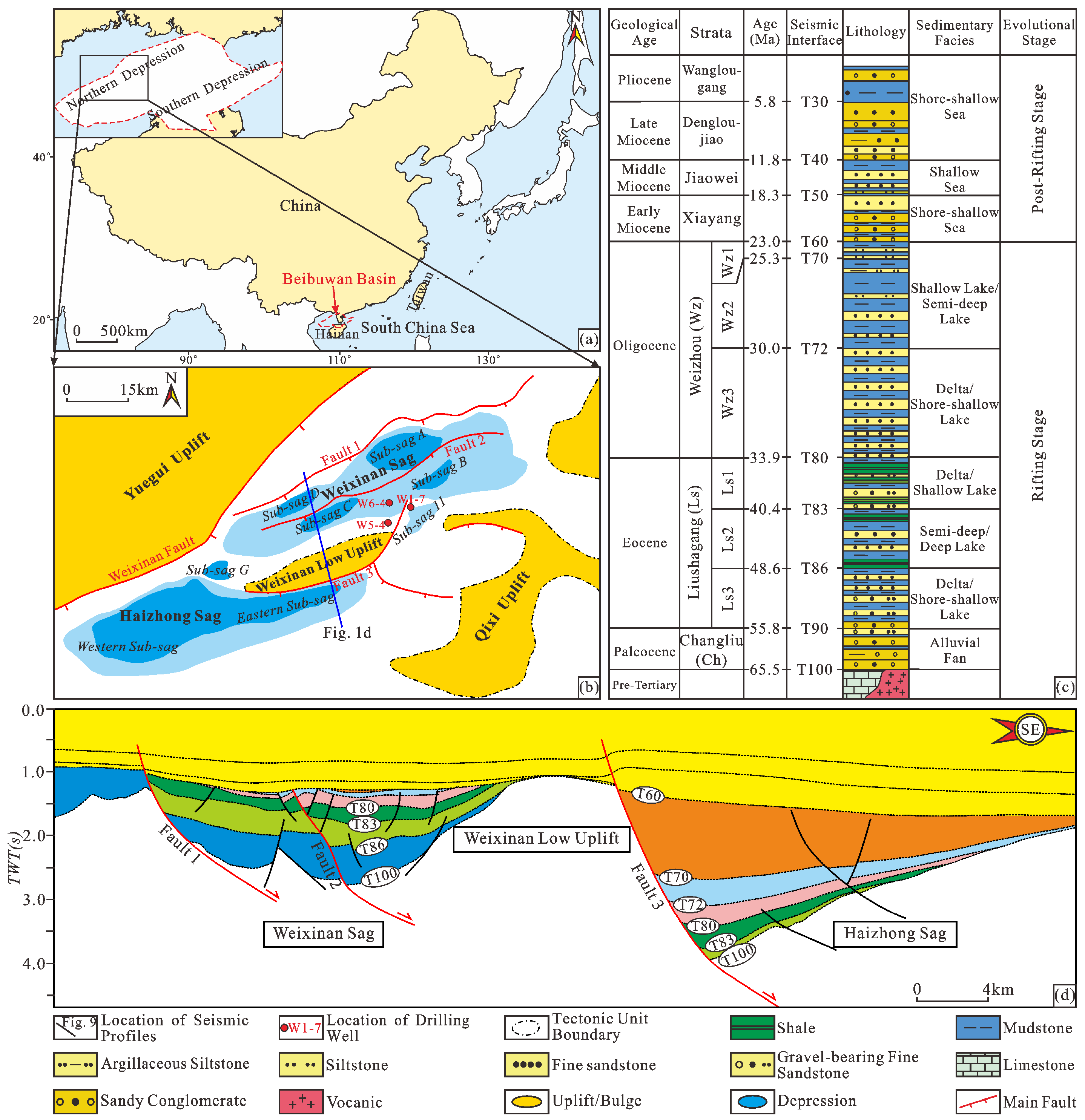
The Beibuwan Basin lies north of the Hainan Uplift and south of the Yuegui Uplift, with a total area of 3.98 × 10⁴ km2 [14,15,16]. The basin exhibits “two sags sandwiching one uplift” and is divided from north to south into three secondary structural units, such as the Northern Depression Zone, Qixi Uplift, and the Southern Depression Zone [17,18] (Figure 1a). The Northern Depression Zone constitutes a key exploration target for oil and gas in the basin, and is further subdivided into the Weixinan Low Uplift, Weixinan Sag, and Haizhong Sag. Extending roughly in a NEE direction in the center of the Northern Depression Zone, the Weixinan Low Uplift separates the northern Weixinan Sag (containing Sub-sag A, Sub-sag B, and Sub-sag 11, etc.) from the southern Haizhong Sag (containing Eastern Sub-sag and Western Sub-sag) (Figure 1b). Driven by the activity of multi-level and multi-episodic faults, the Weixinan Low Uplift exhibits complex structures. Its evolutionary history, particularly the timing of initiation and evolution processes, as well as its spatial extent, has remained a controversial topic [19,20,21,22].
The sedimentary strata in the Northern Depression are sequentially divided from oldest to youngest into the Paleocene Changliu Formation (Ch, 65.5–55.8 Ma), Eocene Liushagang Formation (Ls, 55.8–33.9 Ma), Oligocene Weizhou Formation (Wz, 33.9–23.0 Ma), Lower Miocene Xiayang Formation (23.0–18.3 Ma), Middle Miocene Jiaowei Formation (18.3–11.8 Ma), Upper Miocene Dengloujiao Formation (11.8–5.8 Ma), and Pliocene Wanglougang Formation (5.8–0 Ma) (Figure 1c). Dominated by alluvial fan and fluvial facies, the Changliu Formation was deposited during the initial rifting stage of the Beibuwan basin. The Liushagang Formation is further subdivided into three members: Ls3 Member, Ls2 Member, and Ls1 Member. Specifically, Ls3 Member is characterized by fan delta and shore-shallow lake facies; Ls2 Member is dominated by thick-bedded mudstone-shale deposits of middle-deep lake facies; and Ls1 Member contains fan delta, braided river delta, sublacustrine fan, and shore-shallow lake facies. Based on differences in tectonic activity and lake-level fluctuations, Ls1 Member can be further refined into three evolutionary stages (early, middle, and late), corresponding to the Ls13, Ls12, and Ls11 Sub-members, respectively. The Weizhou Formation is dominated by marine-continental transitional facies such as fan delta, braided river delta, and beach bar, reflecting the basin transition from the rifting stage to the post-rifting stage. Furthermore, the Xiayang, Jiaowei, Dengloujiao, and Wanglougang Formations are mainly composed of shore-shallow marine facies [23,24,25].

3. Dataset and Methods

3.1. Dataset

All datasets used in this study were provided by CNOOC Zhanjiang Branch (Zhanjiang, China), including high-precision 3D seismic, core, drilling-logging, and geochemical datasets covering the Weixinan Low Uplift and its surrounding areas in the Northern Depression. The 3D seismic data were processed via Pre-Stack Time Migration (PSTM) with a frequency range of 30–45 Hz, TWT of ~6 s, and a line spacing of 12.5 m. Covering an area of ~5000 km2 (encompassing the Weixinan Sag and the Eastern Sub-sag of the Haizhong Sag), this seismic dataset enables clear visualization of stratigraphic interfaces, faults, and sedimentary body geometries. Core samples were obtained from 10 wells in the study area, with a total length of ~200 m, which provide direct evidence for the identification of lithologies and sedimentary structures (Table 1). Well logging data include lithological records, well logs, and sediment grain size analysis results from over 300 drill wells, which aid in stratigraphic division and sedimentary facies identification. Geochemical datasets consist of heavy mineral analysis data, primarily used for the discrimination of potential source areas.

3.2. Methods

3.2.1. Tectono-Stratigraphic Framework

Stratigraphic interfaces were dated and characterized using well logging data. High-precision interpretation of 3D seismic data was conducted with DSG software (Version 10ep 5.2). Eight key stratigraphic interfaces in the study area were identified: T100 (65.5 Ma), T90 (55.8 Ma), T86 (48.6 Ma), T83 (40.4 Ma), T80 (33.9 Ma), T72 (30.0 Ma), T70 (25.3 Ma), and T60 (23.0 Ma). Based on these interfaces, a high-precision tectono-stratigraphic framework of the study area was established. Additionally, taking Well W2-3 in the northeastern Weixinan Sag as the constraint well (drilled to a depth of ~3200 m in the Changliu Formation), comprehensive analysis was conducted on 3D seismic profiles and well logging data from over 100 wells. This enabled accurate time-depth conversion, which was essential for subsequent tectonic evolution analysis and quantitative calculations.

3.2.2. Stratigraphic Erosion Amount and Fault Activity Analysis

Building on the high-precision tectono-stratigraphic framework and accurate time-depth conversion results, the stratigraphic trend method was employed to calculate the stratigraphic erosion amount during the Liushagang Formation [26], and the “paleo-throw-distance method” was adopted for fault activity analysis. Specifically, more than 30 sampling points were selected from multiple seismic profiles orthogonal to the strike of Fault 3 and crossing the Weixinan Low Uplift. Seismic time data were converted to depth data via time-depth conversion technology, and the difference in stratigraphic thickness between the hanging wall and footwall of the fault (i.e., paleo-throw) at each sampling point during different sedimentary periods was measured to reflect the activity intensity of Fault 3 [27,28]. The activity characteristics of Fault 3 were systematically analyzed by statistically evaluating the maximum and average paleo-throw of the eastern segment, western segment, and turning point of Fault 3 during each sedimentary period.

3.2.3. Tectonic Paleogeomorphology Reconstruction

Combined with the results of fault activity analysis, residual stratigraphic thicknesses between successive stratigraphic interfaces were extracted from seismic data and drilling-logging stratigraphic data, and residual thickness contour maps covering the study area were constructed. Finally, by superimposing the erosion amount and residual stratigraphic thickness, and integrating basin subsidence history analysis, the tectonic paleogeomorphology of the study area during the Liushagang Formation was reconstructed [29,30].

3.2.4. Provenance Analysis

On the basis of tectonic paleogeomorphology reconstruction, relied on heavy mineral analysis data from numerous drilling samples in the study area, seven most representative heavy minerals (Zircon, Tourmaline, Rutile, Garnet, Hematite-Limonite, Magnetite, and Leucoxene) were selected. The heavy mineral relative content characteristic method and ZTR (Zircon-Tourmaline-Rutile) index method were applied to conduct comprehensive analysis on the sediment input characteristics of potential source areas. Specifically, the relative content characteristic method identifies potential source areas and delineates their influence ranges by tracking the spatial distribution of relative contents of typical heavy minerals [31]. The ZTR index method evaluates the direction of sediment transport based on the ratio of the sum of relative contents of Zircon, Tourmaline, and Rutile to the total amount of transparent heavy minerals [32,33].

3.2.5. Paleodrainage System Reconstruction

Based on the aforementioned source areas discrimination results and tectonic paleogeomorphology characteristics, this study drew on the method proposed by Lu et al. [34] for dividing paleodrainages using lines of structural highs (derived from modern geographical drainage division). Combined with the spatiotemporal distribution patterns of sediment transport pathways in the Weixinan Low Uplift, lines of paleogeomorphological highs were used as the core criterion for dividing boundaries between source areas at all levels, enabling systematic characterization of the paleodrainage systems in the Weixinan Low Uplift and its surrounding areas.

4. Results

4.1. Tectonic Evolution Characteristics

4.1.1. Fault Activity Analysis

Large-scale faults developed in rift basins not only control the tectonic framework of the basin but also affect the “source-to-sink” system and sedimentary filling by developing differential tectonic landforms (e.g., intrabasinal low uplift) [2]. In the Weixinan Low Uplift and its surrounding areas, the fault system was well developed. The NE- and NEE-trending (or nearly EW-trending) faults are relatively large in scale, mostly being basin-controlling or sag-controlling faults, which played a dominant role in the evolution of the Weixinan Low Uplift and changes in tectonic paleogeomorphology. In contrast, the NW-trending faults were mainly Sub-sag-controlling faults, which primarily affect subordinate structural units [35,36,37,38]. There were four major extensional normal faults developed in the study area, namely the Weixinan Fault, Fault 1, Fault 2 and Fault 3. The Weixinan Fault and Fault 1 jointly form the northern boundary of the Northern Depression and were basin-controlling faults that influence the formation and development of the basin (Figure 1b). Fault 2 was located in the northeastern part of the Weixinan Sag and was an en echelon strike-slip fault developed within the sag (Figure 1b) [18,39,40]. Fault 3 was situated in the southern part of the Weixinan Low Uplift and generally presented an arc-shaped convex to the southeast, exerting an important controlling effect on the tectonic evolution of the Weixinan Low Uplift and the Haizhong Sag (Figure 1b).
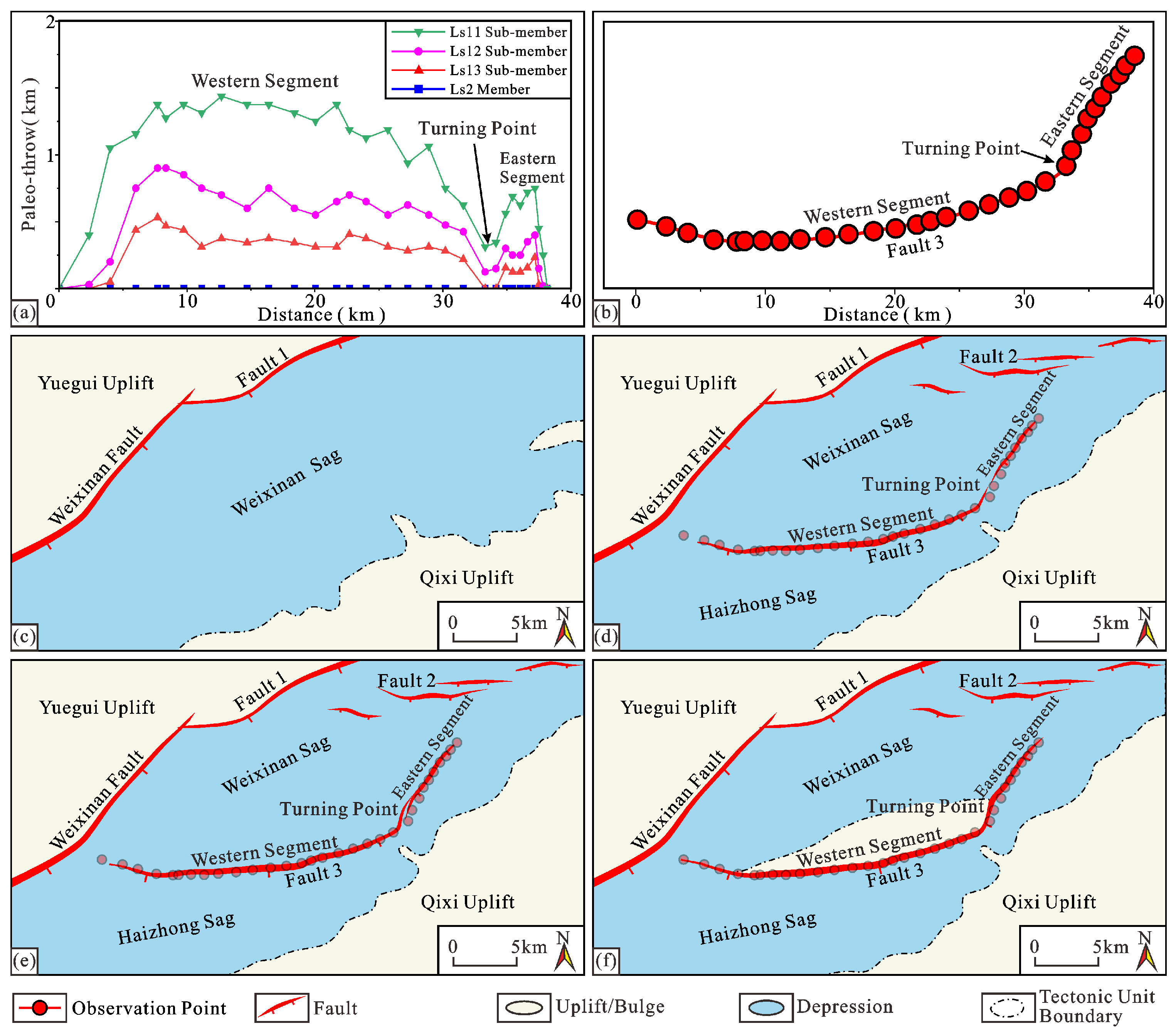
Based on differences in strike, Fault 3 can be further divided into eastern and western segments. The western segment, with an NEE strike, constitutes the main body of Fault 3, while the eastern segment turns to an NE strike. This study conducted a detailed quantitative analysis of the activity of Fault 3 (Figure 2a) and reconstructed the evolutionary process during the different sedimentary periods of the Liushagang Formation.
Before the stage of the Ls1 Member, the paleo-throw values at all sampling points on Fault 3 were 0, indicating that Fault 3 was not yet active (Figure 2c). During the Ls13 Sub-member stage, the maximum paleo-throw value at each sampling point on the western segment of Fault 3 was 0.53 km, with an average of 0.33 km; the maximum paleo-throw at each sampling point on the eastern segment was 0.23 km, with an average of 0.11 km, and the paleo-throw value at the turning point was 0. This indicates initial, segmented development of Fault 3, with greater activity in the western segment (Figure 2d). During the Ls12 Sub-member stage, the maximum paleo-throw value of the western segment of Fault 3 reached 0.89 km, with the average increased to 0.62 km; the maximum paleo-throw value of the eastern segment was 0.41 km, with the average increased to 0.23 km, and the average paleo-throw value at the turning point was 0.14 km. These values demonstrate intensified activity of Fault 3 during this period, and the eastern and western segments were gradually linked (Figure 2e). During the Ls11 Sub-member stage, the maximum paleo-throw value of the western segment of Fault 3 was 1.44 km, with the average increased to 1.11 km; the maximum paleo-throw value of the eastern segment was 0.72 km, with the average increased to 0.48 km, and the average paleo-throw value at the turning point increased to 0.33 km. This indicates that the activity of Fault 3 further intensified during this period, and the eastern and western segments were completely linked (Figure 2f), which exerted a significant impact on the development and distribution of tectonic paleogeomorphologies such as uplifts and sags [41].

4.1.2. Reconstruction of Tectonic Paleogeomorphology

The original geomorphology of a basin was a key controlling factor affecting sedimentary filling [42]. After years of research, scholars have proposed a variety of methods for reconstructing the tectonic paleogeomorphology of basins (e.g., stratigraphic backstripping method, strata denudation quantity restoration method, fault paleo-throw quantitative calculation method, and impression method, etc.). However, different methods have different applicable conditions, and each method has certain limitations [43,44,45,46]. In view of the available dataset and geological characteristics of the study area (characterized by severe strata denudation around the Weixinan Low Uplift), supported by high-precision 3D seismic data and well logging data, the tectonic paleogeomorphology of the study area was reconstructed using the original strata thickness restoration method, which is calculated as the sum of denuded strata thickness and residual strata thickness.
The interval from the Changliu Formation to the Ls3 Member stage was characterized by activity along NE-trending faults (e.g., the Weixinan Fault and Fault 1). Sedimentary strata were restricted to Sub-sag A of the Weixinan Sag and the Western Sub-sag of the Haizhong Sag. During this period, the Weixinan Low Uplift had not yet developed, and this area where it is located showed a nearshore slope, with strata gradually thickening northward (Figure S1).
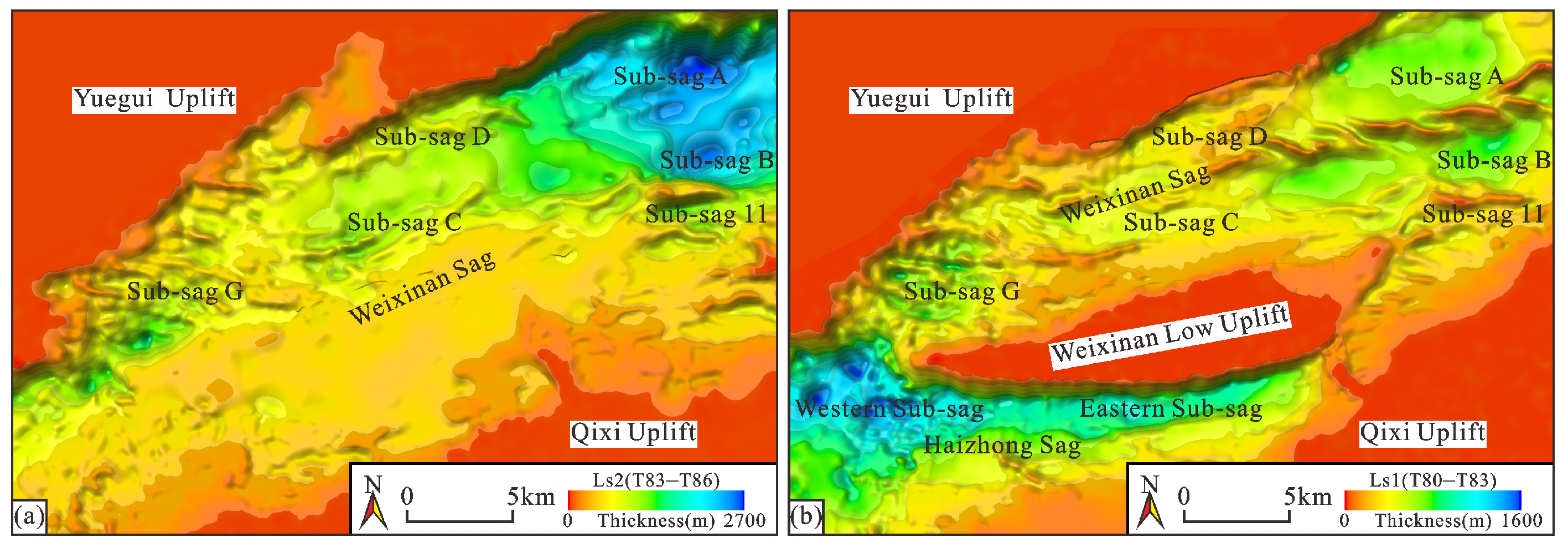
During the Ls2 Member stage, the intense activity of Fault 1 controlled the development of the Weixinan Sag. The scope of the basin expanded significantly, and accompanied by regional lacustrine transgression, a pattern of extensive distribution of semi-deep/deep lake facies was developed. During this period, the nearshore slope at the location of the Weixinan Low Uplift gradually evolved into a gently inclined subaqueous slope (Figure 3a).
In the Ls13 Sub-member stage, Fault 3 initiated, with activity concentrated in its western segment, triggering differential subsidence across the fault. The hanging wall of the Fault 3 subsided rapidly, leading to the gradual development of the Eastern Sub-sag of the Haizhong Sag; and the footwall of the Fault 3 gradually tilted upward. Furthermore, the activity of the eastern segment of the fault was relatively weak, and a transfer slope was developed in the transition zone between the eastern and western segments.
During the Ls12 Sub-member stage, Fault 3 was characterized by sustained activity with increased intensity, and its eastern and western segments were gradually linked. Controlled by this fault activity, the Eastern Sub-sag of the Haizhong Sag, located on the hanging wall of Fault 3, expanded progressively in scale, while the footwall of Fault 3 was further uplifted to develop a subaqueous low uplift.
In the Ls11 Sub-member stage, Fault 3 underwent a further intensification of activity. This intense tectonic activity drove rapid tilting, uplift, and eventual subaerial exposure of the fault’s footwall, developing the Weixinan Low Uplift—a half-horst bounded and controlled by the Fault 3. Meanwhile, the hanging wall of Fault 3 experienced strong subsidence, which triggered the rapid expansion of the Eastern Sub-sag of the Haizhong Sag. By this stage, the Weixinan Sag and Haizhong Sag were essentially separated by this newly emergent half-horst low uplift, establishing the definitive geomorphic framework of “two sags sandwiching one uplift” in the Northern Depression (Figure 3b).

4.2. Reconstruction of the “Source-to-Sink” Systems

The local “source-to-sink” system is an important form of material transport and sediment accumulation within a basin. The differential paleogeomorphology controlled by fault activity exerts a significant influence on its development [2,47]. Based on the restoration of the tectonic evolution process of the Weixinan Low Uplift and its surrounding areas, this study conducted analyses including the identification of potential source areas, the detailed characterization of sediment transport pathways, and the spatiotemporal evolution characteristics of sedimentary systems. The aim is to reconstruct the “source-to-sink” system of the Weixinan Low Uplift and its surrounding areas.

4.2.1. Identification of Potential Source Areas

Comprehensive comparative analysis of detrital zircon U-Pb geochronology and basement lithology indicates that the main source areas of the Northern Depression in the Beibuwan Basin are the Yuegui Uplift (including the Shiwandashan Mountains, Yunkai Block, etc.) in the north and the Qixi Uplift in the south [16,20,48,49,50]. However, in-depth analysis is still needed regarding the redistribution mechanism of clastic materials input from these extrabasinal source areas within the basin, as well as the contribution of small-scale local sources (such as intrabasinal low uplifts) to the “source-to-sink” system.
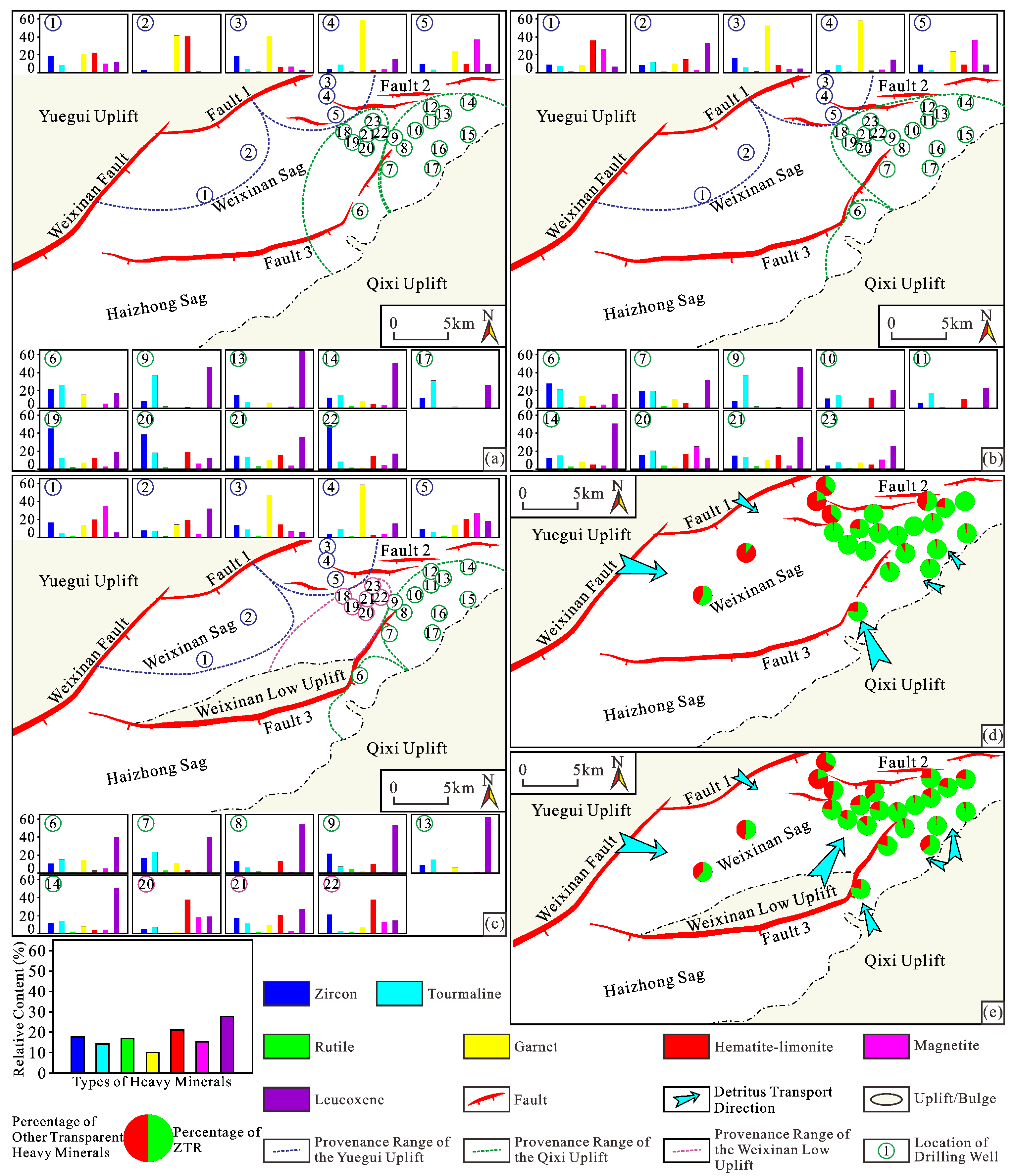
To address the aforementioned research gap, this study analyzed the heavy mineral data of samples from the Ls1 Member in multiple wells within the study area. Significant differences exist in heavy mineral compositions between northern and southern well samples. Among these samples, those from the northern part (Wells 1 to 5) are characterized by high garnet content and low leucoxene content, whereas those from the southern part (Wells 6 to 23) exhibit the opposite characteristics. Combined with previous analyses of basement lithology and detrital zircon dating results in the study area [16,48], two extrabasinal potential source areas were identified: the northern Yuegui Uplift and the southern Qixi Uplift.
Using the identified potential source areas, along with the relative content of various heavy minerals and the distribution trend of the ZTR index, this research further delineated the influence range and approximate transport direction of clastic materials input from extrabasinal source areas into the basin. During the deposition of the Ls1 Member, the relative content of hematite-limonite in samples from Wells 1 and 2 was higher than 18%, while that in samples from Wells 3 to 5 was lower than 15%. Combined with the location of the wells, it is inferred that the sediments in the area of Wells 1 and 2 were supplied by the central source area of the Yuegui Uplift, with clastic materials transported approximately from northwest to southeast; the sediments in the area of Wells 3 to 5 were supplied by the eastern source area of the Yuegui Uplift, with clastic materials transported approximately from north to south. In contrast, the input and distribution of clastic materials supplied by the Qixi Uplift source area within the basin were more complex. During the stage of the Ls13 Sub-member, the relative content of zircon in samples from Wells 6 and 18 to 23 was higher than 17%, while that in samples from Wells 7 to 17 was lower than 14%. It is thus inferred that the sediments in the area of Wells 6 and 18 to 23 were mainly supplied by the central source area of the Qixi Uplift, with clastic materials transported approximately from south to north; the sediments in the area of Wells 7 to 17 were mainly supplied by the eastern source area of the Qixi Uplift, with clastic materials transported approximately from southeast to northwest (Figure 4a,d). In the Ls12 Sub-member stage, the relative content of zircon in samples from Well 6 was approximately 29%, while that in samples from Wells 7 to 23 was lower than 20%. Therefore, it is considered that the sediments in the area of Well 6 were mainly supplied by the central source area of the Qixi Uplift, with clastic materials transported approximately from south to north; the sediments in the area of Wells 7 to 23 were mainly supplied by the eastern source area of the Qixi Uplift, with clastic materials transported approximately from southeast to northwest (Figure 4b). In the Ls11 Sub-member stage, the relative content of hematite-limonite in samples from Wells 18 to 23 was higher than 25%, which was in sharp contrast to other surrounding wells where hematite-limonite was almost absent. As mentioned earlier, during the deposition of the Ls11 Sub-member, the Weixinan Low Uplift had been exposed above the water surface, and Wells 18 to 23 were just adjacent to the tilted termination on the eastern side of the Weixinan Low Uplift. This suggests that sediments in this area were primarily sourced from the newly exposed Weixinan Low Uplift at this time, with clastic materials transported approximately from southwest to northeast (Figure 4c,e).

4.2.2. Sediment Transport Pathways

Sediment transport pathways serve as the critical link between source areas and sedimentary sinks. Their accurate identification clarifies transport paths and helps elucidate the mechanism by which tectonic activities influence the types of transport pathways through modifying paleogeomorphology, thereby providing a scientific basis for predicting the distribution of sandbodies.
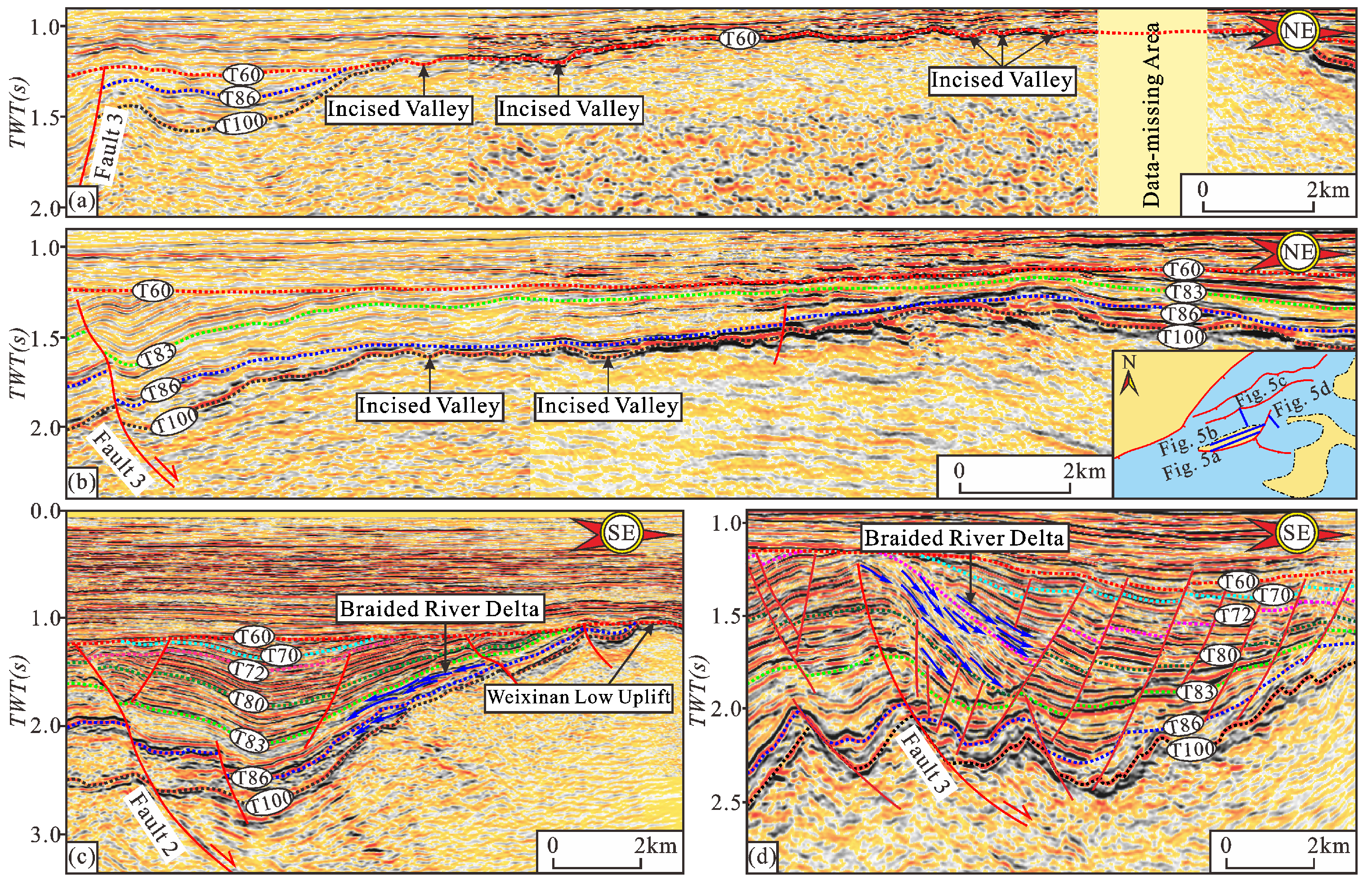
Detailed seismic facies interpretation reveals three main types of sediment transport pathways—incised valleys, fault troughs, and slope belts—can be identified in the Weixinan Low Uplift and its surrounding areas. Incised valleys are mainly distributed on the northern and western sides of the Weixinan Low Uplift and were developed throughout the Liushagang Formation. Their morphological characteristics exhibit significant differences across different structural locations. On the upper-middle part of the slope, due to the large overall uplift amplitude of the strata and the steep slope gradient, the original strata were strongly modified by fluvial erosion. On seismic profiles, the incised valleys typically show V-shaped features with clear boundaries and prominent down-cutting and lateral erosion (Figure 5a). On the lower-middle part of the slope, the uplift amplitude of the strata decreases, the slope gradient becomes gentle, and the fluvial erosion capacity weakens significantly. On seismic profiles, the incised valleys then exhibit broad and gentle U-shaped or W-shaped features (Figure 5b).
Fault troughs are mainly distributed on the northwestern side of the Weixinan Low Uplift. A series of secondary faults obliquely intersecting the strike of the Weixinan Fault develop in this area and jointly form the fault troughs. During the Liushagang Formation, clastic materials from the source area of the Yuegui Uplift were mainly transported southeastward along this transport channel and accumulated in the basin.
Slope belts of various types are widely developed in all directions around the Weixinan Low Uplift. Fault-controlled steep slope belts are mainly distributed along the southern margin of the Weixinan Low Uplift, their formation is primarily controlled by the intense activity of Fault 3. Due to the close distance to the source area and significant topographic relief, fan deltas are mainly developed on them. Gentle slope belts mainly distributed on the northern part of the Weixinan Low Uplift, they are gently inclined slopes developed under the background of relatively weak tectonic activity, and are dominated by the development of braided river delta (Figure 5c). Flexural slope break belts mainly distributed on the northeastern part of the Weixinan Low Uplift. They are developed by the flexure of the overlying strata caused by the gradual weakening of the activity of the eastern segment of Fault 3, which eventually evolved into concealed activity. These belts control the transport and accumulation of clastic materials from the source area on the eastern side of the Weixinan Low Uplift (Figure 5d).

4.2.3. Distribution of Paleodrainage Systems in the Weixinan Low Uplift and Its Surroundings

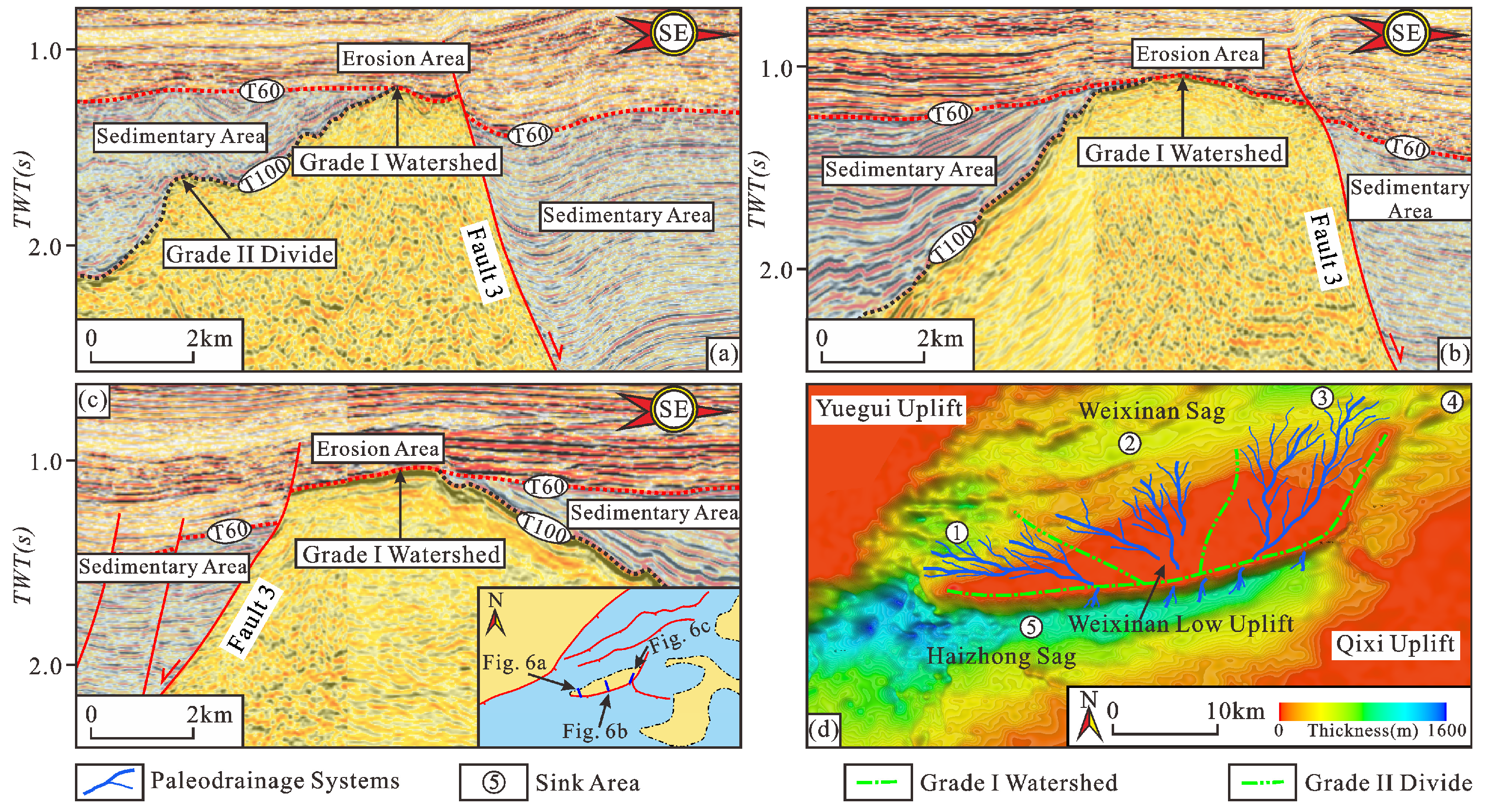
Applying the paleodrainage division concept of Lu et al. [34], this research identified the grade I watershed in the Weixinan Low Uplift by tracing the line connecting the highest points along the east–west axis, and this watershed further divided the surrounding drainage systems into two major drainage areas (northern and southern) with roughly opposite water flow directions.
The northern drainage area of the Weixinan Low Uplift corresponds to the gentle slope belt, featuring an open terrain and a wide convergence range of drainage systems, thus developing the northern grade I source area. The southern drainage area of the Weixinan Low Uplift corresponds to the steep slope belt, where the distribution range of drainage systems is limited due to the strong constraint of boundary faults, thus developing the southern grade I source area. Within the two major grade I source areas, grade II divides were delineated based on the connecting lines of secondary tectonic high points to separate the secondary basins controlled by individual water flows. The secondary tectonic high points on the northern gentle slope belt of the Weixinan Low Uplift are easy to identify, and the distribution characteristics of sediment transport pathways such as incised valleys are clear, allowing the division of three grade II source areas. Combined with the spatial distribution characteristics of microtopography, Sink areas 1–4 were further divided on the lower part of the northern gentle slope belt of the Weixinan Low Uplift. In contrast, the development characteristics of secondary tectonic high points on the southern steep slope belt of the Weixinan Low Uplift are not obvious, making it difficult to clearly define the grade II divide. Therefore, the lower part of the southern steep slope belt was collectively divided into Sink area 5 (Figure 6).

4.2.4. Spatiotemporal Distribution Characteristics of Sandbodies on the Periphery of the Weixinan Low Uplift

To verify the spatiotemporal matching relationship between sediment supply from source areas and sandbody accumulation in sink areas within the “source-to-sink” system, this research finely characterized the spatiotemporal distribution characteristics of sandbodies during each sedimentary period of the Ls2 Member and Ls1 Member in the Weixinan Low Uplift and its surrounding areas, based on sandbody thickness statistics from multiple drill wells.
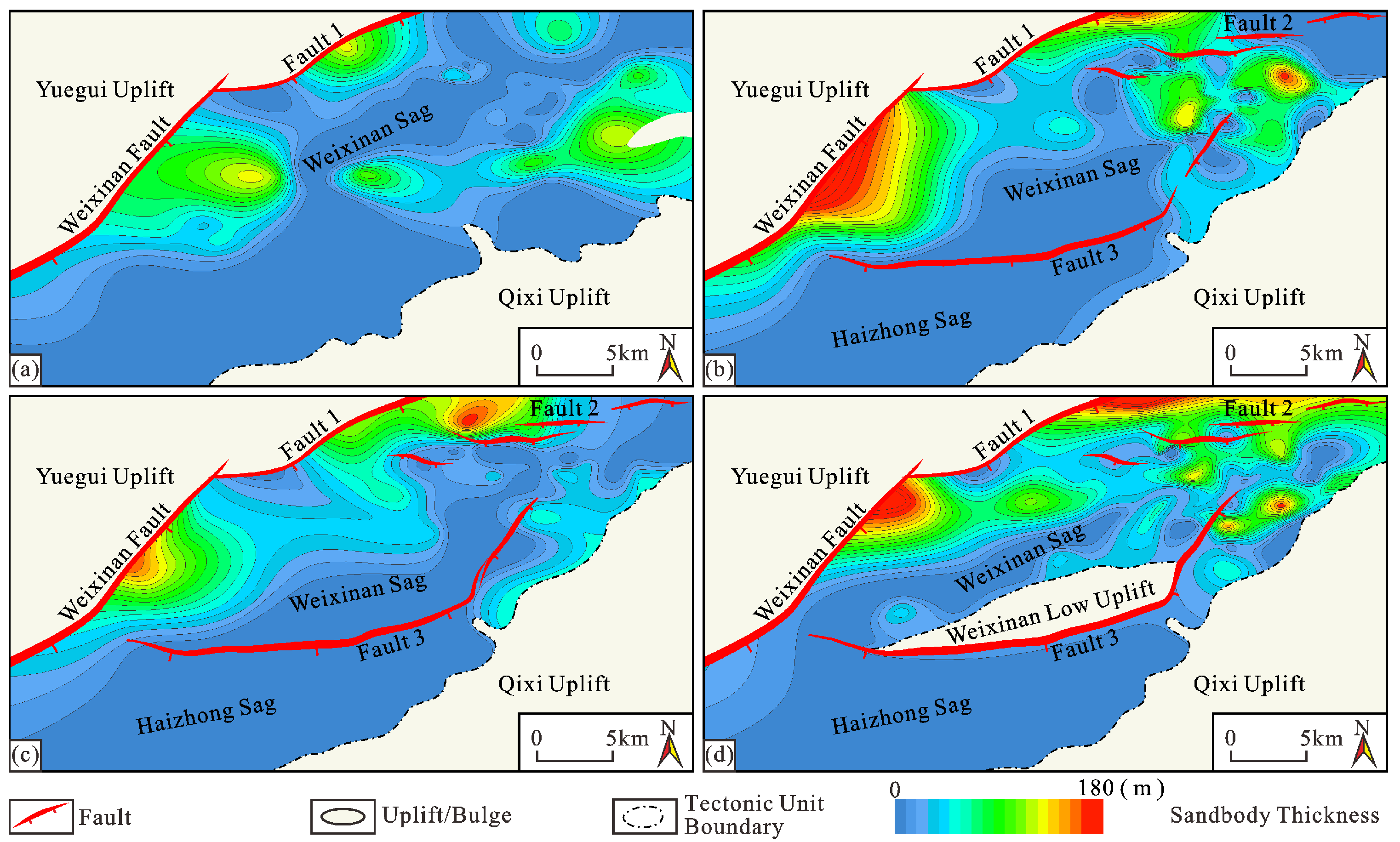
During the Ls2 Member stage, a large-scale lacustrine transgression occurred in the study area, with sandbodies distributed in a scattered and thin-bedded pattern (Figure 7a). The sandbody thickness centers on the northern part are mainly distributed on the hanging wall of the eastern segment of the Weixinan Fault and the root of the hanging wall of the western segment of Fault 1; these sandbodies were supplied and accumulated by sources from the eastern and central parts of the Yuegui Uplift, transported southward and southeastward. The sandbody thickness centers on the southern part are mainly distributed on the eastern slope belt of the Qixi Uplift; they were supplied and accumulated by sediments from the Qixi Uplift, transported toward the north. In addition, extremely thin-bedded sandbodies are sporadically distributed in the center of the Weixinan Sag. It is inferred that these sandbodies were developed by the small-scale northward transportation and accumulation of sediments from the central source area of the Qixi Uplift along the subaqueous slope.
During the Ls13 Sub-member stage, sandbodies in the study area were distributed in thick and continuous layers (Figure 7b). The northern sandbody thickness centers persisted and were distributed on the hanging wall east of the Weixinan Fault and at the root of the hanging wall on the western segment of Fault 1, with a significantly expanded distribution range (extending farthest to the center of the Weixinan Sag), indicating enhanced sediment supply from the Yuegui Uplift at this time. The southern sandbody thickness centers were inherited and distributed on the eastern slope of the Qixi Uplift, with sediments from the Qixi Uplift continuously supplied northward and the supply intensity increased. The most prominent feature of this period was the accumulation of thick-bedded sandbodies (with a maximum thickness of 120 m) in the sag center near the termination of the eastern segment of Fault 3. It is inferred that sediments from the central part of the Qixi Uplift were transported and accumulated northeastward along the transfer zone between the eastern and western segments of Fault 3 at this stage.
In the Ls12 Sub-member stage, the thickness of sandbodies in the study area decreased significantly (Figure 7c). Although the sandbodies supplied by the central source area of the Yuegui Uplift continued to advance eastward, their lateral distribution range narrowed remarkably, indicating weakened sediment supply and reduced sediment input from the Yuegui Uplift at this time. The sandbodies supplied by the Qixi Uplift source area still advanced northward, but their overall thickness thinned significantly, developing only in a small range on the hanging wall of the eastern segment of Fault 3 and its surroundings. This reflects a notable decline in the sediment supply capacity of the Qixi Uplift compared with the previous stage.
During the Ls11 Sub-member stage, sandbodies in the study area were again distributed in thick and continuous layers (Figure 7d). The sandbodies supplied by the Yuegui Uplift source area further expanded on the hanging wall east of the Weixinan Fault and continued to advance eastward, reflecting the renewed enhancement of sediment supply from the Yuegui Uplift. The sandbodies supplied by the eastern source area of the Qixi Uplift continuously prograded northward along the eastern slope, and the sandbodies in the Weixinan Sag center thickened significantly. Small-medium-sized sandbodies gradually developed on the northern and eastern gentle slope belts of the Weixinan Low Uplift. The sandbodies developed on the eastern part are mainly distributed along the northeast direction, extending as far as the Sub-sag on the northeastern side of the Weixinan Low Uplift, and converging with sandbodies from other directions within the sag.

4.3. Sedimentary Responses of the Ls1 Member

Based on the aforementioned reconstruction of the “source-to-sink” system in the study area and its surroundings, combined with a comprehensive analysis of core facies, logging facies, and seismic facies, this research further identified the main types of sedimentary systems in the Ls1 Member of the study area, clarified the spatiotemporal distribution characteristics of the sedimentary systems, and analyzed the evolutionary patterns of the sedimentary systems.

4.3.1. Single-Well Sedimentary Characteristics

1.
Sedimentary Characteristics of Well W1-7
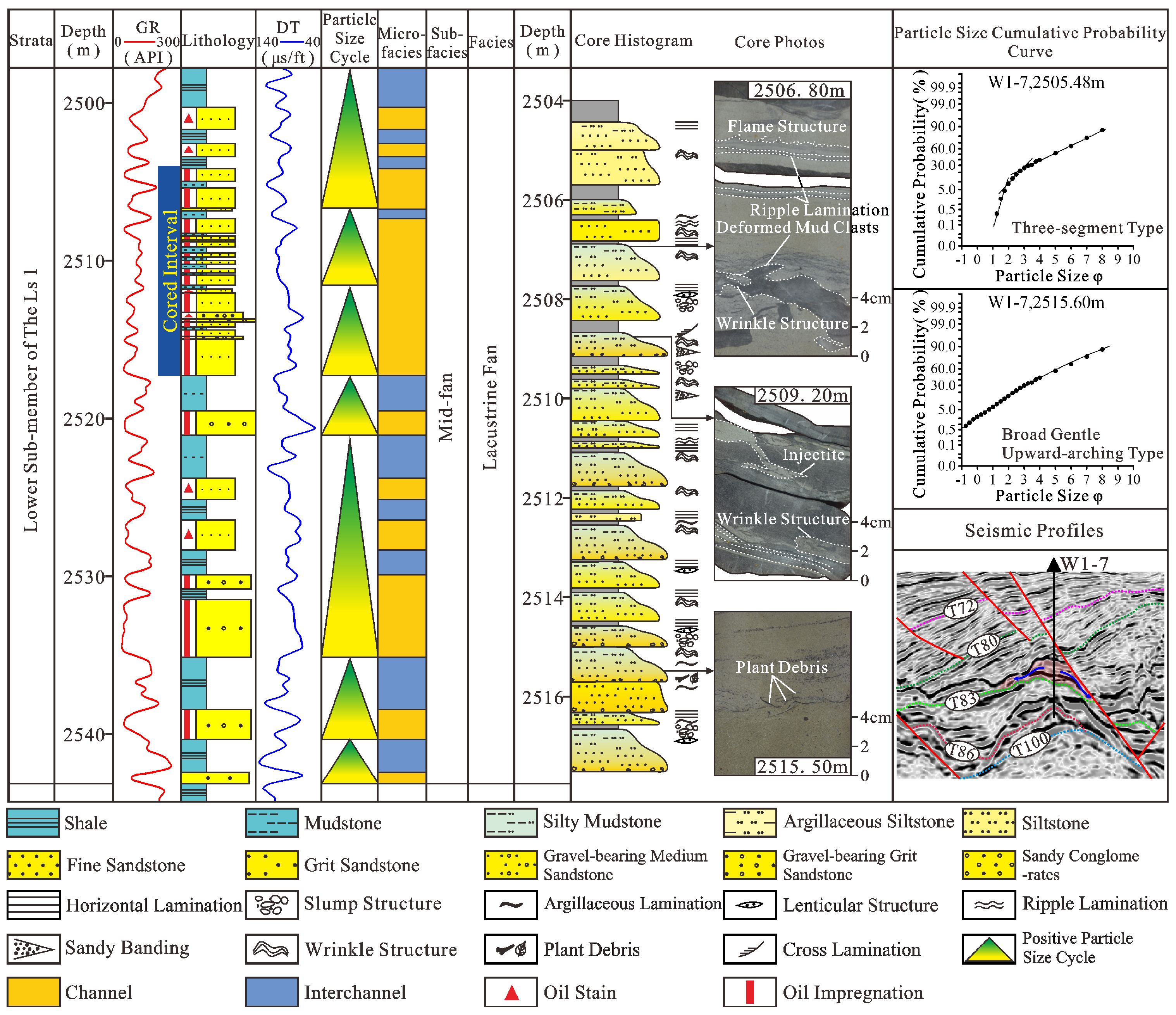
Well W1-7 is located on the hanging wall at the terminal of the eastern segment of Fault 3 (Figure 1b). Seismic profiles show that a set of sedimentary bodies with a mounded shape and obvious bidirectional downlap reflections are developed in the Ls13 Sub-member in this well area, with internal characteristics of medium-high frequency, medium amplitude, and moderate continuity (Figure 8). Logging data indicate that in the Ls13 Sub-member: The lithology of the lower part is dominated by gravel-bearing grit sandstone and grit sandstone; The middle part transitions to fine sandstone and gravel-bearing medium sandstone; The upper part is mainly composed of fine sandstone. Overall, it presents a positive particle size cycle that becomes finer upward. The GR curve is mainly characterized by the superposition of multiple serrated box shapes and bell shapes.
The cored interval of 2504.10–2517.52 m in Well W1-7 show that multiple sets of vertically superimposed Bouma sequence Tc~Te intervals are developed in the Ls13 Sub-member. The Tc interval is dominated by gray fine sandstone, mostly with massive structure, and contains a small amount of plant detritus. The Td interval is mainly composed of gray argillaceous siltstone and silty mudstone, with developed wrinkle structures, deformed mud clasts, etc., and ripple laminations and flame structures are visible. The Te interval is dominated by gray-black mudstone, with extensive development of horizontal laminations and ripple laminations, and injectites and isolated sandy lenses can be observed inside (Figure 8 and Figure S2). The cumulative probability curves of sediment grain size mainly show two types: the three-segment type and the broad gentle upward-arching type. The particle size is concentrated in the range of 4Φ and above, and the slope of each component is small. Comprehensive analysis of the above characteristics indicates that the Ls13 Sub-member in this cored interval of Well W1-7 is dominated by sand-rich sublacustrine fan reworked by traction currents.
2.
Sedimentary Characteristics of Well W5-4
Well W5-4 is located on the middle part of the eastern slope of the Weixinan Low Uplift (Figure 1b). On the seismic profile, the Ls11 Sub-member in this well area generally presents a wedge-shaped sedimentary body with foreset reflection characteristics, and the interior shows medium-low frequency, weak amplitude, and weak continuity reflection features. Logging data indicate that the Ls11 Sub-member in this well has relatively fine particle size, mainly composed of interbedded fine sandstone, shale and mudstone. The GR curve is mainly finger-shaped or funnel-shaped.
The 1505.00–1512.56 m cored interval of Well W5-4 show that multiple reverse grain size cycles (coarsening-upward) were developed in the Ls11 Sub-member. The middle and lower parts of the cycles consist of fine sandstone and siltstone with massive structure; the sandstone contains gray-black argillaceous laminations and argillaceous bands, with parallel laminations and ripple laminations developed, and small-scale cross laminations locally visible. A small amount of gravel is found at the top of the cycles, with good sorting and rounding. The above sedimentary characteristics indicate that the Ls11 Sub-member in Well W5-4 developed a typical braided river delta river mouth bar microfacies.
3.
Sedimentary Characteristics of Well W6-4
Well W6-4 is located on the lower part of the eastern slope of the Weixinan Low Uplift (Figure 1b). The 2190.50–2228.78 m cored interval of Well W6-4 show that the Ls13 Sub-member is mainly composed of mixed accumulations of brown sandy conglomerates and gray-black mudstone. The interface between sandy conglomerates and mudstone presents a high-dip sliding surface, and a large number of slump structures, convolute laminations, and wrinkle structures are observed around the sliding surface. The cumulative probability curves of sediment grain size are mainly of the two-segment type, with particle sizes concentrated below 4Φ and small slopes of each component. The above sedimentary characteristics indicate that the Ls13 Sub-member in Well W6-4 mainly developed gravel-rich sublacustrine fans with typical gravity flow characteristics.

4.3.2. Connected Well Profile Sedimentary Characteristics

Connected well profiles are important means to reveal the spatiotemporal distribution and evolutionary laws of sedimentary systems. This research connected well profiles with multiple strikes in the study area were selected to conduct lateral correlation analysis of sedimentary systems. Research shows that during the Ls1 Member, sedimentary systems such as braided river deltas and sublacustrine fans were mainly developed in the study area, but their development characteristics vary significantly in different directions and different intervals. The following focuses on the detailed elaboration of the NE-trending connected well profile, which extends from the southern basin margin, passes through the northeastern slope of the Weixinan Low Uplift, and reaches Sub-sag B of the Weixinan Sag (Figure 9).
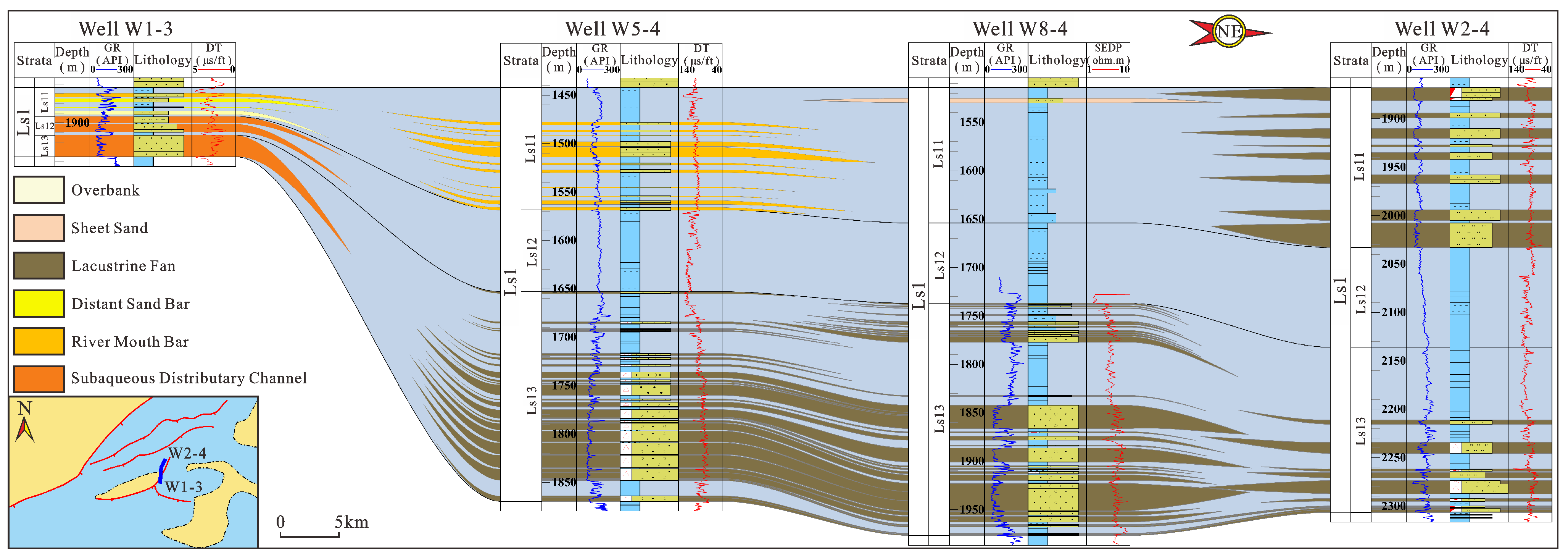
During the Ls13 Sub-member stage, the lithology of the lower interval of Well W1-3 (close to the southern basin margin) is dominated by thick-bedded fine sandstone, and the GR curve is mainly characterized by medium-amplitude serrated box shapes, which is inferred to be distributary channel deposits located on the flank of the main channel of the subaqueous distributary channel on the braided river delta front. The lithology of the lower interval of Well W5-4 (situated on the middle part of the eastern slope of the Weixinan Low Uplift) is dominated by sandy conglomerates, transitioning upward to mudstone interbedded with gravel-bearing medium sandstone; the lower part of the GR curve is mainly medium-high amplitude weakly serrated box shapes, while the upper part consists of low-amplitude serrated curves interspersed with finger shapes. For Well W8-4 (located on the middle-lower part of the eastern slope of the Weixinan Low Uplift), the lithology of the lower interval is dominated by gravel-bearing fine sandstone, and the upper interval is thick-bedded mudstone interbedded with thin-bedded gravel-bearing fine sandstone; the lower part of the GR curve is mainly medium-high amplitude serrated box shapes, and the curves corresponding to the sandstone in the upper interval are serrated bell shapes and finger shapes. As for Well W2-4 (located on the lower part of the eastern slope of the Weixinan Low Uplift), the lithology of the lower interval is dominated by sand-mud interbeds with a very small amount of gravel, and the upper interval is mainly mud and shale deposits; the lower part of the GR curve is mainly finger-shaped, while the upper part is nearly flat or low-amplitude serrated curves. The above characteristics indicate that Wells W5-4, W8-4 and W2-4 all developed sublacustrine fans in a semi-deep/deep lake setting. Laterally, sediment grain size fines and sandbodies thickness decreases toward the basin center. Vertically, all three wells show upward-fining trends, indicating waning sediment supply, possibly with a late-stage pulse from local sources (e.g., Well W8-4).
In the Ls12 Sub-member stage, Well W1-3 is dominated by thin-bedded argillaceous siltstone and argillaceous fine sandstone, with particle size gradually becoming finer from bottom to top; the GR curve is medium-low amplitude serrated bell shapes, indicating the inherited development of subaqueous distributary channel deposits on the braided river delta front. Wells W5-4, W8-4, and W2-4 mainly develop thick-bedded mud and shale deposits, with nearly flat GR curves. The above characteristics indicate that the sediment supply capacity was extremely weak during this period, and only small-scale braided river delta deposits were developed in areas near the basin margin.
During the Ls11 Sub-member stage, Well W1-3 is dominated by argillaceous siltstone, fine sandstone, and mudstone, with particle size gradually becoming coarser from bottom to top; the overall GR curve is funnel-shaped, indicating the development of river mouth bar and distant sand bar microfacies on the braided river delta front. The lower part of Well W5-4 is dominated by mud and shale, with a gradual increase in fine sandstone upward; the GR curve gradually changes from nearly flat in the lower part to multiple superimposed funnel shapes in the upper part, thus inferred to be river mouth bar deposits on the braided river delta front. Well W8-4 is mainly composed of mud and shale, with thin-bedded argillaceous siltstone interbedded at the top, thus inferred to be sheet sand deposits in the prodelta. Well W2-4 is mainly composed of mudstone interbedded with siltstone and fine sandstone; the GR curve is a superposition of bell shapes and serrated box shapes, showing typical sublacustrine fan characteristics. The above characteristics indicate that multi-layer fine sandstone deposits supplied by a new source area appeared on the middle part of the slope (Well W5-4 area), which is inferred to possibly come from the Weixinan Low Uplift. Clastic materials were transported northeastward along the eastern slope of the Weixinan Low Uplift, developing a braided river delta on the middle part of the slope and sublacustrine fans on the lower part of the slope.

5. Discussion

5.1. Activity of Fault 3 and Tectonic Evolution of the Weixinan Low Uplift

For continental rift basins, the activity of their main faults not only shapes the tectonic framework of the basin, but also directly controls the development and evolution of secondary tectonic units [51,52]. Regarding studies on the evolution of normal faults in an extensional tectonic setting, the academic community has established two classic growth models based on the spatiotemporal coupling between the lateral extensional length and vertical displacement of faults, namely the isolated fault growth model and the constant-length fault growth model [53,54,55,56,57].
As the major boundary fault separating the Weixinan Sag and the Haizhong Sag, the evolution of Fault 3 has long been a research focus. Li et al. [58] stated that Fault 3 exhibited typical segmented activity characteristics during the paleogene depositional stage: temporally, it showed an evolutionary pattern of strong activity during the Liushagang Formation depositional stage and weak activity during the Weizhou Formation depositional stage; spatially, the activity intensity of the eastern segment was significantly higher than that of the western segment. Zhang et al. [15] and Zheng and Ge [59] suggested that Fault 3 was basically undeveloped or only experienced weak activity during the depositional stage from the Changliu Formation to the Liushagang Formation. During the depositional stage of the Weizhou Formation, the intense activity of Fault 3 directly resulted in the strong tilted uplift of the Weixinan Low Uplift. Zhang et al. [20] argued that the tilted structural geometry of the Weixinan Low Uplift, which was characterized by a gentle northern slope and a steep southern slope, and its development and tectonic evolution were mainly controlled by Fault 3. Li et al. [18] proposed that Fault 3 is an inherited boundary fault that initiated in the initial rifting stage, and underwent continuous extensional activity throughout the depositional stage of the Liushagang Formation. Hu et al. [35] concluded that Fault 3 had roughly reached its ultimate constant length in the initial active stage, and its subsequent evolution was dominated by the continuous increase in vertical displacement.
Based on the quantitative analysis of the paleo-throw of Fault 3 and the reconstruction results of the tectonic paleogeomorphology of the Weixinan Low Uplift and its surrounding areas, this study suggests that Fault 3 mainly follows the isolated fault growth model during its evolution. The evolutionary process shows that Fault 3 was nearly inactive during the depositional stage of the Ls2 Member, and only initiated activity gradually during the depositional stage of the Ls13 Sub-member, thereby controlling the tectonic evolution of the Weixinan Low Uplift.

5.2. “Source-to-Sink” Evolution of the Weixinan Low Uplift and Its Surrounding Areas

The dynamic evolution of tectonic paleogeomorphology is a key factor controlling the evolution of source systems, the transition of sediment transport pathways, and the spatiotemporal distribution of sedimentary systems, thereby exerting a critical impact on the evolution of “source-to-sink” systems [1,47,60,61]. Numerous studies on continental rift basins have demonstrated that the dynamic changes in the geomorphology and spatial distribution of intrabasinal low uplifts directly restrict the development and evolution of their peripheral “source-to-sink” systems. In particular, when a low uplift is gradually uplifted from subaqueous to subaerial conditions, its attribute changes from a sink area to a source area, thereby completely reshaping the “source-to-sink” systems in its periphery [6,8,9].
As an important tectonic unit in the Northern Depression of the Beibuwan Basin, the “source-to-sink” system of the Weixinan Low Uplift and its surrounding areas has long attracted the attention of scholars. Liu et al. [62] suggested that during the depositional stage of the Liushagang Formation, only local highs of the Weixinan Low Uplift were exposed and eroded, resulting in limited overall provenance supply capacity that could not develop large-scale and continuous clastic supply, and the clastic sediments on the peripheral sags were mainly derived from extrabasinal large-scale uplift areas. Zhang et al. [20] and Jin [63] argued that the Weixinan Low Uplift was only exposed subaerially during the depositional stage of the Ls3 Member and the Ls1 Member, and could act as an effective provenance to supply clastic sediments to the peripheral sags. In contrast, during the depositional stage of the Ls2 Member, the Weixinan Low Uplift was entirely submerged subaqueously and did not possess the geological conditions for sediment supply. Li et al. [18] proposed that the Weixinan Low Uplift was developed in the initial rifting stage, remained in an exposed and denudational state throughout the depositional stage of the Liushagang Formation, and could provide stable clastic sediment supply to the peripheral sags. Liu [16] concluded that the Yuegui Uplift, Qixi Uplift, and Weixinan Low Uplift all supplied clastic sediments to the eastern sag adjacent to the Weixinan Low Uplift during the depositional stage of the Ls1 Member, and sediments from different sources were superimposed in the center of the sag.
Through the analysis of the spatiotemporal evolution of the “source-to-sink” system and sedimentary systems in the Weixinan Low Uplift and its surrounding areas, this study reconstructed the dynamic evolutionary processes of the “source-to-sink” system in the study area. The results show that the study area was mainly supplied by two major extrabasinal source areas during the Ls2 Member stage, namely the Yuegui Uplift and the Qixi Uplift. In this period, the lake basin had a large extent due to the regional lake transgression, while the supply capacity of extrabasinal source areas was weak, resulting in a short transport distance of clastic sediments. The clastic sediments were mainly concentrated and distributed adjacent to the basin margin. In the Ls13 Sub-member stage, the clastic supply capacity of the extrabasinal source areas was enhanced. Clastic sediments supplied by the central provenance of the Qixi Uplift were transported and deposited northeastward along the transfer zone developed between the eastern and western segments of Fault 3. In the Ls12 Sub-member stage, the clastic supply capacity of the extrabasinal source areas was slightly weakened compared with the Ls13 Sub-member stage. At this time, the transport pathway of clastic sediments from the central Qixi Uplift provenance was blocked by the gradually uplifting subaqueous Weixinan Low Uplift. The sediments were only deposited on the hanging wall of the eastern segment of Fault 3 due to the deflection of sediment transportation direction. In the Ls11 Sub-member stage, the Weixinan Low Uplift was exposed subaerially, became a significant intrabasinal source area, and began to supply clastic sediments to its eastern and northern margins, thus altering the overall “source-to-sink” systems and the spatiotemporal distribution of sedimentary systems in the study area.

5.3. Spatiotemporal Distribution and Evolutionary Characteristics of Sedimentary Systems

Integrating the analysis of sedimentary characteristics from single wells and well correlation profiles, detailed interpretation of high-precision 3D seismic data, and the results of the “source-to-sink” process analysis, this research precisely depicted the spatiotemporal distribution and evolutionary characteristics of sedimentary systems in the Weixinan Low Uplift and its surroundings during the depositional stage of the Ls2 Member and Ls1 Member. Research shows that the evolution of the “source-to-sink” systems (including source areas, sediment transport pathways, etc.) and sedimentary systems in the Weixinan Low Uplift and its surroundings are obviously affected by the activity of Fault 3 and the associated paleogeomorphology changes.
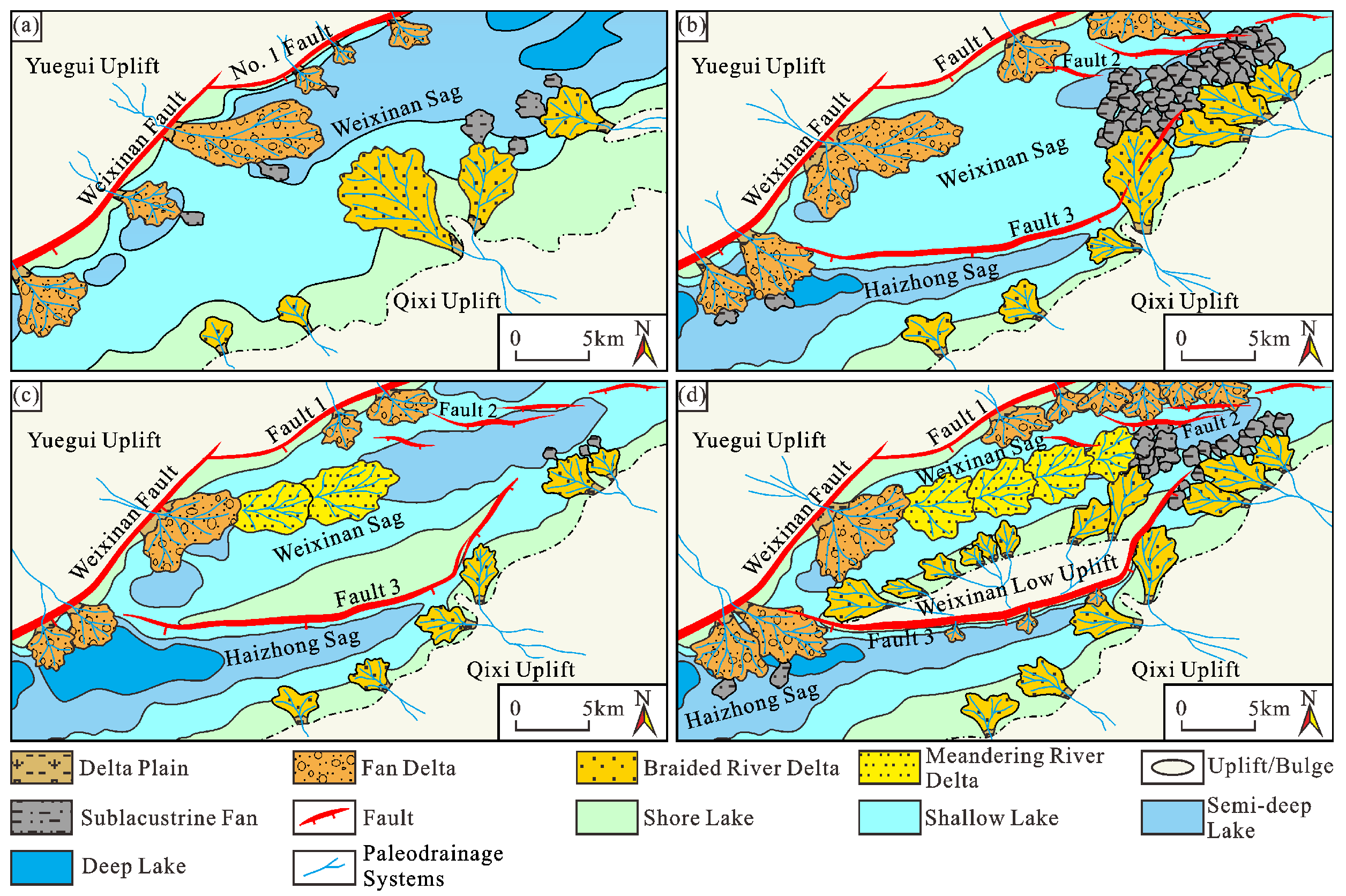
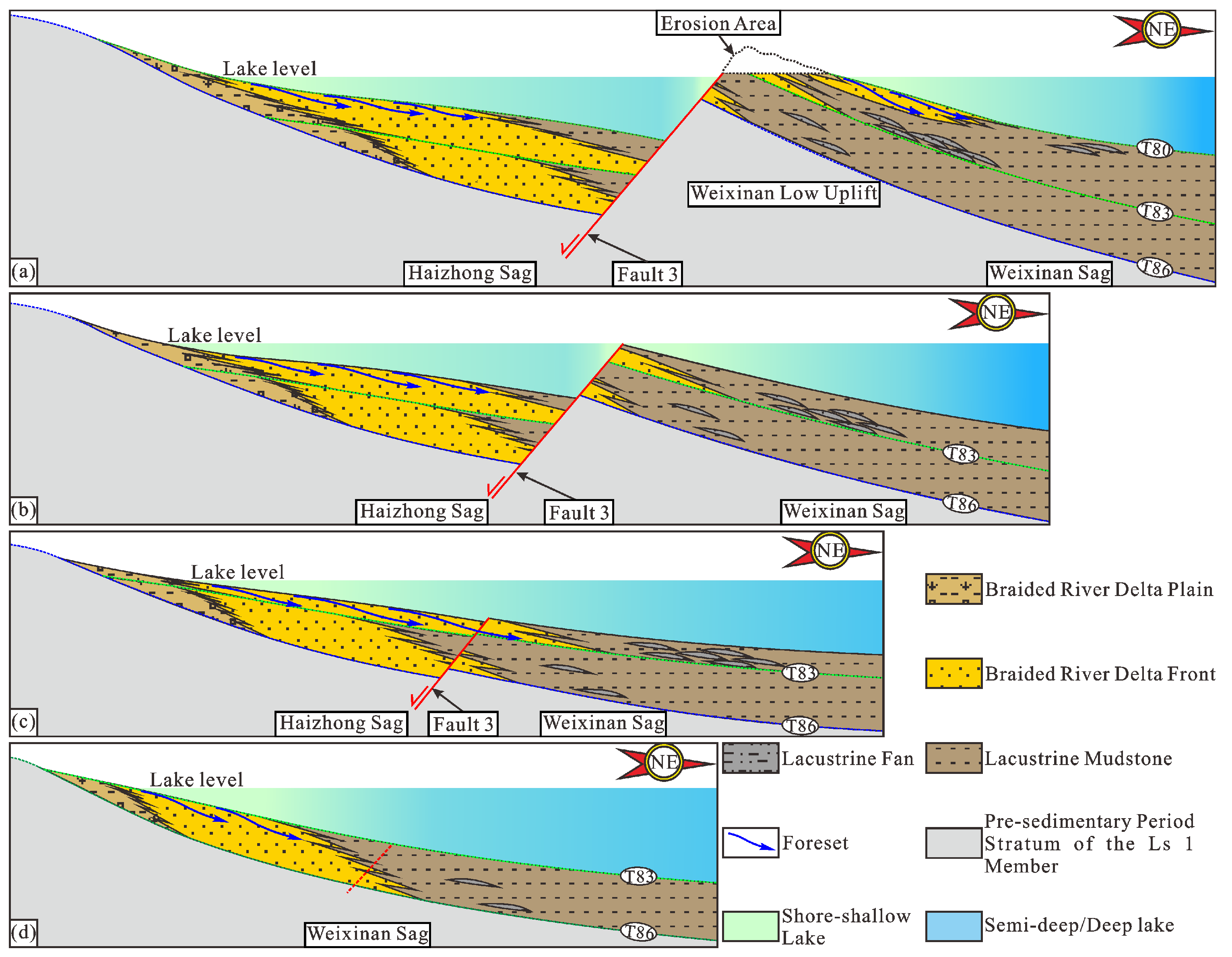
During the Ls2 Member stage, Fault 3 was not yet active, and the study area (the original region of Weixinan Low Uplift development) was characterized by gently inclined subaqueous slope. Semi-deep/deep lake facies were widely distributed in the basin to the north of subaqueous slope (Figure 10a). In this period, clastic materials in the study area were mainly derived from the Yuegui Uplift and Qixi Uplift. The sediments from the Yuegui Uplift were supplied towards southward and southeastward directions, mainly accumulating at the roots of basin-boundary faults (e.g., Weixinan Fault, Fault 1) and developing small-scale fan deltas. The sediments from the Qixi Uplift advanced northward along the gently inclined subaqueous slope, developing small-scale braided river deltas, with small-scale sublacustrine fans developed at the front of the deltas on the middle-lower part of the slope (Figure 11d).
During the Ls13 Sub-member stage, Fault 3 initiated in a segmented manner, with the Weixinan Low Uplift developing a subaqueous embryonic structure and the Eastern Sub-sag of the Haizhong Sag developing synchronously. During this period, the study area was still mainly supplied by the source areas of the Yuegui Uplift and Qixi Uplift. The sediments from the Yuegui Uplift mainly accumulated in the northwestern and northern parts of the study area, developing fan deltas in an inherited manner, with a significant increase in overall scale. The underwater development of the Weixinan Low Uplift altered basin paleogeomorphology, which gradually deflected the transport direction of clastic material from the central Qixi Uplift, developing a braided river delta extending northeastward (Figure 10b and Figure 11c). At the front of the braided river delta, controlled by the activity of Fault 3 and the topography of the underwater low uplift, gravel-rich sublacustrine fans (e.g., Well W5-4 area) dominated by coarse-grained sediments were developed on the middle-lower part of the slope, while sand-rich sublacustrine fans (e.g., Well W8-4 area) were developed on the lower part of the slope (e.g., Sub-sag B, Sub-sag 11). In addition, sediments from the eastern part of the Qixi Uplift continued to be supplied northward, developing braided river deltas in an inherited way, with large-scale sublacustrine fans developed at their front (Figure 10b).
During the Ls12 Sub-member stage, Fault 3 continued to be active and gradually connected, and the low uplift further uplifted underwater and expanded in scale; at the same time, the Eastern Sub-sag of the Haizhong Sag deepened and widened. During this period, accompanied by lacustrine transgression, the distribution range of semi-deep/deep lake facies expanded. The sediments from the Yuegui Uplift continued to develop fan deltas at the northwestern and northern basin margins of the study area, with a significant reduction in overall scale (Figure 10c). The sediments supplied by the central part of the Yuegui Uplift developed a fan delta on the hanging wall of the western segment of the Weixinan Fault; affected by the lacustrine basin floor topography, the sediments continued to advance eastward and gradually evolved into meandering river delta deposits. Under the combined influence of the subaqueous uplift of the low uplift and the expansion of the Eastern Sub-sag of the Haizhong Sag, nearly all sediments from the central Qixi Uplift were trapped, with only a small amount escaping interception, and only small-scale braided river deltas were developed at the edge of the Eastern Sub-sag of the Haizhong Sag (Figure 11b). In addition, a small amount of sediments from the eastern part of the Qixi Uplift were supplied northward, developing small-scale braided river deltas, with small-scale sublacustrine fans developed at their front (Figure 10c).
In the Ls11 Sub-member stage, Fault 3 became more intensely active, causing the Weixinan Low Uplift to eventually uplift and expose above the water surface, and then gradually undergo erosion, thus becoming a new intrabasinal source area. During this period, the Yuegui Uplift and Qixi Uplift still continuously supplied sediments into the lake basin in an inherited manner. Affected by the enhanced source supply capacity, the scale and scope of fan deltas and meandering river deltas developed on the northern part of the study area increased significantly, leading to the re-transport of sediments at the front of the deltas and their final arrival at the sag centers (e.g., Sub-sag A, Sub-sag B), where multiple sets of superimposed sublacustrine fans formed by the convergence of multi-directional sources were developed (Figure 10d). At the same time, due to the influence of topographic differences around the Weixinan Low Uplift, sediments from the Weixinan Low Uplift were mainly transported to the gentle slope belts on the eastern, western, and northern sides of it, developing large-scale braided river deltas (Figure 11a). In contrast, fewer sediments were supplied to the steep slope belt on the southern side of the Weixinan Low Uplift, where only a small number of small-scale fan deltas were developed. In addition, the scale and scope of the braided river delta developed by the northward supply of sediments from the eastern part of the Qixi Uplift also increased significantly, with small-scale sublacustrine fans developed in the sag areas at its front (e.g., Sub-sag B, Sub-sag 11).

6. Conclusions

  • Quantitative analysis of fault activities demonstrates that the evolution of Fault 3 followed the isolated fault growth model during deposition of the Liushagang Formation, and was the fundamental factor governing the evolution of the tectono-sedimentary framework of the Weixinan Low Uplift and its surrounding regions. During the Ls2 Member deposition stage, Fault 3 remained inactive, and the study area was manifested as a gently dipping subaqueous slope which extending towards the northern deep lake. During the Ls1 Member stage, the growth of Fault 3 underwent an evolutionary process of initial segments, gradual linkage, and intense activity, which drove the uplift and subaerial exposure of the Weixinan Low Uplift, and separated the previously unified lacustrine basin into the Weixinan Sag and Haizhong Sag.
  • Reconstruction of the “source-to-sink” systems in the Weixinan Low Uplift and its surrounding areas reveals that clastic sediments in the study area were dominantly supplied by extrabasinal source areas (the Yuegui Uplift and Qixi Uplift) from the Ls2 Member stage to the Ls12 Sub-member stage. In the Ls11 Sub-member stage, the Weixinan Low Uplift was subaerially exposed, subjected to denudation, and evolved into a critical intrabasinal source area which governed the evolution of the “source-to-sink” system and sedimentary systems in the study area together with the extrabasinal source areas (the Yuegui Uplift and Qixi Uplift).
  • The spatiotemporal distribution of sedimentary systems in the study area was characterized by distinct response to the evolution of tectonic paleogeomorphology and “source-to-sink” systems. Prior to the Ls1 Member deposition, fan deltas were developed along the northern and northwestern margins of the Weixinan Sag, while braided river deltas were developed along the southern margin. In the Ls13 Sub-member stage, the Weixinan Low Uplift initiated subaqueous development and deflected the transport direction of clastic sediments which were derived from the central part of the Qixi Uplift, resulting in the development of large-scale lacustrine fans in the eastern subsag centers adjacent to the Weixinan Low Uplift. In the Ls11 Sub-member stage, the Weixinan Low Uplift was subaerially exposed and began to supply clastic sediments to the surrounding subsags. Braided river delta systems were developed on the gentle slope belts along its eastern, western and northern margins, lacustrine fan deposits were deposited in the lower part of the eastern gentle slope belt, and small-scale fan delta systems were developed along the southern steep slope belt.

Supplementary Materials

The following supporting information can be downloaded at: https://www.mdpi.com/article/10.3390/jmse14060554/s1, Figure S1: The tectonic paleogeomorphology of the Weixinan Low Uplift and its surrounding areas during the Ls3 Member; Figure S2: Representative core photographs.

Author Contributions

Conceptualization, J.R. and Y.L.; methodology, Y.L. and D.T.; software, P.J. and Z.S. (Ziyi Sang); validation, P.J., Z.S. (Ziyi Sang) and Z.S. (Zongli Song); formal analysis, P.J.; investigation, Y.L.; resources, J.R.; data curation, P.J., Z.S. (Ziyi Sang) and Z.S. (Zongli Song); writing—original draft preparation, P.J.; writing—review and editing, P.J., Y.L. and D.T.; visualization, P.J. and Z.S. (Zongli Song); supervision, Y.L.; project administration, J.R., Y.L. and D.T.; funding acquisition, J.R., Y.L. and D.T. All authors have read and agreed to the published version of the manuscript.

Funding

This study was supported by the National Natural Science Foundation of China (U19B2007), the Zhanjiang Branch of China National Offshore Oil Corporation.

Data Availability Statement

The accessibility of seismic data is restricted by commercial, industry, and government policies. The seismic data are owned by the Zhanjiang Branch of China National Offshore Oil Corporation.

Acknowledgments

We appreciate Zhanjiang Branch Company of China Offshore Oil Corporation for providing the data and permission to publish this paper. We are also very grateful to the reviewers and editors for their contributions to improving this paper.

Conflicts of Interest

The authors declare that this study received funding from the National Natural Science Foundation of China. The funder was not involved in the study design, collection, analysis, interpretation of data, the writing of this article or the decision to submit it for publication.

References

  1. Zhu, H.T.; Xu, C.G.; Zhu, X.M.; Zeng, H.L.; Jiang, Z.X.; Liu, K.Y. Advances of the Source-to-Sink Units and Coupling Model Research in Continental Basin. Earth Sci. 2017, 42, 1851–1870. [Google Scholar] [CrossRef]
  2. Zhu, X.M.; Liu, Q.H.; Tan, M.X.; Li, S.L.; Chen, H.H.; Nie, Y.L. Comprehensive Investigation of Deep-time Source-to-Sink Systems: Case study of the Shaleitian area. Acta Sedimentol. Sin. 2023, 41, 1781–1797. [Google Scholar] [CrossRef]
  3. Zhu, X.M.; Liu, Q.H.; Tan, M.X.; Chen, H.H. Research Frontier and Development of Source to Sink Systems [OL]. J. Palaeogeogr. 2025, 28, 25–43. [Google Scholar]
  4. Zhu, X.M.; Wang, X.L.; Hu, X.; Wang, X.; Gao, Z.J. Frontiers and Future Prospects of International Sedimentological Research: Review on the 37th International Meeting of Sedimentology. Oil Gas Geol. 2025, 46, 685–704. [Google Scholar] [CrossRef]
  5. Romans, B.W.; Castelltort, S.; Covault, J.A.; Fildani, A.; Walsh, J.P. Environmental signal propagation in sedimentary systems across timescales. Earth-Sci. Rev. 2016, 153, 7–29. [Google Scholar] [CrossRef]
  6. Xu, C.G.; Du, X.F.; Xu, W.; Zhao, M. New advances of the “source-to-sink” system research in sedimentary basin. Oil Gas Geol. 2017, 38, 1–11. [Google Scholar] [CrossRef]
  7. Du, X.F.; Jia, D.H.; Wang, Q.M.; Song, Z.Q. Local provenance system and its oil and gas exploration significance: A case study of the Paleogene in Bohai Sea area. China Offshore Oil Gas 2017, 29, 19–27. [Google Scholar] [CrossRef]
  8. Hu, H.W.; Li, H.Y.; Yu, H.B.; Xiao, S.G.; Xu, W. Quantitative analysis of source-to-sink system controls on sand-body distribution of the Paleogene in Chengbei low uplift and surrounding areas, Bohai Bay Basin. J. Palaeogeogr. 2020, 22, 266–277. [Google Scholar] [CrossRef]
  9. Zhu, H.T.; Xu, C.G.; Du, X.F.; Liu, Q.H.; Sun, Z.H.; Zeng, Z.W. Quantitative reconstruction, hierarchical division and coupling mode establishment for ancient Source-to-Sink systems in continental basins. Oil Gas Geol. 2023, 44, 539–552. [Google Scholar] [CrossRef]
  10. Li, X.S.; Gan, J.; Zhang, Y.C.; Zhang, J.X.; Yang, X.B.; Deng, Y.; Xu, X.D.; Wu, Y.Y. Hydrocarbon accumulation regularity and exploration prospects of fault lacustrine basins in western South China Sea. China Offshore Oil Gas 2015, 27, 22–29. [Google Scholar] [CrossRef]
  11. Man, Y.; Wei, L.; Deng, Y.; Li, W.L.; Hu, D.S.; Ma, X.X.; Yin, J. Oil geochemical and accumulation characterization in the A sag and surrounding oil-bearing structures of the Weixinan depression, Beibuwan Basin. Pet. Sci. Bull. 2022, 7, 155–173. [Google Scholar] [CrossRef]
  12. Deng, Y.; Hu, D.S.; You, J.J.; Man, Y.; Man, X.; Chen, L.; Fu, D.W. Exploration progress and breakthrough directions of crude oil in the western South China Sea. China Offshore Oil Gas 2024, 36, 11–24. [Google Scholar] [CrossRef]
  13. Jiang, D.H.; Yang, P.C.; Cheng, X.T.; Cao, Q.; Yu, Y.Q.; Niu, H.W. Innovative exploration and post-well insights from H3X well in Haizhong Sag of Beibuwan Basin. Pet. Geol. Exp. 2025, 47, 223–234. [Google Scholar] [CrossRef]
  14. Ma, Y.; Li, S.Z.; Liu, X.; Zhao, S.J.; Yu, S.; Wang, X.F.; Zhang, B.K. Formation Mechanism of the Beibuwan Basin, South China. J. Jilin Univ. 2014, 44, 1727–1736. [Google Scholar] [CrossRef]
  15. Zhang, B.T.; Tang, J.Y.; Wang, W.J.; Yin, C.L. Characteristics of Tectonic Sedimentary Evolution in Northern Depression of Beibuwan Basin. Offshore Oil 2014, 34, 7–12. [Google Scholar] [CrossRef]
  16. Liu, S. Multi-level Source-to-Sink System and Reservior-Control Study of the Weixinan Sag in the Beibuwan Basin. Ph.D. Thesis, China University of Geosciences, Wuhan, China, 2023. [Google Scholar]
  17. Liu, E.T.; Wang, H.; Pan, S.Q.; Qin, C.Y.; Jiang, P.; Chen, S.; Yan, D.T.; Lu, X.X.; Jing, Z.H. Architecture and depositional processes of sublacustrine fan systems in structurally active settings: An example from Weixinan Depression, northern South China Sea. Mar. Pet. Geol. 2021, 134, 105380. [Google Scholar] [CrossRef]
  18. Li, C.; Fan, C.W.; Hu, L.; Hu, Q.W.; Chen, L.J. Tectonic evolution characteristics and genesis of Weixinan low uplift in Beibuwan Basin. Mar. Orig. Pet. Geol. 2021, 26, 319–325. [Google Scholar] [CrossRef]
  19. Pei, J.X.; Dong, G.N.; Zhu, Q. Characteristics and petroleum geological significance of lacustrine forced regressive deposits in the 1st Member of Liushagang Formation in Weixinan Sag, Beibuwan Basin. Oil Gas Geol. 2016, 37, 520–527. [Google Scholar] [CrossRef]
  20. Zhang, Q.; Wu, Z.P.; Yan, S.Y.; Liu, Y.M.; Ping, M.M.; Zhang, M.; Hu, L.; Zhang, Y. Structural Characteristics of the Paleogene in the Northern Depression, Beibuwan Basin and Their Control on the Sedimentary Fill. Geol. J. China Univ. 2018, 24, 787–799. [Google Scholar] [CrossRef]
  21. Wu, L.F.; Qu, H.J.; Huang, S.W.; Feng, C.J.; Yao, T.X.; Yao, X.Z. Sedimentary systems and model of the third Member of Weizhou Formation in Haizhong Sag, Beibuwan Basin. Nat. Gas Geosci. 2023, 34, 312–325. [Google Scholar]
  22. Yao, T.X.; Qu, H.J.; Huang, S.W.; Feng, C.J.; Wu, L.F.; Yao, X.Z. Sedimentary system and depositional model of the Second Member of the Liushagang Formation in Haizhong Sag in Beibuwan Basin. Mar. Geol. Front. 2023, 39, 50–62. [Google Scholar] [CrossRef]
  23. Deng, H.W.; Guo, J.Y.; Wang, R.J.; Xie, X.J. Tectono sequence stratigraphic analysis in continental fault basins. Earth Sci. Front. 2008, 2, 1–7. [Google Scholar] [CrossRef]
  24. Li, Z.D.; Bao, C.H.; Wang, D.J.; Zhang, H.X. Controlling effect of structure palaeogeomorphology for sand bodies of Wuerxun—Beier Sag in Hailaer Basin. J. Cent. South Univ. 2016, 47, 2357–2365. [Google Scholar] [CrossRef]
  25. Zhang, Q. Structural-Sedimentary Characteristics and Its Coupling Relationship of Paleogene in Northern Depression, Beibuwan Basin. Master’s Thesis, China University of Petroleum (East China), Qingdao, China, 2019. [Google Scholar] [CrossRef]
  26. Li, K.; Zhao, X.K.; Shen, Z.M.; He, J.J.; Zhang, X.B. Application of trend thickness method in denudation recovery in the Akekule Lobe of Tarim Basin. Comput. Tech. Geophys. Geochem. Explor. 2007, 29, 415–419. [Google Scholar] [CrossRef]
  27. Yan, H.; Luan, X.W.; Li, Z.C.; Ye, C.H.; Wei, X.Y.; He, H.R. Evolution characteristics and genesis of fault-structure in the eastern Andaman Sea depression since the Oligocene. Haiyang Xuebao 2022, 44, 87–99. [Google Scholar] [CrossRef]
  28. Li, K.; Huang, J.J.; Jiang, T.; Yin, J.H.; Dong, R. Comprehensive evaluation of synsedimentary fault activity in Laizhouwan Sag. Pet. Geol. Eng. 2023, 37, 13–20. [Google Scholar] [CrossRef]
  29. Guo, L.B.; Du, X.B.; Li, X.Q. Fault characteristics and reservoir control model of steep slope belt in the Eastern Zhangwu Area. Offshore Oil 2021, 41, 1–10. [Google Scholar] [CrossRef]
  30. Fan, T.T.; Zhou, M.Y.; Guo, Y.Z.; Liu, Y.D.; Cai, Y. Pre-Jurassic palaeogeomorphology characteristics and oil and gas reservoir-forming mode in Hujianshan area of Ordos Basin. China Energy Environ. Prot. 2024, 46, 1–7. [Google Scholar] [CrossRef]
  31. Wang, Q.T.; Zhao, J.Y.; Wang, H.G.; Yang, P.; Yu, X.C.; Zhang, J.H.; Mao, F.S.; Liu, J.Q. Composition and provenance of heavy minerals in surface sediments in the southwestern Bohai Strait. Mar. Geol. Front. 2023, 39, 22–31. [Google Scholar] [CrossRef]
  32. Li, Y.C.; Gong, C.L.; Qiu, X.W.; Qi, P.; He, Y.B.; Yu, Y.X. Source-to-Sink processes and their controls on the reservoirs of the Paleogene Huizhou Sag in Pearl River Mouth Basin. Geol. Rev. 2024, 70, 1403–1418. [Google Scholar] [CrossRef]
  33. Yi, D.H.; Shi, Y.J.; Liu, J.F.; Liu, Y.R.; Li, J.Y.; Wang, A.P.; Ma, Y.K.; Li, H.Z.; Jia, Z.L. Provenance analysis and sedimentary evolution of Oligocene shallow water delta in the Nanbaxian area, northern Qaidam basin. Acta Geol. Sin. 2024, 98, 494–510. [Google Scholar] [CrossRef]
  34. Lu, W.Y.; Zhu, H.T.; Xu, C.G.; Zhang, X.T.; Du, X.F.; Du, J.Y.; Li, S. Methods and Applications of Level Subdivision of Source-to-Sink System. Earth Sci. 2020, 45, 1327–1336. [Google Scholar] [CrossRef]
  35. Hu, C.; Ren, J.Y.; Tong, D.J.; Xu, Y.C.; Wang, Z. Multiphase growth and basin control of main faults on northern sub-basin, Beibuwan Basin, northwestern South China Sea. Mar. Pet. Geol. 2024, 169, 107052. [Google Scholar] [CrossRef]
  36. Wang, Z.; Ren, J.Y.; Hu, C.; Xu, Y.C. Differential extrusion of Indochina-South China Block and its interplay with slab-pull tectonics: Evidence for end-Oligocene basin inversion in the Beibuwan Basin. Tectonics 2025, 44, e2024TC008326. [Google Scholar] [CrossRef]
  37. Qin, C.Y.; Wang, H.; Jiang, P.; Yang, X.B.; Zou, K. Spacial distribution and evolution of axial deltaic system in continental rift basin: A case study of Weixinan sag, Beibuwan Basin. J. China Univ. Min. Technol. 2020, 49, 542–551. [Google Scholar] [CrossRef]
  38. Wang, Z. Late Neogene Multiphase Basin Inversion Structures in NW Margin of South China Sea and Its Formation Mechanisms. Ph.D. Thesis, China University of Geosciences, Wuhan, China, 2024. [Google Scholar] [CrossRef]
  39. Wang, L.F.; Li, W.L.; Shen, L.X.; Liu, Y.Z.; Zeng, C. Analysis on sealing capacity of low-angle faults in Weixinan sag. Nat. Gas Explor. Dev. 2022, 45, 34–40. [Google Scholar] [CrossRef]
  40. Tuo, L.; Liu, H.Y.; Zhou, J.; Zhong, J.; Chen, L.J. Structural characteristics of the Fault 2 zone in Weixinan Sag and its influence on reservoir formation. Complex Hydrocarb. Reserv. 2023, 16, 367–373. [Google Scholar] [CrossRef]
  41. Spahic, D.; Grasemann, B.; Exner, U. Identifying fault segments from 3D fault drag analysis (Vienna Basin, Austria). J. Struct. Geol. 2013, 55, 182–195. [Google Scholar] [CrossRef]
  42. Xu, C.G. Controlling sand principle of source-sink coupling in time and space in continental rift basins: Basic idea, conceptual systems and controlling sand models. China Offshore Oil Gas 2013, 25, 1–11+21+88. [Google Scholar]
  43. Wang, J.H.; Wang, H.; Zhao, Z.X.; Pan, N.N.; Yu, Z. Sequence Stratigraphy in Paleogeomorphy Analysis: An Example from Tahe Oilfield. Earth Sci. 2003, 4, 425–430. [Google Scholar] [CrossRef]
  44. Wu, L.Y.; Chen, C.Q.; Jiang, C.M.; Yan, J.; Li, H.; Yang, X.D. Paleogeomorphic Restoring Techniques in China’s Hydrocarbon Exploration. J. Oil Gas Technol. 2005, 27, 559–560+586. [Google Scholar]
  45. Pang, J.G.; Yang, Y.Y.; Li, W.H.; Li, L.; Wen, Y. Study development of palaeogeomorphology reconstructions in continental facies hydrocarbon basin. J. Xi’an Univ. Sci. Technol. 2013, 33, 424–430. [Google Scholar] [CrossRef]
  46. Xian, B.Z.; Wang, Z.; Ma, L.C.; Chao, C.Z.; Pu, Q.; Jing, A.Y.; Wang, J.H. Paleo-Drainage System and Integrated Paleo-Geomorphology Restoration in Depositional and Erosional Areas: Guantao Formation in East Liaodong Area, Bohai Bay Basin, China. Earth Sci. 2017, 42, 1922–1935. [Google Scholar] [CrossRef]
  47. Liu, Q.H.; Zhu, X.M.; Li, S.L.; Li, H.Y.; Shi, W.L. Pre-Palaeogene Bedrock Distribution and Source-to-Sink System Analysis in the Shaleitian Uplift. Earth Sci. 2016, 41, 1935–1949. [Google Scholar] [CrossRef]
  48. Gong, Y.; Pease, V.; Wang, H.; Gan, H.J.; Liu, E.T.; Ma, Q.L.; Zhao, S.Y.; He, J. Insights into evolution of a rift basin: Provenance of the middle Eocene-lower Oligocene strata of the Beibuwan Basin, South China Sea from detrital zircon. Sediment. Geol. 2021, 419, 105908. [Google Scholar] [CrossRef]
  49. Song, Q.Q.; Hu, J.; Lei, D.; Li, Z.W.; Tang, R.; Hu, S.B. Provenance evolution of the Fushan Sag (Hainan Island, Southern China): Constraints from U-Pb geochronology on detrital zircons. Mar. Pet. Geol. 2024, 168, 107037. [Google Scholar] [CrossRef]
  50. Tan, M.X.; Sun, L.P.; Chen, M.P.; Ge, J.W.; Wang, P.; Ren, P.G. A Source-to-Sink multiproxy analysis of late Eocene regional drainage evolution in the Beibuwan Basin of the South China Sea. Palaeogeogr. Palaeoclimatol. Palaeoecol. 2025, 675, 113081. [Google Scholar] [CrossRef]
  51. Gawthorpe, R.L.; Leeder, M.R. Tectono-sedimentary evolution of active extensional basins. Basin Res. 2000, 12, 195–218. [Google Scholar] [CrossRef]
  52. Ren, J.Y.; Lu, Y.C.; Zhang, Q.L. Forming Mechanism of Structural Slope-Break and Its Control on Sequence Style in Faulted Basin. Earth Sci. 2004, 5, 596–602. [Google Scholar] [CrossRef]
  53. Childs, C.; Manzocchi, T.; Nicol, A.; Walsh, J.J.; Soden, A.M.; Conneally, J.C.; Delogkos, E. The relationship between normal drag, relay ramp aspect ratio and fault zone structure. Geol. Soc. Lond. Spec. Publ. 2016, 439, 355–372. [Google Scholar] [CrossRef]
  54. Whipp, P.S.; Jackson, C.A.L.; Schlische, R.W.; Withjack, M.; Gawthorpe, R.L. Spatial distribution and evolution of fault-segment boundary types in rift systems: Observations from experimental clay models. Geol. Soc. Lond. Spec. Publ. 2016, 439, 79–107. [Google Scholar] [CrossRef]
  55. Nicol, A.; Childs, C.; Walsh, J.J.; Manzocchi, T.; Schopfer, M.P.J. Interactions and growth of faults in an outcrop-scale system. Geol. Soc. Lond. Spec. Publ. 2016, 439, 23–39. [Google Scholar] [CrossRef]
  56. Jackson, C.A.L.; Bell, R.E.; Rotevatn, A.; Tvedt, A.B.M. Techniques to determine the kinematics of synsedimentary normal faults and implications for fault growth models. Geol. Soc. Lond. Spec. Publ. 2016, 439, 187–217. [Google Scholar] [CrossRef]
  57. Rotevatn, A.; Jackson, C.A.L.; Tvedt, A.B.M.; Bell, R.E.; Blakkan, I. How do normal faults grow? J. Struct. Geol. 2018, 125, 174–184. [Google Scholar] [CrossRef]
  58. Li, S.Q.; Niu, H.W.; Zheng, J.; Jiang, P.; Huang, J.J. Discussion on Sedimentary Relationship between Weixinan Sag and Haizhong Sag during Paleogene Period in Beibuwan Basin. Offshore Oil 2012, 32, 1–6. [Google Scholar] [CrossRef]
  59. Zheng, J.; Ge, X. Activities of the Major Faults and Their Control on Deposition in Haizhong Depression, Beibuwan Basin. Offshore Oil 2014, 34, 1–6. [Google Scholar] [CrossRef]
  60. Catuneanu, O. Model-independent sequence stratigraphy. Earth-Sci. Rev. 2018, 188, 312–388. [Google Scholar] [CrossRef]
  61. Xu, C.G.; Du, X.F.; Pang, X.J.; Wang, Q.M.; Pan, W.J. The source-sink system and its control on large-area lithologic reservoirs of the lower Minghuazhen Formation in the southern Bohai Sea. J. Geomech. 2022, 28, 728–742. [Google Scholar] [CrossRef]
  62. Liu, Y.M.; Hu, L.; Zhang, Q.; Wu, Z.P.; Yan, S.Y.; Zhang, Y.; Ping, M.M.; Zhang, M.; Guo, T.T.; Chen, M.M. Structure characteristics of Weixinan sag during Liushagang-2 member to Liushagang-1 member depositional stage and its control on sedimentary fill. J. Northeast Pet. Univ. 2018, 42, 52–61+8–9. [Google Scholar] [CrossRef]
  63. Jin, J.H. “Source-to-Sink” System and Sandbody-Controlling Model of the Liushagang Formation in the Weixinan Sag, Beibuwan Basin. Ph.D. Thesis, China University of Petroleum, Qingdao, China, 2020. [Google Scholar]
Figure 1. Structural units and tectonic-stratigraphic framework of the Northern Depression of the Beibuwan Basin [14,15,16,17,18,19,20]. (a) Location of the Beibuwan Basin in China. (b) Major structural units of the Weixinan Low Uplift and its surrounding areas. (c) Tectono-stratigraphic chart of the Beibuwan Basin. (d) Tectono-stratigraphic profile of the Weixinan Low Uplift, Weixinan Sag and Haizhong Sag.
Jmse 14 00554 g001
Figure 2. Analysis of activity characteristics of the Weixinan Low Uplift and its surrounding faults. (a) Paleo-throw-distance diagram of Fault 3. (b) Locations of sampling points of Fault 3. (c) Major faults in the Ls2 Member stage. (d) Major faults in the Ls13 Sub-member stage. (e) Major faults in the Ls12 Sub-member stage. (f) Major faults in the Ls11 Sub-member stage.
Jmse 14 00554 g002
Figure 3. The tectonic paleogeomorphology of the Weixinan Low Uplift and its surrounding areas. (a) Ls2 Member. (b) Ls1 Member.
Jmse 14 00554 g003
Figure 4. Characteristics of relative heavy mineral content and ZTR index of the Ls1 Member in the periphery of the Weixinan Low Uplift. (a) Relative heavy mineral content distribution of the Ls13 Sub-member. (b) Relative heavy mineral content distribution of the Ls12 Sub-member. (c) Relative heavy mineral content distribution of the Ls11 Sub-member. (d) ZTR index distribution of the Ls13 Sub-member. (e) ZTR index distribution of the Ls11 Sub-member.
Jmse 14 00554 g004
Figure 5. Typical seismic reflection characters of sediment transport pathways in the Weixinan Low Uplift and its surrounding areas. (a) Incised valley on the upper-middle part of the northern margin of the Weixinan Low Uplift. (b) Incised valley on the lower-middle part of the northern margin of the Weixinan Low Uplift. (c) Gentle slope zone on the northern part of the Weixinan Low Uplift. (d) Flexural slope break zone on the northeastern part of the Weixinan Low Uplift. Blue arrows (c,d) indicate the foreset reflections of braided river deltas.
Jmse 14 00554 g005
Figure 6. Division of watersheds and paleodrainage systems on the Weixinan Low Uplift. (a) Western watershed on the Weixinan Low Uplift. (b) Middle watershed on the Weixinan Low Uplift. (c) Eastern watershed on the Weixinan Low Uplift. (d) Paleodrainage system distribution of the Ls11 Sub-member.
Jmse 14 00554 g006
Figure 7. Spatial distribution of sandbodies on the Weixinan Low Uplift and its surrounding areas. (a) Ls2 Member. (b) Ls13 Sub-member. (c) Ls12 Sub-member. (d) Ls11 Sub-member.
Jmse 14 00554 g007
Figure 8. Characteristics of logging, core, sediment grain size, and cross-well seismic profile from Well W1-7.
Jmse 14 00554 g008
Figure 9. Well correlation profile of the Ls1 Member, from the southern basin margin to Sub-sag B, Weixinan Sag.
Jmse 14 00554 g009
Figure 10. Distribution of sedimentary facies in different sedimentary periods of the Weixinan Low Uplift and its surrounding areas. (a) Ls2 Member. (b) Ls13 Sub-member. (c) Ls12 Sub-member. (d) Ls11 Sub-member.
Jmse 14 00554 g010
Figure 11. Tectono-sedimentary models for different periods of the Weixinan Low Uplift. (a) Ls11 Sub-member depositional stage. (b) Ls12 Sub-member depositional stage. (c) Ls13 Sub-member depositional stage. (d) Ls2 Member depositional stage.
Jmse 14 00554 g011
Table 1. Basic information of cored wells used in this study.
Well NameCore IntervalsStrata
W1-12682.37–2688.62 mLs3
2715.45–2730.80 mLs3
2897.00–2915.00 mLs3
2932.00–2939.70 mLs3
2569.00–2572.70 mLs3
W1-42603.35–2606.76 mLs3
W1-72504.10–2517.52 mLs1
W1-10X1836.20–1845.30 mLs2
W2-12658.00–2701.87 mLs3
W2-41868.00–1869.27 mLs1
1876.00–1877.75 mLs1
W2-72082.61–2091.96 mLs2
2574.30–2583.36 mLs3
W2-82985.38–2989.29 mLs3
3001.34–3008.23 mLs3
W5-41505.00–1512.56 mLs1
W6-42190.50–2228.78 mLs1
Disclaimer/Publisher’s Note: The statements, opinions and data contained in all publications are solely those of the individual author(s) and contributor(s) and not of MDPI and/or the editor(s). MDPI and/or the editor(s) disclaim responsibility for any injury to people or property resulting from any ideas, methods, instructions or products referred to in the content.