Article

Numerical Investigation of the Hydrodynamic and Aerodynamic Responses of NREL 5 MW Monopile and Jacket Wind Turbines to the Draupner Wave


by
Leila Mokhberioskouei
1,*,
Barış Namlı
1 and
Cihan Bayındır
1,2
1
Engineering Faculty, Istanbul Technical University, Sarıyer, Istanbul 34469, Türkiye
2
Engineering Faculty, Boğaziçi University, Bebek, Istanbul 34342, Türkiye
*
Author to whom correspondence should be addressed.
J. Mar. Sci. Eng. 2026, 14(6), 551; https://doi.org/10.3390/jmse14060551
Submission received: 11 November 2025 / Revised: 13 March 2026 / Accepted: 13 March 2026 / Published: 15 March 2026

Abstract

Offshore wind energy is an attractive renewable energy source due to its advantages. However, the chaotic marine environment makes the analysis of offshore wind energy extremely difficult. Furthermore, studying the behavior of wind turbines under rare and hazardous natural events such as rogue waves is crucial for the safety and operation of wind turbines and the platforms mounted on them. Therefore, this study numerically investigates the aerodynamic, hydrodynamic, and structural properties of the National Renewable Energy Laboratory (NREL) 5 MW wind turbines under the effect of the Draupner wave, the first marine rogue wave ever recorded. To this end, the geometric and structural information of the NREL 5 MW wind turbines mounted on monopile and jacket platforms is explained. The characteristics of the Draupner wave and the variations in its wave height time series are investigated. The recorded wave height time series values are imported into the QBlade program, and the dynamics of NREL 5MW monopile and jacket wind turbines are simulated. Based on the simulation data, the aerodynamic, hydrodynamic, and structural properties of these structures are examined and analyzed. The results demonstrate that Draupner waves have a significant effect on the aerodynamic, hydrodynamic, and structural parameters of the wind turbines. These parameters are observed to reach their highest values, particularly between the 250th and 280th seconds, when the Draupner wave height reaches its peak. Our findings indicate that the jacket structure experienced higher total forces due to its larger wetted surface area and geometric complexity, while the monopile foundation showed higher inertial loading in the X-direction because of its larger added mass. Additionally, we observed that total aerodynamic power generation is significantly affected by the passage of the Draupner rogue wave. We discuss our findings and their limitations. This numerical study is intended to be a milestone for researchers working on the structural health of offshore wind turbines and platforms under the effect of rogue waves.

1. Introduction

As global energy demand continues to rise, a variety of energy sources are being utilized to fulfill this need. Among these sources, wind energy is gaining popularity as a renewable option. It is especially valued for the stronger wind speeds found offshore and the absence of natural formations or structures that could obstruct the wind. Floating Offshore Wind Turbine (FOWT) structures are key devices employed to harness wind energy in offshore settings. These structures convert a portion of wind energy into electricity. However, it is also essential to consider how environmental factors affect these structures and how they respond to such challenging conditions. One of the most critical factors impacting FOWT structures is the occurrence of rogue waves. The presence of rogue waves can cause damage to FOWT structures and hinder their functionality. As a result, the influence of rogue waves on FOWTs is a topic of significant interest, both in industrial and academic circles. Research has been carried out on the effects of rogue waves on FOWT structures in existing literature. In a study by Li et al., the response of a floating wind turbine and its mooring system to a rogue wave was explored [1]. To conduct this analysis, computational fluid dynamics (CFD) along with the finite element method (FEM) was employed in the study [1]. The dynamic response of a wind turbine subjected to rogue waves was examined in a study conducted by Meng et al. [2]. This research utilized a novel 15 MW FOWT that was equipped with a specific heave plate and low-ballast (SHLB) system [2]. Li et al.’s study investigated the dynamic responses of a wind turbine situated on a semisubmersible platform in relation to the mooring system, particularly in response to rogue wave impacts, employing CFD and FEM methodologies [3]. Meanwhile, Zeng et al. conducted experimental investigations into the dynamic responses of in-place FOWT structures due to rogue wave impacts [4]. In their study, Zhong et al. looked into the dynamic responses of the IEA 15 MW wind turbine mounted on the VolturnUS-S semi-submersible platform under the influence of rogue waves, using CFD and finite element mooring line modeling techniques [5]. Thomas et al. examined the effects of a rogue wave acting on an FOWT positioned on a SPAR platform [6]. This investigation utilized potential flow theory within a time-domain framework [6].
Various methods and software are employed to assess the response of wind turbines. Among these tools are QBlade 2.0.8, ANSYS 2026 R1, OpenFAST v4.2.1, and Simulator for Wind Farm Applications (SOWFA 2.0.x). QBlade, in particular, has been widely referenced in academic literature due to its user-friendliness, speed, and dependability. In a research study by Namli et al., the aerodynamic, hydrodynamic, and structural characteristics of an NREL 5 MW wind turbine positioned on a monopile platform were analyzed in relation to tsunami wave influences using QBlade [7]. The investigation by Marten et al. included comparisons with the Mexico experiment [8], the NREL Phase VI experiment [9], and other relevant studies in the literature utilizing the QBlade software [10]. This research demonstrated that the outcomes achieved with QBlade were consistent with the experimental data [10]. Barber and Nordborg′s study compared the simulated results of a vertical wind turbine through QBlade with those obtained from wind tunnel tests [11]. In Koç et al.’s research, the design and simulation of a small horizontal wind turbine were carried out using both XFoil and QBlade [12]. The findings were then compared to simulation results generated through ANSYS Fluent, which analyzed and modeled the same turbine [12]. Husaru et al. examined the impact of varying yaw angles on the performance of the horizontal wind turbine using the QBlade software [13]. Alaskari et al. investigated the aerodynamic characteristics of a small wind turbine employing the QBlade program [14]. In a study by Szczerba and colleagues, the effects of blade pitch angles were studied both numerically and experimentally [15]. This analysis was performed using an H-type vertical wind turbine and the QBlade software [15].
This research examines the aerodynamic, hydrodynamic, and structural characteristics of NREL 5 MW wind turbines placed on monopile and jacket foundations in response to the Draupner wave. To our best knowledge, this work is the first to directly apply the verified, real-world Draupner wave time series to conduct a comparative, coupled aero-hydrodynamic analysis between two distinct, industry-standard fixed-bottom foundation types (monopile and jacket). For this purpose, in our study, we use the QBlade-based BEM–Morison framework. We aim to investigate the chaotic time series behavior of the Draupner wave and especially its effects on the offshore turbine mechanics. The information, methods, and results presented below aim to provide insights into the design of offshore wind turbines and platforms affected by the interaction of realistic rogue waves with structures. Methodology section covers the properties of the recorded Draupner rogue wave and characteristics of the NREL 5 MW wind turbines as well as a brief summary of the QBlade’s solver, results and discussion section includes our finding and their discussion.

2. Methodology

This section provides details regarding the Draupner wave data that was utilized, along with the geometric and structural characteristics of wind turbines, and outlines the methods employed to assess both aerodynamic and hydrodynamic properties.

2.1. Draupner Wave

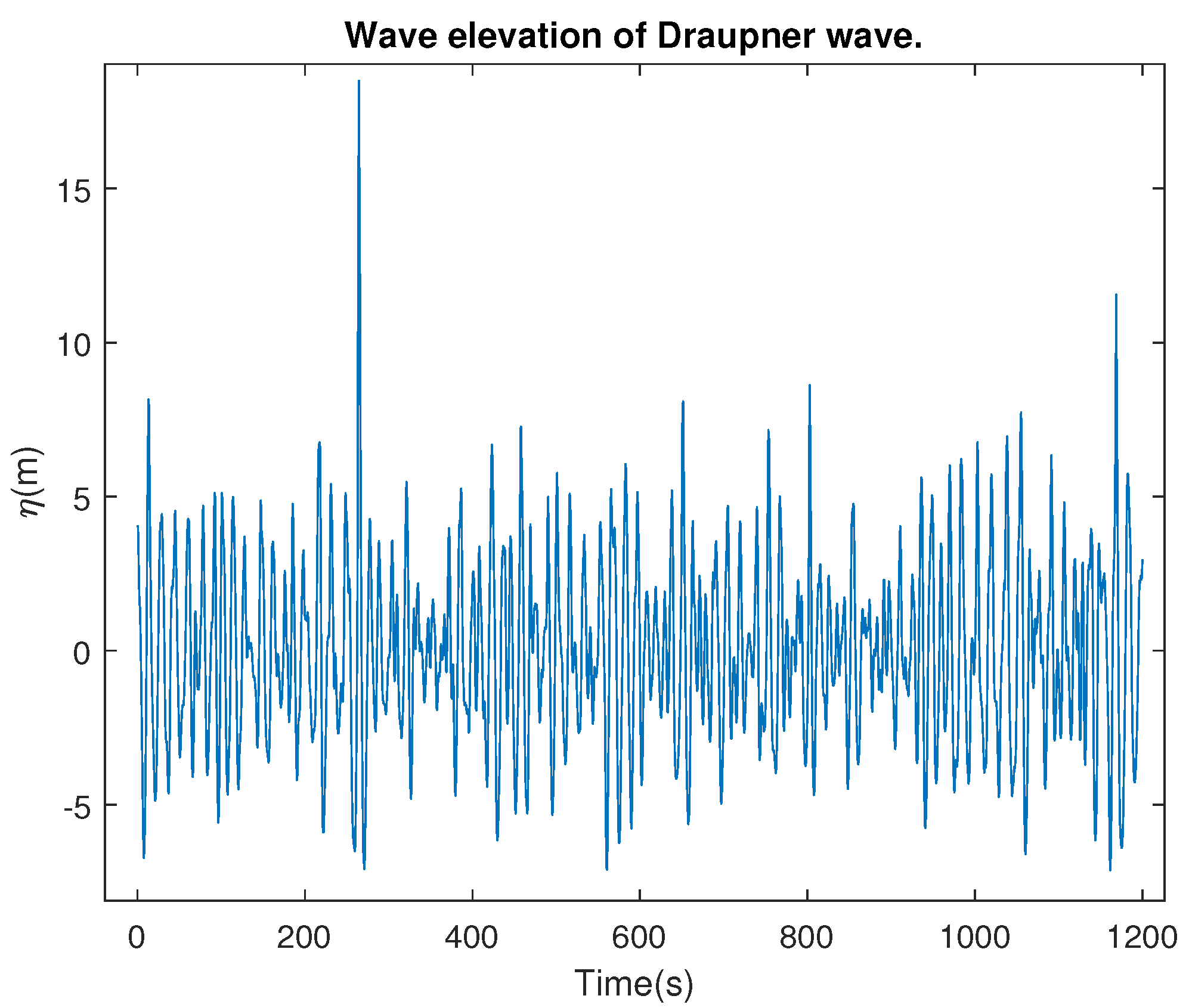
Rogue waves are typically characterized as waves whose height is at least 2.2 times greater than the significant wave height for their area [16]. These waves are a prominent subject in various literatures and have been extensively researched within the field of offshore engineering [16,17,18,19,20]. It is crucial to consider their impacts, as they can have particularly drastic and severe effects on nearby structures. Thus, rogue waves have been the focus of numerous studies and analyses in published works [16,17,18,19,20]. Various elements play a role in the emergence of these waves within coastal science, such as the transfer of energy between waves, influences from wind or currents, and the geography of the seabed [21]. Additionally, the dynamics and predictability of rogue waves differ significantly from those of tsunamis [17,22]. Sailors have long documented rogue waves, with the first recorded instance occurring on 1 January 1995, at a gas pipeline platform situated in the North Sea, approximately 160 km southwest of Norway′s southern tip [20]. This recorded wave has been termed the Draupner wave, also known as the New Year′s wave. The time series graph illustrating the wave height of the Draupner wave is displayed in Figure 1.
As seen in Figure 1, at the time where the wave height was highest, the water surface fluctuation was measured to be approximately 18.50 m, and at the time where the wave height was lowest, it was measured to be around 7.13 m [20]. Thus, the Draupner peak wave height is recorded to be around 25.6 m [20]. The study utilized 2560 recordings with a sampling rate of 2.1333 Hz, giving approximately 1200 s of data points [20]. The obtained Draupner water surface fluctuation time series values are input to the QBlade program to investigate the hydrodynamic properties of NREL 5 MW wind turbines mounted on monopiles and jacket platforms in this study.

2.2. NREL 5 MW Wind Turbines Mounted on Monopile and Jacket Platforms

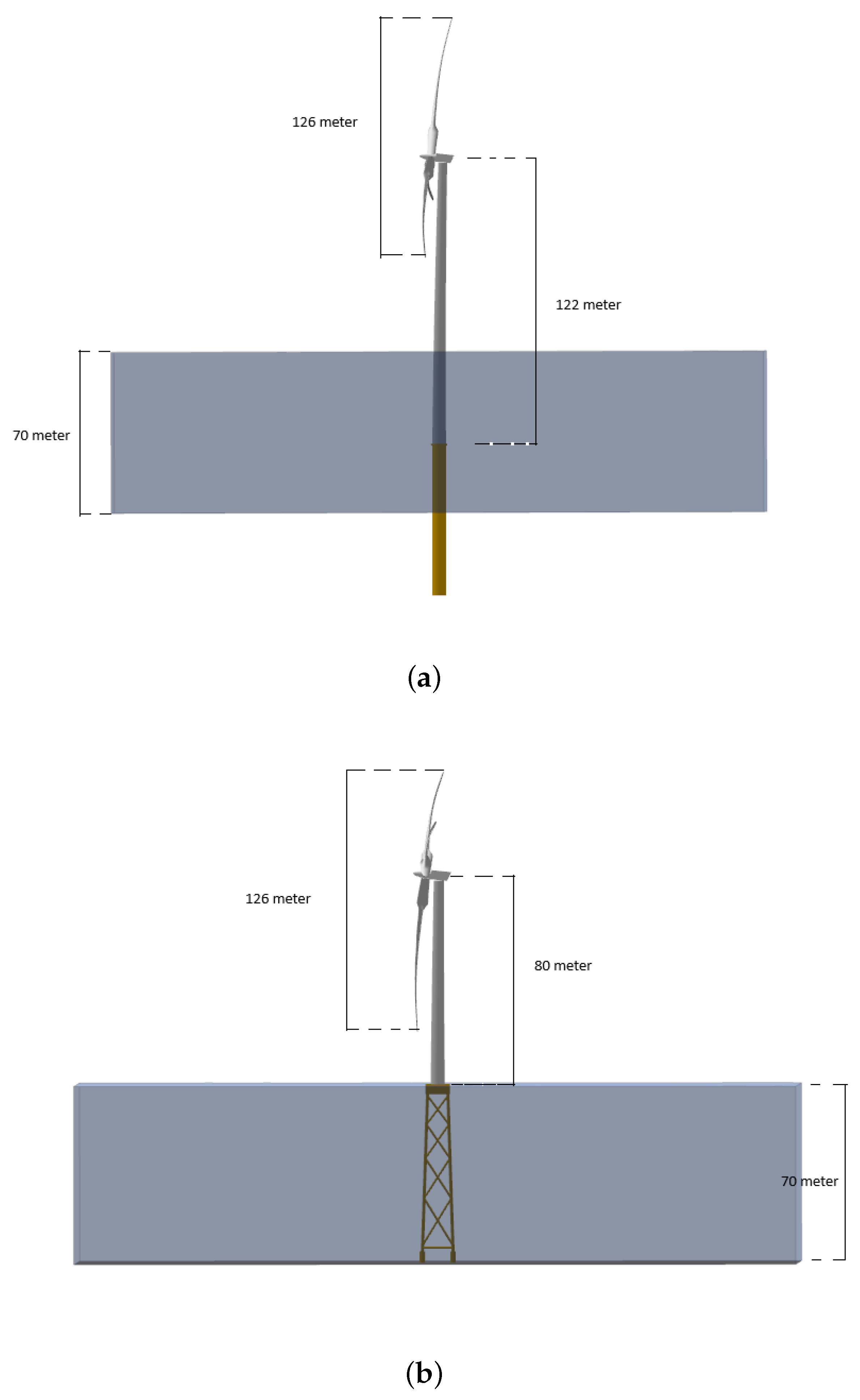
The geometric and structural characteristics of the NREL 5 MW wind turbine were established as a case study within the QBlade program, referencing research conducted by Jonkman [23]. This research also employs these parameters to create a theoretical model of the NREL 5 MW wind turbine. The NREL 5 MW wind turbine was installed on both a monopile and a jacket platform, and the aerodynamic, hydrodynamic, and structural attributes of these two distinct platforms were examined under the effects of uniform wind and Draupner waves. The geometric specifications of the NREL 5 MW wind turbine positioned on the monopile and jacket structures are illustrated in Figure 2.
The geometric characteristics of the NREL 5 MW wind turbine mounted on a monopile platform are virtually identical to those in the study conducted by Namlı et al. [7]. The only difference is that, because the water depth is 70 m, the tower height of the NREL 5 MW wind turbine mounted on a monopile platform has been increased to 122 m. This prevents the blades from contacting the water during rotation. In the second part of this study, a NREL 5 MW wind turbine was theoretically placed on a jacket platform. The geometric dimensions of the NREL 5 MW wind turbine mounted on the jacket platform are shown in Figure 2.
As with the NREL 5 MW wind turbine mounted on a monopile platform, the tower height for the NREL 5 MW wind turbine mounted on a jacket platform was increased to 80 m to prevent the blades from touching the water. Otherwise, it is structurally and geometrically identical to the study by Namlı et al. [7].

2.3. Aerodynamics of Wind Turbines

This section provides details regarding the BEM and Unsteady Blade Element Momentum (UBEM) methods utilized in the QBlade program to analyze the aerodynamic characteristics of NREL 5 MW wind turbines installed on monopile and jacket platforms.

2.3.1. Blade Element Momentum Theory

The BEM methodology employed for assessing aerodynamic effects is favored in steady-state scenarios due to its ease of use, reliability, and precision [24]. Additionally, Actuator Disc Theory (ADT) can enhance the accuracy of calculations when paired with the BEM. In this theory, the rotor is treated as an actuator disc, where the pressure decreases uniformly and the velocity varies continuously across the disc [24]. Moreover, it is assumed that the wind behaves as incompressible, steady, and axisymmetric [24] for our calculations. It is also understood that the pressure at the distant boundaries in front of and behind the rotor region matches atmospheric pressure, with no tangential velocity present [24]. By applying these assumptions, it is possible to determine the values of aerodynamic power and thrust force. The components of velocity are calculated using the principles of conservation of momentum and mass [25]. The velocity relationship can be expressed using the induction factor, a, as
u = ( 1 a ) u .
In Equation (1), u denotes the wind velocity in free air, while u refers to the air velocity that passes through the rotor. Furthermore, in order to evaluate the aerodynamic characteristics of a wind turbine, it is essential to understand the power and thrust coefficients. The equation used to determine the power coefficient ( C P ) is
C P = 4 a ( 1 a ) 2
where the induction factor is again shown by a. Finally, Equation (3) can be used to calculate the thrust coefficient as
C T = 4 a ( 1 a ) .
Since the blade is segmented into smaller sections using the BEM method, the flow affecting these sections is treated as two-dimensional. Parameters such as lift, drag, moment, and relative velocity that influence these sections can be determined. These parameters are computed individually for each segment of the blade. However, since the BEM method is based on two-dimensional assumptions, if three-dimensional analysis is needed, certain approximations must be made to obtain more precise results. Consequently, the Prandtl-type loss factor was employed in this research to achieve improved accuracy [26]. More comprehensive information regarding the Prandtl-type loss factor is available in [24].

2.3.2. Unsteady Blade Element Momentum

When the BEM method is applied, it typically yields consistent results in situations where the wind is steady. However, it has been observed that the results achieved using BEM lack consistency under complex conditions that influence wind velocity [24]. Examples of such complex scenarios include the tower effect, turbulence, and atmospheric boundary conditions. To achieve more reliable results, it is essential to ascertain the position of the blades at each time interval. For this purpose, a stationary coordinate system is established at the base of the nacelle and tower to enhance the solutions [24]. Additionally, the coordinate system’s axes are adjusted for each time step. This allows for a more precise determination and evaluation of the instantaneous velocity values acting upon the blades [27]. The dynamic inlet flow model is utilized to achieve greater accuracy. As a result, a time delay was introduced to the rotor induction across the rotor’s cross-section [28,29].

2.4. Hydrodynamics of Wind Turbines

This section provides details regarding the Morison equation, potential flow theory, and boundary conditions that are utilized to examine the hydrodynamic characteristics of NREL 5 MW wind turbines situated on monopile and jacket structures due to the influence of the Draupner wave.

2.4.1. Potential Flow and Boundary Conditions

One method for determining the wave forces exerted on platforms is through potential flow theory. In this theory, due to the flow being irrotational, the velocity field can be obtained by utilizing the velocity potential and Laplace′s equation. By applying Equation (4), the velocity field can be derived from the velocity potential ( ϕ ) and Laplace′s equation.
v ¯ = ϕ = ϕ x e ¯ x + ϕ y e ¯ y + ϕ z e ¯ z
To solve the Laplace differential equation presented in Equation (4) [30], three boundary conditions need to be established. The first of these boundary conditions is the free water surface boundary condition, represented in Equation (5).
ϕ z ω 2 g ϕ = 0
The equation in Equation (5) is applicable at z = 0 . The second boundary condition is known as the kinematic bottom boundary condition, which changes based on the depth of the water. The kinematic bottom boundary condition relevant for deep water is presented in Equation (6).
ϕ 0
The kinematic bottom boundary condition valid for finite water depths is shown in Equation (7) as
ϕ z = 0 .
The Sommerfeld condition is the third and final boundary condition. This boundary condition states that wave energy disperses in all directions due to an object′s presence in water and its impact on the fluid. In light of this scenario, three assumptions are put forth. The first assumption is that the offshore platform is situated in a fluid with a density denoted as ρ . The second assumption is that the minor movements of the offshore platform, though they may deviate from the equilibrium position, are disregarded. Lastly, it is assumed that the solutions are to be regarded as harmonic. If these three assumptions are accepted, the applicable equation of motion is presented in Equation (8) [31].
( M i j + A i j ) x ¨ j ( t ) + t K i j ( t τ ) x ˙ j ( τ ) d τ + C i j x j ( t ) = F j ω ( t ) F j m ( x , x ˙ , t )
In Equation (8), the term M i j denotes the inertia of the offshore platform, while F j ω indicates the force applied by waves. The term F j m signifies the force resulting from the mooring effect, and A i j refers to the added mass matrix. d τ is the dummy integration parameter which accounts for the time lag between the loading and response of the structure. Additionally, K i j represents the radiation damping, and C i j is associated with hydrostatic stiffness [31]. In our calculations, the substructure is discretized. That is, instead of using a 6 × 6 lumped mass matrix at the center of gravity, the mass is distributed across interconnected beam members. Such a treatment allows for the calculation of bending modes, which are critical for bottom-fixed structures.

2.4.2. Morison Equation

The effects of waves on structures can be analyzed with the Morison equation through the QBlade program. To determine the hydrodynamic Morison wave forces, the structure is divided into sections within the QBlade program, and the force values acting on each compartment are calculated at every time step using the specified equations. The wave elevation dataset is utilized to establish whether the elements are submerged in water or not. Additionally, the parameters u ˙ and u relevant to the Morison equation can also be computed using the QBlade program.
Two distinct Morison forces are analyzed. The first force is the normal wave force applied at the structure’s center, while the second is the axial wave force impacting the structure’s end. The equation for the normal Morison force ( F M n ) used to determine the normal force at the center of the structures is presented in Equation (9) [32].
F M n = ρ π ( D 2 + R M G ) 2 L ( ( C a n + C p n ) u ˙ n C a n X ¨ n ) + 1 2 ρ ( D + R M G ) L C d n ( u n + X ˙ n ) u n X ˙ n
In Equation (9), R M G indicates the marine growth thickness, ρ signifies the water density, C a n denotes the normal added mass coefficient, u n refers to the normal flow velocity, C d n is the normal drag coefficient, D stands for the diameter of the cylindrical structure, L represents the length of the cylindrical structures, C p n indicates the coefficient of normal dynamic pressure, and finally, X ˙ n denotes the normal velocity at the center of the cylindrical structures. This form of the Morison equation accounts for both the drag and inertia terms.
The axial Morison force ( F M a x ) , which is the second Morison force and is used to calculate the axial force, is shown in Equation (10).
F M a x = ρ 2 π 3 ( D 2 + R M G ) 3 C a a x ( u ˙ a x X ¨ a x ) + C p a x p d y n a x π ( D 2 + R M G ) 2 + 1 2 ρ π ( D + R M G ) 2 C d a x ( u a x + X ˙ a x ) u a x X ˙ a x
In Equation (10), X ˙ a x represents the axial velocity that occur at the center of the cylindrical structures end, C p a x represents the coefficient of the axial dynamic pressure, C d a x represents the coefficient of the axial drag, p d y n a x represents the axial dynamic pressure, u a x represents the axial flow velocity and finally C a a x represents the coefficient of axial added mass.

3. Results and Discussion

In this section, we explore and analyze the aerodynamic, hydrodynamic, and structural characteristics of the NREL 5 MW wind turbine installed on monopile and jacket platforms subjected to Draupner waves. Given that the NREL 5 MW wind turbine utilized in the research by Namlı et al. [7] was referenced, the aerodynamic findings derived from BEM analysis were not re-verified.

3.1. Aerodynamic Response Analysis

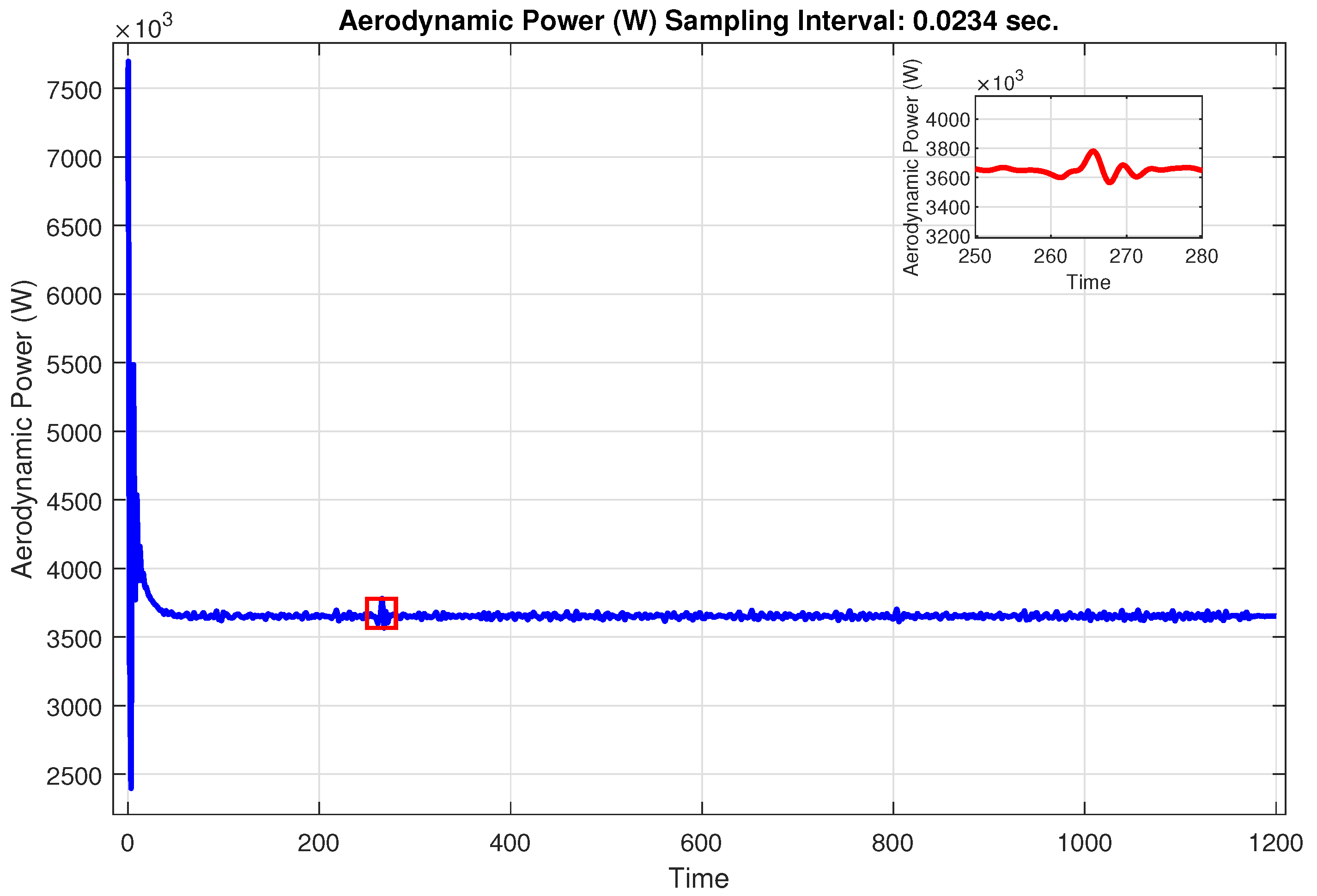
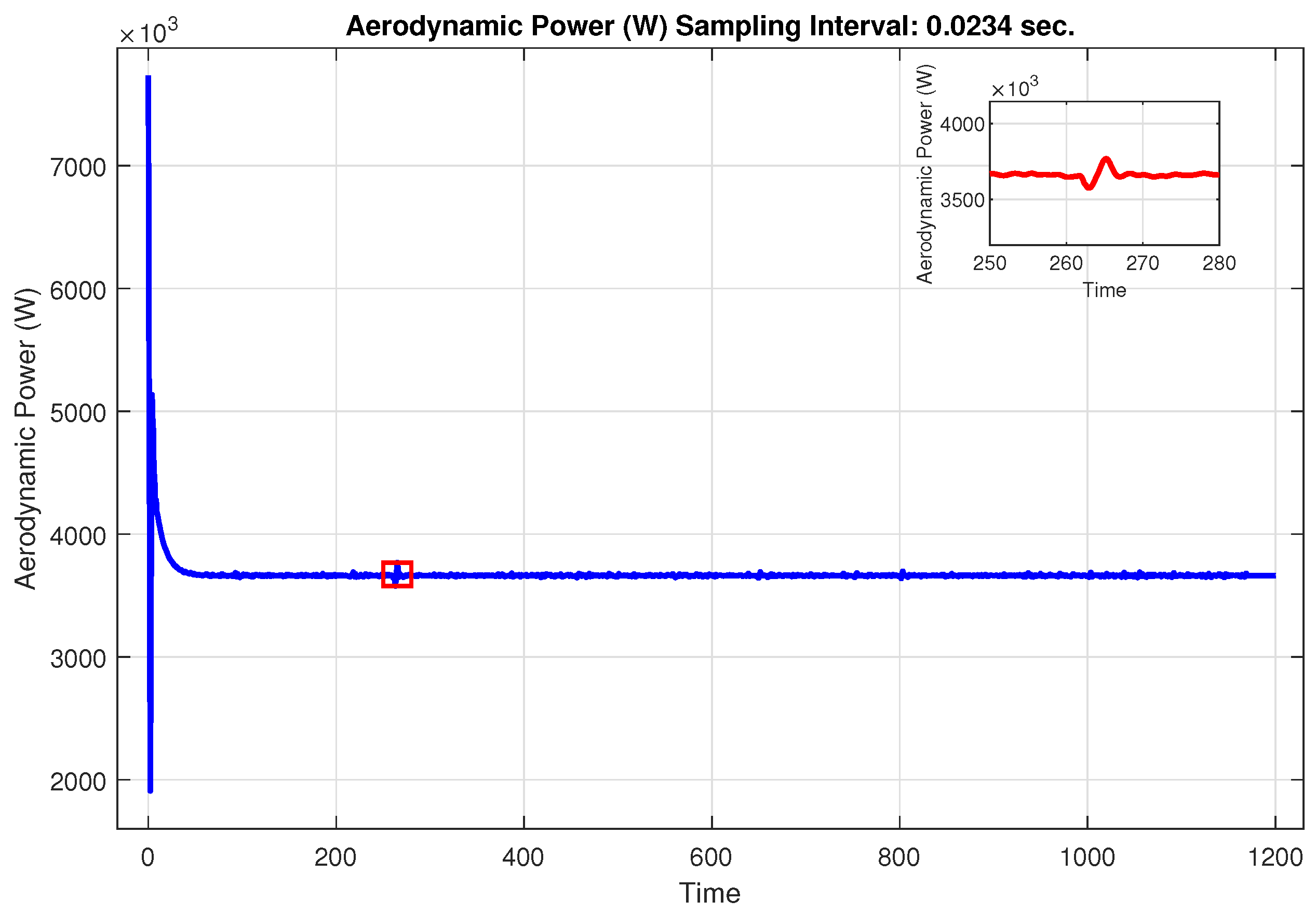
Initially, the aerodynamic performance of the NREL 5 MW wind turbine installed on a monopile platform was examined and analyzed. To evaluate the aerodynamic efficiency, time-series data of the aerodynamic power were reviewed. It was assumed that the wind speed affecting the platform remained constant at 10 m/s. This wind speed of 10 m/s enabled the NREL 5 MW turbines to reach a rated wind speed of nearly 11.4 m/s, resulting in maximum power output. This allows for a reliable assessment of their efficiency by selecting a wind speed that is close to the maximum power generation. The time series graph depicting the aerodynamic power of the NREL 5 MW wind turbine on a monopile platform is presented in Figure 3.
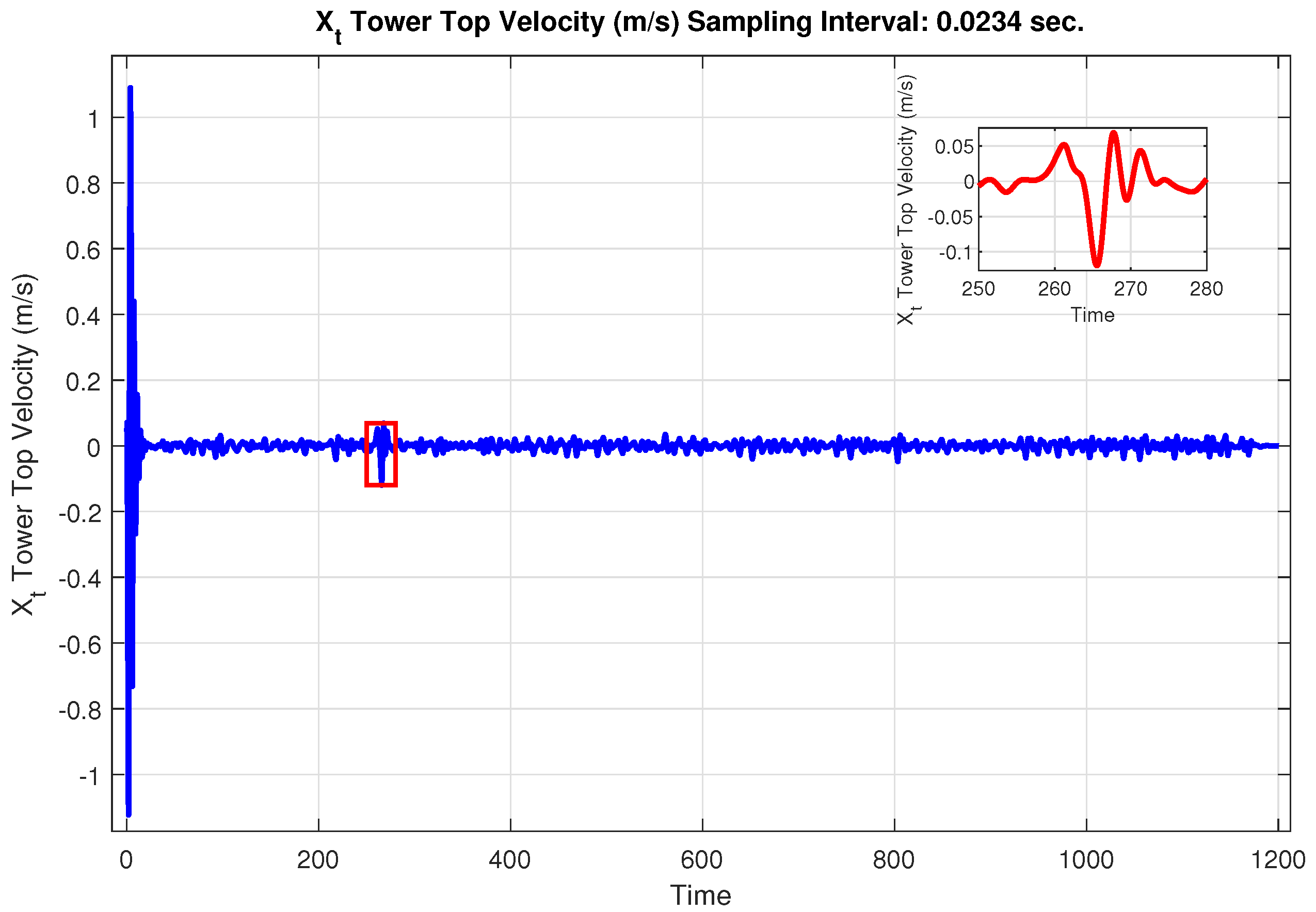
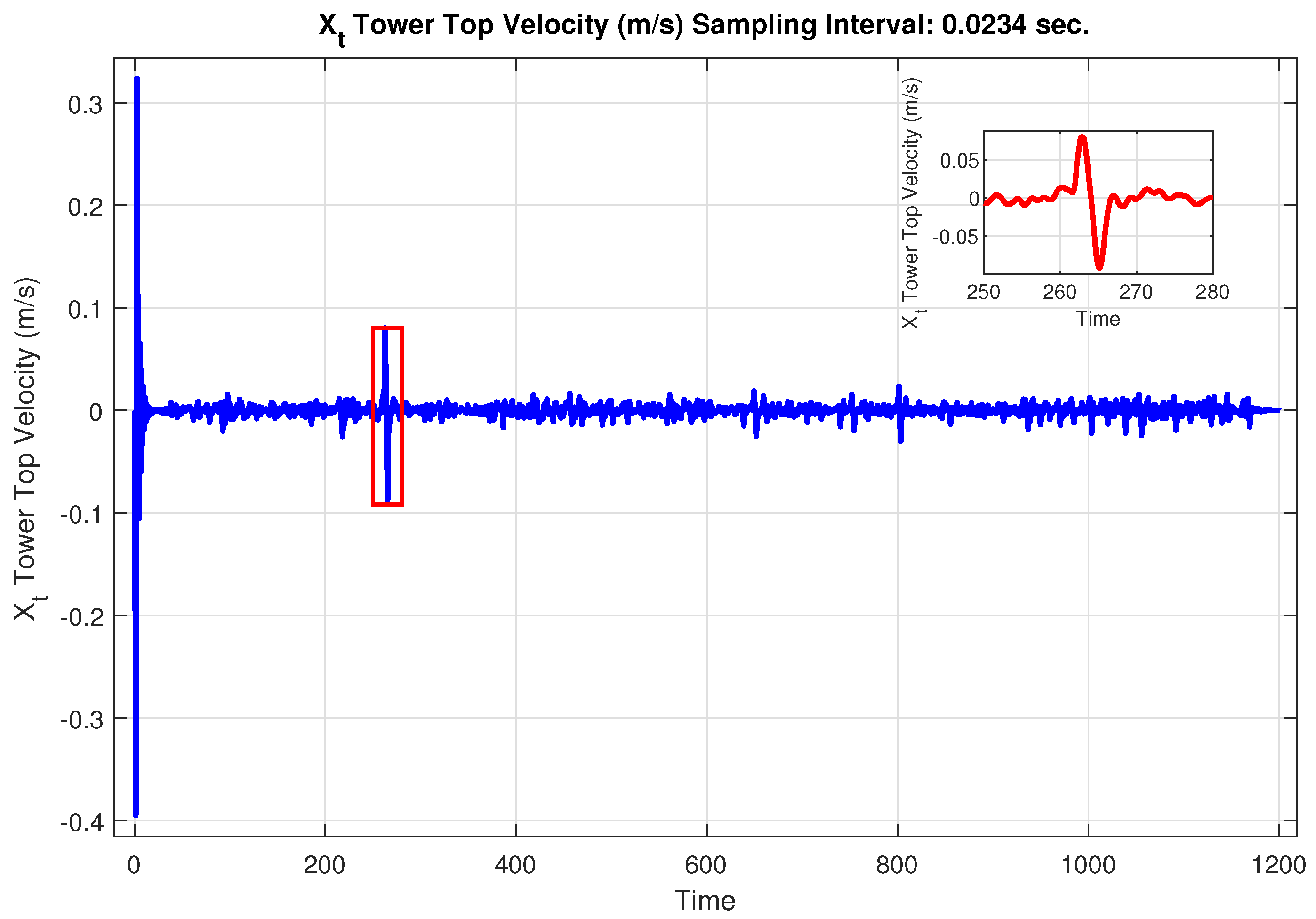
As illustrated in Figure 3, the Draupner wave significantly influences the NREL 5 MW turbine installed on a monopile platform. Notably, between the 250th and 280th seconds, when the wave height reaches its peak, the Draupner wave seems to have an aerodynamic effect. During this timeframe, the maximum aerodynamic power value recorded is approximately 3779.88 kW, while the minimum is about 3566.00 kW. Outside of the initial conditions and this specified time frame, the highest recorded value is roughly 3701.69 kW, with the lowest being approximately 3615.90 kW. The horizontal velocity time series of the NREL 5MW monopile platform tower top depicted in Figure 4 indicates a maximum horizontal velocity magnitude of approximately 0.12 m/s supports this finding, significant tower top velocity fluctuations are causing significant changes in the horizontal net air velocity at the hub, causing oscillations in the power generated.
Meanwhile, the aerodynamic power time series graph for the NREL 5 MW wind turbine situated on a jacket platform, considering the same parameters, is presented in Figure 5. As illustrated in Figure 5, the NREL 5 MW wind turbine situated on a jacket platform is significantly influenced by the Draupner wave. However, during the interval from seconds 250 to 280, when the Draupner wave reaches its peak height, the aerodynamic power output rises to about 3767.80 kW before dropping to roughly 3576.70 kW. Aside from the initial conditions and the moment the Draupner wave hits its maximum height, the highest aerodynamic power observed is approximately 3694.41 kW, while the lowest recorded value is around 3638.51 kW. Similar to the monopile platform case, the horizontal velocity time series of the NREL 5MW jacket platform tower top depicted in Figure 6 indicates significant tower top velocity fluctuations which leads to significant changes in the horizontal net air velocity at the hub, causing oscillations in the power generated. The peak magnitude of the horizontal velocity fluctuations is approximately 0.08 m/s for the jacket platform considered.

3.2. Hydro-Structural Response Analysis

As seen in Figure 3 and Figure 5, the NREL 5 MW wind turbines placed on monopile and jacket platforms are generally affected aerodynamically by the Draupner wave. In particular, the values between seconds 250 and 280 appear to change and fluctuate as a result of the Draupner wave. The numerical results demonstrate that the Draupner wave significantly alters the aerodynamic responses of both monopile- and jacket-supported NREL 5 MW offshore wind turbines where an almost equal impact on both platforms are observed. However, the NREL 5 MW wind turbine placed on a monopile platform appears to be slightly more affected when the aerodynamic power generation is considered. Our findings highlight that although both configurations experience similar aerodynamic fluctuations, the monopile-supported turbine is slightly more sensitive to the wave-induced variations in aerodynamic power. This may be attributed to its higher structural stiffness and larger exposed cross-section, which amplify the transmission of hydrodynamic loads into the tower and rotor system.
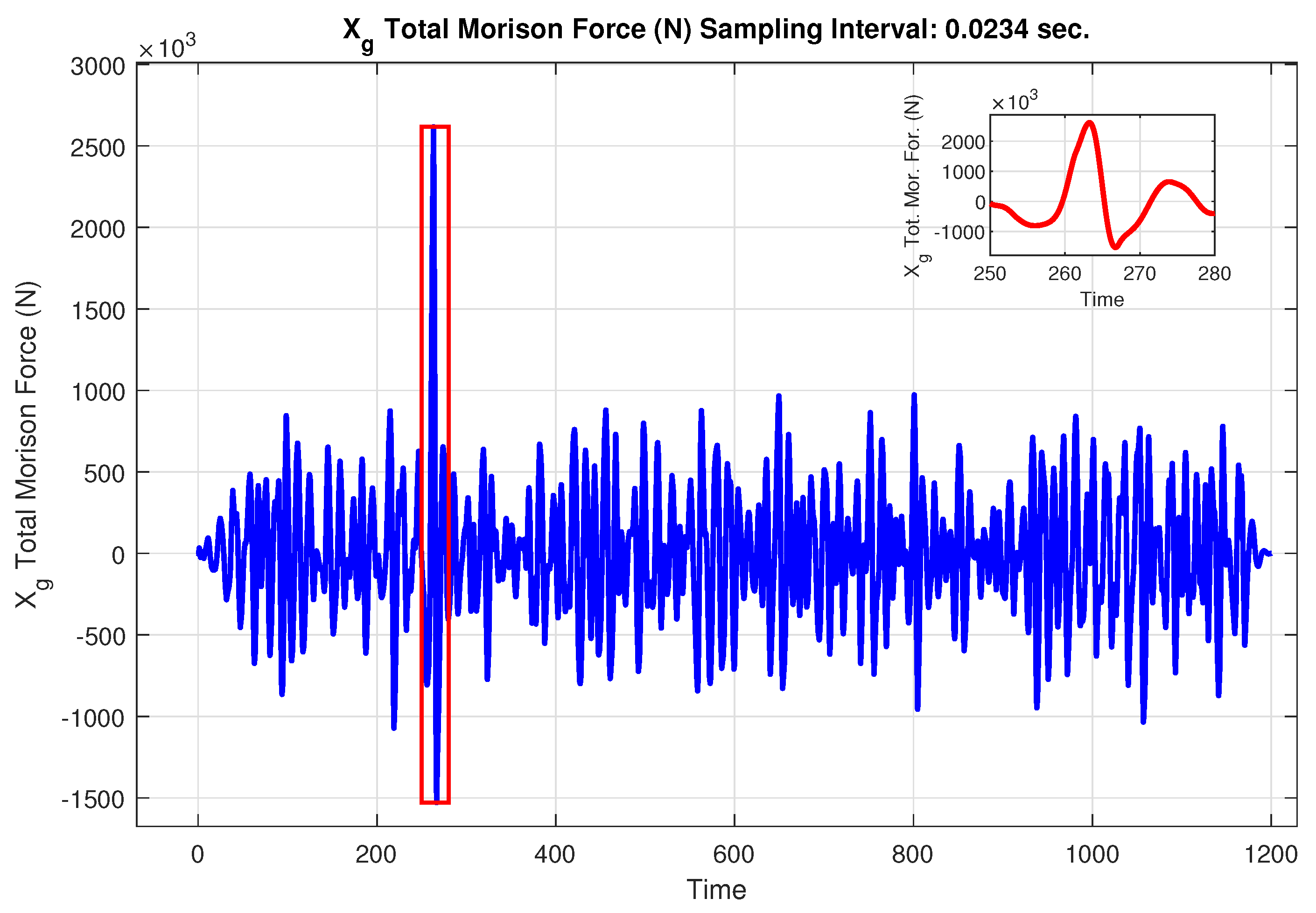
In the subsequent phase, the hydrodynamic characteristics of NREL 5 MW wind turbines installed on monopile and jacket platforms under the impact of Draupner waves were examined and analyzed. To achieve this, the overall Morison wave and hydrodynamic inertial forces in both the X and Z directions were employed. Initially, the total Morison force in the X direction for the NREL 5 MW wind turbine positioned on the monopile platform was studied. The time series graph depicting the total Morison force in the X direction for the NREL 5 MW wind turbine mounted on the monopile platform is displayed in Figure 7.
As illustrated in Figure 7, the Draupner wave applies a significant overall Morison force in the X direction on the NREL 5 MW wind turbine that is positioned on a monopile platform. An analysis of the time series indicates the hydrodynamic effect of the Draupner wave. Notably, between the 250th and 280th seconds, when the height of the Draupner wave peaks, the total Morison force in the X direction rises to around 2616.70 kN, followed by a reduction to 1529.18 kN. Outside this indicated time frame, the total Morison wave force acting in the X direction reaches approximately 972.14 kN before falling to 1034.85 kN.
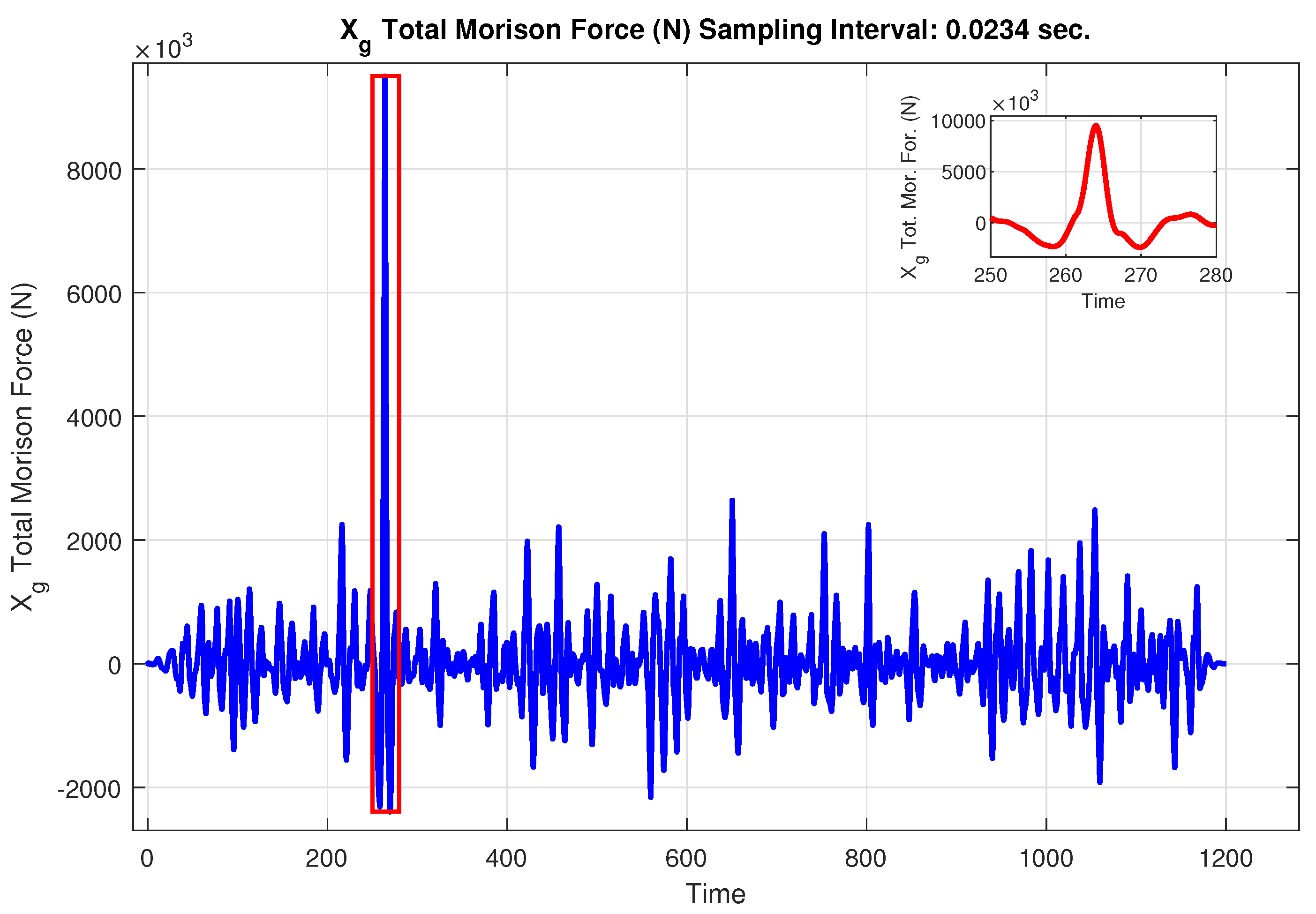
The effect on the NREL 5 MW wind turbine installed on a jacket platform was also examined, maintaining the same parameters. Figure 8 depicts the time series of the total Morison wave force in the X direction on the NREL 5 MW wind turbine mounted on a jacket platform subjected to the Draupner wave.
As illustrated in Figure 8, the overall Morison wave force in the X direction, resulting from the Draupner wave, has a substantial impact on the NREL 5 MW wind turbine situated on the jacket platform. Within the time frame of 250 to 280 s, when the wave height from the Draupner wave peaks, the total Morison wave force in the X direction is noted to reach about 9500.08 kN, while the minimum value is around 2395.10 kN. Outside this specified duration, the maximum force is approximately 2611.27 kN, which then declines to about 2160.24 kN.
From Figure 7 and Figure 8, it is evident that the total Morison wave force in the X direction, caused by the Draupner wave, has a notable effect on both platforms. At the peak of the wave height, the X-force experienced by the jacket platform is considerably higher than that on the monopile platform. Thus, the jacket platform seems to endure a greater X-force due to the Draupner wave.
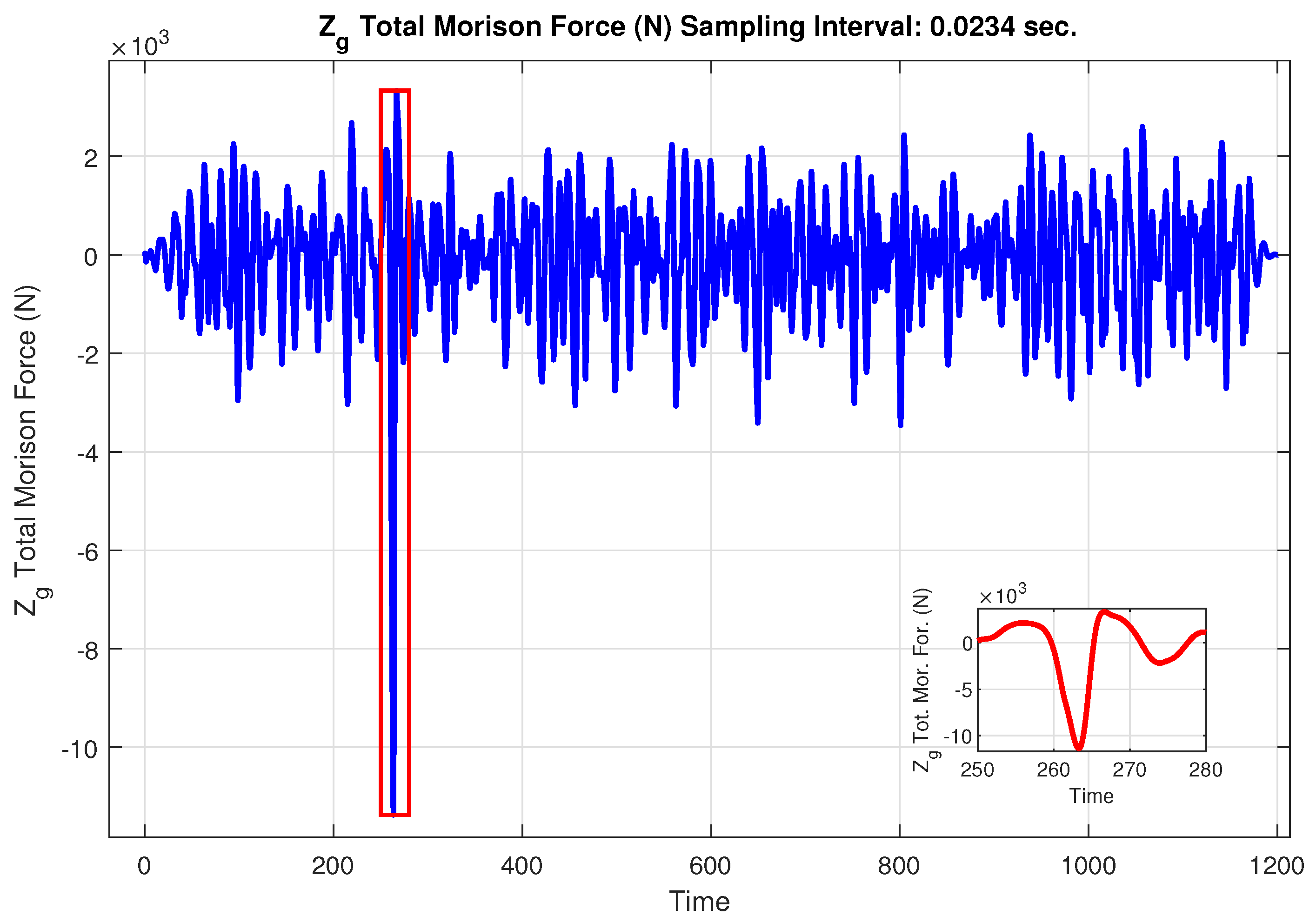
The research also examined the total Morison wave force acting on the platforms in the Z direction, alongside the X direction. Initially, the analysis focused on the total Morison wave force impacting the monopile platform in the Z direction. The time series graph depicting this total Morison wave force acting on the monopile platform in the Z direction is presented in Figure 9.
As illustrated in Figure 9, the overall Morison wave force in the Z direction, which results from the Draupner wave, influences the monopile platform hydrodynamically. Between the 250th and 280th seconds, when the wave height reaches its peak, the force peaks at around 3.33 kN and then drops to about −11.37 kN. Outside this specified time frame, the force rises to roughly 2.60 kN and falls to approximately 3.46 kN.
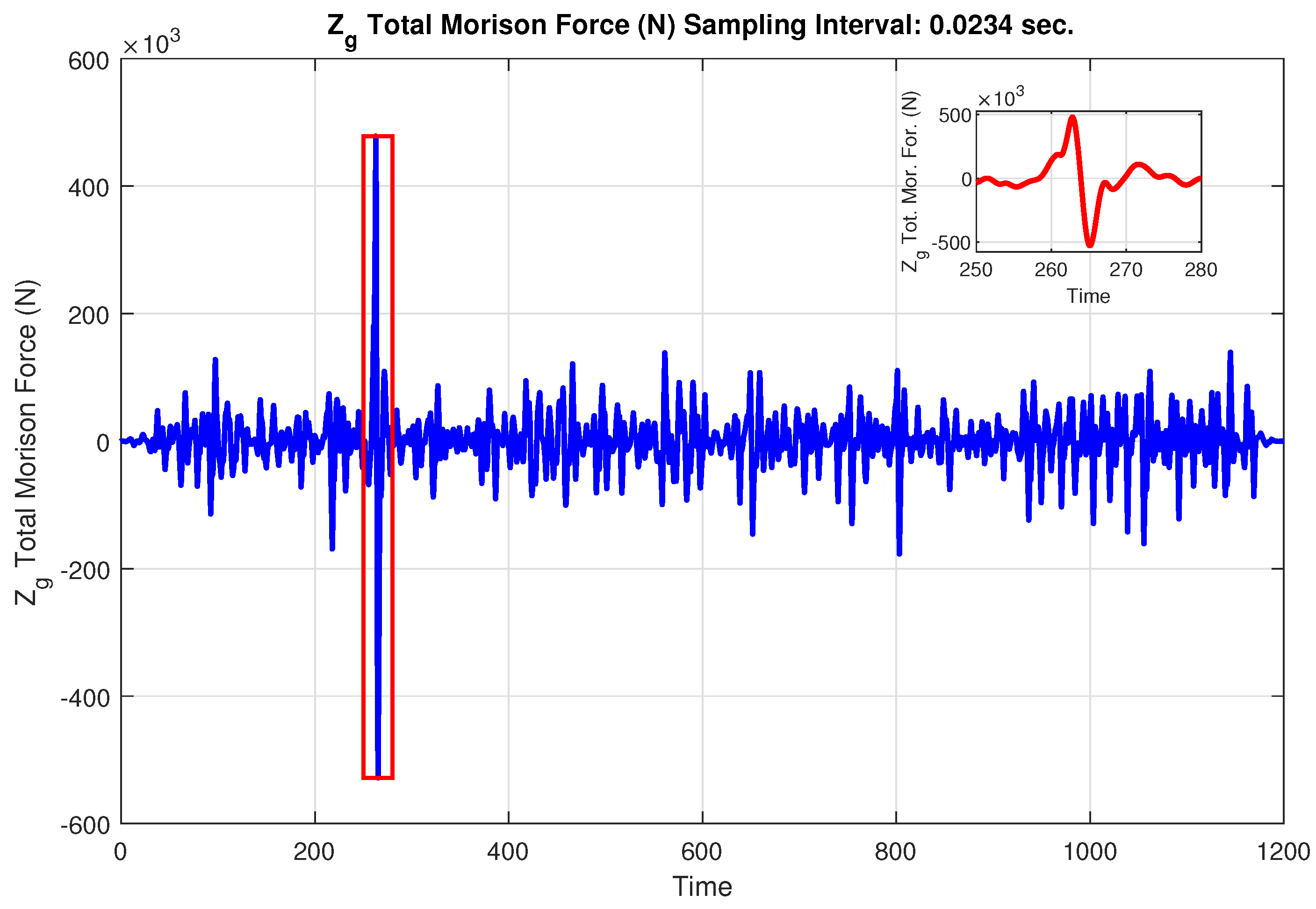
The total Morison wave force in the Z direction was also evaluated for the jacket platform. The time series graph depicting the total Morison wave force acting in the Z direction is presented in Figure 10.
As illustrated in Figure 10, the overall Morison wave force in the Z direction, which is a result of the Draupner wave, impacts the NREL 5 MW wind turbine situated on the jacket platform. The Draupner wave peaks at approximately 478.48 kN between the 250th and 280th seconds, corresponding to its maximum wavelength, and then drops to around 528.21 kN. However, beyond this specific timeframe, the force attains a value of roughly 135.77 kN before decreasing to about 177.07 kN.
A review of the graphs in Figure 9 and Figure 10 indicates that the overall Morison wave force in the Z direction, stemming from the Draupner wave, hydrodynamically influences the platforms. Nonetheless, these influences differ between the platforms. The total Morison wave force in the Z direction acting on the jacket platform is significantly higher than that on the monopile platform. Consequently, it appears that the jacket platform is more susceptible to the Z-wave load parameter compared to the monopile platform.
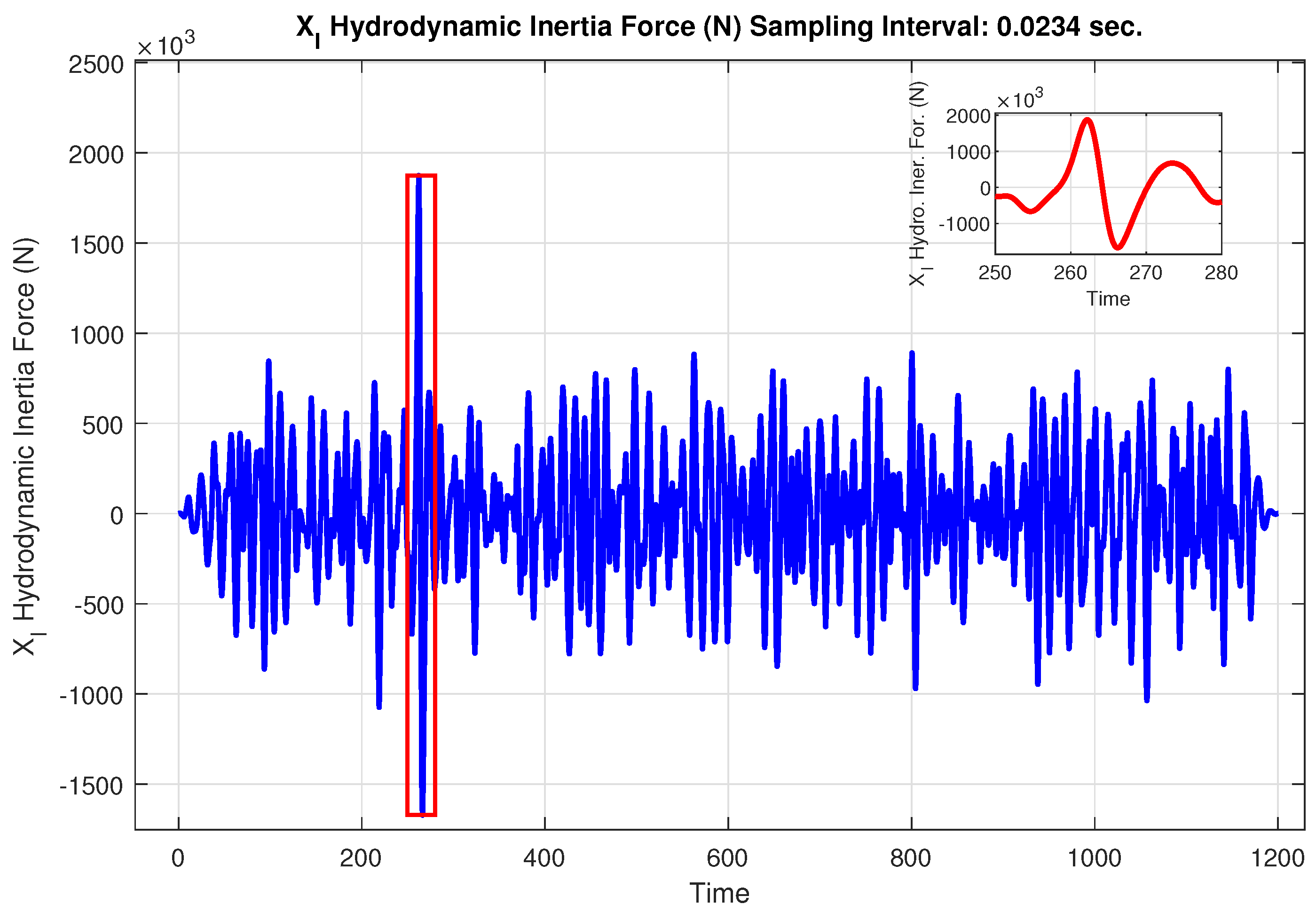
In addition to the overall Morison wave force exerted in the X and Z directions, the hydrodynamic inertial forces acting on the platforms in those same directions were also analyzed. Initially, the temporal variation of the hydrodynamic inertial force in the X direction on the monopile platform was assessed. The findings are presented in Figure 11.
In Figure 11, the hydrodynamic inertial force affecting the monopile platform due to the Draupner wave is depicted. At the maximum wave height, the force reaches around 1874.07 kN before dropping to about 1671.30 kN; outside of the critical peak period, the force measures approximately 883.02 kN and subsequently falls to 1036.42 kN.
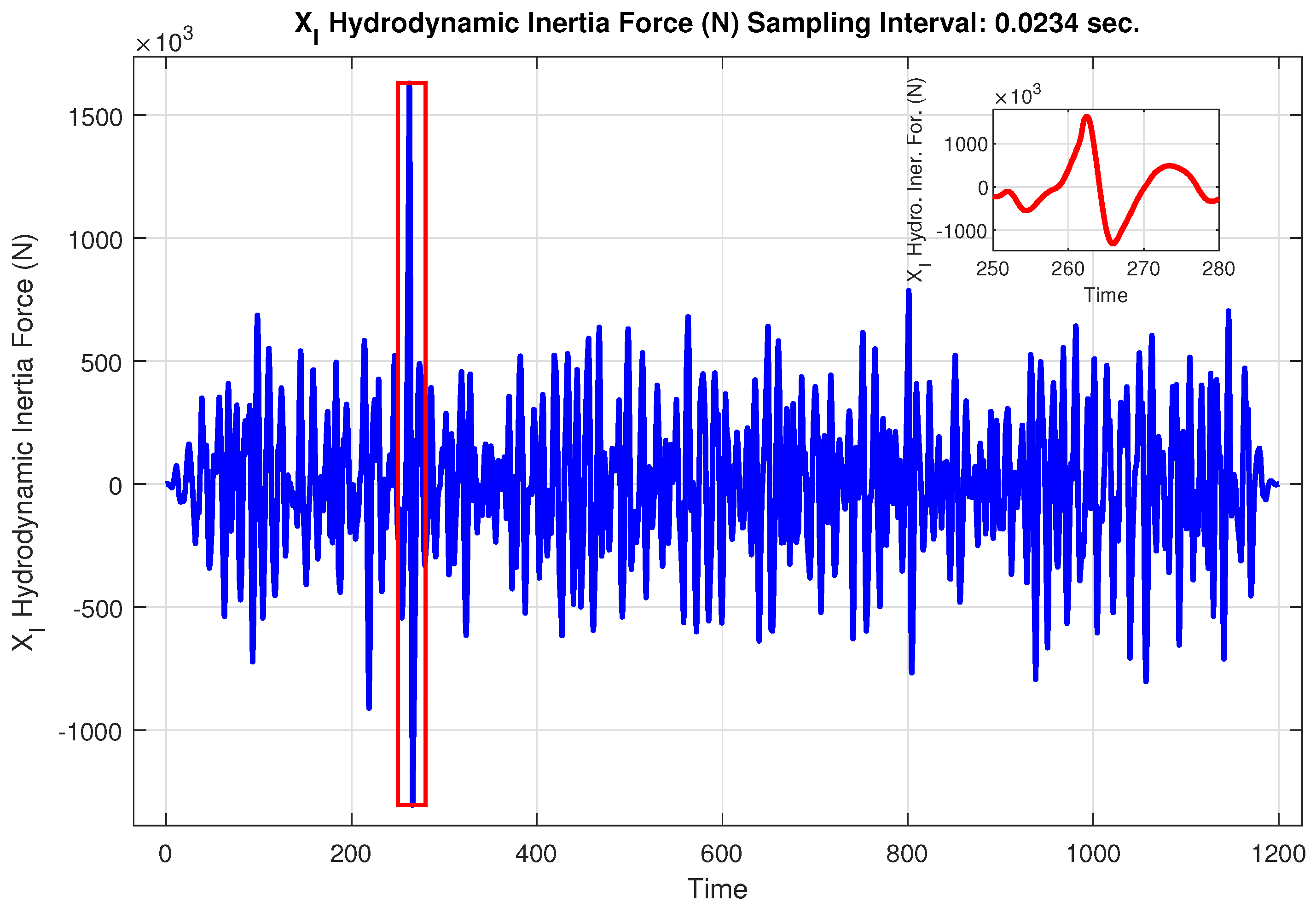
The hydrodynamic inertial forces produced by the Draupner wave on the NREL 5 MW wind turbine that is situated on the jacket platform were also analyzed. The corresponding time series graph is presented in Figure 12.
As illustrated in Figure 12, the jacket platform experiences significant impact from the hydrodynamic inertial force. When the wave height reaches its peak, the force value ascends to about 1629.90 kN and subsequently descends to around 1309.90 kN, in contrast to its lower values away from dangerous peaks, which are approximately 785.81 kN and drop to about 802.48 kN.
Figure 11 and Figure 12 demonstrate that the hydrodynamic inertial forces in the X-direction exert considerable effects on the platforms. However, the analysis indicates that the hydrodynamic inertia force in the X-direction on the monopile platform is more pronounced. Consequently, the monopile platform is more influenced by the Draupner wave when considering the x-component of the hydrodynamic inertia force. This is anticipated due to the monopile having a larger cross-sectional area, leading to an increased added mass.
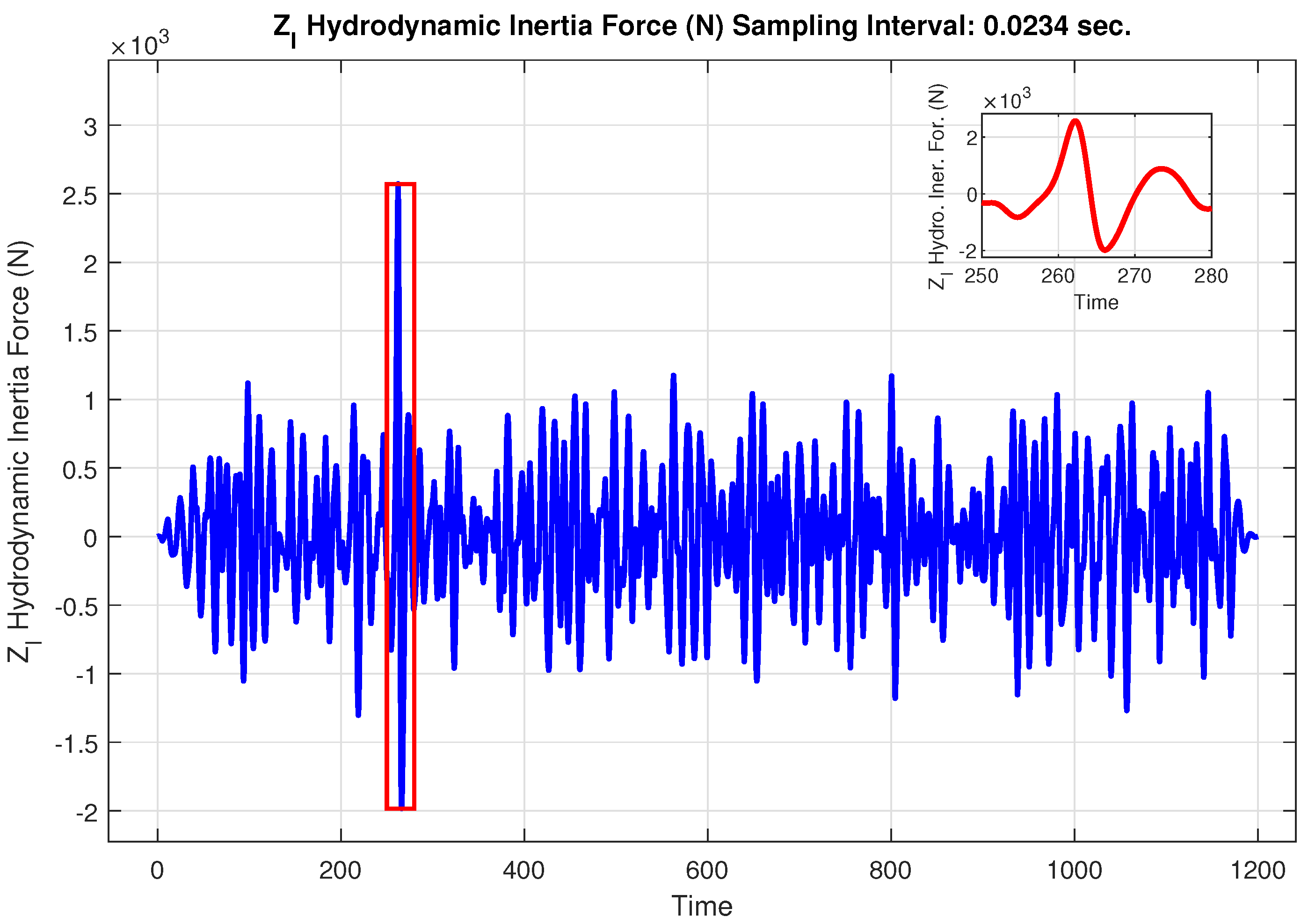
A similar examination was performed in the Z-direction, where the hydrodynamic inertial force acting on the monopile platform in this direction is analyzed in Figure 13.
As illustrated in Figure 13, the hydrodynamic inertial force exerted in the Z direction impacts the monopile platform. Between the 250th and 280th seconds, when the wave height peaks, the force value rises to about 2.57 kN and subsequently falls to around 1.98 kN. In contrast, during times outside this specific interval, the force value climbs to a maximum of roughly 1.17 kN before dropping to 1.30 kN.
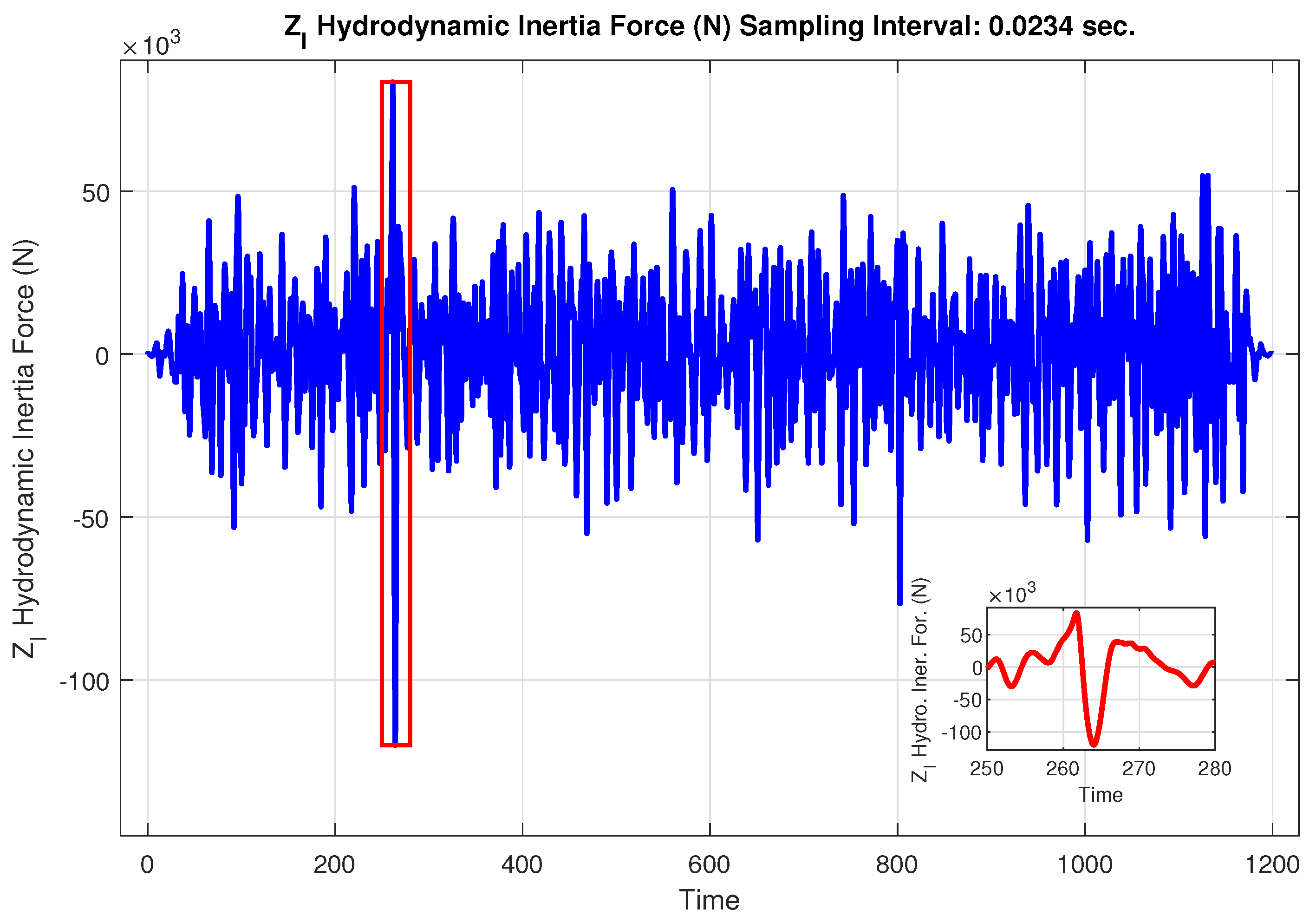
The time series graph depicting the hydrodynamic inertial force in the Z direction acting on the jacket platform is shown in Figure 14. This figure demonstrates that the hydrodynamic inertial force in the Z direction significantly impacts the NREL 5 MW wind turbine situated on the jacket platform. At peak wave height, the hydrodynamic inertial force peaks at approximately 83.45 kN and then decreases to around 120.00 kN. However, outside the specified period, the force reaches a high of about 54.78 kN before declining to 76.58 kN.
According to Figure 13 and Figure 14, a hydrodynamic inertial force is produced in the Z direction due to the Draupner wave, impacting the platforms. However, upon reviewing the presented graphs, it is evident that the hydrodynamic inertial force exerted on the jacket platform is more significant.
From a hydrodynamic perspective, the Morison wave force and the hydrodynamic inertia force analyses reveal that the jacket platform is more responsive to the X- and Z-directional wave loads. The more complex geometry and increased wetted surface area of the jacket structure lead to greater total hydrodynamic forces. The monopile, by contrast, shows higher inertia forces in the X-direction due to its larger continuous cylindrical cross-section, which increases the added mass and subsequently the inertia term. These findings are consistent with existing hydrodynamic analyses of slender and truss-type offshore foundations reported in the literature.
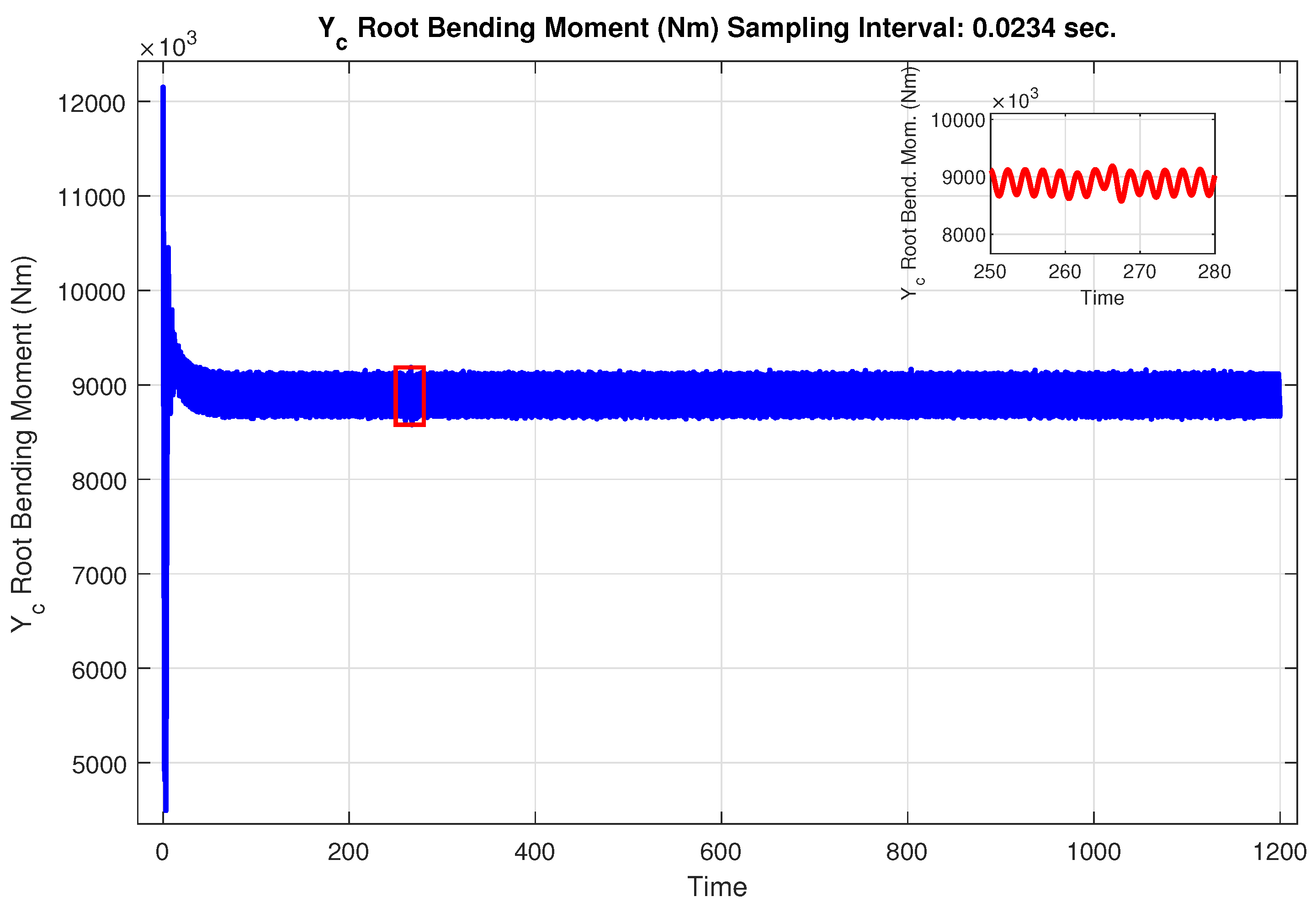
Finally, the bending moment parameters of the NREL 5 MW wind turbine, situated on a monopile and jacket platform as a result of the Draupner wave, were analyzed and discussed. To achieve this, the bending moments in the y-direction at the blade roots were examined. The time series graph depicting the bending moments at the blade roots of the NREL 5 MW wind turbine, positioned on a monopile platform due to the Draupner wave, is illustrated in Figure 15.
As shown in Figure 15, the Draupner wave typically has little impact on the blade root bending moment in the Y direction. Nonetheless, a slight variation is noted during the period of maximum wave height. Within the defined range, the moment value rises to about 9184.98 kNm and falls to 8577.78 kNm. Beyond the initial condition and within the defined range, it increases to 9155.09 kNm and then decreases to roughly 8643.22 kNm. Consequently, the Draupner wave seems to exert a negligible influence.
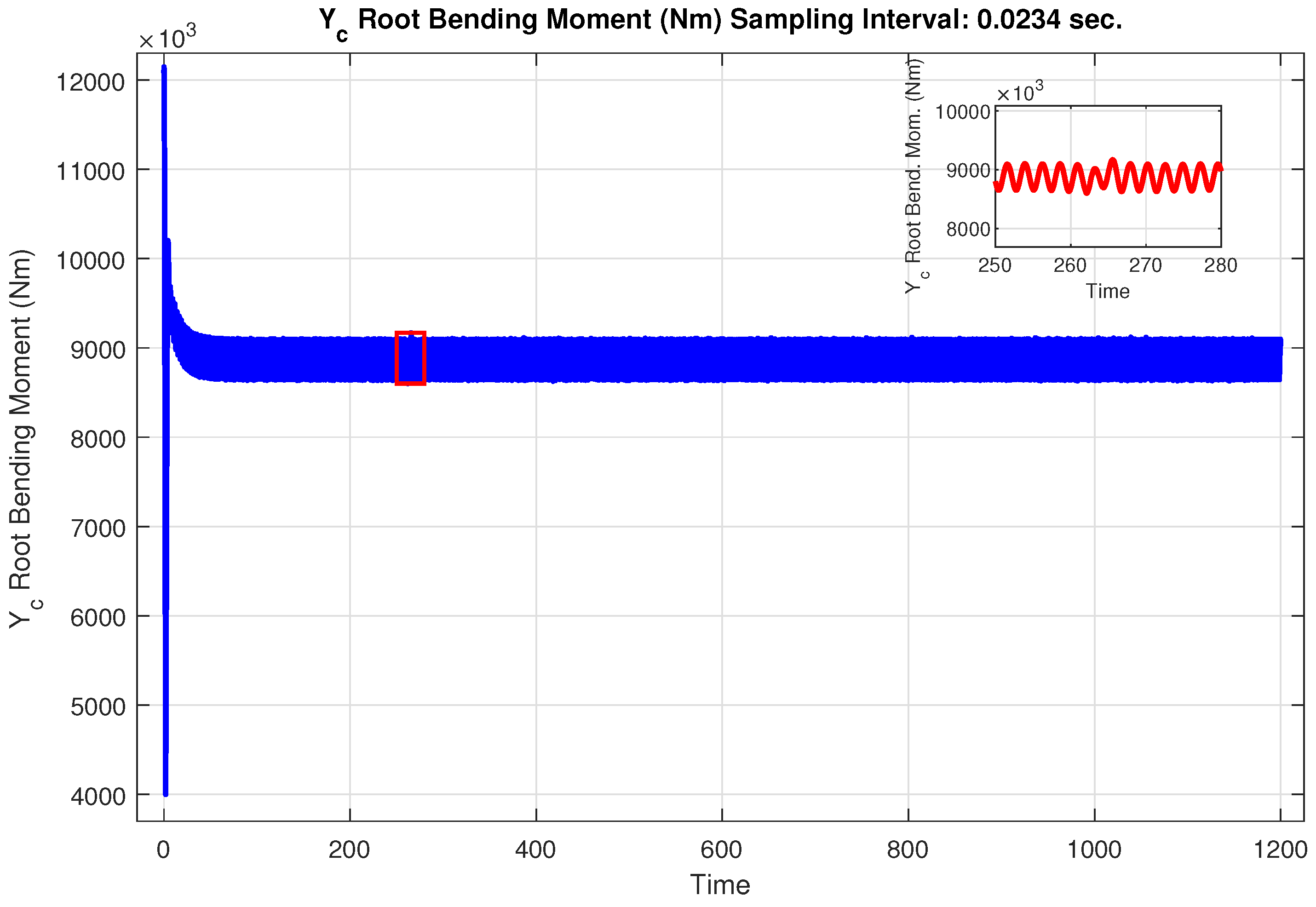
A similar evaluation was conducted for the NREL 5 MW wind turbine positioned on a jacket platform, maintaining the same parameters and values. The resulting time series graph is illustrated in Figure 16.
Lastly, as shown in Figure 16, the Draupner wave has a minimal effect on the bending moment at the wing root in the Y direction. Nevertheless, during the period between the 250th and 280th seconds, when the wave height reaches its peak, the moment value rises to around 9168.78 kNm before dropping to roughly 8600.58 kNm. A review of the graph beyond the initial conditions and the defined time range indicates that the moment value increases to 9118.18 kNm and subsequently decreases to approximately 8638.00 kNm. Consequently, it seems that the Draupner wave has had a negligible influence on the jacket platform.
Analysis of Figure 15 and Figure 16 shows that the Draupner wave does not have a significant structural impact on either platform. However, considering the time period when the wave height is at its maximum, results differ slightly from the overall average outside the initial condition. Therefore, the Draupner wave appears to have had very little structural impact on both platforms when the root bending moment in the Y-direction parameter is considered. Structurally, the root bending moments show only modest variation during the passage of the rogue wave for both of the platforms, suggesting that the aerodynamic control and tower flexibility of the NREL 5 MW turbine mitigate excessive load transmission from the foundation to the rotor system. Nevertheless, even small cyclic load increases under rare events can contribute to long-term fatigue, underscoring the necessity of including rogue wave events in probabilistic design and lifetime assessment of offshore wind turbines.
The Draupner wave peak between 250 s and 280 s consistently corresponds to the maximum observed variations in both aerodynamic power and hydrodynamic forces. This temporal correlation emphasizes the importance of concurrent aerodynamic-hydrodynamic coupling in extreme wave simulations. The QBlade-based BEM–Morison hybrid approach effectively captured these transient interactions without the need for computationally intensive CFD–FEM coupling, indicating that reduced-order methods can still yield physically meaningful insights under extreme sea states. Overall, the comparative results between monopile and jacket configurations confirm that foundation type significantly influences the hydrodynamic load distribution but has a limited effect on aerodynamic and structural responses during short-duration rogue wave impact. These insights reinforce the relevance of platform-specific hydrodynamic modeling in the early design stages of offshore wind turbines located in regions susceptible to freak wave events.

4. Conclusions

This research numerically explored the aerodynamic, hydrodynamic, and structural responses of NREL 5 MW wind turbines installed on monopile and jacket foundations when subjected to the historic Draupner rogue wave using the QBlade simulation platform. Initially, details regarding the Draupner wave are presented, along with an explanation of the water surface fluctuation time series dataset. Following that, an overview of the offshore platforms and the NREL 5 MW wind turbine utilized in the analysis is provided. The methods employed to assess the aerodynamic and hydrodynamic characteristics are detailed. Time series data for aerodynamic power are analyzed to examine and discuss the aerodynamic influences. The total Morison wave force and hydrodynamic inertia force time series parameters along the X and Z axes are analyzed to investigate and discuss the hydrodynamic characteristics. Time series data pertaining to the bending moment at the blade root are examined to evaluate and discuss the structural aspects. The QBlade-based BEM–Morison framework has proven to be an effective alternative for evaluating the coupled aero-hydrodynamic interactions under such rogue wave conditions, facilitating rapid parametric studies before progressing to more complex CFD–FEM models. The findings indicate that wind turbines experience aerodynamic, hydrodynamic, and structural impacts due to the Draupner wave’s effect. In particular, the most significant changes occur between the 250th and 280th seconds, at which point the wave height reaches its peak.
Both monopile- and jacket-supported turbines exhibited pronounced fluctuations in aerodynamic power during the Draupner wave event, particularly between 250 s and 280 s when the wave reached its maximum height. The monopile-supported turbine experienced slightly higher variations in aerodynamic power, attributed to its stiffer dynamic response and direct transmission of base motion. The total Morison and hydrodynamic inertia forces increased sharply during the peak wave event. The jacket structure experienced higher total forces due to its larger wetted surface area and geometric complexity, while the monopile foundation showed higher inertial loading in the X-direction because of its larger added mass. The Draupner wave induced only minor variations in the root bending moments of both configurations, suggesting that the turbine’s control and damping characteristics efficiently suppress large structural amplifications. Nonetheless, these small but abrupt load changes may accelerate fatigue under repeated exposure to extreme wave events. It is observed that the monopile system is more sensitive to dynamic inertial effects, whereas the jacket system endures larger total wave-induced loads. These findings imply that structural design and material optimization must consider different dominant load mechanisms depending on the foundation type.
Future extensions will incorporate long-term stochastic sea states, fatigue life estimation, and hybrid CFD–BEM coupling to capture nonlinear free-surface effects. Furthermore, the authors intend to apply deep learning models such as LSTM networks for forecasting and early detection of rogue wave impacts on offshore energy systems. In summary, the study confirms that even a single rogue wave can induce significant transient aerodynamic and hydrodynamic load variations on offshore wind turbines. Understanding these interactions is crucial for the robust design, monitoring, and risk assessment, early warning systems, structural health monitoring of next-generation offshore renewable energy platforms. The experimental tests and other forms of CFD studies for various extreme wind and wave conditions and to investigate the effects of nonlinear diffraction, viscous flow separation, and full aero-servo-hydro-elastic coupling on our findings are the tasks to be performed on this subject in future studies.

Author Contributions

Conceptualization, C.B., B.N.; methodology, L.M., B.N. and C.B.; software, L.M., B.N. and C.B.; validation, L.M. and C.B.; formal analysis, L.M. and C.B.; investigation, L.M., B.N., C.B.; resources, L.M. and B.N.; writing—original draft preparation, L.M. and C.B.; visualization, L.M. and C.B.; supervision, C.B., L.M. and B.N.; funding acquisition, C.B. All authors have read and agreed to the published version of the manuscript.

Funding

This study is funded by the Turkish Academy of Sciences (TÜBA)-Outstanding Young Scientist Award Program (GEBİP), The Science Academy′s Young Scientist Award Program (BAGEP) and the Research Fund of the İstanbul Technical University with project code: MDA-2023-45117.

Data Availability Statement

All the results can be reproduced through the presented methods. The Draupner wave data is obtained form Sverre Haver.

Acknowledgments

The authors thank Sverre Haver for sharing the Draupner wave data.

Conflicts of Interest

The authors declare no conflicts of interest.

Abbreviations

The following abbreviations are used in this manuscript:
ADTActuator Disc Theory
BEMBlade Element Momentum
CFDComputational Fluid Dynamics
FEMFinite Element Method
FOWTFloating Offshore Wind Turbine
LSTMLong-short Term Memory
NRELNational Renewable Energy Laboratory
SHLBSpecific Heave Plate and Low-Ballast
SOWFASimulator for Wind Farm Applications
UBEMUnsteady Blade Element Momentum

References

  1. Li, B.; Qin, H.; Zhang, H.; Long, Q.; Ma, D.; Xu, C. Mooring Evaluation of a Floating Offshore Wind Turbine Platform Under Rogue Wave Conditions Using a Coupled CFD-FEM Model. J. Mar. Sci. Eng. 2025, 13, 1443. [Google Scholar] [CrossRef]
  2. Meng, H.; Liu, Y.; Tian, D.; Long, K.; Han, Z.; Su, Y.; Sun, K. Dynamic response of novel floating wind turbine to freak waves during uninterrupted operation. Renew. Energy 2025, 239, 121984. [Google Scholar] [CrossRef]
  3. Li, B.; Qin, H.; Long, Q.; Jiang, H. Dynamic Responses of a Floating Offshore Wind Turbine Platform Under Rogue Wave Conditions Using a Coupled CFD-FEM Method. In Proceedings of the ISOPE International Ocean and Polar Engineering Conference, Seoul/Goyang, Republic of Korea, 1–6 June 2025; p. ISOPE-I. [Google Scholar]
  4. Zeng, F.; Zhang, N.; Huang, G.; Gu, Q.; He, M. Experimental study on dynamic response of a floating offshore wind turbine under various freak wave profiles. Mar. Struct. 2023, 88, 103362. [Google Scholar] [CrossRef]
  5. Zhong, W.; Zhang, X.; Wan, D. Hydrodynamic characteristics of a 15 MW semi-submersible floating offshore wind turbine in freak waves. Ocean Eng. 2023, 283, 115094. [Google Scholar] [CrossRef]
  6. Thomas, A.; VK, S.; Behera, M.R. Numerical investigation of a SPAR type floating offshore wind turbine platform under extreme waves. In Proceedings of the International Conference on Offshore Mechanics and Arctic Engineering; American Society of Mechanical Engineers: New York, NY, USA, 2023; Volume 87578, p. V001T01A013. [Google Scholar]
  7. Namlı, B.; Bayındır, C.; Ozaydin, F. Hydrodynamic Analysis of a NREL 5 MW Monopile Wind Turbine Under the Effect of the 30 October 2020 İzmir-Samos Tsunami. J. Mar. Sci. Eng. 2025, 13, 857. [Google Scholar] [CrossRef]
  8. Snel, H.; Schepers, G.; Siccama, N. Mexico Project: The database and results of data processing and interpretation. In Proceedings of the 47th AIAA Aerospace Sciences Meeting Including the New Horizons Forum and Aerospace Exposition, Orlando, FL, USA, 5–8 January 2009; p. 1217. [Google Scholar]
  9. Simms, D.; Schreck, S.; Hand, M.; Fingersh, L.J. NREL Unsteady Aerodynamics Experiment in the NASA-Ames Wind Tunnel: A Comparison of Predictions to Measurements; Technical Report; National Renewable Energy Lab. (NREL): Golden, CO, USA, 2001.
  10. Marten, D.; Lennie, M.; Pechlivanoglou, G.; Nayeri, C.N.; Paschereit, C.O. Implementation, optimization, and validation of a nonlinear lifting line-free vortex wake module within the wind turbine simulation code qblade. J. Eng. Gas Turbines Power 2016, 138, 072601. [Google Scholar] [CrossRef]
  11. Barber, S.; Nordborg, H. Comparison of simulations and wind tunnel measurements for the improvement of design tools for vertical axis wind turbines. In Proceedings of the Journal of Physics: Conference Series; IOP Publishing: Hamburg, Germany, 2018; Volume 1102, p. 012002. [Google Scholar]
  12. Koç, E.; Günel, O.; Yavuz, T. Comparison of Qblade and CFD results for small-scaled horizontal axis wind turbine analysis. In Proceedings of the 2016 IEEE International Conference on Renewable Energy Research and Applications (ICRERA), Birmingham, UK, 20–23 November 2016; pp. 204–209. [Google Scholar]
  13. Husaru, D.; Bârsănescu, P.; Zahariea, D. Effect of yaw angle on the global performances of horizontal axis wind turbine-QBlade simulation. In Proceedings of the IOP Conference Series: Materials Science and Engineering; IOP Publishing: Galati, Romania, 2019; Volume 595, p. 012047. [Google Scholar]
  14. Alaskari, M.; Abdullah, O.; Majeed, M.H. Analysis of wind turbine using QBlade software. In Proceedings of the IOP Conference Series: Materials Science and Engineering; IOP Publishing: Baghdad, Iraq, 2019; Volume 518, p. 032020. [Google Scholar] [CrossRef]
  15. Szczerba, Z.; Szczerba, P.; Szczerba, K.; Szumski, M.; Pytel, K. Wind tunnel experimental study on the efficiency of vertical-axis wind turbines via analysis of blade pitch angle influence. Energies 2023, 16, 4903. [Google Scholar] [CrossRef]
  16. Kharif, C.; Pelinovsky, E. Physical mechanisms of the rogue wave phenomenon. Eur. J. Mech.-B/Fluids 2003, 22, 603–634. [Google Scholar] [CrossRef]
  17. Bayındır, C. Early Detection of the Draupner Wave Using Deep Learning. arXiv 2018, arXiv:1812.10805. [Google Scholar] [CrossRef]
  18. Bayındır, C. Rogue waves of the Kundu-Eckhaus equation in a chaotic wave field. Phys. Rev. E 2016, 93, 032201. [Google Scholar] [CrossRef] [PubMed]
  19. Bayındır, C. Rogue wave spectra of the Kundu-Eckhaus equation. Phys. Rev. E 2016, 93, 062215. [Google Scholar] [CrossRef] [PubMed][Green Version]
  20. Haver, S. Evidences of the Existence of Freak Waves. In Proceedings of the Rogue Waves 2000; Ifremer: Brest, France, 2000; pp. 129–140. [Google Scholar]
  21. Xue, S.; Xu, G.; Xie, W.; Xu, L.; Jiang, Z. Characteristics of freak wave and its interaction with marine structures: A review. Ocean Eng. 2023, 287, 115764. [Google Scholar] [CrossRef]
  22. Alan, A.R.; Bayındır, C.; Ozaydin, F.; Altintas, A.A. The Predictability of the 30 October 2020 İZmir-Samos Tsunami Hydrodynamics and Enhancement of Its Early Warning Time by LSTM Deep Learning Network. Water 2022, 15, 4195. [Google Scholar]
  23. Jonkman, J.; Butterfield, S.; Musial, W.; Scott, G. Definition of a 5-MW Reference Wind Turbine for Offshore System Development; Technical Report; National Renewable Energy Lab. (NREL): Golden, CO, USA, 2009.
  24. Documentation, Q. Blade Element Momentum (BEM) Theory in QBlade. 2025. Available online: https://docs.qblade.org/src/theory/aerodynamics/bem/bem.html (accessed on 22 March 2025).
  25. Branlard, E. Wind Turbine Aerodynamics and Vorticity-Based Methods: Fundamentals and Recent Applications; Springer: Berlin/Heidelberg, Germany, 2017. [Google Scholar]
  26. Glauert, H. Airplane propellers. Aerodynamic Theory; Durand, W.F., Ed.; Springer: Berlin/Heidelberg, Germany, 1935. [Google Scholar]
  27. Silva, C.T.; Donadon, M.V. Unsteady blade element-momentum method including returning wake effects. J. Aerosp. Technol. Manag. 2013, 5, 27–42. [Google Scholar] [CrossRef]
  28. Henriksen, L.C.; Hansen, M.H.; Poulsen, N.K. A simplified dynamic inflow model and its effect on the performance of free mean wind speed estimation. Wind Energy 2013, 16, 1213–1224. [Google Scholar] [CrossRef]
  29. Documentation, Q. Aerodynamics Theory in QBlade. 2024. Available online: https://docs.qblade.org/src/user/turbine/aerodynamic.html (accessed on 22 March 2025).
  30. Newman, J.N. Marine Hydrodynamics; The MIT Press: Cambridge, MA, USA, 2018. [Google Scholar]
  31. Cummins, W. The impulse response functions snd ship motion. Schiffstechnik 1962, 9, 101–109. [Google Scholar]
  32. Faltinsen, O. Sea Loads on Ships and Offshore Structures; Cambridge University Press: Cambridge, UK, 1993; Volume 1, Available online: https://archive.org/details/sealoadsonshipso0000falt (accessed on 10 November 2025).
Figure 1. The time series of the Draupner wave [20].
Jmse 14 00551 g001
Figure 2. Geometric representation of NREL 5 MW wind turbine mounted on (a) monopile structure, (b) jacket structure.
Jmse 14 00551 g002
Figure 3. Aerodynamic power time series plot of an NREL 5 MW wind turbine mounted on a monopile platform under the influence of the Draupner wave.
Jmse 14 00551 g003
Figure 4. Tower top velocity time series plot of an NREL 5 MW wind turbine mounted on a monopile platform under the influence of the Draupner wave.
Jmse 14 00551 g004
Figure 5. Aerodynamic power time series plot of an NREL 5 MW wind turbine mounted on a jacket platform under the influence of the Draupner wave.
Jmse 14 00551 g005
Figure 6. Tower top velocity time series plot of an NREL 5 MW wind turbine mounted on a jacket platform under the influence of the Draupner wave.
Jmse 14 00551 g006
Figure 7. Time series of the total Morison wave load in the X-direction under the influence of the Draupner wave of NREL 5 MW wind turbines placed on a monopile platform.
Jmse 14 00551 g007
Figure 8. Time series of the total Morison wave load in the X-direction under the influence of the Draupner wave of NREL 5 MW wind turbines placed on a jacket platform.
Jmse 14 00551 g008
Figure 9. Time series of the total Morison wave load in the Z-direction under the influence of the Draupner wave of NREL 5 MW wind turbines placed on a monopile platform.
Jmse 14 00551 g009
Figure 10. Time series of the total Morison wave load in the Z-direction under the influence of the Draupner wave of NREL 5 MW wind turbines placed on a jacket platform.
Jmse 14 00551 g010
Figure 11. Time series of the hydrodynamic inertia force in the X-direction under the influence of the Draupner wave of NREL 5 MW wind turbines placed on a monopile platform.
Jmse 14 00551 g011
Figure 12. Time series of the hydrodynamic inertia force in the X-direction under the influence of the Draupner wave of NREL 5 MW wind turbines placed on a jacket platform.
Jmse 14 00551 g012
Figure 13. Time series of the hydrodynamic inertia force in the Z-direction under the influence of the Draupner wave of NREL 5 MW wind turbines placed on a monopile platform.
Jmse 14 00551 g013
Figure 14. Time series of the hydrodynamic inertia force in the Z-direction under the influence of the Draupner wave of NREL 5 MW wind turbines placed on a jacket platform.
Jmse 14 00551 g014
Figure 15. Time series of the root bending moment in the Y-direction under the influence of the Draupner wave of NREL 5 MW wind turbines placed on a monopile platform.
Jmse 14 00551 g015
Figure 16. Time series of the root bending moment in the Y-direction under the influence of the Draupner wave of NREL 5 MW wind turbines placed on a jacket platform.
Jmse 14 00551 g016
Disclaimer/Publisher’s Note: The statements, opinions and data contained in all publications are solely those of the individual author(s) and contributor(s) and not of MDPI and/or the editor(s). MDPI and/or the editor(s) disclaim responsibility for any injury to people or property resulting from any ideas, methods, instructions or products referred to in the content.