Article

Establishment of Ship-Motion-Based Operational Limiting Criteria for Safe and Efficient Offshore Cable-Laying Operations

1
School of Infrastructure Engineering, Dalian University of Technology, Dalian 116024, China
2
State Key Laboratory of Coastal and Offshore Engineering, Dalian University of Technology, Dalian 116024, China
3
Ningbo Key Laboratory of Integrated Development and Safety Assurance for Deep-Sea Energy and Resources, NingBo Institute of Dalian University of Technology, Ningbo 315016, China
*
Author to whom correspondence should be addressed.
J. Mar. Sci. Eng. 2026, 14(6), 543; https://doi.org/10.3390/jmse14060543
Submission received: 11 February 2026 / Revised: 10 March 2026 / Accepted: 12 March 2026 / Published: 14 March 2026
(This article belongs to the Section Ocean Engineering)

Abstract

As offshore wind projects are located further and deeper in the ocean, time-intensive and costly cable laying plays an increasingly critical role in offshore wind farm construction. Cable laying can be designed and operated based on the critical motions of the laying ship to potentially improve the operational window. However, there is no complete procedure for establishing ship-motion-based operational limiting criteria to ensure sufficient safety while balancing efficiency. This paper proposes a complete algorithm for designing cable-laying operations by employing specific ship-motion characteristics as operational limiting criteria, based on their strong correlation with the dominant structural response, e.g., the minimum effective cable tension. A reduction factor β is introduced as an indicator for limiting criteria selection and value determination. This guarantees operational safety without compromising efficiency. The determined value of the limiting criteria is independent of the applied fitting function used in correlation analysis, thus offering greater adaptability. By dynamically selecting ship-motion indicators across different ship headings, the proposed algorithm extends the operational window by approximately 10% compared to conventional H s -based limits, while improving utilization in hazardous sea states by approximately 50%. The effects of ship motion statistical description, laying conditions, and fitting strategies on operational windows are also discussed. The proposed algorithm provides an improvement of cable-laying operation design, leading to safer and smarter marine operations in real-time.

1. Introduction

In recent decades, offshore wind power has become a prominent renewable energy source. It has received widespread attention from coastal nations [1,2,3,4] due to its superior efficiency over onshore wind. However, high construction costs hinder its further development. Submarine cable cost represents a significant portion of these expenses. Like a vascular system, cables in an offshore wind farm collect electricity generated by offshore wind turbines and transmit it to land. Recently, the development of nearshore wind resources has become limited. The focus of offshore wind farms is shifting toward far and deep sea, which offers higher wind energy density and fewer spatial constraints [5,6] than nearshore. Further offshore wind farms require longer submarine cables and subsequently more time for cable-laying operations. This leads to higher material and installation costs. Focusing on material cost reduction, Martina et al. [7] and Jin et al. [8] minimized the cable length among turbines in offshore wind farms through topological optimization of cable layouts. Yet, as the offshore distance increases, the proportion of the cable used to link turbines decreases. Such cost savings achieved become limited.
Cable-laying operation demands detailed planning and design onshore. The operation generally comprises three phases, i.e., first-end laying, normal laying and terminal laying. The normal laying phase typically lasts the longest. During this phase, cables designed to be laid on the seabed statically are exposed to complex dynamic loads, making them most vulnerable to structural damage or failure. Thus, the uncertainties and complexities of the environmental and loading conditions, as well as structural dynamics, often lead to conservative designs. The disproportionate increase in cable-laying duration drives overall cost escalation, with its cost impact substantially exceeding the incremental costs incurred due to the material cost of longer cables [9].
For complex and uncertain sea environments, offshore operations like cable laying often adopt conservative decision making strategies in order to secure personnel and equipment safety. DNV [10] recommends considering parameters like H s , wind speed, and current velocity for marine operation design, which can affect system response. H s is typically used as the operational limiting criterion, which is adjusted by the α factor to consider forecast uncertainties. This is typically the case for the normal laying of cable. Under this approach, once the latest forecasted H s in hours reaches a predefined threshold determined by operation design, the shutdown and standby procedures have to be initiated immediately. In practice, offshore operations taking H s as a sole control indicator also simplify the onboard decision-making procedure. However, this further exacerbates operational conservatism.
With respect to such conservatism, some research aimed to expand operational windows by improving environmental forecasting. Natskår et al. [11] studied weather forecast uncertainty, particularly for H s , and applied it to evaluate the reliability of weather forecasts. Wu et al. [12] developed a hybrid multi-step prediction model for short-term wind-wave forecasting, which helps reduce forecast uncertainty. Other studies focused on improving the operating window analysis accuracy. Wilcken et al. [13] conducted detailed studies on deriving the α factor, showing that a more reliable forecasting method could expand the operational window. Willem et al. [14] used Markov Chain Monte Carlo based on hindcast data statistics to generate synthetic time series for engineering simulations. The use of stochastic models for offshore operation simulation enabled more informed operational window calculation. Some studies focused on specific offshore operations. Applied to offshore wind turbine installation, Wilson et al. [15] proposed a method that assessed operational indicator limits and thresholds based on H s and peak period ( T p ). This formed the basis for a procedure to plan and analyze operational windows, while the results confirmed its positive impact on window expansion. Focusing on weather forecast uncertainty, Wu et al. [16] proposed a response-based correction to DNV’s H s -derived α factor. The corrected α factor considers sea state uncertainty more comprehensively. Recently, AI and machine learning applications have been explored. Jonathan et al. [17] compared various machine learning methods in their effectiveness of evaluating tri-modal wave spectrum parameters (i.e., H s , T p and peak angle). The study verified that machine learning could predict ship motion response statistics accurately. Overall, existing research has primarily been focused on improving weather forecasts for more efficient operations.
In the phase of normal laying operations, the cable is deployed from storage tanks onto reels or drums at a controlled speed. It then passes through a chute or tensioner into the water. With different equipment on the installation ship, the primary cable-laying methods include S-lay, J-lay and reel-lay [18]. This paper investigates the J-lay method as a case study. Although most prior research on cable laying focused on S-lay in nearshore [19,20], the trend toward far and deep sea wind farms suggest a promising future for J-lay applications for cable laying. J-lay has been thoroughly investigated by numerous scholars for pipe laying in deep water. Several conclusions drawn from pipe-laying operation studies can be considered valuable to cable-laying operations. Lenci et al. [21] proposed a static analytical model for J-lay installation based on the classical catenary theory, which provided a reliable theoretical foundation for subsequent research. For pipe J-lay operations, the top effective tension and the dynamic response at the TDP (touch down point) are critical for the pipeline during installation [22]. The water depth [23], ocean current [23], and top angle of the J-lay [23,24] could significantly affect the effective tension of the pipe, while the influence of seabed stiffness [21,25] could be neglected. Furthermore, considering pipe–ship coupling could improve the prediction of pipeline tension [26].
Due to the cable’s nonlinear structural behavior, the onshore design consumes significant resources and time. Consequently, when new information (e.g., real-time onboard load conditions, ship RAOs, etc.) becomes available offshore, real-time reassessment of the operational window is not possible within the time-domain nonlinear simulation of cable-laying operations. This limitation, combined with the forecast errors, may lead to either conservative or unsafe operations. As another significant factor, ship motion monitoring and prediction are also essential for many marine operations. Connell et al. [27] achieved precise ship motion prediction through wave-sensing radar systems during their development of ship motion forecast systems (ESMF), which was also mentioned by Kusters et al. [28]. Multiple studies by Han et al. [29,30,31,32] also proposed various methods to enhance the monitoring and prediction accuracy of ship motions. Leveraging these technologies, it becomes possible to accurately determine if ship dynamics are within the safe operational range.
The correlations between ship motion response and cable or flexible pipe states for operational decision making were investigated. Based on the relationship between vertical motion of the chute and cable response in S-lay cable installation, Calavia et al. [33] proposed a limiting criterion derived from the heave velocity, with a specific focus on discussing the influence of structural response stochastics on the correlation analysis by the fitted equation. Øystein et al. [34] verified the feasibility of the heave-velocity-based limit in operational decision making for the reel-lay. Moreover, their subsequent research [35] indicated the significant contribution of introducing ship motion response prediction to reducing uncertainties in offshore operations. However, it was found that the calculated operation-limiting criteria rely on the fitting quality of the correlation analysis, which makes the approach lack sufficient conservatism, thereby creating potential risks in practical engineering applications [33]. In addition, there has not been a systematic and complete approach on how to select the QoI (Quantity of Interest) of ship motions and determine the value of the limiting criteria to ensure the safety and efficiency.
This study proposes a novel and complete decision-making approach for cable-laying operations. Ship motions and their statistical characteristics (i.e., the QoI) are used to determine the limiting criteria, which are derived directly from the ship’s onsite operational conditions. A reduction factor β is introduced to calculate the final operational limit in the decision criterion establishment procedure proposed in this study, aiming to adjust the fitting results based on actual simulation data. The reduction factor renders the establishment of the decision criterion independent of the chosen fitting methodology, thereby ensuring a high degree of operational safety under the finalized criterion. Consequently, it is possible to update the operational window in real time through computations in the frequency domain. Ship motions can be predicted by the latest weather forecast. The complete algorithm of ship-motion-based limiting criteria establishment is described in Section 2. Taking the J-lay case as an example, details about the J-lay model used for the algorithm validation are presented in Section 3. Section 4 demonstrates the performance of such an algorithm. Section 5 discussed relevant critical issues observed from the case studies. The robustness of the approach under different operational conditions is also validated. Section 6 provides conclusions and outlined directions for future work.

2. Theory Description of Ship-Motion-Based Operating Limiting Criteria Establishment

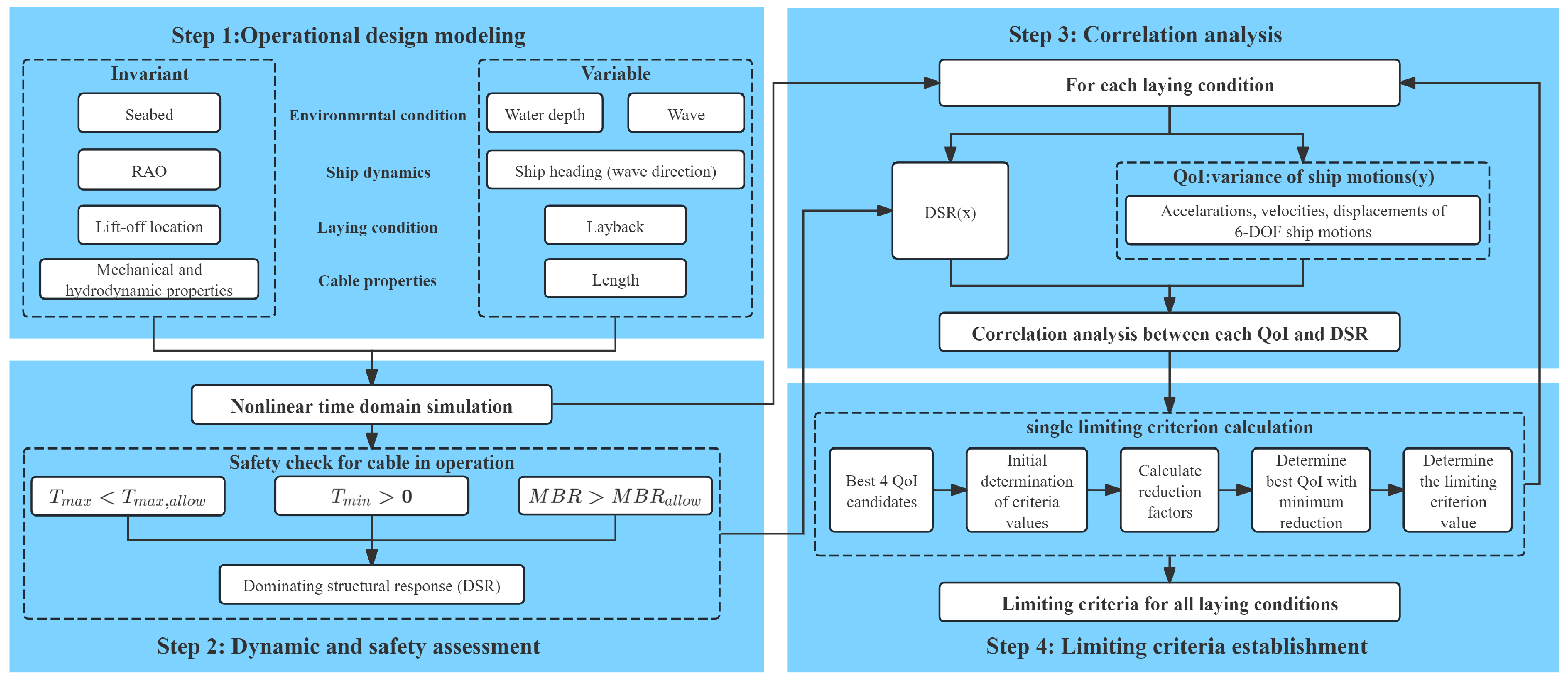
A procedure to establish the ship-motion-based limiting criteria for cable laying is proposed in this section. As shown in Figure 1, it primarily includes four steps: structural modeling of the laying operation, dynamic and safety assessment, correlation analysis, and limiting criteria establishment. A specific QoI representing ship motion dynamics is used as the variable of the operational limiting criteria (i.e., a statistical presentation of acceleration, velocity and displacement of a DOF motion). The main principle is to find the QoI strongly correlated with the DSR (dominating structural response). Through numerical simulations of cable laying under all relevant sea states and lay conditions, the limiting criterion can be calculated. As illustrated in Figure 1, a matrix of limiting criteria could be established with different laying conditions. A laying condition refers to a situation defined by a specific combination of A (water depth), L (layback distance) and θ (wave direction), while a specific combination of A and L is defined as a laying configuration. It is important to note that θ refers to the ship heading relative to the wave direction. The selection of QoI and the values are determined by these variables. In the simulation, different wave directions are set to analyze the impact of ship heading on the criteria establishment. With the matrix, the most suitable criterion can be used during the cable-laying operation by real-time environmental forecasting and monitoring to update the forecasted operational window.

2.1. Modeling of Laying Operation

The cable-laying operation is first modeled for structural dynamic simulations. This step is the same as the traditional marine operation design. The environmental condition, ship dynamics, laying condition and cable properties should be set accordingly. Among these components, the seabed condition, ship motion RAOs (response amplitude operator), lift-off location, cable hydrodynamic and mechanical properties can typically be considered invariant. However, to consider all possible situations during the operation, different combinations of A, wave conditions, hanging length and L should be considered, where the hanging length should be adapted to A. For a specific laying configuration, a large number of nonlinear time-domain simulations need to be performed with all possible wave conditions. Wave conditions can be represented by the historical sea states data, forming a sea state matrix with the variables of H s , T p and θ . Notably, although the ship is slowly sailing during the operation, with a suitable cable laying velocity, it is normally acceptable to simulate the operation by the model without forward speed. Typically, such modeling of laying operations can be conducted in numerical simulation tools such as OrcaFlex [22,23,36] and Sima [26].

2.2. Dynamic and Safety Assessment

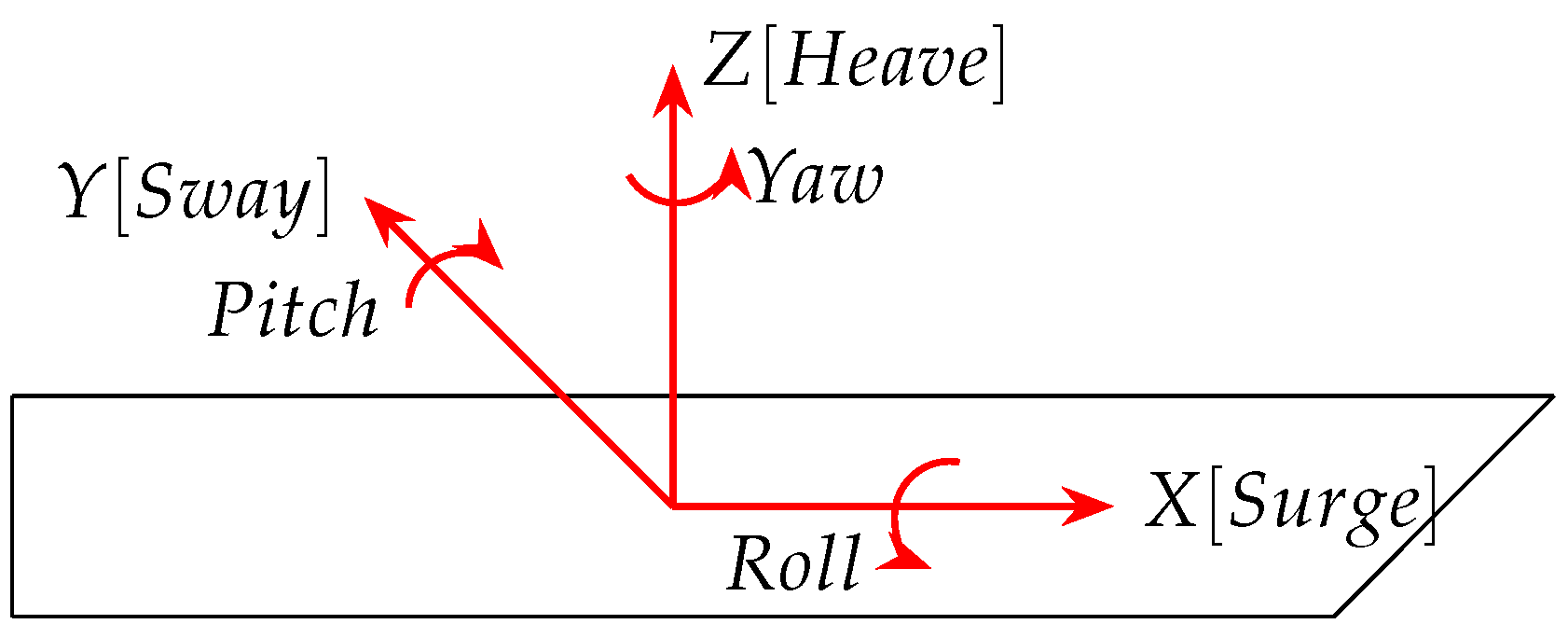
Based on the model, dynamic simulations under irregular waves are performed. The ship motions and dominating structural response (DSR) can be extracted. The ship motions are considered in 6-DOF (six-degree of freedom). The linear displacements in the X, Y, Z directions are called surge, sway and heave. The angular displacements about the corresponding axes (i.e., X, Y, Z) are roll, pitch and yaw. As shown in Figure 2, the positive X-direction is defined as pointing toward the bow, the positive Y-direction points to port, while the positive Z-direction is vertically upward.
For normal cable laying, the minimum tension ( T m i n ), the maximum tension ( T m a x ) and the minimum bend radius ( M B R ) along the cable during each simulation should be extracted. The present study considers three failure modes, i.e., the tension exceeding the maximum or the minimum allowable value, or the minimum bend radius ( M B R ) exceeding the allowable. According to DNV-RP-J301 [37], the following conditions must be satisfied for a cable during laying:
T m i n > 0
T m a x < T m a x , a l l o w
M B R > M B R a l l o w
where T m a x , a l l o w is the allowable maximum effective tension. M B R a l l o w is the allowable minimum bend radius. For a laying cable, excessive tension will cause overloading, which can threaten the stability and safety of the ship. Meanwhile, negative tension will lead to global buckling, which typically appears at TDP. M B R less than M B R a l l o w will cause cable collapses. Through assessment of these failures, the DSR and corresponding failure mode can be determined. With increasing H s and T p , the DSR should almost always firstly exceed the threshold. As shown in Section 4.1, T m i n is the DSR in the case of the studied J-lay operation.

2.3. Correlation Analysis

Correlation analysis should be comprehensively performed to find those promising QoIs strongly correlated with the DSR. Denote the QoIs by Y and the DSR by x. For a simulation with a specific laying configuration and wave condition (i.e., determined by A, L, θ , H s and T p ), QoIs of ship motions and DSR can be obtained according to Section 2.2. To analyze the correlation between them, QoIs of the ship motions are typically described by the variance of the time series of 6-DOF responses at the lift-off point. Thus, Y is further defined by the following:
Y { y 10 , y 11 , , y j i , , y 62 } ,   j { 1 , 2 , , 6 } ,   i { 0 , 1 , 2 }
where j represents the DOF of the corresponding motion (i.e., 1-surge, 2-sway, 3-heave, 4-roll, 5-pitch, 6-yaw), and i represents the derivative order of the corresponding motion (i.e., 0-displacement, 1-velocity, 2-acceleration). QoIs are calculated by the following:
Y = y j i ( A , L , θ , H s , T p ) = 1 N t 1 r = 1 N t ( m j i , r 1 N t r = 1 N t m j i , r ) 2
where N t is the total number of time steps in the simulation. Here, j and i follow the same definitions as in Equation (4), and m j i , r is the observation of the corresponding motion at the r-th time step.
For a given laying condition defined by A 0 , L 0 and θ 0 , a linear regression equation can be expressed as
Y ^ ( A 0 , L 0 , θ 0 , x ) = a j i ( A 0 , L 0 , θ 0 ) x + b j i ( A 0 , L 0 , θ 0 )
The coefficients a j i and b j i are calculated as follows, where j and i have the same definitions as in Equation (4):
a j i ( A 0 , L 0 , θ 0 ) = N x q = 1 N x x q Y q q = 1 N x x q q = 1 N x Y q N x q = 1 N x x q 2 q = 1 N x x q 2
b j i ( A 0 , L 0 , θ 0 ) = q = 1 N x Y q a j i ( A 0 , L 0 , θ 0 ) q = 1 N x x q N x
where N x is the number of the available x (i.e., x q ) under the specific laying condition, and q represents a specific sea state. Y q refers to the corresponding motions of each available x q , which can be expressed as Y q ( A 0 , L 0 , θ 0 , x q ) . Based on the initial studies, the correlation between the important Y and x is different. Preliminary studies indicate that the correlation between a candidate Y and x varies depending on whether the DSR is in the very safe domain, approaching the material limit, or after failure. Therefore, a reasonable correlation analysis based on simulated samples near the failure condition is highly preferred. It is worth mentioning that the dynamic behavior of the cable under tension is significantly different from that under compression. This leads to a very different relation between the minimum tension and ship QoI in the tension and compression regions. Thus, a definition of “critical” sample is needed to ensure correlation fitting quality. In the present study, where T m i n is identified as the DSR (as shown later), samples with x q > −4 kN were used to screen out less relevant simulations.
To measure the correlation of the linear regression equation, R A 2 (Adjusted R-squared) is calculated. For linear regression equation, it is calculated by
R A 2 ( Y , x , A 0 , L 0 , θ 0 ) = 1 S S E / ( N x 2 ) S S T / ( N x 1 )
where S S E is the sum of the squared differences between the sample values and the fitted values, calculated by
S S E ( Y , x , A 0 , L 0 , θ 0 ) = q = 1 N x ( Y q Y ^ ( A 0 , L 0 , θ 0 , x q ) ) 2
while S S T is the sum of squared differences between observed values and the mean of the dependent variable, calculated by
S S T ( Y , x , A 0 , L 0 , θ 0 ) = q = 1 N x ( Y q 1 N x q = 1 N x Y q ) 2
R A 2 is a statistical measure that quantifies how well a regression model explains the variation in the dependent variable. The range of R A 2 is between 0 and 1. An R A 2 value greater than 0.8 typically indicates a strong correlation.

2.4. Limiting Criteria Calculation

Based on the results of R A 2 , the best four QoIs with the largest four values of R A 2 are then identified. For a given laying condition consisting of A 0 , L 0 and θ 0 , the potential threshold, represented by c j i , can be calculated as
c j i ( A 0 , L 0 , θ 0 ) = Y ^ ( A 0 , L 0 , θ 0 , x a l l o w ) = a j i ( A 0 , L 0 , θ 0 ) x a l l o w + b j i ( A 0 , L 0 , θ 0 )
where x a l l o w is the limit of the DSR. For the present study where x a l l o w = 0 , there is c j i ( A 0 , L 0 , θ 0 ) = b j i ( A 0 , L 0 , θ 0 ) . However, the linearly fitted value of b j i has a high risk of overestimating the limiting criteria, e.g., as shown in Section 4.3.2. It is highly possible that there are failed cases with the minimum tension for the q-th sea state smaller than c j i . Therefore, the reduction factor β j i is applied to c j i . This factor is quantized in steps of 0.05. In addition, a single β j i is used for all L under a specific combination of A and θ . These two settings are proposed to provide a potential safety margin for establishing the final limiting criteria, considering the frequently varying layback conditions. Thus, with the combination of A 0 and θ 0 as part of the laying condition, it is calculated by
β j i ( A 0 , θ 0 ) = min L { 0.05 C j i ( A 0 , L , θ 0 ) 0.05 c j i ( A 0 , L , θ 0 ) }
where ‘ ’ indicates rounding down (e.g., 1.9 = 1 ). C j i denotes the minimum Y q when x q < 0 , defined as
C j i ( A 0 , L 0 , θ 0 ) = min x q < x a l l o w [ Y q ( A 0 , L 0 , θ 0 , x q ) ] , q { 1 , 2 , , N x }
Denoting the reduction factors for the four QoIs as β j i , 1 , β j i , 2 , β j i , 3 , β j i , 4 , the most suitable QoI ( y j i ) for the limiting criterion can be determined by
β j i , a l l o w ( A 0 , θ 0 ) = max { β j i , 1 ( A 0 , θ 0 ) , β j i , 2 ( A 0 , θ 0 ) , β j i , 3 ( A 0 , θ 0 ) , β j i , 4 ( A 0 , θ 0 ) }
Finally, the limiting criterion Y a l l o w can be calculated by
Y a l l o w ( A 0 , L 0 , θ 0 ) = β j i , a l l o w ( A 0 , θ 0 ) c j i ( A 0 , L 0 , θ 0 )
By calculating the limiting criterion under all possible conditions, the matrix for ship motion based limiting criteria can be constructed with variables of A, L and θ .

2.5. Summary

The aforementioned algorithm is summarized as follows:
  • After the models of cable-laying operation are built, dynamic simulations are conducted.
  • From the result of the dynamic simulations, QoIs and DSR are obtained.
  • Correlation analysis is performed to identify the best four candidate QoIs.
  • For each laying condition and candidate QoI, C j i , which is the minimum allowable value of Y q , is determined.
  • Using C j i , the quantized reduction factor for each combination of A and θ is calculated.
  • Through comparison among the reduction factors, the applied QoI is determined and the Y a l l o w is calculated.
  • The matrix of limiting criteria is populated with Y a l l o w for each laying condition.

3. Description of J-Lay Case Study

3.1. Numerical Model

This paper presents a J-lay operational window analysis case study used to validate the benefits of the ship-motion-based limiting criteria. To cover the different values of A and L, six J-lay models (i.e., M1–M6) were built based on the dynamic analysis software OrcaFlex [38]. Detailed model parameters are listed in Table 1. L is the horizontal distance between TDP and lift-off point, and is related to the laying angle ϕ at the sea surface. Based on previous research, seabed stiffness was considered to have a minimal impact on effective cable tension during normal laying operations [21,25]. In related pipe or cable-laying operations, different studies assume a rigid seabed stiffness ranging from 10 2 to 10 6 kN/m/m2 [39,40]. Therefore, all models employed a seabed contact with a stiffness of 10 4 kN/m/m2 and without seabed friction.
All models used the same ship and cable specifications. The ship is approximately 110 m long and 24 m wide, with an operational draft of about 7 m. The response amplitude operators (RAOs) of the ship were used to simulate the ship dynamics and its effects on the cable. The heave amplitude approaches its maximum value of 1 m/m at 0 at a large period, while the pitch amplitude peak value at 0 is approximately 1.6 deg/m occurring at about 11 s. The frequency range was considered from 0.2 to 3 rad/s. The quality of applied RAOs was also carefully checked (with respect to their asymptotic values, units, and etc.) and set to allow only interpolations. Notably, the effects of dynamic positioning (DP) or mooring systems are not considered in the simulation.
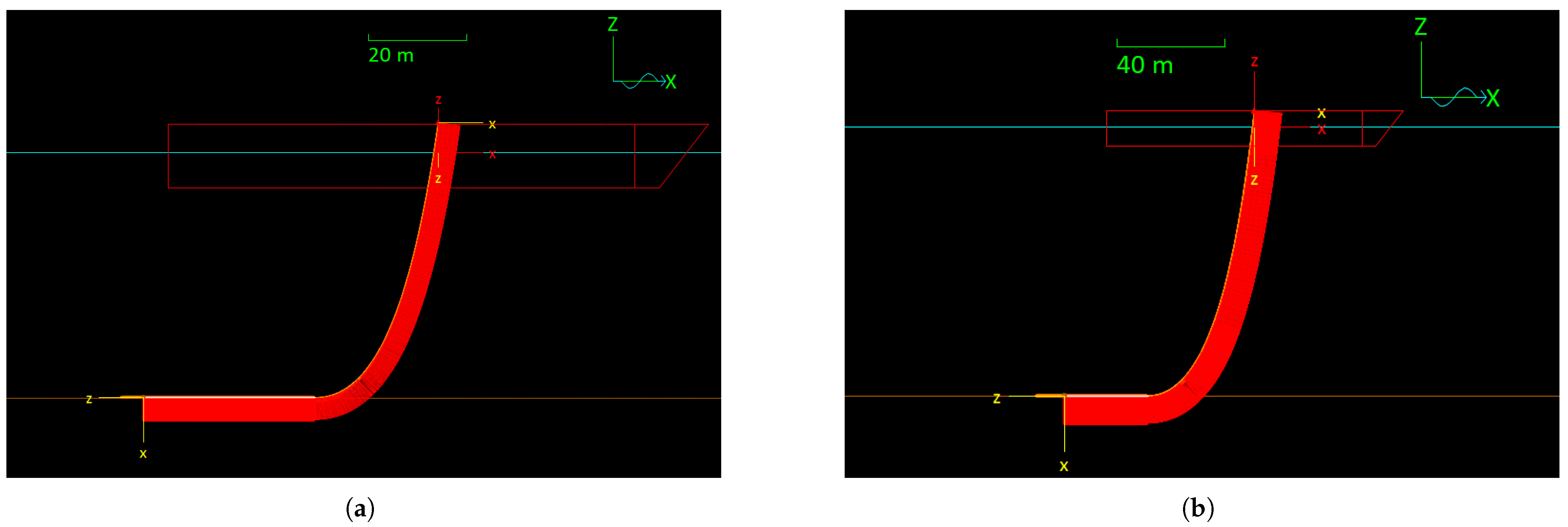
The properties of the considered marine cable are summarized in Table 2 [41]. The hydrodynamic coefficients for the cable were selected in accordance with the relevant DNV standard [42]. Morison’s equation was applied to calculate the hydrodynamic loads on the cable. The damping ratio of the cable is assumed to be 3%. To simulate the relative position and connection method in J-lay, the cable’s upper end was hinged to the ship at the lift-off point. This is considered acceptable for initial marine operation design and research purposes [36]. The lift-off point is assumed at the midship section, 1.5 m horizontally from the port side and 6 m above the sea surface. Schematic views of M1 and M4 in OrcaFlex are shown in Figure 3. The lower end is rigidly connected to the seabed to simulate the stationary state of the already laid part.
To validate the established numerical models, the effective tension and cable configuration were compared with those calculated by the theoretical model [21]. The governing equations for the theoretical cable model in J-lay are
T e = p δ cosh ( δ X )
Z = 1 δ ( cosh ( δ X ) 1 )
δ = 1 A 1 cos ϕ 1
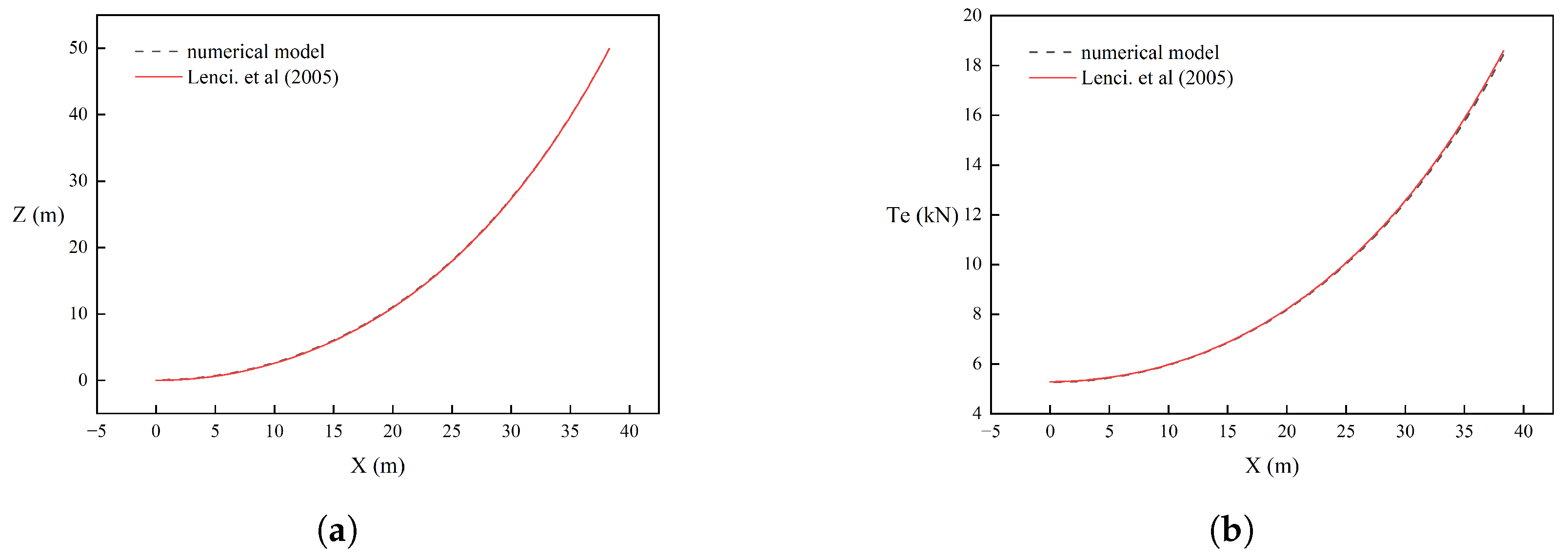
where X is the horizontal distance from any point on the cable to TDP. Z is the vertical distance from the cable unit to the seabed. A is the water depth. ϕ is the laying angle at the sea surface of the cable. T e is the effective tension. In fact, previous studies [22,23,36] using OrcaFlex for J-lay operation analysis also verified the reliability of such a modeling approach. The comparison of M3 configuration and tension distribution is illustrated in Figure 4, as an example of the model validation. The consistency between the OrcaFlex finite element model and the theoretical model has thus been verified.

3.2. Environmental Conditions

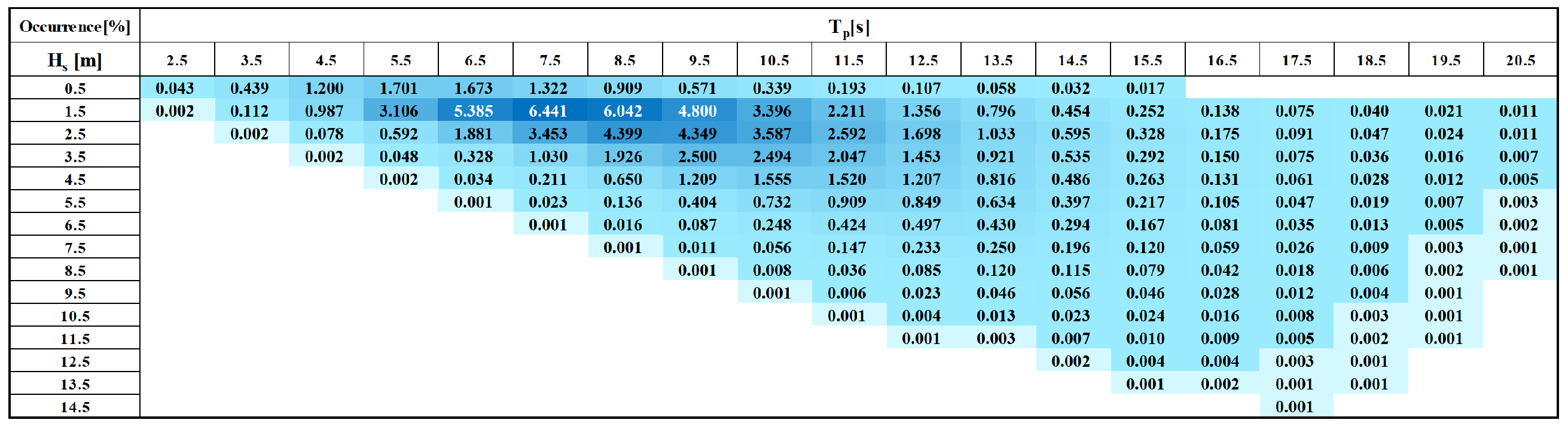
To find the basis for cable laying decisions based on ship motions, all possible sea states were considered. A sea state was characterized by its H s , T p and θ , assuming long-crested with a JONSWAP type of wave spectrum [43]. The values considered for H s , T p and θ are shown in Table 3. Severe sea states with H s larger than 6.5 m were also simulated. However, it was found that the cable was no longer safe at all. Unrealistic sea states were excluded by considering existing available data based on a real scatter diagram at the North Sea (Figure 5) [44]. Unrealistic combinations of H s and T p with no probability of occurrence were not simulated. Notably, current is not considered in this paper for simplicity. The ramp stage for each simulation was set to be 60 s, followed by a simulation duration of 1800 s. The ramp stage was excluded from statistical calculations. The time step was set to be 0.05 s. Usually, a simulation of 1800 s could be considered as sufficient to represent the stationary dynamics of the ship and cable for each sea state as an academic case study [22]. Moreover, the ramp stage guaranteed that the ship motion and DSR data were correct and available, while the data during the ramp stage were not considered or analyzed later.

3.3. Operational Assessment

With the algorithm described in Section 2, after completing the simulations, safety assessment of the laying operation for the cable is required. As shown in Table 1, T m a x during normal operations should not exceed 108 kN. T m i n should not be negative. MBR should not be less than 1.3 m. After processing and analyzing the QoIs and DSR under various conditions, the criteria can be established. Moreover, to assess the percentage increase in the operational window due to applying the newly established criteria compared to the traditional H s -based limiting criteria, the rate of the operational window increase η I is defined:
η I = T S M T H T A × 100 %
where T S M is the operational window according to the ship-motion-based limiting criteria, T H is the operable window according to H s -based limiting criteria. T A represents the duration of sea states with H s less than or equal to 9.5 m in the case studies, assumed to be a limit for the operating ship to be safely standing by at the laying site. Additionally, the rate of hazardous sea state utilization η U is introduced to describe the benefit of applying the proposed algorithm. η U is calculated as follows:
η U = ( 1 T A T S M T A T H ) × 100 %
With the data in Figure 5, the time period mentioned above can be represented by the sum of the frequency in the historical sea states scatter diagram.

4. Results of Ship Motion Based Criteria Design

4.1. Dominating Failure Mode

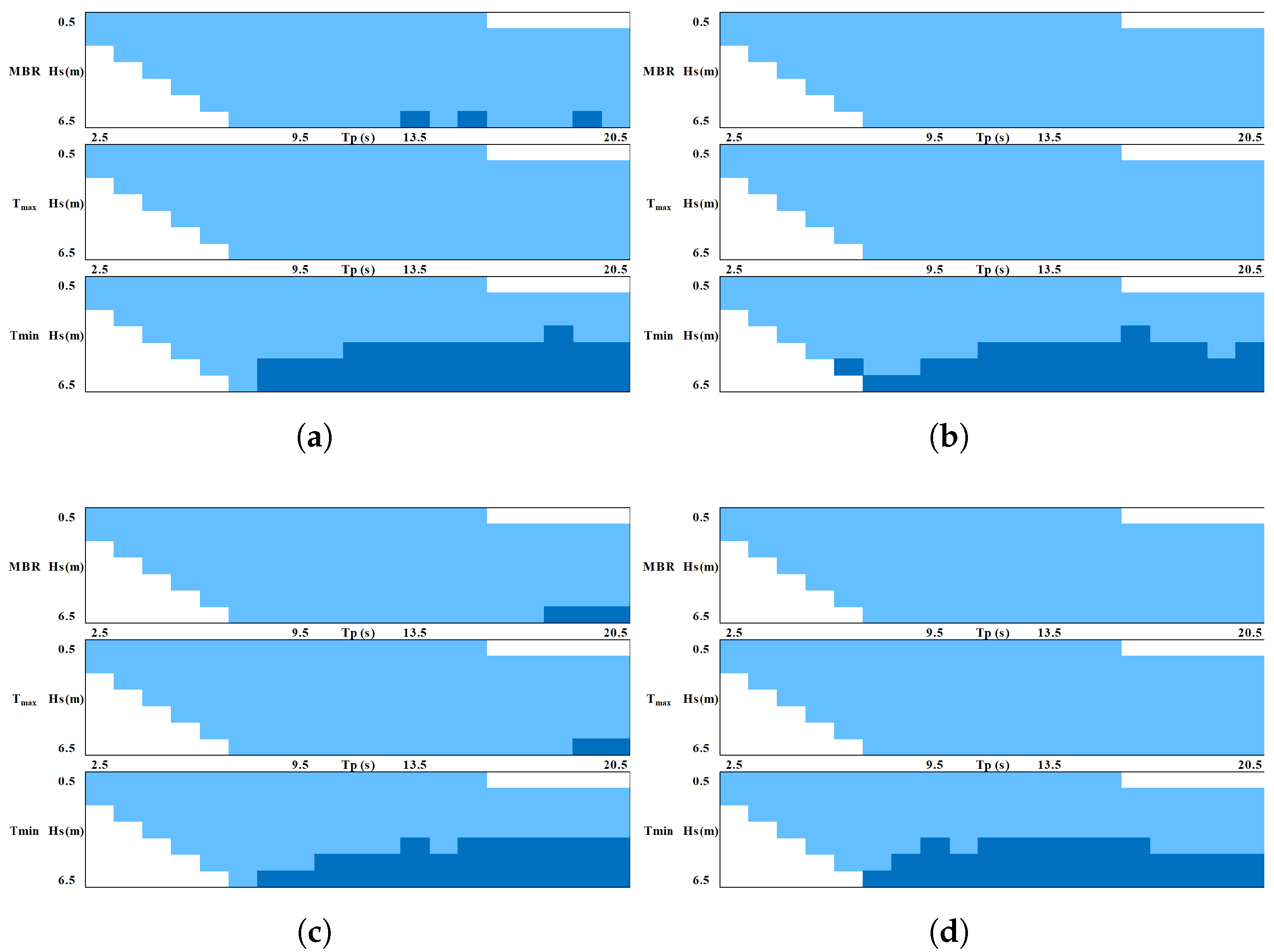
To identify the DSR, dynamic simulations were conducted based on the operational and environmental matrices shown in Table 1 and Table 3. The results of M2 and M3 under different θ are presented in Figure 6, for example. The shallow blue part represents safe conditions, while dark blue indicates that the parameter exceeds the threshold, meaning that a failure might be expected. The white part refers to the unrealistic sea state determined by Figure 5. It is observed that as H s and T p increase, T m i n is the first to exceed the threshold before MBR and T m a x . Therefore, T m i n is selected as the DSR.

4.2. Correlation Study

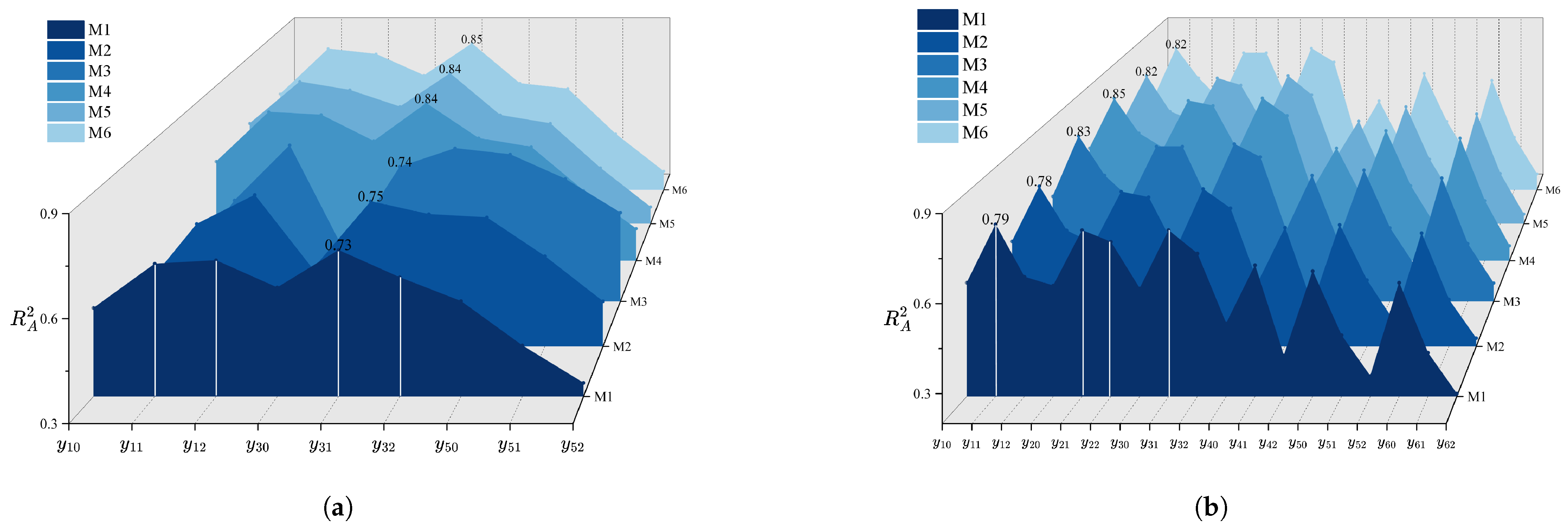
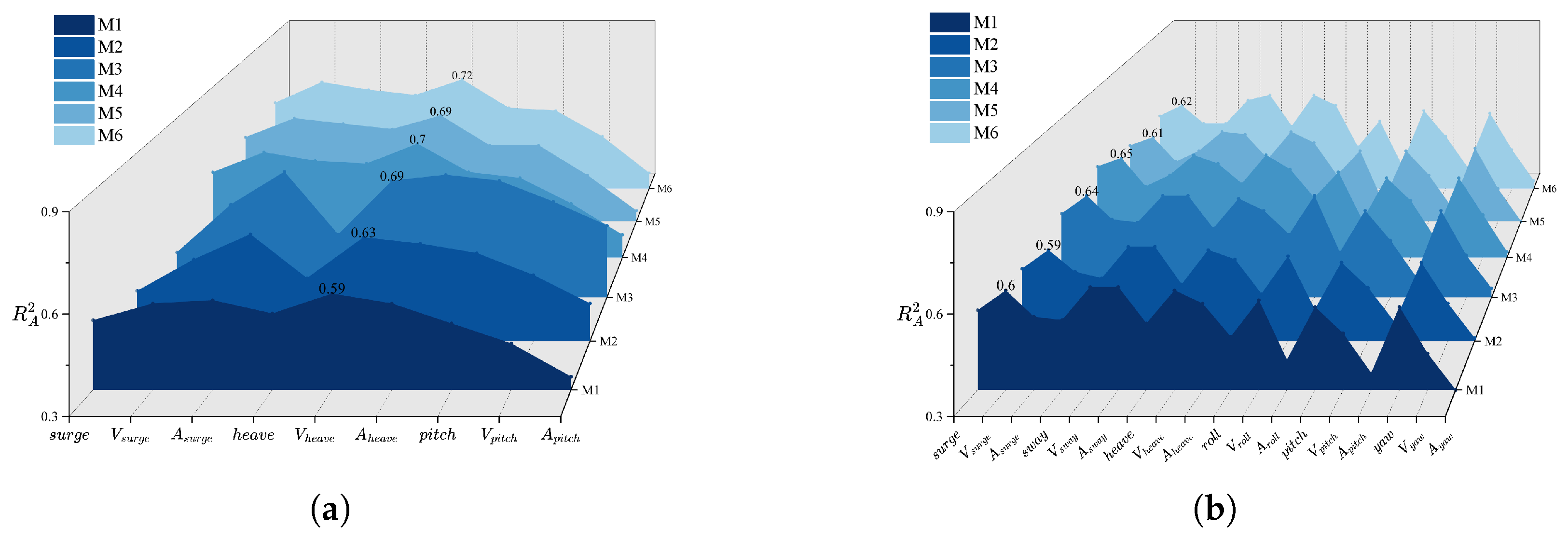
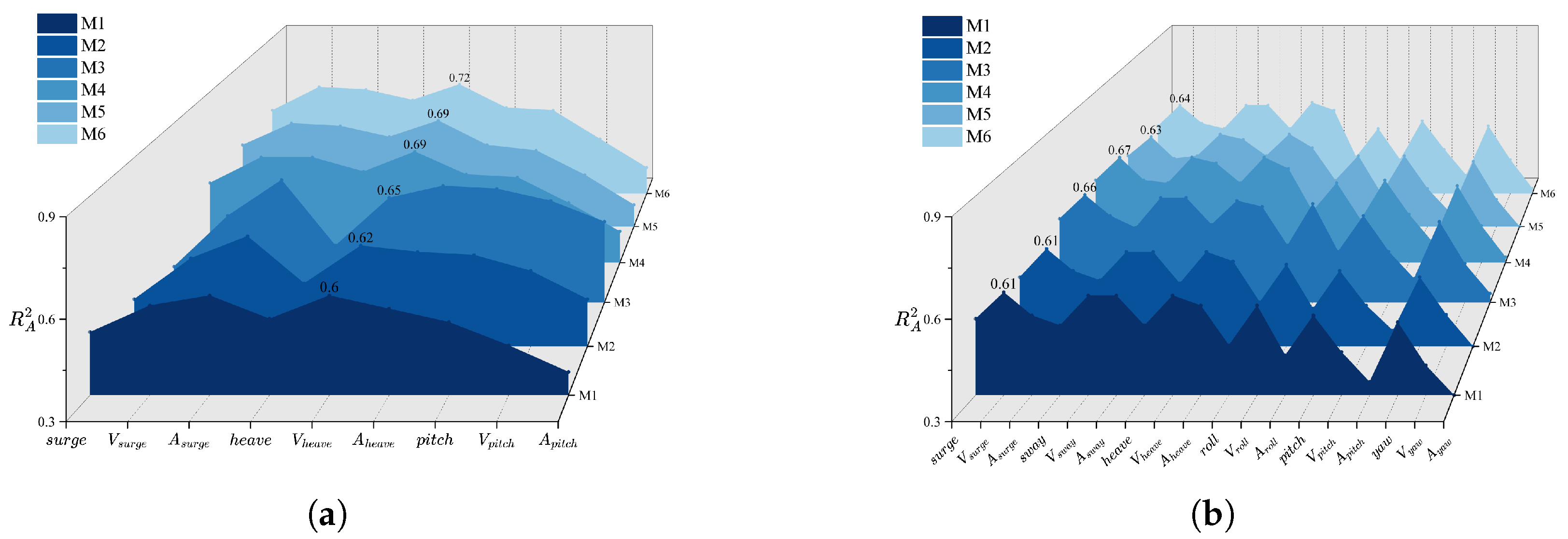
A correlation analysis between x ( T m i n ) and Y was performed. Notably, only safe or critical operations (i.e., T m i n > 4 kN) were considered for R A 2 calculation and linear fitting. The correlation results under a specific laying condition were represented by R A 2 , as shown in Figure 7. For θ = 0 , the top four QoIs are y 11 (surge velocity), y 12 (surge acceleration), y 31 (heave velocity) and y 32 (heave acceleration). Under θ = 30 , they are y 11 (surge velocity), y 21 (sway velocity), y 22 (sway acceleration) and y 31 (heave velocity). A detailed list of the top 4 QoIs for different wave directions is provided in Table 4.

4.3. Limiting Criteria Estimation

4.3.1. H s as Limiting Criterion

Based on the characteristics of traditional decision-making for limiting criteria, the H s limit varies with laying condition. With T m i n validated as the DSR, the H s limit of M2 and M3 under different θ could be determined by the highest available H s in the safety check result of T m i n in Figure 6. For example, the result of M2 under θ = 0 indicates a limit of 2.5 m. According to the DSR found result for all six models, the H s limit can be set, as shown in Table 5.

4.3.2. Ship Motion as Limiting Criterion

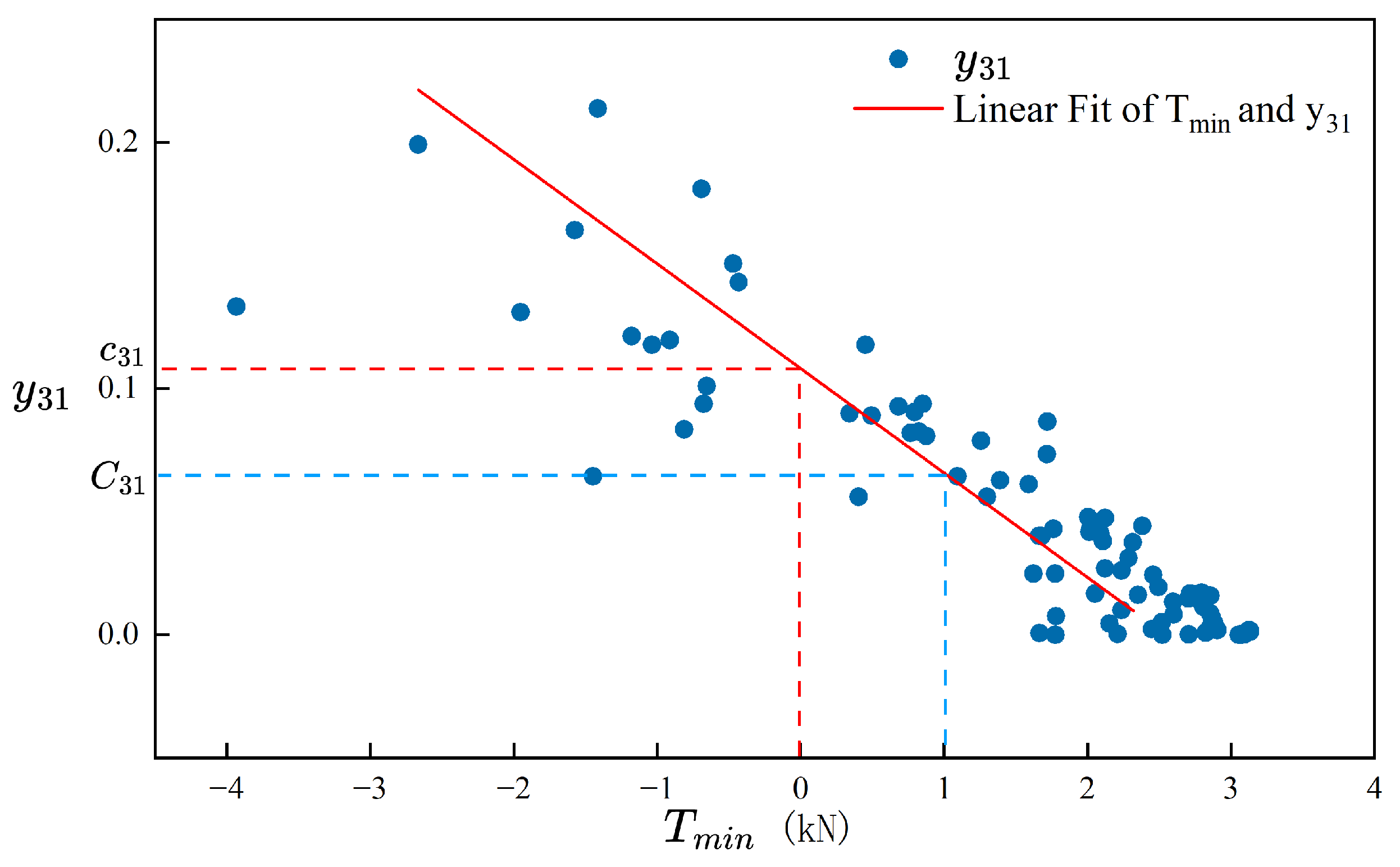
Among the selected four QoI candidates, the most suitable QoI needed to be identified to determine the limiting criterion under specific A, L and θ . Figure 8 presents the linear fitting result between x ( T m i n ) and y 31 (heave velocity) for M2 under θ = 0 , with an R A 2 of 0.75. The figure indicates that c j i (the theoretical threshold from linear regression) may be overly optimistic, failing to exclude all failure conditions. According to the simulation result, C j i was determined, and the corresponding β j i was then calculated using Equation (13).
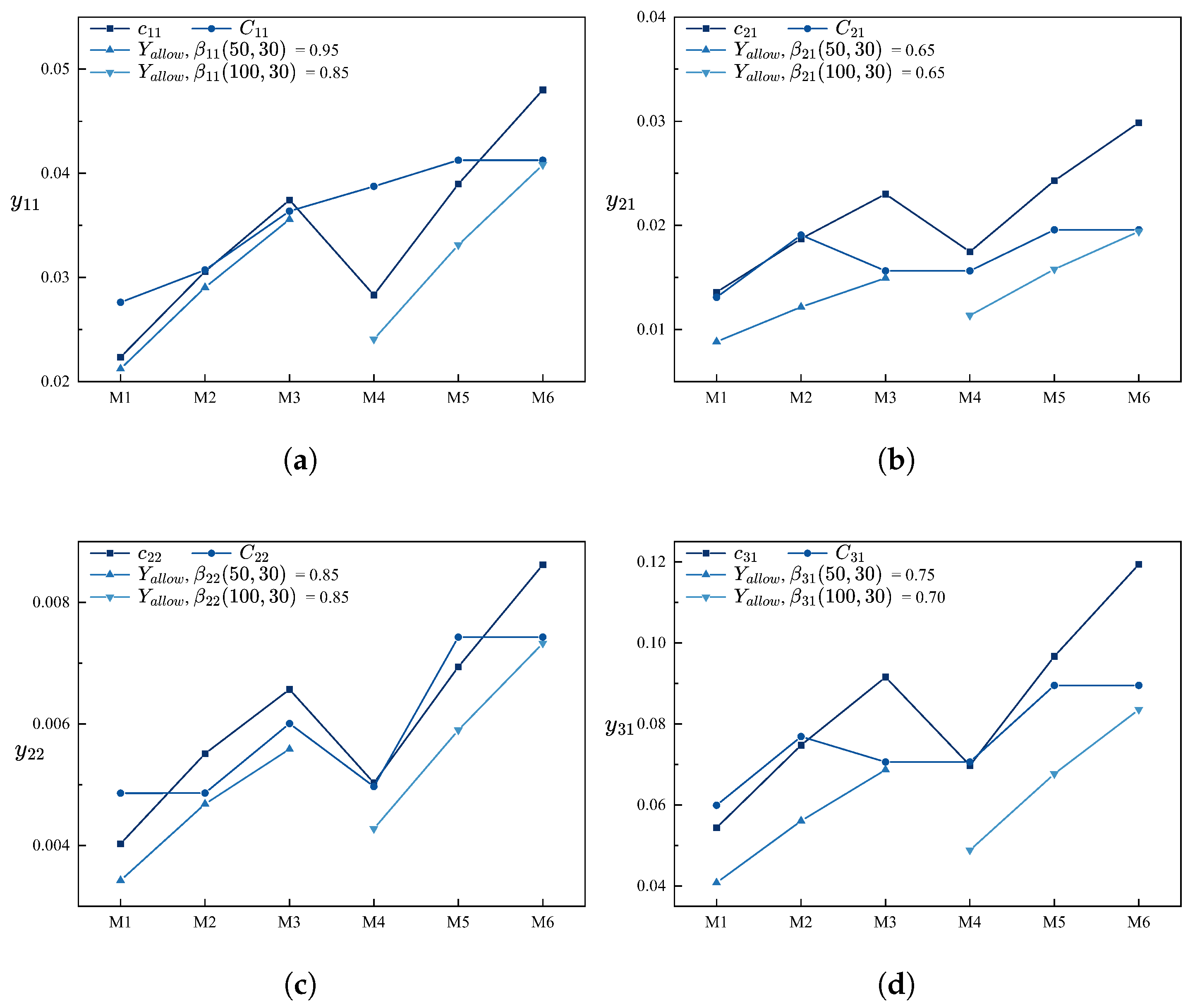
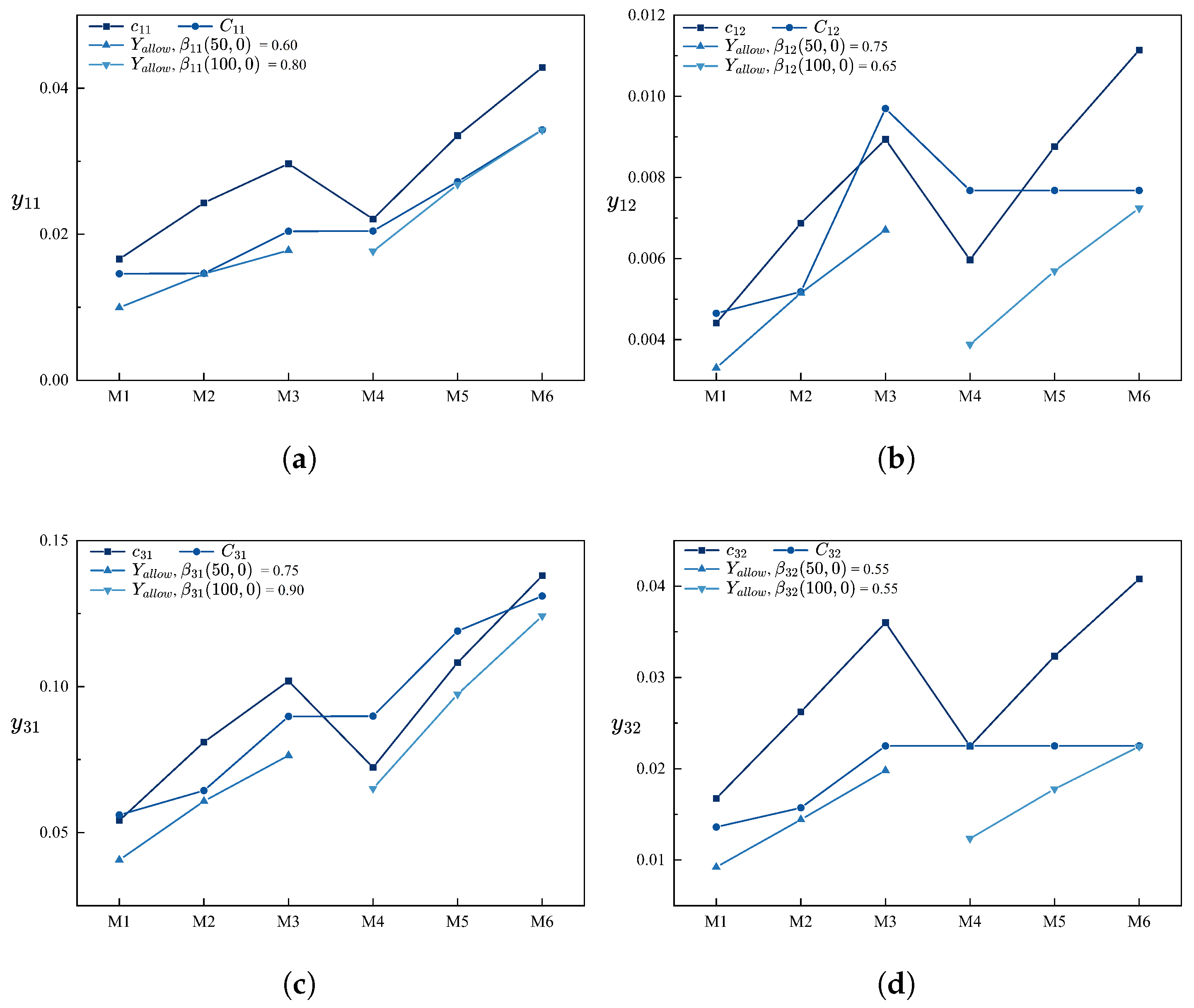
For sea states with θ = 0 , y 11 , y 12 , y 31 and y 32 were calculated. Figure 9 compares three features for them under different laying configurations: c j i , C j i and Y a l l o w , calculated by equations in Section 2.4. These were evaluated for two different A. In Figure 9a,c, it is illustrated that c j i and C j i have the same change trend under different laying configuration. Figure 9c indicates that β 31 is the maximum β j i among the candidate QoIs under any laying configuration. Thus, y 31 (heave velocity) is most suitable for the limiting criterion under any laying configuration for θ = 0 with β 31 , a l l o w ( 50 , 0 ) = 0.75 and β 31 , a l l o w ( 100 , 0 ) = 0.9 .
For sea states with θ = 30 , y 11 , y 21 , y 22 and y 31 were calculated. Figure 10 compares the same three features for them. Similarly, c 11 and C 11 exhibit the same changing trend under different laying configurations in Figure 10a. It is illustrated that β 11 is the maximum β j i among the candidate QoIs under any laying configuration. Consequently, y 11 (surge velocity) is the limiting criterion under any laying configuration for θ = 30 with β 11 , a l l o w ( 50 , 30 ) = 0.95 and β 11 , a l l o w ( 100 , 30 ) = 0.85 .
Based on the above results, the ship motion-based limiting criteria for different laying configurations and θ are summarized in Table 6. Thus, an operation is deemed safe if the corresponding QoI remains below its established threshold.

4.4. Comparison of Operational Window

Following the content in Section 3.3, the operational windows by H s -based (Table 5) and ship-motion-based (Table 6) limiting criteria were estimated. As an example, the detailed comparison of the operational window for M5 when θ = 0 is shown in Figure 11. The dashed line represents the H s limit of 3.5 m. The blue region indicates sea states that are safe according to both limits. The green part refers to the sea states that are considered dangerous by the H s limit but safe by the ship motion limit. The yellow part refers to the sea states that are dangerous by the ship motion limit but safe by the T m i n limit. This part indicates the environmental conditions that the new approach also failed to utilize. To some degree, this may be considered as a safety margin. The red part refers to the sea states that are dangerous by the T m i n limit. Therefore, all safe sea states by ship motion limit consist of the blue and green parts, while the green part refers to the improvement compared to safe sea states by the H s limit. It is illustrated that the green part refers to a high-frequency wave with a higher H s than the H s limit.
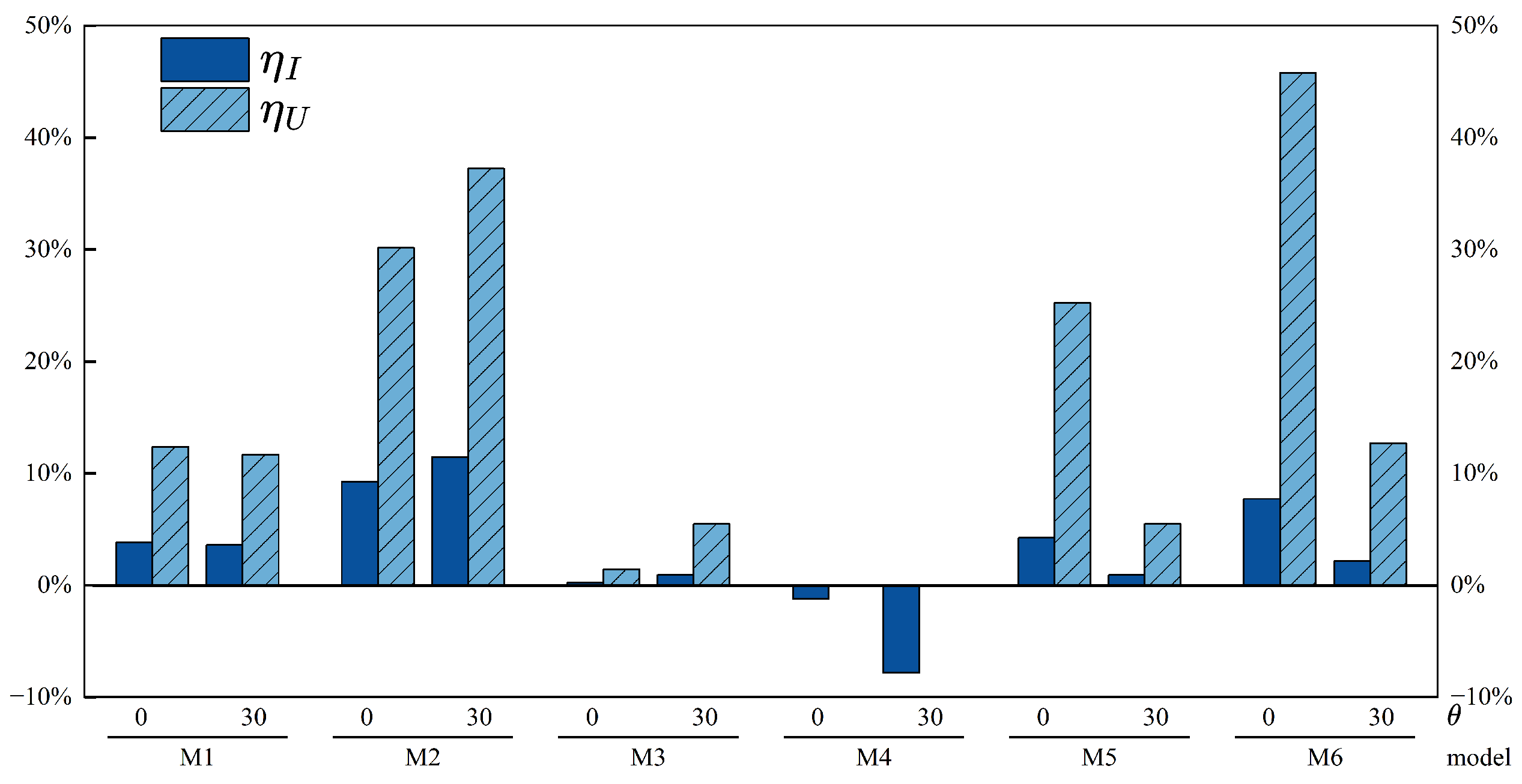
Based on the detailed comparison of the operational window for all models under θ = 0 and 30 (e.g., Figure 11), η I and η U can be calculated using Equations (20) and (21). As shown in Figure 12, the operational window can be increased by up to about 10%, and the utilization rate of dangerous sea states of H s -based limiting criteria reaches up to about 50%. The results indicate that the ship-motion-based limiting criteria generally lead to positive improvements in the operational window, with an average η I of 2.9% and an average η U of 15.6%. Notably, a reduction in the operational window may occur under specific laying conditions. Excluding the cases with the unfavorable layback settings for the ship-motion-based operation (i.e., M4 as discussed in Section 5.2, the averages increase in η I = 4.4% and η U = 18.7%. Under θ = 0 , the average η I is 3.8% and η U is 14.51%. Under θ = 30 , the average η I is 5.0% and η U is 22.99%.

5. Discussions

5.1. On the Selection of Statistical Characteristics of Ship Motions

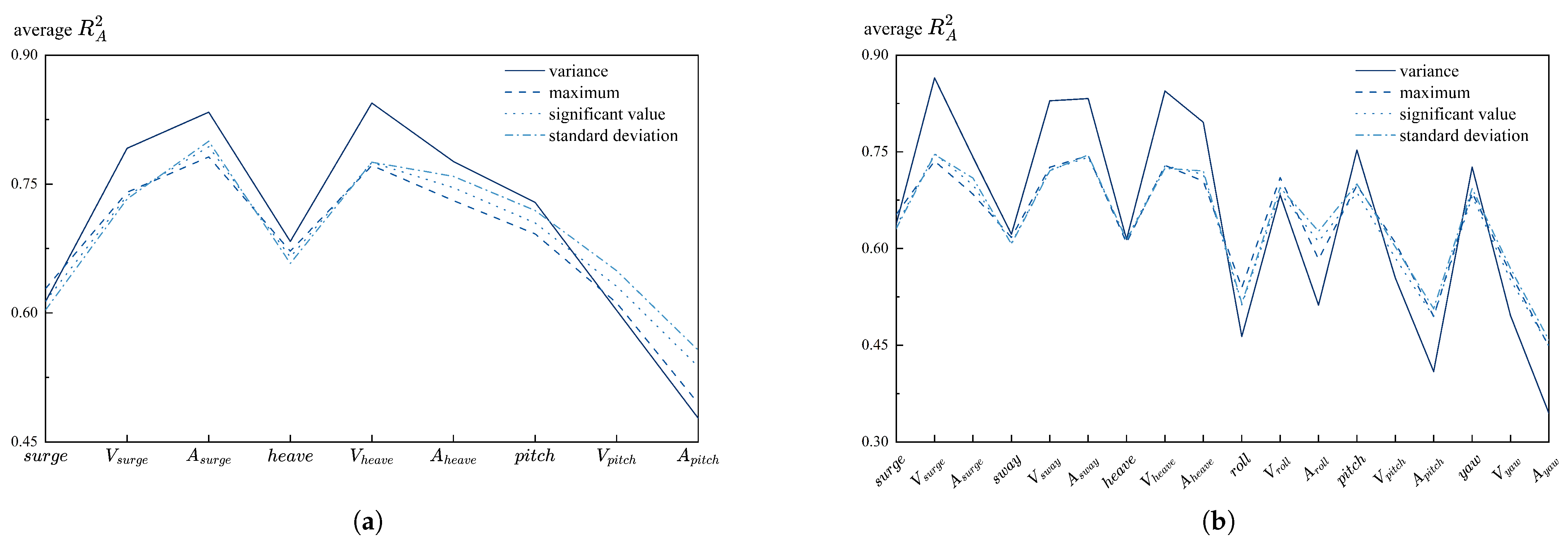
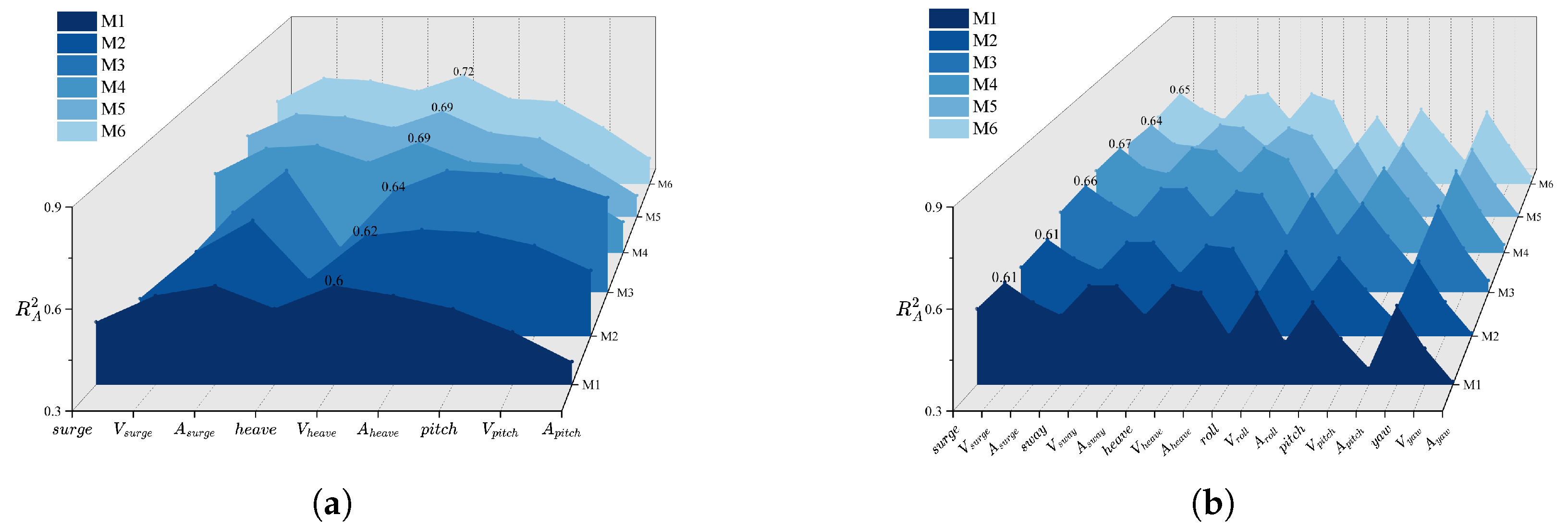
As mentioned in Section 2.3, variance was selected to represent the QoI of ship motions following a comparative analysis. Figure A1, Figure A2 and Figure A3 shows the results of correlation analysis according to different statistical characteristics under various laying conditions. The considered statistical presentation of ship motions includes the maximum values (Figure A1), the significant values (Figure A2) and the standard deviations (Figure A3). Compared to the result of variance (Figure 7), it is shown that the variance always shows the best linear correlation by significant QoIs, giving the strongest information regarding the correlation. Furthermore, using variance helped reduce the influence of simulation randomness, thereby increasing the robustness of the regression analysis. Therefore, it was chosen as the metric for calculating the QoIs.
It is found that velocities and accelerations of the ship generally show a better correlation with DSR in Section 4.3.2. This could be due to the fact that the dynamics of a slender cable are mainly influenced by direct wave loads and ship-motion-induced loads. The direct wave loads usually consist of drag and inertial forces determined by velocities and accelerations. For the considered DSR in the case study, the minimum tension at touch down might be dominated by the dynamic contact behavior, where the instantaneous velocity plays a critical role. Such instantaneous velocity of the cable might be affected by the ship’s kinematics, represented by its velocities and accelerations. It is important to note that the final selection of the QoI in this study is primarily data-driven. The potential physical reasoning for such selection might be case-specific, with more cautiousness to make a conclusion.

5.2. Influence of Layback Distance (L) and Water Depth (A)

According to the result as shown in Figure 12, the operational window of the ship-motion-based decision-making approach will increase with the increase in L. Criteria in Table 6 also indicate that a more severe ship motion response will be acceptable under larger L, while a larger L is not always better. For J-lay operations, an appropriate L is beneficial for the safety of cable-laying operations by decreasing the impact of ship motion response on the laying cable. Moreover, it is indicated that the suitable range of L for the approach is determined by A. The reduction in the operational window observed for M4 but not M1 indicates that L = 20 m is less suitable when A = 100 m. Under this situation, some safe sea states according to the H s limit may turn to be dangerous, as shown in Figure 13, with the same rule mentioned in Section 4.4. It is indicated that a safe sea state by the ship motion limit may not include all safe sea states according to the H s limit, which may potentially lead to a decrease in the operational window. However, such occurrences were infrequent in this study. Such a decrease in operation window may also be due to the rough discretization of the sea states. Although clarifying the suitable range of L under different A is not the research target of this paper, it is evident that such an optimal range of L exists and varies with A.

5.3. Influence of Ship Heading

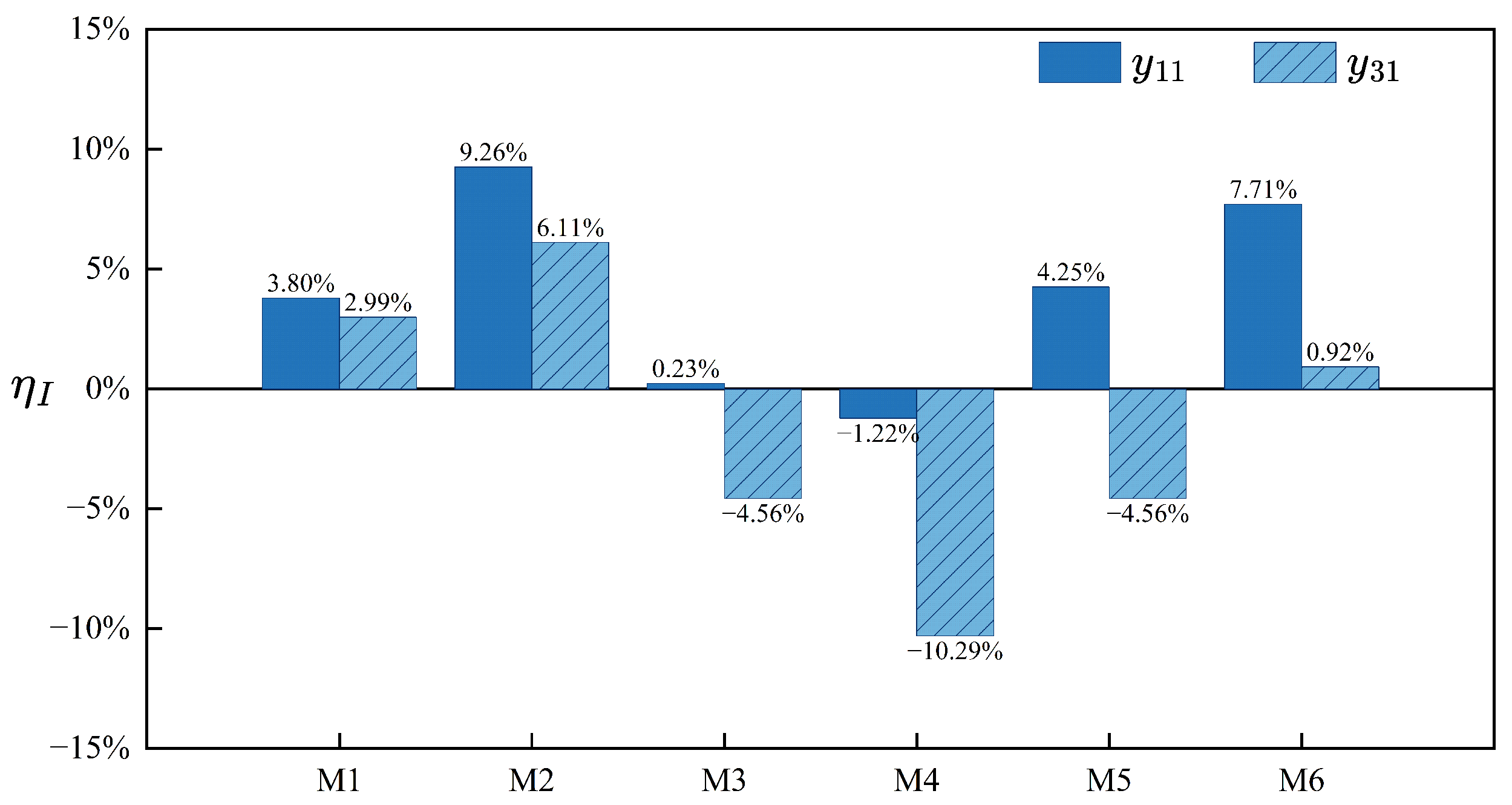
Various θ were used to simulate different ship headings for the operation in the case study. Although only two headings were considered, Figure 7 shows that different headings can yield different critical QoIs for establishing operational limits. As shown in Figure 14, under the condition of θ = 30 , if the same heave velocity as that at 0 was still used as the limiting criterion, the rate of the operational window increase η I will decrease or even become negative. Due to the characteristics of J-lay, the ship can change its heading during the cable-laying operation to adapt to the working environmental conditions. Therefore, the research on the optimal limiting criteria under different ship headings is of great significance, which can maximize the operational window.

5.4. Strategy of Fitting and Regression Analysis

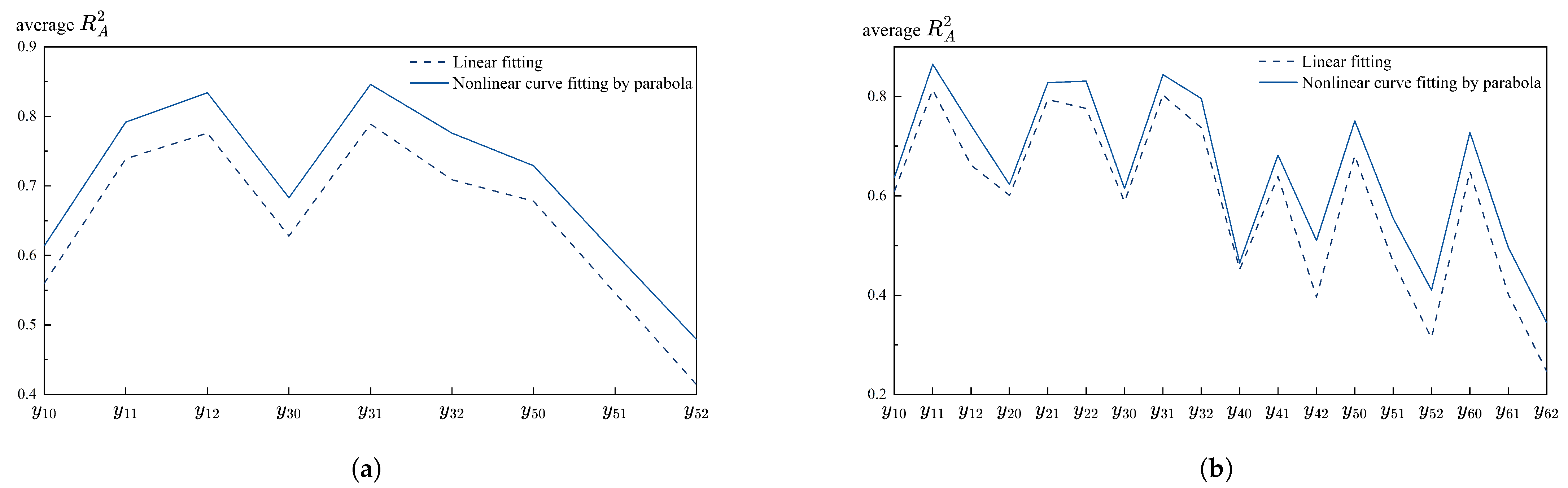
This study initially used a linear regression equation to derive the theoretical thresholds. However, from the perspective of the fitting methodology, employing parabolic or polynomial functions for curve fitting can yield conclusions with stronger correlation coefficients. Figure 15 compares the correlation results from linear and nonlinear fitting by the average R A 2 of QoIs in the models. But within the limiting criterion determination process, the final threshold selection actually depended on the simulation results and was less related to the fitting method. The fitting process served primarily to identify candidate QoIs for limiting criteria calculations later. Furthermore, as demonstrated by Figure 16, changing the fitting strategy did not significantly affect the ranking conclusion in Section 5.1. Consequently, linear fitting was considered sufficient to determine the theoretical thresholds c j i and rank potential QoIs.
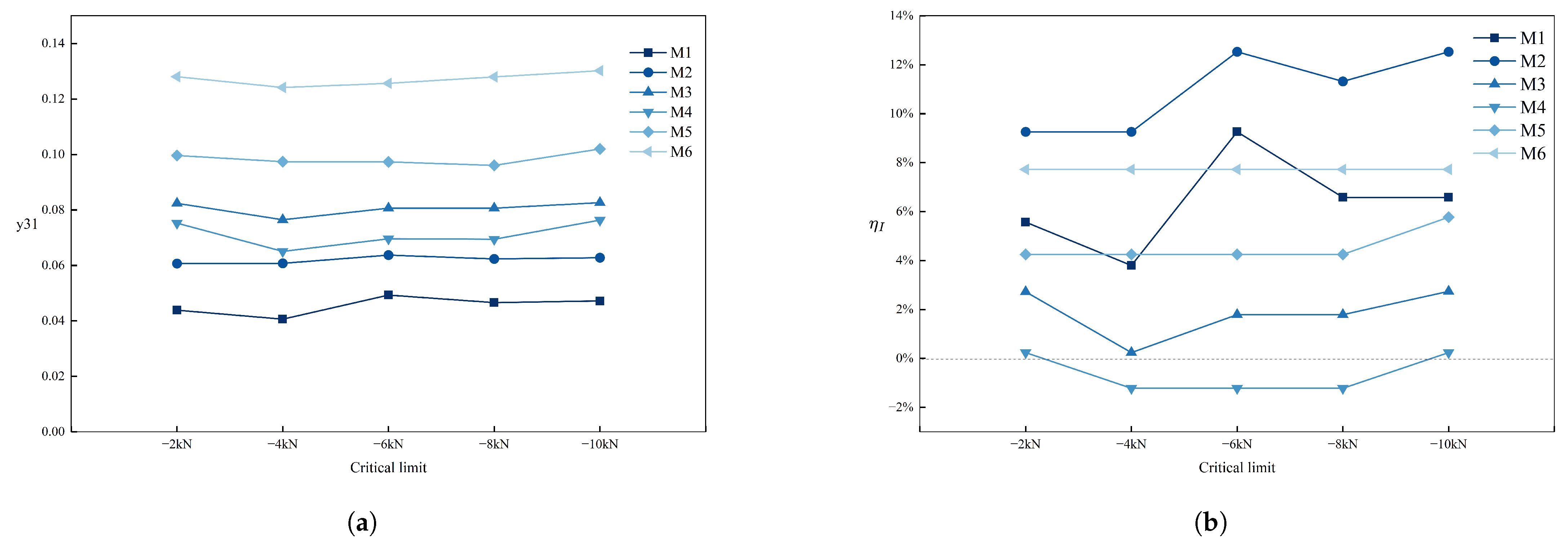
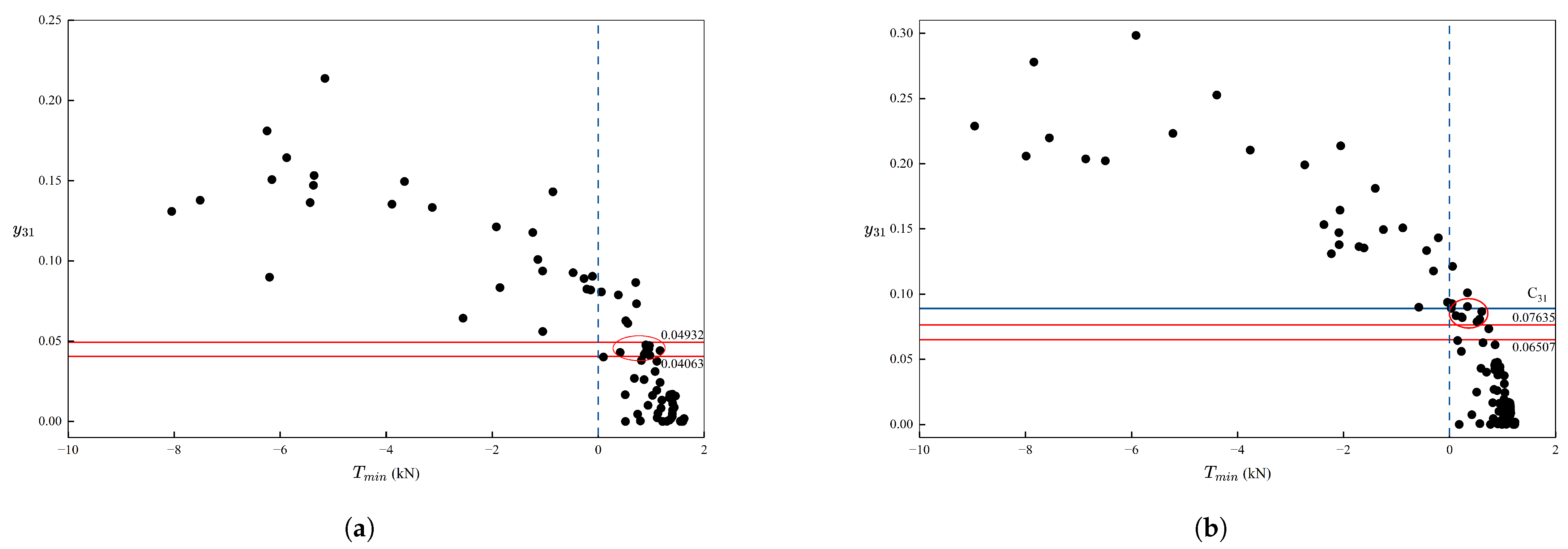
However, the number of simulations changes with the varying value of the critical limit applied to correlation fitting, consequently altering c j i . Although the limiting criterion is ultimately determined by the actual simulation results, the use of Equations (13) and (16) for calculating β and consequent limiting criterion introduced some uncertainty. This involves the quantization of β in steps of 0.05 and the strategy of calculating the limiting criterion using c j i . Figure 17a shows the variation in the limiting criterion for the variation of the critical limits from −2 kN to −10 kN. This has a noticeable impact on the available operational window for some conditions, as shown in Figure 17b. Figure 18a presents a scatter plot of y 31 versus the T m i n for M1. The two red lines indicate the calculated upper and lower bounds of the limiting criteria corresponding to different critical limits for correlation fitting. It can be observed that a significant number of simulated results stood between these two red lines, as indicated by the red circle in Figure 18a. This leads to the drop in the available operational window.
On the other hand, the strategy of using a single β value for all L under the same A and θ also affects the operational window for certain conditions, especially those with smaller L. Figure 18b shows a scatter plot of y 31 versus the T m i n for M4. The two horizontal red lines represent the upper and lower bounds of the calculated limiting criteria due to different critical fitting limits, and the blue horizontal line represents C 31 . It is clearly shown that there is a significant amount of sea states sitting between the blue line ( C 31 ) and the upper bound of the limiting criterion (highlighted by the red circle). These sea states were then misjudged as not safe to operate. The reason for this phenomenon is that under small L, the cable’s static tension at touch down is low. The consequent dynamic variation in tension is more sensitive, leading to the onset of negative tension sooner than in conditions with larger layback. Generally, it is found that the value of β for a combination of A and θ was mostly determined by the large layback conditions. This provides a more conservative operation at the smaller layback as illustrated in Figure 13. However, it is important to mention that such a strategy only created operational conservatisms, essentially representing a change in safety margin for the cable-laying operation. It is interesting to further investigate the coherent uncertainties in a more systematic and quantitative manner.

5.5. Impact of Splash Zone

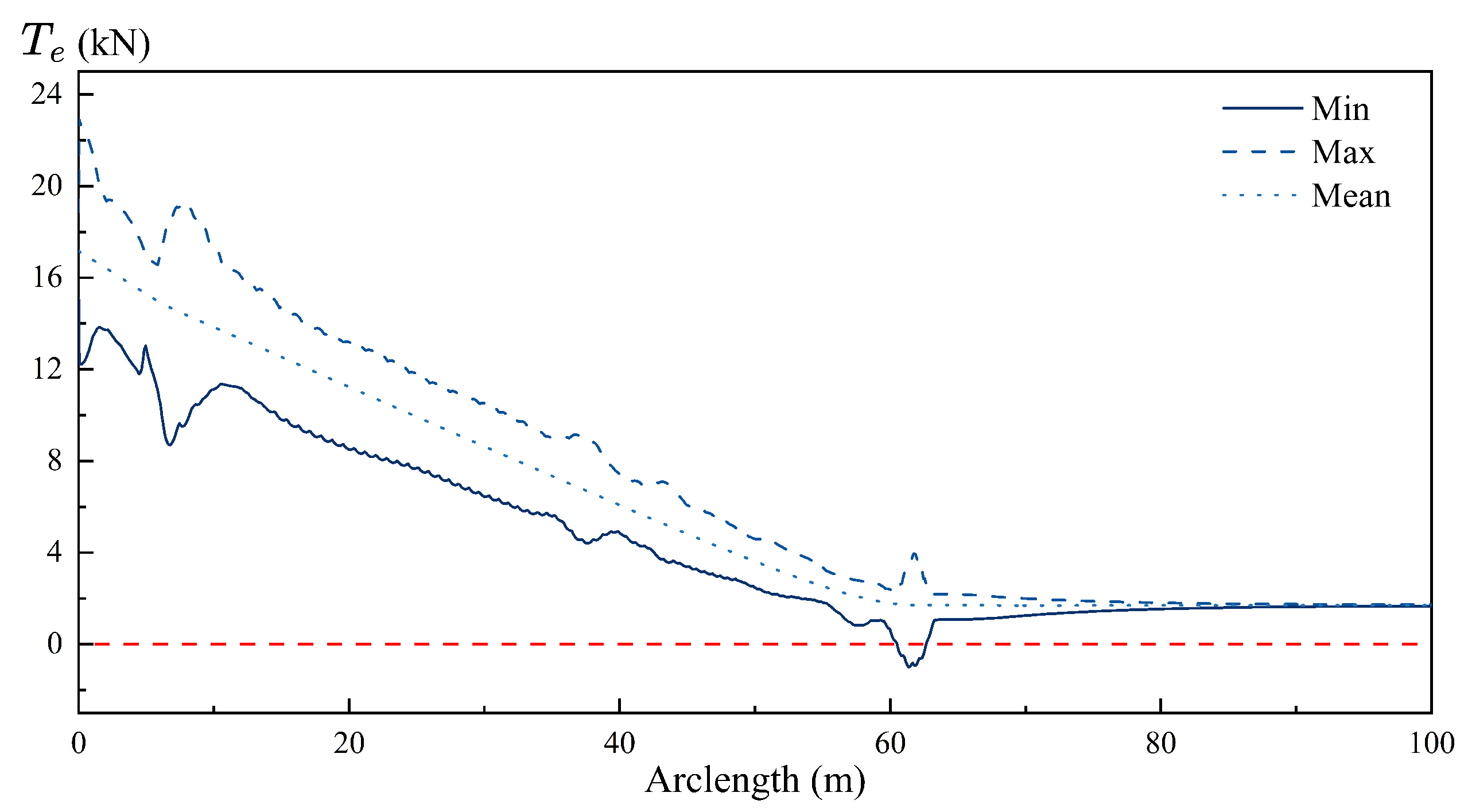
The splash zone refers to the part of the cable that comes into contact with the sea surface, which is directly impacted by waves. These high-frequency waves can cause significant cable perturbation in the splash zone, affecting the dynamic response at both the splash zone and the TDP. The results imply that the selected QoI may not reliably predict the DSR for certain high-frequency sea states. In the present case studies, this issue was less pronounced. As shown in Figure 19, this occurred for the operation of L = 20 m (i.e., ϕ is close to 90 ). The certain high-frequency sea states refer to ( H s , T p ) { ( 2.5 m , 3.5 s ) , ( 3.5 m , 4.5 s ) , ( 4.5 m , 5.5 s ) } , with any wave direction and water depth. However, these specific sea states are critical cases with an extremely low probability of occurrence. Moreover, in practice, this effect can be mitigated by controlling the lay angle ϕ via the onboard tensioner.

6. Conclusions

The present research established a novel algorithm for more efficient and effective cable-laying operations. First, numerical models incorporating different water depths and layback distances were developed by OrcaFlex. DSR and QoIs were identified via dynamic simulations under irregular waves. Then, the criteria were determined by comprehensive correlation analysis, linear fitting and reduction factor analysis for all laying and environmental conditions. The reduction factor β was incorporated to ensure operational safety, thereby enhancing the robustness of the criteria. The selection of QoI based on the maximum value of β also guarantees the operational efficiency as much as possible. Finally, comparative analysis between ship-motion-based and H s -based limiting criteria demonstrated an improvement in operational window utilization. Key conclusions are summarized as follows:
  • During the J-lay operation, the minimum effective tension was identified as the DSR. Negative tension always occurs first with progressive sea state deterioration.
  • The ship-motion-based limiting criteria prove feasible for J-lay operations, with heading-specific QoIs exhibiting optimal correlation to cable integrity. Heave velocity governs 0 heading, while surge velocity dominates 30 heading.
  • Within a suitable range, the limiting thresholds increase with layback distance, which enhances operational safety. Notably, shorter layback distances amplify splash zone effects and reduce the effectiveness of ship-motion-based criteria. This suitable range varies with the operating water depth.
  • By dynamically selecting ship motion indicators across different ship headings, the proposed algorithm extends the operational window by approximately up to 10% compared to conventional H s -based limits, while improving utilization in hazardous sea states by roughly up to 50%.
To adjust the complex sea conditions during the operation, a limiting criteria matrix including all ship headings, water depths, and layback distances determined by numerical simulations (e.g., Table 6) is necessary to establish ship motion-based decision making criteria. Incorporating the reduction factor β enables the establishment of a criteria matrix that expands the operational window while ensuring safety based on actual engineering conditions.
The proposed algorithm has demonstrated significant engineering value for cable-laying operations. However, this initially proposed algorithm involving candidate selection and beta factor screening is worthy of further investigation in several aspects, such as its applicable scope, robustness, and uncertainties. In particular, quantitative uncertainty analysis of the proposed framework in terms of rounding-down of β , QoI ranking, and fitted thresholds is interesting and necessary to perform before broad engineering applications. Moreover, the effects of explicitly considering ship forward speed, current, and dynamic positioning system are worth investigation as well. In addition, future work could examine extending this algorithm to other marine operations, such as heavy lift operations.


Author Contributions

Conceptualization, X.H. and Z.X.; methodology, X.H. and Z.X.; software, X.L.; validation, X.H., Z.X., X.L. and Z.L.; formal analysis, Z.X.; investigation, X.H., Z.X., X.L. and W.S.; resources, X.H., X.L. and W.S.; data curation, Z.X.; writing—original draft preparation, X.H. and Z.X.; writing—review and editing, X.H., Z.X., X.L., W.S. and Z.L.; visualization, Z.X.; supervision, X.H.; project administration, X.H.; funding acquisition, X.H. and W.S. All authors have read and agreed to the published version of the manuscript.

Funding

This research was funded by the National Key R&D Program of China (Grant No. 2024YFB4205400).

Data Availability Statement

The original contributions presented in this study are included in the article. Further inquiries can be directed to the corresponding author.

Conflicts of Interest

The authors declare no conflicts of interest. The funders had no role in the design of the study; in the collection, analyses, or interpretation of data; in the writing of the manuscript; or in the decision to publish the results.

Abbreviations

The following abbreviations are used in this manuscript:
TDPTouch Down Point
RAOResponse Amplitude Operator
QoIQuantity of Interest
DOFDegree of Freedom
MBRMinimum Bend Radius
DSRDominating Structural Response
SSESum of Squares for Error
SSTSum of Squares Total
JONSWAPJoint North Sea Wave Project

Appendix A. Details About the Correlation Analysis

Figure A1. R A 2 result of linear fitting by maximum of ship motions. (a) θ = 0 . (b) θ = 30 .
Jmse 14 00543 g0a1
Figure A2. R A 2 result of linear fitting by significant value of ship motions. (a) θ = 0 . (b) θ = 30 .
Jmse 14 00543 g0a2
Figure A3. R A 2 result of linear fitting by standard deviation of ship motions. (a) θ = 0 . (b) θ = 30 .
Jmse 14 00543 g0a3

References

  1. GWEC. Global Offshore Wind Report 2025; Global Wind Energy Council: Lisbon, Portugal, 2025. [Google Scholar]
  2. Rehana, P.; Kishor, N.; Soumya, R.M. Off-shore wind farm development: Present status and challenges. Renew. Sustain. Energy Rev. 2014, 96, 780–792. [Google Scholar] [CrossRef]
  3. Wang, Z.X.; Jiang, C.W.; Ai, Q.; Wang, C.M. The key technology of offshore wind farm and its new development in China. Renew. Sustain. Energy Rev. 2009, 13, 216–222. [Google Scholar] [CrossRef]
  4. Min, C.G.; Hur, D.; Park, J.K. Economic evaluation of offshore wind farm in Korea. Trans. Korean Inst. Electr. Eng. 2009, 63, 1192–1198. [Google Scholar] [CrossRef]
  5. IRENA. Renewable Power Generation Costs in 2022; International Renewable Energy Agency: Abu Dhabi, United Arab Emirates, 2023. [Google Scholar]
  6. Teng, H.; Leng, S.; Shi, W.; Li, X.; Hou, X.; Ren, Y.; Michailides, C.; Karimirad, M. Hydrodynamic and Power Performance of a V-Shaped Floating Wind-Wave Integrated System Based on Multi-Field Coupling. Ocean Eng. 2026, 351, 124331. [Google Scholar] [CrossRef]
  7. Martina, F.; David, P. Optimizing wind farm cable routing considering power losses. Eur. J. Oper. Res. 2018, 270, 917–930. [Google Scholar] [CrossRef]
  8. Jin, R.S.; Peng, H.; Yang, G.Y.; Qi, Y.H.; Chen, C.; Chen, Z. Cable routing optimization for offshore wind power plants via wind scenarios considering power loss cost model. Appl. Energy 2019, 254, 113719. [Google Scholar] [CrossRef]
  9. Laura, C.S.; Almudena, F.V.; Isabel, L.G.; Luis, C.C. Methodology to calculate the installation costs of offshore wind farms located in deep waters. J. Clean. Prod. 2018, 170, 1124–1135. [Google Scholar] [CrossRef]
  10. DNV-ST-N001; Marine Operations and Marine Warranty. Det Norske Veritas: Bærum, Norway, 2016.
  11. Asle, N.; Torgeir, M.; Per, Ø.A. Uncertainty in forecasted environmental conditions for reliability analyses of marine operations. Ocean Eng. 2015, 108, 636–647. [Google Scholar] [CrossRef]
  12. Wu, M.N.; Christos, S.; Gao, Z.; Sverre, H. Prediction of short-term wind and wave conditions for marine operations using a multi-step-ahead decomposition-ANFIS model and quantification of its uncertainty. Ocean Eng. 2019, 188, 106300. [Google Scholar] [CrossRef]
  13. Wilcken, S. Alpha Factors for the Calculation of Forecasted Operational Limits for Marine Operations in the Barents Sea. Master’s Thesis, University of Stavanger, Stavanger, Norway, 2012. [Google Scholar]
  14. Willem, E.; Jolien, R.; Antoon, J.; Pieter, H.; Sebastiaan, N.J. Probabilistic downtime estimation for sequential marine operations. Appl. Ocean Res. 2019, 86, 257–267. [Google Scholar] [CrossRef]

  15. Wilson, G.A.; Li, L.; Gao, Z.; Torgeir, M. Methodology for assessment of the operational limits and operability of marine operations. Ocean Eng. 2016, 125, 308–327. [Google Scholar] [CrossRef]

  16. Wu, M.N.; Gao, Z. Methodology for developing a response-based correction factor (alpha-factor) for allowable sea state assessment of marine operations considering weather forecast uncertainty. Mar. Struct. 2021, 79, 103050. [Google Scholar] [CrossRef]
  17. Jonathan, P.; Wilson, G.A.; Jesús, P.Y.; Fernando, T.R. Assessment of trimodal wave spectral parameters using machine learning methods and vessel response statistics to enhance safety of marine operations. Ocean Eng. 2024, 311, 118921. [Google Scholar] [CrossRef]
  18. Worzyk, T. Submarine power cables: Design, installation, repair, environmental aspects. Power Syst. 2009, 161–193. [Google Scholar] [CrossRef]
  19. Mamatsopoulos, V.A.; Michailides, C.; Theotokoglou, E.E.; Onoufriou, T. Critical Water Depth and Installation Curves for Submarine Cable Deployment Process. J. Mar. Sci. Eng. 2020, 8, 838. [Google Scholar] [CrossRef]
  20. Kuang, J.X.; Chen, G.D.; Yuan, Z.L.; Qi, X.J.; Yu, Q.H.; Liu, Z. Dynamic Interactions of a Cable-Laying Vessel with a Submarine Cable during Its Landing Process. J. Mar. Sci. Eng. 2022, 10, 774. [Google Scholar] [CrossRef]
  21. Lenci, S.; Callegari, M. Simple analytical models for the J-lay problem. Acta Mech. 2005, 178, 23–39. [Google Scholar] [CrossRef]
  22. Gong, S.F.; Zhang, T.; Wang, X.P.; Liu, C.B. Numerical simulation on dynamic behaviour of deepwater J-lay systems. Ocean Eng. 2020, 196, 106771. [Google Scholar] [CrossRef]
  23. Wang, L.Z.; Yuan, F.; Guo, Z.; Li, L.L. Numerical analysis of pipeline in J-lay problem. J. Zhejiang Univ. Sci. A 2010, 11, 908–920. [Google Scholar] [CrossRef]
  24. Pavel, A.T. Feasible numerical method for analysis of offshore pipeline in installation. Appl. Ocean Res. 2019, 88, 48–62. [Google Scholar] [CrossRef]
  25. Pavel, A.T. Static analysis of offshore pipe-lay on flat inelastic seabed. Ocean Eng. 2020, 213, 107673. [Google Scholar] [CrossRef]
  26. Huang, K.; Zan, Y.F.; Ying, M.L.; Han, D.F.; Yuan, L.H.; Gao, Q.Y. Experimental and numerical study of coupling effects between vessel motion and pipeline tension in deepwater J-laying. Ocean Eng. 2023, 287, 115827. [Google Scholar] [CrossRef]
  27. Connell, B.; Rudzinsky, J.P.; Brundick, C.S.; Milewski, W.M.; Kusters, J.G.; Farquharson, G. Development of an Environmental and Ship Motion Forecasting System. In Proceedings of the ASME 2015 34th International Conference on Ocean, Offshore and Arctic Engineering, St. John’s, NL, Canada, 31 May–5 June 2015; p. V011T12A058. [Google Scholar] [CrossRef]
  28. Kusters, J.G.; Cockrell, K.L.; Connell, B.; Rudzinsky, J.P.; Vinciullo, V.J. FutureWaves™: A real-time Ship Motion Forecasting system employing advanced wave-sensing radar. In OCEANS 2016 MTS/IEEE Monterey; IEEE: New York, NY, USA, 2016; pp. 1–9. [Google Scholar] [CrossRef]
  29. Han, X.; Saevik, S.; Leira, B.J. A Sensitivity Study of Vessel Hydrodynamic Model Parameters. In Proceedings of the ASME 2020 39th International Conference on Ocean, Offshore and Arctic Engineering, Virtual, Online, 3–7 August 2020; p. V001T01A039. [Google Scholar] [CrossRef]
  30. Han, X.; Leira, B.J.; Sævik, S.; Radhakrishnan, G.; Skjong, S.; Kyllingstad, L.T. A Framework for Condition Monitoring and Risk-Based Decision Support Involving a Vessel State Observer. In Proceedings of the ASME 2021 40th International Conference on Ocean, Offshore and Arctic Engineering, Virtual, Online, 21–30 June 2021; p. V002T02A018. [Google Scholar] [CrossRef]
  31. Han, X.; Svein, S.; Bernt, J.L. Tuning of vessel parameters including sea state dependent roll damping. Ocean Eng. 2021, 233, 109084. [Google Scholar] [CrossRef]
  32. Han, X.; Ren, Z.R.; Bernt, J.L.; Svein, S. Adaptive identification of lowpass filter cutoff frequency for online vessel model tuning. Ocean Eng. 2021, 236, 109483. [Google Scholar] [CrossRef]
  33. Calavia, J.R.; Paalvast, M.; Ledoux, B.; Kymmell, J. Derivation of Vessel Motions as Operational Limits and Motion Forecasting With 2D Wave Spectra: Case Study of Inter-Array Subsea Cable Installation in the North Sea. In Proceedings of the International Conference on Offshore Mechanics and Arctic Engineering, Hamburg, Germany, 5–10 June 2022; p. V003T04A008. [Google Scholar] [CrossRef]
  34. Øystein, D.; Ove, T.G.; Petter, M. Use of response forecasting in decision making for weather sensitive offshore construction work. Ocean Eng. 2023, 287, 115896. [Google Scholar] [CrossRef]
  35. Øystein, D.; Gao, Z.; Svein, S. A numerical study on the value of response forecasting for offshore construction work. Ocean Eng. 2024, 309, 118561. [Google Scholar] [CrossRef]
  36. Senthil, B.; Selvam, R.P. Dynamic analysis of a J-lay pipeline. Procedia Eng. 2015, 116, 730–737. [Google Scholar] [CrossRef]
  37. DNV-RP-J301; Subsea Power Cables in Shallow Water Renewable Energy Applications. Det Norske Veritas: Bærum, Norway, 2014.
  38. Orcina. OrcaFlex. Version 11.5 [software]. 2024. Available online: https://www.orcina.com/releases/orcaflex-115/ (accessed on 10 February 2026).
  39. Gong, S.; Xu, P.; Bao, S.; Zhong, W.; He, N.; Yan, H. Numerical modelling on dynamic behaviour of deepwater S-lay pipeline. Ocean Eng. 2014, 88, 393–408. [Google Scholar] [CrossRef]
  40. Liu, J. Study on Pipeline Mechanical Characteristics of Deep Sea J-Lay Installation; Shanghai Jiao Tong University: Shanghai, China, 2017. [Google Scholar]
  41. Tian, Z.Y.; Zhu, R.H.; Zhang, M.Y.; Wang, H.Q.; Kong, L.P.; Liu, H.Q. Dynamic Characteristics Analysis of Submarine Cables for Offshore Wind Power Foundation. Ship Eng. 2023, 45, 47–50. [Google Scholar] [CrossRef]
  42. DNV-RP-H301; Modelling and Analysis of Marine Operations. Det Norske Veritas: Bærum, Norway, 2014.
  43. Hasselmann, K.; Barnett, T.P.; Bouws, E.; Carlson, H.; Cartwright, D.E.; Enke, K.; Ewing, J.A.; Gienapp, A.; Hasselmann, D.E.; Kruseman, P.; et al. Measurements of wind-wave growth and swell decay during the Joint North Sea Wave Project (JONSWAP). Deut. Hydrogr. Z 1973, 8, 1–95. [Google Scholar]
  44. Grytoyr, G.; Steinkjer, O.; ASME. Uncertanty of Long Term Fatigue Load of Subsea Well Heads. In Proceedings of the 31st ASME International Conference on Ocean, Offshore and Arctic Engineering, Rio de Janeiro, Brazil, 1–6 July 2012. [Google Scholar]
Figure 1. Process of ship-motion-based limiting criteria setup.
Jmse 14 00543 g001
Figure 2. 6-DOF of the ship.
Jmse 14 00543 g002
Figure 3. J-lay model in OrcaFlex; red lines are the local axes of cable units. (a) M1. (b) M4.
Jmse 14 00543 g003
Figure 4. Static result of M3 [21]. (a) Configuration. (b) Effective tension.
Jmse 14 00543 g004
Figure 5. Sea states scatter diagram at North Sea [44].
Jmse 14 00543 g005
Figure 6. DSR found by result of M2 and M3. (a) M2, θ = 0 . (b) M2, θ = 30 . (c) M3, θ = 0 . (d) M3, θ = 30 .
Jmse 14 00543 g006
Figure 7. R A 2 result of linear fitting; white lines represent the best four QoIs. (a) θ = 0 . (b) θ = 30 .
Jmse 14 00543 g007
Figure 8. Linear fitting result between T m i n and y 31 for M2 under θ = 0 , R A 2 = 0.75.
Jmse 14 00543 g008
Figure 9. Limiting criterion when θ = 0 . (a) y 11 as limiting criterion. (b) y 12 as limiting criterion. (c) y 31 as limiting criterion. (d) y 32 as limiting criterion.
Jmse 14 00543 g009
Figure 10. Limiting criterion when θ = 30 . (a) y 11 as limiting criterion. (b) y 21 as limiting criterion. (c) y 22 as limiting criterion. (d) y 31 as limiting criterion.
Jmse 14 00543 g010
Figure 11. DSR results of M5 when θ = 0 . For M5, the H s limit is 3.5 m.
Jmse 14 00543 g011
Figure 12. Comparison of operational window under different conditions.
Jmse 14 00543 g012
Figure 13. DSR results of M4 when θ = 0 . For M4, the H s limit is 3.5 m.
Jmse 14 00543 g013
Figure 14. Comparison of η I with different QoIs being the limiting criterion under θ = 30 .
Jmse 14 00543 g014
Figure 15. Comparison of fitting strategy. (a) θ = 0 . (b) θ = 30 .
Jmse 14 00543 g015
Figure 16. Comparison among statistical characteristics’ average R A 2 of nonlinear fitting by parabola with different θ . (a) θ = 0 . (b) θ = 30 .
Jmse 14 00543 g016
Figure 17. Comparison of results under different critical limits. (a) y 31 limit ( Y a l l o w ). (b) η I .
Jmse 14 00543 g017
Figure 18. Influence of β under different models. (a) M1. (b) M4.
Jmse 14 00543 g018
Figure 19. Cable’s range graph of effective tension in M1 when ( H s , T p ) = (2.5 m, 3.5 s), θ = 30 . Arclength starts from Lift-off Point.
Jmse 14 00543 g019
Table 1. Main parameters of numerical models.
ModelA [m]L [m] ϕ [°]Cable Length [m]
M15020 83.440 100
M25030 78.663 100
M35040 73.486 100
M410020 87.478 150
M510030 85.138 150
M610040 82.984 150
Table 2. Main parameters of the cable.
ParameterUnitValue
Cable outer diameterm0.12
Linear density in airkg/m38.5
Axial stiffnessMN113.2
Bending stiffnesskN·m22.28
Torision stiffnesskN·m228.7
C A -0.60
C d n -0.65
C d t -0.03
Damping ratio-0.03
T m a x , a l l o w kN108
M B R a l l o w m1.3
Table 3. The considered values of sea state characteristics.
VariableUnitValue
H s m0.5, 1.5, 2.5, …, 5.5, 6.5
T p s2.5, 3.5, 4.5, …, 19.5, 20.5
θ deg0, 30
Table 4. R A 2 of the top 4 QoIs.
θ [°]QoIM1M2M3M4M5M6
0 y 11 0.690.680.630.810.810.83
y 12 0.70.770.810.800.780.81
y 31 0.730.750.740.840.840.85
y 32 0.650.710.80.720.690.7
30 y 11 0.790.780.830.850.820.82
y 21 0.770.760.790.840.810.8
y 22 0.730.740.790.820.780.8
y 31 0.770.770.80.850.820.82
Table 5. H s -based limiting criteria.
θ [°]M1M2M3M4M5M6
02.5 m2.5 m3.5 m3.5 m3.5 m3.5 m
302.5 m2.5 m3.5 m3.5 m3.5 m3.5 m
Table 6. Ship-motion-based limiting criteria.
θ [°]QoIM1M2M3M4M5M6Unit
0 y 31 0.04060.06080.07640.06510.09740.1242(m/s)2
30 y 11 0.02120.02900.03560.02410.03310.0408(m/s)2
Disclaimer/Publisher’s Note: The statements, opinions and data contained in all publications are solely those of the individual author(s) and contributor(s) and not of MDPI and/or the editor(s). MDPI and/or the editor(s) disclaim responsibility for any injury to people or property resulting from any ideas, methods, instructions or products referred to in the content.