Article

A Single-Beacon Underwater Positioning Method with Sensor Trajectory Systematic Error Calibration


1
Naval University of Engineering, Wuhan 430033, China
2
The Department of Beijing Satellite Navigation Center, Beijing 100094, China
*
Author to whom correspondence should be addressed.
J. Mar. Sci. Eng. 2026, 14(6), 545; https://doi.org/10.3390/jmse14060545
Submission received: 3 February 2026 / Revised: 11 March 2026 / Accepted: 12 March 2026 / Published: 14 March 2026
(This article belongs to the Section Ocean Engineering)

Abstract

Underwater acoustic single-beacon positioning technology achieves localization by integrating vehicle motion with range measurements acquired from acoustic ranging devices, offering advantages such as system simplicity, flexible deployment, and high cost-effectiveness. However, its accuracy is limited by weak initial observability and degraded observation geometry. To address this, a sensor data correction and collaborative optimization framework is proposed. A hybrid outlier rejection strategy first suppresses acoustic multipath and sensor noise. To compensate for systematic sensor errors ignored in conventional Virtual Long Baseline methods, an affine transformation maps the true trajectory to the sensor-indicated one, reformulating error compensation as a correction to virtual beacon coordinates. To further mitigate the accuracy degradation caused by degenerated geometric configurations, this paper proposes a collaborative algorithm that integrates Chan initialization with affine transformation optimization. This approach formulates the positioning problem as an optimization task, simultaneously estimating the position information and affine transformation parameters through iterative refinement to achieve high-precision localization. The process begins with Chan’s algorithm, which provides an initial estimate from the virtual sensor array. This estimate is then refined under affine constraints to achieve high-precision localization. Experimental results show the method improves positioning accuracy by 36.30% compared to baseline algorithms, demonstrating significant performance enhancement.

1. Introduction

High-precision marine geodetic datums and reliable underwater navigation technologies constitute the critical foundation for safeguarding national maritime rights and interests and ensuring operational security [1,2]. Due to the attenuation and unavailability of Global Position System (GPS) signals underwater, Autonomous Underwater Vehicle (AUV) must rely on inertial navigation systems (e.g., INS/DVL) for positioning [3,4]. However, dead reckoning (DR) leads to error accumulation that cannot be autonomously corrected. While surfacing for GPS updates can reset these errors, it interrupts missions, increases operational risks, and is often impractical under fixed-depth constraints [5,6]. Acoustic positioning technology, leveraging the low attenuation of sound in water, represents the only non-ascent auxiliary navigation solution capable of providing real-time external position updates [7]. It is therefore indispensable for maintaining navigation accuracy during prolonged AUV operations. This technology estimates position by measuring acoustic propagation parameters combined with the geometric configuration of acoustic transducer arrays [8]. Based on baseline length, it can be categorized as: Long Baseline (LBL, 100–6000 m), Short Baseline (SBL, 1–50 m), and Ultra-Short Baseline (USBL, <1 m), along with integrated array systems [9,10]. Studies show that no single technology can simultaneously meet the requirements of wide-area coverage, continuous operation, and high precision. As a result, multi-source fusion frameworks centered on inertial navigation systems (INS) have gradually become mainstream. The core challenge lies in addressing theoretical and algorithmic issues related to inertial-based information fusion. Acoustic positioning, owing to its reliable information transmission and technological maturity, has emerged as a key aiding method [11].
However, conventional acoustic positioning techniques, which rely on fixed baselines or multi-channel measurements, suffer from inherent limitations. Their operational range and accuracy are constrained by baseline length, making full ocean coverage difficult; furthermore, they entail high system complexity and substantial deployment and maintenance costs; acoustic signals are susceptible to multipath effects and noise, leading to unstable measurements and difficulties in reliably acquiring data from multiple beacons over long durations [12]. These factors collectively limit the practicality and coverage of such systems for wide-area, long-endurance navigation. Li et al. [13] improved the accuracy of underwater positioning by accounting for the positional difference between sound wave transmission and reception and correcting the one-way travel time. Li et al. [14] analyzed errors in AUV LBL positioning and proposed a travel-time correction method for error compensation during maneuvers. Xing et al. [15] addressed positioning errors caused by uncertain sound speed profiles and introduced a time-of-arrival intersection algorithm based on particle swarm optimization (PSO) for LBL systems, significantly improving target localization accuracy. Underwater navigation presents a distinct challenge due to the rapid attenuation of electromagnetic signals, making acoustic ranging the predominant solution. However, conventional acoustic systems are constrained by low update rates—a consequence of low communication bandwidth and slow sound speed—which hampers continuous, real-time navigation for Autonomous Underwater Vehicles (AUVs). To address this limitation, the Range-Only Single-Beacon (ROSB) positioning technique has been developed. This method enhances positioning performance by fusing AUV kinematic data with acoustic range measurements from a single beacon, thereby advancing the development of sparsely deployed, multi-source fused positioning systems [16]. The core concept of single-beacon ranging has been formally proposed, and related aspects such as observability analysis [17] and classical positioning algorithms have been extensively studied. Tan et al. [18] introduced a cooperative path planning algorithm based on acoustic ranging to help maintain positioning accuracy for assisted AUVs. Yuan et al. [19] proposed an AUV positioning method using beacon ranging and heading angle, offering a simple and cost-effective solution for full-ocean-depth AUV operations.
In traditional single-beacon positioning, the trajectory of AUVs is typically estimated using methods such as the Extended Kalman filter (EKF) [20] or nonlinear least squares, based on a series of range measurements obtained through repeated ranging between the AUV and a single beacon during its motion. The core limitation of this approach lies in the “single observation source,” which leads to “geometric dilution of precision.” To address this issue, virtual beacon technology has been introduced, which effectively generates multiple beacon observations through kinematic constraints [21,22]. For instance, Zhao et al. [23] combined virtual beacons with adjustment theory to develop an initial positioning algorithm that improves navigation efficiency, while Cao [24] further validated the effectiveness of this technology in enhancing positioning accuracy and stability. Virtual beacon technology represents an important direction for improving the geometric observability of positioning systems. However, to further enhance positioning accuracy and resolution in complex underwater environments, it is necessary to incorporate high-resolution signal processing methods from other fields. For example, in radar remote sensing, algorithms like Multiple Signal Classification (MUSIC) are employed for super-resolution direction-of-arrival estimation [25]. Moreover, hybrid solutions that integrate MUSIC with algorithms such as the amplitude and phase estimation (APES) have become a cutting-edge approach for achieving high-resolution positioning and phase estimation [26]. This indicates that combining scenario-specific constraints, such as virtual beacons, with high-resolution parameter estimation methods offers an effective way to overcome positioning bottlenecks in complex environments. The cooperative positioning framework proposed in this paper serves as a preliminary exploration in this direction.
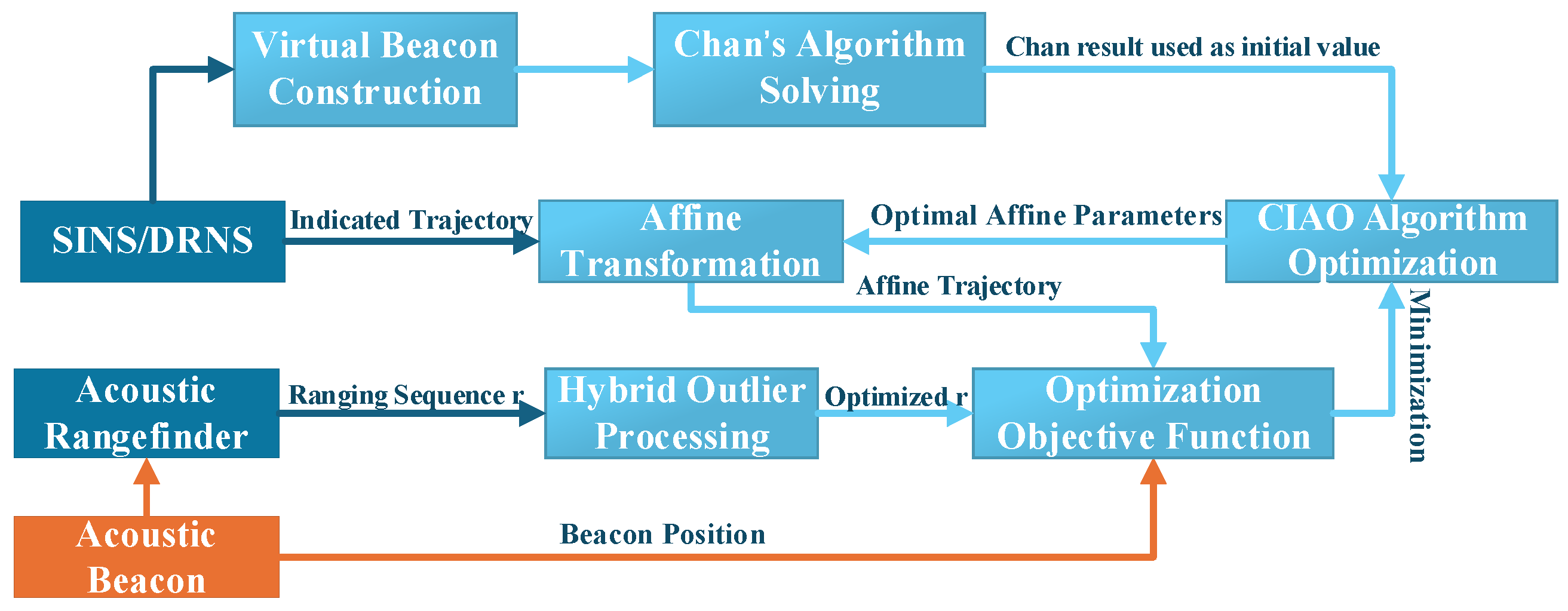
This paper addresses the accuracy degradation in single-beacon ranging positioning systems caused by weak initial observability and degenerate geometric configurations by proposing a collaborative virtual beacon positioning framework, as shown in Figure 1, that integrates sensor data processing, the Chan’s algorithm (named after Y.T. Chan [27]), and affine optimization. First, a hybrid outlier processing framework (HOPF) is employed to enhance the reliability and robustness of sensor ranging data. Second, virtual beacons are constructed using vehicle motion and sensor information to form a four-beacon time difference of arrival (TDOA) array, thereby improving the geometric configuration. Finally, a two-stage collaborative positioning algorithm named CIAO (Chan Initialization and Affine Optimization) is proposed. This algorithm uses the Chan method to rapidly compute an initial position estimate from the virtual sensor array observations, then refines the accuracy by incorporating an affine transformation to optimize the geometric distribution of the virtual beacons. Simulation and experimental results demonstrate that CIAO outperforms comparative algorithms in both accuracy and stability.
The contributions of this article are as follows:
  • A Hybrid Outlier Processing Strategy for raw sensor data, which effectively suppresses anomalies caused by acoustic multipath and sensor noise, thereby enhancing input data quality for underwater positioning.
  • A Novel Affine-Transformation-Based Error Model that reformulates the systematic error compensation in traditional Virtual Long Baseline (VLBL) methods into a virtual beacon coordinate correction problem, providing a new theoretical perspective for accuracy improvement.
  • The Chan-Inspired Affine Optimization Framework, a collaborative positioning method that integrates Chan’s algorithm for reliable initialization with an Affine-Particle Swarm Optimizer for refined resolution.
The remainder of this paper is organized as follows. In Section 2, the fundamental principles of single-beacon underwater localization and a hybrid outlier preprocessing strategy for range data are first introduced. Following that, the proposed CIAO two-stage collaborative positioning framework is derived in detail. The simulation and experimental setups for validation are also provided in this section. The results of the simulations and field tests are presented objectively in Section 3. A thorough analysis and discussion of the results, including comparisons with existing methods, are provided in Section 4. Finally, Section 5 summarizes the main findings.

2. Materials and Methods

This section presents the methodological framework for the proposed high-precision, single-beacon underwater positioning system. Section 2.1 introduces the fundamental principles of single-beacon ranging positioning and the virtual beacon construction method, establishing the theoretical foundation and observation model for subsequent algorithms. Building upon this, Section 2.2 proposes a Hybrid Outlier Processing Framework (HOPF) aimed at enhancing the quality and reliability of raw ranging data. To address the limited accuracy of traditional positioning methods in complex underwater environments, Section 2.3 details the proposed CIAO two-stage collaborative positioning framework. This framework integrates the rapid initialization of the Chan algorithm with an Affine Transformation-enhanced Particle Swarm Optimization, with the aim of achieving high-precision and robust position solutions. Finally, Section 2.4 describes the detailed setup for the simulations and lake trials used to validate the aforementioned methods, including environmental configurations, algorithm parameters, and benchmark comparisons, laying the groundwork for subsequent performance analysis and verification.

2.1. Single-Beacon Ranging Positioning Technology

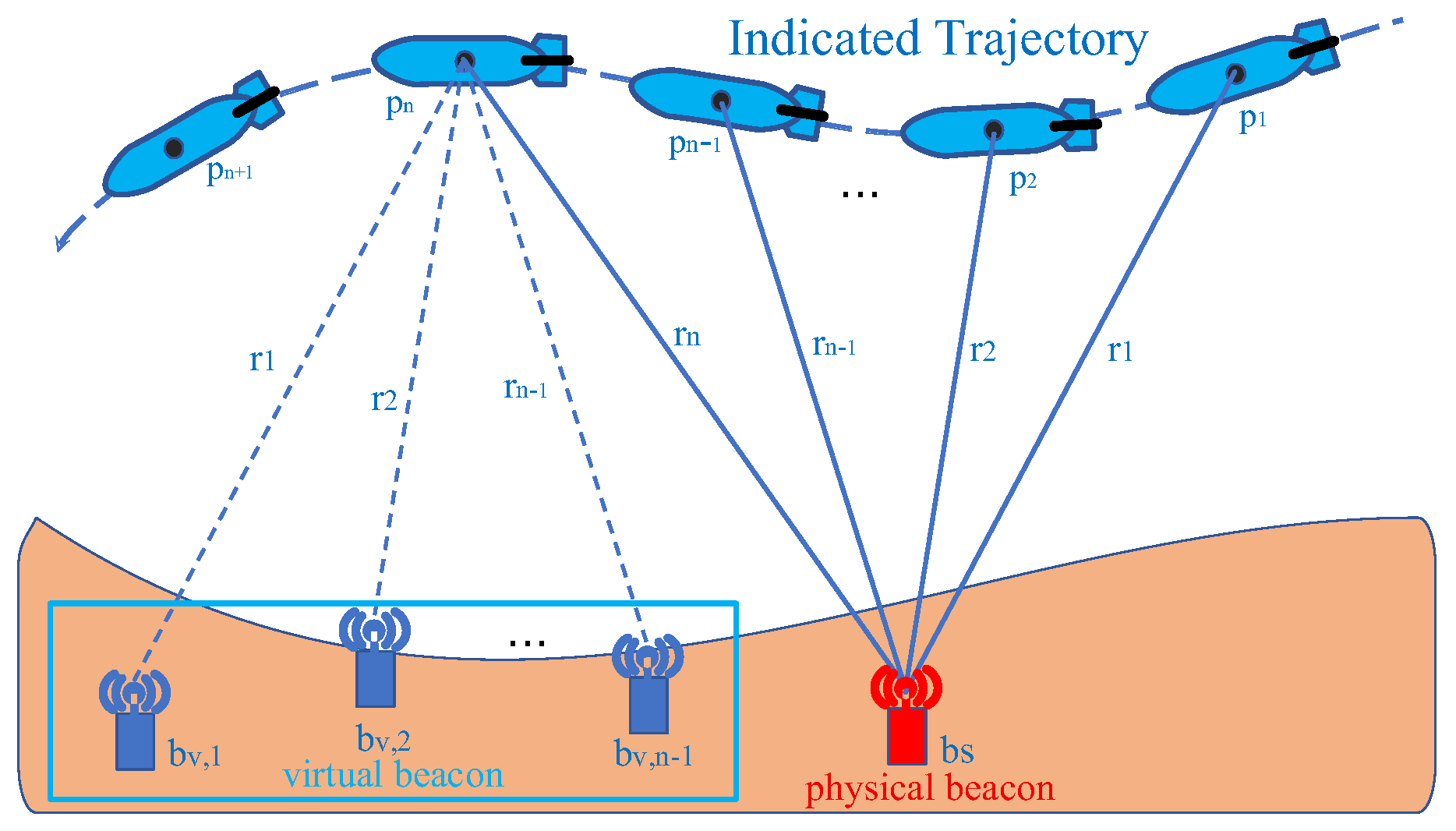
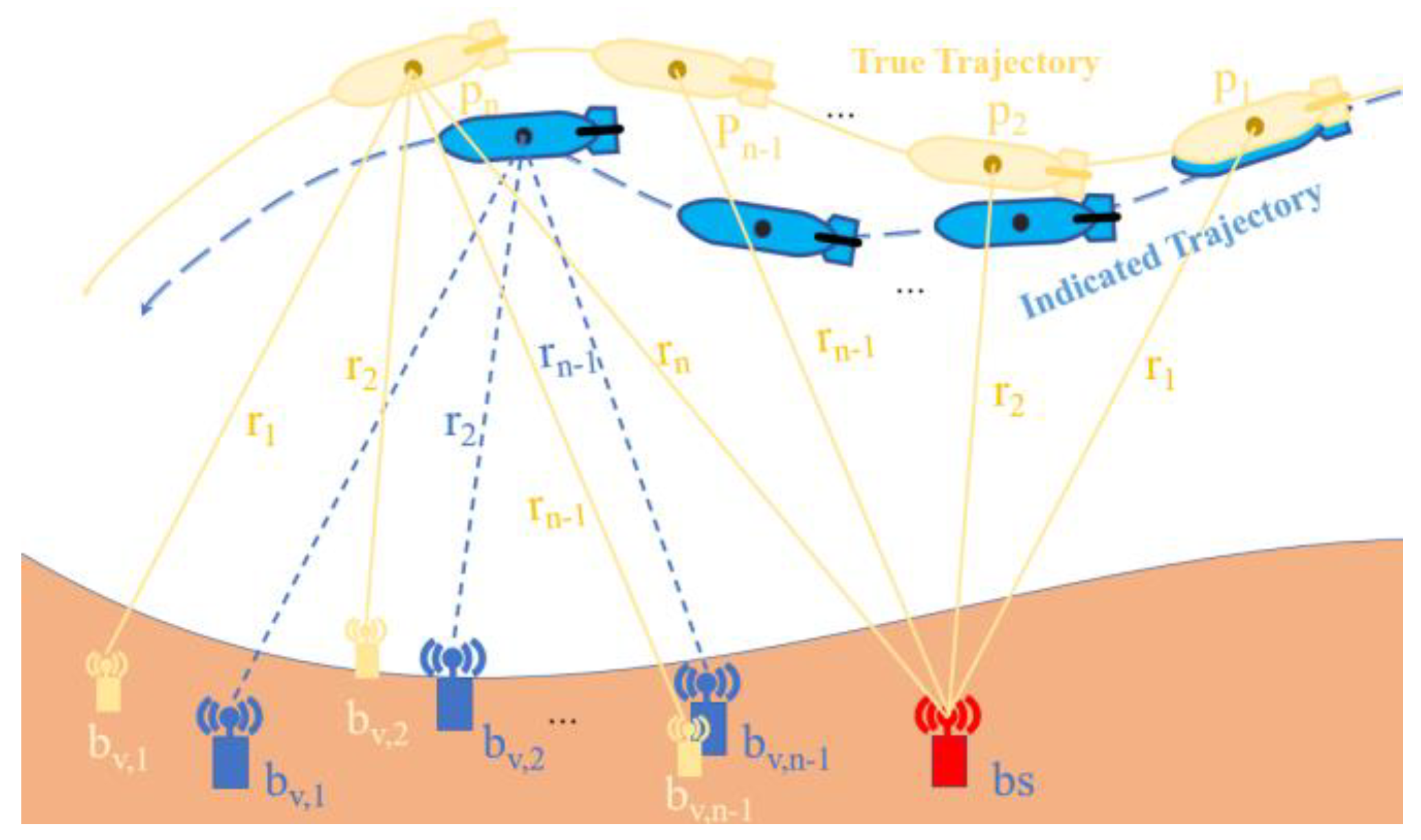
A single-beacon positioning system utilizes acoustic ranging and a fixed seabed acoustic beacon to achieve localization. As shown in Figure 2, the known position of the acoustic beacon is denoted as b s = ( x s , y s , z s ) . The underwater vehicle receives the signal at time t i , which was emitted by the beacon at time t 0 . The time difference Δ t i = t i t 0 is used to calculate the distance between the vehicle and the beacon: r i = c ¯ Δ t i , where c ¯ represents the equivalent sound speed. The relationship between the vehicle’s position p i at time t i and the measured distance r i is given by:
b s p i 2 = r i 2 .
A single ranging measurement can only constrain AUV position within the sphere with center b s and radius r i . Assume the vehicle’s position at time t i is p i = ( x i , y i , z i ) , and by time t n , n range measurements have been accumulated with the vehicle located at p n = ( x n , y n , z n ) . Then the relationship between p n and p i is:
Δ p i n = p n p i .
Substituting (2) into Equation (1), we obtain:
b s ( p n Δ p i n ) 2 = b s + Δ p i n p n 2 = r i 2 .
The i-th virtual beacon can be constructed as: b v , i = b s + Δ p i n , i = 1 , , n . Based on the physical beacon b s , n virtual beacons ( b v , 1 , b v , 2 , , b v , n 1 , b v , n ) are constructed, and the system of ranging equations is established as:
b v , i p n 2 = r i 2 , i = 1 , , n .
The current vehicle position p n can then be estimated via:
p n = ( A T A ) 1 A T B ,
where A i = ( b v , i + 1 b v , i ) T , B i = ( r i 2 r i + 1 2 + d i + 1 2 d i 2 ) / 2 , i = 1 , , n 1 , and d i denotes the slant range information of virtual beacon b v , i . The positions at other time instances are given by: p i = p n Δ p i n , i = 1 , , n 1 . Thereby, continuous tracking and localization of the underwater vehicle is achieved.
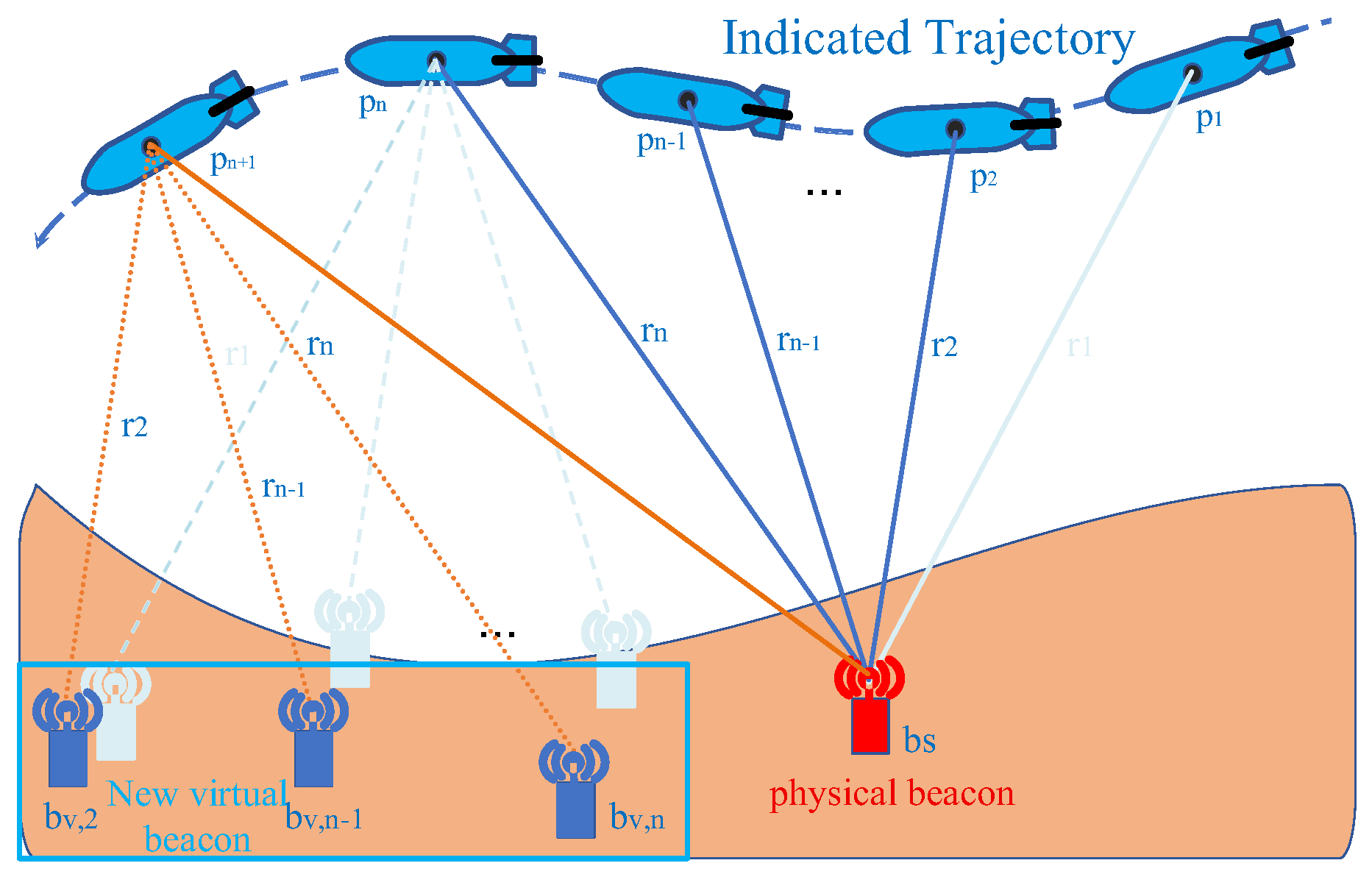
Upon completing the positioning calculation for p n , when AUV moves to p n + 1 , as shown in Figure 3, the virtual beacon must be reconstructed, and the ranging equation system updated [28]. From Equations (3) and (4), it can be known that the corresponding reconstructed virtual beacon is:
b v , i = b s + Δ p i n + 1 , i = 2 , , n + 1 .
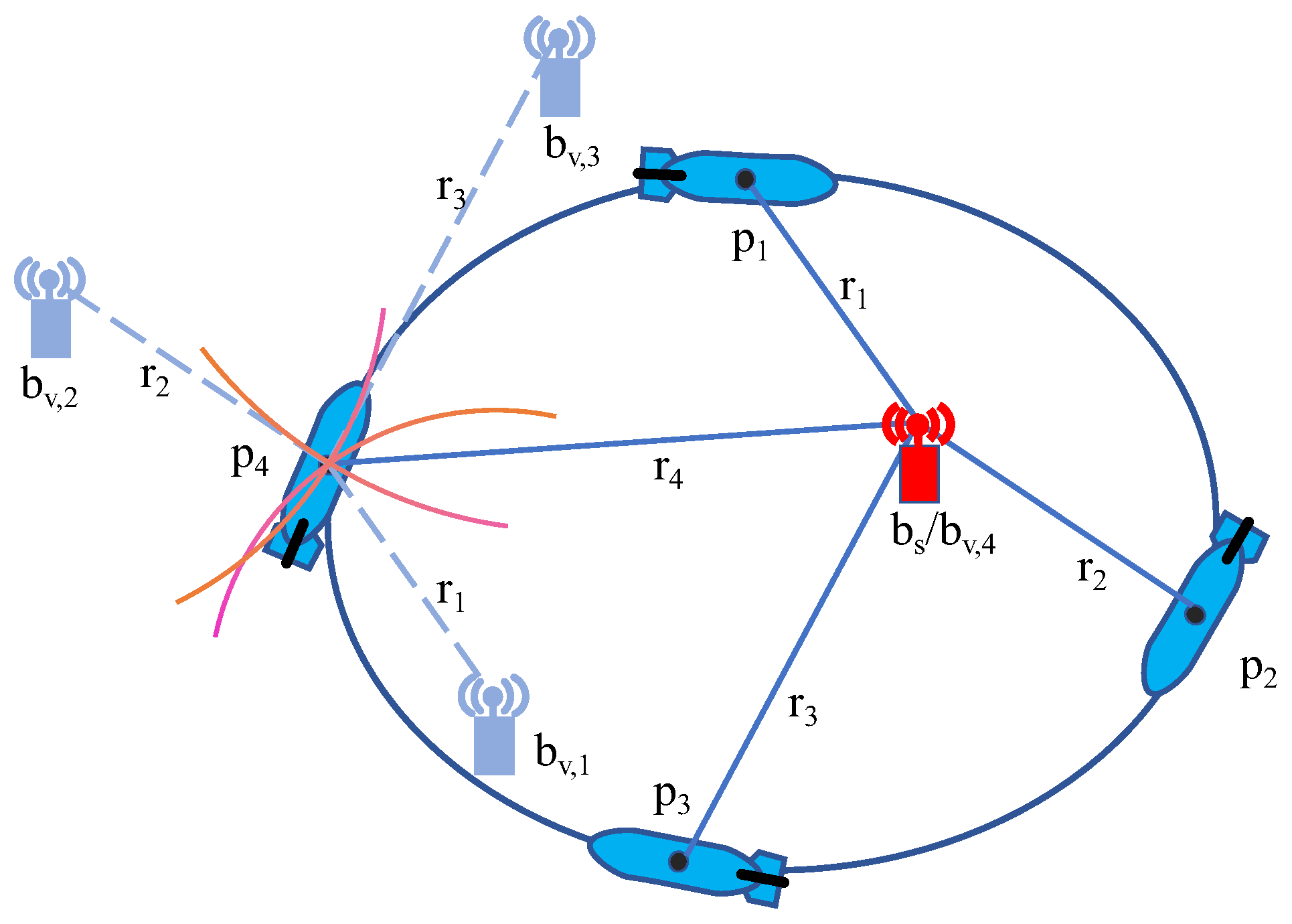
With AUV depth z measured by pressure sensors (Manufactured by Jiaxing Zhongke Acoustics Technology Co., Ltd., Jiaxing, Zhejiang, China, with standard pressure ranges of 0–1 bar, 0–3 bar, and 0–10 bar, a sampling rate accuracy of ±0.05% of full scale at 2 Hz to 30 Hz, and an operating temperature range of −10 to +65 °C), the aforementioned three-dimensional positioning problem degenerates into a two-dimensional plane solution. Figure 4 shows that ROSB constructs a virtual beacon array using physical beacons and employs the same spherical intersection principle as traditional long baseline systems for positioning. This approach significantly reduces costs while achieving the performance advantages of a multi-beacon system.

2.2. Hybrid Outlier Processing Framework (HOPF)

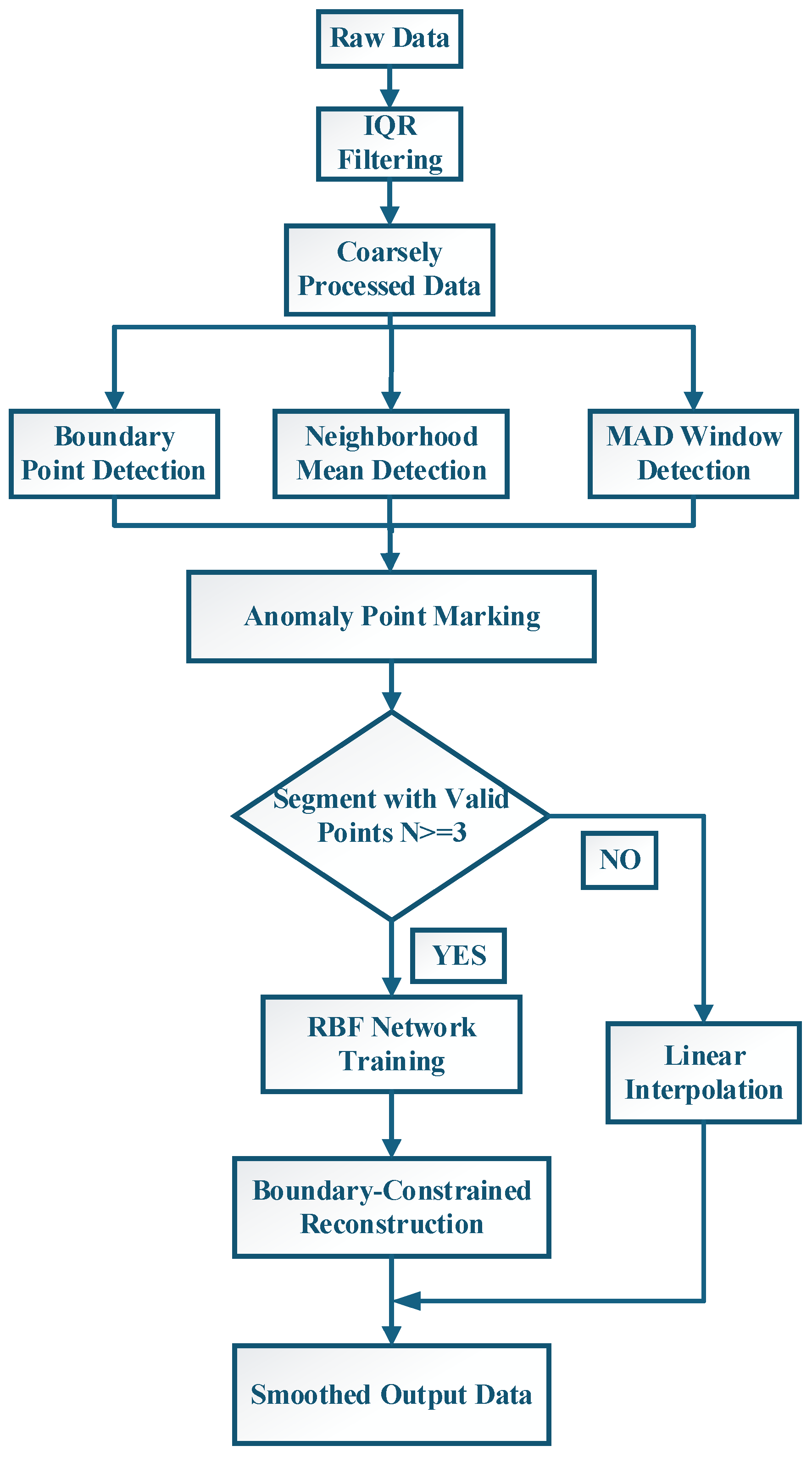
Underwater positioning is susceptible to multipath effects and noise interference, leading to anomalous ranging data. Existing solutions often employ single-threshold methods or fixed-window filters, which struggle to cope with complex underwater environments [29]. This paper proposes a hybrid outlier processing framework that integrates statistical methods with local analysis, as shown in Figure 5, in order to enhance the reliability of ranging data. The outlier handling process comprises three steps.

2.2.1. Dynamic Calculation of Global Thresholds

The global threshold is calculated using the interquartile range (IQR). The global maximum and minimum (Q−3IQR) thresholds are set. Values exceeding these ranges are considered outliers (Q1 represents the first quartile; Q3 represents the third quartile; IQR = Q3 − Q1).

2.2.2. Hybrid Detection Strategy

Endpoint-Specific Detection:
If the absolute deviation of either endpoint from its adjacent point exceeds the product of the deviation threshold δ and the value of that adjacent point, it is identified as an outlier. For instance, for an endpoint t i (s) with ranging value r i (m), the outlier criterion is given by: r i r r e f > δ r r e f ,   δ = 0.15 , where r r e f represents a valid reference ranging value from an adjacent point. A relative change threshold of δ = 0.15 is adopted to detect anomalous ranging jumps. This value represents an empirical balance between sensitivity and robustness, effectively identifying outliers while avoiding false alarms due to normal fluctuations, and its suitability has been verified through preliminary data analysis.
Adjacent-Point Deviation Detection:
Given the continuity and smoothness of single-beacon acoustic ranging within short time windows, the relative deviation of an intermediate point t j (s) is computed by comparing its value to the average of its immediate neighbors. If the deviation exceeds the threshold δ (m), the point is flagged as anomalous:
Δ j = r j 1 2 r j 1 + r j + 1 1 2 r j 1 + r j + 1 > δ ,   δ = 0.15 ,
Sliding Window Detection: Within a sliding window W k , the median r ˜ and median absolute deviation (MAD) are computed. A ranging value r j is considered anomalous if its absolute deviation from the median exceeds λ times the MAD: r j r ˜ > λ × median r j - r ˜ , r j W k ,   λ = 3.0 ( λ = 3.0 provides a conservative balance, ensuring that only points with significant deviation are flagged as outliers while maintaining robustness against the influence of extreme values on the threshold calculation itself).

2.2.3. Radial Basis Function (RBF) Processing Strategy

RBF is a nonlinear interpolation method suitable for continuously varying ranging data, capable of approximating arbitrary continuous functions with excellent local response characteristics [30]. Each data segment is processed individually, if N S k 3 , where N ( ) denotes the number of valid points within the segment and S k represents the k-th segment, the expansion coefficients of the RBF are adaptively computed as follows:
r ^ ( t ) = i = 1 m w i f t c i .
where r ^ ( t ) denotes the interpolated reconstruction value at time t , w i represents the center point of the i-th basis function, and the radius function is set as the Gaussian kernel function ϕ ( z ) = e ( ε z ) 2 , where z = | | t c i | | denotes the Euclidean distance between the input point t and the center point c i . The expansion coefficient ε is dynamically determined by: ε = κ r m a x k r m i n k ,   κ = 0.5 , where r m a x k and r m i n k are the maximum and minimum values within the k-th segment, respectively. If N S k < 3 , linear interpolation is applied to fill in the anomalous values.

2.3. CIAO Two-Stage Collaborative Positioning Framework

High-precision, robust positioning is essential for single-beacon underwater systems. While prior methods establish a data foundation, accuracy remains constrained by noise and model errors in complex acoustic environments. This section proposes a collaborative optimization framework to merge the rapid convergence of deterministic algorithms with the global search ability of intelligent optimization. The Chan’s algorithm was introduced for fast initial positioning using time-difference measurements. To overcome its limited accuracy in complex settings and the traditional Particle Swarm Optimization (PSO)’s sensitivity to initialization and local optima, a two-stage collaborative algorithm named CIAO was proposed. CIAO used the Chan solution as a high-quality initial estimate, applied an affine transformation to correct systematic geometric distortion, and guided the particle swarm within a physically constrained search space. This enhances positioning accuracy while ensuring convergence and stability.

2.3.1. Chan’s TDOA Algorithm

Chan’s algorithm is a closed-form analytical method that directly computes the target position from the observation equations via mathematical derivation without requiring an initial iterative estimate [31]. It is widely used in TDOA-based localization. As described in Section 2.1, considering a two-dimensional localization model with the target point p n = ( x n , y n ) and four base stations b i = ( x i , y i ) ,   i = 1 , 2 , 3 , 4 , the measured distance is given by:
r i = | | p n b i | | + ε i .
The true distance is:
d i = | | p n b i | | .
where ε i representing the ranging error. Transforming r i into:
r i 2 ( x i 2 + y i 2 ) + 2 x i x n + 2 y n y i ( x n 2 + y n 2 ) = 2 ε i r i ε i 2 .
An error vector h = G α Z α + e can be constructed. The initial position estimate x 0 , y 0 is obtained via the least squares method Z α 0 = ( G α T G α ) 1 G α T h .
Assuming the error vector e approximately follows a Gaussian distribution, the weighting matrix is defined as ψ = E ee T = c 2 DQD , where D is a diagonal matrix of the true distances between p n and b s , and Q is the noise covariance matrix. Using the initial estimate x 0 , y 0 , the diagonal matrix D 1 of distances to each base station was computed, along with the updated weighting matrix ψ 1 = c 2 D 1 Q D 1 . A refined position estimate x 1 , y 1 was then obtained via Z α 1 = G α T ψ 1 1 G α 1 G α T ψ 1 1 h . This value x 1 , y 1 was treated as the true target position to compute D 2 , leading to ψ 2 , and the final estimated position x 2 , y 2 from Chan’s algorithm.
Chan’s algorithm essentially performs two stages of weighted least squares estimation. It is computationally efficient and achieves high accuracy under Gaussian noise conditions. However, its performance degrades significantly in non-line-of-sight (NLOS) environments, which motivates its common use in hybrid methods [32]. Accordingly, this paper proposes an optimization model based on affine transformation and employs the PSO algorithm to solve it efficiently, with the aim of significantly enhancing localization robustness in NLOS conditions.

2.3.2. CIAO Cooperative Positioning Algorithm

PSO algorithm is a global optimization technique based on swarm intelligence, which maintains excellent performance even under non-Gaussian noise conditions [33,34]. Consider a D-dimensional search space with a swarm of n particles. The position of the i-th particle is denoted as x i = ( x i , 1 , , x i , D ) R D , and its velocity is denoted as v i = ( v i , 1 , , v i , D ) R D . The particles update their velocities and positions based on two types of optimal solutions:
Personal best: the best solution found by the particle itself, denoted as p i = ( p i , 1 , , p i , D ) ;
Global best: the best solution found by the entire swarm so far, denoted as g i = ( g 1 , g 2 , , g D ) .
Let f be the objective function to be minimized. Denote x i ( t ) as the position of particle i at iteration t , and p i ( t ) as the personal best position of particle i at iteration t . The update rule for the personal best is given by [35]:
p i ( t ) = x i ( t ) , f ( x i ( t ) ) < f ( p i ( t 1 ) ) p i ( t 1 ) , f ( x i ( t ) ) f ( p i ( t 1 ) ) .
The global best position at iteration t , denoted g ( t ) , is selected by comparing the fitness values of all personal best positions in the swarm:
g ( t ) = arg min f ( p i ( t ) ) ,   i   =   1 , 2 , , n .
That is, the personal best position with the smallest fitness value is chosen as the global best. The velocity v i and position x i are updated according to the following rules:
v i ( t + 1 ) = ω v i ( t ) + c 1 r 1 (   p i ( t ) x i ( t ) ) + c 2 r 2 ( g ( t ) x i ( t ) ) .
x i ( t + 1 ) = x i ( t ) + v i ( t + 1 ) .
Here, ω is the inertia weight coefficient; c 1 and c 2 are the cognitive and social acceleration coefficients, respectively; r 1 and r 2 are random vectors with components uniformly distributed in [0,1], i.e., r 1 , r 2 ~ U 0 , 1 ; and denotes the Hadamard (element-wise) product.
However, PSO algorithm inherently suffers from issues such as inefficient random initialization, lack of physical constraints, and a tendency to converge to local optima, which limit its performance in direct applications. To systematically address these limitations and achieve high-precision positioning, this paper proposes a collaborative positioning algorithm integrating Chan initialization and affine optimization, termed CIAO. The core of the proposed algorithm lies in: firstly, introducing an affine transformation mechanism to establish a nonlinear mapping between the indicated trajectory and the true trajectory of the underwater vehicle, correcting systematic geometric errors through rotation, scaling, and translation parameters, thereby providing a physically constrained solution space for PSO; secondly, employing the solution derived from the Chan’s algorithm as the initial search value for PSO, replacing random initialization to enhance convergence efficiency and stability. Ultimately, this framework formulates the positioning problem as a collaborative optimization task, utilizing the PSO algorithm to simultaneously and iteratively estimate the optimal vehicle position and affine transformation parameters, thus achieving high-precision and highly robust localization in complex NLOS environments.
As illustrated in Figure 6, geometric errors such as rotation, scaling, and translation exist between the system’s indicated trajectory and the actual trajectory, causing the virtual beacon position to deviate from the ideal value. To address this, the nonlinear relationship between the indicated displacement and the true displacement can be modeled as an affine transformation:
Δ p i n = T a ( Δ p ¯ i n ) = ( 1 + s ) R ( θ ) Δ p ¯ i n + d , i = 1 , , n .
where Δ p ¯ i n R 2 and Δ p i n R 2 are the displacement vector and true displacement vector, respectively; a ( s , θ , d ) R 4 represents the affine correction parameter, with s as the scaling factor, θ as the rotation angle, and d = ( t x , t y ) R 2 as the translation vector, R ( θ ) [ k θ k θ ^ ] is the rotation matrix corresponding to θ , where k θ [ cos θ , sin θ ] T , and k θ ^ [ sin θ , cos θ ] T . Thus, the corrected virtual beacon position after affine transformation is given by:
b ˜ v , i = b s + ( 1 + s ) R Δ p ¯ i n + d , i = 1 , , n .
Based on the corrected virtual beacon positions, the positioning problem is transformed into the following optimization model:
x + = arg min x F ( x ) = arg min x 1 2 i = 1 n f i ( x ) 2 .
where f i ( x ) = p n b ˜ v , i r i , and x ( p n , s , θ , d ) R 6 represents the combined parameters to be estimated.
Given the measured distances r i and virtual beacons VB = b v , 1 , b v , 2 , b v , 3 , b s , the geometric fitting error is minimized as:
L ( p n , a ) = i = 1 n L   T b v , i ; a p n r i .
where T ( ; a ) denotes the affine transformation: T ( x ; a ) = s R ( θ ) x + [ t x , t y ] T , and p n is the target position to be estimated.
The algorithm pseudocode is described as follows (Algorithm 1):
Algorithm 1. CIAO Cooperative Positioning Algorithm
Input:Population size n, objective function L, search space dimension D;
Output: Optimized   position   p n   and   affine   transformation   parameters   T a .
Step1Initialize the maximum number of iterations, swarm size, and initial inertia weight ω 0 = 0.6 .
Step2Initialize particle positions as random values within a specified range centered around the initial estimate p 0 = x C h a n , y C h a n .
Step3Set lower bound (lb) and upper bound (ub) for each dimension based on the input position and range constraints.
Step4Initialize particle velocities with random values, scaled appropriately per dimension.
Step5Initialize each particle’s personal best position p i   and   the   global   best   position   g i . Evaluate each particle using the objective function L ( p , a ) .
Step6Update the inertia weight ω according to: ω = ω 0 · 0.95 T , where T denotes the current iteration.
Step7Update particle velocity and position using Equations (14) and (15), respectively. Apply bound constraints to ensure solutions remain within the feasible region.
Step8Re-evaluate each particle with L ( p , a ) , and update personal best positions p i according to Equation (12).
Step9Update the global best position g i  according to Equation (13).
Step10If the termination condition is satisfied, output g i ; otherwise, return to Step6.
The algorithm employs a dynamic inertia weight decay strategy, elite initialization, and early termination to facilitate rapid convergence and enhance local search efficiency. Furthermore, the affine transformation dynamically reshapes the population distribution and adjusts the relative positions of particles, thereby actively expanding the search space and assisting the swarm in escaping local optima.

2.4. Simulation and Experimental Setup

To validate the effectiveness of the proposed CIAO algorithm in single-beacon positioning, semi-physical simulations and experimental verification were conducted. By constructing a multi-level validation framework encompassing both simulations and field experiments, the positioning performance and robustness of the proposed algorithms are verified. The specific contents include simulation environment parameters, experimental hardware configuration, the selection of comparative algorithms, and the key parameter settings for the proposed algorithms.
The Earth-Centered Earth-Fixed (ECEF) coordinate system rotates with the Earth. A strapdown inertial navigation system computes and outputs its parameters in a navigation coordinate frame. Therefore, the East-North-Up (ENU) geographic coordinate system is chosen as the navigation reference frame (n-frame) to describe attitude, velocity, and position. As the experiments operate entirely within the n-frame, the coordinate transformation from ECEF to n-frame is provided below:
x = R N + h cos L cos λ y = R N + h cos L sin λ z = R N 1 e 2 + h sin L
where R M = R e ( 1 e 2 ) / ( 1 e 2 sin 2 L ) 3 / 2 and R N = R e / ( 1 e 2 sin 2 L ) 1 / 2 are the meridian and prime vertical radii of curvature, R e = 6378137 is the Earth’s semi-major axis, and e = 0.0818 is the reference ellipsoid eccentricity.

2.4.1. Simulation Setup

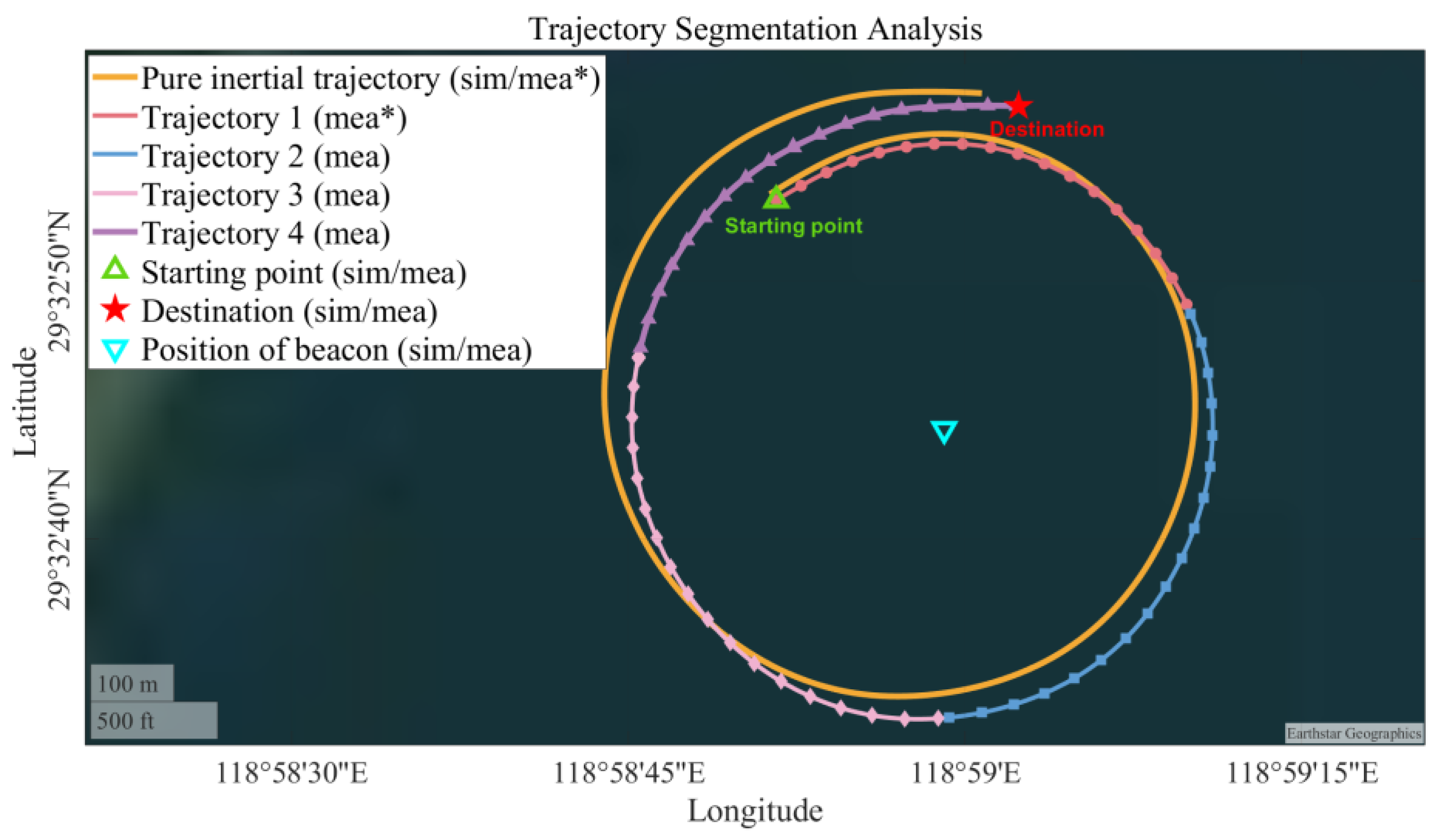
The fusion-based localization method presented herein was verified using a semi-physical simulation platform. For the simulation, the trajectory from a high-accuracy integrated Real-Time Kinematic Global Navigation Satellite System (RTK-GNSS) and laser inertial navigation system served as the ground truth. Furthermore, actual measured USBL range data (accuracy: 2 m, output frequency: 0.25 Hz) was incorporated. The dead reckoning navigation system (DRNS) was employed as the primary navigation system, with gyroscope bias and random drift of 0.01 ° / h and 0.003 ° / h , respectively, and accelerometer bias and random noise of 50 μg and 10   μ g / Hz , respectively. The initial attitude was set to ( 0 ° , 0 ° , 30 ° ) . The equivalent sound speed in the simulation area was 1473.21 m/s, and the entire process lasted 1036 s. The reference trajectory of the vehicle is shown in Figure 7, along with the reference and indicated trajectories. The simulation trajectory started at ( 118.9810 °   E ,   29.5481 °   N ,   103.4755   m ) , and a physical beacon was deployed at an absolute position of ( 118.983 °   E ,   29.5456 °   N ,   56.355   m ) . Virtual beacons were preliminarily constructed based on the DRNS trajectory. The result served as the initial value for the subsequent PSO. Regarding the software and hardware platform, the simulation program was developed in MATLAB 2021a and executed on an industrial computer equipped with an Intel® Core™ i9-11900K processor (3.5 GHz) and 64 GB of RAM.
The simulation compared four positioning methods: the proposed CIAO, Chan-particle swarm optimization (CPSO), Chan–Levenberg–Marquardt (CLM), and differential Gauss–Newton (DCGN) [36], along with Chan-genetic algorithm (CGA). The Levenberg–Marquardt algorithm combines the advantages of the Gauss-Newton method and gradient descent and is widely used for solving nonlinear least-squares problems [37]. The differential Gauss–Newton algorithm is an enhanced version of the classical Gauss-Newton method, based on the principle of carrier-phase differential positioning. Genetic algorithms (GAs) are inspired by evolutionary and genetic principles. Although their theoretical foundations differ significantly from those of PSO, both have been extensively applied in optimization [38].
In the simulation experiments, Monte Carlo simulations were performed with M = 1000 iterations. The parameter configurations for each algorithm are detailed as follows. For the CIAO algorithm, the population size was set to N = 100 , the improvement threshold to δ = 10 4 , and the acceleration coefficients to c 1 = 1.3 and c 2 = 0.8 . The CPSO algorithm employed a population size of N = 100 with acceleration coefficients c 1 = c 2 = 2 . In the CGA, the population size was set to N = 100 , with bidirectional migration enabled. The algorithm utilized a random walk sampling selection operator and a simulated binary crossover operator, where the crossover and migration probabilities were set to 0.8 and 0.1, respectively; the improvement threshold was δ = 10 4 . For the DCGN algorithm, the improvement threshold was set to δ = 10 4 . The CLM algorithm was configured with a damping coefficient μ = 0.01 and an improvement threshold of δ = 10 4 . All algorithms shared a maximum iteration count of k m a x = 50 , and the initial solution was derived from the Chan estimation. All variables used are dimensionless quantities.

2.4.2. Experimental Setup

An acoustic positioning test platform was established at the Qiandao Lake test site to validate the relevant technologies. The trajectory of the test vessel, as represented by the reference track in Figure 7, is consistent with the simulation data. This segment spans 260 acoustic positioning cycles, with a cycle interval of 4 s, resulting in a total duration of 1036 s.
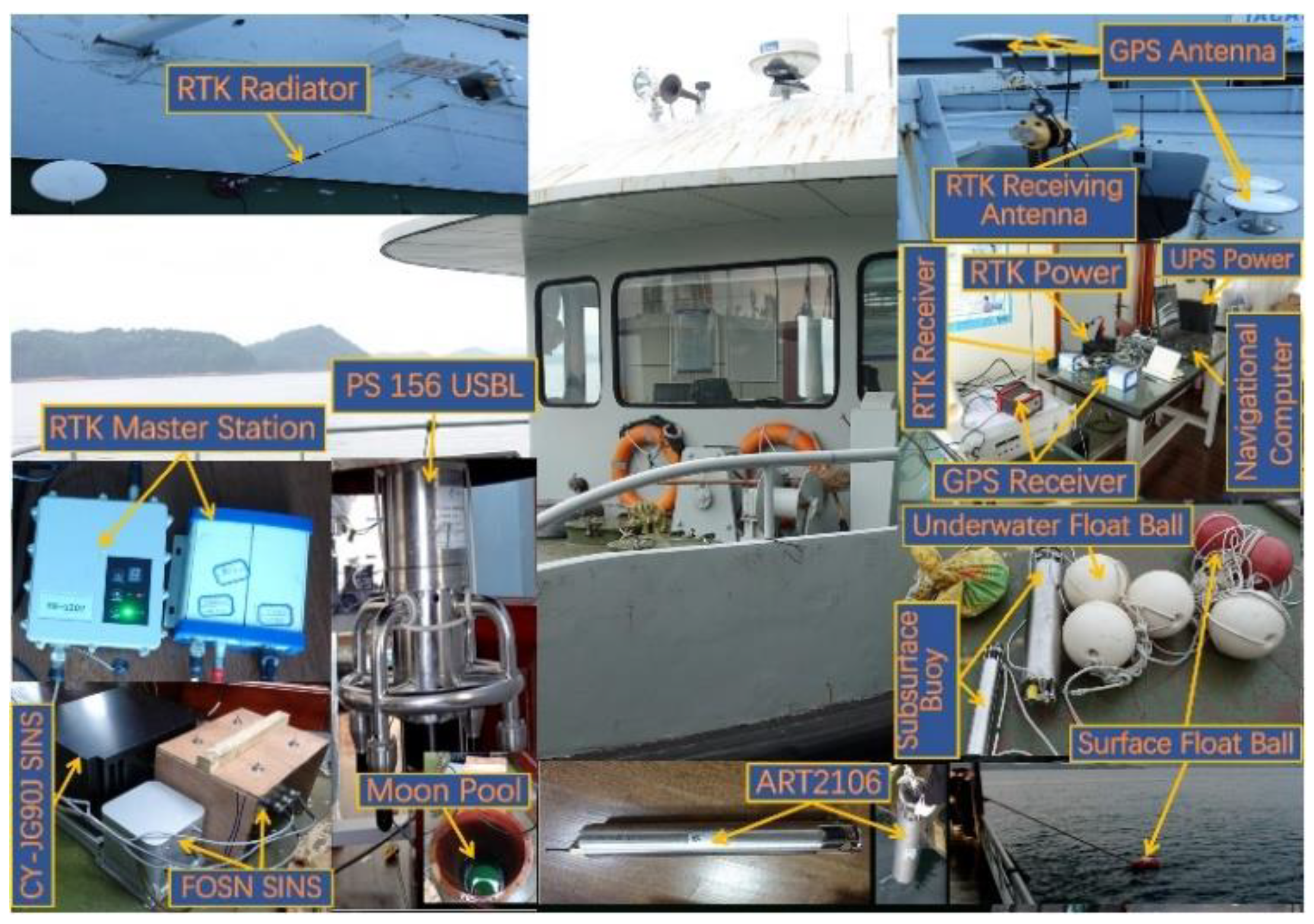
The primary equipment consisted of a PS156 USBL positioning system (Jiaxing Zhongke Acoustics Technology Co., Ltd.) with its dedicated ART2106 acoustic transponder, and a FOSN Fiber Optic Strapdown Inertial Navigation System (FOSN Fiber Optic SINS), as shown in Figure 8. Their specifications are detailed in Table 1. The transponder receives acoustic signals from the USBL’s transmitting transducer array to obtain range and bearing measurements, which are then transmitted to an onboard base station for position calculation. During the trials, USBL was employed for ranging measurements, while parameters such as the mission cycle and reference trajectory remained consistent with those used in the simulations. All experiments were conducted under a system environment comprising Windows 10 and MATLAB 2021a, running on a computer equipped with an 11th Gen Intel® Core™ i9-11900K processor (3.50 GHz) and 64 GB of RAM. As shown in Figure 7, Trajectories 1 to 3 were dedicated to ranging, while Trajectory 4 was used for positioning. By the time the vehicle entered Trajectory 4, all sensor information from Trajectories 1–3 had been stored and integrated into the system.

3. Results

This section presents the experimental results obtained in this study. It first provides the outcomes of the HOPF-based ranging data processing. Subsequently, the positioning performance under simulated conditions is shown. The chapter concludes with the positioning results from the field lake trials.

3.1. Performance of HOPF-Processed Ranging Data

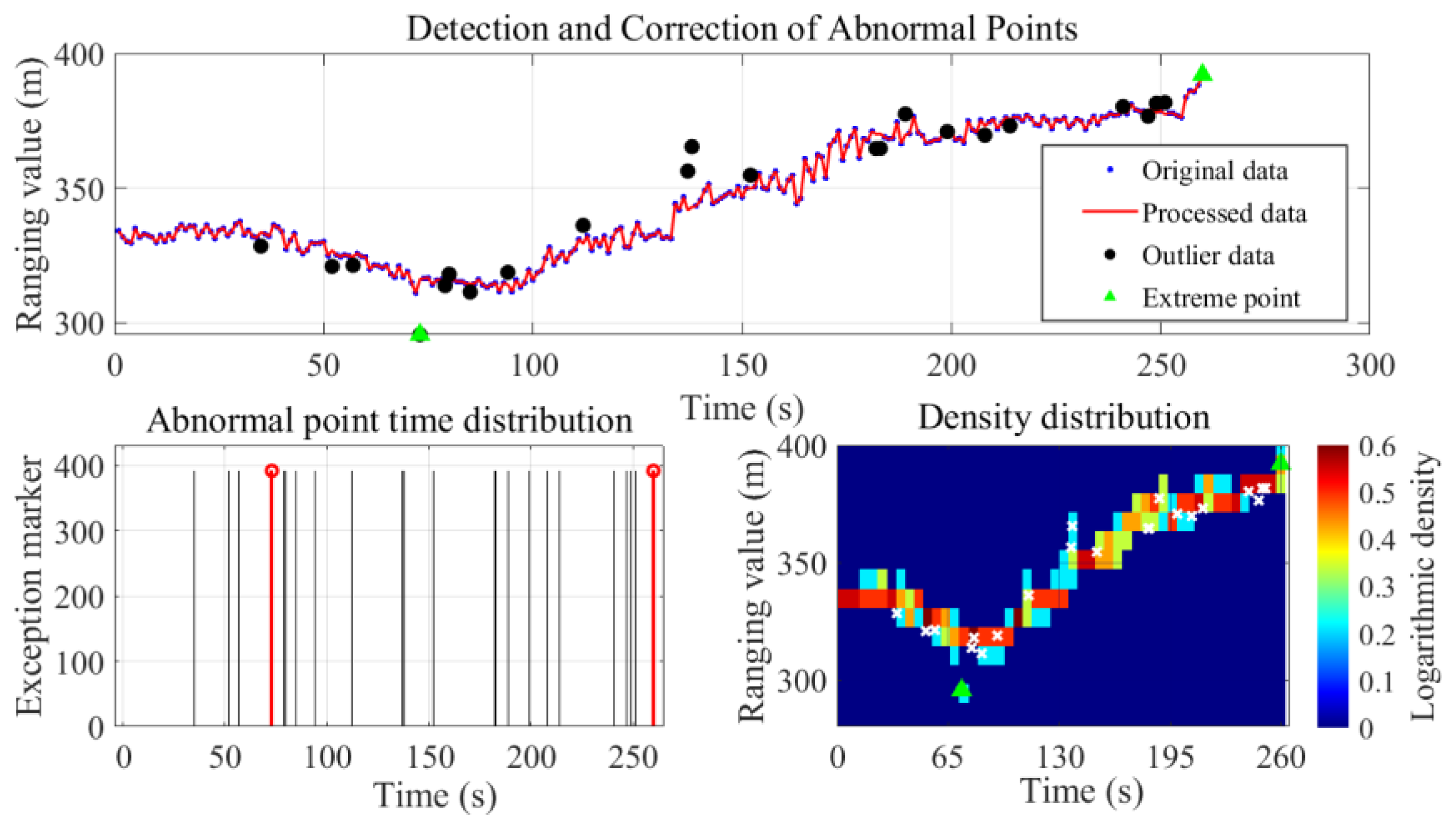
The acquired ranging data from the experiment were processed for outliers using the method described in Section 2.2. The results are presented in Figure 9, which demonstrates that the HOPF method successfully identified and removed anomalies in the data segments while reconstructing reasonable predicted measurements.
This dynamic reconstruction mechanism effectively addresses common issues in traditional interpolation methods, such as boundary distortion, oversensitivity to noise, and fixed parameters when processing USBL data. By comprehensively utilizing dynamic global thresholds, hybrid local detection, and adaptive segment interpolation, the proposed algorithm achieves both robustness and adaptability, thereby providing high-quality data assurance for underwater positioning systems.

3.2. Positioning Performance Under Simulation Environment

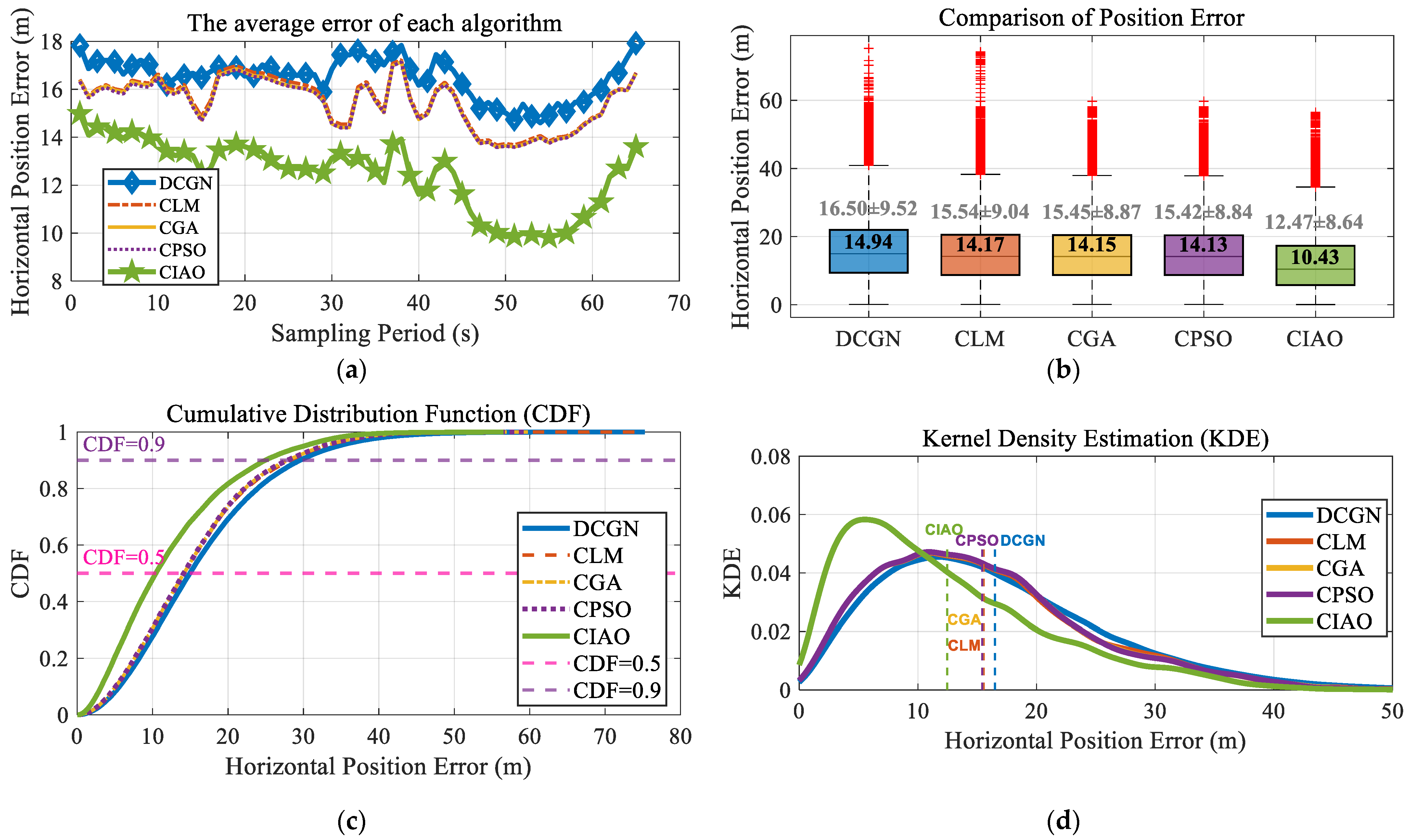
Figure 10 presents a comprehensive comparison of the positioning performance of five algorithms based on 1000 Monte Carlo simulations.
As shown, the median error of CIAO is 10.43 m, which is 30.19% lower than that of DCGN (14.94 m). The average positioning error of CIAO is 12.47 m, representing a 24.42% improvement over DCGN (16.50 m). Boxplot analysis indicates that CIAO has the narrowest interquartile range, suggesting that 75% of the positioning errors are highly concentrated within this interval, confirming the stability of CIAO. The CDF curve shows that CIAO requires an error tolerance of only about 10.5 m to achieve a 50% success rate, whereas other algorithms require approximately 14 m, demonstrating the significant advantage of CIAO under typical conditions. To reach a 90% success rate, CIAO requires an error tolerance of about 23 m, while other algorithms require 28 m or more. These results indicate that, under the same accuracy requirements, CIAO achieves a higher success rate and stronger robustness compared to other algorithms. The KDF plot reveals that the distribution curve of CIAO has a sharper and more concentrated peak near the low-error region, further verifying that its errors are not only lower on average but also highly clustered in the low-error range. In contrast, the distribution curves of other algorithms are wider and flatter, and some even exhibit long tails toward high-error regions, indicating a higher probability of large errors.
Evaluation from 1000 Monte Carlo simulations indicates that the CIAO algorithm performs best among all evaluated algorithms, representing the optimal positioning solution in terms of comprehensive performance. It demonstrated significant advantages across three core dimensions: statistical accuracy (e.g., mean error of 12.6 m, 11.27–15.44% lower than other algorithms), stability (strongest central tendency with minimal fluctuation), and reliability (lower error tolerance under high success rate requirements). These advantages stem from CIAO’s enhanced solution precision and global optimality exploration capabilities.

3.3. Positioning Performance from Lake Trials

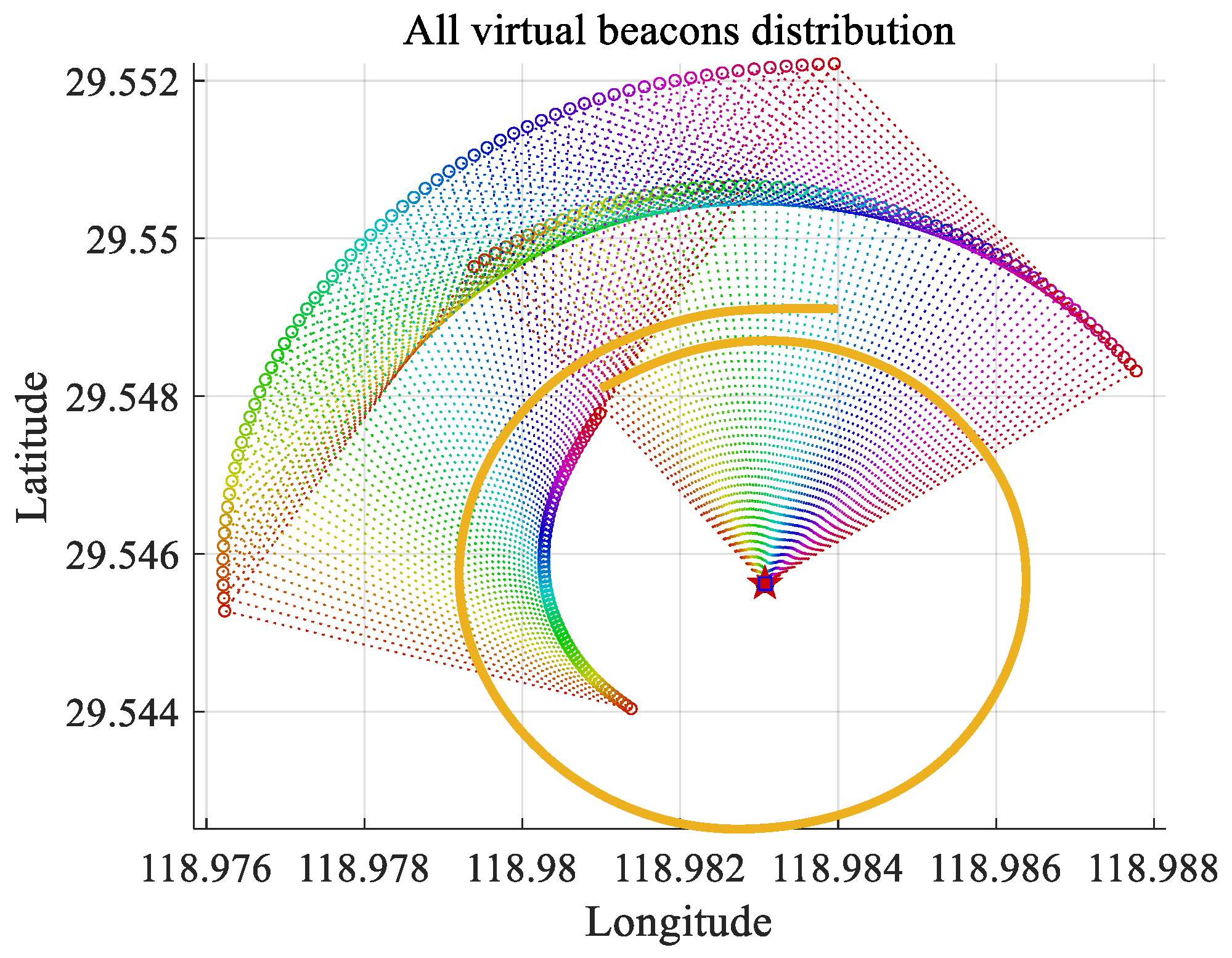
The virtual beacons constructed from the ranging data and indicated trajectory information during AUV Trajectories 1 to 3 are shown in Figure 11. All algorithm parameter settings in the field experiment remained consistent with those used in the simulations.
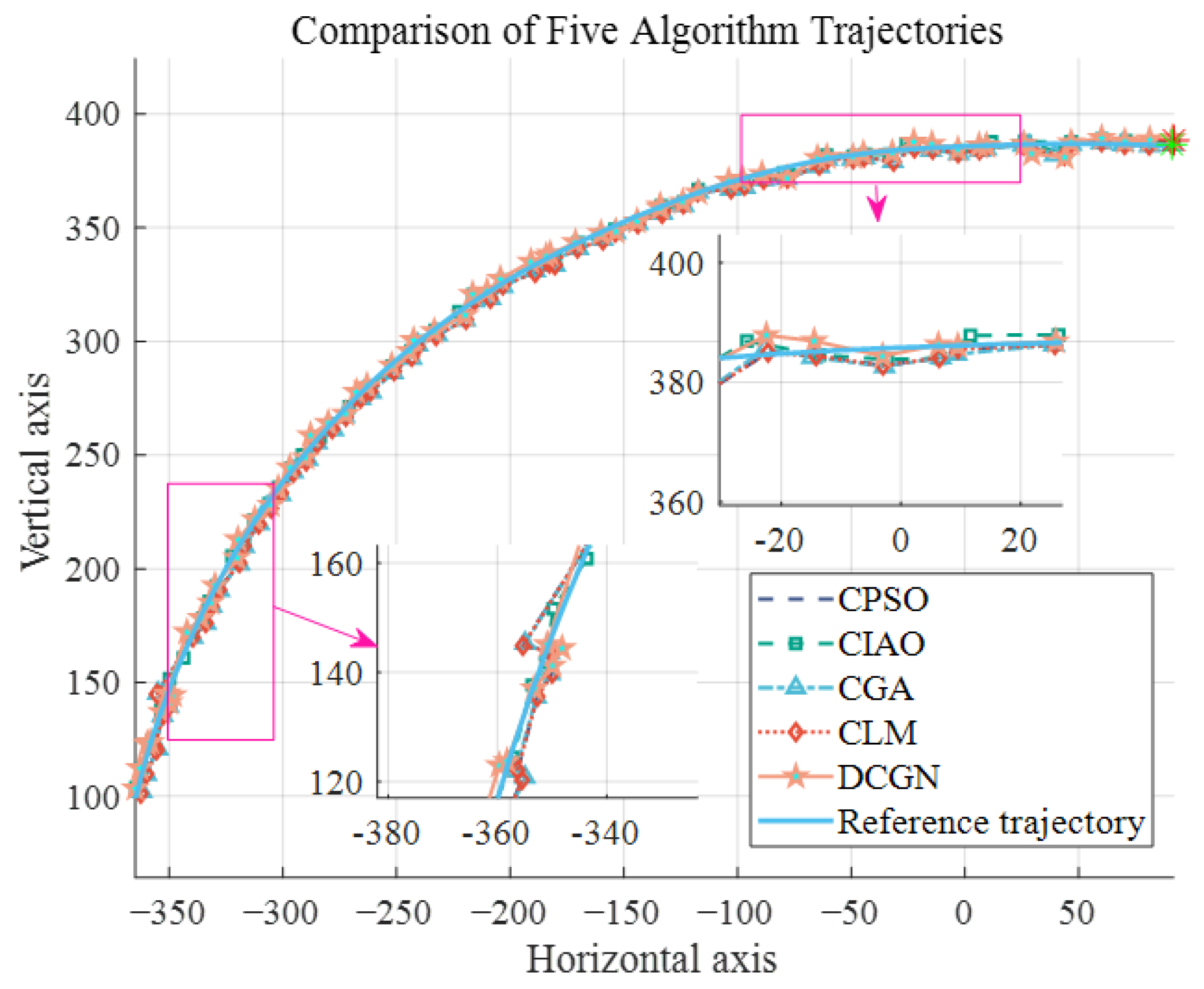
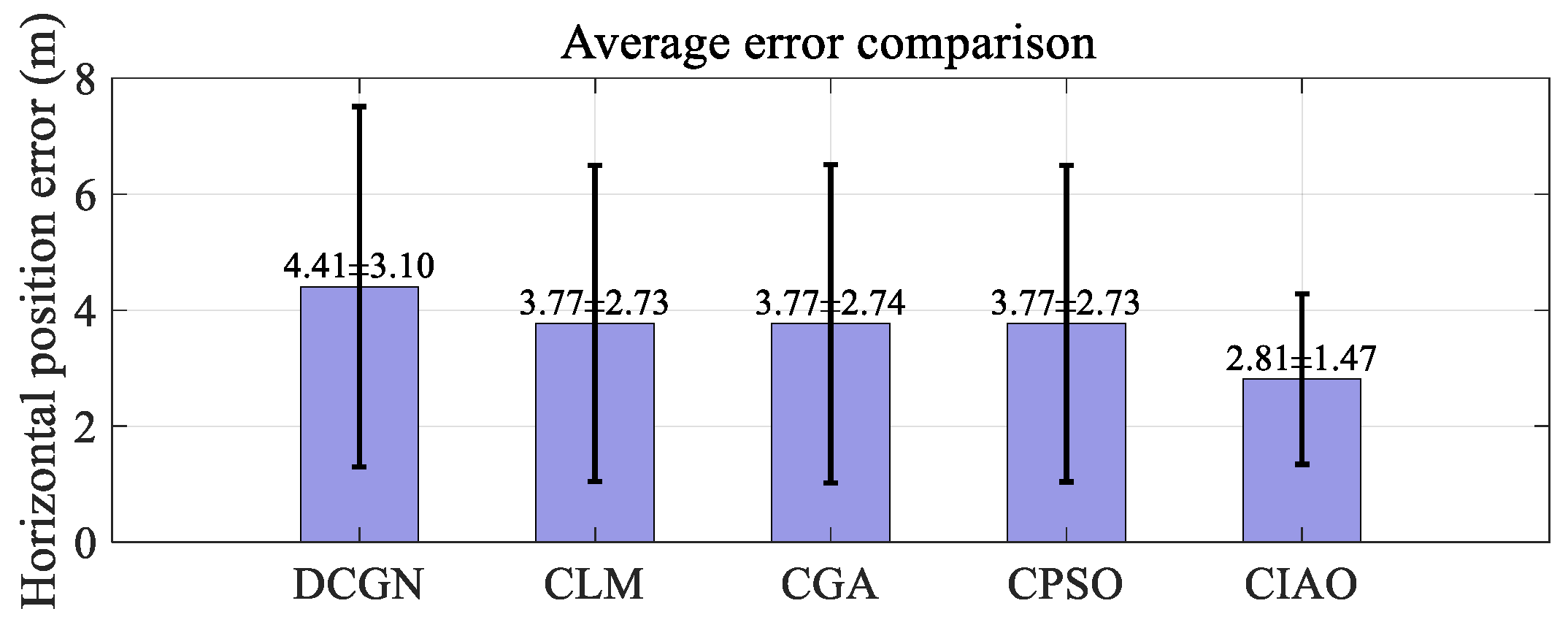
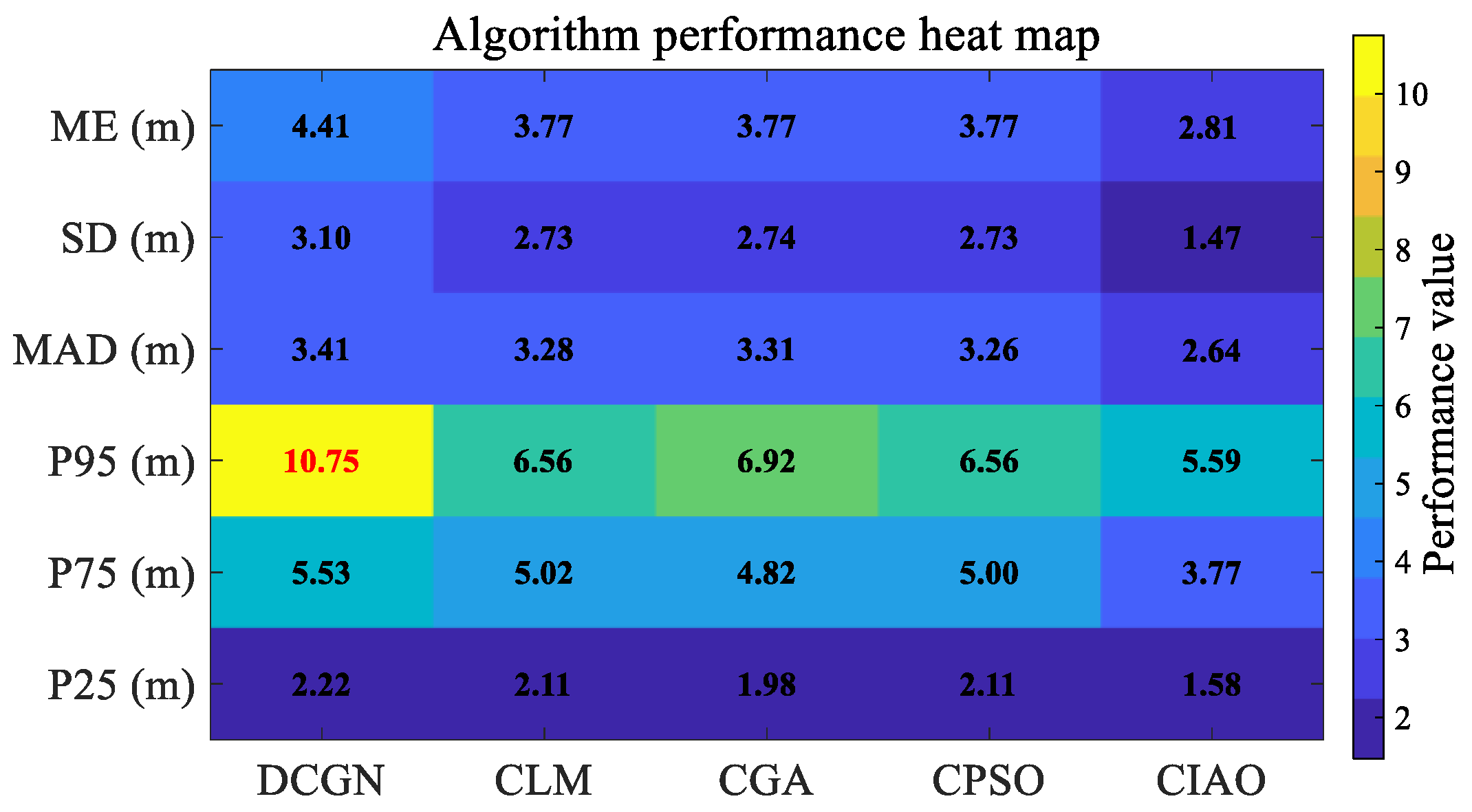
Figure 12 presents the positioning results obtained from field experiments, while Figure 13 provides a comparative statistical summary of the average errors of the five algorithms, and Figure 14 displays a heatmap comparing their performance metrics.
According to the results, the DCGN algorithm achieved an average positioning error of 4.41 m (95% Confidence interval (CI) [3.64, 5.18]; standard deviation (SD) = 3.10 m), indicating considerable bias and variability. The average errors of CLM, CGA, and CPSO were approximately 3.77 m (95% CI [3.09, 4.45]; SD ≈ 2.73 m), reflecting similar accuracy and stability among these three methods. In contrast, the proposed CIAO algorithm attained a significantly lower average error of 2.81 m (95% CI [2.44, 3.18]), which is 36.30% (95% CI: [32.1%, 40.5%]) lower than that of DCGN, along with a substantially reduced standard deviation of 1.47 m. Notably, the confidence interval of CIAO does not overlap with those of the other methods, providing statistical evidence for its superior performance in terms of positioning accuracy and robustness.
Further analysis based on Figure 14 shows that the 75th percentile error of CIAO was 3.77 m, which is approximately 21.78% to 24.9% lower than that of the next best algorithms (CLM/CGA/CPSO: 4.82–5.02 m). In comparison, DCGN exhibited a 95th percentile error of 10.75 m, and its heatmap revealed prominent high-error (yellow) regions, clearly indicating a long-tail risk. CIAO achieved a significantly lower value in this metric (dark blue region, 5.59 m), corresponding to a 48% improvement over DCGN. The IQR of CIAO was 2.19 m, which is 22.89% to 33.84% smaller than those of the other algorithms. This notable advantage at higher percentiles robustly demonstrates the ability of CIAO to effectively handle complex positioning scenarios and substantially reduce the probability of large errors. Together with its median error of 2.64 m, the consistent improvements across three independent metrics—standard deviation, IQR, and median error—confirm the superior accuracy and stability of the CIAO algorithm.
The affine transformation model was employed in this study to establish a nonlinear mapping between the INS-indicated trajectory and the true trajectory. The experimental results validate the high accuracy of CIAO and affirm the effectiveness and superiority of the proposed model in enhancing positioning precision and robustness in challenging environments. The affine transformation model is thus demonstrated to be a critical factor contributing to the performance gains. These advantages have been thoroughly verified through multi-perspective data comparisons and Monte Carlo simulations, reinforcing the statistical significance and reliability of the conclusions.

4. Discussion

The results presented in Section 3 conclusively demonstrate the performance superiority of the proposed CIAO framework. This discussion synthesizes these findings and explicates how they validate our core methodological innovations.
First, the significant reduction in both systematic bias and random error, evidenced by the lower Mean Error (ME) and Standard Deviation (SD) of CIAO in Figure 13 and Figure 14, validates the effectiveness of the affine error model. Traditional VLBL methods treat the DR-derived trajectory as a true geometric reference, which is invalidated by cumulative sensor errors. Our model explicitly parameterizes these systematic errors as an affine transformation. Figure 12 provides a visual corroboration: while trajectories from other algorithms (DCGN, CPSO, CGA, CLM) show varying degrees of drift and deviation from the reference, the CIAO trajectory adheres most closely. This demonstrates that the proposed model successfully corrects the geometrical distortion of the virtual beacon network, leading to a more accurate spatial reference for positioning. The preprocessing step illustrated in Figure 9, which yields cleaner ranging data, further ensures the reliability of the inputs to this model.
Second, the correctness of the proposed approach is cross-validated by the consistency between simulation and field results. The trend observed in the 1000-run Monte Carlo simulation (Figure 10)—where CIAO maintains the lowest and most stable error across various sampling points—is directly mirrored in the field test results (Figure 13 and Figure 14). This consistency confirms that the algorithm’s core logic is sound and performs as expected when transitioning from a controlled environment to a complex real-world setting.
Future research will pursue enhanced system robustness and accuracy along three interconnected avenues:
(1)
The development and integration of intelligent sound speed profile correction to refine fundamental ranging measurements;
(2)
The incorporation of high-resolution signal processing algorithms to enhance the discrimination of the direct path from multipath arrivals;
(3)
The implementation of real-time motion compensation for the surface platform to mitigate performance degradation induced by sea-state dynamics, to ultimately achieve reliable all-weather operational capability.

5. Conclusions

In summary, this paper addresses the issue of accuracy degradation caused by degenerate geometric configurations in single-beacon underwater positioning systems by proposing a high-precision localization method that integrates virtual beacon construction and affine transformation optimization. First, considering that slanted-range measurement-based positioning techniques are susceptible to multipath effects and noise interference in underwater environments, which often lead to anomalous ranging data, a hybrid outlier processing framework is introduced. Furthermore, to enhance the initial observability of the Range-Only Single-Beacon (ROSB) system, a CIAO two-stage collaborative positioning algorithm is proposed. The core of this algorithm lies in its two-stage architecture: the Chan’s algorithm is used to resolve observations from a virtual sensor array to obtain a reliable initial position estimate; this estimate is then used as the initial value to construct a collaborative optimization model based on affine transformation, enabling simultaneous high-precision estimation of the vehicle’s position and systematic errors. The results from 1000 Monte Carlo simulations indicate that the proposed method achieves superior localization accuracy, reducing the average positioning error by 4.56 m compared to the DCGN algorithm. Furthermore, an underwater experiment conducted in Qiandao Lake validated the algorithm’s reliability. The key result is that, over a 1036-s positioning duration, the proposed algorithm improves the average positioning accuracy by 36.30% (95% CI: [32.1%, 40.5%]) relative to the DCGN algorithm.

Author Contributions

Conceptualization, H.H. and Y.Y.; methodology, H.H., J.L. and F.Z.; software, Y.Y. and H.T.; validation, Y.Y., K.X. and Y.C.; formal analysis, Y.Y., F.Z. and Y.C.; investigation, Y.Y.; resources, J.L. and H.T.; data curation, Y.Y.; writing—original draft preparation, Y.Y.; writing—review and editing, Y.Y. and H.H.; visualization, Y.Y.; supervision, F.Z.; project administration, H.H., J.L. and F.Z.; funding acquisition, J.L. All authors have read and agreed to the published version of the manuscript.

Funding

This research was funded by the National Natural Science Foundation of China, grant number 52471386.

Data Availability Statement

The data presented in this study are available on request from the corresponding author.

Conflicts of Interest

The authors declare no conflicts of interest. The funders had no role in the design of the study; in the collection, analyses, or interpretation of data; in the writing of the manuscript; or in the decision to publish the results.

References

  1. Liu, Y.; Wang, Y.; Chen, C.; Liu, C. Underwater Wireless Sensor Network-Based Localization Method under Mixed Line-of-Sight/Non-Line-of-Sight Conditions. J. Mar. Sci. Eng. 2023, 11, 1642. [Google Scholar] [CrossRef]
  2. Ge, X.; Zhou, H.; Zhao, J.; Li, X.; Liu, X.; Li, J.; Luo, C. Robust Positioning Estimation for Underwater Acoustics Targets with Use of Multi-Particle Swarm Optimization. J. Mar. Sci. Eng. 2024, 12, 185. [Google Scholar] [CrossRef]
  3. Garin, R.; Bouvet, P.-J.; Tomasi, B.; Forjonel, P.; Vanwynsberghe, C. A Low-Cost Communication-Based Autonomous Underwater Vehicle Positioning System. J. Mar. Sci. Eng. 2024, 12, 1964. [Google Scholar] [CrossRef]
  4. Paull, L.; Saeedi, S.; Seto, M.; Li, H. AUV navigation and localization: A review. IEEE J. Ocean. Eng. 2014, 39, 131–149. [Google Scholar] [CrossRef]
  5. De, P.; Arrichiello, F.; Parlangeli, G.; Indiveri, G. Underwater localization using single beacon measurements: Observability analysis for a double integrator system. Ocean Eng. 2017, 142, 650–665. [Google Scholar] [CrossRef]
  6. Chen, X.; Xie, Z.; Eun, Y.; Bettens, A.; Wu, X. An observation model from linear interpolation for quaternion-based attitude estimation. IEEE Trans. Instrum. Meas. 2023, 72, 1–12. [Google Scholar] [CrossRef]
  7. Fabijanić, M.; Kapetanović, N.; Mišković, N. Autonomous Visual Fish Pen Inspections for Estimating the State of Biofouling Buildup Using ROV. J. Mar. Sci. Eng. 2023, 11, 1873. [Google Scholar] [CrossRef]
  8. Lu, Y.; Wang, J.; Zhou, H.; Wang, D.; Xing, Y.; He, Z. Station layout optimization for underwater acoustic positioning system based on combined cone configuration. Ocean Eng. 2024, 294, 116753. [Google Scholar] [CrossRef]
  9. Zhu, Y.; Zhou, L. Hybrid Tightly-Coupled SINS/LBL for Underwater Navigation System. IEEE Access 2024, 12, 31279–31286. [Google Scholar] [CrossRef]
  10. Wang, D.; Wang, B.; Huang, H.; Yao, Y.; Xu, X. Robust Filter Method for SINS/DVL/USBL Tight Integrated Navigation System. IEEE Sens. J. 2023, 23, 10912–10923. [Google Scholar] [CrossRef]
  11. Zhuang, Y.; Sun, X.; Li, Y.; Huai, J.; Hua, L.; Yang, X.; Cao, X.; Zhang, P.; Cao, Y.; Qi, L.; et al. Multi-sensor integrated navigation/positioning systems using data fusion: From analytics-based to learning-based approaches. Inf. Fusion 2023, 95, 62–90. [Google Scholar] [CrossRef]
  12. Ma, T.; Ding, S.; Li, Y.; Fan, J. A review of terrain-aided navigation for underwater vehicles. Ocean Eng. 2023, 281, 114779. [Google Scholar] [CrossRef]
  13. Li, T.; Zhao, J.; Ma, J. A precise underwater positioning method by considering the location difference of transmitting and receiving sound waves. Ocean Eng. 2022, 247, 110480. [Google Scholar] [CrossRef]
  14. Li, Z.; Dosso, S.E.; Sun, D. Motion-compensated acoustic localization for underwater vehicles. IEEE J. Ocean. Eng. 2016, 41, 840–851. [Google Scholar] [CrossRef]
  15. Xing, Y.; He, Z.; Wang, J.; Zhou, X.; Chen, Y.; Pan, X. TOA positioning algorithm of LBL system for underwater target based on PSO. J. Syst. Eng. Electron. 2023, 34, 1319–1332. [Google Scholar] [CrossRef]
  16. Qin, H.D.; Yu, X.; Zhu, Z.B.; Deng, Z.C. A variational Bayesian approximation based adaptive single beacon navigation method with unknown ESV. Ocean Eng. 2020, 209, 107484. [Google Scholar] [CrossRef]
  17. Webster, S.E.; Eustice, R.M.; Singh, H.; Whitcomb, L.L. Advances in single-beacon one-way-travel-time acoustic navigation for underwater vehicles. Int. J. Robot. Res. 2012, 31, 935–950. [Google Scholar] [CrossRef]
  18. Tan, Y.T.; Gao, R.; Chitre, M. Cooperative Path Planning for Range-Only Localization Using a Single Moving Beacon. IEEE J. Ocean. Eng. 2014, 39, 371–385. [Google Scholar] [CrossRef]
  19. Yuan, M.; Li, Y.; Li, Y.; Pang, S.; Zhang, J. A fast way of single-beacon localization for AUVs. Appl. Ocean Res. 2022, 119, 103037. [Google Scholar] [CrossRef]
  20. Potokar, E.R.; Norman, K.; Mangelson, J.G. Invariant extended kalman filtering for underwater navigation. IEEE Robot. Autom. Lett. 2021, 6, 5792–5799. [Google Scholar] [CrossRef]
  21. Zhang, G.; Yi, G.; Wei, Z.; Xie, Y.; Qi, Z. A novel positional calibration method for an underwater acoustic beacon array based on the equivalent virtual long baseline positioning model. J. Mar. Sci. Eng. 2024, 12, 825. [Google Scholar] [CrossRef]
  22. Zhang, T.; Wang, Z.; Li, Y.; Tong, J. A passive acoustic positioning algorithm based on virtual long baseline matrix window. J. Navig. 2019, 72, 193–206. [Google Scholar] [CrossRef]
  23. Zhao, W.; Zhao, S.; Liu, G.; Meng, W. Range-only single beacon based multisensor fusion positioning for AUV. IEEE Sens. J. 2023, 23, 23399–23409. [Google Scholar] [CrossRef]
  24. Cao, J.; Han, Y.; Zhang, D.; Sun, D. Linearized iterative method for determining effects of vessel attitude error on single-beacon localization. Appl. Acoust. 2017, 116, 297–302. [Google Scholar] [CrossRef]
  25. Chang, G.; Li, M.; Xie, J.; Zhang, L.; Yu, C.; Ji, Y. Ocean Surface Current Measurement Using Shipborne HF Radar: Model and Analysis. IEEE J. Ocean. Eng. 2016, 41, 970–981. [Google Scholar] [CrossRef]
  26. Wang, J.; Wang, Y.; Li, Y.; Huang, X. Fast Displacement Estimation of Multiple Close Targets with MIMO Radar and MUSICAPES Method. Remote Sens. 2022, 14, 2005. [Google Scholar] [CrossRef]
  27. Chan, Y.T.; Ho, K.C. A simple and efficient estimator for hyperbolic location. IEEE Trans. Signal Process. 1994, 42, 1905–1915. [Google Scholar] [CrossRef]
  28. Tang, H.; He, H.; Li, F.; Xu, J. Underwater inertial error rectification with limited acoustic observations. Satell. Navig. 2024, 5, 3. [Google Scholar] [CrossRef]
  29. Yi, J.; Tang, J.; Yuan, F.; Qiao, G.; Dai, D. Non-Uniform clustering algorithm for UWSNs based on energy equalization. Sensors 2023, 23, 5466. [Google Scholar] [CrossRef] [PubMed]
  30. Satyanarayana, C.; Yadav, M.K.; Nath, M. Multiquadric based RBF-HFD approximation formulas and convergence properties. Eng. Anal. Bound. Elem. 2024, 160, 234–257. [Google Scholar] [CrossRef]
  31. Yang, H.; Gao, X.; Li, B.; Xiao, B.; Huang, H. Development of Hydroacoustic Localization Algorithms for AUV Based on the Error-Corrected WMChan-Taylor Algorithm. J. Mar. Sci. Eng. 2024, 12, 974. [Google Scholar] [CrossRef]
  32. Yang, H.; Gao, X.; Huang, H.; Li, B.; Xiao, B. An LBL positioning algorithm based on an EMD–ML hybrid method. EURASIP J. Adv. Signal Process. 2022, 2022, 38. [Google Scholar] [CrossRef]
  33. Xu, B.; Li, S.; Razzaqi, A.A.; Wang, L.; Jiao, M. A novel ANFIS-AQPSO-GA-Based online correction measurement method for cooperative localization. IEEE Trans. Instrum. Meas. 2022, 71, 1–17. [Google Scholar] [CrossRef]
  34. He, H.; Li, B.; Zha, F.; Tang, H. A Fast Intelligent Algorithm-Based Positioning Error Suppression Method for Strap-Down Inertial Navigation System. IEEE Sens. J. 2023, 23, 5278–5287. [Google Scholar] [CrossRef]
  35. Chen, H.; Ballal, T.; Saeed, N.; Alouini, M.S.; Al-Naffouri, T.Y. A joint TDOA-PDOA localization approach using particle swarm optimization. IEEE Wirel. Commun. Lett. 2020, 9, 1240–1244. [Google Scholar] [CrossRef]
  36. Ye, Y.; He, H.; Lin, E.; Tang, H. Multi-Sensor Collaborative Positioning in Range-Only Single-Beacon Systems: A Differential Chan-Gauss-Newton Algorithm with Sequential Data Fusion. Sensors 2025, 25, 2577. [Google Scholar] [CrossRef]
  37. Li, S.; Ma, D.; Lu, J.; Xing, B.; Wang, K.; Gao, Y.; Han, B. In situ calibration of triaxial coils of a vector optically pumped magnetometers based on a particle swarm optimization algorithm. Measurement 2022, 202, 111878. [Google Scholar] [CrossRef]
  38. Sun, D.; Li, H.; Zheng, C.; Li, X. Sound velocity correction based on effective sound velocity for underwater acoustic positioning systems. Appl. Acoust. 2019, 151, 55–62. [Google Scholar] [CrossRef]
Figure 1. Collaborative optimization method framework diagram.
Jmse 14 00545 g001
Figure 2. Construction of virtual beacon.
Jmse 14 00545 g002
Figure 3. Reconstruction of virtual beacon.
Jmse 14 00545 g003
Figure 4. Virtual beacon positioning method.
Jmse 14 00545 g004
Figure 5. Hybrid outlier handling framework (HOPF).
Jmse 14 00545 g005
Figure 6. Virtual beacon construction based on affine transformation.
Jmse 14 00545 g006
Figure 7. Test reference trajectory chart (* The label “mea” indicates measured data, while the label “sim/mea” indicates the overlap of simulated and measured data).
Jmse 14 00545 g007
Figure 8. Test environment and equipment installation status.
Jmse 14 00545 g008
Figure 9. Handling of abnormal values in ranging data.
Jmse 14 00545 g009
Figure 10. Monte Carlo simulation results of five algorithms. The result of (a) average error, (b) position error box plot. The statistical results are (c) cumulative error distribution map and (d) Kernel density estimation.
Jmse 14 00545 g010
Figure 11. Virtual beacon distribution.
Jmse 14 00545 g011
Figure 12. Measured data positioning result.
Jmse 14 00545 g012
Figure 13. Statistical comparison of average errors of five algorithms.
Jmse 14 00545 g013
Figure 14. Algorithm performance heat map. (The red font indicates that this value is significantly higher than the results of other algorithms within the same indicator.)
Jmse 14 00545 g014
Table 1. Device performance index.
Device NameParametersValues
PS156 USBL Positioning System (Zhejiang, China)maximum range of action≥3 km
ranging accuracy 1<0.2 m
positional accuracy 2<1 m
data updating rate0.25 Hz
FOSN Fiber Optic SINS
(Zhejiang, China)
Gyro Bias<0.02°/h
Gyro Random Walk<0.005°/√h
Accelerometer Bias<100 μg
Accelerometer Random Noise<20 μg/√Hz
Data Update Rate200 Hz
1 Ranging accuracy refers to the precision of a single, direct distance measurement between two known points (e.g., the target and a physical beacon). 2 Positional accuracy refers to the precision of the estimated coordinates of the target itself.
Disclaimer/Publisher’s Note: The statements, opinions and data contained in all publications are solely those of the individual author(s) and contributor(s) and not of MDPI and/or the editor(s). MDPI and/or the editor(s) disclaim responsibility for any injury to people or property resulting from any ideas, methods, instructions or products referred to in the content.