Article

Vertical Bending Moment in Extreme Regular Waves—Benchmarking of Numerical Codes Against Model Tests


1
SINTEF Ocean AS, 7052 Trondheim, Norway
2
Bureau Veritas, 75013 Paris, France
3
National Maritime Research Institute, Tokyo 181-0004, Japan
4
LHEEA, UMR 6598, CNRS, École Centrale Nantes, Nantes Université, 44000 Nantes, France
5
Centre for Marine Technology and Ocean Engineering (CENTEC), Instituto Superior Técnico, Universidade de Lisboa, 1049-001 Lisbon, Portugal
6
Faculty of Engineering, University of Rijeka, 58, 51000 Rijeka, Croatia
7
ClassNK, Tokyo 102-8567, Japan
8
Det Norske Veritas—DNV, 1363 Høvik, Norway
*
Author to whom correspondence should be addressed.
J. Mar. Sci. Eng. 2026, 14(5), 481; https://doi.org/10.3390/jmse14050481
Submission received: 2 December 2025 / Revised: 20 January 2026 / Accepted: 25 February 2026 / Published: 2 March 2026

Abstract

A benchmark study of 10 different numerical methods for ship motion and load assessment is presented. Pitch motions and midship vertical bending moments are compared to model test results for a containership at zero speed in head regular waves. The wave steepness is varied from 2.1% to 10.5%. The model tests show that pitch and the vertical bending moment (VBM) display nonlinear behavior even for low-steepness waves. It is demonstrated that computational fluid dynamics (CFD) methods can reproduce the ship responses with good accuracy, even in very steep waves, involving green water and parts of the ship going in and out of water. Weakly nonlinear potential-theory methods tend to overestimate the pitch motions and the sagging moments as the wave steepness increases. For the vertical bending moment in steep waves, the 3D panel methods did not give significantly better results than those obtained with the nonlinear strip theories.

1. Introduction

With increasing size and with hull designs evolving towards larger flare and flat counter sterns, such as Ultra Large Containerships (ULCS), ship concepts are moving into a novel terrain where operational experience is limited and the need for numerical assessment of wave loads and responses becomes increasingly important. Accurate assessment methods are crucial to ensure structural integrity and safety, while maintaining economic viability and fuel efficiency and avoiding excessive steel weight. Proper evaluation of the extreme vertical wave bending moment (VBM) is important in this process. Unfortunately, there are significant uncertainties in such estimates. Inaccuracies include lack of knowledge about environmental data, the unknowns about operational profiles, and the approximations made by deterministic models used to calculate the ship response. The latter, which has been pointed out in earlier studies [1], is the focus of this benchmark.
Modern containerships are designed with extreme bow flare to maximize deck area and with a flat counter stern to enhance propulsion efficiency. While linear seakeeping theories assume a wall-sided structure near the waterline, these modern hulls are likely to display nonlinear behavior even in relatively low waves. With increasing wave steepness, bow flare slamming and green water will give significant nonlinear forces.
Most of the existing comparisons to model tests are made in moderate waves. This leaves open questions about the capability of existing numerical tools to correctly capture ship behavior as the wave steepness increases.
To tackle these questions, the Loads committee [2] of the International Ship and ocean Structures Congress (ISSC) has carried out a benchmark of numerical codes aiming at assessing the accuracy of rigid body solvers for ships in large and steep waves. The reference used is a specifically designed model test campaign on a large containership carried out at the Laboratory in Hydrodynamics, Energetics and Atmospheric Environment (LHEEA) in Nantes, France. Its main particularity is the high stiffness of the model, which enables filtering out the whipping response, without distorting the nonlinear rigid body response.
In the past few decades, many comparisons between experimentally measured and calculated vertical bending moments have been published, but systematic benchmark studies of computer codes for increasing wave steepness are lacking. Some results can be found in [1], which concerns a 6750 TEU (Twenty-foot Equivalent Unit) containership in head regular waves. Tests with H/lambda less than 1/100 were performed at zero speed, while tests with H/lambda = 1/50 were done at Froude numbers 0.05 and 0.12. An additional steepness of 1/28 was included for Froude number 0.05. For the cases with forward speed, a wavelength of 1.07 times the shiplength was studied. Discrepancies between the methods were found, but it was difficult to state whether differences were caused by different ways of modeling nonlinearities, different ways of handling forward speed or variations in how hydroelastic effects were captured.
Watanabe and Guedes Soares [3] compared nonlinear strip theory methods and one 3D method for the S175 containership at Froude number 0.2 in head regular waves with wavelength-to-shiplength ratios of 1 and 2, and for different wave steepnesses. For increasing steepness there was significant scatter between the methods. Singh and Sen [4] did a similar study with S175 using 3D potential-theory codes with four different nonlinearity levels. Both these studies were purely numerical, with no experimental validation. Moreover, the S175 no longer represents a typical modern ship hull.
Hirdaris et al. [5] compared 2D and 3D linear and nonlinear potential-theory codes, based on the boundary element method (BEM), with experimental results for the 10,000 TEU containership used in the WILS II JIP [6]. Froude numbers 0.046 and 0.183 were investigated in head and bow quartering waves. Results were presented as Response Amplitude Operators (RAOs) only, and the performance of the different methods with increasing wave steepness was not studied.
Parunov et al. [7] presented the results from a benchmark study performed by the ISSC and the International Towing Tank Conference (ITTC) with the Flokstra [8] containership at Froude number 0.245 in low-steepness regular head, bow and stern quartering waves. Fifteen linear 2D and 3D potential-theory codes were benchmarked against the experimental results. The conclusion from this study was that results from the strip theory (2D) codes showed less scatter and better agreement with experiments than the results from the 3D codes. Again, no results for increasing wave steepness were presented, and the Flokstra hull is not representative of modern designs.
There is a need for more systematic studies of how well different computer codes can predict the hull girder load effects in modern ship hulls as the wave steepness increases. Since benchmark studies often produce results with a scatter that is difficult to explain and attribute to specific differences in the methods, the present study aims at eliminating sources of uncertainty. Firstly, we eliminate the effect of forward speed by using tests with a stationary model. Secondly, we minimize hydroelastic effects by using a stiff model, enabling structural vibrations to be filtered out without disturbing the quasi-static structural responses. One may argue that the present ship model is unrealistically stiff, and that structural vibrations are relevant and should be captured by the numerical methods. However, the idea in the present study is to eliminate physical phenomena that often blur the picture in benchmark studies and make conclusions difficult to draw. We want to keep the comparison “simple”, while using a modern hull shape and high-quality model test data.
In the present paper, we compare results from ten different computer codes of different fidelity with systematic experiments in head regular waves of five different steepnesses. Compared to the study in [2], the benchmark is augmented with results from three additional computational fluid dynamics (CFD) models, and the previous smoothed-particle hydrodynamics (SPH) results are replaced by those from an improved version of the method. The computer codes cover most of the numerical methods currently used by research institutes and industry, from basic linear calculations to complex CFD analyses.
The model experiments are described in Section 2 and the various computer codes and models are outlined in Section 3. Results are presented in Section 4 and discussed in Section 5, before conclusions and recommendations are summarized in Section 6.

2. Model and Experimental Data

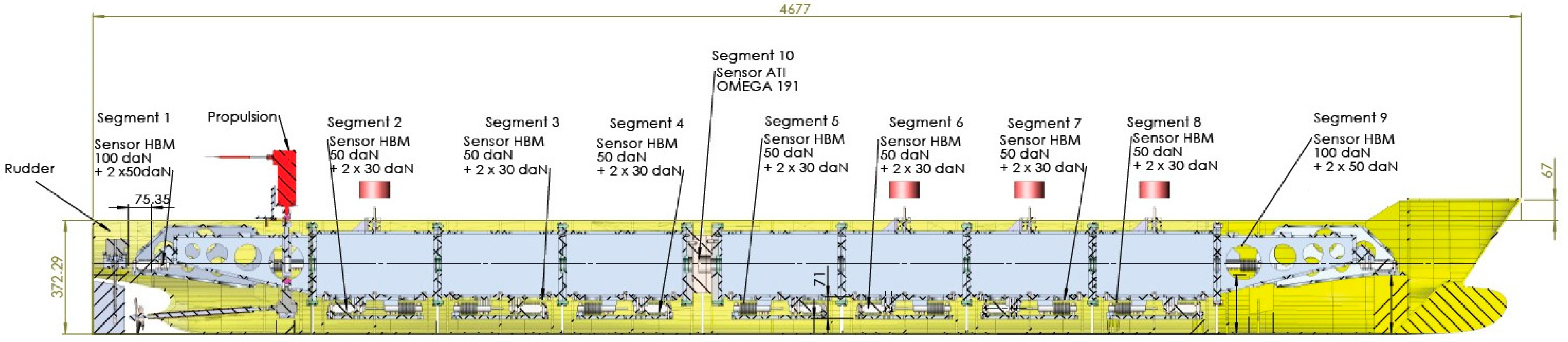
The experimental results used for the present study come from an experimental campaign published in Bouscasse et al. [9]. The ship used is a 6750 TEU containership at 1/65 scale. The hull shape corresponds exactly to the one used in [1] for a previous ISSC-ITTC benchmark. A drawing of the model is shown in Figure 1, and the main dimensions are presented in Table 1.
The hull is segmented into 9 pieces, connected to a common beam. The common beam is itself split into two parts, which are connected by a 6 DOF ATI Omega 191 sensor that allows for the direct measurement of the load effects at this location. Each of the 9 hull segments are connected to the beam via 3 DOF dynamometers, measuring the vertical force, the vertical bending moment and the torsional moment in the connection. Three HBM load cells are used in the dynamometers, which were designed and calibrated at the Ecole Centrale Nantes laboratory. The ship motions are measured with a Qualisys optical system. For redundancy, inclinometers and accelerometers are placed on the common beam at aft, amidship and bow. Data acquisition from all sensors is performed with a Quantum X system at 600 Hz, using Catman software.
The model is designed with high rigidity to ensure that the lowest natural vibration frequency, fs, of the hull girder is sufficiently far from the wave encounter and ship motion frequency, fw. A study by Horel et al. [10] showed that when the fs/fw ratio is higher than 20, the dynamic effects induced by the structural deformation can be considered uncoupled from the quasi-static hull girder response from the wave-frequency loading. From hammer tests in water, Bouscasse et al. [9] estimated the frequency of the first vibration mode of the model to be around 14 Hz. Waves with length equal to the model’s length will have a frequency of about 0.6 Hz, yielding a ratio above 23. In such wave conditions, a low-pass filter can be applied to the measured signal to obtain the quasi-static hull girder response. The experimental data used in the present study were low-pass filtered at 7 Hz, which is about halfway between fw and fs. Unfiltered results are also included in the timeseries plots.
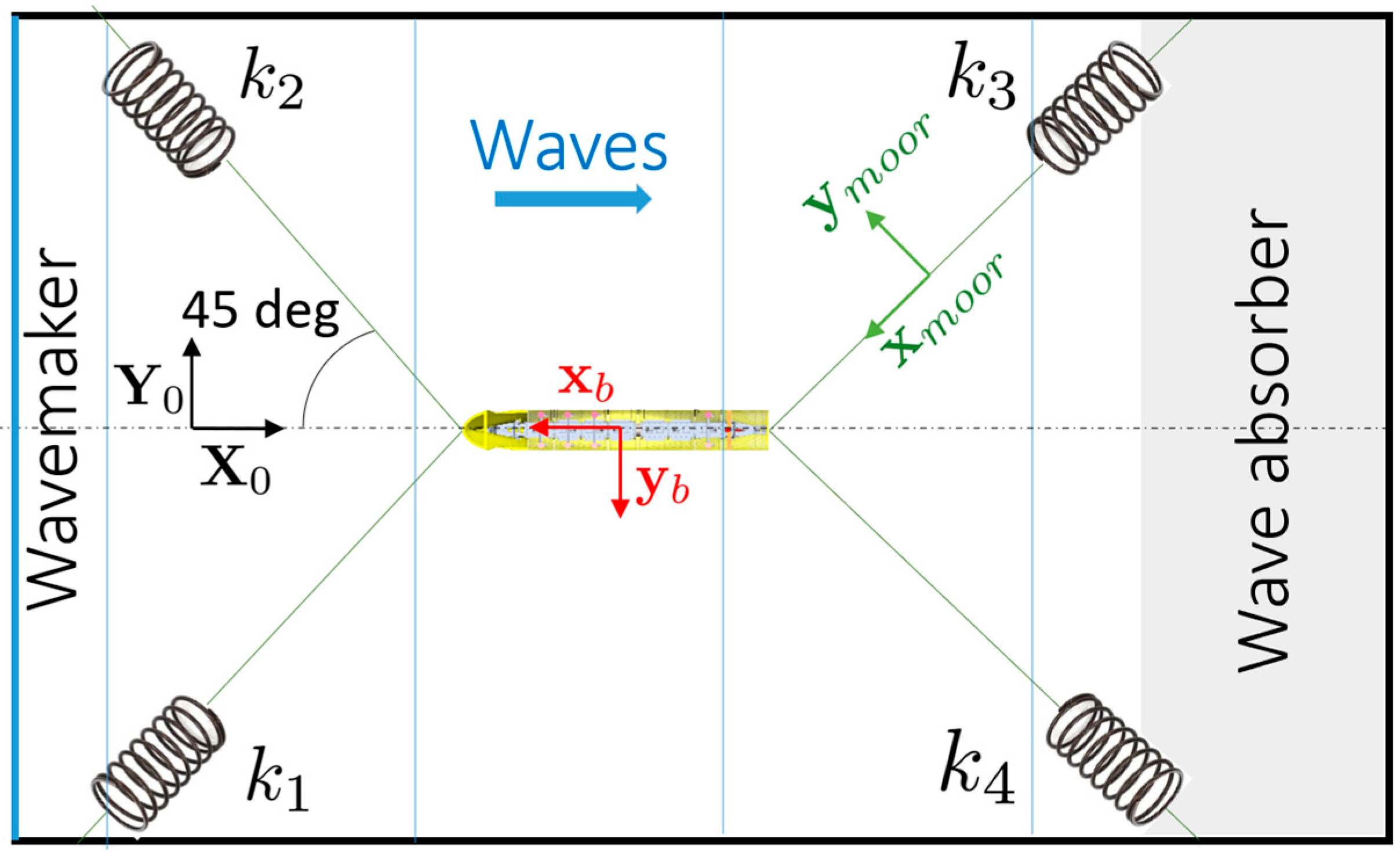
In the basin, the model was restrained with a soft horizontal mooring system, as illustrated in Figure 2. The stiffness of each of the four mooring springs is 56 N/m in model scale, which gives a natural period in surge of approximately 12 s.
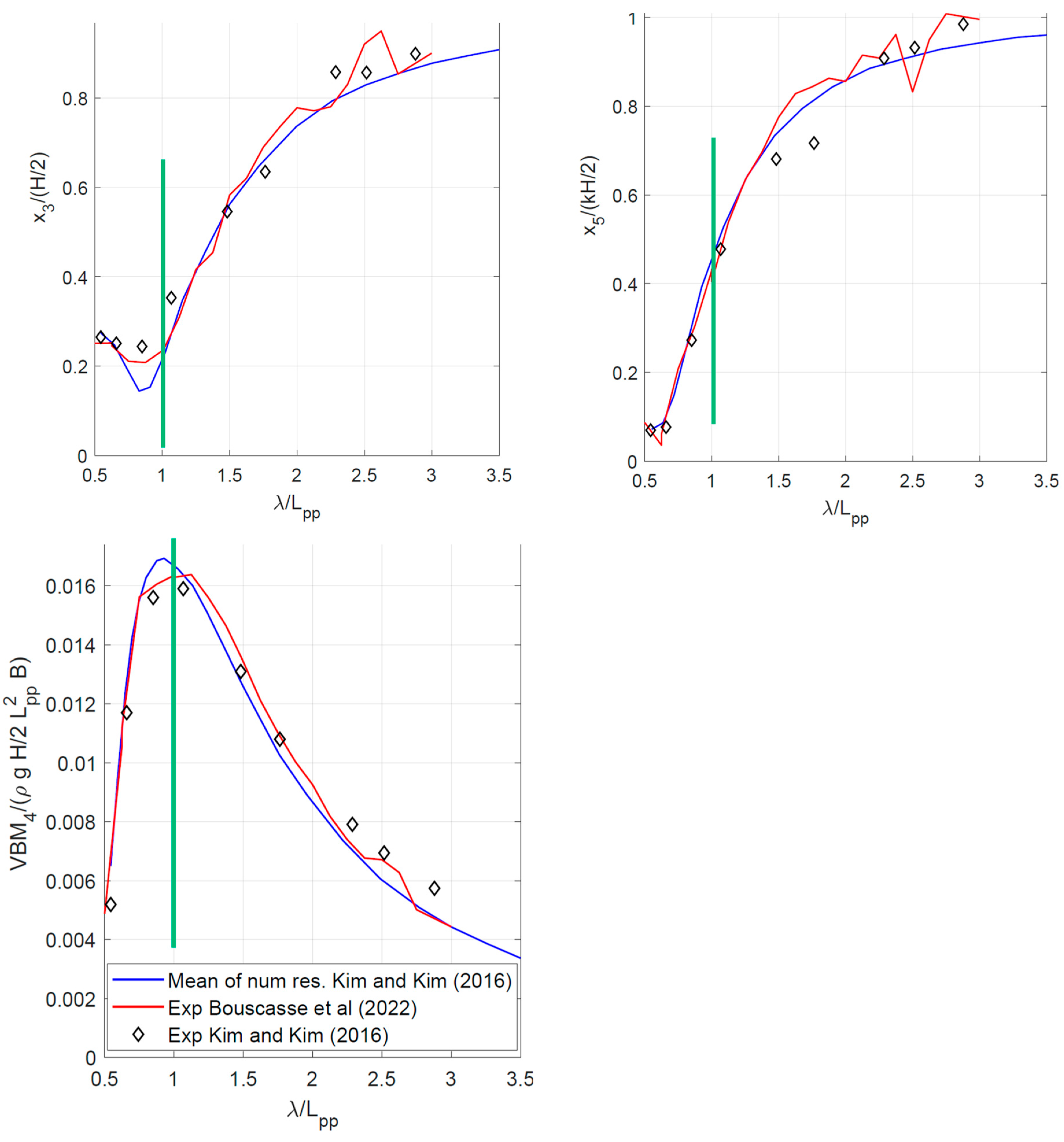
A thorough presentation of the model and measurement system can be found in [9] and [10], where results from tests in regular waves, including repeatability of the results, are presented. Most of the tests were repeated a minimum of two times, while one regular wave condition (Condition ID 188 in Table 2) was tested 12 times. In this condition, Horel et al. [10] showed that all pitch and VBM maxima were within 3% of the mean maxima of all 12 tests. Tests with the same model with long-duration runs in irregular waves were presented by Kim et al. [11]. In the present benchmark, the focus is on the midship vertical bending moment at zero speed in regular waves of length equal to the shiplength. With the focus being on the VBM nonlinearities, the wave steepness is varied in five steps, from 2.10% to 10.5%; see Table 2. As can be seen from the RAOs in Figure 3, the heave motion is small for the relevant wavelength (indicated by the vertical line), while the pitch RAO value is moderate. The VBM RAO is near its peak value. We will focus on pitch and VBM in this study. Results are presented in model-scale values. The VBM is measured by the main sensor, located between segments 4 and 5. The pitch motion is taken from the optical tracking system except for case 179, where we fall back on the inclinometer (the optical system signal has problems in this run).
The calibrated wave heights used in the present study are shown in Table 2. Experimental runs without any ship in the basin were carried out to ensure their correctness. Despite this calibration, the main uncertainty from the model test is still expected to come from the wave generation. For instance, during the calibration runs, a classical problem with wave basins was observed: the wave was not fully unidirectional, and instability led to some variations in the transverse direction. The experimentalist’s estimate of the uncertainty is about 3%; see [9,10] for more details.
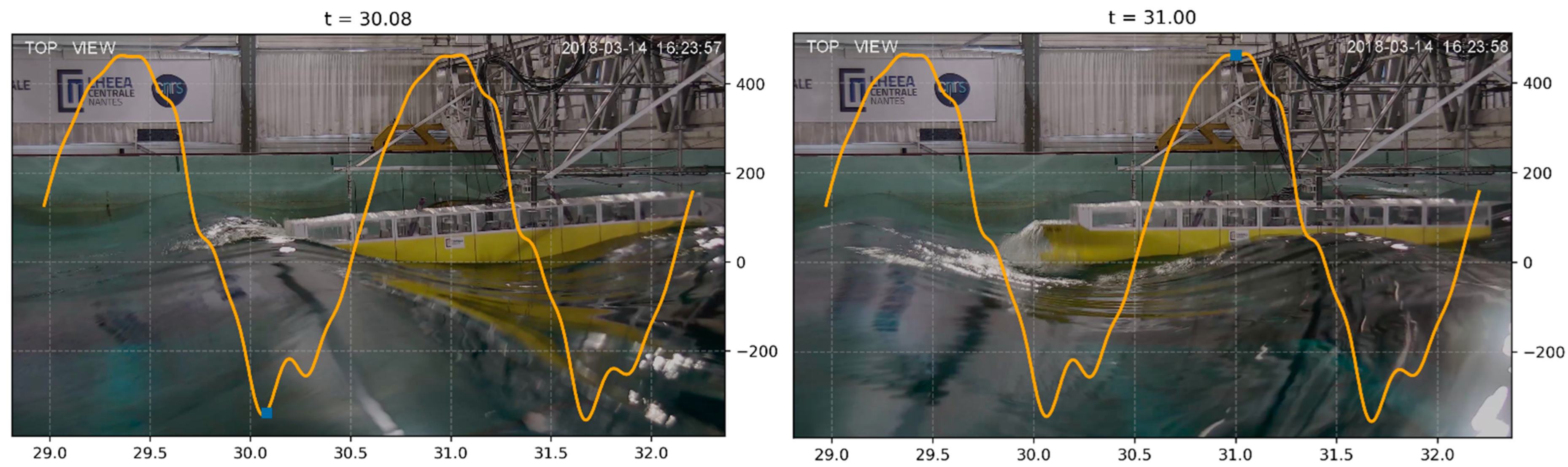
Figure 4 presents the vertical bending moment overlaid on video snapshots taken at the time of maximum sagging moment and maximum hogging moment, respectively. The example is from the second-steepest wave (8.7%/Case 140), and it is seen that the ship motions are large, with water on deck and bow out of water during the motion cycle.

3. Numerical Contributions

3.1. Overview

In this section, the theoretical background of the different contributions is briefly presented.
The benchmark was not blind. Participants had access to model test results for cases 179 and 115, so that the overall sanity of the model input could be checked. Moreover, some further iterations were performed to correct some obvious errors in the inputs. The objective was not to validate the usage of the code by different people, but rather to assess the capability of the different numerical methods to correctly capture the physical behavior of the ship.
The ten different methods are presented in Table 3 and described briefly in the following subsections. There are five field methods, where the whole domain is discretized when the problem is solved. Four of these use a mesh, while one uses particles (SPH method). All four mesh-based results are based on a finite volume method (FVM) where the water surface is captured using a volume-of-fluid (VOF) formulation. Two sets of results are produced using the Simcenter STAR-CCM+ software, while the two others come from software based on OpenFOAM. All four mesh-based CFD simulation sets are performed without viscosity and turbulence, using Euler solvers or Navier–Stokes solvers with low viscosity. The CFD models utilize symmetry in the head wave conditions to reduce the mesh size, but there are large differences in the number of cells in each model.
The other five methods are based on potential theory, where the unknown potentials are found using the boundary element method (BEM). Two methods use 2D BEM, while the other three use 3D BEM. One 3D BEM is linear, solving the problem in the frequency domain, while one weakly nonlinear 3D BEM (WNL3D_RITEH) solves the hydrodynamic boundary value problem in the time domain. In the remaining three potential methods (the 2D methods and the WNL3D_BV), the time-domain solution is represented by convolution integrals and nonlinear modifications to the hydrostatic and Froude–Krylov forces, plus additional nonlinear forces, depending on the formulation.
In all the methods, the ship model is considered rigid. No efforts are made to model hydroelastic effects.
The different numerical tools use different ways of modeling the incident waves. Comparing the waves was not part of the benchmark study, and to what extent the different wave modeling methods contribute to the observed scatter in the predicted ship responses was not investigated.
The results from DNV were produced as part of a study reported in Landet et al. [12], where only two of the five regular waves were considered. They were not part of the original ISSC benchmark [2]. Since adding more CFD results gives increased value to the present study, we decided to include the DNV contribution although they do not cover all conditions.

3.2. Linear 3D BEM—LIN3D_BV

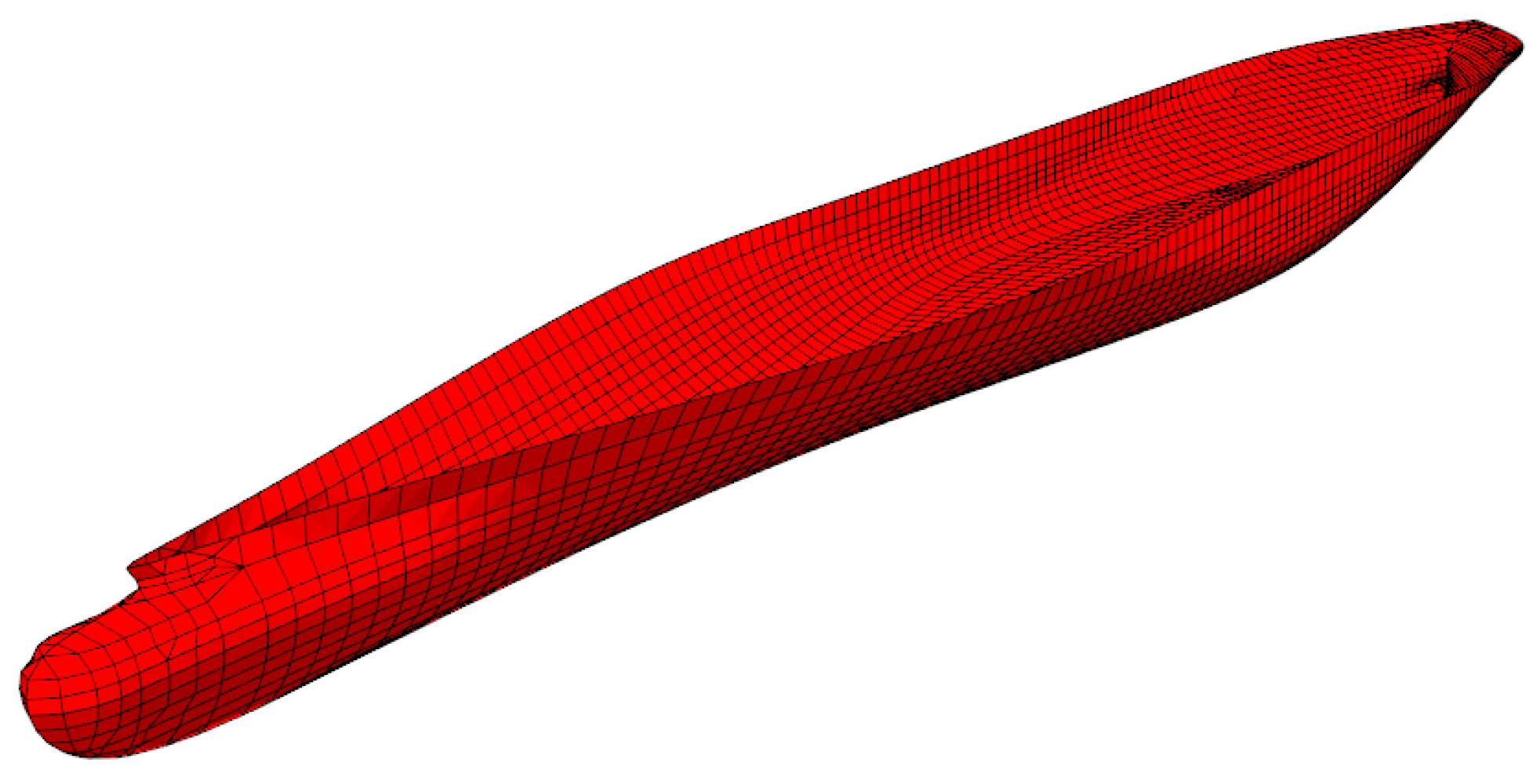
In this contribution from Bureau Veritas (BV), the linear response is computed with a standard 3D BEM (boundary element method) Green’s function-based model, using the HydroStar software [13]. The mesh used (Figure 5) contains 1678 panels on half a hull and leads to converged results. Such a linear 3D BEM, without forward speed, is a quite mature theory, with extensive validation of its implementation in several codes [14]. It is thus considered that the results, here obtained with HydroStar, are representative of linear 3D BEM codes in general.

3.3. Nonlinear Strip Theory—NLSTRIP_IST

The numerical procedure was first developed by Fonseca and Guedes Soares [15] to calculate ship responses based on an extended formulation of the strip theory, with nonlinear contributions associated with the hydrostatic and Froude–Krylov forces. The hull was assumed to be slender, and the forward speed was not very large. The flow was assumed to be inviscid and irrotational. The exciting forces due to the incident waves were decomposed into a linear diffraction part and a nonlinear Froude–Krylov part. The Froude–Krylov force was calculated by the integration at each time step of the associated pressure on the wetted surface of the hull. The radiation force was represented by infinite-frequency added mass, radiation restoring coefficients and convolution integration of memory functions. When the relative vertical motion was larger than the freeboard, the force associated with the green water on deck was calculated by momentum theory as in [16]. This code was extended [17] to include the body nonlinearity in the calculations of radiation/diffraction forces, and with the high-frequency added mass updated at each time instant. This is done by updating, at each time step, the infinite-frequency added mass coefficients and the impulse-response functions used in the convolution integrals, based on the position of each section relative to the incident wave surface. The update is performed by interpolation in a precalculated database of 2D sectional hydrodynamic coefficients calculated for different drafts.

3.4. Weakly Nonlinear Strip Theory—WNLSTRIP_SINTEF

The calculations are performed using SINTEF Ocean’s VERES code. The weakly nonlinear version of the VERES code is based on linear strip theory and nonlinear modifications. First, the linear transfer functions for the six rigid body modes and the fluid forces are calculated. The timeseries of the total responses in a given wave condition are then calculated from the convolution of the linear impulse-response functions, and by including nonlinear modifications to the hydrostatic and Froude–Krylov forces accounting for the instantaneous position of the hull under the incident wave profile [18]. The waves are modeled as linear. Calculation of linear transfer functions is performed with a conventional strip theory, where the 2D boundary value problems are solved with a hybrid BEM using Rankine sources in the inner domain and analytical expressions in the outer domain. An integral theorem is used when the linear fluid forces are calculated to avoid numerical differentiation of the velocity potential in the ship’s longitudinal direction, in the case when the ship has a forward speed.
The VERES code is applicable to ships at zero and moderate speeds. In the present study, the speed is set to zero. Linear waves are used, and the mooring system is not modeled.

3.5. Weakly Nonlinear 3D BEM—WNL3D_BV

This contribution from BV shows the results of HydroStar++, a BV in-house code, which relies on a weakly nonlinear model. The added mass, wave-damping, and diffraction coefficients are provided by a linear BEM calculation in the frequency domain (HydroStar). Thanks to the approach introduced in Cummins [19] and developed in Ogilvie [20], the mechanical equation is then written in the time domain (radiation effect being taken into account via the so-called retardation function), where nonlinear loads can be included. The nonlinearities taken into account are the so-called geometric and Froude–Krylov ones: the incident wave pressures are integrated on the instantaneous ship position.
Compared to the linear model, the geometry above the mean water level is required. The mesh should thus include the geometry above the mean free-surface level.

3.6. Weakly Nonlinear 3D BEM—WNL3D_RITEH

This contribution from the University of Rijeka uses the Wasim software [21]. Wasim is a time-domain 3D BEM using the Rankine approach. It includes Froude–Krylov nonlinearities as well as the geometric ones. In the basic Wasim implementation, the restoring and Froude–Krylov pressures are computed at the instantaneous wetted body surface defined by the rigid body motions and the incident waves. The radiation/diffraction effects are estimated within linear theory, with the corresponding pressures integrated over the mean wetted surface, with the quadratic term in the Bernoulli equation included. Nonlinearities of the incident waves are modeled using Stokes wave theory, while for the linearization of the free surface, the Neumann–Kelvin method is utilized.

3.7. Meshless CFD—SPH

Results from the open-source code DualSPHysics are provided by PAT (NMRI). Since the benchmark study by the ISSC Loads committee [2], the original DualSPHysics code has been enhanced by redeveloping it using a new fluid–solid interaction scheme: the Dummy Particle Condition [22,23]. The interaction formulation between the fluid particles and solid particles is improved to enhance the performance of the original DualSPHysics in floating object simulations.
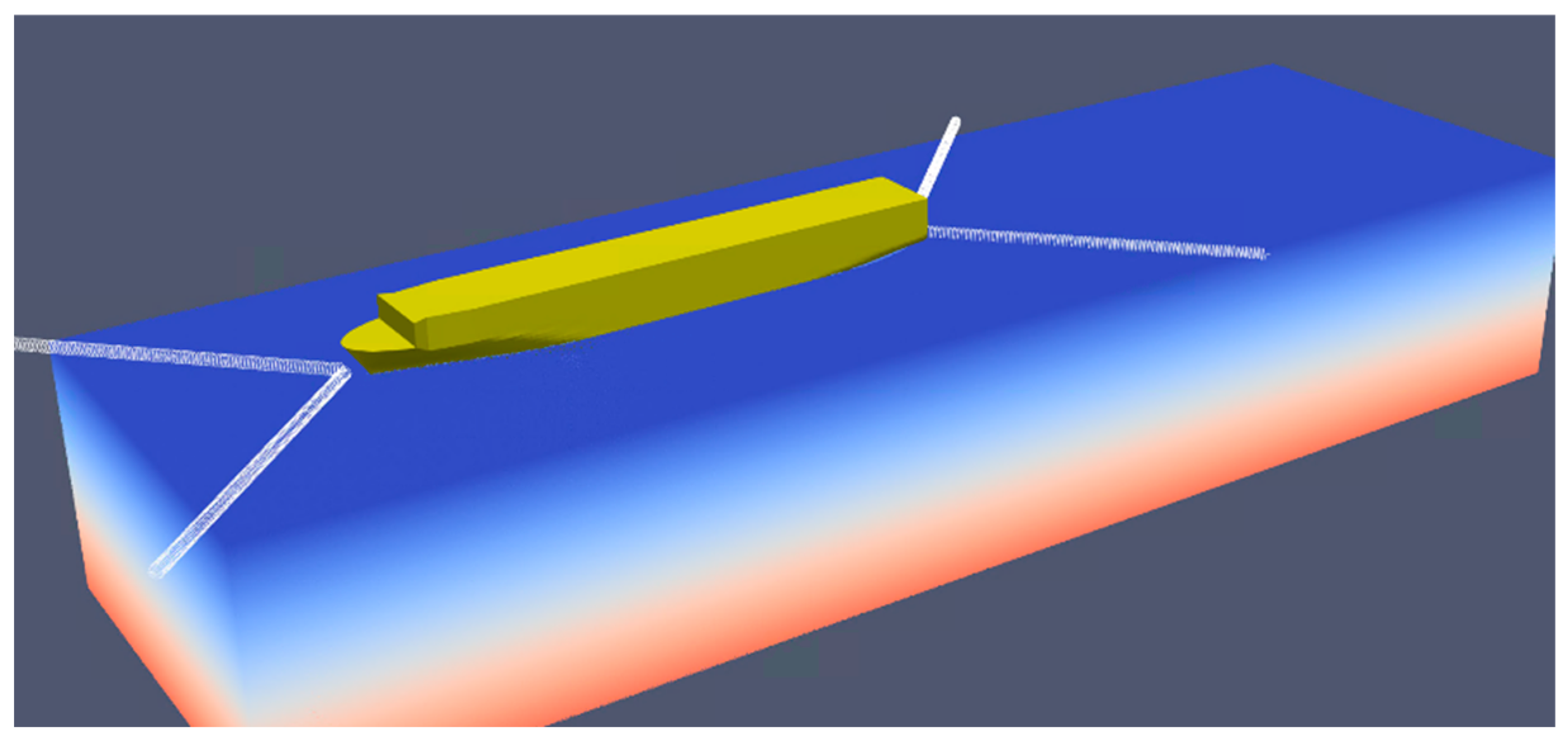
The exact ship parameters, mooring setup, and wave parameters are modeled in DualSPHysics, using a numerical tank with dimensions 12 m (length) × 3.6 m (width) × 2 m (depth). Waves are generated by the numerical Piston-type wave generator. At the outlet, a 2 m damping zone is applied at the end of the numerical tank. The particle size is constant throughout the domain and is set to 0.015 m, and the total number of particles in the SPH model is approximately 27 million. An illustration of the model is shown in Figure 6.
The ship is assumed to be rigid, and the vertical bending moment (VBM) is calculated based on hydrodynamic forces, inertia forces, and mooring forces. To account for the nonlinear effects of the ship motion on internal forces, transient (body-fixed) coordinates that consider global ship motion are applied in the VBM calculation at each time step.

3.8. Nonlinear 3D FVM/VOF—CFD_BV

A CFD code based on OpenFOAM (5.x at the moment) was provided by Bureau Veritas, using foamStar. The flow solver is fundamentally a finite volume method (FVM) solver with the free surface captured by the volume-of-fluid method (VOF).
The Crank–Nicolson scheme is applied for the temporal discretization and a second-order upwinding scheme for the spatial discretization. The transport equation for the VOF field is evaluated using the MULES (Multi-dimensional Universal Limiter for Explicit Solution) algorithm, and it includes artificial interface compression terms [24] to avoid excessive smearing of the wave–air interface. The velocity–pressure coupling is resolved at each time step using a PISO (Pressure-Implicit with Splitting of Operators) solution algorithm [25].
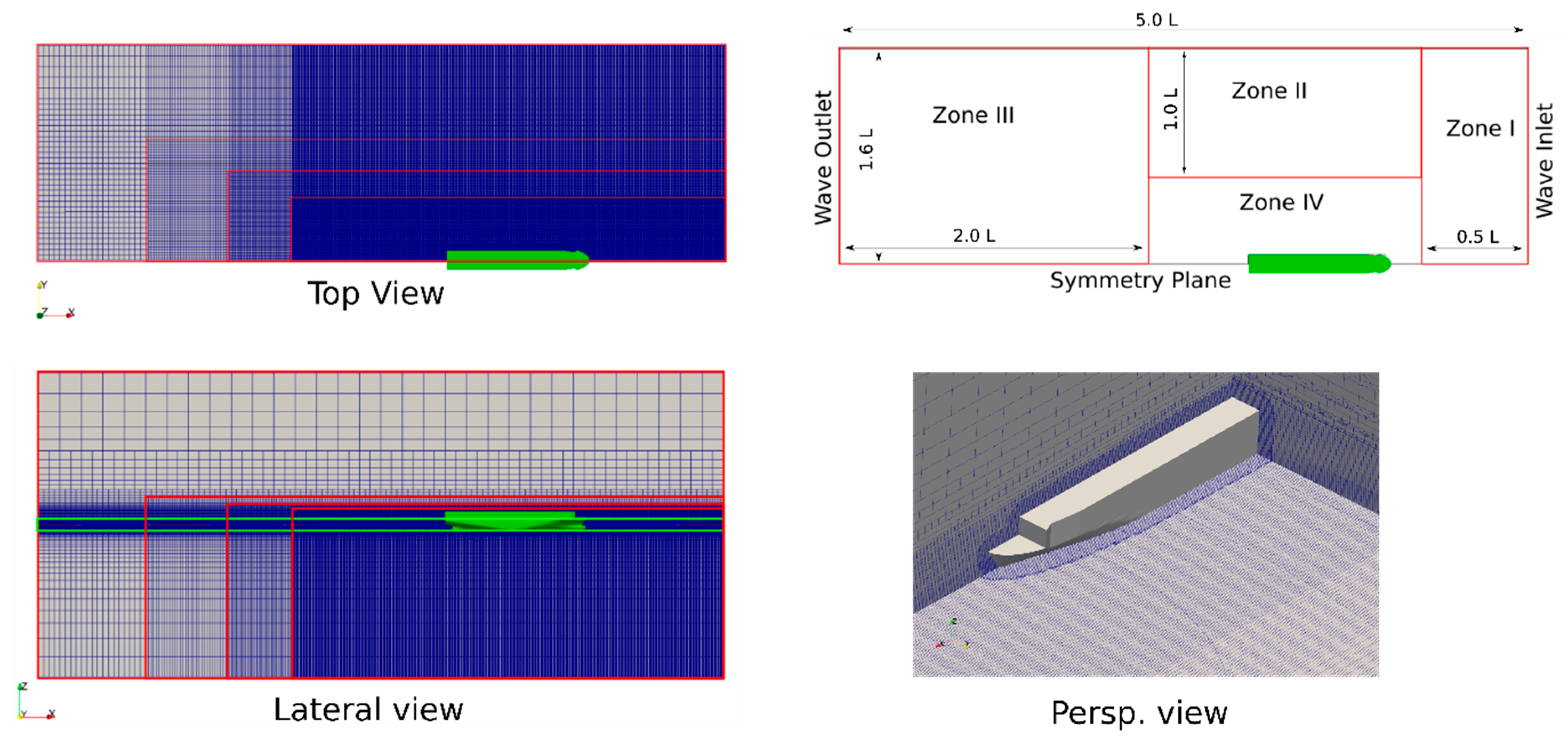
To minimize artificial disturbances due to wave reflection, the computational domain is configured to include wave under-relaxation zones [26], not only in the wake region but in all regions surrounding the ship. These include the upstream region in front of the ship (Zone I), the lateral region (Zone II) and in the wake field behind the ship (Zone III). A schematic overview of wave under-relaxation zones is shown in Figure 7, where the dimensions of the zones are shown in terms of the wavelength L. The computational mesh is configured to have a relatively high density in the propagation zones to allow the incident wave field to propagate to the ship without a significant loss of amplitude and energy. Within the free-surface zone, the mesh density is approximately 200 cells per wavelength, with a length-to-height cell aspect ratio of 2. Due to flow symmetry in head sea, the mesh covers only half of the fluid domain. In total, the mesh contains approximately 8.8 million unstructured polyhedral cells. Convergence studies were performed, and results presented in the present study are for the finest mesh. Results for a coarser mesh, similar to those used by DNV (Section 3.9 and Section 3.10), were very similar to those presented herein.

3.9. Nonlinear 3D FVM/VOF—CFD_OF_DNV

DNV uses their own custom plugins on top of the standard interFoam FVM + VOF solver [27]. Similar results are obtained for both the COM and ORG versions of OpenFOAM. The plugins contain support for nonlinear incident waves through interfacing with the open-source SWD (Spectral Wave Data) file format [28] which can describe irregular HOSM (Higher-Order Spectral Method) waves [29], regular Stokes and stream function waves, and any other potential-theory-based spectral wave model. This allows for full decoupling between the wave generator and the floating body simulator.
The disturbed wave field from radiation and diffraction around the floating body is damped towards the incident SWD wave field by use of a custom plugin supporting wave forcing zones with a tuned penalty parameter; see, e.g., [30,31]. These forcing zones surround all boundaries except the top atmospheric (pressure) boundary, which is always fully in the air phase. The implicit forcing term pulls the velocity field solution towards the incident wave velocity field with a strength that increases towards the boundaries. The forced boundaries have Dirichlet boundary conditions for the velocity and VOF fields.
The mesh is generated by the Simcenter STAR-CCM+ (STAR-CCM+) volume mesh generator and converted to OpenFOAM format by ccmToFoam. The mesh has about 0.5 million cells and is refined towards the free surface and in the pressure radiation zone around the floating vessel. Due to flow symmetry in head sea, the mesh covers only half of the fluid domain. A custom plugin combines the mesh information with a distributed mass model to form a segmented and optionally flexible model of the hull that allows for the calculation of global loads such as VBM in the time loop. The water viscosity is set very low to resemble inviscid flow when solving the Navier–Stokes equations. No turbulence model or wall functions were applied. The mesh and time step sensitivity was checked, and the mesh used in the later works documented in [12] is even coarser than what is used here.

3.10. Nonlinear 3D FVM/VOF—CFD_STAR_DNV

The simulation setup used for STAR-CCM+ is equivalent to the one used by DNV for OpenFOAM in terms of mesh, domain size, forcing zones, and use of incident Stokes waves through the SWD wave model interface. The only major difference is that the CFD simulations are run using the support for solving the inviscid Euler equations in STAR-CCM+ instead of the Navier–Stokes equations. One smaller difference is support for implicit forcing terms also in the VOF solver in the DNV plugins for STAR-CCM+, not only for the velocity as was done in OpenFOAM. This may make the forcing zone approach slightly more effective. STAR-CCM+ is also using the HRIC (High-Resolution Interface Capture) [32] scheme instead of MULES, which is used by OpenFOAM’s interFoam VOF solver.

3.11. Nonlinear 3D FVM/VOF—CFD_NK

Provided by ClassNK, using STAR-CCM+ (ver. 2210), the flow solver is a finite volume method (FVM) solver with the free surface captured by the volume-of-fluid (VOF) method.
A second-order backward scheme is applied for the temporal discretization and a second-order upwind scheme for the spatial discretization. The transport equation for the VOF field is evaluated using the HRIC algorithm [33]. The velocity–pressure coupling is resolved at each time step using a SIMPLE (Semi-Implicit Method for Pressure-Linked Equation) algorithm. Viscosity and turbulence are neglected in the present simulations.
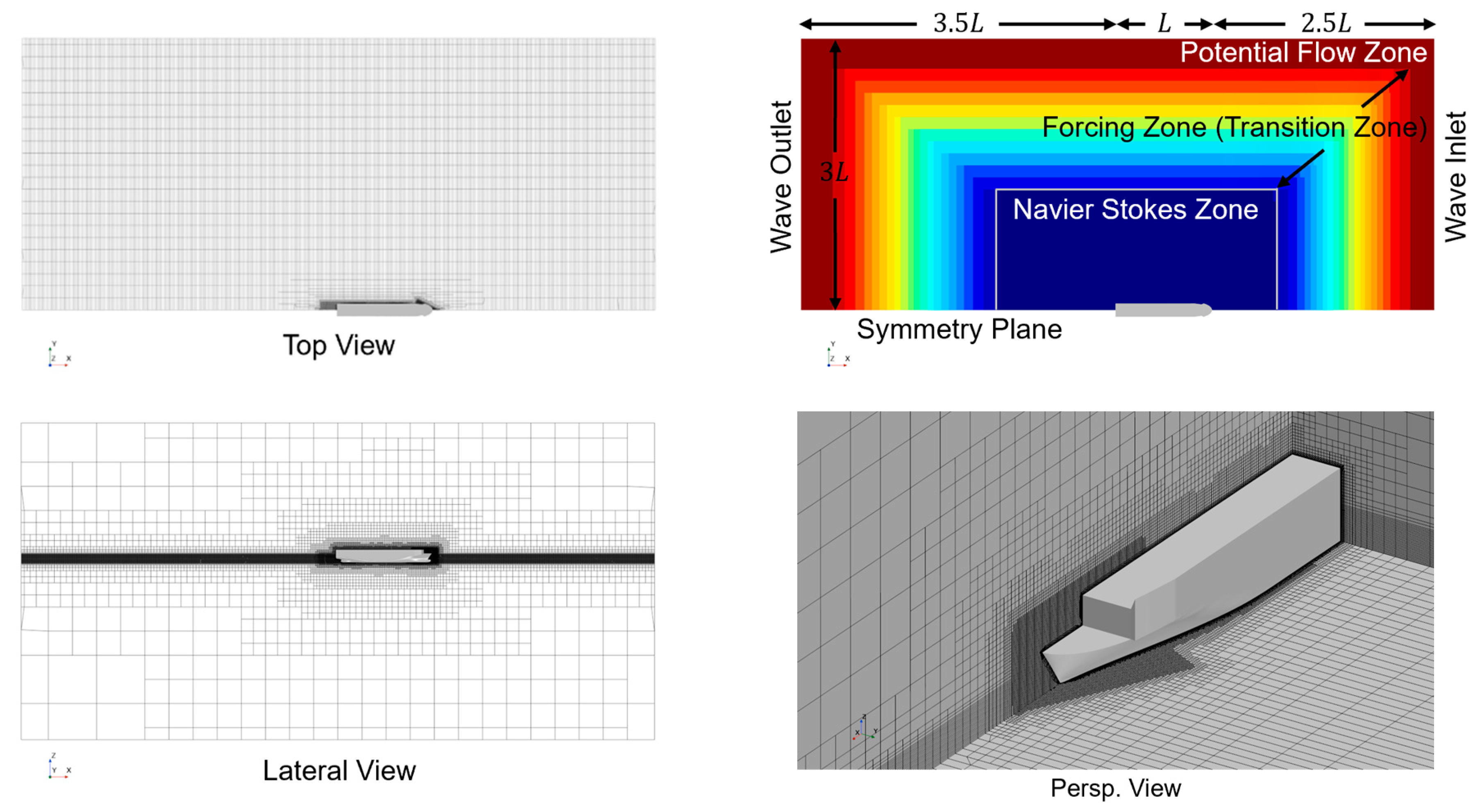
To minimize artificial disturbances due to wave reflection and allowing the incident wave field to propagate to the ship without a significant loss of amplitude and energy, the computational domain is configured to include wave forcing zone using an Euler overlay method [34]. In the far field, a solution based on potential flow theory is used, while in the near field a solution of the Navier–Stokes equation is used. The transition zone between the far field and the near field is defined as the forcing zone, and the solution of the Navier–Stokes equation is forced into the potential-flow-theory-based solution smoothly from the near field to the far field. A schematic overview of the wave forcing zone is shown in Figure 8, where each dimension is shown in terms of the ship length L. The number of cells is considered for striking a balance between computational cost and accuracy to ensure that a similar modeling approach can be used in a lot of simulations. The computational mesh is configured to have a relatively high density in the wave propagation zones and near the bow. Within the free-surface zone, the mesh density is approximately 40 cells per wavelength and 20 cells for wave height. Since the ship speed in the benchmark is zero, and to reduce the computational cost, the fine mesh to capture the Kelvin wake generated behind the stern was not used. Due to flow symmetry in head sea, the mesh covers only half of the fluid domain. In total, the mesh contains approximately 1.5 million hexahedral cells. These settings are based on experience and insights from sensitivity analyses on mesh size carried out separately using experimental data for a similar containership [35]. In the present benchmark, a 12 s simulation in model ship scale took approximately 18 h on 48 cores.

4. Results

4.1. VBM in Calm Water

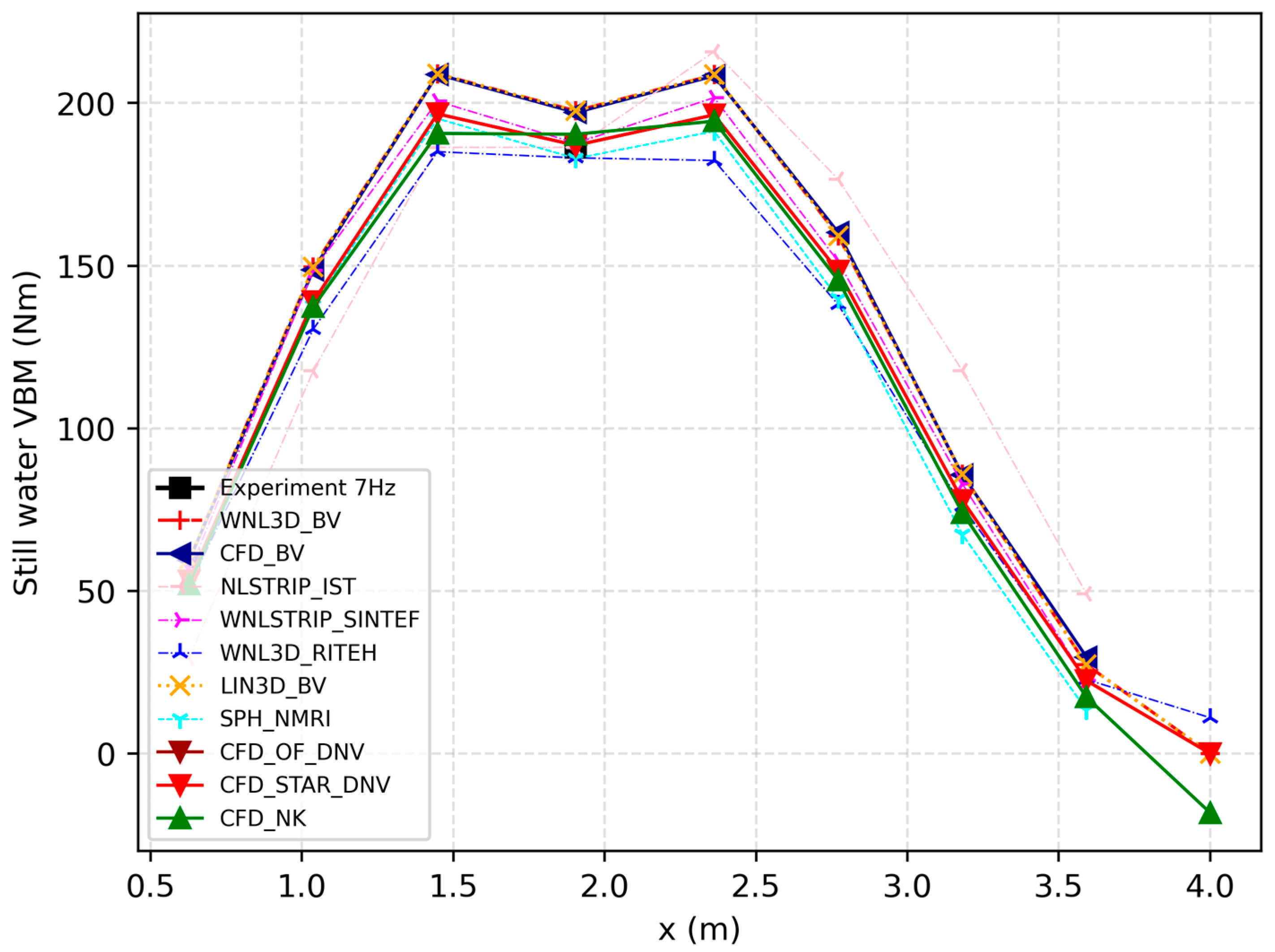
In Figure 9, the still-water loads calculated at the different sections of the ship model are presented. Theoretically, all 3D contributions should provide the same results; differences that may arise would then be attributed to slightly different inputs. Some 2D codes use 3D panels when integrating the hydrostatic pressure, while others are strictly 2D with no longitudinal force components. These differences, however, are not expected to give significant differences in the VBM. The agreement between the different codes is acceptable. These results indicate that the input data were interpreted and set correctly in the different computer codes.

4.2. Photos from Model Tests in Waves

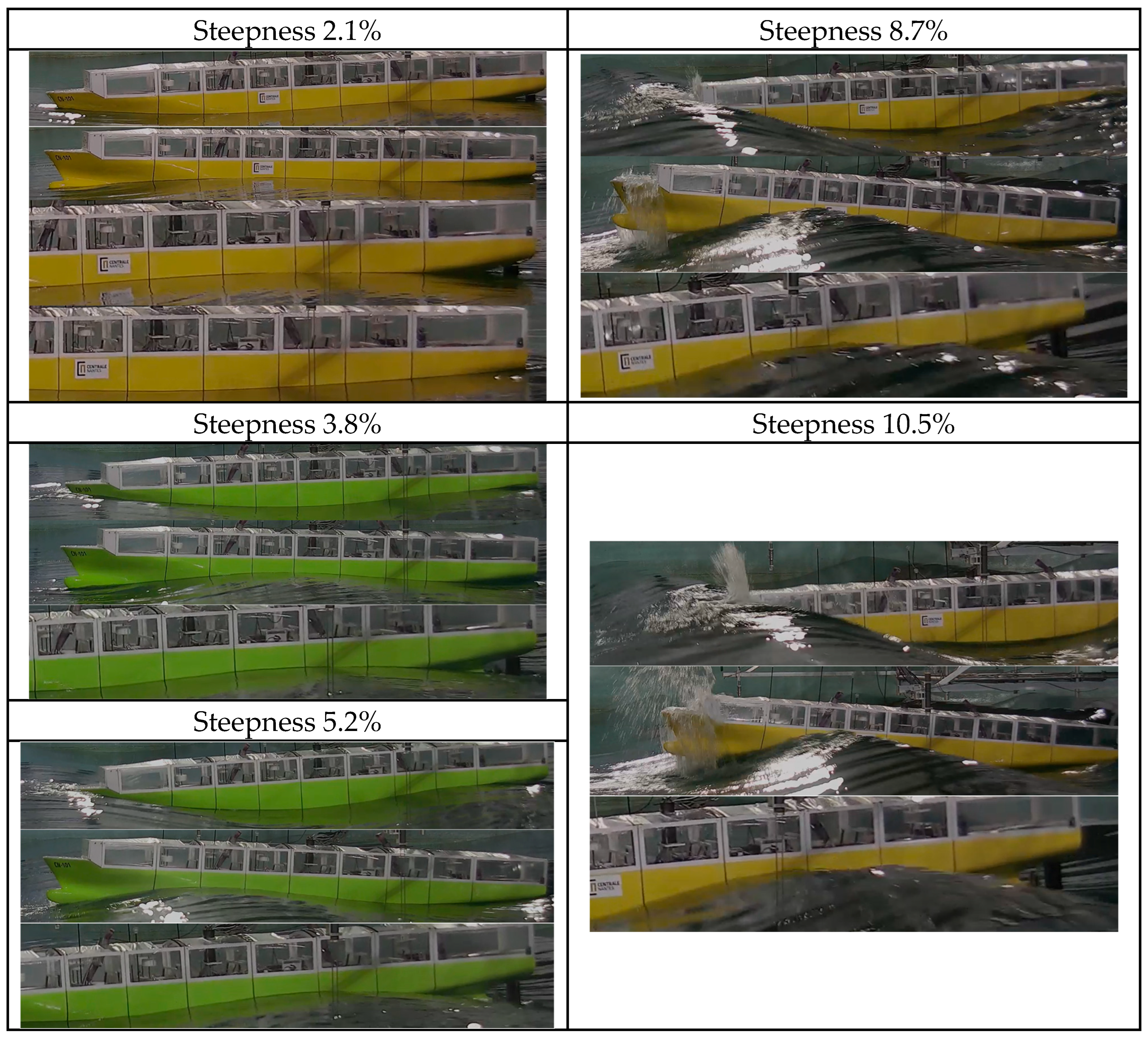
Snapshots from the video recordings from waves with increasing steepness are presented in Figure 10. These illustrate to what extent the bow and stern of the model move in and out of water, and when physical phenomena, such as slamming and green water, become significant.
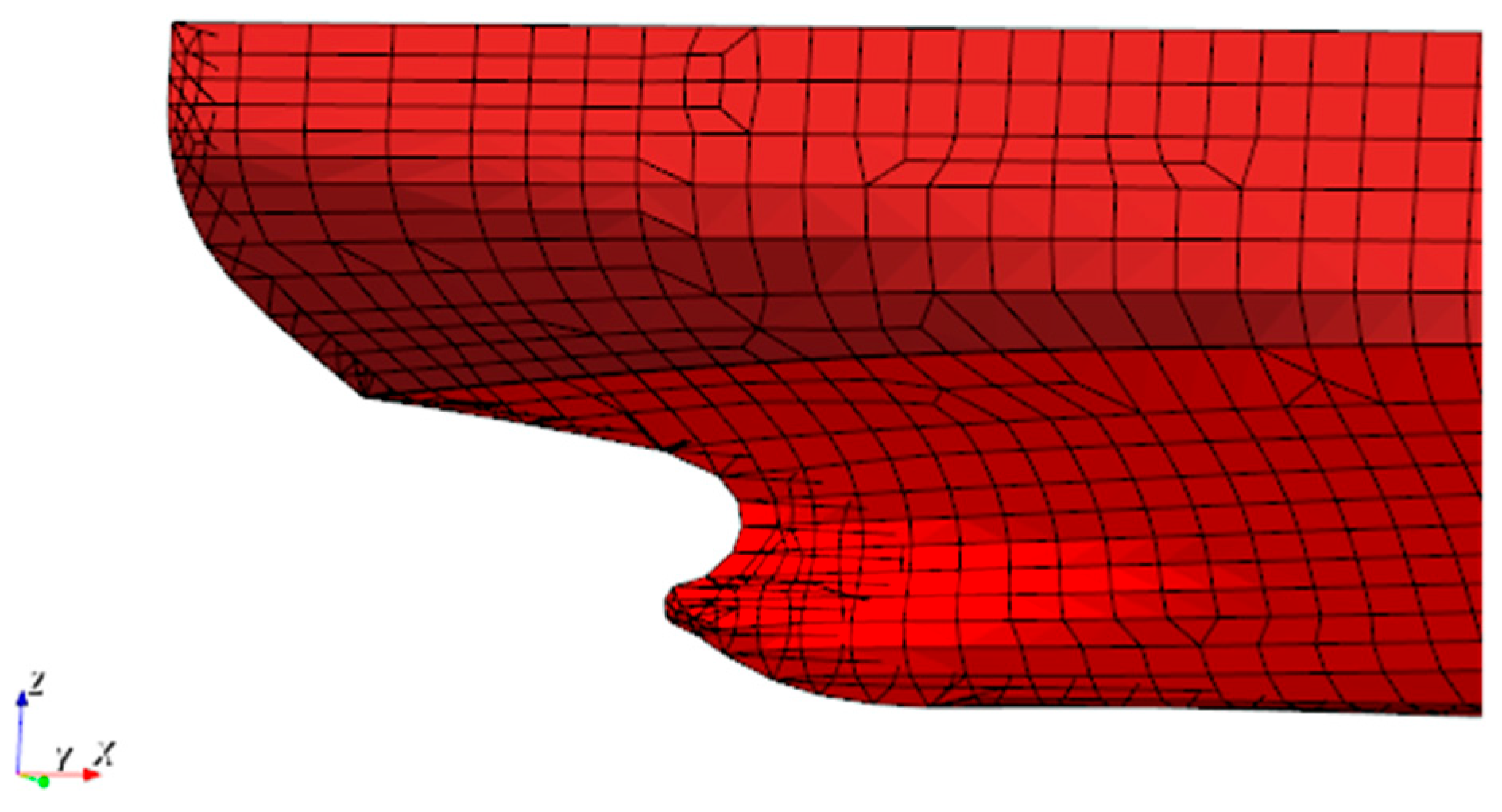
In the steepest waves, both bow and stern come out of water, and there is slamming and green water. The ship has a stern geometry that is relatively flat near the still-water line, as shown in Figure 11. Small stern motions relative to the waves will cause large variations in the wet area and the vertical forces in this region.

4.3. Timeseries of Pitch and VBM in Waves

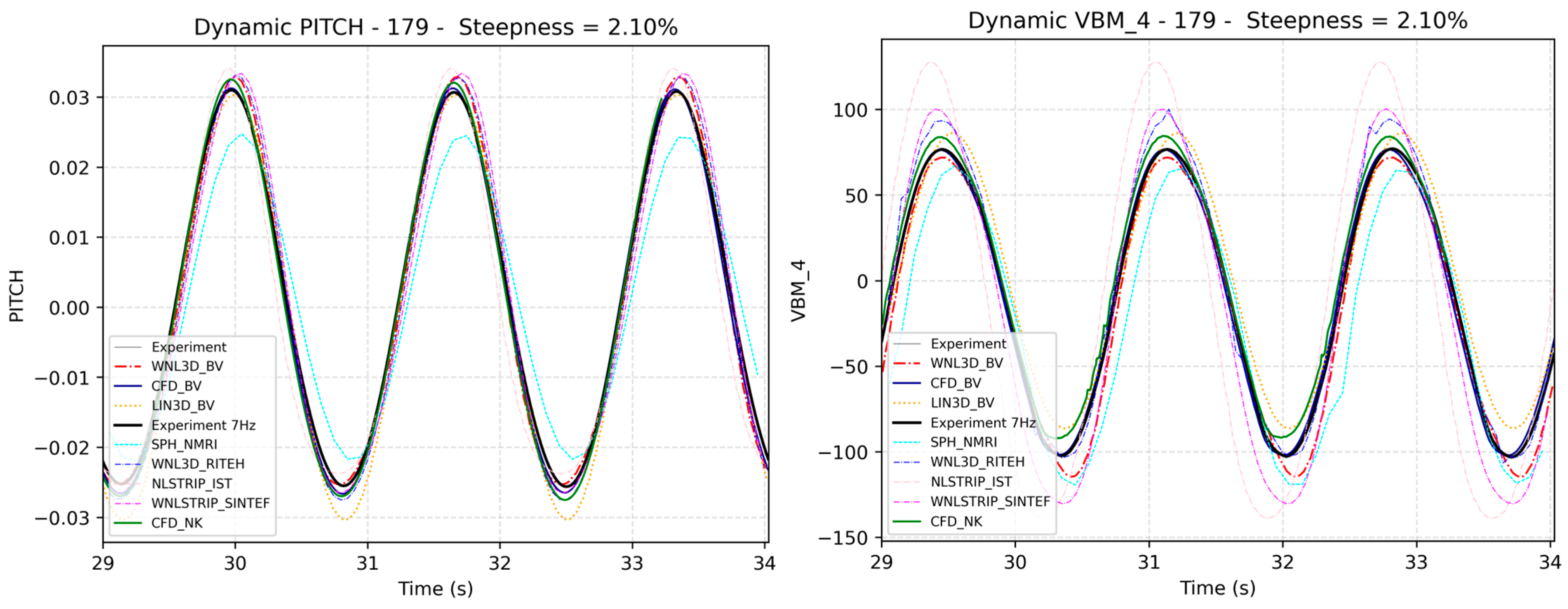
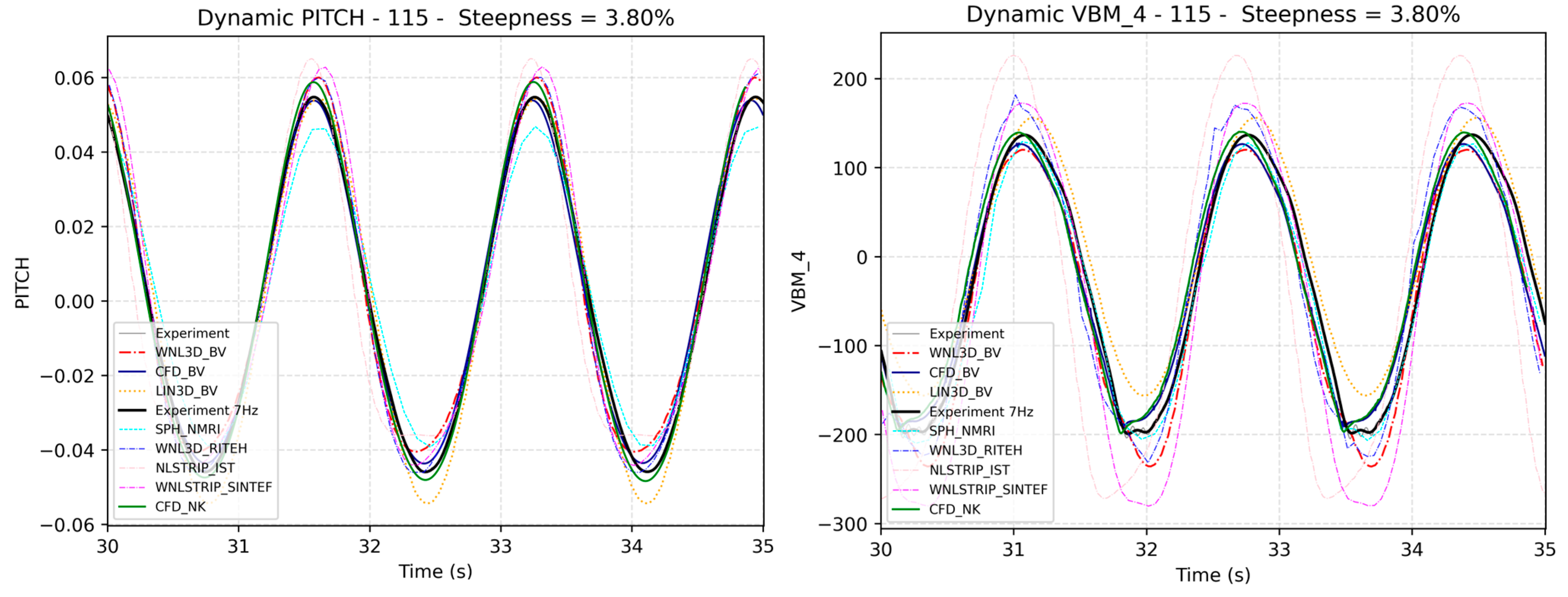
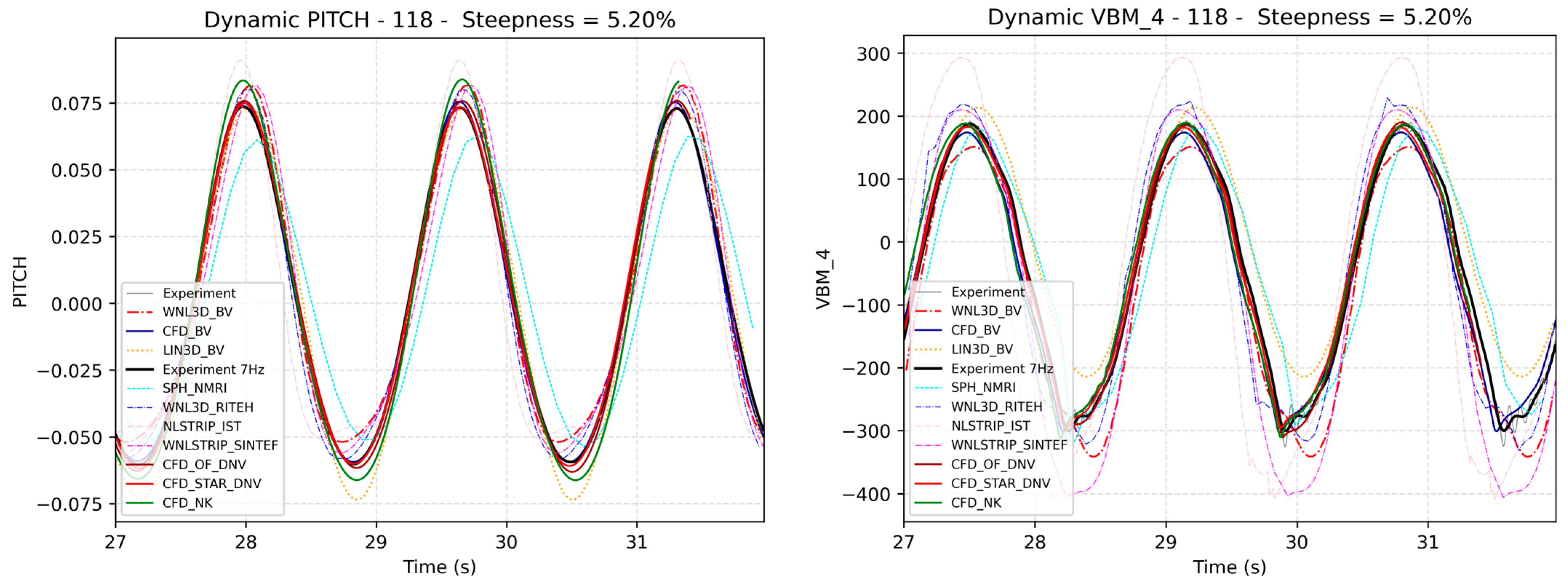
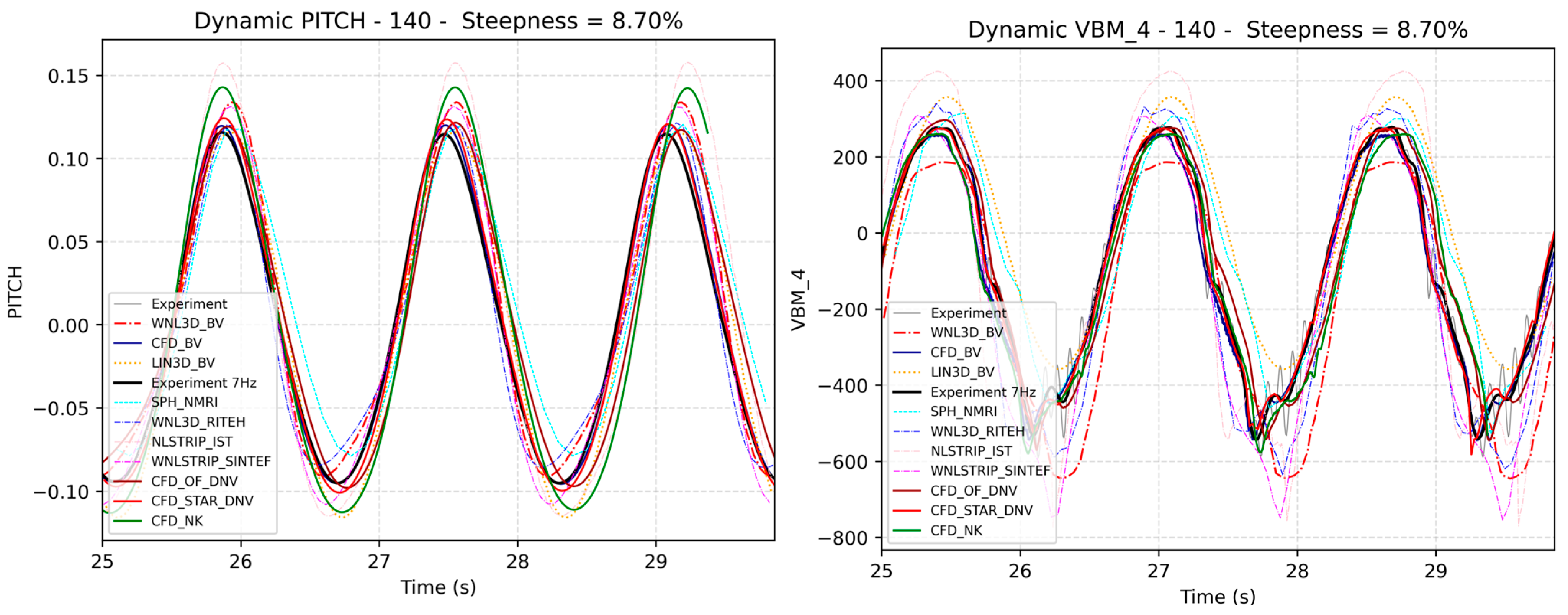
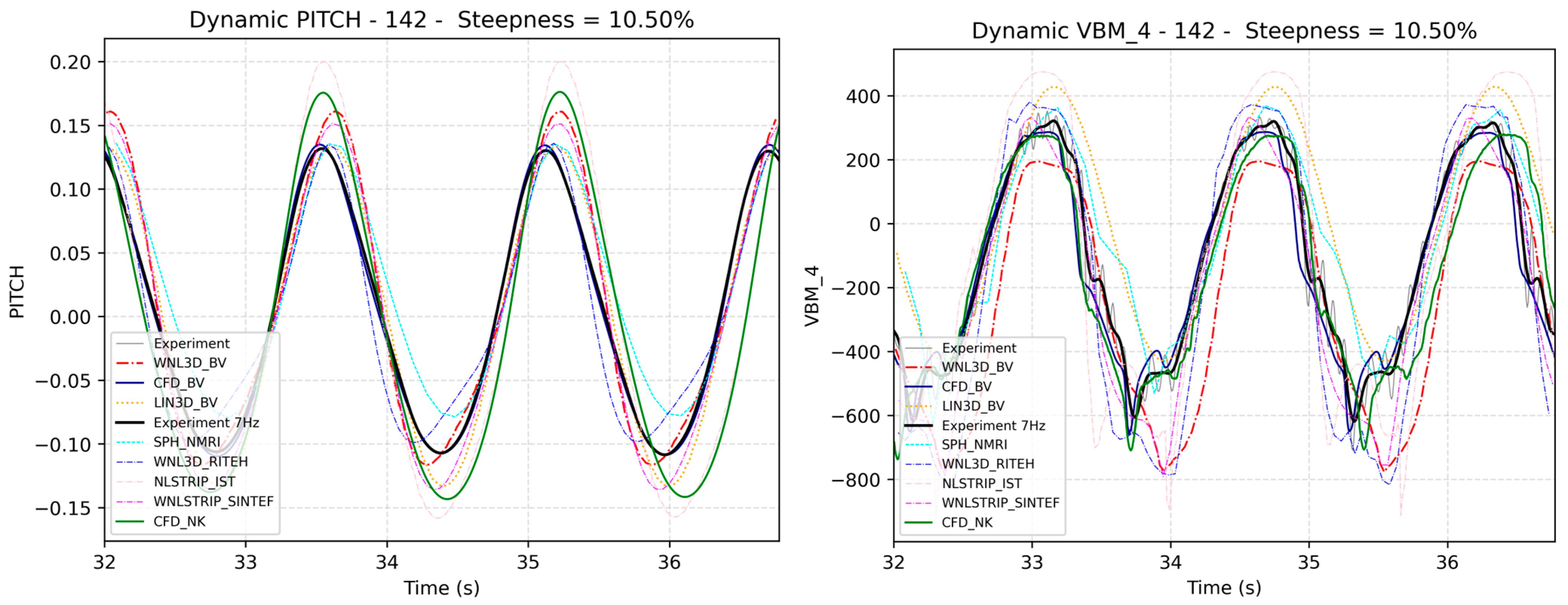
Timeseries of the pitch motion and the VBM are plotted in Figure 12, Figure 13, Figure 14, Figure 15 and Figure 16. In these plots, only the dynamic part of the loads (total minus still water) is included. All results are presented in model-scale values. The results named “Experiment” are the unfiltered measurements, while those named “Experiment 7 Hz” have been low-pass filtered at 7 Hz to remove the effect of vibrations in the VBM signal. As mentioned above, the focus of the present study is not on hull girder vibrations, and all the numerical models assume that the physical model is rigid.
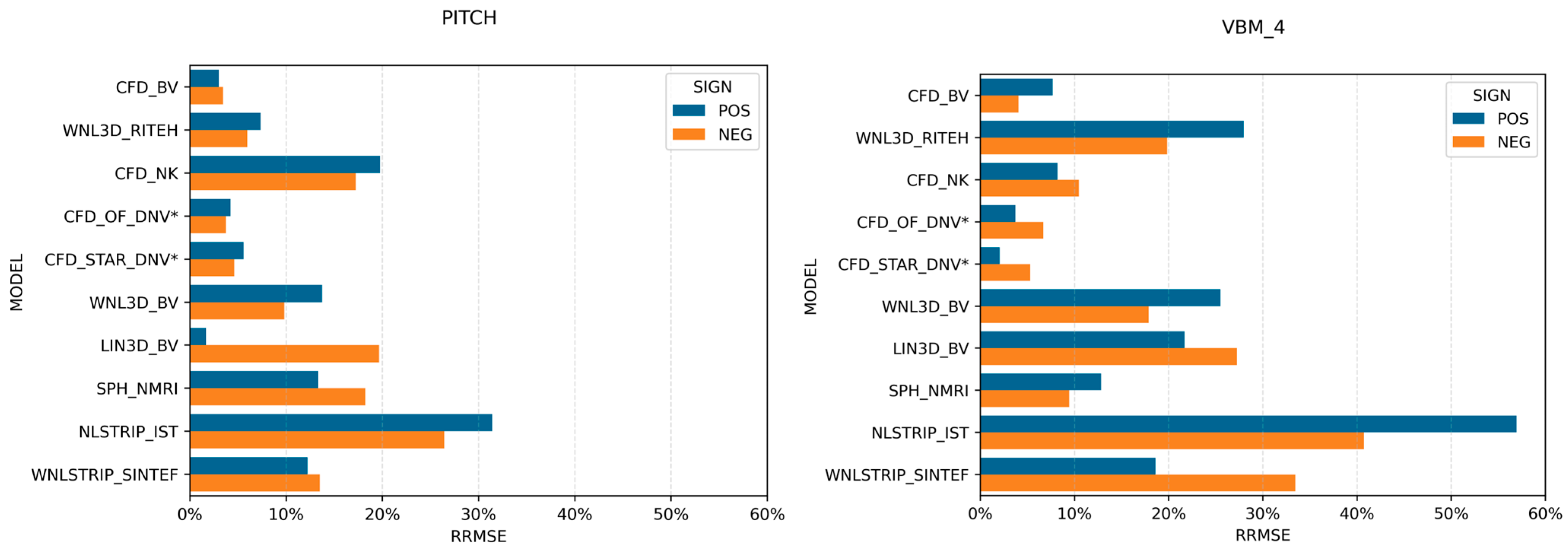
In Figure 17 we have plotted the relative root mean square error (RRMSE) of the different amplitudes of the numerical results in Figure 12, Figure 13, Figure 14, Figure 15 and Figure 16 when compared to the experimental results. The RMSEs are normalized by the experimental amplitude in each wave condition and averaged over the conditions.

4.4. Evolution of Amplitudes with Increasing Wave Steepness

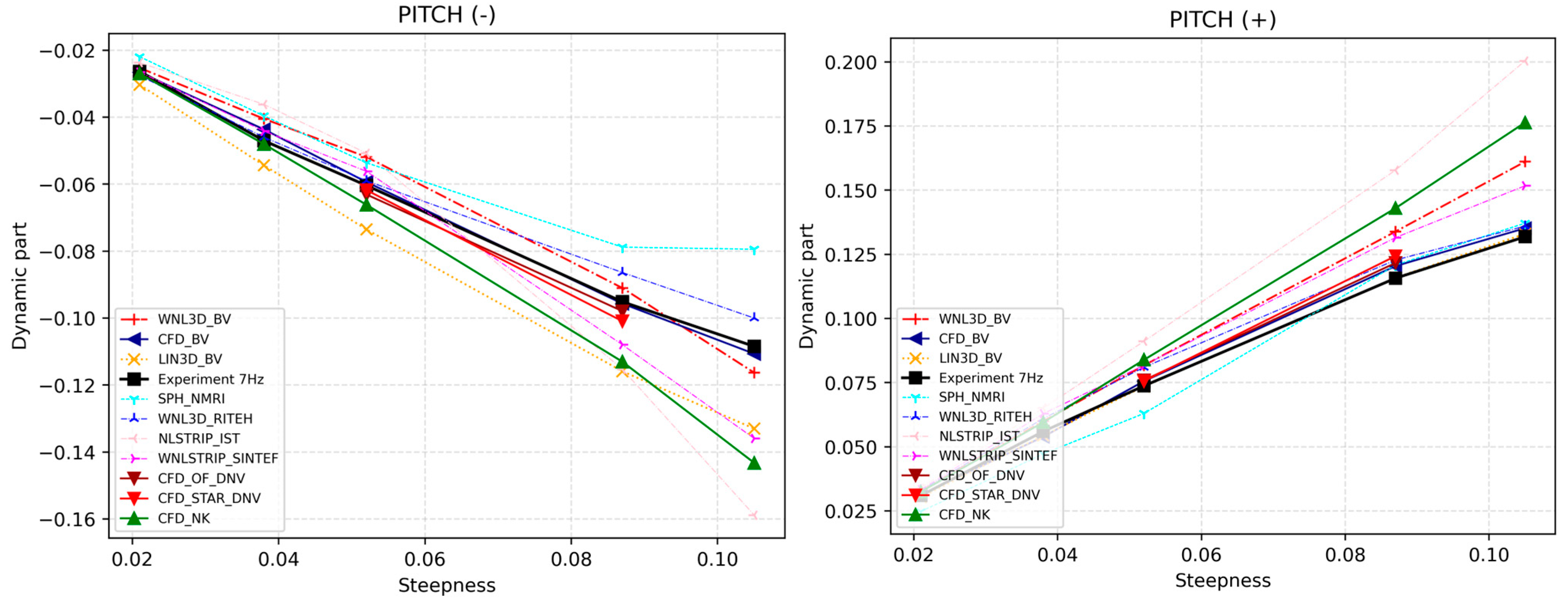
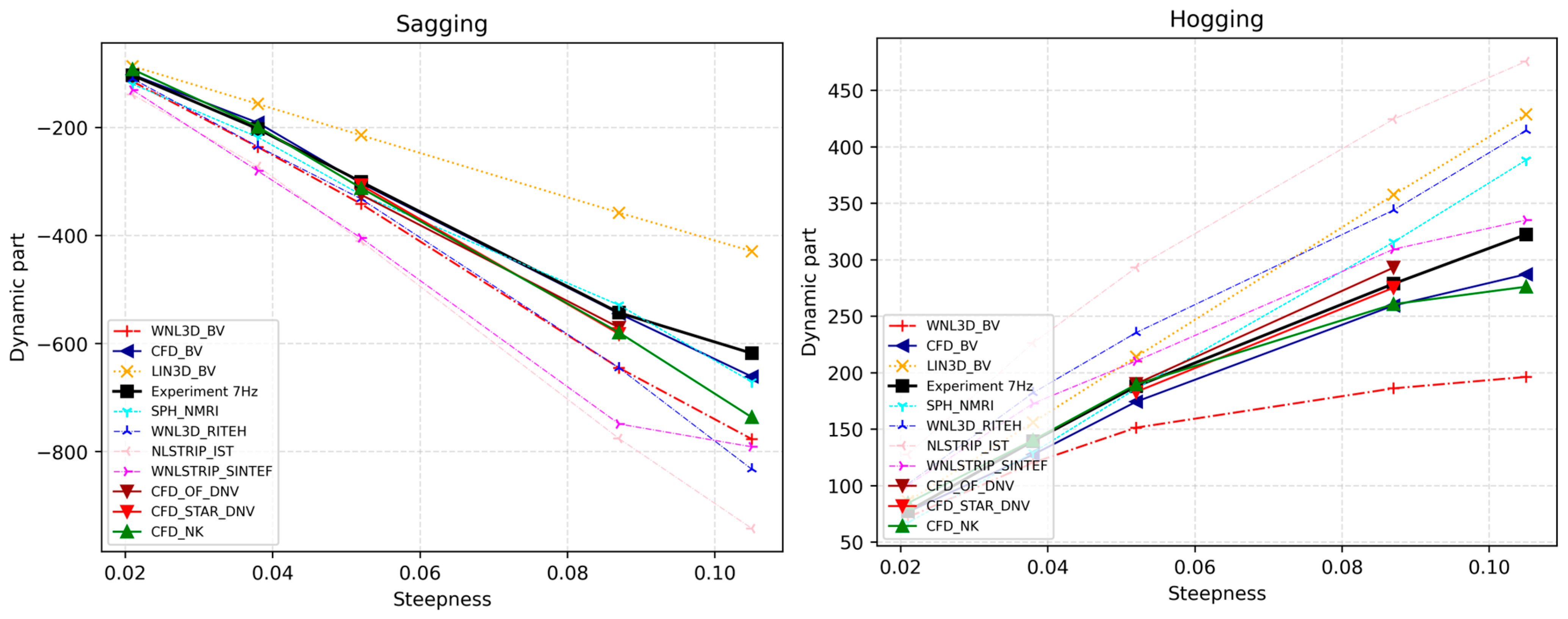
To illustrate how the responses vary with increasing wave steepness, the positive and negative response peaks in Figure 12, Figure 13, Figure 14, Figure 15 and Figure 16 are plotted against wave steepness in Figure 18 and Figure 19 for pitch and VBM, respectively. Note that the linear results here do not appear as strictly proportional to steepness. This is due to the nonlinear dispersion relationship, and to the fact that the different cases are done with the same wavelength (and hence with a slightly different wave period). For increasing wave steepness, the linear results are obtained for slightly shorter wave periods (matching those in the experiments), and as can be seen from the RAOs in Figure 3, this gives a small reduction in the pitch amplitudes.
To zoom in on the differences between the codes, the nonlinear factors are calculated as
F N L + = m a x ( X ) / m a x ( X l i n e a r ) 1 F N L = m i n ( X ) / m i n ( X l i n e a r ) 1
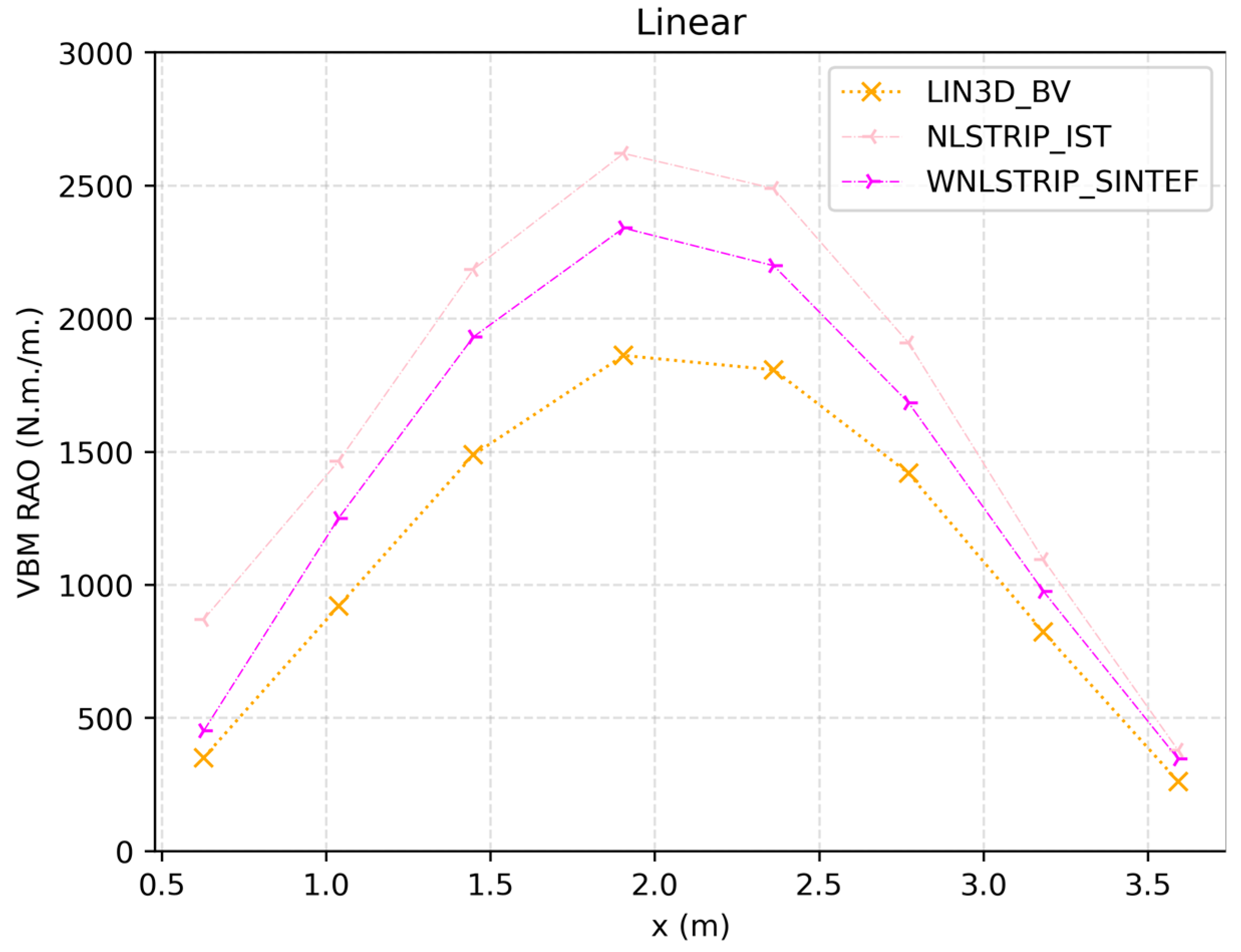
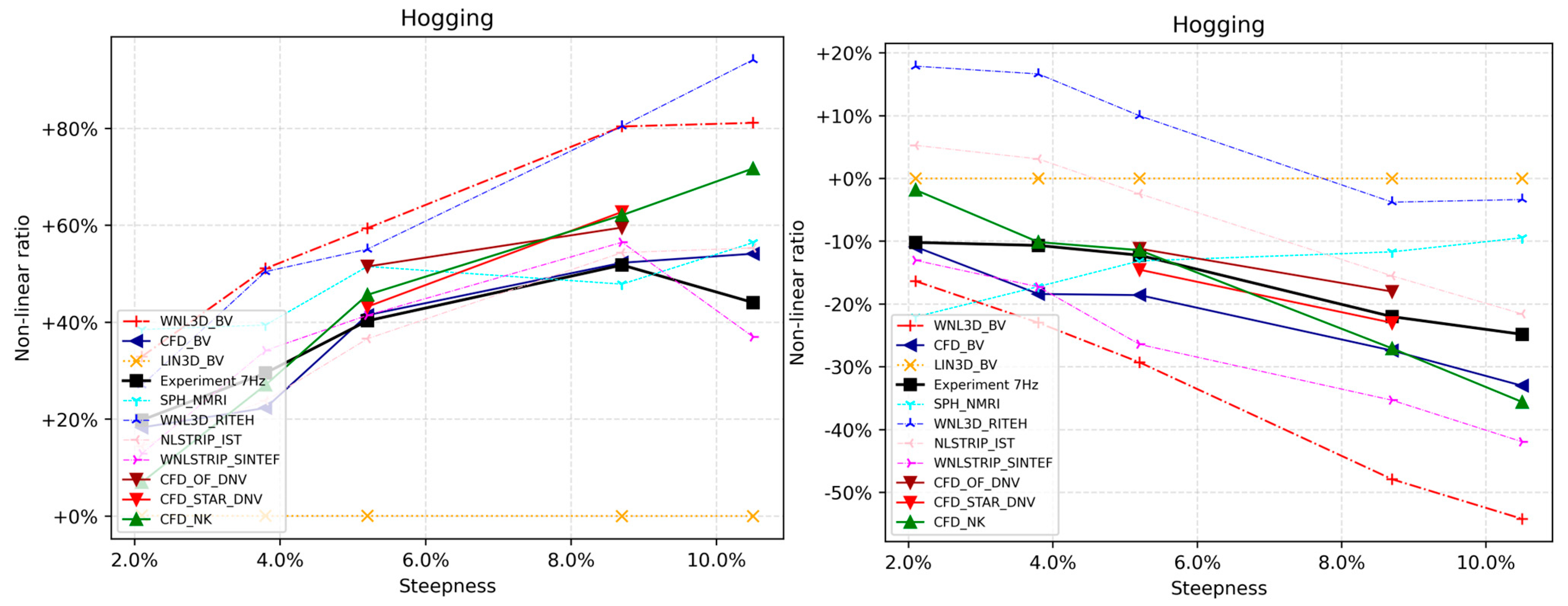
where X is the total dynamic value (pitch or VBM) and X l i n e a r is the linear dynamic value. For 3D results (including experiments), the linear value is taken as the one calculated by 3D BEM (HydroStar). For strip theory codes, the linear value from the corresponding 2D calculations is used. Linear RAOs (Response Amplitude Operators) are displayed in Figure 20. The nonlinear factors are presented in Figure 21.
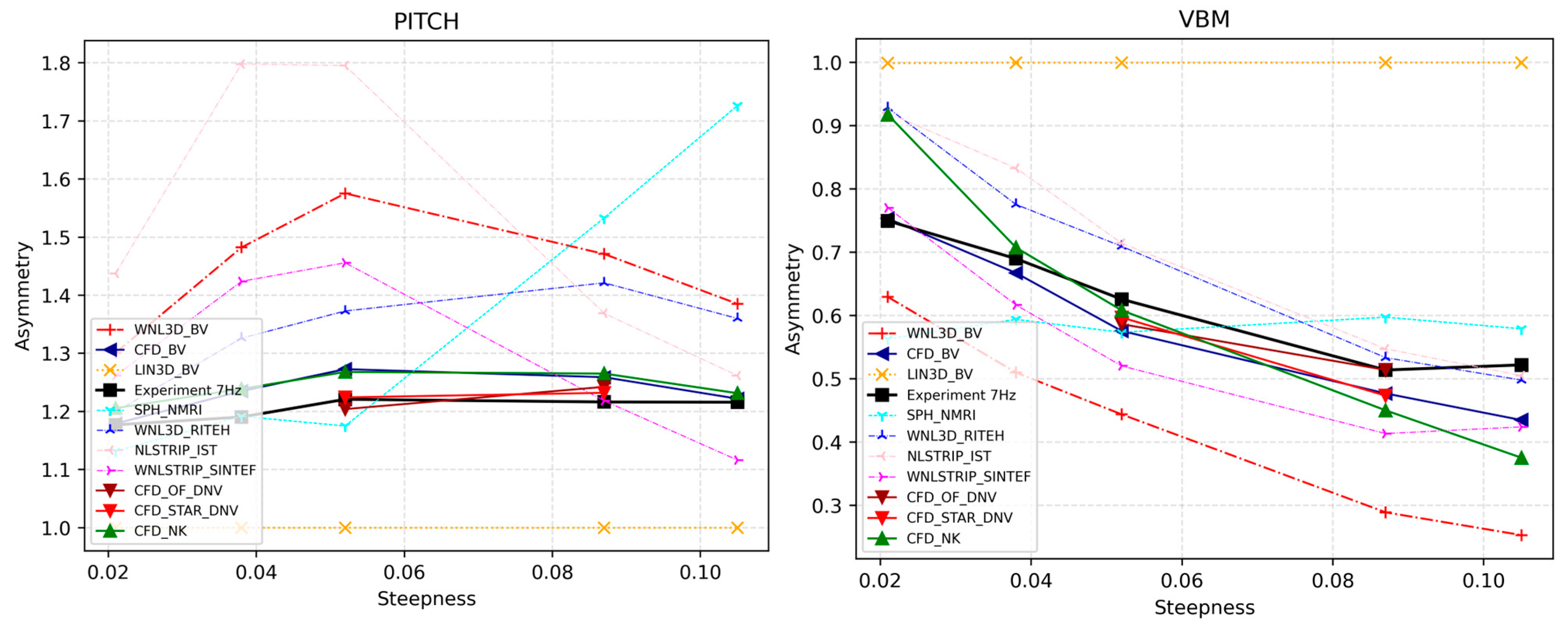
A limitation of the nonlinear factor calculation is that the linear reference is not strictly available for all cases. Theoretically, using the 3D BEM value is fine for 3D runs. But in practice, in the case that the inputs from the different contributions are slightly different, it would offset the hogging/sagging nonlinear factor curves. Using the same linear reference for all results (codes) would not give correct estimates of each code’s ability to capture nonlinearities, since the codes give different linear predictions, as indicated by the differences seen for the lowest wave steepness in Figure 12 and clearly demonstrated in Figure 20. A common linear reference would only reveal each code’s deviation from this selected reference as the wave steepness increases. This would capture trends but not quantitative estimates. To overcome this limitation, the asymmetry ratio (Equation (2)) is extracted and plotted in Figure 22. Deviation from 1.0 can be attributed to nonlinear effects, without any ambiguity.
R a s y m = m a x ( X ) m i n ( X )
Here, X is the dynamic response (still-water level removed). However, the asymmetry plots may also be deceptive, since they only show the ratios between the peaks and troughs. If both peaks and troughs are overpredicted or underpredicted by similar amounts, the asymmetry may still compare well with experimental values. For pitch, we see from Figure 22 that, e.g., the CFD_BV and CFD_NK give almost identical asymmetry ratios, while the timeseries plots in Figure 12, Figure 13, Figure 14, Figure 15 and Figure 16, and the amplitude plots in Figure 18, reveal that the CFD_NK results show an increasing overprediction of pitch with increasing wave steepness. The plots for pitch in Figure 22 may also give the impression that errors and scatter between the methods are larger for the intermediate wave steepnesses than for the highest waves, which is contrary to the observations from the previous figures. Hence, defining simple metrics that capture the performance of the different methods is difficult. Numerical results that agree very well with experiments will also agree well for the different metrics, but for those that deviate from the experiments for some cases one should use the metrics plots with care. In Section 5, we will put the most emphasis on the timeseries plots and use the metrics from Equations (1) and (2) only as supplementary information.

5. Discussion

5.1. Visual Observations

It can be observed from the video snapshots in Figure 10 that already for the lowest wave steepness, 2.1%, the ship behavior violates the basic assumptions of linear seakeeping theory: The bow flare is submerged into the waves and the bulb is coming partly out of the water during the wave cycle. In the stern region, the relatively flat area above the propeller and rudder is going in and out of water, changing the wet hull surface significantly. From Figure 12 we see that, in low-steepness waves, the measured time signals for both pitch and VBM amidships display a smooth sinusoidal shape, but the bow-down pitch motion is larger than the bow-up motion, and the sagging VBM is larger than the hogging VBM. Clearly, these responses are influenced by nonlinearities even at the lowest wave steepness.
As the steepness increases to 3.8% the nonlinear effects increase, and we see from Figure 13 that the VBM signal no longer displays a sinusoidal behavior. This is particularly evident for the sagging peaks.
For a steepness of 5.2% the bow is submerged up to the bulwarks, and the bulb is completely out of water during the wave cycle. Almost the entire rudder is exposed when it is at its lowest submergence. At a steepness of 8.7% there is significant green water on deck, and for the highest wave steepness, 10.5%, the foredeck is deeply submerged and there is violent slamming on the deckhouse.

5.2. Pitch Motions

For the pitch motion, it is seen from Figure 12 that all numerical methods, except the SPH method, agree well with the experiments for the lowest wave steepness. For increasing wave steepness, the bow-down pitch motion amplitudes increase almost linearly with wave amplitude, while the bow-up pitch motion increases less than a linear prediction would indicate; see Figure 18. Hence, the bow-down motion seems to be less governed by nonlinear forces, as compared to the bow-up motion. This indicates that slamming forces in the bow do not significantly influence the pitch bow-down motion, while nonlinear forces in the flat stern area restrict the bow-up motion in steep waves.
For all wave steepnesses, the linear 3D BEM (LIN3D_BV) captures the bow-down pitch amplitudes quite well, and so does the weakly nonlinear 3D BEM (WNL3D_RITEH). The same is the case with the two nonlinear strip theories for the lowest wave steepness, but these 2D methods display an increasing overprediction of the bow-down pitch motion with increasing wave steepness. This is particularly the case for the NLSTRIP_IST. The NLSTRIP_IST should be similar to the WNLSTRIP_SINTEF, except that it also includes body-nonlinear effects on the radiation forces. Apparently, this additional refinement gives an overestimation of the pitch motion for the steeper waves. The same is the case for the VBM. The NLSTRIP_IST also gives a slightly too high response period. There may also be details in the implementation of the methods that cause these discrepancies.
The mesh-based field methods, CFD_BV, CFD_STAR_DNV and CFD_OF_DNV, capture the pitch motion well. Results from DNV are only provided for two of the five waves. The CFD_NK gives good results for the low-steepness waves but displays an increasing overprediction of pitch as the wave steepness increases. Both CFD_NK and CFD_STAR_DNV use the STAR-CCM+ software.
The SPH method underpredicts the pitch motions for the lowest wave steepness, particularly the bow-down motions. For steeper waves, however, the prediction of the bow-down motions improves, while the underprediction of the bow-up pitch motions remains. Generating a stable free-surface wave in SPH is still challenging since the particle size is uniform throughout the SPH domain, which makes it difficult to refine the particles, particularly near the free surface. Moreover, the small energy dissipation in the SPH kernel integration causes the wave amplitude to gradually decrease, making the waves around the ship’s stern slightly smaller than those at the ship’s bow. Currently, the SPH model is under further development through coupling with the HOSM (Higher-Order Spectral Method), in which the far-field wave propagation is fully governed by HOSM, and no artificial energy dissipation occurs. With this coupling strategy, the required SPH simulation domain can be significantly reduced. This allows the use of finer particles, improving computational efficiency and enhancing the prediction accuracy of SPH, particularly for low-wave-steepness cases. In addition, due to the reduced SPH domain and the HOSM-controlled far field, the overall energy dissipation in SPH is expected to be alleviated.
Furthermore, a variable-particle-resolution SPH model, with refined particles near the free surface, is currently being implemented. More energy-conservative SPH formulations are also planned to mitigate the gradual wave amplitude decay observed in the present model.
The pitch bow-up displays a more nonlinear behavior, compared to bow-down, and the linear method, LIN3D_BV, gives too high bow-up motions for the steeper waves. As with the bow-down motion, the nonlinear strip theories show an overprediction for the steeper waves. The weakly nonlinear 3D method WNL3D_RITEH predicts the pitch amplitude values quite well, but the predicted bow-up pitch motions display a non-sinusoidal behavior that does not seem to be present in the experimental results.

5.3. Vertical Bending Moments

As expected, the VBM displays a more nonlinear behavior with increasing wave steepness than the pitch motion. From Figure 19 it is seen that the measured sagging moment amplitudes increase more with wave steepness than what a linear method predicts. The hogging moment, on the other hand, increases less than linear predictions. All numerical methods capture the general trend for the sagging moment, but the potential-theory methods exaggerate the trend. The exaggeration is larger for the 2D methods than for the 3D methods. For the hogging amplitudes, the scatter between the methods is larger, but generally the methods follow the trend from the experiments. While the two weakly nonlinear 3D panel methods (WNL3D_BV and WNL3D_RITEH) follow each other closely for the sagging moment, the WNL3D_BV exaggerates the trend for the hogging moment, while the WNL3D_RITEH underpredicts the trend. Similar observations can also be made from Figure 21 and Figure 22.
The mesh-based CFD methods, CFD_BV, CFD_STAR_DNV and CFD_OF_DNV, capture the VBM well, both in sagging and hogging. The CFD_NK is closer to the measurements for VBM than for pitch, and the VBM for the most extreme wave is well captured, except that its period is a little longer than measured.
The SPH method slightly underpredicts hogging and overpredicts sagging for the lowest waves. For the intermediate waves, the agreement with the experiments is good, while we see an underprediction of sagging for the steepest waves.
The maximum hogging moment occurs when the bow is accelerating downwards after just having been at its highest position. This means that the inertia force in the forward part is acting upwards, while the external pressure forces act downwards or are zero in the bow area. Hence, there is negative dynamic pressure and a wave trough in the bow region. For the steeper waves, the bow is out of water when the maximum hogging moment occurs, as seen in the right part of Figure 4. In this situation, linear methods will predict a large positive dynamic pressure on the hull in the midship region and a large negative dynamic pressure fore and aft. From the photos in Figure 4 we see that the hydrodynamic pressure on the bow is zero, and a linear method would therefore exaggerate the hogging moment in this case.
The maximum sagging moment occurs when the bow accelerates upwards after having been at its lowest position. From the photos in Figure 4 and Figure 10, it appears that wave diffraction and radiation are not very pronounced in these head wave conditions, and one may expect that capturing the hydrostatic and Froude–Krylov forces correctly is the most important, in order to predict the ship responses. However, visual observations may be deceptive, and theoretical reasoning would indicate that there is a significant change in added mass associated with the rapid variations in submerged area in the stern and bow regions. This could give significant water entry and exit forces, especially in the flat stern area. There has been little research on the hull girder load effects associated with flat counter sterns going in and out of water. As demonstrated experimentally and numerically by Baarholm and Faltinsen [36] for waves underneath a horizontal deck, the water exit force can be larger than the water entry force. A weakly nonlinear potential theory captures only the change in hydrostatic and Froude–Krylov forces and would therefore not give correct water entry and exit forces. The method of Rajendran et al. [17], used in NLSTRIP_IST, uses updated hydrodynamic coefficients for each time step, but this does not properly capture the rate of change of added mass in the stern and bow regions.
The VBM timeseries show that for the second-steepest waves, there is significant vibration in the model when the bow dives into a wave, and for the steepest wave, the model vibrates continuously. This must be triggered by loads with high-frequency components, probably associated with slamming, water exit and/or green-water phenomena. From the photos, it is seen that there is relatively little spray during the bow-down motion, which may indicate that the slamming effects are moderate. However, the submergence of the flared bow will lead to a quite rapidly increasing added mass, which will introduce a slamming force that is expected to influence the sagging moment. The relatively sharp peaks in the measured sagging moment for the steepest waves may have been caused by this bow flare slamming force. We see that the CFD methods capture these peaks quite well.
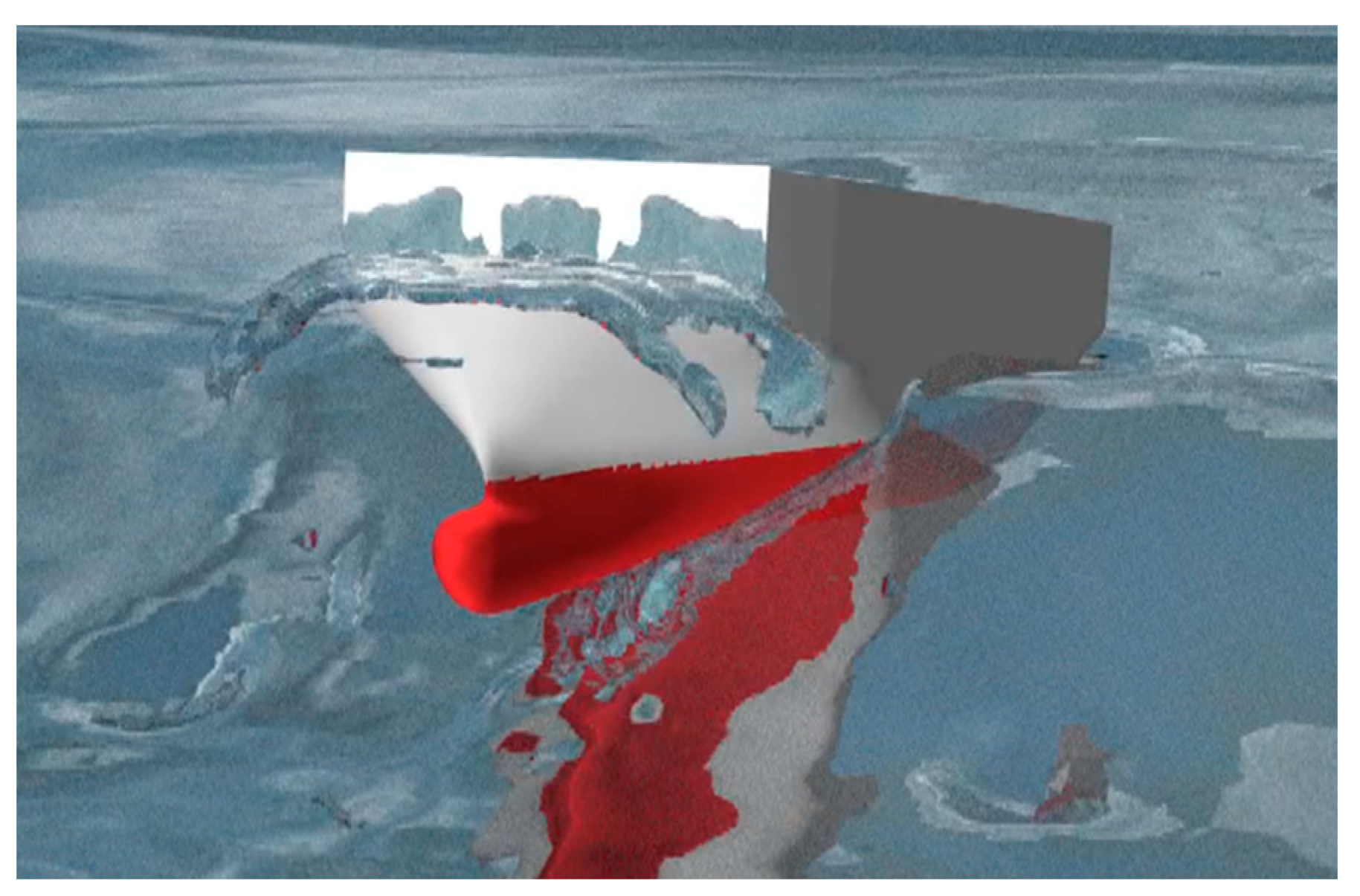
As can be seen from the photos in Figure 10, green water is present for the two highest steepnesses. Apart from the increase in the hull girder vibrations, it is difficult to identify a qualitative change in the measured VBM timeseries, which could be attributed to green-water loads. The potential-theory methods overpredict the sagging amplitudes, especially for the steeper waves. For the two highest steepnesses, these methods display a distinct sagging peak that occurs after the peak in the measured bending moment. This distinct peak may be related to the foredeck being submerged. The methods have different ways of handling deck submergence. The WNLSTRIP_SINTEF accounts for water on deck in calculating the nonlinear modification of the Froude–Krylov and hydrostatic forces, but dynamic effects are not considered. The field methods implicitly include the effects of water flowing onto and off the foredeck and in this respect their capability is superior to that of the BEM-based methods. But we cannot conclude from the present results that it is crucial for the pitch and VBM assessment to model green-water loads with high fidelity. An illustration from the CFD simulations by ClassNK is shown in Figure 23.
All the nonlinear potential theory methods overpredict the sagging peaks, and the nonlinear 2D methods also give too large bow-down pitch motions. It is reasonable to assume that an exaggerated bow-down pitch motion gives too high hydrostatic forces on the bow, which in turn contributes to the overprediction of the sagging VBM. For the nonlinear panel method, WNL3D_RITEH, however, there must be other reasons for the overpredicted sagging peaks, since this method does not exaggerate the bow-down pitch motions.
The mesh refinement of the CFD/FVM models varies significantly in the present study. However, as noted in Section 3, the very refined model used in the CFD_BV simulations was compared with a much coarser mesh, which produced very similar results. Mesh sensitivity studies performed in relation to the work reported in [12] showed that a model with 0.3 million cells can accurately capture the rigid hull VBM, provided local slamming forces do not contribute significantly. The bow flare forces in the present study increase relatively slowly and seem to be captured by such a coarse CFD model (one should note that the two steepest waves were not analyzed with the coarse DNV models). A coarse CFD model will have a surface mesh that is similar to, or slightly finer than, what is typically used in refined BEM-based calculations. Based on the work related to the study in [12], it was found that modeling local slamming loads accurately is not essential for the present containership model. The inferior results obtained by the BEM-based methods are probably not due to the omittance of local slamming loads and viscosity or by lack of geometric resolution, but rather caused by their inability to properly capture the loads due to the intermittent wetting of the hull surface. Hence, the field methods should not require a finer geometric resolution than what is being used in boundary element methods, and this is confirmed by the mesh sensitivity studies mentioned above. The major driver for CFD mesh cells when local effects are not important is the need to accurately propagate the incoming waves without too much diffusion or phase errors.

6. Conclusions and Recommendations

Numerically predicted pitch motions and midship vertical bending moments were compared to model test results for a 6750 TEU containership at zero speed in regular waves with various steepness levels. The methods cover linear and weakly nonlinear 2D and 3D potential theory, as well as mesh-based and meshless field methods.
The following observations are made:
-
Pitch and VBM display a nonlinear behavior even for low-steepness waves. This can probably be attributed to nonlinear forces in the nearly horizontal stern region of this modern containership design.
-
The linear 3D BEM predicts the bow-down pitch motion quite well, even for the steeper waves. However, the bow-up pitch motion is overpredicted.
-
The nonlinear 2D strip theories give too large pitch motions as the wave steepness increases.
-
The nonlinear potential theories, both 2D and 3D, overpredict the sagging moments for the steeper waves.
-
The nonlinear 2D strip theories overpredict both sagging and hogging moments for the low-steepness waves. For the steeper waves, the overprediction is most pronounced for sagging.
-
The mesh-based field methods (CFD/FVM) predict both pitch motions and vertical bending moments with good accuracy for all wave steepnesses. The exception is the STAR-CCM+ model run by ClassNK, which displays an increasing overprediction of pitch as the wave steepness increases.
-
The meshless SPH method struggles in the lowest waves and gives a significant underprediction of the pitch motion in these conditions. For steeper waves, the method performs better, and it predicts the VBM with quite good accuracy, except for an underprediction of the sagging peaks in the steepest wave condition. Work is in progress to improve the performance of the SPH method, especially for low-steepness waves.
-
The good results with the mesh-based field methods (CFD/FVM) are obtained without considering viscosity and turbulence. In a CFD-based benchmark study of the same containership by IACS (International Association of Classification Societies) [12] they stated that “this simplification gives equivalent results in the benchmark to using either an Euler solver or a full URANS solver with turbulence modelling, confirming the negligible influence of viscosity on the global loads“.
-
A mesh with 0.5 million cells does not seem to give significantly poorer results than those obtained with more refined CFD models for pitch and rigid-body VBM.
-
Since viscosity seems insignificant for the present case, the model-scale results are expected to be valid also for full-scale ships. All CFD simulations reported in [12] for the same containership were performed at full scale.
The above observations are in line with the ones discussed in [1]. However, in [1], the experiment was performed with forward speed, which is not the case in the current work. The discrepancies observed can thus no longer be attributed to the approximative way of accounting for the forward speed in most potential codes. Additionally, the experimental model used in the current benchmark is more rigid, and the hydroelastic effects can be filtered out without modifying the rigid motion [10]. Hence, hydroelasticity cannot explain the differences observed.
The weakly nonlinear strip theory gives conservative, but reasonably accurate, results for the present containership, and may be used for fast initial calculations or screening purposes. The weakly nonlinear 3D potential theories perform generally better than the strip theory, although the difference is small for the steepest waves.
The generally good agreement between the experiments and the mesh-based field methods indicates that CFD/FVM are capable of accurately capturing the physical phenomena associated with the vertical responses of a ship in extreme waves, such as green water on deck and the flat counter stern going in and out of water. However, one should note that, even if viscosity and turbulence are neglected, these CFD methods are demanding, both in terms of modeling skills and efforts, and in terms of computational resources.
Like many modern ships, the present design has a relatively large and nearly horizontal area in the stern. This area goes in and out of water even in low-steepness waves, and the associated hydrodynamic forces are expected to influence the pitch motion and the hull girder load effects. A typical weakly nonlinear potential theory captures only the change in hydrostatic and Froude–Krylov forces and does not include the accelerations of the fluid caused by the rapid changes in the submerged geometry. A potential-theory code with proper modeling of these phenomena would give more realistic predictions of water entry and exit forces and would presumably give better estimates of the hull girder load effects. No fully nonlinear BEM-based potential-theory codes have been part of the present benchmark study, and it would be interesting to evaluate if these could be an alternative to the more costly field methods. A weakly nonlinear code with refined load models for the stern and bow water entry and exit could be another interesting alternative to investigate.
As noted in Section 3.1, the different numerical tools use different ways of modeling the incident waves. Comparing the waves was not part of the benchmark study, and to what extent the different wave modeling methods contribute to the observed scatter in the predicted ship responses was not investigated. This deserves some further investigation.

Author Contributions

O.A.H.: administration, writing, numerical contribution; G.d.H.: writing, organizing the benchmark, assembling results, producing figures, numerical contributions; S.S., M.O., C.M., B.B., R.V., S.W., I.S., J.P.-O., K.S. and T.R.L.: numerical contributions, description of method. All authors have read and agreed to the published version of the manuscript.

Funding

The work by University of Rijeka was fully supported by the Croatian Science Foundation under the project IP-2022-10-2821. This work was also supported by the University of Rijeka (PROJECTS no. PU-17 uniri-iz-25-10, funded by the European Union—NextGenerationEU).

Data Availability Statement

The original contributions presented in this study are included in the article. Further inquiries can be directed to the corresponding author.

Conflicts of Interest

Author Ole Andreas Hermundstad was employed by the company SINTEF Ocean AS. Authors Guillaume de Hauteclocque and Sopheak Seng were employed by the company Bureau Veritas. The remaining authors declare that the research was conducted in the absence of any commercial or financial relationships that could be construed as a potential conflict of interest.

Abbreviations

BEMBoundary Element Method
BVBureau Veritas
CFDComputational Fluid Dynamics
DNVDet Norske Veritas
FVMFinite Volume Method
HOSMHigher-Order Spectral Method
HRICHigh-Resolution Interface Capture
IACSInternational Association of Classification Societies
ISSCInternational Ship and Ocean Structures Congress
ISTInstituto Superior Técnico
ITTCInternational Towing Tank Conference
LHEEALaboratory in Hydrodynamics, Energetics and Atmospheric Environment
LppLength between Perpendiculars
MULESMulti-Dimensional Universal Limiter for Explicit Solution
NLNonlinear
NMRINational Maritime Research Institute
PISOPressure-Implicit with Splitting of Operators
PTPotential Theory
RAOResponse Amplitude Operator
RITEHUniversity of Rijeka Faculty of Engineering
RRMSERelative Root Mean Square Error
SIMPLESemi-Implicit Method for Pressure-Linked Equation
SPHSmoothed-Particle Hydrodynamics
SWDSpectral Wave Data
TEUTwenty-Foot Equivalent Unit
ULCSUltra Large Containership
URANSUnsteady Reynolds-Averaged Navier–Stokes
VBMVertical Bending Moment
VOFVolume of Fluid
WNLWeakly Nonlinear
2DTwo-Dimensional
3DThree-Dimensional

References

  1. Kim, Y.; Jung-Hyun Kim, J.-H. Benchmark study on motions and loads of a 6750-TEU containership. Ocean. Eng. 2016, 119, 262–273. [Google Scholar] [CrossRef]
  2. Hermundstad, O.A.; Chai, S.; de Hauteclocque, G.; Dong, S.; Fang, C.-C.; Johannesen, T.B.; Morooka, C.; Oka, M.; Prpić-Oršić, J.; Sacchet, A.; et al. Report of Comm. I.2—Loads. In Proceedings of the 21st International Ship and Offshore Structures Congress, Vancouver, BC, Canada, 11–15 September 2022. [Google Scholar]
  3. Watanabe, I.; Guedes Soares, C. Comparative study on the time-domain analysis of nonlinear ship motions and loads. Mar. Struct. 1999, 12, 153–170. [Google Scholar] [CrossRef]
  4. Singh, S.P.; Sen, D. A comparative study on 3D wave load and pressure computations for different level of modelling of nonlinearities. Mar. Struct. 2007, 20, 1–24. [Google Scholar] [CrossRef]
  5. Hirdaris, S.E.; Lee, Y.; Mortola, G.; Incecik, A.; Turan, O.; Hong, S.Y.; Kim, B.W.; Kim, K.H.; Bennett, S.; Temarel, P. The influence of nonlinearities on the symmetric hydrodynamic response of a 10,000 TEU Container ship. Ocean. Eng. 2016, 111, 166–178. [Google Scholar] [CrossRef]
  6. Hong, S.Y.; Kim, B.W.; Kim, J.H.; Sung, H.G.; Kim, Y.S.; Cho, S.K.; Nam, B.W.; Choi, S.K.; Lee, C.Y.; Lim, D.W.; et al. Wave Induced Loads on Ships 2nd Joint Industry Project (WILS II JIP) (Report No. BSPIS503A-2207-2); MOERI Tech, Maritime and Ocean Engineering Research Institute: Daejeon, Republic of Korea, 2010.
  7. Parunov, J.; Guedes Soares, C.; Hirdaris, S.; Iijima, K.; Wang, X.; Brizzolara, S.; Qiu, W.; Mikulić, A.; Wang, S.; Abdelwahab, H.S. Benchmark study of global linear wave loads on a container ship with forward speed. Mar. Struct. 2022, 84, 103162. [Google Scholar] [CrossRef]
  8. Flokstra, C. Comparison of ship motion theories with experiments for a container ship. Int. Shipbuild. Prog. 1974, 21, 168–189. [Google Scholar] [CrossRef]
  9. Bouscasse, B.; Merrien, A.; Horel, B.; De Hauteclocque, G. Experimental analysis of wave-induced vertical bending moment in steep regular waves. J. Fluids Struct. 2022, 111, 103547. [Google Scholar] [CrossRef]
  10. Horel, B.; Bouscasse, B.; Merrien, A.; de Hauteclocque, G. Experimental Assessment of Vertical Shear Force and Bending Moment in Severe Sea Conditions. In Proceedings of the ASME 2019 38th International Conference on Ocean, Offshore and Arctic Engineering, Volume 3: Structures, Safety, and Reliability, Glasgow, UK, 9–14 June 2019. [Google Scholar]
  11. Kim, S.; de Hauteclocque, G.; Bouscasse, B.; Lasbleis, M.; Ducrozet, G. Experimental analysis of extreme wave loads on a containership. Ocean. Eng. 2024, 306, 118031. [Google Scholar] [CrossRef]
  12. Landet, T.R.; Lasbleis, M.; Sugimoto, K.; de Hauteclocque, G.; Xu, M.; Austefjord, H. A broad CFD-based study of the nonlinear effects on wave-induced bending moments and shear forces on monohull ships. In Proceedings of the 16th International Symposium on Practical Design of Ships and Other Floating Structures PRADS 2025, Ann Arbor, MI, USA, 19–23 October 2025. [Google Scholar]
  13. Chen, X.B. Hydrodynamics in offshore and naval applications—Part I. In Proceedings of the 6th International Conference Hydrodynamics, Perth, Australia, 24–26 November 2004. [Google Scholar]
  14. Derbanne, Q.; Storhaug, G.; Shigunov, V.; Xie, G.; Zheng, G. Rule formulation of vertical hull girder wave loads based on direct computation. In Proceedings of the 13th International Symposium on PRActical Design of Ships and Other Floating Structures, Copenhagen, Denmark, 4–8 September 2016. [Google Scholar]
  15. Fonseca, N.; Guedes Soares, C. Time-Domain Analysis of Large-Amplitude Vertical Ship Motions and Wave Loads. J. Ship Res. 1998, 42, 139–153. [Google Scholar] [CrossRef]
  16. Buchner, B. The impact of green water on FPSO design. In Proceedings of the Offshore Technology Conference, Houston, TA, USA, 1–4 May 1995. [Google Scholar]
  17. Rajendran, S.; Fonseca, N.; Guedes Soares, C. Simplified body nonlinear time domain calculation of vertical ship motions and wave loads in large amplitude waves. Ocean. Eng. 2015, 107, 157–177. [Google Scholar] [CrossRef]
  18. Wu, M.-K.; Hermundstad, O.A. Time-domain simulation of wave-induced nonlinear motions and loads and its applications in ship design. Mar. Struct. 2002, 15, 561–597. [Google Scholar] [CrossRef]
  19. Cummins, W.E. The impulse response function and ship motions. Schiffstechnik 1962, 47, 101–109. [Google Scholar]
  20. Ogilvie, T.F. Recent progress toward the understanding and prediction of ship motions. In Proceedings of the 5th Symposium Naval Hydrodynamics, Bergen, Norway, 10–12 September 1964. [Google Scholar]
  21. DNV. SESAM User Manual—WASIM—Wave Loads on Vessels with Forward Speed; Version 6.3; DNV: Høvik, Norway, 2021. [Google Scholar]
  22. Ma, C.; Oka, M. Investigation of the Influence of Different Boundary Conditions in SPH on Ship Dynamics. Ocean. Eng. 2024, 310, 118571. [Google Scholar] [CrossRef]
  23. Ma, C.; Oka, M. Nonlinear Numerical Simulation on Ship Structural Response Based on the SPH Method. In Proceedings of the 34th International Ocean and Polar Engineering Conference, Rhodes, Greece, 16–21 June 2024. [Google Scholar]
  24. Rusche, H. Computational Fluid Dynamics of Dispersed Two-Phase Flows at High Phase Fractions. Ph.D. Thesis, Imperial College of Science, Technology & Medicine, London, UK, 2002. [Google Scholar]
  25. Issa, R.I. Solution of the implicitly discretised fluid flow equations by operator-splitting. J. Comput. Phys. 1986, 62, 40–65. [Google Scholar] [CrossRef]
  26. Jacobsen, N.G.; Fuhrman, D.R.; Fredsøe, J. A wave generation toolbox for the opensource CFD library: OpenFoam R: Wave generation toolbox. Int. J. Num. Methods Fluids 2012, 70, 1073–1088. [Google Scholar] [CrossRef]
  27. Weller, H.G. A New Approach to VOF-Based Interface Capturing Methods for Incompressible and Compressible Flow; Rep. TR/HGW/04; OpenCFD Ltd.: Bracknell, UK, 2008. [Google Scholar]
  28. Helmers, J.B.; Gramstad, O. The Spectral Wave Data Format (SWD). 2020. Available online: https://github.com/SpectralWaveData/spectral_wave_data (accessed on 2 December 2025).
  29. Gramstad, O.; Johannessen, T.B.; Lian, G. Long-term analysis of wave-induced loads using High Order Spectral Method and direct sampling of extreme wave events. Mar. Struct. 2023, 91, 103473. [Google Scholar] [CrossRef]
  30. Perić, R.; Abdel-Maksoud, M. Reliable damping of free-surface waves in numerical simulations. Ship Technol. Res. 2016, 63, 1–13. [Google Scholar] [CrossRef]
  31. Perić, R.; Vukčević, V.; Abdel-Maksoud, M.; Jasak, H. Optimizing wave generation and wave damping in 3D-flow simulations with implicit relaxation zones. Coast. Eng. 2022, 171, 104035. [Google Scholar] [CrossRef]
  32. Muzaferija, S.; Peric, M.; Sames, P.C.; Schellin, T.E. A Two-Fluid Navier-Stokes Solver to Simulate Water Entry. In Proceedings of the 22nd Symposium Naval Hydrodynamics, Washington, DC, USA, 9–14 August 1998. [Google Scholar]
  33. Muzaferija, S.; Peric, M. Computation of Free Surface Flows Using Interface-Tracking and Interface-Capturing Methods, Chap. 2. In Nonlinear Water Wave Interaction; Mahrenholtz, O., Markiewicz, M., Eds.; Computational Mechanics Publications; WIT Press: Southampton, UK, 1999. [Google Scholar]
  34. Kim, J.; O’Sullivan, J.; Read, A. Ringing analysis of a vertical cylinder by Euler overlay method, Proceedings of the International Conference on Offshore Mechanics and Arctic Engineering. In Proceedings of the International Conference on Offshore Mechanics and Arctic Engineering; ASME Press: New York, NY, USA, 2012; Volume 4, pp. 855–866. [Google Scholar]
  35. Miyake, R.; Mizokami, S.; Ogawa, Y.; Zhu, T.; Kumano, A. Studies on Wave Loads Acting on a Large-Container Ship in Large Waves. J. Soc. Nav. Archit. Jpn. 2004, 195, 185–194. [Google Scholar] [CrossRef]
  36. Baarholm, R.; Faltinsen, O.M. Wave impact underneath horizontal decks. J. Marine Sci. Techn. 2004, 9, 1–13. [Google Scholar] [CrossRef]
Figure 1. Experimental model.
Jmse 14 00481 g001
Figure 2. Mooring line configuration.
Jmse 14 00481 g002
Figure 3. RAOs for heave (top left), pitch (top right) and VBM (bottom). Comparison of test results by Bouscasse et al. [9] with experimental and numerical data from Kim and Kim [1]. In the present paper, focus is on waves with length equal to the ship length, indicated by the vertical line in the RAO plots. For this wavelength, the VBM is at its maximum.
Jmse 14 00481 g003
Figure 4. Test 140 (wave steepness 8.7%). The curves show the VBM amidships, with a blue square indicating the time at which the photo is taken. Hogging moment is positive.
Jmse 14 00481 g004
Figure 5. 3D BEM mesh used by LIN3D_BV.
Jmse 14 00481 g005
Figure 6. SPH calculation domain.
Jmse 14 00481 g006
Figure 7. Mesh for contribution CFD_BV. Here, L is the wavelength.
Jmse 14 00481 g007
Figure 8. Mesh for contribution CFD_NK.
Jmse 14 00481 g008
Figure 9. Still-water VBM distribution along the length of the ship model. Experiments and numerical assessments. Hogging is positive.
Jmse 14 00481 g009
Figure 10. Snapshots illustrating physical phenomena occurring as the wave steepness increases from 2.1% to 10.5%. The wavelength is kept constant and equal to Lpp.
Jmse 14 00481 g010
Figure 11. Flat counter stern of the containership.
Jmse 14 00481 g011
Figure 12. Dynamic response in test 179. Positive pitch: bow down. Positive VBM: hogging.
Jmse 14 00481 g012
Figure 13. Dynamic response in test 115. Positive pitch: bow down. Positive VBM: hogging.
Jmse 14 00481 g013
Figure 14. Dynamic response in test 118. Positive pitch: bow down. Positive VBM: hogging.
Jmse 14 00481 g014
Figure 15. Dynamic response in test 140. Positive pitch: bow down. Positive VBM: hogging.
Jmse 14 00481 g015
Figure 16. Dynamic response in test 142. Positive pitch: bow down. Positive VBM: hogging.
Jmse 14 00481 g016
Figure 17. Relative root mean square error (RRMSE) of the amplitude values of different numerical results when compared to the experimental timeseries in Figure 12, Figure 13, Figure 14, Figure 15 and Figure 16. Normalized by the experimental amplitude and averaged over the conditions. (Left): Pitch. (Right): VBM. * The results from DNV are based on only two of the five wave conditions.
Jmse 14 00481 g017
Figure 18. Evolution of pitch amplitudes with steepness. (Left): negative (bow up). (Right): positive (bow down).
Jmse 14 00481 g018
Figure 19. Evolution of VBM amplitudes with steepness. (Left): negative (sagging). (Right): positive (hogging).
Jmse 14 00481 g019
Figure 20. Distribution along the length of the ship model of the linear VBM RAOs (for lambda/Lpp = 1.0).
Jmse 14 00481 g020
Figure 21. Nonlinear factor (Equation (1)) for midship vertical bending moment. (Left): negative (sagging). (Right): positive (hogging).
Jmse 14 00481 g021
Figure 22. Asymmetry ratio R a s y m . (Left): pitch. (Right): VBM.
Jmse 14 00481 g022
Figure 23. Water on deck during CFD simulations performed by ClassNK.
Jmse 14 00481 g023
Table 1. Ship main dimensions. ECN is the present model.
ParameterUnitECN
Model-Scale
ECN
Full-Scale
Kim & Kim [1]
Length between perpendicularsm4.41286.6286.6
Beam in waterlinem0.6154040
Draft amidshipsm0.18411.9811.98
Displacementton0.312285,72585,563
Longitudinal center of gravity (from AP)m2.128138.3138.395
Vertical center of gravitym0.25516.56216.56
Pitch radius of gyrationm1.10171.5570.655
Table 2. Benchmark wave conditions. Note that the linear dispersion relation does not hold for the steeper waves, and the period decreases with steepness when keeping the wavelength constant.
IDPeriod (s)Height (m)Length (m)Steepness (%)
1791.680.094.412.1%
1151.670.174.413.8%
1181.660.234.415.2%
1401.620.384.418.7%
1421.590.464.4110.5%
Table 3. Overview of contributions (NL = nonlinear, WNL = weakly nonlinear, PT = potential theory, SPH = smoothed-particle hydrodynamics, FVM = finite volume method, VOF = volume of fluid).
LabelTheory/Num, Method2D/3DSoftwareInstitute
LIN3D_BVLinear, PT3DHydroStarBureau Veritas (BV)
NLSTRIP_ISTNL, PT2DIn-HouseInstituto Superior Técnico (IST)
WNLSTRIP_SINTEFWNL, PT2DVERESSINTEF Ocean
WNL3D_BVWNL, PT3DHydroStar++Bureau Veritas (BV)
WNL3D_RITEHWNL, PT3DWasimUniv. of Rijeka Faculty of Eng. (RITEH)
SPH_NMRINL SPH3DDualSPHysicsNational Maritime Research Inst. (NMRI)
CFD_BVFVM + VOF inviscid3DFoamStarBureau Veritas (BV)
CFD_NKFVM + VOF inviscid3DSTAR-CCM+ClassNK
CFD_STAR_DNVFVM + VOF inviscid3DSTAR-CCM+Det Norske Veritas (DNV)
CFD_OF_DNVFVM + VOF inviscid3DOpenFOAMDet Norske Veritas (DNV)
Disclaimer/Publisher’s Note: The statements, opinions and data contained in all publications are solely those of the individual author(s) and contributor(s) and not of MDPI and/or the editor(s). MDPI and/or the editor(s) disclaim responsibility for any injury to people or property resulting from any ideas, methods, instructions or products referred to in the content.