1. Introduction
With the development of the maritime economy, conventional ships face increasing constraints in efficiency, safety, and environmental performance, falling short of modern maritime demands [
1]. In this context, unmanned marine vehicles (UMVs) have emerged as a popular solution to these challenges [
2]. Nevertheless, the large-scale deployment of UMVs still faces critical challenges, among which high-precision and reliable positioning technologies serve as a fundamental prerequisite for achieving robust and adaptive autonomous navigation in complex maritime environments [
3].
The Global Navigation Satellite System (GNSS) serves as the cornerstone of maritime positioning due to its wide-area coverage and long-term localization capabilities [
4]. However, dynamic maritime conditions and environmental disturbances frequently compromise its performance [
5]. Therefore, GNSS is often integrated with autonomous navigation systems such as the Inertial Navigation System (INS). Nevertheless, many ships lack INS equipment. Alternatively, dead reckoning (DR) systems estimate ship positions utilizing shipborne sensor data, offering high short-term accuracy but suffering from cumulative errors that compromise long-term reliability [
6]. Accordingly, this study develops a GNSS/DR integrated navigation system to enhance ship positioning stability.
The ship’s integrated navigation systems mainly employ the Extended Kalman Filter (EKF) [
7], the Unscented Kalman Filter (UKF) [
8], and various improved variants [
9,
10,
11]. Although these methods have promoted maritime navigation technologies, several limitations remain. Specifically, they inadequately exploit global historical data, exhibit limited nonlinearity handling capability, and demonstrate poor scalability. Consequently, ship positioning accuracy and practical implementation are constrained. To overcome these limitations, some researchers have introduced Factor Graph Optimization (FGO), which models the relationships between state vectors and measurements as factors, transforming state estimation into a graph optimization problem. Compared with traditional filtering, FGO methods offer greater flexibility in fusing multi-source data and achieve higher accuracy and robustness in handling nonlinearities [
12,
13]. Chen et al. proposed an FGO-based pedestrian DR/skyward image/optical fusion navigation method, demonstrating its feasibility in complex environments [
14]. Lyu et al. proposed an improved INS pre-integration-based FGO that effectively enhanced vehicle positioning accuracy [
15]. Zhang et al. leveraged factor graph flexibility with INS pre-integration to significantly improve autonomous underwater vehicle positioning accuracy [
16]. These methods primarily construct factor graphs based on INS, overlooking the practical reality that many ships are not equipped with INS. Therefore, this study develops a novel FGO method based on GNSS/DR integrated navigation systems according to practical ship conditions and positioning requirements, without requiring additional sensors.
However, GNSS measurement errors exhibit substantial temporal variability and uncertainty due to dynamic maritime conditions and complex ship dynamics. Consequently, the fixed GNSS Measurement Noise Covariance Matrix (GMNCM) fails to capture actual error characteristics, limiting FGO performance in complex maritime environments [
17]. Solutions to this issue are generally categorized into statistical methods and Artificial Intelligence (AI) methods. For instance, Zhang et al. introduced an adaptive factor weighting function to adjust sensor measurement reliability, improving indoor robot localization [
18]. Tian et al. proposed an adaptive fast incremental smoothing FGO algorithm that enhances positioning accuracy under varying sensor reliability [
19]. Chen et al. developed a multi-factor optimization graph that dynamically adjusts for environmental noise and sensor errors, improving attitude estimation accuracy and stability [
20]. However, they typically rely on predefined error models and assumptions, often failing in complex marine environments and thereby limiting accuracy and robustness. To overcome these limitations, recent studies have increasingly adopted AI approaches. Through data-driven modeling, AI enables adaptive covariance estimation by learning patterns from historical data without requiring precise prior models. Ben et al. combined dynamic kernel PCA with FGO for robust positioning through nonlinear feature extraction, though with high computational complexity and challenging parameter tuning [
21]. Xu et al. integrated dynamic trust functions and bidirectional LSTM into FGO, improving positioning accuracy under anomalous measurements but requiring complex architecture and large quantities of high-quality training data [
22]. Li et al. employed variational Bayesian networks and Gaussian mixture models for noise estimation, but the method requires prior data partitioning and exhibits significant adaptation delays [
23]. Overall, these methods present varying limitations in computational efficiency, data requirements, real-time performance, and generalization capability, making it challenging to simultaneously address dynamic environments, resource constraints, and scarce high-precision data in maritime ship positioning [
24,
25,
26,
27,
28].
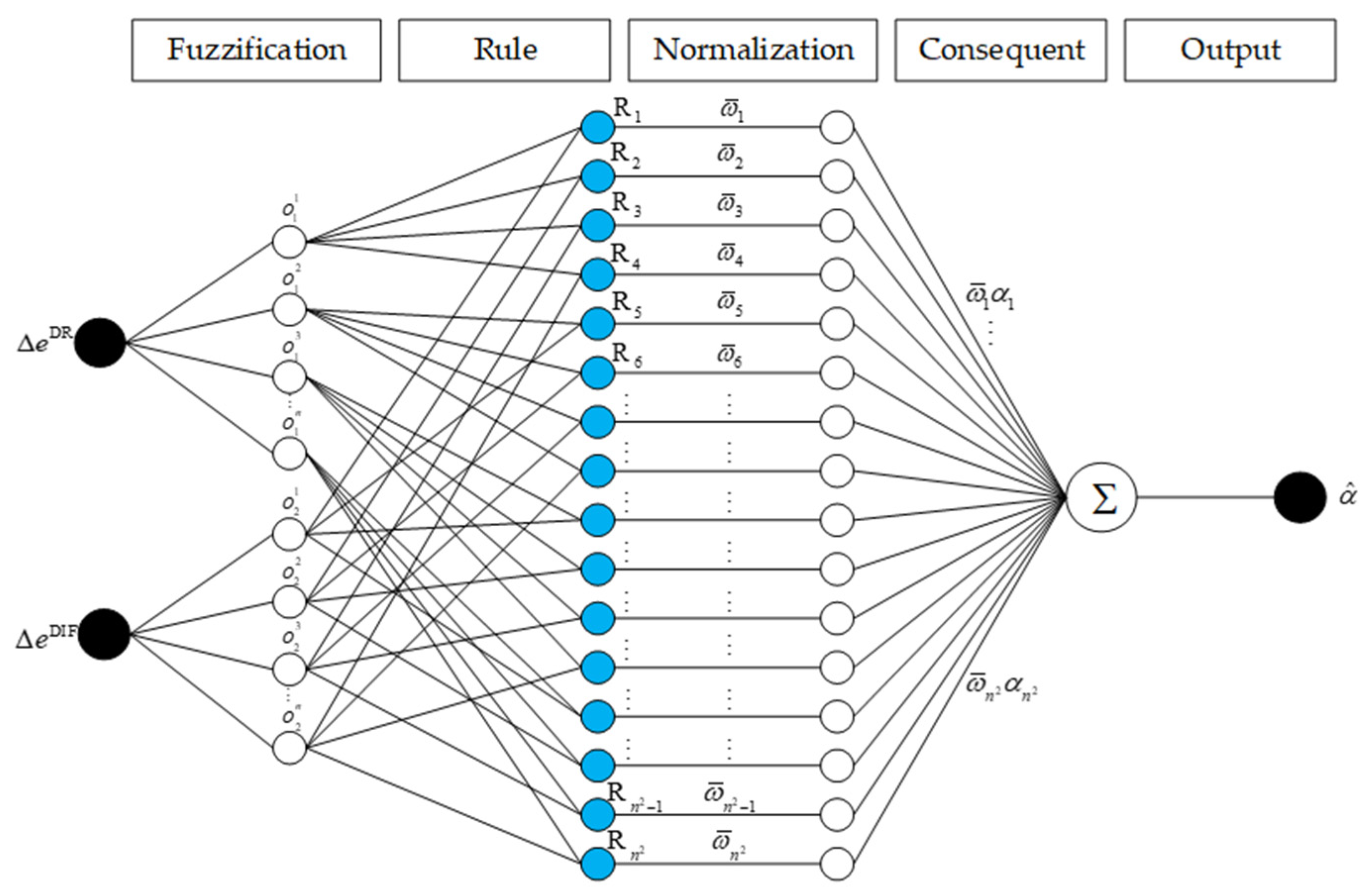
To address these issues, this paper proposes an innovative FGO algorithm enhanced with ANFIS (ANFIS–FGO). ANFIS employs a lightweight five-layer feedforward network that establishes nonlinear mapping relationships between ship motion characteristics and GNSS measurement noise through fuzzy rules. This approach offers several significant advantages: First, the fuzzy rule architecture embeds expert knowledge-based structured biases, assuming piecewise–smooth relationships between ship motion states and GNSS measurement noise to effectively handle measurement uncertainty in maritime environments. Second, continuous fuzzy membership functions ensure smooth extrapolation beyond training data, avoiding unpredictable behavior of conventional AI methods in unseen scenarios and enabling effective operation under scarce high-precision data and high-noise conditions. Third, ANFIS fuzzy rules provide explicit physical interpretations and causal logic, facilitating decision-making and debugging in autonomous navigation. Finally, ANFIS relies solely on current input features, yielding low computational complexity. In summary, the proposed ANFIS–FGO method overcomes traditional filtering limitations, enhances ship positioning accuracy, and significantly improves system robustness under varying GNSS measurement noise conditions. It achieves effective positioning in resource-constrained environments with scarce high-precision data and high-noise levels, providing reliable technical support for the autonomous navigation of UMVs.
The main contributions of this paper are as follows:
We develop a ship GNSS/DR integrated navigation system based on shipborne sensors, improving ship positioning performance without additional hardware.
To address the limitations of filtering algorithms in ship localization, including insufficient utilization of global information and limited accuracy in nonlinear dynamic modeling, an improved FGO algorithm is proposed. By incorporating DR error factors, GNSS measurements, and marginalization factors, the algorithm enhances both positioning performance and computational efficiency.
To mitigate FGO performance degradation in complex maritime environments, an ANFIS–FGO algorithm is proposed. Leveraging ANFIS’s adaptive learning and nonlinear modeling capabilities, the GMNCM is dynamically adjusted, further improving ship positioning accuracy and system robustness.
The remainder of this paper is organized as follows:
Section 2 describes the factor graph model and its components;
Section 3 details the proposed algorithm, which forms the core of the study;
Section 4 presents simulation and experiments along with analytical verification; and
Section 5 concludes the research and outlines directions for future work.
2. GNSS/DR Factor Graph Model
This section presents a factor graph-based framework for maritime GNSS/DR integrated navigation. The framework comprises shipborne DR, DR error, GNSS, and marginalization factors, forming a sparse and computationally efficient structure for state estimation. By combining the short-term accuracy of dead reckoning with the absolute positioning capability of GNSS and leveraging the structural advantages of factor graphs for multi-source fusion, the proposed method enhances estimation accuracy, continuity, and adaptability in complex marine environments.
2.1. GNSS/DR Factor Graph Framework
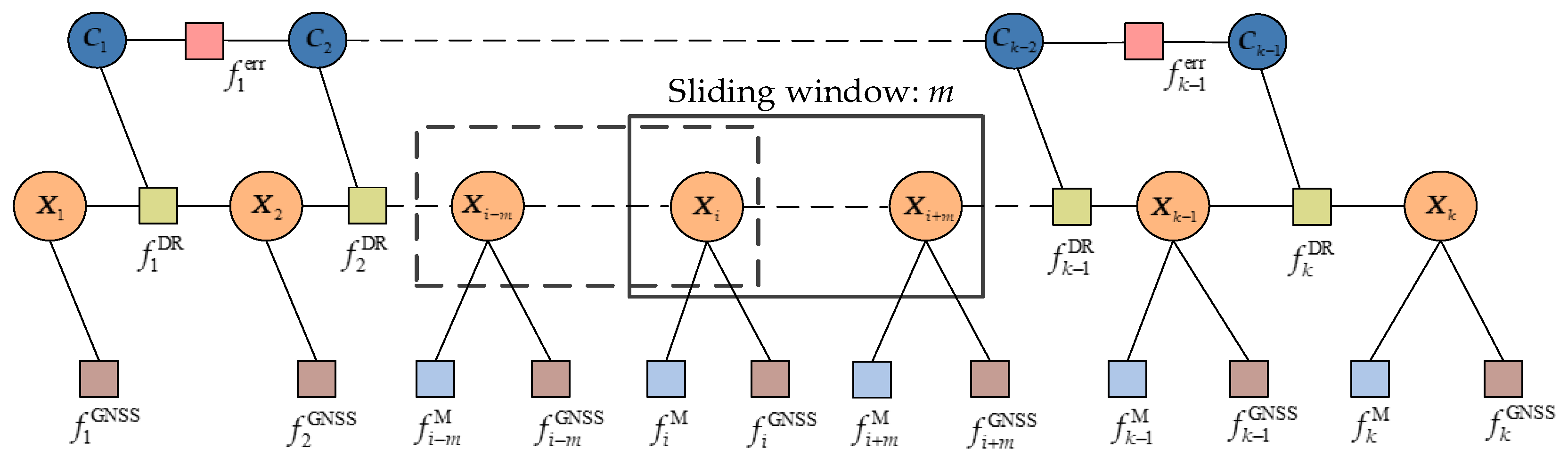
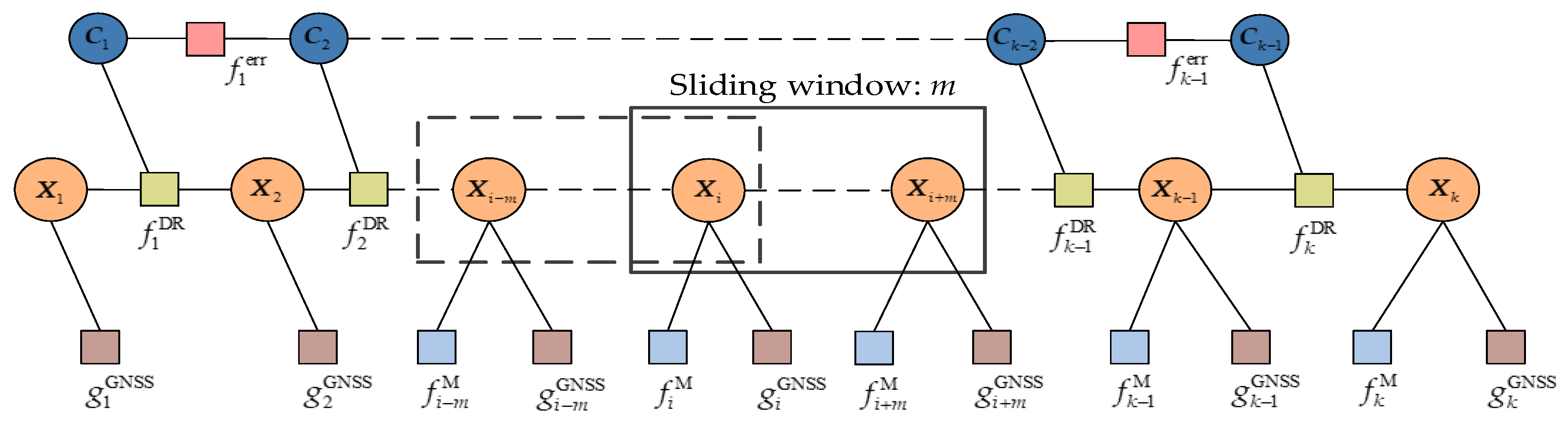
A GNSS/DR factor graph is developed based on the ship GNSS/DR integrated navigation system, as shown in
Figure 1. The system state is defined as
, representing the navigation state of the ship at each epoch, including state variables such as position, velocity, and heading. Meanwhile, the accumulated drift inherent to DR is modeled explicitly through an additional error variable
, which is jointly estimated with the ship state vector to improve drift compensation.
The DR factor encodes the relative motion dynamics between consecutive states and based on the DR propagation model. By incorporating the corresponding drift term , this factor explicitly accounts for the long-term drift characteristics of DR and constrains the state transition accordingly. The DR error factor further refines the estimation of by constraining the temporal evolution of the DR error states through a stochastic error model driven by sensor characteristics, enabling more accurate modeling and correction of the accumulated DR drift.
The GNSS factor provides absolute position constraints derived from GNSS measurements, enabling the system to mitigate accumulated dead reckoning errors whenever GNSS observations are available.
Meanwhile, to ensure computational efficiency, a sliding window strategy is adopted. Only the most recent state nodes are retained in the optimization. Older states and their associated factors are marginalized out, thereby reducing computational load while preserving the information necessary for accurate state estimation.
2.2. DR Factor
In the East–North (EN) local coordinate system, the DR motion model is:
where
and
represent the ship’s position at epoch
k and
k − 1.
denotes the ship’s speed at epoch
k,
is the sampling interval, which is 1s in the study.
represents the heading angle at epoch
k.
Based on Equation (1), the ship state vector at epoch
k can be described as follows:
where
.
and
represent subsets of the ship’s position and speed, obtained through DR.
The DR error vector at epoch
k can be formulated as follows:
where
and
represent the bias error of the log and the compass, respectively.
The DR error factor
at epoch
k can be expressed as follows:
where
is the covariance matrix corresponding to
.
represents the state transition of the DR error vector. Based on the error characteristics of the log and compass,
is typically modeled as a Gaussian random walk process [
29]:
where
and
represent the bias error increments in the log and compass, respectively. They are typically modeled as zero-mean Gaussian white noise processes.
and
denote the measurement noise of the log and compass respectively, which are also assumed to be zero-mean Gaussian white noise processes.
In the factor graph,
connects the DR error vector nodes
C at adjacent time steps, defining their joint probabilistic relationship. Through the sum-product algorithm,
enables message passing between nodes, allowing iterative updates of their marginal distributions [
30]. Within the factor graph structure, these updates to the
C ultimately enable more accurate error compensation for the ship state vector
X.
The measurements from the log and compass at epoch
k are used to obtain
, which then contributes to the construction of the measurement vector
.
is used for DR to estimate the ship state vector
. A residual is then computed between this estimated value and the predicted value obtained through the state transition function
, and this residual is subsequently used to construct the DR factor
:
where
is the process noise, which is modeled as a Gaussian distribution with zero-mean and covariance matrix
Q. The covariance matrix of the DR factor
is given by:
where
is the Jacobian matrix of
with respect to
, calculated as follows:
2.3. GNSS Factor
In the GNSS/DR factor graph, the position outputs from the GNSS receiver are used directly as external measurements. Thus, the GNSS observation model is:
where
denotes the position information measured by the GNSS receiver.
represents the measurement equation for the GNSS observations.
denotes the measurement noise of the GNSS.
The GNSS factor uses the difference between the measured and predicted positions as the nonlinear optimization residual. Accordingly, the GNSS factor at epoch
k is:
where
is the measurement covariance matrix of the
.
2.4. Marginalization Factor
To enable a unified marginalization framework in sliding window optimization, an augmented variable is defined to jointly encapsulate the state variables and constraint terms. Marginalization is triggered when the window size exceeds threshold m; otherwise, the window is maintained.
and represent the relevant vectors within the sliding window at epoch k, respectively. After the marginalization operation, the retained relevant vectors within the window are represented as . Additionally, denotes the variables to be marginalized in the sliding window.
After linearization of the nonlinear residual functions associated with the factors within the sliding window, the joint distribution of the current states
and the states to be marginalized
follows a Gaussian distribution, which is formulated as follows (12):
where
and
represent the posterior means of the
and
conditioned on the GNSS measurements
. Matrices
and
represent the marginal covariances, while
and
denote the cross-covariances.
By the conditional property of Gaussian distributions, the retained states
, conditioned on marginalized states
, can be expressed as follows [
31]:
where
denotes the linearization point of
.
This gives the conditional posterior of
as a Gaussian distribution:
In FGO, this conditional Gaussian distribution is equivalent to introducing a marginalization factor that imposes an identical quadratic form, thereby yielding a new prior constraint on the retained states:
2.5. FGO–Solving Process
The relationships between the ship state vector and measurement vector can be modeled utilizing the DR factor
, DR error factor
, GNSS factor
, and marginalization factor
based on the factor graph. In this way, the joint probability density function of the system can be constructed. This study formulates the optimal ship position estimation as a Maximum A Posteriori (MAP) problem [
32]:
where
represents the optimal estimates of
Y.
and
denote the set of optimal estimates of the ship state vector and the DR error vector, respectively.
Based on the factor graph, the joint probability density function is factorized a product of factors associated with the state vector, DR error vector and measurement vector:
Furthermore, employing the MAP approach in the factor graph allows the optimal state estimation to be reformulated as a least-squares problem:
The least-squares problem is addressed using Google’s Ceres Solver, a robust library tailored for FGO applications. Specifically, the Levenberg–Marquardt method is applied to Equation (19) to obtain the optimal estimate .
4. Experimental Validation and Analysis
To comprehensively validate the proposed ANFIS–FGO method, this chapter employs simulation and actual ship experiments, evaluating performance across positioning accuracy, robustness, computational efficiency, and extreme condition adaptability. Regarding comparison methods, EKF and UKF are selected as representative benchmarks, representing predominant approaches in operational ship positioning systems. Basic FGO serves as the foundational framework for assessing ANFIS-driven improvements. Notably, most existing intelligent fusion methods cannot be directly applied to ship positioning due to inherent limitations, making comparisons inappropriate. Consequently, EKF, UKF, and FGO provide suitable benchmarks for fair evaluation.
The experimental design comprises four components. First, simulation experiments incorporate three typical ship motion scenarios: uniform acceleration, constant speed turning, and complex maneuvering, representing routine maritime operations. Second, actual ship experiments using real sea data verify practicality and reliability. Third, computational efficiency analysis demonstrates real-time capability for platforms with limited resources. Fourth, GNSS outage experiments validate robustness under extreme conditions. Mean Absolute Error (MAE) and Root Mean Square Error (RMSE) are adopted as quantitative evaluation metrics to comprehensively assess the positioning performance of the ANFIS–FGO method.
where
and
are the field value and predicted value of the algorithm output at epoch
k in the
i–th Monte Carlo simulation, respectively.
N is the total time spent on the positioning process.
M denotes the total number of Monte Carlo simulations conducted.
4.1. Simulation Experiments
4.1.1. Simulation Setup
Simulation data in this study were generated using Qt Creator, covering three common ship motion scenarios: constant acceleration linear motion (CALM), constant turn motion (CTM), and complex motion (CM). Motion parameters for each scenario are provided in
Table 1. To ensure statistical reliability, 200 Monte Carlo simulations were conducted per scenario [
33].
The parameters of the shipborne sensors utilized in the simulation experiments are listed in
Table 2. The GNSS receiver, compass and log update frequencies are set to 1 Hz, and their noise characteristics are statistically stable. The initial value of the covariance matrix
is set as
, and
is a five-dimensional identity matrix. The ship state vector, covariance matrix, and state transition process for filtering algorithms are the same as
X,
P, and
defined in Chapter 2 for FGO. Additionally, the measurement vector is given by
.
4.1.2. Simulation Experiments Under CALM, CTM and CM Scenarios
The simulation results of each algorithm under three distinct maritime motion scenarios are presented below, with performance evaluated in terms of east and north positioning errors, east and north velocity errors, and heading error.
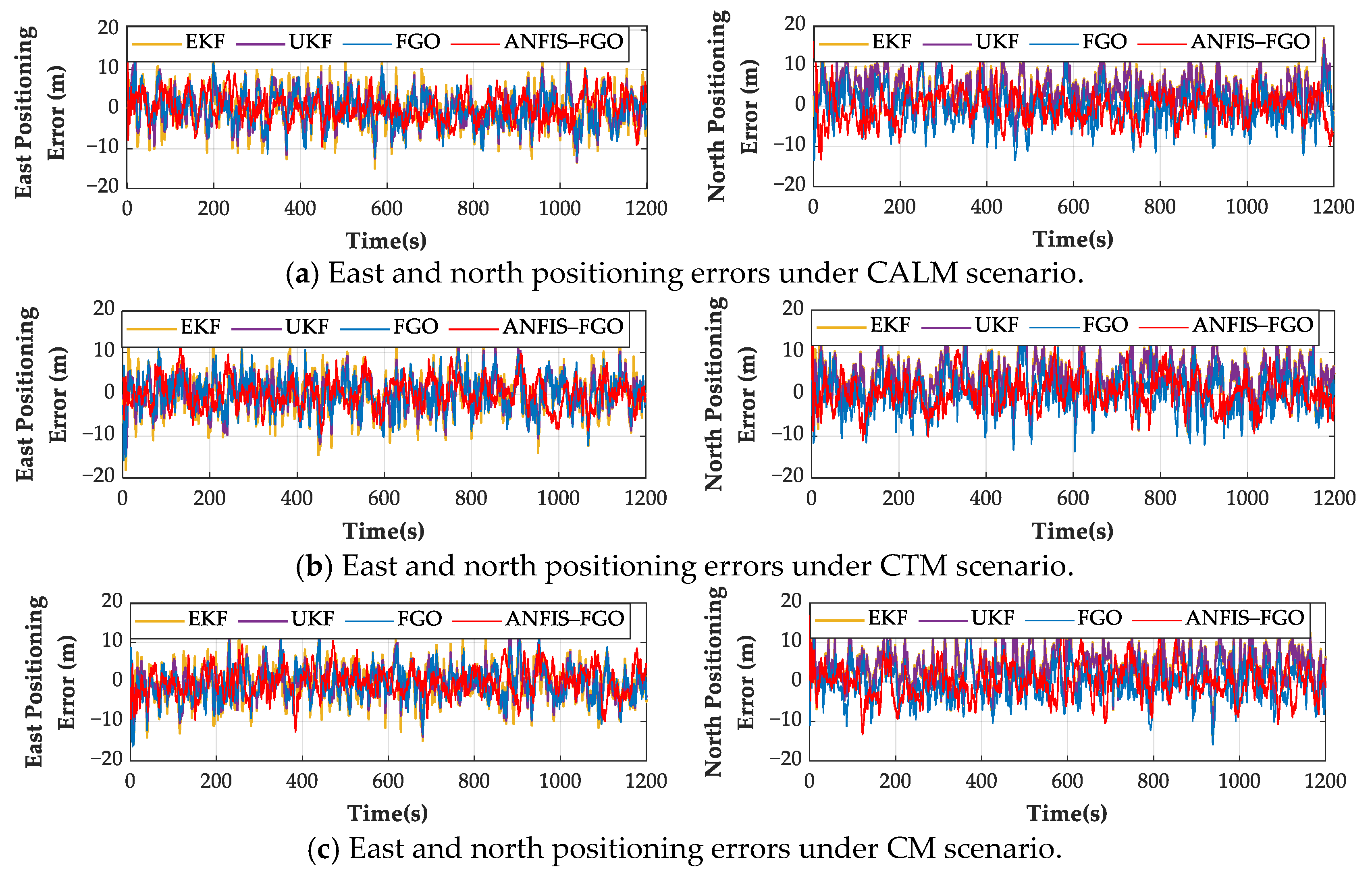
As shown in
Figure 5, across the CALM, CTM, and CM scenarios, ANFIS–FGO consistently achieves the smallest east and north positioning errors, remaining within ±4–6 m after convergence. In contrast, FGO provides moderate positioning accuracy, with errors of approximately 6–12 m, and its performance degrades under highly dynamic and complex conditions due to the use of fixed noise assumptions. UKF and EKF exhibit larger deviations, particularly in CM scenarios, where EKF errors increase to 20–25 m, reflecting their sensitivity to strong nonlinearities and model mismatches. These results indicate that the adaptive error modeling enabled by ANFIS, together with the global optimization capability of the factor graph framework, significantly enhances the robustness of horizontal positioning under varying maritime motion patterns.
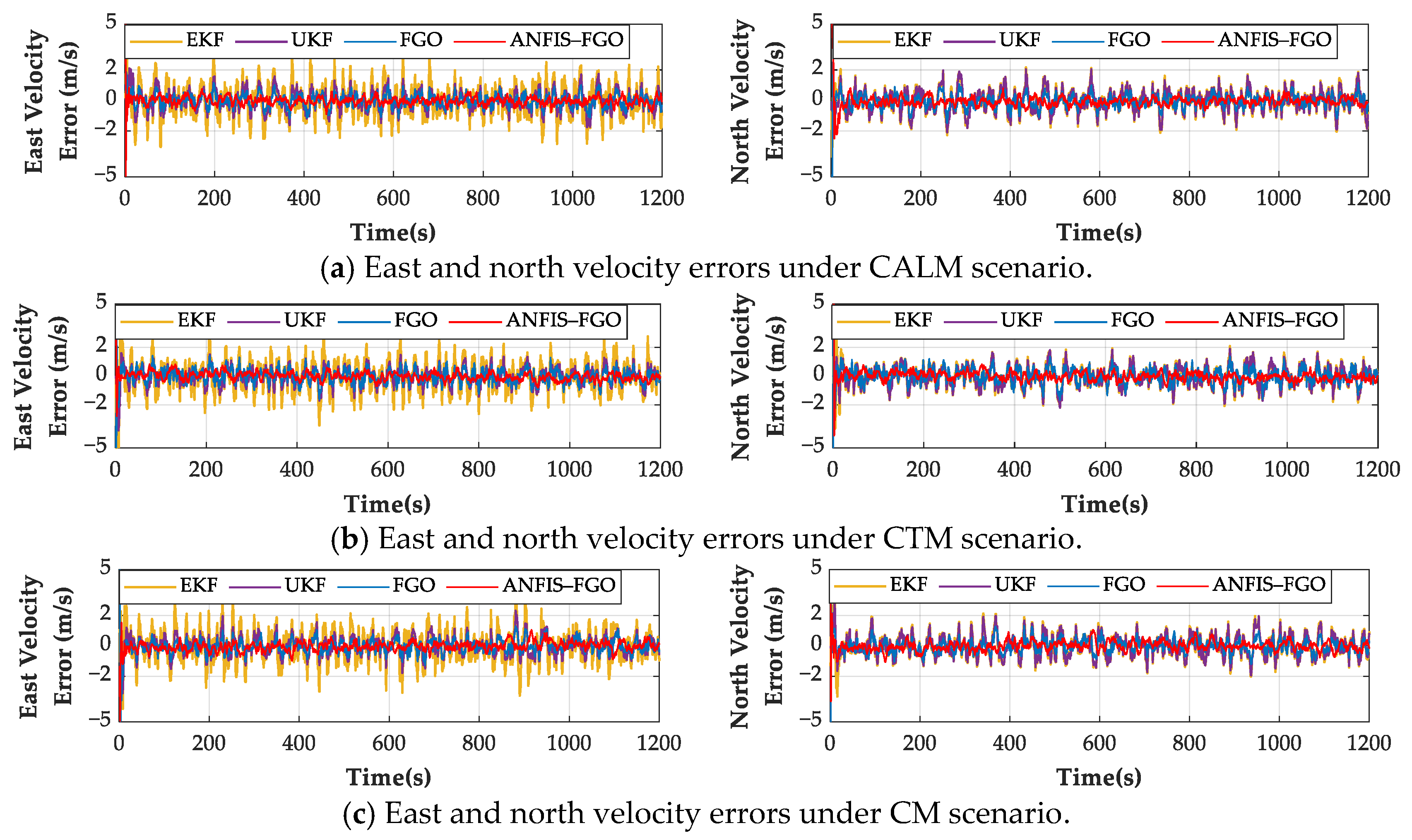
The simulation results presented in
Figure 6 demonstrate that ANFIS–FGO consistently maintains east and north velocity errors within approximately 0.2–0.4 m/s across all three motion scenarios, exhibiting a clear performance advantage over the competing methods. In comparison, FGO yields velocity errors ranging from 0.3 to 0.6 m/s, while UKF and EKF exhibit significantly larger deviations, with errors escalating to approximately 1.2 m/s under fully dynamic conditions. This performance gain can be attributed to the adaptive error modeling capability of ANFIS, which effectively adjusts the contribution of DR–derived velocity information within the factor graph. In contrast, the fixed noise assumptions in FGO and the recursive estimation structure of UKF and EKF make them more sensitive to rapid motion changes and model mismatches, resulting in increased velocity errors.
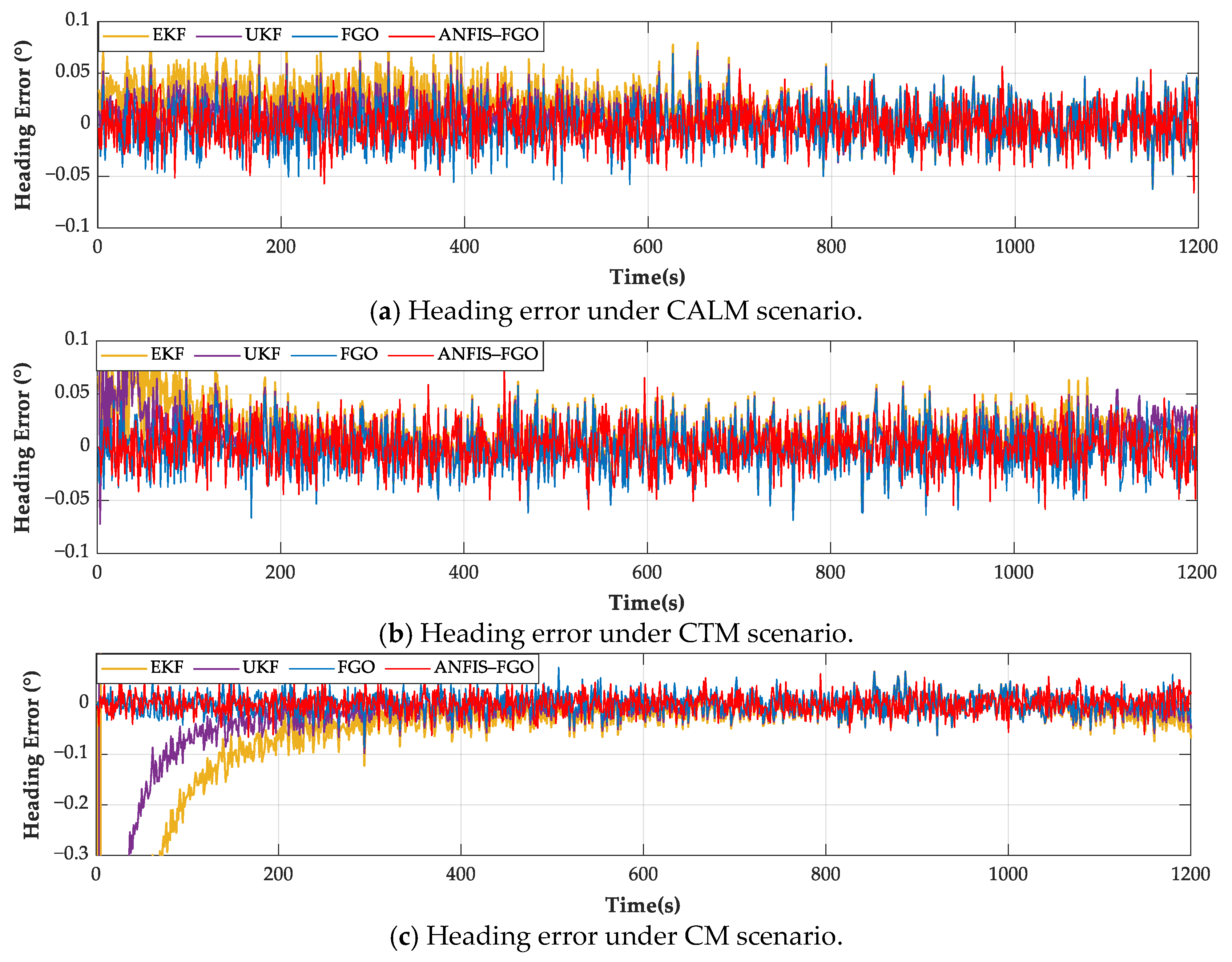
As shown in
Figure 7, ANFIS–FGO consistently restricts heading errors to a range of approximately 0.04 to 0.05°, slightly surpassing the performance of FGO, which exhibits errors between 0.05 and 0.07°. In contrast, UKF and EKF demonstrate larger deviations, particularly under fully dynamic conditions, where maximum errors can exceed 0.1°. This improvement is mainly attributed to the adaptive weighting mechanism introduced by ANFIS, which effectively regulates the contribution of heading-related measurements under varying motion states. As a result, ANFIS–FGO maintains robust and reliable orientation estimation, even in complex and dynamically changing maritime environments.
As evidenced by the quantitative results summarized in
Table 3, ANFIS–FGO consistently achieves the best estimation performance across all three motion scenarios, namely CALM, CTM, and CM, demonstrating its robustness under varying maritime dynamics. Compared with EKF, UKF, and standard FGO, ANFIS–FGO reduces horizontal positioning errors by an average of 30–40%, with the most significant improvements observed in dynamic scenarios such as CM. Both MAE and RMSE values for east and north remain the lowest among all methods, typically around 2.7–3.4 m and 3.0–3.9 m, respectively, whereas the other filters often exceed 4–6 m, especially under complex maneuvers.
In terms of velocity and heading estimation, ANFIS–FGO exhibits significant advantages. The velocity errors decrease to approximately 0.22–0.35 m/s, corresponding to a reduction of nearly 60–70% compared with the EKF, and showing substantial improvement over both UKF and FGO. Similarly, the heading errors are maintained between 0.22° and 0.25° for the MAE and between 0.41° and 0.50° for the RMSE, roughly half of the values observed for EKF and UKF. These enhancements are consistently achieved across the three representative motion patterns, demonstrating stable performance even during steady turning and under fully dynamic conditions.
Overall, the results confirm that ANFIS–FGO delivers the most accurate and robust navigation performance among all tested approaches. The integration of adaptive neuro-fuzzy inference enhances the FGO optimization process, enabling effective suppression of environmental disturbances and dynamic uncertainties. This makes ANFIS–FGO highly suitable for reliable and practical UMV navigation in real marine environments.
4.2. Field Experiments
4.2.1. Experiment Setup
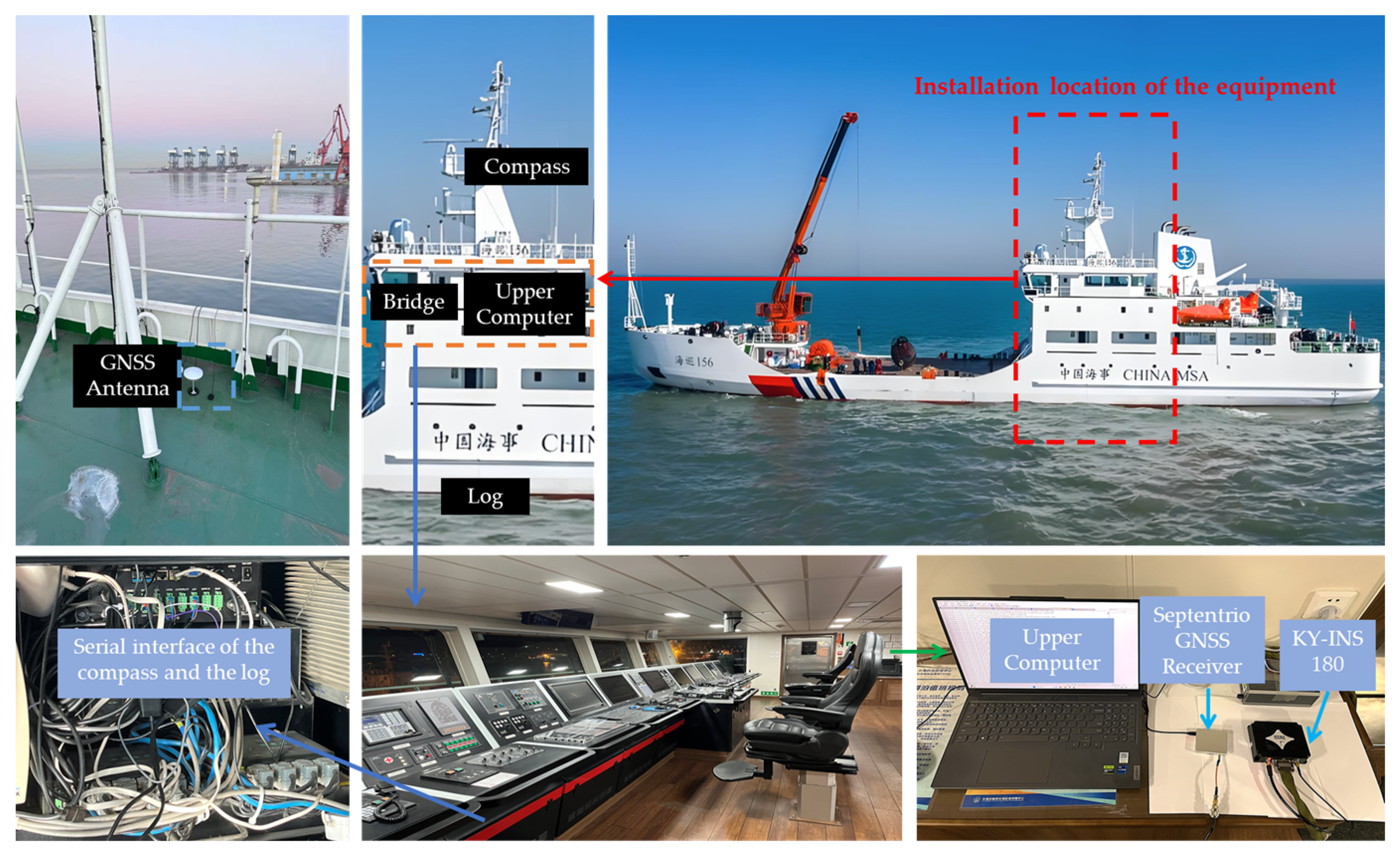
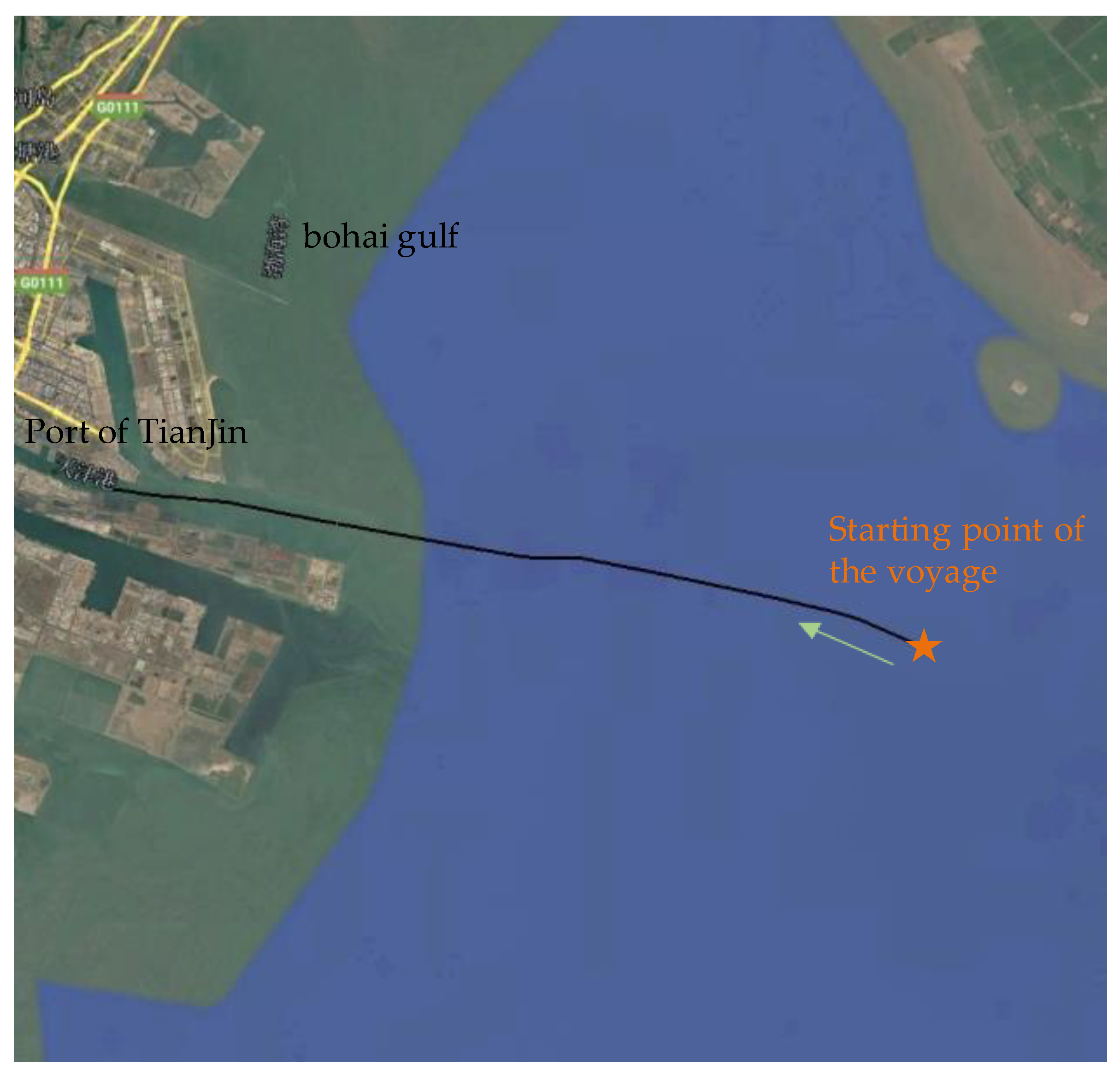
Simulation results confirmed the superior positioning performance of the ANFIS–FGO algorithm in complex maritime scenarios. To validate its field efficacy, a field experiment was conducted using a ship near Tianjin Port, as illustrated in
Figure 8.
The experiment lasted for one hour. Data from the shipborne compass and log were collected via serial interfaces. The high-precision KY–INS 180 system provided ground truth for evaluation, while the Septentrio GNSS receiver and shipborne sensors supplied algorithm inputs. In this study, the KY–INS 180 system is used as the reference, with a nominal positioning error of 2 cm. To ensure comparability between simulation and field tests, the algorithm configuration and parameter settings in the experiment were kept consistent with those used in the simulations.
The high-precision data obtained from the KY–INS180 are utilized as the reference trajectory to plot the field sailing route of the ship, as shown in
Figure 9. In this figure, the black line represents the sailing path of the ship, the orange pentagram indicates the starting point, and the buff arrows denote the direction of travel. During the experiment, the ship maintained an approximate speed of 6.5 m/s, with a gradual deceleration of about −3.4 × 10
−4 m/s
2. The heading shifted slightly from approximately 294° to 280°. This reference trajectory provides a reliable baseline for evaluating the performance of different navigation algorithms, allowing for quantitative comparison of position, velocity, and heading accuracy under realistic operating conditions. Moreover, the detailed depiction of speed and heading changes ensures that subtle dynamic effects on sensor measurements are captured for comprehensive analysis.
4.2.2. Positioning Experiment
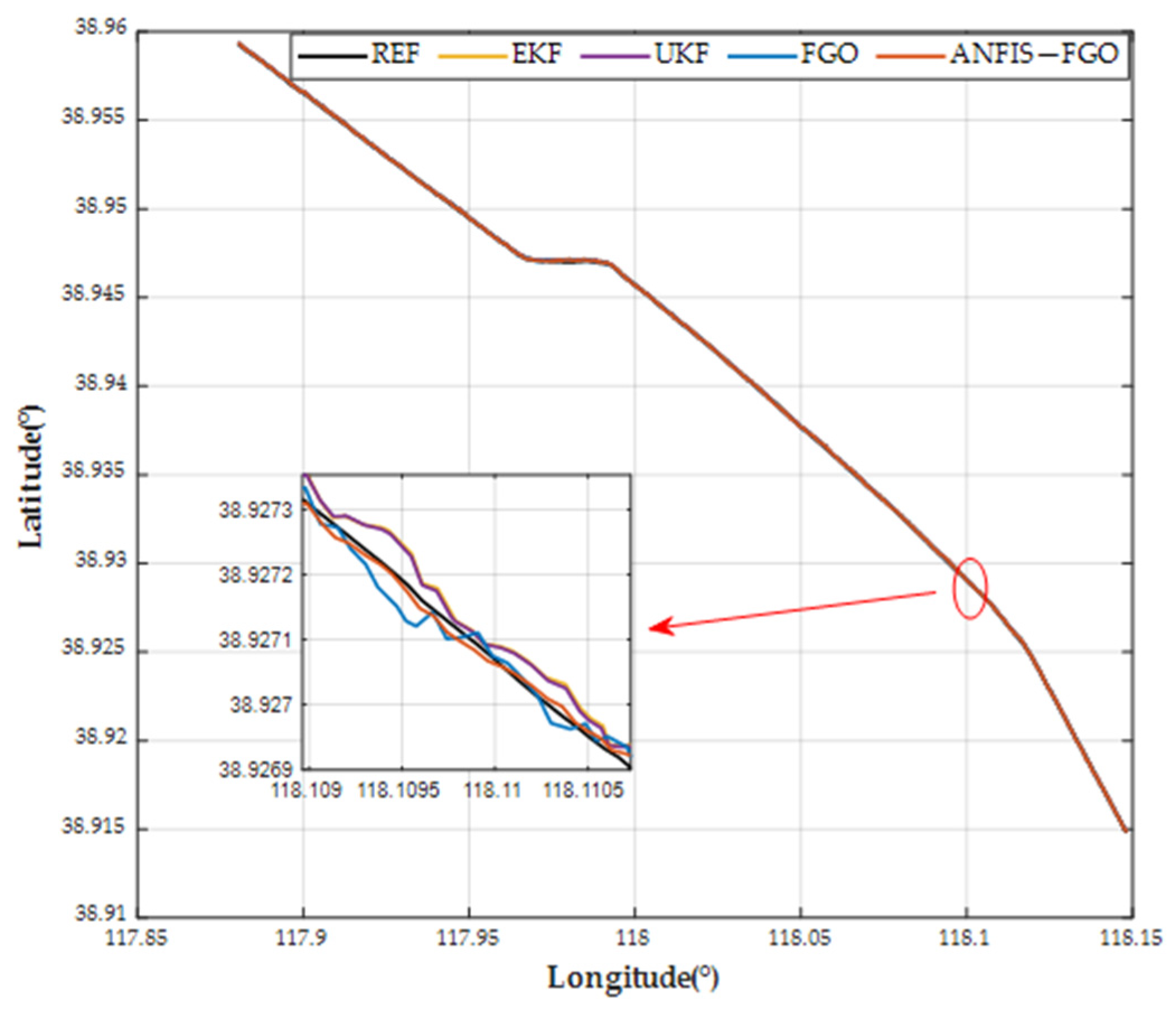
During the field test, sensor measurements were processed using the proposed ANFIS–FGO algorithm alongside three comparison methods: EKF, UKF, and conventional FGO. The resulting trajectories, illustrated in
Figure 10, indicate that the ANFIS–FGO trajectory remains closely aligned with the reference path throughout the entire navigation process, exhibiting minimal fluctuations, smooth transitions, and the highest overall consistency.
In comparison, the EKF, UKF, and FGO trajectories deviate noticeably at specific intervals, particularly during maneuvers or in the presence of environmental disturbances, and display greater instability. These observations confirm that ANFIS–FGO provides superior positioning accuracy, enhanced robustness, and more reliable trajectory tracking under field maritime conditions, further validating its effectiveness and practical applicability for ship navigation operations.
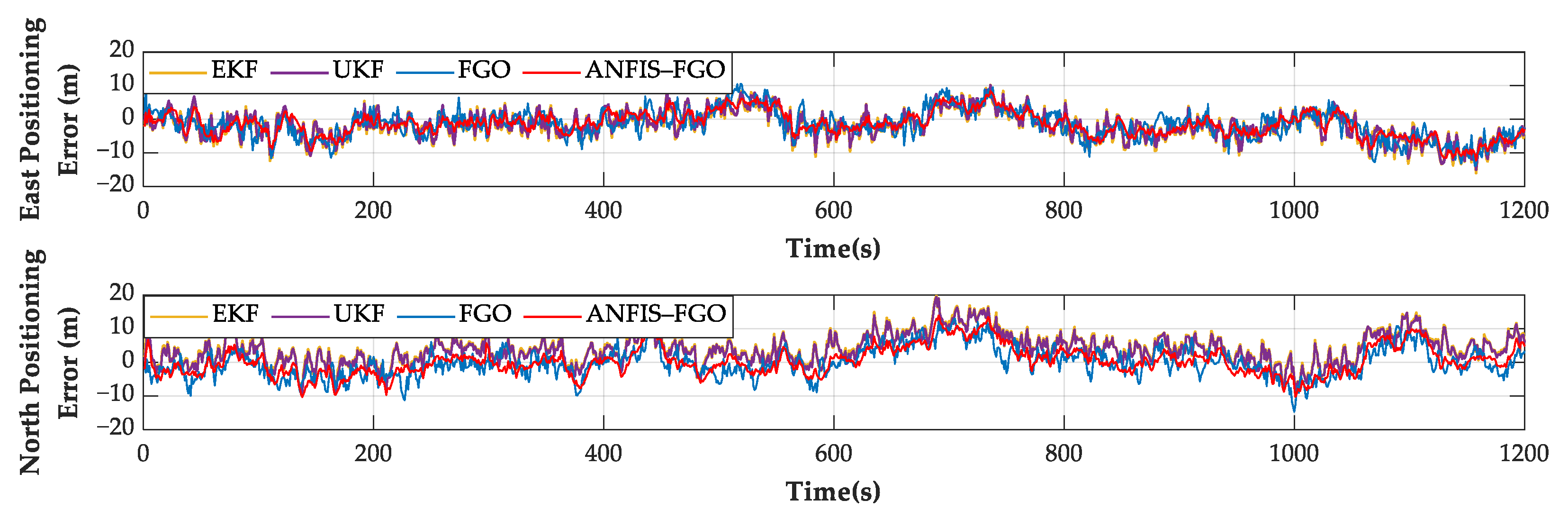
In this study, only position error is evaluated in the experiments, as it directly affects navigation safety, particularly in complex environments. While velocity and heading errors are relevant, they are influenced by external factors and are more challenging to measure accurately. Position error provides a more reliable and straightforward metric for assessing algorithm performance. As shown in
Figure 11, the ANFIS–FGO algorithm yields a minor positioning error and exhibits the least fluctuation in the error curves, indicating strong robustness. In contrast, the EKF algorithm demonstrates the most significant positioning error, while the UKF and FGO algorithms perform moderately, with error levels between those of EKF and ANFIS–FGO.
Further analysis based on RMSE in
Table 4 reveals that the ANFIS–FGO algorithm improves the overall positioning accuracy by approximately 30%, 25%, and 10% compared to the EKF, UKF, and FGO algorithms. These results demonstrate that the ANFIS–FGO algorithm significantly improves positioning accuracy and robustness in complex maritime environments compared to the EKF, UKF, and FGO algorithms, laying a solid technical foundation for the development and application of future UMV navigation and positioning systems.
4.2.3. Efficiency Comparison Experiment
To comprehensively assess the practical feasibility of the ANFIS–FGO algorithm, an ablation study is conducted to provide a preliminary evaluation of its computational efficiency and resource consumption. In theory, the computational cost of ANFIS–FGO primarily originates from two components: the calculation process based on FGO and the training of the ANFIS model. As discussed in the introduction, ANFIS offers advantages such as a simple structure, a limited number of parameters, and reduced dependence on large training datasets. ANFIS requires significantly lower computational complexity and hardware resources than conventional deep learning models. Therefore, this study mainly focuses on analyzing the impact of the FGO module on computational performance. The improved ANFIS–FGO algorithm incorporating a sliding window approach and marginalization factors are compared with the baseline version without these enhancements in the experimental design. Both versions are evaluated utilizing the same actual ship data to ensure fairness and consistency. The ANFIS configuration remains identical across all comparisons to maintain experimental control.
The experiments are conducted on a Windows 10 Professional system equipped with an Intel Core i5–7300HQ CPU and 8 GB of RAM. Given that this study primarily aims to improve positioning accuracy and robustness for the ship in complex marine environments, fifty Monte Carlo simulations were carried out to provide an initial exploration of the algorithm’s computational complexity and resource usage. Future research will focus on a more detailed and multidimensional analysis of the computational performance and deployment ability of the proposed algorithm.
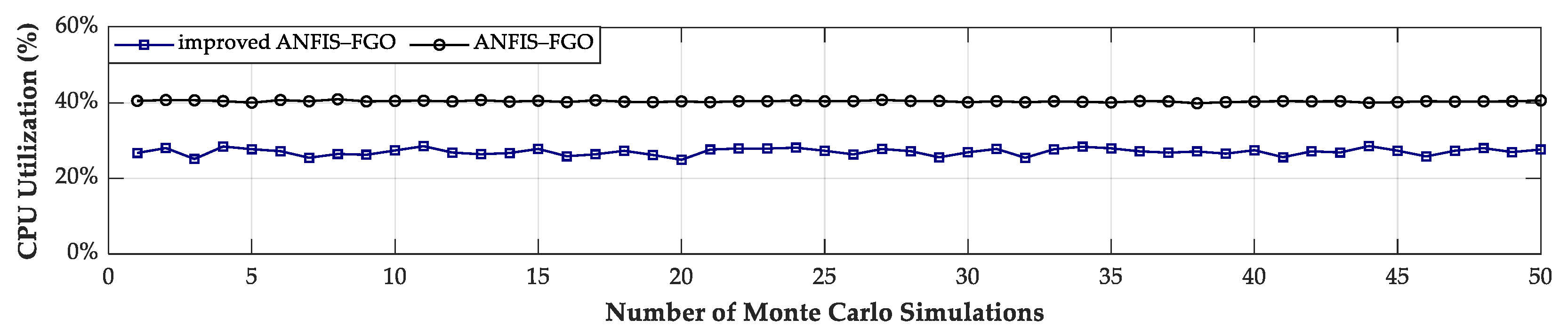
Figure 12 presents a comparative analysis of CPU utilization between the improved ANFIS–FGO algorithm and the baseline ANFIS–FGO across 50 Monte Carlo simulations. As illustrated in the figure, CPU utilization for both algorithms remains relatively stable throughout the simulations. However, the baseline ANFIS–FGO consistently exhibits higher CPU usage, ranging between 40% and 41%, whereas the improved version maintains a lower utilization rate of approximately 27.08%. The results demonstrate that the algorithm enhanced with a sliding window and marginalization factors significantly reduces computational demands, thereby improving its applicability and efficiency on resource-limited UMV platforms.
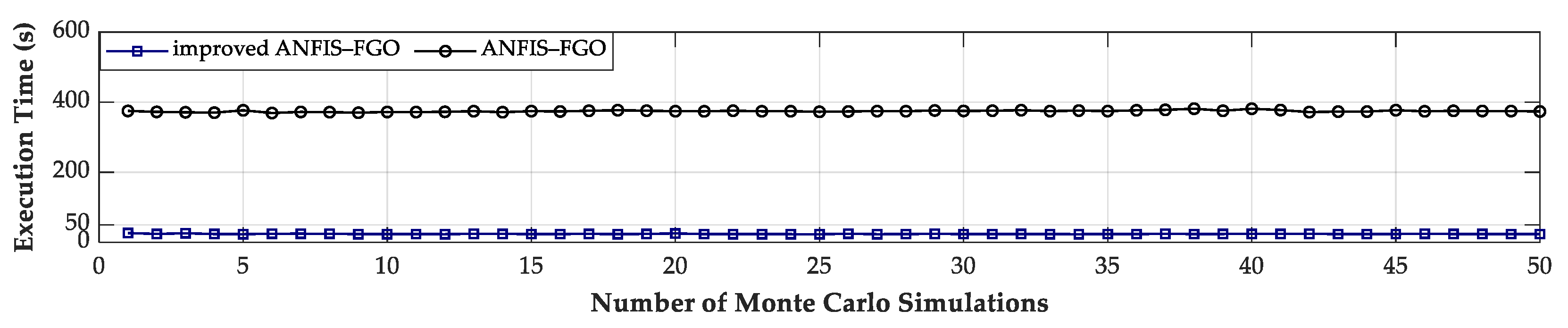
Figure 13 compares execution times for the two algorithms. The improved ANFIS–FGO demonstrates significantly lower execution time, averaging around 23.8 s, in contrast to the baseline version, which approaches 381.4 s. This notable reduction indicates that the proposed improvements reduce computational resource demands and enhance overall efficiency. These results collectively validate the improved ANFIS–FGO algorithm’s computational advantages. The integration of optimization mechanisms has effectively decreased CPU usage and execution time, thereby supporting its suitability for real-time or resource-constrained maritime applications.
4.2.4. GNSS Outage Experiment
Existing studies on navigation algorithms in challenging environments have largely focused on system behavior during GNSS–denied periods. In this work, while the primary objective is to enhance positioning accuracy under nominal operating conditions, a GNSS outage experiment is additionally conducted to examine the robustness of the proposed factor graph-based method. The evaluation is performed using both the CM scenario and real experimental data under consistent test conditions.
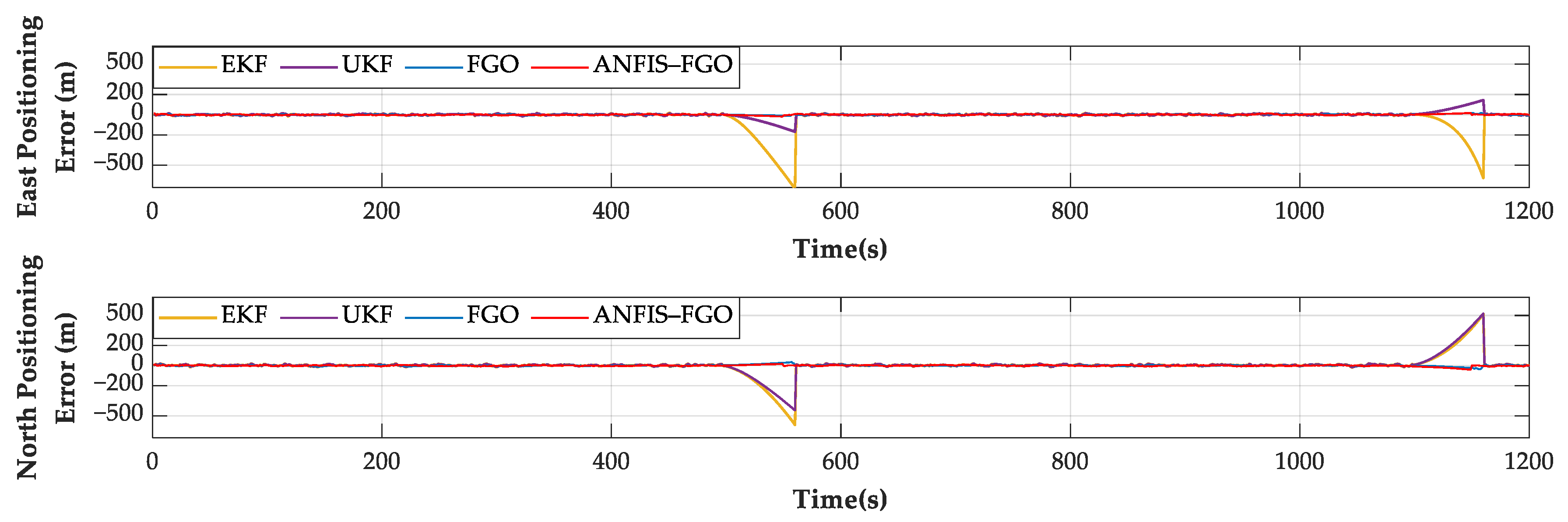
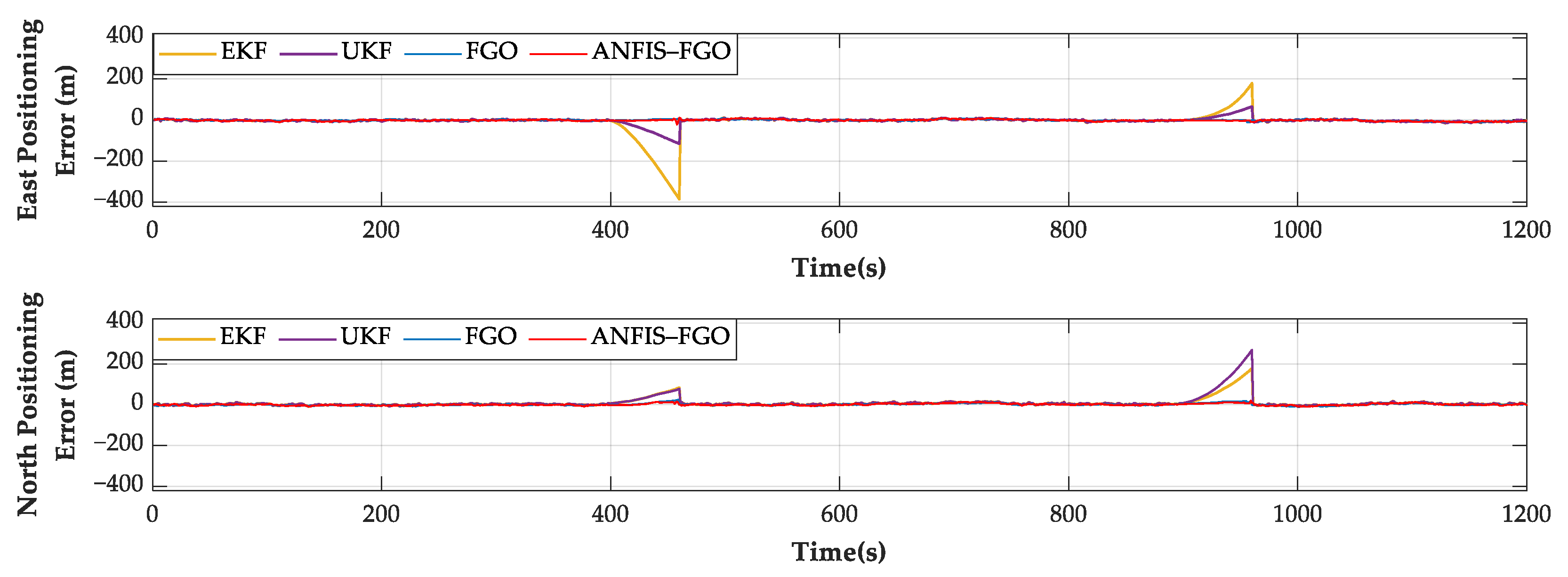
During the experiments, GNSS signals were intentionally interrupted twice. The outages were introduced at 500 s and 1100 s in the simulation, and at 400 s and 900 s in the field tests, with each interruption lasting 60 s. In
Figure 14, GNSS interruptions in the CM scenario led to substantial error growth for EKF and UKF, with maximum position deviations exceeding 500 m. In contrast, FGO effectively constrained the errors within 20 m, while the proposed ANFIS–FGO exhibited the smallest fluctuations and fastest recovery, demonstrating superior robustness and stability. These results confirm that traditional filtering methods diverge without GNSS updates, whereas FGO-based approaches preserve consistency by exploiting historical optimization.
Similarly, as shown in
Figure 15, during field ship navigation tests, EKF and UKF produced large position drifts of 200–400 m, whereas FGO maintained stable estimates within 20 m. The ANFIS–FGO algorithm achieved the highest accuracy and smoothest trajectories, consistent with the simulation findings. Overall, the results verify that FGO-based algorithms outperform conventional filters under both normal and GNSS denied conditions, with ANFIS–FGO exhibiting exceptional accuracy, resilience, and practical applicability for UMV navigation.
5. Conclusions
This paper proposes an improved FGO algorithm enhanced with ANFIS, applied to ship GNSS/DR integrated navigation to improve positioning accuracy and robustness in complex marine environments. The proposed algorithm comprises two primary components. First, a novel GNSS/DR factor graph model tailored for ships is developed to address the limitations of traditional maritime navigation filtering methods. By incorporating a DR error factor, the model effectively enhances positioning accuracy. Meanwhile, a sliding window strategy and the marginalization factor are introduced within the FGO framework to balance computational efficiency and estimation accuracy, ensuring the algorithm’s suitability for resource-constrained UMVs. Second, the learning and adaptive capabilities of ANFIS are employed to optimize the FGO framework, further enhancing navigation accuracy and robustness in dynamically changing marine environments. Simulations and actual experiments are conducted to evaluate the proposed algorithm. These results demonstrate that the ANFIS–FGO algorithm achieves high positioning accuracy, strong robustness, and low computational cost, indicating its potential to ensure stable ship navigation in adverse conditions and support the development of intelligent UMV systems.
Although the proposed ANFIS–FGO algorithm has been validated through simulation experiments covering typical ship motion scenarios and real maritime data, certain limitations remain. Specifically, the method has not been extensively tested under more extreme conditions, such as extended-duration missions, sustained GNSS degradation, or highly dynamic sea states. These scenarios represent more challenging operational environments that warrant further investigation to comprehensively assess the performance boundaries and long-term stability of the proposed approach. Furthermore, other intelligent fusion methods are subject to inherent constraints, including data requirements and computational resource limitations, which make them difficult to directly apply to the ship positioning scenario addressed in this study.
In future work, we will advance the proposed method in three key directions. First, to address positioning requirements under extended-duration missions, complex sea states, and extreme conditions, we will further optimize the existing approach and explore multi-sensor fusion schemes to enhance system redundancy and robustness. Second, we will deepen the investigation of AI-enhanced FGO methods, seeking more efficient and broadly applicable intelligent optimization solutions. Finally, we will extend the method to cooperative localization scenarios for UMV fleets by establishing inter-ship information sharing and distributed optimization frameworks, which represent a critical direction for the development of maritime autonomous systems. These research efforts will provide theoretical foundations for the application of unmanned vessels in complex marine environments and facilitate their engineering deployment and practical implementation.




 ,
,