1.1. Research Background
As a non-renewable resource, oil reserves have been declining rapidly in recent decades. With the global demand for crude oil continuing to rise, new strategies to enhance oil production are urgently needed. Heavy oil is widely recognized as an important energy resource, with global recoverable reserves of about 1.9 billion tons accounting for nearly 36% of global recoverable oil reserves, according to the International Energy Agency (IEA) statistics [
1,
2].
Over the past seven decades, China’s petroleum industry has undergone rapid development, evolving from an oil exporting country to a net oil importing country. The contradiction between oil supply and demand is increasingly acute, which has become a bottleneck restricting economic and social development [
3]. As a rich resource in China, heavy oil is mainly distributed in Xinjiang, Liaohe, Bohai Bay and other oilfield blocks [
4]. At present, the total proven reserves are about 8.2 billion tons, of which the proven reserves of onshore heavy oil reserves are about 4 billion tons, mainly distributed in Liaohe, Xinjiang, Shengli and other major blocks. The proven reserves of offshore heavy oil are about 4.2 billion tons, which are concentrated in the Bohai Bay area [
5].
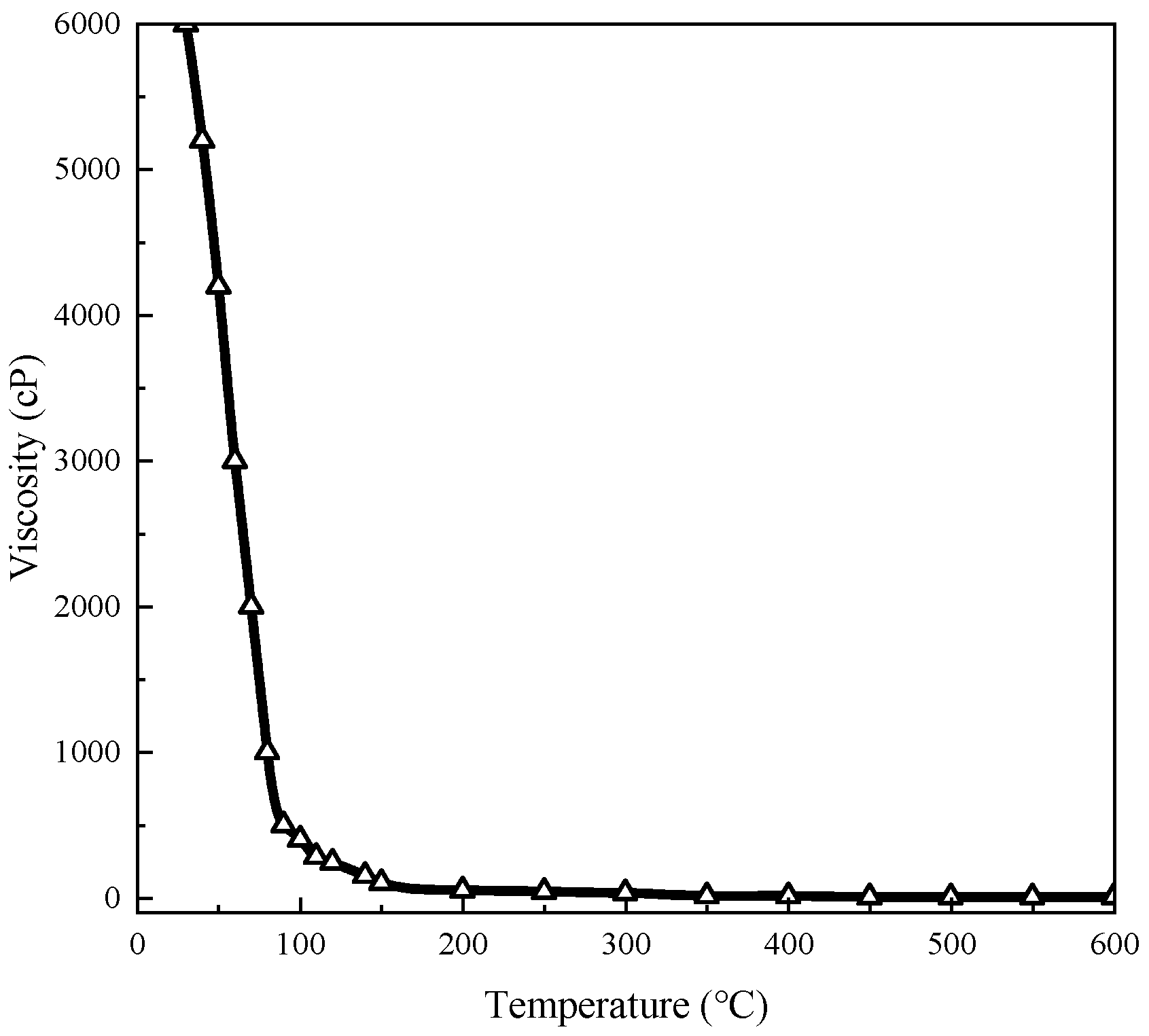
Heavy oil has great viscosity and poor mobility in the reservoir, due to the large amount of gum and asphaltene within. However, it has been observed previously that the viscosity of crude oil decreases sharply with an increasing temperature, consequently diluting heavy oil and improving its mobility in the reservoir [
6,
7,
8,
9]. Based on this principle, steam huff and puff, an in situ thermal recovery technology is developed, within which the main feature is allowing for three processes of steam injection, well soaking and production in the same well.
Nevertheless, only crude oil in a limited area around the wellbore can be produced through steam huff and puff. The oil production effect is declining with huff and puff carrying out and the oil recovery rate is generally only about 15%. Meanwhile, steam huff and puff will cause a high input cost, high energy consumption, high CO
2 emission intensity, etc. [
10,
11,
12].
1.2. Development of Increasing Oil Recovery with CO2
Over the past century, to address the challenge of declining productivity in the later stages of steam huff and puff and to further enhance the sweep efficiency of crude oil within the reservoir, the technique of co-injecting gas with steam during the later phases of steam huff and puff has been extensively studied. As a non-polar molecule, carbon dioxide is easily soluble in crude oil. Hence, a number of studies were on the production-enhancing effect of CO
2 on crude oil, as well as trial productions that were conducted in various oil and gas fields. In 1963, Welker [
13] found that the solubility of CO
2 in crude oil is related to the relative density and viscosity of crude oil. The higher the density of heavy oil, the lower the solubility of CO
2. The higher the viscosity of heavy oil, the better the viscosity reduction effect of CO
2. Later, Monger et al. [
14] observed that when the viscosity of CO
2 in the reservoir is reduced, the oil production-enhancing rate is increased. It is also found that CO
2 can extract the light hydrocarbon components in the crude oil, thereby increasing the production of a single well. Haskin et al. [
15] carried out laboratory analyses of CO
2 huff and puff in different viscosities of crude oil and conducted a trial production at several oil fields in Texas. They believed that crude oil expansion, dissolution and viscosity reduction are the main factors to enhance oil recovery.
Further studies on the enhancing oil recovery (EOR) mechanism and controlling factors of CO
2 were carried out in succession. Yang et al. [
16] and Wang et al. [
17] discovered that CO
2 dissolved in crude oil can reduce the interfacial tension between oil and water and increase the formation pressure around the wellbore. During the production period, dissolved gas was generated to promote the migration of crude oil, thereby increasing the production of a single well. Pu et al. [
18] found that it increased both the oil displacement efficiency and sweep efficiency, enhancing the oil recovery by introducing CO
2 into the steam flooding process. Zhang et al. [
19] conducted laboratory experiments and numerical simulations and found that factors such as porosity and reservoir thickness have greater influence on the effect of CO
2 huff and puff, while the permeability and liquid production rate have less influence. Moreover, CO
2 huff and puff in the horizontal well has a more obvious stimulation effect than the vertical well. Chen et al. [
20] pointed out that the contact differences in space and time between the CO
2 and the crude oil, as well as the scale of CO
2 mobilization for attic oil caused by gravity, are the main reasons for a better CO
2 huff and puff effect in the horizontal well than in the vertical well.
On the other hand, Or et al. [
21] researched the CO
2 gas microbubble of foamy oil through numerical simulation and pointed out that the effect of the initial oil saturation and CO
2 dissolution zone are the controlling factors of heavy oil production. Zhou et al. [
22] conducted further research and developed a dynamic model to match the foamy oil stability of the heavy oil–CO
2 system, with high agreement being achieved between the experimental data and the calculation results. To stabilize and reinforce CO
2 foam in foamy oil, Yang et al. [
23] investigated the foam aging rules and CO
2 foam stability mechanism of synthesized acid-resistant hydrophobic polymer nanospheres, and obtained the best scheme of CO
2 foam reinforcing, which showed the highest foam stability.
Over the past decade, CCUS has become increasingly popular. Hill et al. [
24] investigated and discussed the possibility, advantages and implementation conditions of CCUS by EOR technology, pointing out that EOR can effectively reduce carbon emission. Jin et al. [
25] undertook experiments to investigate properties of Bakken shales and the process of scCO
2 extraction of shale oil. These experimental results demonstrate the potential of scCO
2 injection to enhance ultimate oil recovery while concurrently offering significant CO
2 storage potential within the Bakken Formation. Zhang et al. [
26] conducted experiments of CO
2 immiscible huff and puff, revealed microscopic oil displacement characteristics and the evolution of gas saturation states, and provided a theoretical basis for CO
2 storage through immiscible huff and puff. Guo et al. [
27] discovered that a high temperature is conducive to CO
2 storage but not conducive to displacement oil efficiency. Thus, the integration of CO
2 storage and oil recovery is feasible for strong edge water reservoirs.
In conclusion, it is now well established from a variety of studies that with the functions of viscosity reduction by dissolution, pressurization and formation of foamy oil with CO
2 can be used in miscible flooding, immiscible flooding, steam huff and puff, gas-assisted steam huff and puff, etc. [
12]. Employing CO
2-assisted steam huff and puff represents a dual-purpose approach, integrating the synergistic effect to effectively enhance heavy oil recovery and achieve substantial CO
2 sequestration within the reservoir.
1.3. Previous Studies of Bottom Water Reservoir
Reservoir conditions are inherently diverse and complex, posing significant challenges during oilfield development. Numbers of studies, including those mentioned above, basically paid attention to reservoirs with little geological complexity: for example, the edge and bottom water conditions. Edge and bottom water are very common in global heavy oil reservoirs. The bottom water coning phenomenon poses significant and persistent challenges to reservoir development, having impacted oilfield operations for nearly a century, and remains a difficult issue to resolve even today [
28,
29,
30,
31]. A well-known example is the active edge and bottom water of the reservoir in Bohai Bay, China, where the edge and bottom water are present in approximately 57% of the discovered oilfields [
32]. Abundant studies of heavy oil with bottom water have been undertaken for decades. In 1931, the research and analysis of Wright [
28] on the production capacity of edge and bottom water reservoirs showed that the oil recovery efficiency was greatly affected by the energy of the edge and bottom water. Moreover, the rapid rate of bottom water intrusion into the reservoir also has a serious impact on the production effect of crude oil. Then, Muskat [
33] analyzed the production behavior of the bottom water reservoir and found that the flooding efficiency of the bottom water reservoir can be obtained by using the parameters of reservoir thickness, well conductivity and ratio of vertical to horizontal permeability. In the 1990s, Saleh [
34] extended prior modeling approaches to derive an analytical formula for water channeling velocity in bottom water reservoirs. Subsequently, Yu et al. [
35] summarized the models developed by previous researchers and conducted a numerical simulation study to investigate water intrusion mechanisms during the production of sandstone reservoirs with bottom water. Their results identified several key factors controlling bottom water coning, including the oil-flow ratio, the vertical-to-horizontal permeability ratio, the distribution of interlayers and the oil production rate.
In the 21st century, the risk of bottom water coning has been systematically investigated. Zhou et al. [
36] employed history-matching numerical simulations to analyze the dynamic characteristics of horizontal well flooding and their influencing factors. Their findings offer valuable insights for horizontal well planning, completion design, and late-stage production optimization. Using a synthetic fracture network model and numerical simulation, Lee et al. [
37] investigated the water breakthrough phenomenon in fractured basement reservoirs with bottom water aquifers. Their study analyzed the effects of various factors, including the production rate and the presence or absence of capillary pressure in fractures, on water coning and breakthrough timing. Liu et al. [
38] used numerical simulation methods to explore and analyze the location of horizontal well bottom water channeling and established the equation of bottom water cresting and reservoir’s water breakthrough time with gravity factors considered. They found that bottom water will preferentially invade from the middle of the horizontal well layout. By establishing and solving the pressure response analysis model, Sun et al. [
39] analyzed the influence of the water volumetric multiple on the pressure response, and found that there are six main flow stages in horizontal well seepage in the finite bottom water reservoir.
In conclusion, the studies mentioned above analyzed the law, the migration characteristics and influence of bottom water on many methods of conventional oil and heavy oil recovery, which provide a technical basis and support for the oil production in bottom water reservoirs. However, these studies merely focused on conventional EOR methods, such as steam flooding, steam drive, water drive, and so on.
1.4. Research Purpose and Significance
As the application scope of CO2-assisted steam huff and puff technology continues to expand, more challenging and complex geological conditions are encountered. So far, few studies in this field, including those referenced earlier, have paid attention to specify the influence of bottom water on the CO2-assisted steam huff and puff process and CCUS capability, since the bottom water will seriously affect the oil recovery efficiency, formation water flow law and other parameters. As a result, correct CO2-assisted injection and production parameters cannot be determined in the field production of heavy oil reservoirs with bottom water, thus resulting in the failure to implement the CO2-assisted steam huff and puff stimulation process. Oilfield engineers may choose to abandon developing heavy oil reservoirs with bottom water if the development procedure is not clear, wasting the development potential of heavy oil production and CCUS capability.
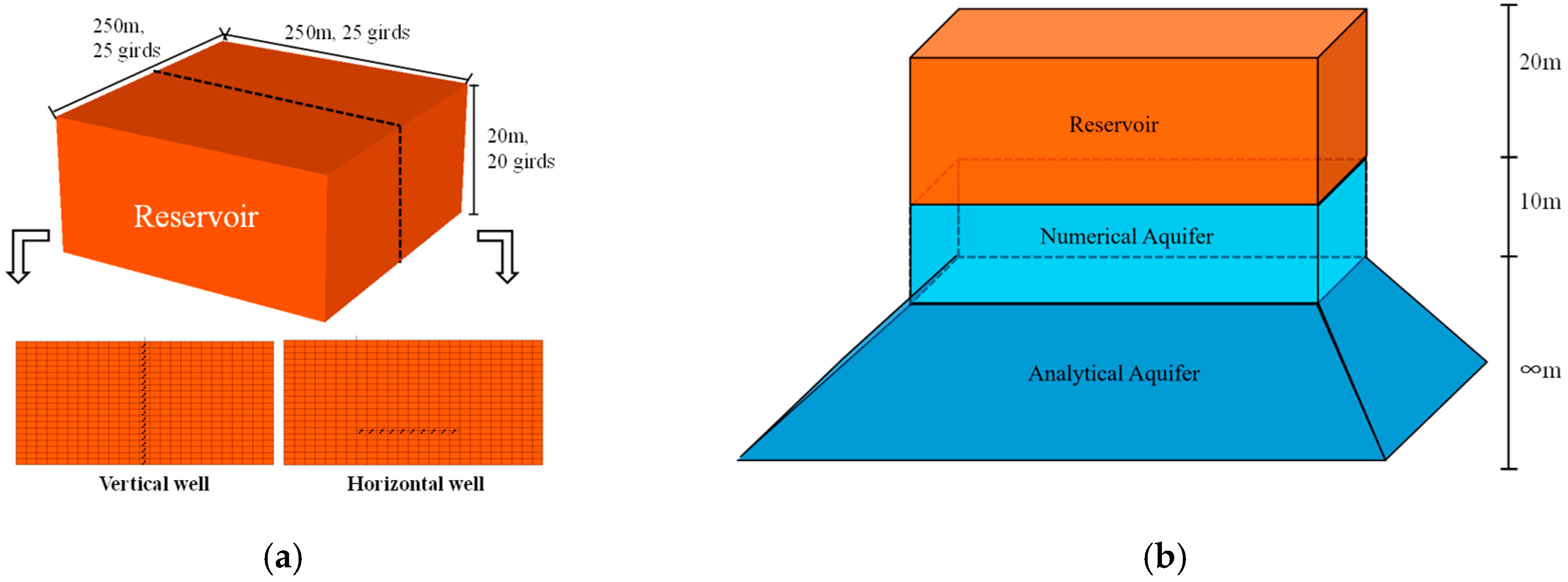
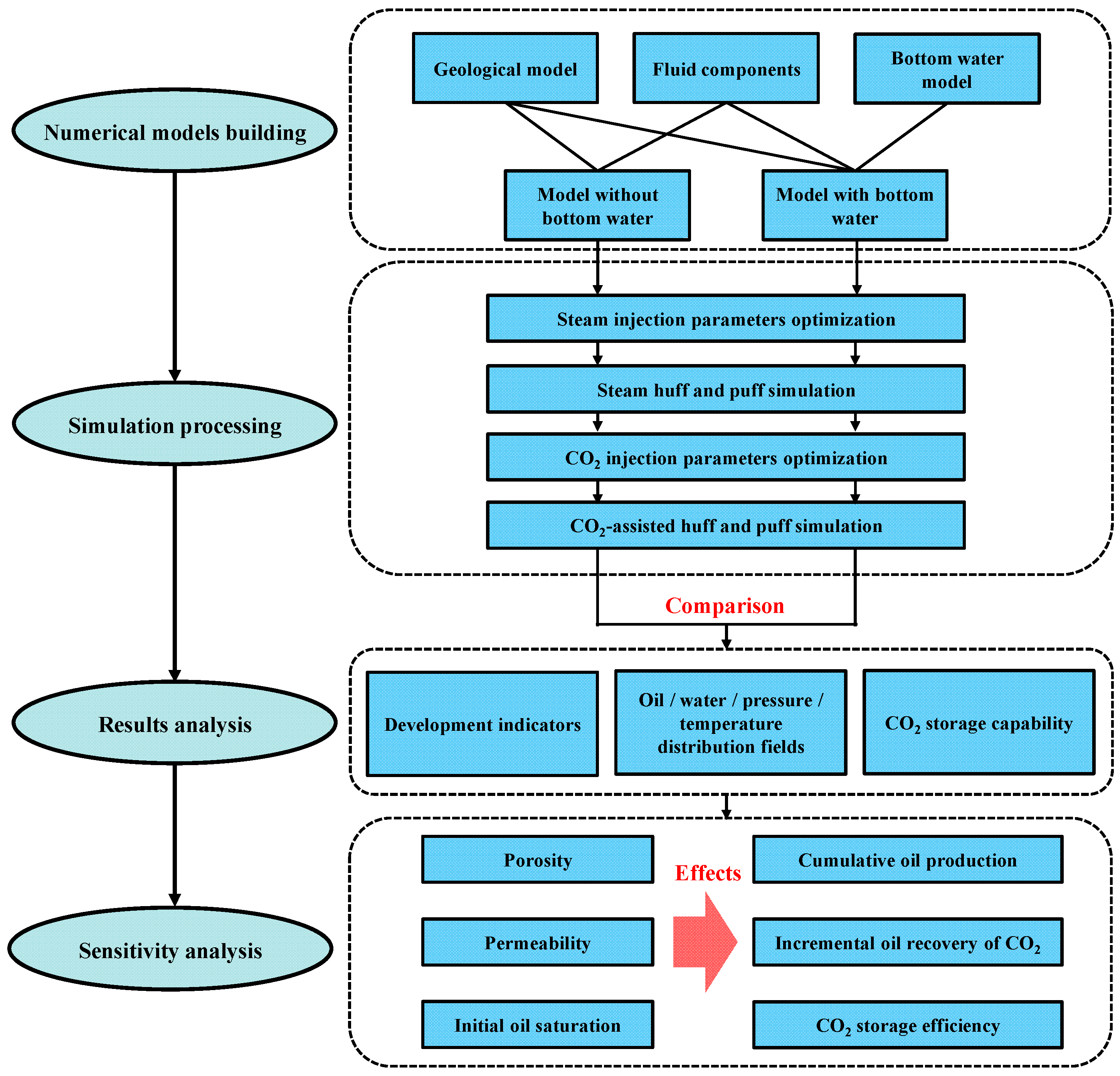
Hence, this study not only focuses on the potential of CO2-assisted steam huff and puff technology to increase oil production and the oil–water ratio, but also discusses the difference in the EOR effect of CO2 and CO2 storage efficiency with or without bottom water in the heavy oil reservoir. To this end, a typical offshore bottom water heavy oil reservoir model is built. Based on both horizontal and vertical well configurations, a comprehensive injection and production parameter optimization is first conducted to identify the most economically viable development scheme. Subsequently, the development indicators and parameter issues are compared and analyzed, aiming to explain the influence of bottom water on CO2-assisted steam huff and puff process and evaluate the CO2 storage efficiency in such an environment, providing technical reference and service guidance for practical production and CCUS projects.
This study is primarily a conceptual and theoretical validation. This positioning stems from the current scarcity of dedicated research and field applications specifically targeting the combination of heavy oil reservoirs with strong bottom water and CO2-assisted steam huff and puff technology, making it difficult to obtain direct external field data for benchmark validation. The present work aims to establish a fundamental theoretical framework and conduct a feasibility analysis for this specific domain, thereby providing a reference for future development planning of such challenging reservoirs. We fully recognize the importance of external data verification for scientific rigor. Consequently, clear follow-up research plans have been established, which include both systematic physical simulation experiments to calibrate the numerical model and efforts to pursue collaboration on pilot field trials to acquire the necessary validation data.