Numerical Modeling of Vegetation Influence on Tsunami-Induced Scour Mechanisms

Abstract
1. Introduction
2. Numerical Setup
2.1. Governing Equation and Turbulence Model
- (1)
- Continuity equation:
- (2)
- Navier–Stokes equations:
- (3)
- Volume fraction equation:
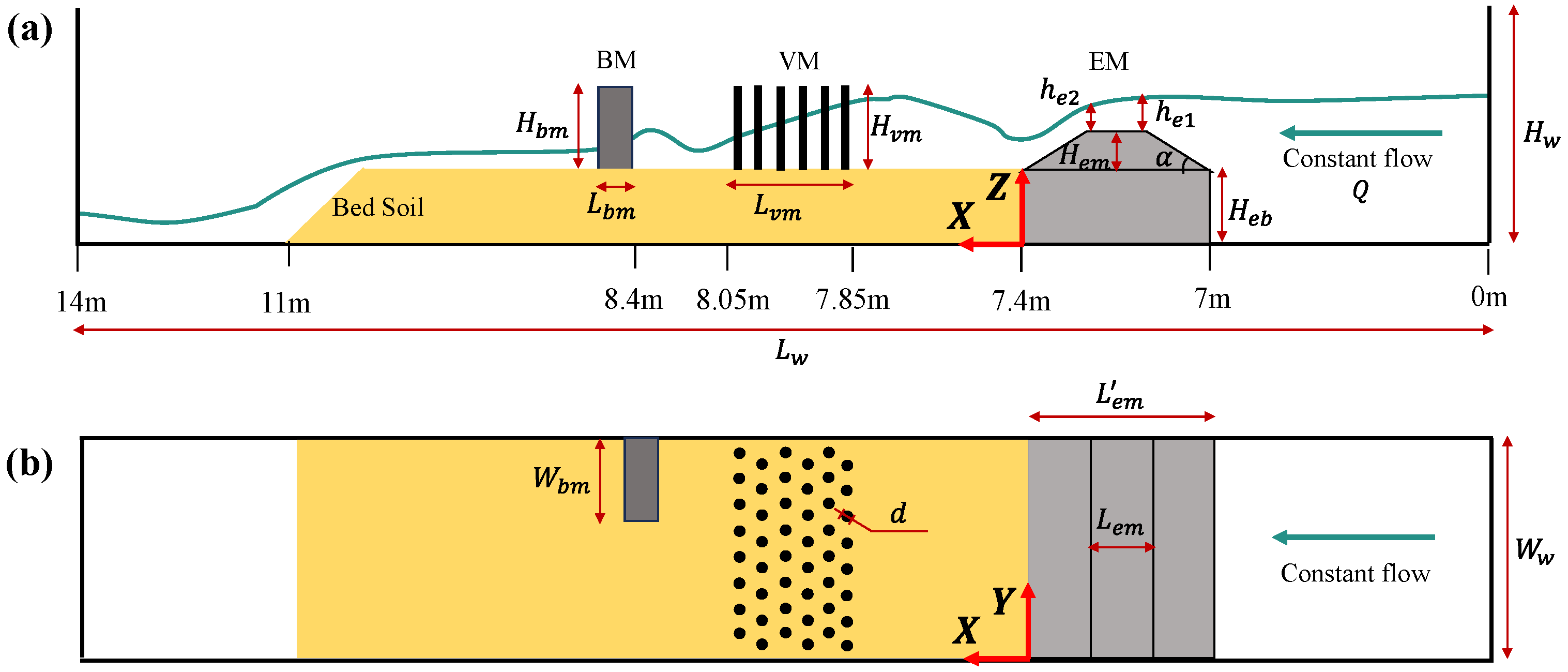
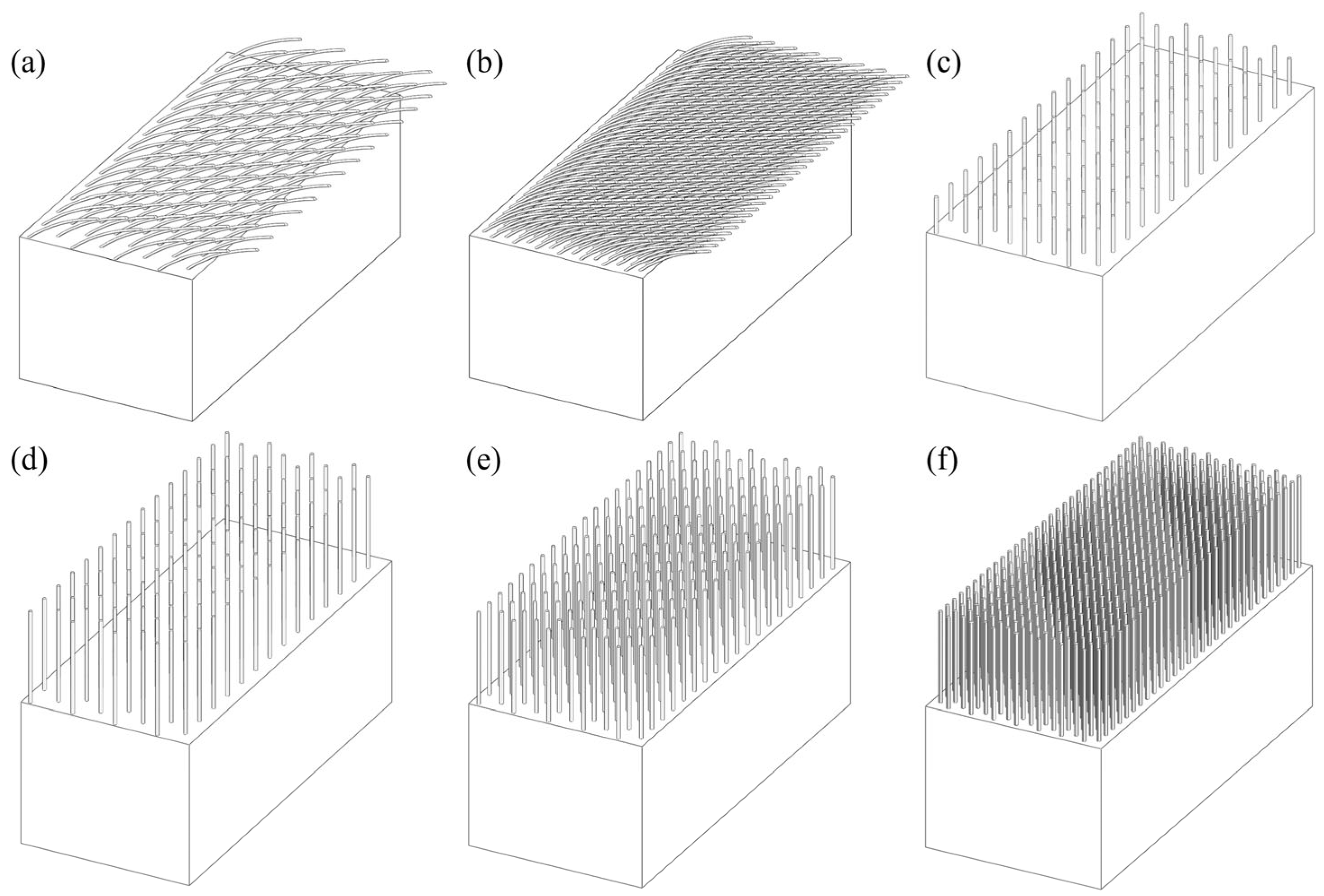
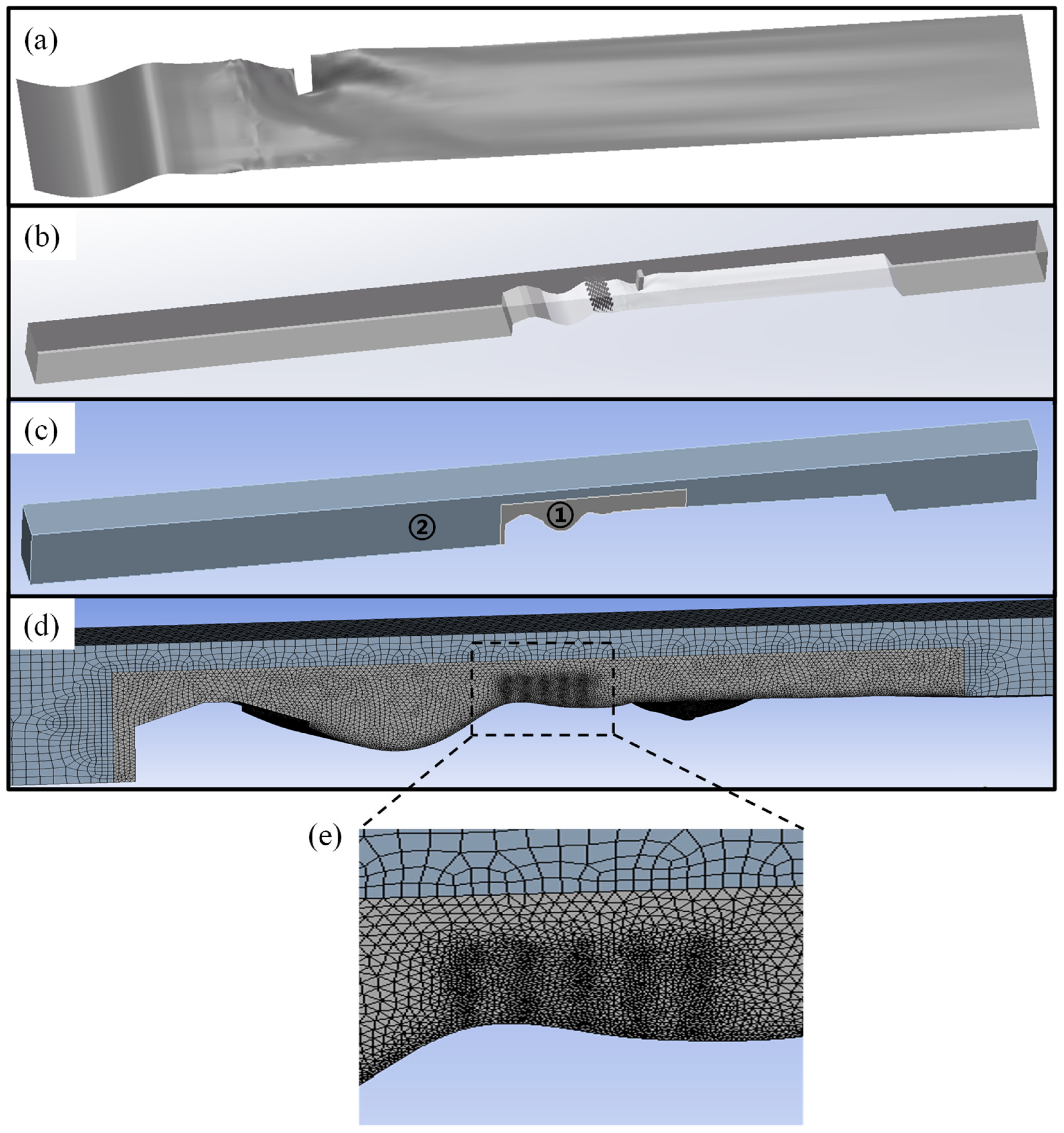
2.2. Computational Domain, Study Parameters, and Mesh Generation
2.3. Boundary and Initial Conditions and Computational Algorithms
- (1)
- Inlet Boundary Condition: The model’s inlet is set as a velocity inlet, with varying inlet velocities depending on the operating conditions. The average inlet velocity is calculated based on the water depth and flow rate at the inlet, as well as the inlet water depth.
- (2)
- Outlet Boundary Condition: The model’s outlet is set as a pressure outlet, with the pressure set to atmospheric pressure and the outlet water depth varying according to the operating conditions.
- (3)
- Wall Boundary Conditions: The top boundary of the model is set as air and defined as a pressure outlet with atmospheric pressure. The surfaces of the tank walls, quartz sand bed, vegetation clusters, and building surfaces are all set as no-slip walls. In numerical simulations, the roughness of the walls must be specified according to their physical properties. The roughness height for the smooth walls on the sides and bottom of the tank is set to 0.0001 m. The roughness height of the quartz sand bed is typically set to the median particle diameter, which is 0.0028 m. The roughness of the surfaces of the vegetation clusters and building models is higher than that of the tank walls and is set to 0.0005 m [25].
- (4)
- Initial Condition: The inlet boundary conditions are used to initialize the entire computational domain, facilitating faster convergence.
3. Model Validation
4. Results and Discussions
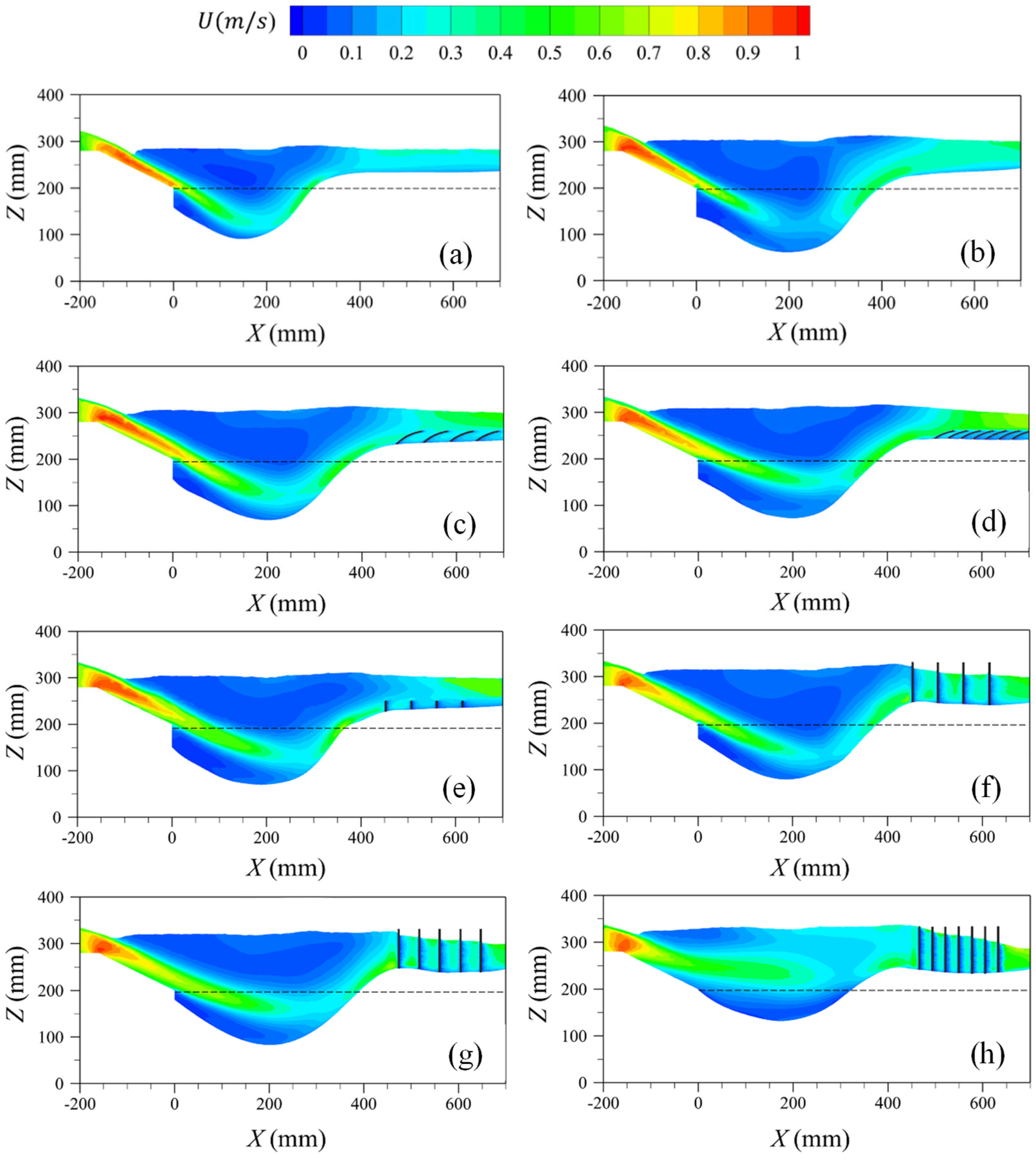
4.1. Overflow-Induced Scour
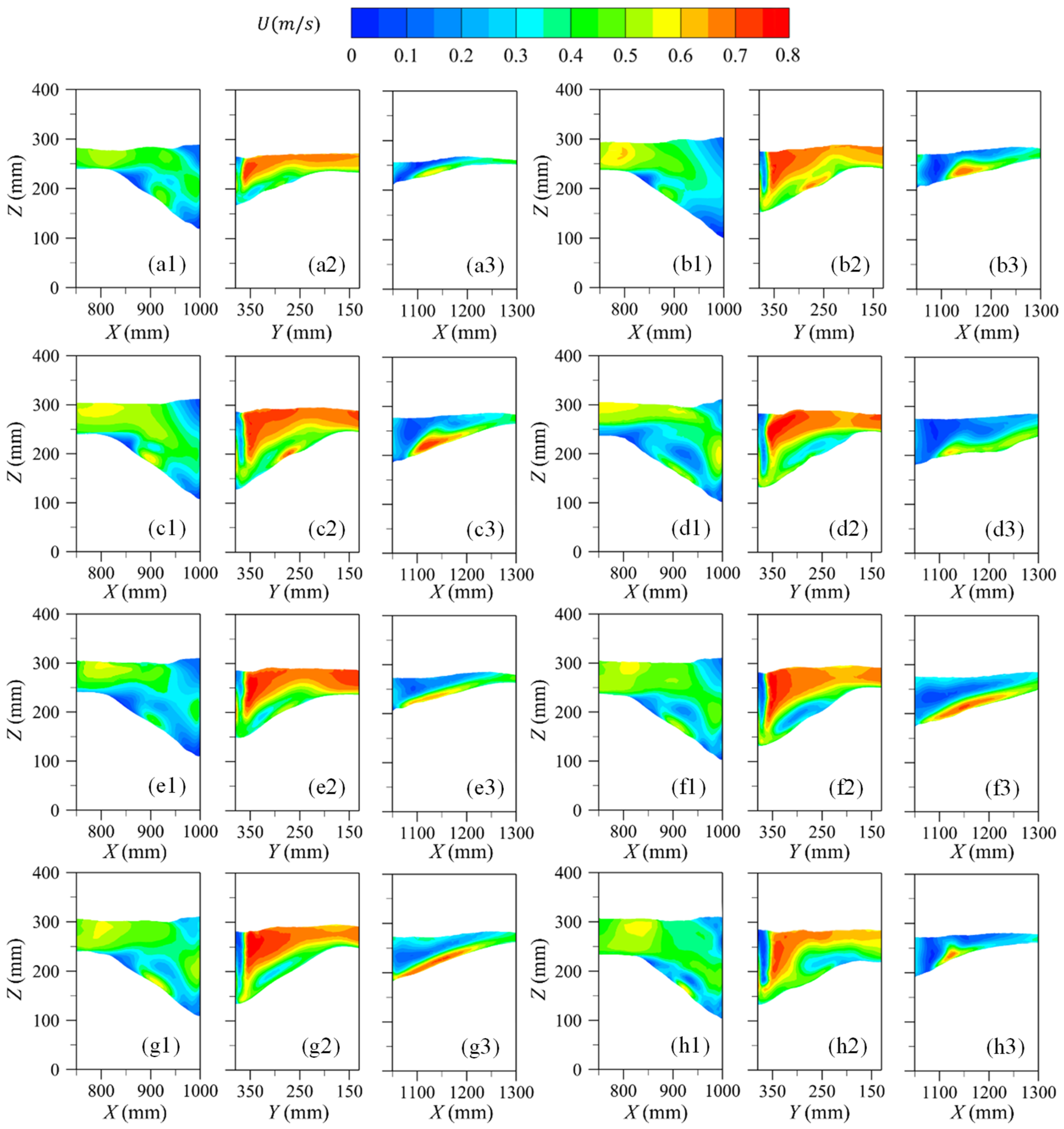
4.1.1. Velocity Distribution
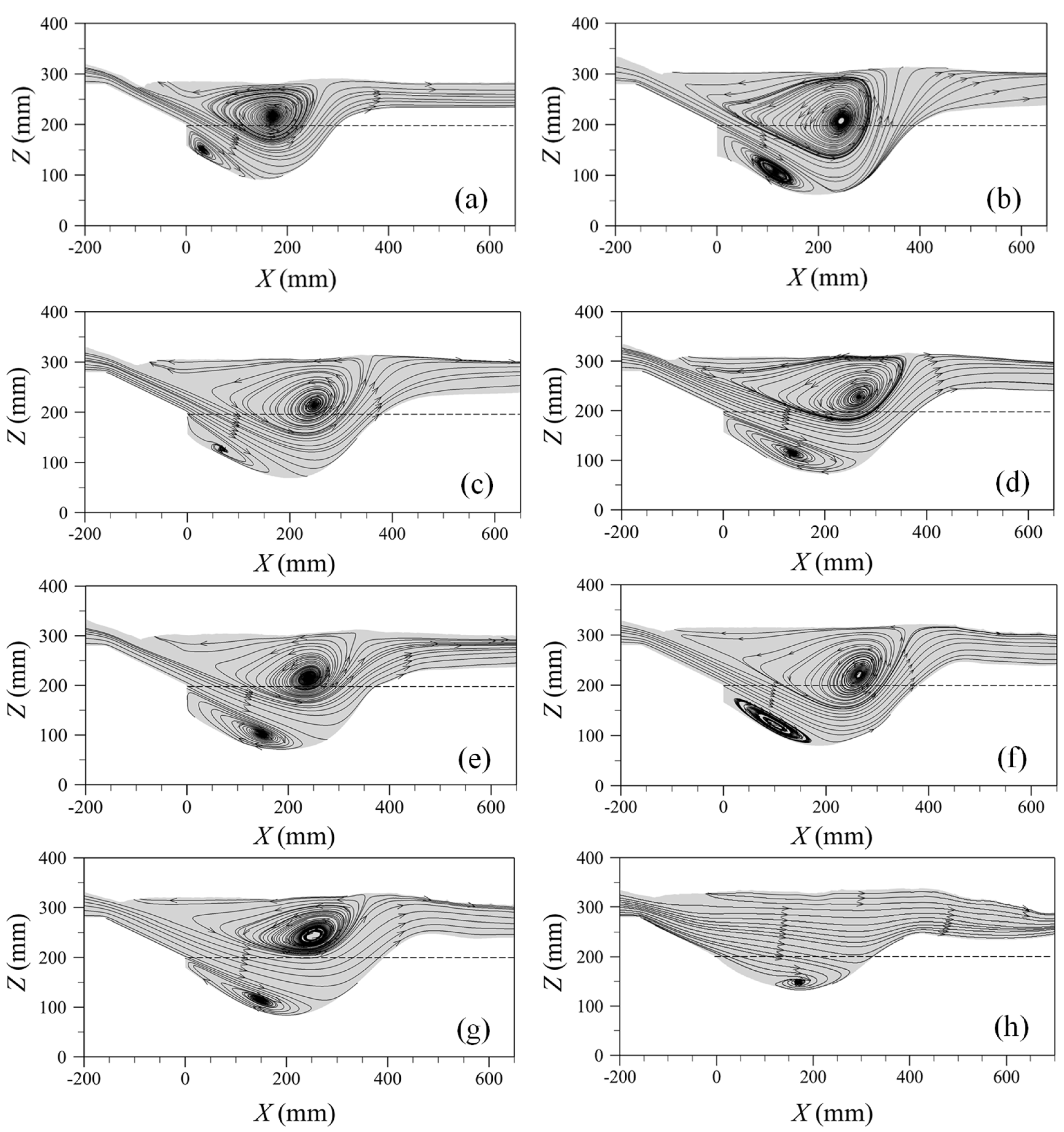
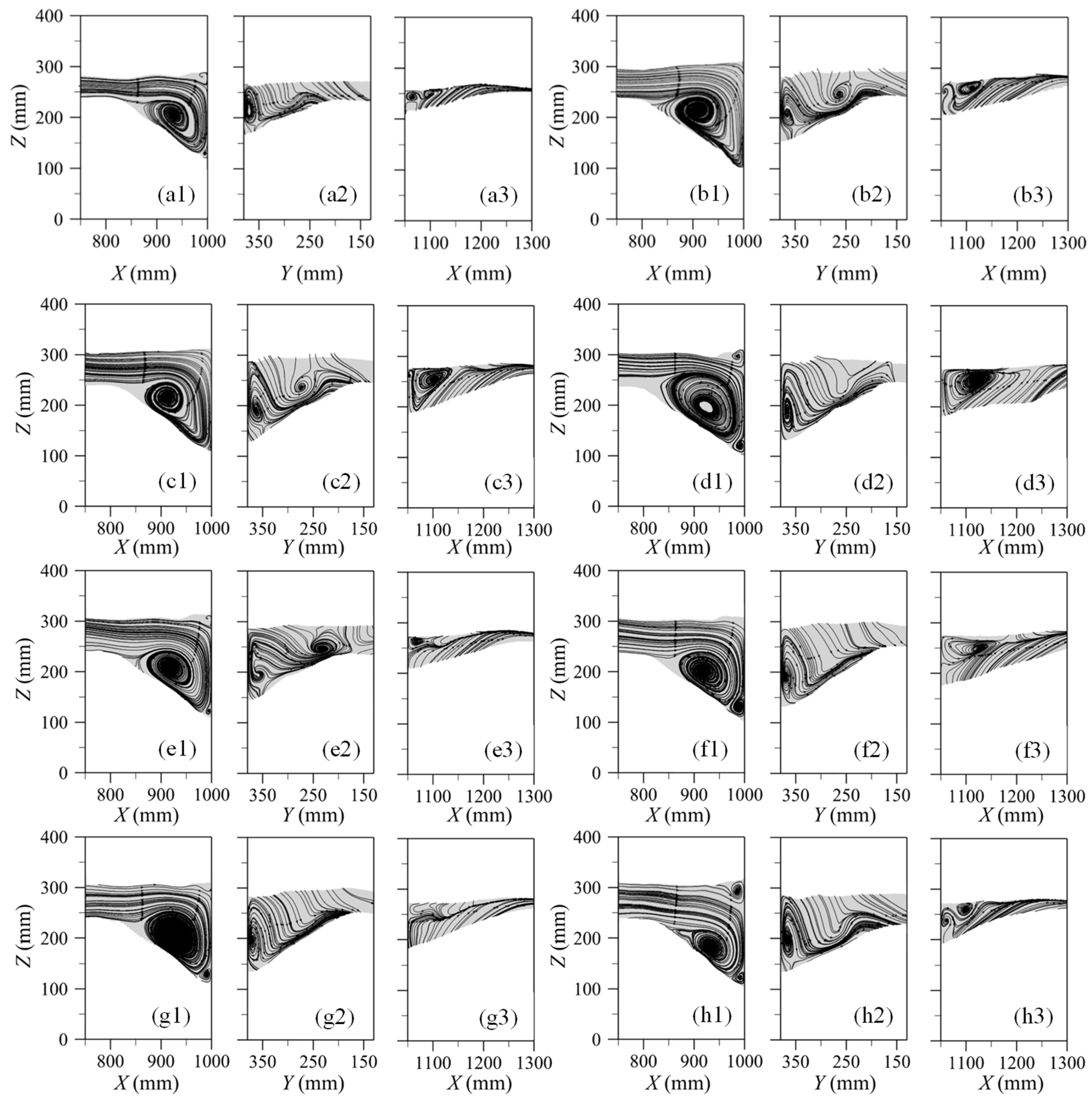
4.1.2. Streamline Patterns
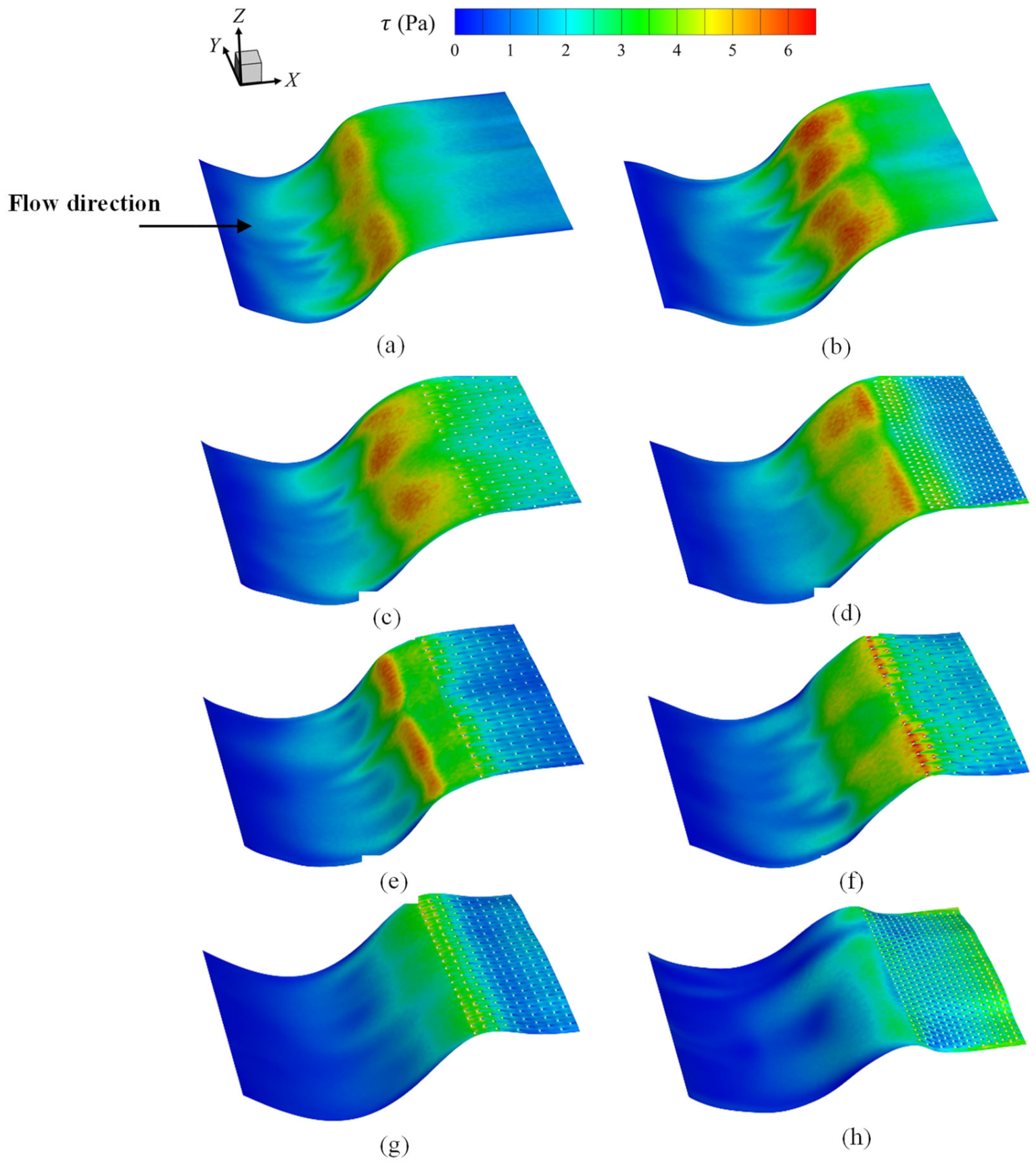
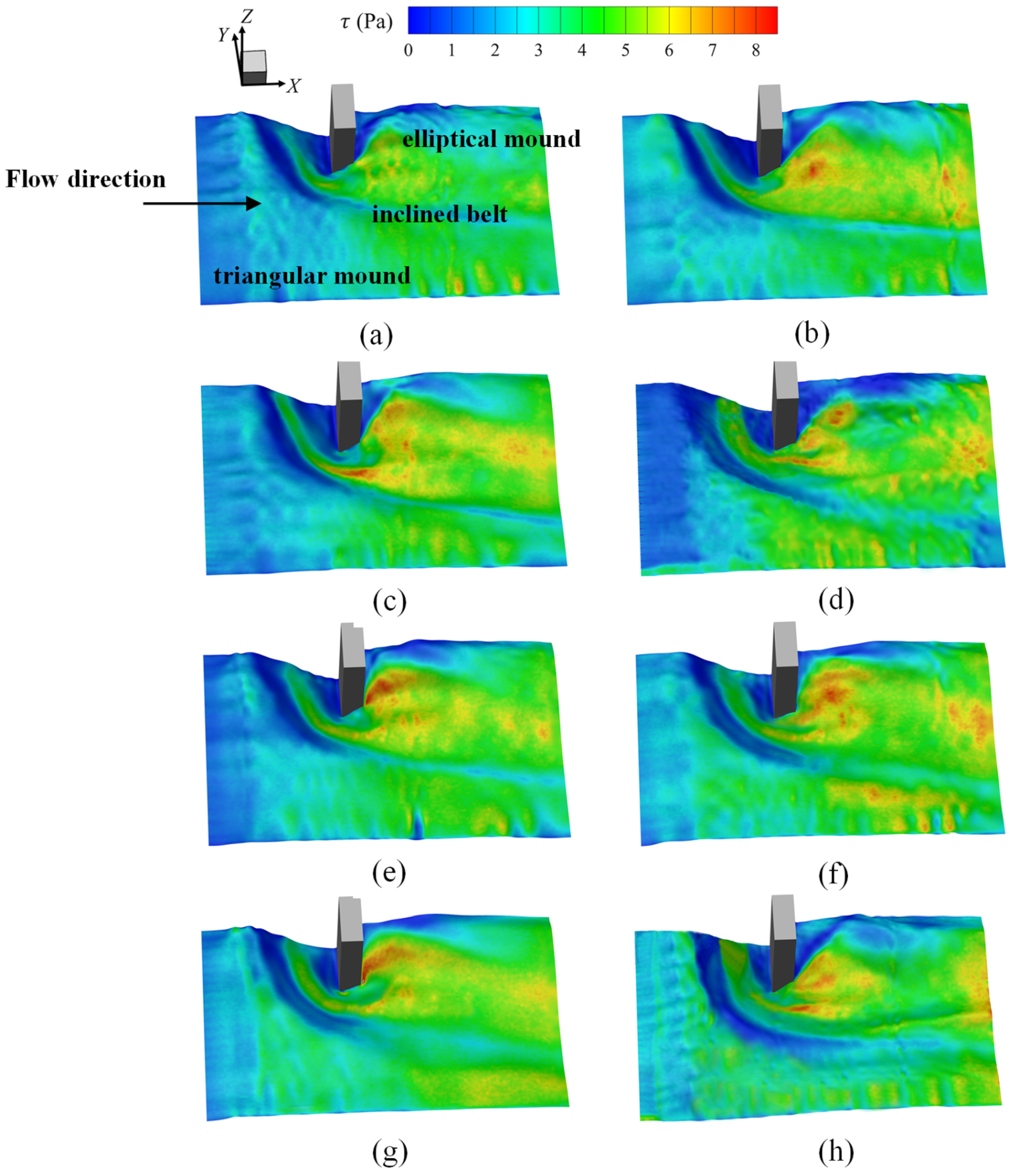
4.1.3. Distribution of Bed Shear Stress
4.2. Local Scour Around Structures
4.2.1. Velocity Distribution
4.2.2. Streamline Patterns
4.2.3. Distribution of Bed Shear Stress
5. Conclusions
Author Contributions
Funding
Data Availability Statement
Conflicts of Interest
References
- Mori, N.; Takahashi, T.; Yasuda, T.; Yanagisawa, H. Survey of 2011 Tohoku earthquake tsunami inundation and run-up. Geophys. Res. Lett. 2011, 38, L00G14. [Google Scholar] [CrossRef]
- Amiri, N.S.; McGovern, D.J.; Rossetto, T.; Day, R. Experiments on Tsunami-induced scour at circular and rectangular onshore structures. Coast. Eng. 2025, 202, 104818. [Google Scholar] [CrossRef]
- Olsen, M.J.; Cheung, K.F.; YamazakI, Y.; Butcher, S.; Garlock, M.; Yim, S.; McGarity, S.; Robertson, I.; Burgos, L.; Young, Y.L. Damage assessment of the 2010 Chile earthquake and tsunami using terrestrial laser scanning. Earthq. Spectra 2012, 28, 179–197. [Google Scholar] [CrossRef]
- Tonkin, S.P.; Francis, M.; Bricker, J.D. Limits on coastal scour depths due to tsunami. Int. Efforts Lifeline Earthq. Eng. 2014, 38, 671–678. [Google Scholar]
- Mitobe, Y.; Adityawan, M.B.; Tanaka, H.; Kawahara, T.; Kurosawa, T.; Otsushi, K. Experiments on local scour behind coastal dikes induced by tsunami overflow. Coast. Eng. Proc. 2014, 1, 62. [Google Scholar] [CrossRef]
- Yoshida, K.; Maeno, S.; Iiboshi, T.; Araki, D. Estimation of hydrodynamic forces acting on concrete blocks of toe protection works for coastal dikes by tsunami overflows. Appl. Ocean Res. 2018, 80, 181–196. [Google Scholar] [CrossRef]
- Takegawa, N.; Sawada, Y.; Kawabata, T. Geogrid-based countermeasures against scour behind coastal dikes under tsunami overflow. Mar. Georesour. Geotechnol. 2019, 38, 64–72. [Google Scholar] [CrossRef]
- Rahman, M.A.; Tanaka, N. Countermeasure against local scouring and tsunami damage by landward forests behind a coastal embankment. Appl. Ocean Res. 2022, 120, 103070. [Google Scholar] [CrossRef]
- Rahman, M.A.; Tanaka, N.; Reheman, N. Experimental study on reduction of scouring and tsunami energy through a defense system consisting a seaward embankment followed by vertically double layered vegetation. Ocean Eng. 2021, 234, 108816. [Google Scholar] [CrossRef]
- Danielsen, F.; Sørensen, M.K.; Olwig, M.F.; Selvam, V.; Parish, F.; Burgess, N.D.; Hiraishi, T.; Karunagaran, V.M.; Rasmussen, M.S.; Hansen, L.B.; et al. The Asian Tsunami: A protective role for coastal vegetation. Science 2005, 310, 643. [Google Scholar] [CrossRef]
- Matsuba, S.; Mikami, T.; Jayaratne, R.; Shibayama, T.; Esteban, M. Analysis of tsunami behavior and the effect of coastal forest in reducing tsunami force around coastal dikes. Coast. Eng. Proc. 2014, 1, 37. [Google Scholar] [CrossRef]
- Rodríguez, R.; Encina, P.; Espinosa, M.; Tanaka, N. Field study on planted forest structures and their role in protecting communities against tsunamis: Experiences along the coast of the Biobío Region, Chile. Landsc. Ecol. Eng. 2015, 12, 1–12. [Google Scholar] [CrossRef]
- Benazir, N.; Triatmadja, R.; Syamsidik, N.; Nizam, N.; Warniyati, N. Vegetation-based approached for tsunami risk reduction: Insights and challenges. Prog. Disaster Sci. 2024, 23, 100352. [Google Scholar] [CrossRef]
- Tanaka, N.; Sasaki, Y.; Mowjood, M.I.M.; Jinadasa, K.B.S.N.; Homchuen, S. Coastal vegetation structures and their functions in tsunami protection: Experience of the recent Indian Ocean tsunami. Landsc. Ecol. Eng. 2006, 3, 33–45. [Google Scholar] [CrossRef]
- Lin, Y.-T.; Ji, J.; Han, D.; Yuan, Y. Impacts of coastal vegetation on tsunami-induced overtopping scour behind embankments and local scour around buildings. Appl. Ocean Res. 2025, 165, 104848. [Google Scholar] [CrossRef]
- Anjum, N.; Tanaka, N. Study on the Turbulent Flow Behavior of Inland Inundating Tsunami Current Through Vertically Layered Vegetation. Int. J. Civ. Eng. 2023, 21, 1219–1235. [Google Scholar] [CrossRef]
- Yang, Y.; Lin, Y.-T.; Ji, X. Hydrodynamic characteristics of flow over emergent vegetation in a strongly curved channel. J. Hydraul. Res. 2021, 60, 240–257. [Google Scholar] [CrossRef]
- Han, D.; He, Z.; Lin, Y.; Wang, Y.; Guo, Y.; Yuan, Y. Hydrodynamics and sediment transport of downslope turbidity current through rigid vegetation. Water Resour. Res. 2023, 59, e2023WR034421. [Google Scholar] [CrossRef]
- Zhang, H.; Zhang, M.; Xu, T.; Tang, J. Numerical investigations of tsunami Run-Up and flow structure on coastal vegetated beaches. Water 2018, 10, 1776. [Google Scholar] [CrossRef]
- Torita, H.; Masaka, K.; Tanaka, N.; Iwasaki, K.; Hasui, S.; Hayamizu, M.; Nakata, Y. Assessment of the effect of thinning on the resistance of Pinus thunbergii parlat. trees in mature coastal forests to tsunami fluid forces. J. Environ. Manag. 2021, 284, 111969. [Google Scholar] [CrossRef]
- Anjum, N.; Iqbal, S.; Pasha, G.A.; Tanaka, N.; Ghani, U. Optimizing coastal forest arrangements for tsunami flow dynamics using a three-dimensional approach. Phys. Fluids 2025, 37, 035197. [Google Scholar] [CrossRef]
- Kirkil, G.; Constantinescu, G. Flow and turbulence structure around an in-stream rectangular cylinder with scour hole. Water Resour. Res. 2010, 46, W11549. [Google Scholar] [CrossRef]
- Kalidindi, M.K.; Khosa, R. Evolution of coherent structures in the flow around a circular pier with a developing scour hole: A numerical study. Phys. Fluids 2024, 36, 025119. [Google Scholar] [CrossRef]
- Ansys Inc. Ansys Fluent User Manual; Ansys Inc.: Canonsburg, PA, USA, 2020. [Google Scholar]
- Lin, Y.-T.; Yang, Y.; Chiu, Y.-J.; Ji, X. Hydrodynamic Characteristics of Flow in a Strongly Curved Channel with Gravel Beds. Water 2021, 13, 1519. [Google Scholar] [CrossRef]
- Rajaratnam, N. Turbulent Jets; Elsevier Health Sciences: Amsterdam, The Netherlands, 1976. [Google Scholar]


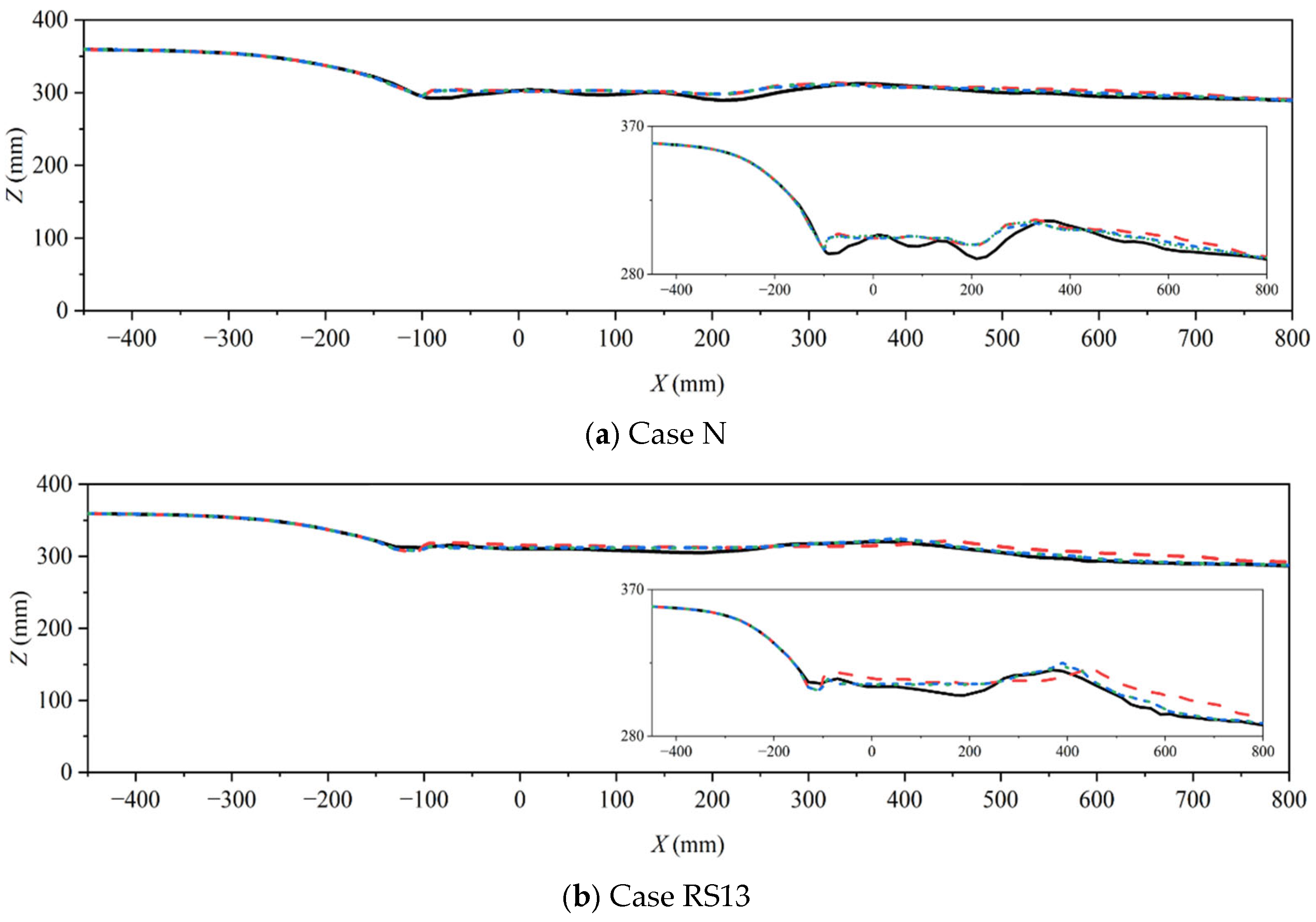
” represents the experimental results, and “
”, “
”, and “
” denote the results for course, median, and fine meshes, respectively. The inset figure enlarges the Z-axis scale and reduces the -axis scale to facilitate observation of differences in water surface elevation between the experimental results and numerical simulations.
” represents the experimental results, and “
”, “
”, and “
” denote the results for course, median, and fine meshes, respectively. The inset figure enlarges the Z-axis scale and reduces the -axis scale to facilitate observation of differences in water surface elevation between the experimental results and numerical simulations.


| No. | Case | Vegetation Parameters | Vegetation Type | Number of Grids (Millions) | ||
|---|---|---|---|---|---|---|
| Rigidity | (cm) | (%) | ||||
| 1 | N (= 0.41) | / | / | / | / | 2.27 |
| 2 | N (= 0.58) | / | / | / | / | 2.35 |
| 3 | FS13 (= 0.58) | Flexible | 13 | 1.38 | Submerged | 3.61 |
| 4 | FD13 (= 0.58) | Flexible | 13 | 5.40 | Submerged | 4.44 |
| 5 | RS5 = 0.58) | Rigid | 5 | 1.38 | Submerged | 2.94 |
| 6 | RS13= 0.58) | Rigid | 13 | 1.38 | Emergent | 4.67 |
| 7 | RM13= 0.58) | Rigid | 13 | 2.32 | Emergent | 5.77 |
| 8 | RD13= 0.58) | Rigid | 13 | 5.40 | Emergent | 8.36 |
| Grid Resolution | Grid Size of the Computational Domain ① (mm) | Local Refined Grid Size (mm) | Grid Size of the Computational Domain ② (mm) | Total Number of Grids (Million) | M.A.E. (mm) |
|---|---|---|---|---|---|
| Course | 18 | 6 | 28 | 1.08 | 3.07 |
| Median | 12 | 4 | 28 | 2.35 | 2.58 |
| Fine | 10 | 2 | 28 | 7.38 | 2.57 |
| Grid Resolution | Grid Size of the Computational Domain ① (mm) | Local Refined Grid Size (mm) | Grid Size of Vegetation Surface (mm) | Grid Size of the Computational Domain ② (mm) | Total Number of Grids (Million) | M.A.E. (mm) |
|---|---|---|---|---|---|---|
| Course | 12 | 4 | 3 | 28 | 2.85 | 4.67 |
| Median | 12 | 4 | 2 | 28 | 4.67 | 1.89 |
| Fine | 12 | 4 | 1 | 28 | 10.11 | 1.74 |
Disclaimer/Publisher’s Note: The statements, opinions and data contained in all publications are solely those of the individual author(s) and contributor(s) and not of MDPI and/or the editor(s). MDPI and/or the editor(s) disclaim responsibility for any injury to people or property resulting from any ideas, methods, instructions or products referred to in the content. |
© 2026 by the authors. Licensee MDPI, Basel, Switzerland. This article is an open access article distributed under the terms and conditions of the Creative Commons Attribution (CC BY) license.
Share and Cite
Ji, X.; Ji, J.; Lin, Y.-T.; Han, D.; You, N.; Liu, Y.; Fan, Y. Numerical Modeling of Vegetation Influence on Tsunami-Induced Scour Mechanisms. J. Mar. Sci. Eng. 2026, 14, 401. https://doi.org/10.3390/jmse14040401
Ji X, Ji J, Lin Y-T, Han D, You N, Liu Y, Fan Y. Numerical Modeling of Vegetation Influence on Tsunami-Induced Scour Mechanisms. Journal of Marine Science and Engineering. 2026; 14(4):401. https://doi.org/10.3390/jmse14040401
Chicago/Turabian StyleJi, Xiaosheng, Jiufeng Ji, Ying-Tien Lin, Dongrui Han, Ningdong You, Yong Liu, and Yingying Fan. 2026. "Numerical Modeling of Vegetation Influence on Tsunami-Induced Scour Mechanisms" Journal of Marine Science and Engineering 14, no. 4: 401. https://doi.org/10.3390/jmse14040401
APA StyleJi, X., Ji, J., Lin, Y.-T., Han, D., You, N., Liu, Y., & Fan, Y. (2026). Numerical Modeling of Vegetation Influence on Tsunami-Induced Scour Mechanisms. Journal of Marine Science and Engineering, 14(4), 401. https://doi.org/10.3390/jmse14040401