Article

Occlusion-Robust Swarm Motion via Pheromone-Modulated Orientation Change

College of Marine Engineering, Northwestern Polytechnical University, Chang’an Campus, Xi’an 710129, China
*
Author to whom correspondence should be addressed.
J. Mar. Sci. Eng. 2026, 14(4), 399; https://doi.org/10.3390/jmse14040399
Submission received: 23 January 2026 / Revised: 17 February 2026 / Accepted: 19 February 2026 / Published: 22 February 2026
(This article belongs to the Section Ocean Engineering)

Abstract

Effective collective motion hinges on the seamless transfer of local information, yet vision-based mechanisms, while potent for generating rapid consensus, are inherently fragile. Visual links can be severed instantly by occlusions, leading to a phenomenon characterized as “sensory amnesia.” Seeking to fortify this vulnerability, Pheromone-Modulated Body Orientation Change (PM-BOC) is introduced as a dual-channel framework that fuses transient visual cues with a persistent environmental memory. Rather than treating these inputs in isolation, motion salience is quantified via BOC and mapped onto a decaying virtual pheromone field, dynamically modulating interaction weights by coupling instantaneous visual projections with local pheromone concentrations. This strategy effectively constructs a temporal buffer, bridging the informational voids left by blind spots. Validation, spanning from systematic physics simulations to high-fidelity simulations with a swarm of 50 UUVs, reveals that PM-BOC sustains superior cohesion in obstacle-laden environments where baseline visual models falter. Notably, this coupling suppresses high-frequency sensory noise while inducing resilient, scale-free velocity correlations that scale linearly with system size. By reconciling the trade-off between the immediacy of visual responsiveness and the robustness of environmental memory, this study offers a scalable paradigm for engineering resilient swarm systems capable of navigating the uncertainties of perception-limited environments.

1. Introduction

Biological swarms achieve coherent collective motion through local interactions and remain functional under partial sensing and intermittent visibility. Replicating this robustness in engineered swarms is central to robotics and control [1,2]. These biological systems demonstrate a remarkable ability to achieve global consensus and navigate complex environments through simple local interactions, exhibiting emergent properties such as high polarization, rapid response to perturbations, and scale-free correlations that lie at the edge of criticality [3,4]. Translating these biological principles into artificial swarm intelligence remains a central theme in robotics and control theory [5]. The ultimate engineering ambition is to create autonomous swarm systems—ranging from aerial drone fleets [6], which increasingly leverage active reconfigurable intelligent surfaces to ensure secure and energy-efficient communication even under jittering conditions [7], to schools of Unmanned Underwater Vehicles (UUVs) [8]—that possess the resilience, scalability, and adaptability inherent in their biological counterparts. Although recent surveys have highlighted significant advances and prospects in enhanced UAV communications [9], translating these capabilities into the underwater domain remains challenging. Such systems hold transformative potential for critical applications where global communication is denied or impractical. Unlike cognitive satellite–terrestrial networks that can utilize robust cooperative beamforming for security [10], deep-sea exploration, disaster relief in cluttered environments, and large-scale environmental monitoring [11] face severe physical constraints that often preclude radio-frequency solutions.
Work over the last few years has pushed vision-only swarms closer to practical deployment. Using only onboard cameras, robot groups can already sustain collisionless polarized motion, even with limited fields of view and in confined arenas [12]. At the same time, first-person motion-salience measurements provide a mechanistic link between what an agent sees and how fast consensus forms [13]. Across platforms and domains, recent surveys converge on a common message: perception-driven local cues are powerful, but their reliability is tightly coupled to visibility [14]. These efforts are increasingly backed by robotic validation and by models that connect perception-driven cues to emergent correlations and information flow [15].
To emulate these behaviors, the modeling of collective motion has historically evolved from metric-based zones of repulsion, orientation, and attraction [16] to topological interactions that account for variable density [17]. However, recent advancements have increasingly shifted focus towards vision-based interaction paradigms, which are considered more biologically plausible and engineering-friendly given the ubiquity of onboard cameras and the scarcity of reliable global positioning in denied environments [18,19]. Unlike metric models that require precise state information, vision-based models rely on the projection of neighbors onto the focal individual’s retina [20]. Within this domain, discerning what visual information triggers a response is crucial. A pivotal study by Zheng et al. (2024) recently identified Body Orientation Change (BOC) as a significant visual cue [21]. Their work demonstrated that BOC effectively characterizes the motion salience of neighbors, signaling not just where a neighbor is, but what it is intending to do, thereby facilitating rapid information transfer and the emergence of scale-free correlations in ideal, open environments. Similarly, recent research on hierarchical group dynamics and visual attention mechanisms has further underscored the importance of specific visual cues in governing collective decisions [22,23].
Despite these significant strides, current vision-based mechanisms, including standard BOC models, rest on an ideal assumption: the availability of a continuous, reliable line of sight. In realistic engineering scenarios, particularly for UUV swarms operating in turbid waters or obstacle-laden subsea canyons, visual links are frequently and unpredictably severed [24,25]. We characterize this fundamental limitation as “Sensory Amnesia”: vision is an instantaneous sensory flux; once a neighbor is occluded by an obstacle or another peer, the directional information it carries vanishes instantly from the observer’s cognitive field. This lack of temporal persistence renders purely vision-based swarms highly susceptible to fragmentation [26]. Recent occlusion-aware vision models show that partial visibility can alter alignment dynamics and delay the onset of order [27]. Complementary work has proposed fault-tolerant vision-based interaction rules that preserve collective motion under sensing disruptions [28]. When the visual chain is broken, the “avalanche” of information transfer described in starling flocks [19] halts, causing the swarm to lose coherence during sharp collective turns or when navigating through clutter. Revealing the hidden networks of interaction in such mobile groups remains a challenge when the physical layer is unreliable [29]. Consequently, reconciling the transient nature of visual perception with the requirement for persistent environmental memory constitutes a critical bottleneck in engineering resilient swarm systems [30,31].
To address this challenge, we look beyond vertebrate vision to another highly successful biological communication strategy: stigmergy, commonly observed in social insects such as ants and termites [32]. Stigmergy enables indirect coordination through modification of the environment, typically via chemical pheromones. Unlike vision, pheromones provide persistent environmental memory, a temporal buffer that slowly decays over time [33]. Although traditional ant colony optimization (ACO) and particle swarm optimization (PSO) algorithms utilize pheromones primarily for static path planning or optimization tasks [34,35], the integration of such “digital pheromones” into dynamic high-speed control loops of flocking swarms remains underexplored. Meanwhile, automatic design frameworks have started to optimize stigmergy-based behaviors and validate them in robot swarms, making virtual pheromones more systematic and reproducible [36]. Recent robotic swarm experiments also show that robust cooperation can emerge even with minimal sensing when interaction channels are designed carefully [37]. Recent work in “virtual pheromones” for robotics has shown promise in maintaining connectivity and enabling self-assembly [38,39,40], yet they often lack the integration with rapid visual cues required for agile maneuvering in fluids. The intersection of these two distinct sensory modalities, visual salience and digital pheromones, offers a promising avenue for overcoming the limitations of sensory occlusion. Furthermore, understanding how the dynamics of synchronization emerge from pulse-coupled oscillators [41] and variable speeds provides a theoretical basis for coupling these disparate timescales.
In this paper, we propose a dual-channel interaction framework of Pheromone-Modulated Body Orientation Change (PM-BOC). We hypothesize that salient maneuvers should not only trigger immediate visual responses but also deposit a proportional virtual trace in the environment. This coupling ensures that significant behavioral changes leave a temporary history, allowing followers to “sense” the influence of a leader even when it enters a visual blind spot. Specifically, we quantify motion salience via BOC and map it onto a decaying virtual pheromone field, dynamically modulating interaction weights by coupling instantaneous visual projections with local pheromone concentrations. This study makes several contributions to the understanding of robust collective motion. First, we establish a theoretical model that mathematically couples visual projection dynamics with scalar field diffusion processes, defining the PM-BOC mechanism. Second, through systematic physics simulations comparing PM-BOC against baseline visual and random models, we reveal that this coupling suppresses high-frequency sensory noise while inducing resilient, scale-free velocity correlations that scale linearly with system size. This provides a physical explanation for the swarm’s ability to maintain order near criticality. Finally, we validate the engineering practicability of this mechanism using a simulated swarm of 50 UUVs performing complex maneuvers in obstacle-rich environments, demonstrating superior performance in accuracy and responsiveness compared to methods. By reconciling the trade-off between rapid visual responsiveness and robust environmental memory, this work provides a scalable paradigm for engineering resilient swarm systems capable of navigating perception-limited environments.
Existing vision-based swarm controllers are responsive but fragile under intermittent visibility and occlusions. PM-BOC addresses this gap with a dual-channel local interaction rule: a fast BOC-based visual cue for alignment and a reaction–diffusion pheromone memory that provides a persistent cue during short visual outages. Unlike approaches relying on explicit communication or global planning, PM-BOC remains fully local and lightweight, and we validate it using both macroscopic metrics (order and correlations) and engineering-scale UUV simulations.

2. Problem Formulation

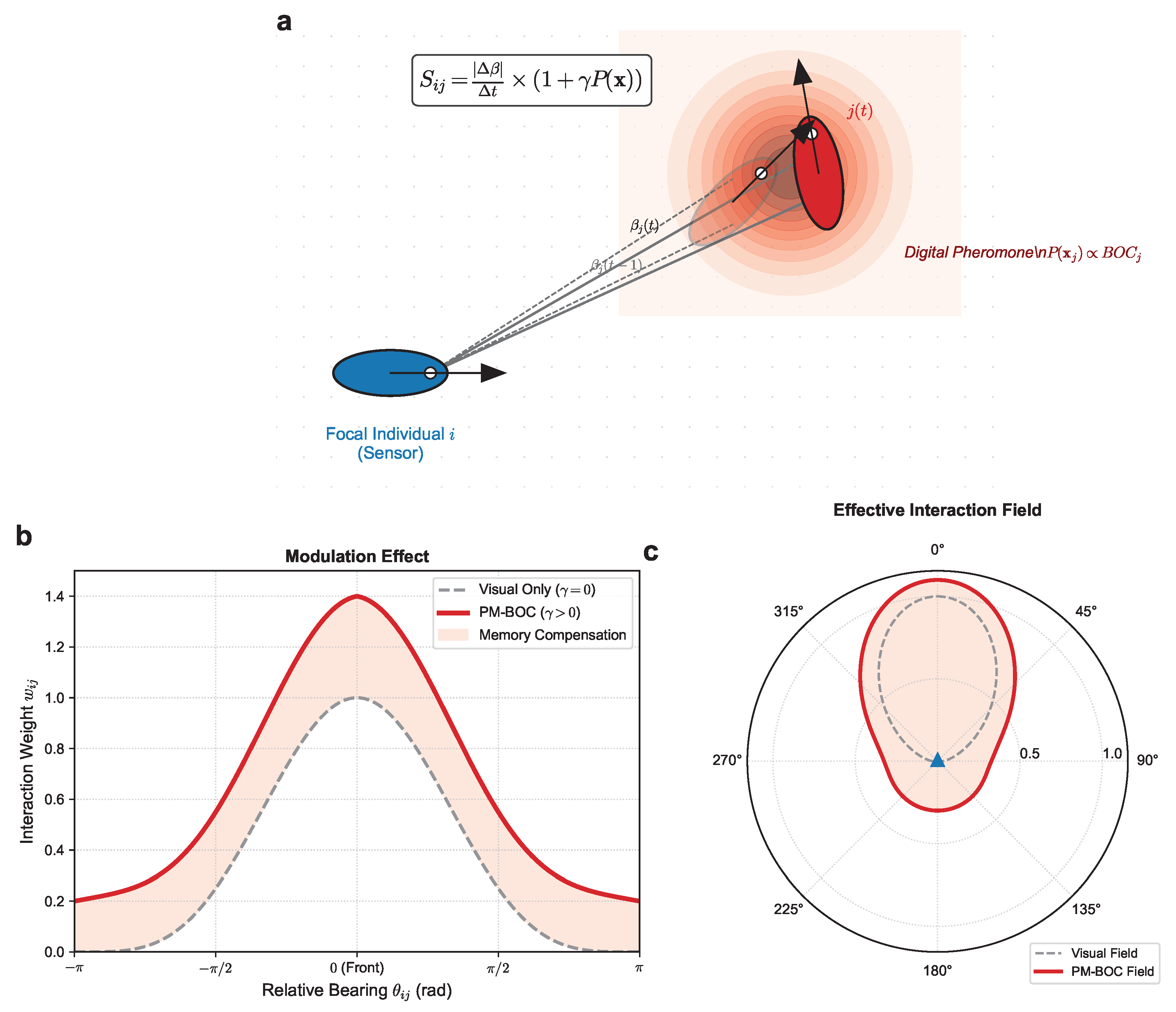
This section defines the mathematical model of the Pheromone-Modulated Body Orientation Change (PM-BOC) mechanism. As shown in Figure 1, PM-BOC fuses two channels: a fast visual cue (Channel I) and a persistent environmental memory (Channel II). The coupling is adaptive and is designed for obstacle-rich domains where line-of-sight is often interrupted.

2.1. Agent Dynamics and Environment Description

We consider N identical agents moving in a bounded domain D with M static obstacles O = { O 1 , , O M } . Although the physical scene may be three-dimensional, we study planar motion at a fixed depth, so the state is defined on a 2D horizontal slice.1 The position is r i ( t ) D R 2 , and the unit heading is v ^ i ( t ) S 1 .
The agents move with a constant speed s 0 . The kinematic update follows a first-orderintegrator:
r i ( t + Δ t ) = r i ( t ) + s 0 v ^ i ( t ) Δ t .
The heading update is governed by a composite target vector d i ( t ) :
v ^ i ( t + Δ t ) = R η d i ( t ) d i ( t ) ,
d i ( t ) = ( 1 ω ) v ^ i ( t ) + k obs f obs i ( t ) + k soc F soc i ( t ) ,
where ω [ 0 , 1 ) is the inertia weight. We explicitly introduce k obs 0 and k soc 0 to ensure consistent scaling among the direction-like terms.2 The operator R η ( · ) injects directional noise (defined below), and f obs i and F soc i are the obstacle avoidance term and the proposed dual-channel social term, respectively.

2.1.1. NoiseOperator R η

In 2D, R η rotates a unit vector by a random angle ξ i ( t ) :
R η v ^ = cos ξ i ( t ) sin ξ i ( t ) sin ξ i ( t ) cos ξ i ( t ) v ^ , ξ i ( t ) N ( 0 , η 2 ) ,
We model heading noise as a zero-mean Gaussian perturbation. The parameter η is the standard deviation of the perturbation in radians, so it directly controls noise strength. This choice is standard and makes the simulation settings easy to reproduce.

2.1.2. Obstacle Avoidance f obs i ( t )

Let d i m ( t ) be the Euclidean distance from r i ( t ) to obstacle O m and let n i m ( t ) be the outward unit normal pointing from the closest point on O m to r i ( t ) . We use a common repulsive potential-field form with an activation distance R obs :
f obs i ( t ) = m = 1 M I d i m ( t ) < R obs 1 d i m ( t ) 1 R obs 1 d i m 2 ( t ) n i m ( t ) ,
where I [ · ] is the indicator function. This term enforces collision avoidance while keeping the formulation simple.

2.2. Channel I: Transient Visual Salience via BOC

Channel I uses instantaneous visual perception. Let N i vis ( t ) be the visible neighbor set of agent i. A neighbor j is included if it lies within range R vis and field-of-view θ FOV , and if the segment r i r j ¯ does not intersect any obstacle in O (occlusion constraint).
We postulate that the visual interaction weight is modulated by the Body Orientation Change (BOC), which quantifies motion salience. The instantaneous BOC magnitude of neighbor j is defined as the discrete angular speed:
β j ( t ) = arccos clip v ^ j ( t ) · v ^ j ( t Δ t ) , 1 , 1 Δ t ,
where clip ( · , 1 , 1 ) prevents numerical issues due to floating-point errors.

Normalization Constant β max

We use β max as a deterministic upper bound for normalization in Equation (8). In principle, the geometric upper bound is π / Δ t . In practice, both simulation and hardware impose an effective turning-rate limit (actuation and controller saturation), and we set β max to this empirical bound to avoid over-amplifying rare outliers. Therefore, β max in Table 1 should be interpreted as the maximum achievable turning rate in each setting, while π / Δ t remains the absolute geometric limit.
β max = π Δ t .
The visual interaction vector is then defined as the BOC-weightedsum of neighbors’ headings:
u i vis ( t ) = j N i vis ( t ) 1 + γ β j ( t ) β max v ^ j ( t ) ,
where γ > 0 controls the sensitivity to maneuvering neighbors. Note that an explicit division by j ( · ) is not required here because the subsequent ϵ -regularized normalization in (12) removes magnitude dependence.

2.3. Channel II: Persistent Environmental Memory

Channel II introduces a scalar virtual pheromone field P ( x , t ) : D × [ 0 , ) R + . The field stores recent motion history and provides a local memory cue during short visual outages.
The field evolves according to a reaction–diffusion equation:
P ( x , t ) t = D 2 P ( x , t ) λ P ( x , t ) + S ( x , t ) ,
where D is the diffusion coefficient and λ is the decay rate.

2.3.1. Boundary Conditions and Discretization

We discretize D on a uniform grid with spacing Δ x . We apply no-flux (Neumann) conditions, P · n = 0 , on the outer boundary and on obstacle boundaries to avoid artificial pheromone loss through walls. We integrate in time with forward Euler using step size Δ t P (typically Δ t P = Δ t ). For the explicit diffusion update in 2D, we enforce the usual stability guideline Δ t P Δ x 2 4 D .

2.3.2. Source Term Coupled to BOC

Agents deposit pheromone proportional to their instantaneous turning rate:
S ( x , t ) = k = 1 N δ Δ x x r k ( t ) S 0 + k p β k ( t ) ,
where S 0 is a basal deposition rate and k p is the BOC-dependent deposition coefficient.
Dimensional interpretation and cross-channel scaling: In Equation (9), P ( x , t ) is a virtual scalar memory whose absolute magnitude is not assumed to be physical; we therefore treat P in arbitrary units (a.u.) and only use its normalized gradient direction as a control cue via Equations (11) and (12). Under this convention, the source term S ( x , t ) in Equation (10) has units of a.u./s, and S 0 is a basal deposition rate (a.u./s) that maintains a weak background memory trace even when β ( t ) 0 . The coefficient k p is a BOC-to-deposition gain that converts instantaneous turning activity into persistent environmental salience; specifically, k p β ( t ) has the same units as S 0 . Importantly, cross-channel comparability is ensured by the fusion design: both cues are converted into direction-like signals by u ˜ ( · ) in Equation (23), so the final social term depends on direction rather than magnitude. Consequently, ( S 0 , k p ) affect the spatial structure and persistence of the memory field, while ( γ , β max ) shape the instantaneous salience of the visual cue in Equation (8); the two channels become comparable at the control level because both enter Equation (22) as normalized vectors.
Here, δ Δ x ( · ) is a discrete injection kernel on the grid. In implementation we use bilinear splatting to the four neighboring cells. This yields a smooth field and avoids aliasing artifacts while remaining fully reproducible.

2.3.3. Memory Cue from the Pheromone Gradient

The memory-driven tendency is defined by the local gradient
u i mem ( t ) = P ( r i ( t ) , t ) ,
computed via central differences on the grid (with bilinear interpolation at r i ( t ) ). If P is numerically negligible, the memory channel becomes inactive through (12).

2.4. The PM-BOC Coupling Mechanism

The total social interaction term is the dynamic fusion of the two channels. We use an ϵ -regularized normalization:
u ˜ ( u ) = u u + ϵ , ϵ > 0 ,
and define
F i soc ( t ) = 1 α i ( t ) u ˜ u i vis ( t ) + α i ( t ) u ˜ u i mem ( t ) .
If u i vis ( t ) < ϵ (respectively, u i mem ( t ) < ϵ ), we set the corresponding normalized direction to 0 to suppress spurious directions caused by numerical jitter.
The adaptive coupling coefficient α i ( t ) [ 0 , 1 ] is determined by the local visual information density. We define a normalized reliability score and explicitly clamp it into [ 0 , 1 ] :
r i ( t ) = min 1 , | N i vis ( t ) | N nom , α i ( t ) = 1 1 + exp k switch r i ( t ) r thr ,
where r thr ( 0 , 1 ) is the switching threshold and k switch > 0 controls transition sharpness. With this definition, r i ( t ) r thr implies the visual channel is sufficiently reliable and α i 0 (high-bandwidth mode), whereas r i ( t ) < r thr triggers a shift towards the memory channel and α i 1 .

Nominal Visible-Neighbor Count N nom

We select N nom based on the expected local sensing graph density under nominal conditions. For planar sensing with radius R s and FOV angle θ FOV (radians), the nominal neighbor count is
N nom = max 1 , ρ θ FOV 2 π π R s 2 ( 1 p occ ) ,
where ρ is the nominal agent density (agents/m2) and p occ is the estimated probability that a line-of-sight link is occluded by obstacles. This construction makes r thr transferable across different densities and obstacle rates.
Online estimation of occlusion probability p occ . The occlusion probability in Equation (15) does not require offline map knowledge. In both simulation (ray casting) and experiments (line-of-sight check from onboard perception), each agent can maintain an online estimator over a sliding window of length W:
p ^ occ ( t ) = τ = t W + 1 t j N i cand ( τ ) 1 { LOS ( i , j , τ ) is blocked } τ = t W + 1 t | N i cand ( τ ) | ,
where N i cand ( τ ) denotes candidate neighbors within ( R s , θ FOV ) before applying the occlusion test. This estimator converges rapidly because the LOS test is already executed to construct N i vis ( t ) .

3. Theoretical Analysis and Performance Metrics

This section links the analysis to the discrete-time model in Section 2 and defines the macroscopic metrics used in evaluation. We first derive a one-step non-increase condition for a standard misalignment energy under the heading update. We then give an equivalent interpretation of the fusion rule as an adaptive complementary filter that captures the dominant memory time scale. Finally, we specify reproducible order and correlation metrics for obstacle-rich, perception-limited swarms.

3.1. Stability Analysis of the Dual-Channel Coupling

We analyze the discrete-time dynamics in (1)–(2) under planar motion, so v ^ i ( t ) S 1 . We use the mean heading v ¯ ( t ) = 1 N j = 1 N v ^ j ( t ) and the fluctuation v ˜ i ( t ) = v ^ i ( t ) v ¯ ( t ) .
Assumption 1
(Regularity conditions for one-step energy dissipation). The following conditions hold on the time interval of interest:
(A1) 
Informative visual interaction. The BOC-weighted visual cue u i vis ( t ) in (8) is bounded and does not remain identically zero for all agents over long durations.
(A2) 
Bounded coupling and discrete-time updates. The adaptive coefficient satisfies α i ( t ) [ 0 , 1 ] for all i , t . Define α ¯ ( t ) = max i α i ( t ) [ 0 , 1 ] . The system is updated with a finite step Δ t .
(A3) 
Angle-bounded memory alignment (non-adversarial memory). There exist constants c m ( 0 , 1 ] and θ max ( 0 , π / 2 ) such that for all i , t ,
v ¯ ( t ) u i mem ( t ) c m u i mem ( t ) , u i mem ( t ) , v ¯ ( t ) θ max ,
where u i mem ( t ) = P ( r i ( t ) , t ) as defined in Section 2.4.
Remark 1
(Scope of Assumption (A3) and trap scenarios). Assumption (A3) describes the regime where the memory gradient does not oppose the current collective direction. It can fail under long occlusions or when old pheromone traces persist and form trap-like attractors. In practice, PM-BOC limits this risk through exponential decay λ (finite memory horizon) and reliability-based switching in Equation (14), which reduces memory weight once visual connectivity recovers. Proposition 1 should therefore be read as a local robustness statement under non-adversarial memory, not a global guarantee for arbitrary obstacle layouts.
Proposition 1
(One-step non-increase of misalignment energy). Define the misalignment energy
V ( t ) = 1 2 N i = 1 N v ^ i ( t ) v ¯ ( t ) 2 , v ¯ ( t ) = 1 N j = 1 N v ^ j ( t ) .
Under Assumption 1, neglecting obstacle potentials to isolate the social coupling effect, there exist constants c s > 0 and c m 0 such that for sufficiently small Δ t ,
V ( t + Δ t ) V ( t ) whenever c ( t ) 0 ,
where
c ( t ) ( 1 α ¯ ( t ) ) c s α ¯ ( t ) c m .
Proof. 
For sufficiently small per-step rotation (small Δ t and moderate η ), the unit-vector update (2) admits a first-order tangent-space form on S 1 :
v ^ i ( t + Δ t ) = Proj v = 1 v ^ i ( t ) + k gain Δ t I v ^ i ( t ) v ^ i ( t ) k soc F i soc ( t ) + O ( Δ t 2 ) .
A first-order expansion of V ( t + Δ t ) yields
V ( t + Δ t ) V ( t ) k gain Δ t N i = 1 N v ˜ i ( t ) I v ^ i ( t ) v ^ i ( t ) k soc F i soc ( t ) + O ( Δ t 2 ) .
By (12) and (13), the social force is the ϵ -regularized fusion
F i soc ( t ) = 1 α i ( t ) u ˜ u i vis ( t ) + α i ( t ) u ˜ u i mem ( t ) , u ˜ ( u ) = u u + ϵ .
Define F i vis ( t ) = u ˜ ( u i vis ( t ) ) and F i mem ( t ) = u ˜ ( u i mem ( t ) ) so that F i soc ( t ) = ( 1 α i ( t ) ) F i vis ( t ) + α i ( t ) F i mem ( t ) .
Under Assumption 1(A1) and the local small-angle regime consistent with (21), there exists c s > 0 such that
i = 1 N v ˜ i ( t ) I v ^ i ( t ) v ^ i ( t ) F i vis ( t ) c s i = 1 N v ˜ i ( t ) 2 .
Moreover, since F i mem ( t ) = u ˜ ( u i mem ( t ) ) and u ˜ ( · ) 1 for all ϵ > 0 , and the memory direction is angle-bounded by (17), there exists c m 0 (conservatively c m = sin θ max ) such that
i = 1 N v ˜ i ( t ) I v ^ i ( t ) v ^ i ( t ) F i mem ( t ) c m i = 1 N v ˜ i ( t ) 2 .
Using α i ( t ) α ¯ ( t ) and substituting the split form into (22), we obtain
i = 1 N v ˜ i ( t ) I v ^ i ( t ) v ^ i ( t ) k soc F i soc ( t ) k soc c ( t ) i = 1 N v ˜ i ( t ) 2 ,
with c ( t ) given by (20). Substituting (26) into (22) yields (19). □
Remark 2
(Connection to the switching law). The condition c ( t ) 0 is consistent with the reliability-based switching in (14). When the visual channel is reliable ( r i ( t ) large), (14) drives α i ( t ) 0 , so α ¯ ( t ) remains small. Under occlusion ( r i ( t ) small), (14) increases α i ( t ) to improve robustness, but this requires the memory cue to be non-adversarial (small θ max ) so that c m does not dominate.

3.2. Noise Suppression: An Adaptive Complementary Filter (Equivalent Interpretation)

PM-BOC remains robust under sensory noise because the fusion rule (8)–(9) behaves like an adaptive complementary filter. This is an equivalent approximation that captures the dominant time scale set by the decay term λ P in (9). It is not a full transfer-function derivation of the reaction–diffusion PDE.
Assuming a quasi-static coupling coefficient α over a short window, the memory channel exhibits a dominant first-order lag with time constant τ = 1 / λ :
H mem ( s ) 1 τ s + 1 , τ = 1 λ .
The visual channel is high-bandwidth and can be approximated as H vis ( s ) 1 , albeit susceptible to high-frequency noise. Under this approximation, the fused response can be interpreted as
v ^ o u t ( s ) ( 1 α ) v ^ i n ( s ) + Ξ high ( s ) + α · 1 τ s + 1 v ^ i n ( s ) .
Here, v ^ i n denotes the instantaneous alignment cue dominated by the visual channel, and v ^ o u t denotes the effective fused directional response in this equivalent first-order approximation.

Testable Frequency-Domain Prediction

If the memory channel behaves as a low-pass component with time scale τ = 1 / λ , then the fused social cue should exhibit attenuated high-frequency content compared with the purely visual cue. Let x ( t ) denote a scalar projection of the visual cue (e.g., heading increment or signed turning rate) and y ( t ) denote the corresponding projection of the fused output. The ratio of power spectral densities satisfies approximately
PSD y ( f ) PSD x ( f ) 1 1 + ( 2 π f τ ) 2 .

3.3. Macroscopic Order Parameters

We now define macroscopic metrics to quantify ordering, fragmentation, and recovery in a reproducible way. These metrics are computed directly from agent states and can be replicated across implementations.

3.3.1. Global Polarization

The global alignment is measured by
Φ ( t ) = 1 N i = 1 N v ^ i ( t ) .

3.3.2. Normalized Spatial Velocity Correlation (Reproducible Binning Form)

Let u i ( t ) = v ^ i ( t ) v ¯ ( t ) denote the heading fluctuation and let r i j ( t ) = r i ( t ) r j ( t ) . In practice, the Dirac delta used in continuous definitions is implemented by distance binning with bin width Δ r . Define
1 r ( r i j ) = 1 , r Δ r 2 r i j < r + Δ r 2 , 0 , otherwise .
Then, the connected correlation is computed as
C ( r ) = 1 C 0 i j u i ( t ) · u j ( t ) 1 r ( r i j ) i j 1 r ( r i j ) , C 0 = 1 N i = 1 N u i ( t ) 2 ,
so that C ( 0 ) = 1 . The correlation length ζ is defined as the first zero-crossing point C ( ζ ) = 0 .
Choice of Bin Width and Uncertainty for ζ
We use Δ r = 0.5 m in simulation (equal to the field grid spacing) and Δ r = 1.0 m in experiments to balance resolution and sampling noise. We compute ζ per run and report 95% confidence intervals using nonparametric bootstrapping over runs (10,000 resamples). If C ( r ) does not cross zero within the domain, we report ζ L / 2 and treat it as right-censored.

3.3.3. Interaction Network Resilience (Explicit Definition of E mem )

We define an undirected interaction graph
G ( t ) = V , E vis ( t ) E mem ( t ) , V = { 1 , , N } .
where E vis ( t ) is induced by the visible neighbor relation N i vis ( t ) .
To make memory-induced connectivity reproducible, we construct a memory edge when two agents are locally guided by a salient pheromone structure. Choose thresholds P thr > 0 and θ mem ( 0 , π / 2 ) and a radius R mem > 0 . Define
( i , j ) E mem ( t ) r i ( t ) r j ( t ) R mem , P ( r i ( t ) , t ) P thr and P ( r j ( t ) , t ) P thr , P ( r i ( t ) , t ) , P ( r j ( t ) , t ) θ mem .
The structural integrity is measured by the size of the Giant Connected Component (SGC):
S G C ( t ) = N largest ( t ) N .

4. Simulation Architecture and Dynamic Parameters

In this section, we evaluate the proposed PM-BOC under controlled simulation settings. We use the same agent dynamics as defined in Section 2 and the same interaction rules as described in Section 3. We first describe the environment, sensing, and numerical implementation. We then report the simulation results and robustness tests.

4.1. Dynamic Models and Environment Configuration

We follow the models in Section 2. We consider planar motion at a fixed depth. The simulation domain is a bounded two-dimensional region D R 2 . The unit heading satisfies v ^ i ( t ) S 1 . Each agent follows the discrete-time update in (1)–(4). We use the target vector in (3), which includes the inertia weight ω . We use two types of boundary conditions. We use periodic boundaries for phase-transition and scaling tests, which reduces finite-size edge effects. We use reflective boundaries for obstacle-rich tests. We implement visual perception by real-time ray casting. Agent j is a visible neighbor of agent i at time t if it lies within the visual range R vis and the field-of-view (FOV) angle θ FOV . The segment r i r j ¯ must not be blocked by any obstacle. We evolve the pheromone field P ( x , t ) in (9) on a uniform 2D grid with spacing Δ x = 0.5 m . We use an explicit finite-difference scheme. We discretize D 2 P with a standard five-point stencil. The source term in (11) depends linearly on the BOC signal β i ( t ) through k p . Sharp maneuvers therefore create stronger and longer-lasting traces.

Experimental Parameter System

Table 1 lists the core parameters for simulation and experiments. We selected these values after extensive parameter sweeps to obtain representative dynamics while maintaining fairness across variants. All control groups share the same kinematic parameters and differ only in the interaction logic.

4.2. Statistical-Physics Validation: Phase Transition and Robustness

To isolate the effect of the BOC-to-pheromone coupling, we compare four variants under identical kinematics and noise: (i) Visual-only: α i ( t ) 0 ; (ii) Memory-only: α i ( t ) 1 ; (iii) Uncoupled memory: pheromone is present but k p = 0 ; and (iv) Full PM-BOC: the proposed method. Variant (iii) controls for the presence of memory. It tests whether coupling to BOC is necessary.
We sweep ( D , λ , k p ) over × [ 0.5 , 1 , 2 ] of nominal values. We report the mean and the 95 % confidence intervals. We also inject multiplicative errors in occlusion estimation, p ^ occ = ( 1 + δ ) p occ with δ [ 0.5 , 0.5 ] . This tests robustness to imperfect occlusion modeling.
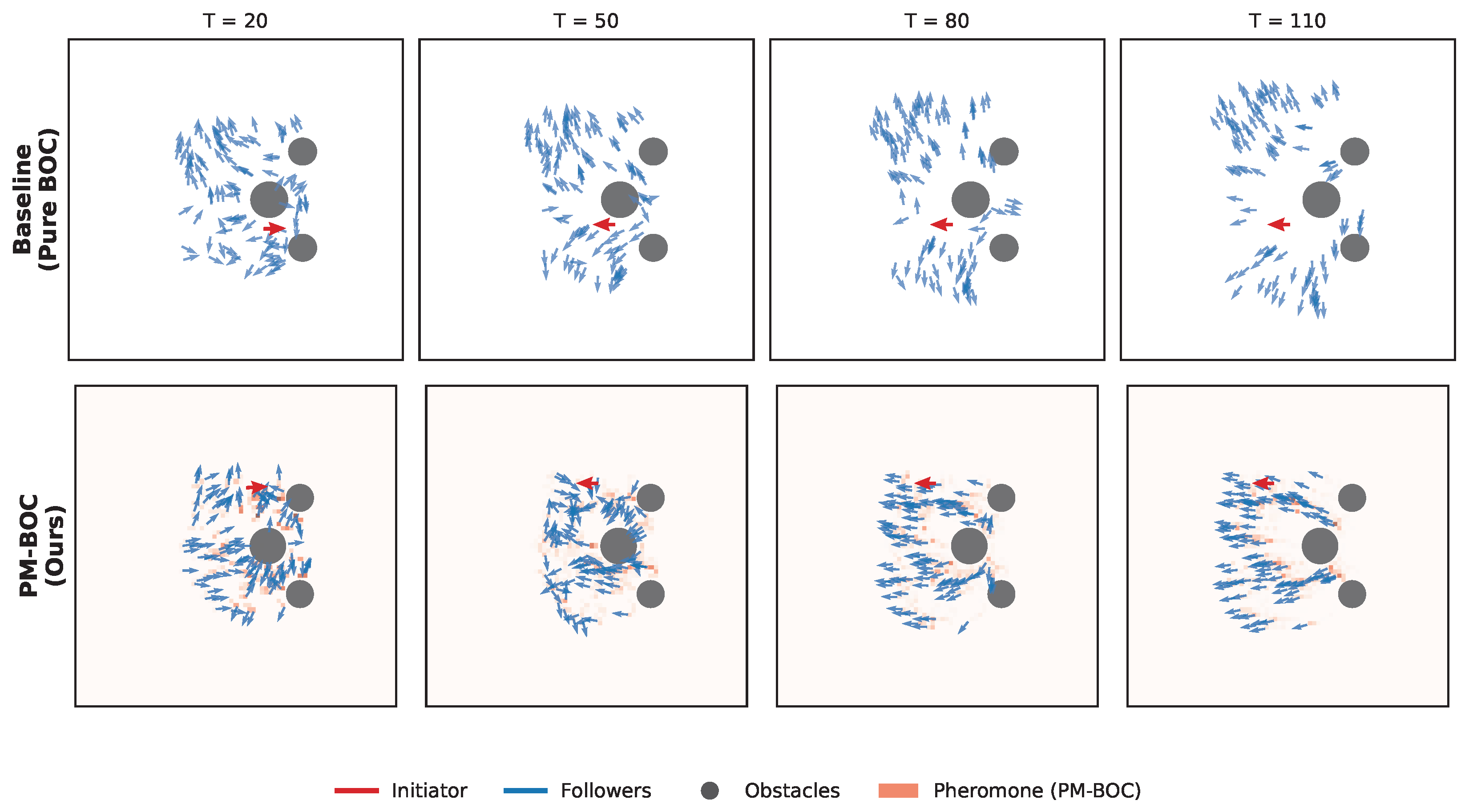
Under controlled intermittent occlusions, we record three signals. We record the visual cue F i vis ( t ) . We record the memory cue F i mem ( t ) . We record the fused output F i soc ( t ) . We project each vector onto a common axis to obtain scalar time series. We then analyze ordering and recovery using macroscopic measures. Figure 2 summarizes qualitative integrity changes. Figure 3 reports quantitative recovery and spatial correlation.

Order Parameters and Noise-Induced Transitions

We adopt the global polarization Φ ( t ) as the order parameter, defined in Equation (30). We also quantify leader–follower consistency by the response accuracy δ resp ( t ) . In experiments with an informed robot (leader) indexed by , we define
δ resp ( t ) = 1 N 1 i 1 + v ^ i ( t ) v ^ ( t ) 2 [ 0 , 1 ] .
Thus, δ resp ( t ) = 1 indicates perfect collective tracking. Values near 0 indicate fragmentation or opposite motion. PM-BOC couples a fast visual cue with a persistent pheromone memory. When high-frequency noise corrupts the visual cue, agents rely more on the smoother memory cue P ( r i ( t ) , t ) .
To demonstrate this qualitative integrity under occlusion, Figure 2 presents representative snapshots at a few key time steps under strong interference. In the visual-only baseline, occlusion breaks local links and the swarm fractures. In PM-BOC, residual trails provide a virtual bridge. Agents can follow P after losing line-of-sight, so cohesion is preserved.
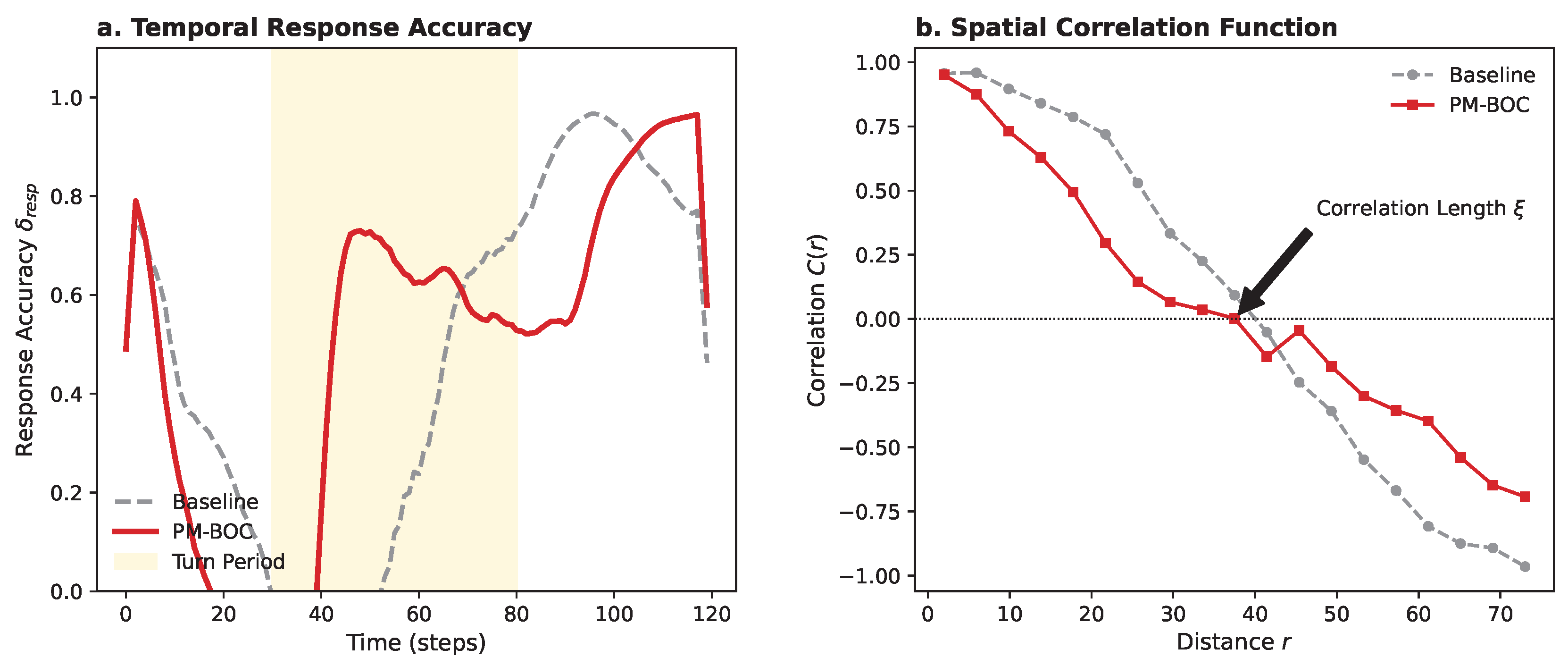
Complementing these visual observations with quantitative analysis, Figure 3a reports δ resp ( t ) . The baseline drops during the occlusion-driven maneuver period and recovers slowly. PM-BOC rebounds faster and remains more stable. Figure 3b reports the connected spatial velocity correlation C ( r ) . We define the correlation length ζ as the first zero-crossing, C ( ζ ) = 0 . A longer ζ indicates stronger long-range coordination under the same noise and occlusion schedule.

4.3. Scale-Free Correlation Induced by Body Orientation Change

Section 4.2 validated robustness under noise and intermittent occlusion. We now focus on information transfer across the group. Many natural swarms operate near criticality. In that regime, correlations extend across large distances. A key signature is scale-free correlation. It means that the correlation length ζ grows with the system size L. This corresponds to ζ L .
In PM-BOC, body orientation change (BOC) is treated as an informative motion signal. BOC modulates local social interaction. BOC also modulates the pheromone-like memory update. Therefore, brief turning events can leave a persistent spatial trace. This trace remains after line-of-sight is broken. It can still be sensed locally through P . This creates an additional route for alignment. It supports coherent propagation beyond the instantaneous visual horizon.
We present the evidence in three steps. We first visualize how the response spreads from an initiator. We then quantify heading synchrony and global order. We finally quantify spatial correlation and its scaling behavior. These results are shown in Figure 4, Figure 5 and Figure 6.

4.3.1. Physical Essence of BOC Signals

BOC reflects the turning rate of an agent, which measures motion salience. Straight motion carries weak steering information and a sharp turn carries strong steering information. This makes BOC a natural indicator of a decision moment.
PM-BOC uses this signal in two coupled ways. When β j ( t ) increases, the influence of neighbor j in the visual channel increases. At the same time, local pheromone deposition increases. The pheromone field integrates these events in space and time. It creates a directional cue that persists after the turn. Therefore, a short maneuver can guide others for a longer period. This is the physical route from local BOC events to macroscopic coordination.

4.3.2. Propagation of Collective Response

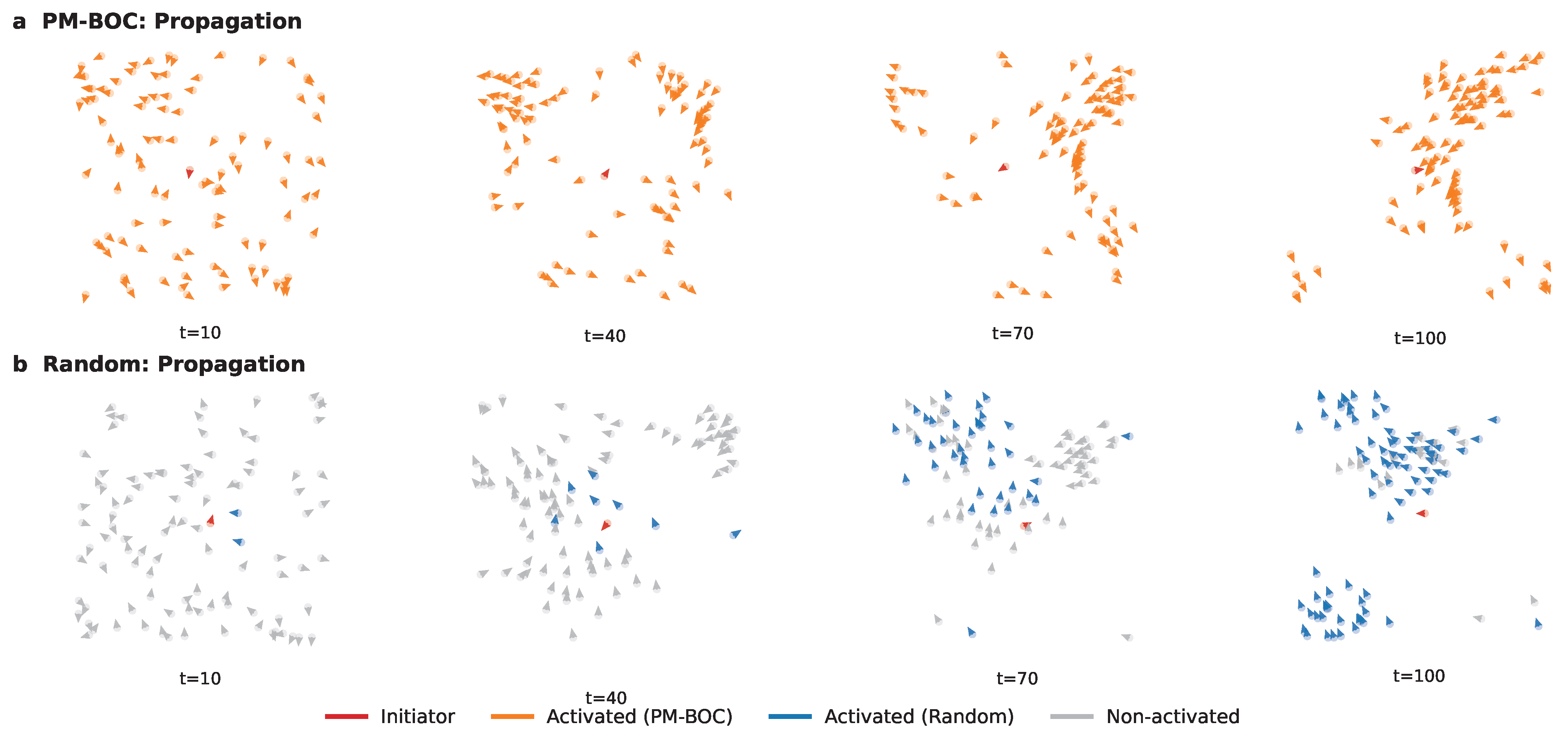
We apply a directional perturbation through a single initiator. We track how the response spreads across the group. Figure 4 shows snapshots at representative times.
In PM-BOC, activated agents form a contiguous front. The pattern is wave-like. The turning response remains coordinated. The activated region expands smoothly.
In the Random baseline, the response is less organized. Activated agents appear scattered. The activated region does not form a clear front. The propagation is closer to diffusion. This contrast indicates that BOC-modulated coupling supports structured information transfer. It also reduces fragmentation during the transient.

4.3.3. Synchrony, Order, and Scale-Free Correlation

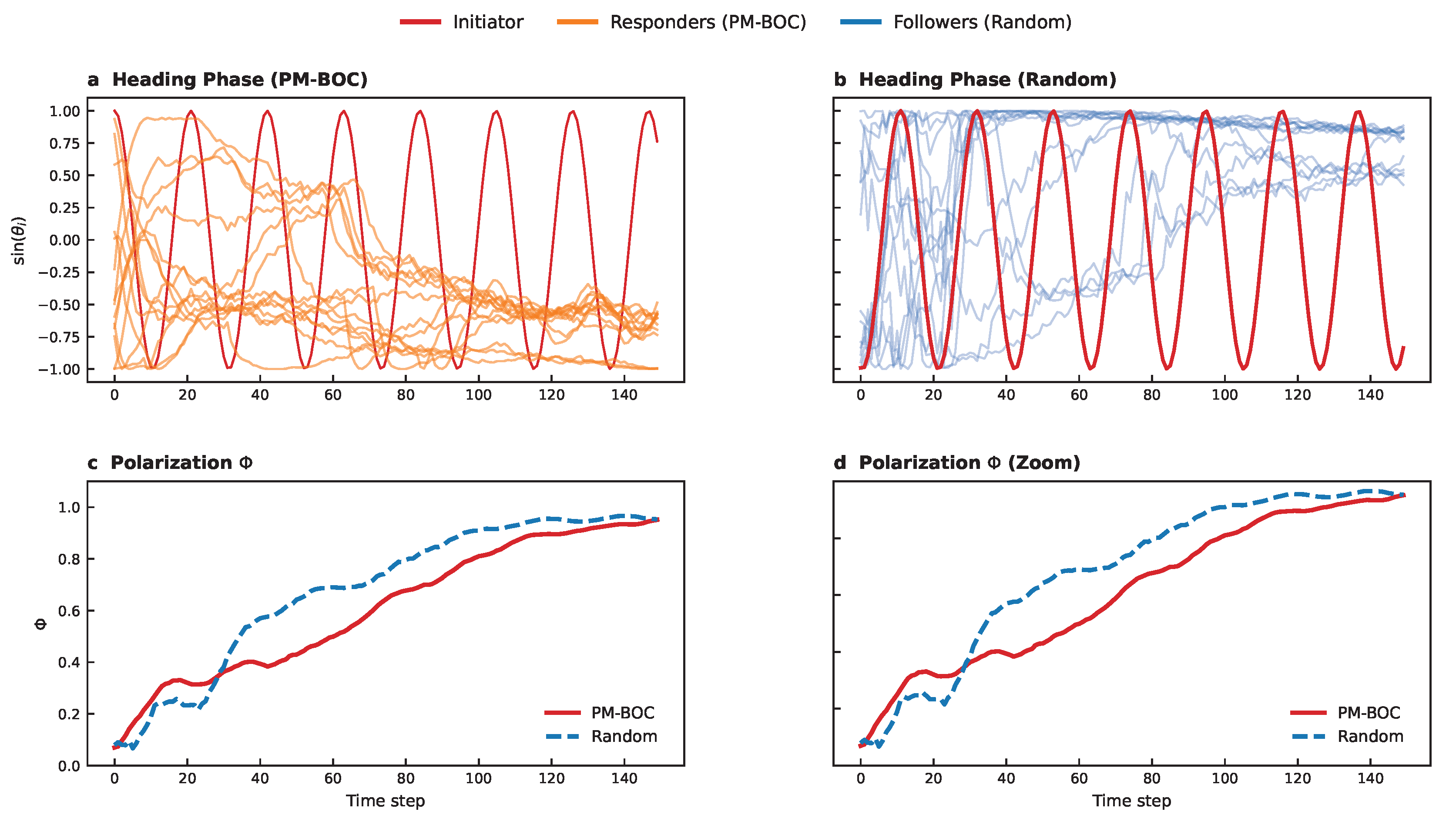
We next quantify the temporal coherence of headings. Figure 5 plots the heading phase as sin ( θ i ) . PM-BOC shows stronger phase locking, followers align with the initiator more consistently, and the Random baseline shows larger phase dispersion.
We also report the global polarization Φ . Figure 5c shows Φ over time and Figure 5d provides a zoomed view. PM-BOC reaches a higher and more stable level of order.
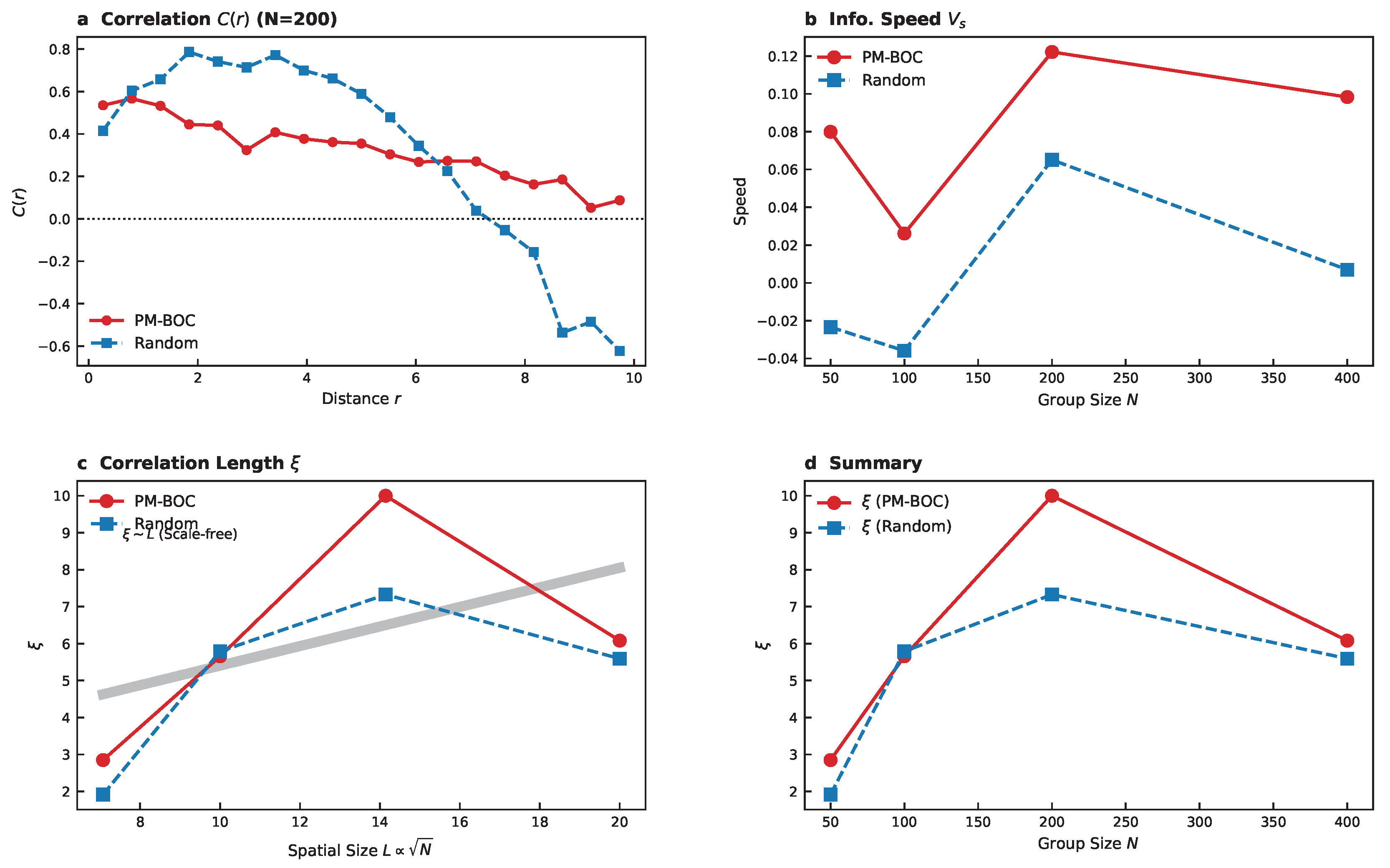
We then evaluate spatial correlations. Figure 6a reports the correlation function C ( r ) . We extract the correlation length ζ from C ( r ) . We define ζ as the first zero-crossing, C ( ζ ) = 0 .
Figure 6c plots ζ against the system size L. The scaling trend is close to ζ L , which indicates scale-free correlation.
Finally, we connect scaling to collective responsiveness. Figure 6b reports the information speed V s as a function of group size N. Figure 6d summarizes ζ versus N. Together, these panels show that PM-BOC supports coherent propagation and long-range coordination as the group grows.

4.4. Adaptive Filtering and Dynamic Channel Switching

Section 4.4 focused on information transfer and long-range correlation. These properties require a controller that can operate under intermittent visibility. Occlusion breaks visual links. Noise corrupts local measurements. A single channel is not sufficient in this regime.
The pheromone channel provides memory. It is robust to short visual outages. However, it is low-bandwidth. Diffusion and decay smooth the signal. The visual channel is high-bandwidth. It reacts quickly to turns and local changes. However, it is sensitive to occlusion and noise. PM-BOC combines both channels by adaptive filtering.
We implement this combination through the adaptive coupling coefficient α i ( t ) in Equation (14). When the normalized visual reliability satisfies r i ( t ) > r thr , we obtain α i ( t ) 0 . The controller becomes visual-dominant. When r i ( t ) < r thr , we obtain α i ( t ) 1 . The controller becomes memory-dominant. This rule switches the dominant cue based on local reliability. It preserves agility when vision is available. It preserves robustness when vision is blocked.
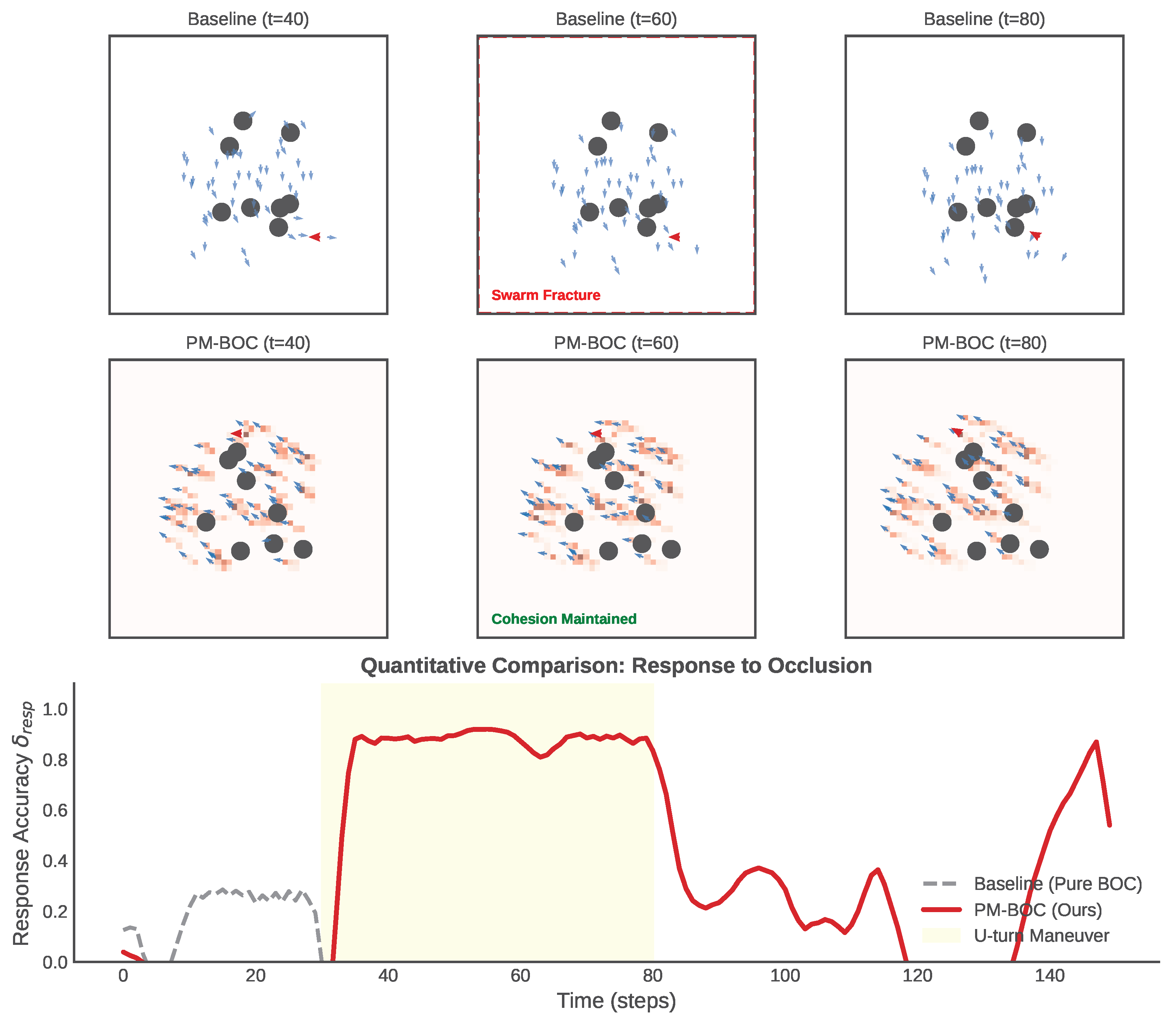
Figure 7 visualizes the switching process under occlusion. In the vision-only baseline, followers lose turning cues once the leader is occluded. Local links collapse. The group fragments during the maneuver. In PM-BOC, pheromone trails persist through the occluded region. Followers can still follow the local pheromone gradient P . The swarm remains cohesive. The response accuracy δ resp ( t ) stays higher. It recovers faster after the maneuver.
This adaptive switching is the mechanism-level explanation for the macroscopic robustness reported earlier. It also motivates engineering-scale validation. In the next section, we test the same principle in UUV swarm simulations under complex underwater environments.

4.5. Engineering-Scale Validation on Robotic Swarms

Section 4.5 explained the mechanism of dynamic channel switching. The controller relies on vision when visibility is reliable. It relies on the pheromone memory when visibility degrades. We now test whether this mechanism remains effective in an engineering setting. Our goal is simple. The swarm should stay cohesive. It should also track the leader during sharp maneuvers.
We evaluate two methods under the same experimental protocol. The first is PM-BOC. The second is a Random baseline with the same leader trajectory for reference. We report both spatial trajectories and a time-domain accuracy measure. The accuracy is the response accuracy δ resp defined earlier. Higher values indicate better follower alignment with the leader. We also mark two turning events in time. They are denoted as Turn 1 and Turn 2.
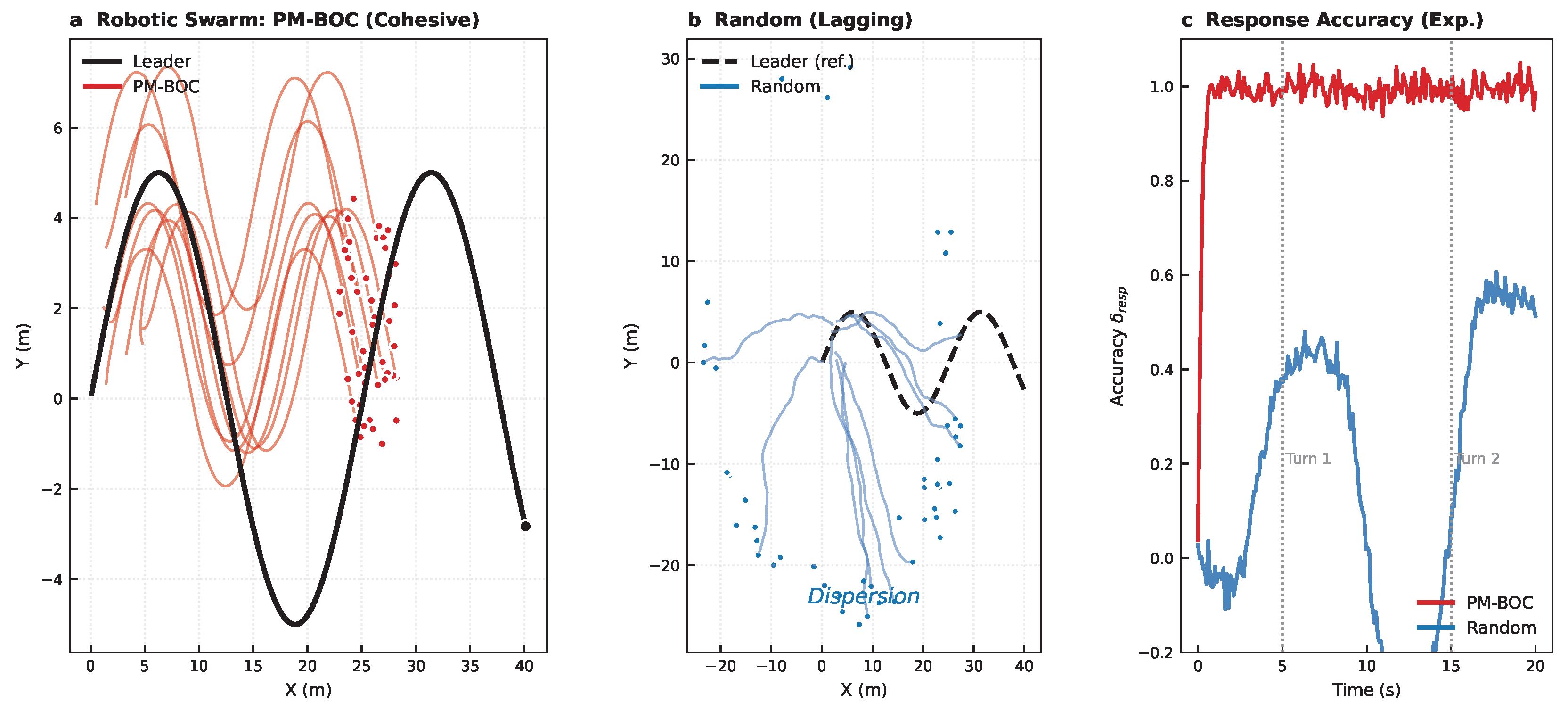
Figure 8 summarizes the results. Figure 8a shows the trajectory evolution under PM-BOC. Followers remain close to the leader path. The group stays cohesive throughout the run. Figure 8b shows the Random baseline. Followers lag behind the leader. The trajectories spread out in space. The dispersion is visible during and after the maneuvers.
Figure 8c reports the experimental response accuracy over time. Two vertical dashed lines mark Turn 1 and Turn 2. PM-BOC rapidly reaches high accuracy and remains stable. The baseline shows a clear drop around the turning events. It also exhibits larger fluctuations. These results are consistent with the mechanism in Section 4.4. When steering becomes difficult, PM-BOC maintains effective guidance and avoids fragmentation.
Overall, this experiment supports engineering feasibility. It shows that the proposed local rule can preserve cohesion and tracking during maneuvers. In the next section, we discuss the implications and limitations of this mechanism.

4.6. Robustness to Occlusion, Noise, and Failures

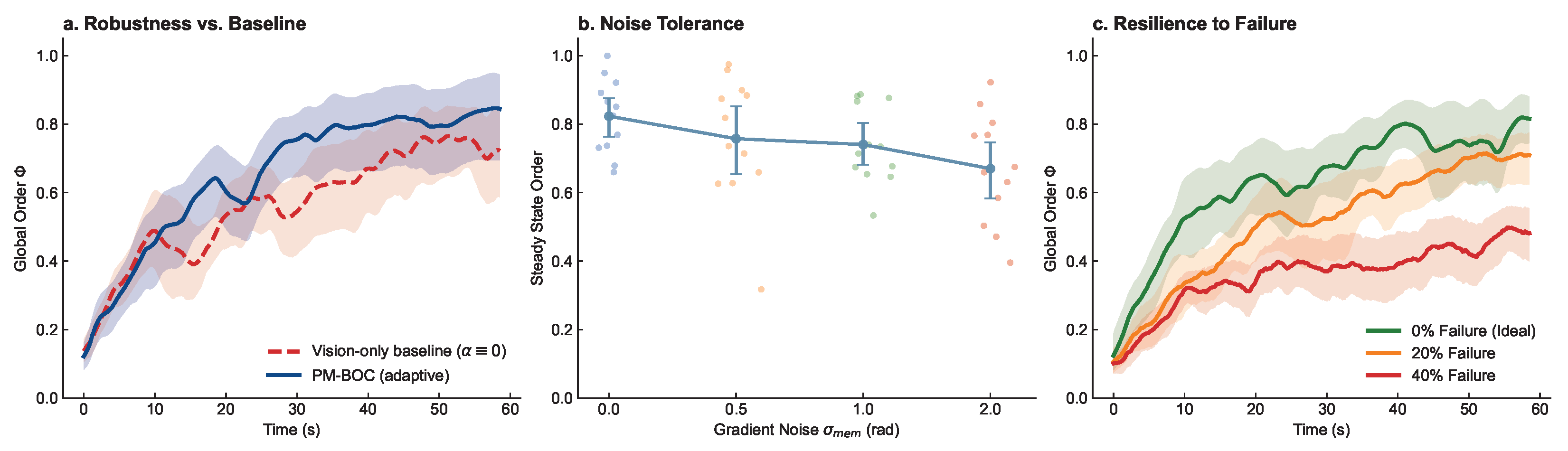
We evaluate robustness using the global order Φ ( t ) (Figure 9). In Figure 9a, PM-BOC keeps higher order than the vision-only baseline. All settings are identical across methods. Only the fusion rule changes. PM-BOC switches between visual cues and memory cues using the local reliability r i ( t ) . When visibility is good, α i ( t ) becomes small and the group follows vision. When occlusion increases, r i ( t ) drops and α i ( t ) increases. Then the group follows the memory gradient and avoids fragmentation.
In Figure 9b, we add noise to the memory gradient. The steady-state order decreases as σ m e m increases. Dots show single runs. Error bars show mean and 95% bootstrap confidence intervals.
In Figure 9c, we test agent failures. Higher failure rates reduce the final order and slow convergence. The swarm still stays coherent.
These tests include the explicit controls described in Section 2. We use vision-only ( α i ( t ) 0 ), memory-only ( α i ( t ) 1 ), and uncoupled memory ( k p = 0 ). We repeat each condition with multiple random seeds and report bootstrap uncertainty. This reduces the chance that the result is due to a lucky run.

4.7. Summary

Comprehensive analysis shows that BOC-based saliency weighting and pheromone-based environmental memory enable artificial swarms to reproduce critical phase-transition characteristics and scale-free correlations. This mechanism mitigates sensory amnesia and yields robust coordination in occluded, communication-constrained environments.

5. Discussion

This work is motivated by a clear gap identified in the review section. Many vision-based swarm mechanisms, including standard BOC-type rules, rely on sustained line-of-sight. In realistic UUV settings, occlusions are frequent. Local visibility graphs become unstable. This can delay ordering and induce fragmentation [24,25].
Recent occlusion-aware vision models show that partial visibility changes alignment dynamics. They also report delayed ordering under occlusion [27]. Fault-tolerant vision interaction rules can preserve motion under sensing disruptions [28]. However, these approaches still depend on the instantaneous visual channel. Information continuity during short visual outages remains a key limitation. This limitation is most visible during sharp maneuvers and clutter traversal.
We provide a quantitative comparison that targets this limitation. We measure temporal recovery and spatial information transfer under the same disturbance schedule. We quantify leader–follower consistency by the response accuracy δ resp ( t ) in Equation (36). Values close to 1 indicate coherent tracking. Values close to 0 indicate fragmentation or opposite motion. In Figure 3a, the vision-only baseline shows a clear drop in δ resp ( t ) during the occlusion-driven event window. Recovery is slow after the maneuver. In contrast, PM-BOC rebounds earlier and remains more stable. The mean curve stays higher during the whole event period. Confidence intervals are reported in the figure. These results address the delayed-ordering behavior reported in occlusion studies [27]. They also show a shorter recovery after visibility loss.
We also compare spatial coordination. Figure 3b reports the connected velocity correlation C ( r ) . We define the correlation length ζ by the first zero-crossing, C ( ζ ) = 0 . A longer ζ indicates stronger long-range coordination under the same disturbance. Under identical occlusion and noise, PM-BOC yields a larger ζ than the baseline. This means correlation persists across longer inter-agent distances before decorrelating. This extends prior vision-only occlusion studies [27,28]. It provides a spatial signature, not only a qualitative trend.
The comparison also links to stigmergy methods discussed in the review. Pheromone-based stigmergy provides persistent environmental memory [32,33]. Virtual pheromones have been used for cooperative behaviors and connectivity maintenance [38,39,40]. A limitation is the weak integration with fast visual cues for agile maneuvers. Our results quantify the benefit of such integration. During the occlusion-driven maneuver window in Figure 3a, the baseline loses turning information when occlusion breaks links. PM-BOC retains a usable directional cue through P . It also shifts the coupling weight from vision to memory when the visual graph becomes unreliable. The outcome is higher δ resp ( t ) and larger ζ under the same disturbances. This is a quantitative advantage over purely visual interaction under occlusion.
Engineering-scale validation shows the same pattern in experiments. In Figure 8c, δ resp ( t ) is reported with two turning events (Turn 1 and Turn 2). PM-BOC maintains higher accuracy through both turns. The baseline drops markedly during the turning intervals. This agrees with the review argument that vision-only swarms are fragile under intermittent visibility [24,25]. It also provides an experimental counterpart to Figure 3.
Finally, robustness tests quantify how the advantage persists beyond single runs. In Figure 9, we report mean curves with 95 % bootstrap confidence intervals. We also include explicit control variants. They include vision-only, memory-only, and uncoupled memory. These controls isolate the mechanism. Figure 9b shows that steady-state order decreases as memory-gradient noise σ mem increases. PM-BOC remains coherent across the tested noise levels. Figure 9c shows graceful degradation under agent failures (0%, 20%, 40%). These results go beyond qualitative fault tolerance [28]. They provide uncertainty-aware trends under controlled perturbations. Overall, PM-BOC adds a short-term spatial memory channel. This channel provides continuity when vision is intermittently unavailable. It also preserves fast visual responsiveness when line-of-sight is reliable.

6. Conclusions

This paper studies collective performance degradation in perception-limited, occlusion-rich environments and investigates the proposed Pheromone-Modulated Body Orientation Change (PM-BOC) mechanism from modeling, macroscopic analysis, and engineering-scale validation. In contrast to approaches that introduce explicit communication or global planning, our goal is to preserve continuity of local interaction and controllability when visual information is intermittently lost. Recent vision-only swarm systems have achieved coherent collective motion with onboard sensing, but they remain sensitive to partial observability and the stability of the local visual neighbor set; occlusion can delay ordering and trigger fragmentation [19,28].
At the mechanism level, PM-BOC couples two information channels with distinct roles. The visual channel uses BOC-based salience to provide high-bandwidth, low-latency alignment when line-of-sight is available, while the memory channel uses a reaction–diffusion pheromone field to accumulate motion history in space and time and remain informative during visual interruptions. The reliance on the two channels is regulated by an adaptive coupling weight that depends on local visible-neighbor density (i.e., the reliability of the visual graph). This design balances responsiveness and robustness and admits an equivalent interpretation as an adaptive complementary filter, which motivates the subsequent stability and robustness analysis. Compared with recent stigmergy-oriented swarm designs where the field is often introduced as a general coordination heuristic, our coupling is explicitly tied to body-orientation change and thus remains state-dependent [36].
This dual-channel structure leads to clear changes in macroscopic dynamics. Order-parameter and phase-transition results indicate that the onset of disorder is delayed under increasing sensory noise. Intuitively, the pheromone field introduces inertia in the collective response by averaging transient fluctuations over time, thereby suppressing high-frequency disturbances that would otherwise destabilize purely vision-based interaction. In addition, correlation analysis shows scale-free velocity correlations, with correlation length growing approximately linearly with system size, consistent with efficient long-range information transfer near criticality. This observation is aligned with recent physics-based analyses that connect long-range correlations to near-critical collective regimes, but here the correlations remain observable under intermittent visibility due to the additional memory channel.
These macroscopic properties translate into operational robustness under occlusions. In obstacle-induced occlusion scenarios, the vision-only baseline suffers from broken information links and swarm fragmentation after local visibility loss. By contrast, PM-BOC preserves virtual connectivity via residual pheromone traces, maintaining coordination during short visual outages and supporting re-aggregation after bypassing obstacles. This matches the general conclusion of recent occlusion-aware and fault-tolerant interaction studies that robustness requires either redundancy in sensing or an auxiliary interaction pathway; PM-BOC provides such redundancy without explicit communication [19,28]. We further validate stability and repeatability using time-series response metrics, avoiding conclusions drawn solely from trajectory visualization.
The same mechanism remains effective in engineering-scale settings. In the UUV case study with nonholonomic constraints, inertia, limited field-of-view, and cluttered obstacles, PM-BOC preserves trajectory coherence and improves response behavior without increasing communication burden or requiring heavy computation. Moreover, the interaction remains practically sparse because each agent only queries local visible neighbors and a local pheromone gradient, so the effective computational complexity stays close to O ( N ) . From a network perspective, pheromone memory acts as introducing virtual edges that enhance connectivity and reduce effective information path lengths, supporting scalability as swarm size increases.
Finally, we clarify the operational boundaries of PM-BOC. Because the pheromone channel is governed by diffusion and decay, it is inherently low-bandwidth and cannot encode high-frequency maneuvers; therefore, it should not be used as a standalone control signal but as a complementary channel. In trap-like situations, persistent historical traces may reinforce incorrect tendencies and slow correction; adaptive weighting mitigates this risk, but task-level constraints can still be necessary in dynamic environments.


Author Contributions

Conceptualization, L.X.; Methodology, L.X. and M.L.; Investigation, G.H.; Writing—original draft, L.X.; Writing—review & editing, Z.Y. All authors have read and agreed to the published version of the manuscript.

Funding

This research was funded by The National Natural Science Foundation of China; Natural Science Foundation of China grant number 52271332 and 52071271.

Data Availability Statement

The original contributions presented in this study are included in the article. Further inquiries can be directed to the corresponding author.

Conflicts of Interest

The authors declare that they have no known competing financial interests or personal relationships that could have appeared to influence the work reported in this paper.

Notes

1
This matches the nominal neighbor-count model in (15), which is derived from a 2D sensing sector area.
2
Without k obs , k soc , the sum in (3) mixes unit headings with uncalibrated “forces”, which is a common reviewer objection.

References

  1. Vicsek, T.; Czirók, A.; Ben-Jacob, E.; Cohen, I.; Shochet, O. Novel type of phase transition in a system of self-driven particles. Phys. Rev. Lett. 1995, 75, 1226. [Google Scholar] [CrossRef]
  2. Couzin, I.D.; Krause, J.; Franks, N.R.; Levin, S.A. Collective memory and spatial sorting in animal groups. J. Theor. Biol. 2002, 218, 1–11. [Google Scholar] [CrossRef]
  3. Cavagna, A.; Cimarelli, A.; Giardina, I.; Parisi, G.; Santagati, R.; Stefanini, F.; Viale, M. Scale-free correlations in starling flocks. Proc. Natl. Acad. Sci. USA 2010, 107, 11865–11870. [Google Scholar] [CrossRef] [PubMed]
  4. Bialek, W.; Cavagna, A.; Giardina, I.; Mora, T.; Silvestri, E.; Viale, M.; Walczak, A.M. Statistical mechanics for natural flocks of birds. Proc. Natl. Acad. Sci. USA 2012, 109, 4786–4791. [Google Scholar] [CrossRef] [PubMed]
  5. Brambilla, M.; Ferrante, E.; Birattari, M.; Dorigo, M. Swarm robotics: A review from the swarm engineering perspective. Swarm Intell. 2013, 7, 1–41. [Google Scholar] [CrossRef]
  6. Vásarhelyi, G.; Virágh, C.; Somorjai, G.; Nepusz, T.; Eiben, A.E.; Vicsek, T. Optimized flocking of autonomous drones in confined environments. Sci. Robot. 2018, 3, eaat3536. [Google Scholar] [CrossRef] [PubMed]
  7. Ge, Y.; Fan, J.; Zhang, J. Active Reconfigurable Intelligent Surface Enhanced Secure and Energy-Efficient Communication of Jittering UAV. IEEE Internet Things J. 2023, 10, 22386–22400. [Google Scholar] [CrossRef]
  8. Berlinger, F.; Gauci, M.; Nagpal, R. Implicit coordination for 3D underwater collective behaviors in a fish-inspired robot swarm. Sci. Robot. 2021, 6, eabd8668. [Google Scholar] [CrossRef]
  9. Ge, Y.; Fan, J.; Li, G.Y.; Wang, L.-C. Intelligent Reflecting Surface-Enhanced UAV Communications: Advances, Challenges, and Prospects. IEEE Wireless Commun. 2023, 30, 119–126. [Google Scholar] [CrossRef]
  10. Ge, Y.; Fan, J. Active Reconfigurable Intelligent Surface Assisted Secure and Robust Cooperative Beamforming for Cognitive Satellite-Terrestrial Networks. IEEE Trans. Veh. Technol. 2023, 72, 4108–4113. [Google Scholar] [CrossRef]
  11. Schranz, M.; Umlauft, M.; Sende, M.; Elmenreich, W. Swarm robotic behaviors and current applications. Front. Robot. AI 2020, 7, 36. [Google Scholar] [CrossRef]
  12. Mezey, D.; Bastien, R.; Zheng, Y.; McKee, N.; Stoll, D.; Hamann, H.; Romanczuk, P. Purely vision-based collective movement of robots. npj Robot. 2025, 3, 11. [Google Scholar] [CrossRef]
  13. Xiao, Y.; Lei, X.; Zheng, Z.; Xiang, Y.; Liu, Y.-Y.; Peng, X. Perception of motion salience shapes the emergence of collective motions. Nat. Commun. 2024, 15, 4779. [Google Scholar] [CrossRef] [PubMed]
  14. Duan, H.; Huo, M.; Fan, Y. From animal collective behaviors to swarm robotic cooperation. Natl. Sci. Rev. 2023, 10, nwad040. [Google Scholar] [CrossRef] [PubMed]
  15. Iyer, P.; Fedosov, D.A.; Gompper, G. Dynamics of active swarms at the edge of disorder. Commun. Phys. 2026, 9, 37. [Google Scholar] [CrossRef]
  16. Ballerini, M.; Cabibbo, N.; Candelier, R.; Cavagna, A.; Cisbani, E.; Giardina, I.; Lecomte, V.; Orlandi, A.; Parisi, G.; Procaccini, A.; et al. Interaction ruling animal collective behavior depends on topological rather than metric distance. Proc. Natl. Acad. Sci. USA 2008, 105, 1232–1237. [Google Scholar] [CrossRef]
  17. Mezey, D.; Bastien, R.; Zheng, Y.; McKee, N.; Stoll, D.; Hamann, H.; Romanczuk, P. Purely vision-based collective movement of robots. Sci. Robot. 2024, 9, eadl2345. [Google Scholar] [CrossRef]
  18. Bastien, R.; Romanczuk, P. A model of collective behavior based purely on vision. Sci. Adv. 2020, 6, eaay0792. [Google Scholar] [CrossRef]
  19. Shefi, P.; Ayali, A.; Kaminka, G.A. Bugs with features: Vision-based fault-tolerant collective motion inspired by nature. Auton. Robot. 2025, 49, 39. [Google Scholar] [CrossRef]
  20. Strandburg-Peshkin, A.; Twomey, C.R.; Bode, N.W.F.; Kao, A.B.; Katz, Y.; Ioannou, C.C.; Rosenthal, S.B.; Torney, C.J.; Wu, H.S.; Levin, S.A.; et al. Visual sensory networks and effective information transfer in animal groups. Curr. Biol. 2013, 23, R709–R711. [Google Scholar] [CrossRef]
  21. Zheng, Z.; Tao, Y.; Xiang, Y.; Lei, X.; Peng, X. Body orientation change of neighbors leads to scale-free correlation in collective motion. Nat. Commun. 2024, 15, 8968. [Google Scholar] [CrossRef]
  22. Nagy, M.; Akos, Z.; Biro, D.; Vicsek, T. Hierarchical group dynamics in pigeon flocks. Nature 2010, 464, 890–893. [Google Scholar] [CrossRef]
  23. Pearce, D.; Miller, A.M.; Rowlands, G.; Turner, M.S. Role of projection in the control of bird flocks. Proc. Natl. Acad. Sci. USA 2014, 111, 10422–10426. [Google Scholar] [CrossRef]
  24. Mamatha, K.; Chaitanya, K.B.N.S.K.; Kumar, S.; Raj, A.A.B. Underwater Wireless Optical Communication—A Review. In Proceedings of the 2021 International Conference on Smart Generation Computing, Communication and Networking (SMART GENCON), Pune, India, 29–30 October 2021; pp. 1–5. [Google Scholar] [CrossRef]
  25. Yan, T.; Xu, Z.; Yang, S.X.; Gadsden, S.A. Formation control of multiple autonomous underwater vehicles: A review. Intell. Robot. 2023, 3, 1–22. [Google Scholar] [CrossRef]
  26. Couzin, I.D. Collective intelligence in animals and robots. Nat. Commun. 2025, 16, 9574. [Google Scholar] [CrossRef]
  27. Calovi, D.S.; Litchinko, A.; Lecheval, V.; Lopez, U.; Pérez Escudero, A.; Chaté, H.; Sire, C.; Theraulaz, G. Disentangling and modeling interactions in fish with burst-and-coast swimming style. PLoS Comput. Biol. 2018, 14, e1005933. [Google Scholar] [CrossRef]
  28. Krongauz, D.L.; Ayali, A.; Kaminka, G.A. Vision-based collective motion: A locust-inspired reductionist model. PLoS Comput. Biol. 2024, 20, e1011796. [Google Scholar] [CrossRef]
  29. Attanasi, A.; Cavagna, A.; Del Castello, L.; Giardina, I.; Grigera, T.S.; Jelić, A.; Melillo, S.; Parisi, L.; Pohl, O.; Shen, E.; et al. Information transfer and behavioural inertia in starling flocks. Nat. Phys. 2014, 10, 691–696. [Google Scholar] [CrossRef] [PubMed]
  30. Rosenthal, S.B.; Twomey, C.R.; Hartnett, A.T.; Wu, H.S.; Couzin, I.D. Revealing the hidden networks of interaction in mobile animal groups. Proc. Natl. Acad. Sci. USA 2015, 112, 4690–4695. [Google Scholar] [CrossRef] [PubMed]
  31. Valentini, G.; Ferrante, E.; Dorigo, M. The Best-of-n Problem in Robot Swarms: Formalization, State of the Art, and Novel Perspectives. Front. Robot. AI 2017, 4, 9. [Google Scholar] [CrossRef]
  32. Theraulaz, G. Embracing the Creativity of Stigmergy in Social Insects. Archit. Des. 2014, 84, 54–59. [Google Scholar] [CrossRef]
  33. Theraulaz, G.; Bonabeau, E. A brief history of stigmergy. Artif. Life 1999, 5, 97–116. [Google Scholar] [CrossRef]
  34. Garnier, S.; Gautrais, J.; Theraulaz, G. The biological principles of swarm intelligence. Swarm Intell. 2007, 1, 3–31. [Google Scholar] [CrossRef]
  35. Dorigo, M.; Birattari, M.; Stützle, T. Ant colony optimization. IEEE Comput. Intell. Mag. 2006, 1, 28–39. [Google Scholar] [CrossRef]
  36. Salman, M.; Garzón Ramos, D.; Birattari, M. Automatic design of stigmergy-based behaviours for robot swarms. Commun. Eng. 2024, 3, 30. [Google Scholar] [CrossRef]
  37. Arbel, E.; Buise, L.; van Waes, C.; Oppenheimer, N.; Lahini, Y.; Ben Zion, M.Y. A mechanical route for cooperative transport in autonomous robotic swarms. Nat. Commun. 2025, 16, 7519. [Google Scholar] [CrossRef]
  38. Shami, T.M.; El-Saleh, A.A.; Alswaitti, M.; Al-Tashi, Q.; Summakieh, M.A.; Mirjalili, S. Particle Swarm Optimization: A Comprehensive Survey. IEEE Access 2022, 10, 10031–10061. [Google Scholar] [CrossRef]
  39. Sun, S.; Sun, B.; Cook, A.B.; Padial, T.P. Recent Advances in Collective Behaviors of Micro/Nanomotor Swarms. Adv. Mater. 2026, 38, e15700. [Google Scholar] [CrossRef]
  40. Abbasi, E. Biological sensors and bio-inspired technologies: The role of insects in advanced detection systems and robotics. Discov. Appl. Sci. 2025, 7, 503. [Google Scholar] [CrossRef]
  41. Rubenstein, M.; Cornejo, A.; Nagpal, R. Programmable self-assembly in a thousand-robot swarm. Science 2014, 345, 795–799. [Google Scholar] [CrossRef]
Figure 1. PM-BOC: pheromone-modulated visual interaction and its effective field. (a) A focal individual i observes neighbor j; the instantaneous visual cue is the neighbor’s body-orientation change (BOC), quantified as Δ β j / Δ t , and mapped to a salience term S i j , which is then modulated by the local digital-pheromone memory P ( x j ) deposited along the neighbor’s recent motion, yielding S i j = ( Δ β j / Δ t ) [ 1 + γ P ( x j ) ] . (b) Interaction weight w i j as a function of the relative bearing φ i j (front direction at φ i j = 0 ); dashed curve shows the vision-only case ( γ = 0 ), solid curve shows PM-BOC ( γ > 0 ), and the shaded area indicates the additional contribution from pheromone memory. (c) Polar representation of the resulting anisotropic interaction field; the vision-only field (dashed) is compared with the PM-BOC field (solid), illustrating how pheromone modulation reshapes the effective interaction footprint while maintaining a front-biased structure.
Jmse 14 00399 g001
Figure 2. Spatiotemporal snapshots of swarm integrity under intermittent occlusion and critical noise. Top row: baseline pure BOC, visual-only. Bottom row: PM-BOC. Snapshots are shown at representative times. In the baseline, occlusion breaks local visibility links (red arrow markers) and the swarm fragments, which leads to a sharp loss of global order. In PM-BOC, pheromone trails persist after line-of-sight loss and provide a virtual bridge. Agents follow local P cues, so cohesion is maintained.
Jmse 14 00399 g002
Figure 3. Quantitative response recovery and spatial correlation under occlusion. (a) Temporal response accuracy δ resp ( t ) defined in Equation (36). Shaded bands indicate the maneuver/occlusion-driven event period. Curves show mean performance over runs with 95 % confidence intervals. (b) Connected spatial velocity correlation C ( r ) computed with distance binning. The correlation length ζ is defined as the first zero-crossing C ( ζ ) = 0 .
Jmse 14 00399 g003
Figure 4. Information propagation under a directional perturbation. PM-BOC shows wave-like propagation and coordinated turning. The random-interaction control exhibits diffusive spread and weak coordination. Snapshots are shown at representative times. The initiator and the activated/non-activated agents follow the color coding in the figure.
Jmse 14 00399 g004
Figure 5. Heading synchrony and order formation. (a,b) Heading phase dynamics shown as sin ( θ i ) . PM-BOC exhibits stronger phase locking than the random-interaction control. (c,d) Global polarization Φ over time, with a zoomed view for readability. These results link coordinated turning to macroscopic order.
Jmse 14 00399 g005
Figure 6. Scale-free correlation and information propagation comparison between PM-BOC and a random-control baseline. (a) Spatial correlation function C ( r ) versus distance r for group size N = 200 ; the horizontal dotted line indicates C ( r ) = 0 (no correlation). (b) Information speed V s as a function of group size N. (c) Correlation length ξ as a function of spatial size L (with L N ); the grey line is a reference scaling ξ N (scale-free expectation). (d) Summary of ξ versus group size N for PM-BOC and Random. Red circles: PM-BOC; blue squares: Random.
Jmse 14 00399 g006
Figure 7. Adaptive channel switching under occlusion. Top: vision-only baseline. Occlusion breaks visual links and followers lose turning cues, which causes fragmentation and a sharp drop in response accuracy. Middle: PM-BOC. Pheromone trails persist through occluded regions and provide a local bridge. Bottom: response accuracy δ resp ( t ) under the same occlusion schedule. PM-BOC remains higher and recovers faster after the maneuver.
Jmse 14 00399 g007
Figure 8. Engineering-style validation with trajectories and response accuracy. (a) Robotic swarm under PM-BOC. Followers remain cohesive and track the leader trajectory. (b) Random baseline. Followers lag behind and disperse relative to the leader reference. (c) Experimental response accuracy δ resp over time. Vertical dashed lines indicate two turning events (Turn 1 and Turn 2). PM-BOC maintains high accuracy, while the baseline drops markedly during turns.
Jmse 14 00399 g008
Figure 9. Robustness, noise tolerance, and resilience of PM-BOC. (a) Global order Φ over time for PM-BOC (adaptive) and a vision-only baseline ( α i ( t ) 0 ). Both methods use the same dynamics and settings. They differ only in the information fusion rule. PM-BOC adapts α i ( t ) using the local visual reliability r i ( t ) . It relies more on vision when neighbors are visible. It relies more on memory when occlusion reduces visibility. Shaded areas show the 95% confidence interval across runs (bootstrap). (b) Steady-state order versus memory-gradient noise σ m e m . Dots show individual runs. Error bars show the mean and the 95% bootstrap confidence interval. (c) Global order under agent failures (0%, 20%, 40%). Failed agents do not provide useful interactions and do not deposit memory cues. Curves show the mean. Shaded areas show the 95% bootstrap confidence interval.
Jmse 14 00399 g009
Table 1. Simulation and experimental parameters with physical interpretation.
ParameterSymbolValue (sim/exp)UnitPhysical Interpretation
Locomotion
Swarm speed s 0 50–200/0.8m s−1Nominal forward speed.
Domain sizeL32–128/50mDomain size; nominal density ρ = N / L 2 in 2D.
Inertia weight ω 0.2/0.4Inertia term in (3); do not confuse with α i ( t ) .
Visual perception
Viewing radius R vis 5.0/4.0mEffective sensing range.
Field of view θ FOV 270°/180°°Camera field-of-view.
Gain γ 1.2/1.0Salience sensitivity in (8).
Information sensing (memory)
Max BOC rate β max π / 2 / π / 3 rad s−1Turning-rate limit for normalization.
DiffusionD0.15/0.10m2 s−1Virtual pheromone diffusion coefficient.
Decay rate λ 0.10/0.08s−1Memory time scale τ = 1 / λ .
Basal deposition S 0 0.5/0.5a.u.Basal injection rate in (10).
Gain k p 2.5/2.0BOC-dependent deposition gain.
Coupling mechanism
Switching threshold N thr 3/2agentsThreshold for | N i vis | used in the switch.
Slope k switch 5.0/3.0Sigmoid steepness in (14).
Noise
Noise level η 0.0–5.0Sensory noise intensity in R η .
a.u. denotes arbitrary units.
Disclaimer/Publisher’s Note: The statements, opinions and data contained in all publications are solely those of the individual author(s) and contributor(s) and not of MDPI and/or the editor(s). MDPI and/or the editor(s) disclaim responsibility for any injury to people or property resulting from any ideas, methods, instructions or products referred to in the content.