Real-Time Wire Rope Inclination Detection Using YOLOv9-Based Camera–LiDAR Fusion for Overhead Cranes




Abstract
1. Introduction
- Geometric formulation: The trolley–hook configuration and inclination angle are formulated directly in the 3D LiDAR frame, providing a physically meaningful metric that overcomes the depth ambiguity of monocular vision.
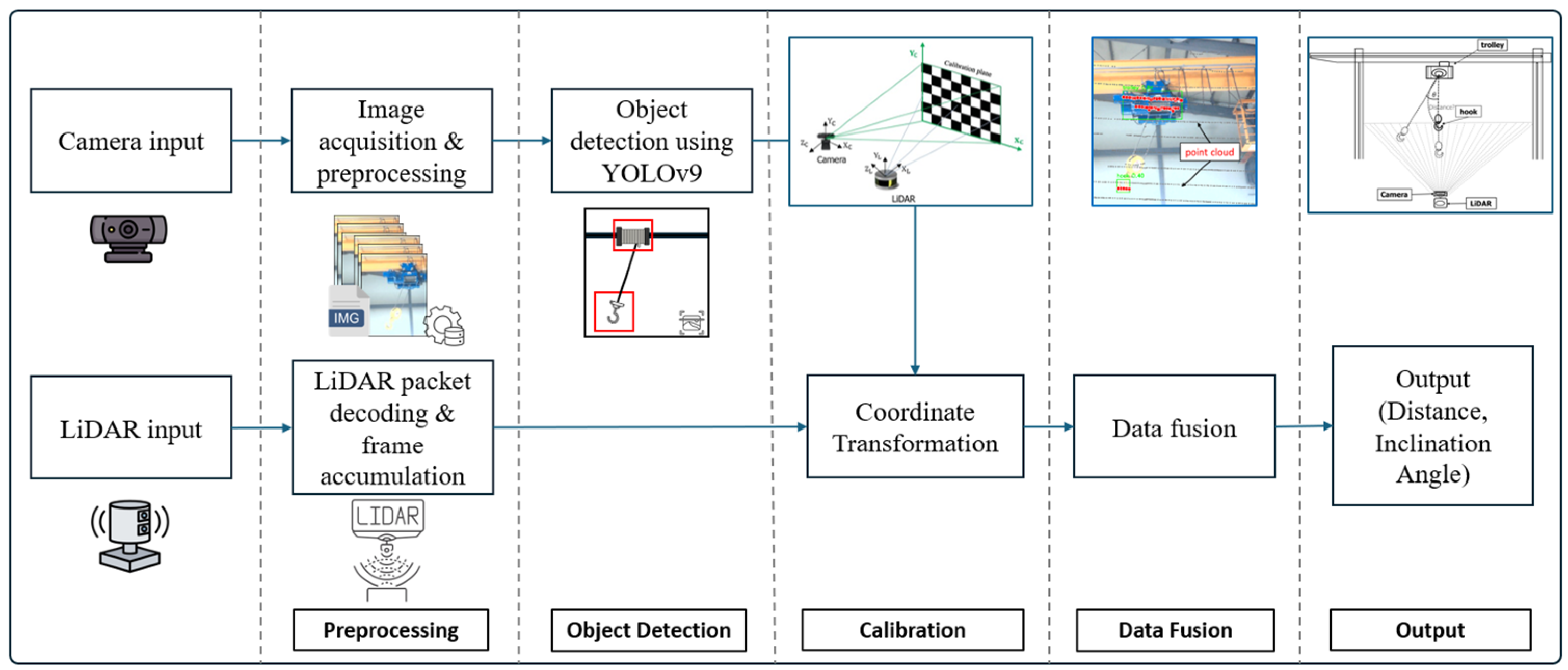
- Crane-specific fusion pipeline: A fine-tuned YOLOv9 detector is utilized to semantically localize the trolley and hook, creating projection-based regions of interest (ROI) that constrain LiDAR point processing. This approach isolates the target 3D structures, enabling the precise derivation of the wire rope inclination in real time.
- Experimental validation: The system is validated on an overhead crane testbed under static, dynamic swing, and low-light conditions, demonstrating superior accuracy (RMSE < 1°) compared to camera-only baselines.
2. Materials and Methods
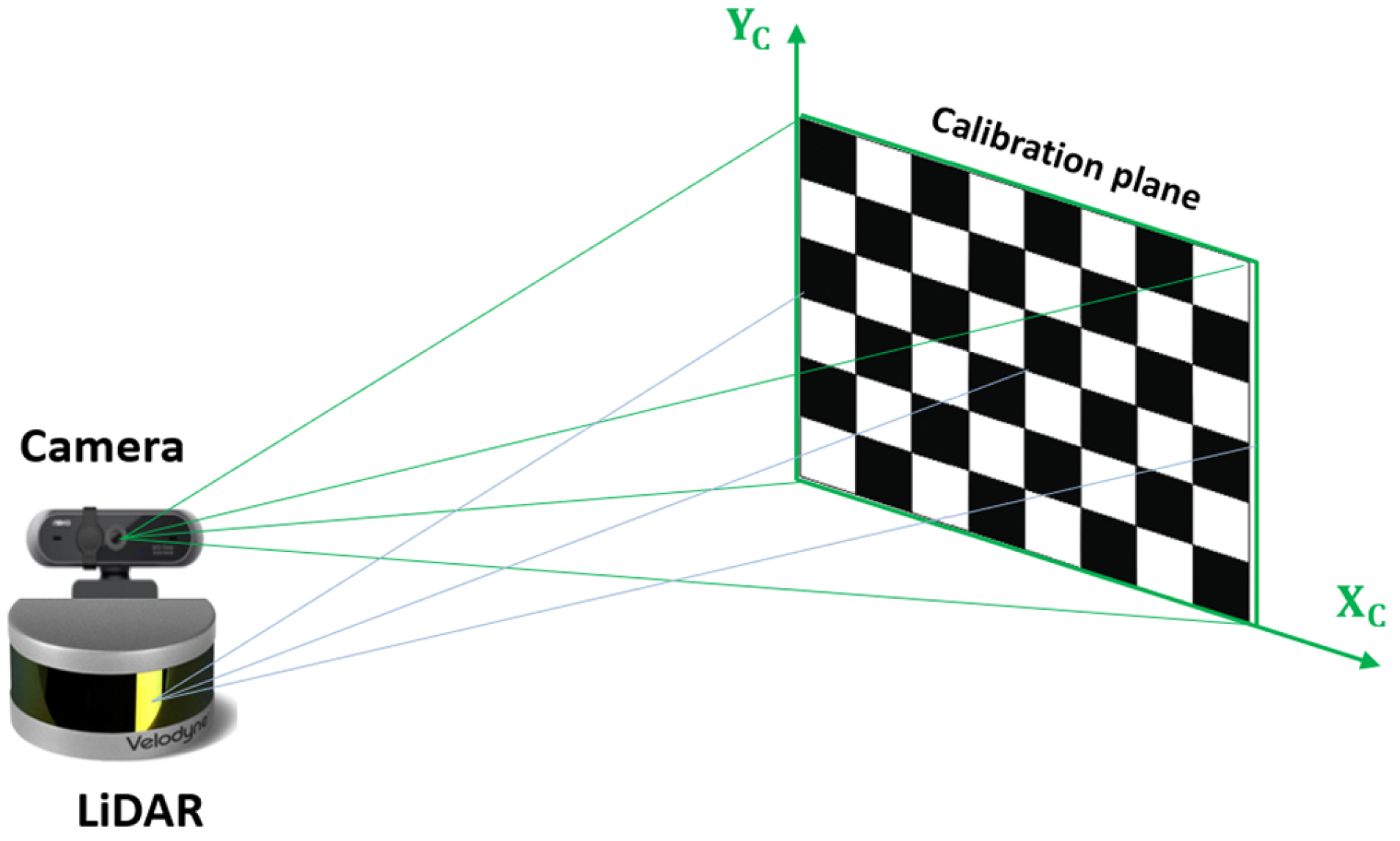
2.1. Coordinate Frames of Camera and LiDAR
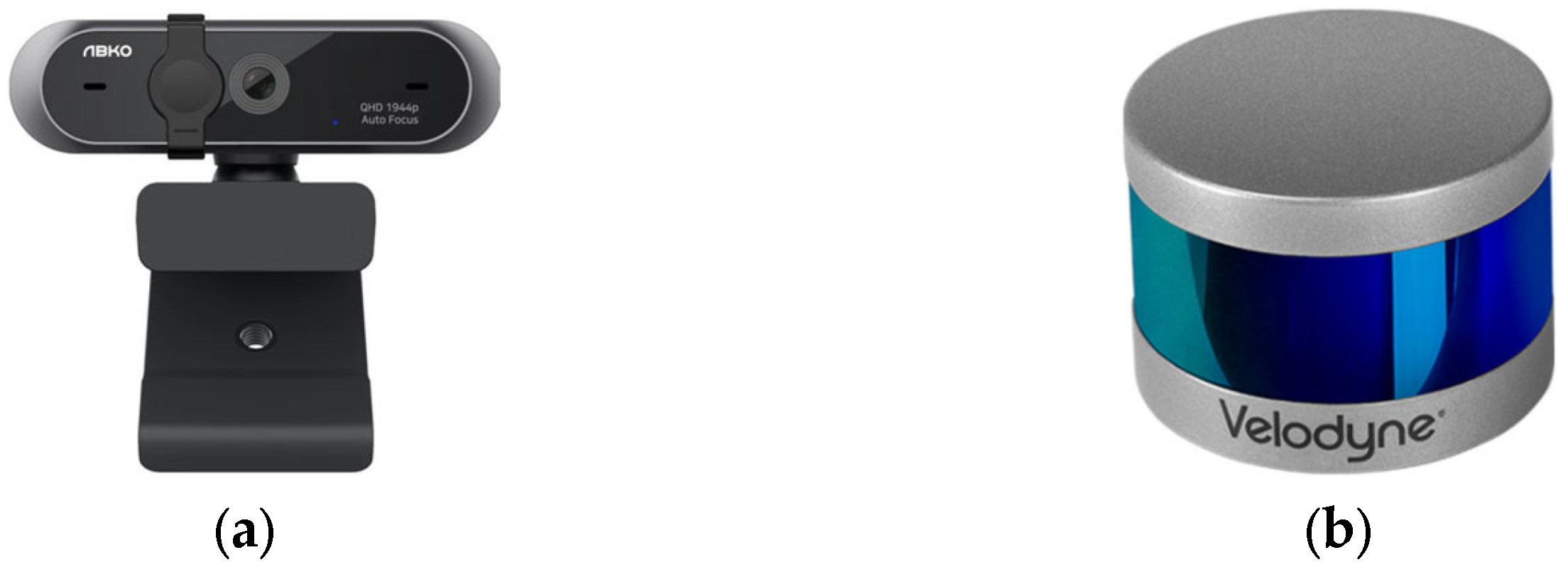
2.2. Sensor Specifications and Mounting Configuration
2.3. Camera–LiDAR Calibration
2.4. Real-Time Data Acquisition and Synchronization
2.5. YOLOv9-Based Trolley and Hook Detection
2.6. LiDAR-Based 3D Center Estimation and Wire Rope Inclination Computation
3. Experimental Setup and Test Scenarios
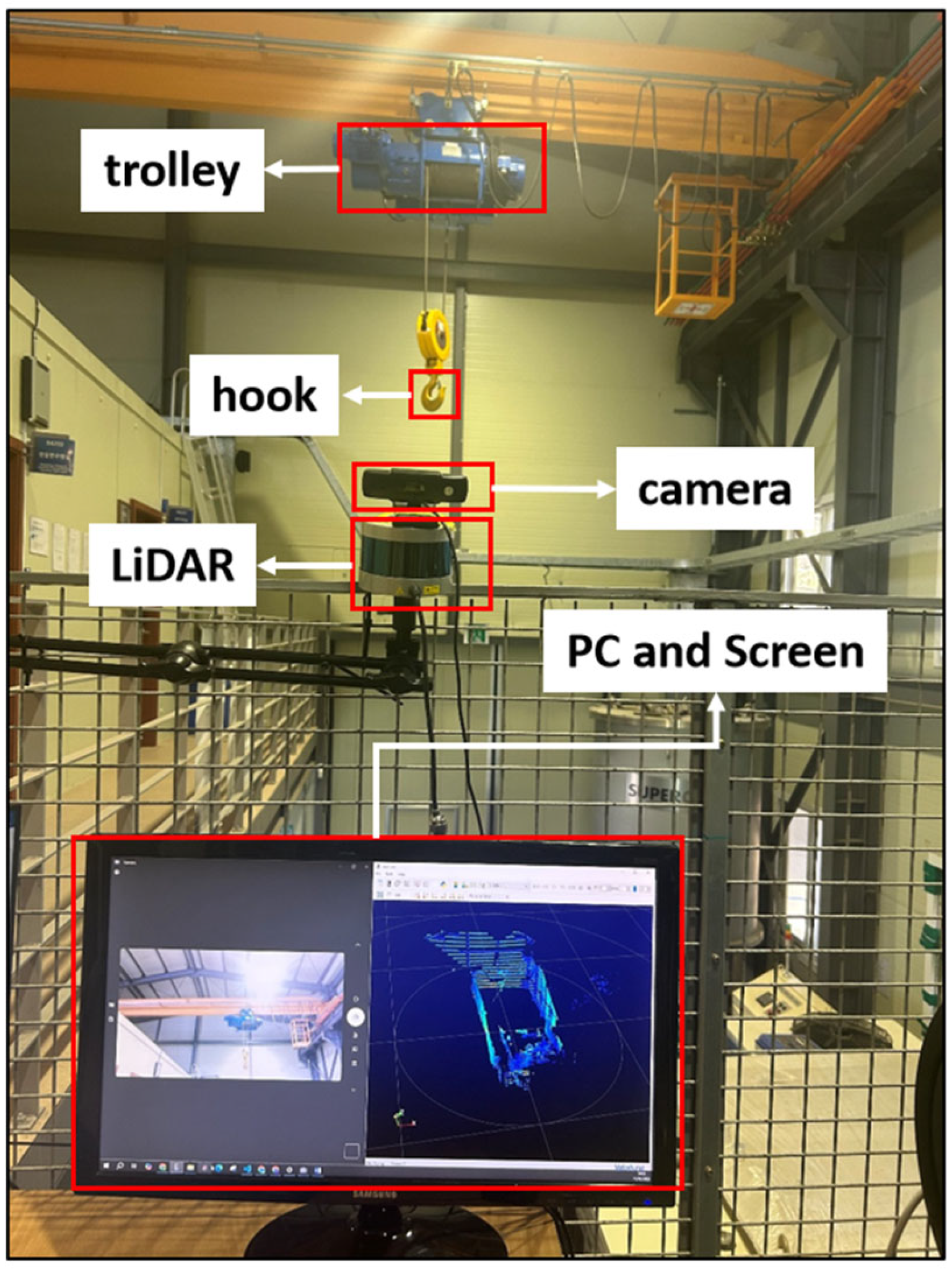
3.1. Overhead Crane Testbed and Data Collection Protocol
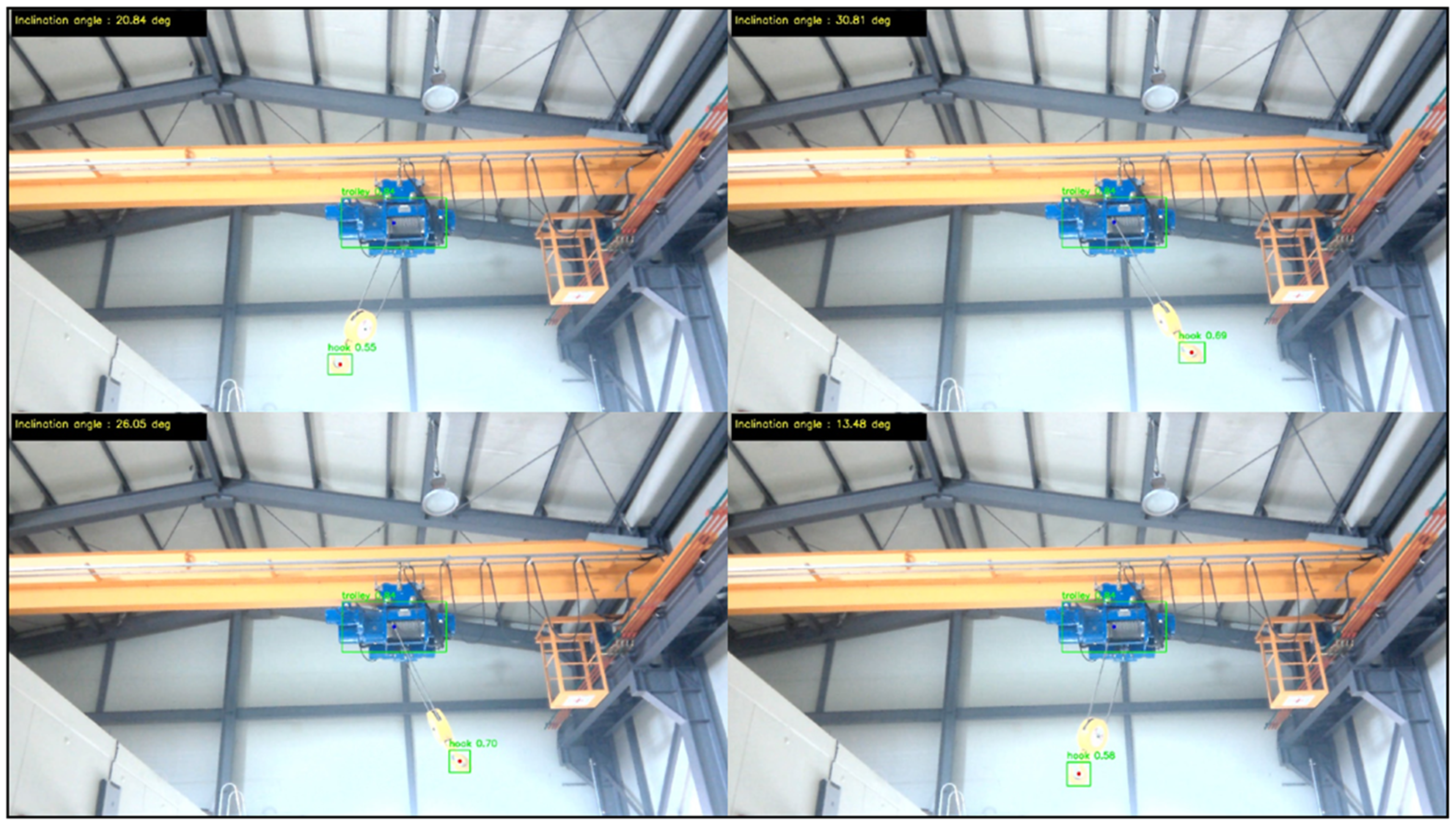
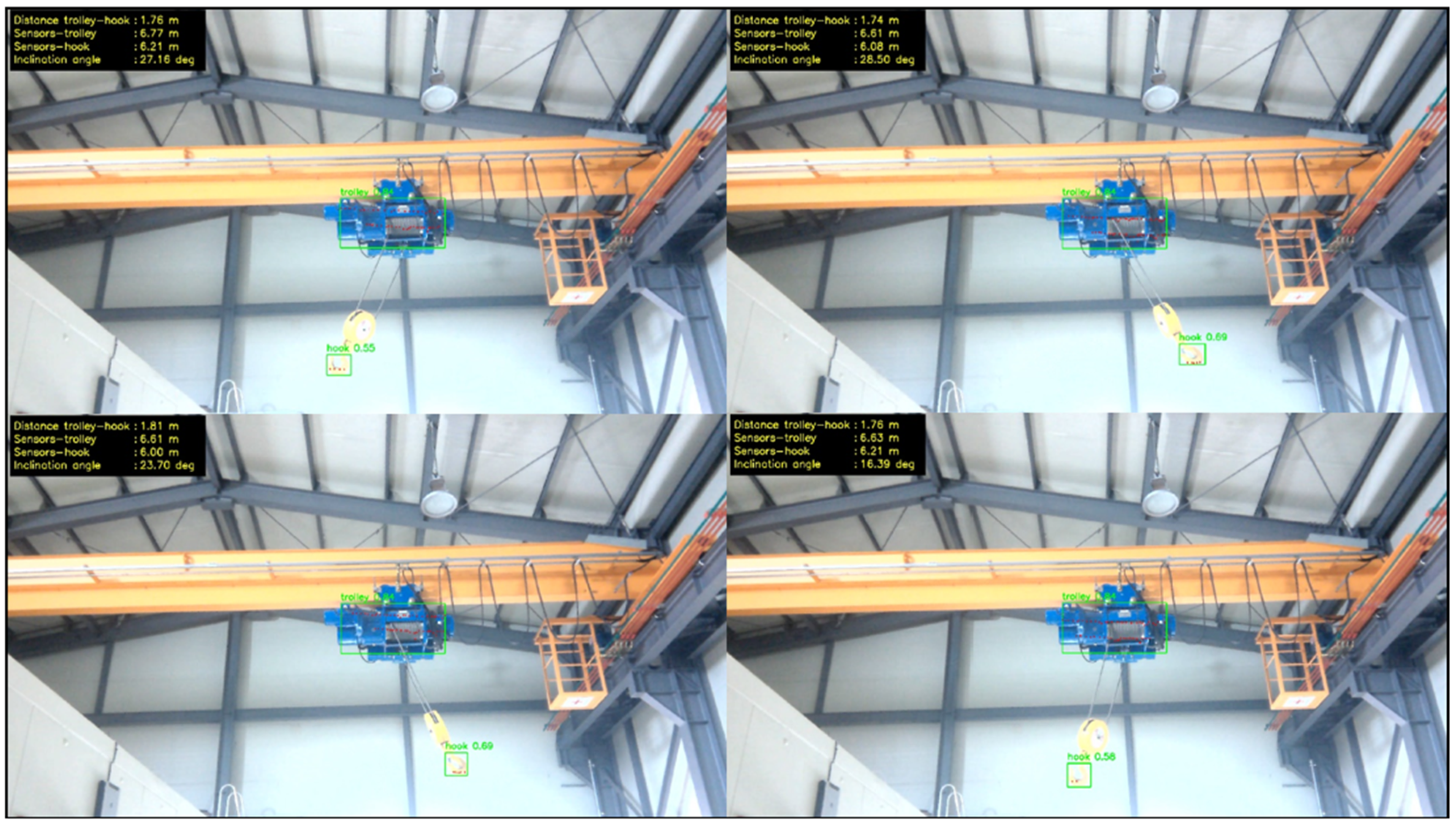
3.2. Dynamic Rope Inclination Evaluation for the Overhead Crane Testbed
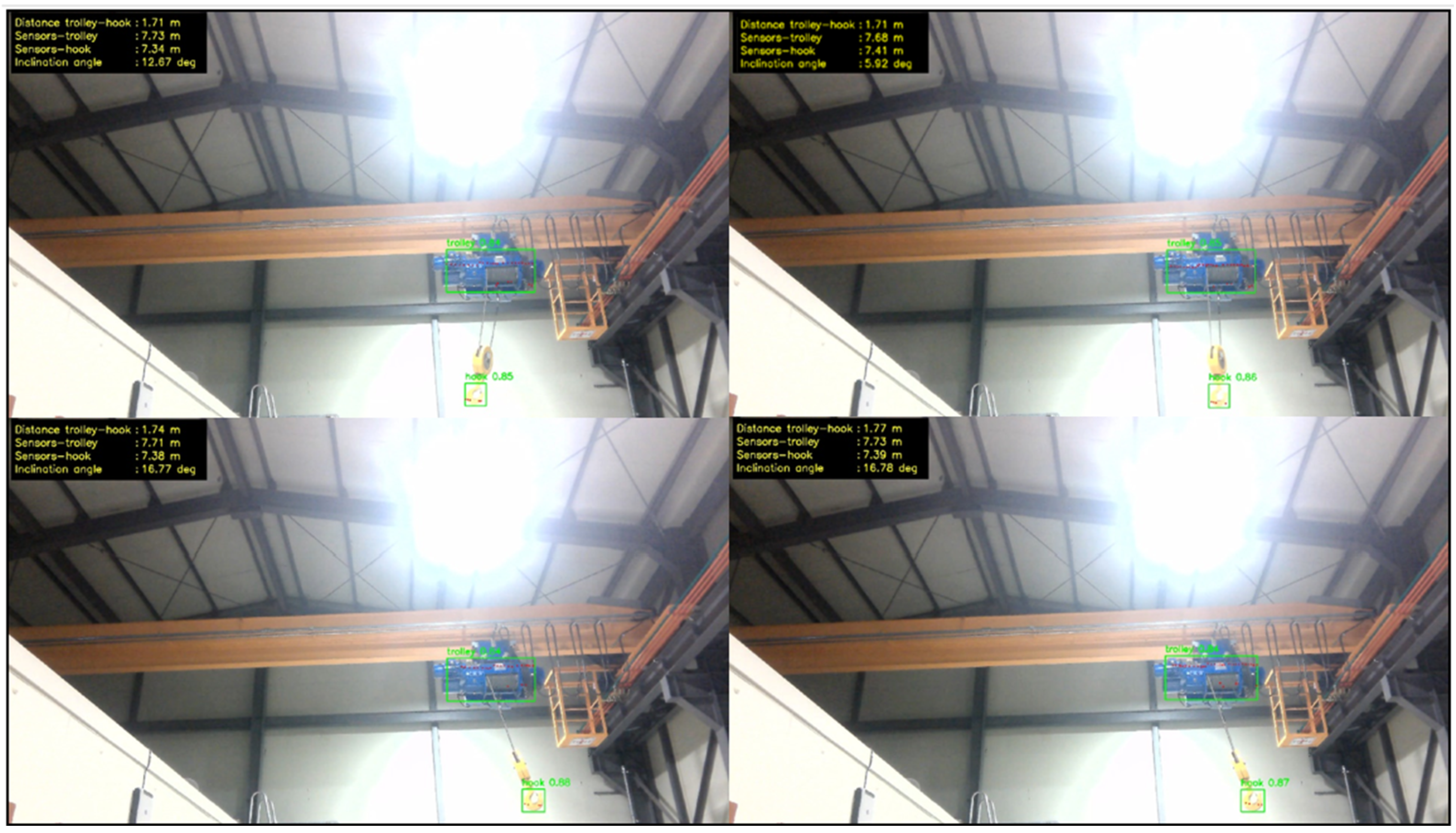
3.3. Illumination Robustness Across Angle and Distance Variations
4. Results and Discussion
4.1. Camera Only Baseline for Rope Inclination Estimation
4.2. Dynamic Swing Results
4.3. Effect of Illumination on Inclination and Distance Estimates
4.4. Computational Performance and Timing Analysis
5. Discussion
5.1. Advantages
5.2. Challenges
5.3. Future Perspectives
- Enhance environmental robustness: Investigate advanced point cloud filtering algorithms or multimodal fusion to maintain reliable detection under severe weather conditions like heavy rain or fog.
- Long-term stability and self-calibration: Develop online or targetless self-calibration routines that can detect and compensate for extrinsic parameter drift caused by mechanical vibrations, ensuring maintenance-free long-term operation.
- Deployment and lightweight optimization: Apply model pruning, quantization and knowledge distillation to optimize the YOLOv9 model for deployment on resource-constrained edge devices (such as NVIDIA Jetson), reducing hardware costs and energy consumption.
- Closed-loop control integration: Directly stream the real-time inclination estimates to the crane’s PLC (Programmable Logic Controller) to validate the system’s effectiveness in active anti-sway control loops and automated positioning tasks in real-world operational cycles.
- High-precision ground truth validation: Future experiments will incorporate industrial-grade inertial measurement units (IMUs) and encoder-based motion references to provide absolute ground truth, allowing for a more rigorous quantification of dynamic tracking errors and time alignment.
6. Conclusions
Author Contributions
Funding
Institutional Review Board Statement
Informed Consent Statement
Data Availability Statement
Conflicts of Interest
Abbreviations
| AI | artificial intelligence |
| MSE | mean squared error |
| RMSE | root mean squared error |
| ROI | region of interest |
| LiDAR | Light Detection and Ranging |
| RGB | red–green–blue |
| YOLO | You Only Look Once |
References
- Jobran, Y.; Kara, G. Examining the Efficiency of Automation in Container Terminals. J. Transp. Logist. 2022, 7, 137–155. [Google Scholar] [CrossRef]
- Tsagkaris, P.; Moschovou, T.P. The Impact of Automation on the Efficiency of Port Container Terminals. Future Transp. 2025, 5, 155. [Google Scholar] [CrossRef]
- AlKheder, S.; Naif, D.; Musaed, D.; Al Shrekah, S.; Al Rshaid, M.; Al. Anzi, N.; Baqer, I. Maritime Transport Management in Kuwait toward an Automated Port Logistical City. Clean. Logist. Supply Chain 2022, 3, 100031. [Google Scholar] [CrossRef]
- Gutierrez, R.; Magallon, M.; Hernandez, D.C. Vision-Based System for 3d Tower Crane Monitoring. IEEE Sens. J. 2021, 21, 11935–11945. [Google Scholar] [CrossRef]
- Gan, G.Y.; Lee, H.S.; Tao, Y.J.; Tu, C.S. Selecting Suitable, Green Port Crane Equipment for International Commercial Ports. Sustainability 2021, 13, 6801. [Google Scholar] [CrossRef]
- Pallis, P.L. Port Risk Management in Container Terminals. Transp. Res. Procedia 2017, 25, 4411–4421. [Google Scholar] [CrossRef]
- Raubar, E.; Vrančić, D. Anti-Sway System for Ship-to-Shore Cranes. Stroj. Vestn./J. Mech. Eng. 2012, 58, 338–344. [Google Scholar] [CrossRef]
- Wang, H.; Yang, Q.; Liu, Q.; Zhao, C.; Zhou, W.; Zhang, H.; Liu, J. Automated Productivity Analysis of Cable Crane Transportation Using Deep Learning-Based Multi-Object Tracking. Autom. Constr. 2024, 166, 105644. [Google Scholar] [CrossRef]
- Munro, D.M.; Govers, M.E.; Oliver, M.L. Physical demands of overhead crane operation. Int. J. Ind. Ergon. 2021, 86, 103200. [Google Scholar] [CrossRef]
- Jakovlev, S.; Eglynas, T.; Voznak, M. Application of neural network predictive control methods to solve the shipping container sway control problem in quay cranes. IEEE Access 2021, 9, 78253–78265. [Google Scholar] [CrossRef]
- Cahyono, R.T.; Kenaka, S.P.; Jayawardhana, B. Simultaneous allocation and scheduling of quay cranes, yard cranes, and trucks in dynamical integrated con-tainer terminal operations. IEEE Trans. Intell. Transp. Syst. 2021, 23, 8564–8578. [Google Scholar] [CrossRef]
- Zhong, B.; Ma, L.; Dong, H. Dynamic Analysis and Structure Parameter Research on a Hydraulic Anti-Swaying System for Container Cranes. Appl. Sci. 2022, 12, 12537. [Google Scholar] [CrossRef]
- Jiang, P.; Ergu, D.; Liu, F.; Cai, Y.; Ma, B. A Review of Yolo Algorithm Developments. Procedia Comput. Sci. 2022, 199, 1066–1073. [Google Scholar] [CrossRef]
- Bochkovskiy, A.; Wang, C.-Y.; Liao, H.-Y.M. YOLOv4: Optimal Speed and Accuracy of Object Detection. arXiv 2020, arXiv:2004.10934. [Google Scholar] [CrossRef]
- Yaseen, M. What Is YOLOv9: An In-Depth Exploration of the Internal Features of the Next-Generation Object Detector. arXiv 2024, arXiv:2409.07813. [Google Scholar]
- Viswanatha, V.; Chandana, R.K.; Ramachandra, A.C. Real time object detection system with YOLO and CNN models: A review. arXiv 2022, arXiv:2208.00773. [Google Scholar] [CrossRef]
- Shao, Y.; Sun, Z.; Tan, A.; Yan, T. Efficient three-dimensional point cloud object detection based on improved Complex-YOLO. Front. Neurorobot. 2023, 17, 1092564. [Google Scholar] [CrossRef]
- Liang, M.; Yang, B.; Wang, S.; Urtasun, R. Deep Continuous Fusion for Multi-Sensor 3D Object Detection. In Proceedings of the European Conference on Computer Vision (ECCV) 2018; Springer: Cham, Switzerland, 2018; pp. 641–656. [Google Scholar]
- Simon, M.; Milz, S.; Amende, K.; Gross, H.-M. Complex-YOLO: Real-Time 3D Object Detection on Point Clouds. arXiv 2018, arXiv:1803.06199. [Google Scholar]
- Xu, X.; Jiang, Y.; Chen, W.; Huang, Y.; Zhang, Y.; Sun, X. Damo-yolo: A report on real-time object detection design. arXiv 2022, arXiv:2211.15444. [Google Scholar]
- Vora, S.; Lang, A.H.; Helou, B.; Beijbom, O. PointPainting: Sequential Fusion for 3D Object Detection. In Proceedings of the IEEE/CVF Conference on Computer Vision and Pattern Recognition 2020; IEEE: New York, NY, USA, 2020; pp. 4604–4612. [Google Scholar]
- Yildiz, A.S.; Meng, H.; Swash, M.R. Real-Time Object Detection and Distance Measurement Enhanced with Semantic 3D Depth Sensing Using Cam-era-LiDAR Fusion. Appl. Sci. 2025, 15, 5543. [Google Scholar] [CrossRef]
- Liu, H.; Wu, C.; Wang, H. Real Time Object Detection Using LiDAR and Camera Fusion for Autonomous Driving. Sci. Rep. 2023, 13, 8056. [Google Scholar] [CrossRef]
- Benayed, W.; Mabrouk, I.; Masmoudi, M.S.; Abdelaziz, W.B. LiDAR 2D and Camera Fusion for ADAS: A Practical Approach With YOLOv9 and ROS2 Framework. IEEE Access 2025, 13, 155500–155519. [Google Scholar] [CrossRef]
- Tsai, D.; Worrall, S.; Shan, M.; Lohr, A.; Nebot, E. Optimising the Selection of Samples for Robust Lidar Camera Calibration. In 2021 IEEE International Intelligent Transportation Systems Conference (ITSC) 2021; IEEE: New York, NY, USA, 2021; pp. 2631–2638. [Google Scholar]
- Li, L.; Li, H.; Liu, X.; He, D.; Miao, Z.; Kong, F.; Li, R.; Liu, Z.; Zhang, F. Joint Intrinsic and Extrinsic LiDAR-Camera Calibration in Targetless Environments Using Plane-Constrained Bundle Adjustment. arXiv 2023, arXiv:2308.12629. [Google Scholar]
- Huang, J.K.; Grizzle, J.W. Improvements to Target-Based 3D LiDAR to Camera Calibration. IEEE Access 2020, 8, 134101–134110. [Google Scholar] [CrossRef]
- Zeng, T.; Gu, X.; Yan, F.; He, M.; He, D. YOCO: You Only Calibrate Once for Accurate Extrinsic Parameter in LiDAR-Camera Systems. Meas. Sci. Technol. 2025, 36, 075009. [Google Scholar] [CrossRef]
- Zhang, H.; Li, S.; Zhu, X.; Chen, H.; Yao, W. 3D LiDAR and monocular camera calibration: A Review. IEEE Sens. J. 2025, 25, 10530–10555. [Google Scholar] [CrossRef]
- Peterle, A.C.F.; Araujo, R.J.T.; Silva, P.I.M. Three-Dimensional Collision Avoidance System Applied to Ship-Loaders Based on GNSS and Point Cloud Mod-eling: A Case Study. Congr. Bras. Autom.-CBA 2024, 4, CBA2024. [Google Scholar]
- Klar, R.; Fredriksson, A.; Angelakis, V. Digital Twins for Ports: Derived from Smart City and Supply Chain Twinning Experience. IEEE Access 2023, 11, 71777–71799. [Google Scholar] [CrossRef]





| Installation and Maintenance | Environmental Robustness | 3D Metric Accuracy | Real-Time and Suitability | |
|---|---|---|---|---|
| Traditional Sensors (Encoders/IMUs) | High (installation burden) | Medium | High | High |
| Monocular Vision (Camera Only) | Low complexity | Low (light) | Low (depth) | High |
| Generic Fusion (Auto-Driving) | Medium | High | High | Medium |
| Proposed Framework (Crane-Specific) | Low/Medium | High | High | High |
| Sensor | Parameter | Value/Setting |
|---|---|---|
| APC930 QHD camera | Image format | RGB color video |
| Resolution | pixels (QHD) | |
| Horizontal field of view | ||
| Frame rate | 30 fps | |
| Velodyne VLP-16 LiDAR | Number of laser channels | 16 channels |
| Measurement range | Up to 100 m | |
| Horizontal field of view | ||
| Vertical field of view | ) | |
| Rotation rate | 5–20 Hz |
| Item | Value/Description |
|---|---|
| Native calibration resolution | pixels |
| Processing resolution | pixels |
| YOLOv9 input | |
| Intrinsic matrix | with resize factors |
| Category | Parameter | Value/Description |
|---|---|---|
| Dataset | Total images | 1000 images (Annotated via Roboflow) |
| Data split | Training 70%; validation 20%; test 10% | |
| Hardware | CPU | Intel(R) Xeon(R) W-2295 @ 3.00 GHz |
| RAM | 512 GB | |
| GPU | NVIDIA Quadro P2200 (5 GB VRAM) | |
| Training Configuration | Epochs/Batch size/Optimizer | 100/16/SGD |
| Strategy | Transfer learning (Fine-tuned from pretrained weights) | |
| Photometric augmentation | HSV gains (H: 0.015, S: 0.7, V: 0.4) | |
| Inference Settings | Confidence threshold | 0.5 (default) |
| IoU threshold | 0.5 (default) |
| Case | Trolley Position (m) | Hoisting Height (m) | Swing Amplitude | |||
|---|---|---|---|---|---|---|
| 1 | 7.90 | 1.30 | Large | 20.84 | 23.63 | 12.87 |
| 2 | 7.90 | 1.30 | Large | 20.84 | 24.62 | 15.35 |
| 3 | 7.90 | 1.50 | Large | 30.83 | 32.12 | 4.02 |
| 4 | 7.90 | 1.50 | Medium | 13.48 | 14.43 | 6.58 |
| 5 | 7.29 | 1.50 | Large | 26.05 | 26.57 | 1.96 |
| 6 | 7.29 | 1.50 | Large | 25.09 | 26.05 | 3.69 |
| 7 | 7.29 | 2.00 | Large | 21.07 | 19.02 | 10.78 |
| 8 | 7.29 | 2.00 | Large | 22.24 | 26.12 | 14.85 |
| 9 | 7.29 | 2.00 | Large | 32.14 | 34.27 | 6.21 |
| 10 | 6.70 | 1.50 | Large | 20.00 | 22.52 | 11.19 |
| 11 | 6.70 | 1.50 | Large | 26.41 | 27.36 | 3.47 |
| 12 | 6.70 | 1.50 | Medium | 16.02 | 15.06 | 6.37 |
| 13 | 6.52 | 2.50 | Small | 10.75 | 9.43 | 12.24 |
| 14 | 6.52 | 2.50 | Medium | 14.09 | 15.12 | 6.81 |
| 15 | 6.52 | 2.50 | Large | 22.26 | 24.37 | 8.66 |
| Case | Trolley Position (m) | Hoisting Height (m) | Swing Amplitude | |||
|---|---|---|---|---|---|---|
| 1 | 7.90 | 1.30 | Large | 28.50 | 27.72 | 2.81 |
| 2 | 7.90 | 1.30 | Large | 27.16 | 26.78 | 1.41 |
| 3 | 7.90 | 1.50 | Large | 23.70 | 25.60 | 7.42 |
| 4 | 7.90 | 1.50 | Medium | 16.39 | 16.70 | 1.85 |
| 5 | 7.29 | 1.50 | Medium | 16.55 | 17.02 | 2.76 |
| 6 | 7.29 | 1.50 | Medium | 10.78 | 10.24 | 5.27 |
| 7 | 7.29 | 2.00 | Medium | 16.77 | 16.71 | 0.35 |
| 8 | 7.29 | 2.00 | Medium | 17.36 | 17.28 | 0.46 |
| 9 | 7.29 | 2.00 | Medium | 17.85 | 17.64 | 1.19 |
| 10 | 6.70 | 1.50 | Large | 18.02 | 18.13 | 0.61 |
| 11 | 6.70 | 1.50 | Large | 19.68 | 20.41 | 3.58 |
| 12 | 6.70 | 1.50 | Small | 10.29 | 9.78 | 5.21 |
| 13 | 6.52 | 2.50 | Small | 5.92 | 5.87 | 0.85 |
| 14 | 6.52 | 2.50 | Small | 7.69 | 7.31 | 5.20 |
| 15 | 6.52 | 2.50 | Medium | 16.78 | 17.41 | 3.62 |
| Case | Trolley Position (m) | Hoisting Height (m) | Swing Amplitude | |||
|---|---|---|---|---|---|---|
| 1 | 7.70 | 1.70 | Medium | 12.67 | 12.21 | 3.75 |
| 2 | 7.70 | 1.70 | Medium | 16.77 | 16.48 | 1.76 |
| 3 | 7.70 | 1.70 | Small | 5.92 | 5.46 | 7.73 |
| 4 | 7.70 | 1.70 | Medium | 16.78 | 16.35 | 2.56 |
| 5 | 7.30 | 2.00 | Large | 19.02 | 18.63 | 2.09 |
| 6 | 7.30 | 2.00 | Large | 19.35 | 20.61 | 4.51 |
| 7 | 7.30 | 2.00 | Medium | 10.29 | 9.70 | 6.08 |
| 8 | 7.30 | 2.50 | Small | 5.72 | 5.87 | 2.56 |
| 9 | 7.30 | 2.50 | Small | 7.69 | 7.25 | 6.07 |
| 10 | 6.60 | 1.00 | Medium | 16.78 | 17.40 | 3.56 |
| 11 | 6.60 | 1.00 | Large | 17.68 | 18.31 | 3.44 |
| 12 | 6.60 | 1.50 | Small | 8.29 | 8.68 | 4.49 |
| 13 | 6.60 | 1.50 | Small | 5.92 | 5.77 | 2.60 |
| 14 | 6.60 | 2.50 | Small | 7.96 | 7.62 | 4.46 |
| 15 | 6.60 | 2.50 | Medium | 14.67 | 13.67 | 7.32 |
| Illumination Condition | MSE | RMSE | |
|---|---|---|---|
| Normal illumination | 0.425 | 0.65 | 2.84 |
| Reduced illumination | 0.431 | 0.66 | 4.20 |
| Pipeline Stage | Mean Time (ms) | Standard Deviation (ms) |
|---|---|---|
| Image Preprocessing | 11.81 | 1.94 |
| YOLOv9 Inference | 124.13 | 43.00 |
| LiDAR Projection and Algorithm | 9.29 | 7.19 |
| Total End-to-End Latency | 145.23 | 43.30 |
Disclaimer/Publisher’s Note: The statements, opinions and data contained in all publications are solely those of the individual author(s) and contributor(s) and not of MDPI and/or the editor(s). MDPI and/or the editor(s) disclaim responsibility for any injury to people or property resulting from any ideas, methods, instructions or products referred to in the content. |
© 2026 by the authors. Licensee MDPI, Basel, Switzerland. This article is an open access article distributed under the terms and conditions of the Creative Commons Attribution (CC BY) license.
Share and Cite
Pham, A.-H.; Jung, G.-E.; Mai, X.-K.; Go, B.-S.; Lee, S.-J. Real-Time Wire Rope Inclination Detection Using YOLOv9-Based Camera–LiDAR Fusion for Overhead Cranes. J. Mar. Sci. Eng. 2026, 14, 393. https://doi.org/10.3390/jmse14040393
Pham A-H, Jung G-E, Mai X-K, Go B-S, Lee S-J. Real-Time Wire Rope Inclination Detection Using YOLOv9-Based Camera–LiDAR Fusion for Overhead Cranes. Journal of Marine Science and Engineering. 2026; 14(4):393. https://doi.org/10.3390/jmse14040393
Chicago/Turabian StylePham, Anh-Hung, Ga-Eun Jung, Xuan-Kien Mai, Byeong-Soo Go, and Seok-Ju Lee. 2026. "Real-Time Wire Rope Inclination Detection Using YOLOv9-Based Camera–LiDAR Fusion for Overhead Cranes" Journal of Marine Science and Engineering 14, no. 4: 393. https://doi.org/10.3390/jmse14040393
APA StylePham, A.-H., Jung, G.-E., Mai, X.-K., Go, B.-S., & Lee, S.-J. (2026). Real-Time Wire Rope Inclination Detection Using YOLOv9-Based Camera–LiDAR Fusion for Overhead Cranes. Journal of Marine Science and Engineering, 14(4), 393. https://doi.org/10.3390/jmse14040393