Article

A Tale of Two Stations—Cleaner Fish at Cleaning Stations That Service Pelagic Clientele Exhibit Different Behaviour than Those That Service Local Clients


School of Zoology, Faculty of Life Sciences, Tel-Aviv University, P.O. Box 39040, Tel Aviv 6997801, Israel
*
Authors to whom correspondence should be addressed.
J. Mar. Sci. Eng. 2026, 14(4), 389; https://doi.org/10.3390/jmse14040389
Submission received: 11 January 2026 / Revised: 4 February 2026 / Accepted: 17 February 2026 / Published: 19 February 2026
(This article belongs to the Section Marine Ecology)

Abstract

Cleaning, the removal of parasites and dead tissue from clients, is common in the Sea. Reef-based cleaning stations are visited by many fish clients, some by both resident and visitor pelagic species, while others are visited solely by resident species. Nonetheless, no distinction has ever been made between the potentially different cleaning stations. Here we describe two distinct categories of cleaning stations: pelagic cleaning stations (PCS) and residential cleaning stations (RCS). We suggest that the two station types differ not only in their clientele but also in the characteristics of their cleaning services. We examined the behaviour of the cleaner wrasse, Labroides dimidiatus, at six cleaning stations on isolated knolls in Palawan, the Philippines—three stations that are routinely visited by pelagic manta rays (i.e., PCS), and three stations that service only resident clients (i.e., RCS). Our results indicate that PCS have more cleaners per station and that cleaners forage at greater distances from the station’s focal point. These distinct patterns suggest functional differences between pelagic and residential cleaning stations. Our findings may aid in the identification and conservation of shark and manta cleaning stations.
Key Contribution: Cleaner wrasses at cleaning stations on patchy reefs that service manta rays were more abundant and tended to forage at larger distances than cleaners at cleaning stations that service only reef dwelling fish.

1. Introduction

Cleaning interactions are commonly observed in marine ecosystems and are considered mutualistic, benefiting cleaners by providing nutritional resources and clients by improving their condition through parasite removal [1,2]. Cleaning is performed by various species of fish and shrimps, during which wounds are cleaned and parasites, bacteria, debris, and diseased tissues are removed from the bodies of client fishes [1,2,3]. Cleaner fish establish cleaning stations, which are spatially discrete territories where cleaners wait for clients to arrive rather than actively searching for potential clients [4]. In addition to their importance for client condition, cleaning stations can also have broader ecological effects, influencing local fish abundance and biodiversity [5,6,7,8,9].
Potential clients at cleaning stations can generally be categorized into two types: (1) resident reef fishes that inhabit the vicinity of the station, and (2) visiting clients, often pelagic or semi-pelagic species, that visit cleaning stations but do not reside on the reef [10,11]. Client type has been suggested to influence cleaner wrasse behaviour. Visiting clients may depart if not serviced promptly, whereas resident clients remain locally available [10,12]. Cleaners also tend to interact more frequently with larger clients, which are often associated with higher parasite loads [11,13]. Visitor species to cleaning stations are often nomadic but can nevertheless exhibit long-term site fidelity, repeatedly returning to the same stations over time [14,15].
Reef manta rays (Mobula alfredi) represent a prominent example of this pattern, with individuals repeatedly visiting certain cleaning stations while rarely or never visiting others [16,17]. This pattern is further supported by observations showing periodic visitation of manta rays to cleaning stations and by reports from dive operators and fishermen, who routinely encounter megafauna at specific cleaning stations [18,19,20,21]. The presence or absence of visiting pelagic clients effectively differentiates cleaning stations into those that service pelagic species such as manta rays in addition to resident reef fishes and those that service only resident species. It remains unclear whether cleaning stations visited by pelagic clients differ systematically from stations servicing only resident reef fishes. To date, few studies have explicitly distinguished between these potential types of cleaning stations. If such differences exist, they may provide insights into the ecological processes associated with pelagic client visitation and inform conservation prioritization of cleaning stations [10].
This study compares pelagic cleaning stations (PCS), which service visiting pelagic clients in addition to resident reef fishes, with residential cleaning stations (RCS), which service only resident species. Specifically, differences in cleaner fish abundance and roaming behaviour between these two types of stations are examined. It is hypothesized that stations servicing megafauna such as manta rays will host higher numbers of cleaner fish and that cleaners at these stations will roam farther from the station focal point [10,22]. Improved understanding of these patterns may broaden current knowledge of cleaning ecology and provide insight into pelagic cleaning systems, particularly those associated with isolated reef structures such as seamounts and knolls. Such information may also contribute to conservation planning by identifying cleaning stations of particular ecological significance for manta rays and associated reef communities.

2. Materials and Methods

2.1. Study Site

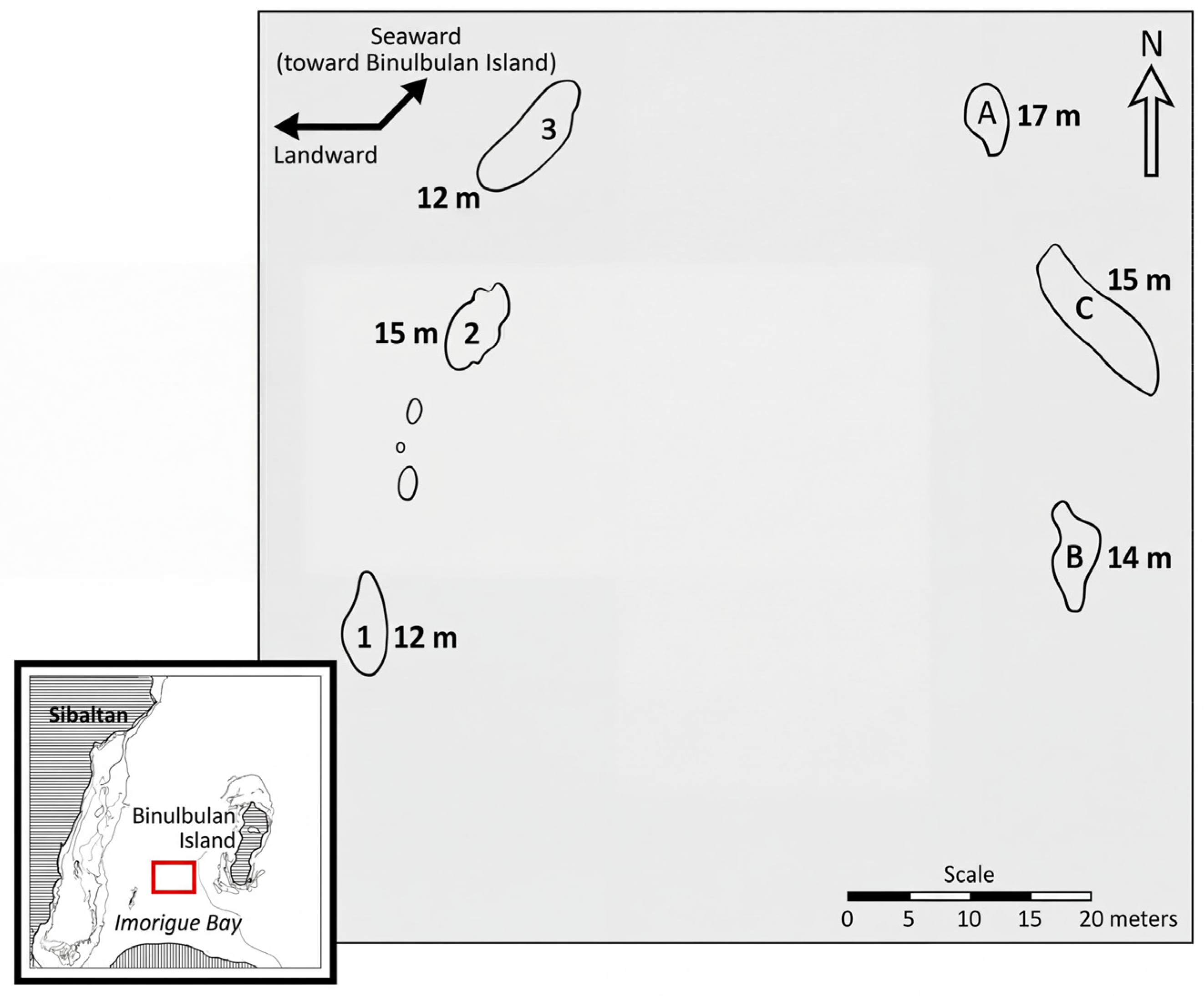
The study was conducted on coral reefs off Sibaltan (11.2705° N, 119.5602° E), a rural coastal village in northern Palawan, the Philippines. The study reefs are composed of isolated rocky knolls scattered over a sandy substrate and are located approximately 7 km offshore, south of Binulbulan Island. Survey sites were situated at depths ranging from 12 to 16 m (Figure 1). East of the study area, the seabed slopes to approximately 50 m before rising again at several small islands.
The study area lies within a community-designated marine protected area established under the El Nido ECAN zoning scheme and incorporated into the Northeastern Palawan MPA network. Additional conservation initiatives aimed at protecting manta ray cleaning stations have been led by non-governmental organizations; however, no active enforcement measures are currently implemented.

2.2. Experimental Design

To compare cleaning stations that service visiting pelagic clients in addition to resident reef fishes with stations that service only resident species, two types of cleaning stations were defined: pelagic cleaning stations (PCS) and residential cleaning stations (RCS). Classification was based on client composition, with particular emphasis on the presence or absence of manta ray visitation.
All dives and surveys were conducted on SCUBA by the same two-person team following best-practice fieldwork guidelines and minimizing disturbance to the surrounding environment. With the assistance of local divers and fishermen, rocky knolls hosting multiple cleaning stations were located. We identified a focal point in each station, defined as the location repeatedly used by cleaner wrasses after roaming or cleaning interactions. This focal point was used as the reference location for subsequent roaming-distance measurements. The cleaner species observed at all stations was the blue-streak cleaner wrasse (Labroides dimidiatus). To ensure consistency, all station-level measurements were recorded by a single observer, who remained stationary at approximately 1–1.5 m from the station. Observations were recorded in situ using an underwater writing slate. The study site is a tourism area, and cleaner wrasses are regularly exposed to divers. Sampling was conducted during the first dives of the day (starting at ~08:00). Four ~40 min dives were conducted per sampling day, each focusing on a single knoll: two knolls were surveyed for cleaner counts during the morning dives, and the same two knolls were revisited in the subsequent dives later that day for roaming-distance measurements.
Knolls where manta rays were routinely observed by divers and fishermen were categorized as PCS, whereas knolls where manta rays were not reported were categorized as RCS. Knoll classification was informed by repeated local observations from divers and fishermen. While this provides practical site knowledge for study design, future work should validate station-type classification using standardized monitoring (e.g., structured manta survey logs and/or continuous camera-based observations).
Knolls were assessed for depth, size (maximum length of ~5 m or ≥10 m), and overall shape (e.g., dome-shaped or elongated). Based on these characteristics, three PCS knolls and three RCS knolls were selected to be as similar as possible. Knolls were labelled PCS-1 to PCS-3 and RCS-1 to RCS-3, such that each PCS knoll was paired with a morphologically similar RCS knoll (Figure 1).
Each knoll was surveyed to quantify the following:
(a)
the number of cleaning stations per knoll;
(b)
the number of cleaner wrasses per station; and
(c)
cleaner wrasse roaming behaviour, quantified as the distance cleaners moved away from the focal point of the cleaning station.
To clarify terminology, “knoll” refers to the discrete reef outcrop surveyed, “cleaning station” the station area used by cleaners and clients on a knoll, and “focal point” the repeatedly used reference point within a station from which roaming distance was measured.

2.3. Data Structure and Acquisition

2.3.1. Cleaner Fish Abundance

Cleaner fish abundance was quantified at the station level as the maximum number of cleaner wrasses observed simultaneously during a standardized 3 min observation window, following ~1 min acclimation. Analyses were conducted at the station level, with each station represented once. Cleaning stations were located on discrete reef knolls, and multiple stations could occur on the same knoll. Because abundance was defined as the maximum number of cleaners observed simultaneously at the focal point during a short, standardized observation window, the measure reflects instantaneous station attendance rather than total population size, thereby reducing sensitivity to potential double-counting across nearby stations.

2.3.2. Cleaner Fish Roaming Distance

Two cleaning stations were randomly selected from each knoll, yielding a total of twelve stations (six PCS and six RCS). Roaming behaviour was measured by tracking an individual cleaner wrasse at 10 s intervals for three minutes and recording its position relative to the station focal point.
Roaming distance was measured as a continuous variable. Distances were estimated underwater in increments of 0.5 m from the focal point using calibrated visual reference markers. Observations were conducted for three minutes per station, with positions recorded at 10 s intervals (18 time-point observations per station). Measurements were taken when no clients were present; observations were paused upon client arrival and resumed once the station was vacant.

2.4. Statistical Analysis

2.4.1. Cleaner Fish Abundance

Differences in cleaner fish abundance between pelagic cleaning stations (PCS) and residential cleaning stations (RCS) were analyzed using generalized estimating equations (GEEs) for clustered count data [23,24]. To account for overdispersion in cleaner counts, a negative binomial distribution was specified with a log link. Cleaning station type (PCS vs. RCS) was included as the predictor variable, and reef knoll identity was specified as the clustering variable to account for non-independence among stations located on the same knoll. Statistical significance of station type was evaluated using Wald χ2 tests. Model-predicted means and 95% confidence intervals were derived from the fitted model. GEE analyses were conducted in IBM SPSS Statistics V.31.

2.4.2. Roaming Behaviour

Cleaner fish roaming distance was analyzed using a generalized linear mixed model (GLMM), with the distance (m) that cleaner fish swam from the cleaning station focal point as the response variable. Cleaning station type (PCS vs. RCS) was included as a fixed effect. Reef knoll identity was nested within station type to account for site-level structure, and station identity was included as a random effect to account for repeated observations within stations. Because distance data were non-normally distributed, statistical significance was additionally assessed using a global randomization (permutation) procedure (1000 permutations of the distance values) to obtain p-values from the permutation distribution of the test statistic. Roaming-distance analyses were conducted in JMP Student Edition.

3. Results

3.1. Cleaner Wrasse Abundance

A total of six reef knolls were surveyed, comprising three pelagic cleaning station (PCS) knolls and three residential cleaning station (RCS) knolls. Multiple cleaning stations were recorded on each knoll. PCS knolls contained six to nine cleaning stations with 16–20 cleaner wrasses in total, whereas RCS knolls contained four to six stations with 8–11 cleaner wrasses (Table 1). Station-level raw cleaner counts for individual cleaning stations are provided in Figure S1 (Supplementary Materials).
Cleaner wrasse abundance differed significantly between station types. Generalized estimating equation (GEE) analysis revealed a significant effect of station type, with pelagic cleaning stations (PCS) supporting higher numbers of cleaner wrasses than residential cleaning stations (RCS) (Wald χ2 = 7.76, df = 1, p = 0.005).
The model predicted a mean cleaner abundance of 2.4 individuals at pelagic cleaning stations (95% CI: 2.17–2.58), compared with 1.8 individuals at residential cleaning stations (95% CI: 1.63–2.01). In contrast, variation among reef knolls nested within station type was not significant (Wald χ2 = 5.05, df = 4, p = 0.282).

3.2. Roaming Behaviour

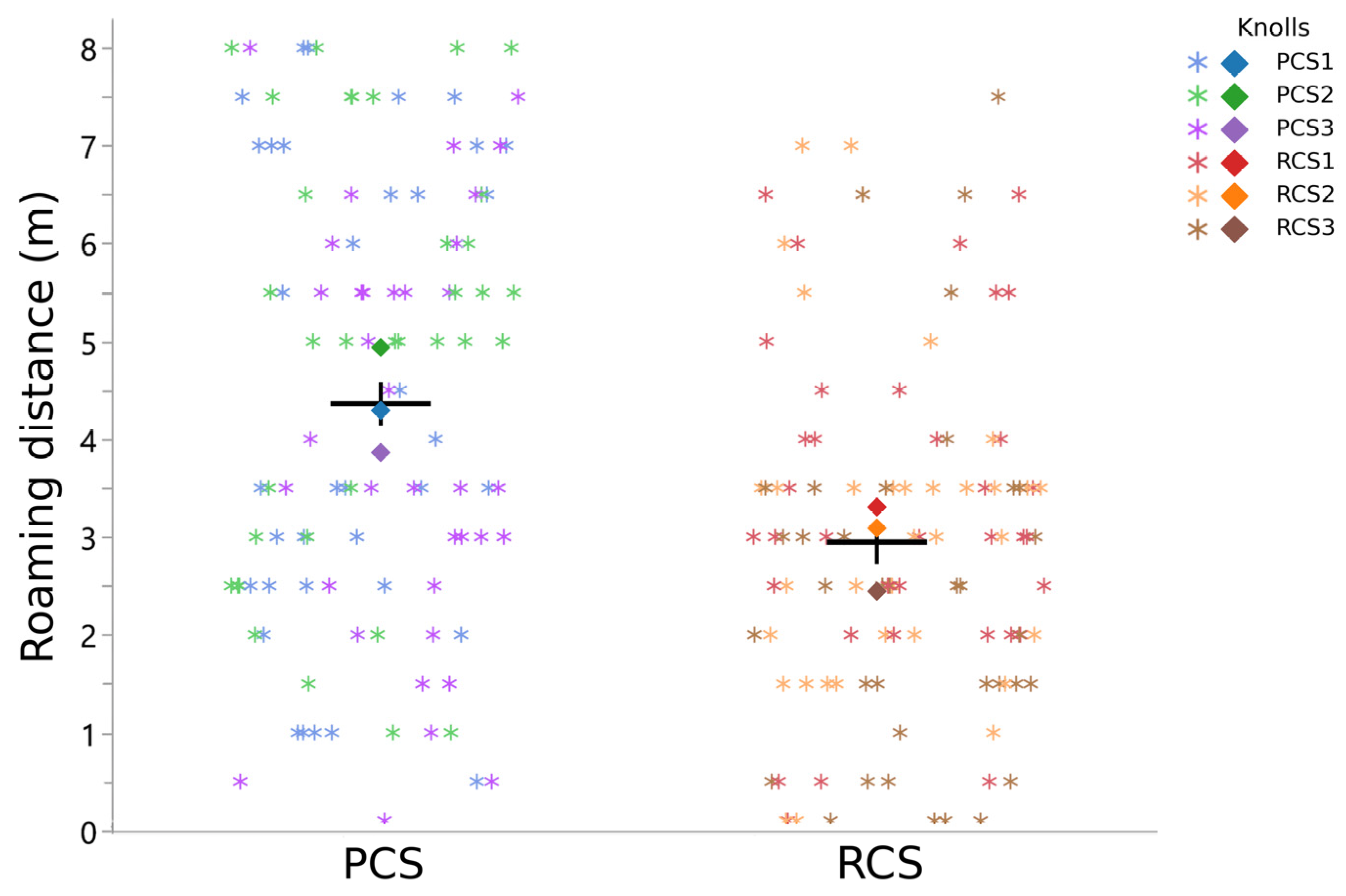
Cleaner wrasse roaming behaviour was quantified at twelve cleaning stations (six PCS and six RCS). At each station, positions were recorded at 10 s intervals for 3 min (18 time-point observations per station; 216 observations in total). Observed roaming distances were higher at PCS than at RCS (PCS: median [Q1–Q3] = 4.75 [2.50–6.50] m, n = 108; RCS: 3.00 [1.63–3.50] m, n = 108). This pattern was consistent with model results (Figure 2; station-level summaries in Table S1).
The generalized linear mixed model (GLMM) showed a strong effect of station type (PCS vs. RCS) on roaming distance (F(1,6) = 26.17, permutation test p < 0.0001), with cleaners at PCS roaming farther from the focal point than those at RCS (Figure 2). Model-predicted mean (±SE) roaming distance was 4.46 ± 0.21 m at PCS and 2.96 ± 0.21 m at RCS (difference ≈ 1.5 m).
Variation among reef knolls nested within station type was not significant (F(4,6) = 1.71, permutation test p = 0.248), indicating consistent roaming behaviour among knolls within each station category.

4. Discussion

This study demonstrates that pelagic cleaning stations (PCS) and residential cleaning stations (RCS) differ not only in their clientele but also in the abundance and roaming behaviour of cleaner wrasse (Labroides dimidiatus). These findings indicate that cleaning stations regularly visited by pelagic megafauna represent a functionally distinct subset of cleaning stations, rather than merely locations with a different assemblage of clients.

4.1. Cleaner Wrasse Abundance

Cleaner wrasse abundance was significantly higher at pelagic cleaning stations than at residential stations. Given the close matching of reef knolls in depth, size, and morphology, it is unlikely that physical habitat characteristics alone explain this pattern. Instead, differences in clientele, specifically the presence or absence of visiting pelagic species such as manta rays, are likely to play a central role. Pelagic clients are typically large-bodied and may carry relatively high parasite loads, potentially offering substantial feeding opportunities to cleaners during short visits [5,13]. Previous work has shown that cleaners preferentially interact with larger clients and may adjust their behaviour to maximize access to profitable interactions [12,22]. Increased cleaner abundance at PCS may therefore reflect the higher expected payoff associated with pelagic clients. Similar spatial variation in cleaner density has been reported across reef systems and regions, suggesting that cleaner distribution is sensitive to ecological and social context rather than being uniform across reefs [7]. From the clients’ perspective, higher cleaner abundance may enhance cleaning efficiency by reducing waiting times and improving service quality [25,26]. Such feedback may promote repeated visitation by pelagic clients, reinforcing the persistence of PCS over time.

4.2. Cleaner Wrasse Roaming Behaviour

Cleaner wrasse roaming distance also differed consistently between station types. Cleaners at PCS roamed farther from the station focal point than those at RCS, while roaming behaviour was remarkably consistent among knolls within each station type. This pattern suggests that roaming behaviour is primarily shaped by differences in clientele, rather than by site-specific characteristics. Cleaner wrasses occupy spatially structured activity areas centred around a station focal point, where most cleaning interactions occur and where individuals retreat following disturbances [4]. Roaming farther from the focal point can increase exposure to predation and agonistic interactions [27,28]. Extended roaming distances are therefore likely to be favoured only when the potential benefits outweigh these costs. At pelagic cleaning stations, roaming farther from the focal point may increase the likelihood of encountering or attracting approaching pelagic clients. Similar plasticity in cleaner foraging and movement behaviour has been documented in other systems, where individuals adjust spatial behaviour in response to fluctuating or spatially dispersed opportunities [29,30]. Such behavioural flexibility is thought to enhance fitness in dynamic environments [31]. Although our observations focus on Labroides dimidiatus, other cleaner taxa may differ in movement ecology, client range, and microhabitat use. Testing whether similar PCS–RCS differences occur across cleaner species will help determine the generality of this functional framework.

4.3. Limitations of the Study

It is important to acknowledge several limitations of this study. First, comparisons between reef knolls were based on general morphological attributes—such as depth, dimensions, and overall shape—without incorporating quantitative measurements of habitat complexity or rugosity. Although efforts were made to pair pelagic and residential cleaning station knolls with similar physical characteristics, unmeasured fine-scale structural variation may have influenced cleaner wrasse behaviour by altering microhabitat availability. Nevertheless, the consistent association between station type (based on pelagic client visitation) and cleaner behaviour across sites suggests that client composition is an important driver, while habitat complexity remains a plausible contributing factor that should be quantified in future work. Second, station-type classification was informed partly by local sighting history, highlighting the value of future validation using standardized monitoring.

4.4. Implications for Conservation

Coral reefs are increasingly threatened worldwide, with many systems no longer providing the ecosystem services they historically supported. Although cleaning stations occupy limited physical space within reef systems, they play a disproportionately important ecological role by mediating interactions among multiple species and influencing local community structure [6,8,9]. The results of this study suggest that not all cleaning stations are functionally equivalent. Stations regularly visited by pelagic megafauna constitute a distinct category with elevated ecological importance. In reef systems composed of isolated knolls or other non-continuous habitats, such functional differences are likely to be particularly consequential, as suitable cleaning sites are spatially limited. Disturbance or loss of individual pelagic cleaning stations may therefore disproportionately reduce the availability of effective cleaning services for pelagic clients. These findings highlight the conservation value of distinguishing between types of cleaning stations based on their clientele and functional characteristics. Identifying pelagic cleaning stations may provide a practical criterion for prioritizing sites in marine protected area planning and other management frameworks aimed at protecting both reef habitats and associated pelagic species [19,32]. Beyond local MPA zoning, pelagic cleaning stations may also inform multi-scale spatial planning because pelagic clients move across broader seascapes. Incorporating functionally important PCS into connectivity-aware conservation networks (e.g., corridors and coordinated measures among adjacent jurisdictions) may strengthen protection for mobile megafauna.

5. Conclusions

The findings of this study demonstrate that cleaning stations are not functionally equivalent. Stations regularly visited by pelagic megafauna (PCS) represent a distinct functional category compared to residential cleaning stations (RCS), supporting higher abundances of cleaner fish with wider roaming behaviour. These differences are particularly relevant in fragmented reef systems, where suitable cleaning sites are spatially limited. Distinguishing between cleaning station types based on their clientele and functional characteristics may therefore provide a practical criterion for conservation and marine protected area planning, particularly for the protection of pelagic species reliant on cleaning services.

Supplementary Materials

The following supporting information can be downloaded at https://www.mdpi.com/article/10.3390/jmse14040389/s1. Figure S1: Raw cleaner wrasse counts per cleaning station.; Table S1: Station-level summaries of cleaner wrasse roaming distance.

Author Contributions

Y.B. and A.A. conceived the study. Y.B. carried out the fieldwork and analyses. Both authors discussed the results and wrote the manuscript. All authors have read and agreed to the published version of the manuscript.

Funding

This study was made possible thanks to the support of the Prince Albert II of Monaco Foundation, grant number 2664, 2018.

Institutional Review Board Statement

Regarding ethical approvals and legal framework for our work, our research consisted of non-invasive, observational methods only. Animals were neither captured, handled, tagged, fed, nor otherwise disturbed. Observations were conducted while SCUBA diving ensuring that manta rays and other marine life were not influenced beyond the normal presence of tourist divers. All dives were conducted under the permission and supervision of Dive Sibaltan, a licenced dive company operating in the region. In the Philippines, manta rays (Mobula alfredi) are protected under several national regulations and international agreements. The overarching framework is provided by the Wildlife Resources Conservation and Protection Act (Republic Act No. 9147). Specific aquatic species, including manta rays, are regulated by the Department of Agriculture (DA) and the Bureau of Fisheries and Aquatic Resources (BFAR). In particular, manta rays are covered under Fisheries Administrative Order (FAO) No. 193, Series of 1998, which prohibits their capture, sale, and transport. As our study involved passive observation only, no special permit or ethics approval was required. For reference, details on FAO No. 193 can be accessed via BFAR: https://www.bfar.da.gov.ph/wp-content/uploads/2021/04/FAO-No.-193-s.-1998.pdf (accessed on 15 June 2024).

Data Availability Statement

The raw data supporting the conclusions of this article will be made available by the authors on request.

Acknowledgments

The research was made possible due to the support of the Prince Albert II of Monaco Foundation. The authors thank Medel Silvosa and the team at Dive Sibaltan for their assistance.

Conflicts of Interest

We state that there are no conflicts or competing interests on the part of any author in this study. The funders had no role in the design of the study; in the collection, analyses, or interpretation of data; in the writing of the manuscript; or in the decision to publish the results.

References

  1. Grutter, A.S. Parasite infection rather than tactile stimulation is the proximate cause of cleaning behaviour in reef fish. Proc. R. Soc. B 2001, 268, 1361–1365. [Google Scholar] [CrossRef]
  2. Vaughan, D.B.; Grutter, A.S.; Costello, M.J.; Hutson, K.S. Cleaner fishes and shrimp diversity and a re-evaluation of cleaning symbioses. Fish Fish. 2017, 18, 698–716. [Google Scholar] [CrossRef]
  3. Grutter, A.S. Spatiotemporal variation and feeding selectivity in the diet of the cleaner fish Labroides dimidiatus. Copeia 1997, 1997, 346–355. [Google Scholar] [CrossRef]
  4. Potts, G.W. The ethology of Labroides dimidiatus. Anim. Behav. 1973, 21, 250–291. [Google Scholar] [CrossRef]
  5. Demairé, C.; Triki, Z.; Binning, S.A.; Glauser, G.; Roche, D.G.; Bshary, R. Reduced access to cleaner fish negatively impacts the physiological state of resident reef fishes. Mar. Biol. 2020, 167, 58. [Google Scholar] [CrossRef]
  6. Slobodkin, L.B.; Fishelson, L. The effect of the cleaner-fish Labroides dimidiatus on the point diversity of fishes on the reef front at Eilat. Am. Nat. 1974, 108, 369–376. [Google Scholar] [CrossRef]
  7. Arnal, C.; Morand, S.; Kulbicki, M. Patterns of cleaner wrasse density among three regions of the Pacific. Mar. Ecol. Prog. Ser. 1999, 177, 213–220. [Google Scholar] [CrossRef][Green Version]
  8. Sun, D.; Cheney, K.L.; Werminghausen, J.; Meekan, M.G.; McCormick, M.I.; Cribb, T.H.; Grutter, A.S. Presence of cleaner wrasse increases the recruitment of damselfishes to coral reefs. Biol. Lett. 2015, 11, 20150456. [Google Scholar] [CrossRef]
  9. Grutter, A.S.; De Brauwer, M.; Bshary, R.; Cheney, K.L.; Cribb, T.H.; Madin, E.M.P.; McClure, E.C.; Meekan, M.G.; Sun, D.; Warner, R.R. Parasite infestation increases on coral reefs without cleaner fish. Coral Reefs 2018, 37, 15–24. [Google Scholar] [CrossRef]
  10. Bshary, R.; Noë, R. Biological markets: The ubiquitous influence of partner choice on the dynamics of cleaner fish–client reef fish interactions. In Genetic and Cultural Evolution of Cooperation; Hammerstein, P., Ed.; MIT Press: Cambridge, MA, USA, 2003; pp. 167–184. [Google Scholar]
  11. Grutter, A.S.; Poulin, R. Cleaning of coral reef fishes by the wrasse Labroides dimidiatus: Influence of client body size and phylogeny. Copeia 1998, 1998, 120–127. [Google Scholar] [CrossRef]
  12. Bshary, R.; Schäffer, D. Choosy reef fish select cleaner fish that provide high-quality service. Anim. Behav. 2002, 63, 557–564. [Google Scholar] [CrossRef]
  13. Grutter, A.S.; Glover, S.; Bshary, R. Does client size affect cleaner fish choice of client? J. Fish Biol. 2005, 66, 527–534. [Google Scholar] [CrossRef]
  14. Setyawan, E.; Mambrasar, R.; Sianipar, A.B.; Hasan, A.W.; Putra, M.I.; Mofu, I.; Erdmann, M.V. Insights into the visitations of oceanic manta rays at cleaning stations on coral reefs in the Bird’s Head Seascape, eastern Indonesia. Front. Fish Sci. 2024, 2, 1432244. [Google Scholar] [CrossRef]
  15. Vianna, G.M.S.; Meekan, M.G.; Bornovski, T.H.; Meeuwig, J.J. Acoustic telemetry validates a citizen science approach for monitoring sharks on coral reefs. PLoS ONE 2014, 9, e95565. [Google Scholar] [CrossRef]
  16. Perryman, R.J.Y.; Venables, S.K.; Tapilatu, R.F.; Marshall, A.D.; Brown, C.; Franks, D.W. Social preferences and network structure in a population of reef manta rays. Behav. Ecol. Sociobiol. 2019, 73, 114. [Google Scholar] [CrossRef]
  17. Setyawan, E.; Sianipar, A.B.; Erdmann, M.V.; Fischer, A.M.; Haddy, J.A.; Beale, C.S.; Lewis, S.A.; Mambrasar, R. Site fidelity and movement patterns of reef manta rays (Mobula alfredi) using passive acoustic telemetry in northern Raja Ampat, Indonesia. Nat. Conserv. Res. 2018, 3, 17–31. [Google Scholar] [CrossRef]
  18. O’Shea, O.R.; Kingsford, M.J.; Seymour, J. Tide-related periodicity of manta rays and sharks to cleaning stations on a coral reef. Mar. Freshw. Res. 2010, 61, 65–73. [Google Scholar] [CrossRef]
  19. Barr, Y.; Abelson, A. Feeding–cleaning trade-off: Manta ray “decision-making” as a conservation tool. Front. Mar. Sci. 2019, 6, 88. [Google Scholar] [CrossRef]
  20. O’Malley, M.P.; Lee-Brooks, K.; Medd, H.B. The global economic impact of manta ray watching tourism. PLoS ONE 2013, 8, e65051. [Google Scholar] [CrossRef]
  21. Acebes, J.M.V.; Tull, M. The history and characteristics of the mobulid ray fishery in the Bohol Sea, Philippines. PLoS ONE 2016, 11, e0161444. [Google Scholar] [CrossRef]
  22. Adam, T.C. Competition encourages cooperation: Client fish receive higher-quality service when cleaner fish compete. Anim. Behav. 2010, 79, 1183–1189. [Google Scholar] [CrossRef]
  23. Liang, K.-Y.; Zeger, S.L. Longitudinal data analysis using generalized linear models. Biometrika 1986, 73, 13–22. [Google Scholar] [CrossRef]
  24. Zeger, S.L.; Liang, K.-Y.; Albert, P.S. Models for longitudinal data: A generalized estimating equation approach. Biometrics 1988, 44, 1049–1060. [Google Scholar] [CrossRef]
  25. Bshary, R.; Grutter, A.S.; Willener, A.S.; Leimar, O. Pairs of cooperating cleaner fish provide better service quality than singletons. Nature 2008, 455, 964–966. [Google Scholar] [CrossRef]
  26. Triki, Z.; Wismer, S.; Rey, O.; Binning, S.A.; Levorato, E.; Bshary, R. Biological market effects predict cleaner fish strategic sophistication. Behav. Ecol. 2019, 30, 1548–1557. [Google Scholar] [CrossRef]
  27. Gingins, S.; Roche, D.G.; Bshary, R. Mutualistic cleaner fish maintains high escape performance despite privileged relationships with predators. Proc. R. Soc. B 2017, 284, 20162469. [Google Scholar] [CrossRef]
  28. Dunkley, K.; Ward, A.J.W.; Perkins, S.E.; Cable, J. To clean or not to clean: Cleaning mutualism breakdown in a tidal environment. Ecol. Evol. 2020, 10, 3043–3054. [Google Scholar] [CrossRef] [PubMed]
  29. Oates, J.; Manica, A.; Bshary, R. Roving and service quality in the cleaner wrasse Labroides bicolor. Ethology 2010, 116, 309–315. [Google Scholar] [CrossRef]
  30. Gilmour, M.E.; Castillo-Guerrero, J.A.; Fleishman, A.B.; Hernández-Vázquez, S.; Young, H.S.; Shaffer, S.A. Plasticity of foraging behaviors in response to diverse environmental conditions. Ecosphere 2018, 9, e02301. [Google Scholar] [CrossRef]
  31. Van Buskirk, J.; Candolin, U.; Wong, B.B.M. Behavioural Plasticity and Environmental Change; Oxford University Press: Oxford, UK, 2012. [Google Scholar]
  32. Belote, R.T.; Barnett, K.; Dietz, M.S.; Burkle, L.; Jenkins, C.N.; Dreiss, L.; Aycrigg, J.L. Options for prioritizing sites for biodiversity conservation with implications for “30 by 30”. Biol. Conserv. 2021, 264, 109378. [Google Scholar] [CrossRef]
Figure 1. Map of the study site showing the surveyed rocky outcrops (“knolls”). Pelagic cleaning station (PCS) knolls are labelled 1–3 and residential cleaning station (RCS) knolls are labelled A–C. Depth (m) is indicated for each surveyed knoll. Arrows indicate the seaward direction toward Binulbulan Island and the landward direction toward El Nido/the shoreline. The inset shows the regional location (red box).
Jmse 14 00389 g001
Figure 2. Cleaner wrasse roaming distance at pelagic cleaning stations (PCS) and residential cleaning stations (RCS). Thick horizontal bars show model-estimated mean roaming distance by station type, with vertical error bars indicating ±SE. Diamonds show model-predicted means for knolls nested within station type. Asterisks show raw roaming-distance observations (jittered horizontally for visibility).
Jmse 14 00389 g002
Table 1. Number of cleaning stations and total number of cleaner wrasses recorded at each surveyed knoll.
KnollNumber of Cleaning StationsTotal Number of Cleaner Wrasses at Knoll
PCS-1616
PCS-2920
PCS-3716
RCS-1611
RCS-258
RCS-348
Disclaimer/Publisher’s Note: The statements, opinions and data contained in all publications are solely those of the individual author(s) and contributor(s) and not of MDPI and/or the editor(s). MDPI and/or the editor(s) disclaim responsibility for any injury to people or property resulting from any ideas, methods, instructions or products referred to in the content.