Skip to Content
  • Article
  • Open Access

19 February 2026

Balancing Accuracy and Speed: Improved D-FINE for Real-Time Ocean Internal Wave Detection

,
,
,
,
and
1
Naval Submarine Academy, Qingdao 266199, China
2
Qingdao Branch of Naval Aviation University, Qingdao 266000, China
*
Author to whom correspondence should be addressed.

Abstract

Ocean internal waves (IWs), induced by density stratification and fluid perturbations, are significant oceanic phenomena prevalent across global oceans, profoundly impacting marine environments and engineering safety. Although one-stage object detection models are favored in practical applications due to their efficient inference, they often suffer from insufficient accuracy in IW detection tasks. To address this, we introduce a novel one-stage, anchor-free detection approach based on Transformer for IW detection, proposing a new algorithm named IW-D-FINE, which balances detection accuracy and inference efficiency. On the public SAR dataset, IW-D-FINE achieves an AP@0.5 of 90.5, significantly outperforming existing one-stage methods while maintaining faster inference speeds than mainstream two-stage models. Furthermore, to mitigate the scarcity of internal wave samples, we construct a small-scale IWs dataset, YH3-IW-2025, and validate the algorithm thoroughly on this dataset. Experimental results demonstrate that IW-D-FINE exhibits robust performance under complex background interference, highlighting its application potential and scalability in IW detection tasks.

1. Introduction

Ocean internal waves (IWs) are sub-mesoscale dynamic phenomena widely observed in density-stratified ocean regions. They are driven by factors like tidal-seafloor interactions and wind stress [1]. IWs have wavelengths spanning from meters to hundreds of kilometers and amplitudes from several meters to hundreds of meters [2]. They profoundly impact marine ecosystems by vertically mixing heat and nutrients, and affect offshore engineering such as the stability of offshore platforms [3,4]. For oceanographers and engineers, accurate and real-time IW detection is critical. However, it remains challenging due to the unique characteristics of IWs and limitations of existing methods.
Traditional IW detection methods include measurements [5], flow field observations [6], theoretical studies [7], and numerical simulations [8]. These methods are limited by narrow spatial-temporal coverage, so they fail to support large-scale or real-time monitoring. Synthetic aperture radar (SAR) has emerged as a game-changer in IW detection. As an all-weather and cloud-penetrating active sensor, it captures IWs as bright or dark bands. These bands come from surface roughness variations caused by IWs [9,10]. SAR also covers wide areas, which is suitable for large-scale IW observation. However, SAR imagery contains interfering features like ocean fronts and eddies. These features resemble IWs [11], making manual detection inefficient and error-prone. This creates an urgent need for automated SAR-based IW detection methods that balance speed and accuracy.
Deep learning has advanced automated object detection, but its application to IWs still faces gaps. Two-stage models such as Faster R-CNN [12] offer high accuracy. However, they have heavy computational complexity, which makes them too slow for real-time IW monitoring. Real-time monitoring is critical for engineering scenarios like platform safety. One-stage models, by contrast, prioritize speed. The YOLO series [13] simplifies detection to a regression task, but it relies on manual anchor tuning. This tuning is poor for IWs with variable shapes. Newer Transformer-based models have improved the balance between accuracy and speed for general objects. Examples include RT-DETR [14], RT-DETRv2 [15], and D-FINE [16]. Yet these models have not been tailored to IW-specific challenges, such as irregular shapes and overlapping IWs in SAR images.
Few studies have focused on deep learning for IW detection. Bao et al. [17] and Sun [18] used Faster R-CNN, a two-stage model, on South China Sea IW datasets. They achieved high accuracy but lacked real-time capability. Tao et al. [19] proposed a YOLOv5-based model with an attention mechanism. However, this model still uses an anchor-based design, which limits its adaptability to IW shapes. Ma et al. [20] built a global IW dataset and used Mask R-CNN. Mask R-CNN is also a slow two-stage model. Furthermore, acquiring SAR images is costly, and high-quality target datasets are crucial for both model training and generalization evaluation. However, such datasets remain very limited at present.
To address these three core gaps, we propose IW-D-FINE. The gaps are the accuracy-speed dilemma of existing detectors for IWs, the lack of models tailored to IW-specific challenges, and sample scarcity. IW-D-FINE is an anchor-free one-stage IW detector based on D-FINE. We optimize feature extraction by integrating a parameter-free attention mechanism. We also optimize multi-scale fusion to tackle IW challenges. Additionally, we construct the YH3-IW-2025 dataset to mitigate sample scarcity. The contributions of this paper are summarized as follows:
  • To enhance IW feature capture, we integrate the parameter-free attention mechanism into the feature extraction stage, significantly improving feature extraction accuracy and efficiency;
  • To address the multi-scale and shape diversity of IWs, we redesign the encoder structure: we integrate a feature fusion strategy that aggregates information across different scales to capture multi-scale characteristics, and incorporate a lightweight feature modeling component that dynamically enhances key feature associations (by focusing on both channel importance and spatial distribution) to strengthen the representation of complex features;
  • Using 49 SAR IW images collected from the Yunhai-3 satellite for testing, the proposed model excels in complex ocean scenarios, providing reliable practical support for its application.
The remainder of this paper is structured as follows: Section 2 details the proposed IW-D-FINE methodology, including the optimized feature aggregation and the novel multi-scale feature fusion encoder. Section 3 describes the experimental setup, datasets, and presents a comprehensive analysis of the results, including ablation studies, comparisons with state-of-the-art models, and visualization of detection performance. Section 4 discusses the conclusions drawn from this work, outlines the current limitations, and suggests directions for future research. Finally, references are listed.

2. Methods

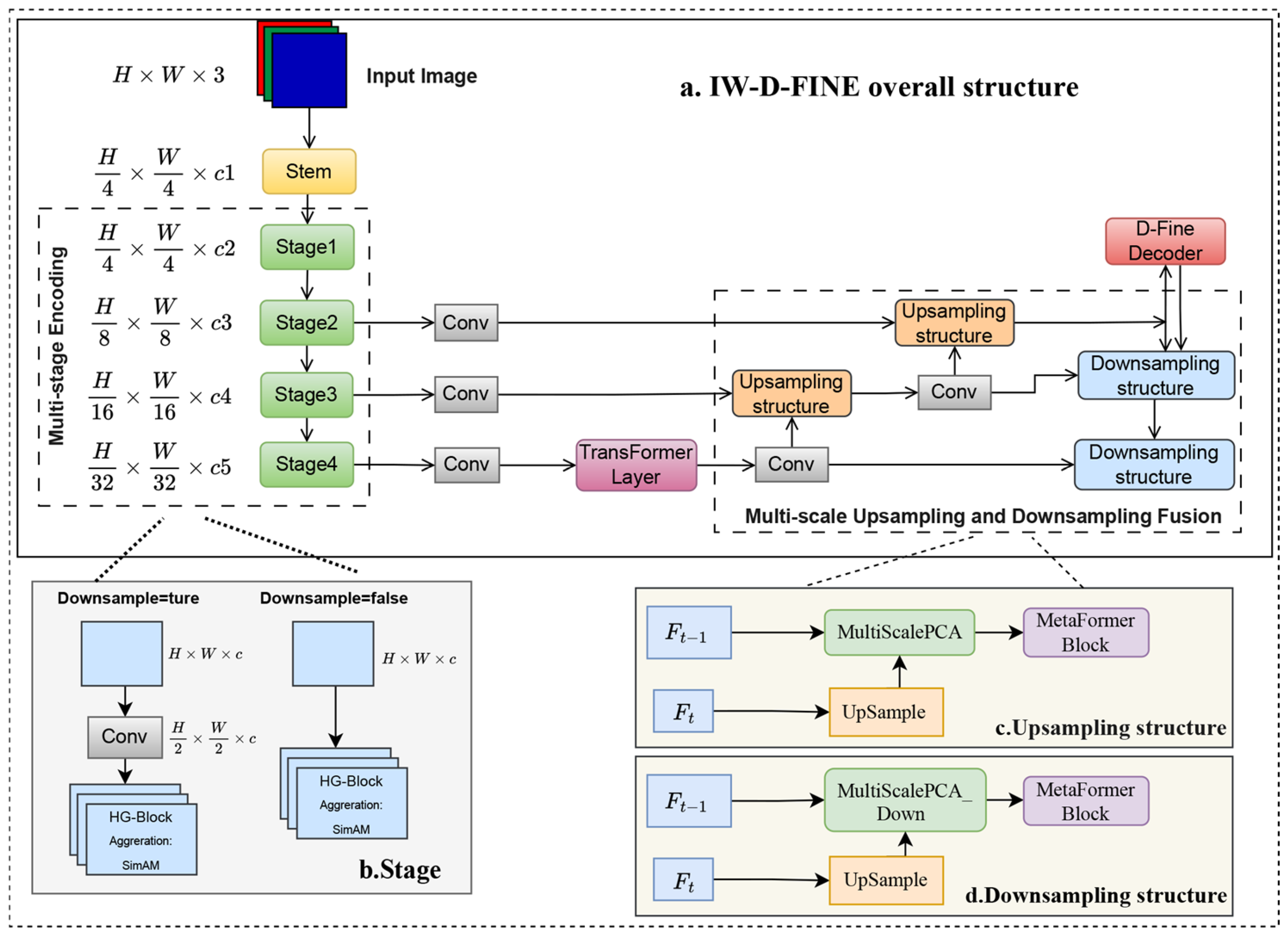
We enhanced the feature aggregation method in the D-FINE backbone and designed a new encoder structure tailored for IW detection characteristics, as shown in Figure 1, where Figure 1a illustrates the overall architecture, and Figure 1b–d highlight the key components of the proposed algorithm.
Figure 1. IW-D-FINE overall architecture.

2.1. Feature Aggregation Method Optimization

In the HGblock of the D-FINE backbone, the original feature aggregation component adopts the Squeeze-and-Excitation (SE) attention mechanism [21], which enhances feature representation by integrating global average pooling and channel-wise attention. However, SE exhibits inherent limitations in HGblock: it overly emphasizes channel-wise feature recalibration while lacking effective modeling of spatial context information, which restricts its ability to capture complex inter-channel dependencies associated with the irregular shapes and multi-scale distribution of ocean internal waves (IWs) in SAR imagery. To address this module-specific bottleneck, we propose a targeted optimization for HGblock: replacing the SE attention with SimAM [22] to achieve more efficient and spatially sensitive feature aggregation tailored to IW detection tasks. Unlike SE’s global pooling-based channel attention, SimAM introduces spatial attention into the HGblock’s feature aggregation process, enabling more precise modeling of the spatial structures and boundary details of IWs. Moreover, SimAM’s energy function computation operates with linear complexity, avoiding the multi-step channel scaling operations in SE that introduce redundant computations. This HGblock-specific optimization not only enhances the quality of multi-scale IW features by integrating spatial context awareness but also maintains the computational efficiency of the backbone, making it well-adapted to the demands of extracting fine-grained IW features from high-resolution SAR images.

2.2. Multi-Scale Feature Fusion Encoder Design

Commonly used encoder designs rely on concatenation for feature fusion and repetitive convolutional modules [23] for feature extraction. However, concatenation increases channel counts without effectively leveraging multi-layer feature relationships, and single convolutional modules struggle to model long-range dependencies. To address these issues, we propose a novel encoder architecture that employs MultiScalePCA (Multi-scale Principal Component Analysis) [24] for efficient feature fusion and replaces traditional convolutional modules with MetaFormer [25], incorporating a scale-adaptive token mixer to balance local and global feature modeling.
Contemporary computer vision is largely driven by core applications such as object detection and semantic image segmentation, demand enhanced feature extraction from encoders while maintaining computational efficiency. Traditional encoder designs rely on concatenation for feature fusion and repetitive convolutional modules (e.g., RepNCSPELAN4 [23]) for feature extraction. However, concatenation increases channel counts without effectively leveraging multi-layer feature relationships, and single convolutional modules struggle to model long-range dependencies. To address these issues, we propose a novel encoder architecture that employs MultiScalePCA [24] for efficient feature fusion and replaces traditional convolutional modules with MetaFormer [25], incorporating a scale-adaptive token mixer to balance local and global feature modeling.
For input X R H × W × C , the ConvNormLayer-fuse module performs channel alignment and feature extraction through 1 × 1 convolution and batch normalization, and its operation can be expressed as:
F = ConvNorm ( X , C out , k = 1 , s = 1 ) = σ ( BN ( Conv ( X ) ) )
Here, Conv denotes a 1 × 1 convolution, BN represents batch normalization, and σ is the activation function, producing the output feature map F H × W × C out . The Transformer Layer models global dependencies via multi-head self-attention, enhancing the global contextual representation of features.
In the initial encoding stage, we retain the three-layer ConvNormLayer and Transformer encoder block to extract multi-scale features, establishing a preliminary feature hierarchy and global contextual information. After nearest-neighbor interpolation and channel alignment, the MultiScalePCA module is introduced to efficiently fuse features from different scales. MultiScalePCA integrates features F 1 H 1 × W 1 × C 1 and F 2 H 2 × W 2 × C 2 via a channel attention mechanism, with its core operation expressed as:
F fused = MPCA ( F 1 , F 2 ) = Conv 1 × 1 ( w 1 F 1 + w 2 Up ( F 2 ) )
Here, w 1 , w 2 1 × 1 × c 1 represents the channel attention weights generated via global pooling and 1D convolution, and up denotes the transposed convolution upsampling operation. At the encoder’s output layer, a custom MetaFormer block replaces the RepNCSPELAN4 module for feature refinement, with its core computation expressed as:
F out = MetaFormer ( F in , C , M , S ) = LN ( M ( LN ( F in ) ) ) + F in
Here, LN denotes layer normalization, and M represents the token mixer (e.g., Incep-tionDWBlock (Inception Depthwise block) or DAttention), controlling whether self-attention is enabled. The MetaFormer block in the upsampling layer adopts the InceptionDWBlock as the token mixer, as suggested in [26], using depthwise separable convolution to capture local patterns in high-resolution features. The S=False configuration ensures focus on local spatial information, suitable for fine-grained feature ex-traction, aiding the model in handling multi-scale IW targets. The downsampling layer retains the original SCDown (3 × 3 convolution with SiLU activation) and integrates MultiScalePCA-Down for cross-scale feature fusion. The MetaFormer block in the downsampling layer uses DAttention [27] as the token mixer, leveraging self-attention to model long range dependencies, ideal for capturing global context in low resolution features.
The InceptionDWBlock is introduced to capture rich local features at a low computational cost. Its core concept involves processing input features through parallel branches, each using different-sized convolutional kernels to perceive spatial patterns at varying scales—small kernels for details and larger ones for broader regions. This multi scale parallel processing enables comprehensive understanding of local image structures. Subsequently, pointwise convolution integrates information from these branches, preserving diverse features while reducing parameters and computation through depthwise separable convolution. This design is particularly suitable for high resolution scenarios, such as upsampling layers requiring fine-grained local feature extraction, while maintaining efficiency, making it well-suited for the complex, multi-scale characteristics of ocean IW samples.
The proposed encoder achieves efficient multi-scale feature fusion via MultiScalePCA and optimizes feature refinement using a custom MetaFormer block with a scale-adaptive token mixer, significantly enhancing feature extraction efficiency and expressiveness. This architecture balances local and global feature modeling.

3. Experimental Results and Analysis

3.1. Datasets Introduction

For algorithm validation, we use the S1-IW-2023 dataset by Ma et al. [20], collected from Sentinel-1 satellites between June 2014 and February 2023. It includes 457 pano-ramic SAR images with IW patterns across multiple ocean regions in the eastern and western hemispheres. After preprocessing, the dataset yields 742 SAR images containing 1039 IW samples, split into training, validation, and test sets at an 8:1:1 ratio.
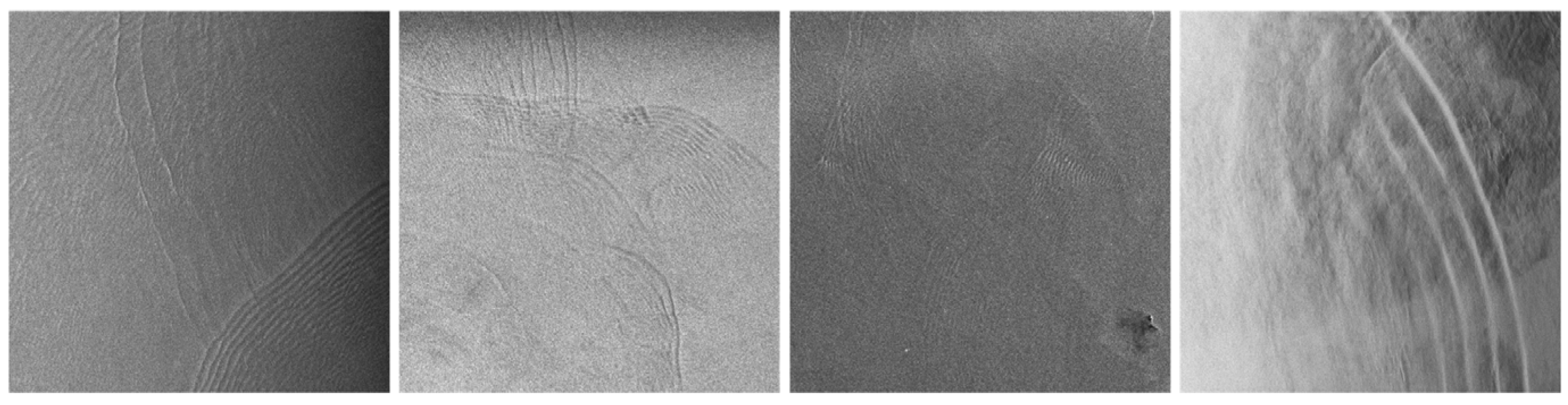
For testing, we utilize 49 IW images collected by the Yunhai-3 satellite in the South China Sea, termed YH3-IW-2025. Launched in November 2022, Yunhai-3, a Chinese ocean observation satellite, carries a high-resolution SAR for large-scale, continuous ocean monitoring.
Compared with S1-IW-2023, YH3-IW-2025 features IW images with greater scale variations in size and aspect ratio. Analysis of IW characteristics reveals distinct internal features due to varying spatial resolutions and wavelengths. These variations make YH3-IW-2025 ideal for testing model generalization. Sample images from this dataset are shown in Figure 2.
Figure 2. YH3-IW-2025 Dataset Presentation.

3.2. Experimental Details and Evaluation Indicators

The experimental environment is based on PyTorch 2.3.0 and Python 3.12 (Ubuntu 22.04), accelerated with CUDA 12.1. Hardware includes one NVIDIA RTX 4090D (24 GB) GPU, an 18-core AMD EPYC 9754 128-Core processor, and 60 GB memory. During experiments, the AdamW optimizer is used with an initial learning rate of 0.0001, betas set to (0.9, 0.999), and weight decay of 0.0001. The batch size is set to 4 to ensure training stability and resource efficiency. Detailed training hyperparameters are shown in Table 1.
Table 1. Hyperparameter Settings.
This experiment does not use a complete pretrained model but only adopts the stem section parameters from the pretrained backbone, facilitating model design experiments. D-FINE offers five models with varying parameter counts, and this paper selects the medium-sized model, balancing parameter count and detection accuracy, as the baseline.
This paper adopts Average Precision (AP) as the primary evaluation metric. AP is calculated at specific IoU thresholds: AP@0.5 measures the area under the Precision-Recall curve (AUC) when IoU ≥ 0.5, a common single-threshold metric in the COCO dataset, reflecting model performance under relaxed overlap requirements. AP@0.5:0.95 denotes the average AP across IoU thresholds from 0.5 to 0.95 (step size 0.05), expressed as:
AP 0.5 : 0.95 = 1 10 IoU = 0.5 0.95 AP IoU
Average Recall (AR) evaluates the model’s ability to detect true targets within a given IoU threshold range, defined as:
AR 0.5 : 0.95 = 1 10 IoU = 0.5 0.95 Recall IoU

3.3. Comparison of Feature Extraction Capabilities

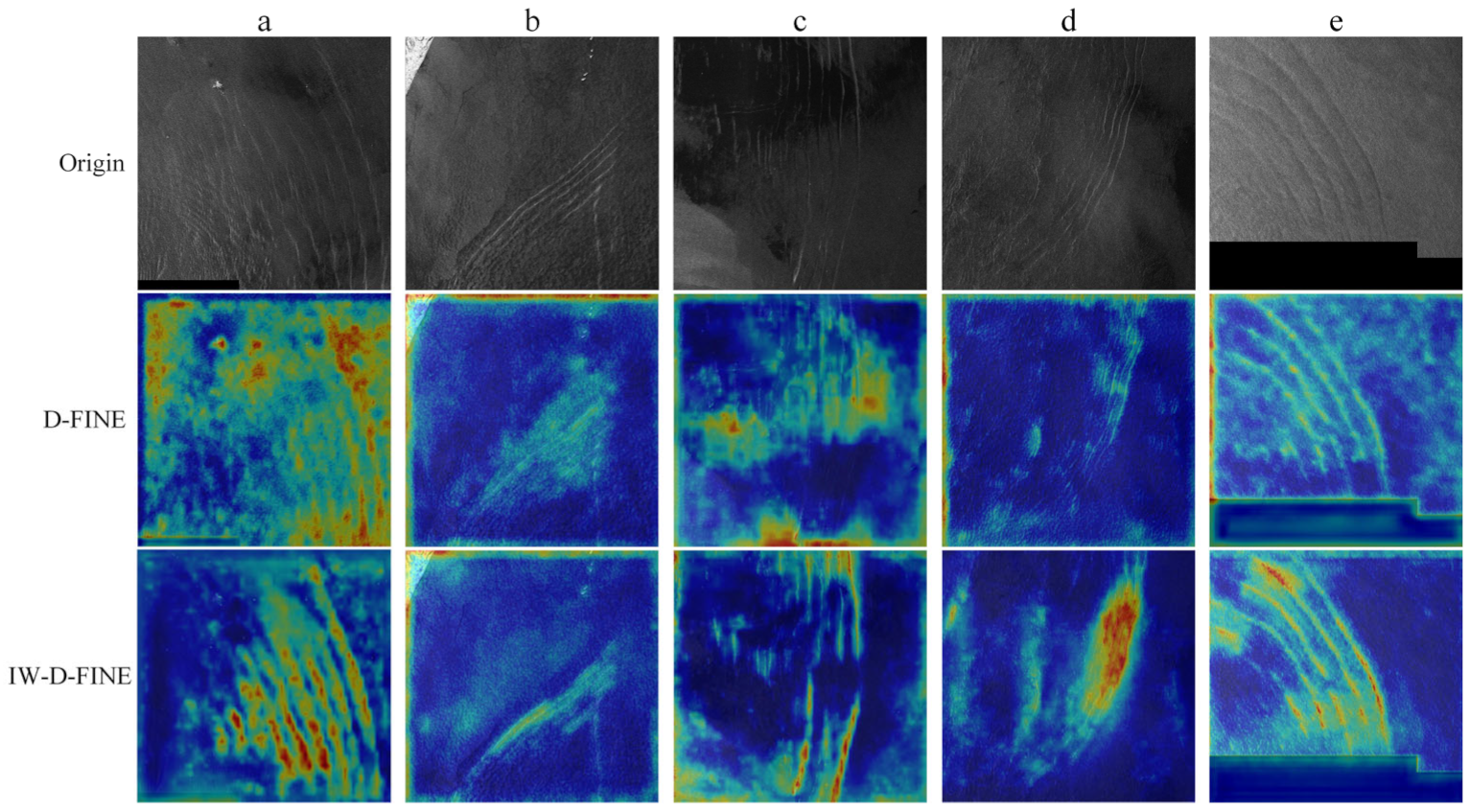
To intuitively demonstrate IW-D-FINE’s focus on internal wave (IW) features across different stages and improve the interpretability of the deep learning “black box”, we extracted feature maps from key modules, including STAGE2, STAGE4, and the upsampling and downsampling output layers of the encoder, and generated feature attention heatmaps via the Grad-CAM algorithm [28], as shown in Figure 3. These heatmaps visualize the attention distribution of both IW-D-FINE and D-FINE toward IW features, thereby providing a intuitive visual explanation for the model’s detection mechanism.
Figure 3. Feature attention heat map comparison results.
Benefiting from the parameter-free attention integrated into the backbone’s feature aggregation stage, the model achieves a large receptive field in shallow layers, which enables effective capture of the multi-scale local features of IWs. As illustrated in Figure 3, the heatmaps show that the model’s feature attention is highly concentrated on the prominent visual cues of IW targets, which demonstrates its superior ability to perceive detailed features. Additionally, the redesigned encoder is equipped with multi-scale attention mechanisms. This allows IW-D-FINE to focus more precisely on IW boundaries and extract boundary features with higher clarity. Such boundary-focused attention and refined feature extraction lay a solid foundation for achieving high-performance IW detection.

3.4. Ablation Experiment

To assess the contribution of each component to the final performance, we performed ablation studies by progressively integrating individual modules and evaluating their effects. To mitigate the influence of weight initialization randomness during training, all ablation experiments were repeated over multiple runs.
Table 2 shows only the best detection results for each group, with ‘√’ indicating the strategy used in that row. The best results for this column are marked in bold. As designs are added, inference time increases from 13.8 ms to 15.5 ms, a rise of about 1.7 ms, indicating a trade-off in speed, which is typically undesirable. However, for the ocean IW detection task, 15.5 ms (approximately 64.5 FPS) remains acceptable, especially given the significant accuracy improvement.
Table 2. Ablation Experiment Results.
Table 2 data show AP@0.5 rising from 87.2% to 90.5% (3.3% increase), AP@0.75 from 76.0% to 81.4% (5.4% increase), and AP@0.5:0.95 from 65.1% to 70.5% (5.4% increase). These improvements highlight that SimAM, MPCA, and MetaFormer significantly enhance the model’s localization and classification capabilities for internal waves, particularly at high IoU thresholds (e.g., 0.75 and 0.5:0.95). This is likely due to optimized multi-scale feature fusion and attention mechanisms, enabling more accurate capture of IW boundaries and shapes.
AR@0.5 fluctuates between 97.2% and 98.1%, ultimately matching the baseline, while AR@0.5:0.95 slightly increases from 84.3% to 85.5% (1.2% rise). The AR@0.5:0.95 performance fluctuated during strategy adoption, which we believe is due to a trade-off between the “scale robustness” and “global-local feature fusion capability” of the upsampling and downsampling stages and the “full threshold recall” of AR@0.5:0.95. The limited AR increase may relate to the single-class nature of our task, as ocean IW detection involves only one target type, with recall primarily constrained by coverage and false positives. Table data indicates AR@0.5 remains consistently high (97%+), suggesting near-saturated detection, while the modest AR@0.5:0.95 improvement reflects challenges in localization at high IoU thresholds.

3.5. Comparative Test of Similar Algorithms

To comprehensively evaluate the performance of IW-D-FINE in ocean IW detection, we conducted comparative experiments with recent one-stage models excelling in general vision tasks and with similar parameter counts, including YOLOv8l [29], YOLO11l [30], YOLO12l [31], and DETRv2-resnet50, alongside the baseline D-FINE. Each model was trained with different learning strategies and repeated multiple times, with Table 3 showing only the best results per group. The best results for this column are marked in bold. Key metrics include AP@0.5 (average precision at IoU = 0.5), AP@0.5:0.95 (average precision across IoU from 0.5 to 0.95), and inference time (ms), as shown in the table.
Table 3. Detection Comparison Indicators of Similar Algorithms.
For AP@0.5, IW-D-FINE achieves 90.5%, significantly outperforming the next-best YOLO11l (85.3%) by 5.2 points and D-FINE (87.2%) by 3.3%, demonstrating superior classification and localization at relaxed IoU thresholds. YOLO12l (81.7%) and DETRv2-resnet50 (79.4%) show weaker adaptability to single-class IW detection. For the stricter AP@0.5:0.95, IW-D-FINE reaches 70.5%, a 5.4% improvement over D-FINE (65.1%), surpassing DETRv2-resnet50 (57.9%) and YOLO11l (54.5%), further validating its robustness and precision at high IoU thresholds. This is attributed to SimAM, MPCA, and MetaFormer Block, which enhance multi-scale feature extraction and boundary localization.
Notably, compared to low-parameter, non-attention-based YOLO models, AP@0.5:0.95 of DETRv2 shows a more significant increase, indicating that Transformer architectures offer greater trainable capacity for complex scenes and multi-scale features. Their self-attention mechanism better captures global dependencies, improving precise target boundary modeling.
In terms of inference time, IW-D-FINE (15.5 ms) is slightly higher than YOLOv8l (8.3 ms) and YOLO11l (11.9 ms) but lower than YOLO12l (23.6 ms) and DETRv2-resnet50 (18.6 ms). The increased time stems from higher module complexity, yet 15.5 ms (approximately 64.5 FPS) meets real-time requirements for IW detection, making the performance acceptable. In contrast, while YOLOv8l exhibits superior speed, its precision (AP@0.5:0.95 at 51.8%) is far below IW-D-FINE, indicating an inferior balance of accuracy and speed.

3.6. Visualization of Test Results Comparison

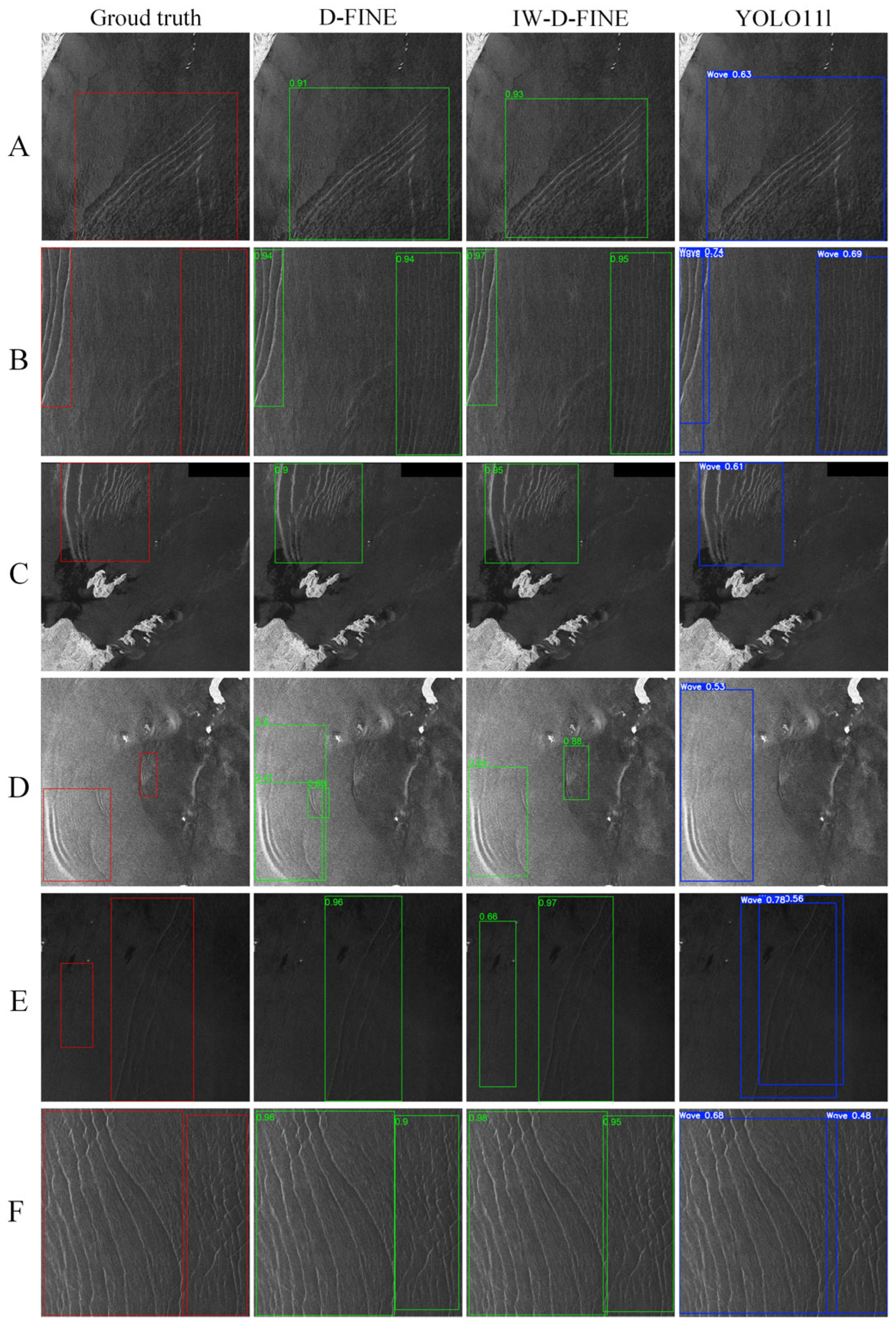
To further demonstrate the application advantages of IW-D-FINE over other models, we conducted inference tests on ocean internal wave (IW) images with diverse characteristics (e.g., shape, scale, aspect ratio, and number of waves) from the S1-IW-2023 test set and YH3-IW-2025 dataset. The experiment compares YOLO11l and the original D-FINE, selected from Table 3 for their representative architectures. Ground truth (manually annotated by [20]) is marked with red bounding boxes, D-FINE-based model predictions with green, and YOLO11l predictions with blue.
In inference visualization, we use confidence score to intuitively compare model performance. The confidence score calculation is as follows:
confidence   score = ObjectnessScore × max P ( Class 1 ) , P ( Class 2 ) , , P ( Class K )
where Objectness Score is the probability distribution (ranging from 0 to 1) of whether an object exists within the selected bounding box, and P ( Class n ) is the probability (ranging from 0 to 1) that the region belongs to the n class.
In Figure 4, Figure 4A shows internal wave ripples with balanced aspect ratios and clear texture but simple geometry. All models detect the target, but YOLO11l’s confidence score is lower at 0.63. Figure 4B depicts two unrelated samples with high aspect ratios; YOLO11l generates overlapping prediction boxes, while D-FINE’s Transformer-based anchor-free approach enables precise single-boundary box prediction for elongated objects. Figure 4C,D illustrate detection results for three morphologically complex, multi-scale IW samples in challenging backgrounds. Figure 4E shows a case with subtle IW features, where only IW-D-FINE successfully detects the faint left-side ripples. Figure 4F presents detection results for a large-scale, complex-shaped IW sample.
Figure 4. Comparison of test set inference results.
Based on Figure 4, the CNN-based YOLO11l struggles to achieve high detection accuracy, and its anchor-based strategy may be a contributing factor to inaccurate boundary predictions and duplicate detections. In complex scenarios, IW-D-FINE outperforms the original model when it comes to extracting IW texture information and delineating sample boundaries. When compared with other models, IW-D-FINE demonstrates notable advantages in both detection performance and accurate bounding box localization.
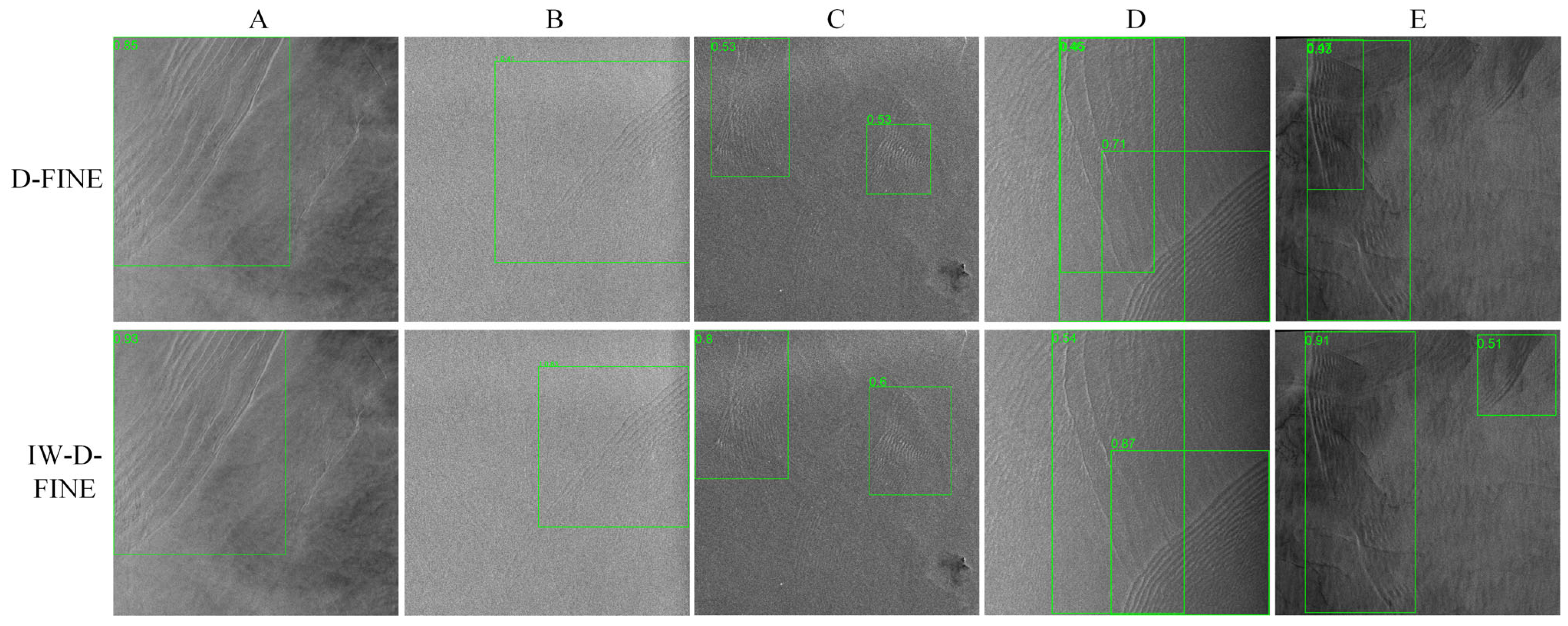
Figure 5 presents the prediction results of IW-D-FINE on the YH3-IW-2025 dataset. Compared to the S1-IW-2023 test set, this small dataset exhibits more diverse IW geometries, with greater scale variations and complex wave patterns. The experiment displays five detection results, ordered by increasing sample complexity, with IW-D-FINE results in the last row. In Figure 5A, its IW geometry slightly differs from S1-IW-2023 patterns; YOLO11l performs worse than the D-FINE series, and IW-D-FINE achieves relatively better detection accuracy. In Figure 5B,C, IW features are weak and small-scale. Both models fail to detect the weak feature in the lower part of Figure 5C, but successfully identify two other weak features, with IW-D-FINE yielding higher confidence scores. Figure 5D depicts a slight overlap of two scales, where D-FINE mistakenly splits a single internal wave into two due to the overlapping region. Figure 5E illustrates a complex wave propagation scenario, where D-FINE misses a small-scale sample in the upper right and fails to predict the continuity of the left-side internal wave, erroneously identifying it as two targets. Additionally, both models fail to detect another IW with deep overlap in the upper left, likely due to insufficient deeply overlapping samples in the training dataset. This issue could be addressed by expanding the IWs dataset in the future.
Figure 5. Comparison of inference results on the YH3-IW-2025 Dataset.
The IW (with new feature) detection results shown in Figure 5 further validate the superior performance of the proposed IW-D-FINE in complex, multi-source sample scenarios. IW-D-FINE comprehensively and flexibly captures features of IW samples in SAR images, excelling in stripe feature detection, boundary localization, and resistance to environmental interference. This approach demonstrates robustness against scale variations in internal wave samples. Moreover, it is capable of disentangling the relationships between the comprehensive features of internal wave data packages and confounding factors, such as sample fragmentation, spatial overlap of different waves, divergent propagation paths, and the crossing of distinct wave fronts.

4. Conclusions

In this study, we introduce IW-D-FINE, a novel one-stage Transformer-based network with an anchor-free strategy, for the first time applied to ocean IW detection. The algorithm employs the SimAM to optimize backbone feature aggregation, integrates MultiScalePCA for efficient feature fusion, and incorporates a redesigned encoder with MetaFormer to balance local and global feature modeling, significantly enhancing feature extraction and spatial modeling capabilities. Additionally, we constructed a new dataset, 3A-IW-2025, collected from the South China Sea, containing IW images from diverse complex scenarios, further supporting algorithm generalization and robustness validation.
Experiments on S1-IW-2023 dataset show that IW-D-FINE, using only pretrained backbone stem weights, achieves outstanding performance with AP@0.5 of 90.5% and AP@0.5:0.95 of 70.5%. Although slightly inferior to fine-tuned two-stage models, its inference time of 15.5 ms is more efficient than the best two-stage model [20], significantly improving prediction efficiency while maintaining high-precision internal wave localization. Inference tests on S1-IW-2023 and 3A-IW-2025 datasets further confirm IW-D-FINE’s ability to effectively detect most IWs with notable interference resistance. However, performance in complex scenarios, such as multiple overlapping waves or faint features, requires further improvement.
The IW-D-FINE model proposed in this study achieves high-accuracy real-time detection and localization of oceanic internal waves in SAR images [32,33], providing an efficient technical solution for automated internal wave recognition. However, several limitations remain that constrain its application in in-depth oceanographic research: Firstly, the study focuses on qualitative visual detection of internal wave targets and has not yet developed an approach for extracting quantitative wave features—such as wavelength, period, and amplitude—from the predicted regions, which limits its ability to provide quantitative data for oceanographic analysis. Secondly, the self-constructed YH3-IW-2025 dataset contains only 49 images from the South China Sea. Its small sample size and single geographic region restrict comprehensive validation of the model’s generalization capability across diverse marine environments and internal-wave types worldwide. Thirdly, the current single-class detection mode cannot classify different types of internal waves, which constrains the analysis of wave diversity and interactions, and is also a key factor limiting improvement in the AR@0.5:0.95 metric. Finally, this research emphasizes computer-vision algorithm development and has not yet integrated detection results with hydrodynamic models or linked them to ecological impacts such as water-column mixing and nutrient transport, leaving the physical significance and dynamic effects underexplored. Although tests on overlapping-wave and complex-background [34,35] samples have been performed, dedicated evaluation on extreme cases—such as multi-scale overlapping waves and weak-feature scenarios—is still lacking, making the robustness verification in real ocean environments insufficient.
Future work will focus on addressing these shortcomings. We plan to develop a quantitative feature-extraction module, build a global cross-region internal-wave dataset, upgrade the model to a multi-class detection and classification framework, and integrate hydrodynamic modeling to explore physical and ecological effects. We will also optimize the network architecture for challenging cases, aiming to establish an integrated technical pipeline of “detection-localization—quantitative extraction—type classification—effect exploration” to further enhance the model’s scientific value and practical utility in oceanography.
Overall, this work introduces an efficient and lightweight method for internal wave detection, which integrates an anchor-free framework with a Transformer-based design. The compact architecture of IW-D-FINE facilitates practical deployment, presenting a novel strategy for extracting internal wave features efficiently from large-scale SAR imagery. Furthermore, the newly constructed YH3-IW-2025 dataset offers a valuable benchmark for subsequent studies, establishing a foundation for improving the robustness and generalizability of internal wave detection systems.

Author Contributions

Conceptualization, L.Y. and Y.T.; methodology, Y.T.; software, L.Y.; validation, C.C. and T.L.; formal analysis, J.L.; data curation, J.C. All authors have read and agreed to the published version of the manuscript.

Funding

This research received no external funding.

Data Availability Statement

The data presented in this study are available in https://doi.org/10.5281/zenodo.11090328 (accessed on 14 February 2025).

Conflicts of Interest

The authors declare no conflict of interest.

References

  1. Garrett, C.; Munk, W. Internal waves in the ocean. Annu. Rev. Fluid Mech. 1979, 11, 339–369. [Google Scholar] [CrossRef] [Scilit]
  2. Klemas, V. Remote sensing of coastal and ocean currents: An overview. J. Coastal Res. 2012, 28, 576–586. [Google Scholar] [CrossRef] [Scilit]
  3. Whalen, C.B.; MacKinnon, J.A.; Talley, L.D. Large-scale impacts of the diapycnal mixing induced by internal waves. Geophys. Res. Lett. 2018, 45, 9848–9857. [Google Scholar] [CrossRef] [Scilit]
  4. Jefferson University. What are Internal Waves in the Ocean and Why Are They Important? 2022. Available online: https://www.jefferson.edu/news/2022/05/what-are-internal-waves-in-the-ocean-and-why-are-they-important.html (accessed on 1 May 2025).
  5. Osadchiev, A.A. Small-scale and mesoscale oceanic features in the Black Sea: Case studies based on in-situ observations. Oceanology 2018, 58, 497–505. [Google Scholar] [CrossRef]
  6. Dosser, H.V.; Rainville, L. Dynamics of the changing near-inertial internal wave field in the Arctic Ocean. J. Phys. Oceanogr. 2016, 46, 395–415. [Google Scholar] [CrossRef] [Scilit]
  7. Hughes, B.A. The effect of internal waves on surface wind waves, Part 1: Theoretical analysis. J. Geophys. Res. Oceans 1978, 83, 455–465. [Google Scholar] [CrossRef] [Scilit]
  8. Rizal, S.; Iskandar, I.; Muhammad, A. Numerical modeling of internal waves in the Andaman Sea. In IOP Conference Series: Earth and Environmental Science; IOP: London, UK, 2019; Volume 348, p. 012069. [Google Scholar] [CrossRef] [Scilit]
  9. Alpers, W. Theory of radar imaging of internal waves. Nature 1985, 314, 245–247. [Google Scholar] [CrossRef] [Scilit]
  10. Thompson, D.; Gasparovic, R. Intensity modulation in SAR images of internal waves. Nature 1986, 320, 345–348. [Google Scholar] [CrossRef] [Scilit]
  11. Magalhaes, J.M.; Da Silva, J.C.B. Internal waves in the Atlantic Ocean: A new look from SAR imagery. Remote Sens. Environ. 2018, 211, 379–398. [Google Scholar] [CrossRef] [Scilit]
  12. Ren, S.; He, K.; Girshick, R.; Sun, J. Faster R-CNN: Towards Real-Time Object Detection with Region Proposal Networks. IEEE Trans. Pattern Anal. Mach. Intell. 2017, 39, 1137–1149. [Google Scholar] [CrossRef] [Scilit]
  13. Redmon, J.; Divvala, S.; Girshick, R.; Farhadi, A. You only look once: Unified, real-time object detection. In IEEE Conference on Computer Vision and Pattern Recognition; IEEE: New York, NY, USA, 2016; pp. 779–788. [Google Scholar] [CrossRef] [Scilit]
  14. Zhao, Y.; Lv, W.; Xu, S.; Wei, J.; Wang, G.; Dang, Q.; Liu, Y.; Chen, J. DETRs beat YOLOs on real-time object detection. arXiv 2023, arXiv:2304.08069. [Google Scholar]
  15. Lv, W.; Zhao, Y.; Chang, Q.; Huang, K.; Wang, G.; Liu, Y. RT-DETRv2: Improved baseline with bag-of-freebies for real-time detection transformer. arXiv 2024, arXiv:2407.17140. [Google Scholar]
  16. Peng, Y.; Li, H.; Wu, P.; Zhang, Y.; Sun, X.; Wu, F. D-FINE: Redefine regression task in DETRs as fine-grained distribution refinement. arXiv 2024, arXiv:2410.13842. [Google Scholar]
  17. Bao, S.; Meng, J.; Sun, L.; Liu, Y. Detection of ocean internal waves based on Faster R-CNN in SAR images. J. Oceanol. Limnol. 2020, 38, 55–63. [Google Scholar] [CrossRef] [Scilit]
  18. Sun, H. Deep Learning-Based Ocean Internal Waves Detection from SAR Images. Master’s Thesis, Guilin University of Technology, Guilin, China, 2021. [Google Scholar]
  19. Tao, M.; Xu, C.; Guo, L.; Wang, X.; Xu, Y. An internal waves dataset from Sentinel-1 synthetic aperture radar imagery and preliminary detection. Earth Space Sci. 2022, 9, e2022EA002528. [Google Scholar] [CrossRef] [Scilit]
  20. Ma, Z.; Huang, L.; Yang, J.; Ren, L.; Li, X.; He, S.; Liu, B.; Liu, A.K. Transformer-based hierarchical multiscale feature fusion internal wave detection and dataset. Ocean-Land-Atmos. Res. 2024, 3, 0061. [Google Scholar] [CrossRef] [Scilit]
  21. Hu, J.; Shen, L.; Sun, G. Squeeze-and-excitation networks. In IEEE Conference on Computer Vision and Pattern Recognition; IEEE: New York, NY, USA, 2018; pp. 7132–7141. [Google Scholar] [CrossRef] [Scilit]
  22. Yang, L.; Zhang, R.Y.; Li, L.; Xie, X. SimAM: A simple, parameter-free attention module for convolutional neural networks. In Proceedings of the 38th International Conference on Machine Learning, Virtual, 18–24 July 2021; pp. 11863–11874. [Google Scholar]
  23. Wang, C.Y.; Liao, H.Y.M. YOLOv9: Learning what you want to learn using programmable gradient information. arXiv 2024, arXiv:2402.13616. [Google Scholar] [CrossRef] [Scilit]
  24. Zhou, Z.; He, A.; Wu, Y.; Yao, R.; Xie, X.; Li, T. Spatial-frequency dual domain attention network for medical image segmentation. In 2024 IEEE International Conference on Bioinformatics and Biomedicine (BIBM); IEEE: New York, NY, USA, 2024; pp. 4076–4081. [Google Scholar] [CrossRef] [Scilit]
  25. Yu, W.; Luo, M.; Zhou, P.; Si, C.; Zhou, Y.; Feng, J.; Yan, S.; Wang, X. MetaFormer is actually what you need for vision. In IEEE/CVF Conference on Computer Vision and Pattern Recognition; IEEE: New York, NY, USA, 2022; pp. 10819–10829. [Google Scholar] [CrossRef] [Scilit]
  26. Yu, W.; Zhou, P.; Yan, S.; Wang, X. InceptionNeXt: When Inception meets ConvNeXt. In IEEE/CVF Conference on Computer Vision and Pattern Recognition; IEEE: New York, NY, USA, 2024; pp. 2235–2245. [Google Scholar] [CrossRef] [Scilit]
  27. Xia, Z.; Pan, X.; Song, S.; Li, L.E.; Huang, G. Vision transformer with deformable attention. In IEEE/CVF Conference on Computer Vision and Pattern Recognition; IEEE: New York, NY, USA, 2022; pp. 4794–4803. [Google Scholar] [CrossRef] [Scilit]
  28. Selvaraju, R.R.; Cogswell, M.; Das, A.; Vedantam, R.; Parikh, D.; Batra, D. Grad-CAM: Visual explanations from deep networks via gradient-based localization. Int. J. Comput. Vis. 2020, 128, 336–359. [Google Scholar] [CrossRef] [Scilit]
  29. Huang, Z.; Li, L.; Krizek, G.; Sun, L. Research on Traffic Sign Detection Based on Improved YOLOv8. J. Comput. Commun. 2023, 11, 226–232. [Google Scholar] [CrossRef]
  30. Jocher, G.; Qiu, J. Ultralytics YOLOv11, Version 11.0.0; 2024. Available online: https://github.com/ultralytics/ultralytics (accessed on 1 May 2025).
  31. Tian, Y.; Ye, Q.; Doermann, D. YOLOv12: Attention-Centric Real-Time Object Detectors. arXiv 2025, arXiv:2502.12524. [Google Scholar]
  32. Kopyshov, I.; Kozlov, I.; Shiryborova, A.; Myslenkov, S.A. Properties of Short-Period Internal Waves in the Kara Gates Strait Revealed from Spaceborne SAR Data. Russ. J. Earth Sci. 2023, 23, 1–11. [Google Scholar] [CrossRef] [Scilit]
  33. Morozov, E. Oceanic Internal Tides: Observations, Analysis and Modeling; Springer: Berlin/Heidelberg, Germany, 2018. [Google Scholar] [CrossRef] [Scilit]
  34. Kozlov, I.E.; Mihaylichenko, T.V.; Petrenko, L.A. Properties of Short-Period Internal Waves Near Svalbard from Sentinel-1 Satellite Data. Russ. J. Earth Sci. 2024, 24, ES5008. [Google Scholar] [CrossRef] [Scilit]
  35. Kozlov, I.E.; Kopyshov, I.O.; Frey, D.I.; Morozov, E.G.; Medvedev, I.P.; Shiryborova, A.I.; Silvestrova, K.P.; Gavrikov, A.V.; Ezhova, E.A.; Soloviev, D.M.; et al. Multi-Sensor Observations Reveal Large-Amplitude Nonlinear Internal Waves in the Kara Gates, Arctic Ocean. Remote Sens. 2023, 15, 5769. [Google Scholar] [CrossRef] [Scilit]
Disclaimer/Publisher’s Note: The statements, opinions and data contained in all publications are solely those of the individual author(s) and contributor(s) and not of MDPI and/or the editor(s). MDPI and/or the editor(s) disclaim responsibility for any injury to people or property resulting from any ideas, methods, instructions or products referred to in the content.

Article Metrics

Citations

Article Access Statistics

Multiple requests from the same IP address are counted as one view.