Article

BOTDR Monitoring of Tensile State in Three-Core Fiber-Optic Composite Submarine Cables with a Three-Layer Mechanical Structure and Dual-Threshold Sensing Model


1
School of Electric Power, South China University of Technology, Guangzhou 510640, China
2
South Sea Submarine Cables Co., Shanwei 516538, China
3
Guangdong Provincial Key Laboratory of Electric Power Equipment Reliability, Electric Power Research Institute of Guangdong Power Grid Co., Ltd., Guangzhou 510000, China
*
Author to whom correspondence should be addressed.
J. Mar. Sci. Eng. 2026, 14(4), 390; https://doi.org/10.3390/jmse14040390
Submission received: 28 January 2026 / Revised: 9 February 2026 / Accepted: 16 February 2026 / Published: 19 February 2026

Abstract

Submarine cables are critical components for power transmission in offshore wind farms, making their condition monitoring paramount for ensuring operational reliability. Addressing unclear strain transfer and underdeveloped Brillouin optical time-domain reflectometry (BOTDR) sensing models for three-core fiber-optic composite submarine cables, this study investigated a 66 kV cable and clarified a BOTDR monitoring principle based on the three-layer mechanical structure. Using the external optical unit’s average Brillouin shift for temperature compensation, four characteristic parameters ( Δ v y , Δ v p , v m , v F ) were analyzed. The results show the optical unit’s tensile strain-induced Brillouin shift exhibits periodic distribution along the cable. The stable average peak v F achieved a correlation coefficient of 0.98 with tensile load Fi. A dual-threshold sensing model was established: no shift response below F0 = 90 kN (7.84% Rated Tensile Strength (RTS)); strong linear correlation between v F and Fi beyond Fm = 110 kN (9.58% RTS) with a tensile sensitivity coefficient of 0.03788 MHz/kN. This study provides key BOTDR technical support for submarine cable tensile monitoring in complex marine environments.

1. Introduction

Submarine cables serve as crucial power transmission channels connecting offshore wind farms, and their long-term operational reliability is essential for power supply security. In complex marine environments, mechanical tensile loads from laying traction, anchor dragging, ocean current scouring, and tidal changes can lead to structural damage, insulation aging, and even fracture failure of submarine cables [1,2]. The traction tension during the laying process can reach about 120 kN, approximately 10∼20% of the submarine cable’s Rated Tensile Strength (RTS) [3,4]. The tensile effect caused by anchor impact can even exceed 1000 με [5]. Accurately monitoring mechanical states such as tension, bending, and torsion during laying and operation is therefore essential [6]. Moreover, the inherently harsh marine environment accelerates the accumulation of fatigue in mechanical components [7], leading to increased focus on structural integrity monitoring for mechanical degradation and stress concentration. Brillouin optical time-domain reflectometry (BOTDR), with its capabilities for distributed strain sensing, offers a promising solution for such monitoring.
For submarine cable monitoring, Rayleigh scattering-based Distributed Acoustic Sensing (DAS) offers advantages like high spatiotemporal resolution and full-link coverage for vibration/impact detection. However, it is susceptible to environmental noise from sea waves and vessel traffic, and cannot quantitatively characterize tensile loads. In contrast, BOTDR boasts full-range sensing, strong anti-interference capability, and a dual role as a communication fiber [8,9]. In recent years, it has been applied to civil engineering infrastructure condition monitoring [10] and transmission line icing monitoring [11], enabling real-time, continuous strain distribution along the entire cable length, accurate load assessment, and localization of local overload sections. It holds unique advantages for distributed monitoring of submarine cables’ mechanical states [12,13], though related research remains in the exploratory stage.
Despite this promise, research on BOTDR-based mechanical monitoring for submarine cables, especially for the increasingly common three-core fiber-optic composite designs, remains in its infancy. Existing studies primarily focus on temperature monitoring [14] or vibration detection using phase-sensitive OTDR [15]. While valuable, these do not address the core need for quantitative tensile load sensing. Previous mechanical investigations (such as tensile tests on single-core cables) have revealed the phenomenon of low-load “blind zones” arising from design fiber redundancy lengths [16], yet these studies remained confined to descriptive observations without establishing the critical load or quantitative criteria for the termination of such blind zones. Other studies, including armored cable testing [17] and field deployments for seismic strain detection [18], have demonstrated the feasibility of integrated optical fibers within cables for strain monitoring applications. However, none have established a quantitative load-strain correlation model, nor have they addressed the impact of helical structures on coupling efficiency. Similar studies based on finite element analysis have revealed the mechanical properties of cables [19,20,21] and internal fiber strain [22,23,24,25]. Further research has explored the potential engineering applications of fiber optic monitoring for submarine cable burial depth [26,27] and vortex-induced vibration [28,29]. However, existing research lacks clear criteria for the complete coupling of the optical fiber–optical unit–cable system. No experimentally validated model has been established for the complex layered structure of submarine cables. Furthermore, the approach of directly correlating distributed BOTDR strain characteristics with the macro-tensile load state of three-core submarine cables cannot be applied to practical engineering scenarios.
To date, existing research has shown the potential of long-distance distributed BOTDR for submarine cable monitoring. Current studies focus on scenarios like temperature monitoring and vibration, with limited research into mechanical load monitoring and sensing models. Revealing strain transfer in the cable’s multi-layer mechanical structure (optical fiber, optical unit, filling layer, armor wires, cable core), considering the optical unit’s helical stranding, and establishing an optical fiber excess-length strain sensing model are fundamental for assessing the mechanical state of submarine cables during offshore wind farm cable laying, operation, and maintenance. This paper clarified the BOTDR monitoring principle based on a three-layer mechanical structure, established a tensile test monitoring platform, and investigated the distributed optical fiber monitoring characteristics and dual-threshold sensing model for a 66 kV three-core fiber-optic composite submarine cable under tensile conditions. The proposed sensing model defines dual thresholds F0 (90 kN, fiber excess-length exhausted) and Fm (110 kN, full coupling), partitioning the sensing process into three intervals: blind zone—transition zone—stable zone. This establishes a linear relationship between the stable average peak v m and load (R2 = 0.98), achieving quantitative load inversion from strain sensing. Furthermore, while prior studies overlooked temperature–strain cross-sensitivity issues, this research proposes a laboratory method of “external optical unit mean compensation” and recommends Raman Optical Time-Domain Reflectometry (ROTDR)collaborative compensation for engineering applications.

2. Three-Layer Mechanical Structure BOTDR Monitoring Principle

To construct a mechanical transfer model, it is necessary to understand the structure of the three-core submarine cable and the mechanical coupling relationships between fiber strain, optical unit strain, and submarine cable strain.

2.1. Three-Layer Mechanical Structure of Submarine Cable, Optical Unit, and Optical Fiber

The three-core fiber-optic composite submarine cable tested in this paper is model HYJQF41-F-38/66, as shown in Figure 1. The filling layer contains two optical units. Each optical unit contains 48 B1 single-mode fibers.
The fiber grease in the optical unit provides protection for the fibers and also serves a lubricating function, allowing the fibers to slide axially to a certain degree within the optical unit. This enhances the fiber’s adaptability to external mechanical disturbances.
To ensure that the fibers maintain low-loss, stable transmission performance under complex environmental conditions such as mechanical stress and temperature changes, the fiber length within the optical unit is slightly longer than the optical unit itself. The percentage ratio of this difference to the optical unit length is called the fiber excess length δ [30], see Equation (1). The design value for submarine cable excess length δ0 is generally controlled between 0.6 and 0.7% [31].
δ = L fiber L unit L unit × 100 %

2.2. Strain Relationships in Three-Layer Structure of Submarine Cable, Optical Unit, and Optical Fiber

2.2.1. Strain of Submarine Cable, Optical Unit, and Optical Fiber

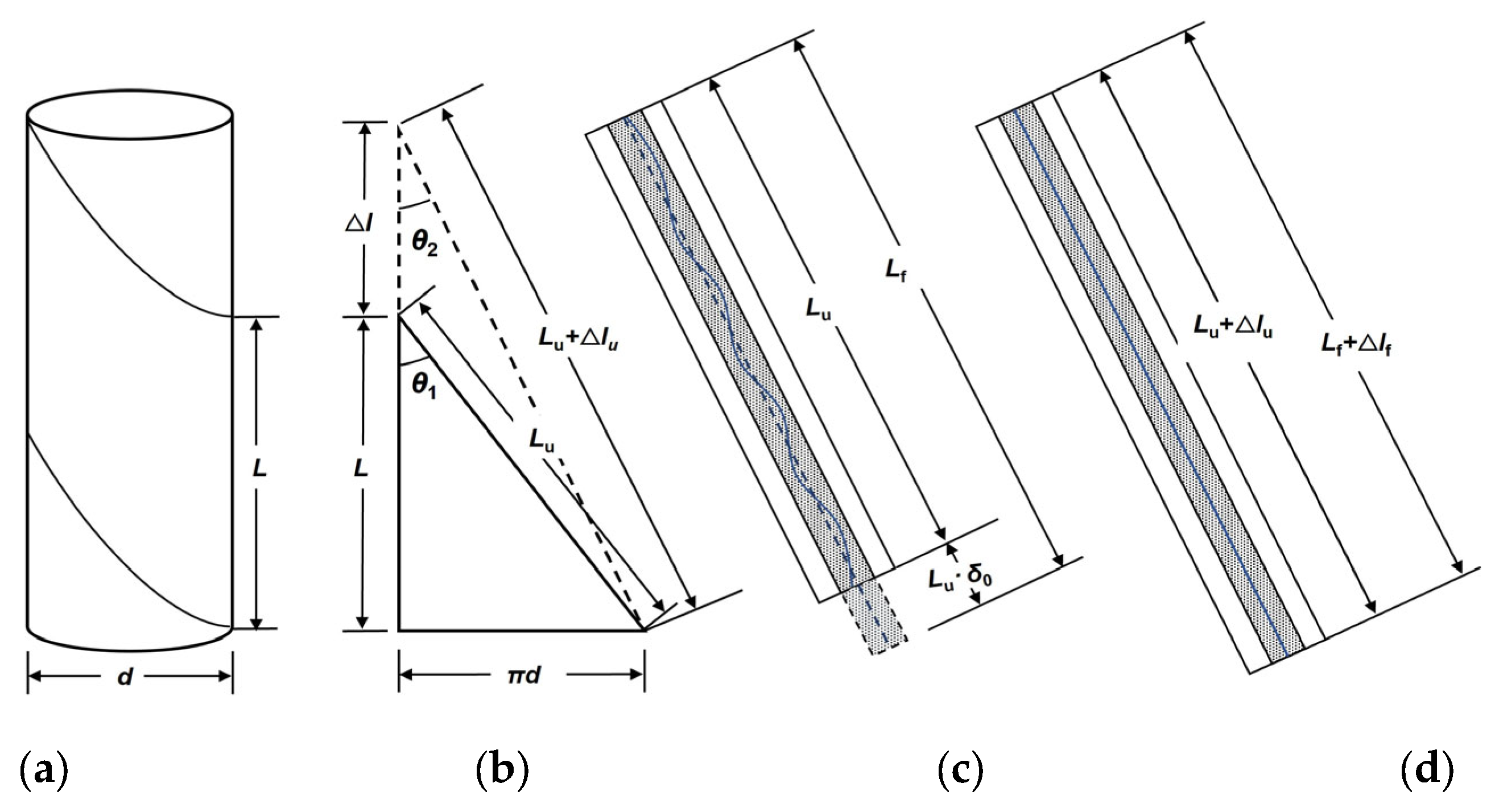
The optical unit is helically wound within the submarine cable as shown in Figure 2a. A planar diagram of the axial elongation during stretching is shown in Figure 2b [32].
In Figure 2b, L is the lay length (pitch) of the optical unit winding, which is much larger than the outer diameter d of the optical unit (L > 10d); Lu is the length of the optical unit corresponding to one pitch. If the submarine cable undergoes axial elongation Δl under axial tension, the corresponding elongation of the optical unit is Δlu. The following relationships exist:
θ 1 = arctan ( π d L )
θ 2 arctan ( π d L + Δ l )
L u = L cos θ 1
L u + Δ l u = L + Δ l cos θ 2
where θ1 and θ2 are the helical winding angles of the optical unit. Since L >> d, c o s θ 1 c o s θ 2 1 ; therefore, LuL, Δlu ≈ Δl.
In Figure 2c, Lf is the fiber length within one pitch. The blue solid line represents the fiber in a loose state within the optical unit, and the blue dashed line represents the fiber in a just-tightened state within the optical unit. When the submarine cable is not subjected to tensile load, the fiber length is the sum of the optical unit length and the initial fiber excess length, i.e., L f = L u + L u δ 0 .

2.2.2. Critical Sensing Tensile Load F0

This paper defined the tensile load at which the fiber excess length in the submarine cable is exhausted (i.e., the optical unit length equals the fiber length) as the critical sensing tensile load F0.
When the tensile load is below the critical sensing tensile load F0, the optical unit length is less than the fiber length (Figure 2c). The fiber maintains its initial length L f = L u + L u δ 0 , and the fiber elongation Δlf = 0. Correspondingly, the fiber strain ε f = 0 . At this point, the fiber cannot sense the mechanical state of the submarine cable.
When the tensile load reaches the critical sensing threshold F0, the optical unit elongates to the fiber’s original length, the fiber becomes perfectly taut, and the fiber’s slack is exhausted, i.e., δ = 0 , L u = L f , yet the fiber exhibits no elongation and remains incapable of sensing the stress applied to the submarine cable.

2.2.3. Minimum Sensing Tensile Load Fm

When the tensile load exceeds the critical sensing tensile load F0, the fiber begins to be stretched, as shown in Figure 2d. The fiber length becomes the sum of its original length and the elongation, i.e., L f + Δ l f = L u + L u δ 0 + Δ l f . Under axial tension, the submarine cable’s filling layer gradually compacts. The helically twisted armor wires undergo slight adjustment relative to the cable core to eliminate initial interlayer gaps, whilst the relative movement between the optical unit and the filling layer remains not yet fully constrained.
This paper defined the minimum sensing tensile load Fm as the transition point where the optical unit and the submarine cable shift from incomplete coupling to complete coupling. When the tensile load continues to increase and reaches Fm, the entire composite cross-section of the submarine cable achieves full engagement and compaction, and the optical unit and the submarine cable are in a state of complete coupling. Thereafter, the fiber elongation equals the optical unit elongation, i.e., Δ l f = Δ l u . Because the fiber excess length δ0 is extremely small and can be neglected, the fiber strain is as shown in Equation (6):
ε f = Δ l f L f = Δ l u L u + L u δ 0 + Δ l f Δ l u L u + Δ l f = Δ l u L u + Δ l u Δ l L + Δ l = ε c
where ε f is the strain of the submarine cable fiber, and ε c is the axial strain of the submarine cable. Although the helical winding structure of the optical unit and the fiber excess length design cause the actual fiber path to be slightly longer than the axial length of the submarine cable, within one winding pitch, the fiber strain is nearly equal to the axial strain of the submarine cable.

2.2.4. Submarine Cable Strain and Fiber Strain

Considering material coupling effects, the fan-shaped PE filling structure undergoes non-uniform compressive deformation under axial tension, forming a composite stress field at the fiber-filling medium interface. Based on elastic mechanics and fiber sensing theory, this stress transfer process can be expressed as follows:
ε f = η ε c = η ( F i A c E c )
where η is the strain transfer efficiency coefficient (0 < η ≤ 1). η characterizes the overall conversion efficiency from macroscopic axial strain in the cable body to axial strain in the optical fiber. As a lumped parameter, η encompasses the mechanical coupling relationship between the optical fiber, optical unit, and cable body, incorporating the combined effect of complex stress states such as lateral pressure on frequency shift. Under the assumption of ideal bonding and the absence of interfacial slip, the theoretical upper limit of strain transfer is determined by the helical path of the optical unit. Calculating the helix angle based on cable structural parameters (rotation diameter d ≈ 75 mm, pitch L = 5 m) yields η max = cos 2 θ 0.9978 under ideal conditions. This value represents an idealized geometric upper bound and does not account for the various loss mechanisms inherently present within η’s definition. Fi is the single-end tensile force applied to the submarine cable, A c is the cross-sectional area of the submarine cable, and E c is the equivalent elastic modulus of the submarine cable. Its calculation requires consideration of the combined response of all structural materials transmitting axial tensile forces:
E c = E i A i k i A i
where A i is the cross-sectional area of each structure, E i is the elastic modulus of each structural material, and ki denotes the helical structure correction coefficient for each helically twisted configuration, typically approximated as k i cos 3 θ i . This study focuses on the overall mechanical response of submarine cables under axial tension. To simplify calculations, the overall axial stiffness is determined by directly summing the three-phase structures, which results in an Ec value slightly greater than the actual value. The total cross-sectional areas and material elastic moduli of each structure for the submarine cable used in this experiment are shown in Table 1.

2.3. BOTDR Monitoring Principle for Fiber Strain

Brillouin scattering is a nonlinear scattering effect arising from the interaction between light waves and acoustic waves in a medium. Microscopic inhomogeneities in material properties such as density and refractive index cause scattering of light propagating in the optical fiber. Environmental temperature and tensile load (strain) influence the speed of sound and the refractive index of light in the fiber, causing a linear change in the Brillouin frequency shift. Their relationship [33] is as follows:
v B ( t , ε ) = v B ( t 0 , ε 0 ) + C t ( t t 0 ) + C ε ( ε ε 0 )
where v B ( t , ε ) is the Brillouin frequency shift of the fiber under the combined effect of temperature t (°C) and strain ε (με); v B ( t 0 , ε 0 ) is the Brillouin frequency shift of the fiber at the initial temperature t0 (°C) and initial strain ε0 (με); C t (MHz/°C) and C ε (MHz/με) are the temperature sensitivity coefficient and strain sensitivity coefficient of the Brillouin frequency shift, respectively.
When environmental temperature changes, after temperature compensation of the fiber Brillouin frequency shift (i.e., knowing C t ( t t 0 ) in Equation (9)), a linear relationship between the Brillouin frequency shift difference and the strain difference can be established:
Δ v B = C ε 0 Δ ε c
where C ε 0 is the relative strain sensitivity coefficient, representing the change in Brillouin frequency shift relative to the initial strain ε0 (με) caused by a unit change in strain. Its typical value is 0.0483 MHz/με [34].
The direct physical quantity monitored by BOTDR is fiber strain. This paper establishes the theoretical formula from submarine cable strain sensing to mechanical load sensing as follows:
Δ v B = C ε 0 Δ ε c
This paper defined the change in Brillouin frequency shift per unit tensile load, C vF = C ε 0 A c E c , as the tensile sensitivity coefficient. Its value is determined by the fiber strain sensitivity coefficient and the equivalent axial stiffness of the submarine cable.

3. Experiment

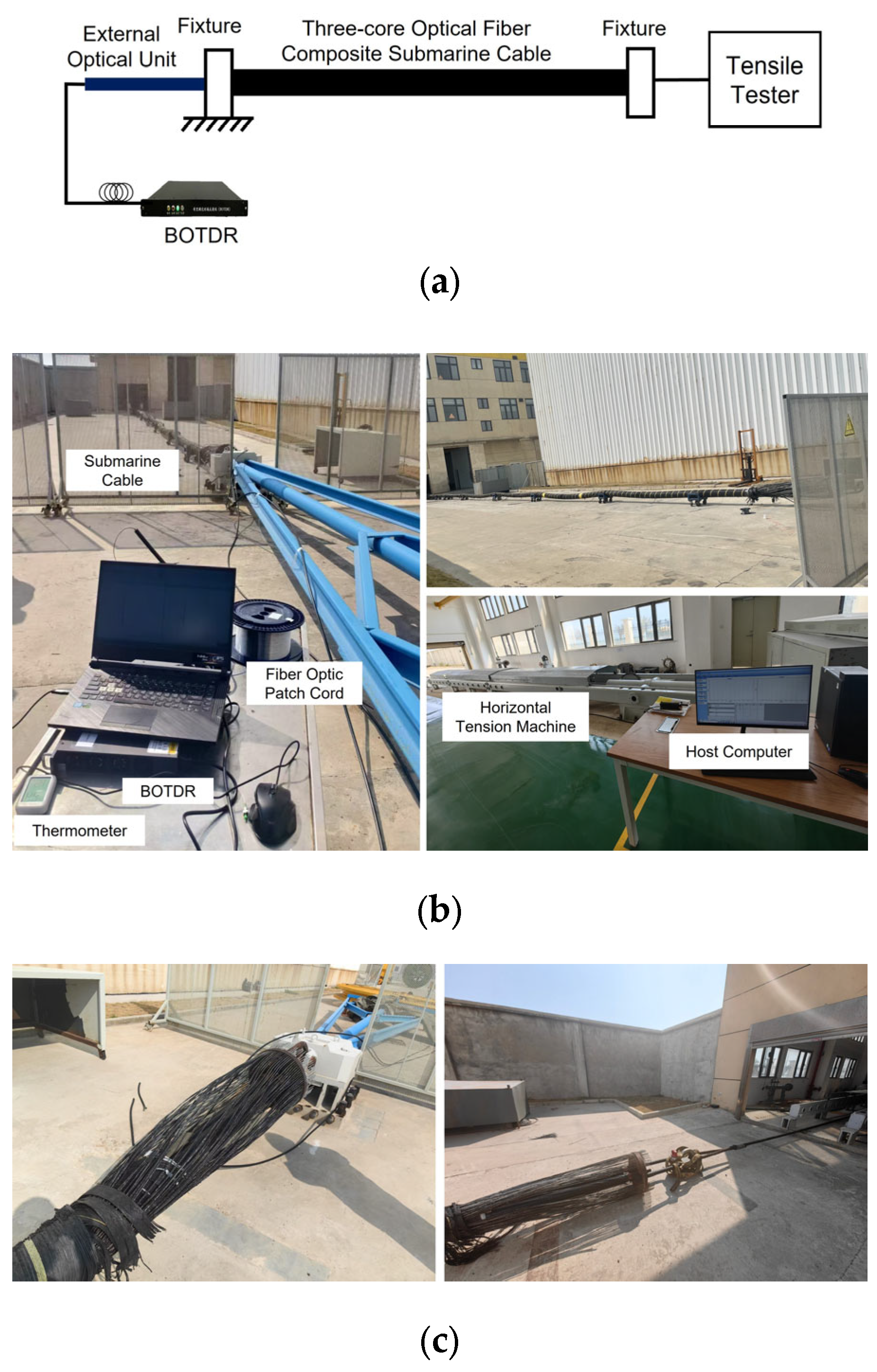
To verify the aforementioned monitoring principle, this paper, referencing CIGRE TB623 [35,36], established a submarine cable tensile test BOTDR monitoring platform at South Sea Submarine Cables Co., Ltd., Shanwei, China. The platform includes a horizontal tension machine, BOTDR, fiber optic patch cords, a 66 kV three-core fiber-optic composite submarine cable, and fixing devices at both ends of the cable, as shown in Figure 3a.
BOTDR with a temperature measurement accuracy of ±1 °C, a strain measurement accuracy of ±20 με, and a spatial resolution better than 1 m was used in the experiment. The experimental environment temperature in this study was 21 ± 0.6 °C, with overall temperature fluctuation not exceeding 1 °C.
The test cable sample length was 45 m. For convenient connection to BOTDR, a section of the optical unit approximately 15 m long was stripped out near the monitoring end. This optical unit retains the original submarine cable optical unit structure, consisting sequentially from inside to out of fiber, water-blocking grease, stainless steel tube, HDPE sheath, etc. It serves as the external optical unit section, as shown in Figure 1b. The external optical unit section was mechanically separated from the stressed submarine cable section, arranged in a slack configuration without being embedded in loading fixtures. It retains its complete protective structure, free from lateral constraints that could cause bending. It is unaffected by tensile loads and is influenced solely by ambient temperature.
The experimental setup is shown in Figure 3b. BOTDR is connected to the external optical unit via a 510 m fiber optic patch cord, which shares the same optical path as the submarine cable’s optical unit. Both ends of the submarine cable are fixed using fixtures to maintain structural stability, as shown in Figure 3c. The galvanized low-carbon steel wires of the armor layer and the three-phase copper conductors are embedded and locked into the fixtures. The near-end fixture is fixed to a rigid base and remains stationary. The far-end fixture is connected to the horizontal tension testing machine via a traction device for applying tensile load.
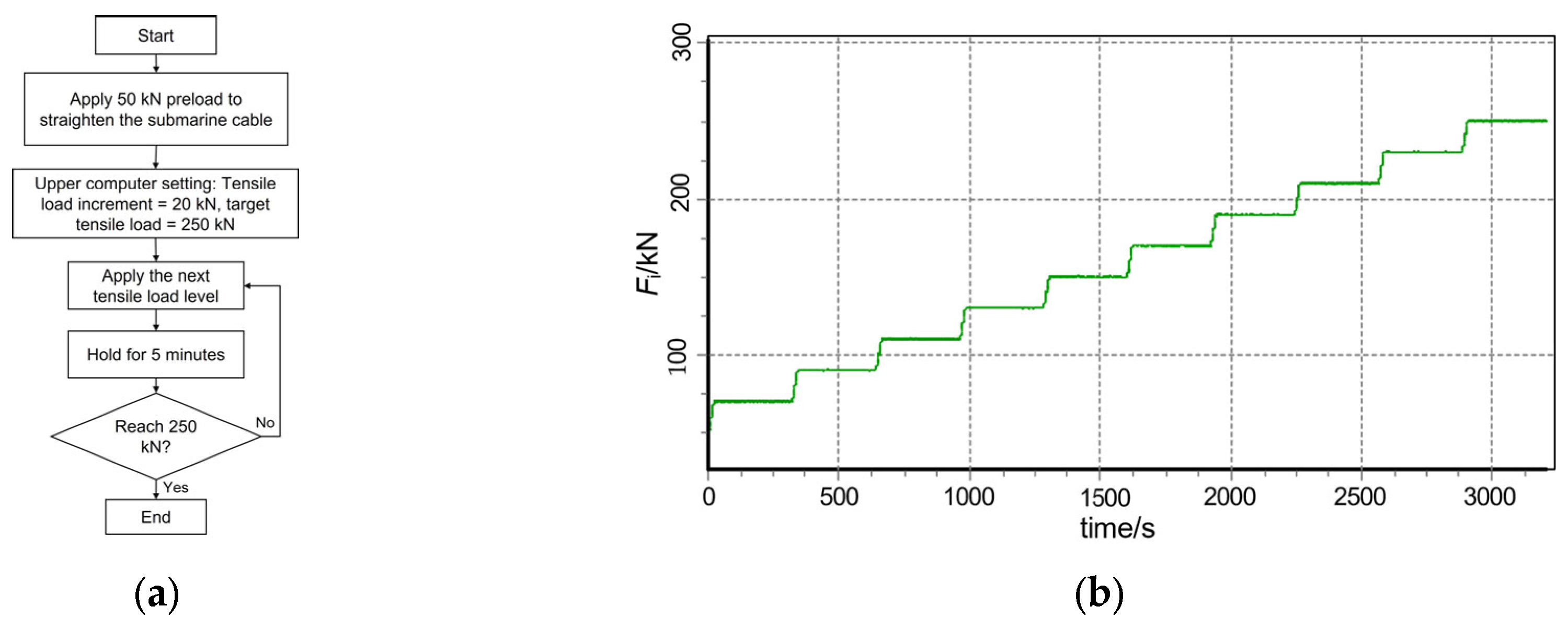
The host system controls the horizontal tension machine with a minimum tensile load step of 20 kN. RTS of the test submarine cable was 1147.65 kN (provided by the manufacturer). The applied tensile load procedure and its variation over time are shown in Figure 4a and b, respectively. References [3,4] indicate that the conventional traction tension for laying three-core submarine cables is approximately 10% RTS, rising to 19% under extreme conditions. The upper load limit of 250 kN (21.8% RTS) established for this experiment fully encompasses the aforementioned range, ensuring the model’s engineering applicability. Two repeated tests were conducted in this study.

4. Results and Analysis

4.1. Length Distribution of Brillouin Frequency Shift

Taking the direction of submarine cable tensile load application as positive, and setting the junction between the external optical unit section and the submarine cable section as 0, the schematic diagram of BOTDR monitoring length is shown in Figure 5a. Here, −16.3–0 m is the external optical unit, and 0–29.1 m is the submarine cable optical unit.
Figure 5b,c show the three-dimensional plots of Brillouin frequency shift vs. length vs. load for the submarine cable fiber in the two repeated tests. The shapes and variation trends of the two 3D plots are consistent, indicating good repeatability of the observed distribution of Brillouin frequency shift with length and load.
From Figure 5b, it can be seen that the initial Brillouin frequency shift distribution curve of the external optical unit is overall higher than that of the submarine cable optical unit. Owing to the absence of structural compression from the outer sheath, armor layer, and filling layer, the external optical unit is exposed to air, resulting in a significantly higher initial Brillouin shift value compared to the submarine cable optical unit. As tensile load increased, the submarine cable optical unit underwent compression from the filling layer’s fan-shaped structure, generating an incremental mechanical component of the Brillouin shift. Consequently, the difference in Brillouin shift between the external optical unit and the submarine cable optical unit progressively diminishes.
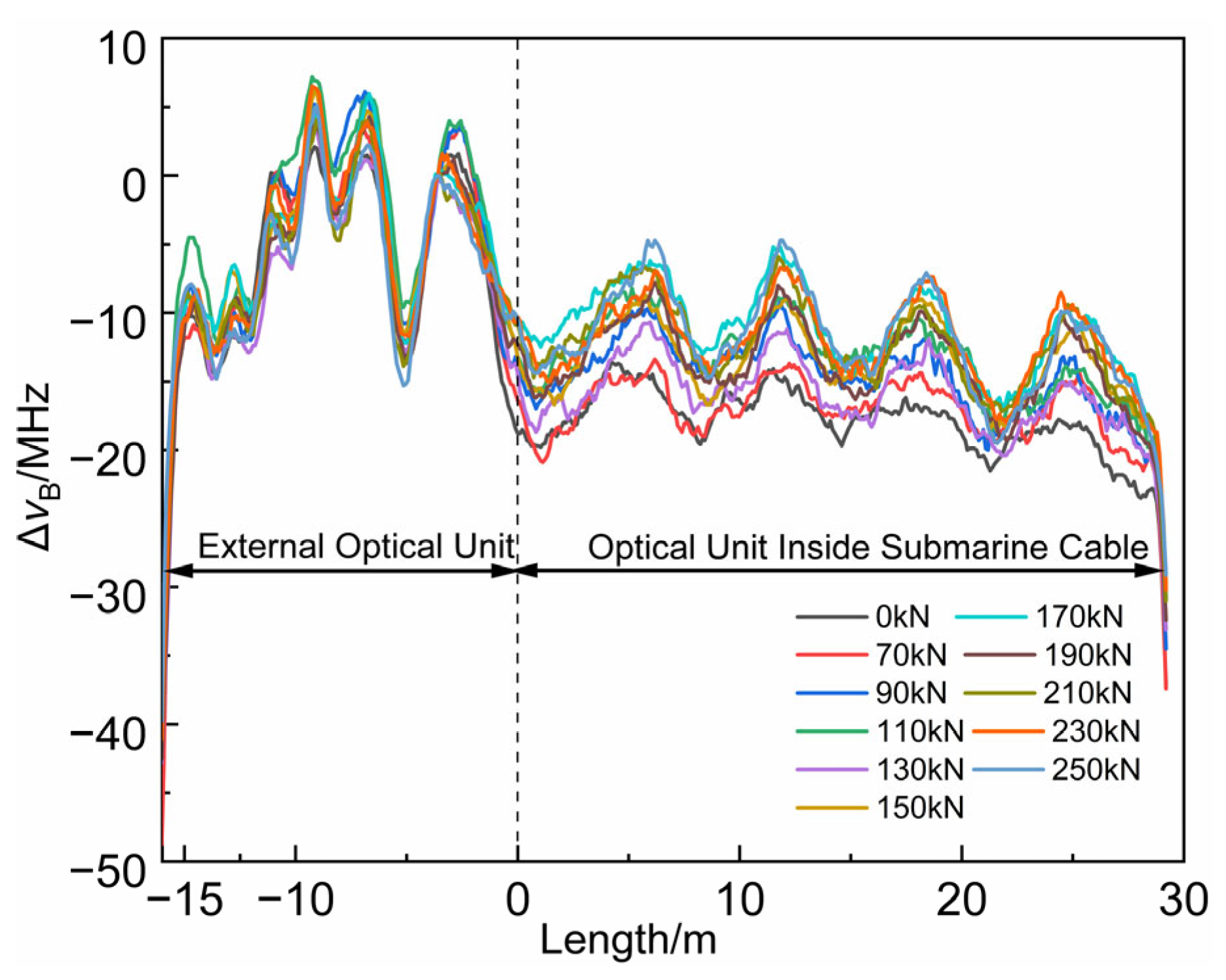
As the Brillouin frequency shift is sensitive to both temperature and strain, spatial temperature variations generate a temperature-induced frequency shift component. When superimposed upon the strain-induced signal, this causes the monitored value of strain Brillouin frequency shift ( Δ v B ) to deviate from its true value. Sudden changes in the temperature-induced frequency shift may also lead to premature misidentification of F0 and blur the boundary of the linear segment corresponding to Fm. Using the external optical unit’s mean Brillouin frequency shift for temperature compensation, the strain Brillouin frequency shift ( Δ v B ) is obtained by subtracting this compensation value from the cable section’s Brillouin frequency shift. Its distribution is shown in Figure 6.
Note that the external optical unit mean temperature compensation method for BOTDR strain monitoring applies only to laboratory studies with uniform temperature fields. A data-driven real-time prediction framework has been successfully applied to critical linear infrastructure monitoring [37]. The approach of achieving robust field monitoring through collaborative multi-source sensor data analysis can be directly transferred to submarine cable systems. For field applications in submarine cable engineering, ROTDR is recommended to provide distributed temperature data for compensating the BOTDR strain measurements. Specifically, BOTDR and ROTDR share the same fiber optic link embedded within the submarine cable. ROTDR captures high-resolution distributed temperature data across the entire cable length, decoupling the Brillouin frequency shift component generated by temperature. This component is then subtracted from the continuous Brillouin frequency shift distribution obtained from BOTDR, yielding the Brillouin component attributable solely to true strain.
From Figure 6, it can be seen that the spatial distribution of strain Brillouin frequency shift Δ v B for the external optical unit section overlaps under various tensile loads and is higher than that of the submarine cable optical unit.
The fiber strain Brillouin frequency shift Δ v B of the submarine cable optical unit section varies with tensile load. Under each tensile load, there is a periodic distribution feature along the line with a length of 6.5 m, which is longer than the design pitch (5 m) of this submarine cable. This discrepancy stems not only from factors such as the optical unit being helically wound within the pitch at a specific diameter and its internal fiber redundancy design, but also relates to the mismatched pitches and reverse-twisting across different layers of the submarine cable’s composite structure.

4.2. Tensile Characteristic Quantities from Brillouin Optical Time-Domain Reflectometry Frequency Shift

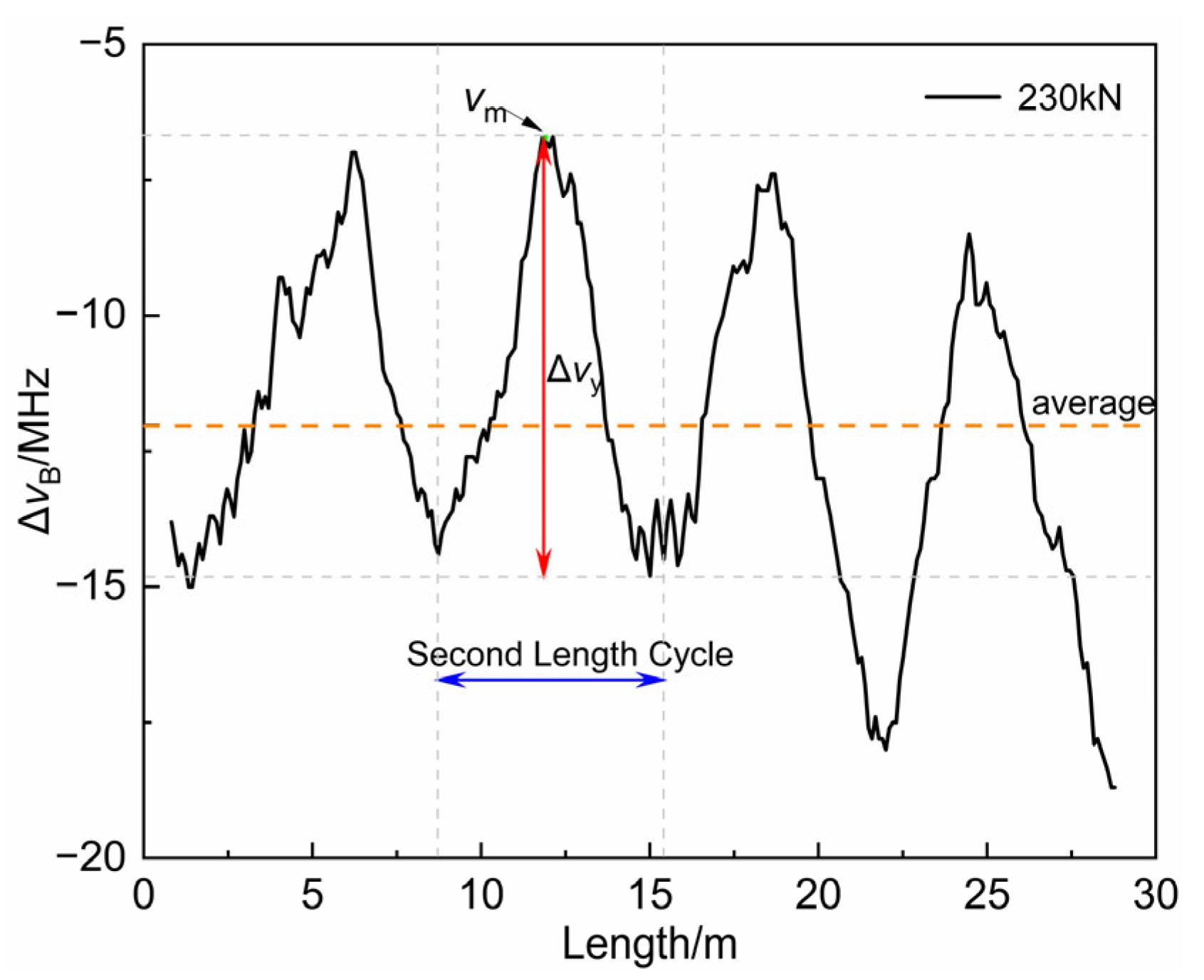
The cable fiber’s Brillouin frequency shift shows a periodic length distribution with four complete cycles in this study. Considering that the external optical unit section might affect the Brillouin frequency shift of the first length cycle in the submarine cable section, the strain Brillouin frequency shift of the second length cycle was selected for result analysis.
To find the characteristic quantities of the Brillouin frequency shift of the submarine cable optical unit under tensile load, this paper studied strain Brillouin frequency shift quantities such as amplitude Δ v y , value Δ v p , and stable peak value v m . The definitions of Δ v y and v m are shown in Figure 7.

4.2.1. Strain Brillouin Frequency Shift Amplitude Δ v y

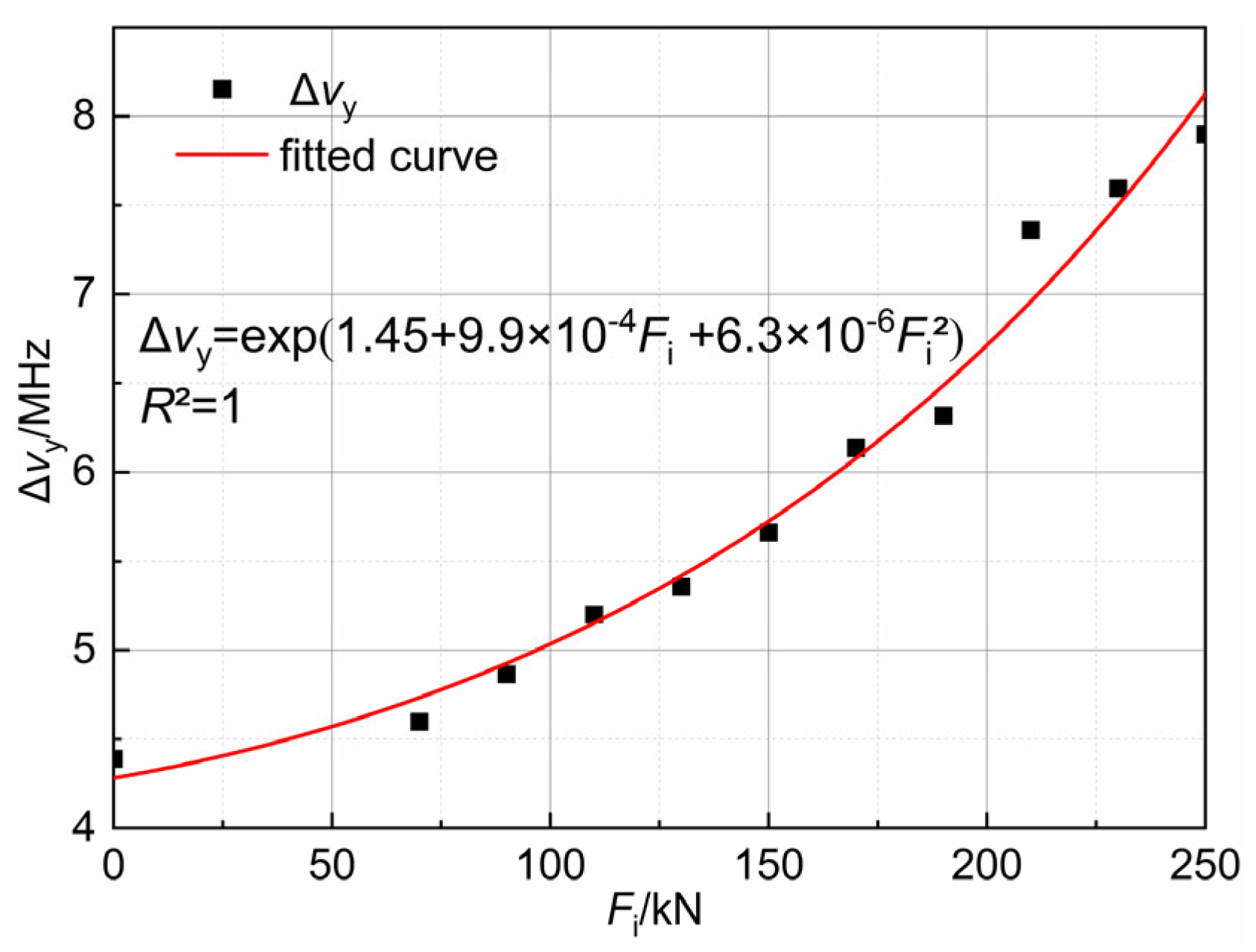
The variation in strain Brillouin frequency shift amplitude Δ v y of the submarine cable optical unit with tensile load Fi under different tensile loads is shown in Figure 8.
Δ v y reflects the maximum range of strain fluctuation within a single-cycle length, characterizing the degree of local stress concentration. From Figure 8, it can be seen that Δ v y has a nonlinear exponential function relationship with Fi, which is not convenient for tensile mechanical monitoring.

4.2.2. Strain Brillouin Frequency Shift Peak Mean Value Δ v p

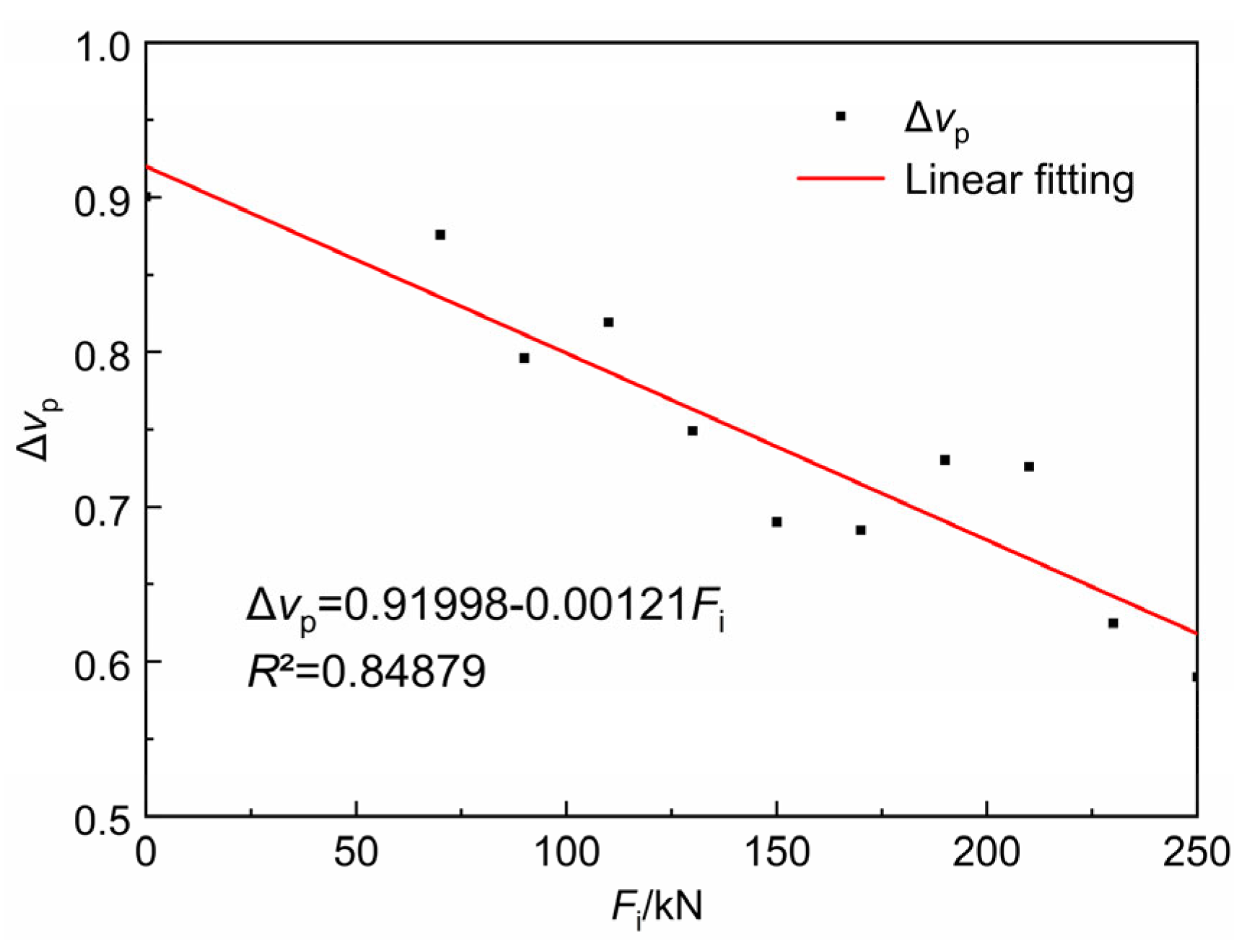
The ratio of the peak value to the mean value of the strain Brillouin frequency shift of the submarine cable optical unit is defined as the Brillouin frequency shift peak mean value Δ v p . The peak mean value Δ v p describes the degree of non-uniformity in the spatial distribution of strain. The variation in the Brillouin frequency shift peak mean value Δ v p with tensile load Fi is shown in Figure 9.
From Figure 9, it can be seen that during the tensile loading process, the peak mean value Δ v p gradually decreases, indicating that as the tensile load increases and the multi-layer structure of the submarine cable compresses, the strain distribution along the optical unit tends to become more uniform.
The correlation coefficient between Δ v p and tensile load is only 0.85, making it unable to precisely quantify the tensile load on the submarine cable. However, it can be used to judge whether the optical unit–submarine cable system has entered a state of complete coupling.

4.2.3. Brillouin Frequency Shift Stable Peak Value v m

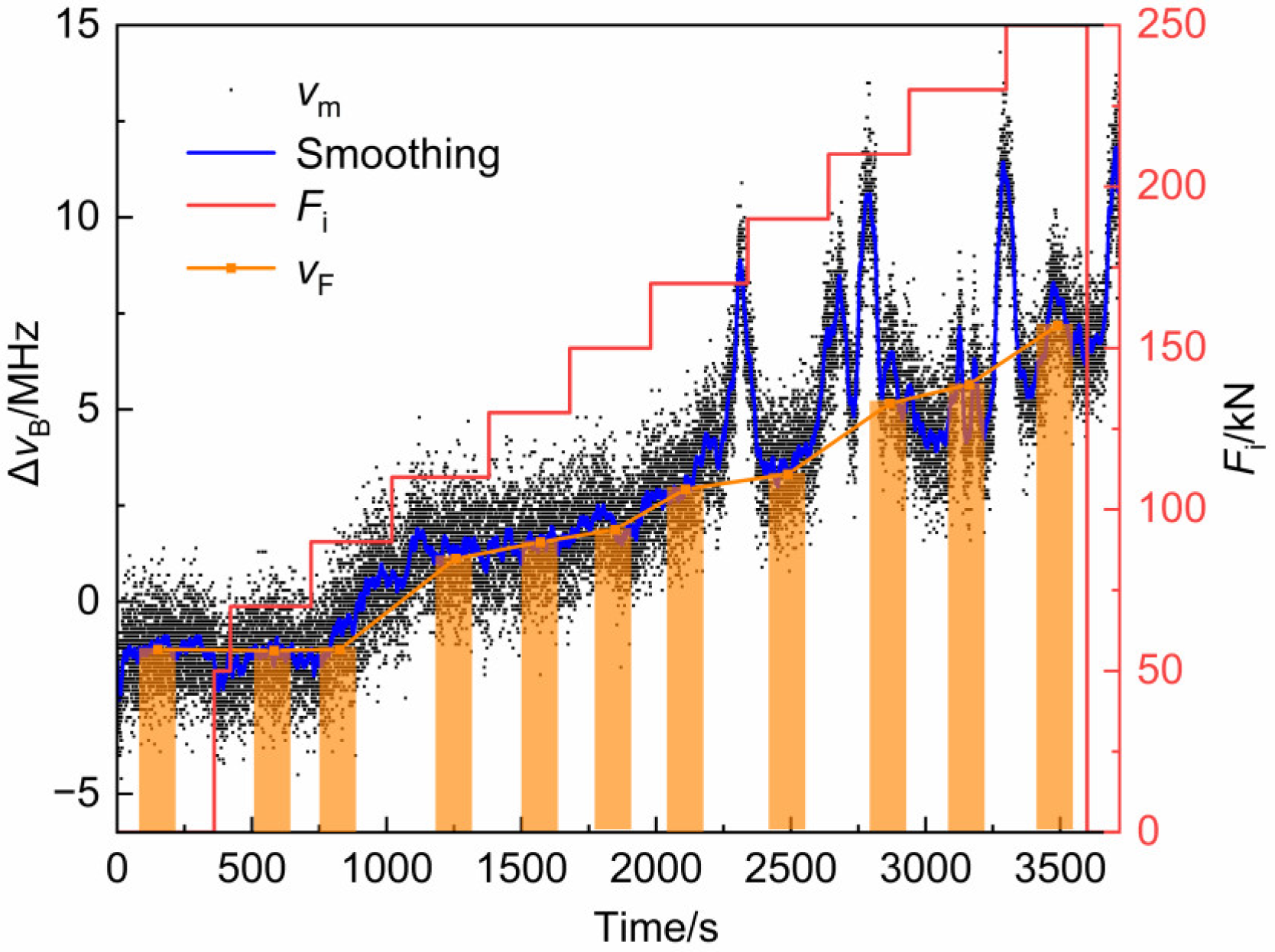
During the loading process of the next tensile load level, the response of the fiber Brillouin frequency shift exhibits fluctuating changes and gradually tends to stabilize. This paper proposes concepts such as the stable segment of Brillouin frequency shift and stable peak value.
Within the 5 min duration of each tensile load application, the 120 s segment with minimal fluctuation is selected as the stable segment of the strain Brillouin frequency shift Δ v B . The time series of peak values v m for this stable segment is extracted.
As shown in Figure 10, the orange bars represent the extracted stable segments of strain Brillouin frequency shift. The overall trend of the Brillouin frequency shift stable peak value v m has a certain correlation with the tensile load Fi, but it is affected by noise disturbance.

4.2.4. Brillouin Frequency Shift Stable Average Peak Value v F

The average value of the 120 s time series of stable Brillouin frequency shift peaks v m was calculated as the stable average Brillouin frequency shift peak v F . The Brillouin frequency shift stable average peak values v F under different loads are presented in Figure 10. Its correlation study and sensing model with the submarine cable tensile load Fi are described below.

4.3. Brillouin Frequency Shift Tensile Sensing Model

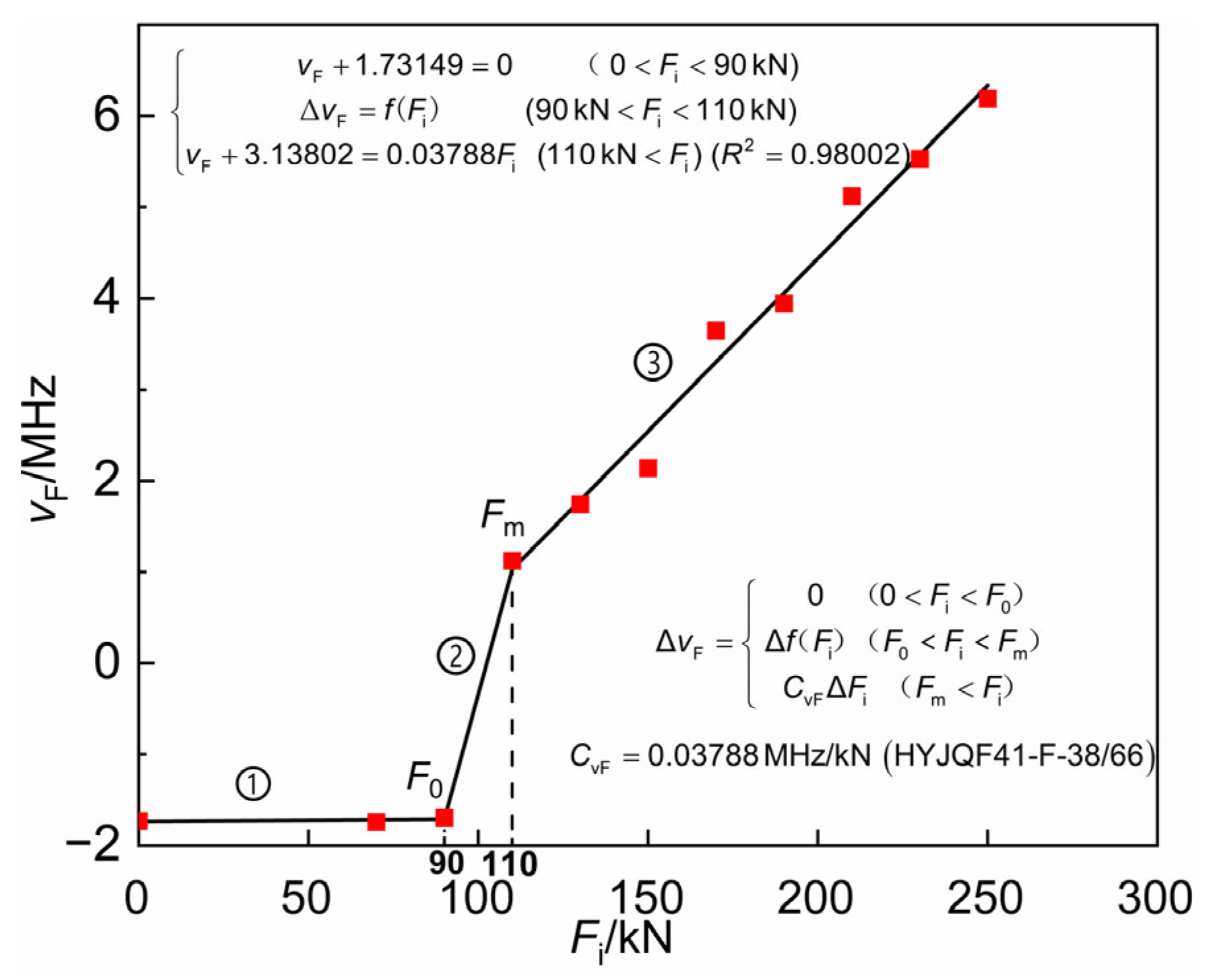
As shown in Figure 11, the three-core submarine cable tensile sensing model exhibited a critical sensing tensile load F0 and a minimum sensing tensile load Fm, thereby validating the tensile load sensing theories outlined in Section 2.2.2 and Section 2.2.3.
Below the critical sensing tensile load F0 (90 kN, 7.84% RTS in this study), the stable average Brillouin frequency shift peak v F is extremely small. In this state, the existence of fiber excess length within the optical unit prevents the submarine cable from sensing strain.
When the tensile load reaches the critical sensing tensile load F0, the stable average peak value v F increases abruptly. In this state, the fiber excess length within the optical unit has been exhausted by the increased strain of the submarine cable under the action of F0, and the sensitivity of v F to the submarine cable tensile load Fi is enhanced.
It should be noted that, due to the minimum tensile load step of 20 kN of the tension machine used in this test, the sensing model between the stable average peak value v F and the tensile load Fi within the range from the critical sensing tensile load F0 (90 kN) to the minimum sensing tensile load Fm (110 kN) could not be obtained. This limitation is significantly mitigated in practical submarine cable deployment scenarios. Driven by the stringent requirements of offshore operations, high-resolution load regulation is commonly adopted during submarine cable laying to avoid over-tensioning, and commercial submarine cable laying equipment can thus continuously capture load responses across the entire F0Fm interval, enabling seamless monitoring of the transition phase from fiber excess length exhaustion to complete coupling between the optical unit and the cable body. Furthermore, in engineering applications, the model only needs to identify F0 (where fiber excess length is exhausted) through the abrupt change in v F and achieve continuous monitoring of the tensile load via the linear relationship.
When the tensile load exceeds the minimum sensing tensile load Fm (110 kN, approximately 9.58% RTS in this study), a significant linear relationship exists between the stable average peak value v F and the submarine cable tensile load Fi, with a correlation coefficient of 0.98 and a tensile sensitivity coefficient C vF of 0.03788 MHz/kN.
Based on the above research, the sensing model between the stable average Brillouin frequency shift peak v F and the tensile load Fi for the three-core submarine cable is given by Equation (12):
Δ v F = 0 ( 0 < F i < F 0 ) f ( F i ) ( F 0 < F i < F m ) C vF Δ F i ( F m < F i ) C vF = 0.03788   MHz / kN   HYJQF41-F-38/66
Table 2 compares the functional relationships, correlation coefficients, and applicable scenarios of the strain Brillouin frequency shift characteristic quantities: amplitude Δ v y , peak mean value Δ v p , stable peak value v m , and stable average peak value v F . The results indicate that v F reflects the overall tensile load level of submarine cables, covering the full range of engineering monitoring requirements including minor load identification, major load quantification, and ultimate load warning.
The core value of distributed fiber optic sensing lies in simultaneously capturing strain distribution along the entire cable length, enabling precise localization of overloaded sections, stress concentration zones, and abnormal deformation segments. This study employs BOTDR distributed sensing technology for tensile load monitoring, establishing a dual-threshold segmented sensing model for submarine cable tensile mechanical states. This achieves synergistic monitoring through quantitative assessment of macro-level tensile loads and precise localization of micro-level stresses.

4.4. Strain Transfer Efficiency Analysis and Sensor Model Validation

4.4.1. Strain Transfer Efficiency

The physical essence of the minimum sensing tensile load Fm is the starting point where the optical unit and the submarine cable achieve sufficient coupling, i.e., the strain transfer efficiency η stabilizes at its highest level. The strain transfer efficiency η can be derived from Equation (7):
η = ε f ε c
Based on the sensing model proposed above and the fiber Brillouin sensing theory Equation (14), the fiber strain ε f based on the sensor monitoring values can be derived from the typical strain coefficient C ε 0 = 0.0483   MHz / μ ε and stable average peak value v F :
ε f = v F v F 0 C ε 0
Meanwhile, according to Hooke’s law in Equation (15), the strain in submarine cables ε c , derived from theoretical calculations based on tensile load Fi and structural parameters A c E c , is as follows:
ε c = F i A c E c
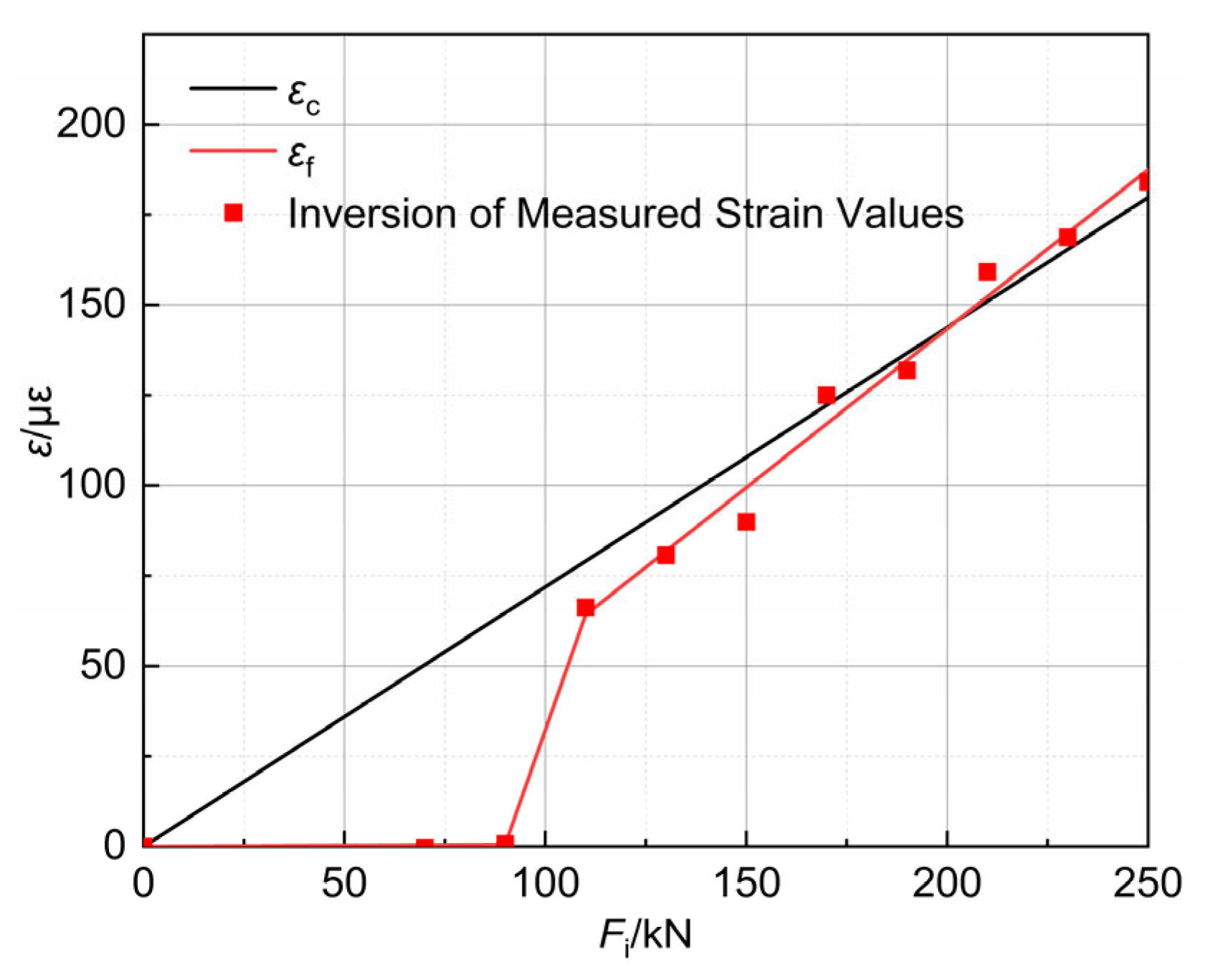
Here, the structural parameter A c E c can be obtained from Table 1 as 1.39 × 10⁹ N. Figure 12 presents a comparison of fiber strain ε f versus submarine cable strain ε c .
When Fm = 110 kN, the strain transfer efficiency η = ε f / ε c = 66.25717 / 79.10533 0.837 . When η approaches 1 and remains relatively stable, it signifies that the submarine cable has completed its overall structural compaction and settlement. The optical unit has achieved full rigid coupling with the main cable structure, with no further significant relative movement or stress redistribution occurring internally. Therefore, η first reaching and stabilizing above 0.8 can be judged as entering a stable and reliable sensing interval for monitoring.
From Figure 12, it can be seen that above the minimum sensing tensile load, the measured and theoretical values are close. Due to neglected helix angle effects, the equivalent stiffness Ec in theoretical calculations is overestimated, such that the strain curve is in reality steeper than shown. However, the spiral structure within the submarine cable exhibits a very small laying angle, with a correction coefficient approaching unity. Consequently, the corrected values obtained after spiral correction remain within the experimental error range of the measured values. The strong linear correlation established in this experiment between the stable average peak value v F of the submarine cable optical unit’s Brillouin frequency shift and the tensile load Fi has been verified theoretically.

4.4.2. Discussion of Error Sources and Uncertainty Quantification

To verify the reliability of the core parameters of the dual-threshold segmented sensing model, Table 3 summarizes the critical sensing tensile load F0, minimum sensing tensile load Fm, and tensile sensitivity coefficient C vF obtained from two repeated tensile tests and theoretical calculations. F0 is 90 kN and Fm is 110 kN measured in both tests; the absolute error between the experimental C vF value and the theoretical value is Δ = k ¯ k e = 0.002375   MHz / kN , and the relative error is δ = Δ k e × 100 % = 6.83 % , which is within the engineering acceptable error margin (10%), verifying the accuracy of the dual-threshold sensing model.
There is an error between the experimentally measured tensile sensitivity coefficient C vF and the theoretical value, mainly from three aspects: first, the uncertainty of submarine cable material parameters, whose calculation depends on parameters of each structural layer, and actual material properties may deviate from nominal values due to manufacturing tolerances, cable production variations, or environmental aging, leading to deviations in axial stiffness calculation; second, the variability in fiber strain coefficient C ε 0 , where the theoretical typical value differs from the inherent parameters of actual optical fibers, and temperature interference from friction during stretching affects temperature–strain decoupling; third, the estimation error of structural parameters, where uneven helical stranding causes non-uniform strain distribution along the cable, reducing the calculation accuracy and fitting effect of C vF .
It is noteworthy that traditional deterministic analysis provides only single-parameter values, failing to comprehensively support engineering decisions in complex marine environments. Integrating a probabilistic framework to quantify parameter uncertainty is increasingly vital for ensuring the reliability of monitoring systems for complex engineering structures [38]. The core parameters of the dual-threshold sensing model (F0, Fm, C vF ) are influenced by multi-source uncertainties stemming from materials, structures, and the environment. Future research may employ Monte Carlo simulations or Bayesian inference to incorporate these uncertainties into the output monitoring results, thereby quantifying the confidence intervals for F0, Fm and C vF .

5. Conclusions

This paper established a BOTDR monitoring platform for tensile testing of a 66 kV three-core fiber-optic composite submarine cable, studying the length distribution characteristics of the fiber’s Brillouin frequency shift under tensile load in the submarine cable optical unit, the characteristic quantities for characterization, and the sensing model. The following conclusions were obtained:
(1)
The strain relationship between the optical fibers, optical units, and submarine cables was clarified based on a three-layer mechanical structure (cable, optical unit, fiber) during the process of increasing tensile load.
(2)
A laboratory-applicable monitoring method was developed, which uses the mean Brillouin frequency shift of an external optical unit for temperature compensation, addressing the cross-sensitivity issue using BOTDR itself. For field applications, ROTDR-based temperature compensation is recommended.
(3)
The Brillouin frequency shift of the cable’s optical unit exhibits a periodic distribution along the pitch under tensile load, with a period slightly longer than the helical pitch. This periodicity becomes more distinct with increasing load.
(4)
The stable average peak value of the Brillouin shift v F was identified as the optimal characteristic quantity for tensile load characterization, showing the highest linear correlation with load Fi (R2 = 0.98) among several candidates.
(5)
A dual-threshold three-segment sensing model was established. Below the critical load F0 (90 kN, 7.84% RTS), sensing is hindered by fiber excess length; above the minimum sensing load Fm = 110 kN (9.58% RTS), v F correlates strongly with Fi, yielding a tensile sensitivity C vF of 0.03788 MHz/kN. The model was verified both theoretically and experimentally.
The proposed framework provides a methodological foundation for transitioning from qualitative strain observation to quantitative mechanical state assessment of submarine cables, enhancing the safety and reliability of offshore wind farm power transmission.

Author Contributions

Conceptualization, M.G. and Y.H.; methodology, Y.Z.; software, M.G.; validation, Y.H., Y.Z. and M.G.; formal analysis, L.L.; investigation, M.G.; resources, B.C. and X.Y.; data curation, Y.Z.; writing—original draft preparation, B.C. and X.Y.; writing—review and editing, M.G. and Y.H.; visualization, Y.Z.; supervision, L.L.; project administration, B.C., X.Y. and Y.H.; funding acquisition, X.Y. All authors have read and agreed to the published version of the manuscript.

Funding

This research received no external funding.

Data Availability Statement

The data presented in this study are available on request from the corresponding author.

Conflicts of Interest

Author Busheng Chen was employed by the South Sea Submarine Cables Company. Author Xin Yu was employed by the Electric Power Research Institute of Guangdong Power Grid Co., Ltd. The remaining authors declare that the research was conducted in the absence of any commercial or financial relationships that could be construed as a potential conflict of interest.

Abbreviations

The following abbreviations are used in this manuscript:
BOTDRBrillouin Optical Time-Domain Reflectometry
RTSRated Tensile Strength
ROTDRRaman Optical Time-Domain Reflectometry

References

  1. Lu, Y.; Huang, H. External Force Damage Simulation of Submarine High-voltage Cable Based on Distributed Fiber Optic Sensor Technology. Electr. Eng. 2012, 12, 87–90, 93. Available online: https://kns.cnki.net/kcms2/article/abstract?v=A-1EuXenf_oJaWUprv_0oNA-pFVwnxFmfwVgtAKbx0mSN5y2e_PW8yItm7c5OmLQn2Iwnclc3al31LNEukFMCNozr32JWbaDgdF73Ww7SCbIyBWNyNm_5SjidhWj3C7pV3hyWBC4bJRXcnGjbXKvXo3umId0WlSF&uniplatform=NZKPT (accessed on 20 January 2025).
  2. Shao, S.A.; Ma, X.; Feng, R.N.; Ma, X.; Ye, L.; Zhou, K.; Zhu, L. Review of Researches on Submarine Cables at Home and Abroad. South. Power Syst. Technol. 2020, 14, 81–88. Available online: https://kns.cnki.net/kcms2/article/abstract?v=A-1EuXenf_oJe9oHSCFJERt6Kc1Hq6hUfMF8nQ9vjJD5oB-JVVXJPQlevwvGjMsUqQA0jU_79A-NGlZdq8LClaKMMXXOg8fDHp20jmI9zRBpbFcyUgBfRC4b25CoV8RJhqoQX7n-Xf1_lAOjpd_mAezgG8QLxTl1Ih01MQr_oUo=&uniplatform=NZKPT (accessed on 20 January 2025). [CrossRef]
  3. Xu, H.B.; Sha, X.Y.; Zhang, Z.Y.; Ku, M. Numerical Simulation Study on Mechanical Characteristics of Submarine Cable During Laying Process. South. Energy Constr. 2023, 10, 118–123. [Google Scholar] [CrossRef]
  4. Gong, B.L.; Liu, L.G.; Miao, B.; Chen, B.; Wang, J.; Wang, W. Design of Three-Core Enhanced Capacity Submarine Photoelectric Composite Cable with Large Cross-Section and High Voltage. Wire Cable 2025, 68, 31–37. [Google Scholar] [CrossRef]
  5. Huang, Z.S.; Sha, X.Y.; Wen, J.Z.; Su, K. Study on the Deformation Response of Submarine Cables Under Anchor Drop Impact in Exposed Areas. Ocean Eng. 2025, 43, 173–183. [Google Scholar] [CrossRef]
  6. Ma, G.M.; Wang, S.H.; Qin, W.Q.; Zhang, B.; Zhang, J.; Chen, C. Research and Prospect in Optical Fiber Sensing of Transmission Line Operating Conditions. High Volt. Eng. 2022, 48, 3032–3047. [Google Scholar] [CrossRef]
  7. Li, R.; Ma, J.Q.; Zhang, X.Y.; Shi, X.; Sun, W.; Lu, X. Modeling and Analysis of Relative Fatigue Life Under 3D Mixed Lubrication in Marine Helical Gears. Tribol. Int. 2025, 211, 110834. [Google Scholar] [CrossRef]
  8. Huang, Q.; Sun, J.Q.; Bao, Y.B.; Liu, X. Advances of Technologies in Long-range Brillouin Optical Time-domain Reflective Optical Fiber Sensing. Laser Infrared 2021, 51, 395–403. Available online: https://kns.cnki.net/kcms2/article/abstract?v=A-1EuXenf_rePCe0NUu6TqFE5JD5cXXu8KFeIaD1rcJydMTDBn6LnH9PLGNcTXsCH4ZH70rapg7CeEsAZnbxNCJrQRD1j-Hc3EO7fDgLXoXaGoyqKjVVVzb6k9d5fd7hELrwSLpa-C9jj0Xj7Vo6XJY-is2JCbrRTNe8bWmIUqU=&uniplatform=NZKPT (accessed on 20 January 2025). [CrossRef]
  9. Xu, Z.N.; Hu, Y.H.; Zhao, L.J.; Fan, M.; Guo, W.; Qin, H. Rapid Temperature and Strain Measurement Method for Optic-electric Composite Submarine Cable Based on Slope-assisted Method. Electr. Power Autom. Equip. 2020, 5, 202–209. Available online: https://kns.cnki.net/kcms2/article/abstract?v=A-1EuXenf_ruBZNW9edoEuxYW3uXBYJQRsj3-4kKrepQaDziUeZiLPYzhLhtWJcSvOWg8hftNYC-6wuJ36kOCd8ILxCqlpJqo09p4_3D1bOs63vndnO2N8KJrRoA53ayIPTudfQ1-KOco5Pv5yEld4EIporBAFsfhODJoGiJIAE=&uniplatform=NZKPT (accessed on 20 January 2025). [CrossRef]
  10. Bertulessi, M.; Bignami, D.F.; Boschini, I.; Brunero, M.; Ferrario, M.; Menduni, G.; Morosi, J.; Paganone, E.J.; Zambrini, F. Monitoring Strategic Hydraulic Infrastructures by Brillouin Distributed Fiber Optic Sensors. Water 2022, 14, 188. [Google Scholar] [CrossRef]
  11. Zhang, W.; Wu, R.R.; Qin, W. Icing Load Monitoring of OPGW Based on Strain Analysis. South. Power Syst. Technol. 2016, 10, 52–58. [Google Scholar] [CrossRef]
  12. Ma, G.M.; Qin, W.Q.; Wang, S.H.; Hu, J.; Yan, J.; Wang, W. Review of Submarine Cable Condition Monitoring Based on Distributed Optical Fiber Sensing. Proc. CSEE 2025, 45, 370–387. Available online: https://kns.cnki.net/kcms2/article/abstract?v=A-1EuXenf_pMVpjm2QTps870TUdqs7r4KpVuzC3JJeVA662cIvNNLruuZD6HQ9BnLPWoUYr-ThG1ANTsZjnNmqEYx-UdOh2k4S4bQX1ZJqlM89Dp3cnTWIUkJYPkNw2_t_l7dC3TBgdwMaoL6kLu19uHcZXIQjhRat-yvhdtkDY=&uniplatform=NZKPT (accessed on 20 January 2025). [CrossRef]
  13. Hou, S.; Wang, Y.S.; Zhu, W.B.; Hui, B.; Feng, B.; Zhang, Y.; Zhan, Y. Review of High Voltage Submarine Cable Monitoring Technology and Applications. South. Power Syst. Technol. 2023, 17, 49–58. [Google Scholar] [CrossRef]
  14. Peng, C.; Zhao, J.K.; Miao, F.G. Distributed Temperature System Applied in Cable Temperature Measurement. High Volt. Eng. 2006, 8, 43–45. Available online: https://kns.cnki.net/kcms2/article/abstract?v=A-1EuXenf_os_erx_vyb_nqkCOwm6YYi8eew-TY0XpDo1KiKyhY__0pYsUalnKnYxG_NEjcevpxK6Pz7vHButVPoV68bwfs9Gbhh6u3oxyJzxO-yvWavWv1C8sghyVxGJYuhM8T5jRnvwB1IJiVGq6t4ISA9v6C-&uniplatform=NZKPT (accessed on 20 January 2025). [CrossRef]
  15. Liao, Y.Q.; Li, D.; Li, L.; Zhang, H.; Yang, S.; Wang, H. Submarine Cable External Disturbance Monitoring Method Based on Phase-sensitive Optical Time-domain Reflectometry. Guangdong Electr. Power 2024, 37, 109–116. Available online: https://kns.cnki.net/kcms2/article/abstract?v=A-1EuXenf_raNwykmxpjHRboCW1q9bLsijgXgVnPesz4gF58lUGbJCksqIegcQTG2WaV-ItRFvTQnwZqM1RvHSxXDXhxWZba9ypClRRyfklSwb4pf6IXzaZsaOY7gXmitfe31IKTI71xs5rMDYrq_reWg9u383Fk-7Hzm5PXE2A=&uniplatform=NZKPT (accessed on 20 January 2025). [CrossRef]
  16. Lyu, A.Q. Research on Condition Monitoring of Optical Fiber Composite Submarine Power Cable Based on Distributed Strain and Temperature Sensing Technology. Ph.D. Thesis, North China Electric Power University, Baoding, China, 2015. Available online: https://kns.cnki.net/kcms2/article/abstract?v=A-1EuXenf_rI5I8kSAz4MTGnsoxVQoi3UurJkRQhE7-DchJ05BRBCyptg1zEK7W79n4vfhvMY2AR3YxBxHcvk5Vl2pnmGU6bBJgWhUzDLQEws9tj4OxQ9ewEyXibk_xTmIhBxRs7YFL7HmTqVW92KxYinc-orY10Af1N7b9vNjokIquS6ESltA==&uniplatform=NZKPT (accessed on 20 January 2025).
  17. Wang, W.C.; Zhang, J.M.; Zhao, Y.L.; Chen, J.; Ye, C.; Yan, Z. Tension Test and Simulation Analysis on Flat-steel-wire-armoured Optical Fiber Composite Submarine Cable. High Volt. Eng. 2019, 45, 3467–3473. [Google Scholar] [CrossRef]
  18. Gutscher, M.A.; Quetel, L.; Murphy, S.; Riccobene, G.; Royer, J.-Y.; Barreca, G.; Aurnia, S.; Klingelhoefer, F.; Cappelli, G.; Urlaub, M.; et al. Detecting Strain with a Fiber Optic Cable on the Seafloor Offshore Mount Etna, Southern Italy. Earth Planet. Sci. Lett. 2023, 616, 118230. [Google Scholar] [CrossRef]
  19. Fang, P.; Jiang, X.L.; Hopman, H. Mechanical Responses of Submarine Power Cables Subject to Axisymmetric Loadings. Ocean Eng. 2021, 239, 109847. [Google Scholar] [CrossRef]
  20. Xie, W.X.; Zou, K.; Wang, H.L.; Qu, Y.; Mao, Y.; Liu, G. Sensitivity Study on Tensile Mechanical Properties of Wind Power Submarine Cables Based on Different Numerical Modeling Methods. High Volt. Appar. 2022, 58, 24–30. Available online: https://kns.cnki.net/kcms2/article/abstract?v=A-1EuXenf_rB28pznIGmmT6-AdWUcETUHmaYLuWvnB5MpEi6rMSiG6sRPZ4se5Noh9RrVTGr95QEpVE7UfbWDUqYE4ZnlHJef6BobkWUd5RMhWrZClVtSGlq3I_3mhIvTA_oKLsvjNAx-yGXfNaN6RmLDevs8cNf8VsXAoxXj_Q=&uniplatform=NZKPT (accessed on 20 January 2025). [CrossRef]
  21. Liu, Z.H.; Hu, K.; Zheng, X.L.; Liang, Y.; Zhang, Z. Overview of Finite Element Simulation Analysis for Mechanical Damage of Submarine Optical Fiber Composite Power Cable. Study Opt. Commun. 2023, 2, 45–54. [Google Scholar] [CrossRef]
  22. Hu, Y.J. Research on Finite Element Model of Optical Fiber Composite Submarine Cables Mechanical Behavior. Ph.D. Thesis, North China Electric Power University, Baoding, China, 2018. Available online: https://kns.cnki.net/kcms2/article/abstract?v=A-1EuXenf_qkNwGyvi-yOn3jhRpskfZyjb_jTHnH78N2xP3MshmxXRl3Bueeb6jWFd-w2R5i4_nvKOt96Bqob0ajLgPdRfEjdS8XSFuBvSFAnGte710sKAYNcEXxY2CS6d8m5d0g8A8x0pSTJsiVBNMTcEZTzKoUPypnxEgc8Xg=&uniplatform=NZKPT (accessed on 20 January 2025).
  23. Zhang, J.; Yin, C.Q. The Analysis of Finite Element Method on the Strain Relationship Between Optical Fiber and Cable in Three-core Submarine Cable. Electr. Meas. Instrum. 2016, 53, 74–78. Available online: https://kns.cnki.net/kcms2/article/abstract?v=A-1EuXenf_oKF-mc8Yp4sdyGj7uQW64k0Oh-dgxzP_3oyL0q2uw05y_u0E6_oD1Js26WepZwialRrJQaRCoJrKJGl8m4s4r6wvcMo7Lp3Q_BFrSQmU8Bli06WpKPy7hFuG3fg0PwmwsOBrArTLUMJ2S-Bf7dTMvF-HrkU6UqCFs=&uniplatform=NZKPT (accessed on 20 January 2025).
  24. Chang, H.C.; Chen, B.F. Mechanical Behavior of Submarine Cable Under Coupled Tension, Torsion and Compressive Loads. Ocean Eng. 2019, 189, 106272. [Google Scholar] [CrossRef]
  25. Fang, P.; Li, X.; Jiang, X.L.; Hopman, H.; Bai, Y. Development of an Effective Modeling Method for the Mechanical Analysis of Three-core Submarine Power Cables Under Tension. Eng. Struct. 2024, 317, 118632. [Google Scholar] [CrossRef]
  26. Li, Q.S.; Hao, Y.P.; Zhang, P.; Tan, H.; Tian, W.; Chen, L.; Yang, L. Numerical Study of the Local Scouring Process and Influencing Factors of Semi-Exposed Submarine Cables. J. Mar. Sci. Eng. 2023, 11, 1349. [Google Scholar] [CrossRef]
  27. Li, Q.S.; Hao, Y.P.; Zhang, P.; Tan, H.; Yang, L. Study on the Burial Depth Calculation Method for AC Submarine Cable Based on the Surface Optical Fiber Monitoring Temperature. IET Gener. Transm. Distrib. 2024, 18, 2930–2942. [Google Scholar] [CrossRef]
  28. Tan, H.T.; Hao, Y.P.; Zhang, P.; Li, Q.; Tian, W.; Chen, L.; Yang, L.; Li, L. Torsional Optical Fiber Stress Analysis and Vortex-Induced Vibration Study of Three-Core Submarine Cable. J. Mar. Sci. Eng. 2023, 11, 1589. [Google Scholar] [CrossRef]
  29. Tan, H.T.; Hao, Y.P.; Zhang, Y.; Zhang, P.; Li, Q.; Yang, L.; Li, L. Fluid–structure Interaction Simulation and Optical Fiber Stress Analysis of Submarine Cables in Vortex-induced Vibration. IET Gener. Transm. Distrib. 2024, 18, 1391–1403. [Google Scholar] [CrossRef]
  30. Fan, H.J.; Li, X.Q.; Zhou, F.; Long, S.; Zhang, L.; Huang, J. The Development of Small Dimension 48 Cores OPGW with G.657 A2 Fibers. Electr. Power Inf. Commun. Technol. 2014, 12, 131–136. Available online: https://kns.cnki.net/kcms2/article/abstract?v=A-1EuXenf_ohp8FCDLLZY00mzhv3HX_e2Y3Lwl-IY2pnxY22wJakjhc02gc-L7O9i-EQakJA-WMEfnwjXBIurFvTVzLwgSIUCYMtaCAmt8PVwH3WmSWo32-Urh8QgBwYHIU5c60wBV6UBH8a0HVicI2O00dEvgT0z7oxS72LrDk=&uniplatform=NZKPT (accessed on 20 January 2025).
  31. Wang, Y.; Hua, L.W.; Kataoka, K. Design and Manufacture of 110kV Submarine Optical-electric Composite Cable. Equip. Mach. 2009, 2, 28–34. Available online: https://kns.cnki.net/kcms2/article/abstract?v=A-1EuXenf_qttCDXoftQa_LW_Qwv6bq46C9MLPfH3w3uqb4De3Q-Nuf6517CR_8vFBogxCkFvsLI1VNhCgFhuj0WqgXFe__CdMGSq8kvOe6H_j0bxh_8uCYGPbPzVg1WYj0tTLTO-Z0sJ7SNU3QpQDKf9N8tJLPX&uniplatform=NZKPT (accessed on 20 January 2025).
  32. Lyu, A.Q.; Chen, Y.; Yin, C.Q.; Li, Y.Q. Mathematical Modeling for and Simulation of Optical Fiber Composite Submarine Cable Strain Measurement. Study Opt. Commun. 2014, 5, 33–36. Available online: https://kns.cnki.net/kcms2/article/abstract?v=A-1EuXenf_o63xLKgM5uHhMKvpQv_N32GLzbdKb3yQsHMTPNq6AU0TbXacgo2BrcZWzlSOK_o8ngojznQz9YXf_-2VytjT5HRoxYLtJhVNonjAP4iZj_986oWRDvSumEgsJ6RpBcCyPhkzhCcF8S005jUbHdoeGW&uniplatform=NZKPT (accessed on 20 January 2025). [CrossRef]
  33. Zhang, X.P. Fully Distributed Fiber Optic Sensing Technology; Science Press: Beijing, China, 2013; p. 315. [Google Scholar]
  34. Parker, T.R.; Farhadiroushan, M.; Handerek, V.A.; Rogers, E.A. Temperature and Strain Dependence of the Power Level and Frequency of Spontaneous Brillouin Scattering in Optical Fibers. Opt. Lett. 1997, 22, 787–789. [Google Scholar] [CrossRef]
  35. CIGRE. Technical Brochure 623: Recommendations for Mechanical Testing of Submarine Cables; CIGRE: Paris, France, 2015. [Google Scholar]
  36. Shan, Q.Y.; Wu, J.L.; Li, P.Y.; Wang, L.B.; Wang, Z.C.; Zhao, Y.T.; Yu, G.J. Special Test Research on 66 kV Wet Design Submarine Cable. Mech. Electr. Eng. Technol. 2024, 53, 248–252. Available online: https://kns.cnki.net/kcms2/article/abstract?v=A-1EuXenf_qUqvbJ3jbkoJDFyOg4I9ul8nIkNB-ld5UXsh43BT3LqV_PgQ5Dj3XqgVdn5EqwMlQYqDVlLvKesp1gzmAGkGCCZuqbulK1OeikjdnDBdiXBql-tZHYB2t6fLAg2umy_5dwpB56S4QeweP2XcEO6XE-LxWr9b9hJBc=&uniplatform=NZKPT (accessed on 20 January 2025).
  37. Su, H.; Zio, E.; Zhang, J.J.; Yang, Z.; Li, X.; Zhang, Z. A Systematic Hybrid Method for Real-Time Prediction of System Conditions in Natural Gas Pipeline Networks. J. Nat. Gas Sci. Eng. 2018, 57, 31–44. [Google Scholar] [CrossRef]
  38. Zhao, Z.H.; Wang, J.R.; Shiau, J.; Luo, H.; Yu, D. Probabilistic Analysis of Pile-Reinforced Slopes Considering Anisotropic Spatial Soil Properties. Int. J. Numer. Anal. Methods Geomech. 2025, 50, 1305–1692. [Google Scholar] [CrossRef]
Figure 1. Structural Diagram of 66 kV Three-Core Fiber-Optic Composite Submarine Cable: (a) Cross-Section; (b) Optical Unit.
Jmse 14 00390 g001
Figure 2. Schematic of Strain Transfer and Elongation in Optical Unit and Fiber Under Tensile Load: (a) Spiral-wound Structure; (b) Axial Extension of Tensile Elongation; (c) Loose Tube Fiber Optic Structure; and (d) Optical Unit and Fiber Elongation.
Jmse 14 00390 g002
Figure 3. BOTDR Monitoring Platform for Tensile Testing of Three-Core Submarine Cable: (a) Schematic Diagram; (b) On-Site Setup; (c) Cable Fixing at Both Ends.
Jmse 14 00390 g003
Figure 4. Tensile Loading Protocol for Submarine Cable Test: (a) Flowchart; (b) Mechanical Load Variation with Time.
Jmse 14 00390 g004
Figure 5. Schematic Monitoring Length and 3D Waterfall Plot of Brillouin Frequency Shift–Length–Load for Submarine Cable: (a) Length Diagram; (b) Test 1; (c) Test 2.
Jmse 14 00390 g005
Figure 6. Length Distribution of Strain-Induced Brillouin Frequency Shift for External Optical Unit and Submarine Cable Under Different Tensile Loads.
Jmse 14 00390 g006
Figure 7. Definitions of Strain Brillouin Frequency Shift Amplitude ( Δ v y ) and Stable Peak ( v m ) of Optical Unit Under Tensile Load.
Jmse 14 00390 g007
Figure 8. Variation in Strain Brillouin Frequency Shift Amplitude ( Δ v y ) with Tensile Load (Fi).
Jmse 14 00390 g008
Figure 9. Variation in Strain Brillouin Frequency Shift Peak Mean ( Δ v p ) with Tensile Load (Fi).
Jmse 14 00390 g009
Figure 10. Temporal Evolution of Stable Peak ( v m ) and Stable Average Peak ( v F ) of Strain Brillouin Frequency Shift.
Jmse 14 00390 g010
Figure 11. Relationship Between Stable Average Peak of Brillouin Frequency Shift ( v F ) and Tensile Load (Fi) for Three-Core Submarine Cable.
Jmse 14 00390 g011
Figure 12. Comparison of Strain Variation Curves for Three-Core Submarine Cables: Fiber Optic Strain ( ε f ) Based on Sensing Measurements versus Submarine Cable Strain ( ε c ) Based on Theoretical Calculations During Tensioning Process.
Jmse 14 00390 g012
Table 1. Numerical Table of Cross-Sectional Areas for Various Structures of Fiber Optic Composite Submarine Cables and Their Corresponding Material Modulus of Elasticity.
StructureMaterial A i (mm2) E i (GPa)
ConductorCopper5.6 × 103110
Insulation layerXLPE7.14 × 1030.3
Inner sheathPE2.41 × 1031.0
Armor layerSteel wire3.88 × 103200
Outer servingPP2.72 × 1031.3
Optical unit (single)Steel wire67.3200
Table 2. Comparison of Strain-Induced Brillouin Frequency Shift Characteristics for Tensile Load Monitoring.
Characteristic QuantityFunctional RelationshipR2Applicable Scenario
Δ v y Δ v y = exp ( 1.45 + 9.9 × 10 4 F i + 6.3 × 10 6 F i 2 ) 1Used for diagnosing local mechanical state or stress concentration phenomena inside the submarine cable.
Δ v p Δ v p = 0.91998 0.00121 F i 0.8488Used for determining the coupling state between the optical unit and the cable body.
v m --Unable to quantify the corresponding tensile load, used to intuitively grasp the overall trend of load application.
v F v F + 1.73149 = 0 ( 0 < F i < 90   kN ) Δ v F = f ( F i ) ( 90   kN < F i < 110   kN ) v F + 3.13802 = 0.03788 F i ( 110   kN < F i ) 0.9800Used for identifying small-load states of the submarine cable, accurately quantifying larger loads, and providing failure warnings under ultimate loads.
Table 3. Comparison of Critical Thresholds and Tensile Sensitivity Coefficients (Experimental vs. Theoretical Values).
GroupF0Fm C vF
Test 190 kN110 kN0.03788 MHz/kN
Test 290 kN 110 kN0.03637 MHz/kN
Theoretical Value--0.03475 MHz/kN
Disclaimer/Publisher’s Note: The statements, opinions and data contained in all publications are solely those of the individual author(s) and contributor(s) and not of MDPI and/or the editor(s). MDPI and/or the editor(s) disclaim responsibility for any injury to people or property resulting from any ideas, methods, instructions or products referred to in the content.