Simulation-Based Energy Optimization Through Maneuvering Prediction for Complex Passenger Ships: Results from the SimPleShip-SigMa Project

 , , ,
, , ,
Abstract
1. Introduction
1.1. Motivation
1.2. From Assistance to Automation
1.3. Research Aim and Contribution
- 1.
- An overview of the research framework and developed simulation architecture;
- 2.
- A description of the integrated models and interfaces to connect nautical and technical domains;
- 3.
- Empirical and simulation-based results demonstrating achievable efficiency gains;
- 4.
- A discussion of implications for automation, crew training, and decarbonization strategies.
2. Background and Related Work
2.1. Operational and Simulation-Based Energy Optimization
2.2. Maneuvering Assistance Systems
2.3. Integration of Engine and Emission Models
2.4. Gradual Automation of Maneuvering
2.5. Recent Developments and Outlook
3. Objectives and Research Framework of SimPleShip-SigMa
3.1. Project Context
3.2. Scientific Objectives
- To integrate dynamic ship-handling models into a comprehensive virtual full-ship simulation environment enabling consistent analysis of maneuvering and energy processes.
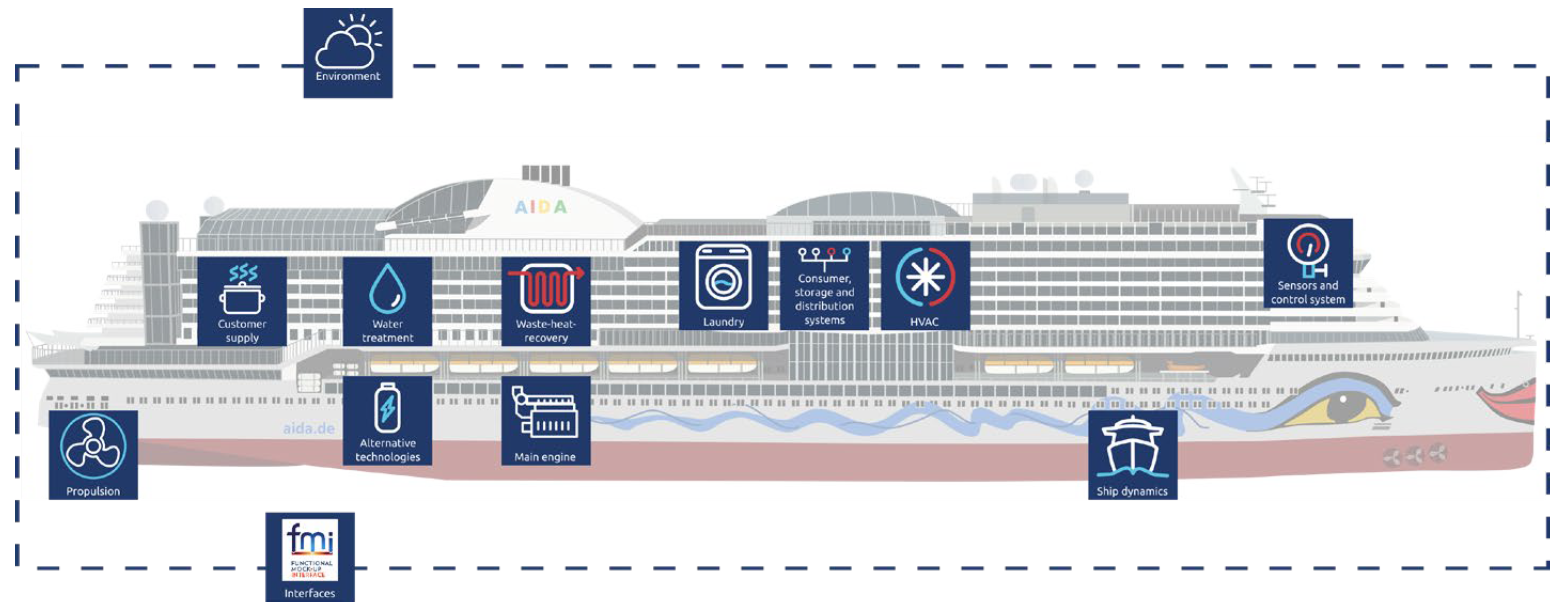
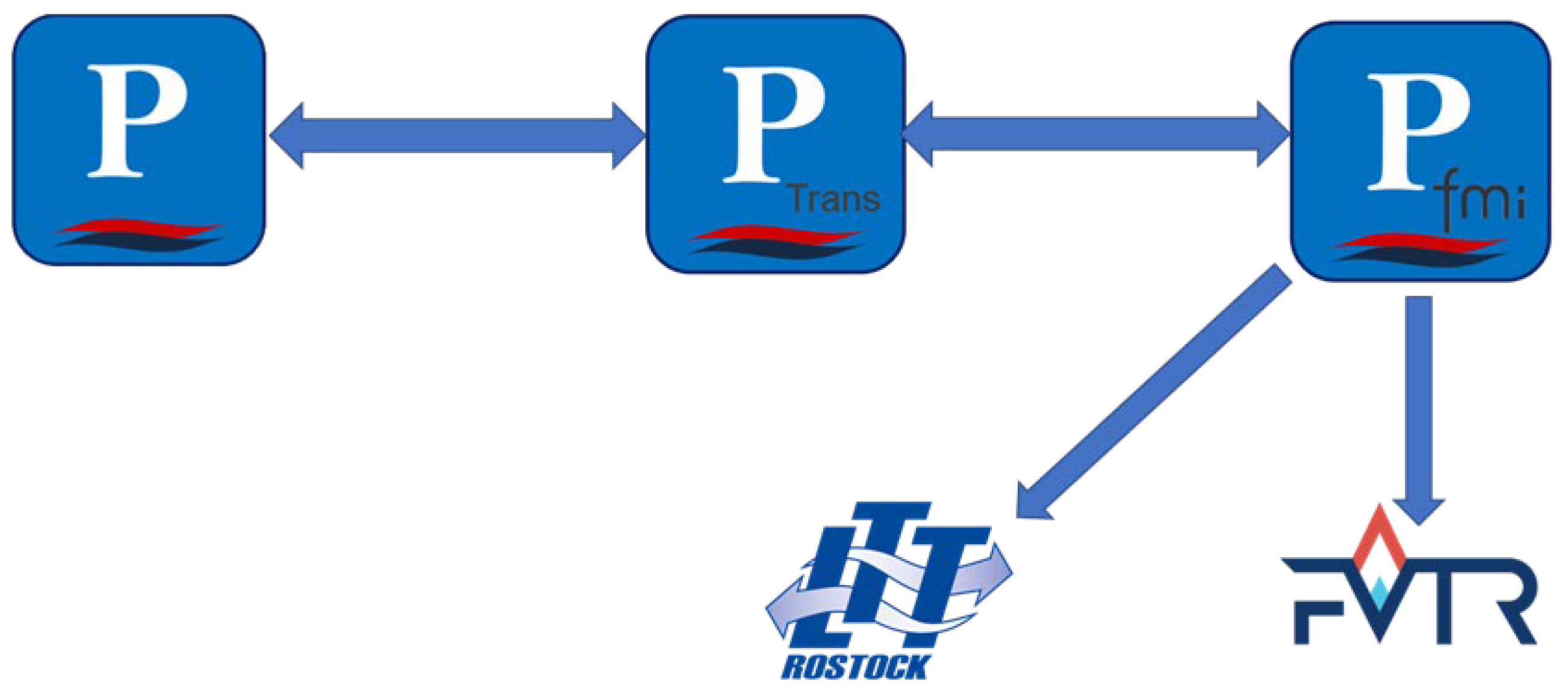
- To establish an FMI-based framework for coupling hydrodynamic ship models with thermodynamic and engine models provided by the project partners FVTR and the University of Rostock—Chair of Technical Thermodynamic (LTT).
- To analyze and validate the coupled simulation results using real-ship measurement data and representative operational scenarios, including cruise-ship maneuvers in restricted and fjord environments.
- To demonstrate the potential of simulation-based energy optimization for maritime operations through simulator studies and workshops involving nautical experts and ship operators.
3.3. Conceptual Framework
- The Nautical Layer, representing ship motion dynamics, control surfaces, and environmental influences;
- The Technical Layer, describing engine, propulsion, and auxiliary systems through thermodynamic process models;
- The Data and Interface Layer, facilitating communication between both domains using FMU/FMI standards for model exchange and co-simulation.
3.4. Use-Case Definition
3.5. Expected Impact
- A validated digital twin of maneuvering and machinery behavior for complex passenger ships;
- Quantifiable reductions in energy demand and emissions during maneuvering;
- Improved training tools that raise crew awareness of energy efficiency and a foundation for semi-autonomous energy management in forthcoming vessel generations.
4. Methodology
4.1. Simulation Environment and Tools
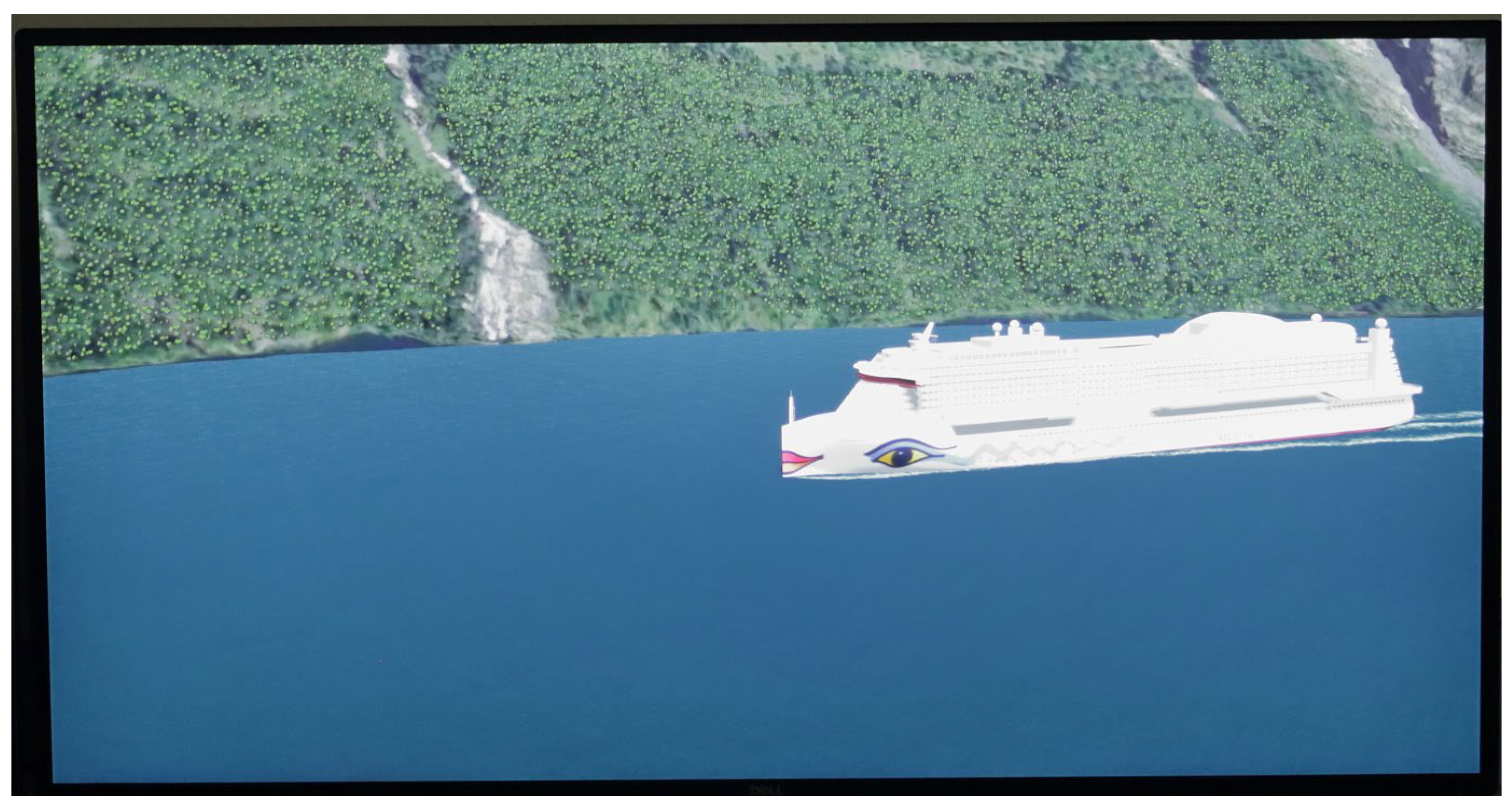
- Full-Mission Ship-Handling Simulator (SHS)—a DNV-certified system reproducing realistic bridge configurations and the hydrodynamic behavior of various ship types. It allows the execution of complex maneuvering scenarios under environmental influences for both research and training purposes.
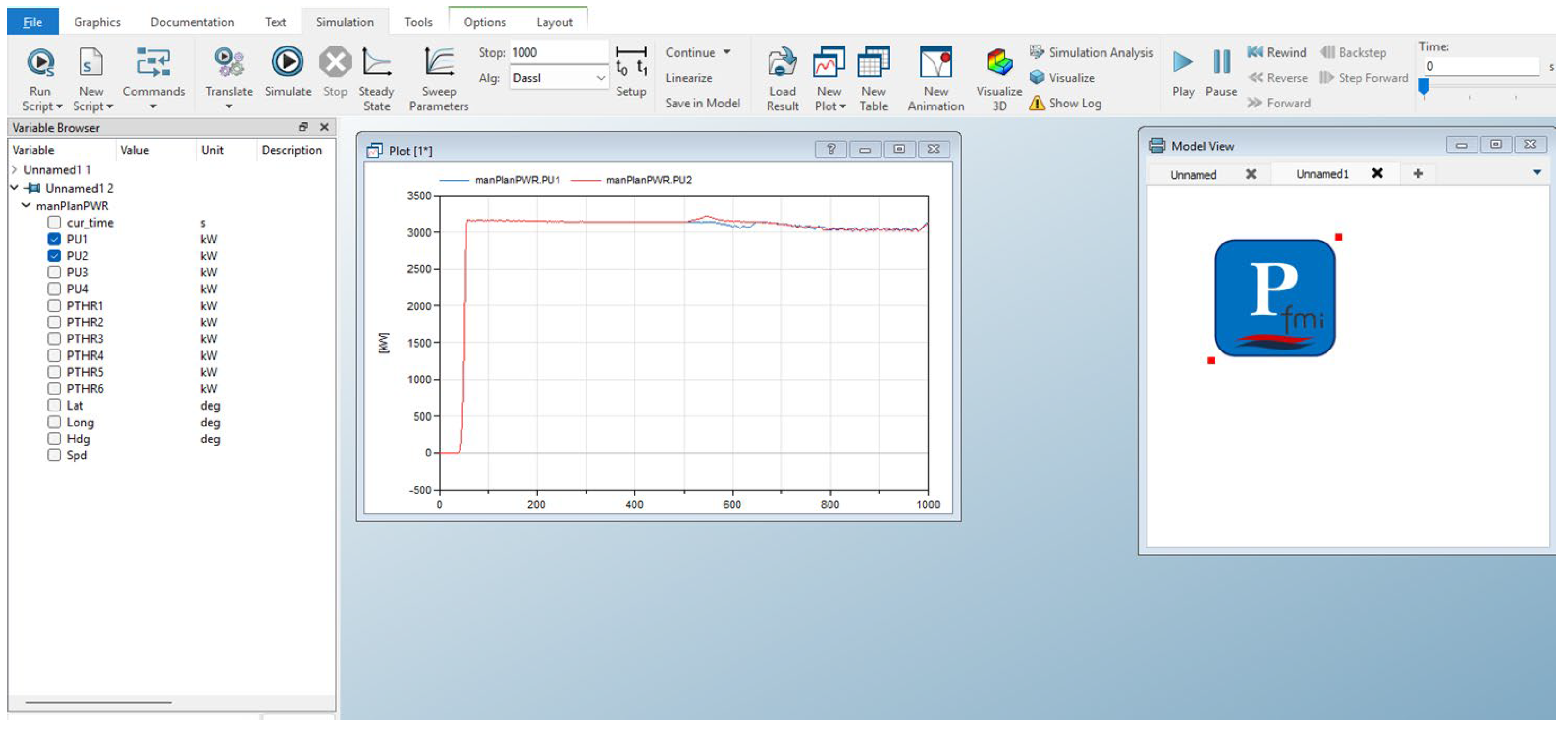
- Engine and Power-System Simulation Environment—developed and provided in collaboration with FVTR GmbH and the University of Rostock (LTT), comprising thermodynamic and hybrid-energy models implemented in a Modelica-based framework. These models enable simulation of energy conversion and charge processes and were coupled with the hydrodynamic ship models through FMI/FMU interfaces.
4.2. Data Sources and Measurement Integration
4.2.1. Shipboard Data Acquisition
- 1.
- Model validation, by comparing simulated and measured responses for equivalent maneuvers;
- 2.
- Scenario definition, providing realistic boundary conditions (wind, current, water depth) for simulator tests.
4.2.2. Data Harmonization
4.3. Ship Dynamics Modeling
4.4. Engine and Thermodynamic Modeling
4.5. Coupled Co-Simulation Procedure
4.6. Experimental Setup and Validation Strategy
4.6.1. Simulator Trials
4.6.2. Quantitative Evaluation
4.7. User-Interface and Decision-Support Components
5. Results
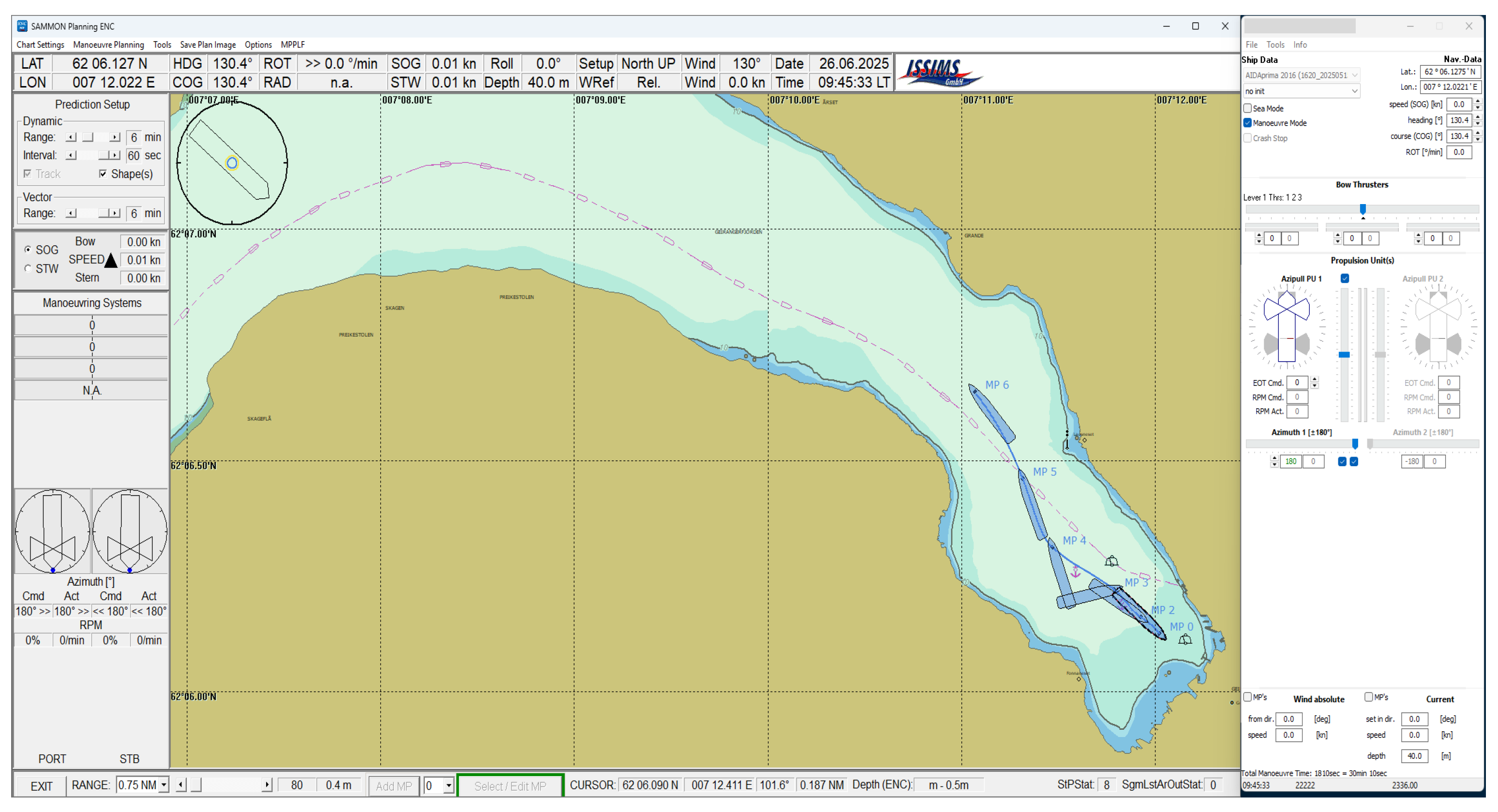
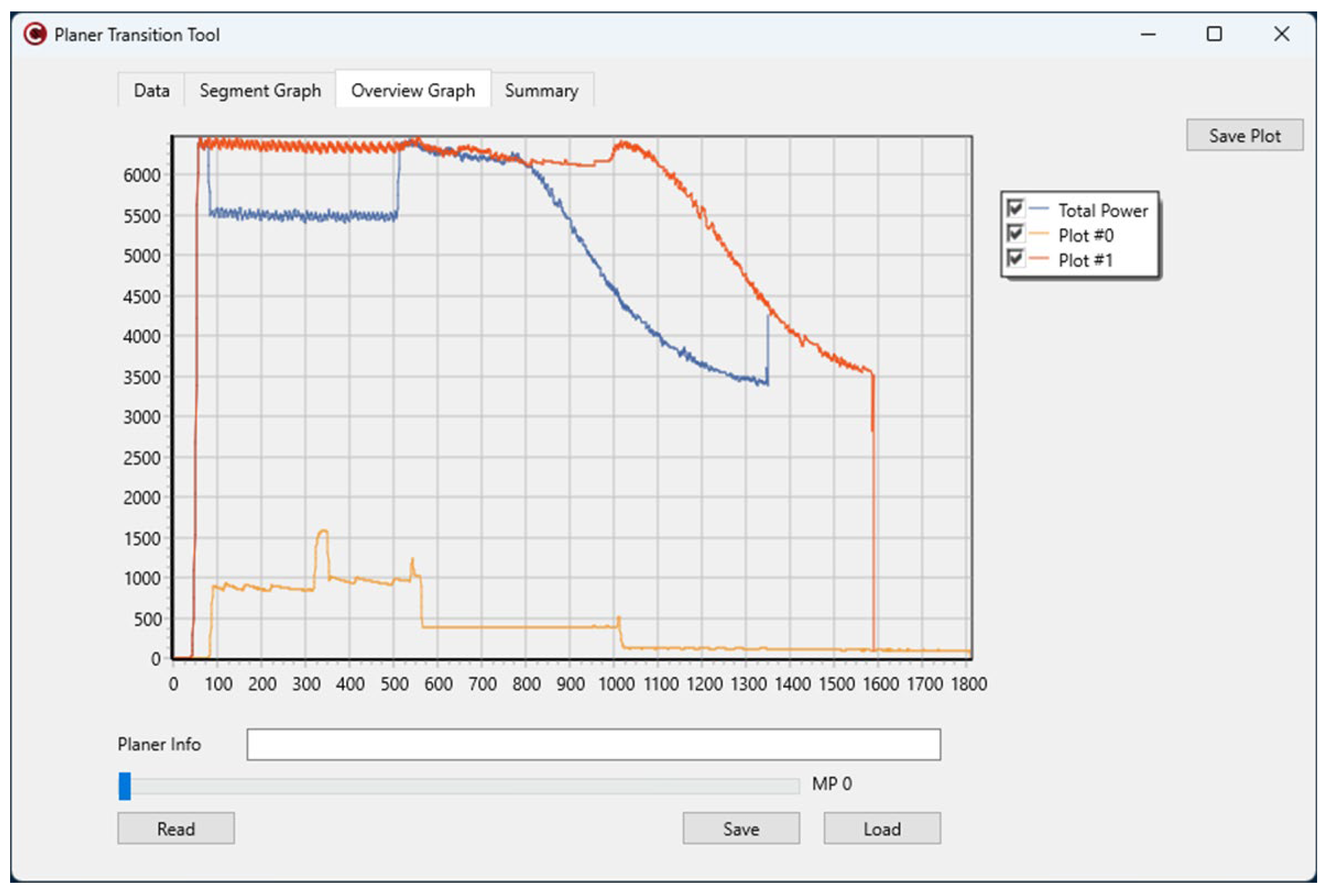
5.1. Energy-Oriented Maneuver Planning in Confined Waters
5.2. Engine and Emission Model Validation
5.3. Practical Findings from Simulator Studies
5.3.1. Human Performance and Behavioral Effects
5.3.2. Integration of Hybrid Power Systems
5.3.3. Workshop Demonstrations and Industry Feedback
6. Discussion
6.1. Comparison with Related Research and Publications
6.2. Implications for Digital Twin Development
- Standardized model interfaces: Data exchange between the hydrodynamic and thermodynamic domains was achieved through FMI-based FMU coupling, ensuring consistent communication between independently developed simulation environments.
- Synchronized data processing: Although the simulations were executed sequentially rather than in real time, the harmonized datasets allowed time-aligned evaluation of maneuvering and energy processes within a shared framework.
- Model calibration and validation: Using measured data from the reference vessel enabled the parameter adjustment and verification of simulation models, improving their representativeness of real-world ship behavior.
6.3. Human-Centered Automation and Training
6.4. Contribution to Decarbonisation Strategies
6.5. Methodological Limitations and Future Challenges
- Sensor Data Availability: Continuous on-board measurement of fuel consumption and emissions is still limited, meaning that model calibration currently depends mainly on engine testbed and logged IMAC data.
- Model Generalization: The simulation models were tuned for specific reference vessels. Developing generic ship-type models will require larger and more diverse datasets from different ship classes.
- Human Factors: The behavioral observations were based on sessions with more than thirty participating nautical officers and engineers. While this represents a solid empirical basis, an extended evaluation across multiple training institutions would be valuable to further quantifying acceptance and learning effects.
7. Conclusions and Outlook
7.1. Summary of Achievements
- 1.
- Development of a modular co-simulation framework linking ship-handling/maneuver planning and engine-system models via FMI/FMU interfaces. This enables consistent analysis of maneuvering dynamics and energy processes across both domains.
- 2.
- Validation of hybrid physical and data-driven models for fuel consumption and emission estimation using testbed and IMAC measurement data, achieving sufficient accuracy for scenario-based energetic evaluation.
- 3.
- Demonstration of human-centered optimization methods, showing that prediction- and planning-supported maneuvering can noticeably reduce energy demand and improve situational awareness during complex operations.
7.2. Outlook for Research and Application
- On-board decision support: The modular architecture could be deployed on real vessels to provide energy-advice and predictive feedback during operations.
- Integration with hybrid and alternative-fuel systems: The flexible FMU-based framework allows replacement of engine or energy-storage modules (e.g., methanol, battery, or fuel cell) to study future propulsion scenarios.
- Assisted automation: Coupling predictive simulation with control algorithms may enable semi-autonomous maneuvering functions that optimize both safety and energy use while keeping the officer in the loop.
- Education and training: Incorporating the prediction and energy-feedback tools into simulator courses promotes energy awareness and supports the training of environmentally responsible bridge officers.
Author Contributions
Funding
Data Availability Statement
Acknowledgments
Conflicts of Interest
References
- IMO. International Convention for the Prevention of Pollution from Ships (MARPOL); IMO: London, UK, 2019; Available online: https://www.imo.org/en/About/Conventions/Pages/International-Convention-for-the-Prevention-of-Pollution-from-Ships-(MARPOL).aspx (accessed on 4 November 2024).
- IMO. MEPC(82). Report of Fuel Oil Consumption Data Submitted to the IMO Ship Fuel Oil Consumption Database in GISIS (Reporting Year 2023). 2024. Available online: https://wwwcdn.imo.org/localresources/en/OurWork/Environment/Documents/Reporting%20year%202023.pdf (accessed on 13 November 2024).
- DNV. Maritime Forecast to 2050. 2021. Available online: https://www.dnv.com/maritime/maritime-forecast/ (accessed on 26 July 2025).
- Resolution MEPC.281(70)—Amendments to the 2014 Guidelines on the Method of Calculation of the Attained Energy Efficiency Design Index (EEDI) for New Ships (Resolution MEPC.245(66), as Amended by Resolution MEPC.263(68))-(Adopted on 28 October 2016). 2016. Available online: https://imorules.com/MEPCRES_281.70.html (accessed on 24 August 2025).
- IMO. Adoption of the Initial IMO Strategy on Reduction of GHG Emissions from Ships and Existing IMO Activity Related to Reducing GHG Emissions in the Shipping Sector; IMO: London, UK, 2018. [Google Scholar]
- Bilgili, L.; Ölçer, A.I. IMO 2023 strategy-Where are we and what’s next? Mar. Policy 2024, 160, 105953. [Google Scholar] [CrossRef] [Scilit]
- Chircop, A. The IMO initial strategy for the reduction of GHGs from international shipping: A commentary. Int. J. Mar. Coast. Law 2019, 34, 482–512. [Google Scholar] [CrossRef] [Scilit]
- European Parliament; Council of the European Union. Directive (EU) 2018/2001 of the European Parliament and of the Council of 11 December 2018 on the Promotion of the Use of Energy from Renewable Sources. Official Journal of the European Union. 2018. Available online: https://eur-lex.europa.eu/legal-content/EN/TXT/PDF/?uri=CELEX:32018L2001 (accessed on 18 January 2026).
- Tadros, M.; Ventura, M.; Soares, C.G. Review of the IMO Initiatives for Ship Energy Efficiency and Their Implications. J. Mar. Sci. Appl. 2023, 22, 662–680. [Google Scholar] [CrossRef] [Scilit]
- Viktorelius, M.; Varvne, H.; von Knorring, H. An overview of sociotechnical research on maritime energy efficiency. WMU J. Marit. Aff. 2022, 21, 387–399. [Google Scholar] [CrossRef] [Scilit]
- Sardar, A.; Islam, R.; Anantharaman, M.; Garaniya, V. Advancements and obstacles in improving the energy efficiency of maritime vessels: A systematic review. Mar. Pollut. Bull. 2025, 214, 117688. [Google Scholar] [CrossRef] [Scilit]
- Balcombe, P.; Brierley, J.; Lewis, C.; Skatvedt, L.; Speirs, J.; Hawkes, A.; Staffell, I. How to decarbonise international shipping: Options for fuels, technologies and policies. Energy Convers. Manag. 2019, 182, 72–88. [Google Scholar] [CrossRef] [Scilit]
- Sontakke, I.; Bergström, M.; Gosala, V.; Baldauf, M.; Ehlers, S. Techno-economic analysis of decarbonization pathways for a deep-sea container vessel. Ship Technol. Res. 2025, 73, 41–58. [Google Scholar] [CrossRef] [Scilit]
- Liu, S.; Papanikolaou, A.; Shang, B. Regulating the safe navigation of energy-efficient ships: A critical review of the finalized IMO guidelines for assessing the minimum propulsion power of ships in adverse conditions. Ocean Eng. 2022, 249, 111011. [Google Scholar] [CrossRef] [Scilit]
- Beşikçi, E.B.; Kececi, T.; Arslan, O.; Turan, O. An application of fuzzy-AHP to ship operational energy efficiency measures. Ocean. Eng. 2016, 121, 392–402. [Google Scholar] [CrossRef] [Scilit]
- Coraddu, A.; Oneto, L.; Baldi, F.; Anguita, D. Vessels fuel consumption forecast and trim optimisation: A data analytics perspective. Ocean Eng. 2017, 130, 351–370. [Google Scholar] [CrossRef] [Scilit]
- Bellingmo, P.R.; Pobitzer, A.; Jørgensen, U.; Berge, S.P. Energy efficient and safe ship routing using machine learning techniques on operational and weather data. In Proceedings of the 20th International Conference on Computer Applications and Information Technology in the Maritime Industries (COMPIT), Mülheim, Germany, 8–9 August 2021. [Google Scholar]
- Baldauf, M.; Mehdi, S.R.A.; Schaub, M.; Benedict, K.; Milbradt, G.; Finger, G.; Fischer, S. Simulation-Based Support to Minimize Emissions and Improve Energy Efficiency of Ship Operations. In Trends and Challenges in Maritime Energy Management; WMU Studies in Maritime Affairs; Ölçer, A., Kitada, M., Dalaklis, D., Ballini, F., Eds.; Springer: Cham, Switzerland, 2018; Volume 6. [Google Scholar] [CrossRef] [Scilit]
- Banks, C.; Turan, O.; Incecik, A.; Lazakis, I.; Lu, R. Seafarers’ current awareness, knowledge, motivation and ideas towards low carbon–energy efficient operations. J. Shipp. Ocean. Eng. 2014, 4, 11–20. [Google Scholar]
- Finger, G.; Schubert, A.U.; Riebe, T.; Fischer, S.; Gluch, M.; Baldauf, M. Consumption and Emission Minimised Ship Manoeuvring. In Global Oceans 2020—Singapore/U.S. Gulf Coast; IEEE: New York, NY, USA, 2020; pp. 1–9. [Google Scholar] [CrossRef] [Scilit]
- Yang, Z.; Qu, W.; Zhuo, J. Optimization of energy consumption in ship propulsion control under severe sea conditions. J. Mar. Sci. Eng. 2024, 12, 1461. [Google Scholar] [CrossRef] [Scilit]
- Schaub, M.; Finger, G.; Krüger, C.; Tuschling, G.; Baldauf, M.; Benedict, K. Quantifying Fuel Consumption and Emission in Ship Handling Simulation for Sustainable and Safe Ship Operation in Harbour Areas. In Proceedings of the IAMU 2019 Conference, Tokyo, Japan, 30 October–1 November 2019; pp. 1–10. [Google Scholar]
- Hsin, C.Y.; Lin, B.H.; Lin, C.C. The optimum design of a propeller energy-saving device by computational fluid dynamics. Comput. Fluid Dyn. 2008, 1, 655–660. [Google Scholar]
- Tadros, M.; Vettor, R.; Ventura, M.; Soares, C.G. Effect of propeller cup on the reduction of fuel consumption in realistic weather conditions. J. Mar. Sci. Eng. 2022, 10, 1039. [Google Scholar] [CrossRef] [Scilit]
- Perera, L.P.; Mo, B. Emission control based energy efficiency measures in ship operations. Appl. Ocean Res. 2016, 60, 29–46. [Google Scholar] [CrossRef] [Scilit]
- Chou, C.C.; Hsu, H.P.; Wang, C.N.; Yang, T.L. Analysis of energy efficiencies of in-port ferries and island passenger-ships and improvement policies to reduce CO2 emissions. Mar. Pollut. Bull. 2021, 172, 112826. [Google Scholar] [CrossRef] [Scilit] [PubMed]
- Yin, C.; Rosenvinge, C.K.; Sandland, M.P.; Ehlers, A.; Shin, K.W. Improve ship propeller efficiency via optimum design of propeller boss cap fins. Energies 2023, 16, 1247. [Google Scholar] [CrossRef] [Scilit]
- Benedict, K.; Kirchhoff, M.; Gluch, M.; Fischer, S.; Baldauf, M. Manoeuvring Simulation on the Bridge for Predicting Motion of Real Ships and as Training Tool in Ship Handling Simulators. TransNav—Int. J. Mar. Navig. Saf. Sea Transp. 2009, 3, 25–30. [Google Scholar]
- Baldauf, M.; Gluch, M.; Finger, G.; Schaub, M.; Riebe, T.; Fischer, S.; Milbradt, G. Modellierung von Emissionen und Brennstoffverbrauch beim Manövrieren von Schiffen: Abschlussbericht zum Verbundprojekt—Einzelvorhaben der Hochschule Wismar, Bereich Seefahrt, Anlagentechnik und Logistik: Numerische Modellierung des Motorprozesses für Simulatoren und Fast-Time Simulation; Hochschule Wismar: Wismar, Germany, 2020. [Google Scholar] [CrossRef]
- Barreiro, J.; Zaragoza, S.; Diaz-Casas, V. Review of ship energy efficiency. Ocean. Eng. 2022, 257, 111594. [Google Scholar] [CrossRef] [Scilit]
- Kondratenko, A.; Zhang, M.; Tavakoli, S.; Altarriba, E.; Hirdaris, S. Existing technologies and scientific advancements to decarbonize shipping by retrofitting. Renew. Sustain. Energy Rev. 2025, 212, 115430. [Google Scholar] [CrossRef] [Scilit]
- Nuchturee, C.; Li, T.; Xia, H. Energy efficiency of integrated electric propulsion for ships—A review. Renew. Sustain. Energy Rev. 2020, 134, 110145. [Google Scholar] [CrossRef] [Scilit]
- Zoubir, M.; Gruner, M.; Franke, T. We go fast—It’s their fuel: Understanding energy efficiency operations on ships and marine vessels. Energy Res. Soc. Sci. 2023, 97, 102992. [Google Scholar] [CrossRef] [Scilit]
- Jimenez, V.J.; Kim, H.; Munim, Z.H. A Review of Ship Energy Efficiency Research and Directions Towards Emission Reduction in the Maritime Industry. J. Clean. Prod. 2022, 366, 132888. [Google Scholar] [CrossRef] [Scilit]
- Royal Academy of Engineering. Future Ship Powering Options, Exploring Alternative Methods of Ship Propulsion; Royal Academy of Engineering: London, UK, 2013. [Google Scholar]
- Pariotis, E.G.; Zannis, T.C.; Yfantis, E.A.; Roumeliotis, I.; Katsanis, J.S. Energy Saving Techniques in Ships—Technical and Operational Measures. In Proceedings of the International Conference Green Transportation, Athens, Greece, 4 June 2016. [Google Scholar]
- Nuevo-Gallardo, C.; Landa del Barrio, I.; Flores Iglesias, M.; Echeverría Trueba, J.B.; Bandera, C.F. Real-Time Digital Twins for Building Energy Optimization Through Blind Control: Functional Mock-Up Units, Docker Container-Based Simulation, and Surrogate Models. Appl. Sci. 2025, 15, 12888. [Google Scholar] [CrossRef] [Scilit]
- Baldauf, M.; Besikci, E.B.; Shi, X. Simulating Growing Complexity in Maritime Traffic. Trans. Marit. Sci. 2025, 14. [Google Scholar] [CrossRef] [Scilit]
- Herdzik, J. Decarbonization of marine fuels—The future of shipping. Energies 2021, 14, 4311. [Google Scholar] [CrossRef] [Scilit]
- Lagouvardou, S.; Psaraftis, H.N.; Zis, T. A Literature Survey on market-based measures for the decarbonization of shipping. Sustainability 2020, 12, 3953. [Google Scholar] [CrossRef] [Scilit]
- Issa, M.; Ibrahim, H.; Ilinca, A.; Hayyani, M. A Review and Economic Analysis of Different Emission Reduction Techniques for Marine Diesel Engines. Open J. Mar. Sci. 2019, 9, 148–171. [Google Scholar] [CrossRef]
- Zoubir, M.; Gruner, M.; Heidinger, J.; Schwarz, B.; Jetter, H.-C.; Franke, T. Bridging the Gap on the Bridge: Seafarers’ Tasks and Decision-Making with DSS in Energy-Efficient Route Planning. J. Cogn. Eng. Decis. Mak. 2025, 19, 335–363. [Google Scholar] [CrossRef] [Scilit]
- Tran, T.A. Investigate the energy efficiency operation model for bulk carriers based on Simulink/Matlab. J. Ocean Eng. Sci. 2019, 4, 211–226. [Google Scholar] [CrossRef] [Scilit]
- Ma, W.; Ma, D.; Ma, Y.; Zhang, J.; Wang, D. Green maritime: A routing and speed multi-objective optimization strategy. J. Clean. Prod. 2021, 305, 127179. [Google Scholar] [CrossRef] [Scilit]
- Bouman, E.A.; Lindstad, E.; Rialland, A.I.; Strømman, A.H. State-of-the-Art Analysis and Modelling of CO2 Reduction Measures for Shipping. Transp. Res. D Transp. Environ. 2017, 52, 408–421. [Google Scholar] [CrossRef] [Scilit]
- Bortuzzo, V.; Bertagna, S.; Braidotti, L.; Bucci, V. An innovative tool for the evaluation of energy efficiency of merchant ships. Brodogradnja 2025, 76, 76304. [Google Scholar] [CrossRef] [Scilit]
- IMO. MEPC.328(76). Amendments to the Annex of the Protocol of 1997 to Amend the International Convention for the Prevention of Pollution from Ships, 1973, as Modified by the Protocol of 1978 Relating Thereto (2021 Revised MARPOL Annex VI); IMO: London, UK, 2021. [Google Scholar]
- International Maritime Organization (IMO) (1973/1978). International Convention for the Prevention of Pollution from Ships, 1973, as Modified by the Protocol of 1978 Relating Thereto (MARPOL 73/78); IMO: London, UK, 1978. [Google Scholar]
- Tran, T.A.; Easwaramoorthy, S.V. Energy-efficiency Management Framework of a Ship based on Data Classification Technique. In Proceedings of the 2024 IEEE International Conference on Data Mining Workshops (ICDMW), Abu Dhabi, United Arab Emirates, 9 December 2024; IEEE: New York, NY, USA, 2025. [Google Scholar] [CrossRef] [Scilit]
- Vasilikis, N.I.; Geertsma, R.D.; Visser, K. Operational data-driven energy performance assessment of ships: The case study of a naval vessel with hybrid propulsion. J. Mar. Eng. Technol. 2022, 22, 84–100. [Google Scholar] [CrossRef] [Scilit]
- Łebkowski, A.; Wnorowski, J. A Comparative Analysis of Energy Consumption by Conventional and Anchor Based Dynamic Positioning of Ship. Energies 2021, 14, 524. [Google Scholar] [CrossRef] [Scilit]
- Finger, G.; Hassel, E.; Dahms, F.; Schaub, M.; Riebe, T.; Milbradt, G.; Wehner, K. On-Board Support System for the Eco-Friendly Ship Operation in Coastal and Port Areas. In OCEANS 2019; IEEE: New York, NY, USA, 2019; pp. 1–8. [Google Scholar]
- Schaub, M.; Dahms, F.; Finger, G.; Hassel, E.; Riebe, T.; Baldauf, M. Data-Based Modelling of Ship Emissions and Fuel Oil Consumption for Transient Engine Operation. In OCEANS 2019; IEEE: New York, NY, USA, 2019; pp. 1–9. [Google Scholar] [CrossRef] [Scilit]
- Dewan, M.H.; Yaakob, O.; Suzana, A. Barriers for adoption of energy efficiency operational measures in shipping industry. WMU J. Marit. Aff. 2018, 17, 169–193. [Google Scholar] [CrossRef] [Scilit]
- Benedict, K.; Baldauf, M.; Gluch, M.; Fischer, S.; Finger, G.; Milbradt, G. Manoeuvring Prediction Technologies in Ship Handling for Training and Use On-Board—Overview & New Developments. In Proceedings of the 10th International Conference on Maritime Transport (MT’24), Barcelona, Spain, 5–7 June 2024. [Google Scholar] [CrossRef] [Scilit]
- Damerius, R.; Schubert, A.U.; Rethfeldt, C.; Finger, G.; Fischer, S.; Milbradt, G.; Kurowski, M.; Gluch, M.; Jeinsch, T. Consumption-Reduced Manual and Automatic Manoeuvring with Conventional Vessels. J. Mar. Eng. Technol. 2022, 22, 55–66. [Google Scholar] [CrossRef] [Scilit]
- Wang, K.; Wang, Y.; Liang, H.; Jing, Z.; Cong, L.; Ma, R.; Huang, L. Ship energy efficiency optimization considering the influences of multiple complex navigational environments: A review. Mar. Pollut. Bull. 2025, 216, 117976. [Google Scholar] [CrossRef] [Scilit]
- Artyszuk, J.; Zalewski, P. Energy Savings by Optimization of Thrusters Allocation during Complex Ship Manoeuvres. Energies 2021, 14, 4959. [Google Scholar] [CrossRef] [Scilit]
- Schubert, A.U.; Damerius, R.; Finger, G.; Fischer, S.; Milbradt, G.; Kurowski, M.; Gluch, M.; Jeinsch, T. Consumption-Optimised Manoeuvring Method for Ship Automation. In Proceedings of the iSCSS 2020, Delft, The Netherlands, 6–8 October 2020; pp. 1–10. [Google Scholar] [CrossRef] [Scilit]
- Schaub, M.; Hassel, E.; Finger, G.; Jeinsch, T.; Dahms, F.; Kirchhoff, M. Data-Based Prediction of Particle Emissions During Manoeuvring of Ships. In 2019 International Interdisciplinary PhD Workshop (IIPhDW); IEEE: New York, NY, USA, 2019. [Google Scholar] [CrossRef] [Scilit]
- Baldauf, M.; Baumler, R.; Ölçer, A.; Nakazawa, T.; Benedict, K.; Fischer, S.; Schaub, M. Energy-efficient Ship Operation—Training Requirements and Challenges. TransNav Int. J. Mar. Navig. Saf. Sea Transp. 2013, 7, 283–290. [Google Scholar] [CrossRef] [Scilit]
- Barone, G.; Buonomano, A.; Del Papa, G.; Forzano, C.; Giuzio, G.; Maka, R.; Palombo, A.; Russo, G.; Zizzania, S. Improving Ship Energy Efficiency Through Advanced HVAC Simulation Techniques. In Technology and Science for the Ships of the Future; (Progress in Marine Science and Technology, Volume 10); IOS Press: Mumbai, India, 2025. [Google Scholar] [CrossRef] [Scilit]
- Mejia, M.Q., Jr. Education, training, and capacity-development for the implementation of global maritime standards. Multidiscip. Adapt. Clim. Insights 2024, 1, 27–29. [Google Scholar] [CrossRef] [Scilit]
- Dewan, M.H.; Godina, R. Effective Training of Seafarers on Energy Efficient Operations of Ships in the Maritime Industry. Procedia Comput. Sci. 2023, 217, 1688–1698. [Google Scholar] [CrossRef] [Scilit]
- Hanif Dewan, M.; Ahmed Mustafi, M.A.; Matos, F.; Godina, R. Exploring seafarers’ knowledge, understanding, and proficiency in SEEMP: A strategic training framework for enhancing seafarers’ competence in energy-efficient ship operations. Heliyon 2024, 10, e36505. [Google Scholar] [CrossRef] [Scilit]


Disclaimer/Publisher’s Note: The statements, opinions and data contained in all publications are solely those of the individual author(s) and contributor(s) and not of MDPI and/or the editor(s). MDPI and/or the editor(s) disclaim responsibility for any injury to people or property resulting from any ideas, methods, instructions or products referred to in the content. |
© 2026 by the authors. Licensee MDPI, Basel, Switzerland. This article is an open access article distributed under the terms and conditions of the Creative Commons Attribution (CC BY) license.
Share and Cite
Finger, G.; Gluch, M.; Baldauf, M.; Milbradt, G.; Fischer, S.; Kirchhoff, M. Simulation-Based Energy Optimization Through Maneuvering Prediction for Complex Passenger Ships: Results from the SimPleShip-SigMa Project. J. Mar. Sci. Eng. 2026, 14, 387. https://doi.org/10.3390/jmse14040387
Finger G, Gluch M, Baldauf M, Milbradt G, Fischer S, Kirchhoff M. Simulation-Based Energy Optimization Through Maneuvering Prediction for Complex Passenger Ships: Results from the SimPleShip-SigMa Project. Journal of Marine Science and Engineering. 2026; 14(4):387. https://doi.org/10.3390/jmse14040387
Chicago/Turabian StyleFinger, Georg, Michael Gluch, Michael Baldauf, Gerd Milbradt, Sandro Fischer, and Matthias Kirchhoff. 2026. "Simulation-Based Energy Optimization Through Maneuvering Prediction for Complex Passenger Ships: Results from the SimPleShip-SigMa Project" Journal of Marine Science and Engineering 14, no. 4: 387. https://doi.org/10.3390/jmse14040387
APA StyleFinger, G., Gluch, M., Baldauf, M., Milbradt, G., Fischer, S., & Kirchhoff, M. (2026). Simulation-Based Energy Optimization Through Maneuvering Prediction for Complex Passenger Ships: Results from the SimPleShip-SigMa Project. Journal of Marine Science and Engineering, 14(4), 387. https://doi.org/10.3390/jmse14040387