Article

Two-Dimensional Growth Patterns of Coral Nubbins

by
David Benyamin
1,*,
Amalia Murgueitio
1,2 and
Baruch Rinkevich
1,*
1
Israel Oceanographic and Limnological Research (IOLR), National Institute of Oceanography, Tel-Shikmona, Haifa 3109701, Israel
2
Department of Marine Biology, Leon H. Charney School of Marine Sciences, University of Haifa, Haifa 3498838, Israel
*
Authors to whom correspondence should be addressed.
J. Mar. Sci. Eng. 2026, 14(4), 345; https://doi.org/10.3390/jmse14040345
Submission received: 10 December 2025 / Revised: 8 February 2026 / Accepted: 9 February 2026 / Published: 11 February 2026
(This article belongs to the Section Marine Biology)

Abstract

Coral body plans are constructed through repeated modular units, with polyps serving as the fundamental structural and functional units, yet the rules underlying tissue and polyp pattern formation remain poorly understood. This study investigated lateral, two-dimensional (2D) tissue and polyp expansion in the coral Stylophora pistillata under controlled laboratory conditions. Using the nubbin assay, we investigated the effects of colony, fragment origin (branch tips versus sub-apical fragments), and nubbin density on this 2D expansion assay. Nubbins from ten colonies (SC1–SC10) were grown on glass slides, and tissue expansion was quantified from digital images over six months. For three fast-growing colonies (SC1, SC2, and SC5), single-, double-, and triple-nubbin configurations were used to evaluate proximity effects. Across all colonies, lateral tissue area strongly correlated with polyp number (R2 = 0.68), indicating a close relationship between surface expansion and polyp proliferation. Pronounced colony differences emerged: SC9 and SC1 exhibited the largest tissue areas, while SC5 developed compact, polyp-dense morphologies. Fragment origin did not influence 2D growth, suggesting the absence of apical dominance. Nubbin density influenced growth in a colony-specific manner; SC1 exhibited strong inhibition under crowded conditions, whereas SC2 and SC5 were largely unaffected. Collectively, these results suggest that intrinsic genetic factors and local spatial interactions, rather than a fragment’s position along a branch, are the primary drivers of 2D growth, highlighting the self-organizing nature of coral tissues and illustrating how controlled 2D systems can clarify the interplay between genetic regulation and local interactions in coral morphogenesis.

1. Introduction

Pattern formation in animals refers to the developmental processes that generate organized spatial structures, such as stripes, spots, segmentation, and repeated body elements. These patterns emerge from coordinated molecular, genetic, and physical interactions that guide initially similar cells toward distinct fates arranged in defined spatial arrangements [1,2,3,4]. Pattern formation explains how cells acquire positional information and differentiate, transforming initially uniform tissues into complex structures. It is therefore central to understanding developmental biology, evolution of morphology, and self-organization in living systems [5,6,7].
Modular organisms provide a unique perspective for studying pattern formation because their bodies are built from repeated, semi-autonomous units, or modules, rather than a fixed, unitary body plan. Modularity is widespread across the tree of life. In plants, architecture emerges from the repeated production of phytomers, modules composed of a leaf, node, internode, and axillary meristem, so that whole-plant form reflects the birth, maturation, and eventual loss of these units over time [8,9]. Early-branching metazoans such as sponges likewise grow through reiterating modular elements and dynamic tissue rearrangements during development and asexual reproduction [10,11]. Among cnidarians, studies of hydroids and other colonial forms illustrate how branching, regeneration, and axis specification emerge from repeated units governed by self-organizing developmental rules [12,13,14,15]. Within anthozoans, octocorals also exhibit strong modularity, where polyp iteration and branching rules give rise to predictable colony architectures [16,17,18,19].
Stony corals (class Anthozoa, order Scleractinia) are modular organisms composed of different repeated modules whose interactions, both genetic and environmental, shape colony morphology and spatial patterning [20,21,22,23,24,25]. Recent studies suggest that simple, locally applied clonal growth rules generate much of the morphological diversity in scleractinian colonies, underscoring how complex colony forms arise from iterative module-level dynamics [26,27]. The development of the modular body plan (astogeny) in corals and other colonial organisms is governed by a combination of fixed and flexible morphometric rules, giving rise to species-specific colonial landscapes [21,22,28]. In branching coral forms, this pattern formation operates across three structural levels: the individual polyps (first tier), the branches (second tier), and daughter colonies or ramets (third tier) [20,22]. One of the model systems for studying colonial pattern formation in corals is Stylophora pistillata (Esper, 1797), a member of the Pocilloporidae family.
Stylophora pistillata, commonly known as the smooth cauliflower coral, is a widespread Indo-Pacific branching species frequently used as a model organism in coral biology [29]. Studies on pattern formation in S. pistillata have shown that settled planula-larvae initiate colony development by forming the founder spat, followed by the budding of a first crown of six polyps around the primary polyp [28,29], marking the first astogenic step. Branches subsequently grow apically, with new upward or lateral branches emerging through dichotomous fission [21,29]. While neighboring branches never fuse, growth directions may shift among closely positioned (isogeneic and allogeneic) branches, exhibiting retreat growth and directional inhibition [30]. Further studies [22,23,31] have demonstrated intraspecific variability and gene phenotypic plasticity in S. pistillata astogeny governed by fixed and plastic architectural rules. The growth patterns exhibit canalization towards either lateral growth or branch axis elongation, altogether elucidating that colony astogeny in S. pistillata is a tightly regulated process expressed through an intrinsic morphogenetic blueprint event, without apical dominance. Importantly, this developmental process is not associated with energy trade-off principles or environmental conditions [31].
Exploiting the two-dimensional (2D) growth patterns of S. pistillata coral tissues and skeletons, which develop from small fragments attached to flat surfaces (the nubbin assay [32]), enables the production of large numbers of genetically identical fragments from a single genet. This approach has facilitated a wide range of applications, including the establishment of coral broodstocks [32], ecotoxicological applications [33], regeneration assays [34], physiological applications (such as cold stress [35], water chemistry [36], starvation [37], and heat stress [38]), and investigations on coral astogeny [28]. The nubbin assay is a low-cost, space-efficient, and well-suited method for controlled experimental studies. Building on this methodological framework, we extend previous studies on S. pistillata 2D lateral growth by (i) comparing lateral tissue growth parameters among coral colonies, (ii) assessing whether nubbins generated from branch tips vs. sub-apical fragments differ in lateral tissue development and polyp proliferation, and (iii) investigating how the proximity of neighboring nubbins influences growth patterns.

2. Materials and Methods

2.1. Collection, Maintenance, and Nubbins Preparation

Ten Stylophora pistillata colonies (SC1-SC10), each approximately 10 cm in diameter, were collected (permit no. 2024/43515) from shallow artificial reef structures (5–12 m depth) in front of the Interuniversity Institute for Marine Sciences (IUI) Eilat, Red Sea (29.5° N, 34.9° E). The colonies were removed from their substrates using a hammer and chisel while SCUBA diving, placed individually in a mesh bag to minimize physical damage during underwater transport, and held in seawater tables at IUI within the collecting bags for one day before being transported to the Israel Oceanographic and Limnological Research Institute (IOLR, Haifa, Israel). During the approximately 8 h transfer, colonies were wrapped in wet, non-bleached paper towels and packed in Styrofoam boxes partially filled with seawater, which was regularly refreshed (2 L every 1–2 h) to maintain optimal conditions.
Upon arrival at IOLR, colonies were removed from the mesh bags, cleaned of resident macrofauna (e.g., Trapezia crabs), underwent DipX (manufactured by Red Sea Europe, Verneuil d’Avre et d’Iton, France) and iodine treatments to reduce external parasites, and placed in running seawater tables under controlled lighting and temperature conditions with no feeding. The water tables were supplied with Mediterranean seawater from the shoreline of Israel and maintained at approximately 25 °C using a heat exchanger unit. The lighting setup consisted of Metal Halide Vialox lamps (400 W, Osram, Munich, Germany), operated on a 12:12 h light–dark cycle.
Nubbins (each ~0.5 cm in height) were removed from colonies using an electric diamond saw (DB 100 Inland Craft, Westmont, IL, USA) and attached to glass slides (5 by 7.5 cm) using cyanoacrylate glue by Loctite Super Glue-3. To improve adhesion, the slides were pre-scratched at the attachment sites using a diamond pen. Once the glue dried, slides with attached nubbins were placed in seawater tanks (supplied by the same Mediterranean seawater as the water tables) under a 12:12 h light–dark cycle, illuminated by RGBW LED lights (Zetlight Lancia 2, Hong Kong, China, all light channels were set to 100%). Slides were cleaned weekly with razor blades and a fine watercolor brush to remove turf and debris. Coral tissue extension was monitored periodically, every 10–14 days, using a Nikon SMZ1000 stereomicroscope (Tokyo, Japan) equipped with a DeltaPix Invenio 3 s II camera (Smørum, Denmark) and an Achro X0.5 lens (Nikon, Tokyo, Japan).

2.2. Experimental Setup and Maintenance

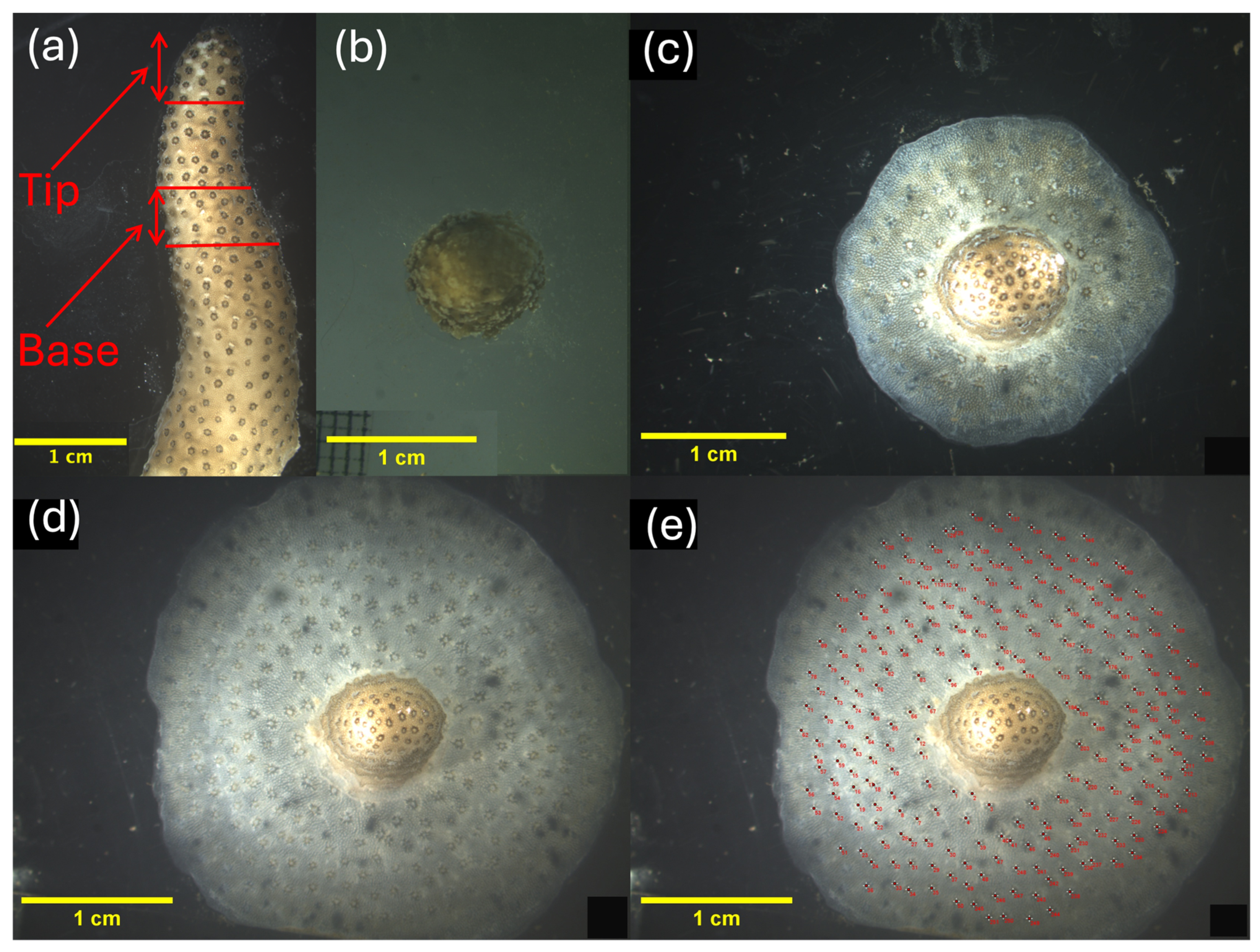
Two sets of experiments were conducted. In the first set, four tip nubbins (Figure 1) from each of the ten collected S. pistillata colonies (totaling 40 nubbins) were attached to slides to evaluate colony-specific growth rates. All slides (4) from each colony were placed vertically in a single plastic histology slide holder (rack), and all 10 racks were placed in the same 16 L tank. In the second set, nubbins from three colonies (SC1, SC2, and SC5) were collected and attached to glass slides (Figure 1) in three nubbin layouts: (a) a single nubbin positioned at the center (control), (b) two nubbins placed with spacing between them, and (c) three nubbins arranged in an equilateral triangular formation (Figure S1). The distance between nubbins in the multi-nubbin configurations was approximately 1.5 cm between nubbin centers. Each nubbin layout included both tip and sub-apical (hereby termed as ‘base’) fragments (Figure 1), resulting in six slide arrangements, with five replicates per colony, totaling 30 slides per colony. All 5 replicate slides from each configuration were placed in a single rack.
Once a week, all slides were removed from racks and thoroughly cleaned as previously described. Aquariums were emptied and thoroughly cleaned by scrubbing with freshwater, a cleaning pad, and a razor blade. Racks were cleaned as well. After cleaning, all racks were grouped by colony and returned to a different location in the aquarium setup. The position of each rack within each experimental aquarium was random, following common gardening practices.

2.3. Digitization

Images were processed and analyzed using Fiji software (Version 2.9.0) [39], an open-source image analysis package based on ImageJ (Version 1.54p). For each coral nubbin, two areas were manually outlined using the Polygon Selection Tool: the entire nubbin, including lateral tissue, and the nubbin alone, excluding lateral tissue. The lateral tissue area was calculated by subtracting the nubbin area from the total, and the nubbin perimeter (excluding lateral tissue) was recorded. Polyp numbers were quantified by marking each polyp with the Point Tool (Figure 1), followed by automated counting using Fiji’s Analyze Particles function.

2.4. Statistical Analyses

Assumptions for the relevant statistical tests were evaluated. Normality was tested using the Shapiro–Wilk test and homoscedasticity was assessed with Levene’s test. When assumptions were not met, appropriate data transformations were explored; if these did not resolve violations, non-parametric alternatives were applied.
Linear regression was used to assess whether initial nubbin perimeter predicted lateral tissue area or polyp number, and to evaluate the relationship between area and polyp number across colonies, with and without adjusting for initial perimeter. Variation in quantitative traits (e.g., lateral tissue area, polyp number, polyp density) among colonies was tested using one-way ANOVA followed by Tukey’s HSD post hoc comparisons when assumptions of normality and homoscedasticity were met. If assumptions were violated, data were log-transformed and re-tested using ANOVA and Tukey HSD; if still unmet, a Kruskal–Wallis test followed by Dunn’s multiple comparison test was applied.
Tip vs. base comparisons were conducted using Welch’s two-sample t-tests when both sides had at least two replicates and met the assumptions; otherwise, Wilcoxon rank-sum tests were applied, with median differences reported. Multiple testing was addressed using the Benjamini–Hochberg method.
Coral growth traits, polyp density, and lateral tissue area were each normalized by initial nubbin perimeter, and modeled as functions of time, colony, and fragment type (tip vs. base) using linear mixed-effects models. Because exploratory analyses indicated nonlinear temporal trajectories, we compared linear, quadratic, and spline formulations for the time component. For polyp density, spline models provided the strongest support, yielding the highest marginal R2 (0.751) and the lowest Root Mean Square Error (RMSE; 0.641), and effectively receiving all information-theoretic support (Akaike Information Criterion; AIC weight = 1.000; quadratic = 1.68 × 10⁻⁵; linear = 2.72 × 10⁻¹⁴). For lateral tissue area, overall model fits were similar across forms (marginal R2: spline = 0.743, quadratic = 0.741, linear = 0.740; RMSE = 1.666–1.696), but AIC criteria favored the spline and linear models over the quadratic alternative. Therefore, spline mixed-effects models were selected for all subsequent analyses.
To assess whether the presence of multiple nubbins on a slide altered growth performance, additive expectations were generated by scaling measurements from single-nubbin slides by a factor of two or three. Observed values from multi-nubbin slides were compared with these expectations for both lateral tissue area and polyp number. According to assumption checks, comparisons were conducted using two-sample t-tests or Wilcoxon rank-sum tests, with p-values adjusted within colony and outcome using the Benjamini–Hochberg procedure.
To assess how nubbin growth changed through time, mixed-effects models were fitted separately for each colony and comparison (one vs. two nubbins, and when available one vs. three). Lateral tissue area was analyzed on a log scale when this improved model performance or addressed violations of normality or variance assumptions. Three alternative temporal structures were evaluated: linear, quadratic, and natural spline (df = 3). All models included the number-of-nubbins group, time, and their interaction, with scaled initial perimeter as a covariate. Slide identity was included as a random intercept to account for repeated measurements.
Polyp counts were modeled using negative-binomial mixed-effects models (NB2 family). Overdispersion was evaluated using Pearson χ2/df, and all fitted models fell within acceptable ranges. Model performance was judged using a combination of AICc (AIC corrected for small samples), marginal and conditional R2 values, and inspection of residual behaviour and convergence. Models were only retained when diagnostics indicated adequate fit. Divergence in temporal growth trajectories between different nubbin counts was assessed using likelihood ratio tests comparing full models (with time × group interaction) to reduced models without this interaction.
All analyses were conducted in R (v4.5.1) [40] using the tidyverse suite [41] for data handling and cleaning, lme4 [42] and glmmTMB [43] for mixed-effects modelling, emmeans [44] for estimating marginal means and contrasts, and ggplot2 [45] for data visualisation.

3. Results

3.1. Intra-Specific Variability in Stylophora Pistillata

3.1.1. Correlation Between Lateral Tissue and Number of Polyps

Nubbins from the 10 coral colonies (four replicates each) were grown for six months under controlled laboratory conditions. Within the first several weeks, tissues regenerated over exposed skeletons, enabling firm attachment to the glass substrate or surrounding glue. After this phase, nubbins expanded horizontally, forming an encrusting tissue sheet, often creating a flat tissue ring around the nubbin or excess glue. Calcium carbonate deposition began several days later, radiating from the center outward, while a thin (2–3 mm) clear tissue layer remained uncalcified. Polyps appeared several days after tissue encrustation, initially forming silhouettes with six septa and central mouths before full polyp development, including tentacles and axial columella, following calcification (Figure 1).
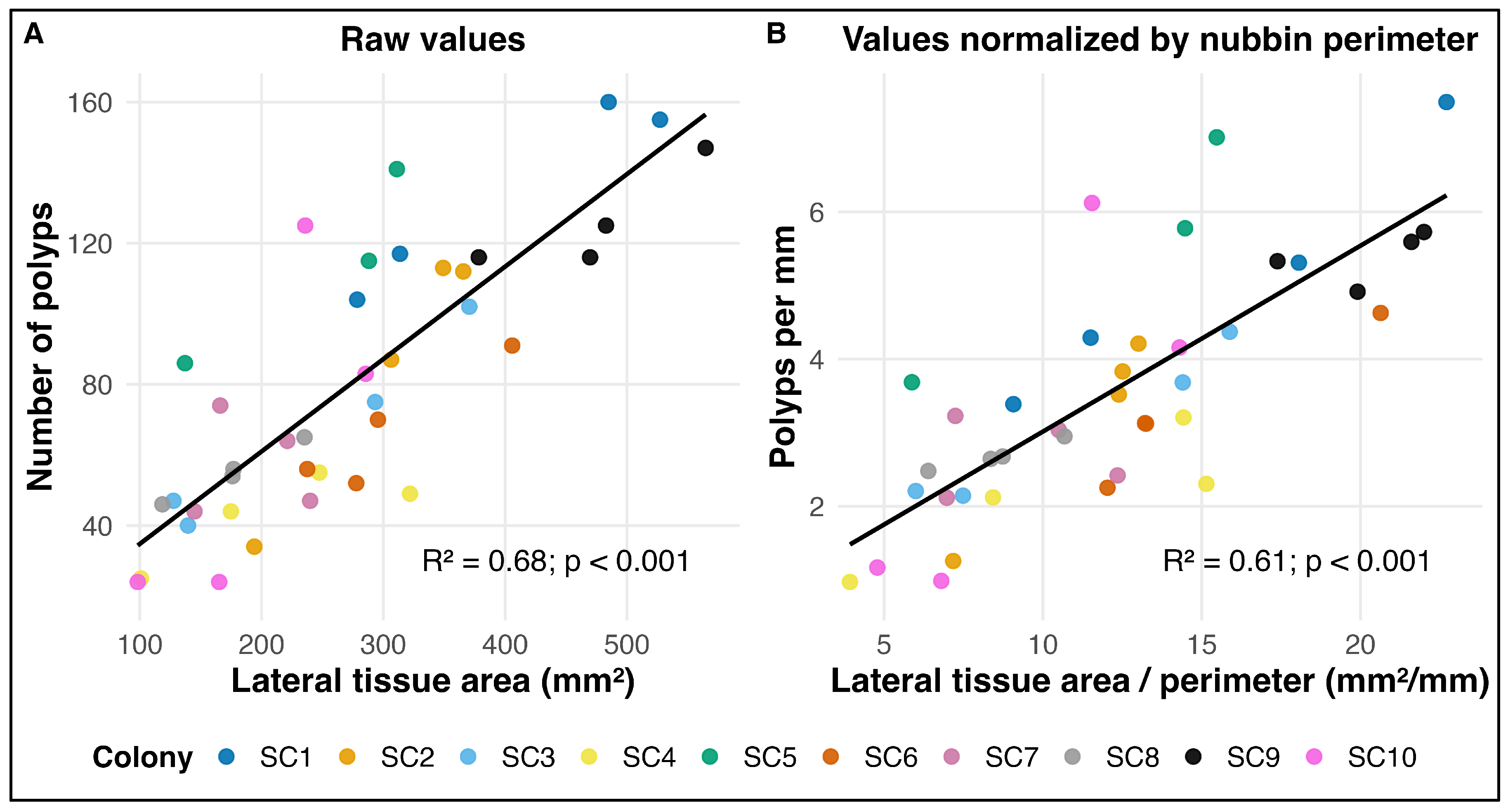
Initial nubbin perimeter was a statistically significant but relatively weak predictor of both lateral tissue area and polyp number (R2 = 0.11 for each; p = 0.042 and p = 0.035, respectively; Figures S2–S5). In contrast, the lateral tissue area showed a stronger association with polyp number after six months (Figure 2). Linear regressions indicated that nubbins with larger lateral tissue areas generally supported more polyps (R2 = 0.68 for raw values; R2 = 0.61 for perimeter-normalized values; both p < 0.05). This pattern was supported by high correlations between lateral tissue area and polyp number, with Pearson’s r = 0.825 (p = 1.06 × 10⁻¹⁰) for raw values and r = 0.784 (p = 3.57 × 10⁻⁹) for perimeter-normalized data. The positive relationship between tissue area and polyp number was consistent across colonies, although SC5 exhibited comparatively higher polyp counts for a given lateral tissue area (2).

3.1.2. Colony-Level Differences in Lateral Tissue Area and Polyp Number

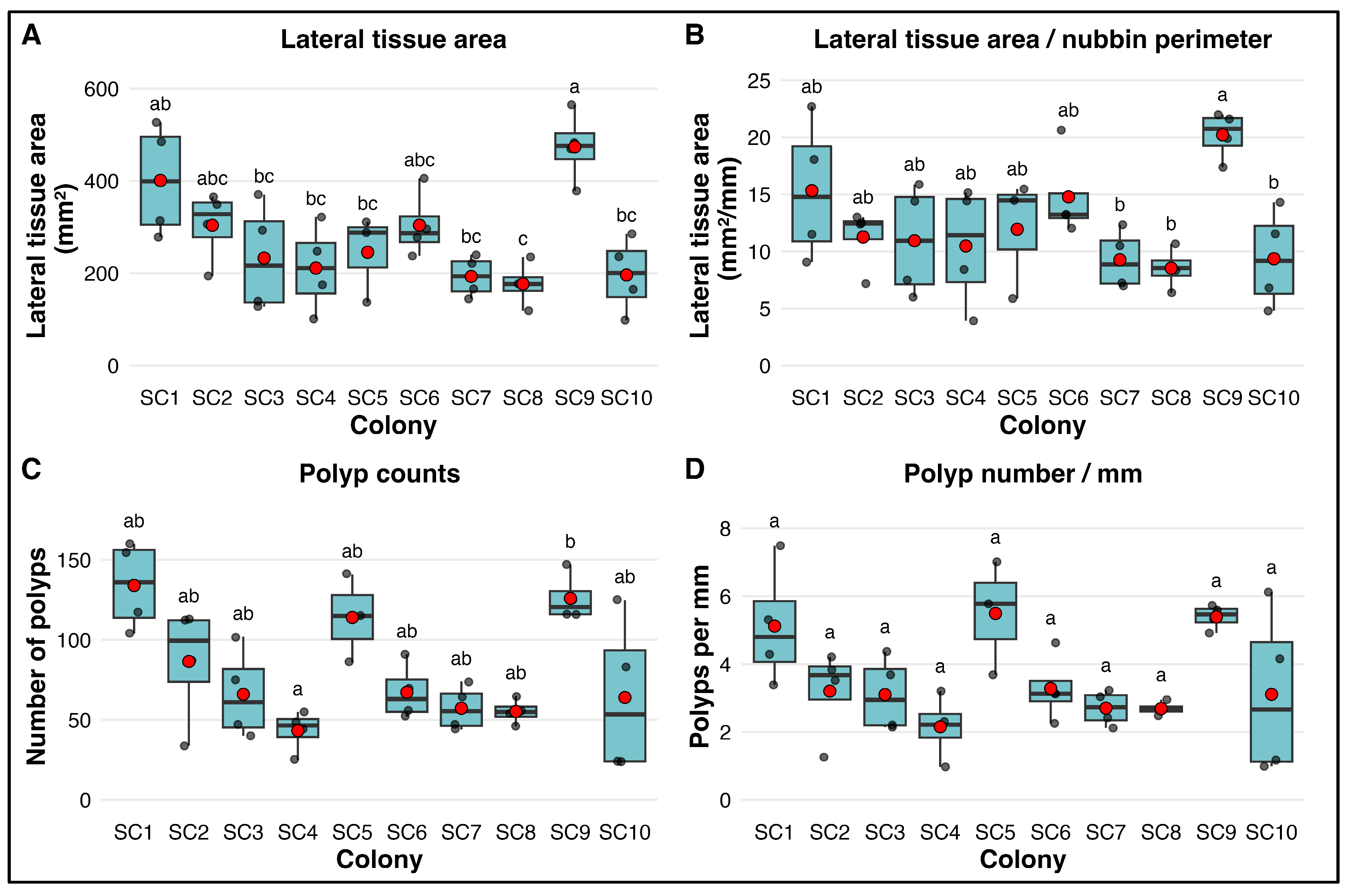
Colony-specific differences in coral growth and morphology for the ten colonies were assessed by comparing total and perimeter-normalized polyp number, as well as lateral tissue area and its perimeter-normalized values. Figure 3 illustrates these traits, allowing for direct comparison of both absolute and size-corrected measures of polyp abundance and tissue expansion. Total polyp counts violated both normality (Shapiro–Wilk p = 0.050) and homogeneity of variance (Levene’s p = 0.047) assumptions, so a Kruskal–Wallis test was applied. Colony significantly influenced total polyp number (χ2(9) = 22.42, p = 0.0076), with Dunn’s post hoc tests (Benjamini–Hochberg adjusted) showing SC9 had more polyps than SC4 (p = 0.0433). Perimeter-normalized polyp counts also varied by colony (χ2(9) = 19.39, p = 0.022), although no pairwise differences remained significant after adjustment.
For lateral tissue area, ANOVA assumptions were met (Shapiro–Wilk W = 0.949, p = 0.078; Levene’s F(9, 29) = 1.24, p = 0.311) and One-way ANOVA revealed significant colony effects (F(9, 29) = 5.54, p < 0.001). Tukey HSD tests showed that SC9 had a significantly larger lateral tissue area than SC10 (p = 0.003), SC3 (p = 0.013), SC4 (p = 0.005), SC5 (p = 0.034), SC7 (p = 0.002), and SC8 (p = 0.001), while SC1 exceeded SC8 (p = 0.014) and SC7 (p = 0.028). For perimeter-normalized lateral tissue area, ANOVA assumptions were also met, and the colony remained significant (F(9, 29) = 3.02, p = 0.0115). Post hoc tests showed that SC9 had a larger normalized tissue area than SC10 (p = 0.025), SC7 (p = 0.023), and SC8 (p = 0.013). Overall, SC9 and SC1 consistently exhibit the largest lateral tissue areas and have the highest total polyp counts. Normalization by perimeter reduces, but does not eliminate, colony differences, highlighting intrinsic differences in growth and tissue expansion across colonies (Figure S3 for perimeter data).
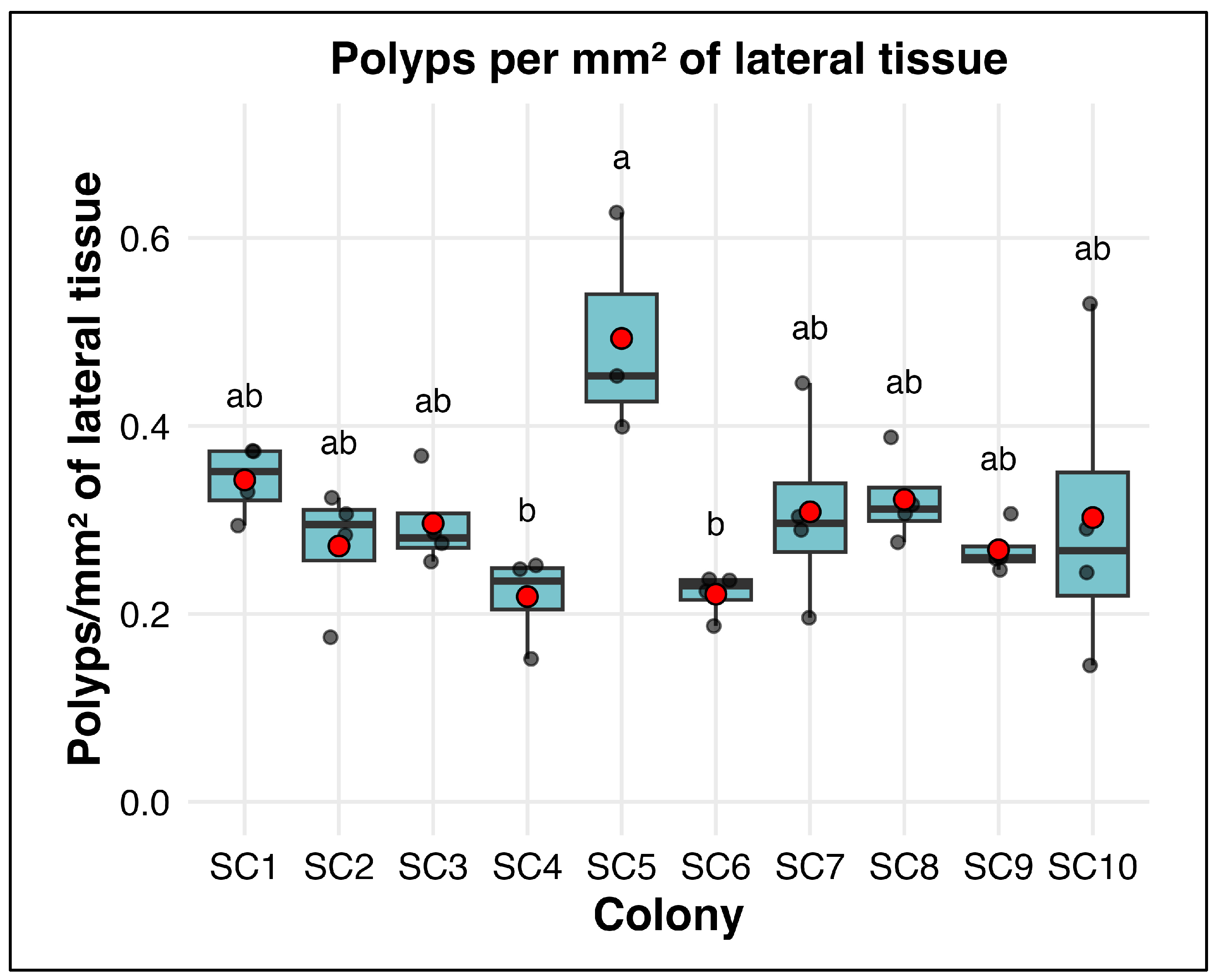
Differences in polyp density (per mm2) among coral colonies were analyzed using a one-way ANOVA on log-transformed data, as the data initially violated the normality assumption, which was successfully corrected after the transformation (Shapiro–Wilk p = 0.005 before and p = 0.725 after (Figure 4). Polyp density varied significantly among coral colonies (F = 2.77, p = 0.018). Post hoc Tukey HSD tests revealed that SC5 had significantly higher polyp density than SC4 (p = 0.0091) and SC6 (p = 0.0128), with no other significant pairwise differences. A more detailed analysis, including linear regressions between nubbin perimeter and selected coral traits are shown in Figure S4.
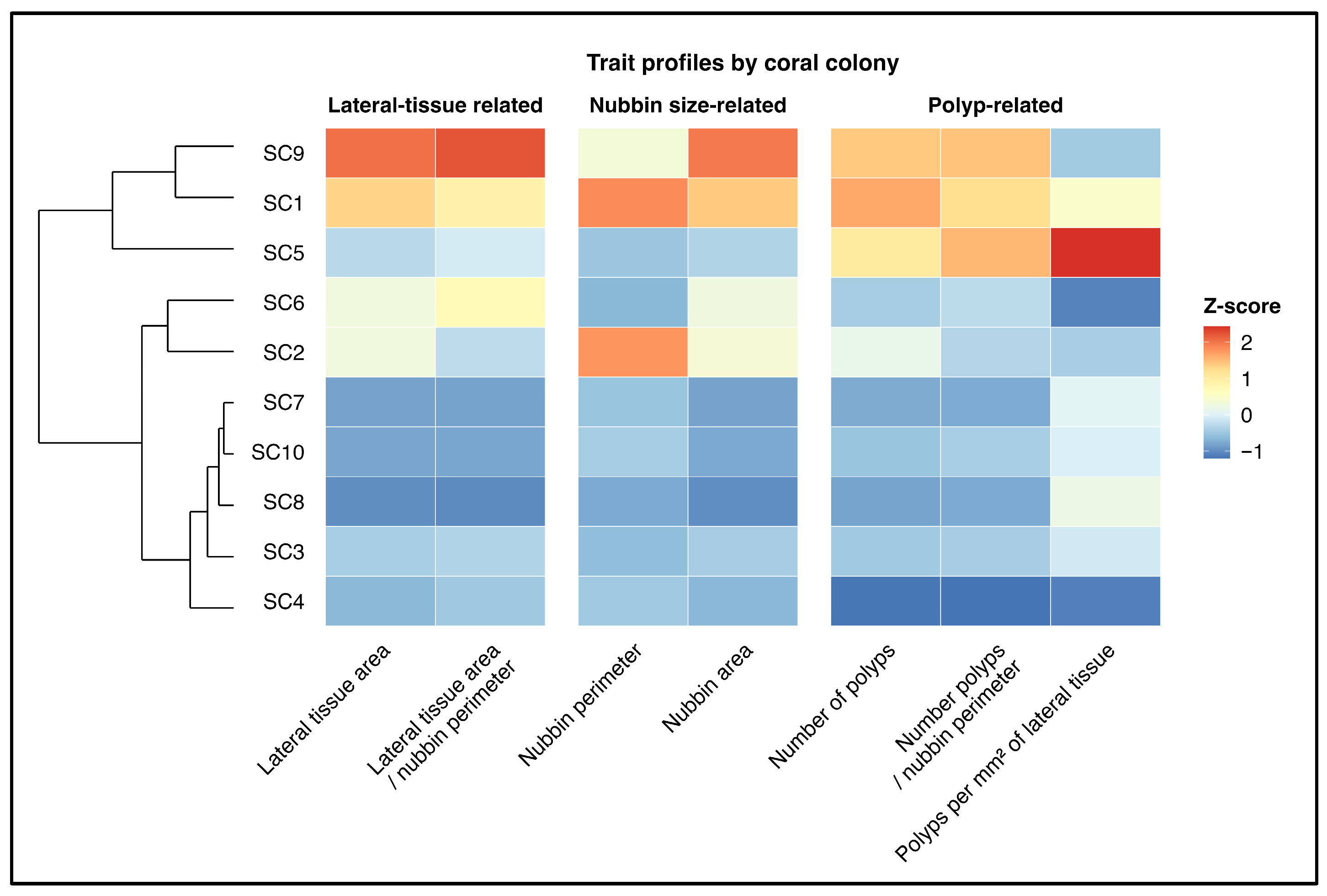
A summary of the 10-colony experiment results is displayed in Figure 5. Among the colonies examined, SC1 and SC2 had the largest initial perimeters, indicating greater starting colony size. The greatest lateral tissue expansion over the six-month period occurred in SC9 and SC1, followed by SC6 and SC2, indicating differences in growth rates among colonies. In terms of polyp number, SC1, SC9, and SC5 exhibited the highest counts, while SC5 showed the highest polyp density (polyps per mm2), reflecting a more compact tissue organization.

3.2. Intra-Colony Growth Comparison

Of the 180 nubbins from the three fast-growing colonies (SC1, SC2, and SC5), 8 died during the experiment (5% mortality rate), and 32 failed to develop lateral tissue on the slides, resulting in an overall procedural success rate of 78% that were digitized and analyzed. For multi-nubbin slides, those with continuous lateral tissue connections among all nubbins were included (Table S1). For each valid slide, we quantified the number of polyps and measured the corresponding tissue area (raw data available in Figures S6–S8).

3.2.1. Tips vs. Bases

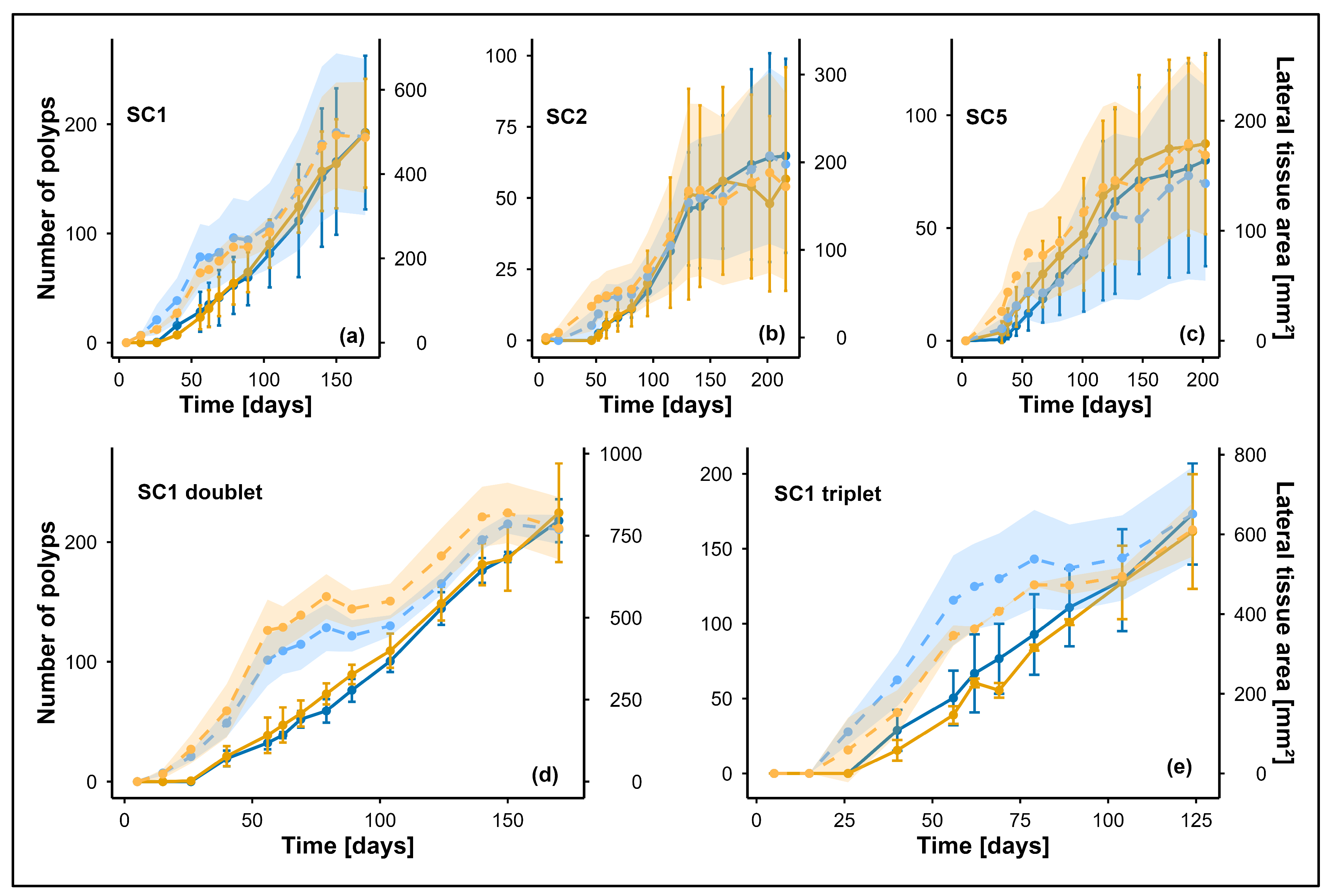
To compare growth between tips and bases, results were averaged by combination type and colony in single- and multi-nubbin slides (Figure 6).
Across all colonies and time points, tips and bases did not differ significantly with respect to either polyp number or lateral tissue area (Table S2). For each colony and nubbin density, pairwise comparisons at the final week (using Welch’s t-test or Wilcoxon rank-sum test, as appropriate) remained non-significant after Benjamini–Hochberg correction (all adjusted p > 0.05). In agreement with these results, linear mixed-effects models incorporating the full time series from single-nubbin slides showed no effect of fragment type (Tip vs. Base) on lateral tissue area per mm (F1,33 = 0.25, p = 0.62) or number of polyps (F1,33 = 0.11, p = 0.74), and no significant fragment × time interactions (p > 0.1 in all cases). Together, these results indicate that tips and bases exhibited statistically indistinguishable growth trajectories across all colonies.

3.2.2. Comparisons Between Colony Growth Rate over Time

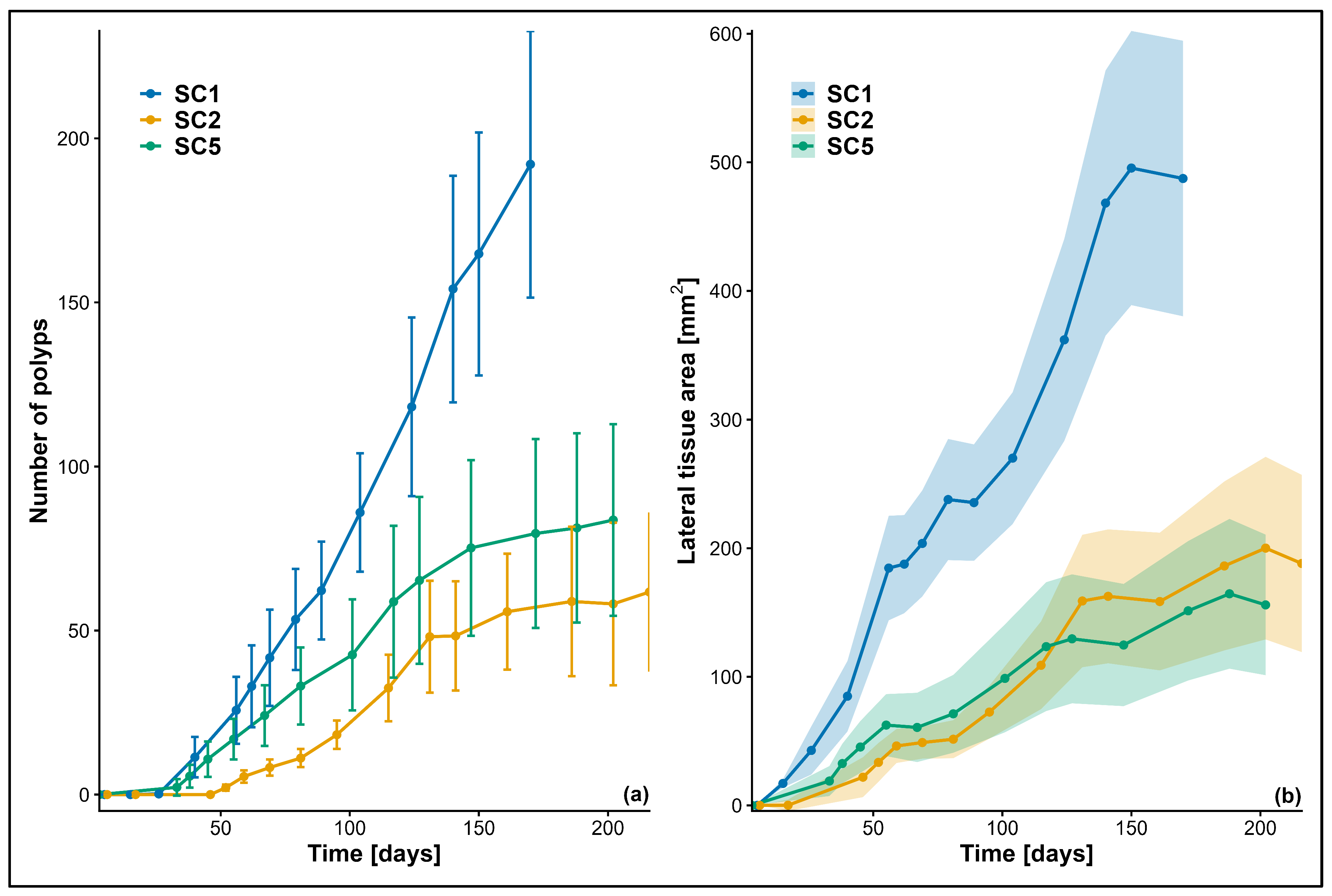
As the results of the previous section indicated that tip and base nubbins exhibited comparable patterns in both polyp number and lateral tissue area, these categories were pooled into a single group for comparisons among the three colonies. Since most multi-nubbin slides of SC2 and SC5 did not survive, only the results from single-nubbin slides are presented (Figure 7).
When temporal trends in colony growth were analyzed using the mixed-effects model for lateral tissue expansion normalized to initial perimeter unit, SC1 showed markedly faster growth than both SC2 and SC5. SC1 nubbins accumulated about 7.4 mm2 more lateral tissue per mm of initial perimeter than SC2 (estimate = 7.42, SE = 1.03, t = 7.24, p < 0.0001) and about 7.3 mm2 more than SC5 (estimate = 7.33, SE = 0.97, t = 7.59, p < 0.0001), while SC2 and SC5 did not differ (estimate = −0.10, SE = 1.00, p = 0.99). The corresponding temporal model for number of polyps (adjusted by initial nubbin perimeter) revealed the same qualitative pattern. SC1 maintained consistently higher polyp counts than both SC2 and SC5, with time-averaged differences of about 2.6 polyps·mm−1 relative to SC2 (estimate = 2.61, SE = 0.37, t = 7.09, p < 0.0001) and 1.8 polyps·mm−1 relative to SC5 (estimate = 1.84, SE = 0.35, t = 5.30, p < 0.0001). While SC2 and SC5 showed no significant differences (estimate = 0.77 polyps·mm−1, SE = 0.36, p = 0.096. These patterns were consistent for both base and tip fragments.

3.2.3. Comparison of Single- and Multi-Nubbin Slides on Lateral Tissue and Polyp Growth

To compare single-nubbin slides with multi-nubbin slides, data from all slides of the same nubbin number and colony were pooled, regardless of whether the nubbin originated from the tip or the base, as tip–base differences were not significant (Figure 6; Section 3.2.1).
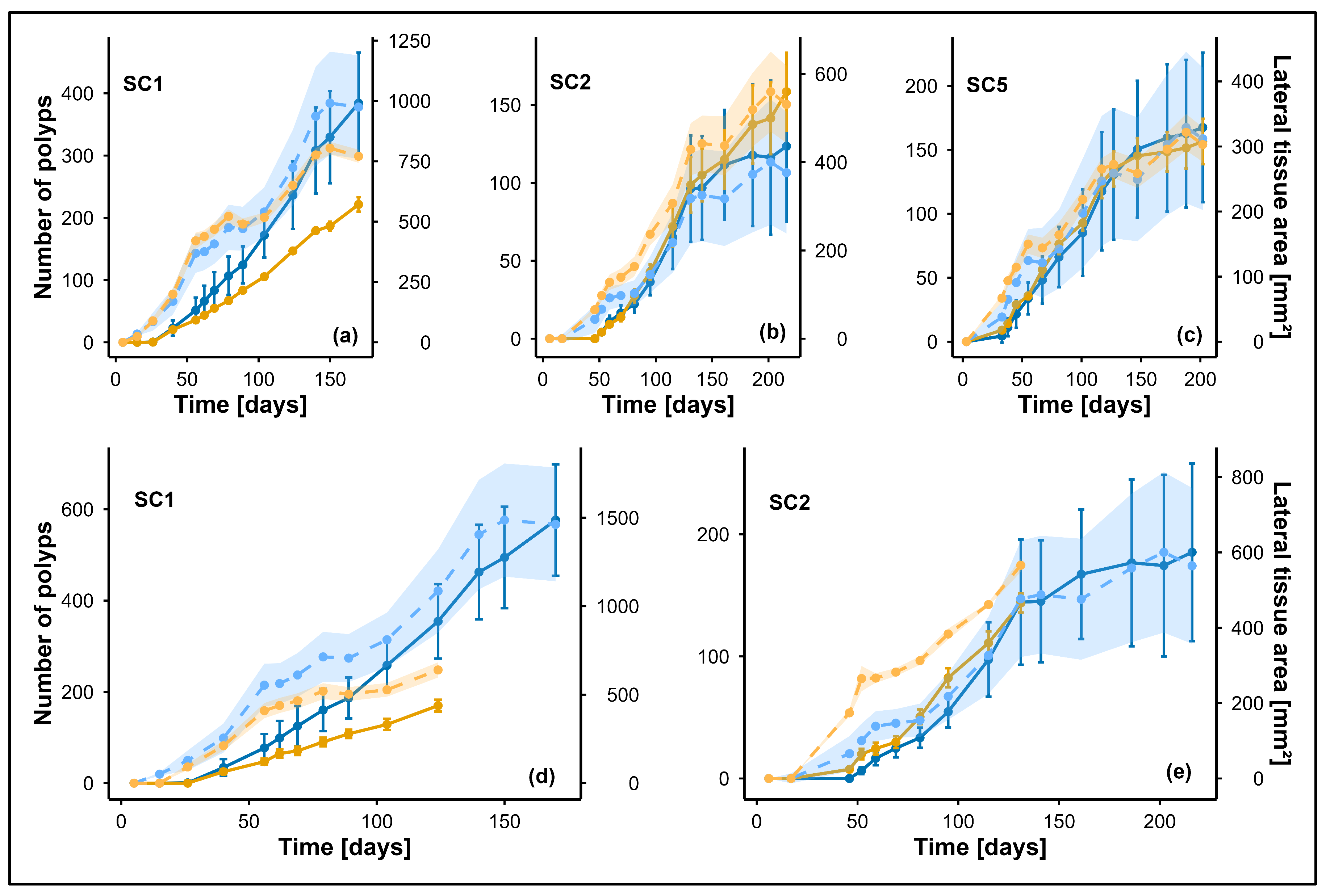
SC1: Slides bearing multiple nubbins showed markedly lower growth than additive expectations (Figure 8) derived from scaling single-nubbin slides. For the comparison between one- and two-nubbin slides, both biological properties studied, lateral tissue area and polyp number, were significantly reduced on multi-nubbin slides. Lateral tissue area was 21% lower (Wilcoxon rank-sum test, p = 0.037), and polyp number was 42% lower (t-test with equal variances, p = 0.0022). For the one- versus three-nubbin comparison, the reductions were larger: lateral area was 56% lower (Wilcoxon, p = 0.0097), and polyp number was 70% lower (t-test, p = 0.00008; Table S3).
Temporal growth models were consistent with these endpoint patterns. Spline models had the highest AICc weights (wAICc = 0.78–0.95), indicating strong support relative to linear and quadratic structures, and yielded the strongest model performance (higher marginal and conditional R2 values; Table S4). Model diagnostics indicated good fit (negative-binomial models: Pearson χ2/df ≈ 1.31–1.35). Likelihood ratio tests comparing full models to reduced models without the interaction demonstrated significant time × group interactions for both lateral area and polyp number (p < 0.05 in all cases), indicating that the non-linear growth trajectories of slides with multiple nubbins diverged early and remained suppressed relative to their scaled counterparts.
SC2: Slides with two or three nubbins grew similarly to their scaled single-nubbin values (Figure 8). At the final time point, differences in lateral tissue area were not significant (two nubbins: Wilcoxon p = 0.21; three nubbins: Wilcoxon p = 1.0), and no differences were detected for polyp number (two nubbins: Wilcoxon p = 0.40; three nubbins: Wilcoxon p = 0.93). Temporal growth trajectory models supported these endpoint patterns. Quadratic and spline models had comparable support (AICc weights < 0.6 for all time structures), indicating smooth but colony-typical growth without a strong preference for a more complex curve. Likelihood ratio tests comparing full models to reduced models without the interaction showed no significant time × group interactions for either lateral area or polyp number (p > 0.05 in all cases). This indicates that growth trajectories for slides with one, two, and three nubbins remained statistically stable through time. Overdispersion was low (Pearson χ2/df ≈ 1.15–1.28), and R2 values were consistent with stable model behaviour. Overall, SC2 exhibited density-neutral growth.
SC5: Only the comparison between one- and two-nubbin slides was possible for SC5 (Figure 8). Final time point measurements showed no significant differences in lateral tissue area (Wilcoxon p = 1.0) or polyp number (Wilcoxon p = 0.88). Two-nubbin slides showed slightly higher median values, but these differences were small and not statistically significant. Temporal trajectory models likewise showed no consistent effect of nubbin number. AICc weights did not favor any particular temporal structure, and the time × group interaction was not reliably supported across outcomes. Model diagnostics indicated mild overdispersion (Pearson χ2/df ≈ 1.39), consistent with the small sample size. Overall, SC5 showed no evidence of density-dependent suppression or enhancement.

4. Discussion

Stylophora pistillata exhibits remarkable developmental plasticity, making it an excellent model for exploring pattern formation principles in modular colonial organisms. This study advances that understanding by analyzing under controlled experimental conditions the emergence of two-dimensional (2D) tissue growth patterns. Our results further show that colony development reflects the interplay between genetically encoded morphogenetic rules and local environmental interactions. Consistent with previous studies describing the hierarchical organization of branching in S. pistillata, we demonstrate that even at the planar level, tissue expansion and organization follow regulated and repeatable patterns. These findings indicate that the mechanisms governing astogeny in the branching coral S. pistillata are not limited to three-dimensional growth [16] and represent intrinsic features of the colony’s developmental program, expressed consistently across spatial settings.
Building on this framework, our experimental design standardized the two-dimensional growth patterns. Using the nubbin assay [32], we fragmented genets into uniformly sized nubbins and mounted them on glass slides under controlled light and water conditions, creating a reproducible platform for evaluating intrinsic growth properties. This setup enabled precise quantification of tissue extension, polyp proliferation, and lateral expansion across colonies and nubbin origins. The use of both apical (tip) and sub-apical (base) fragments allowed us to test whether positional identity within a branch influences subsequent growth potential, while varying nubbin proximity provided insight into the role of local interactions in shaping growth dynamics.
The results reveal substantial intra-specific variation in 2D growth patterns among S. pistillata colonies, highlighting that colony development, even under uniform environmental conditions, is strongly shaped by inherent genetic differences. The robust positive correlation between lateral tissue area and polyp number indicates that tissue expansion and polyp proliferation are tightly linked during astogeny, reflecting a coordinated morphogenetic coupling between surface growth and polyp budding. This coupling, consistent across most colonies, supports the view that polyp formation scales with available tissue and surface area, aligning with previous descriptions of modular growth in branching corals [22,28]. The observed colony variability, such as the pronounced lateral tissue expansion in SC9 and SC1 and the compact polyp dense morphology in SC5, suggests that S. pistillata harbors multiple colony-specific growth strategies, ranging from extensive tissue spreading to tightly packed polyp architectures. These patterns imply genetic regulation of key morphometric traits, contributing to the phenotypic diversity observed among S. pistillata colonies. Comparisons between apical (tip) and sub-apical (base) fragments revealed similar growth patterns, suggesting that a fragment’s position along the branch does not dictate its growth potential in S. pistillata. This aligns with earlier observations [31], which noted that while cut tips do not regenerate from the wound site, intact tips continue developing new branches from both the tip and the base. Collectively, these results reinforce the conclusion that S. pistillata, unlike other scleractinian species [46], lacks true apical dominance and that its morphogenetic capacity is broadly distributed along the branch axis.
Branching corals are often characterized by functional specialization along their branch axis. In Acropora, branch tips are primarily associated with growth and calcification, whereas the bases are more involved in metabolism and defense [47,48]. A similar transcriptional pattern is observed in S. pistillata, where tips predominantly express biomineralization and developmental genes and sections below the tips emphasize metabolic and signaling pathways [49]. In contrast, our results show that lateral expansion proceeded at comparable rates regardless of fragment origin, indicating that lateral tissue proliferation is not strictly determined by axial position. This suggests that the processes shaping three-dimensional branch architecture are at least partially independent of those controlling two-dimensional substrate-oriented growth.
In S. pistillata, lateral tissue expansion appears to be governed by a growth process confined to the advancing tissue edge. Proliferative, stem-like cell populations are concentrated at this margin and are active during both tissue regeneration and lateral spreading [34], consistent with a mechanism triggered upon contact with a new substrate. This lateral growth supports attachment and basal consolidation, providing a stable foundation for subsequent colony growth. Notably, this ability is not universal among scleractinian species. In this context, the similar lateral growth observed in fragments originating from both tips and bases likely reflects the operation of a common edge-growth program, operating independently of the developmental gradients that shape overall branch morphology.
In contrast, multi-nubbin arrangements revealed colony-specific responses to crowding. SC1 exhibited a marked reduction in both tissue area and polyp number when neighboring nubbins were present, whereas SC2 and SC5 maintained consistent growth even under denser arrangements. These divergent responses suggest that local inhibitory interactions, possibly mediated by chemical or mechanical signals, differentially affect growth depending on the gene’s intrinsic regulatory sensitivity. Such colony-dependent crowding effects echo earlier observations of retreat growth and directional inhibition in colonial interactions [30], highlighting that colony self-organization results from a balance of cooperative and competitive processes among neighboring modules.
The alignment between tissue expansion and polyp proliferation over time suggests that these two processes are closely coordinated during astogeny, both reflecting the overall physiological performance of each colony. The consistently faster and more sustained growth in SC1 compared to SC2 and SC5 underscores the role of intrinsic colony factors on growth potential, even under uniform environmental conditions. This growth variability among colonies likely reflects differences in resource allocation or growth regulation, resulting in distinct yet stable developmental trajectories. Further investigation of the mechanisms contributing to intra-specific variability in two-dimensional growth dynamics in S. pistillata may benefit from integrating morphological measurements with physiological indicators of the coral host and its symbionts, which were beyond the scope of the present study.
Overall, our findings indicate that two-dimensional growth in S. pistillata is largely governed by intrinsic colony-specific traits and local spatial context, rather than by positional cues along the branch. The similar performance of tip- and base-derived fragments indicates that once isolated, tissue fragments regain developmental autonomy. At the same time, colony-specific responses to neighboring nubbins reveal that proximity can modulate growth in a non-linear, gene-dependent manner. These results underscore the self-organizing nature of coral growth at the module level and illustrate how simple, controlled two-dimensional systems can serve as a powerful platform to explore fundamental principles of colony morphogenesis.

Supplementary Materials

The following supporting information can be downloaded at: https://www.mdpi.com/article/10.3390/jmse14040345/s1. Figure S1: Slide configurations used in the experiment; Figure S2: Relationship between lateral tissue area size and polyp number in coral nubbins; Figure S3: Box plot of initial nubbin perimeter across ten coral colonies; Figure S4: Linear regressions using nubbin perimeter as a predictor for different traits across ten colonies; Figure S5: Relationships between nubbin perimeter and nubbin traits across colonies; Figure S6: Raw data for slides containing a single nubbin; Figure S7: Raw data for slides containing two nubbins; Figure S8: Raw data for slides with three nubbins on them; Table S1: Summary of slide counts by coral colony and experimental configuration; Table S2: t tests tips vs. bases; Table S3: t tests single vs. multiple; Table S4: model comparisons single vs. multiple.

Author Contributions

Conceptualization, D.B. and B.R.; methodology, D.B. and B.R.; validation, A.M.; formal analysis, D.B. and A.M.; investigation, D.B.; resources, B.R.; data curation, D.B.; writing—original draft preparation, D.B. and A.M.; writing—review and editing, B.R.; visualization, D.B. and A.M.; supervision, B.R.; project administration, D.B.; funding acquisition, B.R. All authors have read and agreed to the published version of the manuscript.

Funding

This study was funded by the Ocean Citizen project, EC-Horizon program no. 101093910 (to B.R.).

Institutional Review Board Statement

The research was conducted under a permit from the Israel Nature and Parks Authority, permit number: 2024/43515.

Data Availability Statement

Raw data is available in the Supplementary Materials. Other types of data will be made available on request.

Acknowledgments

We thank the support and help of all our lab members in Haifa and Eilat, as well as the staff and members of the IOLR (Haifa) and the dive center staff IUI. In particular, we thank Menahem Korzets for the lateral tissue measurements, Elad Nehoray Rachmilovitz for technical assistance, and Giovanni Giallongo for helping with the collection of the S. pistillata colonies.

Conflicts of Interest

The authors declare no conflicts of interest.

References

  1. Chuong, C.-M.; Richardson, M.K. Pattern Formation Today. Int. J. Dev. Biol. 2009, 53, 653–658. [Google Scholar] [CrossRef]
  2. Gilbert, S.F.; Barresi, M.J.F. Developmental Biology, 11th ed.; Sinauer Associates: Sunderland, MA, USA, 2016. [Google Scholar]
  3. Turing, A.M. The Chemical Basis of Morphogenesis. Philos. Trans. R. Soc. Lond. B Biol. Sci. 1952, 237, 37–72. [Google Scholar] [CrossRef]
  4. Kondo, S.; Miura, T. Reaction-Diffusion Model as a Framework for Understanding Biological Pattern Formation. Science 2010, 329, 1616–1620. [Google Scholar] [CrossRef]
  5. Meinhardt, H. Models of Biological Pattern Formation: From Elementary Steps to the Organization of Embryonic Axes. In Current Topics in Developmental Biology; Schnell, S., Maini, P.K., Newman, S.A., Newman, T.J., Eds.; Multiscale Modeling of Developmental Systems; Academic Press: Cambridge, MA, USA, 2008; Volume 81, pp. 1–63. [Google Scholar]
  6. Wolpert, L. Positional Information and the Spatial Pattern of Cellular Differentiation. J. Theor. Biol. 1969, 25, 1–47. [Google Scholar] [CrossRef]
  7. Green, J.B.A.; Sharpe, J. Positional Information and Reaction-Diffusion: Two Big Ideas in Developmental Biology Combine. Development 2015, 142, 1203–1211. [Google Scholar] [CrossRef] [PubMed]
  8. Harper, J.L. Population Biology of Plants; Academic Press: London, UK, 1977; ISBN 978-0-12-325850-2. [Google Scholar]
  9. Harper, J.L.; Bell, A.D. The Population Dynamics of Growth and Form in Organisms with Modular Construction. In Population Dynamics; Anderson, R.M., Ed.; Blackwell Scientific Publications: Oxford, UK, 1979. [Google Scholar]
  10. Degnan, B.M.; Leys, S.P.; Larroux, C. Sponge Development and Antiquity of Animal Pattern Formation. Integr. Comp. Biol. 2005, 45, 335–341. [Google Scholar] [CrossRef] [PubMed]
  11. Ereskovskii, A.V. Problems of Coloniality, Modularity, and Individuality in Sponges and Special Features of Their Morphogeneses During Growth and Asexual Reproduction. Russ. J. Mar. Biol. 2003, 29, S46–S56. [Google Scholar] [CrossRef]
  12. Galliot, B.; Schmid, V. Cnidarians as a Model System for Understanding Evolution and Regeneration. Int. J. Dev. Biol. 2002, 46, 39–48. [Google Scholar] [CrossRef] [PubMed]
  13. Walther, M.; Ulrich, R.; Kroiher, M.; Berking, S. Metamorphosis and Pattern Formation in Hydractinia echinata, a Colonial Hydroid. Int. J. Dev. Biol. 1996, 40, 313–322. [Google Scholar] [CrossRef]
  14. Berking, S. Principles of Branch Formation and Branch Patterning in Hydrozoa. Int. J. Dev. Biol. 2006, 50, 123–134. [Google Scholar] [CrossRef]
  15. Cummings, F.W. On the Origin of Pattern and Form in Early Metazoans. Int. J. Dev. Biol. 2006, 50, 193–208. [Google Scholar] [CrossRef]
  16. Lasker, H.R.; Sanchez, J.A. Astogeny and Allometry of Modular Colonial Organisms. In Progress in Asexual Reproduction; Hughes, R.N., Ed.; Wiley: New York, NY, USA, 2002; pp. 208–253. [Google Scholar]
  17. Lasker, H.R.; Boller, M.L.; Castanaro, J.; Sánchez, J.A. Determinate Growth and Modularity in a Gorgonian Octocoral. Biol. Bull. 2003, 205, 319–330. [Google Scholar] [CrossRef]
  18. Sánchez, J.A.; Lasker, H.R. Patterns of Morphological Integration in Marine Modular Organisms: Supra-Module Organization in Branching Octocoral Colonies. Proc. R. Soc. B Biol. Sci. 2003, 270, 2039–2044. [Google Scholar] [CrossRef]
  19. Sánchez, J.A.; Lasker, H.R.; Nepomuceno, E.G.; Sánchez, J.D.; Woldenberg, M.J. Branching and Self-Organization in Marine Modular Colonial Organisms: A Model. Am. Nat. 2004, 163, E24–E39. [Google Scholar] [CrossRef]
  20. Ryland, J.S.; Warner, G.F. Growth and Form in Modular Animals: Ideas on the Size and Arrangement of Zooids. Philos. Trans. R. Soc. Lond. B Biol. Sci. 1986, 313, 53–76. [Google Scholar] [CrossRef]
  21. Rinkevich, B. The Branching Coral Stylophora pistillata: Contribution of Genetics in Shaping Colony Landscape. Isr. J. Zool. 2002, 48, 71–82. [Google Scholar] [CrossRef]
  22. Shaish, L.; Abelson, A.; Rinkevich, B. Branch to Colony Trajectory in a Modular Organism: Pattern Formation in the Indo-Pacific Coral Stylophora pistillata. Dev. Dyn. 2006, 235, 2111–2121. [Google Scholar] [CrossRef] [PubMed]
  23. Shaish, L.; Abelson, A.; Rinkevich, B. How Plastic Can Phenotypic Plasticity Be? The Branching Coral Stylophora pistillata as a Model System. PLoS ONE 2007, 2, e644. [Google Scholar] [CrossRef] [PubMed]
  24. Todd, P.A. Morphological Plasticity in Scleractinian Corals. Biol. Rev. 2008, 83, 315–337. [Google Scholar] [CrossRef]
  25. Bruno, J.F.; Edmunds, P.J. Clonal Variation for Phenotypic Plasticity in the Coral Madracis mirabilis. Ecology 1997, 78, 2177–2190. [Google Scholar] [CrossRef]
  26. Llabrés, E.; Re, E.; Pluma, N.; Sintes, T.; Duarte, C.M. A Generalized Numerical Model for Clonal Growth in Scleractinian Coral Colonies. Proc. R. Soc. B Biol. Sci. 2024, 291, 20241327. [Google Scholar] [CrossRef] [PubMed]
  27. Re, E.; Schmidt-Roach, S.; Llabrés, E.; Sintes, T.; Duarte, C.M. Clonal Growth Patterns in Colonial Anthozoan Corals. In Oceanography and Marine Biology: An Annual Review; Edgar, G.J., Ed.; Taylor & Francis: London, UK, 2024; ISBN 978-1-003-47751-8. [Google Scholar]
  28. Guerrini, G.; Shefy, D.; Shashar, N.; Shafir, S.; Rinkevich, B. Morphometric and Allometric Rules of Polyp’s Landscape in Regular and Chimeric Coral Colonies of the Branching Species Stylophora pistillata. Dev. Dyn. 2021, 250, 652–668. [Google Scholar] [CrossRef] [PubMed]
  29. Shefy, D.; Rinkevich, B. Stylophora pistillata—A Model Colonial Species in Basic and Applied Studies. In Handbook of Marine Model Organisms in Experimental Biology; CRC Press: Boca Raton, FL, USA, 2021; pp. 195–216. ISBN 978-0-367-44447-1. [Google Scholar]
  30. Rinkevich, B.; Loya, Y. Intraspecific Competition in a Reef Coral: Effects on Growth and Reproduction. Oecologia 1985, 66, 100–105. [Google Scholar] [CrossRef] [PubMed]
  31. Shaish, L.; Rinkevich, B. Critical Evaluation of Branch Polarity and Apical Dominance as Dictators of Colony Astogeny in a Branching Coral. PLoS ONE 2009, 4, e4095. [Google Scholar] [CrossRef]
  32. Shafir, S.; Van Rijn, J.; Rinkevich, B. Coral Nubbins as Source Material for Coral Biological Research: A Prospectus. Aquaculture 2006, 259, 444–448. [Google Scholar] [CrossRef]
  33. Shafir, S.; Van Rijn, J.; Rinkevich, B. The Use of Coral Nubbins in Coral Reef Ecotoxicology Testing. Biomol. Eng. 2003, 20, 401–406. [Google Scholar] [CrossRef]
  34. Levanoni, J.; Rosner, A.; Lapidot, Z.; Paz, G.; Rinkevich, B. Coral Tissue Regeneration and Growth Is Associated with the Presence of Stem-like Cells. J. Mar. Sci. Eng. 2024, 12, 343. [Google Scholar] [CrossRef]
  35. Marangoni, L.F.d.B.; Rottier, C.; Ferrier-Pagès, C. Symbiont Regulation in Stylophora pistillata during Cold Stress: An Acclimation Mechanism against Oxidative Stress and Severe Bleaching. J. Exp. Biol. 2021, 224, jeb235275. [Google Scholar] [CrossRef]
  36. Comeau, S.; Tambutté, E.; Carpenter, R.C.; Edmunds, P.J.; Evensen, N.R.; Allemand, D.; Ferrier-Pagès, C.; Tambutté, S.; Venn, A.A. Coral Calcifying Fluid pH Is Modulated by Seawater Carbonate Chemistry Not Solely Seawater pH. Proc. R. Soc. B Biol. Sci. 2017, 284, 20161669. [Google Scholar] [CrossRef]
  37. Ezzat, L.; Maguer, J.-F.; Grover, R.; Rottier, C.; Tremblay, P.; Ferrier-Pagès, C. Nutrient Starvation Impairs the Trophic Plasticity of Reef-Building Corals under Ocean Warming. Funct. Ecol. 2019, 33, 643–653. [Google Scholar] [CrossRef]
  38. Amorim, K.; Grover, R.; Omanović, D.; Sauzéat, L.; Do Noscimiento, M.I.M.; Fine, M.; Ferrier-Pagès, C. Desert Dust Improves the Photophysiology of Heat-Stressed Corals beyond Iron. Sci. Rep. 2024, 14, 26509. [Google Scholar] [CrossRef] [PubMed]
  39. Schindelin, J.; Arganda-Carreras, I.; Frise, E.; Kaynig, V.; Longair, M.; Pietzsch, T.; Preibisch, S.; Rueden, C.; Saalfeld, S.; Schmid, B.; et al. Fiji: An Open-Source Platform for Biological-Image Analysis. Nat. Methods 2012, 9, 676–682. [Google Scholar] [CrossRef]
  40. R Core Team. R: A Language and Environment for Statistical Computing; R Foundation for Statistical Computing: Vienna, Austria, 2024. [Google Scholar]
  41. Wickham, H.; Averick, M.; Bryan, J.; Chang, W.; McGowan, L.D.; François, R.; Grolemund, G.; Hayes, A.; Henry, L.; Hester, J.; et al. Welcome to the Tidyverse. J. Open Source Softw. 2019, 4, 1686. [Google Scholar] [CrossRef]
  42. Bates, D.; Mächler, M.; Bolker, B.; Walker, S. Fitting Linear Mixed-Effects Models Using Lme4. J. Stat. Softw. 2015, 67, 1–48. [Google Scholar] [CrossRef]
  43. Brooks, M.E.; Kristensen, K.; van Benthem, K.J.; Magnusson, A.; Berg, C.W.; Nielsen, A.; Skaug, H.J.; Mächler, M.; Bolker, B.M. glmmTMB Balances Speed and Flexibility Among Packages for Zero-Inflated Generalized Linear Mixed Modeling. R J. 2017, 9, 378–400. [Google Scholar] [CrossRef]
  44. Lenth, R.V.; Piaskowski, J.; Banfai, B.; Bolker, B.; Buerkner, P.; Giné-Vázquez, I.; Hervé, M.; Jung, M.; Love, J.; Miguez, F.; et al. Emmeans: Estimated Marginal Means, aka Least-Squares Means; R Foundation for Statistical Computing: Vienna, Austria, 2025. [Google Scholar]
  45. Wickham, H. Ggplot2; Use R! Springer International Publishing: Cham, Switzerland, 2016; ISBN 978-3-319-24275-0. [Google Scholar]
  46. Re, E.; Duarte, C.M. Emerging Evidence for Apical Dominance in Colonial Branching Acropora Corals. Front. Mar. Sci. 2025, 12, 1531462. [Google Scholar] [CrossRef]
  47. Hemond, E.M.; Kaluziak, S.T.; Vollmer, S.V. The Genetics of Colony Form and Function in Caribbean Acropora Corals. BMC Genom. 2014, 15, 1133. [Google Scholar] [CrossRef] [PubMed]
  48. Hemond, E.M.; Vollmer, S.V. Diurnal and Nocturnal Transcriptomic Variation in the Caribbean Staghorn Coral, Acropora cervicornis. Mol. Ecol. 2015, 24, 4460–4473. [Google Scholar] [CrossRef]
  49. Drake, J.L.; Malik, A.; Popovits, Y.; Yosef, O.; Shemesh, E.; Stolarski, J.; Tchernov, D.; Sher, D.; Mass, T. Physiological and Transcriptomic Variability Indicative of Differences in Key Functions Within a Single Coral Colony. Front. Mar. Sci. 2021, 8, 685876. [Google Scholar] [CrossRef]
Figure 1. Lateral tissue and polyp development of a single nubbin (parental colony: SC1) on a glass slide at successive time points: (a) Pre-cut branch showing the positions of tip and base fragments (b) Day 5 post-attachment, (c) Day 79 post-attachment, (d) Day 170 post-attachment, and (e) as in (d), illustrating marks added during polyps’ digitation (each number represents an individual polyp).
Jmse 14 00345 g001
Figure 2. Scatterplots showing relationships between lateral tissue area and polyps’ number across coral nubbins, using raw values (A) and values normalized by nubbin perimeter (B). Points are colored by colony, and linear regression results are displayed.
Jmse 14 00345 g002
Figure 3. Colony-specific variation in lateral tissue area and polyp number. Boxplots illustrate lateral tissue area (A,B) and total polyp number (C,D) across ten coral colonies. The left column presents raw values, and the right column shows values normalized by nubbin perimeter (perimeter data available in Figure S3). Boxes represent the interquartile range, whiskers indicate 1.5 × IQR, and median values are shown as horizontal lines. Letters (a–c) above boxes denote significantly different colony groups based on post hoc tests (Tukey HSD for area, Dunn’s test with Benjamini–Hochberg correction for polyp number). Black dots correspond to individual observations. Red dots correspond to the group’s means.
Jmse 14 00345 g003
Figure 4. Polyp density (per mm2) across ten coral colonies. Data were log-transformed for analysis. Boxes represent interquartile ranges, whiskers show variability, black points indicate individual measurements, and red points indicate group means. Letters (a,b) above boxes denote significantly different colony groups.
Jmse 14 00345 g004
Figure 5. Heatmap of scaled trait values (Z-scores) across coral colonies. Rows (colonies) are ordered by similarity, as shown by the dendrogram on the left. Columns (traits) are grouped by biological relevance: lateral-tissue related, nubbin size-related, and polyp-related. Warmer colors (red) indicate higher-than-average values for a given trait, while cooler colors (blue) indicate lower-than-average values. All trait values were standardized (Z-scored) to enable comparison across different traits.
Jmse 14 00345 g005
Figure 6. Lateral tissue growth and polyp number over time. Top panels: Single-nubbin slides for (a) SC1, (b) SC2, and (c) SC5. Bottom panels: Multi-nubbin slides for SC1. (d) Two nubbins; (e) three nubbins arranged in an equilateral triangle (see Figure S1). Means from multiple slides are shown; solid lines indicate polyp counts and dashed lines indicate lateral tissue. Blue represents tip fragments, while orange represents base fragments.
Jmse 14 00345 g006
Figure 7. Temporal changes in number of polyps (a) and lateral tissue growth (b) for colonies SC1 (blue), SC2 (orange), and SC5 (green).
Jmse 14 00345 g007
Figure 8. Growth rates of single-, double-, and triple-nubbin slides across colonies. Top panels: Single- versus double-nubbin slides for (a) SC1, (b) SC2, and (c) SC5. Bottom panels: single- versus triple-nubbin slides for (d) SC1 and (e) SC2. Data from multiple slides are presented. In the double- and triple-nubbin slides, nubbins were spaced approximately 1.5 cm apart (see Figure S1); solid lines represent polyp counts, and dashed lines indicate lateral tissue area. Blue denotes single-nubbin slide fragments, and orange denotes multi-nubbin slides fragments.
Jmse 14 00345 g008
Disclaimer/Publisher’s Note: The statements, opinions and data contained in all publications are solely those of the individual author(s) and contributor(s) and not of MDPI and/or the editor(s). MDPI and/or the editor(s) disclaim responsibility for any injury to people or property resulting from any ideas, methods, instructions or products referred to in the content.