Article

Intelligent Interpolation of OBN Multi-Component Seismic Data Using a Frequency-Domain Residual-Attention U-Net


The College of Oceanography, Hohai University, Nanjing 210098, China
*
Author to whom correspondence should be addressed.
J. Mar. Sci. Eng. 2026, 14(3), 317; https://doi.org/10.3390/jmse14030317
Submission received: 8 January 2026 / Revised: 2 February 2026 / Accepted: 4 February 2026 / Published: 6 February 2026
(This article belongs to the Special Issue Modeling and Waveform Inversion of Marine Seismic Data)

Abstract

In modern marine seismic exploration, ocean bottom node (OBN) acquisition systems are increasingly valued for their flexibility in deep-water complex structural surveys. However, the high operational costs associated with OBN systems often lead to spatially sparse sampling, which adversely affects the fidelity of wavefield reconstruction. To overcome these limitations, hybrid deep learning frameworks that integrate physics-driven and data-driven approaches show significant potential for interpolating OBN four-component (4C) seismic data. The proposed frequency-domain residual-attention U-Net (ResAtt-Unet) architecture systematically exploits the inherent physical correlations among 4C data to improve interpolation performance. Specifically, an innovative dual-branch dual-channel network topology is designed to process OBN 4C data by grouping them into complementary P–Z (hydrophone–vertical geophone) and X–Y (horizontal geophone) pairs. A synchronized joint training strategy is employed to optimize parameters across both branches. Comprehensive evaluations demonstrate that the ResAtt-Unet achieves superior performance in component-wise interpolation, particularly in preserving signal fidelity and maintaining frequency-domain characteristics across all seismic components. Future work should focus on expanding the training dataset to include diverse geological scenarios and incorporating domain-specific physical constraints to improve model generalizability. These advancements will support robust seismic interpretation in challenging ocean-bottom environments characterized by complex velocity variations and irregular illumination.

1. Introduction

As a revolutionary advancement in deep-sea geophysical prospecting, ocean bottom node (OBN) systems directly record seismic wavefields propagating such as compressional (P)-wave and shear (S)-wave at the seafloor from subsurface geological strata by employing autonomous seismic nodes with precise seabed positioning, unlike Tower Streamer (TS) which cannot be flexibly deployed in complex seabed terrains [1]. However, the spatial distribution of OBN tends to be sparse or irregular due to the exorbitant expenditure of OBN deployment and retrieval operations, which results in data gaps and spatially inadequate sampling [2]. To address the issues of incompleteness and non-uniformity in OBN seismic data, numerous scholars have proposed implementing seismic data interpolation and reconstruction on OBN seismic data. Interpolation and reconstruction processing address missing traces and reconstruct continuous wavefield representations by physics-based constraints (e.g., wave-equation constraints) and data-driven training (e.g., compressed sensing or deep learning architectures) to enhance data fidelity and establish a critical foundation for high-resolution seismic imaging and geological interpretation [3,4].
OBN data interpolation primarily aims to restore valid signals and enhance data integrity by mathematically compensating for missing spatial sampling points (e.g., filling missing traces or sparse zones), which mitigates any impact on image quality caused by data incompleteness [5]. Extensive research has demonstrated that conventional interpolation methodologies are predominantly physics-driven, which formulates interpolation constraints through wavefield propagation mechanisms or geological prior knowledge. These methodologies can be taxonomically grouped into three primary categories: wave-equation constraints, predictive filtering methods, and sparse transform [6]. Wave-equation constraints interpolation methodologies require a priori subsurface velocity analysis information and fully leverage wavefield kinematics and dynamics to achieve high-fidelity wavefield reconstruction, but exhibit high computational costs, are dependent on accurate velocity models, and demonstrate susceptibility to noise contamination [7]. The predictive filtering method is implemented using a predictive error filtering technique, which does not require dip-angle information of reflection events [8,9]. The sparse transform method primarily transforms the data [10] into appropriate transform domains (e.g., Radon or f-k domains) to perform interpolation [11,12,13], and subsequently reconstructs complete seismic data through inverse transformation. It represents seismic signals sparsely using a minimal number of basic functions, but the sparsity characteristics degrade when the seismic data contains missing traces. These interpolation methods can yield physically plausible interpolation results, but they suffer from high computational costs, heavy reliance on high-precision velocity models, and stringent requirements on acquisition data quality. Traditional single-component interpolation methods play a role in OBN data pre-processing. However, when handling multicomponent seismic data from seabed nodes with significant data gaps, these methods often neglect inter-component coupling effects [6] and are generally limited by a lack of physical constraints, isolated processing of multicomponent data, and poor adaptability to sparse sampling, which leads to insufficiently accurate interpolation results, failing to meet high-precision exploration requirements.
With marine seismic exploration targets extending into deep and complex geological structures, coupled with advancements in scientific technologies and the liberation of computational power, data-driven interpolation methods integrating physical principles with artificial intelligence (AI)—such as compressed sensing and deep learning—are progressively superseding conventional approaches, emerging as the key technological pathway to unlock the potential of OBN data. Liang et al. [14] combined sparse transforms with compressed sensing theory to reconstruct missing seismic data, balancing computational efficiency with physical consistency. However, the assumption of sparse data for extremely deep layers may fail due to the fact that compressed sensing theory is sensitive to the choice of sparse basis and regularization parameters. In machine-learning-based seismic data interpolation and reconstruction techniques, Oropeza and Sacchi [15] propose a multichannel singular spectrum analysis (MSSA) method combined with singular value decomposition (SVD) for reconstructing three-dimensional (3D) regularly sampled seismic data with irregular missing traces. This method transforms 3D regularly sampled seismic data with irregular missing traces into the frequency domain to construct a block Hankel matrix using single-frequency slices applied the random SVD algorithm for rank reduction, which achieves both reconstruction and denoising simultaneously. Similarly, Jia and Ma [16] utilize support vector regression (SVR) to extract low-order features from seismic data to perform interpolation on regularly missing data. With the successful application of machine learning, methods using deep learning models for interpolation have gained significant attention. Typical approaches include convolutional neural networks (CNNs) [17,18], generative adversarial networks (GANs) [19,20], and physics-informed neural networks (PNNs) [21,22]. CNNs are characterized by local connections, weight sharing, and spatial feature extraction. Compared to other network architectures, CNNs can flexibly adapt to various tasks through modular design, allowing for changes in the network structure. Gao and Zhang [23] created a CNN with a least-squares joint for simultaneous reconstruction and denoising of seismic data. By solving the least-squares problem and alternately iterating through a set of pre-trained denoising CNN models, the method achieves both reconstruction and denoising simultaneously. Some researchers have proposed the five-dimensional (5D) CNN architecture that cascades 3D and 2D convolution layers and approximates the 5D convolution operator as a sum of multiple cascades of lower-dimensional convolution operators by a 5D seismic data interpolation method [24,25,26]. Experimental validation in the literature showed that this method outperforms existing traditional 5D methods and CNN-based methods. Compared to traditional low-rank (LR) methods and CNN-based methods, ref. [27] integrated LR recovery and network refinement into a CNN iterative framework with plug-and-play (PnP) training, which shows significant superiority on datasets with a high missing ratio. In addition to the aforementioned CNN variants, the well-established U-Net architecture [28,29], with its encoder–decoder structure and advantages of cross-layer feature fusion, performs exceptionally well in tasks like seismic data interpolation and reconstruction that emphasize fine local details. U-Net was combined with texture loss to ensure the accuracy of local structural information [28]. Qu et al. established the Huber–U-Net using the Huber norm constraint as the error function, which offers better robustness and is more effective in eliminating strong amplitude noise while reducing information loss [29]. Currently, deep learning is widely applied to OBN seismic data interpolation, but the above networks are still immature in the coupling modeling for the joint interpolation of multi-component OBN seismic data, which makes the collaborative processing of multi-component data difficult. This results in limitations in using deep learning models for OBN seismic data interpolation and reconstruction, preventing the full potential of deep learning. Therefore, multi-component OBN seismic data interpolation and reconstruction networks, which take into account the physical relationships between P-waves, S-waves, and anisotropic features, are gradually becoming the focus of research and application.
To maximize the computational capabilities of deep learning and improve the efficiency of deep learning networks in OBN seismic data interpolation, this paper will combine physics-driven and data-driven modeling. Using the well-established residual-attention U-Net (ResAtt-Unet) network as the foundational architecture, the study integrates frequency domain processing modules into the network structure and conducts experimental research on multi-modal data fusion for multi-component OBN data by modifying the input channels. The deep learning network established in this study not only learns the propagation characteristics of waves with different physical properties and fully utilizes the correlations among different components, but also extracts features related to the patterns and distribution characteristics of missing OBN seismic data. We modify the input channels to optimize the interpolation tasks of different components, aiming to explore effective methods for integrating the physical characteristics among various components. This paper proposes an intelligent interpolation and reconstruction network for multi-component OBN seismic data based on the ResAtt-Unet in the frequency domain. The network aims to simultaneously recover data from multiple components, enhancing the accuracy of interpolation results.

2. Methods

2.1. The ResAtt-Unet

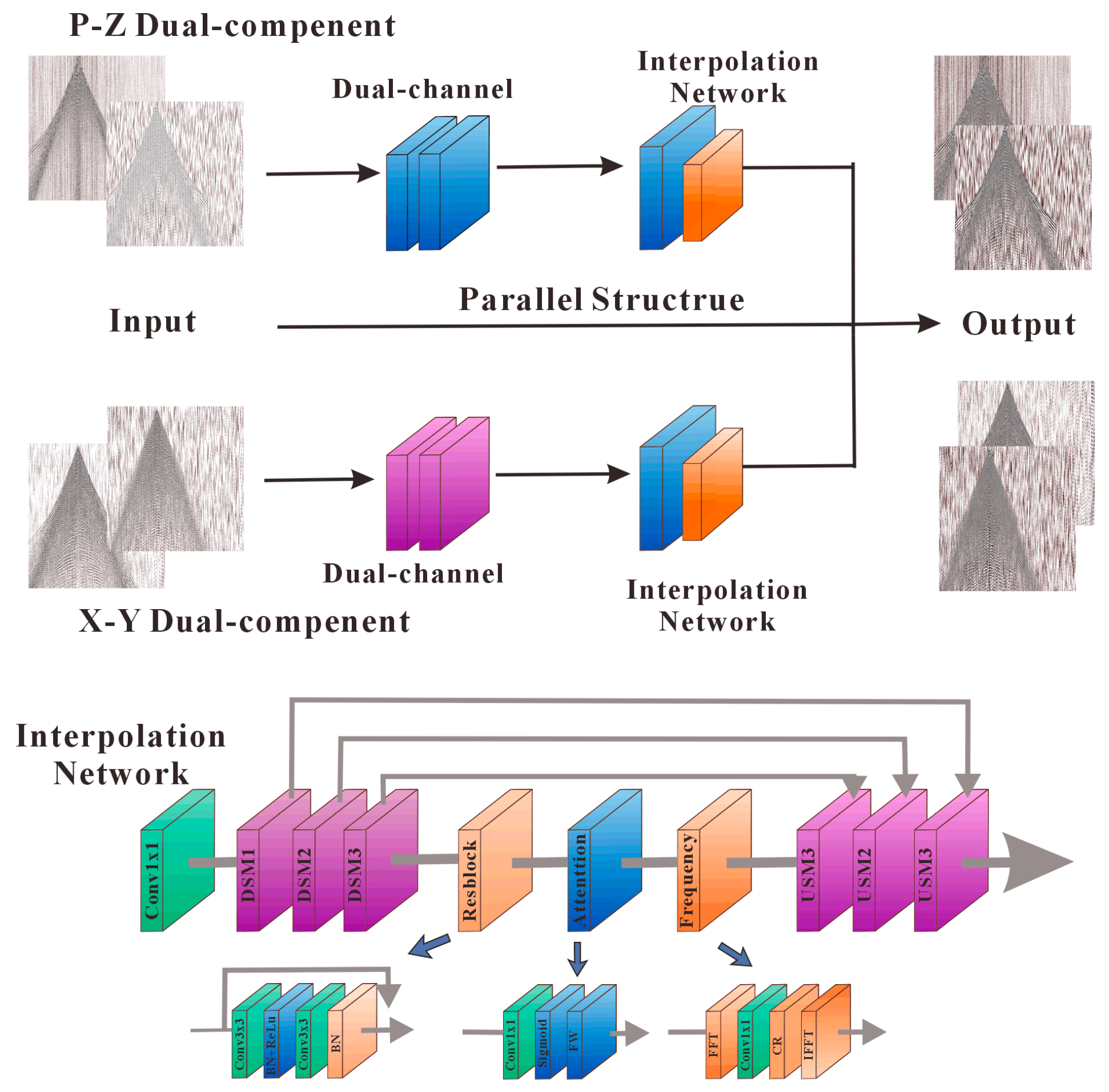
The designed ResAtt-Unet exhibits high nonlinear expressiveness and achieves high-quality conversion from sparse sampling to dense sampling through a carefully designed combination of modules, as shown in Figure 1. The network first performs pre-interpolation on the undersampled seismic dataset to the required size as the input, and the output is the corresponding seismic dataset after reconstruction. The overall pipeline of the proposed network includes input processing, shallow convolutional layers, down-sampling, residual blocks, attention mechanisms, frequency-domain processing, upsampling, skip connections fusion, and final output generation (Figure 1). The four-component OBN data utilized in this study comprise the pressure component (P) and velocity components (X, Y, Z), representing the underwater pressure variations and the wavefields in the horizontal and vertical directions, respectively. The proposed architecture employs a dual-component parallel framework, comprising structurally identical P–Z and X–Y branches with independent weights. This independent parameterization enables each branch to adapt to the specific amplitude scales and noise characteristics of different seismic components. Once distinct wavefield features are extracted, the branch outputs are concatenated and processed by a terminal convolutional layer, which functions as a feature integrator to produce the reconstructed dataset. The down-sampling procedure following input processing is composed of three stages, each producing a skip connection. During the subsequent intermediate processing, up-sampling is carried out using the corresponding skip connections, which are preserved throughout the down-sampling process and utilized during up-sampling.
The standard U-Net consists of three components: the encoding path, the decoding path, and skip connections [29]. The encoder extracts features through convolution and down-sampling, while the decoder restores resolution through up-sampling and convolution. Skip connections combine the features from the encoder with those from the decoder, aiding in the restoration of details [28]. The U-Net network is described as follows:
Y ^ = D ( l = 1 L C l ( E l ( X ) ) ) , X R B × C × H × W ,
B represents the batches. C represents the number of channels. H represents the height. W represents the width. The key symbols and operators used in this methodology are summarized in Table 1.
The core theoretical framework of this network integrates three specialized modules: a residual learning module, an attention mechanism module, and a frequency-domain processing module. Distinct from conventional residual architectures employing single-block designs, our residual module innovatively adopts dual residual blocks (Equation (1)) to enhance gradient propagation and feature reuse capabilities [29]. Residual learning is as follows:
H ( X ) = R e L U ( F ( X ) + X ) , X R B × C × H × W ,
F ( X ) = B N ( W 2 R e L U ( B N ( W 1 X ) ) ) ,
BN refers to the BatchNorm layer. The batch normalization transformation is defined as follows:
B N ( x ) = γ x μ σ 2 + ε + β ,
The activation function is ReLU:
f ( x ) = m a x ( 0 , x ) ,
W 1 , W 2 R C × C × 3 × 3 represents the convolutional kernels of different convolutional layers in the residual blocks. μ is the mean. σ represents standard deviation. γ and β are learnable parameters. ε is a very small constant. The residual module enhances the feature-extraction capability of the network by stacking multiple residual units, mitigating the gradient issues typically associated with deep networks.
The attention block relies on the attention mechanism to generate attention maps and perform feature enhancement:
A = S i g m o i d ( W a X ) , W a R C × 1 × 1 × 1 ,
Y = X A ,
W a is a 1 × 1 convolutional kernel.
The Sigmoid activation function transforms input values into the range (0, 1) through the logistic function:
S i g m o i d ( x ) = 1 1 + e x ,
This research incorporates a specialized attention module. The module processes dual inputs and generates attention weights via a gating mechanism, which are subsequently applied to the second input to highlight salient features. Specifically, the features from the decoder act as a gating signal to adaptively modulate the encoder features via skip connections. Through this gating mechanism, the model learns to selectively focus on pertinent components of the encoder features that align with the global context, effectively highlighting seismically significant regions while suppressing irrelevant artifacts. This design draws inspiration from hierarchical feature fusion strategies commonly employed in medical image segmentation. Leveraged by this architecture, the attention module mitigates artifacts arising from spatially irregular sampling by adaptively focusing on seismically significant regions, with a particular emphasis on primary reflections.
Concurrently, to achieve weak reflection signal enhancement, the model operates in the frequency domain, where signal intensity is bolstered by weighting distinct frequency components. Coupled with the strategic reweighting of attention vectors, the model further strengthens weak reflection signals through feature saliency amplification. This mechanism not only facilitates the precise localization of regions containing weak signals but also significantly enhances the discernibility of low-amplitude seismic events.
The frequency-domain processing block centers on Fast Fourier Transform (FFT) implementation, converting time-domain seismic traces into complex frequency spectra for subsequent spectral manipulation. To mitigate spectral leakage and edge artifacts while ensuring computational efficiency, the input data X is first padded to the nearest power of two. The transformation to the frequency domain is defined as follows:
F = F ( X pad ) ,
X pad is a data tensor whose size is padded to a power of two.
Following the transformation, frequency-domain convolution is performed to adaptively refine the spectral features:
F = W f 2 R e L U ( W f 1 ( M Φ ) ) ,
M = F ,
Φ = F ,
W f 1 R C × 2 C × 1 × 1 is a channel fusion convolution kernel, W f 2 R C × C × 1 × 1 is a feature-adjusting convolutional kernel, M is the amplitude spectrum, Φ is the phase spectrum. The magnitude M and phase Φ are treated as independent real-valued channels for processing via standard 2D convolutions, followed by complex reconstruction to ensure signal stability. Unlike traditional fixed-parameter filters, these 1 × 1 convolutions function as point-wise linear transformations across channels. This data-driven approach allows the module to perform an emergent “learned notch filtering,” where the network automatically identifies and reweights specific frequency bands to suppress noise and amplify seismically significant reflections without manual band selection.
Finally, the recovery is performed through the inverse transformation (IFFT):
Y = [ F 1 ( F e j Φ ) ] : , 1 : H , 1 : W ,
In this process, the refined spectral features F —obtained from Equation (10) as an adaptive magnitude adjustment—are coupled with the complex phase component e j Φ via a Hadamard product . By utilizing the complex exponential form, the module preserves seismic wavefield structures and circumvents ambiguities associated with phase wrapping, ensuring a stable reconstruction of the seismic signal. Subsequently, the Inverse Fast Fourier Transform F 1 is applied, followed by a cropping operation denoted by the subscript : , 1 : H , 1 : W (where : represents all indices, and 1 : H , 1 : W indicate spatial dimensions) to restore the feature map to its original resolution H , W . This mechanism facilitates the precise localization of target reflections and significantly improves the discernibility of low-amplitude seismic events.
The frequency-domain processing module enhances seismic data in the spectral domain to preserve wavefield characteristics (amplitude and phase) while suppressing noise, thereby maintaining discriminative features of valid signals. Subsequently, spectral decomposition isolates target reflections. Rather than employing fixed-parameter filters, the module utilizes learnable 1 × 1 convolutions ( W f 1 , W f 2 ) to achieve adaptive spectral shaping (learned notch filtering). This data-driven approach allows the network to automatically identify and attenuate specific noise bands while strategically amplifying weak reflection signals through feature saliency amplification.
  • Three fundamental innovations characterize the proposed network framework by introducing a frequency domain processing module. The network enables concurrent feature extraction in both the temporal and spectral domains, a critical capability for preserving the spectral characteristics of seismic data.
  • The incorporation of a spatial attention mechanism facilitates adaptive feature emphasis within the network architecture, consequently improving the detection accuracy of pivotal seismic events.
  • The combination of multi-scale feature extraction and residual learning enhances the network’s ability to process complex seismic data. The entire network supports multi-component and multi-channel processing to preserve the inter-component correlations while utilizing batch processing to enhance computational efficiency. Additionally, the modules can be flexibly adjusted according to specific requirements.

2.2. Interpolation of OBN Multi-Component Seismic Data

The multi-component OBN data contains four components, each representing different physical quantities [30]. In ocean-bottom seismic surveying, these components are typically used to capture different characteristics of seismic waves and propagation information. The P-component is recorded by hydrophones (or piezoelectric sensors), reflecting the pressure variations generated as seismic waves pass through the underwater seismic sensors. This primarily corresponds to P-waves propagation. In contrast, the X-, Y-, and Z-components are velocity components reflecting the wavefield in the horizontal and vertical directions (i.e., along the X, Y, and Z axes). The X- and Y-components represent the horizontal velocities, which are essential for characterizing S-wave (shear wave) propagation, while the Z-component represents the vertical velocity associated with the vertical propagation characteristics of seismic waves.
In actual multi-component OBN seismic data, there exists a certain degree of mutual correlation among the P–Z and X–Y components. These interdependencies typically arise from the propagation characteristics of seismic waves, the physical mechanisms, and the acquisition configuration of the recording equipment [31]. Based on the distinct characteristics and interrelations, we developed a parallelized dual-component joint interpolation framework for training.
The initial experiment constitutes a dual-component (P–Z) interpolation task, strategically integrating vertical pressure and velocity components for seismic data interpolation. The fundamental motivation for this combination method is that both the P-component and Z-component are primarily composed of compressional wave energy, and they share similarities in kinematic and dynamic characteristics. The second experiment constitutes a dual-component (X–Y) interpolation framework, accounting for cross-component dependencies among horizontal elements. This approach is physically grounded in the vector rotation consistency and the shared propagation paths of horizontal components, which are often characterized by phenomena such as shear wave splitting [28]. Meanwhile, both horizontal velocity components are primarily composed of shear wave energy, and the main wave types share similar kinematic and dynamic characteristics. We propose a novel multi-component OBN data interpolation framework based on frequency-domain ResAtt-Unet, featuring an innovative dual-component dual-experiment architecture. This design strategically decomposes the original four-component dataset into P–Z and X–Y component pairs, while implementing a synchronized joint training protocol for concurrent experiment execution. The proposed parallel framework demonstrates superior performance by enabling unified processing of all seismic components within a single network architecture, thereby comprehensively incorporating inter-component relationships. However, its challenge also stems from the high complexity of the model, which can be influenced by the different physical characteristics of the components during training, potentially leading to overfitting or training instability.

3. Field Application

3.1. OBN Multi-Component Data in East China Sea

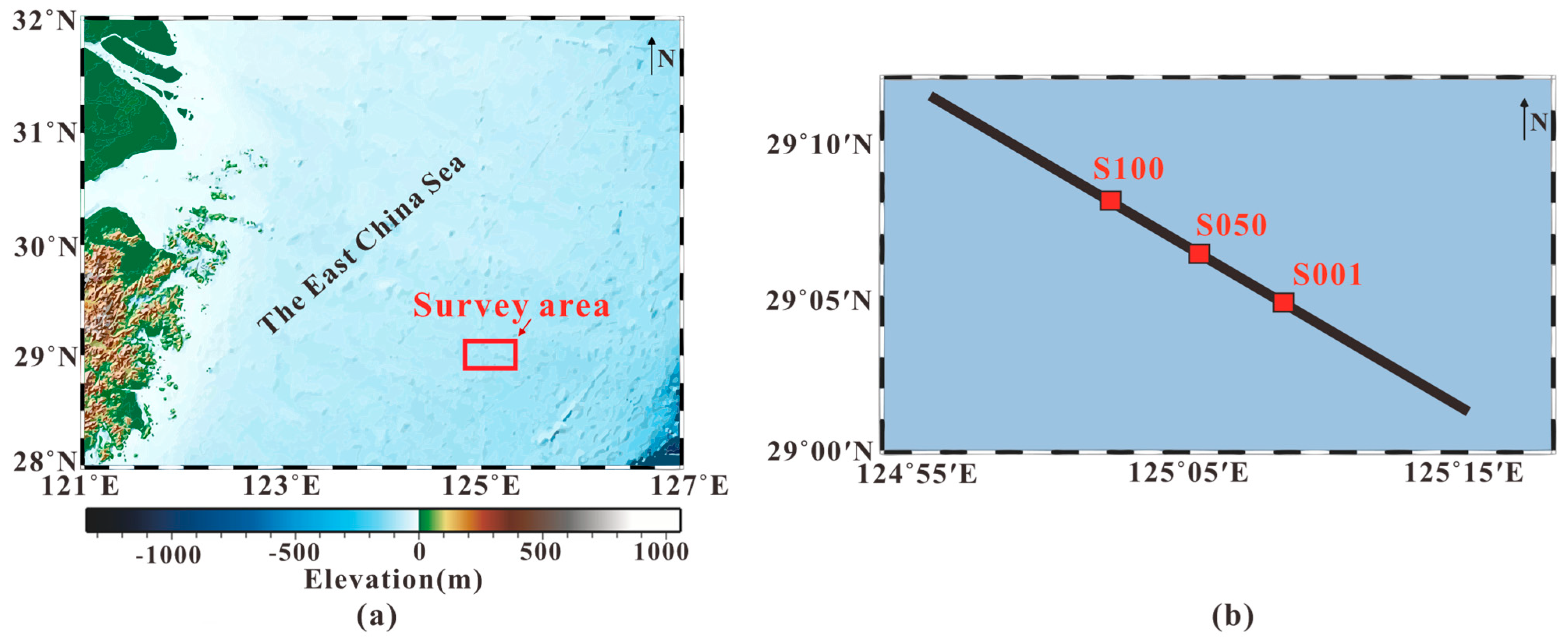
The seismic experiment utilized multi-component OBN data acquired from a shallow-water area located in the East China Sea, with an average depth of 82 m, as shown in Figure 2. Data from 92 valid OBNs, deployed at 100 m intervals, were analyzed in conjunction with 3D air-gun surface shooting (5–88 Hz bandwidth). We selected 834 shots from a single-sided shooting geometry, featuring a 37.5 m trace interval and a 0.004 s sampling rate across 3750 samples. For optimal visualization, only the first 1800 samples are displayed.
Given the limited dataset of 92 OBNs (though each contains substantial data volume), we implemented cross-validation during model training to ensure robust and reliable results from the constrained sample size [32]. The data acquired from these 92 OBNs were partitioned into training-validation and test subsets in a ratio of 85% to 15%. The proposed network architecture comprises 11 layers, with a maximum channel width of 256 in Table 2. The ResAtt-Unet is implemented using the PyTorch (version 1.12; Meta AI, Menlo Park, CA, USA) framework. To ensure high-fidelity wavefield reconstruction, we employ a joint loss function L t o t a l combining L 1 and mean squared error L m s e :
L t o t a l = λ 1 L 1 + λ 2 L m s e ,
where λ 1 and λ 2 are weighting coefficients set to 1.0 in this study. The model is optimized using the Adam optimizer with an initial learning rate of 10−4 and a batch size of 16.
Prior to training, the acquired datasets underwent a comprehensive preprocessing pipeline. To simulate missing traces, the original dataset was decimated by a factor of 2 by zeroing alternate traces, with the resulting decimated data serving as the network input. The preprocessing included (1) outlier removal, where physically implausible extreme values caused by instrumentation malfunctions or environmental perturbations were zeroed to prevent gradient instability; and (2) amplitude normalization, to ensure consistent feature scaling and numerical stability during the training process. These steps ensure a sanitized dataset with unified scaling, thereby optimizing computational efficiency and model robustness.
We utilize two primary metrics to ground our quantitative claims. The normalized cross-correlation (NCC) is used to measure waveform similarity:
N C C = ( X X ^ ) X 2 X 2 ^ .
where X and X ^ are the original and reconstructed data, respectively. Furthermore, the ‘>80% consistency’ in spectral energy is defined by the Spectral Overlap Ratio (SOR), calculated as the intersection area of the reconstructed and original power spectra divided by the total area of the original spectrum. This ensures that our fidelity claims are mathematically grounded and reproducible.

3.2. P–Z Dual-Component Interpolation

The P-component (pressure) and Z-component (vertical velocity) are linked to the vertical components of seismic waves, particularly the P-waves (compressional waves) and SV-waves (horizontally polarized shear waves). The information they typically exhibit in kinematics is coherent, manifesting as spatiotemporal covariations in their wavefield characteristics. During underwater propagation, P-waves induce vertical pressure fluctuations that directly affect the Z-component (vertical velocity). The relationship of pressure–velocity represents different propagation modes of seismic waves (e.g., compressional waves and vertical velocity). Integrating P- and Z-components can more comprehensively capture the variations in the seismic wavefield, potentially aiding in better reconstruction of seismic wave kinematical and dynamical characteristics. Interpolating exclusively on the P-component or the Z-component may induce the model overfitting to one component, while potentially disregarding the potential influence of the complementary component [33,34]. Joint interpolation can enhance the capacity of the models to capture the inter-component dependencies effectively, mitigating the risk of overfitting associated with individual interpolation. Consequently, dual-channel modeling of the P–Z-components ensures physically consistent interpolation by preserving their wavefield characteristics.
As previously described, the interpolation experiments were performed on the seismic dataset of the P- and Z-components using the proposed ResAtt-Unet architecture. The dual-component data are structured in the dual-channel network configuration, with the P-component assigned to Channel 1 and the Z-component to Channel 2. The network architectural parameters were initialized as follows: network depth = 11 layers, initial learning rate = 0.0003, training epochs = 100, with five-fold cross-validation. For visualization and spectral analysis, the third sample from the test dataset was selected.
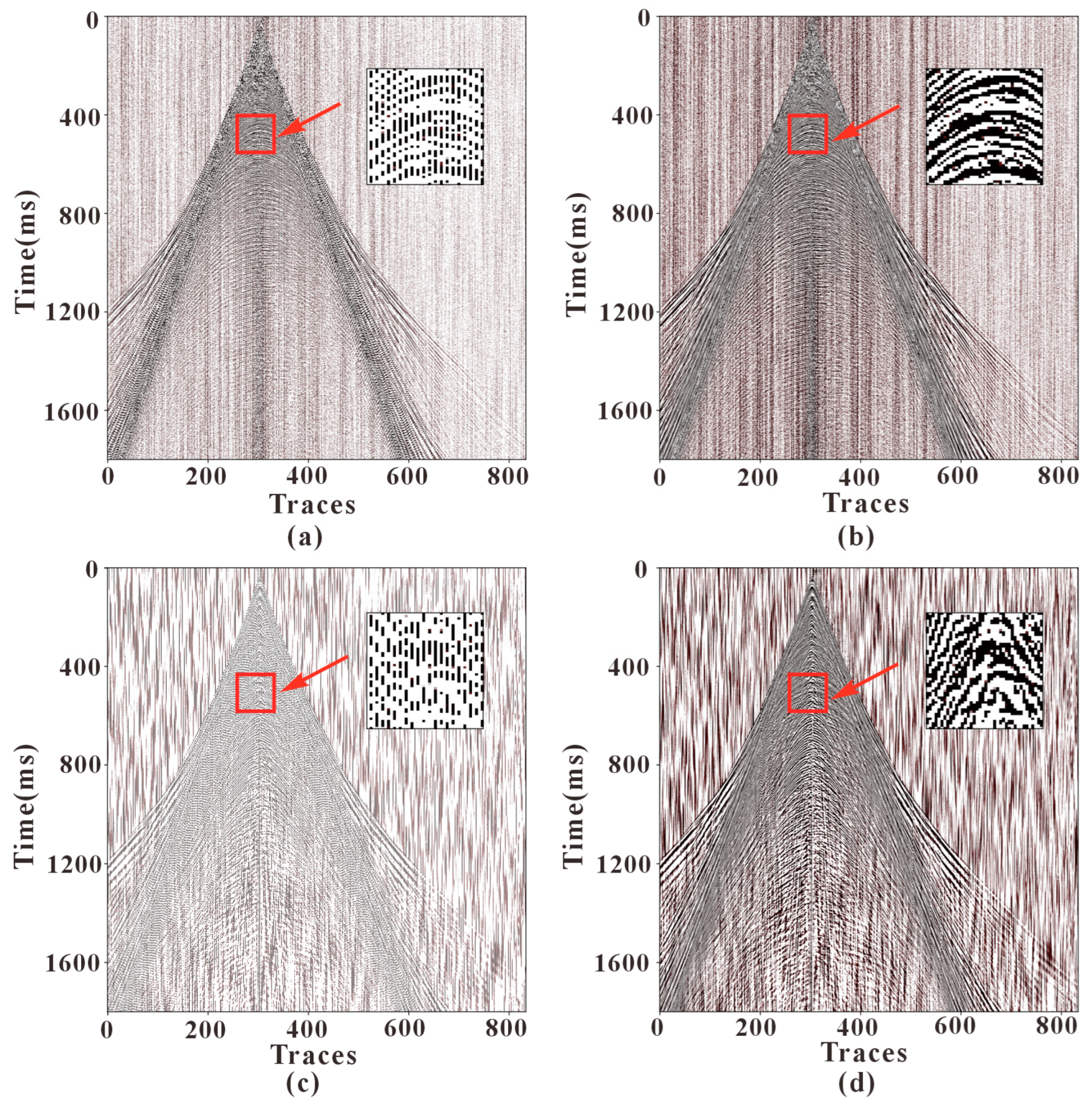
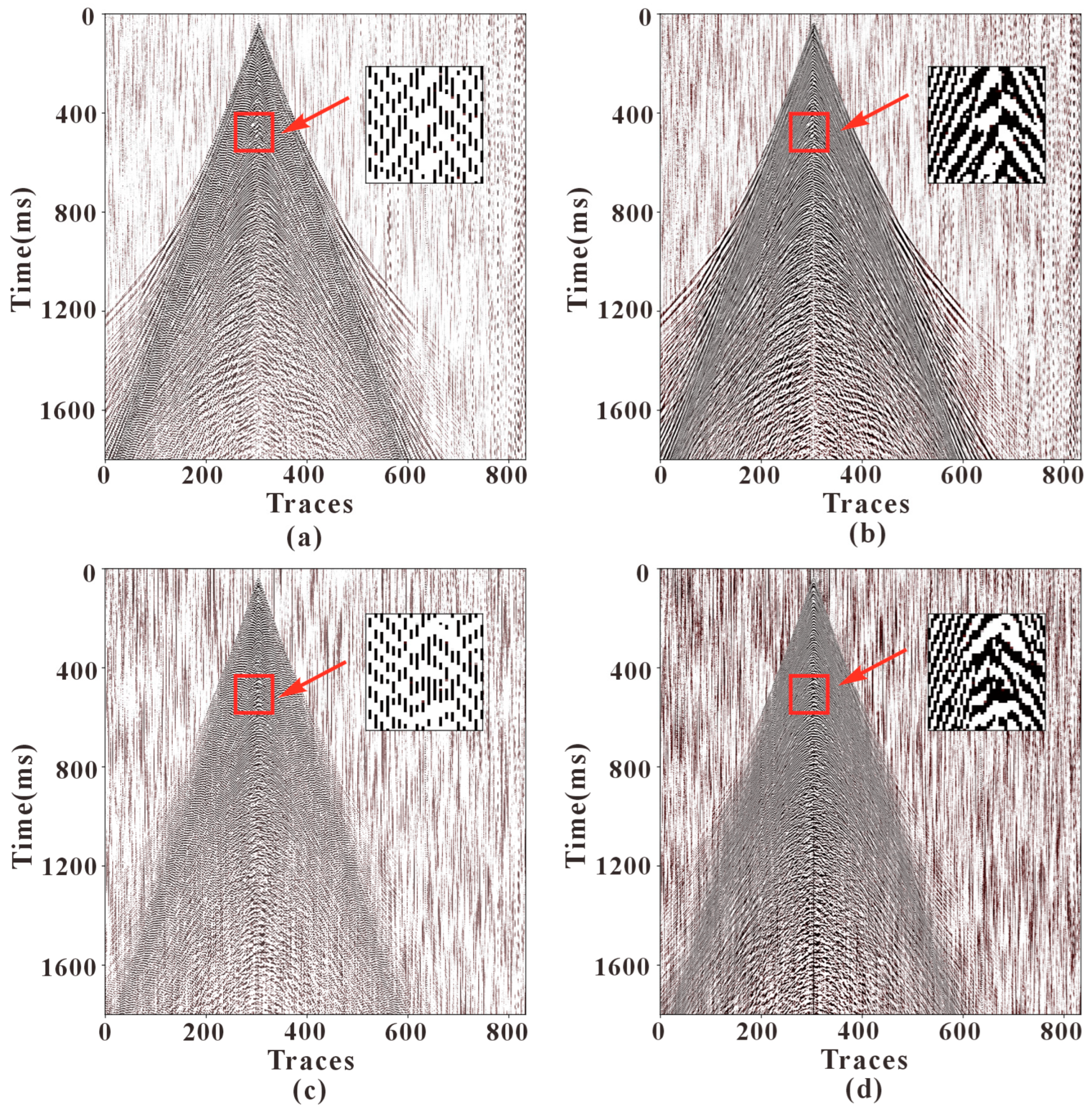
The interpolation results of the P–Z dual components are presented in Figure 3. Specifically, Figure 3b,d display the reconstructed data after interpolation of the P–Z components, respectively. Through comparison of the interpolation results with the decimated data (Figure 3a,c) across multiple traces, the interpolated records demonstrate high consistency with the original data for most traces. Within the dominant wave propagation range of the seismic source, the interpolated signals effectively reconstruct the missing waveforms while exhibiting strong waveform similarity with the original traces. Within the red bounding box corresponding to the locally interpolated seismic section, the continuity of seismic events after the first arrivals was restored by ResAtt-Unet, with notably enhanced coherency among adjacent traces. The interpolation results demonstrate that the recovered signals exhibit excellent temporal continuity, with the waveform characteristics of seismic events accurately reconstructed. Time-domain analysis demonstrates that the interpolated signals maintain continuous wave propagation characteristics, with accurate recovery of key attributes such as event amplitudes and phases. Compared to the decimated data, the interpolation introduces no observable waveform distortions or artificial artifacts within the red-boxed region, while preserving event symmetry and high signal-to-noise ratio (SNR). These results indicate that the ResAtt-Unet successfully captured the primary kinematic and dynamic characteristics of the signal, ensuring the physical plausibility and temporal consistency of interpolated data, thereby providing high-fidelity input for seismic wavefield reconstruction and propagation analysis.
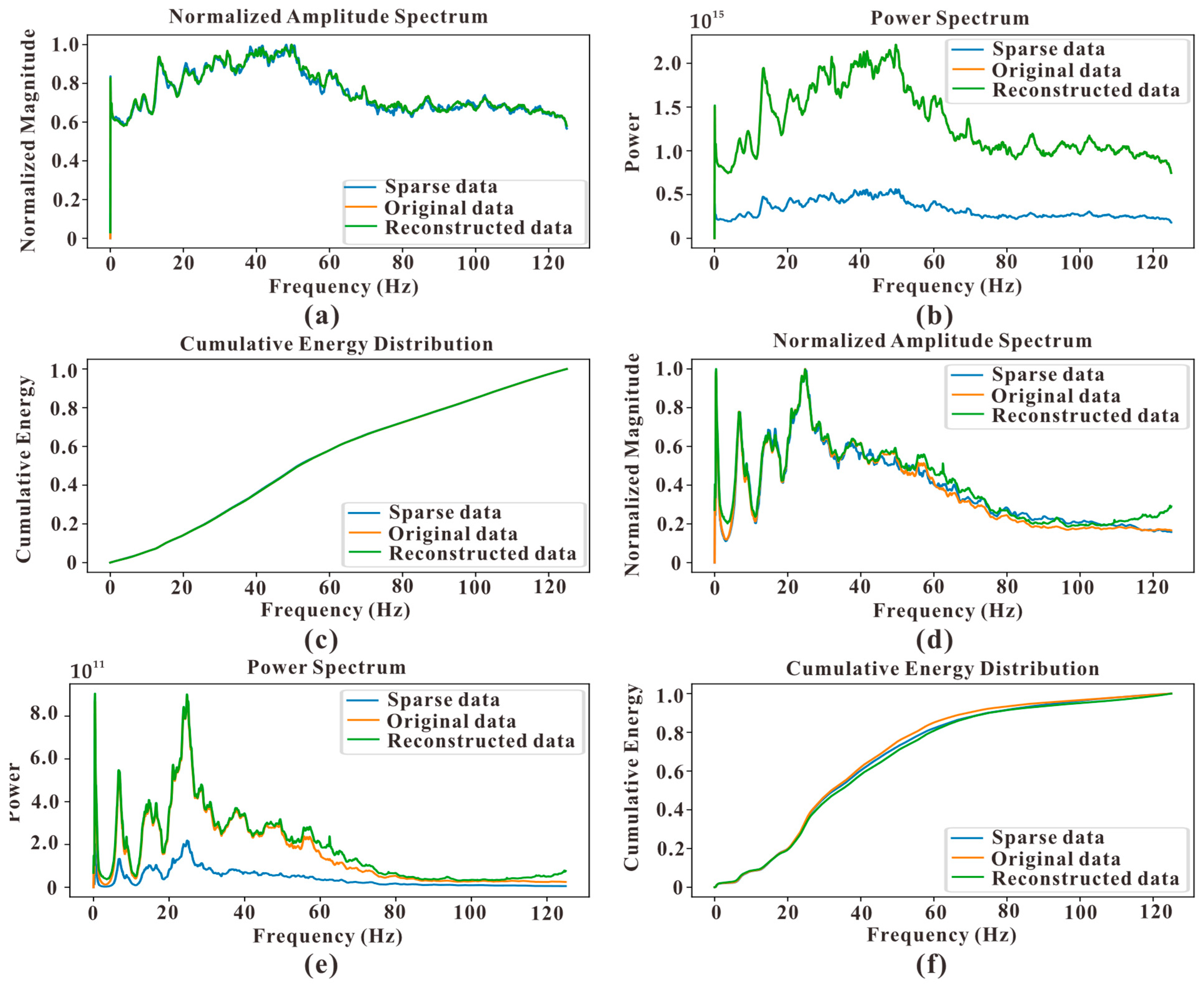
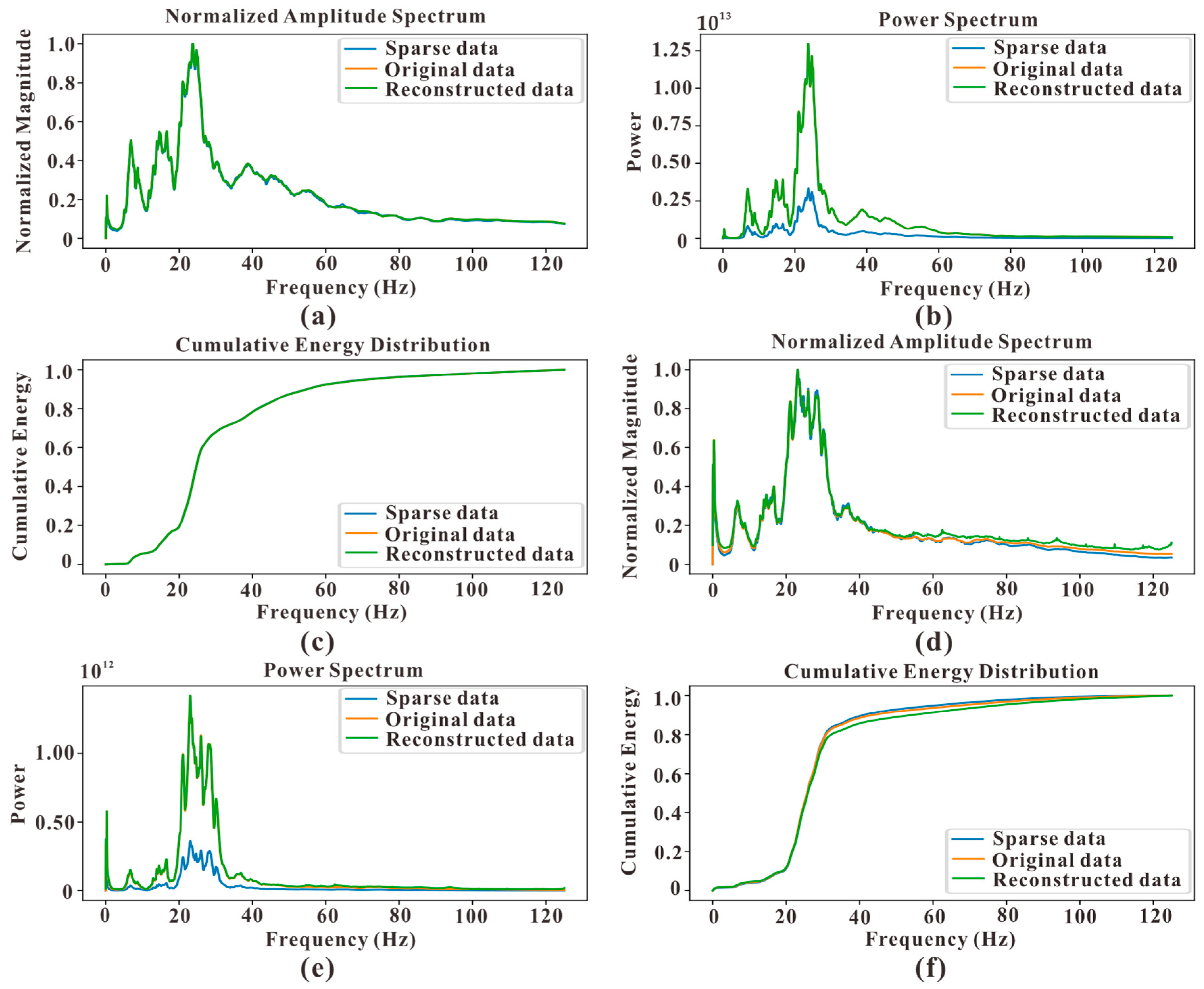
We performed normalized spectral analysis on the P-component and Z-component interpolation data, original data, and decimated data. As shown in Figure 4a,d, the frequency distributions of the P–Z components before and after interpolation remain consistent. Comparing the spectral results of the P-component and Z-component interpolation with those of the original data, it can be revealed that the interpolation model successfully restored the missing high-frequency and low-frequency components in the decimated data. The power spectrum and cumulative energy spectrum of the interpolated data exhibit >95% consistency with the original data across all frequency bands. As evidenced by Figure 4b,e, the power spectrum analysis indicates that the ResAtt-Unet has successfully restored the energy (power) of different frequency components in the P–Z components of the decimated data to levels approaching those of the original data. Within the dominant 60 Hz band, the spectral peaks representing valid signals show high consistency with the original data, indicating successful reconstruction of periodic (or quasi-periodic) spectral features. In the 60–80 Hz and >120 Hz bands, although minor deviations exist, the power spectra exhibit continuous, low-amplitude broadband noise characteristics without significant peaks. These features suggest that these frequency bands are noise-dominated. Cumulative energy spectrum analysis (Figure 4c,f) reveals sharply increasing slopes below 60 Hz for both P-component and Z-component, indicating a primary signal-bearing region, which further validates the power spectrum findings. Above 60 Hz, both components show reduced slope steepness, but the Z-component curve becomes nearly flat while the P-component retains a steeper trend. This suggests a refinement of the initial interpretation: the >60 Hz band is entirely noise-dominated for the Z-component, whereas the P-component still exhibits minor signal contributions. The cumulative energy spectrum analysis demonstrates high consistency between the original and interpolated data curves. The effective signal bandwidth remains stable before and after interpolation. Results confirm that the interpolation process neither smooths out signal details nor introduces significant noise. The energy accumulation characteristics (including energy concentration and frequency-band proportion) are accurately preserved. In summary, the model effectively captures long-timescale seismic fluctuations in both P–Z components while achieving high-accuracy wavefield reconstruction without compromising frequency-domain fidelity.
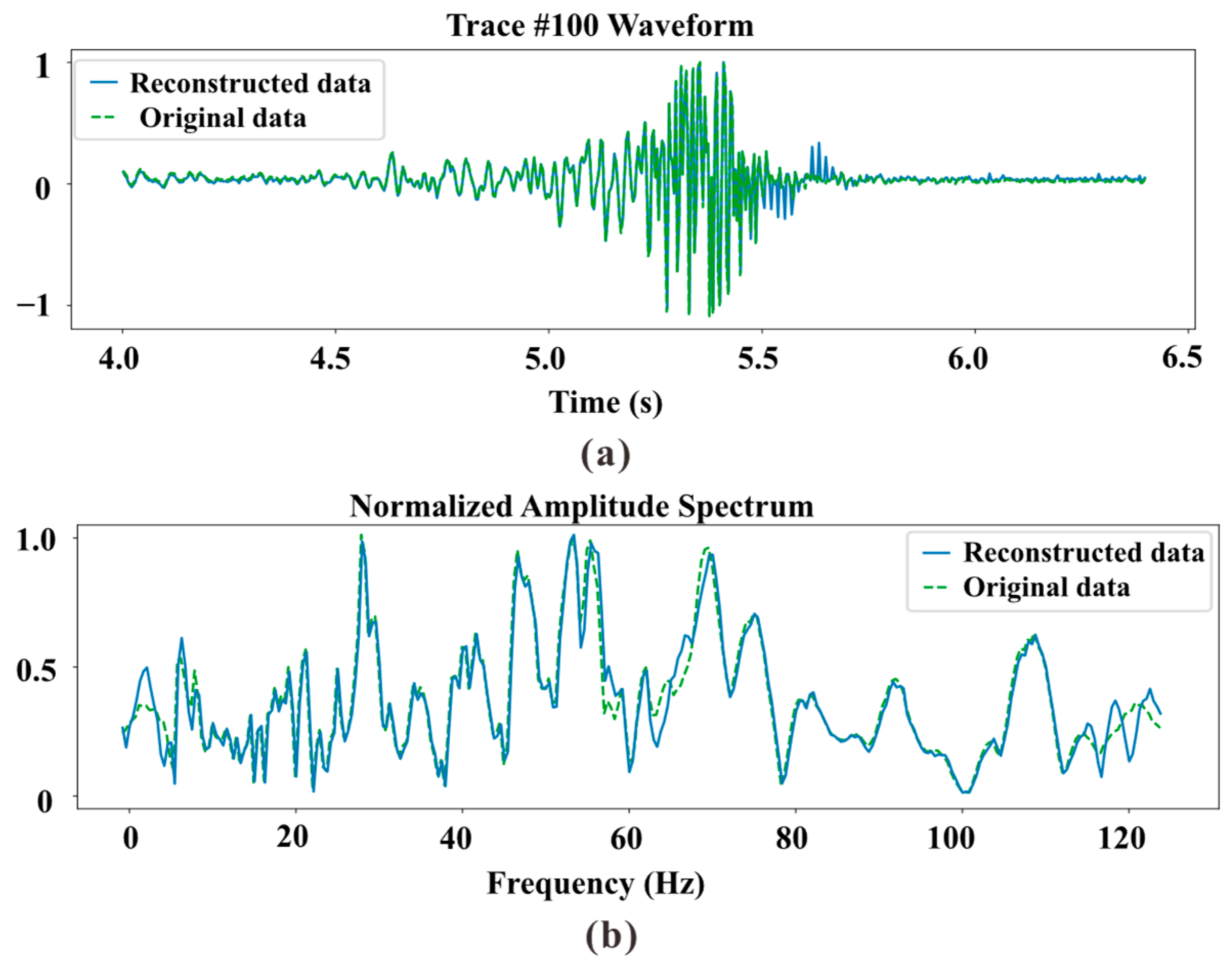
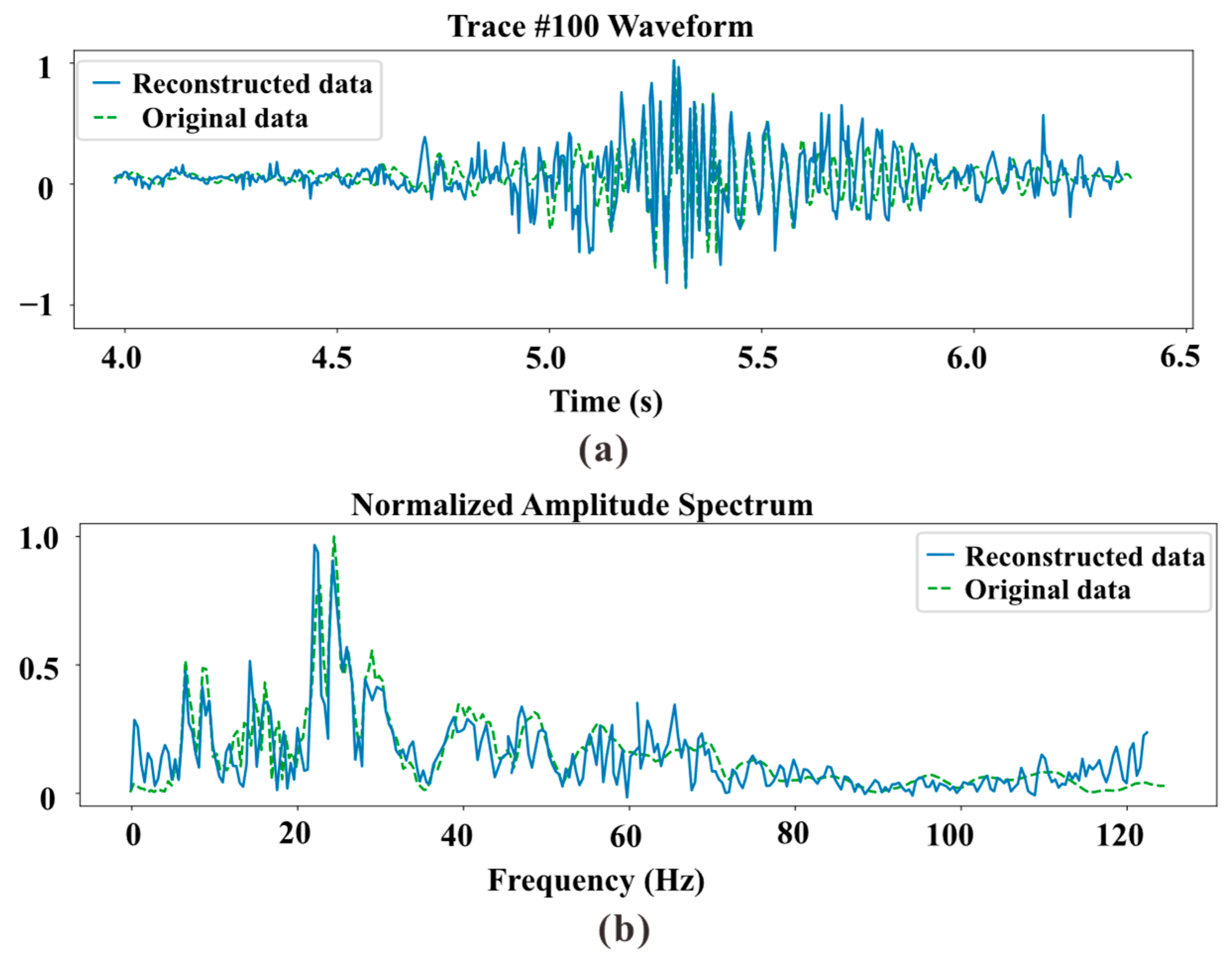
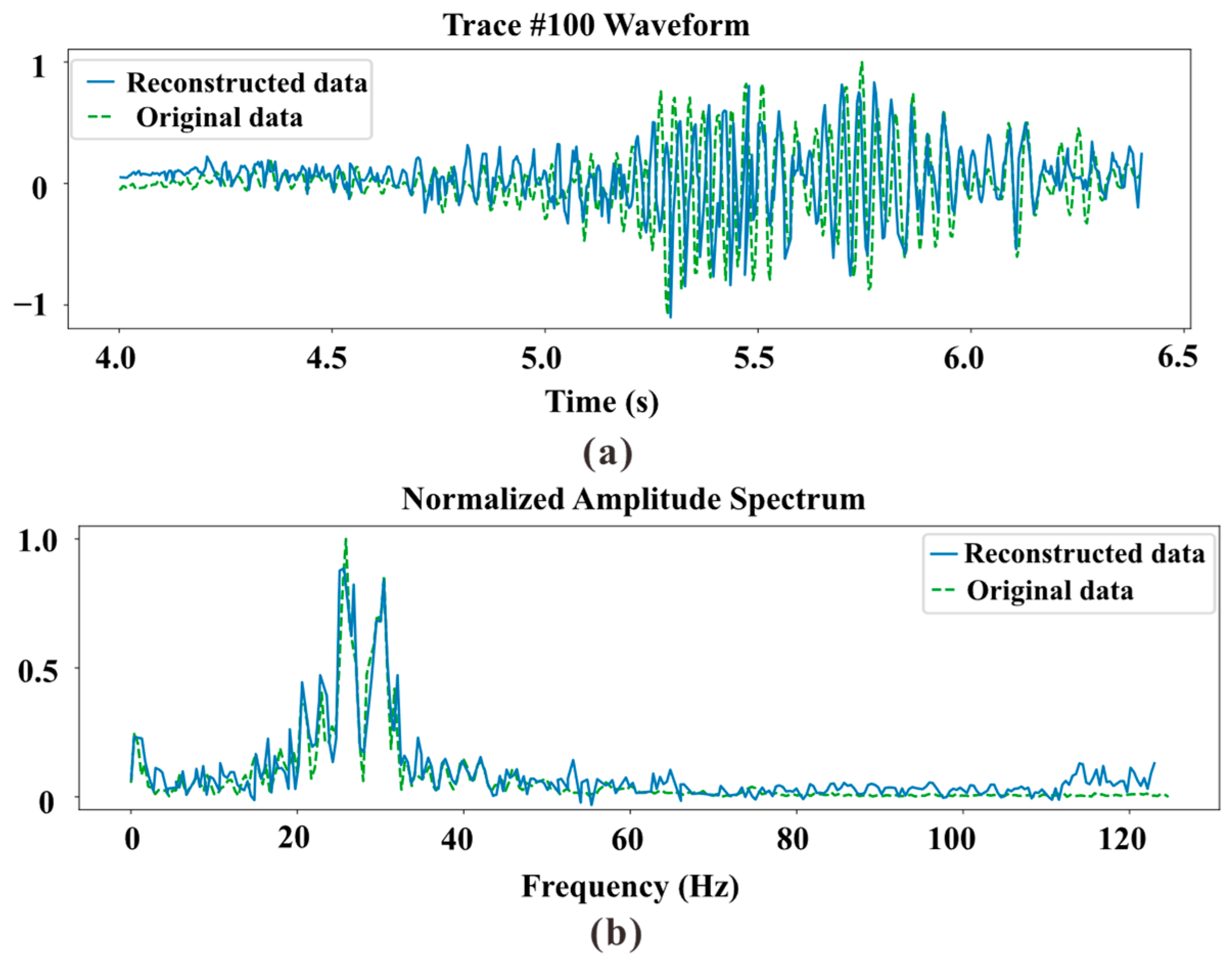
We further extracted the interpolation results of individual missing traces from the decimated data and performed a comparative analysis with their corresponding original traces (Figure 5 and Figure 6). Comparison of single-trace seismic records before and after interpolation (Figure 5a and Figure 6a) shows that the reconstructed P–Z component signals preserve the amplitude characteristics of the original waveforms without systematic attenuation/amplification or spurious ones. The peak/trough timing alignment exhibits negligible deviation, and impulsive peaks are fully restored without smoothing or omission. These confirm exceptional waveform consistency between the reconstructed and original data. Single-trace spectral analysis (Figure 5b and Figure 6b) indicates minor discrepancies between interpolated and original signals in localized frequency bands, yet these differences negligibly impact the temporal signal integrity. The P–Z interpolation robustly preserves the time-domain characteristics of the original data.
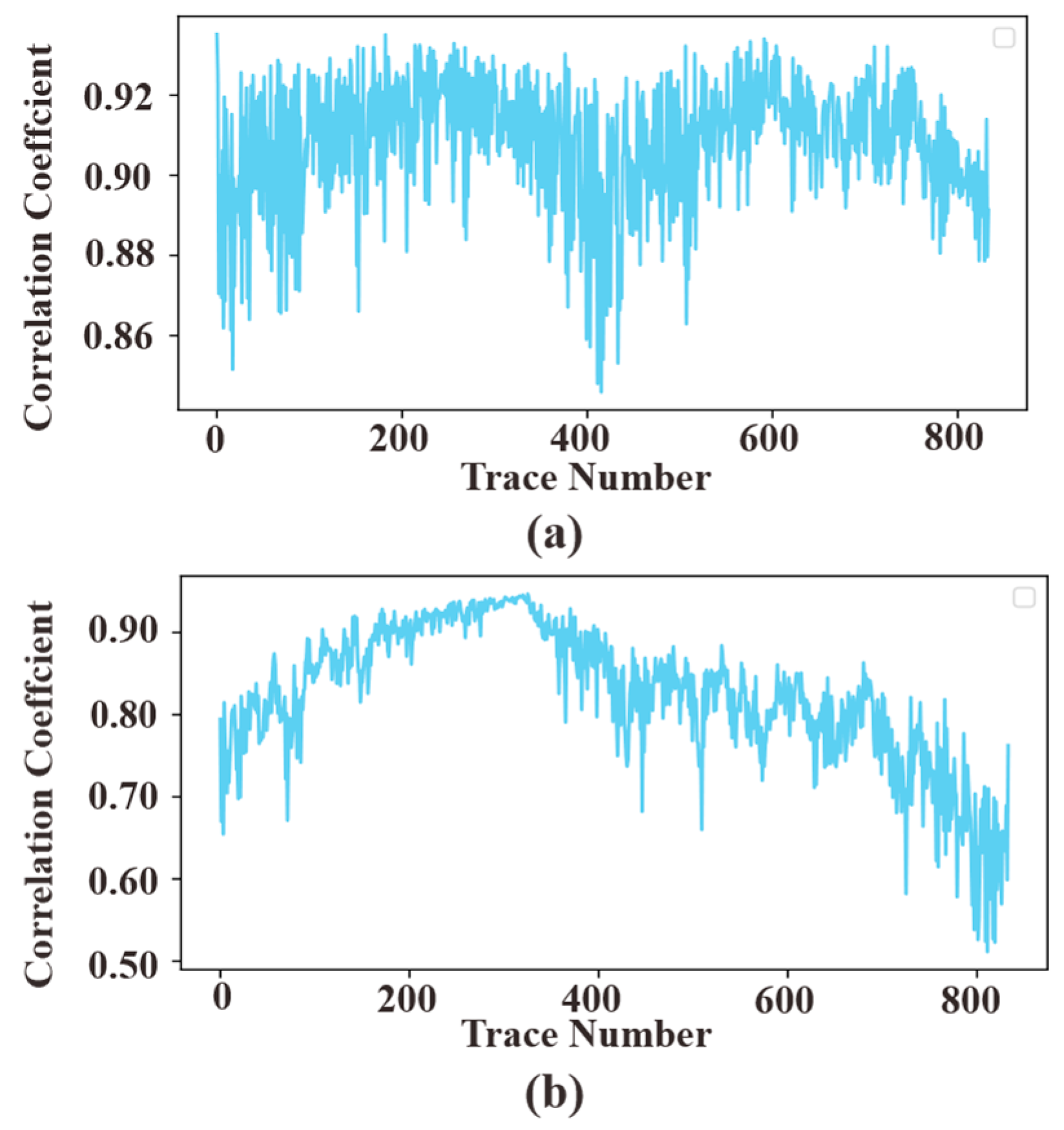
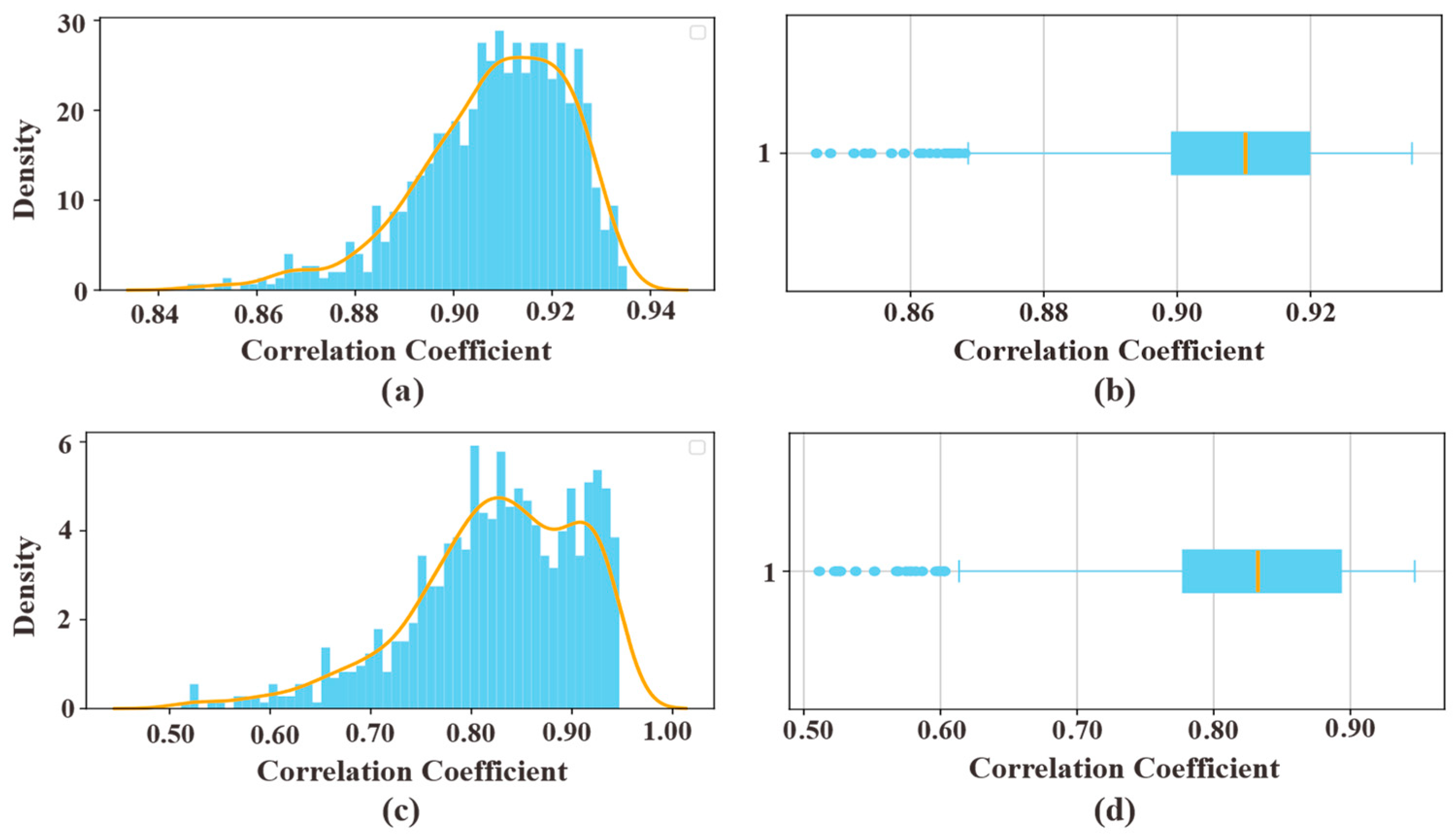
We further computed the correlation coefficients between the interpolated and original seismic traces (Figure 7 and Figure 8). For the P-component (Figure 7a and Figure 8a,b), the cross-correlation coefficients exceed 0.85 for most traces (Figure 7a), indicating successful recovery of seismic waveform characteristics in each trace gather. The distribution of coefficients (Figure 8a,b) shows that 50% of values concentrate between 0.90 and 0.94, with a fluctuation range of 0.84–0.94. Minor outliers (down to 0.82) indicate effective recovery of seismic signal characteristics across all P-component trace gathers. Although the Z-component coefficients (Figure 7b and Figure 8c,d) are slightly lower than the P-component’s, with localized reductions in correlation (Figure 7b), the boxplot in Figure 8d maintains a median value of 0.8 and exhibits fewer outliers. This demonstrates robust recovery of seismic characteristics in most trace gathers, despite minor fluctuations. To evaluate the model’s stability and mitigate the risk of overfitting to the specific survey area, the performance variance across the five-fold cross-validation was quantified. The results yielded a stable median correlation coefficient of 0.92 for the P-component with a low standard deviation. This consistency suggests that the ResAtt-Unet captures the underlying wave kinematics—which are physically invariant—rather than area-specific noise patterns or semantic image features.
A comprehensive multi-faceted assessment—encompassing interpolated results visualization, frequency spectrum analysis, power spectrum comparison, single-trace seismic record matching, and cross-correlation coefficient analysis—demonstrates the superior performance of the ResAtt-Unet interpolation method for P–Z dual-component seismic data. The method exhibits robust capabilities in recovering dominant frequency components and critical temporal characteristics of signals. Combined with the multi-dimensional evaluation (including spectral analysis and cross-correlation validation), these results confirm that the ResAtt-Unet interpolation captures both kinematic and dynamic characteristics of seismic signals, demonstrating exceptional recovery of seismic features across most shot gathers. This ensures not only physical plausibility and temporal consistency but also provides high-fidelity input for wavefield reconstruction in OBN multicomponent surveys.

3.3. X–Y Dual-Component Interpolation

Analogous to the physical coupling between P–Z components, the X–Y components also display significant correlation. The X–Y components are fundamentally linked to lateral seismic wave propagation. Under structurally complex ocean-bottom conditions, horizontal ground motions consistently demonstrate observable synchronization across multiple azimuths. Consequently, analogous to P–Z components, the X–Y components also exhibit distinct spatiotemporal coordinated variations, which yield critical information for seismic wavefield propagation in the horizontal direction. Further investigation establishes that the P–Z components (pressure and vertical velocity, respectively) predominantly correspond to P-waves and SV-waves (vertically polarized shear waves), while the X–Y components are primarily associated with SV-waves and SH-waves. These distinct wave types exhibit fundamentally different propagation dynamics [35]. Treating X–Y components as independent interpolation targets mitigates wavefield crosstalk between distinct seismic wave types, thereby simplifying complex physical effects during model training. Simultaneously interpolating X–Y components directs the focus of the model on the task of laterally propagating seismic waves. This approach effectively restores horizontal wave propagation characteristics while avoiding complexities from mixed P-wave and SV-wave modes. For the ResAtt-Unet, processing X–Y components as dual-channel input enables simultaneous consideration of their mutual influences across spatial and temporal dimensions. Compared to interpolating the X–Y components separately, joint interpolation reduces the risk of overfitting to specific channels while ensuring the physical consistency of the ResAtt-Unet during the reconstruction process. Similarly, a comprehensive evaluation of X–Y components interpolation incorporates spectral analysis, power spectrum comparison, single-trace seismic record matching, and cross-correlation coefficient assessment.
As observed in Figure 9, the interpolated X–Y component signals successfully restored the majority of horizontal propagation characteristics of seismic waves. Notably, within the complex seabed geological environment (highlighted in the red box), the ResAtt-Unet was able to accurately recover the seismic signals that had previously suffered from low resolution. The enlarged area within the red box clearly shows the S-wave information that was unclear before interpolation. After interpolation, the S-wave events are well reconstructed in the interpolated results. Compared to the pre-interpolation data, the post-interpolation results show clearer waveforms and improved event continuity.
As shown in the normalized spectra in Figure 10a,d, the interpolation results for the X- and Y-components recovered the dominant frequency components, exhibiting stable spectral distributions before and after interpolation. Comparing the interpolated spectra with those of the original data reveals that: within the 0–40 Hz frequency band, the interpolated curves align in phase with the spectral peaks/troughs of the original data and exhibit consistent variation trends; however, the spectral coincidence decreases in frequency bands above 60 Hz (a characteristic also observed in the P–Z component spectra). Analysis of the integrated power spectra (Figure 10b,e) and energy accumulation spectra (Figure 10c,f) demonstrates that, within the dominant 40 Hz frequency band, the positions of sharp peaks in the power spectra and the segments with steep gradients in the energy accumulation spectra of the interpolated results show close agreement with the original data. This confirms the accurate reconstruction of periodic spectral features, the preservation of the effective signal bandwidth without compression, and the absence of introduced signal smoothing or noise interference. Simultaneously, frequencies above 60 Hz exhibit characteristics of continuous, low-amplitude broadband noise, manifested as an absence of distorted sharp peaks in the power spectra and energy accumulation spectra slopes approaching zero—consistent with the original data. Overall, the interpolation results for the X–Y components maintain a high degree of consistency with the original data in terms of power distribution, particularly achieving precise restoration of power across all frequencies within the 0–40 Hz seismic dominant frequency band.
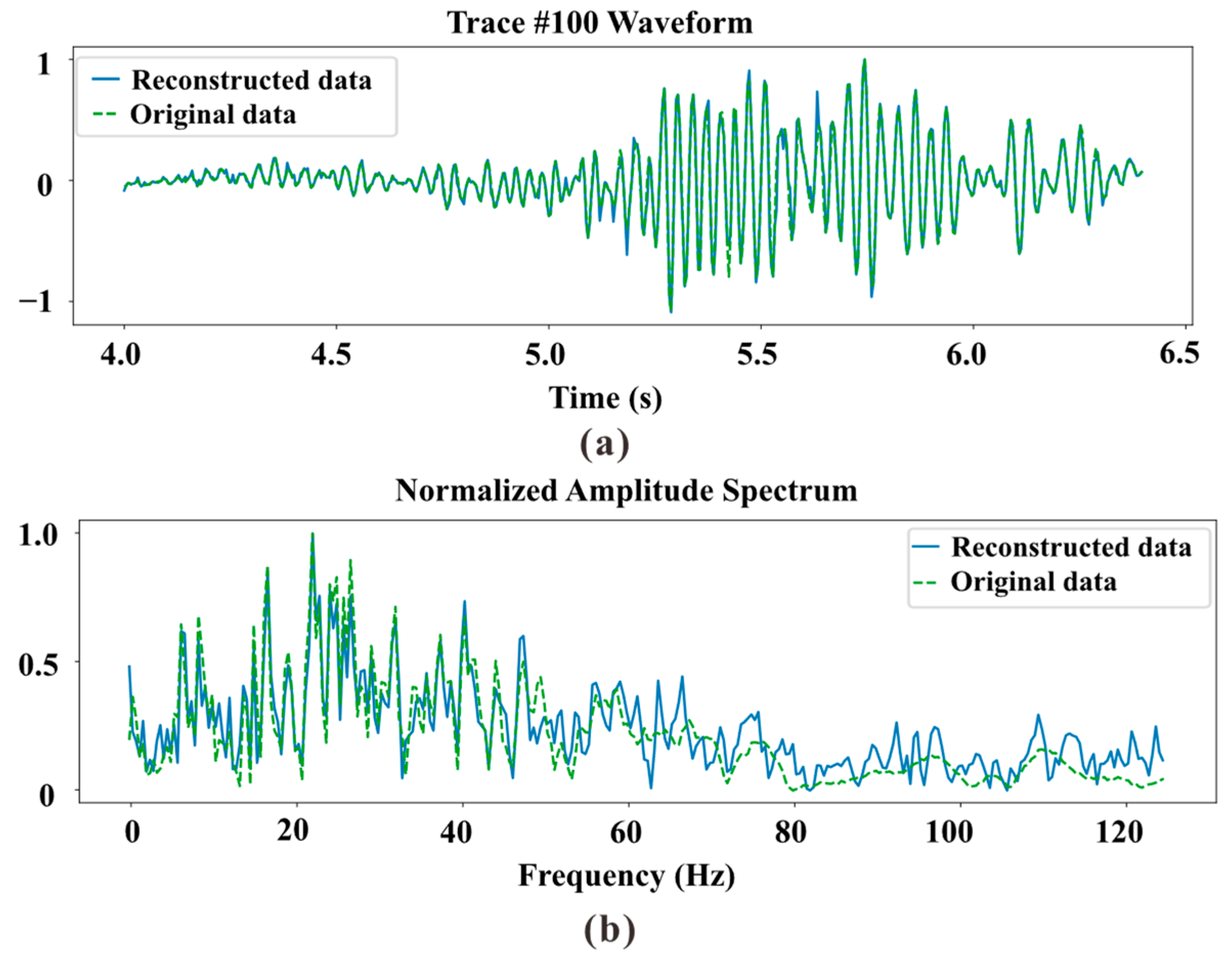
Further validation through single-channel seismic record comparisons confirms the effectiveness of interpolation for the X-component (Figure 11) and Y-component (Figure 12). In time-domain waveform comparisons between interpolated results and original X–Y component records, the interpolated signals not only exhibit a high degree of correspondence with the original waveforms but also successfully recover post-seismic oscillations within the seismic records. Results demonstrate that for horizontal velocity components, the interpolated seismic waves show no distortion in temporal evolution, with negligible differences observed between interpolated and original signals across the majority of time windows. Furthermore, the interpolated waveforms display an absence of significant noise or artifacts, indicating that the interpolation process introduces no additional errors or interference.
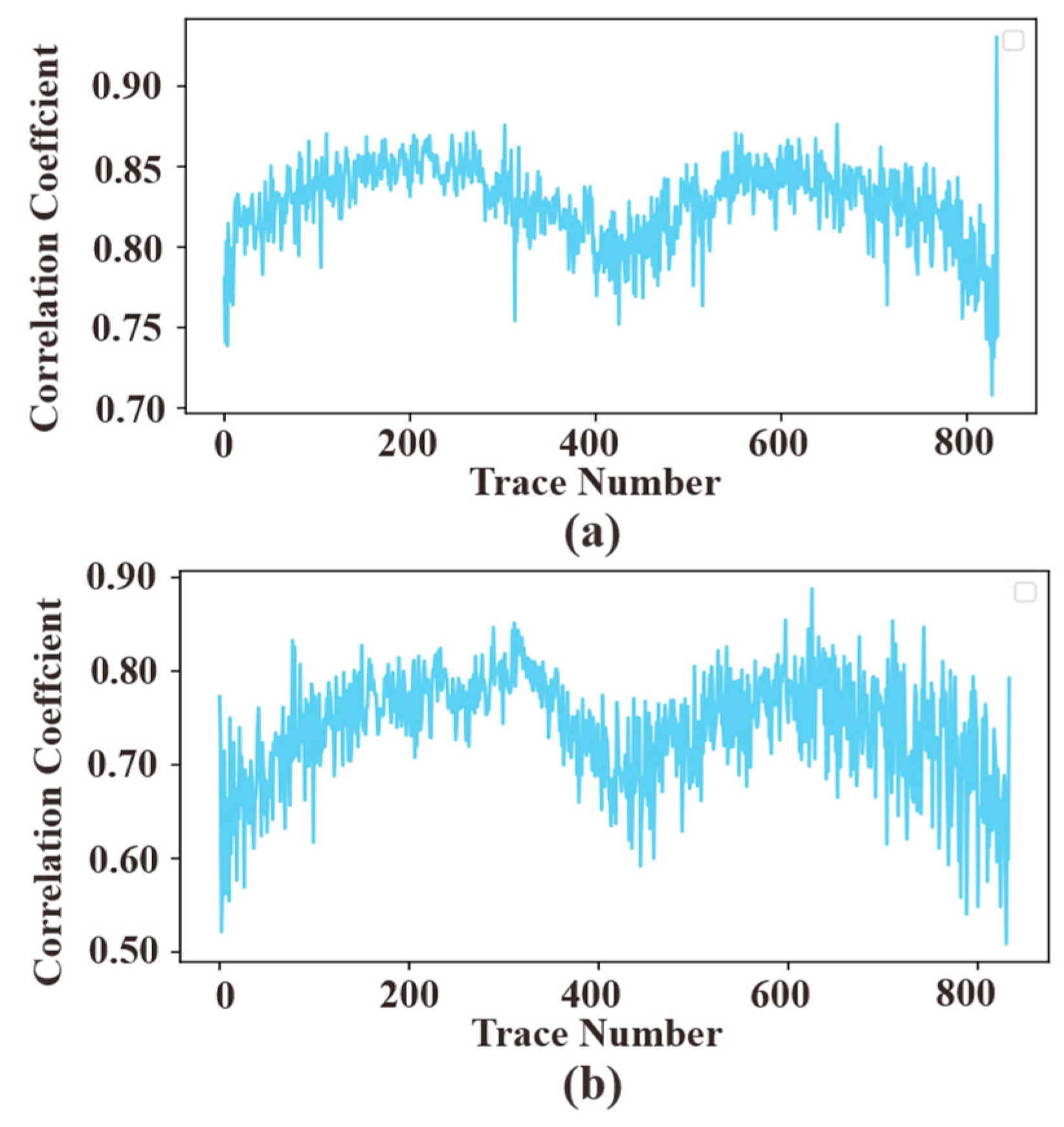
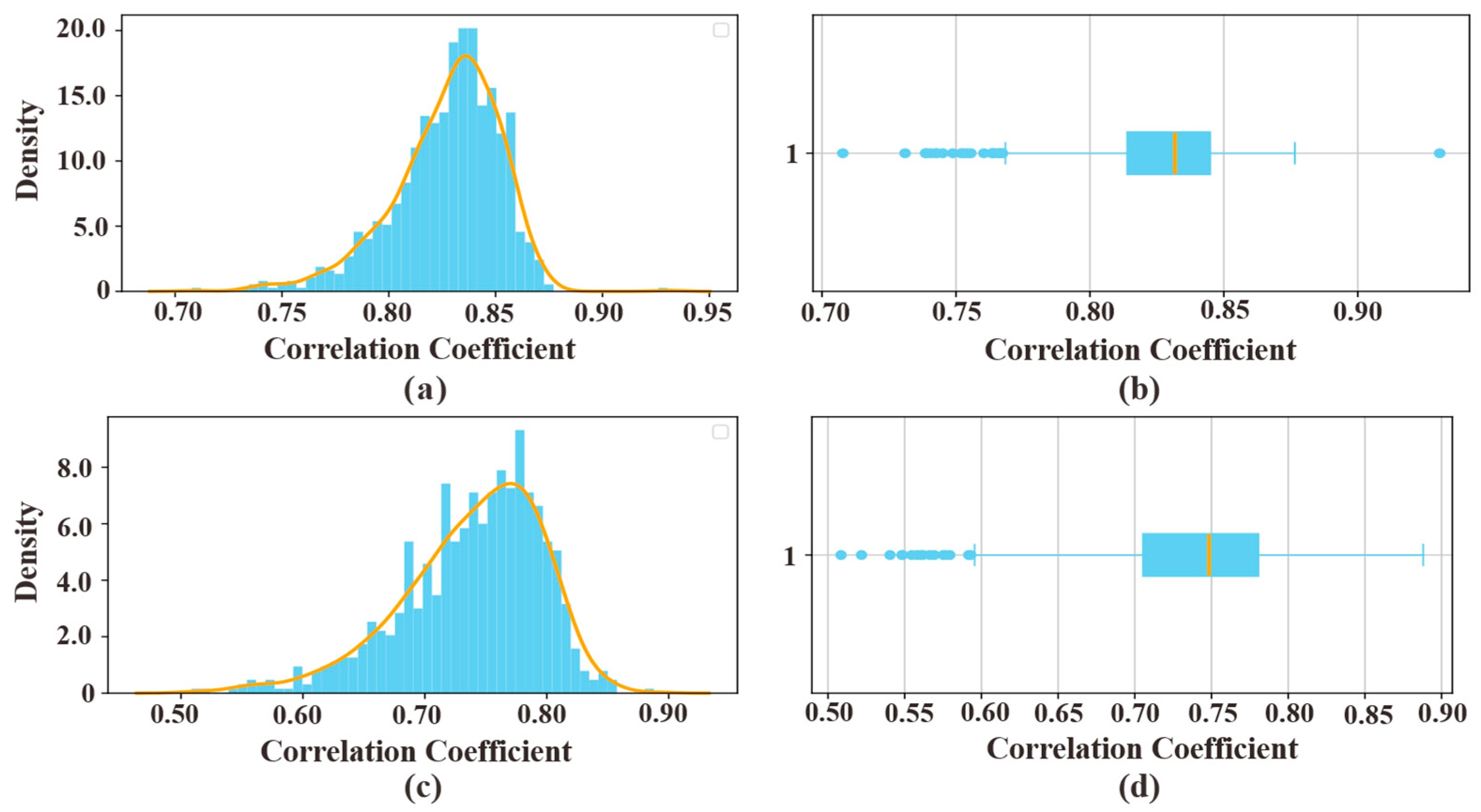
We also computed cross-correlation coefficients between interpolated and original single-trace seismic records for X–Y components (Figure 13 and Figure 14). Analytical results demonstrate that the interpolated X-component (Figure 14a) exhibits a mean correlation value of 0.82 (range: 0.70–0.95) with the original data, while the Y-component (Figure 14c) shows a mean of 0.72 (range: 0.50–0.88), representing an 8–10% reduction compared to the P-component’s value of 0.85+. Box-and-whisker plots (Figure 14b,d) reveal that 50% of X-component coefficients concentrate within 0.82–0.85, with Y-component values clustering in 0.71–0.78. Simultaneously, extremum ranges broaden (X: 0.70–0.95; Y: 0.52–0.88) with increased distribution skewness toward the lower end (approximately 12% of traces < 0.70). Collectively, despite systematically lower coefficients relative to P–Z components, 78% of traces maintain coefficients exceeding the 0.70 threshold, confirming the model’s capability to recover fundamental waveform patterns for X–Y components under most scenarios, thereby satisfying baseline accuracy requirements for interpolation methodology.
A comprehensive evaluation integrating visualization, spectral analysis, power-spectrum comparison, single-trace record matching, and cross-correlation coefficients demonstrates that the ResAtt-Unet for X–Y components exhibits effective recovery capability, though its performance is quantitatively inferior to that of P–Z components.

4. Discussion

The proposed dual-component parallel framework integrates data-driven deep learning with geophysical constraints to enhance the physical consistency of multi-component wavefield interpolation. Unlike conventional single-component methods that often neglect phase and polarization relationships—potentially disrupting the temporal alignment of shear-wave energy—the proposed joint X–Y training forces the network to preserve these critical inter-component phase relationships.
For P–Z interpolation, the attention-gating mechanism functions as a data-driven adaptive weight modulation process. By leveraging the superior signal-to-noise ratio (SNR) of the P-component as a physical reference, the network dynamically constrains the Z-component’s energy distribution, thereby mitigating incoherent noise induced by instrument coupling variations. The performance disparity between P–Z and X–Y components stems from seafloor geophysical characteristics. P–Z pairs benefit from higher SNR and simpler P-wave kinematics, whereas X–Y components are dominated by complex shear-wave energy and sensitive to instrument-seafloor coupling variations. These factors result in lower SNR and complex kinematics in horizontal geophones, making coherent feature extraction significantly more challenging for the network.
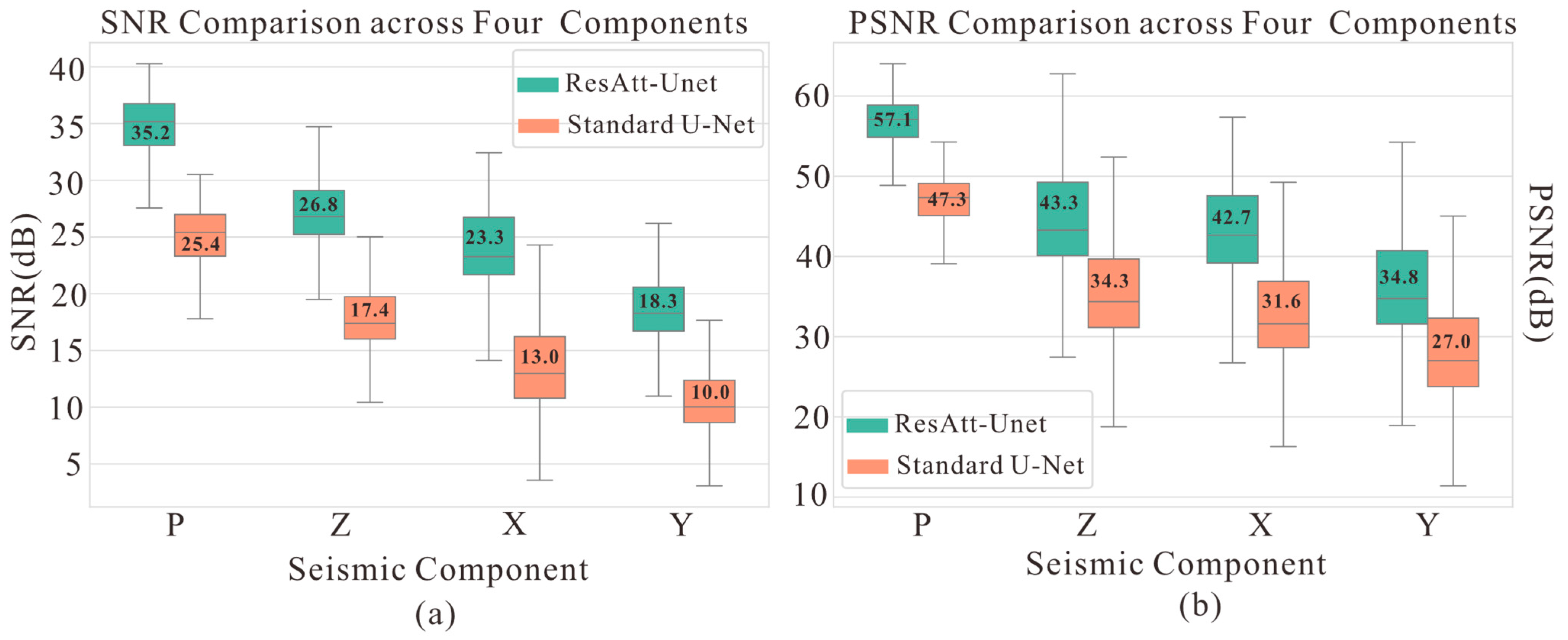
Statistical analysis using the grouped boxplot (Figure 15) demonstrates a consistent enhancement in performance. Compared to the standard U-Net, the ResAtt-Unet achieves an average median signal-to-noise ratio (SNR) improvement of approximately 10 dB, with specific gains of 9.8 dB, 9.4 dB, 10.3 dB, and 8.3 dB for the P-, Z-, X-, and Y-components, respectively. Specifically, for the P-component, our model achieves a median SNR of 35.2 dB, representing a 9.8 dB increase over the standard U-Net. Similarly, the median Peak signal-to-noise ratio (PSNR) gain for the Z-component reaches as high as 11.0 dB.
Despite these advantages, the reliance on high-quality ground-truth labels remains a bottleneck. In real marine geological environments, acquiring spatially continuous, gap-free, and high-signal-to-noise multi-component wavefields is extremely challenging in engineering practice, resulting in limited sample size and representativeness. Given the difficulty of acquiring gap-free, high-SNR OBN data in complex marine environments, future research should transition toward unlabeled or weakly supervised paradigms. Promising avenues include leveraging generative priors—such as deep image prior or diffusion models—to reconstruct sparsely sampled wavefields, thereby obviating the need for extensive labeled training sets.

5. Conclusions

This study has developed a frequency-domain ResAtt-Unet for intelligent interpolation of OBN multi-component seismic data. By integrating dual-branch processing of complementary component pairs and incorporating spectral feature enhancement and attention mechanisms, the model effectively preserves waveform integrity and physical consistency. Validation on field data demonstrates strong performance, particularly for P–Z components, with high correlation (median CC > 0.92) and spectral accuracy within the dominant frequency band. Although X–Y results show moderately reduced correlation, the majority of traces remain above the 0.70 accuracy threshold, confirming the method’s practical applicability. These results underscore the value of combining domain-aware architecture design with deep learning for multi-component seismic reconstruction, and highlight the potential for further generalization through expanded datasets and enhanced physical constraints.

Author Contributions

Conceptualization, P.Y.; Methodology, J.Z.; Software, J.Z.; Validation, J.Z.; Formal analysis, J.Z.; Resources, P.Y.; Writing—original draft, J.Z.; Writing—review & editing, J.Z. and P.Y.; Funding acquisition, P.Y. All authors have read and agreed to the published version of the manuscript.

Funding

This research was funded by the National Natural Science Foundation of China (Corresponding author: Pengfei Yu), grant number 42074149.

Data Availability Statement

The datasets analyzed during the current study are not publicly available due to the sensitive nature of marine geological data in the East China Sea. Data access is restricted by the relevant data privacy and security laws of the People’s Republic of China, and the data are therefore not available for public release.

Conflicts of Interest

The authors declare no conflict of interest.

References

  1. Xie, Y.H.; Ye, Y.F.; Huang, X.G.; Sun, W.B.; Wei, Y.W. Development Direction of Offshore Seismic Exploration Technology. Earth Sci. 2024, 49, 2301–2314. [Google Scholar] [CrossRef]
  2. Chen, X.Q.; Zhu, J.J.; Zhu, Q.L.; Jiao, Y.H.; Ding, X.X.; Liu, Z.Y.; Ding, D.; Jia, Y.G.; Li, S.Z.; Liu, Y.J. Fine Processing and Analysis of Multibeam Bathymetric Data Outlier from Surveying and Mapping in the South China Sea. Earth Sci. 2025, 50, 535–550. [Google Scholar]
  3. Ronen, J. Wave-equation trace interpolation. Geophysics 1987, 52, 973–984. [Google Scholar] [CrossRef]
  4. Jon, F.C.; Dave, N. Interpolation beyond aliasing by (t, x)-domain PEFs. In Proceedings of the 53rd EAEG Meeting, Florence, Italy, 26–30 May 1991. [Google Scholar]
  5. Spitz, S. Seismic trace interpolation in the F-X domain. Geophysics 1991, 56, 785–794. [Google Scholar] [CrossRef]
  6. Mostafa, N.; Mauricio, D.S. Beyond alias hierarchical scale curvelet interpolation of regularly and irregularly sampled seismic data. Geophysics 2010, 75, WB189–WB202. [Google Scholar] [CrossRef]
  7. Anat, C.; Gerald, H.F.G. Regularizing 3-D dataset with DMO. Geophysics 1996, 61, 1103–1114. [Google Scholar] [CrossRef]
  8. Naeini, E.Z.L.; Baboulaz, L.; Grion, S. Enhanced wavefield separation of OBS data. In Proceedings of the 73rd EAGE Conference and Exhibition incorporating SPE EUROPEC 2011, Vienna, Austria, 23–27 May 2011. [Google Scholar]
  9. Mostafa, N.; Mauricio, D.S. Multistep autoregressive reconstruction of seismic records. Geophysics 2007, 72, V111–V118. [Google Scholar] [CrossRef]
  10. Zhang, P.; Han, X.Y.; Chen, C.L.; Liu, X.M. Simultaneous seismic data de-aliasing and denoising with a fast adaptive method based on hybrid wavelet transform. Geophys. Prospect. 2024, 72, 3038–3051. [Google Scholar] [CrossRef]
  11. Felix, J.H.; Gilles, H. Non-parametric seismic data recovery with curvelet frames. Geophys. J. Int. 2008, 173, 233–248. [Google Scholar] [CrossRef]
  12. Shao, J.; Wang, Y.B. Seismic data antialiasing interpolation using sparse Radon transform and dynamic function. Geophysics 2022, 87, V437–V449. [Google Scholar] [CrossRef]
  13. Shao, J.; Wang, Y.B.; Chang, X. Radon domain interferometric interpolation of sparse seismic data. Geophysics 2021, 86, WC89–WC104. [Google Scholar] [CrossRef]
  14. Liang, J.; Ma, J.; Zhang, X. Seismic data restoration via data-driven tight frame. Geophysics 2014, 79, V65–V74. [Google Scholar] [CrossRef]
  15. Oropeza, V.; Sacchi, M. Simultaneous seismic data denoising and reconstruction via multichannel sin-gular spectrum analysis. Geophysics 2011, 76, V25–V32. [Google Scholar] [CrossRef]
  16. Jia, Y.N.; Ma, J.W. What can machine learning do for seismic data processing? An interpolate-on application. Geophysics 2017, 82, V163–V177. [Google Scholar] [CrossRef]
  17. Zhang, H.; Yang, X.Y.; Ma, J.W. Can learning from natural image denoising be used for seismic data interpolation. Geophysics 2020, 85, WA115–WA136. [Google Scholar] [CrossRef]
  18. Liu, Y.; Simmons, J. Feasibility study of fracture interpretation using multicomponent seismic data: SEAM II Barrett model. Interpretation 2021, 9, T1187–T1200. [Google Scholar] [CrossRef]
  19. Zhao, M.X.; Pan, X.; Xiao, S.P.; Zhang, Y.Q.; Tang, C.; Wen, X.T. Seismic Data Interpolation Based on Spectrally Normalized Generative Adversarial Network. IEEE Trans. Geosci. Remote Sens. 2023, 61, 5915611. [Google Scholar] [CrossRef]
  20. Chang, D.K.; Yang, W.Y.; Yong, X.S.; Zhang, G.Z.; Wang, W.L.; Li, H.S. Seismic Data Interpolation Using Dual-Domain Conditional Generative Adversarial Networks. IEEE Geosci. Remote Sens. Lett. 2021, 18, 1856–1860. [Google Scholar] [CrossRef]
  21. Brandolin, F.; Ravasi, M.; Alkhalifah, T. Pwd-pinn: Slopeassisted seismic interpolation with physics-informed neural networks. In Second International Meeting for Applied Geoscience & Energy; Society of Exploration Geophysicists and American Association of Petroleum Geologists: McLean, VA, USA, 2022; pp. 2046–2650. [Google Scholar] [CrossRef]
  22. Brandolin, F.; Ravasi, M.; Alkhalifah, T. PINN slope: Seismic data interpolation and local slope estimation with physics informed neural networks. Geophysics 2024, 89, V331–V345. [Google Scholar] [CrossRef]
  23. Gao, H.; Zhang, J. Simultaneous denoising and interpolation of seismic data via the deep learning method. Earthq. Res. China 2019, 33, 37–51. [Google Scholar]
  24. Fang, W.Q.; Fu, L.H.; Xu, W.T.; Bian, A.F.; Li, H.W. CCNet-5D: 5D convolutional neural network for seismic data interpolation. Geophysics 2023, 88, V333–V344. [Google Scholar] [CrossRef]
  25. Omar, M.S.; Islam, H.; Chen, Y. Unsupervised deep-learning framework for 5D seismic denoising and interpolation. Geophysics 2024, 89, V319–V330. [Google Scholar] [CrossRef]
  26. Gao, W.; Liu, D.; Chen, W.; Sacchi, M.D.; Wang, X. NERSI: Neural Implicit Representations for 5D Seismic Data Interpolation. Geophysics 2025, 90, V29–V42. [Google Scholar] [CrossRef]
  27. Gao, W.; Fu, L.H.; Fang, W.Q.; Wu, J.H.; Wang, Y. Seismic data reconstruction via a hybrid convolutional neural network-low-rank method. Geophysics 2025, 90, V123–V136. [Google Scholar] [CrossRef]
  28. Fang, W.Q.; Fu, L.H.; Zhang, M.; Li, Z.M. Seismic data interpolation based on U-net with texture loss. Geophysics 2021, 86, V41–V54. [Google Scholar] [CrossRef]
  29. Ou, B.L.; Zeng, T.S.; Liu, T.C.; Gao, H.T.; Li, Z.X.; Li, Z.C. Seismic data reconstruction and de-noising based on Huber-U-Net network. Prog. Geophys. 2023, 38, 2540–2552. [Google Scholar] [CrossRef]
  30. Fomel, S. Local seismic attributes. Geophysics 2007, 72, A29–A33. [Google Scholar] [CrossRef]
  31. Shakhawat, H. Application of seismic attribute analysis in fluvial seismic geomorphology. J. Pet. Explor. Prod. Technol. 2020, 10, 1009–1019. [Google Scholar] [CrossRef]
  32. Glorot, X.; Bengio, Y. Understanding the difficulty of training deep feedforward neural networks. J. Mach. Learn. Res. 2010, 9, 249–256. [Google Scholar]
  33. LeCun, Y.; Bengio, Y.; Hinton, G. Deep learning. Nature 2015, 521, 436–444. [Google Scholar] [CrossRef] [PubMed]
  34. Fu, C.; Lin, N.T.; Zhang, D.; Wen, B.; Wei, Q.Q.; Zhang, K. Prediction of reservoirs using multi-component seismic data and the deep learning method. Chin. J. Geophys. 2018, 61, 293–303. [Google Scholar] [CrossRef]
  35. Liu, Q.; Fu, L.H.; Zhang, M. Deep-seismic-prior-based reconstruction of seismic data using convolutional neural networks. Geophysics 2021, 86, V131–V142. [Google Scholar] [CrossRef]
Figure 1. The workflow and structure for the ResAtt-Unet.
Jmse 14 00317 g001
Figure 2. OBN acquisition geometry diagram: (a) geolocation; (b) acquisition geometry.
Jmse 14 00317 g002
Figure 3. P-component interpolation results: (a) pre-interpolation seismic data, (b) post-interpolation seismic data. Z-component interpolation results: (c) pre-interpolation seismic data, (d) post-interpolation seismic data.
Jmse 14 00317 g003
Figure 4. Spectrum analysis of the P-component interpolation results: (a) normalized spectrum, (b) power spectrum, (c) cumulative energy spectrum. Spectrum analysis of the Z-component interpolation results: (d) normalized spectrum, (e) power spectrum, (f) cumulative energy spectrum. In some subfigures, the lines for Original and Reconstructed data overlap due to the high fidelity of the reconstruction.
Jmse 14 00317 g004
Figure 5. Single-trace analysis of the P-component interpolation results: (a) seismic record of trace #100, (b) frequency spectrum analysis.
Jmse 14 00317 g005
Figure 6. Single-trace analysis of the Z-component interpolation results: (a) seismic record of trace #100, (b) frequency spectrum analysis.
Jmse 14 00317 g006
Figure 7. Correlation coefficient of the interpolation results: (a) P-component, (b) Z-component.
Jmse 14 00317 g007
Figure 8. P-component: (a) correlation coefficient distribution, (b) correlation coefficient analysis; Z-component: (c) correlation coefficient distribution, (d) correlation coefficient analysis. The orange curves in (a,c) represent the fitted curves, and the orange vertical lines in (b,d) indicate the median values.
Jmse 14 00317 g008
Figure 9. X-component interpolation results: (a) pre-interpolation seismic data, (b) post-interpolation seismic data. Y-component interpolation results: (c) pre-interpolation seismic data, (d) post-interpolation seismic data.
Jmse 14 00317 g009
Figure 10. Spectrum analysis of the X-component interpolation results: (a) normalized spectrum, (b) power spectrum, (c) cumulative energy spectrum. Spectrum analysis of the Y-component interpolation results: (d) normalized spectrum, (e) power spectrum, (f) cumulative energy spectrum. In some subfigures, the lines for Original and Reconstructed data overlap due to the high fidelity of the reconstruction.
Jmse 14 00317 g010
Figure 11. Single-trace analysis of the X-component interpolation results: (a) seismic record of trace #100, (b) frequency spectrum analysis.
Jmse 14 00317 g011
Figure 12. Single-trace analysis of the Y-component interpolation results: (a) seismic record of trace #100, (b) frequency spectrum analysis.
Jmse 14 00317 g012
Figure 13. Schemes follow another format. If there are multiple panels, they should be listed as (a) description of what is contained in the first panel and (b) description of what is contained in the second panel.
Jmse 14 00317 g013
Figure 14. X-component: (a) correlation coefficient distribution, (b) correlation coefficient analysis; Y-component: (c) correlation coefficient distribution, (d) correlation coefficient analysis. The orange curves in (a,c) represent the fitted curves, and the orange vertical lines in (b,d) indicate the median values.
Jmse 14 00317 g014
Figure 15. Quantitative performance comparison between the proposed ResAtt-Unet and the standard U-Net baseline. (a) Grouped boxplot of SNR (dB) across P-, Z-, X-, and Y-components; (b) grouped boxplot of PSNR (dB) distributions. The consistent superiority of the proposed model across all components validates the effectiveness of the spatial attention and frequency-domain modules.
Jmse 14 00317 g015
Table 1. Summary of nomenclature.
Symbol X E l (⋅) C l (⋅) W D (⋅)
DescriptionInput seismic data tensor, X R B × C × H × W Encoder operation at layer l Skip connection operation at layer l Channel-wise concatenationConvolutional operatorElement-wise (Hadamard) productConvolutional kernelOutput prediction
Table 2. Summary of training hyperparameters.
ParametersNetwork ArchitectureInitial Learning RateOptimizerTraining EpochsLoss FunctionData Split (Train/Test)Validation Method
Values11-layers10−4Adam100L1 + Lmse85%/15%5-fold Cross-validation
Disclaimer/Publisher’s Note: The statements, opinions and data contained in all publications are solely those of the individual author(s) and contributor(s) and not of MDPI and/or the editor(s). MDPI and/or the editor(s) disclaim responsibility for any injury to people or property resulting from any ideas, methods, instructions or products referred to in the content.