Article

Slow Steaming and Just-In-Time (JIT) Arrival Strategies in Maritime Logistics: Exploratory Analysis on Shipping Segments and Potential Challenges for Dry Bulk Carriers

by
Angelos A. Menelaou
,
Sergey Popravko
and
Illya Bronnikov
*
Department of Maritime Transport and Commerce, School of Business and Law, Frederick University, Nicosia 1036, Cyprus
*
Author to whom correspondence should be addressed.
J. Mar. Sci. Eng. 2026, 14(3), 299; https://doi.org/10.3390/jmse14030299
Submission received: 3 September 2025 / Revised: 15 January 2026 / Accepted: 22 January 2026 / Published: 3 February 2026
(This article belongs to the Section Marine Environmental Science)

Abstract

The maritime industry is undergoing significant transformation, necessitating a reassessment of operational strategies, particularly for bulk carriers. Unlike container ships or ferries, which benefit from speed optimisation and real-time operational adjustments, bulk carriers face distinct challenges arising from rigid scheduling practices and the inherent complexities of cargo handling. Variability in loading and unloading processes, fluctuating discharge rates, and port congestion further constrain the practical implementation of Just-In-Time (JIT) arrival strategies in this segment. Through an exploratory analysis of major shipping segments, this study examines the structural challenges and operational limitations associated with the application of JIT port-arrival concepts in dry bulk shipping.

1. Introduction

Maritime transport is facing increasing regulatory pressure to reduce greenhouse gas (GHG) emissions, driven by both international climate targets and regional market-based mechanisms [1,2,3]. A key regulatory milestone is the inclusion of maritime transport in the European Union Emissions Trading System (EU ETS), which from 1 January 2024 subjects CO2 emissions from ships of 5000 gross tonnage and above calling at EU ports to emissions trading [4]. Compliance with the EU ETS requires verified, voyage-level reporting of fuel consumption and CO2 emissions under the EU Monitoring, Reporting and Verification (MRV) framework [4,5].
Among these measures, slow steaming and Just-In-Time (JIT) arrival are frequently highlighted due to their immediate emissions reduction potential, with slow steaming relying on speed reduction and JIT aiming to minimise anchorage and waiting times through improved arrival coordination [6,7,8,9].
In liner shipping segments such as container vessels, Ro-Ro ships, and ferries, fixed schedules, coordinated berth allocation, and advanced port digitalisation enable the systematic application of JIT arrival concepts [10,11,12,13]. By contrast, dry bulk shipping operates under fundamentally different conditions, including voyage-by-voyage chartering, laycan-based arrival windows, uncertain cargo readiness, and highly variable berth availability [11,12,13]. These structural characteristics limit arrival time predictability and constrain the practical implementation of JIT strategies, making the direct transfer of findings from liner shipping studies to dry bulk carriers problematic [11,12,13,14].
Despite this distinction, much of the existing literature on JIT arrival and port call optimisation relies on Automatic Identification System (AIS) data to reconstruct vessel movements and speed profiles [15,16,17,18]. While AIS data are suitable for analysing navigational behaviour, they do not provide verified information on fuel consumption, emissions, or contractual conditions [15,16,17,18]. This limits their usefulness for evaluating operational measures within regulatory compliance frameworks such as the EU ETS, where verified emissions data form the basis for financial obligations [4,5].
As a result, a clear research gap exists between optimisation-oriented studies of JIT arrival and the practical requirements faced by dry bulk operators under emissions-trading regimes [15,16,17,18,19,20]. There is a lack of quantitative assessments that evaluate the feasibility and emissions reduction potential of operational measures for dry bulk carriers using verified, voyage-level emissions data while explicitly accounting for the uncertainty inherent in bulk trades [1,2,3,4,5,21,22].
This study addresses this gap by providing a regulatory-aligned, data-driven assessment of slow steaming and JIT-related operational strategies for dry bulk carriers within the EU ETS framework. Using EU MRV data, the analysis adopts an exploratory yet quantitatively grounded approach to evaluate how operational and near-term technical measures perform under real-world constraints [4,21,22].
Specifically, the study combines a comparative analysis across major shipping segments—container vessels, Ro-Ro ships, and ferries—with a detailed case study of a Panamax dry bulk carrier partially operating within European waters [10,11,12,13,14]. The objective is to assess the emissions reduction potential of selected operational measures under real-world conditions and to explore how their effectiveness can be enhanced through synergies with hydrodynamic efficiency improvements and the adoption of Onshore Power Supply (OPS) within the EU ETS framework [23,24].

2. Materials and Methods

This study applies an exploratory and comparative methodological framework to assess operational and near-term technical CO2 abatement measures in maritime shipping under the European Union Emissions Trading System (EU ETS), with a particular focus on dry bulk carriers. The methodological approach is explicitly designed to reflect real-world operational constraints, contractual conditions, and regulatory compliance requirements, rather than to optimise idealised or fully deterministic scenarios. This positioning is consistent with the study’s objective of evaluating the practical feasibility and emissions reduction potential of operational measures under conditions representative of contemporary shipping operations.

2.1. Scope and Data Sources

The methodology combines an extensive review of the relevant scientific and regulatory literature with an empirical analysis based predominantly on secondary data, which constitute the principal source of quantitative evidence in this study. The primary empirical dataset is derived from the THETIS-MRV system, established under the European Union’s Monitoring, Reporting and Verification (MRV) framework [4,5]. The THETIS-MRV system provides verified, voyage-level records linking fuel consumption, CO2 emissions, and operational performance for ships subject to EU MRV requirements.
THETIS-MRV data were selected as the principal source of information because they offer direct, regulator-verified evidence of emissions and fuel use at the voyage level, which is essential for evaluating decarbonisation measures within the EU ETS context [4,5]. In contrast, Automatic Identification System (AIS) data, although widely used in studies of vessel movement and speed optimisation, do not consistently provide reliable information on fuel consumption, verified emissions, cargo readiness, or port and berthing operations [15,16,17,18]. These limitations restrict the suitability of AIS-based datasets for assessing operational decarbonisation options such as slow steaming, JIT arrival, or voyage optimisation strategies in a regulatory compliance framework.
The evaluation of such measures requires data that directly link operational decision-making with verified emissions outcomes and commercial constraints, which cannot be robustly obtained from AIS information alone. The THETIS-MRV dataset therefore serves as a legitimate and methodologically appropriate secondary-data proxy for primary data, due to its granularity, reliability, and direct relevance to the objectives of this research. In particular, the dataset provides systematic, vessel-specific information on CO2 emissions, fuel consumption, and voyage operational characteristics, enabling a detailed assessment of operational measures under real-world conditions [4,5,21,22].
Within this methodological framework, a comparative analysis is conducted to examine the applicability and performance of JIT arrival and slow steaming strategies across different vessel segments, including container ships, Ro-Ro vessels, ferries, and dry bulk carriers. This comparative approach aims to identify the operational, regulatory, and technical criteria that influence the feasibility and effectiveness of these decarbonisation strategies within each segment. By analysing differences in trading patterns, contractual arrangements, and port interfaces, the study provides a structured assessment of both the constraints and opportunities for energy efficiency improvements that are specific to each shipping sector.
To support the quantitative analysis and ensure methodological consistency, supplementary parameters are obtained from established international and industry sources. These include emission factors, fuel properties, and sectoral benchmarks derived from:
  • IPCC Guidelines for National Greenhouse Gas Inventories (2006), providing internationally recognised emission factors and methodological frameworks for greenhouse gas accounting [5];
  • IMO Fourth Greenhouse Gas Study (2020), supplying sectoral emissions data, fuel characteristics, and broader decarbonisation context for maritime transport [1,2];
  • Methanol guidance documents, offering fuel-specific emission factors and performance data for methanol as an alternative marine fuel [25];
  • ISO 8217 Marine Fuel Specification Standard, detailing the classification and physicochemical properties of marine fuels, including Marine Diesel Oil (MDO) and methanol [26];
  • Clarkson Research (2023), providing market and operational benchmarks for the dry bulk carrier segment [11];
  • UNCTAD (2023), offering global shipping statistics and contextual information on maritime transport and trade [3].
Collectively, these sources provide the emission factors, fuel characteristics, and methodological protocols required to evaluate and verify emissions under different operating conditions. Their application ensures consistency, comparability, and scientific validity of the results across vessel types, with particular emphasis on dry bulk ships and operational decarbonisation strategies.

2.2. Operational and Near-Term Technical Measures Evaluated

The study evaluates a set of operational and near-term technical measures relevant to emissions abatement in maritime shipping under the European Union Emissions Trading System (EU ETS). These measures are selected based on their practical applicability, regulatory relevance, and potential to deliver emissions reductions in the short to medium term without requiring large-scale capital investment. All measures are analysed within a unified methodological framework and are consistent with those illustrated in the Section 3.
With respect to slow steaming, the analysis evaluates different levels of speed reduction based on observed speed–power relationships derived from voyage-level operational data. This approach reflects one of the most widely applied operational strategies for reducing fuel consumption and CO2 emissions, exploiting the non-linear relationship between vessel speed and propulsion power [6,27]. The assessment focuses on speed reduction ranges that remain compatible with operational constraints, contractual arrangements, and schedule reliability.
In the case of JIT arrival and Virtual Arrival concepts, the study examines their potential to reduce anchorage and waiting times by adjusting vessel speed prior to port arrival. Rather than treating JIT as a deterministic optimisation problem, the analysis explicitly accounts for uncertainty in berth availability, cargo readiness, and port coordination. This framing allows the feasibility of JIT-related measures to be assessed under real-world operating conditions, particularly for vessel segments characterised by high operational variability [8,9,16,17,18,19].
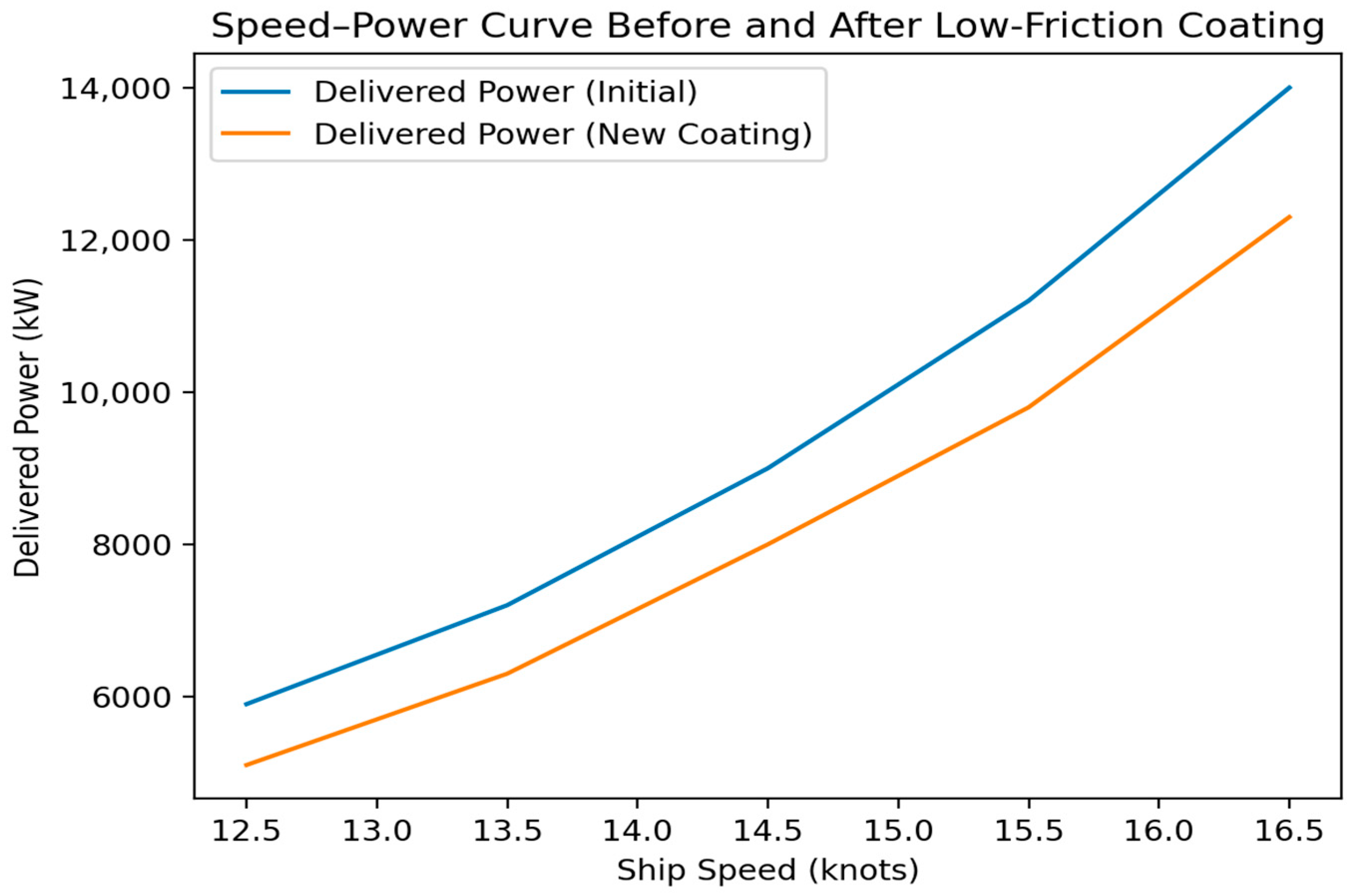
Hydrodynamic efficiency improvements are considered through the application of low-friction hull coating upgrades, which reduce hydrodynamic resistance and lower the propulsion power required to maintain a given service speed. The analysis evaluates how such improvements affect baseline fuel consumption and emissions intensity, as well as how they interact with operational measures such as slow steaming [24,28].
Port-based measures such as Onshore Power Supply (OPS) are assessed by analysing the elimination of auxiliary engine emissions during port stays where shore-side electricity infrastructure is available. This measure is evaluated as a targeted emissions abatement option that operates independently of voyage scheduling and sailing speed, but whose applicability depends on port infrastructure and regulatory implementation [29,30,31,32,33,34,35,36].
Fuel substitution options are evaluated by assessing the partial replacement of conventional marine fuels with methanol on an energy-equivalent basis. This approach accounts for differences in energy density and emission factors, enabling a consistent comparison of emissions outcomes across fuel types within the same operational framework [23,30].
Where applicable, interaction effects between operational and technical measures are explicitly examined. Combined scenarios are analysed to assess whether synergies between measures—such as the joint application of slow steaming and hydrodynamic efficiency improvements—yield cumulative emissions reductions beyond those achieved by individual interventions. These combined scenarios are presented consistently with the figures and tables reported in the Section 3 (Section 3.7 and Section 3.7.2).

2.3. Analytical Approach and EU ETS Alignment

The results of the study are analysed using a combination of comparative metrics and exploratory visualisations to illustrate emissions reduction potential, cost-related implications, and implementation barriers across different vessel types and operational contexts. This analytical approach is designed to support knowledge discovery and policy-relevant insight, rather than to derive statistically optimal solutions based on idealised assumptions.
In line with the exploratory nature of the study, the methodology prioritises transparency and interpretability over model complexity. The analysis reflects the heterogeneous and operationally constrained nature of maritime shipping, where variability in trading patterns, port operations, and contractual arrangements limits the applicability of deterministic optimisation models, particularly for dry bulk carriers.
All evaluated operational and technical measures are embedded within a unified analytical framework aligned with the EU ETS. This alignment ensures that emissions outcomes are interpreted in terms of verified CO2 reductions and their implications for emissions allowance requirements under current and future carbon pricing regimes [4,5,37]. By explicitly linking operational performance to regulatory exposure, the methodology enables a transparent comparison of decarbonisation strategies from the perspective of shipowners, operators, and policymakers.
This approach supports informed decision-making by highlighting not only the theoretical emissions reduction potential of individual measures, but also their practical feasibility, robustness under uncertainty, and relevance within an emissions trading context.

3. Results

3.1. Strategies to Comply with Environmental Requirements in the Shipping Industry

3.1.1. Technological Innovation and Engine Optimisation

A wide range of technological solutions is available to reduce emissions through hull design and machinery optimisation. Innovations such as improved hull forms, advanced surface coatings, wind-assisted propulsion, and air lubrication technologies reduce hydrodynamic resistance and propulsion power demand, leading to lower fuel consumption and operational CO2 emissions under comparable operating conditions [24,28].
Machinery-related innovations further complement hull-based improvements. The results highlight the role of hybrid-powered systems, alternative fuel pathways such as ammonia-hydrogen combustion, and exhaust after-treatment technologies, including selective catalytic reduction (SCR), in reducing both CO2 and NOx emissions [27,31].
In addition, auxiliary technologies such as waste heat recovery systems, increased electrification of onboard systems, and advanced decision-support tools contribute to incremental efficiency gains when assessed across complete voyage cycles [15,29].
Recent developments in fuel and engine technology also play a significant role in emissions performance. Electronically controlled engines, including low-speed engines and gensets designed for the combustion of low-carbon and alternative fuels—such as methanol, ammonia, and liquefied natural gas (LNG)—demonstrate improved fuel economy and compliance with current IMO requirements [29,30,31]. Dual-fuel engine concepts, such as the WinGD X-DF series, incorporate advanced combustion control and turbocharging technologies and, when combined with operational measures such as speed management and route planning, support emissions reductions aligned with long-term sustainability objectives [30].

3.1.2. Adoption of Sustainable Fuels

The transition toward sustainable marine fuels constitutes a key component of current decarbonisation strategies in the shipping sector. Conventional fuels such as heavy fuel oil (HFO) and low-sulphur fuel oil (LSFO) are increasingly complemented by alternative fuels, including LNG and methanol, in response to tightening emissions regulations [1,23].
Among these options, methanol emerges as a fuel that offers a balance between reduced emissions potential and technical compatibility with existing propulsion systems. However, the results indicate that the economic and environmental performance of alternative fuels is strongly influenced by regional fuel prices, infrastructure availability, and regulatory frameworks. As reported by Yang and Zou [32], regional differences in natural gas pricing and emissions regulation may allow HFO with exhaust gas cleaning systems to remain cost-effective in the short term, while methanol becomes increasingly attractive in regions subject to stricter emission requirements. These findings are consistent with recent assessments aligned with the 2023 IMO GHG reduction strategy [33].

3.1.3. International Collaboration and Legal Frameworks

The results indicate that the effectiveness of technological and operational decarbonisation strategies is closely linked to international cooperation and the development of coherent legal and regulatory frameworks. The International Maritime Organization (IMO) plays a central role in establishing global standards and facilitating the harmonised adoption of emissions reduction measures across the shipping industry [34].
Ongoing initiatives demonstrate that collaboration between governments, industry stakeholders, and research institutions supports both regulatory implementation and technological deployment. Frameworks such as the EU Emissions Trading System (EU ETS) and international programmes including GreenVoyage2050 provide institutional mechanisms that enable the practical uptake of decarbonisation measures across different shipping segments.

3.1.4. Operational Optimisation and Slow Steaming

Operational measures constitute an important category of emissions reduction strategies identified in the results. Approaches such as slow steaming and route optimisation directly affect fuel consumption and emissions by modifying vessel speed profiles and voyage trajectories. Slow steaming is shown to be effective in the short term, reducing fuel consumption without requiring additional capital investment.
The results also indicate that slow steaming involves trade-offs related to longer transit times, with implications for commercial performance depending on market conditions and contractual arrangements. Route optimisation strategies utilise advanced navigation systems and environmental data to reduce emissions over entire voyages. As shown by Yang and Zou [32], the effectiveness of these measures varies across vessel types and trading patterns, reinforcing the need for segment-specific assessment.

3.2. Reducing Emission from Shipping

The shipping sector remains one of the major contributors to global greenhouse gas (GHG) emissions, and considerable attention has been directed toward operational measures that can support near-term decarbonisation efforts. In line with the International Maritime Organization’s revised greenhouse gas reduction strategy, the industry has increasingly focused on procedural and operational interventions that can deliver emissions reductions without requiring immediate large-scale capital investments [4]. Among the most widely discussed and implemented strategies are slow steaming and JIT arrival.
Slow steaming involves the deliberate reduction of vessel sailing speed to lower fuel consumption and associated CO2 emissions, while JIT arrival focuses on adjusting speed profiles to minimise idle waiting time at anchor and improve port call efficiency. The results indicate that both strategies offer tangible emissions reduction benefits by reducing fuel use during voyages and limiting unnecessary auxiliary engine operation. In doing so, they contribute directly to compliance with increasingly stringent international emissions regulations and performance-based indicators.
In addition to their environmental benefits, slow steaming and JIT arrival are associated with important economic implications. Reduced fuel consumption under slow steaming can translate into lower voyage costs under comparable market conditions, given the dominant role of fuel expenses in total operating costs. Similarly, JIT arrival may improve operational efficiency by reducing periods of low-load operation and prolonged port waiting, effects that have been observed in highly coordinated port environments, as demonstrated by Sotiralis et al. [18] and Yu and Voß [13]. From a regulatory perspective, increased application of JIT arrival has also been linked to improved Carbon Intensity Indicator (CII) ratings for certain vessel categories, reinforcing its relevance within performance-based compliance frameworks, as reported by Kim and Eom [19].
At the same time, the results highlight several important trade-offs associated with the widespread adoption of these operational measures. Slower operating speeds inevitably increase transit times, which may raise inventory holding costs for cargo owners and affect overall supply chain performance. Empirical evidence from long-haul trades indicates that such impacts often require revised cost-sharing mechanisms between carriers and shippers to maintain economic viability, particularly under competitive market conditions, as discussed in the context of slow steaming impacts on carriers and shippers [21]. These trade-offs underscore the need to assess slow steaming strategies beyond fuel savings alone.
The implementation of JIT arrival also introduces operational complexity. Effective JIT operation requires advanced digital infrastructure, reliable real-time data exchange, and close coordination between vessels, terminals, and port authorities. Such requirements can pose significant challenges for smaller or less digitally advanced ports that lack the necessary technological capabilities, as highlighted in recent port operations studies by Sotiralis et al. [22] and Yu and Voß [13]. As a result, the feasibility of JIT arrival varies substantially across regions and port systems, limiting its uniform applicability.
At the fleet level, prolonged slow steaming may necessitate the deployment of additional vessels to maintain overall transport capacity in high-demand trades. System-level assessments indicate that operating larger fleets at reduced speeds can offset per-vessel emissions savings and, under certain market conditions, increase total operating costs, emphasising the importance of evaluating slow steaming strategies within a broader system context.
Additional technical constraints, including challenges associated with prolonged low-load engine operation and weather-induced speed limitations, further restrict the consistent application of speed reduction strategies under real-world operating conditions [6,21,31]. Together, these factors highlight the importance of segment-specific and system-level evaluation when considering operational decarbonisation measures.

3.3. Challenges in Meeting Emission Reduction Targets

The maritime transport sector plays a central role in global trade and logistics, while simultaneously facing significant challenges in reducing its carbon footprint, as observed in studies of coordinated port–ship interaction by Aroca et al. [32]. Achieving meaningful emissions reductions under increasingly stringent regulatory frameworks requires not only the application of individual operational measures, such as slow steaming, but also their integration within broader data-driven and collaborative operational frameworks. The results indicate that coordinated information exchange between ports and shipping companies, combined with operational speed management, represents a potentially effective pathway for reducing CO2 emissions while maintaining overall supply chain efficiency.
In this context, slow steaming and JIT-related practices emerge as measures whose effectiveness is strongly conditioned by the availability, timeliness, and quality of operational data, as well as by the degree of coordination between maritime stakeholders. The following subsections therefore examine key enabling factors and constraints associated with data-driven collaboration, the use of digital technologies in port operations, and the estimation of emissions reductions through integrated operational strategies.

3.3.1. Data-Driven Collaboration Between Ports and Shipping Companies

The results highlight that the practical implementation of slow steaming and JIT arrival depends critically on effective and timely data sharing between ports and shipping companies. Real-time exchange of information on berth availability, cargo readiness, and port operations enables vessels to adjust sailing speeds in advance, thereby reducing unnecessary waiting times and associated emissions, as observed in studies of coordinated port–ship interaction by Aroca et al. [32]. Such coordination allows operational decisions to be aligned more closely with actual port conditions, improving both emissions performance and schedule reliability.
Recent research underscores the role of digital platforms and advanced analytical tools in enabling this form of collaboration. Zavvos et al. [33] demonstrate that digital twin technologies, when applied within port-centric operational frameworks, can significantly enhance coordination among maritime stakeholders. By creating virtual representations of port operations, digital twins support the simulation and evaluation of alternative operational scenarios, allowing emissions reduction opportunities to be identified and assessed prior to real-world implementation.
The results further suggest that effective collaboration extends beyond bilateral ship–port interactions and requires seamless information flows across hinterland infrastructure and logistics networks. Networks of interconnected digital twins can facilitate this alignment by providing shared situational awareness and synchronised operational planning across multiple actors. Such integrated digital ecosystems support more efficient port-call processes and contribute to lower-emission outcomes under real-world operating conditions.

3.3.2. Role of Digital Technologies in Green Port Transformation

The findings further indicate that the transition toward greener port operations is closely linked to the adoption of digital technologies and data-driven coordination mechanisms. Key elements supporting green port transformation include integrated supply chain information platforms, advanced vessel scheduling systems, intelligent traffic management, and real-time monitoring of carbon emissions, as identified in recent assessments of digital port development by Su et al. [34]. Together, these components form the digital backbone required to align operational efficiency with environmental performance.
The application of such technologies enables ports to improve operational efficiency while simultaneously establishing the infrastructure necessary for systematic emissions monitoring and reduction. Optimised vessel scheduling, for example, can enhance arrival time accuracy and reduce anchorage waiting durations, thereby lowering fuel consumption and associated emissions. The results indicate that these effects are particularly pronounced in high-traffic ports, where congestion-related delays have a disproportionate impact on overall emissions outcomes.
By supporting more reliable arrival time predictions and improved coordination with shipping companies, digital port technologies provide a practical foundation for the implementation of JIT-related operational strategies. At the same time, the results highlight that the effectiveness of digitalisation efforts remains contingent on adequate investment, institutional coordination, and the interoperability of digital systems across ports and shipping lines, which ultimately determine their real-world emissions reduction potential.

3.3.3. Green Steaming and the Estimation of Carbon Savings

The concept of green steaming, which integrates elements of slow steaming and Just-In-Time (JIT) arrival, is identified as a practical approach for estimating potential carbon savings associated with coordinated operational measures. Previous studies have demonstrated that such approaches can be applied to quantify emissions reductions by analysing vessel speed profiles and port waiting times based on publicly available AIS data, providing insight into the relationship between operational behaviour and emissions outcomes, as shown in early AIS-based methodological applications by Watson et al. [35].
Case-based evidence further illustrates how green steaming concepts can be operationalised in port environments. A study conducted at the Port of Gothenburg demonstrates that coordinated speed reduction combined with improved arrival time management can yield measurable carbon savings, while also highlighting the importance of digital collaboration between ports and shipping companies in enabling such outcomes. Beyond their quantitative value, these applications underline the role of coordinated decision-making frameworks in translating operational adjustments into emissions reductions, as reflected in port-level analyses reported by Watson et al. [35].
At the same time, the results indicate that AIS-based green steaming analyses are subject to important limitations. While AIS data are well suited for reconstructing vessel movements and estimating potential emissions savings, they do not capture verified fuel consumption or emissions information. This constraint reinforces the need for complementary analyses based on regulator-verified datasets, such as EU MRV records, when assessing operational measures within a regulatory compliance context. Such combined approaches provide a more robust basis for evaluating the real-world emissions reduction potential of coordinated operational strategies.

3.3.4. The Role of Stakeholder Collaboration in Just-In-Time Navigation

The results indicate that the effectiveness of Just-In-Time (JIT) navigation and its associated emissions reduction outcomes depends strongly on coordinated action among multiple maritime stakeholders, including ports, shipping companies, and logistics operators. JIT-related strategies cannot be implemented solely at the vessel level, but instead require shared situational awareness and synchronised decision-making across the maritime transport chain to ensure consistent operational outcomes.
Within this context, Sea Traffic Management (STM) emerges as a key enabling framework for stakeholder collaboration. STM facilitates structured information exchange among maritime actors and supports coordinated voyage planning and execution. Empirical evidence reported by Aroca et al. [32] shows that STM-based coordination frameworks can deliver substantial reductions in fuel consumption and emissions in highly structured shipping segments, underscoring the role of coordinated navigation and arrival management in improving environmental performance.
By enabling real-time exchange of operational data, STM allows vessels to adjust speed, route, and arrival timing in response to changes in environmental conditions, port readiness, and traffic situations. Such data-driven coordination reduces unnecessary delays and mitigates emissions associated with idling, speed variability, and unplanned waiting. Under these conditions, slow steaming can be applied more effectively, as speed adjustments are informed by reliable shared information and do not compromise schedule reliability or operational performance.
At the same time, the results indicate that the effectiveness of JIT-related coordination frameworks remains highly context-dependent. While substantial benefits have been demonstrated in liner shipping environments characterised by high levels of digital integration and institutional coordination, the transferability of these approaches to less coordinated segments depends on data-sharing maturity, governance structures, and the consistency of stakeholder engagement [36]. These enabling conditions ultimately determine whether JIT navigation can be implemented in a systematic and repeatable manner beyond well-established liner services.

3.4. Application of Just-In-Time Strategies

The results indicate that the applicability and effectiveness of Just-In-Time (JIT) strategies vary substantially across shipping segments. JIT is particularly suited to container ships, Ro-Ro vessels, and ferries, which typically operate under structured schedules, standardised port interfaces, and relatively predictable berth allocation mechanisms [23,37]. In these segments, JIT strategies enable vessels to adjust sailing speeds in line with port readiness, supporting more efficient voyage execution and reduced environmental impact.
By synchronising voyage execution with port operations, JIT strategies minimise idle time at anchor and reduce unnecessary fuel consumption and associated emissions. As a result, JIT has become an increasingly relevant component of decarbonisation efforts in shipping segments characterised by high levels of coordination and digital integration. The following subsections examine the observed performance and implementation characteristics of JIT strategies for container ships and Ro-Ro vessels based on empirical evidence reported in the literature.

3.4.1. Just-In-Time Strategies for Container Ships

The results indicate that Just-In-Time (JIT) arrival strategies are particularly effective for container ships due to their large operational scale, high service frequency, and relatively predictable voyage patterns. In this segment, JIT approaches focus on minimising waiting times and fuel consumption by dynamically adjusting sailing speeds in coordination with berth allocation and terminal operations, thereby improving both operational efficiency and environmental performance [13,18].
Empirical evidence demonstrates that dynamic speed control implemented within a Just-In-Time (JIT) framework can deliver substantial fuel savings under realistic operating conditions. Recent research focusing on integrated voyage planning shows that reallocating port waiting time into voyage time through controlled speed adjustment can significantly reduce fuel consumption and associated emissions without compromising service reliability. Stochastic optimisation approaches applied to container ship arrivals indicate that dynamic speed coordination under uncertainty enables both improved punctuality and lower emissions, particularly when combined with real-time berth availability information [36]. Complementary port-centric studies further demonstrate that digital coordination frameworks, including the application of digital twin technologies, enhance the effectiveness of such JIT strategies by aligning vessel behaviour more closely with terminal readiness and port operational states [33]. Together, these findings confirm the substantial emissions reduction potential of JIT strategies in highly coordinated container shipping environments.
At the same time, the results indicate that effective JIT implementation for container ships depends strongly on advanced digital infrastructure and real-time information exchange. Digital decision-support systems integrating real-time vessel data, port status information, and predictive analytics are identified as key enablers of reliable JIT operations. Emerging digital technologies, including Internet of Things (IoT) devices and artificial intelligence (AI)-based optimisation tools, support real-time situational awareness and facilitate adaptive routing and speed control under dynamic operating conditions [38].

3.4.2. Just-In-Time Strategies for Ro-Ro Vessels

The application of Just-In-Time (JIT) strategies to Ro-Ro vessels presents both opportunities and constraints that differ from those observed in container shipping. Due to simplified cargo-handling processes and relatively short port turnaround times, Ro-Ro services can benefit from JIT primarily through further reductions in port-related waiting times and associated fuel consumption.
The results indicate that integrating JIT strategies with terminal-side operational improvements can deliver substantial emissions reductions. In particular, dual cycling operations—where loading and unloading are performed simultaneously—have been shown to enhance terminal efficiency and reduce fuel consumption and CO2 emissions by up to 25% under real-world conditions, as demonstrated by Jia et al. [39]. These findings highlight the effectiveness of combining JIT-related speed adjustment with process optimisation at the terminal level.
At the same time, the applicability of JIT strategies for Ro-Ro vessels remains context-dependent. While JIT-enabled Ro-Ro services can improve coordination across intermodal transport chains and reduce the overall environmental footprint of logistics operations, as discussed by Christodoulou et al. [10], their implementation is constrained by regulatory requirements, infrastructure availability, and port-specific operational standards. As noted by Mubder [20], these factors introduce variability in JIT feasibility across ports and regions, positioning Ro-Ro vessels between container shipping and ferry services in terms of systematic JIT applicability.

3.4.3. Just-In-Time (JIT) Strategies for Ferries and the Role of Virtual Arrival

The results indicate that Just-In-Time (JIT) arrival strategies are particularly well suited to ferry operations, especially for services operating on fixed routes with predefined schedules and high frequencies of port calls. Under such operating conditions, JIT primarily focuses on optimising sailing speed and arrival timing to minimise waiting at berth and anchor, which directly reduces fuel consumption and associated emissions. Empirical evidence shows that dynamic speed adjustment within a JIT framework can reduce greenhouse gas emissions by up to approximately 23% in coordinated ferry operations, reflecting the high level of predictability and institutional alignment characteristic of this segment, as demonstrated by Aroca et al. [32].
The emissions reduction potential of Just-In-Time (JIT) arrival in ferry services can be further enhanced when combined with complementary technologies. Conceptual and applied studies of electrically powered and hybrid Roll-on/Roll-off ferry systems indicate that integrating JIT arrival with electric propulsion, onboard energy storage, and advanced port technologies—such as real-time traffic management systems and automated berthing solutions—can significantly improve operational efficiency and emissions performance, particularly in environmentally sensitive and emission-regulated areas [40,41,42].
A comparative overview of the applicability of JIT arrival across vessel segments is provided in Table 1. As summarised in this table, JIT strategies exhibit high suitability for container ships and ferries due to structured schedules and predictable port interfaces, whereas Ro-Ro vessels display moderate suitability reflecting additional intermodal and operational coordination constraints.
In addition to JIT arrival, the results identify Virtual Arrival (VA) as a commercially grounded operational strategy that enables emissions reductions by relocating waiting time from anchorage to the voyage itself through controlled speed adjustment. The economic implications of Virtual Arrival are assessed using the Time Charter Equivalent (TCE) metric, expressed as:
TCE = (Voyage Revenue − Voyage Costs)/Voyage Days
This metric captures the trade-off between fuel savings and extended voyage duration under different market conditions and contractual arrangements. Empirical analyses show that VA can reduce fuel consumption and emissions in congestion-prone and schedule-driven trades by avoiding inefficient stop–start operations near ports and aligning economic incentives between contractual parties, as demonstrated by Jia et al. [9] and Venturini et al. [17].
At the same time, the applicability of Virtual Arrival is shown to be highly segment- and market-dependent. While VA can be effectively implemented in liner-oriented and ferry services characterised by predictable operations and contractual stability, its use in dry bulk shipping is more constrained due to uncertain cargo readiness, variable berth availability, and voyage-by-voyage chartering [14,44]. In this context, Virtual Arrival is best interpreted as a secondary operational measure, applicable where commercially viable conditions exist, rather than as a universally applicable emissions reduction strategy for bulk carriers.
Overall, the results confirm that both JIT arrival and Virtual Arrival represent valid operational concepts for emissions reduction and regulatory compliance under the European Union Emissions Trading System (EU ETS) and the IMO Carbon Intensity Indicator (CII). Their effectiveness, however, remains strongly segment-specific and market-dependent, reinforcing the need for differentiated operational decarbonisation strategies across maritime shipping segments.

3.5. Just-In-Time Policy for Bulk Carriers: Challenges and Historical Case Studies

3.5.1. Operational Complexity and Waiting Times

The results show that dry bulk carriers are particularly exposed to prolonged waiting times caused by port congestion, berth allocation constraints, and variability in cargo readiness. In major bulk export terminals, waiting times often constitute a dominant component of total voyage duration rather than marginal delays. Historical evidence from Hay Point, Australia, documents vessel queues of up to 70 ships and waiting periods of approximately 21 days, illustrating structural conditions under which adherence to predetermined arrival schedules is infeasible [14]. Under such circumstances, voyage-level speed adjustments have limited influence on overall waiting outcomes, fundamentally constraining the applicability of JIT arrival strategies in bulk trades.

3.5.2. Infrastructure Constraints at Bulk Ports

Infrastructure limitations further restrict the feasibility of JIT arrival for bulk carriers. Persistent capacity constraints and underinvestment at major bulk ports, including Newcastle and terminals in the Pilbara region, have resulted in chronic congestion and queuing that undermine arrival time predictability [11,14]. These conditions are exacerbated by privatised terminal operations and operational disruptions, creating highly uncertain berth availability that is incompatible with the coordinated timing required for systematic JIT implementation.

3.5.3. Risks Associated with Cargo Shift and Liquefaction

Cargo characteristics introduce additional non-negotiable constraints on JIT application in bulk shipping. Moisture-sensitive cargoes such as iron ore fines and nickel ores are susceptible to cargo shift and liquefaction, posing significant stability and safety risks. Compliance with the Transportable Moisture Limit (TML) under the IMSBC Code is essential, yet variability in testing protocols and uncertainty in moisture assessment complicate operational planning. As highlighted by Rose [45], these safety considerations limit arrival time flexibility and render speed adjustments or extended waiting incompatible with bulk cargo risk management requirements.

3.5.4. Structural Integrity and Maintenance Considerations

Structural integrity and maintenance considerations further constrain tightly synchronised JIT schedules for bulk carriers. Large vessels, particularly Capesize carriers, are vulnerable to structural fatigue and cracking due to high cargo densities and intensified loading cycles. Accelerated port operations associated with JIT-oriented scheduling can amplify these stresses, increasing long-term maintenance risks and reducing asset reliability, as noted by Hadjiyiannis [44]. These factors highlight a trade-off between short-term operational efficiency and long-term structural performance.

3.5.5. Environmental and Regulatory Compliance Constraints

From a regulatory and environmental perspective, the results indicate that the emissions reduction potential of JIT arrival for bulk carriers is constrained by a combination of fleet characteristics and compliance requirements. A substantial share of the existing bulk fleet may struggle to meet tightening carbon-intensity requirements without significant technical upgrades or retrofitting, as discussed by Kim and Eom [19]. Long fleet renewal cycles and capital-intensive investments further restrict the near-term applicability of JIT strategies, reinforcing that operational uncertainty, safety constraints, and regulatory readiness jointly limit the role of JIT arrival in dry bulk decarbonisation.

3.6. Historical Case Studies

Historical evidence provides valuable insights into the structural and market-related constraints that affect the applicability of JIT strategies in the dry bulk shipping sector. The following case studies illustrate how macroeconomic shocks, demand volatility, and the inherent operational characteristics of bulk shipping have historically limited the feasibility of coordinated arrival strategies.

3.6.1. Global Financial Crisis (2008)

The global financial crisis of 2008 led to a sharp contraction in demand for major bulk commodities, including coal and iron ore. This sudden reduction in cargo volumes resulted in a substantial oversupply of dry bulk carriers, creating persistent congestion at loading and discharging ports. As a consequence, vessels experienced prolonged waiting times and increased exposure to demurrage costs. These conditions highlighted the vulnerability of JIT concepts to abrupt market downturns, where excess capacity and port congestion undermine the predictability required for coordinated arrival strategies [46].

3.6.2. Surge in Bulk Demand During Economic Recovery

In contrast to the 2008 downturn, the year 2020 was characterised by a rapid surge in demand for bulk commodities, driven in part by China’s economic recovery. This sudden increase in cargo volumes overwhelmed bulk port infrastructure in several regions, leading to widespread congestion and operational delays. According to Kim and Eom [19], ports such as Pusan New International Port in South Korea experienced significant bottlenecks, as terminal capacity and hinterland logistics struggled to accommodate the abrupt demand spike. These events further demonstrate that both negative and positive demand shocks can disrupt JIT-based operational planning in bulk shipping.

3.6.3. Structural Characteristics of Dry Bulk Operations and Speed Reduction Trends

A longer-term industry trend further illustrates the structural mismatch between JIT concepts and dry bulk operations, as modern dry bulk carriers operate at significantly lower speeds than in previous decades, with average sailing speeds are estimated to be approximately 20% lower than those observed around 2008, reflecting rising fuel costs, environmental regulations, and the widespread adoption of slow steaming as a cost- and emissions-reduction strategy [6,7]. In the spot (tramp) shipping market that dominates the dry bulk sector, contractual arrangements based on laycan windows reduce the relevance of precisely timed arrival strategies. Laycan periods commonly span 10–15 days, incentivising early arrival to secure laytime commencement through the tendering of Notice of Readiness (NOR), even at the cost of extended anchorage waiting.
At the discharging stage, vessels are generally required to proceed with utmost dispatch, and operators seek to minimise delays through speed and route optimisation within prevailing constraints. Nevertheless, persistent global port congestion—observed again in 2024—continues to generate anchorage delays at both loading and discharging ports, reinforcing the structural difficulty of aligning dry bulk operations with JIT arrival practices under increasingly stringent regulatory and compliance requirements [47,48].
A comparative overview of historical case studies and key challenges affecting JIT implementation is provided in Table 2, which summarises the dominant constraints associated with demand shocks and the inherent operational characteristics of bulk shipping.
On the basis of historical evidence, the feasibility of operational decarbonisation strategies in dry bulk shipping cannot be adequately assessed using purely theoretical or optimisation-based frameworks. While previous studies have examined a wide range of operational and technological measures, bulk shipping requires empirically grounded analysis that reflects contractual practices, infrastructure constraints, and real-world operational variability. In response to this need, the present study adopts a systematic, visualisation-based approach using freely available and verified data to explore emissions reduction effects, fuel substitution options, and potential synergies between strategies under realistic operating conditions, as presented in the following section.

3.7. Exploratory Visualisation Analysis of Decarbonisation Pathways

This section reports the results of an exploratory visualisation analysis aimed at investigating potential pathways for decarbonising maritime transport. The analysis draws on open-source and institutional datasets, including IMO, Clarkson Research, UNCTAD and DNV [1,3,11,41], to provide a comprehensive overview of operational and technical decarbonisation options across shipping segments. Particular emphasis is placed on operational measures, notably slow steaming and JIT arrival, as well as on alternative fuels and onshore power supply, in order to contextualise their roles within broader decarbonisation trajectories.
All visualisations were produced using Python (Python 3.10)-based analytical tools, including Matplotlib (Matplotlib 3.8), NumPy (NumPy 1.26), and Pandas (Pandas 2.1), with Seaborn (v0.8) applied for consistent visual styling. Two complementary visualisation frameworks were developed. The first presents a high-level decarbonisation map, capturing emissions reduction potential, implementation barriers, technological readiness, integration synergies, and indicative roadmap timelines. The second framework provides an industry-specific analytical panel focused on the dry bulk carrier sector, highlighting operational constraints, investment implications, and fuel compatibility characteristics.
Consistent with the exploratory nature of the study, the visualisation analysis is intended to support knowledge discovery rather than to establish statistical certainty. The resulting figures provide a structured basis for interpreting decarbonisation potential and constraints across strategies and shipping segments. Although no formal parametric sensitivity model is applied, the scenario-based comparison of speed adjustment, waiting time reduction, and energy-equivalent fuel substitution functions as a practical sensitivity assessment under real-world operating conditions.
All input parameters, scenario assumptions, and analytical procedures required to reproduce the results are provided in the Supplementary Materials. Voyage-level emissions data are derived from the publicly accessible EU MRV (THETIS-MRV) database.

3.7.1. Visualisation Methodology

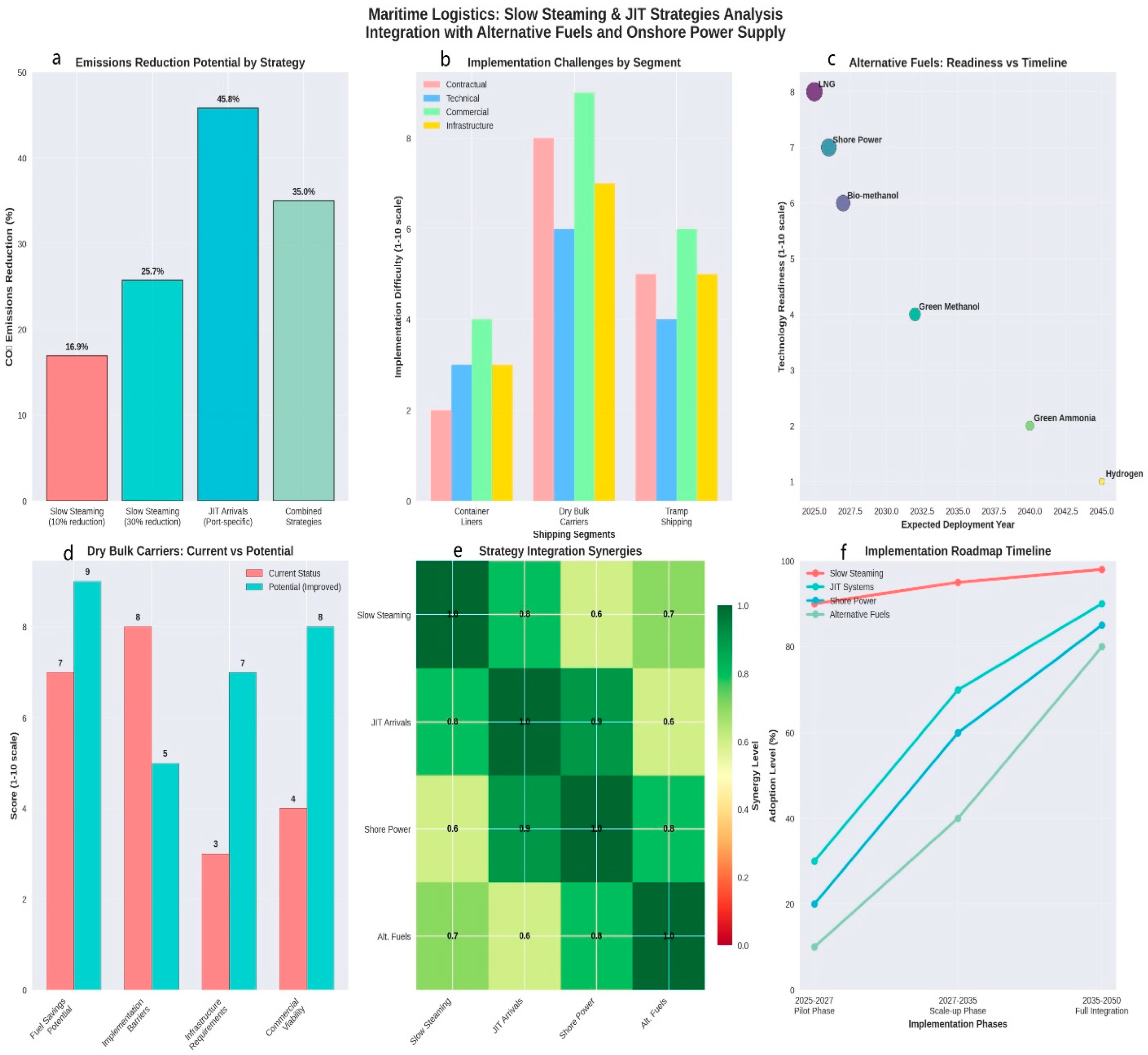
The visual analysis is organised around six principal subplots, each corresponding to a core dimension of the maritime decarbonisation challenge. Input datasets are structured using both discrete and continuous variables and are visualised through a combination of bar charts, scatter plots, heatmaps, and line plots. This composite approach enables cross-strategy comparison, assessment of anticipated implementation timelines, and evaluation of sector-specific impacts, consistent with recent synthesis-based assessments of maritime emission reduction strategies [49,50].
An equivalent set of visualisations is developed for the dry bulk shipping segment. This segment is characterised by distinctive contractual structures, operational dispersion, and infrastructure requirements that differ markedly from those observed in liner shipping contexts. The dry bulk-specific plots facilitate analysis of implementation barriers, investment payback conditions, and readiness for alternative fuels in a high-deadweight-tonnage (DWT) segment operating at a global scale.
Emissions Reduction Potential by Strategy
Figure 1a illustrates the estimated CO2 emissions reduction potential of individual and combined decarbonisation strategies, including slow steaming at two speed-reduction levels (10% and 30%), JIT arrival, and integrated operational packages.
The figure indicates that JIT arrival delivers the highest emissions reduction among individual operational measures, reaching up to 45.8%, while combined strategies achieve reductions of approximately 35.0%. Slow steaming results in emissions reductions of 16.9% and 25.7% for 10% and 30% speed reductions, respectively.
These findings indicate that substantial short-term emissions reductions can be achieved through operational measures alone, even in the absence of large-scale deployment of alternative fuels, with JIT-related reductions of up to 45.8% reported in container shipping operations [20].
Obstacles to Implementation by Shipping Segment
Figure 1b shows the relative severity of implementation barriers across container liner shipping, dry bulk carriers, and tramp shipping, evaluated across contractual, technical, commercial, and infrastructure dimensions. The figure demonstrates that dry bulk carriers face significantly higher contractual complexity and operational unpredictability compared with liner shipping, underscoring the need for segment-specific decarbonisation strategies.
The results show that dry bulk shipping exhibits lower general barriers to entry but higher contractual complexity and operational unpredictability, reflected in elevated difficulty scores. In contrast, container liner shipping demonstrates growing institutional and operational readiness for structured decarbonisation measures, suggesting a greater capacity for systematic implementation.
These results provide empirical evidence of segment-specific variation in decarbonisation readiness, underscoring the need for differentiated operational strategies rather than uniform policy prescriptions [23].
Alternative Fuels: Preparedness and Timing
Figure 1c illustrates the relationship between Technology Readiness Levels (TRLs) and anticipated deployment timelines for selected alternative marine fuels, including LNG, bio-methanol, green methanol, hydrogen, green ammonia, and shore power.
The results indicate that LNG and shore power exhibit relatively high TRLs (8 and 7, respectively), with near-term deployment anticipated during the 2025–2026 period. Bio-methanol, assessed at TRL 6, shows potential for commercial introduction around 2027. In contrast, hydrogen and green ammonia remain at early development stages (TRL 1–2), with widespread deployment projected beyond 2040.
These findings suggest a transitional role for LNG and methanol in the short to medium term, while hydrogen- and ammonia-based solutions remain long-term decarbonisation options [1,41].
Current Versus Potential Performance of Dry Bulk Carriers
Figure 1d compares the current and potential future performance of dry bulk carriers across multiple dimensions, including fuel-saving potential, implementation barriers, infrastructure requirements, and commercial viability. The comparison indicates that while present-day implementation barriers remain high, coordinated adoption of operational and technical measures could substantially improve future performance.
The results indicate that implementation barriers remain the most significant constraint, with high scores reflecting infrastructural and operational challenges. However, potential future performance shows marked improvements across all evaluated dimensions, particularly with respect to infrastructure preparedness and commercial viability. These improvements reflect the cumulative effects of coordinated intervention and gradual technology adoption [11,14].
Strategy Integration and Synergies
Figure 1e presents a heatmap illustrating interaction effects between slow steaming, JIT arrival, onshore power supply, and alternative fuels. The heatmap reveals strong qualitative synergies between JIT arrival and onshore power supply, as well as between slow steaming and JIT arrival, supporting the effectiveness of integrated decarbonisation pathways.
The results reveal particularly strong synergies between JIT arrival and onshore power supply, as well as between slow steaming and JIT arrival. These findings support the concept of integrated decarbonisation pathways, demonstrating that combined operational and energy-transition measures can enhance overall emissions reduction outcomes beyond those achievable through isolated interventions [6].
Implementation Roadmap Timeline
Figure 1f illustrates a staged implementation roadmap for maritime decarbonisation strategies, distinguishing short-term operational measures, medium-term system integration, and long-term fuel-transition pathways.
The roadmap identifies three sequential phases of adoption:
2025–2027 (Pilot Phase): Near-universal adoption of slow steaming.
2027–2035 (Scale-up Phase): Maturation and wider deployment of JIT systems and shore power.
2035–2050 (Full Integration Phase): Large-scale adoption of alternative fuels.
This phased roadmap aligns operational measures, technological readiness, infrastructure development, and policy support, reflecting current international decarbonisation objectives and regulatory trajectories [1,41].

3.7.2. Dry Bulk Carrier Segment Analysis

This subsection presents a segment-specific analysis of dry bulk carriers, based on the exploratory visualisation framework introduced in Section 3.7. The analysis focuses on operational constraints, solution potential, investment characteristics, fuel compatibility, and implementation timelines, reflecting the distinct contractual, infrastructural, and commercial conditions that characterise dry bulk shipping.
Operational Challenges and Solution Potential
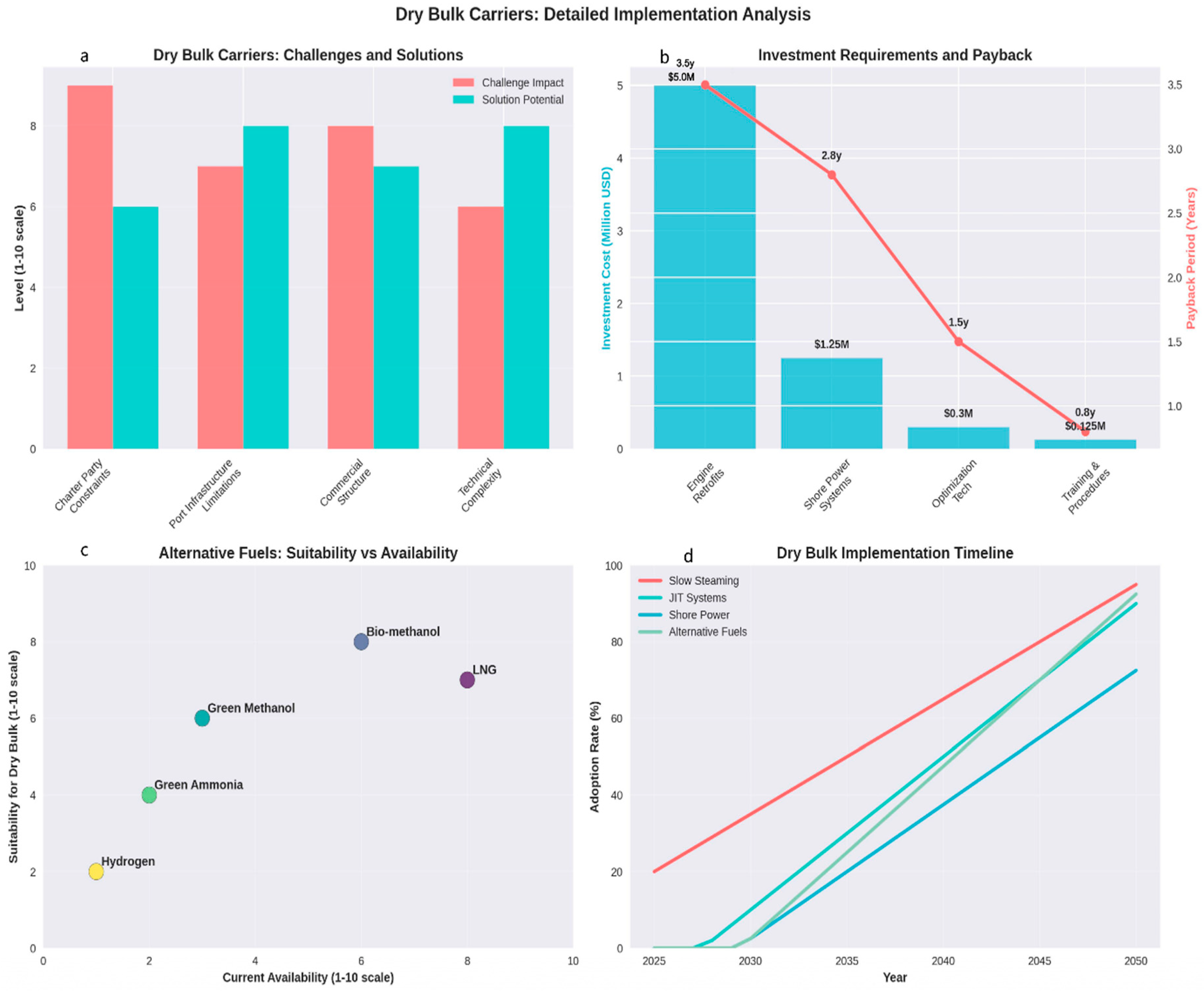
Figure 2a shows the relative influence of key operational challenges and mitigation potential for dry bulk carriers across charter party constraints, port infrastructure limitations, commercial structures, and technical complexity. The results indicate that charter party constraints represent the most significant bottleneck for the implementation of decarbonisation-oriented operational measures in the dry bulk segment, with an influence score of 9 out of 10. This finding reflects the dominance of voyage-based chartering, extended laycan windows, and limited flexibility in arrival timing, all of which constrain the application of coordinated strategies such as JIT arrival.
At the same time, the analysis identifies a moderate level of solution potential, assessed at 6 out of 10. This suggests that while contractual rigidity poses a substantial challenge, targeted regulatory measures, contractual innovation, or the introduction of standardised clauses enabling speed adjustment could partially mitigate these constraints over time.
Investment Requirements and Payback Characteristics
Figure 2b compares investment requirements and payback characteristics for selected decarbonisation interventions relevant to dry bulk carriers, including engine retrofits, onshore power supply, operational optimisation technologies, and crew training.
The results show that operational optimisation technologies and training initiatives are associated with low initial capital requirements and comparatively high ROI, making them attractive candidates for early-stage decarbonisation efforts. These measures can be implemented rapidly and deliver emissions reduction benefits without extensive modification of vessel hardware.
In contrast, engine retrofits require substantially higher upfront investment. However, the results indicate that such interventions can yield significant long-term emissions reductions, particularly when aligned with broader fuel-transition strategies. This highlights a trade-off between near-term economic feasibility and long-term decarbonisation impact in the dry bulk sector.
Compatibility of Alternative Fuels with Dry Bulk Operations
Figure 2c illustrates the relative suitability and current availability of alternative marine fuels for dry bulk carriers. The results indicate that LNG and bio-methanol achieve the highest combined scores for both suitability and availability. This finding underscores their role as transitional fuels for the dry bulk segment, supported by comparatively higher levels of technical maturity and emerging infrastructure.
By contrast, hydrogen and green ammonia exhibit substantially lower scores in both dimensions. Limited bunkering infrastructure, unresolved technical challenges, and low technology readiness levels currently represent significant barriers to their near-term adoption in dry bulk shipping.
Implementation Timeline for Dry Bulk Decarbonisation Pathways
Figure 2d presents an indicative implementation timeline for decarbonisation pathways in dry bulk shipping, from the post—2025 period through mid-century. The timeline demonstrates that operational measures precede capital-intensive technical and fuel-based interventions, reflecting the structural characteristics of the dry bulk sector.
The results indicate that slow steaming is likely to achieve widespread adoption by approximately 2035, reflecting its low capital requirements and immediate emissions reduction potential. Subsequent implementation of JIT arrival systems, onshore power supply, and alternative fuels is shown to depend strongly on the pace of infrastructure development, regulatory tightening, and policy support.
Overall, the implementation timeline reflects a staged transition, in which operational measures precede more capital-intensive technical and fuel-based interventions. This sequencing reflects the structural characteristics of the dry bulk sector and the need to balance emissions reduction objectives with operational and commercial feasibility.

3.8. Summary of Key Findings

The exploratory visualisation analysis reveals several overarching patterns that are consistent with, and extend, the core findings of this study regarding the decarbonisation potential of operational and near-term technical measures in maritime transport. With respect to operational practices, the results demonstrate that measures such as slow steaming and Just-In-Time (JIT) arrival can deliver substantial short-term reductions in CO2 emissions. These measures are characterised by relatively low capital requirements and can be implemented within existing fleet configurations, making them particularly relevant under current regulatory and market conditions, including the EU ETS framework.
In terms of fuel-transition pathways, the analysis shows that alternative marine fuels are at markedly different stages of technological maturity and deployment readiness. LNG and bio-methanol emerge as viable transitional fuels, supported by comparatively higher technology readiness levels and emerging infrastructure. In contrast, hydrogen and ammonia are identified as longer-term decarbonisation options, currently constrained by limited technical maturity, unresolved safety considerations, and insufficient bunkering infrastructure, consistent with recent system-level assessments of maritime fuel transitions [51].
From a segment-specific perspective, the findings highlight that dry bulk carriers face distinctive contractual and commercial constraints that differentiate them from liner-oriented shipping segments. Voyage-based chartering, laycan structures, and uncertainty in cargo readiness significantly restrict the applicability of coordinated arrival strategies such as JIT. These structural characteristics suggest that regulatory alignment, contractual innovation, or targeted policy instruments may be required to enable broader adoption of operational decarbonisation measures in the dry bulk sector.
Regarding strategy interaction, the results consistently indicate that integrated combinations of measures outperform isolated interventions. Synergies between operational practices, technical upgrades, and energy transition options enhance overall emissions reduction potential, reinforcing the importance of system-level and portfolio-based approaches to maritime decarbonisation.
Finally, in relation to implementation dynamics, the analysis supports a staged decarbonisation pathway. Near-term operational measures provide immediate and verifiable emissions reductions, while medium- and long-term progress depends on gradual technological adoption, infrastructure development, and sustained policy support. This phased approach aligns emissions reduction strategies with realistic timelines for technological readiness, market adaptation, and regulatory compliance.
The patterns observed in Figure 1 and Figure 2 can be interpreted in light of existing economic research on operational measures in maritime transport. Prior studies have predominantly analysed slow steaming and arrival time coordination using optimisation and cost-minimisation frameworks, typically assuming predictable schedules, rational speed adjustment, stable port operations, and effective coordination, even when stochastic elements are incorporated [52,53]. Within this literature, slow steaming is consistently identified as economically attractive under conditions of elevated fuel prices and excess fleet capacity, while coordinated arrival strategies are shown to generate efficiency gains when supported by reliable berth allocation and contractual alignment.
In contrast to these optimisation-based approaches, the present analysis adopts a complementary, evidence-based perspective grounded in observed operational performance under regulatory compliance conditions. Using verified EU MRV voyage data, the results capture realised fuel consumption and emissions outcomes in the presence of uncertainty, contractual rigidity, and port-related variability, which are particularly pronounced in dry bulk shipping. While recent optimisation-based studies—such as the work by Wang et al. [54]—demonstrate the theoretical attractiveness of speed optimisation and coordinated arrivals under structured assumptions and controlled operational environments, the MRV-based evidence presented here shows that, for dry bulk carriers, the practical effectiveness of Just-In-Time (JIT) strategies is structurally constrained. These constraints arise from laycan-based chartering practices, uncertain cargo readiness, and prolonged anchorage waiting times, which limit the transferability of optimisation-derived JIT benefits to real-world bulk shipping operations under the EU ETS framework.
At the same time, the findings reinforce the robustness of slow steaming as a reliable emissions reduction measure under the EU ETS framework, even when idealised coordination conditions are absent. By linking operational measures to verified emissions outcomes rather than simulated cost-optimal solutions, this study complements existing economic analyses and provides regulatory-relevant insight into how operational decarbonisation strategies perform under real-world conditions. The comparison highlights that while optimisation models remain valuable for identifying theoretical efficiency frontiers, MRV-based analyses are essential for assessing the feasibility, consistency, and regulatory effectiveness of operational measures in practice, particularly for shipping segments characterised by high operational and contractual uncertainty.

3.9. MRV-Based Case Study: Panamax Dry Bulk Carrier Under EU ETS

3.9.1. Case Study Scope and Data Source

To examine how theoretical operational measures align with real-world conditions, a case study based on verified voyage-level data is presented. The analysis evaluates the operational performance of a Panamax dry bulk carrier mv GxxxxxxS over a two-month period using Emission Voyage Statements submitted under the EU Monitoring, Reporting and Verification (MRV) system. The MRV data were accessed via the THETIS-MRV platform, which serves as the official EU repository for verified voyage-level emissions and fuel consumption data and constitutes the primary data source for EU ETS compliance.
The case study provides empirical insight into emissions performance and compliance implications within the European Union Emissions Trading System (EU ETS) framework.
CO2 emissions are calculated in accordance with Regulation (EU) 2023/2776, amending Regulation (EU) 2015/757. Under the EU MRV framework, ship-level CO2 emissions are calculated as:
CO2 emissions (kg) = Fuel Consumption (t) × Emission Factor (kg CO2/t of fuel)
where
F C i is the mass of fuel type i consumed (tonnes), and
E F i is the corresponding CO2 emission factor (kg CO2 per tonne of fuel), based on default regulatory or ISO values.

3.9.2. Emission Factors Applied

The emission factors presented in Table 3 are applied consistently throughout the analysis to ensure alignment with the EU MRV methodology and comparability across fuel types. These factors represent tank-to-wake CO2 emissions and are based on standardised default values, reflecting regulatory practice rather than fuel-specific lifecycle assessments. Their use enables a transparent comparison of operational emissions outcomes under different fuel and operating scenarios, while maintaining consistency with the reporting requirements of the EU Emissions Trading System (EU ETS).

3.9.3. Vessel and Voyage Characteristics

The analysed vessel is a Panamax bulk carrier (DWT: 81,305 t; GT: 44,336 t). The monitored voyage occurred between 22 September and 27 November 2024, covering a total distance of 8651 nautical miles. Fuel consumption consisted primarily of 864.35 t of HFO and 127.99 t of MGO.
The voyage included two port calls within EU territorial waters—Port of Marin (Spain) and Montoir (France)—allowing direct assessment of EU MRV and EU ETS exposure. This configuration enables a focused assessment of emissions, fuel consumption, and operational performance within EU territorial waters, where EU ETS obligations are directly applicable.
Table 4 summarises the disaggregated EU MRV-reported voyage legs, fuel consumption, and associated CO2 emissions for the analysed Panamax dry bulk carrier. The table distinguishes between sailing and port-stay phases, providing a detailed basis for assessing emissions distribution and anchorage-related waiting time relevant to the evaluation of Just-In-Time (JIT) feasibility.

3.9.4. EU ETS Legs and Fuel Consumption

The results show that only 40% of verified CO2 emissions were subject to EU ETS allowances in 2024, reflecting the transitional phase of maritime inclusion in the EU ETS. This phased coverage directly influences the effective carbon cost exposure of the analysed voyage and highlights the importance of accurately identifying EU-related voyage legs when assessing the economic implications of operational measures.

3.9.5. Port Stay, Waiting Time, and Operational Performance

The total voyage duration amounted to 24.84 days. Of this period, 4.93 days were spent berthed at the Port of Marin and 4.03 days at the Port of Montoir. Sailing between the two EU ports accounted for 2.05 days, while a total of 13.84 days were spent waiting at anchor prior to berthing.
As a result, anchorage waiting time accounted for more than 55% of the total voyage duration within European waters, making it the dominant operational component influencing overall voyage performance. This finding has direct implications for emissions outcomes and for the practical feasibility of implementing JIT arrival strategies under real-world dry bulk operating conditions.
Available port-level evidence supports the plausibility of these observed delays. Published port statistics and AIS-based studies indicate that average anchorage waiting times for bulk carriers typically range between 2–5 days at congested ports such as Santos (Brazil), approximately 2 days at French bulk ports, and around 3 days outside the Port of Baltimore [16,48].

3.9.6. Implications for JIT and Slow Steaming in Dry Bulk Shipping

The case study results indicate that, despite relatively well-organised European ports, JIT arrival strategies remain difficult to implement consistently in the dry bulk sector. This limitation is primarily driven by uncertainty in cargo readiness, variability in berth availability, and voyage-by-voyage chartering practices. The analysed vessel experienced prolonged anchorage periods that could not be mitigated through speed adjustments alone.
In contrast, slow steaming emerged as a more robust and operationally feasible measure, particularly on short intra-European legs. Speed reduction allowed fuel consumption and emissions savings to be achieved without reliance on precise berth coordination. However, its effectiveness is maximised when supported by appropriate berth planning and port–vessel coordination [55]. These findings indicate that, for dry bulk carriers, operational decarbonisation strategies beyond JIT and VA—most notably speed-based measures—play a critical role in reducing emissions under real-world operating conditions.

3.10. Fuel Carbon Factors and Energy-Equivalent Emissions

It is commonly assumed that marine fuels with a lower carbon factor (CF), such as methanol, inherently result in substantially lower CO2 emissions than conventional marine fuels. However, comparisons based solely on mass-based emission factors neglect the significantly lower energy density of alcohol-based fuels. As a consequence, a larger fuel mass is required to deliver an equivalent propulsive energy output.
To ensure a realistic and policy-relevant comparison, this study adopts an energy-equivalent assessment approach. Fuel consumption is adjusted according to the lower heating value (LHV) of each fuel prior to calculating CO2 emissions, ensuring that emissions are compared on the basis of equal delivered energy rather than equal fuel mass. This approach prevents overestimation of the emissions reduction potential of alternative fuels when assessed purely on a mass basis and is consistent with established guidance from the International Maritime Organization and the Intergovernmental Panel on Climate Change for fuel and emissions assessment [1,5].
When this energy-equivalent correction is applied, the apparent emissions advantage of grey methanol is substantially reduced. Although grey methanol exhibits a significantly lower carbon factor per tonne of fuel than marine diesel oil (MDO), this benefit is largely offset by the increased quantity of fuel required to compensate for its lower calorific value. As a result, the substitution of MDO with grey methanol yields only a modest CO2 reduction of approximately 7–8% across operating conditions once energy equivalence is accounted for. These results highlight the importance of energy-equivalent fuel comparison methodologies, as mass-based assessments alone would substantially overestimate the emissions reduction potential of alcohol-based marine fuels within regulatory frameworks such as the EU ETS.

3.10.1. Comparative Analysis of CO2 Emissions from Marine Diesel Oil Versus Methanol for the mv GxxxxxxS

A comparative fuel emissions assessment was conducted for the analysed Panamax dry bulk carrier mv GxxxxxxS to evaluate the CO2 implications of substituting conventional marine fuel with methanol under representative operating conditions. The analysis assumes that the vessel operates on MDO or equivalent intermediate fuel oil (IFO), consistent with observed MRV data.
The operational profile and representative fuel consumption values used for the comparative assessment are summarised in Table 5. These values reflect typical ballast and laden sailing conditions, as well as in-port idle and working modes, and provide the basis for a realistic comparison of fuel-related emissions across the main operational phases of the voyage.

3.10.2. MDO vs. Methanol: Energy-Equivalent CO2 Comparison

To ensure a technically consistent comparison, the analysis adopts an energy-equivalent approach, recognising that fuels with lower carbon factors do not necessarily deliver proportional CO2 reductions due to differences in energy density. The carbon factors and lower heating values (LHV) applied in the analysis are presented in Table 6, based on IPCC default values and IMO guidance [1,5].
Methanol exhibits a substantially lower carbon factor per tonne of fuel than MDO; however, its lower energy density—approximately half that of conventional marine distillates—requires a significantly larger mass of fuel to deliver the same useful energy output. Accordingly, fuel consumption values were adjusted using an energy correction factor derived from the ratio of lower heating values, ensuring that CO2 emissions are compared on an equivalent energy basis rather than a mass basis.
Based on the carbon factors and lower heating values presented in Table 6, fuel consumption was adjusted to an energy-equivalent basis using the ratio of lower heating values. This adjustment ensures that CO2 emissions are compared on the basis of delivered useful energy rather than fuel mass. To ensure transparency and methodological clarity, intermediate energy-equivalent CO2 calculations are presented below for each representative operating mode. Table 7 presents the energy-equivalent daily CO2 emissions under ballast operating conditions.
Methanol reduces CO2 emissions by approximately 7.8% under ballast conditions.
Table 7b reports the corresponding results for laden sailing conditions.
Methanol reduces CO2 by ~7.8% in laden.
Table 7c summarises energy-equivalent CO2 emissions during in-port idle operation. In-Port Idle Mode (2.5 MT IFO + 0.1 MT MDO = 2.6 MT/day MDO total).
The results indicate that, after energy-equivalent correction, methanol yields consistent CO2 reductions of approximately 7–8% across all examined operating modes.
Table 7d presents energy-equivalent emissions for in-port working conditions. In-Port Working Mode (3.5 MT IFO + 0.1 MT MDO = 3.6 MT/day MDO total).
Across all operating modes, the intermediate results consistently indicate that once energy equivalence is accounted for, the substitution of MDO with grey methanol yields only modest reductions in daily CO2 emissions. These intermediate calculations are consolidated in Table 8, which provides a comparative summary of energy-equivalent daily CO2 emissions across all representative operating modes.
The energy-equivalent comparison indicates that, once differences in fuel energy density are accounted for, switching from Marine Diesel Oil (MDO) to grey methanol yields only a modest CO2 reduction of approximately 7–8% across all representative operating modes. Although methanol exhibits a substantially lower carbon factor per tonne of fuel, this advantage is largely offset by the greater fuel mass required due to its significantly lower energy density.
These findings underscore the importance of applying energy-equivalent corrections when evaluating alternative marine fuels. A comparison based solely on mass-based emission factors would misleadingly suggest CO2 reductions of up to 50%, whereas the energy-adjusted analysis reveals a substantially narrower emissions benefit for grey methanol under real operating conditions.
It should be noted that this assessment considers only tank-to-wake CO2 emissions. Methanol nevertheless offers additional environmental benefits, including near-elimination of SOx and particulate matter emissions, and potential reductions in NOx depending on combustion technology [14,19]. Furthermore, when bio-methanol or e-methanol is employed, well-to-wake CO2 emissions can approach zero or even become net-negative, as the carbon released during combustion originates from biogenic or atmospheric sources.
However, such low-carbon methanol pathways remain constrained by fuel availability, production capacity, and cost, limiting their large-scale deployment in the short term [40,51]. Consequently, while methanol represents a promising long-term decarbonisation pathway for the maritime sector, its near-term contribution to CO2 reduction under current fuel supply conditions remains modest.
To ensure a technically consistent comparison, fuel consumption was adjusted using an energy-equivalence correction derived from the ratio of lower heating values (LHV). The lower heating values applied in the analysis are summarised in Table 6 and reflect standard reference values reported by the IMO and IPCC. This adjustment ensures that CO2 emissions are compared on an equivalent energy basis rather than on a mass basis.
While the fuel-based comparison demonstrates that grey methanol delivers only limited tank-to-wake CO2 reductions once energy equivalence is accounted for, the results also highlight the importance of complementary operational and technical measures. In particular, when fuel-related decarbonisation options are constrained by energy density, availability, and cost, improvements in vessel efficiency become increasingly relevant. Accordingly, the subsequent section examines hydrodynamic efficiency measures—specifically low-friction hull coatings—and their implications for fuel consumption, slow steaming performance, and the practical effectiveness of JIT arrival strategies in dry bulk shipping.
The findings indicate that methanol has potential to lower emissions; however, the benefits depend greatly on the type. Grey methanol yields only a marginal 7–8% CO2 reduction, because its lower carbon factor is largely cancelled out by the additional volume required for its lower energy content. Green methanol, on the other hand, can deliver near-zero or even net-negative well-to-wake greenhouse gas emissions because of the biogenic or air-captured CO2 emitted on combustion. However, these benefits are higher cost and availability constrained which is likely to constrain widespread adoption in the short term. So, methanol is a long-term decarbonisation pathway, while its practical application will be determined by increasing production and cost reductions, along with policy encouragement.

3.11. Hydrodynamic Efficiency Improvements Through Low-Friction Coatings and Their Implications for Slow Steaming, JIT Arrival, and Fuel-Emission Performance

3.11.1. Introduction and Methodology

Improving ship propulsion efficiency is a critical component of maritime decarbonisation strategies [56]. Low-friction hull coatings reduce calm water resistance and delivered power demand, thereby lowering fuel consumption and associated greenhouse gas emissions. This section evaluates the hydrodynamic and operational impacts of low-friction hull coatings applied to the mv ExxxN in 2024, which reduced the vessel’s Average Hull Roughness (AHR) from 147 μm to 7.21 μm.

3.11.2. Vessel Data and Baseline Condition

To establish a consistent baseline for the subsequent hydrodynamic and energy-efficiency analyses, the principal particulars and key hydrodynamic characteristics of the analysed vessel are defined under representative baseline operating conditions. These parameters provide the physical and operational reference framework for evaluating resistance components, propulsion performance, and the effects of surface condition and technical interventions. Table 9 summarises the main geometric, hydrodynamic, and propulsion-related parameters of the analysed Panamax dry bulk carrier under baseline conditions.
Scope of Work
The scope of this analysis includes the estimation of the vessel’s speed–power relationship at scantling draft under standard trial conditions, assuming smooth hull and propeller surfaces, no wind, waves, or current, and deep-water operation at 15 °C, in accordance with ISO 15016:2015 [57]. The impact of the low-friction coating is represented through changes in Average Hull Roughness (AHR). The results support assessment of the vessel’s performance within the Energy Efficiency Existing Ships Index (EEXI) framework.
Hydrodynamic Prediction Method
The ITTC 1978 Performance Prediction Method (Rev. 05) was applied to recalculate the vessel’s resistance characteristics and required delivered power. The primary influence of the coating is captured through the roughness allowance (ΔCF), which decreases with lower hull roughness. Delivered power (PD) was computed based on total resistance and the propulsive efficiency components η0, ηH, and ηR. The resulting speed–power curve forms the basis for evaluating operational and environmental performance.
The total resistance coefficient under standard trial conditions is defined as:
C T S = R calm 0.5 ρ S V S 2 S S
where Rcalm, Ps, Ss are the total resistance in standard conditions/specified speed/specified draft value, the sea water density, and vessel’s wetted surface area at specified draft, respectively.
Based on the ITTC (1978) Performance Prediction Method (Rev. 05), the full-scale total resistance coefficient is:
C T S = S + S B K S 1 + k C F S + Δ C F + C A + C W + C A A
where
  • k is the form factor;
  • CW is wave-making resistance coefficient;
  • CAA is the air resistance coefficient;
  • SBK is the bilge keel surface area;
  • ΔCF is the roughness allowance, which is dependent on AHR.
By modifying the AHR, the new total resistance coefficient CTS1 is calculated, and thus the vessel’s total resistance (in standard conditions) is estimated, assuming application of lower-friction coatings.
Based on the predicted total resistance, the full-scale delivered power to the propeller(s) is calculated as:
P D = R T V η D
where ηD = ηR × ηH × η0 is the propulsive coefficient:
  • η0: propeller open water efficiency, from propeller’s open water characteristics, which is dependent on propeller thrust loading;
  • ηR: relative rotative efficiency;
  • ηH = (1 − t)/(1 − w): hull efficiency, t: thrust deduction factor, w: wake fraction.
Values are found in the model test report. The shaft power trial power prediction is estimated by applying a coefficient CP on the delivered power. The value of this coefficient is taken from the model test report.
Reference: IACS Recommendation 172-Rev.1 [27].

3.11.3. Speed–Power Improvements

The application of low-friction hull coatings resulted in an approximate 12% reduction in delivered power across the ship’s operational speed range. Table 10 summarises the changes in delivered power (PD) and shaft power (SHP) after coating installation.
Figure 3 illustrates the predicted speed–power relationship for the analysed vessel before and after the application of a low-friction hull coating, highlighting the reduction in delivered power requirements across the examined speed range.

3.11.4. Implications for Energy Efficiency Existing Ships Index (EEXI) Compliance

Using the updated speed–power relationship, recalculated speed (Vref) at PME 6746 kW improved. Table 11 summarises the improvement.
As shown in Table 10, the application of low-friction hull coatings results in a measurable increase in the reference speed (Vref) at the fixed EEXI power limit (PME = 6746 kW). This improvement reflects a more favourable speed–power relationship, indicating that the vessel can achieve higher operational speeds without increasing installed engine power or violating EEXI constraints. In practical terms, the enhanced Vref provides additional operational flexibility, allowing higher average speeds, reduced voyage durations, or increased margins for slow-steaming and JIT arrival strategies while remaining compliant with regulatory limits.
From a regulatory perspective, the improved speed–power curve also creates additional margins within the EEXI framework. While the main engine MCR has been limited to ensure compliance, the reduced power demand associated with the new hull condition indicates that alternative EEXI-compliant operating points or revised power limits could be explored through a dedicated EEXI reassessment.

3.11.5. Operational Implications

Implications for Slow Steaming
Since propulsion power scales approximately with V3, the reduction in required delivered power lowers the cubic curve, enhancing slow-steaming efficiency. Lower power means proportionally larger fuel savings at reduced speeds.
Implications for Just-In-Time Arrival
Reduced fuel penalties for operating at adjusted speeds improve the economic feasibility of JIT arrival strategies. Enhanced propulsion efficiency supports precise arrival time management and minimises anchorage emissions.
Fuel-Emission Performance
Assuming approximately constant engine efficiency, fuel consumption scales proportionally with delivered power. Accordingly, the observed ~12% reduction in delivered power results in comparable reductions in tank-to-wake CO2, NOx, SOx, and particulate matter emissions. At a representative operating speed of 12.5 knots, a reduction of 748 kW in delivered power corresponds to an estimated fuel saving of approximately 3.1 tonnes per day and a reduction of more than 10 tonnes per day of CO2 emissions.

3.11.6. Interim Conclusions on Hull Coatings

Low-friction hull coatings significantly enhance hydrodynamic efficiency, reduce fuel consumption, strengthen Energy Efficiency Existing Ships Index (EEXI) compliance margins, and improve operational strategies such as slow steaming and JIT arrival. The mv ExxxN case demonstrates the substantial operational and environmental benefits associated with reductions in hull roughness.

3.12. Shore-Power Requirements, Auxiliary-Engine Consumption, and CO2 Reduction Potential

3.12.1. Technical Feasibility (DNV, Voltages)

Onshore Power Supply (OPS) systems provide shore-side electrical power to vessels during port stays, allowing auxiliary engines to be shut down and associated emissions to be reduced. DNV provides indicative specifications for shore-power systems across various power ranges and vessel types. Typical configurations range from low-voltage 230/400/440 V systems for loads below 100 kW to medium- and high-voltage solutions (690 V, 6.6 kV, 11 kV at 50/60 Hz) for loads above 500 kW. According to DNV’s ship-type requirements, bulk carriers in the 50,000–99,999 GT category—such as the 81,300 DWT/44,336 GT vessel examined in this study—typically interface with 690 V/6.6 kV/11 kV shore-power systems [41].
This confirms that supplying a 500–700 kW auxiliary load during port stays via shore power is technically compatible with established industry standards and commonly available port-side infrastructure.

3.12.2. Auxiliary Engine Consumption and SFOC Method

Auxiliary-engine fuel consumption for bulk carriers of this size varies significantly depending on the operating mode. Empirical evidence and industry benchmarks indicate the following ranges:
At sea: approximately 0.7–2.5 t/day, depending on auxiliary electrical load, pump operation, and the use of shaft generators (STGs). When STGs are engaged, auxiliary-engine gensets may be idle or lightly loaded, resulting in consumption at the lower end of the range [29].
In port/during cargo handling: typically, 2–6 t/day, with higher values possible when cargo cranes, pumps, or auxiliary boilers are heavily utilised.
These values are consistent with EMSA guidance, which indicates typical in-port power demand for dry bulk carriers below 50,000 GT of approximately 0.5 MW (average) and 0.7 MW (peak), closely aligning with the auxiliary-load profile observed for the vessel examined in this study [23].

3.12.3. CO2 Reduction Potential from Shore Power

To quantify the potential benefits of shore-power substitution, auxiliary-engine fuel consumption is estimated using a representative Specific Fuel Oil Consumption (SFOC) value of 185 g/kWh, corresponding to the midpoint of the typical industry range (170–200 g/kWh). The resulting hourly fuel consumption is calculated as:
Fuel   use   ( kg / h ) = Load   ( kW ) × 0.185 .
Applying the vessel’s in-port demand:
Average 500 kW load:
500 × 0.185 = 92.5   kg / h 2.22   t / day .
Peak 700 kW load:
700 × 0.185 = 129.5   kg / h 3.11   t / day .
Thus, replacing onboard auxiliary generation with shore power during port stays avoids approximately 2.2–3.1 tonnes of fuel per day. Using a standard CO2 emission factor for marine gas oil (3.206 t CO2 per tonne of fuel), this corresponds to a reduction of approximately 7.1–9.9 t CO2 per day of shore-power use, assuming that the shore-power electricity supply has a lower carbon intensity than onboard diesel-based auxiliary generation.

3.12.4. Interim Conclusions on OPS

The results demonstrate that shore-power integration is technically feasible for bulk carriers of this size and can deliver substantial reductions in auxiliary fuel consumption and tank-to-wake CO2 emissions during port operations. When supplied by a lower-carbon electricity mix, shore power represents an effective near-term decarbonisation measure that complements onboard efficiency improvements and operational strategies.

3.13. Integrated Assessment of Operational and Technical Measures

The results of the analysis indicate that the effectiveness of individual decarbonisation measures varies substantially depending on operational constraints and technological maturity. JIT arrival concept is shown to be strongly limited by berth availability uncertainty inherent to bulk shipping operations, whereas slow steaming emerges as the most immediately deployable option for emissions reduction due to the pronounced cubic relationship between vessel speed and propulsion power demand.
Fuel substitution with grey methanol delivers only modest tank-to-wake CO2 reductions of approximately 7–8% once energy equivalence is accounted for, reflecting the offsetting effect of methanol’s lower energy density and the current limited availability of genuinely low-carbon fuel pathways. In contrast, hydrodynamic efficiency improvements resulting from low-friction hull coatings yield a substantial reduction in delivered power of approximately 12%, directly translating into lower fuel consumption and emissions across all operating modes.
OPS is identified as a particularly promising measure for port-related emissions abatement, supported by forthcoming EU requirements mandating the deployment of shore-power infrastructure by 2030. The combined assessment demonstrates that voyage optimisation strategies and technical efficiency measures can function synergistically as compliance pathways under the EU Emissions Trading System (EU ETS) and related regulatory frameworks.
Overall, the analysis confirms that no single abatement measure can independently deliver deep decarbonisation for a Panamax dry bulk carrier under current commercial, operational, and fuel-supply constraints. While the large-scale availability of genuinely low-carbon fuels such as green methanol, ammonia, and hydrogen remains limited, the evaluated combination of slow steaming, JIT arrival optimisation, advanced hull coatings, and OPS utilisation reveals a cumulative mitigation potential that exceeds the sum of individual measures. In particular, slow steaming remains the most operationally robust near-term strategy, while hull-coating upgrades provide a strengthened efficiency baseline that enhances EEXI compliance margins and amplifies the effectiveness of all subsequent operational measures.

4. Conclusions

This study examined voyage-level operational and near-term technical measures for reducing CO2 emissions and fuel consumption across different shipping segments within the European Union Emissions Trading System (EU ETS) framework. A comparative assessment of container ships, Ro-Ro vessels, and ferries was complemented by a detailed case study of a Panamax dry bulk carrier, allowing the analysis to capture how segment-specific operational and contractual characteristics shape the effectiveness of decarbonisation strategies under real-world conditions.
The results show that several operational measures—most notably slow steaming and Just-In-Time (JIT) arrival—are technically effective and readily applicable in schedule-based segments such as container shipping, Ro-Ro services, and ferries. These segments benefit from regular service patterns, coordinated berth allocation, and contractual arrangements that enable systematic speed regulation and arrival-time management. Slow steaming delivers significant fuel and CO2 reductions due to the near-cubic relationship between propulsion power and vessel speed, while JIT arrival reduces anchorage and drifting times, thereby lowering both main-engine and auxiliary-engine emissions. When applied jointly, slow steaming and JIT arrival constitute a robust, low-disruption pathway for emissions reduction under the EU ETS.
In contrast, the dry bulk sector is characterised by fundamentally different operational constraints. Uncertainty in cargo readiness, berth availability, and voyage-based chartering structures limits the standalone effectiveness of JIT arrival. The case-study results indicate that no single operational or technical measure can deliver deep decarbonisation for a Panamax dry bulk carrier under prevailing commercial and operational conditions. Nevertheless, the combined application of slow steaming, hydrodynamic efficiency improvements, Onshore Power Supply (OPS), and selective fuel substitution demonstrates that integrated strategies can achieve emissions reductions that exceed the sum of individual interventions.
Among the evaluated options, slow steaming emerges as the most immediately available and operationally robust short-term measure for dry bulk carriers. Hydrodynamic efficiency improvements achieved through advanced low-friction hull coatings further reduce resistance and delivered power demand, strengthening compliance margins under the Energy Efficiency Existing Ship Index (EEXI) and enhancing the effectiveness of all operational measures applied on an improved power baseline. Within the EU ETS, these cumulative efficiency gains translate directly into reduced allowance exposure and lower compliance costs.
With respect to fuel-transition pathways, the analysis confirms that low-carbon fuels such as green methanol, ammonia, and hydrogen are not yet available at scale and remain economically prohibitive for widespread adoption in the dry bulk segment. As a result, full fuel switching is not currently a viable near-term solution. In this context, hydrodynamic efficiency measures offer a cost-effective means of achieving immediate emissions reductions while conventional fuels continue to dominate the energy mix. Importantly, such efficiency gains also reduce the future volume of alternative fuels required, thereby improving the economic feasibility of long-term fuel-transition pathways.
OPS adoption further complements onboard measures by delivering immediate emissions reductions during port stays, particularly as EU-driven shore-power infrastructure continues to expand. Similarly, grey methanol, while offering only modest CO2 reductions once energy equivalence is considered, may provide incremental EU ETS-related savings and support a gradual transition toward renewable methanol as supply chains mature.
Overall, the findings indicate that emissions reductions in dry bulk shipping are not achieved through isolated interventions but through the coordinated application of slow steaming, hydrodynamic efficiency improvements, OPS uptake, and opportunistic use of JIT arrival where port and contractual conditions permit. This integrated approach maximises fuel efficiency, improves regulatory compliance margins, and enhances operational resilience under EU ETS requirements.
Based on these results, the study recommends that shipowners, operators, and policymakers take the following actions: (i) prioritise hydrodynamic efficiency upgrades, as hull coatings deliver large, reliable, and cross-cutting benefits across operating conditions; (ii) implement structured slow-steaming regimes as the most practical and flexible short-term lever for greenhouse gas reduction; (iii) utilise OPS wherever available to eliminate auxiliary-engine emissions during port stays; (iv) pursue incremental methanol adoption aligned with EU ETS cost exposure and future green-fuel pathways; (v) support port-level coordination and digital integration measures that enable JIT arrival where schedule predictability allows; and (vi) embed operational measures within a coherent EU ETS-based decarbonisation strategy that explicitly links emissions reduction actions to expected allowance price trajectories.

Supplementary Materials

The following supporting information can be downloaded at: https://www.mdpi.com/article/10.3390/jmse14030299/s1. SM–1. Emissions-Reduction Parameters; SM–2. Implementation Difficulty Parameters; SM–3. Alternative Fuel Readiness and Timeline Inputs; SM–4. Dry Bulk Carrier Status vs. Potential; SM–5. Strategy Integration Synergy Matrix; SM–6. Dry Bulk–Specific Input Data; SM–6.1. Challenge Impact vs. Solution Potential; SM–6.2. Economic Parameters; SM–6.3. Alternative Fuel Suitability (Dry Bulk); SM–7. Adoption Pathway Modelling.

Author Contributions

Conceptualization, I.B., S.P. and A.A.M.; methodology, A.A.M. and I.B.; validation, S.P. and A.A.M.; formal analysis, S.P. and I.B.; investigation, I.B. and S.P.; resources, A.A.M.; data curation, S.P.; writing—original draft preparation, I.B.; writing—review and editing, S.P. and A.A.M.; visualisation, S.P.; supervision, A.A.M. and S.P.; project administration, A.A.M. All authors have read and agreed to the published version of the manuscript.

Funding

This research received no external funding.

Institutional Review Board Statement

Not applicable.

Data Availability Statement

The data presented in this study are available on request from the corresponding author.

Conflicts of Interest

All authors declare no conflicts of interest.

Nomenclature

GHGGreenhouse Gases
AHRAverage Hull Roughness
ITTCInternational Towing Tank Conference

References

  1. IMO (International Maritime Organization). 4th Greenhouse Gas Study; IMO: London, UK, 2020; Available online: https://www.imo.org/en/ourwork/environment/pages/fourth-imo-greenhouse-gas-study-2020.aspx (accessed on 10 January 2025).
  2. IMO (International Maritime Organization). Fourth IMO GHG Study 2020; International Maritime Organization: London, UK, 2020; Available online: https://greenvoyage2050.imo.org/wp-content/uploads/2021/07/Fourth-IMO-GHG-Study-2020-Full-report-and-annexes_compressed.pdf?utm_source=chatgpt.com (accessed on 10 January 2025).
  3. UN Trade and Development. Review of Maritime Transport 2023. Available online: https://unctad.org/publication/review-maritime-transport-2023 (accessed on 10 January 2025).
  4. RESOLUTION MEPC.376(80), Adopted on 7 July 2023. Available online: https://wwwcdn.imo.org/localresources/en/OurWork/Environment/Documents/MEPC.376(80).pdf (accessed on 10 January 2025).
  5. IPCC Guidelines for National Greenhouse Gas Inventories. 2006. Available online: https://www.ipcc-nggip.iges.or.jp/public/2006gl/ (accessed on 10 January 2025).
  6. Maloni, M.J.; Paul, J.A.; Gligor, D.M. Slow steaming impacts on ocean carriers and shippers. Marit. Econ. Logist. 2013, 15, 151–171. [Google Scholar] [CrossRef]
  7. Wong, E.Y.C.; Tai, A.H.; Lau, H.Y.K.; Raman, M. A utility-based decision support sustainability model in slow steaming maritime operations. Transp. Res. Part E Logist. Transp. Rev. 2015, 78, 57–69. [Google Scholar] [CrossRef]
  8. Lee, S.; Prabhu, V.V. Just-in-time delivery for green fleets: A feedback control approach. Transp. Res. Part D-Transp. Environ. 2016, 46, 229–245. [Google Scholar] [CrossRef]
  9. Jia, H.; Adland, R.; Prakash, V.; Smith, T. Energy efficiency with the application of Virtual Arrival policy. Transp. Res. Part D Transp. Environ. 2017, 54, 50–60. [Google Scholar] [CrossRef]
  10. Christodoulou, A.; Raza, Z.; Woxenius, J. The Integration of RoRo Shipping in Sustainable Intermodal Transport Chains: The Case of a North European RoRo Service. Sustainability 2019, 11, 2422. [Google Scholar] [CrossRef]
  11. Clarkson Research. Dry Bulk Carrier Market Overview, 2023. Available online: https://www.clarksons.net (accessed on 10 January 2025).
  12. Du, Y.; Li, C.F.; Wang, T.-K.; Xu, Y. Special issue on “Smart port and shipping operations” in Maritime Policy & Management. Marit. Policy Manag. 2023, 5, 413–414. [Google Scholar] [CrossRef]
  13. Yu, J.; Voß, S. Towards Just-In-Time Arrival for Container Ships by the Integration of Prediction Models. In Proceedings of the 56th Hawaii International Conference on System Sciences, Maui, HI, USA, 3–6 January 2023. [Google Scholar] [CrossRef]
  14. Everett, S. Capacity constraints in bulk ports. In Proceedings of the 2008 International Conference on Shipping, Port & Logistics Management, Taoyuan, Taiwan, 28–29 March 2008; pp. 305–316. [Google Scholar]
  15. Tillig, F.; Ringsberg, J.W.; Psaraftis, H.N.; Zis, T. ShipCLEAN—An integrated model for transport efficiency, economics and CO2 emissions in shipping. In Proceedings of the 2nd International Conference on Modelling an Oprimisation of Ship Energy Systems (MOSES2019), Glasgow, UK, 8–10 May 2019. [Google Scholar]
  16. Identification and Analysis of Ship Waiting Behavior Outside the Port Based on AIS Data. 2023. Available online: https://pmc.ncbi.nlm.nih.gov/articles/PMC10338481/ (accessed on 10 January 2025).
  17. Venturini, G.; Iris, Ç.; Kontovas, C.A.; Larsen, A. The multi-port berth allocation problem with speed optimisation and emission considerations. Transp. Res. Part D Transp. Environ. 2017, 54, 142–159. [Google Scholar] [CrossRef]
  18. Sotiralis, P.; Annetis, M.; Ntachan, F.; Diamantis, C.; Keratsa, L.; Ventikos, N.P. Just in Time Port Call Optimisation: Preliminary Regulatory Compliance Evaluation and Environmental Performance Assessment. J. Phys. Conf. Ser. 2024, 2867, 012010. [Google Scholar] [CrossRef]
  19. Kim, S.-W.; Eom, J.-O. Ship Carbon Intensity Indicator Assessment via Just-in-Time Arrival Algorithm Based on Real-Time Data: Case Study of Pusan New International Port. Sustainability 2023, 15, 13875. [Google Scholar] [CrossRef]
  20. Mubder, A.A.A.M. The implementation of berth allocation policies that enable Just-in-Time arrival in port calls. Int. J. Phys. Distrib. Logist. Manag. 2024, 54, 610–630. [Google Scholar] [CrossRef]
  21. Polemis, D.; Boviatsis, M.; Chatzinikolaou, S.D. Assessing the Sustainability of the Most Prominent Type of Marine Diesel Engines under the Implementation of the EEXI and CII Regulations. Clean Technol. 2023, 5, 1044–1066. [Google Scholar] [CrossRef]
  22. Lindstad, E.; Polic, D.; Rialland, A.; Sandaas, I.; Stokke, T. Reaching IMO 2050 GHG Targets Exclusively Through Energy Efficiency Measures. J. Ship Prod. Des. 2023, 39, 194–204. [Google Scholar] [CrossRef]
  23. EMSA. Alternative Fuel Readiness in European Shipping; European Maritime Safety Agency: Lisbon, Portugal, 2022; Available online: https://emsa.europa.eu/sustainable-shipping/alternative-fuels.html (accessed on 10 January 2025).
  24. Busch, J.; Barthlott, W.; Brede, M.; Terlau, W.; Mail, M. Bionics and green technology in maritime shipping: An assessment of the effect of Salvinia air-layer hull coatings for drag and fuel reduction. Philos. Trans. R. Soc. A 2019, 377, 20180263. [Google Scholar] [CrossRef]
  25. Methanol Guidance. Revision 4. 2024. Available online: https://www.irclass.org/media/7618/guidelines-on-methanol-fueled-vessels_rev4_dec-2024.pdf (accessed on 10 January 2025).
  26. ISO 8217; Products from Petroleum, Synthetic and Renewable Sources—Fuels (Class F)—Specifications of Marine Fuels. ISO: Geneva, Switzerland, 2024. Available online: https://cdn.standards.iteh.ai/samples/80579/b7201571a80247d2a0f0bb694115f97e/ISO-8217-2024.pdf (accessed on 10 January 2025).
  27. IACS (International Association of Classification Societies). Recommendation No. 172—Power and Speed Prediction Using Model Tests; IACS: London, UK, 2022; Available online: https://www.classnk.or.jp/hp/pdf/activities/statutory/eexi/eexi_rec_172_new_june_2022.pdf (accessed on 10 January 2025).
  28. Tadros, M.; Ventura, M.; Soares, C.G. Review of the Decision Support Methods Used in Optimizing Ship Hulls towards Improving Energy Efficiency. J. Mar. Sci. Eng. 2023, 11, 835. [Google Scholar] [CrossRef]
  29. Sciberras, E.A.; Sciberras, E.A.; Zahawi, B.; Atkinson, D.J. Reducing shipboard emissions—Assessment of the role of electrical technologies. Transp. Res. Part D-Transp. Environ. 2017, 51, 227–239. [Google Scholar] [CrossRef]
  30. Sánchez, A.; Rengel, M.A.M.; Martin, M.D.S. A zero CO2 emissions large ship fuelled by an ammonia-hydrogen blend: Reaching the decarbonisation goals. Energy Convers. Manag. 2023, 293, 117497. [Google Scholar] [CrossRef]
  31. Garbatov, Y.; Georgiev, P. Advances in the Prevention of Shipping-Related Air Pollution. Energies 2024, 17, 5991. [Google Scholar] [CrossRef]
  32. Aroca, J.A.; Maldonado, J.A.G.; Clari, G.F.; García, N.A.I.; Calabria, L.; Lara, J. Enabling a green just-in-time navigation through stakeholder collaboration. Eur. Transp. Res. Rev. 2020, 12, 22. [Google Scholar] [CrossRef]
  33. Zavvos, E.; Zavitsas, K.; Latinopoulos, C.; Leemen, V.; Halatsis, A. Digital Twins for Synchronized Port-Centric Optimization Enabling Shipping Emissions Reduction. In State-of-the-Art Digital Twin Applications for Shipping Sector Decarbonization; IGI Global: Hershey, PA, USA, 2024. [Google Scholar] [CrossRef]
  34. Su, Z.; Liu, Y.; Gao, Y. Critical Success Factors for Green Port Transformation Using Digital Technology. J. Mar. Sci. Eng. 2024, 12, 2128. [Google Scholar] [CrossRef]
  35. Watson, R.T.; Holm, H.; Lind, M. Green Steaming: A Methodology for Estimating Carbon Emissions Avoided. In Proceedings of the Thirty Sixth International Conference on Information Systems, ICIS 2015, Fort Worth, TX, USA, 13–16 December 2015. [Google Scholar]
  36. Lin, X.; Bai, X.; Ma, Z.; Li, W. Dynamic Sailing Speed Coordination for Just-in-Time Arrivals with a Stochastic Optimization Approach. SSRN 2025, preprint. [Google Scholar] [CrossRef]
  37. Palippui, H. Integration of Technology and Regulations for Safe and Efficient Marine Logistics. Collab. Eng. Dly. Book Ser. 2024, 2, 1–7. [Google Scholar] [CrossRef]
  38. Yang, B.; Zou, J. Optimization of Liner Operations and Fuel Selection considering Emission Control Areas. J. Environ. Public Health 2023, 2023, 6351337. [Google Scholar] [CrossRef]
  39. Jia, B.; Tierney, K.A.; Reinhardt, L.B.; Pahl, J. Optimal dual cycling operations in roll-on roll-off terminals. Transp. Res. Part E-Logist. Transp. Rev. 2022, 159, 102646. [Google Scholar] [CrossRef]
  40. Optimal selection of sustainable maritime fuels meeting the 2023 IMO strategy on reduction of GHG emissions from ships. Tạp Chí Khoa Học Công Nghệ Giao Thông Vận Tải 2024, 13, 1–12. [CrossRef]
  41. DNV. Maritime Forecast to 2050; DNV: Oslo, Norway, 2024; Available online: https://www.dnv.com/maritime/maritime-forecast/ (accessed on 10 January 2025).
  42. Aravind, K.R.; Sudheer, C.B. Revolutionizing Maritime Transport: A Blueprint for Sustainable Mobility—Conceptualizing an Electric Roll-On/Roll-Off (RO-RO) Ferry System for India’s National Waterway 3. In Proceedings of the First International Conference on Science, Engineering and Technology Practices for Sustainable Development, ICSETPSD 2023, Coimbatore, India, 17–18 November 2023. [Google Scholar] [CrossRef]
  43. Lyu, J.; Zhou, F.; He, Y. Digital Technique-Enabled Container Logistics Supply Chain Sustainability Achievement. Sustainability 2023, 15, 16014. [Google Scholar] [CrossRef]
  44. Hadjiyiannis, N. Structural and Economic Analysis of Capesize Bulk Carriers. Ph.D. Thesis, Massachusetts Institute of Technology, Cambridge, MA, USA, 2010. [Google Scholar]
  45. Rose, T.P. Solid Bulk Shipping: Cargo Shift, Liquefaction and the Transportable Moisture Limit. Master’s Thesis, University of Oxford, Oxford, UK, 2014. [Google Scholar]
  46. UN Trade and Development (UNCTAD). 2019. Available online: https://unctad.org/system/files/official-document/rmt2019ch3_en.pdf (accessed on 10 January 2025).
  47. Yeremenko, K. International Maritime Organization and Decarbonization of Maritime Industry: Mandate and Instruments. Lex Portus 2022, 8, 30–57. [Google Scholar] [CrossRef]
  48. Annual Report of Port of Santos. 2021. Available online: https://www.portodesantos.com.br/wp-content/uploads/ANNUAL-REPORT-2021-ENGLISH-VERSION (accessed on 10 January 2025).
  49. Huang, D.; Wang, Y.; Yin, C. Selection of CO2 Emission Reduction Measures Affecting the Maximum Annual Income of a Container Ship. J. Mar. Sci. Eng. 2023, 11, 534. [Google Scholar] [CrossRef]
  50. Huang, J.; Duan, X. A comprehensive review of emission reduction technologies for marine transportation. J. Renew. Sustain. Energy 2023, 15, 032702. [Google Scholar] [CrossRef]
  51. IEA (International Energy Agency). The Future of Hydrogen and Maritime Transport; International Energy Agency: Paris, France, 2023; Available online: https://iea.org/energy-system/transport/international-shipping (accessed on 10 January 2025).
  52. Ma, W.; Zhang, J.; Han, Y.; Mao, T.; Ma, D.; Zhou, B.; Chen, M. A decision-making optimization model for ship energy system integrating emission reduction regulations and scheduling strategies. J. Ind. Inf. Integr. 2023, 35, 100506. [Google Scholar] [CrossRef]
  53. Koumaniotis, E.K.; Kanellos, F.D. Optimal Routing and Sustainable Operation Scheduling of Large Ships with Integrated Full-Electric Propulsion. Sustainability 2024, 16, 10662. [Google Scholar] [CrossRef]
  54. Wang, Y.; Iris, Ç. Transition to near-zero emission shipping fleet powered by alternative fuels under uncertainty. Transp. Res. Part D Transp. Environ. 2025, 142, 104689. [Google Scholar] [CrossRef]
  55. Mohammed, H.A. Ship emissions reduction via slow steaming without disrupting the logistical supply chain: A case study of the port of Felixstowe. J. Int. Marit. Saf. Environ. Aff. Shipp. 2023, 7, 2280416. [Google Scholar] [CrossRef]
  56. Prpić-Oršić, J.; Faltinsen, O.M.; Valčić, M. Development strategies for greener shipping. In Proceedings of the International Symposium on Electronics in Marine (ELMAR), Zadar, Croatia, 10–12 September 2014. [Google Scholar] [CrossRef]
  57. ISO 15016; Ships and Marine Technology—Guidelines for the Assessment of Speed and Power Performance by Analysis of Speed Trial Data. ISO: Geneva, Switzerland, 2015. Available online: https://www.iso.org/obp/ui/#iso:std:iso:15016:ed-2:v1:en:sec:C (accessed on 10 January 2025).
Figure 1. (a) Estimated CO2 emissions reduction potential by operational strategy, including slow steaming at two speed-reduction levels (10% and 30%), Just-In-Time (JIT) arrival, and combined operational measures. (b) Implementation challenges by shipping segment, comparing container liner shipping, dry bulk carriers, and tramp shipping across contractual, technical, commercial, and infrastructure dimensions. (c) Technology readiness levels and expected deployment timelines for selected alternative marine fuels, including LNG, bio-methanol, green methanol, hydrogen, green ammonia, and shore power. (d) Current versus potential future performance of dry bulk carriers, comparing fuel-saving potential, implementation barriers, infrastructure requirements, and commercial viability. (e) Strategy integration synergies between operational measures and energy-transition options, illustrating interaction effects among slow steaming, Just-In-Time (JIT) arrival, onshore power supply, and alternative fuels. (f) Indicative implementation roadmap for maritime decarbonisation pathways, distinguishing short-term operational measures, medium-term system integration, and long-term fuel-transition phases.
Jmse 14 00299 g001
Figure 2. (a) Operational challenges and solution potential for dry bulk carriers, assessed across charter party constraints, port infrastructure limitations, commercial structures, and technical complexity. (b) Investment requirements and payback characteristics for selected decarbonisation measures in dry bulk shipping, including engine retrofits, onshore power supply, operational optimisation technologies, and crew training. (c) Suitability and current availability of alternative marine fuels for dry bulk carriers, comparing LNG, bio-methanol, green methanol, hydrogen, and green ammonia. (d) Indicative implementation timeline for decarbonisation pathways in dry bulk shipping, illustrating the staged adoption of operational measures, onshore power supply, and alternative fuels from 2025 to 2050.
Jmse 14 00299 g002
Figure 3. Speed–Power Curve Before and After Coating.
Jmse 14 00299 g003
Table 1. Suitability of Just-In-Time Arrival for Different Vessel Types.
Vessel TypeSuitability for JITKey ChallengesCitation
Container ShipsHighAdvanced digital systems and real-time data exchange required[27,28,43]
Ro-Ro VesselsModerateDual-cycling operations and intermodal integration constraints[32,39]
FerriesHighStandardised procedures and supporting infrastructure required[32,42]
Table 2. Historical Case Studies and Key Challenges Affecting Just-In-Time (JIT) Implementation.
Case StudyKey ChallengeOutcome
2008 Global Financial CrisisSurplus of bulk carriers due to reduced demandProlonged waiting times and increased demurrage costs
2020 Surge in DemandRapid demand growth exceeding port capacityCongestion and delays at ports like Pusan New International Port as a contrasting case
Nature of dry bulk vessel operationsLaycan windows, port turnaround times, loading/unloading efficiencyIrregular scheduling, frequent delays, and difficulty aligning with JIT arrival practices
Table 3. CO2 Emission Factors under EU MRV Regulation.
Fuel TypeEmission Factor (kg CO2/t)
Heavy Fuel Oil (HFO)3114
Marine Diesel Oil (MDO)/Marine Gas Oil (MGO)3206
Liquefied Natural Gas (LNG)2750
Methanol1375
Other fuelsRegulation-specific
Table 4. EU MRV-reported voyage legs, fuel consumption, and CO2 emissions for the analysed Panamax dry bulk carrier under the EU ETS.
From Port To Port Start DateEnd DateModeDistanceCO2EUAsReduc. FactorHFOMGO
BRSSZESMAR23 September 2024
18:42
13 October 2024
22:48
Sailing (inbound)4701.3709.5283.840%455.690
ESMAR-13 October 2024
22:48
18 October 2024
21:00
Port Stay0.049.119.6340%015.31
ESMARFRMTX18 October 2024
21:00
4 November 2024
06:13
Sailing (within)493.1274.8109.9340%44.5142.49
FRMTX-4 November 2024
06:13
7 November 2024
19:00
Port Stay0.033.113.2340%010.32
FRMTXUSBAL7 November 2024
19:00
27 November 2024
15:40
Sailing (outbound)3456.9657.0262.840%360.5359.67
Fuel TypeCarbon FactorQuantityCO2
HFO3.114860.731409.46
MGO3.206127.79314.04
Table 5. Operational profile and fuel consumption assumptions for the analysed Panamax dry bulk carrier.
Speed (Ballast)14 knots
Speed (Laden)13.5 knots
Consumption (Ballast)24 MT/day IFO
Consumption (Laden)27 MT/day IFO
In-Port Idle2.5 MT IFO + 0.1 MT MDO/day
In-Port Working3.5 MT IFO + 0.1 MT MDO/day
Table 6. Carbon factors and lower heating values applied in the energy-equivalent fuel comparison.
FuelCF (tCO2/t-Fuel)Source
MDO (or IFO)3.206IPCC; ISO
Methanol1.375IMO (2020), LHV-based
Table 7. (a) Energy-equivalent daily CO2 emissions under ballast conditions. (b) Energy-equivalent daily CO2 emissions under laden conditions. (c) Energy-equivalent daily CO2 emissions during in-port Idle. (d) Energy-equivalent daily CO2 emissions during in-port working.
(a)
FuelAmount (MT)Adjusted (Methanol)CFCO2 Emissions (t/day)
MDO24.03.20676.94
Methanol51.6 (=24 × 2.15)1.37570.95
(b)
FuelAmount (MT)Adjusted (Methanol)CFCO2 Emissions (t/day)
MDO27.03.20686.56
Methanol58.05 (=27 × 2.15)1.37579.81
(c)
FuelAmount (MT)Adjusted (Methanol)CFCO2 Emissions (t/day)
MDO2.63.2068.34
Methanol5.59 (=2.6 × 2.15)1.3757.68
(d)
FuelAmount (MT)Adjusted (Methanol)CFCO2 Emissions (t/day)
MDO3.63.20611.54
Methanol7.74 (=3.6 × 2.15)1.37510.63
Table 8. Summary of energy-equivalent daily CO2 emissions for MDO and methanol under representative operating modes.
ModeMDO (tCO2/Day)Methanol (tCO2/Day)Reduction (%)
Ballast76.9470.957.8%
Laden86.5679.817.8%
In-Port Idle8.347.687.9%
In-Port Working11.5410.637.9%
Table 9. Principal particulars and hydrodynamic parameters of mv ExxxN under baseline conditions.
ParameterValueUnitComments
Length between p/p222.00mWaterline length
Waterline length229.00m
Waterline beam32.3m
Displacement volume100,810m3Scantling condition
Draft12.20mScantling
Block coefficient (CB)0.815From model test
Form factor (1 + k)0.3From model test
Wetted surface area (WSA)15,051m2With appendages
Propeller diameter6.3mFull scale
Density (ρ)1025kg/m3Seawater, 15 °C
Kinematic viscosity (ν)0.00000119m2/sSeawater, 15 °C
Initial roughness (AHR)147μmFrom model test
New roughness (AHR)7.21μmAfter low-friction coating
Number of propellers1
PME (EEXI)6746kWMain engine power for EEXI
Table 10. Changes in delivered and shaft power following application of low-friction hull coatings.
Speed (kn)ΔCTS (%)PD Initial (kW)PD New (kW)ΔPD (%)SHP New (kW)
12.6−11.2%59075159−12.7%5313
13.5−11.2%73456412−12.7%6604
14.5−11.2%90607912−12.7%8148
15.5−11.0%11,1859786−12.5%10,078
16.5−10.7%13,97712,279−12.1%12,646
Table 11. Change in reference speed (Vref) following hull coating application.
ParameterValue
PME (EEXI)6746 kW
Original Vref12.91 kn
New Vref13.65 kn
Disclaimer/Publisher’s Note: The statements, opinions and data contained in all publications are solely those of the individual author(s) and contributor(s) and not of MDPI and/or the editor(s). MDPI and/or the editor(s) disclaim responsibility for any injury to people or property resulting from any ideas, methods, instructions or products referred to in the content.