Article

Experimental Study on Plume Diffusion Characteristics of Particle-Driven Gravity Current Under Wall Confinement


1
State Key Laboratory of Ocean Engineering, Shanghai Jiao Tong University, Shanghai 200240, China
2
Shanghai Changxing Ocean Laboratory, Shanghai 201913, China
3
Jiangsu Marine Technology Innovation Center, Nantong 226199, China
4
Ocean College, Jiangsu University of Science and Technology, Zhenjiang 212100, China
*
Author to whom correspondence should be addressed.
J. Mar. Sci. Eng. 2026, 14(3), 295; https://doi.org/10.3390/jmse14030295
Submission received: 6 January 2026 / Revised: 28 January 2026 / Accepted: 31 January 2026 / Published: 2 February 2026
(This article belongs to the Section Ocean Engineering)

Abstract

Gravity currents constrained by bottom walls are prevalent in engineering applications such as industrial discharges and deep-sea mining, and will pose significant environmental risks. In this study, the influence of jet source parameters on the dynamics and diffusion characteristics of particle-driven bottom currents was investigated through physical experiments using Digital Image Processing (DIP). This non-invasive technology is cost-effective and exhibits broad applicability. The results demonstrated that the downstream plume front d L m a x , the maximum lift height h L m a x and the average lift height h a v e all exhibit a decreasing trend with increasing Richardson number (Ri) after impingement, and show a linear increase with rising Reynolds number (Re). The plume diffusion scale S follows a two-stage evolution: during the inertia-dominated stage, S evolves exponentially over time t as S = a e b t , while in the equilibrium stage of negative buoyancy and turbulent dissipation, S follows a power-law relationship S = a t b (b < 1). The rate of change of S increases with smaller jet angles α, and the variations with dimensionless bottom clearance H/D remain within 10%. The dimensionless average longitudinal expansion rate E ¯ g / D reaches minimum values at α = 75°, peaks at H/D = 10, and exhibits a linear decreasing trend with Ri. As Re increases, E ¯ g / D displays a three-stage fluctuating behavior. This study provides valuable experimental data that improve the understanding of gravity current behavior under wall confinement and support the predictive modelling of gravity current.

1. Introduction

Gravity currents, entered into ambient water through discharge outlets, are ubiquitous in both natural and engineered environments. Various industrial, agricultural and domestic effluents, including brine slurry from desalination plants [1] and municipal wastewater [2], are routinely discharged into lakes and rivers, adversely impacting water quality and benthic habitat [3]. In recent years, deep-sea mining, which has received increasing attention from the international community, also involves such special flow problems, particularly in the aspects of nodule collection and tailings discharge. Deep-sea sediments from polymetallic nodule mining regions are composed of fine, cohesive particles that can remain suspended for extended periods following disturbance [4]. In situ plume dispersion tests in the Pacific Ocean indicate that tailings discharges will increase near-field sediment deposition by several centimeters and expand far-field sedimentary zones by several kilometers [5]. In addition, approximately 7000–10,000 t/km2 of sediments will be recovered together with polymetallic nodules during nodule collection process, with nearly 16% being suspended due to high-velocity scouring [6]. Experimental studies further suggest that while some meiofauna may recover from disturbances within a few years, ecosystem diversity and community composition usually remain impaired for decades, with very few fauna returning to baseline after 20 years [7]. Therefore, a thorough understanding of discharge behavior and the interaction with ambient water is critical for assessing and mitigating the negative impacts on the environment [8].
Previous research has predominantly concentrated on buoyant jets discharging vertically or horizontally. Papanicolaou and List [9] conducted an experimental study of circular jets discharging vertically downward into an unbounded fluid using non-invasive measurement techniques, including Laser Doppler Velocimetry (LDV) and Laser Induced Fluorescence (LIF). The results demonstrated that the momentum flux, volume flux and mean dilution factor of the buoyant jet are all related to the normalized distance from the source. However, in most practical engineering contexts, discharged buoyant jets often exhibit vertical motion because of the density differences with the ambient water, and may eventually impinge on the free surface or bottom boundary of the water body, leading to widespread gravity current formation [10,11,12]. Based on this, some studies have begun to address the influence of boundary constraints. Chowdhury and Testik [13] observed that the length of the radial wall jet scales with both the characteristic jet length and the source-bottom separation distance when the buoyant jets impinge vertically on the bottom as momentum-dominated jets, while it scales with only the source-bottom separation distance when the buoyant jets impinge vertically on the bottom as buoyancy-dominated plumes. On the other hand, Shao and Law [14] examined the turbulence characteristics of horizontally discharging jets confined by a bottom boundary, and found that the turbulent mass and momentum transport is weaker when compared to unconfined vertical buoyant jets. Christodoulou et al. [15] additionally studied the effect of sloping bottoms on buoyant jets and revealed that the dilution at the impingement point on the solid boundary is significantly lower compared to that of the unbounded vertical jet at the same location. Moreover, the additional dilution within the density flow is strongly correlated with the dimensionless distance from the impingement point.
With the advancement of experimental and numerical techniques, more and more scholars have begun to explore the influence of ambient water hydrodynamics on gravity currents. Experimental studies on particle-driven plumes in crossflow illustrate that the trap depth of plume decreases exponentially with crossflow velocity but remains relatively insensitive to particle settling velocity [16]. The studies also established a functional relationship among the downward vertical velocity of the plume, the depth and the velocity of the water flow [17]. Eames et al. [18] considered the influence of laminar flow on the diffusion of viscous gravity currents, and realized that the ambient flow exerts viscous stresses that drives the diffusion of the viscous gravity currents at a rate proportional to the local height of the current. Some studies have incorporated the effects of ambient water turbulence, waves, and earth rotation on gravity current [19,20], further elucidating the interaction mechanisms between gravity currents and ambient water hydrodynamics and advancing the understanding of gravity current dynamics. In the context of sediment-particle-driven gravity current generated by deep-sea mining, Liu et al. [21,22] combined near-field experiments with far-field numerical simulations to evaluate the influence of discharge rate, mining vehicle size, and travelling speed on the scale and behavior of plume. It was found that the travelling speed exerts opposing effects on the propagation of the plume in the discharge and lateral directions, and variations in vertical vortex structure in the plume distribution gradually become dominant. Ouillon et al. [23] simplified the problem of gravity currents in deep-sea mining into a physical model involving the continuous release of a high-density sediment plume from a moving source. The ratio of source speed to buoyancy velocity was found to be a deciding factor in the propagation mode of gravity currents, which was corroborated through tailings discharge simulation experiments. In addition, a considerable number of works have also adopted two-fluid models and Euler–Lagrange approaches to unravel the complex underlying physics [24,25,26].
While it is true that the far-field dispersion of sediment plumes in the vast deep-sea environment is primarily governed by ambient currents and oceanic turbulence, the initial near-field dynamics, particularly within the first tens to hundreds of meters from the source, are critically influenced by the immediate boundaries. In the context of deep-sea mining, the discharge of tailings and the resuspension of sediments often occurs in close proximity to the seabed. During this initial phase, the momentum and buoyancy of the released particle-laden jet dominate its behavior. When such a jet impinges on the seabed, a particle-driven gravity current forms and propagates along the bottom boundary. The interaction with this wall confinement fundamentally alters the flow structure, turbulence characteristics, and initial sedimentation patterns compared to unconfined jets [13,15]. This near-field behavior determines the initial footprint and thickness of the deposited sediment layer, which directly impacts benthic ecosystems [7]. It also provides the crucial initial conditions for predicting far-field dispersion using larger-scale models [21,23] and is highly relevant for optimizing the design of discharge systems on mining vehicles to minimize local environmental impact. It is worth noting that few studies to date have addressed the interaction between inclined buoyant jets and solid boundaries. Although discharge conditions are known to play a decisive role in gravity currents dynamics, the precise relationship among these parameters remains unclear. Furthermore, most experimental studies have simplified the research subject to single-phase jets, such as brine jets or buoyant jets containing fine glass beads, in order to use existing well-established measurement techniques, including Particle Image Velocimetry (PIV), Particle Tracking Velocimetry (PTV) and liquid staining techniques [27,28]. However, two-phase gravity currents laden with high concentrations of opaque fine particles are far more common in practical engineering contexts. Especially for plumes driven by high concentrations of sediment particles in deep-sea mining, the PIV technique is unable to distinguish between sediment particles and PIV particles [29], which results in image overexposure and unreliable data.
In recent years, the rapid development of Digital Image Processing (DIP) technology offers a promising alternative for the study of such complex multiphase flow problems. The DIP technique not only enables effective identification and tracking of gravity current evolution [30,31], but also avoids the interference introduced by traditional invasive measurement methods. Therefore, in this paper, the DIP technique is applied to carry out the experimental study on the diffusion characteristics of gravity current under wall confinement, with focus on the effects of jet angles, jet velocities, bottom clearances, and initial suspended sediment concentrations of jet fluid on the particle-driven bottom current motion. The results elucidate the spatial and temporal evolutionary properties of the plume front, lift height, diffusion scale and longitudinal expansion rate, contributing to an improved understanding of gravity current dynamics under wall confinement.

2. Experimental Set-Up

2.1. Model Test Facilities

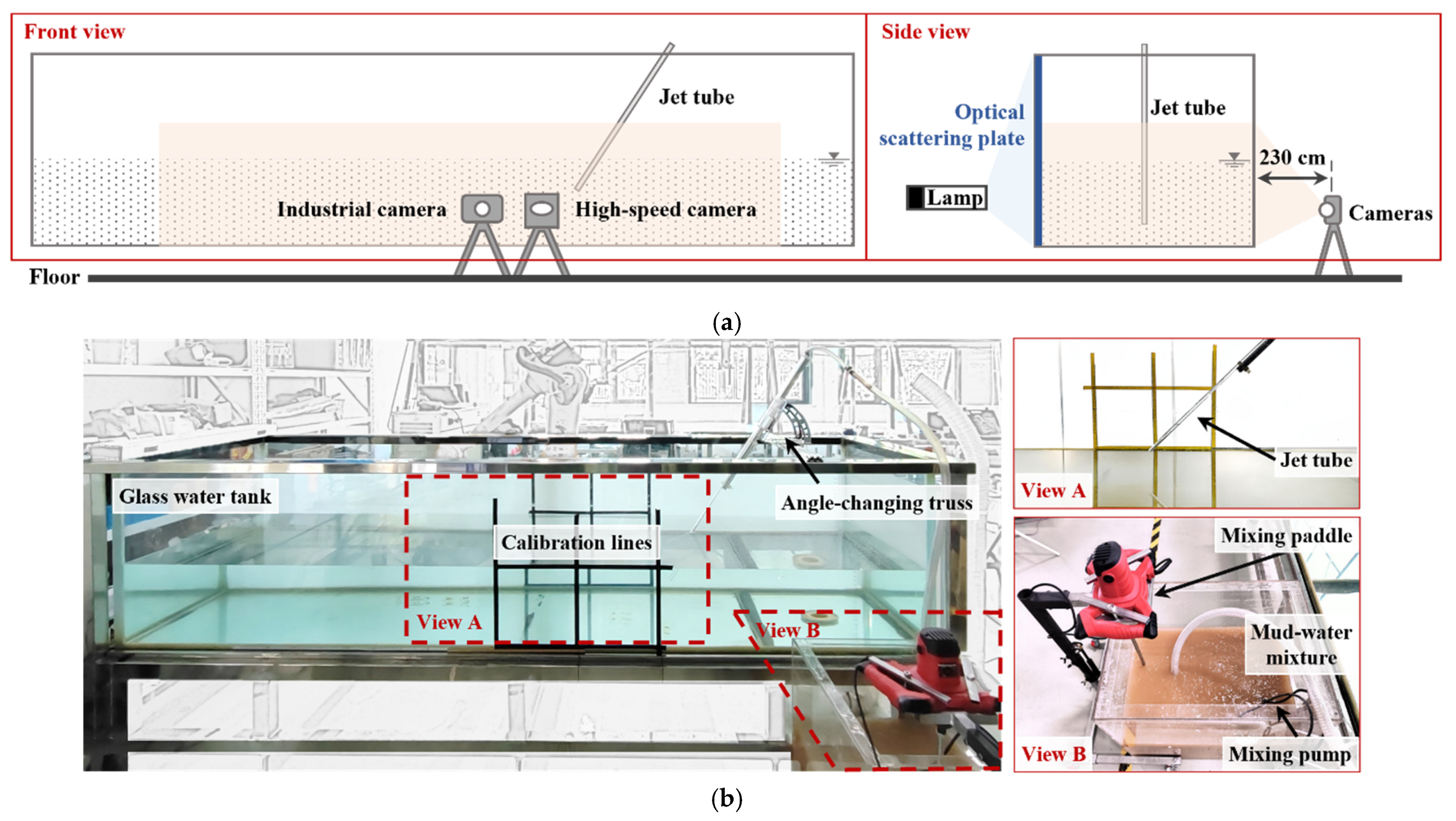
A series of negative buoyant jet experiments were carried out in a transparent glass water tank with internal dimensions of 3.0 m in length, 0.8 m in width, and 0.7 m in height, as shown in Figure 1. The water depth was maintained constant at 0.3 m throughout the experiments. An adjacent separate supply system was used to prepare the jet source fluid, consisting of a rectangular tank measuring 0.65 m × 0.5 m × 0.6 m (length by width by height), which contained a mixture of bentonite and water at a predetermined concentration. To maintain uniform suspension of bentonite particles and prevent settling, the jet source fluid was continuously mixed using a recirculating submersible pump combined with a screw-head paddle.
The jet fluid was delivered from the supply system using a submersible pump and injected into the experimental water tank through a circular glass tube with an inner diameter of 1.0 cm and a length of 1.2 m. The flow rate was regulated by adjusting the voltage of the submersible pump using a high-precision stepless controller. Repeated calibration tests are conducted prior to the experiments to ensure flow control errors remain below 1%. An optical imaging system, comprising an industrial camera with a spatial resolution of 1944 × 2160 pixels and a high-speed camera with a spatial resolution of 1920 × 1080 pixels, was positioned 2.3 m in front of the experimental tank. The high-speed camera focused on the impact zone to resolve the rapid development, while the industrial camera was used to record data over a relatively broader area (0.5 m–2.5 m) to track the dispersion characteristics of the plume. The dual-camera set-up ensures both high temporal resolution for capturing transient phenomena and sufficient spatial coverage for monitoring the full development of the gravity current in the water tank. Both cameras operated at a frame rate of 50 fps to capture time-series data for analyzing the motion of the bottom gravity currents. Spatial calibration was performed using reference markers affixed to the front and rear surfaces of the experimental tank as the scale bars. Meanwhile, an optical scattering plate was installed at the rear side of the tank to homogenize the backlight, ensuring uniform light intensity across the experimental region and thereby enhancing image quality and the reliability of subsequent image processing.

2.2. Jet Fluid Preparation

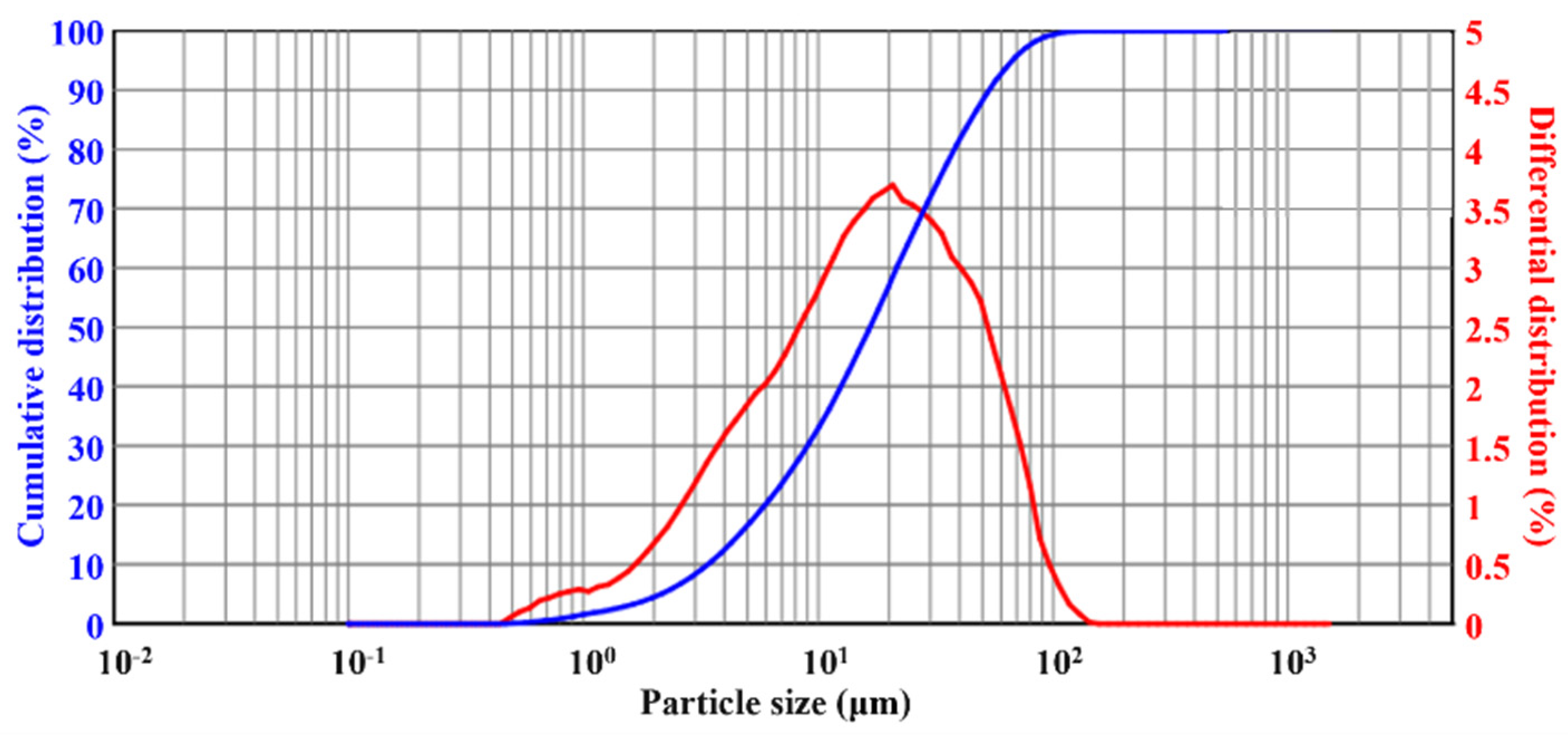
The negative buoyant jet fluid employed in this experiment consisted of a mixture of fresh water and bentonite particles. Bentonite is rich in montmorillonite, a mineral composition analogous to that of deep-sea sediments. Consequently, a bentonite-water mixture prepared at specific ratios can realistically simulate the behavior of particle-driven plumes on the seabed. The grain size distribution characteristics of the bentonite particles were determined using a laser particle size analyzer, and Figure 2 presents the cumulative grain size gradation curve. The particle size of the 300-mesh bentonite ranged from 1.549 to 75.610 μm, with the particle grading indexes of D10 = 3.40 μm, D50 = 16.61 μm, and D90 = 53.48 μm. From the report by Wang et al. [32], the particle sizes of in situ deep-sea sediment typically range from 0.06 to 76.32 μm, with D10 = 3.23 μm and D50 = 15.25 μm, indicating that the bentonite used in the present experiment closely matches the granulometric properties of natural deep-sea sediments.

2.3. Parameters and Test Conditions

The independent variables examined in this test were jet angles (α), jet velocities (v), bottom clearances (H), and initial suspended sediment concentrations of jet fluid (SSC0). The study aims to quantify the effects of these geometric and dynamic parameters on the dynamics of particle-driven gravity currents, and to provide support for different engineering scenarios.
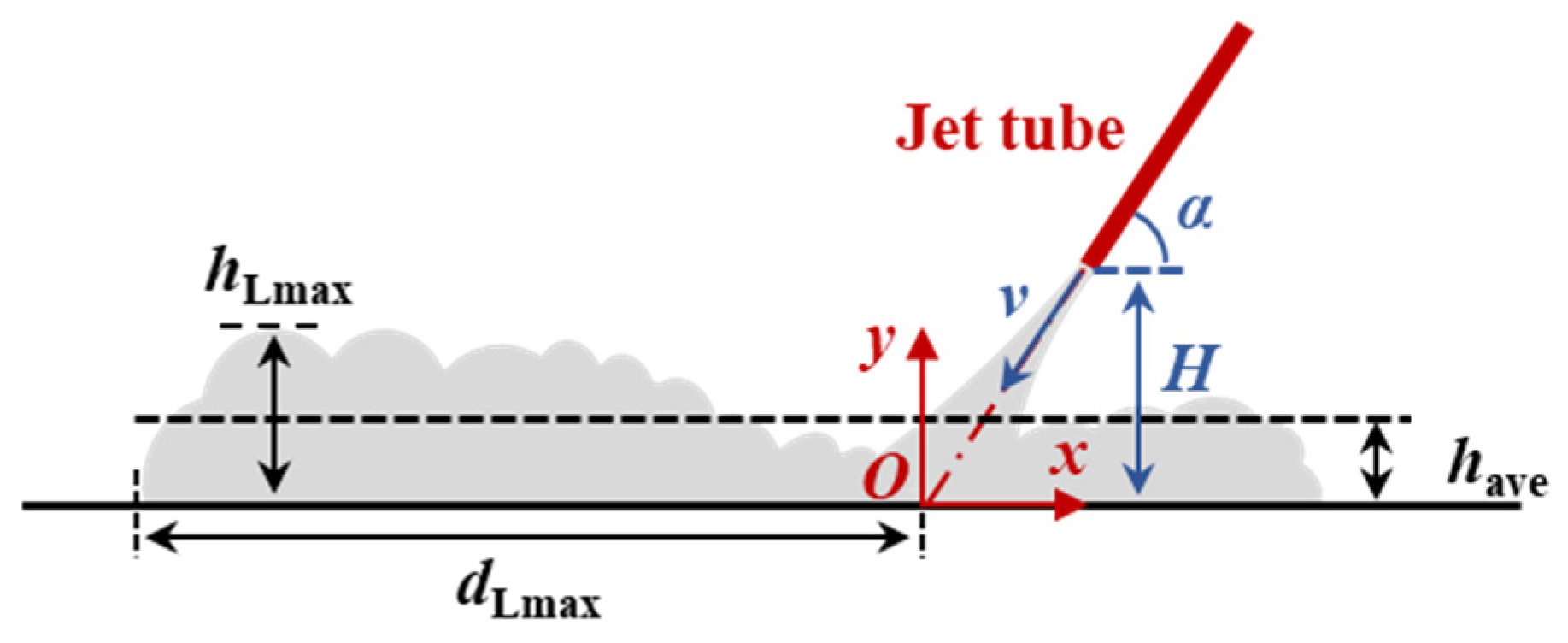
As illustrated in Figure 3, the jet impinges on the tank wall and forms a bottom plume with restricted motion. A Cartesian coordinate system is established with the impingement point as the origin. The direction opposing the jet is designated as upstream (x > 0), while the direction aligned with the jet is referred to as downstream (x < 0). The maximum plume lift height, denoted as h L m a x , is defined as the vertical distance from the highest point of the downstream plume to the bottom of water tank. The horizontal distance from the downstream plume front to the y-axis is defined as d L m a x , and the average lift height of the bottom plume is denoted as h a v e .
The projected area of the bottom plume on the xy-plane, represented as S, quantifies the plume diffusion scale. The plume longitudinal diffusion rate E is defined as the rate of increase in plume diffusion area per unit time, which can be expressed as:
E = d [ l n ( S ( t ) ) ] d t = d S ( t ) S ( t ) d t
Given that the data acquisition cameras used in this study operates at a frame rate of 50 fps, corresponding to a temporal resolution of 0.02 s, E is calculated using the following discrete formulation:
E = S t S t t = S t S t × 0.02   s
where S t denotes the projected area of the bottom plume at time t. The parameter E can be derived solely from the plume profile edge data and plume area obtained through DIP techniques, offering a computationally efficient and robust metric suitable for engineering applications and field monitoring.
In order to describe the relationship between the buoyancy and inertial effects, this study employs Richardson number Ri as the key dimensionless parameter, which is defined by the equation [33]:
R i = g D v 2
where D is the inner diameter of the jet tube, v denotes the jet velocity, and g denotes the effective gravity, expressed as:
g = ρ f ρ w ρ w g
Here, g represents the gravitational acceleration and is taken as 9.81 m/s2, ρ f and ρ w refer to the densities of jet fluid and ambient water, respectively. Ri directly expresses the competition between the stabilizing buoyancy forces and the destabilizing shear forces [34]. Additionally, the influence of the jet Reynolds number Re is also considered, which represents the relationship between inertial and viscous forces and is defined as follows:
R e = ρ f v D μ f
where μ f is the dynamic viscosity of jet fluid.
To enhance the generalizability of analysis, the jet outlet diameter D is adopted as the characteristic length scale to normalize these key length dimensions. Accordingly, the subsequent analysis will focus on the variation in the dimensionless parameters d L m a x / D , h a v e / D , and h L m a x / D . In addition, the dimensionless plume diffusion scale can be expressed as S π D 2 / 4 . Considering that the flow in this study is a particle-driven gravity flow, the plume longitudinal diffusion rate can be non-dimensionalized using the effective gravity g and expressed as E g / D .
Guan et al. [35] found that to ensure the force and penetration depth of the jet on the sediment, the jet angle in hydraulic mining collector is typically set between 39° and 50°. As polymetallic nodules generally have diameters below 200 mm and occur either exposed or partially buried within sediments, the bottom clearance of jet is usually maintained below 200 mm. Therefore, in our study, the design of the jet angle α and the bottom clearance H was appropriately extended beyond the values reported in previous studies to fully investigate their effects on plume formation. Zhang et al. [36] reported that jet velocities during deep-sea mining sea trials typically range between 3 and 10 m/s. Given that low-disturbance, environmentally friendly collection is an inevitable trend in deep-sea mining development, the jet velocities v selected for our study are relatively low, ranging from 2.35 to 5.18 m/s. The test conditions are summarized in Table 1 and the jetting duration was set to 2 s for all cases. The accumulation of initial volume flux in the plume is not the primary focus of this study. The 2 s release duration can be considered short relative to the full observational timescale, allowing the jet to be approximated as an instantaneous source, which facilitates a focused investigation into the diffusion dynamics of the particle-driven flow itself after its departure from the source. A digital timer was used to regulate the voltage supply and precisely control the operation of the submersible pump, ensuring highly consistent jetting durations.

3. Edge Detection and Image Processing Methods

Under uniform backlight illumination, the optical representation of the plume diffusion region can be divided into the following three distinct zones: a dark gray to black plume core region due to strong blocking of the backlight by high concentrations of sediment particles, a bright white background region corresponding to clear ambient water, and a light gray transitional fringe indicating lower particle concentrations. The imaging system used in this experiment can resolve the plume-background interface at millimeter-scale resolution under intense backlight conditions, and DIP techniques were employed to quantitatively analyze the diffusion characteristics of gravity current under near-wall confinement.
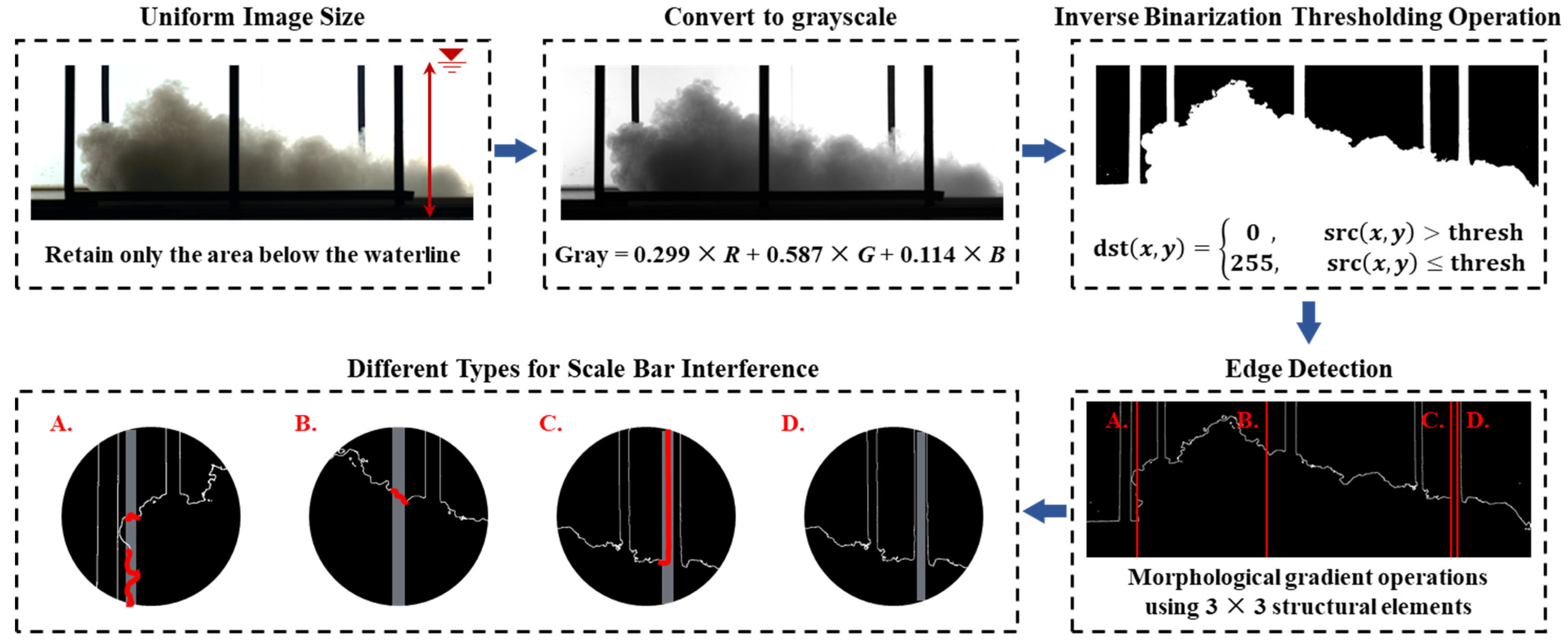
Figure 4 illustrates the image processing pipeline implemented in this study, using a representative plume image from case B1. First, all images were cropped to a standardized size, retaining only the region below the waterline, which is of interest to the analysis. The color images were then converted to grayscale images using a weighted average method, which accounts for the differential sensitivity of the human eye to chromatic channels. Specifically, since the human eyes are most sensitive to green, followed by red and then blue, the following color space conversion formula was applied [37]:
G r a y = 0.299 × R + 0.587 × G + 0.114 × B
where R, G, and B denote the red, green, and blue channel values of the input image, respectively, each ranging from 0 to 255. Due to the high contrast between the plume and the background, an inverse binarization thresholding method was applied to segment the plume region. This process further simplifies the image matrix and improve the computational efficiency. Pixels with grayscale values above the threshold (representing the black background) were set to 0, while those below or equal to the threshold (representing the plume region) were set to 255. The plume edges were subsequently extracted using a morphological gradient operation. The primary sources of uncertainty in the experimental measurements stem from the inherent image noise, attributable to the physical properties of the cameras, and the algorithmic selection within the DIP protocol, particularly the size and shape of the gradient operator. An excessively large gradient operator can potentially shift the detected edge position inward or outward relative to the actual plume boundary, thereby introducing a systematic bias. Therefore, to minimize this effect and achieve a balance between edge clarity and positional accuracy, the DIP algorithm specifically employed a compact 3 × 3 pixel matrix as the structural element for performing morphological dilation and erosion operations on the binarized plume region. This choice was empirically determined to yield well-defined plume contours while limiting the potential for edge displacement.
Distinct edge computation procedures were developed to address the following four typical cases of scale bar interference:
A. Multiple contours: If multiple clusters of consecutive non-zero pixels are detected within the lower region of the image of a given column, indicating contour overlap, the vertical coordinate of each cluster is averaged to represent the position of individual contours.
B. Single contour in the lower region: When only one single group of consecutive non-zero pixels is retrieved in the lower region of a given column, the average vertical coordinate of this pixel group defines the contour position.
C. Single contour extending to the top: If a single cluster of non-zero pixels extends to the top of the given column, which suggests proximity to the edge of the scale bar, the minimum value of the vertical coordinates within the cluster is taken as the contour position.
D. Absent contour: In columns entirely lacking non-zero pixels, which indicates that they are fully occluded by the scale bar, the contour coordinates will be interpolated based on values from adjacent columns.

4. Results and Discussion

4.1. Effects of Ri and Re on Plume Diffusion Characteristics

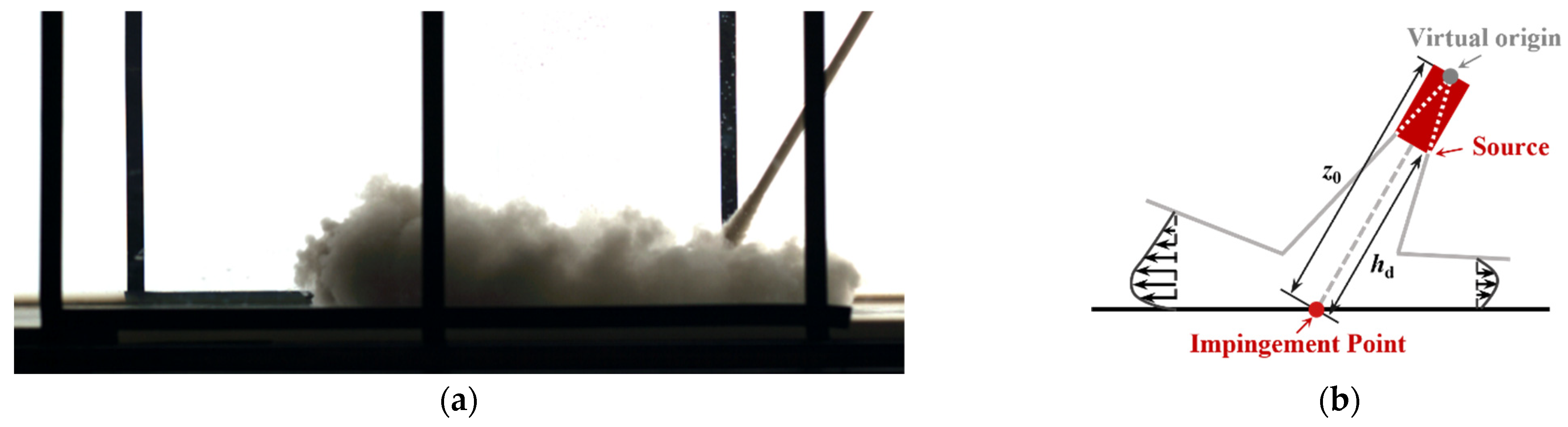
Figure 5a depicts the bottom plume formed after impingement for case A3 (α = 60°), which exhibits non-axisymmetric radial spreading. The two key length scales that determine the behavior of buoyant jets are the momentum jet length scale L M and the source-bottom separation distance z , defined respectively as [38]:
L M = M 0 3 / 4 B 0 1 / 2
z = h d + z 0
where the initial momentum flux M0 for the jet discharging at flow rate Q0 is expressed as:
M 0 = Q 0 v = π v 2 D 2 4
and the initial buoyancy flux B0 is given by:
B 0 = g Q 0 = Q 0 ρ f ρ w ρ w g = π v D 2 ( ρ f ρ w ) g 4 ρ w
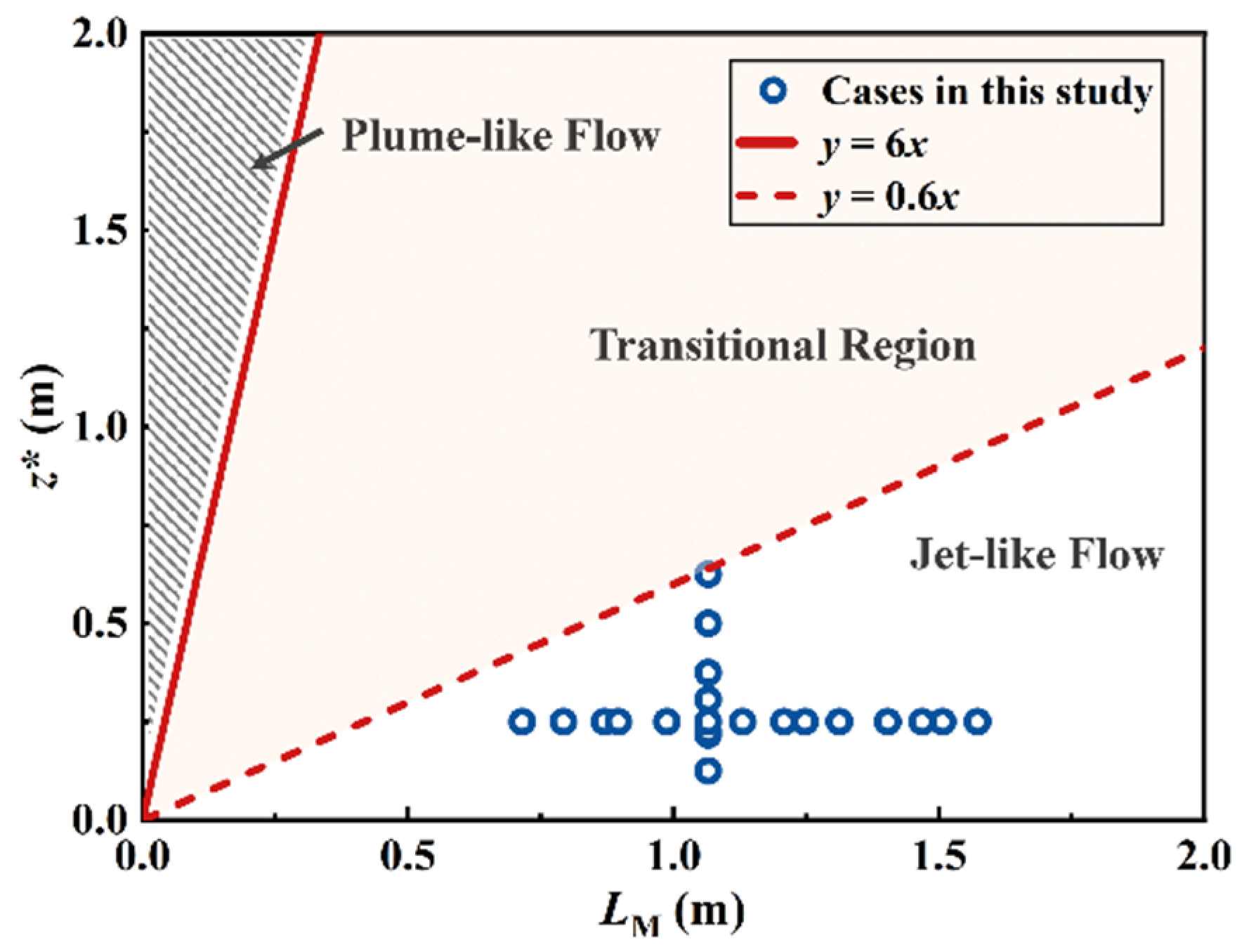
As shown in Figure 5b, hd denotes the distance from the jet tube outlet to the impingement point, and z0 represents the distance from the impingement point to the virtual origin, which is the intersection of the jet envelopes before impingement. Previous studies on buoyant jets have revealed that momentum-dominated jet-like behavior occurs after wall impingement when z <   p j L M , and buoyancy-dominated plume-like behavior develops when z >   p p L M , where p j and p p are both empirical constants. Based on experimental investigations of vertical circular buoyant jets covering the full range from jets to plumes, Wang and Law [39] determined p j = 0.6 and p p = 6 . As illustrated in Figure 6, all cases in this study fall within the jet-like flow regime according to the results, indicating that the flow remains momentum-dominated at impingement.
As the interaction between the plume and the ambient water intensifies, the flow will ultimately transition into a buoyancy-dominated regime over extended time scales, which is characterized by relatively weak momentum exchange with the ambient water. Under natural conditions, gravity currents typically persist for hours to days affected by ambient currents, stratification, and topography. In fact, the initial jet parameters predominantly govern the flow behavior during the early stage following impingement, when momentum effects are dominant. This laboratory study focuses on the initial momentum-dominated phase (t < 15 s) after impingement, which is crucial for determining the initial diffusion behavior and providing key inputs for establishing far-field deposition models in the future. This temporal limitation also prevents interference between the flow and the side walls of the experimental tank over larger time scales, especially the vertical uplift that develops after impingement, thereby ensuring the validity and reliability of the experimental observations.
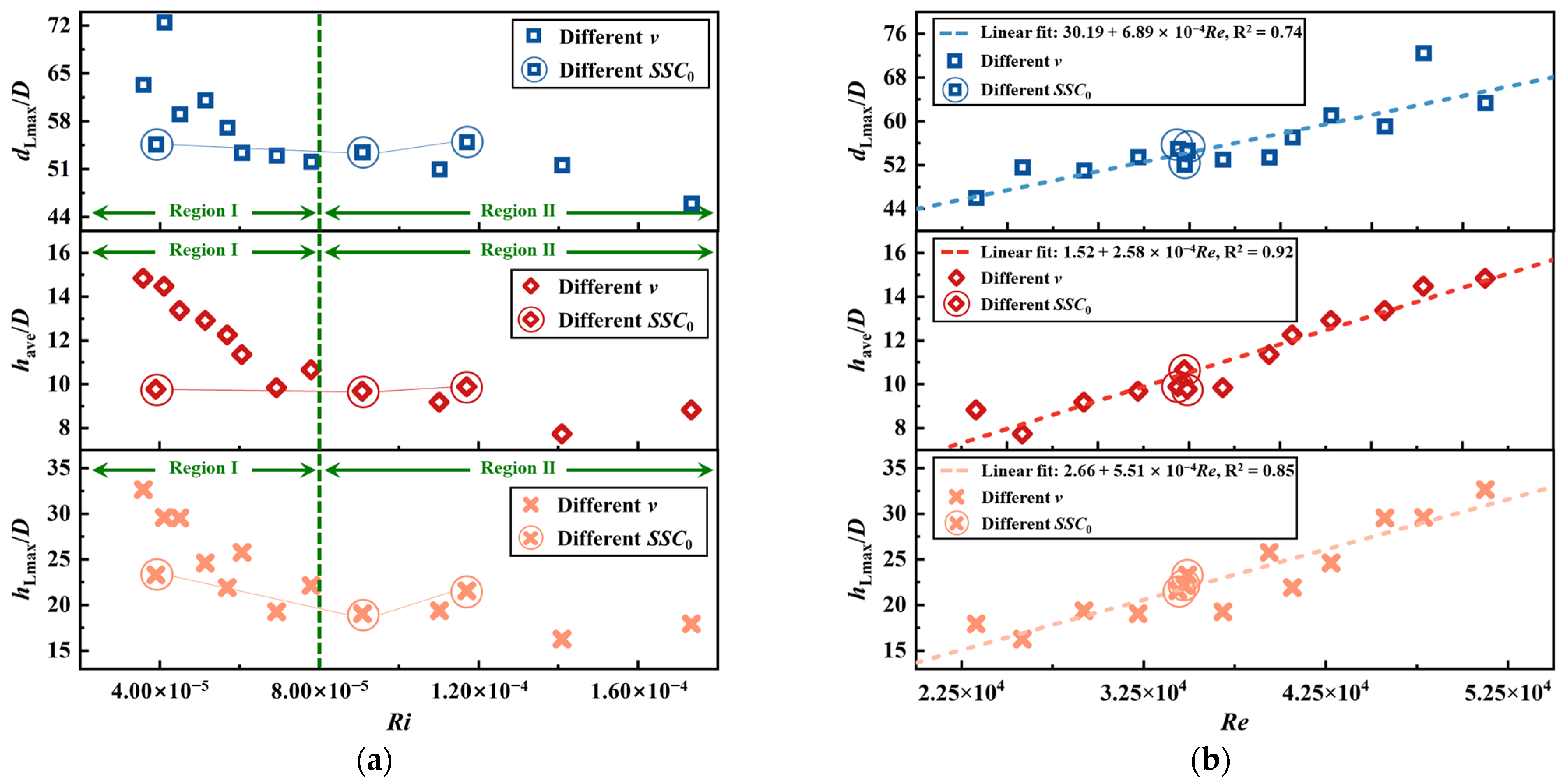
Figure 7a illustrates the evolution of the downstream plume fronts and heights with Ri within t = 10 s after impingement. Overall, both the downstream plume fronts and heights show a decreasing trend with increasing Ri. According to Turner’s entrainment hypothesis [40], the entrainment rate exhibits a negative correlation with the local Ri. The diminishing trend stems precisely from the reduced entrainment rate under high Ri conditions, thereby weakening the expansion capacity of the plume. The trend can be clearly categorized into two distinct regions: Region I (Ri ≤ 8.00 × 10⁻⁵), characterized by a sharp decline in both parameters; and Region II (Ri > 8.00 × 10⁻⁵), where the rate of decrease slows considerably and is accompanied by some fluctuation. This is attributed to the fact that the increase in Ri corresponds to the strengthening of negative buoyancy effects, which shift energy conversion towards potential energy at the expense of kinetic energy. As defined in Equation (3), variations in Ri arise from two factors: (I) changes in the buoyancy term, due to differences in jet fluid density, and (II) changes in the inertia term, resulting from variations in jet velocity. In Figure 7a, data points corresponding to different jet velocities and density differences are represented by distinct symbols. It is evident that the attenuation of plume characteristics induced by the reduction in jet velocity is significantly more pronounced than that resulting from the increase in density difference. That means under these operating conditions, jet kinetic energy serves as the primary driving force for plume dispersion, with the influence of density differences being secondary, which is also consistent with the experimental characteristics of jet-like flow regime. The relationship between the downstream plume fronts and heights and Re is shown in Figure 7b. For Re > 2.25 × 10⁴, both characteristics increase approximately linearly with Re, particularly evident in terms of h a v e / D , which exhibits a high coefficient of determination (R2), indicating a strong correlation between h a v e / D and Re. Given that the three jet fluids with different SSC0 used in this study all fall within the Newtonian fluid regime, the associated variation in dynamic viscosity was negligible. Consequently, the corresponding changes in Re are minimal, leading to insignificant differences in the observed plume characteristics.

4.2. Effects of Jet Parameters on Plume Diffusion Scale

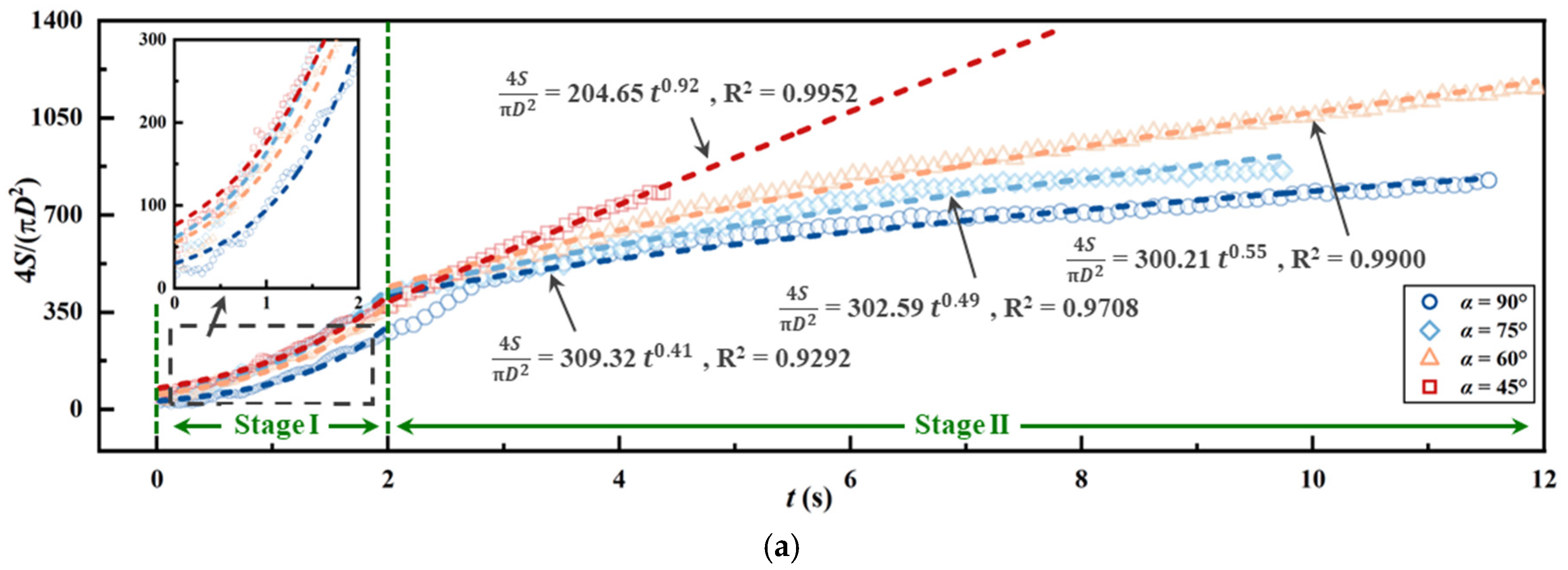
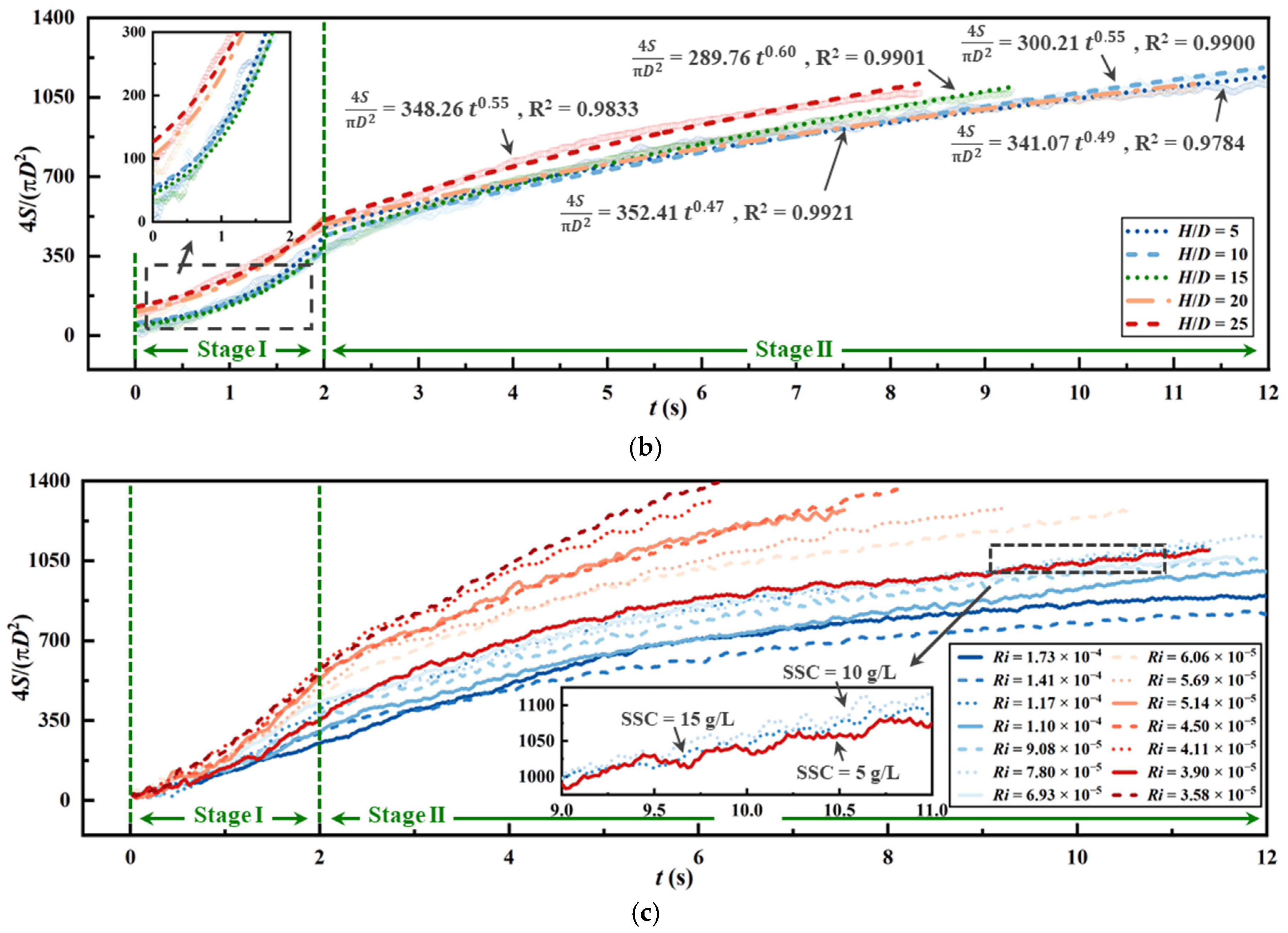
The projected area S of the bottom plume on the xy-plane quantifies the diffusion scale of bottom gravity current. Figure 8 depicts the temporal evolution of the plume diffusion scale under the near-wall confinement for various jet parameters.
The dimensionless diffusion scales all exhibit a distinct two-stage growth behavior:
Stage I (0 < t < 2 s): Inertial forces dominate the plume motion and the lateral spreading is governed by the conversion of the horizontal component of the impact kinetic energy. Constrained by the wall, the momentum of the jet along the initial direction decays rapidly and transforms into rapid expansion along the wall. The temporal evolution of the plume diffusion scale during this stage can be accurately described by an exponential function of the form S = a e b t , where a and b are regression coefficients.
Stage II (t ≥ 2 s): As the time progresses, the turbulent dissipation driven by wall shear and entrainment of the ambient water intensifies, leading to a gradual reduction in the changing rate of the plume diffusion scale. Once the turbulent dissipation and the negative buoyancy effect reach dynamic equilibrium, the plume transitions into a quasi-steady diffusion stage. During this stage, the temporal evolution of the plume diffusion scale follows a power-law relationship of the form S = a t b (b < 1), where a and b are also regression coefficients. The patterns identified are consistent with previous research: for idealized viscous gravity currents, the theory of Huppert [41] predicts b = 1/2, while for inertial flows dominated by turbulent entrainment, different exponents may arise [42]. In this study, the observed exponent b varies with the jet parameters, which indicates that the relative dominance of the underlying physical mechanisms, such as inertia, friction, and buoyancy, will shift with the initial conditions.
It should be noted that the transition point of t = 2 s was empirically determined based on optimal curve-fitting performance under the current experimental conditions and exhibits a degree of dependence on system parameters. The evolution of the plume diffusion scale is synergistically affected by multiple parameters of the jet. As shown in Figure 8a, a decrease in the jet angle α from 90° to 45° leads to a significant increase in the changing rate of plume diffusion during Stage II. The change pattern stems from the efficiency of the horizontal momentum conversion: an inclined jet impinging on the wall possesses a larger horizontal momentum component, which enhances the development of the bottom plume and allows more effective conversion of initial kinetic energy into diffusive energy of the plume. In contrast, the axisymmetric vortex ring structure generated by a vertical jet (α = 90°) concentrates energy near the impingement point, resulting in less efficient transfer of initial kinetic energy into lateral diffusion energy.
As shown in Figure 8b, the power-law exponent for plume diffusion in Stage II remains between 0.47 and 0.60 as H D increases from 5 to 25, with less than 10% variation in diffusion scale at any given time. The bottom clearance influences both the stability of the jet shear layer and the duration of the entrainment of ambient water. A small bottom clearance inhibits full development of the jet shear layer before impingement, leading to disrupted turbulent structures and reduced momentum transfer efficiency. Conversely, a shorter exposure to ambient water results in weaker entrainment and lower energy dissipation. These two competing mechanisms result in an overall weak correlation between plume diffusion scale and bottom clearance.
As depicted in Figure 8c, Ri exerts a discernible influence on the plume diffusion scale. The changing rate of plume diffusion scale decreases with increasing Ri, which can be quantitatively interpreted through the interplay between particle settling and turbulence. Some key parameters are estimated based on established theories. The settling velocity ω s for the bentonite particles (D50 = 16.61 μm) in stagnant water can be estimated using the classical Stokes’ law [43]:
ω s = ρ p ρ w 18 μ w g d p 2
where ρ p is the particle density, d p denotes the particle diameter and can be taken as D50, and μ w is the dynamic viscosity of the ambient fluid. For this study, ω s is calculated as 2.45 × 10⁻⁴ m/s. The relevant turbulent velocity scale u′ in the initial momentum-dominated stage can be approximated as a fraction of the jet velocity v, typically u′ ∼ 0.1v based on previous experimental studies [44,45], which is on the order of 10−1 m/s for this experiment. The comparison ω s << u′ initially suggests that particles are primarily advected by the turbulent flow, and their intrinsic settling is relatively weak at this stage. Consequently, the suppression of plume diffusion cannot be explained by particles merely settling out of a passively turbulent carrier flow, but rather arises from a two-way coupling mechanism, specifically where the dispersed phase modifies the dynamics of carrier fluids [46]. Two key dimensionless parameters support this transition: (a) The Stokes number S t = τ p τ w , where τ p is the particle response time and τ w = D/v is the flow time scale, is estimated to be on the order of 10−2 for this study, satisfying S t << 1. This confirms that particles act as passive tracers to the turbulent fluctuations. (b) The mass loading φ = S S C 0 ρ w . While φ is on the order of 10−2, it is crucial to consider the highly concentrated conditions locally present in the impingement region [46]. Under these conditions of high local concentration, the primary mechanism for diffusion suppression is turbulence attenuation induced by the particle phase [47]. The increasing Ri, whether achieved through higher SSC0 or lower v, promotes an earlier transition of the flow from a momentum-dominated regime to a buoyancy-dominated one and makes the flow particularly susceptible to the damping effects of the particles. Thus, the turbulent structures responsible for entrainment and lateral spreading are inhibited more rapidly and effectively, leading to the observed reduction in the growth rate of S. It is worth noting that, in general, the variations in plume diffusion scale resulting from density differences remain below 5% and are statistically insignificant. This further confirms that the diffusion of the bottom plume is more sensitive to particle kinetic energy than to density variations.

4.3. Effects of Jet Parameters on Plume Longitudinal Expansion Rate

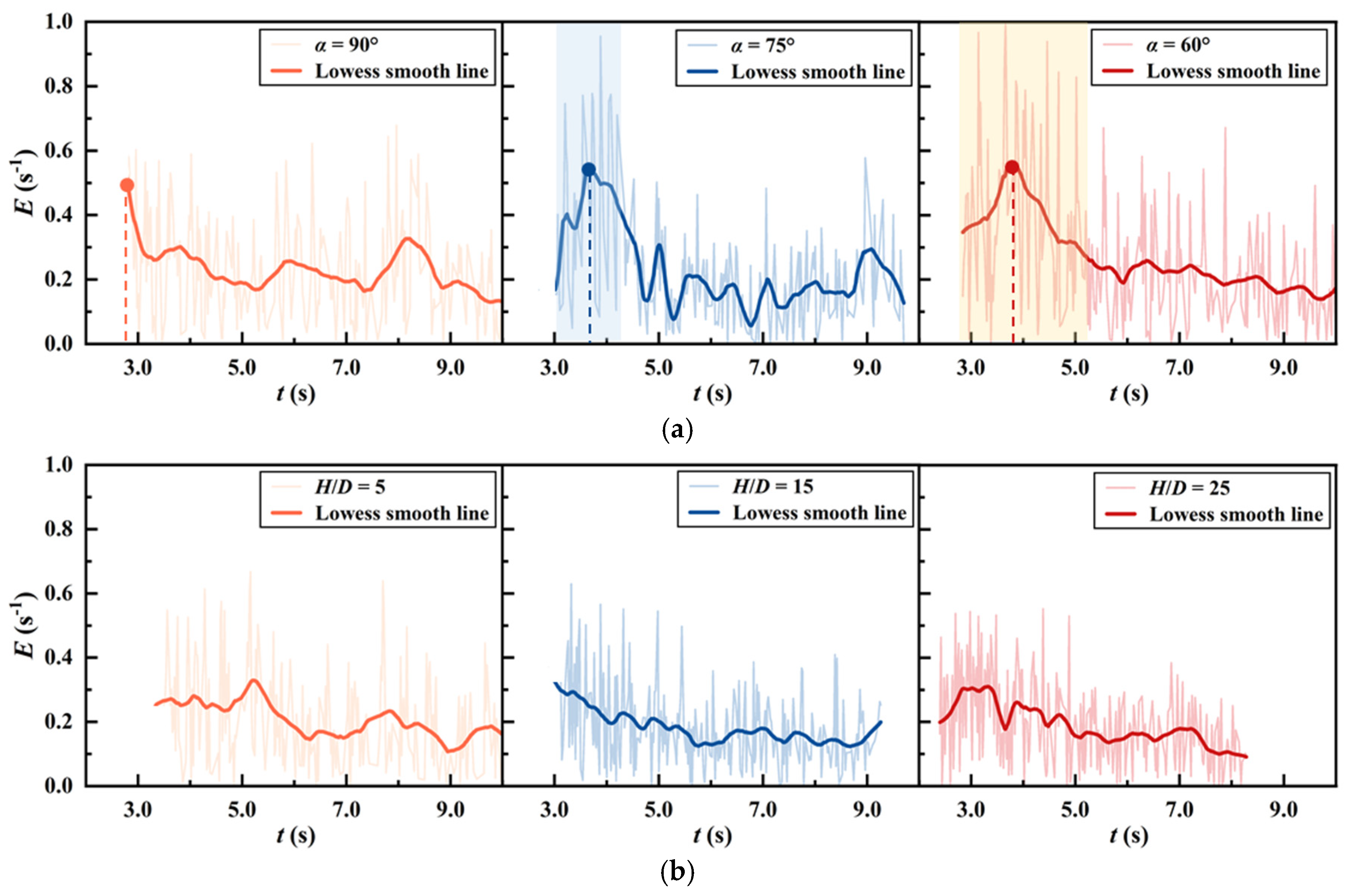
Figure 9 illustrates the influence of the jet angle and the dimensionless bottom clearance on the longitudinal expansion rate E of the bottom plume. As indicated by Equation (1), the calculation of E is particularly susceptible to high-frequency noise when small time intervals are employed in the differentiation process. Given that the plume exhibits rapid non-monotonic growth with pronounced fluctuations during the initial phase due to the intense conversion of kinetic energy at the moment of impact, data from the first three seconds are excluded in some cases to ensure a reliable analysis of E and avoid amplification of high-frequency noise from differential calculations. Moreover, to mitigate the impact of high-frequency noise sensitivity, the raw data are smoothed using the Locally Weighted Scatterplot Smoothing (Lowess) method. This non-parametric technique fits a smooth curve to the data by performing local regression in a moving window, effectively preserving the underlying trend while suppressing high-frequency fluctuations. The application of Lowess filtering enhances the robustness of the identified trends without introducing significant distortion to the physical behavior of the plume.
The temporal evolution of E exhibits fluctuations but demonstrates an overall declining trend for t > 4 s across all cases. For different α, a peak value exceeding 0.5 s−1 was observed within the interval 2.5 < t < 4 s. Variations in the jet angle modify the distribution of velocity components along the horizontal and the wall-normal directions at the moment of impingement. The horizontal velocity component primarily governs the initial kinetic energy of the bottom plume, while the wall-normal component influences the intensity of near-wall vortex formation. Larger α generally promote stronger vortex structures and enhance initial entrainment, leading to an earlier peak in E, as illustrated in Figure 9a. For the three cases with different dimensionless bottom clearances, E remains consistently below 0.5 s−1, accompanied by some minor fluctuations. The corresponding Lowess-smoothed curves display notable morphological similarity, as shown in Figure 9b, indicating that variations in H/D within the tested range do not alter the fundamental expansion dynamics of the bottom plume. This observed similarity suggests that the transport mechanism is dominated by other factors, such as initial momentum and buoyancy flux, rather than by the specific bottom clearance under these conditions.
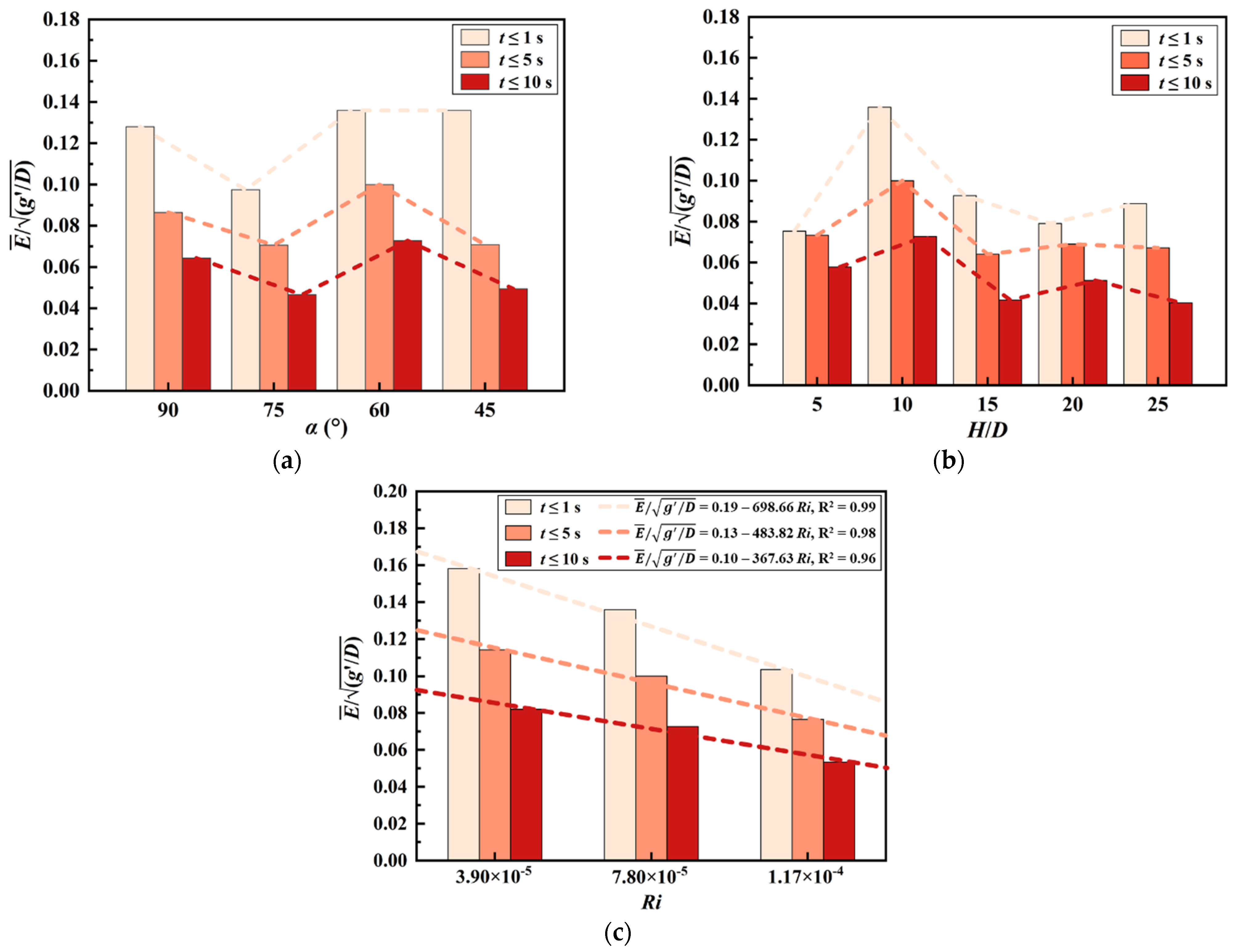
Figure 10 shows the variation in the dimensionless average longitudinal expansion rate E ¯ g / D of the plume with the jet angles, dimensionless bottom clearances and Ri (caused by different SSC0) within 1 s, 5 s, and 10 s after impingement. It can be observed that E ¯ g / D decreases over time for most conditions, with a more pronounced reduction from 1 s to 5 s than from 5 s to 10 s. This is because the plume diffusion morphology often exhibits significant fluctuations within the first 1 s after impingement, which is the phase dominated by kinetic energy conversion. While after t = 5 s, the plume enters a viscous-buoyancy equilibrium stage, during which the diffusion pattern of plume gradually stabilizes. For α = 45°, E ¯ g / D reaches a global peak of 1.2 × 10⁻³ within 1 s, then declines rapidly by 47.9% for t ≤ 5 s. Compared to other jet angles, E ¯ g / D at α = 75° consistently attains the lowest peak values across all time intervals. This suggests that the bottom plume impinging at α = 75° rapidly stabilize into a steady diffusion pattern along the wall. Additionally, as shown in Figure 10b, the case with H/D = 10 yields the highest values of E ¯ g / D , indicating the most efficient conversion of kinetic energy into plume diffusion under this configuration. For conditions with different SSC0, E ¯ g / D demonstrates a pronounced linear decrease with increasing Ri. This strong correlation is attributed to the enhanced gravitational settling effect, which becomes more dominant as the density difference between the particle-driven plume and the ambient fluid increases with higher initial concentrations.
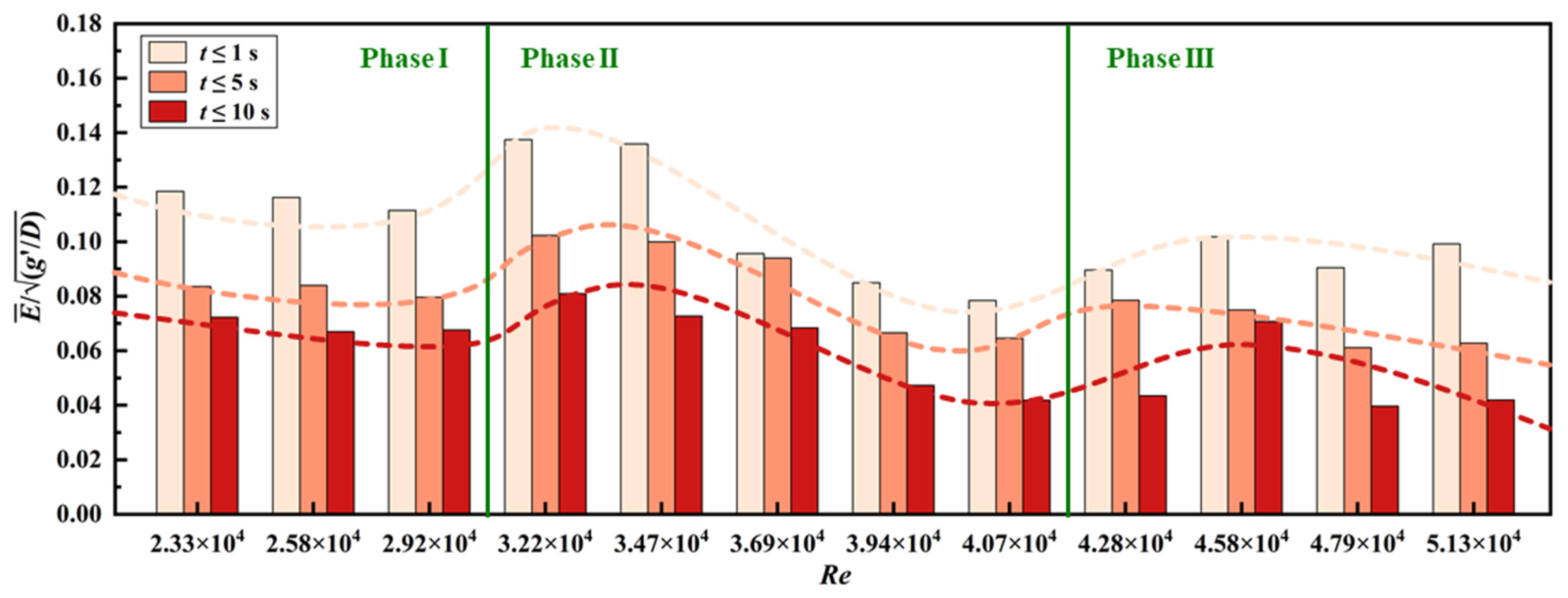
Figure 11 illustrates the relationship between Re and E ¯ g / D of the plume. During the initial 10 s period after the impingement, the variation of E ¯ g / D with Re can be categorized into three phases: In phase I (2.33 × 10⁴ < Re < 3.22 × 10⁴), where Re is relatively low and the flow inertial forces are comparatively weak, the jet remains undeveloped and the flow is dominated by viscous dissipation, and E ¯ g / D exhibits a slight decreasing trend as Re increases. In phase II (3.22 × 10⁴ < Re < 4.28 × 10⁴), as Re further increases and the inertial effects of the flow gradually intensify, E ¯ g / D shows a rebound trend. However, the rapid fragmentation of vortex structures at the moment of impact leads to heightened energy dissipation, resulting in a subsequent gradual decline of E ¯ g / D . This decrease is most pronounced during the initial period where t < 1 s. In phase III (4.28 × 10⁴ < Re < 5.13 × 10⁴), E ¯ g / D exhibits a similar trend to Phase II, also showing an initial rise followed by a decline. However, as the flow becomes sufficiently developed at high Re, the overall variation in E ¯ g / D diminishes significantly compared to Phase II. Furthermore, it can be observed that E ¯ g / D generally fluctuates most significantly within t < 1 s, followed successively by t < 5 s and t < 10 s.

5. Conclusions

In this study, a series of experiments were carried out to examine the short-term diffusion characteristics of the bottom current under wall confinement through the DIP technique. The effects of jet angles, jet velocities, bottom clearances, and initial suspended sediment concentrations of jet fluid on the dynamics of the bottom plume were systematically investigated, elucidating the spatial and temporal evolutionary properties of key features including plume characteristic sizes, diffusion scale and longitudinal expansion rate.
Buoyancy, driven by density differences, and inertial forces, determined by jet velocities, are the primary factors influencing the dimensionless Richardson number Ri. An increase in Ri indicates a stronger negative buoyancy effect, which promotes the transformation of turbulent kinetic energy into particle potential energy. Consequently, d L m a x / D , h L m a x / D and h a v e / D all display a decreasing trend with increasing Ri, and show a linear increase with rising Re.
The plume diffusion scale S demonstrates a distinct two-stage evolution behavior. During the initial stage (0 < t < 2 s), the inertial forces dominate, and S evolves with time as the exponential model of the form S = a e b t . In the subsequent stage (t > 2 s), the plume transitions to a regime governed by negative buoyancy and turbulent dissipation equilibrium, during which S changes with time according to a power-law relationship S = a t b (b < 1). A decrease in the jet angle α corresponds to greater efficiency of converting the initial jet kinetic energy into the diffuse kinetic energy of the bottom current, resulting in a steeper changing rate of S during stage II. Variations in the bottom clearance H/D introduce a trade-off between the stability of the jet shear layer and the duration of the entrainment effect, and the growth exponent of S in stage II remains between 0.47 and 0.60, with relative variability under 10% at the same moment. Furthermore, under the influence of particle-turbulence two-way coupling interactions, the changing rate of plume diffusion sizes exhibits a gradual decrease with increasing Ri.
At α = 75°, the dimensionless average longitudinal expansion rate E ¯ g / D measured within 1 s, 5 s, and 10 s each reach the minimum peaks, indicating that the bottom plume transitions into the stable diffusion phase more rapidly. While for H/D = 10, E ¯ g / D peaks at the highest values, suggesting the optimal jet energy utilization efficiency. E ¯ g / D exhibits a linear downward trend with Ri, and displays a three-stage fluctuating behavior as Re increases.
This study reveals the influence of jet source parameters on the dynamics and dispersion of bottom gravity currents, further advancing the understanding of gravity current behavior under wall confinement. However, the effects of ambient water hydrodynamics, such as waves and ocean currents, as well as the complex seabed topography are not considered. Subsequent studies should incorporate these factors to refine the assessment of the coupling mechanisms with gravity current.

Author Contributions

Conceptualization, Y.L. and G.Z.; methodology, Y.L., G.Z., L.X. (Longfei Xiao) and L.X. (Lixin Xu); formal analysis and investigation, Y.L., G.Z. and L.X. (Longfei Xiao); writing—original draft preparation, Y.L.; writing—review and editing, G.Z., L.X. (Longfei Xiao) and L.X. (Lixin Xu); funding acquisition, G.Z., L.X. (Longfei Xiao) and L.X. (Lixin Xu); supervision, L.X. (Longfei Xiao) and L.X. (Lixin Xu). All authors have read and agreed to the published version of the manuscript.

Funding

This research was funded by the National Natural Science Foundation of China (Grant No: 52301332), Shanghai Sailing Program (Grant No: 23YF1419800), Shanghai Strategic Emerging Industry Major Projects, Hainan Province Science and Technology Special Fund (Grant No: SQ2024KJTPY0035), Hainan Provincial Natural Science Foundation of China (Grant No: 424QN297), and Sanya Science and Technology Innovation Foundation (Grant No: 2022KJCX67).

Institutional Review Board Statement

Not applicable.

Informed Consent Statement

Not applicable.

Data Availability Statement

The data presented in this study are available on request from the corresponding author.

Conflicts of Interest

The authors declare no conflicts of interest.

Abbreviations

The following abbreviations are used in this manuscript:
DIPDigital Image Processing
PIVParticle Image Velocimetry

References

  1. Sola, I.; Fernández-Torquemada, Y.; Forcada, A.; Valle, C.; del Pilar-Ruso, Y.; González-Correa, J.M.; Sánchez-Lizaso, J.L. Sustainable desalination: Long-term monitoring of brine discharge in the marine environment. Mar. Pollut. Bull. 2020, 161, 111813. [Google Scholar] [CrossRef] [PubMed]
  2. Wang, Q.; Sheng, Y.; Zhang, Y.; Zhong, X.; Liu, H.; Huang, Z.; Li, D.; Wu, H.; Ni, Y.; Zhang, J.; et al. Complete long-term monitoring of greenhouse gas emissions from a full-scale industrial wastewater treatment plant with different cover configurations. J. Environ. Manag. 2024, 360, 121206. [Google Scholar] [CrossRef] [PubMed]
  3. Lee, J.H.; Jirka, G.H. Vertical round buoyant jet in shallow water. J. Hydraul. Div. 1981, 107, 1651–1675. [Google Scholar] [CrossRef]
  4. Zhang, N.; Zhai, W.; Yin, S.; Chen, X.; Xia, J.; Luan, L.; Zhai, A. Deep-sea soft soil and deep-sea mining vehicle interaction: From soil properties to locomotion performance. Appl. Ocean Res. 2025, 154, 104372. [Google Scholar] [CrossRef]
  5. Purkiani, K.; Gillard, B.; Paul, A.; Haeckel, M.; Haalboom, S.; Greinert, J.; de Stigter, H.; Hollstein, M.; Baeye, M.; Vink, A.; et al. Numerical simulation of deep-sea sediment transport induced by a dredge experiment in the northeastern Pacific Ocean. Front. Mar. Sci. 2021, 8, 719463. [Google Scholar] [CrossRef]
  6. Oebius, H.U.; Becker, H.J.; Rolinski, S.; Jankowski, J.A. Parametrization and evaluation of marine environmental impacts produced by deep-sea manganese nodule mining. Deep Sea Res. Part II 2001, 48, 3453–3467. [Google Scholar] [CrossRef]
  7. Jones, D.O.B.; Kaiser, S.; Sweetman, A.K.; Smith, C.R.; Menot, L.; Vink, A.; Trueblood, D.; Greinert, J.; Billett, D.S.M.; Arbizu, P.M.; et al. Biological responses to disturbance from simulated deep-sea polymetallic nodule mining. PLoS ONE 2017, 12, e0171750. [Google Scholar] [CrossRef]
  8. Bleninger, T.; Jirka, G.H. Modelling and environmentally sound management of brine discharges from desalination plants. Desalination 2008, 221, 585–597. [Google Scholar] [CrossRef]
  9. Papanicolaou, P.N.; List, E.J. Investigations of round vertical turbulent buoyant jets. J. Fluid Mech. 1988, 195, 341–391. [Google Scholar] [CrossRef]
  10. Muñoz-Royo, C.; Peacock, T.; Alford, M.H.; Smith, J.A.; Le Boyer, A.; Kulkarni, C.S.; Lermusiaux, P.F.J.; Haley, P.J.; Mirabito, C.; Wang, D.; et al. Extent of impact of deep-sea nodule mining midwater plumes is influenced by sediment loading, turbulence and thresholds. Commun. Earth Environ. 2021, 2, 148. [Google Scholar] [CrossRef]
  11. Papakonstantis, I.G.; Christodoulou, G.C. Spreading of round dense jets impinging on a horizontal bottom. J. Hydro-Environ. Res. 2010, 4, 289–300. [Google Scholar] [CrossRef]
  12. Britter, R.E. The spread of a negatively buoyant plume in a calm environment. Atmos. Environ. 1979, 13, 1241–1247. [Google Scholar] [CrossRef]
  13. Chowdhury, M.R.; Testik, F.Y. Axisymmetric underflows from impinging buoyant jets of dense cohesive particle-laden fluids. J. Hydraul. Eng. 2015, 141, 04014079. [Google Scholar] [CrossRef]
  14. Shao, D.; Law, A.W.K. Turbulent mass and momentum transport of a circular offset dense jet. J. Turbul. 2009, 10, N40. [Google Scholar] [CrossRef]
  15. Christodoulou, G.C.; Nikiforakis, I.K.; Diamantis, T.D.; Stamou, A.I. Near-field dilution of a vertical dense jet impinging on a solid boundary. Desalin. Water Treat. 2016, 57, 4898–4905. [Google Scholar] [CrossRef]
  16. Wang, D.; Adams, E.E.; Munoz-Royo, C.; Peacock, T.; Alford, M.H. Effect of crossflow on trapping depths of particle plumes: Laboratory experiments and application to the PLUMEX field experiment. Environ. Fluid Mech. 2021, 21, 741–757. [Google Scholar] [CrossRef]
  17. James, C.B.; Mingotti, N.; Woods, A.W. On particle separation from turbulent particle plumes in a cross-flow. J. Fluid Mech. 2022, 932, A45. [Google Scholar] [CrossRef]
  18. Eames, I.; Gilbertson, M.A.; Landeryou, M. The effect of an ambient flow on the spreading of a viscous gravity current. J. Fluid Mech. 2005, 523, 261–275. [Google Scholar] [CrossRef]
  19. Huppert, H.E. Gravity currents: A personal perspective. J. Fluid Mech. 2006, 554, 299–322. [Google Scholar] [CrossRef]
  20. Noh, Y.; Fernando, H.J.S. Gravity current propagation along an incline in the presence of boundary mixing. J. Geophys. Res. Ocean. 1991, 96, 12586–12592. [Google Scholar] [CrossRef]
  21. Liu, S.; Yang, J.; Lyu, H.; Sun, P.; Zhang, B. A numerical investigation of the effects of deep-sea mining vehicles on the evolution of sediment plumes based on the combination of near-and far-field models. Appl. Ocean Res. 2024, 149, 104048. [Google Scholar] [CrossRef]
  22. Liu, S.; Yang, J.; Lyu, H.; Sun, P.; Zhang, B. Experimental and numerical investigation of the effect of deep-sea mining vehicles on the discharge plumes. Phys. Fluids 2024, 36, 033358. [Google Scholar] [CrossRef]
  23. Ouillon, R.; Kakoutas, C.; Meiburg, E.; Peacock, T. Gravity currents from moving sources. J. Fluid Mech. 2021, 924, A43. [Google Scholar] [CrossRef]
  24. Yang, Y.; Chen, J.; Wang, Y. Particle plume dispersion with various incident velocities: Particle–fluid interaction regimes from coupled discrete element-large eddy simulations. Phys. Fluids 2024, 36, 083318. [Google Scholar] [CrossRef]
  25. Xie, J.; Hu, P.; Pähtz, T.; He, Z.; Cheng, N. Fluid-particle interaction regimes during the evolution of turbidity currents from a coupled LES/DEM model. Adv. Water Resour. 2022, 163, 104171. [Google Scholar] [CrossRef]
  26. Bai, T.; Zhao, Y.; Zhou, Y.; Huang, K. Numerical simulation and analysis of initial plume discharge of deep-sea mining. Ocean Eng. 2024, 310, 118794. [Google Scholar] [CrossRef]
  27. Alhaddad, S.; Elerian, M. Mitigating suspended-sediment environmental pressure in subsea engineering through colliding turbidity currents. Results Eng. 2024, 21, 101916. [Google Scholar] [CrossRef]
  28. Reagle, C.J.; Delimont, J.M.; Ng, W.F.; Ekkad, S.V.; Rajendran, V.P. Measuring the coefficient of restitution of high speed microparticle impacts using a PTV and CFD hybrid technique. Meas. Sci. Technol. 2013, 24, 105303. [Google Scholar] [CrossRef]
  29. Jiang, J.; Law, A.W.K.; Cheng, N.S. Two-phase analysis of vertical sediment-laden jets. J. Eng. Mech. 2005, 131, 308–318. [Google Scholar] [CrossRef]
  30. Burridge, H.C.; Partridge, J.L.; Linden, P.F. The fluxes and behaviour of plumes inferred from measurements of coherent structures within images of the bulk flow. Atmos. Ocean 2016, 54, 403–417. [Google Scholar] [CrossRef]
  31. Kalita, B.; Florez, L.P.; Landau, E.; Ward, R.; Holyoke, J.; Johnson, B.A. Characterizing visual structures in a buoyant plume. Exp. Fluids 2024, 65, 136. [Google Scholar] [CrossRef]
  32. Wang, L.; Lei, H.; Bo, Y.; Jiang, M.; Wang, P.; Liu, M. Geotechnical behavior of soft dredger fill and deep sea soft clay. In IOP Conference Series: Earth and Environmental Science; IOP Publishing: Beijing, China, 2020. [Google Scholar]
  33. Ellison, T.H.; Turner, J.S. Turbulent entrainment in stratified flows. J. Fluid Mech. 1959, 6, 423–448. [Google Scholar] [CrossRef]
  34. Chowdhury, M.R.; Testik, F.Y. A review of gravity currents formed by submerged single-port discharges in inland and coastal waters. Environ. Fluid Mech. 2014, 14, 265–293. [Google Scholar] [CrossRef]
  35. Guan, L.; Zhang, D.; Xia, Y.; Xia, J. Comparison and analysis of deep-sea polymetallic nodule collection methods and structural parameters. J. Ocean Technol. 2021, 40, 62–70. [Google Scholar]
  36. Zhang, X.; Wu, Z.; Ma, N.; Chen, X.; Lu, Q.; Jin, S.; Wang, L. Experimental analysis of abyssal sediment erosion by a traveling double-row jet. Ocean Eng. 2024, 313, 119474. [Google Scholar] [CrossRef]
  37. Pratt, W.K. Digital Image Processing: PIKS Scientific Inside; Wiley-Interscience: Hoboken, NJ, USA, 2007; pp. 3–21. [Google Scholar]
  38. Jirka, G.H.; Domeker, R.L. Hydrodynamic classification of submerged single-port discharges. J. Hydraul. Eng. 1991, 117, 1095–1112. [Google Scholar] [CrossRef]
  39. Wang, H.; Law, A.W.K. Second-order integral model for a round turbulent buoyant jet. J. Fluid Mech. 2002, 459, 397–428. [Google Scholar] [CrossRef]
  40. Turner, J.S. Turbulent entrainment: The development of the entrainment assumption, and its application to geophysical flows. J. Fluid Mech. 1986, 173, 431–471. [Google Scholar] [CrossRef]
  41. Huppert, H.E. The propagation of two-dimensional and axisymmetric viscous gravity currents over a rigid horizontal surface. J. Fluid Mech. 1982, 121, 43–58. [Google Scholar] [CrossRef]
  42. Ungarish, M.; Zemach, T. On the slumping of high Reynolds number gravity currents in two-dimensional and axisymmetric configurations. Eur. J. Mech. B Fluids 2005, 24, 71–90. [Google Scholar] [CrossRef]
  43. Winterwerp, J.C. On the flocculation and settling velocity of estuarine mud. Cont. Shelf Res. 2002, 22, 1339–1360. [Google Scholar] [CrossRef]
  44. Wygnanski, I.; Fiedler, H. Some measurements in the self-preserving jet. J. Fluid Mech. 1969, 38, 577–612. [Google Scholar] [CrossRef]
  45. Panchapakesan, N.R.; Lumley, J.L. Turbulence measurements in axisymmetric jets of air and helium. Part 1. Air jet. J. Fluid Mech. 1993, 246, 197–223. [Google Scholar] [CrossRef]
  46. Elghobashi, S. On predicting particle-laden turbulent flows. Appl. Sci. Res. 1994, 52, 309–329. [Google Scholar] [CrossRef]
  47. Balachandar, S.; Eaton, J.K. Turbulent dispersed multiphase flow. Annu. Rev. Fluid Mech. 2010, 42, 111–133. [Google Scholar] [CrossRef]
Figure 1. Schematic and photograph of the experimental set-up for negative buoyant jet test: (a) Front view and side view, and (b) Photograph view.
Jmse 14 00295 g001
Figure 2. Grain size distribution curve of bentonite particles.
Jmse 14 00295 g002
Figure 3. Coordinate system and plume motion parameters.
Jmse 14 00295 g003
Figure 4. Schematic diagram of edge detection.
Jmse 14 00295 g004
Figure 5. Morphology non-axisymmetric bottom plume: (a) Image from case A3 (α = 60°), and (b) Parameters at the moment of impact.
Jmse 14 00295 g005
Figure 6. L M and z for cases involved in this study.
Jmse 14 00295 g006
Figure 7. Variation in downstream plume fronts and heights with (a) Ri and (b) Re.
Jmse 14 00295 g007
Figure 8. Temporal evolution of dimensionless plume diffusion scale with different jet parameters: (a) Different α (H/D = 10, Ri = 7.80 × 10⁻⁵), (b) Different H/D (α = 60°, Ri = 7.80 × 10⁻⁵), and (c) Different Ri (α = 60°, H/D = 10).
Jmse 14 00295 g008aJmse 14 00295 g008b
Figure 9. Temporal evolution of plume longitudinal expansion rate with different jet parameters: (a) Different α (H/D = 10, Ri = 7.80 × 10⁻⁵), and (b) Different H/D (α = 60°, Ri = 7.80 × 10⁻⁵).
Jmse 14 00295 g009
Figure 10. Variation in plume dimensionless average longitudinal expansion rate with different jet parameters: (a) Different α (H/D = 10, Ri = 7.80 × 10⁻⁵), (b) Different H/D (α = 60°, Ri = 7.80 × 10⁻⁵), and (c) Different Ri (α = 60°, H/D = 10).
Jmse 14 00295 g010
Figure 11. Variation in plume dimensionless average longitudinal expansion rate with Re (α = 60°, H/D = 10).
Jmse 14 00295 g011
Table 1. Experimental conditions.
Case No.α (°)H (cm)SSC0 (g/L)v (m/s)RiRe
A1–A490, 75, 60, 4510103.517.80 × 10−53.47 × 10⁴
B1–B5605, 10, 15, 20, 25103.517.80 × 10−53.47 × 10⁴
C1601053.513.90 × 10−53.49 × 10⁴
C26010103.517.80 × 10−53.47 × 10⁴
C36010153.511.17 × 10−43.44 × 10⁴
D16010102.351.73 × 10−42.33 × 10⁴
D26010102.611.41 × 10−42.58 × 10⁴
D36010102.951.10 × 10−42.92 × 10⁴
D46010103.259.08 × 10−53.22 × 10⁴
D56010103.517.80 × 10−53.47 × 10⁴
D66010103.726.93 × 10−53.69 × 10⁴
D76010103.986.06 × 10−53.94 × 10⁴
D86010104.115.69 × 10−54.07 × 10⁴
D96010104.325.14 × 10−54.28 × 10⁴
D106010104.624.50 × 10−54.58 × 10⁴
D116010104.834.11 × 10−54.79 × 10⁴
D126010105.183.58 × 10−55.13 × 10⁴
Disclaimer/Publisher’s Note: The statements, opinions and data contained in all publications are solely those of the individual author(s) and contributor(s) and not of MDPI and/or the editor(s). MDPI and/or the editor(s) disclaim responsibility for any injury to people or property resulting from any ideas, methods, instructions or products referred to in the content.