Article

Island-Chain Monitoring of Heavy Metals in Sediments of the East China Sea: Distribution Characteristics, Ecological Risk Assessment and Source Apportionment


1
Zhejiang Institute of Hydraulics and Estuary (Zhejiang Institute of Marine Planning and Design), Hangzhou 310020, China
2
Zhejiang Key Laboratory of River-Lake Water Network Health Restoration, Hangzhou 310000, China
3
College of Water Conservancy and Hydropower Engineering, Hohai University, Nanjing 210024, China
4
Key Laboratory of Marine Ecosystem Dynamics, Second Institute of Oceanography, Ministry of Natural Resources, Hangzhou 310012, China
*
Authors to whom correspondence should be addressed.
J. Mar. Sci. Eng. 2026, 14(3), 256; https://doi.org/10.3390/jmse14030256
Submission received: 30 December 2025 / Revised: 21 January 2026 / Accepted: 23 January 2026 / Published: 26 January 2026
(This article belongs to the Section Marine Pollution)

Abstract

In November 2023, surface sediments were collected at 46 sites around the main islands of the Zhoushan Archipelago (Dinghai, Daishan, Qushan, and Shengsi) in the East China Sea. The concentrations of Cu, Zn, Cr, Pb, Cd, Hg, and As were determined, together with sediment TOC and Eh. Pollution and ecological risks were evaluated using the single-factor index (Pi), Nemerow pollution index (PN), and Hakanson’s potential ecological risk index (RI). Source apportionment was investigated using FA–PC and EPA PMF 5.0. Mean concentrations (mg/kg) were Zn 77.58, Cr 70.08, Cu 28.44, Pb 18.92, As 9.40, Cd 0.09, and Hg 0.073, with higher levels generally observed near Dinghai, Daishan, and Shengsi. The overall risk was low, whereas Cd and Hg contributed disproportionately to RI. FA–PC suggested two major source groups, and PMF resolved three factors related to (i) agriculture/aquaculture (As), (ii) industrial and domestic effluents (Hg), and (iii) port and ship-related activities (Cd, Cu, Cr, Pb, Zn). The results support targeted management focusing on Cd, Hg, Cu, and As in identified hotspots.

1. Introduction

Heavy metals (HMS) are non-degradable, bioaccumulate, and toxic, causing long-term and irreversible harm to ecosystems, food safety, and human health [1,2,3,4,5]. It is worth noting that HMs accumulated in the environmental matrix can migrate into the human body through food chain transmission or direct exposure, posing a substantial threat to human health [6,7]. For example, epidemiological studies conducted in areas affected by mining activities have shown that 95% of children have blood lead levels exceeding the World Health Organization’s recommended limit of 100 μg/L. This risk is considered closely related to long-term heavy metal pollution caused by mining waste [6]. Heavy metal contamination in sediments is recognized as an important environmental issue in marine systems [8]. Driven by industrialization and economic growth, HMS are transported into marine environments through both natural processes (rock weathering, soil erosion) [9] and anthropogenic sources (industrial wastewater, urban sewage, agricultural runoff, shipping logistics) [10,11,12]. Marine sediments play a crucial role in the adsorption and migration of metals in aquatic environments [13], and are large reservoirs of HMS [14]. Meanwhile, sediments are also a potential source of secondary pollution. When environmental conditions (e.g., pH, organic matter, and redox potential) change, HMS bound to sediments may be released back into the water column. This process can lead to so-called “secondary pollution” [15,16]. Consequently, sediments play a pivotal role in aquatic pollution assessment by retaining contaminants while also serving as potential sources under changing environmental conditions [17,18,19]. Furthermore, sediments exhibit relative stability across spatial and temporal scales, and the distribution characteristics of their heavy metal concentrations can serve as an important basis for assessing the level of marine environmental pollution [11,18,20].
Currently, a variety of approaches have been developed to evaluate heavy metal contamination and associated ecological risks in aquatic systems, such as the Geo-accumulation Index [21], single-factor index methods [22], Nemerow Pollution Index methods [23], Potential Ecological Risk Index [24], and ecological risk assessment methods based on sediment quality standards (SQGs) [25]. However, a single index often fails to comprehensively reflect the level of heavy metal pollution and risk in sediments, which may lead to biased assessment results and affect the scientific nature of environmental management [26,27]. Therefore, multi-indicator assessments are increasingly used to provide a more accurate and comprehensive evaluation of heavy metal pollution and ecological risks in sediments [28,29]. Based on this, this paper combines the single-factor index, the Nemerow Pollution Index, and the Potential Ecological Risk Index to comprehensively assess the heavy metal pollution and ecological risks of sediments in the study area.
Currently, the main source apportionment methods for HMS in aquatic sediments include correlation analysis (CA) [30], factor analysis (FA) [31], principal component analysis (PCA) [32], and cluster analysis [33]. These multivariate statistical methods can qualitatively identify pollution sources, but they cannot quantitatively assess the contribution rate of each factor [34,35], and outliers and extreme values can strongly affect the principal component loadings or clustering results [36]. Positive matrix factorization (PMF) enables both the identification and optimization of pollution source numbers and source profiles, as well as the quantitative estimation of their contributions to heavy metal concentrations [37,38,39]. Given the advantages and limitations of the above methods, this study combines multivariate statistical analyses and PMF to investigate the sources of heavy metal pollution in sediments. This integrated approach improves the accuracy and scientific robustness of the results.
The East China Sea is dotted with numerous islands and island chains, forming a typical island-chain coastal landform and sedimentary pattern. These island chains are located in the transitional zone between land and sea, where sediments are prone to heavy metal enrichment under complex dynamic processes [13,40]. Previous studies have shown that the distribution, ecological risks, and sources of HMS in nearshore and bay sediments are strongly influenced by terrestrial inputs, regional economic development, and anthropogenic activities [8]. The Zhoushan Islands, the most densely populated island system in the East China Sea, are affected by the East China Sea coastal current and the Taiwan Warm Current [41], and sediment contamination and ecological risks have been reported in some harbors and fishing grounds [14]. Although studies have been conducted on specific marine areas, systematic research on the characteristics and causes of heavy metal pollution across multiple island chains and at multiple scales from the perspective of the “East China Sea island chain as a whole” remains relatively insufficient. This paper defines “island chain” as a series of islands distributed linearly or in a band, encompassing a land–sea gradient from nearshore to inter-island to distant islands, along with a gradient of anthropogenic pressure. “Island chain monitoring” refers to the holistic monitoring of island groups as an integrated system using a unified sampling framework. This framework covers locations with varying degrees of anthropogenic pressure along the island chain and is designed to capture spatial heterogeneity associated with land–sea gradients. Currently, there is a lack of systematic research based on this framework in academia. Therefore, this study, from the perspective of the “East China Sea island chain as a whole,” selected the surrounding waters of the main islands of Zhoushan—Dinghai, Daishan, Qushan, and Shengsi—as the research area (corresponding to the “nearshore-inter-island-distant island” structure). Surface sediment samples were collected in November 2023 with the aim of (1) analyzing the spatial distribution characteristics of HMS in the sediments of the study area; (2) evaluating the heavy metal pollution level and its ecological risk using multiple risk assessment indicators; and (3) identifying the main sources of HMS using various source apportionment methods.

2. Materials and Methods

2.1. Study Area

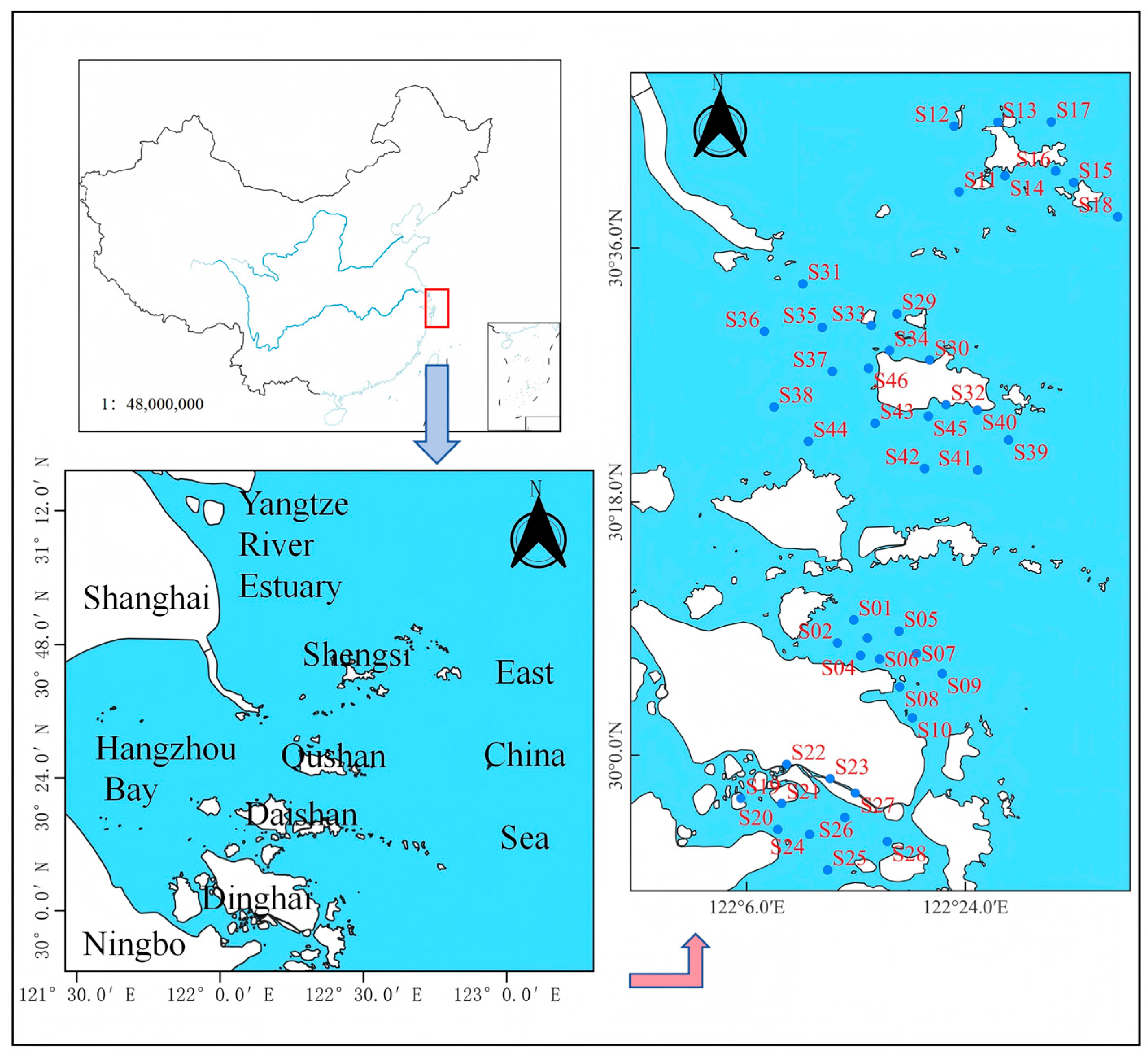
The sea areas surrounding Dinghai, Daishan, Qushan, and Shengsi in the Zhoushan Archipelago (Figure 1) are located on the outer edge of the Yangtze River estuary and Hangzhou Bay, serving as a crucial transition zone connecting the East China Sea’s inner shelf with the open ocean. The seabed sediments in this region are primarily silty clay, characterized by fine particles, a large specific surface area, and strong adsorption capacity, which facilitates the accumulation of pollutants such as HMS. It is also an important sedimentation area for sediment transported by the Yangtze River and other rivers along the southeastern coast, exhibiting typical estuarine-coastal sedimentary characteristics. The hydrodynamic environment in this sea area is extremely complex, regulated by multiple oceanic processes: the Yangtze River diluted water extends southeastward during the flood season, forming a low-salinity water tongue; the East China Sea coastal current transports terrestrial materials from north to south; and the outer branch of the Taiwan Warm Current brings high-temperature, high-salinity offshore seawater in different seasons. The interaction of these three factors leads to strong water mixing and variable suspended sediment transport paths, significantly affecting the migration, diffusion, and redistribution of pollutants. As the core area of the Zhoushan fishing ground—my country’s largest fishing ground—this sea area boasts extremely rich fishery resources, producing a variety of economically important fish species such as hairtail, yellow croaker, and pomfret, making it strategically important to the national marine fishery economy. Meanwhile, its advantageous geographical location and excellent navigation conditions constitute an important maritime transportation hub along my country’s eastern coast. The Ningbo-Zhoushan Port, the world’s largest port in terms of cargo throughput, consistently ranks among the world’s top ports for container and bulk cargo handling, supporting the foreign trade of the Yangtze River Delta and the entire country.
Leveraging its port advantages, the region has developed a highly concentrated cluster of port-related industries, including China’s largest green petrochemical industry base (such as the Zhejiang Zhoushan Green Petrochemical Base), a leading national shipbuilding and marine engineering equipment manufacturing cluster, and a large-scale seafood processing and cold chain logistics system. While these industries promote regional economic development, they also bring in diverse pollution inputs from industrial wastewater, domestic sewage, ship emissions, aquaculture feed residues, and atmospheric deposition, making this sea area a typical land-source-sea-source composite pollution hotspot. The accumulation of persistent pollutants such as HMS and the associated ecological risks are becoming increasingly prominent, urgently requiring systematic environmental monitoring, source apportionment, and comprehensive management research.

2.2. Sampling and Analysis

In November 2023, a total of 46 surface sediment samples were collected from the Zhoushan sea area. The sampling sites were systematically distributed across the coastal waters surrounding Dinghai, Daishan, Qushan, and Shengsi islands, forming a spatially representative sampling network (Figure 1). These locations encompassed areas subjected to varying degrees and types of anthropogenic influence, including port and shipping zones, industrial areas, agricultural regions, and urban residential waters. Such a sampling design was intended to capture the spatial heterogeneity of human activities and their potential impacts on sediment quality in the Zhoushan sea area.
Surface sediment samples (0–20 cm) were collected using an Austrian-made UWITEC columnar sediment sampler, which ensured minimal disturbance to the sediment structure during sampling. Immediately after collection, the samples were transferred to clean containers and transported to the laboratory for pretreatment. In the laboratory, the sediment samples were spread evenly in air-drying trays to form a thin layer of approximately 2–3 cm and allowed to air-dry naturally at room temperature. After drying, the samples were homogenized by grinding with a planetary ball mill PM 400 (Retsch, Haan, Germany) equipped with zirconia (ZrO2) grinding jars and grinding media to minimize the risk of metal contamination. The homogenized sediments were then processed using the quartering method to obtain representative subsamples. Finally, the subsamples were sequentially sieved through 60-mesh and 100-mesh soil sieves to achieve uniform particle sizes for subsequent physicochemical and geochemical analyses.

2.3. Sample Determination Methods

The TOC content of the sediments was measured using a total organic carbon analyzer (TOC-LCPH, Shimadzu, Kyoto, Japan). Concentrations of Cu, Zn, Cr, Pb, and Cd were measured by an atomic absorption spectrometer (PE 900T, PerkinElmer, Norwalk, CT, USA). Hg and As concentrations were analyzed using an atomic fluorescence spectrometer (AFS-9800, Haiguang, Beijing, China). The redox potential (Eh) was measured on wet samples. To maintain in situ redox conditions, the redox potential was measured immediately after collection using a redox potential meter (S40K, Mettler Toledo, Greifensee, Switzerland) on fresh sediment.
Sample pretreatment and analytical procedures were performed in accordance with the Marine Monitoring Standard [42].
Data sets of heavy metal concentrations, Eh, and TOC in sediments are provided in Supplementary Materials Table S1.

2.4. Ecological Risk Assessment Methods

2.4.1. Single-Factor Index Method

The single-factor index method is used to assess the contamination level of a single pollutant in sediment samples. This method can highlight the pollutants that contribute the most to overall pollution, reflecting the pollution characteristics of different sampling points in a simple and intuitive way [43]. The formula for calculating the single-factor index is as follows:
P i = C i S i
where P i is the pollution index of the i -th heavy metal; C i is the measured concentration of heavy metal i ; and S i is the background concentration of heavy metal i . This study referenced previous research results [44] and adopted the background values of HMS in surface sediments of the East China Sea [45], as shown in Table S3.
Table S2 summarizes the classification standards used for the single-factor pollution index.

2.4.2. Nemerow Pollution Index

The Nemerow pollution index was first proposed by Professor N. L. Nemerow of Syracuse University in his book Scientific Stream Pollution Analysis in 1974 [46]. This index evaluates the overall pollution level of multiple HMS in sediments by simultaneously considering both the average and the maximum values of the single-factor pollution indices, thereby highlighting the influence of heavily polluted elements on the integrated pollution level [47,48]. The calculation method for the integrated pollution index is as follows:
P N = A v e P i 2 + M a x P i 2 2
where P N is the integrated pollution index at the sampling site; M a x P i is the maximum single-factor pollution index of the HMS at sampling site i ; and A v e P i is the average value of the single-factor pollution indices at the i -th sampling point.
Given that different HMS exert varying degrees of impact on soil environments and ecosystems, the weighted average method was adopted in this study to obtain a more scientifically representative mean value. The improved formula is as follows:
A v e P i = i = 1 n w i P i i = 1 n w i
Determination of weight (w): HMs were classified into three categories according to their relative environmental risk. Weights of 3, 2, and 1 were assigned to Categories I, II, and III, respectively, reflecting decreasing environmental importance. The category assignments and corresponding weights are listed in Table 1, while the grading criteria for the Nemerow pollution index are provided in Table S2.

2.4.3. Potential Ecological Risk Index

The potential ecological risk index, originally developed by Hakanson (1980) [24], offers an integrated approach for assessing ecological risks posed by HMS in sediments. The method incorporates both the toxicity response factors of individual metals and the ratios between their measured concentrations and corresponding background levels. This method has been widely applied in ecological risk assessments of HMS in surface sediments and is now one of the most commonly used approaches for evaluating heavy-metal risks in soils and sediments worldwide [49,50,51]. The calculation formulas for the Potential Ecological Risk Index are as follows:
C f i = C s u r f a c e i / C n i
E r i = T r i C f i
R I = i n E r i = i n T r i × C f i
where C f i is the contamination factor of heavy metal   i ; C s u r f a c e i and C n i  are the measured concentration and background concentration of heavy metal i ; T r i is the toxicity response coefficient of heavy metal i ; E r i represents the potential ecological risk coefficients of heavy metal i in the sediment; and R I is the integrated potential ecological risk index of all HMS.
In this study, C n i were obtained from surface sediments of the East China Sea [45], T r i were adopted from the relevant literature [24], as summarized in Table S3. The classification criteria for potential ecological risk levels are presented in Table S2.

2.5. Positive Matrix Factorization (PMF) Model

The PMF model was applied to quantitatively identify the sources of HMS in the sediment samples [52]. The model was first proposed by Paatero in 1994 and has since been recommended by the United States Environmental Protection Agency for source apportionment [53]. By introducing weighting factors, PMF fully accounts for the uncertainties in chemical components across samples and quantitatively evaluates major pollution sources and their contributions using a least-squares approach [53]. By constraining source profiles and contributions to non-negative values, the model produces more reasonable and physically interpretable results [9].
PMF resolves the data matrix (X) into source contributions (G), factor profiles (F), and residuals (E). The calculation formula is as follows:
X i j = k = 1 P G i k × F k j + E i j
where X i j is the concentration of chemical component j in sample i ; p is the number of factors; G i k represents the contribution of factor k to sample i ; F k j is the characteristic value of factor k for chemical component j ; and E i j is the residual matrix. The optimal matrices G and F are obtained by minimizing the objective function Q, which is defined as follows:
Q = i = 1 n j = 1 m ( e i j u i j ) 2
Q r o b u s t = i = 1 n j = 1 m e i j h i j u i j
where, when e i j / u i j α ,   h i j = 1 ; and when e i j / u i j α ,   h i j = e i j / u i j · α 1 . The parameter α is typically set to 4 [54]. Here, u i j represents the uncertainty of chemical component j in sample i . The uncertainty u i j is calculated as follows:
U i j = 5 6 × M D L ( c M D L ) ( σ × c ) 2 + ( 0.5 × M D L ) 2 ( c > M D L )
where   c represents the pollutant concentration,   σ is the percentage of measurement uncertainty, and MDL refers to the method detection limit. T h e   v a l u e s of σ and MDL are provided in Supplementary Table S4.
Since PMF 5.0 [55] requires all input parameters to be expressed in concentration units, seven HMS—excluding Eh and TOC—were used in the PMF analysis in this study to identify the sources of heavy metal pollution in surface sediments of the study area. The reliability of the PMF results was evaluated by examining the consistency between base runs and multiple bootstrap (BS) runs, the distribution of Q values, and the distribution patterns of modeled chemical species concentrations.

2.6. Geostatistical Method

Based on the Inverse Distance Weighting (IDW) interpolation method, the spatial distribution of HMS, Eh, TOC, and related assessment indicators was visualized using QGIS v3.40.8 software. This method uses a weighted average, where the weights are determined by the distance between the estimated point and the surrounding sampling points; points closer to the estimated point have higher weights [56]. In this study, spatial interpolation was performed using the projected coordinate system EPSG:3857 (WGS 84/Pseudo-Mercator), with all spatial units in meters. The distance power parameter was set to 2.00, and the pixel size in both the x and y directions was set to 20 m, resulting in an output raster size of 5705 rows × 2878 columns.
To verify the reliability of the interpolation results and rationally select the interpolation method, we further conducted leave-one-out cross-validation, comparing the prediction accuracy of IDW and Ordinary Kriging. The results showed (Table S5) that the root mean square errors (RMSE) of the two methods were very close; for example, the RMSE for Cu was 4.690 (IDW) and 4.685 (Kriging), and for As, it was 2.312 and 2.208, with differences for other elements also less than 0.1. Considering that the study area is a highly heterogeneous coastal environment and the number of sampling points is limited (n = 46), IDW is more suitable for the exploratory spatial mapping needs of this study due to its advantages of not requiring assumptions of spatial stationarity, not relying on variogram fitting, robust calculation, and insensitivity to outliers. Therefore, the IDW method was ultimately used to generate indicative spatial distribution maps for all indicators, and the cross-validation RMSE values were used as a quantitative reference for interpolation uncertainty.

2.7. Data Analysis

Spearman correlation coefficients among HMs and between HMs and environmental parameters (Eh and TOC), were calculated using RStudio (R version 4.5.1) to examine potential relationships and co-variation patterns among variables. To further explore the underlying structure of the dataset and qualitatively identify potential sources of HMs in the sediments of the study area, Factor Analysis–Principal Component Analysis (FA–PC) was conducted using PyCharm Community Edition 2024.2.3 with Python 3.13.
Prior to FA–PC analysis, the suitability of the dataset was assessed using the Kaiser–Meyer–Olkin (KMO) measure of sampling adequacy and Bartlett’s test of sphericity. The results confirmed that the data were appropriate for factor analysis, with KMO values exceeding 0.7 and Bartlett’s test showing statistical significance (p < 0.05). To improve the interpretability of the extracted principal components, Varimax rotation with Kaiser normalization was applied to optimize factor loadings. The spatial distribution and interpretation of FA–PC results were visualized using QGIS version 3.40.8. Figure 2, Figure 3 and Figure 4, Figures S1 and S2 were generated using RStudio (R 4.5.1).

2.8. Quality Control

Microwave digestion conditions for HMS. Digestion was performed according to the following heating program: heating time 10 min, digestion temperature 130 °C, holding time 3 min; followed by heating time 7 min, digestion temperature 190 °C, and holding time 25 min.
Detection Limit: The instrument zero point was adjusted with water. Blank and detection limit solutions were measured simultaneously with the standard solution series. The concentration of each metal in the sample solution was determined based on the absorbance of the sample after subtracting the blank. The detection limit was obtained by measuring the blank solution 11 times and taking three times the standard deviation. The detection limits for each element are shown in Supplementary Table S4.

3. Results and Discussion

3.1. Spatial Distribution of HMS in Sediments

3.1.1. Concentrations of HMS in Surface Sediments

The descriptive statistics of heavy metal concentrations, Eh, and TOC in surface sediments of the waters surrounding the archipelago are presented in Table 2. The concentration ranges of Cu, Zn, Cr, Pb, Cd, Hg, and As were 14.05–34.71 mg/kg, 60.69–94.21 mg/kg, 59.98–79.04 mg/kg, 14.07–24.85 mg/kg, 0.06–0.13 mg/kg, 0.027–0.170 mg/kg, and 5.24–19.07 mg/kg, respectively. All seven HMS at the sampling sites were within the limits of China’s Class I marine sediment quality standard [57]. The mean concentrations of the HMS followed the order Zn (77.58 ± 7.19 mg/kg) > Cr (70.08 ± 5.22 mg/kg) > Cu (28.44 ± 5.28 mg/kg) > Pb (18.92 ± 2.42 mg/kg) > As (9.40 ± 2.24 mg/kg) > Cd (0.09 ± 0.02 mg/kg) > Hg (0.073 ± 0.032 mg/kg). Notably, Hg (43.20%) and As (23.87%) exhibited the highest coefficients of variation, indicating strong spatial heterogeneity. This variability may be associated with localized anthropogenic inputs, as reported in previous studies [58,59]. In contrast, the CV values of Cu, Cd, Pb, Zn, and Cr ranged from 18.56% to 7.45%, indicating relatively low variability.

3.1.2. Spatial Distribution of HMS in Surface Sediments

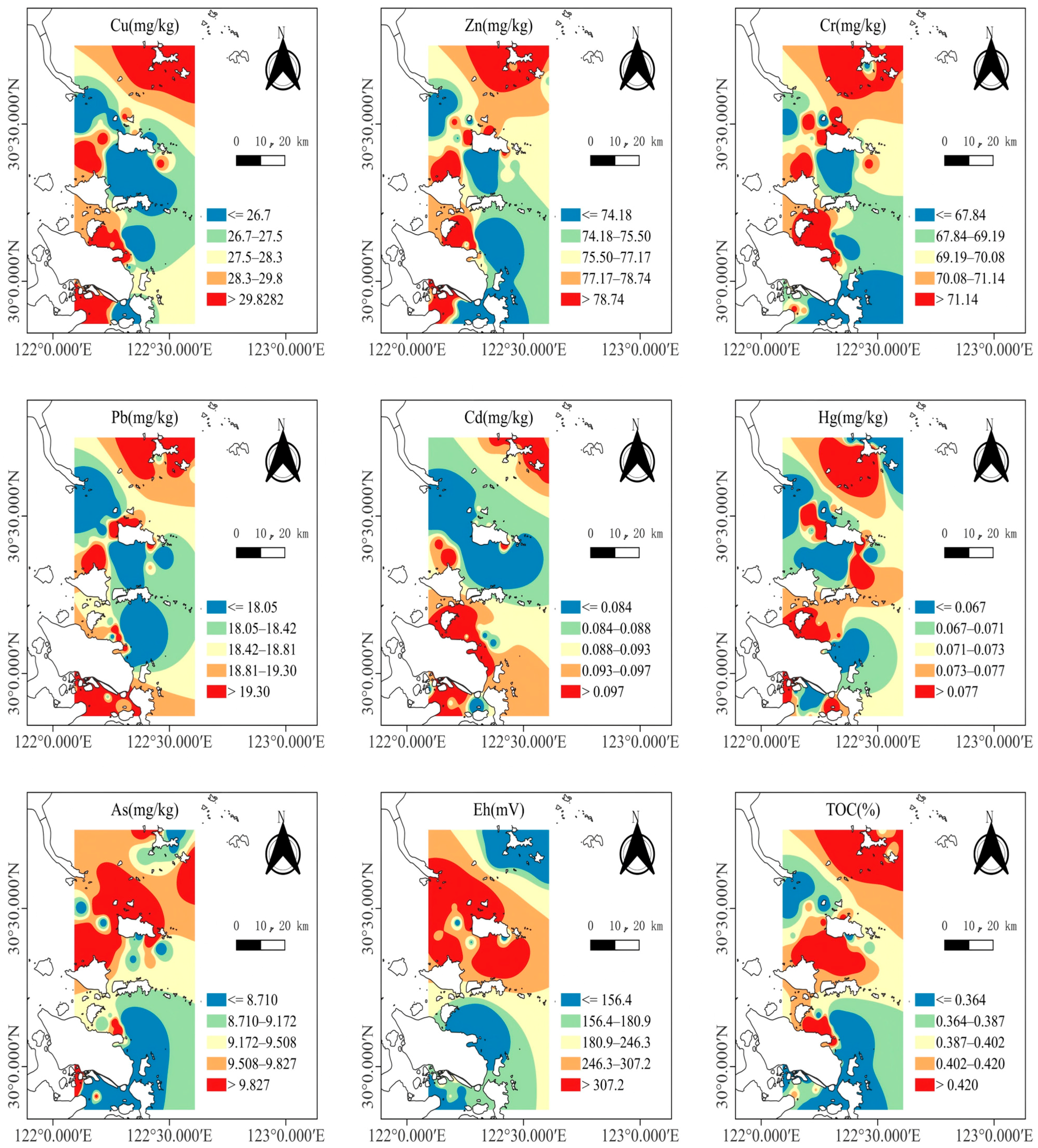
The spatial distributions of HMS, Eh, and TOC in surface sediments of the waters surrounding the archipelago are shown in Figure 5. Overall, the concentrations of Cu, Zn, Pb, and Cd were higher in the waters surrounding the Shengsi, Daishan, and Dinghai Islands, while relatively lower concentrations were observed around the Qushan Islands, forming several localized high-value clusters. These spatial patterns suggest a potential influence of local anthropogenic activities. For example, the elevated levels observed in Dinghai and Daishan may be associated with intensive port operations and shipping activities. Hg and As exhibited relatively high concentrations in the waters around Dinghai, Daishan, Qushan, and Shengsi, but their spatial distributions were more scattered, indicating a strong degree of local variability in the distribution patterns of Hg and As.
Figure S1 shows a comparison of the concentrations of seven heavy metal elements, as well as Eh and TOC, in different regions. Overall, the concentrations of Cu, Zn, Pb, and Cd generally show a decreasing trend from Dinghai > Daishan > Qushan, while Shengsi exhibits relatively high concentrations. Although heavy metal concentrations generally decrease from nearshore to offshore areas [44], Shengsi still exhibits relatively high levels. This suggests potential non-local inputs. Shengsi is located in the southeastern branch of the Yangtze River estuary, where hydrodynamic processes regulate sediment resuspension and pollutant transport [60]. The combined effects of regional currents, shipping activities, and long-range terrestrial inputs may therefore contribute to the observed enrichment.
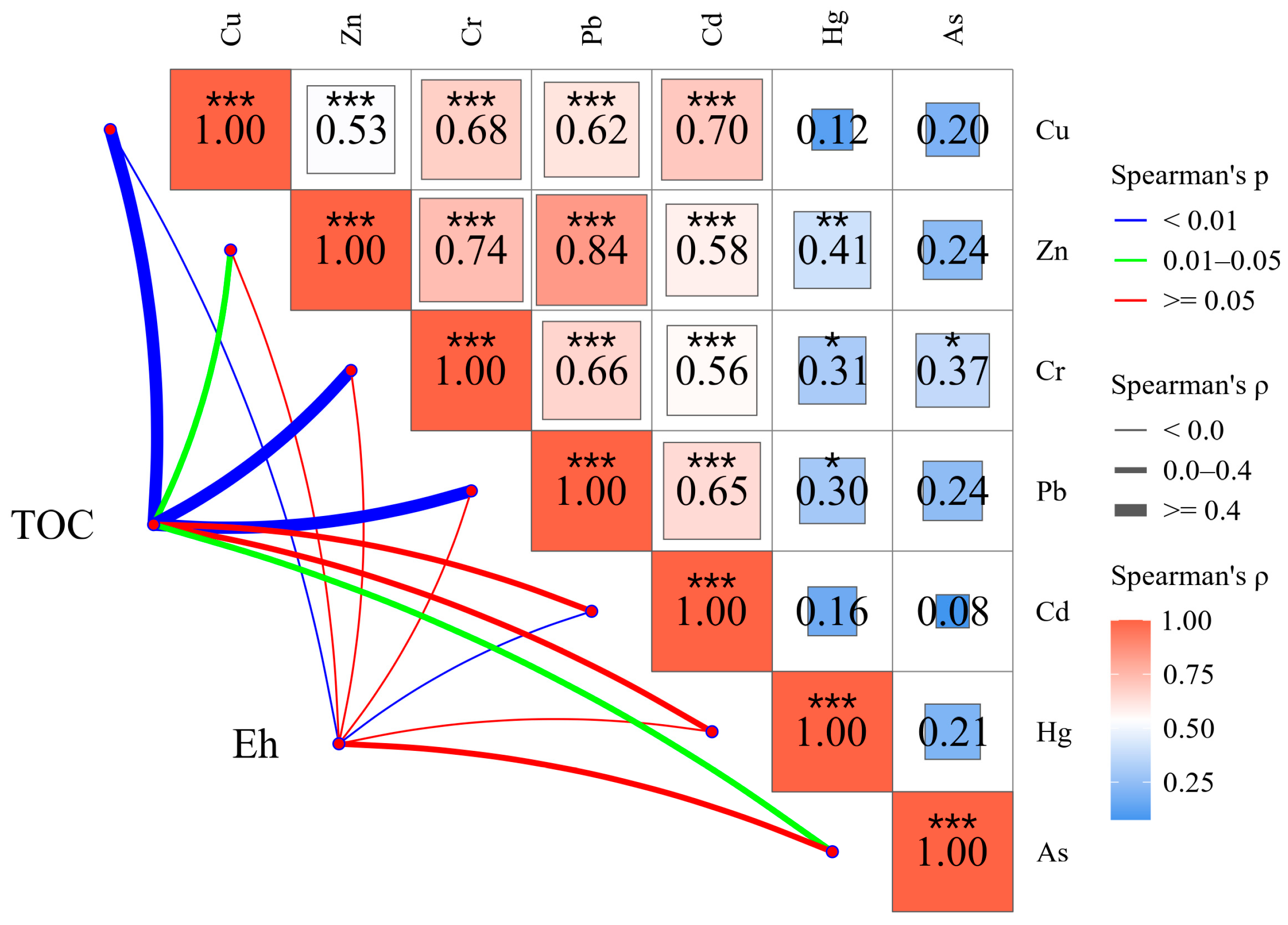
As shown in Figure 5, the Eh values in the waters around Qushan were markedly higher than those in other regions. Redox potential plays a crucial role in the migration and accumulation of HMS [61]. As illustrated in Figure 3, Eh exhibited negative correlations with Zn, Cr, and Pb (ρ < 0), and showed highly significant negative correlations with Cu and Cd (p < 0.01, ρ < 0). This pattern is consistent with previous field observations, in which low-Eh conditions are often associated with higher organic carbon contents and increased heavy metal concentrations [62,63]. High organic carbon levels indicate the presence of abundant organic matter in sediments, containing functional groups such as carboxyl, hydroxyl, phenolic hydroxyl, and amino groups. These groups can form stable organic complexes with metal ions such as Cu, Pb, and Cd, or facilitate their adsorption and immobilization, thereby promoting the accumulation of HMS in sediments [64,65]. In addition, under strongly reducing conditions (i.e., low Eh), Cu and Cd may also be immobilized through sulfide precipitation, further contributing to their elevated concentrations in the sediments [61,66].
Overall, areas with higher TOC generally corresponded to the high-value zones of Cu, Zn, Cr, Pb, and Cd in surface sediments (Figure 5). As shown in Figure 3, TOC exhibited highly significant positive correlations with Cu, Cr, and Pb (p < 0.01, ρ > 0.4), and significant positive correlations with Zn and As (p < 0.05, 0 < ρ < 0.4). These results suggest a strong association between the concentrations of these HMS and TOC, consistent with findings reported by Niu and others, which show that certain HMS tend to accumulate in TOC-rich sedimentary environments [63,67]. This further supports a close relationship between these metals and sedimentary organic matter.

3.2. Ecological Risk Assessment

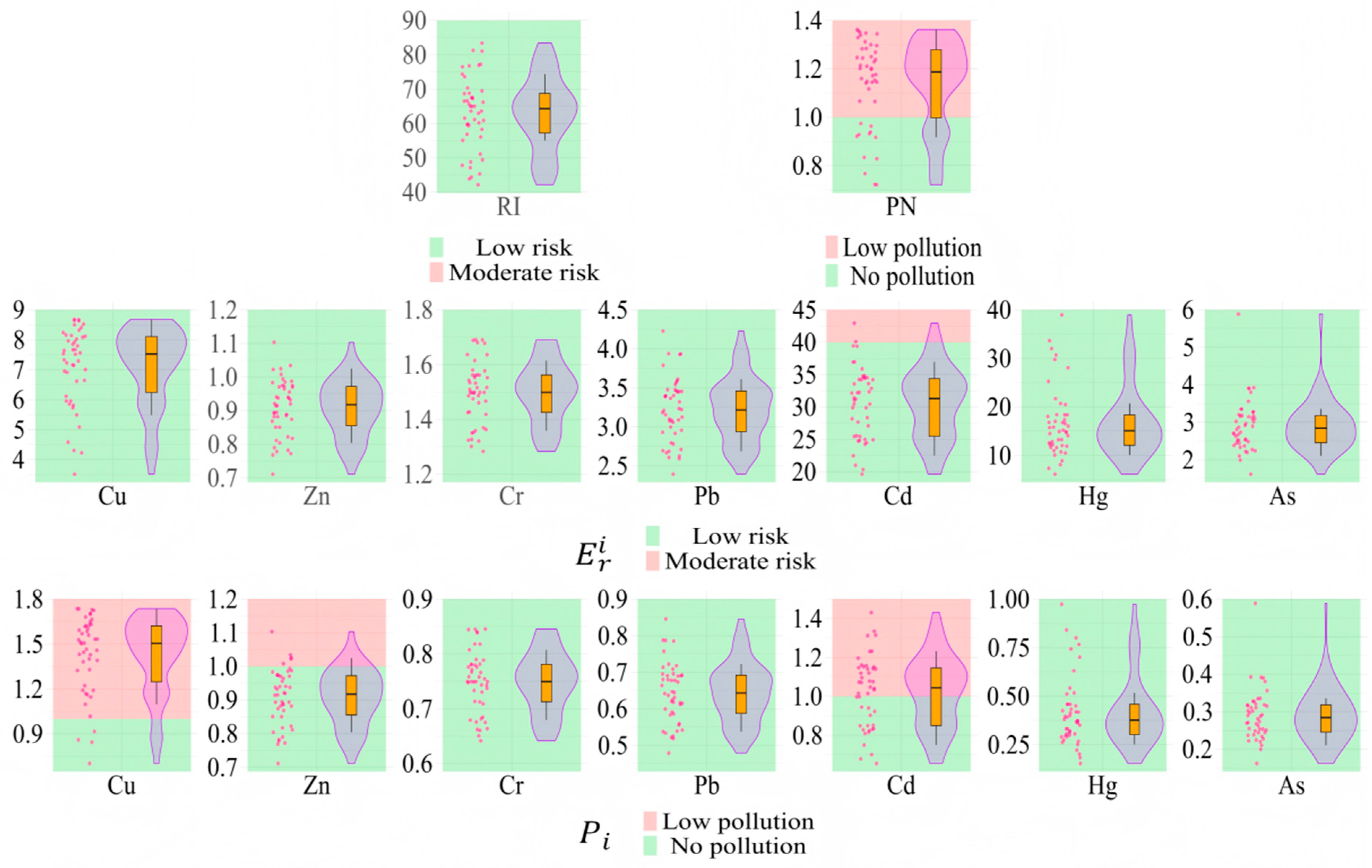
The single-factor pollution indices and Nemerow pollution indices for all sampling sites are summarized in Tables S6 and S7 and Figure 2. As shown, the overall pollution levels of HMS in surface sediments followed the order Cu > Cd > Zn > Cr > Pb > Hg > As. Among them, only Cu and Cd exhibited mean single-factor indices reaching the low-pollution level ( 1 < P i 2 ). Except for the S28, S42, S43, and S45 sites, where Cu was at a no-pollution level ( P i 1 ), the remaining 91.30% of the sampling sites were in a low-pollution state; for Cd, 63.04% of the sampling sites were at a low-pollution level. It was noteworthy that although the mean Zn concentration indicates a no-pollution level, stations S3, S13, S20, S44, and S46 still reached the low-pollution category. According to the Nemerow pollution index, the surface sediments in this area were overall classified as being under low-pollution ( 1 < P N 5 ), with 73.91% of the sampling sites falling into this category.
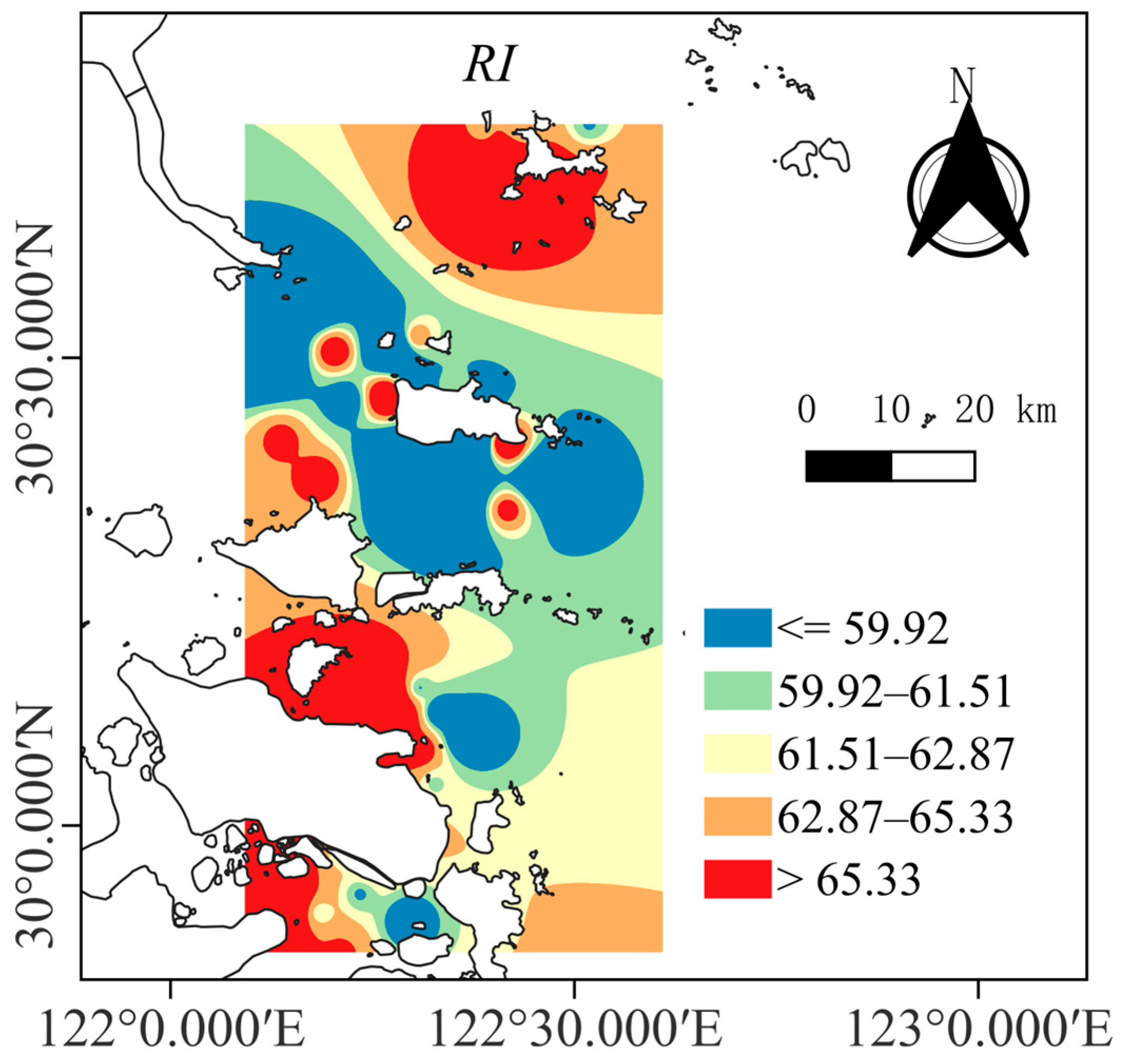
The E i for individual HMS and RI are summarized in Tables S8 and S9, and Figure 2, and their spatial distribution characteristics are shown in Figure 6. Figure S2 shows the differences in potential ecological risk indices across different regions. Overall, the E i and RI for each metal were all classified as low risk ( E i < 40 , R I < 150 ). The E i decreased in the order of Cd, Hg, Cu, Pb, As, Cr, and Zn. However, Cd reached a moderate-risk level ( 40 E i < 80 ) at sampling stations S3 and S20, indicating that these sites warranted particular attention. It is noteworthy that, despite the overall low ecological risk assessment results, Cd and Hg, as highly toxic and bioaccumulative HMs, can still enter the human body through aquatic product ingestion or sediment resuspension, even at low environmental concentrations. They can cause irreversible damage to the nervous system, kidneys, and child development, and may even have potential carcinogenicity [68,69]. This means that elevated Cd levels in local hotspot areas may increase human exposure risk, especially posing a potential health threat to coastal residents through seafood consumption. Furthermore, the risk index (RI) is highly dependent on the background values and toxicity coefficients used; a low-risk conclusion at the regional average level may mask locally high-risk areas near ports, busy shipping lanes, or sewage outlets. Therefore, the results of this study suggest the need to strengthen the monitoring of key HMs such as Cd and Hg, and to implement preventative management measures, while continuously controlling pollution source emissions, to reduce potential human health risks.
As shown in Figure 6 and Figure S2, the spatial distribution of RI was generally consistent with the distribution patterns of heavy metal concentrations. High-RI areas were mainly located in the offshore regions of Dinghai, Daishan, and Shengsi, with little difference in RI among the three. The waters near Qushan generally have lower risk levels, with an average level lower than the other three areas, and only a few localized areas have higher risks, which may reflect the relatively lower intensity of anthropogenic activities in this area. Among the metals, Cd contributed the most to the RI (48.63%), followed by Hg (26.57%) (Table S9). Although the concentrations of these two metals were not the highest, their E i were significantly greater than those of the other metals, contributing approximately 75% to the total risk. This suggests that Cd and Hg make the dominant contribution to the overall potential ecological risk in the island region. This finding is consistent with those of previous studies [14,44,70].

3.3. Source Identification of Sediment HMS by Multiple Methods

Numerous studies have confirmed the applicability of CA, FA–PC, and PMF for identifying the sources of HMS [32,33,37,58].

3.3.1. CA

Figure 3 presents the Spearman correlation results between heavy metal concentrations and their relationships with Eh and TOC. As shown in the figure, Cu, Zn, Cr, Pb, and Cd exhibited positive correlations at a high significance level with one another (ρ = 0.53–0.84, p < 0.001). Conversely, the correlations between Hg and As and other metals were relatively weak. These results suggest that Cu, Zn, Cr, Pb, and Cd may have similar sources or be affected by a common pollution source [9,71], or may be due to common carriers (such as particle size, total organic carbon) or common variations in sediments, while Hg and As may have different pollution sources.

3.3.2. FA-PC

FA-PC was used to qualitatively determine the possible sources of HMS in the surface sediments of the waters around the archipelago [34]. After performing the KMO test and Bartlett’s test of sphericity, the results showed a KMO value of 0.755 and a highly significant Bartlett’s test (p < 0.001), suggesting that the dataset was appropriate for factor analysis. The results of the FA-PC analysis for HMS in the sediments are shown in Table S10. Using Varimax rotation with Kaiser normalization, two factors having eigenvalues exceeding 1 were identified. PC1 had an eigenvalue of 3.828, explaining 54.692% of the total variance, while PC2 had an eigenvalue of 1.334, explaining 19.054% of the variance. Together, the two factors accounted for 73.746% of the cumulative variance.
Table S10 presents the factor loadings of HMS in the sediments, and Figure S3 illustrates the spatial variation in the scores of the two principal components. After Varimax rotation, the factor loading matrix showed that PC1 exhibited high loadings on Pb, Zn, Cd, Cu, and Cr (0.876, 0.850, 0.848, 0.844, and 0.835, respectively). PC1 scores were highest in Shengsi, Dinghai, and Daishan, where port and shipping activities were most intensive, suggesting that this factor may reflect influences related to maritime transportation activities. PC2 was mainly characterized by high loadings of Hg (0.821) and As (0.809), which may be associated with inputs from chemical industries and agricultural activities, as reported in previous studies [72,73,74].

3.3.3. PMF

The PMF model was applied to quantitatively determine the sources of HMS in surface sediments from the waters around the archipelago. The optimal number of factors was determined by minimizing the objective function Q across various factor scenarios (ranging from 3 to 6 factors), with 20 base runs conducted for each scenario. The results showed that a three-factor solution yielded the most stable Q values, with the Q(robust)/Q(true) ratio closest to 1. The coefficients of determination ( r 2 ) ranged from 0.63 for Zn to 1.00 for Hg (Table S11), and the signal-to-noise ratios (S/N) for all seven HMS were greater than 2, indicating “strong” signals. These results demonstrated that the PMF model provided a reliable explanation of the observed dataset.
To assess the uncertainty in the model outputs, a Bootstrap (BS) analysis was carried out in accordance with the EPA PMF 5.0 User Guide [55]. A total of 100 BS runs were conducted, with a random seed of 60 and a minimum correlation coefficient (R value) of 0.6. In each run, the resolved factors were mapped to the base run according to their corresponding profiles. As shown in Table S12, the matching accuracies for Factors 1, 2, and 3 were 79%, 100%, and 97%, respectively, with no unmapped factors. The average matching accuracy between BS factors and base factors exceeded 92%. Furthermore, as shown in Figure S4, although there were local deviations, the predicted concentrations of the seven HMS were highly consistent with the observed concentrations overall, indicating that the model has strong explanatory power for the sources of HMS. According to the EPA guidelines, since the model showed a high matching rate under BS analysis and demonstrated high stability and reliability based on the coefficient of determination ( r 2 ), signal-to-noise ratio (S/N), and comparison of observed and predicted concentrations, DISP analysis was not necessary.
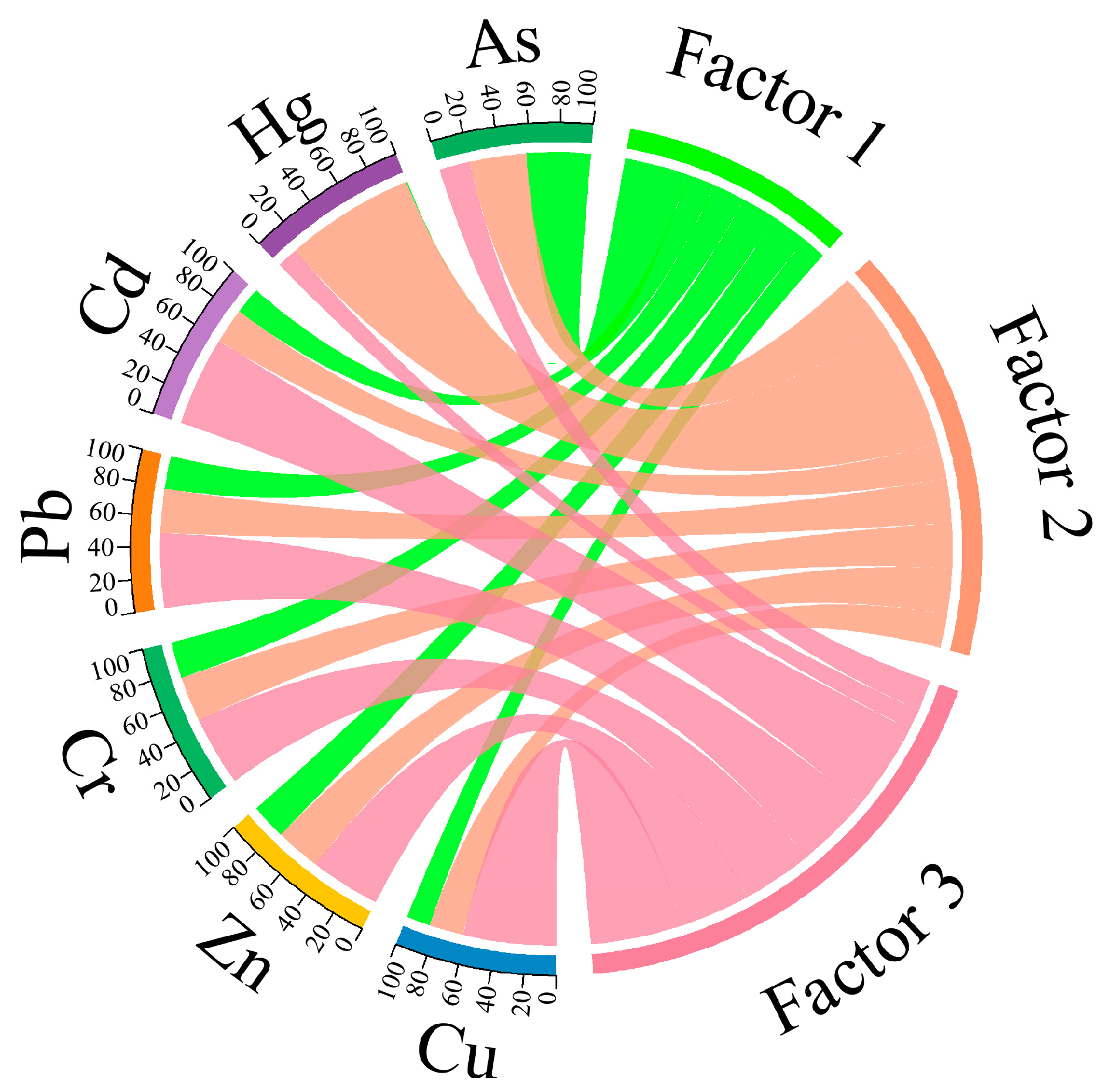
Figure 7 presents the quantitative source contributions of the three identified factors to the seven HMS, as estimated by the PMF model. Factor 1 was dominated by As (42.28%). The study area encompasses Zhoushan Fishery, the largest fishing ground in China, where aquaculture activities are highly developed. Previous studies have shown that many cultured species—particularly invertebrates—tend to accumulate arsenic (As) at relatively high levels [73,75]. In addition, the structural framework of aquaculture facilities can reduce local water flow, thereby limiting the dispersion and transport of pollutants [76]. As shown in Figure 5, As concentrations were relatively high in the waters around Qushan, suggesting that Factor 1 was closely associated with aquaculture activities in this area. Furthermore, many studies have reported that As is commonly present at elevated concentrations in fertilizers and pesticides [77,78]. Compounds such as calcium arsenate and sodium arsenate are widely used in herbicide and pesticide formulations [79]. Long-term and intensive application of fertilizers, herbicides, and pesticides can lead to the gradual accumulation of arsenic in soils, causing soil contamination. Arsenic-contaminated soils may enter coastal waters via surface runoff or groundwater transport, ultimately increasing As concentrations in marine sediments. Taken together, these lines of evidence suggest that Factor 1 is likely associated with agricultural and aquaculture-related activities, including the use of fertilizers and pesticides and the cultivation of shellfish and other farmed species.
Factor 2 was dominated by Hg (85.54%). Hg is commonly associated with anthropogenic inputs such as riverine runoff, industrial discharges, and domestic wastewater, which are the primary sources of Hg, transporting particle-bound or dissolved forms into coastal sediments [74]. In this study, the high-value zones of Hg were mainly concentrated around Dinghai, Daishan, and Shengsi (Figure 5)—areas characterized by intensive industrial operations such as shipbuilding and repair yards, as well as dense residential settlements. Therefore, Factor 2 is interpreted as representing pollution from industrial and domestic wastewater sources.
Factor 3 was primarily associated with Cu (61.67%), Cd (58.93%), Pb (49.22%), Zn (46.21%), and Cr (46.11%). These metals exhibited significant positive correlations with one another (Figure 3), suggesting that they may share similar controlling factors or potential sources. Shipping-related activities are widely recognized as important contributors to Cu, Cd, Pb, and Zn emissions [80,81,82]. For instance, to prevent biofouling on ship hulls, vessels are typically coated with Cu-based antifouling paints, and the Cu contained in the paint can enter the marine environment through leaching or paint detachment and subsequently accumulate in sediments [83,84]. Cd is largely derived from waste materials generated in port areas [78,85]. Spatially, the high-concentration zones of Cd, Cu, Cr, Pb, and Zn were mainly distributed in the waters surrounding Dinghai, Daishan, and Shengsi (Figure 5), where numerous ports facilities are concentrated. Shipping and shipyard-related activities, including vessel navigation, antifouling paint application, and port waste discharge, occur frequently in these regions. Therefore, Factor 3 predominantly represents pollution sources associated with port areas and shipyard activities in Dinghai, Daishan, and Shengsi.
Compared with FA-PC, the PMF model can provide a more refined differentiation of heavy metal sources in sediments, a feature also highlighted in previous studies [86]. In this study, PMF effectively revealed the contributions of different sources. However, the PMF model still has certain limitations in identifying mixed sources. The case of factor 3 in this study serves as an example; when elements exhibited extremely significant correlations, the derived factor likely represented multiple pollution sources simultaneously, and simply increasing the number of factors does not necessarily resolve this issue effectively [87]. Therefore, combining PMF with FA-PC provides a more robust approach for distinguishing the different sources associated with highly correlated heavy metal elements.

3.4. Comparative Analysis

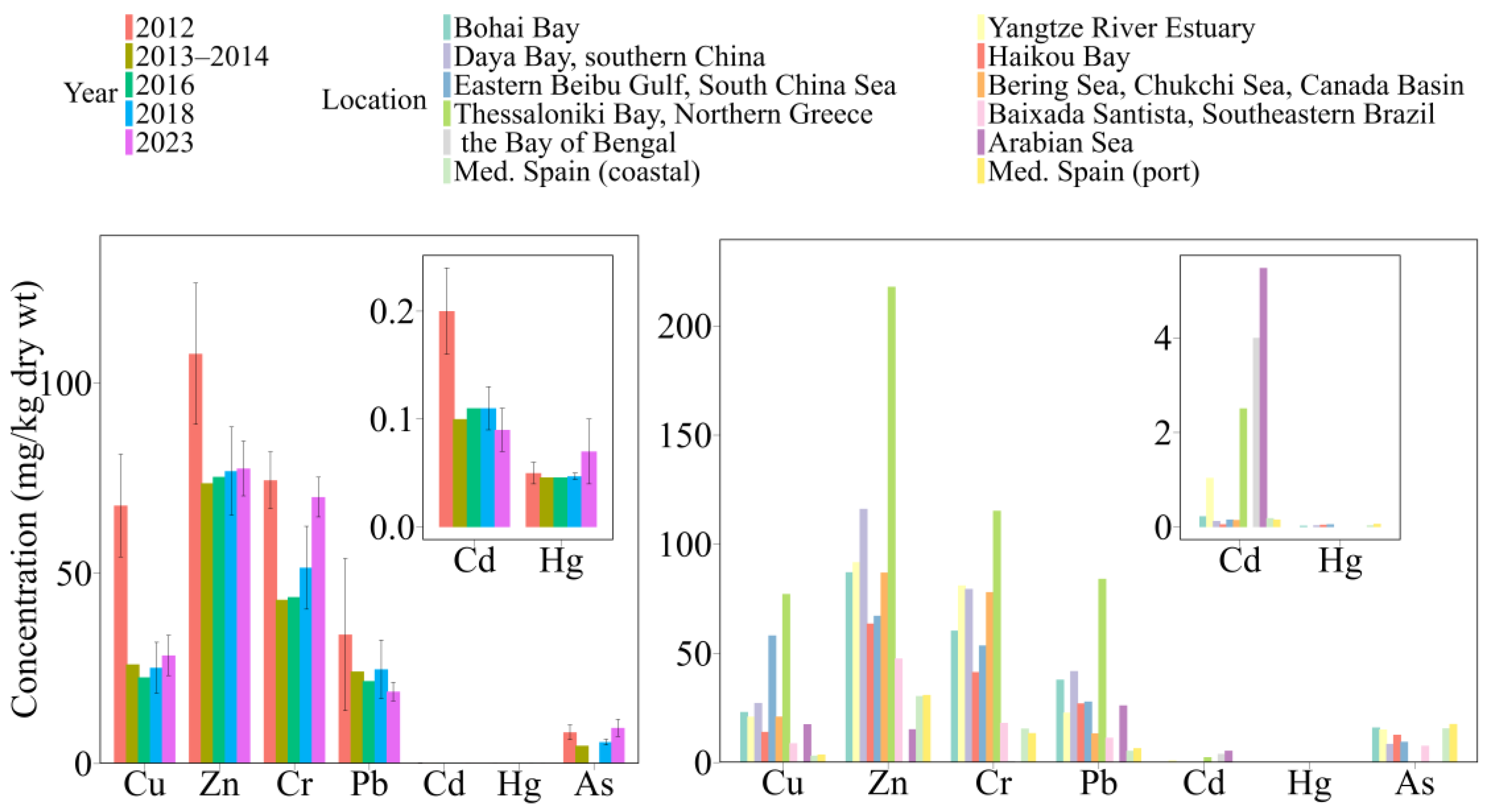
Currently, numerous studies have been carried out by researchers on the spatial distribution of heavy metal concentrations and associated ecological risks in sediments from the waters around Zhoushan. For example, Wang [88] evaluated the sediment pollution status and ecological risk levels in the northern waters of the Ningbo–Zhoushan Port; Zhu [89] investigated the spatial distribution patterns and controlling factors of As and Hg in seawater in the outer waters of Hangzhou Bay during summer and autumn; Zhai [14], Fang [90], Zhuo [91], and Cai [44], respectively, examined the spatial distribution of HMS and pollution levels in sediments sampled in the Zhoushan waters in 2012, 2013–2014, 2016, and 2018. Furthermore, with the escalation of anthropogenic activities, the geochemical characteristics of surface sediments have also shown year-on-year changes [17,92].
Therefore, this study compared the concentrations of HMS in the waters surrounding the archipelago with previously reported values from the same region as well as with those from other domestic and international coastal areas (Figure 4; supporting data in Table S13). The interannual variations from 2012 to 2023 demonstrated that the average concentrations of Cu, Zn, Pb, and Cd ranged from 22.70–67.84 mg/kg, 73.72–107.76 mg/kg, 18.92–33.93 mg/kg, and 0.09–0.20 mg/kg, respectively, exhibiting an overall decreasing trend. Conversely, the average concentrations of Cr, Hg, and As ranged from 43.07–74.51 mg/kg, 0.046–0.070 mg/kg, and 4.70–9.40 mg/kg, respectively, showing an increasing trend, suggesting a potential accumulation risk for Cr, Hg, and As. Overall, the seven HMS exhibited relatively small interannual fluctuations, reflecting their sensitivity to changes in anthropogenic activities in the region [93].
Compared with other domestic study areas, heavy metal concentrations in surface sediments of the study area showed distinct spatial characteristics. The Cu concentration was elevated compared to levels reported in Bohai Bay [94], the Yangtze River Estuary [95], Daya Bay [96], and Haikou Bay [97], yet remained below that observed in the eastern Beibu Gulf of the South China Sea [98]. The concentrations of Zn and Cr were lower than those in the Yangtze River Estuary and Daya Bay, yet higher than those in Haikou Bay and the eastern Beibu Gulf. Pb concentrations in the study area were among the lowest reported in coastal investigations nationwide, whereas Cd concentrations were only higher than those in Haikou Bay. Hg showed the highest concentration among the domestic comparison sites. As concentrations were lower than those reported in Bohai Bay, the Yangtze River Estuary, Haikou Bay, and the eastern Beibu Gulf, yet exceeded those observed in Daya Bay. When compared with international regions, in this study, Zn, Cr, and Cd concentrations were lower than those recorded in the Bering Sea [99], Chukchi Sea, and Canadian Basin, whereas Cu and Pb levels were marginally higher. In contrast to Thessaloniki Bay in northern Greece, the heavy metal concentrations here were substantially lower. This discrepancy is likely due to long-term influences from mining and metallurgical industrial discharges in Thessaloniki Bay [100]. Additionally, the Cu, Zn, and Cr concentrations in the study area were generally elevated compared to those observed in Baixada Santista (Southeastern Brazil) [101], the Bay of Bengal [102], and the Arabian Sea [103], Conversely, Cd concentrations in the latter two regions are notably higher, which may be attributed to factors such as riverine inputs (e.g., the Ganges River) and electronic-waste dismantling activities [102]. Overall, compared with the Spanish Mediterranean coastline and port areas, the study area generally exhibited higher concentrations of most HMS, whereas Cd and As concentrations were relatively lower [104].

4. Conclusions

This study developed a scientific framework for source apportionment of HMS in East China Sea sediments from an island-chain perspective, offering insights for regional pollution management and a reference for global marine heavy metal control and sustainable water resource management.
High concentrations of HMS (Cu, Zn, Pb, Cd) were detected in surface sediments in the waters near Dinghai, Daishan, and Shengsi. The overall concentrations showed a decreasing trend from Dinghai to Daishan to Qushan. Although Shengsi is an outlying island, it still maintained a high concentration, which may be influenced by non-local factors such as the hydrodynamics of the southeastern branch of the Yangtze River estuary, regional ocean currents, shipping activities, and long-distance terrestrial input. In contrast, high concentrations of HMS were only found in localized areas of Qushan. The average concentrations of Zn, Cr, Cu, Pb, As, Cd, and Hg were 77.58, 70.08, 28.44, 18.92, 9.40, 0.09, and 0.073 mg/kg, respectively. All sampling sites met China’s Class I marine sediment quality standards. The strong spatial variability of Hg and As suggests that they may be more sensitive to spatial heterogeneity.
Both the overall contamination level and the potential ecological risk of HMS in surface sediments of the waters surrounding the archipelago were generally low. The single-factor pollution index results indicated the metals as Cu > Cd > Zn > Cr > Pb > Hg > As. Cu and Cd are the main pollutants compared to other HMS, with 91.3% of sampling sites classified as low-polluted by Cu and 63.04% by Cd. The Nemerow pollution index further indicated that the surface sediments were predominantly under low-pollution conditions, accounting for 73.91% of all sampling sites. The potential ecological risk assessment revealed that the ecological risk coefficients followed the order Cd > Hg > Cu > Pb > As > Cr > Zn. Among them, Cd and Hg contributed the most to the overall ecological risk, accounting for 48.63% and 26.57%, respectively, together contributing approximately 75% of the total ecological risk. In terms of spatial distribution, high-risk areas are mainly concentrated in the waters surrounding Dinghai, Daishan, and Shengsi, with little difference among the three, and all exhibiting higher risk levels than the Quanshan area. Nevertheless, given the high toxicity and bioaccumulative nature of Cd and Hg, even their relatively low environmental concentrations may pose potential human health risks through seafood consumption or other exposure pathways, particularly in localized hotspot areas, highlighting the need for strengthened monitoring and precautionary management measures.
FA-PC results indicate that Pb, Zn, Cd, Cu, and Cr are mainly associated with port and shipping activities, while Hg and As are associated with industrial emissions and agricultural inputs. PMF analysis further shows that As mainly originates from agriculture and aquaculture, Hg mainly from industrial and domestic wastewater, while Cu, Cd, Pb, Zn, and Cr mainly originate from port and shipbuilding activities. Overall, heavy metal pollution in the study area is jointly influenced by agricultural and aquaculture activities, industrial and domestic wastewater discharge, and port-related operations. Therefore, pollution control should prioritize high-risk areas such as Dinghai, Daishan, and Shengsi through strengthened source control and the promotion of green development practices.
Comparative analysis shows a general interannual decline in Cu, Zn, Pb, and Cd concentrations, whereas Cr, Hg, and As exhibit increasing trends, indicating potential accumulation. Domestically, Cu and Hg levels are remarkably high, while Zn and Cr are moderate, and Pb, Cd, and As remain low. Compared with international regions, Cu and Pb concentrations exceed those in the Bering Sea, Chukchi Sea, and Canadian Basin but are lower than those in Thessaloniki Bay (Northern Greece). In addition, Cu, Zn, and Cr levels are generally higher than those reported for Baixada Santista, the Bay of Bengal, and the Arabian Sea, whereas Cd is lower. Compared to the Mediterranean coast and port areas of Spain, the concentrations of most HMS were higher in the study area, while the concentrations of cadmium and arsenic were relatively lower.

Supplementary Materials

The following supporting information can be downloaded at https://www.mdpi.com/article/10.3390/jmse14030256/s1, Table S1. Concentrations of heavy metals, Eh, and TOC in surface sediments of the waters surrounding the archipelago. Table S2. Classification criteria for single-factor pollution and Nemerow pollution levels in sediments and the potential ecological risk index and its grading standards. Table S3. Background concentrations, toxic-response factors values of metal elements in surface sediments of the East China Sea. Table S4. The values of σ and MDL. Table S5. RMSE of IDW and Kriging. Table S6. Statistics of single-factor pollution indices and Nemerow pollution indices of heavy metals at each sampling site. Table S7. Descriptive statistics of single-factor and Nemerow indices of heavy metals in surface sediments of the waters surrounding the archipelago. Table S8. Potential ecological risk coefficients for individual heavy metals and potential ecological risk index values at each sampling site. Table S9. Descriptive statistics of the potential ecological risk coefficients ( E r i ) of heavy metals and the potential ecological risk index (RI) in surface sediments of the waters surrounding the archipelago. Table S10. PC–FA results for heavy metals in surface sediments of the waters surrounding the archipelago. Table S11. Results derived from the base PMF model run. Table S12. Results of the mapped bootstrap factors to base factors. Table S13. Concentrations of heavy metals in surface sediments of the study area and other regions in China and abroad. Figure S1. Comparison of heavy metal, Eh, and TOC concentrations in different regions. Figure S2. Comparison of the potential ecological risk index (RI) in different regions. Figure S3. Spatial distributions of the scores for PCs 1 and 2 scores obtained from FA-PC. Figure S4. PMF: Observed and predicted concentrations of 7 heavy metals.

Author Contributions

Formal analysis, Z.W., J.Y., P.Y., W.W., X.Y. and Y.Z.; Investigation, W.W.; Writing—original draft, Z.W. and J.Y.; Writing—review & editing, Z.W., J.Y., P.Y. and W.W.; Visualization, X.Y.; Supervision, J.Y. and W.W.; Funding acquisition, P.Y., W.W. and Y.Z. All authors have read and agreed to the published version of the manuscript.

Funding

This work was supported by grants from the Key Laboratory of Marine Ecosystem Dynamics (MED202305), Natural Science Foundation of Ningbo City (2024J153), The Natural Science Foundation of Zhejiang Provincialand (LQN26E090002), Public Technology Research Project of Zhejiang Province (LGC19B070004), The Research Platform Special Project of Zhejiang Institute of Hydraulics and Estuary (Zhejiang Institute of Marine Planning and Design) (ZIHE25Z002), Central Guidance Funds for Science and Technology Local Development Projects (2025ZY01091), and Science and Technology Planning Project of the Zhejiang Provincial Department of Water Resources (RC2173).

Data Availability Statement

The original contributions presented in this study are included in the article/Supplementary Materials. Further inquiries can be directed to the corresponding authors.

Conflicts of Interest

The authors declare no conflict of interest.

References

  1. Kim, J.J.; Kim, Y.S.; Kumar, V. Heavy metal toxicity: An update of chelating therapeutic strategies. J. Trace Elem. Med. Biol. 2019, 54, 226–231. [Google Scholar] [CrossRef] [PubMed]
  2. Wang, H.; Wang, J.; Liu, R.; Yu, W.; Shen, Z. Spatial variation, environmental risk and biological hazard assessment of heavy metals in surface sediments of the Yangtze River estuary. Mar. Pollut. Bull. 2015, 93, 250–258. [Google Scholar] [CrossRef] [PubMed]
  3. Chen, H.; Wang, J.; Chen, J.; Lin, H.; Lin, C. Assessment of heavy metal contamination in the surface sediments: A reexamination into the offshore environment in China. Mar. Pollut. Bull. 2016, 113, 132–140. [Google Scholar] [CrossRef]
  4. Xu, F.; Hu, B.; Yuan, S.; Zhao, Y.; Dou, Y.; Jiang, Z.; Yin, X. Heavy metals in surface sediments of the continental shelf of the South Yellow Sea and East China Sea: Sources, distribution and contamination. Catena 2018, 160, 194–200. [Google Scholar] [CrossRef]
  5. Zhai, B.; Liu, Z.; Wang, X.; Bai, F.; Wang, L.; Chen, Z.; Zhang, X. Assessment of heavy metal contamination in surface sediments in the western Taiwan Strait. Mar. Pollut. Bull. 2020, 159, 111492. [Google Scholar] [CrossRef]
  6. Xenidis, A.; Papassiopi, N.; Komnitsas, K. Carbonate-rich mining tailings in Lavrion: Risk assessment and proposed rehabilitation schemes. Adv. Environ. Res. 2003, 7, 479–494. [Google Scholar] [CrossRef]
  7. Pappa, F.K.; Tsabaris, C.; Patiris, D.L.; Androulakaki, E.G.; Eleftheriou, G.; Betsou, C.; Michalopoulou, V.; Kokkoris, M.; Vlastou, R. Historical trends and assessment of radionuclides and heavy metals in sediments near an abandoned mine, Lavrio, Greece. Environ. Sci. Pollut. Res. Int. 2018, 25, 30084–30100. [Google Scholar] [CrossRef]
  8. Zhang, M.; Sun, X.; Xu, J. Heavy metal pollution in the East China Sea: A review. Mar. Pollut. Bull. 2020, 159, 111473. [Google Scholar] [CrossRef]
  9. Magesh, N.S.; Tiwari, A.; Botsa, S.M.; da Lima Leitao, T. Hazardous heavy metals in the pristine lacustrine systems of Antarctica: Insights from PMF model and ERA techniques. J. Hazard. Mater. 2021, 412, 125263. [Google Scholar] [CrossRef]
  10. Xu, Y.; Sun, Q.; Yi, L.; Yin, X.; Wang, A.; Li, Y.; Chen, J. The source of natural and anthropogenic heavy metals in the sediments of the Minjiang River Estuary (SE China): Implications for historical pollution. Sci. Total Environ. 2014, 493, 729–736. [Google Scholar] [CrossRef]
  11. Wang, Z.; Ling, Y.; Qu, X.; Yao, P.; Wang, W.; Wang, B. Ecological risk assessment and source apportionment of heavy metals in sediments of a typical marine reservoir in the East China Sea: A case study of xuanmen bay marine reservoir. J. Sea Res. 2025, 206, 102604. [Google Scholar] [CrossRef]
  12. Mitra, S.; Chakraborty, A.J.; Tareq, A.M.; Emran, T.B.; Nainu, F.; Khusro, A.; Idris, A.M.; Khandaker, M.U.; Osman, H.; Alhumaydhi, F.A.; et al. Impact of heavy metals on the environment and human health: Novel therapeutic insights to counter the toxicity. J. King Saud Univ.-Sci. 2022, 34, 101865. [Google Scholar] [CrossRef]
  13. Jain, C.K.; Sharma, M.K. Distribution of trace metals in the Hindon River system, India. J. Hydrol. 2001, 253, 81–90. [Google Scholar] [CrossRef]
  14. Zhai, B.; Zhang, X.; Wang, L.; Zhang, Z.; Zou, L.; Sun, Z.; Jiang, Y. Concentration distribution and assessment of heavy metals in surface sediments in the Zhoushan Islands coastal sea, East China Sea. Mar. Pollut. Bull. 2021, 164, 112096. [Google Scholar] [CrossRef]
  15. Bai, J.; Cui, B.; Chen, B.; Zhang, K.; Deng, W.; Gao, H.; Xiao, R. Spatial distribution and ecological risk assessment of heavy metals in surface sediments from a typical plateau lake wetland, China. Ecol. Model. 2011, 222, 301–306. [Google Scholar] [CrossRef]
  16. Lecrivain, N.; Clement, B.; Dabrin, A.; Seigle-Ferrand, J.; Bouffard, D.; Naffrechoux, E.; Frossard, V. Water-level fluctuation enhances sediment and trace metal mobility in lake littoral. Chemosphere 2021, 264, 128451. [Google Scholar] [CrossRef]
  17. Zhou, F.; Xiong, M.; Wang, S.; Tian, S.; Jin, G.; Chen, F.; Chen, C.; Lu, X.; Zhu, Q.; Meng, Y. Impacts of Human Activities and Environmental Changes on Spatial-Seasonal Variations of Metals in Surface Sediments of Zhanjiang Bay, China. Front. Mar. Sci. 2022, 9, 925567. [Google Scholar] [CrossRef]
  18. Pekey, H. The distribution and sources of heavy metals in Izmit Bay surface sediments affected by a polluted stream. Mar. Pollut. Bull. 2006, 52, 1197–1208. [Google Scholar] [CrossRef]
  19. Lu, Y.; Zeng, Y.; Wang, W. Relation disentanglement, the potential risk assessment, and source identification of heavy metals in the sediment of the Changzhao Reservoir, Zhejiang Province. Environ. Sci. Pollut. Res. Int. 2023, 30, 82625–82636. [Google Scholar] [CrossRef]
  20. Tuncer, G.; Tuncel, G.; Balkas, T.I. Evolution of Metal Pollution in the Golden Horn (Turkey) Sediments Between 1912 and 1987. Mar. Pollut. Bull. 2001, 42, 350–360. [Google Scholar] [CrossRef]
  21. Muller, G. Index of Geoaccumulation in Sediments of the Rhine River. GeoJournal 1969, 2, 108–118. [Google Scholar]
  22. Xue, Y.; Ma, Y.; Long, G.; He, H.; Li, Z.; Yan, Z.; Wan, J.; Zhang, S.; Zhu, B. Evaluation of water quality pollution and analysis of vertical distribution characteristics of typical Rivers in the Pearl River Delta, South China. J. Sea Res. 2023, 193, 102380. [Google Scholar] [CrossRef]
  23. Xie, F.; Yu, M.; Yuan, Q.; Meng, Y.; Qie, Y.; Shang, Z.; Luan, F.; Zhang, D. Spatial distribution, pollution assessment, and source identification of heavy metals in the Yellow River. J. Hazard. Mater. 2022, 436, 129309. [Google Scholar] [CrossRef] [PubMed]
  24. Hakanson, L. An ecological risk index for aquatic pollution control.a sedimentological approach. Water Res. 1980, 14, 975–1001. [Google Scholar] [CrossRef]
  25. Long, E.; Macdonald, D.; Smith, S.; Calder, F. Incidence of adverse biological effects within ranges of chemical concentrations in marine and estuarine sediments. Environ. Manag. 1995, 19, 81–97. [Google Scholar] [CrossRef]
  26. Ferreira, S.L.C.; da Silva, J.B.; dos Santos, I.F.; de Oliveira, O.M.C.; Cerda, V.; Queiroz, A.F.S. Use of pollution indices and ecological risk in the assessment of contamination from chemical elements in soils and sediments—Practical aspects. Trends Environ. Anal. Chem. 2022, 35, e00169. [Google Scholar] [CrossRef]
  27. Ma, W.; Ding, M.; Bian, Z. Comprehensive assessment of exposure and environmental risk of potentially toxic elements in surface water and sediment across China: A synthesis study. Sci. Total Environ. 2024, 926, 172061. [Google Scholar] [CrossRef]
  28. Yu, Z.; Liu, E.; Lin, Q.; Zhang, E.; Yang, F.; Wei, C.; Shen, J. Comprehensive assessment of heavy metal pollution and ecological risk in lake sediment by combining total concentration and chemical partitioning. Environ. Pollut. 2021, 269, 116212. [Google Scholar] [CrossRef]
  29. Jin, M.; Tang, M.; Liu, J.; Zhang, J.; Xiao, R. Multi-Index Assessment of Heavy Metal Contamination and Ecological Risks in Paddy Soils Along National Highways in Southern Henan Province, China. Agronomy 2025, 15, 1348. [Google Scholar] [CrossRef]
  30. Tiabou, A.F.; Takem-Agbor, A.A.; Yiika, L.P.; Eseya Mengu, E.; Kachoueiyan, F.; Agyingi, C.M. Distribution, source apportionment and ecological risk assessment of heavy metals in Limbe River sediments, Atlantic Coast, Cameroon Volcanic Line. Discov. Water 2024, 4, 62. [Google Scholar] [CrossRef]
  31. Le, T.V.; Nguyen, B.T. Heavy metal pollution in surface water bodies in provincial Khanh Hoa, Vietnam: Pollution and human health risk assessment, source quantification, and implications for sustainable management and development. Environ. Pollut. 2024, 343, 123216. [Google Scholar] [CrossRef] [PubMed]
  32. Xie, Y.; Huo, X.; Hu, C.; Tao, Y. Contamination, Ecological Risk and Source Apportionment of Heavy Metals in the Surface Sediments in the Hailar River, the Upper Source of the Erguna River between China and Russia. Sustainability 2023, 15, 3655. [Google Scholar] [CrossRef]
  33. Han, Y.J.; Liang, R.Z.; Li, H.S.; Gu, Y.G.; Jiang, S.J.; Man, X.T. Distribution, Multi-Index Assessment, and Sources of Heavy Metals in Surface Sediments of Zhelin Bay, a Typical Mariculture Area in Southern China. Toxics 2023, 11, 150. [Google Scholar] [CrossRef] [PubMed]
  34. Feng, Z.; Chen, W.; Meng, Y.; Lu, H.; Shi, X.; Zhang, J. Spatial variability and source analysis of soil heavy metals: A case study of the key planting area of special agricultural products in Cangxi County, China. PLoS ONE 2024, 19, e0303387. [Google Scholar] [CrossRef]
  35. Xu, Q.; Wang, J.; Shi, W. Source apportionment and potential ecological risk assessment of heavy metals in soils on a large scale in China. Environ. Geochem. Health 2023, 45, 1413–1427. [Google Scholar] [CrossRef]
  36. Hung, H.; Huang, S.-Y.; Eguchi, S. Robust Self-Tuning Semiparametric PCA for Contaminated Elliptical Distribution. IEEE Trans. Signal Process. 2022, 70, 5885–5897. [Google Scholar] [CrossRef]
  37. Fang, Z.; Hua, C.; He, J.; Zhu, M.; Tian, Y.; Yong, X.; Ren, L. Pollution assessment and source apportionment of heavy metal(loid)s in soil of Huangshui River basin, Qinghai Province, China. Stoch. Environ. Res. Risk Assess. 2023, 37, 4843–4855. [Google Scholar] [CrossRef]
  38. Chen, Z.; Ding, Y.; Jiang, X.; Duan, H.; Ruan, X.; Li, Z.; Li, Y. Combination of UNMIX, PMF model and Pb-Zn-Cu isotopic compositions for quantitative source apportionment of heavy metals in suburban agricultural soils. Ecotoxicol. Environ. Saf. 2022, 234, 113369. [Google Scholar] [CrossRef]
  39. Song, L.; Dai, Q.; Feng, Y.; Hopke, P.K. Estimating uncertainties of source contributions to PM(2.5) using moving window evolving dispersion normalized PMF. Environ. Pollut. 2021, 286, 117576. [Google Scholar] [CrossRef]
  40. Li, Y.; Zhu, Y.; Chen, Y.; Wang, C.; Zhao, G.; Pan, H.; Wang, C.; Bao, H.; Ibrahim, M.; Norgbey, E. Heavy metals contamination in water-sediment systems of a large drinking water reservoir in southern China: Large-scale assessment and risk-based management. J. Clean. Prod. 2025, 525, 146557. [Google Scholar] [CrossRef]
  41. Lie, H.-J.; Cho, C.-H. Seasonal circulation patterns of the Yellow and East China Seas derived from satellite-tracked drifter trajectories and hydrographic observations. Prog. Oceanogr. 2016, 146, 121–141. [Google Scholar] [CrossRef]
  42. GB 17378-2007; The Specification for Marine Monitoring. State Oceanic Administration: Beijing, China, 2007. (In Chinese)
  43. Yan, N.; Liu, W.; Xie, H.; Gao, L.; Han, Y.; Wang, M.; Li, H. Distribution and assessment of heavy metals in the surface sediment of Yellow River, China. J. Environ. Sci. 2016, 39, 45–51. [Google Scholar] [CrossRef]
  44. Cai, L.P.; Jin, J.L.; Yu, D.J.; Jiang, B.B. Distribution and ecological risk assessment of heavy metals in surface sediments in Zhoushan coastal area. Yangtze River 2024, 55, 57–65. (In Chinese) [Google Scholar] [CrossRef]
  45. Guo, B.H.; Huang, Z.Z.; Liu, G.Y. Marine Environment of China’s Coastal and Adjacent Seas; Ocean Press: Beijing, China, 2004. [Google Scholar]
  46. Nemerow, N.L. Scientific Stream Pollution Analysis; Scripta Book Company: Washington, DC, USA, 1974. [Google Scholar]
  47. Kong, M.; Zhong, H.; Wu, Y.; Liu, G.; Xu, Y.; Wang, G. Developing and validating intrinsic groundwater vulnerability maps in regions with limited data: A case study from Datong City in China using DRASTIC and Nemerow pollution indices. Environ. Earth Sci. 2019, 78, 262. [Google Scholar] [CrossRef]
  48. Hu, Z.; Hu, L.; Cheng, H.; Qi, D. Application of Pollution Index Method Based on Dynamic Combination Weight to Water Quality Evaluation. IOP Conf. Ser. Earth Environ. Sci. 2018, 153, 062008. [Google Scholar]
  49. Saeedi, M.; Li, L.Y.; Salmanzadeh, M. Heavy metals and polycyclic aromatic hydrocarbons: Pollution and ecological risk assessment in street dust of Tehran. J. Hazard. Mater. 2012, 227–228, 9–17. [Google Scholar] [CrossRef] [PubMed]
  50. Li, D.; Zhang, B.; Li, H.; Wu, E.; Zhao, J.; Chen, Q.; Bai, X.; Li, Y.F.; Li, B.; Wu, G.; et al. Heavy metals pollution and the associated ecological risks along the Luanhe River basin in North China. J. Environ. Manag. 2025, 376, 124452. [Google Scholar] [CrossRef]
  51. He, W.; Huang, J.; Liu, S.; Shi, L.; Li, E.; Hu, J.; Zhang, W.; Zhang, C.; Pang, H.; Liu, Z. Co-occurrence of microplastics and heavy metals to urban river sediments: The vertical distribution characterization and comprehensive ecological risk assessment. J. Hazard. Mater. 2025, 488, 137500. [Google Scholar] [CrossRef]
  52. Zhang, H.; Cheng, S.; Li, H.; Fu, K.; Xu, Y. Groundwater pollution source identification and apportionment using PMF and PCA-APCA-MLR receptor models in a typical mixed land-use area in Southwestern China. Sci. Total Environ. 2020, 741, 140383. [Google Scholar] [CrossRef]
  53. Paatero, P.; Tapper, U. Positive matrix factorization: A non-negative factor model with optimal utilization of error estimates of data values. Environmetrics 1994, 5, 111–126. [Google Scholar] [CrossRef]
  54. Paatero, P. Least squares formulation of robust non-negative factor analysis. Chemom. Intell. Lab. Syst. 1997, 37, 23–35. [Google Scholar] [CrossRef]
  55. Environmental Protection Agency. U.S. EPA Positive Matrix Factorization (PMF) 5.0 Fundamentals & User Guide; Environmental Protection Agency: Washington, DC, USA, 2014. [Google Scholar]
  56. Ghomlaghi, A.; Nasseri, M.; Bayat, B. How to enhance the inverse distance weighting method to detect the precipitation pattern in a large-scale watershed. Hydrol. Sci. J. 2022, 67, 2014–2028. [Google Scholar] [CrossRef]
  57. GB 18668-2002; Marine Sediment Quality. State Oceanic Administration: Beijing, China, 2002. (In Chinese)
  58. Jiang, R.; Pan, Z.; Lin, C.; Wang, W.; Wang, L.; Liu, Y.; Chen, J.; Zhou, K.; Lin, H. Integrated insights into potentially hazardous metals in sediments of a typical bay under long-term human impacts: Implications for coastal management. J. Clean. Prod. 2022, 364, 132566. [Google Scholar] [CrossRef]
  59. Wu, C.; Bao, J.; Wang, Z.; Chen, Z.; Zheng, Y.; Lu, H. Interplay of natural and anthropogenic factors in source and distribution of heavy metals in Pingtan coastal area, Fujian Province. Front. Mar. Sci. 2025, 12, 1624141. [Google Scholar] [CrossRef]
  60. Wen, Y.; Yang, Z.; Xia, X. Dissolved and particulate zinc and nickel in the Yangtze River (China): Distribution, sources and fluxes. Appl. Geochem. 2013, 31, 199–208. [Google Scholar] [CrossRef]
  61. Madadi, R.; Kachoueiyan, F.; De-la-Torre, G.E. Effect of redox potential on the heavy metals binding phases in estuarine sediment: Case study of the Musa Estuary. Mar. Pollut. Bull. 2023, 195, 115565. [Google Scholar] [CrossRef] [PubMed]
  62. Xia, J.; Han, Y.; Tan, J.; Abarike, G.A.; Song, Z. The Characteristics of Organic Carbon in the Offshore Sediments Surrounding the Leizhou Peninsula, China. Front. Earth Sci. 2022, 10, 648337. [Google Scholar] [CrossRef]
  63. Jeong, H.; Lee, Y.; Moon, H.B.; Ra, K. Characteristics of metal pollution and multi-isotopic signatures for C, Cu, Zn, and Pb in coastal sediments from special management areas in Korea. Mar. Pollut. Bull. 2023, 188, 114642. [Google Scholar] [CrossRef]
  64. Nie, X.; Bi, E.; Qiu, S. The effects of formation modes of ferrihydrite-low molecular weight organic matter composites on the adsorption of Cd(II). Environ. Sci. Process. Impacts 2025, 27, 682–693. [Google Scholar] [CrossRef]
  65. Song, C.; Sun, S.; Wang, J.; Gao, Y.; Yu, G.; Li, Y.; Liu, Z.; Zhang, W.; Zhou, L. Applying fulvic acid for sediment metals remediation: Mechanism, factors, and prospect. Front. Microbiol. 2022, 13, 1084097. [Google Scholar] [CrossRef]
  66. Laing, G.D.; Meyer, B.D.; Meers, E.; Lesage, E.; Moortel, A.V.D.; Tack, F.M.G.; Verloo, M.G. Metal accumulation in intertidal marshes: Role of sulphide precipitation. Wetlands 2008, 28, 735–746. [Google Scholar] [CrossRef]
  67. Niu, A.Y.; Gao, Y.F.; Xu, S.J. Effects of heavy metal pollution on the carbon content of surface sediments of mangroves in the Pearl River Estuary. Acta Ecol. Sin. 2020, 40, 8549–8558. (In Chinese) [Google Scholar]
  68. Garofalo, L.; Sala, M.; Focardi, C.; Pasqualetti, P.; Delfino, D.; D’Onofrio, F.; Droghei, B.; Pasquali, F.; Nicolini, V.; Galli, F.S.; et al. Monitoring of Cadmium, Lead, and Mercury Levels in Seafood Products: A Ten-Year Analysis. Foods 2025, 14, 451. [Google Scholar] [CrossRef] [PubMed]
  69. Naija, A.; Yalcin, H.C. Evaluation of cadmium and mercury on cardiovascular and neurological systems: Effects on humans and fish. Toxicol. Rep. 2023, 10, 498–508. [Google Scholar] [CrossRef]
  70. Wang, Q.; Huang, X.; Zhang, Y.n. Heavy Metals and Their Ecological Risk Assessment in Surface Sediments of the Changjiang River Estuary and Contiguous East China Sea. Sustainability 2023, 15, 4323. [Google Scholar] [CrossRef]
  71. Qi, D.; Chen, H.; Hu, L.; Sun, J. Multimethod Analysis of Heavy Metal Pollution and Source Apportionment in a Southeastern Chinese Region. Appl. Sci. 2024, 14, 10559. [Google Scholar] [CrossRef]
  72. Zhu, A.; Liu, J.; Qiao, S. Quantitative source apportionment of heavy metals in sediments from the Bohai Sea, China. Mar. Pollut. Bull. 2023, 196, 115620. [Google Scholar] [CrossRef]
  73. Zhou, Y.; Du, S.; Liu, Y.; Yang, T.; Liu, Y.; Li, Y.; Zhang, L. Source identification and risk assessment of trace metals in surface sediment of China Sea by combining APCA-MLR receptor model and lead isotope analysis. J. Hazard. Mater. 2024, 465, 133310. [Google Scholar] [CrossRef]
  74. Meng, M.; Shi, J.B.; Yun, Z.J.; Zhao, Z.S.; Li, H.J.; Gu, Y.X.; Shao, J.J.; Chen, B.W.; Li, X.D.; Jiang, G.B. Distribution of mercury in coastal marine sediments of China: Sources and transport. Mar. Pollut. Bull. 2014, 88, 347–353. [Google Scholar] [CrossRef]
  75. Zhang, W.; Xiong, H.; Zhang, J.; Wang, W.X. Transfer and bioavailability of inorganic and organic arsenic in sediment-water-biota microcosm. Aquat. Toxicol. 2021, 232, 105763. [Google Scholar] [CrossRef]
  76. Duarte, P.; Alvarez-Salgado, X.A.; Fernández-Reiriz, M.J.; Piedracoba, S.; Labarta, U. A modeling study on the hydrodynamics of a coastal embayment occupied by mussel farms (Ria de Ares-Betanzos, NW Iberian Peninsula). Estuar. Coast. Shelf Sci. 2014, 147, 42–55. [Google Scholar] [CrossRef]
  77. Shi, W.C.; Lan, M.G.; Hou, Y.; Niu, J. Source apportionment and potential ecological risk assessment of heavy metals in sediments of South-Dianchi wetland based on positive matrix factorization. Environ. Pollut. Control 2023, 45, 92–96. (In Chinese) [Google Scholar] [CrossRef]
  78. Jewel, M.A.S.; Zinat, A.; Khatun, B.; Akter, S.; Chandra Barman, A.; Satter, A.; Haque, M.A. Ecological and public health risk assessment of potentially toxic elements in the surface sediments of the Pasur river estuary, Bangladesh. Heliyon 2024, 10, e29278. [Google Scholar] [CrossRef]
  79. Bradham, K.D.; Diamond, G.L.; Burgess, M.; Juhasz, A.; Klotzbach, J.M.; Maddaloni, M.; Nelson, C.; Scheckel, K.; Serda, S.M.; Stifelman, M.; et al. In vivo and in vitro methods for evaluating soil arsenic bioavailability: Relevant to human health risk assessment. J. Toxicol. Environ. Health B Crit. Rev. 2018, 21, 83–114. [Google Scholar] [CrossRef]
  80. Kawichai, S.; Bootdee, S.; Chantara, S. Health risk assessments and source apportionment of PM2.5-bound heavy metals in the initial eastern economic corridor (EEC): A case study of Rayong Province, Thailand. Atmos. Pollut. Res. 2024, 15, 102205. [Google Scholar] [CrossRef]
  81. Wu, D.; Ling, H.; Lou, M.Y.; Liu, G.B.; Su, X.M.; Xu, H.R. Heavy metal pollution characteristics and ecological risk assessment of sediment in Changdang Lake. Environ. Pollut. Control 2023, 45, 370–375+399. (In Chinese) [Google Scholar] [CrossRef]
  82. Xie, S.; Jiang, W.; Sun, Y.; Yu, K.; Feng, C.; Han, Y.; Xiao, Y.; Wei, C. Interannual variation and sources identification of heavy metals in seawater near shipping lanes: Evidence from a coral record from the northern South China Sea. Sci. Total Environ. 2023, 854, 158755. [Google Scholar] [CrossRef]
  83. Byrnes, T.A.; Dunn, R.J.K. Boating- and Shipping-Related Environmental Impacts and Example Management Measures: A Review. J. Mar. Sci. Eng. 2020, 8, 908. [Google Scholar] [CrossRef]
  84. Lim, Y.-C.; Chen, C.-F.; Tsai, M.-L.; Wu, C.-H.; Lin, Y.-L.; Wang, M.-H.; Albarico, F.P.J.B.; Chen, C.-W.; Dong, C.-D. Impacts of Fishing Vessels on the Heavy Metal Contamination in Sediments: A Case Study of Qianzhen Fishing Port in Southern Taiwan. Water 2022, 14, 1174. [Google Scholar] [CrossRef]
  85. Tan, S.Z.; Yang, T.; Ke, Y.; Liu, C.C.; Zhang, H.F. Source apportionment of metal Cd in the surfacemarine sediments. Mar. Sci. Bull. 2019, 38, 683–689. (In Chinese) [Google Scholar]
  86. Dai, H.; Xu, J.; Yu, K. Integrating PCA-PMF Models for Source Apportionment of Heavy Metals in Urban River Soils: A Case Study of Suzhou, China. Pol. J. Environ. Stud. 2025. [Google Scholar] [CrossRef] [PubMed]
  87. Chen, L.W.A.; Lowenthal, D.H.; Watson, J.G.; Koracin, D.; Kumar, N.; Knipping, E.M.; Wheeler, N.; Craig, K.; Reid, S. Toward effective source apportionment using positive matrix factorization: Experiments with simulated PM2.5 data. Air Repair. 2010, 60, 43–54. [Google Scholar] [CrossRef] [PubMed]
  88. Wang, H.; Li, Z.M.; Yan, J.; Hao, Q.; Bao, J.J. Analysis and assessment of heavymetals in sediments of the northern sea area of Ningbo-Zhoushan Port. Environ. Sci. Manag. 2021, 46, 60–64. (In Chinese) [Google Scholar]
  89. Zhu, W.X.; Xu, H.Z.; Mao, B.D.; Wang, X.Y.; Xu, K.; Li, B. Distribution and influencing factors of As and Hg in summer and autumn off the Hangzhou Bay. Mar. Environ. Sci. 2023, 42, 566–573. (In Chinese) [Google Scholar] [CrossRef]
  90. Fang, L.J.; Ge, C.Y.; Jiang, H.; Ye, G.Q.; Tang, Y.J.; Xie, L.F. Spatial distribution, source and potential ecological risk assessment of heavy metals in surface sediments of Zhoushan sea area. Mar. Environ. Sci. 2019, 38, 769–775. (In Chinese) [Google Scholar] [CrossRef]
  91. Zhuo, L.F.; Li, Z.M.; Jin, Y.J. A study of particle size and heavy metals in surface sediments of Zhoushan region. Mar. Environ. Sci. 2019, 38, 52–59. (In Chinese) [Google Scholar] [CrossRef]
  92. Liu, D.; Lin, Y.; Zhang, T.; Huang, E.; Zhu, Z.; Jia, L. Impact of Anthropogenic Activities on Sedimentary Records in the Lingdingyang Estuary of the Pearl River Delta, China. J. Mar. Sci. Eng. 2024, 12, 1139. [Google Scholar] [CrossRef]
  93. Zhao, Y.P.; Wu, R.; Cui, J.L.; Gan, S.C.; Pan, J.C.; Guo, P.R. Improvement of water quality in the Pearl River Estuary, China: A long-term (2008–2017) case study of temporal-spatial variation, source identification and ecological risk of heavy metals in surface water of Guangzhou. Environ. Sci. Pollut. Res. Int. 2020, 27, 21084–21097. [Google Scholar] [CrossRef]
  94. Zhou, X.B.; Mei, P.Y.; Peng, L.L.; Han, L.; Zhang, Z. Contents and Potential Ecological Risk Assessment of Selected Heavy Metals in the Surface Sediments of Bohai Bay. Ecol. Environ. Sci. 2015, 24, 452–456. (In Chinese) [Google Scholar] [CrossRef]
  95. Fu, Y.T.; Yang, H.; Wang, C.F. The occurrence forms and ecological hazard evaluation of heavy metals in the surface sediments near the Yangtze Estuary. Mar. Environ. Sci. 2022, 41, 534–542+553. (In Chinese) [Google Scholar] [CrossRef]
  96. Wang, H.; Fan, Z.; Kuang, Z.; Yuan, Y.; Liu, H.; Huang, H. Heavy Metals in Marine Surface Sediments of Daya Bay, Southern China: Spatial Distribution, Sources Apportionment, and Ecological Risk Assessment. Front. Environ. Sci. 2021, 9, 755873. [Google Scholar] [CrossRef]
  97. Xu, X.; Cai, Y.C.; Shi, H.M.; Chen, J.Y.; Wang, X.; Ma, Y. Spatial distribution and ecological risk assessment on heavy metals in surface sediments in Haikou Bay. Mar. Environ. Sci. 2023, 42, 493–501. (In Chinese) [Google Scholar] [CrossRef]
  98. Dou, Y.; Li, J.; Zhao, J.; Hu, B.; Yang, S. Distribution, enrichment and source of heavy metals in surface sediments of the eastern Beibu Bay, South China Sea. Mar. Pollut. Bull. 2013, 67, 137–145. [Google Scholar] [CrossRef] [PubMed]
  99. Song, D.M.; Feng, W.Q.; Liu, Y.G.; Liu, C.X.; Wu, H.S. Potential Ecological Risk Assessment of Heavy Metals in the Bering Sea, The Chukchi Sea and the Canada Basin. Chin. J. Polar Res. 2016, 28, 346–352. (In Chinese) [Google Scholar]
  100. Christophoridis, C.; Bourliva, A.; Evgenakis, E.; Papadopoulou, L.; Fytianos, K. Effects of anthropogenic activities on the levels of heavy metals in marine surface sediments of the Thessaloniki Bay, Northern Greece: Spatial distribution, sources and contamination assessment. Microchem. J. 2019, 149, 104001. [Google Scholar] [CrossRef]
  101. Kim, B.S.M.; Salaroli, A.B.; Ferreira, P.A.L.; Sartoretto, J.R.; Mahiques, M.M.; Figueira, R.C.L. Spatial distribution and enrichment assessment of heavy metals in surface sediments from Baixada Santista, Southeastern Brazil. Mar. Pollut. Bull. 2016, 103, 333–338. [Google Scholar] [CrossRef]
  102. Khan, M.Z.; Hasan, M.R.; Khan, M.; Aktar, S.; Fatema, K. Distribution of Heavy Metals in Surface Sediments of the Bay of Bengal Coast. J. Toxicol. 2017, 2017, 9235764. [Google Scholar] [CrossRef]
  103. Sreekanth, A.; Mrudulrag, S.K.; Cheriyan, E.; Sujatha, C.H. Trace metal enrichment and organic matter sources in the surface sediments of Arabian Sea along southwest India (Kerala coast). Mar. Pollut. Bull. 2015, 101, 938–946. [Google Scholar] [CrossRef]
  104. Martinez-Guijarro, R.; Paches, M.; Romero, I.; Aguado, D. Enrichment and contamination level of trace metals in the Mediterranean marine sediments of Spain. Sci. Total Environ. 2019, 693, 133566. [Google Scholar] [CrossRef]
Figure 1. Location map of Dinghai, Daishan, Qushan, and Shengsi Islands, and sampling sites.
Jmse 14 00256 g001
Figure 2. Assessment of the single-factor index ( P i ), Nemerow pollution index ( P N ), individual ecological risk coefficients ( E r i ), and overall ecological risk index (RI) of HMS in surface sediments of the waters surrounding the archipelago.
Jmse 14 00256 g002
Figure 3. Spearman correlations among heavy metal concentrations, Eh, and TOC in surface sediments of the waters surrounding the archipelago. *, **, and *** denote significance at the 0.05, 0.01, and 0.001 levels, respectively.
Jmse 14 00256 g003
Figure 4. Comparison of heavy metal concentrations in surface sediments of the study area with previous studies from the region and other domestic and international marine environments.
Jmse 14 00256 g004
Figure 5. Spatial distribution of HMS, Eh, and TOC in surface sediments of the waters surrounding the archipelago.
Jmse 14 00256 g005
Figure 6. Spatial distribution of the RI for HMS in surface sediments of the waters surrounding the archipelago.
Jmse 14 00256 g006
Figure 7. Chord diagram showing the proportional contributions of three sources to seven HMS, as quantified by the PMF model.
Jmse 14 00256 g007
Table 1. Importance classifications and weighting values of metal elements in surface sediments of the East China Sea.
HMSCuZnCrPbCdHgAs
Importance classificationsIIIIIIIIII
Weighting values ( w )2223333
Table 2. Descriptive statistics of heavy metal concentrations, Eh, and TOC in surface sediments of the waters surrounding the archipelago.
N1.CuZnCrPbCdHgAsEhTOC
mg·kg−1mV%
min14.0560.6959.9814.070.060.0275.24600.138
max34.7194.2179.0424.850.130.17019.074980.555
mean28.4477.5870.0818.920.090.0739.402190.393
median30.1078.3170.0618.900.090.0669.201510.405
SD5.287.195.222.420.020.0322.24142.870.085
CV(%)18.569.277.4512.7817.9643.2023.8765.2621.63
SQG a35.0150.080.060.00.500.20020.0/2.000
a: The SQG is defined according to China’s Class I marine sediment quality standard [57].
Disclaimer/Publisher’s Note: The statements, opinions and data contained in all publications are solely those of the individual author(s) and contributor(s) and not of MDPI and/or the editor(s). MDPI and/or the editor(s) disclaim responsibility for any injury to people or property resulting from any ideas, methods, instructions or products referred to in the content.