Logistics–Energy Coordinated Scheduling in Hybrid AC/DC Ship–Shore Interconnection Architecture with Enabling Peak-Shaving of Quay Crane Clusters

 ,
,
Abstract
1. Introduction
- (1)
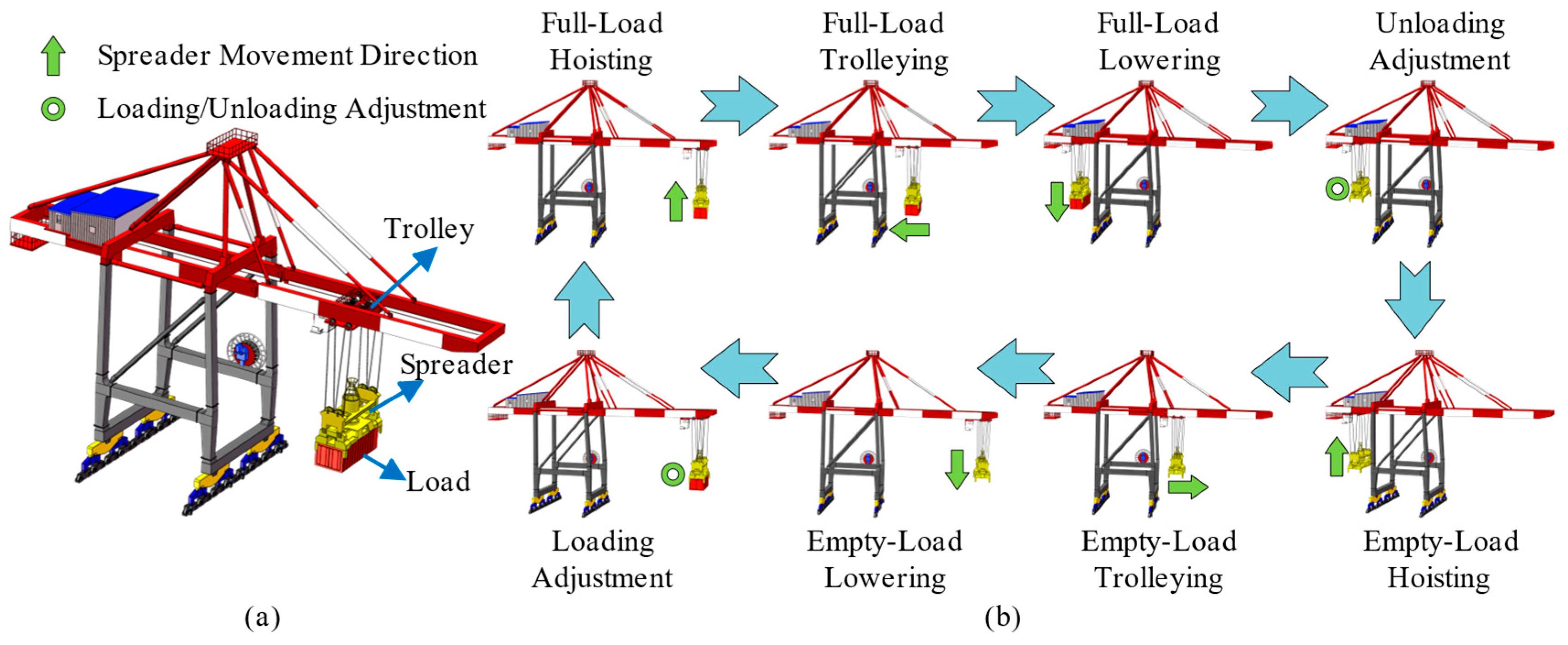
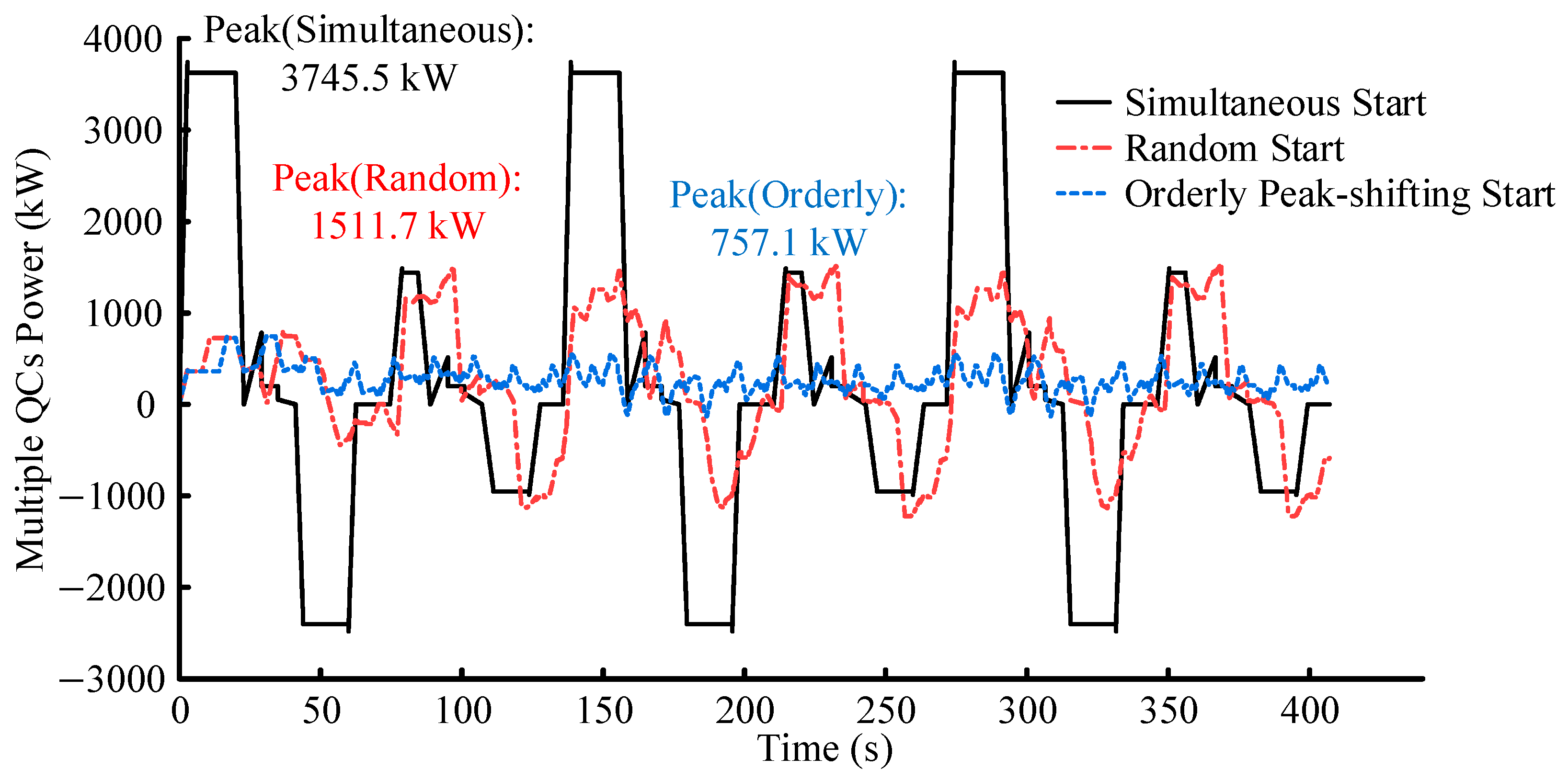
- Quantification and utilization of QC flexibility: To accurately quantify the stable and reliable power capacity that can be released from the QC system, a refined physical model of the operational process for QC clusters is developed, and an orderly peak-shifting scheduling strategy is proposed.
- (2)
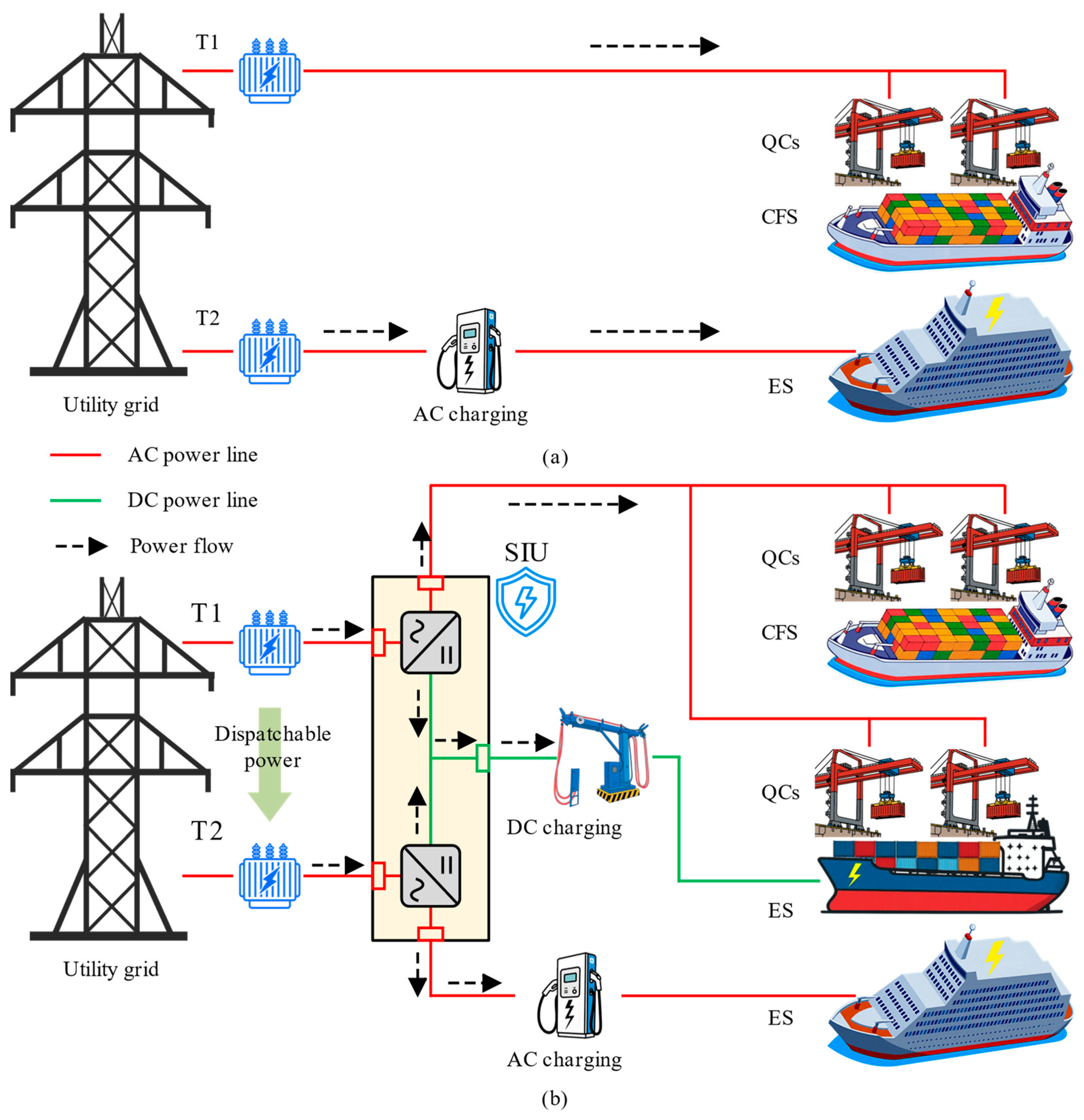
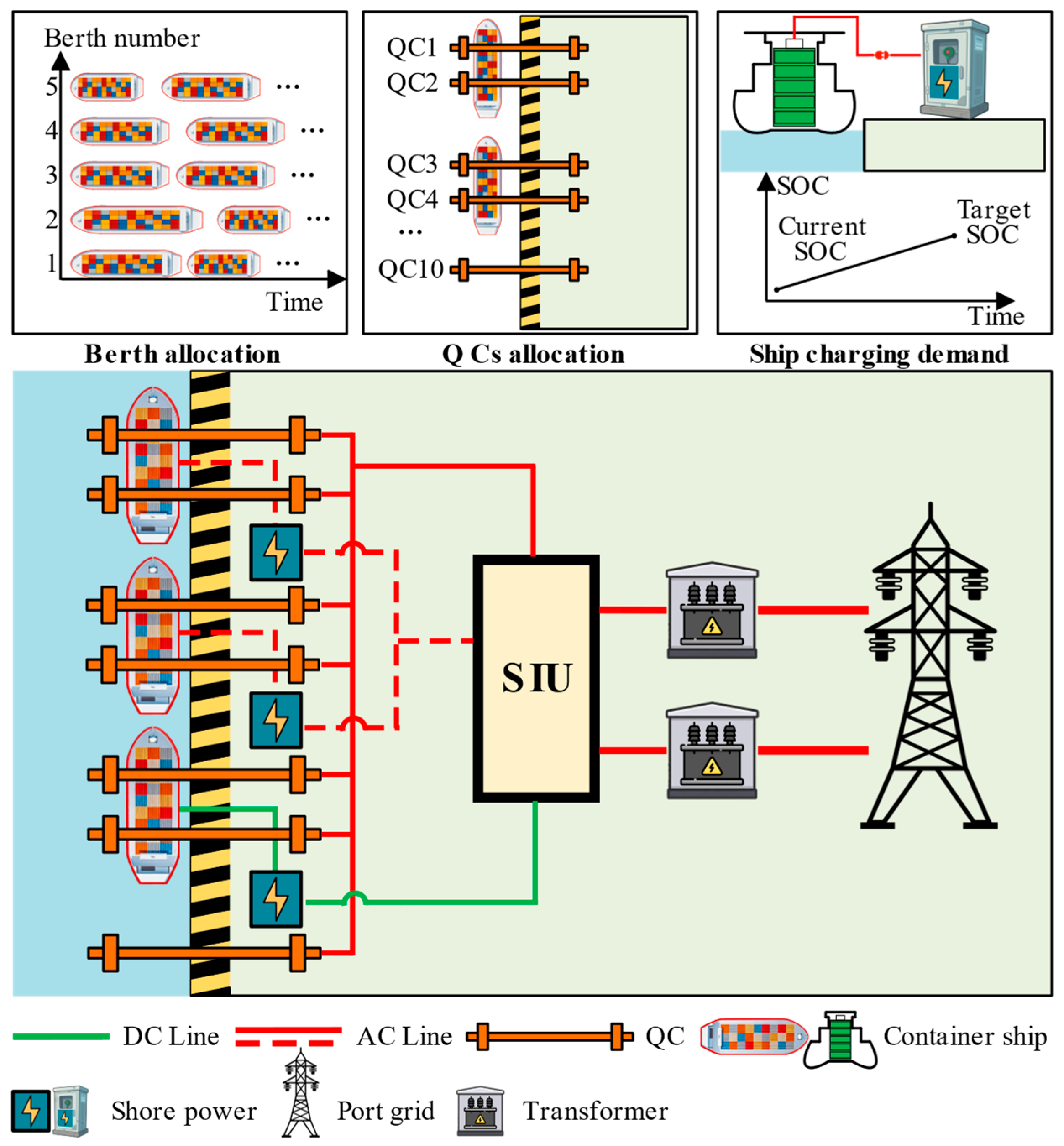
- A novel flexible interconnection architecture: A hybrid AC/DC ship–shore interconnection architecture based on a flexible interlinking device is proposed. This architecture is designed to dismantle the barriers of conventional power supply systems, establishing a physical pathway for the efficient transfer of power capacity released from the QC side to the charging facilities.
- (3)
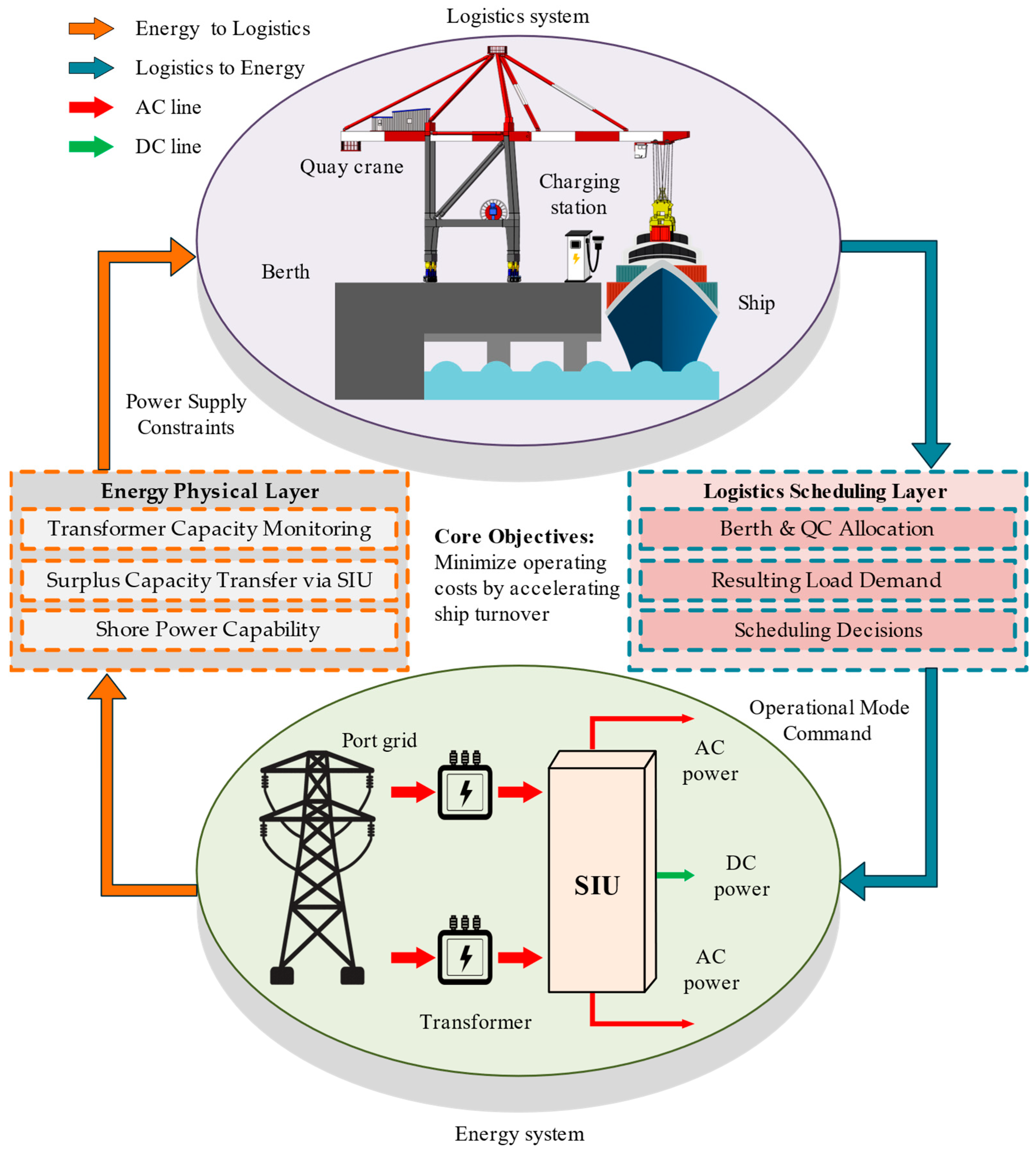
- Coordinated optimization model for ship–shore logistics and energy flow: With the objective of minimizing port berthing operational costs, a bi-level coordinated optimization model for logistics and energy flow is established. The model integrates berth allocation, QC scheduling, and charging management, thereby achieving effective coordination between logistics dispatch and energy flow scheduling.
2. QC Cluster Peak-Shaving and Interconnection Architecture
2.1. Power Characteristics and Peak-Shaving Potential of QC Cluster
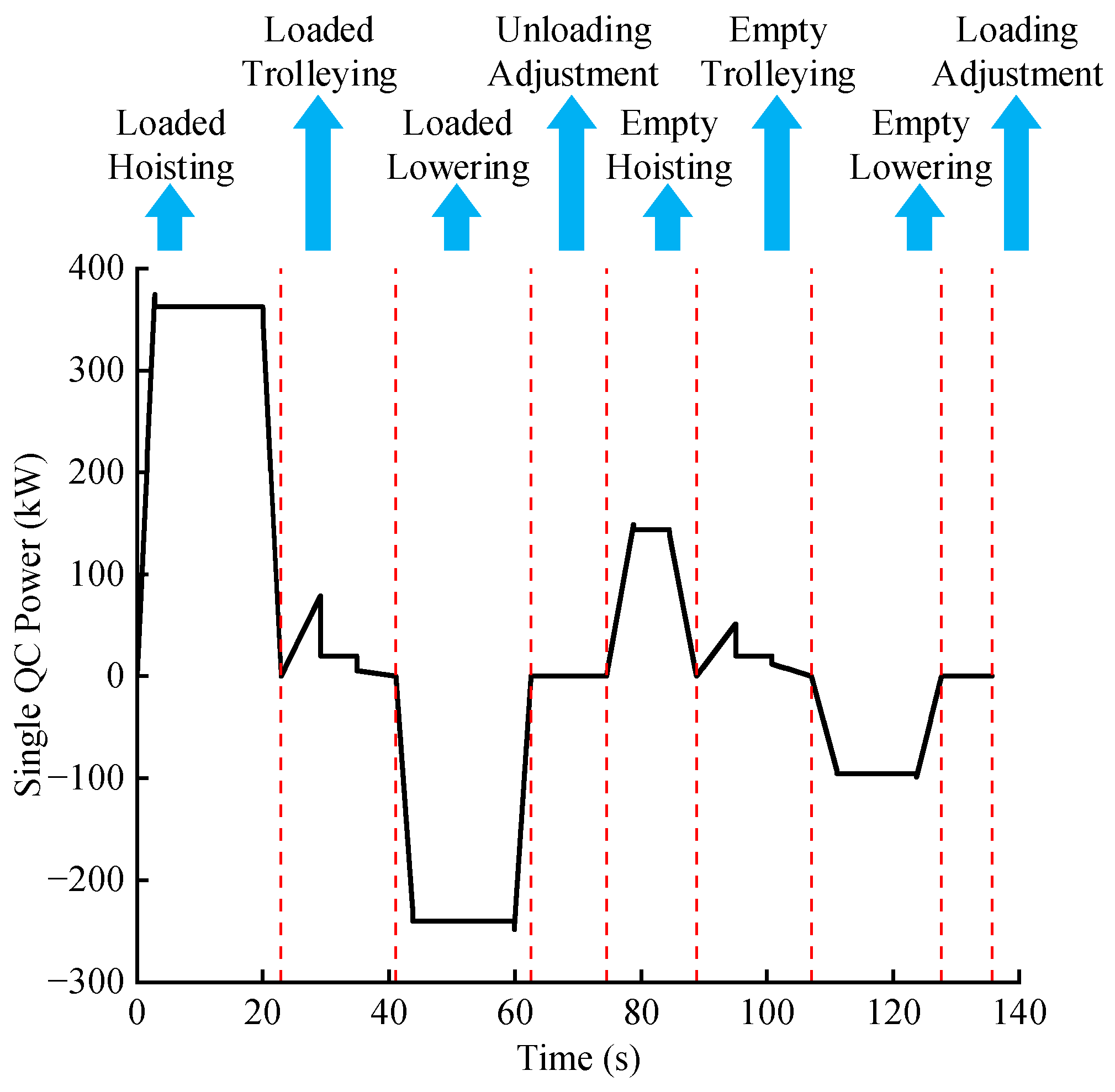
2.1.1. Dynamic Power Modeling of a Single QC
2.1.2. Aggregated Power Model of the QC Cluster
2.1.3. Modeling of Available Capacity from QC Cluster Peak-Shaving
2.2. Hybrid AC/DC Ship–Shore Interconnection Architecture
2.2.1. Conventional Ship–Shore Grid Topology
- (1)
- The ‘Energy Silo’ Effect: The QC power supply and the shore power charging systems operate in isolation, lacking a mechanism for power coordination. This operational paradigm prevents the flexible transfer of energy between them. The QC-side transformer (T1) is typically configured with a substantial capacity margin to handle transient peak loads during operations. However, this underutilized capacity during the QC cluster’s off-peak periods cannot be dispatched to support the increasingly burdened shore power system. The two systems operate like isolated “energy silos,” leading to low utilization of the port’s overall energy assets and insufficient grid operational resilience.
- (2)
- Charging capacity limitation: In the traditional architecture, the port’s total charging power is capped by the rated capacity of the shore-side transformer T2 and the ampacity of its corresponding supply circuit. As the demand for large-scale shore-based energy consumption emerges, this limited capacity becomes a critical bottleneck. The direct consequence of this infrastructure limitation is an involuntary extension of charging times, which in turn increases the in-port turnaround time for ships, thereby reducing the port’s operational efficiency and berth utilization rate.
- (3)
- High upgrade cost and investment risk: To overcome the charging bottleneck, the conventional path-dependent solution is to physically expand the capacity of transformer T2, and potentially the main upstream transformer and associated cables. Upgrading transformers and long stretches of cable entails enormous costs. Furthermore, in busy ports with limited land resources and stringent requirements for continuous operation, large-scale construction and retrofitting are often infeasible and can disrupt normal port activities. More importantly, the increasing penetration of ESs is a gradual and uncertain dynamic process, which poses a severe strategic challenge to the traditional “one-off,” capital-intensive investment model. A large-scale, pre-emptive investment to meet long-term demand would result in new, high-capacity assets operating at low load factors or even remaining idle for an extended period during the demand ramp-up phase. This leads to low capital efficiency and constitutes a significant diseconomy.
2.2.2. Hybrid AC/DC Ship–Shore Interconnection Topology
- (1)
- Enhanced energy efficiency and system resilience: By enabling power sharing across different feeders, the architecture mitigates the “energy silos” effect. It not only improves the utilization of existing transformer assets but also enhances the port grid’s ability to handle load fluctuations, boosting overall operational resilience.
- (2)
- Dynamic expansion of charging capability: The key advantage of this scheme is its ability to dynamically increase the port’s total available charging power through intelligent dispatch, without resorting to expensive physical upgrades. This provides the port with significant flexibility to manage sudden or concentrated high-power charging demands.
- (3)
- Reduced life-cycle cost and investment risk: By leveraging the latent capacity of existing assets, the proposed solution avoids the high upfront investment and long construction periods required for large-scale hardware upgrades, offering a more economical and sustainable technological pathway for expanding shore power infrastructure.
3. Bi-Level Coordinated Optimization Scheduling of Ship–Shore Logistics and Energy Flow Based on the SIU Interconnection Architecture
3.1. Problem Description and Model Assumptions
3.1.1. Problem Description
- (1)
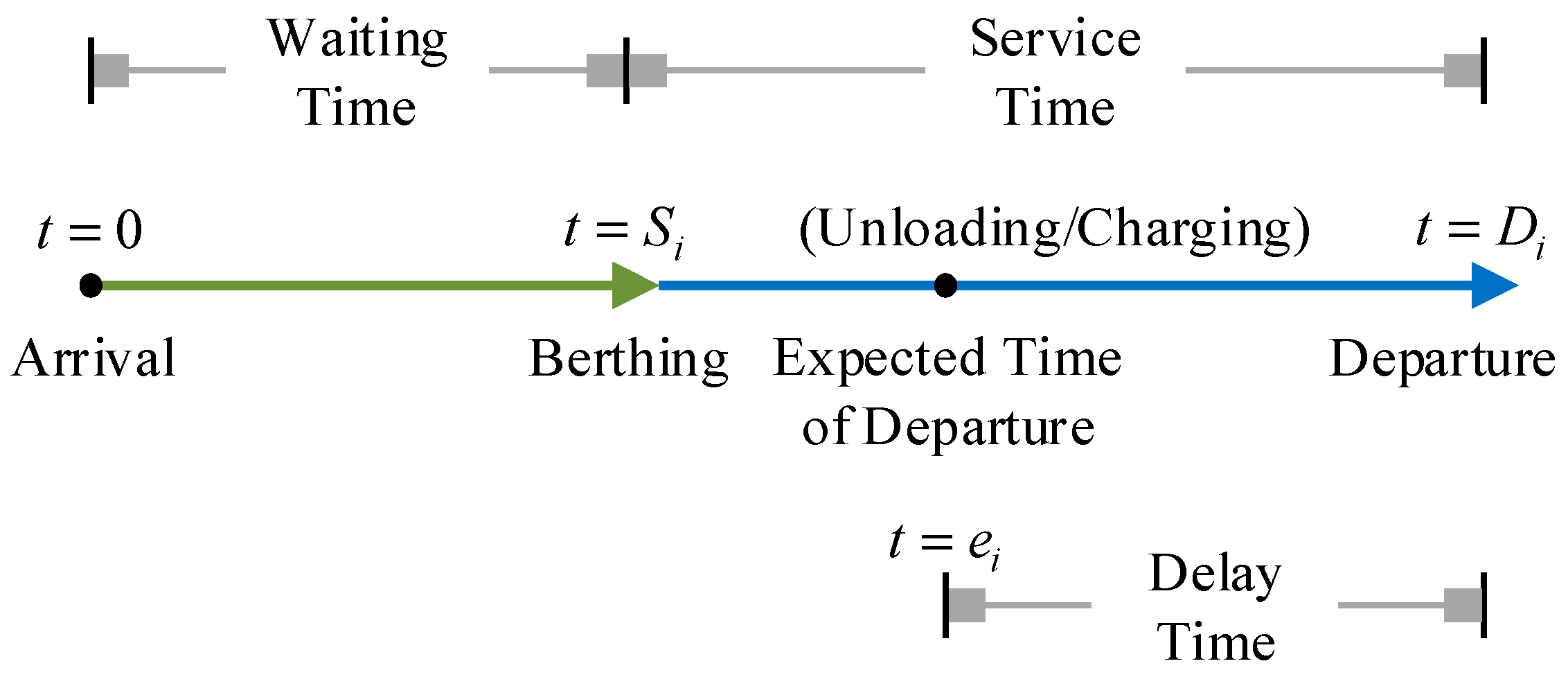
- Waiting time: This refers to the duration from a ship’s arrival at the anchorage (t = 0) to its actual berthing time (). During this period, CFSs and ESs consume diesel and electricity, respectively, to maintain basic ship operations. The electricity consumed by an ES must subsequently be replenished at the port. This waiting cost is borne by the port operator.
- (2)
- Service time: This is the duration from the berthing time () until the completion of all in-port operations and final departure (). A key characteristic of this phase is the decoupling of charging and cargo handling operations. An ES can commence charging immediately upon berthing, while its cargo handling operation can only begin once the assigned QC resources become available. Consequently, its service time is determined by the maximum of the charging duration and the cargo handling duration. For a CFS, the service time is equivalent to its cargo handling duration.
- (3)
- Delay time: This is the period by which a ship’s actual departure time () exceeds its expected departure time (). This triggers a punitive delay cost, which is also borne by the port operator.
3.1.2. Model Assumptions
- (1)
- (2)
- Static arrival: All ships are assumed to have arrived at the anchorage at the beginning of the planning horizon (t = 0), and all their relevant information is known in advance.
- (3)
- Homogeneous berths: All berths are homogeneous, possessing identical physical attributes. Each berth is equipped with charging facilities and can serve all types of ships.
- (4)
- Decoupled and non-preemptive operations: Charging for an ES can commence immediately upon berthing and can be performed flexibly throughout its entire stay ([, ]). The cargo handling process for any ship is considered an independent and non-preemptive operation. It can start at any point after the ship has berthed (), but once initiated, it must continue without interruption until completion.
- (5)
- Constant QC efficiency: Any potential decrease in QC operational efficiency due to the peak-shifting schedule is disregarded. This is because start-up delays are inherent even in the uncoordinated operational state of the QC cluster. The peak-shifting strategy only adjusts the relative start times among QCs within an operational cycle. The imposed delay is in seconds and is small compared with the cargo handling duration measured in hours.
- (6)
- Linear charging: The State of Charge (SOC) of an ES’s battery is assumed to increase linearly during the charging process.
- (7)
- All parameters used for the day-ahead planning baseline, including ship workloads, initial SOCs, port resources, and power limits, are treated as deterministic inputs. Their data sources and calibration logic are described in Section 4.
- (8)
- Negligible transfer times: The time required for QCs to move between different ships, as well as the navigation time of ships within the port channel, are considered negligible.
- (9)
- No breakdowns: All equipment, including berths, QCs, and charging facilities, is assumed to be fully available and free from any maintenance or breakdowns throughout the planning horizon.
3.2. Mathematical Programming Model
3.2.1. Nomenclature
3.2.2. Mathematical Model and Constraints
- (1)
- Berth assignment and sequencing constraints
- (2)
- Decoupled operations and completion time constraints
- (3)
- QC capacity constraint
- (4)
- ES charging and power system constraints
- (5)
- Logical and cost calculation constraints
- (6)
- Variable domain constraints
- (7)
- Model linearization
3.2.3. Genetic Algorithm-Based Solution Framework
- (1)
- Service sequence (p): A permutation of all ship indices, which defines the priority order in which ships are considered by the scheduling system.
- (2)
- QC allocation (q): An integer vector where the i-th element represents the number of QCs assigned to ship i.
- (1)
- Physical scheduling phase: The algorithm applies a greedy strategy to arrange berths and times for each ship according to the service sequence p and QC allocation q in the chromosome. Specifically, the algorithm processes ships in the order defined by p, searching for the earliest available time window for each ship that satisfies both berth and QC resource constraints. In this phase, a ship’s service time is provisionally estimated as the maximum of its cargo handling time and its ideal charging time.
- (2)
- Power check and penalty phase: After a complete physical schedule is generated, the algorithm proceeds to the power dispatch check. It simulates the charging process for all ESs under this schedule and calculates the total power demand for each hour. If the total power demand exceeds the grid capacity at any point, or if an ES fails to complete its charging task before departure, a large penalty term is added to its fitness value. This penalty mechanism guides the GA to discard power-infeasible solutions during the evolutionary process, thereby converging towards high-quality solutions that satisfy all constraints.
4. Case Study
4.1. Quantification of Available Capacity from QC Cluster Peak-Shaving

4.2. Scenario Setup and Comparative Schemes
- (1)
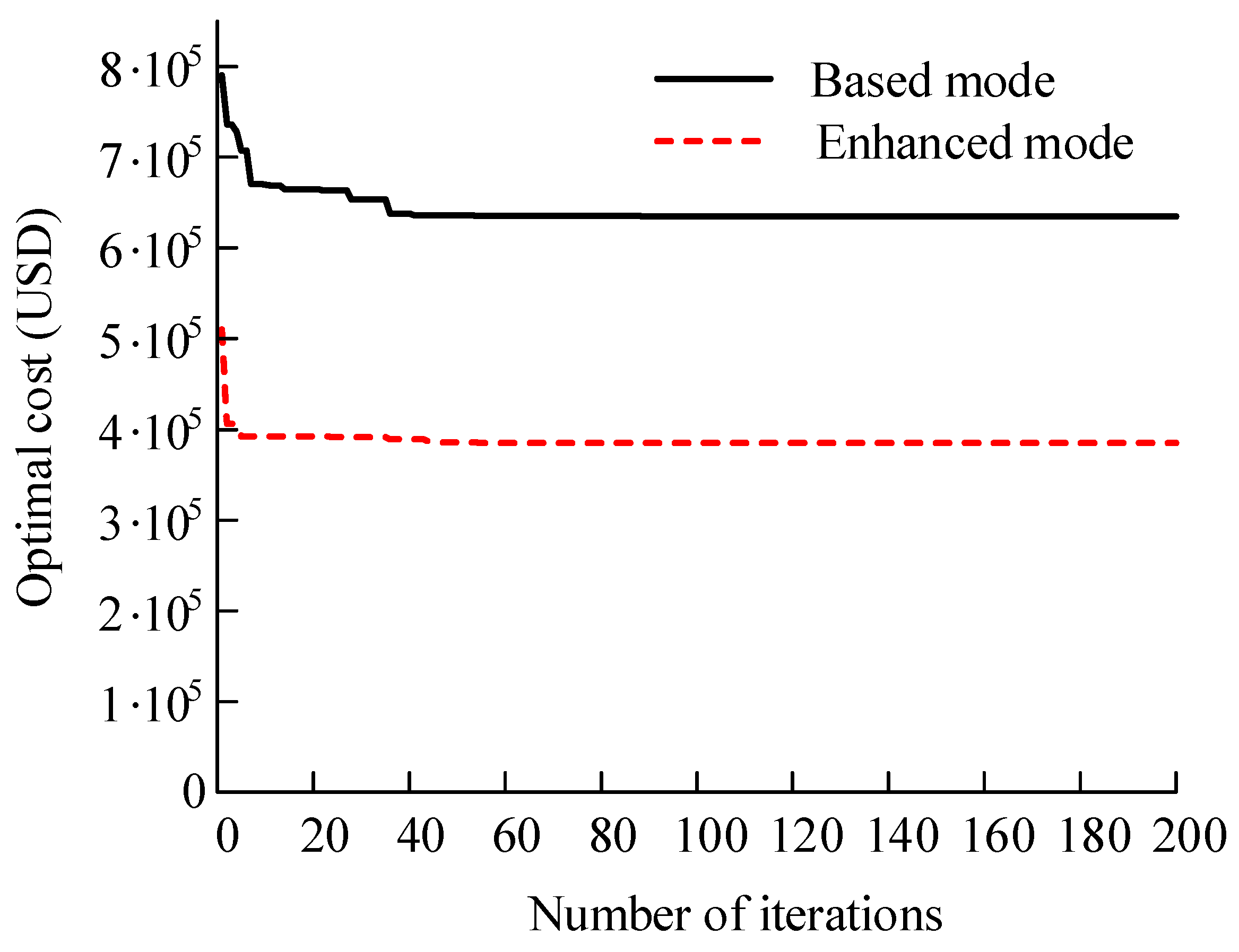
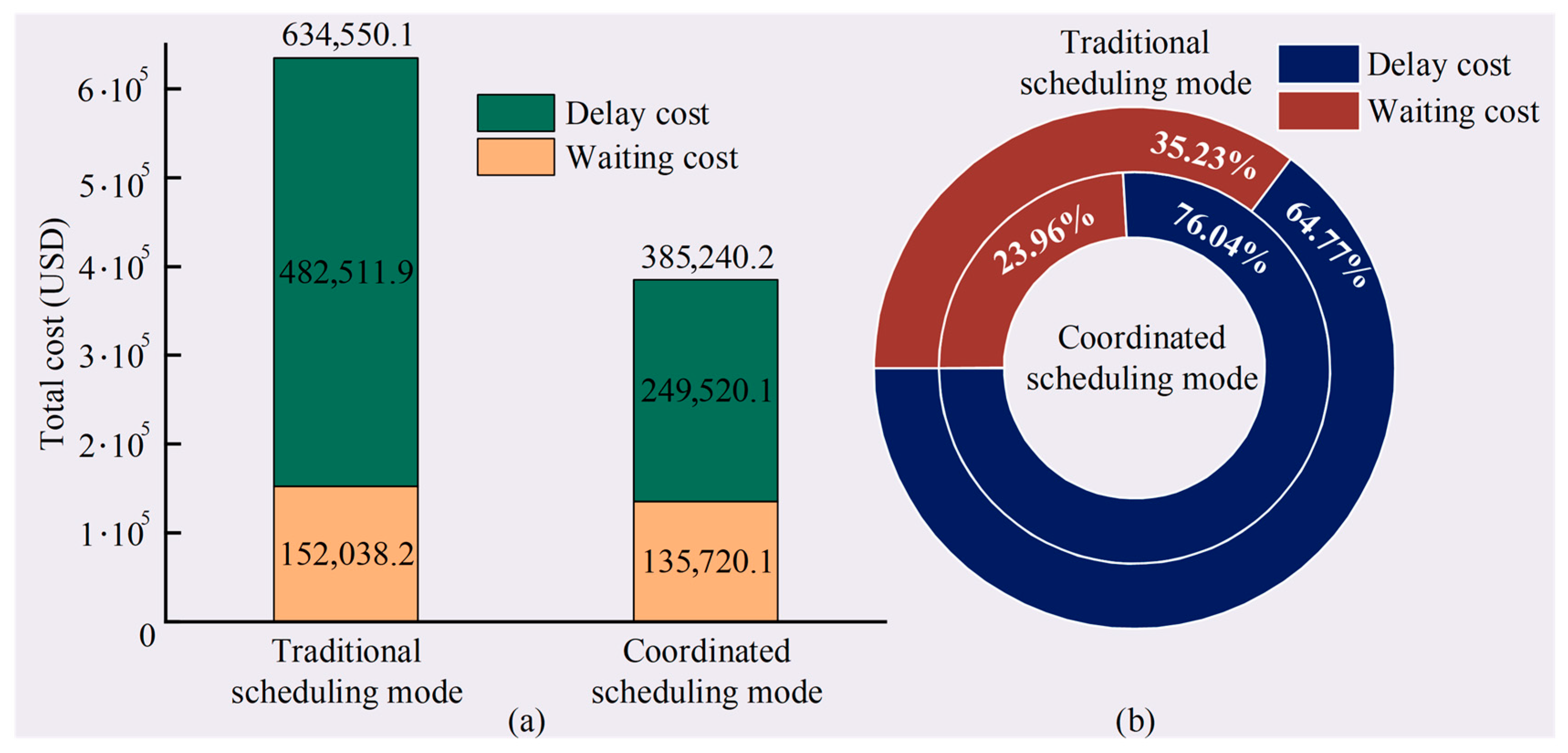
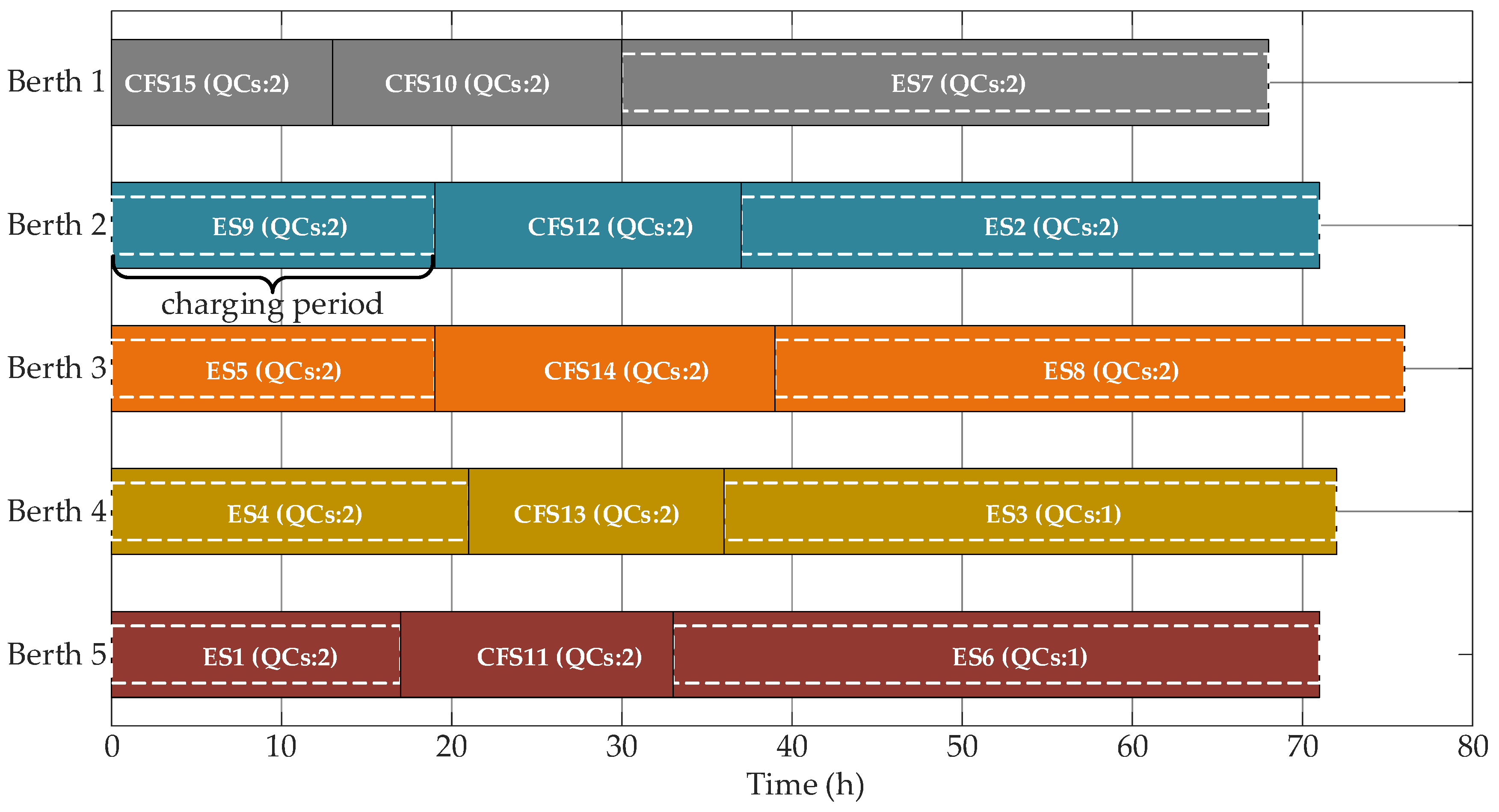
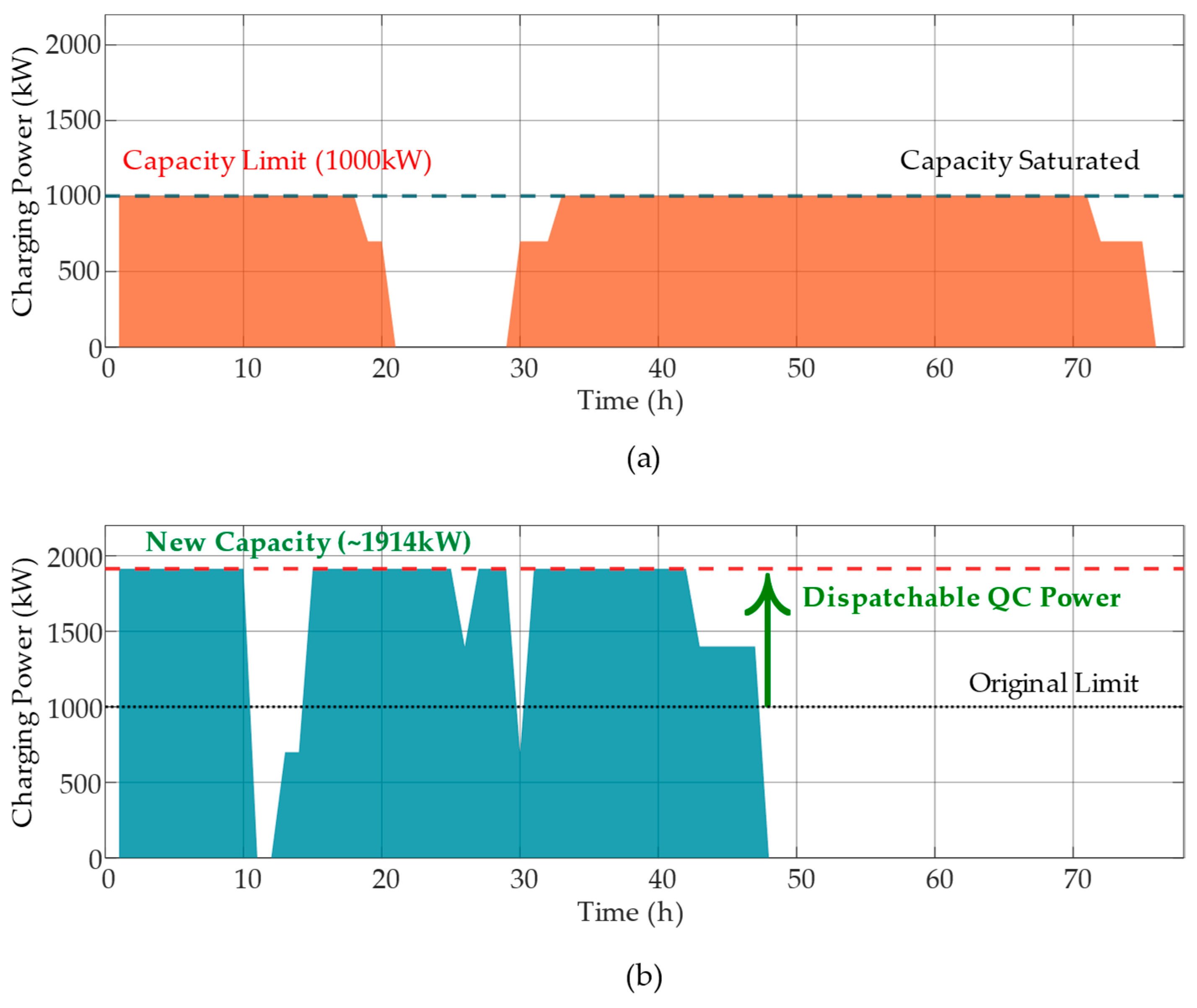
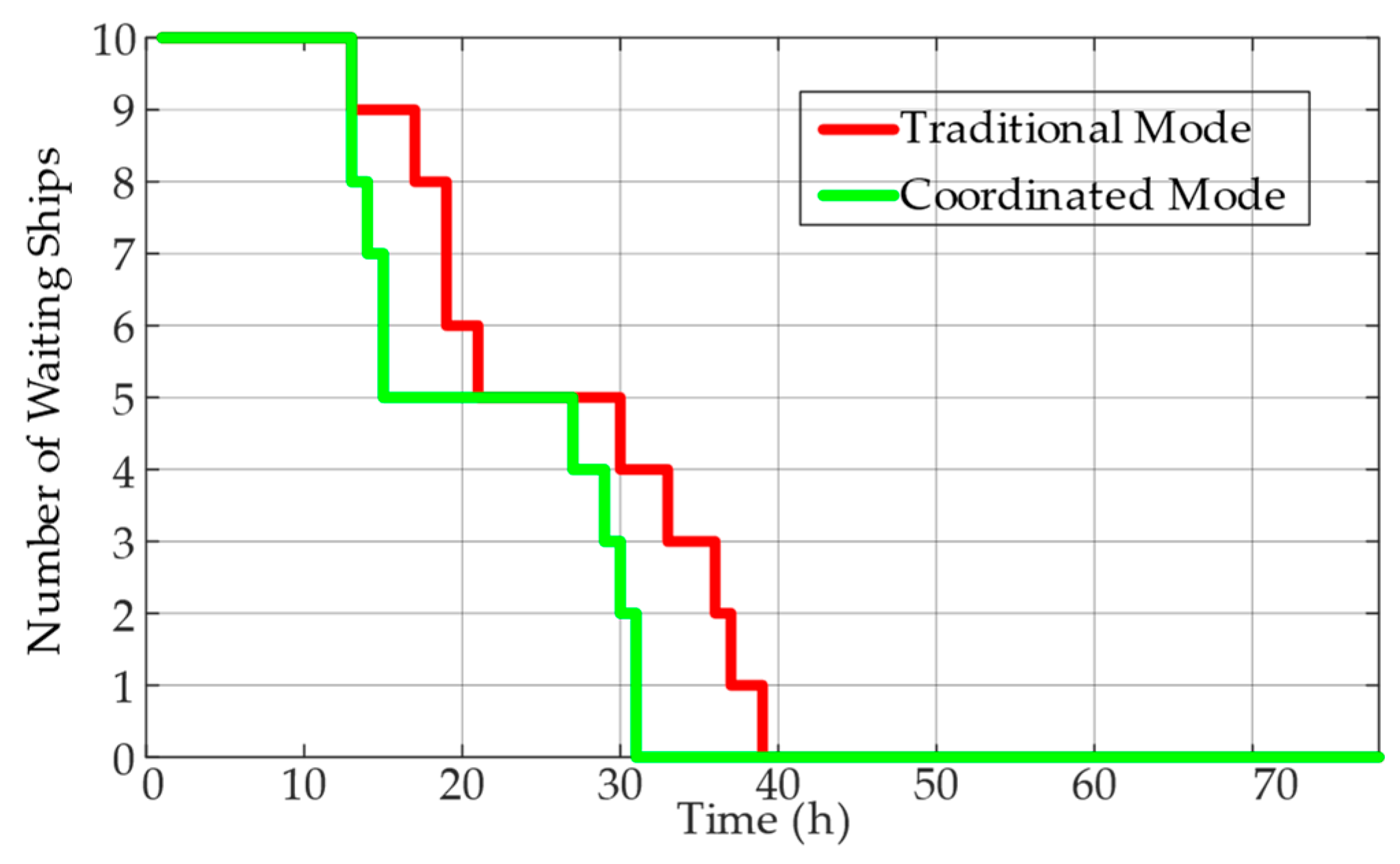
- Traditional scheduling mode: This mode is based on the conventional independent shore power architecture, meaning the port can only rely on its 1000 kW of baseline power to charge all ships.
- (2)
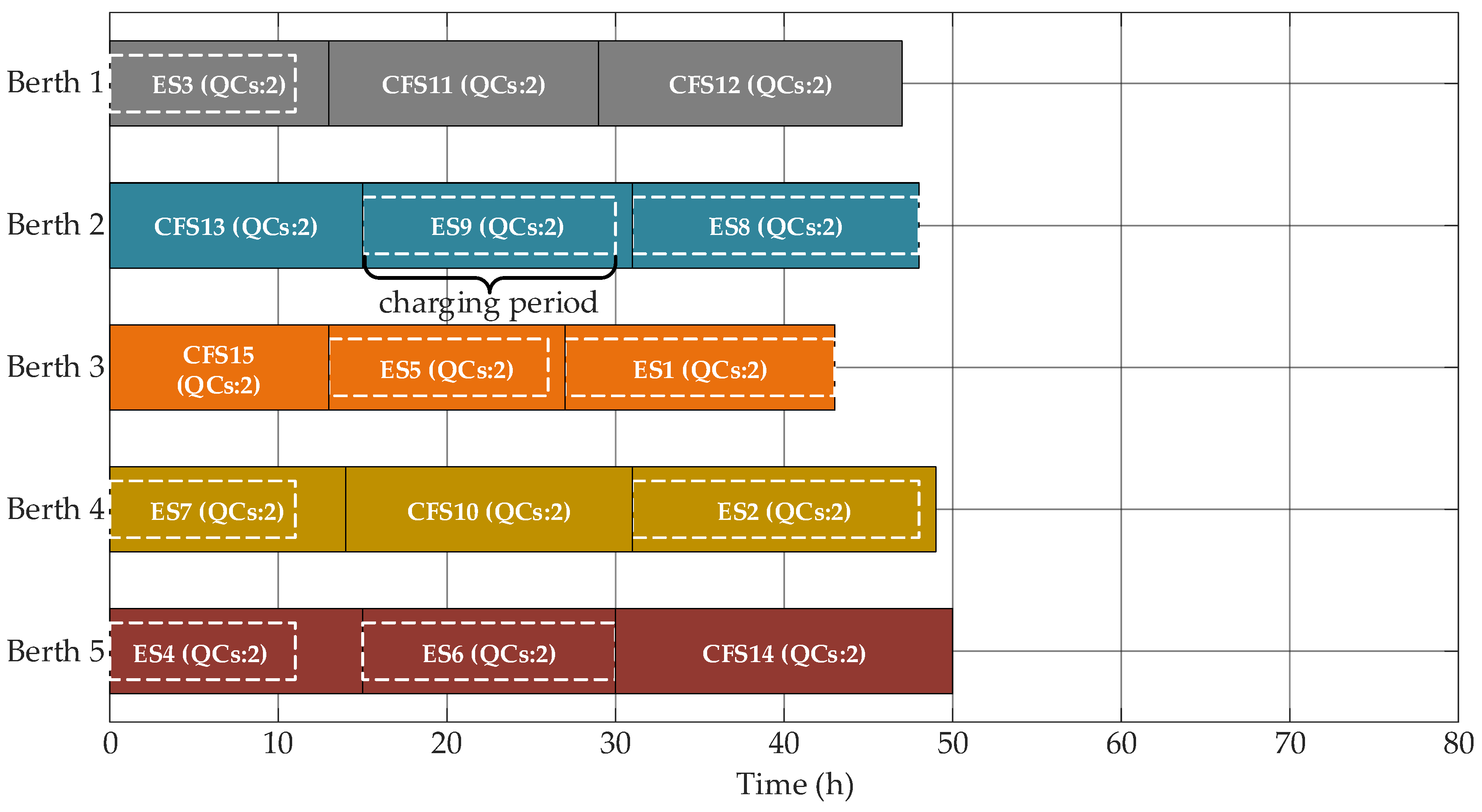
- Coordinated scheduling mode: This mode is based on the proposed ship–shore interconnection architecture. Through the, the 913.9 kW of dispatchable power () released from the QC side is integrated into the charging network, increasing the total available charging power to 1913.9 kW.
4.3. Sensitivity Analysis of ES Penetration
- (1)
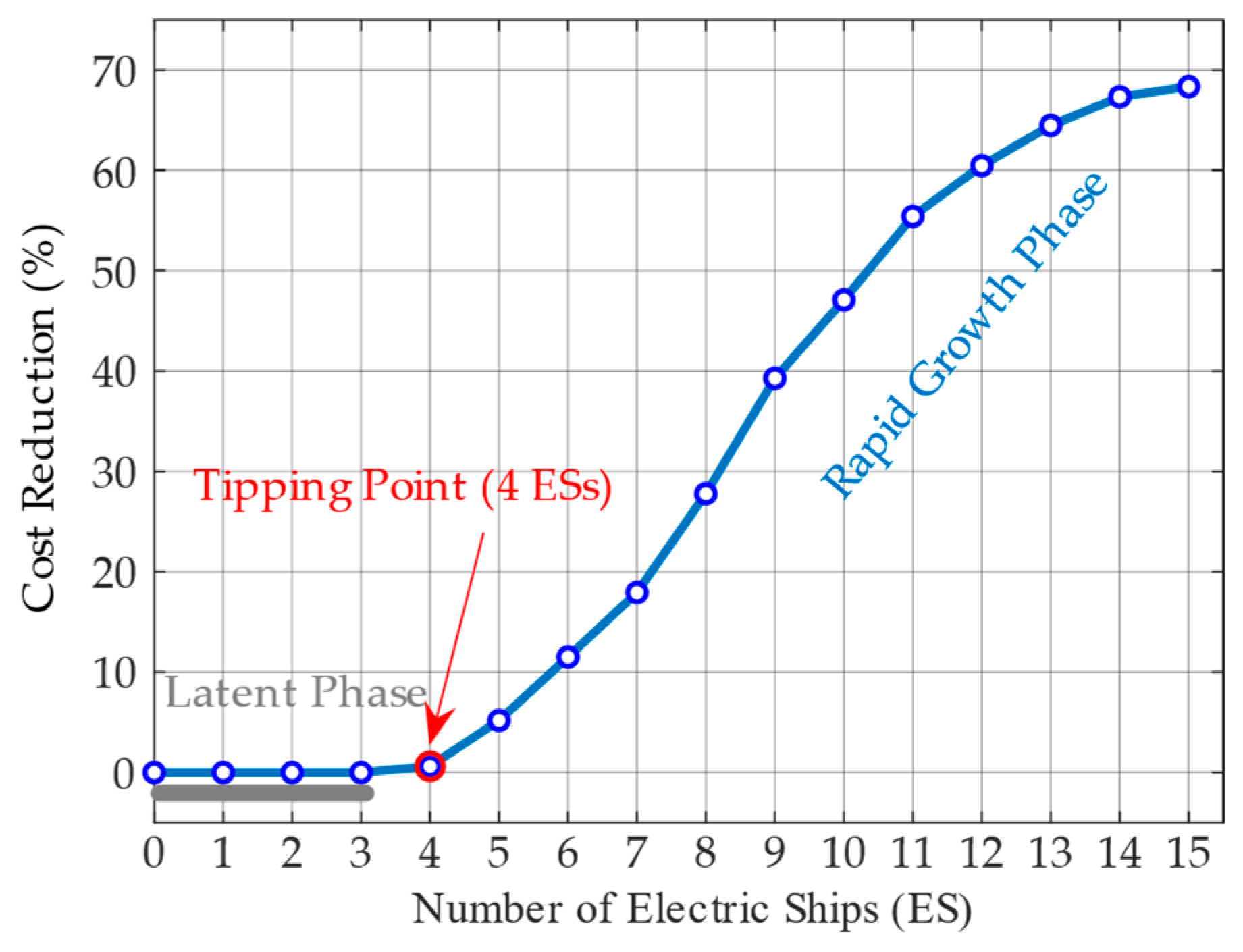
- The Latent Phase (0–3 ESs): When ES penetration remains below 20%, the cost reduction is negligible (approaching 0%). This observation suggests that at low electrification densities, the baseline transformer capacity (1000 kW) of the port is sufficient to accommodate charging demands, rendering coordinated scheduling unnecessary for capacity alleviation.
- (2)
- The Tipping Point (4–5 ESs): A critical inflection point emerges at an ES penetration rate of approximately 26.7% (4 ESs). At this threshold, the cost reduction initially rises to 0.62% before accelerating to 5.19% with 5 ESs. This transition signals the onset of the “charging bottleneck” within the traditional power architecture, indicating that the physical grid capacity is no longer adequate to support independent operations.
- (3)
- The Rapid Growth Phase (6–15 ESs): As penetration exceeds 40%, the marginal benefit of the coordinated scheme amplifies significantly. In the fully electrified scenario (15 ESs), the proposed method yields a 68.34% reduction in total operational costs. This trajectory demonstrates that the efficacy of logistics–energy coordination scales positively with the industry’s electrification progress, offering a “future-proof” solution that mitigates the need for capital-intensive infrastructure expansion.
5. Conclusions
Author Contributions
Funding
Data Availability Statement
Conflicts of Interest
References
- Freitas, D.; Gervásio, H. The Challenge of Benchmarking Carbon Emissions in Maritime Ports. Environ. Pollut. 2024, 363, 125170. [Google Scholar] [CrossRef] [PubMed]
- Maloberti, L.; Zaccone, R. An Environmentally Sustainable Energy Management Strategy for Marine Hybrid Propulsion. Energy 2025, 316, 134517. [Google Scholar] [CrossRef]
- Bei, Z.; Wang, J.; Li, Y.; Wang, H.; Li, M.; Qian, F.; Xu, W. Challenges and Solutions of Ship Power System Electrification. Energies 2024, 17, 3311. [Google Scholar] [CrossRef]
- Jeong, B.; Jeon, H.; Kim, S.; Kim, J.; Zhou, P. Evaluation of the Lifecycle Environmental Benefits of Full Battery Powered Ships: Comparative Analysis of Marine Diesel and Electricity. J. Mar. Sci. Eng. 2020, 8, 580. [Google Scholar] [CrossRef]
- Guo, S.; Wang, Y.; Yue, M.; Dai, L.; Fang, S.; Zhang, S.; Hu, H. Optimization of Energy Replenishment for Inland Electric Ships Considering Multi-Technology Adoption and Partial Replenishment. J. Mar. Sci. Eng. 2025, 13, 2092. [Google Scholar] [CrossRef]
- GMT EIGHT. EVTank: The Lithium Battery Shipments for Electric Ships in China Reached 0.61 GWh in 2023, with a Year-on-Year Increase of 87.1%. Available online: https://gmteight.com/content/detail/66732 (accessed on 10 January 2026).
- Ling, G.; Han, C.; Yang, Z.; He, J. Energy Consumption and Emission Analysis for Electric Container Ships. Ocean Coast. Manag. 2025, 261, 107505. [Google Scholar] [CrossRef]
- Kistner, L.; Bensmann, A.; Hanke-Rauschenbach, R. Potentials and Limitations of Battery-Electric Container Ship Propulsion Systems. Energy Convers. Manag. X 2024, 21, 100507. [Google Scholar] [CrossRef]
- DB 32/T 3711—2020; Technical Specification for Small-Capacity Low-Voltage Shore-to-Ship Power Connecting System in Inland Rivers. Market Supervision Administration of Jiangsu Province: Nanjing, China, 2020.
- Information Disclosure Form for Shore Power Facilities at Port Terminals in Ningbo City. Available online: https://jtj.ningbo.gov.cn/art/2020/8/13/art_1229045353_1868582.html (accessed on 10 January 2026).
- Notice of Changjiang River Administration of Navigational Affairs on Issuing the “Renovation Promotion Plan for Power-Receiving Facilities of Shore Power Systems of Cargo Ships in the Yangtze River Economic Belt”. Available online: https://jtj.ahsz.gov.cn/public/2655601/194344611.html (accessed on 10 January 2026).
- The Country’s First 120-TEU All-Electric Inland River Container Ship Was Launched at Zhenjiang Shipyard in Jiangsu Province. Available online: https://www.mot.gov.cn/tupianxinwen/202208/t20220812_3664040.html (accessed on 10 January 2026).
- Sarantakos, I.; Nikkhah, S.; Peker, M.; Bowkett, A.; Sayfutdinov, T.; Alahyari, A.; Patsios, C.; Mangan, J.; Allahham, A.; Bougioukou, E.; et al. A Robust Logistics-Electric Framework for Optimal Power Management of Electrified Ports under Uncertain Vessel Arrival Time. Clean. Logist. Supply Chain 2024, 10, 100144. [Google Scholar] [CrossRef]
- Tao, Y.; Qiu, J.; Lai, S.; Sun, X.; Zhao, J. Flexible Voyage Scheduling and Coordinated Energy Management Strategy of All-Electric Ships and Seaport Microgrid. IEEE Trans. Intell. Transp. Syst. 2023, 24, 3211–3222. [Google Scholar] [CrossRef]
- Abu Bakar, N.N.; Bazmohammadi, N.; Vasquez, J.C.; Guerrero, J.M. Electrification of Onshore Power Systems in Maritime Transportation towards Decarbonization of Ports: A Review of the Cold Ironing Technology. Renew. Sustain. Energy Rev. 2023, 178, 113243. [Google Scholar] [CrossRef]
- Yu, S.; Huang, Z.; Tang, D.; Ma, W.; Guerrero, J.M. The Role of Integrated Multi-Energy Systems toward Carbon-Neutral Ports: A Data-Driven Approach Using Empirical Data. J. Mar. Sci. Eng. 2025, 13, 477. [Google Scholar] [CrossRef]
- Ye, Z.; Ding, Z.; Liu, Y.; Yu, Y. Coordinated Control Strategy for Island Power Generation System with Photovoltaic, Hydrogen-Fueled Gas Turbine and Hybrid Energy Storage. J. Mar. Sci. Eng. 2025, 13, 2071. [Google Scholar] [CrossRef]
- Kermani, M.; Shirdare, E.; Parise, G.; Bongiorno, M.; Martirano, L. A Comprehensive Technoeconomic Solution for Demand Control in Ports: Energy Storage Systems Integration. IEEE Trans. Ind. Appl. 2022, 58, 1592–1601. [Google Scholar] [CrossRef]
- Zhang, Q.; Song, Z.; Ru, Q.; Fan, J.; Qiao, L.; Li, M.; Wang, L.; Li, S. Coordinated Control of Distributed Energy Storage Systems for DC Microgrids Coupling Photovoltaics and Batteries. Energies 2023, 16, 665. [Google Scholar] [CrossRef]
- Peša, T.; Krčum, M.; Kero, G.; Šoda, J. Electric Ferry Fleet Peak Charging Power Schedule Optimization Considering the Timetable and Daily Energy Profile. Appl. Sci. 2025, 15, 235. [Google Scholar] [CrossRef]
- Makhado, N.; Paepae, T.; Sejeso, M.; Harley, C. Berth Allocation and Quay Crane Scheduling in Port Operations: A Systematic Review. J. Mar. Sci. Eng. 2025, 13, 1339. [Google Scholar] [CrossRef]
- Lyu, X.; Lalla-Ruiz, E.; Schulte, F. The Collaborative Berth Allocation Problem with Row-Generation Algorithms for Stable Cost Allocations. Eur. J. Oper. Res. 2025, 323, 888–906. [Google Scholar] [CrossRef]
- Xiong, C.; Su, Y.; Wang, H.; Dong, Z.; Tian, M.; Shi, B. Consensus-Based Decentralized Scheduling Method for Collaborative Operation in Seaport Virtual Power Plant. Appl. Energy 2024, 373, 123948. [Google Scholar] [CrossRef]
- Mao, A.; Yu, T.; Ding, Z.; Fang, S.; Guo, J.; Sheng, Q. Optimal Scheduling for Seaport Integrated Energy System Considering Flexible Berth Allocation. Appl. Energy 2022, 308, 118386. [Google Scholar] [CrossRef]
- Zhao, W.; Ma, K.; Yang, J.; Qu, Z.; Guo, S.; Qi, F.; Sun, W. A Two-Stage Scheduling Strategy Integrated with Stackelberg Game Approach to Coordinate Seaport Logistics Operation and Energy Management. Electr. Power Syst. Res. 2025, 244, 111527. [Google Scholar] [CrossRef]
- Kanellos, F.D. Multiagent-System-Based Operation Scheduling of Large Ports’ Power Systems with Emissions Limitation. IEEE Syst. J. 2019, 13, 1831–1840. [Google Scholar] [CrossRef]
- Zhang, Y.; Liang, C.; Shi, J.; Lim, G.; Wu, Y. Optimal Port Microgrid Scheduling Incorporating Onshore Power Supply and Berth Allocation under Uncertainty. Appl. Energy 2022, 313, 118856. [Google Scholar] [CrossRef]
- Duan, Y.; Ren, H.; Xu, F.; Yang, X.; Meng, Y. Bi-Objective Integrated Scheduling of Quay Cranes and Automated Guided Vehicles. J. Mar. Sci. Eng. 2023, 11, 1492. [Google Scholar] [CrossRef]
- Long, L.N.B.; You, S.-S.; Cuong, T.N.; Kim, H.-S. Optimizing Quay Crane Scheduling Using Deep Reinforcement Learning with Hybrid Metaheuristic Algorithm. Eng. Appl. Artif. Intell. 2025, 143, 110021. [Google Scholar] [CrossRef]
- Takalani, R.; Masisi, L. Energy Consumption Optimization Strategy for Port Cranes Based on Pontryagin’s Minimum Principle and Filtering Strategies. IEEE Access 2025, 13, 64991–65003. [Google Scholar] [CrossRef]
- Geerlings, H.; Heij, R.; Van Duin, R. Opportunities for Peak Shaving the Energy Demand of Ship-to-Shore Quay Cranes at Container Terminals. J. Shipp. Trade 2018, 3, 3. [Google Scholar] [CrossRef]
- Karimi, S.; Zadeh, M.; Suul, J.A. A Multi-Vessel Universal Shore-to-Ship Charging System: Configuration and Control Architecture. IEEE Trans. Energy Convers. 2024, 39, 2119–2133. [Google Scholar] [CrossRef]
- JTS196-9-2014; Technical Code of Power Supply Facilities for Handling Equipment in Container Yard. Shanghai Testing Inspection and Certification Association: Shanghai, China, 2014. Available online: https://www.doc88.com/p-9069970444461.html (accessed on 10 January 2026).
- TSTIC 110001-2021; 3E Quayside Container Crane. Ministry of Transport of the People’s Republic of China: Beijing, China, 2021. Available online: https://www.doc88.com/p-73647978745978.html (accessed on 10 January 2026).
- GB/T 6451—2023; Technical Parameters and Requirements for Oil-Immersed Power Transformers. China Electrical Equipment Industry Association: Beijing, China, 2023.
- Xia, D.; He, J.; Chi, F.; Dou, Z.; Yang, Z.; Liu, C. Shore Power Optimal Scheduling Based on Gridding of Hybrid Energy Supply System. Sustainability 2022, 14, 16250. [Google Scholar] [CrossRef]
- Daniel, H.; Trovão, J.P.F.; Williams, D. Shore Power as a First Step toward Shipping Decarbonization and Related Policy Impact on a Dry Bulk Cargo Carrier. Etransportation 2022, 11, 100150. [Google Scholar] [CrossRef]
- Yu, H.; Lei, X.; Niu, S.; Shao, Z.; Jian, L. Enhancing Electric Vehicle Penetration and Grid Operation Performance in Old Residential Communities through Hybrid AC/DC Microgrid Reconstruction. Appl. Energy 2023, 347, 121459. [Google Scholar] [CrossRef]
- Yu, H.; Tu, J.; Lei, X.; Shao, Z.; Jian, L. A Cost-Effective and High-Efficient EV Shared Fast Charging Scheme with Hierarchical Coordinated Operation Strategy for Addressing Difficult-to-Charge Issue in Old Residential Communities. Sustain. Cities Soc. 2024, 101, 105090. [Google Scholar] [CrossRef]
- Schepler, X.; Absi, N.; Feillet, D.; Sanlaville, E. The Stochastic Discrete Berth Allocation Problem. EURO J. Transp. Logist. 2019, 8, 363–396. [Google Scholar] [CrossRef]
- Weihua Crane. What Is Quay Crane? In Weihua Heavy Machinery; Weihua Crane: Changyuan, China, 2025. [Google Scholar]
- Xiao, L.; He, W.; Sun, P.; Laportec, G. The Integrated Planning of Berth Allocation, Quay Crane Assignment, and Pilotage Scheduling. Comput. Oper. Res. 2024, 184, 107201. [Google Scholar] [CrossRef]
- Khalilpoor, S.; Kamran, M.A.; Babazadeh, R.; Kia, R. Energy-Efficient Model for Integrated Berth Allocation and Quay Crane Management. Transp. Res. Interdiscip. Perspect. 2025, 31, 101429. [Google Scholar] [CrossRef]
- The Country’s First “Zero Carbon” Ship! The “Qingdian 001” Was Delivered and Set Sail in Huzhou. Available online: https://zjnews.zjol.com.cn/yc/qmt/202511/t20251128_31371425.shtml (accessed on 14 January 2026).
- International Shipping Network. The Largest in China! The First Pure Electric Inland Container Ship in South China Was Delivered. Available online: https://wap.eworldship.com/index.php/eworldship/news/article?id=217542 (accessed on 14 January 2026).
- Chinese Shipping.com. The First Inland Pure Electric Container Ship in Zhejiang Seaport Was Put into Operation. Available online: https://info.chineseshipping.com.cn/cninfo/News/202512/t20251212_1411834.shtml (accessed on 14 January 2026).
- Zhang, Y.; Sun, L.; Ma, F.; Wu, Y.; Jiang, W.; Fu, L. Collaborative Optimization of the Battery Capacity and Sailing Speed Considering Multiple Operation Factors for a Battery-Powered Ship. World Electr. Veh. J. 2022, 13, 40. [Google Scholar] [CrossRef]
- Delahoz-Domínguez, E.; Mendoza-Mendoza, A.; Mendoza-Casseres, D. Simulated Annealing Integrated with Discrete-Event Simulation for Berth Allocation in Bulk Ports under Demurrage Constraints. Eng 2025, 6, 352. [Google Scholar] [CrossRef]
- Zheng, H.; Wang, Z.; Duan, S. Integrated Optimization of Vessel Sequencing and Bulk Carrier Berth Allocation with Shifting in a Comprehensive Port. Ocean Eng. 2025, 316, 119891. [Google Scholar] [CrossRef]



| Symbol | Description |
|---|---|
| Index of ships | |
| Set of all ships to be served, | |
| Set of ESs | |
| Set of CFSs | |
| Index of berths | |
| Set of all available berths | |
| Index of discrete time periods | |
| Set of all discrete time periods within the planning horizon | |
| Number of QCs assigned to a single ship | |
| Set of possible numbers of QCs for ship |
| Symbol | Description |
|---|---|
| Expected departure time of ship | |
| Workload of ship (QC-hours) | |
| Minimum/maximum number of QCs for ship | |
| Total number of available QCs in the port | |
| Battery capacity of ES (kWh) | |
| Initial State of Charge (%) of ES upon arrival | |
| Target State of Charge (%) of ES upon departure | |
| Power consumption rate of ES at anchorage (kW) | |
| Maximum output power of a single charging station (kW) | |
| Baseline power capacity of the transformer for charging (kW) | |
| Fixed additional power available in coordinated scheduling mode (kW) | |
| Waiting cost per unit time for ship (USD/h), potentially different for and | |
| Delay cost per unit time for ship (USD/h) | |
| Duration of each discrete time period (e.g., 1 h) | |
| A sufficiently large positive number for linearization |
| Symbol | Description | Type |
|---|---|---|
| 1 if ship i is assigned to berth b; 0 otherwise | Binary | |
| 1 if ships i and j are at the same berth and i precedes | Binary | |
| 1 if the port activates the enhanced charging mode; 0 otherwise | Binary | |
| 1 if q QCs are assigned to ship i; 0 otherwise | Binary | |
| Berthing time (service start time) of ship | Continuous | |
| Departure time (service completion time) of ship | Continuous | |
| Start time of cargo handling for ship | Continuous | |
| End time of cargo handling for ship | Continuous | |
| Duration of cargo handling for ship | Continuous | |
| Charging power allocated to ES i in time period t | Continuous | |
| Delay duration of ship | Continuous | |
| 1 if ship is at berth in time period (); 0 otherwise | Binary | |
| 1 if ship is undergoing handling in time period ([]); 0 otherwise | Binary |
| Parameter | Value |
|---|---|
| Load mass(kg) | 25,000 |
| Spreader mass (kg) | 9000 |
| Trolley mass (kg) | 20,000 |
| Loaded hoisting or empty lowering height (m) | 20 |
| Loaded lowering or empty hoisting height (m) | 15 |
| Trolley travel distance (m) | 30 |
| Maximum loaded hoisting velocity (m·s−1) | 1.0 |
| Maximum loaded lowering velocity (m·s−1) | 0.8 |
| Maximum empty hoisting velocity (m·s−1) | 1.5 |
| Maximum empty lowering velocity (m·s−1) | 1.2 |
| Hoisting acceleration (m·s−2) | 0.35 |
| Lowering acceleration (m·s−2) | 0.30 |
| Maximum trolley travel velocity (m·s−1) | 2.5 |
| Trolley travel acceleration (m·s−2) | 0.40 |
| Gravitational acceleration/(m·s−2) | 9.81 |
| Trolley equivalent friction power (kW) | 20 |
| Unloading adjustment time (s) | 12 |
| Loading adjustment time (s) | 8 |
| Motor driving efficiency | 0.92 |
| Energy regeneration efficiency | 0.90 |
| Allowable feedback ratio of trolley kinetic energy | 0.30 |
| Parameter | Value |
|---|---|
| Planning horizon (h) | 80 |
| Total number of QCs | 10 |
| Total number of ships | 15 |
| Number of ESs | 9 |
| Number of CFSs | 6 |
| Total number of berths | 5 |
| Range of QCs per ship | [1, 2] |
| Transformer baseline capacity for charging stations (kW) | 1000 |
| Target SOC for ESs (%) | 90 |
| Delay cost per ship (USD/h) | 2000 |
| Ship Index (Type) | Cargo Workload (QC-Hours) | Waiting Cost (USD/h) | Expected Departure Time (h) | Battery Capacity (kWh) | Arrival SOC (%) | ES Waiting Power Consumption (kW) |
|---|---|---|---|---|---|---|
| 1 (ES) | 31 | 497 | 19.4 | 4098 | 46 | 59 |
| 2 (ES) | 36 | 431 | 24.6 | 4421 | 49 | 54 |
| 3 (ES) | 25 | 469 | 17.6 | 4958 | 46 | 51 |
| 4 (ES) | 30 | 488 | 18.2 | 4533 | 39 | 70 |
| 5 (ES) | 27 | 490 | 18.1 | 4692 | 47 | 56 |
| 6 (ES) | 26 | 409 | 18.6 | 4316 | 36 | 58 |
| 7 (ES) | 28 | 404 | 18.4 | 4687 | 42 | 65 |
| 8 (ES) | 30 | 417 | 18.3 | 4835 | 48 | 52 |
| 9 (ES) | 31 | 488 | 21.1 | 4018 | 39 | 67 |
| 10 (CFS) | 33 | 934 | 23.1 | - | - | - |
| 11 (CFS) | 31 | 883 | 21.2 | - | - | - |
| 12 (CFS) | 35 | 912 | 26.2 | - | - | - |
| 13 (CFS) | 28 | 828 | 19.3 | - | - | - |
| 14 (CFS) | 38 | 840 | 28.1 | - | - | - |
| 15 (CFS) | 25 | 960 | 15.8 | - | - | - |
| Parameter | Value |
|---|---|
| Simultaneity factor | 0.4 |
| Demand factor (single unit) | 0.75 |
| Transformer design load factor | 0.6 |
| QC power factor | 0.85 |
| Category | Parameters in This Paper | Source and Treatment |
|---|---|---|
| QC equipment and cycle parameters | Table 4, Figure 6 | Obtained from equipment specifications [34,41] and field survey records of a container terminal. Used to compute the single-QC power-time curve and the aggregated QC cluster power. |
| QC cluster transformer sizing | Table 7, Equations (13)–(15) | Derived from field surveys of a specific port and calibrated following industry design codes and standard practice [9,10,11,33,34]. Used to quantify rated capacity and dispatchable margin. |
| Port infrastructure and planning settings | Table 5 | Integrated from field surveys, relevant literature [33,34,42,43], and news reports. Configured to provide a reasonable simulation environment for validating the proposed method, including berth resources and baseline capacities. |
| Ship logistics parameters | Table 6, workloads and expected departure times | Synthesized from academic literature [13,16,18,21,25,29] and field survey records. Workload ranges follow common settings used in berth allocation and QC scheduling studies. |
| ES energy-related parameters | Table 6, battery capacity and SOC | Sourced from authoritative reports [12,44,45,46], field surveys, and literature [3,47]. Values are selected within realistic bounds to represent ship heterogeneity [5,43,48,49]. |
| Economic coefficients | Table 5 and Table 6, waiting and delay costs | Estimated using reported ranges in port operation studies. These coefficients are used for relative comparison between operational modes under the same fleet inputs. |
Disclaimer/Publisher’s Note: The statements, opinions and data contained in all publications are solely those of the individual author(s) and contributor(s) and not of MDPI and/or the editor(s). MDPI and/or the editor(s) disclaim responsibility for any injury to people or property resulting from any ideas, methods, instructions or products referred to in the content. |
© 2026 by the authors. Licensee MDPI, Basel, Switzerland. This article is an open access article distributed under the terms and conditions of the Creative Commons Attribution (CC BY) license.
Share and Cite
Chen, F.; Tang, X.; Yu, H.; Yuan, C.; Wang, T.; Wang, X.; Shang, S.; Wu, S. Logistics–Energy Coordinated Scheduling in Hybrid AC/DC Ship–Shore Interconnection Architecture with Enabling Peak-Shaving of Quay Crane Clusters. J. Mar. Sci. Eng. 2026, 14, 230. https://doi.org/10.3390/jmse14020230
Chen F, Tang X, Yu H, Yuan C, Wang T, Wang X, Shang S, Wu S. Logistics–Energy Coordinated Scheduling in Hybrid AC/DC Ship–Shore Interconnection Architecture with Enabling Peak-Shaving of Quay Crane Clusters. Journal of Marine Science and Engineering. 2026; 14(2):230. https://doi.org/10.3390/jmse14020230
Chicago/Turabian StyleChen, Fanglin, Xujing Tang, Hang Yu, Chengqing Yuan, Tian Wang, Xiao Wang, Shanshan Shang, and Songbin Wu. 2026. "Logistics–Energy Coordinated Scheduling in Hybrid AC/DC Ship–Shore Interconnection Architecture with Enabling Peak-Shaving of Quay Crane Clusters" Journal of Marine Science and Engineering 14, no. 2: 230. https://doi.org/10.3390/jmse14020230
APA StyleChen, F., Tang, X., Yu, H., Yuan, C., Wang, T., Wang, X., Shang, S., & Wu, S. (2026). Logistics–Energy Coordinated Scheduling in Hybrid AC/DC Ship–Shore Interconnection Architecture with Enabling Peak-Shaving of Quay Crane Clusters. Journal of Marine Science and Engineering, 14(2), 230. https://doi.org/10.3390/jmse14020230