Article

Experimental Study on Suppression and Mechanism of Sloshing Impact Pressure by Vertical Slat Screens Under Broadband Horizontal and Vertical Excitation


1
School of Future Transportation, Guangzhou Maritime University, Guangzhou 510725, China
2
Guangdong Provincial Key Laboratory of Green Construction and Intelligent Operation & Maintenance for Offshore Infrastructure, Guangzhou 510725, China
3
Guangzhou Engineering Technology Research Center of Resilience Improvement for Offshore Infrastructure, Guangzhou 510725, China
4
School of Mechanical and Energy Engineering, NingboTech University, Ningbo 315100, China
*
Author to whom correspondence should be addressed.
J. Mar. Sci. Eng. 2026, 14(2), 220; https://doi.org/10.3390/jmse14020220
Submission received: 24 November 2025 / Revised: 18 January 2026 / Accepted: 19 January 2026 / Published: 21 January 2026
(This article belongs to the Special Issue Advances in Marine Engineering Hydrodynamics, 2nd Edition)

Abstract

Sloshing-induced impact pressure is a key damage factor for marine liquid tanks. While research aimed at overcoming screen failure in sloshing suppression under high-frequency excitation has focused on wave height, the dataset of impact pressure remains lacking. Moreover, the pattern of pressure suppression under broadband excitation remains unclear. The primary contribution of this work is the first experimental dataset of impact pressure with vertical slat screens under broadband horizontal and vertical excitation. Second, it reveals pressure suppression patterns by screens across varying excitation frequencies and screen numbers. The results demonstrate that vertical slat screens can effectively suppress pressure. First, screen position matters more than number, proving that suppression is dominated by modal disturbance. Second, wave-height suppression does not reliably represent pressure suppression. Pressure suppression is systematically weaker. An exception occurs under vertical excitation, where pressure suppression can be stronger even when wave-height suppression fails. The results highlight the suppression mechanism dominated by modal disturbance and the instability inherent to parametric sloshing. Wave height, reflecting global potential energy, is effectively suppressed by modal disturbance. Pressure, originating from local kinetic energy, can be effectively suppressed by both modal disturbance and vortex dissipation.

1. Introduction

Sloshing-induced impact pressure poses a significant threat to the operational safety of marine liquid storage tanks, including LNG carriers, floating production storage and offloading (FPSO) units, and aquaculture vessel tanks. The resulting violent free-surface motion and subsequent impacts against tank walls can lead to structural fatigue, tank leaks, and, in extreme cases, even compromise platform stability.
Baffles, as highly effective passive control devices, have been extensively studied for sloshing suppression. Typical configurations include vertical [1,2,3], horizontal [4], and annular baffles [5]. Among these, perforated baffles are generally recognized to provide the best suppression performance [1]. Additionally, innovative designs, such as T-shaped [6] and floating baffles [7], have also been proposed. However, an inherent drawback of these structures is their susceptibility to significant impact loads from the sloshing liquid.
To enhance energy dissipation in sloshing liquids and reduce the loads on baffles, slat screens (arrays of identical perforated elements) have been developed and widely investigated. The application of perforated baffles to sloshing suppression originated in rocket fuel tanks [8]. Their use has since expanded to numerous other fields. They are widely used in tuned liquid dampers (TLDs) to control wind and seismic response in tall buildings [9,10]. In maritime engineering, key applications include anti-roll tanks for ships under wave loads [11], swash bulkheads [12], and oil–gas separators on floating platforms [13]. Furthermore, they also play a crucial role in land-based storage tanks under seismic loads [14].
However, effective sloshing suppression by baffles is not guaranteed and can degrade into failure under varying conditions. Baffle performance is highly sensitive to excitation direction, frequency, and liquid depth. This is because these parameters directly modify the wave hydrodynamics, undermining the baffles’ working principle. For instance, Wei [15] experimentally investigated slat screens under shallow-water, large-amplitude excitation. They observed a new wave regime under low-frequency and high-amplitude excitation conditions. This finding extended the understanding of free-surface wave patterns and provided a new force-configuration paradigm for designing anti-sloshing baffles. That work also underscored the need for a comprehensive investigation into excitation parameters for effective design guidance. Jin et al. [16] conducted an experimental study on horizontal slat screens. Their results demonstrated that horizontal slat screens effectively damped the first-mode sloshing but provided a much weaker suppression of the third mode. Furthermore, most studies on sloshing suppression have focused on horizontal excitation, whereas research on vertical excitation remains limited. Faltinsen and Timokha [17] identified the participation of higher-order sloshing modes as a primary characteristic and concern under vertical excitation. Jin et al. [18] investigated four baffle types (vertical, horizontal, annular, and T-shaped) under vertical excitation. Using primarily wave-height data, they recommended optimal baffle configurations for different wave patterns. Sanapala et al. [4] numerically investigated horizontal slat screens under vertical excitation. Similarly, they emphasized the significance of higher-mode involvement. They optimized the screen’s damping by adjusting its position and width. However, they found that horizontal slat screens were ineffective in suppressing sloshing driven purely by vertical excitation.
The studies discussed above assess the baffle performance in sloshing suppression primarily through free-surface elevation. However, the actual risk of structural damage arises from sloshing-induced impact pressures. Therefore, evaluating baffle effectiveness requires broadening the scope from wave-height suppression to also encompass impact-pressure suppression. Jin et al. [19] developed a neural network model for the rapid temporal reconstruction of numerical and experimental data. They successfully predicted the sloshing pressure and wave height in the clean tank. Zhang et al. [20] numerically studied the damping of vertical screens on sloshing under rotational excitation. They analyzed the effects of the screen solidity ratio and rotational amplitude on resonance periods and impact pressures under excitation over a frequency range covering the first sloshing natural frequency. Ali et al. [21] designed a novel tree baffle combining vertical and horizontal elements. They found that its branched geometry more effectively disrupted wave propagation, enhanced energy dissipation, and reduced wall pressure, covering the first natural frequency. Wei et al. [22] experimentally investigated the screen solidity ratio by wave height and wall pressure at the initial free-surface position, extending the frequency coverage to the third natural frequency. Xue et al. [23] introduced a porous baffle design, consisting of spherical particles fully contained within a perforated stainless-steel cage. They also presented wave height and wall pressure at the initial free-liquid surface position under horizontal excitation in a rectangular tank, covering the first and third natural frequencies. Liu et al. [24] experimentally investigated a vertical baffle in two-dimensional sloshing. They presented the response patterns of wave height and wall pressure at the initial free-surface position to baffle height, covering the first and third natural frequencies. For first-mode sloshing, baffles suppressed sloshing effectively in both two-layer and single-layer liquids, with the effectiveness proportional to the baffle height. In contrast, for third-mode sloshing, baffles exerted no significant effect. Additionally, the presence of a second liquid layer did not substantially alter the sloshing behavior, regardless of whether baffles were installed. Liu et al. [25] extended their study to three-dimensional tanks. They systematically tested the effect of vertical baffle height on viscous damping, natural frequency, frequency ranges of different wave modes, wave profiles, and impact pressure. They concluded that baffles reduce both wave amplitude and maximum impact pressure.
Collectively, previous studies have made significant progress in verifying baffle effectiveness and clarifying parametric influences. However, two critical research gaps remain.
First, the pressure suppression of baffles under challenging excitation remains unexplored. Existing studies on sloshing suppression have largely focused on horizontal excitation frequencies covering the first natural frequency [19,20,21,25], the first and third natural frequencies [15,16,22,23,24], or on vertical excitation [4,17,18]. These works indicate that baffles may become ineffective or even fail completely under horizontal excitation at the third natural frequency (based on wave height [16] and impact pressure [24] and under vertical excitation (based on wave height [4]). Addressing this baffle suppression failure, Yu et al. [26] employed frequency-sweep experiments covering a broader frequency range than previous studies, revealing that screen position may be a more influential factor than solidity or number in suppressing sloshing. Based on this finding, study [27] investigated parametric sloshing induced by vertical excitation. This work aimed to further analyze the damping mechanism of screens. The rationale is that even-order sloshing modes in parametric sloshing have off-center nodal positions. The experimental investigation [27] under vertical excitation further validated and refined the conclusion drawn in [26] regarding the critical influence of screen position. Despite these advances in understanding wave-height suppression under broadband excitation [26,27], the corresponding pressure-suppression data are entirely absent. This represents a critical gap in the assessment of baffle performance for structural safety.
Secondly, whether wave-height suppression equivalently represents pressure suppression remains unconfirmed. Existing studies typically report suppression in wave height and pressure either separately or in parallel [4,16,18,20,21,22,23,24,25], yet a systematic examination of their quantitative relationship is absent. Wu et al. [28] advanced this area of research. They employed a single comparative plot to present wave height and wall pressure at the initial free-surface position across different horizontal baffle sizes experimentally. Their presentation inherently invited comparison between these two suppression metrics. However, their conclusion was limited to stating that baffles reduced both wave height and pressure, without further exploring their quantitative relationship.
To address these gaps, this study pursues two primary objectives. The first is to present a foundational experimental dataset of impact-pressure suppression by vertical slat screens under broadband horizontal (0.27–2.5 Hz) and vertical (1.60–4.63 Hz) excitation for different screen parameters. This dataset extends our prior investigations on wave-height suppression [26,27] into the critical dimension of pressure suppression. Second, this new dataset enables a quantitative examination of two pivotal questions. One question is whether wave-height suppression equivalently represents pressure suppression, thereby testing a prevalent but unvalidated design assumption. The other is whether the suppression of sloshing wave height and impact pressure is governed by distinct physical mechanisms.
The design’s practical significance of this work lies in the fundamental insights and missing benchmarks. It resolves a critical uncertainty by providing the first pressure-suppression data for high-frequency regimes, where baffles were known to fail in pressure suppression [24]. Furthermore, it establishes a unified experimental benchmark that extends prior wave-height-based findings [26,27] to include the corresponding pressure response under identical conditions. This enables, for the first time, a direct comparison, which is essential for rigorously testing the prevalent assumption that wave-height suppression predicts pressure suppression. Consequently, to support the design of safety-critical marine vessels, such as LNG carriers and aquaculture vessels, this work provides foundational experimental data for calibrating load-conscious design practices.

2. Model Experimental

2.1. Experimental Setup

The experiments were carried out in the Laboratory of Vibration Test and Liquid Sloshing at Hohai University of China. The pressure data presented in this work originate from the same experiment as our prior wave-height studies [26,27]. This consistency ensures direct comparability between the present pressure data and the previously reported wave-height results. To ensure clarity and replicability, the following sections detail the essential geometric and excitation parameters, as well as the pressure measurement specifications.
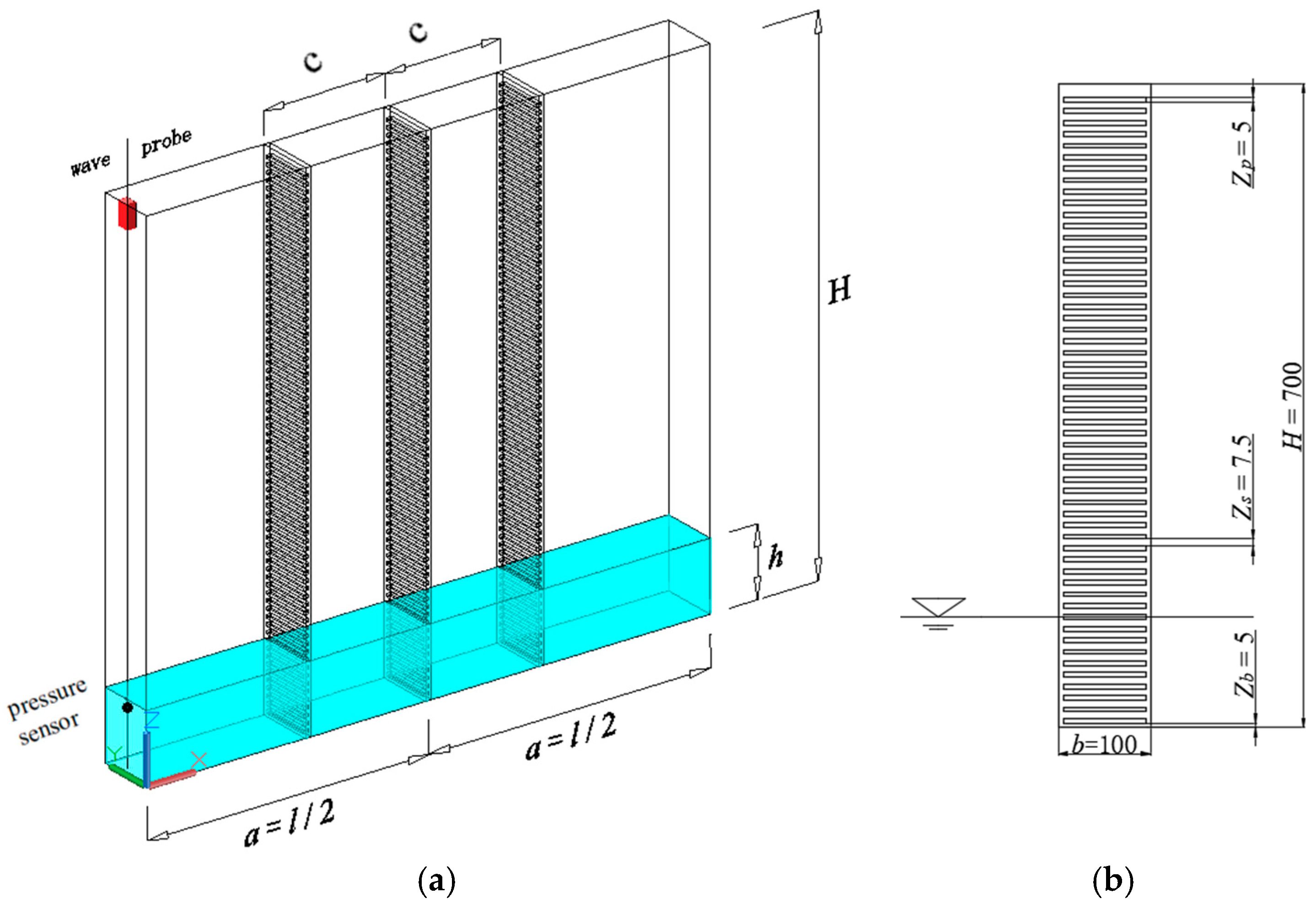
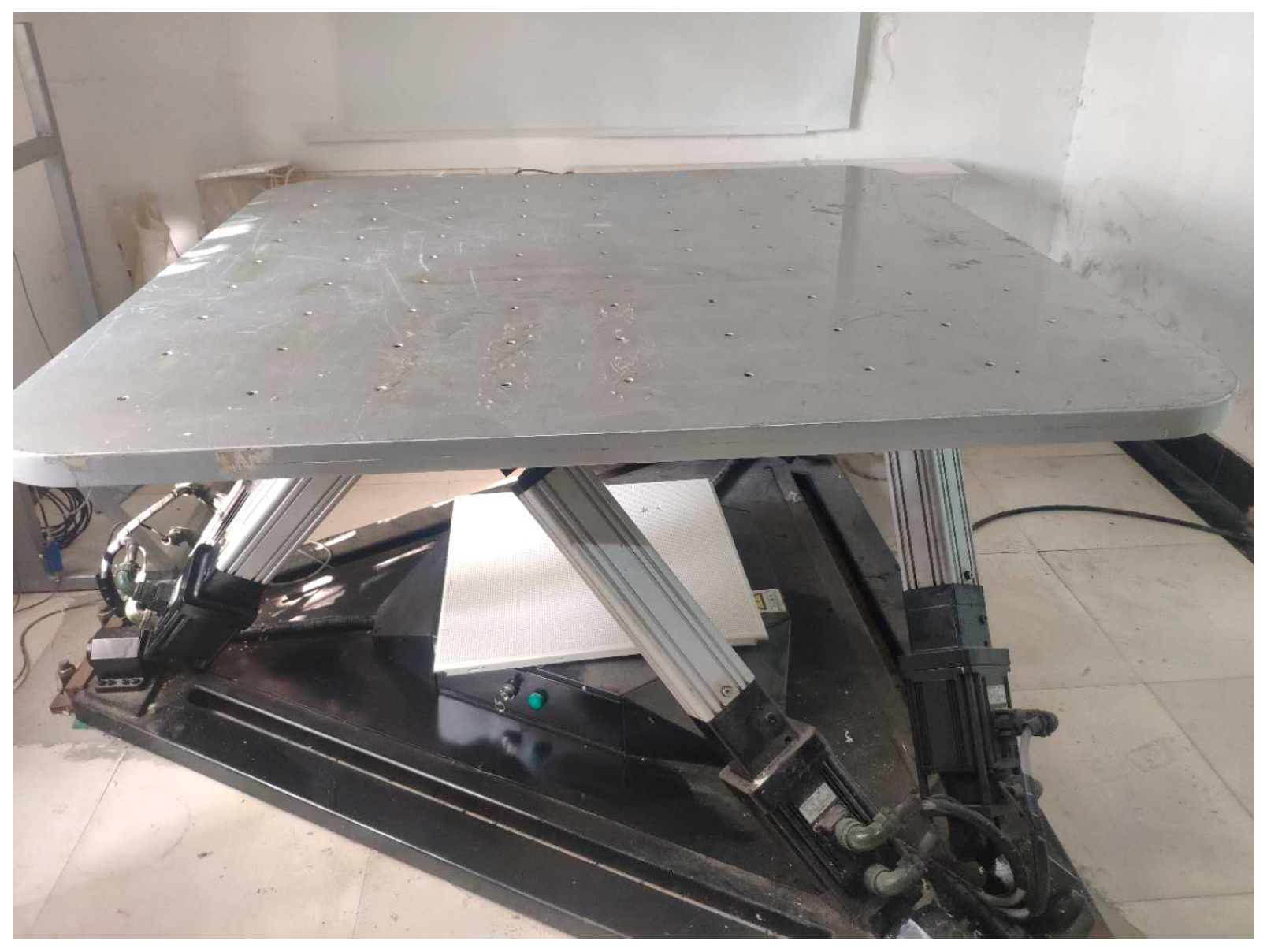
The experimental setup comprised a six-degree-of-freedom (6-DOF) motion platform, a rectangular acrylic tank, and a data acquisition system. The 6-DOF platform (Mootek Technology Co., Ltd., Wuhan, China) (Figure 1) imparted precise horizontal and vertical harmonic excitation to the tank [26,27]. The tank was constructed from 10-mm-thick transparent poly(methyl methacrylate) (PMMA) plates, with internal dimensions were length (l) × width (W) × height (H) = 1000 mm × 100 mm × 700 mm (Figure 2). A shallow water depth of h = 120 mm (using tap water) was maintained for all tests, corresponding to a relative depth (h/l) of 0.12 and a fill ratio (h/H) of 0.17. As shown in Figure 2a, the parameter c denotes the distance from a screen to the center of the tank, while a represents the half-length of the tank. The vertical slat screens (Figure 2b), made of stainless steel and identical to those used in [27], featured a solidity ratio (Sn) of 0.6 with an individual slot height (Zp) of 5mm and a slat height (Zs) of 7.5 mm. The number of screens, denoted by m, varied from 0 to 3. The tested configurations included no screen (m = 0), a single screen at the tank center (m = 1), two symmetrically placed screens each at a distance of c/a = 0.33 from the tank center (m = 2 and c/a = 0.33), and three screens with one at the tank center and the other two symmetrically positioned at c/a = 0.33 (m = 3 and c/a = 0.33). A WH200 wave gauge (Chengdu Xindashengtong Technology Co., Ltd., Chengdu, China; hereafter CDXDST) (range: 0–40 cm, accuracy: ±0.5% FS), fixed to the left tank wall with its probe 15 mm from the tank wall, measured the free-surface elevation. A YPTL1002 miniature digital pressure sensor (CDXDST) (range: 0–50 kPa, accuracy: ±0.1% FS), flush-mounted on the inner wall at 0.8 h (96 mm) above the tank bottom, measured the impact pressure. An SDA1000 sensor data acquisition system (CDXDST) was employed to acquire all data.

2.2. Key Notation

For clarity, the following key notations used throughout the paper are defined here:
Sn: Solidity ratio, defined as the ratio of the solid area to the total frontal area of the screen (Value tested: 0.6).
m: Number of screens (tested values: 0, 1, 2, 3).
a: Half-length of the tank (a = l/2).
c: Distance from a screen to the tank center (c/a = 0.33 was used for multi-screen configurations).
n: Order of the sloshing mode (a positive integer).
fn: Theoretical natural frequency corresponding to the n-th sloshing mode (see Equation (1), Section 2.4 for the calculation). The frequencies f1, f3, f5, and f7 are of particular interest.
A: Excitation amplitude (horizontal: A = 5 mm; vertical: A = 2–5 mm as specified).
f: Excitation frequency.
ηmax/A: Normalized wave height, representing the peak value extracted from the wave-gauge time history at a given excitation frequency.
pmax: peak impact pressure, representing the peak value extracted from the pressure sensor time history at a given excitation frequency.
ηmax-f/A: Maximum normalized wave height, representing the largest value of ηmax/A across all tested excitation frequencies.
pmax-f: Maximum peak impact pressure, representing the largest value of pmax across all tested excitation frequencies.
fη,max-f: Excitation frequency at which the maximum wave height (ηmax-f/A) occurs.
fp,max-f: Excitation frequency at which the maximum wave height (pmax-f) occurs.
η: suppression rate of wave height (see Equation (2) in Section 3.1 for definition).
p: suppression rate of peak impact pressure (see Equation (3) in Section 3.1 for definition).

2.3. Uncertainty and Repeatability Analysis

The reliability of the experimental data is ensured through the following measures.
(1)
Instrument calibration and system validation
All sensors were calibrated prior to the experimental campaign. Before commencing each new test, the liquid in the tank was allowed to reach a state of complete stillness, at which point the pressure sensor was manually zeroed. This procedure eliminated baseline drift and ensured that the recorded pressure signals were solely attributable to the sloshing dynamics induced by the subsequent excitation. The wave gauge (WH200) and pressure sensor (YPTL1002) have manufacturer-specified accuracies of ±0.5% FS and ±0.1% FS, respectively. These values represent the measurement precision of individual readings. More importantly, the complete experimental system was validated in our prior study [27]. In that work, the system successfully reproduced the wave-height time series reported by Xue et al. [29], confirming its capability to generate correct fluid-dynamic responses. This system-level validation provides a foundational assurance of data reliability;
(2)
Parametric trend consistency as a reliability indicator
Confidence in the observed trends is supported by their physical plausibility and internal coherence. The identified resonant frequencies from the experiment were consistent with theoretical frequencies. The measured pressure and wave-height peaks exhibit a consistent correlation across different excitation frequencies (analyzed in Section 3). No physically implausible outliers or discontinuous jumps appear in the response curves.

2.4. Experimental Cases

This study investigates both horizontal and vertical excitation because they induce distinct sloshing mechanisms. Sloshing induced by vertical excitation, known as parametric sloshing, is distinguished from directly forced sloshing in five key aspects. First, its occurrence is conditional, being strictly confined to discrete combinations of excitation frequency and amplitude within well-defined instability regions [4]. Second, a significant growth period is required to develop large-amplitude motion. Third, once these thresholds are met, the motion can easily transition to a state of exceptionally violent sloshing. Fourth, vertical excitation activates both odd and even sloshing modes, unlike horizontal excitation, which typically excites only odd sloshing modes. This is significant because the even-order sloshing modes have off-center nodal positions. This distinction may be beneficial for understanding baffle damping mechanisms. Fifth, resonance occurs when the excitation frequency is approximately twice the natural sloshing frequency.
The natural frequencies of the sloshing in the clean tank, calculated according to the analytical solution of natural frequencies from Lamb [30], Equation (1), are presented in Table 1.
ω n = g k n tanh k n h     f n =   ω n / 2 π ,
where k n = n l π , l is the tank length, h is the water depth, and n is the order of the sloshing mode (a positive integer).
Under horizontal excitation, the tank was subjected to a displacement excitation of the form X(t) = A × sin(ω × t) = A × sin(2π × f × t), where A is the amplitude, fixed at A/l = 0.01 for all tests. A frequency sweep was performed over a range of 0.27 to 2.5 Hz, which encompasses excitation frequencies from 0.50f1 to 1.16f7. Each frequency sweep test lasted a minimum of 40 s to ensure the establishment of steady-state sloshing. From these tests, the frequency response of the free-surface elevation and impact pressure was obtained, and the experimental natural frequencies were identified.
Under vertical excitation, the tank was subjected to a displacement excitation of the form Z(t) = Asin(2πft). Frequency sweeps were conducted to identify the excitation parameters (frequency and amplitude) required to excite each target sloshing mode. Unlike the constant amplitude used in horizontal excitation tests, the excitation amplitude was varied with the target mode under vertical excitation. The sweep range was set to (0.80–1.20) × 2fₙ, covering the first and fifth sloshing natural frequencies. The identified excitation parameters for each sloshing mode (n) were n = 1 (A = 40 mm, f = 0.85–1.27 Hz), n = 2 (A = 4 mm, f = 1.60–2.10 Hz), n = 3 (A = 5 mm, f = 2.20–2.85 Hz), n = 4 (A = 2 mm, f = 3.10–3.50 Hz), and n = 5 (A = 2 mm, f = 3.70–4.00 Hz).

3. Results and Discussion

This section’s central contribution is a new experimental dataset for sloshing impact pressure. The figures in Section 3 present the previously unreported frequency responses of impact pressure under horizontal and vertical excitation for various screen arrangements. This dataset demonstrates that wave-height suppression cannot directly represent pressure suppression.

3.1. Effect of Screen Number on Sloshing Impact Pressure Under Horizontal Excitation

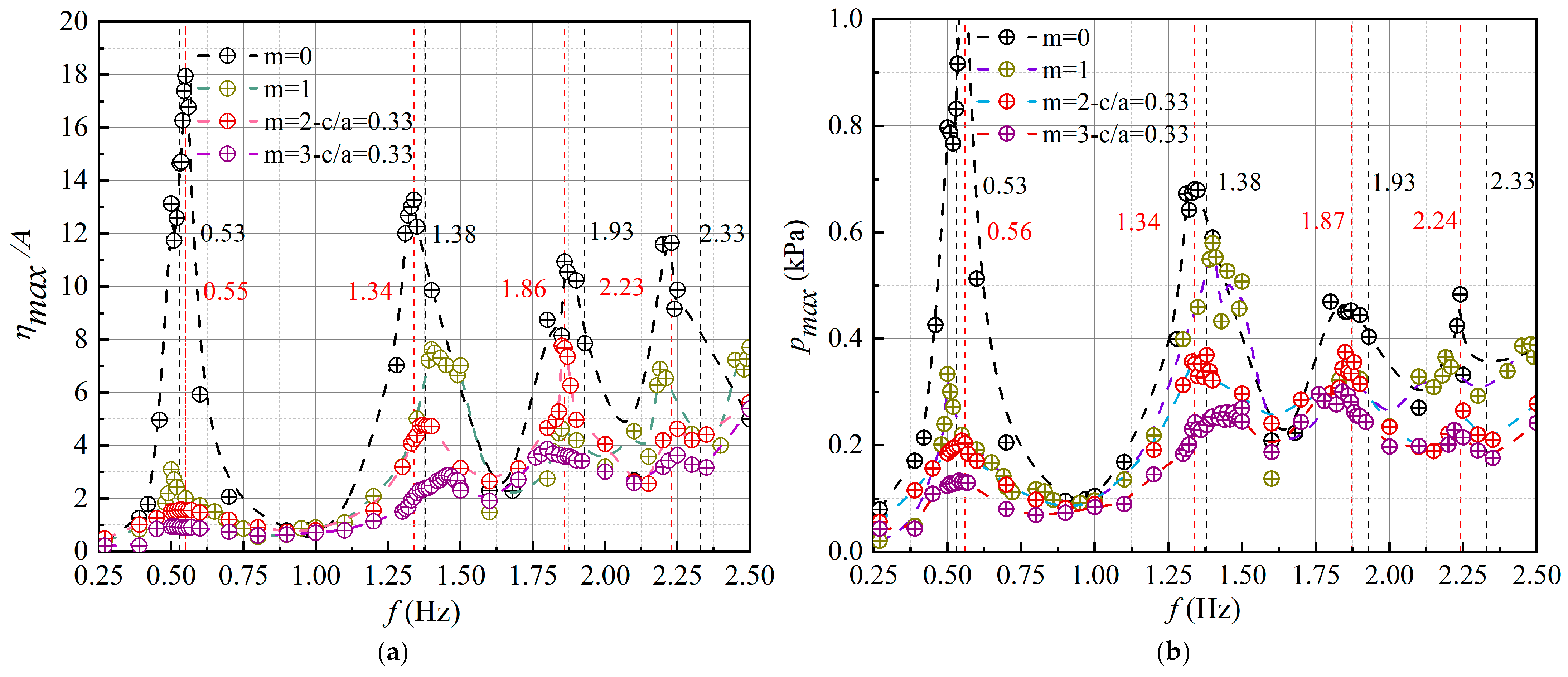
Figure 3 presents the frequency responses of sloshing wave height and pressure under horizontal excitation for different screen arrangements. The horizontal axis denotes the excitation frequency, f. The vertical axis in Figure 3a represents the normalized maximum free-surface elevation, ηmax/A, where ηmax is the peak value from the wave-gauge time history at each frequency, and A is the excitation amplitude. The vertical axis in Figure 3b represents the peak impact pressure, pmax, obtained from the pressure sensor time history at each frequency. In the clean tank case (m = 0), the theoretical natural frequencies are annotated with black dashed lines, with corresponding numerals, while the experimentally identified ones are in red.
As shown in Figure 3, the first natural frequency identified from the experimental results is slightly higher than the theoretical prediction, while the higher frequencies are consistently somewhat lower. This trend aligns with the findings reported in the shallow-water sloshing experiments of Wei et al. [22]. The mechanism behind this discrepancy for the first mode can likely be attributed to the highly violent sloshing at resonance under shallow-water conditions, as evidenced by the peaks in wave height and pressure response in Figure 3, where strong nonlinear effects and possible wave breaking cause the system to deviate from linear theory. The systematic reduction in higher-order frequencies is a common observation in experimental fluid dynamics. Numerous studies have reported that experimentally measured higher-order frequencies fall below inviscid theoretical predictions, primarily due to viscous damping and free-surface effects (e.g., surface tension), which are neglected in the potential-flow theory. In summary, the slight deviations between the theoretical and experimental natural frequencies are attributed to viscous effects and finite-amplitude nonlinearities.
Figure 3b presents the effectiveness results of vertical slat screens in suppressing impact pressure. Around the first natural frequency (f1), a single central screen (m = 1) achieves significant pressure suppression, which is consistent with prior findings [20,21,22,23,24,25]. The suppression efficacy generally increases with the number of screens (m = 2, m = 3). Around the third natural frequency (f3), the performance differs markedly from that around f1. In line with previous reports on the inefficacy of single or horizontal screens against the third mode [4,16,24], a single vertical screen (m = 1) here shows limited effect. However, configurations with two or three screens demonstrate substantial pressure suppression, reaffirming the trend that increasing the number enhances the overall damping performance. A notable exception occurs near the fifth natural frequency (~1.85 Hz). Contrary to the established trend that more screens yield better suppression, the two symmetrically placed screens (m = 2-c/a = 0.33) provide weaker pressure suppression than the single central screen (m = 1). The mechanism of this frequency-dependent performance can be attributed to the interplay of two primary damping mechanisms, namely modal disturbance and vortex-induced dissipation. Around f1 and f3, the increasing screen count enhances flow obstruction and vorticity generation, leading to greater energy dissipation and, thus, a stronger pressure reduction. Around f5, however, the specific spatial arrangement of the dual-screen configuration appears less effective at disrupting the local flow field responsible for pressure peaks, indicating a complex dependence on mode shape.
The results of a direct comparison between Figure 3a,b lead to a central conclusion that wave-height suppression cannot directly represent pressure suppression. This is clearly around f1 and f3, where a single baffle is less effective in reducing impact pressure than wave height. In fact, this result is consistent with the prior few studies that concurrently measured wave height and pressure, with pressure reduction often being weaker than wave-height reduction [21,22,23,24,28]. However, their analysis was confined to establishing the general effectiveness of baffles. That pressure reduction is systematically weaker than wave-height reduction was neither highlighted nor subjected to a dedicated experimental investigation. Our comprehensive experimental campaign provides systematic evidence and a quantitative analysis that confirms that pressure suppression is consistently weaker than wave-height reduction across a broad parameter space. Faltinsen et al. [31] pointed out that, in sloshing flow fields, inertial effects and viscous dissipation dominate under different conditions. This may lead to inconsistencies between pressure responses and wave-height responses.
The underlying mechanism may be the fundamental difference in their intrinsic physical natures. Free-surface elevation primarily corresponds to the global potential energy of sloshing, while wall impact pressure originates from the concentrated release of local kinetic energy. The wall is at the antinode position of the sloshing mode. When the free-surface elevation at that location reaches its maximum, the system’s potential energy is maximum, and theoretically, both the horizontal and vertical fluid velocities there are zero, making the dynamic pressure (related to the square of velocity) zero. At this moment, the sloshing energy is entirely manifested as potential energy. Therefore, the reduction in wave height directly reflects the entire suppression by screens. However, the moment when the wall impact pressure reaches its maximum is different. The maximum impact pressure usually occurs at the instant when a high-speed fluid (such as a jet or tongue) impacts the wall vertically or at a large angle. At this instant, the free surface at the wall is usually neither the highest nor the lowest, but often at an intermediate position and undergoing drastic shape changes (such as curling or breaking). The sloshing energy at this instant is manifested as the sum of kinetic and potential energy. Therefore, the entire suppression by screens is simultaneously manifested as the suppression of pressure and the suppression of wave height. Consequently, the screens’ suppression of pressure is systematically weaker than the suppression of wave height.
Table 2 presents the excitation frequencies that induce the maximum responses at each measurement point for different screen configurations (m = 0, m = 1, m = 2-c/a = 0.33, m = 3-c/a = 0.33). Specifically, fη,max-f denotes the excitation frequency at which the maximum wave height (ηmax-f/A) occurs, and fp,max-f denotes the excitation frequency at which the maximum peak pressure (pmax-f) occurs. The corresponding measured peak pressure (pmax (kPa)) and wave height (ηmax/A) at these frequencies are also provided. For reference, the leftmost column presents the analytical sloshing natural frequencies (f1~f7).
The data in Table 2 reveal the relationship between the peak frequencies for wave height (fη,max-f) and pressure (fp,max-f). A primary observation is that, for most tested cases, fp,max-f is identical to fη,max-f. A secondary but notable trend emerges where fp,max-f exceeds fη,max-f. This condition occurs under specific combinations of frequency and screen configuration. Around f1, f5, and f7, fp,max-f exceeds fη,max-f under m = 0 and m = 3 and c/a = 0.33. This trend is also observed around f3 under m = 2 and c/a = 0.33 and around f5 under m = 1. A sole exception occurs around f7 under m = 3 and c/a = 0.33, where the relationship reverses (fp,max-f < fη,max-f).
The observed frequency shift (fp,max-f > fη,max-f) in Table 2 can be understood through a unified physical framework. (1) It occurs primarily under two conditions, namely, violent sloshing in the clean tank and flow modified by three screens. (2) In both cases, the underlying mechanism is a phase advance of the local kinetic processes (governing pressure) relative to the global potential energy (governing wave height). (3) For the clean tank, nonlinear effects cause peak fluid momentum during wall impact to lead to maximum surface elevation, while for three screens, vortex impingement governs pressure with a leading timescale. (4) This explains the shifts around f3 under m = 2 and c/a = 0.33 and around f5 under m = 1, where incipient vortex dynamics influence the response. (5) The sole reversal around f7 under m = 3 and c/a = 0.33 (fp,max-f < fη,max-f) highlights an exceptional case where complex vortex interactions retard the local kinetic peak, underscoring intricate flow–structure interplay.
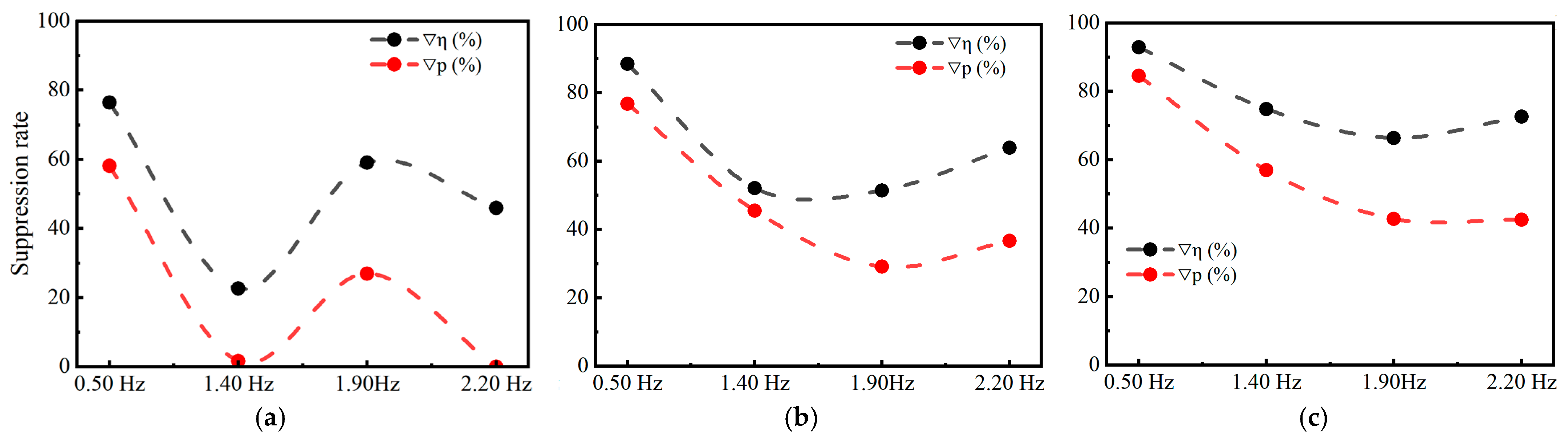
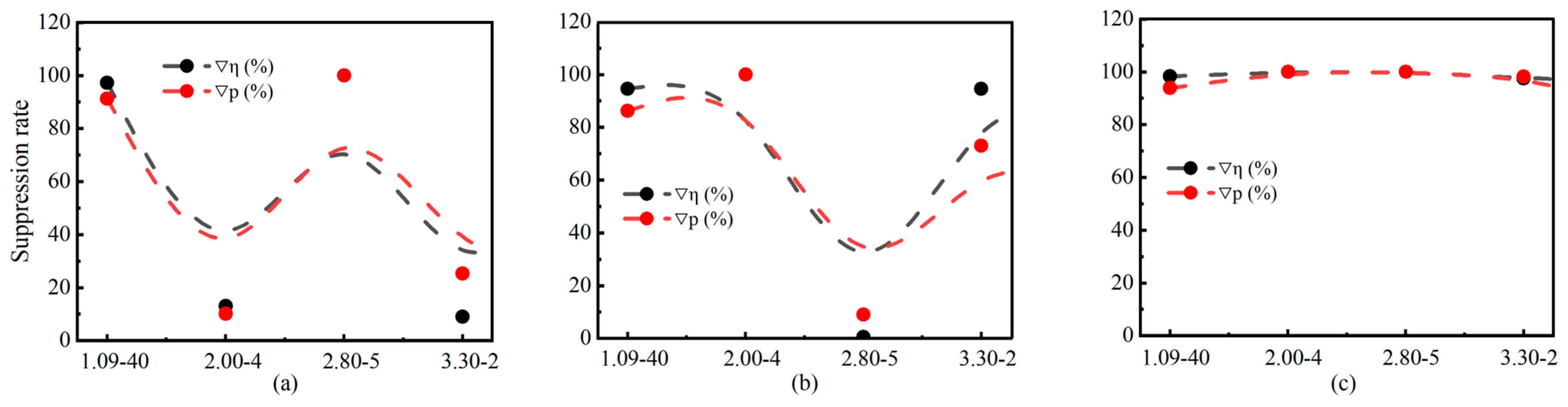
As noted in the results of Figure 3, a single baffle reduces wave height more effectively than impact pressure around f1 and f3. To quantify this difference, the sloshing suppression rate is defined by Equations (2) and (3). The calculated suppression rates (▽η and ▽p) under different excitation frequencies (f = 0.50 Hz, f = 1.40 Hz, f = 1.90 Hz, f = 2.20 Hz) and screen configurations (m = 0, m = 1, m = 2 and c/a = 0.33, m = 3 and c/a = 0.33) are summarized in Table 3 and visually presented in Figure 4 and Figure 5.
η = (ηmax-m=0ηmax-screens)/ηmax-m=0
p = (pmax-m=0pmax-screens)/pmax-m=0
where ηmax-m=0 and pmax-m=0 is the peak value from the wave-gauge time history at each frequency and peak impact pressure from the pressure sensor time history at each frequency in the tank without screens (m = 0), ηmax-screens and pmax-screens is the wave height and peak impact pressure in the tank with screens (m = 0, m = 1, m = 2 and c/a = 0.33, m = 3 and c/a = 0.33).
As shown in Table 3, Figure 4 and Figure 5, the most significant finding of this suppression analysis is that, across all tested frequencies and screen configurations, the suppression rate for impact pressure is consistently lower than that for wave height. This fundamental discrepancy directly and quantitatively demonstrates that wave-height suppression cannot serve as a reliable proxy for pressure-load suppression, challenging a common assumption in sloshing mitigation design.
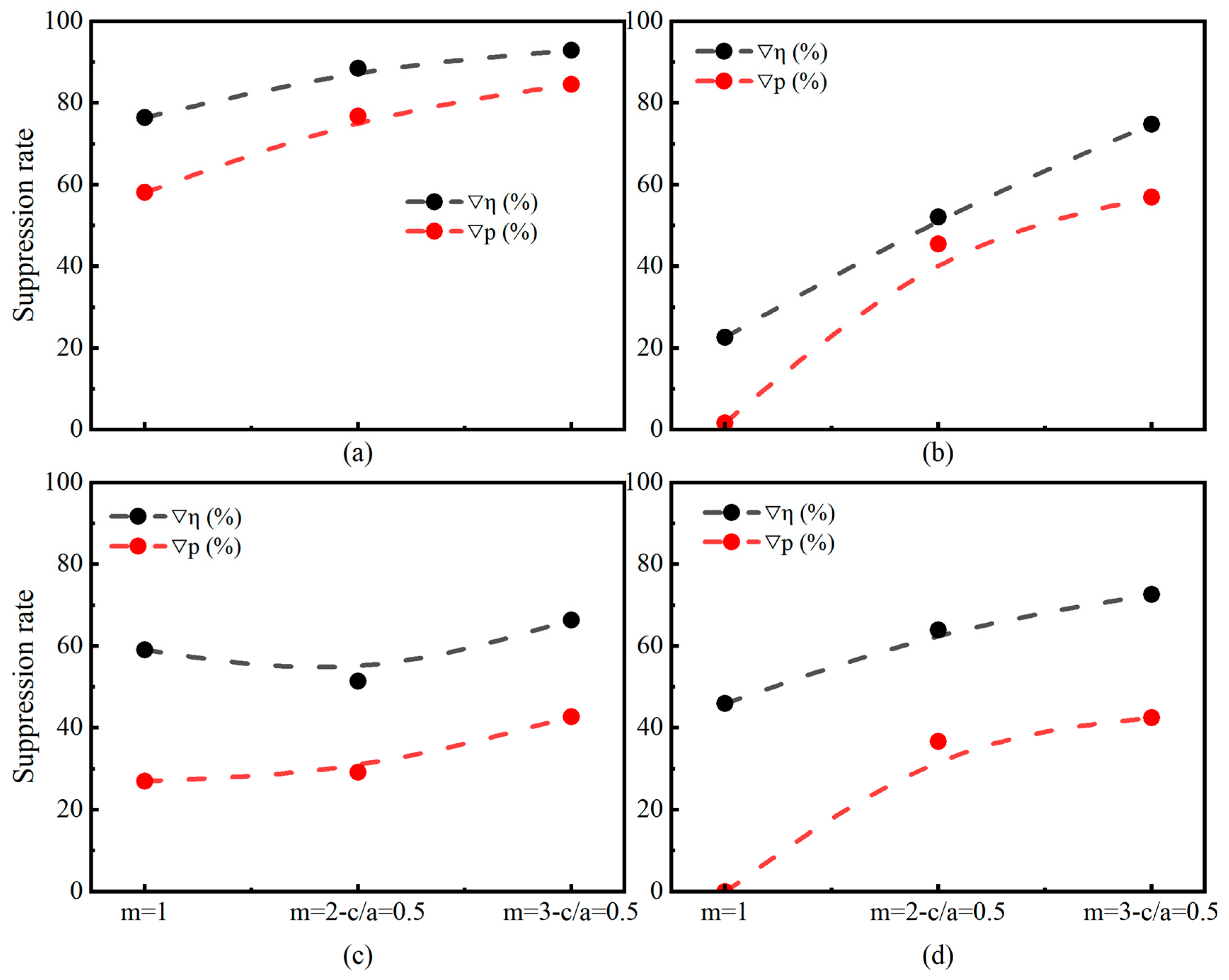
Figure 4 presents the suppression rate comparison of impact pressure (red lines) and wave height (black lines) as a function of screen number (m) under four selected frequencies (around f1 and f7). The central result is that increasing the number of screens yields a disproportionately greater enhancement in pressure suppression than wave-height suppression. For instance, at all tested excitation frequencies, adding a second screen (from m = 1 to m = 2) leads to a marginal improvement in wave-height suppression, while it causes a marked increase in pressure suppression. The mechanism behind this divergence arises from the different energy pathways. The first screen effectively disrupts the global potential energy of the fundamental sloshing mode, achieving substantial wave-height reduction. Additional screens, however, contribute less to further modal disturbance but significantly amplify vortex generation and interactions. This vortex-dominated dissipation effectively dissipates the local kinetic energy responsible for impact pressures, explaining the steeper rise in pressure suppression with screen count. This trend indicates that adding vertical slat screens is a particularly effective strategy for suppressing impact loads critical to structural safety.
Figure 5 presents the suppression rate compression of impact pressure (red lines) and wave height (black lines) as a function of excitation frequency (around f1 and f7) under different screen numbers (m). The central result is that, for a given number of vertical slat screens, their effectiveness in suppressing pressure diminishes as the excitation frequency increases. The underlying mechanism for this frequency-dependent weakening may be attributed to the changing flow physics at higher modes. Higher-frequency sloshing involves shorter wavelengths and more complex, localized flow structures. This trend of frequency-dependent performance highlights an inherent limitation of vertical slat screens in controlling high-frequency sloshing dynamics.

3.2. Effect of Screen Number on Sloshing Impact Pressure Under Vertical Excitation

Section 3.1 establishes that, under horizontal excitation, screen position, rather than number, governs sloshing suppression. To further investigate this mechanism, we now turn to vertical excitation, which induces parametric sloshing and fundamentally different modal dynamics. Crucially, vertical excitation excites the complete modal spectrum, including even-order modes. In contrast to the exclusively odd-mode response under horizontal excitation, the nodes of these even modes are offset from the tank center. This distinction allows for a direct investigation into the relationship between screen placement and modal nodes, thereby clarifying the mechanism of sloshing suppression by screens.
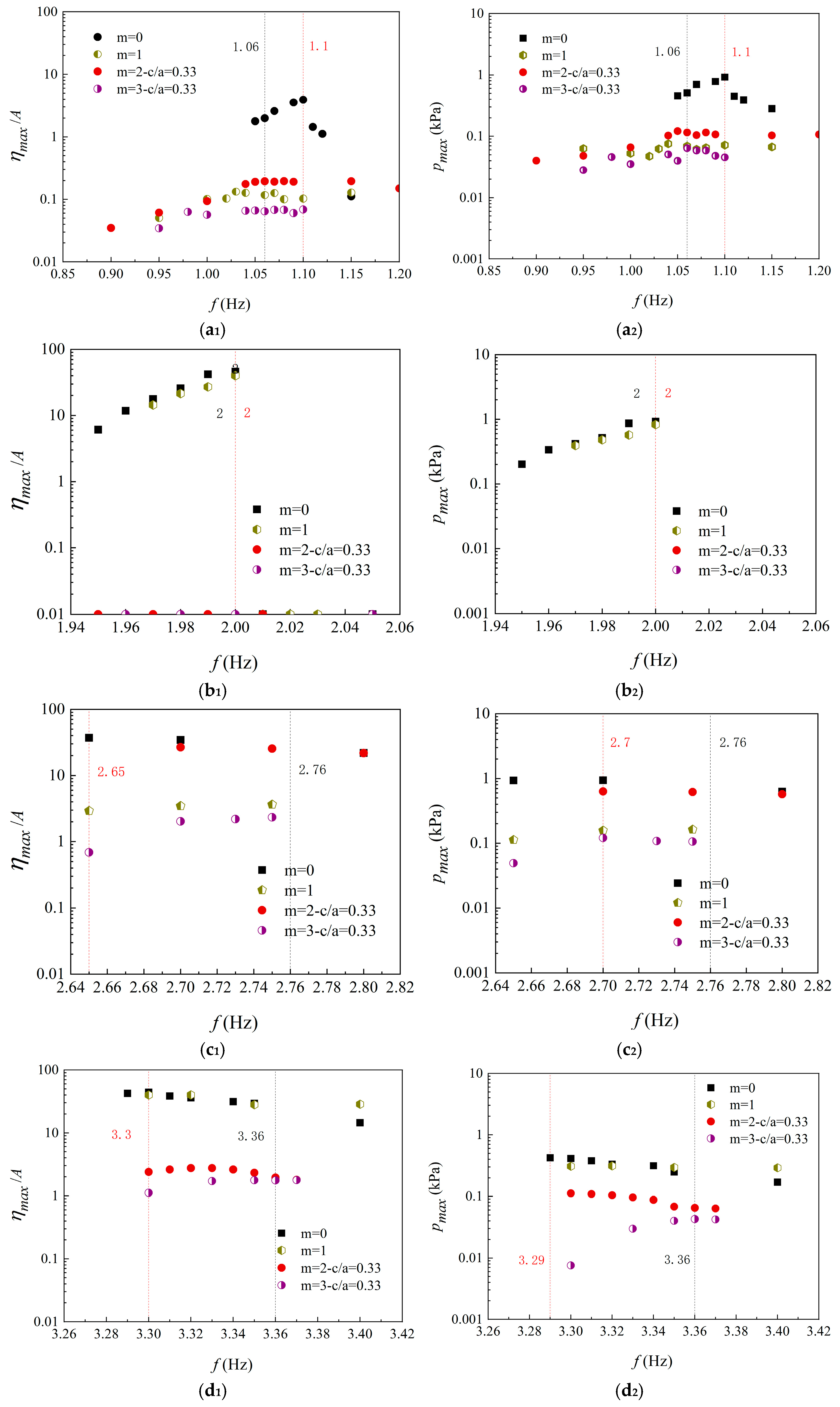
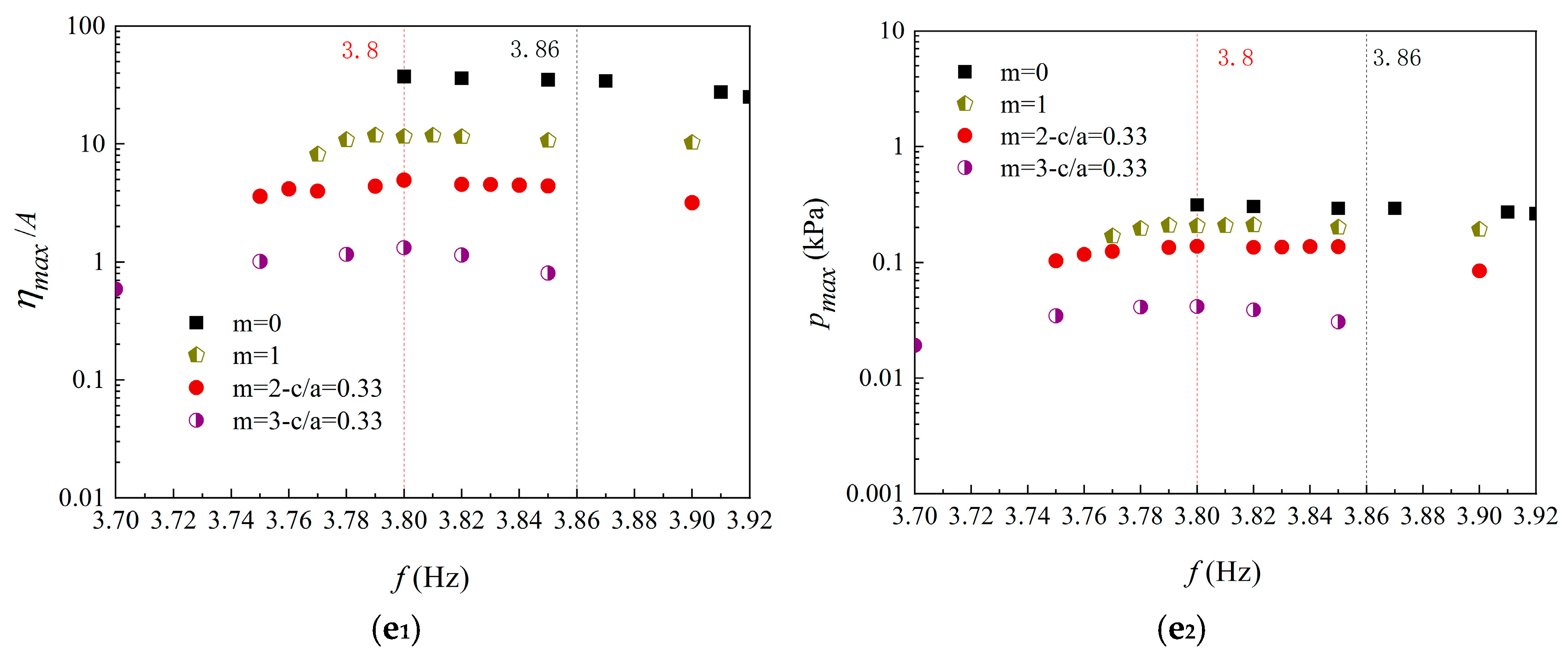
Figure 6 presents the frequency responses of wave height and peak impact pressure under vertical excitation for different vertical slat screen configurations.
Figure 6 shows that the relationship between the experimental and theoretical natural frequencies under vertical excitation follows the same pattern as that under horizontal excitation (Figure 3). The first mode is slightly elevated, while higher modes are consistently lower.
Figure 6 presents the suppression of impact pressure by vertical slat screens under vertical excitation, revealing both parallels and key distinctions compared to the horizontal excitation case (Figure 3). (1) Around 2f1, the trend is consistent with horizontal excitation, where the suppression efficacy increases with the number of screens (Figure 6a). (2) Around 2f3, however, a notable divergence emerges. Under vertical excitation, a single screen (m = 1) provides better suppression than two screens (Figure 6c). This contrasts with the horizontal case, where more screens always perform better. (3) Around 2f5, the suppression efficacy increases with the number of screens. This result is opposite to the trend observed under horizontal excitation. (4) A critical distinction absent in horizontal excitation is the response at even-numbered sloshing modes (2f2, 2f4), which are uniquely excited by vertical parametric forcing. Here, a single central screen (m = 1) fails completely to suppress the pressure (Figure 6b,d). Suppression is achieved only with two or more screens, and its efficacy improves with the number.
The results from Figure 3 and Figure 6 demonstrate that the effectiveness of vertical slat screens depends on the dominant damping mechanism, which varies with the excitation type (direct vs. parametric) and mode number (odd vs. even). (1) Modal disturbance is maximized when a screen coincides with a velocity node of a sloshing mode. The mechanism explains why the sloshing suppression effect does not improve with an increase in the number of baffles. (2) For vortex-induced dissipation, the sloshing suppression effect improves with an increase in the number of baffles. This result underscores a fundamental principle for suppressing parametric sloshing: the screen’s position relative to the sloshing mode nodes is more critical than its mere presence. For even modes, the central screen coincides with an anti-node (peak velocity), rendering it ineffective. Additional screens placed symmetrically off-center can interact with the velocity field, primarily through vortex-induced dissipation, to achieve suppression. Consequently, screen configuration must be tailored to the target sloshing mode and excitation type. A design optimized for horizontal excitation may be ineffective or even detrimental for parametric sloshing control.
A direct comparison between the pressure Figure 6(a2–e2) and the wave-height suppression subplots Figure 6(a1–e1) in Figure 6 does not allow for a clear quantitative comparison.
Table 4 presents the excitation frequencies that induce the maximum responses at the measurement point under vertical excitation for different vertical slat screen configurations. Table 4 reveals a key characteristic of vertical excitation. The frequencies inducing maximum pressure and wave height are generally identical. A minor deviation is observed around 2f3 under m = 2 and c/a = 0.33. This synchrony contrasts with the frequent phase shifts observed under horizontal excitation (Table 2), where the pressure peak often leads the wave-height peak. The underlying cause of this difference lies in the distinct forcing mechanisms. Parametric excitation induces instability by periodically modulating the system’s boundary conditions. This leads the system to tend to respond with a single coherent dominant mode. Consequently, both the local kinetic energy (responsible for pressure) and the global potential energy (responsible for wave height) oscillate in phase within this locked mode, reaching their peaks simultaneously. Direct horizontal forcing applies an oscillatory momentum input directly to the fluid body. This can more readily excite phase differences between local flow structures (governing pressure) and the global sloshing motion (governing wave height), leading to a systematic shift in their respective peak frequencies.
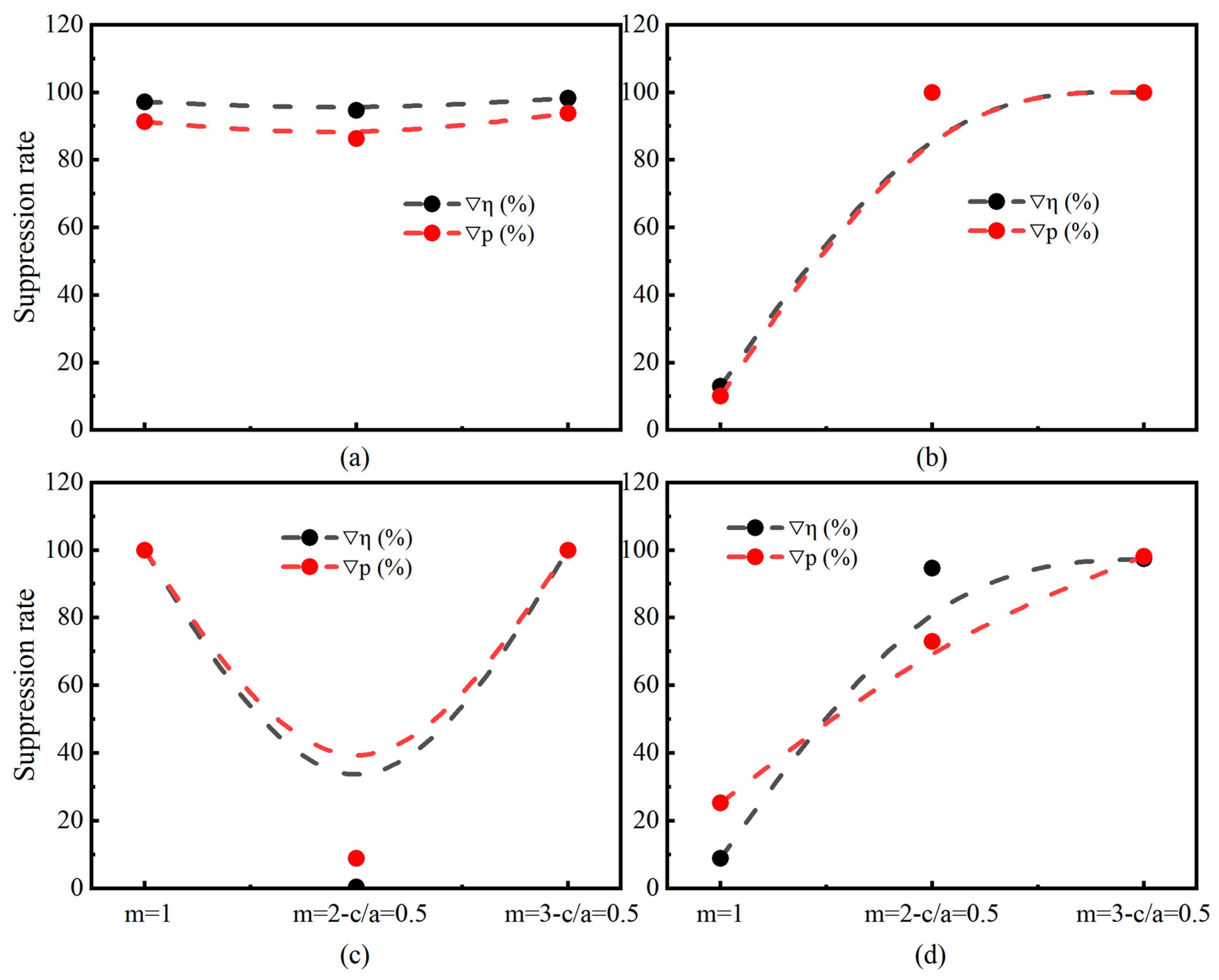
The suppression rates (▽η and ▽p) for vertical excitation are quantified in Table 5 and visualized in Figure 7 and Figure 8. In Table 5, the abbreviation amp. Denotes the amplitude. Amp. = 0 indicates zero sloshing amplitude of the free-surface elevation (or dynamic pressure). This quantitative analysis directly addresses the limitation noted in Figure 6, where a direct visual comparison between pressure and wave-height suppression subplots did not allow for a clear quantitative comparison.
As shown in Table 5, the difference between the suppression of pressure and the suppression of wave height by screens under vertical excitation is less pronounced than under horizontal excitation. Another pivotal result is that the relationship between wave height and pressure suppression under vertical excitation is more complex and fundamentally different from that under horizontal excitation. Under horizontal excitation, pressure suppression is consistently weaker than wave-height suppression. In contrast, under vertical excitation, there are some cases where pressure suppression significantly exceeds wave-height suppression at specific frequencies. This situation occurs when the suppression effect of the screens is weak. For instance, at 2.8 Hz (near 2f3, A = 5 mm), two vertical slat screens yield minimal wave-height suppression (0.504%) but achieve a higher pressure suppression rate of 9.001%. A more pronounced example occurs at 3.3 Hz (near 2f4, A = 2 mm), where a single screen provides 8.94% wave-height suppression but achieves a significantly stronger 25.244% pressure suppression.
Two phenomena require explanation: (i) the mechanism behind the suppression difference between horizontal and vertical excitation, and (ii) the mechanism of the exception where pressure suppression exceeds wave-height suppression.
(i)
Horizontal excitation only excites odd sloshing, and the tank center is always a modal node. A single screen placed at this location can stably disrupt the dominant mode, providing consistent suppression (>20%). Increasing the number of screens further enhances suppression by disturbing higher-order modes (increasing flow obstruction) and augmenting vortex dissipation, which particularly improves the dissipation efficiency of local kinetic energy (pressure). Since horizontal excitation (direct forcing) does not require specific frequency or amplitude thresholds to excite sloshing, the damping of screens remains effective across all conditions. In contrast, the parametric sloshing excited by vertical excitation possesses instability, and its suppression exhibits a nonlinear response tied to specific excitation frequencies and amplitude thresholds. Appropriate screen placement can significantly raise the instability threshold, achieving near-complete suppression. Inappropriate placement has minimal impact on stability, leading to near failure of the global suppression (suppression rate < 20%). This highlights the fundamental principle that screen position absolutely takes precedence over screen number in sloshing suppression;
(ii)
The screens suppress the total mechanical energy by modal disturbance, which is the efficient primary mechanism. Additionally, screens also suppress the impact kinetic energy by generating vortex dissipation, which is a relatively inefficient mechanism. Under vertical excitation, sloshing suppression by screens may exhibit a near-complete failure where the wave-height suppression rate is below 20%. At this time, the screens are far away from the mode nodes, and sloshing can still develop to a maximum wave height similar to that without screens. However, screens can still dissipate part of the impact kinetic energy through vortices. Therefore, against the backdrop of the failure of the global mechanism, the contribution of the local mechanism becomes apparent, leading to the observed phenomenon where pressure suppression exceeds wave-height suppression.
This discovery indicates that, when traditional wave-height suppression designs fail, the screen structure may still provide limited backup pressure protection for structural safety through localized dissipation. Simultaneously, it cautions designers to prioritize screen placement (at modal nodes) rather than simply increasing the number of screens.
The results in Figure 7 and Figure 8 clearly demonstrate that, under vertical excitation, the most effective number of screens varies with the excitation frequency. At 2.00 Hz (near 2f2, A = 4 mm) and 3.30 Hz (near 2f4, A = 2 mm), both two and three vertical slat screens nearly completely suppress the parametric sloshing in both wave height and pressure, whereas a single screen almost entirely fails. Conversely, at 2.8 Hz (near 2f3, A = 5 mm), one and three screens achieve near-complete suppression, whereas two screens are largely ineffective. This frequency-dependent effectiveness confirms that the modal structure is the primary governing mechanism for suppression under parametric excitation.

4. Conclusions

This study achieved the following core findings through systematic model experiments. This study provides the first benchmark dataset on the sloshing pressure suppression by vertical slat screens under broadband horizontal and vertical excitation. The dataset systematically revealed the suppression patterns and mechanisms of screens on pressure suppression. Vertical slat screens can effectively suppress wave pressure. A systematic discrepancy between pressure suppression and wave-height suppression conclusively shows that wave-height suppression is not a reliable proxy for pressure suppression. The results highlight the suppression mechanism dominated by modal disturbance and the instability of parametric sloshing. Wave height, reflecting global potential energy, is effectively suppressed by modal disturbance. Pressure, originating from local kinetic energy, can be effectively suppressed by both modal disturbance and vortex dissipation. Key findings are summarized as follows.

4.1. Pressure Suppression by Screens

(1)
Influence of screen number on pressure suppression effectiveness
Under horizontal excitation and across most excitation frequencies, increasing the number of screens can stably and progressively enhance the suppression of both wave height and pressure, reflecting the additive nature of a classical damping mechanism. In contrast, under vertical excitation, increasing the number of baffles does not necessarily improve suppression. For instance, in even-order modes, a screen positioned at the tank center becomes largely ineffective due to its distance from the actual modal nodes. This fundamentally establishes the core principle that position dominates over number in sloshing suppression by screens.
Furthermore, under horizontal excitation, adding screens (e.g., increasing from one to two layers) improves pressure suppression far more significantly than it improves wave-height suppression. Wave height, reflecting global potential energy, is effectively suppressed by modal disturbance. Pressure, originating from local kinetic energy, can be effectively suppressed by both modal disturbance and vortex dissipation. The first screen substantially reduces the wave height (potential energy) through modal disturbance, while additional screens primarily further suppress impact kinetic energy (pressure) by enhancing vortex generation and dissipation, making this an effective strategy for targeting structural impact loads. Under vertical excitation, adding screens without altering their spatial relationship with the modal nodes yields no significant gain in either wave height or pressure suppression;
(2)
Influence of excitation frequency on pressure suppression effectiveness
The excitation frequency directly determines the sloshing mode. As summarized from the above, the effect of screen position outweighs that of screen number in suppression, indicating that modal disturbance is the most efficient mechanism for sloshing suppression.

4.2. Difference of Pressure Suppression Between Pressure and Wave Height by Screen

Wave-height suppression cannot directly represent pressure suppression. Under horizontal excitation, the wave-height suppression rate by screens is always greater than 20%, and their suppression of pressure is systematically weaker than the wave-height suppression. Under vertical excitation, most situations also follow this rule. However, when the overall suppression by screens is weak (wave-height suppression rate below 20%), an exception occurs where the pressure suppression rate is higher than the wave-height suppression rate.
(1)
Mechanism of suppression difference between horizontal and vertical excitation
Horizontal excitation only excites odd sloshing, and the tank center is always a modal node. A single screen placed at this location can stably disrupt the dominant mode, providing consistent suppression (>20%). Increasing the number of screens further enhances suppression by disturbing higher-order modes (increasing flow obstruction) and augmenting vortex dissipation, which particularly improves the dissipation efficiency of local kinetic energy (pressure). Since horizontal excitation (direct forcing) does not require specific frequency or amplitude thresholds to excite sloshing, the damping of screens remains continuously effective under all conditions.
In contrast, the parametric sloshing excited by vertical excitation possesses instability, and its suppression exhibits a nonlinear response tied to specific excitation frequencies and amplitude thresholds. Appropriate screen placement can significantly raise the instability threshold, achieving near-complete suppression. Inappropriate placement has minimal impact on stability, leading to a near failure of the global suppression (suppression rate < 20%). This highlights the fundamental principle that screen position absolutely takes precedence over screen number in sloshing suppression;
(2)
Mechanism of the general rule (wave-height suppression > pressure suppression)
Wave height reflects global potential energy. When the free surface at the wall reaches its maximum elevation, the potential energy is at a maximum, and the kinetic energy is zero. At this moment, the sloshing energy is entirely manifested as potential energy. Therefore, the reduction in wave height directly reflects the overall sloshing suppression by screens.
Impact pressure originates from concentrated local kinetic energy. The pressure peak occurs at the instant a high-speed fluid (jet or tongue) impacts the wall. At this instant, the free surface at the wall is usually neither at its highest nor lowest point, and the energy is the sum of kinetic and potential energy. Consequently, the overall sloshing suppression by screens at this moment is manifested in both pressure and wave-height suppression. Hence, the pressure suppression by screens is systematically weaker than wave-height suppression;
(3)
Mechanism of the exception (pressure suppression > wave-height suppression)
The screens suppress the total mechanical energy by modal disturbance, which is the efficient primary mechanism. Additionally, screens also suppress the impact kinetic energy by generating vortex dissipation, which is a relatively inefficient mechanism. Under vertical excitation, sloshing suppression by screens may exhibit a near-complete failure where the wave-height suppression rate is below 20%. At this time, the screens are far away from the mode nodes, and sloshing can still develop to a maximum wave height similar to that without screens. However, screens can still dissipate part of the impact kinetic energy through vortices. Therefore, against the background of the failure of the global mechanism, the contribution of the local mechanism becomes apparent, leading to the phenomenon where the pressure suppression exceeds the wave-height suppression.
Future research may integrate flow visualization techniques such as particle image velocimetry (PIV) to further elucidate the transient vortex dynamics and detailed energy dissipation pathways.

Author Contributions

Conceptualization, methodology, investigation, writing—original draft preparation, writing—review and editing, funding acquisition, L.Y.; methodology, investigation, data curation, visualization, formal analysis, X.L.; investigation, data curation, visualization, J.L.; data analysis, writing—original draft preparation, J.F.; conceptualization, methodology, data analysis, writing—review and editing, H.J. All authors have read and agreed to the published version of the manuscript.

Funding

This research was funded by the Guangzhou Basic and Applied Basic Research Foundation [Grant Number 2025A04J4581] and the General Research Project of Universities under the Guangzhou Municipal Bureau of Education [Grant Number 2024312007].

Data Availability Statement

The data presented in this study are available within the article.

Conflicts of Interest

The authors declare no conflicts of interest.

References

  1. Xue, M.A.; Zheng, J.H.; Lin, P.Z.; Yuan, X.L. Experimental Study on Vertical Baffles of Different Configurations in Suppressing Sloshing Pressure. Ocean Eng. 2017, 136, 178–189. [Google Scholar] [CrossRef]
  2. Jung, J.H.; Yoon, H.S.; Lee, C.Y.; Shin, S.C. Effect of the Vertical Baffle Height on the Liquid Sloshing in a Three-Dimensional Rectangular Tank. Ocean Eng. 2012, 44, 79–89. [Google Scholar] [CrossRef]
  3. Liu, D.; Lin, P. Three-Dimensional Liquid Sloshing in a Tank with Baffles. Ocean Eng. 2009, 36, 202–212. [Google Scholar] [CrossRef]
  4. Sanapala, V.S.; Rajkumar, M.; Velusamy, K.; Patnaik, B.S.V. Numerical Simulation of Parametric Liquid Sloshing in a Horizontally Baffled Rectangular Container. J. Fluids Struct. 2018, 76, 229–250. [Google Scholar] [CrossRef]
  5. Gavrilyuk, I.; Lukovsky, I.; Trotsenko, Y.; Timokha, A. Sloshing in a Vertical Circular Cylindrical Tank with an Annular Baffle. Part 1. Linear Fundamental Solutions. J. Eng. Math. 2006, 54, 71–88. [Google Scholar] [CrossRef]
  6. Ünal, U.O.; Bilici, G.; Akyıldız, H. Liquid Sloshing in a Two-Dimensional Rectangular Tank: A Numerical Investigation with a T-Shaped Baffle. Ocean Eng. 2019, 187, 106183. [Google Scholar] [CrossRef]
  7. Koh, C.G.; Luo, M.; Gao, M.; Bai, W. Modelling of Liquid Sloshing with Constrained Floating Baffle. Comput. Struct. 2013, 122, 270–279. [Google Scholar] [CrossRef]
  8. Abramson, H.N.; Chu, W.; Garza, L.R. Liquid Sloshing in Spherical Tanks. AIAA J. 1963, 1, 384–389. [Google Scholar] [CrossRef]
  9. Kareem, A. Reduction of Wind Induced Motion Utilizing a Tuned Sloshing Damper. J. Wind Eng. Ind. Aerodyn. 1990, 36, 725–737. [Google Scholar] [CrossRef]
  10. Kareem, A.; Yalla, S.; McCullough, M. Sloshing-Slamming Dynamics–S 2–Analogy for Tuned Liquid Dampers. In Vibro-Impact Dynamics of Ocean Systems and Related Problems; Springer: Berlin/Heidelberg, Germany, 2009; pp. 123–133. [Google Scholar]
  11. Faltinsen, O.M.; Timokha, A.N. Natural Sloshing Frequencies and Modes in a Rectangular Tank with a Slat-Type Screen. J. Sound Vib. 2011, 330, 1490–1503. [Google Scholar] [CrossRef]
  12. Kobayashi, N.; Watanabe, M.; Honda, T. Suppression Characteristics of Sloshing in Vessels by a Bulkhead. In Proceedings of the ASME 2006 Pressure Vessels and Piping/ICPVT-11 Conference; ASME: New York, NY, USA, 2006. [Google Scholar]
  13. Pourahmadi Laleh, A.; Svrcek, W.Y.; Monnery, W. Computational Fluid Dynamics-Based Study of an Oilfield Separator—Part I: A Realistic Simulation. Oil Gas Facil. 2012, 1, 57–68. [Google Scholar] [CrossRef]
  14. Sanapala, V.S.; Velusamy, K.; Patnaik, B.S.V. CFD Simulations on the Dynamics of Liquid Sloshing and Its Control in a Storage Tank for Spent Fuel Applications. Ann. Nucl. Energy 2016, 94, 494–509. [Google Scholar] [CrossRef]
  15. Wei, Z.J. Study on Sloshing and Slamming Loads in the Design of FLNG Storage Tanks. Ph.D. Thesis, Dalian University of Technology, Dalian, China, 2015. (In Chinese) [Google Scholar]
  16. Jin, H.; Liu, Y.; Li, H.J. Experimental Study on Sloshing in a Tank with an Inner Horizontal Perforated Plate. Ocean Eng. 2014, 82, 75–84. [Google Scholar] [CrossRef]
  17. Faltinsen, O.M.; Timokha, A.N. Sloshing; Cambridge University Press: Cambridge, UK, 2009. [Google Scholar]
  18. Jin, X.; Liu, M.M.; Zou, Y.J.; Luo, M.; Yang, F.; Wang, L. Numerical Simulation of Faraday Waves in a Rectangular Tank and Damping Mechanism of Internal Baffles. J. Fluids Struct. 2022, 109, 103503. [Google Scholar] [CrossRef]
  19. Jin, X.; Wang, Y.S.; Zhang, F.G.; Chen, J.; Li, D.S.; Fan, C.Y.; Liu, M.M. Predictions of wave-height and Pressure Induced by Liquid Sloshing Based on Neural Network. J. Ship Mech. 2025, 29, 388–399. [Google Scholar]
  20. Zhang, C.; Wang, L.; Xu, M. Study on the Damping Effect and Mechanism of Vertical Slotted Screens Based on the BM-MPS Method. J. Mar. Sci. Eng. 2023, 11, 1270. [Google Scholar] [CrossRef]
  21. Ali, U.; Hu, C.; Dief, T.N.; Kamra, M.M. Enhanced Sloshing Control Using Novel Shaped Baffle. Phys. Fluids 2025, 37, 082107. [Google Scholar] [CrossRef]
  22. Wei, Z.J.; Faltinsen, O.M.; Lugni, C.; Yue, Q.J. Sloshing-Induced Slamming in Screen-Equipped Rectangular Tanks in Shallow-Water Conditions. Phys. Fluids 2015, 27, 032104. [Google Scholar] [CrossRef]
  23. Xue, M.A.; He, Y.; Yuan, X.; Cao, Z.; Odoom, J.K. Numerical and Experimental Study on Sloshing Damping Effects of the Porous Baffle. Ocean Eng. 2023, 285, 115363. [Google Scholar] [CrossRef]
  24. Liu, D.; Chang, F.; Chen, Y. Experimental Study of Vertical Baffle Height on Sloshing Reduction Effects in the Rectangular Tank. Ocean Eng. 2025, 335, 121674. [Google Scholar] [CrossRef]
  25. Liu, D.; Zhang, X.; Wang, J. Effect of a Vertical Baffle on the Resonant Steady-State Sloshing Impacts in a Square-Base Container with Longitudinal Harmonic Excitations. Phys. Fluids 2025, 37, 022105. [Google Scholar] [CrossRef]
  26. Yu, L.T.; Xue, M.A.; Zheng, J.H. Experimental Study of Vertical Slat Screens Effects on Reducing Shallow Water Sloshing in a Tank under Horizontal Excitation with a Wide Frequency Range. Ocean Eng. 2019, 173, 131–141. [Google Scholar] [CrossRef]
  27. Yu, L.T.; Xue, M.A.; Jiang, Z.Y. Experimental Investigation of Parametric Sloshing in a Tank with Vertical Baffles. Ocean Eng. 2020, 213, 107783. [Google Scholar] [CrossRef]
  28. Wu, J.; Zhang, J.; Yu, Y.; Shentu, Z.; Xue, M.A. Research on Sloshing Characteristics for Liquefied Iron Ore and Size Optimization of Anti-Sloshing Baffle Based on Data-Driven Models. Appl. Ocean Res. 2025, 158, 104604. [Google Scholar] [CrossRef]
  29. Xue, M.A.; Lin, P.Z.; Zheng, J.H.; Ma, Y.X.; Yuan, X.L.; Nguyen, V.T. Effects of perforated baffle on reducing sloshing in rectangular tank: Experimental and numerical study. China Ocean Eng. 2013, 27, 615–628. [Google Scholar] [CrossRef]
  30. Lamb, H. Hydrodynamics; Cambridge University Press: Cambridge, UK, 1932. [Google Scholar]
  31. Faltinsen, O.M.; Rognebakke, O.F.; Lukovsky, I.A.; Timokha, A.N. Multidimensional Modal Analysis of Nonlinear Sloshing in a Rectangular Tank with Finite Water Depth. J. Fluid Mech. 2000, 407, 201–234. [Google Scholar] [CrossRef]
Figure 1. The six-degree-of-freedom (6-DOF) motion platform.
Jmse 14 00220 g001
Figure 2. Configuration of the liquid tank and vertical slat screens: (a) overview of the liquid tank and vertical slat screens; (b) detailed geometry of a single screen (unit: mm).
Jmse 14 00220 g002
Figure 3. Frequency response of sloshing under horizontal excitation (A/l = 0.01): (a) normalized wave height; (b) peak impact pressure. Note: The notation “m = 2 and c/a = 0.33” denotes two independent parameters (number of screens and the screens position).
Jmse 14 00220 g003
Figure 4. Suppression rates versus screen number (m) under horizontal excitation (A/l = 0.01) at four frequencies: (a) f = 0.50 Hz; (b) f = 1.40 Hz; (c) f = 1.90 Hz; (d) f = 2.20 Hz. Note: The notation “m = 2 and c/a = 0.33” denotes two independent parameters (number of screens and the screens position).
Jmse 14 00220 g004
Figure 5. Suppression rates versus excitation frequency under horizontal excitation (A/l = 0.01) for three screen numbers: (a) m = 1; (b) m = 2 and c/a = 0.33; (c) m = 3 and c/a = 0.33.
Jmse 14 00220 g005
Figure 6. Frequency response of parametric sloshing under vertical excitation: (a1) A = 40 mm, normalized wave height, f = 0.85–1.20 Hz; (a2) A = 40 mm, peak impact pressure, f = 0.85–1.20 Hz; (b1) A = 4 mm, normalized wave height, f = 1.94–2.06 Hz; (b2) A = 4 mm, peak impact pressure, f = 1.94–2.06 Hz; (c1) A = 5 mm, normalized wave height, f = 2.64–2.82 Hz; (c2) A = 5 mm, peak impact pressure, f = 2.64–2.82 Hz; (d1) A = 2 mm, normalized wave height, f = 3.26–3.42 Hz; (d2) A = 2 mm, peak impact pressure, f = 3.26–3.42 Hz; (e1) A = 2 mm, normalized wave height, f = 3.70–3.92 Hz; (e2) A = 2 mm, peak impact pressure, f = 3.70–3.92 Hz.
Jmse 14 00220 g006aJmse 14 00220 g006b
Figure 7. Suppression rates versus screen number (m) under vertical excitation at four parameter combinations: (a) f = 1.09 Hz and A = 40 mm; (b) f = 2.00 Hz and A = 4 mm; (c) f = 2.80 Hz and A = 2 mm; (d) f = 3.30 Hz and A = 2 mm.
Jmse 14 00220 g007
Figure 8. Suppression rates versus excitation frequency under vertical excitation for three screen numbers: (a) m = 1; (b) m = 2 and c/a = 0.33; (c) m = 3 and c/a = 0.33. Note: The hyphen in labels (e.g., “1.09-40”) connects the values of excitation frequency f (Hz) and excitation amplitude A (mm).
Jmse 14 00220 g008
Table 1. Sloshing natural frequencies in the clean tank.
Odd
Modes
ValueEven
Modes
Value
ωn (rad/s)fn (Hz)2fn (Hz)ωn (rad/s)fn (Hz)2fn (Hz)
1st3.3280.531.062nd6.26121.002.00
3rd8.6541.382.764th10.5631.683.36
5th12.1141.933.866th13.4392.144.28
7th14.6022.334.668th15.6522.494.98
9th16.5232.655.3010th17.5332.795.58
Table 2. Maximum values of wave height and peak impact pressure under horizontal excitation, along with corresponding excitation frequencies.
fn (Hz) m = 0m = 1m = 2 and c/a = 0.33m = 3 and c/a = 0.33
fη,max-f/
fp,max-f
ηmax/pmaxfη,max-f/
fp,max-f
ηmax/pmaxfη,max-f/
fp,max-f
ηmax/pmaxfη,max -f/
fp,max-f
ηmax/pmax
f1 = 0.53ηmax-f/Aηmax-f/A0.5517.950.503.090.531.5630.510.93
pmax (kPa)1.140.330.1990.128
Pmax-f
(kPa)
ηmax/A0.5616.780.503.090.551.5590.540.90
pmax-f1.180.330.2090.134
f3 = 1.38ηmax-f/Aηmax-f/A1.3413.271.407.631.374.771.452.86
pmax (kPa)0.6810.580.360.26
Pmax-f
(kPa)
ηmax/A1.3413.271.407.631.384.741.452.86
pmax-f0.6810.580.370.26
f5 = 1.93ηmax-f/Aηmax-f/A1.8610.941.854.631.857.761.803.86
pmax(kPa)0.450.290.380.28
Pmax-f
(kPa)
ηmax/A1.8710.551.904.191.857.761.843.65
pmax-f0.450.320.380.30
f7 = 2.33ηmax-f/Aηmax-f/A2.2311.652.196.862.254.632.253.63
pmax(kPa)0.420.370.260.21
Pmax-f
(kPa)
ηmax/A2.249.162.196.862.254.632.223.43
pmax-f0.480.370.260.23
Table 3. Suppression rates of wave height and peak pressure at selected frequencies by screens with different numbers (m) under horizontal excitation.
f = 0.50 Hzf = 1.40 Hzf = 1.90 Hzf = 2.20 Hz
ηmax/Aη (%)ηmax/Aη (%)ηmax/Aη (%)ηmax/Aη (%)
m = 013.13/9.86/10.23/11.59/
m = 13.0976.467.6322.624.19596.7245.9
m = 2 and c/a = 0.331.5188.54.7252.134.9751.434.1863.93
m = 3 and c/a = 0.330.9392.922.4874.853.4466.383.1872.56
Pmaxp (%)Pmaxp (%)Pmaxp (%)Pmaxp (%)
m = 00.797/0.59/0.445/0.35/
m = 10.33458.0610.581.6840.32526.9550.365−4.443
m = 2 and c/a = 0.330.18576.8170.32145.5070.31529.0870.22236.626
m = 3 and c/a = 0.330.12384.5450.25456.9440.25542.7280.20142.504
Table 4. Maximum values of wave height and peak impact pressure under vertical excitation, along with corresponding excitation frequencies.
fn (Hz) m = 0m = 1m = 2 and c/a = 0.33m = 3 and c/a = 0.33
fη,max-f-A/
fp,max-f-A
ηmax/pmaxfη,max-f-A/
fp,max-f-A
ηmax/pmaxfη,max-f-A/
fp,max-f-A
ηmax/pmaxfη,max-f-A/
fp,max-f-A
ηmax/pmax
f1 = 0.53
2f1 = 1.06
ηmax-f/Aηmax-f/A1.10–403.9151.03–400.1331.08–400.1961.07–400.068
pmax(kPa)0.9170.0620.1150.059
Pmax-f
(kPa)
ηmax/A1.10–403.9151.04–400.1271.08–400.1961.06–400.064
pmax-f0.9170.0750.1150.064
f2 = 1.00
2f2 = 2.00
ηmax-f/Aηmax-f/A2.00–4.046.0382.0–4.040.0632.0–4.00.012.0–4.00.01
pmax(kPa)0.9190.82700
Pmax-f
(kPa)
ηmax/A2.00–4.046.0382.0–4.040.0632.0–4.00.012.0–4.00.01
pmax-f0.9190.82700
f3 = 1.38
2f3 = 2.76
ηmax-f/Aηmax-f/A2.65–5.036.9382.75–5.03.6442.7–5.026.6282.75–5.02.336
pmax(kPa)0.9330.1630.6310.106
Pmax-f
(kPa)
ηmax/A2.70–5.034.3492.75–5.03.6442.7–5.026.6282.7–5.02.038
pmax-f0.9380.1630.6310.121
f4 = 1.68
2f4 = 3.36
ηmax-f/Aηmax-f/A3.30–2.044.0653.32–2.040.133.32–2.02.7453.37–2.01.775
pmax(kPa)0.4120.3130.1040.042
Pmax-f
(kPa)
ηmax/A3.29–2.042.2753.32–2.040.133.31–2.02.6053.36–2.01.755
pmax-f0.4220.3130.1090.043
f5 = 1.93
2f5 = 3.86
ηmax-f/Aηmax-f/A3.80–2.037.4353.79–2.011.8453.80–2.04.9253.80–2.01.32
pmax(kPa)0.3140.2080.1380.041
Pmax-f
(kPa)
ηmax/A3.80–2.037.4353.79–2.011.8453.80–2.04.9253.80–2.01.32
pmax-f0.3140.2080.1380.041
Table 5. Suppression rates of wave height and peak pressure at selected frequencies by screens with different numbers (m) under vertical excitation. Note: The hyphen in labels (e.g., “1.09-40”) connects the values of excitation frequency f (Hz) and excitation amplitude A (mm).
f (Hz)-A (mm)1.09-402.00-42.80-53.30-23.80-2
ηmax/Aη (%)ηmax/Aη (%)ηmax/Aη (%)ηmax/Aη (%)ηmax/Aη (%)
m = 03.54 46.04 21.83 44.07 37.44
m = 10.197.1840.0613Amp. = 010040.138.9411.5669.12
m = 2 and c/a = 0.330.1994.6Amp. = 010021.720.5042.38594.594.92586.85
m = 3 and c/a = 0.330.0698.3Amp. = 0100Amp. = 01001.11597.471.3296.47
Pmaxp (%)Pmaxp (%)Pmaxp (%)Pmaxp (%)Pmaxp (%)
m = 00.779 0.919 0.629 0.412 0.314
m = 10.06891.2690.82710.081Amp. = 01000.30825.2440.20534.507
m = 2 and c/a = 0.330.10786.262Amp. = 01000.5729.0010.11272.940.13856.174
m = 3 and c/a = 0.330.04893.837Amp. = 0100Amp. = 01000.00898.1580.04186.802
Disclaimer/Publisher’s Note: The statements, opinions and data contained in all publications are solely those of the individual author(s) and contributor(s) and not of MDPI and/or the editor(s). MDPI and/or the editor(s) disclaim responsibility for any injury to people or property resulting from any ideas, methods, instructions or products referred to in the content.