1. Introduction
Co-rich ferromanganese crusts (also known as “Co-rich crusts”) are one of three deep-sea solid mineral resources currently regulated by the International Seabed Authority (ISA) [
1]. They are rich in critical metallic elements including Co, Ni, Cu, Te, Pt, Nb, W, rare-earth elements (REE), and platinum-group elements (PGE) [
2,
3], representing strategic minerals for future exploitation [
4]. Co-rich crusts typically occur on seamounts, plateaus, ridges, and deep-sea hills at depths ranging from 400 m to 7000 m, distributed from marginal seas to the open ocean. The primary depth range for thick crusts and high-metal-content crusts is between 800 m and 2500 m [
5]. Recent estimates [
6] indicate that the global tonnage of Co-rich crusts amounts to approximately 93 × 10
10 dry tons, with metal contents of Mn, Co, Ni, and Cu at 18.5 × 10
10 t, 4.51 × 10
9 t, 3.23 × 10
9 t, and 8.02 × 10
8 t, respectively, highlighting their crucial role in concentrating critical metals.
Since 1997, China has conducted surveys of Co-rich crusts on nearly 30 seamounts in the central and western Pacific. Concurrently, extensive research has been undertaken on the metallogenic theory [
7,
8,
9,
10], detection techniques [
11,
12], and resource assessment [
12,
13,
14,
15,
16,
17] of Co-rich crusts, laying a solid foundation for mining area applications. On 29 April 2014, the China Ocean Mineral Resources Research and Development Association (COMRA) signed a 15-year exploration contract for Co-rich ferromanganese crusts with the ISA. This contract granted exploration rights to the Jiaxie Guyots and the Caiwei Seamounts in the Magellan Seamounts of the western Pacific Ocean, securing a 3000 km
2 for exploration [
18]. According to the Exploration Regulations [
1] and contract requirements, one-third of the area must be relinquished by 29 April 2022, and another one-third by 29 April 2024, finally retaining a 1000 km
2 for development.
In July 2019, the ISA’s Legal and Technical Commission issued the “Recommendations for the guidance of contractors on the relinquishment of areas under the exploration contracts for polymetallic sulphides or Co-rich ferromanganese crusts” (ISBA/25/LTC/8, hereinafter referred to as Recommendations) [
19], which stipulates specific provisions: the initial blocks (each 20 km
2) may be subdivided into regular grid cells of equal area for the purpose of relinquishment. Contractors may relinquish individual grid cells within a single block or multiple blocks, with no restrictions on which grid cells or blocks are returned. Following the first relinquishment, the COMRA has subdivided the entire 2000 km
2 retained contract area into grid cells of equal area. Consequently, the present study primarily focuses on developing enrichment zone optimization schemes for such grid cells.
The optimization of Co-rich crust enrichment zones is a complicated process involving numerous factors such as crust thickness, metallic grade, spatial distribution, as well as topography, slope, and biological distribution. Previous studies have explored methods for optimizing enrichment zones. Yang et al. (2022) [
20] proposed a step-by-step relinquishment method. By analyzing resource factors (represented by crust thickness, metal element content, wet density, and water content), each grid cell is assigned one of three attributes: resource-bearing, non-resource, or unclear. Finally, all grid cells were ranked in the order of non-resource, unclear, and resource-bearing cells to achieve stepwise relinquishment, with a demonstration application conducted on the Caiqi Guyot. Du et al. (2017) [
15] employed kriging to interpolate crust thickness, moisture content, wet density, coverage, and metal element content onto customized 20 km
2 square blocks. By calculating resource quantities for each block, they evaluated block quality to achieve optimization. The aforementioned methods primarily focused on resource factors within Co-rich crust distribution zones, lacking consideration of environmental factors. Such results in analysis are one-sided.
The present study attempts to introduce quantified environmental issues that are missing in some previous work, aiming to conduct a comprehensive analysis integrating resource, environment, and mining factors to propose an enrichment zone optimization scheme. It also provides technical reference for the enrichment zone optimization of other deep-sea minerals such as polymetallic nodules and hydrothermal sulphides.
2. Geological Setting
The Western Pacific Ocean simultaneously hosts richly occurred Co-rich crusts and polymetallic nodules [
6,
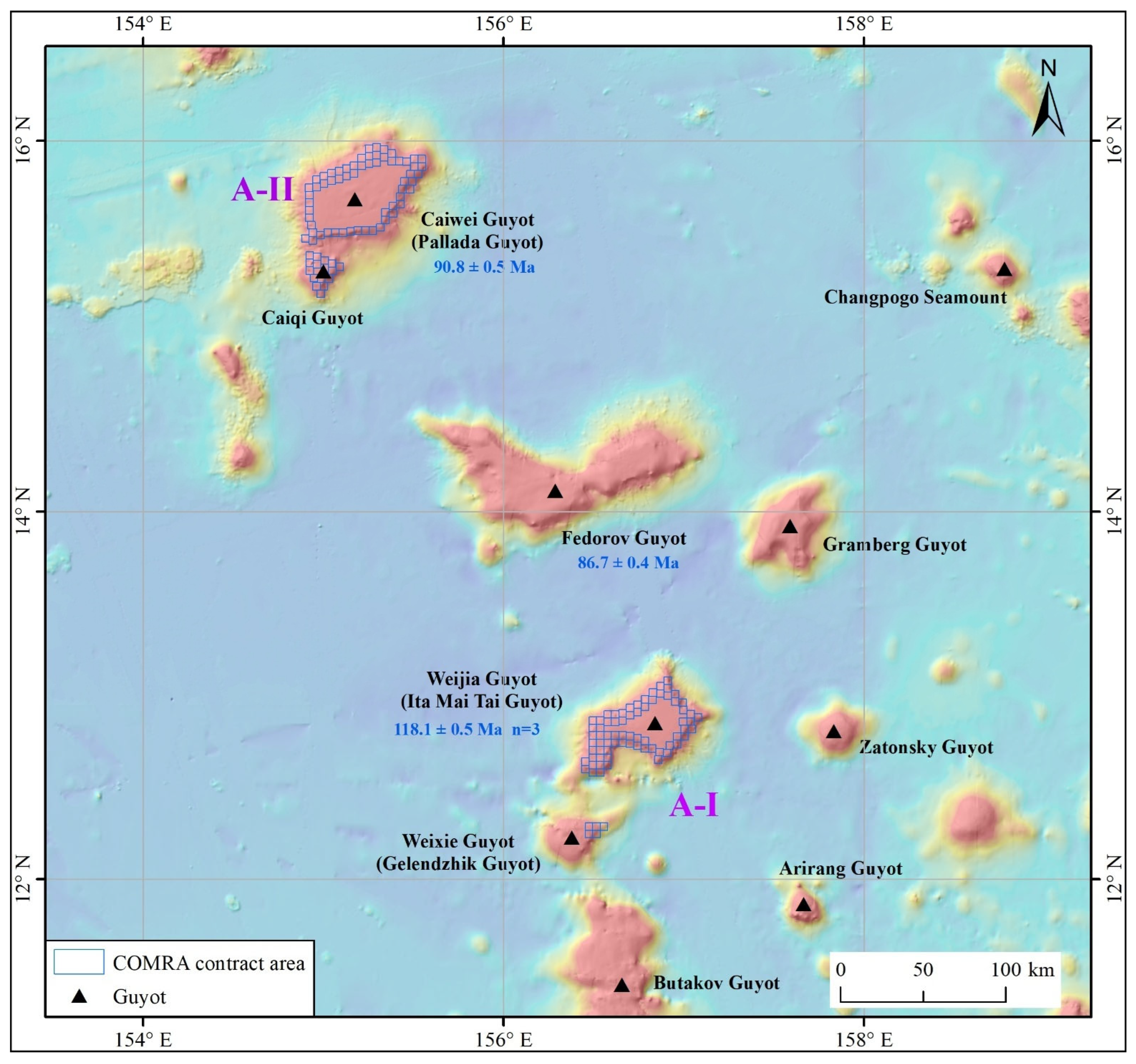
21], with a total of five exploration contractors. Except for the polymetallic nodule contract area held by Beijing Pioneer, the other four are all Co-rich crust contractors, including COMRA (China), Russia, the Republic of Korea, and JOGMEC (Japan). As shown in
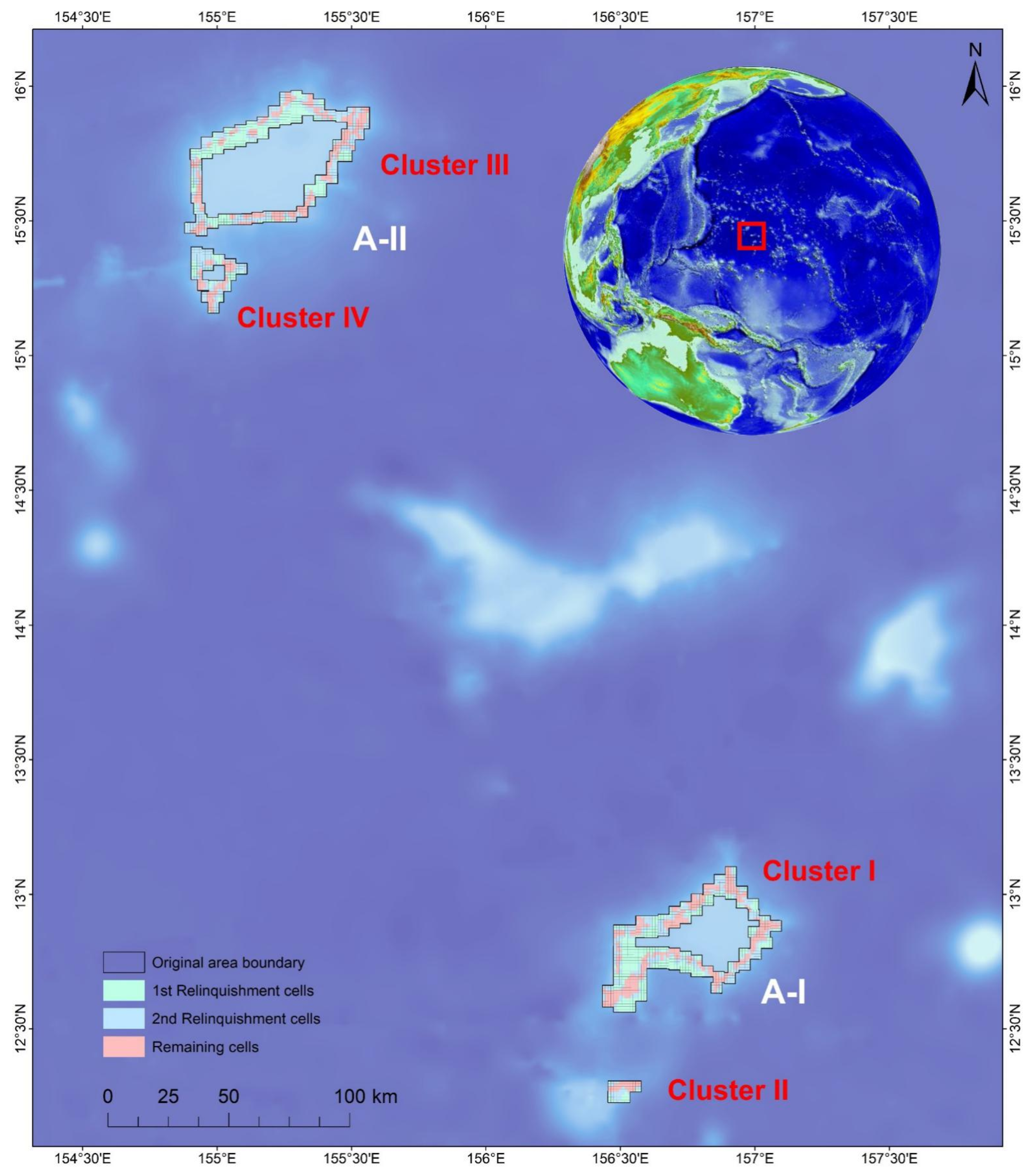
Figure 1, the COMRA Co-rich crust exploration contract area is located in the Jiaxie Guyots (including Weijia Guyot and Weixie Guyot) and the Caiwei Seamounts (including Caiwei Guyot and Caiqi Guyot), part of the Magellan Seamounts, consisting of 150 blocks each covering an area of 20 km
2. The contract area is divided into two sub-areas, namely A-I and A-II. Among them, the A-I sub-area is situated in the Jiaxie Guyots, and the A-II sub-area is situated in the Caiwei Seamounts, with each sub-area containing 75 blocks. The western flank of the Magellan Seamounts connects via the Mariana Trench to the Izu-Bonin (Ogasawara)–Mariana island arc and the Philippine Plate. To the north, the Marcus-Wake Seamounts lie across the Pigafetta Basin, while the Marshall Islands are situated to the east. The basement of the Magellan Seamounts are composed of the oldest oceanic crust dating back to the Middle-Late Jurassic [
22]. The tectonic evolution is closely linked to the evolution of adjacent regions and is also associated with the westward movement of the Pacific Plate and mantle plume (or hotspot) activity.
The Magellan Seamounts constitute a large block-like uplift. This seamount group comprises 97 seamounts exceeding 1000 m high, covering a total area of approximately 2.8 × 10
5 km
2. Seamounts ranging from 1600 m to 4000 m in height account for 67.8% of the total area. Thirteen seamounts exceed 4000 m in height and have a radius greater than 20 km, accounting for 33.2% of the total area. The largest seamount within this group reaches 5000 m in height, spans 57.2 km in radius, and covers approximately 10,260 km
2. The seafloor in this region features a series of NW-trending transform faults, such as the Ogaswara Fault and the Kashima Fault [
24]. The seafloor sediments in most areas of the seamount region are dominated by deep-sea clays, with siliceous mud distributed in the central part and small areas of calcareous deposits in the northern part.
Based on the results of annual survey cruises in the Magellan Seamounts, the seamount stratigraphy is clearly divided into two structural layers: the basement and the sedimentary cover, with a distinct angular unconformity between them. The seamount basement consists primarily of Early Cretaceous tholeiitic pillow basalts, supplemented by Early Cretaceous–Paleogene subalkaline basalts and Neogene alkaline basalts and volcanic breccias. The sedimentary cover of seamounts is mainly composed of Late Mesozoic–Cenozoic strata, with a thickness of over 1 km [
25].
The Magellan Seamounts range in age from 80 Ma to 120 Ma [
23,
26,
27,
28]. Volcanic activity within this age range is also observed in the Marshall seamounts, Central Pacific seamounts, and Line Islands Chain. According to Koppers et al. (1998) [
24], volcanic activity in the Magellan Seamounts manifested in three distinct phases: formation of the volcanic base prior to shield-shaped seamount formation; formation of the shield-shaped seamount; and renewed volcanic activity forming volcanic cones after the seamounts were eroded and submerged. The main volcanic edifice of the Magellan Seamount is thought to be hotspot-derived. This hotspot (termed the Magellan Seamount Hotspot) lies between the present-day Samoa, Rarotonga, and Society Islands hotspots, within the South Pacific Isotope and Thermal Anomaly Zone. Approximately 20–30 million years after the main volcanic edifice formed, the seamount drifted with the tectonic plate to the vicinity of the present-day Samoa hotspot, where it became reactivated with new magmatic activity. Following its formation, the Magellan Seamount migrated northwestward, undergoing multiple episodes of magmatic activity.
4. Methods
Following the ISA Recommendations [
19], the total area of the COMRA’s Co-rich crust exploration contract area after the first regional abandonment was 2000 km
2, comprising nearly 1600 grid cells of 1.12 km × 1.12 km. The second regional relinquishment for the COMRA Contract Area continues to follow the requirements and guidance of the Recommendations, retaining 1000 km
2 from the 2000 km
2 contract area and returning the remaining area to the ISA.
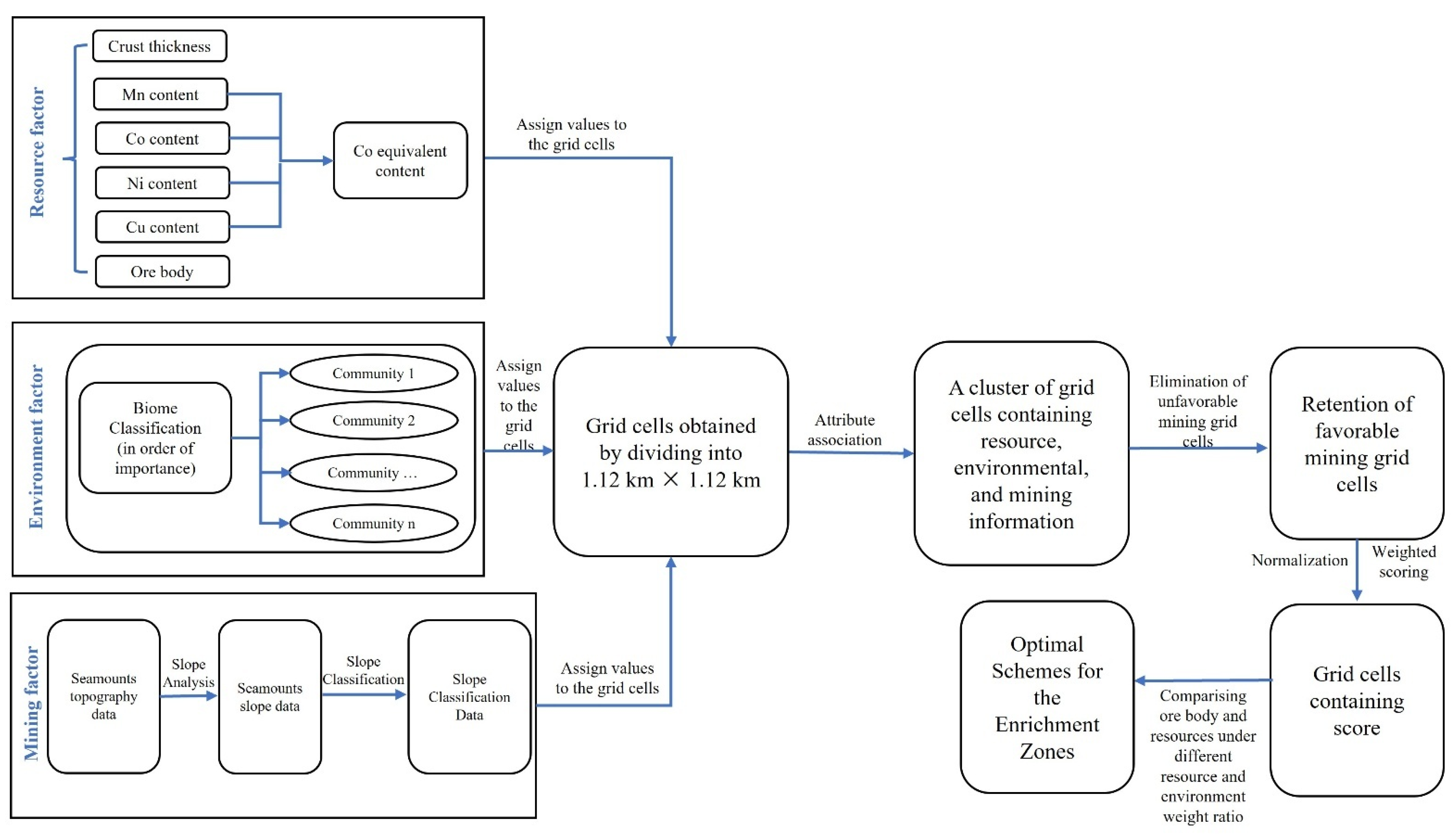
Selecting Co-rich crust enrichment zones is a complicated task. The first enrichment zone selection primarily considered resource factors [
20], with insufficient consideration of other factors. This regional selection process primarily considered three factors: resources, environment, and mining. The workflow is as follows: (1) Define indicators for regional selection. Organize spatial data on resources, environment, and mining to propose assessment indicators for resource, environmental, and mining factors applicable to regional selection; (2) Assign values to grid cells. Through spatial analysis, assign resource, environmental, and mining indicator values to each grid cell; (3) Exclude mining-unfavorable cells. Remove grid cells containing large-slope areas unfavorable for mining activities; (4) Weighted scoring. Normalize resource and environmental indicator values, establish a combined scoring model, and assign scores to each grid cell; (5) Comparison of different weighting schemes for resource and environmental scores within grid cells to select the optimal regional preference scheme (
Figure 2). The key to regional preference lies in assigning quantitative indicator values for resource, environmental, and mining factors to each grid cell. By analyzing and ranking the comprehensive information of grid cells, optimal cells are identified and retained.
4.1. Determining Optimization Indicators
4.1.1. Resource Indicators
Co-rich crust deposits are defined as a series of crust distribution ranges delineated based on geological sampling stations, boundary criteria, and deposit delineation methods. The various resource indicator values they encompass can be spatially overlaid and assigned to corresponding grid cells, equipping them with the resource information essential for regional optimization. According to the “Specification for oceanic cobalt-rich ferromanganese crusts exploration” [
29], a Co-rich crust deposit must meet boundary criteria: crust thickness ≥4 cm and Co content ≥0.4%. Using the engineering spacing method and the Thiessen polygon method, each geological sampling station can form a corresponding polygon representing its spatial control range. The indicators obtained from geological stations—including crust thickness, metal grade, wet density, and moisture content—can be assigned to the corresponding polygons. Polygonal areas meeting the boundary criteria are designated as ore bodies, whereas those failing to meet the criteria are classified as non-ore bodies.
After the crustal ore bodies are delineated, their projected areas can be calculated via ArcGIS 10.8 Desktop. The ore body surface area can be computed via Equation (1) [
20]:
where
S is the ore body surface area,
Sp is the ore body projected area, and
θ is the average slope of the ore body. Here, following regulations from the ISA, Universal Transverse Mercator (UTM), and World Geodetic System 84 (WGS84) [
31] are selected as the projection coordinate system and ellipsoid, respectively, in order to calculate the ore body’s projected area.
For crust ore bodies, the wet density and moisture content of the crust exhibit limited variability and thus have a constrained impact on resource estimation. The primary indicators reflecting resource quality are crust thickness, metal grade, and the controlled area of geological stations. For grid cells, those containing ore bodies with significant crust thickness, high metal grades, and extensive distribution areas indicate favorable resource endowment and should be prioritized for retention. A new indicator, the equivalent resource volume, is derived by multiplying the three metrics: crust thickness, metal grade, and distribution area. This serves as the comprehensive resource indicator for regional optimization.
In Equation (2):
Rij represents the equivalent resource value of the
jth ore body polygon within the
ith grid cell;
Hij denotes the crust thickness of the
jth ore body polygon within the
ith grid cell;
Sij is the surface area of the
jth ore body polygon in the
ith grid cell. In Equation (3),
CEG is the cobalt equivalent grade, calculated based on the international market prices of manganese (
Mn), copper (
Cu), cobalt (
Co), and nickel (
Ni).
Co is priced at
a USD/ton,
Ni at
b USD/ton,
Cu at
c USD/ton, and
Mn at
d USD/ton. The
CEG is calculated by setting the
Co price as 1, converting the
Mn,
Cu, and
Ni prices into cobalt equivalents, and then summing these values. For example, based on the average international metal prices from 2016 to 2020,
Co at
$46,489/ton,
Ni at
$12,342/ton,
Cu at
$6122/ton, and
Mn at
$1893/ton, the
CEG is derived as follows:
4.1.2. Environment Indicators
Yan et al. (2024) [
30] identified and classified benthic communities in the Caiwei seamounts and Weijia guyots using clustering analysis. This study builds upon those classifications for further analysis. Each biome type is assigned a membership value proportional to its importance, with higher importance yielding greater membership value. For grid cells, where multiple biotic community types may occur, only the most significant type is considered. The membership value of this dominant community type is assigned to the corresponding grid cell. A higher membership value indicates greater biotic community importance and conservation value for that grid cell, making it a priority area for abandonment consideration.
In Equation (4), μi represents the membership degree of the ith biome type within a grid cell. Based on biome importance, this study assigns membership degrees of 0.4, 0.3, 0.15, 0.1, and 0.05 to the five biome types, respectively.
4.1.3. Mining Indicators
The primary indicator considered for the mining factors is terrain slope. A critical slope threshold of 25° is adopted: terrain with slopes less than or equal to this threshold is favorable for mining, while terrain with slopes exceeding this threshold is unfavorable. For a grid cell, if the area of mining zones with slopes exceeding 25° constitutes no more than 50% of the total area of the cell, the grid cell should be retained. If the area of mining zones with slopes exceeding 25° constitutes more than 50% of the cell’s total area, the grid cell should be considered for abandonment.
In Equation (5), PS represents the area ratio, SP denotes the area of mining zones with slopes greater than 25° within the grid cell, and Scell represents the grid cell area.
4.2. Grid Cell Assignment
4.2.1. Assigning Resource Indicators to Grid Cells
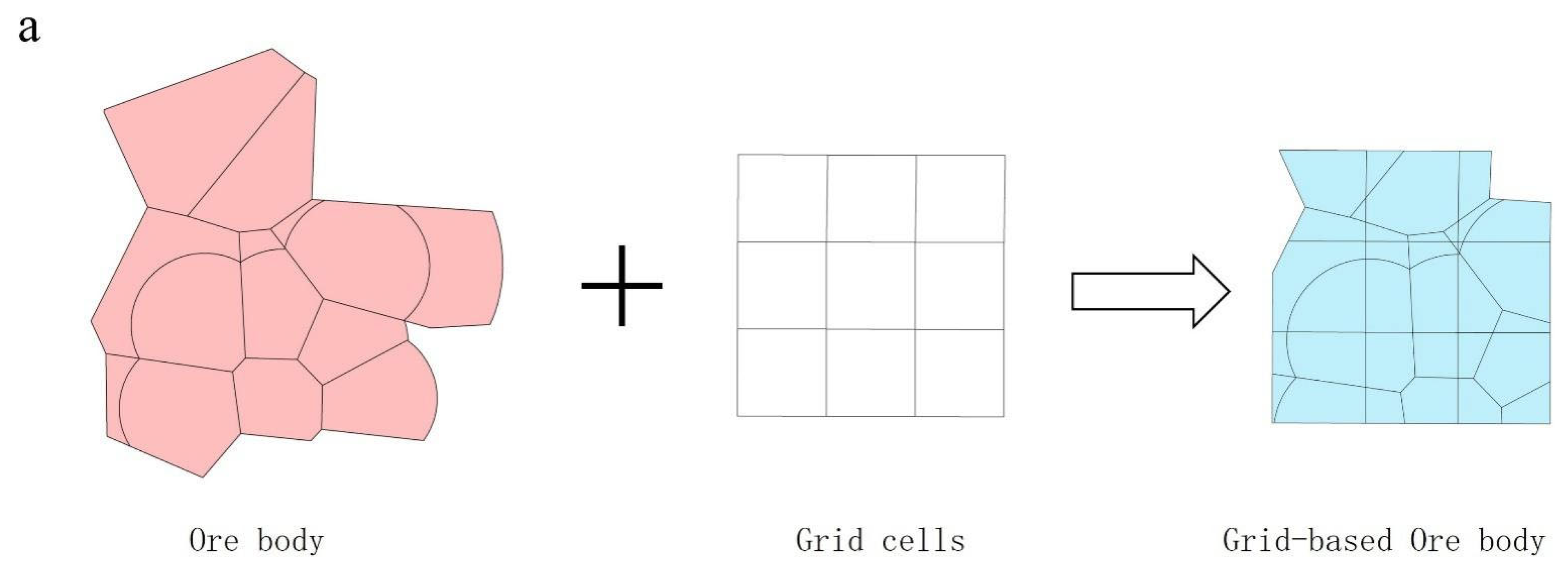
(1) For existing polygon layers, retain ore body polygons and delete non-ore body polygons. An intersection analysis (Intersect) is performed between the ore body polygon layer and the grid cell layer to obtain the grid ore body layer.
(2) For the grid ore body, the ore body polygons are divided along grid cell boundaries and assigned to individual grid cells. Each assigned polygon retains both grid cell attributes and ore body polygon attributes. Summarize the equivalent resource quantities within each grid cell by its Cell_ID. The sum (Sum) is calculated to obtain the equivalent resource quantity for each grid cell. Join this equivalent resource quantity result to the grid cell layer, adding the equivalent resource quantity attribute to the grid cell layer’s attribute table (
Figure 3a).
4.2.2. Assigning Environmental Indicators to Grid Cells
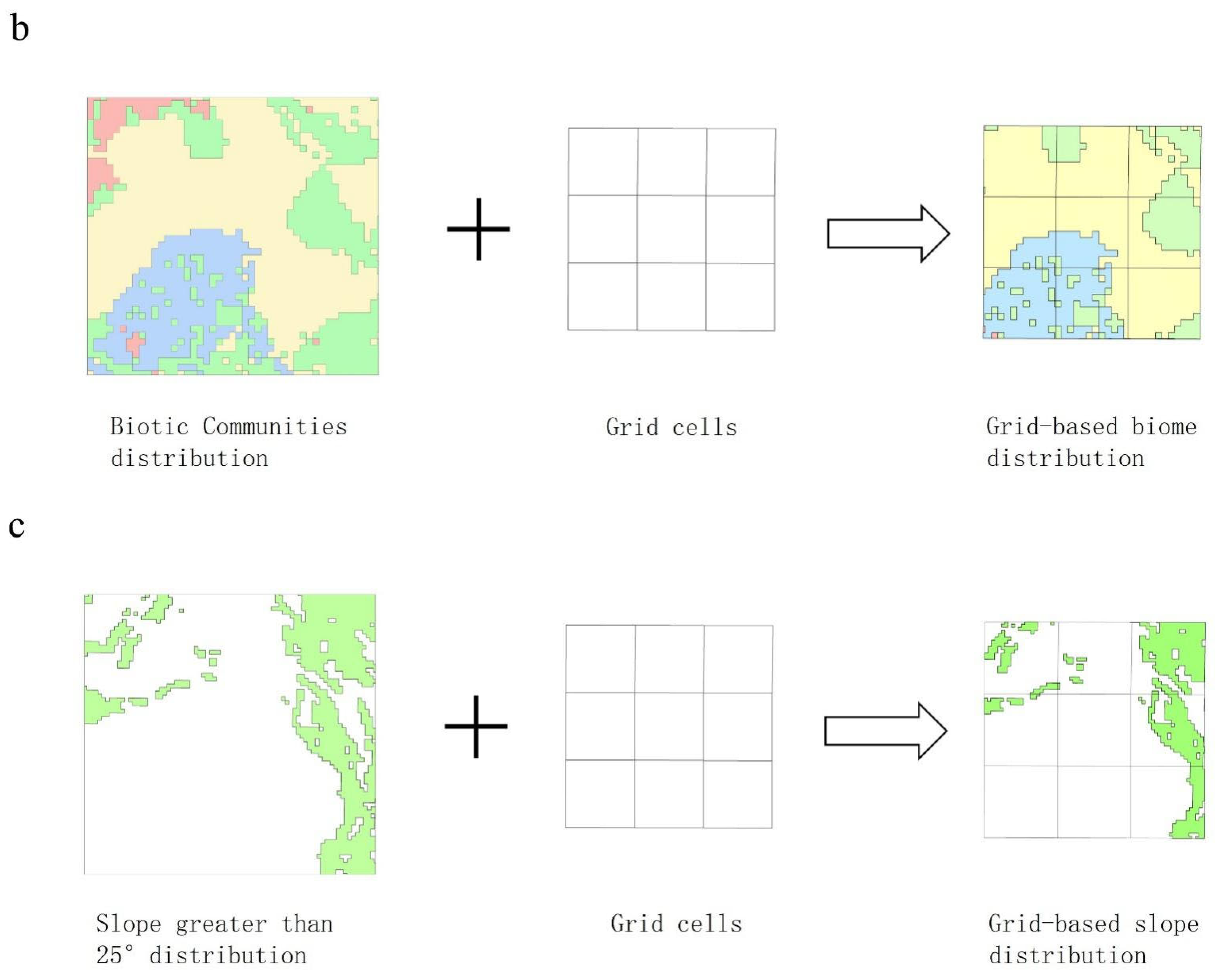
(1) An Intersect analysis is performed between the biome spatial distribution layer and the grid cell layer to generate the grid biome layer.
(2) The grid biome layer contains both grid cell and biome attributes. Summarize the biome types within each grid cell based on the grid cell ID (Cell_ID). The maximum value (Max) is calculated to determine the biome type and corresponding membership value for each grid cell. The biome type and corresponding membership value are linked to the grid cell layer via the Join tool, adding the biome type and membership attributes to the grid cell layer’s attribute table (
Figure 3b).
4.2.3. Assigning Mining Indicators to Grid Cells
(1) Classifying the slope data. The slope values are divided into two categories: ≤25° and >25°. The features with slopes ≤ 25° are removed, and then polygons with slopes > 25° are merged to generate a slope > 25° distribution layer. Intersect analysis is performed between the slope distribution layer, the ore body polygon layer, and the grid cell layer to obtain the grid ore body slope layer.
(2) Summarize the area of ore bodies with slopes greater than 25° within each grid cell by its Cell_ID. The total area of ore bodies with slopes greater than 25° in each grid cell is calculated using the Sum function. Subsequently, the ratio of the total ore body area with slopes greater than 25° to the area of each grid cell is subsequently calculated. Use the Join tool to link this ratio result to the grid cell layer, adding an attribute for the mining area ratio to the grid cell layer’s attribute table (
Figure 3c).
4.3. Comprehensive Analysis
4.3.1. Comprehensive Consideration of Resource and Environmental Factors
A weighted scoring method was employed to calculate scores for each grid cell. The equivalent resource quantities for resource factors within each grid cell were normalized. Weight values were assigned to both resource and environmental factors, and scores were computed using the following formula:
In Equation (6), Score represents the calculated score for each grid cell, fR represents resource factor, WR denotes resource factor weight, fE represents environmental factor, and WE denotes environmental factor weight. Resource factors denote normalized equivalent resource quantities, while environmental factors denote the membership degree values of biome types. Since resource factors are advantageous for regional optimization, their weight is multiplied by 1. Oppositely, environmental factors are disadvantageous for regional optimization, so their weight is multiplied by −1.
4.3.2. Sort Grid Cell Scores from Highest to Lowest
Grid cells with higher scores should be prioritized for retention, while those with lower scores should be prioritized for abandonment. Among high-scoring grid cells, if the area ratio of mining factors exceeds 50% within a cell, such cells should be considered for abandonment. This optimization process continues until the cumulative total area of retained grid cells reaches 1000 km2. All remaining grid cells not selected are abandoned.
5. Results and Discussion
Using the aforementioned method, the application demonstration was conducted in the COMRA Contract Area. This contract area encompasses two seamount groups with a total of 1600 grid cells. First, grid cells deemed unsuitable for mining were screened out based on mining-related factors. Subsequently, for the remaining grid cells, calculations were performed using different weight ratios assigned to resource and environmental factors, respectively. The grid cells were then ranked in descending order of their scores, and those with higher scores were selected as priority targets.
When the weight ratio of resource factors to environmental factors was set at 7:3, the top 800 grid cells with the highest scores were retained. Among these, 426 grid cells were preserved in the Jiaxie Guyots, covering an area of approximately 532 km2; while 374 grid cells were retained in the Caiwei Seamounts, with a corresponding area of about 468 km2. The remaining grid cells were excluded from the contract area.
The results of optimization of enrichment zones for Co-rich crusts have been published on the ISA website (
Figure 4).
5.1. Determination of Weight Value for Resource and the Environment
Resource factors and environmental factors mutually constrain regional optimization. Areas with favorable resource distributions often coincide with regions hosting important biotic communities. Therefore, by assigning different weight values to resource and environmental factors, we compare changes in crustal resource quantities under varying resource-environment weight ratios, i.e.,
① Resource factor weight assigned 1.0, environmental factor weight assigned 0;
② Resource factor weight assigned 0.9, environmental factor weight assigned 0.1;
③ Resource factor weight assigned 0.8, environmental factor weight assigned 0.2;
④ Resource factor weight assigned 0.7, environmental factor weight assigned 0.3;
⑤ Resource factor weight assigned 0.6, environmental factor weight assigned 0.4;
⑥ Resource factor weight assigned 0.5, environmental factor weight assigned 0.5.
This yields a total of six schemes, from which the optimal scheme is chosen through analysis and comparison.
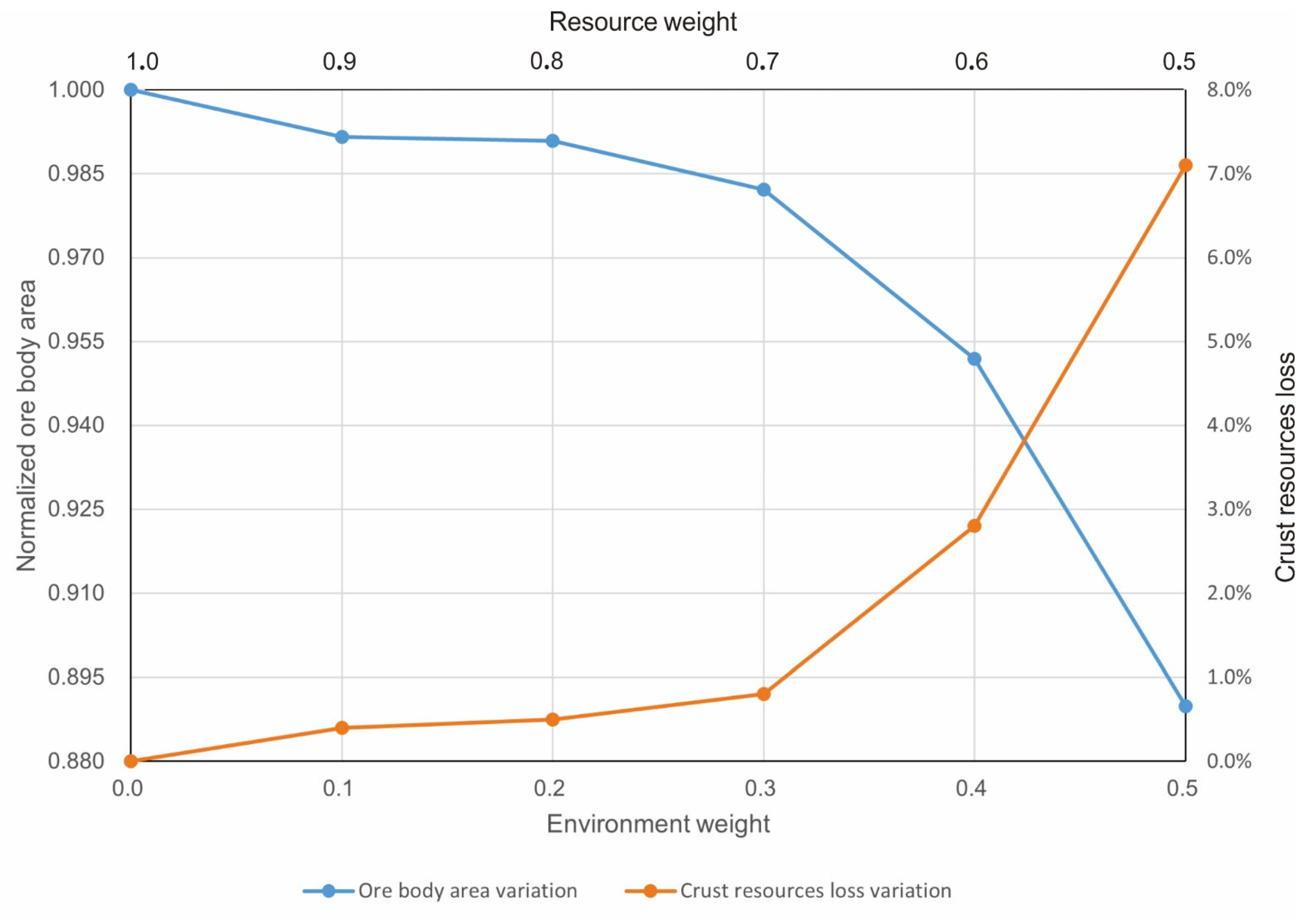
As shown in
Figure 5, as the resource weight decreases and the environment weight increases, the ore body area exhibits a decreasing trend, while the corresponding resources loss shows an increasing trend. However, the changes in both trend variations are relatively gradual. When the resource weight reaches 0.7 and the environmental factor weight reaches 0.3, both ore body area and resources loss reach inflection points. As the environment weight increases, the ore body area shows a marked downward trend while resources loss exhibits a significant upward trend. Based on the above analysis, it can be concluded that when the resource weight is set to 0.7 and the environment weight is set to 0.3, the consideration of resource and environmental factors achieves a relatively balanced and reasonable equilibrium. This aligns with the established optimization principles and standards, making the corresponding solution the optimal scheme.
5.2. Suitable Slope for Co-Rich Crust Growth and Development
Slope not only influences ore body distribution but also significantly impacts crust mining. Yamazaki and Sharma (1998) [
33] found Co-rich crusts coexisting with sediments in seafloor slopes ranging from 4° to 15°. Studies by Yamazaki, Chung, and Tsurusaki (1995) [
34] and Yamazaki and Sharma (1998) [
33] indicate that slopes between 0° and 4° are covered by sediments and sparse crusts. Du et al. (2017) [
15] concluded that slopes between 4° and 15° are suitable for the growth and exploitation of Co-rich crust resources. Some scholars even suggest that future mining technologies could enable slope mining up to 20° [
35]. Yang et al. (2022) [
20] concluded that slopes ranging from 1° to 30° within the COMRA contract area are suitable for the growth of Co-rich crusts. Beyond growth conditions, crust mining feasibility depends critically on operational mining capabilities. Currently, mining technology experts have proposed a critical slope value of 25° for seabed traversal operations by mining vehicles. Integrating the above analysis, this study adopts 25° as the threshold value for the slope indicator within mining factors.
5.3. Validation of the Enrichment Zone Optimization Method
The results indicate that most optimized grid cells are distributed on the summit, flat-topped margins, and seamount flank ridges, consistent with the distribution patterns of Co-rich crusts on seamounts [
12,
13,
36]. Therefore, the grid cell optimization technique proposed in the study—which comprehensively considers resource, environmental, and mining factors—is suitable for selecting Co-rich crust enrichment zones on seamounts. The optimization results obtained using the method meet ISA area requirements and satisfy the needs for enrichment areas selection.
6. Conclusions
Based on the survey data of the contract area of the COMRA, the present study conducted a comprehensive analysis of the influencing factors and optimization schemes for Co-rich crust enrichment areas. Breaking through the limitation of previous studies that focused solely on resource factors, the research proposed the establishment of a grid cell optimization technology that comprehensively considers three categories of factors: resources, environment, and mining. Through analysis, three key evaluation indicators were selected and incorporated, namely equivalent resource quantity, biological community affiliation, and the area proportion of unfavorable mining zones. Spatial analysis techniques were then applied to assign quantitative values to each regular grid cell. A weighted scoring method was adopted to synthesize resource and environmental factors. By comparing the results under different weight combinations, the optimal balance between maximizing resource reserves and protecting the ecological environment was determined. This approach proposed and validated an enrichment zone selection scheme tailored for the Co-rich crust contract area.
The multi-factor comprehensive optimization technology established in the present study not only successfully addresses the challenge of selecting enrichment zones for Co-rich crust, but also features a universal and practical technical framework and process. It can be extended and applied to the optimization of enrichment areas for other deep-sea mineral resources such as polymetallic nodules and hydrothermal sulphides in the future.




 ,
,