Article

Simulation and Experimental Study of Vessel-Borne Active Motion Compensated Gangway for Offshore Wind Operation and Maintenance


1
Tsinghua Shenzhen International Graduate School, Tsinghua Univeristy, Shenzhen 518071, China
2
School of Civil Engineering and Transportation, South China University of Technology, Guangzhou 510641, China
*
Authors to whom correspondence should be addressed.
These authors contributed equally to this work.
J. Mar. Sci. Eng. 2026, 14(2), 187; https://doi.org/10.3390/jmse14020187
Submission received: 13 December 2025 / Revised: 8 January 2026 / Accepted: 13 January 2026 / Published: 16 January 2026

Abstract

Driven by global initiatives to mitigate climate change, the offshore wind power industry is experiencing rapid growth. Personnel transfer between service operation vessels (SOVs) and offshore wind turbines under complex sea conditions remains a critical factor governing the safety and efficiency of operation and maintenance (O&M) activities. This study establishes a fully coupled dynamic response and control simulation framework for an SOV equipped with an active motion-compensated gangway. A numerical model of the SOV is first developed using potential flow theory and frequency-domain multi-body hydrodynamics to predict realistic vessel motions, which serve as excitation inputs to a co-simulation environment (MATLAB/Simulink coupled with MSC Adams) representing the Stewart platform-based gangway. To address system nonlinearity and coupling, a composite control strategy integrating velocity and dynamic feedforward with three-loop PID feedback is proposed. Simulation results demonstrate that the composite strategy achieves an average disturbance isolation degree of 21.81 dB, significantly outperforming traditional PID control. Validation is conducted using a ship motion simulation platform and a combined wind–wave basin with a 1:10 scaled prototype. Experimental results confirm high compensation accuracy, with heave variation maintained within 1.6 cm and a relative error between simulation and experiment of approximately 18.2%. These findings demonstrate the framework’s capability to ensure safe personnel transfer by effectively isolating complex vessel motions and validate the reliability of the coupled dynamic model for offshore operational forecasting.

1. Introduction

The global energy landscape is undergoing a profound transformation, driven by the urgent need to decarbonize power generation and ensure energy sustainability. Offshore wind energy, characterized by its high energy density and low turbulence, has emerged as a cornerstone of this transition. According to the Global Wind Energy Council [1], the global offshore wind capacity is projected to surge significantly over the coming decade, with a marked trend towards installations in deeper waters (depths > 50 m) where wind resources are more abundant and consistent [2,3]. As wind farms scale up and move further from shore, effective operation and maintenance (O&M) is pivotal for minimizing the Levelized Cost of Energy (LCOE), as it typically accounts for 25–30% of the total lifecycle cost of an offshore wind farm [4,5]. In fact, the optimization of maintenance logistics and the selection of appropriate access vessels are critical to reducing long-term operational expenditures [6]. While traditional Crew Transfer Vessels (CTVs) have served the industry well in near-shore waters, they are generally limited to significant wave heights ( H s ) of approximately 1.5 m due to the safety risks associated with the friction-based “push-on” transfer method [7]. To ensure accessibility in more severe seas ( H s 3.0 m), the industry is increasingly relying on Service Operation Vessels (SOVs) equipped with active motion compensated gangways [8].
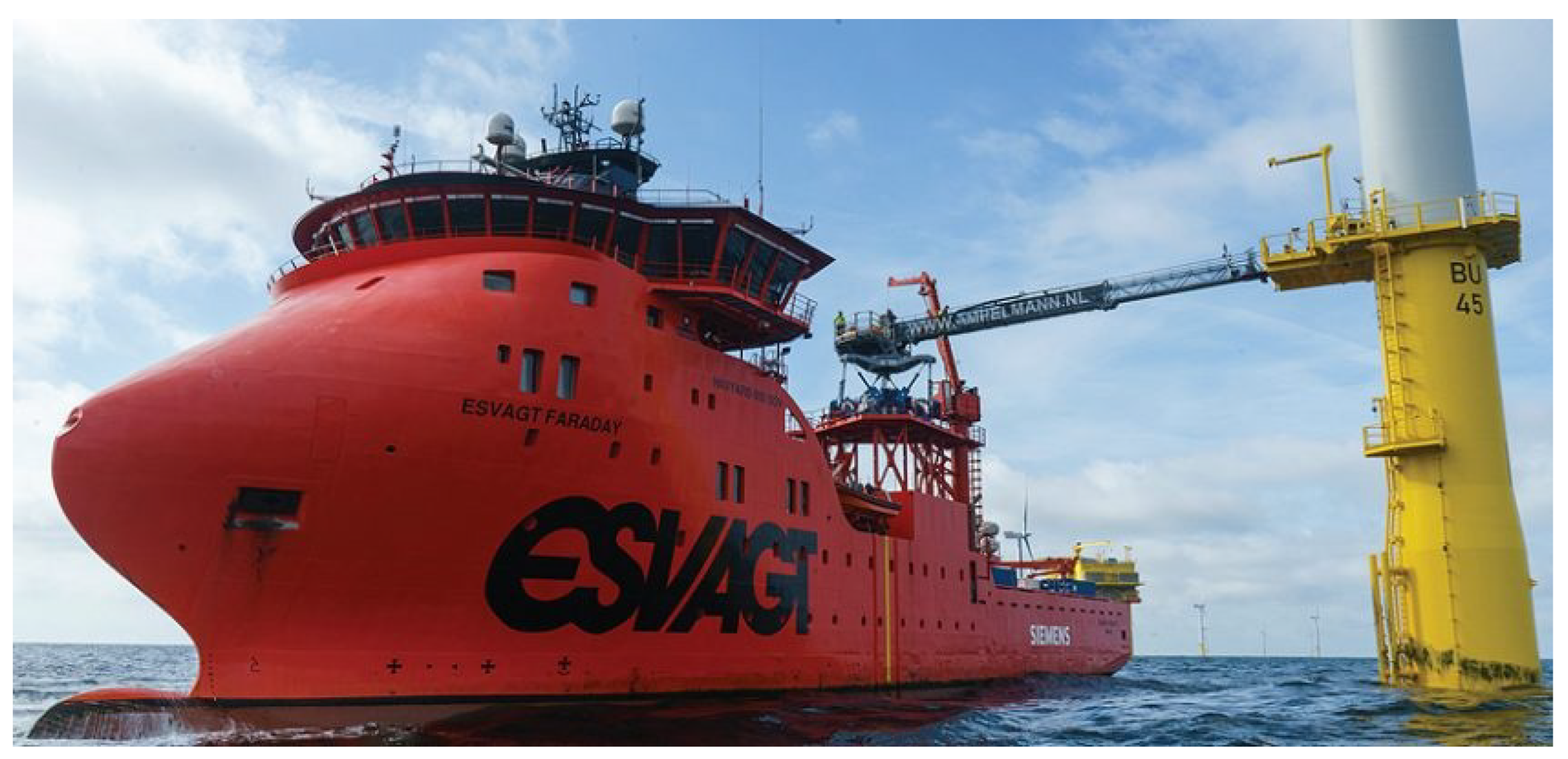
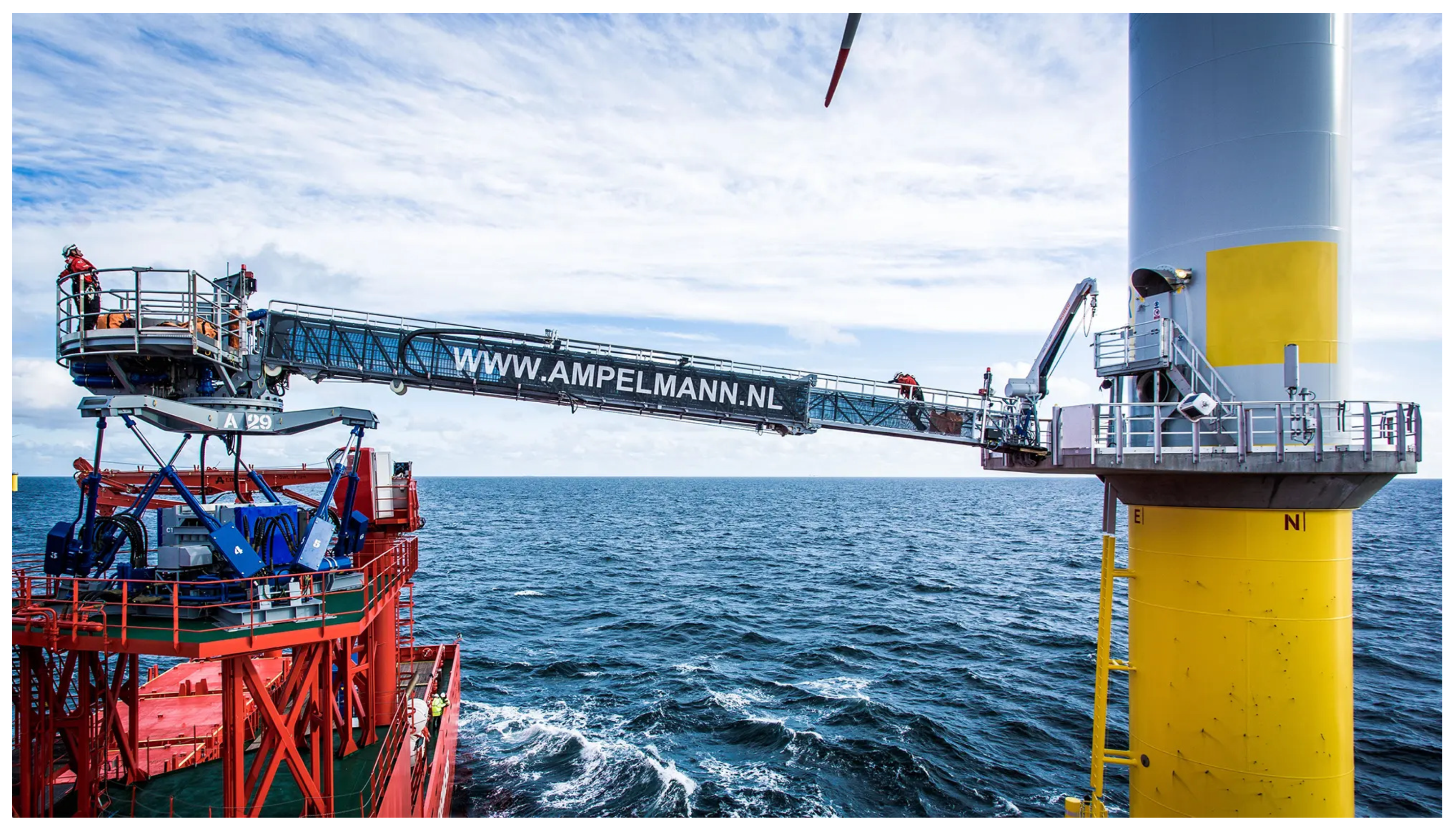
The fundamental operational objective of motion compensated gangway is to mechanically isolate the transfer bridge from the vessel’s 6-Degree-of-Freedom (6-DOF) wave-induced motions [9], thereby establishing a geostationary connection with the wind turbine platform, as shown in Figure 1. The mechanical design typically employs a Stewart–Gough parallel topology [10], chosen for its high stiffness-to-weight ratio and precise positioning capabilities. To accurately describe the behavior of such hexapod systems under marine conditions, computationally efficient inverse dynamics models are essential for real-time control implementation [11]. The hexapod-based motion compensated platform, commercially pioneered by companies like Ampelmann (shown in Figure 2) and Uptime is now central to offshore wind access [12]. Given the safety-critical nature of offshore “Walk-to-Work” (W2W) systems, the dynamic analysis and control of gangway have attracted extensive research interest.
In terms of control strategies for gangway, proportional-integral-derivative (PID) control remains the industrial standard due to its simplicity and robustness, yet its performance deteriorates markedly under stochastic wave disturbances and nonlinear actuator dynamics (e.g., cylinder hysteresis and friction), often amplifying tracking errors by 20–50% in non-Gaussian sea states [13]. To address these limitations, model predictive control (MPC) has been widely adopted for its explicit constraint-handling capability (joint limits, power bounds), achieving up to 30% reduction in peak error through receding-horizon optimisation [14,15]. Furthermore, modern approaches increasingly leverage adaptive control strategies and deep reinforcement learning to handle the high degree of uncertainty inherent in stochastic wave environments [16,17]. More recently, active disturbance rejection control (ADRC) employing extended state observers has demonstrated superior disturbance attenuation, limiting residual 6-DOF motion to less to 5% RMS in coupled vessel–gangway–turbine simulations under H s ranging from 2.5 m to 3.0 m [18]. Inverse dynamics-based controllers in joint space have been proposed to handle the kinematics and dynamics of serial motion compensated gangways, reducing steady-state errors significantly in simulations [19]. Neural-network-enhanced approaches futher improve the control precision under highly uncertain motion. An adaptive control method based on a backpropagation (BP)-PID control algorithm can reduce the position deviation by about 6.56 times compared with PID [20]. Similarly, the compensation errors could be decreased by 70% (roll or pitch) and 40% (heave) by the adaptive control strategy consisting of Beetle Antennae Search (BAS) algorithm and Radial Basis Function Neural Network (RBFNN) [21]. In addition to control algorithms, SOV can also improve operational efficiency through equipment selection. Small Waterplane Area Twin Hull (SWATH) is considered a superior option with higher operability compared to traditional monohull design [22]. Moreover, the integration of dynamic positioning systems with advanced trajectory prediction algorithms further enhances the offshore operational efficiency of SOVs. Optimization of DP systems for monohull vessels has also been explored to reduce gangway telescopic motion and fuel consumption [23].
Despite these theoretical advancements, a critical limitation persists in the modeling fidelity of the “SOV-Gangway-Turbine” coupled system. The majority of control-oriented studies simplify the motion of SOV by simulating it with simple harmonic motion and random motion. This decoupled approach neglects the significant hydrodynamic interaction—specifically radiation and diffraction effects—that occurs when a large-displacement vessel operates in proximity to an offshore wind turbine [24,25]. Nearby offshore wind turbine structures can generate a clear shielding effect that reduces wave loads on the service operation vessel. Conversely, under specific relative positions and wave headings, they may induce local wave amplification or altered diffraction [26], significantly deviating the vessel’s motion from simplified assumptions. Studies on dynamic modeling under load have highlighted the impact of asymmetric loads on stable platforms, showing variations in tractive forces among drive chains [27]. Additionally, reviews of motion compensation technologies emphasize the need for high accuracy and adaptability to larger loads in offshore cranes and gangways [28]. It is essential to fully couple the gangway simulation with the dynamic system of the SOV and offshore wind turbine with experimental verification. Neglecting these multi-body interactions can lead to inaccurate predictions of the gangway’s required compensation, potentially compromising operational safety. Furthermore, there is a distinct geographical gap in existing research: while extensive studies focus on North Sea conditions, there is a lack of systematic research tailored to the specific operational environment of the South China Sea [29,30], which is emerging as a major hub for offshore wind development.
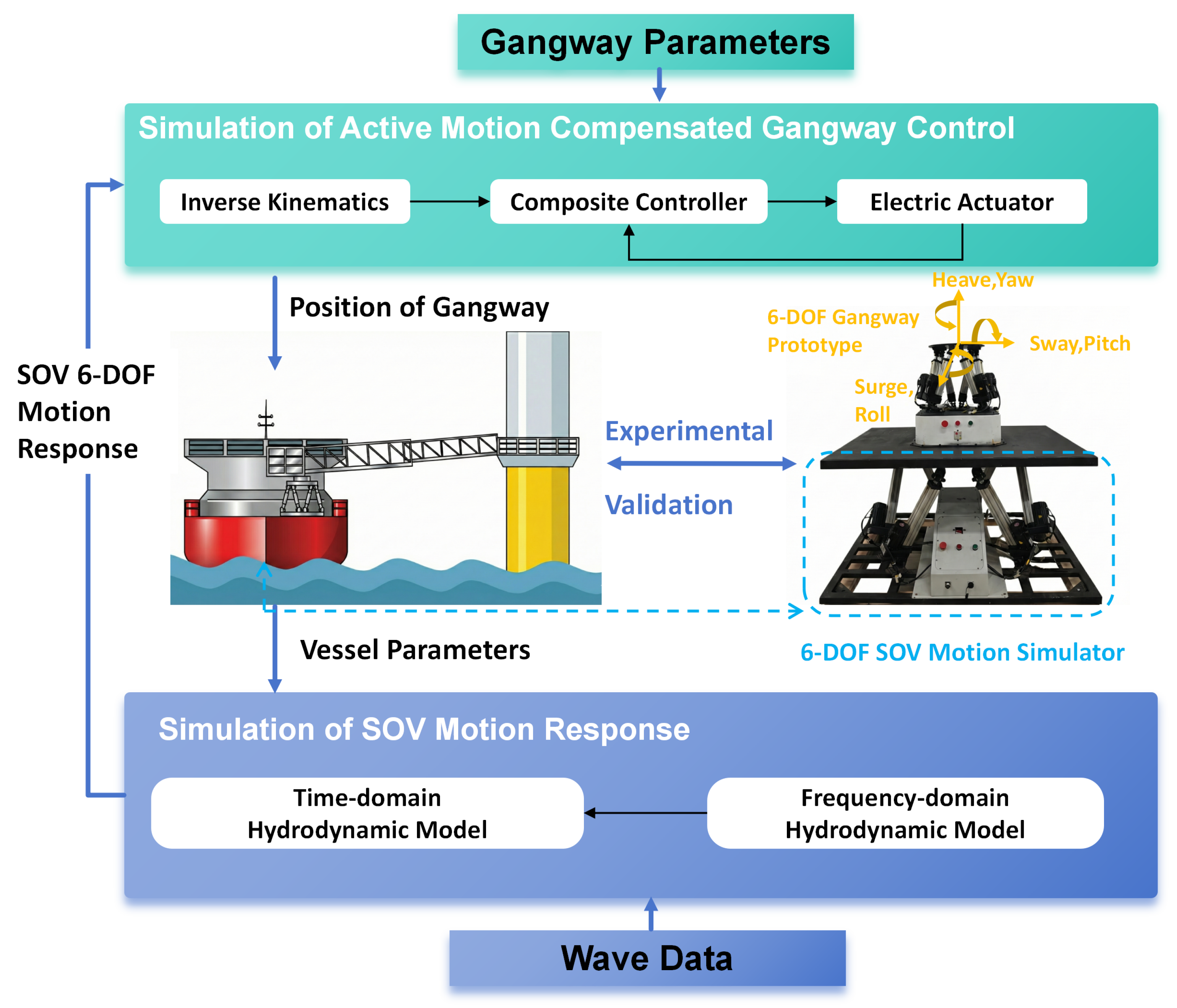
To address these gaps, this paper presents a systematic study on the design, high-fidelity simulation, and validation of a vessel-borne active motion compensated gangway. The integrated workflow of this study—from wave-induced vessel dynamics and gangway control design to experimental validation—is conceptually outlined in Figure 3. As shown in the framework, the system is designed to handle fully coupled 6-DOF disturbances. The simulation phase generates high-fidelity vessel motion time histories for surge, sway, heave, roll, pitch, and yaw modes. These outputs serve as the direct excitation inputs for a dual-layer Stewart platform experimental setup, where the lower base replicates the 6-DOF vessel motions while the upper prototype executes active compensation in the corresponding six axes. The novelty of this work lies in three key aspects that distinguish it from prior research:
(1)
A paradigm shift from decoupled to fully coupled system design: Unlike previous control-oriented studies that simplify vessel motions as independent disturbances, we establish the first integrated framework that simultaneously accounts for wave–vessel–turbine hydrodynamic interactions, vessel–gangway mechanical coupling, and gangway–controller dynamic feedback. This holistic approach addresses the fundamental limitation of current methodologies that optimize subsystems independently, providing a more realistic basis for compensation system design.
(2)
From algorithmic performance to system reliability validation: While most literature focuses on advancing control algorithms under idealized conditions, we prioritize system-level validation under realistic, hydrodynamically consistent disturbances. Our dual-Stewart experimental setup—where one platform replicates high-fidelity vessel motions while another performs active compensation—provides the first physical evidence of how control performance translates from simulation to actual hardware under coupled dynamics, achieving 15.14 dB heave disturbance isolation.
(3)
Geographic-specific design methodology for emerging markets: We move beyond generic North Sea–centric designs by developing and validating a complete methodology tailored to the South China Sea’s unique wave climate. This addresses a critical research gap as offshore wind expands into new regions with distinct environmental characteristics, offering regionally optimized solutions rather than one-size-fits-all approaches.
This paper is organized as follows: Section 2 details the theoretical background, including hydrodynamics of SOV and the kinematic and dynamic modeling of the gangway. Section 3 describes the co-simulation framework and comparative analysis of control strategies. The simulation process and results are displayed in Section 4. Section 5 presents the design of the scaled prototype and discusses the experimental results, followed by the conclusion in Section 6.

2. Theoretical Background

This section provides a detailed introduction to the theoretical basis of the ship-borne active motion compensated gangway. It mainly includes hydrodynamics of SOV, kinematic and dynamic models of gangways, and control strategies.

2.1. Hydrodynamics of the Service Operation Vessel

Hydrodynamic analysis of the SOV is essential for accurately predicting its 6-DOF motions when operating adjacent to fixed-bottom offshore wind turbine platforms. These motion responses provide the primary external disturbances for evaluating the performance and safety of the vessel-borne active motion-compensated gangway during walk-to-work operations.
The theoretical framework is based on linear potential flow theory, assuming an inviscid, incompressible, and irrotational fluid. The flow field is described by a time-dependent velocity potential Φ ( x , t ) . Assuming harmonic motion with angular frequency ω , it can be expressed as Φ ( x , t ) = { ϕ ( x ) e i ω t } , where ϕ ( x ) is the complex spatial velocity potential. The SOV is modelled as a rigid body with six degrees of freedom: surge, sway, heave, roll, pitch, and yaw. Two right-handed coordinate systems are employed: an Earth-fixed inertial system { O - X Y Z } and a body-fixed system { o - x y z } with its origin at the vessel’s centre of gravity (COG). All hydrodynamic computations and equations of motion are formulated in the body-fixed frame.
The spatial velocity potential ϕ ( x ) is decomposed as
ϕ = j = 1 6 ( i ω η j ϕ j ) + a 0 ( ϕ 0 + ϕ 7 )
where ϕ j ( j = 1 , , 6 ) are radiation potentials due to unit-amplitude motion in the j-th mode, ϕ 0 is the unit-amplitude incident wave potential in deep water (subscript 0 denotes incident-wave quantities), ϕ 7 is the diffraction potential, a 0 is the incident wave amplitude, and η j are complex motion amplitudes. Each potential satisfies the Laplace equation in the fluid domain, the linearized free-surface condition, the hull impermeability condition, and the far-field radiation condition.
The frequency-domain boundary value problem is solved using the boundary element method (BEM) with a free-surface Green function [31]. From the solved potentials, the frequency-dependent added mass A k j ( ω ) and radiation damping B k j ( ω ) are obtained from the radiation potentials:
i ω A k j ( ω ) B k j ( ω ) = i ω ρ H ϕ j n k d S
The first-order wave exciting force is computed from the incident and diffracted fields:
F k ( 1 ) ( ω ) = i ω ρ a 0 H ( ϕ 0 + ϕ 7 ) n k d S
where ρ is seawater density and H is the mean wetted hull surface.
The time-domain motion is described by Cummins’ equation [32], which accounts for fluid memory effects via a convolution term:
[ M + M a ( ) ] x ¨ ( t ) + 0 t K ( t τ ) x ˙ ( τ ) d τ + B lin x ˙ ( t ) + B qua x ˙ ( t ) | x ˙ ( t ) | + C x ( t ) = f ( t )
where M is the vessel’s mass matrix, M a ( ) is the infinite-frequency added mass, K ( t ) is the retardation function matrix, B lin and B qua are frequency-independent linear and quadratic viscous damping matrices calibrated from decay tests, C is the hydrostatic restoring matrix, and f ( t ) is the external force vector.
The retardation function is obtained from the frequency-domain damping via the cosine transform [33]:
K ( t ) = 2 π 0 B ( ω ) cos ( ω t ) d ω
In practice, artificial decay is applied to B ( ω ) outside the computed frequency range, and K ( t ) is truncated when its magnitude becomes negligible. The infinite-frequency added mass is evaluated using
M a ( ) = M a ( ω ) + 1 ω 0 K ( t ) sin ( ω t ) d t
where ω is an arbitrary frequency within the solved range; results are averaged over several ω for robustness.
Irregular wave elevation is generated from the target JONSWAP spectrum S η η ( ω ) as
η ( t , X , β wave ) = Re i = 1 N a i e i ( ω i t k i X + ε i )
with
X = cos β wave X sin β wave Y
where X and Y are the low-frequency horizontal position in the global system, β wave is the mean wave direction, k i satisfies the deep-water dispersion relation ω i 2 = g k i [34], ε i are random phases, and
a i = 2 S η η ( ω i ) Δ ω
The corresponding first-order wave force is
f wave ( 1 ) ( t ) = i = 1 N A i ( 1 ) a i e i φ i e i ( ω i t k i X + ε i )
where A i ( 1 ) and φ i are the magnitude and phase of the force transfer function, interpolated at each time step to reflect heading changes.
Equation (4) is integrated using a fourth-order Runge–Kutta scheme with a time step of typically 0.02–0.05 s. The convolution is evaluated numerically using the precomputed K ( t ) . Multiple 3-hour realisations with independent random phase sets are performed to ensure statistical convergence. The resulting high-fidelity 6-DOF motion time histories at the COG are transformed to the global frame and used as disturbance inputs to the gangway control co-simulation. The hydrodynamic computations described above were performed using HydroStar (v8.2) [35], a frequency-domain 3D diffraction/radiation analysis software. HydroStar computes the key hydrodynamic coefficients—including added mass, radiation damping, and wave excitation forces—which were subsequently exported and integrated into our custom time-domain solver, Kraken.

2.2. Hydrodynamic Model Validation

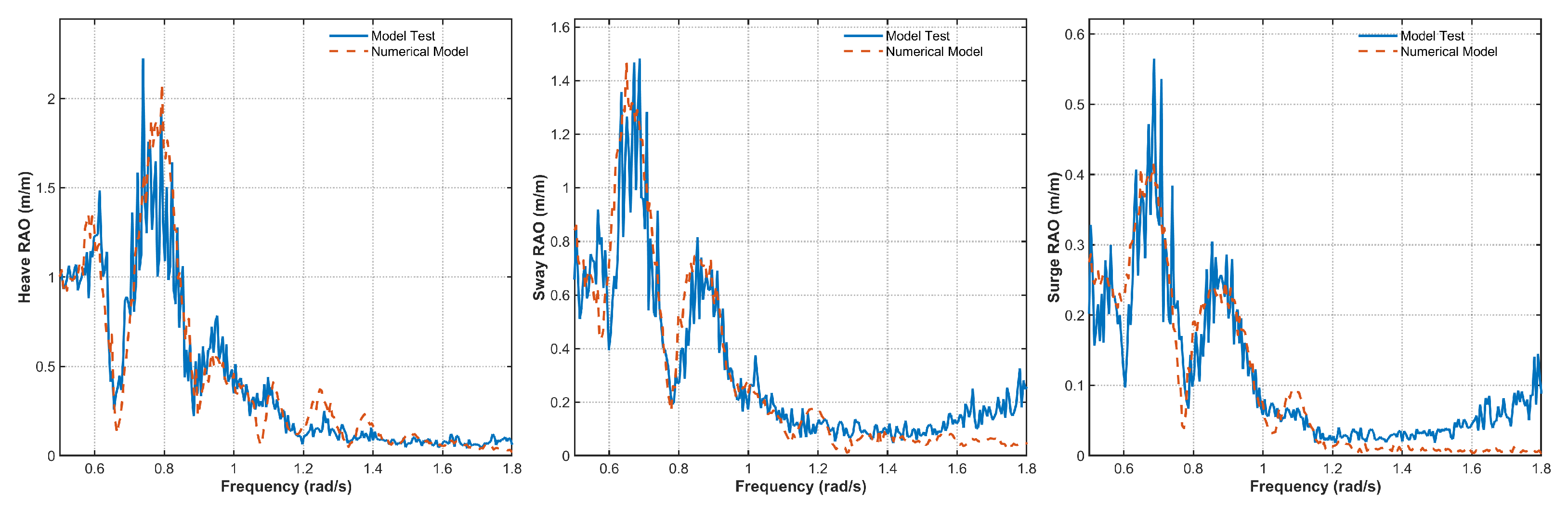
The hydrodynamic model described in Section 2.1 is validated by comparing simulated Response Amplitude Operators (RAOs) with experimental data from scaled model tests. The validation procedure follows the established methodology of white-noise testing and RAO extraction used in multi-body hydrodynamic studies [36]. Numerical RAOs were computed using the time-domain solver Kraken, which incorporates the frequency-domain hydrodynamic coefficients from HydroStar and the nonlinear damping terms in Equation (4).
Figure 4 shows the RAO comparisons in the frequency range 0.5–1.8 rad/s. High correlation coefficients are achieved: R = 0.951 for heave, R = 0.937 for surge, and R = 0.950 for sway, with corresponding RMSE (Root Mean Square Error) values of 0.154 m/m, 0.044 m/m, and 0.115 m/m. This close agreement confirms that the nonlinear quadratic damping term B qua x ˙ ( t ) | x ˙ ( t ) | in Equation (4) effectively compensates for viscous effects not captured by linear potential flow theory, providing a reliable foundation for generating vessel motion inputs to the gangway control system.

2.3. Kinematic and Dynamic Models of Gangways

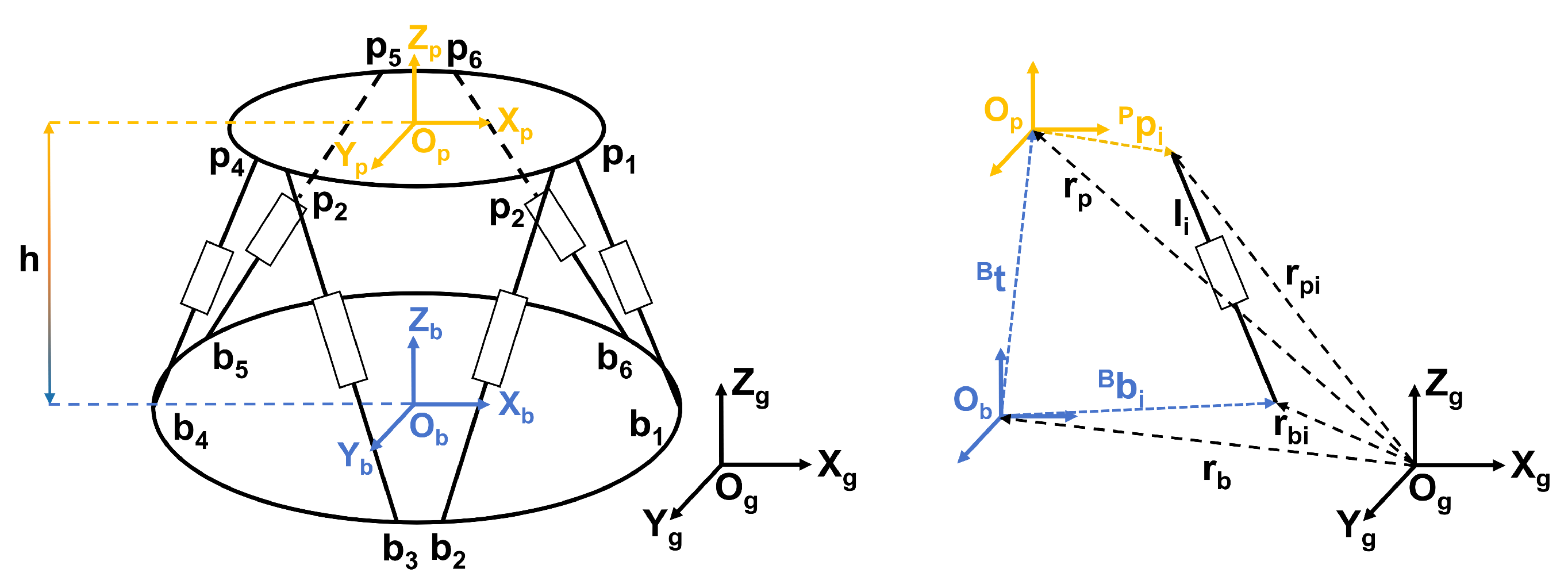
The kinematic analysis of the Stewart platform is essential for motion compensation control. The position, velocity, and acceleration relationships between the moving platform and the actuator legs are derived using the closed-loop vector method. The structure of the Stewart platform is shown in the Figure 5.
The position vector of the i-th leg can be expressed as:
l i = p i + t b i
where p i and b i denote the position vectors of the upper and lower hinge points in the global inertial coordinate system, respectively, and t is the translation vector of the moving platform.
The length of the i-th leg is given by:
L i = l i
The unit vector along the leg is:
s i = l i L i
The velocity of the leg is derived as:
L ˙ i = s i T ( r ˙ p i r ˙ b i )
where r ˙ p i and r ˙ b i are the velocities of the upper and lower hinge points, respectively.
The acceleration of the leg is obtained as:
L ¨ i = s i T ( r ¨ p i r ¨ b i ) L i ω i 2
where ω i is the angular velocity of the leg.
The Jacobian matrices for the upper and lower platforms are defined as:
J p = s 1 s 6 p 1 × s 1 p 6 × s 6 , J b = s 1 s 6 b 1 × s 1 b 6 × s 6
The dynamic model of the Stewart platform is established using Kane’s method to account for the non-inertial base motion. The generalized coordinates of the moving platform are defined as:
q p = [ x p , y p , z p , α p , β p , γ p ] T
The generalized velocities are:
q ˙ p = [ x ˙ p , y ˙ p , z ˙ p , ω p x , ω p y , ω p z ] T
The partial velocities and partial angular velocities are derived for the platform, legs, and payload. The generalized active and inertial forces are formulated as:
F j + F j * = 0 , j = 1 , 2 , , 6
The final dynamic equation is expressed as:
M p q ¨ p + C p M b q ¨ b C b G p + M l q ¨ l + C l = J p F
where M p and M b are mass matrices of the upper and base platforms, C p and C b are Coriolis and centrifugal force vectors, G p is the gravity vector, and F is the driving force vector of the legs.
The electric cylinder, driven by a permanent magnet synchronous motor (PMSM), is modeled as:
[ i ˙ q ω ˙ m ] = R m L q K E L q K T J m B m J m [ i q ω m ] + u q L q T L J m
where i q is the q-axis current, ω m is the motor angular velocity, R m is the stator resistance, L q is the q-axis inductance, K E is the back EMF coefficient, K T is the torque coefficient, J m is the rotor inertia, B m is the damping coefficient, u q is the q-axis voltage, and T L is the load torque.
The transfer function from voltage to angular velocity is:
Ω ( s ) U q ( s ) = K T L J s 2 + ( L B + R J ) s + R B + K T K E
The linear displacement of the electric cylinder is related to the motor rotation by:
L m = P 2 π n θ m
where P is the screw lead, n is the transmission efficiency, and θ m is the motor angle.
This completes the theoretical foundation for the kinematic and dynamic modeling of the motion-compensated gangway based on the Stewart platform.

2.4. Control Strategies

In motion compensation systems based on the Stewart parallel mechanism, the design of control strategies is crucial to achieve high-precision trajectory tracking and effective disturbance rejection [37]. The system exhibits strong nonlinearity, coupling, and time-varying characteristics due to its multi-input multi-output (MIMO) structure and the complex marine environment in which it operates. While traditional PID control remains the industrial standard, its limitations in handling stochastic wave disturbances and nonlinear actuator dynamics have prompted research into advanced control strategies.
Model Predictive Control (MPC) has been widely adopted for its capability to handle explicit constraints through receding-horizon optimization, achieving significant error reduction [38]. However, the heavy computational burden of online optimization often challenges the real-time performance required for high-frequency motion compensation. Active Disturbance Rejection Control (ADRC) employing extended state observers (ESO) offers another alternative, demonstrating superior attenuation of internal and external disturbances [39,40]. Neural Network (NN) enhanced approaches, such as adaptive BP-PID and RBFNN strategies, have shown potential in improving precision under uncertainty [41].
In contrast to these complex architectures, this study proposes a Composite Control Strategy that augments the robust industrial PID framework with explicit Velocity and Dynamics Feedforward. By leveraging the high-fidelity hydrodynamic and mechanical model established in this work, the proposed strategy proactively calculates and compensates for coupling forces and wave disturbances. This approach offers a “model-known” advantage over ADRC and a computational efficiency advantage over MPC and NN, making it a highly effective and practical solution for real-time engineering applications [42]. So this section introduces the fundamental control methodologies employed, namely PID control and feedforward control, which form the basis of the proposed composite control strategy.

2.4.1. PID Control

PID control is one of the most widely used control strategies in industrial applications due to its simplicity, robustness, and ease of implementation. The continuous-time form of a PID controller is expressed as:
u ( t ) = K p e ( t ) + K i 0 t e ( τ ) d τ + K d d e ( t ) d t ,
where u ( t ) is the control output, e ( t ) is the error between the desired and actual output, and K p , K i , and K d are the proportional, integral, and derivative gains, respectively.
In the context of the Stewart platform, a three-loop control structure is typically adopted for each electric cylinder, comprising current loop, velocity loop and position loop [43]. The current loop is the innermost loop regulated the motor torque using a PI controller to ensure fast response and disturbance rejection. The velocity loop, which is the middle control loop, regulates the motor speed using a PI controller to improve dynamic performance. The position loop is the outer loop, which achieves accurate position tracking, often using a P or PID controller.
The PID parameters are usually tuned sequentially from the inner to the outer loop. However, due to the nonlinear and coupled nature of the Stewart platform, conventional tuning methods may not suffice. Thus, intelligent optimization techniques such as the Genetic Algorithm (GA) are employed to auto-tune the PID parameters by minimizing a cost function that considers tracking error, overshoot, and settling time [44].

2.4.2. Feedforward Control

To enhance the tracking performance and robustness of the PID controller, feedforward control is introduced. Unlike the feedback control, which reacts to errors, feedforward control proactively compensates for known disturbances or system dynamics.
Velocity feedforward is used to improve the tracking of high-frequency reference signals by utilizing the high bandwidth of the velocity loop. The feedforward term is derived from the derivative of the desired position signal:
u v f f ( t ) = K v f · d l d ( t ) d t ,
where l d ( t ) is the desired position of the electric cylinder, and K v f is the velocity feedforward gain. When properly designed, this term reduces phase lag and improves the system’s ability to track dynamic trajectories.
Dynamics feedforward compensates for the nonlinear and coupling effects within the Stewart platform. Based on the inverse dynamics model, the required control force for each actuator is computed and fed forward to the current loop:
F f = 1 K T · F ,
where F is the axial force computed from the dynamics model, and K T is the motor torque constant. This approach mitigates the effects of inertial and coupling forces, thereby improving both dynamic response and disturbance rejection.

2.4.3. Composite Control Strategy

By integrating both PID feedback and feedforward control, a composite control strategy is formed. This hybrid approach leverages the error-correction capability of PID and the predictive compensation of feedforward control, resulting in enhanced performance in terms of tracking accuracy, response speed, and stability—even under complex multi-degree-of-freedom disturbances.
The overall control law for each actuator can be summarized as:
u ( t ) = u P I D ( t ) + u v f f ( t ) + u d f f ( t ) ,
where u P I D ( t ) is the output of the PID controller, u v f f ( t ) is the velocity feedforward term, and u d f f ( t ) is the dynamics feedforward term.
The proposed composite control strategy is designed for real-time implementation. The Inverse Kinematics and Dynamics Feedforward modules rely on analytical algebraic solutions, which have a computational complexity of O ( 1 ) (constant time) relative to the control cycle. Unlike Model Predictive Control (MPC), which requires iterative online optimization, or Neural Networks that involve heavy matrix multiplications, the proposed composite strategy imposes minimal computational load. This ensures that the control loop can comfortably operate at high frequencies on standard industrial controllers without inducing latency that could compromise stability.
This composite strategy has been validated through both simulation and experimentation, demonstrating significant improvements in motion compensation performance for the Stewart-based gangway system.

3. Establishment of Numerical Models and Simulation Models

3.1. Numerical Model Implementation

The theoretical models derived in previous sections were implemented numerically to enable digital simulation and analysis. This process involved discretizing the continuous-time equations and developing efficient computational algorithms.

3.1.1. Kinematic Numerical Solution

The inverse kinematics solution was implemented using vector operations. For each sampling time step, the leg lengths were computed as:
L i [ k ] = R p [ k ] · P p i + t p [ k ] R b [ k ] · B b i t b [ k ]
where k denotes the discrete time index, R p [ k ] and R b [ k ] are the rotation matrices of the moving and base platforms at time step k, and t p [ k ] and t b [ k ] are their translation vectors.
The Jacobian matrices were computed numerically at each time step to handle the system’s nonlinearity:
J [ k ] = s 1 T [ k ] ( R p [ k ] · P p 1 × s 1 [ k ] ) T s 6 T [ k ] ( R p [ k ] · P p 6 × s 6 [ k ] ) T

3.1.2. Dynamic Numerical Integration

The Kane’s dynamic equations were solved using numerical integration methods. The fourth-order Runge-Kutta method was employed for its balance between accuracy and computational efficiency:
q [ k + 1 ] = q [ k ] + Δ t 6 ( k 1 + 2 k 2 + 2 k 3 + k 4 )
where k 1 to k 4 are the intermediate derivatives computed at different points within the time step Δ t .

3.2. Simulation Framework Construction

A co-simulation framework was established using MATLAB/Simulink (R2023a) and Adams (2020) to leverage the strengths of both platforms for control system design and multi-body dynamics analysis.

3.2.1. Multi-Body Dynamics Model in Adams

The mechanical system was modeled in Adams with precise geometric and mass properties, as detailed in Table 1.
The electric cylinders are connected to the upper platform via spherical joints (3 DOFs) and to the lower platform via universal joints (2 DOFs), while their actuation is provided by internal prismatic joints (1 DOF).

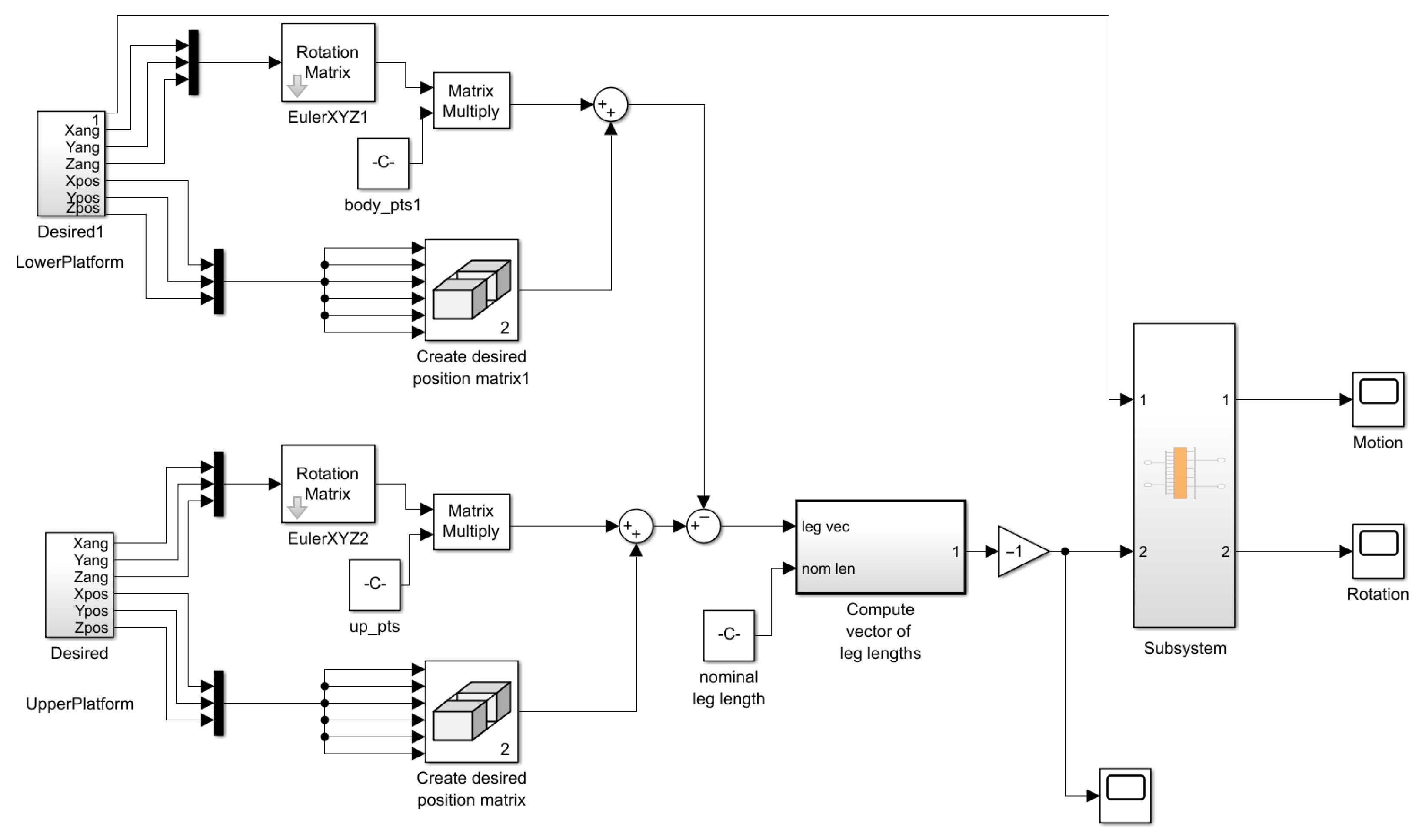
3.2.2. Control System Model in Simulink

The control system was implemented in Simulink, as shown in Figure 6. The main components included Disturbance Generator, Inverse Kinematics Module, Controller Module, Adams Interface. Disturbance Generator provides 6-DOF motion of the SOV computed in Section 2.1. Inverse Kinematics Module computed desired leg lengths from platform poses. Controller Module implemented the composite feedforward-feedback control strategy. Adams Interface handled data exchange with the Adams mechanical model.
The control system was implemented in Simulink, as shown in Figure 5. The framework consists of four distinct functional blocks:
  • Disturbance Generator (Vessel Motion Embedding): This block bridges the hydrodynamic analysis and control simulation. The frequency-domain RAOs obtained from the HydroStar monohull model are convolved with the JONSWAP wave spectrum to generate time-series data of the vessel’s 6-DOF motion. These time-series signals are injected into the loop as external disturbances acting on the gangway base.
  • Inverse Kinematics Module: This block transforms the desired Cartesian pose of the gangway and the varying base position into reference lengths for each of the six actuator legs, serving as the setpoint for the servo loops.
  • Composite Controller Module: This module implements the proposed control strategy. It processes the error signals using the PID algorithm while simultaneously calculating the feedforward compensation values ( u v f f and u d f f ) based on the reference trajectory derivatives and the rigid-body dynamics model.
  • Adams Interface (Co-Simulation): This block manages the bi-directional communication with the MSC Adams mechanical environment. It transmits the calculated motor torques/forces to the virtual actuators in Adams and receives real-time feedback for the next control cycle.

4. Simulation and Result

4.1. Simulation Parameters and Conditions

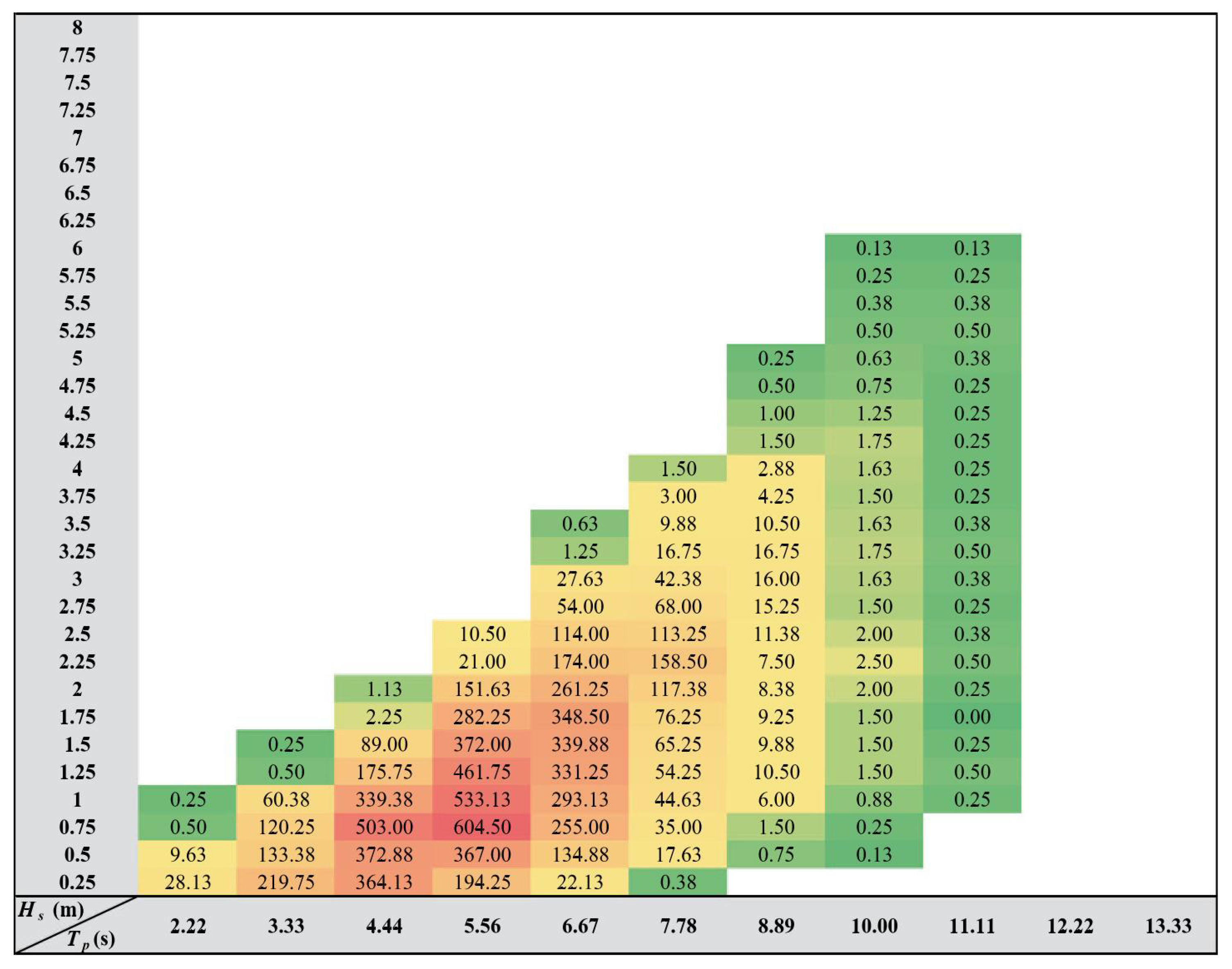
The environmental input for the coupled simulation is defined by the wave scatter diagram of the targeted offshore wind farm (Figure 7). The primary wave statistics for the South China Sea region are obtained from the 20-year (1996–2015) hindcast datasets established by Lin et al. [45], which utilize an unstructured SWAN model to provide high-resolution oceanographic data for the Guangdong coast.To ensure the simulation parameters are suitable for high-precision motion compensation analysis, the raw wave data were processed following the methodology proposed by Li et al. [46]. Specifically, the wave energy period ( T e ) from the original datasets was converted into the peak period ( T p ) required for the JONSWAP spectrum. This conversion employs the linear relationship T e = α e T p , adopting the conservative approximation α e as validated for the China adjacent seas. Furthermore, in accordance with the refinement techniques for operability analysis suggested in [46], the interval of significant wave height ( H s ) was refined to 0.25 m. This methodological approach allows for a more granular and realistic representation of the sea states, providing a robust disturbance input for the SOV motion response simulation.
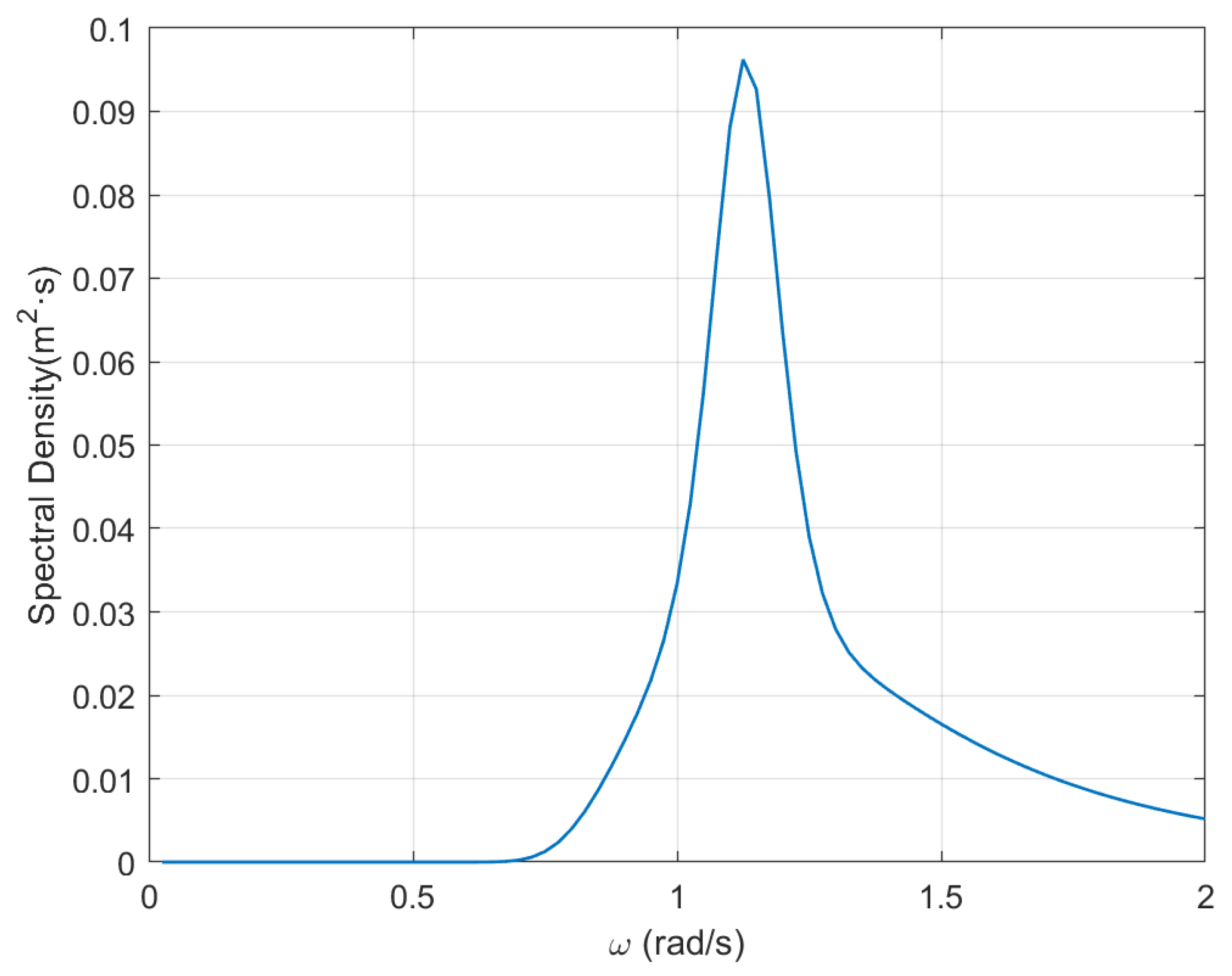
The irregular wave field was generated based on the JONSWAP spectrum, with the governing parameters given as follow: the sea state is characterized by a significant wave height ( H s ) of 0.75 m and a peak period ( T p ) of 5.56 s . A standard peak enhancement factor ( γ ) of 3.3 and a wave heading ( β ) of 0 were applied. To ensure sufficient resolution in the frequency domain, the spectrum was discretized over a range of ω [ 0.025 , 2.0 ] rad / s with a frequency increment of 0.005 rad / s . The generated JONSWAP wave spectrum is shown in the Figure 8.
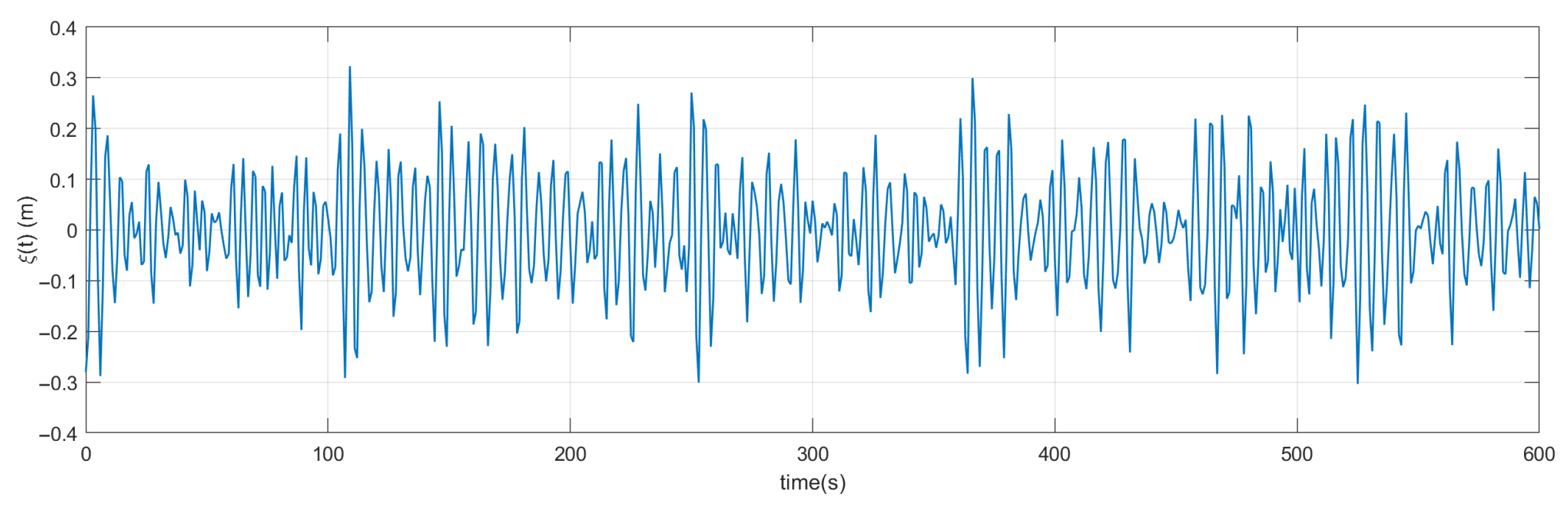
Ultimately, the total surface elevation time series is constructed through the linear superposition of these individual harmonic components, often calculated using an Inverse Fast Fourier Transform, resulting in a realistic simulation of an irregular wave field that statistically matches the target JONSWAP spectrum, the wave height shown in the Figure 9.
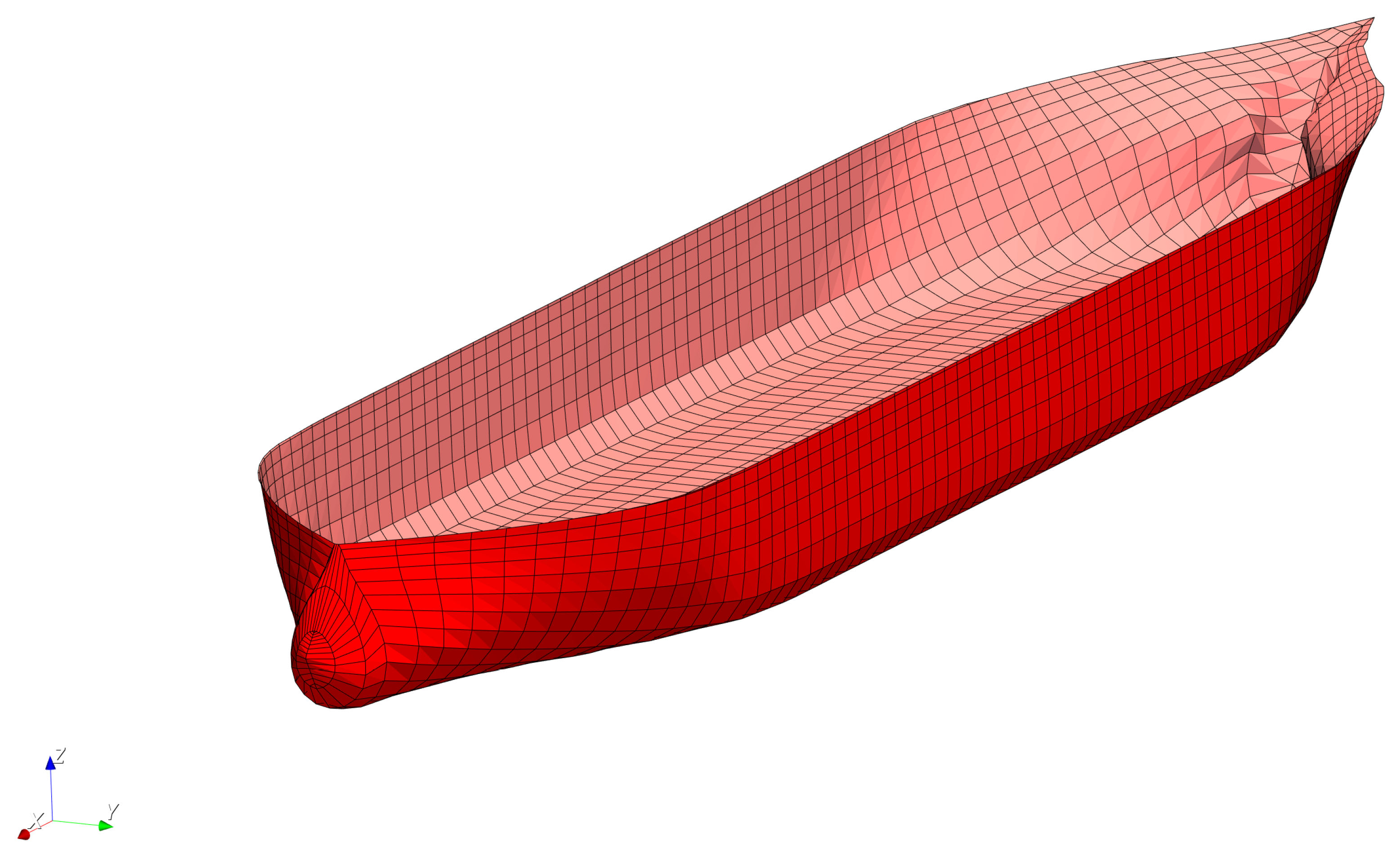
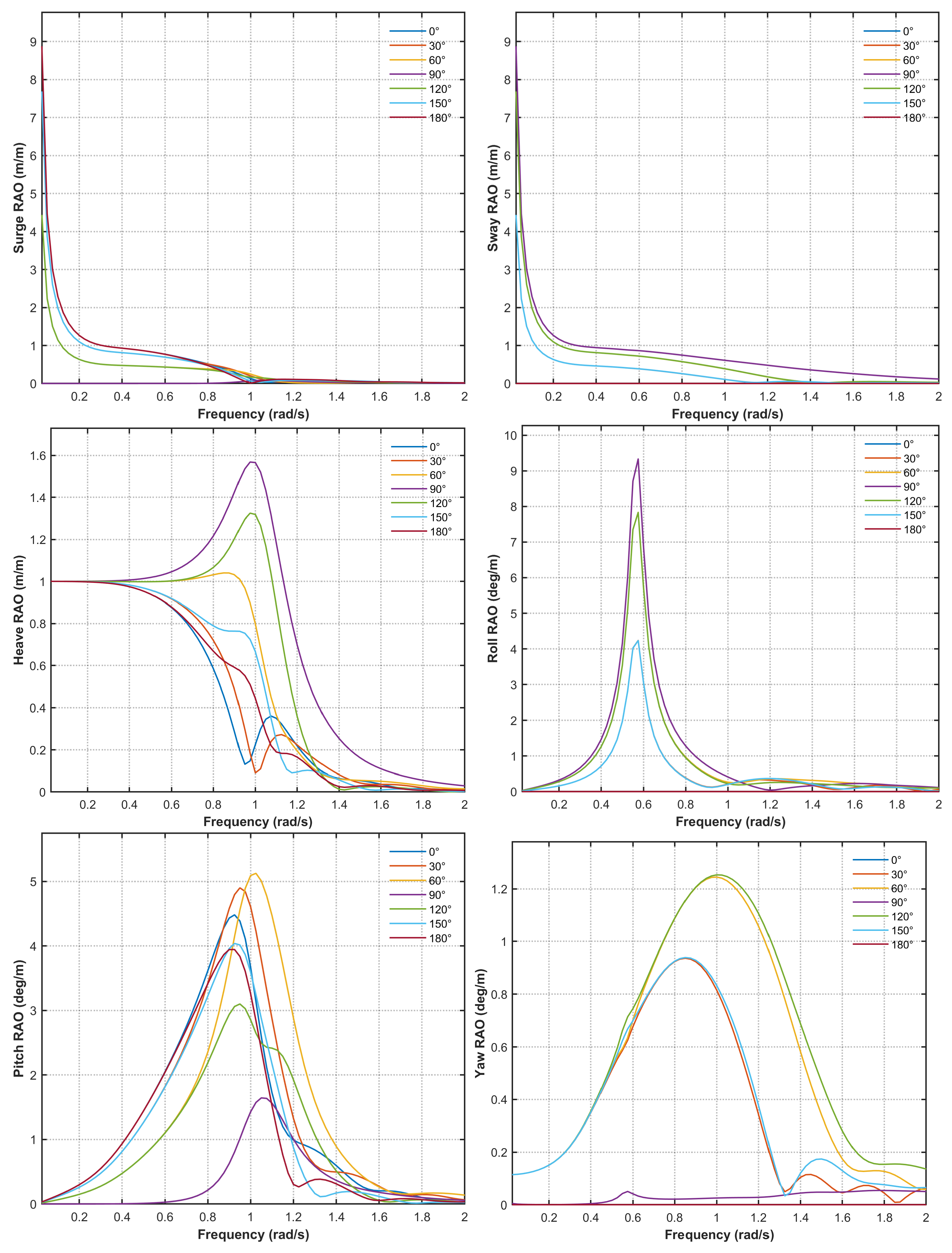
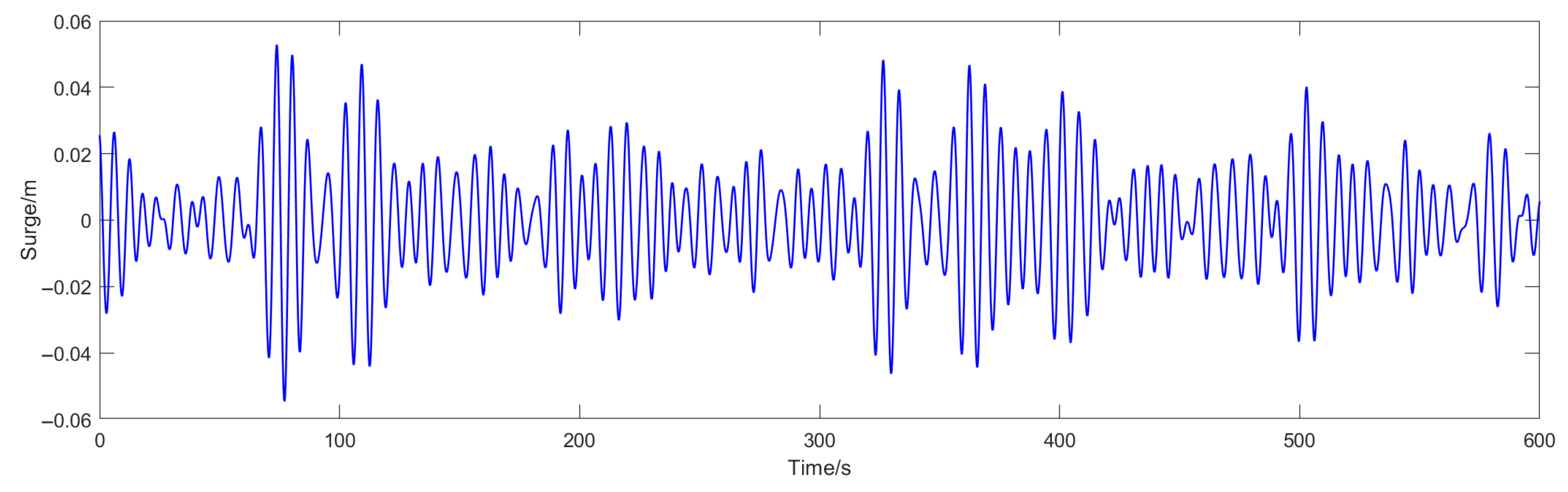
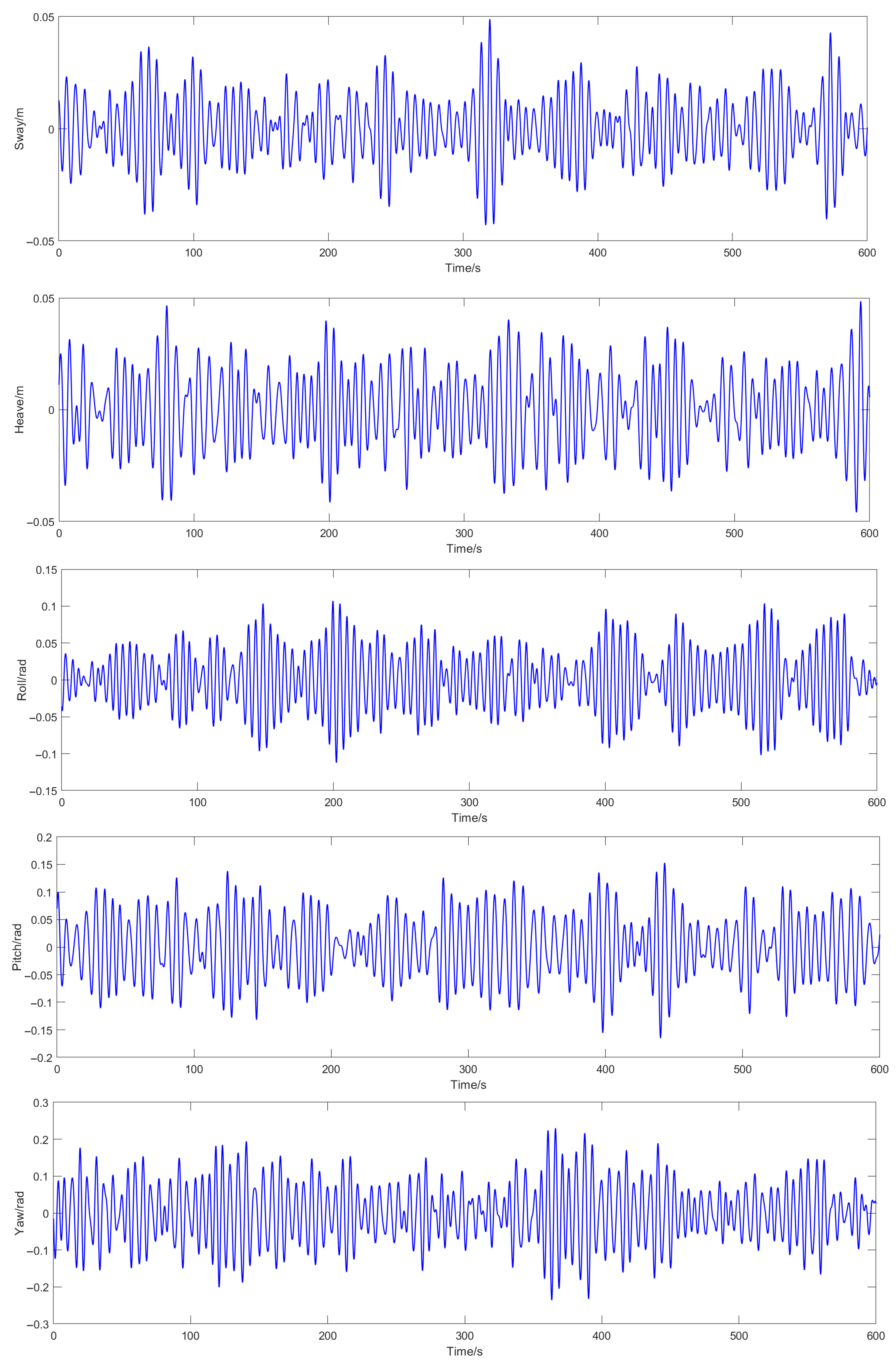
Figure 10 shows the monohull SOV model studied in this paper, and Table 2 lists its key specifications. Figure 11 presents the corresponding RAO, calculated using the method described in Section 2.1. Finally, Figure 12 shows 600-s excerpts of the resulting 6-DOF motion time histories. These time histories were computed by applying the wave excitation forces to the vessel’s RAOs. The full simulation represented a three-h operational scenario, but for clarity, only a representative segment is displayed here.
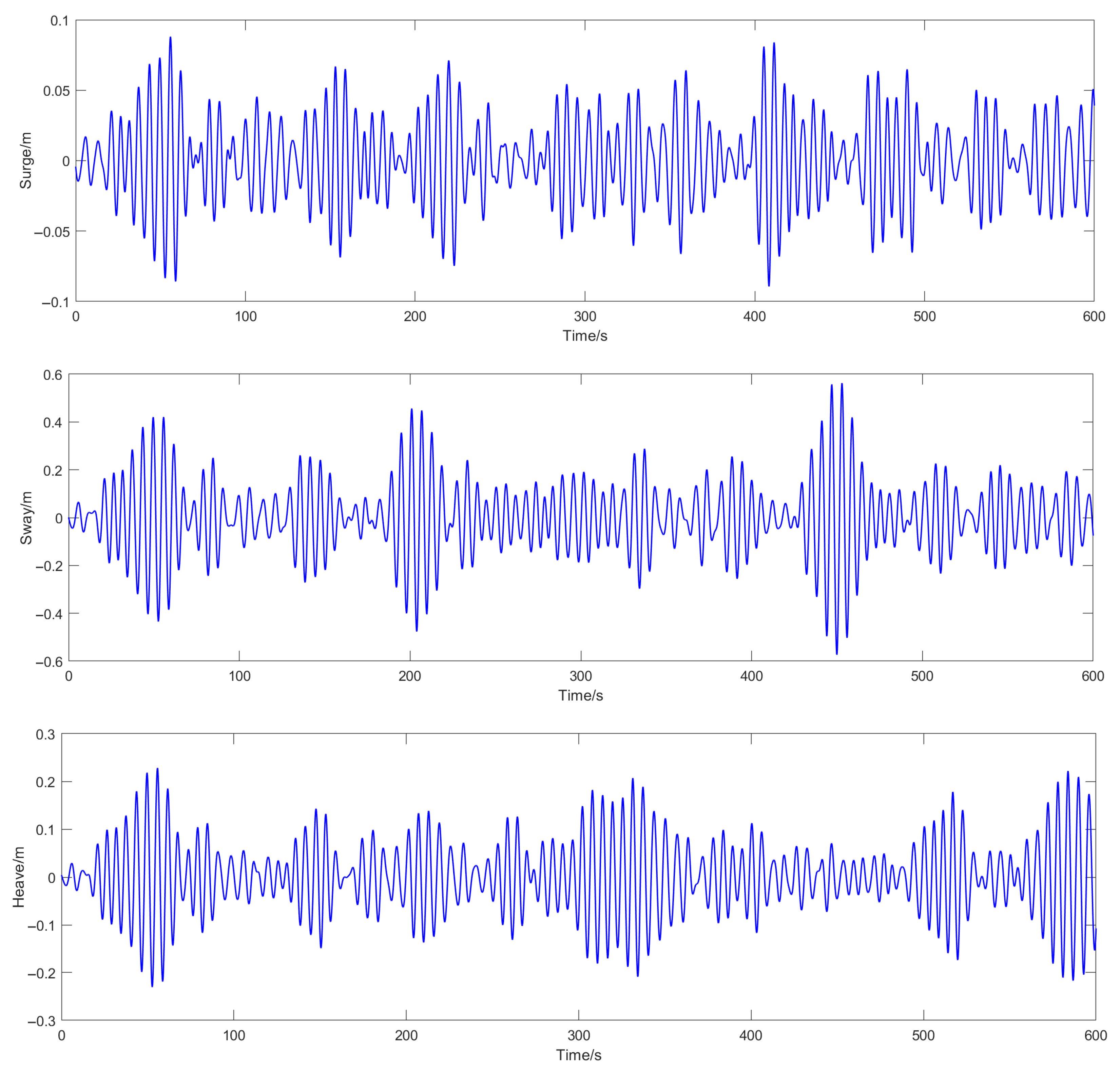
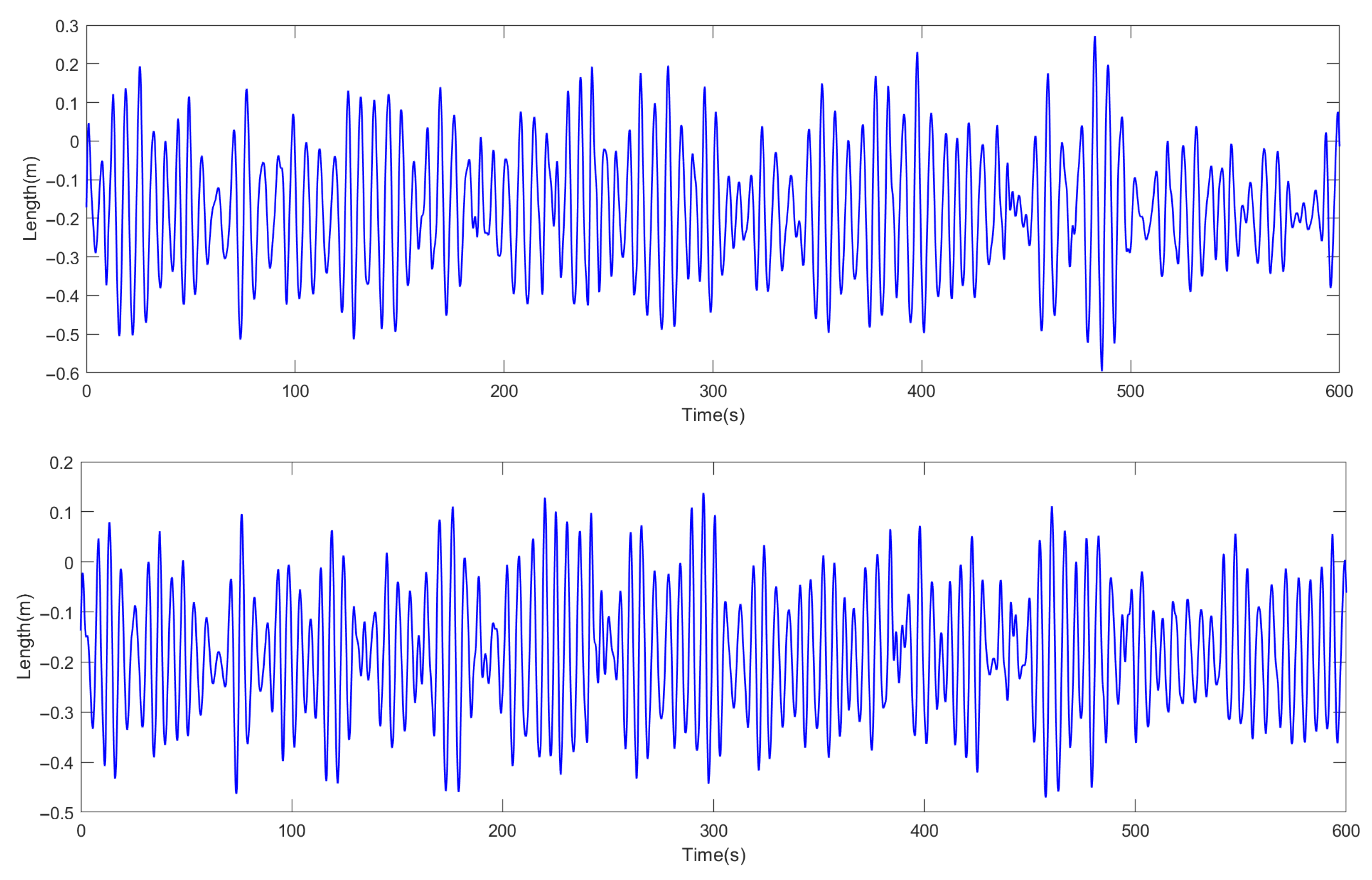
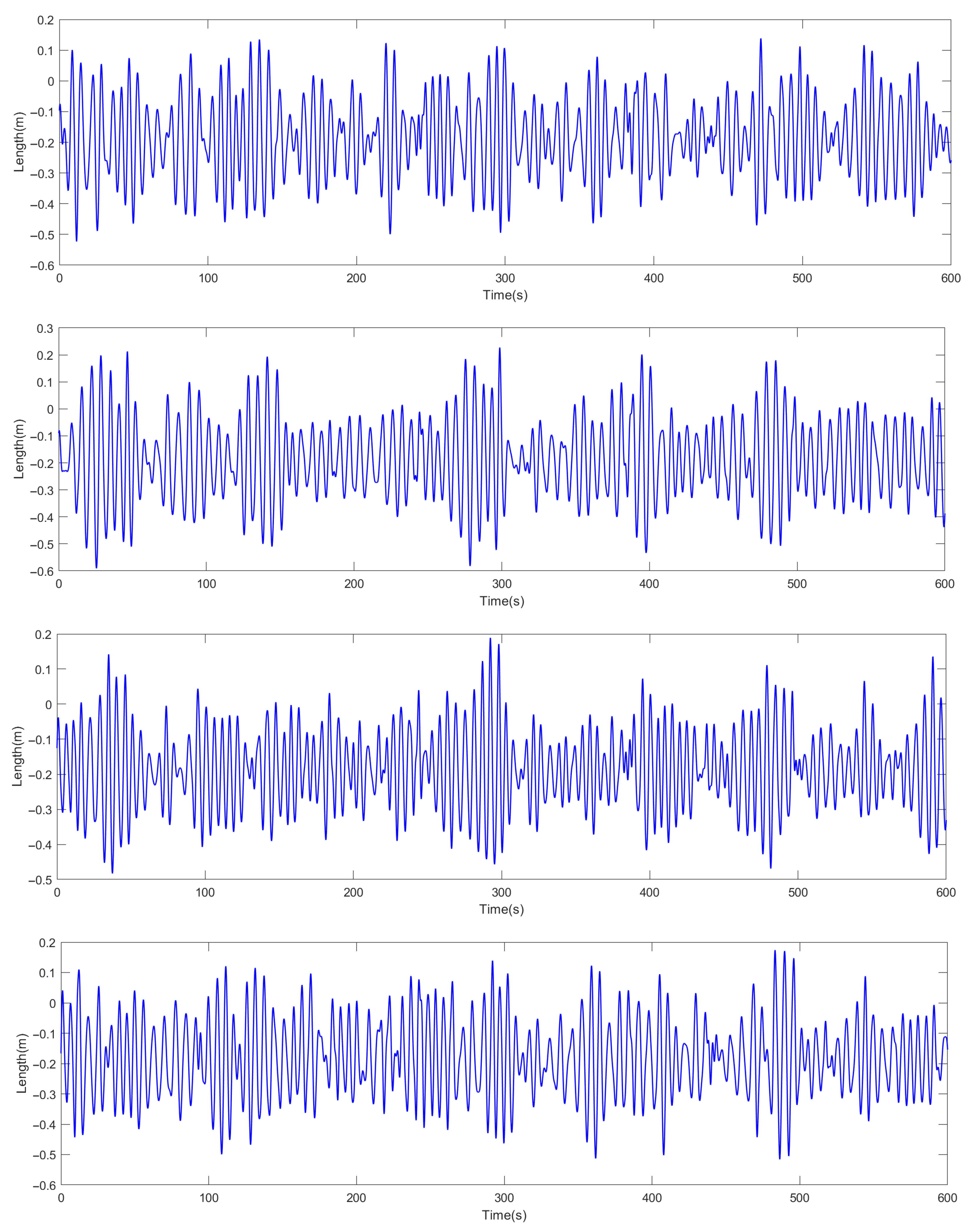
In this study, the motion of the lower platform of the motion compensated gangway installed on the vessel can be obtained through coordinate transformation. Since the base of the Stewart platform is rigidly connected to the deck, its attitude remains consistent with the vessel, and coordinate transformation only needs to be performed for the translational directions. The base platform of the Stewart platform should be installed on the Y -direction axis, at the intersection with the vertical line passing through the center of mass, to reduce the impact of vessel motion. Its specific coordinates relative to the vessel coordinate system are (−26, 0, −5.8). The displacement of the Stewart platform’s base obtained through coordinate transformation is shown in the Figure 13. Assuming the ideal state where the upper platform is fully compensated (i.e., the upper platform remains stationary relative to the inertial coordinate system), the length variations of the six legs can be calculated after obtaining the 6-DOF motion time histories of the Stewart platform’s base relative to the inertial coordinate system, as shown in the Figure 14.

4.2. Simulation Results and Analysis

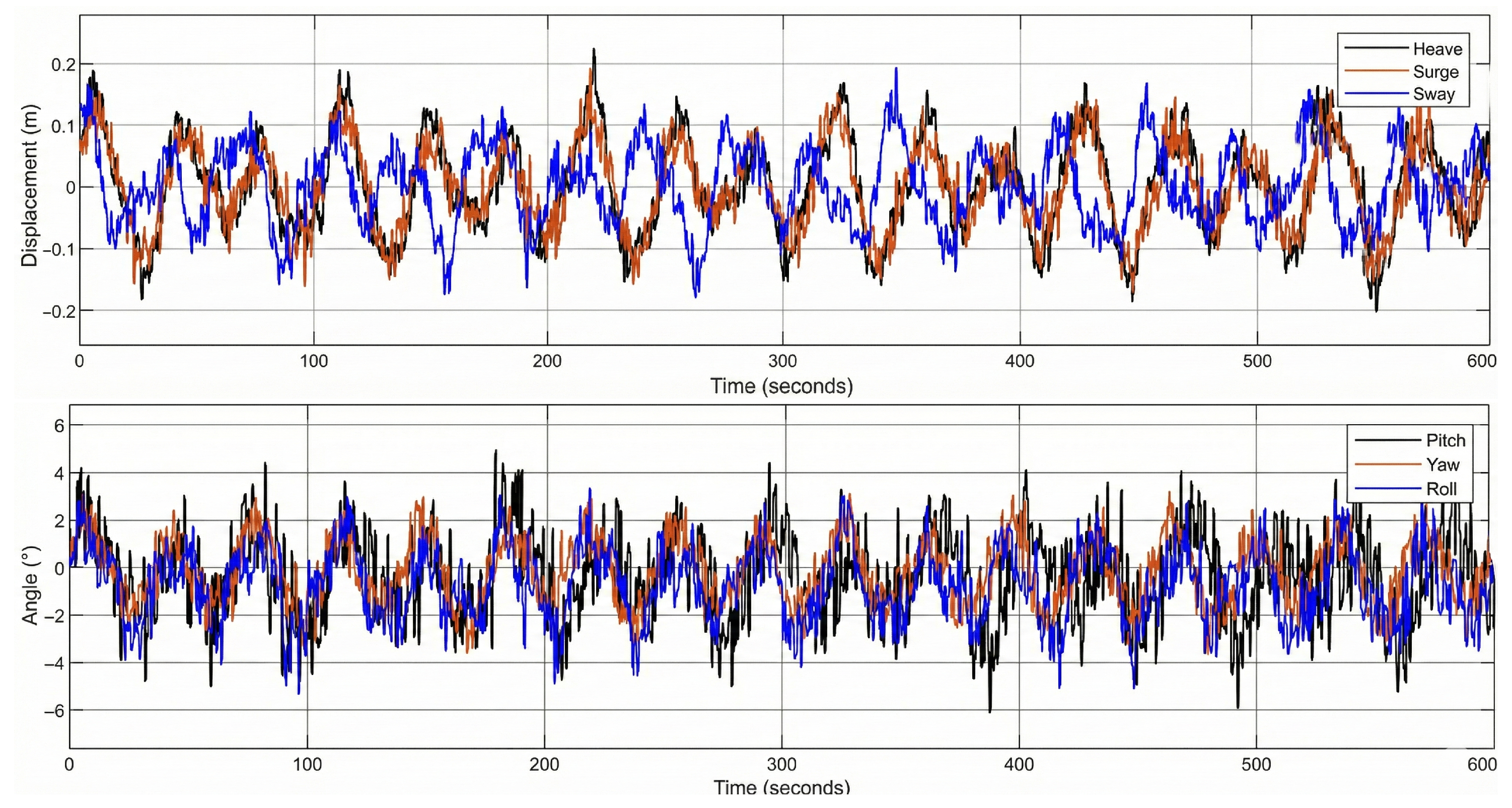
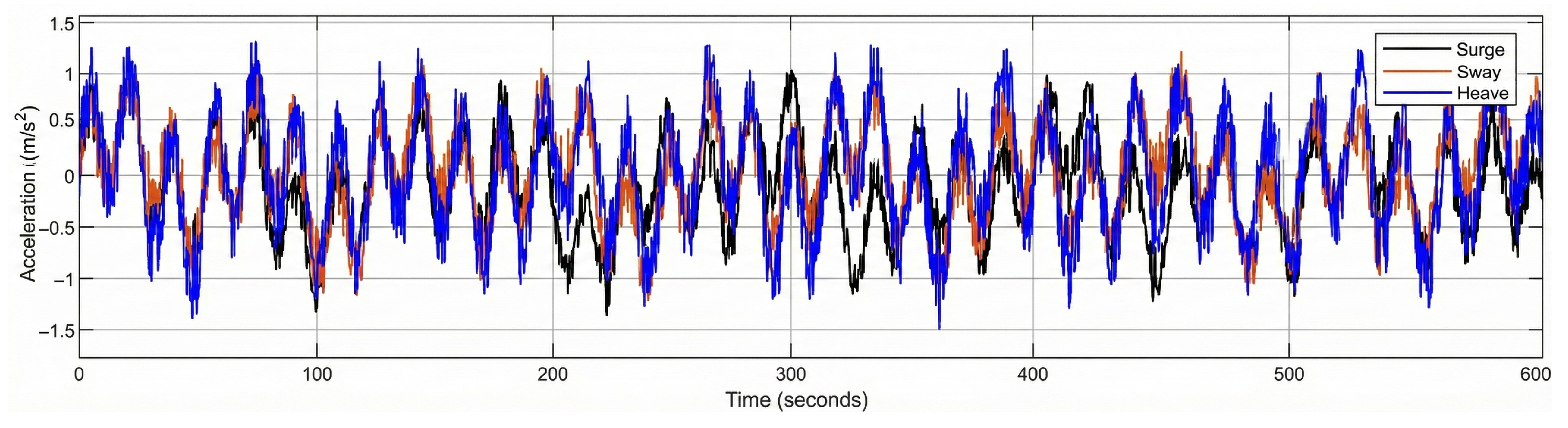
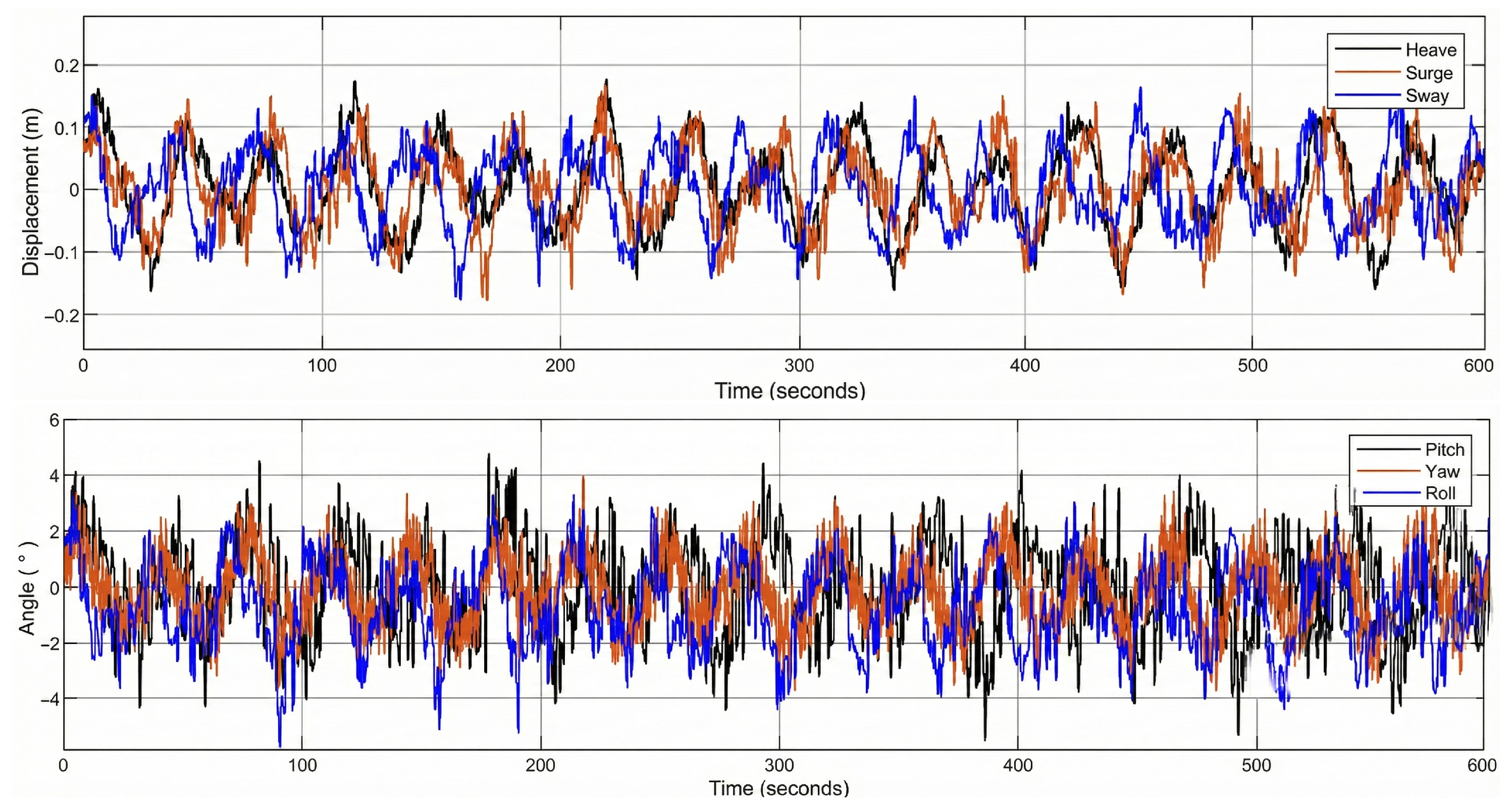
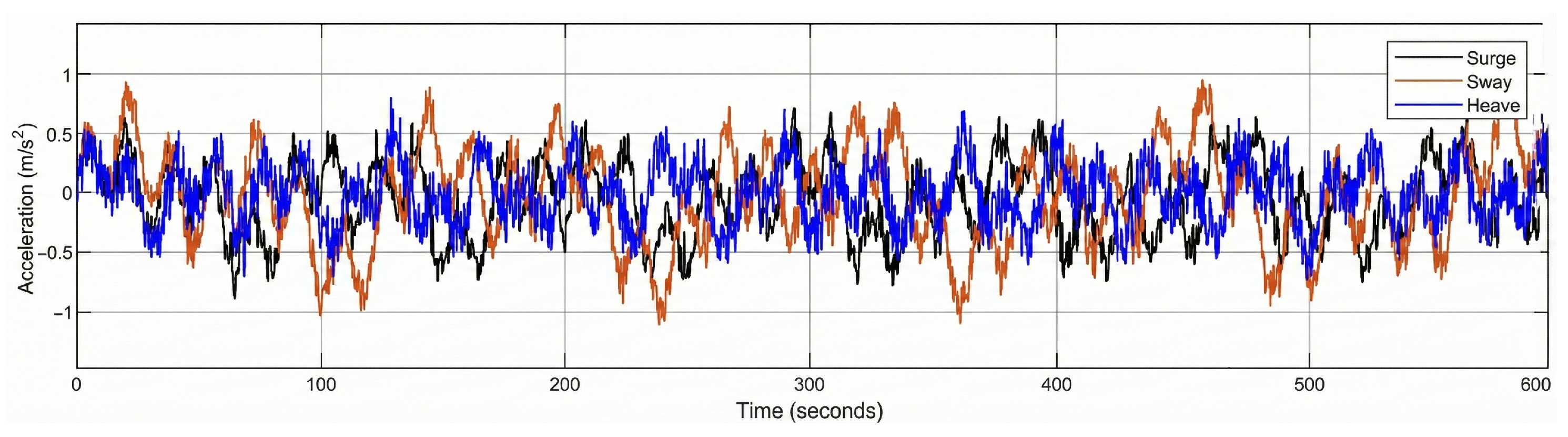
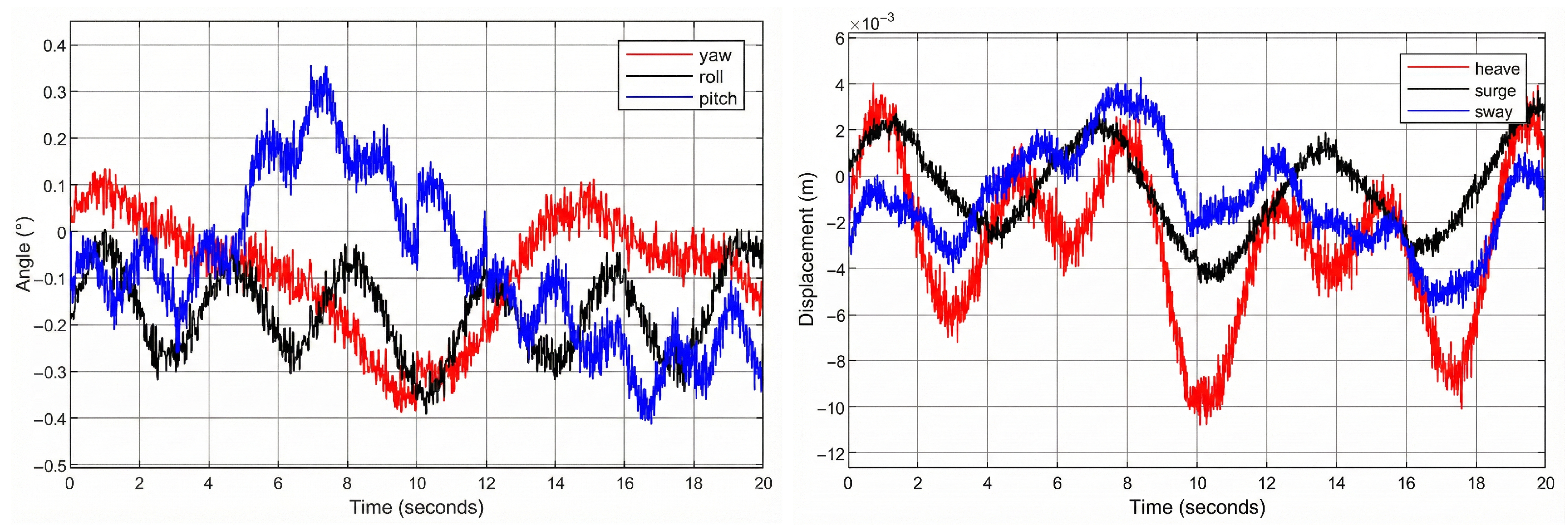
To further compare the control motion compensation effect under the traditional PID control with the composite control strategy, input the base platform’s pose and leg length changes into the motion compensated gangway system built by Simulink-Adams, and obtain the six-degree-of-freedom motion time history and acceleration of the Stewart upper platform, the result for using PID control as shown in the Figure 15 and Figure 16.
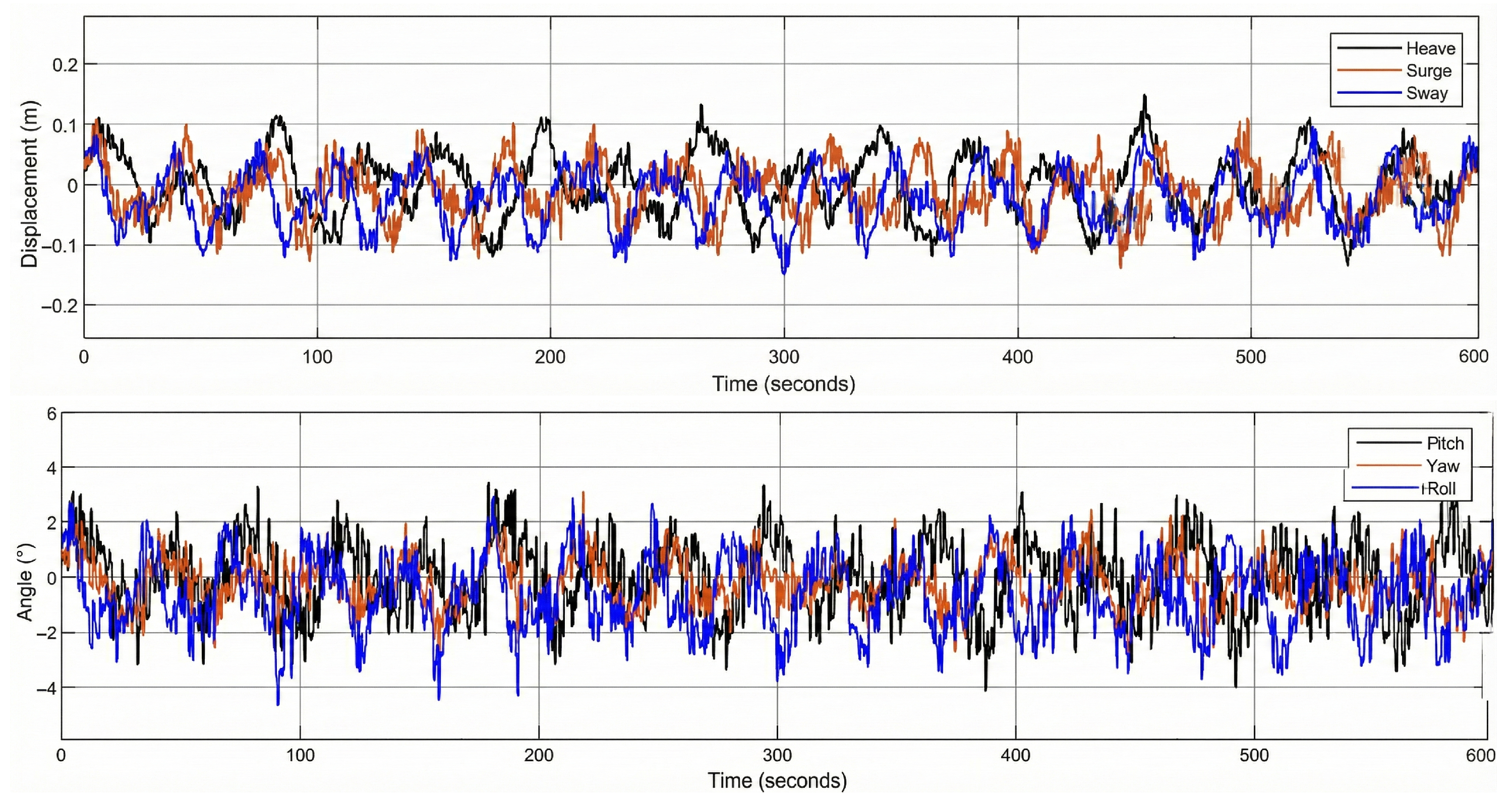
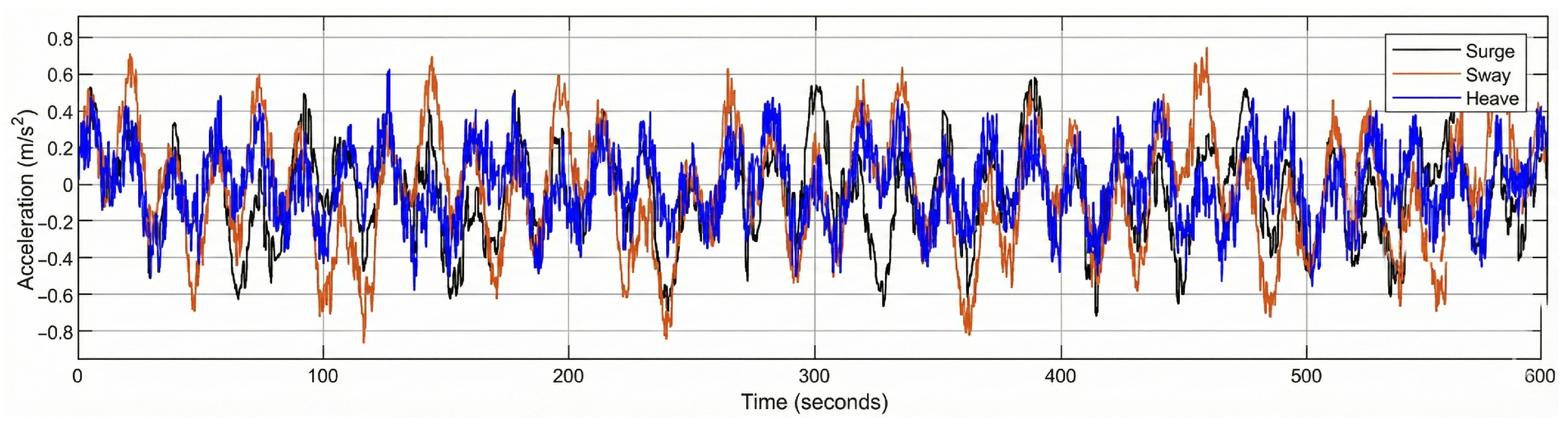
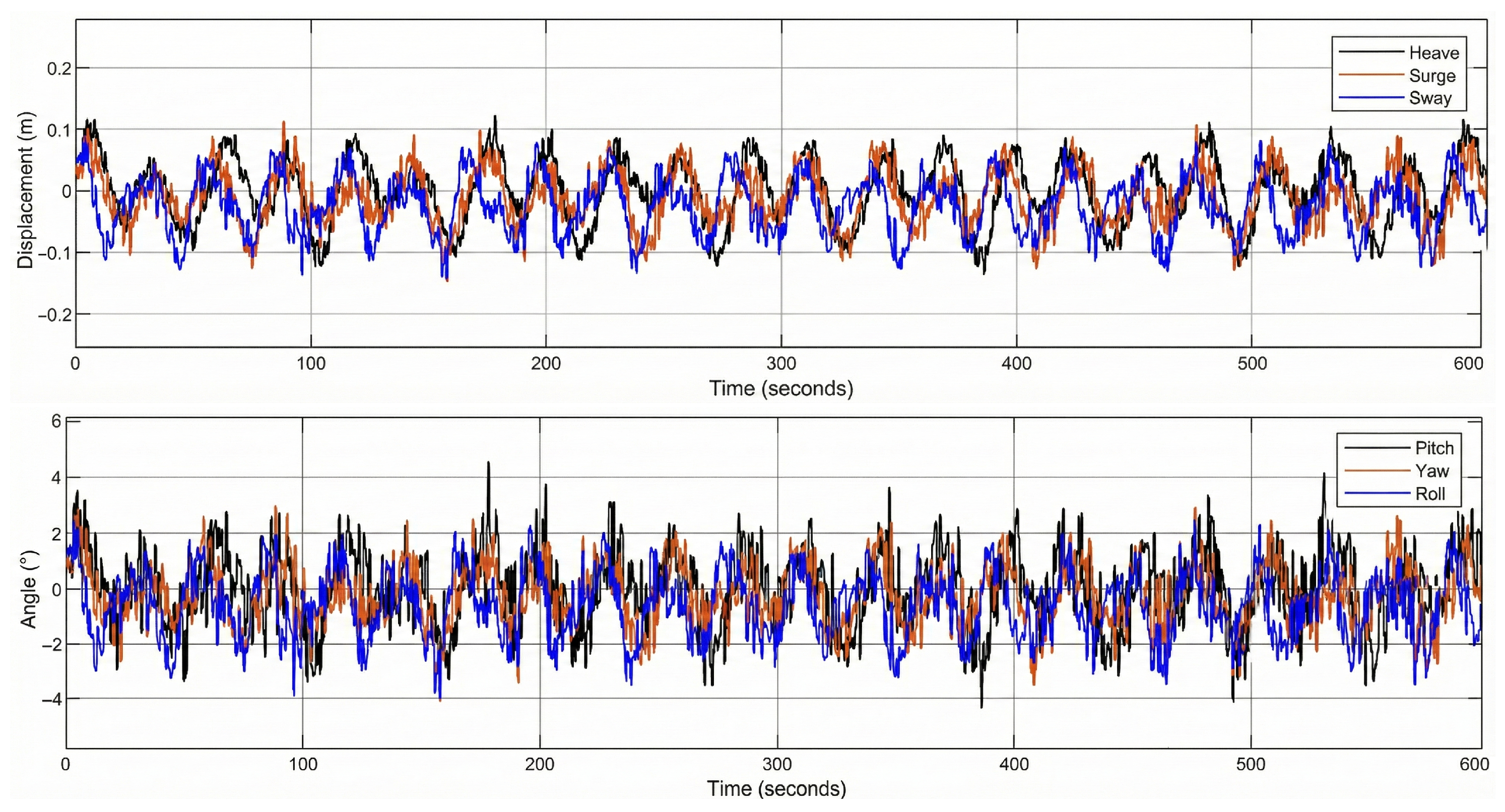
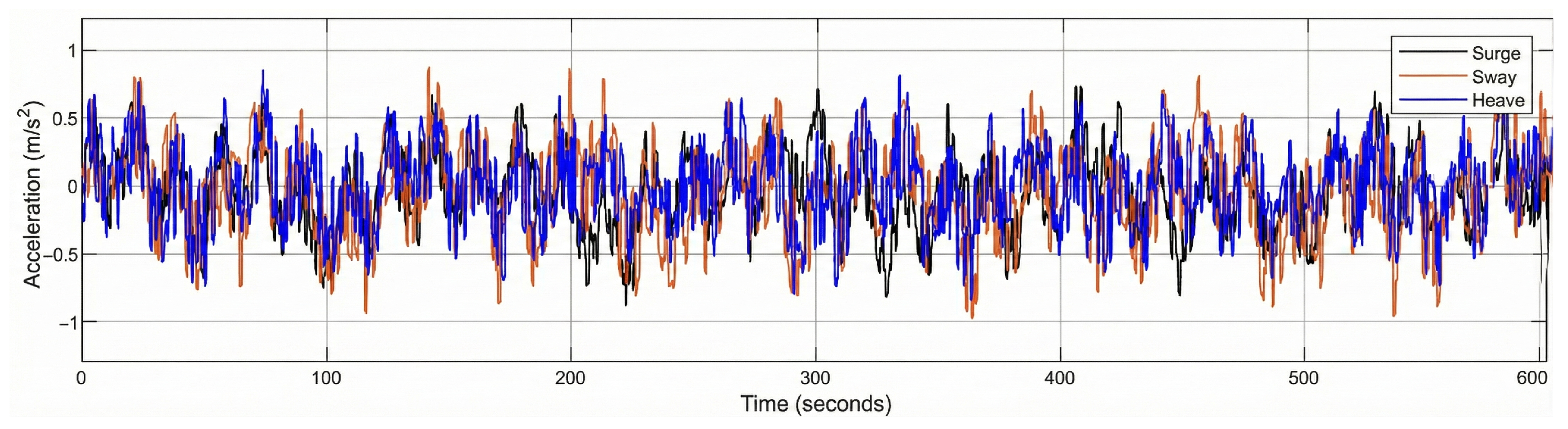
Next, velocity and dynamic feedforward are introduced, and the simulation results are obtained as shown in the Figure 17 and Figure 18.
The compensation performance was quantified using the isolation degree metric. Define the compensation isolation degree as the evaluation index for the compensation effect of the motion compensated gangway system in each degree of freedom, which is expressed by Equation (31).
η α = 20 lg ( | α | | α | ) dB
In the formula, α is the value of the motion compensated gangway in a certain degree of freedom, and α is the value of the pose simulation platform in the corresponding degree of freedom. The larger η α is, the better the compensation effect of the motion compensated gangway on disturbances; when it is infinite, it indicates complete compensation for disturbances. Conversely, the closer it is to 0, the worse the compensation effect; when it is 0, it means the platform has no compensation effect on disturbances at all.
Table 3 summarizes the isolation degrees achieved for each degree of freedom under different control strategies.
The composite control strategy demonstrated superior performance, achieving an average isolation degree of 21.81 dB, which corresponds to approximately 91% disturbance rejection.
To verify the performance of the composite controller model, a scenario with a 45 wave heading was introduced. The obtained simulation results are illustrated in Figure 19, Figure 20, Figure 21 and Figure 22. The calculated isolation degrees are presented in Table 4. It can be observed that the composite controller continues to demonstrate significant advantages in disturbance isolation effectiveness.
The significance of these simulation results is twofold. Firstly, the achievement of an average isolation degree of 21.81 dB indicates that the composite control strategy can effectively expand the operational window of SOVs in rougher sea states compared to traditional PID methods. Secondly, the specific improvement in heave compensation is critical for offshore operations, as vertical motion is the primary risk factor impacting the safe latching of the gangway tip to the turbine landing platform. The simulation confirms that the proposed system design remains robust even under the stochastic irregularities of the JONSWAP spectrum.
To evaluate the robustness of the control strategy, a sensitivity analysis was performed by varying the PID gains and feedforward coefficients by ± 10 % . Simulation results indicate that the isolation degree fluctuates by less than 1.5 dB within this range, demonstrating that the composite control strategy maintains stable performance despite minor parameter mismatches.

5. Scaled Gangway Prototype Experiment

5.1. Experimental Platform Design and Setup

To validate the simulation results and control strategies, a 1:10 scaled experimental platform was designed and constructed, maintaining geometric and dynamic similarity with the full-scale system.
The experimental setup of the Stewart platform mainly includes a dual-layer Stewart-configuration mechanical structure, an AC servo system, an inertial measurement unit (IMU), a motion control card, and a PC upper computer.
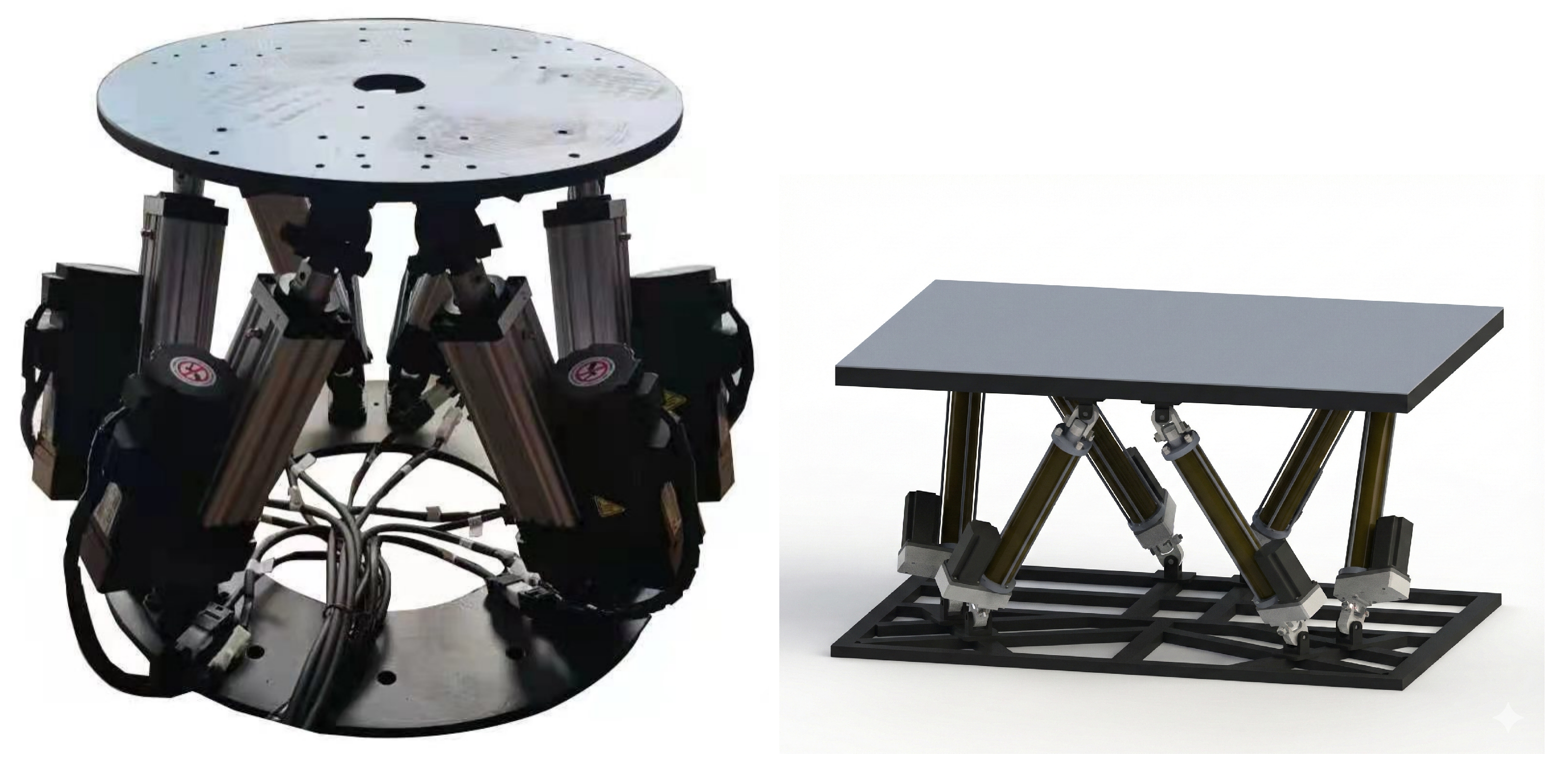
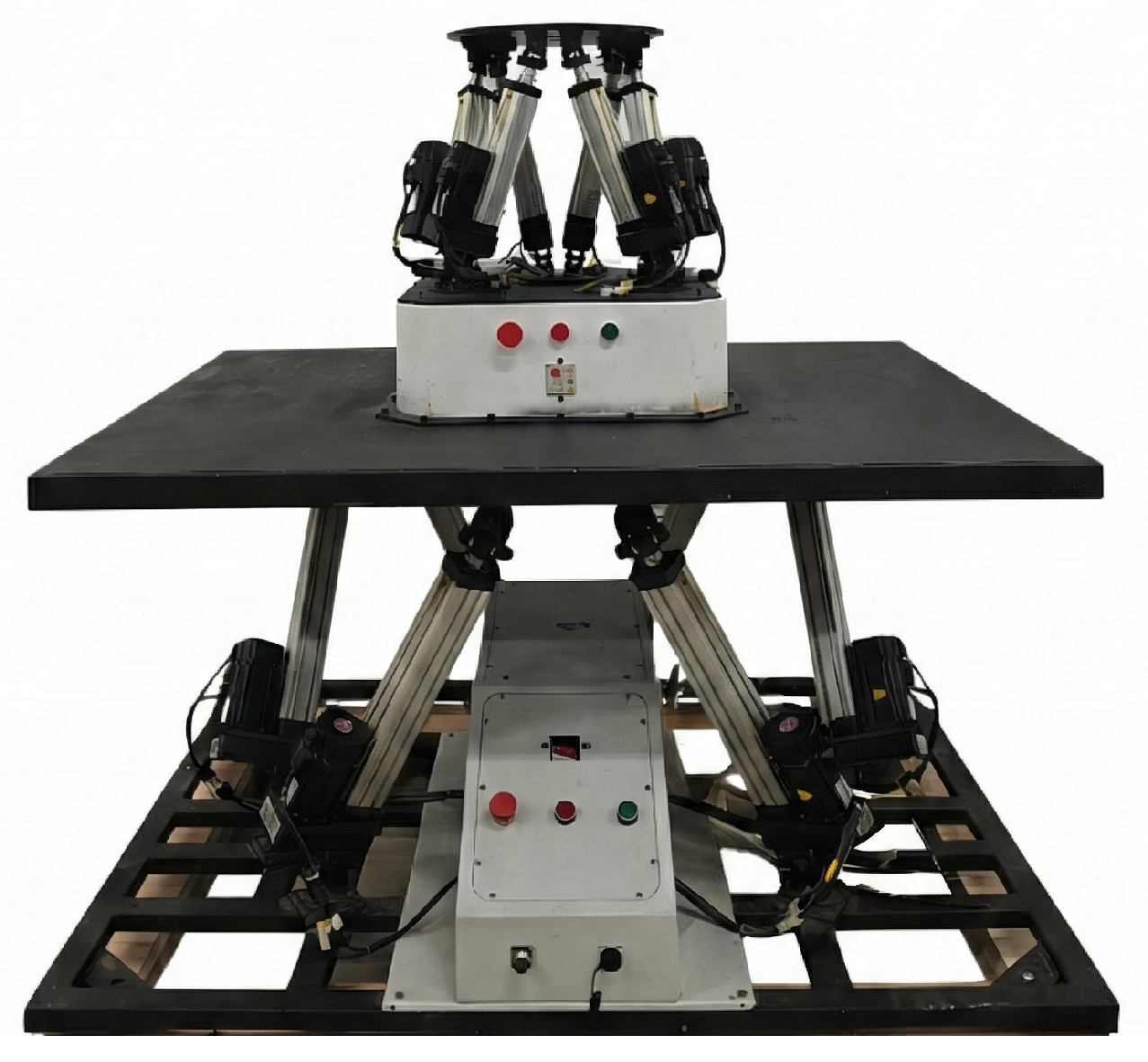
The mechanical system of this experimental setup is mainly composed of two parts: a motion simulation subsystem and a motion compensated subsystem. The lower Stewart platform serves as the motion simulation system, which can provide six-degree-of-freedom motion simulating an offshore operation and maintenance vessel. The upper Stewart platform acts as the motion compensated system, whose lower plane is welded and fixed to the upper plane of the lower Stewart platform. It is actuated by a complete set of control systems and electric cylinders to compensate for the motion caused by the lower Stewart platform and maintain the stability of the upper plane. The physical diagram of the dual-layer Stewart-configuration mechanical structure is shown in Figure 23.
The key technical parameters of both Stewart platforms are detailed in Table 5.
The motion compensated control system uses a motion control card as the main controller. An inertial motion sensor, serving as the pose measurement and feedback component, is installed at the center of the base platform of the Stewart platform to feed back the real-time pose information of the lower plane of the motion compensated system to the upper computer software. After undergoing steps such as signal preprocessing, signal prediction, and forward/inverse kinematic solutions, the upper computer calculates the rod length error of each electric cylinder and sends control commands to the motion control card. The motion control card drives the motor operation by controlling the driver; the motor drives the expansion and contraction of the electric cylinder through a mechanical transmission mechanism to complete the control of a single joint branch. Ultimately, it achieves the control of the upper plane of the motion compensated system, keeping it in a relatively stable state at all times. The entire experimental setup is shown in the Figure 24.

5.2. Control System Implementation

During the operation of the motion compensated system, it is necessary to perform kinematic and dynamic model calculations based on the disturbance pose signals detected by the inertial motion sensor, and then control the electric cylinders to compensate for ship disturbances.
Among the disturbance poses in six degrees of freedom, the angles of roll, pitch, and yaw can be obtained by a high-precision attitude and heading reference system. However, the displacement data of surge, sway, and heave cannot be directly measured and need to be obtained through double integration of acceleration information in the corresponding directions. The acceleration information measured by the sensor contains noise and interference from low-frequency Schuler period oscillation signals, and especially interference from gravitational acceleration in the heave direction. Therefore, the original acceleration information needs to be further processed to obtain a more accurate calculated value of heave motion.
In the pose calculation module, to achieve accurate estimation of disturbance motions such as platform heave, this paper adopts the Cubature Kalman Filter (CKF) algorithm for state estimation of the received original sensor data. Compared with the traditional Extended Kalman Filter (EKF) method, the Cubature Kalman Filter has higher accuracy and stability when dealing with nonlinear systems, making it more suitable for the calculation of complex motion states in the marine environment.

5.3. Experimental Protocol

To ensure the experimental results could be extrapolated to the full-scale system, similarity criteria were strictly followed. Based on Froude similarity law, the time scaling factor was determined as:
T m = T p λ L = 5.56 10 1.76 s
where T p = 5.56 s is the prototype wave period and λ L = 10 is the geometric scale ratio.
During the compensation experiment, one pose measurement unit is placed on the upper plane of the pose simulator to measure the disturbed pose, and another pose measurement unit is placed on the stable compensation plane to verify the effect of stable compensation. A laser range finder is fixed at the same position as the pose measurement unit to measure the displacement variation in the heave direction, with a measurement accuracy of 2 mm. The pose simulation platform is used to simulate disturbances in each degree of freedom, and the attitude angle changes of the motion compensated platform are obtained through the pose measurement units.

5.4. Experimental Results and Analysis

To ensure that the experimental results can effectively reflect the actual force and response laws of the prototype structure, real sea conditions must be considered in the scaled model experiment. For better verifying the reliability of motion compensation and the effectiveness of the scaled test, we added two other common sea state conditions as inputs, which are T p = 5.56 s , H s = 1 m and T p = 4.44 s , H s = 0.75 m . The wave heading set to 90° beam sea, it may cause relatively strong roll, which poses great challenges to the system stability. The wave conditions are summarized in Table 6.
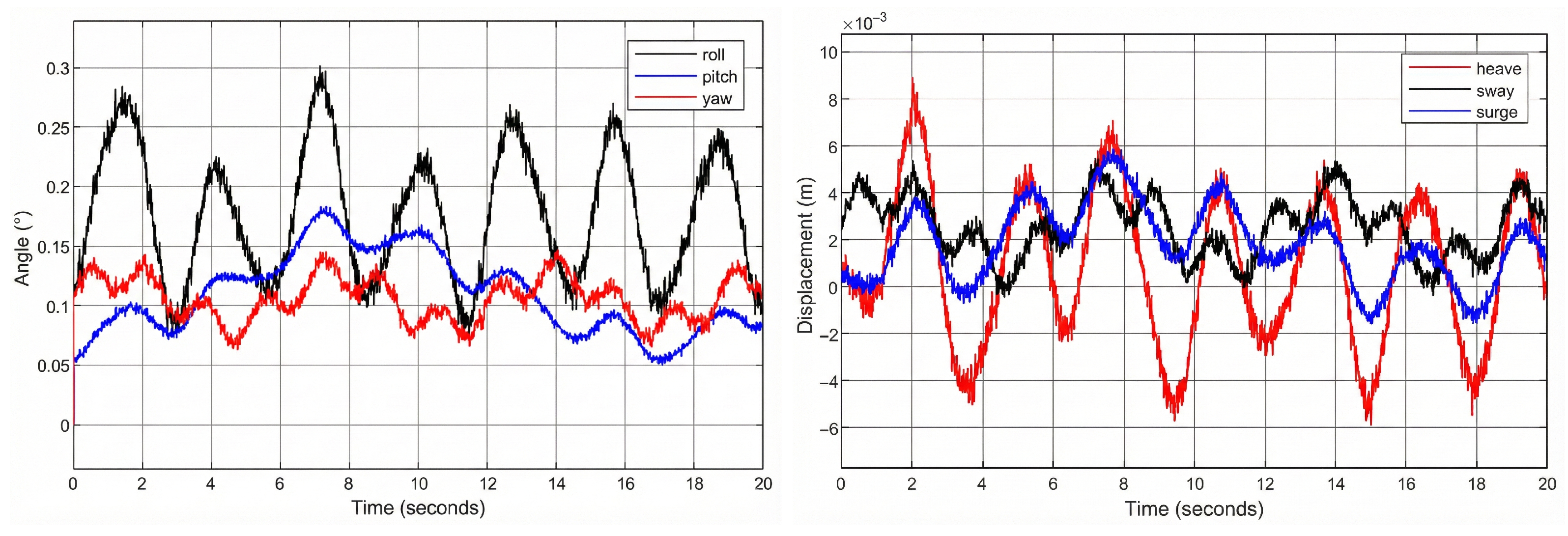
A 20-s 6-DOF motion time history is input into the motion control software of the pose simulation platform, and the pose measured by the motion compensated platform is shown in Figure 25.
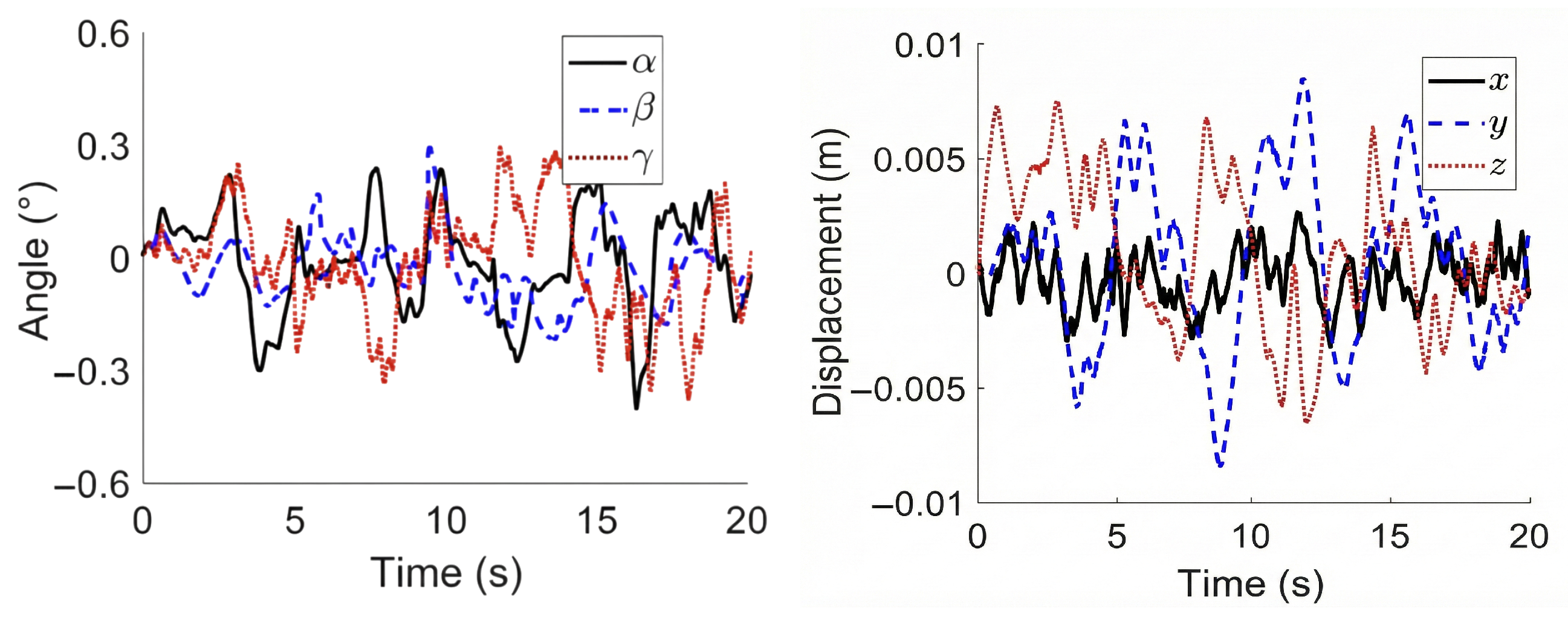
The analysis results show that the variation of the platform’s attitude angles is kept within 0 . 6 , and the isolation degrees of roll angle, pitch angle, and yaw angle reach 16.48 dB. Measurements from the laser range finder indicate that the variation in the heave direction is between 1.399 m and 1.414 m, i.e., the heave variation is maintained within a small range of 1.4 cm with an isolation degree of 15.14 dB.
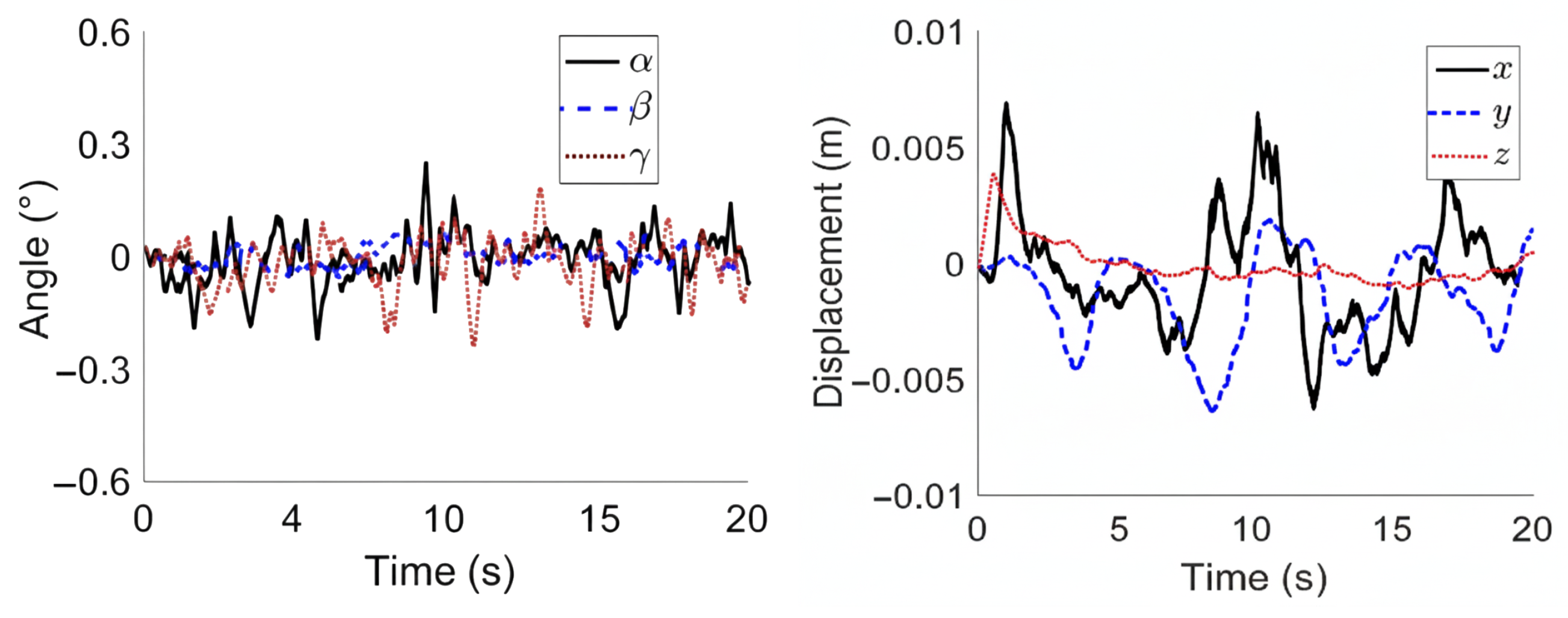
The simulation results corresponding to the time points in the previous text are scaled by a scale ratio of 1:10, and the difference is calculated between these scaled results and the model test results after low-pass filtering.
The error results between model test and simulation are shown in Figure 26. Tests show that the angle error is less than 0.03°, and the displacement error is less than 0.01 m.
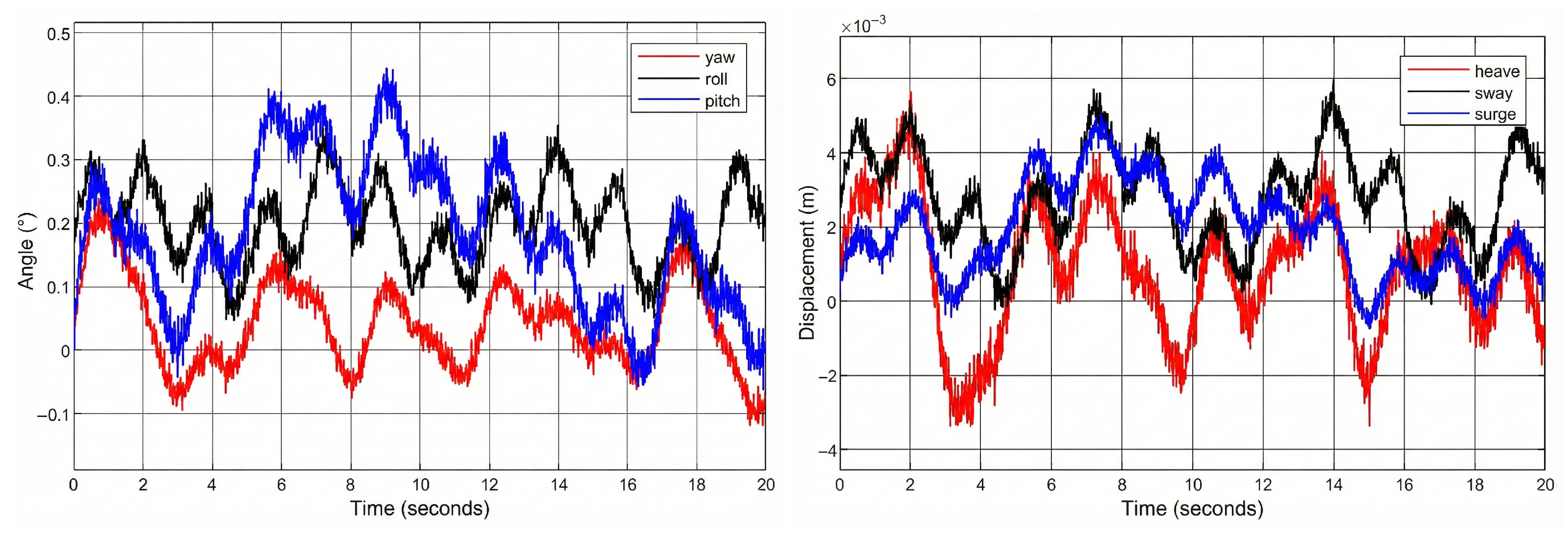
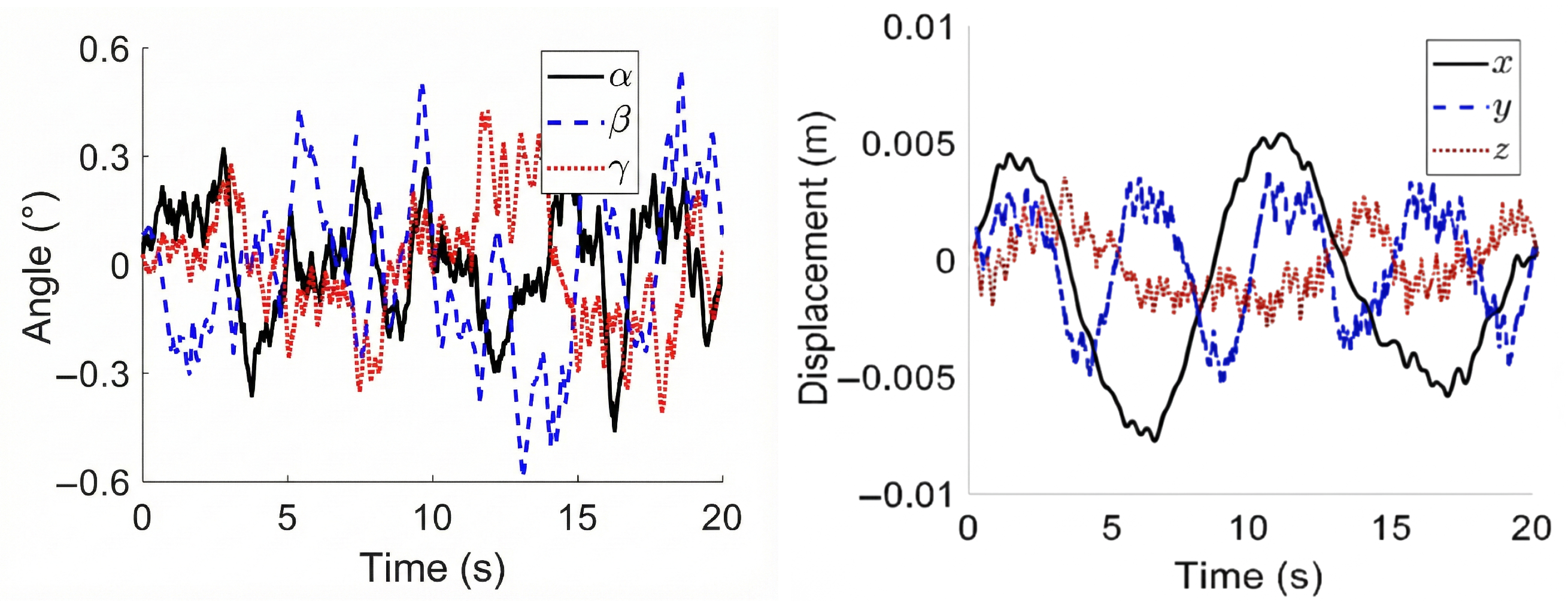
The pose measured by the motion compensated platform and the error between model test and simulation are shown in Figure 27, Figure 28, Figure 29 and Figure 30.
The analysis results show: When T p = 5.56 s, H s = 1 m, the variation of the platform’s attitude angles is kept within 0.5°, and the isolation degrees of angles reach 15.25 dB. the heave variation is maintained within a small range of 1.6 cm with an isolation degree of 13.02 dB. When T p = 4.44 s, H s = 0.75 m, the variation of the platform’s attitude angles is kept within 0.8°, and the isolation degrees of angles reach 13.17 dB. the heave variation is maintained within a small range of 1.4 cm with an isolation degree of 12.14 dB. The calculated average error rate is 18.2%, which can meet the requirements for experimental verification of the simulation results.

6. Results and Discussion

6.1. Performance Analysis of Control Strategies

The simulation results presented in Section 4 demonstrate the efficacy of the proposed control strategies for the vessel-borne active motion compensated gangway. As illustrated in the comparative analysis between the traditional PID control and the proposed composite control strategy, the latter significantly enhances motion compensation performance.
Specifically, the composite control strategy achieved an average isolation degree of 21.81 dB across all six DOFs, compared to 18.15 dB for the standard PID controller (see Table 3). This represents an improvement of approximately 3.66 dB. Notably, the heave and pitch motions—critical for personnel safety during transfer—saw isolation degrees increase to 21.58 dB and 23.12 dB, respectively. This superior performance is attributed to the feedforward loop’s ability to proactively compensate for wave-induced disturbances based on the inverse dynamics model, thereby reducing the phase lag and tracking errors inherent in pure feedback systems. The results indicate that the system can effectively reject approximately 91% of disturbances, ensuring a stable gangway tip position even under irregular wave conditions defined by the JONSWAP spectrum.

6.2. Experimental Validation and Model Fidelity

The experimental trials conducted on the 1:10 scaled prototype in the wave-wind combined test basin provided physical validation for the numerical models. Under simulated sea states corresponding to the specific wave scatter diagram of the Guangdong offshore wind farm, the prototype maintained high stability. The attitude angle variations were constrained within 0 . 8 , and the residual heave motion was maintained within a small range of 1.6 cm. The experimental isolation degrees reached 16.48 dB for rotational motions and 15.14 dB for heave, confirming the mechanical feasibility of the design.
A critical aspect of this study was validating the fully coupled SOV-Gangway-Turbine dynamic system. The comparison between the scaled simulation results and the model test data yielded an average error rate of 18.2%. While this discrepancy exists, it is within the acceptable range for complex hydrodynamic and multi-body mechanical coupling problems. The error can be attributed to unmodeled non-linear factors such as mechanical friction in the electric cylinders, sensor noise (drift in accelerometer integration), and complex viscous fluid effects that potential flow theory estimates with lower precision. Nevertheless, the correlation confirms that the developed simulation framework is sufficiently accurate for predicting system behavior and optimizing control parameters for full-scale applications.

6.3. Limitations

Despite the promising results, several limitations and practical challenges remain:
  • Sea State Selection: The current study focuses on wave conditions with prototype scale H s 1.0 m. While SOVs typically operate in harsher environments ( H s 2.5 m), the selected sea states represent the critical window for high-precision “Walk-to-Work” operations where the gangway is in floating connection with the offshore wind turbine platform. For extreme sea states, the focus shifts from compensation accuracy to disconnect safety strategies, which is beyond the scope of this control-focused study.
  • Scaling Effects and Experimental Error: The observed 18.2% error between simulation and experiment is largely attributed to scaling effects. While Froude scaling ensures kinematic similarity, it does not preserve the Reynolds number. Consequently, viscous damping and mechanical friction can’t be ignored of 1:10 scaled model [47].
  • Hydrodynamic Model Simplifications: The model is based on linear potential flow theory, which neglects higher-order wave effects like second-order forces [48]. While these forces can influence station-keeping, their impact on gangway compensation is limited as the system primarily targets first-order wave-frequency motions, and low-frequency drift is managed by the vessel’s dynamic positioning system [49]. Validation in Section 2.2 confirms the model’s adequacy for predicting relevant disturbances.

7. Conclusions

This paper presented a comprehensive study on the simulation and experimental validation of a vessel-borne active motion compensated gangway designed for offshore wind operation and maintenance. By establishing a fully coupled hydrodynamic and mechanical model and proposing a composite control strategy, the following conclusions are drawn:
  • Integrated Simulation Framework: A numerical model integrating frequency-domain multi-body hydrodynamics with time-domain mechanical dynamics was successfully developed. This framework effectively captures the complex interactions between the SOV, the motion-compensated gangway, and the fixed offshore wind turbine.
  • Enhanced Control Performance: The proposed active motion compensated strategy, which combines feedforward control (velocity and dynamics) with a three-loop PID feedback structure, demonstrated superior performance over traditional methods. Simulation results confirmed an average disturbance isolation degree of 21.81 dB, effectively neutralizing over 90% of vessel motions.
  • Experimental Validation: A 1:10 scaled prototype was constructed and tested. The experimental results validated the simulation, with the heave variation maintained within 1.6 cm and a simulation-to-experiment error margin of 18.2%. This verifies the reliability of the theoretical model and the control system design.
Future work will address the identified limitations through several key directions. To minimize the discrepancy between simulation and scaled experiments, future models will incorporate nonlinear friction dynamics for the actuators and viscous hydrodynamic damping corrections to better capture fluid-structure interactions in resonance regions. Furthermore, the research scope will be expanded to include harsh environmental conditions ( H s 2.5 m), involving the development of safety-critical control strategies, such as automated emergency disconnection protocols, to ensure personnel safety when active compensation limits are exceeded. Finally, building on the scaled tests, full-scale sea trials are planned to evaluate the system’s robustness under real stochastic ocean conditions, utilizing advanced sensor fusion algorithms to mitigate measurement noise and drift in the open ocean.

Author Contributions

Conceptualization, H.M., T.Z. and B.L.; methodology, H.M., T.Z. and B.L.; software, H.M.; validation, H.M. and T.Z.; formal analysis, H.M., T.Z., B.L. and K.L.; resources, B.L. and K.L.; writing—original draft, H.M. and T.Z.; writing—review and editing, H.M., T.Z., B.L. and K.L.; visualization, H.M. and T.Z.; supervision, B.L. and K.L.; funding acquisition, B.L. All authors have read and agreed to the published version of the manuscript.

Funding

This research was funded by the grant of international cooperation of science and technology, department of science and technology of Guangdong province (2023A0505050086), the General Program of National Natural Science Foundation of China (52371280), Guangdong joint research fund of offshore wind power (2023A1515240025).

Data Availability Statement

The original contributions presented in this study are included in the article. Further inquiries can be directed to the corresponding authors.

Conflicts of Interest

The authors declare no conflicts of interest.

Nomenclature

In this section, the parameters and variables used in the mathematical models and control strategies are summarized and categorized.
SymbolDescriptionUnit
Part I: Hydrodynamics and Vessel Motion
a 0 Wave amplitudem
A k j ( ω ) Added masskg or kg · m 2
B ( ω ) Radiation damping matrix kg / s or kg · m 2 / s
B lin Linear damping matrix N · s / m
B qua Quadratic damping matrix N · s 2 / m 2
C Hydrostatic restoring matrix N / m
f wave ( 1 ) ( t ) Wave excitation force N or N · m
gGravity m / s 2
HWetted surface m 2
H s Significant wave heightm
K ( t ) Retardation function N / m
M Vessel mass matrixkg
M a ( ) Infinite-frequency added masskg
ρ Water density kg / m 3
S η η ( ω ) Wave spectrum m 2 · s
T p Peak periods
x ( t ) Vessel motionm or rad
β wave Wave directionrad or °
η ( t ) Wave elevationm
ϕ ( x ) Velocity potential m 2 / s
ω Wave frequency rad / s
Part II: Gangway Kinematics and Dynamics
b i Lower hinge pointm
C b Base platform Coriolis forceN or N · m
C p Upper platform Coriolis forceN or N · m
F Leg driving forceN
G p Gravity forceN
i q Q-axis currentA
J p Jacobian matrix
L i Leg lengthm
l i Leg vectorm
L m Cylinder displacementm
M b Base mass matrixkg
M p Upper platform mass matrixkg
PScrew leadm
p i Upper hinge pointm
q b , q ˙ b , q ¨ b Base platform generalized motionm, rad, m / s , rad / s , m / s 2 , rad / s 2
q p , q ˙ p , q ¨ p Upper platform generalized motionm, rad, m / s , rad / s , m / s 2 , rad / s 2
s i Leg unit vector
t Platform translationm
T L Load torque N · m
u q Q-axis voltageV
θ m Motor anglerad
ω i Leg angular velocity rad / s
ω m Motor speed rad / s
Part III: Control Strategy
e ( t ) Error between desired and actual outputm or rad
K p , K i , K d Proportional, integral, and derivative gains
K vf Velocity feedforward gain
u ( t ) Total control outputV or A
u dff ( t ) Dynamics feedforward termV or A
u vff ( t ) Velocity feedforward termV or A
η α Disturbance isolation degreedB

References

  1. Global Wind Energy Council. Global Offshore Wind Report 2024; Technical Report; Global Wind Energy Council: Brussels, Belgium, 2024. [Google Scholar]
  2. International Renewable Energy Agency. Future of Wind: Deployment, Investment, Technology, Grid Integration and Socio-Economic Aspects; Technical Report; International Renewable Energy Agency: Abu Dhabi, United Arab Emirates, 2019. [Google Scholar]
  3. Díaz, H.; Guedes Soares, C. Review of the current status, technology and future trends of offshore wind farms. Ocean Eng. 2020, 209, 107381. [Google Scholar] [CrossRef]
  4. Ren, Z.; Verma, A.S.; Li, Y.; Teuwen, J.J.; Jiang, Z. Offshore wind turbine operations and maintenance: A state-of-the-art review. Renew. Sustain. Energy Rev. 2021, 144, 110886. [Google Scholar] [CrossRef]
  5. Carroll, J.; McDonald, A.; Dinwoodie, I.; McMillan, D.; Revie, M.; Lazakis, I. Availability, operation and maintenance costs of offshore wind turbines with different drive train configurations. Wind Energy 2017, 20, 361–378. [Google Scholar] [CrossRef]
  6. Shafiee, M. Maintenance logistics organization for offshore wind energy: Current progress and future perspectives. Renew. Energy 2015, 77, 182–193. [Google Scholar] [CrossRef]
  7. O’Connor, M.; Lewis, T.; Dalton, G. Weather window analysis of Irish west coast wave data with relevance to operations & maintenance of marine renewables. Renew. Energy 2013, 52, 57–66. [Google Scholar] [CrossRef]
  8. Hong, S.; McMorland, J.; Zhang, H.; Collu, M.; Halse, K.H. Floating offshore wind farm installation, challenges and opportunities: A comprehensive survey. Ocean Eng. 2024, 304, 117793. [Google Scholar] [CrossRef]
  9. Salzmann, C.; Ampelmann, D. Development of the Access System for Offshore Wind Turbines. Ph.D. Thesis, Delft University of Technology, Delft, The Netherlands, 2010. [Google Scholar]
  10. Stewart, D. A Platform with Six Degrees of Freedom. Proc. Inst. Mech. Eng. 1965, 180, 371–386. [Google Scholar] [CrossRef]
  11. Abdellatif, H.; Heimann, B. Computational efficient inverse dynamics of 6-DOF fully parallel manipulators by using the Lagrangian formalism. Mech. Mach. Theory 2009, 44, 192–207. [Google Scholar] [CrossRef]
  12. Pergod, L.; Dighe, V.; Yung, C. Offshore Wind Access Report 2023; Technical Report TNO-2023-R12488; TNO: Petten, The Netherlands, 2023. [Google Scholar]
  13. Yin, L.; Qiao, D.; Li, B.; Liang, H.; Yan, J.; Tang, G.; Ou, J. Modeling and controller design of an offshore wind service operation vessel with parallel active motion compensated gangway. Ocean Eng. 2022, 266, 112999. [Google Scholar] [CrossRef]
  14. Woodacre, J.; Bauer, R.; Irani, R. Hydraulic valve-based active-heave compensation using a model-predictive controller with non-linear valve compensations. Ocean Eng. 2018, 152, 47–56. [Google Scholar] [CrossRef]
  15. Chen, X.; Jiao, Y.; Yuan, X.; Meng, Z.; Zhang, L.; Liu, X. An online dual-loop AMPC strategy for wave compensation of an electro-hydraulic servo Stewart platform. Control Eng. Pract. 2025, 165, 106540. [Google Scholar] [CrossRef]
  16. Yadavari, H.; Tavakol Aghaei, V.; İkizoğlu, S. Deep reinforcement learning-based control of Stewart platform with parametric simulation in ROS and Gazebo. J. Mech. Robot. 2023, 15, 035001. [Google Scholar] [CrossRef]
  17. Cai, Y.; Zheng, S.; Liu, W.; Qu, Z.; Zhu, J.; Han, J. Adaptive robust dual-loop control scheme of ship-mounted Stewart platforms for wave compensation. Mech. Mach. Theory 2021, 164, 104406. [Google Scholar] [CrossRef]
  18. Chen, W.; Wang, S.; Li, J.; Lin, C.; Yang, Y.; Ren, A.; Li, W.; Zhao, X.; Zhang, W.; Guo, W.; et al. An ADRC-based triple-loop control strategy of ship-mounted Stewart platform for six-DOF wave compensation. Mech. Mach. Theory 2023, 184, 105289. [Google Scholar] [CrossRef]
  19. Liang, L.; Le, Z.; Zhang, S.; Li, J. Modeling and controller design of an active motion compensated gangway based on inverse dynamics in joint space. Ocean Eng. 2020, 197, 106864. [Google Scholar] [CrossRef]
  20. Li, D.; Wang, S.; Song, X.; Zheng, Z.; Tao, W.; Che, J. A BP-Neural-Network-Based PID Control Algorithm of Shipborne Stewart Platform for Wave Compensation. J. Mar. Sci. Eng. 2024, 12, 2160. [Google Scholar] [CrossRef]
  21. Liu, J.; Chen, X. Adaptive Control Based on Neural Network and Beetle Antennae Search Algorithm for an Active Heave Compensation System. Int. J. Control. Autom. Syst. 2022, 20, 515–525. [Google Scholar] [CrossRef]
  22. Zhou, T.; Li, B.; Liu, K.; Huang, W.; Wang, C.; Yang, L. Accessibility of floating wind turbines via walk-to-work: SWATH vs. monohull service vessels. Ocean Eng. 2025, 342, 123043. [Google Scholar] [CrossRef]
  23. Stuberg, P.; Amundsen, C.J. Optimized Offshore Gangway Operations on Monohull Vessels. In Proceedings of the MTS DP Conference, Houston, TX, USA, 13–14 October 2015; pp. 1–15. [Google Scholar]
  24. Ren, X.; Tao, L.; Nuernberg, M.; Ramzanpoor, I. Interaction of Offshore Support Vessel with Adjacent Offshore Wind Turbine During Maintenance Operation. In Proceedings of the ASME 2022 41st International Conference on Ocean, Offshore and Arctic Engineering, Hamburg, Germany, 5–10 June 2022; V008T09A027; ASME: New York City, NY, USA, 2022; Volume 8. [Google Scholar] [CrossRef]
  25. Li, B.; Ou, J. Heave response analysis of Truss Spar in frequency domain. Ocean Eng. 2009, 27, 8–15. (In Chinese) [Google Scholar]
  26. Wang, X.; Qiao, D.; Jin, L.; Yan, J.; Wang, B.; Li, B.; Ou, J. Numerical investigation of wave run-up and load on heaving cylinder subjected to regular waves. Ocean Eng. 2023, 268, 113415. [Google Scholar] [CrossRef]
  27. Qiu, J.; Qiu, W.; Niu, A.; Han, G.; Wang, S.; Sun, Y. Modeling and Analysis of Offshore Gangway under Dynamic Load. J. Mar. Sci. Eng. 2023, 11, 77. [Google Scholar] [CrossRef]
  28. Jin, G.; Wang, S.; Zhang, F. A Review of Motion Compensation Technology and Application Status of Marine Crane Payload System. J. Offshore Mech. Arct. Eng. 2025, 147, 051403. [Google Scholar] [CrossRef]
  29. Hasager, C.B.; Astrup, P.; Zhu, R.; Chang, R.; Badger, M.; Hahmann, A.N. Quarter-Century Offshore Winds from SSM/I and WRF in the North Sea and South China Sea. Remote Sens. 2016, 8, 769. [Google Scholar] [CrossRef]
  30. He, J.; Chan, P.; Li, Q.; Tong, H. Mapping future offshore wind resources in the South China Sea under climate change by regional climate modeling. Renew. Sustain. Energy Rev. 2023, 188, 113865. [Google Scholar] [CrossRef]
  31. Li, B.; Liu, Z.; Liang, H.; Zheng, M.; Qiao, D. BEM modeling for the hydrodynamic analysis of the perforated fish farming vessel. Ocean Eng. 2023, 285, 115225. [Google Scholar] [CrossRef]
  32. Cummins, W.E. The Impulse Response Function and Ship Motions. Schifstechnik 1962, 9, 101–109. [Google Scholar]
  33. Ogilvie, T. Recent Progress Toward the Understanding and Prediction of Ship Motions. In Proceedings of the 5th Symposium on Naval Hydrodynamics, Bergen, Norway, 10–12 September 1964. [Google Scholar]
  34. Newman, J.N. Marine Hydrodynamics; The MIT Press: Cambridge, MA, USA, 1977. [Google Scholar] [CrossRef]
  35. Bureau Veritas. HydroStar for Experts User Manual, 8.2 ed.; Bureau Veritas: Neuilly-Sur-Seine, France, 2021. [Google Scholar]
  36. Li, B. Multi-body hydrodynamic resonance and shielding effect of vessels parallel and nonparallel side-by-side. Ocean Eng. 2020, 218, 108188. [Google Scholar] [CrossRef]
  37. Yin, R.; Xie, W.; Wen, Y.; Zhang, C.; Chen, W.; Zhang, W. Robust wave compensation controller design for an active hexapod platform with time-varying input delays. Ocean Eng. 2023, 274, 114084. [Google Scholar] [CrossRef]
  38. Luo, Y.; Ji, T.; Sun, F.; Sima, Q.; Liu, H.; Jing, M.; Zhang, J. Robust tube-based MPC with smooth computation for dexterous robot manipulation. Sci. China (Inf. Sci.) 2024, 67, 252–268. [Google Scholar] [CrossRef]
  39. Jin, X.; Lv, H.; Tao, Y.; Lv, J.; Ikiela, N.V.O. Deep Reinforcement Learning-Based Active Disturbance Rejection Control for Trajectory Tracking of Autonomous Ground Electric Vehicles. Machines 2025, 13, 523. [Google Scholar] [CrossRef]
  40. Peng, B.; Ren, Z. Safety-Critical Disturbance Rejection Control for Capsizing Prevention of an Unmanned Sailboat. IEEE Trans. Autom. Sci. Eng. 2026. [Google Scholar] [CrossRef]
  41. Jiang, N.; Xu, J.; Zhang, S. Event-Triggered Adaptive Neural Network Control of Manipulators with Model-Based Weights Initialization Method. Int. J. Precis. Eng.-Manuf.-Green Technol. 2020, 7, 443–454. [Google Scholar] [CrossRef]
  42. Wang, G.; Lin, Z.; Min, F.; Li, D.; Liu, N. Ensuring Safe Physical HRI: Integrated MPC and ADRC for Interaction Control. Actuators 2025, 14, 608. [Google Scholar] [CrossRef]
  43. Wen, Y.; Li, W.; Zhou, S.; Gao, F.; Chen, W. Robust sliding mode control with adaptive gravity estimation of ship-borne Stewart platform for wave compensation. Appl. Ocean. Res. 2024, 148, 104004. [Google Scholar] [CrossRef]
  44. Copot, C.; Zhong, Y.; Ionescu, C.M.; Keyser, R.D. Tuning fractional PID controllers for a Steward platform based on frequency domain and artificial intelligence methods. Cent. Eur. J. Phys. 2013, 11, 702–713. [Google Scholar] [CrossRef]
  45. Lin, Y.; Dong, S.; Wang, Z.; Guedes Soares, C. Wave energy assessment in the China adjacent seas on the basis of a 20-year SWAN simulation with unstructured grids. Renew. Energy 2019, 136, 275–295. [Google Scholar] [CrossRef]
  46. Li, B.; Qiao, D.; Zhao, W.; Hu, Z.; Li, S. Operability analysis of SWATH as a service vessel for offshore wind turbine in the southeastern coast of China. Ocean Eng. 2022, 251, 111017. [Google Scholar] [CrossRef]
  47. Liu, Q.; Chen, H.; Wang, B. A true double-body method based on porous media model for simulation and froude scaling verification of an aquaculture vessel resistance. Ocean Eng. 2024, 310, 118501. [Google Scholar] [CrossRef]
  48. Robertson, A.N.; Jonkman, J.M.; Masciola, M.D.; Molta, P.; Goupee, A.J.; Coulling, A.J.; Prowell, I.; Browning, J. Summary of Conclusions and Recommendations Drawn from the DeepCWind Scaled Floating Offshore Wind System Test Campaign; Technical Report NREL/TP-5000-61452; National Renewable Energy Laboratory (NREL): Golden, CO, USA, 2014. [Google Scholar]
  49. Fossen, T.I. Handbook of Marine Craft Hydrodynamics and Motion Control; John Wiley & Sons: Chichester, UK, 2011. [Google Scholar] [CrossRef]
Figure 1. Offshore walk-to-work Scenario (courtesy of ESVAGT).
Jmse 14 00187 g001
Figure 2. Stewart platform-based motion compensated gangway (courtesy of Ampelmann).
Jmse 14 00187 g002
Figure 3. Simulation and validation framework for the coupled SOV-Gangway-Turbine system.
Jmse 14 00187 g003
Figure 4. Validation of motion RAO.
Jmse 14 00187 g004
Figure 5. The structure of the Stewart platform.
Jmse 14 00187 g005
Figure 6. Simulink control system model for Stewart platforms.
Jmse 14 00187 g006
Figure 7. Wave scatter diagram of an offshore wind farm in Guangdong.
Jmse 14 00187 g007
Figure 8. JONSWAP wave spectrum.
Jmse 14 00187 g008
Figure 9. Wave height time series.
Jmse 14 00187 g009
Figure 10. Monohull service operation vessel model.
Jmse 14 00187 g010
Figure 11. Motion RAO of SOV.
Jmse 14 00187 g011
Figure 12. The time histories of vessel’s 6-DOF responses.
Jmse 14 00187 g012aJmse 14 00187 g012b
Figure 13. The displacement of the Stewart platform’s base.
Jmse 14 00187 g013
Figure 14. Compensation amount of each leg of the Stewart platform.
Jmse 14 00187 g014aJmse 14 00187 g014b
Figure 15. 6-DOF motion of the Stewart upper platform by using PID control ( β = 0 ) .
Jmse 14 00187 g015
Figure 16. Acceleration of the Stewart upper platform by using PID control ( β = 0 ) .
Jmse 14 00187 g016
Figure 17. 6-DOF motion of the Stewart upper platform by composite control ( β = 0 ) .
Jmse 14 00187 g017
Figure 18. Acceleration of the Stewart upper platform by composite control ( β = 0 ) .
Jmse 14 00187 g018
Figure 19. 6-DOF motion of the Stewart upper platform by using PID control ( β = 45 ) .
Jmse 14 00187 g019
Figure 20. Acceleration of the Stewart upper platform by using PID control ( β = 45 ) .
Jmse 14 00187 g020
Figure 21. 6-DOF motion of the Stewart upper platform by composite control ( β = 45 ) .
Jmse 14 00187 g021
Figure 22. Acceleration of the Stewart upper platform by composite control ( β = 45 ) .
Jmse 14 00187 g022
Figure 23. Main parts of the Scaled test mechanical structure.
Jmse 14 00187 g023
Figure 24. Scaled test platform device for motion compensation.
Jmse 14 00187 g024
Figure 25. Measured pose error of the compensation platform ( T p = 5.56 s , H s = 0.75 m ) .
Jmse 14 00187 g025
Figure 26. The error between the model test and simulation ( T p = 5.56 s , H s = 0.75 m ) .
Jmse 14 00187 g026
Figure 27. Measured pose error of the compensation platform ( T p = 5.56 s , H s = 1 m ) .
Jmse 14 00187 g027
Figure 28. The error between the model test and simulation ( T p = 5.56 s , H s = 1 m ) .
Jmse 14 00187 g028
Figure 29. Measured pose error of the compensation platform ( T p = 4.44 s , H s = 0.75 m ) .
Jmse 14 00187 g029
Figure 30. The error between the model test and simulation ( T p = 4.44 s , H s = 0.75 m ) .
Jmse 14 00187 g030
Table 1. Mass and inertia properties of Stewart platform components.
ComponentMass (kg)Inertia ( kg · m 2 )
Base Platform285.6 I x x = 45.2
I y y = 45.2
I z z = 72.8
Moving Platform163.4 I x x = 28.7
I y y = 28.7
I z z = 42.1
Electric Cylinder (each)18.3 I x x = 1.2
I y y = 1.2
I z z = 0.8
Gangway Load100.0 I x x = 15.3
I y y = 32.6
I z z = 28.4
Table 2. Engineering specifications of SOV.
ItemMonohullUnit
Length in overall66m
Breadth in overall15m
Mean draught in operation5.3m
Vertical Center of gravity (from keel)5.15m
Metacentric height GM1.05m
Displacement4010ton
Roll moment of inertia 1.04 × 10 8 kg · m 2
Pitch moment of inertia 1.09 × 10 9 kg · m 2
Yaw moment of inertia 1.1 × 10 9 kg · m 2
Table 3. Wave compensation performance comparison ( β = 0 ) .
Degree of FreedomPID (dB)Composite Control (dB)
Surge (X) 18.32 ± 0.33 20.37 ± 0.31
Sway (Y) 17.21 ± 0.35 21.21 ± 0.26
Heave (Z) 15.89 ± 0.41 20.87 ± 0.39
Roll ( α ) 21.16 ± 0.39 25.71 ± 0.48
Pitch ( β ) 17.39 ± 0.37 26.21 ± 0.39
Yaw ( γ ) 19.66 ± 0.40 24.22 ± 0.36
Average18.1521.81
Table 4. Wave compensation performance comparison ( β = 45 ) .
Degree of FreedomPID (dB)Composite Control (dB)
Surge (X) 17.22 ± 0.25 19.23 ± 0.31
Sway (Y) 16.13 ± 0.43 19.24 ± 0.28
Heave (Z) 14.39 ± 0.44 18.62 ± 0.47
Roll ( α ) 20.86 ± 0.31 23.36 ± 0.27
Pitch ( β ) 17.68 ± 0.30 24.49 ± 0.36
Yaw ( γ ) 17.31 ± 0.42 21.58 ± 0.33
Average17.0220.39
Table 5. Technical specifications of the experimental platforms.
ParameterMotion Compensation
Platform
Ship Motion
Simulator
Unit
Platform Size ϕ 600 1500 × 1200mm
Payload Capacity80500kg
Tilt Range±30±15°
Yaw Range±35±20°
Stroke160100mm
Max. Velocity0.50.5m/s
Motor Power400 × 61000 × 6W
Rated Speed30003000rpm
Table 6. Wave conditions parameters.
ParameterCase1Case2Case3Unit
Significant wave height H s 0.7510.75m
Peak period T p 5.565.564.44s
Disclaimer/Publisher’s Note: The statements, opinions and data contained in all publications are solely those of the individual author(s) and contributor(s) and not of MDPI and/or the editor(s). MDPI and/or the editor(s) disclaim responsibility for any injury to people or property resulting from any ideas, methods, instructions or products referred to in the content.