Article

Digital Twin and Path Planning for Intelligent Port Inspection Robots

State Key Laboratory of Coastal and Offshore Engineering, Dalian University of Technology, Dalian 116024, China
*
Author to whom correspondence should be addressed.
These authors contributed equally to this work.
J. Mar. Sci. Eng. 2026, 14(2), 186; https://doi.org/10.3390/jmse14020186
Submission received: 9 December 2025 / Revised: 4 January 2026 / Accepted: 5 January 2026 / Published: 16 January 2026
(This article belongs to the Section Ocean Engineering)

Abstract

In the context of the digital twin engineering of large smart hub seaports, port path planning faces more complex challenges, such as efficient logistics scheduling, unmanned transportation, coordination of port automation facilities, and rapid response to complex dynamic environments. Particularly in applications like robotic inspection, how to effectively plan paths, improve inspection efficiency, and ensure that robots complete tasks within their limited energy capacity has become a key issue in the design and realization of digital and intelligent seaport systems. To address these challenges, a path planning algorithm based on an improved Rapidly-exploring Random Tree (RRT) is proposed, considering the complexity and dynamics of the port’s digital twin environment. First, by optimizing the search strategy of the algorithm, the flexibility and adaptability of path planning can be enhanced, allowing it to better accommodate changes in the environment within the digital twin model. Secondly, an appropriate heuristic function is constructed for the digital twin seaport environment, which can effectively accelerate the convergence speed of the algorithm and improve path planning efficiency. Finally, trajectory smoothing techniques are applied to generate executable paths that comply with the robot’s motion constraints, enabling more efficient path planning in practical operations. To validate the feasibility of the proposed method, a combination of virtual and real digital twin environments is used, comparing the path planning results of the improved RRT algorithm with those of the traditional RRT algorithm. Experimental results show that the proposed improved algorithm outperforms the traditional RRT algorithm in terms of sampling frequency, planning time, path length, and smoothness, further validating the feasibility and advantages of this algorithm in the application of intelligent seaport digital twin engineering.

1. Introduction

As a critical support for modern international trade and the maritime economy, large smart hub seaports rely on digital twin technology to achieve comprehensive, real-time data monitoring and analysis. In the digital twin seaport project, traditional manual inspection methods face high costs and safety risks and fail to meet the need for real-time, precise monitoring of port facilities. In contrast, robotic inspection systems based on digital twin technology, combined with advanced sensors and navigation technologies, can provide efficient, safe, and accurate inspections, greatly improving port safety management and operational efficiency. In this context, path planning becomes a core issue in robotic inspection systems. Especially in the complex and dynamic seaport environment, efficient, accurate, and optimized path planning is particularly critical. Digital twin technology can provide precise real-time environmental models and dynamic data for robotic inspection, enabling more intelligent path planning. Researching path planning for port inspection robots is not only the foundation for realizing automated inspections but also plays a vital role in promoting the smart development of seaports, offering innovative solutions to enhance port management efficiency, ensure port safety, and optimize resource allocation.
With the development of artificial intelligence and automation technology, robot path planning has become one of the core issues in intelligent systems. The RRT (Rapidly-exploring Random Tree) algorithm is widely used in robot path planning due to its efficient search capability in high-dimensional spaces. However, the traditional RRT algorithm has problems such as slow convergence speed and poor path quality when dealing with complex environments. Therefore, in recent years, many scholars have proposed various improvement methods to enhance the efficiency and adaptability of the RRT algorithm. RRT* is an improved version of the RRT algorithm that introduces an optimization mechanism, making the path gradually approach the optimal one. RRT* optimizes the path by reconnecting the nearest nodes, thereby improving the quality of the path [1]. Informed-RRT* is an improved algorithm based on RRT*, which utilizes the known target area information to reduce unnecessary search space and accelerate the convergence speed [2]. RRT-Connect is a dual-tree RRT algorithm that generates two trees simultaneously from the start and end points to speed up the path search process [3]. Hybrid A* + RRT combines the heuristic search ability of the A* algorithm and the random sampling ability of RRT, making it suitable for path planning tasks with complex constraints [4]. For complex obstacle environments, some studies have proposed RRT algorithms combined with obstacle detection mechanisms to improve the safety and feasibility of the path [5]. In dynamic environments, the RRT algorithm needs to consider the motion state of obstacles, so some studies have proposed dynamic RRT algorithms to adapt to real-time changing environments [6]. Combining reinforcement learning with RRT can enhance the algorithm’s adaptive ability in complex environments and achieve more efficient path planning [7]. Multi-objective optimization RRT algorithms aim to optimize multiple indicators such as path length, safety, and energy consumption simultaneously, making them suitable for path planning in multi-task scenarios [8]. Utilizing deep learning models to predict obstacle distribution or path quality can significantly improve the efficiency and accuracy of the RRT algorithm [9]. Combining swarm intelligence algorithms (such as particle swarm optimization) with RRT can improve the search efficiency of the algorithm in large-scale environments [10]. This paper proposes a hybrid global path planning method that combines an improved A* algorithm with fuzzy logic. By introducing a fuzzy control mechanism to optimize the heuristic function, the quality and adaptability of the path in complex urban environments are enhanced. Experimental results show that this method has higher robustness and efficiency in dynamic obstacle scenarios [11]. Dynamic obstacle avoidance based on deep reinforcement learning is implemented, which is suitable for path planning in unstructured environments [12]. The artificial potential field method is improved by introducing a dynamic weighting mechanism to enhance the stability and adaptability of local path planning [9]. Propose a multi-agent path planning framework based on graph neural networks, which is used for path coordination and optimization in collaborative robot systems [13].
In recent years, with the development of automation technology, path planning has been increasingly applied in robotics, autonomous driving, and unmanned aerial vehicles andother fields. The reasoning-based path planning methods, especially the RRT (Rapidly-exploring Random Tree) technology, have become an important tool for solving complex path planning problems. The traditional RRT method explores by gradually building a tree structure with the goal of approximating the shortest path. However, to improve the efficiency and quality of path planning, researchers have proposed various improved and extended methods in recent years, including bidirectional RRT (bidirectional-RRT*), RRT and neural networks, RRT and reinforcement learning, and real-time RRT (real-time path planning), etc. The bidirectional RRT* method effectively reduces the computational time of path planning by introducing a bidirectional exploration mechanism during the path search process, and can find better paths in a wider range of environments. The combination of RRT and neural networks further enhances the intelligence level of path planning, as the neural network optimizes the decision-making quality of the path generation process by learning complex patterns in the environment. The combination of RRT and reinforcement learning enables the path planning method to continuously optimize the path planning strategy through adaptive learning, especially in dynamic environments. The real-time RRT method addresses the challenge of real-time requirements in application scenarios by improving the response speed and processing capacity of the algorithm, and solves the problem of robots needing to respond quickly in complex environments. With the continuous development of these methods, the reasoning-based path planning technology is gradually breaking through the limitations of traditional methods, and its application in dynamic, complex, and unknown environments has been widely explored and realized. Future research will further focus on how to combine these methods with other technologies such as big data analysis and cloud computing to enhance the intelligence level and practicality of path planning, in order to meet more complex task requirements.
Since the inception of the A* algorithm in 1966, scholars worldwide have introduced a plethora of global path planning approaches, encompassing graph-based schemes, sampling-based schemes, bio-inspired algorithms, and fuzzy algorithms [14]. Li et al. [15] notably enhanced the efficiency of the A* algorithm through bidirectional alternating search. Nonetheless, in intricate scenarios, the heuristic function’s reliance may not always guarantee optimal outcomes, thereby posing challenges in ensuring the quality of global path trajectories. In response, Xu et al. [16] proposed a method for the smooth path planning of mobile robots, leveraging a novel fourth-order Bezier transition curve and an improved particle swarm optimization algorithm. Their approach entailed constructing a fourth-order Bezier transition curve with three overlapping control points. Tang et al. [17] pioneered the application of deep reinforcement learning algorithms in substation environments, facilitating obstacle avoidance and precise planning of inspection paths through cloud computing. Concurrently, local path planning algorithms are often integrated with global algorithms to achieve precision in planning when confronted with complexity or insufficient environmental data. While traditional local planning typically employs algorithms such as Dynamic Window Approach (DWA) and artificial potential fields, ongoing research indicates that many global algorithms can be tailored to meet local planning requirements following suitable modifications. Wu et al. [18] proposed a novel BAS-APF algorithm, amalgamating beetle antenna search algorithms with APF algorithms to enable real-time dynamic path planning for mobile robots. Trinh et al. [19] introduced a local planning algorithm for robotic pedestrians, leveraging reinforcement learning for path planning and constructing predictive models based on obstacle hazards, thus offering a local planning approach akin to human cognitive processes. Chang et al. [20] proposed an enhanced DWA algorithm based on Q-learning, dynamically adapting the evaluation function and leveraging Q-learning to flexibly learn state space, action space, and reward functions of DWA parameters, thereby addressing issues related to insufficient evaluation functions and high dependence on global references in traditional DWA algorithms. Through simulation experiments, they demonstrated the algorithm’s efficacy in complex environments. Gammell et al. [2] introduced an enhanced algorithm termed Informed RRT*, which augments the randomness of the RRT algorithm by employing optimal sampling from elliptical heuristics. Nonetheless, this approach is susceptible to local extreme value problems in complex environments.
The aforementioned methods typically adhere to a point-to-point path planning principle. However, in port inspection environments, the necessity arises to cover multiple inspection points, posing a challenge for traditional algorithms to achieve global planning with minimal path cost. Furthermore, traditional local planning algorithms primarily focus on navigating around unknown obstacles along the robot’s operational path. Yet, in port inspection settings, apart from human workers, the presence of unknown obstacles is minimal, thus diminishing the efficacy of traditional local algorithms in performance enhancement.
Although the dual RRT algorithm may improve efficiency in some scenarios, it increases computational complexity. Since the dual RRT typically searches for paths in two directions simultaneously, this may lead to the algorithm requiring more computational resources in certain situations, especially in complex or dynamic environments. Compared to the traditional RRT, it may result in unnecessary increases in computational load, thereby affecting efficiency. One characteristic of the RRT algorithm is that it generates paths step by step. Although it can find a feasible path, this path is usually not globally optimal. Even though the dual RRT searches for paths in two directions, it may not necessarily solve the problem of local optimality. Especially in environments with obstacles or complex paths, the dual RRT may still get stuck in local optimality and cannot guarantee a higher quality path than a single RRT. Although the dual RRT may reduce the time for path search in some cases, it may sacrifice some path accuracy. In complex environments, the paths generated by the dual RRT may require more post-processing or correction to achieve the desired accuracy, while the RRT algorithm can generate feasible paths more directly. The dual RRT may need additional optimization steps to ensure path smoothness and accuracy, and these steps may not be effective in all situations. The RRT is a highly adaptable algorithm that can handle dynamic changes in the environment well, and the performance of the dual RRT’s improvement in such situations may not be as flexible as a single RRT. Especially in complex environments or tasks with high real-time requirements, the RRT may still be a more suitable choice.
In response to the aforementioned challenges, this study introduces a path-planning algorithm founded on an enhanced Rapidly-exploring Random Tree (RRT) approach. Firstly, through refining the algorithm’s search strategy, the agility and adaptability of path planning can be augmented. Secondly, the development of suitable heuristic functions can expedite the model’s convergence rate. Lastly, the utilization of trajectory smoothing methods can produce executable trajectories that adhere to vehicle motion constraints, thereby amplifying the efficiency and viability of path planning.

2. Port Inspection Robot Kinematic Modeling

At present, the chassis of inspection robot is mainly composed of leg type, track type and wheel type, which have advantages and disadvantages in different environments. The legged inspection robot has strong terrain adaptability, but its structure and control system are complicated. The tracked inspection robot has high traction and strong applicability in outdoor, sandy, muddy and other complex terrain, but the speed is relatively low and the movement noise is large. Wheeled inspection robot has the characteristics of fast speed, high efficiency and low movement noise, and is widely used. In this paper, we focus on the complex port factory environment and employ a two-wheel differential wheel robot whose kinematic model is shown in the figure.
This article presents an enhanced inspection algorithm designed for comprehensive port area coverage. By addressing the mobility needs of robots, it aims to develop a path-planning approach that minimizes the combined lengths of straight-line segments and turning paths during traversal, thereby optimizing the route for shortest distance. The mathematical formulation is outlined as follows.

2.1. Objective Function

min z = i n k m q i , i + 1 c i , j + 1 k + i n k m l m q i , i + 1 d i k l y i k l + i n q i s i min t = i n k m t i , j + 1 k x i , j + 1 k + i n k m l m z i k l y i k l + i n w i q i M ( q ) q ¨ + C ( q , q ˙ ) q ˙ = E ( q ) τ A T ( q ) λ
Equation (1) defines the optimal trajectory, minimum time, and the kinematic equations governing the motion of the inspection robot. q i j represents the inspection point, d i k the actual inspection distance, c i , j k the inspection point count, s i the turning path, q ˙ the posture of the robot, and λ the damping coefficient. By replacing the cost C in formula (1) with the Euclidean distance cost of the traditional RRT and incorporating it into the cost function of RRT in cos t ( n n e w , n p a r e n t ) , it serves as the key evaluation criterion for selecting the parent node and reconnecting the path.

2.1.1. Constraint of Motion

During the path planning process for a mobile vehicle, it is essential to consider the constraints that affect the vehicle’s movement. The motion equation, under conditions of incomplete constraint, is expressed as follows:
The constraints related to power and patrol points are as follows:
q j , j + 1 x j , j + 1 k Q i , i + 1 k i n , k m q i , i + 1 = Q i n q i i n , k m
In the equation, Q represents the inspection point collection, q j , j + 1 the meeting point, and x j , j + 1 k the distance between inspection points.

2.1.2. Different Mode Node Selection Constraints

x i , j + 1 k = 1 i n , k m k m l m y i k l = 1 i n , k m x i , j + 1 k + x i , i + 1 l 2 y i k l i n , k m , l m
In the equation the inspection locations, respectively, x i , j k and y i k l represent two different inspection modes. Formulas (2) and (3) serve as the constraint feasibility judgment conditions for the RRT expansion step. When RRT expands from a random sampling point to a tree node, the generated candidate nodes must satisfy the constraints of Formulas (2) and (3). If they do not meet the constraints, the expansion attempt should be directly discarded to ensure the compliance of the expansion process with the constraints.

2.1.3. Path Selection Constraint

p i j k = 0 , j t a b u k τ i j ( t ) α η i j β k t a b u k τ i j ( t ) α η i j β , j t a b u k
In the equation, τ i j ( t ) represents the ACO information quantity, and η the loss factor. Formula (4) is used as a heuristic sampling method to guide the directional sampling of RRT. The calculated heuristic information is weighted into the randomly adopted probability distribution, making the sampling points more inclined to the regions that satisfy the constraints. This enables the model to select the optimal direction among multiple candidate expansion directions, thereby improving the search efficiency of RRT. The pseudo-code is as follows:
Function R R T C o n s t r a i n e d ():
Tree.init(Start)
while not converged:
x r a n d = Sample(heuristic = Formula (4)) // Heuristic sampling
x n e a r = Tree.Nearest( x r a n d )
x n e w = Extend( x n e a r , x r a n d )
if CheckFeasibility( x n e w , constraints = Formulas (2) and (3)): // Constraint check
cost = CalculateCost( x n e a r , x n e w , formula = Formula (1)) // Cost calculation
Tree.AddNode( x n e w , x n e a r , cost)
Tree.Rewire( x n e w , c o s t f u n c t i o n = Formula (1)) // Based on the new cost reconnection
return Tree.Path(Goal)
By introducing the modeling of the kinematic characteristics of the robot, we optimize its sampling, expansion, constraint verification, and cost update. We implement the constraint conditions in the RRT algorithm and adjust the sampling probability based on the heuristic information of Formula (4). We generate x r a n d , expand from x n e a r to x r a n d , generate candidate node x n e w . We verify the constraint feasibility of x n e w using Formulas (2) and (3), and conduct collision detection simultaneously. If x n e w is feasible, we calculate the edge cost C using Formula (1), update the node cost cost( x n e w ), and perform parent node selection and reconnection operations based on this cost, thereby constructing a more adaptive path planning framework.

2.2. Robot Model

2.2.1. Robot Position and Velocity Error Constraints

A ( q ) q ˙ = 1 0 0 1 r cos θ r sin θ 0 0 x ˙ y ˙ φ ˙ θ ˙ = x ˙ r ω cos θ y ˙ r w sin θ
q ˙ e = x ˙ e y ˙ e θ ˙ e = y e ω ν + v r cos θ v r sin θ e x e ω ω r ω
In the equation, x ˙ represents the speed of movement, y ˙ the vertical velocity, and θ ˙ the torque angular velocity of the robot. ω ˙ represents the linear velocity.

2.2.2. Horizontal Movement Without Sliding Constraint

A ( q ) q ˙ = x ˙ sin θ y ˙ cos θ = sin θ cos θ 0 x ˙ y ˙ θ ˙ = 0
q ˙ = x ˙ y ˙ θ ˙ = cos θ sin θ 0 0 0 1 v ω
In the equation, θ represents the inclination angle, φ the speed, and ω the movement angle.

2.2.3. Robot Position Calculation

x b = x + x r cos θ y r sin θ y b = y + x r sin θ + y r sin θ
A = cos θ sin θ 0 sin θ cos θ 0 0 0 1
In the equation, A Representative solution of the normalization matrix.

2.3. System Non-Negativity and Non-Incompleteness Constraints

t i , i + 1 k , z i k l 0 i n , k m , l m
f x ( x , y , θ ) x ˙ = sin θ f y ( x , y , θ ) y ˙ = cos θ f θ ( x , y , θ ) θ ˙ = 0
In the equation, z represents the actual traveled distance.
The objective of inspection robot path planning is to determine an optimal sequence of waypoints that ensures cost-effectiveness while maintaining the vehicle’s operational feasibility. This involves identifying a path that minimizes factors such as travel time, energy consumption, or distance, all while remaining within the vehicle’s specified operational limits. To achieve this, the planning process incorporates a set of constraints, detailed in Equations (1)–(12), which define the vehicle’s kinematic, dynamic, and environmental boundaries. Provide an effective cost criterion, constraint checking and heuristic guidance for the RRT algorithm. Through local evaluation, the constraints are taken into account and the search direction is guided. By adhering to these constraints, the path planning algorithm generates feasible trajectories that not only interconnect the designated waypoints but also ensure safe and efficient vehicle movement, resulting in a comprehensive and viable motion trajectory for the robot.

3. Port Inspection Robot Path Planning with Improved RRT Algorithm

3.1. The Principle of Traditional RRT Algorithm

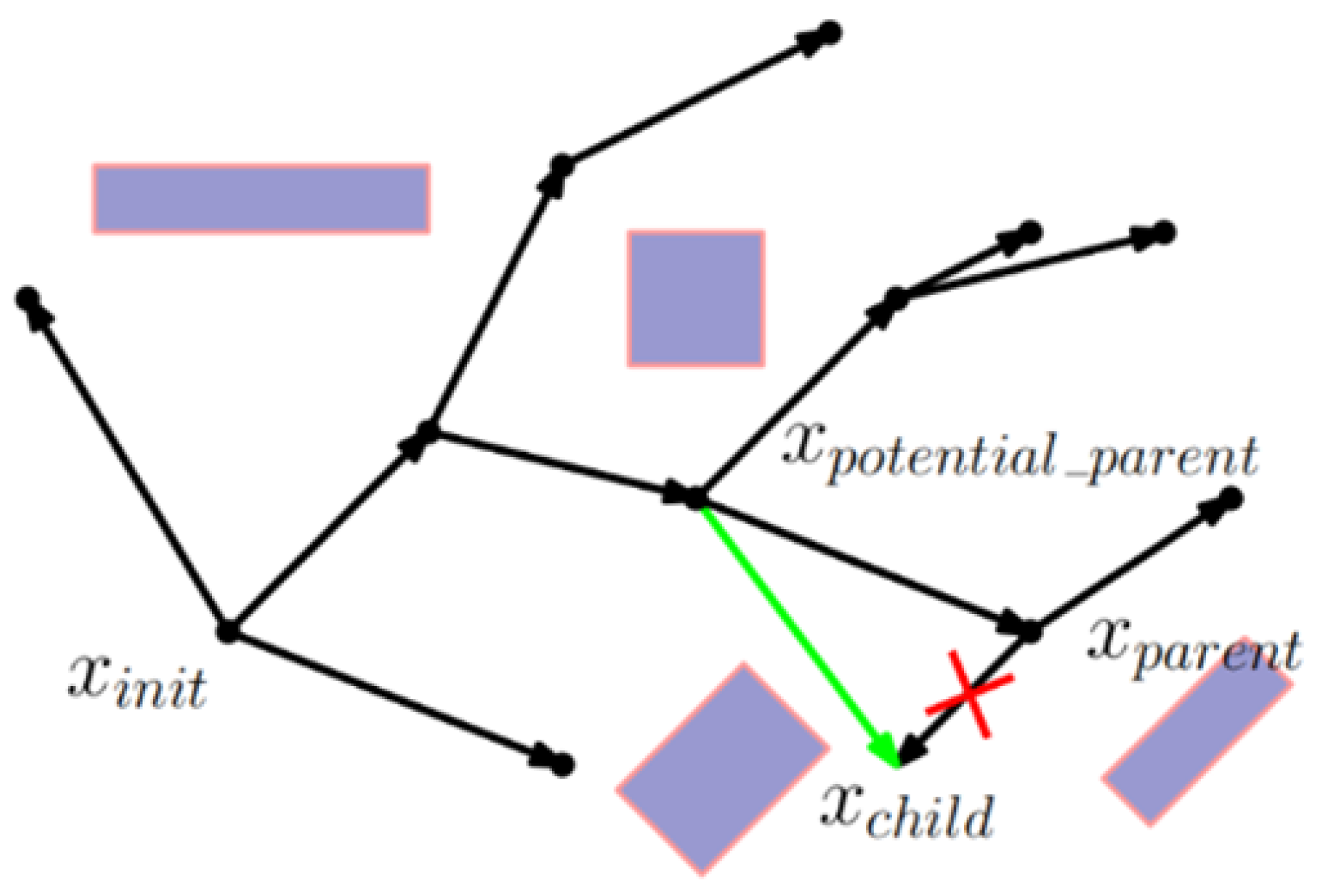
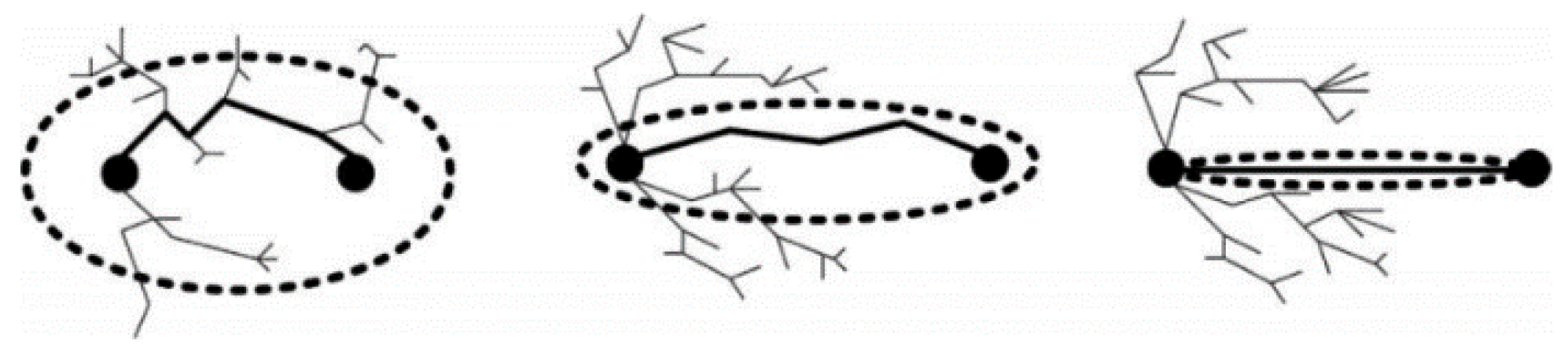
The RRT algorithm is a sampling-based random search algorithm designed to efficiently explore feasible paths within complex high-dimensional spaces. The core concept of the traditional RRT algorithm, as depicted in the diagram below, involves initiating from a starting point and progressively constructing a search tree. At each iteration, a random target point is generated, and the node closest to this point within the search tree is selected. This chosen node then serves as the parent node for the newly generated target point. Subsequently, a new node is extended in the direction of the random node for a specified distance and incorporated into the search tree. This iterative process continues until reaching the goal or meeting predefined termination criteria. The RRT algorithm is distinguished by its simplicity, efficiency, lack of preprocessing requirements, adaptability to nonlinear constraints, and dynamic environments, rendering it widely applicable in the realm of intelligent robot inspection [21].

3.2. Algorithm Optimization in Special Inspection Environments at Ports

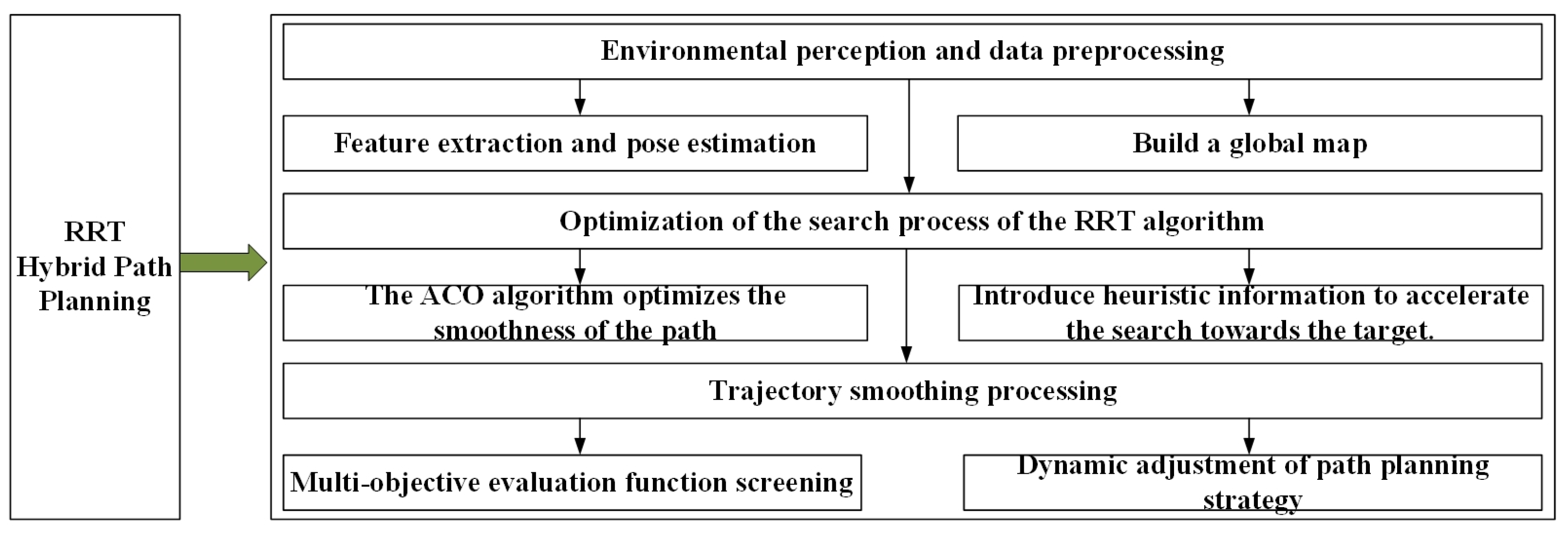
This paper proposes a constrained optimization RRT algorithm that integrates the ant colony optimization (ACO) heuristic mechanism. The core innovation lies in constructing a formal correlation framework between ACO and RRT through Formulas (1)–(4), eliminating the cognitive biases of their independent operation. This framework defines Formula (1) as the edge/path cost criterion of RRT, replacing the traditional Euclidean distance cost and serving as the core evaluation index for parent node selection and path reconnection; embeds Formulas (2) and (3) into the RRT expansion steps as the constraint feasibility judgment conditions for candidate nodes; converts Formula (4) into heuristic information for guiding the directional sampling and expansion direction selection of RRT. It is integrated as an organic component of the RRT framework and deeply embedded in the entire iterative process of sampling → expansion → constraint verification → cost update. Through this correlation design, the algorithm retains the advantage of RRT’s rapid search for feasible paths, while leveraging the heuristic mechanism of ACO to achieve global optimization of the path and improvement in smoothness, and also possesses the ability to handle multi-objective constraints and adapt to dynamic environments. It is suitable for path planning tasks in complex scenarios such as port robot inspections.

3.2.1. Optimization of Search Strategy

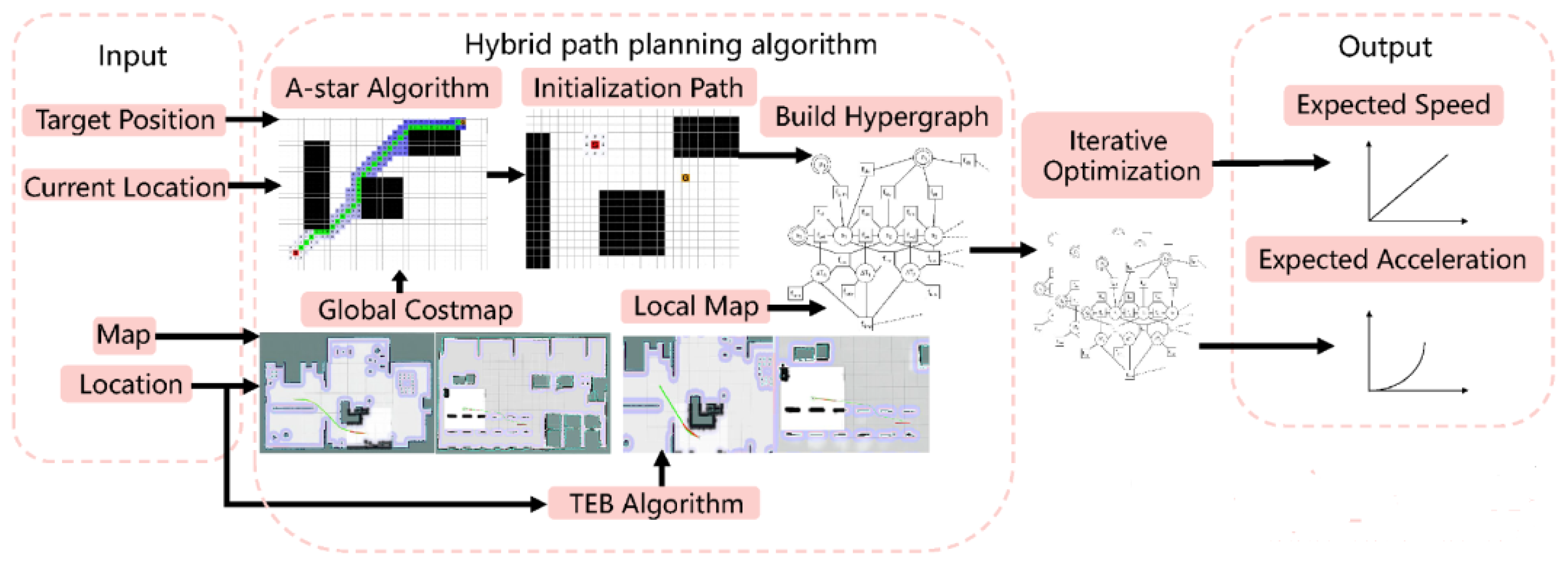
The global path planning takes the static obstacle cost map as the input, and does not consider the mechanical properties and kinematic constraints of the robot. It uses the A * algorithm to plan the optimal path from the robot’s current location to the target location and provides initial values for local path planning.
Local path planning collects the path nodes on the globally optimal path and optimizes the subset of the global path between the robot’s current node and the collected path nodes. It combines static obstacle cost map and dynamic obstacle cost map, and uses TEB algorithm to continuously adjust the robot’s attitude and direction in the scope of local path planning, considering its shape, dynamic model and motion performance. When it encounters a dynamic obstacle, it removes the old robot pose and adds a new one, making it possible to generate a new path with each iteration and obtain an optimized path through successive iterations.
By integrating navigation algorithm, the optimal global path planning and real-time obstacle avoidance function are realized in the navigation process of mobile robot.
In the intricate and dynamic context of port environments, optimizing the search strategy of the Rapidly-exploring Random Tree (RRT) algorithm is paramount for augmenting the flexibility and adaptability of path planning. By defining the random growth direction for RRT nodes, the algorithm can effectively adjust to diverse and intricate scenarios such as narrow passages and obstacles, thereby enhancing its flexibility and adaptability. Introducing randomness in the growth direction of nodes amplifies the exploratory nature of the algorithm, facilitating the exploration of novel pathways and encompassing a wider spatial scope, thereby circumventing local optima [22]. Consequently, this study refines the search process of the RRT algorithm, as illustrated in the diagram below.
The cost associated with determining the optimal paths in the Rapidly-exploring Random Tree (RRT) algorithm at the initial and goal nodes, as well as during the ongoing iteration, is utilized to establish the elliptic state subset space, depicted in Figure 1. Upon identifying a viable initial path, the start and target nodes act as the two foci. The distance between these foci serves as the major axis, with the trajectory length determining the long axis, and the construction of an ellipse selection for the short axis. Subsequently, all sampling points must fall within this elliptical sampling space. As a more optimal path is discovered, the aforementioned process is reiterated continuously, leading to a reduction in the sampling space. Eventually, as the ellipse converges to a line segment connecting the two foci, the most optimal path is identified, Green indicates feasible paths, while red indicates infeasible paths. see Figure 2, Figure 3 and Figure 4.
To verify the effectiveness of the proposed heuristic function, this paper provides some benchmark tests to ensure its adaptability and performance in different application scenarios. By comparing it with other traditional heuristic functions, the advantages of the improved heuristic method in actual path planning can be demonstrated. Specifically, the benchmark tests can include the following aspects:
1. Standard test environment: Select representative sets of path planning problems, such as the distribution of obstacles in classic 2D or 3D environments, different scales of open or closed spaces, etc. Through these standard environments, the performance of the algorithm in terms of computation time, path quality, convergence speed, etc. can be compared intuitively.
2. Comparison with traditional methods: Compare the improved heuristic RRT algorithm with traditional RRT algorithms, A* algorithms, or other common path planning algorithms. Through experimental verification, it can be shown how the heuristic function improves in terms of path search efficiency, path smoothness, and computational complexity.
3. Dynamic environment assessment: Consider the impact of dynamic obstacles, especially in real-time demanding application scenarios such as port inspection. It can be demonstrated whether the heuristic function can quickly adapt to environmental changes and adjust the path planning strategy. Through tests in dynamic environments, the robustness and real-time performance of the algorithm in changing conditions can be demonstrated.
4. Performance evaluation metrics: In the experiments, evaluation criteria can include computation time, path planning quality (such as path length and smoothness), algorithm stability (adaptability to different initial conditions and environmental changes), and convergence speed, etc.
5. Comparison with other heuristic functions: In related work, other commonly used heuristic functions, such as those based on Euclidean distance, Manhattan distance, cost functions, etc., can be discussed, and their comparison results with the method proposed in this paper can be presented. Through such comparisons, the advantages of the new heuristic function in different scenarios can be highlighted, especially in terms of convergence speed and path quality improvements.
Through these benchmark tests and comparisons with other methods, the effectiveness of the improved heuristic function in actual path planning can be effectively verified, and data support can be provided for further optimization of the algorithm.
In conclusion, introducing a random direction as the growth orientation for nodes in the Rapidly-exploring Random Tree (RRT) algorithm enhances its performance in port inspection tasks by enhancing adaptability to intricate environments, increasing exploratory capabilities, and mitigating the risk of converging to local optima. Consequently, this refinement facilitates more efficient completion of path planning assignments.

3.2.2. Heuristic Function Improvement

The traditional RRT algorithm operates by identifying the node closest to the randomly sampled node and subsequently connecting the new node to this identified node. While this heuristic approach is straightforward, it suffers from slow convergence rates and is inadequate for meeting the real-time demands of inspection vehicles. Consequently, this paper proposes a tailored heuristic function, designed in accordance with the unique attributes of the path planning problem, to address these shortcomings effectively.
C ( X 1 , X 2 ) = N 1 ( d ) D ( X 1 , X 2 ) + N 2 ( θ ) H ( X 1 , X 2 ) D ( X 1 , X 2 ) = ( x 1 x 2 ) 2 + ( y 1 y 2 ) 2 H ( X 1 , X 2 ) = θ 1 θ 2 N 1 ( d ) = d max d d max N 2 ( θ ) = θ max θ θ max
As indicated in the aforementioned equation, the heuristic function proposed in this paper incrementally adjusts the distance weight between nodes based on the distance to the target point. This adjustment aims to expedite the search process towards the target point, with the incorporation of heuristic information serving to enhance the efficiency and quality of path planning. Utilizing pre-computed Euclidean distances and similar metrics, nodes are guided to expand in directions that facilitate faster progress towards the goal. In dynamic path planning environments, the heuristic function can be customized to integrate the positions of moving obstacles, enabling real-time adjustments to the path planning strategy. By integrating these enhancements tailored to the specific requirements of harbor inspection scenarios, the path planning approach can be optimized to enhance efficiency and performance effectively.
In contrast to the conventional RRT algorithm, which selects the node with the shortest distance to the new node as the parent node, the enhanced heuristic approach demonstrates superior convergence. Leveraging the rapid convergence rate of the heuristic function, it adeptly integrates its benefits into the fundamental RRT algorithm, thereby promoting a more discerning selection of parent nodes by the new node.

3.2.3. Trajectory Smoothing

The conventional RRT path planning algorithm employs a uniform random sampling strategy to generate paths consisting of multiple nodes, resulting in trajectories that lack smoothness, exhibit jitteriness, and feature sharp corners. Particularly in harbor environments characterized by numerous irregular obstacles, RRT tends to produce trajectories with multiple turning points and redundant nodes. For a partially constrained vehicle, tracking such a path becomes challenging, posing risks to both the inspection vehicle’s operational lifespan and overall safety [23]. To address this issue, this study introduces an effective Bessel trajectory smoothing technique that utilizes quasi-uniform B-spline curves to refine the pruned path nodes, thereby producing a feasible trajectory that adheres to the vehicle’s kinematic constraints.
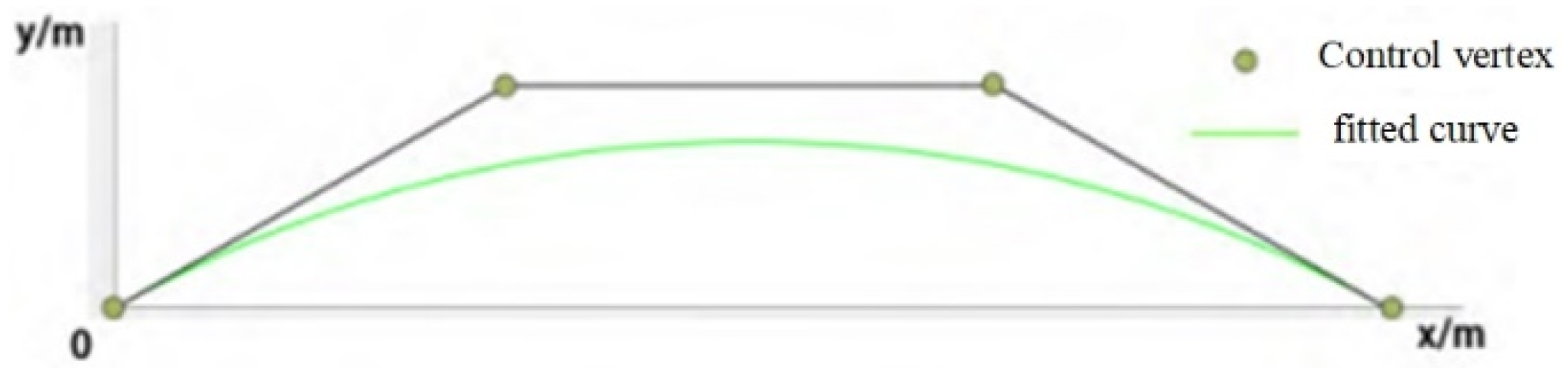
By conducting a comprehensive analysis of both the kinematic model of the inspection vehicle and the driving environment, and taking into consideration the algorithm’s computational complexity, this study opts for a three-times quasi-uniform B-spline curve approach to path smoothing. This method enables the generation of a smooth path characterized by continuous curvature. The schematic representation of the resulting inspection route curve is illustrated in Figure 5 [24].
X n e w A = X 1 + ( X X 1 ) ( L 1 A ) / d 1 X n e w B = X 1 + ( X X 2 ) ( L 2 A ) / d 2
Compared with the trajectory smoothing methods introduced in related works, the trajectory smoothing method proposed in this paper has several novel features, mainly reflected in the following aspects: Many existing trajectory smoothing methods usually adopt static smoothing strategies, ignoring the influence of dynamic changes in the path environment. The method proposed in this paper can adaptively adjust the smoothing strategy by considering the real-time changes of obstacles in the environment and the dynamic adjustment of the target position, so as to maintain the smoothness and feasibility of the trajectory in a dynamic environment. This dynamic adjustment based on environmental feedback makes the algorithm more robust and real-time in practical applications. In summary, the trajectory smoothing method proposed in this paper has made innovations in many aspects, especially by combining heuristic information and dynamic environmental feedback, improving the smoothing effect and path planning efficiency, and making it more practical and reliable in complex and dynamic environments.

3.3. Evaluation Function

In this study, following the exclusion of kinematic, collision, and dynamic constraints in the speed sampling process, a multitude of feasible speed combinations and corresponding motion trajectories meeting the specified criteria persist within the speed space. Consequently, an evaluation function incorporating target point azimuth, obstacle distance, and velocity is devised to refine the selection of feasible trajectories. This refinement process aims to derive a more optimal and feasible search velocity space. The formulation of the evaluation function is delineated in reference [25].
G ( v , w ) = δ ( α h e a d i n g ( v , w ) + β d i s t ( v , w ) + γ v e l ( v , w ) )
where h e a d i n g ( v , w ) evaluates the degree of deviation of the trajectory point from the target point; d i s t ( v , w ) evaluates the minimum distance between the trajectory and the obstacle; and d i s t ( v , w ) evaluates the moving speed of the robot. In this paper, the finally selected travelable trajectory should simultaneously satisfy the three conditions of converging to the target point, reasonably avoiding obstacles and maintaining a fast moving speed.

4. Experimental Results and Analysis

The experimental environment of this paper: Window11 64-bit operating system, i7-10400 CPU, main frequency 2.3 GHz, memory 16 GB (State Key Laboratory of Coastal and Offshore Engineering, Dalian University of Technology, Dalian, China), simulation software Matlab 2020b. All the algorithms were compared and tested under the same dataset, initial conditions and simulation parameters to ensure the comparability and reliability of the results.
Firstly, by projecting a 3D laser onto a 2D depth map, the ground is segmented according to the pitch Angle, and non-ground point clouds are clustered and marked point cloud data are obtained to reduce the dimension of the laser point cloud data. Then, four groups of feature point clouds are obtained by feature extraction based on smoothness. The 6-degree-of-freedom attitude transformation matrix is solved by Levenberg-Marquardt optimization method. Then, the iterative nearest point algorithm is used for loop detection. Finally, the current point cloud is mapped to the global map based on graph optimization, and the high-precision map is established.

4.1. Static Environment Comparison Simulation Experiment

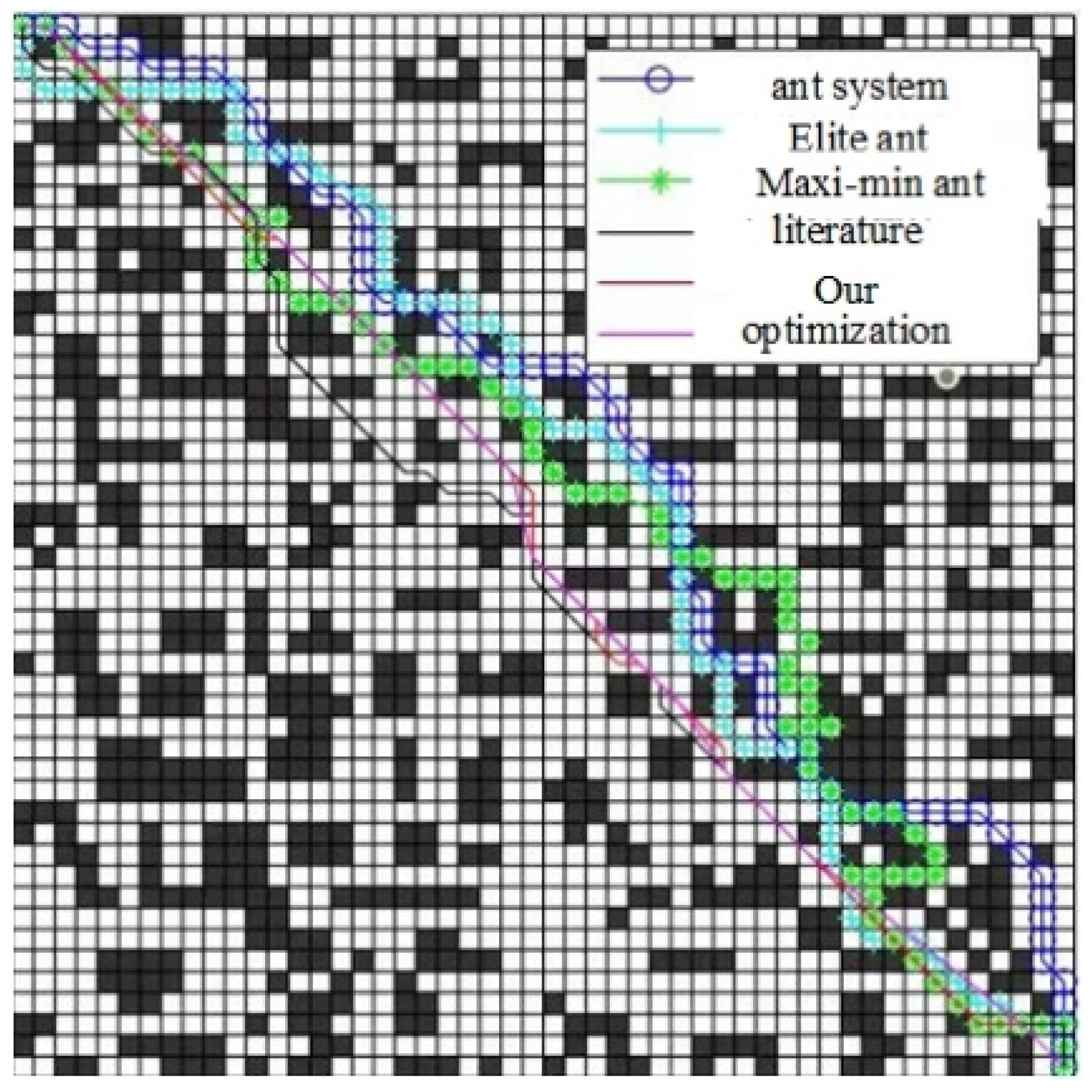
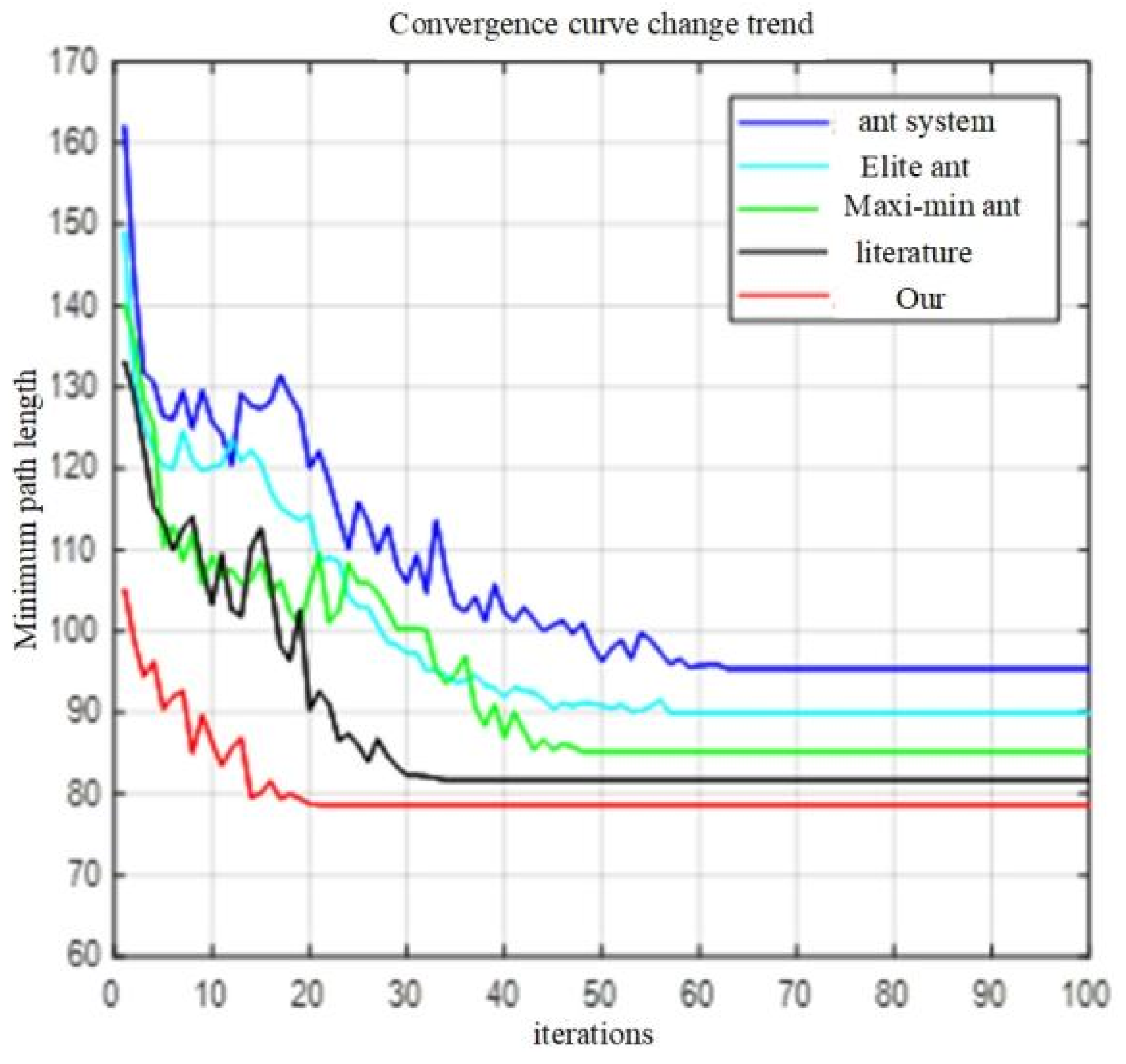
To validate the efficacy and superiority of the enhanced RRT algorithm proposed in this study within a known static environment, comparative simulation experiments are conducted against the improved A* algorithm [26], the enhanced ACO algorithm [27], the refined ACO-based algorithm [28], the optimized RRT algorithm [29], and the quadratic optimization algorithm [30]. The evaluation criteria encompass five key aspects: path length, total steering angle, number of steering maneuvers, planning time, and frequency of obstacle collisions. The simulations are executed on the MATLAB 2021a platform, utilizing a 50 × 50 raster map with a minimum resolution of 3 cm × 3 cm. The experimental findings are presented in Figure 6 and Figure 7.
The depicted results reveal that in a complex environment featuring a higher density of 50 × 50 obstacles, the algorithm enhancements proposed in this study achieve convergence to 76 after 20 iterations. In comparison, the refined A* algorithm converges to 90 after 60 iterations, the enhanced ACO algorithm converges to 94 after 60 iterations, the ACO-based improved algorithm converges to 88 after 58 iterations, the optimized RRT algorithm converges to 86 after 50 iterations, and the quadratic optimization algorithm converges to 80 after 30 iterations.
The algorithm enhancement presented in this paper reduces the number of iterations by 64.91%, 58.33%, and 37.50%, respectively, while decreasing the path length by 12.49%, 7.67%, and 3.69% when compared to the improved ACO, ACO-based algorithm, and optimized RRT algorithm. Additionally, post-secondary optimization yields a 2.6% reduction in path length and a 53.9% decrease in the number of transitions compared to pre optimization.
Notably, the enhanced algorithm in this paper demonstrates significantly accelerated convergence, fewer iterations, and identifies a relatively shorter optimal route length when contrasted with the other four algorithms.
The data from Table 1 elucidates that the improved RRT algorithm, with 100 iterations, exhibited the shortest execution time, contrasting with the improved ACO algorithm which recorded the longest total runtime. This discrepancy can be attributed to the notably intricate environment, where finding a feasible path poses substantial challenges. Notably, both the improved algorithm and the secondary optimization algorithm showcased an increase in total elapsed time, primarily due to the exponential rise in computational demands stemming from algorithmic enhancements.
Furthermore, the performance metrics, including average path length, average number of convergences, and average steering angle, highlight the superior effectiveness of the improved algorithm presented in this paper, in comparison to the other four methods. These results further affirm its capability in navigating complex environments and optimizing path planning parameters.

4.2. Ablation Experiment

To validate the efficacy of each algorithmic enhancement proposed in this paper, ablation experiments were conducted on 50 × 50 raster maps to scrutinize the experimental outcomes, as detailed in the subsequent table.
As shown in Table 2, the enhancement of the search strategy resulted in significant reductions in both average path length and steering angle length, greatly improving the algorithm’s efficiency. Following the integration of the heuristic function, the convergence speed increased while the steering angle was minimized. Additionally, although trajectory smoothing led to a slight decrease in algorithm speed, other performance metrics showed improvement [30]. In conclusion, the three enhancements applied to the RRT foundation in this study have proven to be effective on their own.
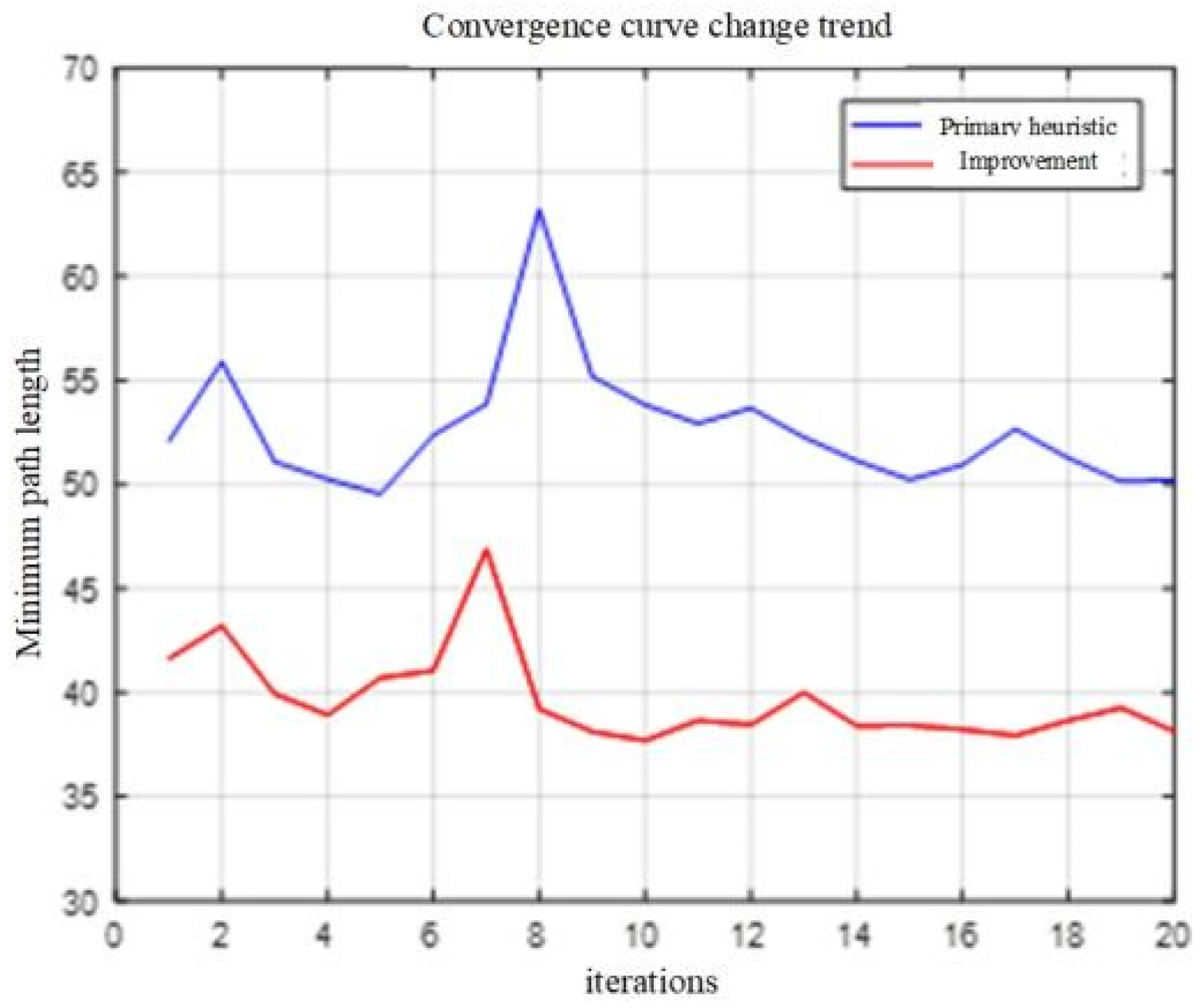
While the original heuristic function exhibits superior global search capability, it inadvertently results in slower overall algorithm convergence, extended runtime, and diminished local search effectiveness, as depicted in Figure 8. Conversely, the enhanced heuristic function proposed in this study not only enhances computational speed but also fortifies local search capability, thereby facilitating accelerated algorithm convergence in later stages, as illustrated in Figure 9. Through a total of 15 experiments, both pre and post the heuristic function improvement, with the initial 20 iterations considered, the average convergence curve depicted in Figure 10 further underscores the accelerated convergence speed facilitated by the improved heuristic function, significantly reducing the likelihood of convergence oscillations.

4.3. Simulation of Port Environment Simulation Experiment

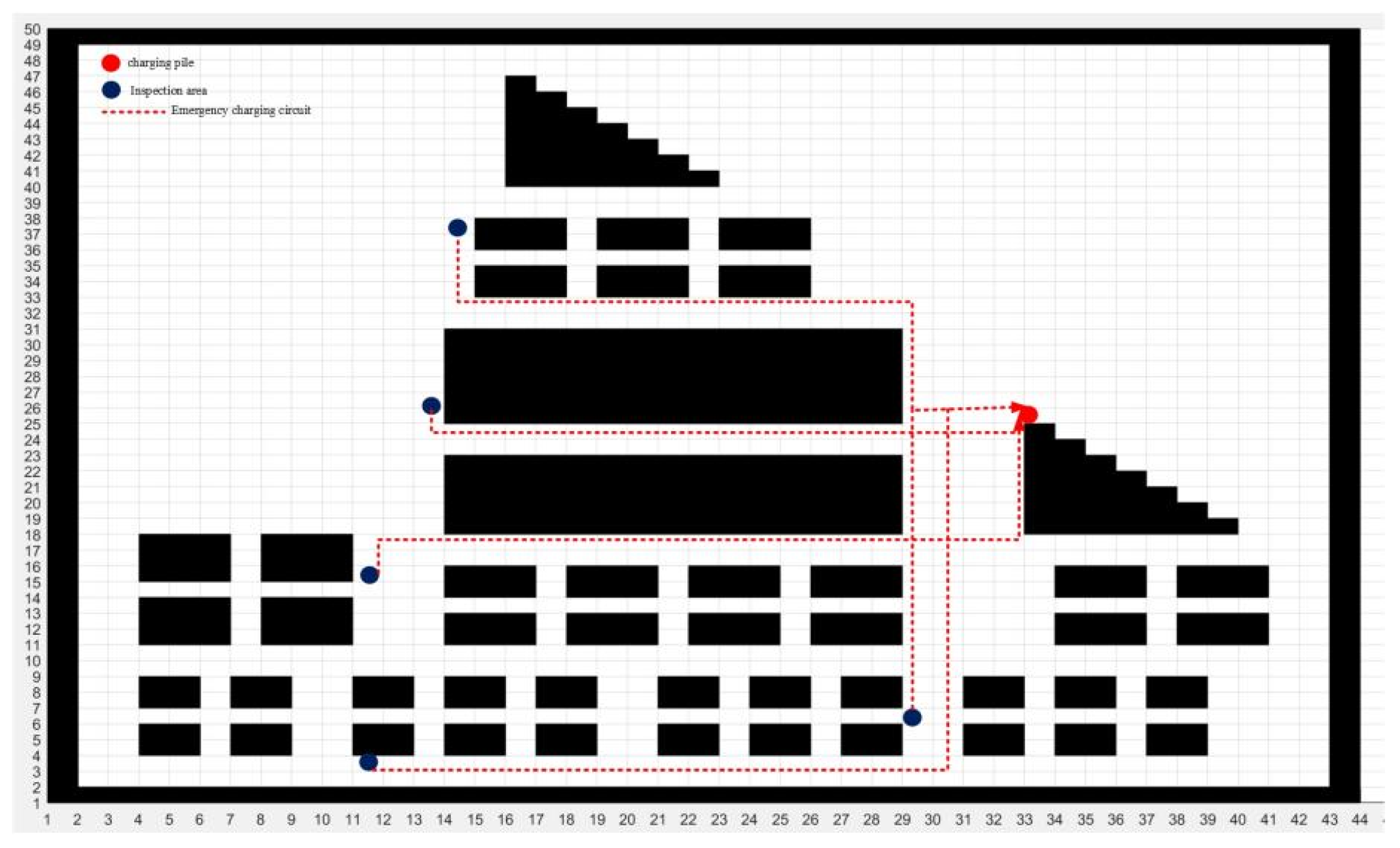
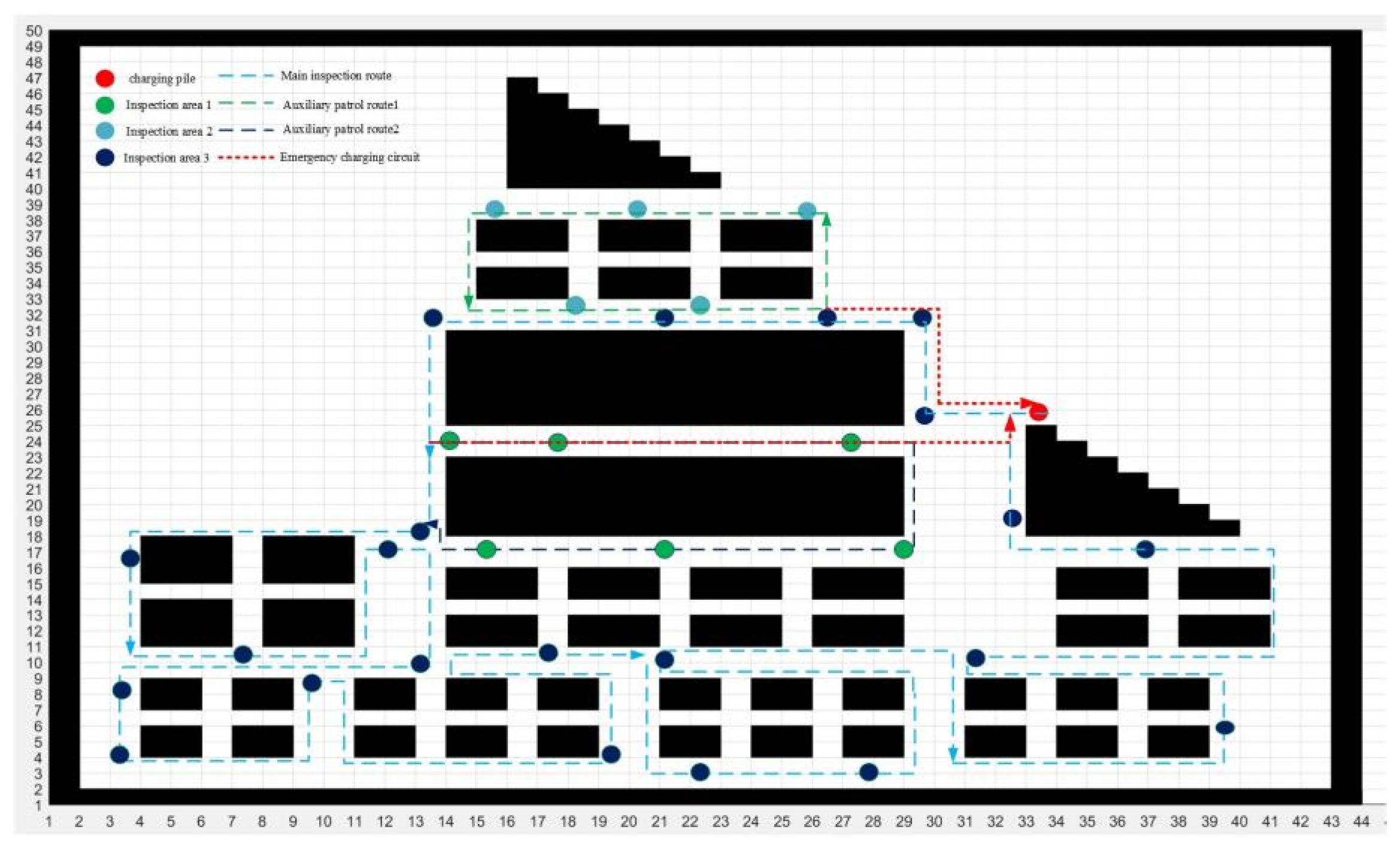
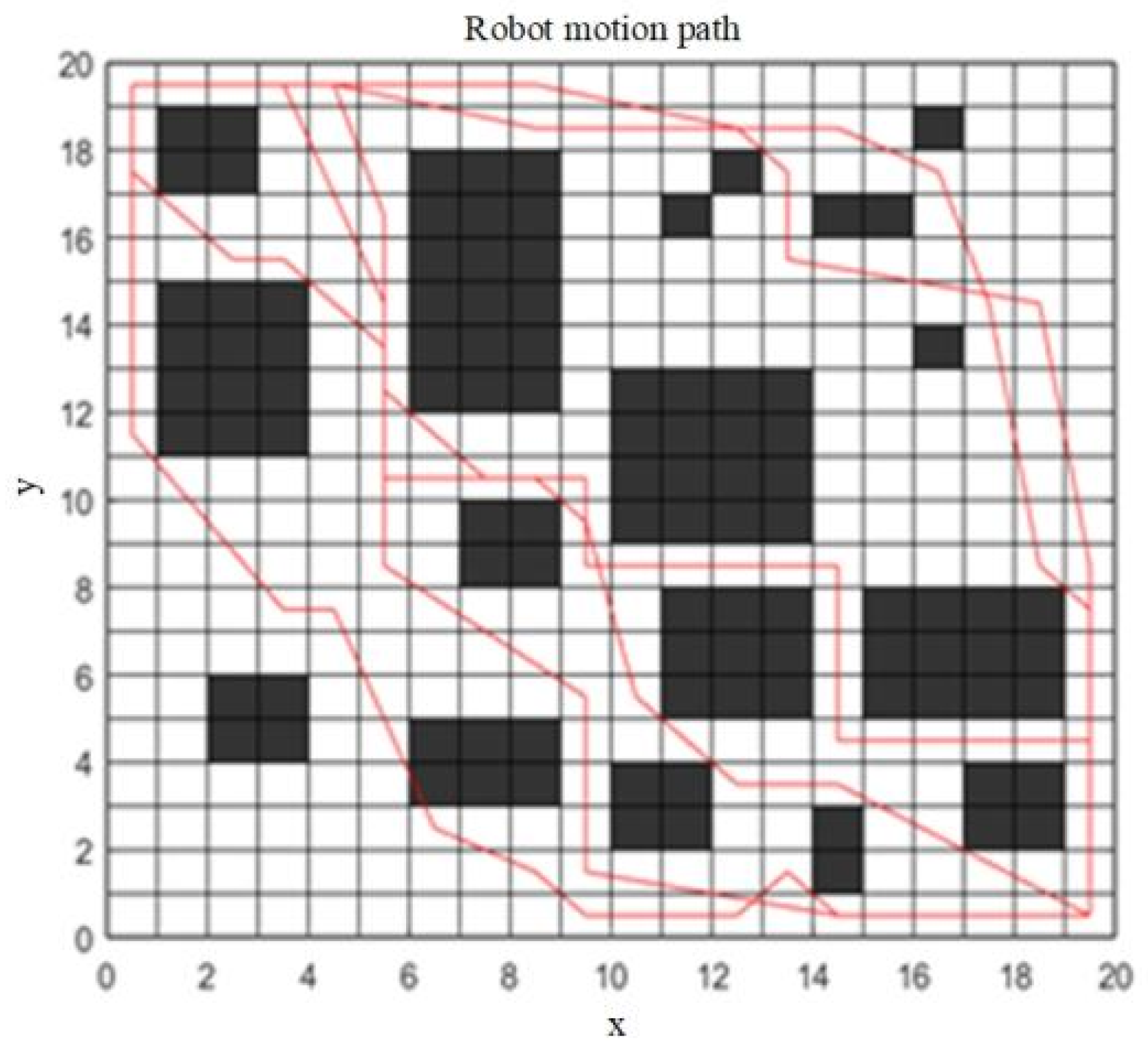
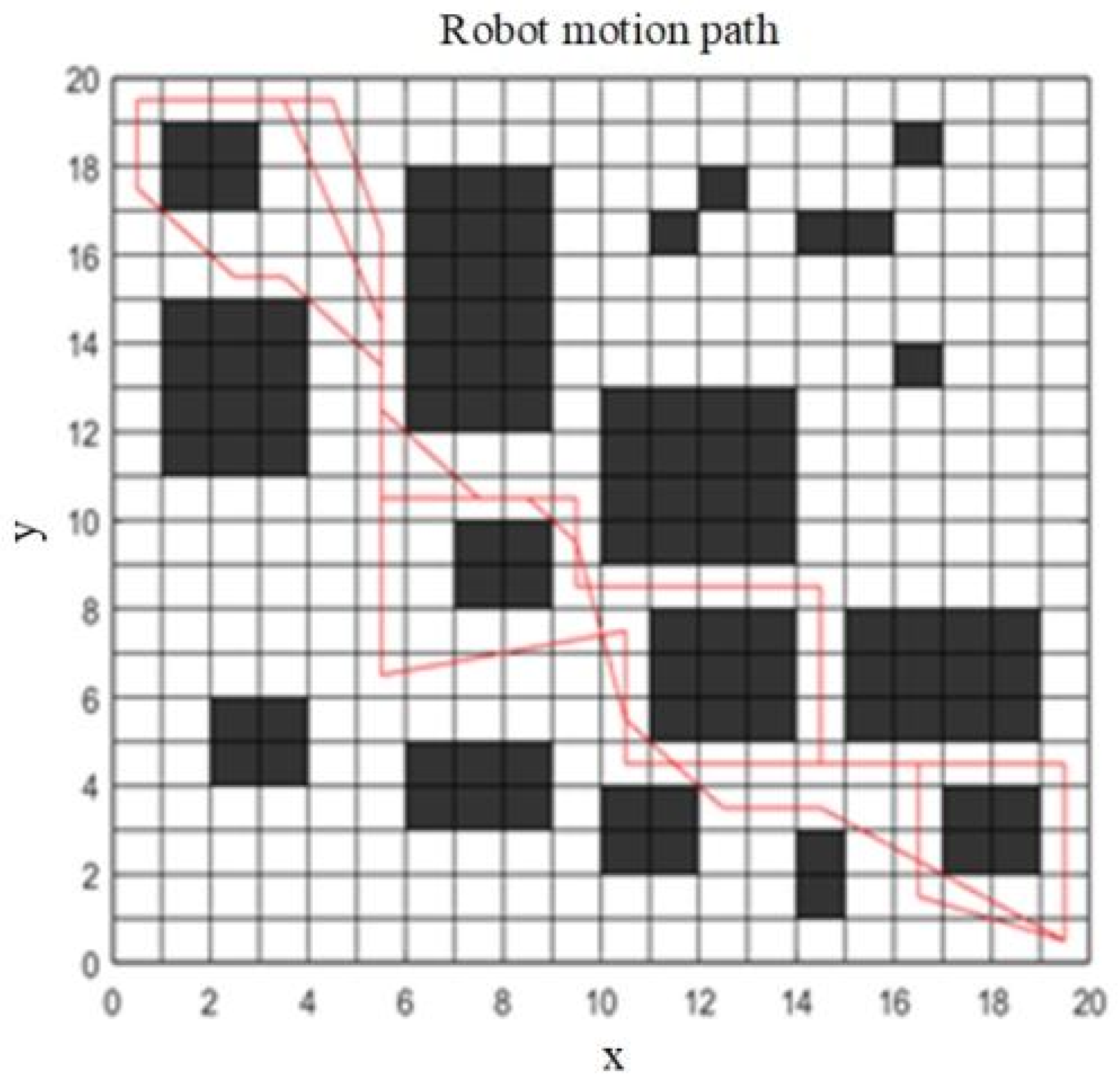
In this paper, experiments were conducted in a simulated harbor environment, with the robot’s initial and final positions set at coordinates (35, 25), representing the location of the charging station. The black grid in the figure denotes static obstacles and safety margins within the inspection area. The robot’s objective is to navigate from the starting point to the endpoint without collisions, utilizing a combination of global and local target points. Along the inspection path, the primary focus is on reaching the warehouse, with the robot strategically planning local inspections based on remaining battery power post-warehouse inspection. The robot’s battery capacity is 10 km, and it moves at a speed of 5 km/h. When the remaining battery falls below 30%, the robot promptly returns to the charging station. During a specific inspection instance, when the robot reaches the inspection point in the lower left corner of the parking lot, having covered 7.21 km, and the remaining battery is less than 30% of the total mileage, the robot directly heads back to the designated red charging point. Additionally, the inspection robot is equipped with a power sensor and navigation system for real-time power monitoring and autonomous identification of charging routes. The power sensor accurately measures the battery level, while the navigation system employs pre-set path planning and environmental awareness technologies to guide the robot to charging stations [31]. Upon detecting a low power level, the inspection robot initiates a charging route search program, leveraging sensors for voltage and current changes, visual recognition, predefined paths, wireless communication, and map localization to ensure timely charging and uninterrupted inspection task execution. The outcomes of these procedures are illustrated in Figure 11, Figure 12 and Figure 13.
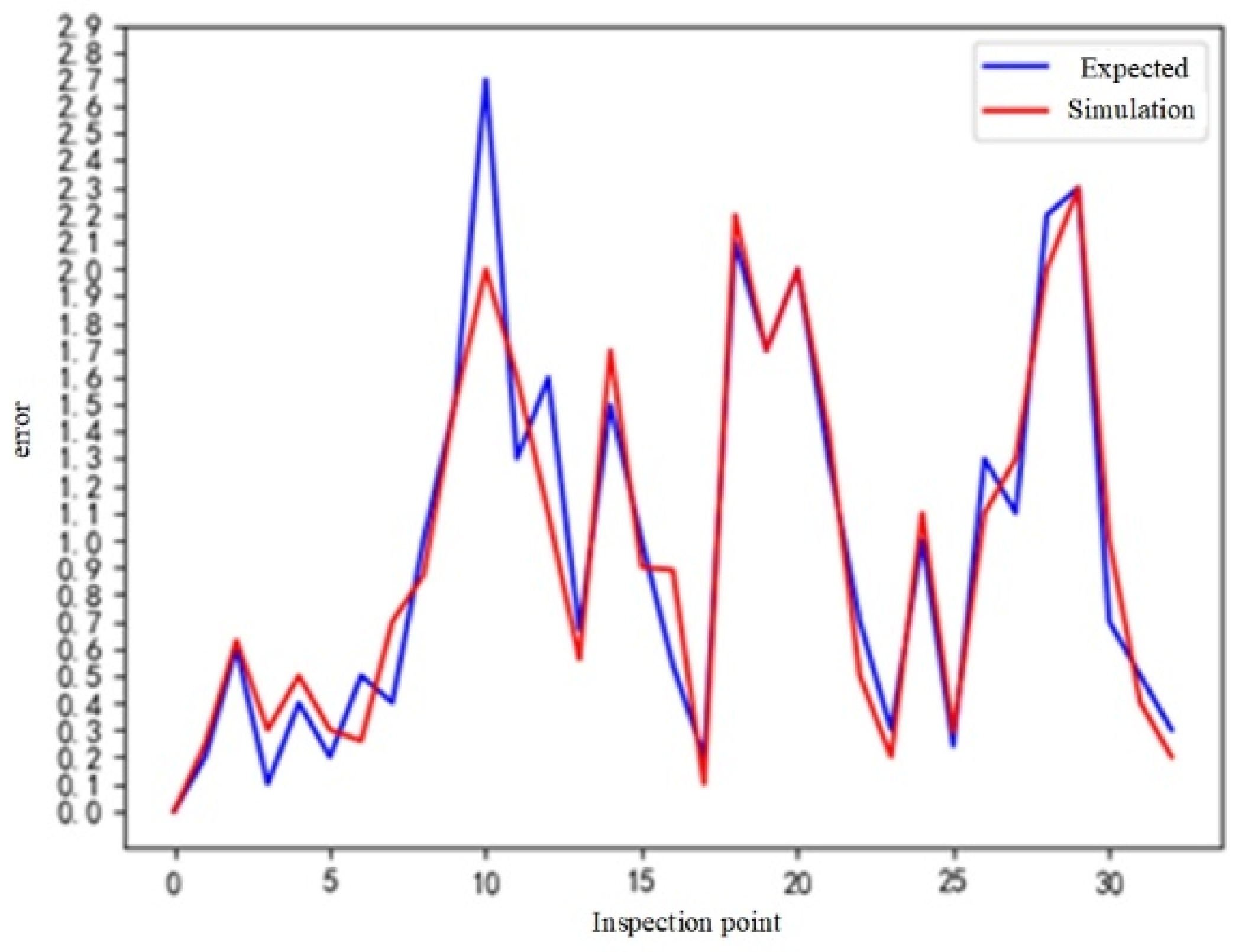
As depicted in Figure 11, Figure 12 and Figure 13, the algorithm presented in this paper demonstrates efficient completion of inspection tasks within the harbor area, successfully navigating around obstacles with minimal error between the desired and simulated paths. It exhibits a high level of accuracy and adaptability in diverse inspection areas, enabling real-time power monitoring and autonomous charging route exploration. Notably, at specific sampling points such as 9–11, 14–17, and 25–27, the algorithm shows larger errors due to unique robot conditions. However, the robot gradually converges towards the desired path by leveraging global and local target points. Near sampling point 24, the trajectory influenced solely by local target points yields better results, emphasizing the significance of local guidance. Although trajectories 18–22 and 28–32 exhibit larger errors and deviate more from the desired path, they are deemed reasonable upon comprehensive planning analysis. Through this evaluation, it is evident that the algorithm in this paper excels in identifying optimal paths within complex environments, see Table 3.
Based on the aforementioned analysis, it can be inferred that the enhanced algorithm proposed in this paper adeptly adheres to the desired path within simulated environments. It effectively navigates obstacle avoidance and achieves precise local path planning through the combined influence of global and local target points. This substantiates the efficacy of the improved algorithm put forth in this study.

5. Summary

Upon comprehensive analysis, it is clear that the enhanced algorithm introduced in this paper successfully navigates the desired path within simulated environments. The algorithm demonstrates robust performance in key areas, such as obstacle avoidance and local path planning. By leveraging the interplay between global and local target points, the algorithm is able to generate precise, adaptive paths that respond dynamically to environmental changes. This synergy between global and local planning ensures that the vehicle not only reaches its intended destination but also avoids potential obstacles efficiently, maintaining smooth and safe motion throughout. The results confirm the effectiveness of the proposed enhancements, showcasing their ability to improve path planning accuracy, robustness, and overall performance in complex, real-world scenarios.
In synopsis, we propose a path planning algorithm based on an enhanced Rapidly-Exploring Random Tree (RRT) approach tailored specifically for port inspection environments. Within this algorithm, we introduce an adaptive step-size strategy to bolster its resilience. This strategy enables the algorithm to dynamically adjust its step size, thereby optimizing performance across varying environmental complexities encountered during inspections. Furthermore, in the algorithm’s optimization phase, we implement a mechanism to prune redundant nodes from the generated path, enhancing path generation speed. By mitigating redundant nodes, path complexity is significantly reduced, concurrently bolstering efficiency while preserving path accuracy and reliability. Subsequently, following path generation, we employ a Bezier smoothing algorithm to refine the path. The Bezier smoothing algorithm effectively mitigates sharp angles and corners, rendering the path smoother and continuous. This refinement not only enhances path aesthetics but also aids in diminishing vibrations and minimizing energy consumption during the execution of the path by robots or vehicles. Consequently, these refinements contribute to heightened inspection efficiency and stability.
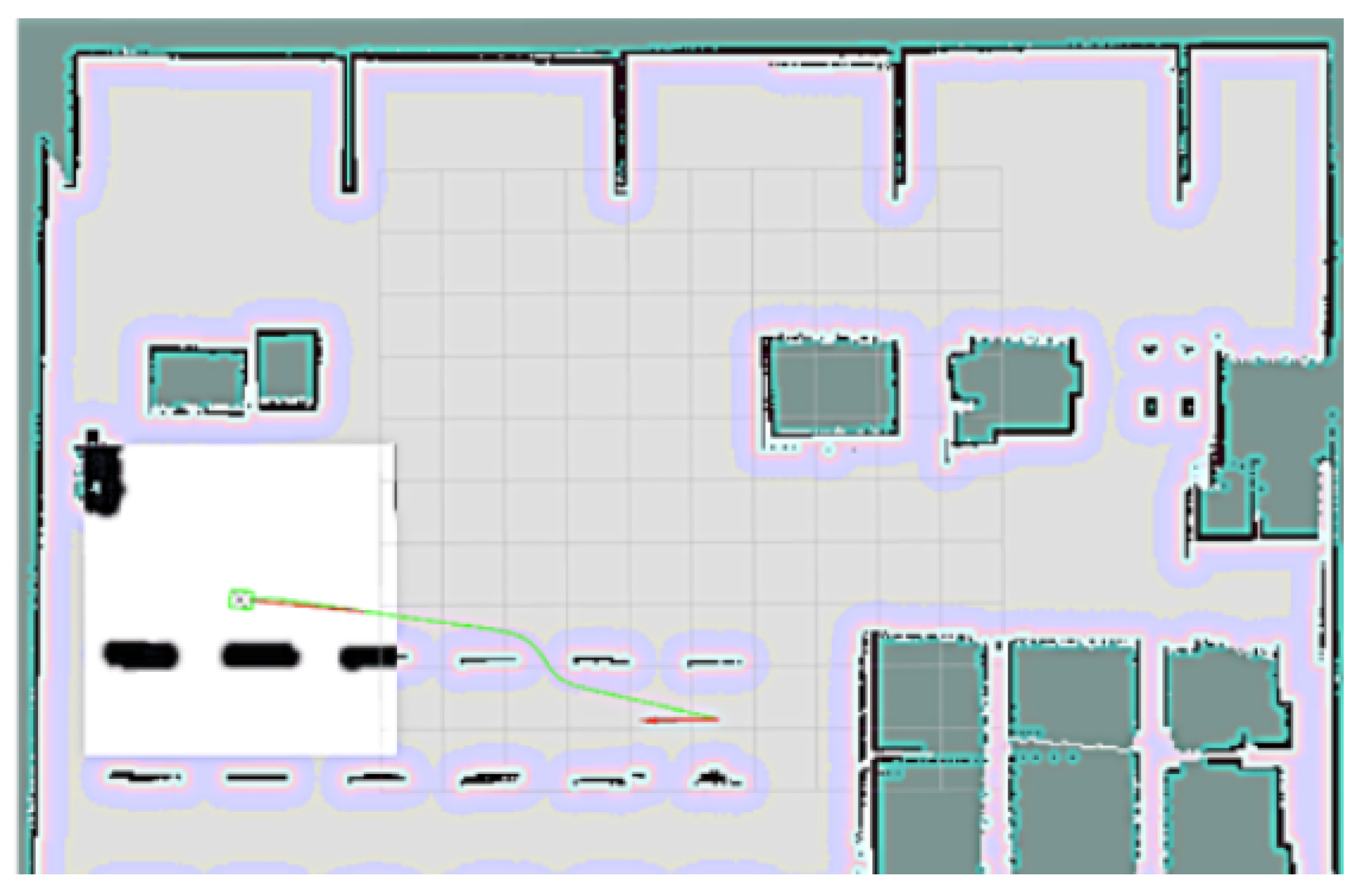
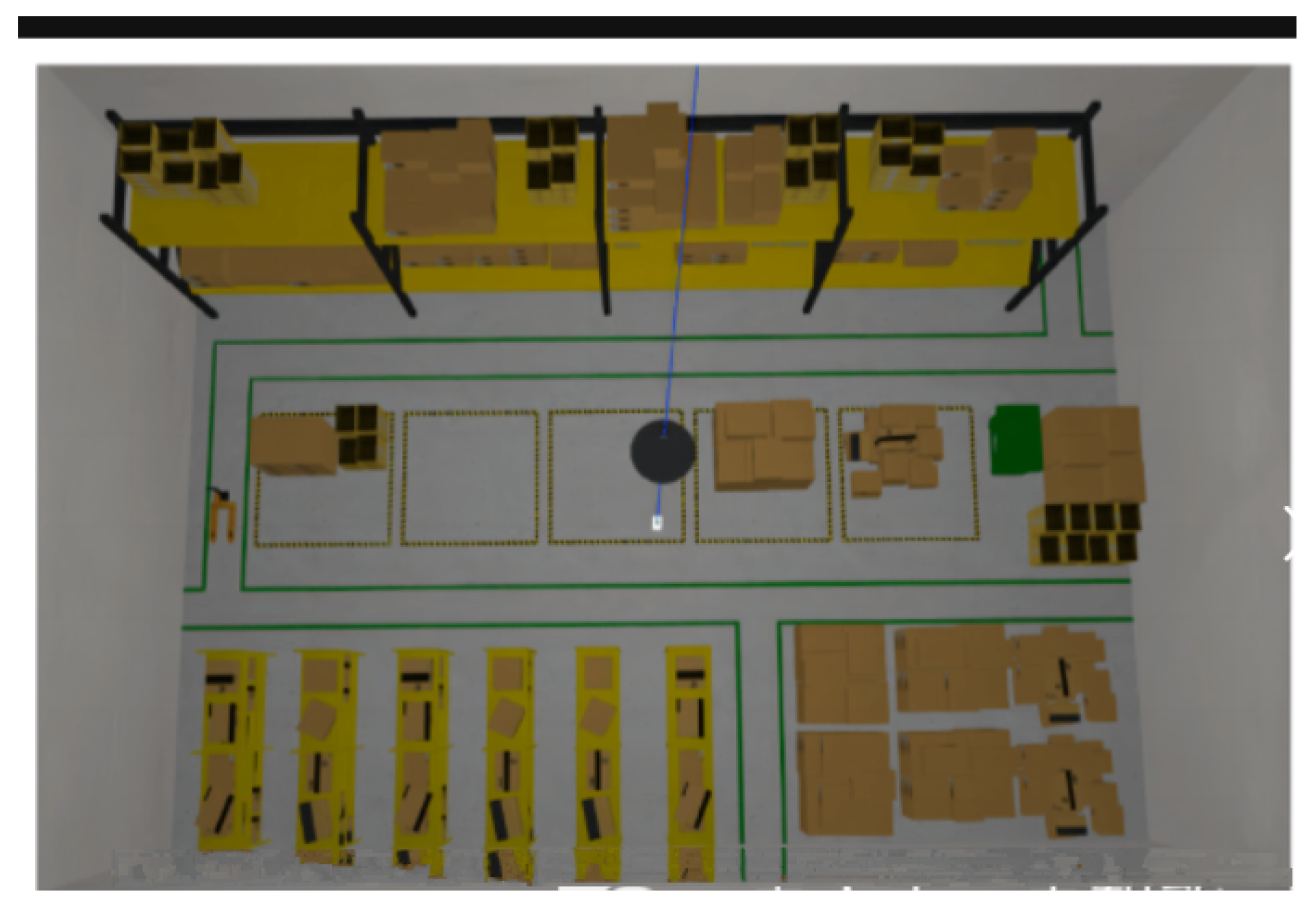
In order to verify the effectiveness of the navigation system in practical applications, we used the Turtlebot3 mobile robot in the ROS platform running on the 64-bit Ubuntu 18.04 operating system with 4 GB memory to carry out experiments on different types of scenarios, which were built in the Gazebo simulation platform. As shown in the Figure 14, we set up a factory warehouse environment to simulate the real-world environment. Using real-time positioning and map-building capabilities in Rviz, we scan the simulation environment, build the corresponding map, and perform path planning.
The path planning algorithm, which integrates enhanced RRT methodology with adaptive step size strategy, redundant node removal, and Bezier smoothing processing, is tailored for optimal application within the unique inspection environment of ports. This comprehensive approach enhances the efficiency and precision of path planning, thereby offering robust support and assurance for inspection operations.
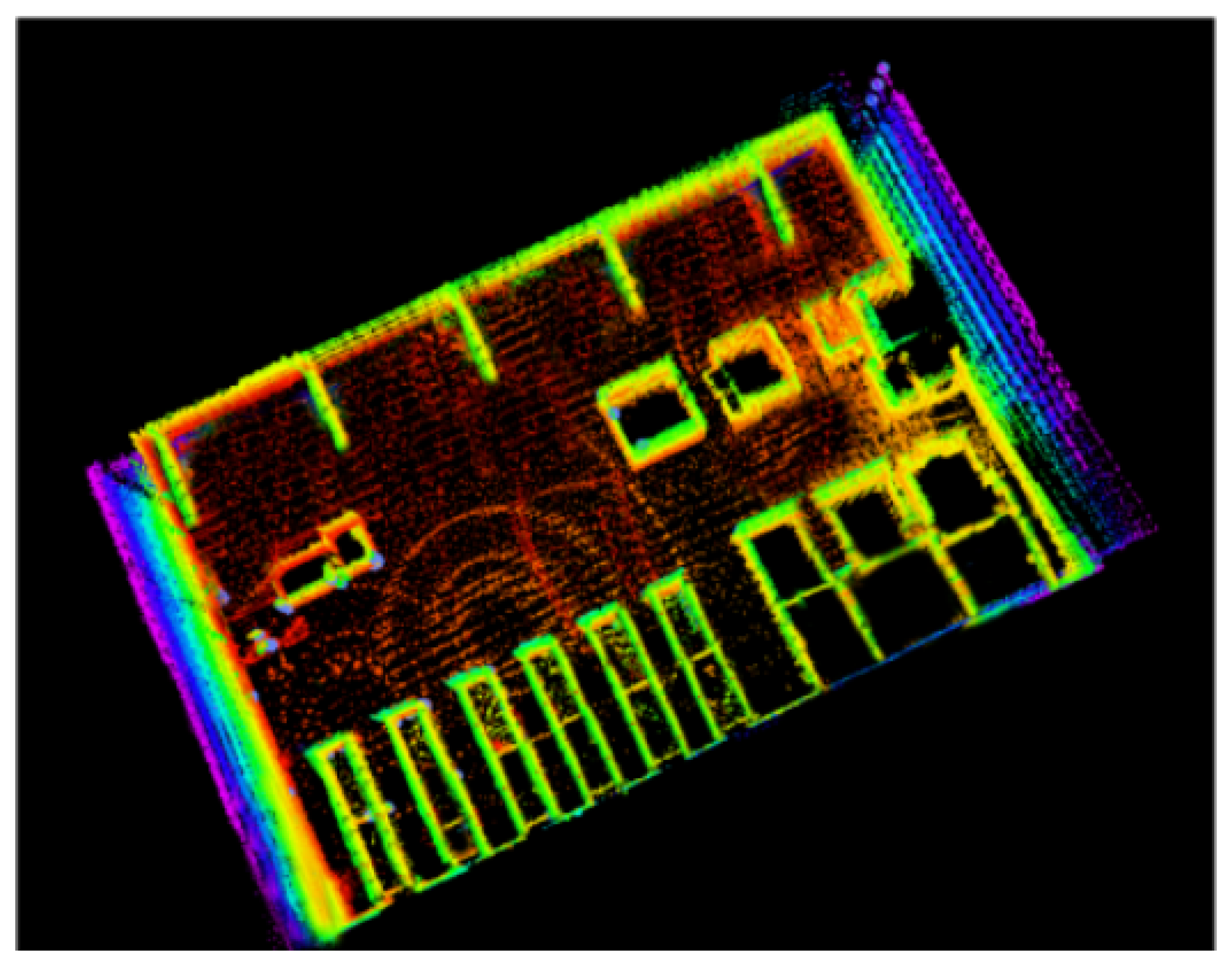
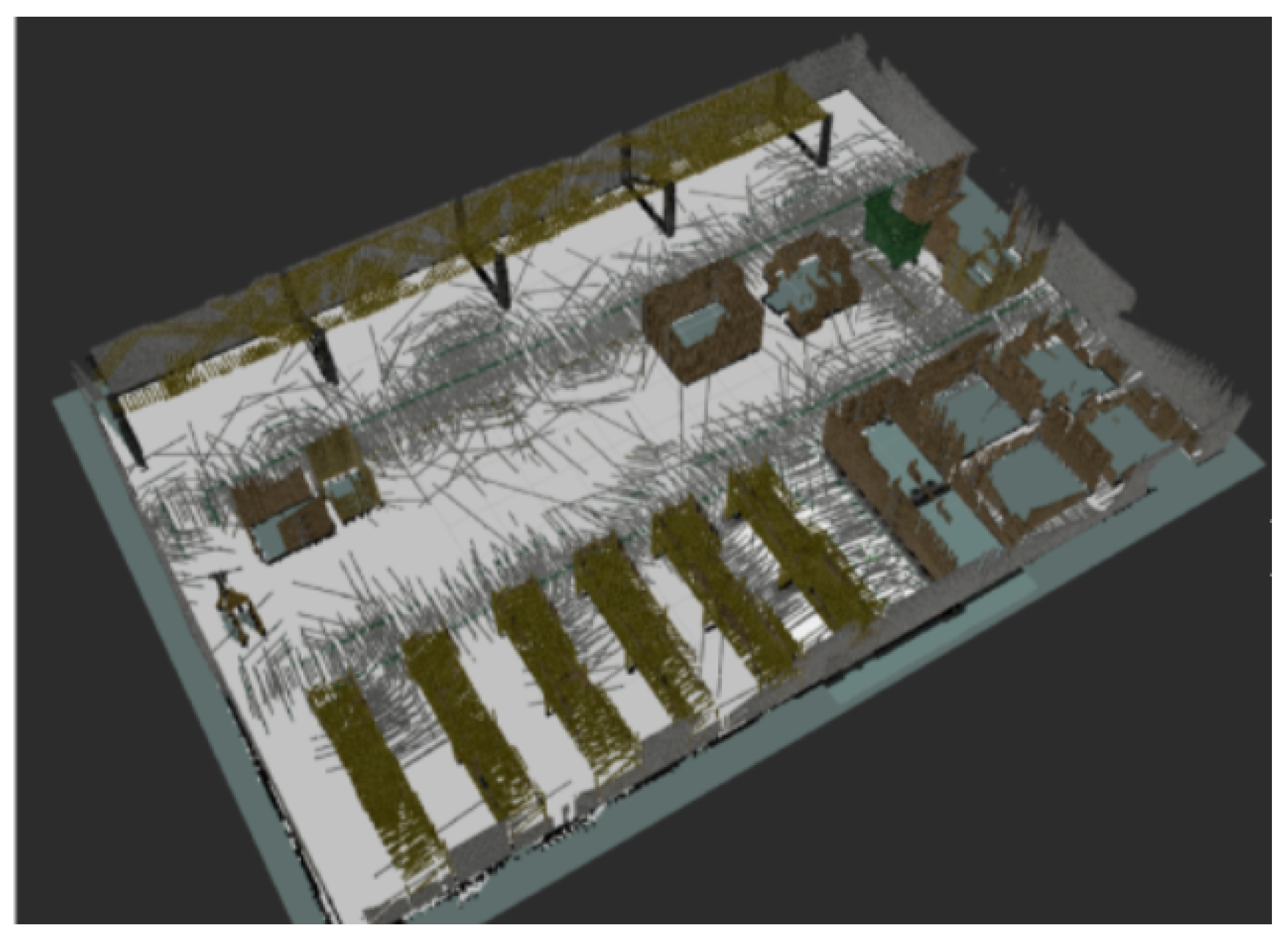
The depth camera data is first read into the ROS environment, then front-end and back-end threads are executed to build a sparse feature point map and continuously updated to create a real-time point cloud map. The front-end keyframes are passed into the point cloud build thread to generate the point cloud map. The effectiveness of the proposed map generation algorithm is verified by the corresponding point cloud map in the Figure 15, which shows the good three-dimensional effect of the map construction in the indoor environment.
As shown in the Figure 16, the algorithm detects the motion trajectory of the object, which is consistent with the actual trajectory. Although there is a deviation between the detected trajectory and the actual trajectory, there is no serious deviation, which meets the robot’s perception requirements. When the motion trajectory of the object changes significantly, there is still no serious deviation, and it also meets the perception requirements of the robot.
By comparing point cloud maps to visual maps, it can be observed that maps built using multi-line laser scanning are sharper than those built using visual algorithms, thus reducing cumulative errors and providing better edge contour processing. In addition, in order to verify the feasibility, reliability and accuracy of the algorithm, the map generation time, map generation effect and CPU utilization are compared [32].
Several tests were carried out to ensure the accuracy of the experiment. The robot is fixed at a specific location, labeled the origin (0, 0), and the output object movement data is compared with the actual object movement data.
The algorithm detects that the point cloud map is basically consistent with the simulated scene, and the detected trajectory has no obvious deviation from the actual trajectory, which meets the robot’s perception requirements. As shown in the figure, when the motion trajectory of the object changes greatly, there is a slight deviation between the detected trajectory and the actual trajectory, but no serious deviation occurs, and it still meets the perception requirements of the robot.
After testing, the path planned by the A-STAR algorithm maintains A certain distance from the obstacle, avoiding the collision between the robot and it. At the same time, the global path planning effect is good, can accurately reach the set target point position, meet the requirements of accurate positioning navigation. The robot moves along the obstacle (square) path and avoids autonomously through local path planning when encountering obstacles. The process and results of local path planning are shown in the Figure 17.
After testing, the inspection robot can accurately achieve autonomous obstacle avoidance, complete the local path planning of the set target point, and meet the requirements of accurate positioning and navigation.
In the context of the digital twin engineering of large smart hub seaports, the automation and intelligence of port inspection systems have become crucial for enhancing port safety, efficiency, and effectiveness. Traditional manual inspection methods can no longer meet the high efficiency and precision requirements of port operations, particularly in the complex port environments. In contrast, robotic inspection, with its efficiency, safety, and precision, has become one of the key technologies driving the development of smart ports. However, the complexity and dynamic nature of port environments present significant challenges for robotic path planning. Therefore, simulating the port environment and optimizing path planning algorithms based on digital twin technology are particularly important [33].
With the continuous advancement of technology and the diversification of industry demands, the scalability of the inspection model will become a key factor in its development. In the future, we can enhance the flexibility and adaptability of the inspection model through the following aspects: By adopting a modular architecture, different functional modules can be independently upgraded and replaced, meeting the needs of various scenarios and improving the upgrade efficiency of the overall system; Utilizing big data and artificial intelligence technologies, conducting in-depth analysis of inspection data, thereby enabling self-learning and optimization, and improving the accuracy and intelligence level of the inspection model; Ensuring that the inspection model can seamlessly connect with various devices and systems, enabling efficient operation in different environments and enhancing the application scope; According to the special needs of different customers and industries, providing customized solutions to enhance the adaptability of the model and improve user experience. By leveraging cloud computing technology, migrating the computing and storage capabilities of the inspection model to the cloud, improving data processing capabilities and model scalability, and supporting large-scale applications. Through the above measures, the inspection model will possess greater adaptability and development potential, and be able to maintain competitiveness in the ever-changing market environment.


Author Contributions

H.J. wrote the main manuscript text. All authors reviewed the manuscript. All authors have read and agreed to the published version of the manuscript.

Funding

This research was funded by the National Key Researchand Development Program of China (Grant No. 2024YFF0507100), the National Natural Science Foundation of China (Grant No. 52272318).

Data Availability Statement

Dataset available on request from the authors.

Conflicts of Interest

The authors declare no conflicts of interest.

References

  1. Karaman, S.; Frazzoli, E. Sampling-based algorithms for optimal motion planning. Int. J. Robot. Res. 2021, 30, 846–894. [Google Scholar] [CrossRef]
  2. Gammell, J.D.; Srinivasa, S.S.; Barfoot, T.D. Informed RRT*: Optimal Sampling-Based Path Planning Focused via Direct Sampling of an Admissible Ellipsoidal Heuristic. In Proceedings of the International Conference on Intelligent Robots and Systems, Chicago, IL, USA, 14–18 September 2014; pp. 2997–3004. [Google Scholar] [CrossRef]
  3. Kuffner, J.J.; Lavalle, S.M. RRT-Connect: An efficient approach to single-query path planning. In Proceedings of the 2020 IEEE International Conference on Robotics and Automation, Paris, France, 31 May–31 August 2020; pp. 968–973. [Google Scholar]
  4. Li, S.; Han, K.; Li, X.; Zhang, S.; Xiong, Y.; Xie, Z. Hybrid trajectory replanning-based dynamic obstacle avoidance for physical human-robot interaction. J. Intell. Robot. Syst. 2021, 103, 41. [Google Scholar] [CrossRef]
  5. Zhang, Z.; Hu, Z.; Lu, W.; Xiong, H.; Liu, H. Obstacle Aware Sampling for Path Planning. In Proceedings of the 2022 China Automation Congress, Xiamen, China, 25–27 November 2022; pp. 5295–5300. [Google Scholar] [CrossRef]
  6. Zhao, P.; Chang, Y.; Wu, W.; Luo, H.; Zhou, Z.; Qiao, Y.; Li, Y.; Zhao, C.; Huang, Z.; Liu, B.; et al. Dynamic RRT: Fast feasible path planning in randomly distributed obstacle environments. J. Intell. Robot. Syst. 2023, 107, 48. [Google Scholar] [CrossRef]
  7. Chiang, H.T.L.; Hsu, J.; Fiser, M.; Tapia, L.; Faust, A. RL-RRT: Kinodynamic Motion Planning via Learning Reachability Estimators from RL Policies. IEEE Robot. Autom. Lett. 2019, 4, 4298–4305. [Google Scholar] [CrossRef]
  8. Huang, Y.; Jiang, W.; Xu, S. A multi strategy bidirectional RRT* algorithm for efficient mobile robot path planning. Sci. Rep. 2025, 15, 29501. [Google Scholar] [CrossRef] [PubMed]
  9. Zheng, Y.; Li, A.; Chen, Z.; Wang, Y.; Yang, X.; Im, S.-K. MPN-RRT: A New Method in 3D Urban Path Planning for UAV Integrating Deep Learning and Sampling Optimization. Sensors 2025, 25, 4142. [Google Scholar] [CrossRef]
  10. Mao, P.; Lv, S.; Quan, Q. Tube-RRT: Efficient Homotopic Path Planning for Swarm Robotics Passing-Through Large-Scale Obstacle Environments. IEEE Robot. Autom. Lett. 2025, 10, 2247–2254. [Google Scholar] [CrossRef]
  11. Gao, J.; Xu, X.; Pu, Q.; Petrovic, P.B.; Rodić, A.; Wang, Z. A hybrid path planning method based on improved A* and fuzzy logic for autonomous vehicles in dynamic environments. IEEE Access 2024, 12, 39139–39151. [Google Scholar] [CrossRef]
  12. Xiao, H.; Chen, C.; Zhang, G.; Chen, C.L.P. Reinforcement learning-driven dynamic obstacle avoidance for mobile robot trajectory tracking. Knowl.-Based Syst. 2024, 297, 111974. [Google Scholar] [CrossRef]
  13. Feng, H.; Zhang, W.; Liu, Y.; Li, Y.; Yin, J.; Kang, J. GNN-Enabled Multi-Agent DRL for Adaptive Path Selection in Multi-Network Domains. IEEE Trans. Netw. Sci. Eng. 2026, 13, 130–145. [Google Scholar] [CrossRef]
  14. Sedighi, S.; Nguyen, D.V.; Kapsalas, P.; Kuhnert, K.D. Implementing Voronoi-based Guided Hybrid A* in Global Path Planning for Autonomous Vehicles. In Proceedings of the 2019 IEEE Intelligent Transportation Systems Conference-ITSC, Auckland, New Zealand, 27–30 October 2019. [Google Scholar]
  15. Li, C.; Huang, X.; Ding, J.; Song, K.; Lu, S. Global path planning based on a bidirectional alternating search A* algorithm for mobile robots. Comput. Ind. Eng. 2022, 168, 10808X. [Google Scholar] [CrossRef]
  16. Xu, L.; Cao, M.; Song, B. A new approach to smooth path planning of mobile robot based o quartic Bezier transition curve and improved PSO algorithm. Neurocomputing 2022, 473, 98–106. [Google Scholar] [CrossRef]
  17. Tang, M.; Xia, F.; Song, H.; Du, Y.; Wang, L.; Cheng, X. Research on pathplanning of substation robot inspection based on cloudcomputing. In Proceedings of the 2022 IEEE 6th Information Technologyand Mechatronics Engineering Conference (ITOEC), Chongqing, China, 4–6 March 2022; IEEE: Piscataway, NJ, USA, 2022; pp. 47–50. [Google Scholar]
  18. Wu, Q.; Chen, Z.; Wang, L.; Lin, H.; Jiang, Z.; Li, S.; Chen, D. Real-Time Dynamic Path Planning of Mobile Robots: A Novel Hybrid Heuristic Optimization Algorithm. Sensors 2020, 20, 188. [Google Scholar] [CrossRef]
  19. Trinh, T.T.; Kimura, M. The Impact of Obstacle’s Risk in Pedestrian Agent’s Local Path-Planning. Appl. Sci. 2021, 11, 5442. [Google Scholar] [CrossRef]
  20. Chang, L.; Shan, L.; Jiang, C.; Dai, Y. Reinforcement based mobile robot path planning with improved dynamic window approach in unknown environment. Auton. Robot. 2021, 45, 51–76. [Google Scholar] [CrossRef]
  21. Mai, X. An improved dynamic window approach for local trajectory planning in the environment with dense objects. J. Phys. Conf. Ser. 2021, 1884, 959–965. [Google Scholar] [CrossRef]
  22. Liu, H.; Jin, C.; Zhou, A. Popular route planning with travel cost estimation from trajectories. Front. Comput. Sci. 2020, 14, 191–207. [Google Scholar] [CrossRef]
  23. Yousaf, J.; Li, J.; Chen, L.; Tang, J.; Dai, X. Generalized multipath planning model for ride-sharing systems. Front. Comput. Sci. 2014, 8, 100–118. [Google Scholar] [CrossRef]
  24. Chen, P.Z.; Pei, J.A.; Lu, W.Q.; Li, M.Z. A deep reinforcement learning based method for real-time path planning and dynamic obstacle avoidance. Neurocomputing 2022, 497, 64–75. [Google Scholar] [CrossRef]
  25. Yang, H.; Oguchi, K. Development and Evaluation of Connected-Vehicle-Enabled Optimal Dynamic Path Planning with Bus Stops. Transp. Res. Rec. 2023, 2677, 577–586. [Google Scholar] [CrossRef]
  26. Zhang, M.; Li, X.; Wang, L.; Jin, L.; Wang, S. A Path Planning System for Orchard Mower Based on Improved A* Algorithm. Agronomy 2024, 14, 391. [Google Scholar] [CrossRef]
  27. Liu, X.; Xu, H.; Wang, L.; Liu, L.; Wang, R. The method of grid map construction of visual characteristics on rocket tank surface and robot automatic cleaning path planning. IOP Conf. Ser. Mater. Sci. Eng. 2020, 740, 012035. [Google Scholar] [CrossRef]
  28. Shi, Y.; Zhang, H.; Li, Z.; Hao, K.; Liu, Y.; Zhao, L. Path planning for mobile robots in complex environments based on improved ant colony algorithm. Math. Biosci. Eng. MBE 2023, 20, 15568–15602. [Google Scholar] [CrossRef]
  29. Zhang, R.; Guo, H.; Andriukaitis, D.; Li, Y.; Królczyk, G.; Li, Z. Intelligent path planning by an improved RRT algorithm with dual grid map. Alex. Eng. J. 2024, 88, 91–104. [Google Scholar] [CrossRef]
  30. Xin, P.; Wang, X.; Liu, X.; Wang, Y.; Zhai, Z.; Ma, X. Improved bidirectional RRT* algorithm for robot path planning. Sensors 2023, 23, 1041. [Google Scholar] [CrossRef] [PubMed]
  31. Zhang, S.C. Based on Ant Colony Algorithm, the Mobile Robot Path Planning Study; Henan University of Science and Technology: Luoyang, China, 2021. [Google Scholar]
  32. He, Y.; Hou, T.C.; Zeng, Z.W. UAV Path Planning Algorithm Based on Improved A and Dynamic Window Approach. Mech. Sci. Technol. Aerosp. Eng. 2025, 44, 1668–1676. [Google Scholar] [CrossRef]
  33. Wang, S. Mobile Robot Path Planning based on Fuzzy Logic Algorithm in Dynamic Environment. In Proceedings of the 2022 International Conference on Artificial Intelligence in Everything, Lefkosa, Cyprus, 2–4 August 2022; pp. 106–110. [Google Scholar] [CrossRef]
Figure 1. The search process.
Jmse 14 00186 g001
Figure 2. Overall process of RRT hybrid path planning.
Jmse 14 00186 g002
Figure 3. Hybrid Path Planning Algorithm.
Jmse 14 00186 g003
Figure 4. Traditional RRT Algorithm Principle Diagram.
Jmse 14 00186 g004
Figure 5. The formula for calculating new nodes is as follows.
Jmse 14 00186 g005
Figure 6. Planning results.
Jmse 14 00186 g006
Figure 7. Convergence curve.
Jmse 14 00186 g007
Figure 8. Trajectory diagram before improvement.
Jmse 14 00186 g008
Figure 9. Improved trajectory diagram.
Jmse 14 00186 g009
Figure 10. Comparison of 20 iteration curves before and after heuristic function improvement.
Jmse 14 00186 g010
Figure 11. Patrol line experimental results.
Jmse 14 00186 g011
Figure 12. Experimental results for partial charging lines.
Jmse 14 00186 g012
Figure 13. Difference between Desired Patrol Path and Simulation Path.
Jmse 14 00186 g013
Figure 14. Factory warehouse scene.
Jmse 14 00186 g014
Figure 15. Factory warehouse scene.
Jmse 14 00186 g015
Figure 16. Factory warehouse scene.
Jmse 14 00186 g016
Figure 17. Factory warehouse scene.
Jmse 14 00186 g017
Table 1. Comparison of results of five algorithms in 50 × 50 environment.
AlgorithmAverage Path
Length/cm
Average Number of
Convergences
Average Steering
Angle/°
Total Elapsed
Time/s (100 Times)
Parameter Quantity/M
Improved A*
Algorithm
94.260.11887523
Improved Ant
Algorithm
99.569.72147834
Improving Ant
Algorithm
92.263.71646435
Based on Ant Colony
Improved RRT Algorithm
89.856.61105927
Quadratic Optimization
Algorithm
84.237.71306741
Improved algorithm
in this paper
80.128.3836330
Table 2. Comparison of the results of ablation experiments in a 50 × 50 environment.
ModelsSearch
Strategy
Heuristic
Functions
Trajectory
Smoothing
Average Path
Length/m
Average Number of
Convergences
Average Steering
Angle/°
Total Elapsed
Time/s (100 Times)
Parameter Quantity/M
1 93.139.913374.031
2 84.237.210160.429
3 82.030.18862.239
480.131.38363.137
Table 3. Comparison of trajectory data in simulated environment.
Simulation Trajectory CaseExpected Trajectory Situation
Path length/m72.2177.20
Average Turning Angle/°9.826.22
Average error/m0.460.39
Running time/s21.3124.18
Disclaimer/Publisher’s Note: The statements, opinions and data contained in all publications are solely those of the individual author(s) and contributor(s) and not of MDPI and/or the editor(s). MDPI and/or the editor(s) disclaim responsibility for any injury to people or property resulting from any ideas, methods, instructions or products referred to in the content.