

Research on Formation Path Planning Method and Obstacle Avoidance Strategy for Deep-Sea Mining Vehicles Based on Improved RRT*

 and
and
Abstract
1. Introduction
2. Formation Applicability Analysis of the Traditional RRT* Algorithm
2.1. Traditional RRT*
2.2. Formation Applicability Analysis
- (1)
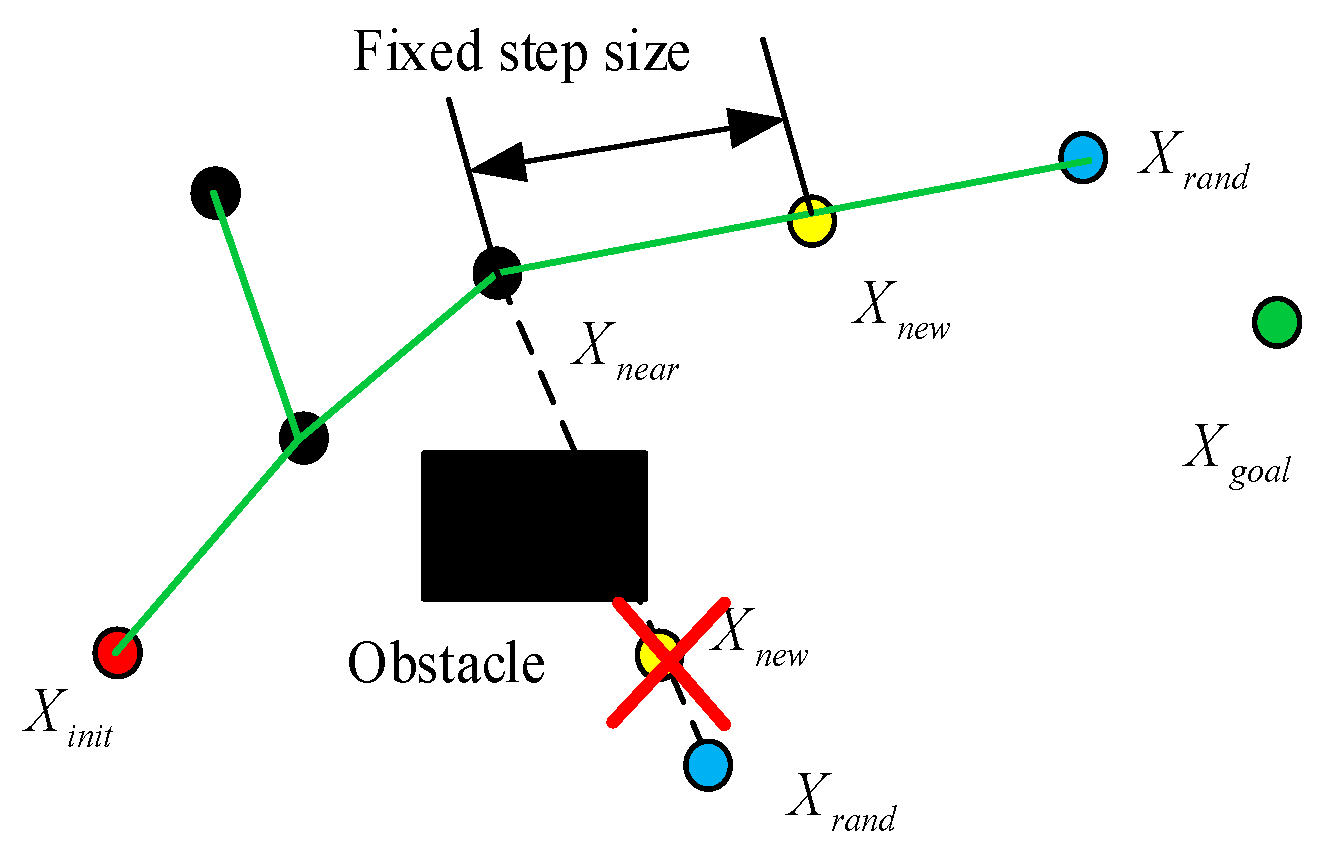
- The distribution of sampling points is uneven. The traditional RRT* adopts global random sampling, which is prone to uneven distribution of sampling points, resulting in large differences in the length of path segments, affecting the synchronous following and motion fluency between formation vehicles, and increasing the difficulty of path tracking control.
- (2)
- Insufficient path smoothness. Although RRT* optimizes the path length through the path reconnection mechanism, the generated trajectory is still discrete and the curvature changes are discontinuous, which is difficult to meet the high requirements of smoothness and controllability of formation trajectory tracking.
- (3)
- Vehicle size constraints are not considered. In the process of sampling and feasibility testing, RRT* usually only focuses on the accessibility of sampling points, and does not fully consider the external dimensions of vehicles, which is easy to generate areas with insufficient path space, which limits the passability of bicycles, and it is more difficult to ensure the overall passability and safety of the entire formation.
3. Formation Constraint-Based RRT* Algorithm for Leader Vehicle
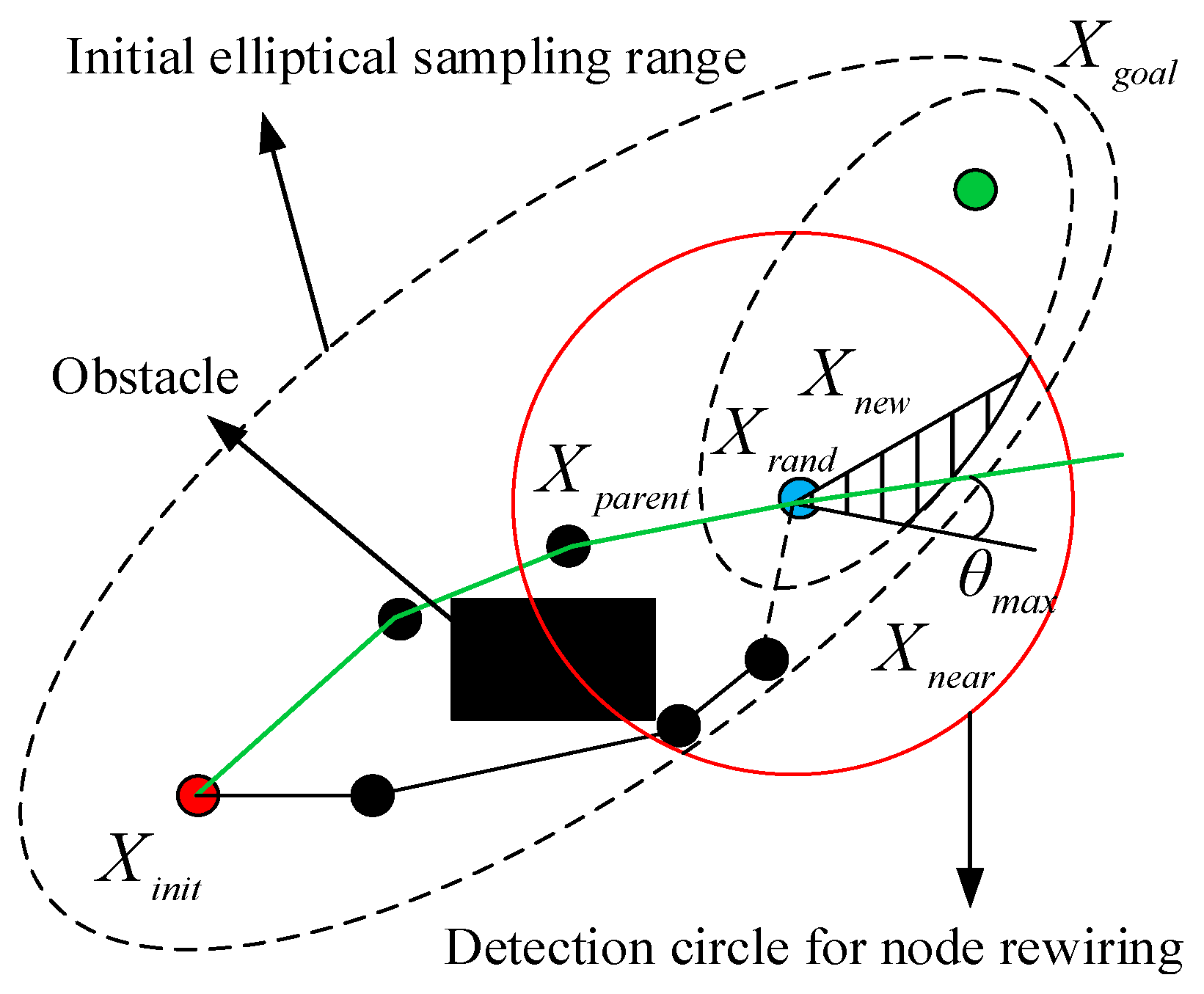
3.1. Improved Goal-Biased Sampling Strategy
3.2. Determination of the Sampling Region Under Dual Constraints
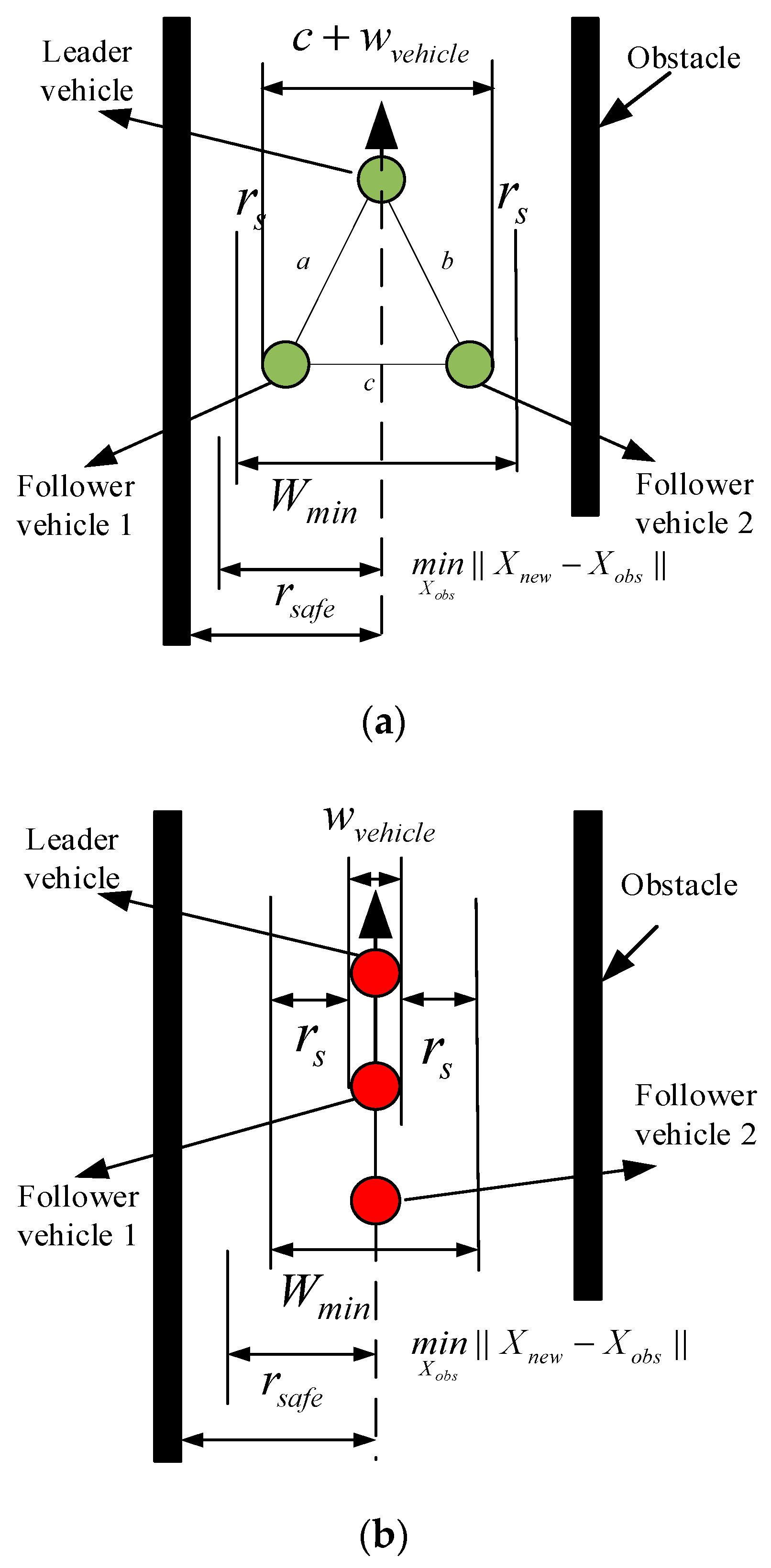
3.3. Design of Safety Distance Checking for Sampling Points Under Formation Constraints
3.4. Design of Path Evaluation Function
3.5. Procedure of the Improved RRT* Algorithm
- (1)
- Initialization Phase
- (2)
- Iterative Expansion Loop
- (3)
- Termination Conditions
4. Formation Behavior-Based Obstacle Avoidance RRT* Algorithm for Follower Vehicles
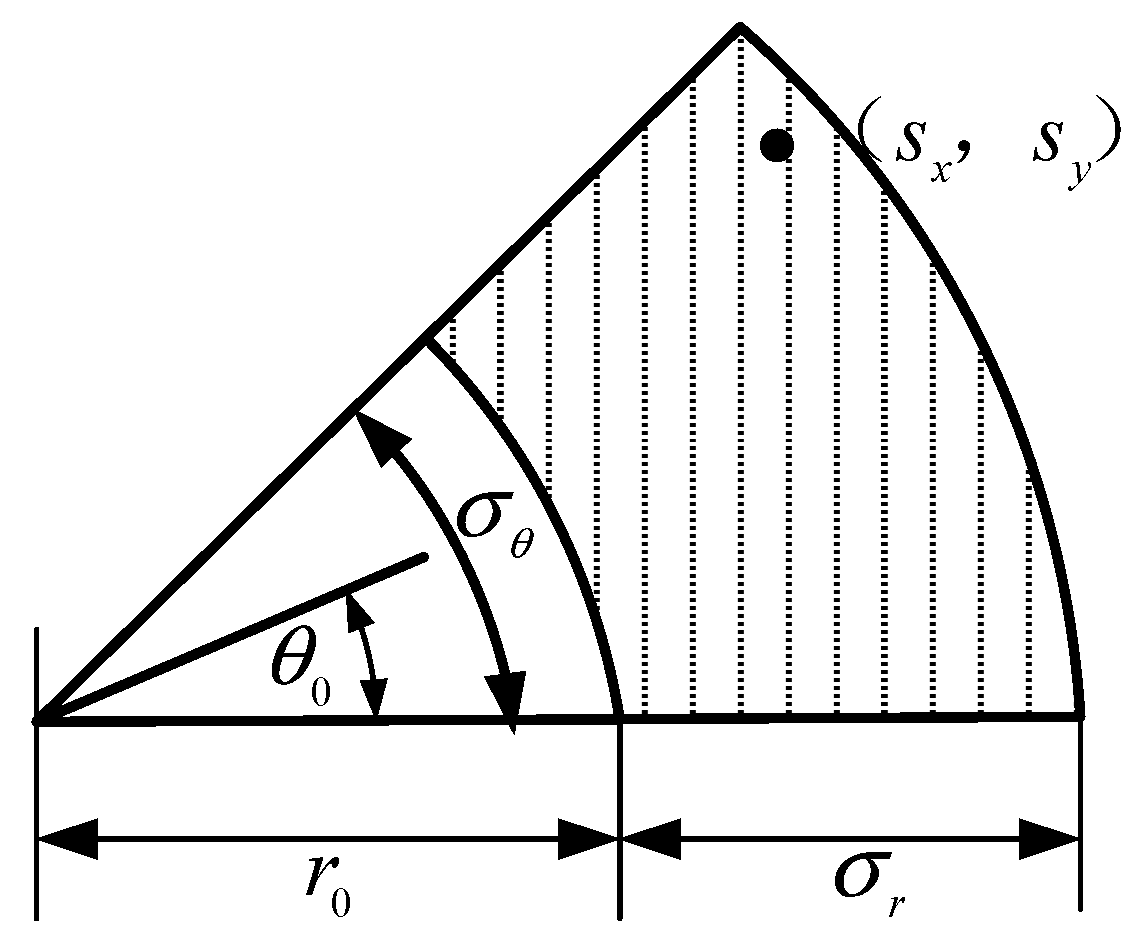
4.1. Sector Sampling Region Design Based on Gaussian Distribution
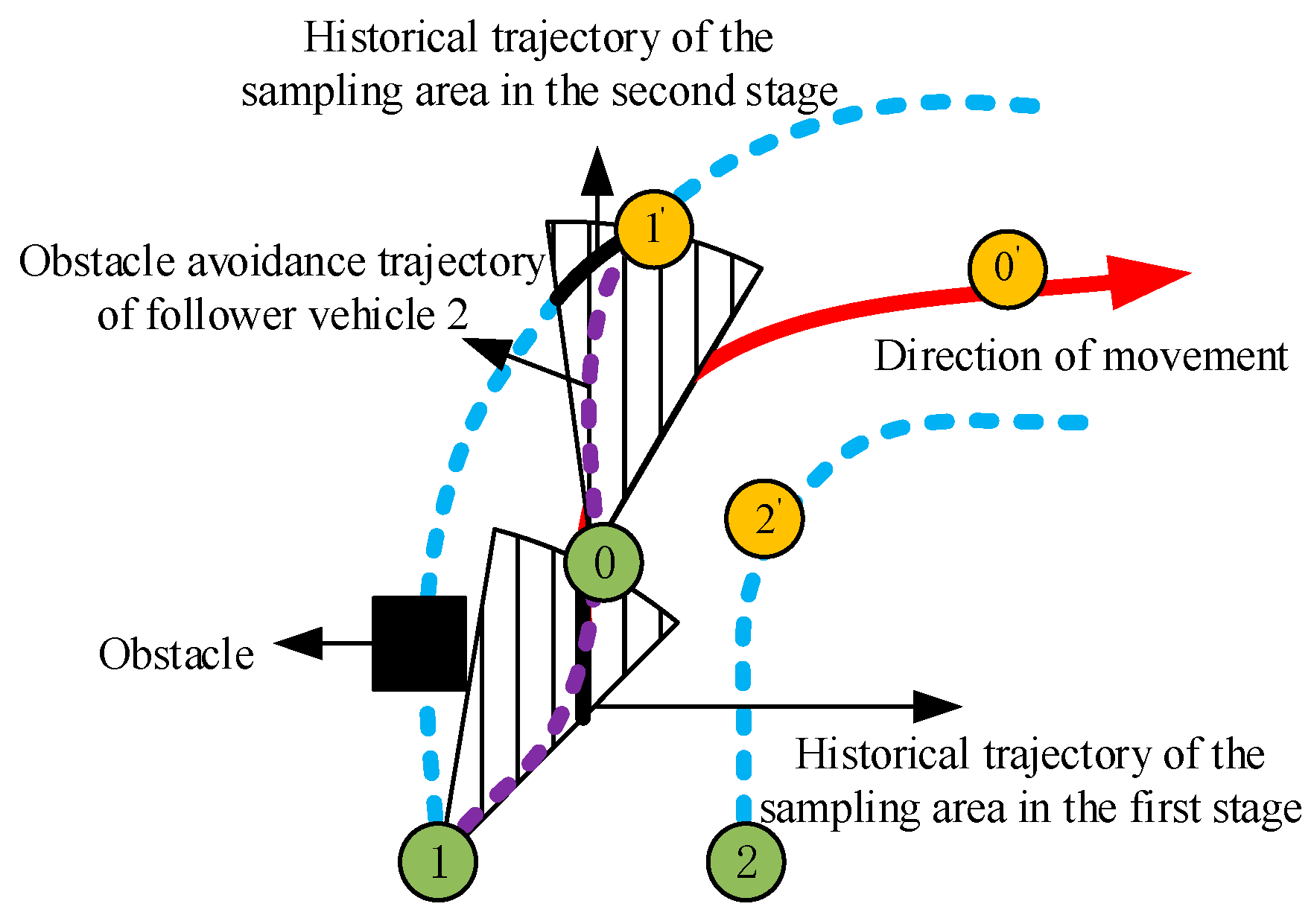
4.2. Formation Local Obstacle Avoidance Planning Strategy
4.3. Formation Contraction Obstacle Avoidance Planning Strategy
4.4. Formation Transformation Obstacle Avoidance Planning Strategy
4.5. Formation Obstacle Avoidance Workflow
5. Simulation Verification and Data Analysis
5.1. Simulation in an Obstacle-Free Environment
5.2. Simulation in an Environment with Obstacles
6. Research Limitations and Constraints
7. Conclusions
Author Contributions
Funding
Data Availability Statement
Acknowledgments
Conflicts of Interest
References
- Du, K.; Xi, W.-Q.; Huang, S.; Zhou, J. Deep-sea Mineral Resource Mining: A Historical Review, Developmental Progress, and Insights. Min. Metall. Explor. 2024, 41, 37–51. [Google Scholar] [CrossRef]
- Liu, Z.-H.; Liu, K.; Chen, X.-G.; Ma, Z.; Lv, R.; Wei, C.; Ma, K. Deep-sea rock mechanics and mining technology: State of the art and perspectives. Int. J. Min. Sci. Technol. 2023, 33, 1083–1115. [Google Scholar] [CrossRef]
- Xu, W.-H.; Yang, J.-M.; Wei, H.-D.; Lu, H.; Tian, X.; Li, X. A localization algorithm based on pose graph using Forward-looking sonar for deep-sea mining vehicle. Ocean Eng. 2023, 284, 114968. [Google Scholar]
- Liu, S.-H.; Yang, J.-M.; Lyu, H.; Sun, P. Experimental and numerical investigation of the effect of deep-sea mining vehicles on the discharge plumes. Phys. Fluids 2024, 36, 033358. [Google Scholar] [CrossRef]
- Gammell, J.D.; Strub, M.P. Asymptotically Optimal Sampling-Based Motion Planning Methods. arXiv 2021, arXiv:2009.10484v2. [Google Scholar] [CrossRef]
- Rakita, D.; Mutlu, B.; Gleicher, M. Single-query Path Planning Using Sample-Efficient Probability Informed Trees. IEEE Robot. Autom. Lett. 2021, 6, 4624–4631. [Google Scholar]
- Fan, J.-M.; Chen, X.; Liang, X. UAV trajectory planning based on bi-directional APF-RRT* algorithm with goal-biased. Expert Syst. Appl. 2023, 213, 119137. [Google Scholar] [CrossRef]
- Wang, J.-K.; Jia, X.; Zhang, T.-Y.; Ma, N.; Meng, M.Q.-H. Deep Neural Network Enhanced Sampling-Based Path Planning in 3D Space. IEEE Trans. Autom. Sci. Eng. 2022, 19, 3434–3443. [Google Scholar]
- Yu, F.-J.; Shang, H.-Q.; Zhu, Q.-L.; Zhang, H.; Chen, Y. An efficient RRT-based motion planning algorithm for autonomous underwater vehicles under cylindrical sampling constraints. Auton. Robot. 2023, 47, 281–297. [Google Scholar] [CrossRef]
- Ji, H.-C.; Xie, H.-B.; Wang, C.; Yang, H. E-RRT*: Path Planning for Hyper-Redundant Manipulators. IEEE Robot. Autom. Lett. 2023, 8, 8128–8135. [Google Scholar] [CrossRef]
- Zhang, R.-D.; Chai, R.-Q.; Chai, S.-C.; Xia, Y.; Tsourdos, A. Design and Practical Implementation of a High Efficiency Two-Layer Trajectory Planning Method for AGV. IEEE Trans. Ind. Electron. 2024, 71, 1811–1822. [Google Scholar]
- Huang, Y.; Lee, H.H. Adaptive Informed RRT*: Asymptotically Optimal Path Planning with Elliptical Sampling Pools in Narrow Passages. Int. J. Control Autom. Syst. 2024, 22, 241–251. [Google Scholar] [CrossRef]
- Chen, Q.-Y.; Wang, Y.-J.; Lu, Y.-F. Formation Control for UAVs based on the Virtual Structure Idea and Nonlinear Guidance Logic. In Proceedings of the 2021 6th International Conference on Automation, Control and Robotics Engineering (CACRE), Dalian, China, 15–17 July 2021; pp. 135–139. [Google Scholar]
- Yan, X.; Jiang, D.-P.; Miao, R.-L.; Li, Y. Formation Control and Obstacle Avoidance Algorithm of a Multi-USV System Based on Virtual Structure and Artificial Potential Field. J. Mar. Sci. Eng. 2021, 9, 161. [Google Scholar] [CrossRef]
- Xu, C.; Rong, J.-W.; Chen, Y.-L.; Wu, H.; Duan, S. Spatial-Temporal Fusion Based Path Planning for Source Seeking in Wireless Sensor Network. Int. J. Wirel. Inf. Netw. 2022, 29, 1–13. [Google Scholar]
- Zhen, Q.-Z.; Wan, L.; Li, Y.-L.; Jiang, D. Formation control of a multi-AUVs system based on virtual structure and artificial potential field on SE(3). Ocean Eng. 2022, 253, 111148. [Google Scholar] [CrossRef]
- Zhou, A.-Y.; Peeta, S.; Yang, M.-L.; Wang, J. Cooperative signal-free intersection control using virtual platooning and traffic flow regulation. Transp. Res. Part C Emerg. Technol. 2022, 138, 103610. [Google Scholar]
- Guo, J.-D.; Liu, Z.-G.; Song, Y.-G.; Yang, C.; Liang, C. Research on Multi-UAV Formation and Semi-Physical Simulation with Virtual Structure. IEEE Access 2023, 11, 126027–126039. [Google Scholar] [CrossRef]
- Liu, Y.-P.; Zhang, J.-Q.; Zhang, Y.-Y.; Wang, J. Virtual Streamline Traction: Formation Cooperative Obstacle Avoidance Based on Dynamical Systems. Appl. Sci. 2024, 14, 6087. [Google Scholar] [CrossRef]
- Carpin, S.; Parker, L.E. Cooperative leader following in a distributed multi-robot system. In Proceedings of the Proceedings 2002 IEEE International Conference on Robotics and Automation (Cat No02CH37292), Washington, DC, USA, 11–15 May 2002; Volume 2993, pp. 2994–3001. [Google Scholar]
- Bae, Y.B.; Lim, Y.H.; Ahn, H.S. Distributed Robust Adaptive Gradient Controller in Distance-Based Formation Control with Exogenous Disturbance. IEEE Trans. Autom. Control 2021, 66, 2868–2874. [Google Scholar] [CrossRef]
- Lv, G.-H.; Peng, Z.-H.; Wang, H.-L.; Liu, L.; Wang, D.; Li, T. Extended-state-observer-based distributed model predictive formation control of under-actuated unmanned surface vehicles with collision avoidance. Ocean Eng. 2021, 238, 109587. [Google Scholar]
- Gong, J.-Y.; Ma, Y.-J.; Jiang, B.; Mao, Z. Distributed adaptive fault-tolerant formation control for heterogeneous multiagent systems under switching directed topologies. J. Frankl. Inst. Eng. Appl. Math. 2022, 359, 3366–3388. [Google Scholar]
- Fu, J.-J.; Wen, G.-H.; Yu, X.-H.; Wu, Z.-G. Distributed Formation Navigation of Constrained Second-Order Multiagent Systems with Collision Avoidance and Connectivity Maintenance. IEEE Trans. Cybern. 2022, 52, 2149–2162. [Google Scholar]
- Zhao, Y.N.; Zhu, F.L.; Xu, D.Z. Event-Triggered Bipartite Time-Varying Formation Control for Multiagent Systems with Unknown Inputs. IEEE Trans. Cybern. 2023, 53, 5904–5917. [Google Scholar]
- Liu, X.-F.; Wu, X.-X.; Xie, Y.-F.; Guo, B.; Yan, J. Fully distributed adaptive time-varying formation control of singular multiagent systems. Neurocomputing 2023, 516, 146–154. [Google Scholar]
- Fang, X.; Xie, L.H.; Li, X.L. Integrated Relative-Measurement-Based Network Localization and Formation Maneuver Control. IEEE Trans. Autom. Control 2024, 69, 1906–1913. [Google Scholar]
- Zhu, Y.-K.; Li, S.-L.; Guo, G.; Yuan, P.; Bai, J. Formation control of UAV-USV based on distributed event-triggered adaptive MPC with virtual trajectory restriction. Ocean Eng. 2024, 294, 116850. [Google Scholar]
- Wu, J.-T.; Wang, Z.; Zhang, Z.-C.; Wang, N.-Y. Current status and prospects of forestry and grassland special robot swarm technology. For. Mach. Woodwork. Equip. 2023, 51, 22–30. [Google Scholar] [CrossRef]
- Cao, L.; Liu, G.-P.; Zhang, D.-W. A leader-follower formation strategy for networked multi-agent systems based on the PI predictive control method. In Proceedings of the 2021 40th Chinese Control Conference (CCC), Shanghai, China, 26–28 July 2021; pp. 4763–4768. [Google Scholar]
- Lagunas-Avila, J.; Castro-Linares, R.; Alvarez-Gallegos, J. Obstacle avoidance in leader-follower formation using artificial potential field algorithm. In Proceedings of the 2021 18th International Conference on Electrical Engineering, Computing Science and Automatic Control (CCE 2021), Mexico City, Mexico, 10–12 November 2021. [Google Scholar]
- Dai, S.-L.; He, S.-D.; Cai, H.; Yang, C. Adaptive Leader-Follower Formation Control of Underactuated Surface Vehicles with Guaranteed Performance. IEEE Trans. Syst. Man Cybern. Syst. 2022, 52, 1997–2008. [Google Scholar]
- Xia, L.-N.; Li, Q.; Song, R.-Z.; Zhang, Z. Leader-follower time-varying output formation control of heterogeneous systems under cyber attack with active leader. Inf. Sci. 2022, 585, 24–40. [Google Scholar]
- Han, S.H.; Yang, S.H.; Lee, Y.S.; Lee, M.; Park, J.-I.; Kim, K.-S. The Leader-Follower Formation Control of Nonholonomic Vehicle with Follower- Stabilizing Strategy. IEEE Robot. Autom. Lett. 2024, 9, 707–714. [Google Scholar]
- Zhang, X.-Z.; Yang, Q.-K.; Xiao, F.; Fang, H.; Chen, J. Linear formation control of multi-agent systems. Automatica 2025, 171, 111935. [Google Scholar] [CrossRef]
- Luan, Q.; Zhou, X.; Shi, Y.; Li, K.; Deng, C.; Zhu, G.; Chen, Z. Motion Planning of 6R Manipulator with Improved RRT* Algorithm. Mech. Sci. Technol. Aerosp. Eng. 2024, 43, 1367–1377. [Google Scholar] [CrossRef]
- Chen, X.; Ma, F.; Wu, Y.; Han, B.; Luo, L.; Biancardo, S.A. MFMDepth: MetaFormer-based monocular metric depth estimation for distance measurement in ports. Comput. Ind. Eng. 2025, 207, 111325. [Google Scholar] [CrossRef]
- Chen, D.; Huang, C.; Fan, T.; Lau, H.C.; Yan, X. Predictive modelling for vessel traffic flow: A comprehensive survey from statistics to AI. Transp. Saf. Environ. 2025, 7, tdaf022. [Google Scholar]
- Wang, Q.Q. Research on Path Planning and Formation Control of Unmanned Vehicles in Forest Environment. Harbin Inst. Technol. 2023. [Google Scholar] [CrossRef]
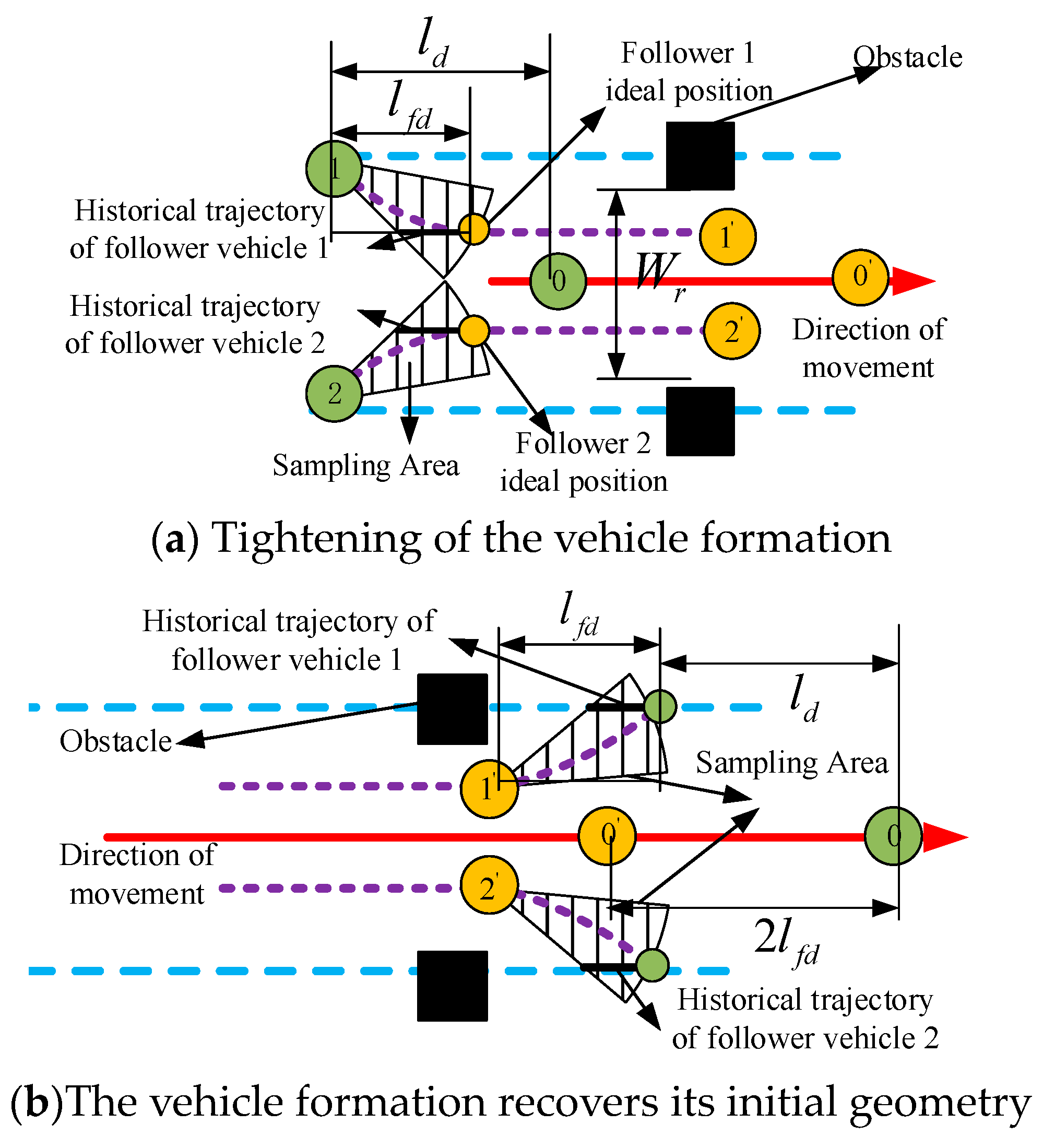
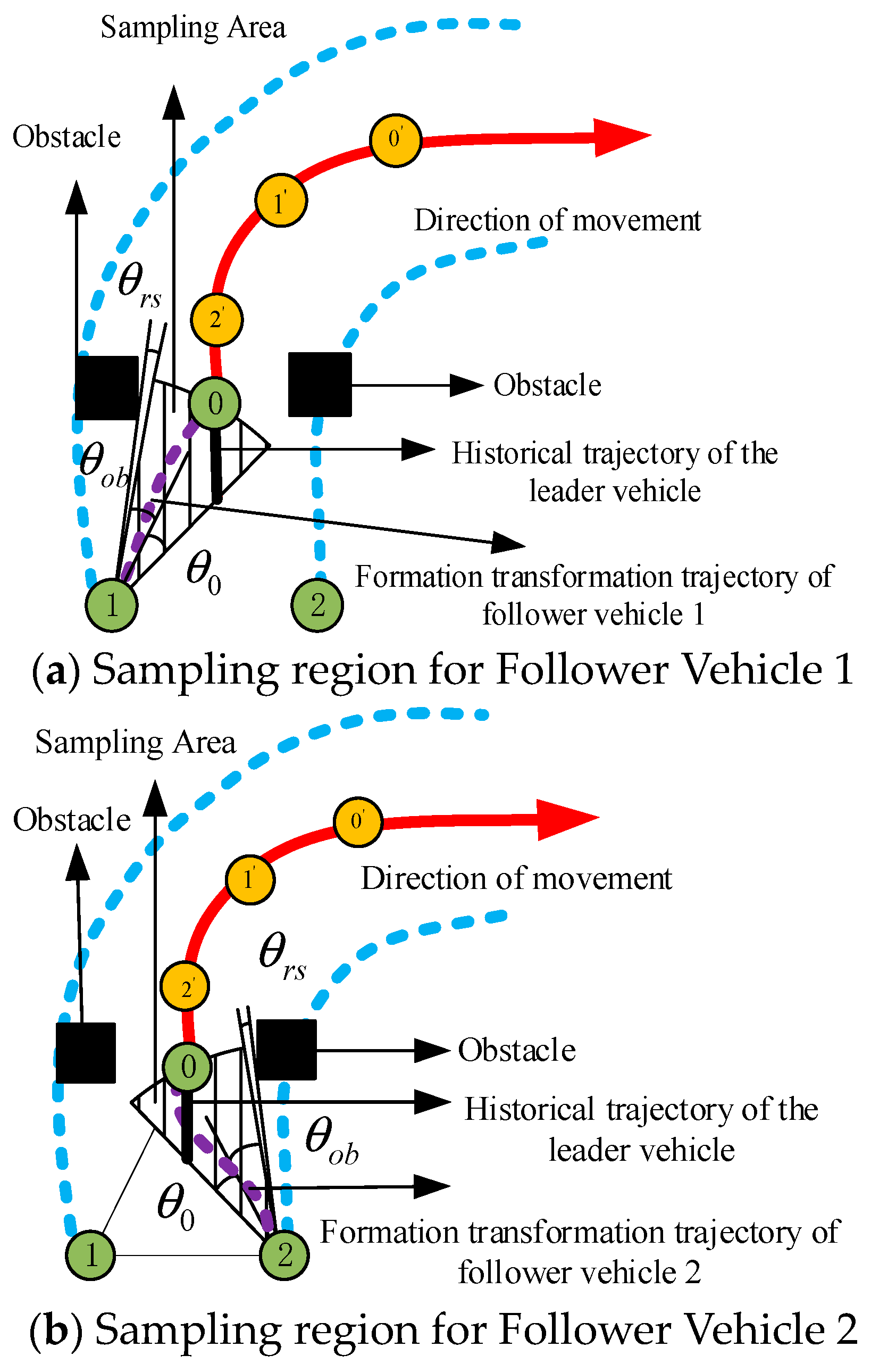
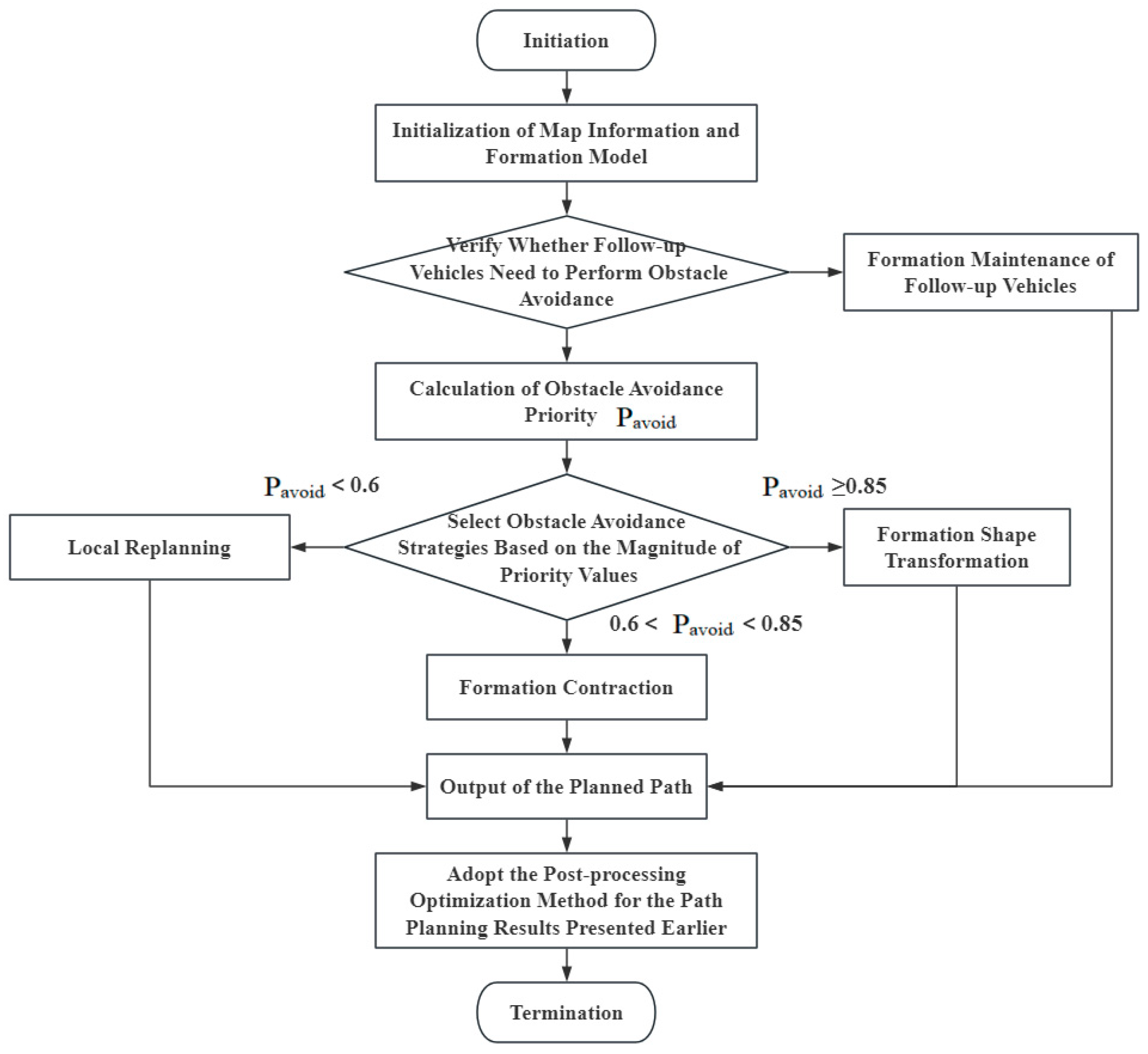
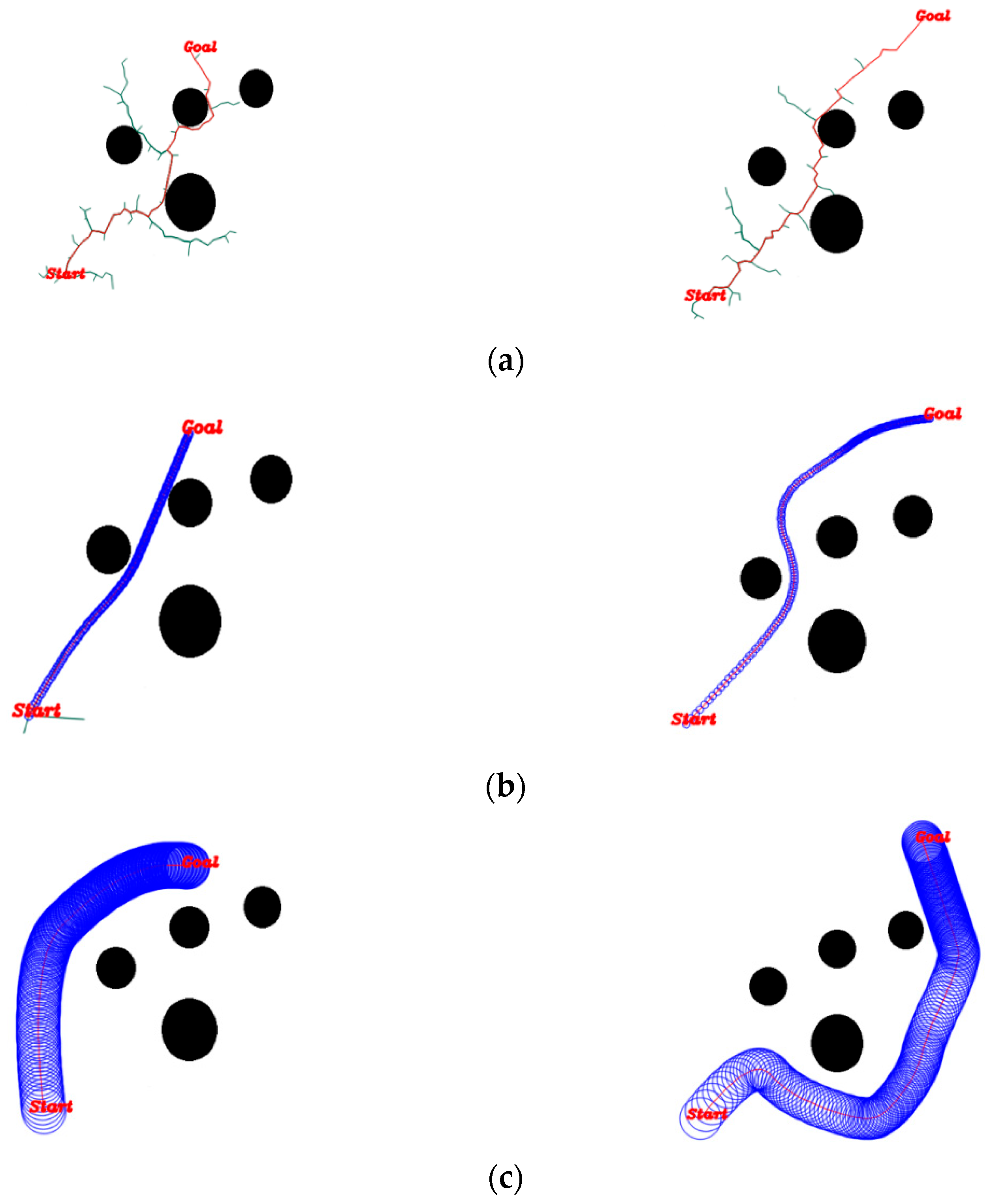
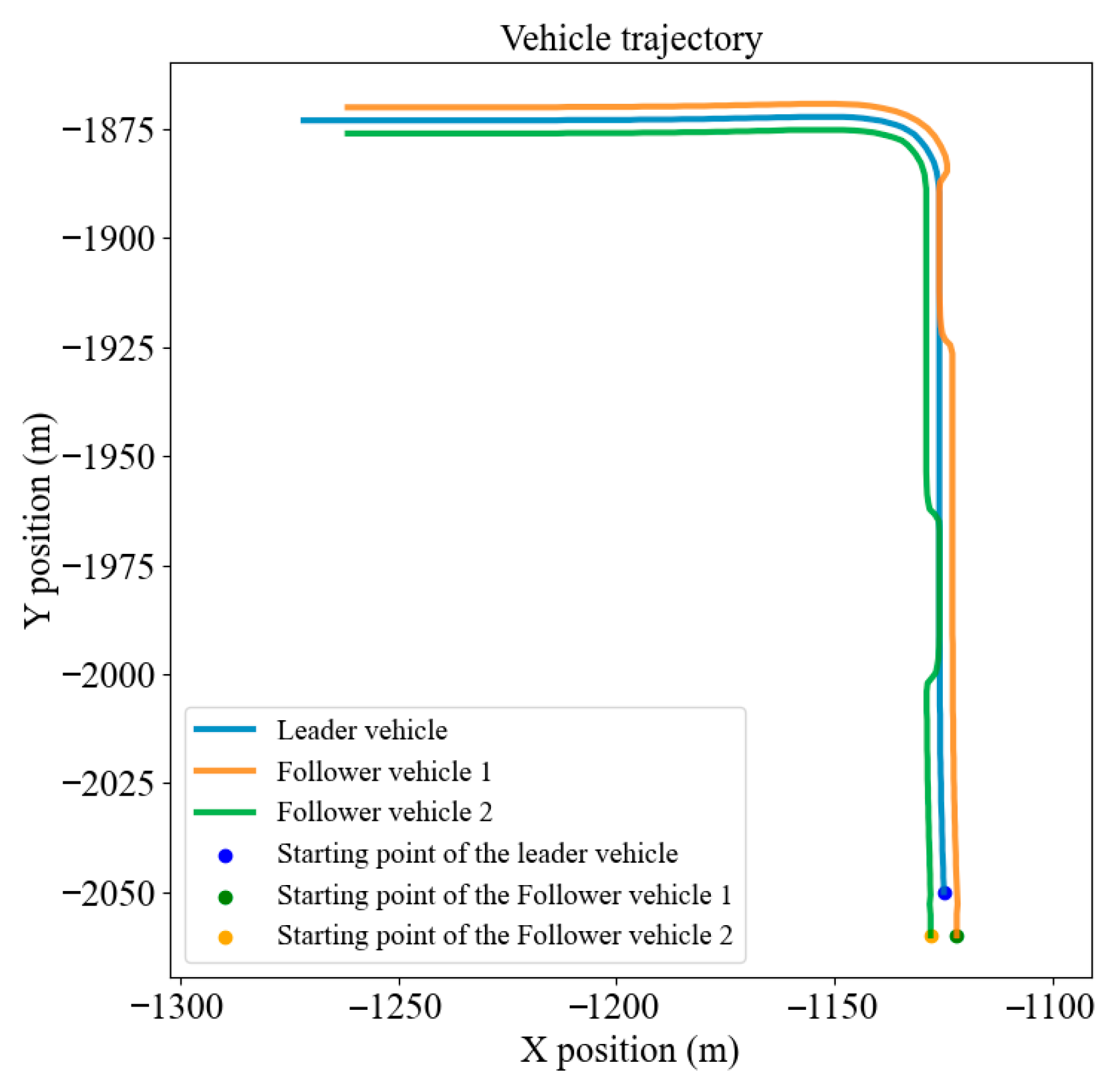
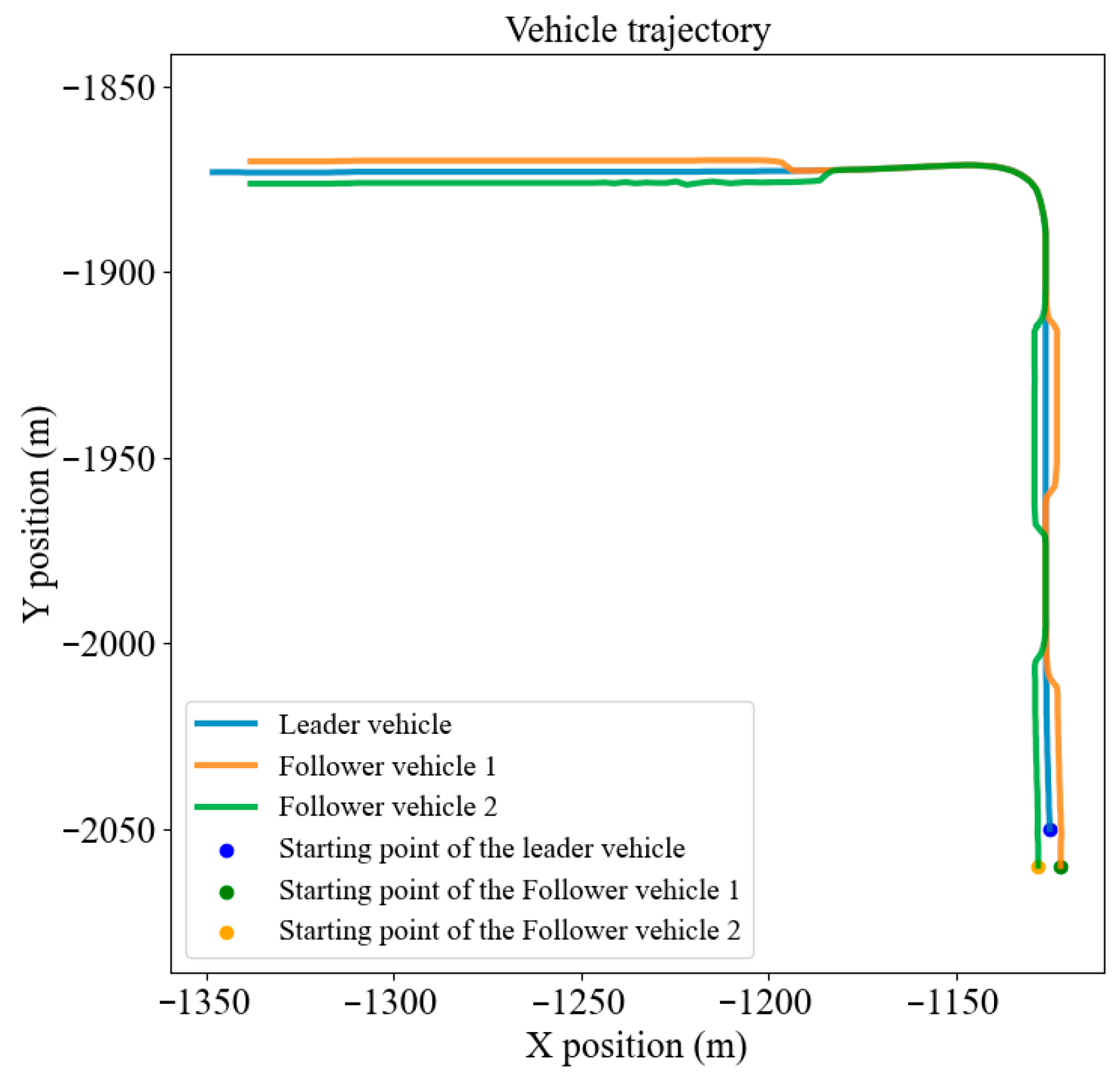
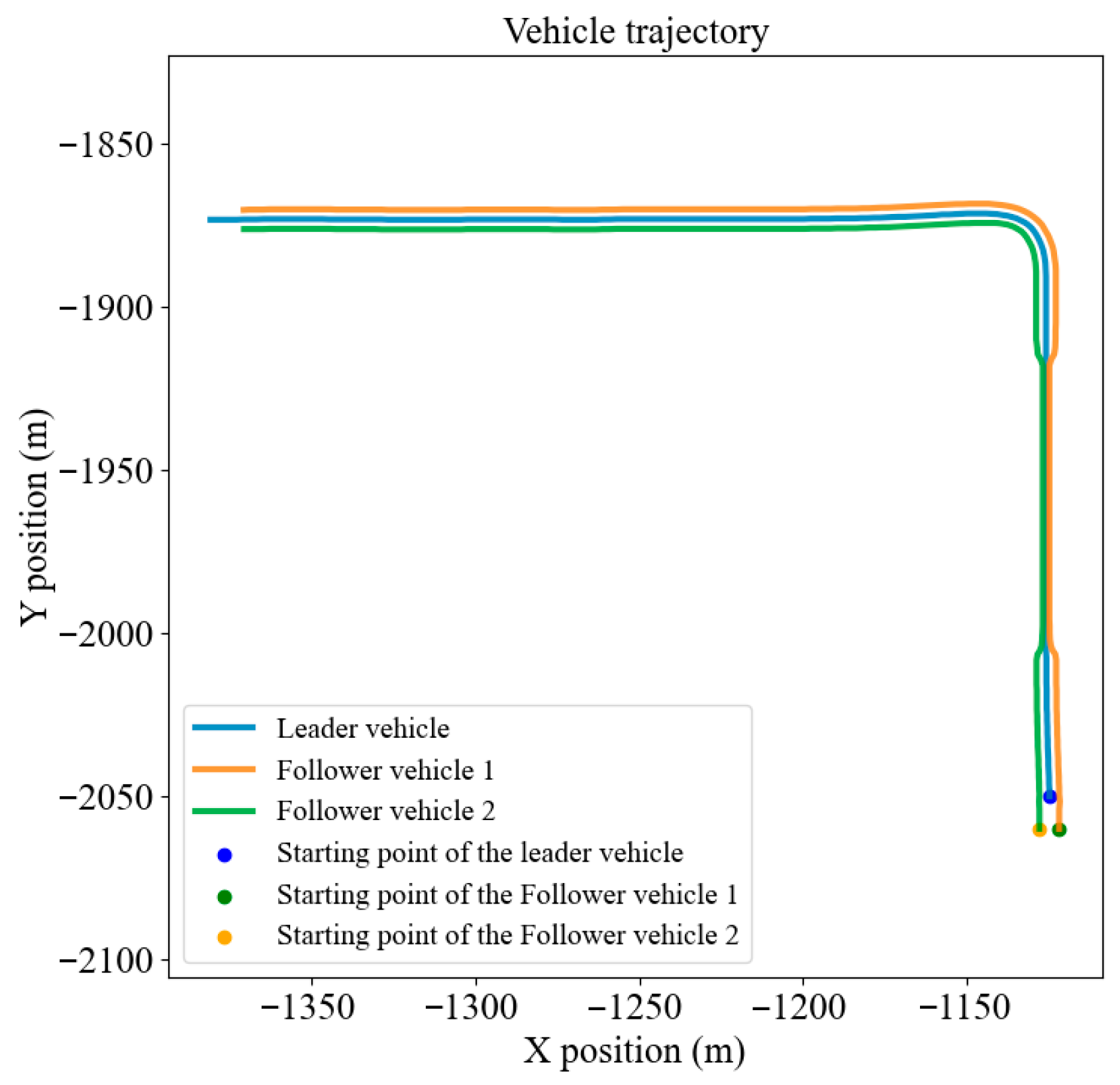

| Algorithm Parameters | Grid Map [39] | Grid Map [39] |
|---|---|---|
| Maximum sampling iterations | 1000 | 10,000 |
| Sampling area size | 1000 × 1000 | 1000 × 1000 |
| Initial goal bias | 0.35 | 0.25 |
| Extension length | 50 | 50 |
| Reconnection neighborhood radius R | 50 | 40 |
| Minimum formation passage size | 10 | 60 |
| \ | Algorithm | Passage Constraint | Path Length | Mean Curvature | Max Curvature |
|---|---|---|---|---|---|
| A | Traditional RRT* | \ | 20.811 m | 0.0602 m−1 | 0.482 m−1 |
| Improved RRT* | 10 pixels | 15.3254 m | 0.0016 m−1 | 0.0104 m−1 | |
| Improved RRT* | 60 pixels | 18.062 m | 0.0050 m−1 | 0.0163 m−1 |
| \ | Algorithm | Passage Constraint | Path Length | Mean Curvature | Max Curvature |
|---|---|---|---|---|---|
| B | Traditional RRT* | \ | 24.61 m | 0.0627 m−1 | 0.4629 m−1 |
| Improved RRT* | 10 pixels | 21.57 m | 0.0052 m−1 | 0.0181 m−1 | |
| Improved RRT* | 60 pixels | 29.79 m | 0.0058 m−1 | 0.0508 m−1 |
| Evaluation Metrics | Improved RRT* | RRT | RRT* |
|---|---|---|---|
| Average number of iterations | 4 | 135.45 | 162.27 |
| Average number of nodes | 5 | 8.4 | 6.4 |
| Average path length | 51.3 m | 74.2 m | 59.6 m |
| Average path curvature | 0.13 m−1 | 0.43 m−1 | 0.32 m−1 |
| Evaluation Metrics | Improved RRT* | RRT | RRT* |
|---|---|---|---|
| Average number of iterations | 3.2 | 153.3 | 142.8 |
| Average number of nodes | 6.4 | 13.2 | 9.64 |
| Average path length | 32.4 m | 36.3 m | 35.2 m |
| Average path curvature | 0.163 m−1 | 0.323 m−1 | 0.214 m−1 |
| Evaluation Metrics | Improved RRT* | RRT | RRT* |
|---|---|---|---|
| Average number of iterations | 4.2 | 32.6 | 43.3 |
| Average number of nodes | 3.5 | 18 | 12 |
| Average path length | 15.4 m | 18.9 m | 18.2 m |
| Average path curvature | 0.135 m−1 | 0.302 m−1 | 0.262 m−1 |
Disclaimer/Publisher’s Note: The statements, opinions and data contained in all publications are solely those of the individual author(s) and contributor(s) and not of MDPI and/or the editor(s). MDPI and/or the editor(s) disclaim responsibility for any injury to people or property resulting from any ideas, methods, instructions or products referred to in the content. |
© 2026 by the authors. Licensee MDPI, Basel, Switzerland. This article is an open access article distributed under the terms and conditions of the Creative Commons Attribution (CC BY) license.
Share and Cite
Liu, J.; Wang, Y.; Li, H.; Huang, P.; Liang, B.; Wu, H.; Yu, S. Research on Formation Path Planning Method and Obstacle Avoidance Strategy for Deep-Sea Mining Vehicles Based on Improved RRT*. J. Mar. Sci. Eng. 2026, 14, 138. https://doi.org/10.3390/jmse14020138
Liu J, Wang Y, Li H, Huang P, Liang B, Wu H, Yu S. Research on Formation Path Planning Method and Obstacle Avoidance Strategy for Deep-Sea Mining Vehicles Based on Improved RRT*. Journal of Marine Science and Engineering. 2026; 14(2):138. https://doi.org/10.3390/jmse14020138
Chicago/Turabian StyleLiu, Jiancheng, Yujia Wang, Hao Li, Pengjie Huang, Bingchen Liang, Haotian Wu, and Shimin Yu. 2026. "Research on Formation Path Planning Method and Obstacle Avoidance Strategy for Deep-Sea Mining Vehicles Based on Improved RRT*" Journal of Marine Science and Engineering 14, no. 2: 138. https://doi.org/10.3390/jmse14020138
APA StyleLiu, J., Wang, Y., Li, H., Huang, P., Liang, B., Wu, H., & Yu, S. (2026). Research on Formation Path Planning Method and Obstacle Avoidance Strategy for Deep-Sea Mining Vehicles Based on Improved RRT*. Journal of Marine Science and Engineering, 14(2), 138. https://doi.org/10.3390/jmse14020138

