


Abstract
Marine biofouling significantly impacts vessel operational efficiency, with mussel species being particularly problematic due to their rapid settlement on biofilm-covered surfaces. This pilot study presents the first explicit test of whether ultrasonic treatment can disrupt the biofilm–larva interaction pathway that facilitates mussel settlement. The study evaluated ultrasonic treatment (28 kHz) as a preventive antifouling strategy targeting the mixed microbial biofilm-mediated settlement pathway of Mytilus edulis. A controlled laboratory experiment compared settlement rates on biofilm-conditioned (2.5-week mixed microbial biofilm development) and unconditioned steel plates with and without ultrasonic treatment. Under control conditions, biofilm presence increased mussel settlement odds by 49-fold (p < 0.001). Ultrasonic treatment eliminated this biofilm enhancement, maintaining settlement at baseline levels (odds ratio: 1.3, p = 0.84). The mechanism remains unclear but may involve biofilm disruption, larval behavioral avoidance, or interference with chemical cues. While limited replication (n = 2, temporal replicates, one tank per treatment per replicate) constrains statistical power and inference, the large effect size and consistency across replicates warrant additional investigation. If confirmed by increased replication and mechanistic studies, ultrasonic treatment could provide sustainable antifouling protection without chemical discharge.
1. Introduction
Marine biofouling is a significant operational challenge for the marine industry, with accumulation of organisms on submerged surfaces affecting vessel efficiency, maintenance costs, and environmental sustainability [1]. Fouling on internal seawater systems, particularly vessel cooling systems, can lead to operational consequences such as flow blockage, reduced heat transfer, and increased corrosion, substantially increasing operational costs [2,3]. Box coolers, tube-type heat exchangers, are particularly vulnerable to biofouling due to their complex geometry and constant seawater exposure [2].
Biofouling follows a predictable succession: initial adsorption of abiotic conditioning films composed of dissolved organic matter (within minutes to hours), followed by primary settlement by biofilms on these conditioning films (hours to days), secondary settlement of barnacles and hydroids (days to weeks), and tertiary colonization by macroinvertebrates such as mussels (weeks to months) [4]. Mussel species are particularly problematic due to their rapid larval settlement, strong byssal attachment, and aggregative behavior, with colonization densities exceeding 35,000 individuals/m2 in vessel intake systems [5]. Previous research suggests that macrofouling organisms do not settle on clean surfaces but rather on surfaces colonized by microbial biofilms that develop within days to weeks after initial conditioning film formation [6,7]. These microbial biofilms (not the initial abiotic conditioning films) provide physical substrates and/or chemical cues that facilitate mussel larval attachment and metamorphosis [8], with early-to-intermediate biofilms (1–4 weeks old) showing the highest inductive activity [9]. In this study, we focus on these microbial biofilms (2.5-week development) that facilitate macrofouling settlement, rather than the initial abiotic conditioning films.
Current antifouling strategies for marine vessel systems rely primarily on chemical treatments, mechanical cleaning, or protective coatings [10]. Chemical biocides, while effective, raise environmental concerns and face increasing regulatory restrictions [11,12]. In addition, mechanical cleaning is reactive rather than preventive and may require costly system shutdowns [10]. Furthermore, antifouling coatings show reduced effectiveness in internal systems compared to external hull surfaces [13]. Conventional approaches often fail to address the critical early stages of biofouling, particularly the biofilm formation that precedes and enables macrofouling establishment [6].
Ultrasonic antifouling represents a non-chemical alternative that has shown promise in laboratory and field applications. Early studies demonstrated that ultrasonic frequencies (20–100 kHz) can prevent biofilm formation and reduce macrofouling settlement through mechanisms including cavitation, acoustic streaming, and direct mechanical disruption [14,15]. Effectiveness generally increases with acoustic power and decreases with distance from transducers [16,17]. Studies on barnacles [18] and more diverse fouling communities [14] have reported fouling reductions ranging from 40% to 95%, although results vary considerably based on operational parameters, target organisms, and system configurations. However, potential concerns include energy consumption, equipment maintenance requirements, and possible impacts on non-target marine organisms, though ultrasonic frequencies (>20 kHz) generally exceed the hearing range of most marine vertebrates [19].
Critical knowledge gaps remain regarding the ultrasonic treatment of biofilm-mediated settlement processes. Most ultrasonic studies have focused on removing established fouling rather than preventing initial colonization [3]. While ultrasonic treatment can reduce microbial attachment and biofilm development [15,20], few studies have explicitly tested whether this disruption eliminates the microbial biofilms necessary for successful mussel larval settlement. Furthermore, current literature lacks comprehensive evaluation of ultrasonic treatment effectiveness specifically against Mytilus edulis in the context of biofilm-mediated settlement [2].
The goal of this pilot study is to evaluate whether ultrasonic treatment (28 kHz) might prevent biofilm-mediated settlement enhancement in Mytilus edulis, addressing a critical gap in understanding how ultrasonic antifouling affects the early stages of the biofouling succession. We specifically test the hypothesis that ultrasonic treatment reduces mussel settlement by disrupting the microbial biofilm development that normally facilitates larval attachment. By comparing settlement on biofilm-conditioned (2.5-week mixed microbial biofilm development) versus unconditioned surfaces, with and without ultrasonic treatment, this study provides preliminary evidence for the efficacy of targeting the biofilm–larva interaction as an antifouling strategy. If confirmed with increased replication, this approach could inform the development of non-chemical antifouling systems for vessel cooling systems and other hard-to-reach marine applications.
2. Material and Methods
A controlled laboratory experiment was conducted to evaluate the effectiveness of ultrasonic treatment in preventing biofilm formation and larval settlement of Mytilus edulis.
2.1. Experimental Design
The experiment employed a split-plot design with ultrasonic treatment as the whole-plot factor (applied at the tank level) and biofilm conditioning as the sub-plot factor (applied at the plate level within tanks). The design included two temporal replicates (trials) conducted sequentially due to resource constraints. Each trial consisted of two tanks: one equipped with ultrasonic transducers on all plates (treatment tank) and one without ultrasonic devices (control tank). Within each tank, four S355 steel plates with thermoplastic coating (Abcite X60, Axalta, Philadelphia, PA, USA; dimensions: 450 mm × 800 mm × 5 mm; submerged surface: 450 mm × 787 mm), were deployed: two plates were suspended 2.5 weeks prior to larval introduction under optimal conditions for biofilm development (‘biofilm-conditioned’ plates), and two plates were suspended only at the time of larval introduction (‘unconditioned’ plates; though these would develop abiotic conditioning films within hours, they lacked the 2.5-week microbial biofilms). This design yielded four treatment combinations: (1) Control tank, unconditioned plates; (2) Control tank, biofilm-conditioned plates; (3) Ultrasound tank, unconditioned plates; and (4) Ultrasound tank, biofilm-conditioned plates. The split-plot structure recognizes that plates within the same tank share water, larvae, and environmental conditions, making the tank the appropriate experimental unit for testing ultrasound effects (n = 2 tanks per treatment per trial), while conditioning effects can be tested within tanks using plate-level variation (n = 2 plates per conditioning level per tank).
Ultrasonic treatment was applied continuously throughout both the biofilm development period (2.5 weeks for biofilm-conditioned plates) and the subsequent larval settlement period (minimum 1 week) for all plates in the treatment tank. More specifically, (a) biofilm-conditioned plates in ultrasound tank: received ultrasound for 2.5 weeks during biofilm development plus 1 week during settlement; (b) unconditioned plates in ultrasound tank: received ultrasound for 1 week during settlement only; and (c) all plates in control tank: no ultrasound at any time. This approach tests whether ultrasound prevents biofilm formation during the development period and/or interferes with settlement during the larval exposure period.
Biofilm development occurred in dedicated tanks with aerated flow-through raw seawater heated to 20 °C, supplemented continuously with live cultured algae (Isochrysis lutea and Pavlova lutheri). The biofilms that developed on the plates were mixed communities consisting of both the cultured algae and naturally occurring bacteria present in the raw seawater. The flow-through system (flow rate: 2 L/min) ensured continuous inoculation with marine bacteria from the natural seawater, while the algal supplementation provided additional organic matter and photosynthetic organisms. Fluorescent lighting (50 μmol photons m−2 s−1) was provided to maintain algal growth and enhance biofilm development. The resulting biofilms after 2.5 weeks were therefore complex mixed communities, not purely algal biofilms. The 2.5-week development period was selected based on previous studies showing that early-to-intermediate biofilms (1–4 weeks old) exhibit optimal inductive activity for mussel settlement [9,21]. While algae grow more slowly than bacteria, the combination of (1) continuous flow-through raw seawater providing bacterial inoculum, (2) algal supplementation at high concentrations, (3) optimal temperature (20 °C), and (4) continuous light facilitated development of stable mixed biofilms. Visual inspection confirmed substantial biofilm coverage on conditioned plates (see Section 3), and the 49-fold enhancement of settlement in control conditions (compared to unconditioned plates) demonstrates that these biofilms were functionally mature and biologically active.
Just before larval introduction, biofilm-conditioned plates were transferred to clean tanks with filtered seawater and live algae to ensure only plate surfaces (not tank walls) had biofilm. The remaining two plates per tank were suspended only at the time of larval introduction, serving as unconditioned controls.
Ultrasonic transducers were mounted directly on all four plates in the treatment tank. Ultrasonic transducers were type Shipsonic-TD100. Transducer specifications were: 100 Watt peak power, resonance frequency 28 ± 0.5 kHz, and contact membrane diameter 65 mm. The HDS40 is a high-power ultrasonic antifouling control unit that drives TD100 transducers using a complex spectrum of ultrasonic frequencies, ensuring optimal excitation and thus antifouling performance. Each transducer channel is equipped with its own oversized power supply, providing excellent reliability and operational stability. Transducers were installed by means of a welded ring, in which the transducer membrane is torqued against the plate with 18 Nm. This installation is patented under number 1044515. This installation method represents a significant advantage over systems relying on acoustic transmission through water, which suffer substantial energy losses [16]. The direct-contact mounting approach may also generate standing waves and resonant plate modes that enhance antifouling effectiveness compared to water-coupled systems (discussed further in Section 4).
The control tank contained identical plates without any ultrasonic devices to isolate the effect of acoustic treatment from other experimental variables.
2.2. Larval Inoculation
Mussels were conditioned following standard protocols [22] with temperature and live algal feeding until they reached the mature gonadal stage. By maintaining the temperature at 10 °C, the animals remained sexually mature and could be used to initiate larval cultures. A controlled temperature increase was applied to induce spawning, triggering the release of gametes. At the moment spawning began, male and female mussels were kept separately and spawned as two distinct groups. Within one hour after spawning, fertilization was initiated. Once the first cell divisions were visible, the embryos were transferred to conical tanks with a continuous flow of filtered seawater and aeration. After two days, the D-larvae were collected and transferred to new tanks supplied with flow through filtered seawater and cultured algae following established methods [22] (Isochrysis lutea and Pavlova lutheri, later supplemented after one week with 50% Chaetoceros calcitrans). The tanks were refreshed every other day; during each transfer, larvae were sieved, optionally size-selected, and moved to clean tanks [23]. After approximately two to three weeks, the larvae had fully developed and were ready to settle. At this stage, they were transferred to the experimental tanks containing the settlement plates. These tanks were supplied with filtered seawater and the algal diet. Mussel spat were sampled after at least one week, when the larvae were no longer present in the water phase and had undergone through metamorphosis.
During the experiment, approximately one million mussel larvae were introduced per tank. This represents a high larval density relative to the available substrate; however, tank sides and the bottom were also available as settlement substrates. Spatfall success varies between cultures, as larvae must undergo metamorphosis, and only a portion successfully completes this process to become spat. This proportion can vary from several tens of percent to over ninety percent and cannot be predicted in advance.
2.3. Data Collection
Following the settlement period (minimum 1 week, when larvae were no longer present in the water column and had completed metamorphosis), all plates were carefully removed from both tanks. All spat that settled on the walls and floor of the tanks were collected separately per treatment. Settled mussel spat were quantified using established protocols [21,24] by scraping each plate with a rubber strip, rinsing with tap water, and collecting all material on a 200 μm sieve. Spat were counted using an inverted microscope at 65× magnification [25]. When necessary, samples were subsampled (minimum 400 individuals counted per subsample) to ensure accurate enumeration. Settlement success was calculated as the proportion of spat on each plate relative to the total spat across all plates within each trial, accounting for the shared larval pool within each temporal replicate.
2.4. Statistical Analysis
Settlement data were analyzed as proportional response data (number of spat per plate relative to total spat across all plates per trial) using a generalized linear mixed model with a beta-binomial error distribution (glmmTMB package; [26]). The beta-binomial family was selected to account for substantial overdispersion observed in standard binomial models (dispersion parameter φ = 36.4 vs. φ > 2600 in binomial GLM).
The model included ultrasonic treatment (control vs. ultrasound) and biofilm conditioning (unconditioned vs. biofilm-conditioned) as fixed effects, with their interaction. To account for the hierarchical structure of the experimental design, temporal replicates (trials) and tanks nested within trials were included as random effects. This structure recognizes that plates within the same tank share water, larvae, and environmental conditions, making them non-independent observations. The tank is therefore the appropriate experimental unit for testing ultrasound effects (n = 2 tanks per treatment per trial), while conditioning effects can be tested within tanks using plate-level variation (n = 2 plates per conditioning level per tank per treatment per trial).
Model assumptions were verified using simulated residuals (DHARMa package; [27]). Diagnostic tests indicated appropriate model fit: uniformity test (p = 0.09), dispersion test (p = 0.40), and outlier detection (p = 1.00). Estimated marginal means and pairwise comparisons were calculated using the emmeans package [28] with Tukey adjustment for multiple comparisons. Effect sizes are reported as odds ratios with 95% confidence intervals on the response (proportion) scale.
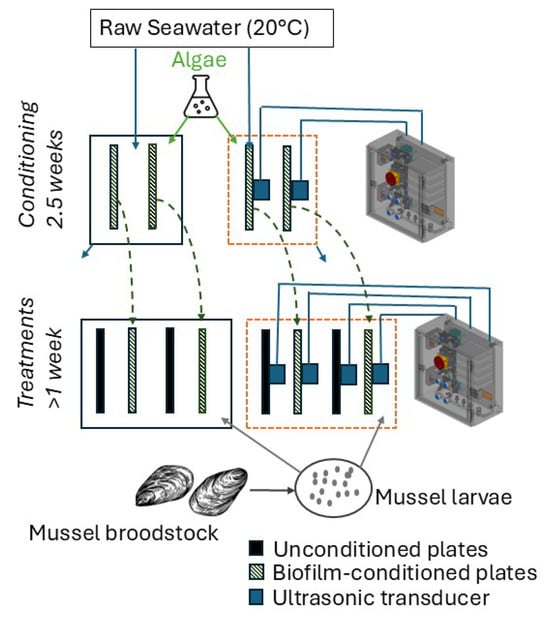
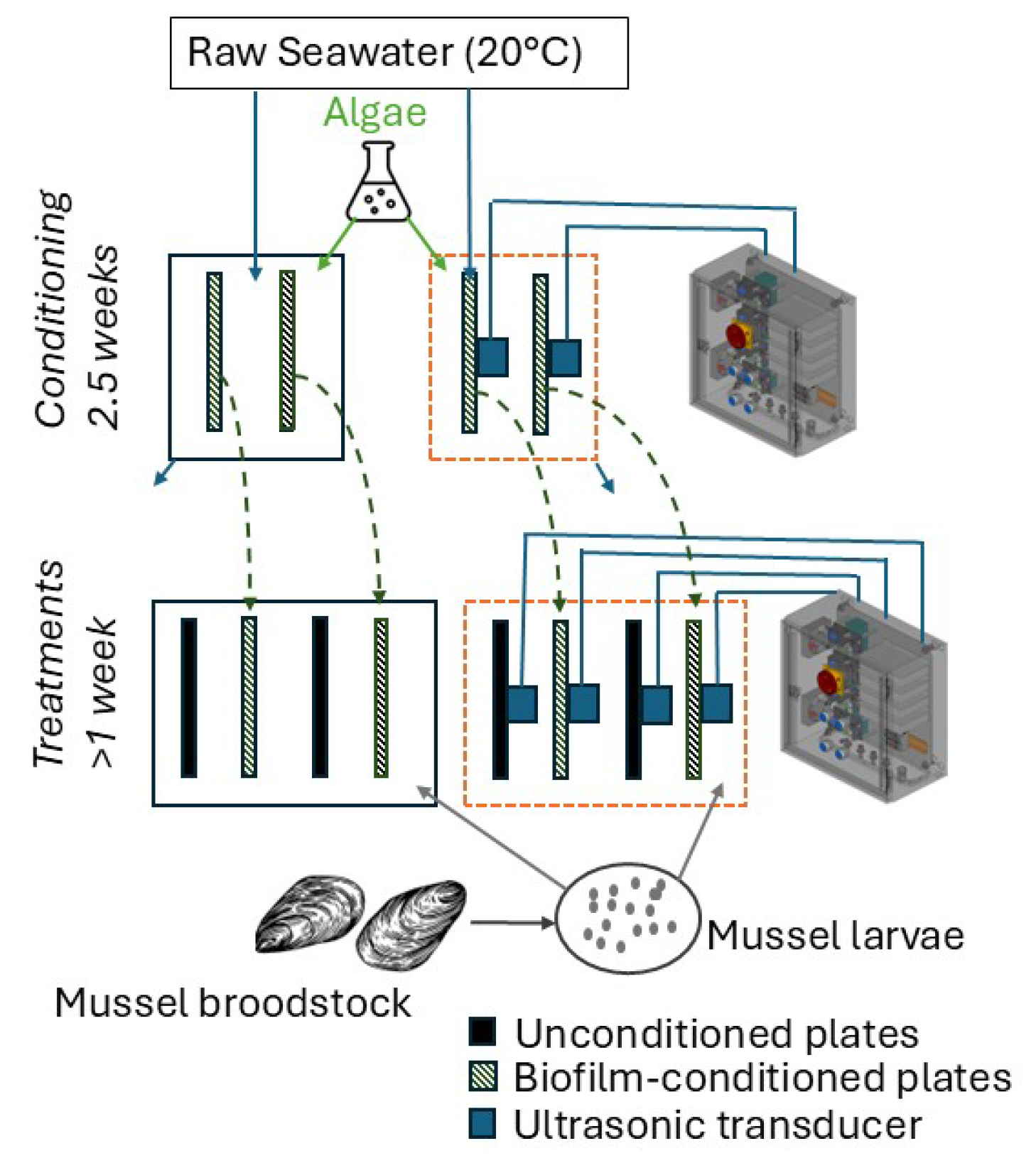
Figure 1.
Experimental setup and design. Schematic representation of the split-plot experimental design. During the conditioning phase (2.5 weeks), biofilm-conditioned plates (hatched) were suspended in tanks with flow-through raw seawater (20 °C) supplemented with live algae (Isochrysis lutea and Pavlova lutheri, green arrows). Ultrasonic transducers (blue rectangles, Shipsonic TD100, Goes, The Netherlands, 28 kHz, 100 W) were mounted on all plates in treatment tanks and operated continuously throughout conditioning and settlement periods. After conditioning, biofilm-conditioned plates were transferred to clean tanks (dotted arrows), unconditioned plates (black) were added, and ~1 × 10⁶ competent mussel larvae were introduced. After a ≥1-week settlement period, all spat were collected and quantified. The HDS40 control unit (shown) drove four transducers per treatment tank. Each trial included one control tank (top) and one ultrasound-treated tank (bottom), with two temporal replicates conducted sequentially.
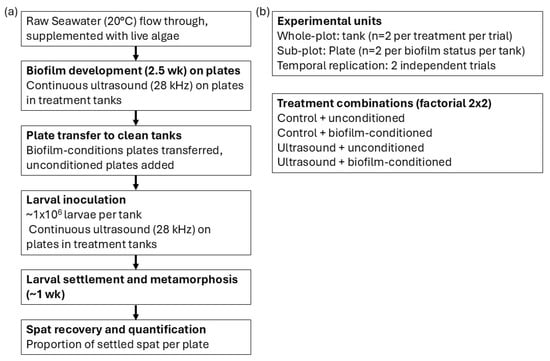
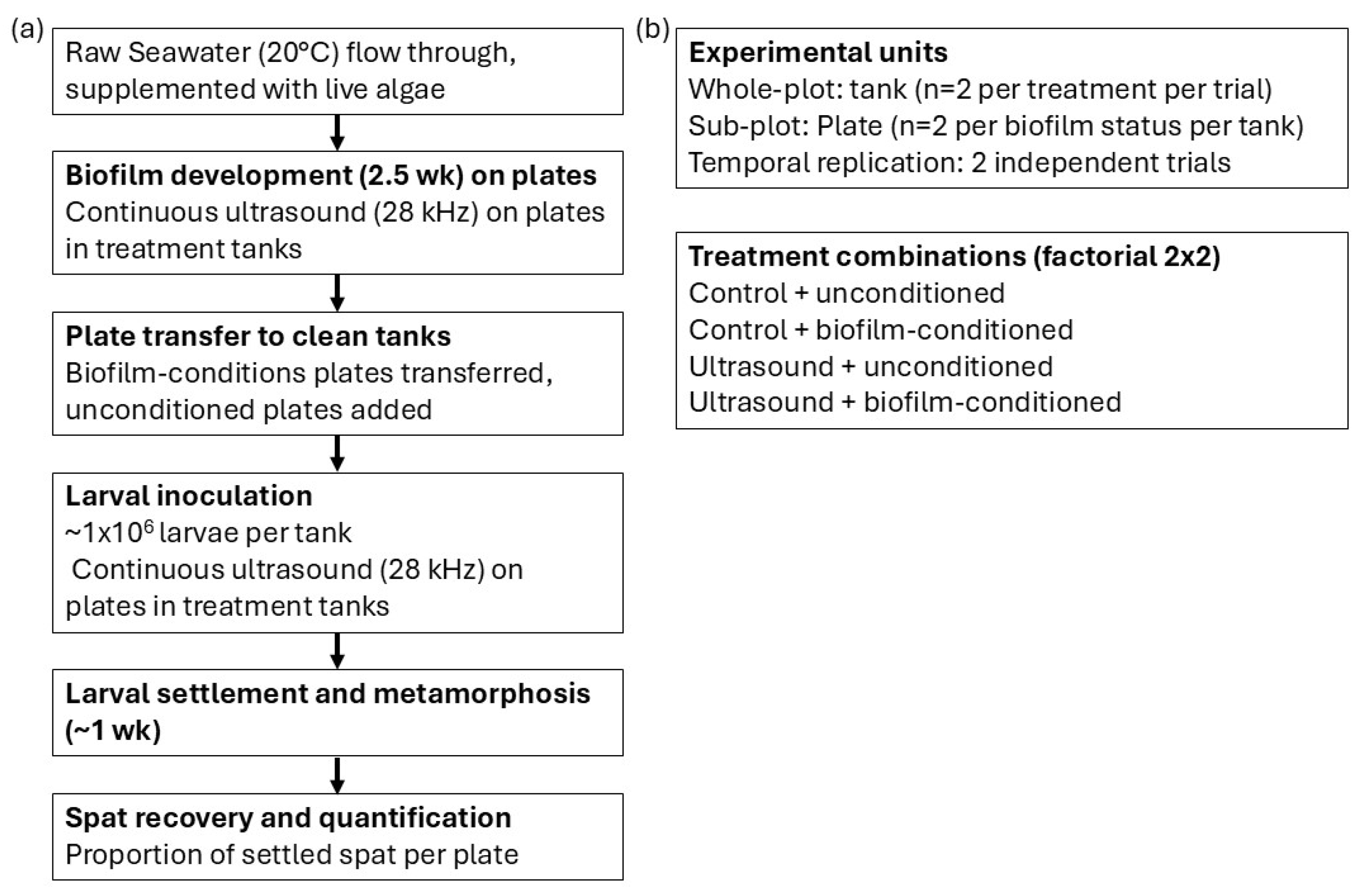
Figure 2.
Experimental workflow and statistical design. (a) Temporal sequence of experimental procedures from biofilm development through spat quantification. Ultrasonic treatment (28 kHz) was applied continuously to all plates in treatment tanks during both biofilm development (2.5 weeks) and larval settlement (~1 week) phases. (b) Split-plot experimental structure showing whole-plot factor (ultrasonic treatment at tank level), sub-plot factor (biofilm conditioning at plate level), temporal replication (2 independent trials), and resulting 2 × 2 factorial treatment combinations. This design yields n = 2 tanks per treatment per trial as the experimental unit for testing ultrasound effects, while plate-level replication (n = 2 per biofilm status per tank) allows testing of biofilm effects within tanks.
3. Results
3.1. Effect of Ultrasonic Treatment on Mussel Settlement
The analysis revealed a highly significant effect of biofilm conditioning (z = 7.67, p < 0.001) and a highly significant interaction between ultrasonic treatment and biofilm conditioning (z = −4.60, p < 0.001; Table 1). The main effect of ultrasonic treatment was not significant (z = −0.21, p = 0.84), indicating that ultrasound alone (without biofilm) does not affect settlement relative to control conditions.
Table 1.
Fixed effects from beta-binomial generalized linear mixed model testing effects of ultrasonic treatment and biofilm conditioning on mussel settlement. Estimates are regression coefficients on the logit scale (log-odds scale); positive values indicate increased settlement odds and negative values indicate decreased odds. SE = standard error of the estimate, quantifying uncertainty in the coefficient. z value = Wald test statistic (Estimate/SE), used to test whether each coefficient differs significantly from zero; larger absolute values indicate stronger evidence against the null hypothesis. p-value = probability of observing the data if the null hypothesis (coefficient = 0) were true; values < 0.05 indicate statistical significance at the conventional α = 0.05 level. The model included random effects for temporal replicates (trials) and tanks nested within replicates to account for hierarchical experimental structure; variance components for both random effects were near zero (intraclass correlation coefficients ICC < 0.001), indicating minimal unexplained variation among tanks beyond the fixed treatment effects and demonstrating consistent experimental conditions across replicates.
Raw settlement data from all plates and tank surfaces are presented in Table 2. Several patterns are evident: First, biofilm-conditioned plates in control tanks showed dramatically higher settlement than unconditioned plates within the same tanks (Trial 1: 97,750 vs. 1294 spat, 75-fold difference; Trial 2: 37,900 vs. 696 spat, 54-fold difference). Second, ultrasonic treatment eliminated this biofilm enhancement, maintaining settlement at baseline levels comparable to unconditioned controls (Trial 1: 1519 vs. 1294 spat; Trial 2: 1034 vs. 696 spat). Third, overall settlement success differed substantially between trials, with Trial 1 showing approximately 3-fold-higher total settlement than Trial 2 (332,844 vs. 115,321 total spat). This trial-to-trial variation likely reflects differences in larval batch quality, competency, or environmental conditions during settlement. Importantly, the ultrasonic treatment effect was consistent across both trials despite this variation, demonstrating robustness of the finding.
Table 2.
Raw settlement data from all experimental replicates, tanks, and plates. Spat counts are total settled individuals per plate or tank surface after ≥1 week exposure. All spat that settled on tank walls and floors were collected separately and counted. Total larvae per trial were estimated from initial inoculation density (~1 million per tank). “Proportion Settled (%)” shows percentage of total trial settlement on each surface; “Proportion per tank (%)” shows percentage within each tank. The data demonstrate: (1) strong biofilm enhancement in control tanks (54–75 fold), (2) elimination of biofilm enhancement by ultrasound, (3) substantial settlement on tank surfaces in all treatments indicating larval viability, and (4) trial-to-trial variation in overall settlement success while ultrasound effect remained consistent. Raw data and R analysis scripts are available at https://github.com/capel002/Effect-of-Ultrasound-on-Mussel-Settlement, accessed on 25 December 2025.
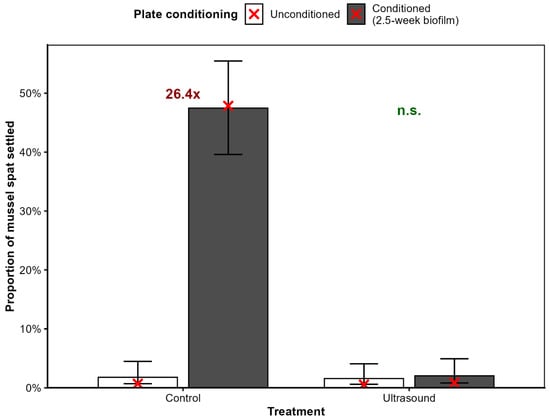
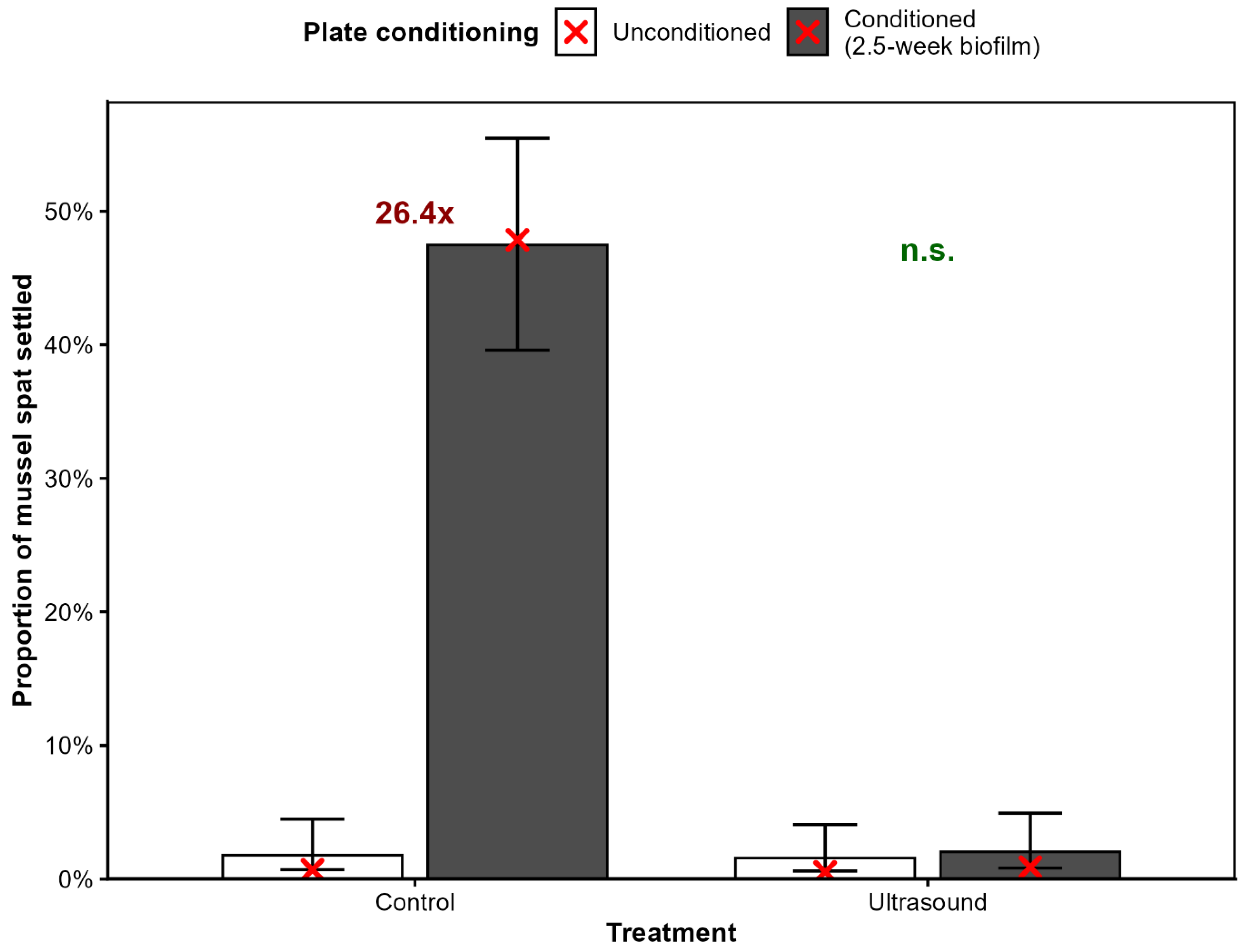
In control tanks, biofilm presence dramatically increased settlement (Figure 3). Estimated marginal means showed that biofilm-conditioned plates supported settlement of 47.5% (95% CI: 39.6–55.5%) of available spat, compared to only 1.8% (95% CI: 0.7–4.5%) on unconditioned plates, representing a 49-fold increase in odds (odds ratio = 49.4, 95% CI: 18.2–134.3, p < 0.001, see also Figure 4). This demonstrates the strong biofilm-mediated enhancement of mussel settlement under control conditions.
Figure 3.
Ultrasonic treatment eliminates biofilm-mediated enhancement of mussel settlement. Bars show estimated marginal means (±95% CI) from the beta-binomial generalized linear mixed model for settlement proportions under four treatment combinations (n = 2 temporal replicates, 2 plates per treatment per replicate per trial, total n = 16 plates). Red × symbols indicate observed means (averaged across replicates). Statistical significance: Control biofilm-conditioned vs. all other treatments: p < 0.001; all other pairwise comparisons: p > 0.67 (n.s., not significant). The biofilm effect in control tanks (49-fold increase, odds ratio = 49.4) is completely eliminated in ultrasound-treated tanks (1.3-fold increase, odds ratio = 1.3, p = 0.84).
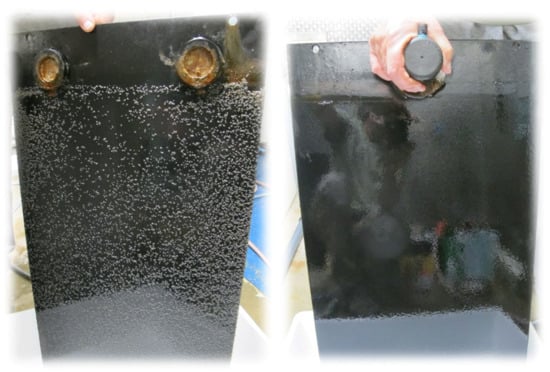
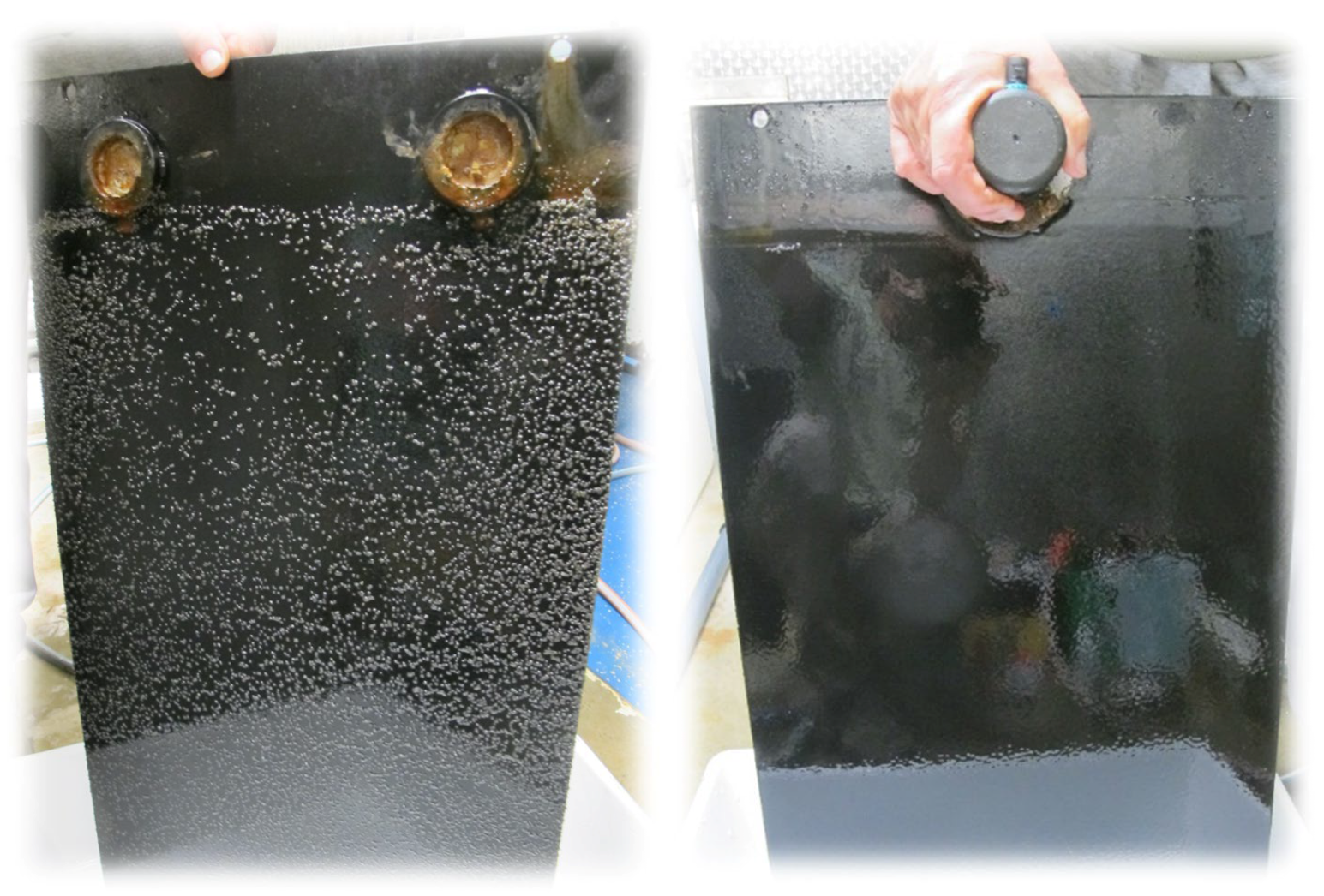
Figure 4.
Representative images of settlement plates after one week. (Left): Control tank, conditioned plate showing heavy mussel spat settlement. (Right): Ultrasound tank, conditioned plate showing minimal settlement despite 2.5 weeks of biofilm conditioning prior to larval introduction. Plates were S355 steel plates, with a thermoplastic coating (Abcite X60, Axalta) and dimensions: 450 mm × 800 mm × 5 mm, with a submerged surface of 450 mm × 787 mm.
In contrast, ultrasound-treated tanks showed no significant difference between biofilm-conditioned and unconditioned plates (Figure 3). Settlement remained at baseline levels regardless of biofilm status: unconditioned plates had 1.6% settlement (95%CI: 0.6–4.1%) and biofilm-conditioned plates had 2.1% settlement (95% CI: 0.8–5.0%), yielding an odds ratio of only 1.3 (95% CI: 0.3–5.1, p = 0.84). The interaction contrast demonstrated that ultrasonic treatment eliminated the biofilm enhancement observed in controls (odds ratio = 43.3, 95% CI: 21.3–87.8, p < 0.001).
Random effects variance components were near zero (intraclass correlation coefficients < 0.001 for both trial and tank), indicating minimal variation among tanks beyond what was explained by treatment effects. This suggests that experimental conditions were highly consistent across tanks and that the observed treatment effects are robust across temporal replicates.
3.2. Settlement Patterns Across Treatment Combinations
Pairwise comparisons across all four treatment combinations (Table 3) revealed distinct settlement patterns. Control biofilm-conditioned plates differed significantly from all other treatment combinations (all p < 0.001), showing 26- to 49-fold-higher settlement. In contrast, the three other treatment combinations (control unconditioned, ultrasound unconditioned, and ultrasound biofiom-conditioned) did not differ significantly from each other (all p > 0.67), maintaining settlement at consistently low baseline levels (1.6–2.1%). This pattern indicates that ultrasonic treatment effectively maintained settlement at levels comparable to unfouled control surfaces, regardless of biofilm presence.
Table 3.
Estimated marginal means (back-transformed from logit scale) showing settlement proportions under each treatment combination. Odds ratios compare each condition to control unconditioned (baseline). *** p < 0.001; ns = non-significant (p > 0.05).
Mussel spat settled on tank walls and floors in substantial numbers in all tanks (Table 2). Total settlement on tank surfaces (excluding experimental plates) was: Control Tank 1: 233,800 spat (70.2% of tank total); Ultrasound Tank 2: 198,000 spat (98.8%); Control Tank 3: 76,725 spat (66.5%); and Ultrasound Tank 4: 89,400 spat (98.1%). The high proportion of settlement on tank surfaces in ultrasound-treated tanks (98–99% vs. 66–70% in control tanks) reflects the dramatic reduction in settlement on ultrasound-treated plates. Importantly, absolute settlement on tank surfaces was similar between control and ultrasound tanks within each trial (Trial 1: 233,800 vs. 198,000; Trial 2: 76,725 vs. 89,400), indicating that larvae remained viable and capable of settlement throughout the experiment. This substrate-specific pattern (reduced settlement on treated plates but not on tank surfaces) demonstrates that the ultrasonic effect was localized to directly treated surfaces rather than due to larval mortality or general toxicity.
4. Discussion
4.1. Main Findings
This pilot study demonstrates that ultrasonic treatment at 28 kHz eliminates the biofilm-mediated enhancement of Mytilus edulis larval settlement observed under control conditions. In the absence of ultrasound, 2.5-week-old mixed microbial biofilms increased settlement odds by 49-fold compared to unconditioned surfaces, consistent with previous findings on the critical role of microbial biofilms in facilitating mussel settlement [21,24,29]. Ultrasonic treatment maintained settlement at baseline levels regardless of biofilm presence, with no significant difference between biofilm-conditioned and unconditioned plates. While replication (n = 2 temporal replicates, one tank per treatment per replicate) was limited, the large effect size and consistency across replicates provide preliminary evidence that ultrasonic treatment may disrupt the biofilm–larva interaction that normally facilitates macrofouling establishment.
4.2. Biofilm Composition and Development
Our biofilms were mixed communities of cultured algae (Isochrysis lutea and Pavlova lutheri) and naturally occurring bacteria from raw seawater, reflecting the complexity of natural marine biofilms. While we supplemented with algae to enhance biofilm development and provide photosynthetic organisms, the flow-through raw seawater ensured continuous bacterial colonization. This mixed-community composition is more representative of natural marine biofilms than pure bacterial or algal cultures [8,15]. However, we did not characterize the relative proportions of algal vs. bacterial components, nor the specific bacterial taxa present. The 49-fold settlement enhancement in control conditions demonstrates that these mixed biofilms were functionally mature and biologically active, providing effective settlement cues for mussel larvae. Future studies should include 16S rRNA sequencing (bacteria) and 18S rRNA sequencing (algae/diatoms) to determine community composition and identify which microbial groups are most affected by ultrasonic treatment.
Settlement on control biofilm-conditioned plates varied approximately 2.6-fold between trials (Trial 1: 97,750 spat; Trial 2: 37,900 spat), while overall settlement success differed 3-fold (33% vs. 12%). This variability likely reflects differences in larval batch quality, competency period, or subtle environmental conditions between trials. However, the ultrasonic treatment effect was remarkably consistent across both trials (98.4% and 97.3% reduction), demonstrating robustness despite sources of variation.
4.3. Possible Mechanisms for Ultrasound Efects
The mechanism by which ultrasonic treatment eliminates biofilm-mediated settlement enhancement remains unclear, as we did not directly measure biofilm properties, larval behavior, or acoustic fields. Several not mutually exclusive hypotheses warrant investigation:
Hypothesis 1: Biofilm disruption. Ultrasonic frequencies in the 25–40 kHz range generate acoustic streaming and cavitation effects that can disrupt biofilm architecture [15,20]. The extracellular polymeric substance (EPS) matrix that provides three-dimensional structure and chemical gradients essential for larval settlement cues [7] may be particularly susceptible to acoustic shear forces. Acoustic shear forces may break glycosidic bonds or disrupt hydrogen bonding networks in the EPS matrix, reducing three-dimensional structure. Ultrasound may also selectively disrupt settlement-promoting bacterial populations, as not all bacteria induce mussel settlement and cavitation-induced pressure waves may cause membrane permeabilization or lysis [30]. Testing this hypothesis requires direct measurement of biofilm biomass, EPS content, and microbial community composition under ultrasonic treatment.
Hypothesis 2: Larval behavioral avoidance. Larvae may actively avoid vibrating substrates through mechanosensory detection. The observation that mussel spat settled on tank walls and floors in both control and ultrasound tanks at similar densities supports this interpretation, suggesting larvae were viable but selectively avoided treated plates. However, it is unclear whether larvae can detect 28 kHz vibrations or whether avoidance would occur at the intensities used (100 W peak power). Behavioral assays with controlled acoustic exposure are needed to test this hypothesis.
Hypothesis 3: Chemical cue interference. Biofilm-associated bacteria release soluble chemical cues that induce larval settlement behavior [31,32]. Ultrasonic vibration may interfere with the production, release, or stability of these signaling molecules. Acoustic streaming may also homogenize concentration gradients of settlement cues within the biofilm. Alternatively, ultrasound may disrupt larval chemosensory systems. Chemical analysis of conditioned seawater combined with larval sensory assays would address this hypothesis.
Hypothesis 4: Hydrodynamic effects. Acoustic streaming may create near-surface flow patterns that physically prevent larval contact with the substrate or disrupt the boundary layer where chemical cues concentrate. Or, acoustic forces may preferentially dislodge weakly attached bacteria while leaving strongly attached cells. This would represent a physical rather than biological mechanism.
Distinguishing among these hypotheses is critical for understanding ultrasonic antifouling systems and predicting effectiveness across different fouling organisms and environmental conditions. The current study provides preliminary evidence that ultrasonic treatment affects the biofilm–larva interaction but cannot determine the underlying mechanism.
4.4. Acoustic Effects of Direct Transducer Mounting
The direct-contact mounting approach used in this study (transducer torqued to 18 Nm against plate via welded ring) may introduce acoustic and vibrational phenomena beyond simple ultrasonic transmission. When ultrasonic energy is directly coupled into a solid substrate, several effects may occur: (1) standing wave formation within the plate material, creating nodes and antinodes of maximum vibrational amplitude; (2) resonant plate modes, where the plate dimensions and material properties determine natural frequencies that may amplify certain ultrasonic components; (3) localized high-amplitude surface vibrations at the transducer-plate interface and propagating outward; and (4) Lamb waves (plate waves) that travel through the thickness of thin plates with particle motion both parallel and perpendicular to the surface [33].
These phenomena may enhance antifouling performance compared to water-coupled systems in several ways. First, direct coupling eliminates the ~99% energy loss that occurs when ultrasound transmits from a transducer through water to a distant surface [16]. Second, standing waves and resonance may create localized regions of intense vibration that are particularly effective at disrupting biofilm attachment or deterring larval settlement. Third, plate waves may distribute ultrasonic energy more uniformly across the surface than point-source water-coupled transducers. However, these potential advantages remain speculative without direct measurements of acoustic pressure fields, surface vibration patterns, and energy distribution. Future studies should consider to include measurements to predict standing wave patterns and resonant modes for different plate geometries and materials. Such characterization would clarify the physical mechanisms underlying the observed antifouling effects and guide optimization of transducer placement and operating frequencies.
4.5. Comparison to Previous Studies
Our observed 49-fold biofilm enhancement in control conditions aligns with previous studies. Ref. [24] observed 20–50 fold increases in M. galloprovincialis settlement on bacterial biofilms, and Ref. [34] documented similar responses across multiple marine invertebrate taxa. The magnitude of enhancement we observed falls within this established range, confirming the critical role of biofilm development in mussel settlement.
Our findings on ultrasonic antifouling effectiveness are consistent with previous laboratory studies showing 40–95% fouling reductions [14,16], though direct comparisons are difficult due to differences in target organisms, frequencies, power levels, and experimental designs. Our study is among the first to explicitly test ultrasonic treatment against biofilm-mediated settlement rather than simply measuring removal of established fouling. This distinction is important because preventing biofilm formation may be more effective than removing established organisms. The consistency of our results with previous work on ultrasonic biofilm disruption [15,20] and larval deterrence [18,35] suggests that the mechanisms we hypothesize are plausible, though direct mechanistic measurements remain necessary for confirmation.
4.6. Implications and Limitations
If confirmed with more replication and mechanistic validation, ultrasonic treatment could offer advantages over conventional antifouling approaches. Chemical biocides achieve high fouling reduction (70–95%) through broad-spectrum toxicity [36,37] but pose environmental risks and face regulatory restrictions [38,39]. Mechanical cleaning requires regular maintenance and may damage surfaces [40]. Ultrasonic treatment, by contrast, could provide continuous prevention without chemical discharge or physical abrasion. The preservation of baseline settlement levels suggests minimal interference with natural larval behavior in surrounding waters, potentially making this a lower-impact approach. Meanwhile, concerns include: (1) energy consumption for continuous operation; (2) equipment maintenance and replacement costs; (3) possible acoustic impacts on non-target organisms, though 28 kHz exceeds the hearing range of most marine vertebrates [19]; and (4) unknown long-term effectiveness as fouling communities.
Several important limitations must be acknowledged. With only two temporal replicates and one tank per treatment per replicate, our statistical power is limited, particularly for detecting small to moderate effects. Limited replication (n = 2) constrains statistical inference in two ways: (1) reduced power to detect effects smaller than the large 49-fold difference we observed and (2) limited ability to generalize findings beyond the specific conditions tested. However, the near-zero random effects variance (ICC < 0.001) indicates that tank-to-tank variation was minimal and treatment effects were consistent across replicates. The near-zero random effects variance suggests consistent experimental conditions, but increased replication would strengthen confidence in the generalizability of these findings.
We did not measure biofilm biomass, EPS content, microbial community composition, acoustic pressure fields, or larval behavior. Without these data, we cannot determine whether ultrasound affects biofilm development during the conditioning period, larval sensory systems during settlement, chemical cue production, or other pathways. Future studies should include direct biofilm characterization (e.g., crystal violet staining for biomass, EPS quantification, 16S/18S rRNA sequencing for community composition, and confocal microscopy for three-dimensional structure) and larval behavioral assays (video tracking and choice experiments).
Laboratory experiments lack the complexity of natural marine systems. Acoustic propagation in actual vessel systems (box coolers and heat exchangers) differs substantially from laboratory tanks, due to complex geometries, flow patterns, and acoustic reflections. Additionally, long-term effectiveness (months to years) and potential adaptation by fouling communities need further research. Field trials are essential to validate laboratory findings and assess practical feasibility.
We tested only Mytilus edulis larvae at the competent settlement stage. Fouling communities include diverse taxa (barnacles, hydroids, bryozoans, ascidians, and sponges) with varying settlement requirements and biofilm dependencies [41,42]. The 28 kHz frequency effective for disrupting mussel–biofilm interactions may not be optimal for other species. For example, barnacle cyprid settlement may be more sensitive to different frequencies (Ref. [18] found 23 kHz most effective for barnacles), and soft-bodied organisms like hydroids and bryozoans may respond differently to ultrasonic vibration than hard-shelled mussels and barnacles. Multi-species testing is essential before drawing general conclusions about antifouling efficacy.
We tested only 28 kHz at 100 W peak power. Optimal parameters for biofilm disruption or larval deterrence may differ. Ref. [20] found that low-intensity, low-frequency ultrasound can actually enhance biofilm growth, indicating that parameter selection is critical. The HDS40 system uses a complex spectrum around the 28 kHz resonance frequency, but we did not characterize the actual frequency content or temporal patterns. Future optimization studies should systematically vary frequency (20–100 kHz), power (10–500 W), duty cycle (continuous vs. pulsed), and waveform characteristics to identify optimal operating parameters for different target organisms and biofilm types. While 28 kHz exceeds the hearing range of most marine vertebrates [19], invertebrate responses remain poorly understood. Potential impacts on non-target settlement (e.g., beneficial biofilm-forming bacteria and native invertebrate larvae) require assessment. Environmental impact assessments might be needed before field deployment, particularly in ecologically sensitive areas or near critical habitats.
Our study measured only endpoint settlement (total spat after ≥1 week), not temporal dynamics. We cannot determine whether ultrasound: (1) prevented settlement throughout exposure, (2) delayed settlement onset, or (3) caused post-settlement mortality. The distinction is mechanistically important. Our observation of similar settlement on tank walls in both treatments argues against larval mortality (Scenario 3) but cannot distinguish prevention versus delay.
4.7. Algal vs. Bacterial Biofilm Considerations
An important consideration is that our mixed biofilms (algae + bacteria) may respond differently to ultrasonic treatment than purely bacterial biofilms studied in other systems. Algal cells are generally larger (5–20 μm for Isochrysis and Pavlova) than bacteria (0.5–2 μm), have cell walls with different compositions (cellulose/silica vs. peptidoglycan), and may exhibit different susceptibilities to acoustic cavitation and shear forces. The relative contributions of algal vs. bacterial components to settlement enhancement, and their differential responses to ultrasound, remain unknown in our study.
Previous studies have shown that both bacterial biofilms [30] and diatom films [21] can induce mussel settlement, but the mechanisms may differ. Bacteria produce soluble chemical cues (e.g., quorum sensing molecules, and peptides) that trigger larval metamorphosis, while diatoms may provide both chemical cues and physical surface modifications (increased roughness and EPS matrix) that facilitate attachment. Ultrasonic treatment may disrupt these components differently: cavitation may be more effective at disrupting EPS matrices and bacterial cell membranes than at damaging larger, more robust algal cells; conversely, acoustic streaming may physically dislodge algal cells more effectively than smaller bacteria embedded in EPS. This complexity represents an important area for future mechanistic investigation, ideally using separate treatments with pure bacterial biofilms, pure algal films, and mixed communities to distinguish their individual and synergistic contributions to settlement enhancement and their differential responses to ultrasound.
4.8. Alternative Explanations and Unresolved Questions
Mussel spat settled on tank walls and floors in both control and ultrasound tanks at similar densities. This finding has important implications for interpreting our results. It indicates that larvae remained viable and capable of settlement in both conditions; ultrasound did not cause widespread larval mortality or prevent metamorphosis; and the effect was substrate-specific (plates vs. tank surfaces). This pattern is consistent with two interpretations: (a) ultrasound disrupted biofilm on plates but not on distant tank surfaces, eliminating settlement cues locally, or (b) larvae actively avoided vibrating plates but settled normally on non-vibrating surfaces. Distinguishing between these interpretations requires measuring acoustic fields throughout the tank and conducting behavioral choice experiments where larvae can choose between vibrating and non-vibrating surfaces with identical biofilm coverage.
Another unresolved question is whether ultrasound affects biofilm formation during the development period, settlement during the larval exposure period, or both. Our design, where biofilm-conditioned plates received ultrasound for 2.5 weeks before larvae were introduced, cannot separate these effects. Future experiments should include treatments where ultrasound is applied only during biofilm development and only during larval exposure to determine the critical window for intervention.
4.9. Broader Applicability and Multi-Frequency Approaches
This study focused exclusively on Mytilus edulis larvae. Marine biofouling communities include diverse taxa (barnacles, bryozoans, hydroids, and ascidians) with varying settlement cues and biofilm dependencies [41,42]. A single ultrasonic frequency (28 kHz) may not provide broad-spectrum protection. Previous research suggests frequency-dependent effectiveness: Ref. [18] found 23 kHz most effective for barnacles, while our 28 kHz targeted mussels. Multi-frequency or frequency-sweeping systems cycling through 20–100 kHz may be necessary for comprehensive fouling control, though cost–benefit trade-offs of increased complexity require evaluation. Future research should systematically test multi-frequency protocols against mixed fouling communities.
4.10. Future Research Priorities
To advance ultrasonic antifouling from proof of concept to practical application, we suggest the following research priorities. In the short term (laboratory studies): (a) Biofilm characterization: quantify biomass, EPS content, and microbial community composition via 16S/18S sequencing. (b) Conduct larval behavioral assays (video tracking and choice experiments) to test avoidance hypothesis. (c) Accoustic field mapping: characterize pressure amplitude and distribution in experimental systems. (d) Parameter optimization: test multiple frequencies (20–100 kHz) and power levels (50–200 W). (e) Test settlement rate dynamics (daily counts) to distinguish prevention vs. delay vs. post-settlement mortality.
In the medium term (expanded laboratory studies): (a) Multi-species testing: evaluate effectiveness against barnacles, hydroids, bryozoans, ascidians. (b) Temporal dynamics: determine critical windows for intervention (conditioning vs. settlement periods). (c) Long-term exposure: test continuous treatment for weeks to months. (d) Complex substrates: evaluate effectiveness on geometries relevant to heat exchangers.
In the long term (field validation): (a) Pilot field trials: test in operational vessel cooling systems under realistic fouling pressure. (b) Environmental impact: assess non-target effects on marine invertebrates and ecosystems. (c) Cost–benefit analyses comparing ultrasonic systems to conventional antifouling approaches.
These research priorities would address the major knowledge gaps identified in this pilot study and provide the evidence base necessary for practical deployment of ultrasonic antifouling systems in marine vessel applications and other marine infrastructures.
5. Conclusions
This pilot study provides evidence that ultrasonic treatment at 28 kHz may suppress the settlement enhancement typically associated with early-stage mixed microbial biofilms in Mytilus edulis. Under control conditions, 2.5-week-old mixed biofilms (algae + bacteria from seawater) increased settlement odds by 49-fold, a large and highly significant effect (p < 0.001) that is in line with findings from previous studies. Ultrasonic treatment eliminated this biofilm advantage, maintaining settlement at baseline levels regardless of surface biofilm status. The mechanism remains uncertain and may involve biofilm disruption, larval behavioral avoidance, interference with chemical cue production or detection, or hydrodynamic effects.
While limited replication (n = 2 temporal replicates, one tank per treatment per replicate) constrains the strength of statistical inference, the large effect size (49-fold difference), high statistical significance (p < 0.001 for interaction), and consistency across replicates suggest this is a robust and replicable phenomenon worth further investigation. The near-zero random effects variance (ICC < 0.001) indicates that experimental conditions were highly consistent and treatment effects dominated any tank-level variation.
If confirmed and validated through follow-up studies, with increased replication, mechanistic measurements, multi-species testing, and field trials, ultrasonic treatment could offer a non-chemical, preventive antifouling approach that targets the biofilm–larva interaction at the root of the fouling succession. This would represent a mechanistically distinct alternative to reactive cleaning methods and toxic biocides, potentially reducing maintenance costs and environmental impacts of vessel operations and other marine infrastructure.
Author Contributions
Conceptualization, J.J.C. and M.D.; methodology, J.J.C. and M.D.; validation, J.J.C. and M.D.; formal analysis, J.J.C.; investigation, S.T. and M.D.; resources, M.D.; data curation, J.J.C. and M.D.; writing—original draft preparation, J.J.C.; writing—review and editing, J.J.C., S.T. and M.D.; visualization, J.J.C.; project administration, J.J.C. and M.D.; funding acquisition, J.J.C. and M.D. All authors have read and agreed to the published version of the manuscript.
Funding
This work was funded by Shipsonic, a Delta-Sistems BV enterprise. Registration Netherlands Chamber of Commerce: 67511287.
Data Availability Statement
Data is published under CC license and available at https://github.com/capel002/Effect-of-Ultrasound-on-Mussel-Settlement, accessed on 25 December 2025.
Conflicts of Interest
This work was funded by Shipsonic (Delta-Sistems BV), a manufacturer of ultrasonic antifouling systems. The funders had no role in the design of the study; in the collection, analyses, or interpretation of data; in the writing of the manuscript; or in the decision to publish the results.
References
- Hopkins, G.; Davidson, I.; Georgiades, E.; Floerl, O.; Morrisey, D.; Cahill, P. Managing biofouling on submerged static artificial structures in the marine environment–assessment of current and emerging approaches. Front. Mar. Sci. 2021, 8, 759194. [Google Scholar] [CrossRef] [Scilit]
- Davidson, I.; Cahill, P.; Hinz, A.; Kluza, D.; Scianni, C.; Georgiades, E. A review of biofouling of ships’ internal seawater systems. Front. Mar. Sci. 2021, 8, 761531. [Google Scholar] [CrossRef] [Scilit]
- Bott, T.R. Fouling of Heat Exchangers; Elsevier: Amsterdam, The Netherlands, 1995. [Google Scholar]
- Edith, A.; Robinson, A.; Hester, S.; Woodham, B.; Wilkinson, P.; Gorgula, S. Factors that Influence Vessel Biofouling and Its Prevention and Management; Final Report for CEBRA Project 190803; Centre of Excellence for Biosecurity Risk Analysis: Melbourne, Australia, 2021. [Google Scholar]
- Venugopalan, V.P. Industrial seawater cooling systems under threat from the invasive green mussel Perna viridis. ASEAN J. Sci. Technol. Dev. 2018, 35, 65–69. [Google Scholar] [CrossRef] [Scilit]
- Dobretsov, S.; Rittschof, D. Love at first taste: Induction of larval settlement by marine microbes. Int. J. Mol. Sci. 2020, 21, 731. [Google Scholar] [CrossRef] [Scilit]
- Decho, A.W.; Gutierrez, T. Microbial extracellular polymeric substances (EPSs) in ocean systems. Front. Microbiol. 2017, 8, 922. [Google Scholar] [CrossRef] [Scilit]
- Antunes, J.; Leão, P.; Vasconcelos, V. Marine biofilms: Diversity of communities and of chemical cues. Environ. Microbiol. Rep. 2019, 11, 287–305. [Google Scholar] [CrossRef] [Scilit] [PubMed]
- Baldanzi, S.; Vargas, I.T.; Armijo, F.; Fernández, M.; Navarrete, S.A. Experimental assessment of a conducting polymer (PEDOT) and microbial biofilms as deterrents and facilitators of macro-biofouling: Larval settlement of the barnacle Notobalanus flosculus (Darwin, 1854) from Central Chile. J. Mar. Sci. Eng. 2021, 9, 82. [Google Scholar] [CrossRef] [Scilit]
- Rubio, D.; Casanueva, J.F.; Nebot, E. Assessment of the antifouling effect of five different treatment strategies on a seawater cooling system. Appl. Therm. Eng. 2015, 85, 124–134. [Google Scholar] [CrossRef] [Scilit]
- Davidson, I.; Scianni, C.; Hewitt, C.; Everett, R.; Holm, E.; Tamburri, M.; Ruiz, G. Mini-review: Assessing the drivers of ship biofouling management–aligning industry and biosecurity goals. Biofouling 2016, 32, 411–428. [Google Scholar] [CrossRef] [Scilit]
- Weber, F.; Esmaeili, N. Marine biofouling and the role of biocidal coatings in balancing environmental impacts. Biofouling 2023, 39, 661–681. [Google Scholar] [CrossRef] [Scilit]
- Tang, Z.; Zu, P.; Chen, B.; Zhang, X.; Lan, J.; Zhang, J.; Zhang, H.; Wang, B.; Ma, L.; Wu, J. Ultrasonic-Assisted Marine Antifouling Strategy on Gel-like Epoxy Primer. Molecules 2024, 29, 4735. [Google Scholar] [CrossRef] [Scilit] [PubMed]
- Legg, M.; Yücel, M.; De Carellan, I.G.; Kappatos, V.; Selcuk, C.; Gan, T. Acoustic methods for biofouling control: A review. Ocean Eng. 2015, 103, 237–247. [Google Scholar] [CrossRef] [Scilit]
- Qian, P.-Y.; Lau, S.C.; Dahms, H.-U.; Dobretsov, S.; Harder, T. Marine biofilms as mediators of colonization by marine macroorganisms: Implications for antifouling and aquaculture. Mar. Biotechnol. 2007, 9, 399–410. [Google Scholar] [CrossRef] [Scilit]
- McQuillan, J.S.; Hopper, D.J.; Magiopoulos, I.; Arundell, M.; Brown, R.; Shorter, S.; Mowlem, M.C.; Pascal, R.W.; Connelly, D. Buzz off! An evaluation of ultrasonic acoustic vibration for the disruption of marine micro-organisms on sensor-housing materials. Lett. Appl. Microbiol. 2016, 63, 393–399. [Google Scholar] [CrossRef] [Scilit]
- Thiruppathi, K.; Lakshmi, P.; Sudarsan, K.; Rajapan, D.; Kirubagaran, R. A study on the effect of pulsed power ultrasound waves on marine biofouling. Indian J. Geo-Mar. Sci. 2014, 43, 2169–2174. [Google Scholar]
- Guo, S.F.; Lee, H.P.; Chaw, K.C.; Miklas, J.; Teo, S.L.M.; Dickinson, G.H.; Birch, W.R.; Khoo, B.C. Effect of ultrasound on cyprids and juvenile barnacles. Biofouling 2011, 27, 185–192. [Google Scholar] [CrossRef] [Scilit] [PubMed]
- Popper, A.N.; Hawkins, A.D. An overview of fish bioacoustics and the impacts of anthropogenic sounds on fishes. J. Fish Biol. 2019, 94, 692–713. [Google Scholar] [CrossRef] [Scilit]
- Pitt, W.G.; Ross, S.A. Ultrasound increases the rate of bacterial cell growth. Biotechnol. Prog. 2003, 19, 1038–1044. [Google Scholar] [CrossRef] [Scilit] [PubMed]
- Toupoint, N.; Mohit, V.; Linossier, I.; Bourgougnon, N.; Myrand, B.; Olivier, F.; Lovejoy, C.; Tremblay, R. Effect of biofilm age on settlement of Mytilus edulis. Biofouling 2012, 28, 985–1001. [Google Scholar] [CrossRef] [Scilit]
- Kamermans, P.; Galley, T.; Boudry, P.; Fuentes, J.; McCombie, H.; Batista, F.; Blanco, A.; Dominguez, L.; Cornette, F.; Pincot, L.; et al. Blue mussel hatchery technology in Europe. In Advances in Aquaculture Hatchery Technology; Elsevier: Amsterdam, The Netherlands, 2013; pp. 339–373. [Google Scholar]
- Widdows, J. Physiological ecology of mussel larvae. Aquaculture 1991, 94, 147–163. [Google Scholar] [CrossRef] [Scilit]
- Bao, W.-Y.; Satuito, C.G.; Yang, J.-L.; Kitamura, H. Larval settlement and metamorphosis of the mussel Mytilus galloprovincialis in response to biofilms. Mar. Biol. 2007, 150, 565–574. [Google Scholar] [CrossRef] [Scilit]
- Caceres-Martinez, J.; Robledo, J.A.F.; Figueras, A. Settlement and post-larvae behaviour of Mytitus galtoprovincialis: Field and laboratory experiments. Mar. Ecol. Prog. Ser. 1994, 112, 107–117. [Google Scholar] [CrossRef] [Scilit]
- Brooks, M.E.; Kristensen, K.; Van Benthem, K.J.; Magnusson, A.; Berg, C.W.; Nielsen, A.; Skaug, H.J.; Mächler, M.; Bolker, B.M. glmmTMB balances speed and flexibility among packages for zero-inflated generalized linear mixed modeling. R J. 2017, 9, 378–400. [Google Scholar] [CrossRef] [Scilit]
- Hartig, F. Residual Diagnostics for Hierarchical (Multi-Level/Mixed) Regression Models. R Package, Version 046. 2022. Available online: https://cran.r-project.org/web/packages/DHARMa/index.html (accessed on 1 December 2025).
- Lenth, R. Emmeans: Estimated Marginal Means, Aka Least-Squares Means_. R package, version 18 5. J. Stat. Softw. 2023, 34, 1–28. [Google Scholar] [CrossRef] [Scilit]
- Wang, C.; Bao, W.Y.; Gu, Z.Q.; Li, Y.F.; Liang, X.; Ling, Y.; Cai, S.L.; Shen, H.D.; Yang, J.L. Larval settlement and metamorphosis of the mussel Mytilus coruscus in response to natural biofilms. Biofouling 2012, 28, 249–256. [Google Scholar] [CrossRef] [Scilit]
- Yang, J.-L.; Shen, P.-J.; Liang, X.; Li, Y.-F.; Bao, W.-Y.; Li, J.-L. Larval settlement and metamorphosis of the mussel Mytilus coruscus in response to monospecific bacterial biofilms. Biofouling 2013, 29, 247–259. [Google Scholar] [CrossRef] [Scilit]
- Hadfield, M.G.; Paul, V.J. Natural chemical cues for settlement and metamorphosis of marine invertebrate larvae. In Marine Chemical Ecology; CRC Press: Boca Raton, FL, USA, 2001; Volume 13, pp. 431–461. [Google Scholar]
- Steinberg, P.D.; De Nys, R.; Kjelleberg, S. Chemical cues for surface colonization. J. Chem. Ecol. 2002, 28, 1935–1951. [Google Scholar] [CrossRef] [Scilit]
- Zhang, J.; Cho, Y.; Kim, J.; Malikov, A.K.U.; Kim, Y.H.; Yi, J.-H. Nondestructive Inspection of Underwater Coating Layers Using Ultrasonic Lamb Waves. Coatings 2023, 13, 728. [Google Scholar] [CrossRef] [Scilit]
- Hadfield, M.G. Biofilms and Marine Invertebrate Larvae: What Bacteria Produce That Larvae Use to Choose Settlement Sites. Annu. Rev. Mar. Sci. 2011, 3, 453–470. [Google Scholar] [CrossRef] [Scilit]
- Guo, S.; Lee, H.P.; Teo, S.L.M.; Khoo, B.C. Inhibition of barnacle cyprid settlement using low frequency and intensity ultrasound. Biofouling 2012, 28, 131–141. [Google Scholar] [CrossRef] [Scilit]
- Chambers, L.D.; Stokes, K.R.; Walsh, F.C.; Wood, R.J. Modern approaches to marine antifouling coatings. Surf. Coat. Technol. 2006, 201, 3642–3652. [Google Scholar] [CrossRef] [Scilit]
- Thomas, K.V.; Brooks, S. The environmental fate and effects of antifouling paint biocides. Biofouling 2010, 26, 73–88. [Google Scholar] [CrossRef] [Scilit] [PubMed]
- Turner, A. Marine pollution from antifouling paint particles. Mar. Pollut. Bull. 2010, 60, 159–171. [Google Scholar] [CrossRef] [Scilit] [PubMed]
- Yebra, D.M.; Kiil, S.; Dam-Johansen, K. Antifouling technology—Past, present and future steps towards efficient and environmentally friendly antifouling coatings. Prog. Org. Coat. 2004, 50, 75–104. [Google Scholar] [CrossRef] [Scilit]
- Schultz, M.P.; Bendick, J.; Holm, E.; Hertel, W. Economic impact of biofouling on a naval surface ship. Biofouling 2011, 27, 87–98. [Google Scholar] [CrossRef] [Scilit]
- Railkin, A.I. Marine Biofouling: Colonization Processes and Defenses; CRC Press: Boca Raton, FL, USA, 2003. [Google Scholar]
- Wahl, M. Marine epibiosis. I. Fouling and antifouling: Some basic aspects. Mar. Ecol. Prog. Ser. 1989, 58, 175–189. [Google Scholar] [CrossRef] [Scilit]

Disclaimer/Publisher’s Note: The statements, opinions and data contained in all publications are solely those of the individual author(s) and contributor(s) and not of MDPI and/or the editor(s). MDPI and/or the editor(s) disclaim responsibility for any injury to people or property resulting from any ideas, methods, instructions or products referred to in the content. |
© 2026 by the authors. Licensee MDPI, Basel, Switzerland. This article is an open access article distributed under the terms and conditions of the Creative Commons Attribution (CC BY) license.