


Abstract
In multi-level overtopping wave energy converters (OWEC), the inlet slot governs overtopping losses and the distribution of inflow among reservoirs, making it a critical design feature for maximizing hydraulic efficiency. This study defines the relative slot width as (=w/) and investigates its influence on the performance of an SSG-based multi-level OWEC using DualSPHysics, an open-source weakly compressible smoothed particle hydrodynamics (WCSPH) solver, in a two-dimensional recirculating numerical wave tank under regular-wave conditions. Hydraulic efficiency is evaluated as the ratio of the overtopping-stored potential-energy flux to the incident wave energy flux per unit width. The results show a nonlinear dependence of reservoir-level contributions on , and an intermediate provides a balanced contribution across upper, middle, and lower reservoirs, yielding the maximum overall efficiency. To extend the analysis beyond a single design wave, a global-state performance map in the period–height space is constructed and combined with the target-sea spectral characteristics, indicating that the optimal geometry maintains relatively robust efficiency in the dominant spectral band while revealing efficiency limitations associated with insufficient overtopping at small waves and saturation at large waves. The proposed approach provides quantitative guidance for slot design and site-relevant performance screening of multi-level OWEC.
1. Introduction
The rapid growth in energy demand has accelerated the transition away from fossil-fuel-based power generation, as the relative cost competitiveness of fossil energy declines and concerns about climate and environmental impacts increase. Accordingly, the development of renewable energy technologies such as solar, wind, and hydropower has become increasingly important. Because oceans cover more than 70% of the Earth’s surface, marine energy represents a vast potential resource. Among marine renewables, wave energy has attracted attention because it harnesses the kinetic and potential energy of sea-surface waves, offers high conversion potential owing to its high energy density, is widely distributed, and enables comparatively stable power forecasting [1,2].
Wave energy converter (WEC) technologies are currently being investigated and demonstrated based on diverse operating principles, including overtopping, oscillating water column, and oscillating body concepts. Among these, overtopping-type wave power systems are particularly attractive for nearshore applications because they have a relatively simple operating principle, exhibit strong structural stability due to their static configuration, and can be readily integrated with coastal and nearshore structures. Overtopping WECs generate electricity by exploiting the potential energy of water that overtops a ramp and is stored at an elevated level, which provides a practical advantage in that existing infrastructure such as breakwaters can be used as installation sites [3,4].
The Sea-wave Slot-Cone Generator (SSG) is a representative overtopping concept in which electricity is produced using the potential energy of water stored in several reservoirs arranged vertically above the still water level [5,6,7]. In addition, overtopping breakwater concepts integrated with conventional rubble-mound structures have been actively investigated. The Overtopping Breakwater for Energy Conversion (OBREC) integrates a front sloping ramp and an overtopping reservoir into an existing breakwater structure, and multiple studies have examined overtopping discharge, hydraulic efficiency, wave loading, and prototype behavior under real-sea conditions [8,9,10,11]. More recently, construct design and systematic numerical parametric analyses have been used to investigate the effects of global geometric parameters and sea-state conditions on the performance of overtopping WECs integrated with breakwaters or nearshore structures [12,13,14,15]. These studies, together with the EurOtop overtopping manual and subsequent improvements to overtopping prediction formulas, demonstrate that global geometric parameters such as ramp slope, crest freeboard, crest width, and crown/crest wall configuration can strongly influence overtopping discharge predictions, structural safety, and energy performance [16,17].
From a methodological perspective, beyond laboratory experiments and empirical formula-based modeling, high-resolution numerical modeling has gained attention as a key tool for analyzing overtopping processes and optimizing device geometry. The weakly compressible smoothed particle hydrodynamics approach implemented in the open-source DualSPHysics solver has been widely applied to simulate wave transformation, run-up, and irregular-wave overtopping at coastal dikes and nearshore structures, and it has been reported to show good agreement with experimental observations [18,19,20,21]. Recent studies have also coupled large-scale spectral wave modeling with DualSPHysics to evaluate overtopping hazards to pedestrians and infrastructure under storm conditions, illustrating that particle-based modeling can support realistic design and risk assessment under real sea states [12,13,14,15].
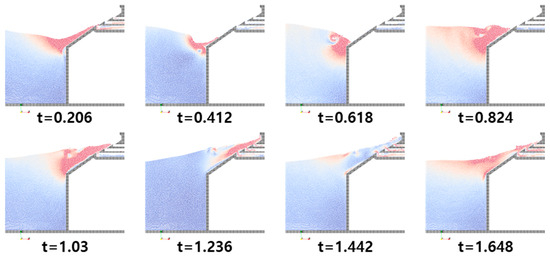
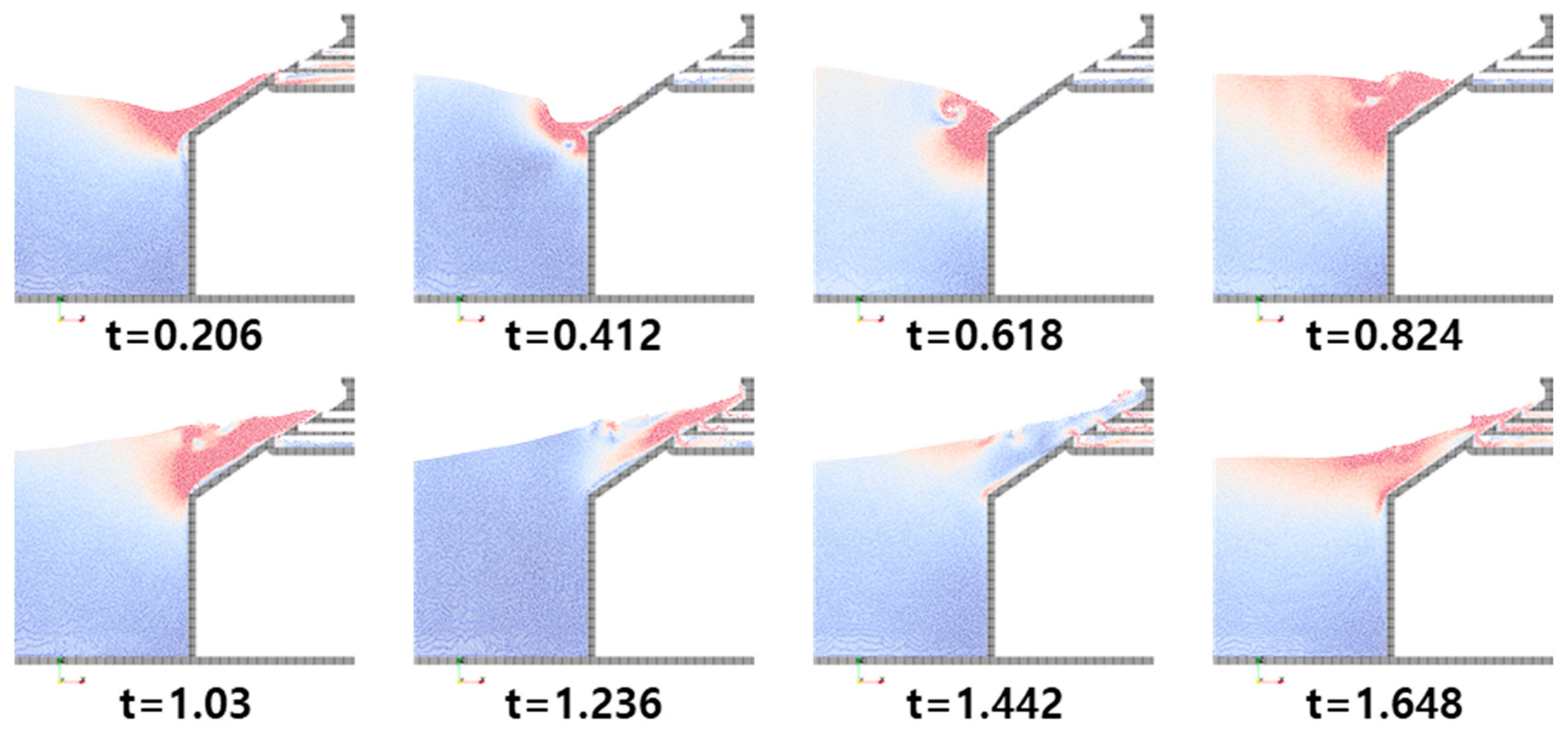
These findings suggest that SPH-based numerical approaches are particularly suitable for overtopping WEC analyses where strongly nonlinear free-surface phenomena—such as jet formation, recirculation zones, and reservoir filling—play important roles (Figure 1). Accordingly, this study uses a DualSPHysics-based SPH model to quantitatively evaluate overtopping discharge and energy capture characteristics of a multi-level overtopping WEC.
Figure 1.
Time-series SPH simulation snapshots of wave run-up and overtopping onto a multi-level OWEC.
Although many studies have focused on global design parameters, comparatively fewer have addressed the detailed geometry of the slot that directly controls inflow to reservoirs in a multi-level overtopping device. Because slot geometry governs local velocities and energy losses near the reservoir entrance and determines how overtopping discharge is distributed among reservoirs, it can be regarded as a key design variable for hydraulic performance. Jungrungruengtaworn and Hyun [22] analyzed the influence of relative slot width on overtopping discharge and hydraulic efficiency for a multi-level floating overtopping device using two-dimensional numerical simulations, and they reported an optimal tendency in which efficiency peaks near an intermediate relative slot width. Liu et al. [23] experimentally investigated a multi-level overtopping device and confirmed that the upper ramp angle and lower reservoir opening width can significantly affect overtopping discharge (Liu et al., 2018). Nevertheless, systematic parametric studies that treat relative slot width as a primary design variable for multi-level overtopping WECs remain limited, and further investigation is needed, particularly under broad period–height wave conditions relevant to practical design.
In this study, using a design wave selected from wave-climate analysis, we quantitatively examine the influence of relative slot width on hydraulic performance for a bottom-fixed multi-level (three-reservoir) overtopping WEC under the premise of a multifunctional structure concept that can be added to or integrated with breakwaters and coastal structures. A DualSPHysics-based WCSPH numerical model is employed, which is a particle-based method that offers favorable computational efficiency for representing multi-level nonlinearities (e.g., turbulence, breakwater-induced wave attenuation, and associated energy losses), although it may not reach the accuracy of conventional CFD, and the ratio between slot width and ramp length ( = w/) is used as the primary design variable with the energy efficiency evaluated based on particle-motion variability. Under the design-wave condition, overtopping discharge and energy capture characteristics are compared across multiple geometries. For the selected optimal geometry, a global performance map is constructed by combining a global-state efficiency map with spectral analysis for the target sea area, so that favorable operating regions and systematic efficiency changes with respect to λ can be identified. However, this paper confines its scope to the energy-efficiency assessment and geometry optimization of the overtopping WEC and does not address breakwater performance metrics such as reflection and transmission coefficients or wave-height attenuation. These results are expected to provide practical design guidance for early-stage geometry selection and integration strategies with coastal structures such as breakwaters for sea areas with similar wave conditions, including a quantitative basis for rationally screening the design-variable (λ) range at the early design stage and baseline data for follow-up studies on integrated applications.
The remainder of this paper is organized as follows. The design wave, target device configuration, and numerical simulation conditions are described. Based on these settings, the optimal design-variable result under the design-wave condition is identified. Global-state performance evaluation results and a global performance map for varying wave height–period combinations are then presented. Finally, the main conclusions and directions for future research are provided.
2. Materials and Methods
This section describes the numerical approach and modeling conditions used to analyze the influence of OWEC design variables. An open-source solver, DualSPHysics, based on WCSPH (Weakly Compressible Smoothed Particle Hydrodynamics), was used, and the design variable definition and numerical setup are presented.
2.1. Device Configuration and Design Variable Definition
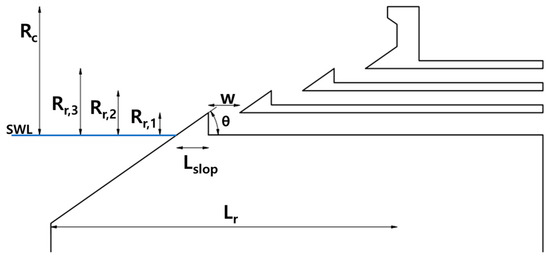
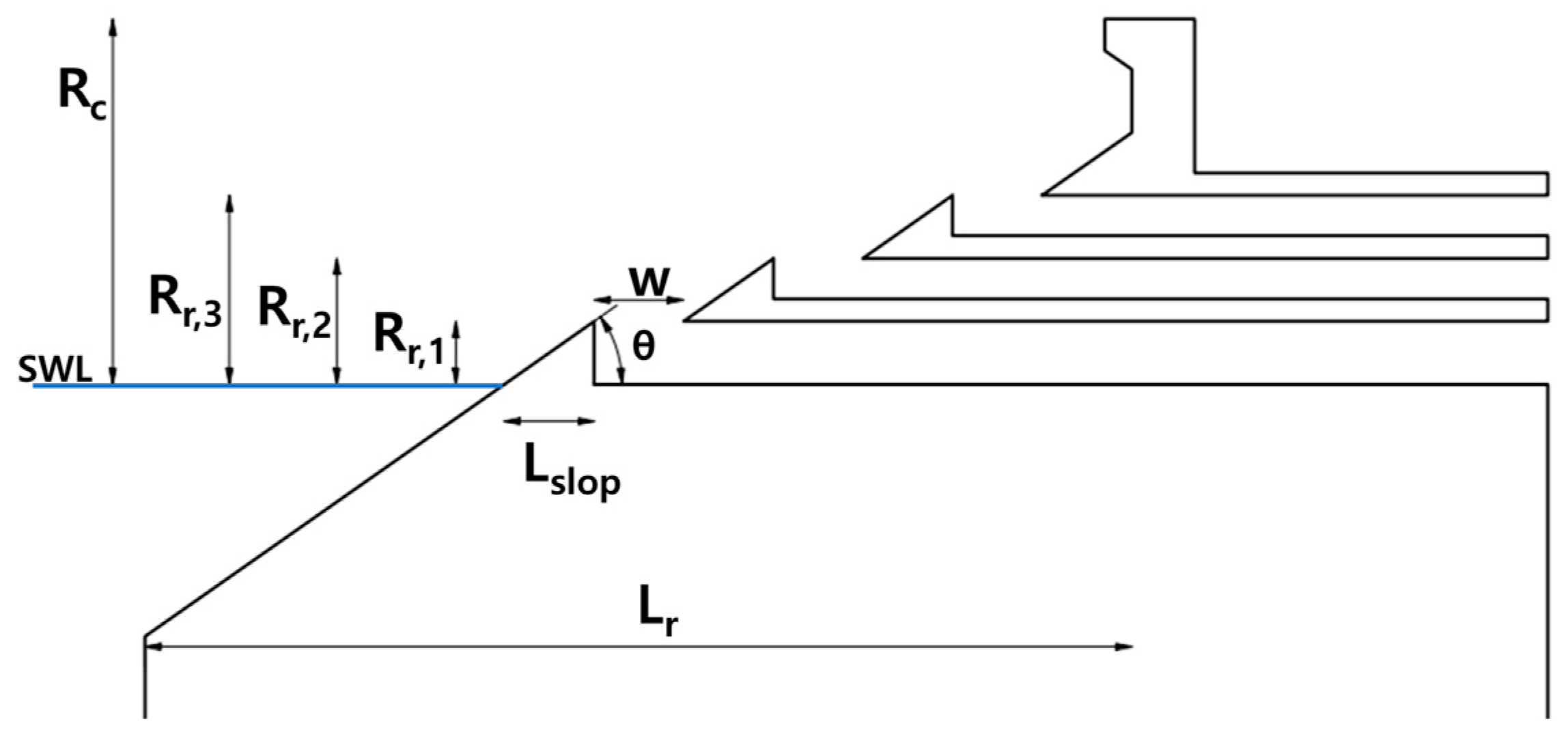
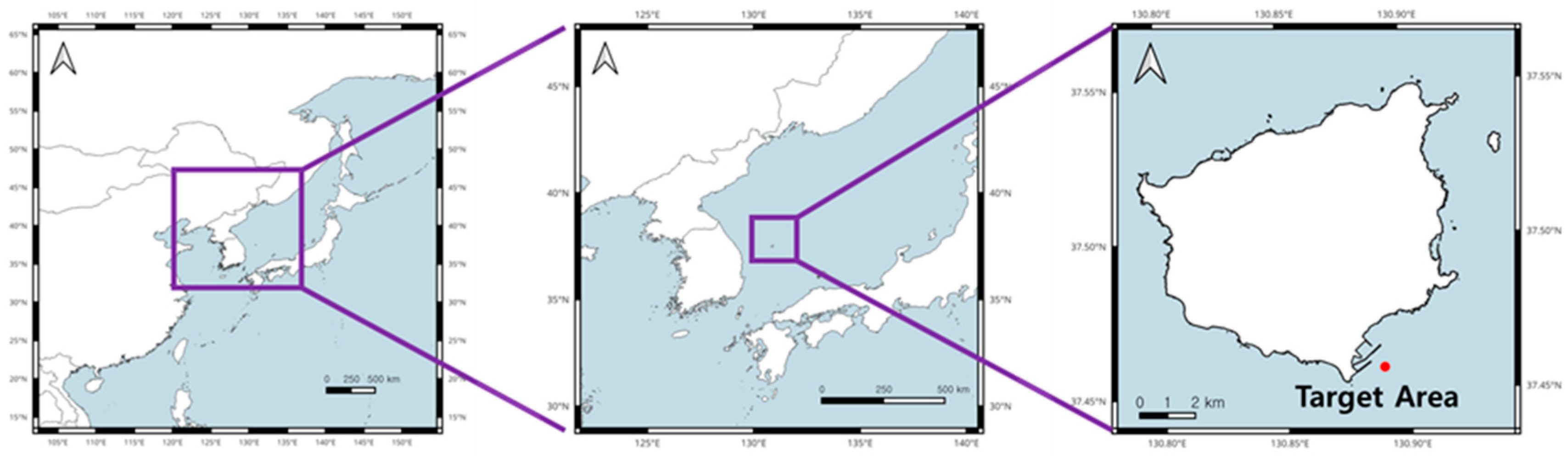
A multi-level overtopping WEC consists of a front ramp and multiple reservoirs. After the incident wave runs up along the ramp, the overtopping flow passes through a slot and enters the reservoirs at each level. In this multi-level configuration, geometric variables that affect overtopping discharge and energy efficiency include the ramp slope angle (), ramp length (), overall width (), slot horizontal length (), level-dependent reservoir elevations (), and crest wall height (), as defined in Figure 2. In this study, the device geometry was modified from the SSG concept based on environmental conditions in the sea area near Ulleungdo Island in the East Sea, Republic of Korea (Figure 3) [6,23]. For the numerical simulations, a 1/20 Froude scaling was applied, and the main specifications are summarized in Table 1.
Figure 2.
Definition of the geometric parameters of the multi-stage OWEC.
Figure 3.
Location of the target sea area around Ulleungdo Island (East Sea, Korea).
Table 1.
Main geometric parameters of the baseline OWEC model used in this study (Froude scale 1:20).
The energy capture process of an overtopping WEC can be divided into (i) the phase in which waves climb the ramp and overtop the slot, and (ii) the phase in which the descending flow after crest passage again passes through the slot and enters the reservoir. While the optimal ramp slope angle can be adopted from validated data in previous studies, the energy efficiency associated with overtopping discharge is influenced by the travel distance along the ramp in the overtopping region and by the slot size. Because the run-up height of waves reaching successive reservoirs is influenced by the ramp travel distance and the horizontal length of the slot under a fixed ramp angle, a representative design variable can be expressed as the ratio between the ramp horizontal length () and the slot horizontal length ().
Accordingly, this study defines the design variable as () and expresses it as a percentage. To analyze the influence of on energy efficiency, was varied from 25% to 125% in 25% increments. In DualSPHysics-based WCSPH simulations, if < 25%, inflow particles cannot be sufficiently resolved because of particle spacing and boundary conditions, leading to excessively reduced overtopping discharge or numerical noise; thus, 25% was selected as a minimum value for numerical stability. Conversely, for > 125%, the flow behavior tends to resemble that of a single-level OWEC rather than a multi-level OWEC, and therefore this study excluded values beyond 125%. Five baseline configurations ( = 25%, 50%, 75%, 100%, and 125%) were defined, and model parameters and geometries are provided in Table 2 and Figure 4. The detailed results, including identification of the optimal , are presented and discussed in Section 3.
Table 2.
Design cases of the representative models (M1–M5) with varying relative slot width and corresponding dimensions.
Figure 4.
Cross-sectional configurations of the representative OWEC models (M1–M5).
2.2. Numerical Setup and Wave Conditions
Numerical simulations were performed using DualSPHysics v5.4, an open-source code based on WCSPH (Weakly Compressible Smoothed Particle Hydrodynamics) [24,25,26,27,28]. The simulations were designed as a two-dimensional (x–z) model representing a vertical cross-section along the wave propagation direction, with a unit width (1 m) in the transverse direction. Model details and numerical parameters are summarized in Table 3 [29,30].
Table 3.
Numerical parameters and computational settings used in the DualSPHysics simulations.
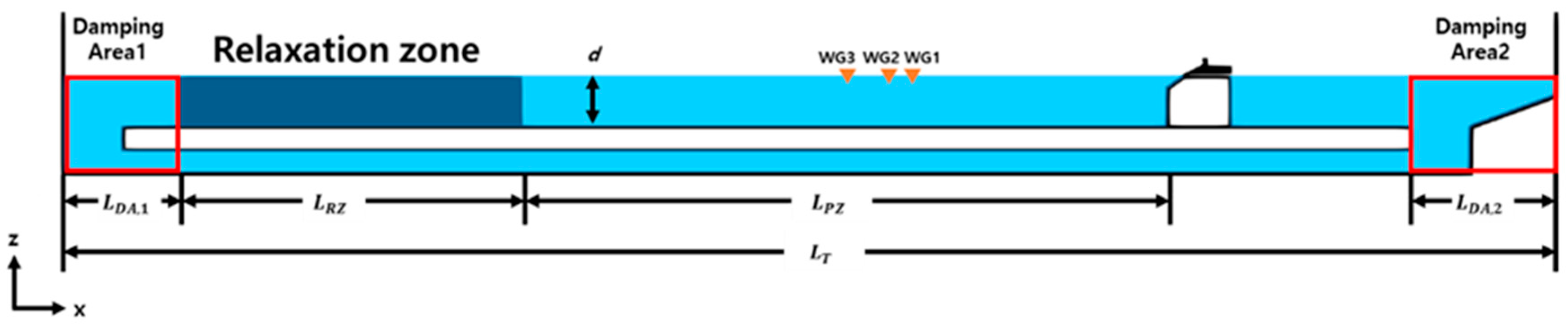
The numerical domain was configured as a two-dimensional recirculating wave tank with a water tunnel (Figure 5 and Table 4). Because SPH methods are Lagrangian, directly storing overtopped water in an upper reservoir can reduce the number of particles in the main wave tank over time, causing artificial decreases in water depth and distorted flow behavior. To prevent particle loss, the upper reservoir was removed in the model, and overtopped water was routed through the structure and then recirculated back into the wave tank through the water tunnel. The water tunnel was implemented as a recirculation channel connected to the downstream end of the main channel, which enabled the mean water depth and particle count to remain nearly constant during long simulations. This recirculating wave-tank configuration implicitly assumes an idealized drainage condition in which the reservoir remains empty at all times (i.e., an effectively infinite discharge capacity). Accordingly, the effects of a rising reservoir water level such as variations in the effective head or changes in the upstream water level at the intake on overtopping and inflow performance were not considered. In practical operation, where the reservoir water level may fluctuate over time depending on the drainage and turbine operating conditions, the overtopping discharge and inflow performance may differ from the present results obtained under the idealized assumption.
Figure 5.
Numerical wave tank setup for the DualSPHysics simulations.
Table 4.
Configuration and dimensions of the numerical wave tank.
A relaxation technique that blends the target wave form with the computed solution was applied so that wave generation and absorption occur simultaneously at a single boundary, thereby minimizing accumulation of reflected waves at the wavemaker. In addition, damping zones were introduced to suppress nonphysical vortices that can develop at the water tunnel boundary due to particle reordering and high-resolution particle distributions. Damping area 1 applied damping in the (−x, +z) direction, and damping area 2 applied damping in the (+x, +z) direction, which mitigated abnormal vortices near the inlet and outlet of the water tunnel. The OWEC was installed 11 m from the right end of the relaxation zone to secure a sufficient wave development distance in front of the structure.
Wave conditions were defined based on wave characteristics of the Ulleungdo sea area analyzed in a previous study [27,31]. The design wave was defined as = 7.37 s and = 2.8 m under a water depth of = 18 m (prototype). Applying a 1/20 Froude scale resulted in = 1.648 s and = 0.14 m under a model depth of = 0.9 m (Table 5). Because overtopping discharge and energy conversion efficiency respond nonlinearly to changes in incident wave period and height, the design wave alone is insufficient to represent performance variations under the full wave spectrum of the target sea area. Therefore, additional regular-wave combinations were considered: T = 6, 7, 8, 9, and 10 s, and Hs = 0.4, 0.8, 1.2, 1.6, 2.0, 2.4, and 2.8 m. By applying these combinations, the nonlinear response characteristics of the OWEC were evaluated across the primary spectral bands of interest.
Table 5.
Prototype and scaled design wave conditions used for the regular-wave simulations.
Overtopping discharge was measured using the FlowTool provided in DualSPHysics. A flow box was defined and extended up to the top elevation corresponding to each reservoir passage height so that only overtopping particles for each level could pass through. The flow box was installed at x = 20 m in the OWEC wake region. By counting particles entering the box over time, instantaneous overtopping discharge and cycle-averaged overtopping discharge were obtained, and OWEC hydraulic performance and energy efficiency were evaluated based on these quantities.
3. Results
This section summarizes results obtained from the two-dimensional numerical model. Section 3.1 compares hydraulic performance (overtopping discharge and energy efficiency) for geometries with varying λ to identify an optimal configuration. Section 3.2 presents a global-state analysis for the selected optimal geometry.
3.1. Sensitivity Analysis and Identification of an Optimal Design Variable
3.1.1. Definition of Hydraulic Efficiency
In this study, the hydraulic efficiency , employed as a performance index for an overtopping-type wave energy converter, is defined as the ratio of the potential-energy flux stored by overtopping the incident wave energy flux per unit width:
Here, denotes the hydraulic power associated with the potential energy stored by overtopping water. For a multi-level OWEC, is expressed as the sum of potential-energy contributions from overtopping into each reservoir.
In Equation (2), is the fluid density (1025 kg/m3), is the gravitational acceleration (9.81 m/s2), is the average overtopping discharge into the j-th reservoir, and is the vertical distance from the mean sea level to the entrance of the j-th reservoir. The discharge was evaluated as the mean value over 20 wave periods used in the simulations. The mean discharge is computed as:
where B is the structure width; for the two-dimensional simulations, B is set to a unit width of 1 m. is the start time of the measurement, is the measurement duration, and is the total measured volume. is the instantaneous overtopping discharge defined as the time derivative of the fluid volume inside the control volume specified by the DualSPHysics FlowTool box, i.e., . In the two-dimensional simulations, Q(t) represents the volumetric discharge per unit width (m3/s/m). The incident wave power per unit width at the front of the OWEC, , is computed as:
where is the design significant wave height, is the wave group velocity, defined as the product of the wave celerity and the group coefficient :
Here, ω, k, and d denote the angular frequency, wavenumber, and water depth, respectively. ω and k are obtained from the linear dispersion relation:
3.1.2. Baseline Results for the Design Variable
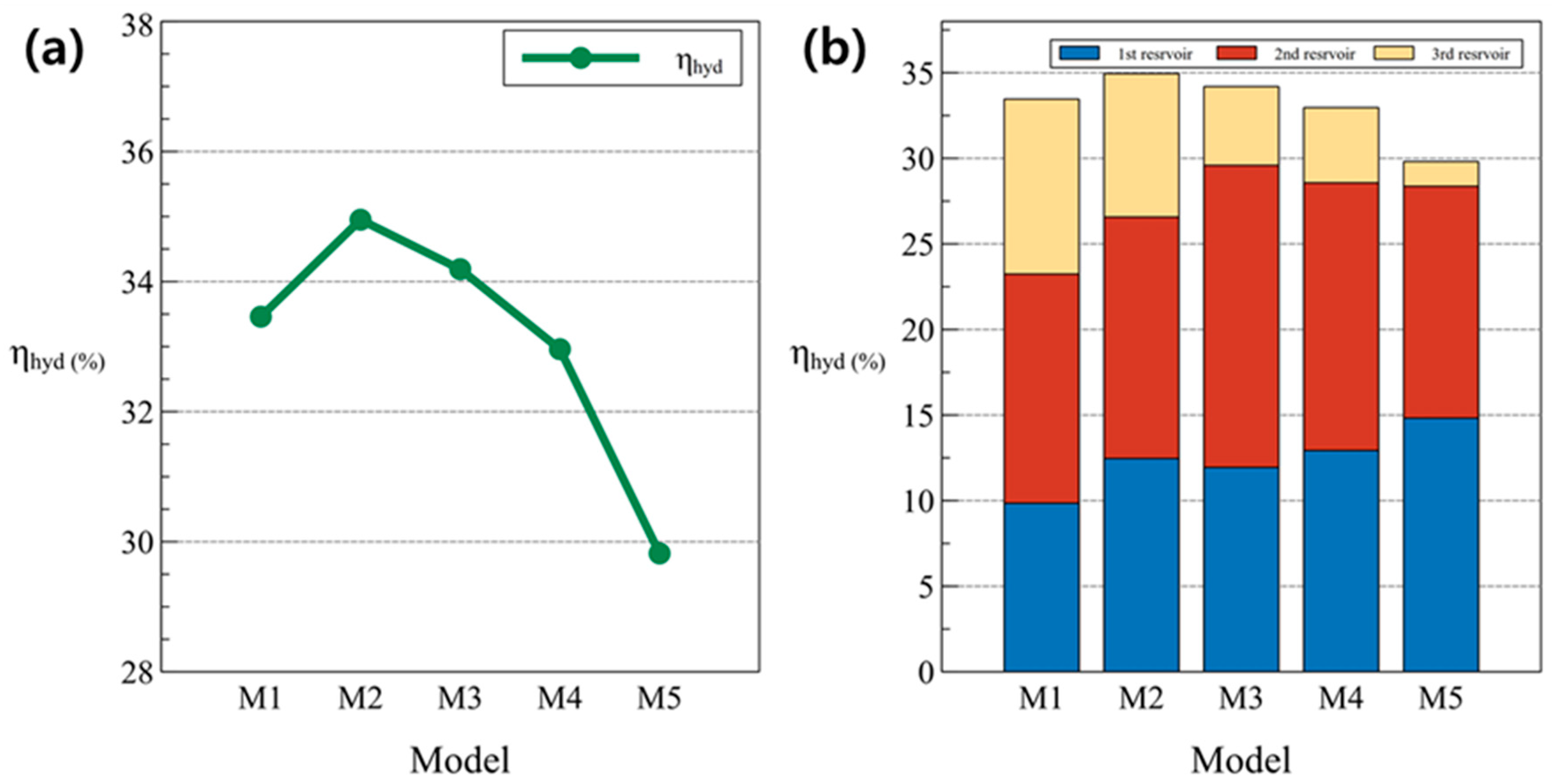
Five baseline geometries (M1–M5) were simulated by varying the design variable at equal intervals, as shown in Table 2. The level-wise and total hydraulic efficiencies are summarized in Table 6 and Figure 6. The total hydraulic efficiency is 33.46% for M1, 34.95% for M2, 34.19% for M3, 32.96% for M4, and 29.82% for M5. After reaching a maximum at M2, gradually decreases as increases.
Table 6.
Overall hydraulic efficiency of the representative models (M1–M5).
Figure 6.
Hydraulic efficiency results of the representative models (M1–M5): (a) overall efficiency; (b) contribution of each reservoir. Blue, red, and yellow represent the 1st, 2nd, and 3rd reservoirs, respectively.
The Level 1 reservoir efficiency increases from 9.85% (M1) to 14.82% (M5). The Level 2 reservoir efficiency increases from 13.39% to 17.65% in the M1–M3 range and then decreases again for M4 and M5. In contrast, the Level 3 reservoir efficiency continuously decreases from 10.22% (M1) to approximately 1.44% (M5), indicating that the contribution of the upper reservoir is highly sensitive to geometry changes.
The total efficiency curve in Figure 6a forms a single global peak within the M1–M5 range. In the M2–M3 range, efficiency varies mildly at approximately 34–35%, whereas the slope is largest in the M1–M2 range. This implies that even a small change in geometry near the lower bound of can substantially improve efficiency. The M3 geometry also maintains a relatively high efficiency (34.19%) compared with M4 and M5, suggesting that a potentially high-efficiency region exists between M1 and M3.
Level-wise efficiency shares (Table 6 and Figure 6b) reveal how overtopping distribution changes with . As λ increases, overtopping tends to be concentrated in the lower levels: the share of Level 1 increases from 29% to 50%. Level 2 shows a clear increase in the M1–M3 range (13.39% to 17.65%), and its share reaches a maximum of 52% at M3 before decreasing slightly. Level 3 decreases sharply with , and its share drops from 31% to 5%. These results imply that when becomes too large, run-up reaching the upper reservoir decreases rapidly, and overall efficiency is reduced. Therefore, a potentially optimal region exists around M1–M3, and finer subdivision of is required.
3.1.3. Refined Study in the High-Efficiency Region
Based on the baseline results, a refined analysis was conducted in the M1–M3 range where the efficiency change rate was relatively large. Additional models M6–M9 were defined by subdividing the M1–M3 region (three models between M1 and M2, and one model between M2 and M3), as shown in Table 7 and Figure 7. Simulations were performed for M6–M9, and results for M1–M3 and M6–M9 are summarized in Table 8 and Figure 8.
Table 7.
Additional model configurations (M6–M9) introduced for detailed analysis in the M1–M3 range.
Figure 7.
Cross-sectional configurations of additional OWEC models (M6–M9).
Table 8.
Overall hydraulic efficiency of the refined model set (M1–M3, M6–M9).
Figure 8.
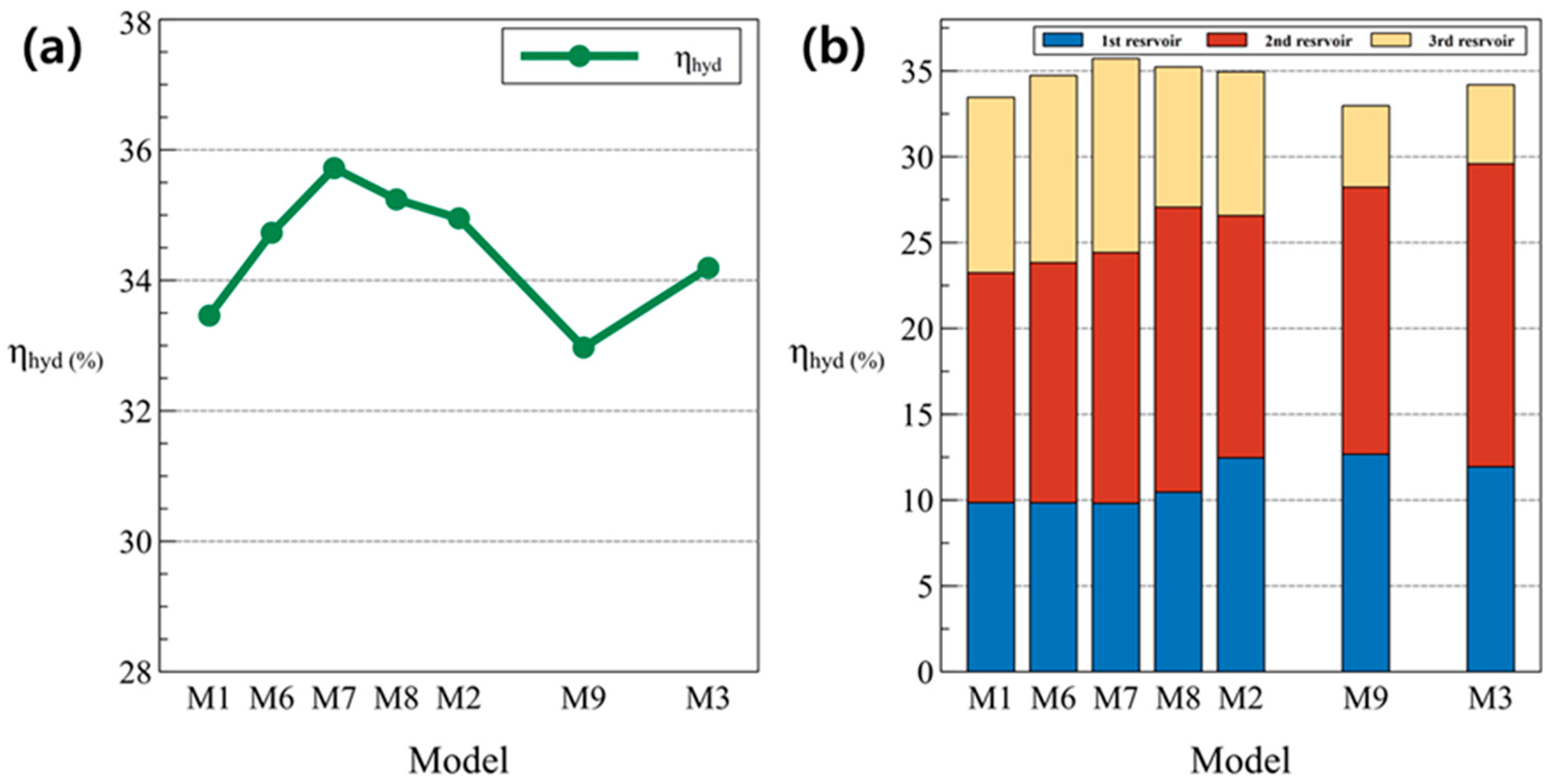
Hydraulic efficiency results of the refined model set (M1–M3, M6–M9): (a) overall efficiency; (b) contribution of each reservoir. Blue, red, and yellow represent the 1st, 2nd, and 3rd reservoirs, respectively.
The total hydraulic efficiency is 33.46% for M1, 34.73% for M6, 35.72% for M7, 35.24% for M8, 34.95% for M2, 32.97% for M9, and 34.19% for M3. Efficiency increases with from M1 to M7, forming a peak at M7 (35.72%), and then decreases slightly for M8 and M9. This confirms, with finer resolution, the overall tendency observed in the baseline analysis: efficiency increases from the lower bound to an intermediate region and then decreases for larger .
M7 provides a relatively balanced distribution across all three reservoirs: 9.81% (Level 1), 14.61% (Level 2), and 11.30% (Level 3), corresponding to total-efficiency shares of 27%, 41%, and 32%, respectively. In contrast, M3 is strongly dominated by Level 2 (17.65%, 52% share), while Level 3 contributes only 4.60% (13% share). For large- geometries (e.g., M9 and M3), overtopping tends to concentrate into Levels 1 and 2, and the Level 3 share decreases to about 14%, leading to a reduction in total efficiency. These results indicate that increasing without bound is not optimal; the most efficient design maintains sufficient energy generation at all three levels.
The efficiency differences between M6, M7, and M8 are within approximately 1 percentage point, and differences in slot width w are less than 5 mm at model scale (prototype: approximately 100 mm). This indicates that the efficiency curve exhibits a broad, gently sloped peak around M7. Therefore, when construction tolerances likely to arise in practical design and the ease of operation and maintenance are taken into account, geometries in the vicinity of M7 can be regarded as a practically meaningful optimization candidate region that can be implemented without performance degradation. Therefore, the model with the highest efficiency, M7, was selected as the final optimal geometry
3.2. Global-State Analysis for the Optimal Geometry
For the optimal geometry (M7), a global-state analysis was conducted to evaluate changes in hydraulic efficiency under diverse wave conditions beyond the design wave. First, hydraulic efficiency was calculated for regular-wave combinations within a period range of 6–10 s and a wave-height range of 0.4–2.8 m to identify efficiency distributions in the two-dimensional wave-condition space. Next, a period-dependent peak wave height was estimated using a JONSWAP spectrum for the target sea area, and hydraulic efficiency was evaluated at these peak conditions to assess overall performance under realistic wave environments.
3.2.1. Regular-Wave-Based Global State in the Period–Height Space
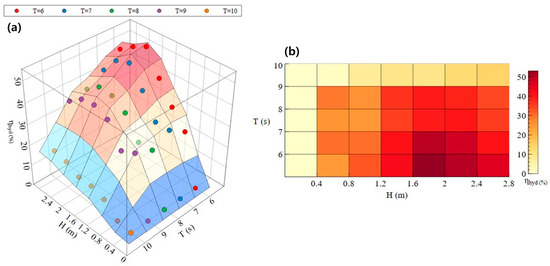
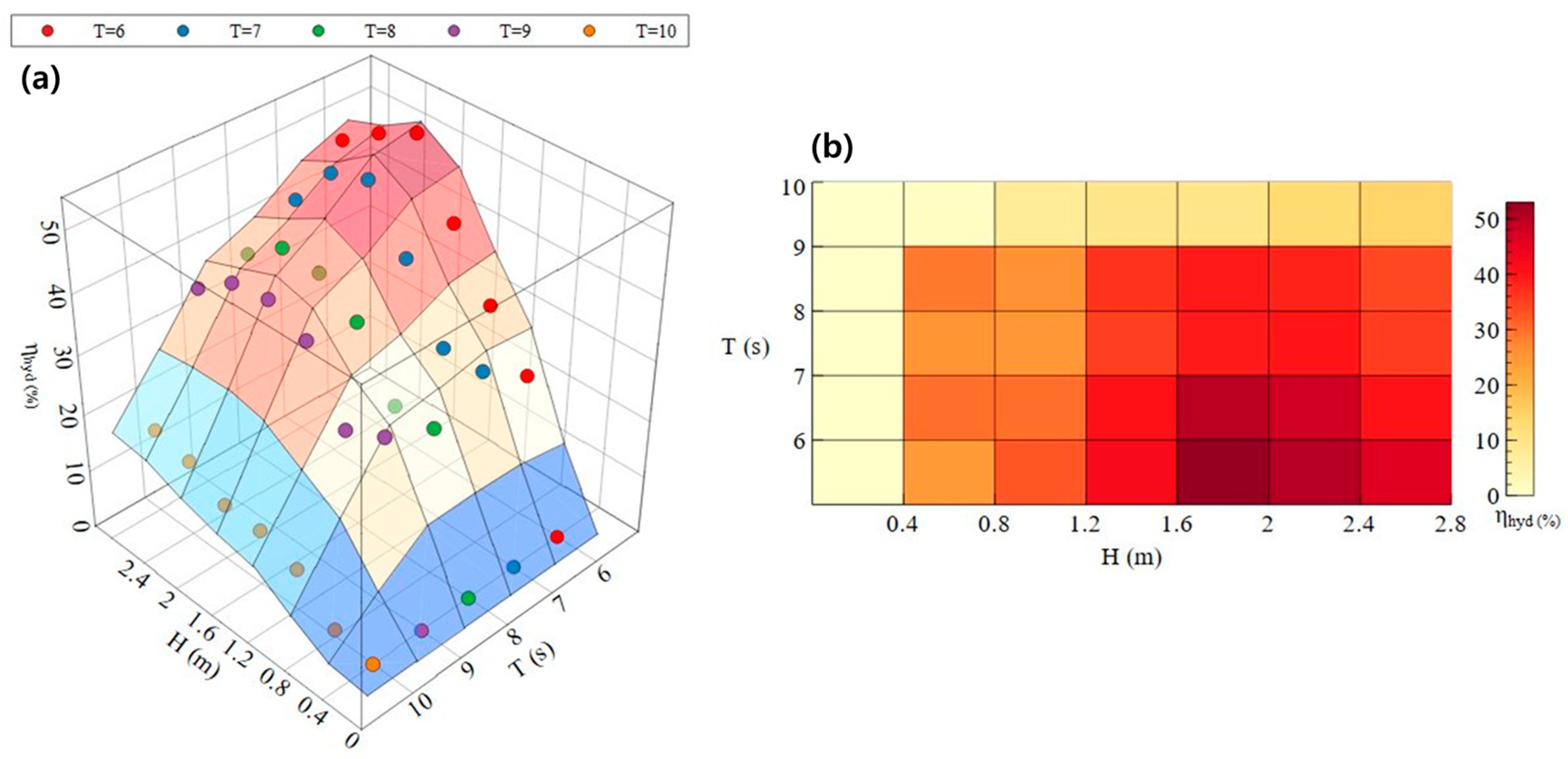
Optimal geometry (M7), regular-wave combinations were defined over the ranges T = 6–10 s and Hs = 0.4–2.8 m. Period and wave height were discretized at fixed intervals, yielding 35 simulation cases that represent the wave-condition space. Hydraulic efficiency was evaluated for each case following the definition of Section 3.1.1.
The maximum hydraulic efficiency (53.6%) occurs at T = 6 s and H = 2.0 m. A high-efficiency region is formed for T = 6–7 s and H = 2.0–2.4 m, where efficiency remains around 50%. When the wave height decreases to 0.8 m or less at the same periods, efficiency drops to approximately 25–30% due to insufficient overtopping. In the long-period range around T = 10 s, efficiency decreases below 15% for all wave heights, indicating generally low performance.
Around the design wave (), hydraulic efficiency exceeds 40%. Efficiency decreases when the period becomes shorter or longer, or when wave height becomes too small or too large. At small wave heights (H ≤ 0.8 m), overtopping is limited. Conversely, at very large wave heights (H ≥ 2.4 m), reservoirs tend to saturate and additional overtopping does not translate into additional energy capture, resulting in decreased efficiency. In the intermediate period range (6–8 s), efficiency remains relatively high (approximately 0.35–0.50) across a broad wave-height range of about 1.6–2.4 m, whereas for periods of 9–10 s the efficiency distribution becomes lower and flatter due to reduced wave steepness and overtopping. These results indicate that OWEC efficiency exhibits a clear nonlinear response with a local maximum near the design wave and strong reductions toward both ends of the period–height domain. Therefore, long-term mean performance can depend strongly on the occurrence frequency of specific period–height combinations in real seas, see Table 9 and Figure 9.
Table 9.
Hydraulic efficiency matrix of the M7 for 35 regular-wave cases (T = 6–10 s, H = 0.4–2.8 m).
Figure 9.
Global-state distribution of hydraulic efficiency for the M7 in the period–wave height domain: (a) 3D response surface; (b) 2D heat map.
3.2.2. JONSWAP Spectrum for the Target Sea Area and Peak Wave Height Estimation
To incorporate wave statistics under real sea conditions, a JONSWAP spectrum for the target sea area was applied [32]. The JONSWAP spectrum is an asymmetric wave spectrum originally developed from North Sea observations and is characterized by a peak enhancement factor γ that represents energy concentration near the spectral peak.
In this study, based on domestic references [33,34] and wave observation data for the target sea area, the JONSWAP spectrum was used with . Considering observational studies indicating that the target region can have a lower peak enhancement than the original North Sea recommendation (γ = 3.3), γ =1.4 was adopted. The selected spectrum parameters are summarized in Table 10.
Table 10.
Parameters of the target JONSWAP spectrum adopted for the peak-wave-height analysis.
3.2.3. Hydraulic Efficiency Under Period-Dependent Peak Wave Heights
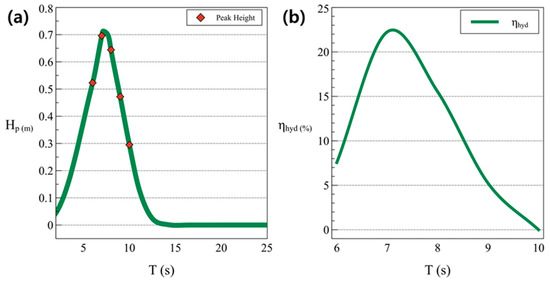
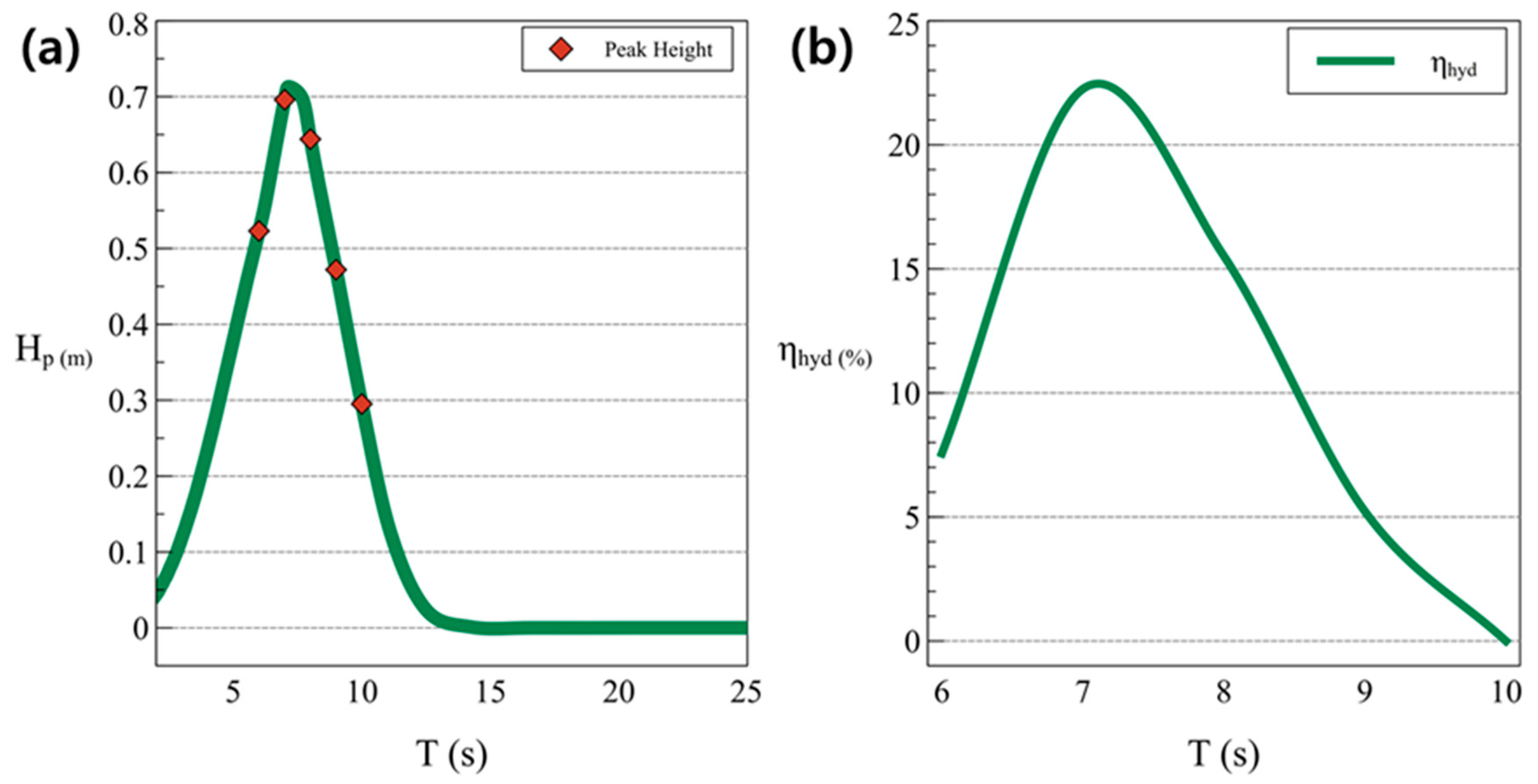
For each period band , the peak wave height was defined as the wave height corresponding to the maximum spectral energy density within that band. In practice, the energy distribution was obtained by integrating the spectrum over each period band, and the equivalent significant wave height in that band was used as (Figure 10a). The period-dependent peak heights were combined with the regular-wave-based efficiency map to evaluate efficiency for wave conditions that contribute strongly to the spectrum, yielding and an efficiency curve for the period–peak-height combinations (Figure 10b).
Figure 10.
Peak wave height derived from the target JONSWAP spectrum and the corresponding hydraulic efficiency of the optimal model: (a) peak wave height ; (b) hydraulic efficiency .
In this section, for the design-variable analysis, an engineering procedure was applied in which the peak wave heights , derived from the JONSWAP spectrum for the period band T = 6~10 s (approximately 60.4% of the total spectral energy; f = 0.10~0.167 Hz), were converted to equivalent regular-wave conditions with identical combinations and then superimposed onto the previously established regular-wave-based performance map . However, real sea states involve wave-group formation and probabilistic variability in wave height due to the random phase of component waves, and overtopping is a threshold-type, strongly nonlinear process for which the cumulative overtopping volume can be dominated by a limited number of energetic wave groups. Therefore, even for the same representative period (or period band) and , the cumulative overtopping discharge and energy efficiency under irregular-wave conditions may deviate to some extent from the estimates based on the equivalent regular-wave approach adopted in this study. Since the objective of this work is to identify relative performance trends with respect to the design variable and to provide quantitative guidance for preliminary design, the site-specific efficiency assessment in this section should be interpreted as a first-pass screening result; further validation that accounts for wave-group effects is required in future work through irregular-wave simulations (or physical experiments) using the same target spectrum.
Hydraulic efficiency under peak-height conditions varies relatively mildly across the considered period range and reaches a maximum near the design peak period Tp. In shorter-period ranges, wave steepness is larger, and the JONSWAP peak wave height is also larger, resulting in greater incident energy than in long-period conditions; thus, overtopping occurs actively and efficiency remains high. In contrast, in the long-period range (9–10 s), both wave steepness and peak wave height decrease, overtopping reduces, and efficiency becomes lower and flatter. The fact that efficiency is relatively high in period bands with large spectral energy contribution suggests that the optimal geometry M7 is tuned to the target wave characteristics from an energy-generation perspective. In addition, because the efficiency distribution over the full period–height space exhibits smooth gradients without abrupt changes, M7 is favorable for robust performance under real wave variability.
4. Conclusions
This study employed a DualSPHysics-based WCSPH numerical model to quantitatively evaluate how the relative slot width affects the hydraulic efficiency of a multi-level overtopping WEC and to construct a global-state performance map considering the wave spectrum of the target sea area. The numerical model was configured as a two-dimensional recirculating wave tank at 1:20 scale under a constant depth condition corresponding to d = 18 m (model: 0.9 m). The design-wave condition and regular-wave combinations spanning T = 6–10 s and H_s = 0.8–2.8 m were applied as incident-wave conditions. Hydraulic efficiency, , defined as the ratio of the potential-energy flux captured via overtopping to the incident wave-energy flux per unit width, was used as the performance metric. The main findings are summarized as follows.
The influence of on hydraulic performance and an optimal geometry were identified. For five baseline geometries (M1–M5) with λ varied from 25% to 125% in 25% increments, the total hydraulic efficiency increased from 0.3346 (M1) to 0.3495 (M2) and then decreased to 0.2982 (M5). A refined study in the M1–M3 region identified a clear peak at M7, with . M7 provides a balanced distribution of efficiency contributions across all three reservoirs, maximizing the sum of stored potential energy while avoiding excessive saturation of lower levels.
A global-state analysis and a spectrum-based performance evaluation were conducted for M7. The global-state efficiency map exhibited a local maximum near the design wave and decreased toward both small-wave and large-wave boundaries: efficiency is limited by insufficient overtopping at small wave heights and by reservoir saturation at very large wave heights. Using a JONSWAP spectrum for the target sea area, period-dependent peak wave heights were combined with the efficiency map. The resulting peak-condition efficiency curve showed relatively stable efficiency across periods and a maximum near , where spectral energy contribution is largest. Overall, the optimal geometry M7 maintains strong and stable hydraulic efficiency across the period–height space considering the target spectrum, indicating its potential as a practical design option for overtopping wave energy conversion structures.
Future work should include validation of local flow structures and overtopping behavior around the slot using three-dimensional numerical models and physical experiments. Additional studies should also consider irregular-wave simulations and long-term wave climate (including seasonal variability and typhoon periods). Such efforts will enable more comprehensive evaluation of whether the optimal relative slot width identified in this study can be applied to full-scale, commercially deployable systems.
Author Contributions
Conceptualization, S.-H.A. and J.-H.L.; software, S.-H.A.; validation, S.-H.A. and J.-H.L.; formal analysis, S.-H.A.; investigation, S.-H.A.; data curation, S.-H.A.; writing—original draft preparation, S.-H.A. and J.-H.L.; writing—review and editing, J.-H.L.; visualization, S.-H.A.; project administration, S.-H.A. and J.-H.L. All authors have read and agreed to the published version of the manuscript.
Funding
This work was supported by National R&D Program through the National Research Foundation of Korea (NRF) funded by the Korea government (Ministry of Science and ICT) (No. 2021R1I1A3057230).
Data Availability Statement
The data presented in this study are available on request from the corresponding author.
Acknowledgments
During the preparation of this manuscript, the authors used ChatGPT 5.1 Pro for data collection, research design, and software coding. The authors reviewed and edited the content generated by this tool and take full responsibility for the content of this publication.
Conflicts of Interest
The authors declare no conflicts of interest.
References
- Lian, J.; Wang, X.; Wang, X.; Wu, D. Research on Wave Energy Converters. Energies 2024, 17, 1577. [Google Scholar] [CrossRef] [Scilit]
- Cao, D.; He, J.; Chen, H. Empirical Predictions on Wave Overtopping for Overtopping Wave Energy Converters: A Systematic Review. Processes 2024, 12, 1940. [Google Scholar] [CrossRef] [Scilit]
- Bevilacqua, G.; Zanuttigh, B. Overtopping Wave Energy Converters: General Aspects and Stage of Development. Int. Coast. Eng. Proc. 2011, 1, 21. [Google Scholar]
- Allen, J.; Sampanis, K.; Wan, J.; Greaves, D.; Miles, J.; Iglesias, G. Laboratory Tests in the Development of WaveCat. Sustainability 2016, 8, 1339. [Google Scholar] [CrossRef] [Scilit]
- Ocean Energy Systems (OES-IEA). Overtopping Devices. Available online: https://www.ocean-energy-systems.org/ocean-energy/wave-energy-converters/overtopping-devices/ (accessed on 28 November 2025).
- Margheritini, L.; Vicinanza, D.; Frigaard, P. SSG Wave Energy Converter: Design, Reliability and Hydraulic Performance of an Innovative Overtopping Device. Renew. Energy 2009, 34, 1371–1380. [Google Scholar] [CrossRef] [Scilit]
- Vicinanza, D.; Margheritini, L.; Nørgaard, J.Q.H.; Frigaard, P. The SSG Wave Energy Converter: Performance, Status and Recent Developments. Energies 2012, 5, 193–226. [Google Scholar] [CrossRef] [Scilit]
- Contestabile, P.; Ferrante, V.; Vicinanza, D. Wave Energy Resource Assessment in Italy: A Review. Renew. Energy 2020, 150, 564–578. [Google Scholar]
- Iuppa, C.; Cavallaro, L.; Musumeci, R.E.; Vicinanza, D.; Foti, E. Empirical overtopping volume statistics at an OBREC. Coast. Eng. 2019, 152, 103524. [Google Scholar] [CrossRef] [Scilit]
- Kralli, V.E.; Theodossiou, N.; Karambas, T. Optimal design of Overtopping Breakwater for Energy Conversion (OBREC) Systems using the harmony search algorithm. Front. Energy Res. 2019, 7, 80. [Google Scholar] [CrossRef] [Scilit]
- Cavallaro, L.; Iuppa, C.; Castiglione, F.; Musumeci, R.E.; Foti, E. A Simple Model to Assess the Performance of an Overtopping Wave Energy Converter Embedded in a Port Breakwater. J. Mar. Sci. Eng. 2020, 8, 858. [Google Scholar] [CrossRef] [Scilit]
- Martins, J.C.; Fragassa, C.; Goulart, M.M.; dos Santos, E.D.; Gomes, M.N.; Rocha, L.A.O.; Isoldi, L.A. Constructal Design of an Overtopping Wave Energy Converter Incorporated in a Breakwater. J. Mar. Sci. Eng. 2022, 10, 471. [Google Scholar] [CrossRef] [Scilit]
- Paiva, M.d.S.; Mocellin, A.P.G.; Oleinik, P.H.; dos Santos, E.D.; Rocha, L.A.O.; Isoldi, L.A.; Machado, B.N. Geometrical Evaluation of an Overtopping Wave Energy Converter Device Subject to Realistic Irregular Waves and Representative Regular Waves of the Sea State That Occurred in Rio Grande—RS. Processes 2025, 13, 335. [Google Scholar] [CrossRef] [Scilit]
- Hübner, R.G.; Fragassa, C.; Paiva, M.d.S.; Oleinik, P.H.; Gomes, M.N.; Rocha, L.A.O.; dos Santos, E.D.; Machado, B.N.; Isoldi, L.A. Numerical Analysis of an Overtopping Wave Energy Converter Subjected to the Incidence of Irregular and Regular Waves from Realistic Sea States. J. Mar. Sci. Eng. 2022, 10, 1084. [Google Scholar] [CrossRef] [Scilit]
- Cisco, L.A.; Maciel, R.P.; Oleinik, P.H.; dos Santos, E.D.; Gomes, M.N.; Rocha, L.A.O.; Isoldi, L.A.; Machado, B.N. Numerical Analysis of the Available Power in an Overtopping Wave Energy Converter Subjected to a Sea State of the Coastal Region of Tramandaí, Brazil. Fluids 2022, 7, 359. [Google Scholar] [CrossRef] [Scilit]
- Van der Meer, J.; Allsop, W.; Bruce, T.; De Rouck, J.; Kortenhaus, A.; Pullen, T.; Schüttrumpf, H.; Troch, P.; Zanuttigh, B. EurOtop: Manual on Wave Overtopping of Sea Defences and Related Structures, 2nd ed.; University of Bologna: Bologna, Italy, 2018; Available online: https://www.overtopping-manual.com/manual.html (accessed on 28 November 2025).
- Eldrup, M.R.; Andersen, T.L.; Burcharth, H.F. Improved Guidance on Random Wave Overtopping for Vertical and Steep Structures in Deep Water. Coast. Eng. 2022, 175, 104151. [Google Scholar]
- Altomare, C.; Gironella, X.; Crespo, A.J. Simulation of random wave overtopping by a WCSPH model. Appl. Ocean Res. 2021, 115, 102972. [Google Scholar] [CrossRef] [Scilit]
- Dang, B.-L.; Nguyen-Xuan, H.; Abdel Wahab, M. Numerical study on wave forces and overtopping over various seawall structures using advanced SPH-based method. Eng. Struct. 2021, 226, 111349. [Google Scholar] [CrossRef] [Scilit]
- Mun, J.Y.; Cho, W.H.; Rehman, K. Multiscale Numerical Modeling of Wave Overtopping for Pedestrian Hazard Classification and Risk Assessment. J. Mar. Sci. Eng. 2025, 13, 2022. [Google Scholar] [CrossRef] [Scilit]
- Suzuki, T.; Altomare, C.; Yasuda, T.; Verwaest, T. Characterization of Overtopping Waves on Sea Dikes with Gentle and Shallow Foreshores. J. Mar. Sci. Eng. 2020, 8, 752. [Google Scholar] [CrossRef] [Scilit]
- Jungrungruengtaworn, S.; Hyun, B.-S. Influence of Slot Width on the Performance of Multi-Stage Overtopping Wave Energy Converters. Int. J. Nav. Archit. Ocean Eng. 2017, 9, 668–676. [Google Scholar] [CrossRef] [Scilit]
- Liu, Z.; Han, Y.; Shi, H.; Yang, W. Experimental study on multi-level overtopping wave energy convertor under regular wave conditions. Int. J. Nav. Archit. Ocean Eng. 2018, 10, 651–659. [Google Scholar] [CrossRef] [Scilit]
- Gingold, R.A.; Monaghan, J.J. Smoothed Particle Hydrodynamics: Theory and Application to Non-Spherical Stars. Mon. Not. R. Astron. Soc. 1977, 181, 375–389. [Google Scholar] [CrossRef] [Scilit]
- Lucy, L.B. A Numerical Approach to the Testing of the Fission Hypothesis. Astron. J. 1977, 82, 1013–1024. [Google Scholar] [CrossRef] [Scilit]
- Monaghan, J.J. Smoothed Particle Hydrodynamics. Annu. Rev. Astron. Astrophys. 1992, 30, 543–574. [Google Scholar] [CrossRef]
- Kim, G.; An, S.; Lee, J. Review of the Optimal Locations of Coastal Sea Area for Operating Wave Energy Converter in Korea. J. Adv. Mar. Eng. Technol. 2022, 46, 172–181. [Google Scholar] [CrossRef] [Scilit]
- Crespo, A.J.C.; Domínguez, J.M.; Rogers, B.D.; Gómez-Gesteira, M.; Longshaw, S.; Canelas, R.; Vacondio, R.; Barreiro, A.; García-Feal, O. DualSPHysics: Open-Source Parallel CFD Solver Based on Smoothed Particle Hydrodynamics (SPH). Comput. Phys. Commun. 2015, 187, 204–216. [Google Scholar] [CrossRef] [Scilit]
- Wendland, H. Piecewise Polynomial, Positive Definite and Compactly Supported Radial Functions of Minimal Degree. Adv. Comput. Math. 1995, 4, 389–396. [Google Scholar] [CrossRef] [Scilit]
- Fourtakas, G.; Vacondio, R.; Alonso, E.; Rogers, B.D. Improved Density Diffusion Term for Long Duration Wave Propagation. In Proceedings of the 14th International SPHERIC Workshop, Harbin, China, 14–17 October 2020. [Google Scholar]
- Eum, H.-S.; Jeong, W.-M.; Chang, Y.S.; Oh, S.-H.; Park, J.-J. Wave Energy in Korean Seas from 12-Year Wave Hindcasting. J. Mar. Sci. Eng. 2020, 8, 161. [Google Scholar] [CrossRef] [Scilit]
- Hasselmann, K.; Barnett, T.P.; Bouws, E.; Carlson, H.; Hasselmann, D.E.; Kruseman, P.; Meerburg, A.; Müller, P. Measurements of Wind-Wave Growth and Swell Decay during the Joint North Sea Wave Project (JONSWAP). Ergänzungsheft Zur Dtsch. Hydrogr. Z. 1973, 12, 1–95. [Google Scholar]
- Cho, H.Y.; Jeong, W.M.; Oh, S.-H.; Baek, W.D. Parameter Estimation and Fitting Error Analysis of the Representative Spectrums Using the Wave Spectrum off the Namhangjin, East Sea. J. Korean Soc. Coast. Ocean Eng. 2020, 32, 363–371. [Google Scholar] [CrossRef] [Scilit]
- Lee, U.-J.; Ko, D.-H.; Kim, J.-Y.; Cho, H.-Y. Estimation and Analysis of Wave Spectrum Parameter Using HeMOSU-2 Observation Data. J. Korean Soc. Coast. Ocean Eng. 2021, 33, 217–225. [Google Scholar] [CrossRef] [Scilit]





Disclaimer/Publisher’s Note: The statements, opinions and data contained in all publications are solely those of the individual author(s) and contributor(s) and not of MDPI and/or the editor(s). MDPI and/or the editor(s) disclaim responsibility for any injury to people or property resulting from any ideas, methods, instructions or products referred to in the content. |
© 2026 by the authors. Licensee MDPI, Basel, Switzerland. This article is an open access article distributed under the terms and conditions of the Creative Commons Attribution (CC BY) license.