Review

Comparative Assessment of Hybrid Wave–Wind Energy Platforms: Classification, Performance Trade-Offs, and Optimization Implications

1
School of Engineering, Lancaster University, Lancaster LA1 4YW, UK
2
School of Engineering, International Hellenic University, 62124 Serres, Greece
*
Author to whom correspondence should be addressed.
J. Mar. Sci. Eng. 2026, 14(12), 1103; https://doi.org/10.3390/jmse14121103 (registering DOI)
Submission received: 23 May 2026 / Revised: 8 June 2026 / Accepted: 10 June 2026 / Published: 15 June 2026
(This article belongs to the Special Issue Wave-Driven Ocean Modelling and Engineering)

Abstract

Offshore renewable energy is widely recognised as a critical pathway for decarbonising electricity systems, but the integration of floating offshore wind turbines with wave energy converters remains technically challenging. This paper presents a structured literature review of hybrid wave–wind offshore energy platforms, drawing on 114 reviewed sources published between 2000 and 2026. The review classifies hybrid concepts using a three-axis framework based on floating platform type, wave energy converter (WEC) integration approach, and energy-dominance category. It then compares representative configurations, including point absorbers, oscillating water columns, flap-type devices, and heaving torus concepts, with emphasis on hydrodynamic response, energy contribution, structural complexity, mooring implications, validation status, and optimization suitability. The findings show that no single hybrid configuration can be ranked as universally superior because reported performance depends strongly on platform geometry, WEC scale, site wave climate, modelling assumptions, and validation maturity. Point absorber systems offer modularity and lower integration complexity, oscillating water column (OWC)-based systems provide protected power take-off (PTO) integration and moderate hydrodynamic interaction, flap-type systems can provide stronger motion-control potential but impose higher structural and mooring demands, and spar–torus concepts remain geometrically compatible with spar platforms but are generally wind-dominated. The review further shows that optimization method selection should depend on problem class: gradient-based methods are most suitable for local PTO tuning, evolutionary methods for non-convex multi-objective layout problems, surrogate-based methods for high-cost coupled simulations, and data-driven methods for adaptive control. The paper concludes that future progress requires standardized benchmark models, transparent evidence-level reporting, multi-physics co-optimization, techno-economic assessment, and systematic experimental or field validation before definitive concept ranking or commercial-readiness claims can be made. For decision-makers, industry stakeholders, and policymakers, the framework supports early-stage concept screening, identification of technology-specific risk factors, prioritisation of validation and investment pathways, and alignment of hybrid-platform development with site conditions, infrastructure constraints, and policy objectives.

1. Introduction

Offshore renewable energy plays a critical role in the global transition toward low-carbon energy systems [1,2]. Among available technologies, offshore wind energy has reached a relatively high level of technological maturity, with global installed capacity exceeding 75 GW by 2023 [3], while wave energy remains at a pre-commercial stage despite its significant resource potential estimated at approximately 32,000 TWh/year globally [4]. Both technologies, however, face inherent limitations when deployed as standalone systems. Offshore wind turbines are subjected to substantial wave-induced loads that affect structural integrity and fatigue life [5], whereas wave energy converters often suffer from low power capture efficiency, high capital costs, and survivability challenges under extreme sea states [6].
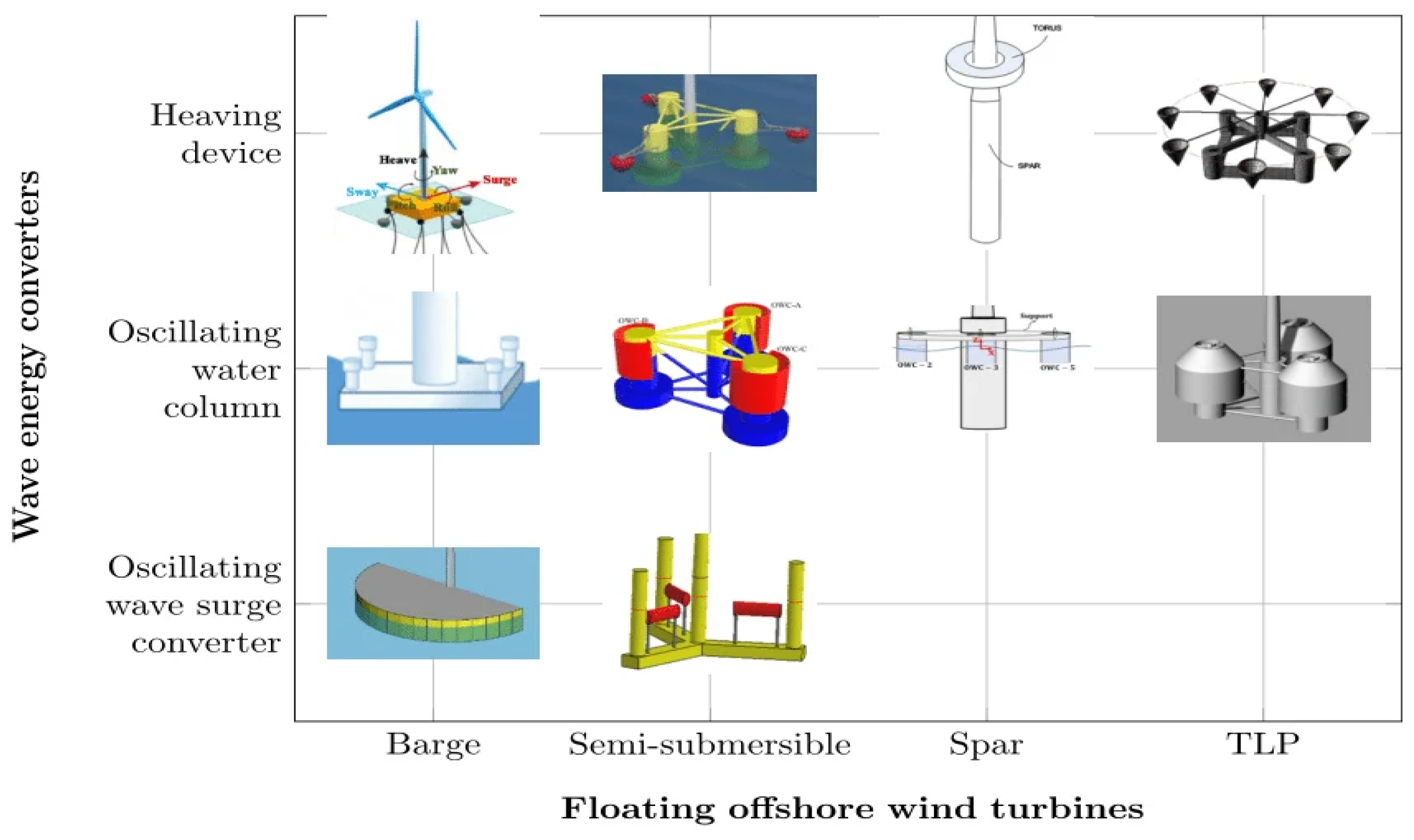
Hybrid wave–wind energy systems have emerged as a promising solution to address these limitations by integrating wave energy converters with floating offshore wind platforms [7]. By sharing structural components, mooring systems, and electrical infrastructure, hybrid platforms may reduce some lifecycle cost components while improving energy yield and platform stability, although the net economic benefit depends on added WEC complexity, maintenance requirements, site conditions, and system reliability [7,8,9]. Moreover, wave energy devices can provide additional hydrodynamic damping, which may reduce platform motions and structural loads acting on the wind turbine [10]. This synergy makes hybrid wave–wind structures particularly attractive for deep-water offshore environments where floating solutions are required [11,12]. Figure 1 illustrates representative examples of floating hybrid wave–wind energy system designs across the main platform and wave energy converter (WEC) type combinations addressed in this review.
Despite growing research interest, the design of hybrid wave–wind structures remains highly complex [14]. The interaction between aerodynamic loads from the wind turbine and hydrodynamic loads from waves introduces strong coupling effects that influence platform motions, power performance, and structural response [14]. The effectiveness of a hybrid system is strongly dependent on multiple design parameters, including platform geometry, WEC type and placement, mass distribution, and mooring configuration [10,15]. Consequently, different hybrid concepts exhibit significantly different performance characteristics, and there is currently no consensus on optimal integration strategies [9].
Existing studies have largely focused on individual hybrid concepts or specific performance aspects, such as motion reduction or wave power extraction [7,15]. However, a systematic and step-by-step comparison between different hybrid wave–wind structures is still lacking [15]. Such a comparison is essential to identify key design trade-offs, understand the influence of integration strategies, and highlight the parameters that are most critical for performance optimization [16].
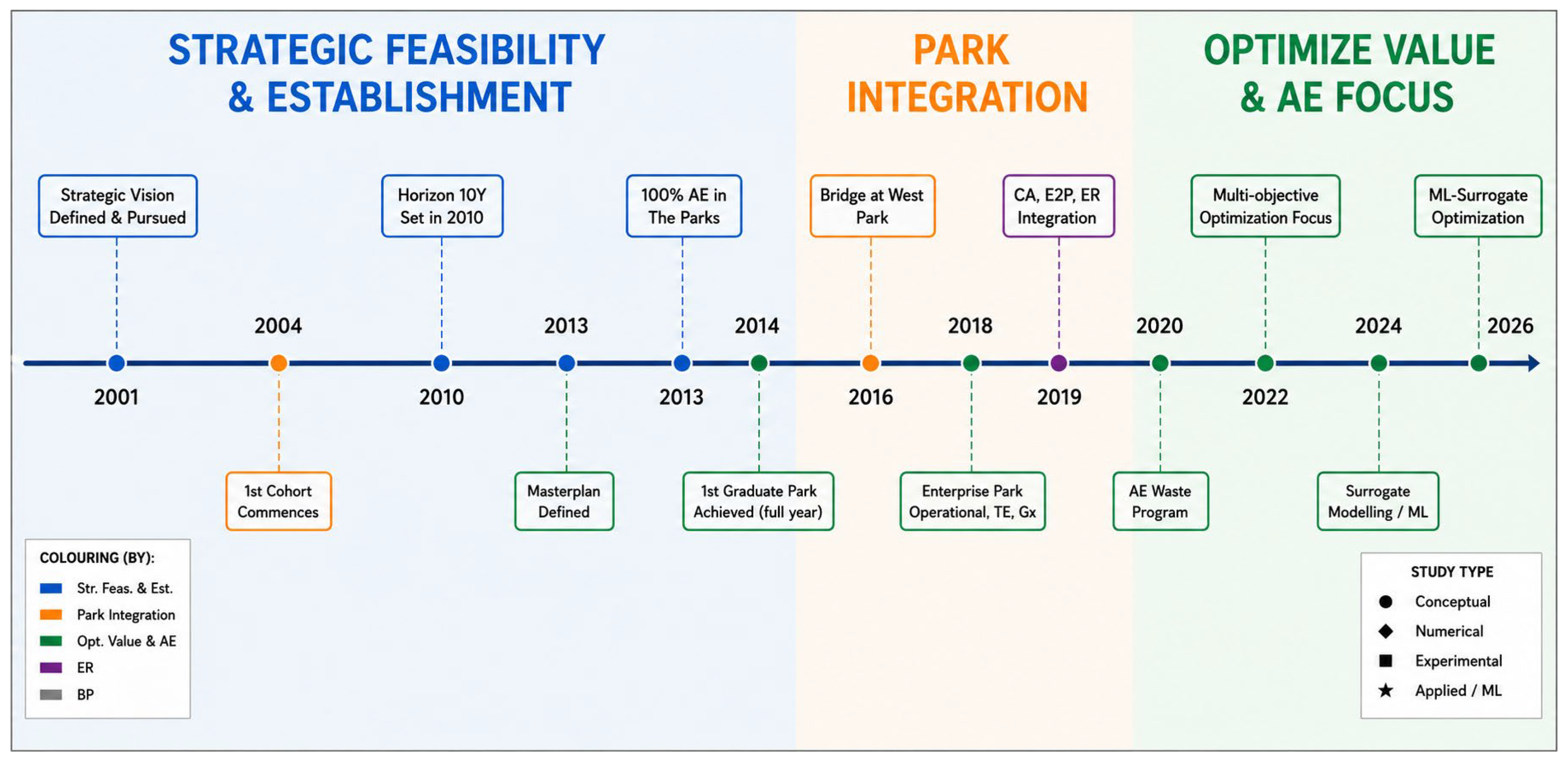
This paper addresses this gap by presenting a structured review and comparison of representative hybrid wave–wind energy concepts, with optimization methods serving as the dominant analytical lens [15,16]. Rather than treating optimization as a secondary discussion, the paper examines how different design strategies—encompassing platform geometry, WEC type and placement, power take-off (PTO) parameters, mass distribution, and control architecture—have been approached in the literature and identifies which optimization techniques have been applied and to what effect [10,17]. Hydrodynamic performance, energy output, and structural complexity are assessed in so far as they define the objective functions and constraints within which these optimization problems are posed [14,18,19]. Figure 2 presents a chronological overview of representative hybrid wave–wind energy concepts reported in the literature, illustrating the evolution of platform integration strategies and optimization-focused research trends from early conceptual systems to recent advanced hybrid configurations.
Based on this scope, the review is guided by the following research objectives: (i) to classify representative hybrid wave–wind platform concepts according to floating platform type, WEC integration approach, and energy dominance; (ii) to compare the main hydrodynamic, energy-performance, structural, mooring, and validation characteristics reported across the reviewed literature; (iii) to identify the design variables, objective functions, and optimization methods most relevant to each class of hybrid configuration; and (iv) to synthesize the principal trade-offs, evidence gaps, and future research priorities needed to support more systematic hybrid platform design.
The main contributions of this work are:
A three-axis classification framework for hybrid wave–wind structures based on platform type, WEC integration approach, and energy dominance.
A structured comparison framework that evaluates representative concepts in terms of hydrodynamic response, energy contribution, structural complexity, mooring implications, validation status, and optimization suitability.
A synthesis of key design trade-offs linking energy capture, motion suppression, structural loading, mooring demand, reliability, and optimization tractability.
A critical survey of optimization methods applied to hybrid wave–wind platforms, identifying suitable method classes for different problem types and highlighting gaps for future research.
Beyond its technical synthesis, the review is intended to support early-stage decision-making by clarifying which hybrid configurations are more suitable for specific deployment contexts, which risks require further validation, and which optimization priorities are most relevant for industry development and policy planning.

Review Methodology and Scope

This review was conducted using a structured literature review protocol designed to identify, classify, and critically compare studies on hybrid wave–wind offshore energy platforms and associated optimization methods. The review focused on three linked themes: floating offshore wind platform type, wave energy converter integration approach, and optimization strategy, reflecting classification dimensions identified in previous hybrid wave–wind reviews [7,15] and optimization dimensions highlighted in recent hybrid-renewable and hybrid wave–wind optimization studies [20]. Literature was searched using Scopus, Web of Science, ScienceDirect, IEEE Xplore, ASME Digital Collection, MDPI, SpringerLink, and Google Scholar. The final review corpus comprised 114 sources published between 2000 and 2026. Additional targeted searches were conducted for technical reports, benchmark platform definitions, and industrial demonstration projects where these sources provided essential contextual information. The approach is therefore intended as a structured technical review rather than a statistical meta-analysis.
The search covered publications from 2000 to April 2026, with emphasis on peer-reviewed journal articles and conference papers addressing hybrid wave–wind energy systems, floating offshore wind turbines, wave energy converters, hydrodynamic response, mooring behaviour, structural loading, techno-economic assessment, and optimization. Search terms included combinations of “hybrid wave–wind energy”, “combined wind and wave energy”, “floating offshore wind”, “wave energy converter”, “point absorber”, “oscillating water column”, “oscillating wave surge converter”, “flap-type WEC”, “spar-torus combination”, “semi-submersible wind-wave platform”, “PTO optimization”, “multi-objective optimization”, “surrogate modelling”, “aero-hydro-servo-elastic modelling”, and “mooring optimization”.
Studies were included when they met at least one of the following criteria: (i) they proposed or analysed a hybrid offshore wave-wind platform; (ii) they examined WEC integration with a floating wind or offshore support structure; (iii) they provided hydrodynamic, structural, mooring, energy-performance, or techno-economic data relevant to hybrid platform assessment; or (iv) they presented optimization, control, or modelling methods transferable to hybrid wave–wind systems [10,15,17,20,21,22]. Studies were excluded when they addressed only standalone wind or wave systems without transferable relevance to hybrid integration, lacked sufficient technical detail for classification, or could not be traced to an accessible source.
The screening process involved title and abstract review followed by full-text assessment of relevant studies. Data were extracted under the following categories: platform type, WEC type, energy-dominance category, modelling approach, validation status, optimization method, design variables, objective functions, reported performance indicators or trends, and stated limitations. To avoid false equivalence across studies, comparative table entries are treated as indicative literature-derived trends rather than directly comparable benchmark results. Particular attention was given to whether results were derived from conceptual models, frequency-domain simulations, time-domain coupled simulations, laboratory experiments, field demonstrations, or full-scale operational experience, consistent with the wide variation in validation maturity observed across floating wind and hybrid wave–wind studies [11,23,24,25,26]. This evidence-level distinction was used to support the critical discussion of modelling maturity, validation gaps, and future research needs.

2. Classification of Hybrid Wave–Wind Energy Structures

Hybrid wave–wind energy systems can be broadly classified based on the characteristics of the floating wind platform and the method used to integrate wave energy conversion devices [27]. This classification is essential for understanding the design space of hybrid systems and for enabling a systematic comparison between different concepts [11]. To contextualize this classification, Figure 2 presents a chronological timeline of representative hybrid wave–wind concepts reported in the literature. The figure is intended to show not only the historical emergence of different platform/WEC combinations, but also the gradual shift in the field from concept feasibility and hydrodynamic characterization [10,28] toward optimization-oriented studies involving PTO tuning, WEC layout, coupled dynamic response, and multi-objective design [15,17,29]. Key milestones and platform archetypes are annotated to allow trends in integration strategy and platform type to be traced over time, and to provide a basis for identifying which periods have seen the greatest concentration of optimization-focused research [7,10,16]. As shown in the timeline, early studies focused primarily on structural feasibility and hydrodynamic characterization [27,30], whereas more recent work has increasingly shifted toward performance optimization and multi-objective design frameworks [9,10,17]. This evolution motivates the classification structure adopted in this paper, which organizes hybrid concepts not only by platform type and WEC integration approach, but also by energy dominance—a third classification axis introduced in Section 2.1 to distinguish concepts in which wave energy constitutes a primary rather than supplementary contribution to total platform output [10,15].
Figure 2. Chronological timeline of representative hybrid wave–wind energy concepts and optimization-related developments from 2000 to 2026. The timeline highlights the transition from early floating-platform feasibility and hydrodynamic-response studies toward more recent work addressing WEC layout, PTO tuning, coupled simulation, multi-objective optimization, and ML-surrogate optimization. Original figure created by the authors based on information from [7,9,10,15,16,17,22,27,28,30,31,32].
Jmse 14 01103 g002

2.1. Classification by Floating Platform Type

All hybrid wave–wind concepts reviewed in this paper are classified simultaneously across three axes: floating platform type, WEC integration method (Section 2.2), and energy dominance, defined in Section 2.1.5. Table 1 consolidates this three-axis classification for every concept in the reference list, enabling direct cross-comparison. A single concept—for example, the SFC—appears once in the table but carries entries across all three columns, reflecting the fact that classification axes are independent and complementary rather than mutually exclusive.

2.1.1. Spar-Type Platforms

Spar platforms are characterised by a deep draft and relatively small waterplane area, which together provide excellent pitch and roll stability through ballast-induced restoring forces [30]. These platforms are well suited to deep-water deployments typically exceeding 100 m water depth [12,30]. The Hywind concept developed by Equinor remains the most commercially advanced spar-type floating wind platform and has demonstrated long-term operational viability at full scale [12]. A quantitative comparison of the dynamic responses of three principal platform types under equivalent loading conditions was provided by Jonkman and Matha [33], establishing benchmark motion characteristics that continue to inform spar-type hybrid design assessments.
When wave energy converters are integrated onto spar platforms, the inherent pitch stability of the hull can be both an advantage and a constraint. Reduced platform motion limits the relative displacement available to surface-following or heaving WEC types, which depend on relative body–wave or body–platform motion for energy extraction [34,35]. Consequently, the hybrid concepts based on spar platforms reviewed in this paper predominantly employ torus-shaped heaving absorbers or pressure-differential devices positioned along the submerged column, where relative axial motion remains exploitable despite the platform’s stability characteristics [15,30,34].
Using the energy-dominance thresholds defined in Section 2.1.5, spar-based hybrid concepts are classified as wind-dominated, with reported WEC contributions generally falling within the supplementary range and depending strongly on torus dimensions, PTO tuning, and site wave climate [10,15,35,36]. This reflects both the geometric constraints on WEC sizing imposed by the spar hull and the early-stage nature of wave energy integration in these configurations, where the primary design objective has remained wind power delivery with wave energy as a supplementary harvest [17].
Cross-referencing with Table 1, spar-type platforms appear in combination with the following WEC integration categories: heaving point absorbers mounted on the platform column, oscillating water column devices embedded within the hull structure, and, in a small number of conceptual studies, tethered submerged pressure differential devices [17,27,34]. The optimization suitability of these configurations is introduced in Section 4.6, with spar-specific optimization studies discussed in Section 5.5 where the platform type introduces particular constraints on the objective function or design-variable space.

2.1.2. Semi-Submersible Platforms

Semi-submersible platforms consist of multiple vertical columns connected by submerged pontoons, producing a large waterplane area and moderate draft [37,38]. This configuration provides good stability across a range of sea states while offering significant geometric flexibility in the placement and sizing of wave energy conversion devices, as demonstrated in semi-submersible hybrid concepts incorporating flap-type WECs [39,40]. Semi-submersibles are among the most frequently studied platform types for hybrid wave–wind systems in the reviewed literature, reflecting their modularity, scalability, and compatibility with a wide range of WEC integration strategies [15,17].
The WindFloat concept developed by Principle Power exemplifies the commercial maturity of semi-submersible floating wind technology [37,38,41], while the SFC concept has specifically explored semi-submersible geometries as hosts for integrated flap-type wave energy devices [39]. Cross-referencing with Section 2.2, semi-submersible platforms in the reviewed literature appear in combination with the broadest range of WEC types of any platform category, including oscillating surge and rotating flap devices mounted on column faces or pontoon structures, heaving point absorbers positioned at column tops or on outrigger arms, oscillating water column devices integrated into column walls, and multi-body relative-motion devices exploiting inter-column dynamics [17,27,38]. The SFC concept, for example, is simultaneously classified in Table 1 as semi-submersible by platform type and rotating flap by WEC integration method.
Using the energy-dominance thresholds defined in Section 2.1.5, semi-submersible hybrid concepts span the wind-dominated and balanced categories, with the possibility of WEC-dominated behaviour only in early conceptual or site-specific designs. The majority remain wind-turbine-dominated, with WEC contributions in the 5–15% range [10]; however, a subset of concepts—particularly those featuring large arrays of point absorbers distributed across extended platform geometries—report balanced contributions, and a small number of early conceptual studies proposed configurations in which wave energy output was intended to match or exceed wind power at specific design sea states [15,17].
This spread makes the semi-submersible category the most analytically rich for optimization studies, as the wider geometric freedom expands the feasible design space considerably. Optimization methods applied to semi-submersible hybrid concepts are reviewed in Section 5.5.

2.1.3. Barge-Type Platforms

Barge-type platforms are shallow-draft structures with large planar deck areas and high waterplane inertia, but their wave-induced pitch and heave responses are generally more sensitive to incident wave excitation than those of spar or semi-submersible concepts [11,33]. Hybridisation with wave energy converters has been proposed as a passive motion-mitigation strategy for floating platforms, with WEC reaction forces potentially reducing platform response amplitude near resonant frequencies [10,15,17].
The OC4 Deep C wind semi-submersible and related floating-platform reference models have been extensively used in the reviewed literature as numerical benchmarks for assessing coupled dynamic response under standardised conditions [42,43]. Cross-referencing with Section 2.2, barge-type platforms reviewed in this paper are most commonly integrated with oscillating water column devices exploiting the hull’s large internal volume, and with arrays of heaving point absorbers distributed across the deck perimeter [24,27]. The large waterplane area of barge platforms uniquely enables high WEC packing densities, which has motivated several optimization studies focused on WEC array layout and spacing as primary design variables [10,17].
From an energy dominance perspective, barge-based hybrid concepts are more evenly distributed across the wind-turbine-dominated and balanced categories than spar-type configurations. The relatively unconstrained deck geometry allows larger WEC arrays to be accommodated, and several reviewed concepts report WEC power fractions exceeding 20% of total platform output under rated conditions [15,17]. No reviewed barge-type concept achieves WEC-dominated classification, though the potential exists in principle given the available deck area. Optimization challenges specific to barge platforms—particularly the coupling between WEC layout, platform inertia, and motion response—are discussed in Section 5.5.

2.1.4. Tension Leg Platforms (TLPs)

Tension leg platforms employ vertical pre-tensioned tendons connecting the hull to the seabed, providing high stiffness in heave, pitch, and roll while permitting relatively compliant horizontal motion [44,45]. This motion profile can be favourable for wind turbine performance because reduced pitch response helps maintain rotor alignment and limit tower/drivetrain loading relative to more compliant floating configurations [44]. However, TLP concepts require carefully designed tendon pretension and station-keeping systems, which increases installation and design complexity relative to some semi-submersible and spar alternatives [44,45].
Application of TLP configurations to hybrid wave–wind systems remains the least developed area within the reviewed literature. The high structural stiffness that makes TLPs attractive for wind turbine hosting may also constrain the relative motions available for WEC energy extraction, creating a design tension that requires further investigation [15,46]. Cross-referencing with Section 2.2, the small number of TLP-based hybrid concepts identified in the reviewed literature employ submerged pressure-differential devices or tethered oscillating bodies that rely on local device motion rather than large hull motion as the primary energy extraction mechanism [15,46].
Using the energy-dominance thresholds defined in Section 2.1.5, TLP-based hybrid concepts reviewed in this paper are expected to remain wind-dominated, with WEC contributions likely toward the lower end of the supplementary range reported for other wind-dominated hybrid configurations [10,15]. This reflects both the early conceptual stage of TLP hybridisation and the geometric constraints imposed by tendon systems on WEC sizing and placement. The relative scarcity of optimization studies targeting TLP-based hybrid platforms is noted as a gap in the literature; this is returned to in the future research directions discussed in Section 6.

2.1.5. Definition of Energy-Dominance Categories

To avoid ambiguity in the third classification axis, energy dominance is defined here according to the indicative contribution of wave energy to the total annual energy output of the hybrid platform. Previous studies show that reported wave-energy fractions in hybrid wave–wind systems depend strongly on platform configuration, WEC scale, wave climate, turbine rating, and modelling assumptions [7,10,15,22,47]. Therefore, the thresholds used in this review are defined as operational review categories rather than universal design standards.
In this review, a configuration is classified as wind-dominated when the WEC contribution is less than 15% of total annual energy output, balanced when the WEC contribution is approximately 15–40%, and WEC-dominated when the WEC contribution exceeds 40%. These cut-offs are used to provide a consistent basis for comparing heterogeneous concepts across the literature. Systems in the wind-dominated category generally use wave energy as a supplementary contribution for power smoothing, capacity-factor improvement, or motion mitigation. Balanced systems are those in which wave energy becomes large enough to influence platform sizing, power-management strategy, and optimization priorities. WEC-dominated systems are those in which wave power is intended to constitute a primary generation pathway rather than a secondary contribution. Because the underlying energy fractions are study-specific, the categories are applied as indicative ranges rather than exact physical boundaries.

2.2. Classification by Wave Energy Integration Approach

In addition to platform type, hybrid wave–wind concepts can be classified according to the type of wave energy converter integrated into the floating system [11,27]. This classification captures differences in hydrodynamic behavior, power conversion mechanism, structural complexity, and optimization potential that are not fully reflected by platform geometry alone [14,48]. The three principal WEC integration categories identified in the literature are point absorbers, oscillating water columns, and oscillating flaps and bodies. Overtopping devices are discussed separately at the close of this section, as their structural and operational characteristics make them more appropriately classified by platform geometry than by WEC type [49,50,51].

2.2.1. Point Absorber Integration

Point absorber wave energy converters are compact devices that extract energy from the relative motion between a floating body and the surrounding water [35]. In hybrid systems, they are often attached to the platform or distributed around its perimeter [17]. Their modular nature makes them attractive for hybrid applications, though their performance is highly sensitive to tuning and control strategies [35,36]. Research by Muliawan et al. demonstrated that point absorber integration could reduce platform pitch motions under selected sea states [35,36], while numerical studies by Hu et al. have shown that the optimal design and performance of WECs integrated with floating wind platforms depend strongly on PTO-related parameters and system-level coupling effects [52]. Experimental investigations by Kamarlouei et al. further confirmed that concentrically arranged point absorbers on a floating offshore platform can improve both energy capture and motion damping simultaneously, provided spatial arrangement and PTO parameters are jointly optimized [25]. The Portuguese Pilot Zone has provided an important test and demonstration context for wave energy technologies, offering operational experience relevant to future hybrid integration strategies [53]. In terms of energy dominance, point absorber hybrids are predominantly wind-dominated, with wave energy generally acting as a supplementary contribution to the overall hybrid system output, depending on site conditions, WEC sizing, and the number of WEC units deployed [14].

2.2.2. Oscillating Water Columns (OWCs)

OWCs capture wave energy through the oscillation of an internal water column within a partially submerged chamber [54]. When integrated into a floating wind platform, OWCs offer the advantage of protected power take-off systems and reduced exposure to harsh marine conditions [55]. However, their performance depends strongly on chamber geometry and wave climate, making site-specific optimization of chamber dimensions—including width, lip draft, and internal air volume—essential for achieving acceptable annual energy yields [56,57,58]. The Ocean Energy OWC buoy demonstration has provided operational experience for floating OWC technology at the U.S. Navy Wave Energy Test Site [59], while numerical studies by Pols et al. have analysed the mooring behaviour and dynamic response of a floating OWC wave energy converter, showing that floating OWC design must account for coupled hydrodynamic response and station-keeping performance [57]. Experimental work by Elhanafi et al. [60] and Xu et al. [61] has further characterised the hydrodynamic response and efficiency of offshore and floating OWC configurations under wave loading, while Zheng et al. investigated wave power extraction from an oscillating water column integrated into a tubular structure using potential-flow-based modelling [62]. Studies by Falcão and Henriques have shown that OWC performance depends strongly on chamber resonance, air-turbine behaviour, and power take-off control, while comparative studies of self-rectifying air turbines highlight the importance of turbine selection for maintaining efficiency across variable sea states [56,63]. OWC-integrated hybrid concepts therefore tend toward the balanced energy dominance category, particularly in energetic wave climates [10,15].

2.2.3. Oscillating Flaps and Bodies

Flap-type or oscillating body WECs extract energy from rotational or translational motion induced by waves [64]. These devices can generate significant hydrodynamic forces and potentially provide strong damping to platform motions [65]. Nevertheless, they introduce additional hydrodynamic loading and modelling complexity, which must be carefully managed in hybrid configurations [66,67]. The Oyster system by Aquamarine Power demonstrated the high energy capture potential of flap-type devices, achieving capture widths exceeding 50% in controlled tests [68], and provided substantial operational experience regarding hinge mechanism reliability and hydraulic PTO maintenance requirements that is directly relevant to hybrid platform design [31,67]. Recent hybrid concepts have adapted this technology for integration with floating wind platforms, with studies by Michailides et al. examining the response of flap-type WECs attached to semi-submersible floating wind turbine concepts under operational conditions [40]. In the SFC case study examined by Michailides et al., numerical and experimental investigations under selected operational and extreme environmental conditions show that flap-type WEC integration can substantially modify platform motions, mooring tensions, internal WEC loads, and tower-base bending response. The extreme-condition study provides validated evidence for survivability assessment and coupled structural response, but the reported response trends remain dependent on environmental condition, WEC operating mode, and modelling assumptions. These results therefore demonstrate a case-specific trade-off between motion control, wave-energy capture, and structural demand rather than a universal performance range for all flap-type hybrid platforms [26,40].
Nonlinear modelling studies reviewed by Penalba et al. highlight that flap-type and other WEC systems can exhibit strongly nonlinear hydrodynamic behaviour, reinforcing the need for optimization approaches that account for both energy capture and structural response [29]. Control and performance considerations for oscillating surge and flap-type devices have been explored by Folley et al. and Whittaker and Folley, with emphasis on how water depth, sea state, and device motion influence energy capture and operational constraints [69,70]. Flap-type hybrid concepts may fall within the balanced energy-dominance category depending on WEC dimensions, control strategy, and site wave climate; however, reported wave-energy contributions are configuration-specific and should not be generalized across all flap-type hybrid platforms [7,26,70].

3. Selected Hybrid Wave–Wind Concepts for Comparison

Based on the classification framework established in Section 2, four representative hybrid wave–wind concepts are selected for detailed comparison [28,71]. The selected concepts were chosen to ensure representation across the principal WEC integration classes identified in Section 2—namely point absorbers, oscillating water columns, and oscillating flap/body systems. Selection was additionally guided by the availability of published optimisation-focused studies and by the desire to span the energy-dominance categories defined in Section 2.1.5, particularly wind-dominated and balanced configurations, thereby enabling comparison across differing optimisation priorities and coupling characteristics.
Each concept is identified by its primary platform type (Section 2.1), its WEC integration approach (Section 2.2), and its energy dominance category, as summarized in Table 1. This structured labelling ensures that the subsequent comparisons are grounded in the classification framework rather than treated as isolated case studies and allows the findings of Section 5 to be interpreted in the context of broader trends across the hybrid systems literature [10,15].

3.1. Concept 1: Floating Wind Platform with Integrated Point Absorbers

In this configuration, multiple point absorber WECs are attached to or distributed around the floating wind platform [25]. The WECs extract energy from wave-induced motions while simultaneously providing additional hydrodynamic damping [72]. This concept is attractive due to its modularity and relatively low structural complexity, which reduces fabrication, installation, and maintenance demands compared to more mechanically complex WEC types [26]. However, the interaction between the WECs and the platform dynamics requires careful tuning to avoid adverse coupling effects that can amplify rather than suppress platform motions under certain loading conditions [52,72]. Numerical studies by Hu et al. have demonstrated that the optimal design and performance of WECs integrated with floating wind platforms depend strongly on PTO-related parameters and system-level coupling effects, underscoring the importance of system-level rather than device-level optimization when designing this class of hybrid platform [52]. Experimental validation by Kamarlouei et al. has further confirmed that jointly optimising WEC arrangement and PTO parameters is essential for realising the motion damping and energy capture benefits associated with this concept [25]. This concept falls within the wind-dominated energy dominance category, with wave energy typically providing a supplementary contribution to the total hybrid system output [14].

3.2. Concept 2: Floating Wind Platform with Integrated Oscillating Water Column

This concept incorporates one or more OWC chambers into the platform substructure, converting wave energy through the oscillatory airflow driven by water column motion [73]. The integration of OWCs into the platform hull offers a key structural advantage: the power take-off machinery is housed within the platform body and therefore shielded from direct wave impact, reducing exposure to extreme marine loading conditions [55]. OWC integration can enhance platform stiffness and modify added mass and radiation damping characteristics, producing more consistent motion reduction across a broader frequency range than point absorber configurations [60]. Challenges include the optimization of chamber geometry—particularly chamber width, lip draft, and internal air volume—and the management of aerodynamic losses within the air turbine system across varying sea states [63,73]. Experimental and numerical studies by Elhanafi et al. have characterised the hydrodynamic response of OWC configurations [60], while Pols et al. [57] and Hallak et al. [74] have provided numerical and experimental analyses relevant to floating OWC devices, mooring behaviour, and hybrid wave–wind platform hull behaviour. Henriques et al. have further examined the dynamics and control of OWC systems, demonstrating that turbine control strategies that regulate airflow can substantially improve performance across a range of wave conditions [73]. This concept falls within the balanced energy-dominance category when chamber geometry and turbine characteristics are appropriately tuned for the deployment site; reported OWC contributions should be interpreted as site- and configuration-dependent rather than as a fixed annual percentage [9,56,57,73].

3.3. Concept 3: Floating Wind Platform with Oscillating Flap-Type WEC

In this configuration, oscillating flaps or articulated bodies are connected to the platform to extract wave energy from rotational motion [70]. These devices can achieve high energy capture efficiency and provide substantial hydrodynamic interaction with the supporting structure, particularly in pitch and surge degrees of freedom [70]. However, they introduce large dynamic loads into the platform structure and increase mechanical complexity considerably, which may affect long-term system reliability and maintenance requirements in harsh offshore environments [68]. The hinge mechanism and hydraulic PTO system require specialized maintenance procedures, as evidenced by operational experience from the Oyster project, which identified these components as the primary contributors to operational expenditure (OPEX) over the system lifecycle [31,67]. Work by Whittaker and Folley on nearshore oscillating wave surge converters has discussed performance and operational considerations for flap-type WECs, including the need to balance energy capture with structural and operational constraints across varying sea states [70]. Research by Michailides et al. on the SFC concept—one of the most comprehensively studied flap-type hybrid systems—demonstrated that flap-type WEC integration can substantially modify platform pitch response, mooring tensions, and tower-base bending response under selected operational and extreme environmental conditions. These findings reinforce the need for multi-objective optimization frameworks that jointly address energy performance, motion response, mooring demand, and structural integrity [26,40]. Depending on WEC dimensions, control strategy, and site wave climate, this concept may fall within the balanced energy-dominance category, with higher wave-energy contributions possible in energetic sea states; however, such contributions are configuration-specific and should not be generalized across all flap-type hybrid platforms [7,26,70].

3.4. Concept 4: Floating Spar Platform with Heaving Torus Wave Energy Converter

In this configuration, a toroidal heaving body—a torus-shaped ring—is mounted concentrically around the column of a spar-type floating wind platform, free to heave relative to the main hull [30,34]. The torus extracts energy from the relative axial motion between the ring and the spar column induced by incident waves, with the power take-off system typically located within the spar hull, providing protection from direct wave loading [17,35]. This geometry is well suited to spar platforms precisely because the deep draft and small waterplane area of the spar hull, while limiting the availability of free-surface relative motion for surface-following devices, still permits significant axial relative displacement along the submerged column under wave excitation [15,30]. The coaxial arrangement eliminates the need for external attachment structures, thereby preserving the hydrodynamic simplicity of the spar hull while adding wave energy conversion capability [34].
The heaving torus concept has been investigated most systematically in the context of spar-type floating wind platforms by Muliawan et al., whose numerical studies demonstrated that a coaxial torus WEC can influence spar platform heave and pitch motions while simultaneously contributing wave-derived power [34,35,36]. The performance of the torus is sensitive to the mass ratio between the torus and the spar, the PTO damping coefficient, and the natural heave frequency of the torus relative to the dominant wave period at the deployment site [35,36]. Sarmiento et al. have further shown that PTO damping and natural frequency tuning are the most influential design variables for torus-type point absorber hybrids, reinforcing the need for site-specific optimization of these parameters [75]. Unlike distributed modular point absorbers (Concept 1), the torus geometry constrains integration to the spar hull specifically and offers limited scalability to other platform types, but it compensates through its structural simplicity and its compatibility with the geometric form of existing spar designs such as the Hywind concept [12,17].
From a structural standpoint, the heaving torus introduces lower mechanical complexity than OWC or flap-type configurations. There are no internal chambers, air ducts, or articulated joints; the primary structural demands relate to the design of the annular torus body, the guidance and bearing system that constrains its motion to the axial degree of freedom, and the PTO mechanism housed within the spar column [35,52]. The enclosed PTO arrangement is a meaningful reliability advantage over exposed mechanical systems, though bearing wear and seal integrity under continuous cyclic loading require careful attention in the detailed design phase [55,76]. Mooring loads induced by the torus are expected to be more limited than those associated with flap-type configurations, because the torus forces act primarily in the axial direction within the coaxial spar–torus arrangement [34,35,36]. Using the energy-dominance thresholds defined in Section 2.1.5, this concept is classified as wind-dominated because the reviewed STC studies treat the torus-derived wave power as a supplementary contribution to the primary wind-generation pathway. The magnitude of this contribution depends on torus dimensions, PTO tuning, site wave climate, and operating condition [10,15,34,35,36]. The key characteristics of these four concepts are summarized in Table 2.

4. Comparison Framework

To enable a consistent and transparent evaluation of the selected hybrid concepts, a step-by-step comparison framework is adopted [77]. Each concept is assessed using the same criteria to highlight similarities, differences, and key design trade-offs [78].

4.1. Hydrodynamic Response

The first comparison step focuses on the hydrodynamic behaviour of the hybrid platforms [77,79,80,81]. Key metrics include surge, heave, and pitch motions, as well as added mass and radiation damping effects [81]. Particular attention is given to the extent to which the integrated WECs modify platform response amplitude operators (RAOs) and reduce wave-induced motions acting on the wind turbine [25,52,60,61,62,72]. Frequency-domain analysis methods established by Newman [77,79,80] and extended by Falnes [81] provide the theoretical foundation for these comparisons.

4.2. Energy Performance

Energy production is identified here as the primary realistic metric for comparing hybrid wave–wind concepts. Unlike motion response, which is system-specific and difficult to benchmark fairly without identical numerical models constructed for identical environmental inputs, annual energy yield can be normalised and compared meaningfully across concepts using site-consistent assumptions [21,67,78]. The comparison presented in this step therefore focuses on combined wind and wave energy contributions, capacity factor improvement, and the extent to which hybridisation smooths power output variability across representative sea states [78,82,83].
It is acknowledged that motion reductions reported in the literature for different hybrid concepts cannot be directly compared unless derived from equivalent numerical models subject to equivalent environmental conditions [81,84]. Comparing response amplitude operators (RAOs) across studies that use different platform geometries, wave spectra, and modelling fidelities risks producing misleading conclusions about relative performance [15,85]. For this reason, motion response data are retained in the comparison framework—particularly in Section 5.1—but treated as a contextual indicator of platform behaviour rather than a primary ranking criterion. Where motion reductions are reported, they are interpreted as enabling conditions for wind turbine performance, for example by reducing nacelle displacement and maintaining rotor alignment, rather than as standalone performance metrics in their own right [86].
The energy performance comparison draws on normalised metrics consistent with the capture width ratio framework proposed by Babarit [78], supplemented by capacity factor improvement estimates from studies reporting annual energy production (AEP) for hybrid configurations under North Sea or equivalent offshore conditions [76,87]. This approach allows the four selected concepts—and the broader range of hybrid systems reviewed in Section 2—to be compared on a consistent basis despite differences in scale, site, and modelling methodology across the underlying studies [10,15].

4.3. Structural and Mechanical Complexity

The third step examines structural and mechanical complexity, including the number of moving components, load transfer paths, and integration challenges [88]. Systems with higher mechanical complexity may offer improved performance but can also increase capital and operational costs [89]. This step highlights the trade-off between performance gains and system robustness, drawing on reliability assessment frameworks developed for marine energy systems [9].

4.4. Mooring and Stability Considerations

The fourth step considers mooring system requirements and overall platform stability [76,86,90]. The influence of WEC-induced forces on mooring line tensions and restoring characteristics is assessed, along with sensitivity to extreme sea states [91]. Stability considerations are particularly important for maintaining wind turbine operational limits, as documented in design standards such as DNV-OS-J103 [76] and IEC 61400-3-2 [86].

4.5. Techno-Economic Assessment Criteria

Because hybrid wave–wind platforms are often justified on the basis of shared infrastructure, improved energy yield, and reduced lifecycle cost, techno-economic performance is treated in this review as a coupled design criterion rather than as a standalone post-processing metric. The principal economic indicators considered are capital expenditure (CAPEX), operational expenditure (OPEX), annual energy production (AEP), levelized cost of energy (LCOE), capacity-factor improvement, shared infrastructure potential, and maintenance accessibility. These indicators are interpreted qualitatively because the reviewed studies differ substantially in site assumptions, device scale, turbine rating, cost model structure, and maturity level [8,70].
In the context of hybrid platforms, CAPEX is influenced by additional WEC structures, power take-off equipment, mooring-system modifications, electrical integration, and installation complexity, while OPEX is affected by maintenance frequency, accessibility, component reliability, failure modes, and the exposure of moving parts to harsh marine conditions [70,92]. AEP and capacity factor depend on resource complementarity, WEC scale, PTO control, and platform-motion effects on turbine performance [82,83]. LCOE therefore depends not only on added wave-energy capture, but also on whether the additional energy yield and operational benefits offset increased structural, mechanical, and maintenance costs [92,93,94].
For this reason, the review does not treat cost reduction as an inherent outcome of hybridisation. Instead, techno-economic benefit is interpreted as conditional on site-specific resource conditions, system reliability, shared infrastructure efficiency, and the balance between additional energy capture and added complexity. This framework is used in Section 5 and Section 6 to distinguish between technical performance gains and commercially meaningful design improvements [8,92,93,94].

4.6. Suitability for Optimization

The next comparison step evaluates the suitability of each concept for optimization [17]. This includes the identification of key tunable parameters, such as WEC placement, power take-off damping, and mass distribution. Concepts offering greater flexibility and controllability are considered more favorable for multi-objective optimization approaches [19]. Recent advances in optimization algorithms for marine energy systems provide guidance on parameter selection and objective formulation [21,88].

4.7. Evidence Level and Validation Status

Because the reviewed studies differ substantially in modelling fidelity and validation maturity, each source used in the comparative assessment was interpreted according to its evidence level. In this review, evidence level refers to the degree to which a reported result is supported by physical validation or operational experience. Seven evidence categories are distinguished: conceptual design, frequency-domain numerical modelling, time-domain coupled simulation, laboratory-scale experiment, wave-tank or basin test, field demonstration, and full-scale deployment or operational experience.
Conceptual studies are useful for identifying feasible configurations and design variables, but they provide limited evidence for quantitative performance claims. Frequency-domain numerical models are valuable for early-stage hydrodynamic screening and response-amplitude analysis, but they generally simplify nonlinearities, control effects, and transient coupled loading. Time-domain coupled simulations provide stronger evidence for platform response, mooring loads, and control interactions under irregular sea states, although their reliability still depends on model validation and environmental assumptions. Laboratory-scale experiments and wave-tank tests provide higher confidence in hydrodynamic behaviour, but scaling effects and simplified wind loading can limit direct extrapolation to full scale. Field demonstrations and operational experience provide the highest level of practical evidence, especially for reliability, maintenance, and survivability, but remain scarce for integrated hybrid wave–wind platforms.
The validation status of representative studies is summarized in Table 3. This classification is used in Section 5 to distinguish between illustrative numerical trends, experimentally supported findings, and operationally demonstrated outcomes. Consequently, quantitative values reported in the comparative tables are interpreted with caution and are not treated as equivalent evidence unless they originate from comparable validation levels.

4.8. Evidence Interpretation Recommendation Framework

To avoid treating all literature-derived findings as equivalent, the discussion in Section 5 and Section 6 distinguishes between evidence, interpretation, and recommendation. In this review, evidence refers to results explicitly reported in the cited studies, including numerical simulations, experimental measurements, field demonstrations, and operational observations. Interpretation refers to synthesis across multiple studies, where recurring patterns are identified but may remain dependent on modelling assumptions, environmental conditions, platform scale, or validation maturity. Recommendation refers to design or research guidance proposed by the authors based on the combined evidence and interpretation.
Accordingly, recommendations in this paper are not presented as universal design rules. They are framed as review-derived guidance whose strength depends on the consistency of the supporting evidence and the validation level of the underlying studies. Where the evidence base is dominated by conceptual or numerical studies, recommendations are expressed cautiously as research priorities or promising directions. Where experimental, field, or operational evidence exists, stronger practical implications are drawn. This distinction is used throughout Section 5 and Section 6 to separate reported findings from author interpretation and proposed future research directions.

5. Comparative Results and Discussion

This section presents a comparative discussion of the selected hybrid wave–wind concepts based on the step-by-step framework introduced in Section 4 [10,15,17]. Rather than focusing on absolute performance values, the analysis emphasizes relative trends, trade-offs, and design implications that are critical for the development and optimization of hybrid platforms [70]. It is important to note that the comparative performance data discussed in this section are drawn from studies employing substantially different modelling assumptions, optimisation depths, environmental conditions, and validation approaches. Some reported results originate from fully optimised configurations, whereas others reflect parametric sensitivity studies or baseline concept evaluations. Accordingly, the comparisons presented here are intended to illustrate broad design trends and optimisation implications rather than provide definitive rankings of inherent concept superiority. Any numerical values reported in this section should therefore be interpreted in relation to the source study from which they were obtained, including the modelling approach, validation level, sea-state definition, device scale, and optimization status. Where values or ranges are reported, they are used as source-specific or indicative literature-derived estimates rather than universal performance limits. The evidence-level classification introduced in Section 4.7 is used to distinguish between conceptual, numerical, experimental, and operational findings when interpreting reported performance trends.

5.1. Hydrodynamic Performance and Motion Response

Across all hybrid concepts, the integration of wave energy converters significantly alters the hydrodynamic response of the floating wind platform [29]. Compared to standalone floating wind systems, hybrid configurations can exhibit increased radiation damping and modified added mass characteristics, leading to reduced motion amplitudes in key degrees of freedom depending on WEC type, placement, and tuning [25,52,60,61,62,72].
Hybrid platforms incorporating point absorber WECs demonstrate moderate reductions in heave and pitch motions, particularly when the WECs and PTO settings are tuned to the dominant wave conditions [25,52,72]. However, the effectiveness of motion mitigation is highly dependent on WEC placement and power take-off (PTO) damping [95]. Poor tuning can result in adverse coupling effects, where wave-induced forces amplify platform motions rather than suppress them [52,72,91]. Numerical simulations by Bachynski et al. have quantified this sensitivity, showing that optimal PTO damping can reduce pitch motions by up to 25%, while suboptimal tuning may increase motions by 10% [91].
In contrast, OWC-integrated platforms show more consistent hydrodynamic response characteristics across a broader frequency range [57,60,61]. The enclosed water column contributes additional stiffness and damping, particularly in heave, which can be beneficial for maintaining wind turbine operational limits [90]. However, this benefit may be accompanied by changes in structural mass distribution and hydrodynamic properties, which can influence natural periods and mooring loads [57,61,62,74]. Experimental and numerical studies by Pols et al. [57] and Zheng et al. [62] have examined these effects for floating and tubular OWC configurations. Because the reported RAO values originate from independent studies using different platform geometries, WEC scales, environmental assumptions, and modelling fidelities, Table 4 is presented as an indicative evidence map of reported response trends rather than as a directly comparable benchmark dataset.
Platforms equipped with oscillating flap-type WECs exhibit the strongest motion suppression, especially in pitch and surge [26]. The large hydrodynamic forces generated by the flaps provide substantial damping, but they also introduce higher dynamic loads into the platform structure [72]. This highlights a key trade-off between motion control effectiveness and structural demand [26,96]. The SFC results reported by Michailides et al. illustrate this trade-off under selected operating and extreme environmental conditions, where substantial pitch-motion reduction was accompanied by increased tower-base bending moments [26,40].

5.2. Energy Performance and Power Synergy

From an energy production perspective, all hybrid concepts benefit from the complementary nature of wind and wave resources [82]. Wave energy contributions are particularly valuable during periods of reduced wind availability, enhancing overall capacity factor and power availability [56,83]. Studies of resource complementarity in offshore regions show that wind and wave resources can exhibit partial temporal complementarity depending on location and season, indicating potential for output smoothing through hybridization [82,83].
Point absorber-based hybrid systems typically provide modest wave energy contributions relative to wind power, with wave-derived electricity accounting for 5–15% of total annual production depending on site conditions. Nevertheless, their distributed configuration allows scalability and redundancy, which can improve reliability [7]. Additionally, the damping effect of the WECs can indirectly enhance wind turbine power production by reducing nacelle motion and rotor misalignment [15]. Simulations by Wei et al. show that the power performance of WECs mounted around an offshore wind turbine support structure depends strongly on WEC arrangement and hydrodynamic interaction effects, reinforcing the need for integrated design when assessing hybrid wave–wind energy output [47].
OWC-based hybrids tend to deliver more stable wave power output due to the smoother airflow-driven PTO system [56]. However, energy capture efficiency is strongly influenced by chamber geometry and wave climate, making site-specific tuning essential [57]. Studies reviewed by Falcão and Henriques show that OWC devices can achieve high hydrodynamic efficiency near resonance under favourable chamber and turbine tuning, but annual performance is strongly reduced by off-resonance operation, wave-climate variability, and turbine losses [56].
Flap-type WEC hybrids can offer high wave energy capture potential in energetic sea states, although reported contributions depend strongly on device scale, site conditions, and platform configuration [7,26,70]. Despite this advantage, the variability of flap motion and the associated structural loads may introduce challenges in maintaining consistent wind turbine performance under combined loading conditions [68]. Research by Pérez-Collazo et al. has highlighted the importance of hydrodynamic coupling in hybrid wave–wind systems, showing that WEC integration can enhance energy capture while introducing additional interaction effects that must be considered in platform design [7,97]. For the same reason, the entries in Table 5 are presented as illustrative qualitative trends rather than directly comparable annual energy production predictions.
Overall, the results suggest that energy synergy alone is insufficient as a design criterion; hybrid systems must balance energy gains with structural and dynamic performance. This finding aligns with hybrid wave–wind studies emphasizing coupled system-level design [9,10,17] and broader hybrid-renewable optimization literature emphasizing multi-criteria optimization approaches [20,22].

5.3. Structural Complexity and Integration Challenges

Structural and mechanical reliability varies substantially across the full range of hybrid wave–wind configurations reviewed in this paper and represents one of the most practically important dimensions along which concepts differ [65,68]. A consistent ordering emerges across the reviewed literature: point absorber configurations present the lowest structural demands, OWC-integrated platforms introduce intermediate complexity, and flap-type WEC hybrids impose the highest level of mechanical challenge. This ordering is robust across platform types and geographic study contexts and correlates with both mooring load impact and motion suppression potential.
Point absorber configurations occupy the lowest complexity tier across the reviewed literature [65]. Their primary advantage from a structural standpoint is modularity: WECs can generally be treated as distributed attachments with limited interaction with the primary load-bearing structure of the floating platform, simplifying fabrication, installation, and maintenance procedures [52]. Point absorber systems generally offer a simpler mechanical architecture than flap-type devices, but their reliability still depends strongly on PTO design, mooring arrangement, and cyclic loading conditions [52,84,98]. The studies by Kamarlouei et al. [25], Da Silva et al. [99], Si et al. [72], and Yang et al. [95] collectively confirm that point absorber integration can be implemented as a modular add-on to floating wind and wave energy platforms, although its influence on platform motions, loads, and energy capture depends strongly on WEC arrangement, PTO tuning, mooring response, and environmental conditions.
OWC-integrated platforms introduce intermediate structural complexity, principally through the requirement to incorporate internal chambers, air ducts, and turbines within the platform substructure [86]. While these components benefit from protection against direct wave impact—a meaningful advantage over exposed mechanical systems—their integration affects global structural stiffness, mass distribution, natural periods, and station-keeping behaviour in ways that require careful treatment during design [70,73]. Construction cost estimates across reviewed studies suggest that OWC integration may increase platform capital expenditure (CAPEX) relative to standalone floating wind platforms, primarily due to the additional structural volume and materials required for chamber formation [21,67]. The studies by Pols et al. [57], Zheng et al. [62], Aubault et al. [100], and Thomsen et al. [101] collectively characterise the hydrodynamic, structural, and mooring implications of OWC integration across floating, tubular, and WindFloat-type platform configurations.
Flap-type WEC hybrids are consistently identified across the reviewed literature as the most mechanically complex hybrid configuration. The presence of articulated joints, large oscillating bodies, and high load transfer demands increases the risk of fatigue and mechanical failure under the cyclic loading conditions characteristic of offshore wave environments [68]. These challenges must be addressed through robust structural design, careful material selection, and comprehensive fatigue analysis from the earliest stages of concept development. Operational experience from the Oyster project indicates that hinge mechanisms and hydraulic PTO systems require specialised maintenance and contribute substantially to operational expenditure over the system lifecycle [31,67]. The SFC concept studied under operational and extreme environmental conditions by Michailides et al. [26,40], together with the long-term extreme structural response analysis by Li et al. [96], provides the most detailed structural characterisation of this WEC category available in the reviewed literature.
Across all concepts reviewed, higher performance potential corresponds to greater structural and mechanical complexity, reinforcing the need for integrated design approaches that treat structural integrity and energy performance as coupled rather than independent objectives. Lifecycle cost analyses suggest that the optimal balance between complexity and performance is strongly site-specific, with more complex systems justified only in energetic wave climates where additional energy capture offsets higher fabrication, installation, and maintenance costs [70].

5.4. Mooring System Implications and Stability

Hybridisation influences not only the platform structure but also the mooring system. The additional forces generated by WECs modify both mean and dynamic mooring tensions across all reviewed configurations, with mooring load impact increasing progressively from point absorber to OWC to flap-type WEC integration. These implications for mooring design, fatigue life, and station-keeping performance must be addressed from the earliest stages of platform development. Mooring systems represent a significant component of floating offshore wind farm capital expenditure, making their correct sizing and configuration an important economic consideration [92].
Point absorber hybrids generally induce more moderate additional mooring loads than flap-type configurations, particularly when WECs are symmetrically arranged around the platform perimeter [25,52,72]. Studies of point absorber arrangements around floating platforms show that WEC placement and hydrodynamic interaction strongly influence platform response and mooring demand, while mooring-line modelling studies highlight the importance of damping and dynamic line response in assessing station-keeping performance [25,52,72,95,102]. However, failure of individual WEC units or asymmetrical arrangement can introduce unbalanced loading and should therefore be considered in dynamic mooring analysis and reliability assessment of hybrid configurations [84,98,101]. The experimental and numerical studies by Kamarlouei et al. [25] and Si et al. [72] provide quantitative characterisation of these effects for point absorber configurations on floating and semi-submersible platforms.
OWC-based systems may increase mean mooring loads due to added mass effects introduced by the water column, but dynamic load amplification is typically moderate compared to other WEC types [101,103]. The enclosed nature of OWC chambers distributes wave forces over larger structural areas, reducing peak loads on individual mooring lines relative to point-concentrated force inputs [73]. Dynamic mooring analyses indicate that OWC-related changes in added mass, damping, and station-keeping response can modify maximum mooring tensions, but the magnitude of this effect is strongly dependent on platform geometry, chamber configuration, mooring layout, and load-case definition [57,101]. The studies by Pols et al. [57], Zheng et al. [62], and Aubault et al. [100] further support the importance of hydrodynamic response, chamber integration, and mooring behaviour across different OWC-related platform configurations.
Flap-type WECs can significantly amplify dynamic mooring tensions due to the large oscillatory forces generated by articulated flap motion [26,48]. The cyclic nature of flap loading introduces fatigue damage accumulation in mooring lines at rates substantially higher than those associated with platform wave loading alone [9,26]. Mooring design studies for WEC systems show that cyclic loading and dynamic line response must be explicitly considered when assessing fatigue damage and station-keeping reliability, particularly for configurations subject to large oscillatory WEC forces [90,98]. The experimental results of Michailides et al. on the SFC concept under extreme environmental conditions represent the most comprehensive validated dataset for mooring load amplification associated with flap-type integration in the reviewed literature [26].
The comparative picture across all reviewed literature shows that while flap-type WECs offer the strongest motion suppression, they simultaneously impose the greatest demands on mooring and structural systems [26,90]. This trade-off must be explicitly evaluated during the concept selection phase and incorporated into optimization frameworks as a coupled structural–hydrodynamic constraint [59]. Point absorber and OWC configurations offer a more moderate and predictable mooring load profile, which may be preferable in sites where mooring system cost or seabed conditions constrain the design space. Table 6 summarizes indicative mooring-load trends reported for different WEC integration types. As with Table 4 and Table 5, the entries should be interpreted as literature-derived qualitative trends rather than directly comparable design loads, because the underlying studies differ in platform geometry, mooring layout, wave conditions, WEC scale, and numerical or experimental methodology.

5.5. Optimization Methods Applied to Hybrid Wave–Wind Systems

This section constitutes the core analytical contribution of the review. Rather than simply noting that optimization is needed for hybrid platform design, it examines which specific optimization methods have been applied to hybrid wave–wind systems in the existing literature, what design variables and objective functions they addressed, and what conclusions can be drawn about the relative effectiveness of different algorithmic approaches across hybrid configuration types [10,17,91]. The survey covers studies addressing device-level, platform-level, and system-level optimization problems, and identifies the principal gaps that remain unaddressed in the current body of work [9,15].

5.5.1. Overview of Optimization Methods Used

Across the reviewed literature, optimization studies of hybrid wave–wind platforms have employed four principal classes of method, each with distinct strengths and limitations depending on the nature of the design problem addressed [9,17].
Gradient-based methods have been applied primarily to single-objective PTO tuning problems where the objective function is smooth and differentiable, such as the maximisation of wave power absorption subject to a fixed platform geometry [21,88]. These methods offer computational efficiency and are well suited to problems with a limited number of continuous design variables, but their reliance on local search makes them poorly suited to the non-convex, multimodal design spaces characteristic of full hybrid platform optimization [17,104]. Studies by Ringwood et al. represent the most systematic application of gradient-based control optimization to WEC systems, demonstrating that optimal PTO control can increase wave energy capture by 50–100% relative to passive damping configurations [21,88].
Genetic algorithms and evolutionary strategies have been applied more broadly to multi-objective layout and geometry optimization problems where the design space is non-convex and objective functions are computationally expensive to evaluate [10,17]. These population-based methods are well suited to exploring high-dimensional design spaces and handling competing objectives simultaneously, making them the most commonly employed optimization class in the hybrid systems literature to date [9]. Studies by Sarmiento et al. have applied evolutionary optimization to multi-use floating platform design, identifying PTO damping coefficient and WEC natural frequency as the most critical design variables for point absorber hybrids [75]. Cao et al. reviewed combined wind and wave energy harvesting devices and related coupling simulation techniques, highlighting the need for optimization approaches capable of accounting for coupled hydrodynamic response, structural loading, and energy performance [15].
Surrogate-based optimization, including machine-learning-based response models, has been employed where the computational cost of high-fidelity coupled hydrodynamic simulations makes direct optimization impractical [9,17,32]. By constructing a fast-to-evaluate surrogate model from a limited number of simulation runs, these methods enable broader exploration of the design space than would be feasible with direct simulation alone, particularly when simplified coupled-analysis methods are used to reduce computational cost in early-stage floating-platform studies [10,90,105]. Recent work by Wei et al. has further demonstrated the use of a multilayer-perceptron surrogate trained on coupled OpenFAST–AQWA simulation data and linked with a genetic algorithm to predict and optimize power and motion responses of a floating wave–wind hybrid system [32]. Gomes et al. have developed optimization approaches for OWC wave-energy conversion, including hydrodynamic chamber optimization and aerodynamic turbine optimization, demonstrating that both chamber geometry and turbine design influence overall energy conversion performance [58,89]. Ansari et al. provide a broader review of optimization techniques applied to hybrid renewable energy systems, confirming their growing importance for hybrid platform design problems [20].
Reinforcement learning and data-driven optimization represent the most recent class of method to be applied to hybrid system design and currently remains primarily at the device level rather than the platform level [10,91]. These approaches are particularly promising for real-time control optimization under variable sea state conditions, where the ability to adapt PTO parameters continuously offers substantial performance gains over fixed passive damping strategies [21,88]. Wang et al. have demonstrated the applicability of data-driven control frameworks to floating offshore wind systems [19], and their extension to hybrid wave–wind platforms represent an active frontier in the field [10,90]. Table 7 summarizes the mapping between hybrid concept type, problem class, design variables, suitable optimization methods, and remaining gaps.
The mapping in Table 7 shows that optimization method selection is governed less by WEC type alone than by the mathematical structure of the design problem: smooth single-variable PTO tuning, non-convex multi-objective layout design, high-cost coupled simulation, or adaptive real-time control.

5.5.2. Suitability of Optimization Methods by Problem Class

The suitability of an optimization method depends strongly on the structure of the design problem, including the number of design variables, the smoothness of the objective function, the computational cost of each evaluation, and whether the objectives are single- or multi-criteria. For hybrid wave–wind systems, no single optimization method is appropriate across all design levels. Instead, the reviewed literature suggests a hierarchy of method suitability that depends on whether the problem is device-level, platform-level, control-oriented, or fully system-level.
Gradient-based methods are most suitable for low-dimensional, continuous, and relatively smooth problems, particularly PTO damping and control-parameter tuning for individual WECs. Their main advantage is computational efficiency, which is important when repeated time-domain simulations are required. However, they are less suitable for hybrid platform layout problems because these typically involve non-convex design spaces, discrete variables, and multiple local optima. Their role in hybrid wave–wind design is therefore best interpreted as local refinement after a feasible configuration has already been identified, rather than as a primary global search method [17,21,88].
Evolutionary and population-based methods are better suited to non-convex and multi-objective design problems, including WEC placement, array layout, flap geometry, PTO parameter selection, and trade-offs between energy capture and platform-motion reduction. These methods can handle discontinuous response surfaces and competing objectives without requiring gradient information. Their disadvantage is the large number of function evaluations required, which becomes prohibitive when each evaluation involves coupled aero-hydrodynamic time-domain simulation. For this reason, evolutionary algorithms are most appropriate for early-stage global exploration, reduced-order models, or cases where they are combined with surrogate models [9,10,17,22,52].
Surrogate-based optimization is particularly suitable for high-cost platform-level and system-level design problems. In these cases, direct optimization using high-fidelity coupled simulations is computationally impractical. Surrogate models can approximate relationships between design variables and performance metrics, allowing broader exploration of platform geometry, WEC layout, mooring configuration, and PTO settings. Their main limitation is that surrogate reliability depends on training-data quality and on whether the sampled design space captures nonlinear coupling effects. Surrogate-based methods are therefore most useful when combined with adaptive sampling and validation against selected high-fidelity simulations [9,17,20,22,32,105].
Data-driven and reinforcement-learning methods are most appropriate for adaptive control problems, especially where PTO settings or control policies must respond to changing sea states in real time. These methods are promising for online control of WEC subsystems and for coordinating wave-energy extraction with platform-motion mitigation. However, their use at the full hybrid-platform level remains limited because they require large training datasets, robust state estimation, and careful treatment of safety constraints. Their near-term role is therefore likely to be in device-level or subsystem-level control, with later extension to system-level supervisory control once validated coupled datasets become available [10,21,88,91].
Overall, the most appropriate optimization strategy for hybrid wave–wind platforms is likely to be multi-stage rather than single-method. A practical workflow would use evolutionary or other global-search methods to identify promising configurations, surrogate models to reduce the cost of exploring high-dimensional coupled design spaces, gradient-based methods for local PTO or geometry refinement, and data-driven control methods for real-time adaptation under variable sea states. This interpretation shifts the optimization discussion from a list of available algorithms toward a problem-dependent selection framework for hybrid platform design.

5.5.3. Device-Level Optimization

For point absorber hybrids, optimization efforts in the reviewed literature have focused primarily on three interdependent design variables: PTO damping coefficient, WEC natural frequency tuning, and spatial placement of WEC units around the platform perimeter [52,72,106,109]. Nonlinear hydrodynamic modelling of heaving buoy WECs further demonstrates that accurate representation of device motion and fluid–body interaction is important when assessing PTO tuning and energy capture under realistic wave conditions [109]. Research by Ringwood et al. has demonstrated that optimal PTO control can increase wave energy capture by 50–100% relative to passive configurations, while simultaneously improving motion damping characteristics of the host platform [21,88]. Parameter sensitivity studies by Sarmiento et al. have identified PTO damping and WEC resonant frequency as the most influential design variables for point absorber hybrids across a range of sea states [75], while studies by Hu et al. have shown that the optimal design and performance of WECs integrated with floating wind platforms depend strongly on PTO-related parameters, layout, and system-level coupling effects, reinforcing the necessity of system-level rather than device-level optimization for this configuration [52].
For OWC-based hybrids, device-level optimization has centred on chamber geometry, turbine characteristics, and station-keeping behaviour, with studies demonstrating that OWC performance depends on chamber dimensions, airflow dynamics, hydrodynamic response, and mooring configuration under site-specific wave conditions [56,57,58,73]. Gomes et al. have developed optimization frameworks specifically for OWC chamber geometry, showing that coordinated optimization of these parameters can substantially increase annual energy production relative to non-optimised designs [58,89]. Turbine control strategies that regulate airflow across varying sea states have been examined by Henriques et al., demonstrating that active control of the air turbine can improve off-resonance performance and reduce the sensitivity of annual energy yield to site-specific wave climate variability [73].
For flap-type WEC hybrids, device-level optimization must address not only energy capture but also structural load mitigation, given the large dynamic forces associated with oscillating surge and flap-type devices [26,64,66,70]. The hinge mechanism, flap dimensions, and PTO characteristics must be carefully coordinated to balance energy capture against fatigue loading on both the WEC and the host platform structure [68,96]. Nonlinear modelling studies reviewed by Penalba et al. highlight that flap-type and other WEC systems can exhibit strongly nonlinear hydrodynamic behaviour, reinforcing the need for optimization approaches that account for both energy capture and structural response [29]. These results confirm that single-objective optimization for maximum power capture will systematically overestimate achievable performance in operational hybrid systems by ignoring structural constraints [31].

5.5.4. System-Level and Multi-Objective Optimization

At the system level, the most important finding across the reviewed literature is that no single hybrid configuration consistently outperforms others across all performance criteria simultaneously [10,15,22]. Performance is governed by a set of interdependent parameters—including WEC placement, PTO damping, mass distribution, platform geometry, mooring configuration, and control architecture—whose optimal values differ depending on the integration strategy and deployment site [10,14,48]. This finding strongly motivates the adoption of multi-objective optimization frameworks capable of simultaneously addressing coupled aerodynamic, hydrodynamic, and structural dynamics across the full hybrid system [22].
Despite this motivation, truly integrated system-level optimization of hybrid wave–wind platforms—where aerodynamic, hydrodynamic, structural, and economic objectives are jointly optimised within a single computational framework—remains largely absent from the current literature [9,10,15]. The majority of reviewed optimization studies address either the WEC subsystem in isolation or the floating platform with WEC effects approximated through simplified force models, rather than treating the hybrid system as a coupled multi-physics design problem from the outset [14,18,48]. This represents the most significant gap identified in this review, and its resolution is identified as the principal direction for future research in Section 6.
Recent advances in computational optimization, including genetic algorithms, surrogate-based methods, and machine learning approaches, are progressively enabling more comprehensive exploration of hybrid system design spaces [20,22]. Studies by Celesti et al. have examined design considerations for hybrid wave–wind platforms under energy-maximising control, illustrating how control-oriented modelling can inform optimization of coupled hybrid systems [108]. Wang et al. have demonstrated the feasibility of OpenFAST-based coupled simulation frameworks for semi-submersible floating wind systems [19], while Yang et al. have developed an aero-hydro-servo-elastic coupling framework for floating offshore wind turbine analysis [18]. Extending such coupled modelling frameworks to include WEC subsystems represents a natural and achievable next step for the field [10].

5.6. Summary of Key Trade-Offs and Optimization Implications

Using the evidence interpretation recommendation framework introduced in Section 4.8, the comparative analysis in Section 5.1, Section 5.2, Section 5.3, Section 5.4 and Section 5.5 is synthesized into five recurring trade-offs. These represent author interpretations of patterns observed across the reviewed literature rather than outputs from a single unified model. They define the main tensions that future optimization studies should translate into objective functions and constraints [9,22].

5.6.1. Trade-Off 1: Wave Energy Capture Versus Structural Loading

Increased wave energy capture is consistently associated with higher structural loads across all WEC types reviewed [15,28]. This trade-off is most clearly demonstrated by flap-type configurations, where maximum wave energy extraction is achieved at the cost of substantially increased dynamic loading on both the platform structure and the mooring system [9,52]. Even for point absorber configurations, studies have shown that aggressive PTO tuning for maximum power capture can amplify platform motions rather than suppress them under certain sea state conditions [62,70]. Optimization frameworks for hybrid platforms must therefore treat energy capture and structural load as coupled objectives rather than independent criteria and must explicitly incorporate structural constraints—including fatigue damage limits and mooring tension bounds—within the optimization problem formulation [10,17,31].

5.6.2. Trade-Off 2: Motion Suppression Versus Mechanical Reliability

The WEC configurations that provide the strongest platform motion suppression are also those that introduce the greatest mechanical reliability and maintenance demand. Flap-type WECs achieve the highest levels of pitch and surge reduction across the reviewed literature, but this performance comes with articulated joints, high load transfer paths, and PTO systems that require specialized maintenance and have shorter mean times between failure than simpler configurations [31,67]. Point absorber systems offer more modest motion reduction but substantially lower mechanical complexity, making them more suitable for near-term deployment where operational reliability is prioritised over maximum performance [52,55]. This trade-off implies that the optimal WEC type for a given hybrid platform cannot be determined on hydrodynamic grounds alone, and that reliability and lifecycle cost models must be integrated within the optimization framework to produce commercially meaningful results [70,92].

5.6.3. Trade-Off 3: System Performance Versus Optimization Tractability

Higher-performing hybrid configurations are generally those with the greatest number of interdependent design variables, which simultaneously makes them the most difficult to optimise effectively [10,17]. Flap-type hybrids involve coupled structural, hydrodynamic, and PTO design variables whose interactions are highly nonlinear and computationally expensive to evaluate with high-fidelity models [31,101]. Point absorber hybrids present a more tractable optimization problem due to their modularity, but the relatively modest performance gains achievable mean that optimization effort may yield diminishing returns beyond a certain level of design refinement [74,104]. Surrogate-based and multi-fidelity optimization methods are identified across the reviewed literature as the most promising approaches for managing this trade-off, enabling higher-fidelity design spaces to be explored at acceptable computational cost [9,17,58].

5.6.4. Trade-Off 4: Site-Specific Performance Versus Design Generalisability

The comparative performance of different hybrid concepts varies substantially with deployment site, including water depth, wave climate, wind resource, and grid connection constraints [7]. Configurations that perform well in energetic North Sea conditions may be suboptimal in milder Atlantic or Mediterranean sites where wave energy contributions are lower and structural loads are less severe [10,15,110]. This site-specificity implies that optimization results derived for one location cannot be straightforwardly transferred to another, and that standardised benchmarking across a representative range of deployment sites is needed before general design guidelines can be established [22]. Multi-fidelity optimization frameworks that can efficiently re-optimise designs for different site conditions represent a particularly valuable direction for future research [9,58].

5.6.5. Trade-Off 5: Active Control Performance Versus Design Complexity

Active control of PTO systems offers substantial opportunities to adapt hybrid platform response to changing sea states and to reconcile some of the inherent trade-offs identified above [85,91]. Studies consistently show that actively controlled PTO configurations outperform passive designs across a wide range of sea states, with energy capture improvements of 50–100% reported for point absorber systems under optimal control [21,88]. However, the integration of advanced control strategies introduces additional design complexity, increases software and sensor system requirements, and raises questions about robustness and fail-safe behaviour in harsh offshore environments [10,91]. The optimization of control architecture—including the choice between passive, reactive, model predictive, and reinforcement learning-based approaches—must therefore be treated as an integral component of hybrid platform design rather than a post-design refinement [87,91].
Understanding and explicitly managing these five trade-offs is essential for the successful design and optimization of next-generation hybrid wave–wind energy platforms [90]. Taken together, they define a multi-dimensional optimization landscape in which no single configuration dominates across all criteria, and in which the appropriate balance between competing objectives is inherently site-specific, configuration-dependent, and sensitive to the assumptions embedded in the objective function [22]. This supports the review-derived recommendation that future hybrid wave–wind studies should prioritise multi-objective, multi-physics optimization frameworks capable of addressing energy performance, structural integrity, mechanical reliability, mooring loads, and control architecture simultaneously [9,10,17]. Given the current dominance of numerical and concept-level evidence, this recommendation should be interpreted as a research and design priority rather than as a fully validated universal design rule.

6. Discussion and Future Work

This paper has presented a structured classification, comparative assessment, and optimization methods survey of hybrid wave–wind energy platforms, with optimization methods serving as the dominant analytical lens [10,15]. The classification framework introduced in Section 2 organises hybrid concepts across three axes—floating platform type, WEC integration approach, and energy dominance—providing a more complete and practically useful taxonomy than platform type or WEC type alone [11,27]. The comparative analysis in Section 4 and Section 5 evaluates hydrodynamic response, energy performance, structural complexity, mooring implications, and optimization potential across four representative hybrid configurations, drawing on the full breadth of the reviewed literature rather than isolated case studies [28,71]. Section 5.5 surveys the optimization methods applied to hybrid platforms to date—including gradient-based methods, evolutionary algorithms, surrogate-based approaches, and reinforcement learning—and identifies the principal gaps that remain unaddressed [9,10,17,91].

6.1. Key Findings and Discussion

The three-axis classification framework introduced in this paper—platform type, WEC integration approach, and energy dominance—provides a more complete basis for comparing hybrid concepts than the two-axis frameworks commonly used in the literature [11,15,27]. The energy dominance category in particular offers a practically important distinction between configurations where wave energy plays a supplementary load-mitigation role and those where it constitutes a primary generation contribution [7,10,15,24]. Applying this framework to all concepts reviewed reveals that the majority of existing hybrid systems are wind-dominated, and that balanced or WEC-dominated configurations remain largely at the conceptual or early numerical stage [10,15]. A consolidated classification table and chronological timeline of hybrid concepts are provided to support future comparative studies and to contextualise the evolution of the field [16,28,31].
Across all WEC types reviewed, integration modifies the hydrodynamic response of the floating platform by altering radiation damping and added mass characteristics [29,84]. The degree of motion mitigation depends strongly on WEC type, placement, and tuning: flap-type configurations generally provide the strongest motion suppression but introduce the highest structural loads, OWC integrations provide moderate damping across a broader frequency range, and point absorber configurations show more variable response that is highly sensitive to PTO parameter selection [22,25,70]. Because the reported motion-response data come from studies using different platform geometries and modelling fidelities, they are treated here as contextual indicators rather than as a basis for direct concept ranking [84,85,111].
All hybrid concepts reviewed demonstrate potential for enhanced combined energy capture relative to standalone floating wind platforms, with estimated capacity factor improvements depending strongly on WEC type, site conditions, and platform configuration [7,10,24]. Wave energy contributions are particularly valuable in smoothing power output variability and improving availability during periods of reduced wind resource, consistent with the resource complementarity findings reported across the reviewed literature [25,54,72,86]. However, energy synergy alone is insufficient as a design criterion: hybrid systems must balance energy gains against structural demand, mechanical complexity, and mooring loads within a multi-objective framework to produce commercially viable designs [25,64].
Higher performance potential generally corresponds to greater structural and mechanical complexity across the WEC types reviewed [68]. Point absorber systems offer the best near-term balance of performance gain versus complexity, with modular architectures that simplify fabrication, installation, and maintenance [52,55,65]. OWC integrations introduce moderate complexity with the compensating advantage of protected PTO machinery, while flap-type configurations impose the greatest demands on structural design, materials selection, and maintenance planning [31,67]. Lifecycle cost considerations must be integrated within the optimization framework from the outset, as the optimal complexity–performance balance is strongly site-specific and cannot be determined from hydrodynamic analysis alone [70].
Hybridisation modifies mooring system requirements across all configuration types, with flap-type WECs imposing the greatest additional dynamic loading and fatigue damage accumulation [26,90,98]. Symmetrical arrangement of point absorbers can help moderate platform and mooring response, while asymmetrical configurations or individual unit failures should be considered in dynamic mooring and reliability assessments [25,52,72,84,98,101]. OWC integration produces moderate and broadly predictable mooring load increases that can generally be accommodated within standard design margins [101]. These findings confirm that mooring system design must be treated as an integral component of hybrid platform optimization rather than a post-design consideration [62].
The optimization survey identifies four principal method classes and reveals that fully integrated system-level frameworks represent the most critical remaining gap. The survey of optimization methods in Section 5.5 identifies four principal classes applied to hybrid wave–wind systems in the reviewed literature: gradient-based methods, evolutionary algorithms, surrogate-based optimization, and reinforcement learning [9,10,17,91]. Evolutionary algorithms and surrogate-based methods are the most commonly employed for multi-objective and system-level problems respectively, while gradient-based methods remain useful for single-objective PTO tuning problems with smooth objective functions [21,31,88]. The most significant gap identified is the absence of truly integrated system-level optimization frameworks that simultaneously address coupled aerodynamic, hydrodynamic, structural, and economic objectives within a single computational workflow [10,14,18,48]. The majority of reviewed studies optimise either the WEC subsystem in isolation or the platform with WEC effects approximated, rather than treating the full hybrid system as a coupled multi-physics design problem [9,15].

6.2. Research Challenges and Future Directions

Based on the reviewed evidence, fully integrated multi-physics optimization frameworks emerge as a priority research direction because hybrid platforms require simultaneous treatment of aerodynamic, hydrodynamic, structural, and economic design variables [10,17,22,25]. OpenFAST, as reported in the reviewed literature, provides the coupled simulation capability needed to support such frameworks, [19], but embedding them within multi-objective optimization loops remains computationally demanding because of the large number of function evaluations required [9,90]. Future work should therefore prioritise multi-fidelity workflows in which high-fidelity coupled simulations are used to train and validate surrogate models that can be evaluated efficiently within evolutionary or Bayesian optimization procedures [10,17,32].
Based on the cross-study limitations identified in this review, standardised benchmarking and reference platform models emerge as an important research priority for enabling reliable comparison and validation of optimization results. The absence of standardised benchmarking across hybrid wave–wind studies severely limits the ability to draw reliable comparative conclusions from the existing literature [15,67,78]. Different studies employ different platform geometries, WEC scales, wave spectra, and modelling fidelities, making direct performance comparisons unreliable [84,111]. Future research should prioritise the establishment of reference hybrid platform models—analogous to the OC3, OC4, and OC5 reference models for floating wind [11,23,24]—against which new hybrid concepts and optimization methods can be consistently evaluated. Standardised metrics for energy performance, structural loading, and mooring response, defined across a representative set of deployment sites, would substantially improve the transferability of research findings across the community [10,21,87].
The reviewed evidence suggests that advanced control strategies are a promising direction for improving hybrid platform performance, although their integration within complete design frameworks remains limited. Advanced model-based and data-driven control approaches represent one of the most promising avenues for improving hybrid system performance, yet their integration within holistic design frameworks remains limited in the current literature [10,87,91]. Future work should develop control methodologies that are co-designed with the platform from the outset rather than applied as post-design refinements and should examine hierarchical control architectures that coordinate WEC-level PTO optimization with platform-level motion management and wind turbine load control simultaneously [70,85,87,91]. Reinforcement learning approaches offer particular promise for real-time adaptive control under variable sea states and warrant systematic investigation at the hybrid system level [10,90,91].
Based on the evidence-level assessment in Section 4.7, physical validation through scaled testing and prototype deployment remains a priority because much of the current optimization literature is still dominated by numerical modelling. The overwhelming majority of optimization studies reviewed are based on numerical modelling, with physical validation limited to a small number of scaled wave tank experiments [29,46,52]. Large-scale demonstrations and real-world operational data remain scarce, constraining confidence in numerical performance predictions and limiting the ability to validate optimization results under realistic irregular sea states and combined wind-wave loading [29]. Future research should prioritise scaled tank testing of integrated hybrid systems—including simultaneous aerodynamic and hydrodynamic loading where facilities permit—and, where resources allow, deployment of prototype systems in representative offshore environments. Data from such tests are essential both for validating numerical models and for identifying failure modes and maintenance requirements that are not apparent from simulation alone [21,31].
The reviewed literature indicates that techno-economic and lifecycle cost analysis remain underdeveloped relative to their commercial importance, supporting the recommendation that these factors should be integrated within optimization frameworks from the outset. Comprehensive techno-economic assessment and lifecycle cost analysis remain underdeveloped relative to hydrodynamic and structural studies in the hybrid systems literature. Future work should develop standardised methodologies for comparing hybrid system economics—incorporating capital expenditure, operational expenditure, levelized cost of energy, energy yield, and infrastructure sharing benefits—and should integrate these economic models directly within multi-objective optimization frameworks so that cost-performance trade-offs can be explicitly quantified and navigated during the design process [70,92,93,94]. Uncertainty quantification methods that propagate resource variability, manufacturing tolerances, and degradation rates through to cost and performance estimates would substantially improve the reliability of investment decisions for hybrid platforms.
The current evidence base also indicates that long-term reliability, extreme-condition survivability, and environmental impact assessment require more systematic treatment before hybrid platforms can be confidently advanced toward commercial deployment. Long-term reliability under operational and extreme marine conditions remains a critical concern for all hybrid configurations reviewed, particularly those involving mechanically complex WEC types. Future work should develop reliability models that account for the coupled nature of hybrid systems and identify critical failure modes arising from WEC–platform interaction rather than treating subsystem failures independently. Survivability under 50-year and 100-year storm conditions requires particular attention for flap-type and point absorber configurations where WEC components are directly exposed to wave loading [26,84,98]. Alongside reliability, the environmental effects of hybrid platforms—including combined acoustic footprint, electromagnetic emissions from subsea cables, and potential as artificial reef structures—require systematic investigation to support consenting processes and to quantify whether hybridisation offers environmental co-benefits relative to standalone deployments. These research challenges also have broader implications for theory development, industrial decision-making, and policy design, as discussed in the following subsection.

6.3. Theoretical, Practical, and Policy Implications

The findings of this review have theoretical, practical, and policy implications for the development of hybrid wave–wind energy platforms. From a theoretical perspective, the three-axis classification framework proposed in this paper provides a structured basis for comparing hybrid concepts across platform type, WEC integration approach, and energy dominance, building on previous review and classification efforts [7,15]. This helps move the literature beyond isolated case studies toward a more systematic understanding of how platform geometry, WEC mechanism, resource contribution, and optimization strategy interact. The evidence-level framework introduced in Section 4.7 further supports theory development by distinguishing between conceptual proposals, numerical simulations, physical experiments, and operational evidence, consistent with the variation in modelling and validation maturity observed across benchmark, numerical, and experimental studies [11,23,25,26].
From a practical and industrial perspective, the results can support early-stage concept screening and technology development decisions. Developers and engineering consultancies can use the classification and comparison framework to identify which hybrid configurations are most compatible with specific deployment contexts, water depths, infrastructure constraints, and reliability requirements. For example, point absorber systems may be more suitable where modularity and lower mechanical complexity are prioritised [25,52], OWC-based concepts may be attractive where protected PTO integration and moderate hydrodynamic interaction are desirable [57], and flap-type systems may be considered where stronger motion-control potential justifies higher structural and maintenance demands [26,67,68]. The techno-economic framework introduced in Section 4.5 also highlights that hybridisation should not be assumed to reduce cost automatically. Instead, the commercial value of a hybrid platform depends on whether additional wave-energy capture, power smoothing, and infrastructure sharing can offset increased CAPEX, OPEX, maintenance complexity, and validation requirements [8,70,92,93,94].
From a policy and planning perspective, the review indicates that hybrid wave–wind deployment decisions should be based on a combination of technical, market, regulatory, and political factors rather than energy yield alone. Technical suitability depends on resource complementarity, bathymetry, mooring feasibility, grid connection, reliability, and survivability [82,83]. Market suitability depends on electricity price structures, support mechanisms, supply-chain maturity, port availability, insurance risk, and investor confidence [85,111]. Political and regulatory suitability depends on marine spatial planning, consenting processes, environmental assessment, local content priorities, and long-term offshore energy strategy [112]. These factors are especially important because the same hybrid concept may be attractive in one region but unsuitable in another if wave climate, grid capacity, policy incentives, or maintenance logistics differ substantially [110].
The sustainable-development implications of hybrid wave–wind systems are also region-specific. In mature offshore wind markets, such as parts of northwest Europe, hybrid platforms may contribute to higher offshore energy density, better use of grid connections, and improved utilization of existing port and supply-chain infrastructure [82,112]. In island and remote-grid contexts, hybrid systems may support energy security and reduce dependence on imported fuels if reliability and maintenance challenges can be managed [110,111]. In emerging offshore energy regions, however, policy priorities may place greater emphasis on affordability, local workforce development, environmental protection, and gradual technology transfer than on maximum technical performance [1,112]. Therefore, future policy frameworks should avoid treating hybrid wave–wind systems as a single universal solution and should instead evaluate them through region-specific sustainability criteria that integrate decarbonisation potential, economic viability, environmental compatibility, supply-chain readiness, and social acceptability [1,85,112].
Overall, the review suggests that hybrid wave–wind platforms should be evaluated as coupled socio-technical systems rather than only as engineering configurations. Their future development will depend not only on improved hydrodynamic and structural performance, but also on credible cost models, validated reliability data, supportive regulation, bankable demonstration projects, and alignment with regional sustainable-development priorities [85,92,93,94,112]. This broader framing can help decision-makers and policymakers prioritize research funding, demonstration sites, market-support mechanisms, and regulatory pathways that are appropriate to the maturity level and deployment context of each hybrid platform concept [22].

7. Conclusions

Hybrid wave–wind energy platforms represent a promising but still emerging direction in offshore renewable energy. The reviewed literature indicates that combining floating offshore wind turbines with wave energy converters may offer potential benefits in terms of resource complementarity, shared infrastructure, motion mitigation, and capacity-factor improvement. However, the current evidence base remains fragmented across different platform geometries, WEC types, modelling assumptions, environmental conditions, validation levels, and performance metrics. As a result, the available literature is not yet sufficient to support a definitive ranking of hybrid platform concepts or to identify a universally optimal configuration.
The classification framework, optimization-methods survey, and trade-off analysis presented in this review provide a structured basis for comparing hybrid wave–wind concepts across platform type, WEC integration approach, and energy dominance [11,15,27]. The comparative assessment shows that each configuration involves distinct compromises between energy capture, hydrodynamic response, structural loading, mooring demand, mechanical complexity, and optimization tractability. Point absorber systems generally offer modularity and lower structural complexity, OWC-based systems provide protected PTO integration and moderate hydrodynamic interaction, flap-type systems offer stronger motion-control potential but higher structural and mechanical demands, and spar–torus concepts provide a geometrically compatible option for spar platforms. These findings should be interpreted as literature-derived trends rather than definitive performance rankings.
The review also indicates that future progress depends on more rigorous multi-objective and multi-physics optimization frameworks that treat hybrid platforms as coupled systems rather than as independently optimized wind and wave subsystems [9,10,17,22]. Surrogate modelling, multi-fidelity simulation, adaptive control, and experimental validation are likely to play important roles in making such optimization workflows computationally feasible and practically reliable. Nevertheless, these methods must be supported by standardized benchmark models, transparent reporting of modelling assumptions, and systematic validation under irregular combined wind–wave loading before robust design guidelines can be established.
Overall, this review identifies hybrid wave–wind platforms as a technically promising but not yet mature class of offshore renewable energy systems. Their commercial potential will depend not only on energy-yield improvements, but also on demonstrated reliability, survivability, maintainability, lifecycle cost reduction, and regulatory acceptability. Future research should therefore prioritize validated cross-study benchmarks, evidence-based optimization frameworks, techno-economic assessment, and full-system experimental or field demonstration before strong claims can be made regarding concept superiority or commercial readiness.


Author Contributions

Conceptualisation, A.Z. and C.M.; methodology, A.Z.; formal analysis, A.Z.; investigation, A.Z.; writing—original draft preparation, A.Z.; writing—review and editing, C.M., G.A., Z.W. and X.M.; supervision, C.M., G.A. and X.M. All authors have read and agreed to the published version of the manuscript.

Funding

This research received no external funding.

Data Availability Statement

No new data were created or analyzed in this study. Data sharing is not applicable to this article.

Acknowledgments

The authors thank the anonymous reviewers and editorial team for their valuable suggestions.

Conflicts of Interest

The authors declare no conflicts of interest.

References

  1. IPCC. Climate Change 2022: Mitigation of Climate Change. Contribution of Working Group III to the Sixth Assessment Report of the Intergovernmental Panel on Climate Change; Shukla, P.R., Skea, J., Slade, R., Al Khourdajie, A., van Diemen, R., McCollum, D., Pathak, M., Some, S., Vyas, P., Fradera, R., et al., Eds.; Cambridge University Press: Cambridge, UK; New York, NY, USA, 2022. [Google Scholar] [CrossRef]
  2. Falcão, A.F.O. Wave energy utilization: A review of the technologies. Renew. Sustain. Energy Rev. 2010, 14, 899–918. [Google Scholar] [CrossRef]
  3. GWEC. Global Offshore Wind Report 2023; Global Wind Energy Council: Brussels, Belgium, 2023; Available online: https://www.gwec.net/reports (accessed on 26 March 2026).
  4. Gunn, K.; Stock-Williams, C. Quantifying the global wave power resource. Renew. Energy 2012, 44, 296–304. [Google Scholar] [CrossRef]
  5. Sclavounos, P.D.; Lee, S.; DiPietro, J.; Potenza, G.; Caramuscio, P.; De Michele, G. Floating offshore wind turbines: Tension leg platform and taut leg buoy concepts supporting 3–5 MW wind turbines. In Proceedings of the European Wind Energy Conference, Warsaw, Poland, 20–23 April 2010; Available online: https://web.mit.edu/flowlab/pdf/EWEC2010.pdf (accessed on 10 March 2026).
  6. Drew, B.; Plummer, A.R.; Sahinkaya, M.N. A review of wave energy converter technology. Proc. Inst. Mech. Eng. Part A J. Power Energy 2009, 223, 887–902. [Google Scholar] [CrossRef]
  7. Pérez-Collazo, C.; Greaves, D.; Iglesias, G. A review of combined wave and offshore wind energy. Renew. Sustain. Energy Rev. 2015, 42, 141–153. [Google Scholar] [CrossRef]
  8. Astariz, S.; Iglesias, G. The economics of wave energy: A review. Renew. Sustain. Energy Rev. 2015, 45, 397–408. [Google Scholar] [CrossRef]
  9. Pérez-Collazo, C.; Pemberton, R.; Greaves, D.; Iglesias, G. Monopile-mounted wave energy converter for a hybrid wind–wave system. Energy Convers. Manag. 2019, 199, 111971. [Google Scholar] [CrossRef]
  10. Li, L.; Gao, Z.; Yuan, Z.; Day, S.; Hu, Z. Dynamic response and power production of a floating integrated wind, wave and tidal energy system. Renew. Energy 2018, 116, 412–422. [Google Scholar] [CrossRef]
  11. Robertson, A.N.; Jonkman, J.M.; Masciola, M.D. Definition of the Semisubmersible Floating System for Phase II of OC4; NREL/TP-5000-60601; National Renewable Energy Laboratory: Golden, CO, USA, 2014. Available online: https://docs.nlr.gov/docs/fy14osti/60601.pdf (accessed on 15 April 2026).
  12. Equinor. Hywind Scotland. Available online: https://www.equinor.com/energy/hywind-scotland (accessed on 26 March 2026).
  13. Sergiienko, N.Y.; Xue, L.; Da Silva, L.S.P.; Ding, B.; Cazzolato, B.S. Statistical analysis of floating hybrid wind–wave energy systems. Appl. Energy 2025, 401, 126669. [Google Scholar] [CrossRef]
  14. Li, J.; Shi, W.; Zhang, L.; Michailides, C.; Li, X. Wind–wave coupling effect on the dynamic response of a combined wind–wave energy converter. J. Mar. Sci. Eng. 2021, 9, 1101. [Google Scholar] [CrossRef]
  15. Cao, F.; Yu, M.; Liu, B.; Wei, Z.; Xue, L.; Han, M.; Shi, H. Progress of combined wind and wave energy harvesting devices and related coupling simulation techniques. J. Mar. Sci. Eng. 2023, 11, 212. [Google Scholar] [CrossRef]
  16. Roddier, D.; Cermelli, C.; Aubault, A.; Weinstein, A. WindFloat: A floating foundation for offshore wind turbines. J. Renew. Sustain. Energy 2010, 2, 033104. [Google Scholar] [CrossRef]
  17. Hals, J.; Falnes, J.; Moan, T. A comparison of selected strategies for adaptive control of wave energy converters. J. Offshore Mech. Arct. Eng. 2011, 133, 031101. [Google Scholar] [CrossRef]
  18. Yang, Y.; Bashir, M.; Michailides, C.; Li, C.; Wang, J. Development and application of an aero-hydro-servo-elastic coupling framework for analysis of floating offshore wind turbines. Renew. Energy 2020, 161, 606–625. [Google Scholar] [CrossRef]
  19. Wang, L.; Robertson, A.; Jonkman, J.; Yu, Y.-H. OC6 Phase I: Improvements to the OpenFAST predictions of nonlinear, low-frequency responses of a floating offshore wind turbine platform. Renew. Energy 2022, 187, 282–301. [Google Scholar] [CrossRef]
  20. Ansari, M.S.; Jalil, M.F.; Bansal, R.C. A review of optimization techniques for hybrid renewable energy systems. Int. J. Model. Simul. 2023, 43, 722–735. [Google Scholar] [CrossRef]
  21. Ringwood, J.V.; Bacelli, G.; Fusco, F. Energy-maximizing control of wave-energy converters: The development of control system technology to optimize their operation. IEEE Control Syst. Mag. 2014, 34, 30–55. [Google Scholar] [CrossRef]
  22. Neshat, M.; Sergiienko, N.Y.; da Silva, L.S.P.; Mirjalili, S.; Gandomi, A.H.; Abdelkhalik, O.; Boland, J. Enhancing the performance of hybrid wave–wind energy systems through multi-objective optimisation. Appl. Energy 2024, 362, 122955. [Google Scholar] [CrossRef]
  23. Robertson, A.N.; Wendt, F.; Jonkman, J.M.; Popko, W.; Dagher, H.; Gueydon, S.; Qvist, J.; Vittori, F.; Azcona, J.; Uzunoglu, E.; et al. OC5 Project Phase II: Validation of global loads of the DeepCwind floating semisubmersible wind turbine. Energy Procedia 2017, 137, 38–57. [Google Scholar] [CrossRef]
  24. Jonkman, J.; Musial, W. Offshore Code Comparison Collaboration (OC3) for IEA Wind Task 23 Offshore Wind Technology and Deployment; NREL/TP-5000-48191; National Renewable Energy Laboratory: Golden, CO, USA, 2010. [Google Scholar] [CrossRef]
  25. Kamarlouei, M.; Gaspar, J.F.; Calvário, M.; Hallak, T.S.; Mendes, M.J.G.C.; Thiebaut, F.; Guedes Soares, C. Experimental analysis of wave energy converters concentrically attached on a floating offshore platform. Renew. Energy 2020, 152, 1171–1185. [Google Scholar] [CrossRef]
  26. Michailides, C.; Gao, Z.; Moan, T. Experimental and numerical study of the response of the offshore combined wind/wave energy concept SFC in extreme environmental conditions. Mar. Struct. 2016, 50, 35–54. [Google Scholar] [CrossRef]
  27. Karimirad, M.; Moan, T. Wave- and wind-induced dynamic response of a spar-type offshore wind turbine. J. Waterw. Port. Coast. Ocean Eng. 2012, 138, 9–20. [Google Scholar] [CrossRef]
  28. Karimirad, M.; Michailides, C. V-shaped semisubmersible offshore wind turbine: An alternative concept. In Proceedings of the ASME 2014 33rd International Conference on Ocean, Offshore and Arctic Engineering, San Francisco, CA, USA, 8–13 June 2014. Paper No. OMAE2014-23798. [Google Scholar] [CrossRef]
  29. Penalba, M.; Giorgi, G.; Ringwood, J.V. A review of non-linear approaches for wave energy converter modelling. In Proceedings of the 11th European Wave and Tidal Energy Conference, Nantes, France, 6–11 September 2015; Available online: https://mural.maynoothuniversity.ie/id/eprint/6678/ (accessed on 7 October 2025).
  30. Nielsen, F.G.; Hanson, T.D.; Skaare, B. Integrated dynamic analysis of floating offshore wind turbines. In Proceedings of the ASME 2006 25th International Conference on Offshore Mechanics and Arctic Engineering, Hamburg, Germany, 4–9 June 2006. Paper No. OMAE2006-92291. [Google Scholar] [CrossRef]
  31. Ghafari, H.R.; Ghassemi, H.; He, G. Numerical study of the Wavestar wave energy converter with multi-point-absorber around DeepCwind semisubmersible floating platform. Ocean Eng. 2021, 232, 109177. [Google Scholar] [CrossRef]
  32. Wei, Z.; Zhao, C.; Borthwick, A.G.L.; Cao, F.; Zhu, K.; Fei, H.; Shi, H. Prediction and multi-objective optimization of a floating wind–wave hybrid system using surrogate modeling. Ocean Eng. 2026, 343, 123393. [Google Scholar] [CrossRef]
  33. Jonkman, J.; Matha, D. A quantitative comparison of the responses of three floating platforms. In Proceedings of the European Offshore Wind 2009 Conference and Exhibition, Stockholm, Sweden, 14–16 September 2009; NREL/CP-500-46726; National Renewable Energy Laboratory: Golden, CO, USA, 2010. Available online: https://docs.nlr.gov/docs/fy10osti/46726.pdf (accessed on 10 April 2026).
  34. Muliawan, M.J.; Karimirad, M.; Moan, T.; Gao, Z. STC (Spar-Torus Combination): A combined spar-type floating wind turbine and large point absorber floating wave energy converter—promising and challenging. In Proceedings of the ASME 2012 31st International Conference on Ocean, Offshore and Arctic Engineering, Rio de Janeiro, Brazil, 1–6 July 2012; pp. 667–676. [Google Scholar] [CrossRef]
  35. Muliawan, M.J.; Karimirad, M.; Moan, T. Dynamic response and power performance of a combined spar-type floating wind turbine and coaxial floating wave energy converter. Renew. Energy 2013, 50, 47–57. [Google Scholar] [CrossRef]
  36. Muliawan, M.J.; Karimirad, M.; Gao, Z.; Moan, T. Extreme responses of a combined spar-type floating wind turbine and floating wave energy converter (STC) system with survival modes. Ocean Eng. 2013, 65, 71–82. [Google Scholar] [CrossRef]
  37. Cermelli, C.; Roddier, D.; Aubault, A. WindFloat: A floating foundation for offshore wind turbines—Part II: Hydrodynamic analysis. In Proceedings of the ASME 2009 28th International Conference on Ocean, Offshore and Arctic Engineering, Honolulu, HI, USA, 31 May–5 June 2009. Paper No. OMAE2009-79231. [Google Scholar] [CrossRef]
  38. Aubault, A.; Cermelli, C.; Roddier, D. WindFloat: A floating foundation for offshore wind turbines—Part III: Structural analysis. In Proceedings of the ASME 2009 28th International Conference on Ocean, Offshore and Arctic Engineering, Honolulu, HI, USA, 31 May–5 June 2009; pp. 213–220. [Google Scholar] [CrossRef]
  39. Michailides, C.; Gao, Z.; Moan, T. Experimental study of the functionality of a semisubmersible wind turbine combined with flap-type wave energy converters. Renew. Energy 2016, 93, 675–690. [Google Scholar] [CrossRef]
  40. Michailides, C.; Luan, C.; Gao, Z.; Moan, T. Effect of flap type wave energy converters on the response of a semi-submersible wind turbine in operational conditions. In Proceedings of the ASME 2014 33rd International Conference on Ocean, Offshore and Arctic Engineering, San Francisco, CA, USA, 8–13 June 2014. Paper No. OMAE2014-24065. [Google Scholar] [CrossRef]
  41. Principle Power. WindFloat Technology. Available online: https://www.principlepower.com (accessed on 12 October 2025).
  42. Bayati, I.; Jonkman, J.; Robertson, A.; Platt, A. The effects of second-order hydrodynamics on a semisubmersible floating wind turbine. J. Phys. Conf. Ser. 2014, 524, 012094. [Google Scholar] [CrossRef]
  43. Bae, Y.H.; Kim, M.H. Coupled dynamic analysis of multiple wind turbines on a large single floater. Ocean Eng. 2014, 92, 175–187. [Google Scholar] [CrossRef]
  44. Sclavounos, P.D.; Tracy, C.; Lee, S. Floating offshore wind turbines: Responses in a seastate, Pareto optimal designs and economic assessment. In Proceedings of the ASME 2008 27th International Conference on Offshore Mechanics and Arctic Engineering, Estoril, Portugal, 15–20 June 2008; pp. 31–41. [Google Scholar] [CrossRef]
  45. Wayman, E.N.; Sclavounos, P.D.; Butterfield, S.; Jonkman, J.; Musial, W. Coupled dynamic modeling of floating wind turbine systems. In Proceedings of the Offshore Technology Conference, Houston, TX, USA, 1–4 May 2006. Paper No. OTC-18287-MS. [Google Scholar] [CrossRef]
  46. Falnes, J. A review of wave-energy extraction. Mar. Struct. 2007, 20, 185–201. [Google Scholar] [CrossRef]
  47. Wei, Z.; Shi, H.; Cao, F.; Yu, M.; Li, M.; Chen, Z.; Liu, P. Study on the power performance of wave energy converters mounted around an offshore wind turbine jacket platform. Renew. Energy 2024, 221, 119786. [Google Scholar] [CrossRef]
  48. Karimirad, M.; Michailides, C. V-shaped semisubmersible offshore wind turbine: An alternative concept for offshore wind technology. Renew. Energy 2015, 83, 126–143. [Google Scholar] [CrossRef]
  49. Margheritini, L.; Vicinanza, D.; Frigaard, P. SSG wave energy converter: Design, reliability and hydraulic performance of an innovative overtopping device. Renew. Energy 2009, 34, 1371–1380. [Google Scholar] [CrossRef]
  50. Sørensen, H.C.; Kofoed, J.P. The Wave Dragon: A slack-moored wave energy converter. In Ocean Wave Energy: Current Status and Future Perspectives; Cruz, J., Ed.; Springer: Berlin/Heidelberg, Germany, 2008; pp. 219–237. [Google Scholar]
  51. Kofoed, J.P.; Frigaard, P.; Friis-Madsen, E.; Sørensen, H.C. Prototype testing of the wave energy converter. Wave Dragon. Renew. Energy 2006, 31, 181–189. [Google Scholar] [CrossRef]
  52. Hu, J.; Zhou, B.; Vogel, C.; Liu, P.; Willden, R.; Sun, K.; Zang, J.; Geng, J.; Jin, P.; Cui, L.; et al. Optimal design and performance analysis of a hybrid system combining a floating wind platform and wave energy converters. Appl. Energy 2020, 269, 114998. [Google Scholar] [CrossRef]
  53. Ocean Plug—Portuguese Pilot Zone. Available online: https://tethys.pnnl.gov/project-sites/ocean-plug-portuguese-pilot-zone (accessed on 4 November 2025).
  54. Vyzikas, T.; Deshoulières, S.; Barton, M.; Giroux, O.; Greaves, D.; Simmonds, D. Experimental investigation of different geometries of fixed oscillating water column devices for wave energy generation. Renew. Energy 2017, 104, 248–258. [Google Scholar] [CrossRef]
  55. Evans, D.V. The oscillating water column wave-energy device. IMA J. Appl. Math. 1978, 22, 423–433. [Google Scholar] [CrossRef]
  56. Falcão, A.F.O.; Henriques, J.C.C. Oscillating-water-column wave energy converters and air turbines: A review. Renew. Energy 2016, 85, 1391–1424. [Google Scholar] [CrossRef]
  57. Pols, A.; Causon, D.; Mingham, C.; Qian, L.; Martínez Ferrer, P.J. Mooring analysis of a floating OWC wave energy converter. J. Mar. Sci. Eng. 2021, 9, 228. [Google Scholar] [CrossRef]
  58. Gomes, R.P.F.; Henriques, J.C.C.; Gato, L.M.C.; Falcão, A.F.O. Hydrodynamic optimization of an axisymmetric floating oscillating water column for wave energy conversion. Renew. Energy 2012, 44, 328–339. [Google Scholar] [CrossRef]
  59. Lewis, T.; Mauer, E. Demonstration of the Ocean Energy (OE) Buoy at U.S. Navy’s Wave Energy Test Site. Available online: https://www.energy.gov/sites/prod/files/2019/12/f69/07_EE0006924_OceanEnergy_Lewis_%20Mauer_Final.pdf (accessed on 18 November 2025).
  60. Elhanafi, A.; Fleming, A.; Macfarlane, G.; Leong, Z. Numerical hydrodynamic analysis of an offshore stationary–floating oscillating water column–wave energy converter using CFD. Int. J. Nav. Archit. Ocean Eng. 2017, 9, 77–99. [Google Scholar] [CrossRef]
  61. Xu, S.; Rezanejad, K.; Gadelho, J.F.M.; Guedes Soares, C. Experimental investigation on a dual chamber floating oscillating water column moored by flexible mooring systems. Ocean Eng. 2020, 216, 108083. [Google Scholar] [CrossRef]
  62. Zheng, S.; Zhu, G.; Simmonds, D.; Greaves, D.; Iglesias, G. Wave power extraction from a tubular structure integrated oscillating water column. Renew. Energy 2020, 150, 342–355. [Google Scholar] [CrossRef]
  63. Falcão, A.F.O.; Henriques, J.C.C.; Gato, L.M.C. Self-rectifying air turbines for wave energy conversion: A comparative analysis. Renew. Sustain. Energy Rev. 2018, 91, 1231–1241. [Google Scholar] [CrossRef]
  64. Henry, A.; Rafiee, A.; Schmitt, P.; Dias, F.; Whittaker, T. The characteristics of wave impacts on an oscillating wave surge converter. J. Ocean Wind Energy 2014, 1, 101–110. Available online: https://publications.isope.org/jowe/jowe-01-2/JOWE-01-2-p101-asr01-Henry.pdf (accessed on 10 March 2026).
  65. Van Rij, J.; Yu, Y.-H.; Coe, R.G. Design load analysis for wave energy converters. In Proceedings of the ASME 2018 37th International Conference on Ocean, Offshore and Arctic Engineering, Madrid, Spain, 17–22 June 2018. Paper No. OMAE2018-78178. [Google Scholar] [CrossRef]
  66. Schmitt, P.; Elsäßer, B. On the use of OpenFOAM to model oscillating wave surge converters. Ocean Eng. 2015, 108, 98–104. [Google Scholar] [CrossRef]
  67. Aquamarine Power. Oyster Wave Energy Converter: Operational Experience and Maintenance Requirements. Available online: https://tethys-engineering.pnnl.gov/publications/aquamarine-power-ltd-project-overview (accessed on 21 March 2026).
  68. Henry, A.; Doherty, K.; Cameron, L.; Whittaker, T.J.T.; Doherty, R. Advances in the design of the Oyster wave energy converter. In Proceedings of the Marine and Offshore Renewable Energy Conference, London, UK, 21–23 April 2010; Available online: https://pure.qub.ac.uk/en/publications/advances-in-the-design-of-the-oyster-wave-energy-converter (accessed on 20 January 2026).
  69. Folley, M.; Whittaker, T.J.T.; Henry, A. The effect of water depth on the performance of a small surging wave energy converter. Ocean Eng. 2007, 34, 1265–1274. [Google Scholar] [CrossRef]
  70. Whittaker, T.; Folley, M. Nearshore oscillating wave surge converters and the development of Oyster. Philos. Trans. R. Soc. A 2012, 370, 345–364. [Google Scholar] [CrossRef]
  71. Cheng, Z.; Wen, T.; Ong, M.C.; Wang, K. Power performance and dynamic responses of a combined floating vertical axis wind turbine and wave energy converter concept. Energy 2019, 171, 190–204. [Google Scholar] [CrossRef]
  72. Si, Y.; Chen, Z.; Zeng, W.; Sun, J.; Zhang, D.; Ma, X.; Qian, P. The influence of power-take-off control on the dynamic response and power output of combined semi-submersible floating wind turbine and point-absorber wave energy converters. Ocean Eng. 2021, 227, 108835. [Google Scholar] [CrossRef]
  73. Henriques, J.C.C.; Portillo, J.C.C.; Sheng, W.; Gato, L.M.C.; Falcão, A.F.O. Dynamics and control of air turbines in oscillating-water-column wave energy converters: Analyses and case study. Renew. Sustain. Energy Rev. 2019, 112, 571–589. [Google Scholar] [CrossRef]
  74. Hallak, T.S.; Gaspar, J.F.; Kamarlouei, M.; Mendes, M.J.G.C.; Thiebaut, F.; Guedes Soares, C. Numerical and experimental analysis of a hybrid wind–wave offshore floating platform’s hull. In Proceedings of the ASME 2018 37th International Conference on Ocean, Offshore and Arctic Engineering, Madrid, Spain, 17–22 June 2018. Paper No. OMAE2018-77501. [Google Scholar] [CrossRef]
  75. Sarmiento, J.; Iturrioz, A.; Ayllón, V.; Guanche, R.; Losada, I.J. Experimental modelling of a multi-use floating platform for wave and wind energy harvesting. Ocean Eng. 2019, 173, 683–698. [Google Scholar] [CrossRef]
  76. Hopstad, A.L.H.; Ronold, K.O.; Argyriadis, K. Revision of DNV GL design standard for floating wind turbine structures. In Proceedings of the ASME 2017 36th International Conference on Ocean, Offshore and Arctic Engineering, Trondheim, Norway, 25–30 June 2017. Paper No. OMAE2017-62313. [Google Scholar] [CrossRef]
  77. Newman, J.N. Marine Hydrodynamics; MIT Press: Cambridge, MA, USA, 1977. [Google Scholar]
  78. Babarit, A. A database of capture width ratio of wave energy converters. Renew. Energy 2015, 80, 610–628. [Google Scholar] [CrossRef]
  79. Cummins, W.E. The impulse response function and ship motions. Schiffstechnik 1962, 9, 101–109. Available online: https://apps.dtic.mil/sti/trecms/pdf/AD0288277.pdf (accessed on 19 October 2025).
  80. Newman, J.N. The theory of ship motions. Adv. Appl. Mech. 1978, 18, 221–283. [Google Scholar] [CrossRef]
  81. Falnes, J. Ocean Waves and Oscillating Systems: Linear Interactions Including Wave-Energy Extraction; Cambridge University Press: Cambridge, UK, 2002. [Google Scholar] [CrossRef]
  82. Astariz, S.; Iglesias, G. Enhancing wave energy competitiveness through co-located wind and wave energy farms. A review on the shadow effect. Energies 2015, 8, 7344–7366. [Google Scholar] [CrossRef]
  83. Astariz, S.; Iglesias, G. Output power smoothing and reduced downtime period by combined offshore wind and wave energy farms. Energy 2016, 97, 69–81. [Google Scholar] [CrossRef]
  84. Ambühl, S.; Kramer, M.; Sørensen, J.D. Reliability-based structural optimization of wave energy converters. Energies 2014, 7, 8178–8200. [Google Scholar] [CrossRef]
  85. Jeffrey, H.; Sedgwick, J.; Gerrard, G. Public funding for ocean energy: A comparison of the UK and US. Technol. Forecast. Soc. Chang. 2014, 84, 155–170. [Google Scholar] [CrossRef]
  86. IEC TS 61400-3-2:2019; Wind Energy Generation Systems—Part 3-2: Design Requirements for Floating Offshore Wind Turbines. International Electrotechnical Commission: Geneva, Switzerland, 2019. Available online: https://webstore.iec.ch/en/publication/29244 (accessed on 15 December 2025).
  87. Jonkman, J.; Masciola, M.; Driscoll, F.; Robertson, A. Investigation of a FAST-OrcaFlex coupling module for integrating turbine and mooring dynamics of offshore floating wind turbines: Preprint. In Proceedings of the International Conference on Offshore Wind Energy and Ocean Energy, Beijing, China, 31 October–2 November 2011; Available online: https://docs.nlr.gov/docs/fy12osti/52896.pdf (accessed on 22 November 2025).
  88. Penalba, M.; Ringwood, J.V. A review of wave-to-wire models for wave energy converters. Energies 2016, 9, 506. [Google Scholar] [CrossRef]
  89. Gomes, R.P.F.; Henriques, J.C.C.; Gato, L.M.C.; Falcão, A.F.O. Multi-point aerodynamic optimization of the rotor blade sections of an axial-flow impulse air turbine for wave energy conversion. Energy 2012, 45, 570–580. [Google Scholar] [CrossRef]
  90. Johanning, L.; Smith, G.H.; Wolfram, J. Mooring design approach for wave energy converters. Proc. Inst. Mech. Eng. Part M. J. Eng. Marit. Environ. 2006, 220, 159–174. [Google Scholar] [CrossRef]
  91. Bachynski, E.E.; Young, Y.L.; Yeung, R.W. Analysis and optimization of a tethered wave energy converter in irregular waves. Renew. Energy 2012, 48, 133–145. [Google Scholar] [CrossRef]
  92. Castro-Santos, L.; Filgueira-Vizoso, A.; Carral-Couce, L.; Formoso, J.A.F. Economic feasibility of floating offshore wind farms. Energy 2016, 112, 868–882. [Google Scholar] [CrossRef]
  93. Castro-Santos, L.; Garcia, G.P.; Estanqueiro, A.; Justino, P.A.P. The levelized cost of energy of floating offshore wind farms in the North of Spain. J. Mar. Sci. Eng. 2020, 8, 58. [Google Scholar] [CrossRef]
  94. Castro-Santos, L.; Martins, E.; Guedes Soares, C. Methodology to calculate the costs of a floating offshore renewable energy farm. Energies 2016, 9, 324. [Google Scholar] [CrossRef]
  95. Yang, S.-H.; Ringsberg, J.W.; Johnson, E.; Hu, Z. Experimental and numerical investigation of a taut-moored wave energy converter: A validation of simulated mooring line forces. Ships Offshore Struct. 2020. [Google Scholar] [CrossRef]
  96. Li, Q.; Michailides, C.; Gao, Z.; Moan, T. A comparative study of different methods for predicting the long-term extreme structural responses of the combined wind and wave energy concept semisubmersible wind energy and flap-type wave energy converter. Proc. Inst. Mech. Eng. Part M. J. Eng. Marit. Environ. 2018, 232, 85–96. [Google Scholar] [CrossRef]
  97. Pérez-Collazo, C.; Greaves, D.; Iglesias, G. Hydrodynamic response of the WEC sub-system of a novel hybrid wind–wave energy converter. In Proceedings of the 11th European Wave and Tidal Energy Conference, Nantes, France, 6–11 September 2015; Available online: https://www.semanticscholar.org/paper/Hydrodynamic-response-of-the-WEC-sub-system-of-a-Collazo-Conversion/c9f7521167a1707df93c3a79f3b4c9020bb7c829 (accessed on 14 February 2026).
  98. Thies, P.R. Advancing Reliability Information for Wave Energy Converters. Ph.D. Thesis, University of Exeter, Exeter, UK, 2012. Available online: https://ore.exeter.ac.uk/articles/thesis/Advancing_reliability_information_for_Wave_Energy_Converters/29691650 (accessed on 24 March 2026).
  99. Da Silva, L.S.P.; Sergiienko, N.Y.; Cazzolato, B.; Ding, B.; Arjomandi, M. Dynamics of hybrid offshore renewable energy platforms: Heaving point absorbers connected to a semi-submersible floating offshore wind turbine. Renew. Energy 2022, 199, 1424–1439. [Google Scholar] [CrossRef]
  100. Aubault, A.; Alves, M.; Sarmento, A.; Roddier, D.; Peiffer, A. Modeling of an oscillating water column on the floating foundation WindFloat. In Proceedings of the ASME 2011 30th International Conference on Ocean, Offshore and Arctic Engineering, Rotterdam, The Netherlands, 19–24 June 2011; pp. 235–246. [Google Scholar] [CrossRef]
  101. Thomsen, J.B.; Ferri, F.; Kofoed, J.P. Screening of available tools for dynamic mooring analysis of wave energy converters. Energies 2017, 10, 853. [Google Scholar] [CrossRef]
  102. Johanning, L.; Smith, G.H.; Wolfram, J. Measurements of static and dynamic mooring line damping and their importance for floating WEC devices. Ocean Eng. 2007, 34, 1994–2009. [Google Scholar] [CrossRef]
  103. Mackay, E.B.L.; Bahaj, A.S.; Challenor, P.G. Uncertainty in wave energy resource assessment. Part 2: Variability and predictability. Renew. Energy 2010, 35, 1809–1819. [Google Scholar] [CrossRef]
  104. Babarit, A.; Hals, J.; Muliawan, M.J.; Kurniawan, A.; Moan, T.; Krokstad, J. Numerical benchmarking study of a selection of wave energy converters. Renew. Energy 2012, 41, 44–63. [Google Scholar] [CrossRef]
  105. Karimirad, M.; Moan, T. A simplified method for coupled analysis of floating offshore wind turbines. Mar. Struct. 2012, 27, 45–63. [Google Scholar] [CrossRef]
  106. Sharp, C.; DuPont, B. Wave energy converter array optimization: A review of current work and preliminary results of a genetic algorithm approach introducing cost factors. In Proceedings of the International Design Engineering Technical Conferences and Computers and Information in Engineering Conference, Charlotte, NC, USA, 21–24 August 2016. Paper No. DETC2016-59373. [Google Scholar] [CrossRef]
  107. Skaare, B.; Hanson, T.D.; Nielsen, F.G. Importance of control strategies on fatigue life of floating wind turbines. In Proceedings of the ASME 2007 26th International Conference on Offshore Mechanics and Arctic Engineering, San Diego, CA, USA, 10–15 June 2007. Paper No. OMAE2007-29277. [Google Scholar] [CrossRef]
  108. Celesti, M.L.; Paduano, B.; Peña-Sanchez, Y.; Pasta, E.; Faedo, N.; Ringwood, J.V. Design considerations for a hybrid wind–wave platform under energy-maximising control. In Proceedings of the 15th European Wave and Tidal Energy Conference, Bilbao, Spain, 3–7 September 2023; Available online: https://submissions.ewtec.org/proc-ewtec/article/view/590 (accessed on 6 March 2026).
  109. Giorgi, G.; Penalba Retes, M.; Ringwood, J.V. Nonlinear hydrodynamic models for heaving buoy wave energy converters. In Proceedings of the 3rd Asian Wave and Tidal Energy Conference, Singapore, 24–28 October 2016; Available online: http://mural.maynoothuniversity.ie/9418/1/JR-Nonlinear-2016.pdf (accessed on 2 April 2026).
  110. Iglesias, G.; Carballo, R. Wave resource in El Hierro—An island towards energy self-sufficiency. Renew. Energy 2011, 36, 689–698. [Google Scholar] [CrossRef]
  111. Dalton, G.J.; Alcorn, R.; Lewis, T. Case study feasibility analysis of the Pelamis wave energy converter in Ireland, Portugal and North America. Renew. Energy 2010, 35, 443–455. [Google Scholar] [CrossRef]
  112. IRENA. Offshore Renewables: An Action Agenda for Deployment; International Renewable Energy Agency: Abu Dhabi, United Arab Emirates, 2021; Available online: https://www.irena.org/publications/2021/Jul/Offshore-Renewables-An-Action-Agenda-for-Deployment (accessed on 26 December 2025).
Figure 1. Examples of floating hybrid wave–wind energy system designs across different floating offshore wind turbine (FOWT) platform types (barge, semi-submersible, spar, tension leg platform (TLP)) and wave energy converter (WEC) categories (heaving device, oscillating water column, oscillating wave surge converter). Reproduced from Sergiienko et al. [13], © 2025 The Authors. Published by Elsevier Ltd. under the terms of the Creative Commons Attribution 4.0 International (CC BY 4.0) license.
Jmse 14 01103 g001
Table 1. Three-axis classification framework for representative hybrid wave–wind platforms.
Platform TypeWEC TypeEnergy DominanceOptimization VariablesPrimary Objective
SparPoint absorberWind-dominatedPTO damping, massMotion reduction
Semi-submersibleFlapBalancedLayout, hinge stiffnessEnergy and stability
BargeOscillating water column (OWC)BalancedChamber geometryEnergy smoothing
TLPSubmergedWind dominatedTendon stiffnessLoad minimization
Note: Energy-dominance categories are author-defined review thresholds: wind-dominated, WEC contribution <15%; balanced, WEC contribution ≈15–40%; WEC-dominated, WEC contribution >40%. These ranges are used for consistent classification across heterogeneous studies and should not be interpreted as universal design standards.
Table 2. Summary of selected representative hybrid wave–wind concepts used for comparative assessment.
ConceptWEC TypeKey FeatureMotion DampingComplexity
C1Point absorberModular attachments around platformModerateLow
C2OWCIntegrated substructure chambersConsistentModerate
C3Flap-typeArticulated flaps attached to platformHighHigh
C4Heaving torus (point absorber)Torus ring encircling spar hullModerate–HighModerate
Table 3. Evidence level and validation status of representative studies used in the comparative assessment.
Evidence LevelTypical Source TypeExamples in this ReviewInterpretation in this Paper
Conceptual designEarly stage platform or hybrid-system proposalKarimirad and Michailides [28,48]; Cheng et al. [71]Used to identify feasible configurations and design variables; not treated as quantitative validation.
Frequency-domain numerical modellingPotential-flow, RAO, or hydrodynamic screening modelsNewman [77,79,80]; Falnes [81]; Gomes et al. [58]Used for hydrodynamic interpretation and early-stage comparison; numerical values treated as indicative.
Time-domain coupled simulationCoupled aero-hydrodynamic or hydro-servo-elastic simulationsYang et al. [18]; Wang et al. [19]; Si et al. [72]; Hu et al. [52]Used for dynamic response, PTO tuning, and coupled-load assessment; results interpreted as model-dependent.
Laboratory-scale experimentControlled experimental testing of WEC or hybrid subsystemKamarlouei et al. [25]; Xu et al. [61]; Sarmiento et al. [75]Used to support hydrodynamic response and WEC integration trends; scaling limitations acknowledged.
Wave-tank/basin testPhysical model testing of integrated hybrid conceptsMichailides et al. [26,39]; Hallak et al. [74]Used as stronger evidence for coupled platform/WEC response, while noting test-specific environmental conditions.
Field demonstrationSea testing or prototype demonstrationOcean Energy Ltd. [59]; Ocean Plug [53]Used for deployment context and operational feasibility; not directly generalized to all hybrid configurations.
Full-scale deployment or operational experienceCommercial or near-commercial offshore operationHywind Scotland [12]; WindFloat [41]; Oyster experience [67,68]Used mainly for floating wind maturity, survivability, maintenance, and practical deployment considerations.
Table 4. Indicative hydrodynamic response trends reported for selected hybrid wave–wind concepts.
ConceptSurge Response TrendHeave Response TrendPitch Response TrendEvidence BasisSource Basis
Standalone FOWTBaselineBaselineBaselineReference FOWT responseJonkman and Matha [33]
Point absorberModified; reduced in selected casesModified; PTO-dependentReduced/moderate in selected casesNumerical and experimental hybrid studiesKamarlouei et al. [25]; Si et al. [72]; Hu et al. [52]
OWCModified/moderateResonance-sensitiveModerate; model-dependentFloating OWC modelling and validationPols et al. [57]; Elhanafi et al. [60]; Xu et al. [61]
Flap-typeStrongly modifiedStrongly modifiedPotentially strong reduction, with added loadsSFC numerical/experimental studiesMichailides et al. [26,40]
Heaving torusModified; spar-dependentRelative-heave dependentReduced/moderate in selected casesSTC operational and extreme studiesMuliawan et al. [34,35,36]
Note: Entries are qualitative, literature-derived response trends compiled from independent studies with different numerical models, environmental assumptions, optimisation procedures, platform scales, and validation levels. They are intended to illustrate reported response behaviour only and should not be interpreted as directly comparable RAO benchmarks or as a ranking of concept performance.
Table 5. Illustrative energy-performance trends reported for representative hybrid wave–wind concepts.
ConceptWind-Energy RoleWave-Energy RoleEvidence-Supported InterpretationSource Basis
Point absorberDominantSupplementary to moderateWEC contribution depends on array layout, PTO tuning, and site wave climateKamarlouei et al. [25]; Hu et al. [52]; Wei et al. [47]
OWCDominant to balancedSupplementary to balancedPerformance depends strongly on chamber geometry, resonance, turbine losses, and wave climateFalcão and Henriques [56]; Pols et al. [57]; Henriques et al. [73]
Flap-typeDominant to balancedPotentially high in energetic sea statesHigh capture potential but structurally demandingPérez-Collazo et al. [7]; Whittaker and Folley [70]; Michailides et al. [26]
Heaving torusDominantSupplementarySTC studies support supplementary wave contribution and possible wind-power improvement in selected casesMuliawan et al. [34,35,36]
Note: Entries are indicative literature-derived trends and are not based on a common site, turbine rating, wave climate, WEC scale, or unified simulation model. They are included to show the reported role of wind and wave energy in different hybrid configurations, not to provide direct concept-to-concept ranking or annual energy production predictions.
Table 6. Indicative mooring-system implications reported for representative WEC integration types.
ConceptMooring-Load ImplicationFatigue-Load ImplicationStation-Keeping InterpretationSource Basis
Point absorberModerate; strongly dependent on PTO, layout, and mooring geometryModerate; requires validated dynamic analysisGood when mooring is co-designed with device responseYang et al. [95]
OWCLow–moderate; depends on floating-body response and catenary layoutLow–moderate; resonance and viscous damping treatment matterGood, but model validation is neededPols et al. [57]; Thomsen et al. [101]
Flap-typeHigh; large oscillatory WEC forces can increase structural and mooring demandHigh; cyclic loading and survivability must be assessed explicitlyPotentially effective motion control but structurally demandingJohanning et al. [90]; Michailides et al. [26]
Heaving torusLow–moderate; survival mode and torus locking affect load responseCase-specific; survival-mode dependentGood, but ULS/FLS/ALS checks are requiredMuliawan et al. [34,35,36]
Note: Entries are qualitative literature-derived trends synthesized from reviewed studies. They do not represent results from a common mooring model, site condition, platform scale, or load-case definition, and should be interpreted as indicative mooring-system implications rather than directly comparable design loads.
Table 7. Mapping of optimization methods to hybrid wave–wind system types, design variables, objective functions, and key references.
Hybrid Concept TypeOptimization MethodDesign VariablesObjective FunctionKey RefsGap/Status
Point absorber hybridGradient-basedPTO damping coefficientMaximise wave power absorption[70,91]
Point absorber hybridGenetic algorithm/evolutionary/layout optimizationPTO damping, WEC natural frequency, spatial placementMaximise energy + minimise platform pitch[52,72,106]
Point absorber hybridParametric sensitivity analysis (sensitivity/exploration technique; not a formal optimization method)PTO damping, WEC spacingMaximise energy capture and motion damping[26,62,72]
Point absorber hybridReinforcement learning/data-drivenReal-time PTO adaptationMaximise energy under variable sea states[10,91]Device level only—not yet at platform level
OWC hybridGeometry/aerodynamic optimization Chamber geometry, turbine blade geometry, PTO characteristicsMaximise wave-to-wire energy conversion[58,73,89]
OWC hybridGradient-basedChamber resonant frequency tuningMaximise power capture at target wave period[19,59,76]
OWC hybridActive control optimizationAir turbine control strategyImprove off-resonance performance[21,63,73]
OWC hybridSurrogate-based/meta-heuristicPlatform geometry, chamber integrationMinimise CAPEX + maximise energy[58,89]Fully coupled aero-hydrodynamic optimization absent
Flap-type hybridNonlinear modelling/model-informed optimization Flap geometry, PTO, hydrodynamic model fidelityAccount for nonlinear hydrodynamics and structural response[26,29,96]
Flap-type hybridGenetic algorithm/evolutionaryFlap geometry, control strategyBalance energy capture vs structural loading[26,96]
Flap-type hybridParametric/sensitivity analysis (sensitivity/exploration technique; not a formal optimization method)Hinge stiffness, PTO dampingMinimise mooring fatigue damage equivalent loads[9,103,107]
Flap-type hybridData-driven/advanced controlReal-time PTO control adaptationMaximise energy under variable sea states[91,108]Not yet fully applied at hybrid platform level—identified gap
System-level (all types)Multi-objective evolutionaryWEC placement, mass distribution, platform geometry, mooring, controlSimultaneously optimise energy capture, platform response, structural integrity, cost[9,22]Fully integrated system-level optimization largely absent
System-level (all types)Surrogate-based + high-fidelity simulationFull hybrid system design variablesCoupled aero-hydrodynamic performance[10,17]OpenFAST extension to WEC subsystems—active frontier
Disclaimer/Publisher’s Note: The statements, opinions and data contained in all publications are solely those of the individual author(s) and contributor(s) and not of MDPI and/or the editor(s). MDPI and/or the editor(s) disclaim responsibility for any injury to people or property resulting from any ideas, methods, instructions or products referred to in the content.