Robust Tightly-Coupled Multi-Source Navigation Using Acoustic-Geometric Constraints for Underwater Vehicles in Tunnels

 ,
,
Abstract
1. Introduction
1.1. Research Background and Engineering Significance
1.1.1. Challenges in the Inspection of Large-Scale Hydropower Infrastructure
1.1.2. Limitations of Traditional Inspection Methods
1.1.3. High-Precision Navigation: A Critical Technological Challenge for Intelligent Inspection
- GNSS denial: Satellite signals are completely absorbed within a few centimeters of entering the water, resulting in a complete denial of absolute spatial positioning data.
- Severe magnetic interference: The dense reinforcing steel mesh inside the underwater structures and the giant generator units generate strong magnetic field interference, rendering the magnetic compass unable to provide reliable heading references.
- Acoustic multipath interference: The dam, acting as a massive acoustic reflector, combined with the water surface, bottom, and gate slot structures, forms a high-reverberation environment. This severely afflicts Ultra-Short Baseline (USBL) localization systems with multipath effects, causing severe localization outliers.
- Limited optical visibility: The water in hydropower stations exhibits high turbidity. The strong scattering effect of suspended sediment particles on light (backscattering forms a “light curtain,” while forward scattering causes blurring) makes it difficult for visual SLAM algorithms based on natural texture features to operate stably, making them highly susceptible to tracking loss.
1.2. Analysis of the Current State of Research
- Excessive reliance on vision: The current literature focuses predominantly on extracting geometric features via vision. When extreme turbidity leads to total visual failure, the robustness of these systems is severely challenged.
- Insufficient acoustic geometric modeling: Systematic research is still lacking on how to construct high-precision wall manifold constraints using only single-beam sonar in visual-blind conditions and how to derive the corresponding analytical Jacobian matrices for the full 6-DOF state.
1.3. Main Work and Innovations
- Construction of a deep fusion framework for heterogeneous sensors adapted to confined spaces: Considering the actual dynamic characteristics of the underwater vehicle, a multi-source information fusion model encompassing the IMU, DVL, depth sensor, vision, and ranging sonar was established. This framework primarily resolves the synchronization and alignment issues among disparate sensors concerning sampling frequencies (1 Hz–200 Hz), signal transmission delays, and physical installation deviations, thereby ensuring system stability under severe water flow disturbances.
- Proposal of a strong acoustic constraint algorithm based on wall geometric priors: Utilizing the engineering characteristics of the regular geometric planes inherent in hydropower infrastructures and diversion tunnels, the ranging data from the single-beam sonar are transformed into spatial position constraints. By establishing a direct mathematical correlation between the sonar observations and the 6-DOF pose of the vehicle, this algorithm effectively corrects the localization drift perpendicular to the structural surface, preventing the vehicle from colliding with or deviating from the inspection area during operations.
- Verification of the operational robustness of “acoustic-relaying” vision in highly turbid environments: Close-wall inspection experiments were conducted at the dam of a certain hydropower station under a high turbidity of approximately 400 NTU. The results demonstrate that under extreme conditions where the visual system completely fails due to the “light curtain effect,” the acoustic geometric constraints can take over the localization correction task in real time. This achieves a seamless transition from optical-vision-based navigation to acoustic-geometry-based navigation, ensuring the continuity of the inspection tasks.
2. System Modeling
2.1. Coordinate Frame Definitions
- Earth-Centered, Earth-Fixed frame (-frame, ECEF): The origin is located at the center of mass of the Earth. It is used to describe the absolute geographical position of the dam on Earth.
- Navigation frame (-frame): A fixed water-entry point in the inspection area of the dam is selected as the origin, adhering to the North–East–Down (NED) convention. In this frame, the gravity vector is denoted as . The real-time position , velocity , and attitude quaternion of the vehicle are all expressed in this frame.
- Body frame (-frame): The origin coincides with the measurement center of the IMU. The X-axis points to the front of the vehicle (longitudinal axis), the Y-axis points to the right (transverse axis), and the Z-axis points downward (vertical axis).
- Sensor frames:
- Camera frame (-frame): The origin is located at the optical center of the camera, with the Z-axis pointing forward along the optical axis.
- Sonar frame (-frame): The origin is located at the center of the transducer surface, with the Z-axis pointing along the direction of acoustic wave emission.
- The mounting positions (translation vectors) and angles (rotation matrices) of each sensor relative to the body frame (-frame) have been obtained through rigorous offline calibration, which are used to compensate for the “lever-arm effect” caused by sensor installation deviations.
2.2. Strapdown Inertial Navigation System (SINS) Kinematics Equations
2.3. Error-State Dynamics Modeling
2.4. Spatiotemporal Alignment Mechanism for Heterogeneous Data
- Time synchronization: The IMU sampling rate is 100 Hz, whereas vision and sonar typically operate at 1 Hz–30 Hz, accompanied by transmission and processing delays. A combined hardware–software synchronization mechanism based on the IMU time axis as the primary reference is adopted in this paper. At the hardware level, unified trigger signals are transmitted via an FPGA. At the software level, to address transmission delays, linear interpolation is utilized to align the low-frequency sensor data with the nearest IMU timestamp. Let the visual observation timestamp be , which falls between two IMU timestamps and . The state at is predicted using the state at to calculate the residual, and the correction is subsequently retroactively updated to the current time step.
- Spatial alignment: All observation data must be uniformly transformed into the body frame or the navigation frame for residual calculation via extrinsic parameter matrices (e.g., ), comprehensively accounting for the influence of the lever-arm effect on velocity and position observations.
3. Strong Acoustic Constraint Algorithm Based on Wall Geometric Priors
3.1. Geometric Priors and Physical Constraint Mechanisms
3.2. Construction of the Acoustic Geometric Constraint Model
3.3. Derivation and Linearization of the Analytical Jacobian Matrix
3.3.1. Partial Derivative with Respect to the Position Error
3.3.2. Partial Derivative with Respect to the Attitude Error
3.4. Adaptive Robust Mechanism for Strong Constraints
- If : The measurement is considered valid, and a standard Kalman update is executed.
- If : The measurement is identified as a geometric outlier. At this point, rather than directly discarding the data, a Huber kernel function or covariance inflation strategy is employed to scale up by a factor of , substantially reducing the weight of this observation. This approach not only prevents outliers from biasing the trajectory but also retains partial information to maintain the stability of the filter.
4. Experimental Verification
4.1. Simulation Experiments and Result Analysis
4.1.1. Simulation Platform and Environmental Modeling
- Structural Surface Model: A vertical plane of 100 m × 100 m was constructed in the simulation space as an ideal structural surface, simulating the close-wall operating condition wherein the vehicle maintains a distance of approximately 2 m from the infrastructure.
4.1.2. Experimental Setup
- Method 1: High-precision dead reckoning (DR baseline). This method utilizes a SINS/DVL/Depth/Compass combination, fusing velocity and depth information via EKF. This is the standard configuration for industrial ROVs, operating independently of visual information but suffering from cumulative errors.
- Method 2: Standard tightly coupled ESKF (standard ESKF). This approach introduces VO observations based on the DR baseline. It maintains high precision when vision is normal but lacks external position correction during periods of visual failure.
- Method 3: The proposed method (Proposed Manifold-ESKF). Building upon Method 2, this method introduces a manifold constraint for the structural surface based on single-beam sonar. By constructing the observation equation , sonar ranging is transformed into a strong position constraint along the direction perpendicular to the structural surface (X-axis).
4.1.3. Comparative Analysis of Simulation Results
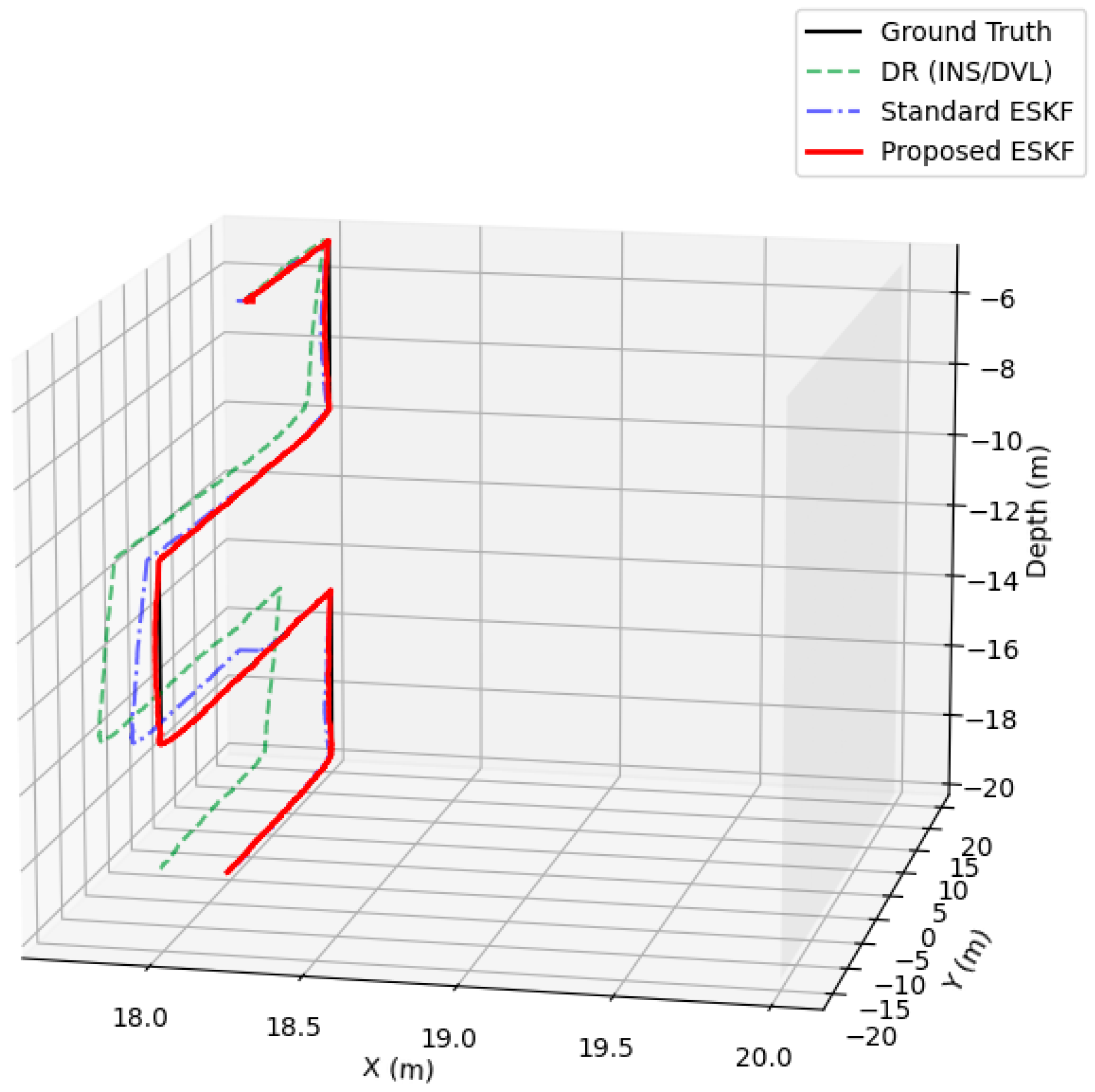
- DR method (green dashed line): Due to the absence of absolute position observations, although the DVL and compass possess high precision, the vehicle’s position estimation still exhibited a slow but continuous drift over time. This cumulative error became particularly significant when overcoming flow resistance during lateral scanning.
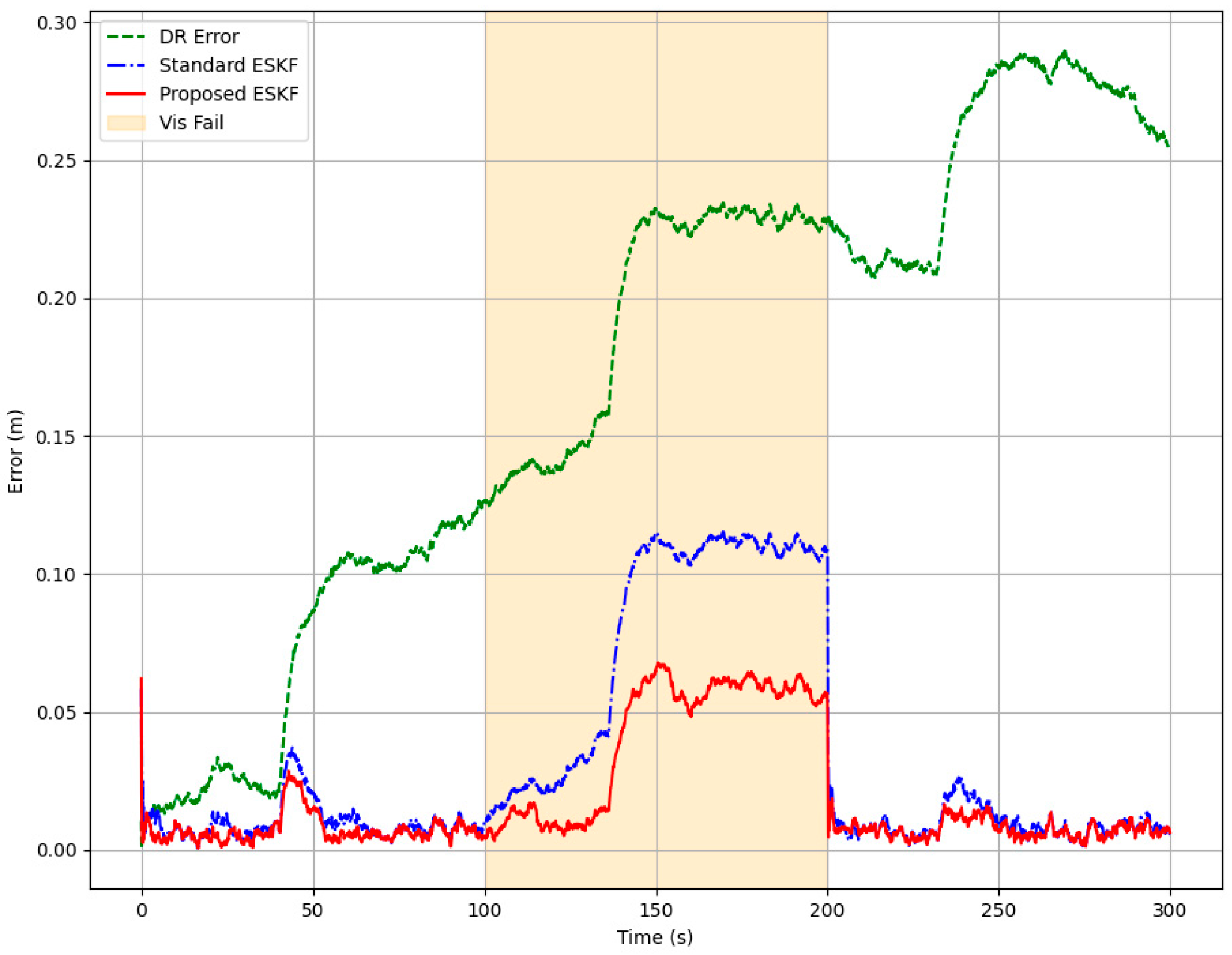
- Standard ESKF Method (blue dashed–dotted line): During the initial 100 s normal visual phase, the trajectory highly aligned with the ground truth. However, upon entering the visual-denied zone at 100 s–200 s (indicated by the orange shaded area), the filter rapidly degraded to a pure prediction mode due to the loss of the sole position correction source, resulting in severe trajectory divergence within a short period.
- The proposed method (red solid line): During the visual failure period, the algorithm automatically adjusted weights and utilized the geometric constraints constructed by the sonar to effectively constrain the degree of freedom perpendicular to the structural surface. The trajectory indicates that even when VO was highly unreliable, the vehicle still moved closely along the predefined manifold surface without divergence, achieving a smooth transition.
- Overall localization precision: The localization error of the proposed method consistently converged within 0.1 m. In contrast, the error of the DR method grew linearly over time to exceed 0.25 m.
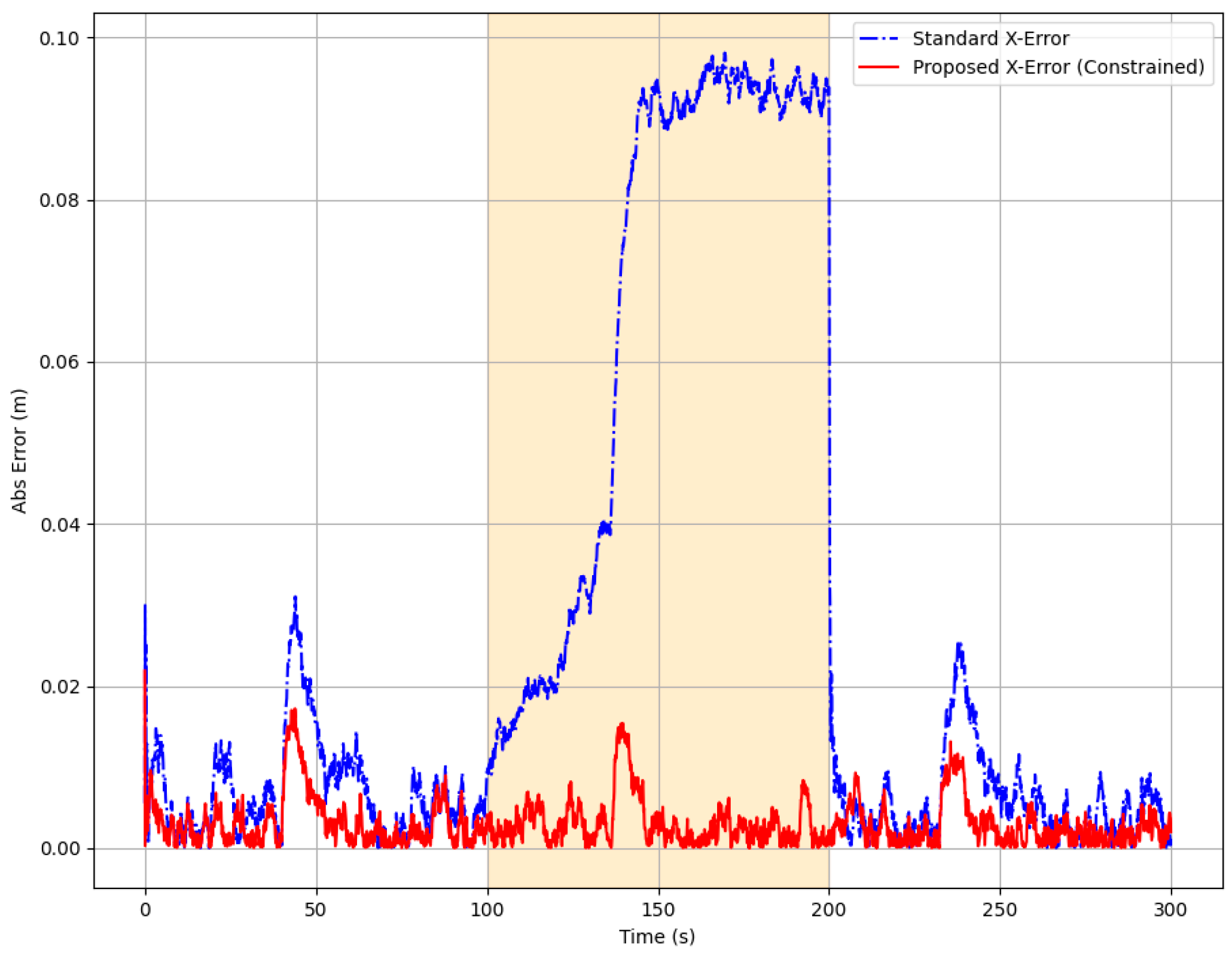
- In the visual failure interval, the X-axis error of the standard method exhibited random walk characteristics, with a maximum deviation exceeding 1.0 m. This implies a high risk of the vehicle colliding with the infrastructure or deviating from the inspection distance in actual operations.
- The X-axis error of the proposed method was consistently restricted within the coupling range of the sonar measurement noise and the DVL integration error, reducing the standard deviation by over 85%. This strongly proves that the manifold constraint model successfully compressed the vehicle’s state space onto a manifold cluster parallel to the structural surface, ensuring the safety of close-wall operations.
4.1.4. Simulation Analysis
- Precision enhancement: Compared to the traditional DR method, the overall localization RMSE was reduced by approximately 60%.
- Safety improvement: By introducing the sonar manifold constraint, the drift risk perpendicular to the structural surface was effectively eliminated, resolving the localization divergence issue caused by visual SLAM “tracking loss” in turbid waters.
- Smooth transition: The algorithm seamlessly switched between states of visual validity and failure, ensuring the continuity of prolonged and large-scale inspection tasks on structural surfaces.
4.2. Field Experiment Validation
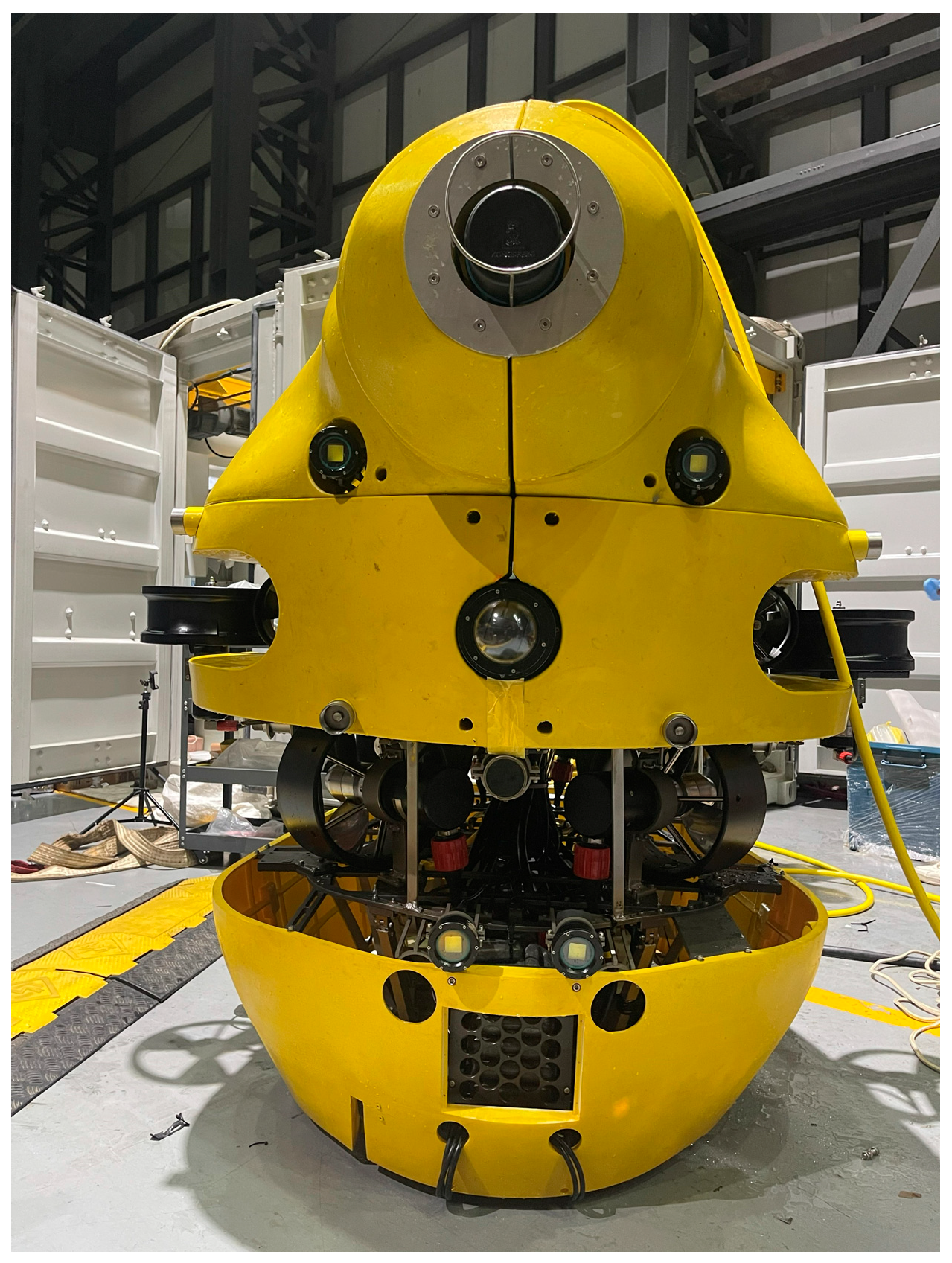
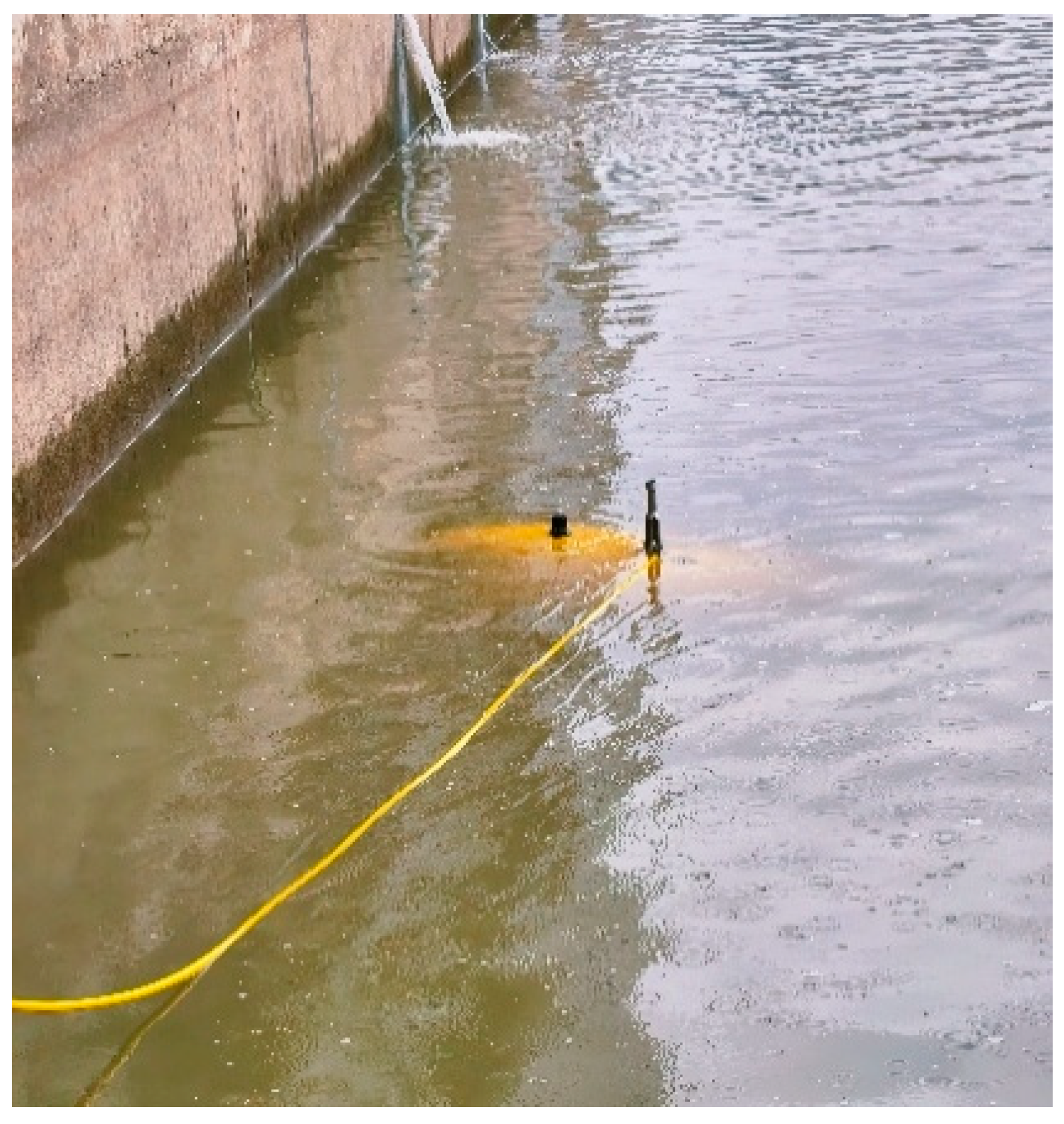
4.2.1. Experimental Environment
- Turbidity: The water body adjacent to the infrastructure was highly turbid, exhibiting strong backscattering and extremely poor visibility.
- Visual environment: With the artificial lighting fully activated, the effective visual distance was merely 0.3–0.5 m.
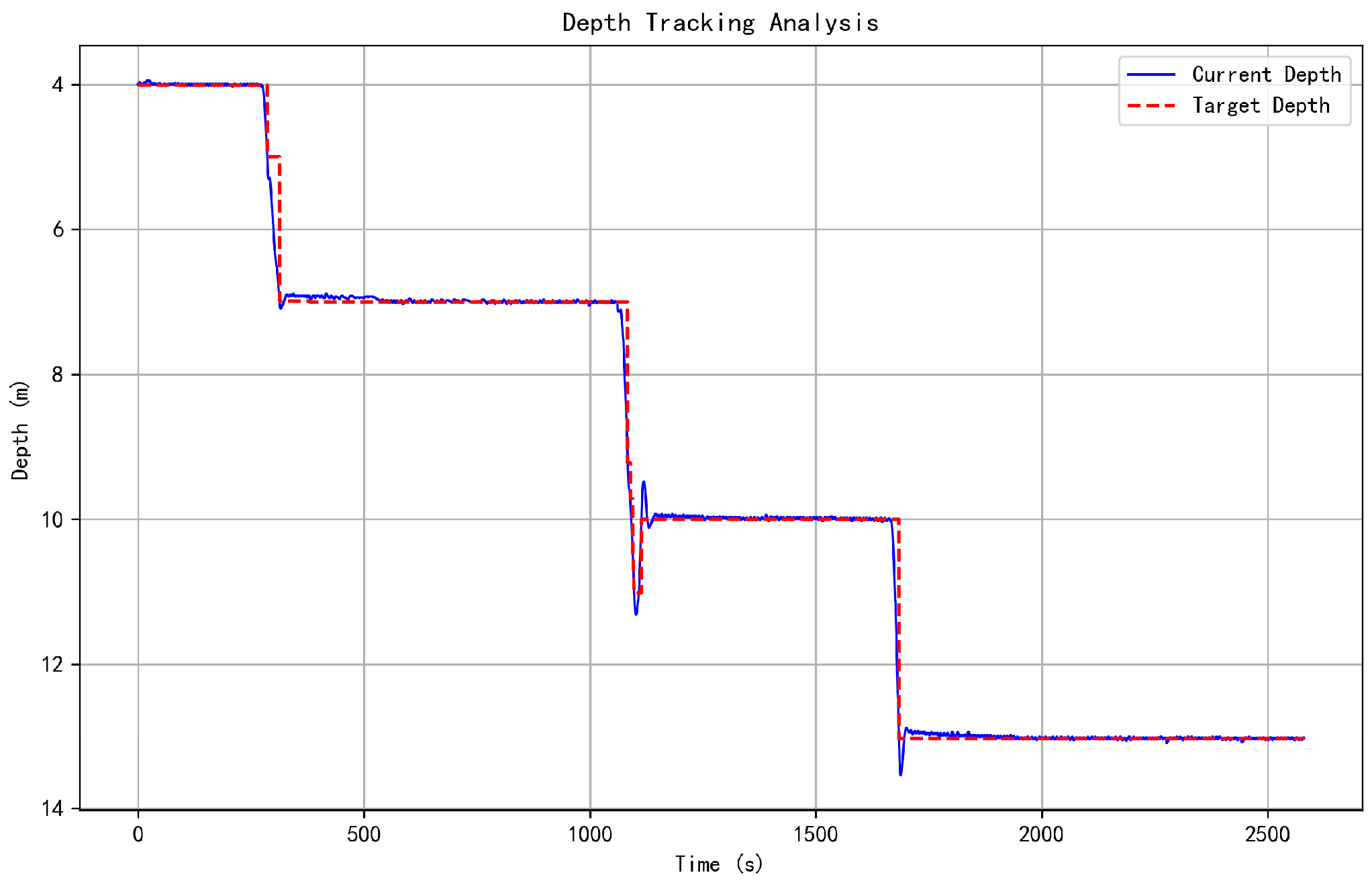
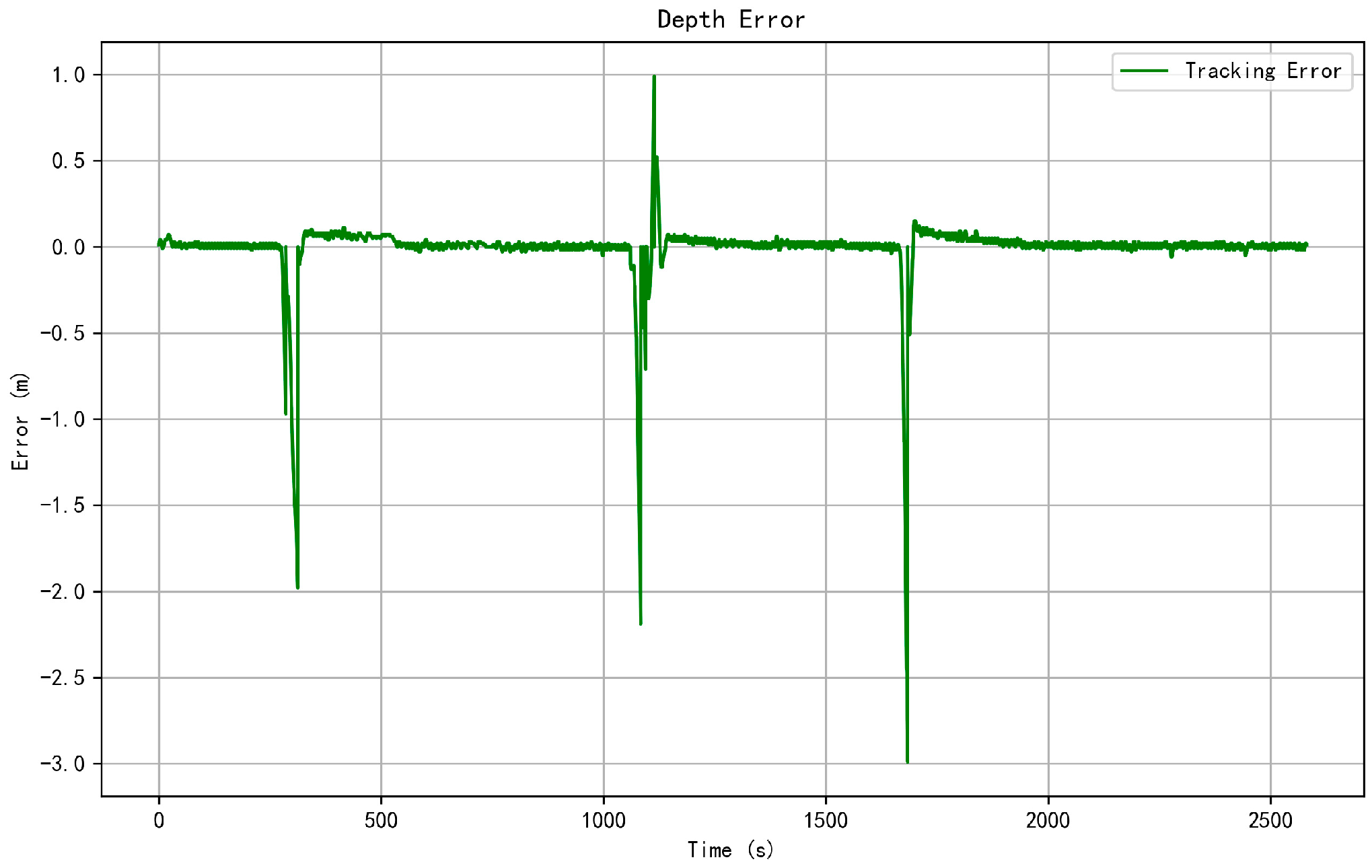
- Experimental task: The ROV executed a “lawnmower” close-wall scanning inspection, with the target distance to the structural surface set at 1.0 m and a navigation speed of 0.2 m/s. It is important to emphasize that the localization error evaluated in these field tests refers specifically to the relative tracking error with respect to the known structural wall. The tracking performance metrics for the vehicle’s heading, depth, and cross-track distance to the wall are directly calculated by employing the respective target control commands as the absolute reference baseline (ground truth).
4.2.2. Analysis of Experimental Results
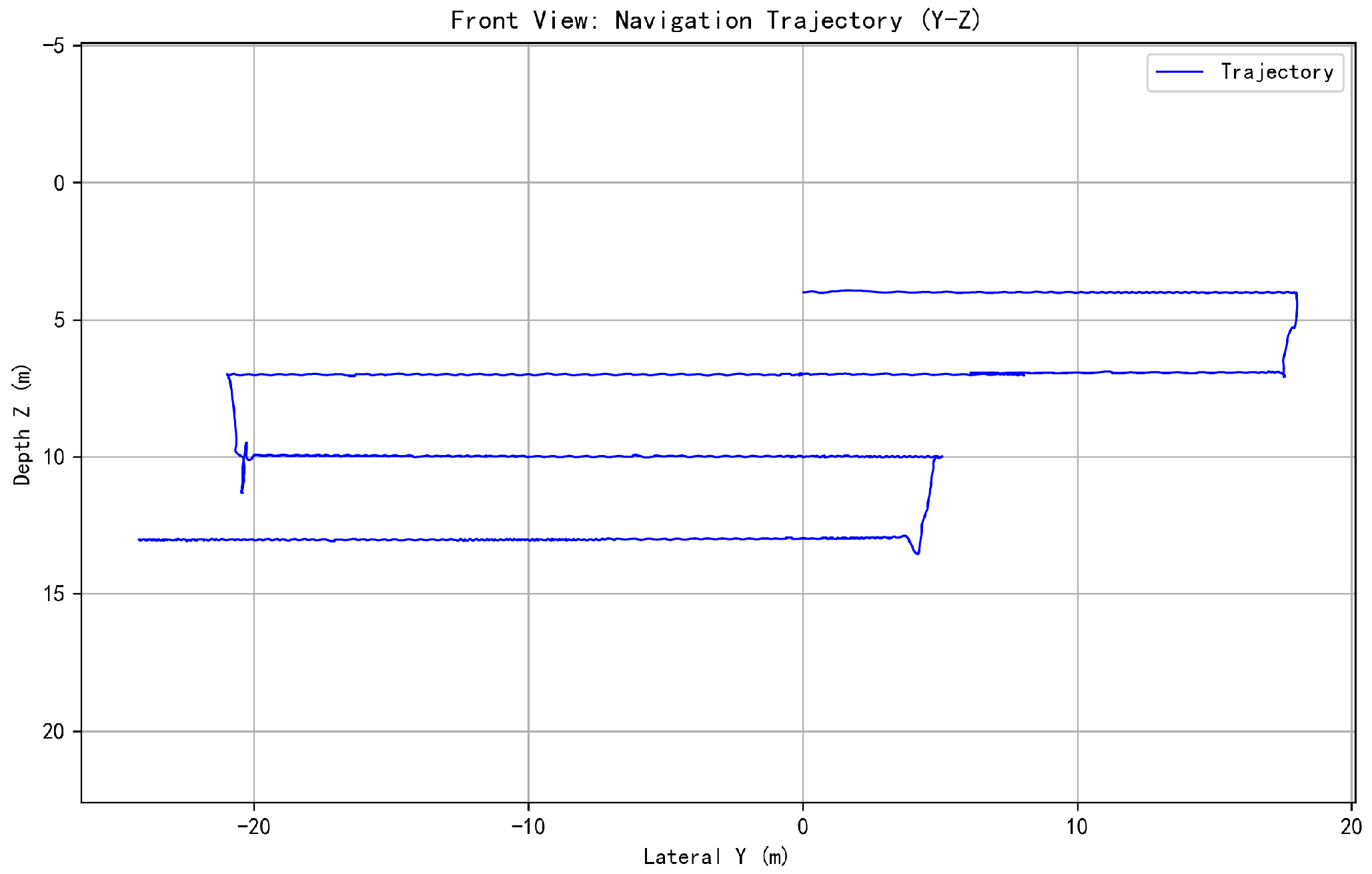
- Front view (Y-Z plane): Figure 8 demonstrates a standard lawnmower scanning path covering water depths from 2 m to 13 m. The uniform layer spacing indicates that even in the event of visual failure, the fusion algorithm provided continuous and smooth position feedback.
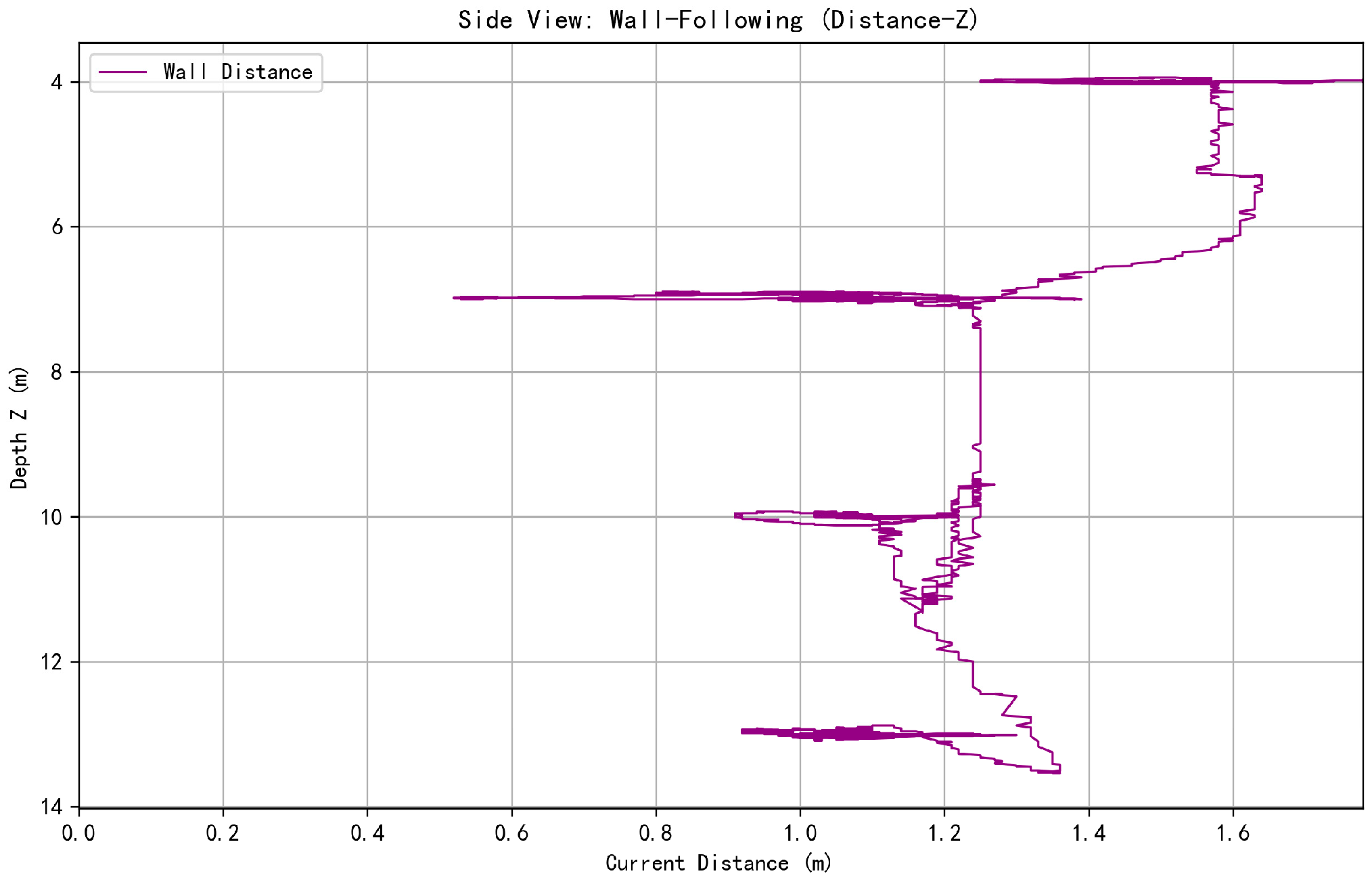
- Side view (Distance-Z plane): Figure 9 strongly proves the effectiveness of the proposed algorithm. The X-axis represents the distance to the structural surface, with data densely concentrated at depths of 7 m, 10 m, and 13 m. This corresponds to the vehicle conducting surface inspections at these respective depths, as illustrated in Figure 8. The close-wall tracking distance consistently converges around the target distance. This demonstrates that the sonar geometric manifold constraint successfully constrained the degree of freedom perpendicular to the structural surface. Compared to traditional schemes, the proposed algorithm utilizes planar geometric priors to restrict the localization error strictly within the sensor noise level.
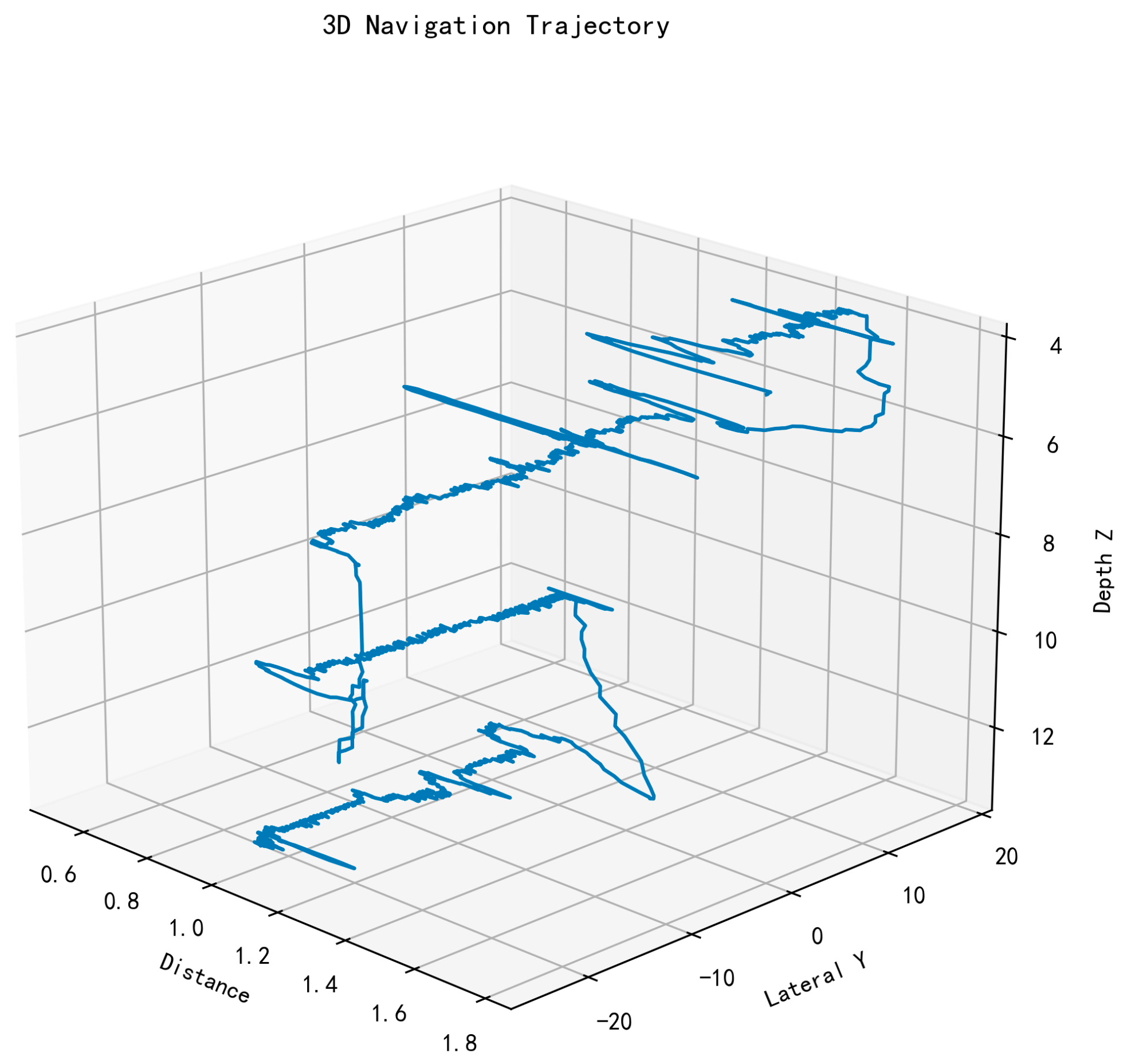
- Three-dimensional trajectory reconstruction: Figure 10 illustrates the spatial morphology of the close-wall scan, reflecting the algorithm’s decoupling capability between “in-plane motion” and “out-of-plane constraint”.
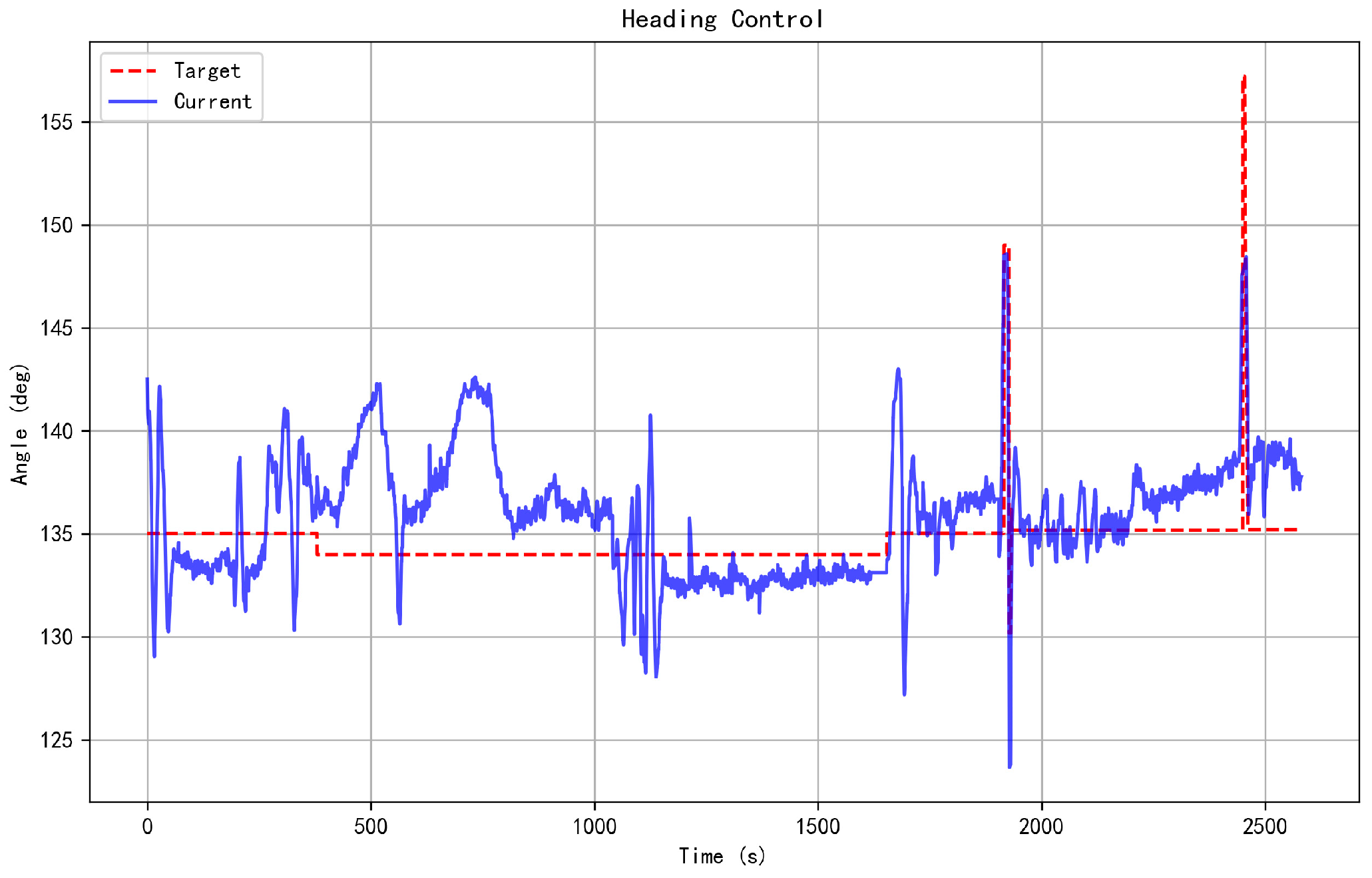
- Heading stability: The vehicle consistently maintained heading stability (target value of approximately 135°). Although the water flow generated yaw moments, the fused localization provided accurate attitude estimation, with an overall heading MAE of approximately 2.56°.
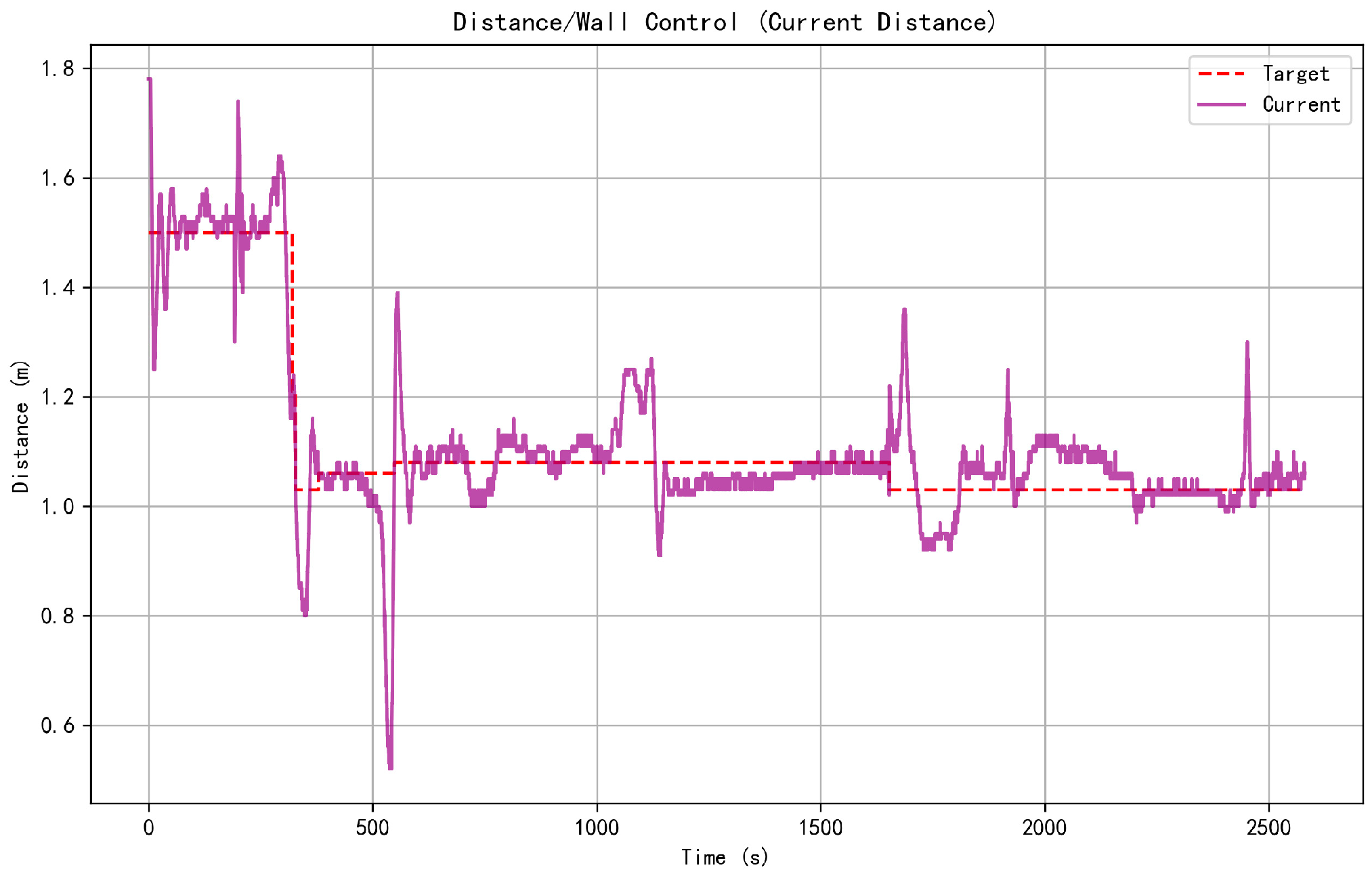
- Close-wall distance maintenance: The deviation between the measured close-wall distance and the target fluctuated within ±0.15 m for the vast majority of the time, achieving a Root Mean Square Error (RMSE) of 0.08 m (as further illustrated in Figure 12). It is important to note that because the absolute global position of the wall is known, the vehicle’s position is continuously corrected by the distance inferred from this wall tracking. Consequently, this wall-tracking error can represent the relative localization error to a large extent, thereby avoiding the ambiguity of claiming an absolute global localization error without an external independent ground-truth system. This effectively validates the localization precision along the cross-track axis and demonstrates that the navigation information fulfills the rigorous requirements of close-wall precision operations.
4.2.3. Summary
- Effectiveness: Long-endurance, large-scale lawnmower scanning was successfully achieved with a smooth trajectory.
- Robustness: By introducing manifold constraints, the limitations of visual failure were overcome, restricting the localization error perpendicular to the structural surface to the centimeter level.
- Engineering practicability: The algorithm operates stably with good real-time performance, satisfying the demands of normalized intelligent inspection for hydropower infrastructures.
5. Conclusions
Author Contributions
Funding
Data Availability Statement
Acknowledgments
Conflicts of Interest
References
- Xu, S.; Zhang, K.; Wang, S. AQUA-SLAM: Tightly-Coupled Underwater Acoustic-Visual-Inertial SLAM With Sensor Calibration. IEEE Trans. Robot. 2025, 41, 2785–2803. [Google Scholar] [CrossRef]
- Zhang, J.; Han, F.; Han, D.; Yang, J.; Zhao, W.; Li, H. Integration of Sonar and Visual–Inertial Systems for SLAM in Underwater Environments. IEEE Sens. J. 2024, 24, 16792–16804. [Google Scholar] [CrossRef]
- Song, J.; Li, W.; Zhu, X. Acoustic-VINS: Tightly Coupled Acoustic-Visual-Inertial Navigation System for Autonomous Underwater Vehicles. IEEE Robot. Autom. Lett. 2024, 9, 1620–1627. [Google Scholar] [CrossRef]
- Yang, H.; Gao, X.; Huang, H.; Li, B.; Jiang, J. A Tightly Integrated Navigation Method of SINS, DVL, and PS Based on RIMM in the Complex Underwater Environment. Sensors 2022, 22, 9479. [Google Scholar] [CrossRef] [PubMed]
- Fan, J.; Liu, X.; Ou, Y.; Zhang, P.; Zhou, C.; Hou, Z. Underwater Robot Self-Localization Method Using Tightly Coupled Events, Images, Inertial, and Acoustic Fusion. IEEE Trans. Ind. Electron. 2025, 72, 5126–5135. [Google Scholar] [CrossRef]
- Zheng, J.; Zhao, R.; Yang, G.; Liu, S.; Zhang, Z.; Fu, Y.; Lu, J. An Underwater Image Restoration Deep Learning Network Combining Attention Mechanism and Brightness Adjustment. J. Mar. Sci. Eng. 2024, 12, 7. [Google Scholar] [CrossRef]
- Ou, Y.; Xia, S.; Fan, J.; Zhou, C.; Huang, Y.; Shuai, P.; Xue, Y.; Hou, Z. PL-VAP: A Tightly Coupled Self-Localization Framework for Underwater Robots Using Point-Line Features and Visual-Acoustic-Pressure Sensor Fusion. IEEE/ASME Trans. Mechatron. 2025, 30, 4116–4128. [Google Scholar] [CrossRef]
- Huang, Y.; Li, P.; Yan, S.; Tan, M.; Yu, J.; Wu, Z. Self-Localization of a Biomimetic Robotic Shark Using Tightly Coupled Visual-Acoustic Fusion. IEEE Trans. Ind. Electron. 2024, 71, 12581–12591. [Google Scholar] [CrossRef]
- Zhao, B.; Li, S.; Wang, X.; Yang, M.; Yu, X.; Meng, Z.; Wan, G. Design of Control System for Underwater Inspection Robot in Hydropower Dam Structures. J. Mar. Sci. Eng. 2025, 13, 1656. [Google Scholar] [CrossRef]
- Starbuck, B.; Fornasier, A.; Weiss, S.; Pradalier, C. Consistent State Estimation on Manifolds for Autonomous Metal Structure Inspection. In 2021 IEEE International Conference on Robotics and Automation (ICRA), Xi’an, China; IEEE: New York, NY, USA, 2021; pp. 10250–10256. [Google Scholar] [CrossRef]
- Wang, Y.; Xie, C.; Liu, Y.; Zhu, J.; Qin, J. A Multi-Sensor Fusion Underwater Localization Method Based on Unscented Kalman Filter on Manifolds. Sensors 2024, 24, 6299. [Google Scholar] [CrossRef] [PubMed]
- Ding, S.; Zhang, T.; Lei, M.; Chai, H.; Jia, F. Robust visual-based localization and mapping for underwater vehicles: A survey. Ocean Eng. 2024, 312, 119274. [Google Scholar] [CrossRef]
- Rahman, S.; Li, A.Q.; Rekleitis, I. SVIn2: A multi-sensor fusion-based underwater SLAM system. Int. J. Rob. Res. 2022, 41, 1022–1042. [Google Scholar] [CrossRef]
- Hong, K.; Wang, H.; Yuan, B. Inspection-Nerf: Rendering Multi-Type Local Images for Dam Surface Inspection Task Using Climbing Robot and Neural Radiance Field. Buildings 2023, 13, 213. [Google Scholar] [CrossRef]
- Shaukat, N.; Ali, A.; Iqbal, M.J.; Moinuddin, M.; Otero, P. Multi-Sensor Fusion for Underwater Vehicle Localization by Augmentation of RBF Neural Network and Error-State Kalman Filter. Sensors 2021, 21, 1149. [Google Scholar] [CrossRef] [PubMed]
- Cohen, N.; Klein, I. Seamless Underwater Navigation with Limited Doppler Velocity Log Measurements. IEEE Trans. Intell. Veh. 2024. [Google Scholar] [CrossRef]
- Li, J.; Wang, J.; Xu, T.; Shu, J.; Liu, Y.; Ma, Y.; Xu, Y. Dynamic Stochastic Model Optimization for Underwater Acoustic Navigation via Singular Value Decomposition. J. Mar. Sci. Eng. 2025, 13, 1329. [Google Scholar] [CrossRef]
- Chen, Z.; Zhu, H.; Yu, B.; Fu, X.; Jiang, C.; Zhang, S. Robust Multi-Sensor Fusion SLAM Based on Road Network and Reflectivity Enhancement. In 2024 7th International Conference on Advanced Algorithms and Control Engineering (ICAACE), Shanghai, China; IEEE: New York, NY, USA, 2024; pp. 1434–1439. [Google Scholar] [CrossRef]
- Xu, Z.; Haroutunian, M.; Murphy, A.J.; Neasham, J.; Norman, R. A Low-Cost Visual Inertial Odometry System for Underwater Vehicles. In 2021 4th International Conference on Mechatronics, Robotics and Automation (ICMRA), Zhanjiang, China; IEEE: New York, NY, USA, 2021; pp. 139–143. [Google Scholar] [CrossRef]
- Khan, A.; Fouda, M.M.; Do, D.T.; Almaleh, A.; Alqahtani, A.M.; Rahman, A.U. Underwater Target Detection Using Deep Learning: Methodologies, Challenges, Applications, and Future Evolution. IEEE Access 2024, 12, 12618–12635. [Google Scholar] [CrossRef]
- Zhou, H.; Kong, M.; Yuan, H.; Pan, Y.; Wang, X.; Chen, R.; Lu, W.; Wang, R.; Yang, Q. Real-time underwater object detection technology for complex underwater environments based on deep learning. Ecol. Inform. 2024, 82, 102680. [Google Scholar] [CrossRef]



| Sensor | Update Rate (Hz) | Noise Standard Deviation (σ) | Remarks |
|---|---|---|---|
| IMU | 100 | Acc: 0.02 m/s2, Gyro: 0.001 rad/s | Contains bias random walk |
| DVL | 10 | 0.02 m/s | Simulates bottom-tracking mode |
| Depth Sensor | 10 | 0.02 m | Absolute depth observation |
| Magnetic Compass | 10 | 0.05 rad | Highly susceptible to magnetic interference |
| VO | 10 | Normal: 0.1 m/Failure: 100 m | Simulates pose observation |
| Single-Beam Sonar | 10 | 0.05 m | Core of the proposed constraint |
Disclaimer/Publisher’s Note: The statements, opinions and data contained in all publications are solely those of the individual author(s) and contributor(s) and not of MDPI and/or the editor(s). MDPI and/or the editor(s) disclaim responsibility for any injury to people or property resulting from any ideas, methods, instructions or products referred to in the content. |
© 2026 by the authors. Licensee MDPI, Basel, Switzerland. This article is an open access article distributed under the terms and conditions of the Creative Commons Attribution (CC BY) license.
Share and Cite
Wang, X.; Yang, M.; Zhao, B.; Ma, T.; Liu, L.; Li, X. Robust Tightly-Coupled Multi-Source Navigation Using Acoustic-Geometric Constraints for Underwater Vehicles in Tunnels. J. Mar. Sci. Eng. 2026, 14, 1097. https://doi.org/10.3390/jmse14121097
Wang X, Yang M, Zhao B, Ma T, Liu L, Li X. Robust Tightly-Coupled Multi-Source Navigation Using Acoustic-Geometric Constraints for Underwater Vehicles in Tunnels. Journal of Marine Science and Engineering. 2026; 14(12):1097. https://doi.org/10.3390/jmse14121097
Chicago/Turabian StyleWang, Xiangbin, Mingyu Yang, Bing Zhao, Tengfei Ma, Lijia Liu, and Xinyu Li. 2026. "Robust Tightly-Coupled Multi-Source Navigation Using Acoustic-Geometric Constraints for Underwater Vehicles in Tunnels" Journal of Marine Science and Engineering 14, no. 12: 1097. https://doi.org/10.3390/jmse14121097
APA StyleWang, X., Yang, M., Zhao, B., Ma, T., Liu, L., & Li, X. (2026). Robust Tightly-Coupled Multi-Source Navigation Using Acoustic-Geometric Constraints for Underwater Vehicles in Tunnels. Journal of Marine Science and Engineering, 14(12), 1097. https://doi.org/10.3390/jmse14121097