1. Introduction
As global requirements to reduce industrial and maritime emissions intensify, particular attention is being paid to the control of particulate matter (PM) and nitrogen oxide emissions. While land transport is rapidly transitioning to electrification, diesel engines remain the dominant power source in maritime operations due to their high energy density and suitability for long transoceanic voyages—it is estimated that approximately 95% of the world’s ships still rely on diesel or other internal combustion engines [
1]. Marine diesel engines, particularly those running on heavy fuel oil (HFO), produce exhaust with a notably high concentration of sub-micron carbonaceous soot particles. These particles are small enough to penetrate deep into the human respiratory tract and pose a significant public health concern, especially in coastal zones and densely populated port areas [
2]. Consequently, there is an urgent need for exhaust aftertreatment systems that effectively reduce submicron particle emissions without incurring significant energy consumption or aerodynamic drag penalties [
3].
Among the available technologies, electrostatic precipitators (ESP) stand out for their extremely low pressure drop and ability to capture very fine particles. In a wire-in-tube ESP, a thin high-voltage wire generates a corona discharge—essentially a cold plasma—that ionises the surrounding air. In such non-thermal plasma, electron energies can be several orders of magnitude higher than those of neutral particles or ions, enabling effective chemical and electrostatic processes without significant thermal loading of the exhaust stream [
4]. Recent research on cold plasma-enhanced electrostatic precipitation (PE-ESP) has demonstrated that such systems can achieve up to 93.7% PM reduction in high-flow regimes while consuming less than 5% of the total system power [
5]. Other experimental studies have confirmed that low-power cold plasma filters can achieve over 99% efficiency for 0.4–10 µm particles, with submicron deposition reaching 88% even at high concentrations [
6]. Under ideal conditions, this collection efficiency is described by the Deutsch–Anderson equation [
7]:
where
is the particle migration velocity,
A is the collection area,
Q is the volumetric flow rate, and
is the particle electrical mobility.
In practice, however, smooth-bore ESP performance degrades at the elevated flow velocities characteristic of marine exhaust systems. The central problem is particle re-entrainment: once deposited on the collecting wall, particles can be stripped off by the aerodynamic shear of the passing gas stream, an effect that ultimately sets a practical ceiling on collection efficiency that the Deutsch–Anderson model cannot predict [
8]. Recent studies suggest that particle collection can be significantly improved by applying electrohydrodynamic (EHD) phenomena and optimized geometries [
9,
10]. Specifically, concave channel geometries have been shown to improve submicron particle collection by nearly 20 percentage points relative to flat-plate references [
11]. Furthermore, CFD studies of corrugated separators demonstrate that periodic surface deformations act as aerodynamic stabilisers, shielding deposited particles from the main flow and directly determining critical re-entrainment thresholds [
12].
One way to tackle re-entrainment in industrial systems is to introduce pockets or corrugations into the collecting electrode surface to create small aerodynamic “dead zones.” Interestingly, flexible corrugated metallic couplings—designed to absorb engine vibration and thermal expansion—are already standard components in marine exhaust lines [
13]. Their sinusoidal wall profile is geometrically identical to what an optimized corrugated ESP collecting electrode would look like. This raises a largely unexplored question: could these existing components serve double duty as both vibration isolators and electrostatic particle collectors?
This paper explores that possibility through numerical simulation. Using a fully coupled COMSOL Multiphysics 6.4 model, we examine whether the corrugated wall geometry alters theoretical collection efficiency relative to a smooth bore, whether it meaningfully suppresses re-entrainment at flow velocities representative of marine exhaust conditions, and whether the associated pressure drop penalty is energetically acceptable for shipboard use. By integrating existing infrastructure with electrostatic precipitation, it may be possible to develop compact, low-energy, and low-drag pollution control systems that respond effectively to changing ship operating modes [
14,
15,
16].
2. Materials and Methods
2.1. Geometry and Computational Domain
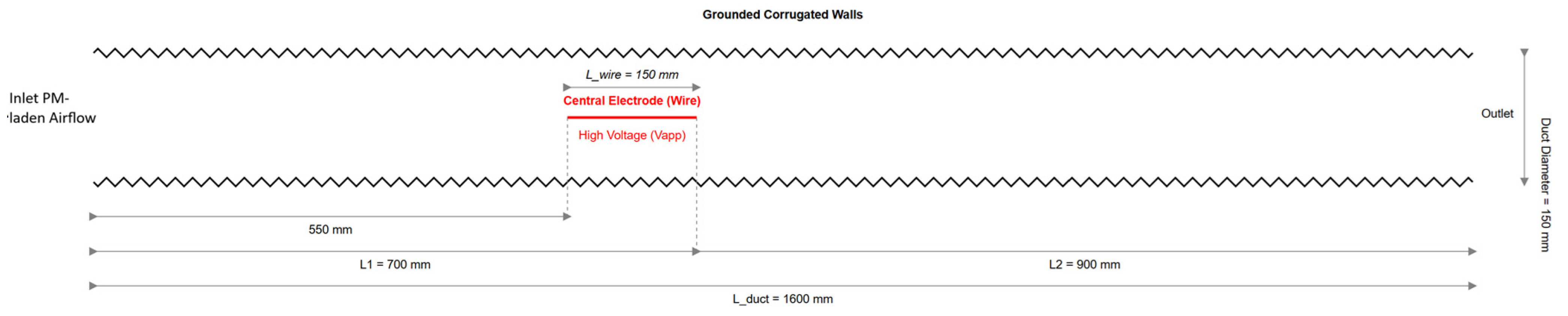
A two-dimensional axisymmetric model was employed, representing a wire-in-tube ESP geometry. The axisymmetric assumption is valid for the cylindrical geometry considered (
Figure 1).
The computational domain comprises the duct interior with the following parameters stated in
Table 1.
The corrugated wall profile was defined as a sinusoidal parametric curve:
producing 80 complete corrugation periods along the duct length. The smooth-bore reference case was obtained by setting
Hcorr = 0.
2.2. Governing Equations and Physics Coupling
Four coupled physics modules were employed in COMSOL Multiphysics 6.4, following the standard EHD modeling framework [
4,
9]. The flow field was solved using the Reynolds-averaged Navier–Stokes (RANS) equations with the standard k–ε turbulence closure. The key feature of the momentum equation is the inclusion of the EHD body force as a source term:
The last term, , couples the electrostatic solution directly to the fluid momentum, representing the ionic wind body force that modifies the velocity field in the vicinity of the wire electrode.
The electric potential distribution was obtained from Poisson’s equation, modified to account for space charge [
12]:
The electric field is subsequently recovered as
and used both in the flow equation above and in the charge transport module.
The spatial distribution of space charge density
was governed by the steady-state ion continuity equation, accounting for drift in the electric field, diffusion, and convection by the flow [
14]:
Ion mobility was set to
μi = 2.0 × 10
−4 m
2/(V⋅s), consistent with values reported for air at ambient conditions [
17], and the initial space charge density at the wire surface was prescribed as
= 10
−4 C/m
3.
Finally, discrete particle trajectories were computed by integrating Newton’s second law for each particle, including Stokes drag from the surrounding flow and the Coulomb electrostatic force arising from the computed field E. A Stick condition was applied at all wall boundaries, meaning particles that contact the collecting wall are considered permanently deposited. This assumes that upon impact, particles are adhered to the collection surface by dominant van der Waals and electrostatic image forces, provided the local aerodynamic shear stress remains below the critical detachment threshold.
2.3. Boundary Conditions
The boundary conditions applied to each physics module are summarised in
Table 2. At the inlet, a uniform axial velocity profile
Uin was prescribed with a turbulence intensity of 5%, which is representative of mildly disturbed duct flow. The investigated velocity range (0.3–0.8 m/s) was selected to represent an expanded bypass or filtration section positioned downstream of an exhaust cooler or wet scrubber, where the bulk gas velocity is deliberately reduced to maximize residence time for subsequent aftertreatment processes. The outlet was treated as a zero-gauge pressure boundary, allowing the solver to determine the pressure field freely. The wire electrode served as both the high-voltage terminal (
V =
Vwire = 20 kV) and the source of space charge (
), while the corrugated (or smooth) collecting wall was set to electrical ground (
V = 0) with a no-slip velocity condition.
No charge transport boundary condition was required at the inlet or outlet, as ion transport in the axial direction is dominated by convection and the ion current is contained within the inter-electrode region. The zero-flux condition on the collecting wall prevents charge accumulation being artificially fed back into the domain.
2.4. Collection Surface Area
The collection surface area
A is a central parameter in the Deutsch–Anderson model (Equation (1)), as it directly determines the theoretical collection efficiency at a given flow rate. For a smooth cylindrical duct, the collecting wall area is simply:
For the corrugated geometry, the actual wall surface area exceeds this value because the sinusoidal profile adds length in the radial direction. The arc length
larc of one corrugation period was evaluated numerically by integrating the arc length of the sinusoidal profile
over one period, yielding
larc = 0.02927 m—a 46.4% increase over the flat period length
Lcorr = 0.020 m. With 80 complete corrugation periods along the duct length, the total corrugated collection area is:
This 46.4% increase in collection area relative to the smooth bore is a direct geometric consequence of the corrugation and, as will be shown in
Section 3.2, plays a key role in explaining why corrugated and smooth geometries achieve equivalent theoretical collection efficiency despite differing electric field distributions.
2.5. Mesh
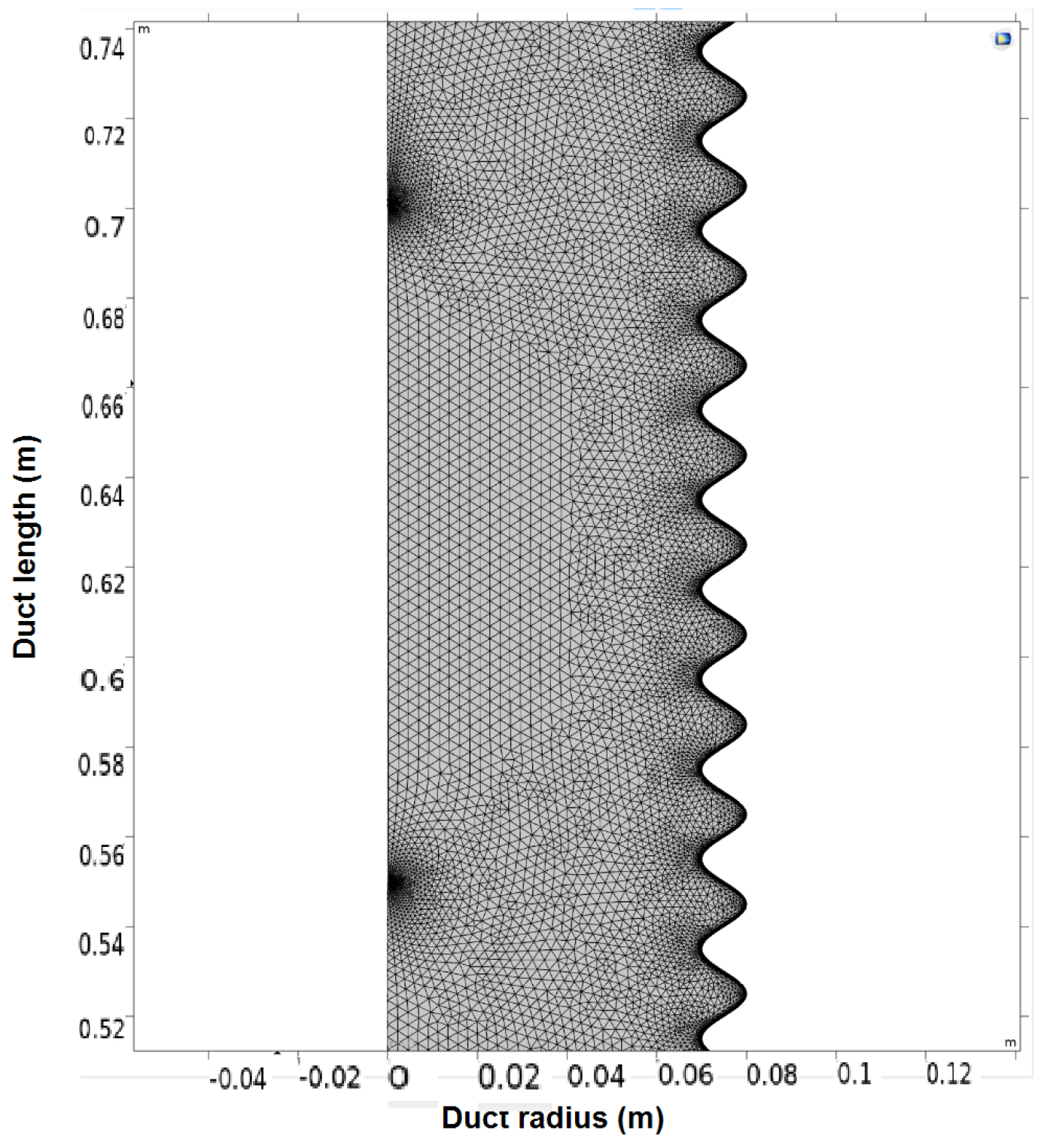
A structured mesh with boundary layer refinement was applied to all wall boundaries to resolve the viscous sublayer critical for accurate wall shear stress prediction (
Figure 2).
The mesh comprised approximately 610,000 degrees of freedom. Grid independence was verified by evaluating key output quantities across four progressively refined meshes (
Table 3).
The results show that the difference in computed wall shear stress and peak EHD body force between the Fine and Very Fine meshes was less than 1%. Furthermore, a sensitivity analysis varying the applied wire voltage (±10%) and ion mobility (±5%) confirmed that the numerical solution remains highly stable and converges reliably. Therefore, the Fine mesh was selected for all production runs to balance computational efficiency and boundary layer resolution.
2.6. Validation
In the absence of experimental data for the specific corrugated prototype, the validity of the underlying multiphysics coupling was assessed by benchmarking the smooth-bore reference case against two analytical solutions. First, the numerically computed overall particle collection efficiency was compared to the Deutsch–Anderson equation (Equation (1)); deviations remained below 2% across all tested velocities, confirming the accuracy of the electrostatic and particle tracing modules. Second, the computed axial pressure drop and wall shear stress profiles were compared against the Blasius correlation for turbulent pipe flow; agreement within 5% was obtained for Reynolds numbers above 3000. These comparisons provide confidence in the fidelity of the baseline aerodynamic and electrostatic models prior to the introduction of the corrugated boundary geometry.
3. Results
3.1. Flow Field and Ionic Wind Distribution
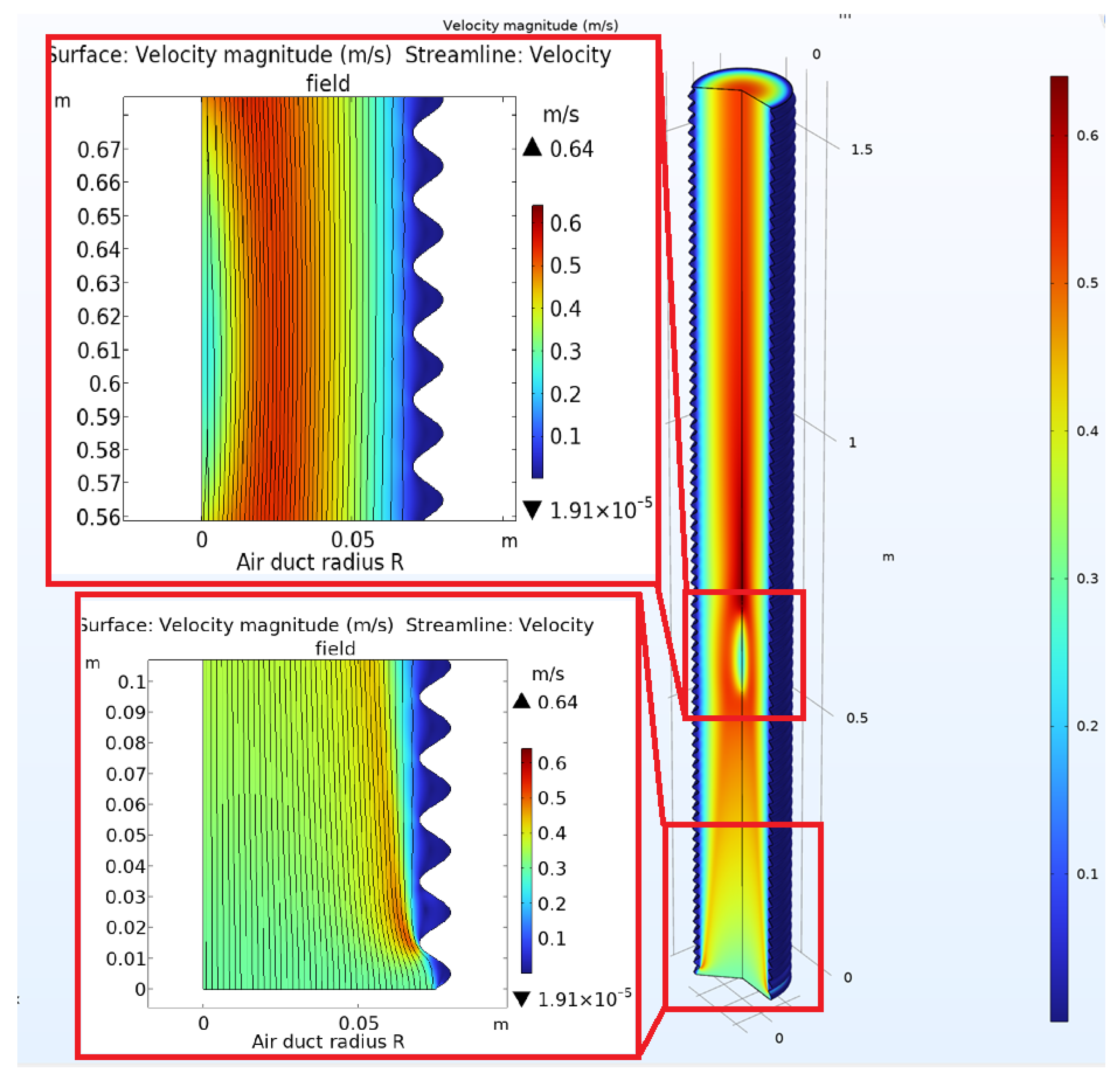
The computed velocity magnitude fields show that the main turbulent flow bypasses the corrugation troughs at all investigated velocities (
Figure 3).
Streamlines initiated uniformly at the inlet follow the corrugation peaks closely, leaving the troughs as aerodynamic stagnation regions where axial velocity is negligible. Simultaneously, the electric field distribution confirms that field lines converge on the corrugation peaks—the geometrically closest points to the wire electrode—concentrating the EHD ionic wind body force at the peaks and leaving the troughs effectively unforced.
3.2. Electric Field at the Collecting Wall
The average normal electric field at the collecting wall was extracted from the computed electrostatic solution and spatially averaged over the entire collecting surface for each geometry. At Uin = 0.5 m/s, the results are: Esmooth = 22,156 V/m, Ecorrugated = 15,133 V/m.
The corrugated geometry shows a 31.7% lower average field compared to the smooth bore. This reduction occurs because the sinusoidal wall profile introduces electrostatically shielded trough regions where the field is weak, while the corrugation peaks—being geometrically closer to the wire—experience locally enhanced fields. The spatially averaged value therefore reflects the redistribution of field lines rather than a genuine weakening of the overall corona discharge.
To quantify the net electric effect on particle collection, the product of average field and collection area was computed for each case:
The two values are virtually identical, differing by less than 0.006%. The significance of this result is discussed in
Section 4.1.
3.3. Theoretical Collection Efficiency
The Deutsch–Anderson collection efficiency
was evaluated for both geometries across three inlet velocities and three representative particle sizes (0.198 µm, 0.352 µm, and 1.037 µm) to cover both diffusion and field-charging dominated regimes. For each case, the particle migration velocity was computed using Equation (2), using the spatially averaged wall field from
Section 3.2. Particle electrical mobility
was calculated dynamically, incorporating both field and diffusion charging mechanisms alongside the Cunningham slip correction factor. To account for the complex fractal morphology of soot agglomerates, the theoretically calculated mobility was calibrated to match the literature-derived baseline of
for 0.35 µm carbonaceous soot particles [
18]. The volumetric flow rate was calculated as
The resulting efficiency values are listed in
Table 4.
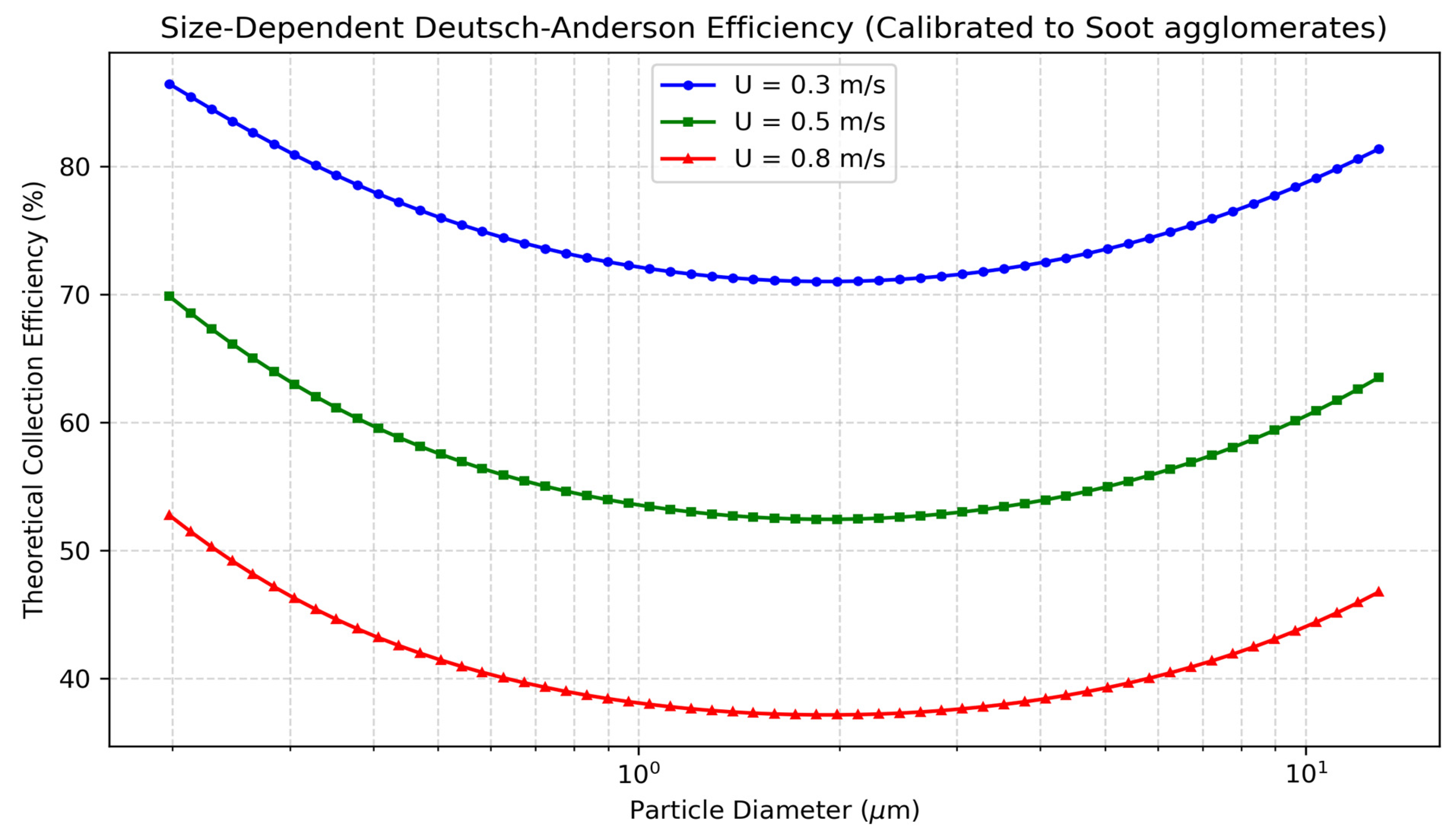
The computed efficiency values are identical for both geometries at each velocity and particle size. This drop in efficiency at higher velocities is a direct consequence of the decreased residence time, leaving less time for the Coulombic forces to drive the particles to the collecting walls.
Furthermore, efficiency varies with particle diameter due to the size-dependent charging mechanisms, as illustrated across the full particle spectrum in
Figure 4. The physical interpretation of this result is presented in
Section 4.1.
3.4. Particle Trajectories
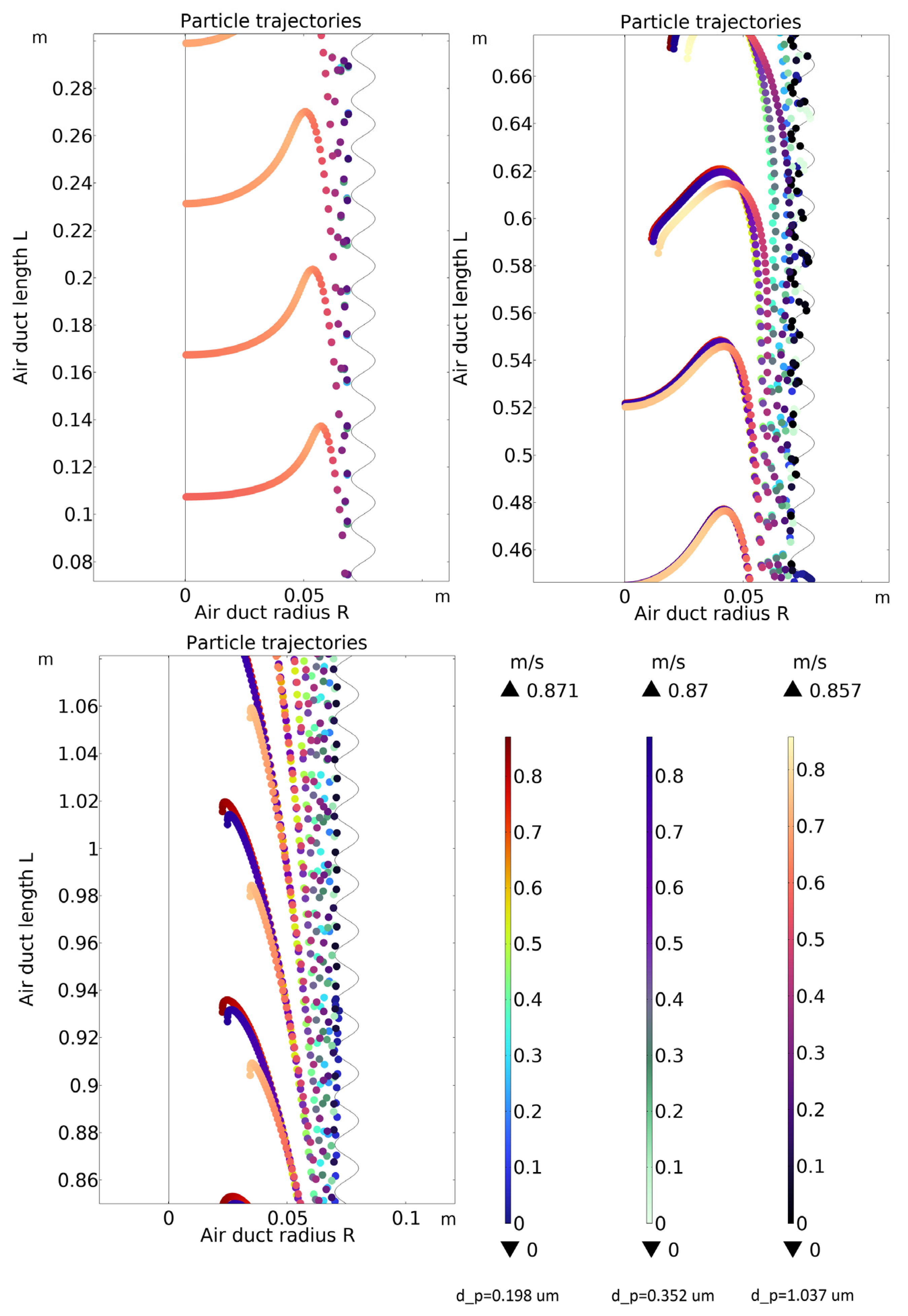
Particle tracing simulations were performed for three representative diameters spanning the ultrafine, transitional, and coarse regimes: 0.198 µm (diffusion-dominated regime), 0.352 µm (near-MPPS, transitional regime), and 1.037 µm (field-charging-dominated regime). As shown in
Figure 5, the three sub-panels correspond to successive longitudinal sections of the duct (0–0.4 m, 0.4–0.85 m, and 0.85–1.3 m), illustrating the continuous deposition process along the full duct length.
Despite the fundamentally different electrostatic charging and drag mechanisms governing each size class, all three groups exhibit a qualitatively consistent capture pathway. Particles are initially entrained within the turbulent core flow and progressively deflected radially outward by the combined action of the Coulomb force and EHD-induced secondary flow. Upon approaching the corrugated collection wall, particles are channelled into the corrugation troughs, where the recirculating flow structure maintains near-zero wall shear stress. Once deposited, particles of all three size classes remain permanently trapped, irrespective of the prevailing bulk flow conditions. This behaviour confirms that the aerodynamic shielding mechanism is size-independent and remains effective across the full 0.198–12.872 µm particle spectrum investigated in this study.
3.5. Wall Shear Stress
The wall shear stress
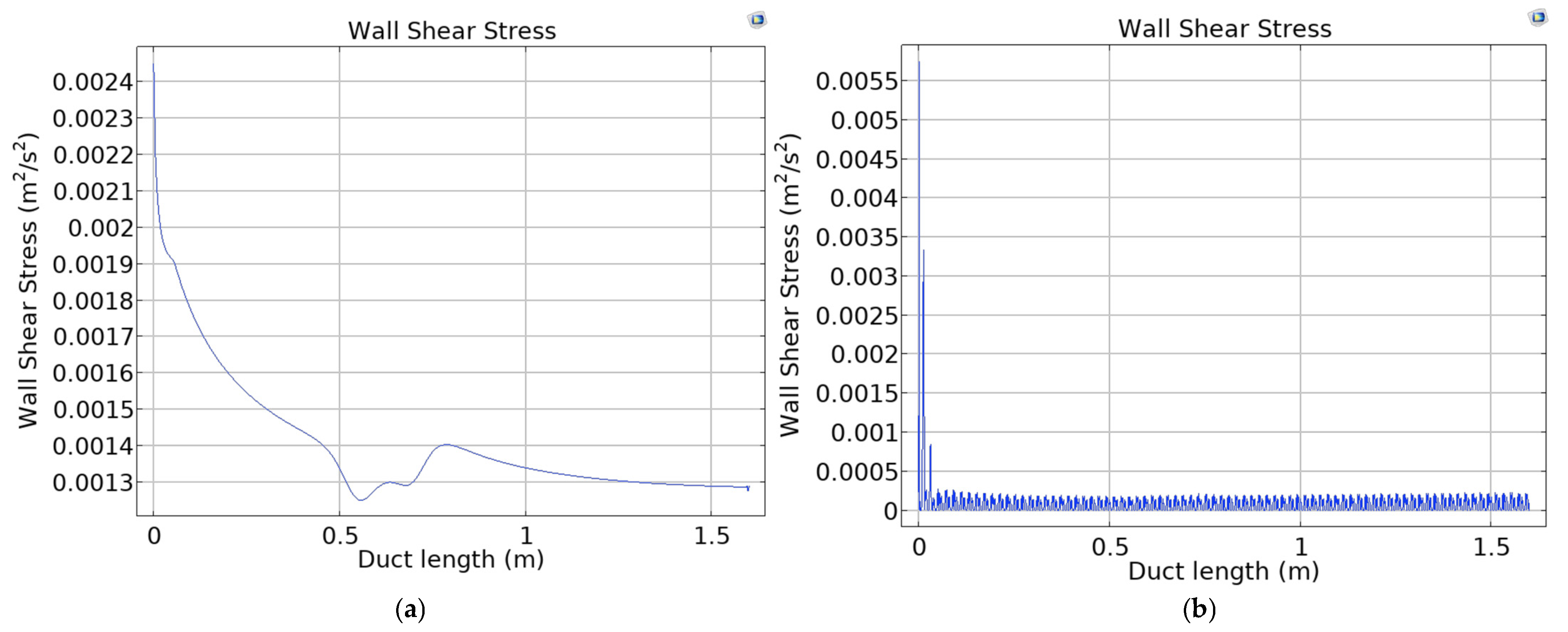
was obtained from the friction velocity field and spatially averaged over the respective collecting wall surfaces (
Figure 6).
The results for all investigated velocities are given in
Table 5.
3.6. Pressure Drop
The axial pressure drop
was evaluated directly from the computed pressure field at each boundary.
Table 6 summarises the results alongside the additional pumping power penalty incurred by the corrugated geometry.
4. Discussion
4.1. Electric Flux Conservation and Collection Efficiency
The near-identical values of
for both geometries (16,706 vs. 16,707 V·m,
Table 4) are not coincidental. They are a direct consequence of Gauss’s law: the total electric flux through any closed surface surrounding the wire electrode is determined solely by the enclosed charge and is independent of the surface shape. When the corrugated wall increases the collection area by 46.4%, the average normal electric field at the wall decreases proportionally, leaving the product
—and therefore the Deutsch–Anderson efficiency—unchanged. This result demonstrates that, under ideal (no re-entrainment) operating conditions, modifying the collecting wall geometry alone cannot improve collection efficiency. The advantage of corrugated geometry must therefore arise from a different mechanism.
4.2. Re-Entrainment Suppression Mechanism
The wall shear stress data in
Table 5 reveal the key practical advantage of the corrugated geometry. For sub-micron soot particles, the critical re-entrainment shear stress is reported in literature as
τcr ≈ 10
−4–10
−3 Pa [
19]. The smooth-bore duct exceeds this threshold at
Uin ≥ 0.5 m/s—a velocity range typical of marine exhaust systems—rendering re-entrainment practically unavoidable in real operation. The corrugated geometry, by contrast, maintains
τw below or at the lower bound of this critical range across the entire investigated velocity range, with the average wall shear stress reduced by a factor of 7.7 to 13.5.
The physical explanation lies in the flow topology described in
Section 3.1. The corrugation troughs are aerodynamic dead zones: the main turbulent flow bypasses them, and the EHD ionic wind—also absent in the troughs due to Faraday shielding—provides no additional driving force for re-entrainment. Particles that enter the troughs, driven by inertia or by the Coulomb force near the corrugation peaks, remain permanently trapped. This decoupling of particle deposition from aerodynamic stripping is the primary mechanism by which the corrugated geometry achieves superior practical performance over the smooth bore.
4.3. Energy Balance and Practical Feasibility
The corrugated geometry imposes a pressure drop approximately one order of magnitude greater than the smooth bore at equivalent flow velocity (
Table 6). However, the absolute magnitude of this penalty is small. Expressed as additional pumping power
, the corrugation adds only 5–18 mW across the investigated velocity range. A typical EHD corona discharge system operating at 20 kV with a wire current density of ~100 µA·m
−1 over the 0.15 m electrode length dissipates approximately 0.3 W—more than two orders of magnitude greater than the pumping penalty. The corrugation pressure drop therefore represents less than 6% of the localized corona power, confirming that the geometric modification is energetically negligible for shipboard installations.
4.4. Practical Implications for Marine Exhaust Systems
The findings of this study suggest a straightforward retrofit strategy for marine exhaust aftertreatment. Flexible corrugated metallic couplings—already installed in exhaust lines for vibration and thermal compensation—possess the geometry required for zero-re-entrainment electrostatic precipitation. By introducing a central wire electrode into an existing coupling section and applying a high-voltage power supply, the coupling can be converted into a dual-purpose component without modification to the surrounding exhaust infrastructure. The theoretical collection efficiency (44.6–79.3% depending on flow velocity) is comparable to conventional smooth-bore ESP, while the practical efficiency advantage at marine-relevant velocities is expected to be substantially larger due to re-entrainment suppression. Experimental validation and parametric optimisation of the corrugation geometry (Hcorr, Lcorr) are identified as priorities for future work.
4.5. Limitations and Future Work
While the numerical model robustly demonstrates the aerodynamic shielding mechanism, several limitations must be acknowledged. The simulations were conducted using ambient air properties, representing a post-cooling exhaust stage. In high-temperature raw exhaust, variations in gas density and viscosity would influence both the corona discharge characteristics and particle drag. Furthermore, the present study considers a broad particle size distribution spanning 0.198–12.872 µm, which encompasses multiple distinct capture regimes: diffusion-dominated transport for ultrafine particles and field-charging-dominated inertial deposition for larger agglomerates. Additionally, the model utilizes a standard turbulence closure; while adequate for bulk flow predictions, more advanced models (e.g., Large Eddy Simulation) could provide deeper insights into transient vortex shedding within the corrugation troughs. Finally, experimental validation in a physical wind tunnel with actual diesel particulate matter is required to confirm the critical shear stress thresholds and the long-term particle buildup effects on the corona wire.