Analyzing the Carbon Footprint of an LNG Tanker Using Real Operational Data: Quantifying Methane Slip Effects


Abstract
1. Introduction
2. Materials and Methods
2.1. Case Vessel and Data Collection
2.2. Calculation Procedure and Data Analysis
3. Results
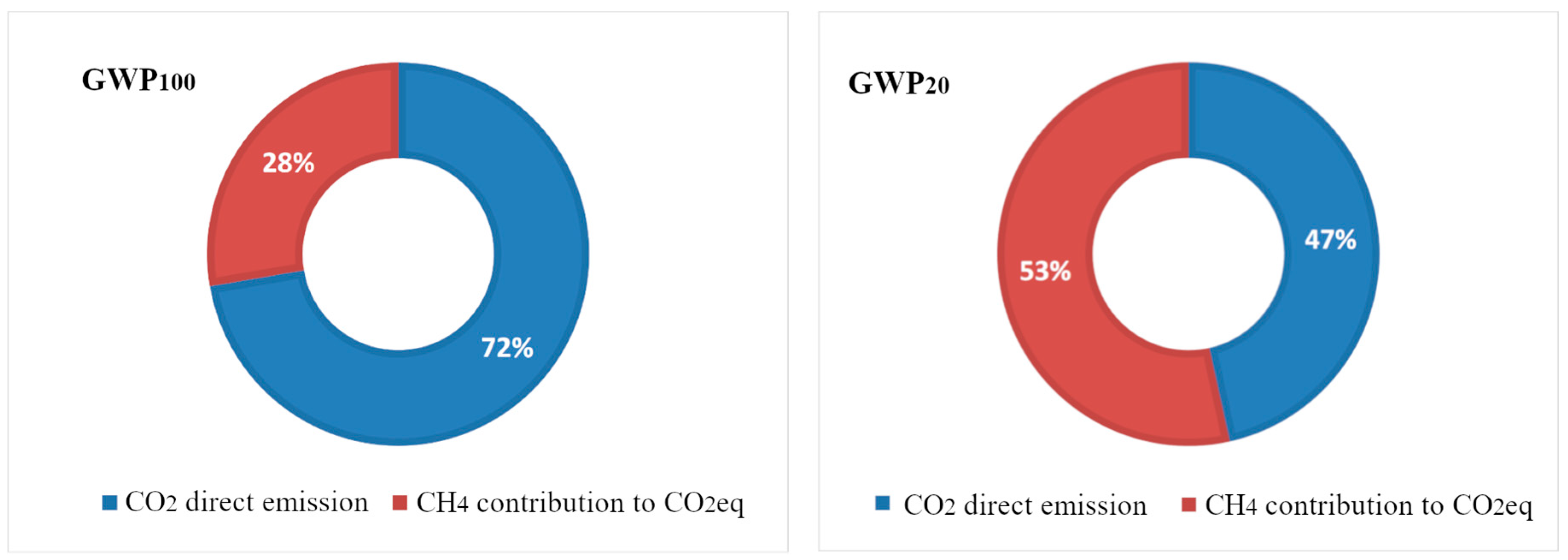
3.1. Total Emissions and Monthly Distribution
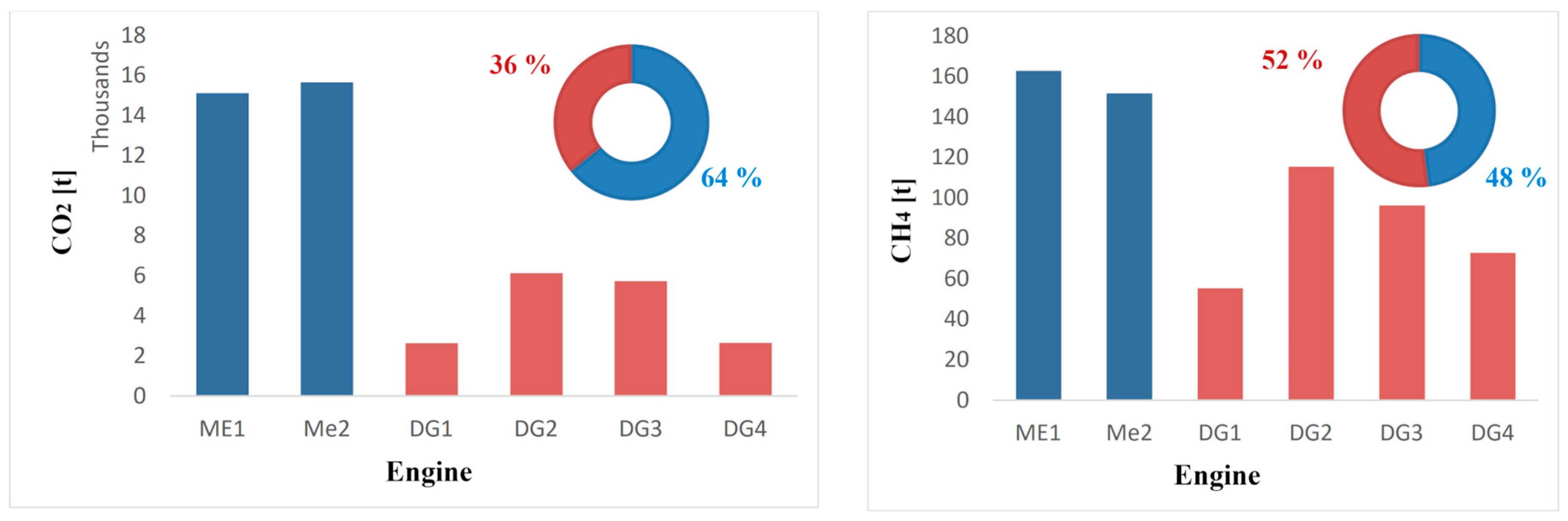
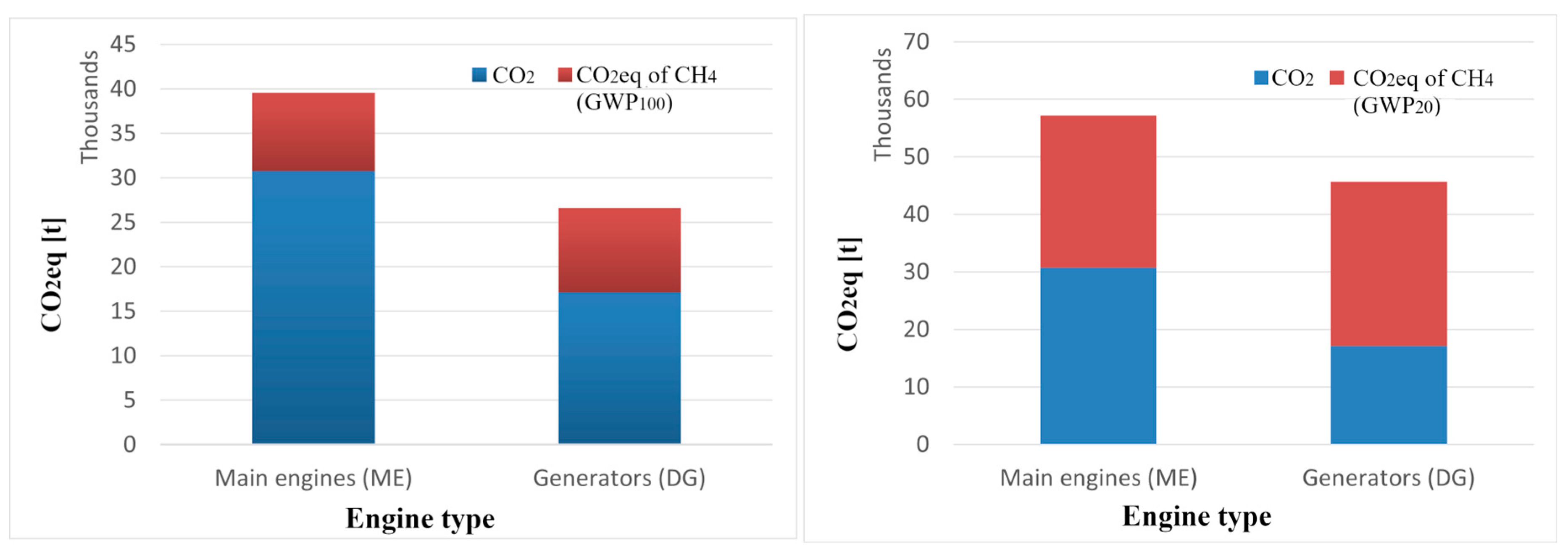
3.2. Distribution of Emissions by Engine
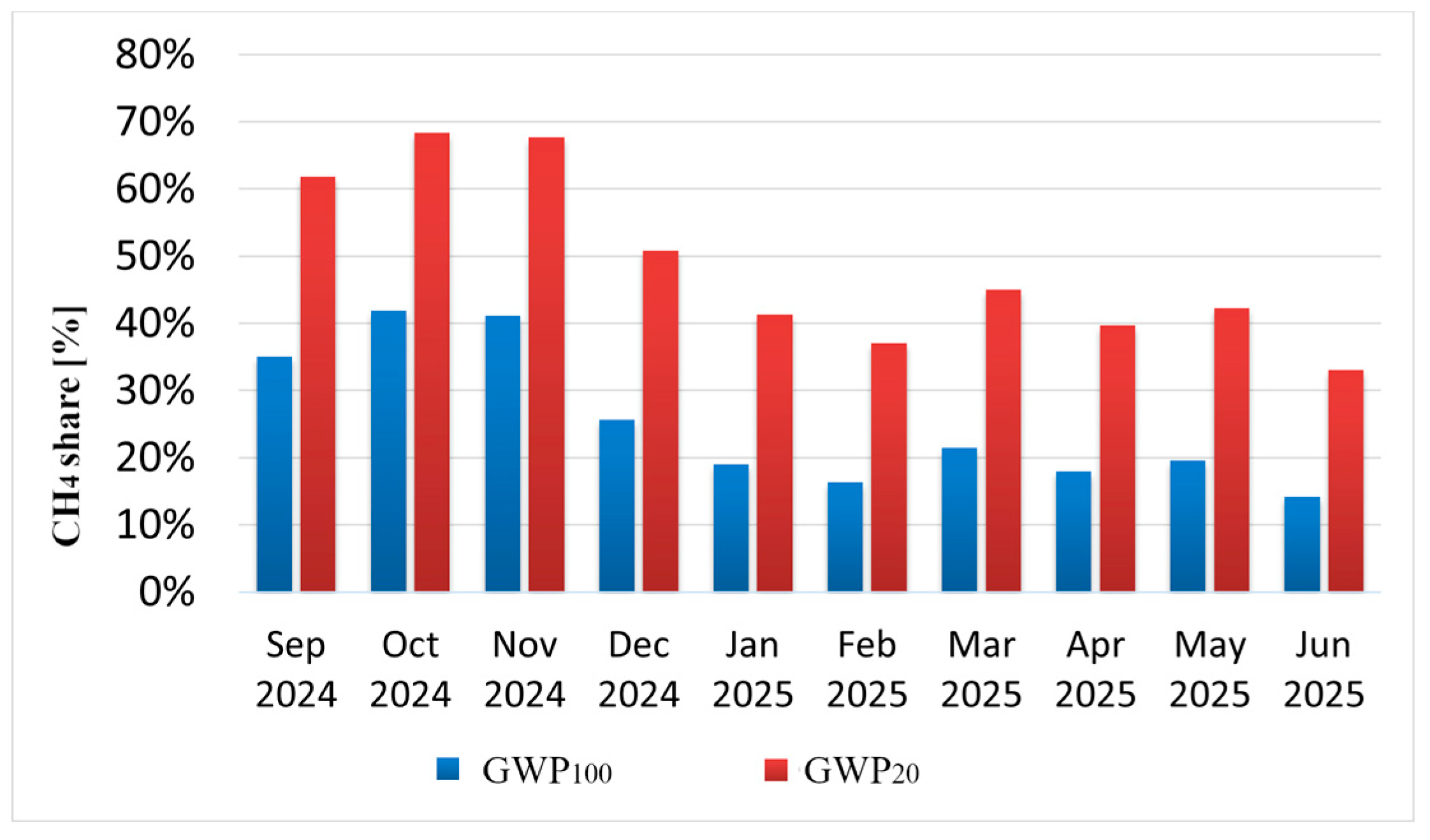
3.3. Methane Slip and Its Variability
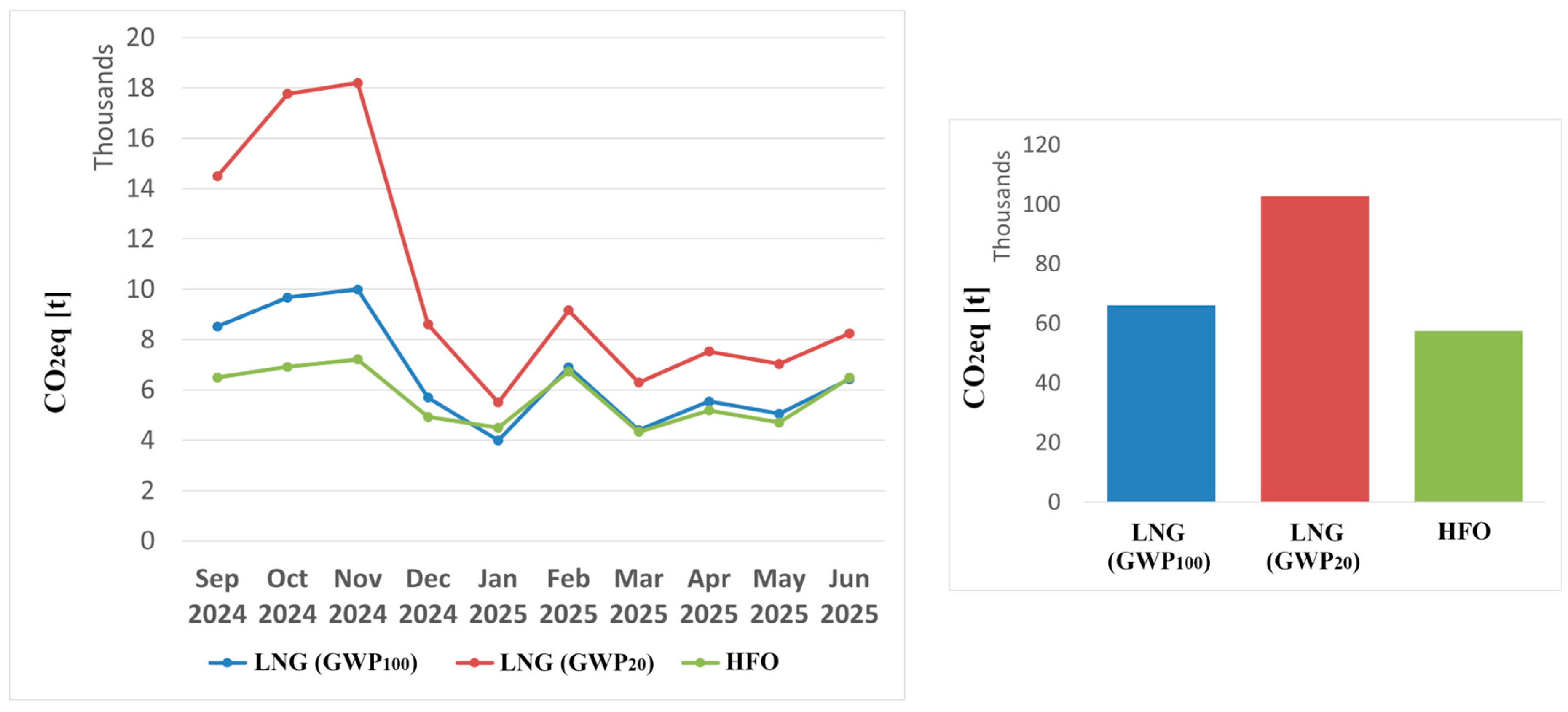
3.4. Comparison of LNG and HFO Scenarios
4. Discussion
4.1. Methane Slip and GWP Time Horizon
4.2. Role of Auxiliary Generators and Operating Conditions
4.3. Value of Onboard Monitoring
4.4. Study Limitations
5. Conclusions
Supplementary Materials
Author Contributions
Funding
Data Availability Statement
Acknowledgments
Conflicts of Interest
Abbreviations
| BOG | Boil-Off Gas |
| CO2 | Carbon Dioxide |
| CH4 | Methane |
| CO2-eq | Carbon Dioxide Equivalent |
| DG | Diesel Generator |
| DCS | Data Collection System |
| EMSYS | Emission Monitoring System |
| GHG | Greenhouse Gas |
| GWP | Global Warming Potential |
| GWP100 | Global Warming Potential (100-year horizon) |
| GWP20 | Global Warming Potential (20-year horizon) |
| HFO | Heavy Fuel Oil |
| IMO | International Maritime Organization |
| LNG | Liquefied Natural Gas |
| ME | Main Engine |
| MRV | Monitoring, Reporting and Verification of Maritime Transport Emissions |
| TtW | Tank-to-Wake |
| WtT | Well-to-Tank |
| WtW | Well-to-Wake |
References
- Eyring, V.; Isaksen, I.S.A.; Berntsen, T.; Collins, W.J.; Corbett, J.J.; Endresen, O.; Grainger, R.G.; Moldanova, J.; Schlager, H.; Stevenson, D.S. Transport impacts on atmosphere and climate: Shipping. Atmos. Environ. 2010, 44, 4735–4771. [Google Scholar] [CrossRef]
- Faber, J.; Hanayama, S.; Zhang, S.; Pereda, P.; Comer, B.; Hauerhof, E.; van der Loeff, W.S.; Smith, T.; Zhang, Y.; Kosaka, H.; et al. Fourth IMO Greenhouse Gas Study. 2020. Available online: https://www.imo.org/en/ourwork/environment/pages/fourth-imo-greenhouse-gas-study-2020.aspx (accessed on 21 April 2026).
- IMO, 2023 IMO Strategy on Reduction of GHG Emissions from Ships, 2023. Available online: https://www.imo.org/en/ourwork/environment/pages/2023-imo-strategy-on-reduction-of-ghg-emissions-from-ships.aspx (accessed on 20 April 2026).
- European Commission. The EU ETS and MRV Maritime General Guidance for Shipping Companies. 2025. Available online: https://climate.ec.europa.eu/document/download/31875b4f-39b9-4cde-a4e2-fbb8f65ee703_en?filename=policy_transport_shipping_gd1_maritime_en.pdf (accessed on 29 April 2026).
- European Commission. Monitoring, Reporting and Verification of Maritime Transport Emissions, 2025. Available online: https://climate.ec.europa.eu/eu-action/transport-decarbonisation/reducing-emissions-shipping-sector_en (accessed on 20 April 2026).
- Li, Z.; Wang, K.; Liang, H.; Wang, Y.; Ma, R.; Cao, J.; Huang, L. Marine alternative fuels for shipping decarbonization: Technologies, applications and challenges. Energy Convers. Manag. 2025, 329, 119641. [Google Scholar] [CrossRef]
- Wang, K.; Li, Z.; Liu, X.; Hu, Z.; Huang, L.; Song, Q.; Liang, H.; Jiang, X. Wind-assisted propulsion system for shipping decarbonization: Technologies, applications and challenges. Energy 2025, 336, 138420. [Google Scholar] [CrossRef]
- Li, Z.; Wang, K.; Ruan, Z.; Li, D.; Liang, H.; Ma, R.; Cao, J.; Huang, L. A fuel consumption prediction model for wind-assisted ship based on operational data. Transp. Res. D Transp. Environ. 2025, 149, 105045. [Google Scholar] [CrossRef]
- Wiedmann, T.; Minx, J. A Definition of “Carbon Footprint”. In Ecological Economics Research Trends; ISA UK Research Report 07-01; Nova Science Publishers: Hauppauge, NY, USA, 2007. [Google Scholar]
- Pandey, D.; Agrawal, M.; Pandey, J.S. Carbon footprint: Current methods of estimation. Environ. Monit. Assess. 2011, 178, 135–160. [Google Scholar] [CrossRef]
- Matthews, H.S.; Hendrickson, C.T.; Weber, C.L. The importance of carbon footprint estimation boundaries. Environ. Sci. Technol. 2008, 42, 5839–5842. [Google Scholar] [CrossRef] [PubMed]
- Lee, H.; Romero, J. IPCC Climate Change 2023 Synthesis Report; IPCC: Geneva, Switzerland, 2023. [Google Scholar] [CrossRef]
- Myhre, G.; Shindell, D.; Bréon, F.; Collins, W.; Fuglestvedt, J.; Huang, J.; Koch, D.; Lamarque, J.; Lee, D.; Mendoza, B.; et al. Anthropogenic and Natural Radiative Forc-ing. In Climate Change 2013: The Physical Science Basis; Cambridge University Press: Cambridge, UK, 2013. [Google Scholar]
- Balcombe, P.; Speirs, J.F.; Brandon, N.P.; Hawkes, A.D. Methane emissions: Choosing the right climate metric and time horizon. Environ. Sci. Process. Impacts 2018, 20, 1323–1339. [Google Scholar] [CrossRef]
- Edwards, R.; Larive, J.-F.; Rickeard, D.; Hamje, H.; Godwin, S.; Hass, H.; Krasen-brink, A.; Lonza, L.; Maas, H.; Nelson, R.; et al. JEC Well-to-Wheels Analysis; Publications Office of the European Union: Luxembourg, 2014. [Google Scholar] [CrossRef]
- Gilbert, P.; Walsh, C.; Traut, M.; Kesieme, U.; Pazouki, K.; Murphy, A. Assessment of full life-cycle air emissions of alternative shipping fuels. J. Clean. Prod. 2018, 172, 855–866. [Google Scholar] [CrossRef]
- IMO. Resolution MEPC.391(81) 2024 Guidelines on Life Cycle GHG Intensity of Marine Fuels. 2024. Available online: https://wwwcdn.imo.org/localresources/en/KnowledgeCentre/IndexofIMOResolutions/MEPCDocuments/MEPC.391(81).pdf (accessed on 27 April 2026).
- Ushakov, S.; Stenersen, D.; Einang, P.M. Methane slip from gas fuelled ships: A comprehensive summary based on measurement data. J. Mar. Sci. Technol. 2019, 24, 1308–1325. [Google Scholar] [CrossRef]
- Balcombe, P.; Heggo, D.A.; Harrison, M. Total Methane and CO2Emissions from Liquefied Natural Gas Carrier Ships: The First Primary Measurements. Environ. Sci. Technol. 2022, 56, 9632–9640. [Google Scholar] [CrossRef]
- Bouman, E.A.; Lindstad, E.; Rialland, A.I.; Strømman, A.H. State-of-the-art technologies; measures, and potential for reducing GHG emissions from shipping—A review. Transp. Res. D Transp. Environ. 2017, 52, 408–421. [Google Scholar] [CrossRef]
- Lindstad, E.; Eskeland, G.S.; Rialland, A.; Valland, A. Decarbonizing Maritime Transport: The Importance of Engine Technology and Regulations for LNG to Serve as a Transition Fuel. Sustainability 2020, 12, 8793. [Google Scholar] [CrossRef]
- Balcombe, P.; Brierley, J.; Lewis, C.; Skatvedt, L.; Speirs, J.; Hawkes, A.; Staffell, I. How to decarbonise international shipping: Options for fuels, technologies and policies. Energy Convers. Manag. 2019, 182, 72–88. [Google Scholar] [CrossRef]
- Burel, F.; Taccani, R.; Zuliani, N. Improving sustainability of maritime transport through utilization of Liquefied Natural Gas (LNG) for propulsion. Energy 2013, 57, 412–420. [Google Scholar] [CrossRef]
- Seddiek, I.S. An Overview: Environmental and Economic Strategies for Improving Quality of Ships Exhaust Gases. Int. J. Marit. Eng. 2015, 157, A53–A64. [Google Scholar] [CrossRef]
- Pavlenko, N.; Comer, B.; Zhou, Y.; Clark, N.; Rutherford, D. The Climate Implications of Using LNG as a Marine Fuel, 2020. Available online: www.theicct.org (accessed on 20 April 2026).
- Stanivuk, T.; Korljan, D.; Stazić, L. Modeling the Future of Liquefied Natural Gas Transportation: Regression Analysis of Historical Data and Fleet Development Scenarios. Appl. Sci. 2025, 15, 5973. [Google Scholar] [CrossRef]
- Kuittinen, N. Methane Slip Emissions from LNG Vessels-Review Emission Reduction Technologies-Exhaust Gas Aftertreatment Solutions. Available online: https://www.cimac.com (accessed on 20 April 2026).
- Howarth, R.W. The greenhouse gas footprint of liquefied natural gas (LNG) exported from the United States. Energy Sci. Eng. 2024, 12, 4843–4859. [Google Scholar] [CrossRef]
- Bengtsson, S.; Andersson, K.; Fridell, E. A comparative life cycle assessment of marine fuels: Liquefied natural gas and three other fossil fuels. Proc. Inst. Mech. Eng. Part M J. Eng. Marit. Environ. 2011, 225, 97–110. [Google Scholar] [CrossRef]
- Balcombe, P.; Staffell, I.; Kerdan, I.G.; Speirs, J.F.; Brandon, N.P.; Hawkes, A.D. How can LNG-fuelled ships meet decarbonisation targets? An environmental and economic analysis. Energy 2021, 227, 120462. [Google Scholar] [CrossRef]
- Kuittinen, N.; Koponen, P.; Vesala, H.; Lehtoranta, K. Methane slip and other emissions from newbuild LNG engine under real-world operation of a state-of-the art cruise ship. Atmos. Environ. X 2024, 23, 100285. [Google Scholar] [CrossRef]
- Sagot, B.; Defossez, R.; Mahi, R.; Villot, A.; Joubert, A. An Engine Load Monitoring Approach for Quantifying Yearly Methane Slip Emissions from an LNG-Powered RoPax Vessel. J. Mar. Sci. Eng. 2025, 13, 1379. [Google Scholar] [CrossRef]
- Kuittinen, N.; Heikkilä, M.; Vesala, H.; Karppanen, M.; Koponen, P.; Piimäkorpi, P.; Jalkanen, J.P.; Lehtoranta, K. Real-World Methane Emissions Measured On-Board Two LNG-Fueled Vessels. In Transport Transitions: Advancing Sustainable and Inclusive Mobility; Lecture Notes in Mobility; Springer: Cham, Switzerland, 2025; pp. 445–451. [Google Scholar] [CrossRef]
- Third IMO GHG Study 2014. Available online: https://www.imo.org/en/ourwork/environment/pages/greenhouse-gas-studies-2014.aspx (accessed on 21 April 2026).
- IPCC. 2006 IPCC Guidelines for National Greenhouse Gas Inventories, Volume 1: General Guidance and Reporting. 2006. Available online: https://www.ipcc-nggip.iges.or.jp/public/2006gl/vol1.html (accessed on 21 April 2026).
- EEA. EMEP/EEA Air Pollutant Emission Inventory Guidebook 2023; EEA: Copenhagen, Denmark, 2023. [Google Scholar] [CrossRef]
- Kuittinen, N.; Heikkilä, M.; Lehtoranta, K. Review of Methane Slip from LNG Engines, 2023. Available online: https://tuhat.helsinki.fi/ws/portalfiles/portal/282364163/D1.1_Review_of_methane_slip_from_LNG_engines.pdf (accessed on 4 June 2026).
- Sjerić, M.; Perčić, M.; Jovanović, I.; Vladimir, N. Carbon Footprint and Economic Analysis of LNG-fueled Fishing Vessel Using Real Engine Performance Simulation. J. Mar. Sci. Appl. 2026, 25, 259–276. [Google Scholar] [CrossRef]
- Schinas, O.; Butler, M. Feasibility and commercial considerations of LNG-fueled ships. Ocean. Eng. 2016, 122, 84–96. [Google Scholar] [CrossRef]
- VPS EmSys, Marine Approved Emissions and Particulate Matter Monitoring Systems. 2024. Available online: https://www.vpsveritas.com/sites/default/files/2024-11/vps_emsys_marine_approved_emissions_and_particulate_matter_monitoring_systems_brochure_0.pdf (accessed on 20 April 2026).
- IMO. IMO Data Collection System (DCS), 2023. Available online: https://www.imo.org/en/ourwork/environment/pages/data-collection-system.aspx (accessed on 20 April 2026).
- Franic, Z. Praćenje, Izvještavanje i Provjera Emisija CO2 u Pomorskom Prometu. Sigur. Časopis Za Sigur. U Radn. I Zivotn. Okolini 2021, 63, 198–201. [Google Scholar] [CrossRef]
- IMO. Resolution MEPC.308(73) 2018 Guidelines on the Method of Calculation of the Attained Energy Efficiency Design Index (EEDI) for New Ships. 2018. Available online: https://imorules.com/MEPCRES_308.73.html (accessed on 20 April 2026).
- Brynolf, S.; Fridell, E.; Andersson, K. Environmental assessment of marine fuels: Liquefied natural gas, liquefied biogas, methanol and bio-methanol. J. Clean. Prod. 2014, 74, 86–95. [Google Scholar] [CrossRef]




| Month | CO2 [t] | CH4 [t] | CO2eq (GWP100) [t] | CO2eq (GWP20) [t] |
|---|---|---|---|---|
| Sep 2024 | 5532.91 | 106.62 | 8518.27 | 14,488.99 |
| Oct 2024 | 5617.80 | 144.59 | 9666.31 | 17,763.33 |
| Nov 2024 | 5877.98 | 146.69 | 9985.22 | 18,199.71 |
| Dec 2024 | 4234.38 | 52.03 | 5691.09 | 8604.52 |
| Jan 2025 | 3232.11 | 27.02 | 3988.62 | 5501.64 |
| Feb 2025 | 5771.04 | 40.33 | 6900.40 | 9159.11 |
| Mar 2025 | 3461.91 | 33.69 | 4405.31 | 6292.12 |
| Apr 2025 | 4542.68 | 35.51 | 5536.97 | 7525.54 |
| May 2025 | 4058.63 | 35.34 | 5048.24 | 7027.46 |
| Jun 2025 | 5521.74 | 32.42 | 6429.61 | 8245.33 |
| Total | 47,851.19 | 654.24 | 66,170.04 | 102,807.74 |
| Engine | CO2 [t] | CH4 [t] | CO2eq (GWP100) [t] | CO2eq (GWP20) [t] | Share in CO2eq (GWP100) | Share in CO2eq (GWP20) |
|---|---|---|---|---|---|---|
| ME1 | 15,104.17 | 162.79 | 19,662.33 | 28,778.65 | 29.7% | 28.0% |
| ME2 | 15,640.64 | 151.68 | 19,887.68 | 28,381.76 | 30.1% | 27.6% |
| DG1 | 2620.86 | 55.25 | 4167.93 | 7262.06 | 6.3% | 7.1% |
| DG2 | 6119.47 | 115.43 | 9351.46 | 15,815.42 | 14.1% | 15.4% |
| DG3 | 5719.94 | 96.27 | 8415.63 | 13,807.00 | 12.7% | 13.4% |
| DG4 | 2646.10 | 72.82 | 4685.02 | 8762.85 | 7.1% | 8.5% |
| Total | 47,851.19 | 654.24 | 66,170.04 | 102,807.74 | 100.0% | 100.0% |
| Month | ME Slip [%] | DG Slip [%] | Total Slip [%] |
|---|---|---|---|
| Sep 2024 | 4.89% | 5.36% | 5.03% |
| Oct 2024 | 6.44% | 6.92% | 6.61% |
| Nov 2024 | 6.28% | 6.81% | 6.42% |
| Dec 2024 | 1.30% | 5.83% | 3.27% |
| Jan 2025 | 0.39% | 5.06% | 2.25% |
| Feb 2025 | 0.68% | 5.06% | 1.89% |
| Mar 2025 | 0.59% | 4.66% | 2.61% |
| Apr 2025 | 0.36% | 4.41% | 2.10% |
| May 2025 | 0.39% | 4.41% | 2.34% |
| Jun 2025 | 0.79% | 3.24% | 1.59% |
| Total | 2.74% | 5.18% | 3.62% |
| Month | HFO CO2eq [t] | ΔLNG GWP100 vs. HFO [%] | ΔLNG GWP20 vs. HFO [%] |
|---|---|---|---|
| Sep 2024 | 6486.46 | +31.3 | +123.4 |
| Oct 2024 | 6916.19 | +39.8 | +156.8 |
| Nov 2024 | 7212.02 | +38.5 | +152.4 |
| Dec 2024 | 4926.35 | +15.5 | +74.7 |
| Jan 2025 | 4496.62 | −11.3 | +22.4 |
| Feb 2025 | 6729.35 | +2.5 | +36.1 |
| Mar 2025 | 4331.57 | +1.7 | +45.3 |
| Apr 2025 | 5184.81 | +6.8 | +45.1 |
| May 2025 | 4699.03 | +7.4 | +49.6 |
| Jun 2025 | 6480.23 | −0.8 | +27.2 |
| Total | 57,462.64 | +15.2 | +78.9 |
Disclaimer/Publisher’s Note: The statements, opinions and data contained in all publications are solely those of the individual author(s) and contributor(s) and not of MDPI and/or the editor(s). MDPI and/or the editor(s) disclaim responsibility for any injury to people or property resulting from any ideas, methods, instructions or products referred to in the content. |
© 2026 by the authors. Licensee MDPI, Basel, Switzerland. This article is an open access article distributed under the terms and conditions of the Creative Commons Attribution (CC BY) license.
Share and Cite
Maleš, M.; Stanivuk, T.; Zore, B.; Stazić, L. Analyzing the Carbon Footprint of an LNG Tanker Using Real Operational Data: Quantifying Methane Slip Effects. J. Mar. Sci. Eng. 2026, 14, 1087. https://doi.org/10.3390/jmse14121087
Maleš M, Stanivuk T, Zore B, Stazić L. Analyzing the Carbon Footprint of an LNG Tanker Using Real Operational Data: Quantifying Methane Slip Effects. Journal of Marine Science and Engineering. 2026; 14(12):1087. https://doi.org/10.3390/jmse14121087
Chicago/Turabian StyleMaleš, Matko, Tatjana Stanivuk, Božidar Zore, and Ladislav Stazić. 2026. "Analyzing the Carbon Footprint of an LNG Tanker Using Real Operational Data: Quantifying Methane Slip Effects" Journal of Marine Science and Engineering 14, no. 12: 1087. https://doi.org/10.3390/jmse14121087
APA StyleMaleš, M., Stanivuk, T., Zore, B., & Stazić, L. (2026). Analyzing the Carbon Footprint of an LNG Tanker Using Real Operational Data: Quantifying Methane Slip Effects. Journal of Marine Science and Engineering, 14(12), 1087. https://doi.org/10.3390/jmse14121087