Article

Analyzing the Carbon Footprint of an LNG Tanker Using Real Operational Data: Quantifying Methane Slip Effects


Faculty of Maritime Studies, University of Split, 21000 Split, Croatia
*
Author to whom correspondence should be addressed.
J. Mar. Sci. Eng. 2026, 14(12), 1087; https://doi.org/10.3390/jmse14121087
Submission received: 11 May 2026 / Revised: 4 June 2026 / Accepted: 8 June 2026 / Published: 11 June 2026
(This article belongs to the Section Ocean Engineering)

Abstract

This paper presents an exploratory operational assessment of the carbon footprint of an LNG tanker using real operational data collected by a continuous emission monitoring system over a ten-month period of vessel operation. The analysis included carbon dioxide (CO2) and methane (CH4) emissions from the main engines and diesel generators, the calculation of CO2-equivalent using the GWP100 and GWP20 global warming potential factors, and a comparison with a hypothetical heavy fuel oil (HFO) operating scenario. The methodology is based on a Tier III approach, that is, on real operational data, which allows a more realistic assessment of emissions than approaches based on standard emission factors. The results show that CO2 emissions make up the largest share of total emissions, but including methane emissions significantly increases the ship’s overall climate impact. Total methane slip was 3.62%, with diesel generators exhibiting higher slip than the main engines. When GWP20 was applied, total emissions expressed as CO2-equivalent were, in some periods, comparable to or higher than those estimated for the HFO scenario, despite lower direct CO2 emissions. The emission distribution indicated that the main engines dominated CO2 emissions, while methane emissions were more evenly distributed between the main engines and the auxiliary generators, with generators making a significant contribution to total CO2-equivalent emissions due to their higher methane slip. The results confirm that any assessment of the climate performance of LNG-fueled operation must include methane emissions and should be based on real operational data; otherwise, the overall climate impact may be underestimated.

1. Introduction

International shipping plays a key role in global trade, but at the same time it is a significant source of greenhouse gas emissions [1,2]. It is estimated that the maritime sector accounts for about 2–3% of total global CO2 emissions, with a rising trend linked to the growth of world trade [2]. In line with this, the decarbonization of the maritime sector has become one of the main goals of international regulatory policies, including the International Maritime Organization (IMO) strategy for reducing greenhouse gas emissions [3].
Current emission-reduction policies in shipping increasingly require broader greenhouse-gas accounting rather than focusing only on CO2. The 2023 IMO Strategy aims to reduce the carbon intensity of international shipping by at least 40% by 2030 and to reach net-zero GHG emissions by or around 2050 [3]. At the European Union level, CO2 emissions from large ships have been included in the EU Emissions Trading System (EU ETS) since 2024, while CH4 and N2O will be included from 2026 [4]. In parallel, the EU MRV Maritime framework has covered CO2, CH4 and N2O since 2024 [5]. Recent decarbonization research also reflects this broader focus, including studies on alternative marine fuels [6], wind-assisted propulsion [7], and operational-data-based fuel-consumption prediction [8]. These developments make methane emissions increasingly relevant for both scientific assessment and regulatory compliance in LNG-fueled shipping.
For the quantitative assessment of the environmental impact of ships, an increasingly used concept is that of the carbon footprint. It is commonly expressed as carbon-dioxide-equivalent (CO2-eq) [9,10,11], which includes CO2 and other greenhouse gases weighted by their global warming potential (GWP). This approach allows a more realistic assessment of the climate impact of different fuels and engine systems [12,13,14].
In the analysis of shipping emissions, tank-to-wake (TtW), well-to-tank (WtT), and well-to-wake (WtW) approaches are commonly distinguished. These cover different stages of the fuel life cycle: TtW includes emissions during ship operation, WtT includes emissions related to fuel production and supply, while WtW represents their sum [15,16,17]. Although the WtW approach is necessary for a full assessment, TtW analysis based on real operational data remains essential for understanding actual ship emissions, especially methane emissions from LNG-fueled operation [18,19].
In the last decade, liquefied natural gas (LNG) has often been seen as a transition fuel that can reduce CO2 emissions compared with conventional marine fuels such as heavy fuel oil (HFO) [20,21,22]. This is mainly due to its more favorable chemical composition, which leads to lower CO2 emissions per unit of produced energy, as well as lower emissions of sulfur compounds and some air pollutants [23,24,25]. Considering the expected growth of the LNG fleet and the volume of LNG maritime transport [26], understanding actual emissions during ship operation is becoming increasingly important for assessing its long-term sustainability [18,19].
However, the use of LNG is also linked to emissions of unburned methane, known as methane slip, which can significantly affect the overall climate impact of a ship [18,19,27]. Methane has a much higher global warming potential than CO2, especially over shorter time horizons, so even relatively small CH4 emissions can increase the total CO2-equivalent of emissions [12,13,14]. Recent studies show that the climate benefit of LNG is not always achieved and that, under certain conditions, methane emissions can partly or even fully offset the reduction in CO2 emissions [16,25,28,29,30].
In addition, recent measurement-based studies confirm that methane slip strongly depends on engine type and operating conditions, especially engine load and operating mode [18,27,31,32,33]. Studies based on real onboard measurements show that CH4 emissions can differ considerably from standard emission factors and that auxiliary engines and generators may make an important contribution to total methane emissions [19,31,32,33].
In this context, the level of detail of the data used in emission analysis is very important. The Tier I approach is based on generic, globally applicable emission factors, while Tier II uses more specific emission factors adjusted to certain fuel types, technologies, or operating conditions. In contrast, Tier III includes more detailed approaches, which may involve advanced models or real operational data [34,35,36]. For operation on LNG, where methane emissions strongly depend on actual operating conditions, approaches based on real operational data allow a more realistic assessment of the true climate impact than methods based on standard emission factors [18,19,32,33].
Despite the growing interest in LNG as a marine fuel, available review papers show that published data on methane slip from LNG marine engines are still limited, especially for newer engines and real operating conditions [18,37]. A similar lack of data was pointed out in the first primary emission measurements from an LNG carrier, where the need for additional measurement studies was also emphasized [19]. At the same time, assessments of the environmental impact of alternative marine fuels are often based on LCA/LCCA models and WtW analyses [15,16], scenario-based or simulation approaches [30,38] and average emission factors with assumed methane slip values [25], while real operational variations of a specific ship are not always well captured [38]. For this reason, studies that simultaneously include both CO2 and CH4 emissions, cover both main and auxiliary engines, express the results as CO2-equivalent, and allow comparison with conventional fuels are especially important for a reliable assessment of the climate impact of LNG-fueled operation [19,25,30].
This paper analyzes the carbon footprint of an LNG tanker using real operational data collected by a continuous emission monitoring system during a ten-month period of regular vessel operation. The analysis includes CO2 and CH4 emissions from the main engines and diesel generators, their conversion into CO2-equivalent using GWP100 and GWP20 factors, and the estimation of methane slip for different engine groups as well as for the ship as a whole. Special attention is given to the comparison between actual LNG emissions and a hypothetical HFO operating scenario. The aim is to assess to what extent the inclusion of methane emissions and the choice of GWP time horizon change the evaluation of the climate impact of operation on LNG compared with conventional marine fuels.
The novelty of this study is therefore the use of real operational emission data from an LNG tanker to quantify the contribution of methane slip to the ship’s carbon footprint, separately considering main engines and diesel generators and comparing the results under both GWP100 and GWP20 time horizons. Because the analysis is based on one LNG tanker and a ten-month observation period, the study is framed as an exploratory operational case study rather than as a fleet-wide assessment. Its purpose is to show how measured CO2 and CH4 emissions affect the carbon-footprint assessment of a specific ship under real operating conditions.
The research question guiding this study is: How does the inclusion of measured methane emissions from both main engines and auxiliary generators change the assessed carbon footprint of an LNG tanker compared with an assessment based on CO2 emissions alone and with a hypothetical HFO reference scenario?
The remainder of the paper is organized as follows. Section 2 describes the case vessel, monitoring system, operational data, and calculation methods. Section 3 presents the emission results, methane slip variability, LNG–HFO comparison, and uncertainty assessment. Section 4 discusses the implications, operational relevance, and limitations of the results, while Section 5 summarizes the main conclusions and recommendations.

2. Materials and Methods

2.1. Case Vessel and Data Collection

The carbon footprint analysis was carried out using real operational data from an LNG tanker during regular vessel service. The ship observed in this study is a modern membrane-type LNG tanker equipped with two slow-speed two-stroke dual-fuel main engines (ME1 and ME2) and four diesel generator sets (DG1–DG4), which provide the electrical power needed for onboard systems. Dual-fuel engines can operate on liquefied natural gas (LNG) or on conventional liquid fuels, which is a common technical solution on modern LNG tankers [18,39]. During the observed period, the ship mainly operated on LNG, with pilot fuel used in the combustion process.
Emission data were collected from the Emission Monitoring System (EMSYS, Emsys Maritime Ltd., Altrincham, UK; Emsys-iS-OMU-02, version 2.1), installed on the observed LNG tanker [40]. EMSYS enables continuous monitoring, recording, and analysis of exhaust gas emissions under real ship operating conditions. The system uses an extractive measurement method with heated filter probes and heated sampling lines, while gas analysis is performed using a multi-channel quantum cascade laser (QCL) based on infrared absorption spectroscopy. The QCL sensor can be configured for multi-gas monitoring, including NO, NO2, SO2, CO2, CO, CH4, NH3 and N2O, and the reported repeatability and accuracy are ±2%. The system requires an annual calibration check and mandatory class/flag zero/span checks [40]. In this study, daily records of carbon dioxide (CO2) and methane (CH4) emissions were used for each main engine and diesel generator. This allowed emissions to be separated by individual source and their contribution to total CO2-equivalent emissions to be analyzed, which is particularly important for the assessment of methane slip. Monitoring and reporting of ship emissions are also part of the wider regulatory framework in maritime transport, including the EU MRV and IMO DCS systems [5,41,42].
The analysis covered the period from September 2024 to June 2025. Daily CO2 and CH4 emission data were used for the calculations, while in some parts of the analysis they were summed to the monthly level in order to show trends and emission variability. Operational data, including engine running hours, cargo/maneuvering modes, and port hours, were taken from the ship’s noon reports and are presented in the Supplementary Materials (Table S1).

2.2. Calculation Procedure and Data Analysis

In this study, an approach corresponding to Tier III methodological detail was applied, because the analysis is based on real operational data and daily emission records obtained from a continuous emission monitoring system, rather than on standardized emission factors [34,35,36]. This approach allows a more realistic assessment of emissions under actual ship operating conditions, especially for LNG-fueled operation and dual-fuel engines, where methane emissions can differ significantly from standard values because they depend on engine load and operating conditions [18,19,32,33].
The total carbon footprint was expressed as CO2-equivalent (CO2-eq), which includes CO2 and CH4 emissions weighted by their global warming potential (GWP). For methane, the values GWP100 = 28 and GWP20 = 84 were used, according to the IPCC AR5 tabulated values for CH4 without climate-carbon feedbacks [13]. The use of both time horizons allows the assessment of both the shorter-term and longer-term climate impact of methane emissions [14].
The total CO2-equivalent was calculated as:
C O 2 e q = C O 2 + G W P   · C H 4
where all quantities are expressed in the same mass units, that is, in tonnes in this study.
Methane slip was defined as the share of unburned methane relative to the total amount of methane entering the combustion process [18,19]. In this study, methane slip was not measured directly but was calculated from the measured CO2 and CH4 emissions using a stoichiometric approach. It was assumed that CO2 emissions mainly result from the complete combustion of methane according to the following reaction:
C H 4 + 2 O 2 C O 2 + 2 H 2 O  
Based on molar masses (16 g/mol for CH4 and 44 g/mol for CO2), the mass of burned methane was determined from the measured CO2 emissions as:
m C H 4 b u r n e d = 16 44 m C O 2  
The total amount of methane entering the combustion process was then determined as the sum of burned methane and emitted methane:
m C H 4 t o t a l = m C H 4 b u r n e d + m C H 4 e m i t t e d
where m C H 4 e m i t t e d is the directly measured CH4 emission. Methane slip was then calculated as:
S l i p C H 4 = m C H 4 e m i t t e d m C H 4 t o t a l 100 %  
This calculation is based on the carbon mass balance and gives the methane slip percentage in conditions where direct data on LNG fuel mass flow to individual engines are not available. The methane slip values calculated in this way should therefore be interpreted as operational estimates based on measured CO2 and CH4 mass emissions, rather than as direct measurements of the fraction of methane entering each engine. The approach assumes that the measured CO2 originates predominantly from methane combustion and that LNG can be represented by its dominant component, methane, for the purpose of the stoichiometric calculation. Since dual-fuel engines also use pilot fuel, a small part of the measured CO2 may originate from liquid fuel combustion, which can affect the estimated amount of burned methane and, consequently, the calculated slip percentage. These assumptions should be considered when interpreting the exact methane slip values.
To compare the climate impact of operation on LNG, a hypothetical reference scenario of ship operation on heavy fuel oil (HFO) was defined. HFO was selected because it represents a conventional fossil marine fuel commonly used as a reference in comparisons with LNG operation. The scenario was based on the same observed operational period and the same reported fuel-use basis, so that the comparison reflects the actual activity level of the vessel rather than an arbitrary operating profile. In this scenario, CO2 emissions were calculated using the standard HFO emission factor, E F H F O = 3.114 t C O 2 / t f u e l [34,43]. The total fuel amount in the HFO scenario was taken from the ship’s operational data as the sum of reported fuel consumption and the fuel-oil-equivalent (FOE) amount corresponding to the consumed boil-off gas (BOG), as presented in the Supplementary Materials (Table S2). Since the purpose of this scenario was to compare the direct climate impact of LNG and HFO operation in terms of CO2-equivalent, CH4 emissions in the HFO scenario were considered negligible, and therefore: C O 2 e q H F O = C O 2 H F O . The HFO scenario was not intended to reconstruct an actual alternative voyage of the same vessel under HFO operation or to represent a full engine-performance simulation; rather, it provides a transparent conventional-fuel reference for assessing whether the apparent CO2 benefit of LNG operation remains after measured methane emissions are included in the CO2-equivalent assessment.
The data analysis included the calculation of total CO2, CH4, and CO2-equivalent emissions, the distribution of emissions by engine, the calculation of specific emission rates (t/h), the calculation of methane slip for the main engines, diesel generators, and the ship as a whole, as well as the analysis of monthly trends. To assess the relationship between methane slip and operational parameters, Pearson’s correlation coefficient was used. In particular, the relationships between methane slip and cargo hours, maneuvering hours, and port hours were analyzed at the monthly level (Supplementary Materials, Tables S3 and S4). All calculations and graphical presentations were prepared in Microsoft Excel (Version 2605, Microsoft Corpora-tion, Redmond, WA, USA).

3. Results

Emission data obtained from the EMSYS [40] were analyzed for the period from September 2024 to June 2025, covering ten months of continuous operation of the LNG tanker. During the observed period, the main engines recorded 6576 operating hours (ME1) and 6572 operating hours (ME2), while the diesel generators recorded between 2985 and 5215 operating hours. The ship spent most of the observed period at sea, with 272 sea days, 11 port days and 8 anchored days, while the total time in cargo/maneuvering mode was 152 h. The highest number of cargo/maneuvering hours was recorded in September and October 2024, while no such activities were recorded in February and June 2025. Monthly operational data are presented in Supplementary Materials Table S1.

3.1. Total Emissions and Monthly Distribution

During the observed period, total emissions of 47,851.19 t CO2 and 654.24 t CH4 were recorded. When methane emissions are included in the carbon footprint calculation, the total emissions amount to 66,170.04 t CO2-eq using GWP100 and 102,807.74 t CO2-eq using GWP20. Monthly values of CO2, CH4, and the corresponding CO2-equivalent are shown in Table 1.
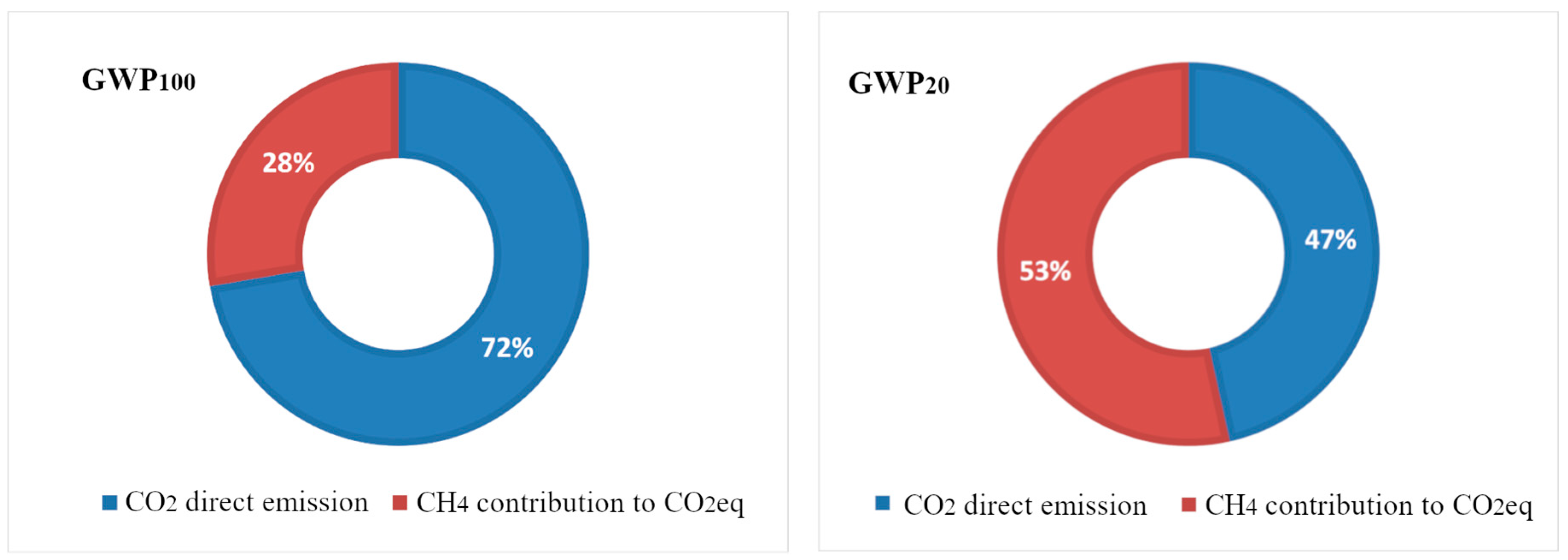
Methane contributed 27.7% of the total CO2-equivalent when GWP100 was used, and 53.5% when GWP20 was used. In other words, although the mass of emitted CH4 was much lower than the mass of emitted CO2, its contribution to the total climate impact became very large because of its high global warming potential. The shares of CO2 emissions and methane-derived contribution in total CO2-equivalent are shown in Figure 1.
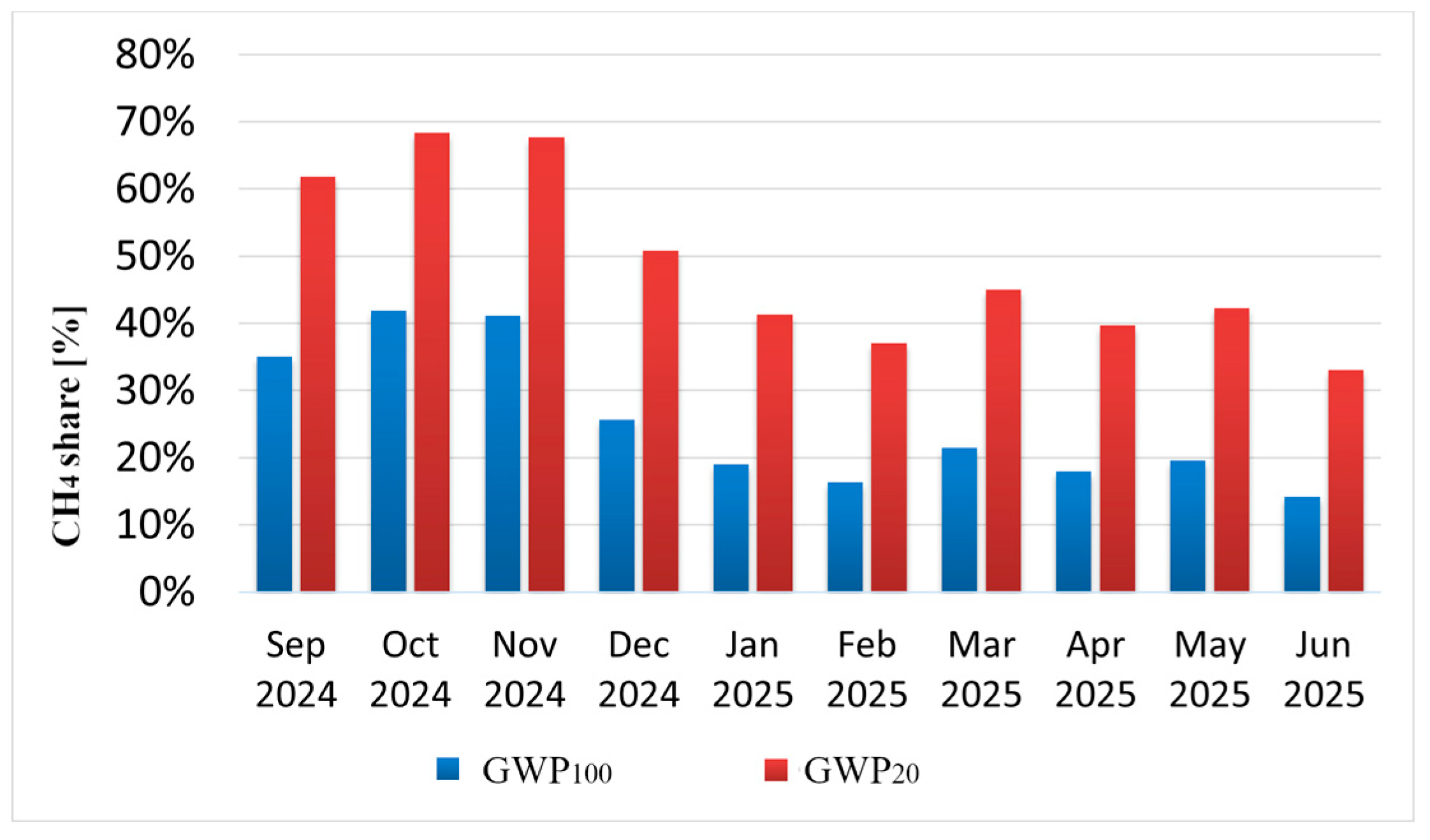
The monthly distribution of emissions shows that CO2 emissions alone do not describe the total climate impact of operation on LNG well enough. In months with higher CH4 emissions, the difference between direct CO2 emissions and the corresponding CO2-equivalent becomes much more pronounced. This is especially visible in September, October, and November 2024, when both the absolute CH4 emissions and their share in total CO2-equivalent were among the highest, while in February and June 2025 the relative contribution of methane was clearly lower.

3.2. Distribution of Emissions by Engine

The distribution of emissions by engine shows a clear difference between the contribution of the main engines and that of the auxiliary units. The main engines dominate total CO2 emissions, with ME1 and ME2 together accounting for about 59.8% of the total CO2-equivalent under GWP100 and 55.6% under GWP20. Diesel generators account for a smaller, but still significant, share of total emissions. When emissions are expressed as CO2-equivalent, their relative contribution increases, especially under GWP20, because of relatively high methane emissions. A detailed breakdown of emissions by individual engine is given in Table 2.
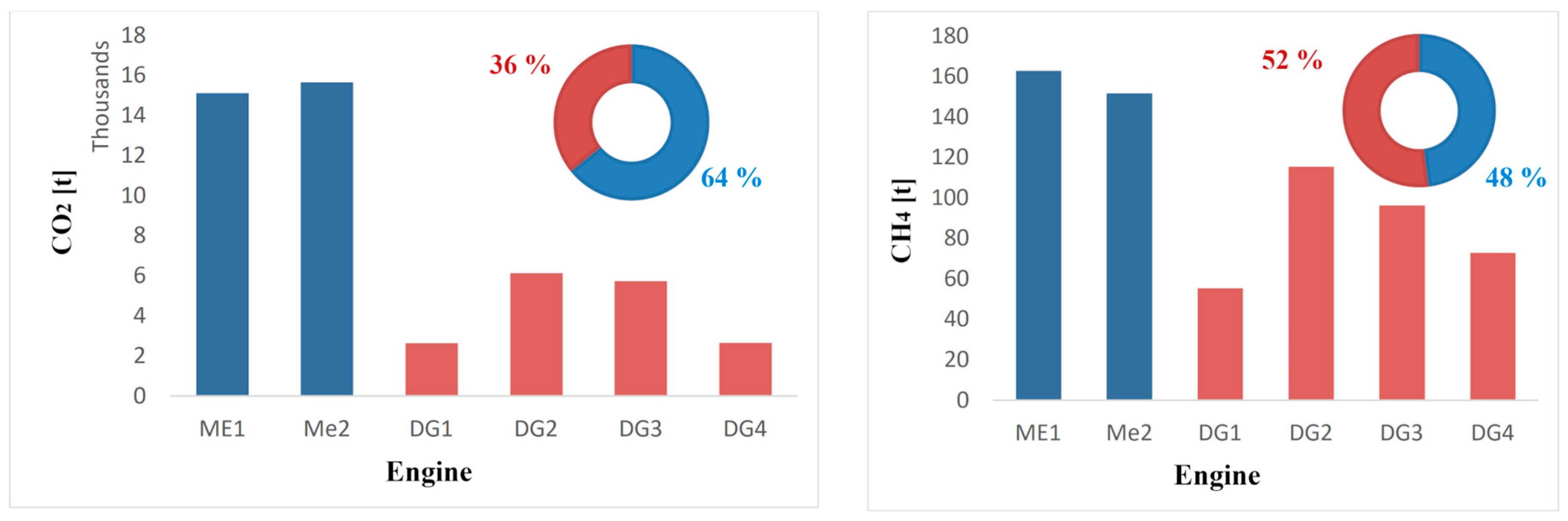
Total CO2 and CH4 emissions by individual engine are shown in Figure 2. The main engines had the highest absolute CO2 emissions, which is expected given their role in ship propulsion. In contrast, the contribution of the diesel generators to CO2 emissions was much lower. For CH4 emissions, however, a different pattern can be seen. Although the main engines still had considerable absolute methane emissions, the share of the generators in total CH4 emissions was much higher than in the case of CO2. This is also visible in the relative shares shown in the figure, where the generators accounted for about half of total methane emissions. This distribution indicates that methane emissions were not linked only to the main propulsion system and that a substantial part also came from the auxiliary units.
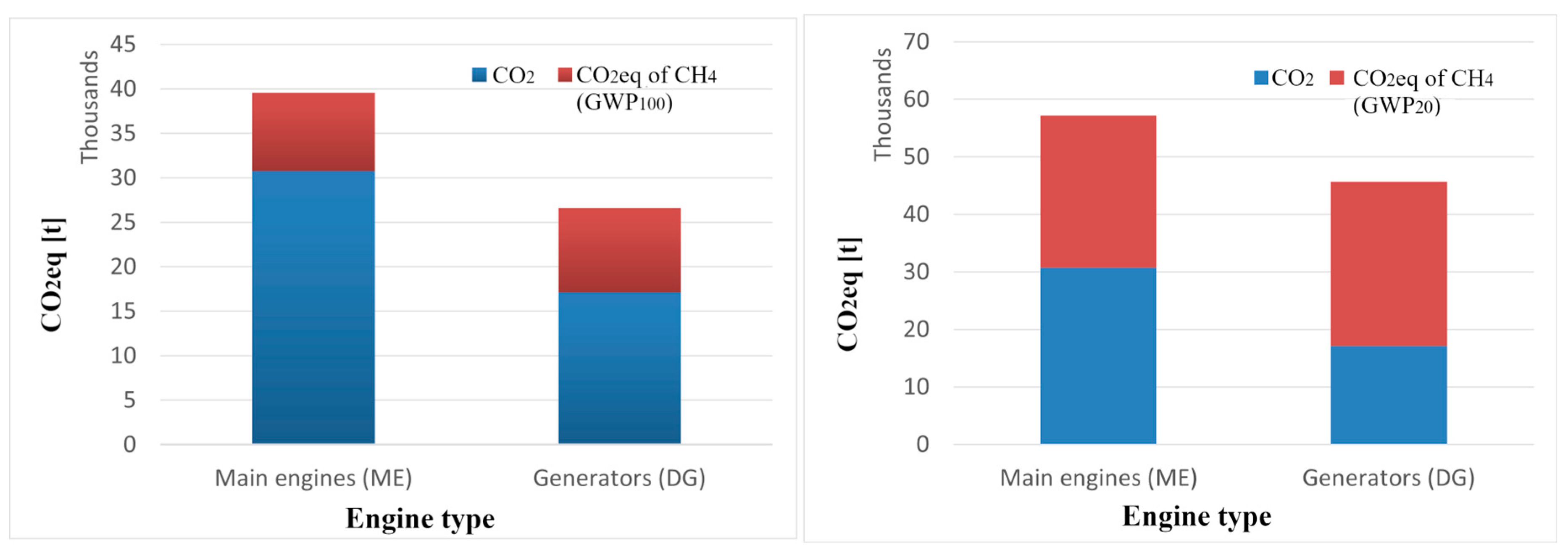
When emissions are expressed as CO2-equivalent, the relationship between the main engines and the generators changes. Although the main engines remain the dominant source of total emissions, the share of the auxiliary units increases because of their relatively larger contribution to CH4 emissions. This effect is even stronger under GWP20, where the generators account for a larger share of total CO2-equivalent than under GWP100. The distribution of CO2-equivalent by engine type, with separate contributions from CO2 and CH4, is shown in Figure 3.
To compare the contribution of the main engines and the auxiliary units more clearly, emissions were also analyzed as specific emission rates per operating hour. The results show that the main engines had about twice the CO2 emissions per operating hour (2.338 t/h) compared with the diesel generators (1.067 t/h), or about 2.2 times higher. Specific methane emissions per operating hour, however, were very similar for the two engine groups (0.024 t/h for the main engines and 0.021 t/h for the generators). When emissions are expressed as CO2-equivalent, the difference between the main engines and the generators becomes much smaller. The ratio between emissions from the main engines and the generators was about 1.81 for GWP100 and 1.53 for GWP20, which is much lower than the ratio based on CO2 emissions alone. Specific CO2-equivalent emissions were 3.008 t/h for the main engines and 1.660 t/h for the generators under GWP100 and 4.347 t/h and 2.846 t/h, respectively, under GWP20. These results show that, although generators have much lower CO2 emissions per operating hour, their relative contribution to total CO2-equivalent becomes more important because of methane emissions. Detailed emission rate values are given in the Supplementary Materials (Table S5).

3.3. Methane Slip and Its Variability

To quantify the effect of unburned methane on the total carbon footprint of the ship, methane slip was calculated for the main engines, the auxiliary generators, and the ship as a whole. Total methane slip during the analyzed period was 3.62%, with 2.74% for the main engines and 5.18% for the diesel generators. The higher slip in the generators agrees with the distribution of CH4 emissions by engine and with their relatively larger contribution to total CO2-equivalent. The resulting values are shown in Table 3.
Monthly methane slip values showed strong variability. The highest total values were recorded in September, October, and November 2024 (5.03%, 6.61% and 6.42%), while the lowest values were recorded in June and February 2025 (1.59% and 1.89%). Methane slip from the main engines was particularly high during the first three observed months, after which it decreased sharply and remained below 1% during the rest of the period. In contrast, generator slip remained elevated throughout the whole period, mostly in the range from 3.24% to 6.92%, which points to a consistently higher relative loss of unburned methane in the auxiliary power system than in the main engines.
The analysis of methane emission shares showed that its contribution to total CO2-equivalent changed considerably over the observed period. Relatively small changes in CO2 emissions from one month to another were not necessarily followed by proportional changes in total CO2-equivalent. For example, between October and November 2024, CO2 emissions increased moderately, while a stronger increase in total CO2-equivalent was recorded, indicating a significant influence of CH4 emissions. The monthly share of methane in total CO2-equivalent is shown in Figure 4.
Operational data for cargo/maneuvering modes suggest that months with more cargo/maneuvering hours were also among the months with higher methane slip and a larger relative contribution of methane to total CO2-equivalent. For example, September and October 2024 had 54.0 h and 39.5 h of cargo/maneuvering activity, with total slip values of 5.03% and 6.61%, while February and June 2025 had 0.0 h of such activity and lower total slip values of 1.89% and 1.59% (Supplementary Materials Table S3). Correlation analysis showed a positive relationship between methane slip and cargo hours (r = 0.692, p < 0.05) and between methane slip and total port hours (r = 0.691, p < 0.05), while the relationship with maneuvering hours was weaker (r = 0.553, p ≈ 0.10) (Supplementary Materials Table S4). These results suggest that the ship’s operating mode probably contributes to methane slip variability, although it does not explain it fully.

3.4. Comparison of LNG and HFO Scenarios

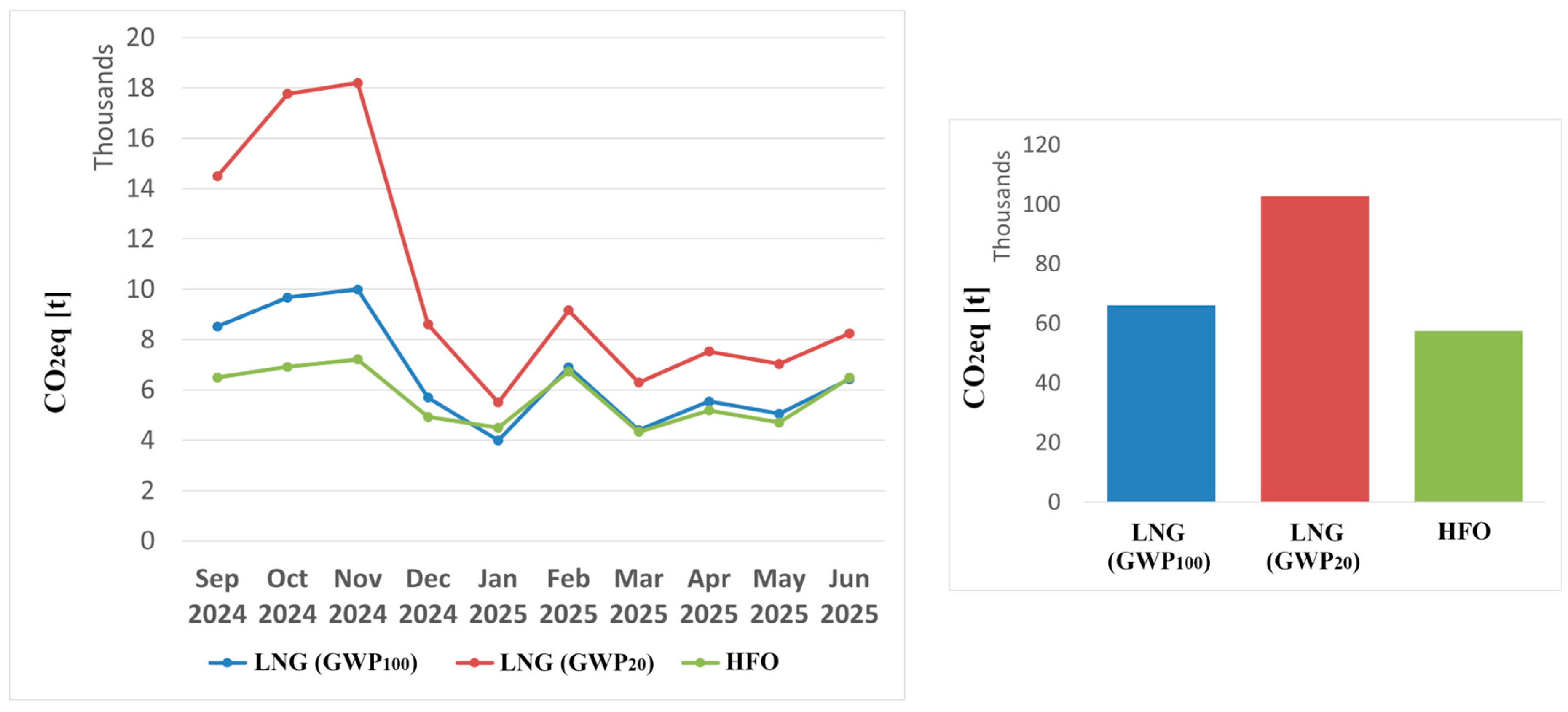
A comparison between actual LNG emissions and a hypothetical HFO operating scenario was made on the basis of LNG CO2-equivalent emissions shown in Table 1 and the HFO scenario defined in the Materials and Methods section. Monthly values for the HFO scenario and the relative differences compared with LNG CO2-equivalent emissions are shown in Table 4.
For the whole observed period, direct CO2 emissions under operation on LNG were 16.7% lower than the emissions estimated for the HFO scenario. However, after including CH4 and converting it into CO2-equivalent, total emissions under LNG operation were 15.2% higher than in the HFO scenario when GWP100 was used and 78.9% higher when GWP20 was used. The monthly comparison shows that LNG CO2-equivalent emissions under GWP100 were lower than the HFO scenario only in January and June 2025, while under GWP20 they were higher in all observed months. This indicates that the apparent CO2 advantage of LNG operation is strongly affected by methane slip, especially when the shorter GWP20 time horizon is applied. The monthly comparison of LNG and HFO scenarios, together with total values for the whole observed period, is shown in Figure 5.
These results show that including CH4 significantly changes the comparison between LNG and HFO scenarios, especially when GWP20 is applied.
To evaluate the influence of data uncertainty and methodological assumptions on the main conclusions, a sensitivity-based uncertainty assessment was performed (Supplementary Materials, Table S6). The tested cases included variations in measured CH4 emissions, measured CO2 emissions, and HFO reference emissions. The results showed that the exact numerical values of methane slip and CO2-equivalent emissions vary with the assumptions, but the main conclusion remained unchanged within the tested ranges: methane emissions substantially increase the assessed climate impact of LNG operation, especially when GWP20 is applied.

4. Discussion

4.1. Methane Slip and GWP Time Horizon

The results show that the climate impact of an LNG tanker cannot be assessed only from direct CO2 emissions. For the observed vessel, direct CO2 emissions were lower than those estimated for the hypothetical HFO scenario, but this advantage was not retained after measured CH4 emissions were included in the CO2-equivalent assessment. Total LNG emissions were 15.2% higher than the HFO scenario under GWP100 and 78.9% higher under GWP20. Therefore, the main interpretation is not that LNG is necessarily worse than HFO in all cases but that its climate performance depends strongly on methane slip and on the selected GWP time horizon.
This interpretation is consistent with recent literature, which questions the earlier and simpler view of LNG as automatically a “cleaner” fuel. Earlier studies on LNG as a marine fuel often emphasized its potential to reduce CO2 emissions, sulfur compounds, and some other air pollutants and presented it as a promising transition solution in shipping [20,23,29,44]. However, more recent studies show that the overall climate benefit of LNG can be greatly reduced or even completely lost when unburned methane emissions are taken into account [25,28,30]. The results obtained in this study support these observations using real operational data.
In this context, the difference between the GWP100 and GWP20 time horizons is particularly important. Methane has a relatively short atmospheric lifetime but a very high global warming potential over a shorter time horizon, so its contribution to total CO2-equivalent becomes much larger when GWP20 is used. In this study, the contribution of CH4 to total CO2-equivalent was 27.7% under GWP100, but as high as 53.5% under GWP20. This shows that the choice of GWP horizon is not only a technical detail of the calculation but also a methodological decision that can significantly change the conclusion about the overall climate impact of operation on LNG [13,14].

4.2. Role of Auxiliary Generators and Operating Conditions

Besides the choice of GWP horizon, the distribution of emissions among the individual engines on board is also important for a proper assessment of the climate impact of LNG-fueled operation. The results show that the main engines and the diesel generators have different roles in the ship’s total climate impact. The main engines dominate CO2 emissions, while CH4 emissions are more evenly distributed between the main engines and the diesel generators. As a result, the generators, despite their smaller contribution to CO2 emissions, still make a significant contribution to total CO2-equivalent because of their relatively higher methane emissions.
This is also reflected in the methane slip values. Total methane slip in this study was 3.62%, with 2.74% for the main engines and 5.18% for the diesel generators. This total value is close to the average value of 3.8% reported in another LNG carrier case [19], where generator engines were also identified as an important source of methane emissions. Additional confirmation of the importance of the generators is given by the specific emission rates per operating hour. The main engines had about 2.2 times higher CO2 emissions per operating hour than the generators, but CH4 emissions per operating hour were very similar for both engine groups. Therefore, the relative importance of the generators increased when emissions were expressed as CO2-equivalent. This confirms that auxiliary engines and generators should not be neglected in the climate assessment of LNG-fueled ships [19,37].
The monthly results indicate that operating conditions also affected methane slip variability. Months with more cargo/maneuvering activity and port-related operation were among the months with higher methane slip and higher methane contribution to CO2-equivalent emissions. Correlation analysis showed a positive relationship between methane slip and cargo hours, while the relationship with maneuvering hours was somewhat weaker. Because the number of monthly observations was limited, these results should not be interpreted as proof of direct causality but rather as an indication that operating modes related to cargo operations and varying engine loads may contribute to methane slip variability. These interpretations are in line with studies showing that methane slip depends on engine type, engine load and actual operating conditions [18,19,31,32,37].

4.3. Value of Onboard Monitoring

The variability of methane slip described above confirms the importance of using a Tier III approach based on real operational emission data rather than only on standardized emission factors. Standardized emission factors, although useful for wider inventories and preliminary assessments, cannot always capture the variability of the real operation of a specific ship [34,35,36]. The results of this study clearly show that, without real CH4 emission data, the total climate impact of the observed ship would not have been properly assessed. In this sense, the findings support the conclusions of studies that stress the need for real onboard measurements and more detailed operational data when assessing emissions from LNG ships [18,19,27,33,37]. This is especially important in the context of current regulatory changes, since EU ETS and MRV Maritime include CH4 from 2026 and 2024, respectively. This makes methane emissions increasingly relevant not only for scientific assessment but also for the regulatory framework of maritime transport [4,5]. From an operational perspective, such monitoring can help identify engine groups and operating periods associated with higher methane contribution to CO2-equivalent emissions and can support engine-load management, maintenance planning, and future methane slip mitigation measures.

4.4. Study Limitations

Several limitations of this study should be noted. Since the analysis was carried out on one ship and over one ten-month period, the study should be interpreted as an exploratory operational assessment rather than as a fleet-wide evaluation of LNG-fueled vessels. Therefore, the results cannot be directly extended to all LNG tankers, all types of LNG-fueled systems, or all operational profiles. Methane slip was not measured directly but was calculated from measured CO2 and CH4 emissions using a stoichiometric approach. In addition, daily data were used, which means that it was not possible to analyze short transient operating modes and instantaneous engine loads in detail. Even so, the results clearly show that methane slip has a strong effect on the assessment of the climate impact of operation on LNG and that ignoring it may lead to incorrect conclusions about the environmental performance of LNG.

5. Conclusions

This paper analyzed the carbon footprint of an LNG tanker using EMSYS data collected over a ten-month period, with special attention given to methane emissions and their contribution to total CO2-equivalent. The results show that operation on LNG reduces direct CO2 emissions but does not necessarily lead to lower total greenhouse gas emissions once methane slip is included in the analysis. In the observed case, total methane slip was 3.62%, with higher slip recorded for the diesel generators than for the main engines. This confirms the importance of including all onboard emission sources and not only the main engines. Methane emissions had a major effect on the total climate impact, especially when the GWP20 factor was applied.
When CH4 emissions were included and converted into CO2-equivalent, the overall climate impact of operation on LNG in the observed case became comparable to, or even worse than, the HFO scenario, especially when GWP20 was used. The results also show that an approach based on real operational data is of key importance, because standardized emission factors cannot always capture the variability of methane slip and the distribution of emissions among engines. Therefore, LNG may be considered a possible transition solution, but its climate advantage depends strongly on the level of methane slip, the ship’s operational profile, and the emission assessment methodology. Future studies should include a larger number of ships, longer observation periods, and more direct methane slip measurements.
From a practical and regulatory perspective, the results support the wider use of onboard monitoring systems that record both CO2 and CH4 emissions, especially for LNG-fueled ships. Future regulatory and technical assessments should account for methane slip explicitly and should distinguish between main and auxiliary engines where possible. For ship operators, particular attention should be given to operating conditions and engine groups associated with higher methane slip, since these can substantially affect the overall CO2-equivalent performance of LNG operation.

Supplementary Materials

The following supporting information can be downloaded at: https://www.mdpi.com/article/10.3390/jmse14121087/s1, Table S1: Monthly engine operating hours and ship operational modes (main engines, auxiliary generators, sea/port distribution). Table S2: Estimated CO2-equivalent emissions for the HFO scenario by month. Table S3: Methane slip and operational parameters (cargo, maneuvering, and port hours) by month. Table S4: Correlation between methane slip and operational modes (Pearson correlation coefficients and p-values). Table S5: Specific emissions and emission rates by engine type. Table S6: Sensitivity analysis of the influence of input-data and calculation assumptions on methane slip, CO2-equivalent emissions, and LNG–HFO comparison.

Author Contributions

Conceptualization, L.S., T.S. and M.M.; methodology, M.M. and T.S.; software, B.Z. and M.M.; validation, L.S. and T.S.; formal analysis, L.S. and M.M.; investigation, B.Z. and M.M.; resources, B.Z.; data curation, M.M. and B.Z.; writing—original draft preparation, M.M., B.Z. and T.S.; writing—review and editing, L.S., T.S. and M.M.; visualization, M.M.; supervision, T.S. and L.S.; project administration, T.S. and M.M.; funding acquisition, B.Z. All authors have read and agreed to the published version of the manuscript.

Funding

This paper/research or part of it was funded by the European Union (NextGenerationEU) under the Croatian Recovery and Resilience Plan 2021–2026 (NRRP), through the University of Split institutional project “Energy Efficiency and Reduction of Harmful Gas Emissions in Maritime Transport through Integrated Technical and Operational Measures (EnEMar)—IP-UNIST-39”, approved by the Ministry of Science, Education and Youth of the Republic of Croatia. Views and opinions expressed are, however, those of the author(s) only and do not necessarily reflect those of the European Union or the European Commission. Neither the European Union nor European Commission can be held responsible for them.

Data Availability Statement

Aggregated data supporting the findings of this study are presented in the article and/or Supplementary Materials.

Acknowledgments

The authors would like to thank Zdeslav Jurić, Filip Bojić, Ante Čalić and Goran Rilje (University of Split, Faculty of Maritime Studies) for their valuable suggestions and for the time they generously devoted to the fundamental preparation of this work.

Conflicts of Interest

The authors declare no conflicts of interest.

Abbreviations

The following abbreviations are used in this manuscript:
BOGBoil-Off Gas
CO2Carbon Dioxide
CH4Methane
CO2-eqCarbon Dioxide Equivalent
DGDiesel Generator
DCSData Collection System
EMSYSEmission Monitoring System
GHGGreenhouse Gas
GWPGlobal Warming Potential
GWP100Global Warming Potential (100-year horizon)
GWP20Global Warming Potential (20-year horizon)
HFOHeavy Fuel Oil
IMOInternational Maritime Organization
LNGLiquefied Natural Gas
MEMain Engine
MRVMonitoring, Reporting and Verification of Maritime Transport Emissions
TtWTank-to-Wake
WtTWell-to-Tank
WtWWell-to-Wake

References

  1. Eyring, V.; Isaksen, I.S.A.; Berntsen, T.; Collins, W.J.; Corbett, J.J.; Endresen, O.; Grainger, R.G.; Moldanova, J.; Schlager, H.; Stevenson, D.S. Transport impacts on atmosphere and climate: Shipping. Atmos. Environ. 2010, 44, 4735–4771. [Google Scholar] [CrossRef]
  2. Faber, J.; Hanayama, S.; Zhang, S.; Pereda, P.; Comer, B.; Hauerhof, E.; van der Loeff, W.S.; Smith, T.; Zhang, Y.; Kosaka, H.; et al. Fourth IMO Greenhouse Gas Study. 2020. Available online: https://www.imo.org/en/ourwork/environment/pages/fourth-imo-greenhouse-gas-study-2020.aspx (accessed on 21 April 2026).
  3. IMO, 2023 IMO Strategy on Reduction of GHG Emissions from Ships, 2023. Available online: https://www.imo.org/en/ourwork/environment/pages/2023-imo-strategy-on-reduction-of-ghg-emissions-from-ships.aspx (accessed on 20 April 2026).
  4. European Commission. The EU ETS and MRV Maritime General Guidance for Shipping Companies. 2025. Available online: https://climate.ec.europa.eu/document/download/31875b4f-39b9-4cde-a4e2-fbb8f65ee703_en?filename=policy_transport_shipping_gd1_maritime_en.pdf (accessed on 29 April 2026).
  5. European Commission. Monitoring, Reporting and Verification of Maritime Transport Emissions, 2025. Available online: https://climate.ec.europa.eu/eu-action/transport-decarbonisation/reducing-emissions-shipping-sector_en (accessed on 20 April 2026).
  6. Li, Z.; Wang, K.; Liang, H.; Wang, Y.; Ma, R.; Cao, J.; Huang, L. Marine alternative fuels for shipping decarbonization: Technologies, applications and challenges. Energy Convers. Manag. 2025, 329, 119641. [Google Scholar] [CrossRef]
  7. Wang, K.; Li, Z.; Liu, X.; Hu, Z.; Huang, L.; Song, Q.; Liang, H.; Jiang, X. Wind-assisted propulsion system for shipping decarbonization: Technologies, applications and challenges. Energy 2025, 336, 138420. [Google Scholar] [CrossRef]
  8. Li, Z.; Wang, K.; Ruan, Z.; Li, D.; Liang, H.; Ma, R.; Cao, J.; Huang, L. A fuel consumption prediction model for wind-assisted ship based on operational data. Transp. Res. D Transp. Environ. 2025, 149, 105045. [Google Scholar] [CrossRef]
  9. Wiedmann, T.; Minx, J. A Definition of “Carbon Footprint”. In Ecological Economics Research Trends; ISA UK Research Report 07-01; Nova Science Publishers: Hauppauge, NY, USA, 2007. [Google Scholar]
  10. Pandey, D.; Agrawal, M.; Pandey, J.S. Carbon footprint: Current methods of estimation. Environ. Monit. Assess. 2011, 178, 135–160. [Google Scholar] [CrossRef]
  11. Matthews, H.S.; Hendrickson, C.T.; Weber, C.L. The importance of carbon footprint estimation boundaries. Environ. Sci. Technol. 2008, 42, 5839–5842. [Google Scholar] [CrossRef] [PubMed]
  12. Lee, H.; Romero, J. IPCC Climate Change 2023 Synthesis Report; IPCC: Geneva, Switzerland, 2023. [Google Scholar] [CrossRef]
  13. Myhre, G.; Shindell, D.; Bréon, F.; Collins, W.; Fuglestvedt, J.; Huang, J.; Koch, D.; Lamarque, J.; Lee, D.; Mendoza, B.; et al. Anthropogenic and Natural Radiative Forc-ing. In Climate Change 2013: The Physical Science Basis; Cambridge University Press: Cambridge, UK, 2013. [Google Scholar]
  14. Balcombe, P.; Speirs, J.F.; Brandon, N.P.; Hawkes, A.D. Methane emissions: Choosing the right climate metric and time horizon. Environ. Sci. Process. Impacts 2018, 20, 1323–1339. [Google Scholar] [CrossRef]
  15. Edwards, R.; Larive, J.-F.; Rickeard, D.; Hamje, H.; Godwin, S.; Hass, H.; Krasen-brink, A.; Lonza, L.; Maas, H.; Nelson, R.; et al. JEC Well-to-Wheels Analysis; Publications Office of the European Union: Luxembourg, 2014. [Google Scholar] [CrossRef]
  16. Gilbert, P.; Walsh, C.; Traut, M.; Kesieme, U.; Pazouki, K.; Murphy, A. Assessment of full life-cycle air emissions of alternative shipping fuels. J. Clean. Prod. 2018, 172, 855–866. [Google Scholar] [CrossRef]
  17. IMO. Resolution MEPC.391(81) 2024 Guidelines on Life Cycle GHG Intensity of Marine Fuels. 2024. Available online: https://wwwcdn.imo.org/localresources/en/KnowledgeCentre/IndexofIMOResolutions/MEPCDocuments/MEPC.391(81).pdf (accessed on 27 April 2026).
  18. Ushakov, S.; Stenersen, D.; Einang, P.M. Methane slip from gas fuelled ships: A comprehensive summary based on measurement data. J. Mar. Sci. Technol. 2019, 24, 1308–1325. [Google Scholar] [CrossRef]
  19. Balcombe, P.; Heggo, D.A.; Harrison, M. Total Methane and CO2Emissions from Liquefied Natural Gas Carrier Ships: The First Primary Measurements. Environ. Sci. Technol. 2022, 56, 9632–9640. [Google Scholar] [CrossRef]
  20. Bouman, E.A.; Lindstad, E.; Rialland, A.I.; Strømman, A.H. State-of-the-art technologies; measures, and potential for reducing GHG emissions from shipping—A review. Transp. Res. D Transp. Environ. 2017, 52, 408–421. [Google Scholar] [CrossRef]
  21. Lindstad, E.; Eskeland, G.S.; Rialland, A.; Valland, A. Decarbonizing Maritime Transport: The Importance of Engine Technology and Regulations for LNG to Serve as a Transition Fuel. Sustainability 2020, 12, 8793. [Google Scholar] [CrossRef]
  22. Balcombe, P.; Brierley, J.; Lewis, C.; Skatvedt, L.; Speirs, J.; Hawkes, A.; Staffell, I. How to decarbonise international shipping: Options for fuels, technologies and policies. Energy Convers. Manag. 2019, 182, 72–88. [Google Scholar] [CrossRef]
  23. Burel, F.; Taccani, R.; Zuliani, N. Improving sustainability of maritime transport through utilization of Liquefied Natural Gas (LNG) for propulsion. Energy 2013, 57, 412–420. [Google Scholar] [CrossRef]
  24. Seddiek, I.S. An Overview: Environmental and Economic Strategies for Improving Quality of Ships Exhaust Gases. Int. J. Marit. Eng. 2015, 157, A53–A64. [Google Scholar] [CrossRef]
  25. Pavlenko, N.; Comer, B.; Zhou, Y.; Clark, N.; Rutherford, D. The Climate Implications of Using LNG as a Marine Fuel, 2020. Available online: www.theicct.org (accessed on 20 April 2026).
  26. Stanivuk, T.; Korljan, D.; Stazić, L. Modeling the Future of Liquefied Natural Gas Transportation: Regression Analysis of Historical Data and Fleet Development Scenarios. Appl. Sci. 2025, 15, 5973. [Google Scholar] [CrossRef]
  27. Kuittinen, N. Methane Slip Emissions from LNG Vessels-Review Emission Reduction Technologies-Exhaust Gas Aftertreatment Solutions. Available online: https://www.cimac.com (accessed on 20 April 2026).
  28. Howarth, R.W. The greenhouse gas footprint of liquefied natural gas (LNG) exported from the United States. Energy Sci. Eng. 2024, 12, 4843–4859. [Google Scholar] [CrossRef]
  29. Bengtsson, S.; Andersson, K.; Fridell, E. A comparative life cycle assessment of marine fuels: Liquefied natural gas and three other fossil fuels. Proc. Inst. Mech. Eng. Part M J. Eng. Marit. Environ. 2011, 225, 97–110. [Google Scholar] [CrossRef]
  30. Balcombe, P.; Staffell, I.; Kerdan, I.G.; Speirs, J.F.; Brandon, N.P.; Hawkes, A.D. How can LNG-fuelled ships meet decarbonisation targets? An environmental and economic analysis. Energy 2021, 227, 120462. [Google Scholar] [CrossRef]
  31. Kuittinen, N.; Koponen, P.; Vesala, H.; Lehtoranta, K. Methane slip and other emissions from newbuild LNG engine under real-world operation of a state-of-the art cruise ship. Atmos. Environ. X 2024, 23, 100285. [Google Scholar] [CrossRef]
  32. Sagot, B.; Defossez, R.; Mahi, R.; Villot, A.; Joubert, A. An Engine Load Monitoring Approach for Quantifying Yearly Methane Slip Emissions from an LNG-Powered RoPax Vessel. J. Mar. Sci. Eng. 2025, 13, 1379. [Google Scholar] [CrossRef]
  33. Kuittinen, N.; Heikkilä, M.; Vesala, H.; Karppanen, M.; Koponen, P.; Piimäkorpi, P.; Jalkanen, J.P.; Lehtoranta, K. Real-World Methane Emissions Measured On-Board Two LNG-Fueled Vessels. In Transport Transitions: Advancing Sustainable and Inclusive Mobility; Lecture Notes in Mobility; Springer: Cham, Switzerland, 2025; pp. 445–451. [Google Scholar] [CrossRef]
  34. Third IMO GHG Study 2014. Available online: https://www.imo.org/en/ourwork/environment/pages/greenhouse-gas-studies-2014.aspx (accessed on 21 April 2026).
  35. IPCC. 2006 IPCC Guidelines for National Greenhouse Gas Inventories, Volume 1: General Guidance and Reporting. 2006. Available online: https://www.ipcc-nggip.iges.or.jp/public/2006gl/vol1.html (accessed on 21 April 2026).
  36. EEA. EMEP/EEA Air Pollutant Emission Inventory Guidebook 2023; EEA: Copenhagen, Denmark, 2023. [Google Scholar] [CrossRef]
  37. Kuittinen, N.; Heikkilä, M.; Lehtoranta, K. Review of Methane Slip from LNG Engines, 2023. Available online: https://tuhat.helsinki.fi/ws/portalfiles/portal/282364163/D1.1_Review_of_methane_slip_from_LNG_engines.pdf (accessed on 4 June 2026).
  38. Sjerić, M.; Perčić, M.; Jovanović, I.; Vladimir, N. Carbon Footprint and Economic Analysis of LNG-fueled Fishing Vessel Using Real Engine Performance Simulation. J. Mar. Sci. Appl. 2026, 25, 259–276. [Google Scholar] [CrossRef]
  39. Schinas, O.; Butler, M. Feasibility and commercial considerations of LNG-fueled ships. Ocean. Eng. 2016, 122, 84–96. [Google Scholar] [CrossRef]
  40. VPS EmSys, Marine Approved Emissions and Particulate Matter Monitoring Systems. 2024. Available online: https://www.vpsveritas.com/sites/default/files/2024-11/vps_emsys_marine_approved_emissions_and_particulate_matter_monitoring_systems_brochure_0.pdf (accessed on 20 April 2026).
  41. IMO. IMO Data Collection System (DCS), 2023. Available online: https://www.imo.org/en/ourwork/environment/pages/data-collection-system.aspx (accessed on 20 April 2026).
  42. Franic, Z. Praćenje, Izvještavanje i Provjera Emisija CO2 u Pomorskom Prometu. Sigur. Časopis Za Sigur. U Radn. I Zivotn. Okolini 2021, 63, 198–201. [Google Scholar] [CrossRef]
  43. IMO. Resolution MEPC.308(73) 2018 Guidelines on the Method of Calculation of the Attained Energy Efficiency Design Index (EEDI) for New Ships. 2018. Available online: https://imorules.com/MEPCRES_308.73.html (accessed on 20 April 2026).
  44. Brynolf, S.; Fridell, E.; Andersson, K. Environmental assessment of marine fuels: Liquefied natural gas, liquefied biogas, methanol and bio-methanol. J. Clean. Prod. 2014, 74, 86–95. [Google Scholar] [CrossRef]
Figure 1. Contribution of direct CO2 emissions and methane-derived CO2-equivalent contribution to total CO2-equivalent emissions for GWP100 (left) and GWP20 (right).
Jmse 14 01087 g001
Figure 2. Total CO2 (left) and CH4 (right) emissions by engine during the observed period. Inset charts show the relative contribution of main engines and diesel generators.
Jmse 14 01087 g002
Figure 3. CO2-equivalent emissions by engine type, showing separate contributions from direct CO2 emissions and methane-derived CO2-equivalent for GWP100 (left) and GWP20 (right).
Jmse 14 01087 g003
Figure 4. Monthly share of methane contribution in total CO2-equivalent for GWP100 and GWP20.
Jmse 14 01087 g004
Figure 5. Monthly comparison of LNG CO2-equivalent emissions for GWP100 and GWP20 with the hypothetical HFO scenario (left) and total emissions over the observed period (right). Numerical values and relative differences are provided in Table 4.
Jmse 14 01087 g005
Table 1. Monthly CO2 and CH4 emissions and corresponding CO2-equivalent emissions for the observed LNG operation.
MonthCO2
[t]
CH4
[t]
CO2eq (GWP100) [t]CO2eq (GWP20) [t]
Sep 20245532.91106.628518.2714,488.99
Oct 20245617.80144.599666.3117,763.33
Nov 20245877.98146.699985.2218,199.71
Dec 20244234.3852.035691.098604.52
Jan 20253232.1127.023988.625501.64
Feb 20255771.0440.336900.409159.11
Mar 20253461.9133.694405.316292.12
Apr 20254542.6835.515536.977525.54
May 20254058.6335.345048.247027.46
Jun 20255521.7432.426429.618245.33
Total47,851.19654.2466,170.04102,807.74
Table 2. CO2, CH4 and CO2-equivalent emissions by individual engines during the observed period.
EngineCO2 [t]CH4 [t]CO2eq (GWP100) [t]CO2eq (GWP20) [t]Share in CO2eq (GWP100)Share in CO2eq (GWP20)
ME115,104.17162.7919,662.3328,778.6529.7%28.0%
ME215,640.64151.6819,887.6828,381.7630.1%27.6%
DG12620.8655.254167.937262.066.3%7.1%
DG26119.47115.439351.4615,815.4214.1%15.4%
DG35719.9496.278415.6313,807.0012.7%13.4%
DG42646.1072.824685.028762.857.1%8.5%
Total47,851.19654.2466,170.04102,807.74100.0%100.0%
Table 3. Monthly and total methane slip values for main engines, diesel generators, and the entire ship.
MonthME Slip [%]DG Slip [%]Total Slip [%]
Sep 20244.89%5.36%5.03%
Oct 20246.44%6.92%6.61%
Nov 20246.28%6.81%6.42%
Dec 20241.30%5.83%3.27%
Jan 20250.39%5.06%2.25%
Feb 20250.68%5.06%1.89%
Mar 20250.59%4.66%2.61%
Apr 20250.36%4.41%2.10%
May 20250.39%4.41%2.34%
Jun 20250.79%3.24%1.59%
Total 2.74% 5.18% 3.62%
Table 4. Comparison of the hypothetical HFO scenario with LNG CO2-equivalent emissions. Percentage differences were calculated relative to the HFO scenario using LNG CO2-eq values under GWP100 and GWP20.
MonthHFO CO2eq [t]ΔLNG GWP100
vs. HFO [%]
ΔLNG GWP20
vs. HFO [%]
Sep 20246486.46+31.3+123.4
Oct 20246916.19+39.8+156.8
Nov 20247212.02+38.5+152.4
Dec 20244926.35+15.5+74.7
Jan 20254496.62−11.3+22.4
Feb 20256729.35+2.5+36.1
Mar 20254331.57+1.7+45.3
Apr 20255184.81+6.8+45.1
May 20254699.03+7.4+49.6
Jun 20256480.23−0.8+27.2
Total57,462.64+15.2+78.9
Disclaimer/Publisher’s Note: The statements, opinions and data contained in all publications are solely those of the individual author(s) and contributor(s) and not of MDPI and/or the editor(s). MDPI and/or the editor(s) disclaim responsibility for any injury to people or property resulting from any ideas, methods, instructions or products referred to in the content.