An Investigation on a Virtual Assembly System for Structural Experiments

 ,
,
Abstract
1. Introduction
1.1. Background
1.2. Research Gap and Contributions
1.3. Research Objective
2. Methodology
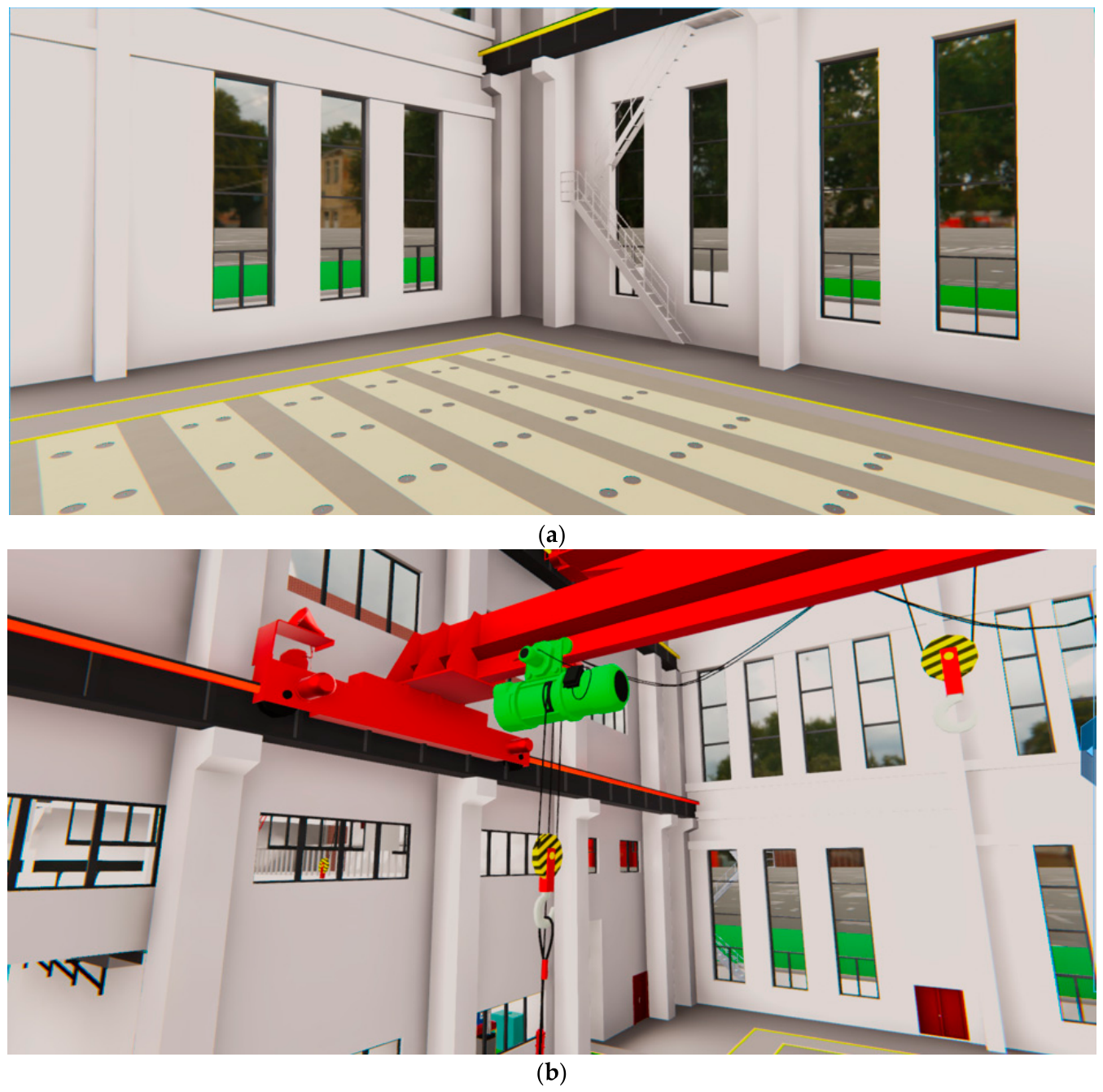
2.1. Modeling of the Experimental Scenario
2.1.1. 3D Geometric Modeling
2.1.2. Processing of Surfaces
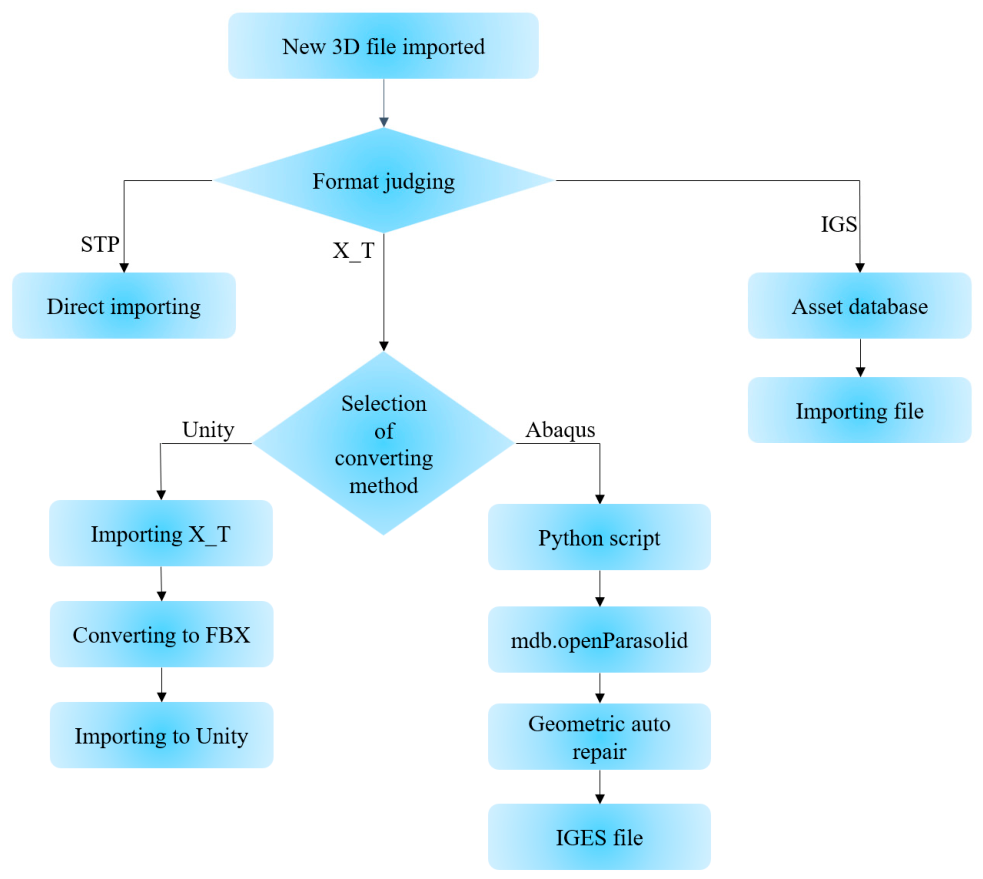
2.2. Importation of 3D Files
2.3. Parametric Modeling of Experimental Objects
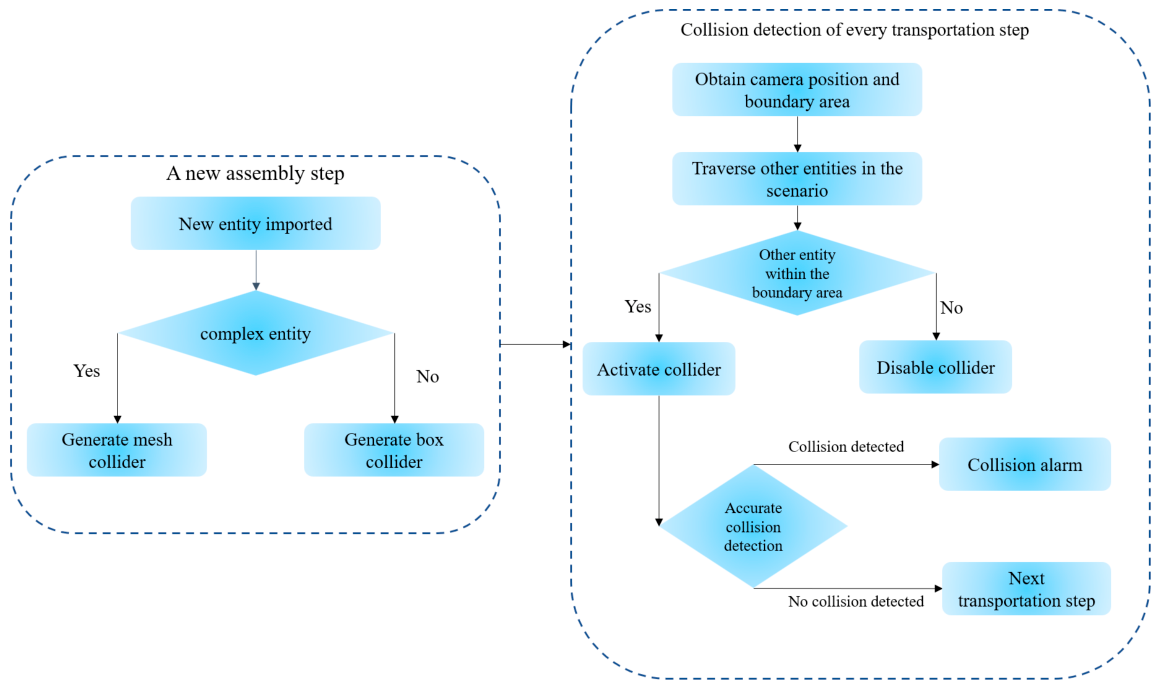
2.4. Design of Interference Detection Algorithm
2.5. Virtual Assembly
2.5.1. Virtual Assembly Perspectives
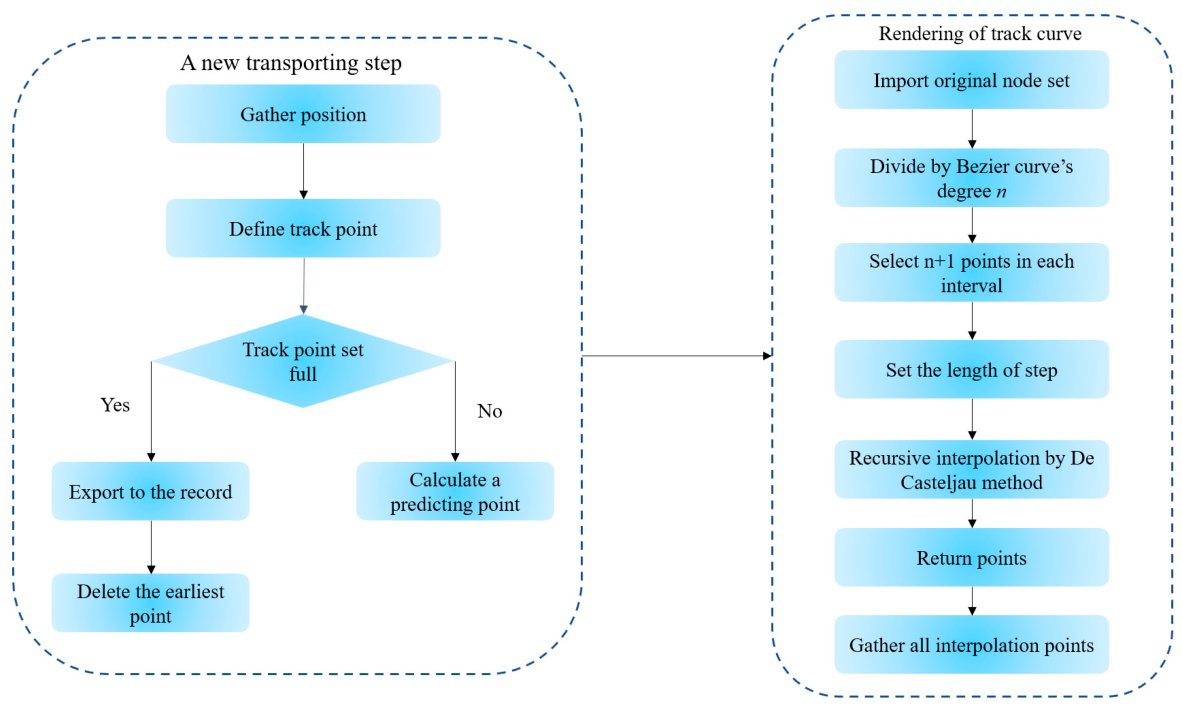
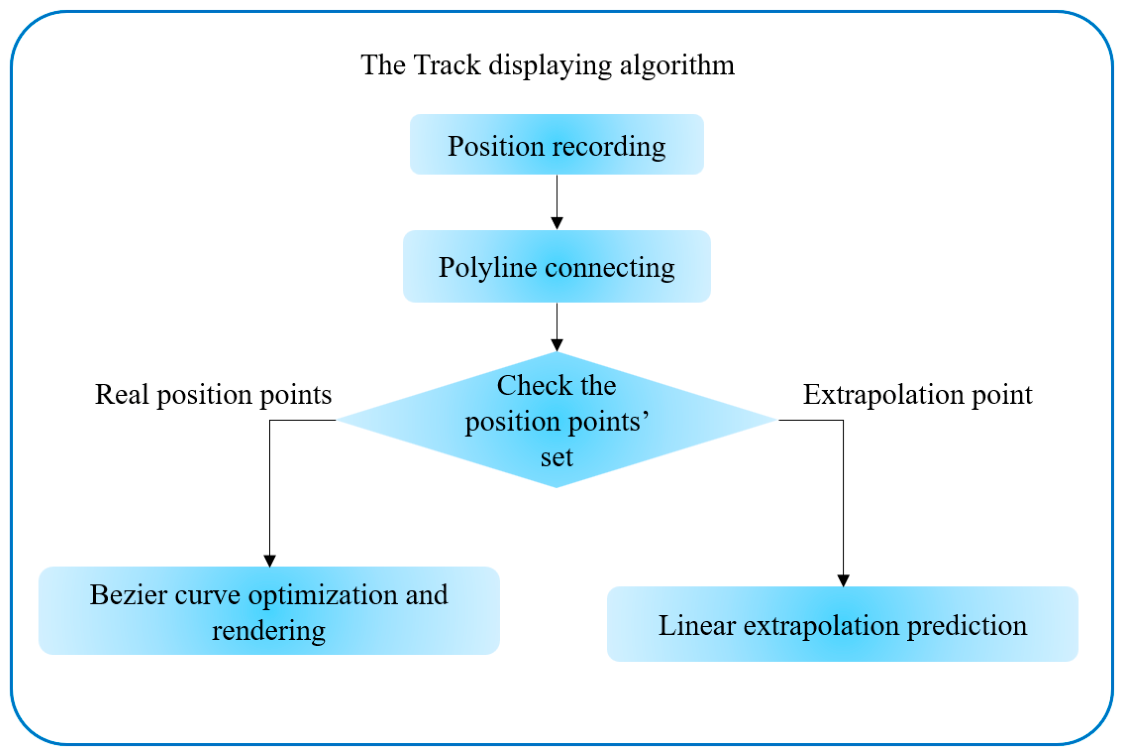
2.5.2. Track Managing Algorithm
3. Results
3.1. Construction of the Virtual Assembly System
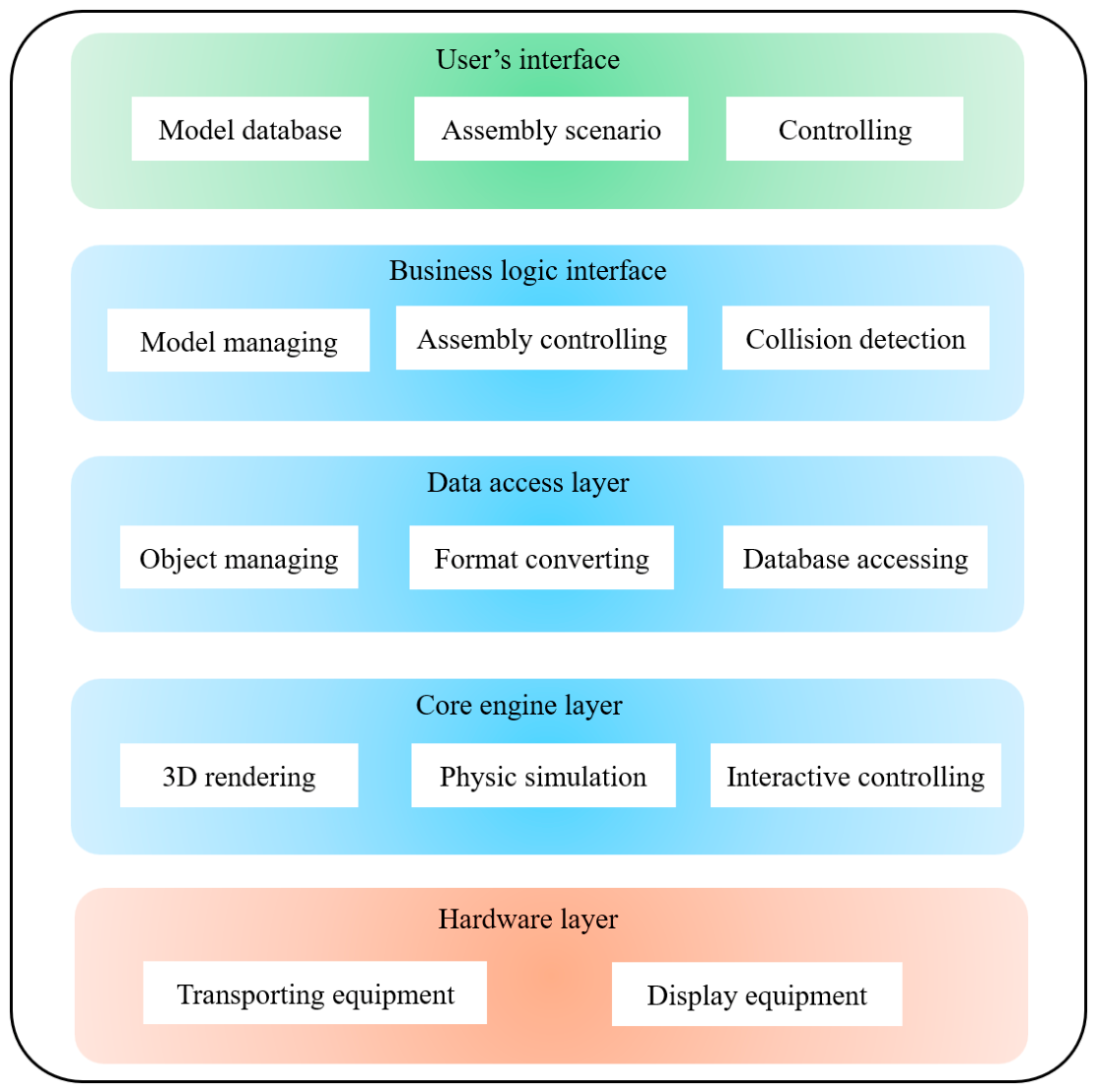
3.1.1. Architecture of the System
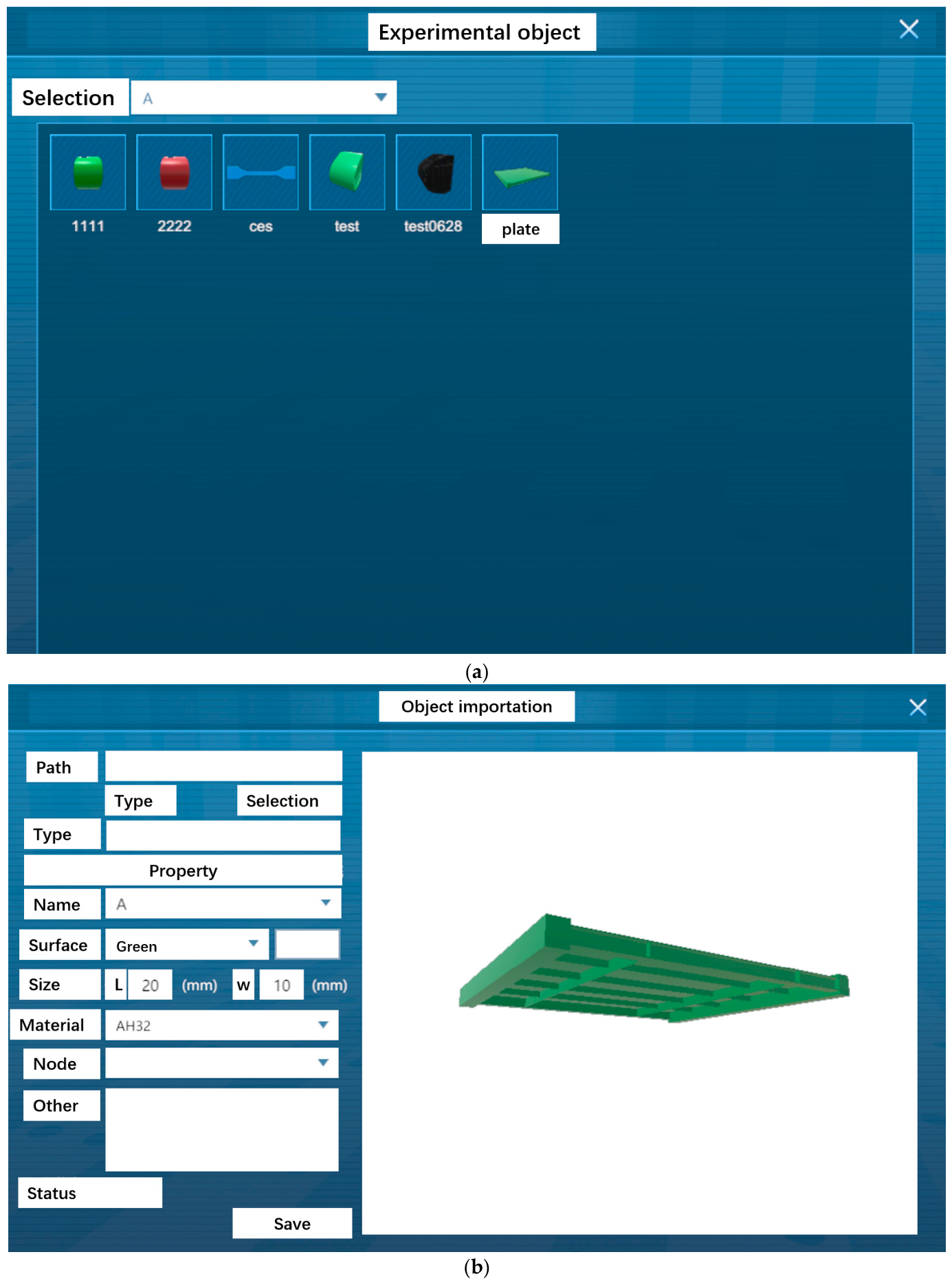
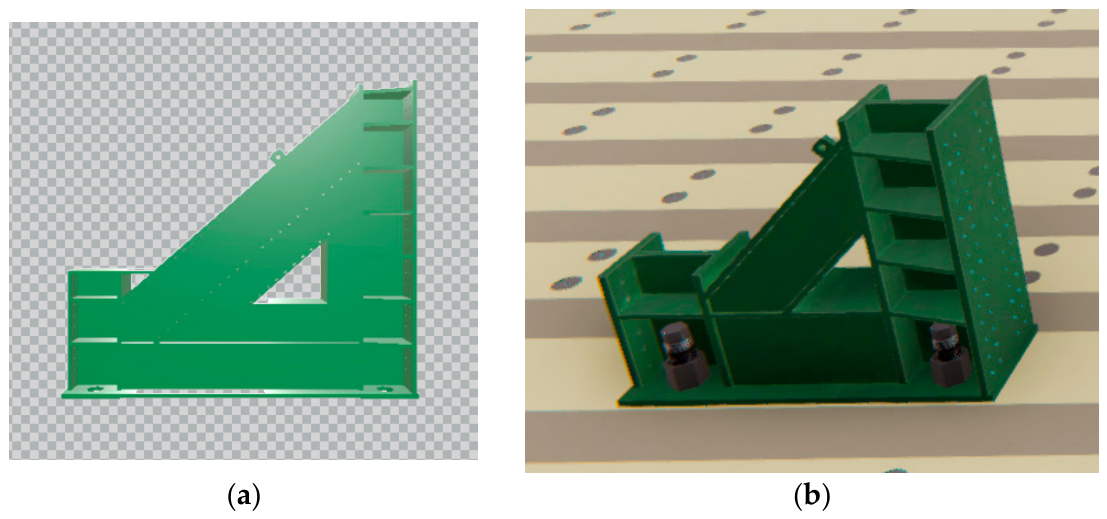
3.1.2. Database of Experimental Objects


3.1.3. Track Managing Mechanism
- (1)
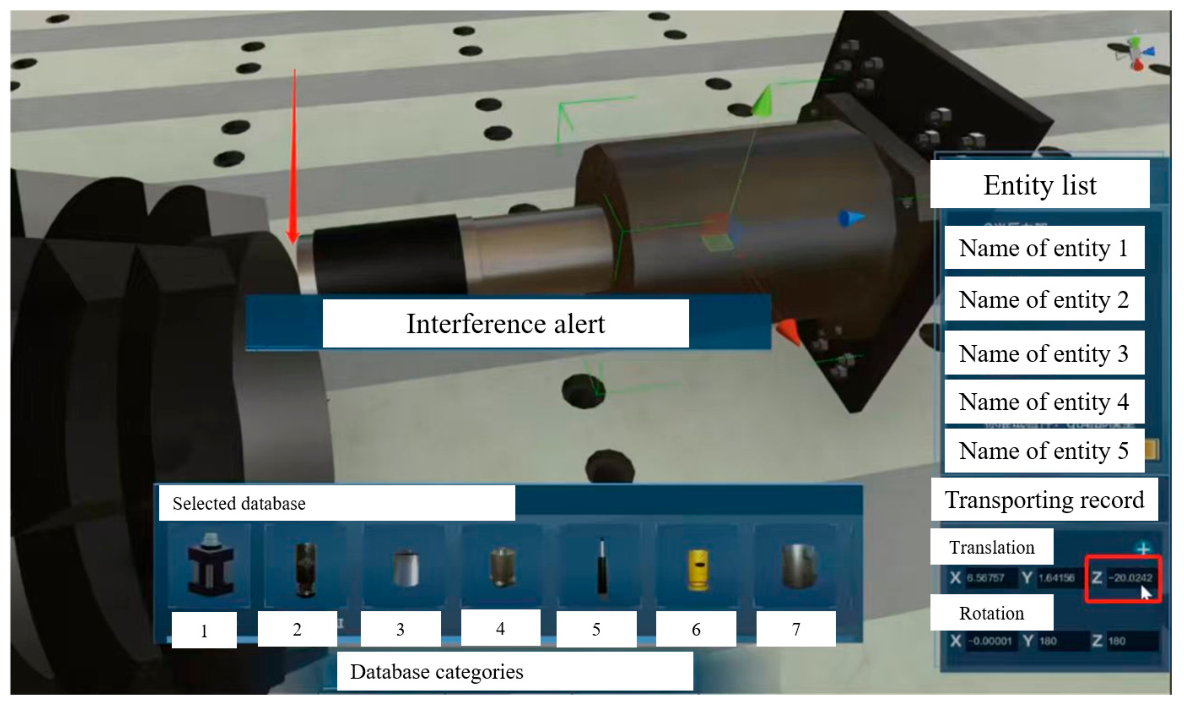
- Dynamic line drawing is adopted to control the starting position and final position of the object being transported. The color and width of the line can mark the spaces influenced by the object, and the real-time updating of vertex positions can record the important position in every assembly step.
- (2)
- Customizable materials and light rendering of the transportation track can be employed to distinguish each assembly step and identify possible interferences in the assembly process.
- (3)
- The interactive application that combines mouse clicking and manual input is employed to realize functions such as freehand drawing and path tracking.
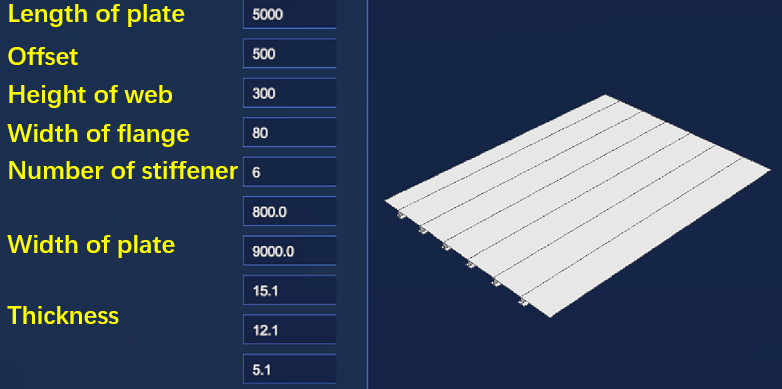
3.2. Effects of Parametric Modeling
3.3. Virtual Assembly Operations
3.4. Validation of Functions
4. Conclusions
- (1)
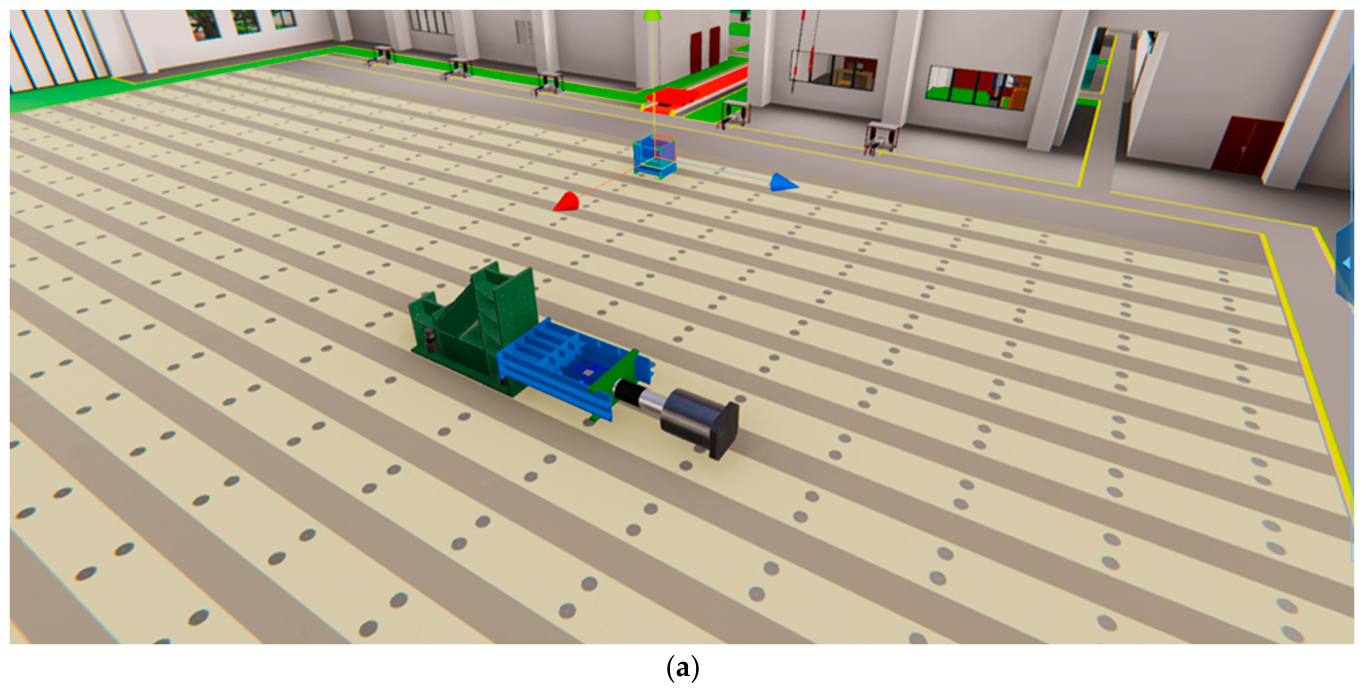
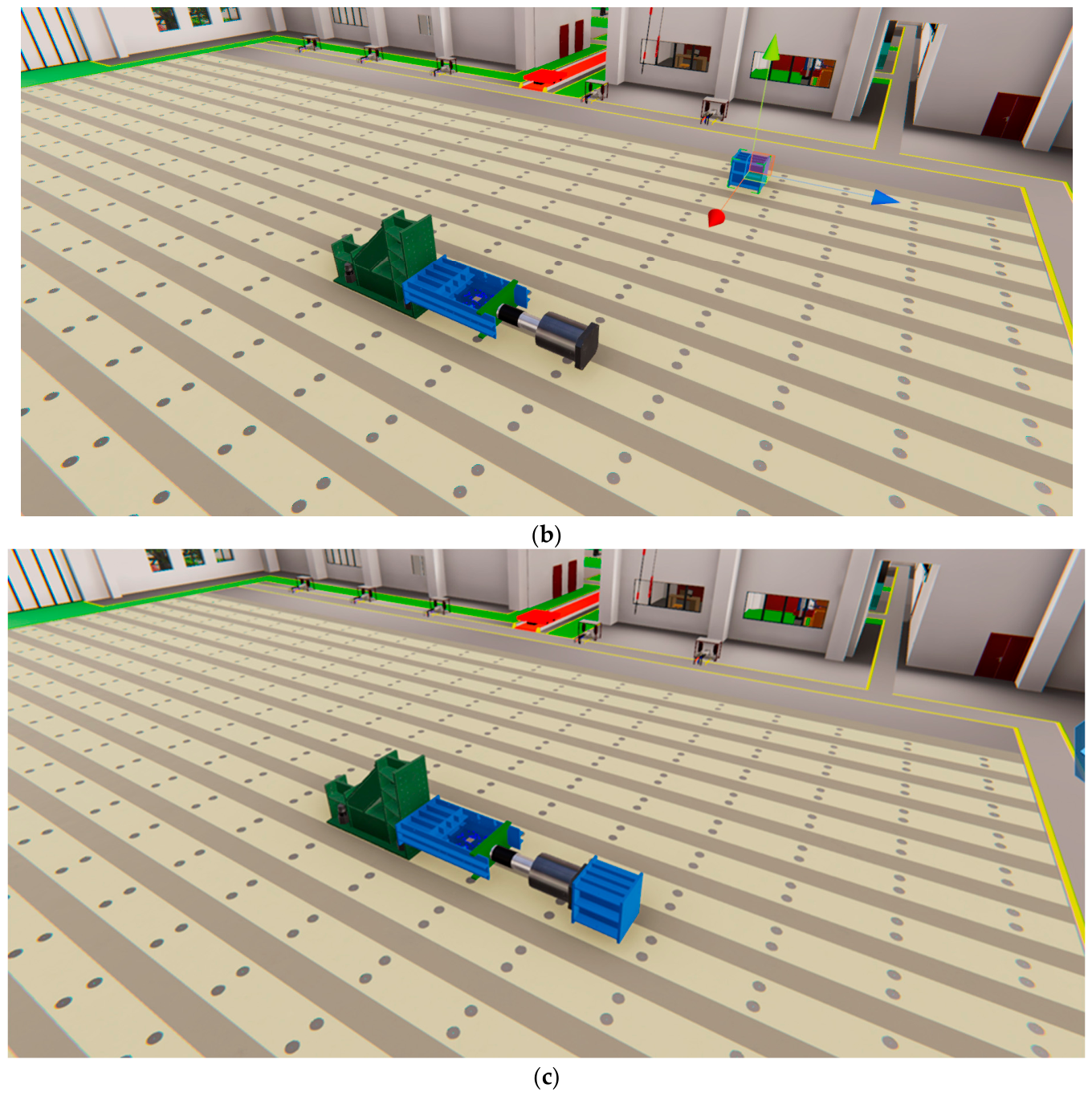
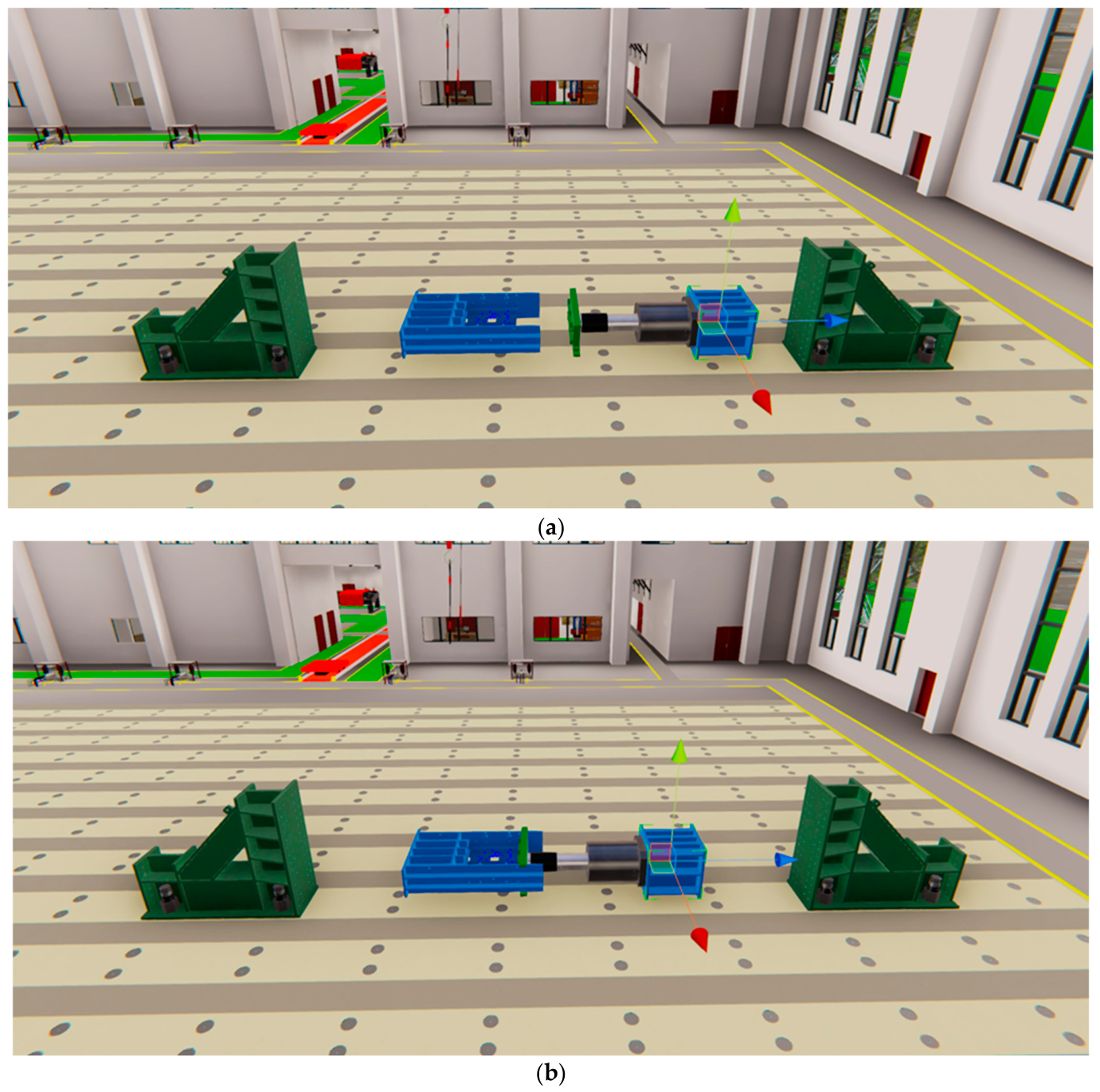
- According to the connection between different parts, the assembly of each structural experimental device is divided into different assembly steps; every assembly step consists of transportation/installation steps of each entity. A bounding area model is employed to activate collision bodies, which is influenced by the distances between entities.
- (2)
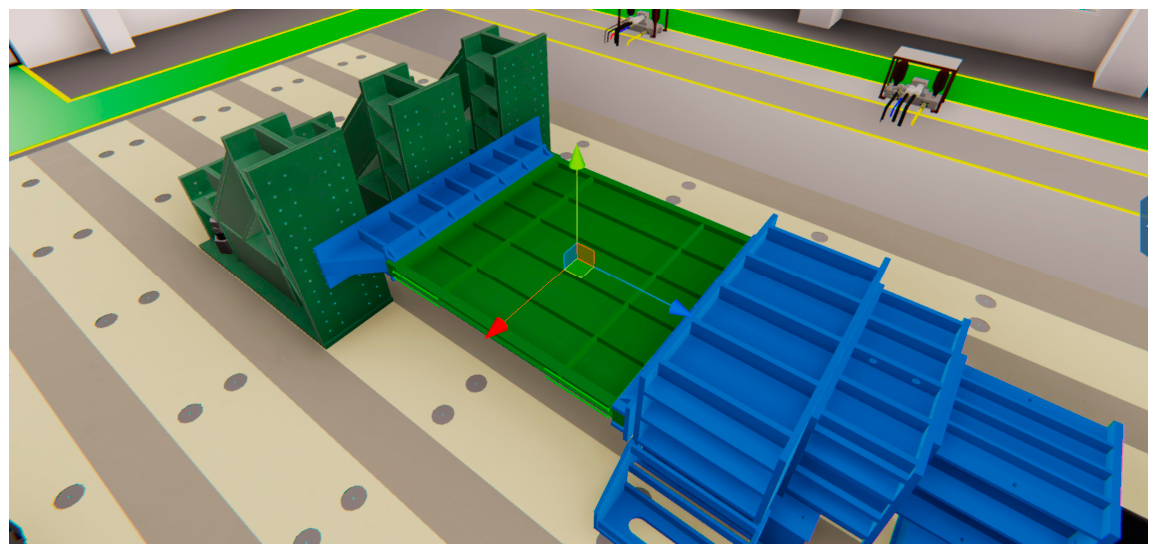
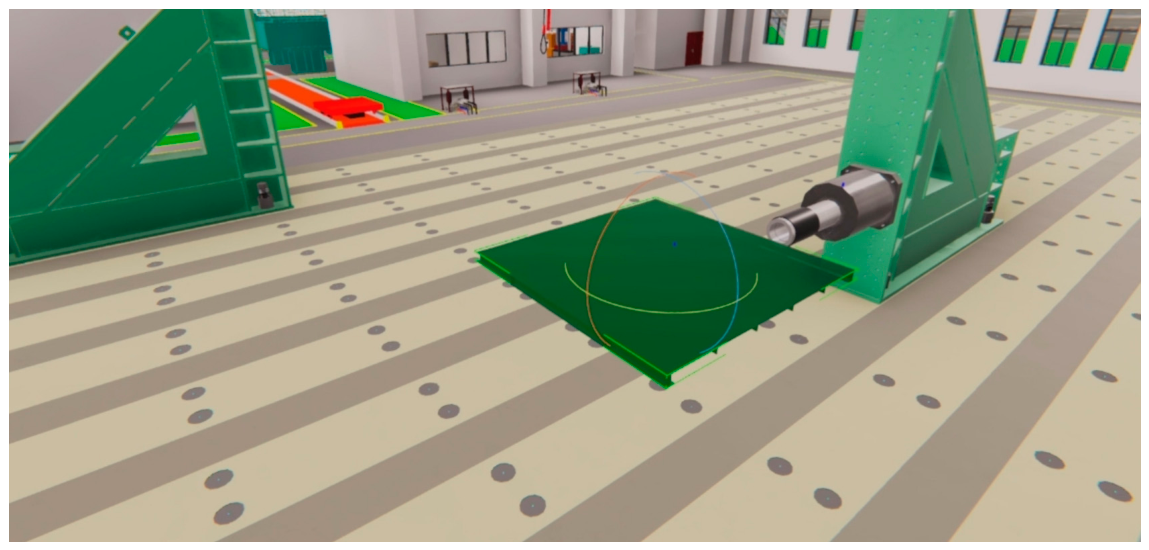
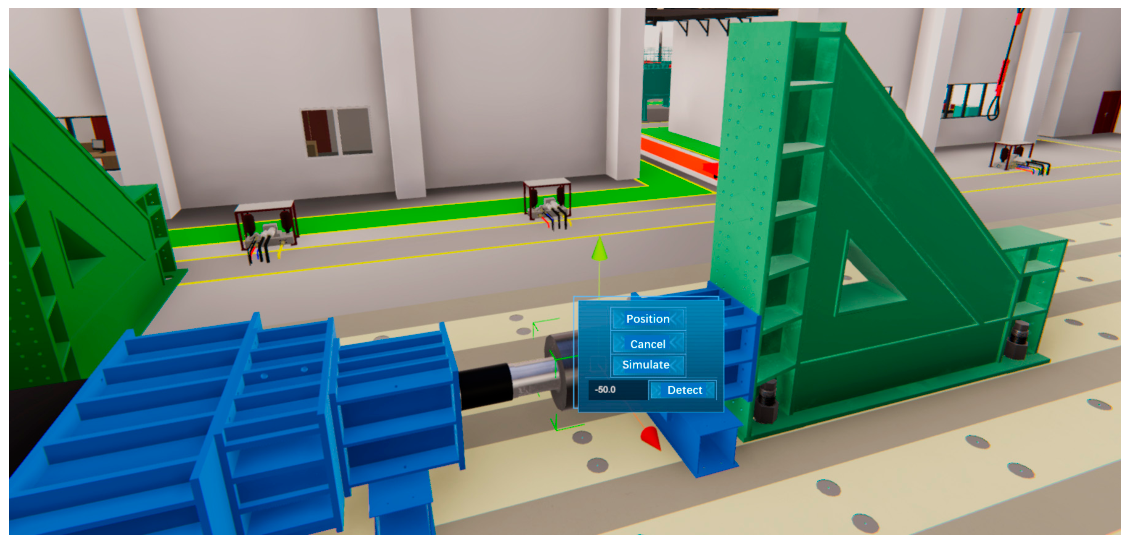
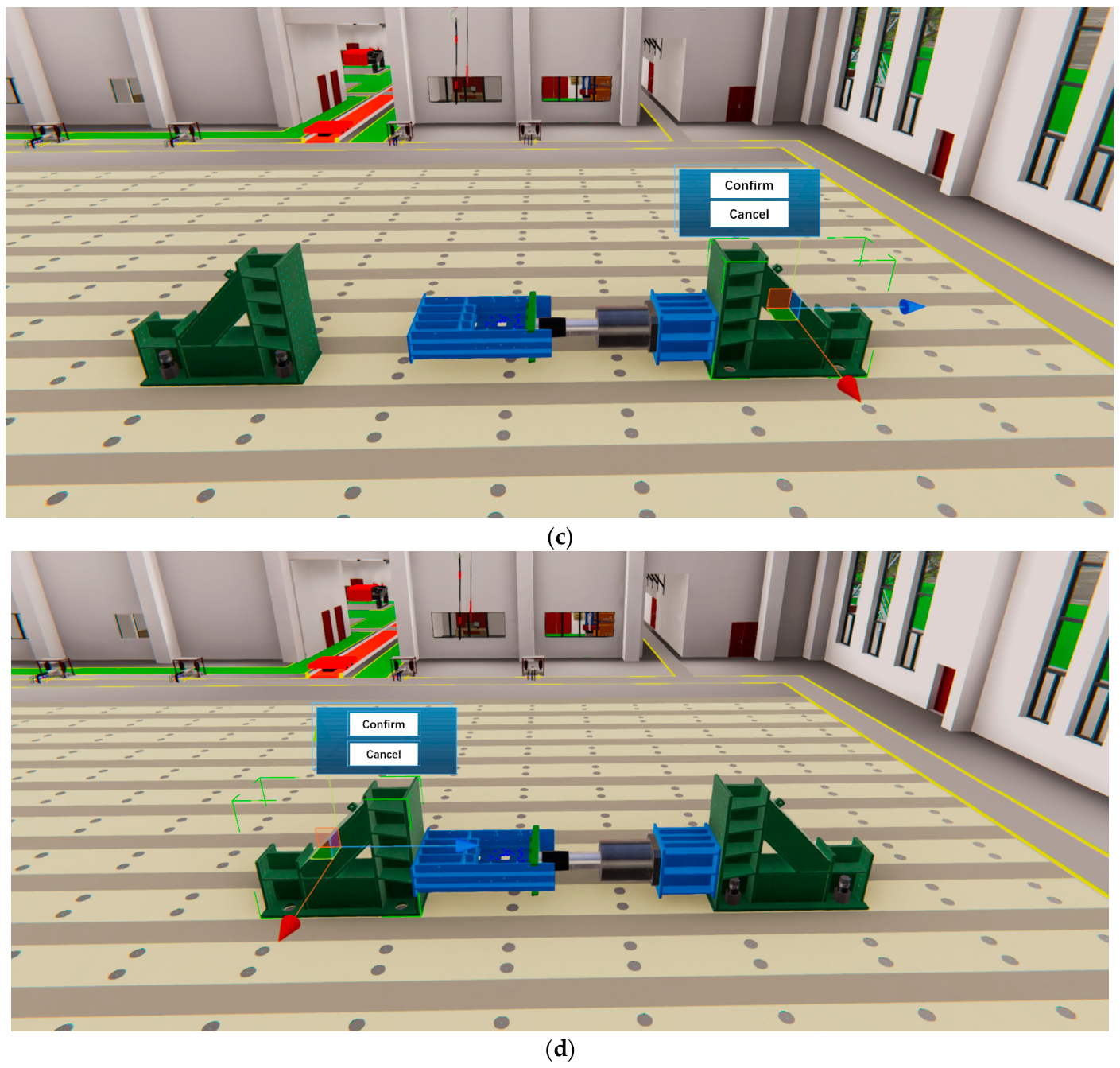
- For the validation case in this research, the arrangements and adjustments of the transportations and installations (distances and locations) are simulated and checked in the system, and four assembly steps are conducted, with no collision bodies activated.
- (3)
- Spatial interferences result from accumulated installation of entities. The optimizing strategy can be concluded by reducing the activations of collision bodies by adjusting the transportation distances and locations in each assembly step, through which the scales of the bounding areas can also be efficiently reduced.
- (4)
- Serialized experimental objects can be generated through the model driven by users’ input parameters, which is suitable for designing experimental plans. A cross-software 3D generating interface is implemented by combining a parameter-driven generator and format convertor.
Author Contributions
Funding
Data Availability Statement
Acknowledgments
Conflicts of Interest
References
- Cui, J.J.; Wang, D.Y. An experimental and numerical investigation on ultimate strength of corrugated bulkheads and plane bulkheads subjected to lateral pressure. Ocean Eng. 2024, 295, 116895. [Google Scholar] [CrossRef]
- Shanmugam, N.E.; Zhu, D.Q.; Choo, Y.S.; Arockiaswamy, M. Experimental studies on stiffened plates under in-plane load and lateral pressure. Thin-Walled Struct. 2014, 80, 22–31. [Google Scholar] [CrossRef]
- Wang, Y.; Liew, J.Y.R.; Lee, S.C. Ultimate strength of steel–concrete–steel sandwich panels under lateral pressure loading. Eng. Struct. 2016, 115, 96–106. [Google Scholar] [CrossRef]
- Liu, B.; Wu, W.; Guedes Soares, C. Ultimate strength analysis of a SWATH ship subjected to transverse loads. Mar. Struct. 2018, 57, 105–120. [Google Scholar] [CrossRef]
- Xue, D.; Yu, J.F.; Li, Y.; Zhang, H.; Tong, X. An advanced rigid-flexible hybrid assembly deviation analysis method for aerostructures. Adv. Eng. Inform. 2023, 58, 102173. [Google Scholar] [CrossRef]
- Cai, N.; Qiao, L. Rigid-compliant hybrid variation modeling of sheet metal assembly with 3D generic free surface. J. Manuf. Syst. 2016, 41, 45–64. [Google Scholar] [CrossRef]
- Ni, J.; Tang, W.C.; Xing, Y. Three-dimensional precision analysis with rigid and compliant motions for sheet metal assembly. Int. J. Adv. Manuf. Technol. 2014, 73, 805–819. [Google Scholar] [CrossRef]
- Yang, R.Z.; Huang, J.Z.; Chen, Z.; Lian, D.S.; Gao, S.R.; Zhong, X.C.; Li, J.A.; Liu, Y.M.; Tan, J.B. Measurement and optimization method for aero-engine rotors based on binocular multi-line laser sensing and virtual assembly. Measurement 2025, 242, 115808. [Google Scholar] [CrossRef]
- Katsoulis, T.; Wang, X.; Kaklis, P.D. A T-splines-based parametric modeller for computer-aided ship design. Ocean Eng. 2019, 191, 106433. [Google Scholar] [CrossRef]
- Papanikolaou, A. On parametric modelling, digital siblings and ship design optimization. Ship Technol. Res. 2024, 71, 92–101. [Google Scholar] [CrossRef]
- Du, L.; Wu, Q.; Shu, Y.H.; Li, G.N. The effects of online-training artificial neural network mechanism and multi-stage parametric modeling method on simulation-based design system for ship optimization. Ocean Eng. 2024, 309, 118284. [Google Scholar] [CrossRef]
- Khan, S.; Goucher-Lambert, K.; Kostas, K.; Kaklis, P. ShipHullGAN:Agenericparametric modeller for ship hull designusing deep convolutional generative model. Comput. Methods Appl. Mech. Eng. 2023, 411, 116051. [Google Scholar] [CrossRef]
- Li, Y.B.; Pan, Q.; Huang, M.H.; Li, L. Set-based parametric modeling, buckling and ultimate strength estimation of stiffened ship structures. J. Cent. South Univ. 2023, 26, 1958–1975. [Google Scholar] [CrossRef]
- Jin, C.Y.; Lin, M. Application of virtual assembly for complex mechanical structures based on digital twin technology. Sci. Rep. 2025, 15, 30306. [Google Scholar] [CrossRef]
- Jiang, Y.; Shu, J.P.; Ye, J.; Zhao, W.J. Virtual trail assembly of prefabricated structures based on point cloud and BIM. Autom. Constr. 2023, 155, 105049. [Google Scholar] [CrossRef]
- Lin, S.W.; Duan, L.P.; Jiang, B.; Liu, J.M.; Miao, J.; Zhao, J.C. Automated geometric measurement and virtual assembly of steel joints using point clouds. J. Constr. Steel Res. 2025, 231, 109601. [Google Scholar] [CrossRef]
- Liu, S.; Yu, H.D.; Xia, Z.K.; Chen, K.Y. A new virtual functional element method for deviation prediction of assembled structures with parallel connection chain. CIRP Ann. Manuf. Technol. 2024, 48, 42–54. [Google Scholar] [CrossRef]
- Zhu, Y.B.; Yao, J.; Xu, Y.W.; Zhang, Y.L. Research and Application of Collision Detection on Steel Structure in Virtual Pre-Assembly Environment. IOP Conf. Ser. Earth Environ. Sci. 2018, 199, 032046. [Google Scholar]
- Jiang, Z.; Wei, P.Y.; Du, Y.T.; Peng, J.Y.; Zeng, Q.B. A Virtual Assembly Technology for Virtual–Real Fusion Interaction of Ship Structure Based on Three-Level Collision Detection. J. Mar. Sci. Eng. 2024, 12, 1910. [Google Scholar] [CrossRef]
- Li, C.T.; Wei, P.Y.; Wang, D.Y. Investigations on visualization and interaction of ship structure multidisciplinary finite element analysis data for virtual environment. Ocean Eng. 2022, 266, 112955. [Google Scholar] [CrossRef]
- Sánchez-Fernández, Á.; Vlad-Voinea, E.-D.; Pernas-Álvarez, J.; Crespo-Pereira, D.; Sañudo-Costoya, B.; Lamas-Rodríguez, A. Framework for the Development of a Process Digital Twin in Shipbuilding: A Case Study in a Robotized Minor Pre-Assembly Workstation. J. Mar. Sci. Eng. 2026, 14, 106. [Google Scholar] [CrossRef]
- Gao, S.; Xu, W.J.; Geng, W.B.; Zhao, X.; Tang, X.D.; Chai, Y.; Xiong, H.X.; Ren, C. A multi-task unified digital twin framework for anomaly detection, virtual validation, and decision-making support of deep-sea Argo floats. Ocean Eng. 2026, 355, 125121. [Google Scholar] [CrossRef]
- Xu, D.S.; Yang, J.; Zheng, H.Y.; Chen, B.; Yan, D.; Fan, J.C.; Tang, Q.Y.; Zhou, Y.F. Digital twin system for deepwater well construction: Enhancing operational efficiency and safety. Ocean Eng. 2026, 352, 1254378. [Google Scholar] [CrossRef]
- Liu, W.C.; Liu, J.C.; Sun, Y.K.; Li, L.; Wang, S.Q.; Hong, X.W.; Yu, L.W.; Li, Y.; Gu, H.L.; Jiang, L.J.; et al. Digital twin (DT) for deep-sea mining: System design, application and sea trial validation. Ocean Eng. 2026, 358, 125853. [Google Scholar] [CrossRef]
- Zhang, T.G.; Li, R.Q.; Jin, Y.; Ouyang, W.; Zhu, H.H.; Dong, X.W.; Wei, D.; Bai, Y.M. Structural health monitoring of water-lubricated stern bearing systems based on digital twins. Ocean Eng. 2026, 345, 123844. [Google Scholar] [CrossRef]






Disclaimer/Publisher’s Note: The statements, opinions and data contained in all publications are solely those of the individual author(s) and contributor(s) and not of MDPI and/or the editor(s). MDPI and/or the editor(s) disclaim responsibility for any injury to people or property resulting from any ideas, methods, instructions or products referred to in the content. |
© 2026 by the authors. Licensee MDPI, Basel, Switzerland. This article is an open access article distributed under the terms and conditions of the Creative Commons Attribution (CC BY) license.
Share and Cite
Wang, L.; Cui, J.; Guo, G.; Wei, P.; Hu, Z.; Zhu, Z.; Dai, Z. An Investigation on a Virtual Assembly System for Structural Experiments. J. Mar. Sci. Eng. 2026, 14, 1086. https://doi.org/10.3390/jmse14121086
Wang L, Cui J, Guo G, Wei P, Hu Z, Zhu Z, Dai Z. An Investigation on a Virtual Assembly System for Structural Experiments. Journal of Marine Science and Engineering. 2026; 14(12):1086. https://doi.org/10.3390/jmse14121086
Chicago/Turabian StyleWang, Lian, Jinju Cui, Guangyu Guo, Pengyu Wei, Zihao Hu, Zhikui Zhu, and Zeyu Dai. 2026. "An Investigation on a Virtual Assembly System for Structural Experiments" Journal of Marine Science and Engineering 14, no. 12: 1086. https://doi.org/10.3390/jmse14121086
APA StyleWang, L., Cui, J., Guo, G., Wei, P., Hu, Z., Zhu, Z., & Dai, Z. (2026). An Investigation on a Virtual Assembly System for Structural Experiments. Journal of Marine Science and Engineering, 14(12), 1086. https://doi.org/10.3390/jmse14121086