Article

High-Order Spectral Modeling of Nonlinear Wave Loading on Vertical-Wall Structures with Improved Incident-Wave Boundary Treatment

1
College of Civil Engineering and Architecture, Dalian University, Dalian 116622, China
2
National Marine Environmental Monitoring Center, Dalian 116023, China
3
State Key Laboratory of Coastal and Offshore Engineering, Dalian University of Technology, Dalian 116024, China
*
Author to whom correspondence should be addressed.
J. Mar. Sci. Eng. 2026, 14(12), 1085; https://doi.org/10.3390/jmse14121085
Submission received: 8 May 2026 / Revised: 6 June 2026 / Accepted: 8 June 2026 / Published: 11 June 2026
(This article belongs to the Section Coastal Engineering)

Abstract

Accurate prediction of nonlinear wave–structure interaction is essential for the safe design of coastal structures. In this study, a fully nonlinear high-order spectral numerical wave tank is developed to investigate nonlinear wave interaction with a vertical wall. The incident-wave boundary is introduced through an additional velocity potential, with the incident-wave kinematics prescribed from corresponding nonlinear analytical wave solutions. The model is validated against the Fourier solution, demonstrating good accuracy in predicting free-surface elevation, pressure distribution, and resultant wave force. Numerical results show that wave nonlinearity significantly modifies both the standing-wave field and the wall loading. Under strongly nonlinear conditions, negative pressure develops near the lower part of the wall during the crest phase, giving rise to a characteristic saddle-shaped force history. Water depth further modulates this nonlinear mechanism by altering both the force magnitude and the pressure distribution along the wall. For focused wave groups, the force response is strongly affected by the focusing type, wave steepness, and spectral bandwidth. A narrower bandwidth maintains stronger phase coherence over a longer portion of the wave group, leading to slightly larger focused extrema and more pronounced amplification of adjacent wave and force cycles. These findings highlight the importance of nonlinear pressure effects and spectral characteristics in predicting extreme wave loads on vertical-wall coastal structures.

1. Introduction

Vertical-wall structures, such as breakwaters, quay walls, and harbor basins, are essential elements in coastal and offshore engineering owing to their structural efficiency and space-saving configuration. As these structures are continuously subjected to dynamic wave action, reliable prediction of wave-induced pressures and resultant forces is crucial for hydraulic design and safety assessment. Recent international experiments on vertical walls and seawalls have further shown that wave impact, overtopping, and post-impact pressure responses remain strongly dependent on wave period, freeboard, water depth, and impact regime, highlighting the continuing need for accurate load-prediction tools [1,2,3]. This issue has become more pressing in the context of rapid coastal development, sea-level rise, and the increasing occurrence of extreme wave events and severe sea states. Incident waves interacting with a vertical wall can generate strong reflection, pronounced standing-wave patterns, local free-surface amplification, and violent impacts [3]. Laboratory and field observations of vertical coastal structures indicate that large impacts may be strongly phase-sensitive and that irregular or focused wave groups can produce substantial variability in the magnitude and timing of impact loads [3,4]. The resulting wave–structure interaction may induce highly non-uniform and impulsive pressure distributions, leading to amplified transient loads and posing risks to structural stability and long-term reliability [5,6].
Early studies on wave loading against vertical walls mainly relied on analytical theories. Classical perturbation solutions for finite-amplitude standing waves provided the theoretical basis for describing nonlinear free-surface motions and wall-pressure distributions. However, despite their fundamental contributions to wave–structure interaction theory, these approaches are generally limited to idealized conditions and moderate nonlinearities. With climate-driven sea-level rise and the increasing occurrence of extreme sea states, fully nonlinear methods are becoming essential for structural safety assessment and the design or retrofit of coastal defense systems [7]. Numerical wave tanks (NWTs) have therefore emerged as powerful tools for investigating free-surface evolution, wave kinematics, and dynamic pressure distributions under controlled wave and bathymetric conditions [8]. Compared with analytical solutions and scaled experiments, NWTs offer greater flexibility, higher spatial–temporal resolution, and more complete flow-field information [9]. Among these approaches, potential-flow-based NWTs are particularly suitable for non-breaking and steep waves because of their balance between accuracy and computational efficiency [10]. The high-order spectral (HOS) method, in particular, has become an efficient tool for simulating nonlinear wave propagation and wave–structure interaction over large spatial and temporal scales [11]. More broadly, several numerical frameworks have been developed for fully nonlinear free-surface Euler equations, including HOS formulations, conformal-mapping techniques, and approaches based on expansions of the Dirichlet-to-Neumann operator. These methods provide complementary routes for modeling nonlinear wave propagation and wave generation. For example, Poletto et al. [12] recently solved the full Euler equations for waves generated by vertical seabed displacements, providing a useful reference for direct Euler-based modeling. In contrast, the present study does not aim to replace such full-Euler solvers. Rather, it focuses on incorporating an incident-wave boundary treatment into the HOS-NWT framework, with the aim of retaining spectral efficiency while enabling non-periodic wave generation for nonlinear wave loading on a vertical wall.
The HOS method has been widely employed for fully nonlinear free-surface wave simulations owing to its high computational efficiency and spectral accuracy [13]. By expressing the local wave field through a weakly ordered asymptotic expansion and employing Fourier-series basis functions at successive orders, the HOS method takes full advantage of the fast Fourier transform (FFT), thereby enabling large-scale wave simulations at a relatively low computational cost [14]. Nevertheless, conventional HOS formulations were originally developed mainly for periodic computational domains. Their extension to non-periodic boundary-value problems, such as NWTs, remains numerically challenging [15]. Pioneering work by Bonnefoy et al. [16,17] led to the development of the second-order SWEET model by expanding the free-surface and wavemaker boundary conditions to second order using a Taylor perturbation approach. Building on this framework, subsequent models such as HOST-wm1 and HOST-wm2 retained the fully nonlinear free-surface conditions within the HOS formulation while incorporating first- and second-order wavemaker boundary conditions [18]. Ducrozet et al. [19] further extended the wavemaker description to third order in the HOST-wm3 model. Despite these developments, the simulation of very steep waves, for instance with wave steepness kA ≥ 0.3, using moving-wavemaker formulations may still induce saw-tooth-type instabilities near the upstream boundary. Within the conventional HOS-NWT framework, an effective and generally robust treatment of this high-frequency numerical artifact remains challenging [19]. To overcome this limitation, the present model avoids prescribing explicit wavemaker motions at the upstream boundary. Instead, wave generation is realized by directly imposing wave properties derived from a selected nonlinear wave theory at the inflow boundary, in a manner analogous to the relaxation strategy proposed by Ning et al. [20]. Related HOS-based formulations have also been used to represent wave-generation, damping, or scattering mechanisms in nonlinear free-surface problems. For example, Guyenne and Nicholls [21] developed a high-order spectral formulation for nonlinear waves over moving bottom topography, while Xu and Guyenne [22] simulated nonlinear wave-group attenuation caused by scattering in broken floe fields. These studies provide relevant HOS-context for incorporating external forcing, damping, or scattering effects, whereas the present work focuses on imposing nonlinear incident-wave kinematics at a non-periodic inflow boundary for vertical-wall loading analysis [21,22]. More importantly, the imposed wave kinematics are extended from the tank bottom to the instantaneous free surface, rather than being truncated at the still-water level [11]. This treatment effectively suppresses high-frequency numerical instabilities and improves the robustness of the model, making it suitable for the continuous generation of steep, fully nonlinear waves.
Recent high-fidelity studies on wave interactions with vertical structures have mainly addressed extreme wave impacts [23] and the hydro-elastic response of deformable walls [24]. However, less attention has been paid to the nonlinear evolution of distributed wall pressure and the phase-dependent timing of peak integrated force under strong reflection, particularly when negative-pressure regions and nonlinear reflected-wave dynamics play a critical role in shaping the load history [4]. Under irregular-wave conditions, the loading process becomes more complex because wave-group evolution, spectral energy redistribution, nonlinear phase coupling, and local focusing may significantly modify the force response. Focused-wave studies have further demonstrated that temporal and spatial nonlinear evolution during propagation must be considered, as the resulting hydrodynamic loads depend not only on the target crest amplitude but also on the redistribution of wave-group energy before structural interaction [25,26]. Thus, irregular-wave loading on vertical walls should be interpreted beyond maximum crest height alone, requiring consideration of wave-group organization, nonlinear focusing, and reflected-wave dynamics. Nevertheless, a unified computational framework for accurately simulating both regular and irregular fully nonlinear wave interactions with vertical walls remains insufficiently developed.
Motivated by these considerations, the present study develops a high-order spectral numerical wave tank (HOS-NWT), where the incident velocity boundary condition is introduced by means of an auxiliary velocity-potential function. The remainder of the paper is organized as follows. Section 2 defines the physical problem and formulates the governing equations. Section 3 assesses the accuracy and stability of the proposed HOS-NWT model in simulating interactions between waves and vertical walls. In Section 4, the validated numerical tank is employed to simulate standing waves and to systematically investigate the hydrodynamic interactions of regular and extreme waves with a vertical wall. Finally, Section 5 summarizes the major findings and presents the conclusions.

2. Mathematical Formulation

2.1. HOS-Based Numerical Wave Tank

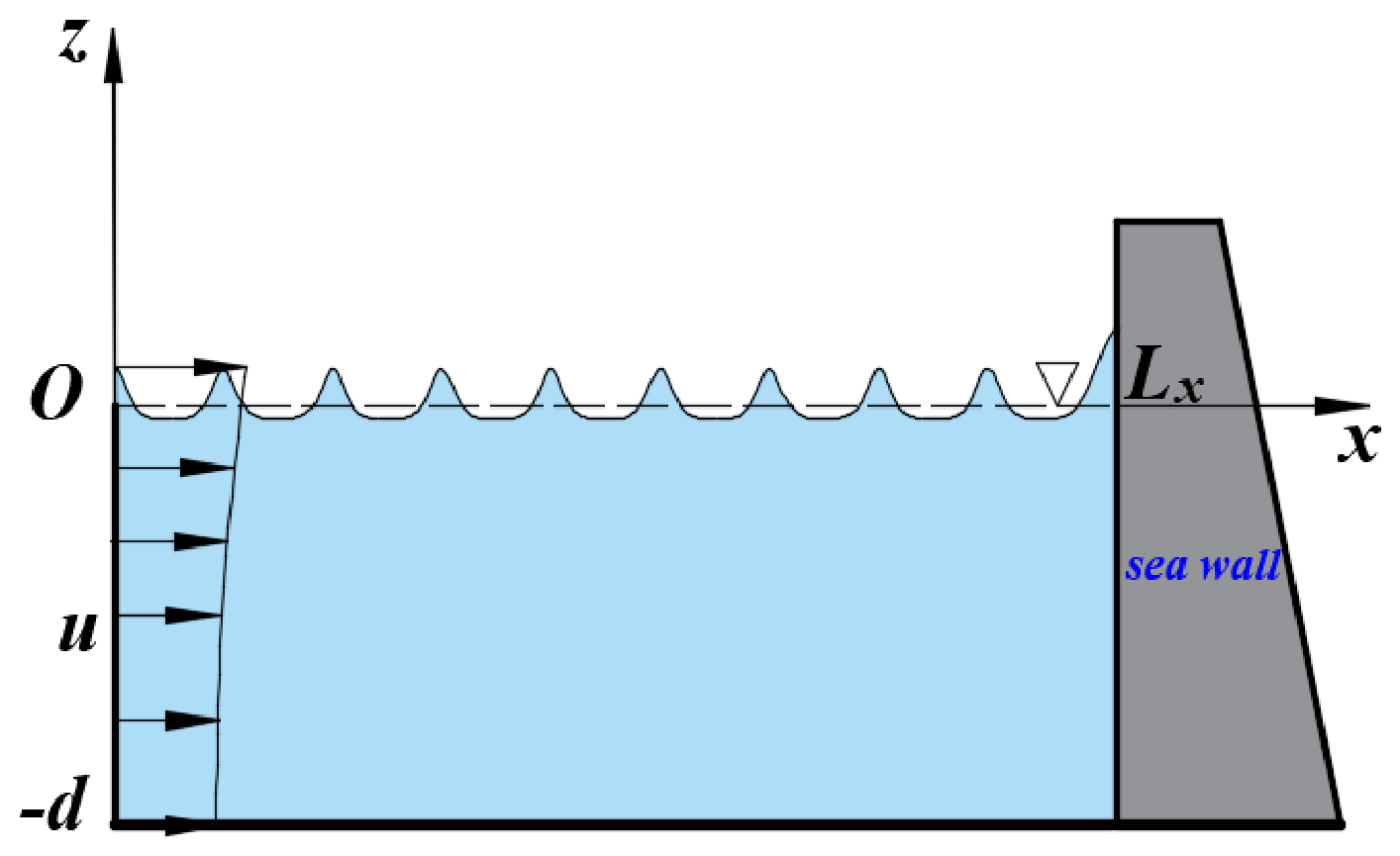
A two-dimensional numerical wave tank based on the HOS method is established in this study to simulate the interaction between nonlinear waves and a vertical wall, as shown in Figure 1. The present formulation is restricted to non-breaking waves, and the fluid is assumed to be inviscid, incompressible, homogeneous, and irrotational. The physical domain is defined as
  Domain   = ( x , z ) 0 x L x , d z η ( x , t ) ,  
where L x is the tank length, d is the still-water depth, and η ( x ,   t ) denotes the free-surface elevation.
The velocity field is represented by the velocity potential Φ ( x ,   z ,   t ) , such that u = Φ . Owing to incompressibility and irrotationality, Φ satisfies Laplace’s equation in the fluid domain:
2 Φ = 0 , ( x , z ) D .
The free surface is located at z = η(x, t). Defining the free-surface potential as ϕ s ( x ,   t )   =   Φ ( x ,   η ,   t ) , the fully nonlinear kinematic and dynamic free-surface boundary conditions can be written as
η t = 1 + 2 η 2 Φ z 2 ϕ s 2 η , z = η ,
ϕ s t = g η 1 2 2 ϕ s 2 + 1 2 1 + 2 η 2 Φ z 2 , z = η .
Here, 2 denotes the horizontal gradient; in the present two-dimensional formulation, 2 = / x . The gravitational acceleration is taken as g = 9.81 m/s2 in the present study.
The bottom boundary and the downstream wall are assumed to be impermeable, yielding
Φ n = 0 , z = d   and   x = L x ,
where n is the outward unit normal vector on the boundary. At the upstream boundary x = 0 , wave generation is imposed through a prescribed incident velocity profile:
Φ x = u b ( z , t ) , x = 0 .
For regular-wave cases, u b is obtained from stream-function theory, whereas for irregular-wave cases it is prescribed from second-order Stokes wave theory, which better represents fluid-particle motion at the inlet and helps suppress undesired free waves.
The boundary conditions used in the present HOS-NWT are specified as follows. At the instantaneous free surface, the velocity potential satisfies the fully nonlinear kinematic and dynamic free-surface boundary conditions given in Equations (3) and (4). At the bottom boundary and the downstream vertical wall, the impermeability condition is imposed through the homogeneous Neumann condition in Equation (5). At the upstream inlet, the incident-wave generation is prescribed by the vertical distribution of the incident velocity profile, as expressed in Equation (6).
Because the present numerical wave tank is a time-domain model, the initial conditions are specified as
η ( x , 0 ) = 0 , ϕ s ( x , 0 ) = 0 .
In addition, a temporal ramp function is introduced to avoid the generation of long-wave transients at the beginning of the simulation. The ramp function is defined as
β ( t ) = 1 2 1 cos π t T ramp , t T ramp   , 1 , t > T ramp   ,
and the actual boundary input is written as
u b ( z , t ) = β ( t ) u b ( z , t ) .
In practice, T ramp is typically set to two wave periods, i.e., Tramp = 2T.
Since the standard HOS method requires periodic horizontal boundary conditions, the non-periodic inflow boundary in Equation (6) is incorporated by decomposing the total potential into a spectral component and an additional component:
Φ = Φ spec   + Φ add   .
The additional potential Φ add is introduced to satisfy the non-homogeneous inflow boundary, whereas Φ spec satisfies homogeneous Neumann conditions in the horizontal direction. The decomposition allows the two potentials to be solved independently. The free-surface boundary conditions (FSBCs) are imposed only on the propagation potential Φ spec , where Φ add acts as a free-surface forcing term. The resulting total potential therefore satisfies the Laplace equation and all boundary conditions. The total cost of the HOS–NWT model consists of the standard HOS cost and the additional wavemaking cost. The standard HOS part preserves the spectral efficiency of free-surface evolution, with an estimated O(Nxlog2Nx) FFT cost per time step in two dimensions, while the additional potential mainly adds spectral processing of the extended inlet profile, scaling as O(NxNz) for modal evaluation [27]. Thus, the proposed method is costlier than a purely periodic HOS model but avoids the much higher expense of full grid-based Euler or Navier–Stokes solvers and repeated global two-dimensional elliptic solves. This formulation preserves the accuracy and efficiency of the original HOS method and extends it to non-periodic boundary-value problems. The two subproblems are defined as
2 Φ add   = 0 , ( x , z ) D , Φ add   x = u b ( z , t ) , x = 0 , Φ add   n = 0 , x = L x   and   z = d ,
and
2 Φ spec   = 0 , ( x , z ) D , Φ spec   n = 0 , x = 0 , x = L x , and z = d ,   FSBCs ,   z = η .
After introducing the decomposition in Equation (10), the free-surface equations can be rewritten in terms of Φ spec and Φ add . Defining
ϕ s = Φ spec   z = η , W s = Φ spec   z z = η ,
the kinematic boundary condition becomes
η t = 1 + 2 η 2 W s 2 ϕ s + Φ add 2 η + Φ add z , z = η ,
and the dynamic boundary condition reads
ϕ s t = g η 1 2 2 ϕ s 2 + 1 2 1 + 2 η 2 W s 2 2 ϕ s 2 Φ add 1 2 2 Φ add 2 1 2 Φ add z 2 Φ add t , z = η .
All the terms involving Φ add in Equations (14) and (15) are evaluated at the free surface. When the absorption zone is activated, the damping contribution is additionally imposed in the dynamic condition. The vertical velocity Ws at the free surface is evaluated through the HOS perturbation expansion, where M denotes the truncation order of the expansion.
Because Φ spec satisfies homogeneous Neumann conditions in the horizontal direction, it can be expanded in a cosine series,
Φ spec   ( x , z , t ) = m = 0 N x A m ( t ) ψ m ( x , z ) ,
with
ψ m ( x , z ) = cos k m x cosh k m ( z + d ) cosh k m d , k m = m π L x ,
where A m ( t ) are the modal amplitudes and N x represents the number of retained modes in the horizontal direction. For the spectral propagation potential Φspec, the HOS procedure is used at each time step or Runge–Kutta substep; the known free-surface potential and surface elevation are used in a perturbation expansion with respect to the free-surface elevation, and the modal amplitudes A m ( t ) are obtained through the orthogonality of the cosine basis, implemented by spectral transforms. The vertical velocity at the free surface is then reconstructed by summing the retained HOS orders up to M = 7 [28]. This procedure does not require solving a full two-dimensional linear system at each time step.
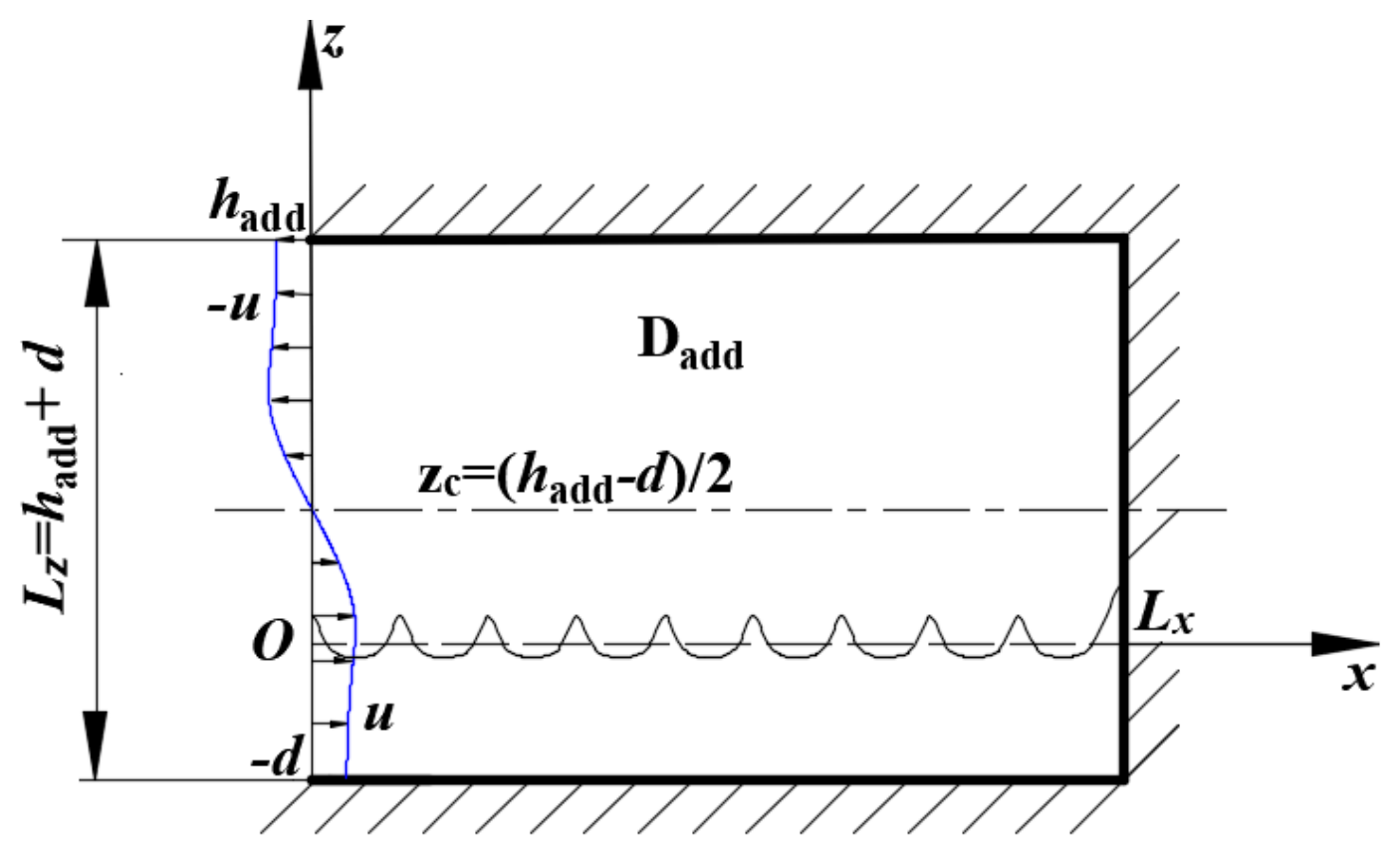
To represent Φ add in a spectral form while preserving mass conservation, an extended domain is constructed by reflecting and shifting the original boundary profile, as shown in Figure 2. The physical fluid domain in the present potential-flow model remains the water domain bounded below by the seabed and above by the instantaneous free surface. The reflected and shifted portion of the extended domain Dadd is introduced only to close the boundary profile smoothly and to enable an efficient spectral representation of Φ add while preserving the compatibility of the imposed inlet velocity. Therefore, the formulation does not assume that the air above the free surface is an irrotational flow, nor are air-side dynamics solved in the model. The original interval [ d ,   η ]   with boundary velocity u b is mirrored about z c = ( h add d ) / 2 , shifted upward to [ 2 d η ,   3 d ] with opposite sign u b . We choose the third-order polynomial function from z   =   η to z   =   2d η as a matching curve to smoothly close the domain D add , which is defined as
S ( z , t ) = z z c c 1 ( t ) + c 2 ( t ) z z c 2
The coefficients at every time step are as follows.
c 1 ( t ) = 3 u ( η ( t ) , t ) + ( d η ( t ) ) u z ( η ( t ) , t ) 2 ( d η ( t ) ) c 2 ( t ) = u ( η ( t ) , t ) + ( d η ( t ) ) u z ( η ( t ) , t ) 2 ( d η ( t ) ) 3
In the extended domain, the additional potential Φ add and its time derivative are expanded as
Φ add ( x , z , t ) = n = 0 N z B n ( t ) χ n ( x , z ) , Φ add ( x , z , t ) t = n = 0 N z B ˙ n ( t ) χ n ( x , z ) ,
where
χ n ( x , z ) = cos k n ( z + d ) cosh k n L x x cosh k n L x , k n = n π 4 d .
At the inflow boundary, the boundary conditions for Φ add and its time derivative can be expressed as
Φ add x = u b ( z , t ) , x = 0 ,
x Φ add t = u b t , x = 0 .
For the additional potential Φadd, the imposed inlet profile is first extended by the mirroring and matching procedure described around Figure 2. Therefore, once the extended boundary velocity u b and its time derivative u b / t are prescribed, the modal coefficients B n ( t ) and B ˙ n ( t ) are obtained directly by FFT, and the required spatial and temporal derivatives of Φ add can be evaluated analytically from the modal expansion.
Finally, the coupled evolution equations for η and ϕ s are integrated in time by means of the fourth-order Runge–Kutta Cash–Karp scheme with adaptive time stepping, which ensures both stability and computational efficiency for nonlinear wave simulation.

2.2. Wave Pressure and Force on the Vertical Wall

The downstream boundary at x   =   L x acts as a rigid wall. The pressure field inside the fluid is then calculated from Bernoulli’s equation,
P ρ = g z Φ t 1 2 Φ x 2 + Φ z 2 ,
where P ( x ,   z ,   t ) is the instantaneous fluid pressure. The derivatives Φ / x , Φ / z , and Φ / t are directly obtained from the modal expansions of Φ spec and Φ add .
The wave-induced pressure on the wall is evaluated by subtracting the hydrostatic component referenced to the still-water level from the total pressure. Let η w ( t )   =   η ( L x ,   t ) denote the instantaneous free-surface elevation at the wall. The wave-induced pressure is given by
p w = z , η w z 0 , p ( z ) , z < η w .
where p w denotes the dimensionless wave-induced pressure, and p represents the dimensionless total fluid pressure. In the present study, the pressure sampling interval is taken as [ d , η w ] when η w > 0 , and as [ d , 0 ] when η w 0 . The resultant horizontal wave force per unit width acting on the wall is then computed as
F ( t ) = z l z u p w L x , z , t d z ,
where z l = d , z u = η w for η w > 0 , and z u = 0 for η w 0 . For numerical implementation, the wall pressure is evaluated at K discrete points along the integration interval, and the total wave force is obtained using the composite trapezoidal rule,
F ( t ) k = 1 K 1 p w , k + p w , k + 1 2 z k + 1 z k .
To compute the wave-induced force on the vertical wall, the wall is discretized into K = 600 sampling points in the vertical direction, which is sufficient to capture the detailed pressure distribution and localized extrema arising from nonlinear effects.

3. Comparisons and Verifications

3.1. Convergence Study

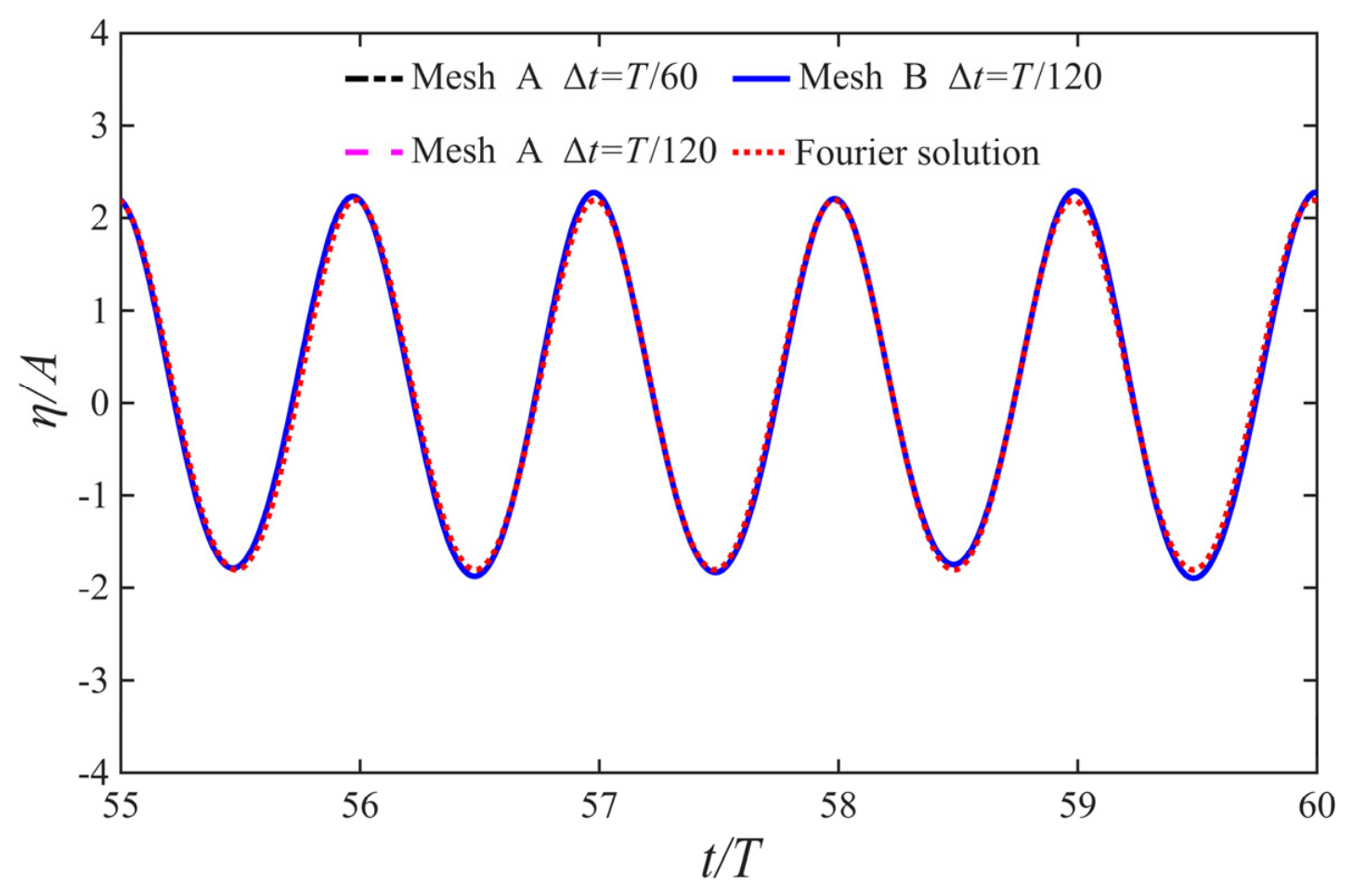
To assess the numerical accuracy and stability of the present HOS-NWT, a convergence test is first carried out for a regular wave case interacting with a vertical wall. The incident wave period is T   =   2.0 s , water depth d   =   5 m , and wave amplitude A = 0.10 m. The incident wave steepness, defined as ε   =   kA , is approximately set to ε     0.10 . Reflection at the vertical wall induces standing waves ahead of the structure, yielding a standing-wave steepness of approximately 0.20. The computational domain is defined with a tank length of L x = 100 m . This length is sufficiently large to ensure the formation of a stable standing wave system in front of the vertical wall while minimizing the influence of secondary wave reflections within the simulation duration. The total simulation time is set to 120 s , which corresponds to 60 wave periods. This relatively high-order expansion is adopted to accurately capture nonlinear free-surface effects.
In terms of numerical discretization, the spatial resolution is defined by the number of modes in the horizontal and vertical directions. Mesh A is discretized using N x = 512 and N z = 256 modes in the horizontal and vertical directions, respectively. A finer mesh, denoted as Mesh B, employs N x = 1024 and N z = 512 , corresponding to a twofold increase in modal resolution. Time-step sensitivity is examined using Δ t = T / 60 and T / 120 for Mesh A, while the refined Mesh B is computed with Δ t = T / 120 . Overall, the selected numerical parameters represent a compromise between computational efficiency and solution accuracy. Figure 3 shows that the free-surface elevation remains almost unchanged with further refinement of the spatial and temporal resolutions, demonstrating the convergence of the present numerical configuration. Moreover, the numerical prediction agrees well with the Fourier solution [29], which further validates the accuracy of the present model.

3.2. Validation of Wave Force and Pressure on Vertical Wall

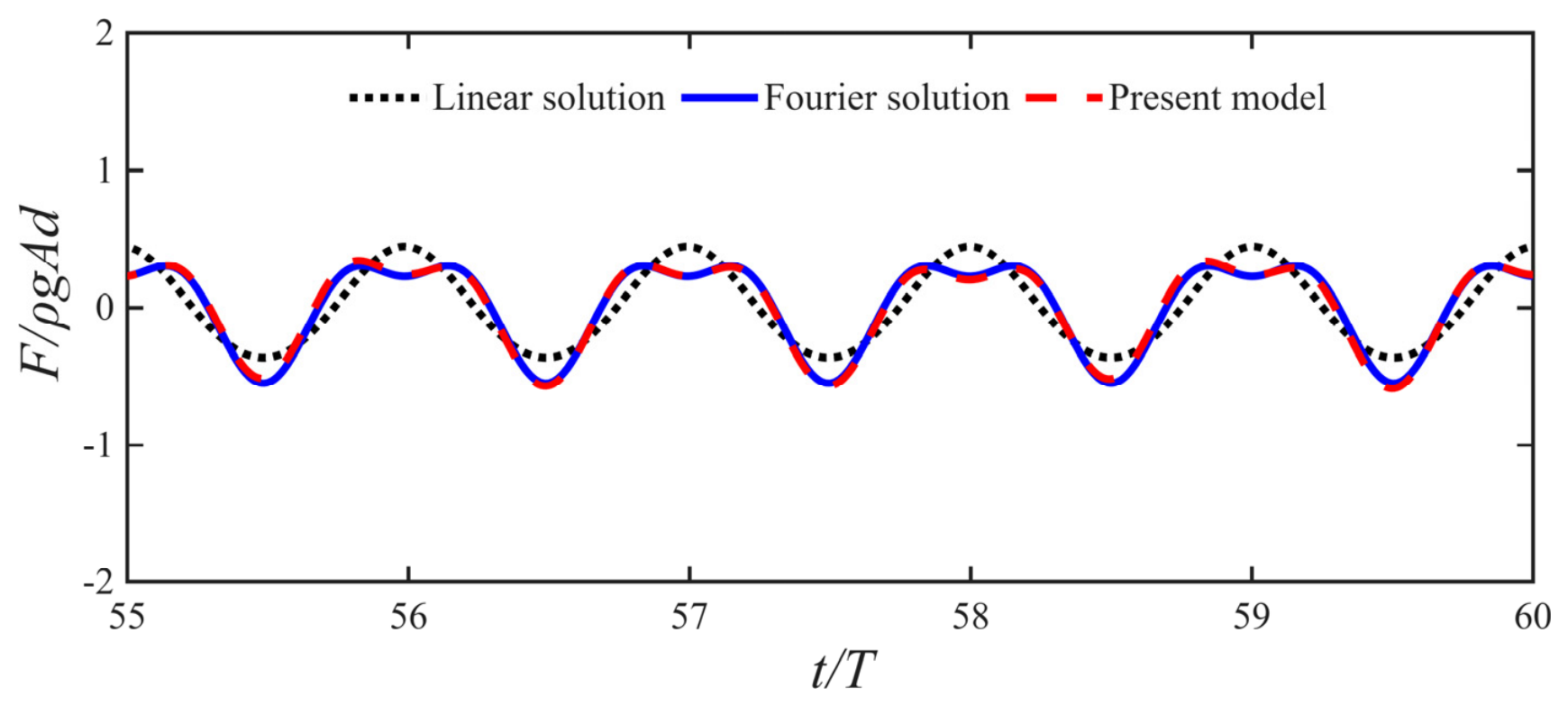
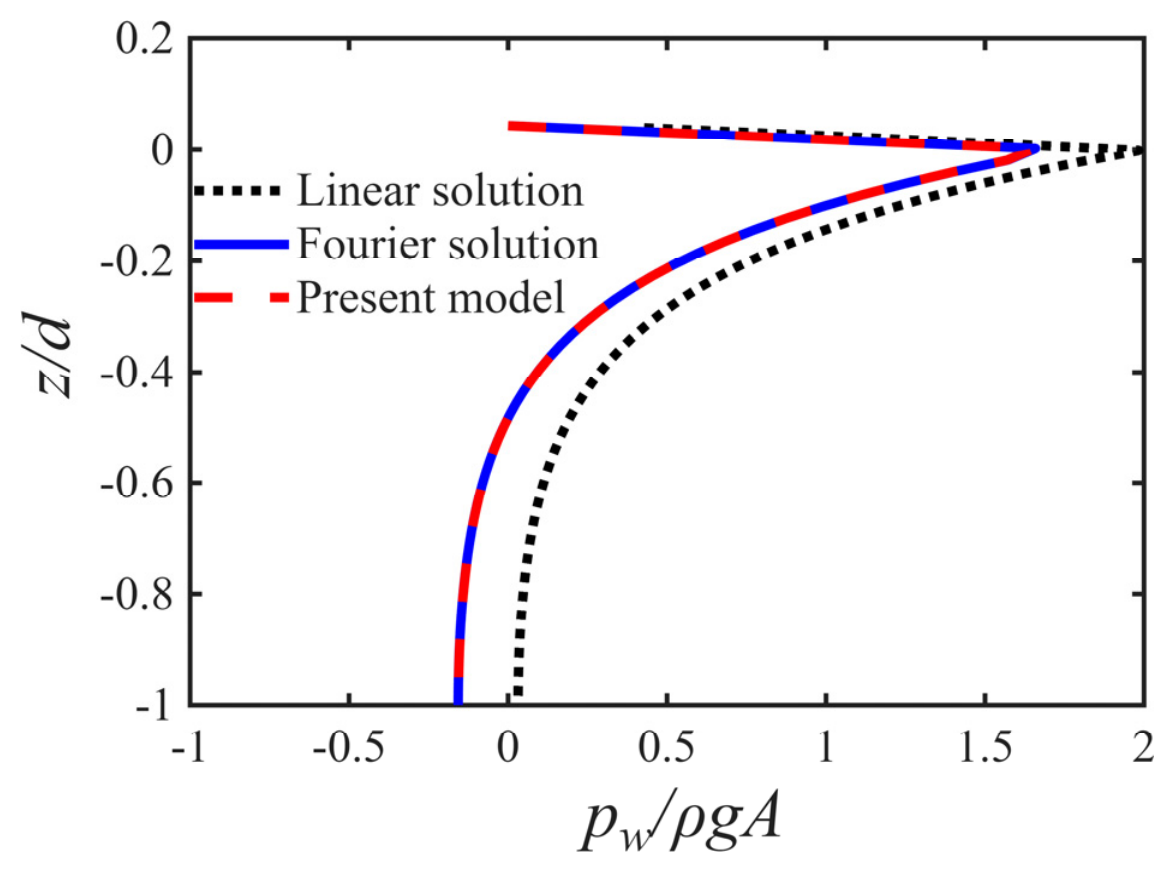
In this section, the same incident wave conditions as in the previous section are adopted to further assess the predictive accuracy of the present model. Figure 4 compares the computed dimensionless resultant wave force on the vertical wall and the crest-phase pressure distribution with those obtained from linear standing-wave theory and the Fourier solution [29]. Figure 5 presents the temporal variation in the resultant wave force and clearly shows the role of nonlinear effects. Unlike the linear solution, in which the force maximum coincides with the wave crest, the nonlinear predictions exhibit a saddle-shaped pattern. In this case, the maximum force occurs slightly before or after the crest phase rather than exactly at the crest. This discrepancy results from nonlinear wave motion and the redistribution of pressure along the wall, which are beyond the capability of linear theory. Figure 5 presents the crest-phase wall-pressure profiles. The present results closely match the Fourier solution [29], reproducing both the pressure magnitude and vertical variation. The nonlinear deviation from the conventional linear pressure distribution is also accurately captured. These results confirm that the proposed numerical wave tank provides reliable predictions of free-surface elevation, pressure distribution, and resultant force for nonlinear waves acting on a vertical wall.

4. Numerical Results and Discussion

4.1. Regular Waves Interaction with Vertical Wall

(a)
Effect of Wave Amplitudes
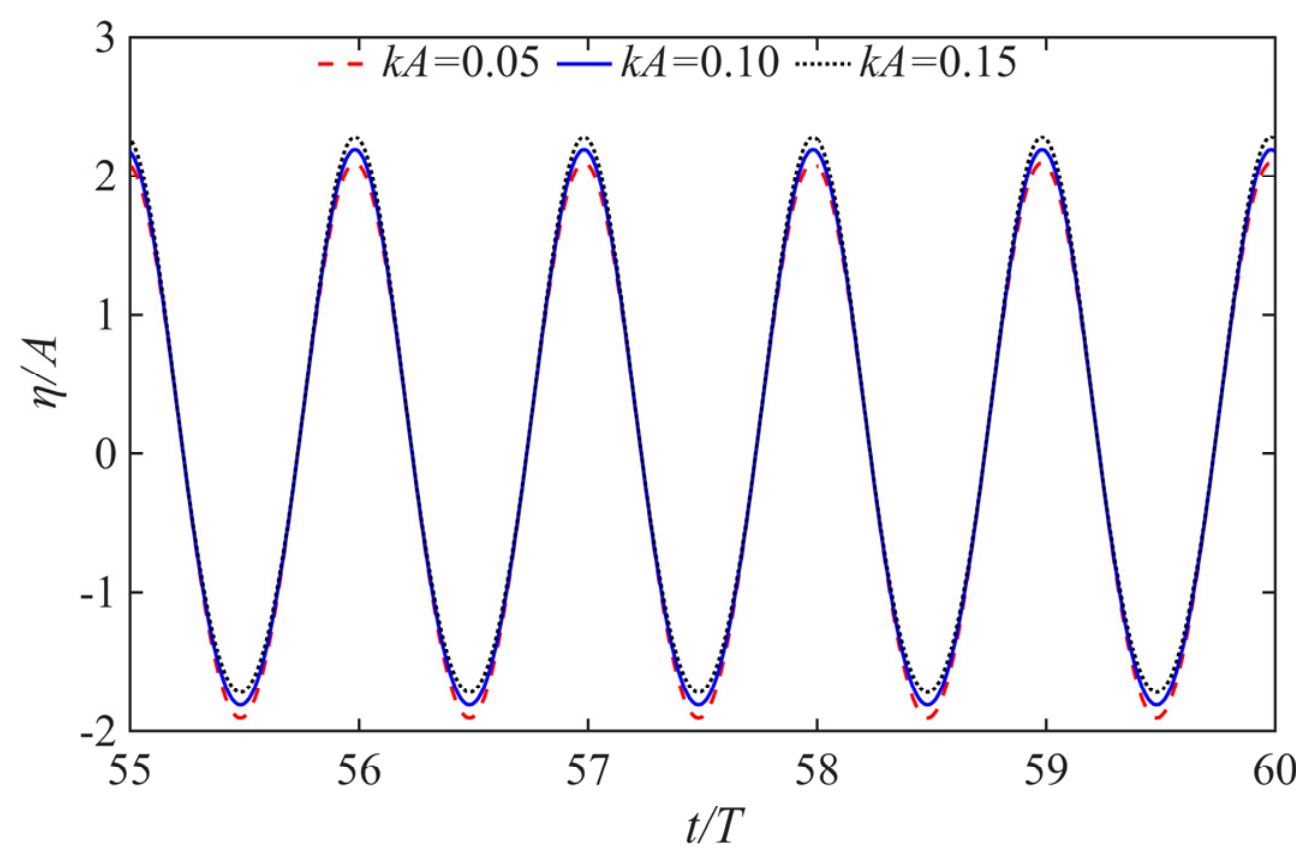
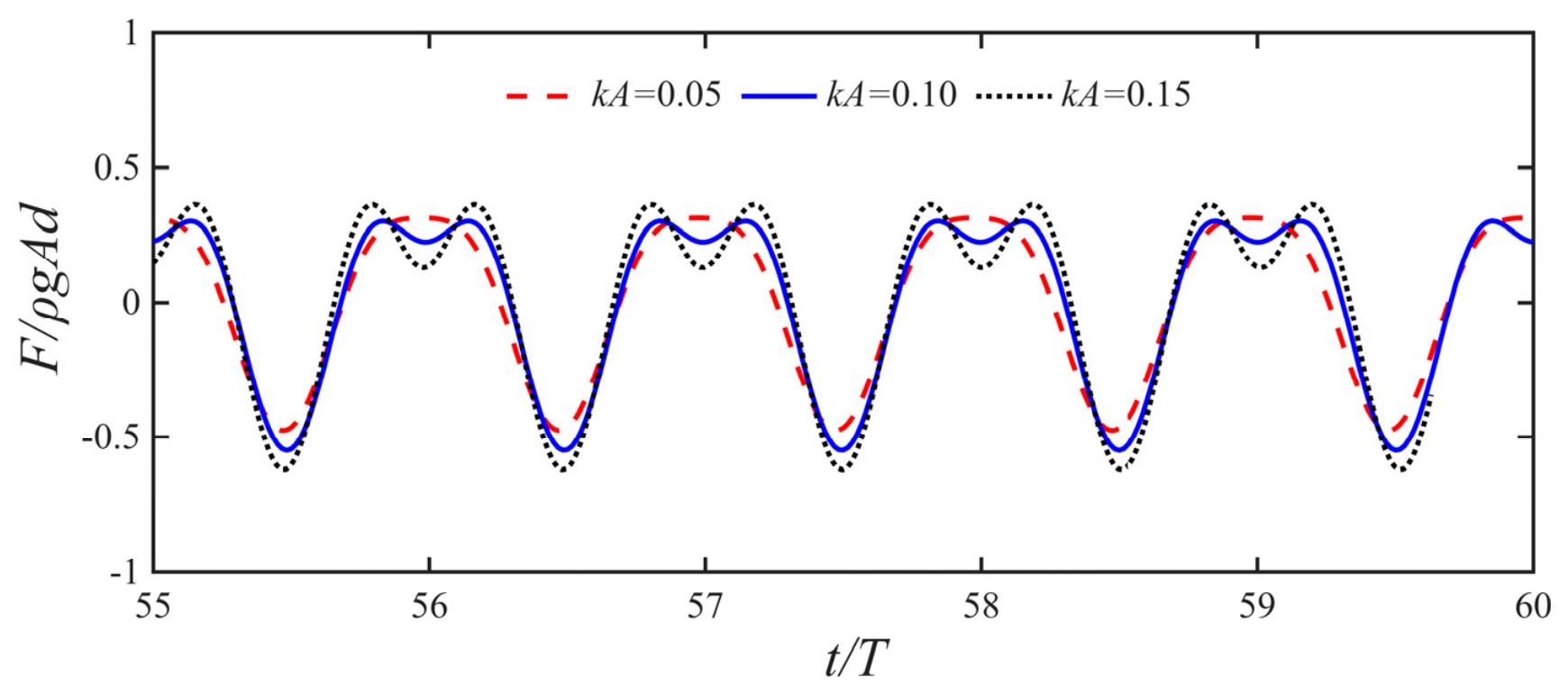
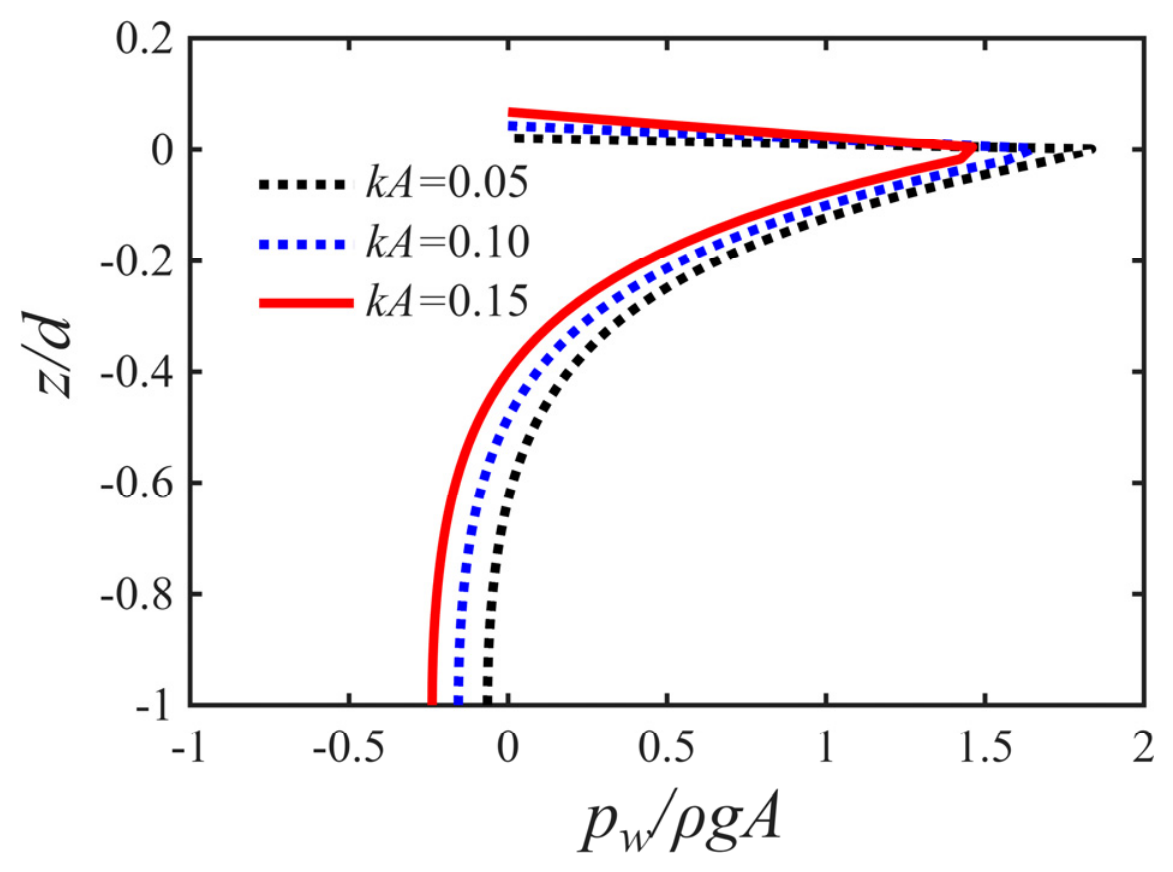
The validation results highlight the essential role of wave nonlinearity in governing the temporal evolution of the resultant wave force on a vertical wall, particularly as evidenced by the emergence of a saddle-shaped force response that lies beyond the predictive capability of linear theory. To further examine this nonlinear feature, numerical simulations are conducted for regular incident waves with period T = 2.0 s, water depth d = 5.0 m, and amplitudes A = 0.05 m, 0.10 m and 0.15 m, corresponding to incident wave steepness values of kA   =   0.05 , 0.10 , and 0.15 , respectively. The resulting free-surface elevations, wave-force time histories, and wall-pressure distributions are presented in Figure 6, Figure 7 and Figure 8. These cases cover weakly to strongly nonlinear wave conditions and therefore provide a systematic basis for assessing nonlinear wave–wall interaction. For the weakly nonlinear case kA = 0.05 , the standing wave formed in front of the wall has an amplitude close to twice that of the incident wave, consistent with linear standing-wave theory for complete reflection. Accordingly, nonlinear effects remain limited, the resultant force reaches its maximum at the crest phase, and no saddle-shaped response is observed. As the wave steepness increases to kA = 0.10 and 0.15 , the standing-wave profile becomes increasingly asymmetric: the crest elevation exceeds the linear prediction, whereas the trough elevation is relatively suppressed. As shown in Figure 7, the maximum force no longer occurs exactly at the crest phase but shifts to adjacent instants on either side of the crest, producing a distinct saddle-shaped distribution in the force time history. This behavior is closely related to the pressure field along the wall. Although the present potential-flow formulation provides access to interior velocity and pressure quantities, the present study focuses on free-surface evolution, wall-pressure distribution, and resultant force, which are the primary quantities governing nonlinear loading on the vertical wall. A detailed analysis of particle trajectories, interior flow structure, and bottom-pressure phase behavior will be considered in future work. As illustrated in Figure 8, a negative pressure region develops near the lower part of the wall during the crest phase, and both its spatial extent and magnitude increase with wave steepness. Under sufficiently nonlinear conditions, the negative-pressure region reduces the integrated force during the crest phase, producing a local depression in the force peak. This finding suggests that estimating extreme wave loads solely from the crest-phase pressure distribution may underestimate the true peak force. Accordingly, the emergence of negative-pressure regions and the associated saddle-shaped force response reveal important nonlinear mechanisms that should be explicitly accounted for in the analysis and design of vertical-wall coastal structures.
(b)
Effect of water depth
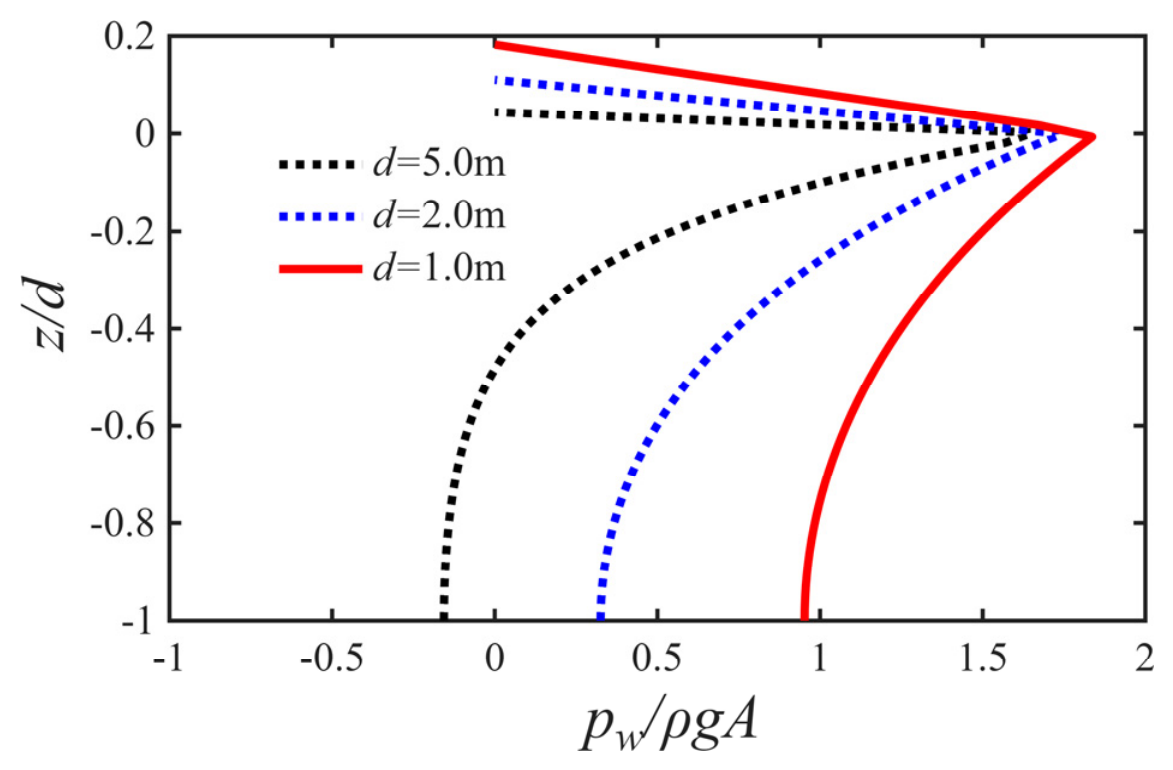
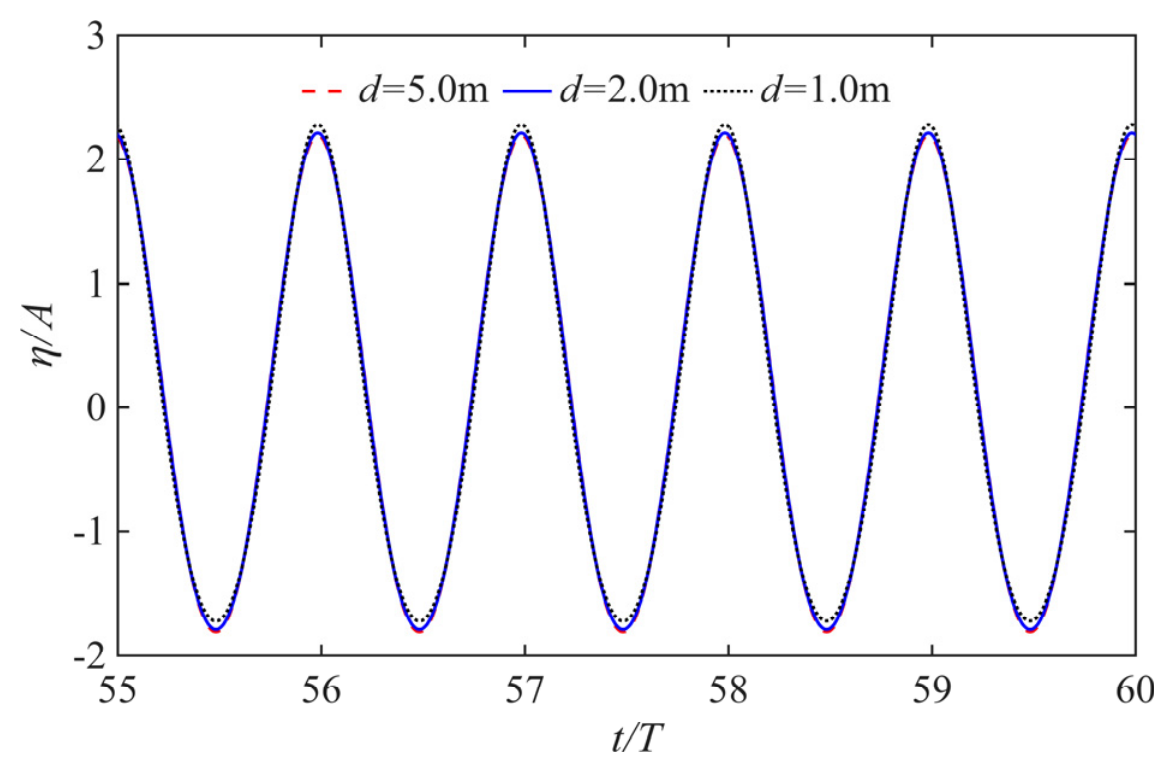
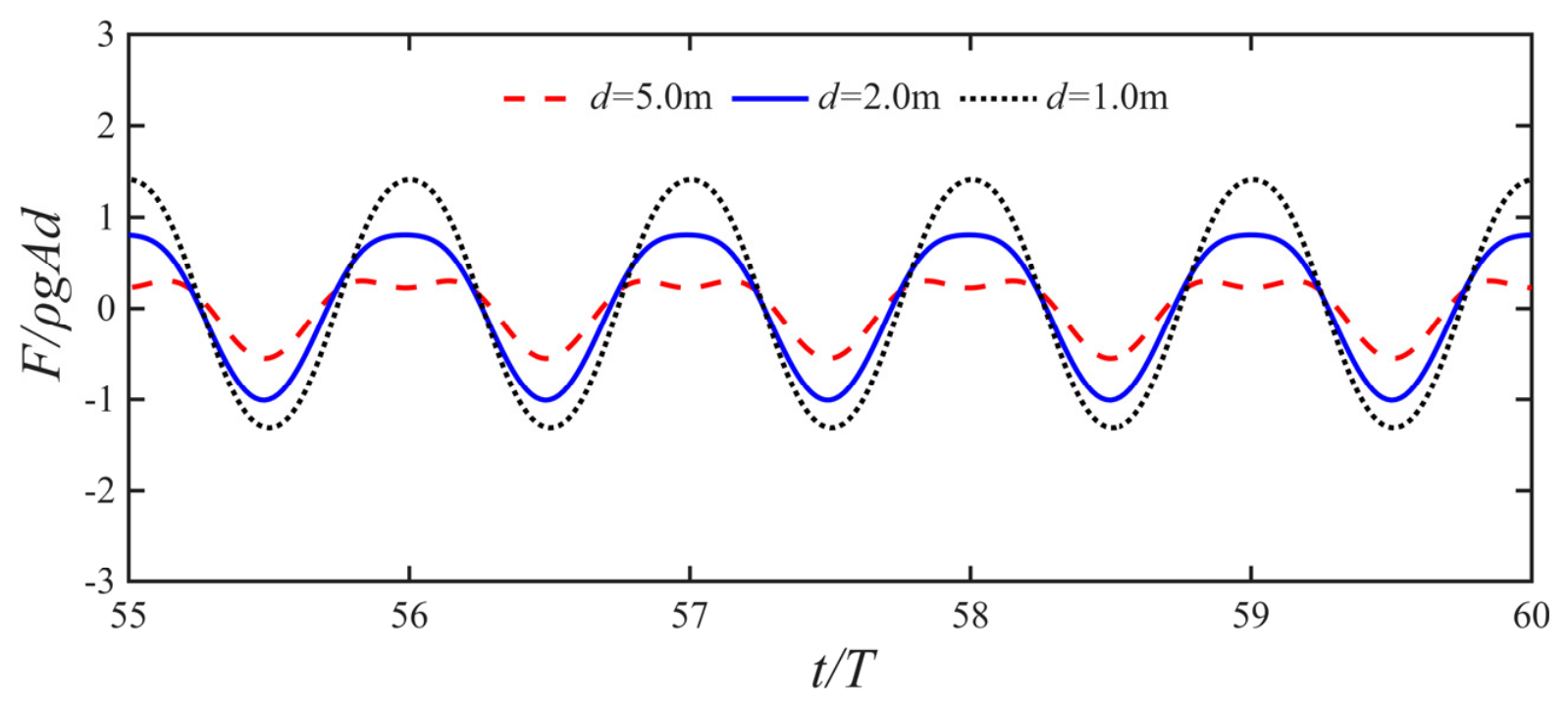
The previous section showed that increasing wave nonlinearity induces negative pressure near the lower wall during the crest phase, leading to a saddle-shaped resultant force history. In this section, the effect of water depth is examined to clarify how hydrodynamic conditions modulate this mechanism. Regular waves with a fixed period of T = 2.0 s are simulated for three still-water depths, d   =   5 m , 2 m   and 1 m . The incident wave amplitudes are adjusted as A = 0.10 m, 0.10 m and 0.08 m, respectively, so that the incident wave steepness remains approximately constant at kA = 0.10, corresponding to a nonlinear wave regime. The corresponding free-surface elevations, wave-force histories, and wall-pressure distributions are compared in Figure 9, Figure 10 and Figure 11. As the water depth decreases, seabed effects become increasingly important, enhancing the nonlinear deformation of the standing wave in front of the wall, with a steeper crest and a flatter trough.
The resultant wave force also exhibits a clear dependence on water depth, with its dimensionless amplitude increasing as the water depth decreases. This indicates that shallower-water conditions amplify wave loading through stronger depth-induced nonlinearity and enhanced interaction between incident and reflected waves. More importantly, the saddle-shaped force response observed in deeper water gradually weakens and eventually disappears as the water depth decreases. This transition is closely related to the wall-pressure distribution at the crest phase, as shown in Figure 11. In deeper water, a pronounced negative pressure region forms near the lower part of the wall, reducing the integrated force at the crest and causing the force maximum to shift to adjacent instants. In contrast, under shallower-water conditions, the velocity field becomes more uniformly distributed over the water column, with larger velocities concentrated closer to the free surface. According to Bernoulli’s principle, the associated positive dynamic pressure in the upper region of the wall becomes dominant, while the negative pressure near the bottom is suppressed. Consequently, the resultant force increases and its temporal evolution becomes more symmetric, with the maximum force occurring closer to the crest phase. These results demonstrate that water depth plays a critical role in regulating nonlinear wave loading on vertical walls. Both wave nonlinearity and depth effects should therefore be carefully considered in the design and assessment of vertical-wall coastal structures.

4.2. Focused Waves Interaction with Vertical Wall

In addition to regular waves, focused wave groups are widely adopted as numerical representations of extreme wave events in realistic sea states [30]. Such waves are characterized by the transient concentration of wave energy at a prescribed location and time, resulting in a markedly amplified free-surface elevation. In the present study, the focusing process of irregular wave groups in front of a vertical wall is simulated using the developed HOS-NWT. The irregular focused wave group is represented by the linear superposition of N wave components,
η ( x , t ) = n = 1 N A n cos k n x ω n t + θ n ,
where A n , k n , ω n , and θ n denote the amplitude, wavenumber, angular frequency, and phase of the n -th wave component, respectively. The phases θ n are prescribed to ensure constructive interference at the target focusing location and time. The component amplitudes are determined from a prescribed wave spectrum:
A n = A S f n i = 1 N S f i
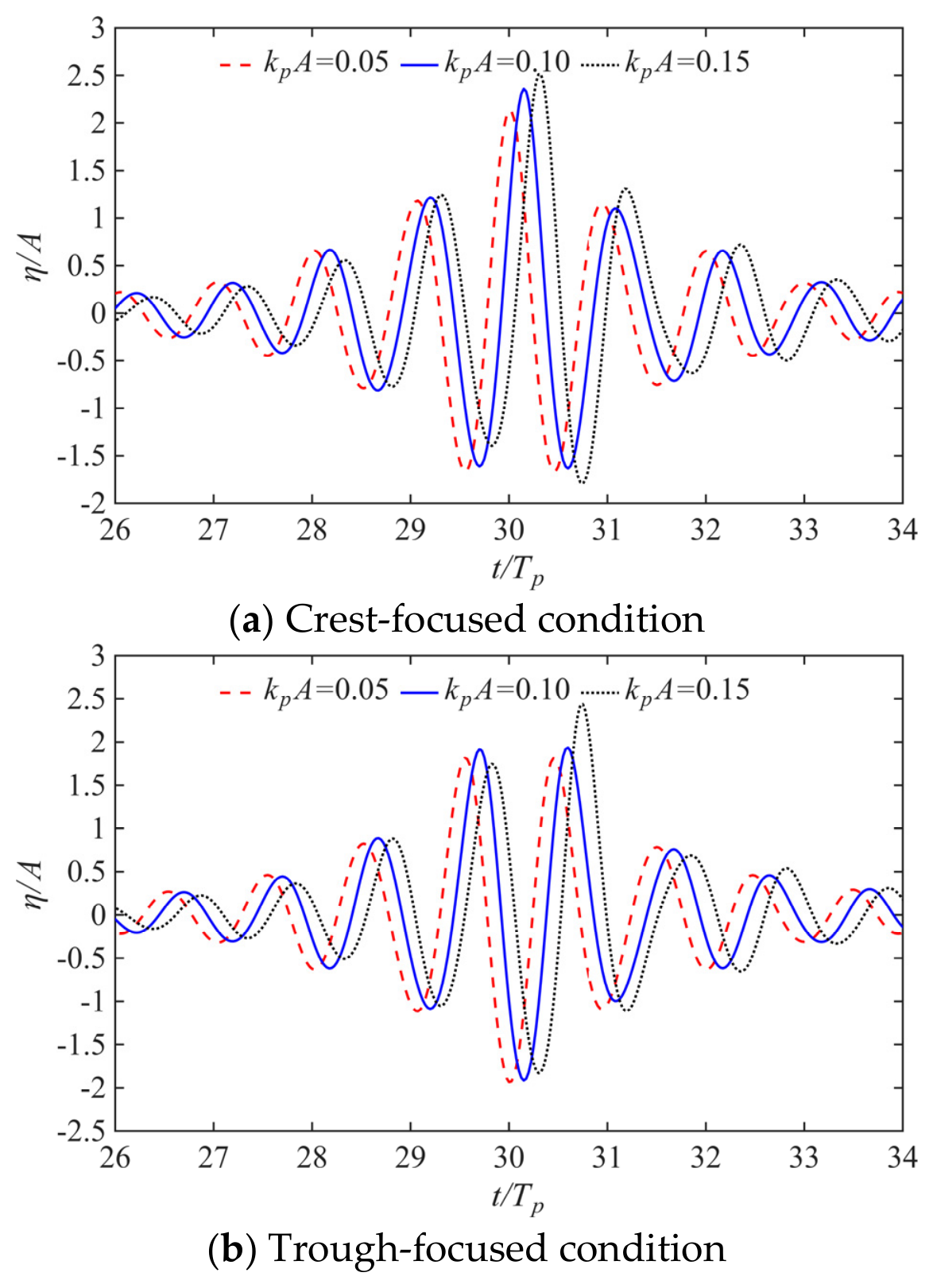
and the total linear amplitude satisfies A = n = 1 N A n . Accordingly, the characteristic wave steepness is defined as ε p = k p A , where k p is the wavenumber corresponding to the peak frequency. In this study, N = 25 wave components are considered. The underlying wave components are generated using the JONSWAP spectrum developed under the Joint North Sea Wave Project [31], with the peak enhancement factor set to γ = 3.30. The peak frequency is fixed at f p   =   0.5 Hz , corresponding to a peak period of T p   =   2.0 s . To concentrate the wave energy at the vertical wall while minimizing the influence of secondary reflections, the theoretical focusing location and focusing time are prescribed as x 0   =   50 m ,   t 0   =   60 s , respectively. Nonlinear higher-order wave components may shift the actual focusing location and focusing time from their prescribed theoretical values. Therefore, before examining the wave forces exerted by focused wave groups on the vertical wall, the actual focusing location and time are first determined using the procedure reported in our previous work [32]. Both crest- and trough-focused conditions are examined in this section, with trough focusing achieved by reversing the sign of the focused wave amplitudes. Stronger focused-wave nonlinearity results in greater shifts in both the actual focusing location and focusing time, while the two focusing types exhibit identical actual focusing locations at the same steepness.
(a)
Effect of focused wave amplitudes
Varying the focused wave amplitude A yields different characteristic steepness levels for assessing nonlinear effects during wave focusing. In this section, A = 0.05, 0.10, and 0.15 m are adopted, corresponding to kpA = 0.05, 0.10, and 0.15, respectively. The wave groups are prescribed to focus at the vertical wall. For kpA = 0.15, the incident wave group is strongly nonlinear, and wall reflection induces a transient standing wave with an effective local steepness of approximately 0.30. The free-surface elevations at the wall under crest- and trough-focused conditions are shown in Figure 12a and Figure 12b, respectively. During crest focusing, the maximum surface elevation increases markedly with wave steepness; for the strongly nonlinear case (kpA = 0.15), it reaches approximately 2.5 times the characteristic amplitude, exceeding the value of 2.0 predicted by linear standing-wave theory and indicating pronounced nonlinear amplification. In contrast, during trough focusing, the minimum surface elevation decreases with increasing steepness, accompanied by a progressive flattening of the trough. These trends are consistent with those observed for propagating focused waves discussed previously [33], suggesting that the nonlinear evolution of wave groups is retained even under strong wall reflection.
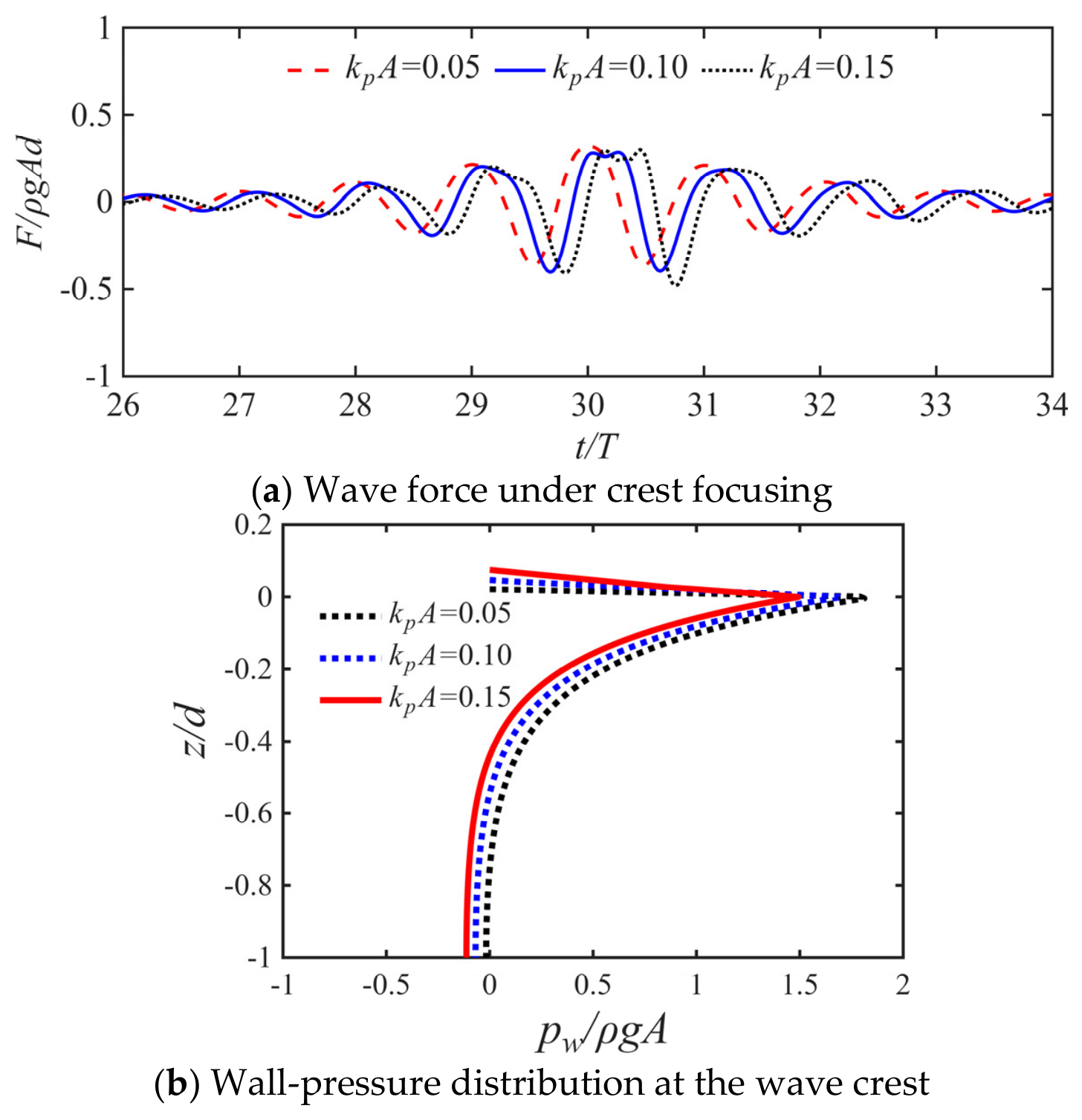
The corresponding wave-force response under crest-focused conditions is more complex. As shown in Figure 13a, in strongly nonlinear cases, the maximum resultant force does not occur exactly at the focusing instant, although the free-surface elevation reaches its peak at that time. Instead, the force time history exhibits a saddle-shaped distribution similar to that observed for regular waves in Section 4.1, indicating that nonlinear wave–structure interaction governs both the timing and magnitude of extreme forces. This feature can be attributed to the pressure distribution along the wall during crest focusing. As shown in Figure 13b, the negative pressure reduces the integrated force at the focusing instant, producing a local depression in the force response and shifting the maximum force to adjacent time instants. The resulting saddle-shaped force pattern is consistent with that observed for regular waves, but is further intensified under focused-wave conditions because of the strong localization of wave energy and enhanced nonlinear interactions within the wave group.
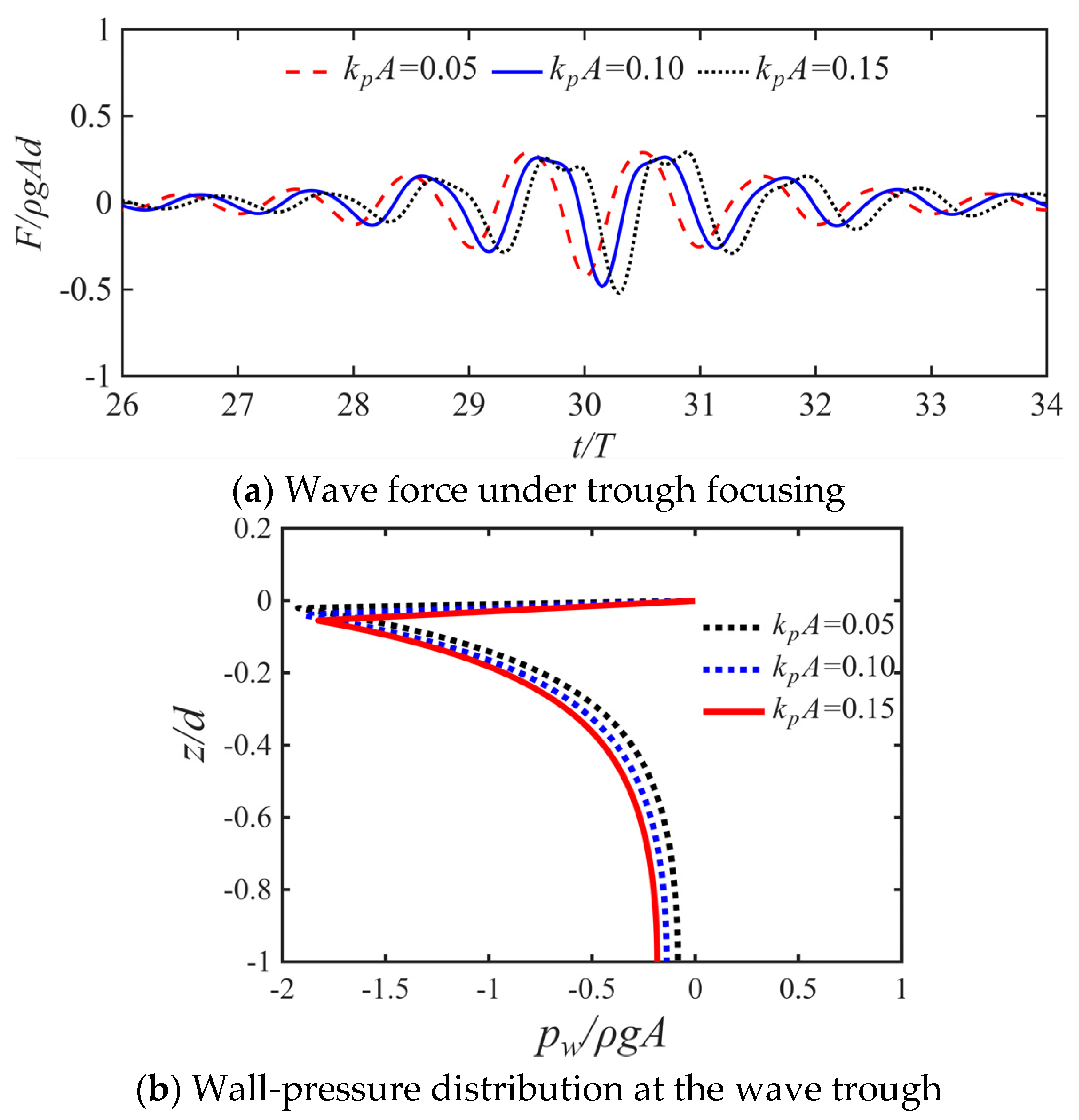
For trough-focused waves, the minimum resultant force occurs at the focusing instant, coinciding with the focused trough, as shown in Figure 14a. As wave steepness increases, the absolute magnitude of this force increases, despite the minimum free-surface elevation becoming less negative in Figure 12b. This indicates that the enhanced force response is not controlled solely by the trough depth, but is primarily associated with the intensified nonlinear pressure distribution along the wall. Consistently, Figure 14b shows that the pressure magnitude increases over most of the water column with increasing steepness, thereby producing a larger integrated force despite the reduced local trough depression.
(b)
Effect of frequency bandwidth on focused wave loading on a vertical wall
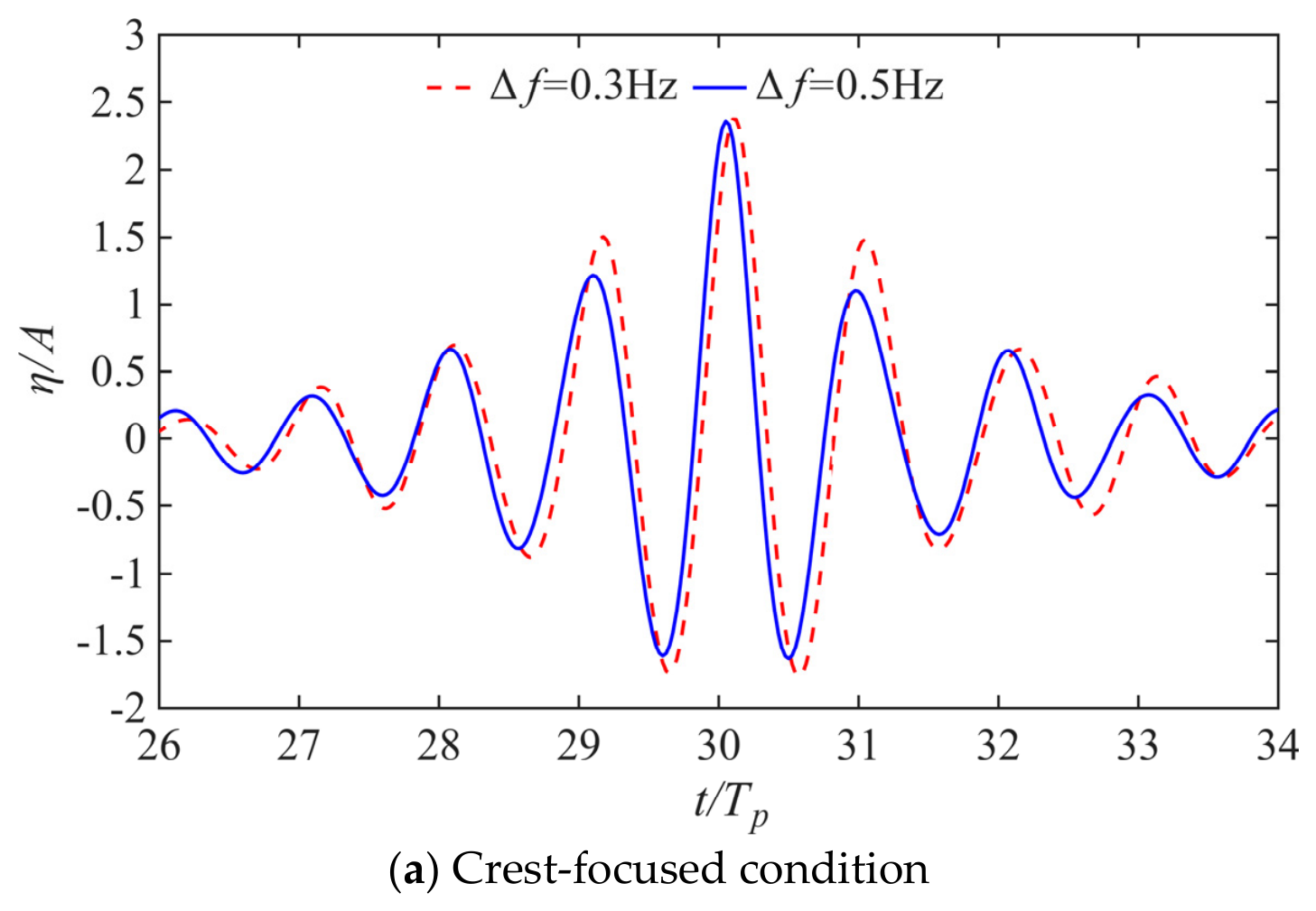
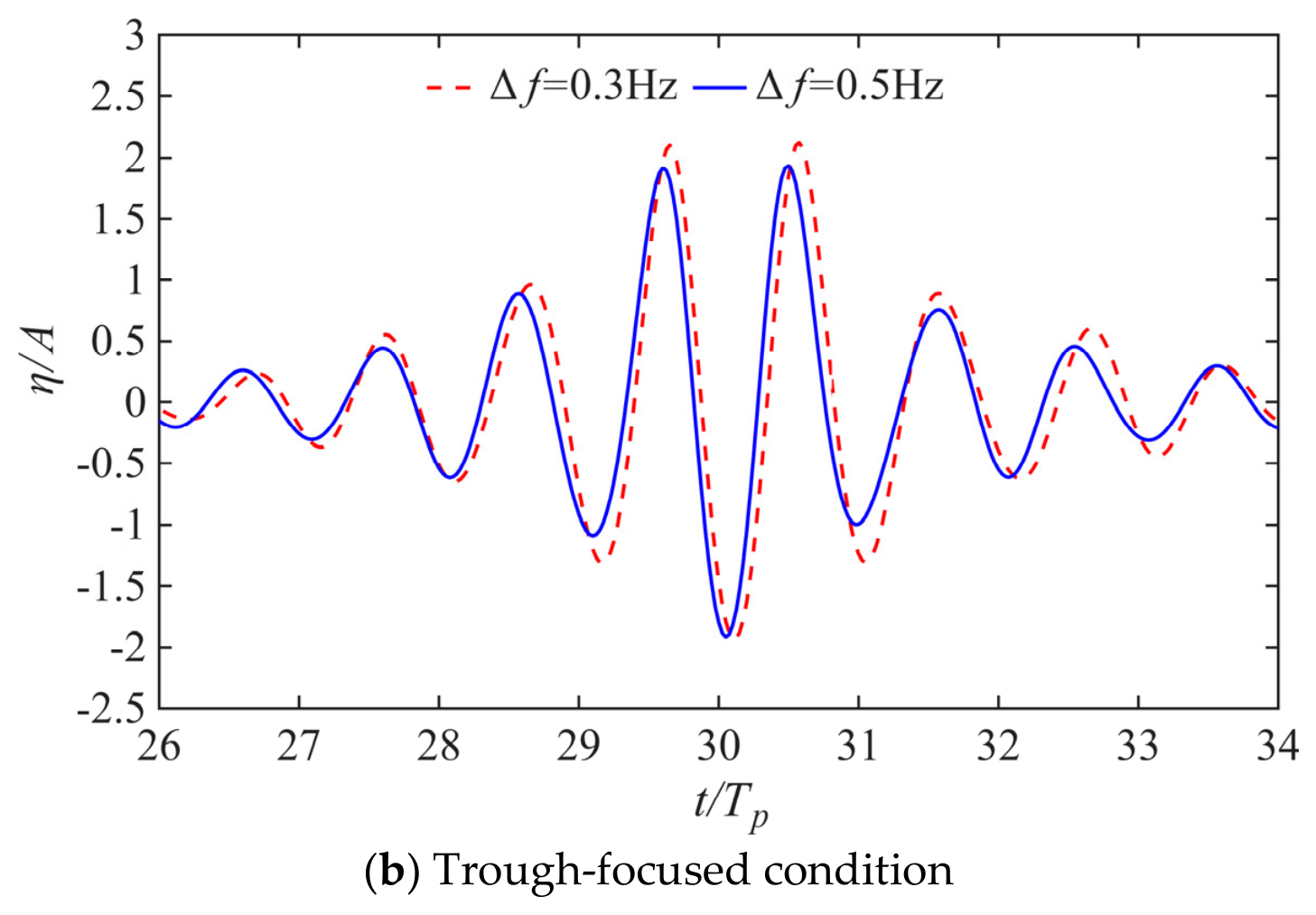
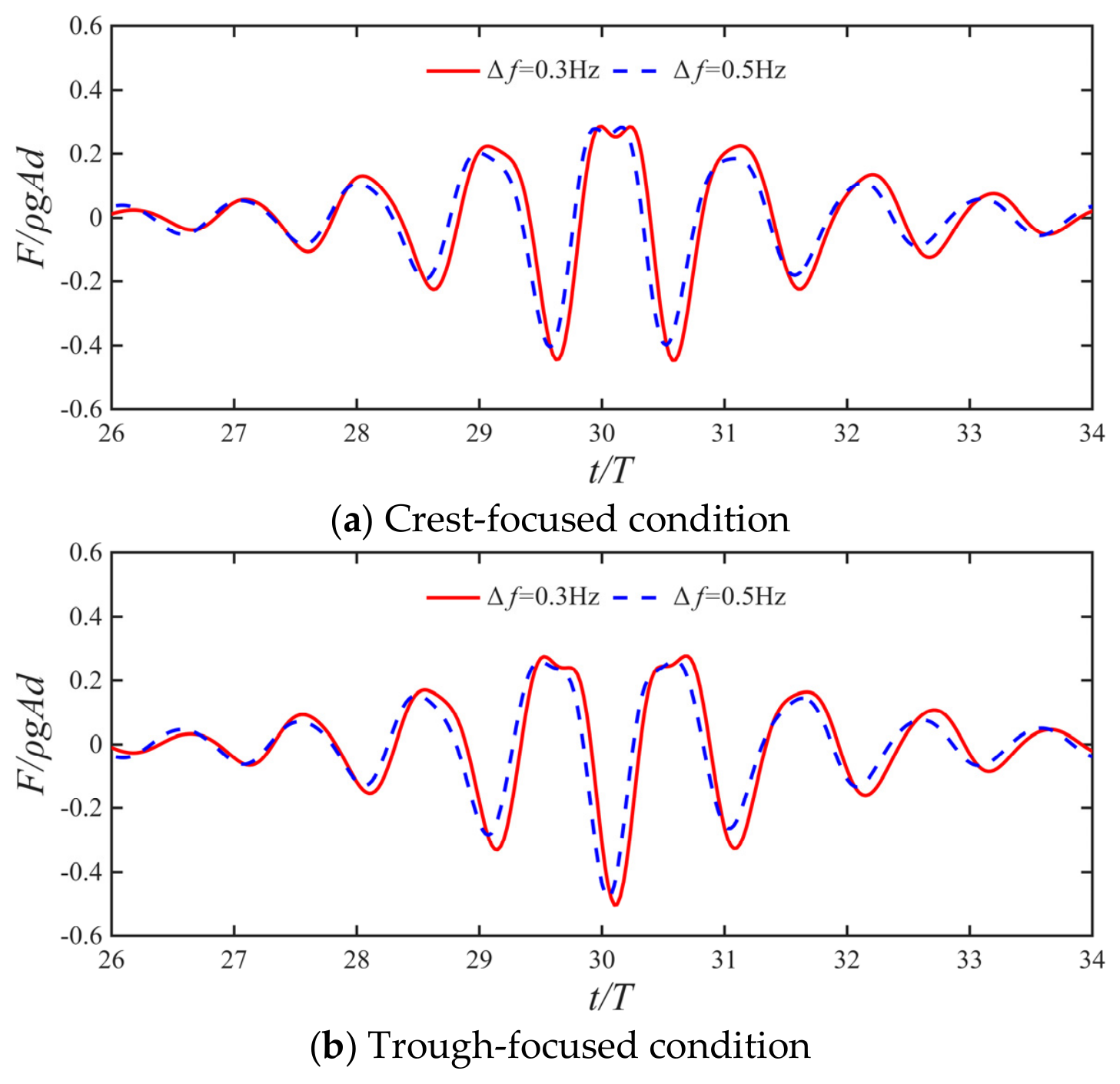
In addition to wave steepness, the frequency bandwidth is another key parameter governing focused-wave characteristics and wave–structure interaction. To examine its influence, two representative frequency ranges are considered: a broad-band case with Δf = 0.50 Hz (0.30–0.80 Hz) and a narrow-band case with Δf = 0.30 Hz (0.40–0.70 Hz). Numerical simulations are performed using the present HOS-NWT to investigate the effects of frequency bandwidth on wave focusing and the resulting wave force on the vertical wall. The time histories of free-surface elevation at the wall are shown in Figure 15a,b. The two bandwidth cases exhibit comparable overall focusing characteristics. Nevertheless, the narrow-band case (Δf = 0.30 Hz) yields slightly larger focused extrema in both crest- and trough-focused conditions, with a more pronounced amplification observed in the neighboring wave crests and troughs. This behavior reflects the stronger phase coherence in the narrow-band case, which sustains larger amplitudes over neighboring wave cycles and enhances the adjacent crests and troughs near the wall.
Figure 16a,b show the corresponding wave-force histories on the vertical wall. In line with the free-surface responses, both bandwidth cases display broadly similar force variations for crest- and trough-focused waves. Nevertheless, the narrow-band case (Δf = 0.30 Hz) yields a more sustained response around the focusing event, with noticeably amplified adjacent force peaks and troughs. By comparison, the difference in the primary focused force is relatively limited. This indicates that reducing the frequency bandwidth mainly enhances the neighboring-cycle loading by maintaining stronger phase coherence over a longer portion of the wave group. Consequently, the effect of bandwidth should be accounted for in wave-load assessment, as it influences not only the extreme force level but also the temporal distribution of loading near the focusing event. The apparent post-focusing broadening of the response may be interpreted qualitatively as wave-group spreading and dispersive redistribution after the main focusing event; a systematic longer-time analysis of this defocusing process is left for future work.

5. Conclusions

In this study, a fully nonlinear HOS-NWT is developed to investigate nonlinear wave interaction with a vertical wall. The incident wave boundary is introduced through an additional velocity potential, enabling simulations of both regular and focused waves. The model is validated against the Fourier solution [29], showing good accuracy in predicting free-surface elevation, pressure distribution, and resultant wave force. The main conclusions are as follows:
(1)
Wave nonlinearity significantly modifies the standing-wave field and the resultant force on the wall. With increasing incident wave steepness, the standing wave becomes increasingly asymmetric, with enhanced crest elevation and suppressed trough elevation. Under strongly nonlinear conditions, the resultant force develops a saddle-shaped time history, caused by negative pressure near the lower wall during the crest phase. This reduces the integrated force at the crest and shifts the maximum force to adjacent instants, indicating that the maximum force does not necessarily coincide with the maximum free-surface elevation.
(2)
Water depth plays a critical role in regulating nonlinear wave–wall interaction. As the water depth decreases, seabed effects intensify wave-shape deformation and increase the overall force magnitude. Meanwhile, the negative-pressure region near the lower wall is progressively suppressed, causing the saddle-shaped force response to weaken and eventually disappear. Thus, water depth affects not only the magnitude of wave loading but also the nonlinear pressure mechanism governing its temporal evolution.
(3)
Focused wave groups and spectral bandwidth further complicate extreme wave loading. Under crest-focused conditions, the resultant force may exhibit a saddle-shaped response similar to that observed for strongly nonlinear regular waves. Under trough-focused conditions, the extreme force magnitude increases with wave steepness, even when the minimum free-surface elevation becomes less negative, confirming that the force response is governed by the integrated nonlinear pressure distribution rather than the instantaneous surface elevation alone. A narrower spectral bandwidth maintains stronger phase coherence over a longer portion of the wave group, leading to slightly larger focused extrema and more pronounced amplification of adjacent wave and force cycles.
Overall, these results highlight the importance of nonlinear pressure effects, water depth, and spectral bandwidth in predicting extreme wave loads on vertical-wall structures. The proposed HOS-NWT provides an efficient tool for nonlinear wave-load prediction, and future work will extend the framework to breaking waves and three-dimensional wave–structure interactions.

Author Contributions

Conceptualization, S.X. and J.L.; methodology, S.X. and J.L.; software, S.X. and J.L.; validation, S.X. and J.L.; formal analysis, S.X.; investigation, J.L.; resources, J.L.; data curation, J.L.; writing—original draft preparation, S.X. and J.L.; writing—review and editing, S.X. and J.L.; visualization, S.X. and J.L.; supervision, J.L.; project administration, S.X. and J.L.; funding acquisition, S.X. and J.L. All authors have read and agreed to the published version of the manuscript.

Funding

This research was funded by the Open Fund of State Key Laboratory of Coastal and Offshore Engineering, grant number LP2414, and the Science and Technology Innovation Foundation of Dalian, grant number 2024RQ026.

Data Availability Statement

The original contributions presented in this study are included in the article. Further inquiries can be directed to the corresponding author.

Conflicts of Interest

The authors declare no conflicts of interest.

References

  1. Cecioni, C.; Pepi, Y.; Franco, L. New 2D laboratory experiments on wave overtopping at vertical walls under impulsive and non-impulsive conditions. Coast. Eng. 2025, 197, 104689. [Google Scholar] [CrossRef]
  2. McGovern, D.J.; Allsop, W.; Rossetto, T.; Chandler, I. Large-scale experiments on tsunami inundation and overtopping forces at vertical sea walls. Coast. Eng. 2023, 179, 104222. [Google Scholar] [CrossRef]
  3. Baines, A.; Cunningham, L.S.; Rogers, B.D. Shore-side downfall pressures due to waves impacting a vertical seawall: An experimental study. J. Mar. Sci. Eng. 2024, 12, 2149. [Google Scholar] [CrossRef]
  4. Shen, Y.; Whittaker, C.N.; Thompson, C.F.; Raby, A.C.; Young, A.P.; Dickson, M.E. Wave impacts on vertical cliffs: Insights from laboratory experiments and field observations. Coast. Eng. 2025, 201, 104794. [Google Scholar] [CrossRef]
  5. Li, Z.; Wang, Z.; Liang, B.; Wang, X. Experimental study on hydrodynamic performance and structural forces of curved and vertical front face pile-supported permeable breakwaters. Phys. Fluids 2024, 36, 117134. [Google Scholar] [CrossRef]
  6. Li, Z.; Liu, R.; Wang, Z.; Liang, B.; Xia, H.; Sun, X.; Wang, X.; Shi, L. Wave forces and dynamic pressures on pile-supported breakwaters with inclined perforated plates under regular waves. Front. Mar. Sci. 2024, 11, 1499685. [Google Scholar] [CrossRef]
  7. Rambabu, N.; Srineash, V. Physical modeling study on hydrodynamic performance of vertical seawalls defended by submerged reef breakwaters. J. Waterw. Port Coast. Ocean Eng. 2026, 152, 04026011. [Google Scholar] [CrossRef]
  8. Herdayanditya, I.; Lataire, E.; Rauwoens, P. Spatial variations in numerical wave tanks with active wave generating–absorbing system. Ocean Eng. 2025, 315, 119744. [Google Scholar] [CrossRef]
  9. Melander, A.; Ebstrup Bitsch, M.; Chen, D.; Peter Engsig-Karup, A. A high-order hybrid-spectral incompressible Navier–Stokes model for non-Linear water waves. Int. J. Numer. Methods Fluids 2025, 97, 1009–1021. [Google Scholar] [CrossRef]
  10. Sriram, V.; Saincher, S.; Yan, S.; Ma, Q. The past, present and future of multi-scale modelling applied to wave–structure interaction in ocean engineering. Philos. Trans. R. Soc. A Math. Phys. Eng. Sci. 2024, 382, 20230316. [Google Scholar] [CrossRef]
  11. Jung, J.-S.; Lee, J.-W.; Hong, S.H. A numerical study of nonlinear periodic waves generated by bottom wavemakers using a high-order spectral method and a linear analytical solution. Phys. Fluids 2025, 37, 106619. [Google Scholar] [CrossRef]
  12. Poletto, J.V.P.; Andrade, D.; Flamarion, M.V.; Ribeiro-Jr, R. Full Euler equations for waves generated by vertical seabed displacements. SIAM J. Appl. Math. 2025, 85, 1344–1360. [Google Scholar] [CrossRef]
  13. Kim, S.; Bouscasse, B.; Ducrozet, G.; Canard, M.; De Hauteclocque, G.; Housseine, C.O.; Ferrant, P. Numerical and experimental study of a FORM-based design wave applying the HOS-NWT nonlinear wave solver. Ocean Eng. 2022, 263, 112287. [Google Scholar] [CrossRef]
  14. Ducrozet, G.; Charlou, M.; Bonnefoy, F. HOS-NWT: An open-source numerical wave tank based on the high-order spectral method. Comput. Phys. Commun. 2026, 325, 110168. [Google Scholar] [CrossRef]
  15. Oh, S.; Jung, S.; Sung, H.-G. Development of a numerical wave tank of deep ocean engineering basin via high order spectral method. Ships Offshore Struct. 2025, 20, 295–305. [Google Scholar] [CrossRef]
  16. Bonnefoy, F.; Le Touzé, D.; Ferrant, P. A fully-spectral 3D time-domain model for second-order simulation of wavetank experiments. Part A: Formulation, implementation and numerical properties. Appl. Ocean Res. 2006, 28, 33–43. [Google Scholar] [CrossRef]
  17. Bonnefoy, F.; Le Touzé, D.; Ferrant, P. A fully-spectral 3D time-domain model for second-order simulation of wavetank experiments. Part B: Validation, calibration versus experiments and sample applications. Appl. Ocean Res. 2006, 28, 121–132. [Google Scholar] [CrossRef]
  18. Ducrozet, G.; Bonnefoy, F.; Le Touzé, D.; Ferrant, P. Implementation and validation of nonlinear wavemaker models in a HOS numerical wave tank. Int. J. Offshore Polar Eng. 2006, 16, 161–167. [Google Scholar]
  19. Ducrozet, G.; Bonnefoy, F.; Le Touzé, D.; Ferrant, P. A modified high-order spectral method for wavemaker modeling in a numerical wave tank. Eur. J. Mech.-B/Fluids 2012, 34, 19–34. [Google Scholar] [CrossRef]
  20. Ning, D.; Zang, J.; Liu, S.; Taylor, R.E.; Teng, B.; Taylor, P. Free-surface evolution and wave kinematics for nonlinear uni-directional focused wave groups. Ocean Eng. 2009, 36, 1226–1243. [Google Scholar] [CrossRef]
  21. Guyenne, P.; Nicholls, D.P. A high-order spectral method for nonlinear water waves over moving bottom topography. SIAM J. Sci. Comput. 2008, 30, 81–101. [Google Scholar] [CrossRef]
  22. Xu, B.; Guyenne, P. Nonlinear simulation of wave group attenuation due to scattering in broken floe fields. Ocean Model. 2023, 181, 102139. [Google Scholar] [CrossRef]
  23. Akrish, G.; Schwartz, R.; Rabinovitch, O.; Agnon, Y. Impact of extreme waves on a vertical wall. Nat. Hazards 2016, 84, 637–653. [Google Scholar] [CrossRef]
  24. Hu, Z.; Huang, L.; Li, Y. Fully-coupled hydroelastic modeling of a deformable wall in waves. Coast. Eng. 2023, 179, 104245. [Google Scholar] [CrossRef]
  25. Xu, G.; Zhou, Y.; Yan, S.; Yuan, S. Spatial energy evolution of focused waves generated in numerical wave tank. Appl. Ocean Res. 2024, 148, 104015. [Google Scholar] [CrossRef]
  26. Wang, H.; Fang, Q.; Chen, Z.; Liu, C.; Jung, K.H.; Guo, A. Experimental and numerical study on the temporal and spatial nonlinearity evolution of focused wave. Ocean Eng. 2024, 311, 118840. [Google Scholar] [CrossRef]
  27. Wang, Y.; Ducrozet, G. Performance-enhanced HOS-NWT for generating and propagating short-crested seas. In Proceedings of the 41st International Workshop on Water Waves and Floating Bodies 2026, Plitvice, Croatia, 26–29 April 2026. [Google Scholar]
  28. Liu, J.; Teng, B. A modified approach to wavemaker modeling for high-order spectral numerical wave tanks. Wave Motion 2022, 109, 102850. [Google Scholar] [CrossRef]
  29. Tsai, C.-P.; Jeng, D.-S. Numerical Fourier solutions of standing waves in finite water depth. Appl. Ocean Res. 1994, 16, 185–193. [Google Scholar] [CrossRef]
  30. Xu, G.; Zhou, Y.; Yan, S.; Zhang, N. Numerical investigation of wave amplitude spectra effects on focusing wave generation. Ocean Eng. 2022, 265, 112550. [Google Scholar] [CrossRef]
  31. Goda, Y. A comparative review on the functional forms of directional wave spectrum. Coast. Eng. J. 1999, 41, 1–20. [Google Scholar] [CrossRef]
  32. Liu, J.; Teng, B. Spectral wave explicit weak-scattering approach for higher harmonic wave loads and ringing response of flexible monopile. Appl. Ocean Res. 2023, 130, 103415. [Google Scholar] [CrossRef]
  33. Liu, J.; Teng, B. Higher-Harmonic response of a slender monopile to fully nonlinear focused wave groups. J. Mar. Sci. Eng. 2021, 9, 286. [Google Scholar] [CrossRef]
Figure 1. Schematic of the wave tank with its coordinate system.
Jmse 14 01085 g001
Figure 2. Extended domain Dadd for additional problem solution.
Jmse 14 01085 g002
Figure 3. Convergence study of free surface elevations at vertical wall.
Jmse 14 01085 g003
Figure 4. Comparison of dimensionless resultant wave force on the vertical wall.
Jmse 14 01085 g004
Figure 5. Comparison of wall-pressure distribution at the wave crest.
Jmse 14 01085 g005
Figure 6. Effect of incident wave steepness on wave run-up at the vertical wall.
Jmse 14 01085 g006
Figure 7. Effect of incident wave steepness on the resultant wave force acting on the vertical wall.
Jmse 14 01085 g007
Figure 8. Effect of incident wave steepness on the wall-pressure distribution at the wave crest.
Jmse 14 01085 g008
Figure 9. Effect of water depth on wave run-up at the vertical wall.
Jmse 14 01085 g009
Figure 10. Effect of water depth on the resultant wave force acting on the vertical wall.
Jmse 14 01085 g010
Figure 11. Effect of water depth on the wall-pressure distribution at the wave crest.
Jmse 14 01085 g011
Figure 12. Evolution of free-surface elevation during crest and trough focusing.
Jmse 14 01085 g012
Figure 13. Wave force and wall-pressure distribution during crest focusing.
Jmse 14 01085 g013
Figure 14. Wave force and wall-pressure distribution during trough focusing.
Jmse 14 01085 g014
Figure 15. Evolution of free-surface elevation during crest and trough focusing for different frequency bandwidths.
Jmse 14 01085 g015aJmse 14 01085 g015b
Figure 16. Wave force during crest and trough focusing for different frequency bandwidths.
Jmse 14 01085 g016
Disclaimer/Publisher’s Note: The statements, opinions and data contained in all publications are solely those of the individual author(s) and contributor(s) and not of MDPI and/or the editor(s). MDPI and/or the editor(s) disclaim responsibility for any injury to people or property resulting from any ideas, methods, instructions or products referred to in the content.