1. Introduction
In recent years, the global energy system has been accelerating its transition toward cleaner and lower-carbon solutions. The issue of greenhouse gas emissions and environmental pollution caused by excessive consumption of fossil fuels has become a global consensus [
1,
2]. According to the latest statistics, global CO
2 emissions reached 36.3 Gt in 2024, marking an increase of approximately 0.9% compared to 2023 and setting a new record high. This poses significant challenges to the climate system and the human living environment [
3]. Against this backdrop, the development and utilization of renewable energy sources such as wind, solar, and wave power have become key directions for global energy transition [
4,
5].
Among various renewable energy technologies, wind power generation has emerged as a crucial pillar of the current energy transition due to its technological maturity, widespread resource distribution, and high capacity per unit of installed equipment [
6]. However, offshore wind projects face challenges, including high construction costs, complex operation and maintenance requirements, and harsh wind conditions. Optimizing methods to enhance system efficiency and economic viability has therefore become a primary focus of current research [
7,
8].
Selected wind energy subfields have been addressed in recent focused surveys. Wake measurement, reliability modeling, and wind-resource assessment have each attracted dedicated survey work. Sun et al. [
9] cataloged full-scale wake measurements spanning onshore and offshore campaigns, isolated wake dynamics, and model validation—and reported a new experiment on wake interaction. Wen et al. [
10] concentrated on analytical and Monte Carlo reliability techniques, probing how wake effects, turbine correlation, and penetration shape system dependability. Wais [
11] compared two- and three-parameter Weibull distributions for wind resource work, arguing that the three-parameter form offers distinct advantages at sites with frequent low winds. These contributions solidify the methodological backbone of their respective areas. What they leave largely unexamined is the growing imprint of advanced optimization.
More recent reviews have shifted the spotlight to optimization. Teklehaimant et al. [
12] classified maximum power point tracking (MPPT) control algorithms for wind energy conversion systems into indirect power control, direct power control, hybrid, and intelligent schemes, evaluating their convergence speed, efficiency, and robustness. Dubey et al. [
13] charted the expanding use of machine learning and hybrid intelligence—deep learning, reinforcement learning, physics-data hybrids—across forecasting, control, fault diagnosis, and multi-objective energy management. Selvaraj et al. [
14] weighed wind power forecasting techniques against each other for integration optimization, comparing numerical weather prediction, machine learning, and hybrid probabilistic methods, and pinned down the accuracy lifts that advanced models have achieved. Firoozi et al. [
15] inventoried efficiency improvement strategies, from aerodynamic tweaks and layout optimization to data-driven operational enhancements enabled by analytics and smart technologies.
For all the insights they provide, existing reviews leave certain needs unmet. Most reviews, for one, confine themselves to a single algorithm class or application scenario—MPPT control, machine learning forecasting, or system reliability—and rarely attempt to weave together multiple optimization methodologies and application domains. Data-driven and intelligent optimization is seeing wider use, yet no evaluation has clarified these techniques’ roles and effectiveness through a system-level lens across the three core application areas: turbine design, wind-farm layout, and operational control. A final shortcoming concerns the absence of a unifying analytical framework that systematically captures the commonalities, differences, and complementarities of diverse optimization approaches operating across these interconnected domains.
To address these gaps, this review focuses on the literature published between 2021 and 2025. Relevant studies were retrieved from the Web of Science database using keywords related to offshore wind energy design, layout, control, and optimization methods. The inclusion criteria require that the literature explicitly involves optimization methodologies and is directly related to turbine/system design, wind farm layout, or control optimization. Studies that are duplicated, weakly related, or purely descriptive without optimization analysis are excluded.
From this perspective, this work does not aim to replace previous reviews, but rather to complement and extend them. Specifically, it provides a cross-domain synthesis of recent advances in offshore wind energy systems from an optimization-oriented viewpoint, integrating developments in design, layout, and control, and highlighting the latest methodological progress.
The main contributions of this review are summarized as follows:
Systematically summarize and compare mathematical optimization methods applied to wind power systems across multiple application domains;
Analyze the applicability and limitations of these methods in floating wind turbine systems, with particular emphasis on multidisciplinary coupling and environmental uncertainties;
Provide a unified framework for understanding the interconnections among turbine design, wind farm layout, and control optimization, offering insights for future research and engineering applications in floating wind energy systems.
The structure of this paper is organized as follows.
Section 2 introduces the requirements and challenges of wind power system optimization, analyzing key issues in wind turbine parameter design, wind farm layout optimization, and control strategy optimization.
Section 3 focuses on typical applications of mathematical optimization methods in wind power systems, detailing their specific implementation and representative case studies in wind turbine parameter design optimization, wind farm layout optimization, and control strategy optimization.
Section 4 compares and evaluates different optimization methods, assessing their respective strengths and weaknesses in terms of accuracy, convergence, and computational overhead.
Section 5 summarizes current challenges and outlines future research directions.
Through this work, this paper aims to provide a comprehensive reference for both academic research and engineering practice. It seeks to help researchers better understand the effectiveness and limitations of various optimization methods in wind power applications, while offering insights and methodological support for future research and practical engineering implementation.
2. Requirements and Key Challenges for Wind Power System Optimization
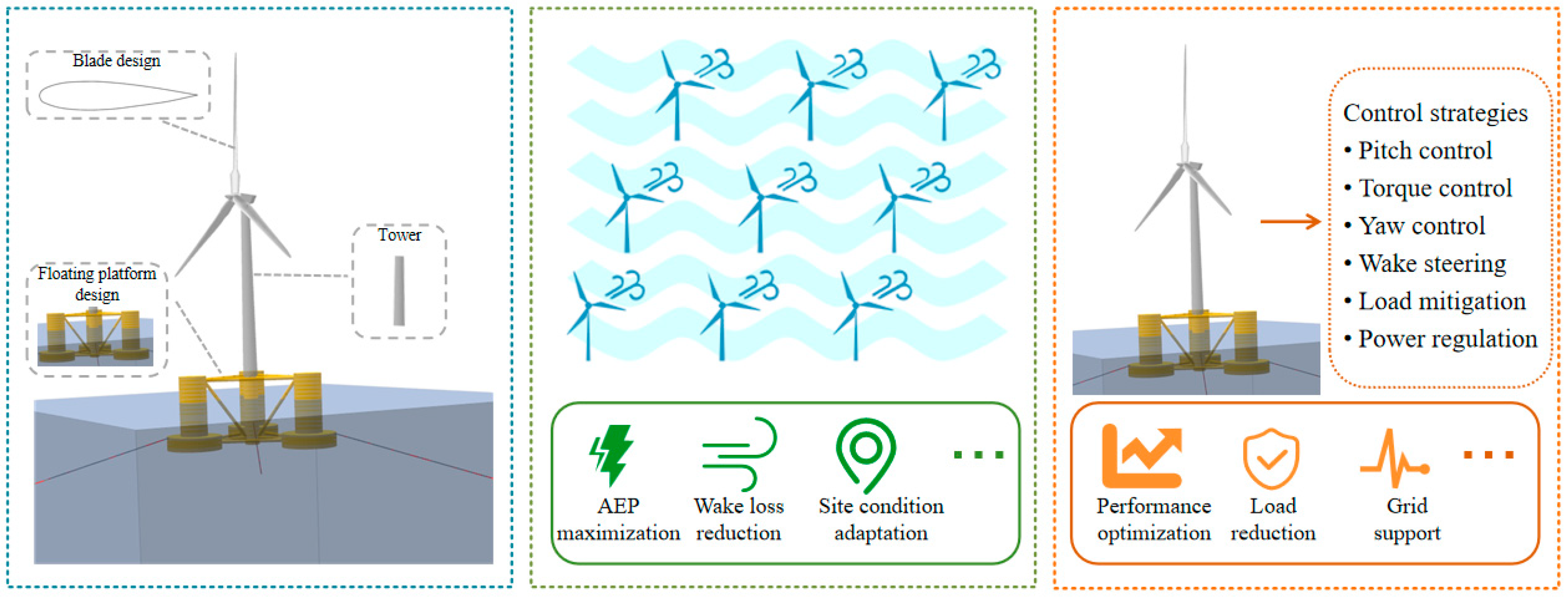
As shown in
Figure 1, wind energy optimization problems can be broadly categorized into three major domains: turbine system design, wind farm layout, and control strategy optimization. In this review, these domains are selected not because they are completely independent, but because they represent the major levels at which mathematical optimization methods are applied in wind energy systems. From a methodological perspective, they share several common features, including strong nonlinearity, multiple conflicting objectives, high computational cost, which refers to the exponential growth of the solution space and the resulting increase in both computational time and memory requirements when solving large combinatorial optimization problems, and increasing uncertainty.
In floating wind applications, these domains may also become more tightly coupled in practice. For example, platform and turbine design influence structural dynamics and wake behavior [
16,
17,
18], wind farm layout affects inflow conditions and control effectiveness [
19], and control strategies in turn influence load distribution and long-term system performance [
20,
21]. Although a detailed review of these coupling mechanisms is beyond the main scope of this paper, such cross-domain interactions provide an important motivation for future integrated optimization research.
2.1. Multidisciplinary Coupling and Computational Challenges in Wind Turbine Parameter Design
Wind turbines are complex systems characterized by strong multidisciplinary coupling, involving aerodynamics, structural mechanics, and control systems, with all subsystems tightly integrated. For example, aerodynamic loads induce structural deformation, which in turn affects the distribution of aerodynamic forces. Control system actions, such as pitch and yaw adjustments, modify flow fields and loads, thereby dynamically interacting with the structural response [
22]. In offshore applications, especially under complex environmental loading, such coupling becomes more pronounced and makes isolated single-discipline design increasingly insufficient. Consequently, wind turbine parameter design urgently requires Multidisciplinary Design Optimization (MDO) methods. These approaches integrate aerodynamic performance, structural strength, and control strategies from a holistic perspective to meet the growing demands for larger turbine sizes and enhanced performance [
23].
The aim of multidisciplinary optimization for wind turbines is to improve energy capture efficiency while meeting requirements related to cost, safety, and reliability. For example, improvements in blade and rotor design can significantly enhance the power coefficient [
24]. Aerodynamic improvements may increase power output but also raise structural loads, while lightweight structural designs may reduce cost but compromise dynamic robustness [
25]. In addition, reliability and service life must also be optimized. As shown in
Figure 2, studies on wind turbine transmission system optimization have demonstrated that multi-objective optimization of gear and bearing micro-geometries can reduce the failure risk of gearbox components by at least 20%, thereby decreasing downtime losses caused by failures [
26]. Overall, wind turbine optimization objectives are numerous and highly interdependent, requiring trade-offs among energy production, structural cost, and operational reliability.
In multidisciplinary optimization of wind turbines, the high computational cost associated with complex models represents a central challenge. To address this issue, researchers have developed a range of efficient optimization strategies. During the design space exploration phase, statistical experimental design and surrogate modeling techniques are commonly employed to reduce computational expense. For instance, the Taguchi method, a design of experiments (DoE) approach based on orthogonal arrays, has been applied to optimize the configuration of adjacent vertical-axis wind turbines. Here, the “experiments” refer to structured numerical trials used to evaluate different parameter combinations efficiently [
27,
28]. By analyzing the influence of rotor parameters on self-starting performance, a solution that effectively reduces start-up time was identified using a limited number of experiments [
26]. For large-scale optimization problems, the integration of computationally efficient surrogate models with evolutionary algorithms that possess strong global search capabilities has emerged as a key strategy [
29]. For instance, one study employed sparse polynomial chaotic expansion to construct a surrogate model for floating wind turbine mooring systems, and combined it with a differential evolution (DE) algorithm to identify optimal mooring parameters, achieving a balance between accuracy and computational efficiency [
30]. Furthermore, genetic algorithms (GA), particle swarm optimization (PSO), and their variants have been widely applied to optimize aerodynamic profiles and control system parameters. Under various constraints, these approaches have been shown to significantly enhance aerodynamic efficiency and control performance [
30,
31].
Looking ahead, in the face of persistent challenges related to large-scale computations and uncertainty, multidisciplinary coupling optimization for wind turbines requires further development of more efficient algorithms, more precise models, and more robust optimization methods to facilitate the effective translation of optimization results into engineering practice.
2.2. Optimization and Modeling Challenges for Wind Farm Layout Under High-Dimensional Nonconvex Constraints
The overall performance of wind farms is significantly constrained by the coupled effects of wake interference and layout configuration. As individual turbine capacity and site density continue to increase, wake interactions become increasingly complex, making the coordinated optimization of layout and control a core challenge for enhancing energy capture efficiency and operational stability in wind farms [
32,
33].
At present, the primary demand in wind farm optimization is the establishment of an integrated design framework that simultaneously addresses multiple objectives, scales, and disciplines, balancing power output, structural loads, system stability, and economic viability [
34]. Traditional single-objective optimization approaches often prioritize maximizing annual energy production (AEP) while neglecting long-term considerations such as load safety and fatigue damage. In recent years, researchers have introduced composite performance metrics, including power coefficient, fatigue load, and turbulence intensity, to achieve synergistic optimization of energy capture and structural lifespan [
35]. Furthermore, complex topography, variable wind patterns, and unsteady offshore wave fields require optimization solutions that perform robustly across diverse wind conditions and operational scenarios [
36,
37].
At the modeling level, the accuracy of wake models directly determines the effectiveness of layout optimization and control strategies. Analytical wake models are widely employed for rapid layout optimization due to their high computational efficiency; however, their accuracy is significantly limited under complex boundary layers, varying atmospheric stability, and hilly terrain conditions [
38,
39]. High-fidelity CFD models, such as RANS and LES, can accurately capture vortex dynamics and turbulent transport processes, but their substantial computational costs render direct integration into iterative, large-scale optimization workflows impractical [
40]. To address this trade-off, the research community has proposed fusion strategies that combine multi-fidelity modeling with surrogate models. In this approach, a limited number of high-fidelity simulations are used to generate training data, after which portions of the simulation process are replaced by machine learning or reduced-order models.
This strategy significantly reduces computational overhead while maintaining physical consistency [
41]. However, such approximate models often exhibit limited transferability across different wind conditions and terrain types, and they lack unified standards for error assessment and applicability [
41,
42].
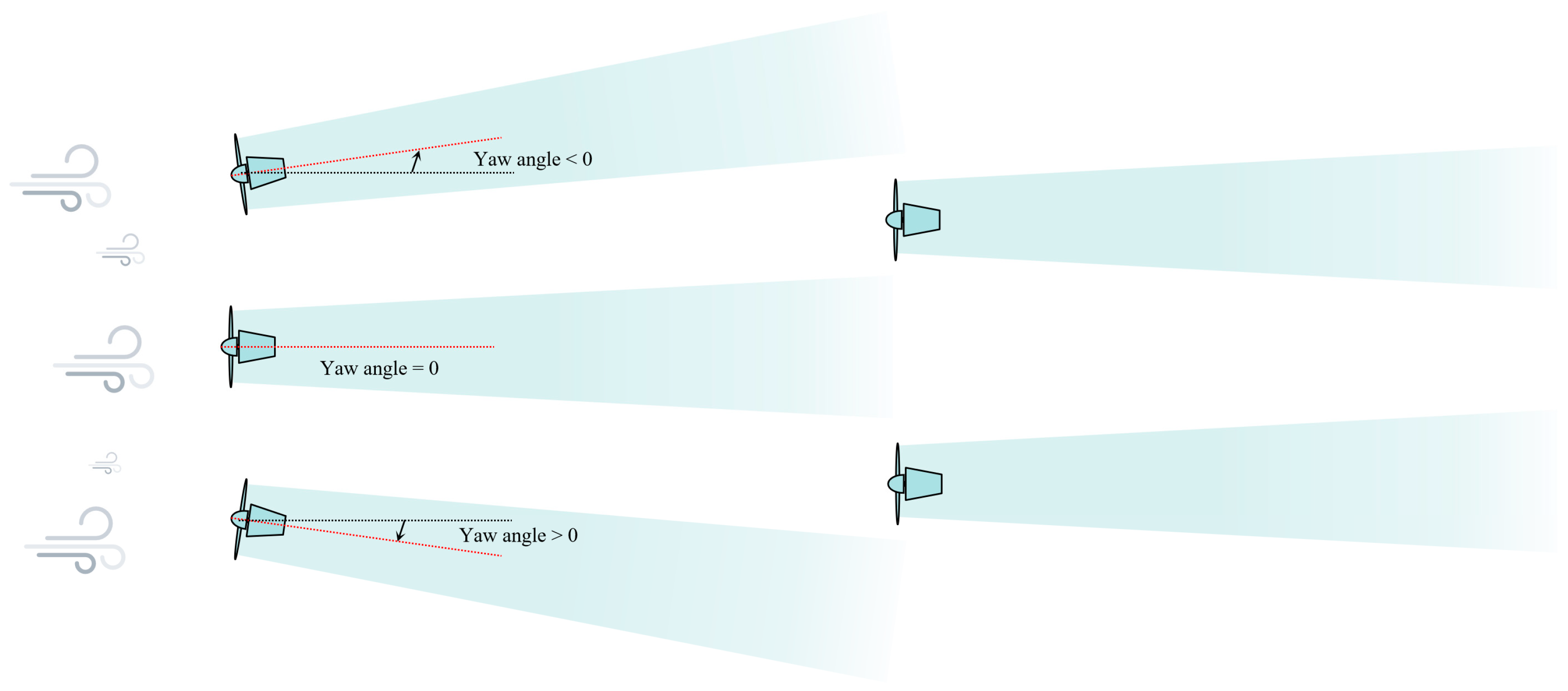
Beyond modeling-level trade-offs, the collaborative optimization of layout and control has emerged as a key research focus in recent years. As shown in
Figure 3, yaw-based control strategies can effectively improve downstream inflow quality by actively adjusting the yaw angle of upstream turbines to redirect wake flow, thereby enhancing the total power output of the wind farm [
43,
44]. However, yaw control is highly sensitive to wind speed fluctuations, turbulence intensity, and actuator dynamic response. If load constraints are not adequately considered, such control strategies may accelerate structural fatigue or lead to unstable control performance [
35]. Therefore, layout optimization must be integrated with control strategy design by incorporating turbine coordinates, yaw angles, and control parameters into a unified optimization framework [
44]. Studies indicate that such “layout-control co-design” strategies can effectively increase annual power generation while suppressing load fluctuations in downstream turbines, without increasing the number of turbine locations [
32,
45].
In engineering practice, the optimization of multi-turbine layouts for wind farms represents a typical high-dimensional, non-convex problem, involving both discrete decisions regarding the placement of hundreds of wind turbines and continuous parameter optimization. This optimization problem must account for diverse terrain conditions, cable layouts, and maintenance access paths, as well as incorporate potential environmental constraints. Consequently, it leads to in a complex mixed-integer programming formulation that requires simultaneous solution [
42]. Metaheuristic algorithms such as GA, PSO, and DE demonstrate strong advantages for addressing such problems, as they possess robust global search capabilities and require minimal mathematical formulation of the optimization problem, particularly for multi-objective optimization (MOO) [
35,
43]. However, as the scale of the wind farm increases, the computational burden grows substantially, motivating the adoption of strategies such as problem decomposition and parallel computing to improve solution efficiency [
46]. Moreover, economic feasibility and grid compatibility of wind farms operate across different time scales and physical processes. Integrating these aspects with aerodynamic wake models into a unified framework for joint modeling and optimization remains challenging, and translating such integrated approaches from theory into engineering practice is still difficult [
42,
43].
2.3. Wind Turbine Control Strategies and Uncertainty Challenges Under Complex Wind Conditions
Wind turbines operate in complex wind conditions and within structurally flexible environments, exhibiting significant nonlinearity and strong coupling among aerodynamic, structural, and electrical subsystems [
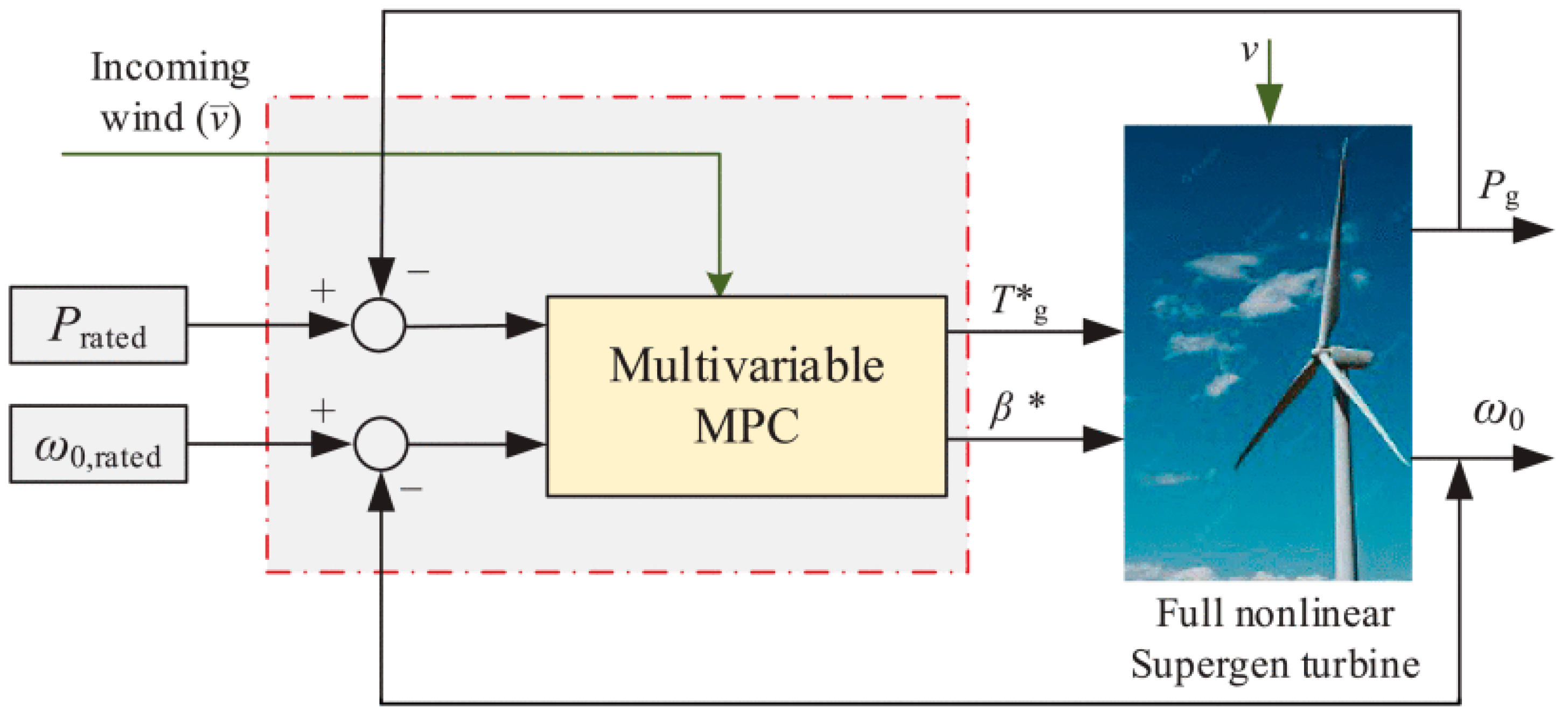
47]. This places substantial demands on the formulation of an effective control optimization scheme. Due to turbulent inflow and continuously changing operating modes, traditional PI controllers are increasingly being replaced by advanced control strategies such as (MPC), robust control, and adaptive control, as illustrated in
Figure 4 [
48,
49]. These methods enable real-time optimization of control variables, including pitch angle, generator torque, and yaw angle, while explicitly satisfying operational and safety constraints [
50]. However, the performance of MPC is sensitive to factors such as wind speed prediction errors, variations in model parameters, and actuator saturation. Therefore, improving the computational efficiency and robustness of MPC under uncertainty is essential to achieve reliable control performance [
51,
52]. To enhance the practical applicability of MPC, researchers have explored hybrid approaches that combine measurements from tower-top inertial measurement units (IMU) with aerodynamic linearization models for rolling optimization and feedforward compensation. In addition, distributed and embedded architectures for multi-rotor coordinated control have been investigated to achieve smoother overall power output and faster dynamic response [
53,
54].
At the same time, the concepts of uncertainty quantification and robust optimization are embedded throughout the entire process of wind turbine design, operation, and management. Model identification, online decision-making, and control execution all require accurate characterization and propagation of uncertainty [
55,
56]. Major external uncertainties in wind turbine control systems arise from stochastic wind speed variations and the spatial correlation of the wind field, while internal uncertainties stem from material property variability, manufacturing tolerances, and sensor noise [
57,
58]. Accordingly, distributed robust optimization and probabilistic constraint control methods have been incorporated into wind turbine MPC frameworks. These methods employ Monte Carlo sampling or Bayesian updating to generate power and load predictions with confidence intervals, thereby ensuring control strategy stability under highly turbulent wind conditions [
48,
56,
59]. In parallel, data-driven methods such as Bayesian neural networks and Gaussian process regression, augmented with physical prior information, have been widely adopted to construct aerodynamic surrogate models. These models correct uncertainties in wind speed estimation and aerodynamic load prediction, enabling more effective integration of data-driven and physics-based modeling approaches [
60,
61].
Despite the effectiveness of these uncertainty quantification methods, the primary challenge in practical control applications lies in balancing high-fidelity modeling with real-time computational requirements. Although high-dimensional nonlinear models can accurately capture blade aeroelastic behavior and load dynamics, directly embedding them into control loops incurs excessive computational costs, making it difficult to satisfy millisecond-level real-time feedback constraints [
62]. To address this limitation, researchers have developed multi-fidelity modeling and model reduction techniques. These approaches leverage principal component analysis, dynamic mode decomposition, or sparse surrogate models to accelerate computation, while incorporating adaptive update mechanisms within control frameworks to mitigate model mismatch. In floating wind turbine applications, the six-degree-of-freedom motion of the platform exhibits strong coupling with aerodynamic and servo-elastic dynamics. Wave excitation and uncertainties in the mooring system further exacerbate controller output oscillations, placing stringent demands on algorithm robustness and parameter tuning [
63,
64]. Against this backdrop, multi-timescale and multi-objective control frameworks have emerged as prominent research directions. By simultaneously accounting for short-term power smoothing and long-term fatigue load constraints, these approaches aim to achieve dynamically robust optimal operation of floating wind turbines under complex sea conditions [
64,
65].
Future research on wind turbine control and uncertainty-aware optimization urgently requires breakthroughs in three key areas. First, improving model credibility and interpretability demands the development of robust uncertainty propagation theories and trustworthy surrogate models under multi-physics coupling to enable high-confidence prediction and uncertainty tracking. Second, achieving real-time performance and distributed coordination requires the construction of control algorithms based on parallel computing and adaptive solvers to support cluster-level optimization for hundred-megawatt-scale wind farms. Finally, robust data-fusion-based closed-loop systems must be developed. Through the integration of digital twins and online re-optimization, control strategies should continuously self-correct and learn during operation, ensuring efficient, safe, and economical performance under uncertain wind conditions and complex grid environments.
3. Typical Application Scenarios of Optimization Methods in Wind Power Systems
3.1. Optimized Design of Wind Turbine Parameters
Wind turbine design involves a large and complex parameter space encompassing numerous variables, such as blade geometry, material composition, and support structure configuration. The design process must simultaneously satisfy power generation performance requirements and structural lifespan constraints under diverse operating conditions and environmental loads. When addressing such highly coupled, multivariable design problems, the application of advanced mathematical optimization methods becomes essential. In recent years, extensive research has employed optimization algorithms to improve the design of critical wind turbine components, achieving significant gains in energy capture efficiency while controlling cost and structural loading [
66,
67]. This section reviews recent applications of mathematical optimization techniques in wind turbine systems, covering standard modeling approaches, optimization variables, solution algorithms, and reported performance improvements. In addition, prevalent constraints and remaining challenges in this field are systematically analyzed.
3.1.1. Aerodynamic Shape Optimization of Blades
The aerodynamic design of wind turbine blades directly affects energy capture efficiency and is therefore a core focus of optimization research. Numerous studies have combined aerodynamic models (such as BEM and CFD) with optimization algorithms to refine blade airfoil profiles and geometries, thereby improving performance metrics such as the power coefficient. For example, one study optimized the thickness-to-curvature ratio of horizontal-axis wind turbine (HAWT) airfoils under low Reynolds number conditions. Using QBlade to evaluate the lift-to-drag characteristics of different airfoils, the results demonstrated that the optimized airfoil significantly improved the lift-to-drag ratio and stall margin within the range Re = 5 × 10
4–5 × 10
5, validating the effectiveness of aerodynamic shape optimization for low-Re. small wind turbine blades [
68]. For multi-megawatt large wind turbine blades, workflows that combine parametric shape description, CFD simulation, and swarm intelligence algorithms have been shown to systematically increase power output. For instance, CST parameter + PSO of the NREL 1.5 MW reference blade, validated using a 37-million-cell CFD simulation, demonstrated increased power output at wind speeds above 4.5 m/s, including a 13.8% increase at 10 m/s and a 7.25% increase at the rated wind speed of 11.5 m/s [
69]. In addition, optimization of blade micro-geometries, such as airfoil profiles, sweep angles, and wingtip structures, can yield measurable performance gains. For example, response surface optimization of swept blades increased the power coefficient (Cp) by approximately 4.28% at the target tip-speed ratio (TSR) [
70]. Similarly, heuristic and genetic algorithms applied to airfoil shape optimization have been shown to increase maximum lift and lift-to-drag ratio (by 13.8% and 39%, respectively), while achieving an approximate 6.7% gain in Cp at the full-scale blade level [
31].
3.1.2. Blade Structure and Material Layup Optimization
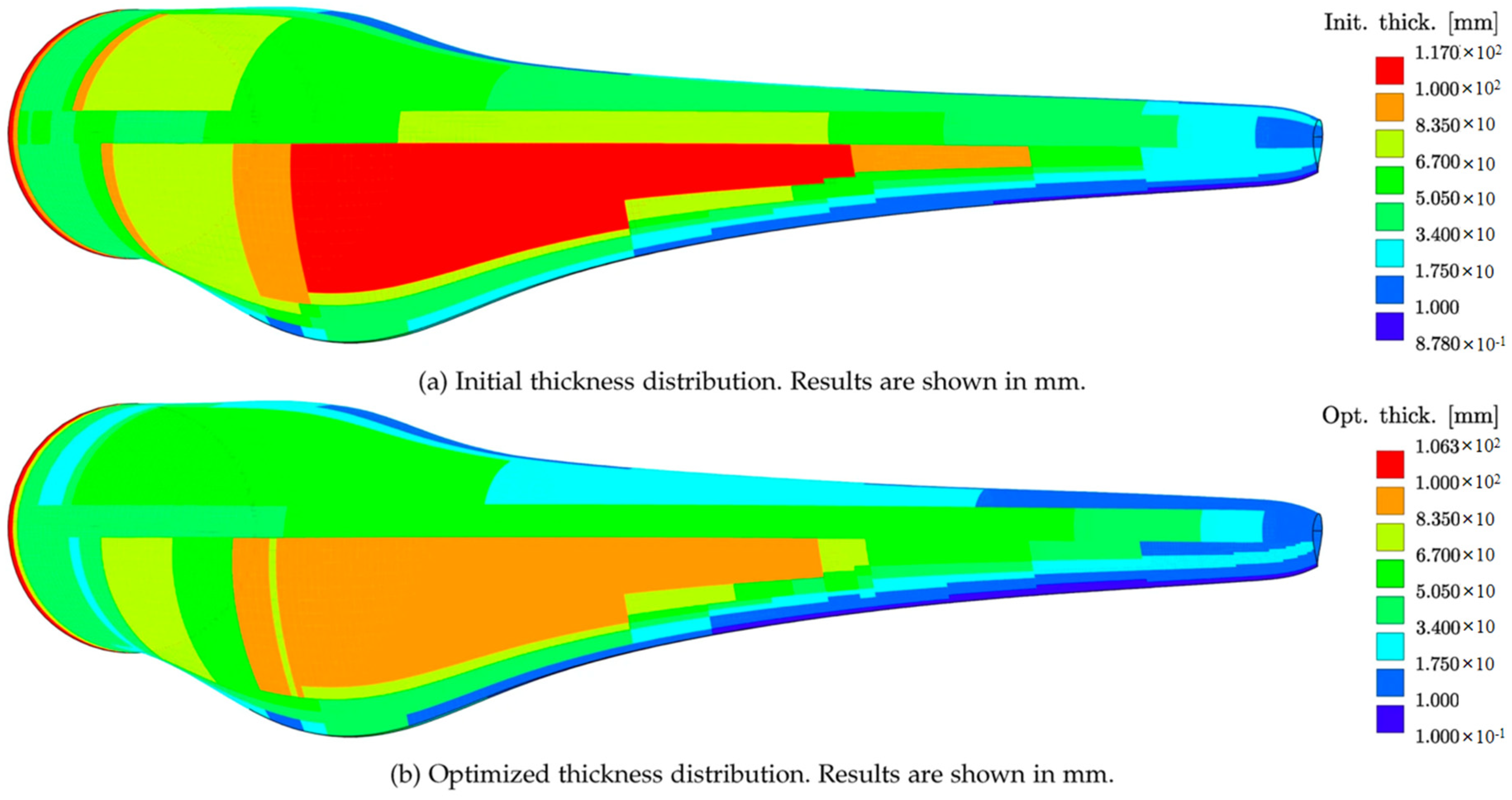
With the ongoing trend toward larger wind turbines, blade structural design has become a key focus of optimization research. For the blade root bearing section, the collaborative optimization of discrete material selection and continuous thickness variables under multiple buckling, strength, and fatigue constraints enables the optimal distribution of complex variable thicknesses and achieves significant weight reduction [
71]. In addition, as shown in
Figure 5, the open-source 98 m glass fiber blade model (Gurit98m) has been employed for large-scale constrained optimization studies. Using semi-analytical adjoint sensitivity analysis, it minimized cost under up to 12 limit conditions, achieving approximately 17% cost reduction and 25% total mass reduction while satisfying all constraints [
72].
For composite wind turbine blades, structural optimization combining topology and size optimization has demonstrated up to 3% mass reduction under strain, deflection, vibration, and buckling constraints [
73], while ply layout optimization using kinematic draping and genetic algorithms has been explored to balance manufacturability, structural performance, and material waste [
74]. Dellaroza et al. [
75] applied a surrogate-model-based optimization method using radial basis functions to the design of composite blades for small wind turbines, achieving an improvement in the power coefficient and enhancing passive pitch control capabilities through bending-torsional coupling effects.
Multi-objective genetic algorithms enable effective trade-offs between blade mass and first-order natural frequency, with case studies demonstrating approximately 15% mass reduction [
76]. Krogh et al. [
73] applied a genetic algorithm combined with kinematic overhang simulation to generate manufacturable layup paths for large wind turbine blades, achieving multi-objective optimization that balances layup feasibility, material utilization, and construction practicality while satisfying structural performance requirements. Jiang et al. [
77] integrated a genetic algorithm with blade element momentum theory and finite element analysis for the retrofitting and compatibility optimization of aging wind turbine blades, achieving comprehensive performance improvements, including a 31% reduction in blade mass, a 48% reduction in tip deflection, and an increase in annual power generation exceeding 4.2%. In terms of full-scale testing and validation, intelligent optimization methods have also been shown to significantly improve efficiency and accuracy in “moment matching” in fatigue loading tests [
78].
3.1.3. Structural Design of Novel Wind Turbines
In recent years, vertical-axis wind turbines (VAWTs) have emerged as a promising direction for offshore wind turbines due to their advantages of simple structure, low center of gravity, and lack of yaw mechanisms. Research employing two-dimensional unsteady CFD coupled with response surface methodology and Morris sensitivity analysis on Darrieus-type turbines revealed that the pitch angle contributes most significantly (approximately 58%). The optimized final design achieved an efficiency improvement of about 40% [
79]. At the micro structural level, adding dimples to blade surfaces and optimizing their position, size, and depth can significantly enhance the power coefficient by weakening wake vortices and delaying separation [
80]. Multi-objective optimization of three-bladed VAWT winglets indicates more pronounced improvements in cyclic average Cp at lower aspect ratios [
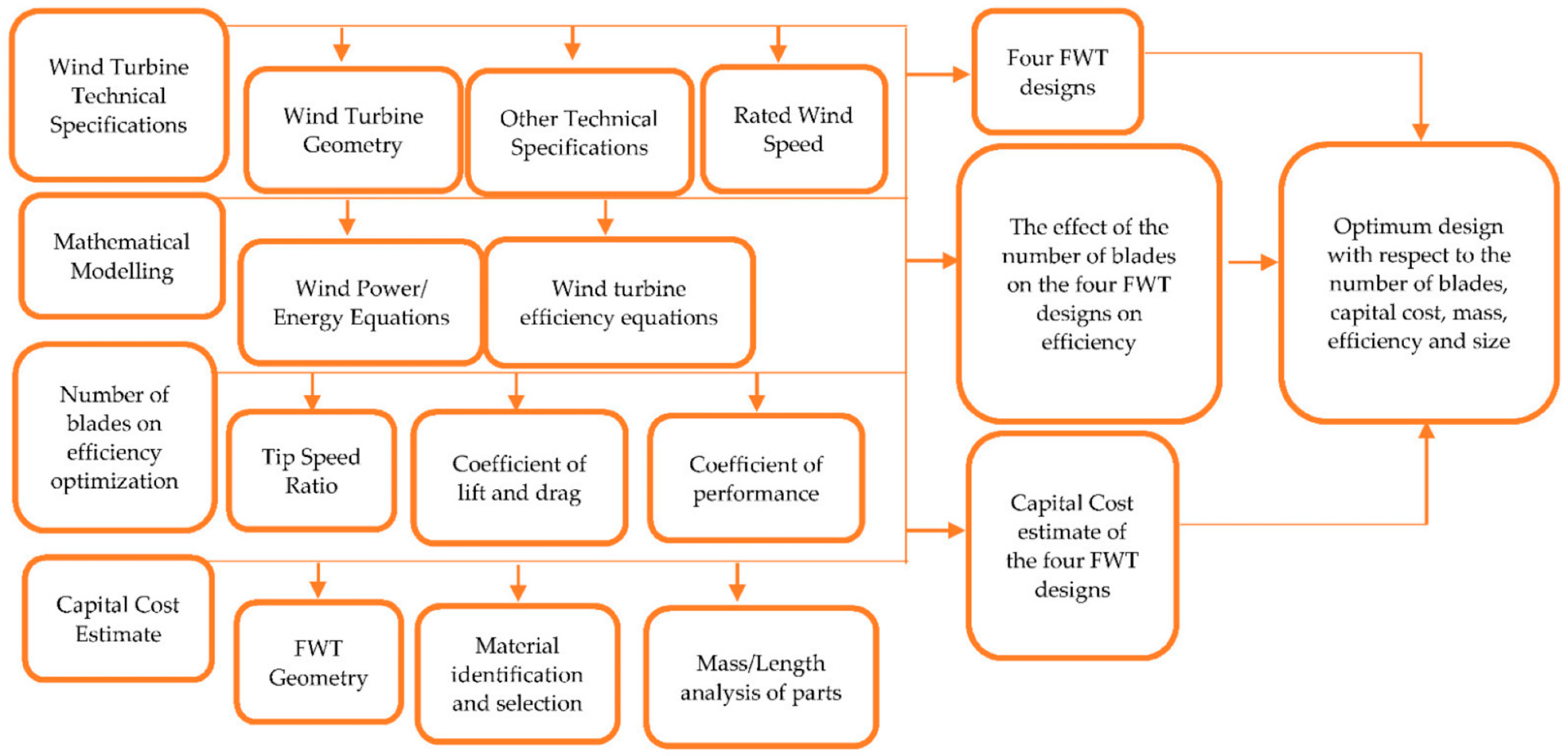
81]. As shown in
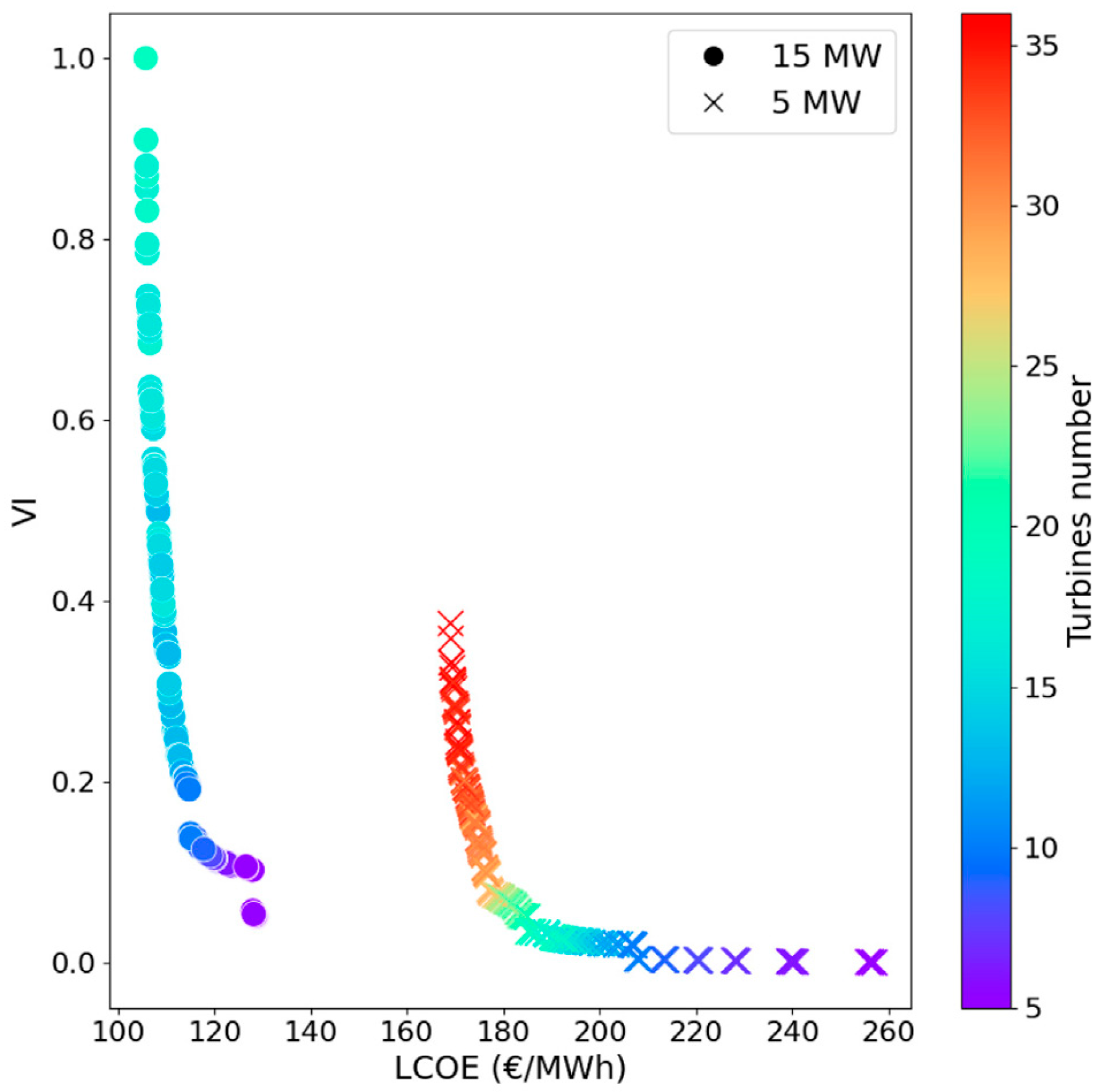
Figure 6, regarding novel wind turbine concepts, multi-objective optimization using NSGA-II for Ferris Wheel turbines-adjusting rim diameter, blade count, and rated speed-yielded evaluations across 21 low-wind-speed regions in Africa: maximum return on investment increased by 182%, levelized cost of energy (LCOE) decreased by approximately 39%, and halving the blade count further shortened the simple payback period by about 32% [
82]. A counter-rotating twin-rotor VAWT (CR-VAWT) achieved a 36.68% increase in Cp (reaching 99.19% of a single-rotor turbine) and a 96.96% reduction in total torque ripple after optimizing four variables-pitch angle, thickness ratio, and rotor spacing-via response surface methodology, significantly enhancing smoothness [
83]. Optimizing the layout and parameters of VAWT arrays for urban/cluster configurations can also yield additional power gains. Numerical studies provide recommendations for optimal spacing and relative heights under conditions such as paired/triple staggered configurations [
84,
85].
3.1.4. Optimization of Tower and Foundation Support Systems
Tower and foundation parameter optimization is equally critical for reducing costs and enhancing reliability. To address the high cost of multi-factor coupling and iterative load simulations, a hierarchical optimization–simulation integration approach jointly treats tower height, diameter, thickness, and segmentation as design variables, with maximized investment return and power generation as objectives. The method employs AMI-PSO coupled with full-machine simulation, cutting LCOE by approximately 2.43% and shortening the design cycle roughly fivefold [
86]. For fixed offshore jacket foundations, parameter sensitivity analysis identifies critical design variables, after which surrogate models replace finite element analysis within genetic algorithm global searches, achieving approximately 98.61% computational time savings while satisfying the strength and fatigue constraints [
87]. For semi-submersible floating platforms, considering typhoon wave-wind coupling and multi-objective optimization (platform deadweight, engine room acceleration, pitch angle), a series of Pareto solutions were obtained using Copula joint distributions, Kriging substitution, and multi-objective particle swarm optimization (MOPSO). Applied to the IEA 22 MW platform, the compromise solution significantly reduces weight while suppressing pitch and tower base fatigue, all while ensuring typhoon safety [
88]. In terms of control and structural co-design, constrained static optimization problems under steady wind speeds can automatically yield optimal scheduling for different wind speed control inputs, providing a benchmark for linearization and tracking control [
89]. Floating turbine optimization combining gradient optimization with frequency-domain modal models maintains acceptable computational costs while incorporating three-dimensional vibration modes and structural flexibility details [
90]. Scale parameter optimization and comparative analysis of a 10 MW semi-submersible platform also reveals pathways to enhance stability and hydrodynamic response through parameterization strategies such as “increasing column spacing” [
91]. An evolutionary multi-objective optimization framework for the 15 MW floating turbine achieves significant improvements in platform steel weight and pitch angle metrics [
92]. Mooring system parameters can also be jointly optimized using backpropagation neural networks (BPNN) combined with GA to minimize cost while satisfying safety constraints [
93].
3.1.5. Collaborative Optimization of Drive Train and Control Parameters
Optimization of generators and drive trains aims to enhance electrical performance and operational reliability. For example, the transient model parameters of direct-drive permanent magnet synchronous generators (PMSGs) are difficult to obtain. By screening five key control parameters using trajectory sensitivity analysis and employing an improved gray wolf optimization approach for identification, higher convergence accuracy and generalizability are achieved compared to gray wolf optimization (GWO) and PSO [
94]; PSO of cogging torque parameters and Maxwell simulations demonstrate that optimized cogging torque is significantly reduced, facilitating smoother start–stop and steady-state operation [
95]; Under multidisciplinary constraints, the surrogate modeling combined with hybrid optimization of small gears and sliding bearings can significantly enhance load-carrying capacity without increasing dimensions or mass (e.g., the load capacity of rectangular-groove elliptical sliding bearings increased by approximately 95.9% compared with conventional elliptical bearings [
96]. Regarding control parameters, multi-objective optimization of adaptive pitch control in the rated operating region has been shown to simultaneously reduce tower displacement and rotational speed deviation [
97]. Hierarchical genetic optimization of torque control parameters combined with active damping in the transmission chain balances multiple objectives while enhancing control accuracy away from the equilibrium point [
98]. Optimization of control parameters for participation in primary frequency regulation significantly improves secondary frequency decay characteristics of the power system [
99]. Nonlinear MPC weights for floating units can be adaptively optimized based on environmental conditions using random walk or Monte Carlo processes [
100]. Bayesian-optimized robust MPC can increase average output by 1.9% at low wind speeds while maintaining 5 MW steady-state performance at high wind speeds [
101]. In cold climates, blade vibration and icing issues can be addressed through genetic algorithm optimization of piezoelectric actuator positions and control parameters, achieving rapid vibration damping and efficient de-icing [
102]. At the aerodynamic level, vortex generator arrays arranged using PSO effectively suppress stall-induced nonlinear instability and increase the stall onset wind speed [
103].
3.1.6. Method-Based Synthesis of Parameter Design Optimization
Wind turbine parameter design is not only a high-dimensional optimization problem, but also a strongly coupled one involving aerodynamic performance, structural safety, manufacturability, control response, and economic cost. Therefore, the suitability of an optimization method depends less on the component being optimized itself than on the mathematical characteristics of the subproblem, including differentiability, dimensionality, computational cost, and the number of competing objectives. Based on the studies reviewed in
Section 3.1.1,
Section 3.1.2,
Section 3.1.3,
Section 3.1.4 and
Section 3.1.5, the optimization methods applied to wind turbine parameter design can be more clearly categorized into four major groups: gradient-based deterministic methods, surrogate-assisted optimization methods, metaheuristic intelligent algorithms, and multi-objective optimization methods. To provide a clearer distinction among the main optimization paradigms discussed above,
Table 1 summarizes their mathematical characteristics, representative applications, strengths, limitations, and most suitable use scenarios in wind turbine parameter design.
First, gradient-based deterministic optimization methods are most suitable for problems with continuous design variables, explicit constraints, and available sensitivity information. Their main advantage lies in high search efficiency and fast local convergence, which makes them particularly attractive for large-scale structural optimization problems, such as composite layup design, thickness distribution, and full-system continuous parameter refinement. Representative studies on blade root material-thickness optimization and large blade structural optimization have shown that gradient or adjoint-based approaches can significantly reduce mass and cost while satisfying multiple buckling, strength, and fatigue constraints. However, their limitations are equally clear. These methods usually require differentiable models and relatively smooth design spaces, which restricts their applicability to discrete-variable, highly multimodal, or black-box problems. As a result, they are less suitable for aerodynamic shape optimization or multidisciplinary configurations where the objective function is evaluated through expensive CFD/FEA black-box simulations without accessible gradients.
Second, surrogate-assisted optimization methods have become a mainstream strategy when high-fidelity simulations dominate the computational cost. Their core advantage is that they replace repeated expensive evaluations with approximate models, such as response surface models, Kriging, radial basis functions, or polynomial expansions, thereby significantly improving optimization efficiency. In the literature reviewed here, surrogate-assisted methods have shown strong effectiveness in vertical-axis wind turbine parameter optimization, blade layup optimization, jacket foundation design, and floating platform optimization. They are particularly suitable for multidisciplinary design tasks in which each function evaluation requires CFD, FEA, or coupled aero-hydro-servo-elastic analysis. Nevertheless, the main drawback of this category is that optimization quality depends heavily on surrogate fidelity. If the training samples do not adequately cover the design space, the surrogate model may misrepresent the true response landscape, especially in strongly nonlinear or high-dimensional regions. Therefore, surrogate-assisted methods are most reliable when combined with adaptive sampling, sensitivity analysis, or subsequent local refinement.
Third, metaheuristic intelligent algorithms, including GA, PSO, DE, GWO, and related variants, are the most flexible tools for wind turbine parameter design problems with black-box, nonlinear, nonconvex, or mixed-variable characteristics. Their major strength lies in strong global exploration capability and weak dependence on gradient information or explicit mathematical structure. This explains why they have been widely used in blade airfoil optimization, structural topology and size optimization, control parameter tuning, generator parameter identification, and mooring-system design. In particular, when the design problem includes discrete choices, irregular feasible regions, or strong coupling among variables, intelligent algorithms often provide more robust search behavior than deterministic methods. However, these methods also have notable weaknesses: they usually require a large number of function evaluations, are sensitive to parameter settings, and may suffer from slow convergence or premature stagnation. Hence, although they are highly versatile, their standalone use becomes increasingly expensive when coupled with high-fidelity simulations.
Fourth, multi-objective optimization methods are indispensable when wind turbine parameter design involves explicit trade-offs among conflicting goals, such as aerodynamic efficiency, structural mass, fatigue resistance, platform motion, and economic cost. Their main advantage is that they do not force all design requirements into a single weighted objective; instead, they generate a Pareto frontier that exposes the trade-off structure of the problem. This feature is particularly valuable in floating platform design, novel turbine concept optimization, blade structural design, and controller co-design, where engineering decisions depend on balancing performance and reliability rather than maximizing one single metric. The limitation, however, is that the output is not a unique solution but a set of compromise candidates, meaning that an additional decision-making step is required. Moreover, as the number of objectives and design variables increases, the computational burden and the difficulty of maintaining population diversity also rise substantially.
Overall, the literature reviewed in this section shows that no single optimization method is universally superior for all wind turbine parameter design tasks. Instead, method selection should be aligned with the problem structure. Gradient-based methods are preferable for smooth continuous optimization with available sensitivities; surrogate-assisted methods are advantageous when simulation cost is the dominant bottleneck; metaheuristic algorithms are more appropriate for black-box, multimodal, and mixed-variable problems; and multi-objective methods are essential when engineering trade-offs must be explicitly revealed. From this perspective, the most promising direction is not to advocate one category over another, but to develop hybrid optimization frameworks that combine their complementary strengths. In future wind turbine parameter design, greater progress is likely to come from integrated strategies that couple surrogate models for acceleration, intelligent algorithms for global exploration, gradient-based methods for local refinement, and multi-objective formulations for engineering decision support. Such a combination is better suited to the increasing complexity, multidisciplinary coupling, and uncertainty of modern floating wind turbine systems.
3.2. Wind Farm Layout Optimization and Turbine Arrangement Strategy
The optimized design of turbine arrangement within a wind farm, commonly referred to as micro-siting, is a critical factor in enhancing overall farm efficiency and reducing the cost per kilowatt-hour. Wake effects generated by upstream turbines significantly reduce downstream wind speeds, leading to power output losses that can reach up to 46% under fully developed wake conditions [
104]. Consequently, wind farm layout optimization (WFLO) can be formulated as a mathematical optimization problem whose core objective is to employ optimization algorithms to determine turbine positioning that minimizes wake interference and thereby maximizes expected power output [
104]. Traditional engineering practice often adopts regular grid-based layouts; however, optimization results based on heuristic algorithms indicate that irregular layouts can significantly increase AEP and improve power output stability under complex wind conditions [
105]. For example, layouts optimized using NSGA-III have been shown to outperform existing real-world wind farm designs across multiple objectives, including AEP, Cp, and LCOE [
106]. Wind turbine layout optimization constitutes a high-dimensional, nonlinear combinatorial problem that requires trade-offs among multiple objectives, including energy yield, construction costs, and load safety, and is classified as a typical NP-hard problem [
107]. As turbine size and farm scale continue to increase, the dimensionality of the optimization problem grows exponentially, making the development of efficient and scalable optimization algorithms a critical research challenge [
108,
109].
3.2.1. Wake Model Construction and Computation Acceleration Techniques
Building precise and efficient mathematical models forms the foundation of WFLO. Wake modeling is central to objective function evaluation, with the classical Jensen model being widely adopted in optimization iterations due to its high computational efficiency [
110]. To achieve a better balance between efficiency in optimization, researchers have developed higher-fidelity wake models such as Gaussian and double-Gaussian models formulations, which more accurately capture wake superposition and turbulent diffusion effects [
111]. For example, within a hybrid optimization framework combining CFD and IGA-PSO, multiple wake models, including double-Gaussian, were employed to evaluate wind resources in complex terrain [
112]. For floating wind farms, a coupled analysis model integrating platform motion, wake interference, and single turbine dynamics within a unified framework was developed to provide rapid and accurate performance assessments for layout optimization [
113]. Beyond wake effects, terrain characteristics and wind resource distributions are often quantified using CFD simulations and incorporated as inputs to optimization problems, which is a common approach for handling complex sites [
112,
114]. Analytical optimization models have also advanced in recent years. For instance, the FLOWERS model proposed by Locascio et al. [
115] analytically integrates wake effects across wind condition space to derive closed-form functions of AEP as a function of site coordinates and their gradients. This formulation enables efficient optimization using gradient descent algorithms. Although the model exhibits an average error of approximately 14% in predicting the absolute value of AEP, it achieves a tenfold improvement in computational speed and provides a smooth design space, which is crucial for the optimization process [
115].
To reduce computational costs during iterative optimization involving complex models, surrogate modeling techniques have gained widespread adoption. These approaches train approximation functions using a limited number of high-fidelity simulation samples to enable rapid evaluation of objective functions [
116]. For example, Wang et al. [
117] developed a CFD-based Kriging surrogate model optimization framework that surrogates models with GA and adaptively updates the training dataset, thereby identifying optimal layouts with substantially fewer CFD evaluations. Similarly, Ogunjuyigbe et al. [
118] constructed a BPNN-based surrogate model to simplify the computational process of a 3D wake model, significantly reducing optimization computation time. Collectively, these data-driven modeling approaches substantially alleviate the computational burden of optimization iterations and lay a solid foundation for large-scale wind farm layout optimization.
3.2.2. Multi-Objective Trade-Off and Collaborative Optimization Framework
WFLO is inherently a multi-objective optimization problem that requires identifying Pareto-optimal solutions by balancing energy, economic, and structural objectives. Maximizing AEP remains the most adopted objective [
105,
118], though studies have also employed economic indicators such as minimizing LCOE, maximizing return on investment, or net present value as objective functions [
119,
120]. For example, Ti et al. [
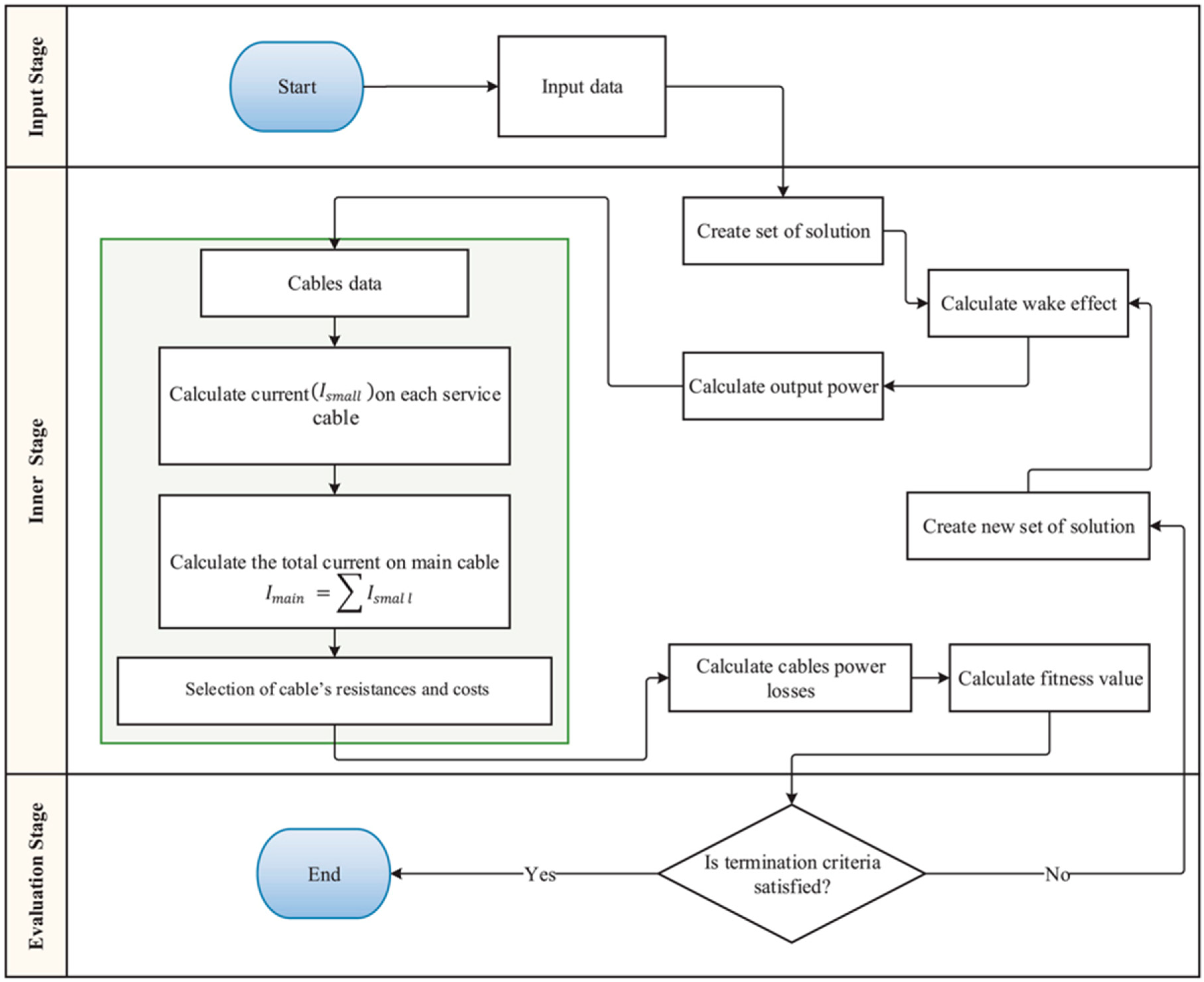
121] considered wave variability in nearshore environments and developed a coupled optimization framework that minimizes total wave-induced loads while maintaining AEP as an objective. The resulting optimized wind farm layout demonstrated that the multi-objective optimization can reduce wave loads by 20.1–40.5% with only minimal loss in energy production. In addition, cable layout plays a critical role in overall project economics. As illustrated in
Figure 7, Al Shereiqi et al. [
122] formulated cable routing optimization and micro-siting as a collaborative optimization problem, solving it using GA to enhance overall economic performance.
Furthermore, incorporating structural safety metrics such as fatigue loads as constraints or optimization objectives has emerged as a significant recent trend in WFLO. Stanley et al. [
123] proposed an analytical model for calculating fatigue damage, which is computationally efficient and embeddable within optimization workflows. This approach reduces turbine damage by over 10% while sacrificing only a small portion of AEP (0.07%). Cao et al. [
124] employed 3D wake mode and non-dominated sorting genetic algorithm (NSGA-II) with an elite strategy to maximize total power generation while minimizing the comprehensive flow-direction turbulence intensity at the turbine inflow. Compared with the original layout, their optimized configuration achieved a 0.8% increase in total power output and an 8.1% reduction in maximum comprehensive flow-direction turbulence intensity at the turbine inlet, contributing to extended fatigue life of wind turbines. Additional optimization objectives introduced include noise suppression, power intermittency smoothing, and environmental visual impact [
125]. Kim et al. [
126] introduced a novel annual power intermittency metric based on wind condition transition probabilities into optimization. They employed a multi-objective genetic algorithm to optimize layouts, aiming to simultaneously enhance power generation and reduce power fluctuations. As shown in
Figure 8, Barnabei et al. [
127] proposes a multi-objective optimization method integrating visual impact and LCOE for offshore wind farm layout. The method resolves a multi-objective and multi-constrained wind farm layout optimization problem in a designated marine area. Yang et al. [
128] established a multi-objective layout optimization framework considering power performance and turbine fatigue life. They employed efficient power and fatigue life evaluation methods to study wind farms of varying scales and typical wind roses. These studies demonstrate that modern WFLO has evolved into a complex multi-objective optimization problem, requiring support from Pareto frontier analysis or multi-criteria decision-making methods for final decision-making.
3.2.3. Method-Based Synthesis of Wind Farm Layout Optimization
Wind farm layout optimization (WFLO) differs from component-level wind turbine design in that it is fundamentally a large-scale spatial optimization problem characterized by discrete or mixed decision variables, strong wake-induced nonlinearity, and explicit trade-offs among aerodynamic, economic, structural, and environmental objectives. As a result, the choice of optimization method in WFLO is determined not only by the optimization objective itself, but also by the mathematical properties of the wake model, the scale of the wind farm, and the computational cost of repeated performance evaluation. Based on the studies reviewed in
Section 3.2.1 and
Section 3.2.2, the methods used in WFLO can be grouped into four major categories: heuristic and metaheuristic algorithms, multi-objective evolutionary algorithms, surrogate-assisted and data-driven methods, and gradient-based optimization methods. To provide a clearer distinction among the main optimization paradigms used in wind farm layout optimization,
Table 2 summarizes their mathematical characteristics, representative applications, major strengths, limitations, and most suitable use scenarios.
First, heuristic and metaheuristic algorithms remain the dominant methods for classical WFLO problems because they are well suited to non-convex, high-dimensional, and combinatorial search spaces. Their principal advantage is strong global exploration ability with limited dependence on explicit mathematical structure or derivative information. This makes them particularly effective when turbine locations are encoded as discrete siting decisions, when wake interactions create many local optima, or when the feasible region is shaped by land-use, spacing, cable-routing, and environmental constraints. Accordingly, GA, PSO, and DE have been widely used in layout design problems, while improved variants such as the modified gray wolf optimizer, binary Harris hawks optimization, and adaptive moth-flame optimization have been developed to further enhance exploration efficiency and solution quality. However, the main drawbacks of this class of methods are also evident: computational cost grows rapidly with wind farm size, convergence speed is often limited, and algorithm performance is sensitive to parameter settings. Therefore, while metaheuristic methods are highly flexible and robust for complex WFLO formulations, they become increasingly expensive when coupled with high-fidelity wake or terrain models.
Second, multi-objective evolutionary algorithms (MOEAs) play a central role when WFLO must explicitly balance competing design criteria. In modern wind farm planning, maximizing annual energy production alone is no longer sufficient; optimization must also consider levelized cost of energy, fatigue load, turbulence intensity, power intermittency, cable length, and even visual impact. The main strength of MOEAs is that they can generate a set of Pareto-optimal solutions in a single optimization process, thereby revealing the trade-off structure among these competing objectives. This makes them especially appropriate for offshore wind farm design, where decisions must balance aerodynamic efficiency, structural reliability, and economic feasibility. Studies using NSGA-II and NSGA-III have demonstrated strong performance in multi-criteria layout optimization, including many-objective offshore wind farm design problems. Nevertheless, the limitations of MOEAs should also be recognized. As the number of objectives increases, maintaining convergence and solution diversity becomes more challenging, and the resulting Pareto set still requires an additional decision-making step before engineering implementation. Thus, MOEAs are best viewed as powerful decision-support tools rather than direct generators of a unique final layout.
Third, surrogate-assisted and data-driven optimization methods have become increasingly important because the computational bottleneck in WFLO often lies in wake modeling rather than in the optimization algorithm itself. Although analytical wake models are fast, they may lose accuracy under complex terrain, atmospheric stability variation, or floating-platform motion; by contrast, CFD-based models offer much higher physical fidelity but are too expensive for direct embedding in large iterative optimization loops. Surrogate models provide an effective compromise by learning fast approximations from a limited number of high-fidelity simulations. In this way, Kriging models, neural-network-based approximations, and hybrid data-physics frameworks can substantially reduce evaluation cost while preserving acceptable predictive accuracy. These methods are particularly suitable for large-scale wind farm optimization in complex terrain or offshore environments where repeated CFD evaluation would otherwise be prohibitive. Their main limitation, however, is dependence on training data quality and representativeness. When wind conditions, terrain characteristics, or wake regimes differ significantly from the training set, surrogate accuracy may deteriorate, which in turn affects optimization reliability. For this reason, surrogate-assisted frameworks are most effective when combined with adaptive updates or multi-fidelity modeling strategies.
Fourth, gradient-based optimization methods are emerging as a promising direction for large-scale WFLO when differentiable analytical or hybrid wake models are available. Their core advantage lies in computational efficiency. Instead of relying on stochastic population search, gradient-based methods directly exploit sensitivity information to guide layout updates, which can drastically accelerate convergence, especially in high-dimensional continuous coordinate optimization. This is particularly attractive for modern large-scale wind farms, where the number of turbines may be very high and repeated evaluations dominate overall runtime. Recent studies based on analytical AEP gradients and differentiable data-physics hybrid wake models show that gradient-based optimization can achieve much faster convergence than traditional non-gradient methods. However, these methods also have clear restrictions. They rely on smooth and differentiable formulations and therefore are less suitable for problems with discrete siting decisions, non-smooth terrain constraints, or strongly black-box evaluation processes. In practice, their effectiveness depends critically on the availability of mathematically tractable wake representations.
Overall, the literature indicates that no single optimization method can adequately address all WFLO scenarios. Metaheuristic algorithms remain the most versatile choice for non-convex and mixed-variable problems; MOEAs are indispensable for explicitly revealing aerodynamic-economic-structural trade-offs; surrogate-assisted and data-driven methods are essential when high-fidelity evaluation dominates computational cost; and gradient-based methods are increasingly attractive for scalable optimization when differentiable models are available. Therefore, the future of WFLO is likely to move toward hybrid optimization frameworks that combine these complementary strengths. In particular, combining surrogate models for fast wake evaluation, metaheuristic algorithms for global exploration, gradient-based methods for efficient local refinement, and multi-objective formulations for engineering trade-off analysis offers a more realistic pathway for solving next-generation offshore and floating wind farm layout problems. Such integrated strategies are better aligned with the increasing scale, complexity, and multidisciplinary requirements of modern wind farm systems.
3.3. Application of Algorithms in Control Strategy Optimization
The core of wind turbine control strategy optimization lies in achieving a feasible trade-off among maximizing energy, minimizing structural loads, and satisfying grid connection requirements and operational constraints. In recent years, mathematical optimization methods at both the single-turbine and wind farm levels, including evolutionary and swarm intelligence algorithms, gradient- and adjoint-based methods, Bayesian and extremum seeking optimization, model predictive control, deep reinforcement learning, as well as data-driven and surrogate modeling approaches, have advanced rapidly. These methods are increasingly integrated with engineering simulation platforms (e.g., OpenFAST, FAST.Farm and FLORIS), forming practical and implementable solution frameworks [
19]. Compared to “greedy” control, optimization-based field-level cooperative control has demonstrated significant improvements across multiple case studies while balancing structural loads and grid integration quality [
129,
130].
3.3.1. Field-Level Active Wake Control and Deep Learning
At the turbine level, nonlinear model predictive control (NMPC) combined with intelligent optimization has emerged as a leading approach for enhancing energy capture and load smoothing. For example, NMPC based on the “Yin-Yang Gray Wolf” meta-heuristic demonstrated dynamic optimization capability by simultaneously balancing energy production and torque variation within a prediction horizon of a few seconds for high-power variable-speed wind turbines [
131]. For offshore wind farms, learning-based NMPC frameworks have been shown to enhance active power output while suppressing structural loads, without requiring iterative field-level wake modeling [
132]. Regarding differentiable flow field modeling, the companion/gradient method coupled with a free level wake model efficiently solves the joint “induction-yaw” control timing optimization problem. The two-dimensional model yields roughly periodic induction control signals consistent with dynamic hybrid conclusions, while the three-dimensional model reproduces curled wakes under yaw and smoothly transitions between “yaw guidance-greedy control” during wind direction changes [
133]. At the wind farm level, active wake control systems have evolved from “single yaw guidance or induction control” to “joint control,” simultaneously optimizing turbine yaw angle, rotational speed, and pitch to fully leverage three-dimensional effects such as secondary yaw guidance [
130].
Operational optimization for existing wind farms increasingly incorporates synchronized strategies involving start–stop control, yaw regulation, and small-scale position fine-tuning. Three-dimensional wake and superposition models evaluated the Chapman Ranch wind farm: simultaneous optimization of start-stop, yaw, and position increased annual power generation by 8.85% while avoiding merged wakes [
129]. Another emerging trend in wind power control is the adoption of model-agnostic or weakly model-based strategies. Distributed extremum search achieves unit-level power extremum tracking through consistent estimation and sliding mode extremum search without requiring explicit wake models [
134]. Hierarchical data-driven approaches further decompose the optimization problem by wind direction sectors and solve subproblems online using stochastic projection simplex methods, with field tests demonstrating measurable power output improvements [
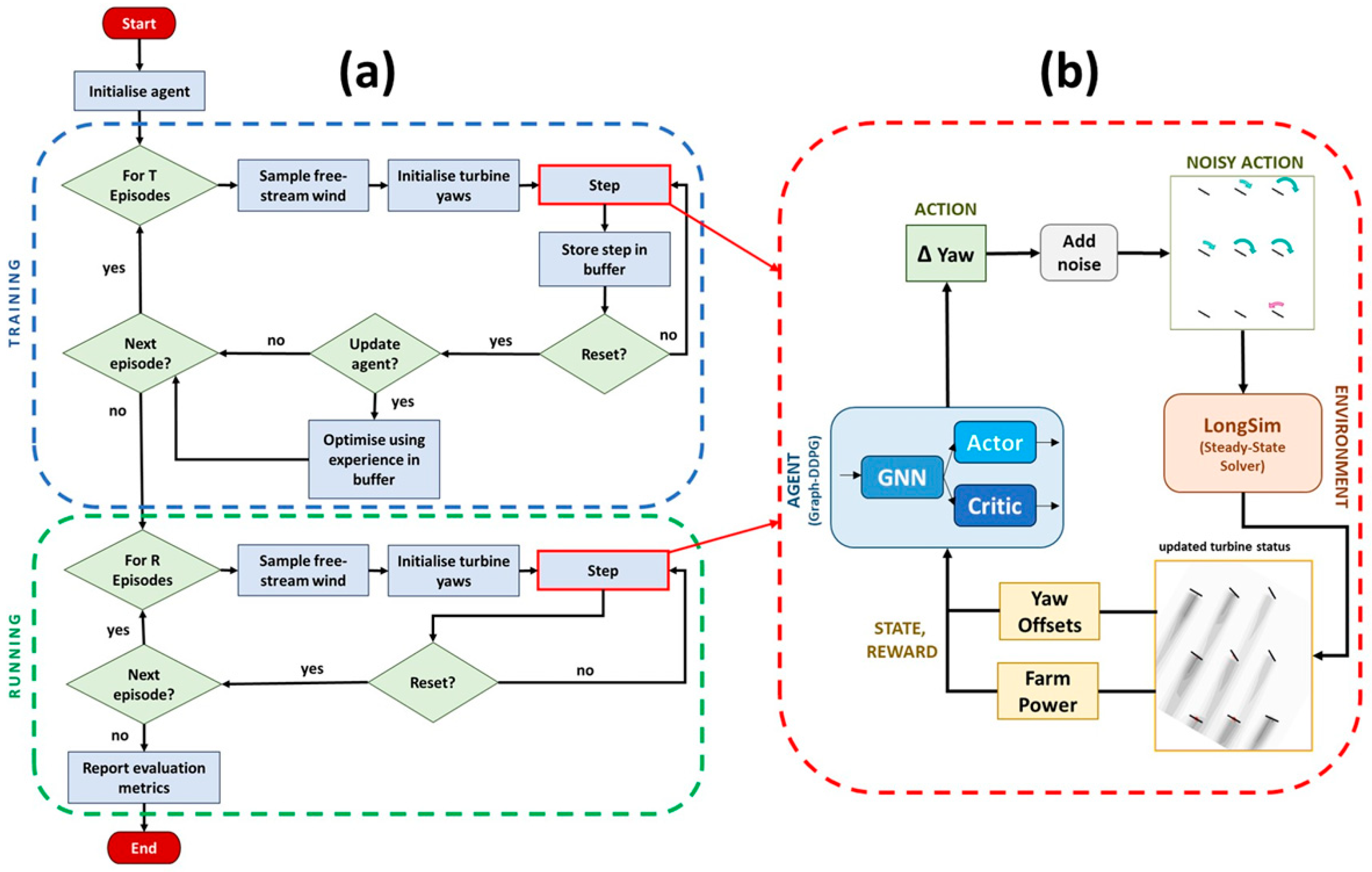
135]. Deep reinforcement learning has also shown strong potential for multi-turbine yaw setpoint optimization. As shown in
Figure 9, a graph-based deep deterministic policy gradient (DDPG) framework achieved approximately 6.5% (47 MW) power gains across four wind directions in a 9-turbine array compared to greedy control [
136]. In addition, real-time yaw optimization using Teaching-Learning-Based Optimization (TLBO) delivered power output improvements consistent with high-fidelity SOWFA in a 20-turbine wind farm [
137]. Furthermore, for extreme wind conditions like typhoons, real-time pitch optimization driven by deep neural networks achieves output improvements comparable to high-fidelity SOWFA with no more than 8% load forecast error [
137,
138]. Furthermore, for extreme wind conditions such as typhoons, deep neural network-driven real-time yaw optimization reduces structural loads by 1–9% compared with no-yaw or traditional yaw while maintaining load prediction errors below 8% [
138].
3.3.2. Multi-Objective Collaborative Control for Power-Load Optimization
In the collaborative control optimization for wind turbines and wind farms, joint strategies involving yaw, pitch, and torque have been employed to achieve dual-objective optimization of power capture and fatigue load reduction. Joint optimization of DE-fatigue surrogate models for large-scale wind farms delivers optimal solutions for the “power-fatigue” dual objective: in test wind farms, total power output increases by 6.4–7.8% while additional fatigue loads introduced by power optimization decrease by 23.53–52.25% [
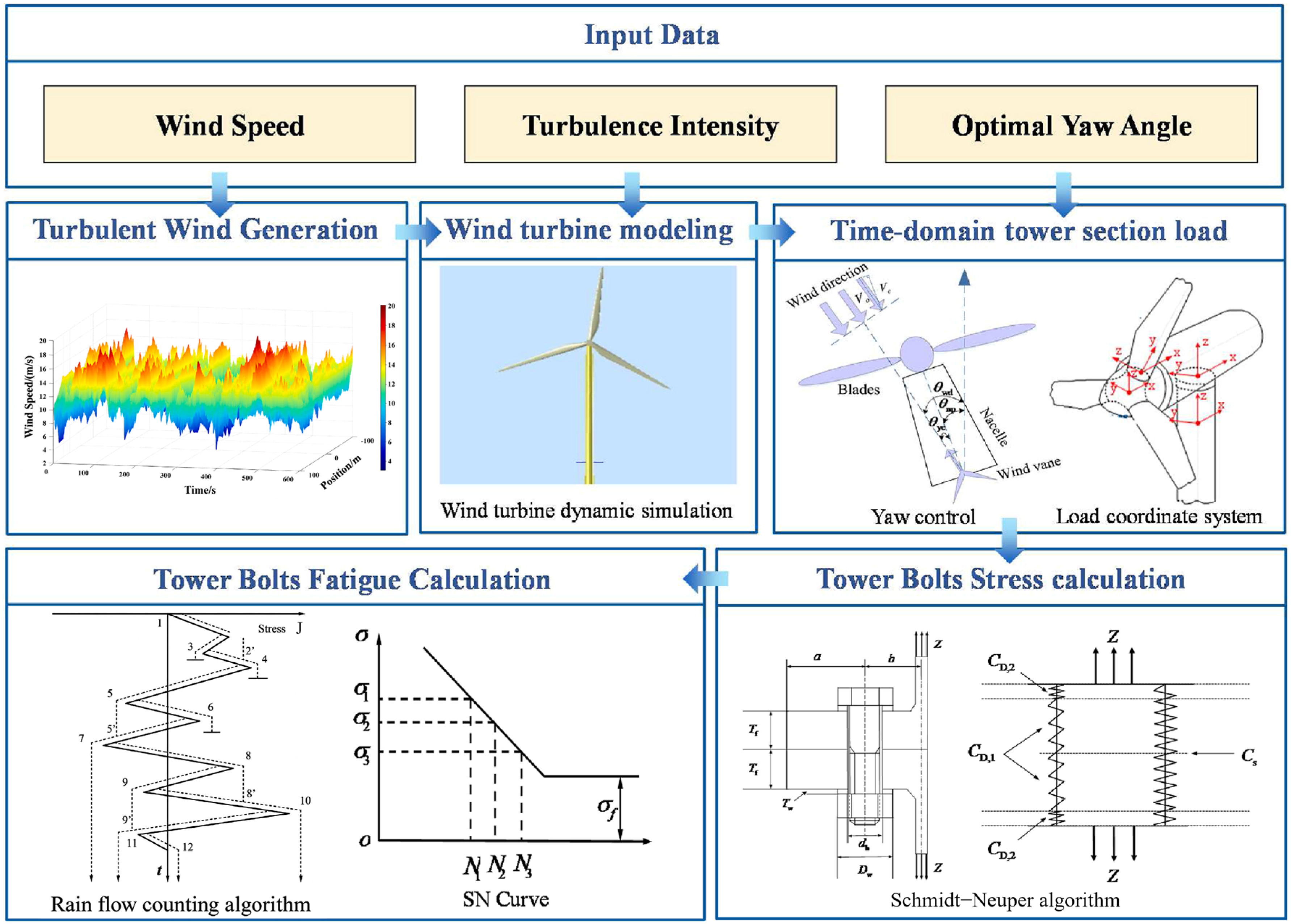
139]. As shown in
Figure 10, engineering studies focusing on yaw optimization in large offshore wind farms also demonstrate clear “benefit–cost” metrics: an annual power generation increase of approximately 1.818% comes at the cost of reducing tower bolt fatigue life by about 3–9 years compared to the baseline [
140]. With respect to 3D modeling and coordinated control, joint control of five aligned turbines has been shown to achieve higher total power output than individual control. Secondary yaw effects allow downstream turbines to significantly deflect the wake with minimal yaw adjustments [
130].
Regarding optimization workflows, coupled optimization of start–stop control, yaw regulation, and position finetuning using a dynamic Levy sparrow search algorithm outperforms sequential optimization approaches, yielding an additional increase in 1.70% AEP [
141]. Meanwhile, online cluster-level optimization achieves approximately 15.24% higher power output than the greedy baseline strategies under dynamic wind conditions [
142]. Under constraints imposed by multi-scenario wind speed and direction distributions, single-scenario optimization yields efficiency gains of 3.13–8.61%, while multi-scenario joint optimization still achieves improvements of 0.58–0.63% by balancing global trade-offs across scenarios [
143]. Within the rated wind speed range, enhancing linear active disturbance rejection control (LADRC) with PSO-optimized parameters simultaneously reduces shaft torque and tower bending moment fluctuations while stabilizing power tracking [
144]. Error-type Active Disturbance Rejection Control (ADRC) on a 5 MW turbine demonstrates faster power regulation and more stable constant-power control compared to an industrial baseline [
145]. Combining cascaded IPI with adaptive pitch control through multi-objective genetic algorithm tuning simultaneously reduces tower sway and speed deviation on the FAST platform [
97]. Regarding fractional-order control, Fractional-Order Proportional-Integral-Derivative (PID) tuned using GA, MOGA or PSO achieves a superior trade-off between robustness and control performance [
146]. The parallel compact firefly algorithm enables efficient pitch PID tuning with smooth power output even under limited memory constraints [
147]. Furthermore, hydraulic half-rotation actuators combined with fractional-order feedforward-feedback control demonstrated superior tracking and stability compared to conventional schemes when evaluated using data from a 1.5 MW wind turbine [
148]. For individual blade load mitigation, blade-specific pitch control based on PSO offline optimization combined with fuzzy online self-calibration significantly enhances load reduction performance in OpenFAST coupled simulations [
149].
3.3.3. Online Self-Optimization and Grid-Connection Auxiliary Services
Intelligent algorithms, including data-driven and distributed extremum search, provide effective solutions for online self-optimization of wind energy systems under model uncertainty and dynamic environmental conditions. The simultaneous perturbation stochastic approximation method enables online torque control in partial load regions without requiring aerodynamic models or flow measurements, achieving rapid convergence and enhancing energy capture for 4.8 MW wind turbines [
150]. Along the optimal torque control (OTC) chain, PSO-optimized wind speed estimation combined with enhanced OTC suppresses estimation noise and improves tracking performance for a 1.5 MW turbine [
151]. Similarly, SVR-PSO based wind speed prediction with feedforward-feedback pitch control enables simultaneous load optimization and power or speed regulation in GH Bladed simulations [
152]. For low-cost PID tuning, both the single-agent norm-limited smoothed functional algorithm (NL-SFA) and the safe experimentation dynamics algorithm (SEDA) significantly reduce function evaluations while improving transient and steady-state performance. For example, SEDA reduces computational load by 52% while achieving zero overshoot [
153]. NL-SFA outperforms multi-agent methods on metrics like IAE [
154]. A distributed model-agnostic strategy combining sliding-mode extremum optimization and consistency estimation can drive field-level power toward extremum values under both steady-state and time-varying wind and direction conditions, outperforming centralized multivariable optimization [
134]. Perturbation-free extremum-seeking control (PF-ESC) further achieves multi-objective improvements simultaneously maximizing power output, reducing power fluctuations, and lowering fatigue loads in a four-turbine array [
155]. To ensure stable and reliable grid-connected operation of wind farms, safety-constrained control strategies compliant with stringent grid codes are essential. Under high-voltage ride-through and asymmetric ride-through scenarios, parameter optimization based on GWO and PSO effectively suppresses DC bus voltage and grid-connected current fluctuations, improving asymmetric ride-through efficiency by approximately 7.2% compared with related methods [
156,
157]. Online optimal feedback control for site voltage decoupling via gradient descent enables decentralized deployment [
158]. In doubly fed induction generator (DFIG) and permanent PMSG loop control, optimization techniques such as PSO, ant colony optimization (ACO), and Laplacian continuous multi-node (LCMN) methods have been applied for coordinated tuning of multi-loop PI controllers, significantly enhancing system stability and efficiency under disturbances, with reported conversion efficiencies reaching up to 98.57% [
159,
160,
161].
3.3.4. Method-Based Synthesis of Control Strategy Optimization
Compared with parameter design and wind farm layout optimization, control strategy optimization in wind energy systems is more strongly characterized by dynamic coupling, real-time constraints, model uncertainty, and multi-timescale decision-making. The optimization task is not limited to maximizing power output, but also involves reducing structural loads, improving tracking performance, enhancing grid-support capability, and maintaining safe operation under highly variable wind conditions. Therefore, the suitability of an optimization method depends not only on the control objective but also on whether the problem requires online computation, whether a reliable model is available, and how strongly uncertainty affects the system. Based on the studies reviewed in
Section 3.3.1,
Section 3.3.2 and
Section 3.3.3, the optimization methods used in wind turbine and wind farm control can be grouped into five main categories: model-based predictive optimization, gradient-based and adjoint methods, metaheuristic intelligent optimization, data-driven and model-agnostic online optimization, and multi-objective optimization methods. To make the distinctions among the main control-oriented optimization paradigms more explicit,
Table 3 summarizes their control characteristics, representative applications, major strengths, limitations, and most suitable use scenarios in wind energy systems.
First, model-based predictive optimization methods, especially MPC and NMPC, constitute one of the most important frameworks for wind turbine control because they can explicitly handle multivariable coupling and operational constraints within a receding-horizon formulation. Their main advantage lies in the ability to optimize control variables such as pitch angle, generator torque, and yaw angle while accounting for system dynamics, actuator limits, and power-load trade-offs. This makes them particularly suitable for turbine-level coordinated control, floating wind turbine motion regulation, and wind-farm-level active wake control. In the reviewed literature, predictive control frameworks have demonstrated strong capability in balancing energy extraction, structural load reduction, and power smoothing. However, their limitations are also significant. MPC-based methods depend strongly on model fidelity and prediction quality, and their computational burden increases rapidly with system complexity, uncertainty representation, and control horizon length. Consequently, although they are highly effective for structured dynamic control problems, their practical deployment often requires model reduction, surrogate assistance, or efficient embedded solvers.
Second, gradient-based and adjoint optimization methods are particularly effective when the control-oriented system model is differentiable and sensitivity information can be obtained efficiently. Their main strength is fast convergence and high computational efficiency in continuous optimization problems, especially when solving large-scale coordinated control problems with many coupled decision variables. In wind farm flow control, for example, adjoint-based optimization can efficiently solve induction-yaw scheduling problems by directly exploiting analytical gradients of the control objective. This makes gradient-based methods attractive for differentiable wake-model-based control and other smooth model-based optimization tasks. Nevertheless, their applicability is constrained by the need for differentiable formulations. They are generally not well suited to black-box control problems, discontinuous actuator logic, or scenarios in which the system dynamics are difficult to model with sufficient smoothness and accuracy. As a result, their usefulness is highest in mathematically tractable control environments rather than in highly uncertain or purely data-driven settings.
Third, metaheuristic intelligent optimization methods, such as GA, PSO, GWO, TLBO, and related variants, are widely used in wind energy control because they do not require explicit gradient information and can flexibly handle nonlinear, multimodal, and constrained problems. Their greatest advantage is broad applicability. They are especially suitable for controller parameter tuning, nonlinear predictive control weight adjustment, pitch and torque control optimization, and other scenarios where the optimization problem is difficult to solve analytically. The reviewed studies show that such methods can effectively improve power capture, suppress torque or load fluctuations, and enhance controller robustness under complex operating conditions. However, these methods also have inherent drawbacks. Since they rely on population-based stochastic search, they usually require many objective evaluations and may suffer from slow convergence or sensitivity to algorithm parameters. For this reason, they are often more appropriate for offline optimization, controller design, or supervisory-level parameter tuning than for fast inner-loop real-time control.
Fourth, data-driven and model-agnostic online optimization methods have become increasingly important because modern wind turbine control must often operate under incomplete models and time-varying environmental uncertainty. This category includes extremum-seeking control, stochastic approximation, hierarchical data-driven optimization, Bayesian optimization, and deep reinforcement learning. Their main advantage is reduced dependence on precise physical models. By using measured data, interaction feedback, or learned policy representations, these methods can adapt control actions to uncertain wind conditions and changing operating states. This makes them especially suitable for online self-optimization, weak-model environments, and large wind farm control tasks where explicit wake models are unavailable or unreliable. Deep reinforcement learning is particularly promising for multi-turbine cooperative yaw control because it can learn complex nonlinear control policies directly from environment interaction. At the same time, model-agnostic extremum-seeking strategies provide lightweight solutions for real-time power maximization without requiring detailed wake modeling. Still, the limitations of this category remain substantial. Data-driven methods often require extensive training or tuning, their convergence and stability may be difficult to guarantee, and their interpretability is often weaker than that of model-based methods. Therefore, despite their strong adaptability, their engineering deployment still depends on improvements in robustness, safety assurance, and trustworthiness.
Fifth, multi-objective optimization methods are essential in wind energy control because the control task almost always involves conflicting objectives. Increasing power extraction may aggravate fatigue loads; aggressive yaw optimization may improve farm-level output while accelerating component damage; and grid-support functions may interfere with turbine-level efficiency. The main advantage of multi-objective optimization is that it explicitly preserves these trade-offs and generates Pareto-optimal solution sets, allowing designers to select appropriate control strategies according to operational priorities. This is particularly valuable in adaptive pitch control, wind-farm-level power-fatigue coordination, and auxiliary grid-service optimization. However, as in other wind energy optimization problems, the drawback is that the method does not directly produce a unique final control strategy. Instead, it provides a compromise set that still requires engineering judgment or additional decision criteria. In addition, computational complexity rises further when multi-objective formulations are combined with dynamic prediction, uncertainty modeling, or large wind farm coordination.
Overall, the reviewed studies indicate that no single optimization method is sufficient for all wind energy control problems. Model-based predictive methods are most appropriate for constrained multivariable dynamic control with reliable models; gradient-based methods are advantageous for differentiable large-scale continuous control problems; metaheuristic intelligent algorithms are effective for nonlinear controller tuning and nonconvex optimization tasks; data-driven and model-agnostic methods are especially promising under uncertainty and for online self-optimization; and multi-objective methods are indispensable when explicit trade-offs among power, load, and grid-support performance must be analyzed. Therefore, the future of control strategy optimization is likely to depend on intelligent hybrid frameworks that integrate these complementary strengths. In particular, combining predictive control for structured dynamic decision-making, gradient information for computational acceleration, intelligent optimization for global tuning, and data-driven learning for online adaptation offers a more realistic pathway toward robust, efficient, and engineering-ready control of modern wind turbines and wind farms under uncertain operating conditions.
4. Comparison and Analysis of Different Optimization Methods
This section compares the mainstream categories of optimization methods from the perspectives of global search capability, convergence efficiency, computational cost, multi-objective handling ability, and engineering suitability, as shown in
Table 4. Furthermore, semi-quantitative conclusions are drawn for each application domain through comprehensive synthesis from the reviewed literature according to unified criteria (Low/Medium/High), as presented in
Table 5.
Table 4 and
Table 5 show that the different optimization methods should not be interpreted as competing for a single universal ranking. Instead, each category exhibits a distinct comparative advantage. Gradient-based methods are strongest in computational efficiency when smooth gradients are available; surrogate-assisted frameworks are most valuable when high-fidelity simulations dominate the optimization cost; metaheuristic algorithms are the most flexible for black-box and multimodal problems; multi-objective methods are indispensable for explicit trade-off analysis; predictive control is particularly suitable for constrained dynamic optimization; and data-driven methods are increasingly attractive under uncertainty. This distinction is consistent with the application-specific method distributions observed in
Section 3.1,
Section 3.2 and
Section 3.3.
In parameter-design problems, the central difficulty lies in multidisciplinary coupling and high simulation cost. The reviewed studies indicate that metaheuristic methods are the most widely applicable for aerodynamic shape optimization and black-box parameter tuning, where reported aerodynamic or power improvements are typically on the order of 4.28–13.8%. By contrast, gradient-based methods show clearer advantages in large-scale continuous structural optimization, where representative studies report about 17% cost reduction and 25% mass reduction. Meanwhile, the most prominent quantitative advantage of surrogate-assisted frameworks is computational rather than purely performance-based: in tower and support-structure optimization, surrogate and hybrid approaches reduced LCOE by about 2.43%, shortened the design cycle by about 5 times, and in one jacket-foundation case achieved approximately 98.61% computational time savings. These results suggest that parameter-design optimization should not be judged only by the final performance gain, but also by the ability of a method to make expensive multidisciplinary optimization computationally feasible.
Compared with parameter design, WFLO is more strongly characterized by high dimensionality, wake-induced nonlinearity, and combinatorial complexity. In this domain, metaheuristic and swarm-intelligence algorithms remain the dominant tools because of their strong global exploration capability in non-convex and mixed-variable design spaces. However, the reported power or AEP gains are generally moderate, often ranging from about 0.8% to 8.85%, which implies that the main comparative value of a layout-optimization method is not necessarily larger energy gain alone. Instead, the most distinctive quantitative advantage of multi-objective methods lies in achieving substantial reductions in fatigue or wave-induced loads with only minor energy sacrifice. Representative studies report more than 10% fatigue-damage reduction with only 0.07% AEP loss, 20% damage reduction with 0.6% AEP sacrifice, and 20.1–40.5% wave-load reduction with minimal energy loss. By contrast, gradient-based methods become highly competitive when differentiable wake models are available, with representative WFLO studies achieving optimization speeds about four times faster than traditional non-gradient approaches. Therefore, in WFLO, the most meaningful comparison among methods concerns the trade-off between global-search flexibility, wake-model fidelity, and computational efficiency.
Control optimization differs from the previous two domains because it is a dynamic problem subject to real-time constraints and uncertainty. In this context, MPC/NMPC-based methods are comparatively strongest when the system model is sufficiently reliable and explicit operational constraints must be enforced. Metaheuristic methods are widely used for controller tuning because they can handle nonlinear and non-convex parameter-adjustment problems without requiring gradient information, but they are more suitable for offline optimization than for fast inner-loop real-time control. Data-driven and learning-based methods have become increasingly important in recent years because they reduce model dependence and improve adaptability under uncertain wind conditions. Quantitatively, representative studies report approximately 6.5% power gain for graph-based reinforcement learning, 6.4–7.8% coordinated power gains with 23.53–52.25% fatigue-load reduction, 3.13–8.61% single-scenario yaw-efficiency improvement, but only 0.58–0.63% gain under robust multi-scenario optimization, and 1–9% load reduction in typhoon-oriented data-driven control. These results show that control methods should not be compared only by power increase, since robustness, fatigue mitigation, and online applicability are often equally important performance criteria.
Overall, the comparative evidence indicates that no single optimization method is universally superior across all wind energy problems. Instead, the dominant advantage of a method depends on the problem structure. For parameter design, the main issue is simulation cost and multidisciplinary coupling; for WFLO, it is global search under wake-induced non-convexity; and for control optimization, it is real-time decision-making under uncertainty. Therefore, the future direction is unlikely to be the replacement of one method class by another, but rather the development of hybrid optimization frameworks. In such frameworks, surrogate models can reduce computational burden, intelligent algorithms can provide global exploration, gradient-based methods can accelerate local refinement, and data-driven or predictive methods can enhance adaptability in operation. This combined strategy is more consistent with the increasing scale, complexity, and uncertainty of modern floating wind energy systems.
5. Synthesis, General Guidelines, and Future Research Needs
This review indicates that mathematical optimization in wind energy systems has evolved from solving isolated subproblems toward addressing increasingly coupled, multi-objective, and uncertainty-aware tasks. Across wind turbine design, wind farm layout, and control optimization, no optimization method is universally superior. Instead, method suitability depends mainly on problem characteristics, including differentiability, dimensionality, computational cost, uncertainty, and objective conflict.
For continuous and differentiable problems, gradient-based methods remain highly effective because of their fast convergence and low iteration cost. They are particularly suitable for structural design, composite layup optimization, and differentiable wind farm layout formulations. However, their applicability is limited when the problem includes discrete variables, black-box simulations, or highly nonlinear and multimodal response surfaces.
For black-box, nonlinear, and mixed-variable problems, metaheuristic and swarm intelligence algorithms remain widely used because they do not require gradient information and have strong global search capability. This makes them attractive for aerodynamic shape optimization, wind farm layout optimization, and controller parameter tuning. However, the reviewed studies also show that these methods usually require many function evaluations and are sensitive to algorithm parameter settings, which limits their efficiency in problems coupled with expensive high-fidelity simulations.
For computationally expensive problems, surrogate-assisted and multi-fidelity frameworks provide a practical balance between accuracy and efficiency. This pattern is evident in turbine design, floating platform optimization, and CFD-based wind farm layout optimization. By replacing part of the expensive simulation process with surrogate models or reduced-order models, these approaches significantly improve optimization feasibility. However, their performance still depends strongly on training data quality, sampling coverage, and generalization ability under changing operating conditions.
For problems involving conflicting engineering objectives, multi-objective evolutionary algorithms are particularly valuable because they can explicitly reveal trade-offs among power production, structural load, fatigue, cost, and reliability. This is especially important in floating wind turbine systems, where energy capture, platform motion, structural safety, and control effort are strongly coupled. Nevertheless, their computational cost increases with the number of objectives and design variables, and the final solution still requires additional engineering judgment or decision-making criteria.
A key insight from the reviewed literature is that three common patterns appear across all application domains. First, there is a persistent trade-off between model fidelity and optimization efficiency. Second, isolated optimization is gradually being replaced by coupled optimization, because design, layout, and control increasingly influence one another. Third, uncertainty has become a central factor rather than a secondary consideration, especially in floating wind systems subject to stochastic wind, wave, mooring, and sensor disturbances.
Based on these findings, several general guidelines can be proposed:
Gradient-based methods are preferable for large-scale continuous problems with available sensitivity information.
Metaheuristic methods are more suitable for black-box, multimodal, or mixed discrete-continuous problems.
Surrogate-assisted and multi-fidelity methods are generally more practical for optimization tasks dominated by expensive simulations.
Multi-objective evolutionary methods are more informative when explicit trade-offs among energy, cost, load, and reliability must be considered.
For floating wind turbine systems with strong multidisciplinary coupling, hybrid frameworks that combine deterministic optimization, intelligent search, surrogate acceleration, and uncertainty treatment represent the most promising direction.
Despite recent progress, several limitations remain. Many studies still optimize turbine design, wind farm layout, and control strategy separately, while integrated co-design frameworks remain limited. In addition, many data-driven or surrogate-based methods have only been validated under restricted operating conditions, and their transferability across different wind climates, sea states, and platform types is still insufficiently demonstrated. Furthermore, many optimization results remain at the simulation level, and engineering-scale validation under realistic offshore conditions is still scarce.
Therefore, future research should focus less on proposing isolated new algorithms and more on developing reliable, uncertainty-aware, and system-level optimization frameworks. For floating wind turbines, the most meaningful direction is the integration of component design, farm-level interaction, and operational control within a unified optimization framework. This will be essential for improving not only energy capture but also long-term reliability, robustness, and engineering applicability in real marine environments.
Overall, this review suggests that the scientific value of mathematical optimization in floating wind energy lies not in identifying a single best algorithm, but in establishing appropriate matches between optimization methods and problem structure. This perspective provides a more general basis for future research and offers more practical guidance for the design, layout, and control of next-generation floating wind turbine systems.