Article

Investigation on the Absorption Characteristics of the Pressure-Resistant Metastructures

1
China Ship Scientific Research Center, Wuxi 214082, China
2
Taihu Laboratory of Deepsea Technological Science, Wuxi 214082, China
*
Authors to whom correspondence should be addressed.
J. Mar. Sci. Eng. 2026, 14(10), 896; https://doi.org/10.3390/jmse14100896 (registering DOI)
Submission received: 27 March 2026 / Revised: 6 May 2026 / Accepted: 7 May 2026 / Published: 12 May 2026
(This article belongs to the Section Ocean Engineering)

Abstract

The development of pressure-resistant sound-absorbing materials is crucial for enhancing the stealth performance of underwater vehicles operating at great depths. In this paper, a pressure-resistant metastructure is proposed, and an analytical model for its acoustic impedance is derived. Through structural optimization, the low-frequency sound absorption bandwidth is further extended. The results demonstrate that the proposed metastructure achieves broadband low-frequency sound absorption based on a plate–rubber–cavity coupling resonance mechanism. Experimental validation conducted in a pressurized impedance tube shows that under hydrostatic pressures ranging from 0.5 MPa to 3 MPa, the average sound absorption coefficient between 500 Hz and 10 kHz remains above 0.8. These findings confirm the effectiveness of the proposed configuration in broadening the low-frequency absorption bandwidth while maintaining stable acoustic performance under varying hydrostatic pressures. The study provides a robust platform for the development of underwater artificial functional materials and offers a novel approach for designing noise reduction structures suitable for deep-sea environments.

1. Introduction

The attachment of underwater sound-absorbing materials to the surface of underwater vehicles serves as a crucial means to counteract sonar detection and suppress radiated noise, thereby significantly enhancing their stealth performance [1]. Typical materials employ a viscoelastic medium as the base matrix to match the surface impedance with that of the surrounding water, while incorporating various types of embedded cavities to improve low-frequency absorption [2]. As incident sound waves approach the cavity resonance frequency, the scattering effect promotes the conversion of longitudinal waves into shear waves. Subsequently, low-frequency acoustic energy is attenuated through viscous internal friction, heat conduction, and relaxation mechanisms within the viscoelastic medium, effectively reducing the target strength of underwater vehicles [3,4,5,6].
Previous research on cavity-resonant absorbing materials has encompassed both analytical and numerical approaches. Based on the Kelvin–Voigt model, Gaunaurd proposed a one-dimensional model for anechoic coatings containing short cylindrical cavities and analyzed the influence of different resonance modes on sound absorption efficiency [7]. Tang developed a two-dimensional sound absorption theory for coatings with cylindrical cavities using a linear viscoelastic model and investigated the dispersion curves and attenuation characteristics of axisymmetric viscoelastic waves in perforated neoprene [8]. Sharma combined analytical solutions with finite element simulations, establishing a sound energy dissipation model for viscoelastic media containing locally resonant through-holes based on equivalent medium theory [9,10,11,12]. By adjusting the geometric dimensions of periodic cavities and exploiting their mutual coupling effects, the sound insulation bandwidth could be modulated precisely.
However, underwater vehicles often operate at depths ranging from tens to hundreds of meters, where hydrostatic pressure exerted on the sound-absorbing layer leads to significant deviations in surface acoustic impedance compared to atmospheric pressure conditions. This degradation is primarily attributable to two factors: first, the embedded cavities tend to collapse under hydrostatic pressure, diminishing the low-frequency resonance effect; second, the viscoelastic medium itself undergoes compression, increasing its Young’s modulus while also altering the shear modulus, thereby reducing the efficiency of acoustic energy dissipation. Consequently, as diving depth increases, the low-frequency sound absorption performance deteriorates, severely compromising the acoustic stealth capability of the coating. This issue similarly affects acoustic metamaterials [13,14,15]—viscoelastic media embedded with locally resonant unit cells—which achieve efficient low-frequency sound absorption through compact structures by inducing longitudinal-to-shear wave conversion and energy dissipation at resonance frequencies. Under high hydrostatic pressure, these materials likewise suffer from degraded low-frequency absorption performance [16,17].
To enhance the pressure resistance of underwater sound-absorbing materials, researchers have focused on two primary strategies: improving the pressure resistance of the matrix material and optimizing the pressure-resistant design of the acoustic structure. These efforts have led to the proposal of various acoustic metastructure prototypes [18,19,20,21,22,23,24]. From the perspective of matrix material enhancement, Fu et al. [18] incorporated carbon nanotubes and graphene nanosheets into polydimethylsiloxane via hybridization to improve the pressure-resistant sound absorption performance of the matrix. Dong et al. [19] blended Eucommia ulmoides gum, known for its crystalline and high-modulus properties, into polyurethane, achieving a 16.8% improvement in sound absorption performance within the 4.5–8 kHz frequency range under 4 MPa hydrostatic pressure. However, these efforts primarily enhanced absorption efficiency in the mid-to-high-frequency range.
Regarding pressure-resistant structural design, Feng et al. [20] introduced steel partition plates as reinforcement into locally resonant metamaterials containing lead blocks. The designed underwater sound-absorbing composite structure maintained high absorption efficiency even under 4.5 MPa pressure, although experimental validation was not conducted in related studies. Yang et al. [21] incorporated aluminum frames to surround cylindrical cavities, improving sound absorption performance under 2 MPa. Wang [22] integrated carbon fiber honeycomb frames into viscoelastic media embedded with conical cavities to form a composite sound-absorbing structure, achieving sound absorption coefficients no less than 0.9 within the 2.4–10 kHz range under 1.5 MPa. This proposed an effective design configuration for withstanding hydrostatic pressure. Nevertheless, these studies struggled to simultaneously satisfy both pressure resistance and efficient low-frequency absorption, particularly within the frequency range around 1 kHz.
To address the aforementioned challenges, this paper proposes a pressure-resistant metastructure that achieves low-frequency, broadband sound absorption based on a plate-rubber-cavity coupling resonance mechanism. By embedding functional units composed of fiberglass-reinforced plastic and photosensitive resin, an optimized design for pressure-resistant configuration prototypes is developed. Absorption testing conducted in a pressurized impedance tube demonstrates the proposed metastructure’s capabilities in withstanding hydrostatic pressure while maintaining low-frequency, broadband, high-efficiency sound absorption. This work lays a foundation for the investigation of configuration design and the underlying mechanisms of highly efficient sound-absorbing materials suitable for deep-sea applications.

2. Materials and Methods

2.1. Materials and Structures

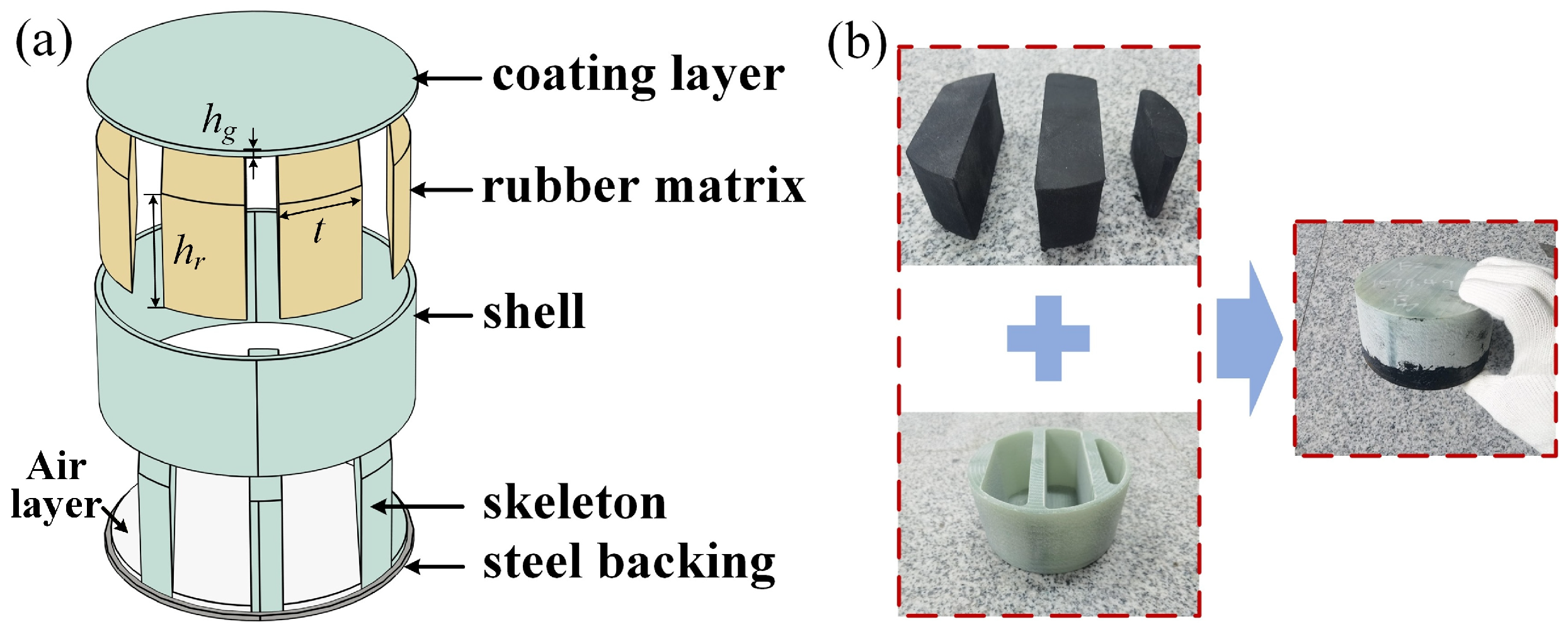
The pressure-resistant metastructure consists of three functional layers. The top layer is a sound-transmission layer fabricated from fiberglass-reinforced plastic (FRP), which facilitates efficient sound transmission into the structure. Beneath it, the middle layer serves as the primary sound-absorbing component, comprising elastic rubber integrated with an FRP reinforcing frame. The bottom layer is a stainless steel backing, which functions as an acoustically rigid boundary to constrain displacement at the terminal end. The material properties and mechanical parameters of the aforementioned components were characterized using dynamic thermomechanical analysis (DMA 850, TA Instruments, New Castle, DE, USA) and are summarized in Table 1.
Table 1. Parameters of the medium and materials in Figure 1a.
MaterialsDensity
ρ   ( k g / m 3 )
Velocity
c   ( m / s )
Young’s Modulus
E   ( M P a )
Poison s   Ratio   σ Loss   Factor   η
Rubber1780/19.212 × f00.296 + 115.90.4950.41 + 1.44 × 10⁻⁵ × f01.07
Steel7890/ 2.1 × 10 5 0.30/
Glass fiber1730/7 × 1030.22/
Water10001500///
Air1.225340///
The frame material used in the middle sound-absorbing layer is identical to that of the top sound-transmission layer, both being fiberglass-reinforced plastic (FRP). Owing to the challenges associated with precision machining of thin-walled structures using FRP cutting techniques, the wall thickness of the FRP shell was set to 5 mm. The detailed dimensions of the FRP surface layer, FRP grid support, rubber components, and steel backing are provided in Table 2. The three constituent layers of the metastructure—namely, the top acoustic window, the middle absorbing layer, and the steel backing—were bonded together using an adhesive (NANDA RTV Silicone Rubber, Kangda Chemical Co., Ltd., Changzhou, China). The total thickness of the assembled metastructure was 55 mm.
Table 2. Geometric parameters of the pressure-resistant metastructure in Figure 1a.
RubberGrating SkeletonSteel BackingTransmission Layer
s-th Height   h r (mm) Width   t (mm) Width   d x (mm) Height   h s (mm) Height   h g (mm)
145.129.211.752.1

2.2. Characterization of Sound Absorption Performance

The key properties of the constituent materials—namely, the rubber, fiberglass-reinforced plastic (FRP), and stainless steel—including density, Young’s modulus, loss factor, and Poisson’s ratio, were determined by means of DMA. The sound absorption coefficient of the specimen was measured over the frequency range of 500 Hz to 10 kHz using the transfer function method. All measurements were conducted at an ambient temperature of 18 °C. Hydrostatic pressure was applied sequentially at 0.1 MPa, 0.5 MPa, 1 MPa, 2 MPa, and 3 MPa, in accordance with the national standard CB/T 3674-2019 [25].
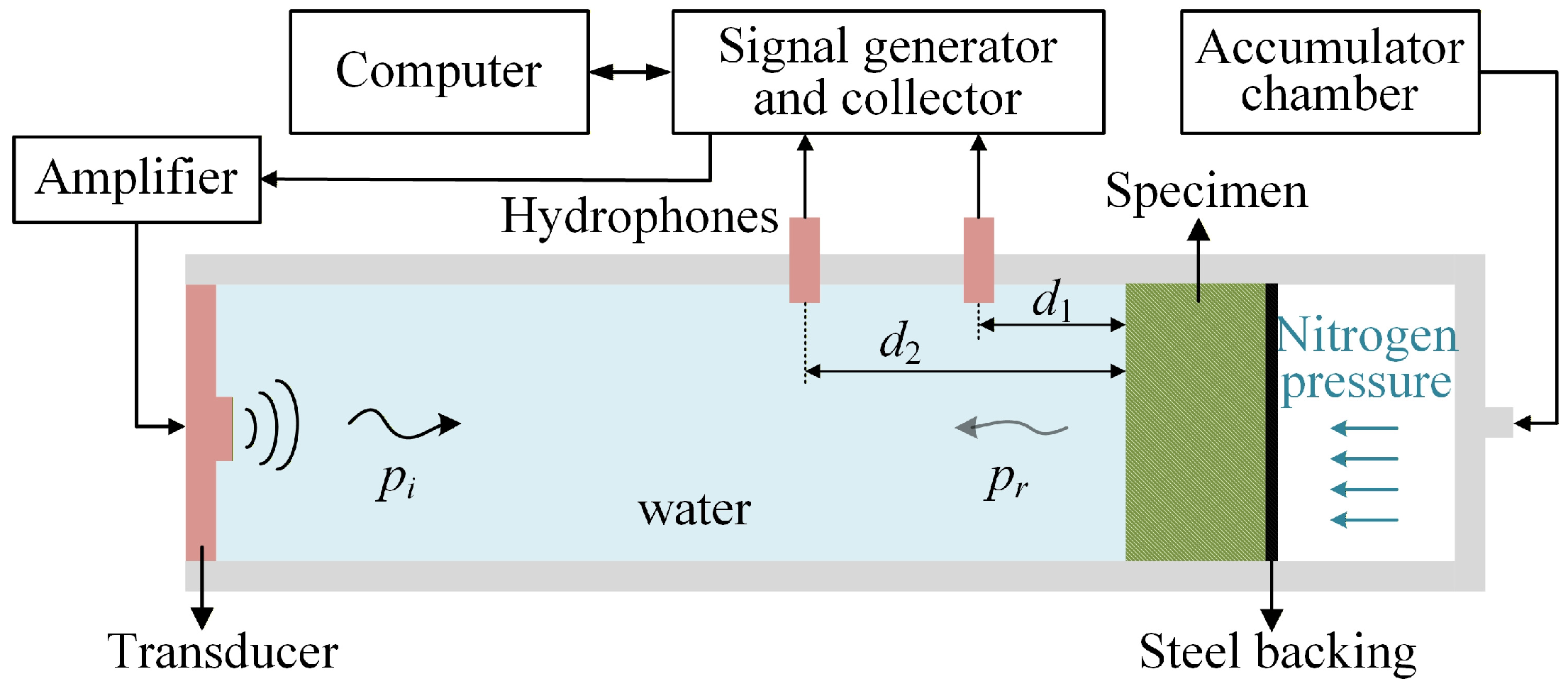
As illustrated in Figure 2, an emitting transducer was installed at the beginning of the impedance tube, and the specimen was attached to an acoustically rigid backing at the opposite end. Sound waves propagate within the tube, and the sound pressure p at any point is the superposition of the incident wave p i traveling from the source toward the termination and the reflected wave p i traveling in the opposite direction. The distances from the two hydrophones to the specimen surface are denoted as d 1 , d 2 . Accordingly, the sound pressures p 1 and p 1 measured at the hydrophone positions can be expressed as follows:
p 1 = A e j k d 1 + B e j k d 1 p 2 = A e j k d 2 + B e j k d 2 ,
Here, the first term A e j k d on the right-hand side of each equation represents the incident wave, and the second term B e j k d denotes the reflected wave. The reflection coefficient, defined as R = B / A , can be solved as
R = p 2 e j k d 1 p 1 e j k d 2 p 1 e j k d 2 p 2 e j k d 1 .
The transfer function is defined as H f = p 2 / p 1 = H e j θ f , where H denotes the amplitude ratio, and θ f represents the phase difference between the sound pressure measured by the two hydrophones. Substituting the expression of H into Equation (2) yields
R = H ( f ) e j k d 1 e j k d 2 e j k d 2 H ( f ) e j k d 1 .
Given that the backing of the specimen serves as an acoustically rigid boundary, the sound absorption coefficient α can be expressed as
α = 1 R 2 .

2.3. Theoretical Sound Absorption Efficiency of the Metastructure

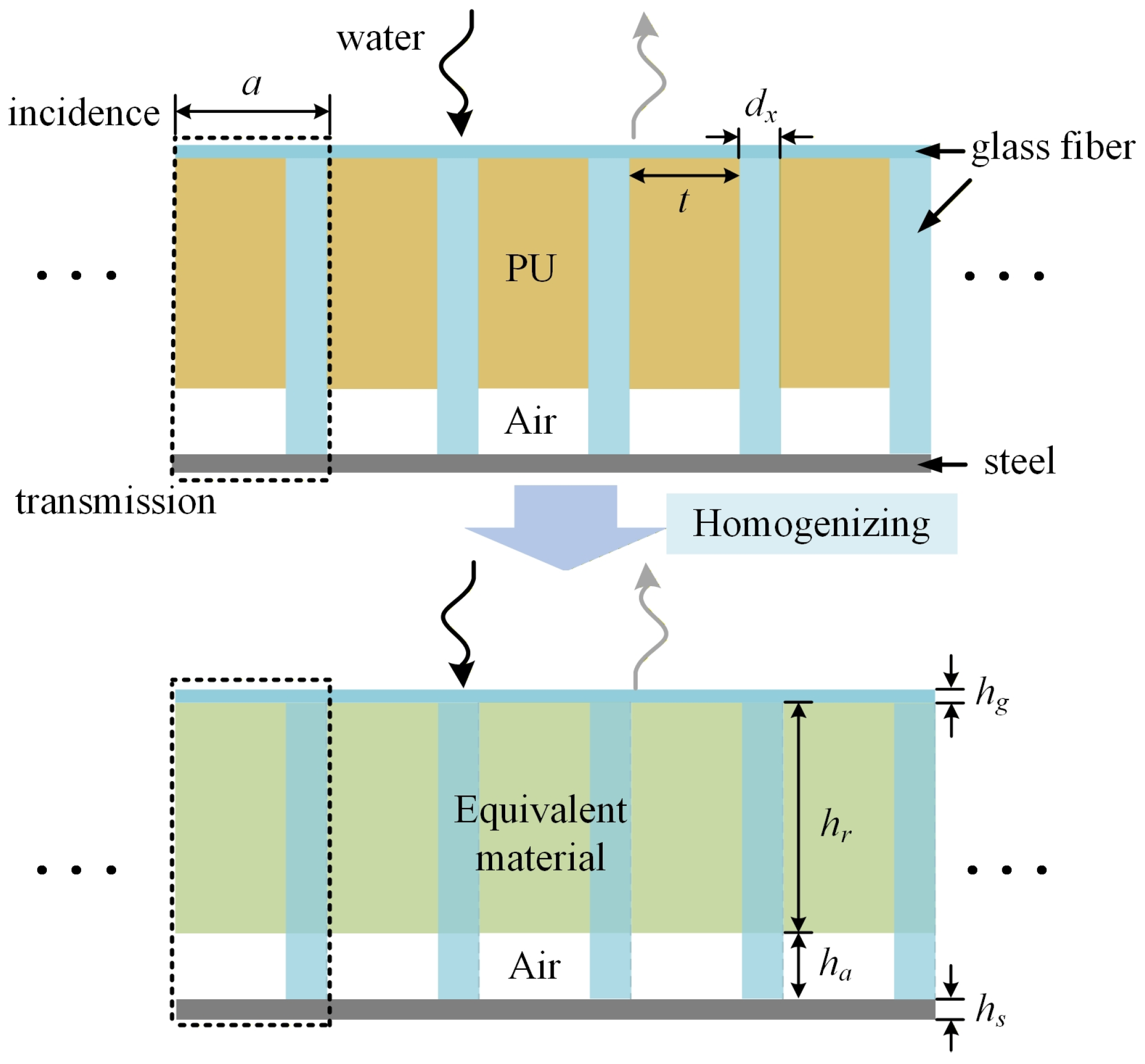
In view of the relatively large width of the grid support in the specimen illustrated in Figure 1, and considering that complex physical phenomena—such as wave mode conversion and shear vibration—typically occur at the interface between the embedded rubber and the support structure upon interaction with incident sound waves, the effective medium theory in conjunction with the transfer matrix method was employed to derive the analytical solution for the sound absorption coefficient of this complex viscoelastic configuration.
Given that the stiffness of the fiberglass-reinforced plastic (FRP) is substantially higher than that of the rubber, the grid support is treated as a rigid boundary with a no-slip condition imposed at the interface between the rubber and the support. Under this assumption, the average particle velocity within the rubber region can be expressed as [26].
v = 1 j ω ρ p z 1 1 Q j t a n h Q j ,
where Q = t ρ ω / μ c / 2 represents the ratio of the support spacing t to the thickness of the viscous boundary layer. The complex viscosity coefficient is given by μ c = j G r / ω , and the shear modulus is defined as G r = 3 1 2 σ 2 1 + σ K r , with K r = ρ c l 2 1 + j η l corresponding to the storage modulus of the rubber. Here, c l and η l denote the compression wave velocity and loss factor of the rubber, respectively, and σ = 0.497 is Poisson’s ratio. Based on the above, the equivalent density of the embedded rubber is derived as [27].
ρ e = ρ 1 1 Q j t a n h Q j 1 .
It should be noted that the effective medium theory is based on the assumption that the skeleton is rigid, with stiffness far exceeding that of the rubber, so its vibration can be neglected. The operating wavelength must be much larger than the plate spacing or grating period to avoid elastically coupled vibrations in the skeleton and to maintain the no-slip boundary condition. Once the equivalent density for the periodic unit cell is obtained, the sound pressures ( P i ,   P t ) and normal velocity ( V i , V t ) in the water domain (incident side) and air domain (transmission side) satisfy the following transfer matrix relationship:
P i V i = T P t V t ,
T = T 11 T 12 T 21 T 22 = i = 1 n T i .
Here, n = 4 corresponds to the metastructure depicted in Figure 1, and the transfer matrix for each layer is given by
T 1 = c o s ( k g h g ) j Z g s i n ( k g h g ) j Z g s i n ( k g h g ) c o s ( k g h g ) ,
T 2 = 1 0 0 τ c o s ( k r h r ) j Z r s i n ( k r h r ) j Z r s i n ( k r h r ) c o s ( k r h r ) ,
T 3 = c o s ( k a h a ) j Z a s i n ( k a h a ) j Z a s i n ( k a h a ) c o s ( k a h a ) ,
T 4 = c o s ( k s h s ) j Z s s i n ( k s h s ) j Z s s i n ( k s h s ) c o s ( k s h s ) .
The four transfer matrices correspond to the FRP surface layer, the sound-absorbing layer (embedded rubber), the air layer, and the steel backing, denoted by the subscripts g, r, a, and s, respectively. In these expressions, k, Z, and h represent the wavenumber, characteristic impedance, and thickness of each respective layer. The rubber-filling fraction within the sound-absorbing layer is given by τ = 1 t t + a , where a denotes the period of the unit cell. The equivalent wavenumber of the absorbing layer is k r = ω ρ e / K r , and its characteristic impedance is Z r = K r ρ e . The wavenumbers and equivalent impedances of the remaining layers can be determined analogously. Owing to the significant impedance mismatch between the steel backing and the transmission medium (air), the steel backing is treated as an ideal rigid boundary during sound wave transmission, implying V t = 0 . Consequently, the surface acoustic impedance of the device can be expressed as
Z i = P i V i = T 11 T 21 .
Similarly, the transfer matrix corresponding to the frame—i.e., the solid skeleton comprising the FRP grid—can be written as
P i V i = T g P t V t ,
T g = c o s ( k g h g ) j Z g s i n ( k g h g ) j Z g s i n ( k g h g ) c o s ( k g h g ) c o s ( k s h s ) j Z s s i n ( k s h s ) j Z s s i n ( k s h s ) c o s ( k s h s ) ,
where h g = h g + h r + h a denotes the total thickness of the FRP surface layer and the supporting frame. The input impedance of the frame is given by Z g = T g 1,1 / T g 2,1 . Subsequently, the overall input impedance of the metastructure consisting of a single unit cell per period can be derived as
Z t = 1 a t Z i + d x Z g 1 .
The sound absorption coefficient of the designed metastructure is then obtained as
α = 1 Z t Z 0 Z t + Z 0 2 .
Here, Z 0 = ρ 0 c 0 represents the characteristic impedance of water (the incidence medium), with ρ 0 and c 0 denoting the density and sound speed in water, respectively.

3. Results

3.1. Numerical Modeling

To validate the sound absorption performance of the proposed pressure-resistant metastructure, a two-dimensional numerical model coupling the pressure-acoustic domain and the solid mechanics module was established in COMSOL Multiphysics 6.2, as illustrated in Figure 3. This model was used both to verify the analytical solution and to compare it with the experimentally measured absorption curve. The background media (water and air) were modeled using the Pressure Acoustics interface, while the viscoelastic medium (rubber), the support frame, and the steel backing were modeled using the Solid Mechanics interface. Floquet periodic boundary conditions were applied between adjacent unit cells. An air domain was included on the transmission side to approximate a reflection-free boundary, and perfectly matched layers (PMLs) were added in both the incident and transmitted regions. The interface between the pressure-acoustic and solid mechanics domains was defined as an acoustic–structure coupling boundary.
To obtain an accurate sound absorption spectrum, averaging operators were applied in the incident and transmission domains to extract the surface acoustic impedance at the reflection and transmission ends, respectively. The sound absorption coefficient was then computed from the numerical model using Equation (17). To ensure computational accuracy, triangular mesh elements were employed, with the element size maintained at less than one-sixth of the incident wavelength over 500 Hz to 10 kHz.

3.2. Absorption Performance of the Pressure-Resistant Metastructure

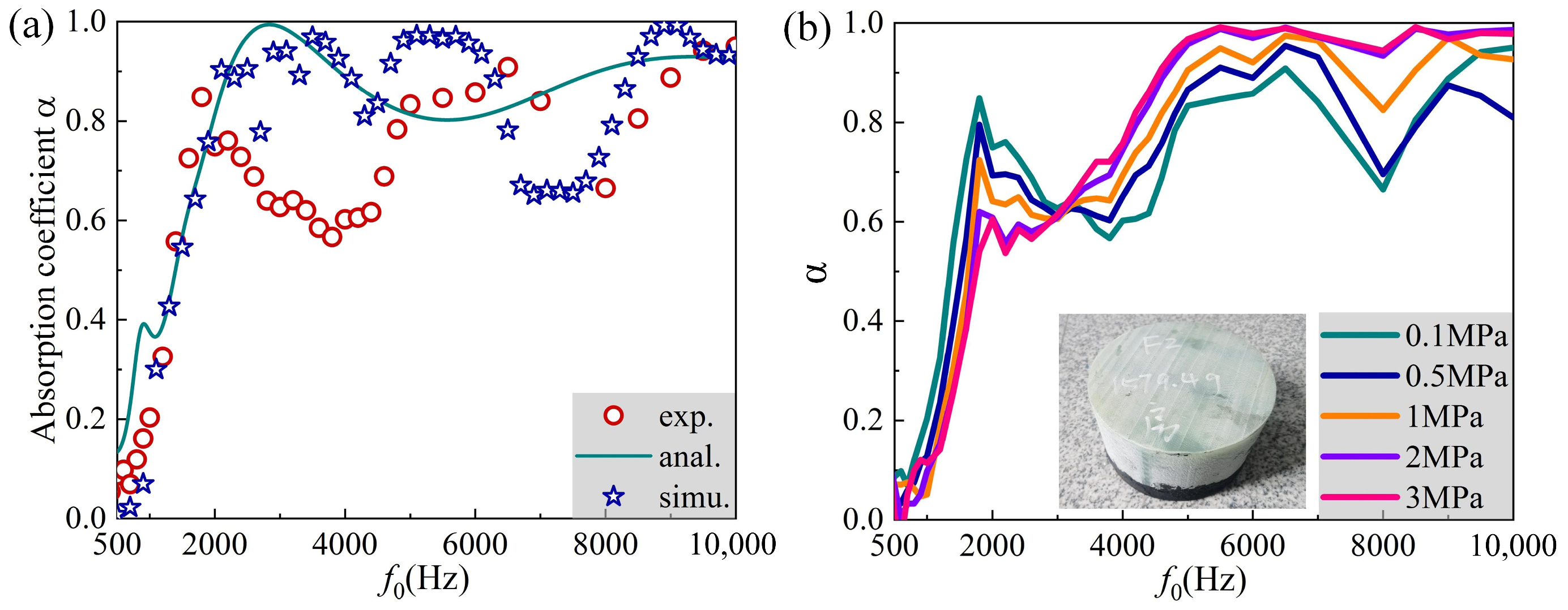
Figure 4a presents the sound absorption curves of the pressure-resistant metastructure specimen containing a single unit cell per period. The green line, blue pentacles, and red circles correspond to the analytical solution, numerical simulation, and experimental data obtained from the acoustic impedance tube under atmospheric pressure (0.1 MPa), respectively. The minor discrepancies observed in the 3–4 kHz range, which can be attributed to the boundary inconsistency between the analytical model and the fabricated specimen. Specifically, the analytical model assumes an infinite periodic boundary, which deviates from the real specimen. When the sample is submerged in water inside the impedance tube, the acoustic–solid coupling at its periphery modifies its surface impedance. Nevertheless, the overall trends—including the frequency and magnitude of the first absorption peak—are in good agreement. The metastructure achieves a sound absorption coefficient exceeding 0.6 across the frequency range of 1250 Hz to 10 kHz. The maximum incident wavelength is approximately 24 times the total thickness of the structure, demonstrating efficient low-frequency broadband sound absorption at a subwavelength scale.
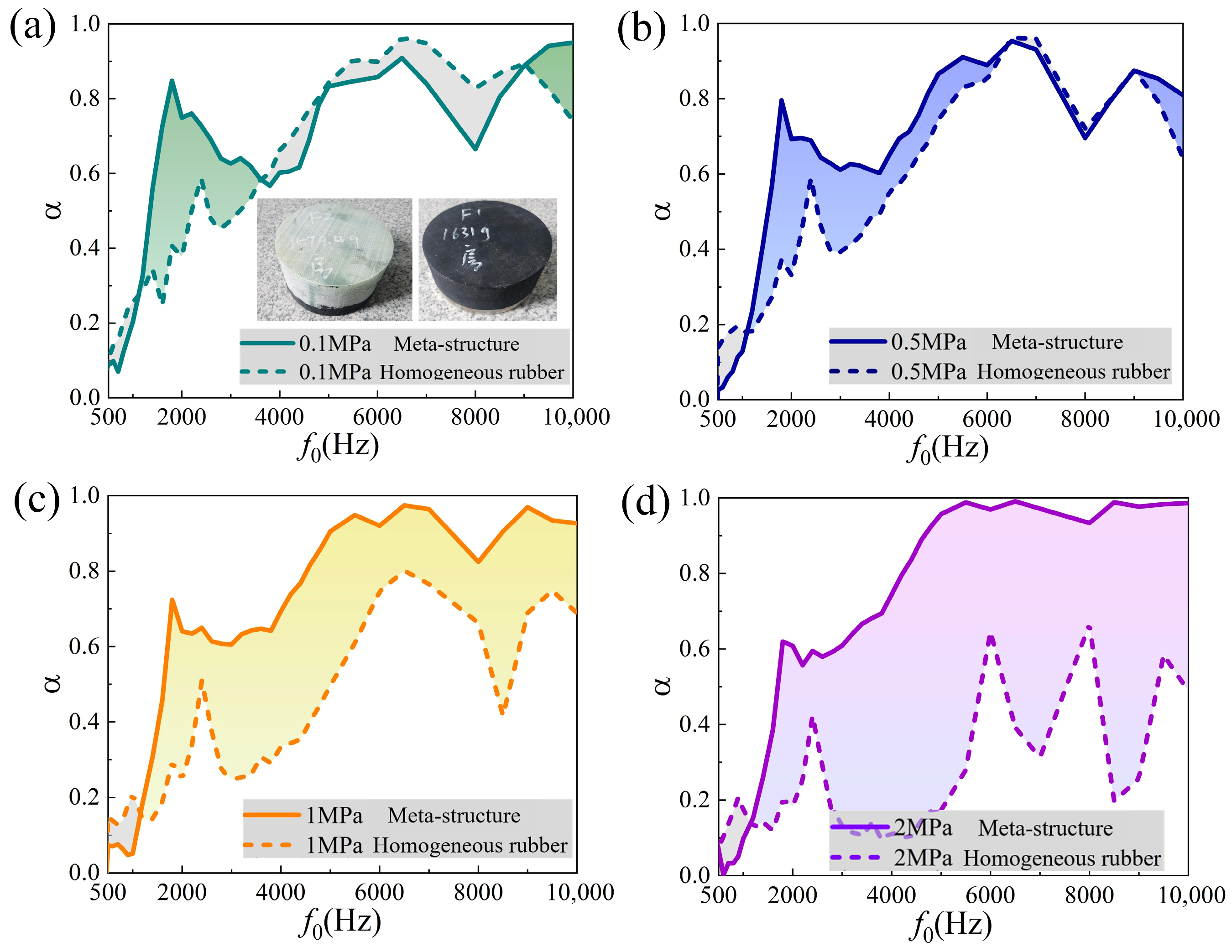
To further evaluate the acoustic performance of the metastructure under hydrostatic pressures, Figure 4b presents the measured sound absorption coefficients at 0.1 MPa, 0.5 MPa, 1.0 MPa, 2.0 MPa, and 3.0 MPa. Across the applied pressure range, the absorption spectrum remains stable from 500 Hz to 10 kHz, indicating pressure resistance. To more clearly illustrate the pressure-resistant capability of the proposed configuration, the sound absorption performance of the metastructure is further compared with that of homogeneous rubber under various hydrostatic pressures, as shown in Figure 5.
Under atmospheric pressure, the homogeneous rubber exhibits sound absorption primarily above 4 kHz (α > 0.6), with limited efficiency in the mid-to-low-frequency range. Moreover, its absorption coefficient across the entire frequency band degrades significantly as the hydrostatic pressure increases. In contrast, by introducing the metastructure configuration—comprising the FRP support frame and surface layer—the specimen not only achieves a reduction in weight but also demonstrates substantially enhanced sound absorption performance, particularly in the mid-frequency range around 2 kHz. Furthermore, it maintains a relatively stable absorption spectrum under varying hydrostatic pressures. The comparison up to 2 MPa confirms that the metastructure is capable of achieving a favorable balance among lightweight design, broadband sound absorption, and pressure-resistant performance.
To effectively counteract detection sonar operating within the 500 Hz–10 kHz range, it is necessary to further enhance the low-frequency absorption performance of the pressure-resistant metastructure, particularly in the mid-to-low-frequency range (500 Hz–4 kHz) and especially below 1 kHz. To this end, the internal configuration of the metastructure was optimized based on the underwater metagrating concept previously proposed by our research group [28]. This optimization involved extending the single unit cell per period to a multi-cell architecture within each period. The multi-cell skeleton was fabricated using intelligent additive manufacturing technology with photosensitive resin as the base material, thereby circumventing the limitations of conventional machining, which cannot readily produce complex embedded skeletal configurations. To identify the global optimum among various geometric parameters—including the height and width of the rubber rods, the support frame, and the air cavities—a genetic optimization algorithm was employed to invoke the analytical model of the multi-cell metastructure, while the equivalent parameters of FRP in the transfer matrix (Equation (15)) were replaced with those of the photosensitive resin. The acoustic impedance of which can be expressed as
Z t p = 1 a l t l Z i l + d x l Z g l 1 .
where l denotes the serial number of rubber rods and skeletons within each period. Then, the absorption coefficient of the multi-cell metastructure is α = 1 Z t p Z 0 Z t p + Z 0 2 . The objective function was defined as Objective = 1 L l = 1 L 1 α f l , where α f l is the frequency-dependent absorption coefficient with the embedded rubber number L in one period. Considering both the absorption efficiency of the metastructure and the manufacturability of the specimen, a configuration containing three unit cells per period was selected (L = 3). During the optimization, the max generations, crossover fraction, population size, and migration fraction are set as 10,000, 0.2, 100, and 0.2, respectively. Geometric boundaries were constrained as specified in Equation (19), where D = 119 mm corresponds to the specimen diameter—slightly smaller than the inner diameter of the impedance tube (120 mm) to facilitate placement. Furthermore, the total thickness of the structure is given by the sum of the sound-transmission layer thickness h g , the thickness of the l-th rubber layer h r l , the thickness of its corresponding air cavity h a l , and the steel backing thickness h s . This total thickness was constrained to H = 55 mm.
s t s + d x s = D 3 , h t o p + h r s + h a i r s + h s t = H .
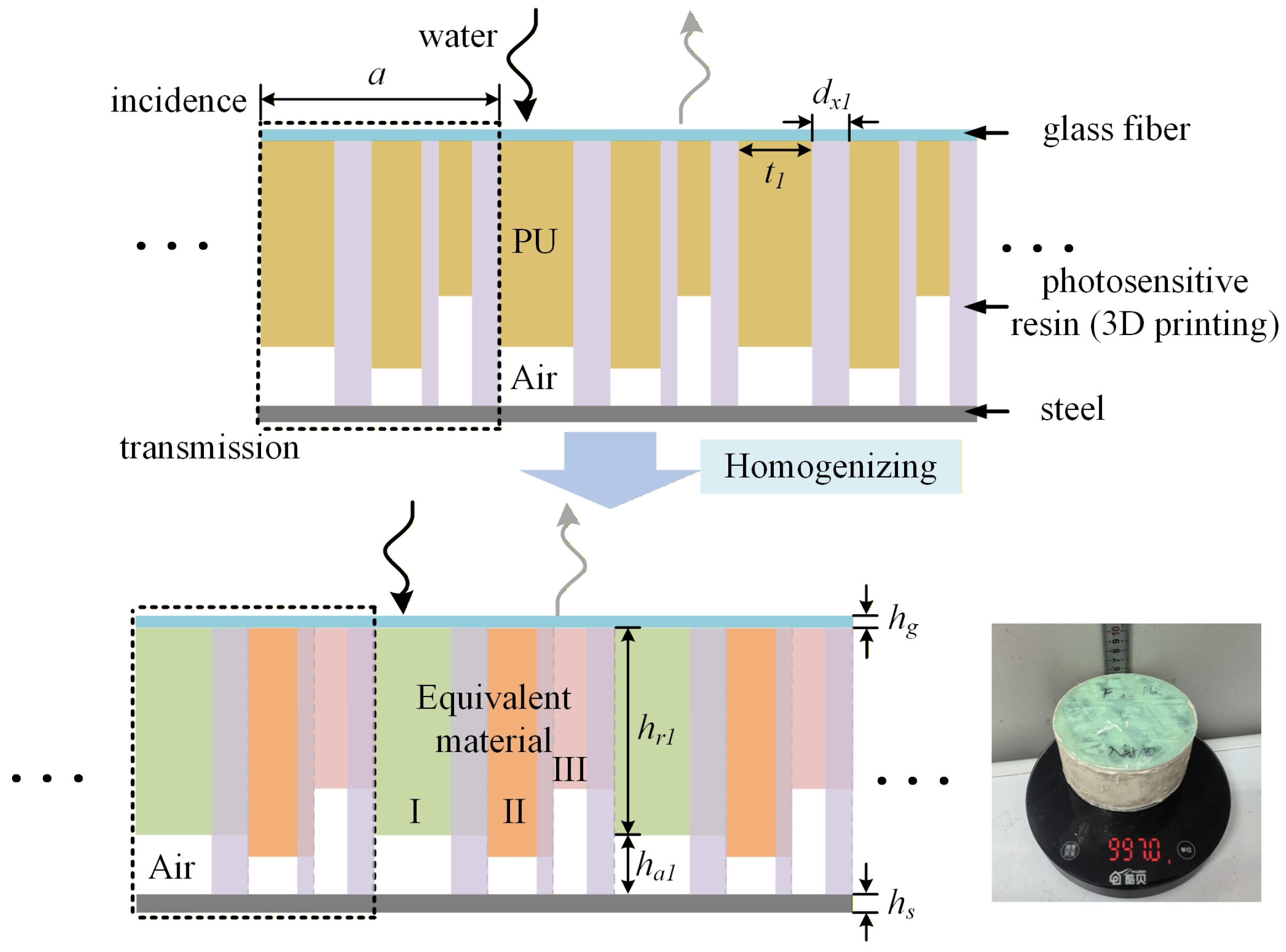
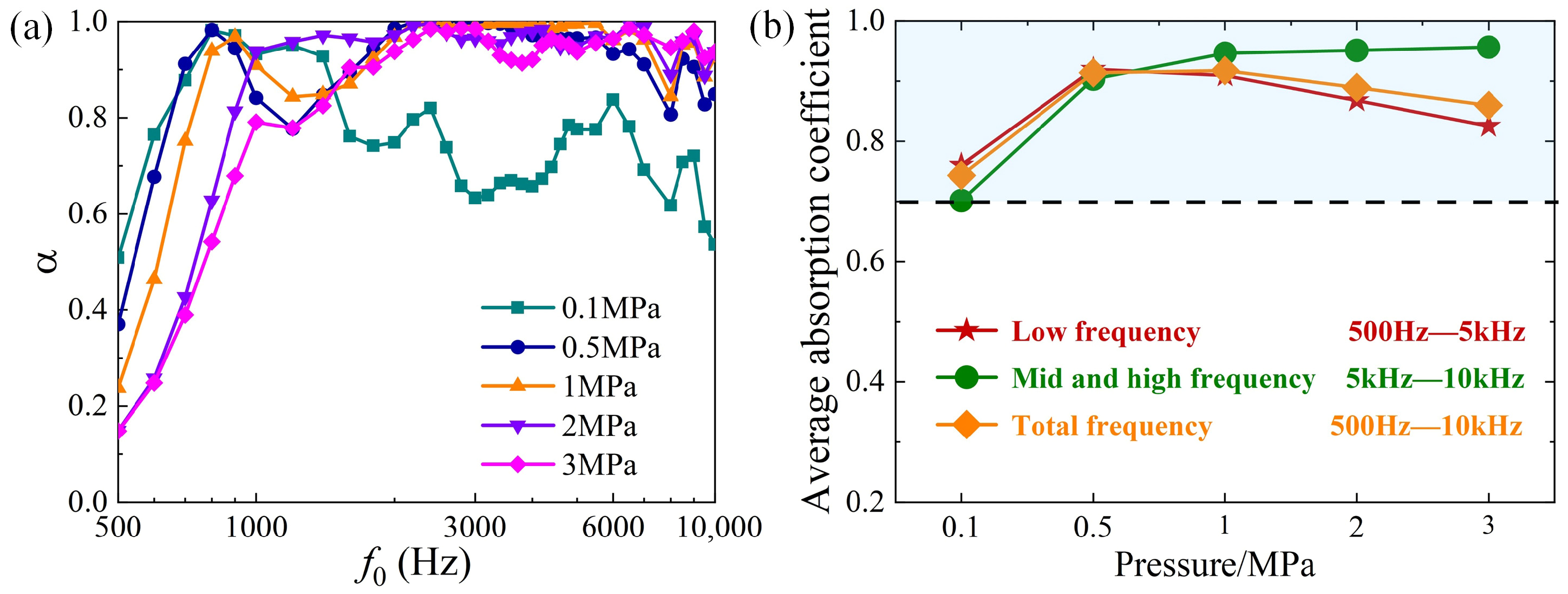
The optimized geometric parameters are listed in Table 3, and the corresponding two-dimensional schematic of the equivalent model and a photograph of the fabricated specimen are presented in Figure 6. Figure 7a shows the measured sound absorption spectra of the multi-unit pressure-resistant metastructure under hydrostatic pressures of 0.5 MPa, 1.0 MPa, 2.0 MPa, and 3.0 MPa at a test temperature of 18 °C.
It can be observed that the pressure-resistant metastructure with the multi-cell design exhibits significantly improved mid-to-low-frequency sound absorption performance compared with the single-unit configuration of the same overall thickness (55 mm). Under atmospheric pressure (0.1 MPa), the specimen maintains a sound absorption coefficient above 0.75 in the low-frequency range below 2 kHz, which can be attributed to the resonance effect induced by the backing. However, above 2 kHz, the absorption efficiency decreases owing to the presence of air bubbles, which are inevitably formed on the sample surface while it is placed and hinder the transmission of mid-to-high-frequency sound waves into the specimen. When the hydrostatic pressure is increased to 0.5 MPa, the surface bubbles are squeezed and eliminated [5]. Through the combined mechanisms of cavity resonance, wave mode conversion, viscous dissipation within the rubber, and backing-induced resonance, the sound absorption coefficient exceeds 0.75 at all measured frequencies across the 700 Hz–10 kHz range. Notably, near-perfect absorption (coefficient close to 1) is achieved within the 2.2 kHz–4 kHz band.
Owing to the pressure-resistant design of the metastructure, the measured absorption curves across the full 500 Hz–10 kHz range remain largely stable, with no significant degradation observed as the hydrostatic pressure is further increased to 1.0 MPa, 2.0 MPa, and 3.0 MPa. Only at 3 MPa, due to compression of the cavities and the rubber medium, does the resonance frequency shift slightly toward higher frequencies, leading to a minor decrease in absorption performance around 1 kHz. The arithmetic mean of the experimental sound absorption coefficients across the tested frequency band under each hydrostatic pressure is shown in Figure 7b. It is evident that, over the pressure range from 0.5 MPa to 3 MPa, the average sound absorption coefficients for the 500 Hz–5 kHz band, the 5 kHz–10 kHz band, and the entire measured frequency range all exceed 0.8, demonstrating that the absorption performance of the specimen is largely insensitive to hydrostatic pressure.

3.3. Analysis of Absorption Mechanism and Pressure-Resistant Characteristics

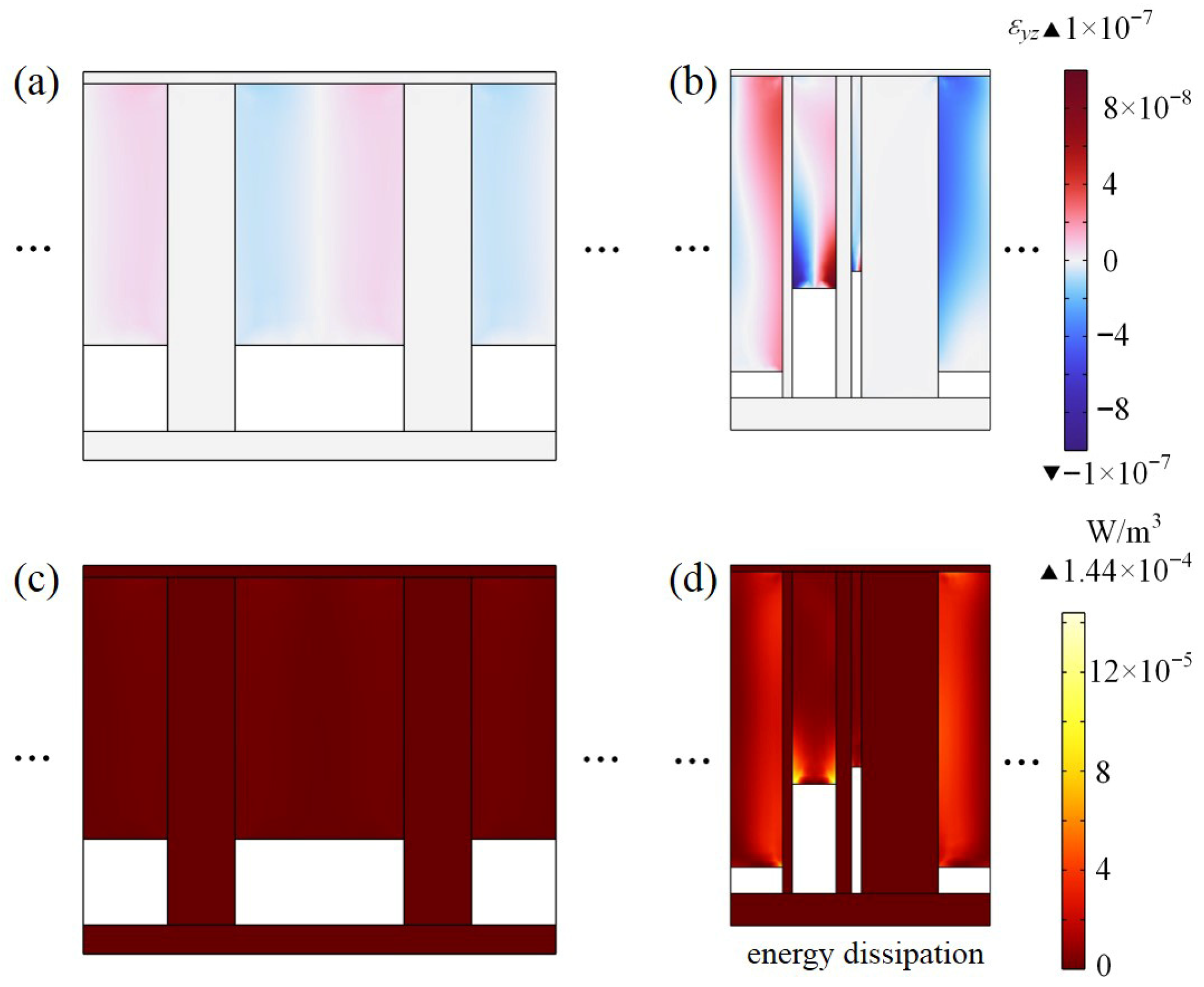
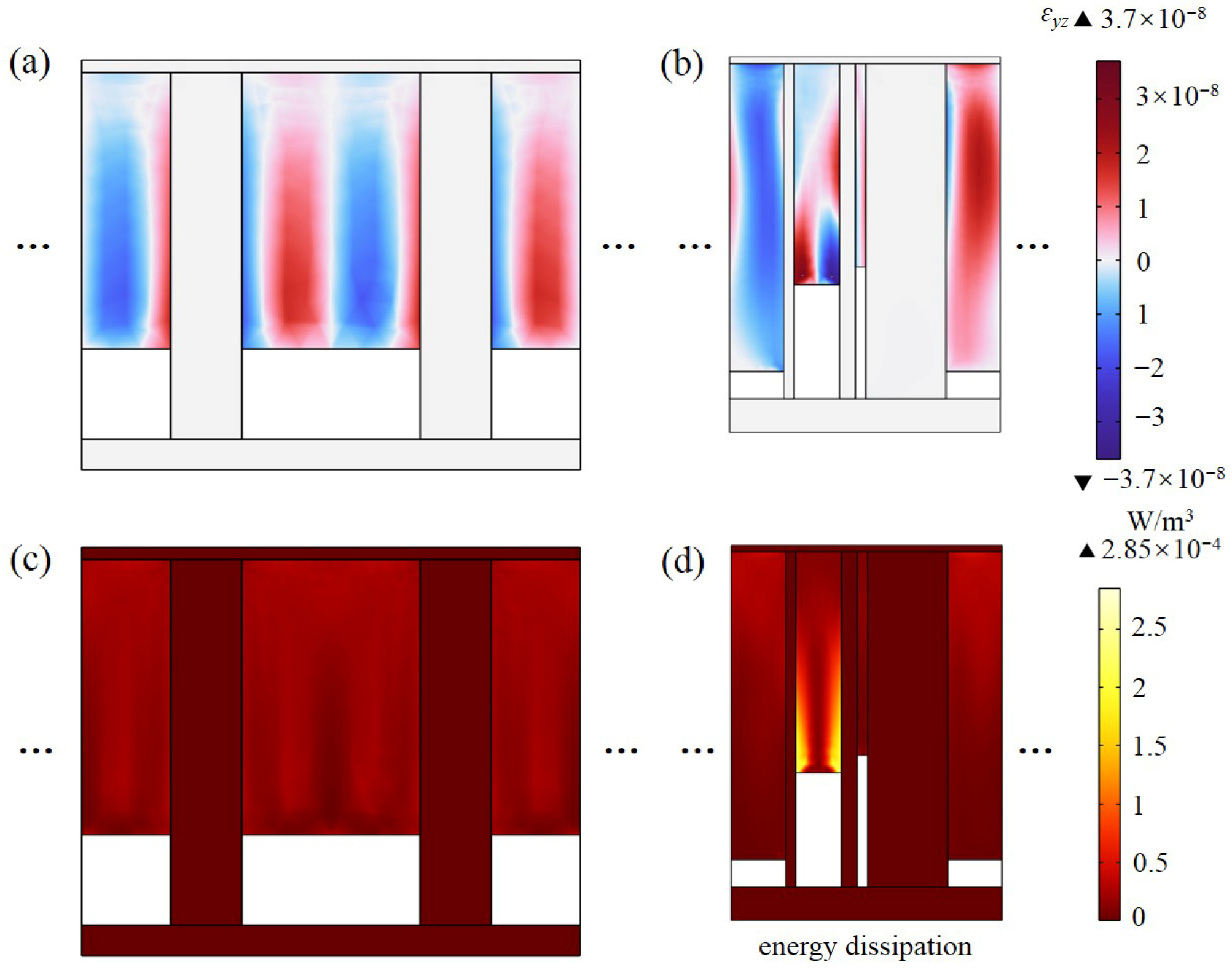
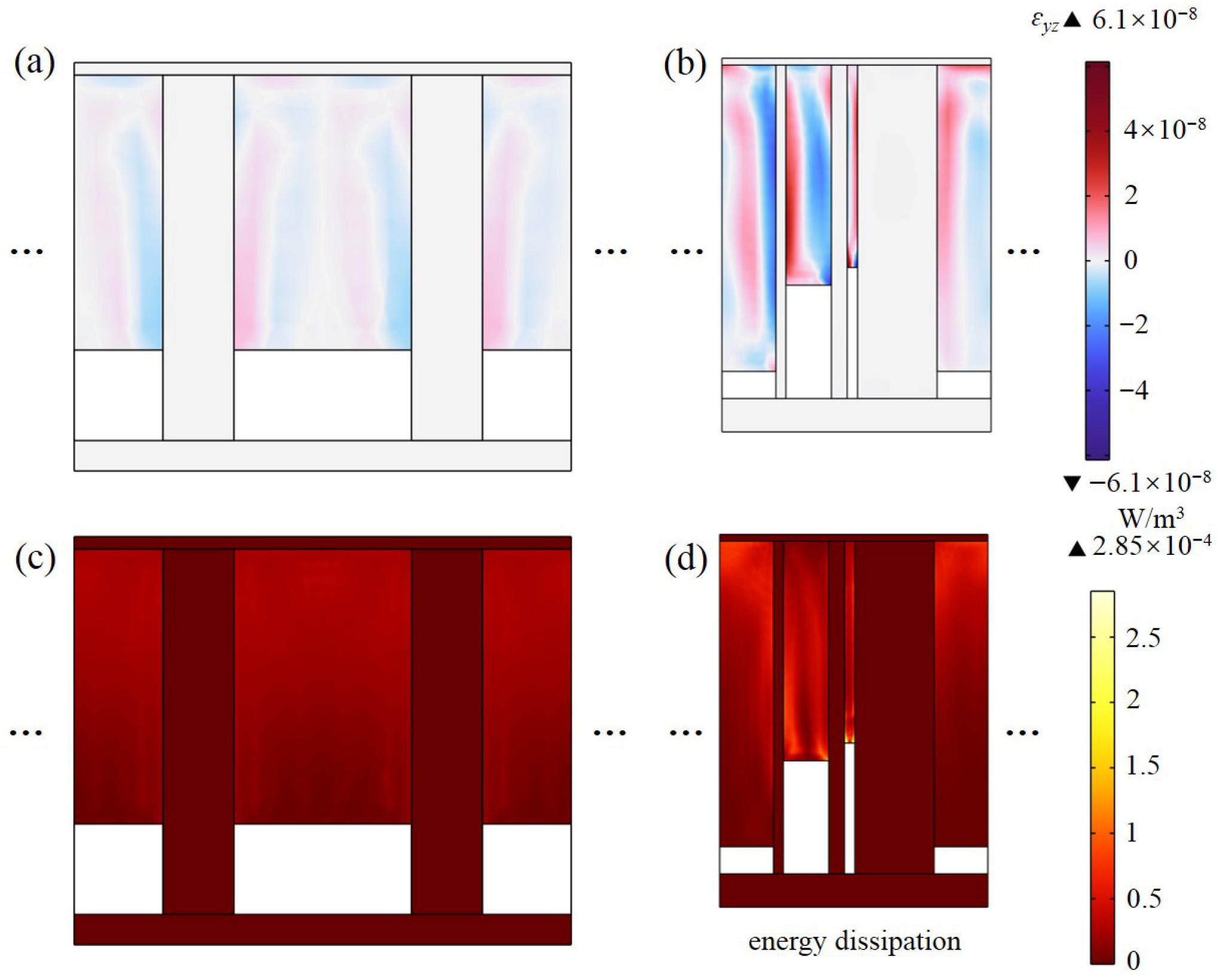
To elucidate the mechanism by which the multi-cell metastructure achieves both low-frequency and broadband sound absorption, finite element (FE) analysis was employed to investigate the energy dissipation mechanisms in the single-cell and multi-cell metastructures. Referring to Figure 3 and Figure 6, three frequency points—1 kHz, 2 kHz, and 4 kHz—were selected to generate color maps of the shear strain tensor and energy dissipation density for both structural types. The former reflects the generation and propagation of shear waves within the metastructure, while the latter identifies regions of energy dissipation and quantifies the loss magnitude, as shown in Figure 8, Figure 9 and Figure 10. It can be observed that the spatial distributions of the shear strain tensor and the energy dissipation density exhibit good consistency. This is because, for viscoelastic materials such as rubber absorbing mid-to-low-frequency sound waves, the energy loss is mainly attributed to the wave mode conversion and dissipation of shear waves, which account for a much higher proportion of energy dissipation than compressional waves.
At 1 kHz, the internal shear strain (Figure 8a,b) and energy dissipation density (Figure 8c,d) within the single-cell metastructure are significantly weaker than those in the multi-cell configuration. Consequently, the sound absorption coefficient of the single-cell structure is relatively low at 1 kHz, consistent with the trend shown in Figure 4a. When low-frequency sound waves enter the multi-cell metastructure and interact with the three embedded rubber rods, significant shear strain is observed at the connection between each rubber rod and the adjacent frame, as well as at the interface between the rubber and the air cavities. This indicates that the efficient low-frequency sound absorption at 1 kHz relies on the resonance of the three sets of cavities and the bending vibration at the rubber–frame junctions. Shear wave conversion and energy dissipation are primarily concentrated in these two regions, corresponding to the absorption peak observed at 1 kHz in the absorption spectrum measured at 0.1 MPa, as shown in Figure 7a.
At 2 kHz, the shear strain tensor (Figure 9a) and energy dissipation (Figure 9b) within the single-cell metastructure show a significant increase compared with those at 1 kHz. Shear loss and energy dissipation are concentrated at the interface between the single-cell rubber rod and the frame, as well as inside the rubber itself. This leads to the first absorption peak of the single-cell metastructure near 2 kHz, as shown in Figure 4a. In the multi-cell metastructure, the shear strain is primarily concentrated within each rubber component and at the interface between the second rubber rod and the air cavity. This demonstrates that sound absorption in the multi-cell metastructure at 2 kHz relies on the cavity resonance of the second rubber rod and the energy dissipation within the rubber. At 4 kHz (Figure 10), the shear strain and energy dissipation density in the single-cell configuration decrease, corresponding to the absorption dip near 4 kHz (α = 0.57) in Figure 4a, which arises from the anti-resonance effect. While the mass of the resonant unit and the cavity’s elasticity achieve impedance matching at the resonant frequency, the strong impedance mismatch induced by frequency deviation triggers such an absorption dip. In contrast, the multi-cell metastructure exhibits more pronounced shear energy dissipation, mainly within the rubber components and near the interface between the third rubber rod and the corresponding air cavity. This indicates that mid-to-high-frequency absorption depends on energy dissipation within the rubber and the resonant effects of the cavities corresponding to the shorter rubber rods.
By introducing and optimizing a multi-cell configuration comprising rubber rods, air cavities, and skeletons, rubber rods of varying heights and their corresponding cavities could be fully utilized to achieve resonance across different frequency bands, thereby extending the low-frequency absorption bandwidth beyond that achievable with a single-cell configuration. Furthermore, the embedded frames between adjacent unit cells not only serve a mechanical load-bearing function but also guide coupled vibrations among the viscoelastic medium, air cavities, and skeletons. This enhances shear deformation within the rubber, promotes acoustic energy dissipation, and consequently improves the sound absorption efficiency across the entire frequency band.
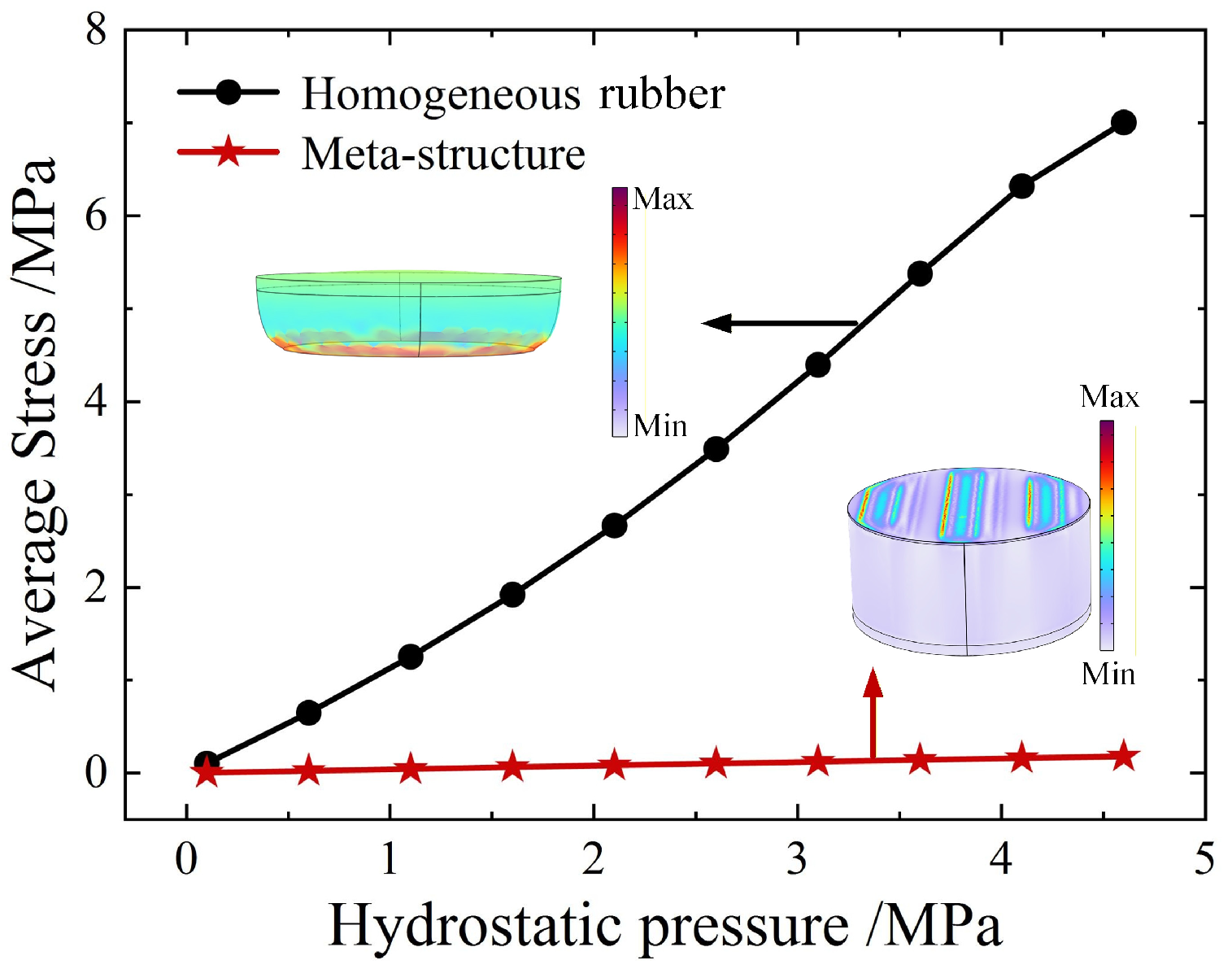
To further validate the mechanical load-bearing function of the metastructure, a numerical calculation was conducted to compare the average stress experienced by the rubber with and without the pressure-resistant configuration, as shown in Figure 11. It can be observed that as the hydrostatic pressure increases, the stress within the rubber inside the metastructure remains stable and is maintained below 0.2 MPa. This contrasts with the near-linear growth trend of stress observed in the homogeneous rubber. The FRP surface layer and the photosensitive resin skeleton enhance the pressure resistance of the structure, allowing it to retain its fundamental form under hydrostatic pressure, similar to its behavior under atmospheric conditions. Consequently, the internal rubber core does not undergo significant deformation or stress under pressure, and the relative dimensions of the cavities remain stable. This effectively ensures low-frequency broadband sound absorption performance even under high-pressure conditions.

4. Discussion

The results presented in this study demonstrate that the proposed pressure-resistant metastructure achieves stable, broadband low-frequency sound absorption under hydrostatic pressures up to 3 MPa, addressing a longstanding challenge in the development of underwater acoustic materials for deep-sea applications. These findings not only validate the effectiveness of the plate–rubber–cavity coupling resonance mechanism but also provide new insights into the design of acoustically efficient structures capable of withstanding extreme hydrostatic environments.
A key contribution of this study lies in the extension of the single-cell design to a multi-cell metastructure optimized via a genetic algorithm. This optimization yielded a configuration in which rubber rods of varying heights and their corresponding air cavities resonate across distinct frequency bands, effectively broadening the low-frequency absorption bandwidth. This multi-resonance mechanism, enabled by the nonlocal coupling among unit cells, extends the concept of locally resonant metamaterials by demonstrating that carefully engineered periodic skeletons can simultaneously serve mechanical and acoustic functions. This study demonstrates that the proposed pressure-resistant metastructure achieves a favorable balance among lightweight construction, broadband low-frequency sound absorption, and hydrostatic pressure tolerance. By combining theoretical modeling, numerical simulation, and experimental validation, this work provides a robust foundation for the rational design of underwater acoustic materials capable of operating in deep-sea environments.
The analytical model proposed in this work can also capture the effects of hydrostatic pressure: once the storage modulus and shear modulus of the compressed rubber and its deformed geometry are determined, the metastructure’s absorption performance under pressure can be predicted, which is the focus of our future work.

5. Conclusions

This paper proposes a pressure-resistant metastructure capable of balancing mechanical and acoustic performance. Based on the analytical model, an optimized design was developed and experimentally validated using an acoustic impedance tube, confirming its broadband sound absorption performance with α ≥ 0.6 over the frequency range of 1.3 kHz–10 kHz. The sound absorption performance of the metastructure was investigated under five different hydrostatic pressures: atmospheric pressure (0.1 MPa), 0.5 MPa, 1.0 MPa, 2.0 MPa, and 3.0 MPa. The experimental results verify the effectiveness of the pressure-resistant configuration and the insensitivity of its absorption spectrum to applied pressure. To further enhance low-frequency absorption, a multi-cell metastructure was optimized using the genetic algorithm. This improved the sound absorption performance under atmospheric pressure to above 0.75 in the low-frequency band from 500 Hz to 2 kHz. Moreover, the proposed pressure-resistant configuration maintains a stable average absorption coefficient exceeding 0.7 across the 500 Hz–10 kHz range under hydrostatic pressures from 0.1 MPa to 3.0 MPa, demonstrating the insensitivity of its acoustic performance to hydrostatic pressure. The absorption mechanisms at different frequencies were analyzed using color maps of the shear strain tensor and energy dissipation density. This analysis reveals that cavity resonances in different unit cells, together with the shear deformation effects at the rubber-frame interfaces, effectively extend and enhance absorption efficiency in the mid-to-low-frequency range. This work provides a simple and effective configuration for the design of noise reduction devices intended for deep-water environments, offering broad application prospects.

Author Contributions

Conceptualization, X.F. and W.W. (Wenwei Wu); methodology, W.W. (Weibo Wang); software, L.Z.; validation, L.Z. and X.F.; formal analysis, L.Z.; writing—original draft preparation, L.Z.; writing—review and editing, L.Z., W.W. (Weibo Wang), and X.F.; supervision, W.W. (Weibo Wang) and W.W. (Wenwei Wu). All authors have read and agreed to the published version of the manuscript.

Funding

This research was funded by the Jiangsu Science and Technology Agency (Grant No. BK20230182) and the China Ship Scientific Research Center (Grant No. WDZC70202020303).

Data Availability Statement

The original contributions presented in this study are included in the article. Further inquiries can be directed to the corresponding authors.

Conflicts of Interest

The authors declare no conflict of interest.

References

  1. Lane, R. Absorption mechanisms for waterborne sound in Alberich anechoic layers. Ultrasonics 1981, 19, 28–30. [Google Scholar] [CrossRef]
  2. Ivansson, S.M. Numerical design of Alberich anechoic coatings with superellipsoidal cavities of mixed sizes. J. Acoust. Soc. Am. 2008, 124, 1974–1984. [Google Scholar] [CrossRef]
  3. He, S.; Tang, W.; Fan, J. Axisymmetric wave propagation and attenuation along an infinite viscoelastic cylindrical tube. Acta Acoust. 2005, 30, 249–254. [Google Scholar]
  4. Hu, J.; Lin, Y.; Zhou, Z.; Cao, X.; Chi, Q.; Wu, W. Study on the Low-Frequency and Broadband Sound Absorption Performance of an Underwater Anechoic Layer with Novel Design. J. Mar. Sci. Eng. 2023, 11, 409. [Google Scholar] [CrossRef]
  5. Liu, J.; Yang, H.; Zhao, H.; Wang, Y.; Yu, D.; Wen, J. A lightweight waterborne acoustic meta-absorber with low characteristic impedance rods. Int. J. Mech. Sci. 2023, 255, 108469. [Google Scholar] [CrossRef]
  6. Shi, K.; Hu, D.; Li, D.; Jin, G. Sound absorption behaviors of composite functionally graded acoustic structure under hydrostatic pressure. Appl. Acoust. 2023, 211, 109474. [Google Scholar] [CrossRef]
  7. Gaunaurd, G. One-dimensional model for acoustic absorption in a viscoelastic medium containing short cylindrical cavities. J. Acoust. Soc. Am. 1977, 62, 298–307. [Google Scholar] [CrossRef]
  8. Tang, W.; He, S.; Fan, J. Two-dimensional model for acoustic absorption of viscoelastic coating containing cylindrical holes. Acta Acust. 2005, 30, 289–295. [Google Scholar]
  9. Sharma, G.S.; Skvortsov, A.; MacGillivray, I.; Kessissoglou, N. Sound transmission through a periodically voided soft elastic medium submerged in water. Wave Motion 2017, 70, 101–112. [Google Scholar] [CrossRef]
  10. Sharma, G.S.; Skvortsov, A.; MacGillivray, I.; Kessissoglou, N. Acoustic performance of gratings of cylindrical voids in a soft elastic medium with a steel backing. J. Acoust. Soc. Am. 2017, 141, 4694–4704. [Google Scholar] [CrossRef]
  11. Sharma, G.S.; Skvortsov, A.; MacGillivray, I.; Kessissoglou, N. Sound absorption by rubber coatings with periodic voids and hard inclusions. Appl. Acoust. 2019, 143, 200–210. [Google Scholar] [CrossRef]
  12. Sharma, G.S.; Faverjon, B.; Dureisseix, D.; Skvortsov, A.; MacGillivray, I.; Audoly, C.; Kessissoglou, N. Acoustic Performance of a Periodically Voided Viscoelastic Medium with Uncertainty in Design Parameters. J. Vib. Acoust. 2020, 142, 061002. [Google Scholar] [CrossRef]
  13. Wen, J.; Zhao, H.; Lv, L.; Yuan, B.; Wang, G.; Wen, X. Effects of locally resonant modes on underwater sound absorption in viscoelastic materials. J. Acoust. Soc. Am. 2011, 130, 1201–1208. [Google Scholar] [CrossRef]
  14. Liu, B.; Huang, S.; Zheng, B.; Chen, X.; Zhao, J.; Qi, X.; Li, Y.; Liu, S. Tunable composite lattice structure for low-frequency and ultra-broadband underwater sound absorption. J. Acoust. Soc. Am. 2023, 153, 415–422. [Google Scholar] [CrossRef] [PubMed]
  15. Zhao, H.; Wen, J.; Yang, H.; Lv, L.; Wen, X. Backing effects on the underwater acoustic absorption of a viscoelastic slab with locally resonant scatterers. Appl. Acoust. 2014, 76, 48–51. [Google Scholar] [CrossRef]
  16. Yang, H.; Zhao, H.; Wen, J. Theory and numerical method for the effects of hydrostatic pressure on sound absorption of underwater acoustic coatings with air cavities. J. Sound Vib. 2022, 533, 116985. [Google Scholar] [CrossRef]
  17. Gu, Y.; Zhong, H.; Bao, B.; Wang, Q.; Wu, J. Experimental investigation of underwater locally multi-resonant metamaterials under high hydrostatic pressure for low frequency sound absorption. Appl. Acoust. 2021, 172, 107605. [Google Scholar] [CrossRef]
  18. Fu, Y. Synergism of carbon nanotubes and graphene nanoplates in improving underwater sound absorption stability under high pressure. ChemistrySelect 2022, 7, e202103222. [Google Scholar] [CrossRef]
  19. Dong, L.; Fan, Y.; Cui, J.; Li, Y.; Liu, S.; Zhao, D. Underwater sound absorption characteristics of compliant acoustic coatings with adjustable stiffness. J. Phys. D Appl. Phys. 2024, 57, 135306. [Google Scholar] [CrossRef]
  20. Feng, J.; Liang, Q.; Dou, Y.; He, J.; He, J.; Chen, T. Ultrathin Underwater Sound-Absorbing Metasurface by Coupling Local Resonance with Cavity Resonance. Phys. Rev. Appl. 2022, 18, 034054. [Google Scholar] [CrossRef]
  21. Yang, J.; Zhao, X.; Wang, K.; Song, H.; Cui, Z. Influence of deformation on sound-absorbing performance under hydrostatic pressure. Int. J. Acoust. Vib. 2022, 27, 344–353. [Google Scholar] [CrossRef]
  22. Wang, Z.; Huang, Y.; Zhang, X.; Li, L.; Chen, M.; Fang, D. Broadband underwater sound absorbing structure with gradient cavity shaped polyurethane composite array supported by carbon fiber honeycomb. J. Sound Vib. 2020, 479, 115375. [Google Scholar] [CrossRef]
  23. Zhong, H.; Tian, Y.; Gao, N.; Lu, K.; Wu, J. Ultra-thin composite underwater honeycomb-type acoustic metamaterial with broadband sound insulation and high hydrostatic pressure resistance. Compos. Struct. 2021, 277, 114603. [Google Scholar] [CrossRef]
  24. Jia, X.; Jin, G.; Ye, T. Review of underwater anechoic coating technology under hydrostatic pressure. J. Mar. Sci. Appl. 2025, 24, 137–151. [Google Scholar] [CrossRef]
  25. CB/T 3674-2019; Measuring Method for Underwater Acoustic Material in Standing Wave Tube. Ministry of Industry and Information Technology of the People’s Republic of China: Beijing, China, 2019.
  26. Yu, C.; Duan, M.; He, W.; Chen, X.; Xin, F.; Lu, T.J. Grating-like anechoic layer for broadband underwater sound absorption. Int. J. Mech. Syst. Dyn. 2022, 2, 265–277. [Google Scholar] [CrossRef]
  27. Yu, C.; Duan, M.; He, W.; Xin, F.; Lu, T.J. Underwater anechoic layer with parallel metallic plate insertions: Theoretical modelling. J. Micromech. Microeng. 2021, 31, 074002. [Google Scholar] [CrossRef]
  28. Fang, X.; Wang, N.; Yan, B.; Li, D.; Li, Y.; Wang, W.; Wu, W. Nonlocal metagrating for low-frequency and broadband underwater sound absorption. Int. J. Mech. Sci. 2025, 286, 109917. [Google Scholar] [CrossRef]
Figure 1. Pressure-resistant metastructure sample: (a) schematic diagram of sample assembly containing one unit cell per period; (b) the corresponding sample entity.
Jmse 14 00896 g001
Figure 2. Pressure-measuring system based on the transfer function method via a double hydrophone in an impedance tube.
Jmse 14 00896 g002
Figure 3. Schematic diagram of metastructure and the corresponding effective medium model. The sample assembly containing one unit cell per period is shown. The ellipsis indicates that both sides were subject to the Floquet periodic conditions.
Jmse 14 00896 g003
Figure 4. The absorption curve and evolution under hydrostatic pressures of the pressure-resistant metastructure: (a) The comparison between analytical (green lines), numerical (blue pentacles), and experimental (red circles) absorption curves. (b) Absorption evolution of the proposed specimen under hydraulic pressures from 0.1 MPa to 3 MPa in the experiment. The inset refers to the sample entity.
Jmse 14 00896 g004
Figure 5. The comparison of absorption performance between the metastructure and the homogeneous rubber under 0.1 MPa to 2 MPa measured in an impedance tube: (a) 0.1 MPa; (b) 0.5 MPa; (c) 1 MPa; (d) 2 MPa. The colored regions indicate where the metastructure outperforms homogeneous rubber in absorption efficiency, while the gray regions indicate the opposite.
Jmse 14 00896 g005
Figure 6. Schematic diagram of the optimized metastructure composed of multi-cells and the corresponding specimen profile. In the two-dimensional equivalent, regions I, II, and III refer to each unit composed of a viscoelastic rubber rod and a skeleton per period.
Jmse 14 00896 g006
Figure 7. Experimental absorption curves and corresponding average coefficients of the optimized multi-cell metastructure under various hydrostatic pressures: (a) Measured absorption coefficients of the multi-cell specimen measured from 500 Hz to 10 kHz at 0.1 MPa (olive rectangles), 0.5 MPa (blue circles), 1.0 MPa (orange triangles), 2.0 MPa (purple triangles), and 3.0 MPa (pink rhombi). The horizontal axis is on a logarithmic scale. (b) Arithmetic mean of the measured absorption coefficients across different frequency bands: low-frequency band (500 Hz–5 kHz), mid-to-high-frequency band (5 kHz–10 kHz), and total frequency band (500 Hz–10 kHz), corresponding to the red pentagrams, olive circles, and orange rhombi, respectively. The black dashed line corresponds to an absorption coefficient of 0.7, and the light blue region indicates that the average absorption coefficient of this metastructure exceeds 0.8 across different frequency bands under 0.5 MPa–3 MPa.
Jmse 14 00896 g007
Figure 8. Color maps of the shear strain tensor εyz (a,b) and energy dissipation density (c,d) for both metastructures at 1 kHz. (a,c) and (b,d) correspond to the single-cell configuration and the multi-cell metastructure, respectively.
Jmse 14 00896 g008
Figure 9. Color maps of the shear strain tensor εyz and energy dissipation density for both metastructures at 2 kHz: (a,c) single-cell configuration; (b,d) multi-cell metastructure.
Jmse 14 00896 g009
Figure 10. Color maps of the shear strain tensor εyz and energy dissipation density for both metastructures at 4 kHz: (a,c) single-cell configuration; (b,d) multi-cell metastructure.
Jmse 14 00896 g010
Figure 11. Average stress of the rubber core in the metastructure and in homogeneous rubber.
Jmse 14 00896 g011
Table 3. Optimized geometric parameters of the pressure-resistant metastructure.
RubberGrating SkeletonSteel BackingTransmission Layer (Glass Fiber)
l th Height   h r l (mm)Width
t l (mm)
Width
d x l (mm)
Height   h s (mm) Height   h g (mm)
145.916.21.551
2336.82.4
330.41.611.9
Disclaimer/Publisher’s Note: The statements, opinions and data contained in all publications are solely those of the individual author(s) and contributor(s) and not of MDPI and/or the editor(s). MDPI and/or the editor(s) disclaim responsibility for any injury to people or property resulting from any ideas, methods, instructions or products referred to in the content.