Article

Energy Harvesting Characteristics and Effects of Structural Parameters of a Near-Surface 2-DOF Oscillating Foil


1
Sanya Science and Education Innovation Park of Wuhan University of Technology, Sanya 572000, China
2
School of Naval Architecture, Ocean and Energy Power Engineering, Wuhan University of Technology, Wuhan 430063, China
3
Institute of Port, Coastal and Offshore Engineering, Zhejiang University, Zhoushan 316021, China
*
Author to whom correspondence should be addressed.
J. Mar. Sci. Eng. 2026, 14(10), 895; https://doi.org/10.3390/jmse14100895 (registering DOI)
Submission received: 13 April 2026 / Revised: 4 May 2026 / Accepted: 9 May 2026 / Published: 12 May 2026
(This article belongs to the Section Marine Energy)

Abstract

In this study, the energy harvesting mechanism of a two-degree-of-freedom (2-DOF) oscillating foil under near-surface conditions and the underlying influence of structural parameters are systematically investigated. Numerical simulations are conducted using the open-source CFD platform OpenFOAM and the waves2Foam toolbox. The free surface is captured using the volume of fluid (VOF) method, while the heave and pitch motions of the foil are simulated via the overWaveDyMFoam solver, coupling 6-DOF dynamic equations with the overset grid technique. The results demonstrate that the periodic evolution and shedding of the leading-edge vortex (LEV) fundamentally drive the self-sustained oscillation of the foil. Moreover, the phase synchronization between the fluid-induced force and the kinematic response serves as the core mechanism for efficient energy extraction. Structural parameters critically regulate these characteristics: stiffness coefficients dictate the natural frequency and phase coordination, thereby modulating the overall motion response. Notably, a local resonance occurs when the system’s natural frequency approaches the fluid’s vortex shedding frequency, inducing the maximum kinematic response. Within the investigated parameter space, the system achieves a peak energy harvesting efficiency of 45.6% and a maximum average power coefficient of 1.15. Finally, the damping coefficients are found to primarily govern the response amplitude and the viscous dissipation of the system.

1. Introduction

Oceans cover nearly 71% of the Earth’s surface and harbor abundant renewable energy resources [1]. Driven by the continuous growth in global energy demand and the ongoing transition toward low-carbon economies, the extensive development of ocean energy has emerged as a crucial strategy for addressing the energy crisis [2]. Recently, inspired by the natural propulsion mechanisms of aquatic animals—specifically the interaction of their pectoral or caudal fins with the surrounding fluid to generate both thrust and lift—a novel energy harvesting device, the oscillating foil, has emerged. Compared with traditional rotary turbines, oscillating foil harvesters offer significant advantages, including lower operating speeds, reduced environmental noise, and minimal ecological impact [3]. Furthermore, their unique rectangular swept trajectory makes them exceptionally well-suited for efficient energy extraction in shallow-water environments [4]. During the energy harvesting process, the foil typically undergoes a coupled two-degree-of-freedom (2-DOF) heave and pitch motion. This 2-DOF kinematic response directly dictates the overall energy conversion efficiency of the system.
Extensive research has been conducted on the hydrodynamic response and energy harvesting characteristics of two-degree-of-freedom (2-DOF) oscillating foils. The concept of energy extraction using a 2-DOF oscillating foil was first proposed by McKinney and DeLaurier [5] in 1981. In wind-tunnel experiments, they demonstrated that an airfoil executing periodic coupled heave and pitch motions with a specific phase difference can capture energy from the incoming flow. Subsequently, research teams, most notably those from Laval University [6,7,8,9,10,11,12], systematically extended this technology from aerodynamic to hydrodynamic environments, establishing the theoretical and experimental foundations for 2-DOF hydrofoil energy harvesting. Based on the actuation and control strategy, 2-DOF oscillating foils are generally classified into three categories: fully active, semi-passive, and fully passive. Davids [13] systematically investigated the influence of kinematic parameters (including angle of attack, reduced frequency, phase difference between heave and pitch, and pivot position) on the energy harvesting performance of a fully active oscillating foil, achieving a peak energy extraction efficiency of 30%. Kinsey [14] explored the variation in energy harvesting efficiency with motion amplitude using a two-dimensional fully active mode. Their results showed that the peak efficiency reached 34% at a low Reynolds number (Re = 1100) and further increased to 43% in subsequent studies at a high Reynolds number (Re = 500,000). Furthermore, Wu [15,16] systematically analyzed the combined effects of horizontal motion amplitude, phase difference between horizontal and vertical motions, and horizontal motion frequency on the power extraction performance of the system at Re = 1100 with the pitch axis located at one-third of the chord length.
Unlike active control systems, which require external power to maintain an optimal angle of attack, fully passive oscillating foils rely entirely on fluid-induced forces to overcome system damping and drive the foil into coupled limit-cycle oscillations of heave and pitch. This purely fluid–structure interaction mode greatly simplifies the mechanical structure and significantly reduces manufacturing and maintenance costs. Poirel [17] confirmed through low-Reynolds-number experiments that an airfoil with appropriate elastic supports can spontaneously sustain limit-cycle oscillations driven by unsteady fluid forces, laying the groundwork for research on fully passive 2-DOF oscillating foils. Peng and Zhu [18,19] investigated the hydrodynamic performance of a fully passive 2-DOF oscillating foil and identified four distinct dynamic response modes, of which only the periodic large-amplitude coupled heave-pitch motion enabled stable energy extraction (with an efficiency of up to 20%). Wang [20], using an immersed boundary method (Re = 500), reported five different hydrodynamic response patterns, but only one achieved stable energy extraction, with a maximum efficiency of 32%. Deng [21] applied computational fluid dynamics to optimize the pivot position and spring stiffness, obtaining a maximum energy harvesting efficiency of 20% under specific parameter matching, while the system maintained stable energy output over a wide parameter range. Wang [22] studied the nonlinear dynamics of a fully passive oscillating foil and proposed introducing nonlinear heave and pitch stiffness parameters. They found that nonlinear spring stiffness can significantly enhance the motion stability of the foil, limit excessive heave and pitch amplitudes, and effectively improve energy capture efficiency. Jiang [23] numerically examined the effects of nonlinear spring stiffness on the adaptability and self-excited oscillation of a fully passive oscillating foil for energy extraction. They concluded that proper design and matching of mechanical parameters, especially the introduction of nonlinear stiffness, can promote spontaneous stable periodic limit-cycle oscillations in complex flow fields, thereby achieving efficient and stable energy harvesting. Jeanmonod [24] numerically showed that an appropriate spring stiffness facilitates self-starting and stable operation of the foil in a water flow. Leandro [25] further confirmed through flume experiments that the system achieves the most stable energy harvesting when the pitch axis is located between 0.31 and 0.39 times the chord length. Dumas and Veilleux [26] demonstrated through extensive parametric studies that the proper phase difference between heave and pitch motions is the core mechanism governing the energy extraction efficiency of fully passive foils. Boudreau and Dumas [27] successfully realized self-excited oscillation of a fully passive foil in flume experiments, achieving an energy conversion efficiency of 31% and a power coefficient of 0.86. Subsequently, Boudreau [28] proposed a strong fluid–structure interaction numerical scheme for performance prediction of fully passive foils. Their results indicated that after rigorous optimization of structural parameters such as spring stiffness and system damping, the theoretical peak energy harvesting efficiency of the system could reach 53.8%.
Despite the substantial achievements of the above studies, a significant physical limitation remains in the current research framework: most existing theoretical models and numerical simulations are based on the assumption of infinitely deep water. In practical marine engineering applications, to capture the high-kinetic-energy tidal currents in the surface layer, foils are often deployed in the near-surface region, where the effects of gravity and the free surface cannot be neglected. Notably, the few existing studies on 2-DOF oscillating foils that consider the free surface focus mostly on active control or propulsion performance. Filippas [29] used a panel method and pointed out that the free-surface effect significantly alters the hydrodynamic characteristics of the foil. Under optimal motion parameters, the propulsion efficiency can be increased by 20% compared to an unbounded flow field. Deng [30] performed a preliminary investigation of a semi-active oscillating foil beneath a free surface, analyzing the influence of submergence depth on its energy harvesting performance.
In summary, although extensive research has been conducted on parameter optimization and energy harvesting mechanisms of fully passive 2-DOF oscillating foils, most of these studies are limited to unbounded ideal flow fields that neglect gravity and buoyancy effects. Consequently, the self-excited oscillation mechanism, energy harvesting characteristics, and the regulation laws of structural parameters under near-surface conditions remain open questions that urgently need to be addressed. In view of these research gaps, the present study develops a numerical model of a two-dimensional 2-DOF oscillating foil beneath a free surface using the open-source CFD platform OpenFOAM-v2206, employing overset grid and the VOF method. The objective is to reveal the energy harvesting mechanism of a 2-DOF oscillating foil under realistic near-surface conditions and to systematically investigate the influence of structural parameters on its energy harvesting performance.

2. Materials and Methods

2.1. Governing Equations

The numerical simulations are performed using the waves2Foam toolbox within the OpenFOAM framework, primarily solving the Reynolds-averaged Navier–Stokes (RANS) equations for hydrodynamic problems. Under the assumptions of two-dimensional, incompressible, and viscous fluid flow, the governing equations for mass and momentum conservation are given as follows:
· U = 0
ρ U t + · ( ρ U U ) · μ e f f U = p g X · ρ + U · μ e f f + σ κ α
μ eff = μ + ρ ν turb
where U is the velocity vector in Cartesian coordinates, ρ is the fluid density, p is the dynamic pressure, g is the gravitational acceleration, X is the position vector in the Cartesian coordinate system, μ eff is the effective dynamic viscosity, μ is the molecular dynamic viscosity, and ν turb is the turbulent eddy viscosity.
The volume of fluid (VOF) method [31] is adopted to capture the air–water interface. The free surface is captured by defining and solving the volume fraction of air and water in each discrete cell. The volume fraction satisfies the following transport equation:
Φ t + · ( U Φ ) = 0
where Φ represents the water volume fraction in a cell. A value of Φ = 1 indicates that the cell is fully occupied by water, Φ = 0 indicates that it is fully occupied by air, and a value between 0 and 1 indicates that the cell contains both water and air, i.e., it lies on the free surface. To preserve the physical consistency of the solution, the value of Φ must be bounded between 0 and 1. Meanwhile, to minimize numerical diffusion, an artificial compression term is introduced in OpenFOAM to improve the solution accuracy. The above equation is then rewritten as follows:
Φ t + · ( U Φ ) + · U r Φ ( 1 Φ ) = 0
where U r is the interface compression velocity, and the compression term is active only at the air–water interface. To ensure the boundedness of the solution, the MULES (Multidimensional Universal Limiter for Explicit Solution) explicit algorithm is employed in OpenFOAM.
Therefore, the density and viscosity within a discrete cell at the air–water interface are weighted by the volume fraction as follows:
ρ = Φ ρ w a t e r + ( 1 Φ ) ρ a i r
μ = Φ μ w a t e r + ( 1 Φ ) μ a i r
The k-ω SST turbulence model is adopted to close the RANS equations. It is well-suited for flows with separation and adverse pressure gradients.

2.2. Numerical Discretization and Boundary Conditions

The discretization of the governing equations involves integrating the differential equations over the control volume around each grid point in both time and space. The resulting integral equations are then transformed into algebraic equations expressed in terms of the physical quantities at the cell centers, leading to a system of linear algebraic equations. Solving this system yields the values of the physical quantities at each node in the computational domain.
In the present study, the time term of the Navier–Stokes equations is discretized using the first-order implicit Euler scheme. The convective term is discretized using the Gauss limitedLinear 1 scheme, the viscous diffusion term using the linear corrected scheme, and all other terms using linear interpolation. To capture the free surface more accurately, the newly introduced interface compression term is discretized using the Gauss interfaceCompression scheme, and the convective term in the volume-of-fluid transport equation is discretized using the Gauss MUSCL scheme. The velocity–pressure coupling is handled using the PIMPLE algorithm.
To generate the inflow and absorb outgoing waves, relaxation zones of a certain length are placed at both ends of the numerical wave tank. Relaxation zones are set at the upstream and downstream boundaries. The relaxation technique provided by the waves2Foam toolbox is employed, with a uniform flow as the target solution. By taking a weighted average between the numerical solution and the target solution, the wake and surface waves are effectively absorbed, ensuring a stable flow field.

2.3. Fully Passive Two-Degree-of-Freedom Oscillating Foil Model

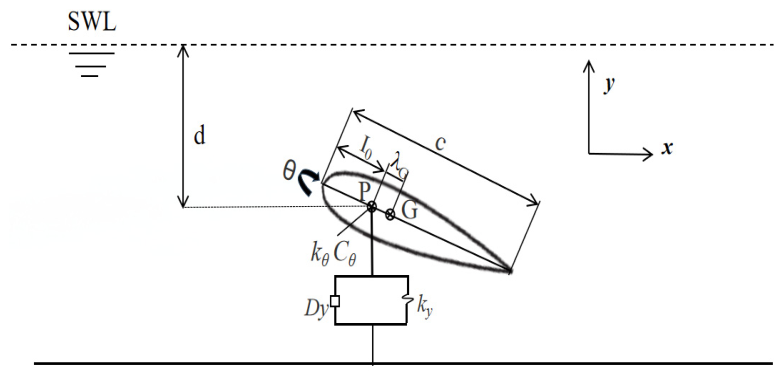
A schematic of the simplified physical model of the fully passive two-degree-of-freedom (2-DOF) oscillating foil is shown in Figure 1. The foil adopts the NACA0015 airfoil, which has been demonstrated to enable efficient energy harvesting for 2-DOF oscillating foils [14]. The coordinate system is established as a Cartesian frame, with the inflow direction aligned with the positive x-axis. The foil is fully submerged beneath the free surface and is held in place by an elastic suspension system. Under fluid excitation, the foil undergoes heave motion along the y-axis and pitch motion about the z-axis. In this study, an asterisk (*) denotes a dimensionless quantity. Symbols without an asterisk represent their dimensional forms.
Driven by the fluid-induced lift force in the y-direction and the moment about the pitch axis, the dynamic equations of the coupled two-degree-of-freedom foil system can be expressed as follows:
m h y ¨ + c h y ˙ + k h y + Λ ( θ ˙ 2 s i n θ θ ¨ c o s θ ) = F y
I θ θ ¨ + c θ θ ˙ + k θ θ m θ λ G ( y ¨ c o s θ ) = M θ
where m h is the heave mass, I θ is the moment of inertia of the foil, c h is the heave damping coefficient, k h is the heave stiffness, c θ is the pitch damping coefficient, and k θ is the pitch stiffness. Since the center of gravity does not coincide with the pitch axis, a static unbalance term Λ = λ G m θ is introduced to couple the two equations, where λ G is the distance from the center of gravity to the pitch axis and m θ is the pitch mass.
To evaluate the energy capture performance of the device, the energy harvesting efficiency and the average power coefficient are adopted as performance metrics. The energy harvesting efficiency is defined as the ratio of the captured mechanical energy to the available energy of the incoming flow over the swept area of the foil. The average power coefficient is defined as the dimensionless expression of the work done by the fluid on the foil per unit period. The specific calculation formulas are as follows [32]:
η = 1 N · T t 0 t 0 + N · T c h y ˙ 2 + c θ θ ˙ 2 1 2 ρ U 3 S d t
C ¯ p = 1 N · T t 0 t 0 + N · T c h y ˙ 2 + c θ θ ˙ 2 1 2 ρ U 3 bc d t
where S is the maximum projected area swept by the foil perpendicular to the flow direction, given by the product of the span b and the maximum vertical sweep distance d . Since the present study is two-dimensional, b is set to 1. N is the number of periods averaged for calculating the efficiency.
In addition to the energy harvesting efficiency and the average power coefficient, several other parameters are defined to characterize the energy capture performance of the two-degree-of-freedom oscillating foil, including the heave amplitude ( h 0 ), pitch amplitude ( θ 0 ), and reduced frequency ( f ):
h 0 = h m a x h m i n 2
θ 0 = θ m a x θ m i n 2
f = f c U
where h m a x and h m i n are the maximum and minimum heave positions, and θ m a x and θ m i n are the maximum and minimum pitch angles reached by the foil during its motion. Furthermore, in the two-degree-of-freedom oscillating foil energy harvesting system, the phase difference ( Φ ) is a key parameter characterizing the temporal coordination between the fluid force and the foil motion, which determines the effective range of positive work done by the system. It is calculated as follows:
Φ = t θ ˙ m a x t h ˙ m a x T · 360
where t θ ˙ m a x is the instant at which the pitch angular velocity of the oscillating foil reaches its maximum, t h m a x is the instant at which the heave linear velocity reaches its maximum, and T is the oscillation period.

2.4. Numerical Model Setup

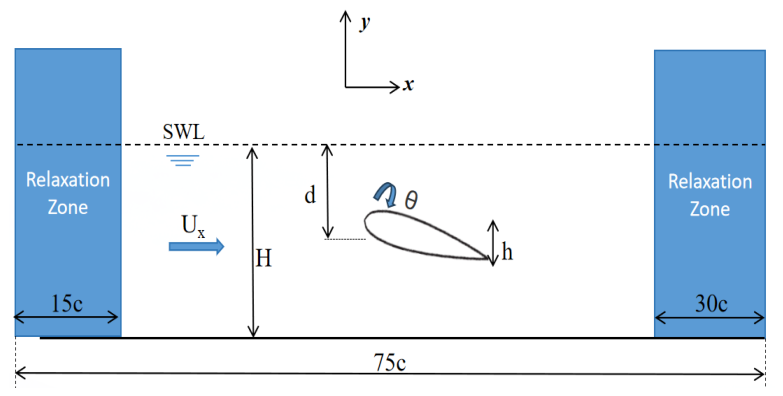
To investigate the energy harvesting characteristics of a near-surface two-degree-of-freedom oscillating foil, a numerical model of the oscillating foil is established as shown in Figure 2. The total length of the computational domain in the streamwise direction is set to 75c (where c is the chord length of the foil). To eliminate boundary reflections and ensure numerical stability, relaxation zones are applied at both ends of the domain, with lengths of 15c at the upstream inlet and 30c at the downstream outlet. When stationary, the oscillating foil is placed at the geometric center of the working zone, with a fixed submergence depth of 4c. The foil adopts the classic NACA0015 symmetric airfoil, with a chord length c = 0.1 m, and the water depth H in the computational domain is set to 2.0 m. The simulations are conducted in a high-Reynolds-number turbulent flow regime, with the Reynolds number fixed at Re =1 × 10⁵ and the Froude number Fr = 1.0.

2.5. Validation of the Numerical Model

2.5.1. Grid Independence Study

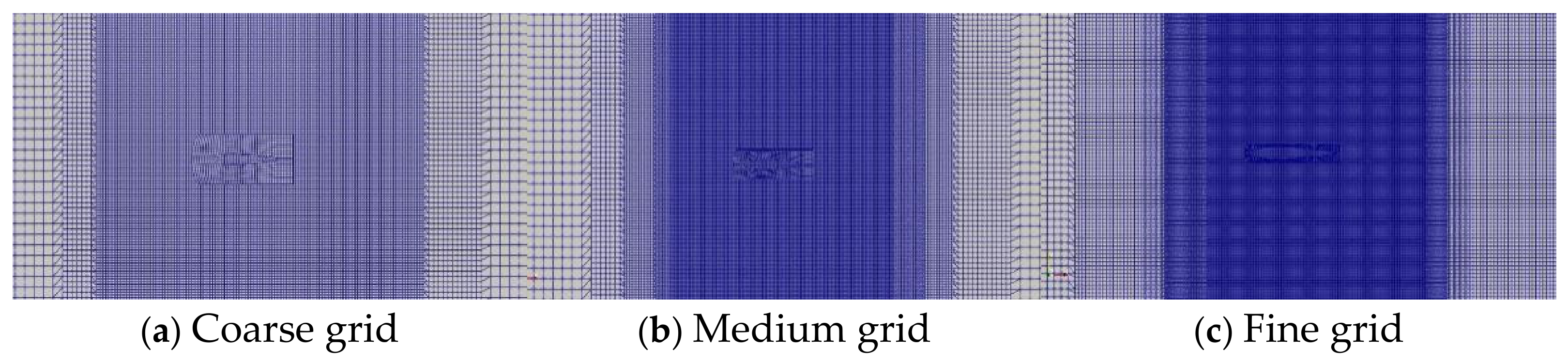
Under uniform flow, the flow field around the oscillating foil becomes complex. To accurately capture the flow characteristics near the foil while balancing the accuracy requirements of numerical simulation and the effective use of computational resources, a proper meshing strategy for the near-field of the structure was first determined. Three grids with different resolutions were constructed for the grid independence study, with mesh sizes of 0.004 m, 0.002 m, and 0.001 m, The coarse, medium, and fine grids consist of approximately 150,450, 200,906, and 384,654 cells, respectively. To avoid numerical errors caused by excessive differences in adjacent cell sizes, a gradual transition strategy was adopted from the near-field refined region to the far-field background region.
Since the wall function method is used to handle near-wall turbulence, the key aspect of meshing is to control the height of the first grid layer on the foil surface, y, so that the dimensionless wall distance y+ lies strictly within the effective range of the logarithmic law region [33]. For numerical stability, the y+ value is fixed at 60 in this study. Based on this y+ value, the height of the first grid layer on the foil surface is calculated to be 0.001 m. After fixing the first-layer grid thickness, the mesh size around the airfoil is varied, while the background grid in the same region is set to the same size as the internal grid to avoid interpolation errors caused by a large size discrepancy between the two grids.
As shown in Figure 3, the Reynolds number is fixed at Re = 1 × 10⁵, the Froude number at Fr = 1.0, and the structural parameters are set to k h = 0.3, c h = 0.8, k θ = 0.025, and c θ = 0.005. Three meshing schemes with different refinement levels around the oscillating foil are tested: coarse (no refinement), medium (one level of refinement), and fine (two levels of refinement). The background grid is also refined accordingly to avoid excessive size differences between the internal and background grids, which could lead to numerical divergence or loss of accuracy.
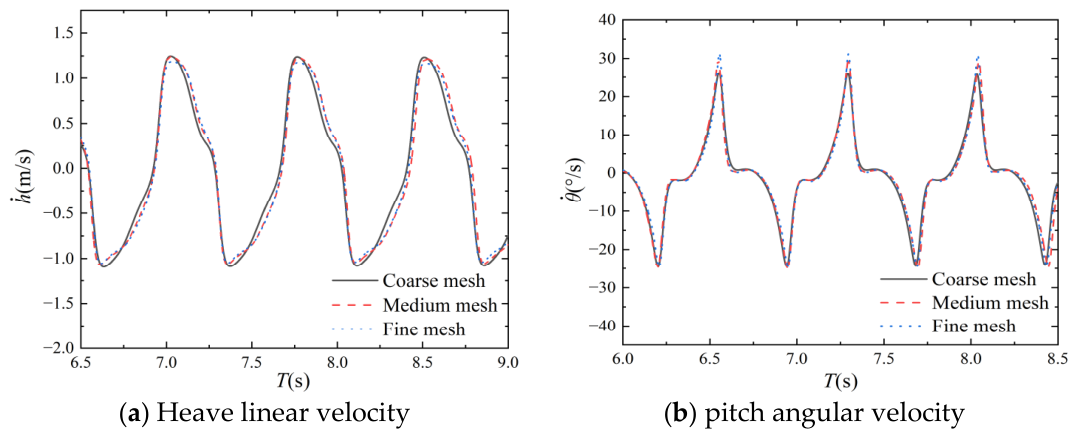
Figure 4 shows a comparison of the time histories of the heave linear velocity and pitch angular velocity of the oscillating foil. It can be observed that there is no significant difference in the two curves among the three grids. The peak pitch angular velocity obtained with the coarse grid is approximately 5°/s lower than that of the fine grid. In contrast, the results from the medium and fine grids are in good agreement. Considering both computational accuracy and cost, the medium grid is selected as the mesh discretization scheme around the foil, with a grid size of approximately 0.002 m.

2.5.2. Validation Against Forced Heaving Foil Experiment

In this study, the overWaveDyMFoam solver, which couples the six-degree-of-freedom (6DOF) motion equations with overset grid techniques, is used to numerically simulate the energy harvesting characteristics and motion response of the two-degree-of-freedom oscillating foil.
The computed results are compared with the experimental data of D. J. Cleaver et al. [34]. Following the experimental setup of Cleaver et al., a corresponding numerical model is established. To validate the accuracy of the present numerical model in solving unsteady moving boundary problems, the numerical results are compared with the drag reduction experiments of a forced heaving motion conducted by Cleaver et al. The flow field configuration is the same as described above, and the airfoil is forced to heave according to the following harmonic law:
y ( t ) = A sin ( 2 π   f t )
where y ( t ) is the instantaneous heave displacement, A is the motion amplitude, and f is the motion frequency.
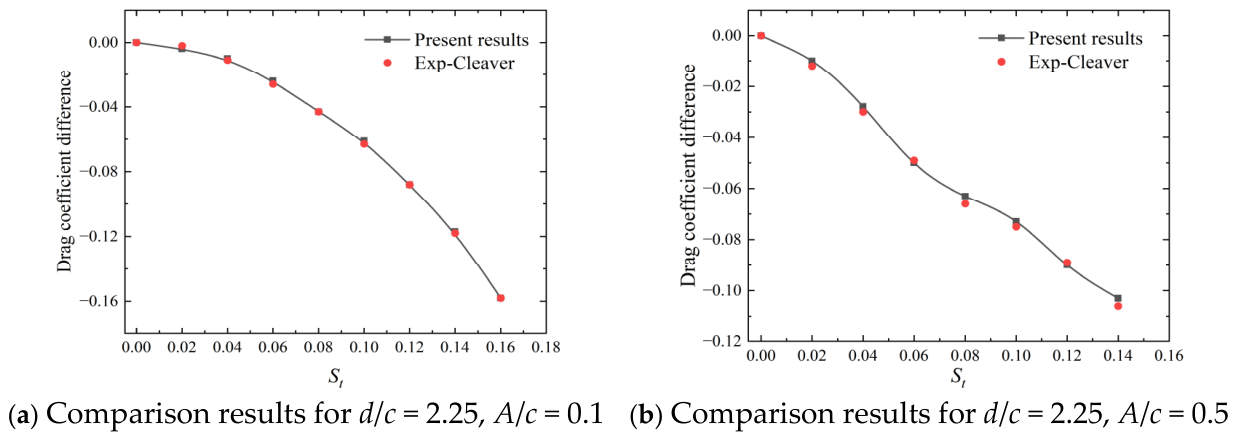
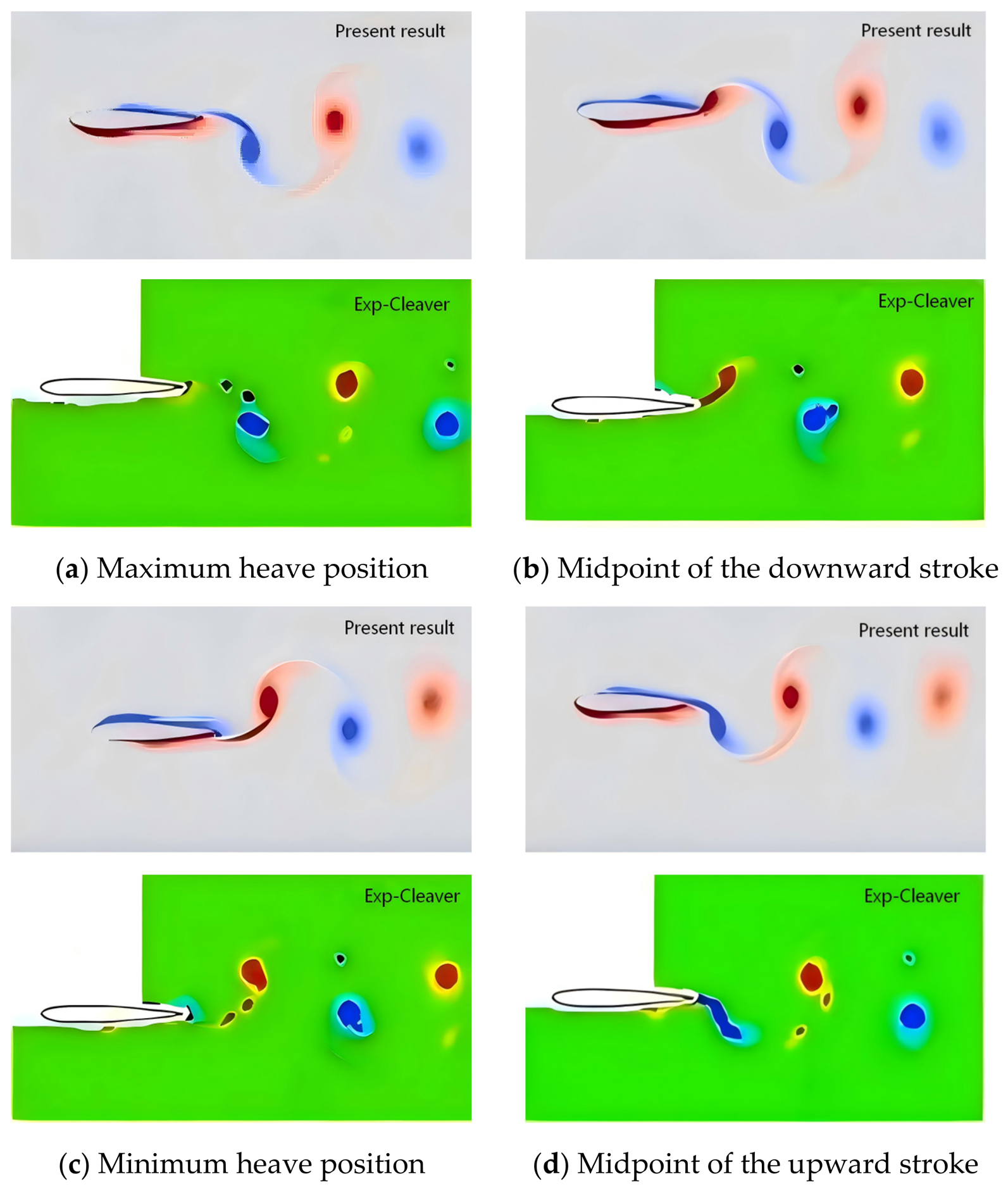
Two typical cases from the experiments were selected for validation: dimensionless initial submergence depth d/c = 2.25, dimensionless amplitudes A/c = 0.1 and A/c = 0.5, and Strouhal number St ranging from 0 to 0.16. Under these settings, the numerical results of the drag reduction effect, represented by the variation in the time-averaged drag coefficient with frequency, were compared with the experimental data. Figure 5 shows a comparison of the time-averaged drag coefficient curves between the numerical simulation and the experiment. It can be observed that the two are in good agreement, with a maximum error of less than 3%. Figure 6 presents a comparison of the vorticity fields between the numerical simulation and the experimental results from the literature under the conditions of St = 0.16, d/c = 2.25 and A/c =0.1. The comparison shows that the numerical simulation clearly captures the Kármán vortex street shed in the wake, including the position and morphology of the vortices. This demonstrates the rationality of the numerical method employed in the present simulation.

2.5.3. Validation of the Heave Motion of a Floating Box Beneath a Free Surface

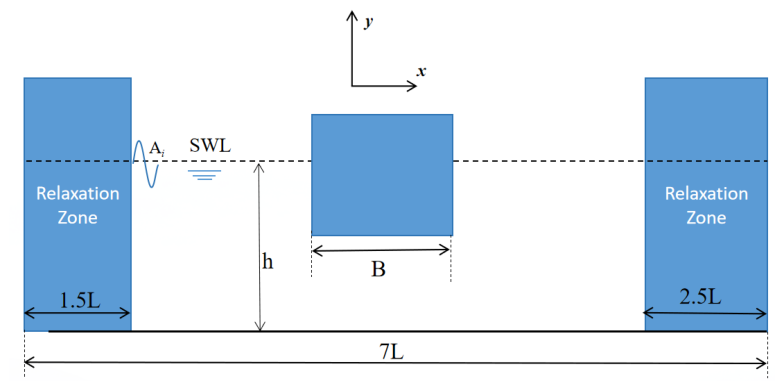
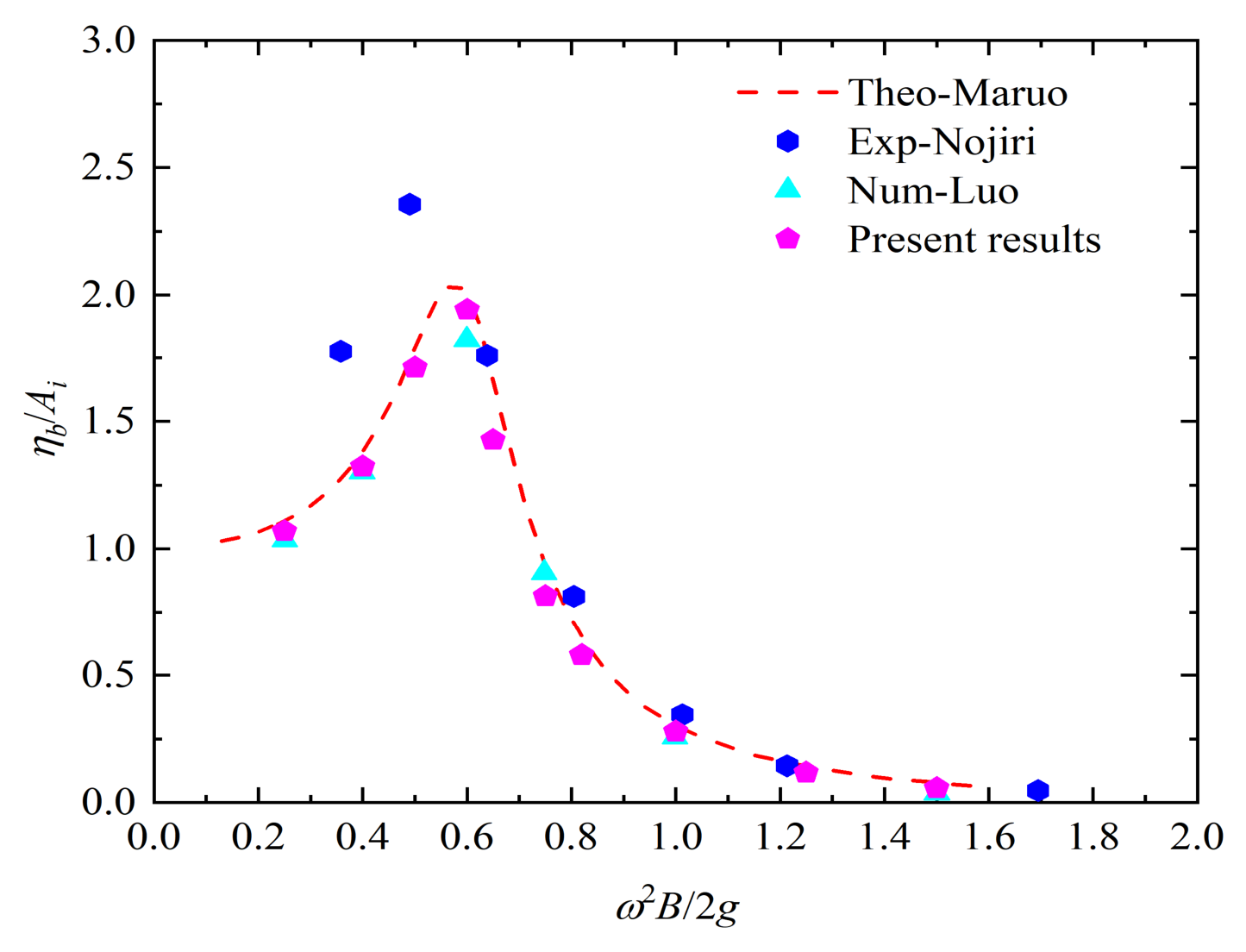
To further validate the accuracy of the present numerical method, the passive heave motion response of a floating box excited by regular waves is simulated. The computed results are compared with the experimental data of No et al. [35], the numerical results of Luo [36], and the theoretical analysis of M [37]. A schematic of the model is shown in Figure 7, where L is the incident wavelength, Aᵢ is the incident wave amplitude, and B is the bottom width of the structure.
Figure 8 presents a comparison between the numerical results of the present study and the data from previous literature. The vertical axis represents the ratio of the structural motion amplitude to the incident wave amplitude, and the horizontal axis represents the dimensionless wave period. As shown, the overall agreement is good. The maximum error between the present numerical results and the previous numerical results is less than 5%, occurring near the natural frequency of the floating body. Owing to enhanced nonlinear effects, a deviation arises between the nonlinear numerical solution and the linear theoretical solution. If the incident wave amplitude is gradually reduced, the nonlinear results will converge monotonically to the linear theoretical solution. This demonstrates that the present numerical method can accurately simulate the passive motion of a floating structure when subjected to fluid excitation forces.

3. Results and Discussion

3.1. Analysis of the Energy Harvesting Mechanism of the 2-DOF Oscillating Foil

The baseline operating conditions in this study are set with reference to experience from fully passive 2-DOF oscillating foils in unbounded flow fields. It is known that when the heave amplitude h 0 ≈ 1.2c and the pitch amplitude θ 0 > 70°, the foil generally exhibits favorable hydrodynamic performance and energy harvesting characteristics. Based on this preferred target, the parameters listed in Table 1 are selected as the baseline operating conditions for the present study.
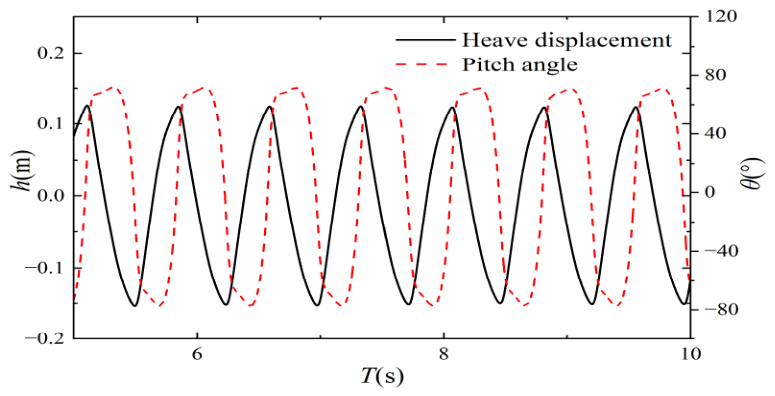
As shown in Figure 9, the numerical simulation of the foil has stabilized and entered a cyclic oscillation mode, and the motion response meets the requirements. To investigate the motion characteristics of the 2-DOF oscillating foil during the energy capture stage, a specific period of the stable cyclic oscillation is selected for detailed analysis.
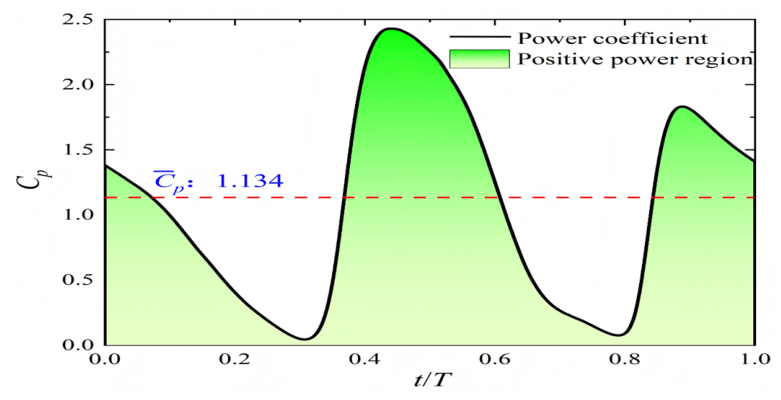
Under the current operating conditions, the average power coefficient of the oscillating foil energy capture system reaches 1.134, and the energy harvesting efficiency reaches 41.39%. However, the respective contributions of heave and pitch motions to energy capture remain unclear. Therefore, a decomposition plot of the power coefficient over one period is presented. To facilitate a better understanding of the energy harvesting mechanism, schematic diagrams of the lift coefficient, pitch moment coefficient, heave linear velocity, and pitch angular velocity are also provided. Figure 8 shows the power coefficient curve of the oscillating foil over one period. Figure 9 presents the motion response of the foil over one stable period.
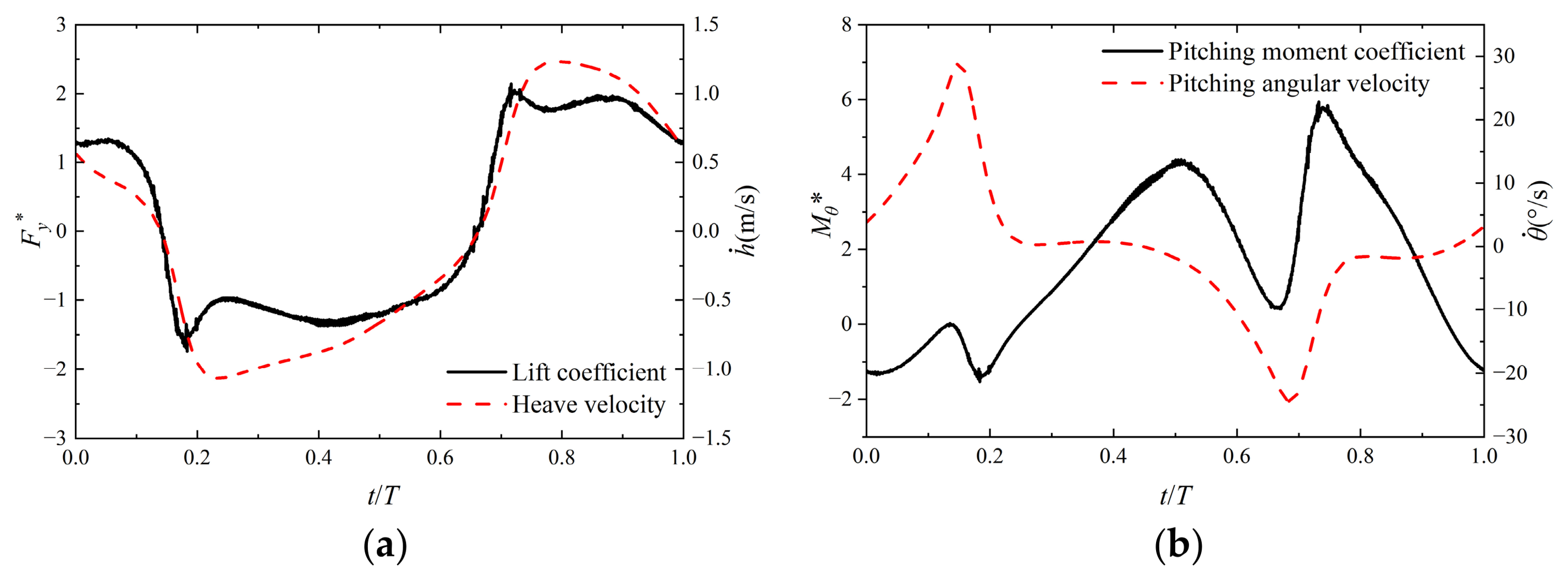
Figure 10 shows the decomposition of the power coefficient over one period. Figure 11a presents the time histories of the lift coefficient and heave linear velocity, and Figure 11b presents the time histories of the pitch moment coefficient and pitch angular velocity. Figure 9 provides an overview of the motion response of the oscillating foil over one stable period. From Figure 10, it can be seen that the system mainly performs positive work in two regions, corresponding to the upstroke and downstroke phases, respectively. As shown in Figure 11a, during the two main work-producing intervals (downstroke and upstroke), the foil maintains a stable negative lift and positive lift, respectively, and the direction of the lift force is always consistent with the direction of the heave velocity. This excellent phase synchronization ensures that the instantaneous power remains positive throughout, thereby enabling efficient extraction of fluid kinetic energy. The high energy harvesting performance mainly relies on the phase coordination between the peak heave velocity and the high lift coefficient.
From the curves of the pitch moment coefficient and pitch angular velocity shown in Figure 11b, it can be observed that during the main work-producing intervals, the pitch angle of the foil remains relatively stable, with the angular velocity staying near zero. This indicates that the foil is in a quasi-static equilibrium state during this phase, i.e., undergoing heave motion at a fixed effective angle of attack. Although the pitch moment coefficient varies dramatically in this region, this is due to the strong elastic restoring moment generated by the torsional stiffness of the system at a large angle of attack. The hydrodynamic pitch moment acts as a quasi-static balancing load, continuously counteracting the elastic restoring force, thereby locking the foil within the angle-of-attack range that facilitates efficient energy harvesting and preventing premature rebound. During the transition phases between strokes, the angular velocity curve exhibits two pronounced extrema, indicating that the foil is in a state of dynamic stall and pitch reversal.
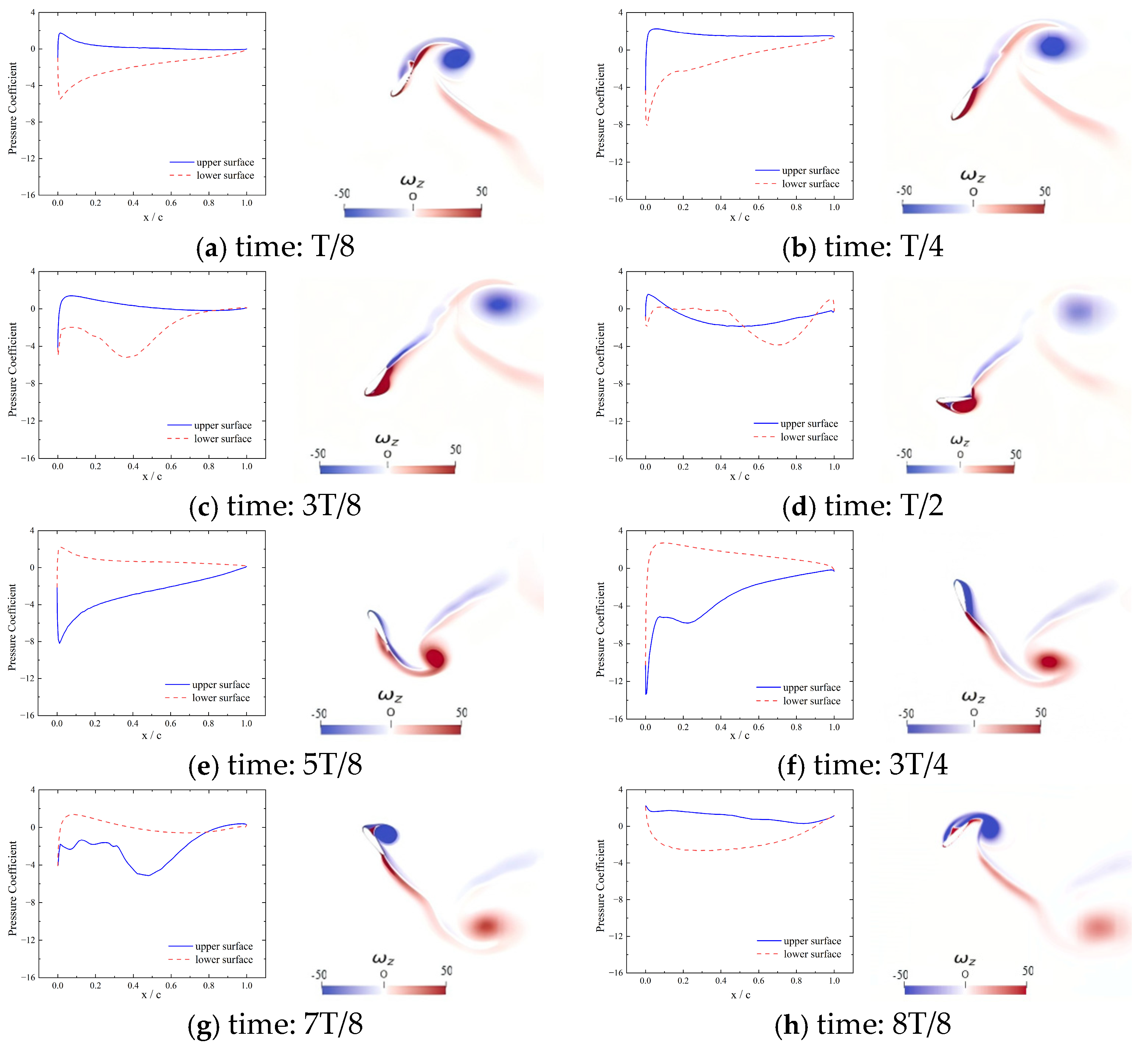
During the energy harvesting process, especially during the heave reversal transition phase, the sharp fluctuations in force and velocity on the oscillating foil are attributed to the generation, evolution, and shedding of the leading-edge vortex (LEV). Figure 10 illustrates the evolution of the surface pressure distribution and the vorticity field over one complete oscillation cycle.
At the beginning of the cycle (T = 1/8), as shown in Figure 12a, the effective angle of attack gradually increases as the foil pitches during its downward motion. At this stage, boundary layer separation occurs at the leading edge of the lower surface, and a leading-edge vortex begins to form. The generation of the LEV establishes a local low-pressure region near the leading edge of the lower surface, creating a significant pressure difference between the upper and lower surfaces, and the foil starts its downstroke. As the motion proceeds, the low-pressure region on the lower surface expands considerably; however, because the vortex core remains attached to the leading edge, the foil maintains a high pressure difference and transient lift.
During the mid-downstroke (T = 1/4 to 3/8), as shown in Figure 12b,c, the LEV core moves toward the trailing edge following the flow direction, and the low-pressure center shifts to the mid-chord. At this point, the effective angle of attack reaches its maximum and then begins to decrease. Subsequently, at T = 1/2 (Figure 12d), the vortex core gradually attaches to the trailing edge and approaches the critical state of shedding, the hydrodynamic center shifts significantly rearward, and almost no effective angle of attack is generated.
Further, at T = 5/8 (Figure 12e), when the leading-edge vortex is completely shed, the vortex shedding causes a relative pressure reduction on the upper surface, generating a reverse (upward) lift force and simultaneously inducing a severe imbalance in the moment. This sudden change in moment breaks the previous quasi-static equilibrium, driving a reversal of the effective angle of attack to an upward orientation, and the foil begins its upstroke.
As the foil continues its upward motion, at T = 3/4 (Figure 12f), a new leading-edge vortex begins to form at the leading edge of the upper surface, and the low-pressure center shifts to the front of the upper surface. During the subsequent upstroke phase (T = 7/8 to 8/8), as shown in Figure 12g,h, the LEV and the low-pressure center on the upper surface migrate toward the mid-chord and eventually shed from the trailing edge. With the vortex shedding and the resulting re-imbalance of the moment, the effective angle of attack again undergoes a sharp reversal, initiating a new downstroke cycle. This process repeats periodically.

3.2. Influence of Stiffness Coefficients on the Energy Harvesting Characteristics of the 2-DOF Oscillating Foil

3.2.1. Influence of Heave Stiffness on the Energy Harvesting Characteristics of the 2-DOF Oscillating Foil

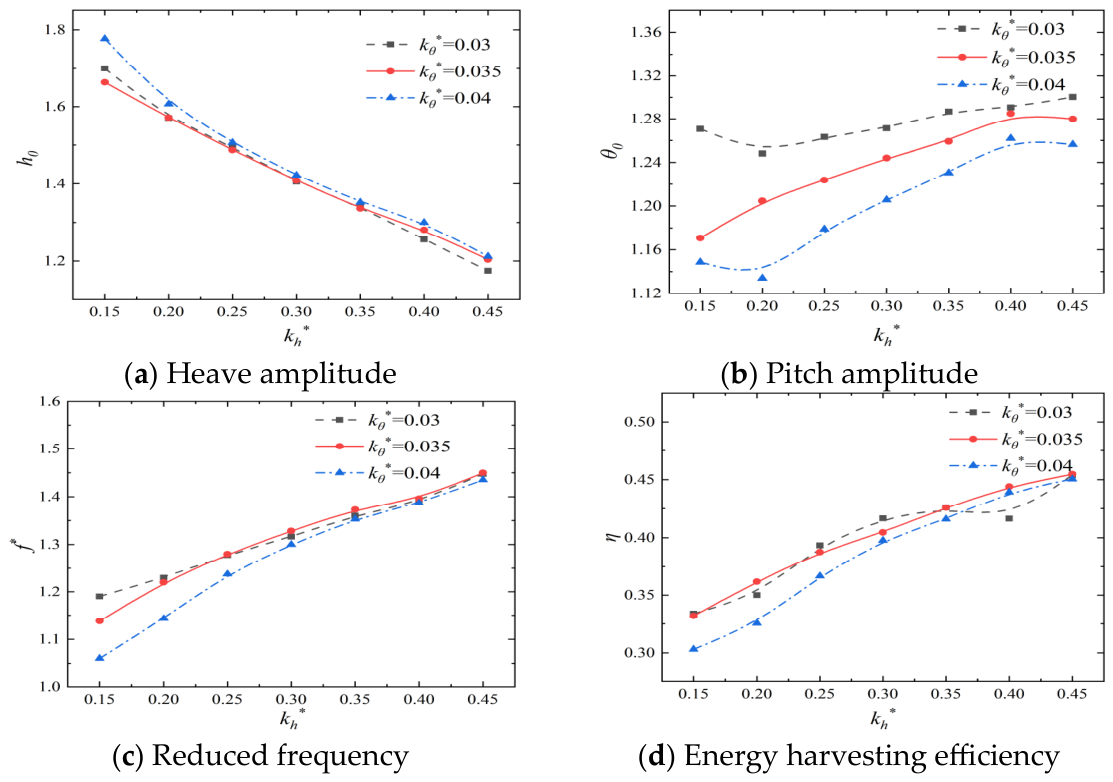
The influence of heave stiffness on the motion response and energy harvesting characteristics of the foil is first investigated. Keeping the damping coefficients in the structural parameters unchanged, three different pitch stiffness coefficients ( k θ = 0.03, 0.035, 0.04) are selected to numerically study the effects of varying heave stiffness on the motion response and energy harvesting performance of the 2-DOF oscillating foil. The heave stiffness coefficient k h is varied in the range of 0.15 to 0.45 in the numerical simulations. The stable stage of the numerical simulation for each case is taken for analysis. Figure 11 shows the variation in the energy harvesting characteristics of the foil with different heave stiffness values, where the pitch amplitude is converted to radians.
Figure 13 shows that heave stiffness significantly regulates the motion response and energy harvesting characteristics of the foil. As seen in Figure 13a–c, when the heave stiffness k h increases, the heave amplitude decreases monotonically, while the pitch amplitude increases monotonically—an opposite trend. This behavior arises because a higher heave stiffness strengthens the elastic restoring force in the heave direction, imposing stronger structural constraints on the displacement response under fluid excitation. Consequently, the heave motion is suppressed, which directly reduces the heave amplitude. The increase in pitch amplitude occurs because part of the incoming flow energy is redirected from the heave direction to the pitch direction as the structural resistance in heave grows. Hence, the pitch amplitude increases with heave stiffness. Moreover, the reduced frequency of the system increases monotonically with heave stiffness: a larger heave stiffness raises the system’s natural frequency, and the enhanced elastic restoring force forces the foil to respond to fluid excitation more rapidly, thereby increasing the oscillation frequency.
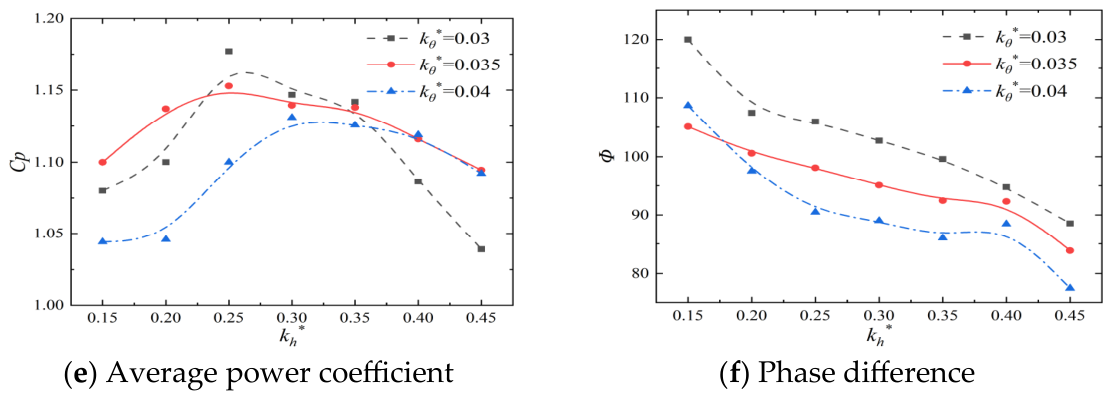
The change in motion response directly affects the foil’s energy harvesting performance. Figure 13d,e show that for the three selected pitch stiffness values, the average power coefficient exhibits a clear nonlinear trend: it first increases and then decreases. In contrast, the energy harvesting efficiency increases monotonically with heave stiffness. The reason for this difference is as follows. In the low-stiffness regime, the natural frequency is low, the oscillation period is long, and the foil can achieve a large heave amplitude due to weak structural constraints. However, as seen from the phase difference curve in Figure 13f, the phase difference is relatively large in this regime. The sluggish response caused by low stiffness leads to a time lag between the fluid forcing and the foil motion, resulting in poor force-velocity matching and, therefore, low power output. As the heave stiffness increases into the optimal range, the structural restoring force rises, the natural frequency increases, the system becomes more responsive, and the phase difference gradually decreases toward the optimal synchronization range. This appropriate heave stiffness brings the force and velocity into optimal phase synchrony, allowing the power coefficient to reach its peak. When heave stiffness increases further, the phase difference continues to decrease and begins to deviate from the optimal range, disrupting the synchrony between force and velocity, and the power coefficient drops accordingly.
It is worth noting that the energy harvesting efficiency does not follow the same nonlinear behavior as the average power coefficient; instead, it increases strictly monotonically. Physically, the energy harvesting efficiency measures the energy extracted per unit swept area. In the low-stiffness regime, the low natural frequency leads to poor force-velocity synchrony and low work efficiency. However, the weak structural constraint allows a large heave stroke and a large swept area, so the energy extracted per unit area is low. As heave stiffness increases into the optimal range, the average power coefficient rises due to improved phase coordination, while the increasing elastic restoring force significantly limits the heave amplitude and the swept area. As a result, the energy extracted per unit swept area increases. When stiffness increases further, although the system moves away from the optimal phase synchronization range and the average power coefficient begins to fall, the heave amplitude decreases faster than the power output. This means that even though the total power output is reduced, the foil still maintains a very high energy extraction efficiency within the constrained swept area. Hence, the energy harvesting efficiency continues to increase monotonically.
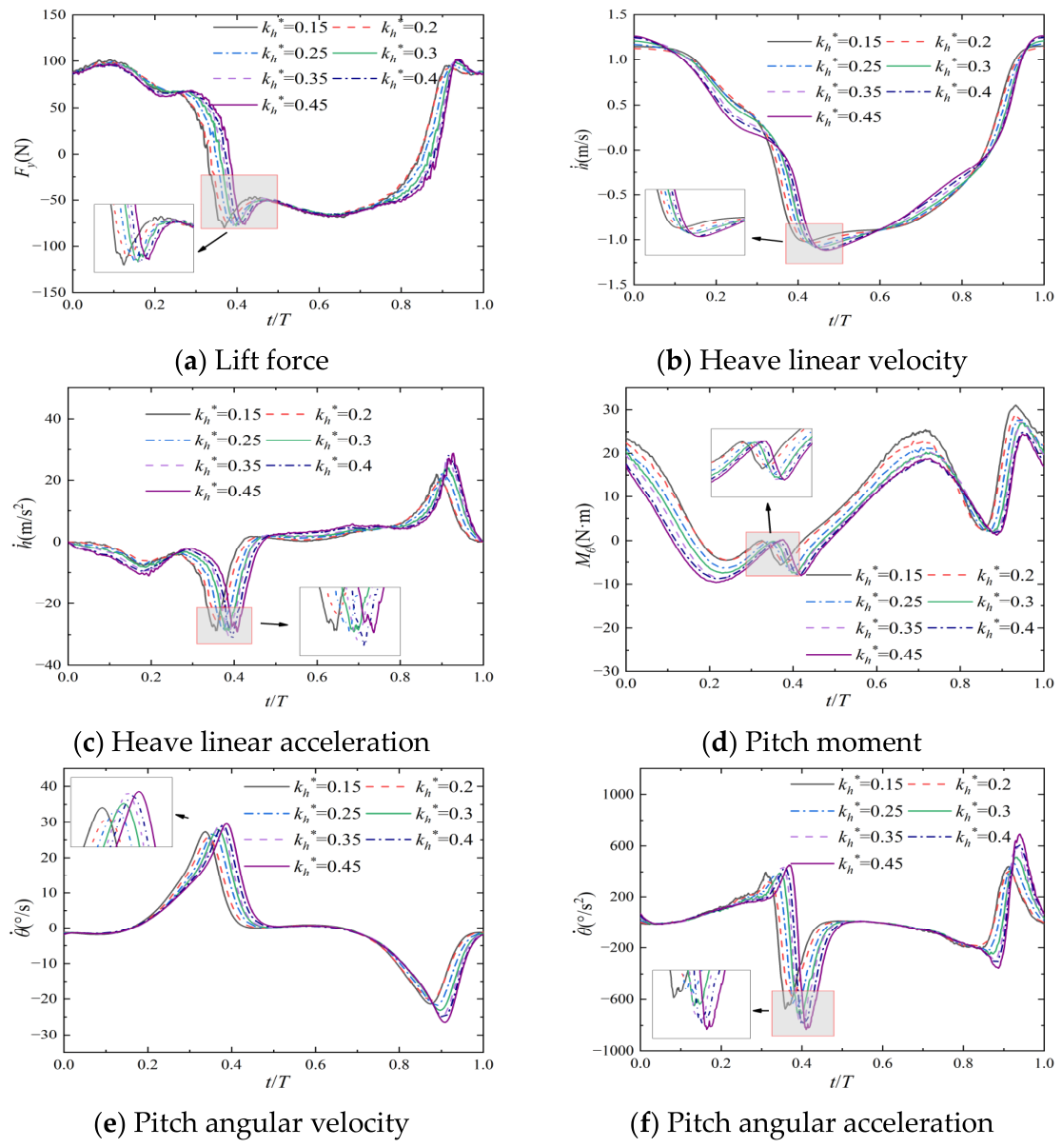
To further investigate the influence of heave stiffness on the energy harvesting characteristics of the oscillating foil, the case with a pitch stiffness coefficient of k θ = 0.03 is selected. Figure 14 presents the time histories of the fluid force and motion response over one stable cycle for different heave stiffness values.
Figure 14 shows the evolution of the linear velocity, linear acceleration, lift coefficient, angular velocity, angular acceleration, and pitch moment coefficient with dimensionless time. Heave stiffness plays a decisive role in the dynamic characteristics of the foil system. As seen in Figure 14a–c, with increasing heave stiffness, the lift force on the foil gradually decreases, while the peak linear velocity and peak linear acceleration exhibit the opposite increasing trend. Under low-stiffness conditions, the natural frequency of the system is low, and the longer oscillation period allows the leading-edge vortex (LEV) to fully develop. The low-pressure region created by the well-developed LEV provides a very high transient lift force on the foil, with a peak lift of up to 105 N. However, in this regime, the natural frequency is lower than the vortex shedding frequency, causing a lag in the motion response, as reflected by the peak linear velocity lagging significantly behind the peak lift. This phase mismatch results in little overlap between the high-lift interval and the high-motion-response interval, leading to low power output.
As the stiffness increases into the optimal range, the increase in structural restoring force raises the natural frequency, which in turn accelerates the oscillation frequency of the foil. Consequently, the peaks of the linear velocity and linear acceleration increase markedly. Although the higher natural frequency and shorter oscillation period reduce the time available for LEV evolution and attachment, thereby decreasing the lift force, the synchronization between force and velocity becomes optimal. The natural frequency matches the vortex shedding frequency, and the high-linear-velocity interval overlaps highly with the high-lift interval in the time domain. This excellent force-velocity synchronization and phase coordination allow the power coefficient to reach its peak. When the stiffness increases further, the lift continues to drop. Although the continuously increasing natural frequency leads to local maxima in the linear velocity and linear acceleration (with the peak linear velocity reaching 1.15 m/s), the larger structural restoring force causes a phase lag in the peak velocity, and the overlap between the high-lift and high-motion-response intervals decreases. As a result, the force-velocity matching deteriorates, and the power output declines. Moreover, throughout the entire stiffness variation, the peaks of lift and linear velocity exhibit a clear lag in dimensionless time, indicating that the effective work-producing interval shifts progressively later as stiffness increases.
The change in heave stiffness also affects the rotational response characteristics of the system. From Figure 14d–f, it can be seen that as heave stiffness increases, the fluid pitch moment on the foil decreases, but the rotational motion response increases, as reflected by the increase in angular velocity and its peak value. In the low-stiffness regime, limited by the low natural frequency, the overall response of the foil is relatively slow; therefore, the peaks of angular velocity and angular acceleration are low and show a clear phase advance. However, the high-intensity leading-edge vortex induced by low stiffness generates a large transient fluid pitch moment during its attachment and shedding, with the peak pitch moment reaching 33 N·m, which is the global maximum. As the stiffness increases into the optimal range, the higher natural frequency accelerates the overall response, and the peaks of angular velocity and angular increase accordingly. Nevertheless, the reduced LEV intensity due to higher heave stiffness leads to a smaller transient pitch moment from vortex shedding. At the same time, the increased structural restoring force introduces a phase lag in the motion response. As stiffness increases further, the continuously rising natural frequency makes the peaks of angular velocity and angular acceleration reach their global maximum. The LEV evolution becomes even more constrained, and the vortex strength is substantially weakened; therefore, the pitch moment induced by vortex shedding decreases further. In addition, the excessive structural stiffness aggravates the system response lag, resulting in more severe phase delays in the angular velocity and angular acceleration peaks.

3.2.2. Influence of Pitch Stiffness on the Energy Harvesting Characteristics of the 2-DOF Oscillating Foil

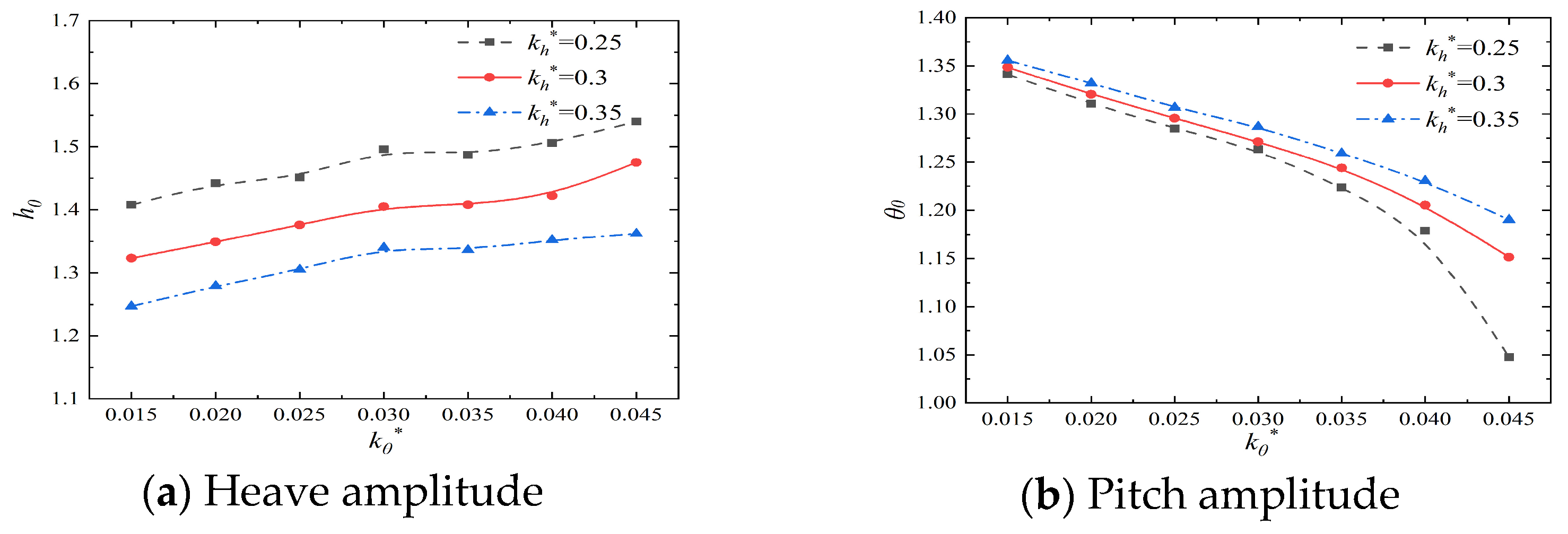
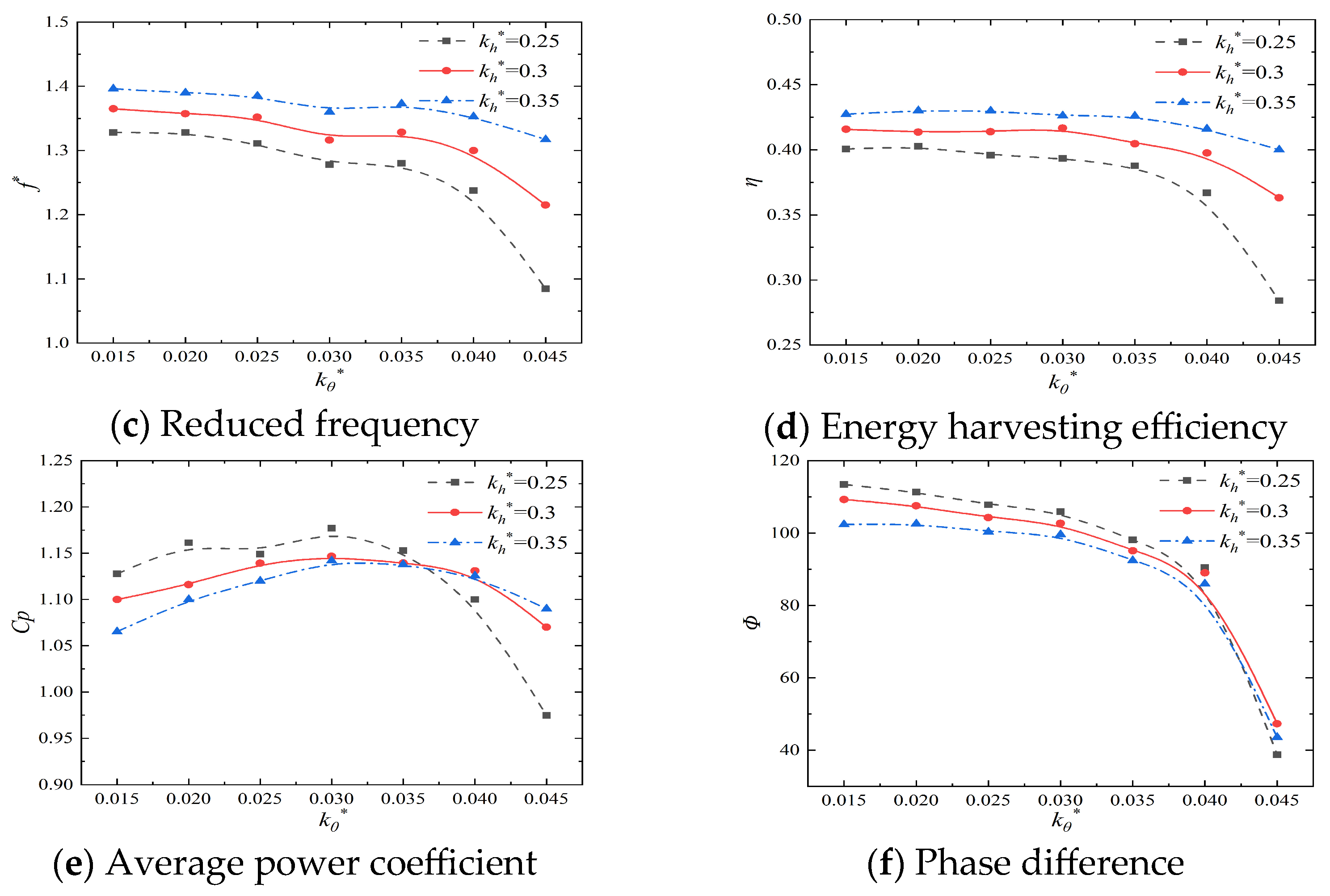
Keeping the heave damping and pitch damping coefficients in the structural parameters unchanged, three different heave stiffness coefficients ( k h = 0.25, 03, 0.35) are selected to further investigate the influence of pitch stiffness on the motion response and energy harvesting characteristics of the near-surface two-degree-of-freedom oscillating foil. The pitch stiffness coefficient k θ is varied in the range of 0.015 to 0.045 in the numerical simulations. The stable stage of the numerical simulation for each case is taken for analysis. Figure 15 shows the variation in the foil energy harvesting characteristics with different pitch stiffness values.
Figure 15 shows the variation in the energy harvesting characteristics of the foil with different pitch stiffness values. Regarding the system motion response, as seen in Figure 15a,b, with increasing pitch stiffness k θ , the pitch amplitude decreases monotonically, while the heave amplitude exhibits the opposite monotonic increasing trend. The reason for this behavior is as follows. Under low-stiffness conditions, the small structural restoring force makes the foil highly susceptible to fluid moments, leading to large-angle, high-frequency pitch deflections and thus a large pitch amplitude. However, this easy-deflection characteristic shortens the time during which the foil maintains an effective angle of attack, making it difficult for the foil to continuously and stably harvest energy from the flow, thereby limiting its heave amplitude. As the pitch stiffness increases, the enhanced elastic restoring force effectively suppresses the pitch deflection, so both the pitch amplitude and the deflection frequency decrease. This allows the foil to maintain a longer effective angle-of-attack duration, enabling the incoming flow to perform work on the foil steadily and continuously, which in turn increases the heave motion response. Meanwhile, as shown in Figure 15c, the reduced frequency of the foil decreases with increasing pitch stiffness. This is because the larger elastic restoring force requires the flow to work over a longer period to overcome the greater restoring moment, which macroscopically manifests as a lower oscillation frequency.
The change in motion response directly affects the energy harvesting characteristics of the foil. According to Figure 15d,e, the energy harvesting efficiency decreases monotonically with increasing pitch stiffness, while the average power coefficient exhibits a clear nonlinear trend, first increasing and then decreasing. An appropriate structural restoring force helps coordinate the heave and pitch degrees of freedom. In the low-stiffness regime, the weak elastic restoring force causes the foil to reverse its pitch angle too early or too easily. As seen in Figure 15f, the phase difference is relatively large in this regime, indicating poor system coordination and therefore low power output. As the stiffness increases into the optimal range, the appropriate pitch stiffness brings the force and velocity into optimal synchrony, reflected by the phase difference gradually decreasing into the favorable range, and the power coefficient reaches its peak. However, when the pitch stiffness increases further, the foil becomes difficult to reverse, the structural response lags, and the force-velocity synchrony is disrupted. The phase difference continues to decrease and deviates from the favorable range, causing the power coefficient to drop.
It is worth noting that the energy harvesting efficiency does not exhibit the same nonlinear behavior as the average power coefficient; instead, it shows a strictly monotonic decreasing trend. This is mainly because, as the pitch stiffness increases, the heave amplitude of the foil grows continuously, leading to a continuous increase in the swept area for energy harvesting. Before the optimal stiffness range, although the power coefficient is increasing, the swept area increases even faster, resulting in a decrease in energy harvesting efficiency. After the optimal range, the power coefficient begins to decrease, but the heave amplitude (and thus the swept area) continues to increase, so the energy harvesting efficiency keeps declining.
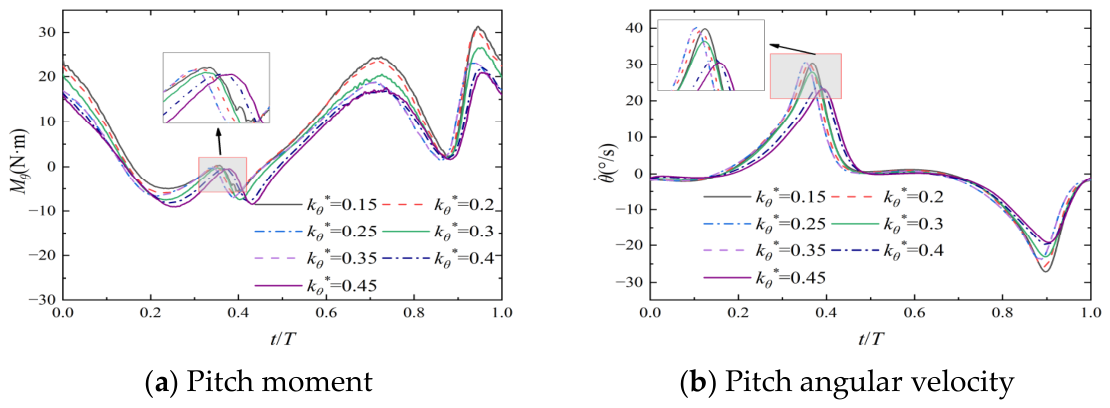
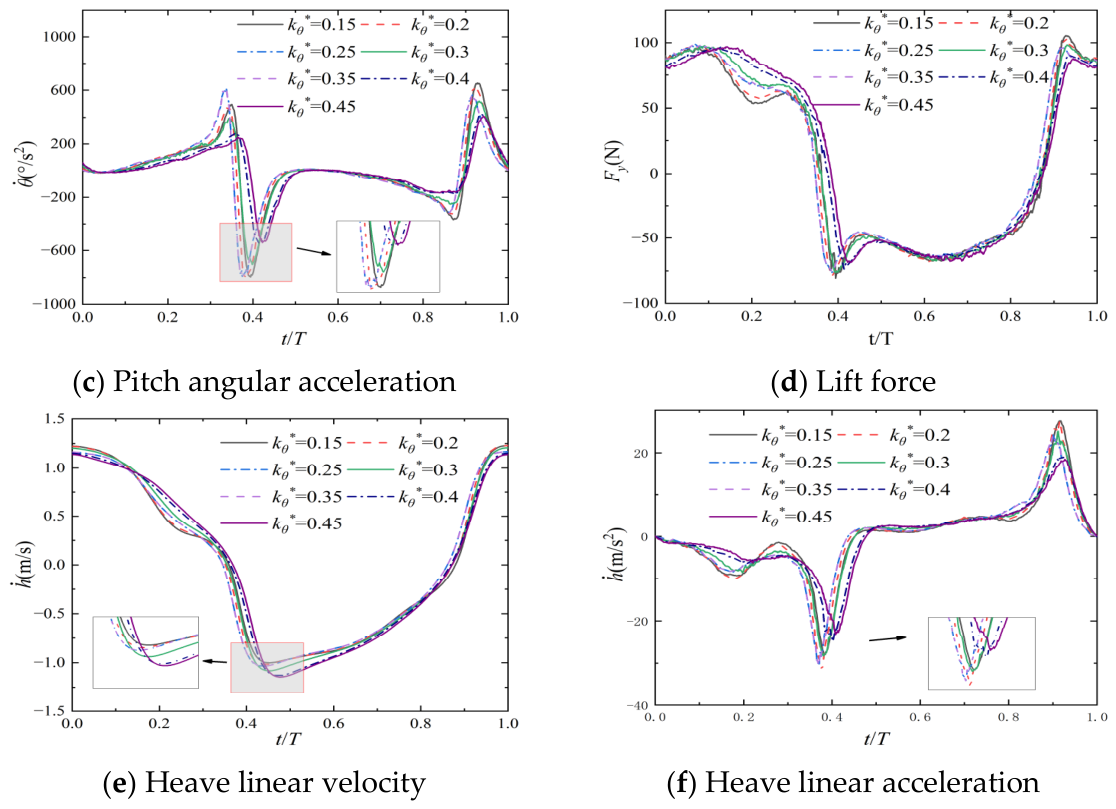
Pitch stiffness has a decisive influence on the structural stability and dynamic characteristics of the system. Figure 16 shows the evolution of the heave linear velocity, heave linear acceleration, lift coefficient, pitch angular velocity, pitch angular acceleration, and pitch moment coefficient with dimensionless time. As seen in Figure 16a–c, with increasing pitch stiffness, the pitch moment, peak angular velocity, and peak angular acceleration of the foil generally exhibit a decreasing trend, and the peaks of angular velocity and angular acceleration show a phase lag. Under low-stiffness conditions, the structural restoring force is small and cannot effectively resist the fluid moment, causing a large transient fluid moment during leading-edge vortex (LEV) shedding, with the peak pitch moment reaching up to 30 N·m. This large fluid moment induces a rapid pitch reversal of the foil in a short time, resulting in a violent motion response, as reflected by the high peaks of angular velocity and angular acceleration, indicating that the system exhibits significant dynamic instability. As the pitch stiffness increases into the optimal range, the enhanced restoring force provides effective regulation and buffering: the transient fluid moment peak decreases, the pitch reversal speed and frequency are effectively suppressed, and consequently the peaks of angular velocity and angular acceleration are significantly reduced, with the angular acceleration curve becoming smoother. It is worth noting that when the pitch stiffness reaches 0.035, the increasing natural frequency of the system approaches the vortex shedding frequency, triggering local resonance. When the two frequencies coincide, substantial energy is generated, causing sharp increases in the peaks of pitch moment, angular velocity, and angular acceleration, with the peak angular velocity reaching up to 31 rad/s. As the stiffness increases further, the system moves out of the resonance regime; the peaks of pitch moment, angular velocity, and angular acceleration all decrease, and the phase lag becomes severe. At this stage, the system response becomes sluggish, and the foil rotation lags significantly behind the vortex shedding frequency.
The change in pitch stiffness not only affects the reversal characteristics of the system but also determines the heave motion response during the work-producing process. As shown in Figure 16d–f, with increasing pitch stiffness, the time histories of lift and heave linear velocity both exhibit an overall increasing trend, while the heave linear acceleration shows the opposite decreasing trend. In the low-stiffness regime, the foil reverses too early and too rapidly, making it difficult to maintain a long-lasting effective angle of attack. Consequently, the LEV sheds before it can fully develop and attach. Thus, the lift curve shows a distinct collapse in the first half of the period. The premature shedding of the LEV prevents the foil from maintaining a stable and high lift, so the heave motion response is weak and the peak linear velocity is low. However, because the system is in an unstable state, the linear acceleration exhibits a large peak. Due to the poor overlap between the high-lift interval and the high-motion-response interval, the force-velocity coordination is poor, resulting in low power output. As the stiffness increases into the optimal range, the appropriate structural restoring moment effectively delays the pitch reversal, allowing the LEV to remain stably attached throughout the entire work-producing stroke. The foil experiences a stable lift, the lift curve becomes full, and the linear acceleration curve becomes smooth with lower extremes. The stable lift enhances the heave motion response, and the high-lift interval perfectly overlaps with the high-motion-response interval, achieving excellent phase matching, so the power output increases. It is also worth noting that when the pitch stiffness reaches 0.035, due to the local resonance effect, the linear acceleration peak increases again, and both the heave amplitude and the linear velocity increase further. However, the resonance disrupts the smooth evolution of the LEV, causing a clear phase mismatch between lift and linear velocity, and therefore the power output decreases. When the stiffness increases further, the coordination mechanism of the system is completely disrupted. Although the longer effective angle-of-attack duration allows the heave linear velocity and heave amplitude to reach their global maxima (with the peak linear velocity reaching 1.2 m/s and the peak linear acceleration reaching 35 m/s2), the lagging motion response frequency leads to poor force-velocity synchrony, ultimately causing a further decline in the energy harvesting performance.

3.3. Influence of Damping Coefficients on the Energy Harvesting Characteristics of the 2-DOF Oscillating Foil

3.3.1. Influence of Heave Damping on the Energy Harvesting Characteristics of the 2-DOF Oscillating Foil

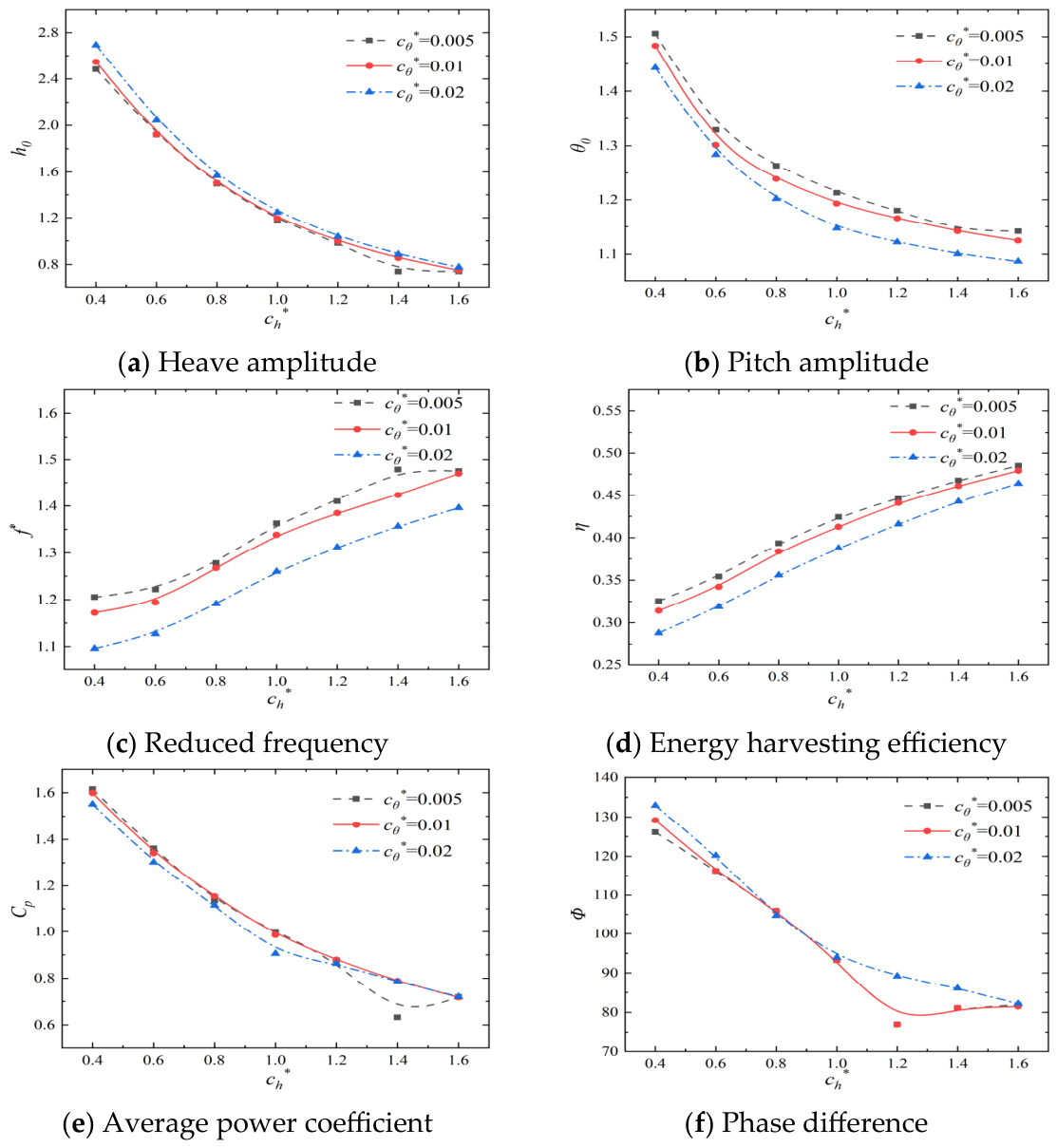
The influence of heave damping on the motion response and energy harvesting characteristics of the foil is first investigated. Keeping the stiffness coefficients in the structural parameters unchanged, three different pitch damping coefficients ( c θ = 0.005, 0.01, 0.02) are selected to numerically study the effects of varying heave damping on the motion response and energy harvesting performance of the 2-DOF oscillating foil. The heave damping coefficient c h is varied in the range of 0.4 to 1.6 in the numerical simulations. The stable stage of the numerical simulation for each case is taken for analysis. Figure 17 shows the variation in the energy harvesting characteristics of the foil with different heave damping values.
Figure 17 shows the variation in the foil energy harvesting characteristics with different heave damping values. Regarding the system motion response, as seen in Figure 17a,b, with increasing heave damping c h , both the heave amplitude and the pitch amplitude exhibit a monotonic decreasing trend. The reason for this behavior is as follows. The increasing heave damping imposes greater viscous dissipation and motion resistance in the heave direction, strongly suppressing the heave motion. At the same time, the increased heave damping consumes kinetic energy in the heave direction, limiting the heave motion and reducing the swept area of the foil, which in turn decreases the available energy from the incoming flow. Consequently, the energy captured in the pitch direction is reduced, the fluid moment decreases, and the pitch motion response also decreases. Furthermore, as shown in Figure 17c, the reduced frequency of the system increases monotonically with heave damping. This is because the increased heave damping dissipates the heave momentum and reduces the heave displacement range, shortening the time required for the foil to complete one oscillation cycle, which manifests in the time domain as an increase in the reduced frequency.
According to Figure 17d,e, the energy harvesting characteristics of the foil also change with heave damping. The average power coefficient decreases monotonically with increasing heave damping, while the energy harvesting efficiency exhibits the opposite monotonic increasing trend. The reason for this is as follows. In the low-damping regime, the motion constraint is weak, and the foil has a large heave displacement. This long-stroke work-producing interval allows the fluid excitation force to act over a longer period, capturing more energy. However, as seen from the phase difference curve in Figure 17f, the phase difference in this regime is relatively large (generally above 120°) and not within the optimal range. Nevertheless, due to the long fluid work duration and the large motion response, the system still achieves the highest power output. However, the large heave response also implies a large swept area, so the energy harvesting efficiency in this regime is relatively low, i.e., the energy extraction density is low. As heave damping increases, the increased viscous dissipation weakens the heave motion response, and the power output decreases. It is worth noting that in this regime, the phase difference gradually decreases and enters the theoretical optimal range, and the force-velocity synchronization becomes good. However, because the motion response is reduced, the optimal phase cannot compensate for the loss in power output, so the power remains lower than that in the low-damping regime. Regarding the energy harvesting efficiency, the swept area decreases sharply, and the rate of decrease in the average power coefficient is much smaller than the rate of decrease in the swept area. As a result, the energy harvesting efficiency continues to increase. In the high-damping regime, the strong viscous dissipation further weakens the motion response. At the same time, the phase difference continues to decrease and deviates from the optimal range, causing poor force-velocity synchronization, and the average power coefficient decreases further. However, because the swept area continues to shrink, the energy harvesting efficiency still increases.
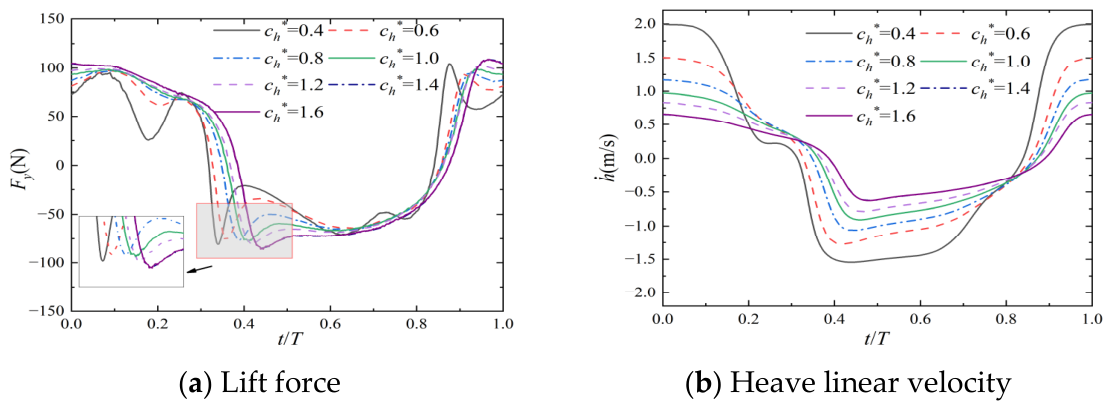
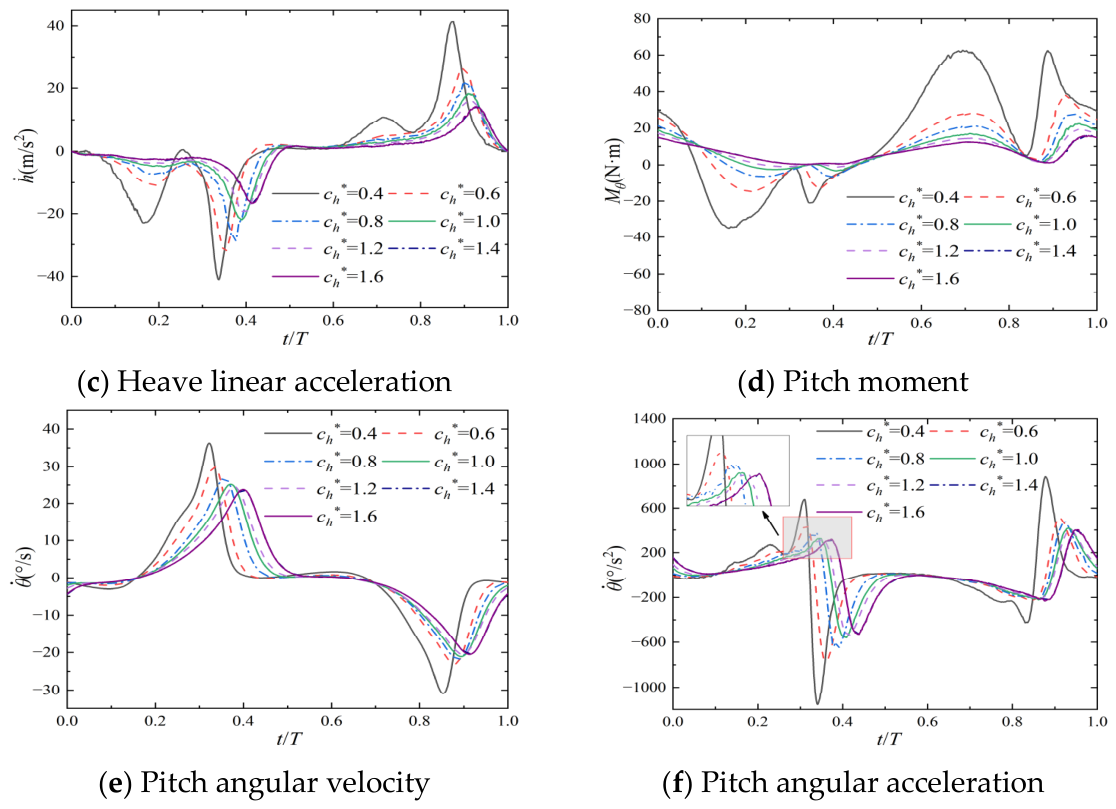
To further investigate the influence of heave damping on the energy harvesting characteristics of the oscillating foil, the case with a pitch damping coefficient of c θ = 0.005 is selected. Figure 18 presents the time histories of the fluid force and motion response over one stable cycle for different heave damping values.
Figure 18 shows the evolution of the heave linear velocity, heave linear acceleration, lift coefficient, pitch angular velocity, pitch angular acceleration, and pitch moment coefficient with dimensionless time. Heave damping plays a decisive role in the dynamic characteristics and energy capture performance of the foil system.
As seen in Figure 18a–c, with increasing heave damping, the lift force exhibits a monotonic increasing trend, while the heave linear velocity and heave linear acceleration show the opposite monotonic decreasing trend. In the low-damping regime, the viscous dissipation is small, and the structural impedance in the heave direction is weak. Consequently, the foil can respond without needing to generate a high-intensity leading-edge vortex (LEV) to establish extreme surface pressure differences, which macroscopically results in a low lift curve and low lift peaks. Because of the weak heave impedance, the foil undergoes large-amplitude heave motion, and the system motion response is large, as reflected by the high peaks of linear velocity and linear acceleration (peak linear velocity up to 1.5 m/s, peak linear acceleration up to 42 m/s2). It is worth noting that during the first half of the work-producing period, the excessively large motion response causes premature LEV shedding, leading to a distinct collapse in the lift curve; the corresponding linear acceleration curve also exhibits a peak.
However, as damping increases further, the motion constraint in the heave direction becomes significantly stronger. The foil surface is forced to generate a high-intensity LEV to create a larger pressure difference to overcome the increased resistance, thereby driving the foil motion. Macroscopically, the lift curve increases continuously. At the same time, the increased damping dissipation consumes most of the lift force acting on the foil, causing the corresponding heave motion response (linear velocity and linear acceleration) to decrease.
The change in heave damping also affects the rotational dynamic characteristics of the system. As shown in Figure 18d–f, with increasing heave damping, the pitch moment, angular velocity, and angular acceleration of the foil all exhibit a decreasing trend. In the low-damping regime, the heave motion space is large, the system motion response is violent, and the system is in an unstable state. Consequently, a strong fluid moment is generated on the foil surface, which induces a large transient driving pitch moment on the pivot, with the peak pitch moment reaching up to 60 N·m. Under this strong fluid torque, the pitch amplitude of the foil is also large, reflected by the extreme values of angular velocity and angular acceleration. As damping increases further, the heave response becomes more restricted, the system tends toward stability, the fluid pitch moment on the foil surface weakens, leading to a reduction in the pitch moment acting on the foil, and consequently the angular velocity and angular acceleration decay.

3.3.2. Influence of Pitch Damping on the Energy Harvesting Characteristics of the 2-DOF Oscillating Foil

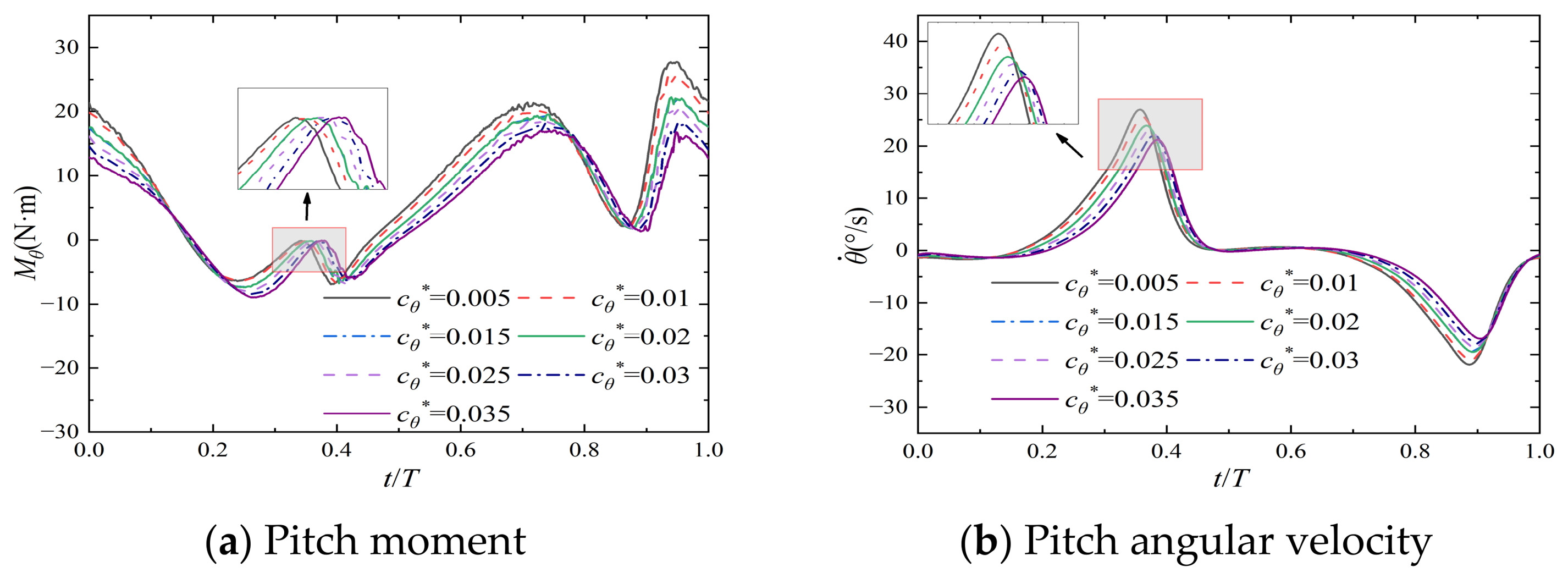
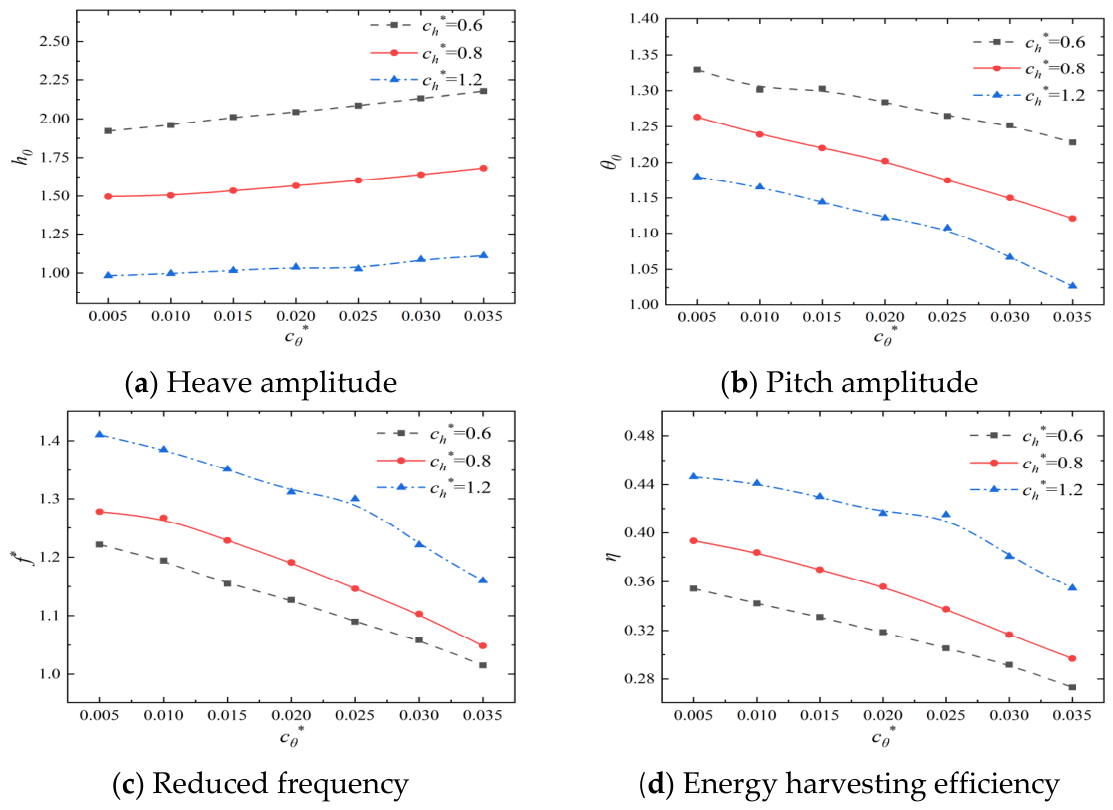
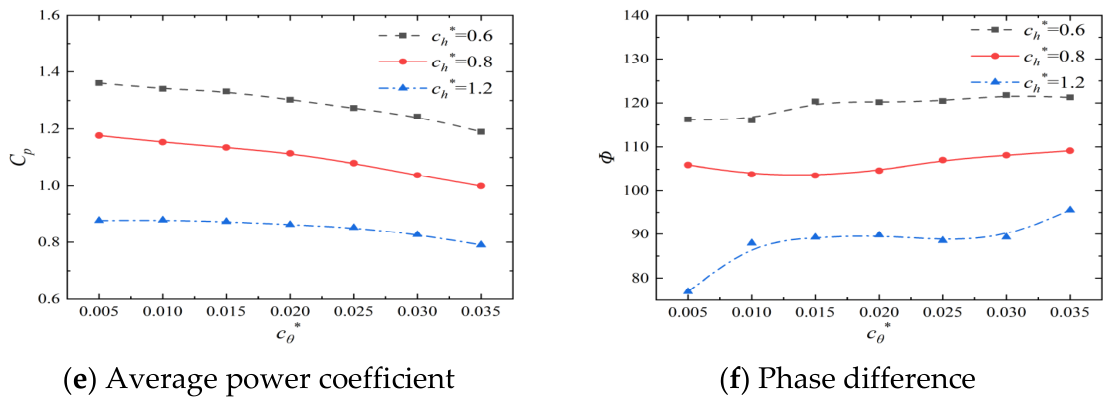
Keeping the stiffness coefficients in the structural parameters unchanged, three different heave damping coefficients ( c h = 0.6, 0.8, 1.2) are selected to further investigate the effects of varying pitch damping on the motion response and energy harvesting performance of the near-surface oscillating foil. The pitch damping coefficient c θ is varied in the range of 0.005 to 0.035 in the numerical simulations. The stable stage of the numerical simulation for each case is taken for analysis.
Figure 19 shows the variation in the foil energy harvesting characteristics with different pitch damping values. Regarding the system motion response, as seen in Figure 19a–c, with increasing pitch damping, both the pitch amplitude and the reduced frequency exhibit a monotonic decreasing trend, while the heave amplitude shows the opposite monotonic increasing trend. The increasing pitch damping imposes strong mechanical resistance and viscous dissipation on the foil pivot, suppressing the pitch response, which macroscopically manifests as a monotonic decrease in the pitch amplitude. However, this strong rotational impedance significantly delays the pitch reversal process. This reversal lag allows the foil to maintain an effective angle of attack for a longer duration within a single work-producing cycle. The fluid energy continuously performs work on the system during this prolonged period, driving the foil to undergo larger displacement in the heave direction, thereby increasing the heave amplitude. At the same time, the foil requires more time to overcome the increased resistance and dissipation, leading to a longer overall oscillation period and a consequent decrease in the reduced frequency.
Regarding the system energy capture characteristics, as shown in Figure 19d–f, both the average power coefficient and the energy harvesting efficiency exhibit a significant monotonic decreasing trend with increasing pitch damping. The phase difference shows a weak increasing fluctuation, but the overall variation is limited, indicating that the pitch damping has little effect on the phase difference. In the low-pitch-damping regime, the rotational constraint on the system is weak, and the system exhibits high-frequency, small-amplitude oscillations. Although the heave displacement is small in this regime, the very high oscillation frequency gives the foil a very large heave linear velocity. This high heave velocity increases the instantaneous absolute work done by the system, allowing the average power coefficient to reach its global maximum. Furthermore, the small heave amplitude limits the swept area of the foil; the high power output maximizes the energy extraction density per unit area, resulting in a very high energy harvesting efficiency. Conversely, as pitch damping continues to increase, the strong rotational impedance significantly aggravates the pitch reversal lag. Although this lag promotes the heave response to some extent, the attenuation of the oscillation frequency causes the heave linear velocity to decrease substantially. The decrease in linear velocity directly reduces the effective work output from the fluid excitation force, leading to a decline in the average power coefficient. As the effective power output decreases, the swept area of the foil increases due to the larger heave amplitude, ultimately reducing the energy extraction capacity per unit swept area, i.e., the energy harvesting efficiency decreases.
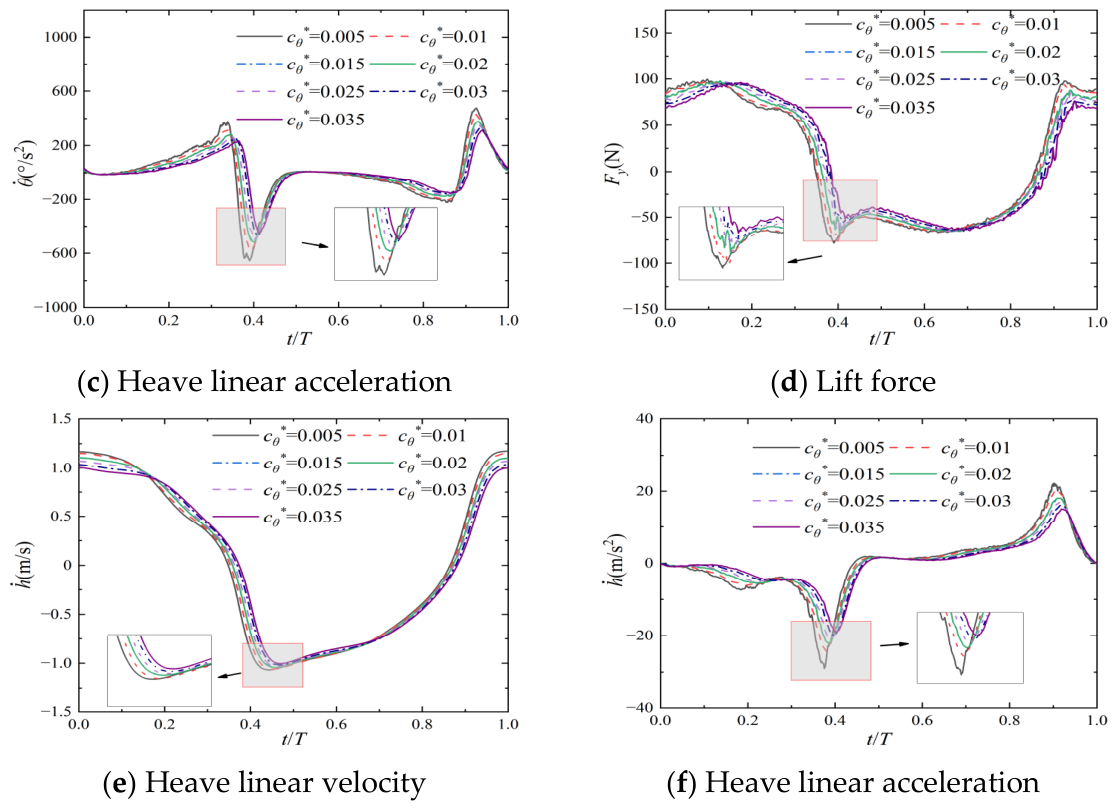
To further investigate the influence of pitch damping on the energy harvesting characteristics of the oscillating foil, the case with a heave damping coefficient of c h = 0.8 is selected. Figure 20 presents the time histories of the fluid force and motion response over one stable cycle for different pitch damping values.
From Figure 20a–c, it can be seen that as pitch damping increases, the pitch moment, angular velocity, and angular acceleration of the system all exhibit a significant decreasing trend. In the low-pitch-damping regime, the rotational dissipation of the system is small, and the rotational response of the foil is highly sensitive to changes in the flow field. Consequently, under fluid excitation, the foil experiences a sharp increase in fluid moment, with the peak pitch moment reaching up to 23 N·m. This large fluid moment causes the foil to respond with higher angular velocity and angular acceleration. However, as pitch damping continues to increase, the viscous dissipation in the rotational direction rises sharply. The increased mechanical impedance makes it more difficult for the foil to reverse, leading to a reduction in the pitch moment, and thus the angular velocity and angular acceleration of the system also decrease.
Furthermore, the change in pitch damping also affects the dynamic characteristics in the heave direction. From Figure 20d–f, it can be observed that as pitch damping increases, the fluid lift force, heave linear velocity, and heave linear acceleration all exhibit a strictly monotonic decreasing trend. In the low-pitch-damping regime, the rotational constraint on the foil is weak, allowing it to easily develop a large effective angle of attack under fluid excitation. This large angle of attack not only significantly enhances the intensity of the leading-edge vortex (LEV) evolution but also results in a larger lift force on the foil. Driven by this large lift, the heave motion response of the foil is strong, and the linear velocity and linear acceleration reach their peak values. As pitch damping increases further, the rotational constraint on the foil becomes significantly stronger, reducing the effective angle of attack. The fluid can no longer excite a sufficiently strong vortex-induced low-pressure region and excitation force, thereby reducing the peak lift force. Due to the decrease in lift, the heave motion response of the foil weakens accordingly.

4. Conclusions

In this study, a two-degree-of-freedom (2-DOF) oscillating foil is investigated using the open-source CFD platform OpenFOAM and the waves2Foam toolbox. The heave and pitch motion responses of the foil are simulated with the overWaveDyMFoam solver, which couples the six-degree-of-freedom (6-DOF) motion equations with the overset grid technique. The energy harvesting mechanism of the 2-DOF oscillating foil is thoroughly analyzed, and the effects of different structural parameters on its energy harvesting characteristics are systematically examined. The main conclusions are as follows:
(1)
The dynamic evolution of the leading-edge vortex (LEV) is the fundamental cause driving the self-sustained oscillation of the oscillating foil, and the phase synchronization between force and velocity is the core mechanism for achieving high energy harvesting efficiency. The effective angle of attack formed during foil motion induces the generation of the LEV. The vortex core attached to the foil surface creates a strong low-pressure region, providing a large transient lift force on the foil. As the LEV moves toward the trailing edge and eventually sheds, the sharp change in surface pressure difference causes a severe imbalance in the fluid moment, driving the foil to undergo rapid pitch reversal and thus maintain cyclic oscillation. During the main heave work-producing phase, the system relies on an appropriate structural elastic restoring force to effectively prolong the duration of the effective angle of attack. This mechanism brings the high-lift interval and the peak heave linear velocity into close temporal alignment, achieving force-velocity phase synchronization and ensuring maximum instantaneous power output.
(2)
The stiffness coefficients significantly regulate the motion response and energy harvesting characteristics of the system. Heave stiffness determines the natural frequency of the system: a change in heave stiffness directly affects the natural frequency, and the matching between the natural frequency and the fluid vortex shedding frequency not only affects the reduced frequency but also alters the phase matching between force and velocity, thereby modifying the energy harvesting characteristics of the foil. Heave stiffness significantly influences the heave amplitude but has a minor effect on the pitch amplitude. Pitch stiffness governs phase coordination: pitch stiffness directly affects the pitch motion, thereby influencing the pitch amplitude, heave amplitude, and reduced frequency. An appropriate pitch stiffness provides a suitable elastic restoring force, effectively controlling the timing of pitch reversal and bringing the force and velocity into optimal phase coordination, thus maximizing the power coefficient.
(3)
The damping coefficients also play a significant regulatory role. Heave damping influences heave dissipation and heave displacement: an increase in heave damping suppresses both the heave and pitch amplitudes, leading to a monotonic decrease in the average power coefficient. However, due to the sharp reduction in the swept area, the energy harvesting efficiency increases. Pitch damping determines the pitch amplitude: an increase in pitch damping mainly suppresses the pitch motion, but the heave amplitude increases instead. Both the average power coefficient and the energy harvesting efficiency decrease monotonically with increasing pitch damping.
Despite the systematic investigation, several limitations of this study should be acknowledged. First, the simulations are two-dimensional, neglecting three-dimensional effects, which may become important for foils with finite span. Second, the present study only considered a fixed submergence depth ( d = 4 c ) and a fixed Froude number ( F r = 1.0 ); the effects of varying these parameters are not examined. Third, the free surface is assumed to be calm without incoming waves, whereas real ocean environments involve irregular waves and wave–current interactions. These limitations will be addressed in future work. Specifically, future work will include three-dimensional simulations to capture spanwise effects, systematic studies on different submergence depths and Froude numbers, and the coupling between waves and currents in more realistic ocean environments.

Author Contributions

Data curation, L.W. (Lixian Wang); Funding acquisition, Z.D.; Investigation, L.W. (Longyao Wang) and T.T.; Supervision, W.H.; Validation, Z.D. and L.W. (Lixian Wang); Writing—original draft, Z.D.; Writing—review and editing, L.W. (Longyao Wang). All authors have read and agreed to the published version of the manuscript.

Funding

(1) Zhejiang Province “Pioneer” R&D Project (Grant No. 2023C03188); (2) the National Key R&D Program of China (Grant No. 2024YFB4207000) and the Strategic Priority Research Program of the Chinese Academy of Sciences (XDA0370205).

Data Availability Statement

Data available upon request.

Conflicts of Interest

The authors declare no conflicts of interest.

References

  1. Li, J.; Yuan, L.L. Overview of the current situation and trends in global marine resource development. Nat. Resour. Inf. 2013, 156, 13–16, 32. [Google Scholar] [CrossRef]
  2. Yang, X.R. Global installed capacity of renewable energy may double in the next five years. China Energy News, 19 December 2022.
  3. Xiao, Q.; Zhu, Q. A review on flow energy harvesters based on flapping foils. J. Fluids Struct. 2014, 46, 174–191. [Google Scholar] [CrossRef]
  4. Young, J.; Lai, J.C.S.; Platzer, M.F. A review of progress and challenges in flapping foil power generation. Prog. Aerosp. Sci. 2014, 67, 2–28. [Google Scholar] [CrossRef]
  5. McKinney, W.; DeLaurier, J. Wingmill: An oscillating-wing windmill. J. Energy 1981, 5, 109–115. [Google Scholar] [CrossRef]
  6. Kinsey, T.; Dumas, G. Aerodynamics of oscillating wings and performance as wind turbines. In Proceedings of the 23rd AIAA Applied Aerodynamics Conference, Toronto, ON, Canada, 6–9 June 2005. [Google Scholar] [CrossRef]
  7. Dumas, G.; Kinsey, T. Eulerian simulations of oscillating airfoils in power extraction regime. In Proceedings of the Advances in Fluid Mechanics VI, Skiathos, Greece, 8–10 May 2006; pp. 245–254. [Google Scholar] [CrossRef]
  8. Kinsey, T.; Dumas, G. Parametric study of an oscillating airfoil in a power-extraction regime. AIAA J. 2008, 46, 1318–1330. [Google Scholar] [CrossRef]
  9. Kinsey, T.; Dumas, G.; Lalande, G.; Ruel, J.; Méhut, A.; Viarouge, P.; Lemay, J.; Jean, Y. Prototype testing of a hydrokinetic turbine based on oscillating hydrofoils. Renew. Energy 2011, 36, 1710–1718. [Google Scholar] [CrossRef]
  10. Kinsey, T.; Dumas, G. Computational fluid dynamics analysis of a hydrokinetic turbine based on oscillating hydrofoils. J. Fluids Eng. 2012, 134, 021104. [Google Scholar] [CrossRef]
  11. Kinsey, T.; Dumas, G. Optimal tandem configuration for oscillating-foils hydrokinetic turbine. J. Fluids Eng. 2012, 134, 031103. [Google Scholar] [CrossRef]
  12. Kinsey, T.; Dumas, G. Three-dimensional effects on an oscillating-foil hydrokinetic turbine. J. Fluids Eng. 2012, 134, 071105. [Google Scholar] [CrossRef]
  13. Davids, S.T. A Computational and Experimental Investigation of a Flutter Generator. Doctoral Thesis, Naval Postgraduate School, Monterey, CA, USA, 1999. [Google Scholar]
  14. Kinsey, T.; Dumas, G. Optimal operating parameters for an oscillating foil turbine at Reynolds number 500,000. AIAA J. 2014, 52, 1885–1895. [Google Scholar] [CrossRef]
  15. Wu, J.; Shu, C.; Zhao, N.; Tian, F.B. Numerical study on the power extraction performance of a flapping foil with a flexible tail. Phys. Fluids 2015, 27, 013602. [Google Scholar] [CrossRef]
  16. Chen, Y.; Zhan, J.; Wu, J.; Wu, J. A fully-activated flapping foil in wind gust: Energy harvesting performance investigation. Ocean Eng. 2017, 138, 112–122. [Google Scholar] [CrossRef]
  17. Poirel, D.; Harris, Y.; Benaissa, A. Self-sustained aeroelastic oscillations of a NACA0012 airfoil at low-to-moderate Reynolds numbers. J. Fluids Struct. 2008, 24, 700–719. [Google Scholar] [CrossRef]
  18. Zhu, Q.; Peng, Z. Mode coupling and flow energy harvesting by a flapping foil. Phys. Fluids 2009, 21, 033601. [Google Scholar] [CrossRef]
  19. Zhu, Q. Energy harvesting by a purely passive flapping foil from shear flows. J. Fluids Struct. 2012, 34, 157–169. [Google Scholar] [CrossRef]
  20. Wang, Z.; Du, L.; Zhao, J.; Sun, X. Structural response and energy extraction of a fully passive flapping foil. J. Fluids Struct. 2017, 72, 96–113. [Google Scholar] [CrossRef]
  21. Deng, J.; Dai, B.; Shao, X.M.; Zheng, Y. Hydrodynamic mechanism of fully passive ocean current energy harvesting system. J. Zhejiang Univ. Eng. Sci. 2013, 47, 1784–1789, 1804. [Google Scholar] [CrossRef]
  22. Wang, E.; Ramesh, K.; Killen, S.; Viola, I.M. On the nonlinear dynamics of self-sustained limit-cycle oscillations in a flapping-foil energy harvester. J. Fluids Struct. 2018, 83, 339–357. [Google Scholar] [CrossRef]
  23. Jiang, W.; Wang, Y.L.; Zhang, D.; Xie, Y.H. Numerical investigation into the effect of nonlinear spring on the adaptation of an oscillating foil for energy extraction. Renew. Energy 2018, 117, 12–21. [Google Scholar] [CrossRef]
  24. Jeanmonod, G.; Olivier, M. Effects of chordwise flexibility on 2D flapping foils used as an energy extraction device. J. Fluids Struct. 2017, 70, 327–345. [Google Scholar] [CrossRef]
  25. Duarte, L.; Dellinger, N.; Dellinger, G.; Ghenaim, A.; Terfous, A. Experimental investigation of the dynamic behaviour of a fully passive flapping foil hydrokinetic turbine. J. Fluids Struct. 2019, 88, 1–12. [Google Scholar] [CrossRef]
  26. Veilleux, J.C.; Dumas, G. Numerical optimization of a fully-passive flapping-airfoil turbine. J. Fluids Struct. 2017, 70, 102–130. [Google Scholar] [CrossRef]
  27. Boudreau, M.; Dumas, G.; Rahimpour, M.; Oshkai, P. Experimental investigation of the energy extraction by a fully-passive flapping-foil hydrokinetic turbine prototype. J. Fluids Struct. 2018, 82, 446–472. [Google Scholar] [CrossRef]
  28. Boudreau, M. Optimizing the Power-Generation Performance of Flapping-Foil Turbines While Simplifying Their Mechanical Design with the Use of Elastic Supports. Ph.D. Thesis, Université Laval, Québec, QC, Canada, 2019. [Google Scholar]
  29. Filippas, E.S.; Belibassakis, K.A. Hydrodynamic analysis of flapping-foil thrusters operating beneath the free surface and in waves. Eng. Anal. Bound. Elem. 2014, 41, 47–59. [Google Scholar] [CrossRef]
  30. Deng, J.; Wang, S.; Kandel, P.; Teng, L. Effects of free surface on a flapping-foil based ocean current energy extractor. Renew. Energy 2022, 181, 933–944. [Google Scholar] [CrossRef]
  31. Hirt, C.W.; Nichols, B.D. Volume of fluid (VOF) method for the dynamics of free boundaries. J. Comput. Phys. 1981, 39, 201–225. [Google Scholar] [CrossRef]
  32. Li, Z. Study on Energy Capture Performance of Fully Passive Oscillating Foil. Master’s Thesis, Harbin Engineering University, Harbin, China, 2022. [Google Scholar]
  33. Launder, B.E.; Spalding, D.B. The numerical computation of turbulent flows. Comput. Methods Appl. Mech. Eng. 1974, 3, 269–289. [Google Scholar] [CrossRef]
  34. Cleaver, D.J.; Calderon, D.E.; Wang, Z.; Gursul, I. Periodically plunging foil near a free surface. Exp. Fluids 2013, 54, 1491. [Google Scholar] [CrossRef]
  35. Nojiri, N.; Murayama, K. A study on the drift force on two-dimensional floating body in regular waves. Trans. West-Jpn. Soc. Nav. Archit. 1975, 51, 131–152. [Google Scholar]
  36. Luo, Y.; Wang, Z.; Peng, G.; Xiao, Y.; Zhai, L.; Liu, X.; Zhang, Q. Numerical simulation of a heave-only floating OWC (oscillating water column) device. Energy 2014, 76, 799–806. [Google Scholar] [CrossRef]
  37. Maruo, H. On the increase of the resistance of a ship in rough seas (I). J. Zosen Kiokai 1957, 1957, 33–39. [Google Scholar] [CrossRef][Green Version]
Figure 1. Schematic of the two-degree-of-freedom (2-DOF) oscillating foil system.
Jmse 14 00895 g001
Figure 2. Schematic of the numerical wave tank.
Jmse 14 00895 g002
Figure 3. Different grid resolutions around the oscillating foil device: (a) coarse grid, (b) medium grid, (c) fine grid.
Jmse 14 00895 g003
Figure 4. Time histories of the foil motion response for different grid resolutions.
Jmse 14 00895 g004
Figure 5. Time-averaged drag coefficient curves with experimental data Ref. [34].
Jmse 14 00895 g005
Figure 6. Comparison of vorticity fields with experimental data Ref. [34].
Jmse 14 00895 g006
Figure 7. Schematic diagram of the validation model.
Jmse 14 00895 g007
Figure 8. Heave amplitude under different wave periods with data Refs. [35,36,37].
Jmse 14 00895 g008
Figure 9. Time history of the foil motion response.
Jmse 14 00895 g009
Figure 10. Schematic diagram of the power coefficient decomposition over one period.
Jmse 14 00895 g010
Figure 11. Schematic diagram of the motion response of the oscillating foil over one stable period. (a) Time histories of the lift coefficient and heave linear velocity. (b) Time histories of the pitch moment coefficient and pitch angular velocity.
Jmse 14 00895 g011
Figure 12. Schematic diagram of the evolution of the surface pressure distribution and vorticity field on the oscillating foil over one stable oscillation cycle.
Jmse 14 00895 g012
Figure 13. Variation in foil energy harvesting characteristics with heave stiffness.
Jmse 14 00895 g013aJmse 14 00895 g013b
Figure 14. Time histories of motion response and fluid forces on the oscillating foil over one stable oscillation cycle for different heave stiffness values.
Jmse 14 00895 g014
Figure 15. Variation in foil energy harvesting characteristics with pitch stiffness.
Jmse 14 00895 g015aJmse 14 00895 g015b
Figure 16. Time histories of motion response and fluid forces on the oscillating foil over one stable oscillation cycle for different pitch stiffness values.
Jmse 14 00895 g016aJmse 14 00895 g016b
Figure 17. Variation in foil energy harvesting characteristics with heave damping.
Jmse 14 00895 g017
Figure 18. Time histories of motion response and fluid forces on the oscillating foil over one stable oscillation cycle for different heave damping values.
Jmse 14 00895 g018aJmse 14 00895 g018b
Figure 19. Variation in foil energy harvesting characteristics with pitch damping.
Jmse 14 00895 g019aJmse 14 00895 g019b
Figure 20. Time histories of motion response and fluid forces on the oscillating foil over one stable oscillation cycle for different pitch damping values.
Jmse 14 00895 g020aJmse 14 00895 g020b
Table 1. Definition and values of the baseline operating parameters.
ParameterSymbolValueUnit
Chord length c 0.1m
Mass coefficient m 0.3-
Pitch axis position x c 1/3-
Heave stiffness coefficient k h 0.3-
Heave damping coefficient c h 0.8-
Pitch stiffness coefficient k θ 0.025-
Pitch damping coefficient c θ 0.005-
Moment of inertia I θ 0.0188kg·m2
Froude number F r 1.0-
Disclaimer/Publisher’s Note: The statements, opinions and data contained in all publications are solely those of the individual author(s) and contributor(s) and not of MDPI and/or the editor(s). MDPI and/or the editor(s) disclaim responsibility for any injury to people or property resulting from any ideas, methods, instructions or products referred to in the content.