Sandstone Reservoir Prediction in the Beikang Basin Using a Fusion Workflow of Tomographic Velocity Inversion and Multiple Seismic Integration

 ,
,
Abstract
1. Introduction
2. Geological Background

3. Data and Methods
3.1. Seismic Data
3.2. Pre-Stack Gather Optimization
3.3. Horizon-Controlled Grid Tomographic Velocity Modeling and Inversion
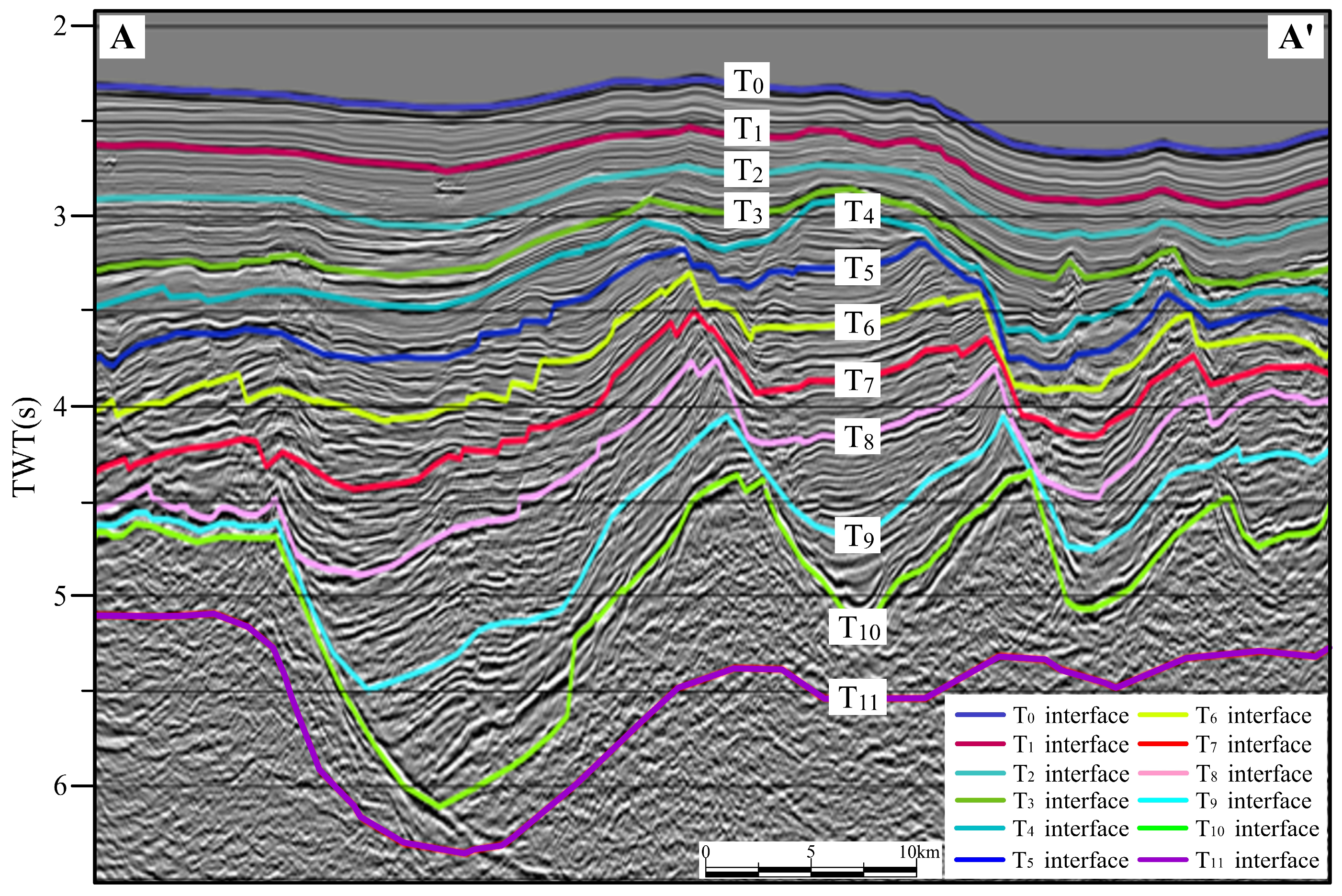
- Structural Model Building: To establish the initial depth-velocity model, horizon calibration was first performed based on the time-migrated seismic section. Time-domain horizon calibration is a fundamental step in pre-stack depth migration because it provides the foundation for depth-domain modeling and constrains both structural geometry and lateral velocity variation. On the time-migrated sections, continuous, high-energy reflectors that effectively define the structural framework of the study area were selected for tracking and interpretation. A total of 13 horizons were interpreted, and these were used to construct a detailed time-domain structural model (Figure 3).
- Construction and Optimization of the Initial Velocity Model: The accuracy of tomographic velocity inversion depends dominantly on the quality of the interval velocity field. Estimation of this field, therefore, becomes a critical step for both tomographic inversion and pre-stack depth migration. In this study, the interval velocity field was determined primarily through the establishment of an initial velocity model followed by iterative updating and optimization of the model [57].
- Horizon-controlled Grid Tomographic Velocity Inversion: Gridded tomographic inversion is a mature global optimization method that utilizes travel-time residuals to update the velocity field. Under the constraints of geological interpretation and seismic reflection characteristics, the inversion becomes more stable, and reduces the non-uniqueness commonly associated with least-squares solutions, ultimately yielding a more accurate velocity model.
3.4. Petrophysical Analysis
3.5. Low-Frequency Model Construction Based on Multiple Seismic Integration
3.6. Pre-Stack AVO Simultaneous Inversion
4. Results
4.1. Pre-Stack Gather Optimization Results
4.2. Tomographic Velocity Modeling
4.3. Establishment of the Lithology Interpretation Template
4.4. Low-Frequency Model Construction via Multiple Seismic Integration
4.5. Pre-Stack AVO Simultaneous Inversion
4.6. Lithology Prediction
5. Discussion
5.1. Feasibility of the Multiple Seismic Integration Method
5.2. Geological Implications
6. Conclusions
Author Contributions
Funding
Data Availability Statement
Conflicts of Interest
References
- Tang, W.; Xie, X.; Zhao, Z.; Xiong, L.; Bai, H.; Liu, Z. Petroleum geology characteristics and exploration prospect of Beikang Basin in Nansha waters. China Offshore Oil Gas 2023, 35, 47–55. [Google Scholar]
- Zhang, H.; Liu, P.; Liao, Z.; Hao, S.; Zhu, X. Oil and gas exploration potential in Beikang Basin, Nansha sea area. China Pet. Explor. 2017, 22, 40–48. [Google Scholar] [CrossRef]
- Lei, Z.; Liu, X.; Zhang, L.; Luo, S.; Qian, X.; Liu, J.; Wang, Z.; Shuai, Q. Structural styles and evolution of Beikang Basin, southern South China Sea. Geotecton. Metallog. 2021, 45, 861–874. [Google Scholar]
- Su, H.; Liu, S.; Zhang, L.; Su, M.; Huang, S.; Lei, Z. Spatiotemporal distribution characteristics and controlling factors of deep-water sediments in the Beikang Basin since the Late Miocene, southern South China Sea. Bull. Geol. Sci. Technol. 2023, 42, 129–139. [Google Scholar]
- Wu, D.; Zhu, X.; Zhang, H.; Zhu, M.; Zhao, D.; Geng, M.; Li, W.; Liao, Z. Deposition characteristics and hydrocarbon distribution in medium and large basins of Nansha, South China Sea. J. Palaeogeogr. 2014, 16, 673–686. [Google Scholar]
- Ayyad, H.M.; Hewaidy, A.G.A.; Omar, M.; Fathy, M. Sequence stratigraphy and reservoir quality of the Gulf of Suez syn-rift deposits of the Nukhul Formation: Implications of rift initiation and the impact of eustacy and tectonic on deposition. Mar. Pet. Geol. 2023, 156, 106459. [Google Scholar] [CrossRef]
- Hutchison, C.S. Marginal basin evolution: The southern South China Sea. Mar. Pet. Geol. 2004, 21, 1129–1148. [Google Scholar] [CrossRef]
- Yang, Z.; Zhang, G.; Zhang, L.; Yan, W.; Lin, Z.; Luo, S.; Qian, X. The style and hydrocarbon prospects of reefs in the Beikang Basin, southern South China Sea. Geol. China 2017, 44, 428–438. [Google Scholar]
- Morley, C.K. Major unconformities/termination of extension events and associated surfaces in the South China Seas: Review and implications for tectonic development. J. Asian Earth Sci. 2016, 120, 62–86. [Google Scholar] [CrossRef]
- Ma, L.; Fan, T.; Wang, Z.; Dong, J.; Cai, W. Analysis on construction method of inversion low frequency model under different geological conditions. Prog. Geophys. 2021, 36, 0625–0635. [Google Scholar]
- Luan, Y.; Feng, X.; Liu, C.; Liu, Y. The Research Present and Future of Wave Impedance Technique. J. Jinlin Univ. (Earth Sci. Ed.) 2008, 38, 94–98. [Google Scholar]
- Du, Z.; Wu, G.; Wang, Y. Seismic Full Waveform Inversion Method Based on Well Logging Constraints. Oil Geophys. Prospect. 2017, 52, 1184–1192. [Google Scholar]
- Chen, Z.; Ying, M.; He, Y.; Deng, C.; Zhao, D. The Study Method of Low-frequency Compensation Inversion Based on Multiple Integral. Sci. Technol. Eng. 2014, 36, 1–6. [Google Scholar]
- Wang, X.; Xie, Y.; Xu, Y.; Zhong, J. Experience and skill of constructing low-frequency components in impedance inversion. Geophys. Prospect. Pet. 2000, 39, 27–34. [Google Scholar]
- Yuan, H.; Zhai, X.; Bao, K. Complex frequency domain seismic inversion method for well-free area based on geological model. Oil Geophys. Prospect. 2024, 59, 558–566. [Google Scholar]
- Zhang, J.; Wang, M.; Li, R. The pre-stack without well elastic parameter inversion technique and its application. Chin. J. Eng. Geophys. 2013, 10, 66–70. [Google Scholar]
- Tang, Z.; Guo, Q.; Liu, G. A Well-absent seismic inversion method and its application on the early exploration of South Asia Indus basin reservoir. Comput. Tech. Geophys. Geochem. Explor. 2018, 40, 324–329. [Google Scholar]
- Xu, Y.; Zhang, B.; Wen, P. The application research of high density velocity analysis in hydrate impedance inversion without log constrain. Tech. Geophys. Geochem. Explor. 2016, 38, 540–545. [Google Scholar]
- Li, Y.; Yan, C.; Li, J.; Shi, W.; Chen, L. Application of well-free broadband seismic inversion technology on the description of gas hydrate ore body in Shenhu waters, South China Sea. China Offshore Oil Gas 2019, 31, 51–60. [Google Scholar]
- Yang, R.; Li, S.; Wang, Y.; Li, Y.; Jie, M.; Song, X.; Peng, W.; Li, C.; Liang, J.; Sha, Z. Application of inversion without well constraint to hydrate forecasting in Shehu area. Nat. Gas Geosci. 2012, 23, 784–790. [Google Scholar]
- Huang, A.; Li, L.; Wang, L.; Zhang, J.; Yang, S.; Zhu, J.; Guo, M. Application of pseudo-well technology in clastic reservoir prediction in deepwater areas without wells. Geophys. Prospect. Pet. 2011, 50, 281–287. [Google Scholar]
- Chen, Y.; Zhang, M.; Zhu, J.; Song, X. Application of first break tomography to shallow water gas and area: A case study in Bohai Bay. Chin. J. Eng. Geophys. 2024, 21, 890–897. [Google Scholar]
- Liu, S.; Zhao, W. Application of joint velocity modeling pre-stack depth migration technology in shallow seismic exploration. Coal Chem. Ind. 2025, 48, 83–85. [Google Scholar]
- Li, B.; Xie, Y.; Yang, C.; Shi, Q.; Zhang, C.; Zhang, Y.; Chen, Y. Implementation and application of underlying structure of surface high speed conglomerate layer based on prestack depth migration technology: Taking the middle-eastern section of the southern margin of Junggar Basin as an example. Nat. Gas Geosci. 2025, 36, 1929–1941. [Google Scholar]
- Cui, W.; Ye, Y.; Niu, C.; Wang, Z.; Guo, G.; Li, N. Prediction of thin coal seams based on seismic facies-constrained fre-quency-divided and stepwise fusion inversion: A case study of coal measures source rocks in Enping Formation in Huibei Area. Oil Geophys. Prospect. 2025, 60, 453–463. [Google Scholar]
- Xu, C.; Li, L.; Wang, Y.; Wang, S.; Liu, Z. Application of elastic inversion based on an iterative lithofacies model in predicting Paleogene terrestrial reservoirs in LB oilfield. Geophys. Prospect. Pet. 2025, 64, 118–128. [Google Scholar]
- Xie, Y. Facies-controlled reservoir prediction based on the seismic configuration. Geophys. Prospect. Pet. 2021, 60, 784–793. [Google Scholar]
- Liu, B.; Guo, Y.; Tian, Z.; Chen, C.; Gao, R.; Dou, X. Prediction of high-quality tight sandy conglomerate reservoirs in Mesozoic of Xinglongtai buried hill, Liaohe Depression by seismic facies-controlled inversion. Oil Geophys. Prospect. 2022, 57, 100–109. [Google Scholar]
- Cao, S.; Chen, J. Studies on complex frequencies in frequency domain full waveform inversion. Chin. J. Geophys. 2014, 57, 2302–2313. [Google Scholar]
- Li, H.; Wang, X.; Jiang, J.; Lin, Y.; Guo, Y.; Zhang, G. Research on the method of well—Free cascade inversion. Comput. Tech. Geophys. Geochem. Explor. 2021, 43, 147–153. [Google Scholar]
- Tang, J. Reservoir characteristics constrained dispersion AVO fluid detection method and its application. Pet. Geol. Eng. 2024, 38, 17–24. [Google Scholar]
- Wu, S.; Han, B.; Ji, L.; Sun, Z. Pre-stack AVO inversion for estimating effective pressure in sandstone reservoirs. Oil Geophys. Prospect. 2024, 59, 1165–1173. [Google Scholar]
- Dong, Z.; Liu, Y.; Sun, Y.; Tian, W.; Di, X. Joint AVO inversion method of PP- and PS-wave based on cross-correlation objective function and Bayesian theory. Oil Geophys. Prospect. 2025, 60, 761–774. [Google Scholar]
- Jin, C.; Qin, N.; Guan, J.; Zong, Z.; Li, K.; Liu, Q. Application of constrained tomographic inversion in seismic velocity modeling of glutenite bodies. Oil Geophys. Prospect. 2023, 58, 1392–1397. [Google Scholar]
- Luo, W.; Li, H.; Zhu, L.; Qiao, Y.; Shi, N.; Yu, F. Application of the cross-hole electromagnetic method (CHEM) in hydrocarbon reservoir monitoring. Oil Geophys. Prospect. 2014, 49, 205–212. [Google Scholar]
- Luo, S.; Zhang, L.; Xu, G.; Wang, X.; Lei, Z.; Shuai, Q. Reconstruction of late oligocene depositional systems in the Beikang Basin by seismic facies analysis. Mar. Geol. Quat. Geol. 2022, 42, 123–134. [Google Scholar]
- Hou, F.; Tian, Z.; Zhang, X.; Zhang, Z.; Li, S. Joint inversion of gravity, magnetic and seismic data of the South Yellow Sea Basin. Oil Geophys. Prospect. 2012, 5, 808–814. [Google Scholar]
- Yan, W.; Zhang, G.; Zhang, L.; Yang, Z.; Wang, H.; Hu, X.; Lei, Z.; Sun, M. Carbonate reservoirs characteristics and hydrocarbon accumulation in Beikang Basin, southern South China Sea. Earth Sci. 2022, 47, 2549–2561. [Google Scholar]
- Ming, Y.; Li, Q.; Niu, X.; Xie, X.; Guo, S. Application of joint interpretation of gravity and seismic in west Luobei depression of Lop Nur. North China Geol. 2021, 1, 52–55. [Google Scholar]
- Qi, C.; Pang, Y.; Guo, X.; Qi, J.; Yan, L. Research progress in Cenozoic tectono-thermal evolution of the Beikang Basin in the Nansha Sea area. Mar. Geol. Front. 2025, 41, 100–102. [Google Scholar]
- Luo, S.; Wang, W.; Zhang, L.; Zhang, L.; Zhang, K.; He, G.; Yu, Q. Cenozoic stratigraphic architecture of the Beikang Basin (South China Sea): Insights into tectonic evolution and sedimentary response. J. Mar. Sci. Eng. 2025, 13, 2216. [Google Scholar] [CrossRef]
- Shuai, Q.; Zhang, L.; Lei, Z.; Luo, S.; Qian, X.; Liu, J.; Zhou, J. Age dating of main geological interfaces and its significance in oil and gas geology in Beikang Basin. Mar. Geol. Front. 2020, 36, 32–41. [Google Scholar]
- Lei, Z.; Zhang, L.; Wang, L.; Luo, S.; Qian, X.; Xu, Q.; Shen, A.; Xiao, Q. Provenance migration in the Beikang Basin of the southern South China Sea during the Oligocene to the Mid-Miocene. Earth Sci. 2020, 45, 1855–1864. [Google Scholar]
- Tang, W.; Zhao, Z.; Xie, X.; Song, S.; Wang, Y.; Liu, S. Cenozoic sequence stratigraphic framework and tectonic evolution model of Nansha block in South China Sea. China Offshore Oil Gas 2021, 33, 66–67. [Google Scholar]
- Yao, Y.; Yang, C.; Li, X.; Ren, J.; Jiang, T.; Tong, D.; Han, B.; Yin, Z.; Xu, Q. The seismic reflection characteristics and tectonic significance of the tectonic revolutionary surface of mid-Miocene (T3 seismic interface) in the southern South China Sea. Chin. J. Geophys. 2013, 56, 1274–1286. [Google Scholar]
- Luo, S.; Wang, X.; Zhang, L.; Lei, Z.; Shuai, Q. Study of high-quality sandstone in Early Miocene sequence of Beikang-Zengmu Basin, the Southern South China Sea. Mar. Geol. Quat. Geol. 2019, 40, 111–123. [Google Scholar]
- Ayyad, H.M.; Hewaidy, A.G.A.; Al-Labaidy, N.A. Sequence stratigraphy of the Miocene siliciclastic-carbonate sediments in Sadat Area, north-west of Gulf of Suez: Implications for Miocene eustasy. Geol. J. 2022, 57, 2255–2270. [Google Scholar] [CrossRef]
- Madon, M.; Kim, C.L.; Wong, R. The structure and stratigraphy of deepwater Sarawak, Malaysia: Implications for tectonic evolution. J. Asian Earth Sci. 2013, 76, 312–333. [Google Scholar] [CrossRef]
- Haq, B.U.; Hardenbol, J.; Vail, P.R. Chronology of fluctuating sea levels since the Triassic. Science 1987, 235, 1156–1167. [Google Scholar] [CrossRef]
- Shi, Z.; Pang, S.; Wang, Y.; Chi, Y.; Zhou, Q. Random noise attenuation of common offset gathers by f-x TV regularization. Prog. Geophys. 2022, 37, 1148–1158. [Google Scholar]
- Guo, L.; Liu, C.; Liu, Y.; Zheng, Z.; Wang, Q. Seismic random noise attenuation based on streaming prediction filter in the f-x domain. Chin. J. Geophys. 2020, 63, 329–338. [Google Scholar]
- Wang, Z.; Xia, J.; Li, H.; Zhang, X.; Yan, J. Influence of vibroseis high-efficiency acquisition on weak signals and corresponding countermeasures. Geophys. Prospect. Pet. 2020, 59, 695–702. [Google Scholar]
- Zhang, Z.; Xuan, Y. High resolution parabolic radon transform multiple wave suppression technique. Geophys. Geochem. Explor. 2014, 38, 981–988. [Google Scholar]
- Wang, C.; Zhou, Z.; Yao, G.; Sun, W.; Han, M.; Rui, Y.; Cui, Q.; Shang, X. First-arrival tomography for building velocity model by jointly using seismic lines and sparse nodes. Chin. J. Geophys. 2024, 67, 3483–3495. [Google Scholar]
- Guan, W.; Duan, W.; Cha, M.; Sun, Q.; Song, X.; Su, Z. Low-relief structural imaging with model- based tomographic velocity inversion. Oil Geophys. Prospect. 2017, 52, 87–93. [Google Scholar]
- Dong, L.G. The improved first-arrival traveltime tomography based on the adjoint-state method. Chin. J. Geophys. 2021, 64, 982–992. [Google Scholar]
- Li, L.; Tao, B.; Wang, H.; Sun, S.; Mu, F.; Zhang, W.; Ye, J. Optimizing the reservoir model of delta front sandstone using seismic to simulation workflow: A case study in the South China Sea. In Proceedings of the SEG International Exposition and 86th Annual Meeting, Dallas, TX, USA, 16–21 October 2016; pp. 2821–2825. [Google Scholar]
- Focht, T.J.; Sams, M.; Brookes, D.; Ting, D. Seismic Reservoir Characterisation of a Channel Sand Oil and Gas Field, Malaysia. In Proceedings of the SEG Annual Meeting, Society of Exploration Geophysicists, Lima, Peru, 23–26 September 2012; pp. 4–7. [Google Scholar]
- Amin, R.; Mohammad, D.; Mohammad, K.J.; Mohsen, B.; Ali, A.; Hassan, J.K. Optimization of Earth Dam Cross-Sections Using the Max-Min Ant System and Artificial Neural Networks with Real Case Studies. Buildings 2026, 16, 501. [Google Scholar]
- Hassan, J.K.; Mohammad, A.L.Y.; Alireza, M. A modified orthonormal polynomial series expansion tailored to thin beams undergoing slamming loads. Ocean Eng. 2019, 182, 38–47. [Google Scholar] [CrossRef]
- Luo, S.; Zhang, L.; Zhao, Y.; Deng, W.; Lei, Z.; Shuai, Q. Application of extended elastic impedance based petrophysical analysis technique in oil-gas bearing detection in Beikang Basin. Comput. Tech. Geophys. Geochem. Explor. 2021, 43, 331–339. [Google Scholar]
- Du, B.; He, Z.; Wang, X.; Yong, X.; Liu, Y. Initial impedance model establishment based on the seismic dipole wavelet and multiple integral methods. Comput. Tech. Geophys. Geochem. Explor. 2017, 39, 71–80. [Google Scholar]
- Bevc, D. Flooding the topography: Wave-equation datuming of land data with rugged acquisition topography. Geophysics 1997, 62, 1558–1569. [Google Scholar] [CrossRef]
- Liu, W.; Liu, Y.; Wang, J.; Zhang, J.; Wu, Z.; Yang, T. Joint traveltime tomography for seawater based on ocean bottom seismometer and towed streamer observations. Chin. J. Geophys. 2024, 67, 2378–2387. [Google Scholar]
- Yang, T.; Wang, P.; Li, Q.; Huo, K.; Li, W.; He, X. A pre-stack nonlinear inversion method for joint PP-PS wave based on exact Zoeppritz equation. Oil Geophys. Prospect. 2025, 60, 152–162. [Google Scholar]
- He, X. Identifying methods of the fluid properties in ultra-low permeability reservoirs based on prestack AVO simultaneous inversion and their applications: A case of Well Block Ao-158 in Aonan nose structure of Daqing Placanticline. Pet. Geol. Oilfield Dev. Daqing 2021, 40, 137–144. [Google Scholar]
- Liu, H.; Bai, J. Prestack simultaneous inversion of fluid factors with prior constraint. Comput. Tech. Geophys. Geochem. Explor. 2021, 43, 275–281. [Google Scholar]
- Deng, J.; Wang, G.; Pang, Y.; Li, C. Prestack AVA simultaneous inversion based on optimized CRP gathers: A case study from the KL9 tectonic region, China. Geophys. Prospect. Pet. 2019, 58, 461–470. [Google Scholar]
- Ren, L.; Wang, P.; Liu, C.; Huang, C. The application of pre-stack AVO inversion technology to the oil-bearing prediction of carbonate reservoirs in Shunnan area. Chin. J. Eng. Geophys. 2018, 15, 292–298. [Google Scholar]






Disclaimer/Publisher’s Note: The statements, opinions and data contained in all publications are solely those of the individual author(s) and contributor(s) and not of MDPI and/or the editor(s). MDPI and/or the editor(s) disclaim responsibility for any injury to people or property resulting from any ideas, methods, instructions or products referred to in the content. |
© 2026 by the authors. Licensee MDPI, Basel, Switzerland. This article is an open access article distributed under the terms and conditions of the Creative Commons Attribution (CC BY) license.
Share and Cite
Luo, S.; Wang, X.; Zhang, K.; Sun, M.; Yu, Q.; He, G.; Gao, Y. Sandstone Reservoir Prediction in the Beikang Basin Using a Fusion Workflow of Tomographic Velocity Inversion and Multiple Seismic Integration. J. Mar. Sci. Eng. 2026, 14, 894. https://doi.org/10.3390/jmse14100894
Luo S, Wang X, Zhang K, Sun M, Yu Q, He G, Gao Y. Sandstone Reservoir Prediction in the Beikang Basin Using a Fusion Workflow of Tomographic Velocity Inversion and Multiple Seismic Integration. Journal of Marine Science and Engineering. 2026; 14(10):894. https://doi.org/10.3390/jmse14100894
Chicago/Turabian StyleLuo, Shuaibing, Xiaoxue Wang, Kangshou Zhang, Ming Sun, Qiuhua Yu, Guanghui He, and Yuan Gao. 2026. "Sandstone Reservoir Prediction in the Beikang Basin Using a Fusion Workflow of Tomographic Velocity Inversion and Multiple Seismic Integration" Journal of Marine Science and Engineering 14, no. 10: 894. https://doi.org/10.3390/jmse14100894
APA StyleLuo, S., Wang, X., Zhang, K., Sun, M., Yu, Q., He, G., & Gao, Y. (2026). Sandstone Reservoir Prediction in the Beikang Basin Using a Fusion Workflow of Tomographic Velocity Inversion and Multiple Seismic Integration. Journal of Marine Science and Engineering, 14(10), 894. https://doi.org/10.3390/jmse14100894