A Hybrid Mamba–ConvLSTM Framework for Multi-Day Sea Surface Temperature Forecasting at 0.05° Resolution



Abstract
1. Introduction
- Under-specified spatial scan design for state-space models. When flattening 2D spatial grids into 1D sequences for SSM processing, the choice of scan order profoundly affects which spatial neighborhoods remain contiguous. While VMamba [11] introduced a four-direction cross-scan module for image classification, its adaptation to spatiotemporal forecasting—where SSM hidden states should also carry information across time steps—requires explicit design choices that existing studies do not address.
- Ambiguous auxiliary-variable handling during autoregressive rollout. SST prediction models often ingest auxiliary ocean variables (currents, salinity, sea-surface height) as inputs. During multi-step rollout, the model predicts only SST, yet these auxiliary fields are needed at every step. The rollout protocol for auxiliary variables is rarely specified, creating a hidden but impactful source of methodological ambiguity.
- Insufficiently defined boundary treatment and cross-resolution alignment. Physical proxy features (advection, diffusion) require spatial finite differences that produce unphysical values at land–sea boundaries. Simultaneously, multi-source products reside on different native grids whose coastline masks do not coincide. Both issues are frequently mentioned but not algorithmically specified, hindering reproducibility.
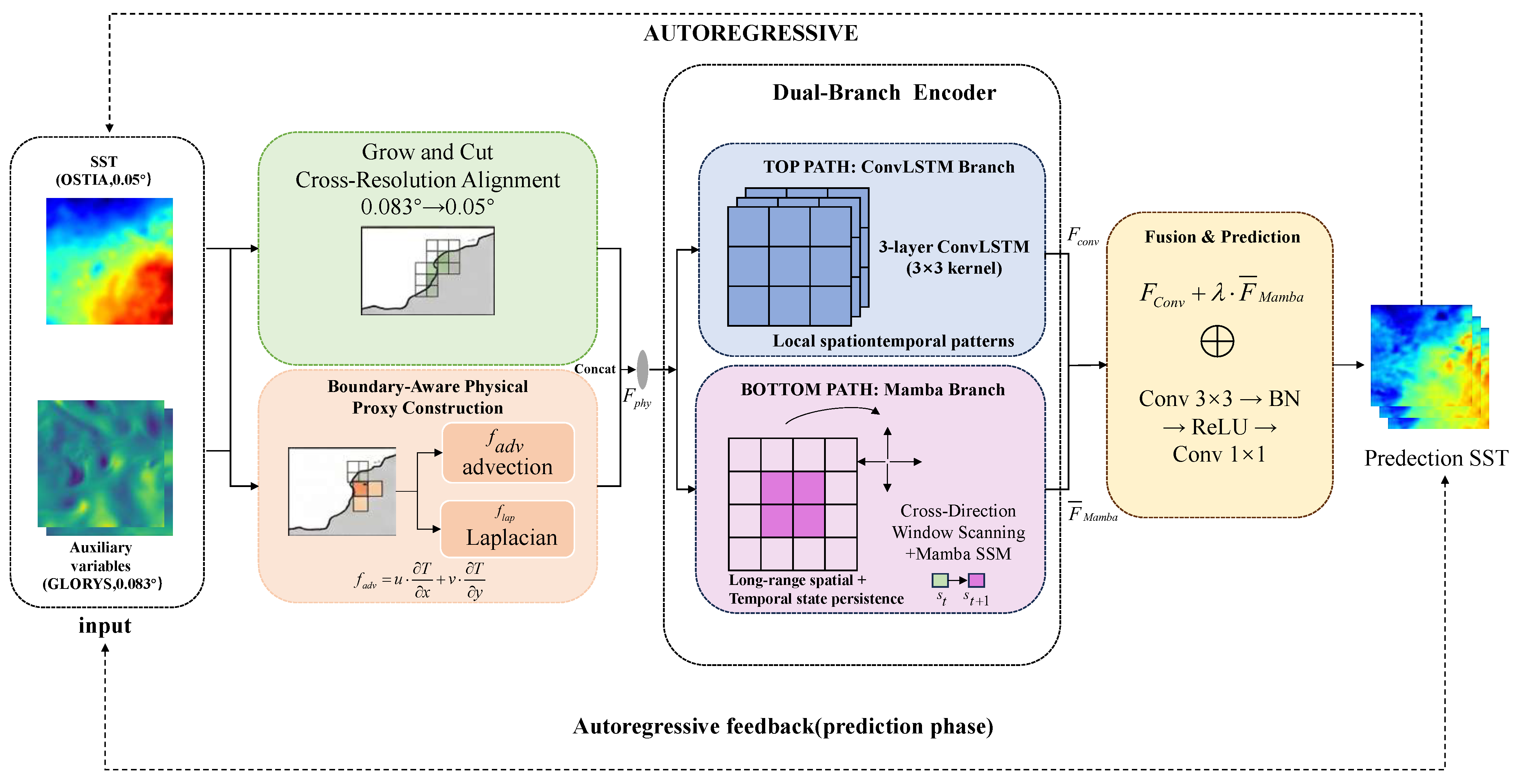
- A hybrid Mamba–ConvLSTM framework is proposed that combines ConvLSTM-based local spatiotemporal encoding with Mamba-based long-range spatial modeling. Building on the cross-scan concept introduced by VMamba [11], this work extends it to the spatiotemporal forecasting setting by (a) adding persistent Mamba hidden states across time steps to endow the spatial scan with temporal memory, (b) introducing learnable softmax-weighted directional aggregation for inverse mapping, and (c) providing explicit forward and inverse rearrangement operators for full reproducibility. To the best of the authors’ knowledge, this is the first work to introduce temporal state persistence into vision-oriented selective state-space scanning, enabling SSMs to serve as both spatial encoders and implicit temporal memory pathways within a single unified architecture.
- Fully specified physical preprocessing is provided, including an algorithmic Grow-and-Cut cross-resolution alignment procedure and a boundary-aware finite-difference scheme for gradient-based proxy construction under land–sea masking, together with an explicit autoregressive rollout protocol that documents how auxiliary variables and physical proxies are maintained beyond the observation window. Unlike prior SST forecasting studies that mention physical preprocessing without algorithmic detail, every step of the proposed pipeline is formally defined and reproducible, addressing a persistent gap in methodological transparency within the field.
- A unified benchmark on the South China Sea is established with nine baselines—including persistence and daily climatology as elementary references—evaluated under identical data splits, normalization, rollout protocols, and five complementary metrics (RMSE, MAE, SSIM, , ACC), supported by ablation studies, sensitivity analyses, seasonal evaluation, and statistical significance testing. This standardized evaluation protocol, which is rarely adopted in SST forecasting studies, ensures that reported improvements are attributable to architectural differences rather than implementation discrepancies.
2. Related Work
2.1. Recurrent Spatiotemporal Models
2.2. CNN and Transformer Approaches
2.3. Selective State-Space Models
2.4. Physics-Informed Ocean Forecasting
3. Methodology
3.1. Problem Formulation
3.2. Overall Framework
| Algorithm 1: Hybrid Mamba–ConvLSTM Inference | |
| Require: Observed sequence , forecast horizon T | |
| Ensure: Predicted SST sequence | |
| 1: | Align auxiliary variables via Grow-and-Cut (Section 3.3) |
| 2: | Store last observed auxiliaries: |
| 3: | Initialize ConvLSTM states |
| 4: | Initialize Mamba states |
| 5: | for to t do |
| 6: | Compute physical proxies from |
| 7: | Construct |
| 8: | Update ConvLSTM: ← ConvLSTM(·) |
| 9: | Scan windows along ; process via Mamba with state persistence (Equation (16)) |
| 10: | end for |
| 11: | for to do |
| 12: | Set auxiliaries: // persistence |
| 13: | Recompute physical proxies from |
| 14: | Update ConvLSTM and Mamba (with persistent states) |
| 15: | Fuse: |
| 16: | Predict: |
| 17: | end for |
| 18: | return |
3.3. Grow-And-Cut Cross-Resolution Alignment
- Initial interpolation. Apply bilinear interpolation to map onto the 0.05° grid, producing . Mark pixels with valid output as “filled.”
- Iterative boundary growth. For each unfilled ocean pixel with filled 8-connected neighbors , compute the inverse-distance weighted averagewith . Here denotes the value at pixel q after iteration k, and is the result of the initial bilinear interpolation from step 1. The iterative process is used because standard bilinear interpolation leaves unfilled ocean pixels near coastlines where the lower-resolution grid has no valid neighbors; each growth round propagates values from already-filled pixels into adjacent gaps.
- Repetition. Repeat for rounds. The choice of is determined by the maximum coastal gap width between GLORYS and OSTIA masks in the study domain. Because GLORYS (0.083°) has a coarser coastline than OSTIA (0.05°), some OSTIA ocean pixels near the coast fall outside the GLORYS ocean mask. Empirical inspection of the South China Sea domain shows that the maximum gap between the two coastline masks is 2 pixels on the 0.05° grid; each growth round propagates values by exactly one pixel, so two rounds suffice to reach all gap pixels. The sensitivity analysis (Section 5.8) confirms diminishing returns beyond : and produce negligible further improvement (0.513 °C vs. 0.512 °C), while (no growth) degrades RMSE to 0.527 °C due to unfilled coastal ocean pixels.
- Cut-back. Zero out all pixels outside .
3.4. Boundary-Aware Physical Proxy Construction
3.5. Cross-Direction Window Scanning for Mamba
- Temporally persistent Mamba states. In VMamba, each image is processed independently and hidden states are re-initialized per sample. In the proposed framework, the Mamba hidden state persists across successive time steps within each sample (detailed in Section 3.6), enabling the spatial scan to accumulate temporal information.
- Learnable softmax-weighted directional aggregation. VMamba merges directional outputs by concatenation, doubling the channel dimension. Instead, aggregation is performed through learnable attention weights (Equation (19)), maintaining the original channel dimension and allowing the model to dynamically balance directional contributions.
- : (row-forward);
- : (row-reverse);
- : (column-forward);
- : (column-reverse).
3.6. Mamba Block with Temporal State Persistence
3.7. Rearrangement Operator and Spatial Restoration
3.8. ConvLSTM Branch
3.9. Feature Fusion and Prediction Head
3.10. Training Strategy: Scheduled Sampling
3.11. Training Objective
4. Dataset and Experimental Setup
4.1. Study Area and Data Sources
4.2. Data Statistics and Preprocessing
4.3. Temporal Split and Protocol
4.4. Baselines
4.5. Implementation Details
4.6. Evaluation Metrics
- : Average error magnitude, sensitive to outliers.
- : Robust error magnitude.
- SSIM [30]: Structural similarity capturing luminance, contrast, and spatial pattern fidelity. An Gaussian window is used, which at 0.05° resolution covers approximately 0.55° × 0.55° (≈60 km), a scale relevant to sub-mesoscale and mesoscale thermal structures.
- : Explained variance ratio.
- Anomaly Correlation Coefficient (ACC):where is the daily climatological mean at pixel i. ACC measures the correlation between predicted and observed anomalies relative to climatology and is a standard skill metric in operational weather and ocean forecasting [5]. By definition, the daily climatology baseline has ACC = 0.
5. Experimental Results and Discussion
5.1. Overall Quantitative Comparison
5.2. Lead-Time Performance Analysis
5.3. Ablation Study
5.4. Auxiliary Variable Rollout Strategy
5.5. Seasonal Robustness Analysis
5.6. Statistical Significance Testing
5.7. Computational Cost Analysis
5.8. Hyperparameter Sensitivity Analysis
5.9. Qualitative Analysis
5.10. Cross-Domain Generalization: Kuroshio Extension
5.10.1. Overall Performance
5.10.2. Lead-Time Analysis
5.10.3. Summary
5.11. Discussion
5.12. Limitations and Future Directions
6. Conclusions
Author Contributions
Funding
Data Availability Statement
Conflicts of Interest
References
- Donlon, C.J.; Martin, M.; Stark, J.; Roberts-Jones, J.; Fiedler, E.; Wimmer, W. The Operational Sea Surface Temperature and Sea Ice Analysis (OSTIA) system. Remote Sens. Environ. 2012, 116, 140–158. [Google Scholar] [CrossRef] [Scilit]
- Hou, S.; Li, W.; Liu, T.; Zhou, S.; Guan, J.; Qin, R.; Wang, Z. MIMO: A Unified Spatio-Temporal Model for Multi-Scale Sea Surface Temperature Prediction. Remote Sens. 2022, 14, 2371. [Google Scholar] [CrossRef] [Scilit]
- Ouala, S.; Nguyen, D.; Drumetz, L.; Chapron, B.; Pascual, A.; Collard, F.; Gaultier, L.; Fablet, R. Learning latent dynamics for partially observed chaotic systems. Chaos 2020, 30, 103121. [Google Scholar] [CrossRef] [Scilit] [PubMed]
- Nguyen, T.; Brandstetter, J.; Kapoor, A.; Gupta, J.K.; Grover, A. ClimaX: A foundation model for weather and climate. In International Conference on Machine Learning; PMLR: Cambridge, MA, USA, 2023. [Google Scholar]
- Pathak, J.; Subramanian, S.; Harrington, P.; Raja, S.; Chattopadhyay, A.; Mardani, M.; Kurth, T.; Hall, D.; Li, Z.; Azizzadenesheli, K.; et al. FourCastNet: A global data-driven high-resolution weather forecasting model using Adaptive Fourier Neural Operators. arXiv 2022, arXiv:2202.11214. [Google Scholar]
- Shi, X.; Chen, Z.; Wang, H.; Yeung, D.Y.; Wong, W.K.; Woo, W.C. Convolutional LSTM network: A machine learning approach for precipitation nowcasting. In Advances in Neural Information Processing Systems 28; NeurIPS: La Jolla, CA, USA, 2015; pp. 802–810. [Google Scholar]
- Wang, Y.; Long, M.; Wang, J.; Gao, Z.; Yu, P.S. PredRNN: Recurrent neural networks for predictive learning using spatiotemporal LSTMs. In Advances in Neural Information Processing Systems 30; NeurIPS: La Jolla, CA, USA, 2017; pp. 879–888. [Google Scholar]
- Liu, Z.; Lin, Y.; Cao, Y.; Hu, H.; Wei, Y.; Zhang, Z.; Lin, S.; Guo, B. Swin Transformer: Hierarchical vision transformer using shifted windows. In 2021 IEEE/CVF International Conference on Computer Vision (ICCV); IEEE: New York, NY, USA, 2021; pp. 10012–10022. [Google Scholar]
- Gao, Z.; Shi, X.; Wang, H.; Zhu, Y.; Wang, Y.B.; Li, M.; Yeung, D.Y. Earthformer: Exploring space-time transformers for Earth system forecasting. In Advances in Neural Information Processing Systems 35; NeurIPS: La Jolla, CA, USA, 2022. [Google Scholar]
- Gu, A.; Dao, T. Mamba: Linear-time sequence modeling with selective state spaces. arXiv 2023, arXiv:2312.00752. [Google Scholar] [CrossRef] [Scilit]
- Liu, Y.; Tian, Y.; Zhao, Y.; Yu, H.; Xie, L.; Wang, Y.; Ye, Q.; Jiao, J.; Liu, Y. VMamba: Visual state space model. In Advances in Neural Information Processing Systems 37; NeurIPS: La Jolla, CA, USA, 2024. [Google Scholar]
- Huang, T.; Pei, X.; You, S.; Wang, F.; Qian, C.; Xu, C. LocalMamba: Visual state space model with windowed selective scan. arXiv 2024, arXiv:2403.09338. [Google Scholar] [CrossRef] [Scilit]
- Wang, Y.; Gao, Z.; Long, M.; Wang, J.; Yu, P.S. PredRNN++: Towards a resolution of the deep-in-time dilemma in spatiotemporal predictive learning. In Proceedings of the 35th International Conference on Machine Learning; PMLR: Cambridge, MA, USA, 2018; pp. 5123–5132. [Google Scholar]
- Ballas, N.; Yao, L.; Pal, C.; Courville, A. Delving deeper into convolutional networks for learning video representations. arXiv 2015, arXiv:1511.06432. [Google Scholar]
- Lin, Z.; Li, M.; Zheng, Z.; Cheng, Y.; Yuan, C. Self-attention ConvLSTM for spatiotemporal prediction. In Proceedings of the AAAI Conference on Artificial Intelligence; Association for Computing Machinery: New York, NY, USA, 2020; pp. 11531–11538. [Google Scholar]
- Gao, Z.; Tan, C.; Wu, L.; Li, S.Z. SimVP: Simpler yet better video prediction. In Proceedings of the IEEE/CVF Conference on Computer Vision and Pattern Recognition; IEEE: New York, NY, USA, 2022; pp. 3170–3180. [Google Scholar]
- Cao, H.; Wang, Y.; Chen, J.; Jiang, D.; Zhang, X.; Tian, Q.; Wang, M. Swin-Unet: Unet-like pure transformer for medical image segmentation. In European Conference on Computer Vision; Springer Nature: Cham, Switzerland, 2022. [Google Scholar]
- Bi, K.; Xie, L.; Zhang, H.; Chen, X.; Gu, X.; Tian, Q. Accurate medium-range global weather forecasting with 3D neural networks. Nature 2023, 619, 533–538. [Google Scholar] [CrossRef] [Scilit] [PubMed]
- Shi, B.; Hao, Y.; Feng, L.; Ge, C.; Peng, Y.; He, H. An attention-based context fusion network for spatiotemporal prediction of sea surface temperature. Remote Sens. 2022, 14, 459. [Google Scholar] [CrossRef] [Scilit]
- Gu, A.; Goel, K.; Ré, C. Efficiently modeling long sequences with structured state spaces. In International Conference on Learning Representations; ICLR: Appleton, WI, USA, 2022. [Google Scholar]
- Zhu, L.; Liao, B.; Zhang, Q.; Wang, X.; Liu, W.; Wang, X. Vision Mamba: Efficient visual representation learning with bidirectional state space model. In International Conference on Machine Learning; PMLR: Cambridge, MA, USA, 2024. [Google Scholar]
- Wang, Z.; Kong, F.; Feng, S.; Wang, M.; Yang, X.; Zhao, H.; Wang, D.; Zhang, Y. Is Mamba Effective for Time Series Forecasting? arXiv 2024, arXiv:2403.11144. [Google Scholar] [CrossRef] [Scilit]
- Ahamed, S.; Checkley, M. TimeMachine: A time series is worth 4 Mambas for long-term forecasting. arXiv 2024, arXiv:2403.09898. [Google Scholar]
- Raissi, M.; Perdikaris, P.; Karniadakis, G.E. Physics-informed neural networks: A deep learning framework for solving forward and inverse problems involving nonlinear partial differential equations. J. Comput. Phys. 2019, 378, 686–707. [Google Scholar] [CrossRef] [Scilit]
- Li, Z.; Kovachki, N.; Azizzadenesheli, K.; Liu, B.; Bhattacharya, K.; Stuart, A.; Anandkumar, A. Fourier neural operator for parametric partial differential equations. In International Conference on Learning Representations; ICLR: Appleton, WI, USA, 2021. [Google Scholar]
- Beucler, T.; Pritchard, M.; Rasp, S.; Ott, J.; Baldi, P.; Gentine, P. Enforcing analytic constraints in neural networks emulating physical systems. Phys. Rev. Lett. 2021, 126, 098302. [Google Scholar] [CrossRef] [Scilit] [PubMed]
- Shi, B.; Feng, L.; He, H.; Hao, Y.; Peng, Y.; Liu, M.; Liu, Y.; Liu, J. A Physics-Guided Attention-Based Neural Network for Sea Surface Temperature Prediction. IEEE Trans. Geosci. Remote Sens. 2024, 62, 4210413. [Google Scholar] [CrossRef] [Scilit]
- Wang, J.; Zhang, Z.; Wang, X.; Li, Y.; Zhang, H. A Spatial-Temporal Graph Neural Network for Sea Surface Temperature Forecasting. IEEE J. Sel. Top. Appl. Earth Obs. Remote Sens. 2023, 16, 3452–3465. [Google Scholar]
- Bengio, S.; Vinyals, O.; Jaitly, N.; Shazeer, N. Scheduled sampling for sequence prediction with recurrent neural networks. In Advances in Neural Information Processing Systems 28; NeurIPS: La Jolla, CA, USA, 2015; pp. 1171–1179. [Google Scholar]
- Wang, Z.; Bovik, A.C.; Sheikh, H.R.; Simoncelli, E.P. Image quality assessment: From error visibility to structural similarity. IEEE Trans. Image Process. 2004, 13, 600–612. [Google Scholar] [CrossRef] [Scilit] [PubMed]
- Kendall, A.; Gal, Y. What uncertainties do we need in Bayesian deep learning for computer vision? In Advances in Neural Information Processing Systems 30; NeurIPS: La Jolla, CA, USA, 2017; pp. 5574–5584. [Google Scholar]





| Variable | Mean | Std | Min | Max | |
|---|---|---|---|---|---|
| SST (°C) | 27.42 | 2.18 | 19.85 | 32.61 | 0.19 |
| u (m/s) | −0.03 | 0.15 | −1.02 | 0.89 | 0.06 |
| v (m/s) | 0.01 | 0.12 | −0.78 | 0.71 | 0.05 |
| S (PSU) | 33.82 | 0.45 | 31.20 | 35.10 | 0.03 |
| (m) | 0.52 | 0.08 | 0.25 | 0.85 | 0.01 |
| Hyperparameter | Symbol | Value |
|---|---|---|
| ConvLSTM layers | – | 3 |
| ConvLSTM hidden channels | 64 | |
| ConvLSTM kernel size | – | |
| Mamba window size | P | 8 |
| Mamba state dimension | 16 | |
| Mamba model dimension | 128 | |
| Scan directions | – | 4 |
| Grow-and-Cut rounds | 2 | |
| MSE loss weight | 0.8 | |
| SSIM loss weight | 0.2 | |
| Fusion weight init | 0.1 | |
| Input/forecast length | L/T | 10/10 |
| Method | RMSE ↓ | MAE ↓ | SSIM ↑ | R2 ↑ | ACC ↑ |
|---|---|---|---|---|---|
| Persistence | 0.648 | 0.487 | 0.838 | 0.818 | 0.812 |
| Climatology | 0.872 | 0.685 | 0.782 | 0.670 | 0.000 |
| ConvLSTM | 0.603 | 0.451 | 0.861 | 0.842 | 0.836 |
| PredRNN | 0.579 | 0.432 | 0.872 | 0.857 | 0.851 |
| ConvGRU | 0.621 | 0.468 | 0.848 | 0.831 | 0.824 |
| TCTN | 0.566 | 0.421 | 0.879 | 0.864 | 0.858 |
| PANN | 0.551 | 0.409 | 0.886 | 0.872 | 0.867 |
| Swin-UNet | 0.547 | 0.404 | 0.889 | 0.875 | 0.871 |
| ViT-ST | 0.539 | 0.398 | 0.893 | 0.881 | 0.878 |
| Ours | 0.512 | 0.374 | 0.907 | 0.896 | 0.894 |
| Day | Method | RMSE ↓ | SSIM ↑ | R2 ↑ | Δ (%) |
|---|---|---|---|---|---|
| 1 | Persist. | 0.189 | 0.953 | 0.982 | – |
| ViT-ST | 0.238 | 0.947 | 0.972 | −25.9 | |
| Ours | 0.226 | 0.954 | 0.978 | −19.6 | |
| 3 | Persist. | 0.472 | 0.891 | 0.903 | – |
| ViT-ST | 0.389 | 0.921 | 0.934 | +17.6 | |
| Ours | 0.368 | 0.932 | 0.944 | +22.0 | |
| 5 | Persist. | 0.681 | 0.841 | 0.798 | – |
| ViT-ST | 0.523 | 0.899 | 0.886 | +23.2 | |
| Ours | 0.499 | 0.912 | 0.901 | +26.7 | |
| 7 | Persist. | 0.856 | 0.795 | 0.682 | – |
| ViT-ST | 0.635 | 0.869 | 0.842 | +25.8 | |
| Ours | 0.601 | 0.885 | 0.862 | +29.8 | |
| 10 | Persist. | 1.032 | 0.756 | 0.537 | – |
| ViT-ST | 0.736 | 0.841 | 0.804 | +28.7 | |
| Ours | 0.698 | 0.862 | 0.828 | +32.4 |
| Variant | RMSE ↓ | MAE ↓ | SSIM ↑ | R2 ↑ |
|---|---|---|---|---|
| w/o Mamba branch | 0.548 | 0.402 | 0.886 | 0.875 |
| w/o ConvLSTM branch | 0.556 | 0.412 | 0.880 | 0.868 |
| w/o temporal state persist. | 0.529 | 0.387 | 0.897 | 0.885 |
| w/o physical proxies | 0.531 | 0.389 | 0.896 | 0.884 |
| w/o advection only | 0.523 | 0.382 | 0.901 | 0.889 |
| w/o Laplacian only | 0.516 | 0.377 | 0.904 | 0.893 |
| w/o Grow-and-Cut | 0.527 | 0.386 | 0.898 | 0.887 |
| w/o cross-dir scan | 0.524 | 0.383 | 0.901 | 0.889 |
| w/o SSIM loss | 0.519 | 0.380 | 0.899 | 0.892 |
| Full model | 0.512 | 0.374 | 0.907 | 0.896 |
| Strategy | RMSE ↓ | ΔRMSE |
|---|---|---|
| (a) No auxiliaries (SST only) | 0.541 | +5.7% |
| (b) Auxiliaries persist from Day 0 | 0.512 | – |
| (c) Ground-truth auxiliaries (oracle) | 0.498 | −2.7% |
| Method | Spring | Summer | Autumn | Winter |
|---|---|---|---|---|
| Persistence | 0.601 | 0.718 | 0.652 | 0.626 |
| ConvLSTM | 0.571 | 0.639 | 0.596 | 0.605 |
| PredRNN | 0.548 | 0.618 | 0.572 | 0.580 |
| PANN | 0.525 | 0.589 | 0.548 | 0.542 |
| Swin-UNet | 0.520 | 0.583 | 0.541 | 0.535 |
| ViT-ST | 0.517 | 0.576 | 0.536 | 0.528 |
| Ours | 0.489 | 0.551 | 0.511 | 0.503 |
| Metric | Ours (Mean ± std) | ViT-ST (Mean ± std) | p-Value |
|---|---|---|---|
| RMSE | 0.004 | ||
| MAE | 0.003 | ||
| SSIM | 0.005 | ||
| 0.006 | |||
| ACC | 0.004 |
| Method | Params | FLOPs | Model | End-to-End |
|---|---|---|---|---|
| (M) | (G) | (ms) | (ms) | |
| Persistence | – | – | – | 0.1 |
| Climatology | – | – | – | 0.1 |
| ConvLSTM | 2.1 | 18.4 | 12.3 | 12.3 |
| PredRNN | 3.8 | 32.6 | 19.7 | 19.7 |
| ConvGRU | 1.6 | 14.2 | 10.1 | 10.1 |
| TCTN | 4.2 | 25.1 | 8.5 | 8.5 |
| PANN | 5.1 | 38.5 | 22.4 | 25.8 |
| Swin-UNet | 8.7 | 52.3 | 28.6 | 28.6 |
| ViT-ST | 12.4 | 68.9 | 35.2 | 35.2 |
| Ours | 9.6 | 56.8 | 31.4 | 34.8 |
| Window P | RMSE | State dim | RMSE |
| 4 | 0.518 | 8 | 0.521 |
| 8 | 0.512 | 16 | 0.512 |
| 16 | 0.516 | 32 | 0.514 |
| 32 | 0.525 | 64 | 0.515 |
| / | RMSE | Grow rounds | RMSE |
| 1.0/0.0 | 0.519 | 0 | 0.527 |
| 0.9/0.1 | 0.515 | 1 | 0.517 |
| 0.8/0.2 | 0.512 | 2 | 0.512 |
| 0.7/0.3 | 0.514 | 3 | 0.513 |
| 0.5/0.5 | 0.520 | 4 | 0.513 |
| Method | RMSE ↓ | MAE ↓ | SSIM ↑ | R2 ↑ | ACC ↑ |
|---|---|---|---|---|---|
| Persistence | 0.842 | 0.632 | 0.793 | 0.756 | 0.768 |
| ConvLSTM | 0.783 | 0.585 | 0.818 | 0.789 | 0.802 |
| ViT-ST | 0.694 | 0.517 | 0.852 | 0.835 | 0.849 |
| Ours | 0.651 | 0.483 | 0.871 | 0.858 | 0.872 |
| Day | Persistence | ViT-ST | Ours | Δ (%) |
|---|---|---|---|---|
| 1 | 0.310 | 0.331 | 0.302 | +2.6 |
| 3 | 0.605 | 0.498 | 0.462 | +23.6 |
| 5 | 0.832 | 0.678 | 0.637 | +23.4 |
| 7 | 1.014 | 0.822 | 0.772 | +23.9 |
| 10 | 1.232 | 1.010 | 0.952 | +22.7 |
Disclaimer/Publisher’s Note: The statements, opinions and data contained in all publications are solely those of the individual author(s) and contributor(s) and not of MDPI and/or the editor(s). MDPI and/or the editor(s) disclaim responsibility for any injury to people or property resulting from any ideas, methods, instructions or products referred to in the content. |
© 2026 by the authors. Licensee MDPI, Basel, Switzerland. This article is an open access article distributed under the terms and conditions of the Creative Commons Attribution (CC BY) license.
Share and Cite
Peng, B.; Hong, Z.; Wang, G. A Hybrid Mamba–ConvLSTM Framework for Multi-Day Sea Surface Temperature Forecasting at 0.05° Resolution. J. Mar. Sci. Eng. 2026, 14, 898. https://doi.org/10.3390/jmse14100898
Peng B, Hong Z, Wang G. A Hybrid Mamba–ConvLSTM Framework for Multi-Day Sea Surface Temperature Forecasting at 0.05° Resolution. Journal of Marine Science and Engineering. 2026; 14(10):898. https://doi.org/10.3390/jmse14100898
Chicago/Turabian StylePeng, Bo, Zhonghua Hong, and Guansuo Wang. 2026. "A Hybrid Mamba–ConvLSTM Framework for Multi-Day Sea Surface Temperature Forecasting at 0.05° Resolution" Journal of Marine Science and Engineering 14, no. 10: 898. https://doi.org/10.3390/jmse14100898
APA StylePeng, B., Hong, Z., & Wang, G. (2026). A Hybrid Mamba–ConvLSTM Framework for Multi-Day Sea Surface Temperature Forecasting at 0.05° Resolution. Journal of Marine Science and Engineering, 14(10), 898. https://doi.org/10.3390/jmse14100898