Article

Motion Characteristics and Drag-Reduction Optimization of Moonpool Drillships in Irregular Waves


School of Naval Architecture and Ocean Engineering, Jiangsu University of Science and Technology, Zhenjiang 212100, China
*
Author to whom correspondence should be addressed.
J. Mar. Sci. Eng. 2026, 14(10), 890; https://doi.org/10.3390/jmse14100890 (registering DOI)
Submission received: 22 March 2026 / Revised: 20 April 2026 / Accepted: 2 May 2026 / Published: 11 May 2026
(This article belongs to the Special Issue Advancements in Marine Hydrodynamics and Structural Optimization)

Abstract

This study analyzes the effects of different moonpool configurations on drillship hydrodynamics using the Reynolds-averaged Navier–Stokes (RANS) equations. A three-dimensional numerical wave tank is established to realize the prediction and validation of the hydrodynamic performance of irregular waves and the interaction between irregular waves and structures. Combined with the selection of the drillships with relatively favorable resistance performance among different moonpool configurations under calm-water navigation conditions, further studies are carried out on the motion characteristics and drag-reduction optimization of the rectangular- and square-moonpool drillships under irregular wave conditions. Comparative analysis of the numerical results shows that different moonpool shapes result in different drag-increase effects under calm-water conditions, and the moonpool-induced drag increase mainly originates from added residuary resistance. Relative to the non-moonpool baseline drillship, the installation of a moonpool under irregular wave conditions notably elevates the resistance amplitude and amplifies the heave and pitch responses, with a more prominent impact observed on pitch, while also modifying the natural frequency characteristics of the moonpool-equipped drillship. Introducing appropriate rounded corners at the bottom of the moonpool can effectively reduce the resistance of the moonpool drillship and significantly decrease the amplitudes of heave and pitch responses under irregular wave conditions. Based on the present study, a bottom rounded-corner radius of 40 mm effectively improves the hydrodynamic performance of the moonpool drillship in irregular waves. The numerical results provide direct theoretical and design guidance for drag reduction and motion-performance enhancement of moonpool-equipped drillships, highlighting their engineering applicability.

1. Introduction

Against the backdrop of energy transition and tightening onshore resources, the development of deep-sea oil and gas resources is critical for energy security and strategic positioning. As the core mobile equipment for deep-sea exploration, the hydrodynamic performance and structural design of drilling ships directly determine operational efficiency, economic returns, and resource recovery rates [1,2,3]. Guided by the “dual carbon” goals, enhancing the energy efficiency of drilling ships, reducing carbon emissions, and improving their adaptability in extreme sea conditions represent core scientific and engineering challenges for achieving high-quality and sustainable development of marine oil and gas resources.
Drilling ships, favored for their self-propulsion capability, operational flexibility, and broad water-depth adaptability, have become mainstream in deep-sea operations. However, the mandatory through-type moonpool structure disrupts hull continuity, leading to significant hydrodynamic challenges [4,5,6,7,8,9]. It induces flow separation and vortex shedding, increasing resistance and fuel consumption; excites hull vibrations and noise through fluid sloshing, compromising drilling precision and stability; and degrades seakeeping by amplifying heave and pitch motions, thereby reducing operational safety windows. These issues collectively elevate operational costs and constrain performance. Consequently, systematic investigation into the hydrodynamics of moonpool-equipped drilling ships—elucidating motion responses and flow mechanisms—and advancing drag-reduction and structural optimization are of paramount engineering importance for enhancing safety, efficiency, and economic viability, representing a forefront research focus in ocean engineering.
The hydrodynamic characteristics of drillships with moonpools are predominantly investigated through physical model testing and numerical simulation methods. Potential-flow-based theoretical methods are limited in their ability to account for viscous effects and also show deficiencies in dealing with the complex nonlinear coupling among waves, the hull, and the moonpool [10]. Physical model tests provide accurate and reliable results and can realistically reflect ship performance under actual sea conditions; however, they are associated with high costs and long testing periods [11,12,13,14]. Liu et al. [15] (2022) adopted a combined approach of numerical simulation and model testing, taking a separated polar ocean nuclear energy platform as the research object, to investigate the mechanism by which an annular moonpool affects towing resistance under calm-water towing conditions. Their study revealed the evolution characteristics of the vortex structures inside the moonpool and the surrounding flow field. Garad et al. [16] (2024) employed towing-tank experiments and potential-flow-theory calculations, using a rectangular floater equipped with fore, middle, and aft moonpools as the research object, to investigate the resonance responses, phase differences, and coupling characteristics with hull motions of multiple moonpools when the floater was free to heave and pitch in regular waves. The advancement of computational fluid dynamics (CFD) enables numerical simulations to effectively incorporate viscous effects and resolve intricate flow-field details. By providing reliable agreement with experimental data alongside notable cost efficiency and implementation flexibility, this approach has thus emerged as a vital tool for investigating the hydrodynamic issues associated with moonpool-equipped drillships.
Research on the hydrodynamic performance of moonpool drillships mainly relies on three-dimensional numerical wave tank technology. After long-term development by scholars both in China and abroad, this technique has become relatively mature and well established. It is worth noting that this journal has, in recent years, continuously focused on and published a series of important studies in this field. These works closely reflect current research trends and frontier directions, fully demonstrating the journal’s academic leadership and timeliness in this area [17,18,19]. Domestic and international researchers have undertaken numerous investigations into the hydrodynamic performance of moonpool-equipped drillships. Zeng Zhihong et al. (2020) [20] established a frequency-domain model based on potential flow theory and employed AQWA software to analyze the effects of the geometric parameters of an FPSO moonpool and the arrangement of internal damping plates on heave motion. The results showed that when the damping plate is located close to the free surface, the system resonance frequency decreased and the heave response is intensified; when the damping plate is flush with the still water level, the suppression effect on heave is more favorable; whereas when the damping plate is extended above the free surface, the suppression effect is weakened. This study provides a reference for controlling the heave motion of moonpool vessels through structural design. Zhang et al. [21] (2021) carried out CFD simulations of the resistance and flow-field characteristics of a moonpool drillship in calm water based on STAR-CCM+, and validated the results through model tests. The study showed that the evolution of the flow pattern inside the moonpool has a significant influence on ship resistance. When the internal flow transitions from transitional flow to turbulent flow, both resistance and wave-making exhibit strongly nonlinear characteristics. The coupling between the moonpool flow and the external hull flow is found to be significant, and the periodic shedding of the vortex street at the leading edge is identified as the main cause of resistance fluctuations, as well as the excitation of piston-mode and sloshing motions inside the moonpool. This study further pointed out that the Reynolds number is the key similarity parameter affecting flow structure and vortex shedding behavior, and that traditional resistance conversion methods may introduce considerable errors in such problems and thus require further improvement. Machado et al. [22] (2022) optimized the position and dimensions of the moonpool on a drillship using a genetic algorithm to enhance its stability in random sea conditions. The optimized design significantly reduced the ship’s motion response, particularly demonstrating higher stability in larger waves. The introduction of a random sea condition model made the optimization process more realistic, validating the effectiveness of the genetic algorithm in solving complex engineering problems. Yao Zhi et al. (2023) [23] conducted towing-tank experiments to investigate the effects of an open and closed moonpool on the hydrodynamic characteristics of a multipurpose drillship under different wave conditions. The results showed that closing the moonpool can reduce the ship’s motion acceleration and resistance. Mavrakos et al. [24] (2023) investigated the hydrodynamic coefficients in heave for a moonpool-type floater using a combination of theoretical, numerical, and CFD methodologies. The study focused on the dynamic behavior of the floater in waves and examined how the moonpool influences the heave response. The authors utilized both analytical models and computational fluid dynamics (CFD) simulations to capture the fluid–structure interactions and validate their results. Their findings highlighted the importance of accurate modeling of the moonpool effects, which play a significant role in the stability and motion responses of floating platforms. The study offers insights into improving the design and operational stability of moonpool-type floaters in offshore environments. Sun et al. [25] (2023) adopted the OpenFOAM platform together with the SST k ω turbulence model to explore the resistance characteristics of drillships equipped with various moonpool arrangements under calm-water and regular-wave conditions. The results showed that the additional resistance induced by the moonpool is closely related to the hull resistance, and that the piston motion of the water inside the moonpool contributes more to the additional resistance than the sloshing motion. The study further pointed out that introducing properly designed openings in the recessed region of the moonpool can effectively alter the vortex structure, free-surface evolution, and fluid resonance mode inside the moonpool, thereby optimizing the wall pressure distribution and effectively reducing the additional resistance. Wei et al. (2023) [26], based on model tests in a dedicated towing tank, investigated the influence of fluid motion inside a recessed moonpool under non-resonant conditions on the additional resistance of the hull. The results showed that the vortex structure inside the moonpool is a key factor affecting the additional hull resistance, and that dissipating vortex energy through damping devices can effectively improve the resistance performance of the ship. Li et al. [27] (2024) optimized the motion responses of a semi-submersible platform with a hollow moonpool using CFD simulations. The study identified key design factors that minimize heave, pitch, and roll motions, improving stability in various sea conditions. The findings offer valuable insights for enhancing the design of semi-submersible platforms in offshore environments. In contrast, the configuration without chamfered edges suppresses piston motion through enhanced vortex dissipation, which is beneficial for reducing pitch but aggravates heave. Hu et al. [28] (2026) established a three-dimensional numerical wave tank based on the CFD method to investigate the effects of different moonpool configurations on the hydrodynamic performance of a drillship under calm-water and regular-wave conditions, as well as the corresponding drag-reduction measures. Their results indicated that, among the configurations tested, the rectangular moonpool exhibited relatively favorable overall performance in terms of resistance and sailing attitude. In addition, installing flanges at the moonpool opening was shown to effectively suppress the free-surface oscillation inside the moonpool. A preferred flange size and installation position were identified for this selected configuration/the configuration yielding better performance.
The present study further extends our previous work reported in Ref. [28]. In the research process, the mesh-generation strategy, boundary-condition settings, and prediction method for the hydrodynamic performance of moonpool drillships in calm-water navigation were adopted with reference to that study. Specifically, the mesh-generation strategy includes the overset mesh around the hull and the locally refined mesh regions near the bow and stern, whereas the mesh arrangement near the free surface differs from that in Ref. [28]. Ref. [28] investigated the effects of different moonpool configurations on the hydrodynamic performance of a drillship under calm-water and regular-wave conditions, together with corresponding drag-reduction measures achieved by installing flanges at the moonpool opening. In contrast, the present study focuses on the motion-response characteristics of moonpool drillships under irregular waves and the corresponding drag-reduction optimization method, which differs substantially from the scope of the previous study. A new drillship model is adopted in this work, and moonpool configurations different from those in Ref. [28] are selected to identify the moonpool drillship with relatively favorable hydrodynamic performance. On this basis, the motion-response characteristics of the moonpool drillship under irregular waves are analyzed, and drag-reduction optimization is achieved by introducing rounded-corner radii at the bottom of the moonpool. The present study mainly aims to reveal the flow characteristics inside the moonpool, the interaction mechanism between irregular waves and the structure, and the drag-reduction effect of the rounded-corner moonpool configuration. The numerical conclusions are expected to provide valuable references for the engineering design and application of moonpool drillships.

2. Theoretical Introduction

2.1. RANS Equations

By adopting the CFD approach with STAR-CCM+ 2025.1 simulations, the hydrodynamic characteristics of moonpool-equipped drillships in irregular wave conditions are investigated through solving the viscous flow equations. Considering the nonlinearity of the flow field and the incompressibility of the fluid, the continuity equation and the Reynolds-averaged Navier–Stokes (RANS) equations are given as follows [29,30,31]:
u i ¯ x i = 0
u i ¯ t + u j ¯ u i ¯ x j + u i u j ¯ x j = 1 ρ p ¯ x i + ν 2 u i ¯ x j x j + f i
where ρ is the fluid density, t is time, u i and u i denote the time-averaged flow velocity and the instantaneous fluctuating velocity, respectively, p is the fluid static pressure, ν is the kinematic viscosity of the fluid, and f i is the body force acting on the fluid. For the motion of an incompressible viscous fluid, the above Equations (1) and (2) are not closed. Therefore, additional supplementary equations, namely a turbulence model, must be introduced to close the governing equations. In this study, the SST k ω two-equation turbulence model is adopted to achieve closure and solvability of the governing equations.

2.2. Turbulence Model

This study employs the SST k ω turbulence model to simulate a moonpool drillship, with the aim of investigating its motion responses in irregular waves. The SST k ω turbulence model serves as a hybrid turbulence model that integrates the strengths of the Standard k ε model in far-field flow simulations with those of the Standard k ω model in near-wall calculations, thus offering higher applicability and reliability. The transport equations for the turbulent kinetic energy k and the specific dissipation rate ω are expressed as follows [32,33]:
t ( ρ k ) + x j ( ρ k u j ¯ ) = x j μ + σ k μ t k x j + P k ρ β * k ω
t ( ρ ω ) + x j ( ρ ω u j ¯ ) = x j μ + σ ω μ t ω x j + ρ α S 2 ρ β ω 2 + 2 ρ ( 1 F 1 ) σ ω 2 1 ω k x j ω x j
In Equations (3) and (4), the turbulent kinetic energy production term P k , the turbulent eddy viscosity μ t , and the parameters σ k and σ ω are calculated as follows, respectively:
P k = min μ t u i ¯ x j ( u i ¯ x j + u j ¯ x i ) , 10 β * ρ k ω
μ t = ρ α 1 k max ( α 1 ω , Ω F 2 )
σ k = 1 F 1 / σ k 1 + ( 1 F 1 ) / σ k 2
σ ω = 1 F 1 / σ ω 1 + ( 1 F 1 ) / σ ω 2
In Equations (5)–(8), F 1 and F 2 are blending functions, which are defined as follows:
F 1 = tanh ( Φ 1 4 )
Φ 1 = min max k β * ω y , 500 υ y 2 ω , 4 ρ σ ω 2 k C D k ω y 2
C D k ω = max 2 ρ σ ω 2 1 ω k x j ω x j , 10 10
F 2 = tanh ( Φ 2 2 )
Φ 2 = max 2 k β * ω y , 500 υ y 2 ω
The constants in the transport equations for the turbulent kinetic energy k and the specific dissipation rate ω are obtained by the expression ϕ = ϕ 1 F 1 + ϕ 2 ( 1 F 1 ) . ϕ 1 denotes the constants in the Standard k ε turbulence model equations, and ϕ 2 denotes the constants in the Standard k ω turbulence model equations. The turbulence model constants are listed in Table 1.

2.3. Numerical Methods

In the Numerical Wave Tank (NWT) simulation, the viscous flow around the hull is resolved by solving the Reynolds-Averaged Navier–Stokes (RANS) equations. The Finite Volume Method (FVM) is employed to discretize the governing equations, where the continuous spatial domain is partitioned into multiple sub-domains to form a computational mesh. This process transforms the governing equations into a system of discretized algebraic equations. For the spatial discretization, a second-order upwind scheme is applied to both the convective and diffusive terms. The PISO (Pressure-Implicit with Splitting of Operators) algorithm is utilized for pressure-velocity coupling, offering distinct advantages for solving transient problems. To track the free surface, the Volume of Fluid (VOF) multiphase model, originally proposed by Hirt and Nichols (1981) [34], is implemented. Furthermore, the SST k ω turbulence model is adopted for its wide applicability and robust performance in calculating viscous flow fields.

3. Numerical Validation

3.1. Validation Using a Numerical Wave Tank Under Irregular Waves

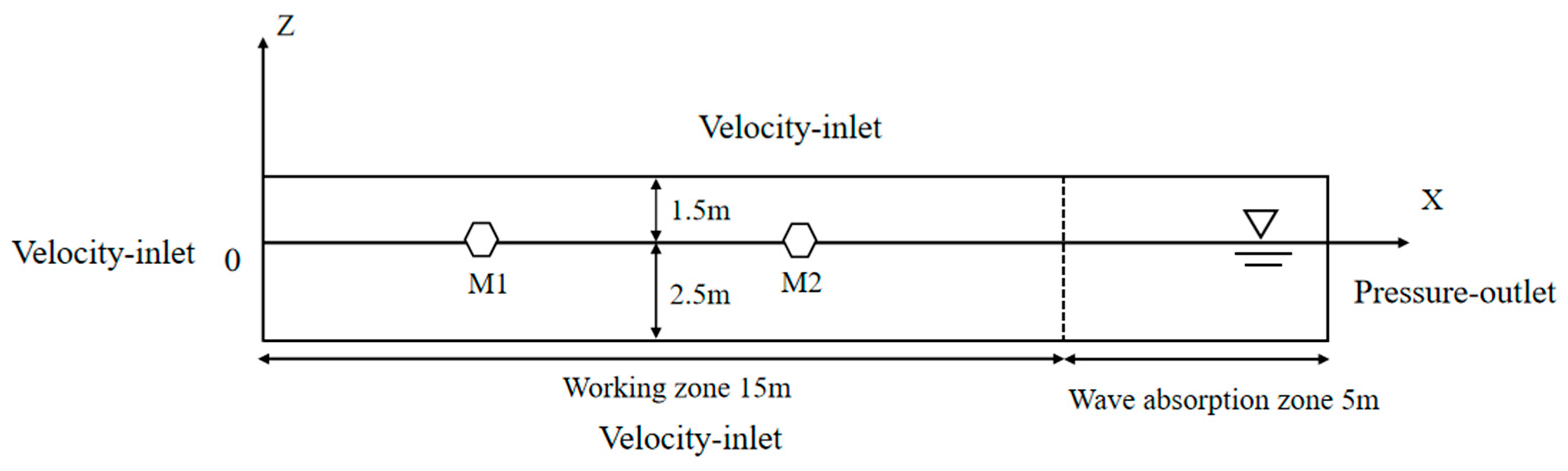
Building upon the validated regular-wave numerical wave tank in prior work [28], which demonstrated good agreement between numerical results and theoretical solutions at various wave heights, this study extends the validation to irregular waves. The methods for wave generation, flow computation, and boundary conditions are adopted from [28]. To verify the accuracy and reliability of irregular wave generation, a three-dimensional numerical wave tank is constructed using the velocity-inlet method. The free-surface motion model of irregular waves is imposed at the inlet boundary. By calculating the instantaneous velocity of fluid particles and the phase volume fraction at the boundary, non-periodic irregular waves consistent with real sea conditions are generated. Implementation of the Pierson–Moskowitz spectral wave model is achieved by defining the following parameters: initial free-surface elevation, significant wave height, and peak period. This model thereby produces an irregular sea state with greater fidelity to real ocean environments than basic spectral representations. In addition, a damping source term is introduced, and a damping wave-absorbing method is applied by setting a wave-absorption zone at the outlet. This approach effectively absorbs reflected irregular waves and prevents wave reflections within the tank from interfering with the wave-generation process. The computational domain should be selected with an appropriate size. The selection of its length mainly considers the sufficient development of waves and effective wave absorption. For irregular waves, this length usually needs to be 6–10 wavelengths. The width is selected to provide sufficient lateral space for wave propagation so as to minimize sidewall effects. The height of the air domain above the free surface is chosen to provide adequate space for wave elevation fluctuations, especially wave crests, as well as possible nonlinear phenomena such as splashing, green water, and wave breaking, thereby avoiding nonphysical constraints imposed by the top boundary on the wave height and pressure field. The water depth of the computational domain is selected to reproduce a deep-water wave environment and eliminate the influence of shallow-water effects. In general, when the water depth is greater than one characteristic wavelength, its influence on numerical wave generation can be neglected. In the present study, the established three-dimensional numerical wave tank is a rectangular domain with a length of 20 m, a width of 6 m, and a height of 4 m. The water depth is 2.5 m, and the distance from the free surface to the top of the tank is 1.5 m, which satisfies the computational requirements for irregular-wave simulations in the numerical wave tank. Table 2 compiles the corresponding wave parameters, where A stands for wave amplitude and T represents wave period.
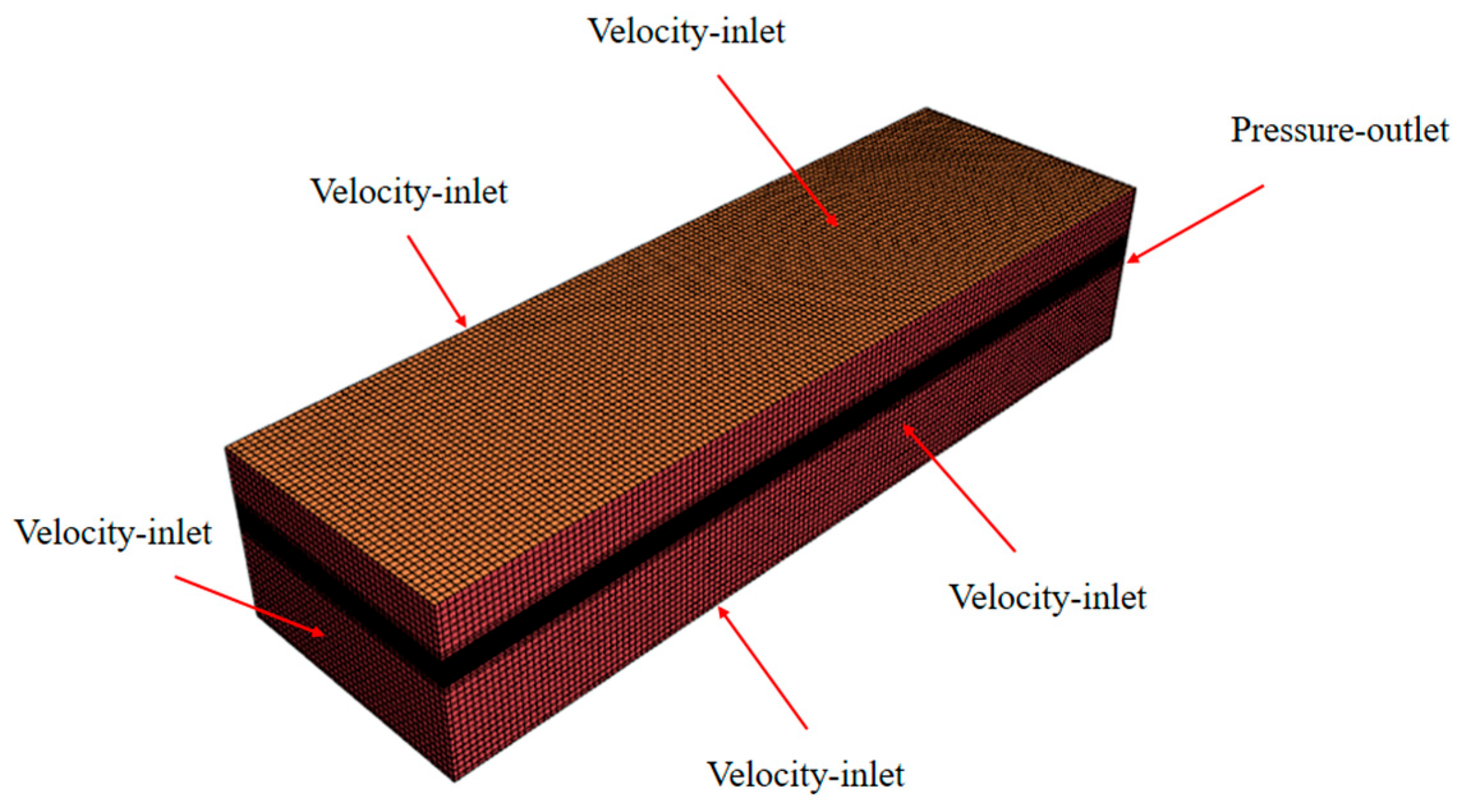
To accurately capture the free surface elevation, local mesh refinement is implemented along the vertical Z-axis, extending one wave height above and below the free surface. Within this refined region, 15 layers of grid nodes are distributed for the numerical investigation. In the working area along the longitudinal X-axis, the mesh is uniformly distributed. To effectively mitigate wave reflection, a 5 m damping zone is established at the downstream end of the computational domain. Previous numerical studies [35] have indicated that the ratio of vertical grid spacing Δ z to longitudinal grid spacing Δ x near the free surface should generally not exceed 1:10; accordingly, a ratio of Δ z / Δ x = 1 : 6 is adopted in this study. The total grid count for the numerical wave tank (NWT) is approximately 2.56 million. Regarding boundary conditions, the inlet, top, bottom, and lateral faces are defined as velocity inlets, while the outlet is designated as a pressure outlet. For the pressure-outlet boundary condition, a hydrostatic pressure distribution is prescribed and combined with a wave-damping zone (damping layer) to suppress wave reflection. The hydrostatic pressure distribution is calculated by the expression p = p 0 + ρ g ( d z ) , where p 0 is the reference pressure (usually taken as atmospheric pressure), ρ is the fluid density, and z is the vertical coordinate (with the origin located at the still water level and the upward direction taken as positive). For the pressure outlet with a damping zone, wave energy is dissipated within the damping region by adding a damping source term to the momentum equation, and its mathematical form can be written as S ϕ = ρ α ( z ) ϕ , where ϕ denotes the velocity component or turbulence variable, and α ( z ) is the spatially varying damping coefficient. The mesh discretization and boundary condition configurations are illustrated in Figure 1.
Based on the numerical study in [36], a time step of 0.005 s is selected. During the initialization stage, the volume fraction of water is set to zero above the free surface and to unity (full value) below it. To effectively monitor wave characteristics during propagation, two wave height monitoring points, M1 and M2, are positioned along the wave propagation direction (X-axis) at distances of 5 m and 10 m from the inlet, respectively. By comparing the wave elevations at these two locations, the stability and attenuation of the waves can be analyzed, thereby verifying the performance of wave generation and damping. The arrangement of these monitoring points is illustrated in Figure 2.
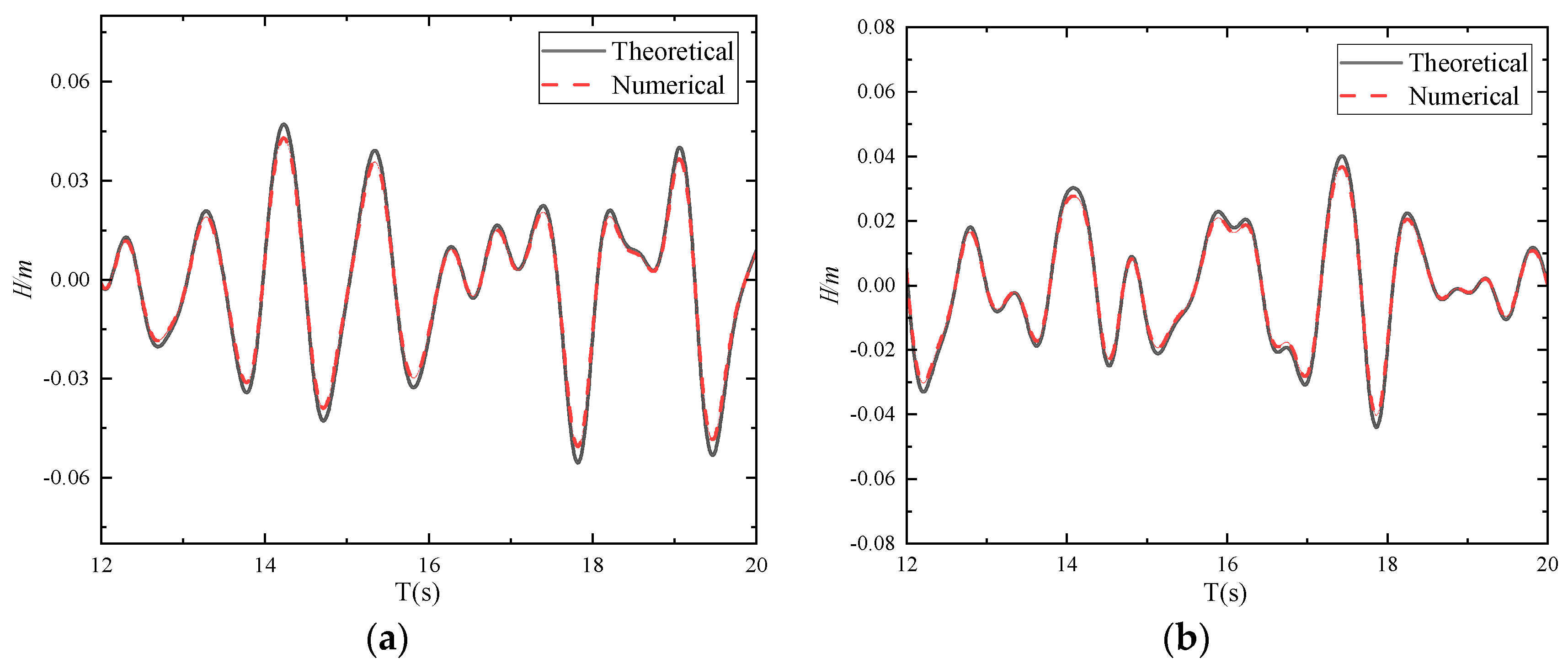
Based on the numerical results, the time-history curves of wave surface elevations at various monitoring points are plotted in Figure 3. As can be seen from Figure 3, the waveforms at the wave-height monitoring points M1 and M2 are stable and exhibit good regularity in wave amplitude. Although observable deviations exist between the numerical simulation results and the theoretical values, the errors are relatively small. In particular, the numerical results show better performance in the region close to the wave-generation inlet. The theoretical values used to validate the generation of irregular waves in Figure 3 are generated based on linear random wave theory. The specific procedure is as follows: (1) First, the target irregular-wave characteristics are defined using the Pierson–Moskowitz spectrum, and the spectral parameters, namely the significant wave height and peak period, are determined. (2) Second, the linear superposition method is adopted to discretize the target wave spectrum into a series of regular linear wave components, i.e., airy waves, with different frequencies, amplitudes, and random phases. These components are linearly superimposed at the inlet boundary to generate the theoretically expected wave time series, including the free-surface elevation and particle velocity. (3) The “theoretical values” compared in Figure 3 are obtained from this pre-generated linear theoretical time series at the corresponding monitoring points. The findings obtained in this study validate the precision and dependability of the developed 3D numerical wave tank, laying a solid foundation for follow-up research.

3.2. Validation of Hydrodynamic Performance Prediction for Structures in Irregular Waves

To validate the hydrodynamic characteristics of the interaction between irregular waves and structures, the Lingshui 17-2 semi-submersible drilling platform model is adopted as the research object, following the study by [37] (2021). Corresponding numerical investigations are conducted in conjunction with the experimental results reported in the literature. The parameters for the irregular waves and the Lingshui 17-2 platform model are summarized in Table 3 and Table 4, respectively.
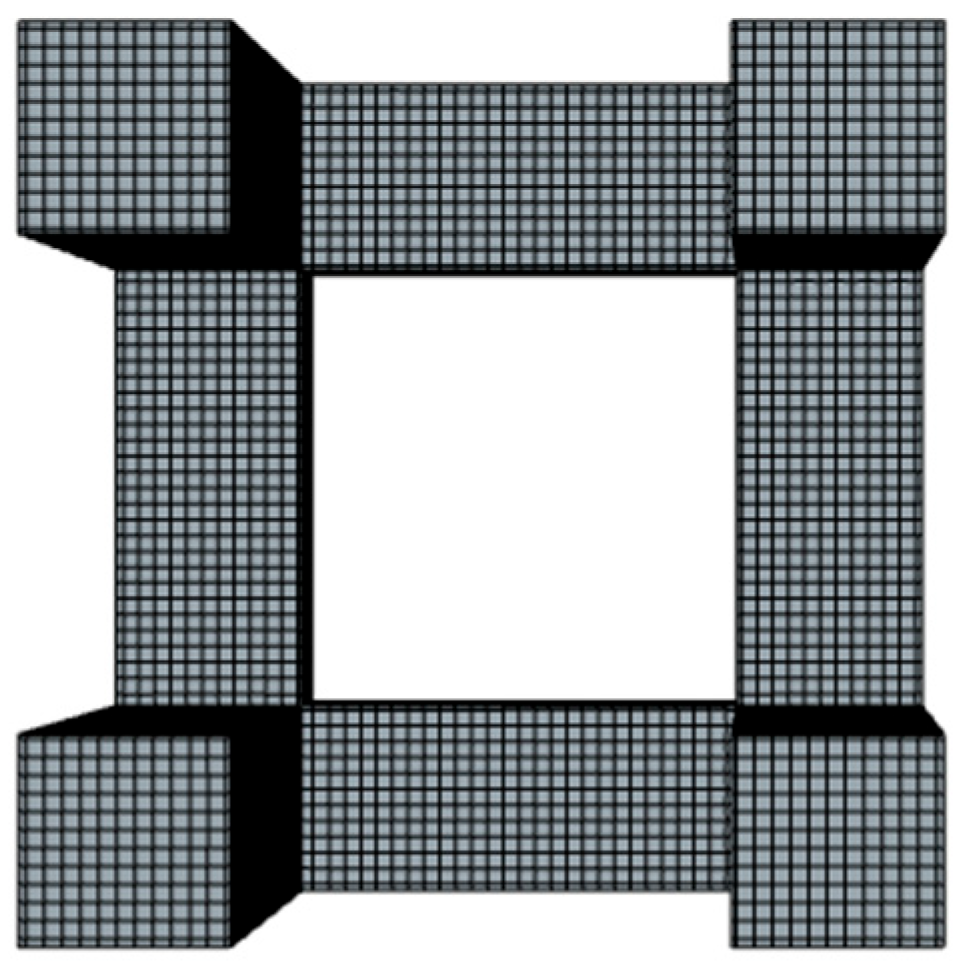
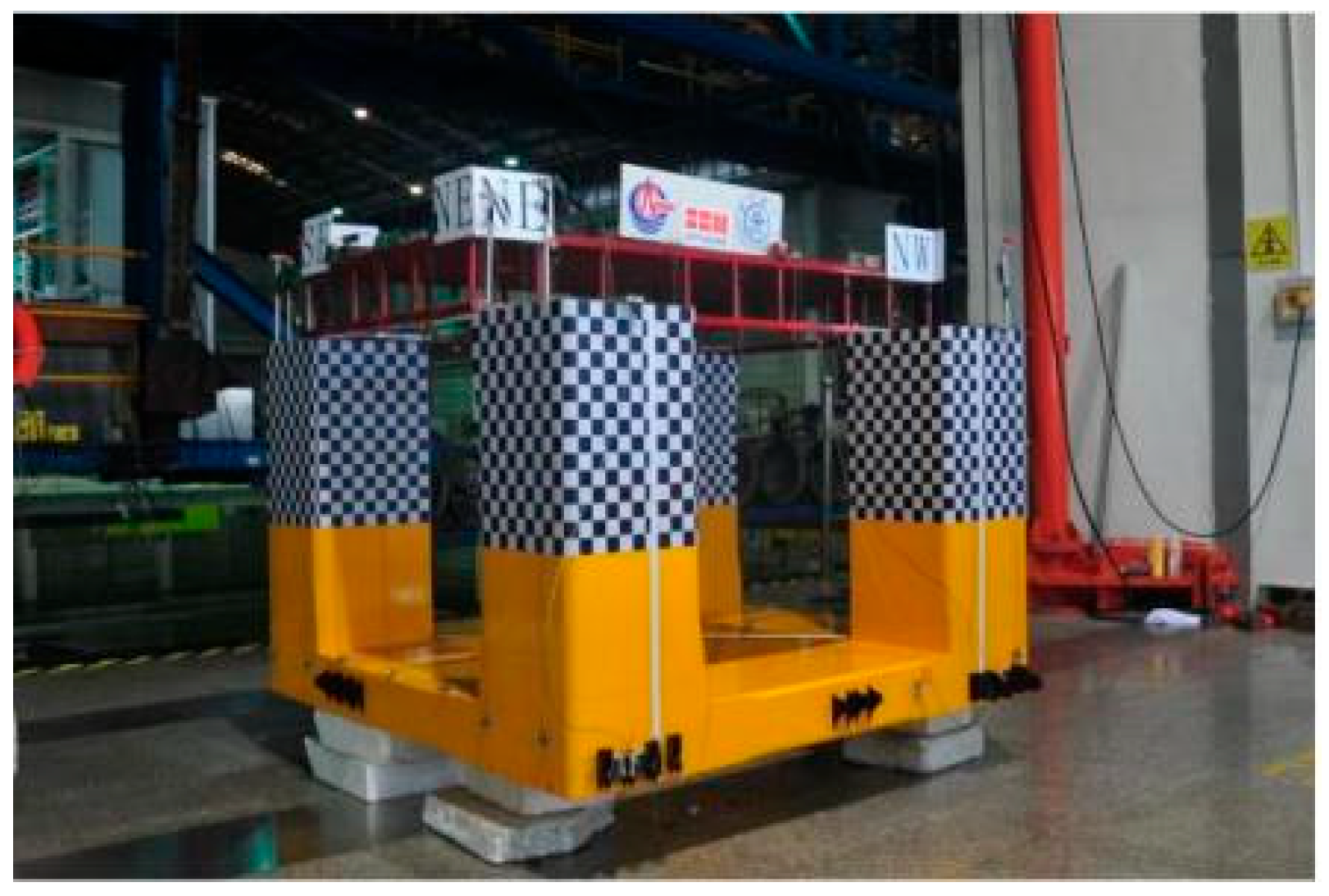
Based on the aforementioned parameters, the mesh model and the experimental model of the semi-submersible drilling platform are established, as illustrated in Figure 4 and Figure 5, respectively. The grid strategy around the free surface, the downstream damping region layout, and the global boundary conditions all align with the numerical wave tank configuration presented in Section 2.1. However, the dimensions of the computational domain are modified to 16 m in length, 8 m in width, and 4 m in height. To accurately capture the motion response of the platform, the overset mesh (overlapping grid) technique is implemented. Local mesh refinement is applied to the region surrounding the platform, with the characteristic surface mesh size set to 4‰ of the column width. To minimize the influence of boundary effects on the numerical results, the center of the platform is positioned 5.5 m from the inlet, 10.5 m from the outlet, and 4 m from the lateral boundaries. Vertically, the domain extends 2.5 m above and 1.5 m below the static waterline.
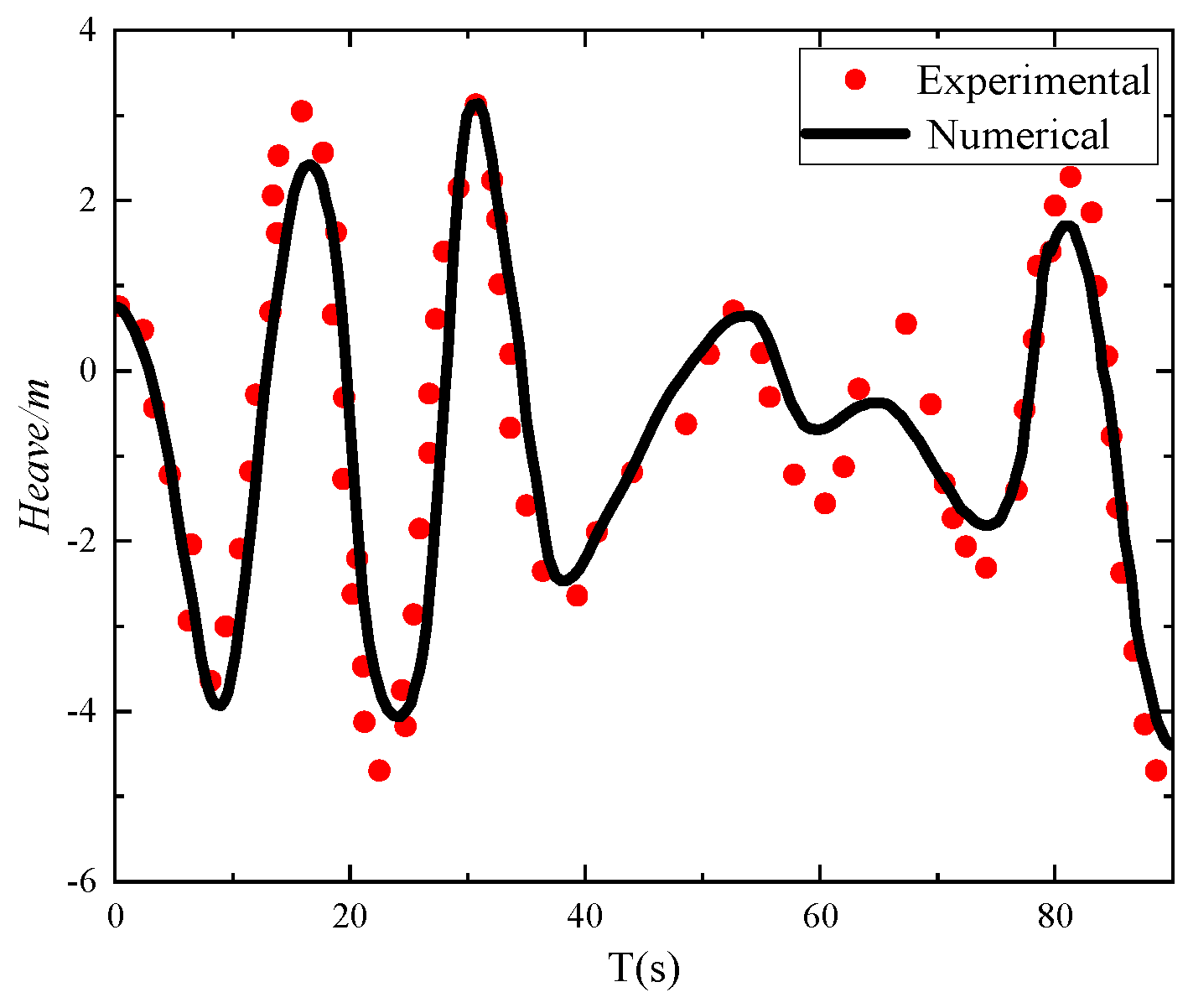
Based on the numerical results and experimental data, the heave motion time-history curves for the Lingshui 17-2 semi-submersible platform are plotted in Figure 6. Figure 6 shows that the time histories of heave motion for the semi-submersible platform exhibit a trend in fundamental consistency with the experimental data, indicating good agreement. The calculated error for the heave period is 3.37%, and the average peak error is 3.98%. The discrepancies between the numerical and experimental values stem from multiple factors, including model simplification, differences in initial condition settings, the fineness of mesh discretization, and viscous dissipation inherent in the numerical process. Overall, the numerical results accurately reflect the motion response of the structure under wave action. To further enhance numerical accuracy, potential refinements include increasing mesh resolution for the platform or reducing the computational time step. The numerical methodology presented in this study proves to be reasonable and effective for investigating structural motion responses under irregular waves, thereby establishing a reliable foundation for subsequent research in this paper.

4. Hydrodynamic Performance Prediction of a Drillship with a Moonpool in Calm Water

4.1. Model Parameters and Moonpool Configurations

In the previous study (Ref. [28]), a grid-convergence study was conducted for the KCS ship under calm-water conditions, and its heave and pitch motions as well as added resistance in regular waves have been calculated and validated. To investigate the motion-response characteristics of moonpool drillships under irregular waves and the corresponding drag-reduction method, the present study adopts a new drillship model at a scale of 1:64. Following the hydrodynamic-performance prediction method established in Ref. [28] for calm water, a preliminary investigation is first carried out to select the moonpool configuration with relatively favorable hydrodynamic performance. The principal particulars of the full-scale vessel and the ship model are listed in Table 5.
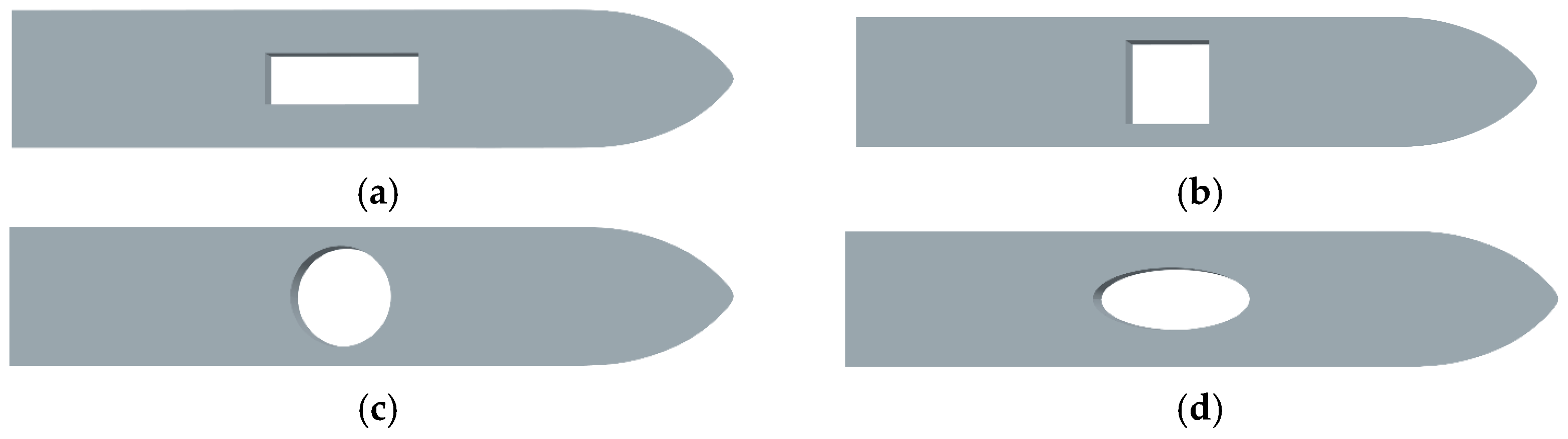
For the purpose of examining the influence exerted by moonpool geometries on the hydrodynamic characteristics of drillships, this study selects common moonpool structures used in drillships, with a drillship without a moonpool serving as the baseline model. The chosen moonpool shapes include rectangular, square, circular, and elliptical moonpools, all of which are area-converted to match the rectangular moonpool as the reference. Table 6 details the relevant parameters for each moonpool structural layout, while Figure 7 illustrates the drillship models featuring distinct moonpool configuration schemes.

4.2. Computational Conditions and Mesh Generation

This work presents an investigation into the impact of moonpool geometry on drillship hydrodynamics in calm water, with a focus on the practical speed range of 12–15 knots. The speed increment between consecutive cases is set at 1 kn. The specific matrix of the numerical simulation cases is summarized in Table 7.
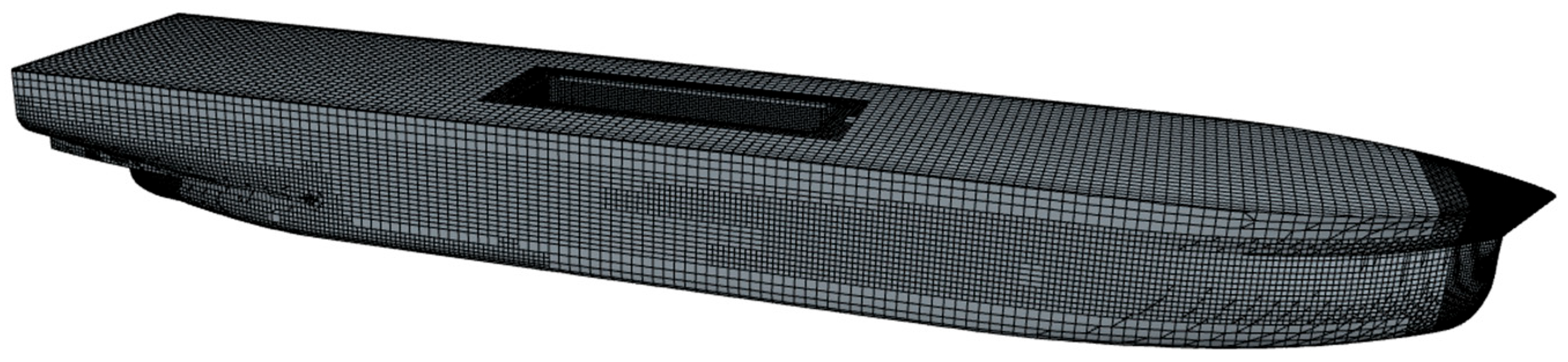
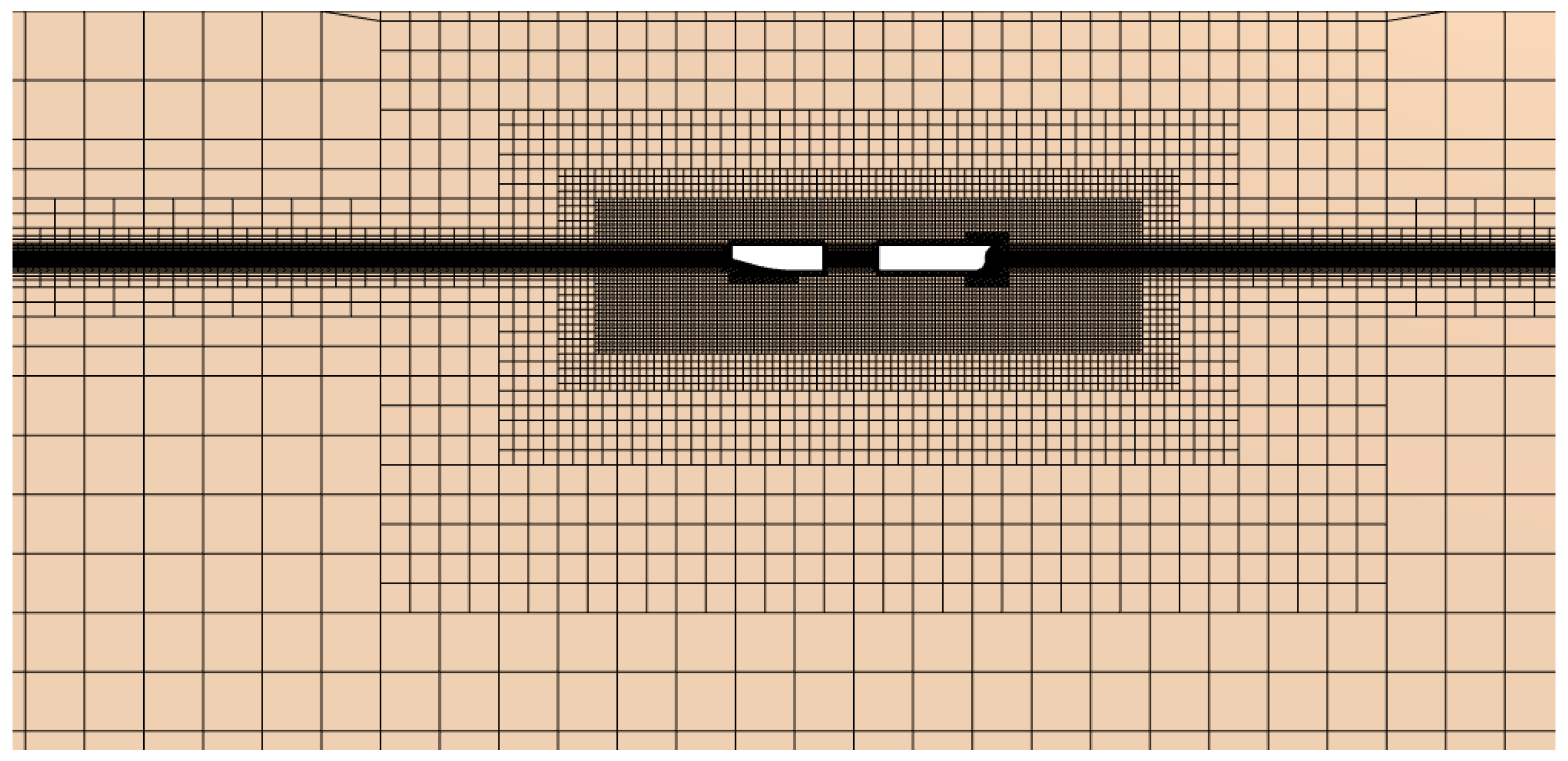
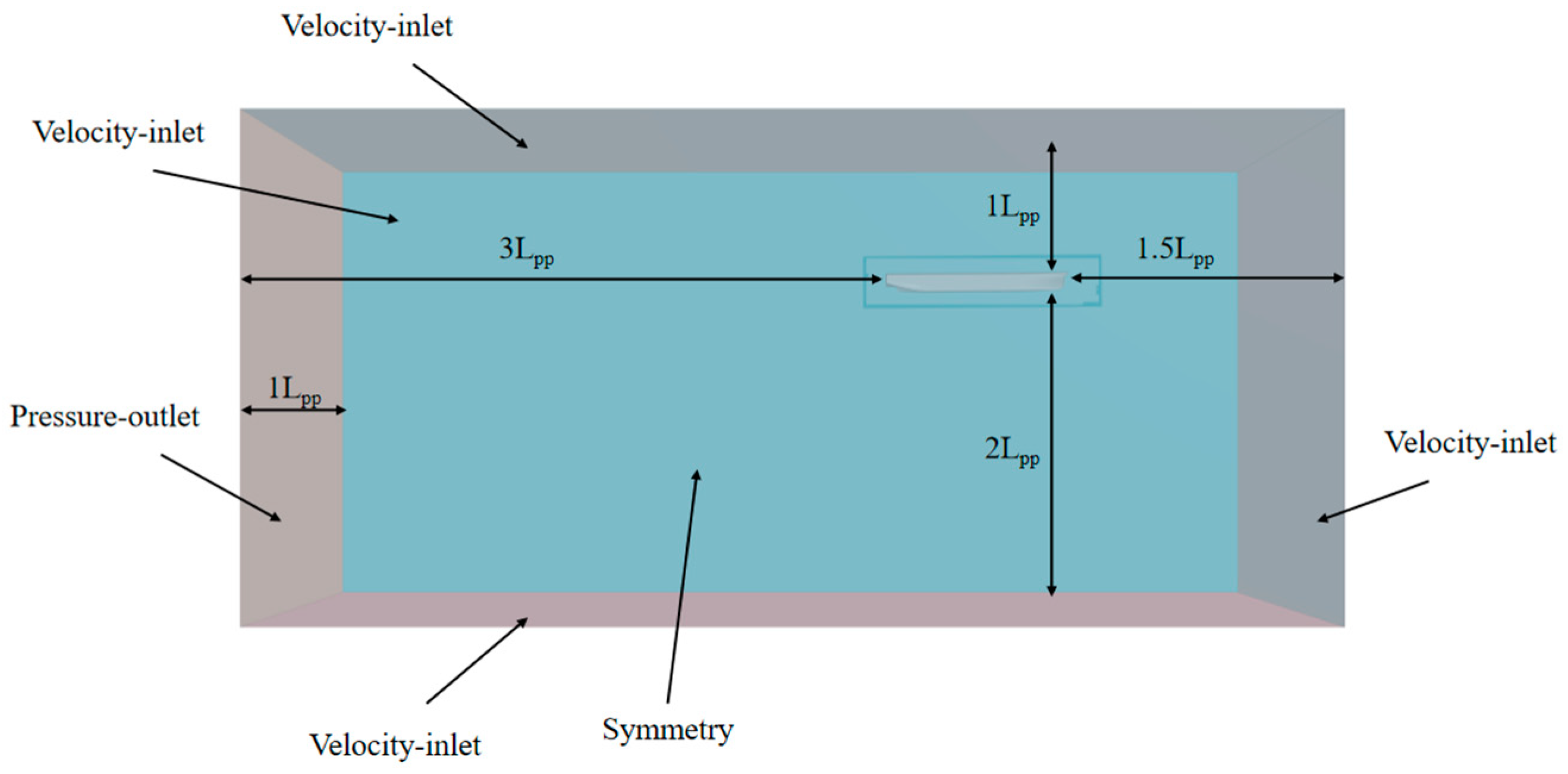
As the drillship models with or without a moonpool structure exhibit symmetry about the longitudinal axis, a half-hull model is adopted to carry out all numerical computations. To precisely resolve the wave elevation around the free surface, a locally refined mesh is adopted in the vicinity of the free surface. The mesh refinement scheme for the free-surface zone, together with the layout of the wave damping zone at the downstream end of the computational domain, are established in accordance with the irregular wave numerical wave tank methodology detailed in Section 2.1, to maintain full consistency with the previously defined numerical scheme. Consequently, the boundary condition on the right lateral side of the domain is set as a symmetry plane, while all other boundary conditions remain identical to those in Section 2.1. To better simulate the ship’s motion, an overset mesh (overlapping grid) technique is implemented around the hull; Due to the complex curvature of the 3D hull, local mesh refinement is performed in the regions near the bow and stern. To resolve the boundary layer effects, the wall function method is adopted, with eight layers of prismatic mesh arranged along the hull surface. The height of the initial mesh layer is set to 1 mm, and a stretching ratio of 1.1 is used, ensuring that the dimensionless wall distance y + meets the criteria for the logarithmic law region ( y + 30 ~ 300 ). Furthermore, to accurately resolve the detailed flow features inside the moonpool—including flow separation and vortex shedding at the bottom edges—local mesh encryption is implemented in the vicinity of the moonpool, where the element size is defined as 0.25% of the ship’s waterline length. To minimize the interference of domain boundaries on the numerical results, the upstream (inlet) length is selected as 1.5 L to prevent the inlet flow from being disturbed by the hull’s diffraction. To allow for the complete development of the wake field, a downstream (outlet) length of 3 L is employed. Vertically, the domain extends 1 L above the waterline and 2 L below it to eliminate blockage effects (shallow water effects). The half-width of the computational domain is chosen as 1 L to mitigate wave reflections from the lateral boundaries. Figure 8, Figure 9 and Figure 10 present the mesh of the hull surface, the locally refined mesh along the longitudinal cross-section of the numerical domain, as well as the configuration of boundary conditions and computational domain dimensions for the drillship with a rectangular moonpool.

4.3. Analysis of Numerical Results for Resistance Performance

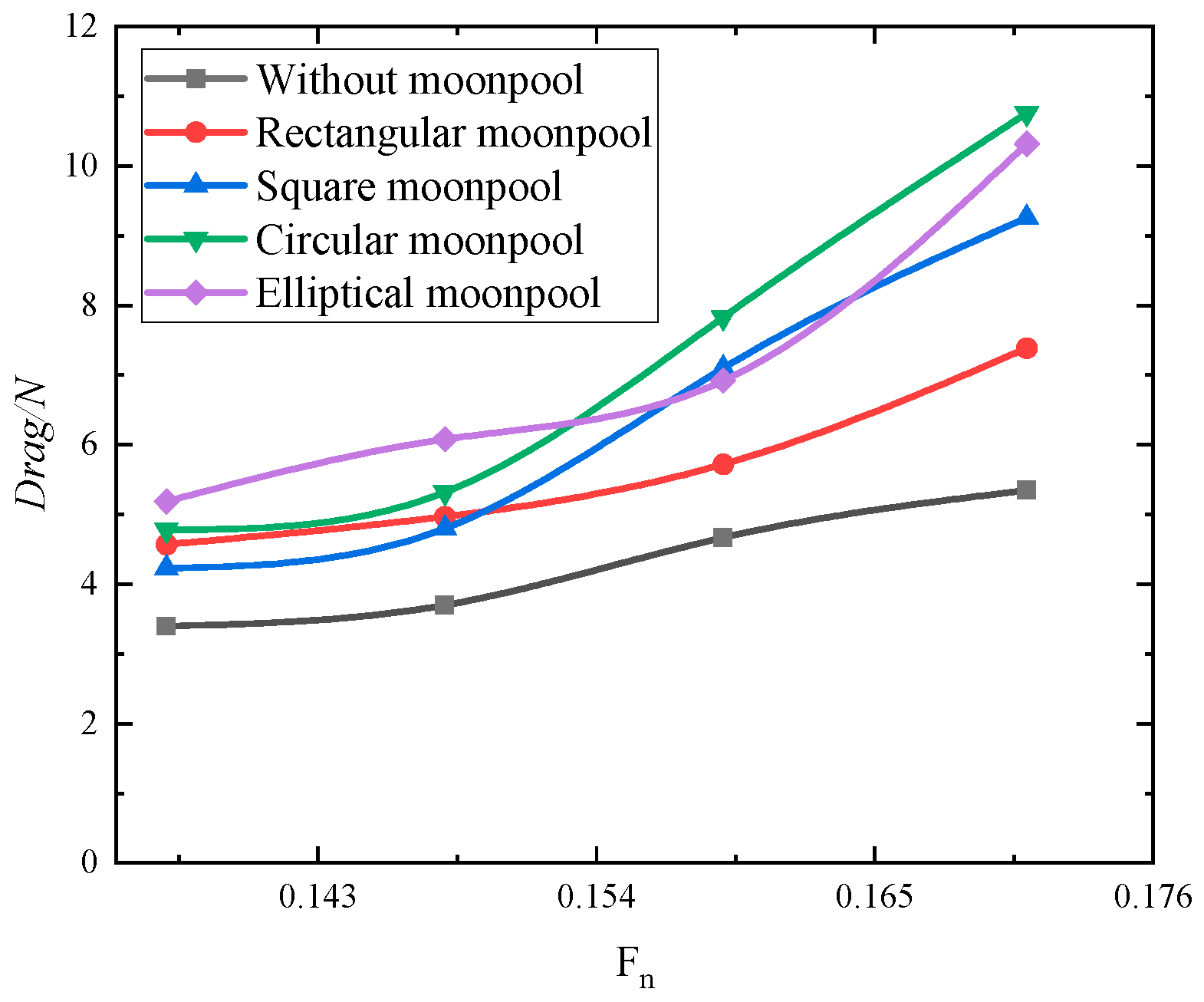
The calm-water hydrodynamic behavior of drillships equipped with moonpools is evaluated, and the total resistance curves of both moonpool-free drillships and vessels with distinct moonpool designs at different advance speeds are presented in Figure 11. As shown in Figure 11, the presence of the moonpool significantly affects the hydrodynamic performance of the drillship; the resistance performance varies greatly across different moonpool configurations. In the total resistance curve, as the speed increases and the Froude number rises, the total resistance of both the moonpool and non-moonpool drillships increases accordingly. Under identical Froude number conditions, the total drag of moonpool-equipped drillships consistently exceeds that of moonpool-free vessels. This can be attributed to the additional resistance generated by the moonpool, particularly the additional residual resistance. The additional residual resistance consists of two components. These include the incremental viscous pressure resistance and incremental wave-making resistance, both of which are affected by the installation of the moonpool. The incremental viscous pressure resistance is mainly attributed to boundary layer separation at the leading edge of the moonpool, while the additional wave-making resistance originates from wave interference between the flow fields inside and outside the moonpool, as well as the oscillation of water within the moonpool (including piston-mode and heave-mode motions). As the Froude number rises, the total resistance of drillships with various moonpool designs presents a consistent upward trend. Within the Froude number range of 0.137 < Fn < 0.148, the drillship with a square moonpool exhibits superior resistance performance, even though the difference in total resistance between different moonpool configurations is negligible. However, when the Froude number exceeds 0.148 (Fn > 0.148), the gap in total resistance between different moonpool designs grows markedly, and the drillship with a rectangular moonpool presents a distinct advantage in hydrodynamic performance.
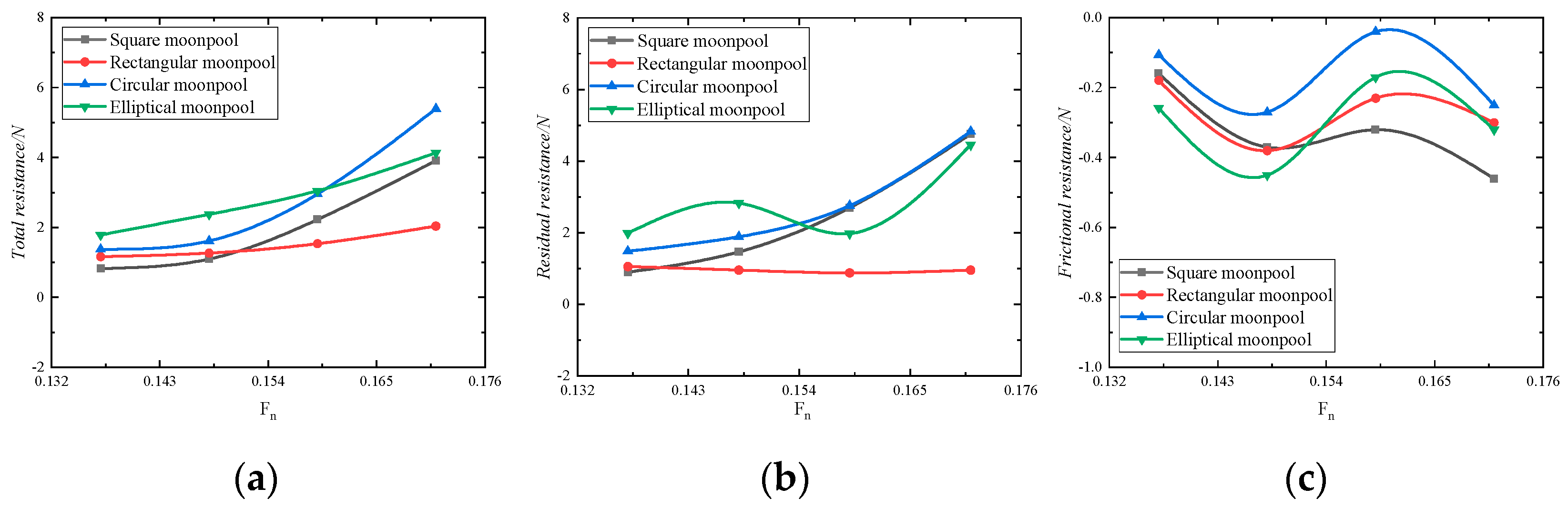
Figure 12 presents the added frictional, residuary, and total resistance curves for drillships with four moonpool shapes (relative to the moonpool-free baseline) to quantify their influence. The black, red, blue, and green curves correspond to the square, rectangular, circular, and elliptical moonpools, respectively. As shown in Figure 12, the added residual resistance from the moonpool follows a trend similar to the total added resistance, while its frictional component remains relatively small and predominantly negative. This is attributed to factors such as the reduction in wet surface area, decreased internal flow velocity within the moonpool, and alterations in the ship’s boundary layer development, leading to early separation or thinning of the boundary layer. Different moonpool configurations introduce only minor differences in added resistance at low speeds. However, when the Froude number Fn > 0.148, the added resistance due to the moonpool increases significantly, showing an exacerbating trend, which is consistent with the previously discussed total resistance results. However, for the elliptical moonpool, the added residuary resistance at Fn = 0.148 is greater than that at Fn = 0.159, indicating a distinctive behavior. This may be attributed to the fact that, for the specific elliptical moonpool configuration, unfavorable resonance or flow separation may occur at Fn = 0.148, resulting in a local peak in the added residuary resistance. As the sailing speed further increases, the flow gradually departs from this unfavorable state, leading to a reduction in the added residuary resistance. Among various moonpool designs, the rectangular and square moonpool configurations show better performance in reducing added resistance.

5. Analysis of Motion Characteristics of Moonpool Drillship Under Irregular Waves

5.1. Computational Conditions and Mesh Generation

Based on calm-water computational results regarding the moonpool’s influence on hydrodynamic performance, this study selects drillships with rectangular and square moonpools—which demonstrated superior resistance performance—as the primary focus for investigating their behavior in irregular waves. These are compared with a reference drillship without a moonpool, with the goal of examining the motion response characteristics under irregular wave conditions. The computational condition is set at a Froude number of Fn = 0.171, with a model speed of 0.965 m/s, corresponding to a full-scale design speed of 15 kn. The incident wave angles are selected as head waves (0°) and oblique waves (45°). The VOF method is adopted, and irregular waves are generated using the Pierson–Moskowitz spectrum, with an incident wave height of 0.102 m and a wave period of 1.54 s. Under irregular-wave conditions, only two degrees of freedom, namely heave and pitch, are considered in the prediction of the motion performance of the moonpool drillship. Different wave heading angles have a significant influence on the hydrodynamic characteristics of moonpool drillships. The present study is limited to head waves at 0° and a wave heading angle of 45°. In particular, under beam-sea conditions (90°) and following-sea conditions (180°), the influencing parameters that need to be considered are different. Under beam-sea conditions, roll motion becomes the dominant motion response, and its amplitude may be much larger than that of heave and pitch. Moreover, under following-sea conditions (180°), the ship may be prone to maneuvering instability and large-amplitude motions. These issues will be investigated in future work. The parameters for the simulation cases are provided in Table 8.
Grid refinement at the bow and stern, mesh resolution near the free surface, local refinement around the moonpool, overset grids surrounding the hull, computational domain selection, and wave-damping zone configuration at the domain outlet all follow the setup defined in Section 4.2. These settings are consistent with the calm-water hydrodynamic performance prediction methodology for the moonpool-equipped drillship described in that section. The numerical simulations of the interaction between irregular waves and the moonpool drillship are conducted using a full-ship model. Therefore, no symmetry plane is applied in the boundary condition settings. The overall boundary conditions are established with reference to Section 2.1, Numerical Irregular Wave Tank, and are kept consistent with that section.

5.2. Analysis of Numerical Results for Resistance Performance

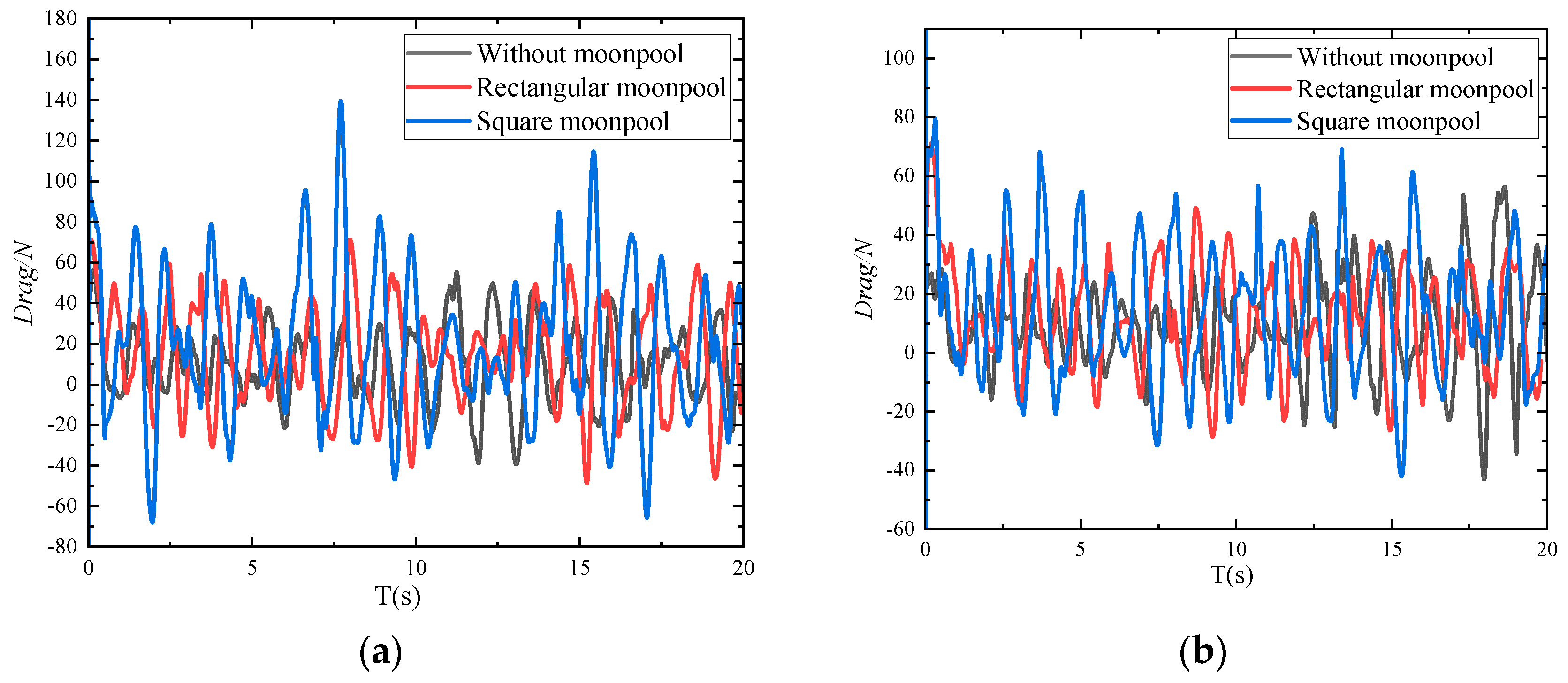
The resistance time histories for the three drillship configurations (without a moonpool, with a rectangular moonpool, and with a square moonpool) are plotted in Figure 13, showing irregular total resistance curves. To clearly distinguish the resistance levels, the mean resistance values are calculated and presented in Table 9.
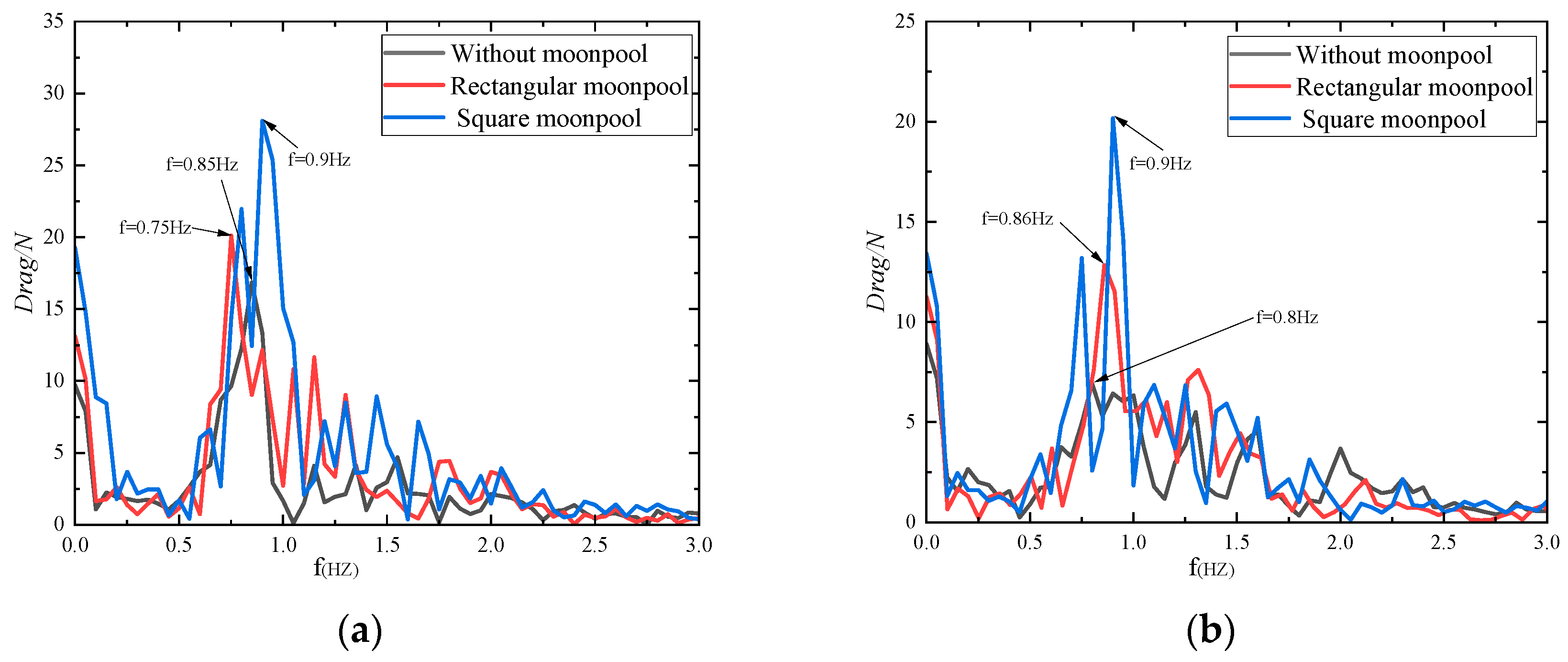
Table 9 shows that at identical wave heading angles, the moonpool-free drillship has a significantly lower mean resistance than those with rectangular or square moonpools, the latter exhibiting the highest value. These findings confirm that the moonpool’s presence substantially elevates both the mean sailing resistance and the fluctuation amplitude of the drillship. The time-domain analysis shows that the moonpool significantly alters the resistance characteristics of the drillship. However, to quantitatively distinguish the effects of the moonpool on hull motions and wave excitation, it is necessary to transform the results from the time domain to the frequency domain. Therefore, the Fourier transform is applied to the resistance time-history curves of the drillships without a moonpool, with a rectangular moonpool, and with a square moonpool, and the corresponding resistance spectra are obtained, as shown in Figure 14.
Figure 14 shows that at 0° and 45° wave incidence, the resistance amplitude is largest for the drillship with a square moonpool, being considerably greater than that of the rectangular-moonpool and baseline (moonpool-free) vessels. The drillship without a moonpool exhibits the smallest amplitude among the three. These results indicate that the presence of a moonpool notably increases the resistance amplitude and alters the natural frequency of the drillship.

5.3. Analysis of Numerical Results for Motion Responses

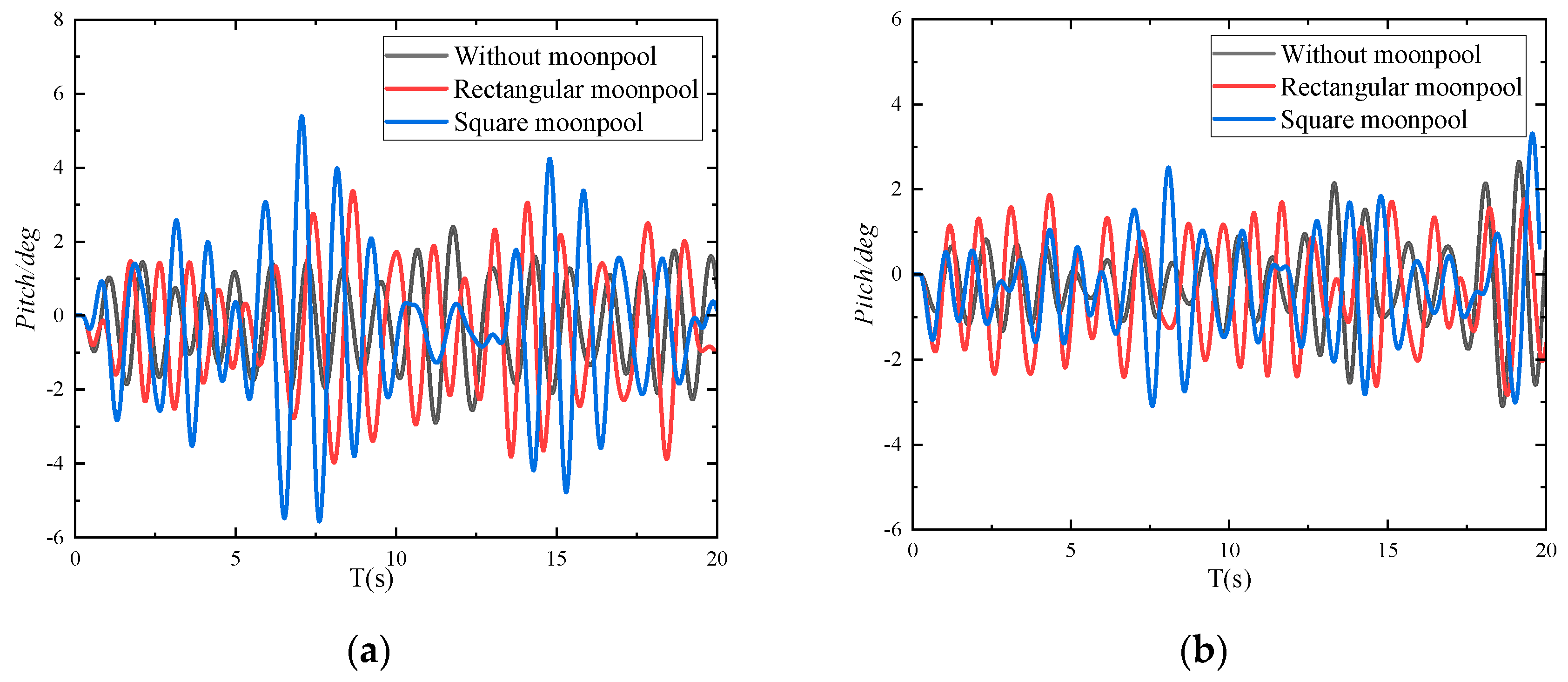
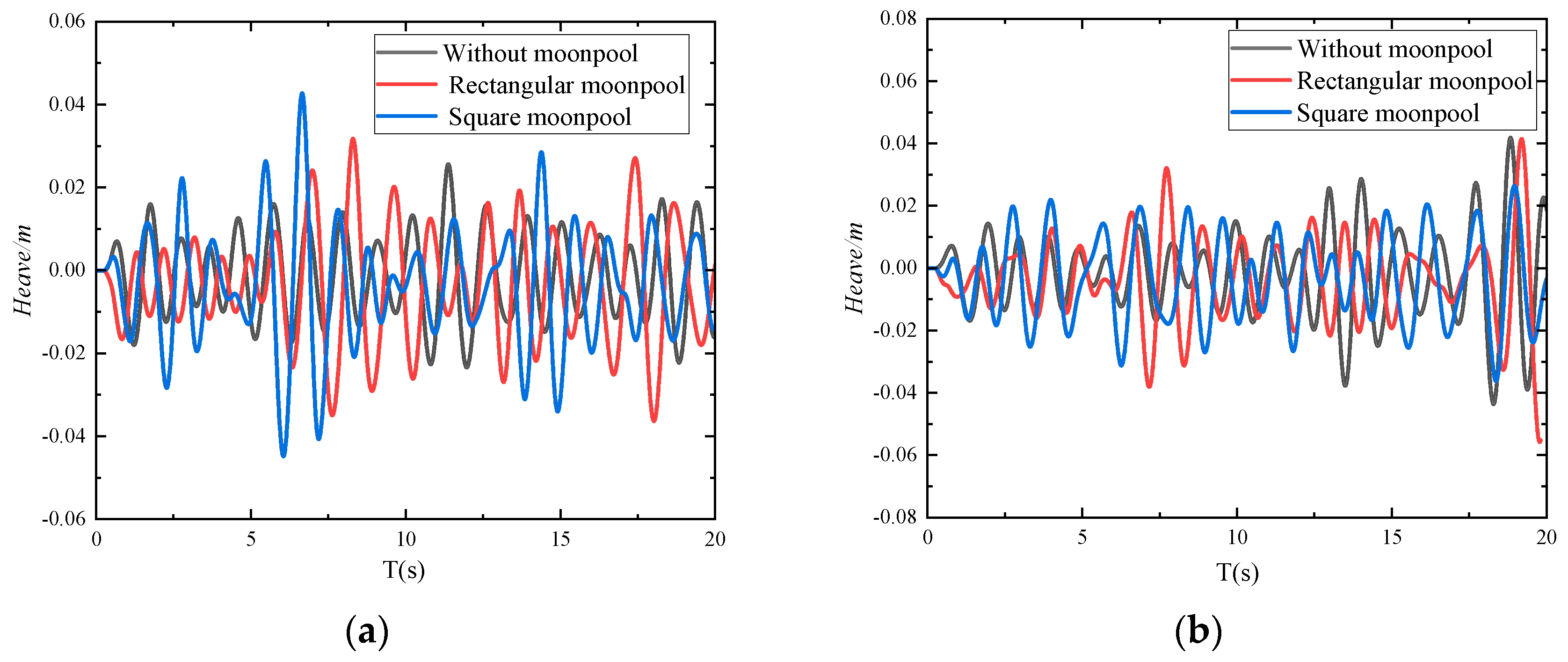
The motion response of moonpool drillships in irregular waves is analyzed. Based on the results, the heave and pitch time histories for three hull configurations (without a moonpool, with rectangular and square moonpools) at 0° and 45° wave incidence are presented in Figure 15 and Figure 16. As can be seen from Figure 15 and Figure 16, under irregular wave conditions, the time-domain responses of heave and pitch for the three drillships all exhibit pronounced randomness and non-periodicity, and their motion amplitudes vary continuously with time, reflecting the random energy input characteristics of irregular waves in the time domain. Furthermore, under head irregular waves (0°), the heave and pitch amplitudes for all three hull configurations (baseline, rectangular, and square moonpool) exceed those at 45°. The moonpool notably amplifies both motion responses compared to the moonpool-free baseline, with a more pronounced effect on pitch. This is because the broadband energy distribution of irregular waves interacts with the hydrodynamic characteristics of the moonpool in a more complex and unfavorable manner. The probability and duration of moonpool resonance are greatly increased, resulting in a significant amplification of heave over longer time intervals. Meanwhile, the reduction in the hull’s restoring stiffness against pitch makes the drillship respond more severely to irregular wave components, particularly those with wavelengths close to the ship length, which mainly induce pitch motion.
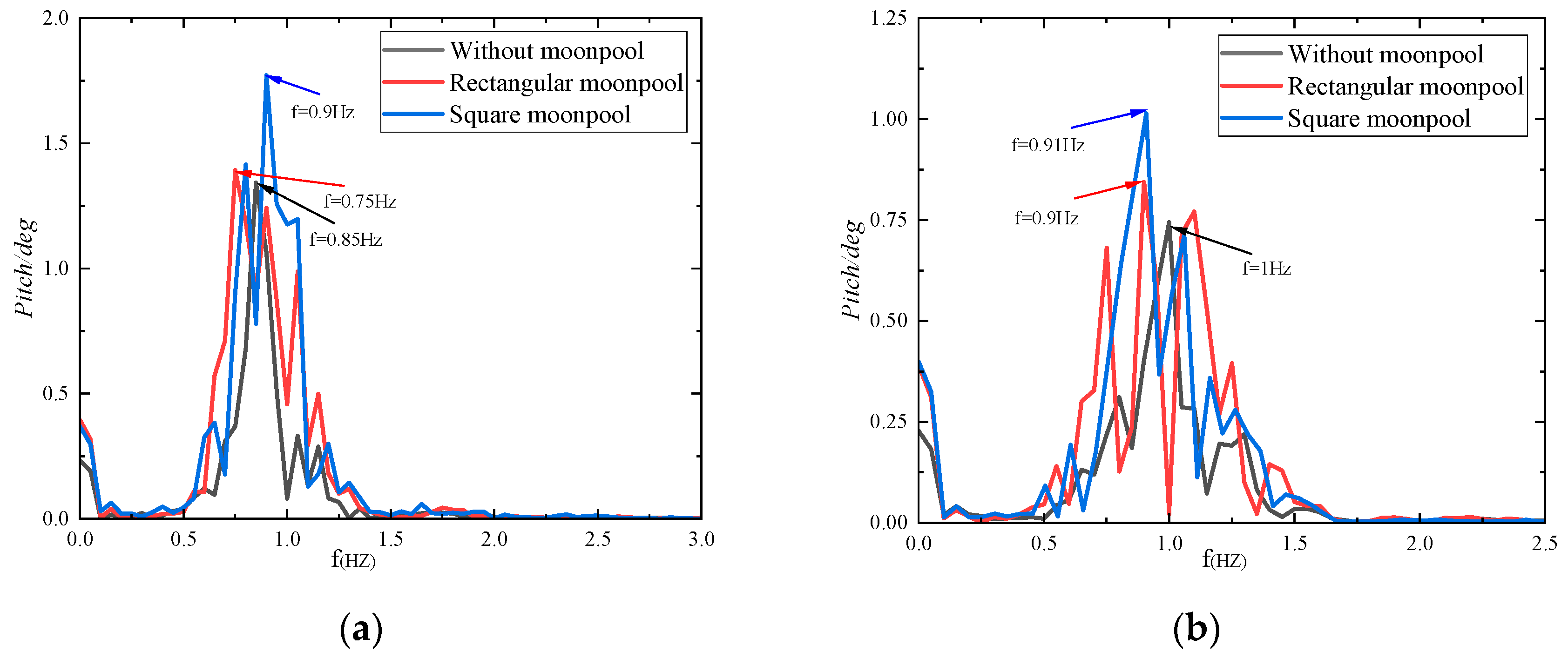
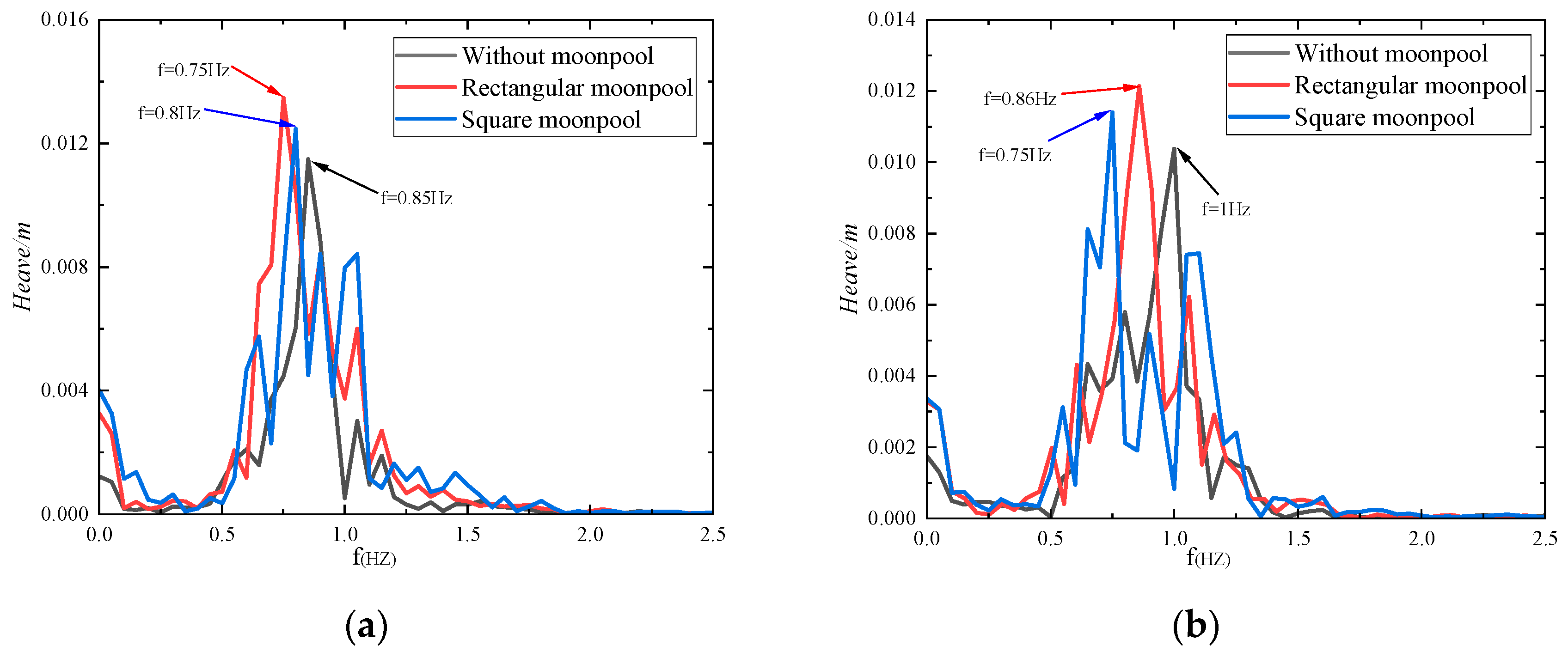
A time-domain analysis alone makes it difficult to clearly identify the contribution of each frequency component to the motion responses. By applying the Fourier transform to the time-history signals of heave and pitch, the complex time-domain responses can be converted into the frequency domain, thereby revealing the distribution characteristics of motion energy over different frequency ranges. The resulting frequency spectra of heave and pitch motions are shown in Figure 17 and Figure 18, respectively. As can be seen from the spectra, the dominant peak amplitudes and energy distributions of the heave and pitch response spectra for the drillships without a moonpool, with a rectangular moonpool, and with a square moonpool change significantly. Figure 17 and Figure 18 show that the heave and pitch response amplitudes for the rectangular and square moonpool designs are notably higher than those of the moonpool-free drillship. The dominant peak frequencies of the heave motions for the drillships with rectangular and square moonpools shift noticeably toward higher frequencies compared with those of the drillship without a moonpool. A similar peak shift is also observed in the pitch motion, although it is not entirely a forward shift. In addition, the heave and pitch amplitudes under head irregular waves (0°) are evidently greater than those under a wave heading angle of 45°, which is consistent with the previous conclusions and further verifies the results obtained from the time-history curves of heave and pitch motions. Furthermore, the pitch frequency-response amplitude of the square-moonpool drillship is markedly higher than that of its rectangular-moonpool counterpart, while the discrepancy in their heave response magnitudes is comparatively minor. This further indicates that irregular waves have a greater influence on the hydrodynamic characteristics of the drillship with a square moonpool than on those of the drillship with a rectangular moonpool. The numerical results further demonstrate that the presence of a moonpool alters the natural frequencies of the drillship and affects its motion response characteristics.

6. Corner Optimization Study of the Moonpool Drillship

6.1. Mechanism Analysis and Dimension Selection of Moonpool Corner Optimization

As established in previous studies [28,38,39], the presence of a moonpool imposes a more significant impact on ship resistance than on hull motion in calm water. The dominant source of the additional resistance is the flow dynamics generated inside the moonpool cavity. To reduce this flow, the study adopts drillships with rectangular and square moonpools, known for their improved resistance performance, while adhering to the principles of simplicity and efficiency. Large-radius rounded corners are arranged at the four bottom corners of the moonpool. By smoothing the wall geometry, the attached flow along the wall is improved, enabling the formation of a stable and continuous shear layer in this region, enhancing local viscous dissipation, and converting the oscillatory kinetic energy of the water body into thermal energy. This design introduces wall damping at the critical locations of flow separation, which can effectively suppress the overall oscillation of the water inside the moonpool and reduce navigation resistance.
However, the radius of the bottom rounded corners of the moonpool directly affects the numerical results. From the perspective of hydrodynamics, an appropriate corner radius can reduce resistance. If the radius is too small, obvious flow separation and vortex shedding will still occur near the moonpool corners, making it difficult to effectively suppress corner vortices and thus failing to reduce form drag or improve the flow field. If the radius is too large, the effective flow area inside the moonpool will be excessively reduced, leading to contraction of the internal flow field and flow blockage, which in turn increases local resistance and additional damping. Moreover, from the viewpoint of structural mechanics, it is known that when the ratio of corner radius (R) to opening width (b), namely (R/b), is within the range of 0.1–0.2, the stress concentration factor can be significantly reduced. In order to effectively reduce stress concentration, improve fatigue strength, and decrease navigation resistance, and considering that the width (b) of the rectangular moonpool in the present drillship model is 0.188 m, the corresponding corner-radius range is calculated to be 18.8–37.6 mm.
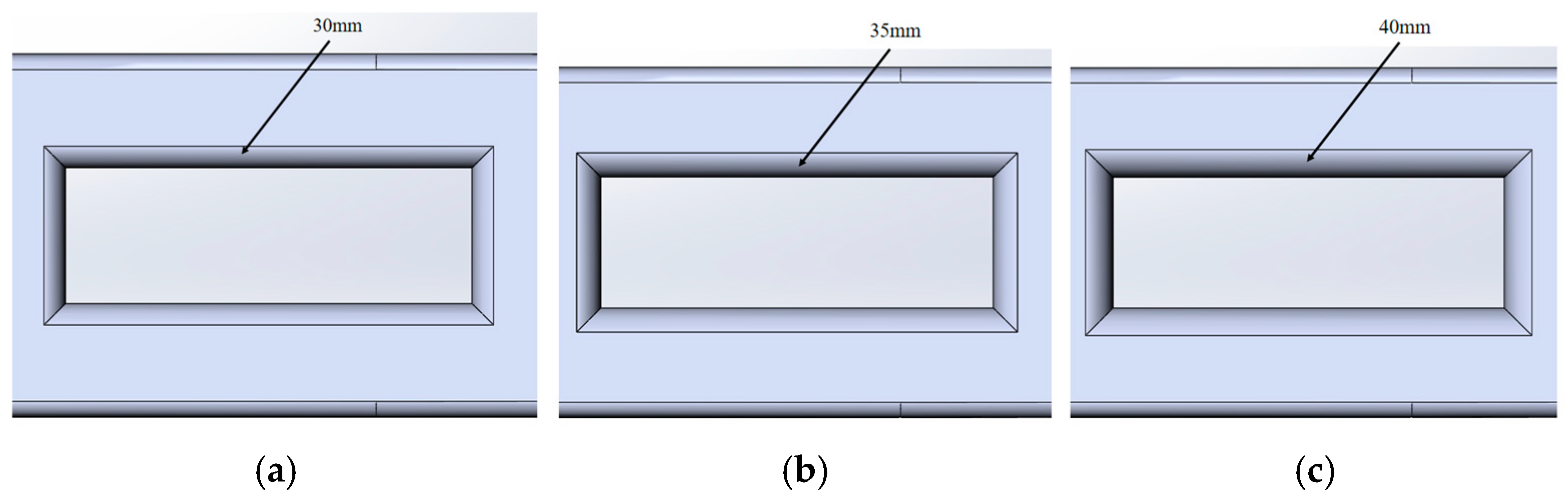
In addition, according to general rules and regulations for ship openings, all openings in the hull structure, including apertures and cut-outs, should have smooth edges and sufficiently large rounded corners, and the corner radius (R) should generally not be less than 25 mm. Considering that the moonpool of a drillship is a critical load-bearing structure, and based on the above theoretical analysis, regulations, and engineering practice, the lower limit of the corner radius (R) is appropriately increased to 30 mm, and the upper limit is extended to 50 mm. This range can ensure drag reduction and fatigue performance while also taking into account the practical usability of the opening. Therefore, in this study, the drillship with a rectangular moonpool is taken as the baseline model, and suitable corner radii are selected for the optimization study of the hydrodynamic performance of the moonpool drillship. Specifically, the rounded-corner radii at the bottom of the moonpool are set to 30 mm, 35 mm, and 40 mm, respectively. A schematic diagram of the bottom rounded corners of the rectangular-moonpool drillship is shown in Figure 19.

6.2. Corner Optimization Study of the Moonpool Drillship in Calm-Water Navigation

To select the optimal moonpool rounded-corner device for resistance reduction, the computational condition is set at Fn = 0.171, corresponding to a design ship speed of 15 kn. The grid refinement around the bow and stern, the mesh distribution near the free surface, the grid refinement around the moonpool, the overlapping mesh near the hull, the selection of the computational domain, and the wave-dissipation region at the tail of the computational domain all follow the methods outlined in Section 3.2, which details the hydrodynamic performance prediction of moonpool-equipped drillships in calm water, maintaining consistency with that section.
Based on the data in Table 10, it can be seen that the total resistance of both the rectangular-moonpool and square-moonpool drillships decreases significantly as the radius of the rounded corners at the bottom of the moonpool increases. When the bottom rounded-corner radius of the moonpool is 30 mm, the total resistance of both the rectangular- and square-moonpool drillships is greater than that of the corresponding original moonpool drillships without rounded corners. This phenomenon may be attributed to the following reasons. On the one hand, when the rounded-corner radius is relatively small, it may be insufficient to completely suppress flow separation. Instead, it may break a large-scale stable separation vortex into several smaller-scale, higher-frequency, and more unstable vortices. The generation, shedding, and dissipation of these small vortices consume more energy, resulting in an increase in viscous pressure resistance, which may offset any slight benefit introduced by the rounded corners. On the other hand, the change in the rounded-corner radius directly affects the geometry and flow resistance of the moonpool inlet, namely the bottom opening, thereby altering the oscillation frequency and amplitude of the internal water body. A rounded-corner radius of 30 mm may cause the oscillation frequency of the fluid inside the moonpool to become closer to its natural frequency or induce unfavorable coupling with the hull motion. This intensifies the internal fluid motion, thereby increasing wave-making resistance or additional momentum loss, and ultimately leading to an increase in the total resistance. Compared to drillships with rectangular or square moonpools without rounded corners, the configuration with a 40 mm corner radius shows a more favorable reduction in total resistance. Specifically, the resistance of the rectangular-moonpool drillship is reduced by 5.82%, while that of the square-moonpool drillship is reduced by 4.32%. These results indicate that an appropriate bottom corner radius of the moonpool can effectively reduce the resistance of the drillship, and the scheme with a corner radius of 40 mm performs the best.

6.3. Analysis of Resistance Performance with Moonpool Corner Optimization in Irregular Waves

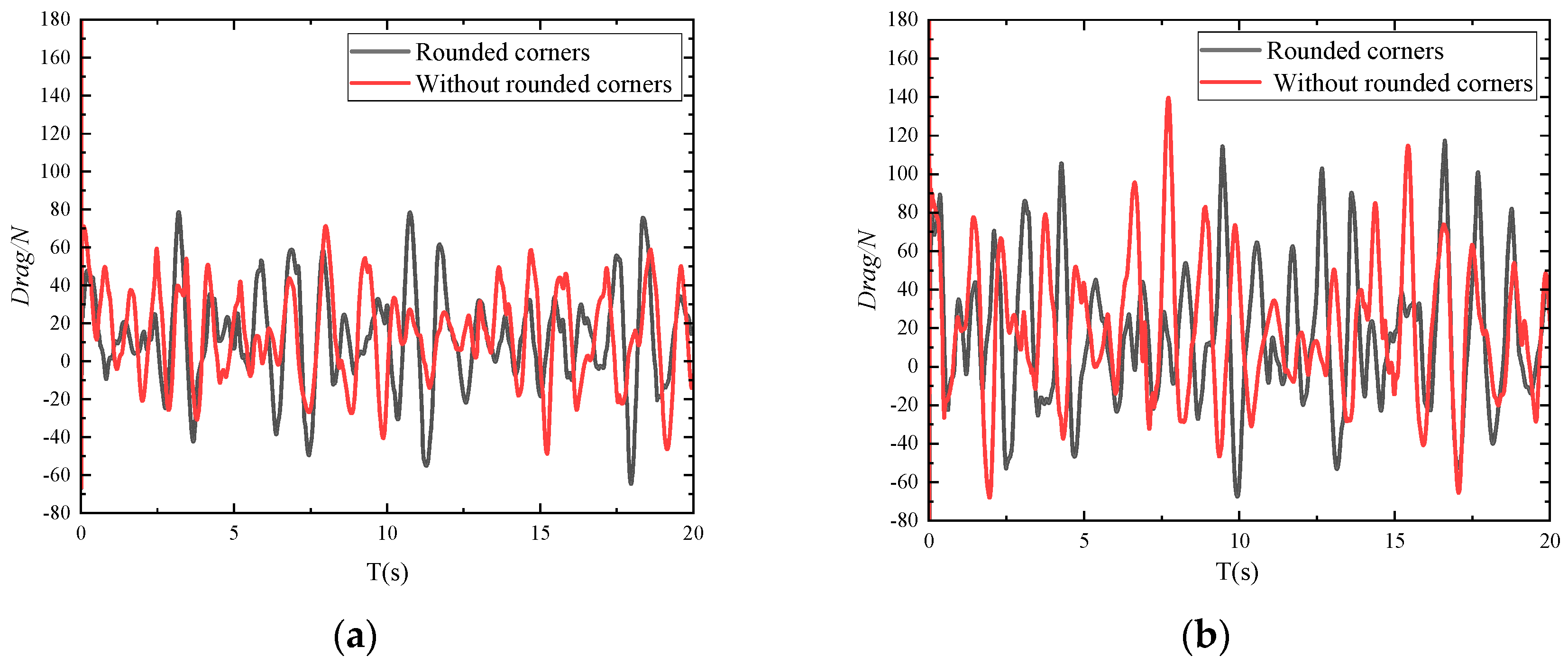
The corner optimization analysis for a moonpool-equipped drillship in calm water shows that the resistance performance is most favorable within the tested range at a bottom rounded-corner radius of 40 mm. To further evaluate its hydrodynamic performance in irregular waves, a numerical investigation on the resistance performance of the moonpool with corner optimization under irregular wave conditions is carried out. The drillships with rectangular and square moonpools are taken as the research objects. Computations are performed at a Froude number of 0.171, equivalent to a full-scale ship speed of 15 knots. The parameters for the irregular waves are maintained constant, with an incident wave height of 0.102 m and a wave period of 1.54 s, while the irregular waves are generated using the Pierson–Moskowitz spectrum. Figure 20 presents the resistance time histories for the four hull configurations: rectangular and square moonpools, with and without rounded corners.
To more clearly distinguish the resistance levels of the rectangular- and square-moonpool drillships with and without rounded corners, their mean resistance values are calculated, and the numerical results are presented in Table 11. As can be seen from Table 10, the rounded corners of the moonpool can effectively reduce the resistance of the drillship. The average resistance of the rectangular-moonpool drillship with rounded corners is reduced by 11.76% compared to its counterpart without rounded corners. Introducing rounded corners yields a 9.9% reduction in average resistance for the square-moonpool configuration. Moreover, the rectangular-moonpool drillship with rounded corners outperforms its square counterpart in resistance performance. Furthermore, the resistance performance of the rectangular-moonpool drillship with rounded corners outperforms that of the square-moonpool drillship with rounded corners.

6.4. Analysis of Motion Responses with Moonpool Corner Optimization in Irregular Waves

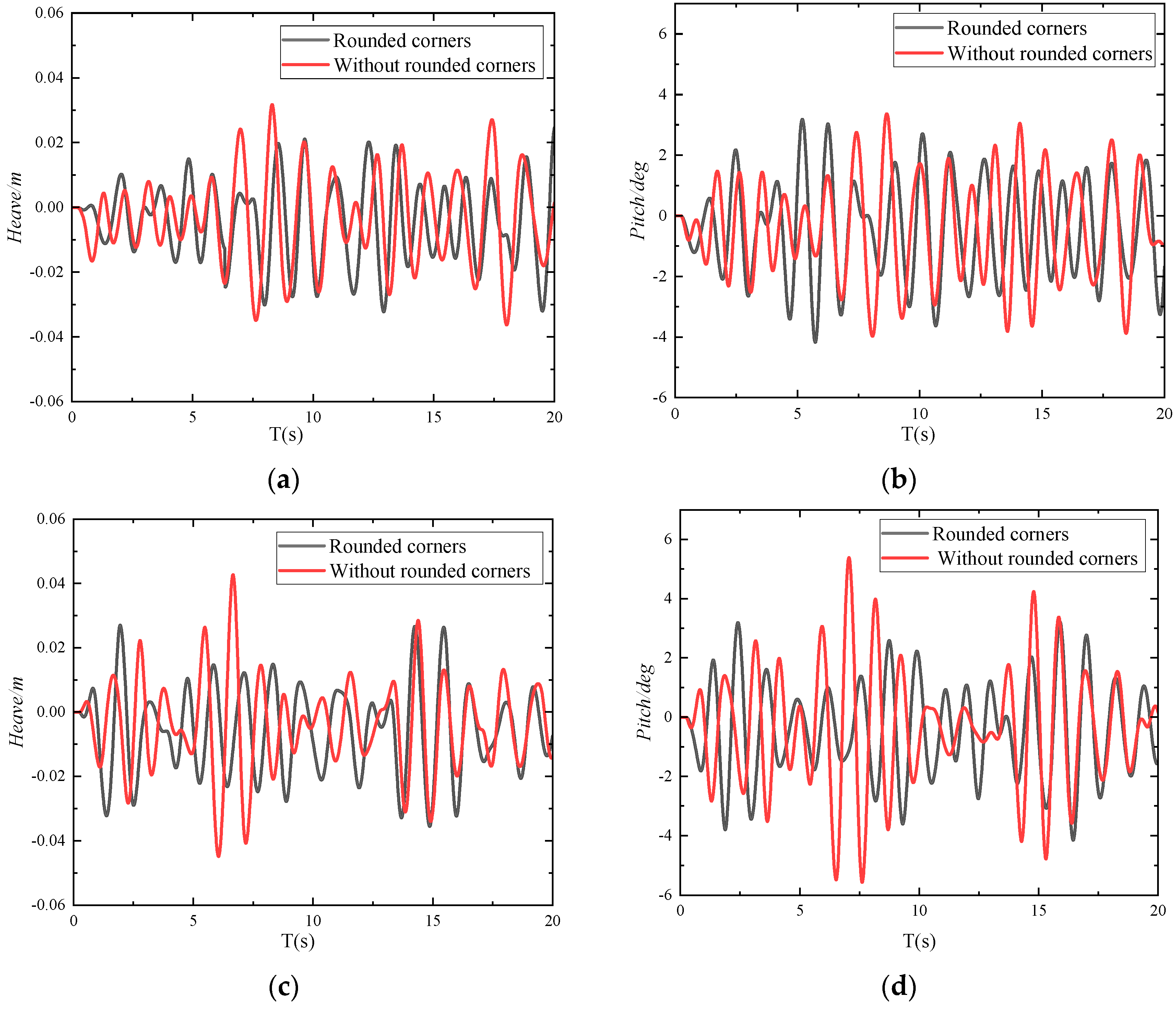
A rounded-corner radius of 40 mm at the bottom of the moonpool is selected and is kept unchanged to investigate the motion characteristics of the rectangular- and square-moonpool drillships with and without rounded corners in irregular waves, so as to further evaluate their hydrodynamic performance. Figure 21 presents a comparison of the heave and pitch time histories for the rectangular- and square-moonpool drillships, both with and without rounded corners. As can be seen from Figure 21, after rounded corners are introduced at the bottom of the moonpool, the amplitudes of both heave and pitch responses of the drillships are significantly reduced. This is because the rounded corners at the bottom of the moonpool suppress flow separation and vortex shedding at the sharp corners of the moonpool, thereby weakening the reaction forces on the hull induced by unsteady pressure fluctuations and reducing the motion excitation input.
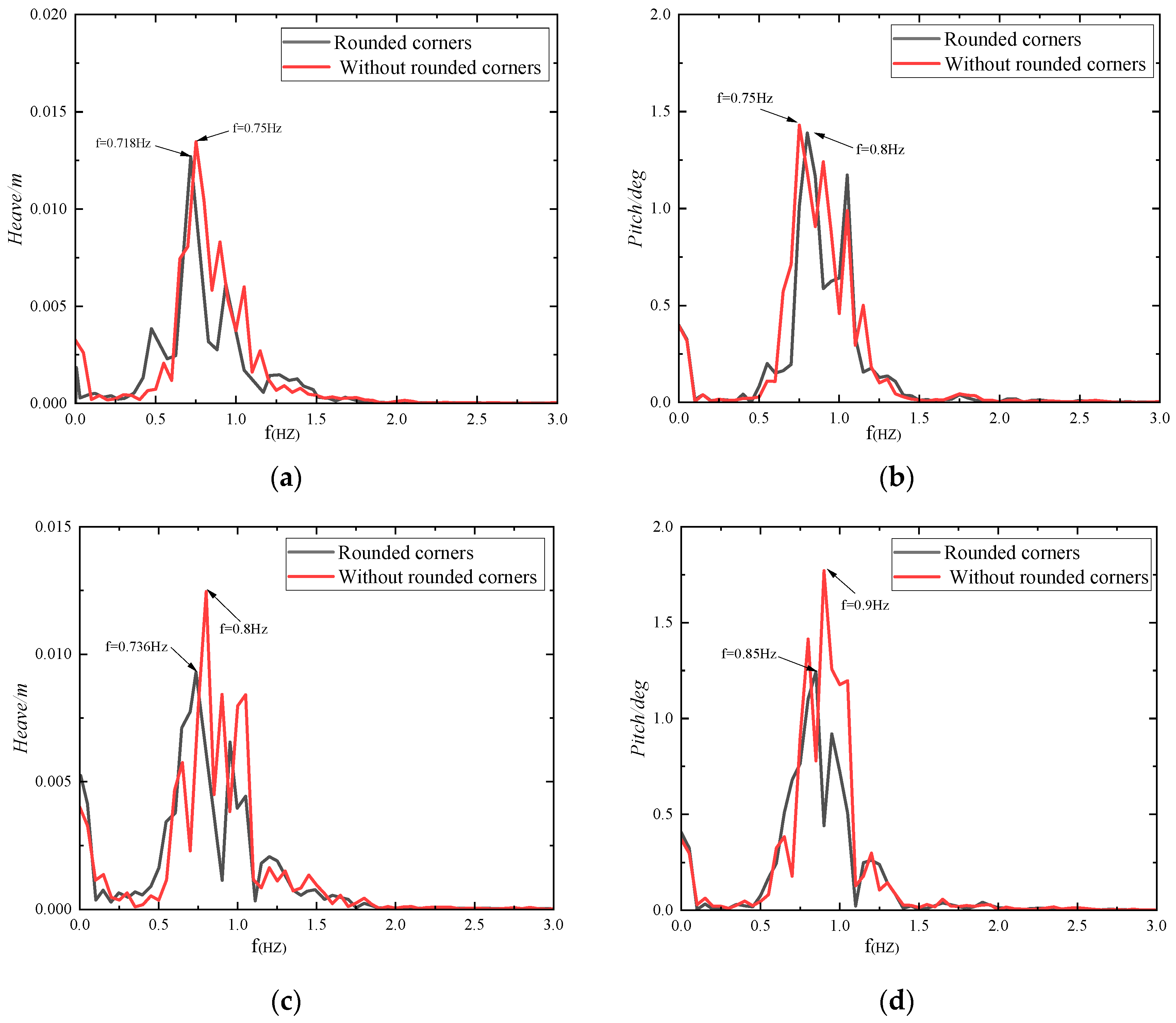
To reveal the distribution characteristics of motion energy over different frequency ranges, the above time-history curves are transformed into the frequency domain by the Fourier transform. The resulting frequency spectra of heave and pitch motions for the rectangular- and square-moonpool drillships with and without rounded corners are shown in Figure 22. As can be seen from Figure 22, the amplitudes of the heave and pitch frequency-response curves for the rectangular- and square-moonpool drillships with rounded corners are clearly smaller than those of the corresponding drillships without rounded corners. Moreover, the dominant peak frequency of heave shows an evident shift toward higher frequencies compared with that of the drillship without rounded corners, while a similar peak shift is also observed in the pitch motion, although it is not entirely a forward shift. The numerical results indicate that an appropriate rounded-corner radius at the bottom of the moonpool can effectively reduce the amplitudes of heave and pitch motions, alter the natural frequencies of the moonpool drillship, and improve its hydrodynamic performance.

7. Conclusions

A three-dimensional numerical wave tank is developed using computational fluid dynamics (CFD), and validation work is performed focusing on irregular waves and wave-structure interaction. On this basis, the selection of drillships with relatively favorable hydrodynamic performance among different moonpool configurations under calm-water navigation conditions is investigated, followed by the study of the motion response characteristics of rectangular- and square-moonpool drillships under irregular wave conditions. For drag-reduction purposes, rounded corners are added to the bottom of the moonpool in both the rectangular and square configurations of the drillship for optimization. Combined with the analyses of resistance performance and motion responses of the rectangular- and square-moonpool drillships with rounded-corner optimization in irregular waves, the numerical results are compared, and the following conclusions are obtained:
(1)
A three-dimensional numerical wave tank is established to verify the accuracy of hydrodynamic performance prediction for irregular waves and the interaction between irregular waves and structures. The numerical results show that the simulated irregular waves are in good agreement with the theoretical values, with relatively high accuracy. In addition, the motion responses of the semi-submersible drilling platform under irregular wave conditions agree well with the experimental results, indicating that the CFD-based method is feasible and accurate for predicting the hydrodynamic performance of the interaction between irregular waves and structures.
(2)
This study numerically investigates the calm-water hydrodynamics of drillships with different moonpool geometries. The results indicate that the moonpool produces a significant drag-increase effect, and the drag-increase effect varies with the moonpool shape. The moonpool-induced drag increase mainly originates from the added residual resistance. Compared with the other moonpool design schemes, the rectangular-moonpool and square-moonpool drillships show better performance in reducing the added resistance.
(3)
The hydrodynamic performance of drillships featuring rectangular and square moonpools under irregular wave conditions is numerically investigated. Numerical results reveal that irregular waves impose a more pronounced influence on the hydrodynamic characteristics of the square-moonpool drillship relative to the rectangular-moonpool drillship. In comparison with a drillship without a moonpool, the introduction of a moonpool leads to a significant increase in resistance amplitude, with the square-moonpool drillship exhibiting the maximum amplitude. Moreover, the presence of a moonpool further amplifies heave and pitch responses, with a more prominent effect observed on pitch motion. Additionally, the integration of a moonpool modifies the natural frequency of the moonpool-equipped drillship, thereby altering its motion response characteristics.
(4)
The mechanism of the rounded-corner optimization model is numerically investigated. By introducing different bottom rounded-corner radii, the resistance performance of the rectangular- and square-moonpool drillships under calm-water navigation conditions is predicted. The results show that, with the increase in the bottom rounded-corner radius of the moonpool, the total resistance of both the rectangular- and square-moonpool drillships decreases significantly. An appropriate bottom-rounded-corner radius can reduce the resistance of the moonpool drillship. Among the cases considered in this study, the configuration with a bottom rounded-corner radius of 40 mm shows the best overall performance. Moreover, the bottom rounded-corner radius obtained in the present study is determined at the model scale and can be converted to the full-scale value according to the scale ratio. It is expected that this design can also produce a significant drag-reduction effect for full-scale moonpool drillships, thereby offering practical value for engineering design.
(5)
The superiority of the selected bottom-rounded-corner optimization model is numerically validated. Combined with the cases without rounded corners, analyses of the resistance performance and motion responses of the rectangular- and square-moonpool drillships with rounded-corner optimization under irregular wave conditions are carried out. The results show that introducing rounded corners at the bottom of the moonpool can effectively reduce the resistance of the moonpool drillship, and the rectangular-moonpool drillship with rounded corners exhibits better resistance performance than the corresponding square-moonpool drillship with rounded corners. Moreover, the rounded corners at the bottom of the moonpool can effectively reduce the amplitudes of heave and pitch motions, alter the natural frequency of the moonpool drillship, and improve its hydrodynamic performance.
(6)
Based on the research presented in this paper, the quantitative impact of moonpool shape and rounded-corner optimization on the resistance and motion response of a drillship has been clarified. The proposed 40 mm rounded-corner optimization scheme provides a direct theoretical basis and design guidance for the engineering drag reduction design, motion performance enhancement, and operational safety assessment of drillships with moonpools, demonstrating clear engineering application value for practical ship design and optimization.

Author Contributions

Conceptualization, J.H. and J.W.; Methodology, J.H., Z.Z. and C.S.; Software, Z.Z. and C.S.; Validation, Z.Z. and C.S.; Formal analysis, Z.Z., C.S. and X.Y.; Investigation, J.H. and Z.Z.; Resources, J.W., X.Y. and D.Z.; Data curation, C.S. and X.Y.; Writing—original draft, J.H.; Writing—review & editing, J.W. and D.Z.; Visualization, J.W., X.Y. and D.Z.; Supervision, X.Y. and D.Z.; Project administration, J.H. and D.Z.; Funding acquisition, J.H. and J.W. All authors have read and agreed to the published version of the manuscript.

Funding

This research was funded by the National Natural Science Foundation of China (Grant Nos. 52401380 and 52301321), and the Natural Science Foundation of Jiangsu Province of China (Grant Nos. BK20220652 and BK20251030).

Data Availability Statement

Data is contained within the article.

Conflicts of Interest

The authors declare no conflicts of interest.

References

  1. Cheng, X.K.; Zhou, G.P.; Zhang, Y.X.; Zhang, J. Numerical simulation research of moonpools effect in model scale on ship resistance. J. Ship Mech. 2020, 24, 589–598. [Google Scholar] [CrossRef]
  2. Xu, X.; Zhang, X.; Chu, B.; Huang, H. On natural frequencies of three-dimensional moonpool of vessels in the fixed and free-floating conditions. Ocean Eng. 2020, 195, 106656. [Google Scholar] [CrossRef]
  3. Duan, F.; Ma, N.; Zhang, L.J.; Cao, K.; Zhang, Q. Research on the influence of the moonpool scale effect on the navigation resistance of drilling ships. J. Ship Mech. 2020, 24, 1253–1260. [Google Scholar] [CrossRef]
  4. Zhang, X.; Li, Z. Natural frequencies and modal shapes of three-dimensional moonpool with recess in infinite-depth and finite-depth waters. Appl. Ocean. Res. 2022, 118, 102921. [Google Scholar] [CrossRef]
  5. Shi, C.; Lyu, H.N.; Yang, J.M. Nonlinear resonance characteristics of a rectangular moonpool with stairways in a deep sea drilling ship. J. Ship Mech. 2021, 25, 311–320. [Google Scholar] [CrossRef]
  6. Peng, N.N.; Chow, K.W. A numerical wave tank with large eddy simulation for wave breaking. Ocean. Eng. 2022, 266, 112555. [Google Scholar] [CrossRef]
  7. Han, J.; Zhang, X.; Chen, J.; Li, Z. On coupled hydrodynamic responses of three-dimensional cylindrical moonpools. Ocean. Eng. 2024, 294, 116769. [Google Scholar] [CrossRef]
  8. Zhang, X.; Zhang, X.; Chen, C.; Chang, X.; Zhang, Y. Numerical simulation of effective wake field and propulsion performance in a ship with moonpool. Ocean. Eng. 2025, 323, 120589. [Google Scholar] [CrossRef]
  9. Zhao, Z.; Zou, L.; Jin, G.Q.; Sun, J.Z.; Yu, Z.B.; Sun, Z. Numerical investigation of coupled responses of a mining vessel and moonpool in regular and irregular waves with varying moonpool aspect ratios using SPH. Ocean. Eng. 2025, 339, 122162. [Google Scholar] [CrossRef]
  10. Chu, B.; Zhang, X.S.; Zhang, Y. Effects of nonlinearity and viscous damping on the resonant responses in two-dimensional moonpools with a recess. Appl. Ocean. Res. 2022, 127, 103295. [Google Scholar] [CrossRef]
  11. Ravinthrakumar, S.; Kristiansen, T.; Molin, B.; Ommani, B. Coupled vessel and moonpool responses in regular and irregular waves. Appl. Ocean. Res. 2020, 96, 102010. [Google Scholar] [CrossRef]
  12. Huang, X.H.; Xiao, W.; Yao, X.L.; Liu, Y.; Wang, L. An experimental investigation of reduction effect of damping devices in the rectangular moonpool. Ocean. Eng. 2020, 196, 106767. [Google Scholar] [CrossRef]
  13. Liu, Z.; He, J.; Meng, Y.; Zhang, H.; Zhou, Y.; Tao, L. Numerical and experimental study on the influence of a moonpool on motion performance and stability of a drillship. Ocean Eng. 2022, 262, 112241. [Google Scholar] [CrossRef]
  14. Liu, H.; Jiang, S.C.; Ran, Y.Q.; Zhang, M.; Zhou, W. Experimental and numerical investigations on fluid resonance in moonpool affected by the side wall reflection. Ocean. Eng. 2025, 317, 119750. [Google Scholar] [CrossRef]
  15. Liu, Y.; Li, H.; Zhou, X.; Wang, Y.; Chen, L. The influence of an annular moonpool on towing resistance of a separated polar ocean nuclear energy platform. Ocean. Eng. 2022, 266, 112913. [Google Scholar] [CrossRef]
  16. Garad, S.; Kumar, S.; Bhattacharyya, A.; Bhowmick, S.; Chaudhuri, S. Multiple moonpools within a vessel free to heave and pitch: An experimental study. Appl. Ocean. Res. 2024, 147, 103963. [Google Scholar] [CrossRef]
  17. Lu, Y.; Cao, X.; Wu, J.; Peng, X.; An, L.; Liu, S. Research on Optimization Design of Ice-Class Ship Form Based on Actual Sea Conditions. J. Mar. Sci. Eng. 2025, 13, 1320. [Google Scholar] [CrossRef]
  18. Tang, P.; Lin, X.; Wang, W.; Zhang, H. Numerical Simulation of Hydrodynamic Performance of an Offshore Oscillating Water Column Wave Energy Converter Device. J. Mar. Sci. Eng. 2024, 12, 2289. [Google Scholar] [CrossRef]
  19. Ruan, X.; Qian, H.; Dai, J.; Fan, F.; Niu, S. Numerical Study on the Wave Attenuation Performance of a Novel Partial T Special-Type Floating Breakwater. J. Mar. Sci. Eng. 2024, 12, 2269. [Google Scholar] [CrossRef]
  20. Zeng, Z.H.; Deng, X.X.; Sun, L. Effect analysis of thick plate structure on heave motion of ship with moonpool in waves. Chin. J. Ship Res. 2020, 15, 20–33. [Google Scholar] [CrossRef]
  21. Zhang, X.; Sun, L.; Sun, C.; Liu, H.; Yang, Y. Study on the influence of the moonpool on the smooth water resistance performance of the ship. Ocean. Eng. 2021, 237, 109590. [Google Scholar] [CrossRef]
  22. Machado, L.D.V.; Fernandes, A.C. Moonpool dimensions and position optimization with genetic algorithm of a drillship in random seas. Ocean. Eng. 2022, 247, 110561. [Google Scholar] [CrossRef]
  23. Yao, Z.; Li, D.J.; Xu, G.; Ma, Y. Experimental study of drillship resistance performance in open and closed state of moonpool. Chin. J. Ship Res. 2023, 18, 176–183. [Google Scholar] [CrossRef]
  24. Mavrakos, A.S.; Konispoliatis, D.N.; Ntouras, D.G.; Papadakis, G.P.; Mavrakos, S.A. Hydrodynamic coefficients in heave of a moonpool-type floater using theoretical, numerical and CFD methodologies. Ocean. Eng. 2023, 279, 114519. [Google Scholar] [CrossRef]
  25. Sun, J.Y.; Sun, S.L.; Sun, S.Z.; Li, Y.H.; Wang, J. The impact of piston and sloshing motions on added resistance from moonpool configurations. Ocean. Eng. 2023, 267, 113179. [Google Scholar] [CrossRef]
  26. Wei, Q.; Gu, J.Y.; Lyu, H.G.; Zhang, H.; Wu, Y. Experimental study on the influence of fluid motion on hull resistance in stepped moonpool. Ocean. Eng. 2023, 286, 115508. [Google Scholar] [CrossRef]
  27. Li, Y.; Shi, Z.; Yang, H.; Liu, J.; Zhao, L. Motion responses optimal design of semi-submersible platform equipped with a hollow moonpool based on CFD. Ocean. Eng. 2024, 311, 119010. [Google Scholar] [CrossRef]
  28. Hu, J.; Song, C.; Deng, J.; Wang, J.; Zhao, X.; Zhang, D. Research on hydrodynamic characteristics and drag reduction optimization of drillships with moonpools. J. Mar. Sci. Eng. 2026, 14, 215. [Google Scholar] [CrossRef]
  29. Chorin, A.J. A numerical method for solving incompressible viscous flow problems. J. Comput. Phys. 1967, 2, 12–26. [Google Scholar] [CrossRef]
  30. Versteeg, H.K.; Malalasekera, W. An Introduction to Computation Fluid Dynamics: The Finite Volume Method; Wigley: New York, NY, USA, 1995. [Google Scholar]
  31. Turkyilmazoglu, M.; Alotaibi, A. Sharp Interface Establishment through Slippery Fluid in Steady Exchange Flows under Stratification. Cmes-Comput. Model. Eng. Sci. 2025, 143, 2847–2865. [Google Scholar] [CrossRef]
  32. Menrer, F.R.; Kuntz, M.; Langtry, R. Ten years of industrial experience with the SST turbulence model. Turbul. Heat Mass Transf. 2003, 4, 35–42. [Google Scholar]
  33. Wilcos, D.C. Multi Scale Model for Turbulence Flows Aerospace Sciences Meeting of AIAA; American Institute of Aeronautics and Astronautics: Reston, VA, USA, 1986. [Google Scholar]
  34. Hirt, C.W.; Nichols, B.D. Volume of fluid (VOF) method for the dynamics of free boundaries. J. Comput. Phys. 1981, 39, 201–225. [Google Scholar] [CrossRef]
  35. Zhang, C.; Magee, A.R. Effectiveness of floating breakwater in special configurations for protecting nearshore infrastructures. J. Mar. Sci. Eng. 2021, 9, 785. [Google Scholar] [CrossRef]
  36. Liu, Y. Hydroelastic Response of Large Floating Structure in Nonlinear Waves. Master’s Thesis, Jiangsu University of Science and Technology, Zhenjiang, China, 2020. [Google Scholar]
  37. Wei, Q.Q. Analysis and Prediction of Motion Responses of a Semi-Submersible Platform Based on Deep Learning. Master’s Thesis, Shanghai Jiao Tong University, Shanghai, China, 2021. [Google Scholar]
  38. Lu, Y.Y.; Chen, Z.T.; Li, D.Q. Research on the mechanism of moonpool resistance increase during the navigation of double moonpool drilling ship. Ship Sci. Technol. 2025, 47, 37–42. [Google Scholar]
  39. Gu, J.Y.; Mao, P.S.; Tao, Y.W.; Zhang, Z.Y. Flow Field Characteristics of the Drilling Ship Moonpool under Navigation Condition. Ship Eng. 2021, 43, 49–56+113. [Google Scholar] [CrossRef]
Figure 1. Mesh discretization and boundary condition setup of the computational domain.
Jmse 14 00890 g001
Figure 2. Schematic showing the arrangement of wave height monitoring points.
Jmse 14 00890 g002
Figure 3. Time−history curves of wave elevations at various monitoring locations (a) M1 = 5 m; (b) M2 = 10 m.
Jmse 14 00890 g003
Figure 4. Mesh model of the semi-submersible drilling platform.
Jmse 14 00890 g004
Figure 5. Experimental model of the semi-submersible drilling platform.
Jmse 14 00890 g005
Figure 6. Heave response of the Lingshui 17−2 semi-submersible platform.
Jmse 14 00890 g006
Figure 7. Four moonpool geometries implemented on the drillship model: (a) rectangular; (b) square; (c) circular; (d) elliptical.
Jmse 14 00890 g007
Figure 8. Hull surface mesh of the rectangular moonpool drillship.
Jmse 14 00890 g008
Figure 9. Local mesh refinement in the longitudinal section of the computational domain for the rectangular moonpool drillship.
Jmse 14 00890 g009
Figure 10. Computational domain dimensions and boundary condition configurations.
Jmse 14 00890 g010
Figure 11. Total resistance curves of the drillship with and without moonpool configurations.
Jmse 14 00890 g011
Figure 12. Added resistance components for different moonpool configurations: (a) total; (b) residual; (c) frictional.
Jmse 14 00890 g012
Figure 13. Time histories of resistance for the drillships without a moonpool, with a rectangular moonpool, and with a square moonpool: (a) wave heading angle 0°; (b) wave heading angle 45°.
Jmse 14 00890 g013
Figure 14. Resistance frequency spectrum: (a) wave heading angle 0°; (b) wave heading angle 45°.
Jmse 14 00890 g014
Figure 15. Time histories of heave motion (a) wave heading angle 0°; (b) wave heading angle 45°.
Jmse 14 00890 g015
Figure 16. Time histories of pitch motion (a) wave heading angle 0°; (b) wave heading angle 45°.
Jmse 14 00890 g016
Figure 17. Frequency spectrum of heave motion (a) wave heading angle 0°; (b) wave heading angle 45°.
Jmse 14 00890 g017
Figure 18. Frequency spectrum of pitch motion (a) wave heading angle 0°; (b) wave heading angle 45°.
Jmse 14 00890 g018
Figure 19. Schematic diagram of the bottom rounded corners of the rectangular-moonpool drillship: (a) 30 mm; (b) 35 mm; (c) 40 mm.
Jmse 14 00890 g019
Figure 20. Time histories of resistance for the rectangular- and square-moonpool drillships with and without rounded corners: (a) rectangular moonpool; (b) square moonpool.
Jmse 14 00890 g020
Figure 21. Time histories of heave and pitch motions for the rectangular- and square-moonpool drillships with and without rounded corners: (a) time histories of heave motion for rectangular-moonpool drillships; (b) time histories of pitch motion for rectangular-moonpool drillships; (c) time histories of heave motion for square-moonpool drillships; (d) time histories of pitch motion for square-moonpool drillships.
Jmse 14 00890 g021
Figure 22. Frequency spectra of heave and pitch motions for the rectangular- and square-moonpool drillships with and without rounded corners: (a) frequency spectra of heave motion for rectangular-moonpool drillships; (b) frequency spectra of pitch motion for rectangular-moonpool drillships; (c) frequency spectra of heave motion for square-moonpool drillships; (d) frequency spectra of pitch motion for square-moonpool drillships.
Jmse 14 00890 g022
Table 1. Turbulence model constants.
Parametersβ* α 1 β 1 σ k 1 σ ω 1 α 2 β 2 σ k 2 σ ω 2
Value0.090.5550.0750.850.50.440.08310.856
Table 2. Irregular wave parameters.
Wave ModelWave SpectrumA (m)T (s)
Irregular wavesPierson–Moskowitz0.051 m1.54 s
Table 3. Wave parameters.
Wave TypeSignificant Wave Height (m)Peak Period (s)Wave Heading
Angle (°)
Irregular waves13.414.7
Table 4. Model parameters of the Lingshui 17-2 semi-submersible platform.
Model ParametersFull-Scale Ship
Dimensions (m)
Model-Scale
Dimensions (m)
Draft370.617
Freeboard220.367
Molded breadth91.51.525
Column spacing70.51.175
Column width210.35
Column height590.983
Pontoon height90.15
Pontoon width210.35
Pontoon length49.50.825
Main deck height70.51.175
Table 5. Principal particulars of the drillship.
ParticularsModel ScaleFull Scale
Length overall (m)3.379216.282
Length between perpendiculars (m)3.251208
Molded breadth (m)0.50333.999
Molded depth (m)0.25816.5
Design draft (m)0.1489.5
Table 6. Geometrical parameters of different moonpool configurations.
ItemMoonpool ShapeFull-ScaleModel-Scale
1Rectangular: length × width36.03 × 12.030.563 × 0.188
2Square: side length20.80.325
3Circular: radius11.7120.183
4Elliptical: semi-major/semi-minor axis18.56/7.4240.29/0.116
Table 7. Computational cases.
Case1234
Froude number0.1370.1480.1590.171
Full-scale speed12 kn13 kn14 kn15 kn
Model-scale speed0.772 m/s0.836 m/s0.9 m/s0.965 m/s
Table 8. Computational conditions.
ConditionsValues
Froude number0.171
Speed15 kn
Wave height0.102 m
Wave heading angle0°, 45°
Table 9. Mean resistance of drillships: without moonpool, with rectangular moonpool, and with square moonpool.
Working ConditionsResistance of Drillship Without Moonpool (N)Resistance of Drillship with Rectangular Moonpool (N)Resistance of Drillship with Square Moonpool (N)
10.28814.4620.09
45°9.9612.4514.5
Calm water5.357.399.26
Table 10. Calculated total resistance results for corner optimization.
ParameterRadius (30 mm)Radius
(35 mm)
Radius
(40 mm)
Without Rounded
Total resistance of the rectangular-moonpool drillship (N)7.537.226.967.39
Total resistance of the square-moonpool drillship (N)9.829.028.869.26
Table 11. Numerical results of resistance for moonpool drillships with and without rounded corners.
Hull FormMean Resistance with Rounded Corners (N)Mean Resistance without Rounded Corners (N)
Rectangular-moonpool drillship12.7614.46
Square-moonpool drillship18.1020.09
Disclaimer/Publisher’s Note: The statements, opinions and data contained in all publications are solely those of the individual author(s) and contributor(s) and not of MDPI and/or the editor(s). MDPI and/or the editor(s) disclaim responsibility for any injury to people or property resulting from any ideas, methods, instructions or products referred to in the content.