1. Introduction
Spatially accurate emission inventories underpin decisions ranging from shore power siting to emission control zone delineation and anchorage mitigation prioritization [
1,
2]. In China, the establishment of Domestic Emission Control Areas (DECAs) since 2016, progressively tighter fuel sulfur limits, and expanding shore power mandates at major berths have sharpened the demand for inventories that correctly resolve where emissions are concentrated [
3,
4]. The quality of the resulting engineering and policy decisions cannot exceed that of the spatial evidence on which they rest.
Maritime shipping accounts for over 80% of global merchandise trade by volume, yet its environmental footprint remains a pressing concern [
5,
6]. Ship engines burning heavy fuel oil emit CO
2, NO
x, SO
x, and particulate matter at scales that measurably degrade air quality in densely populated coastal regions [
7,
8,
9,
10]. In the Yangtze River Delta, home to some of the world’s busiest port complexes, the spatial distribution of these emissions directly affects public health outcomes and regulatory priorities [
11,
12]. Ship-related PM
2.5 exposure has been associated with adverse respiratory and cardiovascular health outcomes and reduced life expectancy in coastal populations [
12,
13], underscoring the need to correctly locate emission sources for health-oriented assessment. Vessel emission rates further depend strongly on operational mode: the transition from open-sea cruising to port approach, anchorage, and berthing involves frequent engine load changes, slow-steaming, maneuvering with main-engine reversals, and extended hotelling on auxiliary engines—all of which yield emission factors that differ substantially from those of steady cruising [
14,
15]. Resolving where in the coastal domain each mode dominates is therefore a prerequisite for accurate emission attribution.
Bottom-up approaches leveraging Automatic Identification System (AIS) data have become the standard methodology for spatially explicit emission inventories [
16,
17]. Combining AIS-derived vessel activity—position, speed, and vessel type—with emission factor frameworks such as the Ship Traffic Emission Assessment Model (STEAM) [
15,
18], researchers have produced inventories spanning individual ports to the global ocean [
19,
20]. Emission factors for main engines, auxiliary engines, and boilers have been progressively refined to account for fuel type, engine load, and operational mode [
21,
22], while AIS preprocessing methods—trajectory interpolation and anomalous record removal—have likewise matured [
23,
24,
25].
Regional inventories for Chinese coastal waters have steadily improved in resolution, from early 0.1° grids toward sub-kilometer scales [
26,
27,
28]. Studies of the Pearl River Delta, the Yangtze River Delta, and inland waterways have highlighted the importance of distinguishing vessel type and operational mode in spatial attribution [
29,
30,
31]; parallel European work has achieved comparable resolution at continental scale [
32]. China’s Emission Control Areas have further motivated precise spatial inventories as a basis for evaluating regulatory effectiveness [
3,
33]. Within this trajectory, the prevailing operational frontier for regional inventories remains 500 m to 1 km [
20,
27,
32]; sub-100 m work has so far been confined to focused single-port or single-berth case studies and has not been deployed across regional-scale port complexes spanning multiple morphologies. The 100 m scale adopted here therefore represents an order-of-magnitude refinement relative to current regional-frontier practice, with the explicit purpose of resolving functional zones (channels, anchorages, and berths) within rather than between grid cells.
Despite this progress, a fundamental limitation persists. Most regional inventories aggregate emissions onto grids of 500 m to 1 km [
27], a resolution at which navigation channels and anchorage zones—functionally and behaviorally distinct—are routinely collapsed into the same cell. Vessels in transit produce a continuous linear signal across many cells, causing navigation lanes to appear as dominant hotspots on coarse maps. Yet a transiting vessel passes through any given cell in minutes, whereas an anchored or hotelling vessel runs auxiliary engines continuously for hours or days [
14,
34]. The cumulative anchorage burden is therefore systematically underestimated, and the apparent dominance of navigation lanes becomes an artifact of spatial averaging. If mitigation strategies are guided by such maps, the resulting resource allocation—shore power siting and speed-restriction corridors—may be spatially misdirected. Reducing unnecessary anchorage time has been recognized as a key lever for port emission reduction [
35], yet the spatial evidence base for targeting such interventions remains limited.
Here, we construct a 100 m resolution AIS-based emission inventory for two representative coastal environments in eastern China: the Yangtze River estuary, a major estuarine port complex with distinct navigation and anchorage zones, and the Wenzhou coastal area, a smaller harbor environment characterized by narrow waterways and riverbank berthing. Operating at a resolution an order-of-magnitude finer than prevailing convention, we apply Lorenz curve and Gini coefficient analyses to quantify spatial concentration, and we show that the vast majority of theoretical emission potential is confined to a small fraction of grid cells corresponding to anchorage and berthing areas. Reaggregating the inventory to 1 km confirms that this concentration is substantially diluted by spatial averaging, revealing the apparent dominance of navigation lanes in coarse maps to be a gridding artifact. The resulting methodological framework is transferable to other port environments worldwide.
The specific objectives of this study are (i) to construct a year-long (2023) 100 m gridded ship emission inventory for two morphologically contrasting coastal regions of eastern China using a fully bottom-up STEAM-based pipeline; (ii) to quantify the spatial concentration of emissions and its dependence on inventory resolution by means of Lorenz curve and Gini coefficient analysis at 100 m and 1 km; (iii) to identify and characterize the dominant emission archetypes (transit corridors, discrete anchorages, bankside berthing strips, and riverbank traces) that emerge once the within-cell averaging of coarse grids is removed; (iv) to assess the robustness of these findings to uncertainty in auxiliary engine load assumptions through a dedicated sensitivity analysis; and (v) to derive policy implications for shore-power siting, anchorage management, and emission control zone design that follow from the resulting spatial structure.
The remainder of this paper is organized as follows.
Section 2 describes the methodological framework, including the STEAM-based emission pipeline, AIS preprocessing, spatial allocation, the Lorenz/Gini concentration analysis, the two case-study regions, and the sensitivity-analysis design.
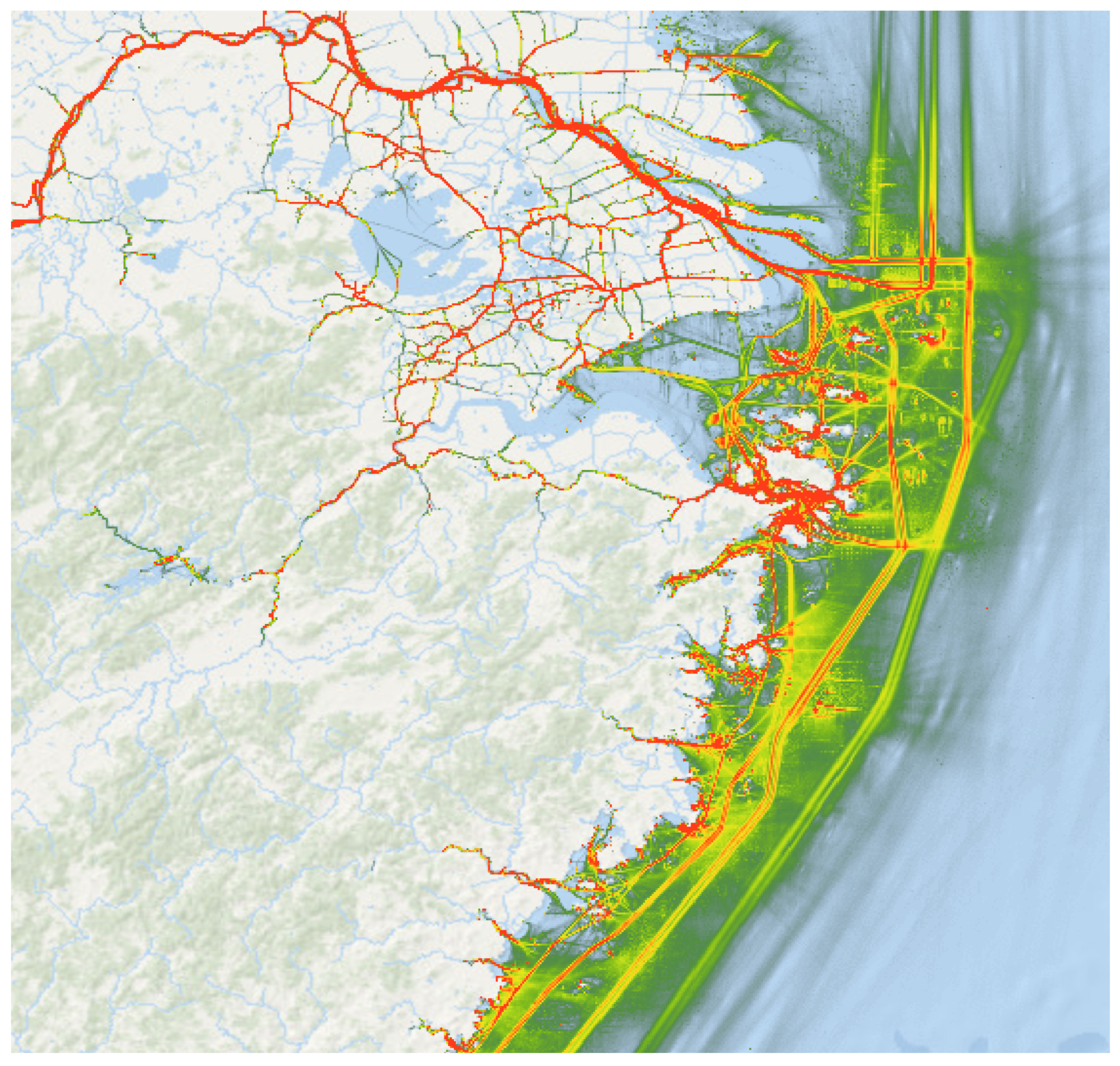
Section 3 presents the resulting 100 m inventories for the Yangtze River estuary and the Wenzhou coastal area, the resolution comparison, and the concentration analysis.
Section 4 interprets these findings, discusses counterarguments and limitations, and develops policy implications.
Section 5 summarizes the conclusions and outlines directions for future work.
2. Data and Methods
This section describes the study regions, data sources, and analytical methods. Ship emissions were estimated from AIS data using the STEAM framework and allocated to a 100 m grid, and their spatial concentration was quantified via Lorenz curve analysis.
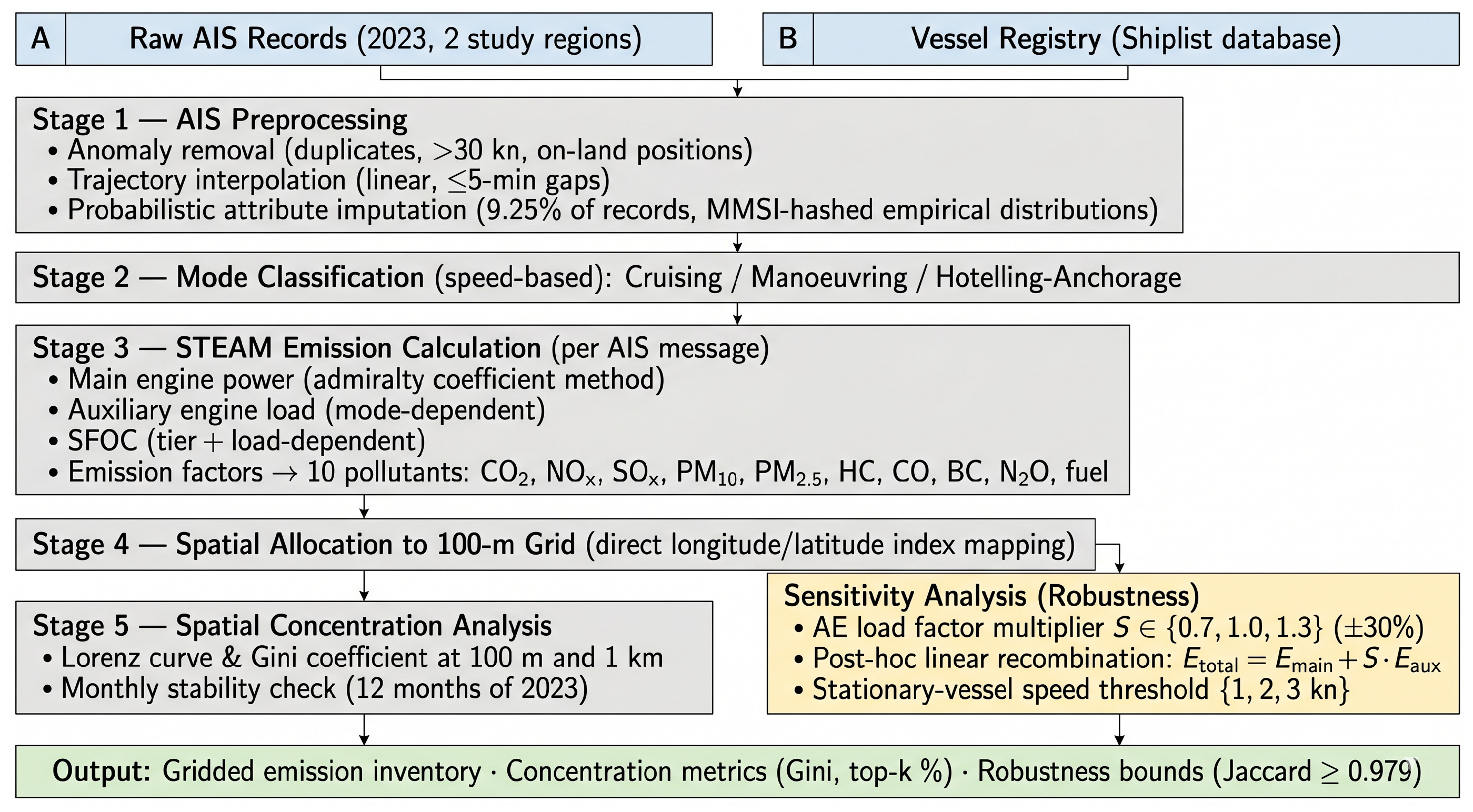
The methodological framework consists of five sequential stages, and the section is organized accordingly. Stage 1 (
Section 2.1) defines the two case-study regions. Stage 2 (
Section 2.2) describes AIS data sourcing and the three-step preprocessing pipeline (anomaly removal, trajectory interpolation, and probabilistic imputation of missing vessel attributes). Stage 3 (
Section 2.3) computes per-AIS-message emissions of ten pollutant species using the STEAM framework with separate accounting for main and auxiliary engines. Stage 4 (
Section 2.4) allocates these per-message emissions to a 100 m grid via direct index mapping. Stage 5 (
Section 2.5) quantifies the spatial concentration of the gridded inventory using Lorenz curves and the Gini coefficient at 100 m and at 1 km aggregation.
Section 2.6 then describes the sensitivity-analysis design used to evaluate robustness to auxiliary engine load assumptions.
Figure 1 provides a schematic overview of the full pipeline. The general framework is independent of the case study and is in principle transferable to any region for which AIS, vessel-registry, and emission-factor inputs are available;
Section 2.1 below specifies the regional instantiation used in this paper.
2.1. Study Area
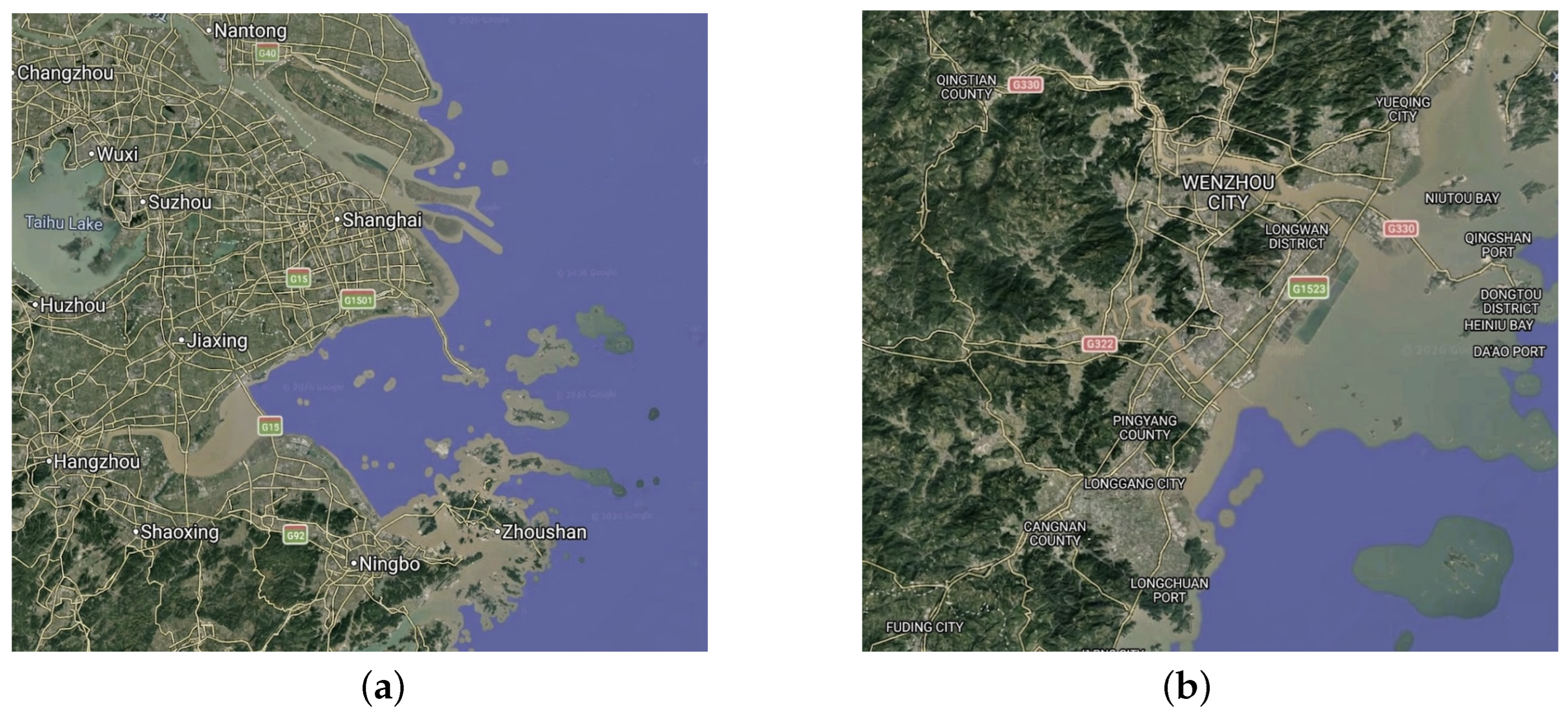
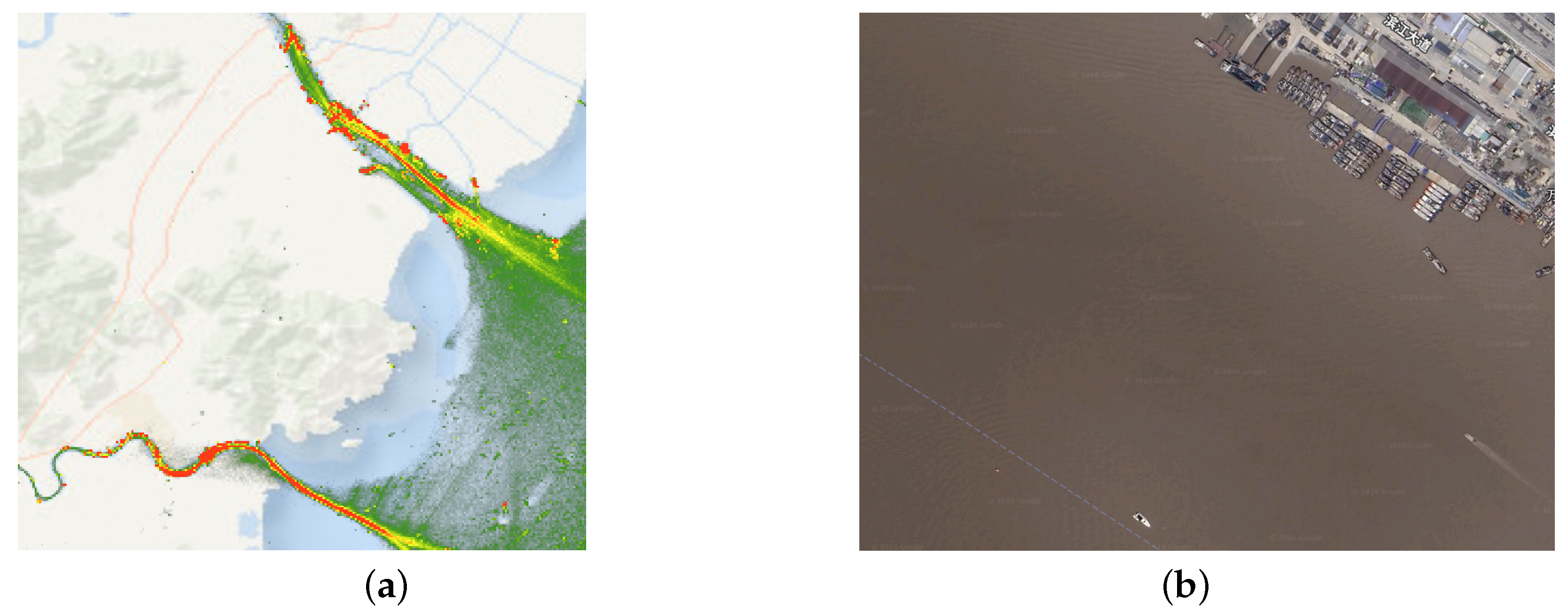
This study focuses on two coastal regions in eastern China with contrasting port morphologies (
Figure 2). The first encompasses the Yangtze River estuary and adjacent waters, extending from Nantong in the north to Ningbo in the south and incorporating three sub-areas: the Yangtze River channel, Hangzhou Bay, and the Zhoushan Archipelago. This region hosts Ningbo-Zhoushan Port and the Port of Shanghai, collectively forming the world’s largest port complex by cargo throughput. The Yangtze channel features an exceptionally wide navigable waterway, while Hangzhou Bay provides a broad open-water environment with extensive anchorage grounds.
The second region covers the Wenzhou coastal area in southern Zhejiang Province, comprising Wenzhou Port and the smaller ports of Ruian and Aojiang. Unlike the Yangtze estuary, this region is characterized by narrow tidal rivers and confined coastal waterways where navigation channels and riverbank berths lie in close proximity. The functional distinction between transit and anchorage is compressed into a much smaller geographic footprint, making it a complementary case to the large estuarine environment.
Together, these two regions represent end-member archetypes of Chinese coastal port morphology: a large, open estuarine complex dominated by major international trade and a smaller, confined coastal harbor system serving regional cargo and fishing fleets (
Figure 2).
2.2. AIS Data and Preprocessing
The AIS dataset covers the year 2023 and encompasses the two study regions. Raw AIS records were subject to a three-step preprocessing pipeline. First, anomalous records were removed, including duplicate timestamps, physically implausible speeds exceeding 30 knots, and positions falling on land. Second, trajectory gaps were filled by linear interpolation where the time interval between consecutive records did not exceed 5 min.
Third, approximately 9.25% of records contained missing vessel attribute information, including vessel type, length, and beam. For these records, a vessel-specific random seed
was generated from the MMSI number using a hash function:
where
denotes a deterministic hash function. Vessel type
was then sampled from an empirical type distribution
constructed from the Chinese and global fleet registry:
Principal dimensions (length
L and beam
B) were subsequently assigned by sampling from type-conditional distributions, where each attribute was drawn conditioned on the previously assigned attribute, following a Markov-based procedure:
This approach preserves the statistical composition of the fleet while ensuring full coverage of the emission calculation pipeline. The use of MMSI-derived deterministic seeds ensures that the same vessel is consistently assigned the same imputed attributes across all AIS messages and across months, eliminating spurious spatial heterogeneity. As discussed in
Section 2.6, the share of records requiring imputation (9.25%) and the linearity of STEAM in the imputed parameters together bound the propagated uncertainty in aggregate emissions.
2.3. Emission Calculation
Ship emissions were estimated using the Ship Traffic Emission Assessment Model (STEAM) framework [
15,
18], considering contributions from both main engines and auxiliary engines. Emissions for pollutant
p from vessel
i during time interval
are calculated as follows:
where
is the engine power (kW),
is the specific fuel oil consumption (g/kWh), and
is the emission factor for pollutant
p (g/g fuel) [
21,
22].
Equation (
4) is evaluated independently for the main engine and for the auxiliary engine of each vessel at every AIS-record time step, and the per-message contribution is the sum of the two. The pollutant set
p comprises ten species computed in parallel, CO
2, NO
x, SO
x (reported as SO
2), PM
10, PM
2.5, hydrocarbons (HCs), CO, black carbon (BC), and N
2O, together with total fuel consumption. SFOC values are tier- and category-specific. For each engine, the underlying tier (Tier 0/I/II/III, inferred from build year and engine category following IMO MARPOL Annex VI conventions) determines a baseline SFOC, which is further modulated by a load-factor-dependent multiplier that increases SFOC at low loads (a low-load correction factor activates for main-engine load factor < 0.20, following STEAM convention). Main and auxiliary engines therefore each have their own load-dependent SFOC and pollutant-specific emission factors. Sulfur-bearing pollutants (SO
x, sulfate-related PM) are scaled to a representative DECA-compliant fuel sulfur content of 0.5% m/m for 2023; differentiation among individual fuel mixes (HFO, MDO, MGO, and LNG) at the per-vessel level is not attempted in the present implementation due to the absence of fuel-record-level data, and it is discussed as a limitation in
Section 4.5.
The main engine power was estimated using the admiralty coefficient method, scaling with the cube of the speed ratio relative to design speed. For stationary vessels, defined as those with AIS-recorded speeds below 2 knots—a threshold consistent with established practice in AIS-based ship-emission inventories [
15,
18,
19]—the main engine power was set to zero, and auxiliary engine power was applied at full hotel load. We acknowledge that vessels at 1–2 knots may retain a small residual main-engine output for steerage in tidal currents; this residual contribution is small relative to the continuous auxiliary load that runs throughout the anchorage or hotelling event, and the dependence of the inventory on the precise value of this threshold is examined as part of the robustness analysis described in
Section 2.6. The resulting quantities represent theoretical emission potentials rather than verified atmospheric release, as actual emissions may differ where alternative fuels or abatement technologies are in use. The implications of this distinction for atmospheric exposure assessment are discussed explicitly in
Section 4.2, and the limitation itself is revisited in
Section 4.5.
2.4. Spatial Allocation
Vessel emissions were allocated to a 100 m × 100 m grid using a direct index mapping method. For each AIS record, the grid cell indices
were computed as
where
is the grid resolution (100 m expressed in decimal degrees), and
denotes the floor function. The integer pair
serves as a unique hash key identifying the target grid cell, enabling direct array indexing without spatial neighbor search. Emission contributions from all records mapping to the same cell were accumulated to produce the final gridded inventory.
2.5. Spatial Concentration Analysis
To quantify the degree of spatial concentration in the gridded emission inventory, a Lorenz curve analysis was performed. All
N grid cells with non-zero emission values were ranked by emission intensity in ascending order, and cumulative shares of cells and emissions were computed. The Gini coefficient
G was calculated as follows:
where
is the emission value of the
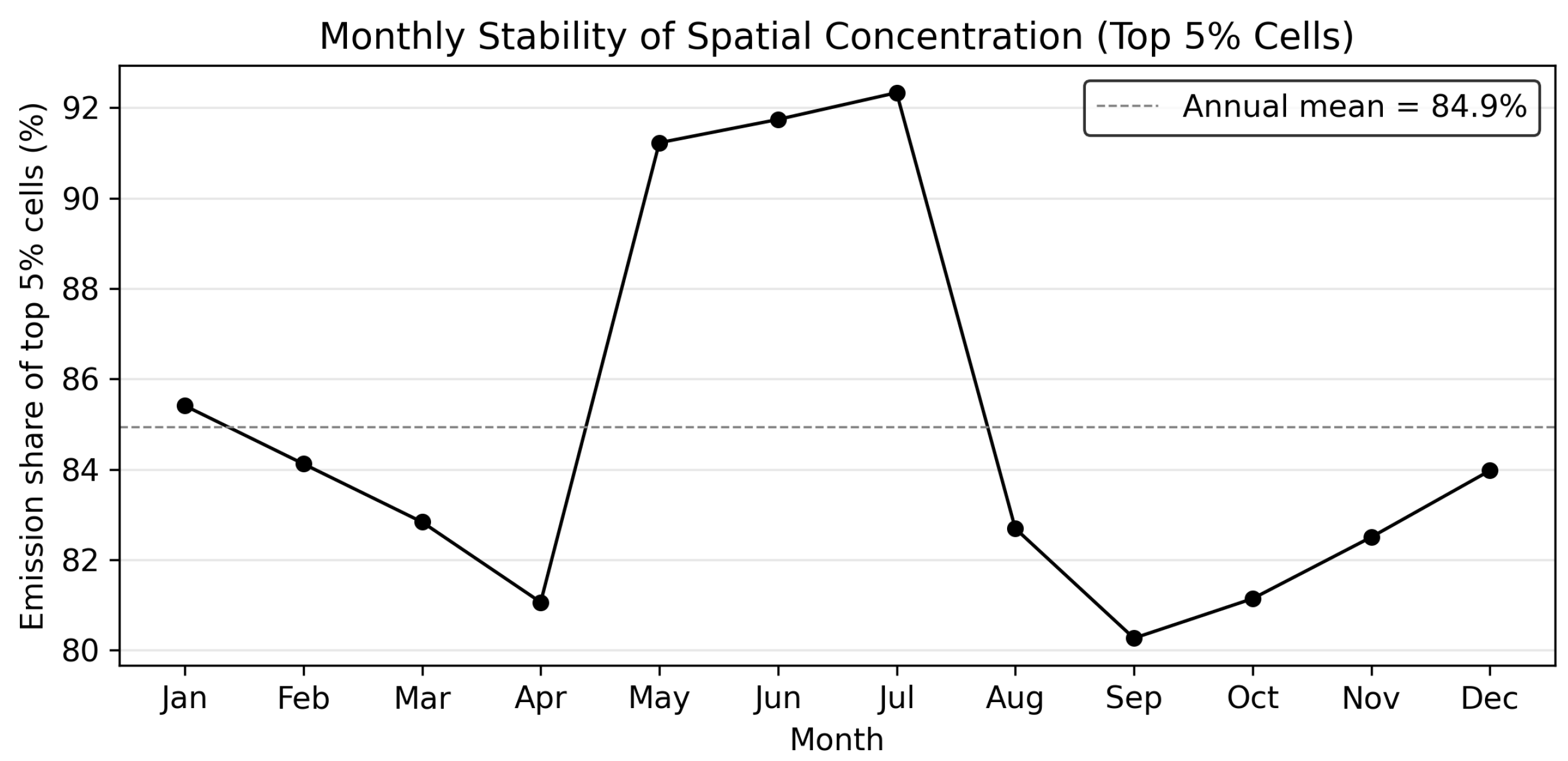
i-th cell in the ranked sequence. A Gini coefficient of 0 indicates perfectly uniform distribution across all cells, while a value approaching 1 indicates extreme concentration in a small number of cells. To evaluate the effect of spatial resolution on observed concentration, the 100 m inventory was aggregated to 1 km by summing each 10 × 10 block of cells, and the analysis was repeated at a coarser resolution. Monthly stability was assessed by applying the same procedure independently to each of the twelve monthly inventories for 2023.
The per-cell quantity used for the concentration analysis is the cumulative AIS-derived ship activity intensity, which functions as a direct spatial proxy for the theoretical emission potential. Under the STEAM framework, cell-level emission for any pollutant is the integral of
over the AIS-message residence time within the cell (Equation (
4)); for any given fleet composition, this quantity is monotonic in cumulative activity intensity, so the spatial concentration of activity intensity (Gini coefficient, top-
k% contribution share) is the same as the spatial concentration of theoretical emissions with respect to within the cell-level variations in fleet composition.
Section 3.5 reports the same concentration analysis carried out directly on the CO
2 emission grid as a cross-check; the two metrics yield essentially identical Gini and top-5% values, confirming that the activity-intensity proxy and the direct CO
2 metric coincide on the property of interest. The relative invariance of concentration metrics across STEAM-derived pollutants follows from the same argument: pollutants differ from CO
2 only by approximately constant per-engine multiplicative factors, and both the Gini coefficient and the top-
k% contribution share are invariant under linear scaling of cell values, so the concentration is reported once and applies to all STEAM pollutants.
2.6. Robustness Considerations
To assess the sensitivity of the inventory to the most uncertain parametric assumption identified in
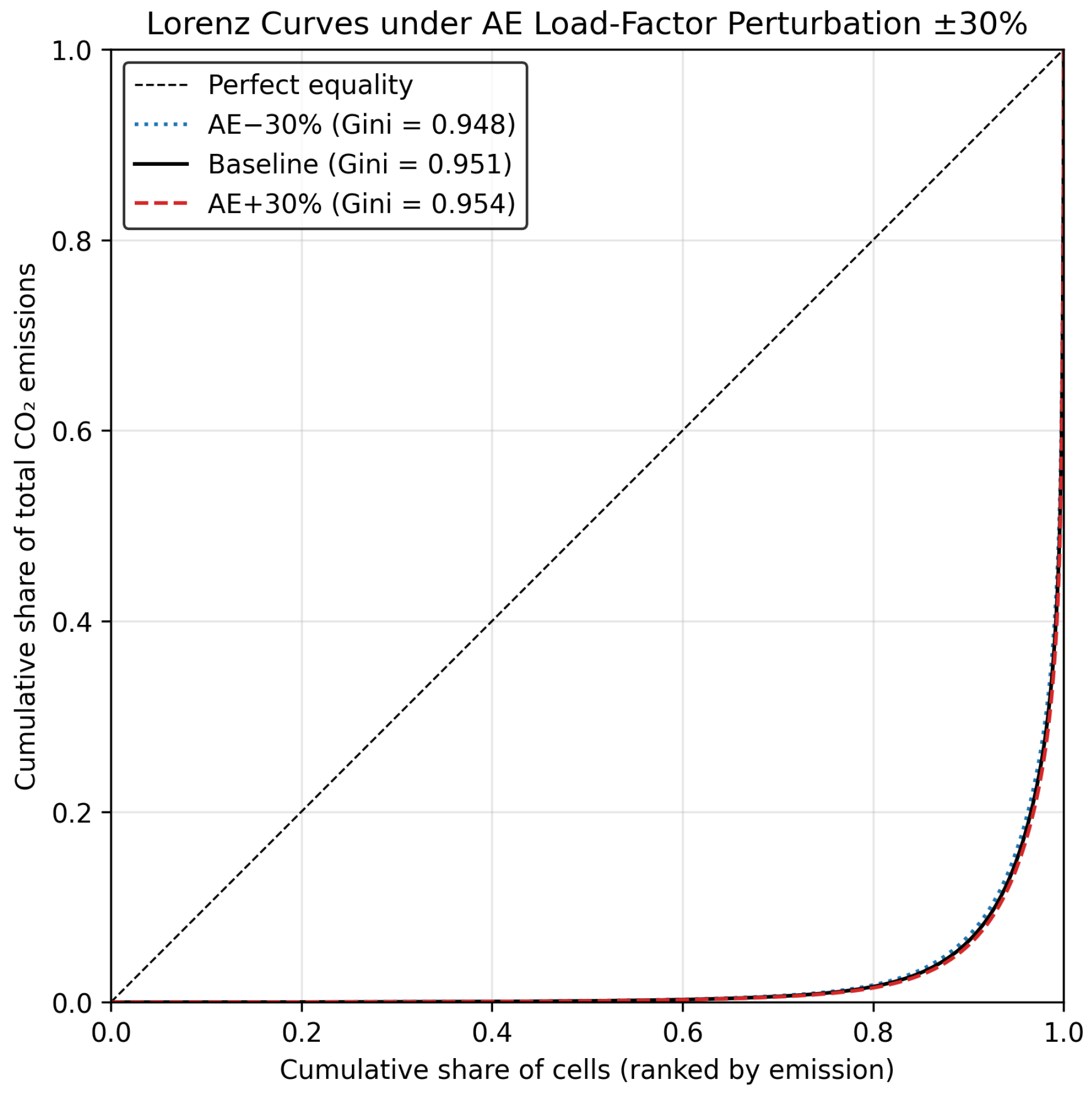
Section 2.3—the auxiliary engine (AE) load factor—a global scaling perturbation experiment was performed. A multiplier
was applied to the AE load factor returned by the STEAM mode-classification routine, corresponding to a ±30% perturbation of canonical Jalkanen-style AE load brackets [
15,
18]. Because STEAM emissions are linear in the load factor for the AE branch, the perturbed total emission of pollutant
p in any 100 m cell can be obtained by post hoc recombinations of the precomputed main-engine and auxiliary-engine grids:
so the full year-2023 inventory does not need to be recomputed for each scenario. This procedure was applied to the 100 m, 2023-annual inventory for the combined study domain (2.79 × 10
6 valid cells). Three quantities were evaluated under each scenario: (i) total emissions for each pollutant species; (ii) Gini coefficient and top-
k% emission contributions (
); and (iii) the spatial overlap of top-5% hotspot cells between scenarios, measured by the Jaccard similarity index. The same procedure was applied to the threshold of 2 knots used to demarcate stationary vessels (
Section 2.3), with alternative thresholds of 1 kn and 3 kn examined; the resulting effect on aggregate emissions is small relative to the AE load perturbation and is reported in
Section 3.4. The post hoc linear recombination neglects second-order effects from the SFOC step function and from the low-load correction (which engages only for AE load factor below 0.20). These second-order effects are bounded and do not change the reported deviations to within the precision considered here.
For the imputation of vessel attributes (
Section 2.2), the linearity of STEAM in the imputed engine power, together with the small share of records affected (9.25%), bounds the propagated uncertainty in aggregate emissions to within a few percent of total. This bound is well below the AE-load-factor uncertainty examined above and does not affect the spatial concentration metric, which is invariant under fleet-wide multiplicative scaling of emission factors.
4. Discussion
4.1. Stationary Vessels as a Major and Spatially Concentrated Emission Source
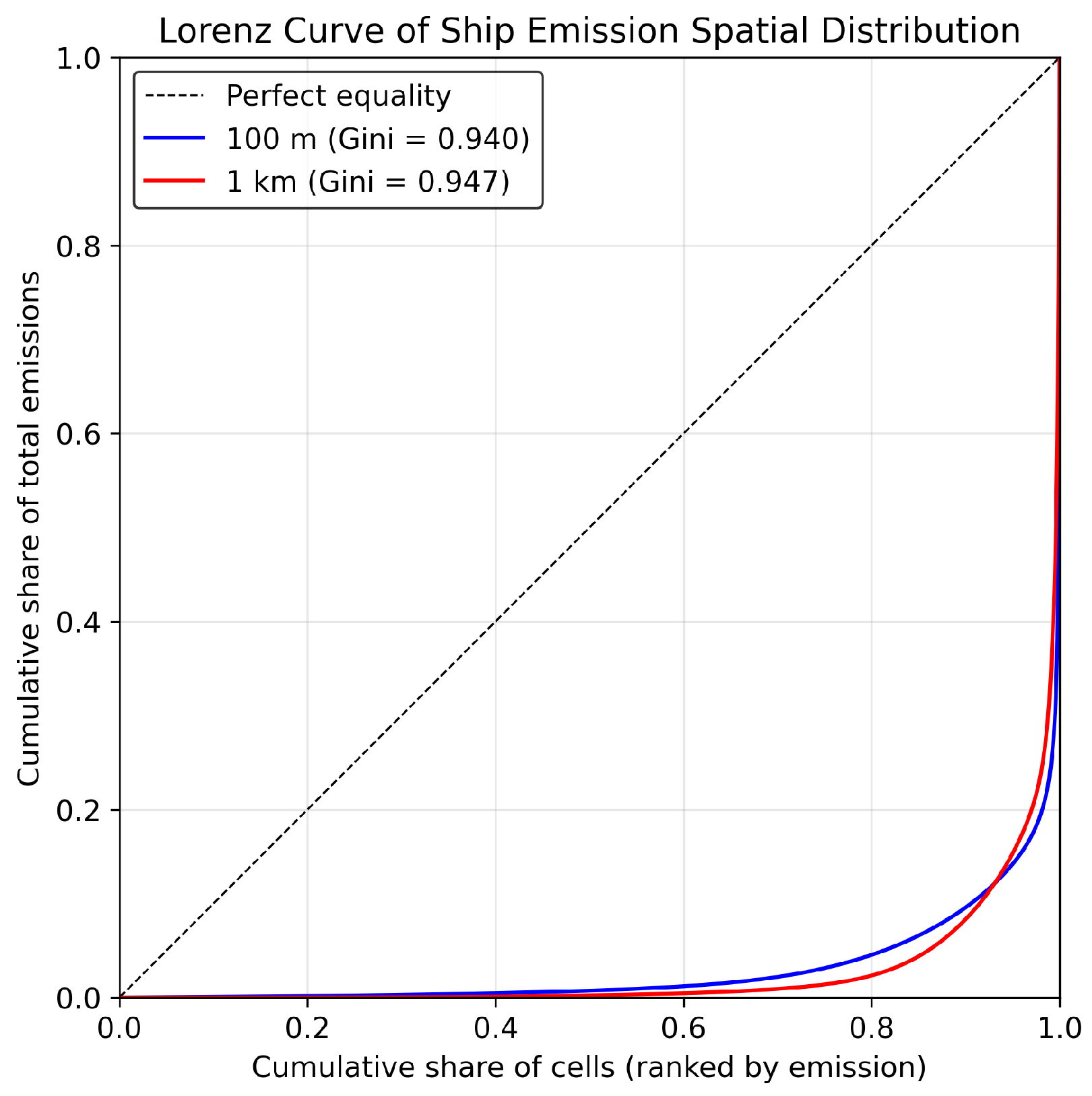
The concentration analysis confirms quantitatively what the emission maps show visually: Emissions are highly concentrated in a small number of persistent hotspot cells. With a Gini coefficient of 0.940 at 100 m study-domain resolution (and 0.951 on the 1 km China-wide CO
2 cross-check; see
Section 3.5) and the top 1% of cells capturing three-quarters of the total theoretical emission potential, the emission landscape contains a substantial stationary-vessel component—the anchorage clusters, berthing bands, and riverbank strips described above—that is comparable to or larger than the contribution of navigation lanes when integrated over time, despite the lanes being more visually prominent on coarse-resolution maps. The physical mechanism is straightforward: A transiting vessel passes through a 100 m cell in seconds to minutes, whereas an anchored vessel occupies the same cell continuously for hours or days while maintaining auxiliary engines at hotel load. Cumulative anchorage emissions therefore scale with waiting time—determined by port scheduling efficiency—rather than traffic volume. The monthly stability of this concentration further indicates that these hotspots are fixed infrastructure features, not transient traffic phenomena. The sensitivity analysis reported in
Section 3.5 demonstrates that this geography is not a consequence of the specific auxiliary engine load values adopted: under ±30% perturbation of the canonical AE load brackets, total emissions vary by ±15%, but the spatial concentration metrics, especially the location of top-5% hotspot cells, remain essentially unchanged (≥97.9% Jaccard overlap).
A useful analogy is the distinction between a highway and a parking lot. A highway carries high traffic volume, but each vehicle passes any given point quickly; a parking lot holds fewer vehicles, each idling for extended periods. Conventional coarse-resolution emission maps amount to concluding that highways are the dominant source of urban vehicle emissions because they appear as bright continuous bands on a traffic density map—while the parking lots, where engines idle for hours, are averaged into the surrounding landscape. The 100 m inventory resolves this distinction, revealing that the maritime “parking lots”—anchorage grounds, berthing zones, and riverside quays—account for the majority of the cumulative emission budget despite occupying a small fraction of the spatial footprint of the navigation network.
4.2. Theoretical Emission Potential, Atmospheric Exposure, and Counterarguments
Several caveats and counterarguments warrant explicit discussion before the policy implications are drawn.
The quantities reported throughout this paper are theoretical emission potentials—the product of AIS-derived activity, engine power, and standard emission factors—rather than measured atmospheric concentrations. They assume full-load auxiliary engine operation during anchorage and berthing, no shore-power substitution, and a representative DECA-compliant fuel sulfur content. In practice, vessels at electrified berths, on shore power, with scrubbers, or burning low-sulfur or alternative fuels (LNG, methanol) will release less than the theoretical potential at the corresponding cells. The expansion of shore-power infrastructure at major Chinese ports since 2020 [
36] therefore implies that the actual realized share of stationary-vessel emissions is somewhat smaller than the theoretical potential reported here. Crucially, this asymmetry reinforces rather than weakens the central argument: where shore power has already been deployed, the geography identified here pinpoints precisely the cells in which it is being most effectively used; where it has not been deployed, the same geography identifies the highest-leverage targets for future deployment.
A potential counterargument concerns cumulative corridor exposure: even if anchorage cells exhibit higher per-cell theoretical emissions, the cumulative population exposure to navigation-corridor emissions could nevertheless be higher because corridors traverse a much larger spatial footprint and may pass closer to densely populated coastlines. The theoretical emission potential and the resulting human-exposure-weighted burden are not the same quantity. Quantifying the exposure-weighted contribution requires coupling the emission grid with a population-density product and an atmospheric dispersion model, which is beyond the scope of the present inventory paper but is identified as a priority for follow-up work in
Section 5. We note, however, that anchorage clusters in the Yangtze River estuary and along the Wenzhou riverbanks are themselves located close to or directly adjacent to populated coastal districts, so the spatial advantage of corridors in terms of exposure footprint is not unambiguous.
A second counterargument concerns near-source plume behavior and atmospheric dispersion. Stationary vessels constitute concentrated, persistent point-like sources for which their plumes can produce locally high but spatially compact concentrations near the source; transit vessels constitute moving line sources that may spread emissions over a larger ground footprint at lower per-cell intensity. The per-receptor concentration impact therefore depends on meteorology, source height, and downwind distance in ways the inventory itself cannot resolve. The implications drawn here are accordingly framed in terms of where emission mass is released, which is a necessary input to any subsequent dispersion modelling, rather than as a direct ranking of receptor exposure.
A further consideration is policy feasibility. Stationary-vessel sources, while spatially concentrated, are not always operationally easier to abate than corridor sources. Shore-power deployment at anchorage grounds is constrained by water depth, cable infrastructure, and maritime traffic patterns; floating power barges remain a niche solution [
37,
38]. Conversely, corridor-level interventions (speed reduction and fuel switching) are operationally lighter but yield smaller per-cell reductions because each cell hosts each transit only briefly. The implications developed in
Section 4.3 should accordingly be read as a redirection of relative priority and not as an argument that corridor measures are unhelpful.
On imputation and emission-factor uncertainty, approximately 9.25% of records required probabilistic vessel-attribute imputation; the resulting bias in aggregate emissions is bounded by the share of affected records and the linearity of STEAM in the imputed parameters, and it does not affect the spatial concentration metric, which is invariant under fleet-wide multiplicative scaling (
Section 2.6). The AE load factor sensitivity analysis (
Section 3.5) further demonstrates that the principal parametric uncertainty in the inventory affects absolute emission totals at the ±15% level but leaves the geography of hotspot cells essentially unchanged.
4.3. Implications for Emission Mitigation in Coastal Seas
The distinction between stationary and transit sources has direct consequences for mitigation strategy design. At 500 m to 1 km resolution, navigation corridors appear as the dominant hotspots, which may encourage disproportionate emphasis on corridor-based interventions such as speed restrictions and traffic management. The 100 m inventory suggests that this emphasis, taken alone, may be spatially incomplete.
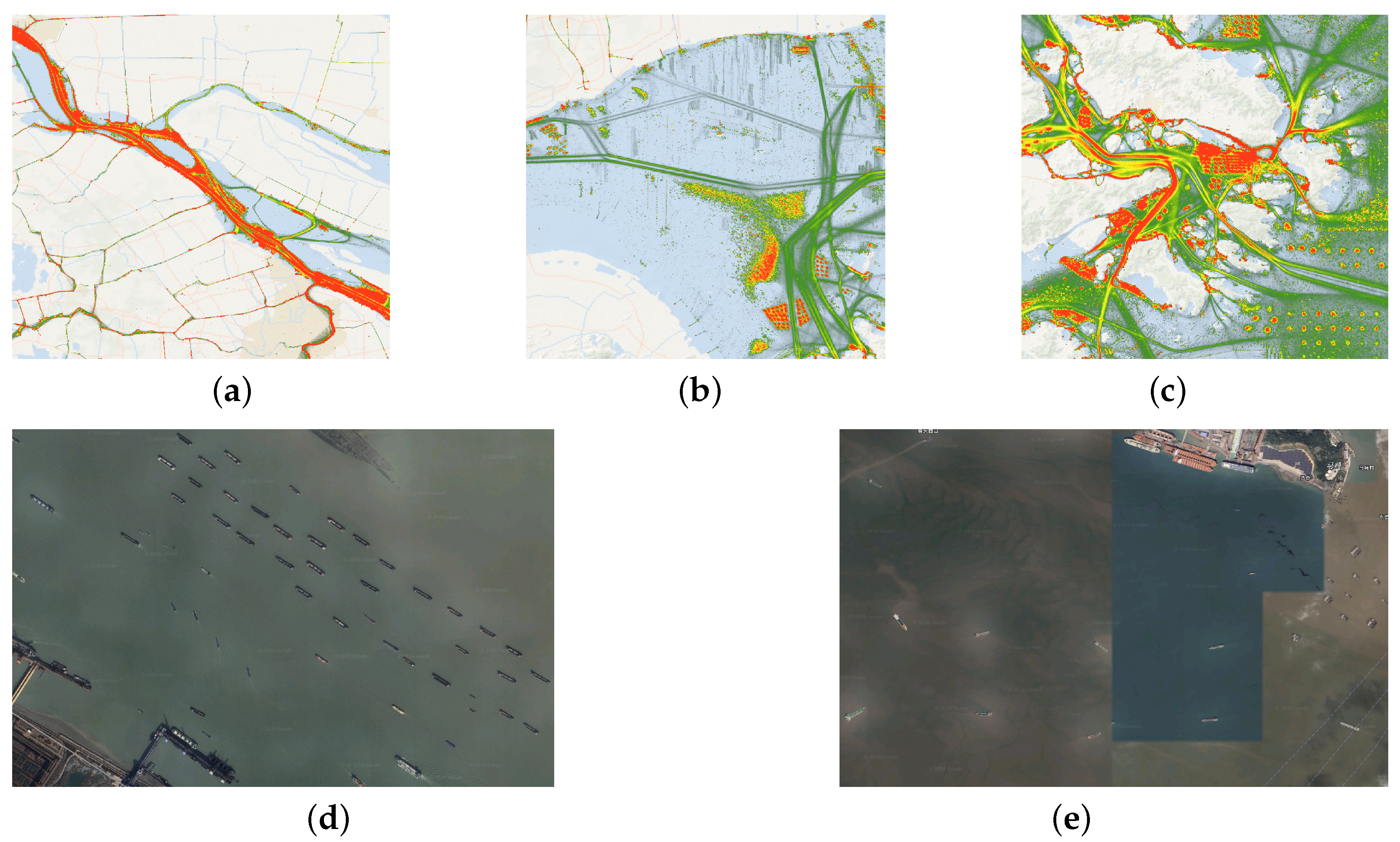
The implications align with three intervention categories corresponding to the emission archetypes identified here. First, the discrete anchorage clusters in Hangzhou Bay and around the Zhoushan Archipelago represent the most spatially concentrated sources in the inventory. These clusters are geographically fixed—they correspond to designated anchorage grounds regulated by port authorities—and the vessels occupying them run auxiliary engines continuously. Shore power at designated anchorage areas, or mandatory engine-shutdown requirements with auxiliary supply from floating power barges, would directly address the source type accounting for the majority of the top 1% of cells [
37,
38]. Their spatial fixity and persistence make them particularly amenable to infrastructure-based solutions.
Second, the bankside berthing bands in the Yangtze River channel show that, even within a high-traffic transit corridor, stationary vessel emissions at riverside berths rival those of the navigation lanes. This is directly relevant to shore power siting: Berth-side electrification along the Yangtze channel would target sources co-located with some of the country’s busiest navigation lanes yet functionally independent of transit traffic. The current regulatory emphasis on fuel switching and speed reduction in corridors, while beneficial, does not address these bankside sources [
39].
Third, the sinuous riverbank patters in the Wenzhou area reveal that in confined port environments, the cumulative emission budget is dominated by berthing rather than transit. For smaller coastal harbors, this suggests that anchorage and berth management—scheduling optimization and shore power at quayside—should be elevated to comparable priority alongside navigation-lane regulation [
35].
Importantly, these implications follow from the spatial structure of the inventory and do not depend on absolute emission totals. Because the Lorenz curve and Gini coefficient measure relative distribution, the directional conclusion—that stationary vessel hotspots merit priority comparable to that traditionally given to navigation corridors—is robust to variations in emission factor assumptions, as confirmed by the AE load factor sensitivity analysis (
Section 3.5). The counterarguments raised in
Section 4.2—cumulative corridor exposure, atmospheric dispersion, and policy feasibility—qualify the strength but do not overturn the direction of the implication: where the spatial evidence indicates that emission mass is concentrated should be a primary input to mitigation planning, alongside dispersion and exposure modelling.
4.4. Resolution as a Determinant of Emission Pattern Characterization
The 100 m resolution employed here is not merely a technical refinement but a methodological prerequisite for accurately characterizing the spatial structure of coastal ship emissions. The Lorenz curve analysis makes this concrete: reaggregating from 100 m to 1 km reduces the top-1% emission share by roughly 10%, a loss caused entirely by averaging high-emission anchorage cells with surrounding low-emission transit cells. At coarse resolutions, navigation and anchorage signals are conflated within the same cell, systematically inflating the apparent contribution of transit corridors.
The Wenzhou coastal area provides a particularly clear illustration: Features that would appear as a broad uniform band at 1 km are resolved at 100 m into distinct bankside berthing strips flanking low-emission central channels. Without sufficient resolution, the behavioral distinction between transit and stationary vessels is irretrievably lost in the gridding process, and the resulting map presents a misleading picture to decision-makers.
This suggests a practical design criterion: Grid resolution must be fine enough to spatially separate the functional zones—channels, anchorages, and berths—that constitute distinct targets for assessment and intervention. In the estuarine environments examined here, 100 m achieves this separation; in more confined port basins, even finer resolutions may be needed. Conversely, for open-ocean route analysis where the question concerns corridor-level emissions rather than within-port allocation, coarser resolutions remain appropriate. The resolution should therefore be guided by the question being addressed and not by convention [
20,
27].
4.5. Limitations
Several limitations warrant acknowledgment. The emission quantities represent theoretical potential derived from AIS activity and standard emission factors; they are not measured atmospheric concentrations. Vessels using alternative fuels, scrubbers, or shore power will have actual emissions below the theoretical values, and the spatial distribution of such abatement technologies is not captured in AIS records [
40]. The expansion of shore power at major Chinese ports since 2020 [
36] means berth-side emissions at electrified facilities will be lower than reported here. However, this reinforces the core argument: If some berth-side emissions are already being reduced by electrification, the remaining non-electrified anchorages represent an even more concentrated residual source warranting prioritized intervention. The implications of this gap between theoretical potential and realized atmospheric exposure are discussed at length in
Section 4.2.
The current implementation also assumes a single representative DECA-compliant heavy fuel oil (sulfur 0.5% m/m), without per-vessel differentiation among fuel types (HFO, MDO, MGO, LNG, and methanol). This affects the absolute level of sulfur-bearing pollutants (SO
x and sulfate-related PM) more than CO
2 or NO
x and would chiefly bias absolute totals at vessels using ECA-compliant or alternative fuels; the spatial concentration metric is unaffected by the same scale-invariance argument given in
Section 2.6. Per-vessel fuel-mix differentiation is identified as a priority for future work in
Section 5.
Additionally, approximately 9.25% of vessel records required probabilistic attribute imputation, introducing uncertainty into vessel-type-specific estimates. However, as the core finding concerns spatial concentration rather than absolute totals, these limitations do not affect the primary conclusions. The Lorenz curve and Gini coefficient measure relative distributions, which are invariant to linear scaling of emission factors; the finding that a small fraction of cells dominates the emission budget is therefore robust to reasonable variations in emission factor assumptions. This robustness is explicitly verified by the AE-load-factor sensitivity analysis presented in
Section 2.6 and
Section 3.5, in which the ±30% perturbation of the most uncertain parametric assumption produces ±15% variation in absolute totals but a Gini variation of less than 0.01 and ≥97.9% spatial overlap of top-5% hotspot cells.
5. Conclusions
This study presents a 100 m resolution AIS-based emission inventory for the Yangtze River estuary and the Wenzhou coastal area, and it evaluates the implications of inventory resolution for marine environmental assessment. Three emission pattern archetypes were identified: discrete anchorage clusters in open water, parallel bankside berthing bands flanking navigation lanes in wide estuarine channels, and sinuous riverbank traces in confined waterways. Lorenz curve analysis reveals extreme spatial concentration, with the top 1% of grid cells accounting for over three-quarters of the total theoretical emission potential (Gini = 0.940 at 100 m within the study domain; Gini = 0.951 and top-5% = 85.3% on the independent 1 km China-wide CO
2 cross-check,
Section 3.5), stable across all months of 2023. A dedicated sensitivity analysis on the auxiliary engine load factor demonstrates that this spatial concentration pattern is structurally robust: under ±30% perturbation of canonical AE load brackets, the Gini coefficient varies by less than 0.01, the top-5% emission share varies by less than 2 percentage points, and the location of top-5% hotspot cells overlaps by ≥97.9% across scenarios, even as absolute emission totals shift by approximately ±15%.
Inventory resolution is not merely a technical parameter but determines whether the spatial evidence correctly identifies the geography of emission sources. Aggregating to 1 km reduces the top-1% share by roughly 10%, confirming that coarse gridding dilutes the anchorage and berthing signal while inflating the apparent contribution of navigation lanes. The 100 m resolution represents a practical threshold at which this distinction becomes resolvable across a range of port morphologies, and the framework combining high-resolution gridding with Lorenz curve analysis is transferable to other coastal environments.
From a practical standpoint, the spatially concentrated nature of stationary vessel hotspots, alongside the more diffuse contribution of navigation corridors, suggests that mitigation strategies targeting anchorage and berthing areas—shore power expansion, scheduling optimization, and low-emission anchorage zones—may yield greater per-cell environmental returns than corridor-focused interventions alone, while the counterarguments examined in
Section 4.2 (cumulative corridor exposure, atmospheric dispersion, and policy feasibility) qualify rather than overturn this directional conclusion.
5.1. Replicability
The methodological framework—STEAM-based per-message emissions on a hashed AIS pipeline, direct index mapping to a 100 m grid, separate accounting for main and auxiliary engines, Lorenz curve and Gini analysis with monthly stability, and AE sensitivity tests—is independent of the specific case study and is in principle transferable to any port environment for which AIS, vessel-registry, and emission-factor inputs are available. The case-specific elements (study-area boundaries, fleet composition, and regulatory regime) enter only through the configuration stage and do not require modification of the analytical core. To facilitate independent reproduction of the sensitivity analysis specifically, the auxiliary engine load multiplier has been exposed as a global parameter (AE_SCALING) in the emission-calculation module, with default value of 1.0 reproducing the central inventory.
5.2. Future Work
Several extensions follow naturally from the limitations and counterarguments discussed in
Section 4. (i) Coupling the 100 m emission grid to a meso-scale atmospheric dispersion model (e.g., CALPUFF or FLEXPART), in turn linked to a population-density product, would translate theoretical emission potential into receptor-level exposure and resolve the cumulative-corridor-versus-concentrated-anchorage tension on quantitative grounds. (ii) Per-vessel fuel-mix differentiation, drawing on bunker-record or port-state-control databases where available, would refine the absolute level of sulfur-bearing pollutants and enable evaluation of the realized impact of DECA fuel-sulfur regulations and shore-power deployment. (iii) Extending the framework to additional coastal regions (Pearl River Delta, Bohai Bay, and major non-Chinese port complexes) would test the generality of the spatial concentration archetypes identified here and provide a comparative basis for resolution-of-decision decisions in inventory design. (iv) Linking the 100 m inventory to operational port-call records would enable explicit attribution of the anchorage-emission burden to scheduling-induced waiting time, opening a direct path from spatial diagnosis to operational mitigation levers.