Article

Turbidity Inversion from the ADCP Using a CNN-ResNet-RF Hybrid Model

1
College of Oceanography and Space Informatics, China University of Petroleum (East China), Qingdao 266580, China
2
Technology Innovation Center for Maritime Silk Road Marine Resources and Environment Networked Observation, Ministry of Natural Resources, Qingdao 266580, China
*
Author to whom correspondence should be addressed.
J. Mar. Sci. Eng. 2026, 14(1), 14; https://doi.org/10.3390/jmse14010014
Submission received: 7 November 2025 / Revised: 17 December 2025 / Accepted: 18 December 2025 / Published: 21 December 2025
(This article belongs to the Section Physical Oceanography)

Abstract

Addressing the limitations of traditional acoustic turbidity inversion models in complex marine environments—specifically their reliance on empirical parameters and lack of vertical resolution—this study presents a novel CNN-ResNet-RF hybrid model based on the simultaneous ADCP and turbidity observations in the Chengshantou sea area. Unlike conventional approaches, the proposed framework integrates deep spatio-temporal features automatically extracted by a ResNet-enhanced CNN, utilizing a Random Forest (RF) regressor for final prediction, thereby avoiding the limitations of artificial feature engineering. To ensure rigorous evaluation and mitigate stochastic bias, the model was validated using a 5-fold cross-validation strategy with dynamic Z-score normalization. Experimental results demonstrate that the proposed model significantly outperforms benchmark methods (CNN, RF, and CNN-RF), achieving an average R2 of 0.782, an MAE of 4.454, and a MAPE of 15.42% on the test sets. This study confirms that the hybrid framework successfully combines the feature extraction power of deep learning with the robustness of ensemble learning, providing a robust and high-precision tool for the vertical structural analysis of ocean turbidity.

1. Introduction

In the field of water environment monitoring and ecological protection, turbidity is a key optical index, and its dynamic changes directly affect the light transmittance, primary productivity, and ecosystem stability of water bodies [1]. As a large marine country, China’s coastal area is not only the core area of national economic development but also an important carrier of sustainable utilization of marine resources. Offshore turbidity is affected by multiple factors such as tidal power, terrestrial input, biological activity, and anthropogenic emissions [2]. Therefore, it is of great strategic significance to realize high-resolution and real-time monitoring for marine environmental governance, biological resource conservation, and ecological restoration.
Because of its unique geographical location and hydrological characteristics, the Yellow Sea has become an ideal natural laboratory for studying land-sea interaction, material transport, and its ecological response. The Chengshantou sea area, focused on in this study, is the key node of this complex system. The water quality dynamics, especially physical indicators such as turbidity, are not only indicators of key Earth science issues such as suspended particle transport and sediment ‘source-to-sink’ processes [3], but also the core variables for understanding the depth of the water photosynthesis layer and the environmental changes in benthic habitat (link ecology). Therefore, high-precision monitoring and in-depth study of water quality parameters in this sea area not only have practical significance for local environmental management but also are valuable for elucidating the material cycle and ecological evolution mechanism of the entire Yellow Sea and even similar marginal sea systems.
The Chengshantou sea area is affected by the monsoon and semi-diurnal tide, and the suspended matter concentration shows significant spatial and temporal heterogeneity. Studies have shown that the annual average suspended matter flux [4] in the Chengshantou coastal waters reaches 1.2 × 10⁶ tons/yr, of which 70% of the transport occurs during the strong wind period in winter [5]. Although the traditional single-point turbidity meter [6] can provide high-precision measurement, it is limited by single-point sampling and low-frequency measurement, and it is difficult to describe the dynamic characteristics of the vertical profile. Acoustic Doppler Current Profiler (ADCP), as a hydroacoustic observation device, can simultaneously obtain the three-dimensional velocity profile and backscatter intensity (BS) of water by transmitting high-frequency acoustic waves and receiving their backscattered signals, which provides a new technical approach for turbidity inversion [7]. This technology has the advantages of high vertical resolution [8] and wide coverage, and can realize simultaneous profile observation of hydrodynamic and suspended matter concentration. The physical basis of ADCP inversion of SSC is the attenuation and scattering theory of sound waves in particle suspension. This theory can be traced back to Urick’s pioneering research on the acoustic absorption mechanism in irregular particle suspensions. His work established the basic relationship between acoustic attenuation and volume concentration of suspended particles and laid a theoretical foundation for quantitative inversion [9]. In the classical research, Deines and other scholars [10] applied the sonar equation to the ADCP instrument on this basis, established a quantitative conversion method from the BS measured by the instrument to the volume backscatter intensity (Sv), and systematically gave the realization path of instrument correction and acoustic attenuation correction. This makes it possible to use the backscatter signal of the ADCP to synchronously invert hydrodynamics and SSC. Subsequently, Thorne & Hanes [11] systematically reviewed the principles, techniques, and applications of acoustic measurement of sediment movement. They combed the theoretical model of the interaction between acoustic waves and suspended particles (such as Rayleigh scattering) in detail and clearly pointed out the core limitations of acoustic inversion technology: to accurately obtain SSC from Sv, it is necessary to accurately estimate the particle scattering cross section (depending on the particle size d and the acoustic frequency f) and accurately correct the acoustic attenuation caused by suspended matter. However, the inversion accuracy of the ADCP is significantly disturbed by acoustic attenuation, particle characteristics, and other aspects. The traditional acoustic model based on Rayleigh scattering relies on empirical parameter calibration (such as absorption coefficient α), and the error can reach more than 30% in complex water bodies [12], and the inversion effect is not ideal in the complex Chengshantou sea area.
In order to overcome the parameter dependence and nonlinear bottleneck of traditional acoustic physical models in complex environments, data-driven machine learning methods are being introduced into underwater acoustic oceanography research. Recent studies have shown that high-frequency acoustic observation equipment, such as the ADCP, can produce large-scale datasets with high temporal and spatial resolution. The study of Chalov & Efimov [13] highlights the potential of using big data analysis techniques to process ADCP data to evaluate suspended sediment flux and provides new ideas for improving traditional sediment calculation methods that rely on low-resolution sampling or empirical formulas. In this context, the combination of multi-beam sonar and machine learning technology is promoting acoustic oceanography to make significant progress in frontier fields such as marine garbage detection and underwater target recognition [14,15]. Machine learning methods have also been successfully introduced into ADCP research to solve the bottleneck of traditional physical models in complex environments. Zhu et al. [16] proposed a ship-borne ADCP navigation design based on an LSTM network, which combines the information from the ADCP into the inversion results of submarine radar and improves the accuracy of data. Xiong et al. [17] included the bottom-mounted ADCP and towed ADCP data in the LSTM network training. The results showed that both ADCPs improved the quality of high-frequency radar monitoring data. The new ADCP can estimate the surface wave according to the current measurement. Zheng et al. [18] used the BP neural network to find the nonlinear relationship between the wave estimation error and various influencing factors, which can be used as the basis of the new tilt correction algorithm. Therefore, the development of an ADCP turbidity inversion algorithm with higher accuracy suitable for a complex hydrodynamic environment has become an important research direction in the field of underwater acoustic observation. However, it is crucial to acknowledge that while machine learning enhances predictive accuracy, the training and validation of these models are ultimately dependent on high-quality, in situ measurements.
In response to the above challenges, this paper abandons the traditional acoustic model that relies on empirical parameters and the artificial feature engineering path and innovatively proposes a CNN-ResNet-RF hybrid deep learning framework that combines Convolutional Neural Networks, residual networks, and random forests [19]. This framework aims to automatically mine the complex nonlinear mapping relationship between ADCP multi-dimensional data and turbidity and use the spatial correlation of 27-layer ADCP data [20] to focus on solving the problem of full-profile vertical joint inversion.

2. Data and Processing

2.1. Dataset

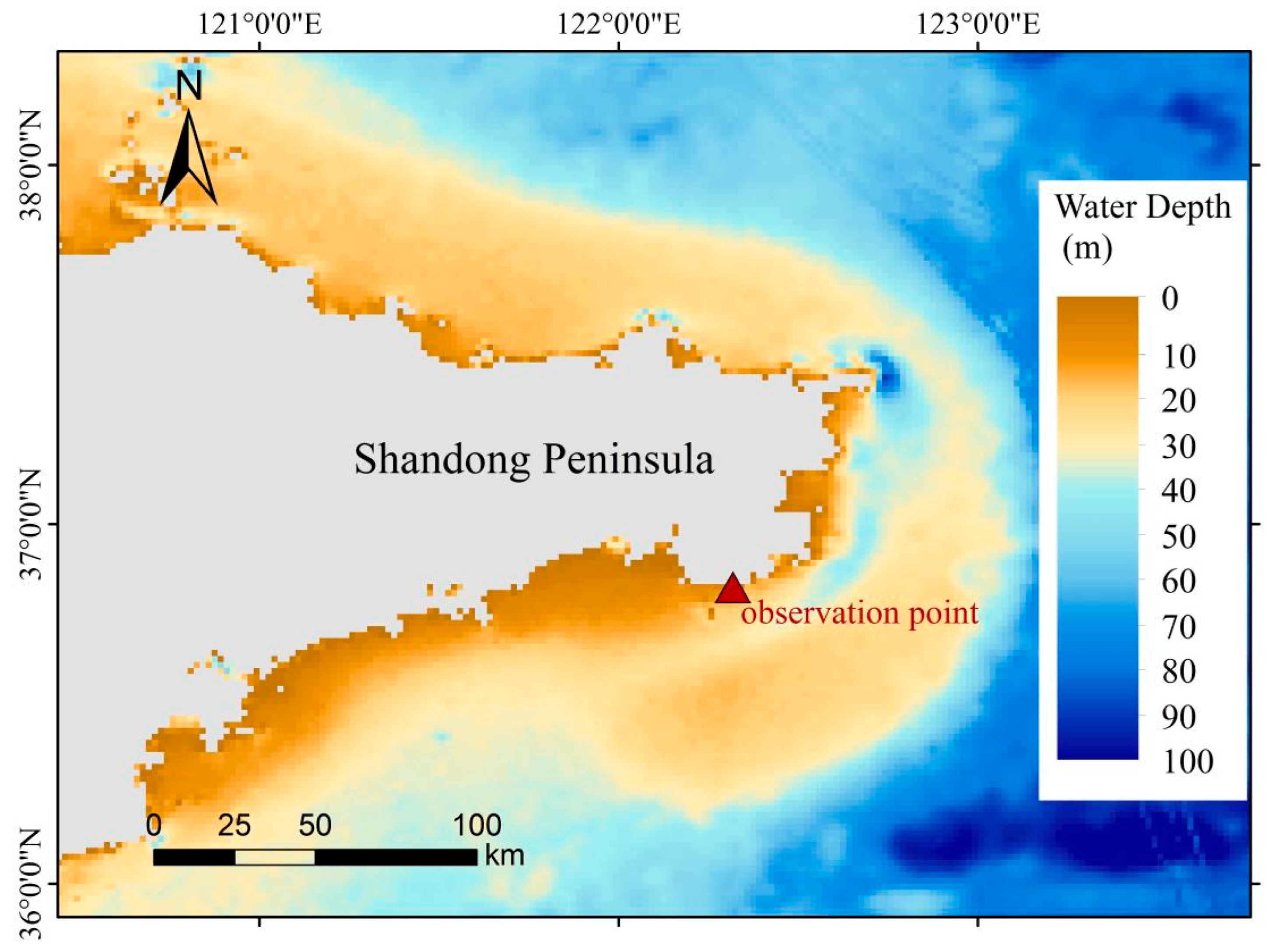
In this research, a 614.4 kHz ADCP and a temperature-salt depth-turbidimeter (CTD) were deployed in the northern sea area of Chengshantou (Figure 1). The hydro-optical properties of the northern Chengshantou sea area are dominated by complex marine dynamics, exhibiting significant seasonal and event-driven variations. The seabed substrate primarily consists of sandy gravels in the nearshore zone and silts in the offshore area, serving as a major source of suspended particulate matter. Seasonally, in summer, the water column is characterized by a clear bottom layer under the influence of the Yellow Sea Cold Water Mass, while the surface layer may be turbid due to algal blooms, resulting in pronounced vertical stratification. In autumn and winter, strong winds induce vertical mixing, leading to extensive resuspension of sediments and overall turbid water conditions. Tidal currents are robust, acting as the primary daily driver of resuspension. Furthermore, this area is a confluence zone of the Yellow Sea Warm Current and the Shandong Peninsula Coastal Current, resulting in complex current systems and significant frontal effects [21]. The sea area is located at the junction of the southern and northern Yellow Seas. It has unique marine environmental characteristics and can provide abundant field observation data for related research.
The ADCP is deployed on a platform on the sea surface to measure the water velocity profile downward. The first layer is located 2.11 m below the sea surface, and the layer spacing is 1 m. The data is continuously recorded, and the sampling frequency is 17 pulses per 10 s. We use the RBRconcerto 3 C.T.D.Tu.DO recorder produced by RBR, Ottawa, ON, Canada, with the official turbidity and dissolved oxygen sensors. It is also fixed on the platform, about 40 cm from the water surface, for simultaneous monitoring of temperature, salinity, pressure, turbidity, dissolved oxygen, and redox potential (ORP). The measurement accuracy of each sensor is as follows: temperature ± 0.002 °C, conductivity ± 0.003 mS/cm, pressure ± 0.05% of water depth, dissolved oxygen ± 5%, ORP ± 0.01 V, and turbidity ± 2%.
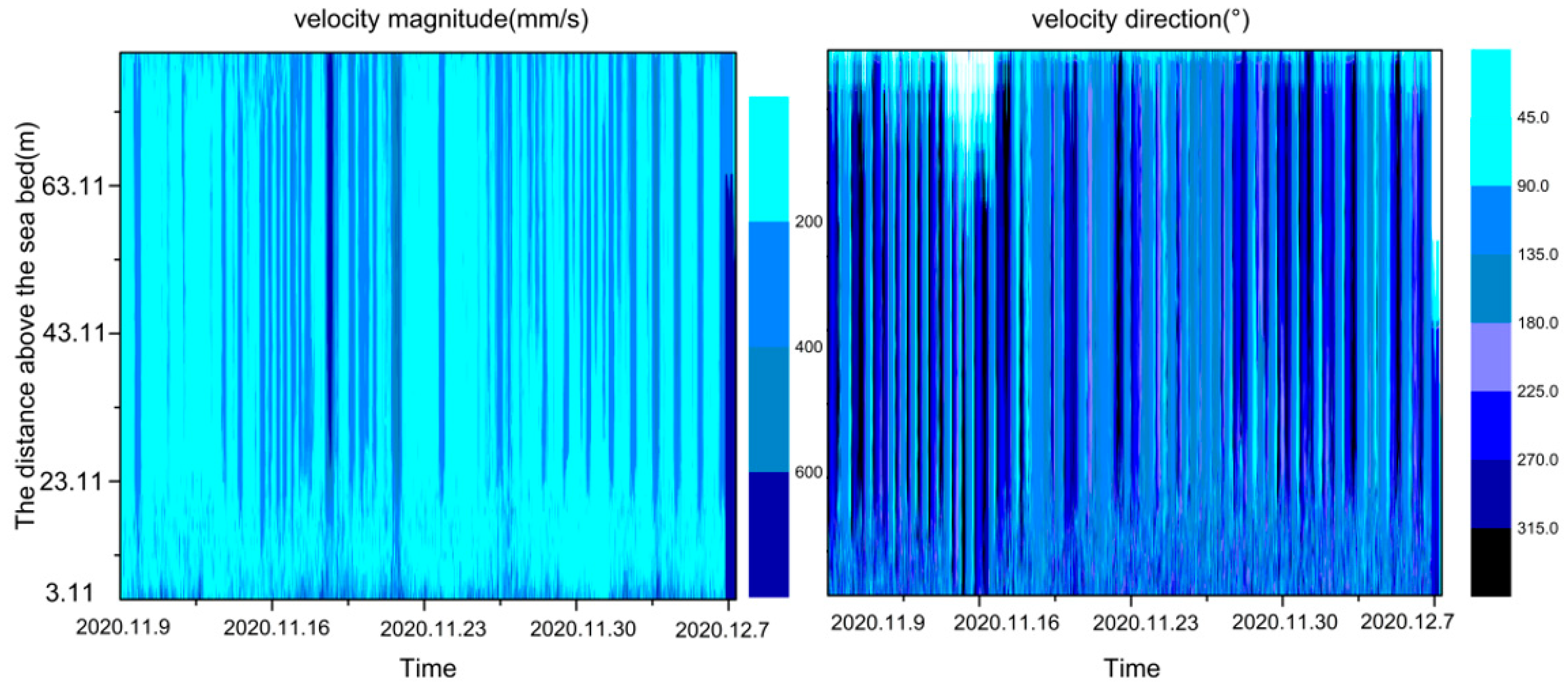
This research is based on the ADCP observation data (Figure 2) obtained from the ‘North-South Yellow Sea Water Exchange Dataset’ in the southern Yellow Sea from 12:00 on 7 November to 22:30 on 10 December 2020.

2.2. Processing

First, the flow rate data of the first layer (bin1) of the ADCP are time-aligned with the turbidity data. After eliminating the default value, a total of 2958 valid data pairs were obtained, and the data efficiency was more than 95%. Then, the attitude data (roll angle, pitch angle, yaw angle) and velocity data of the ADCP are extracted as three-dimensional velocity components. In order to eliminate the influence of attitude change during ADCP measurement, we correct the velocity data based on the rotation matrix. The calculation of the rotation matrix is based on the following formula [22]:
R = 1 0 0 0 c o s θ s i n θ 0 s i n θ c o s θ c o s ψ s i n ψ 0 s i n ψ c o s ψ 0 0 0 1 c o s ϕ 0 s i n ϕ 0 1 0 s i n ϕ 0 c o s ϕ
Among them, ϕ , θ, and ψ are roll angle, pitch angle, and yaw angle, respectively.
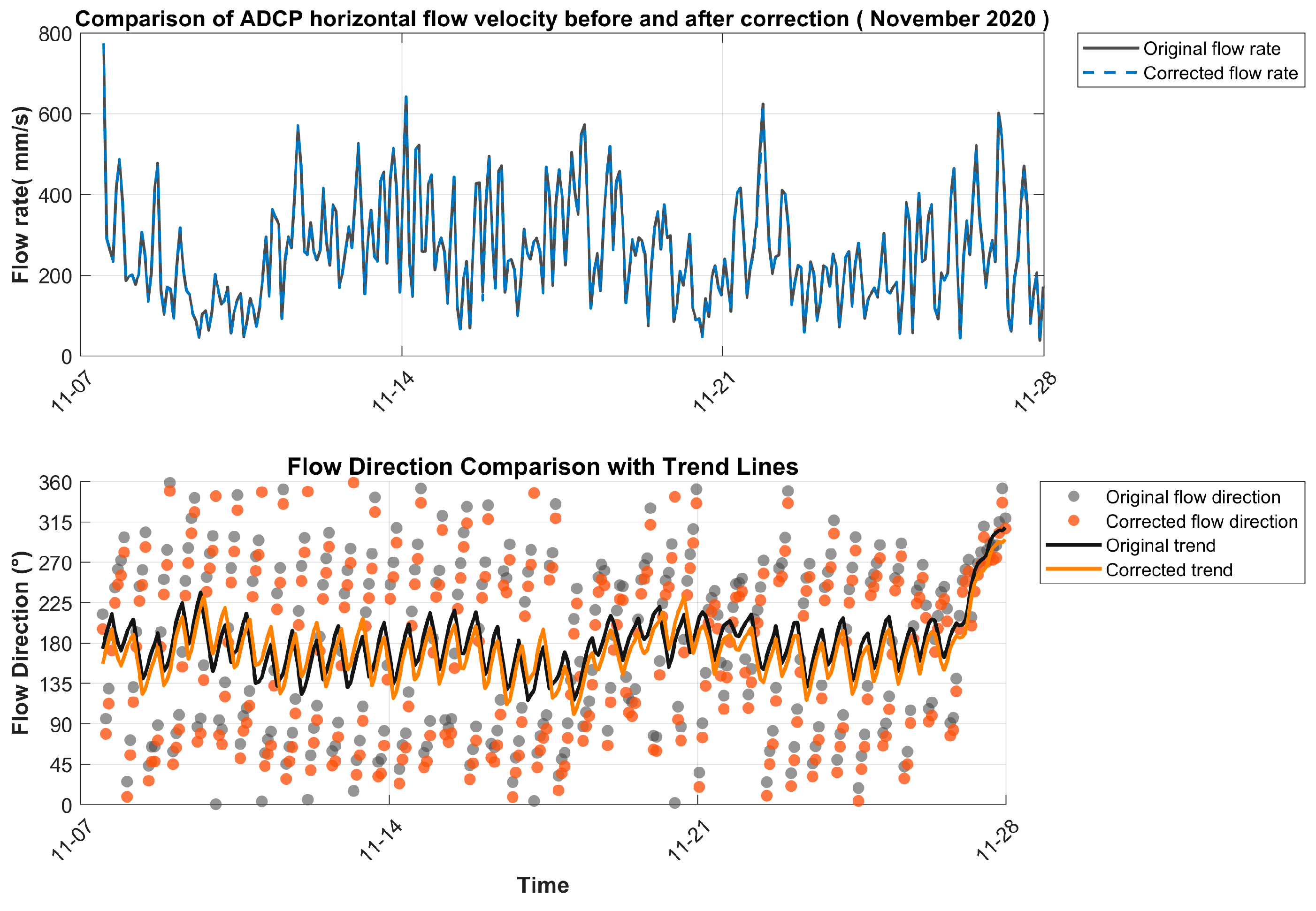
Based on the resampling data, the time series comparison of horizontal flow velocity and flow direction before and after correction is drawn (Figure 3). After the correction of the rotation matrix, the amplitude of the horizontal velocity does not change significantly, which is consistent with the mathematical principle that the vector mode length remains unchanged in the coordinate rotation transformation and further verifies the accuracy of the correction algorithm. In contrast, the flow direction data shows a fundamental improvement: before correction, the original flow direction is a disorderly scattered distribution, and the noise is significant due to the interference of the high-frequency attitude change in the platform; after correction, the streamwise data showed clear aggregation and continuity, reflecting the existence of a stable dominant flow direction in the sea area, indicating a tidal movement pattern characterized by reciprocating flow. The results show that the attitude correction method adopted in this study effectively suppresses the measurement error introduced by the platform motion, significantly improves the reliability and physical consistency of ADCP observation data, and provides a high-quality data basis for subsequent flow field analysis and water exchange research.

3. Methods

3.1. Traditional Acoustic Methods

The scattering intensity of the echo source in scattering water is proportional to the concentration of suspended solids [23]. Since the scatterers of ADCP emission sound waves are mainly suspended particles in water, the backscattered sound intensity collected by the ADCP can be used to invert turbidity. In the process of sound wave propagation in water, when calculating the sound intensity at the scattering source, it is necessary to consider the geometric attenuation and absorption factors of the sound wave [24]. After correcting the echo intensity measured by the ADCP, the volume backscattering strength (Sv) is obtained. Based on the sonar equation, the volume backscattering strength measured by the ADCP is expressed as follows [10]:
Sv   =   C   +   10 log 10 [ ( T x   +   273.16 )   R 2 ]   +   2 α R   +   K c ( E     E r )     10 log 10 L     10 log 10 P   +   20 log 10 ( Ψ R )
Among them, C is a constant determined by the performance of the ADCP instrument, Tx is the water temperature recorded by the probe, R is the distance from the surface of the suspended scatterer to the ADCP transducer along the beam direction of the transducer, and α = αw + αs is the total sound wave absorption coefficient of seawater, where αw and αs are the absorption coefficients of sound waves by pure seawater and suspended solids in water, respectively. Kc is the conversion coefficient of the sound intensity unit of the ADCP instrument (which can be obtained from the manufacturer or measured by the user), E is the ADCP echo intensity, which is the background noise; L and P are the pulse length (m) and transmitting power (W) of the acoustic wave emitted by the ADCP, respectively. Ψ is the near-field correction function. Because the sound wave is non-spherically diffused in the near-field of the sound source, near-field correction should be considered in the water layer less than the critical distance [24]:
ψ = 1 + 1 1.35 z + ( 2.5 z ) 3.2
where z = r/ r n is the dimensionless acoustic transmission distance, r n = π A t 2 / λ , r is the acoustic transmission distance, A t is the transducer radius, λ is the acoustic wavelength. Based on the principle of Rayleigh scattering, the volume backscattering intensity Sv can be expressed as [10]:
S v = 10 l o g 10 ( S S C ) + b
b is the calibration factor, and the backscattered sound intensity of the ADCP has a linear relationship with the logarithm of suspended sediment concentration, lg (SSC). In a specific water area and a specific time period, if we can establish a reliable empirical calibration relationship between Sv and optical turbidity through synchronous measurement and assume that the properties (such as composition and size) of suspended particles in water are relatively stable, then we can use acoustic equipment to continuously and extensively invert the spatial distribution and temporal changes in turbidity.

3.2. CNN-Resnet-RF

The construction of models that possess strong feature extraction capabilities, excellent generalization performance, and high training stability remains a persistent research focus in predictive tasks. Traditional Convolutional Neural Networks (CNNs) face challenges such as gradient vanishing and network degradation when their architectures become excessively deep. Furthermore, the conventional practice of appending a fully connected layer with a Softmax classifier can introduce limitations, including a predisposition to overfitting and insufficient discriminative power for complex problems [25]. To address these issues, this paper proposes a novel hybrid deep learning framework, termed the ResNet-RF network. The core concept involves a modular design: a Deep Residual Network (ResNet) serves as the front-end module for powerful hierarchical feature extraction, while a Random Forest (RF) algorithm acts as the back-end, functioning as a robust ensemble classifier [26]. This division of labor is designed to leverage the complementary strengths of each component, synergizing advanced feature learning with effective classification decision-making to enhance the model’s overall performance.
The feature extraction of this model is based on the deep residual network. With the increase in network depth, the performance of traditional CNNs will be saturated or even decreased, which is not caused by overfitting but by the so-called ‘network degradation’ problem: the deep network is difficult to learn the identity mapping, resulting in higher training error than the shallow network. The revolutionary feature of ResNet is that it introduces the ‘residual block’ structure, which realizes residual learning through fast connections and fundamentally alleviates the problem.

3.2.1. Residual Block Structure and Residual Learning Principle

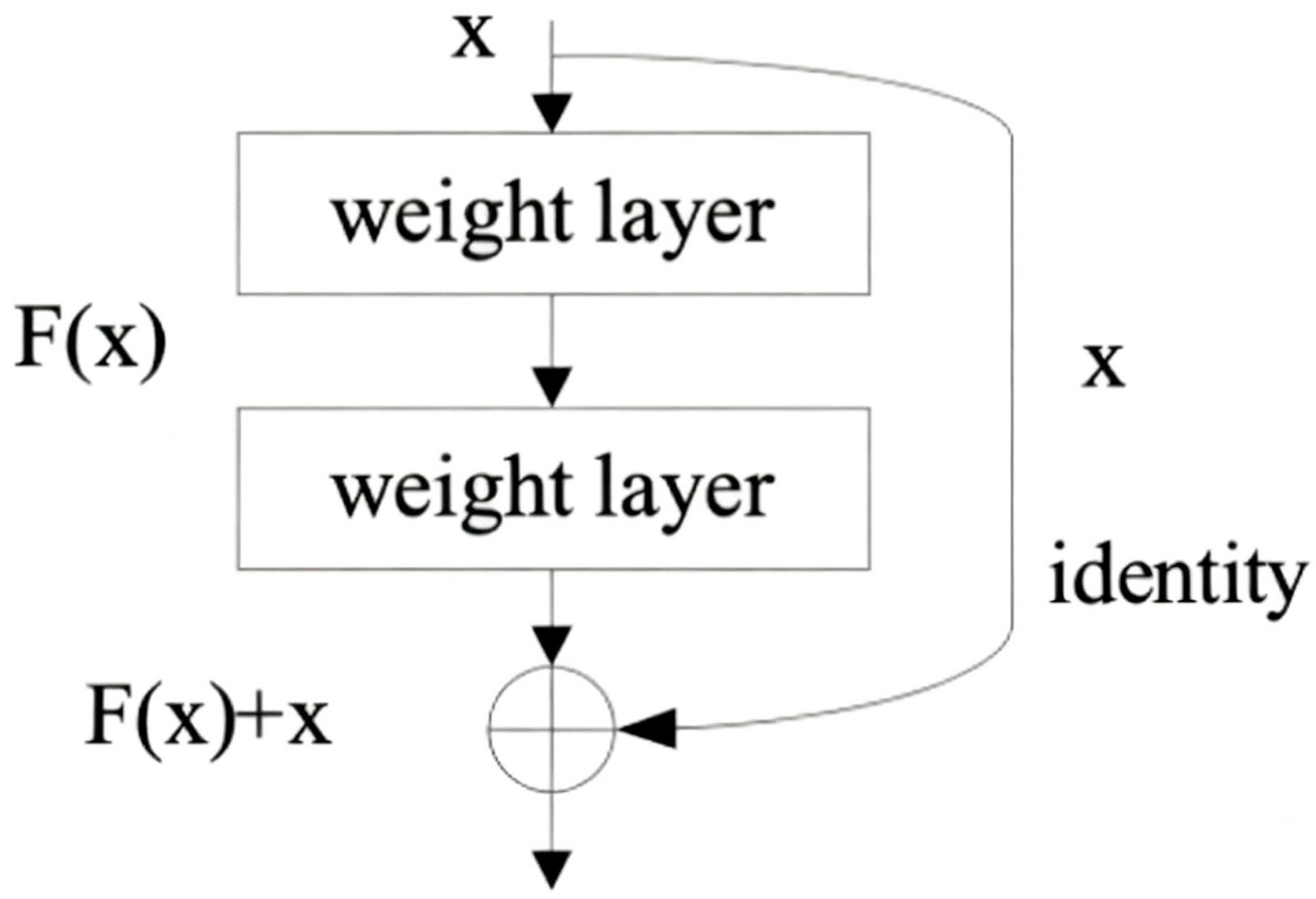
The residual block is the basic construction unit of ResNet [27], and its detailed structure is shown in the following figure (Figure 4). For a stacking layer structure, the input is x, and the expected output is H(x). The traditional network directly learns the target mapping H(x), and the residual block defines that it needs to learn the residual mapping F(x) = H(x) − x. Therefore, the original mapping is rewritten as H(x) = F(x) + x.
The structure adds the input x directly to the output F(x) of the stacked nonlinear layer element by element through a quick connection. This operation can be expressed as follows:
y   =   F ( x ,   { W i } )   +   x
where y is the output of the residual block. If the dimension of F(x) is different from that of x, for example, when down-sampling, the dimension can be matched by a linear projection Ws of a 1 × 1 convolution, that is, y = F(x, {Wi}) + Wsx.
If the desired optimal mapping is close to an identity mapping, then it is much easier to push the residual F(x) to zero than to let the stacked nonlinear layers fit an identity mapping. This allows the gradient to be directly back-propagated through a quick connection, effectively alleviating the gradient disappearance problem, thereby allowing the network to be successfully trained to be extremely deep.

3.2.2. The Backbone Network and Feature Processing Flow Used in This Model

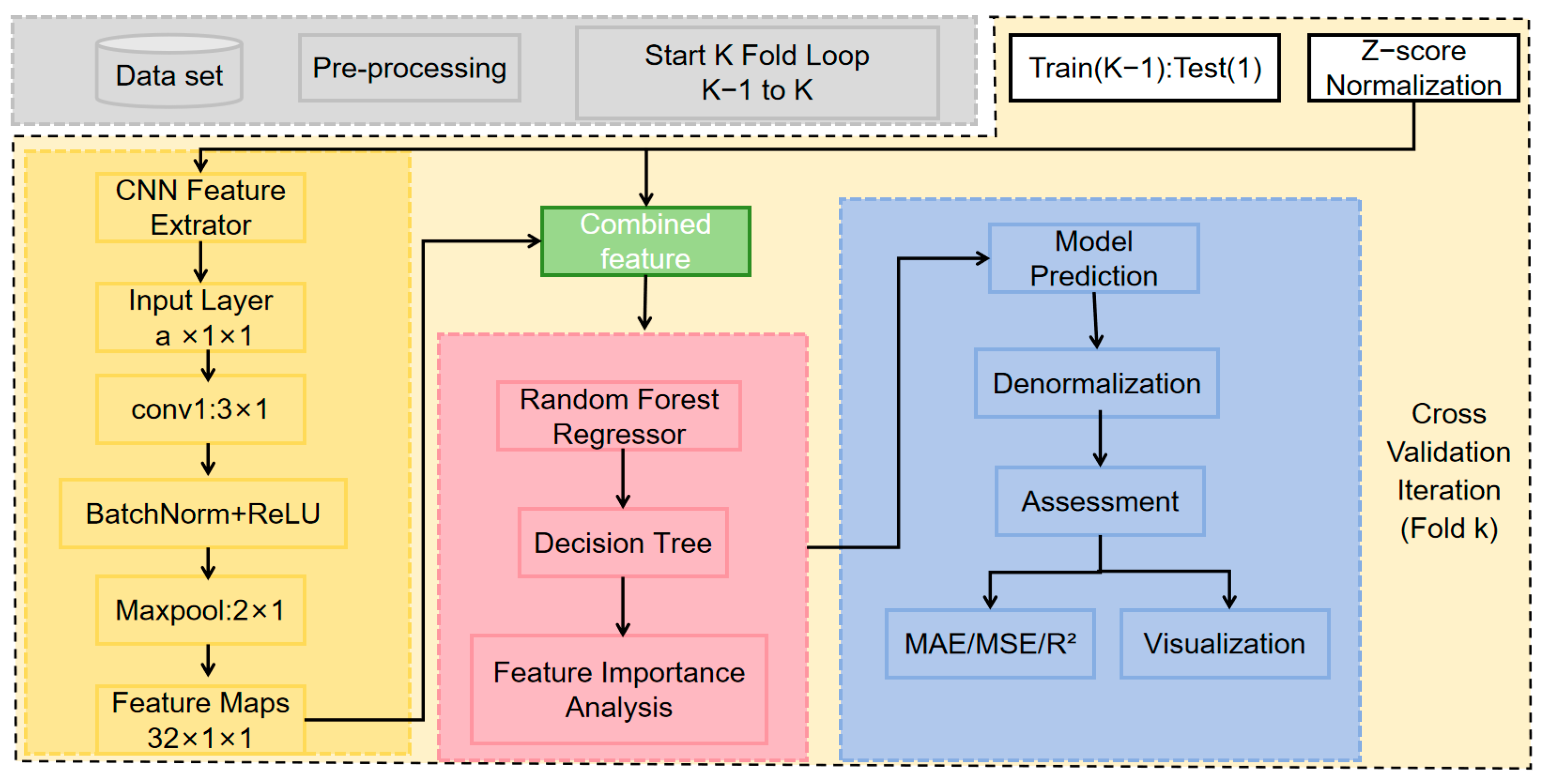
Specifically, we do not use a simple stacked convolutional layer but implement the ‘CNN feature extractor’ module shown in the left yellow box of the flow chart (Figure 5) as a series of residual blocks. The structure of each residual block is shown in Figure 4. Its core is to map the input identity to the output by fast connection so that the network only needs to learn the residual between input and output. This design ensures that even if the network deepens, the gradient can be effectively back-propagated through fast connections, allowing us to build deeper feature extractors to capture complex feature patterns from low-level to high-level. For example, operations such as the conv1:3 × 1 convolutional layer, BatchNorm + ReLU, and Maxpool:2 × 1 marked in the flowchart are integrated into the nonlinear layer part F(x) of each residual block.
Feature process processing:
  • Data Partitioning and Dynamic Pre-processing: To mitigate the stochastic bias associated with single data partitioning and to maximize the utilization of a limited dataset, we abandon the traditional static partitioning method in favor of a K-fold Cross-Validation strategy. Specifically, the complete dataset is randomly partitioned into K mutually exclusive subsets (where K = 5 in this study). In each validation iteration, K-1 subsets are selected as the training set, while the remaining subset serves as the testing set. A critical step lies in the timing of normalization: to strictly prevent data leakage, the parameters for Z-score normalization (mean and standard deviation) are derived exclusively from the current training set and subsequently applied to standardize both the training and testing sets. This dynamic processing ensures that the data distribution remains completely unknown to the model during the testing phase.
  • Deep Feature Extraction: In each training fold, the normalized data is first fed into a Convolutional Neural Network (CNN) backbone for feature mining. The network architecture comprises convolutional layers, batch normalization, ReLU activation functions, and max-pooling layers. Through such hierarchical nonlinear transformations, the network is capable of extracting deep feature representations with high abstraction and robustness from the original low-dimensional data. These feature maps capture latent patterns within the input data that are difficult to detect via traditional statistical methods.
  • Feature Fusion and Ensemble Regression: To combine the representation capability of deep learning with the interpretability of traditional machine learning, a Feature Fusion Module was designed. We concatenate the high-dimensional deep features extracted by the CNN with the original physical features (subjected to identical normalization) to construct a set of enhanced feature vectors containing multi-source information. Subsequently, these fused features are input into a Random Forest Regressor composed of 50 decision trees. The Random Forest not only leverages the advantages of ensemble learning to handle nonlinear relationships in high-dimensional features but also effectively mitigates overfitting. Simultaneously, utilizing its built-in feature importance evaluation mechanism, the model can automatically focus on the key feature dimensions that contribute most significantly to the prediction target.
  • Prediction and Global Evaluation: The prediction output of the model on the current testing set first undergoes a denormalization process (using the mean and standard deviation of the current training fold) to restore it to the original physical scale. This process is repeated across the K validation cycles. Consequently, the final model performance no longer relies on a specific partition but is comprehensively assessed by calculating the average metrics of the K test results. We adopt the mean and standard deviation of the Mean Absolute Error (MAE), Mean Squared Error (MSE), Coefficient of Determination (R2), Mean Absolute Percentage Error (MAPE), and bias as the final evaluation criteria to quantify both the prediction accuracy and generalization stability of the model.

4. Results

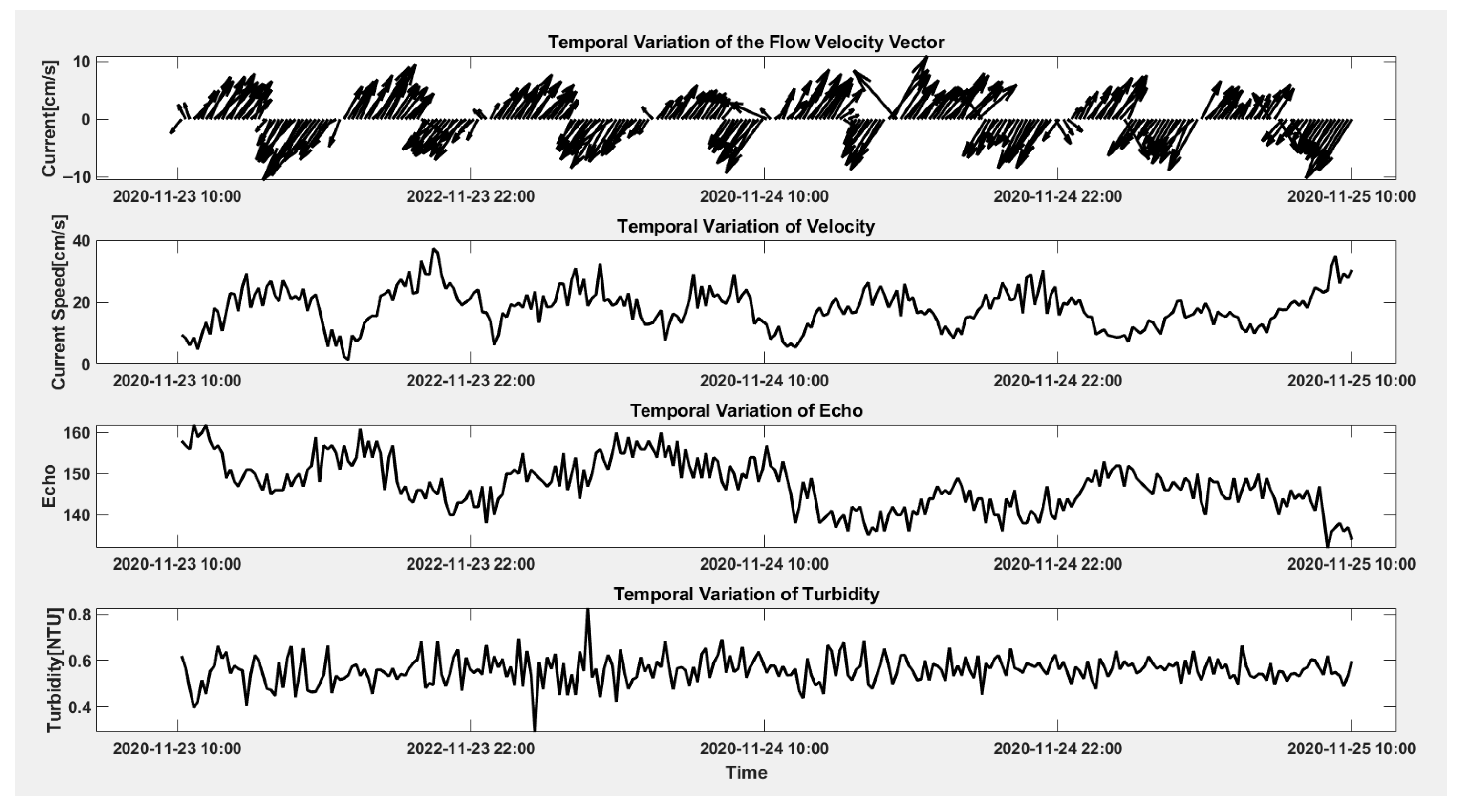
The current in the Chengshantou area is greatly affected by the monsoon and tide. We observed the changes in current velocity, current direction, ADCP echo, and turbidity from 10:00 on 23 November to 10:00 on 25 November 2020 (Figure 6). It can be seen that this is a standard semidiurnal tide; the velocity range is between 0 and 40 cm/s, and the average velocity is about 20 cm/s. The range of the ADCP Echo Amplitude is between 130 and 160, which is negatively correlated with the flow rate. In addition, although there are some fluctuations in the turbidity value, the overall trend is relatively stable, with a maximum value of 0.8 NTU and a minimum value of 0.3 NTU.
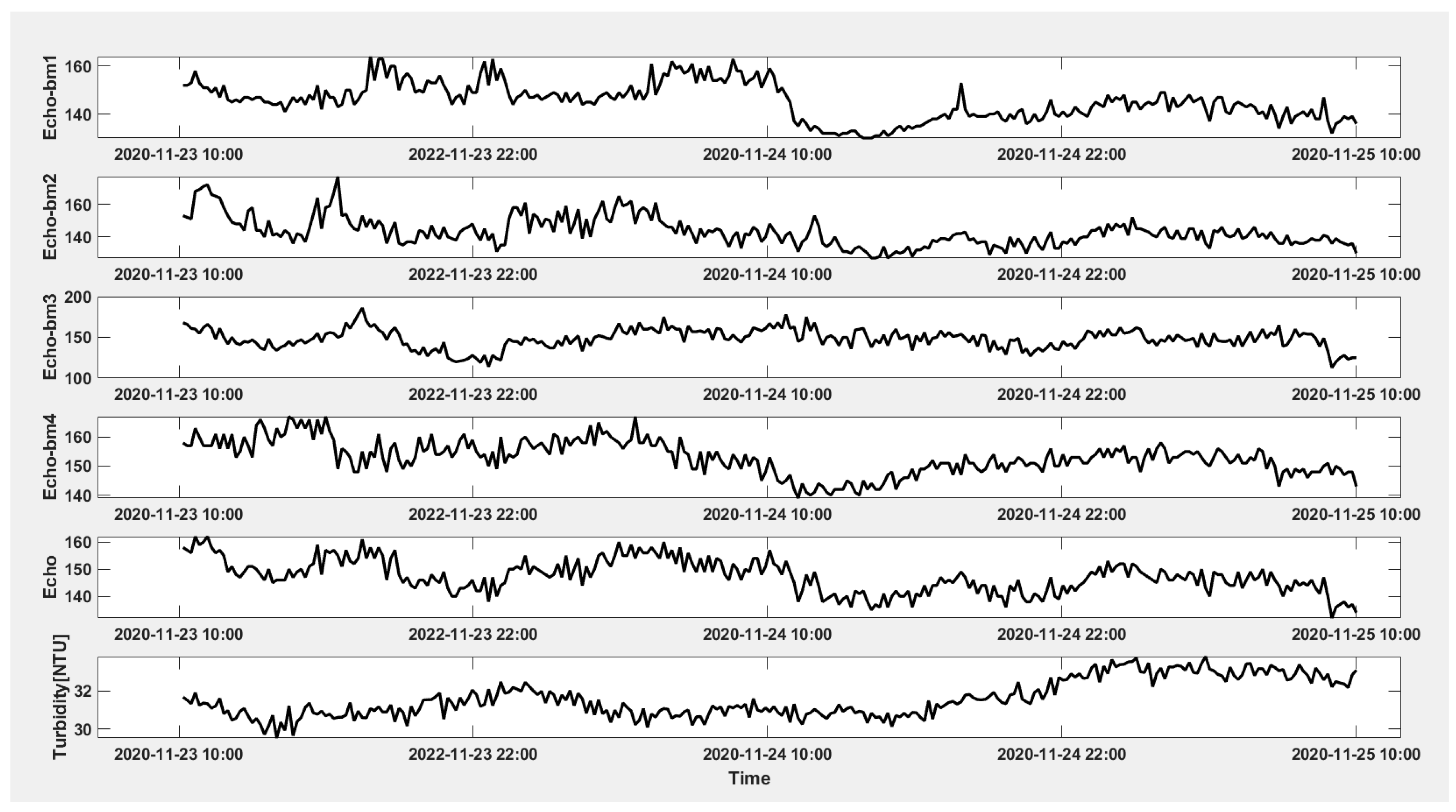
The four echo signals collected by the ADCP include vertical echo, horizontal echo, lateral echo, and oblique echo. The direction of each echo signal is different, so the measured flow characteristics are also different. Vertical and horizontal echoes are commonly used to measure water depth and flow velocity, while lateral and oblique echoes are used to detect the dynamic changes in water flow and the distribution of suspended particles. The above diagram shows the combined values of these four echoes. Next, we will look at the specific values of each echo.
There are differences in the trend of the four echoes, but they all peaked in the afternoon of the 23rd and valleyed at noon on the 24th (Figure 7). During the period from 10:00 to 14:00 on 24 November, the value of echo 1 decreased significantly, reaching a minimum value of 130, and then gradually returned to stability. The change trend of echo 4 was similar to that of turbidity, but the difference was that the turbidity value did not decrease significantly in the morning of the 24th, as that of echo 4 did.
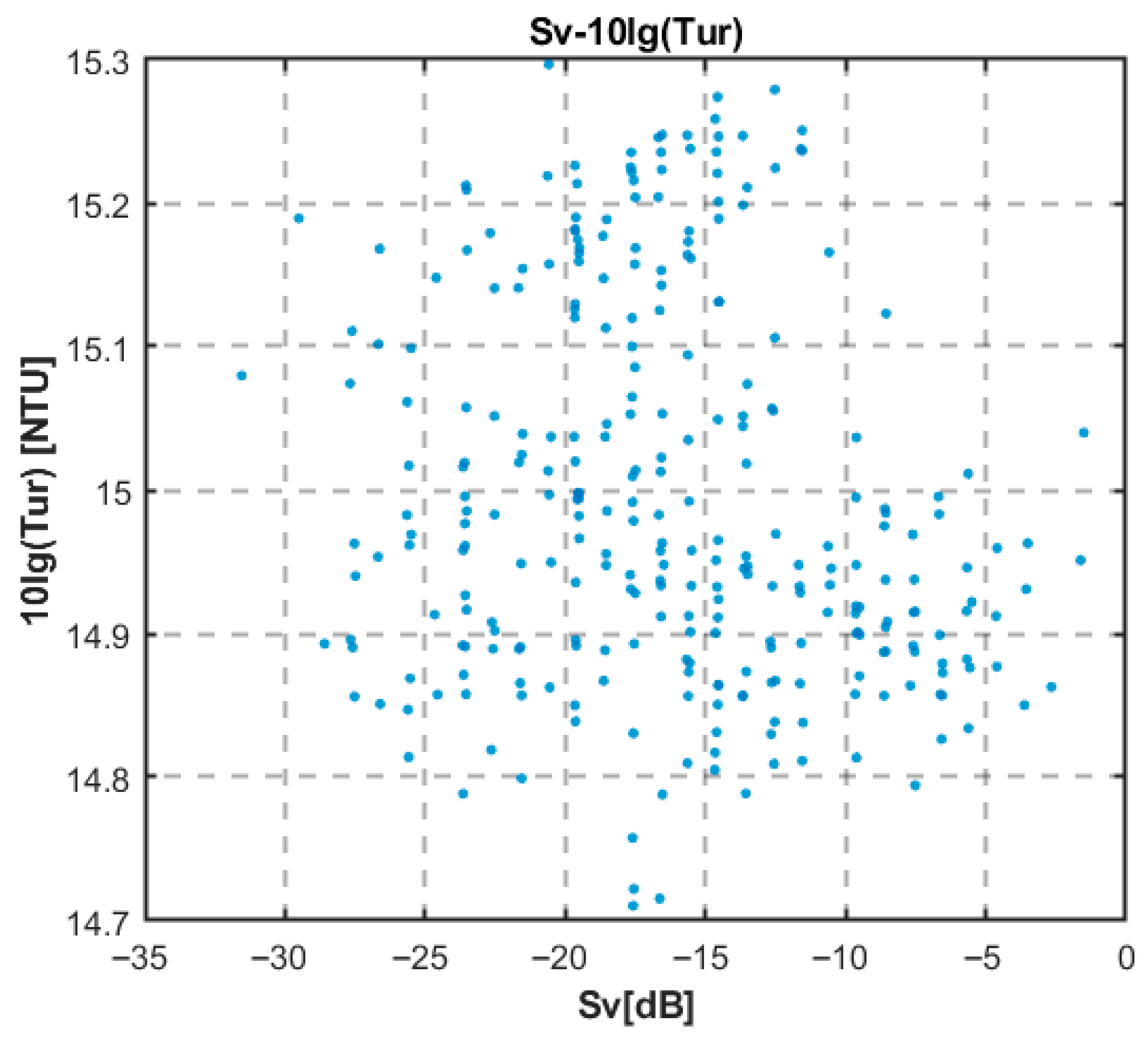
In the typical complex water environment of the Chengshantou sea area, this study attempts to use traditional acoustic methods to invert water turbidity based on ADCP observation data and calculate the corresponding Sv. In order to evaluate the applicability of this method, we compare the Sv value obtained by inversion with the logarithm of the measured turbidity, and the results are as follows (Figure 8). The analysis shows that the scatter distribution is extremely discrete and does not show any significant correlation trend, indicating that there is no clear global statistical relationship between ADCP echo intensity and turbidity in this sea area, which can be used for effective inversion. This phenomenon may be attributed to the interference of various environmental factors, including changes in water temperature and salinity, spatial distribution of plankton, and measurement noise. These factors may significantly affect the backscattering signal of acoustic waves, thus masking the dominant role of turbidity in echo intensity.
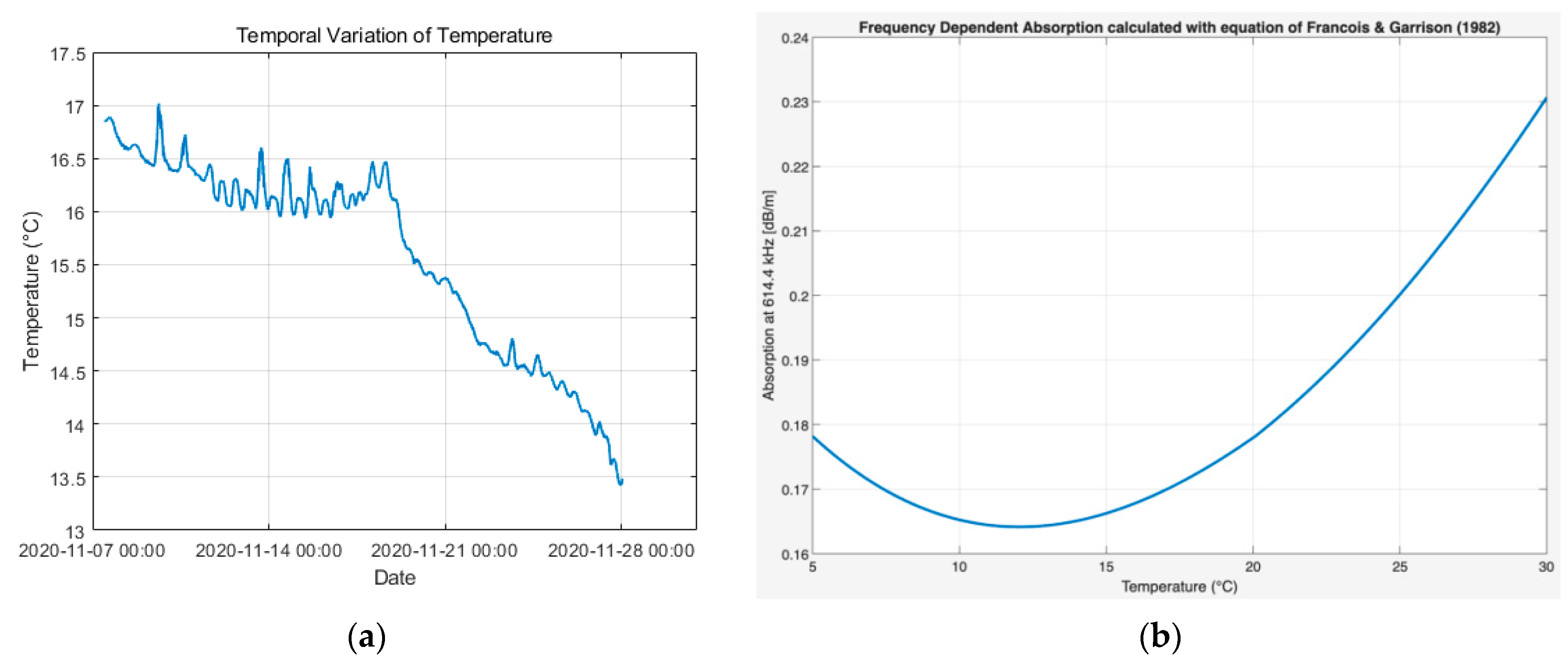
To elucidate the complex relationships between hydroacoustic parameters and turbidity, this study conducted a rigorous physical sensitivity analysis on potential input features. While auxiliary variables such as temperature are often considered in hydrographic studies [28,29], their direct contribution to the high-frequency acoustic inversion mechanism in shallow water requires verification. We analyzed the temporal variation in water temperature during the experiment (Figure 9a), which showed a decrease from approximately 17 °C to 13.5 °C. To quantify the acoustic impact of this change, the theoretical sound absorption coefficient was calculated using the Francois & Garrison [30] equation at the ADCP frequency (Figure 9b). The results indicate that the temperature-induced variation in absorption is approximately 0.006 dB/m, leading to a negligible difference in transmission loss (<0.2 dB) across the water column. This analysis confirms that temperature variations do not significantly alter the acoustic backscatter intensity through physical absorption. Consequently, temperature was excluded from the final feature set to prevent overfitting to seasonal trends. In contrast, depth was retained as an indispensable feature. Unlike the negligible absorption variance, depth determines the geometric spreading loss (20logR) in the sonar equation, which causes signal attenuation of tens of decibels. Therefore, retaining depth allows the model to correctly compensate for physical transmission loss, ensuring that the turbidity estimation is driven by genuine scattering physics (as shown in Table 1).
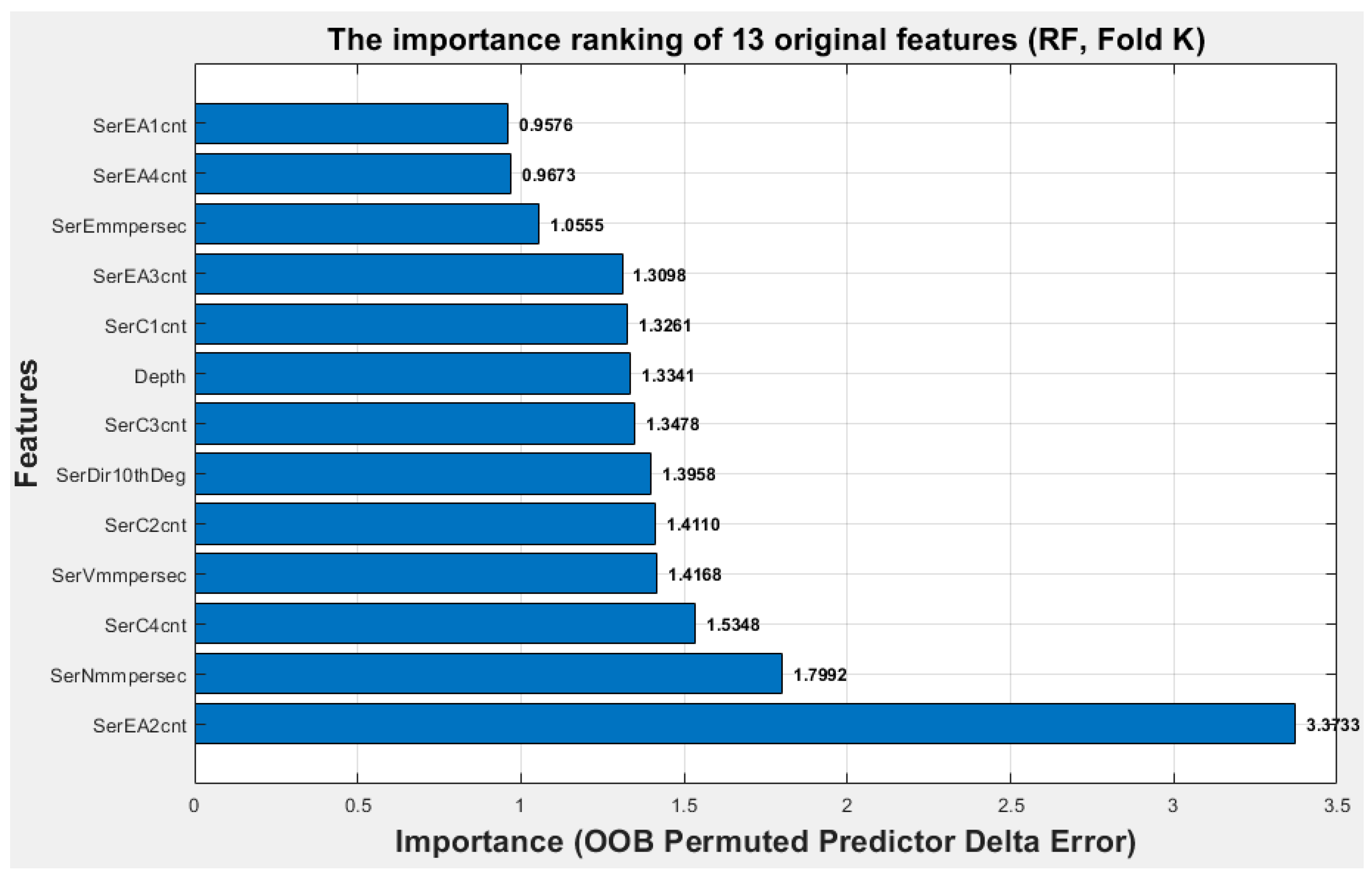
The feature importance ranking diagram (Figure 10), derived from the Random Forest model, utilizes the out-of-bag (OOB) permutation importance to quantitatively evaluate the contribution of each input feature to the turbidity inversion. As illustrated, the acoustic feature SerEA2cnt (Echo Amplitude of Beam 2) exhibits the highest importance score of 3.3733, dominating the ranking. This result is consistent with hydroacoustic theory, confirming that backscatter intensity serves as the primary physical proxy for suspended sediment concentration. Following the Echo Amplitude, velocity-related features (e.g., SerNmmpersec) and correlation features (e.g., SerC4cnt) also show significant contributions, reflecting the influence of hydrodynamic transport and signal correlation on sediment distribution. Furthermore, depth maintains a substantial importance score (~1.33). This confirms its critical physical role in the model, specifically for correcting geometric spreading loss and capturing the vertical settlement profile (Rouse profile) of suspended sediments. In summary, the weight distribution among these acoustic and geometric features aligns with theoretical expectations, demonstrating that the inversion is fundamentally driven by hydroacoustic physics.
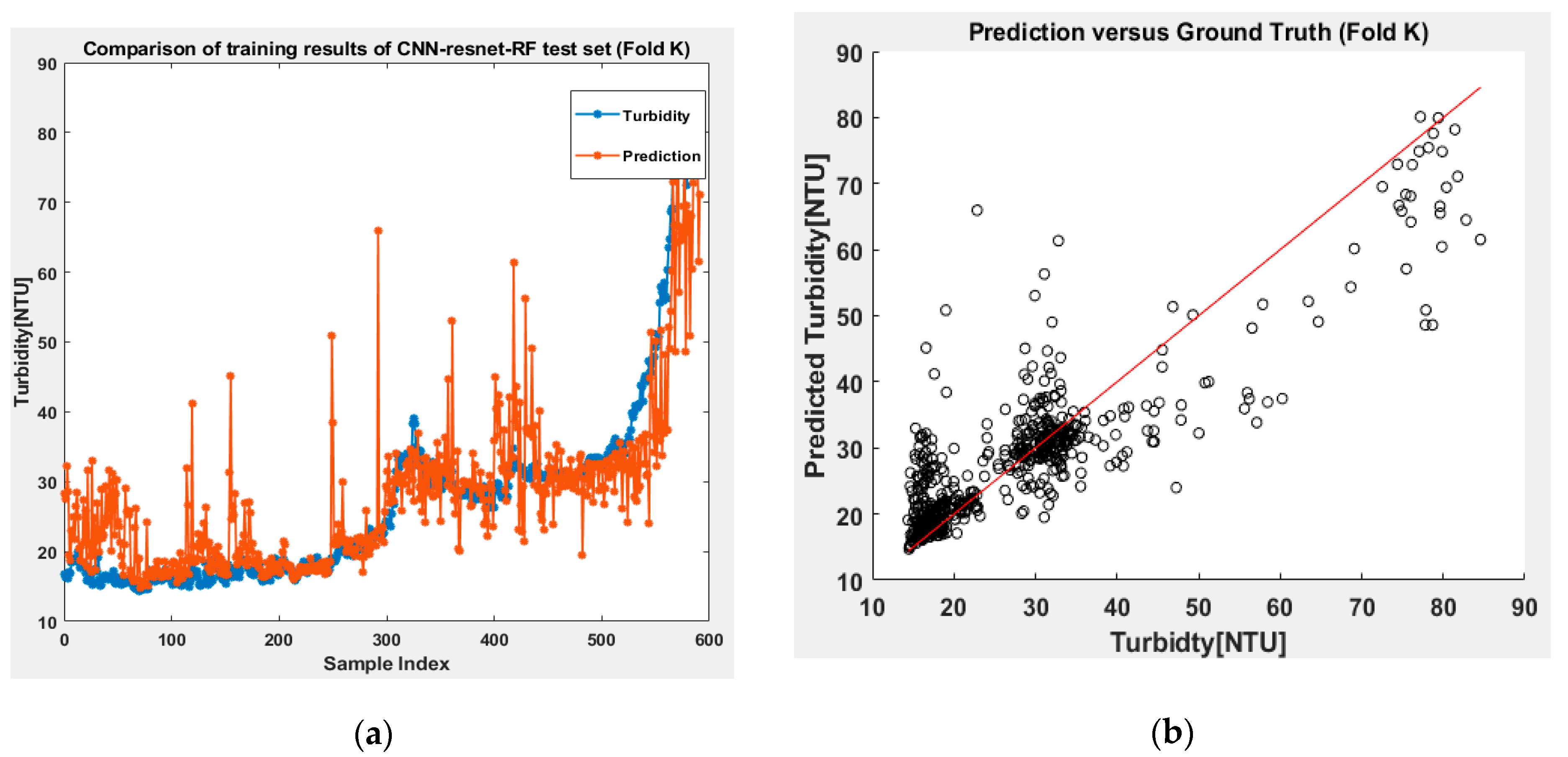
The statistical analysis based on 5-fold cross-validation reveals that the CNN-ResNet-RF model exhibits exceptional predictive performance (Figure 11). For the training set, the average R2 was 0.946, with an MSE of 10.113, an MAE of 2.118 NTU, a MAPE of 7.013%, and a bias of −0.002 NTU, indicating an extremely high goodness of fit. Crucially, the model maintained robust performance on the unseen test sets. The average R2 reached 0.782 (standard deviation: 0.016), while the average MAE and MAPE were 4.454 NTU and 15.42%, respectively, with an average MSE of 52.089, respectively, with a bias of 0.007 NTU. The minimal divergence between the testing and training metrics, coupled with the low volatility across folds (as indicated by the standard deviation), validates that the incorporation of the K-fold strategy and dynamic Z-score normalization has effectively mitigated stochastic bias. These results demonstrate the model’s reliability and its strong potential for practical application.
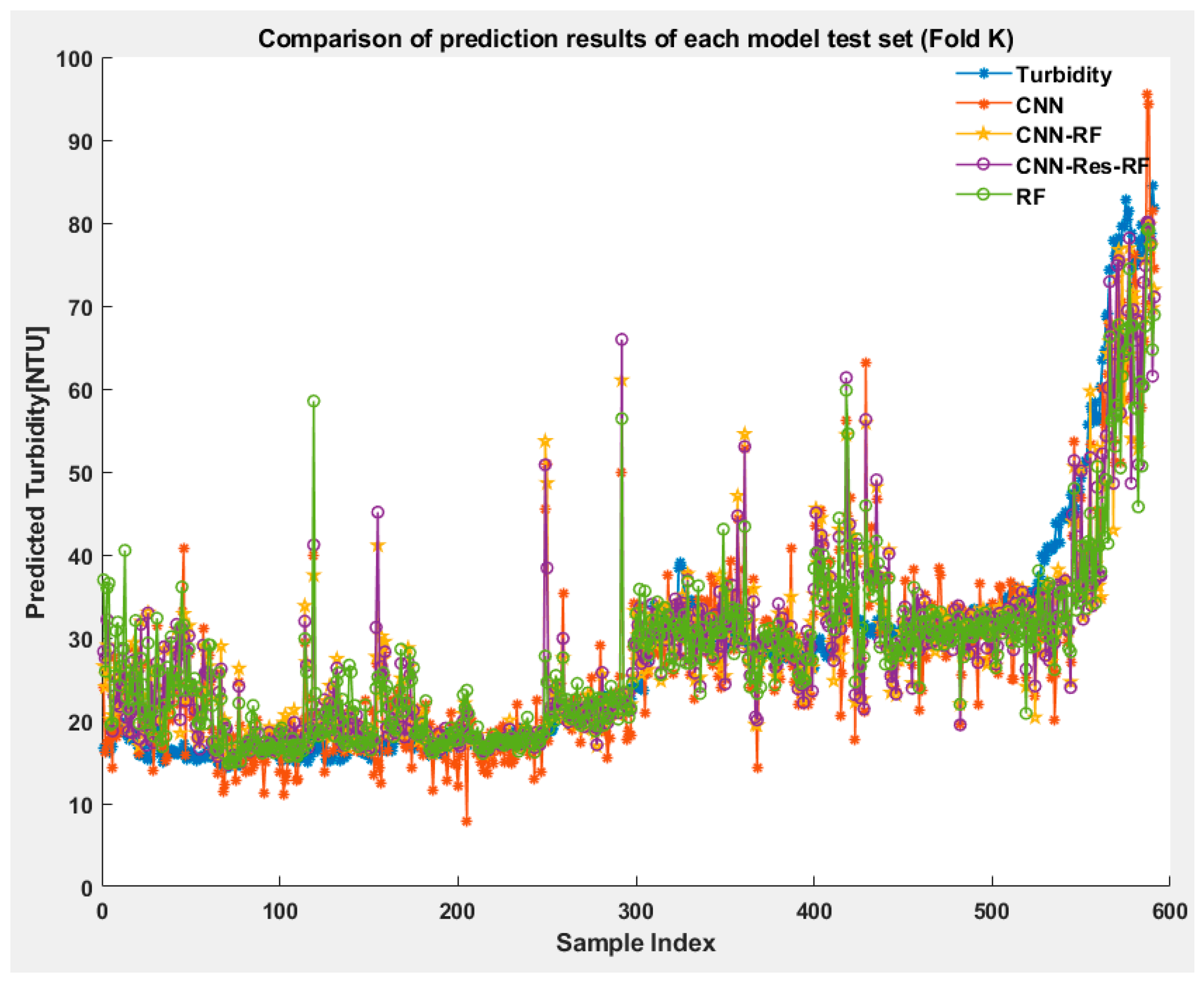
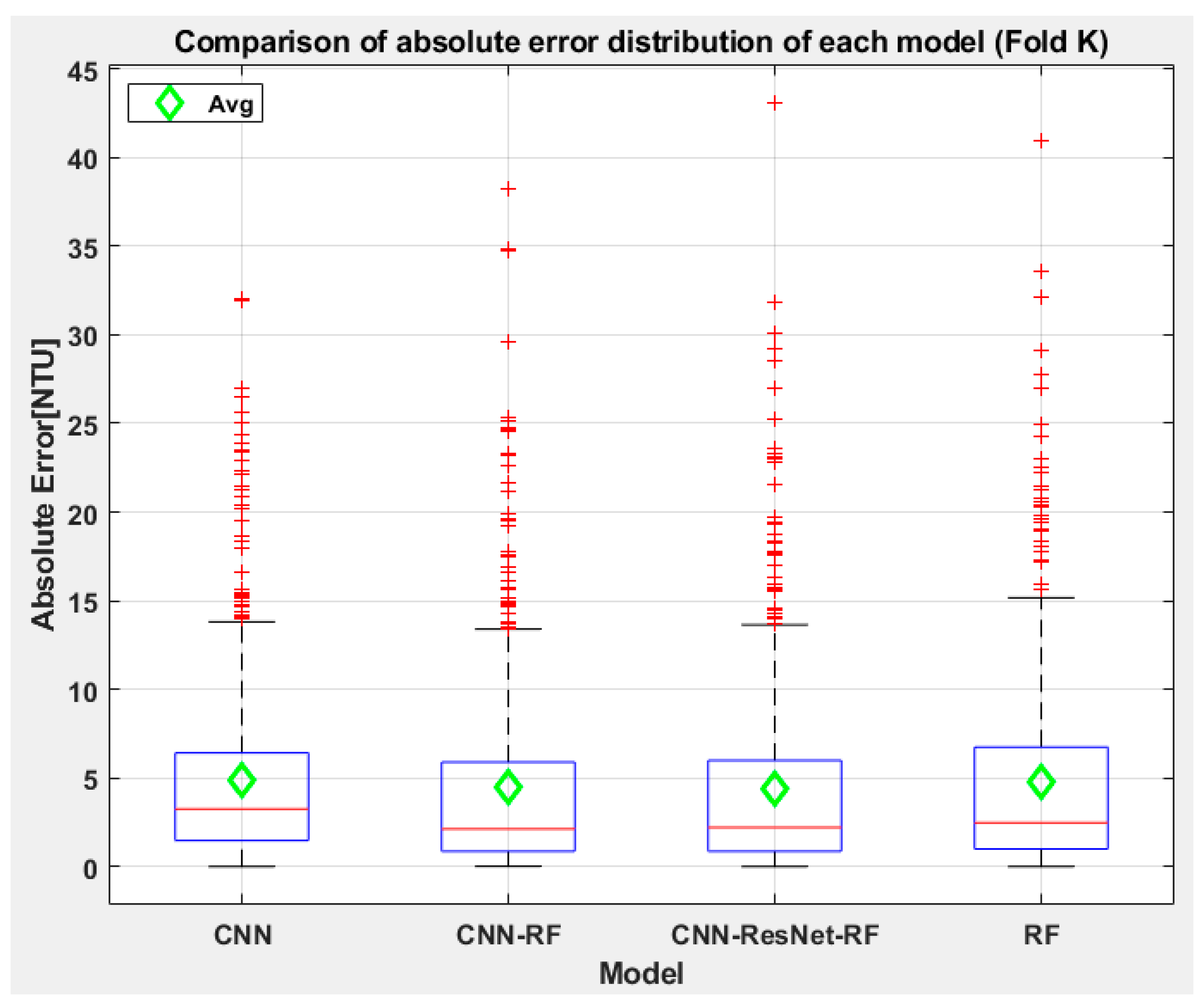
Results demonstrate that the CNN-ResNet-RF hybrid model yielded the best results on all performance metrics (Table 2). It further shows that the prediction curve of the model has the highest fitting degree with the real value curve (Figure 12). The statistical description of the absolute error (box plot, Figure 13) confirms that the error distribution of CNN-ResNet-RF is not only the lowest overall position and the smallest median, but also its box range is more concentrated, indicating that the prediction stability is the best. Specifically, the performance of CNN-ResNet-RF is significantly better than that of a single CNN model and RF model, which highlights the effectiveness of the hybrid architecture; at the same time, the dispersion of the error distribution is smaller than that of the CNN-RF model, indicating that the introduction of the ResNet module further enhances the robustness of the model.
The generalizability of the proposed CNN-ResNet-RF hybrid model was evaluated using an independent dataset from the Northern Yellow Sea. This dataset, temporally distinct (November to December 2020) and containing 1750 samples, was utilized to assess model performance under spatio-temporal conditions significantly different from the training data.
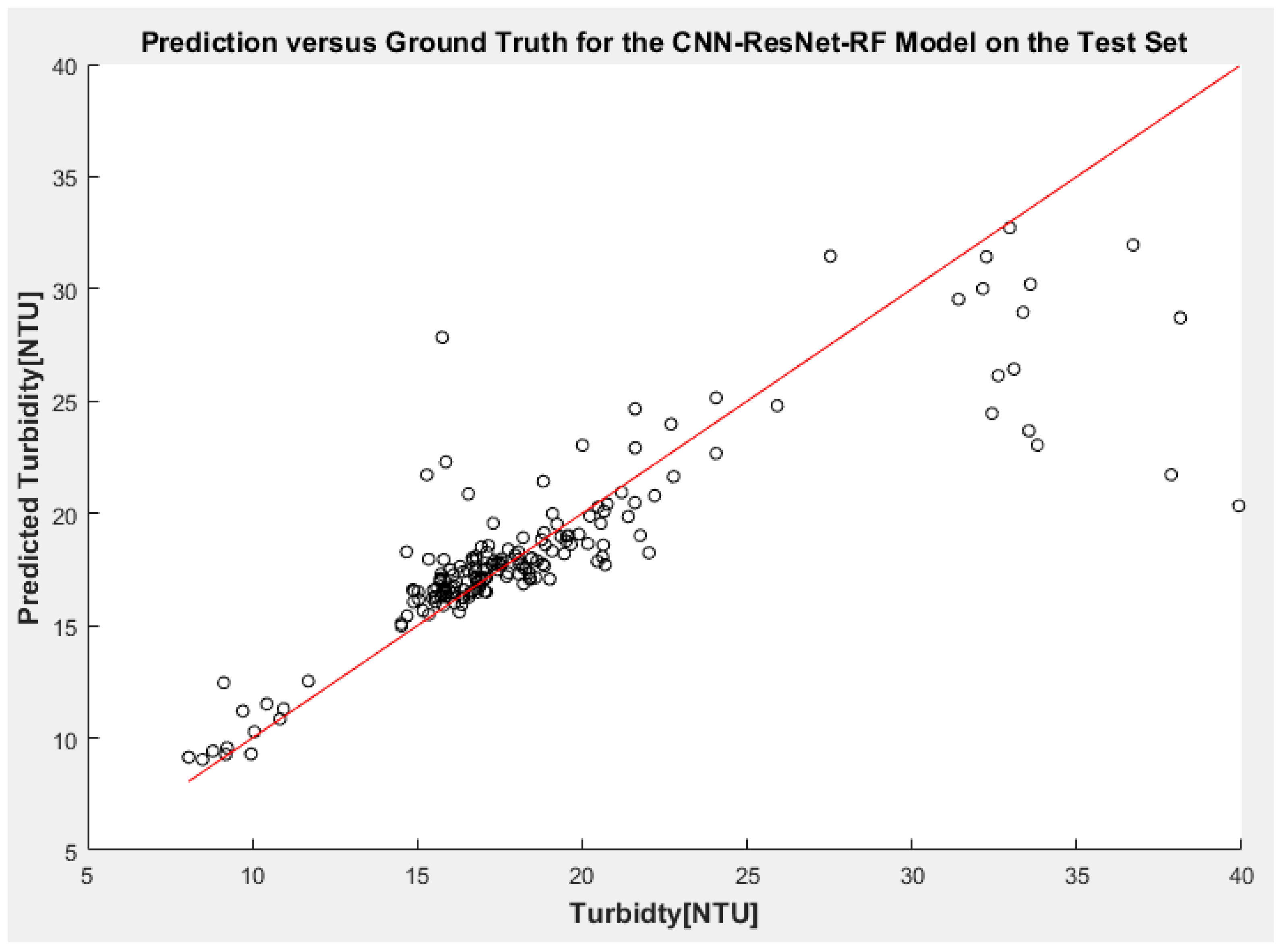
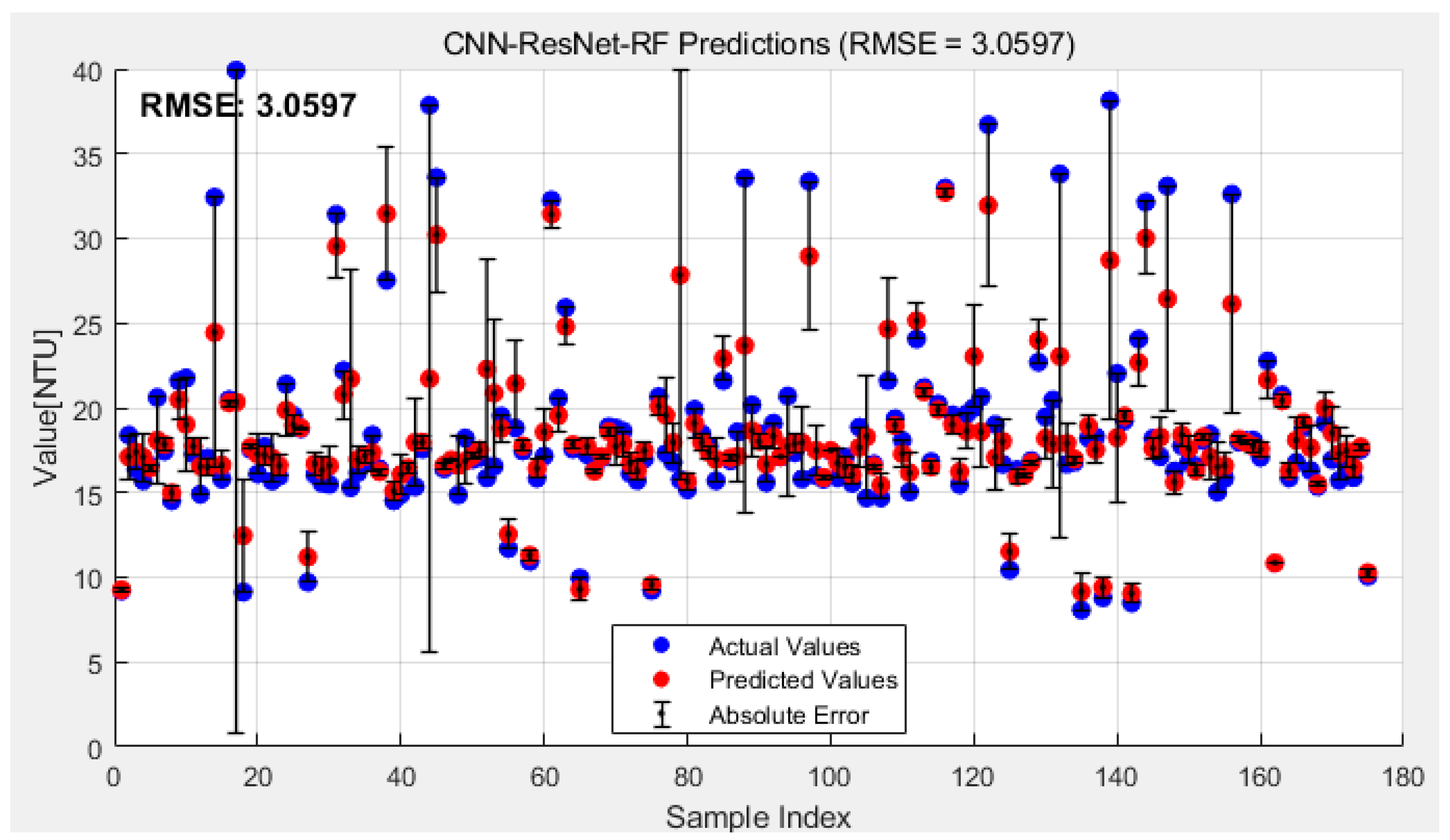
The predicted and true values of the CNN-ResNet-RF hybrid model are closely distributed along the Y = X diagonal in the scatter plot. The RMSE is 3.0597, and the determination coefficient R2 exceeds 0.78. The results show that the model still maintains excellent prediction accuracy in unfamiliar sea areas (Figure 14). It is worth noting that the data points are most densely distributed in the main numerical interval of 15–25, indicating that the model has the best fitting effect in this interval. Further analysis from the perspective of the sample sequence (Figure 15) shows that the model shows good stability. The overall prediction curve can effectively track the trend of the real value. The error analysis shows that the prediction error of most samples is controlled within a reasonable range.
The experimental results show that the CNN-ResNet-RF hybrid model has strong generalization ability and robustness on the dataset of the northern Yellow Sea. The distribution characteristics of data points in the scatter plot are consistent with the performance of the training set, indicating that the deep features extracted by the model through the convolutional neural network have good cross-sea migration ability and can adapt to the prediction tasks in different marine environments. This finding provides an experimental basis for the popularization and application of the model in a broader sea area.

5. Discussion

Through the inversion of the ADCP echo signal, the turbidity data at 2.11 m from the sea surface (the first layer) were obtained. The inversion results are in good agreement with the synchronous measured turbidity meter data, which verifies the reliability of the acoustic inversion method in surface turbidity monitoring. It is worth noting that the high consistency achieved largely depends on the CNN-ResNet-RF empirical model constructed for the specific hydrological and particulate conditions in the study area (northern Chengshantou). To systematically explore the vertical distribution characteristics of turbidity and ensure the robustness of the inversion results, feature selection was strictly controlled. Since including spatial coordinates might lead the model to overfit the fixed vertical turbidity profile (e.g., the Rouse profile) rather than learning the acoustic scattering relationship, depth was excluded from the feature set along with surface parameters (temperature and pressure). Consequently, only 12 acoustic features derived from the ADCP (spanning Layers 1 to 27) were used in the inversion process. This rigorous exclusion ensures that the model establishes a direct mapping between hydroacoustic properties and suspended sediment concentration, independent of vertical depth or environmental artifacts.
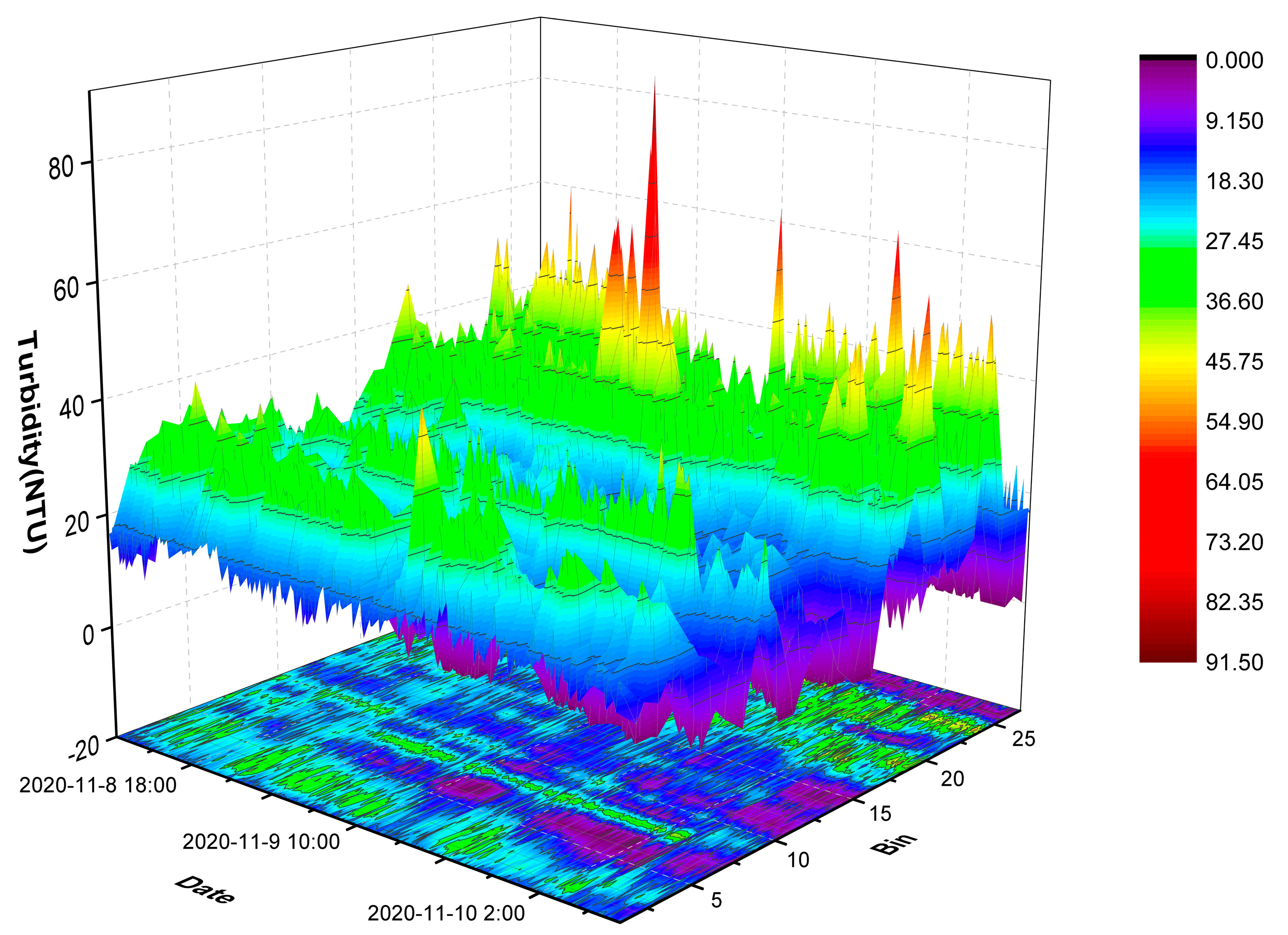
The results showed that during the observation period, the turbidity of the water body showed a clear vertical stratification structure (Figure 16). The turbidity from the surface to the middle layer (1–17 layers) was low and uniform (≤15 NTU), while the turbidity of the bottom layer (18–27 layers) increased significantly (maximum > 40 NTU).
The vertical turbidity stratification observed in this study aligns with classical acoustic backscatter theory and oceanographic observations, where high near-bottom turbidity is typically dominated by sediment resuspension driven by bottom shear stress [11]. However, when comparing our results with classical theoretical models, a key difference must be noted: classical models typically require explicit inputs of particle size distribution (PSD) and sediment type to accurately calculate backscattering strength [31]. In contrast, the CNN-ResNet-RF model proposed in this study implicitly learns the nonlinear mapping between acoustic features and suspended sediment concentration (SSC) through a data-driven approach.
Although environmental proxies such as temperature and depth were excluded to ensure the physical purity of the inversion, the specific morphology and accuracy of the turbidity stratification may still be modulated by complex factors not fully resolved:
  • Coupling Effects of Hydrodynamics and Sediment Dynamics: Vertical mixing intensity and stratification driven by tidal currents and residual flows directly alter the vertical distribution pattern of suspended particles. If the training data fails to fully cover extreme hydrodynamic scenarios (e.g., intense resuspension during storms), the model may exhibit prediction biases. This underscores the importance of capturing the full dynamic range of sediment processes in the training set (utilized here via the K-fold cross-validation strategy) to ensure physical robustness.
  • Acoustic Interference from Biological Scatterers: As noted by Stanton et al. [32] and Gartner [33], a primary physical challenge in single-frequency ADCP turbidity inversion is distinguishing suspended sediments from biological scatterers (e.g., zooplankton or algal aggregates). While sediments act as passive tracers, biological scatterers are often active swimmers or exist in specific scattering layers. During periods of high biological activity (e.g., algal blooms or diel vertical migration), the contribution of biological targets to the volume backscattering strength (Sv) may be conflated with sediment signals, potentially introducing a positive bias in the turbidity inversion. Although our model utilizes Convolutional Neural Networks (CNNs) to extract spatio-temporal texture features, which helps differentiate the morphological patterns of sediment plumes from biological patches, uncertainty remains in the absence of multi-frequency acoustic data.
  • Spatio-Temporal Variability of Particle Properties: While the model automatically extracts multi-level acoustic features, it does not explicitly input physical properties such as particle size or composition. When the particle population in the water column undergoes sudden shifts (e.g., a transition from fine clay to coarse silt or a surge in organic matter), the acoustic scattering cross section of the particles changes accordingly [34]. Since the model was trained on data from a specific season (November), applying it to seasons or regions with significantly different particle properties may require transfer learning to adapt to the new acoustic-sediment relationship.
In summary, this study successfully verified the significant potential of the ensemble learning method for inverting vertical turbidity structures using training data from the southern Yellow Sea. Crucially, the successful generalization of the model to the northern Yellow Sea demonstrates its robustness and adaptability to similar hydrological environments, effectively ruling out the possibility of simple spatial interpolation. However, caution must still be exercised when directly applying the model to sea areas with fundamentally different hydrodynamic structures (such as estuaries dominated by strong runoff) or significantly different particulate sources. Future research should focus on integrating synchronous hydrological and particle size spectrum data to further reveal the coupling mechanisms between turbidity stratification and the multi-scale dynamic-sedimentary environment.

6. Conclusions

This study constructed a hybrid CNN-ResNet-RF turbidity inversion model tailored for the Chengshantou sea area in the southern Yellow Sea. By integrating a physical correction mechanism with deep learning architectures, the model demonstrates a synergistic enhancement in suppressing observation noise and improving the accuracy of ocean turbidity inversion. Crucially, to ensure the inversion is driven by genuine scattering physics, environmental proxies (temperature, pressure, and depth) were excluded. Based on 5-fold cross-validation, the model exhibited robust performance on the test sets (average R2 = 0.782, MAE = 4.454 NTU), showing excellent capability in resolving vertical turbidity structures and maintaining stability across data partitions. Feature importance analysis revised the understanding of the model’s mechanism, revealing that Echo Amplitude is the most critical variable, confirming that the machine learning process is fundamentally governed by hydroacoustic scattering intensity rather than environmental artifacts.
However, this study has limitations that warrant attention in future work:
  • Ambiguity in Scatterer Distinction: The primary limitation lies in the physical ambiguity inherent to single-frequency acoustic inversion. Without synchronous Particle Size Distribution (PSD) or multi-frequency acoustic data, the model cannot fully decouple suspended sediment signals from biological interference (e.g., zooplankton). This may introduce uncertainty during periods of intense biological activity, as the current model inputs cannot explicitly account for variations in particle composition.
  • Boundary Conditions of Generalization: Although the model demonstrates adaptability by successfully generalizing to the northern Yellow Sea, it remains implicitly optimized for the specific hydrodynamic environment of the open Yellow Sea. Its universal applicability to regions with fundamentally different sedimentary regimes, such as high-turbidity estuaries dominated by strong runoff, remains to be systematically verified.
Based on these findings and limitations, future research will focus on three aspects:
  • Deepening Mechanism Integration and Signal Filtering: We aim to optimize the underlying inversion algorithm by developing a vertically adaptive sound absorption correction module. Crucially, to address interference from biological scatterers, we plan to introduce signal statistical filtering (e.g., identifying “spikiness” in echo intensity) and opto-acoustic synergistic discrimination mechanisms. Incorporating PSD data as a model constraint will further quantify the influence of the particle size effect, enhancing the physical consistency and extrapolation ability of the inversion.
  • Expanding Data Dimensions: By fusing multi-source data (such as satellite remote sensing and hydrological model outputs), we intend to construct a comprehensive training dataset that covers a broader range of environmental conditions, thereby improving the model’s responsiveness to complex changes.
  • Verifying Regional Applicability: The model will be validated in typical high-turbidity waters, such as the Yellow River Estuary and the Yangtze River Estuary, to systematically evaluate and improve its generalization ability across diverse marine environments.
In summary, this study provides a solid methodological basis for transitioning the monitoring of turbidity in the Yellow Sea from “single-point static” to “intelligent dynamic” modes and charts the course for enhancing model interpretability by incorporating environmental mechanism parameters.
We have provided a table at the end of the article that lists and explains the professional terms used throughout the text (Table 3).

Author Contributions

Formal analysis, J.L.; data curation, A.Y. and R.W.; writing—original draft preparation, J.L.; writing—review and editing, B.L.; supervision, X.C.; funding acquisition, B.L. All authors have read and agreed to the published version of the manuscript.

Funding

This research was funded by the “Fundamental Research Funds for the Central Universities” (24CX02031A) and the “annual sediment movement characteristics of the seabed boundary layer in Chengdao Oilfield”, supported by Shandong Continental Shelf Marine Technology Co., Ltd. (HX20230616). The authors declare that the funder was not involved in the study design, collection, analysis, interpretation of data, the writing of this article, or the decision to submit it for publication.

Data Availability Statement

Field measurement data of turbidity, current velocity, and direction used in this paper are provided by the First Institute of Oceanography and China University of Petroleum (https://doi.org/10.6084/m9.figshare.26156446, accessed on 1 November 2025).

Conflicts of Interest

The authors declare no conflicts of interest.

References

  1. Talling, P.J.; Hage, S.; Baker, M.L.; Bianchi, T.S.; Hilton, R.G.; Maier, K.L. The Global Turbidity Current Pump and Its Implications for Organic Carbon Cycling. Annu. Rev. Mar. Sci. 2024, 16, 105–133. [Google Scholar] [CrossRef]
  2. Mithila, T.; Mohan, V.; Alzaben, N.; Alghamdi, A.G. Satellite-derived turbidity and salinity mapping for desalination plant site selection using remote sensing. GIS, and machine learning. Desalination Water Treat. 2025, 324, 101482. [Google Scholar] [CrossRef]
  3. Sun, J.; Yang, H.; He, L.; Chu, H.; Lu, Y.; Li, P.; Liu, C.; Qi, J.; Qiang, X. Quaternary Magnetostratigraphy Record in Sediments from Borehole BHS01 in the Bohai Strait. Geoscience 2019, 33, 315–324. [Google Scholar]
  4. Qi, F.; Bian, C.; Xu, J. Parameterization of sediment transport in the Bohai Strait. Acta Oceanol. Sin. 2020, 42, 83–96. [Google Scholar]
  5. Wang, Y.; Zhang, Y.; Sun, H. Seasonal variation of suspended sediment distribution and its transport flux in winter in the eastern coastal area of Shandong Peninsula. Acta Sedimentol. Sin. 2019, 37, 541–549. [Google Scholar] [CrossRef]
  6. Zhang, W.; Huang, Y.; Cheng, W.; Li, M. Experimental study on high concentration suspend sediment calibration. J. Sediment Res. 2019, 44, 21–26. [Google Scholar]
  7. Li, X.; Chen, Y.; Jiang, J.; Ni, Z.; Liu, Q.; Xu, Y.; Tu, D.; Li, S. Reliability analysis of suspended sediment concentration estimated using an ADCP and a turbidity meter. Mar. Sci. 2016, 40, 89–94. [Google Scholar]
  8. Kong, B.; Chen, H.; Yuan, Y. The Influence of CTD Data Resolution on Calculating Geostrophic Flow of Kuroshio. Adv. Mar. Sci. 2016, 34, 358–369. [Google Scholar]
  9. Deines, K.L. Backscatter estimation using broadband acoustic Doppler current profilers. Presented at the IEEE Sixth Working Conference on Current Measurement (Cat. No. 99CH36331), San Diego, CA, USA, 13 March 1999; IEEE: New York, NY, USA, 1999. [Google Scholar]
  10. Urick, R.J. The Absorption of Sound in Suspensions of Irregular Particles. J. Acoust. Soc. Am. 1948, 20, 283–289. [Google Scholar] [CrossRef]
  11. Thorne, P.D.; Hanes, D.M. A review of acoustic measurement of small-scale sediment processes. Cont. Shelf Res. 2002, 22, 603–632. [Google Scholar] [CrossRef]
  12. Berhane, I.; Sternberg, R.W.; Kineke, G.C.; Milligan, T.G.; Kranck, K. The variability of suspended aggregates on the Amazon Continental Shelf. Cont. Shelf Res. 1997, 17, 267–285. [Google Scholar] [CrossRef]
  13. Chalov, S.; Moreido, V.; Ivanov, V.; Chalova, A. Assessing suspended sediment fluxes with acoustic Doppler current profilers: Case study from large rivers in Russia. Big Earth Data 2022, 6, 504–526. [Google Scholar] [CrossRef]
  14. Guedes, P.A.; Silva, H.M.; Wang, S.; Martins, A.; Almeida, J.; Silva, E. Acoustic Imaging Learning-Based Approaches for Marine Litter Detection and Classification. J. Mar. Sci. Eng. 2024, 12, 1984. [Google Scholar] [CrossRef]
  15. Luo, X.; Chen, L.; Zhou, H.; Cao, H. A Survey of Underwater Acoustic Target Recognition Methods Based on Machine Learning. J. Mar. Sci. Eng. 2023, 11, 384. [Google Scholar] [CrossRef]
  16. Zhu, L.F.; Yang, F.; Yang, Y.F.; Xiong, Z.M.; Wei, J. Designing Theoretical Shipborne ADCP Survey Trajectories for High-Frequency Radar Based on a Machine Learning Neural Network. Appl. Sci. 2023, 13, 7208. [Google Scholar] [CrossRef]
  17. Xiong, Z.M.; Wei, C.L.; Yang, F.; Zhu, L.F.; Huang, R.Y.; Wei, J. High-Frequency Surface Wave Radar Current Measurement Corrections via Machine Learning and Towed Acoustic Doppler Current Profiler Integration. Appl. Sci. 2024, 14, 2105. [Google Scholar] [CrossRef]
  18. Zheng, W.; Wang, Z.; Fu, M.; Zhao, B.; Shi, L.; Ran, X.; Hui, L.; Yang, Y. BP neural network applied to ADCP wave estimation. Presented at the 2nd IEEE Advanced Information Technology, Electronic and Automation Control Conference (IAEAC), Chongqing, China, 25–26 March 2017. [Google Scholar]
  19. Sklivanitis, G.; Viloria, J.A.S.; Tountas, K.; Pados, D.A.; Bentley, E.S.; Medley, M.J. Unsupervised training dataset curation for deep-neural-net RF signal classification. In Proceedings of the Big Data V-Learning, Analytics, and Applications, Orlando, FL, USA, 30 April–4 May 2023. [Google Scholar]
  20. Zhang, Q.; Guo, X.; Ma, L. The effect of ocean wave on the vertical spatial correlation of ocean ambient noise. Acta Acust. 2019, 44, 189–200. [Google Scholar]
  21. Li, J.; Feng, Y.; Chu, H.; Hao, L.; Jiang, W.; Huang, X.; Yuan, J.; Chen, Y. Grain size and clay mineral characteristics of surface sediments in the southern North Yellow Sea and their implications for sediment provenance. Mar. Geol. Front. 2024, 40, 91–102. [Google Scholar] [CrossRef]
  22. Zheng, W.; Zhang, D.; Sun, D. Application of attitude sensor in bottom-mounted ADCP wave array. J. Harbin Eng. Univ. 2011, 30, 119–122. [Google Scholar] [CrossRef]
  23. Lan, Z.; Gong, J.; Yu, X.; Li, S.; Xu, Y. A grain-size correction method for synchronous measurement of suspended sediment concentration using a field particle size analyzer and an ADCP. Oceanol. Limnol. Sin. 2004, 385–392. Available online: http://dianda.cqvip.com/Qikan/Article/Detail?id=10657396 (accessed on 1 November 2025).
  24. Downing, A.; Thorne, P.D.; Vincent, C.E. Backscattering from a suspension in the near field of a piston transducer. J. Acoust. Soc. Am. 1995, 97, 1614–1620. [Google Scholar] [CrossRef]
  25. Shafiq, M.; Gu, Z. Deep Residual Learning for Image Recognition: A Survey. Appl. Sci. 2022, 12, 8972. [Google Scholar] [CrossRef]
  26. Breiman, L. Random Forests. Mach. Learn. 2001, 45, 5–32. [Google Scholar] [CrossRef]
  27. Li, B.Q.; He, Y.Y. An Improved ResNet Based on the Adjustable Shortcut Connections. IEEE Access 2018, 6, 18967–18974. [Google Scholar] [CrossRef]
  28. Sun, Z.; Fan, Z.; Zhu, C.; Li, K.; Sun, Z.; Song, X.; Xue, L.; Liu, H.; Jia, Y. Study on the Relationship between Resistivity and the Physical Properties of Seafloor Sediments Based on the Deep Neural Learning Algorithm. J. Mar. Sci. Eng. 2023, 11, 937. [Google Scholar] [CrossRef]
  29. Jing, Y.; Zhang, J.; Zhang, Q.; Maa, J.P.-Y. Experimental study on the effects of sediment size gradation and suspended sediment concentration on the settling velocity, ws. Powder Technol. 2024, 437, 119541. [Google Scholar] [CrossRef]
  30. Francois, R.E.; Garrison, G.R. Sound absorption based on ocean measurements: Part II: Boric acid contribution and equation for total absorption. J. Acoust. Soc. Am. 1982, 72, 1879–1890. [Google Scholar] [CrossRef]
  31. Sheng, J.; Hay, A.E. An examination of the spherical scatterer approximation in aqueous suspensions of sand. J. Acoust. Soc. Am. 1988, 83, 598–610. [Google Scholar] [CrossRef]
  32. Stanton, T.K.; Wiebe, P.H.; Chu, D.; Goodman, L. Acoustic characterization and discrimination of marine zooplankton and turbulence. ICES J. Mar. Sci. 1994, 51, 469–479. [Google Scholar] [CrossRef]
  33. Gartner, J.W. Estimating suspended solids concentrations from backscatter intensity measured by acoustic Doppler current profiler. J. Hydraul. Eng. 2004, 130, 836–848. [Google Scholar]
  34. Thorne, P.D.; Meral, R. Formulations for the scattering properties of suspended sandy sediments for use in the application of acoustics to sediment transport processes. Cont. Shelf Res. 2008, 28, 309–317. [Google Scholar] [CrossRef]
Figure 1. Observation point position (122.318° E, 36.825° N). The red triangle is the position of the observation point.
Jmse 14 00014 g001
Figure 2. ADCP observation data.
Jmse 14 00014 g002
Figure 3. Time series curves of magnitude and direction of horizontal velocity before and after correction.
Jmse 14 00014 g003
Figure 4. Details of residual block structure.
Jmse 14 00014 g004
Figure 5. Flow chart.
Jmse 14 00014 g005
Figure 6. The variation in current velocity, current direction, ADCP echo, and turbidity from 10:00 on 23 November to 10:00 on 25 November.
Jmse 14 00014 g006
Figure 7. Comparison of the echo in each direction with the total echo and turbidity value.
Jmse 14 00014 g007
Figure 8. Comparison between Sv and 10lg (Tur).
Jmse 14 00014 g008
Figure 9. Physical sensitivity analysis of temperature on hydroacoustic properties. (a) Temporal variation in the in situ water temperature during the observation period. (b) The relationship between sound absorption coefficient and temperature derived from the Francois & Garrison (1982) [30] equation at 614.4 kHz.
Jmse 14 00014 g009
Figure 10. The importance of the 13 original features.
Jmse 14 00014 g010
Figure 11. Performance evaluation of the CNN-ResNet-RF model on a representative test fold. (a) Sample-wise comparison between the predicted turbidity (blue line) and the ground truth (in situ measured turbidity, red line). (b) Scatter plot illustrating the correlation between predicted and measured values, where the solid red line represents the 1:1 perfect fit line (y = x).
Jmse 14 00014 g011
Figure 12. Comparison of inversion results of each model.
Jmse 14 00014 g012
Figure 13. Comparison of the absolute error distribution of each model. Box plots depict the median (red horizontal line), interquartile range (blue box), data range extending to 1.5 × IQR (black whiskers), and outliers (red ‘+’ symbols). Green diamond markers (labeled ‘Avg’ in legend) indicate the mean absolute error for each model.
Jmse 14 00014 g013
Figure 14. Comparison of test set results in the northern Yellow Sea.
Jmse 14 00014 g014
Figure 15. RMSE of turbidity prediction results in the northern Yellow Sea.
Jmse 14 00014 g015
Figure 16. Turbidity inversion results of the ADCP bin1-bin27 layer from 10:00 on 8 November to 10:00 on 10 November.
Jmse 14 00014 g016
Table 1. Input characteristics.
NumberParameterExplanation
1SerEmmpersecEast-west current
2SerNmmpersecNorth-south current
3SerVmmpersecVertical current
4SerDir10thDegFlow direction
5SerC1cntSerC1cnt-SerC4cnt are the Correlation Counts of four sensors, SerEA1cnt-SerEA4cnt are the Echo Amplitude Counts of four sensors
6SerEA1cnt
7SerC2cnt
8SerEA2cnt
9SerC3cnt
10SerEA3cnt
11SerC4cnt
12SerEA4cnt
13DepthDepth
Table 2. Comparison of turbidity inversion results of each model.
ModelCNNRFCNN-RFCNN-Res-RF
Training setMAE(NTU)3.9222.8832.3392.118
MSE32.86520.83912.26210.113
R20.8520.9060.9350.946
MAPE(%)14.45810.3968.7447.013
Bias(NTU)−0.083−0.004−0.002−0.002
Test setMAE(NTU)4.8964.7894.5674.454
MSE53.98156.02853.04952.089
R20.7580.7490.7630.782
MAPE(%)17.88217.2116.5315.42
Bias(NTU)−0.07−0.050.020.007
Table 3. The professional terms used throughout the text.
Professional TermsFull Name
ADCPAcoustic Doppler Current Profiler
CNNConvolutional Neural Networks
ResNetResidual Network
RFRandom Forest
BSBackscatter intensity
LSTMLong Short-Term Memory network
ORPOxidation-reduction potential
SvBackscattering strength
SSCSuspended Sediment Concentration
ReLURectified Linear Unit
MAEMean absolute error
MSEMean square error
R2Coefficient of determination
MAPEMean absolute percentage error
Disclaimer/Publisher’s Note: The statements, opinions and data contained in all publications are solely those of the individual author(s) and contributor(s) and not of MDPI and/or the editor(s). MDPI and/or the editor(s) disclaim responsibility for any injury to people or property resulting from any ideas, methods, instructions or products referred to in the content.