Integration of Maritime Autonomous Surface Ships into Coastal Waters Supply Chains: A Systematic Literature Review of Safety and Autonomy Challenges



Abstract
1. Introduction
- RQ1: What tasks should be performed in response to collision avoidance in the MASS ship-to-object scenario?
- RQ2: What tasks should be performed in response to collision avoidance in the MASS ship-to-ship scenario?
- RQ3: What tasks should be performed in response to collision avoidance in the MASS multi-ship scenario?
2. State-of-the-Art Literature Review on MASS Coastal Waters Supply Chain Integration
2.1. Autonomous Navigation in Maritime Coastal Waters
2.2. Maritime Coastal Supply Chain Integration
2.3. Operational Characteristics of Maritime Autonomous Surface Ships
3. Research Methodology of Systematic Literature Review
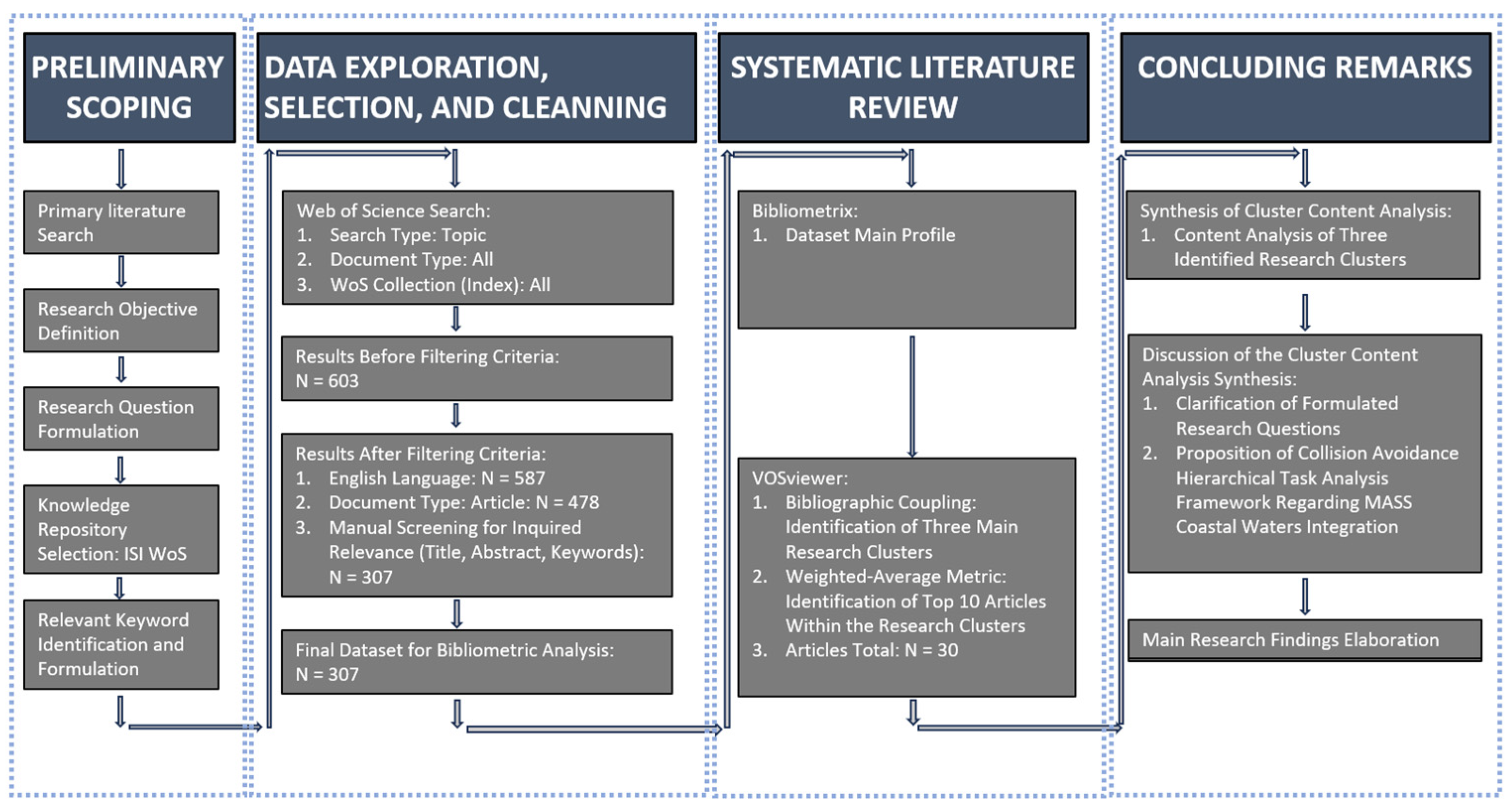
3.1. Bibliometric Analysis Process
3.2. Bibliographic Data Extraction Process
3.3. Methodological Transparency and Parameter Specification
- Map creation: the utilization of VOSviewer (v1.6.20) enables the construction of science maps from bibliographic data [43]. This includes importing the Web of Science Core Collection export files as input data.
- Analysis type: this science mapping used the bibliographic coupling analysis on the document level. In the bibliographic coupling, documents are clustered on the basis of common references [44]. Thus, the greater the reference list overlap in two documents, the stronger their shared connection. This method clusters papers that belong to the same intellectual subject.
- Citation threshold: we set a minimum threshold of 15 citations per document for inclusion in the analysis. Thus, only scientific records exceeding 15 citations were retained for mapping [45]. This selection filter resulted in the retention of only the most influential and highly connected articles (core documents), thus enabling meaningful cluster formation of relevant articles. This citation threshold is a common strategy that is employed to focus on influential works and to facilitate the scientific interpretability of the network. In our case, 112 articles from the starting set met the ≥15 citation threshold and were grouped into clusters.
- Normalization method: we applied the association strength normalization approach for scientific network construction. By default, the VOSviewer software uses the stated normalization method to normalize link weights, accounting for differences in the number of connections each item (article) has [43,44,45,46]. This approach accounts for the concept of relative link strength and takes into consideration the fact that highly connected and linked articles do not outweigh articles with weaker but meaningful links.
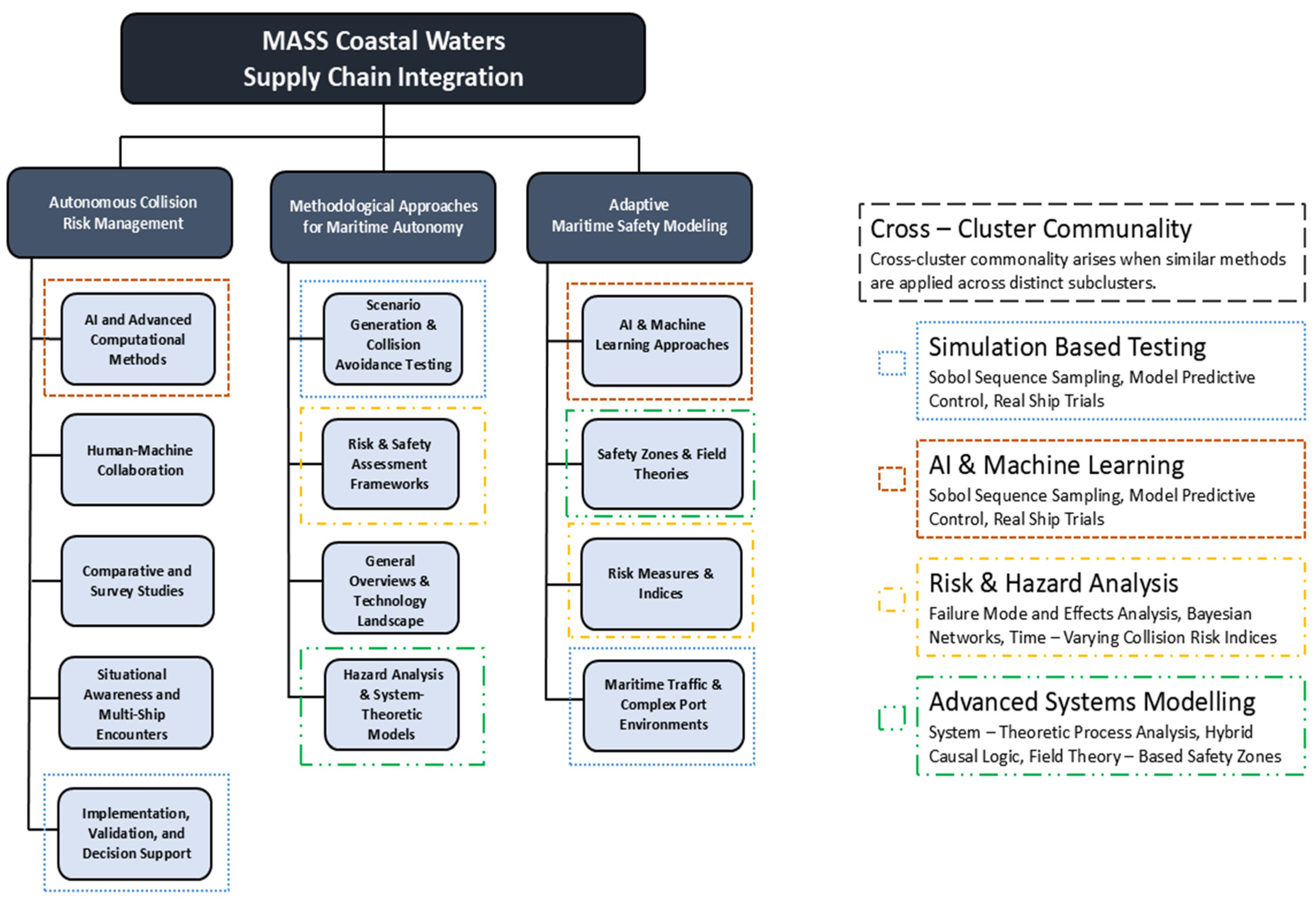
- Clustering algorithm: we used VOSviewer’s built-in clustering algorithm (with the default resolution parameter and method association strength) to identify clusters of documents [47]. This algorithm partitions the network such that documents with stronger bibliographic coupling links naturally form coherent clusters (research themes) [48]. We report that three thematic clusters emerged in our analysis, corresponding to major subtopics in the field.
4. Main Results of the Systematic Literature Review: Research Cluster Analysis
4.1. Autonomous Collision Risk Management
4.1.1. Advanced Computational Methods and AI
4.1.2. Human–Machine Collaboration
4.1.3. Comparative and Survey Studies
4.1.4. Situational Awareness and Multi-Ship Encounters
4.1.5. Implementation, Validation, and Decision Support
4.2. Methodological Approaches for Maritime Autonomy
4.2.1. Scenario Generation and Collision Avoidance Testing
4.2.2. Evaluation Frameworks for Risk and Safety
4.2.3. General Overviews and Technology Landscape
4.2.4. Hazard Analysis and System-Theoretic Models
4.3. Adaptive Maritime Safety Modeling
4.3.1. AI and Machine Learning Approaches
4.3.2. Safety Zones and Field Dimensions
4.3.3. Risk Measures and Indices
4.3.4. Complex Port Environments and Maritime Traffic
5. Discussion: Clarification of Main Research Questions Regarding MASS Coastal Waters Supply Chain Integration
- (RQ1) What tasks should be performed in response to collision avoidance in the MASS ship-to-object scenario?
- (RQ2) What tasks should be performed in response to collision avoidance in the MASS ship-to-ship scenario?
- (RQ3) What tasks should be performed in response to collision avoidance in the MASS multi-ship scenario?
5.1. Formal Modeling, Evaluation, and Validation of MASS Collision Avoidance Subtasks
5.1.1. Ship-to-Object (Allision)
Collision Risk Assessment
Collision Avoidance Method Implementation
Route Planning and Real-Time Adaptation
System Execution and Validation
5.1.2. Ship to Ship (Collision)
Collision Risk Assessment
Collision Avoidance Method Implementation
Route Planning and Real-Time Adaptation
System Execution and Validation
5.1.3. Multi-Ship Encounters
Collision Risk Assessment
Collision Avoidance Method Implementation
Route Planning and Real-Time Adaptation
System Execution and Validation
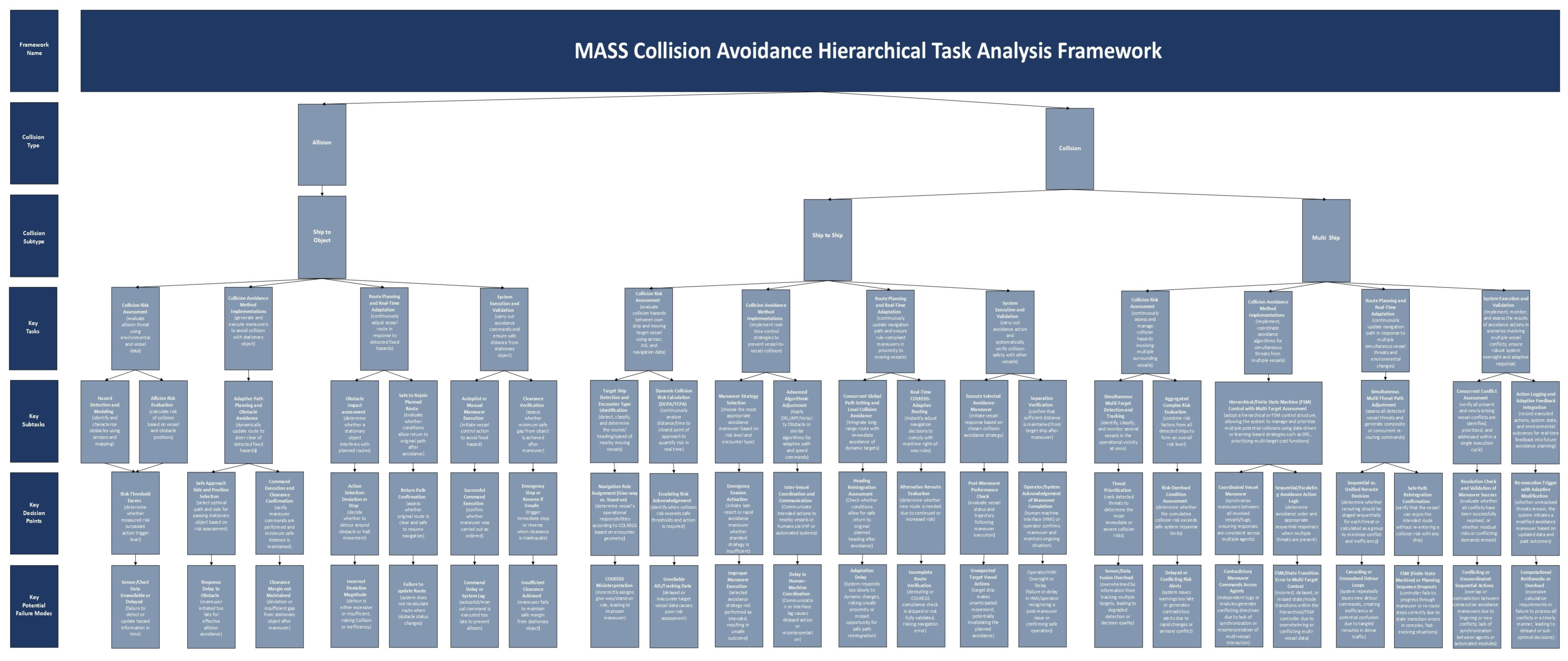
5.1.4. Allocations by Universal Key Task and Collision Subtype
5.2. Research Question Number 1: What Tasks Should Be Performed in Response to Collision Avoidance in MASS Ship-to-Object Scenarios?
5.3. Research Question Number 2: What Tasks Should Be Performed in Response to Collision Avoidance in MASS Ship-to-Ship Scenarios?
5.4. Research Question Number 3: What Tasks Should Be Performed in Response to Collision Avoidance in MASS Multi-Ship Scenarios?
5.5. MASS Collision Avoidance Hierarchical Task Analysis Framework
5.5.1. Collision Avoidance Algorithm Mechanisms
5.5.2. Legal and Regulatory Implications for MASS Coastal Waters Integration
5.5.3. Coastal Logistics Case Studies
5.6. Future Research Directions Regarding MASS Coastal Waters Supply Chain Integration
6. Conclusions
Author Contributions
Funding
Institutional Review Board Statement
Informed Consent Statement
Data Availability Statement
Conflicts of Interest
Abbreviations
| MASS | Maritime autonomous surface ship |
| ISI | Institute for Scientific Information (as in ISI Web of Science) |
| WoS | Web of Science |
| RQ | Research question (e.g., RQ1, RQ2, RQ3) |
| SSS | Short-sea shipping |
| HMI | Human–machine interface |
| AI | Artificial intelligence |
| IMO | International Maritime Organization |
| HTA | Hierarchical task analysis |
| DRL | Deep reinforcement learning |
| APF | Artificial potential field |
| FSM | Finite-state machine |
| VTS | Vessel traffic service |
| CPA | Closest point of approach |
| DCPA | Distance at closest point of Approach |
| TCPA | Time to closest point of approach |
| COLREGs | Convention on the International Regulations for Preventing Collisions at Sea |
| CADCA | Collision avoidance dynamic critical area |
| QSD | Quaternion ship domain |
| MPAPF | Model predictive artificial potential field |
| MANDS | Maritime autonomous navigation decision-making system |
| S-100 | IHO S-100 communication standard |
| ENC | Electronic navigational chart |
| CPU | Central processing unit |
| MG | Metacentric height (stability) |
| FMEA | Failure modes and effects analysis |
| SCC | Shore control center |
References
- Özkan, E.D.; Sevgili, C. Future Horizons: A Bibliometric Analysis of Autonomous Shipping Technologies. Ships Offshore Struct. 2025, 20, 1407–1421. [Google Scholar] [CrossRef] [Scilit]
- Riordan, J.; Constapel, M.; Trslic, P.; Dooly, G.; Oeffner, J.; Schneider, V. Ship Anti-Grounding with a Maritime Autonomous Surface Ship and Digital Twin of Port of Hamburg. In Proceedings of the OCEANS 2023, Limerick, Ireland, 5–8 June 2023; pp. 1–8. [Google Scholar]
- Schröder-Hinrichs, J.U. Human and Organizational Factors in the Maritime World—Are We Keeping up to Speed? WMU J Marit Aff. 2010, 9, 1–3. [Google Scholar] [CrossRef] [Scilit]
- Heij, C.; Knapp, S. Predictive Power of Inspection Outcomes for Future Shipping Accidents—An Empirical Appraisal with Special Attention for Human Factor Aspects. Marit. Policy Manag. 2018, 45, 604–621. [Google Scholar] [CrossRef] [Scilit]
- Wróbel, K. Searching for the Origins of the Myth: 80% Human Error Impact on Maritime Safety. Reliab. Eng. Syst. Saf. 2021, 216, 107942. [Google Scholar] [CrossRef] [Scilit]
- Alamoush, A.S.; Ölçer, A.I. Maritime Autonomous Surface Ships: Architecture for Autonomous Navigation Systems. J. Mar. Sci. Eng. 2025, 13, 122. [Google Scholar] [CrossRef] [Scilit]
- IMO. Autonomous Shipping. Available online: https://www.imo.org/en/MediaCentre/HotTopics/Pages/Autonomous-shipping.aspx (accessed on 26 May 2025).
- DNV. IMO Maritime Safety Committee (MSC 107). Available online: https://www.dnv.com/news/2023/imo-maritime-safety-committee-msc-107--244383/ (accessed on 9 November 2025).
- Burmeister, H.-C.; Bruhn, W.; Rødseth, Ø.J.; Porathe, T. Autonomous Unmanned Merchant Vessel and Its Contribution towards the E-Navigation Implementation: The MUNIN Perspective. Int. J. E-Navig. Marit. Econ. 2014, 1, 1–13. [Google Scholar] [CrossRef] [Scilit]
- Ahvenjärvi, S. The Human Element and Autonomous Ships. TransNav Int. J. Mar. Navig. Saf. Sea Transp. 2016, 10, 517–521. [Google Scholar] [CrossRef] [Scilit]
- Chang, C.-H.; Wijeratne, I.B.; Kontovas, C.; Yang, Z. COLREG and MASS: Analytical Review to Identify Research Trends and Gaps in the Development of Autonomous Collision Avoidance. Ocean Eng. 2024, 302, 117652. [Google Scholar] [CrossRef] [Scilit]
- Zhou, Y.; Liu, Z.; Wang, X.; Xie, H.; Tao, J.; Wang, J.; Yang, Z. Human Errors Analysis for Remotely Controlled Ships during Collision Avoidance. Front. Mar. Sci. 2024, 11, 1473367. [Google Scholar] [CrossRef] [Scilit]
- Barry, E.S.; Merkebu, J.; Varpio, L. Understanding State-of-the-Art Literature Reviews. J. Grad. Med. Educ. 2022, 14, 659–662. [Google Scholar] [CrossRef] [Scilit]
- Grant, M.J.; Booth, A. A Typology of Reviews: An Analysis of 14 Review Types and Associated Methodologies. Health Inf. Libr. J. 2009, 26, 91–108. [Google Scholar] [CrossRef] [Scilit]
- Arenius, M.; Athanassiou, G.; Sträter, O. Systemic Assessment of the Effect of Mental Stress and Strain on Performance in a Maritime Ship-Handling Simulator. IFAC Proc. Vol. 2010, 43, 43–46. [Google Scholar] [CrossRef] [Scilit]
- Porathe, T.; Fjortoft, K.; Bratbergsengen, I.L. Human Factors, Autonomous Ships and Constrained Coastal Navigation. IOP Conf. Ser. Mater. Sci. Eng. 2020, 929, 012007. [Google Scholar] [CrossRef] [Scilit]
- Porathe, T.; Borup, O.; Jeong, J.S.; Park, J.H.; Camre, D.A.; Brödje, A. Ship Traffic Management Route Exchange: Acceptance in Korea and Sweden, a Cross Cultural Study. In Proceedings of the International Symposium Information on Ships, ISIS 2014, Hamburg, Germany, 4–5 September 2014; pp. 64–79. [Google Scholar]
- Cheng, T.; Veitch, E.A.; Utne, I.B.; Ramos, M.A.; Mosleh, A.; Alsos, O.A.; Wu, B. Analysis of Human Errors in Human-Autonomy Collaboration in Autonomous Ships Operations through Shore Control Experimental Data. Reliab. Eng. Syst. Saf. 2024, 246, 110080. [Google Scholar] [CrossRef] [Scilit]
- Bolbot, V.; Bergström, M.; Rahikainen, M.; Valdez Banda, O.A. Investigation into Safety Acceptance Principles for Autonomous Ships. Reliab. Eng. Syst. Saf. 2025, 257, 110810. [Google Scholar] [CrossRef] [Scilit]
- Kurt, I.; Aymelek, M. Operational Adaptation of Ports with Maritime Autonomous Surface Ships. Transp. Policy 2024, 145, 1–10. [Google Scholar] [CrossRef] [Scilit]
- Paixão, A.C.; Marlow, P.B. Strengths and Weaknesses of Short Sea Shipping. Mar. Policy 2002, 26, 167–178. [Google Scholar] [CrossRef] [Scilit]
- Marlow, P.B.; Casaca, A.C.P. Short Sea Shipping and Its Role in Logistics Supply Chains: A European Perspective. J. Int. Logist. Trade 2004, 2, 57–68. [Google Scholar] [CrossRef] [Scilit]
- Suárez-Alemán, A.; Lourdes, T.; Medda, F. Short Sea Shipping as Intermodal Competitor: A Theoretical Analysis of European Transport Policies. Marit. Policy Manag. 2015, 42, 317–334. [Google Scholar] [CrossRef] [Scilit]
- Brooks, M.R.; Frost, J.D. Short Sea Shipping: A Canadian Perspective. Marit. Policy Manag. 2004, 31, 393–407. [Google Scholar] [CrossRef] [Scilit]
- Bendall, H.B.; Brooks, M.R. Short Sea Shipping: Lessons for or from Australia. Int. J. Shipp. Transp. Logist. 2011, 3, 384. [Google Scholar] [CrossRef] [Scilit]
- Medda, F.; Trujillo, L. Short-Sea Shipping: An Analysis of Its Determinants. Marit. Policy Manag. 2010, 37, 285–303. [Google Scholar] [CrossRef] [Scilit]
- Ng, A.K.Y. Competitiveness of Short Sea Shipping and the Role of Port: The Case of North Europe. Marit. Policy Manag. 2009, 36, 337–352. [Google Scholar] [CrossRef] [Scilit]
- Sambracos, E.; Maniati, M. Competitiveness between Short Sea Shipping and Road Freight Transport in Mainland Port Connections; the Case of Two Greek Ports. Marit. Policy Manag. 2012, 39, 321–337. [Google Scholar] [CrossRef] [Scilit]
- Jovanović, I.; Perčić, M.; BahooToroody, A.; Fan, A.; Vladimir, N. Review of Research Progress of Autonomous and Unmanned Shipping and Identification of Future Research Directions. J. Mar. Eng. Technol. 2024, 23, 82–97. [Google Scholar] [CrossRef] [Scilit]
- Ziajka-Poznańska, E.; Montewka, J. Costs and Benefits of Autonomous Shipping—A Literature Review. Appl. Sci. 2021, 11, 4553. [Google Scholar] [CrossRef] [Scilit]
- Hogg, T.; Ghosh, S. Autonomous Merchant Vessels: Examination of Factors That Impact the Effective Implementation of Unmanned Ships. Aust. J. Marit. Ocean Aff. 2016, 8, 206–222. [Google Scholar] [CrossRef] [Scilit]
- Hwang, T.; Youn, I.-H. Collision Risk Situation Clustering to Design Collision Avoidance Algorithms for Maritime Autonomous Surface Ships. J. Mar. Sci. Eng. 2022, 10, 1381. [Google Scholar] [CrossRef] [Scilit]
- Kretschmann, L.; Burmeister, H.-C.; Jahn, C. Analyzing the Economic Benefit of Unmanned Autonomous Ships: An Exploratory Cost-Comparison between an Autonomous and a Conventional Bulk Carrier. Res. Transp. Bus. Manag. 2017, 25, 76–86. [Google Scholar] [CrossRef] [Scilit]
- Liang, T.-P.; Liu, Y.-H. Research Landscape of Business Intelligence and Big Data Analytics: A Bibliometrics Study. Expert Syst. Appl. 2018, 111, 2–10. [Google Scholar] [CrossRef] [Scilit]
- Munim, Z.H.; Dushenko, M.; Jimenez, V.J.; Shakil, M.H.; Imset, M. Big Data and Artificial Intelligence in the Maritime Industry: A Bibliometric Review and Future Research Directions. Marit. Policy Manag. 2020, 47, 577–597. [Google Scholar] [CrossRef] [Scilit]
- Aria, M.; Cuccurullo, C. Bibliometrix: An R-Tool for Comprehensive Science Mapping Analysis. J. Informetr. 2017, 11, 959–975. [Google Scholar] [CrossRef] [Scilit]
- Kirby, A. Exploratory Bibliometrics: Using VOSviewer as a Preliminary Research Tool. Publications 2023, 11, 10. [Google Scholar] [CrossRef] [Scilit]
- Ellegaard, O.; Wallin, J.A. The Bibliometric Analysis of Scholarly Production: How Great Is the Impact? Scientometrics 2015, 105, 1809–1831. [Google Scholar] [CrossRef] [Scilit]
- Belabyad, M.; Kontovas, C.; Pyne, R.; Chang, C.H. Skills and Competencies for Operating Maritime Autonomous Surface Ships (MASS): A Systematic Review and Bibliometric Analysis. Marit. Policy Manag. 2025, 1–26. [Google Scholar] [CrossRef] [Scilit]
- Li, Z.; Zhang, D.; Han, B.; Wan, C. Risk and Reliability Analysis for Maritime Autonomous Surface Ship: A Bibliometric Review of Literature from 2015 to 2022. Accid. Anal. Prev. 2023, 187, 107090. [Google Scholar] [CrossRef] [Scilit]
- Xue, J.; Yang, P.; Li, Q.; Song, Y.; Gelder, P.V.; Papadimitriou, E.; Hu, H. Machine Learning in Maritime Safety for Autonomous Shipping: A Bibliometric Review and Future Trends. J. Mar. Sci. Eng. 2025, 13, 746. [Google Scholar] [CrossRef] [Scilit]
- van Eck, N.J.; Waltman, L. Software Survey: VOSviewer, a Computer Program for Bibliometric Mapping. Scientometrics 2010, 84, 523–538. [Google Scholar] [CrossRef] [Scilit]
- van Eck, N.J.; Waltman, L. Visualizing Bibliometric Networks. In Measuring Scholarly Impact: Methods and Practice; Ding, Y., Rousseau, R., Wolfram, D., Eds.; Springer International Publishing: Cham, Switzerland, 2014; pp. 285–320. ISBN 978-3-319-10377-8. [Google Scholar]
- Zupic, I.; Čater, T. Bibliometric Methods in Management and Organization. Organ. Res. Methods 2015, 18, 429–472. [Google Scholar] [CrossRef] [Scilit]
- Ali Abaker Omer, A.; Dong, Y. Mapping the Use of Bibliometric Software and Methodological Transparency in Literature Review Studies: A Comparative Analysis of China-Affiliated and Non-China-Affiliated Research Communities (2015–2024). Publications 2025, 13, 40. [Google Scholar] [CrossRef] [Scilit]
- Ersen, N.; Akyüz, İ.; Akyüz, K.C. Bibliometric Analysis of the International Journal in Wood Science Using Visualization Mapping Method. Eur. J. Sci. 2024, 12, 47–65. [Google Scholar] [CrossRef] [Scilit]
- Nandy, A.; Singh, A.; Gupta, V.; Singh, V.K. Bibliographic Coupling and Conceptual Similarity: Are the Bibliographically Coupled Papers Also Conceptually Similar? J Scientometr. Res. 2025, 13, 706–714. [Google Scholar] [CrossRef] [Scilit]
- Tsilika, K. Exploring the Contributions to Mathematical Economics: A Bibliometric Analysis Using Bibliometrix and VOSviewer. Mathematics 2023, 11, 4703. [Google Scholar] [CrossRef] [Scilit]
- Maditati, D.R.; Munim, Z.H.; Schramm, H.-J.; Kummer, S. A Review of Green Supply Chain Management: From Bibliometric Analysis to a Conceptual Framework and Future Research Directions. Resour. Conserv. Recycl. 2018, 139, 150–162. [Google Scholar] [CrossRef] [Scilit]
- Sharma, R.; Shishodia, A.; Gunasekaran, A.; Min, H.; Munim, Z.H. The Role of Artificial Intelligence in Supply Chain Management: Mapping the Territory. Int. J. Prod. Res. 2022, 60, 7527–7550. [Google Scholar] [CrossRef] [Scilit]
- Shishodia, A.; Sharma, R.; Rajesh, R.; Munim, Z.H. Supply Chain Resilience: A Review, Conceptual Framework and Future Research. Int. J. Logist. Manag. 2021, 34, 879–908. [Google Scholar] [CrossRef] [Scilit]
- Boyack, K.W.; Klavans, R. Co-citation Analysis, Bibliographic Coupling, and Direct Citation: Which Citation Approach Represents the Research Front Most Accurately? J. Am. Soc. Inf. Sci. 2010, 61, 2389–2404. [Google Scholar] [CrossRef] [Scilit]
- Jimenez, V.J.; Kim, H.; Munim, Z.H. A Review of Ship Energy Efficiency Research and Directions towards Emission Reduction in the Maritime Industry. J. Clean. Prod. 2022, 366, 132888. [Google Scholar] [CrossRef] [Scilit]
- Chun, D.-H.; Roh, M.-I.; Lee, H.-W.; Ha, J.; Yu, D. Deep Reinforcement Learning-Based Collision Avoidance for an Autonomous Ship. Ocean Eng. 2021, 234, 109216. [Google Scholar] [CrossRef] [Scilit]
- Bolbot, V.; Gkerekos, C.; Theotokatos, G.; Boulougouris, E. Automatic Traffic Scenarios Generation for Autonomous Ships Collision Avoidance System Testing. Ocean Eng. 2022, 254, 111309. [Google Scholar] [CrossRef] [Scilit]
- Fiskin, R.; Atik, O.; Kisi, H.; Nasibov, E.; Johansen, T.A. Fuzzy Domain and Meta-Heuristic Algorithm-Based Collision Avoidance Control for Ships: Experimental Validation in Virtual and Real Environment. Ocean Eng. 2021, 220, 108502. [Google Scholar] [CrossRef] [Scilit]
- Huang, Y.; Chen, L.; Chen, P.; Negenborn, R.R.; Van Gelder, P.H.A.J.M. Ship Collision Avoidance Methods: State-of-the-Art. Saf. Sci. 2020, 121, 451–473. [Google Scholar] [CrossRef] [Scilit]
- Chang, C.-H.; Kontovas, C.; Yu, Q.; Yang, Z. Risk Assessment of the Operations of Maritime Autonomous Surface Ships. Reliab. Eng. Syst. Saf. 2021, 207, 107324. [Google Scholar] [CrossRef] [Scilit]
- Gil, M. A Concept of Critical Safety Area Applicable for an Obstacle-Avoidance Process for Manned and Autonomous Ships. Reliab. Eng. Syst. Saf. 2021, 214, 107806. [Google Scholar] [CrossRef] [Scilit]
- Li, M.; Mou, J.; Chen, L.; Huang, Y.; Chen, P. Comparison between the Collision Avoidance Decision-Making in Theoretical Research and Navigation Practices. Ocean Eng. 2021, 228, 108881. [Google Scholar] [CrossRef] [Scilit]
- Fan, C.; Montewka, J.; Zhang, D. A Risk Comparison Framework for Autonomous Ships Navigation. Reliab. Eng. Syst. Saf. 2022, 226, 108709. [Google Scholar] [CrossRef] [Scilit]
- He, Z.; Chu, X.; Liu, C.; Wu, W. A Novel Model Predictive Artificial Potential Field Based Ship Motion Planning Method Considering COLREGs for Complex Encounter Scenarios. ISA Trans. 2023, 134, 58–73. [Google Scholar] [CrossRef] [Scilit]
- Lyu, H.; Yin, Y. COLREGS-Constrained Real-Time Path Planning for Autonomous Ships Using Modified Artificial Potential Fields. J. Navig. 2019, 72, 588–608. [Google Scholar] [CrossRef] [Scilit]
- Gu, Y.; Goez, J.C.; Guajardo, M.; Wallace, S.W. Autonomous Vessels: State of the Art and Potential Opportunities in Logistics. Int Trans Oper. Res 2021, 28, 1706–1739. [Google Scholar] [CrossRef] [Scilit]
- Huang, Y.; Van Gelder, P.H.A.J.M. Collision Risk Measure for Triggering Evasive Actions of Maritime Autonomous Surface Ships. Saf. Sci. 2020, 127, 104708. [Google Scholar] [CrossRef] [Scilit]
- Shaobo, W.; Yingjun, Z.; Lianbo, L. A Collision Avoidance Decision-Making System for Autonomous Ship Based on Modified Velocity Obstacle Method. Ocean Eng. 2020, 215, 107910. [Google Scholar] [CrossRef] [Scilit]
- Johansen, T.A.; Perez, T.; Cristofaro, A. Ship Collision Avoidance and COLREGS Compliance Using Simulation-Based Control Behavior Selection With Predictive Hazard Assessment. IEEE Trans. Intell. Transport. Syst. 2016, 17, 3407–3422. [Google Scholar] [CrossRef] [Scilit]
- Li, H.; Jiao, H.; Yang, Z. AIS Data-Driven Ship Trajectory Prediction Modelling and Analysis Based on Machine Learning and Deep Learning Methods. Transp. Res. Part E Logist. Transp. Rev. 2023, 175, 103152. [Google Scholar] [CrossRef] [Scilit]
- Wang, K.; Xu, H.; Li, J.; Huang, L.; Ma, R.; Jiang, X.; Yuan, Y.; Mwero, N.A.; Sun, P.; Negenborn, R.R.; et al. A Novel Dynamical Collaborative Optimization Method of Ship Energy Consumption Based on a Spatial and Temporal Distribution Analysis of Voyage Data. Appl. Ocean. Res. 2021, 112, 102657. [Google Scholar] [CrossRef] [Scilit]
- Li, M.; Mou, J.; Chen, L.; He, Y.; Huang, Y. A Rule-Aware Time-Varying Conflict Risk Measure for MASS Considering Maritime Practice. Reliab. Eng. Syst. Saf. 2021, 215, 107816. [Google Scholar] [CrossRef] [Scilit]
- Wang, S.; Zhang, Y.; Zhang, X.; Gao, Z. A Novel Maritime Autonomous Navigation Decision-Making System: Modeling, Integration, and Real Ship Trial. Expert Syst. Appl. 2023, 222, 119825. [Google Scholar] [CrossRef] [Scilit]
- Abilio Ramos, M.; Utne, I.B.; Mosleh, A. Collision Avoidance on Maritime Autonomous Surface Ships: Operators’ Tasks and Human Failure Events. Saf. Sci. 2019, 116, 33–44. [Google Scholar] [CrossRef] [Scilit]
- Montewka, J.; Manderbacka, T.; Ruponen, P.; Tompuri, M.; Gil, M.; Hirdaris, S. Accident Susceptibility Index for a Passenger Ship-a Framework and Case Study. Reliab. Eng. Syst. Saf. 2022, 218, 108145. [Google Scholar] [CrossRef] [Scilit]
- Wu, X.; Liu, K.; Zhang, J.; Yuan, Z.; Liu, J.; Yu, Q. An Optimized Collision Avoidance Decision-Making System for Autonomous Ships under Human-Machine Cooperation Situations. J. Adv. Transp. 2021, 2021, 7537825. [Google Scholar] [CrossRef] [Scilit]
- Wróbel, K.; Montewka, J.; Kujala, P. Towards the Development of a System-Theoretic Model for Safety Assessment of Autonomous Merchant Vessels. Reliab. Eng. Syst. Saf. 2018, 178, 209–224. [Google Scholar] [CrossRef] [Scilit]
- Qiao, Z.; Zhang, Y.; Wang, S. A Collision Risk Identification Method for Autonomous Ships Based on Field Theory. IEEE Access 2021, 9, 30539–30550. [Google Scholar] [CrossRef] [Scilit]
- Zhang, X.; Wang, C.; Jiang, L.; An, L.; Yang, R. Collision-Avoidance Navigation Systems for Maritime Autonomous Surface Ships: A State of the Art Survey. Ocean Eng. 2021, 235, 109380. [Google Scholar] [CrossRef] [Scilit]
- Wróbel, K.; Gil, M.; Krata, P.; Olszewski, K.; Montewka, J. On the Use of Leading Safety Indicators in Maritime and Their Feasibility for Maritime Autonomous Surface Ships. Proc. Inst. Mech. Eng. Part O J. Risk Reliab. 2023, 237, 314–331. [Google Scholar] [CrossRef] [Scilit]
- Xin, X.; Liu, K.; Loughney, S.; Wang, J.; Li, H.; Yang, Z. Graph-Based Ship Traffic Partitioning for Intelligent Maritime Surveillance in Complex Port Waters. Expert Syst. Appl. 2023, 231, 120825. [Google Scholar] [CrossRef] [Scilit]
- Zhang, K.; Huang, L.; Liu, X.; Chen, J.; Zhao, X.; Huang, W.; He, Y. A Novel Decision Support Methodology for Autonomous Collision Avoidance Based on Deduction of Manoeuvring Process. JMSE 2022, 10, 765. [Google Scholar] [CrossRef] [Scilit]
- Zhang, D.; Han, Z.; Zhang, K.; Zhang, J.; Zhang, M.; Zhang, F. Use of Hybrid Causal Logic Method for Preliminary Hazard Analysis of Maritime Autonomous Surface Ships. J. Mar. Sci. Eng. 2022, 10, 725. [Google Scholar] [CrossRef] [Scilit]
- Xin, X.; Liu, K.; Loughney, S.; Wang, J.; Li, H.; Ekere, N.; Yang, Z. Multi-Scale Collision Risk Estimation for Maritime Traffic in Complex Port Waters. Reliab. Eng. Syst. Saf. 2023, 240, 109554. [Google Scholar] [CrossRef] [Scilit]
- Gomola, A.; Kristensen, S.D.; Utne, I.B. Multi-Level Risk Classification of Distributed Embedded Software Failures for Autonomous Systems. Proc. Inst. Mech. Eng. Part O J. Risk Reliab. 2025, 239, 936–965. [Google Scholar] [CrossRef] [Scilit]
- Wang, C.; Zhang, X.; Gao, H.; Bashir, M.; Li, H.; Yang, Z. Optimizing Anti-Collision Strategy for MASS: A Safe Reinforcement Learning Approach to Improve Maritime Traffic Safety. Ocean Coast. Manag. 2024, 253, 107161. [Google Scholar] [CrossRef] [Scilit]
- Laakso, A.; Chaal, M.; Valdez Banda, O.A. A Risk Assessment of an Autonomous Navigation System for a Maritime Autonomous Surface Ship. J. Mar. Eng. Technol. 2024, 24, 253–269. [Google Scholar] [CrossRef] [Scilit]
- Li, Y.; Wu, D.; Wang, H.; Lou, J. Dynamic Collision Avoidance for Maritime Autonomous Surface Ships Based on Deep Q-Network with Velocity Obstacle Method. Ocean Eng. 2025, 320, 120335. [Google Scholar] [CrossRef] [Scilit]
- Liu, J.; Xu, C.; Li, S.; Dong, Z.; Liu, J.; Zhao, Y.; Sun, B. Towards Future Autonomous Tugs: Design and Implementation of an Intelligent Escort Control System Validated by Sea Trials. Adv. Eng. Inform. 2025, 65, 103116. [Google Scholar] [CrossRef] [Scilit]
- Zhang, H.; Cao, Y.; Shan, Q.; Sun, Y. Collision Avoidance for Maritime Autonomous Surface Ships Based on Model Predictive Control Using Intention Data and Quaternion Ship Domain. J. Mar. Sci. Eng. 2025, 13, 124. [Google Scholar] [CrossRef] [Scilit]
- Gezer, E.C.; Moreau, M.K.I.; Høgden, A.S.; Nguyen, D.T.; Skjetne, R.; Sørensen, A. Digital-Physical Testbed for Ship Autonomy Studies in the Marine Cybernetics Laboratory Basin. Available online: http://arxiv.org/abs/2505.06787 (accessed on 26 May 2025).
- Li, L.; Wu, W.; Li, Z.; Wang, F. Collision Avoidance Method for Unmanned Ships Using a Modified APF Algorithm. Front. Mar. Sci. 2025, 12, 1550529. [Google Scholar] [CrossRef] [Scilit]
- Zheng, K.; Zhang, X.; Wang, C.; Li, Y.; Cui, J.; Jiang, L. Adaptive Collision Avoidance Decisions in Autonomous Ship Encounter Scenarios through Rule-Guided Vision Supervised Learning. Ocean Eng. 2024, 297, 117096. [Google Scholar] [CrossRef] [Scilit]
- Zhang, M.; Taimuri, G.; Zhang, J.; Zhang, D.; Yan, X.; Kujala, P.; Hirdaris, S. Systems Driven Intelligent Decision Support Methods for Ship Collision and Grounding Prevention: Present Status, Possible Solutions, and Challenges. Reliab. Eng. Syst. Saf. 2025, 253, 110489. [Google Scholar] [CrossRef] [Scilit]
- Zarzycki, F.; Gil, M.; Montewka, J.; Szłapczyński, R.; Szłapczyńska, J. Declarative Ship Arenas under Favourable Conditions. Ocean Eng. 2025, 316, 119927. [Google Scholar] [CrossRef] [Scilit]
- Tengesdal, T.; Rothmund, S.V.; Basso, E.A.; Schmidt-Didlaukies, H.; Johansen, T.A. Obstacle Intention Awareness in Automatic Ship Collision Avoidance: Full-Scale Experiments in Confined Waters. Field Robot. 2024, 4, 211–245. [Google Scholar] [CrossRef] [Scilit]
- Kim, C.; Hong, S.; Park, J.; Choi, J.; Kim, H.-J. Generation of Navigation Database Using AIS Data for Remote Situational Awareness of Coastal Vessels. Appl. Ocean Res. 2025, 154, 104401. [Google Scholar] [CrossRef] [Scilit]
- Huang, C.; Wang, X.; Wang, H.; Kong, J.; Zhou, J. A Novel Regional Ship Collision Risk Assessment Framework for Multi-Ship Encounters in Complex Waters. Ocean Eng. 2024, 309, 118583. [Google Scholar] [CrossRef] [Scilit]
- Xie, W.; Gang, L.; Zhang, M.; Liu, T.; Lan, Z. Optimizing Multi-Vessel Collision Avoidance Decision Making for Autonomous Surface Vessels: A COLREGs-Compliant Deep Reinforcement Learning Approach. J. Mar. Sci. Eng. 2024, 12, 372. [Google Scholar] [CrossRef] [Scilit]
- Salmon, P.; Jenkins, D.; Stanton, N.; Walker, G. Hierarchical Task Analysis vs. Cognitive Work Analysis: Comparison of Theory, Methodology and Contribution to System Design. Theor. Issues Ergon. Sci. 2010, 11, 504–531. [Google Scholar] [CrossRef] [Scilit]
- Naikar, N.; Pearce, B.; Drumm, D.; Sanderson, P.M. Designing Teams for First-of-a-Kind, Complex Systems Using the Initial Phases of Cognitive Work Analysis: Case Study. Hum Factors 2003, 45, 202–217. [Google Scholar] [CrossRef] [Scilit]
- Ahlstrom, U. Work Domain Analysis for Air Traffic Controller Weather Displays. J. Saf. Res. 2005, 36, 159–169. [Google Scholar] [CrossRef] [Scilit] [PubMed]
- Jenkins, D.P.; Stanton, N.A.; Salmon, P.M.; Walker, G.H.; Rafferty, L. Using the Decision-Ladder to Add a Formative Element to Naturalistic Decision-Making Research. Int. J. Hum. Comput. Interact. 2010, 26, 132–146. [Google Scholar] [CrossRef] [Scilit]
- Jo, M.; Choi, W.; Lim, M.; Seo, S.; Shin, J. A Study on Improving the International Regulations for Preventing Collisions at Sea (COLREG) for the Introduction of Maritime Autonomous Surface Ships (MASS). J. Int. Marit. Saf. Environ. Aff. Shipp. 2024, 8, 2428006. [Google Scholar] [CrossRef] [Scilit]
- Stępień, B. Towards a New Horizon: 1972 COLREG in the Era of Autonomous Ships. Ocean Dev. Int. Law 2024, 55, 170–184. [Google Scholar] [CrossRef] [Scilit]
- Lloyds Register Maritime Autonomous Surface Ships (MASS)|LR. Available online: https://www.lr.org/en/knowledge/research-reports/2024/maritime-autonomous-surface-ships/ (accessed on 26 May 2025).
- Kosmajac, S. DNV: New Autonomous Shipping Class Notation Family Sees Light of Day. Available online: https://www.offshore-energy.biz/dnv-new-autonomous-shipping-class-notation-family-sees-light-of-day/ (accessed on 26 May 2025).
- IMO. Maritime Safety Committee (MSC 107)—Amendments Adopted, Progress on Autonomous Ships Code. Available online: https://www.imo.org/en/MediaCentre/Pages/WhatsNew-1908.aspx (accessed on 26 May 2025).
- Tangstad, E.J.; Mørkrid, O.E.; Nordahl, H.; Krause, S.; Mateienko, D.; Dæhlen, J.S.; Johanson, K. Evaluation of an Autonomous, Short Sea Shipping Feeder-Loop Service through Advanced Simulations. J. Phys.: Conf. Ser. 2023, 2618, 012018. [Google Scholar] [CrossRef] [Scilit]
- Taylor, T.; PR, S.M.; Maritime, C.P. KONGSBERG Successfully Demonstrates Autonomous Vessel Operations on Belgium’s Inland Waterway Network. Available online: https://www.kongsberg.com/maritime/news-and-events/news-archive/2023/trial-of-autonomous-shipping/ (accessed on 26 May 2025).
- Chen, G.; Ding, C.; Yin, J.; Zhu, H.; Li, Y. Study on Automatic Berthing of Large Under-Actuated Vessel with Multi-Tug Collaboration. Ocean Eng. 2025, 325, 120709. [Google Scholar] [CrossRef] [Scilit]
- Alamoush, A.; Ölçer, A. Navigating the Future: Analysing Maritime Autonomous Surface Ship Projects and Anticipating Future Needs. In Proceedings of the MT’24. 10th International Conference on Maritime Transport, Barcelona, Spain, 5–7 June 2024. [Google Scholar]
- Rolls Royce. Rolls-Royce and Finferries Demonstrate World’s First Fully Autonomous Ferry|Rolls-Royce. Available online: https://www.rolls-royce.com/media/press-releases/2018/03-12-2018-rr-and-finferries-demonstrate-worlds-first-fully-autonomous-ferry.aspx (accessed on 26 May 2025).
- Lu, H.; Zhang, Y.; Zhang, C.; Niu, Y.; Wang, Z.; Zhang, H. A Multi-Sensor Fusion Approach for Maritime Autonomous Surface Ships Berthing Navigation Perception. Ocean Eng. 2025, 316, 119965. [Google Scholar] [CrossRef] [Scilit]
- Munim, Z.H.; Notteboom, T.; Haralambides, H.; Schøyen, H. Key Determinants for the Commercial Feasibility of Maritime Autonomous Surface Ships (MASS). Mar. Policy 2025, 172, 106482. [Google Scholar] [CrossRef] [Scilit]
- Song, R.; Papadimitriou, E.; Negenborn, R.R.; Van Gelder, P. Safety and Efficiency of Human-MASS Interactions: Towards an Integrated Framework. J. Mar. Eng. Technol. 2024, 3, 159–178. [Google Scholar] [CrossRef] [Scilit]


| Step | Keyword Search | No. of Articles in WoS |
|---|---|---|
| 1. | “Maritime Autonomous Surface Ship *” | 467 |
| 2. | “Maritime Autonomous Surface Ship *” OR “Autonomous Ship *” | 1510 |
| 3. | (“Maritime Autonomous Surface Ship *” OR “Autonomous Ship *”) AND “Risk Assessment” | 117 |
| 4. | (“Maritime Autonomous Surface Ship *” OR “Autonomous Ship *”) AND (“Risk Assessment” OR “Safety Management”) | 135 |
| 5. | (“Maritime Autonomous Surface Ship *” OR “Autonomous Ship *”) AND (“Risk Assessment” OR “Safety Management” OR “Collision Avoidance”) | 459 |
| 6. | (“Maritime Autonomous Surface Ship *” OR “Autonomous Ship *”) AND (“Risk Assessment” OR “Safety Management” OR “Collision Avoidance” OR “Situational Awareness”) | 496 |
| 7. | (“Maritime Autonomous Surface Ship *” OR “Autonomous Ship *”) AND (“Risk Assessment” OR “Safety Management” OR “Collision Avoidance” OR “Situational Awareness”) OR “Nearshore Operations” | 500 |
| 8. | (“Maritime Autonomous Surface Ship *” OR “Autonomous Ship *”) AND (“Risk Assessment” OR “Safety Management” OR “Collision Avoidance” OR “Situational Awareness”) OR “Nearshore Operations” OR “Coastal Navigation” | 664 |
| 9. | (“Maritime Autonomous Surface Ship *” OR “Autonomous Ship *”) AND (“Risk Assessment” OR “Safety Management” OR “Collision Avoidance” OR “Situational Awareness”) OR “Nearshore Operations” OR “Coastal Navigation” OR “Shore-Based Control” | 783 |
| 10. | (“Maritime Autonomous Surface Ship *” OR “Autonomous Ship *”) AND (“Risk Assessment” OR “Safety Management” OR “Collision Avoidance” OR “Situational Awareness”) OR (“Nearshore Operations” OR “Coastal Navigation” OR “Shore-Based Control” OR “Port Approach”) | 1221 |
| 11. | (“Maritime Autonomous Surface Ship *” OR “Autonomous Ship *”) AND (“Risk Assessment” OR “Safety Management” OR “Collision Avoidance” OR “Situational Awareness”) OR (“Nearshore Operations” OR “Coastal Navigation”) OR (“Shore-Based Control” OR “Port Approach”) AND “MASS” | 603 |
| 12. | Exclusion Criteria: English Language | 587 |
| 13. | Exclusion Criteria: Article | 478 |
| 14. | Exclusion Criteria: Article Manual Screening for Inquired Relevance | 307 |
| Cluster 1: Autonomous Collision Risk Management | Cluster 2: Methodological Approaches for Maritime Autonomy | Cluster 3: Adaptive Maritime Safety Modeling |
|---|---|---|
| (Chun et al., 2021) [54] | (Bolbot et al., 2022) [55] | (Fiskin et al., 2021) [56] |
| (Huang et al., 2020) [57] | (Chang et al., 2021) [58] | (Gil 2021) [59] |
| (Li et al., 2021a) [60] | (Fan et al., 2022) [61] | (He et al., 2023) [62] |
| (Lyu and Yin 2019) [63] | (Gu et al., 2021a) [64] | (Huang and Van Gelder 2020) [65] |
| (Shaobo et al., 2020) [66] | (Johansen et al., 2016) [67] | (Li et al., 2023a) [68] |
| (Wang et al., 2021) [69] | (Jovanović et al., 2024) [29] | (Li et al., 2021b) [70] |
| (Wang et al., 2023) [71] | (Abilio Ramos et al., 2019) [72] | (Montewka et al., 2022) [73] |
| (Wu et al., 2021) [74] | (Wróbel et al., 2018) [75] | (Qiao et al., 2021) [76] |
| (Zhang et al., 2021) [77] | (Wróbel et al., 2023) [78] | (Xin et al., 2023a) [79] |
| (Zhang et al., 2022a) [80] | (Zhang et al., 2022b) [81] | (Xin et al., 2023b) [82] |
| Universal Key Task | Ship to Object (Allision) | Ship to Ship (Collision) | Multi-Ship (Multiple Moving Vessels) |
|---|---|---|---|
| 1. Collision risk assessment (identifying and measuring collision/allision risk) | Subtasks
Key decision points
Potential Failure Modes
| Subtasks
Key decision points
Potential failure modes
| Subtasks
Key decision points
Potential failure modes
|
| 2. Collision avoidance method implementation (choosing and applying an avoidance algorithm or tactic) | Subtasks
Key decision points
Potential failure modes
| Subtasks
Key decision points
Potential failure modes
| Subtasks
Key decision points
Potential failure modes
|
| 3. Route planning and real-time adaptation (integrating broader route planning with local collision avoidance, adjusting in real time) | Subtasks
Key decision points
Potential failure modes
| Subtasks
Key decision points
Potential failure modes
| Subtasks
Key decision points
Potential failure modes
|
| 4. System execution and validation (carrying out maneuvers, verifying safe clearance, logging results) | Subtasks
Key decision points
Stop/emergency reverse
Potential failure modes
| Subtasks
Key decision points
Potential failure modes
| Subtasks
Key decision points
Potential failure modes
|
Disclaimer/Publisher’s Note: The statements, opinions and data contained in all publications are solely those of the individual author(s) and contributor(s) and not of MDPI and/or the editor(s). MDPI and/or the editor(s) disclaim responsibility for any injury to people or property resulting from any ideas, methods, instructions or products referred to in the content. |
© 2025 by the authors. Licensee MDPI, Basel, Switzerland. This article is an open access article distributed under the terms and conditions of the Creative Commons Attribution (CC BY) license (https://creativecommons.org/licenses/by/4.0/).
Share and Cite
Jugović, A.; Sirotić, M.; Oblak, R.; Schiozzi, D. Integration of Maritime Autonomous Surface Ships into Coastal Waters Supply Chains: A Systematic Literature Review of Safety and Autonomy Challenges. J. Mar. Sci. Eng. 2025, 13, 2346. https://doi.org/10.3390/jmse13122346
Jugović A, Sirotić M, Oblak R, Schiozzi D. Integration of Maritime Autonomous Surface Ships into Coastal Waters Supply Chains: A Systematic Literature Review of Safety and Autonomy Challenges. Journal of Marine Science and Engineering. 2025; 13(12):2346. https://doi.org/10.3390/jmse13122346
Chicago/Turabian StyleJugović, Alen, Miljen Sirotić, Renato Oblak, and Donald Schiozzi. 2025. "Integration of Maritime Autonomous Surface Ships into Coastal Waters Supply Chains: A Systematic Literature Review of Safety and Autonomy Challenges" Journal of Marine Science and Engineering 13, no. 12: 2346. https://doi.org/10.3390/jmse13122346
APA StyleJugović, A., Sirotić, M., Oblak, R., & Schiozzi, D. (2025). Integration of Maritime Autonomous Surface Ships into Coastal Waters Supply Chains: A Systematic Literature Review of Safety and Autonomy Challenges. Journal of Marine Science and Engineering, 13(12), 2346. https://doi.org/10.3390/jmse13122346