Article

Experimental Study on Hydrodynamic Characteristics and Top Elevation Determination of Low Rise Shore Connected Structures


1
China Harbour Engineering Company Limited, Beijing 100027, China
2
Tianjin Research Institute for Water Transport Engineering, National Engineering Research Center of Port Hydraulic Construction Technology, Tianjin 300456, China
*
Authors to whom correspondence should be addressed.
J. Mar. Sci. Eng. 2025, 13(12), 2347; https://doi.org/10.3390/jmse13122347
Submission received: 1 November 2025 / Revised: 4 December 2025 / Accepted: 7 December 2025 / Published: 9 December 2025
(This article belongs to the Special Issue Structural Analysis and Failure Prevention in Offshore Engineering)

Abstract

Based on economic considerations, in order to fully utilize the land use and landscape functions behind a shore connection project, the sea side is often designed as a low-rise structure, which is prone to wave energy concentration and water retention at the shore base junction during wave action. The reasonable design of the top elevation of the structure will also directly affect its stability and durability. To demonstrate its hydrodynamic characteristics and reasonable structural design, a 1:40 scale model test was conducted on a dock docking project in Guangdong Province as an example. We obtained the variation laws of hydrodynamic characteristics such as wave height, wave crest elevation, wave force, and impact pressure at the forefront of the structure. Based on the results of overtopping, the design elevation of +6.0 m was determined to be reasonable. In order to further promote the application of low-rise shore structure engineering, a comparative analysis of experimental and standard formula calculation results was conducted. It was found that if the standard calculation is used, the safety factor needs to be amplified by 1.1~1.5, which can meet the requirements. It is recommended to conduct model tests for verification if necessary.

1. Introduction

In modern port and artificial island construction, efficient operation of the rear yard or artificial island land area is crucial to the success of the entire project. In order to fully utilize its loading and unloading, transportation, and other functions and achieve maximum benefits, the shore structure is often designed in a low form. This design not only effectively utilizes space but also reduces engineering costs and improves operational efficiency. Among them, the shore-connected high pile wharf, as a typical representative of low-rise shore-connected structures, is widely used in open water areas due to its unique structural advantages. The design of dock elevation is a key factor in ensuring the safety of the upper structure [1,2,3]. The main reason is that if the elevation is low, a very short but strong impact pressure will be generated at the moment when the wave crest just touches the panel. This extremely strong impact load can cause instability or local damage to the entire upper structure of the building. At the same time, the negative pressure generated when the wave leaves the bottom of the upper structure can easily cause local stress concentration and fatigue damage to the upper structure (such as longitudinal beams, panels, and berthing components). At the same time, the elevation also directly affects the economy of the rear land area. The reason is that if the elevation is determined to be too high, it will be difficult to connect with the land area, and the utilization rate of the rear yard will be greatly reduced [4,5], which is not conducive to maximizing engineering investment and benefits. Therefore, under adverse factors such as the limitation of the elevation of the rear land area and the complex hydrodynamic environment at the shore base junction, the calculation of wave forces for the safety of dock engineering structures is extremely complex. At this time, wave forces are not purely a simple wave influence but also related to the dock structure, the cross-section of the shore protection area, and other factors. In addition, the over-wave water generated by waves on the dock panel will directly affect the efficiency of the land functional area connected to the rear of the dock. Therefore, it is necessary to carry out a demonstration of the hydrodynamic characteristics and elevation relationship of low-rise shore connection projects to provide a basis for similar structural design.
For the study of wave forces on porous structures, El Ghamry [6], Tirindelli [7], McConnell [8], Guo et al. [9], as well as Wang [10], Zhou et al. [11], Meng et al. [12], and Wang et al. [13] have successively proposed calculation methods for wave forces on structures under specific conditions. Due to the empirical nature of these calculation formulas, the results of each method also vary greatly. In practical engineering calculations, different calculation methods can have a significant impact on the safety and economic benefits of the project.
For the study of shore-connected structures, Ge et al. and Wang et al. [14,15] conducted experimental research on the wave force on the foundation structure of the shore island bridge joint, and they found that the key factor controlling the safety of the structure under the most unfavorable water level and wave combination is the wave height. Empirical formulas were derived, as shown in Equations (1) and (2). Kuai et al. [16] conducted experimental research on wave forces on panels under cylindrical structures and provided corresponding calculation methods for wave forces.
p 1% γ 0 H 1% = 4.5 K 1 1 h η 1% 0.3 e 0.9 h η 1% 0.75 2
η 1% = H 1% 2 + π H 1% 2 2 L c h ( 2 π d L ) c h ( 4 π d L ) + 2 4 s h ( 2 π d L ) 3
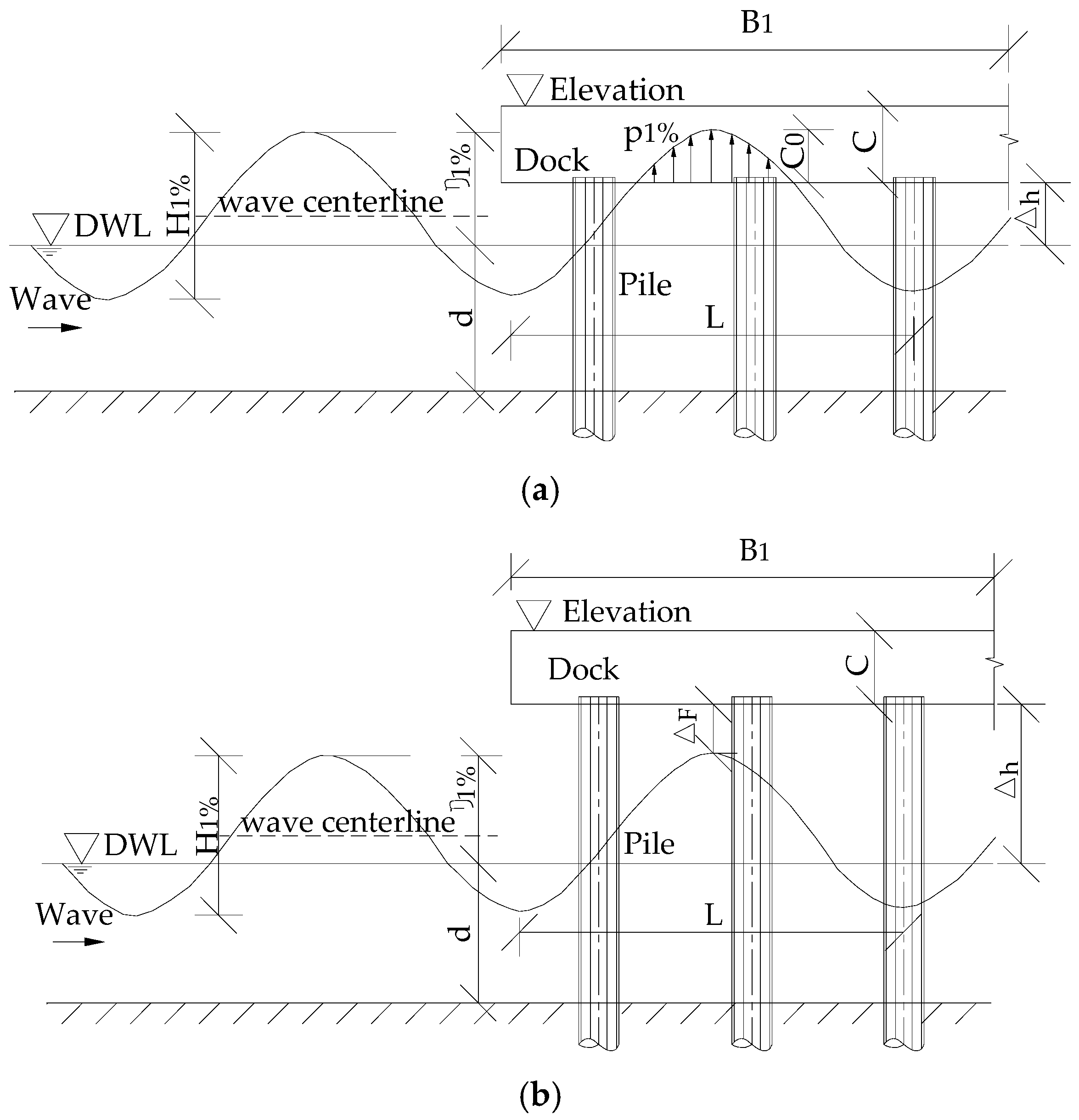
where p 1% is the impact pressure per unit area of the shore base junction; γ 0 is the specific gravity of water; K 1 is the low knot influence coefficient, taken as 1.7~2.4; Δ h is the height of the bottom of the panel above the still water surface; and H 1 % refers to a set of waves (usually containing more than 100 waves) where the cumulative frequency of wave heights exceeding this value is 1%. η 1% is the height of the wave crest above the still water surface, calculated as a second-order Stokes wave; L is the wavelength; d is the water depth at the shore base junction; and “ch” and “sh” are a hyperbolic cosine function and hyperbolic sine function, respectively. The relationship between the letters inside the formula and the dock is shown in Figure 1.
At present, the strength calculation of low-rise shore structures in engineering design is still mainly based on the calculation Formulas (3) and (4) in the “Port Terminal Structure Design Manual” [17] according to the specifications.
p = β ρ g η 1% h
F 2 = B 1 x 1 x 2 p d x
where p is the wave uplift pressure; F 2 is the maximum total uplift force of the horizontal plate; B 1 is the total width of the horizontal plate perpendicular to the direction of the incident wave; and β is the wave pressure response coefficient, which can be taken as 1.5 when the width of the upper structure is below 10 m and not connected to the bank slope. When the width of the upper structure is large or connected to the bank slope, it can be taken as 2.0; g is the acceleration due to gravity. The definitions of other variables are the same as mentioned above.
For the design and calculation of the top elevation of low-rise shore structures, the calculation Formula (5) in the offshore wharf of the “General Design Code for Seaports” (JTS 165-2013) [18] is still used. The specific calculation formula is as follows:
E = D W L + η 1% C 0 + C + Δ F
where E is the top elevation of the wharf front; C is the height of the upper structure of the wharf; D W L is the design water level; η 1% is the height of the wave crest above the water surface; C 0 is the height of the wave crest above the water surface above the bottom of the upper wave structure, which is 0 when the wave crest is below the bottom of the upper structure; and Δ F is the affluent height of the force standard, generally ranging from 0 to 1.0 m. The definitions of other variables are the same as mentioned above. The relationship between the letters inside the formula and the dock is shown in Figure 1.
According to the characteristics of the shore structure, the degree to which waves generate overtopping water on the dock surface and affect the functionality of the land area still depends on the elevation of the shore protection at the junction of land and sea. Therefore, for the design of the elevation of the revetment project, according to the “Code for Design of Breakwaters and Shorelines” (JTS 154-2018) [19], “for revetment projects that do not exceed the waves, the elevation of the embankment top should be no less than 1.0 times the design wave height above the design high water level”. For revetment projects with high protection requirements, the elevation of the revetment should be determined based on the calculation Formulas (6)–(13) for wave-induced wave rise on sloping buildings in section 10.2.3 of the “Hydrological Code for Ports and Navigational Channels” (JTS-145-2015) (2022 edition) [20], and the wave crossing standards should be determined according to the actual use.
R 1% = K K U K θ R 0 H 1%
K = i = 1 n K , i l i i = 1 n l i
K θ = cos θ
If   m 1.25 ,   R 0 = 1.24 1.5 m 2 + 1
If   m > 1.25 ,   ξ 1% 1.4 ,   R 0 = 1.6 ξ 1%
If   m > 1.25 ,   ξ 1% > 1.4 ,   R 0 = 2.66 0.5 1 ξ 1%
ξ 1% = L H 1% m
L = g T 2 2 π tanh 2 π d / L
where R 1% represents the wave crest with an accumulated frequency of 1%; and K is the roughness and permeability coefficient of the protective surface structure located between 0.5 H 1% below the static water surface and 1.5 H 1% above the static water surface. The protective surface is ACCROPODE, so 0.47 is taken; K U is the wind speed influence coefficient, for which this project takes 1.28; and K β is the influence coefficient of oblique waves. When K θ < 0.6 , K θ = 0.6 is taken; when R 0 is K = 1.0, K U = 1.0, and K θ = 1.0, the waves on a single-slope building climb relatively high; K , i is the roughness and permeability coefficient of the third type of protective surface structure (this project is ACCROPODE, so 0.47 is taken); l i is the outer contour length of the i-th type of protective structure; θ is the angle between the wave direction line and the normal of the building’s longitudinal axis; m is the slope gradient; ξ 1% is the wave breaking parameter; L is the average wavelength used; and T is the average period of waves. The definitions of other variables are the same as mentioned above.
For embankment protection projects that do not allow crossing waves, the elevation of the embankment top can be determined according to the following formula:
Z c = D W L + R 1% + a
where Z c is the elevation of the embankment top; and a is the affluent value, usually taken as 0.5 m~1.0 m. The definitions of other variables are the same as mentioned above.
Of course, for research on wave crossing in nearshore revetment engineering, most of the results mainly focus on two types: one is the influence of factors related to the embankment structure, including the slope of the embankment front slope, the height of the breast wall, the width of the slope shoulder, the superelevation of the embankment top, the types and sizes of wave dissipating blocks laid on the slope surface, etc. The second type is the influence parameters related to the incident wave, such as water depth, significant wave height, spectral peak period, wave direction, etc. For example, Van der Meer [21] proposed a calculation method for overtopping based on a large number of physical model experiments, including factors such as embankment platform width, average slope, slope roughness coefficient, and wave direction; Owen et al. [22] conducted experimental research on the overtopping amount of sloping embankments under irregular wave incidence, established the correlation between the dimensionless overtopping amount and dimensionless embankment top elevation, and provided a calculation method for the overtopping amount; and Saville [23] studied the influence of factors such as the slope coefficient m of sloping embankments, the structural form of breast walls, and the structural form of protective surfaces on overtopping and climbing. Afterwards, Weggled [24] summarized Saville’s results into a dimensionless calculation expression for overtopping. Gao et al. [25] and Sun et al. [26,27] conducted physical model tests, considered the influencing factors of the first type of structure, and proposed a calculation method for wave overtopping using multiple regression. Huang et al. [28], Jiang et al. [29], and Zhang et al. [30] derived empirical calculation formulas for wave overtopping based on the influence of the second type of hydrodynamic condition. There are relatively few research results that can be referred to in the study of wave overtopping at the top of embankments under various combinations of structures, such as revetments, low and permeable shore connections, and revetment wave barriers.
Based on the above analysis, this article mainly focuses on the hydrodynamic characteristics and wave crossing measurement of a low-rise shore structure at the shore foundation junction, aiming to provide basic data for determining the reasonable elevation of engineering projects. Therefore, taking a low-structure dock project in Guangdong Province, China as an example, a 1:40 scale model test was conducted to demonstrate the hydrodynamic characteristics of the shore base joint using different wave directions and wave periods. Wave force and overtopping measurements were carried out, and the test results were compared with those calculated by standard formulas. The safety amplification factor was given to solve practical engineering problems and meet the test objectives.

2. Model Test

2.1. Engineering Background

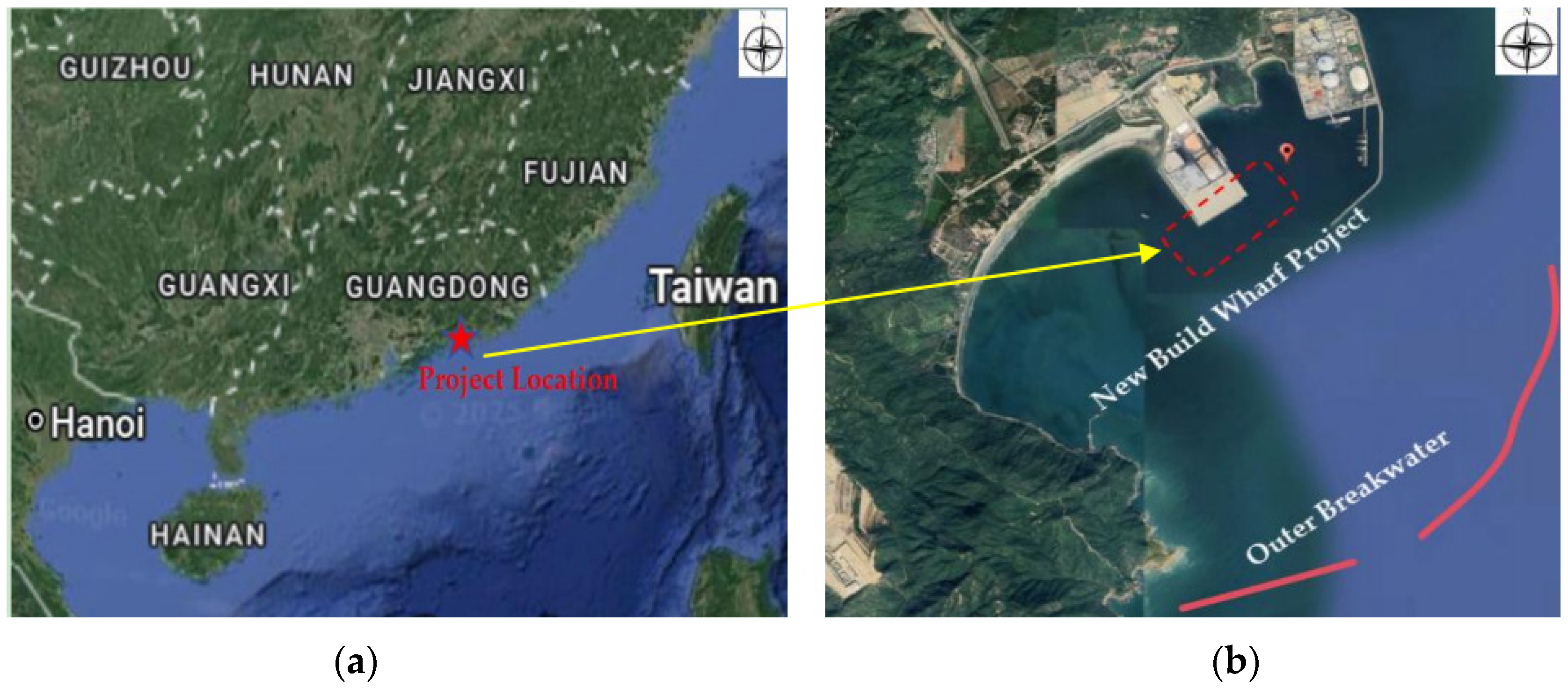
The project is located in the Xiaomo Port Area, Shenzhen, Guangdong Province, China. It adopts a layout of “double breakwaters surrounding and protruding harbor pools combined”. The dock project is 530 m long and 79 m wide, as shown in Figure 2. According to the analysis of wave characteristics in the engineering sea area, it is often subjected to typhoon waves, with an average annual occurrence frequency of 4.6 times per year. According to the “Technical Specification for Simulation Testing of Water Transport Engineering” (JTJ/T231-2021) [31], physical model tests were conducted.

2.2. Experimental Design

2.2.1. Wharf Structure Scheme

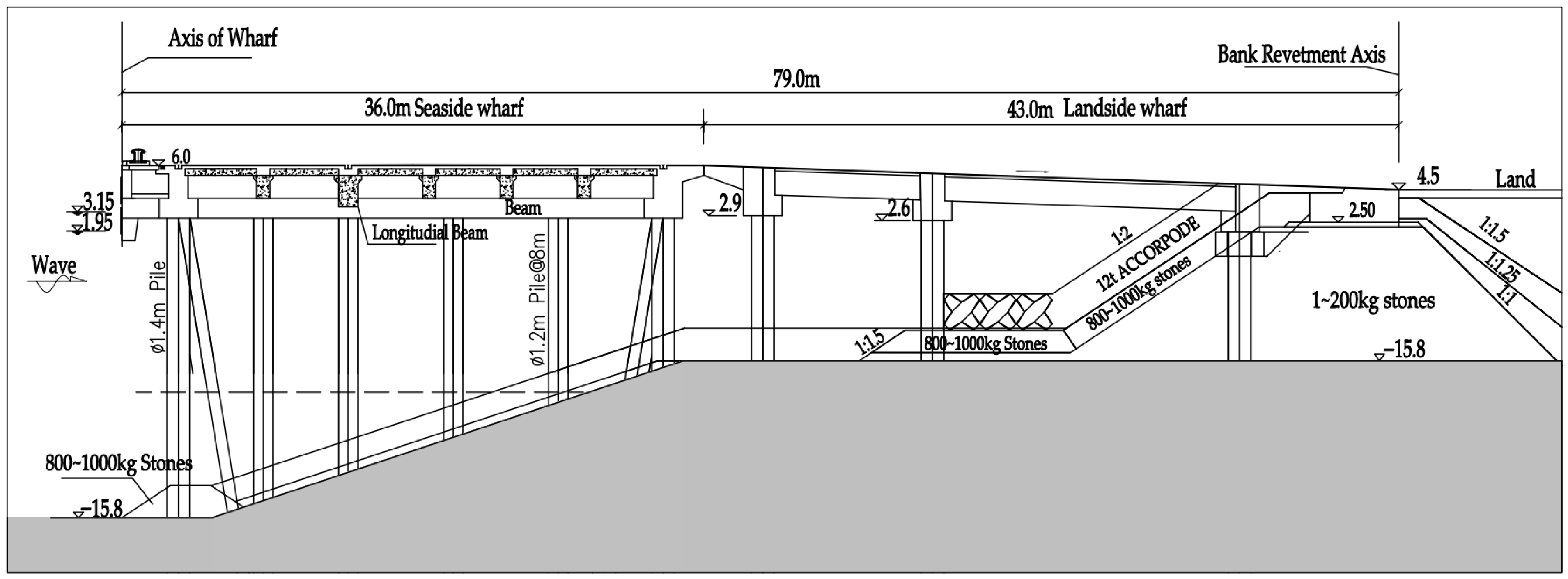
The dock is a high pile beam slab structure, with waves passing underneath. It has a total design width of 79 m. Influenced by the cross-section of the existing revetment position, it is divided into two parts adjacent to the land side and the sea side in the transverse direction of the dock, with corresponding widths of 36 m and 43 m, respectively. The top elevation is +6.0 m, and the panel thickness is 0.6 m. The lower part adopts two types of piles, inclined piles and straight piles, with corresponding pile diameters of Φ = 1.4 m and Φ = 1.2 m. The cross-section of the existing revetment at the shore foundation junction is a stone-throwing slope embankment structure, and the outer side adopts a 12 t ACCROPODE protected with a slope of 1:2 and a top elevation of +4.5 m, which is directly connected to the rear land area. The specific structural cross-section is shown in Figure 3.

2.2.2. Working Condition Design and Boundary Simulation

(1)
Determination of experimental boundary
Water level: According to the research objectives, we selected two high-tide levels of 1.95 m and 3.15 m in the engineering sea area.
Waves: Based on the previous research results of numerical modeling [32], two normal angles with the dock axis were selected: 0° (forward direction) and 30° (oblique direction). Considering the wave direction and the connection between the wave type and structure of the engineering sea area and the shore, two types of wave periods, long and short, were selected. The experimental conditions are shown in Table 1.
(2)
Model Design and Production
According to the Technical Specification for Simulation Testing of Water Transport Engineering (JTJ/T231-2021), the test adopts a normal model and is designed according to the Froude number similarity law. The simulation of various physical quantities is as follows: geometric scale is L r = 1:40; time scale is T r = L r 1 / 2 ; weight scale is M r = L r 3 ; wave force scale is F r = L r 3 ; wave high scale is H r = L r .
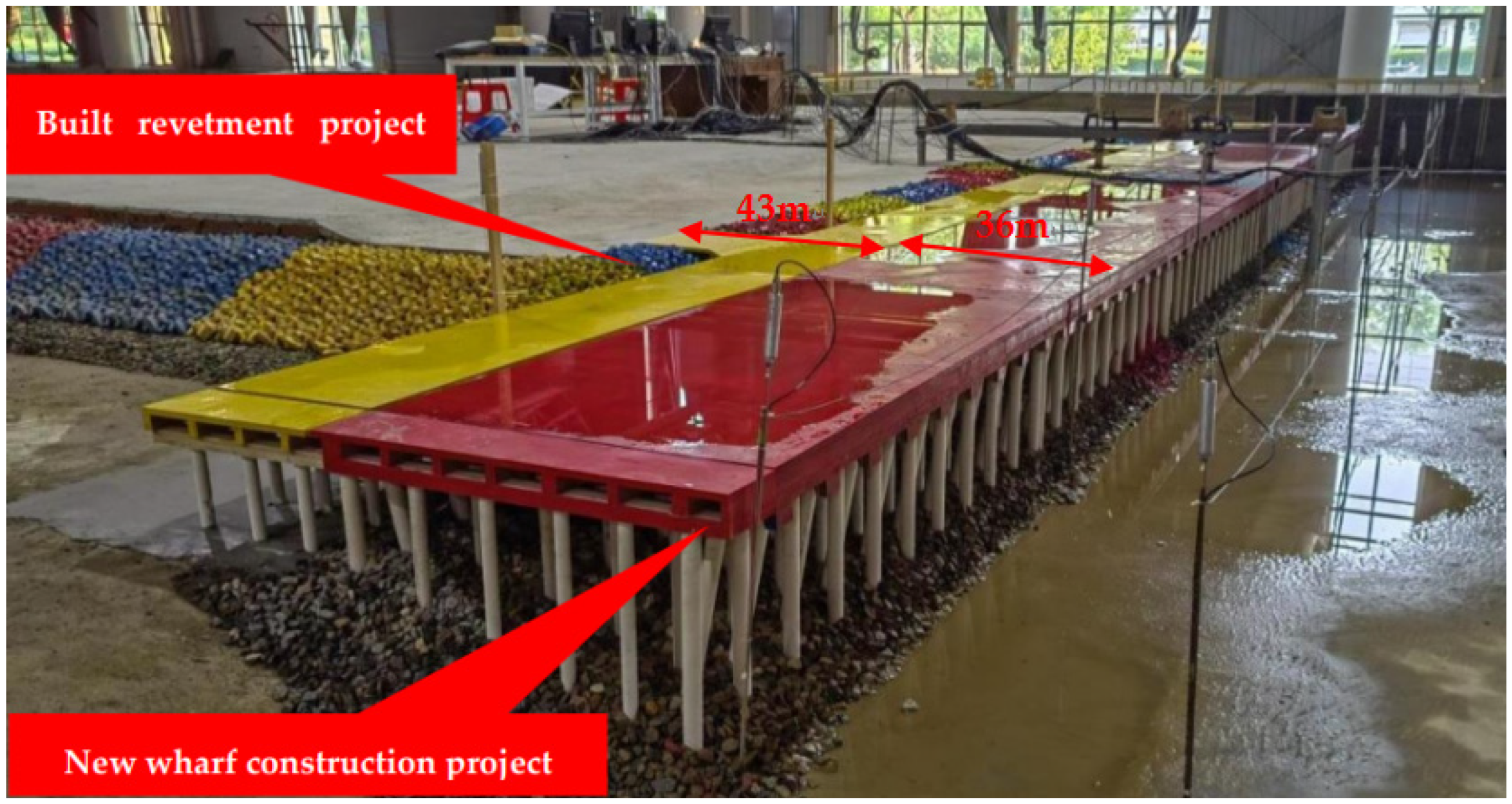
The experiment was conducted in a 43 m wide and 45 m long harbor basin, equipped with 10 lightweight and movable flat push wave-making units measuring 4.0 m in width. The wave-making capability is a maximum wave maker depth of 0.65 m, wave height of 0–0.35 m, and period of 0.5–3.5 s, and each unit can be freely spliced to achieve wave-making in multiple directions. At the same time, in order to reduce the reflection of wave boundaries, multiple layers of wave absorbers are installed around the harbor basin. The production of dock and revetment models includes two parts, namely the revetment section at the shore foundation junction and the outer perforated high pile dock structure section. Simulate the underwater terrain using the pile point method and lay it out in a 1.0 m × 1.0 m grid. The production of the revetment section is controlled by setting up sectional panels to control the size, and the shape is reduced according to the geometric scale. The artificial blocks are placed and produced. The high pile wharf beam and slab structure is made of a combination of sheet metal and plastic sheets. The calibration errors during the production process meet the specification requirements, and the completed model is shown in Figure 4.
(3)
Environmental simulation and methods
Wave simulation: The experiment used irregular waves, and the spectrum used was the JONSWAP spectrum (γ = 3.3). Each group of experiments simulates irregular waves with a number greater than 120, repeated three times, and the calibration wave height and period verification errors are controlled within the allowable ±2% of the specifications.

2.2.3. Layout and Methods of Measuring Points

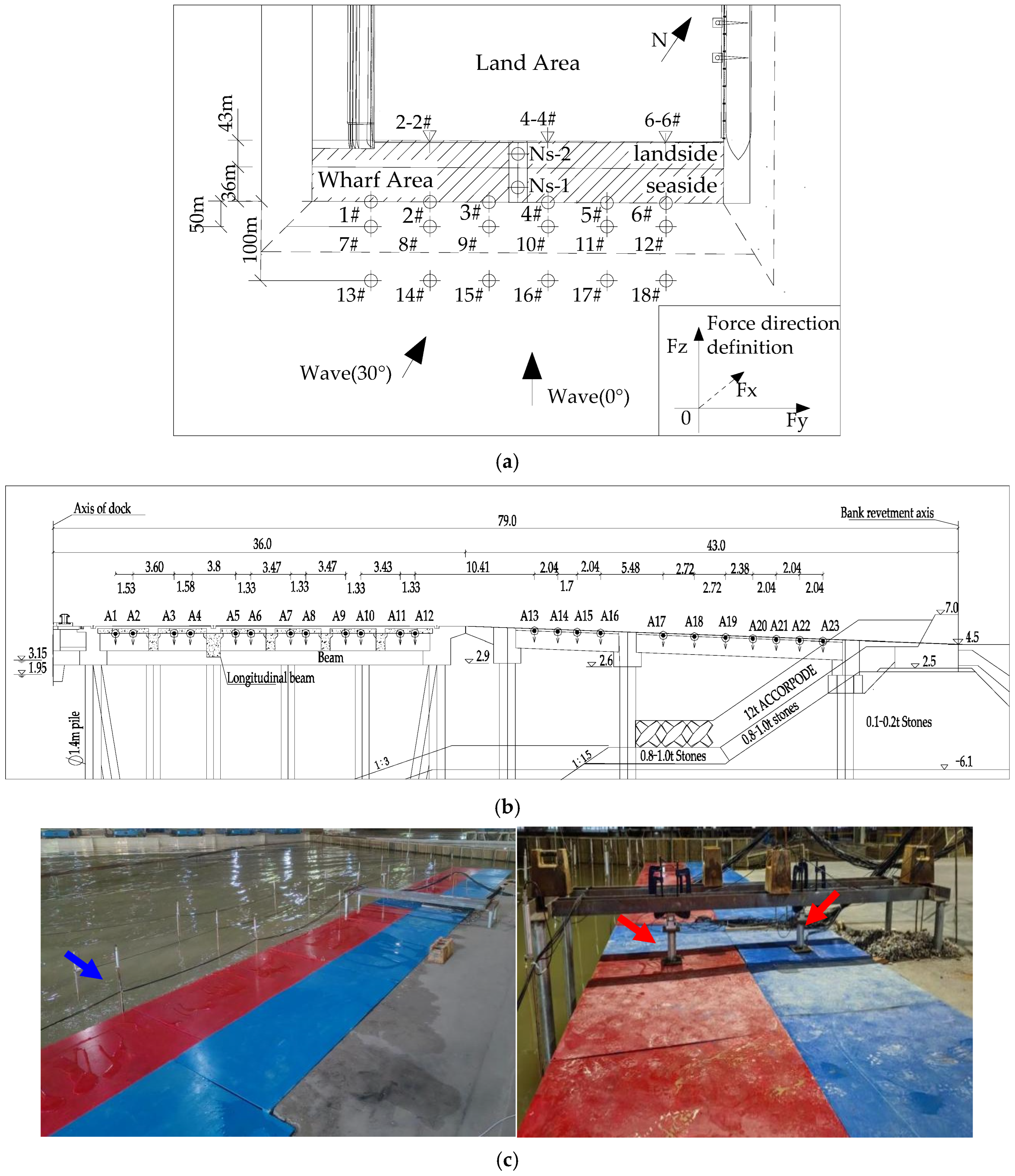
Layout of wave height measurement points in front of the dock: A total of 18 wave height measurement points (Note: 1#~18#) are arranged in three rows and six columns at distances of 0 m, 50 m, and 100 m from the dock front on the offshore side of the dock, as shown in Figure 5a. Measurement and data statistics methods: Using the TK2008 wave height acquisition system for autonomous statistics and analysis, and obtain wave height values at different cumulative frequencies.
Layout of total wave force measurement points for the dock structure: Ns-1# and Ns-2# sensors are, respectively, arranged on the sea side and land side of the dock, as shown in Figure 5a. Measurement and data statistics methods: The selection principle is as follows: firstly, based on the measurement results of wave height, the most unfavorable area is displayed, and a complete unit (including piles, beams, and slabs) of the dock in that area is intercepted, which is a bent frame. Consolidate the unit structure with the total force sensor as a whole, ensuring that the entire unit structure does not come into contact with the outside during measurement. Use the TK-1 total force measurement system for independent statistics and analysis to obtain the process of total force variation over time, and finally, calculate the total force received by different parts of the dock.
Layout of impact pressure measurement points on the dock panel: Same as the total wave force measurement mentioned above, choose the most unfavorable wave area; 23 wave pressure sensors are arranged on the panels on both the land and sea sides of the dock, as shown in Figure 5b. Measurement and data statistics methods: Using the TK2008 pressure acquisition system for independent statistics and analysis, the pressure variation process over time is finally obtained, and the maximum impact pressure in different areas of the panel is calculated.
Layout of measuring points for collecting the amount of overtopping on the top of the embankment: in the dock area, at positions 2#, 4#, and 6# in front of it; the shore base junction is located at positions 2-2#, 4-4#, and 6-6#, as shown in Figure 5a. Measurement and statistical methods: Using self-developed wave-crossing measurement devices, collect the results of all wave-crossing quantities under the entire wave train. Various data measurements on the model are shown in Figure 5c.

3. Results and Analysis

3.1. Hydrodynamic Characteristics Test of Dock Area

3.1.1. Wave Height Distribution Pattern

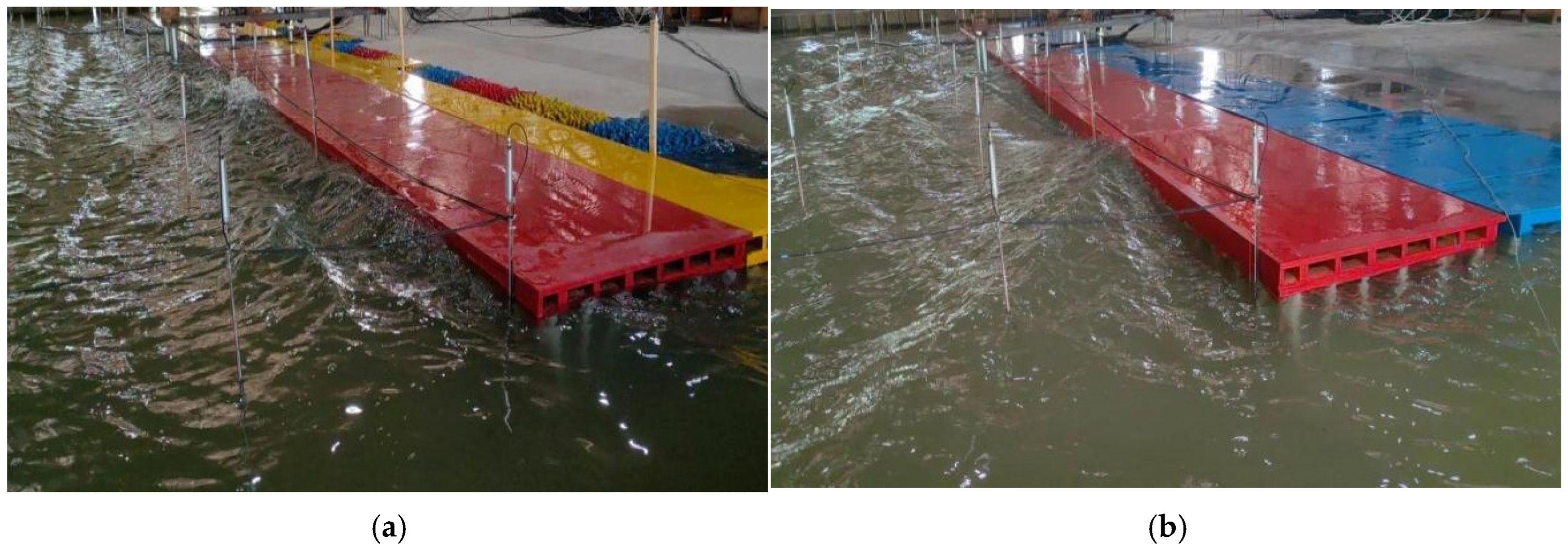
Based on the results of multiple wave height measurement points in front of the dock [33], it was found that the incident waves were significantly reflected in front of the dock due to unfavorable factors such as the upright structure of the ship on the wave-facing side of the dock, the lower pile group, and the steep terrain. At the same time, the waves on both sides of the dock converge and superimpose towards the middle, resulting in a significant increase in wave height in the middle section of the dock, ultimately causing the water in this area to directly flush onto the top plate of the dock, as shown in Figure 6.
The distribution results of wave heights at different distances in front of the dock are shown in Table 2. The following can be seen from the table:
The wave height measured at the 0 m position in front of the dock is greater than the wave height measured at the 50 m and 100 m positions, with a maximum amplitude of 10% to 40%. The middle position has a higher wave height than the two sides, with a maximum wave height of Hs = 3.97 m; The distribution pattern of wave height under different wave direction angles: 0° forward waves are greater than 30° oblique waves, with a maximum amplitude of about 10%; The distribution pattern of wave height under different periods: long periods are smaller than short periods, with an average amplitude of 14.8% and a maximum wave height of 3.97 m; The distribution pattern of wave height at different water levels: the 3.15 m high water level is greater than the 1.95 m water level, with an average amplitude of 21.4%.
To provide a basis for the design and calculation of dock elevation, the height distribution of dock wave height is used to calculate the height of the front wave crest. The most unfavorable combination of 0 m in front of the dock and a 0° wave direction was selected, and the statistical results are shown in Table 3. According to the table, the wave action at water levels of 3.15 m and 1.95 m resulted in a cumulative frequency of D1% wave surface elevation of 7.85 m and 6.62 m, respectively. The cumulative frequency of D13% wave surface elevation was 6.89 m and 5.76 m, respectively, which were higher than the top surface of the dock (design elevation +6.0 m) by 1.85 m to −0.24 m (the water level did not touch the top surface elevation). This indicates that there is a certain degree of wave crossing at the dock with a designed elevation of +6.0 m.

3.1.2. Wave Force Distribution Pattern

Under different water levels and wave directions, the maximum horizontal forces (including Fxmax and Fymax) and vertical force (Fzmax) acting on the sea- and land-side structures of the dock were obtained. The force results are shown in Table 4, which indicates the following:
The distribution law of wave forces under different wave direction angles: At 0°, the wave force is at its maximum, and there is a vertical force greater than the horizontal force. At this time, the maximum stresses on the sea-side and land-side structures of the dock are 67,980 kN/m and 21,880 kN/m, respectively, with a difference of about three times. Therefore, differentiated design can be considered in structural design, and the vertical force is considered as the control condition for structural safety design; The distribution law of wave forces at different water levels: The 3.15 m high water level is greater than the 1.95 m low water level, with a difference of about 1.85 times. Therefore, it is believed that the 3.15 m water level is the control condition for structural safety design; The distribution law of wave forces under different periods: Long periods are greater than short periods, with a difference of about 1.45 times between the two, indicating that more wave energy enters the interior of the dock under long-period wave action. This is considered a control condition for structural safety design under long-period wave action.
In order to further obtain the design strength of different areas of the dock panel, obtained the distribution results of the maximum impact pressure along the sea and land side panels, as shown in Table 5. The following can be seen:
The distribution law of the panel impact pressure under different water levels, wave heights, and periods is essentially the same as the variation in wave forces, so the design control conditions are selected as above; When comparing the pressure at various measuring points on the structural panels of the sea side and land side of the dock, it was found that due to the influence of steep terrain changes, waves undergo sudden changes, and the pressures at the junction of the sea-side and land-side docks are the highest, at 63.82 kPa and 42.56 kPa, respectively, which are 2~3 times higher than in other areas. The second-largest area is the shore base junction, so according to the distribution law of impact pressure on the panel, differentiated design can also be considered when carrying out structural design.

3.2. Determination and Discussion of Pier Elevation

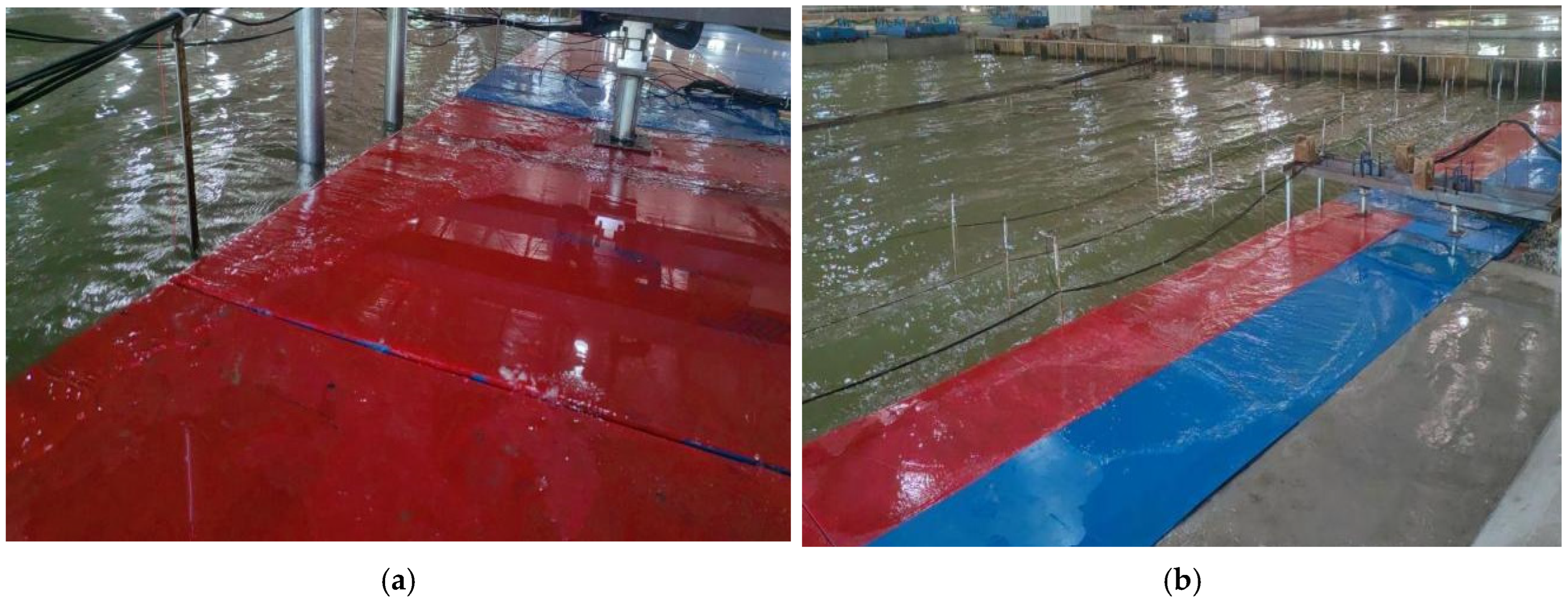
Based on the usage function of the land area behind the dock engineering location, and in accordance with the “Design Specification for Breakwaters and Banks” (JTS 154-2018) [18], which specifies the wave-crossing standard (see Table 6), the design proposes using 0.02 m3/(m·s) as the standard for judgment. Using the set wave-crossing collection measurement points, the most unfavorable 3.15 m maximum water level and 0° wave direction combination test conditions were selected to obtain the wave-crossing results at the top of the dock front and shore foundation junction, as shown in Table 7. According to the results in the table, the waves generated a large overtopping of 0.062 m3/(m·s) at the front of the dock. Due to the influence of water delay and the floodplain, the water entering the dock panel from the front of the dock diffuses and propagates through the 79 m long dock panel to the shore foundation junction. The overtopping amount is less than 0.02 m3/(m·s), which meets the design requirements and indicates that the +6.0 m elevation in front of the dock and the +4.5 m elevation in the shore foundation junction are reasonable. The phenomenon of overtopping at the junction of the dock and the shore foundation is shown in Figure 7.

3.3. Application and Analysis of Experimental Results

We sought to effectively and widely apply the results of low-rise shore structures, and to provide basic data for similar engineering design references and standard revisions. Therefore, we compared the experimental results with the calculation results of the standard formula. For comparison, we chose the structural safety calculation control group, which includes the vertical wave force of the dock structure and its front top elevation.
The calculation formula for the vertical wave force on the dock structure is based on the current “Hydrological Code for Ports and Navigational Channels” (JTS145-2015) (2022 edition) [20]. The calculation formulas are shown in Equations (15)–(18), and different wave conditions are substituted into them for calculation. The results are shown in Table 6.
F Z X γ 0 H 1% = A 1 1 y η 0.75 e x p A 2 Δ y H 1% 0.16 2.86
X = L 4 ( 1.3 Δ y H 1% ) 2
A 1 = 0.93 A 2 e x p 155 A 2 H 1% L 0.042 2
A 2 = 4.0 t a n h B 3 2.2 H 1% 3 / 2 t a n h 2 π d L
where F Z is the maximum impact force of the wharf panel; and X represents the width of the impact in the direction of wave propagation. When the calculated value of X is greater than the diameter of the pier circle, the diameter of the bottom circle of the pier is directly used; B 3 is the width of the bottom of the structure, taken as the circular diameter of the bottom of the bearing platform; A 1 is the wave impact coefficient; A 2 is the influence coefficient of the diameter of the pedestal circle and water depth; Δ y is the water level rise, generally taken as 0.3~0.5; and the definitions of other variables are same as mentioned above.
For the calculation of the top elevation of the dock surface, the current “General Design Specification for Seaports” (JTS 165-2013) standard [18] was adopted, and the calculation formula is shown in Equation (5). The test conditions were substituted into it for calculation, and the results are shown in Table 8.

4. Discussion

(1) For the experimental study of the wave force in low-rise shore to shore structure engineering, only the wave load is used in the test. For the semi-enclosed area of the shore foundation joint, water flow is also a very important load, especially when the two wave current coupling effects occur, meaning there will be a certain superposition effect on the wave force. According to the author’s previous research results [34], local wave forces will increase by 1.3~1.6 times when wave current coupling occurs. Therefore, work in this area will continue in the next stage to further supplement and improve this achievement.
(2) For the measurement of wave forces on the dock structure, the experiment only selected the length of one span unit in the middle section with the most unfavorable wave height distribution for measurement. If differential design is required for the structural strength of the entire length of the dock to save engineering costs, wave force measurements and statistics can be carried out at multiple locations along the dock (such as the two ends of the dock, 1/4 and 3/4 areas, etc.). From a safety perspective, the test results are feasible, but from an economic perspective, the latter measurement method may be more reasonable.
(3) For the determination of the top elevation of the dock, the experiment mainly considers two aspects: the wave force on the dock structure and the allowable overtopping standard for land use. However, for the overall design of the terminal, other influencing factors need to be considered comprehensively, such as the loading and unloading arms at the front of the terminal, the pipelines below, etc., which are not allowed to withstand wave forces or corrosion [35,36,37], and the lateral pressure of the crossbeam below the terminal, which does not exceed the disturbance [38].
(4) This dock is a Chinese port project, and the design and calculation of the top elevation of the dock surface adopt the current Chinese “General Design Specification for Seaports” (JTS 165-2013). However, if undertaking foreign projects, different regional standards need to be adopted based on the actual local situation of the project to ensure that the project passes the review of the local national consulting department smoothly. For example, the Japanese standard “Technical Standards and Commentaries for Port and Harbour Facilities in Japan” [39] is used to calculate the top elevation of the dock front.
E = E W L + η c m a x + C + Δ F
where E W L is is the highest average monthly water level; η c m a x is the maximum peak height above the design water level; and the definitions of other variables are the same as mentioned above.
According to the British standard 6349-2:2010 “Maritime works Part 2: Code of Practice for the Design of Quay Walls, Jetties and Dolphins” [40], when calculating the top elevation of the dock front, for sheltered docks, the top elevation of the dock front should be at least 1.5 m above the working water level.
According to the US Department of Defense Design Code (UFC) “Design: Piers and Wharves” [41], for a transparent dock, in order to avoid water ingress, the top elevation of the dock is calculated as follows:
E = M H H W L + C 1 + Δ F
where M H H W L is the average high climax; C 1 is the height of the wave crest above the still water surface, C 1 = 2 H m a x / 3 ; H m a x is the maximum wave height; and Δ F is the height of abundance, with a minimum of 0.9 m. The definitions of other variables are the same as mentioned above.
The German Port Engineering Association’s standard “Recommendations of the Committee for Waterfront Structures Harbour and Waterways” [42] is used to calculate the top elevation of the dock front.
E = H c r + C + 1.5
H c r = h D W L + H m a x 0.5 + 2 ε 18 ε + 3 + 5 ε 2 30 ε 2 + 1
ε = H m a x L c o t h 2 π d L
where H c r is the height of the wave peak above the water surface (including the design water level); h D W L is the design water level; and ε is a nonlinear parameter. The definitions of other variables are the same as mentioned above.

5. Conclusions

This experiment studied the hydrodynamic characteristics and the method for determining the top elevation of a low-rise dock engineering area. Due to the limitations of various empirical formulas and the need to ensure structural safety and economy, a 1:40 scale physical model test was conducted to determine the values for structural safety calculation. Under the superposition of different water levels and wave directions, the laws of wave height and wave force distribution at the junction of the dock front and shore foundation were obtained, and the sea-side dock elevation was determined based on the wave-crossing standard proposed in the design of the rear land embankment top, which met the experimental purpose. At the same time, the current standards were used to compare the calculation and experimental results. In order to expand the engineering application of similar low-rise shore-connected structures, a safety factor of 1.2~1.5 should be adopted in the design to ensure the safety of the structure. At the same time, the experiment also obtained the following: (1) The distribution law of wave height, with the highest wave height on the wave-facing side and in the middle section of the dock, with a maximum amplitude of 10% to 40%; the combination of a 0° wave direction and short-period operating conditions is the most unfavorable, with an amplitude of approximately 15%. (2) The distribution law of wave force: Vertical force is the control condition for structural safety calculation, with a maximum of 67,980 kN/m. The panel impact pressure is the most unfavorable, located at the junction of the sea survey and the onshore dock, with a maximum of 63.82 kPa. The design should pay attention to this. (3) The designed elevation of +6.0 m in front of the dock and +4.5 m at the junction of the shore and foundation is reasonable, with 0.02 m3/(m·s) as the standard for crossing waves. (4) Based on the complex hydrodynamic environment of the low-rise shore-connected structure at the shore foundation junction, in order to ensure structural safety, it is recommended to conduct physical model tests for verification if conditions permit.
This study can not only solve practical problems in engineering but also provide valuable experimental data and a reference for the construction of similar dock projects in the future.

Author Contributions

G.W.: Planning of thesis topic, model design and testing, data analysis, funding support; L.G.: model design and testing, paper preparation, wave force data processing and analysis; T.Y.: testing, data of wave height and force processing and analysis; Y.Z.: stability test of armor block, comparison between standardized formula calculation and experimental results; S.C.: series group model testing, test instrument debugging, test terrain processing, and data verification. All authors have read and agreed to the published version of the manuscript.

Funding

This study was financially supported by the National Key R&D Program of China (2024YFB2606003), the National Natural Science Foundation of China (42307597), and the special fund for central scientific research institutes (TKS20230205, TKS20230505, and TKS20230515).

Data Availability Statement

The original contributions presented in this study are included in the article. Further inquiries can be directed to the corresponding authors.

Acknowledgments

This physical model test was conducted in the experimental harbor basin of the Tianjin Research Institute for Water Transport Engineering.

Conflicts of Interest

Authors Guangsheng Wang and Tong Yu were employed by the company China Harbour Engineering Company Limited. The remaining authors declare that the research was conducted in the absence of any commercial or financial relationships that could be construed as a potential conflict of interest.

References

  1. Jie, L.B.; Su, L.; Wang, J.F.; Wang, Y.X.; Bi, J.W.; Lin, X.C. Research on dynamic response characteristics of high pile wharf seabed system under wave action. Water Transp. Eng. 2025, 27–35. [Google Scholar] [CrossRef]
  2. Zhou, Y.; Liu, M.L.; Pang, R. Research on the static and dynamic laws of high pile wharf under the influence of complex factors. J. Dalian Univ. Technol. 2025, 65, 152–160. Available online: http://dx.chinadoi.cn/10.7511/dllgxb202502006 (accessed on 6 December 2025).
  3. Li, W.; Zhu, L. Application Technology of Beam Assembly for High Piled Wharf. China Harb. Constr. 2022, 42, 7–10. [Google Scholar] [CrossRef]
  4. Liu, C. Comparison of Seismic Design and Slope Stability Analysis Methods for High Piled Wharf Structures Between China and the United States; Dalian University of Technology: Liaoning, China, 2021. [Google Scholar]
  5. Zhou, S.L.; Tang, M.H.; Sun, S.Q. Health assessment of high pile wharf structure based on damage induced inversion. J. Water Resour. Water Transp. Eng. 2025, 1, 157–167. Available online: http://dx.chinadoi.cn/10.12170/20231021001 (accessed on 6 December 2025).
  6. El Ghamry, O.S. Wave forces on a Dock. In Technical Report HEL-9-1; University of California, Institute of Engineering Research: Berkeley, CA, USA, 1963. [Google Scholar]
  7. Tirindelli, M.; Cuomo, G.; Allsop, W.; McConnell, K. Exposed jetties: Inconsistencies and gaps in design methods for wave-induced forces. In Proceedings of the International Conference on Coastal Engineering, Cardiff, UK, 7–12 July 2002; Volume 2, pp. 1684–1696. [Google Scholar]
  8. McConnell, K.J.; Allsop, W.; Cuomo, G.; Cruickshank, I.C. New guidance for wave forces on jetties in exposed locations. In Proceedings of the Sixth Conference on Coastal and Port Engineering Developing Countries (COPEDEC VI), Colombo, Sri Lanka, 15–19 September 2003; 20p. [Google Scholar]
  9. Guo, D.; Cai, B.H. Calculation of wave uplift force of transparent building panel. J. East China Inst. Water Resour. 1980, 3, 14–33. [Google Scholar]
  10. Wang, H. Water wave pressure on horizontal plate. J. Hydraul. Div. 1970, 96, 1997–2017. [Google Scholar] [CrossRef]
  11. Zhou, Y.R.; Chen, G.P.; Wang, D.T. Calculation method for wave uplift force of perforated horizontal plate. Ocean Eng. 2004, 22, 26–30. [Google Scholar] [CrossRef]
  12. Meng, Y.Q.; Chen, G.P.; Yan, S.C. Test and analysis of supporting force on offshore high pile wharf panel. J. PLA Univ. Sci. Technol. (Nat. Sci. Ed.) 2010, 11, 72–78. [Google Scholar]
  13. Wang, J.; Wang, T.; Huang, Z.W. Calculation and Model Test of Wave Buoyancy Force on High-Pile Rigid-Beam and Slab Structures. Waterw. Eng. 2021, 10, 203–208. [Google Scholar] [CrossRef]
  14. Ge, L.Z.; Liu, G.; Chen, H.B. Experimental study on wave force at the junction of the artificial island bridge in the west of the Shenzhen Zhongshan Passage. Bridge Constr. 2023, 53, 60–67. [Google Scholar] [CrossRef]
  15. Wang, G.; Ge, L.; Yu, T.; Zhang, Y.; Chen, S. Experimental Study on the Stability and Wave Force of a Breakwater Transition under Multiangle Oblique Waves. J. Mar. Sci. Eng. 2023, 11, 631. [Google Scholar] [CrossRef]
  16. Kuai, Y.R.; Qi, M.L.; Li, J.Z. Analysis of wave forces on bridge substructure in near-shore. J. Zhejiang Univ. Eng. Sci. 2018, 52, 2356–2364. [Google Scholar]
  17. CCCC First Navigation Engineering Survey and Design Co., Ltd. The First Navigation Engineering Survey and Design Institute of the Ministry of Communications Harbor Engineering Design Manual (Middle), 2nd ed.; People’s Communications Press: Beijing, China, 1994. [Google Scholar]
  18. JTS 165-2013; Design Code of General Layout for Sea Ports. People’s Communications Press: Beijing, China, 2013.
  19. JTS154-2018; Code of Design for Breakwater and Revetments. People’s Communications Press: Beijing, China, 2018.
  20. JTS145-2015; Hydrological Code for Ports and Navigational Channels. People’s Communications Publishing House Co., Ltd.: Beijing, China, 2015.
  21. Van Der Meer, J.W. Technical Report Wave Run-Up and Wave Overtopping at Dikes; Technical Advisory Committee on Flood Defence: Delft, The Netherlands, 2002. [Google Scholar]
  22. Owen, M.; Steele, W. Effectiveness of recurved wave return wall. In Proceedings of the 22nd International Conference on Coastal Engineering, Delft, The Netherlands, 2–6 July 1991. [Google Scholar]
  23. Saville, T. Large-Scale Model Tests of Wave Run Up and Overtopping on Shore Structures; US Army, Corps of Egineers, Beach Erosion Board, Washington District of Columbia: Washington, DC, USA, 1958. [Google Scholar]
  24. Weggle, J.R. Wave overtopping equation. In Proceedings of the 15th International Conference on Coastal Engineering, Honolulu, HI, USA, 11–17 July 1976; pp. 2737–2755. [Google Scholar]
  25. Gao, Q.Y.; Zuo, D.W.; Luo, J.P. Study on Wave Attenuation Characteristics of Multi-Layer Permeable Breakwater Structures. Port Coast. Offshore Eng. 2025, 62, 11–16. [Google Scholar] [CrossRef]
  26. Sun, D.P.; Sun, P.Y.; Li, D.H. Experimental study on single wave overtopping of twisted block sloping embankment. Waterw. Port 2023, 44, 157–165172. [Google Scholar] [CrossRef]
  27. Sun, Z.L. Analysis of Wave Crossing during Embankment Construction and Research on Protective Measures. Port Navig. Offshore Eng. 2025, 62, 4–8. [Google Scholar] [CrossRef]
  28. Huang, F.Y.; Chen, Y.M.; Luan, H.L. The influence of wave period on seawall overtopping under irregular wave conditions. China Harb. Eng. 2024, 44, 39–43101. Available online: http://dx.chinadoi.cn/10.7640/zggwjs202410007 (accessed on 6 December 2025).
  29. Jiang, H.B.; Ye, J.W.; Wang, Y. Spatial distribution of overtopping water bodies in compound seawalls under regular wave action. J. Zhejiang Ocean Univ. (Nat. Sci. Ed.) 2024, 43, 504–510. [Google Scholar] [CrossRef]
  30. Zhang, X.; Yang, Y.T. Study on Seawall Overthrowing under Water Level Changes during Storm Surge. Ocean Forecast. 2025, 42, 64–70. [Google Scholar] [CrossRef]
  31. JTJ/T231-2021; Technical Code for Simulation Test of Water Transportation Engineering. People’s Communications Publishing House Co., Ltd.: Beijing, China, 2021.
  32. Zhang, Y.J.; Ge, L.Z. Experimental Study Report on the Wave Integrated Mathematical Model of the Breakwater Phase I Project of Xiaomo International Logistics Port in Shenshan Special Cooperation Zone; Tianjin Research Institute for Water Transport Engineering, M.O.T.: Tianjin, China, 2024. [Google Scholar]
  33. Ge, L.Z.; Xu, Y. Research Report on the Experimental Study of Local Physical Model of Wave Structure for the Car Roll on/Roll off Terminal Project of Xiaomo International Logistics Port; Tianjin Research Institute for Water Transport Engineering, M.O.T.: Tianjin, China, 2025. [Google Scholar]
  34. Ge, L.; Chen, H.; Chen, S.; Liu, H. Experimental Study on Wave Current Characteristics and Stability of the Junction of Artificial Island and Subsea Tunnel. J. Mar. Sci. Eng. 2022, 10, 1525. [Google Scholar] [CrossRef]
  35. Wang, L.L.; Su, L.; Wang, J.F. Study on seismic response of high pile wharf considering corrosion effect. J. Earthq. Eng. 2025, 47, 122–132. [Google Scholar] [CrossRef]
  36. Liu, Y.F. Analysis of anti-corrosion safety protection measures for steel pipe piles in 300000 ton crude oil terminal project. Chem. Manag. 2021, 29, 175–176. Available online: http://dx.chinadoi.cn/10.19900/j.cnki.ISSN1008-4800.2021.29.084 (accessed on 6 December 2025).
  37. Zhang, P. Durability assessment of high pile wharf structures based on chloride ion diffusion model. China Water Transp. 2025, 34–37. [Google Scholar] [CrossRef]
  38. Zhao, J. Research on the Stress of Lateral Bent Structures with Different Pile Layout Types. Shanxi Archit. 2024, 50, 74–77. [Google Scholar] [CrossRef]
  39. Miyata, M.; Niimura, T. Outline of Revision of Technical Standards and Commentaries for Port and Harbour Facilities in Japan. In Steel Construction Today & Tomorrow; Japan Iron and Steel Federation and Japan Steel Construction Association: Tokyo, Japan, 2019. [Google Scholar]
  40. BS 6349-2:2010; Maritime Works-Part 2: Code of Practice for the Design of Quay Walls, Jetties and Dolphins. BSI: London, UK, 2010.
  41. UFC 4-152-01; Design: Piers and Wharves. United States Department of Defense: Washington, DC, USA, 2005.
  42. Erickson, B.P.; Fotinos, G.C. Code Recommendations for Waterfront Structures. In Ports ’95; ASCE: Reston, VA, USA, 2010. [Google Scholar]
Figure 1. The relationship between each letter in Equations (1)–(5) and dock, water level, and wave. (a) The wave force on the dock structure; (b) the dock structure is not subjected to wave forces.
Jmse 13 02347 g001
Figure 2. Geographical location map of the project. (a) Project location; (b) project layout plan.
Jmse 13 02347 g002
Figure 3. Cross-section of high pile dock structure (Unit: m).
Jmse 13 02347 g003
Figure 4. Model completion effect.
Jmse 13 02347 g004
Figure 5. Location of wave height and wave force measurement points on the dock structure. (a) Layout of wave height and wave force measurement points; (b) layout of dock panel wave pressure measuring points. (c) During the experiment, measurements of wave height namely blue arrow, wave force namely red arrow, and overtopping are taken.
Jmse 13 02347 g005
Figure 6. Wave conditions in front of the dock. (a) Wave energy aggregation and water accumulation; (b) reflection superposition of waves.
Jmse 13 02347 g006
Figure 7. Overtopping at different positions under wave action: (a) at the forefront of the dock; (b) at the shore base junction.
Jmse 13 02347 g007
Table 1. Test conditions.
Wave DirectionWater LevelWave Elements
H1% (m)Hs (m)Tp (s)
0°/30°3.15 m4.132.8513.5
1.95 m3.682.5413.5
0°/30°3.15 m4.763.318.5
1.95 m4.353.028.5
Table 2. Distribution of wave height in front of the dock.
PositionMeasure Point3.15 m (m)1.95 m (m)
30°30°
13.5 s8.5 s13.5 s8.5 s13.5 s8.5 s13.5 s8.5 s
In front of the dock 100 m1#2.793.213.083.542.292.812.512.99
2#2.883.283.143.442.292.722.672.9
3#2.963.412.963.62.512.872.513.05
4#3.083.343.083.342.492.872.462.96
5#2.993.242.883.512.622.752.442.9
6#2.823.282.743.612.412.692.412.99
In front of the dock
50 m
7#3.023.423.143.662.542.812.643.05
8#2.993.543.113.542.343.022.693.08
9#2.913.613.143.282.413.172.672.87
10#3.193.483.023.212.672.932.572.93
11#3.223.383.143.382.672.872.543.05
12#2.743.483.143.382.343.022.393.02
In front of the dock
0 m
13#2.853.483.163.812.342.992.593.41
14#3.193.513.223.642.512.962.773.32
15#3.423.973.453.812.793.52.923.2
16#3.193.973.283.772.643.322.743.32
17#3.083.943.223.942.393.22.693.41
18#2.993.512.993.512.362.842.623.14
Table 3. Distribution of wave crest elevation in front of the dock.
Position3.15 m1.95 m
13.5 s8.5 s13.5 s8.5 s
D1% (m)D13% (m)D1% (m)D13% (m)D1% (m)D13% (m)D1% (m)D13% (m)
17#6.595.906.976.045.514.925.805.05
18#6.736.037.226.345.695.026.135.34
19#6.775.997.256.155.634.946.055.16
20#7.256.347.676.616.055.306.405.65
21#7.336.577.856.895.875.226.625.76
22#7.096.017.406.445.964.946.145.35
23#6.765.947.256.205.774.966.065.20
24#6.635.817.066.185.544.935.835.18
Table 4. Results of wave force test on wharfs under different wave directions.
Water LevelTest ConditionsSea-Side Wharf (kN/m)Land-Side Wharf (kN/m)
FxmaxFymaxFzmaxFxmaxFymaxFzmax
3.15 m0° (TP = 13.5 s)4100983067,9802550274021,880
0° (TP = 8.5 s)3410673047,5901140166014,360
30° (TP = 13.5 s)227011,37060,4901810321018,630
30° (TP = 8.5 s)1890512026,510154017508190
1.95 m0° (TP = 13.5 s)3890498039,8801090352016,200
0° (TP = 8.5 s)2740503030,4801490280012,600
30° (TP = 13.5 s)1990425018,38098024706020
30° (TP = 8.5 s)14402650770069014903690
Table 5. Results of wave pressure on the dock floor under different wave actions.
PositionMeasure Point3.15 m1.95 m
30°30°
13.5 s8.5 s13.5 s8.5 s13.5 s8.5 s13.5 s8.5 s
Bottom of the sea-side dock
panel
A114.1710.139.936.259.247.256.355.95
A214.6413.6712.177.8510.886.697.344.28
A316.8315.9511.4110.1713.738.118.266.73
A415.0017.9913.3612.5911.6710.459.345.27
A522.5011.9920.048.3918.507.6813.254.41
A636.3211.3517.957.9521.1910.0511.986.53
A721.2812.6019.0410.5816.959.4912.414.47
A819.3516.0517.318.4413.1211.628.873.15
A938.4922.2718.9113.2427.8516.0917.1110.75
A1063.8234.7730.2327.7141.9423.5327.2212.20
A1128.1922.3127.1319.3124.9515.1119.699.84
A1217.4813.9114.2510.6914.2412.079.237.23
Bottom of the land-side dock panelA1321.3617.7220.1314.4817.379.0611.025.78
A1442.5631.2540.1229.3926.2513.5928.5823.50
A1539.3831.7636.0319.1635.7017.0030.2117.28
A1621.7619.2317.0711.5615.519.2413.047.31
A1715.1010.2510.807.188.816.025.534.82
A1810.239.568.736.694.764.682.042.19
A198.695.976.995.182.832.782.402.26
A2010.916.538.585.477.245.124.183.84
A2117.1812.4010.495.267.839.145.882.94
A2234.7821.1830.9413.8616.2211.898.147.14
A2318.7713.0614.229.2911.3910.717.294.79
Table 6. Allowable wave crossing amount at the top of the embankment for the revetment project.
Protective ObjectProtective FacilitiesControl Standard m3/(m·s)Design Conditions
Important facilities such as hazardous chemical tank areaTop of the embankment is protected0.005Calculate high water level and corresponding design waves
General important facilities0.010
Areas with dense personnel and public facilities in the rearTop and inner slope of the embankment are protected0.020
The rear personnel are not densely packed or there are general facilities0.050
Table 7. Results of overtopping at the junction of the dock front and shore foundation.
Water Level/PeriodDock Front AreaShore Base JunctionNotes
PointsOvertopping
m3/(m·s)
PointsOvertopping
m3/(m·s)
3.15 m/8.52#0.0482-2#0.009The design proposes a wave crossing standard of 0.02 m3/(m·s)
4#0.0624-4#0.018
6#0.0516-6#0.011
3.15 m/13.52#0.0312-2#0.006
4#0.0454-4#0.013
6#0.0396-6#0.008
Table 8. Comparison results of standard formula and test.
Water
Level (m)
Wave DirectionFzmaxElevation
TestStandardKF (Test/Standard)TestStandardKL (Test/Standard)
1.9539,88030,212.121.326.054.80 1.26
30°18,38014,587.301.265.875.29 1.11
3.1567,98048,212.771.417.255.49 1.32
30°60,49043,517.991.397.336.26 1.17
Disclaimer/Publisher’s Note: The statements, opinions and data contained in all publications are solely those of the individual author(s) and contributor(s) and not of MDPI and/or the editor(s). MDPI and/or the editor(s) disclaim responsibility for any injury to people or property resulting from any ideas, methods, instructions or products referred to in the content.