Article

A Novel Sorting Route Planning Method for Irregular Sheet Parts in the Shipbuilding Process

1
School of Mechanical Engineering, Shanghai Jiao Tong University, Shanghai 200240, China
2
Shanghai Changxing Ocean Laboratory, Shanghai 201913, China
*
Author to whom correspondence should be addressed.
J. Mar. Sci. Eng. 2025, 13(10), 1871; https://doi.org/10.3390/jmse13101871
Submission received: 4 September 2025 / Revised: 24 September 2025 / Accepted: 26 September 2025 / Published: 27 September 2025
(This article belongs to the Section Ocean Engineering)

Abstract

Due to the complexity of shipyards’ operating scenes and the inconsistency of ship parts’ type and size, current sorting operations for ship parts mainly rely on laborers, resulting in weak control over the production process and key nodes. With the gradual advancement of intelligent manufacturing technology in the shipbuilding process, the trend of machines replacing humans is obvious. In order to promote the automation of the sorting process, intelligent scene recognition and route planning algorithms are needed. In this work, we introduce a localization method based on a laser line profile sensor and ship parts layout analysis algorithm, aiming at obtaining the information needed for sorting route planning. In addition, a heuristic-based route planning algorithm is proposed to solve the built mathematical model of the ship part sorting process. The proposed method can optimize the sorting order of parts, realize stable stacking, shorten sorting distance (taking about 490 m for 43 parts), and thereby improve operation efficiency. These results show that the proposed approach can make intelligent and comprehensible sorting route planning for the ship parts layout.

1. Introduction

The shipbuilding industry, as a capital-intensive and labor-intensive equipment manufacturing industry [1], poses the challenge of a lack of workers. Intelligent manufacturing systems attract attention in shipbuilding processes, because it is necessary to improve construction efficiency [2]. Manufacturing processes of ship parts, including cutting, sorting, milling, welding, etc., all tried to apply automatic equipment into the processes, aiming to reduce the use of workers.
At the current stage, automatic sorting equipment for irregular-shaped plate parts has not been practically applied in shipyards. Due to the complexity of shipyards’ operating scenes and the inconsistency of ship parts’ type and size, current sorting operations for ship parts mainly rely on laborers, resulting in weak control over the production process and key nodes. Taking an example, there are 16 operating areas for cutting platforms in the workshop of a shipyard, a single cutting platform has a transverse span of over 40 m and a longitudinal span of 5 m, and each cutting platform is further divided into two to three workstations for placing part layouts. In total, at least 22 material handlers are required for operations, and the monthly labor cost for material handling amounts to 150,000 to 200,000 yuan. In most cases, the determination of the parts sorting order has arbitrariness that varies from person to person, which lacks the awareness of lean production and weakens the control over the key operation nodes. In the research field of ship intelligent manufacturing, scene recognition and ship part sorting route planning is a relatively important research branch. In order to realize automatic operation, intelligent scene recognition and planning algorithms are needed to organize the work.
Accurate scene recognition is the prerequisite for the realization of sorting automation. The limitations of the ship part sorting platform, such as a large scene, dim light, and immense amounts of dust, make it difficult for traditional industrial cameras to work stably. For the past few years, laser vision has been widely applied in non-contact accuracy surveys of 3D geometric parameters because of its brevity and robustness [3,4,5,6]. Laser vision performs well from small scenes to large scenes. Tian et al. [7] introduced a laser vision sensor-based automatic recognition system for multi-type weld seams, using Convolutional Neural Networks (CNNs) to classify weld seams. Wang et al. [8] designed a line-structured sensor by themselves, and used the Iterative Closest Point (ICP) algorithm to realize automatic tray positioning and forklift picking. Further, Mohamed et al. [9] used machine learning and Kalman filtering to identify, locate, and track the tray. In addition, laser vision is also used in outdoor scenes, such as road defect detection [10] and tunnel complete profile measurement [11]. The laser line profile measurement system has the advantages of large scan width, non-sensitivity to the optical properties of the object surface, and a lower illumination requirement for the ambient [12]. Therefore, it has the possibility to be applied to the recognition of the shipyard’s sorting scene.
Ship part sorting route planning is actually an order picking problem (OPP), similar to job-shop scheduling. Early research mainly focused on the application of classical precision and analytical methods, such as branch and bound algorithms and mixed integer programming. These methods are limited to solving relatively simple production scheduling problems. For highly complex scheduling problems just like an NP-hard optimization problem, the required computational time and analytical method workload increase in a dramatic way. In contrast, heuristic-based methods have been found more effective and efficient for real-scale production scheduling problems, with the objective to find near-optimal solutions within reasonable time [13].
After decades of development, scholars around the world have proposed many effective heuristic-based scheduling algorithms and put them into practical applications. For example, tabu search (TS) [14,15], genetic algorithm (GA) [16,17], simulated annealing (SA) [18,19], particle swarm optimization (PSO) [20,21] and ant colony optimization (ACO) [22,23]. Zhang et al. [24] presented a strategy for typical high-density sorting path planning by using a greedy strategy, which shortened the total stroke of the end effector and improved the efficiency of the production line. Hernandez et al. [25] proposed an autonomous multi-objective path planning system based on the Lin–Kernighan heuristic (LKH) algorithm for picking or delivery tasks of mobile robots. Chen et al. [26] used the ant colony algorithm to solve the priority arrangement problem of receiving and sending files in various offices in the building. Ganesh et al. [27] solved the simultaneous delivery and pick-up routing problem with a two-phase heuristic combining an agglomerative procedure and simulated annealing. Fotuhi et al. [28] proposed a nonlinear friction model for system interaction, and quantitatively described the motion process. Although PSO, ACO, and GA-SA had been applied to various path optimization problems, the part-sorting path optimization was a typical multi-constraint path optimization problem involving factors such as the number of trays, stacking potential energy, and sorting path length. It was still an issue to sort path planning in the shipyard. Compared with PSO, ACO, and GA-SA, the genetic algorithm (GA) featured stronger global search capability and higher compatibility with constraints [29,30,31], making it more suitable for hull part-sorting path optimization. However, due to the complexity of shipyards’ operating scenes and the inconsistency of ship parts’ type and size, stacking stability and high-precision part size recognition are both constraints for the sorting path planning of ship parts. The integration method with genetic algorithms remained a non-trivial research gap.
Motivated by the above-mentioned issues, this paper proposed a recognition method and a routing algorithm. We illustrated the laser line profile sensor localization method and the necessity of the route planning. The mathematical model of the sorting process and introduction of the route planning algorithm were established and validated by the experimental results. Meanwhile, further discussions were conducted to investigate the algorithm effectiveness.

2. Methods

2.1. Sorting Process Analysis

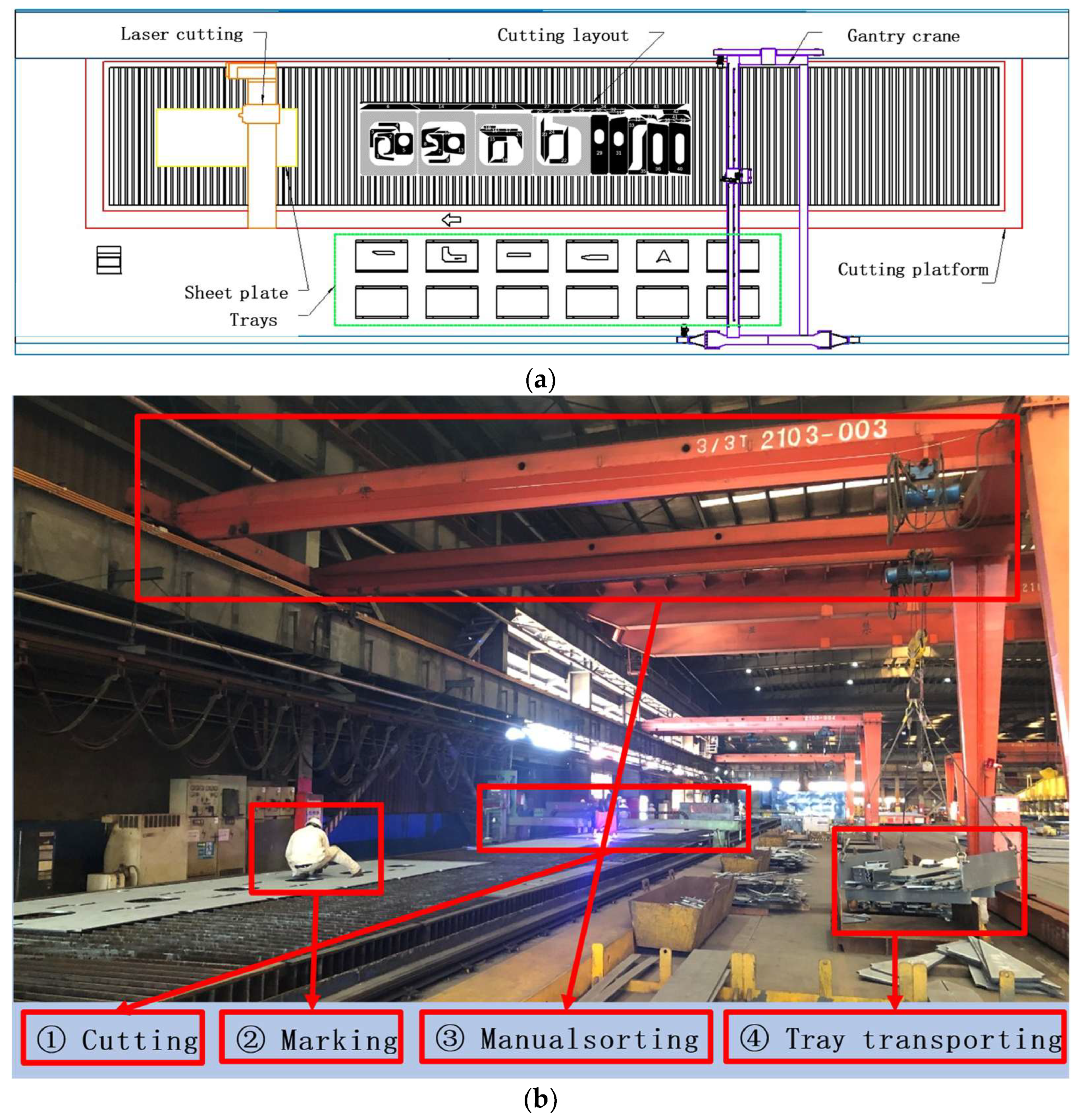
In the process of sorting ship parts, shortening the sorting distance has a direct effect on efficiency improvement. The ship part sorting platform is shown in Figure 1. The parts are steel plates with the same thickness and different sizes and shapes. In each layout, the number of parts to be sorted is mostly between 30 and 60, and trays mostly between 4 and 6.
The manual sorting process can be roughly described as follows: After the laser cutting machine completes the cutting task of the current layout, the worker comes to the work platform and sorts the parts with the help of a gantry crane. The whole process is shown in Figure 1, which can be divided into three steps: confirming, transporting, and dropping the object.
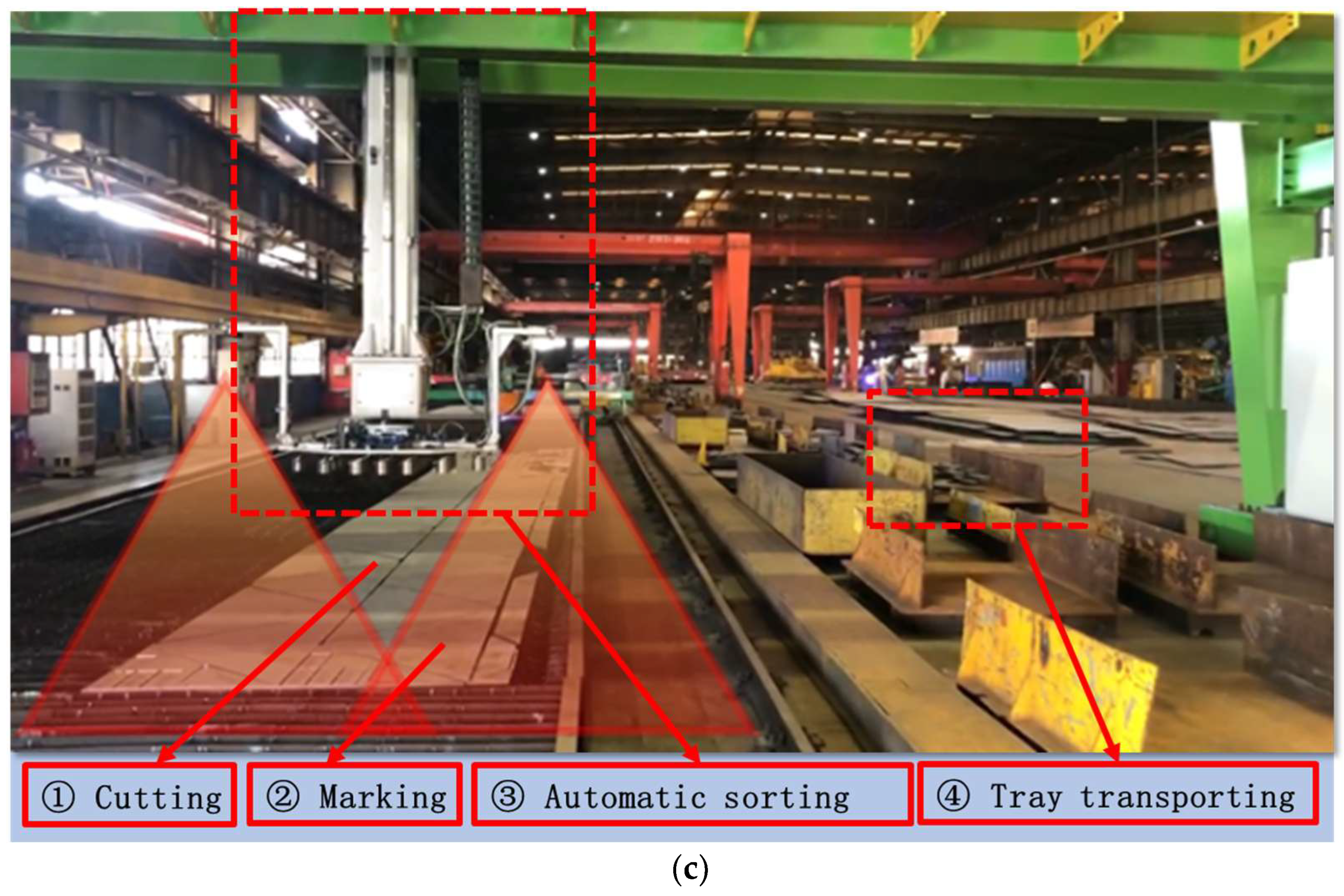
In the corresponding automated sorting scenario, as a substitute for workers and gantry cranes, a truss robot (as shown in the lower right corner of Figure 1) requires planning algorithms for guidance in the above three steps. However, workers’ determinations of the part sorting sequences and transport routes vary from person to person, and as such cannot be rules to guide the truss robot to perform automated sorting operations. To achieve automation, intelligent analysis and scheduling algorithms are needed to organize the work.

2.2. Ship Part Sorting Route Planning

Ship part sorting route planning (SPSRP) is mainly to plan the parts sorting sequence and the transportation path. Relying on automated equipment, parts are picked from the layout in turn, and sorted to their trays according to the specified routes, finally realizing the stable stacking of parts and the shortening of the sorting distance. Sort path planning of ship parts was a typical NP-hard optimization problem. Two key issues should be addressed for efficient and stable path planning: (1) an accurate mathematical model to describe the sorting process, given the coordination between multiple parts and trays; and (2) the identification of a suitable solution algorithm to achieve optimal path planning results. The following will introduce the necessity of SPSRP through a simple example.
As with other approaches for route planning such as ant colony optimization, particle swarm optimization, simulated annealing, and tabu search (as shown in Table 1), genetic algorithm (GA) is a random global search and optimization method developed by imitating the biological evolution mechanism of nature. It can automatically acquire and accumulate knowledge about the search space during the search process and adaptively control the search process to find the optimal solution (close to optimal).
The algorithm consists of an 8-tuple:
G A = ( C , f , P 0 , N , Φ , Γ , Ψ , T )
where C is the individual coding method, f is the individual fitness evaluation function, P 0 is the initial population, N is the population size, Φ is the selection qualification, Γ is the crossover rate, Ψ is the mutation rate, and T is the termination condition of the genetic algorithm.
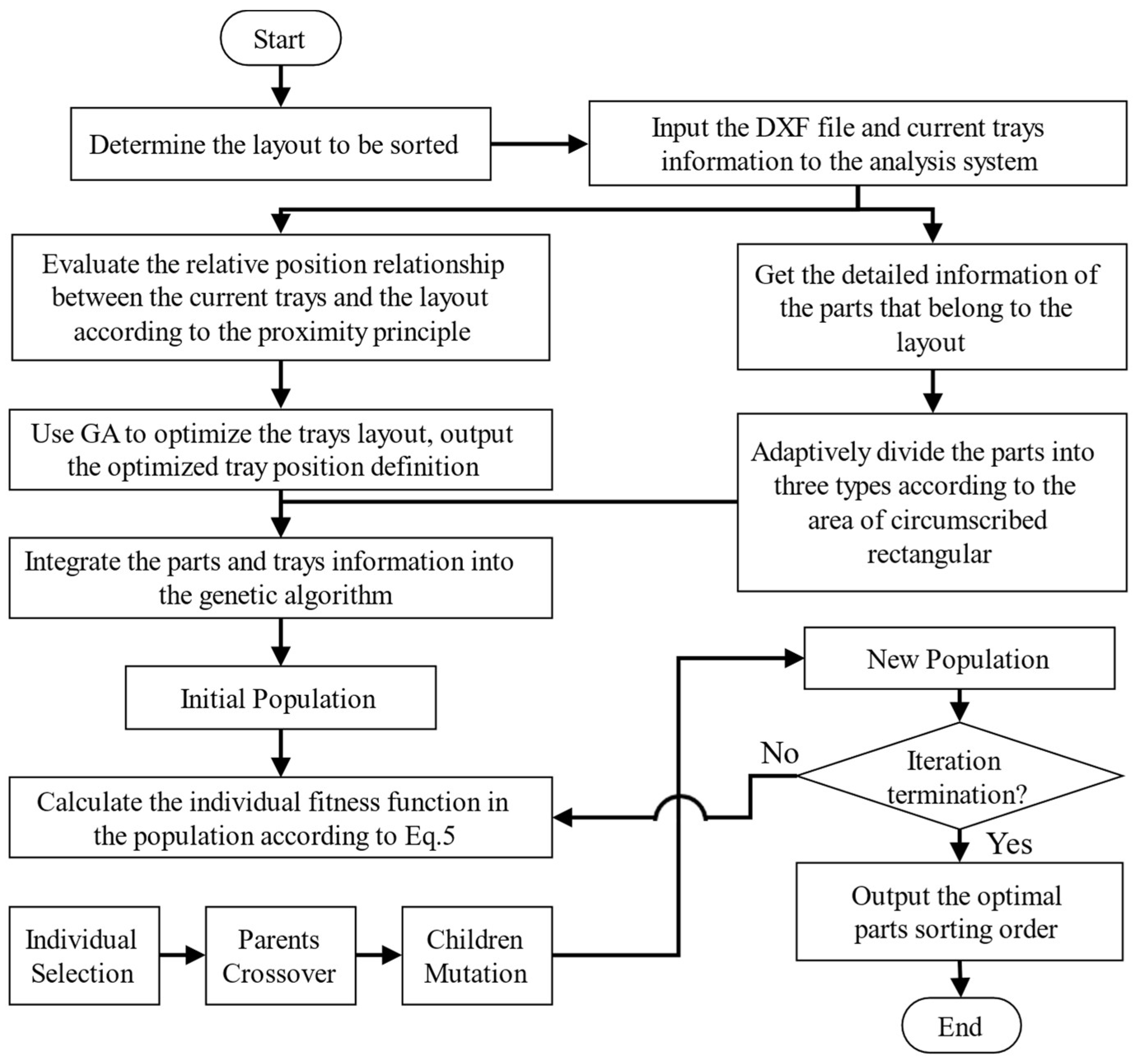
Aiming at the problem of SPSRP, the function of this algorithm is to optimize the sorting order of parts so that the f-value, that is, the total sorting distance and the stacking potential energy, reach the minimum or close to the minimum. In this study, a modified GA is developed, as shown in Figure 2, and its main characteristics are described analytically as follows:
(1)
Chromosome representation and population initialization
An integer-point representation is applied, where each chromosome is a N-dimensional vector that is a permutation of integer numbers. In the scene of ship part sorting, each integer number represents a ship part; thus, the set of integer numbers represents the order with which the robot sorts the parts.
The initial population is generated randomly in an attempt to produce solutions over the search space expressed by uniform distribution. Each chromosome represents a possible route for the robot starting and ending at the initial position.
(2)
The evaluation mechanism
The fitness evaluation function represents the possibility of chromosome survival and reproduction in the next generation, and is closely related to the mathematical model. A reasonable sorting sequence of parts can reduce the sorting distance and enhance the stacking stability, thereby improving the operation efficiency.
The reciprocal of T = α D + β E is used as the evaluation function f to reflect the pros and cons of the sorting order of parts. The initial values of α and β were obtained via the radar probing algorithm (RPA). Assuming that the total material arrangement distance corresponding to the part sorting sequence output by RPA is D R P A , the overall stability score is E R P A , and the local stability score is L R P A , the relationship between α and β is shown in Equation (3).
f = 1 α D + β E
α β = 1.5 E R P A D R P A L R P A
(3)
Selection operation
In the proposed GA, reproduction is based on the roulette wheel selection scheme, where the parent chromosomes are selected with rates proportional to their fitness. Calculate the fitness f = { f 1 , f 2 f n } (Equation (5)), the selection probability P = { P 1 , P 2 P n } (Equation (4)), and the corresponding cumulative probability S = { S 1 , S 2 S n } (Equation (7)). In general, chromosomes with higher fitness value have more chances to be selected for reproduction.
P i = f i k = 1 n f k
S i = k = 1 i P k
(4)
Crossover and mutation operations
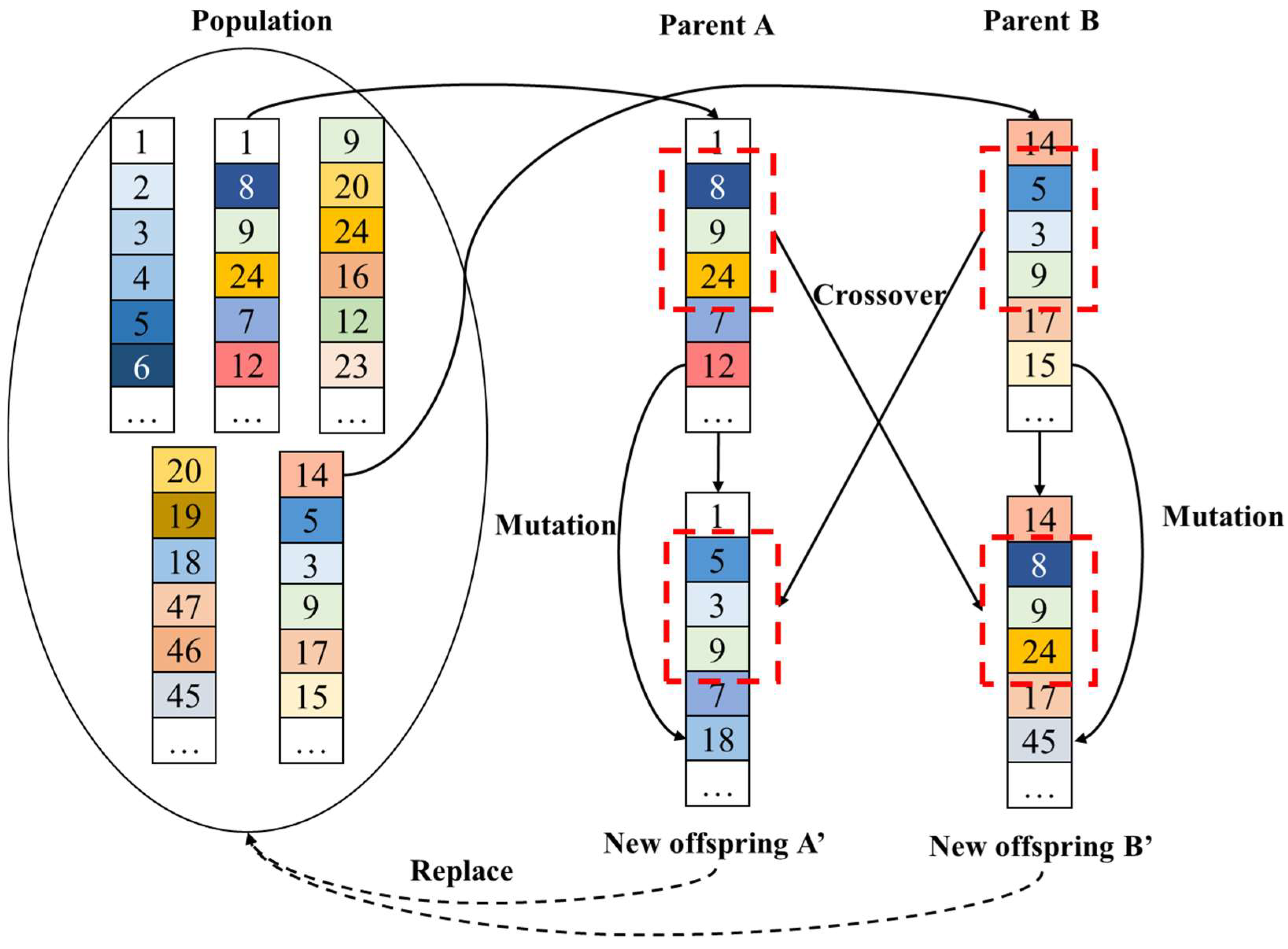
The two-point crossover method, as shown in Figure 2, is used to randomly select two crossover positions from the parent’s coding sequence. The code fragments between the crossover positions are exchanged to produce offspring. If there are duplicate numbers in the offspring’s coding sequence, only the duplicated genes between the offspring need to be exchanged to eliminate conflicts.
The mutation operation is adopted to randomly select two mutation positions from the coding sequence of the offspring, and then reverse the coding fragments between the mutation positions to generate new offspring.
To sum up, this paper establishes an SPSRP model based on the actual situation, and uses the genetic algorithm to optimize the sorting route to improve operation efficiency and stability of parts stacking.
As shown in Figure 3, the input of the flowchart is the detailed information of the parts and trays. Firstly, optimize the relative position relationship between the two based on the principle of proximity. Then, combined with the developed GA, output the optimized parts sorting order, which will further serve as the basis for the generation of the robot motion information.

2.3. Model Establishment of the Ship Part Sorting Process

(1)
Mathematical model of the sorting process
Ship part sorting route planning (SPSRP) is used to optimize the sorting distance and stacking stability. Now take the parts layout S P = { P 1 , P 2 , P n } and trays S T = { T 1 , T 2 , T m } as an example to illustrate the mathematical model of the sorting process.
Where S P is a set of n parts belonging to the same layout, and each part P i contains the information P i = { x p i , y p i , a i , t i } , i = 1 n , which is needed for sorting, and S T is the set of m trays corresponding to S P , each tray T j contains the information T j = { x t j , y t j } , j = 1 m :
  • i is the actual number of the part P i ;
  • x p i and y p i are the coordinates of the center of gravity of the part P i (the coordinate origin is set at the lower left corner of the layout);
  • a i is the area of the circumscribed rectangle of the part P i ;
  • t i is the number of the tray to which the part P i belongs;
  • j is the number of the tray T j ;
  • x t j and y t j are the centroid coordinates of the tray T j ;
  • The sorting order of parts can be represented by the set O P = { o 1 , o 2 , o n } , and o i means the sorting order of part P i .
First, divide the parts into three types from large to small according to the area a i and replace the original a i with size labels 3, 2, and 1,which represent large, medium, and small, respectively.
Then, calculate the total stacking potential energy E of the layout with the sorting order O P = { o 1 , o 2 , o n } . The calculation method has been introduced, and the algorithm pseudo code is shown as Algorithm 1.
Algorithm 1: Pseudo code for calculating the stacking potential energy E
Input:   S P : part information;   S T : tray information; O P : sorting order
Output: Total parts stacking potential energy E
1: Initial E = 0 ,   k = 1 and h j = 0 ,   j = 1 . . . m
2: Repeat
3: Find o i equal to k in O P , take out the label a i and tray number t i of part P i
4: Find tray j corresponding to t i in S T , and calculate h j + = 1 , E + = a i h j
5: Complete the calculation of E of the current part, and calculate k + = 1
6: Until ( k = n + 1 )
Finally, calculate the total parts sorting distance D for the layout with the sorting order O P = { o 1 , o 2 , o n } . It should be noted that only one part can be sorted at a time, and each part can only be sorted once. Equation (1) can be derived:
D = o i = 1 n d 1 P i x , y , T t i x , y + o i = 1 n 1 d 2 T t i x , y , P i , o i = o i + 1 x , y + d 2 P i n i t i a l , P i , o i = 1 x , y + d 2 T t i , o i = n x , y , P i n i t i a l
where d 1 represents the load route, d 2 represents the no-load route. Specifically:
  • d 1 P i x , y , T t i x , y represents the load route from the part position P i x , y to the corresponding tray position T t i x , y ;
  • d 2 T t i x , y , P i , o i = o i + 1 x , y means the no-load route from the current tray position T t i x , y to the next part position P i , o i = o i + 1 x , y ;
  • d 2 P i n i t i a l , P i , o i = 1 x , y represents the initial route from the origin P i n i t i a l to the first part position P i , o i = 1 x , y ;
  • d 2 T t i , o i = n x , y , P i n i t i a l represents the end route from the tray position T t i , o i = n x , y to the origin P i n i t i a l .
Taking into account the difference in the value of the total sorting distance D and the total stacking potential energy E, the weight factors α and β need to be added. The final optimization model for the ship part sorting route can be expressed as follows:
m i n i m i z e   T = α D + β E s . t . P i S P , i = 1 . . . n T i S T , i = 1 . . . m
The following section will take the layout in Figure 1 as an example to introduce the route planning algorithm, but first, it is necessary to briefly explain the layout analysis method. Understand how the parts information in the layout S P , including part number, part location, part size, and part flow direction, is obtained.
(2)
Assumptions and constraints
The assumptions and constraints for the algorithm solution were as follows:
  • The number of trays was assumed to be unlimited, as the research focuses on the path planning algorithm for a limited number of part layouts, and the load capacity of trays in actual shipyard operations was far greater than the number of parts involved in the paper.
  • The collision loss of the robot arm during the sorting process was not considered.
  • Only one part could be sorted at a time and each part could be sorted only once.

3. Results

3.1. Scene Recognition

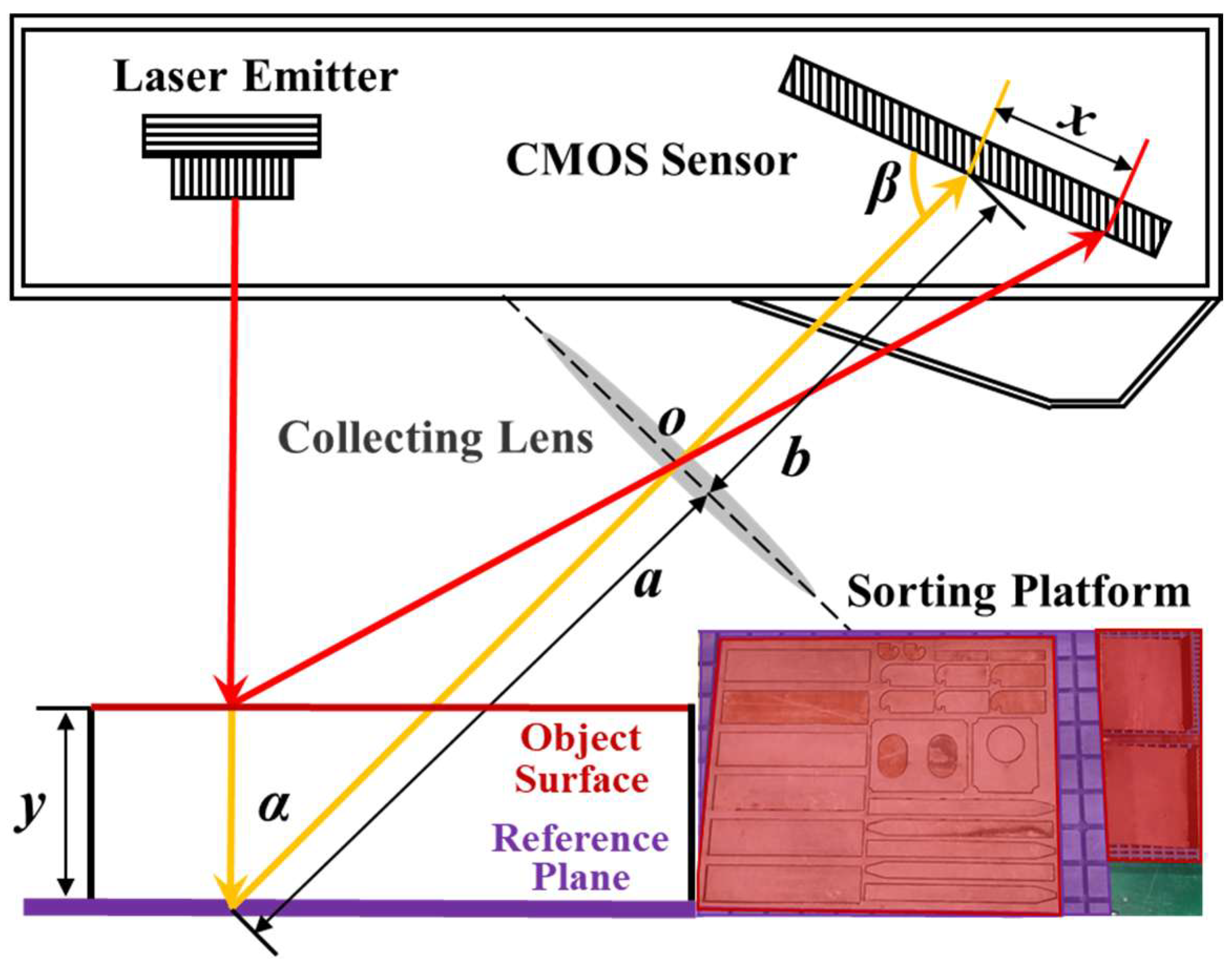
Figure 4 shows the measurement principle of the line profile sensor. The laser emitter projects a line laser to the object surface. Part of the diffusely reflected light from the object surface is imaged on the CMOS photosensitive element through the collecting lens. α is the angle between the incident light and the reflected light, and β is the angle between the reflected light and the image plane of the photosensitive element. The position relationship between the measurement points on the object surface and the image plane of the photosensitive component is determined by the laser triangulation method (Equation (8)).
The Gocator 2490 (Holland), with dimensions of 49 × 85 × 272 mm and a weight of 1.5 kg, was applied to obtain a point cloud of the sorting layout. This type of laser line profile sensor had a laser line with 1920 sampling points, a field of view of 390–2000 mm, and a measurement range of 1525 mm.
y = a x sin β b sin α + x sin ( α + β )
where y is the height difference between the object surface and the reference plane, x is the distance between points M and N on the CMOS (Complementary Metal-Oxide-Semiconductor) image plane, and a and b are the object distance and the image distance, respectively.
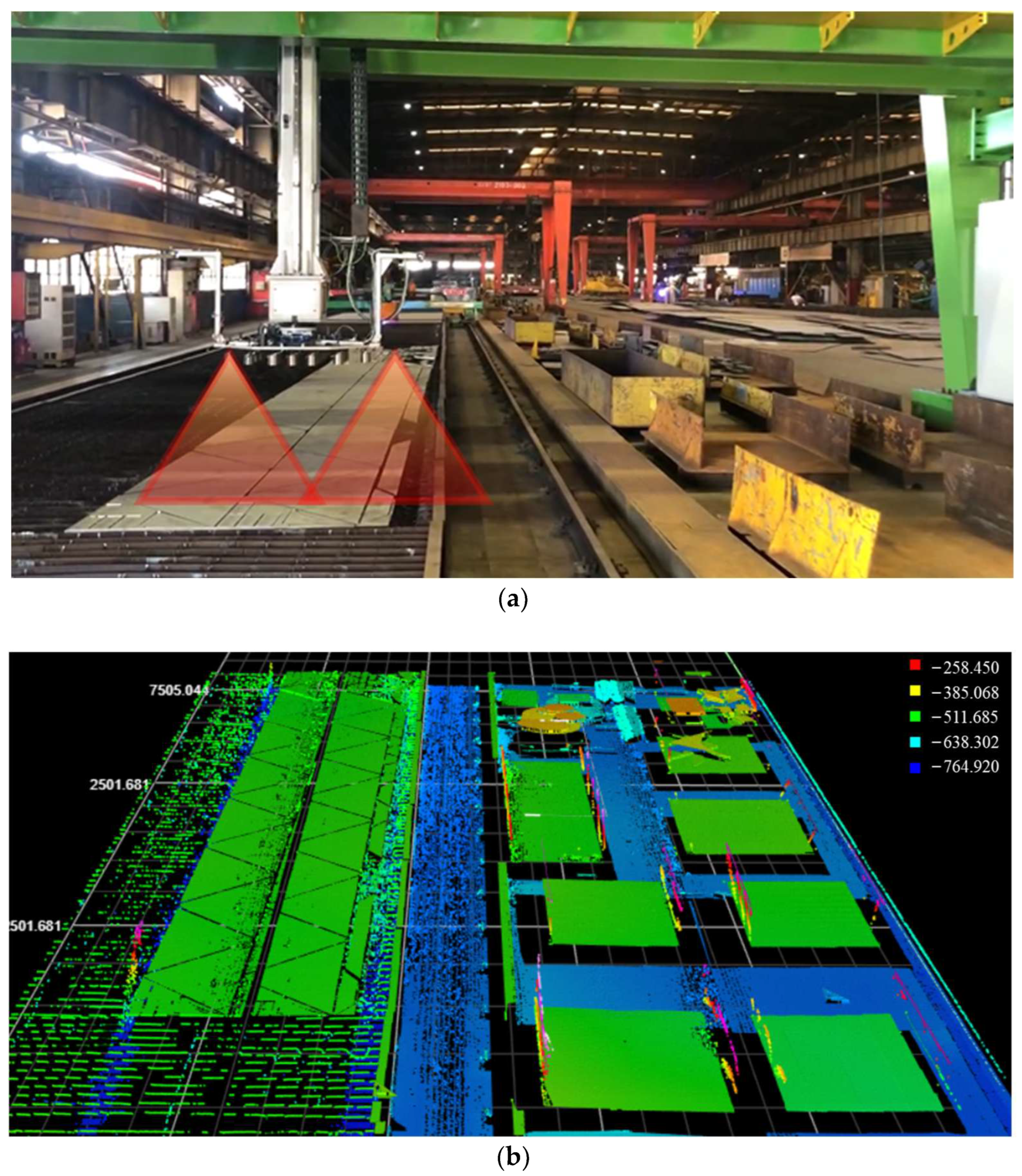
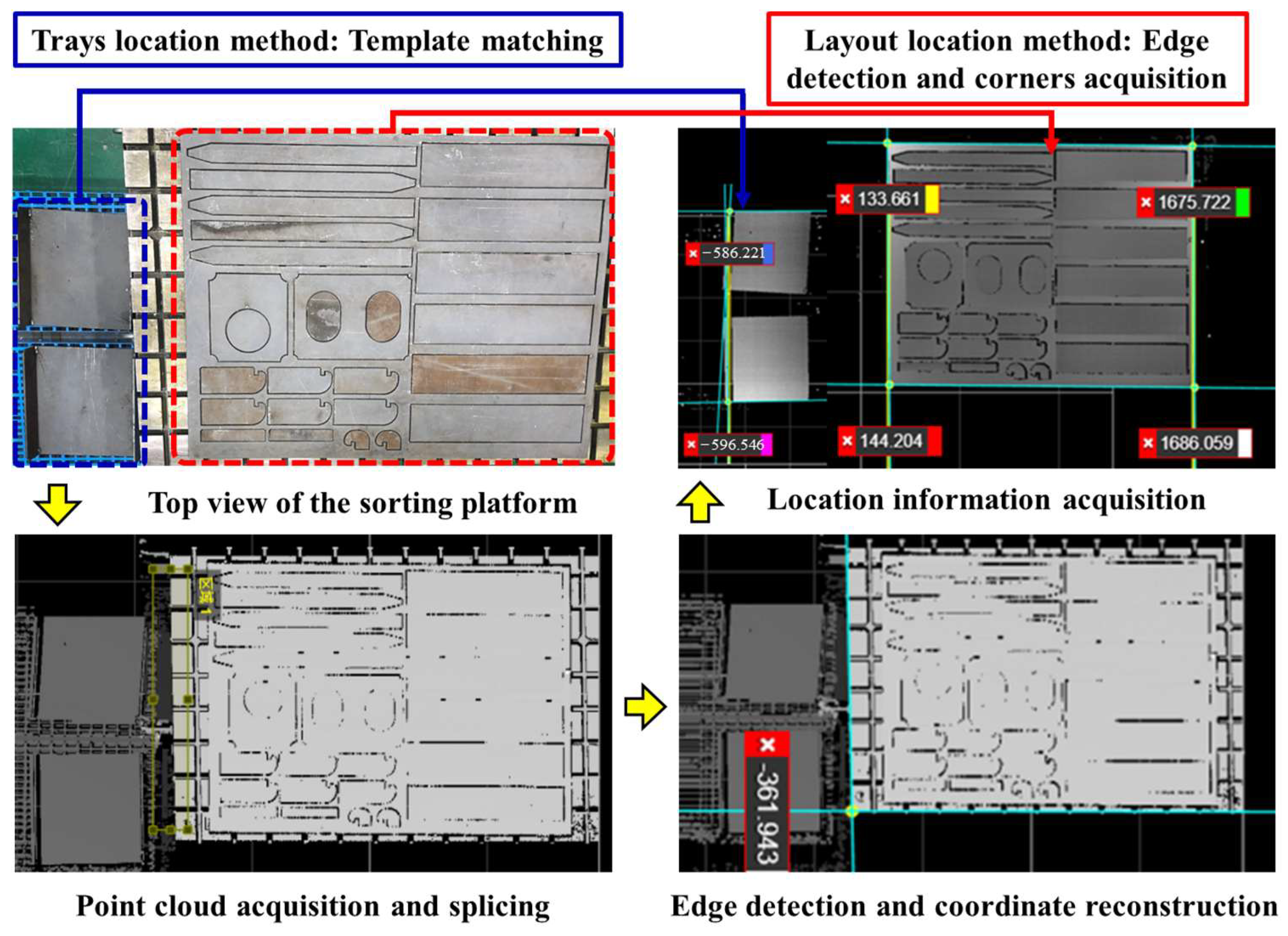
Figure 5 is a schematic of the laser scanning operation. The sensor is installed at the end of the robot to scan the sorting platform at a constant speed. Point cloud information obtained includes the sorting platform and the tray area. In order to further locate the parts layout and trays, point cloud data needs to be processed in sequence as follows: point cloud splicing, coordinate system reconstruction, point cloud filtering, corner localization, and template matching. Figure 6 shows the flowchart of the localization method. The final output information is four corner points and deflection angles of the parts layout and trays.
Thanks to the high efficiency of laser line profile localization, the sorting scene can be quickly identified. However, the parts in the layout are closely adjacent, which means that if continuing to use laser line profile sensor to recognize the parts, the localization error will increase significantly. Beyond that, the sensor cannot obtain the hidden information such as the allocation of each part, which will also hinder the subsequent sorting route planning. Therefore, some measures must be taken to assist the sensor to obtain complete parts information.

3.2. Parts Location

In view of the situation that the shipbuilding company uses AutoCAD 2004 software for layout design, an analysis system has been developed. Through data analysis of the ship layout in DXF format, various parts’ information can be accurately identified in batches, providing technical support for precise localization and intelligent sorting work.
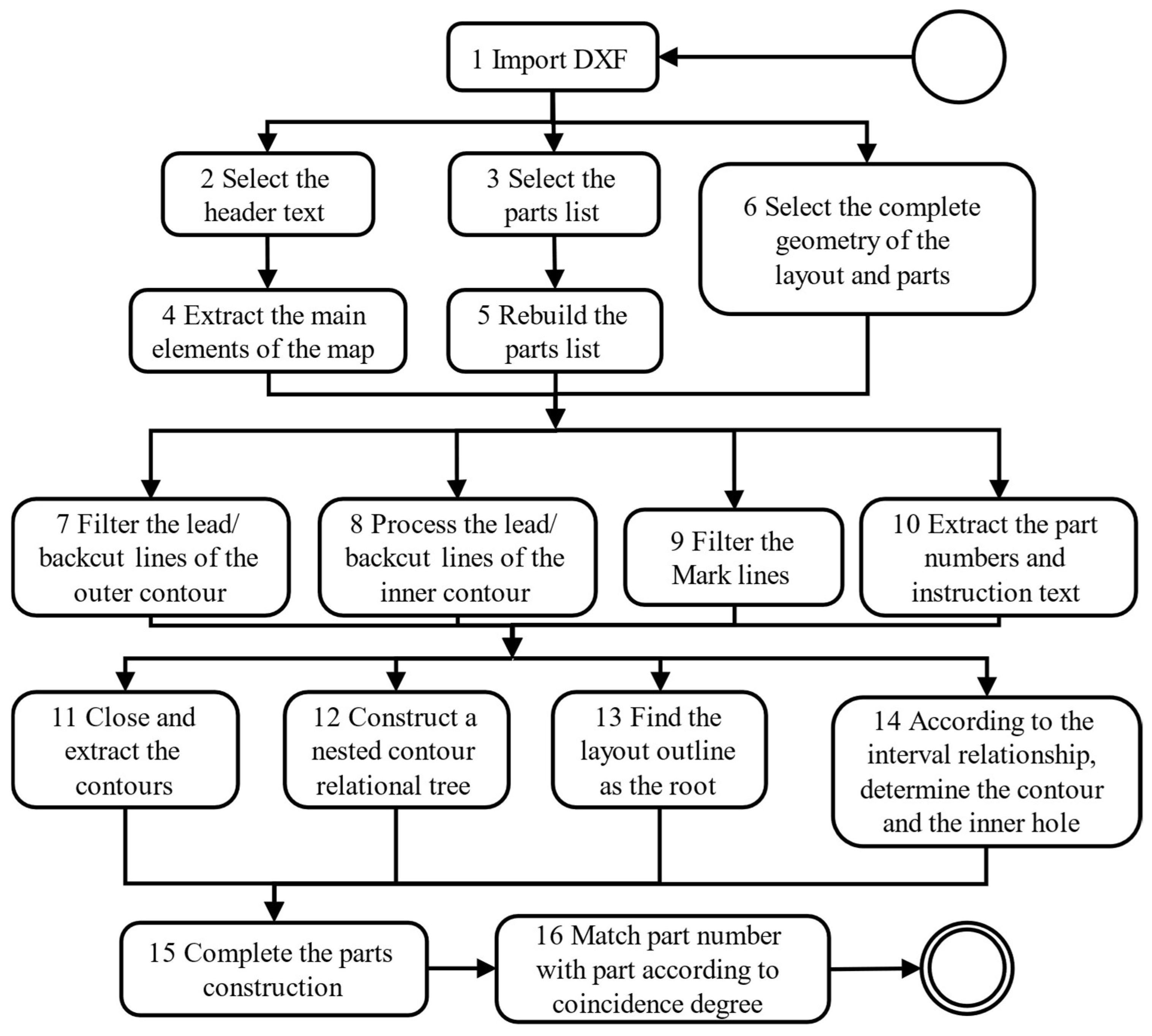
Figure 7 shows the technical route of the analysis system, which mainly includes two parts: parts list reconstruction and contour relationship construction. The former extracts the effective information from the layout, and the latter constructs the parts contour relationship and matches the detailed information of the parts.
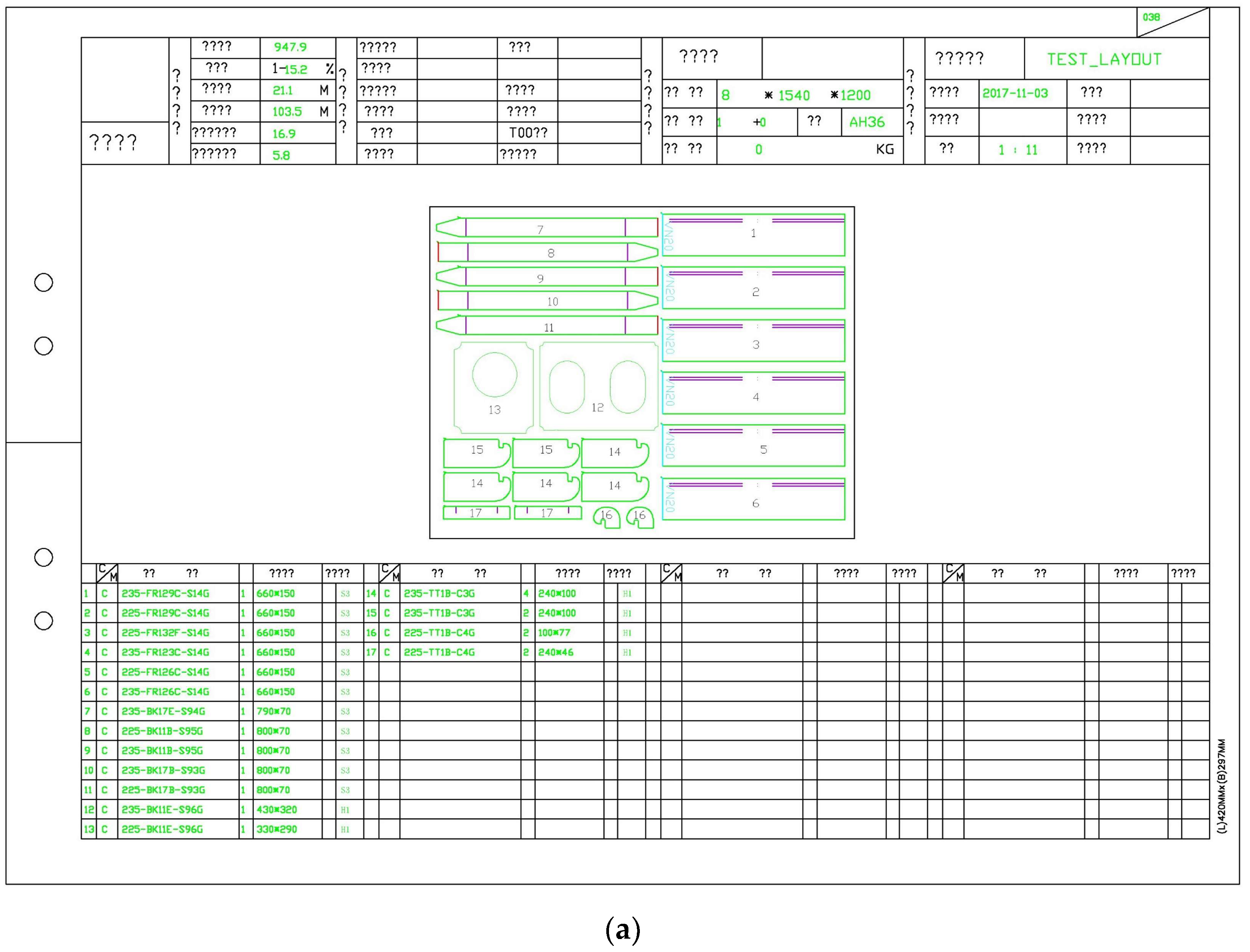
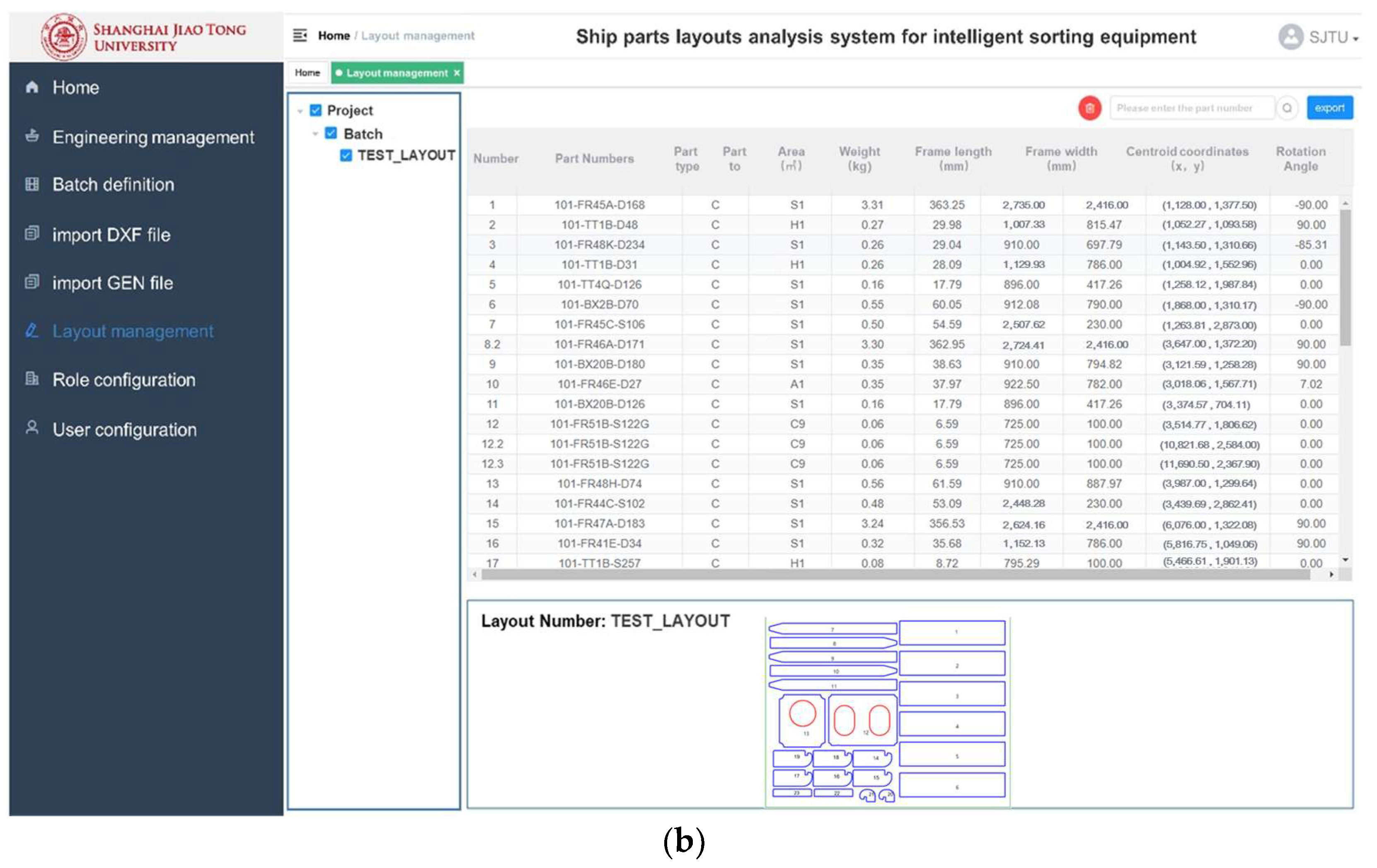
Import the DXF file into the system, and the parts information can be clearly presented in the form of a list. Combined with the localization information obtained by the sensor, the valuable information of the entire sorting scene can be accurately acquired. As shown in Figure 8b, the part’s number, allocation, size, and location information is totally extracted from the DXF file (Figure 8a) by the analysis system.

3.3. Sorting Path Planning

In this section, numerical results are provided to illustrate our method, and the application case is the parts layout described above. The simulation uses MATLAB version R2018a, and the machine used is a quad-core Celeron 2.8 GHz PC. The settings of the parameters are as follows according to previous works [16,18]: population size = 100, maximum generation number = 1000, the crossover rate is 0.8, and the mutation rate is 0.09.
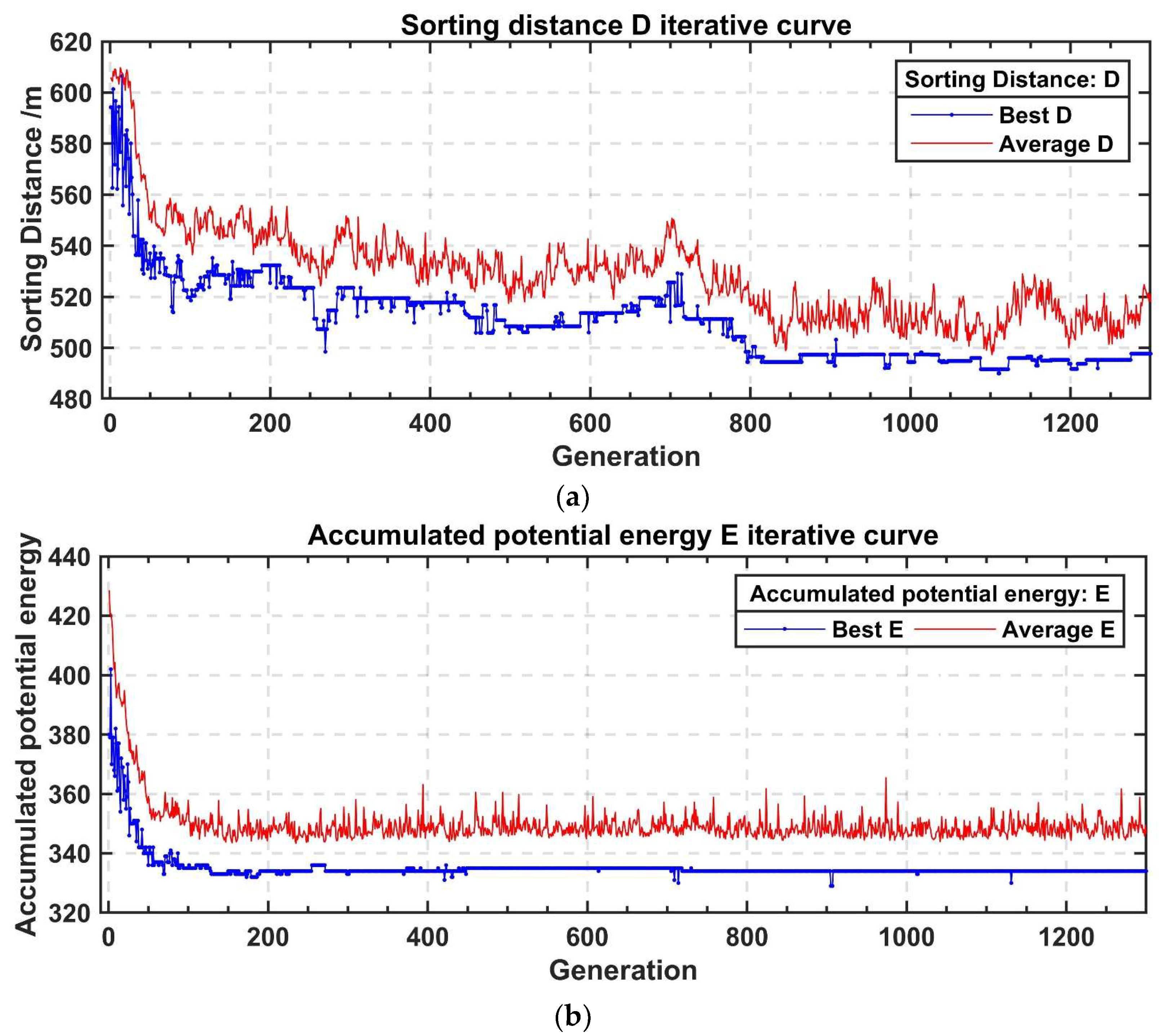
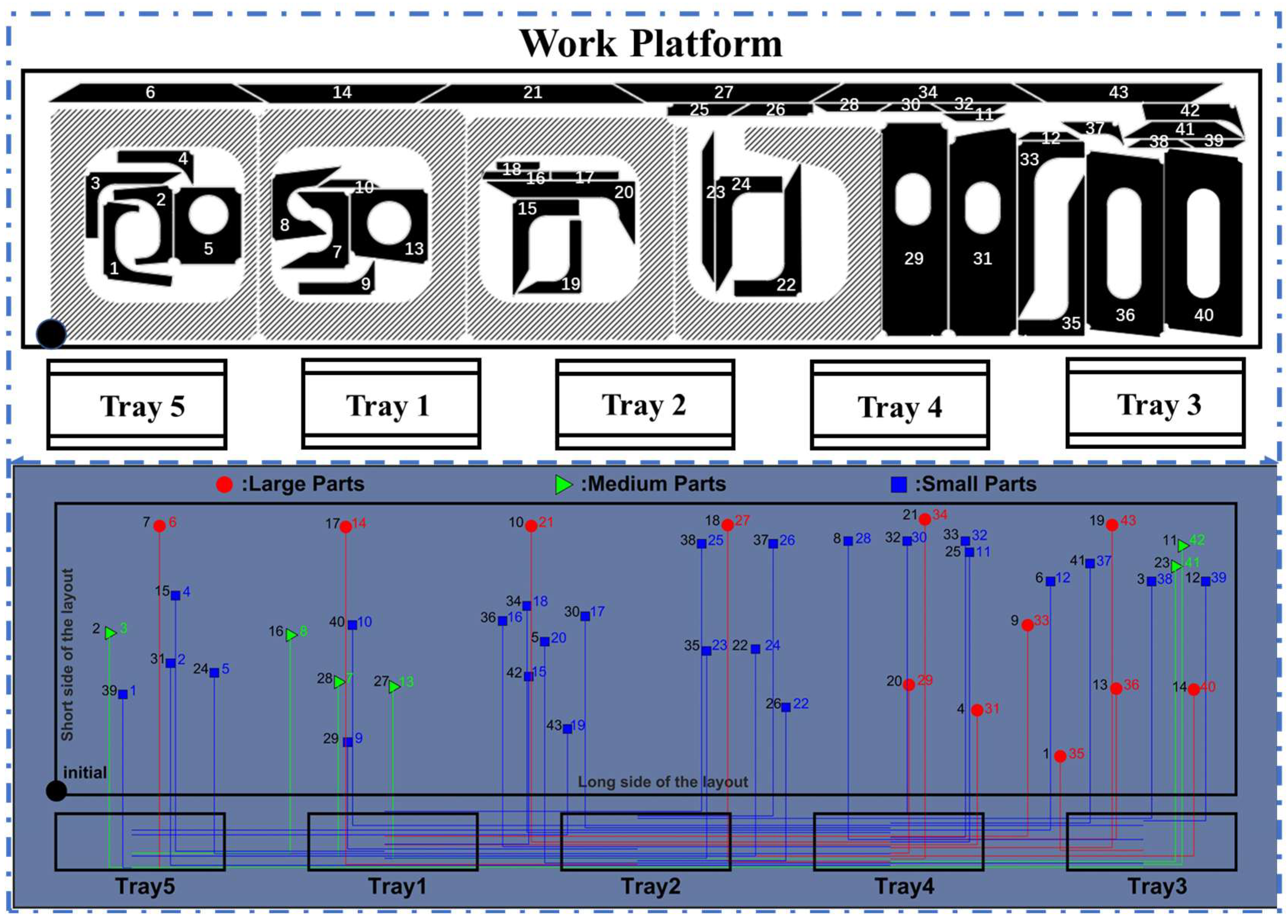
Table 2 presents the optimal sorting route derived from the proposed genetic algorithm, which starts at the initial point, then proceeds to part 35, followed by part 3, part 38, part 31, part 20, part 12, part 6, part 28, part 33, part 21, part 42, part 39, part 36, part 40, part 4, part 8, part 14, part 27, part 43, part 29, part 34, part 24, part 41, part 5, part 11, part 22, part 13, part 7, part 9, part 17, part 2, part 30, part 32, part 18, part 23, part 16, part 26, part 25, part 1, part 10, part 37, part 15, part 19, and finally returns to the initial point. Corresponding to this route, the sorting distance is 493 m, and the stacking potential energy amounts to 330.
It can be observed that the parts in each tray are basically stacked in order from large to small (red, green, and blue represent large, medium, and small, respectively). A few defects are caused by the limitation of the sorting distance in the evaluation mechanism.
Figure 9 shows the optimization results of the parts sorting. The position of each part in the layout is indicated by its center of gravity, and the sorting order and actual number of the part are marked on the left and right sides of the center of gravity. In addition, the route represents the load path of the robot, and the three different symbols represent the three types of parts. Figure 9 also shows the result of optimizing the relative position relationship between the trays and the parts based on the principle of proximity and evolutionary thought. The five trays are defined as 5-1-2-4-3 from left to right.
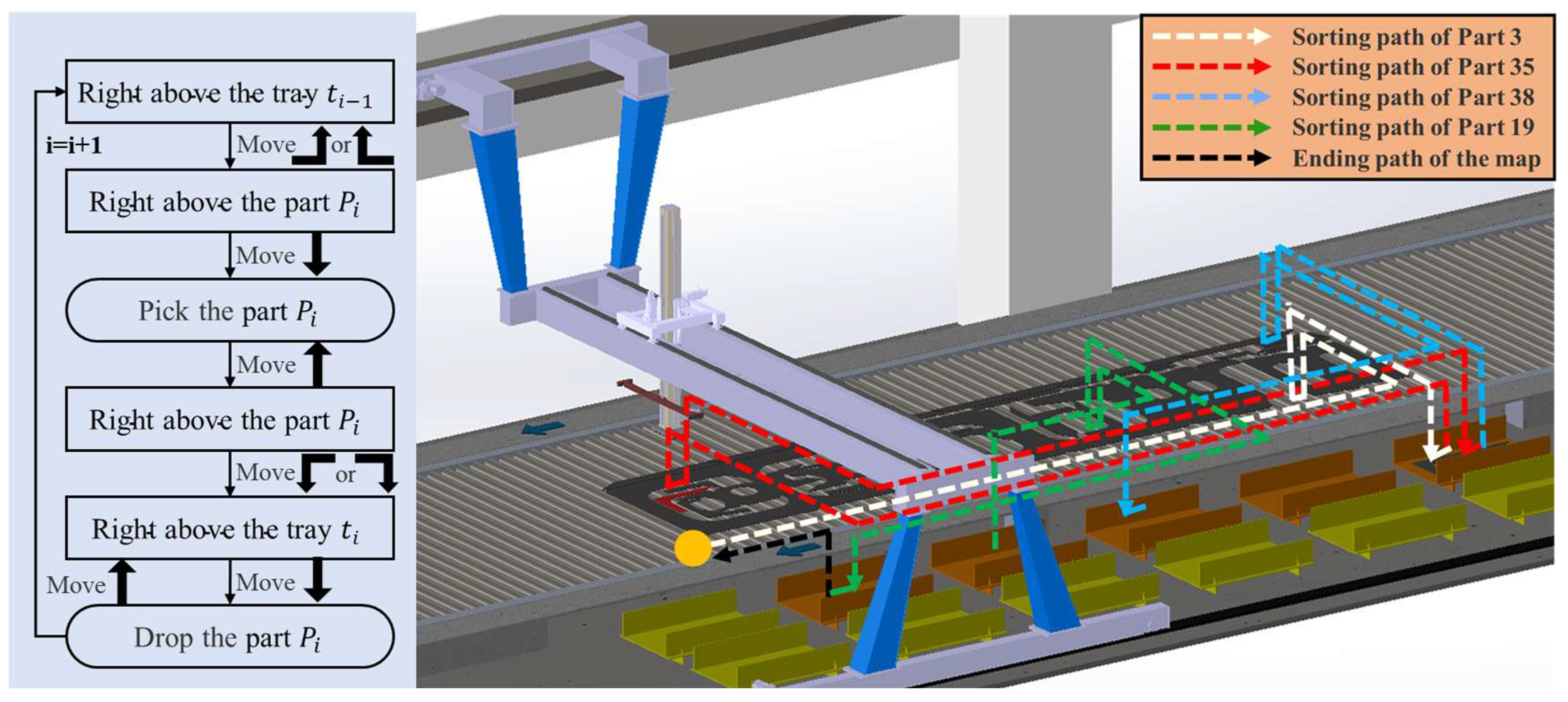
Based on the above numerical results, the trajectory of the truss robot can be determined. As shown in Figure 10, each time the robot sorts parts, it will go through the same action cycle: move from the position of tray t i 1 to the position of part P i that currently needs to be picked up, pick up P i , and then move to tray t i and drop it. In addition, in order to prevent interference and collisions with the cutting machine during the sorting process, the sorting robot will follow a right-angle trajectory during the operation to minimize the time it spends above the work platform.
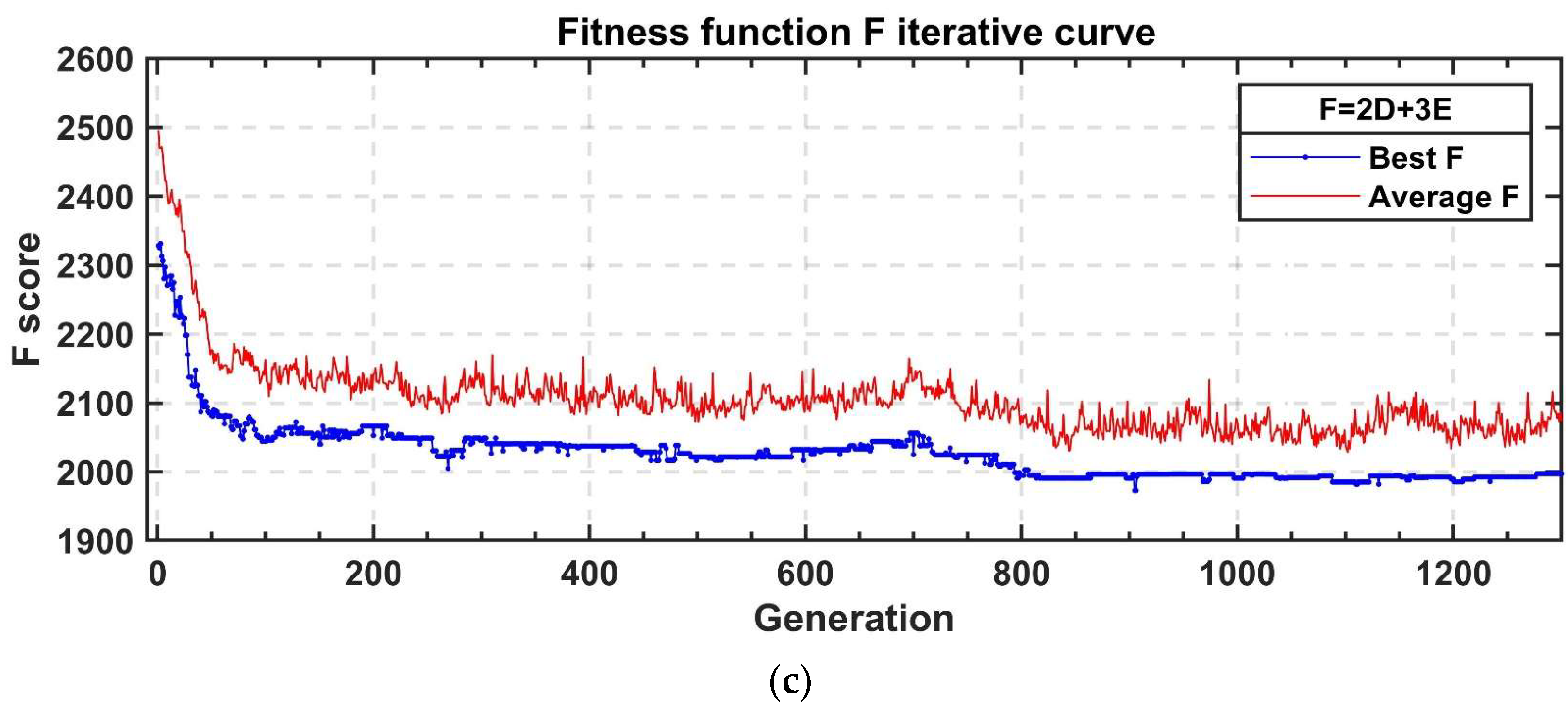
It can be observed from Figure 11 that the proposed algorithm has successfully optimized the mathematical model established in Section 3. With the increase of iteration, the sorting distance and the stacking potential energy of parts are both decreasing, stabilizing after 800 generations. The sorting distance has been shortened from the original 607 m to 493 m (24% optimization). The stacking potential energy has dropped from the initial 404 to 330 (22% optimization), which is only a 3.8% deviation from the ideal minimum, 318.
In the aforementioned scenario, the total distance covered during the sorting of 43 components amounted to approximately 490 m. Within an industrial application context, the robotic system operated at a translational speed of 1.2 m per second (m/s) along the x–y axis, while the velocity associated with its component picking and placing processes was roughly 0.5 m/s. Based on these operational parameters, the average time required to complete the sorting of a single component ranged from 20 to 30 s. In contrast, the manual sorting of a single component by shipyard workers typically demands a time window of 40 to 50 s. This comparative analysis indicated that the enhancement in operational efficiency achieved through automated sorting systems was statistically significant and practically observable.
Similarly, this paper has also conducted algorithm tests on the other layouts. In the next subsection, the proposed algorithm will be further discussed and compared with other traditional sorting solutions.

4. Discussion

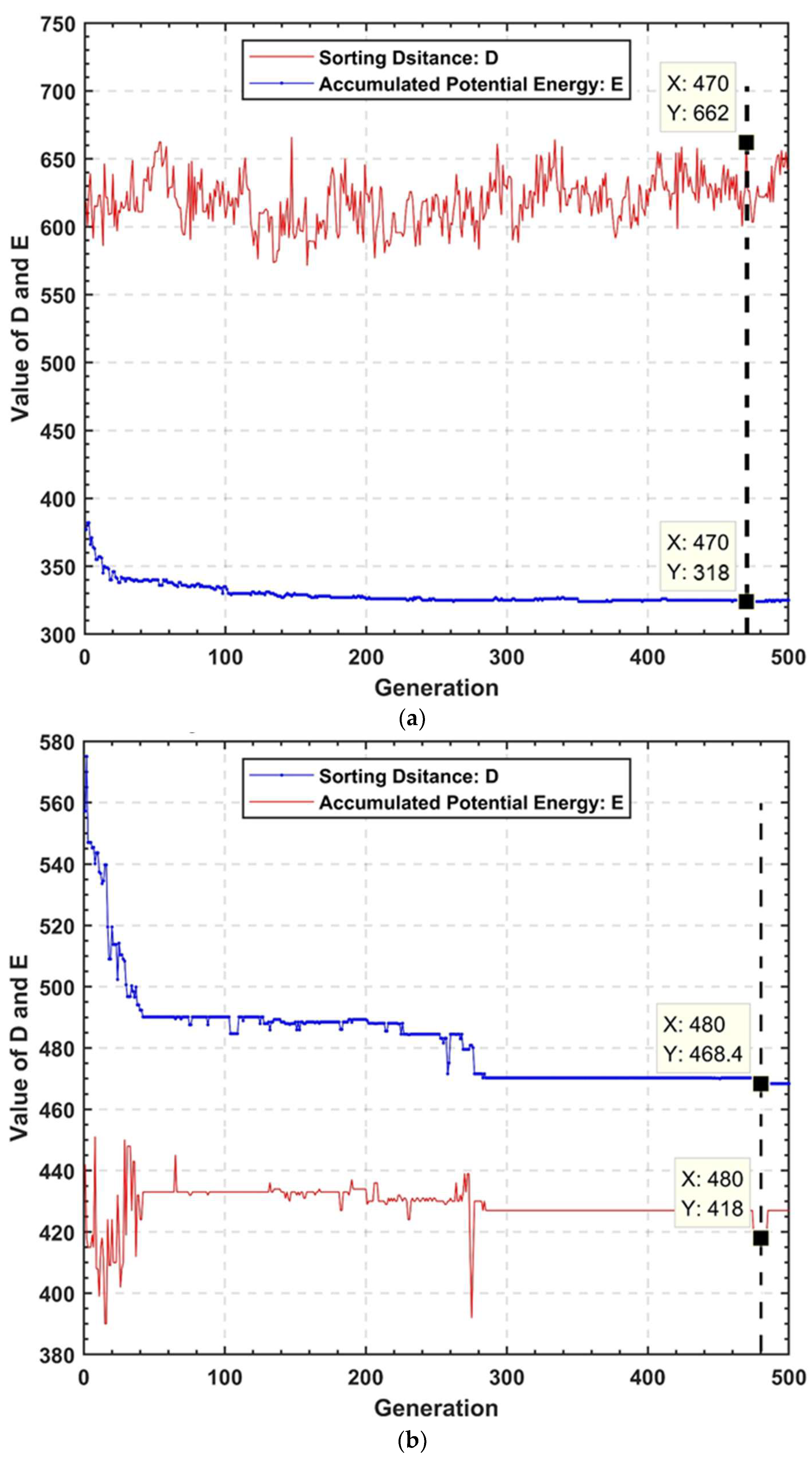
Multi-objective optimization is a key issue in solving path planning problems. Suresh et al. [32] proposed a multi-objective genetic algorithm-based mobile robot path search method. By integrating the genetic algorithm with multiple objective functions through the multi-objective genetic algorithm, the optimal path for mobile robots is obtained. Therefore, the influence of different fitting functions on the sorting path was discussed. As mentioned earlier, in the construction of the fitness function, if only the sorting distance is considered, the sorting distance obtained will be shorter than the current result, but the stacking stability will be poor. Similarly, if only considering the stacking stability, the stacking potential energy can reach the ideal state, but it will reduce the efficiency of the sorting operation.
Figure 12 shows the above two considerations. In Figure 12a, when only the stacking stability is considered, the potential energy reaches the ideal state 318, but the sorting distance increases to 662 m, which is a 34% reduction in efficiency compared with Figure 12a. In Figure 12b, the situation that only considers the sorting distance is also not optimistic. The optimized sorting distance is 468 m, which is only reduced by 5% compared with Figure 8a. However, the stacking potential energy increases to 418, resulting in a significant decrease in stability. The above discussion also reflects the rationality of our consideration of SPSRP.
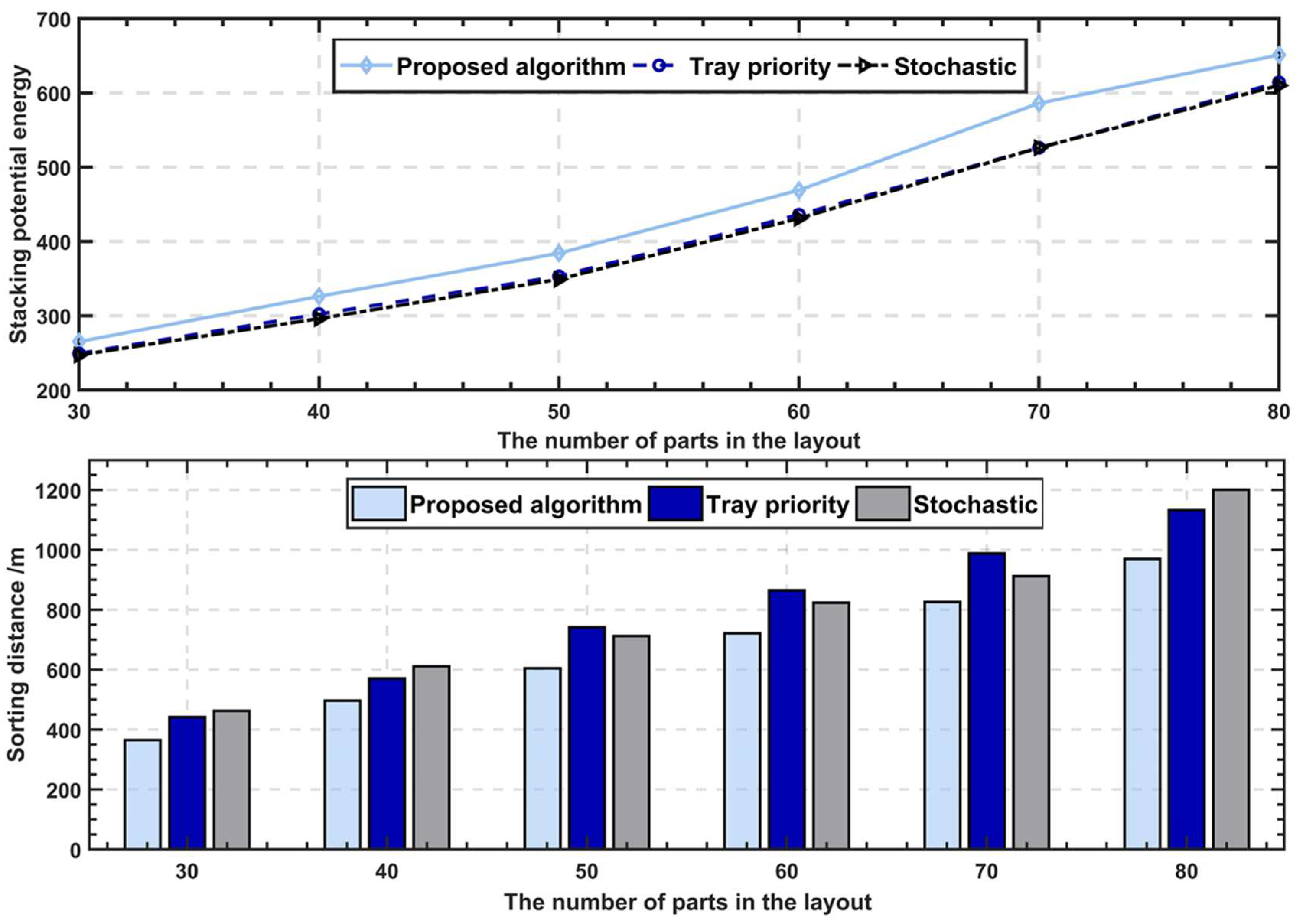
In order to verify the effectiveness of the proposed algorithm, this paper compares with two traditional manual sorting planning solutions. Procházka et al. [33] analyzed the effectiveness of both automated and manual sorting methods in terms of sorting efficiency, and the key parameters of the sorting process were obtained. In this paper, one of the traditional manual sorting planning solutions is the sorting planning scheme that takes the priority of the tray into consideration. The characteristic of this scheme is to sort parts of a certain tray first. The other is a stochastic planning that only considers the stacking stability of parts.
Figure 13 shows the comparison between the above two and the proposed algorithm for solving different layouts. It can be observed that as the number of parts increases, the sorting distance and stacking potential energy of each scheme are both increasing, and the proposed approach has an obvious effect on the optimization of sorting distance. However, for the stacking stability, the proposed algorithm still has a gap compared with the traditional solution, which is also the key to the subsequent optimization.

5. Conclusions

This study contributes to the problem of SPSRP in the following aspects: (a) establishing an accurate ship part sorting process model, and developing an analysis system to obtain detailed information of the parts in the layout; (b) proposing a sorting route optimization scheme based on GA, considering sorting distance and stacking stability as evaluation indicators; and (c) standardizing the movement mode of the truss robot.
Research shows that the algorithm proposed in this paper can effectively solve the design problem of ship part sorting route planning. In the above case, it takes about 490 m to sort the 43 parts. In the industrial application scenario, the robot runs at a speed of 1.2 m/s in the x–y direction, and the speed of picking and placing parts is about 0.5 m/s. Therefore, the average time required to sort a part is about 20 to 30 s, while the time required for shipyard workers to sort a part is usually 40 to 50 s. The improvement in operation efficiency brought by automated sorting is obvious.
SPSRP can guide robots to automatically sort, which will help companies improve their lean production capabilities, enhance their control over key production nodes, and help the continuous development and growth of ship intelligent manufacturing technology. Future work will focus on solving the established model through reinforcement learning to achieve real-time planning. In addition, more practical factors will be taken into account in the establishment of the model to improve the generalization ability of the model.

Author Contributions

Conceptualization, H.X. and Y.Z.; methodology, H.X. and C.L.; software, J.S.; validation, H.X., C.L., and J.S.; writing—original draft preparation, H.X.; writing—review and editing, H.X., C.L., and Y.Z.; visualization, H.X., C.L., and Y.Z.; funding acquisition, Y.Z. All authors have read and agreed to the published version of the manuscript.

Funding

This research received no external funding.

Data Availability Statement

Dataset available on request from the authors.

Conflicts of Interest

The authors declare no conflicts of interest.

References

  1. Li, J.; Guo, H.; Zhou, Q.; Yang, B. Vehicle routing and scheduling optimization of ship steel distribution center under green shipbuilding mode. Sustainability 2019, 11, 4248. [Google Scholar] [CrossRef]
  2. Li, H. Research on Digital, Networked and Intelligent Manufacturing of Modern Ship. J. Phys. Conf. Ser. 2020, 1634, 012052. [Google Scholar] [CrossRef]
  3. Um, D. Multiple intensity differentiation-based 3-D surface reconstruction with photometric stereo compensation. IEEE Sens. J. 2014, 14, 1453–1458. [Google Scholar] [CrossRef]
  4. Sun, J.; Liu, Z.; Zhao, Y.; Liu, Q.; Zhang, G. Motion deviation rectifying method of dynamically measuring rail wear based on multiline structured-light vision. Opt. Laser Technol. 2013, 50, 25–32. [Google Scholar] [CrossRef]
  5. Zhong, F.; Kumar, R.; Quan, C. A cost-effective single-shot structured light system for 3D shape measurement. IEEE Sens. J. 2019, 19, 7335–7346. [Google Scholar] [CrossRef]
  6. Yang, L.; Li, E.; Long, T.; Fan, J.; Liang, Z. A novel 3-D path extraction method for arc welding robot based on stereo structured light sensor. IEEE Sens. J. 2019, 19, 763–773. [Google Scholar] [CrossRef]
  7. Tian, Y.; Liu, H.; Li, L.; Yuan, G.; Feng, J.; Chen, Y.; Wang, W. Automatic identification of multi-type weld seam based on vision sensor with silhouette-mapping. IEEE Sens. J. 2021, 21, 5402–5412. [Google Scholar] [CrossRef]
  8. Wang, S.; Ye, A.; Guo, H.; Gu, J.; Wang, X.; Yuan, K. Autonomous pallet localization and picking for industrial forklifts based on the line structured light. In Proceedings of the 2016 IEEE International Conference on Mechatronics and Automation, Harbin, China, 7–10 August 2016. [Google Scholar]
  9. Mohamed, I.; Capitanelli, A.; Mastrogiovanni, F.E.A. Detection localisation and tracking of pallets using machine learning techniques and 2D range data. Neural Comput. Appl. 2019, 32, 8811–8828. [Google Scholar] [CrossRef]
  10. Mathavan, S.; Kamal, K.; Rahman, M. A review of three-dimensional imaging technologies for pavement distress detection and measurements. IEEE Trans. Intell. Transp. Syst. 2015, 16, 2353–2362. [Google Scholar] [CrossRef]
  11. Guo, Y.; Shi, H.; Yu, Z. Research on tunnel complete profile measurement based on digital photogrammetric technology. In Proceedings of the 2011 IEEE International Conference on Service Operations, Logistics and Informatics, Beijing, China, 10–12 July 2011. [Google Scholar]
  12. Wang, H.; Wu, Z.; He, Z.; Gao, R.; Huang, H. Detection of HF-ERW process by 3d bead shape measurement with line-structured laser vision. IEEE Sens. J. 2021, 21, 7681–7690. [Google Scholar] [CrossRef]
  13. Zhang, S.; Wong, T. Integrated process planning and scheduling: An enhanced ant colony optimization heuristic with parameter tuning. J. Intell. Manuf. 2018, 29, 585–601. [Google Scholar] [CrossRef]
  14. Li, J.; Duan, P.; Cao, J.; Lin, X.; Han, Y. A hybrid pareto-based tabu search for the distributed flexible job shop scheduling problem with E/T criteria. IEEE Access 2018, 6, 58883–58897. [Google Scholar] [CrossRef]
  15. Abdelaziz, F.B.; Mir, H. An optimization model and tabu search heuristic for scheduling of tasks on a radar sensor. IEEE Sens. J. 2016, 16, 6694–6702. [Google Scholar] [CrossRef]
  16. Nguyen, S.; Zhang, M.; Johnston, M.; Tan, K.C. Automatic design of scheduling policies for dynamic multi-objective job shop scheduling via cooperative coevolution genetic programming. IEEE Trans. Evol. Comput. 2014, 18, 193–208. [Google Scholar] [CrossRef]
  17. Liu, T.; Chen, Y.; Chou, J. Solving distributed and flexible job-shop scheduling problems for a real-world fastener manufacturer. IEEE Access 2015, 2, 1598–1606. [Google Scholar]
  18. Wang, B.; Xie, H.; Xia, X.; Zhang, X. A NSGA-II algorithm hybridizing local simulated-annealing operators for a BI-criteria robust job-shop scheduling problem under scenarios. IEEE Trans. Fuzzy Syst. 2019, 27, 1075–1084. [Google Scholar] [CrossRef]
  19. Hajad, M.; Tangwarodomnukun, V.; Jaturanonda, C.; Dumkum, C. Laser cutting path optimization using simulated annealing with an adaptive large neighborhood search. Int. J. Adv. Manuf. Technol. 2019, 103, 781–792. [Google Scholar] [CrossRef]
  20. Li, B.B.; Wang, L.; Liu, B. An effective PSO-based hybrid algorithm for multiobjective permutation flow shop scheduling. IEEE Trans. Syst. Man Cybern. Part A Syst. Hum. 2008, 38, 818–831. [Google Scholar] [CrossRef]
  21. Gao, H.; Kwong, S.; Fan, B.; Wang, R. A hybrid particle-swarm tabu search algorithm for solving job shop scheduling problems. IEEE Trans. Ind. Informat. 2014, 10, 2044–2054. [Google Scholar] [CrossRef]
  22. Korytkowski, P.; Rymaszewski, S.; Wiśniewski, T. Ant colony optimization for job shop scheduling using multi-attribute dispatching rules. Int. J. Adv. Manuf. Technol. 2013, 67, 231–241. [Google Scholar] [CrossRef]
  23. Ferrandi, F.; Lanzi, P.L.; Pilato, C.; Sciuto, D.; Tumeo, A. Ant colony heuristic for mapping and scheduling tasks and communications on heterogeneous embedded systems. IEEE Trans. Comput.-Aided Des. Integr. Circuits Syst. 2010, 29, 911–924. [Google Scholar] [CrossRef]
  24. Zhang, H.; Su, T.; Wu, S.; Zheng, J.; Wang, Y. Simultaneous path planning and trajectory optimization for high-speed sorting system. Int. J. Adv. Robot Syst. 2018, 9, 1729881418797870. [Google Scholar] [CrossRef]
  25. Hernandez, K.; Bacca, B.; Posso, B. Multi-goal path planning autonomous system for picking up and delivery tasks in mobile robotics. IEEE Latin Amer. Trans. 2017, 15, 232–238. [Google Scholar] [CrossRef]
  26. Chen, K.; Chen, C.; Lin, C.; Tsai, J.; Chung, H. Development of optimal path planning based on ant colony and wireless sensor network localization techniques for an autonomous mobile service robot. In Proceedings of the 2014 International Conference on Information Science, Electronics and Electrical Engineering, Hokkaido, Japan, 26–28 April 2014. [Google Scholar]
  27. Ganesh, K.; Narendran, T.T. TASTE: A two-phase heuristic to solve a routing problem with simultaneous delivery and pick-up. Int. J. Adv. Manuf. Technol. 2008, 37, 1221–1231. [Google Scholar] [CrossRef]
  28. Fotuhi, M.J.; Hazem, Z.B.; Bingül, Z. Comparison of joint friction estimation models for laboratory 2 dof double dual twin rotor aero-dynamical system. In Proceedings of the IECON 2018—44th Annual Conference of the IEEE Industrial Electronics Society, Washington, DC, USA, 21–23 October 2018. [Google Scholar]
  29. Liu, Z.; Zhou, C.; Li, J.; Wang, C.; Zhang, P. Improved genetic algorithm-based path planning for multi-vehicle pickup in smart transportation. Smart Cities 2025, 8, 136. [Google Scholar] [CrossRef]
  30. Ke, Z.; Xu, J.; Zhang, Z.; Cheng, Y.; Wu, W. A consolidated volatility prediction with back propagation neural network and genetic algorithm. In Proceedings of the 2024 International Conference on Image Processing, Computer Vision and Machine Learning (ICICML), Shenzhen, China, 22–24 November 2024. [Google Scholar]
  31. Li, X.; Chen, N.; Ma, H.; Nie, F.; Wang, X. A parallel genetic algorithm with variable neighborhood search for the vehicle routing problem in forest fire-fighting. IEEE Trans. Intell. Transp. Syst. 2024, 25, 14359–14375. [Google Scholar] [CrossRef]
  32. Suresh, K.S.; Venkatesan, R.; Venugopal, S. Mobile robot path planning using multi-objective genetic algorithm in industrial automation. Soft Comput. 2022, 26, 7387–7400. [Google Scholar] [CrossRef]
  33. Procházka, R.; Valíček, J.; Harničárová, M.; Kušnerová, M.; Tozan, H.; Borzan, C.; Kadnár, M.; Palková, Z.; Gálik, R.; Slamová, K. Collection of plastic packaging of various types: Sorting of fractions of plastic waste using both automated and manual modes. IEEE Access 2024, 12, 44244–44261. [Google Scholar] [CrossRef]
Figure 1. Introduction to the ship part sorting platform. (a) Sorting platform, consisting of laser cutting stage, cutting layout, cutting platform, gantry crane, and sheet plate trays; (b) manual sorting, including cutting, marking, manual sorting, and tray transporting; (c) automatic sorting, including cutting, marking, automatic sorting, and tray transporting.
Jmse 13 01871 g001aJmse 13 01871 g001b
Figure 2. The crossover and mutation operations.
Jmse 13 01871 g002
Figure 3. The flowchart of the developed genetic algorithm for ship part sorting path optimization.
Jmse 13 01871 g003
Figure 4. Measurement system of the laser line profile sensor, including laser emitter, CMOS sensor, sorting platform, and collecting lens. The object surface and reference plan were deposited to characterize the surface of the sorting platform.
Jmse 13 01871 g004
Figure 5. Line laser scanning system for shipbuilding sites. (a) Working state of laser sensor consisted of laser-line profile sensor, trays, cutting platform, cutting plates, and sorting device; (b) point cloud results of sorting process extracted from laser-line profile sensor, including distribution of trays and overall view of cutting platform. The red triangles are the view of laser-line field.
Jmse 13 01871 g005
Figure 6. The flowchart of the localization method including the tray location method and layout location method. Template matching was applied for tray location. Edge detection and corners acquisition were used in the layout location.
Jmse 13 01871 g006
Figure 7. The flowchart of the layout analysis method.
Jmse 13 01871 g007
Figure 8. Ship parts layout analysis system. (a) An example of the DXF file; (b) the results of the analysis system.
Jmse 13 01871 g008aJmse 13 01871 g008b
Figure 9. The optimized results of the parts sorting. Take five trays and three stages of parts (large, medium, and small parts) for an example; the results included the sorting paths of different parts, as well as the quantity and type of parts in different trays.
Jmse 13 01871 g009
Figure 10. A schematic of the robot sorting trajectory.
Jmse 13 01871 g010
Figure 11. Variation of the fitness function. (a) Sorting distance D; (b) stacking potential energy E; (c) fitness function.
Jmse 13 01871 g011aJmse 13 01871 g011b
Figure 12. Optimization under different fitness function construction methods. (a) Only E is considered in the construction of the fitness function; (b) only D is considered in the construction of the fitness function.
Jmse 13 01871 g012
Figure 13. Comparison of three different sorting schemes in terms of stacking potential energy and sorting distance: proposed algorithm, tray priority, and stochastic.
Jmse 13 01871 g013
Table 1. Comparison of genetic algorithm, ant colony optimization, particle swarm optimization, simulated annealing, and tabu search for sorting path planning.
CharacteristicsGenetic Algorithm (GA)Ant Colony Optimization (ACO)Particle Swarm Optimization (PSO)Simulated Annealing (SA)Tabu Search (TS)
Global ConvergenceGoodAveragePoorBestAverage
Convergence SpeedMediumSlowFastestSlowestMedium
Implementation ComplexityHighMediumLowestLowMedium
Parameter SensitivityHighHighMediumHighMedium
Table 2. Characteristics of the best solution attained by the proposed approach.
NO.Tray
Position /m
Stacking Order of the Parts
(Actual Parts Number/Sorting Order)
Stacking Potential
Energy of Each Tray
Tray 1(4.5, −0.8)31 (4)6 (7)33 (9)4 (15)7 (28)23 (35)25 (38)15 (42)53
Tray 2(7.5, −0.8)38 (3)14 (17)34 (21)22 (26)9 (29)26 (37) 31
Tray 3(13.5, −0.8)35 (1)3 (2)20 (5)28 (8)42 (11)39 (12)10 (40) 37
Tray 4(10.5, −0.8)21 (10)36 (13)27 (18)43 (19)29 (20)41 (23)5 (24)11 (25)181
13 (27)17 (30)2 (31)30 (32)32 (33)18 (34)16 (36)37 (41)
Tray 5(1.5, −0.8)12 (6)40 (14)8 (16)24 (22)1 (39)19 (43) 28
Total Sorting Distance: 693 mTotal E: 330
Disclaimer/Publisher’s Note: The statements, opinions and data contained in all publications are solely those of the individual author(s) and contributor(s) and not of MDPI and/or the editor(s). MDPI and/or the editor(s) disclaim responsibility for any injury to people or property resulting from any ideas, methods, instructions or products referred to in the content.