Abstract
This study investigates the elastic response characteristics of a floating wind turbine (FOWT) with two vertical-axis wind turbines (VAWTs), called double-rotor VAWTs. The model consists of two VAWTs mounted on a single semi-submersible floating structure and employs a single point mooring, which allows the FOWT to always self-align with the wind. Usually, a coupled analysis of the wind turbine and floating structure is used in the design of FOWTs; however, there is no coupled analysis available for VAWTs. In this study, we attempted to combine the wind turbine design software “QBlade” and the coupled wind turbine/floating body analysis code “UTWind” as one of the methods of coupled analysis of a VAWT and a floating body. Numerical simulation results were compared with experimental results using an elastic model scaled down to 1/100 of its actual model to determine the motion response and cross-sectional bending moments. The experimental results showed that the thrust of the VAWT had a particular influence on the cross-sectional forces and motion response between the two VAWTs. For cross-sectional forces, all results showed similar trends. Overall, the results of UTWind for double-rotor VAWTs are reasonable. It was also found that the pitch motion must be accurately reproduced to improve the accuracy.
1. Introduction
Research on floating offshore wind turbines (FOWTs) has been active in recent years, and demonstrations of various concepts have been conducted around the world. In Japan, the “Fukushima Floating Offshore Wind Farm Demonstration Project” [1,2,3] began in 2013 to investigate the cost and future potential of semi-submersible and spar-type floating wind turbines with wind turbines ranging from 2 to 7 MW, from design to dismantling. Demonstrations employing the spar type [4] and barge type [5] have also been conducted.
Thus, floating offshore wind turbine demonstration projects are being conducted all over the world, including Japan, and most of them are equipped with a horizontal-axis wind turbine (HAWT). HAWTs have proven their superiority in onshore wind power generation with many successful projects. However, use of HAWTs for floating offshore wind turbines possess many challenges. The characteristics of HAWTs require the generator to be mounted on the tower top in the upper rotating shaft section. This leads to a high center of gravity, which results in a large floating structure to support the wind turbine. In addition, the orientation of the wind turbine must be controlled in relation to the wind direction, and the weight of the control system unit further increases the center of gravity. It further increases operation and maintenance costs. These disadvantages are critical especially for FOWTs. Therefore, instead of using HAWTs, it is possible to use vertical-axis wind turbines (VAWT) for FOWTs. The working principle of VAWTs which eliminates the blade control system can be much more suitable for offshore wind energy, and has potential to reduce the high costs of FOWTs.
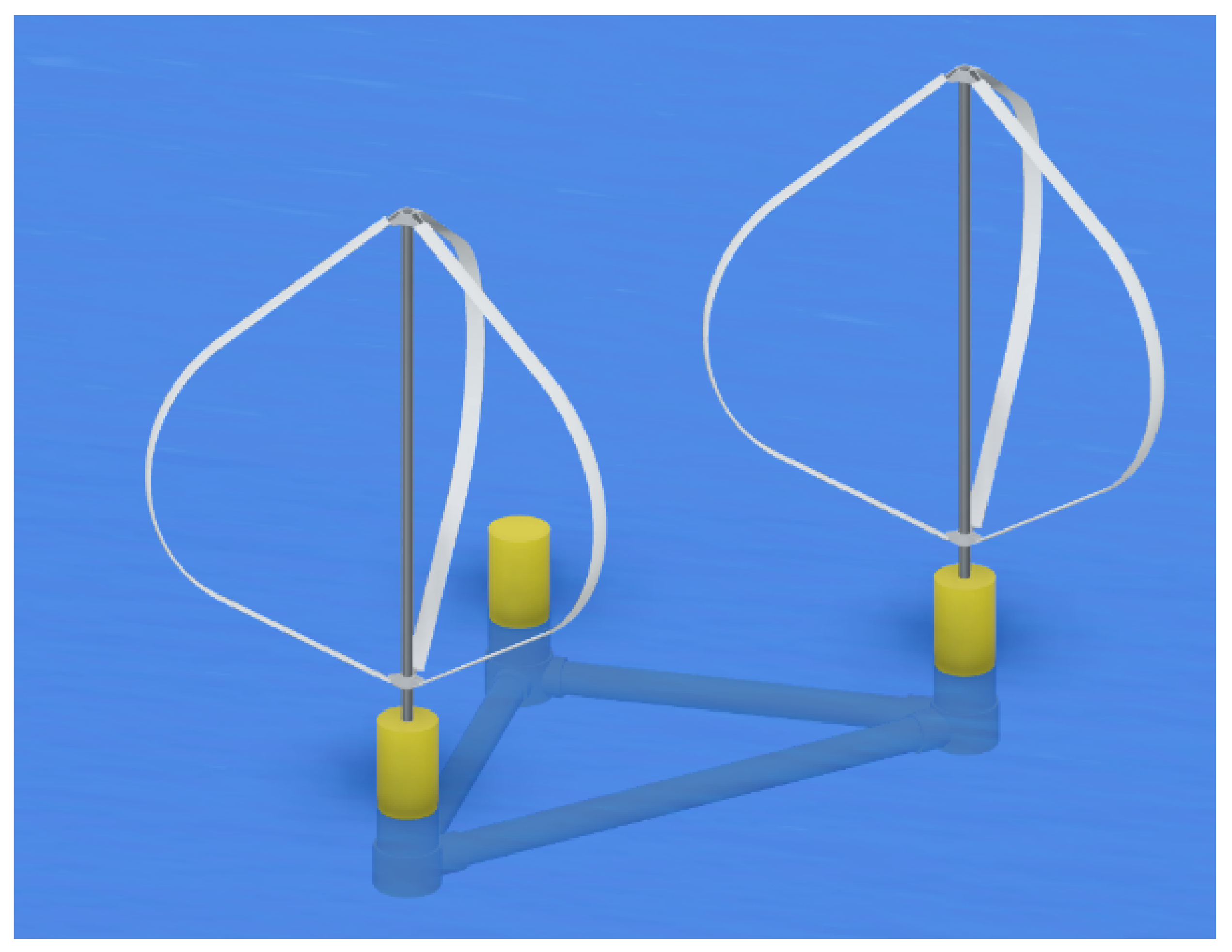
This study focusses on an FOWT concept with two Darrieus-type wind turbines, which is one of the types of vertical-axis wind turbine (see Figure 1). The concept is termed double-rotor VAWTs. The use of a VAWT results in a lower center of gravity, eliminating the problem of the high center of gravity of a HAWT. In addition, the yaw control mechanism, which has a high failure rate in HAWTs, is not required, thus reducing maintenance costs. The concept of multiple VAWTs on one floating structure was developed by M. Collu et al. [6] for a doughnut-shaped floating structure. In addition, Parneix et al. [7] were developing an FOWT with two straight wing VAWTs. In this study, an isosceles triangle is used for robustness and mooring purposes. A single point mooring system (SPM) is used for mooring. An SPM is usually used in FPSO (Floating Production, Storage and Offloading system) and FSO (Floating Storage and Offloading system), but it has already been shown in [8,9] to be useful in FOWTs. By combining a VAWT that is omnidirectional to the wind with an SPM that can turn around its mooring, the VAWT can always follow the wind without the need for yaw control. In this model, it has already been shown in tank experiments that turning motion around the SPM is possible [10]. Thus, the use of two VAWTs on one floating structure is expected to reduce mooring costs and the occupied area.
Figure 1.
Conceptual image of double-rotor VAWTs.
In order to realize this model, a coupled analysis of the floating structure and wind turbine is required at the time of design. Normally, when designing a wind power generation system, the cross-sectional forces and motion response generated in the tower and substructure are verified from the loads acting on the wind turbine itself. For floating wind turbines with HAWT, the design is performed using analysis tools capable of coupling analysis of the wind turbine and substructure. HAWC2 is a representative software for VAWT. This software has already been commercialized and validated by Verelst et al. [11]. Zheng et al. [12] and Zheng et al. [13] have also attempted a coupled analysis of a vertical-axis wind turbine with straight blades and a floating structure. However, there are limited studies related to the use of VAWTs in offshore wind energy, especially experimental validation studies of Darrieus-type VAWTs. An example of a study of Darrieus-type wind turbines is the work of Cheng et al. [14]. They developed a concept that combines a spar-type floating structure with a Darrieus-type wind turbine and a wave power generator, and analyzed their time history response. In this study, it is necessary to conduct model scale experiments and also develop a numerical simulation that enables the coupled analysis of an FOWT with two Darrieus-type VAWTs. The floating structure utilized to provide buoyancy to a double-rotor VAWT also needs special attention for practical applications. Therefore, in order to realize this model, it is necessary to construct a basic physical model that enables the development of coupled analysis of a wind turbine and a floating structure with two VAWTs. In this study, as a demonstration, a double-rotor VAWT was designed to obtain a rated output of 2 MW at a wind speed of 12 m/s. Model scale experiments were conducted to understand the basic physics of the floating structure and the wind turbines. Numerical simulations were constructed based on the experimental findings and validation studies are carried out.
2. Actual Model
2.1. Airfoil
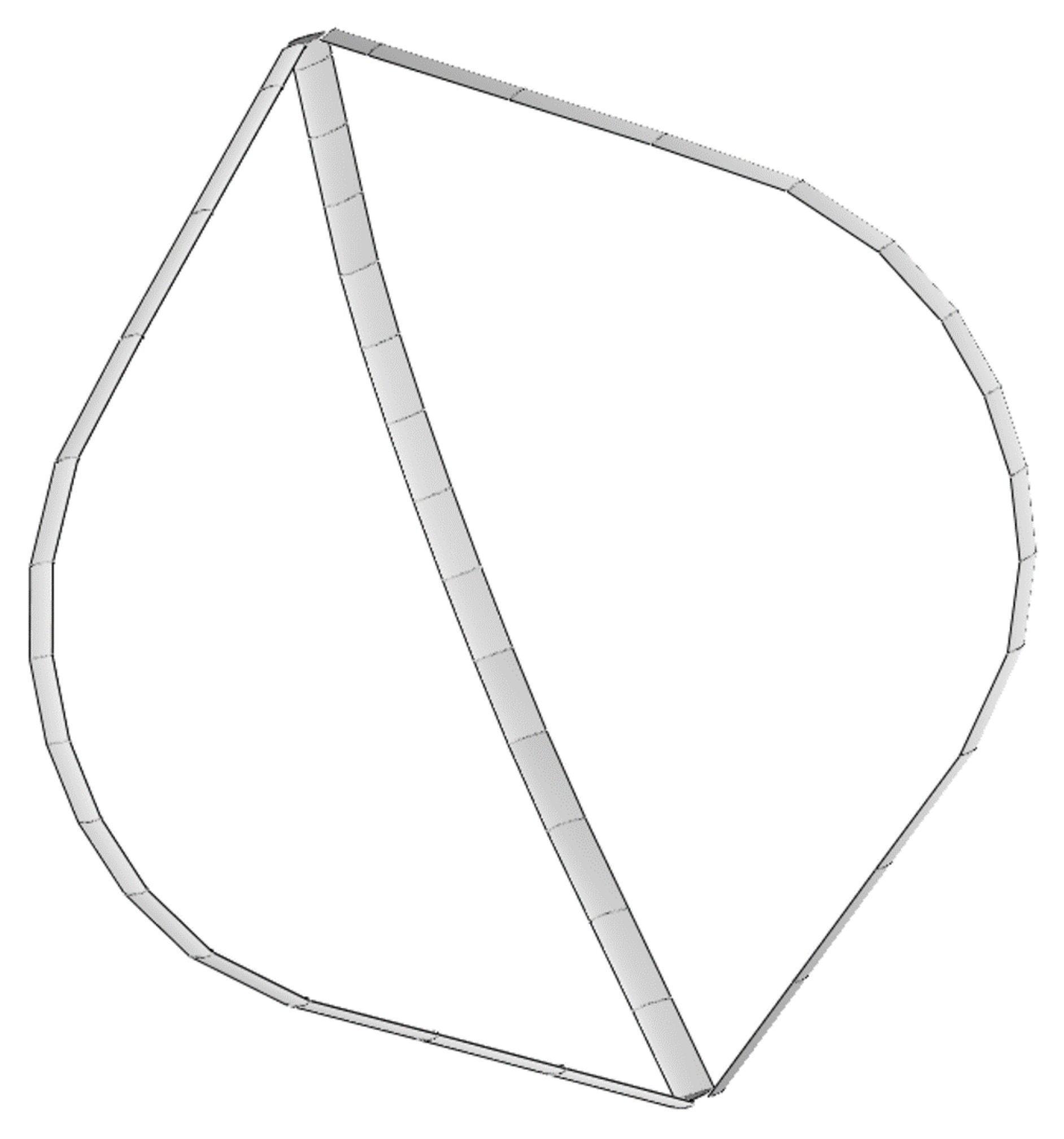
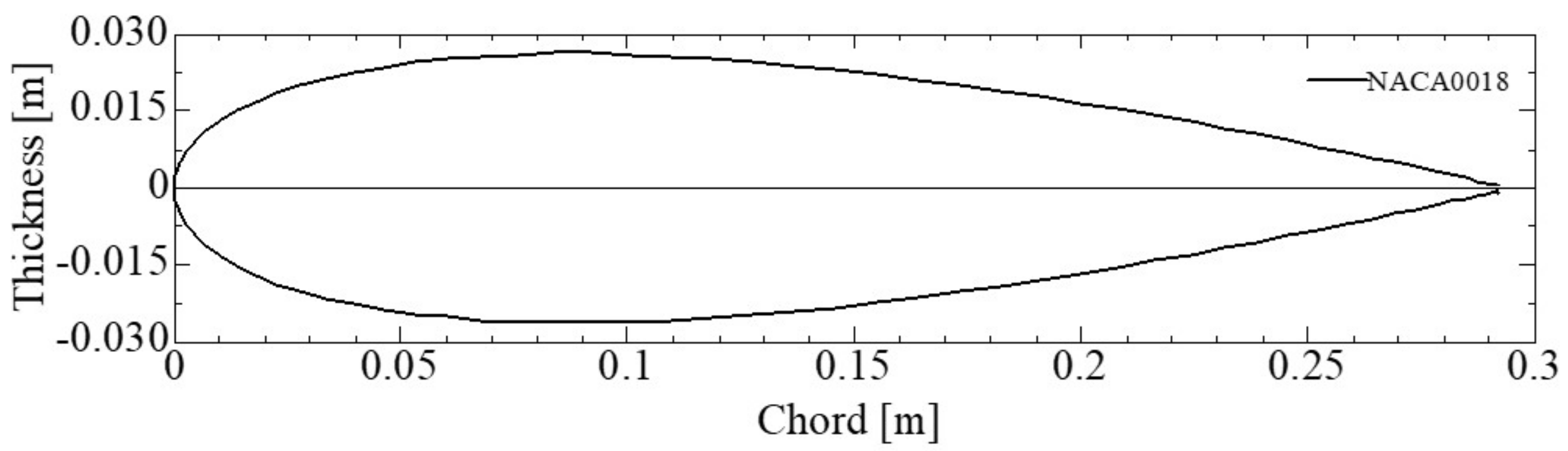
The VAWT was designed using the wind turbine design software QBlade [15]. QBlade is an open source software program that can design and simulate wind turbines and is suitable for the basic design of wind turbines. In this study, parameter studies of rotor diameter and chord length were conducted to obtain a rated output of 2 MW at a rated wind speed of 12 m/s. An overview of the wind turbine determined by this process is shown in Figure 2 and Figure 3. Table 1 also shows the values entered into QBlade.
Figure 2.
Actual blade shape (NACA0018).
Figure 3.
VAWT full scale model.
Table 1.
Input data of full scale model for QBlade.
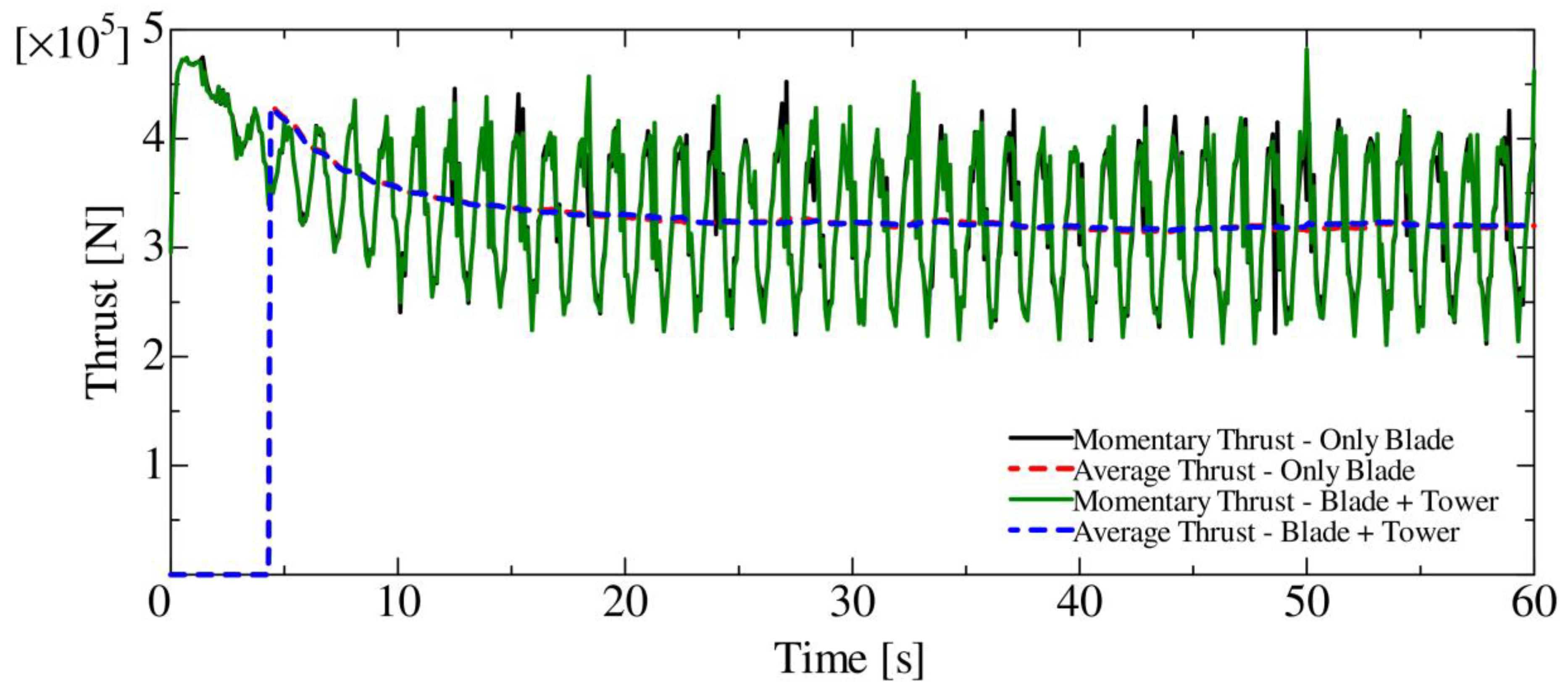
Figure 4, Figure 5, Figure 6 and Figure 7 show the results of the QBlade calculations, Table 2 shows the calculation conditions, and Table 3 shows the results.
Figure 4.
Power results from QBlade.
Figure 5.
Thrust results from QBlade.
Figure 6.
Power coefficient results from QBlade.
Figure 7.
Thrust coefficient from QBlade.
Table 2.
QBlade analysis conditions.
Table 3.
Average results (Time = 60.0 s).
2.2. Float Model
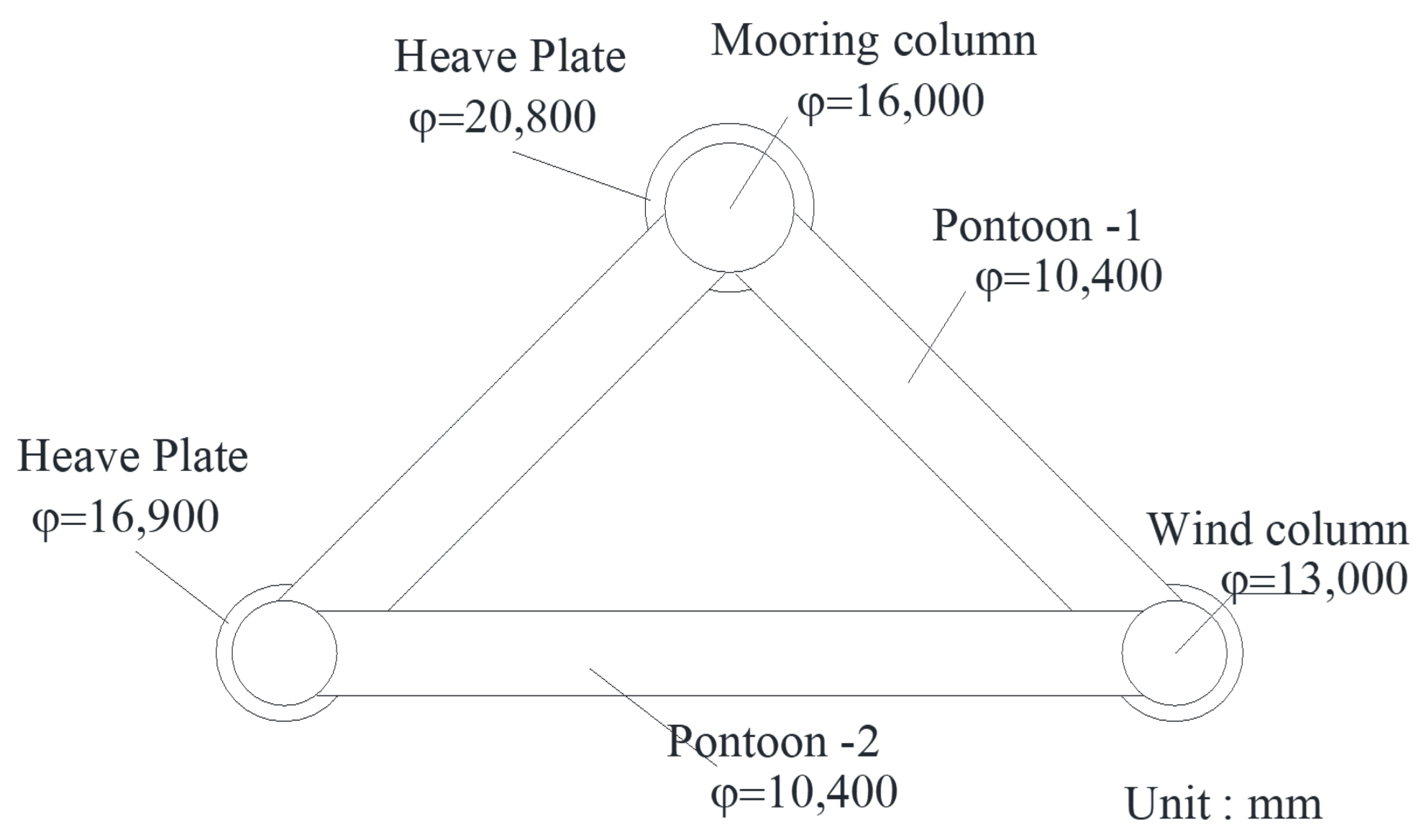
The actual double-rotor VAWT proposed in this study is shown in Figure 8 and Figure 9. The floating wind turbine in this study has a simple structure that emphasizes robustness and a mechanism that allows it to follow the wind around its mooring point and rotate in accordance with the wind. The distance between two vertical-axis wind turbines has been shown to have the highest power generation efficiency when the distance between the two turbines is 1.36 times the rotor diameter. Therefore, in this study, the distance between the turbines in this study was set to 108 m [16].
Figure 8.
Full scale float model from top.
Figure 9.
Full scale float model from front.
3. Experimental Outline
3.1. Experimental Model
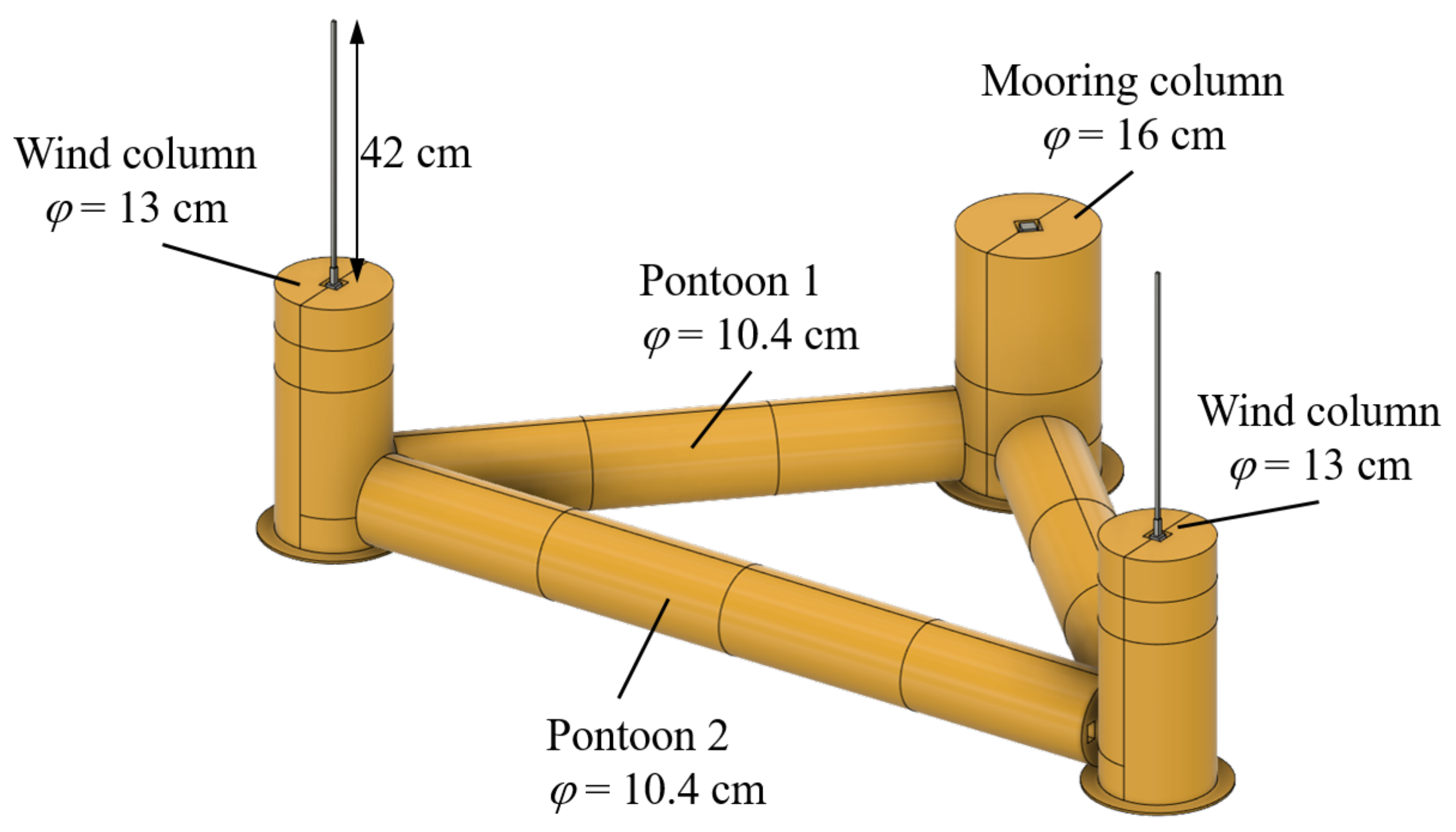
In the towing tank test of this study, it is necessary to measure the strain of the floating body. Therefore, an elastic model scaled down to 1/100 of the actual model was fabricated. Figure 10 shows the elastic model, Table 4 shows the scale factor, and Table 5 shows the floating body parameters. Where V is the drainage volume, I is the waterline cross-sectional second moment, is the metacenter height, is the natural period of heave, and is the natural period of pitch. As shown in Figure 10, the tower height of this test model is 42 cm, with a ducted fan mounted at the top. Approximately 95% of the load generated in a vertical-axis wind turbine occurs in the central 60% [17]. Therefore, in this study, thrust was simulated to occur as a concentrated load at the center of the vertical-shaft wind turbine.
Figure 10.
Experimental Model.
Table 4.
Scale factor.
Table 5.
Principal particulars of float models.
3.1.1. Stainless Core
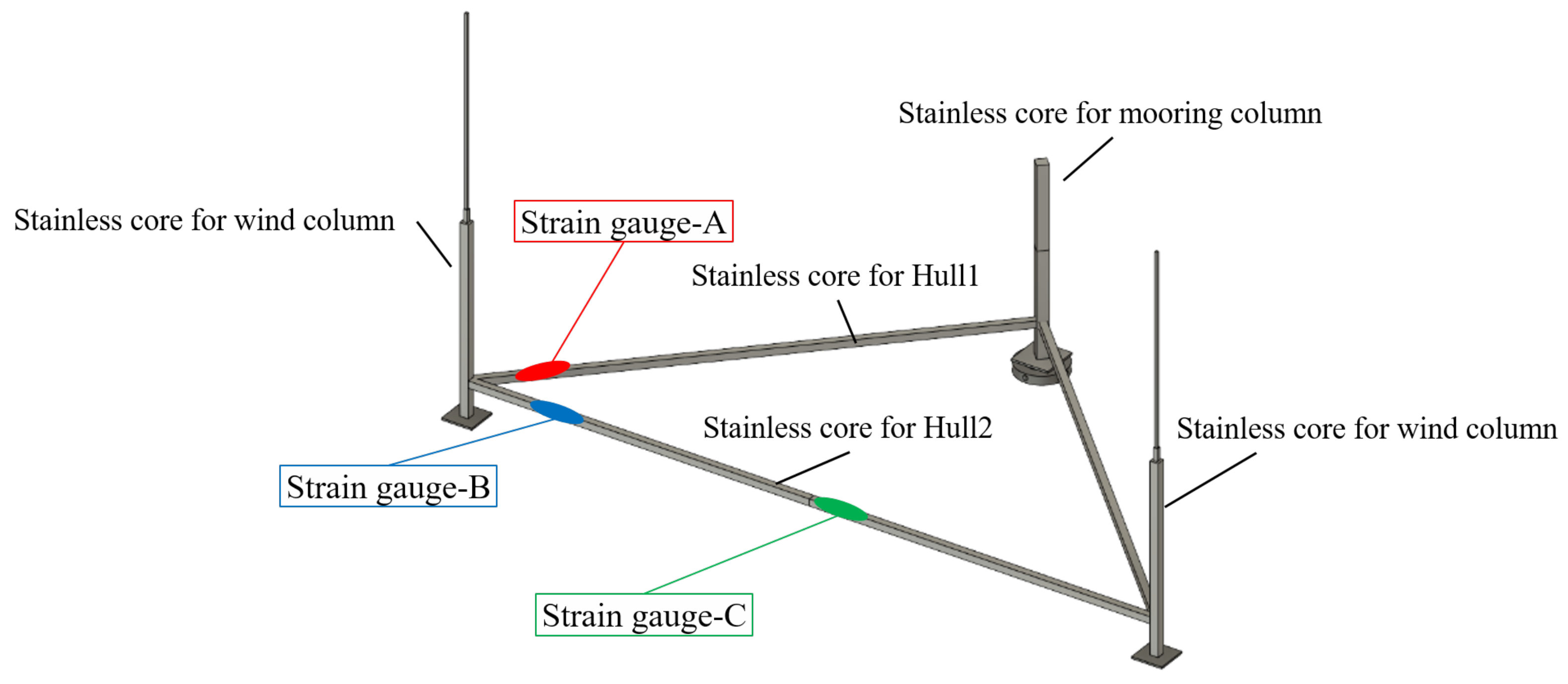
Figure 11 shows the stainless core of the test model and Table 6 shows the bending stiffness of different components of the test model. In order to measure the strain of the floating body and investigate the bending moment, emphasis was placed on matching the bending stiffness of the test model to that of the actual model.
Figure 11.
Stainless core.
Table 6.
Flexural rigidity EI.
3.1.2. Ducted Fan
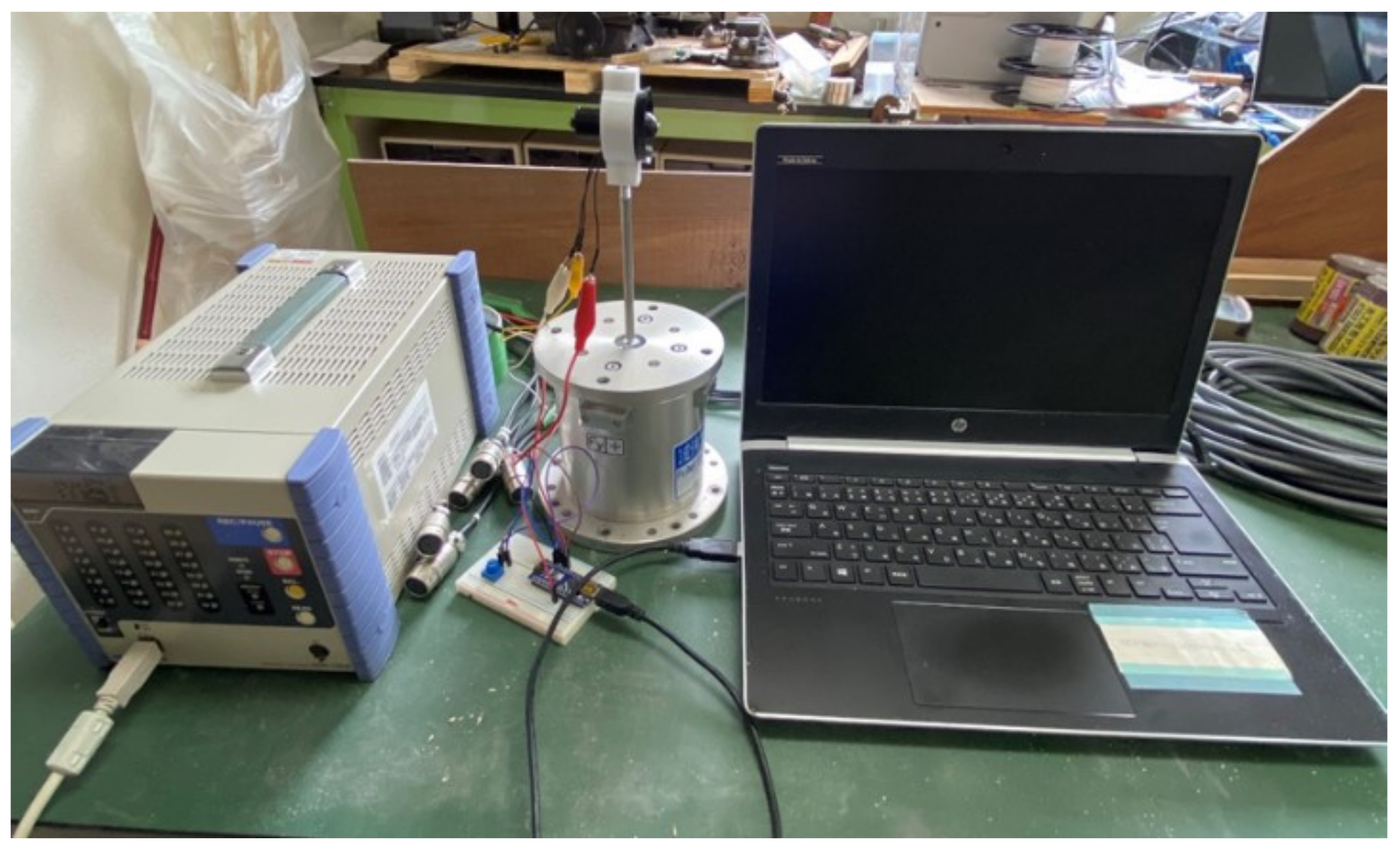
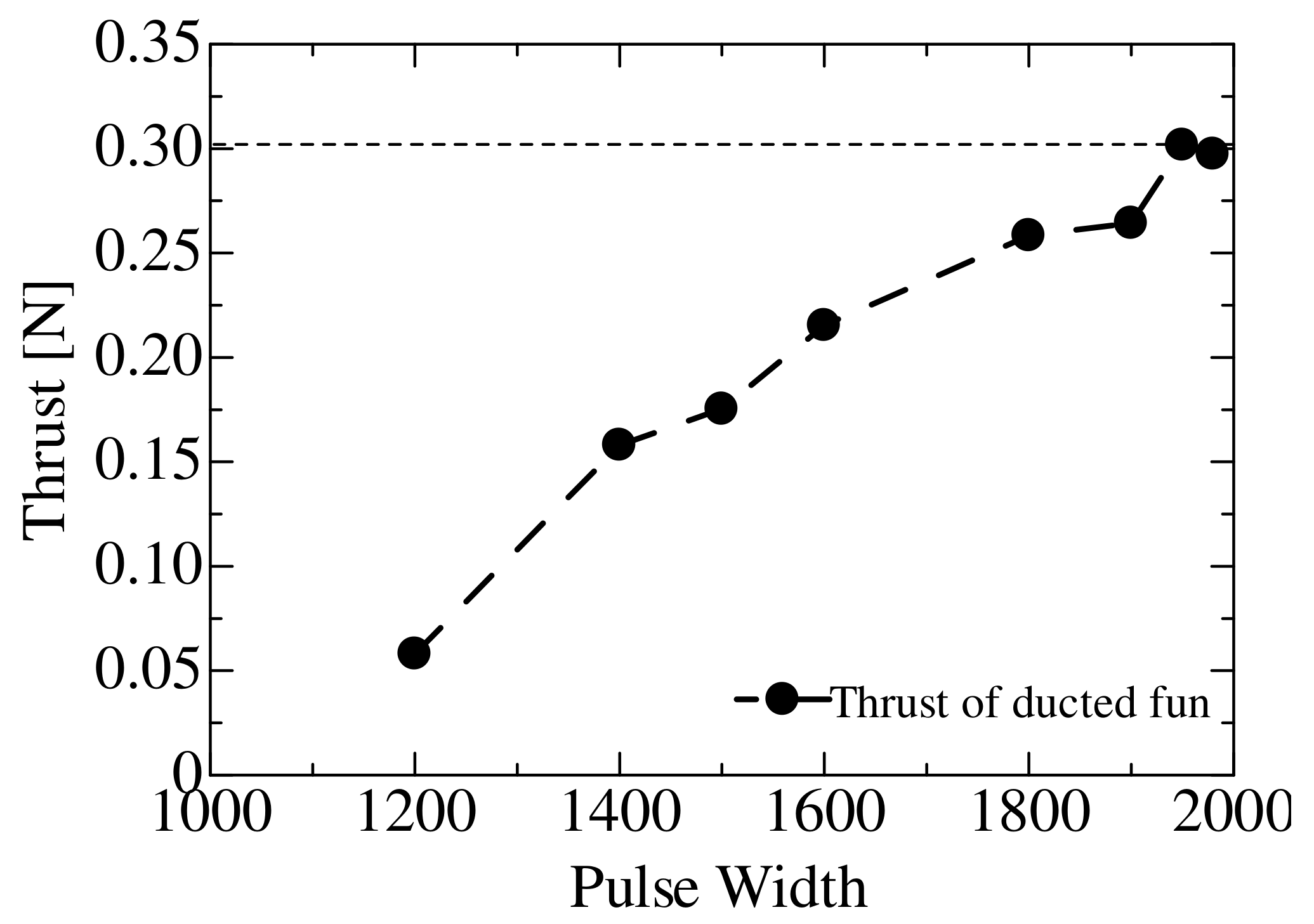
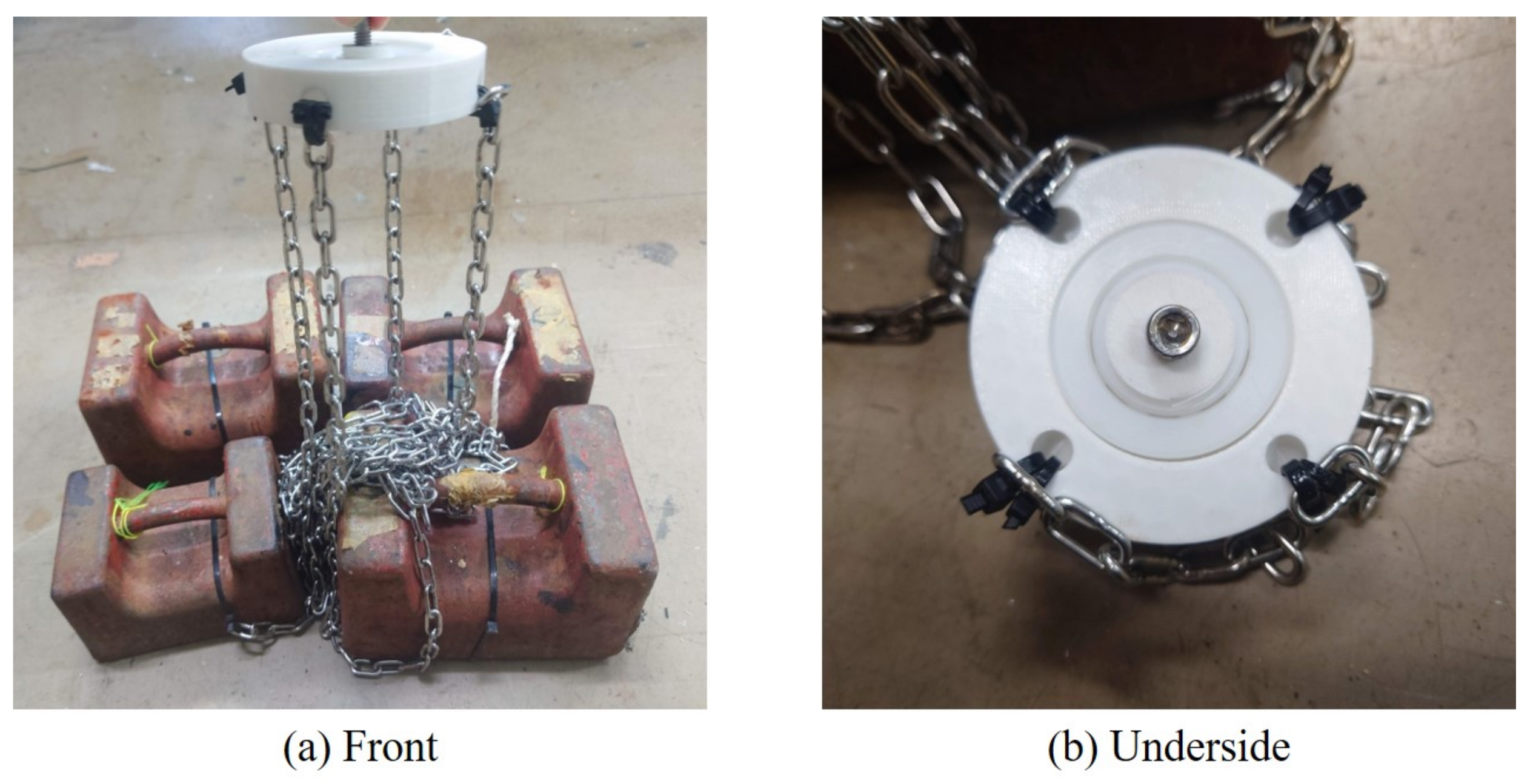
In the tank test of this study, the wind load is simulated by generating thrust by a ducted fan instead of installing a wind turbine rotor (see Figure 12). The thrust of the 1/100 scale model is 0.30 N. To control the ducted fan used, the thrust was investigated. Figure 13 shows the thrust test and Figure 14 shows the test results. The ducted fan was controlled by varying the pulse width and adjusting the speed. As a result, a thrust of 0.30 N was obtained when the pulse width was set to 1950.
Figure 12.
Ducted Fun.
Figure 13.
Thrust test.
Figure 14.
Results of thrust test.
3.2. Real-Time Hybrid Model Test
The test method used in this study is called the real-time hybrid model test (ReaTHM test) and has recently attracted attention as a new experimental method for FOWT [18,19]. Normally, in model tests of FOWT, a rotor is installed at the top of the tower, and wind is applied to the rotor and tower from a wind tunnel facility as an external force. However, in the case of an FOWT, while the fluid law dominates the loading due to the water below the water surface, the aerodynamic forces due to the wind turbine rotor are highly dependent on the Reynolds number, and the Reynolds number cannot be matched in the experiment. One test method that solves this similarity law problem is the ReaTHM test.
3.2.1. Experimental Setup
A schematic diagram of the experiment is shown in Figure 15, and the actual model is shown in Figure 16. The specifications of this test tank are 70.0 m long, 3.0 m wide, and 1.6 m deep, and it has a wave generator.
Figure 15.
Outline of scale model installation.
Figure 16.
Installed scale model.
3.2.2. Mooring Setup
The mooring mechanism used in this experiment is shown in Figure 17 and a summary of the mooring chains is shown in Table 7. In the experiment, an anchor was placed 1.2 m away from the floating structure, and four catenary moorings were used. The mooring cables were screwed to the lowest part of the mooring stainless core, and a bearing was used to simulate a single point mooring.
Figure 17.
Mooring system of scale model.
Table 7.
Principal particular of mooring chain.
3.2.3. Motion Capture
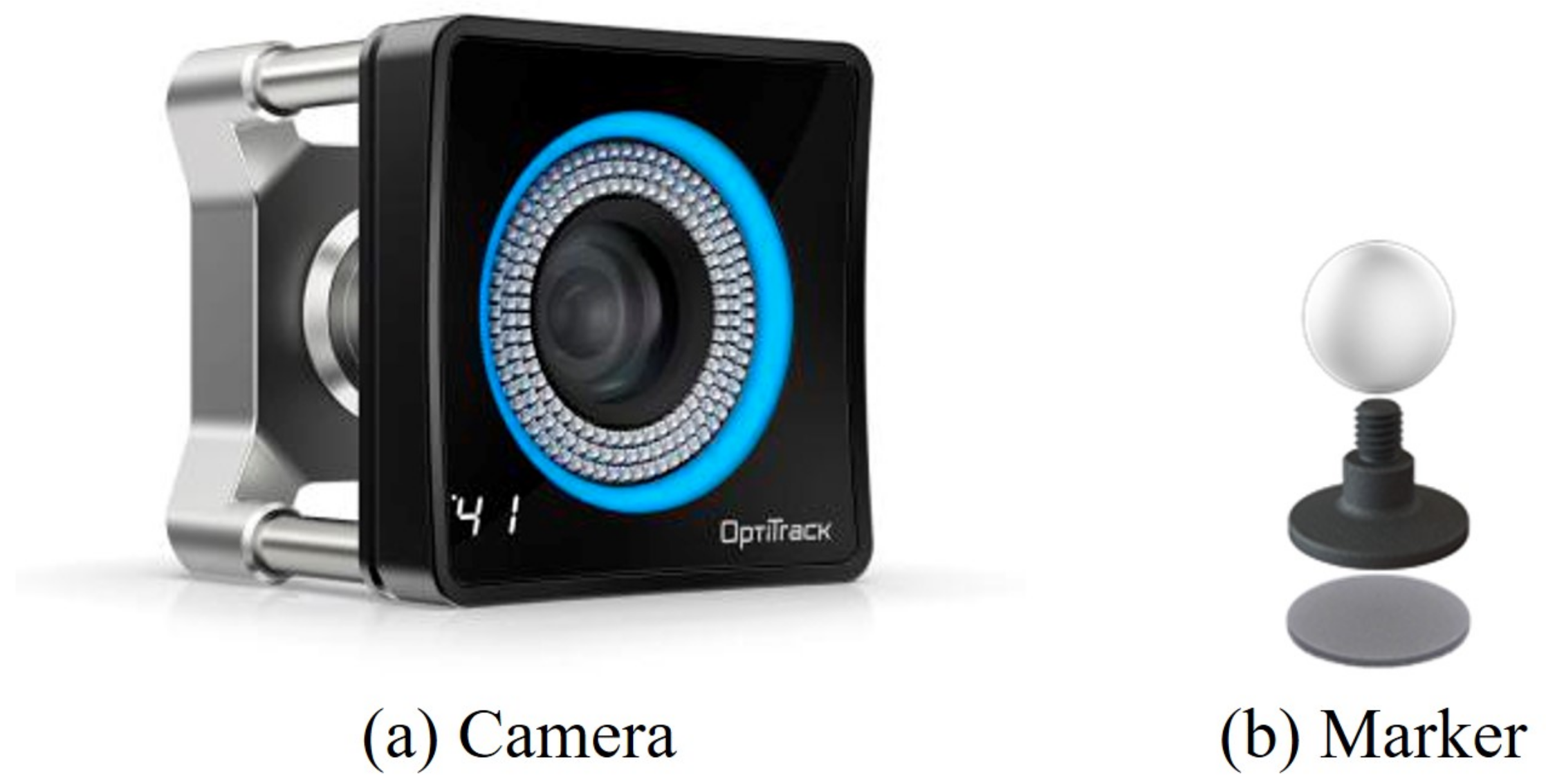
The motion of the floating body in this experiment was measured using the motion capture “OptiTrack” (Figure 18). This instrument measures the distance between the camera and the marker by observing the reflection of ultraviolet rays emitted by multiple cameras on the marker and the bounce back to the cameras. Therefore, it is possible to follow the markers three-dimensionally if there are at least two cameras.
Figure 18.
OptiTrack.
3.2.4. Strain Gauge
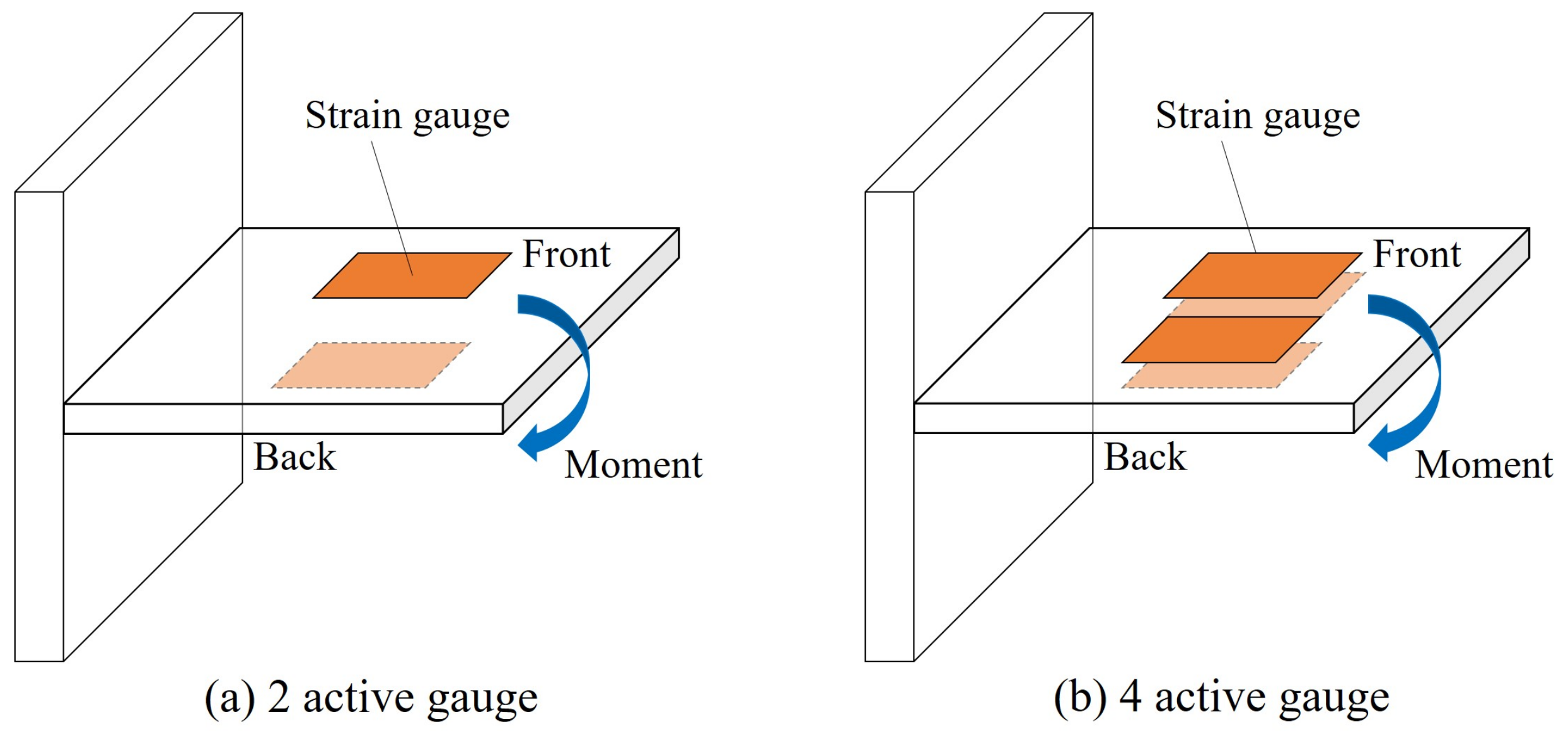
In this study, bending strain of stainless cores was measured by strain gauges and converted to bending moments. Figure 19 shows the method of measuring bending strain. Typical methods for measuring bending strain using strain gauges are the two active gauge method and the four active gauge method. The method using two or four strain gauges is used to remove strain components other than those to be measured. In this study, it is necessary to remove the tensile and compressive components in order to measure only the bending strain. The major differences between the two active gauge method and the four active gauge method are output values and temperature compensation. For the output value, the output is twice the actual strain when two strain gauges are used, and four times the actual strain when four strain gauges are used. Therefore, the choice should be made according to the performance of the transducer used in the experiment. Regarding temperature compensation, changes in temperature from the installation position to the bridge circuit may affect the results of strain gauges. The four active gauge method is less affected by temperature than the two active gauge method.
Figure 19.
Method of measuring bending strain with strain gauge.
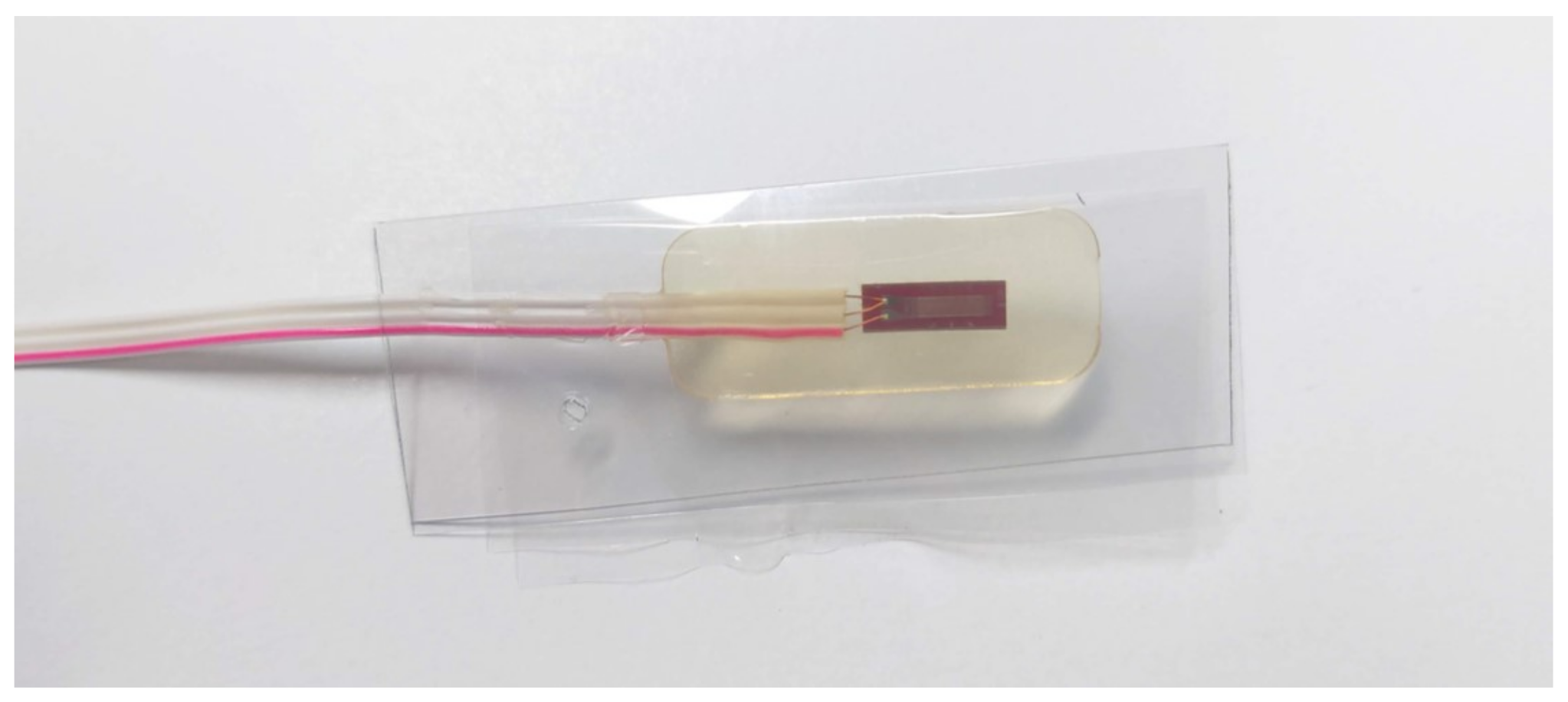
In this study, waterproof three-wire strain gauges were used to measure bending strain using the two active gauge method. Figure 20 shows the strain gauges used and Table 8 shows the strain gauge characteristics.
Figure 20.
Strain gauge.
Table 8.
Principal particular of strain gauge.
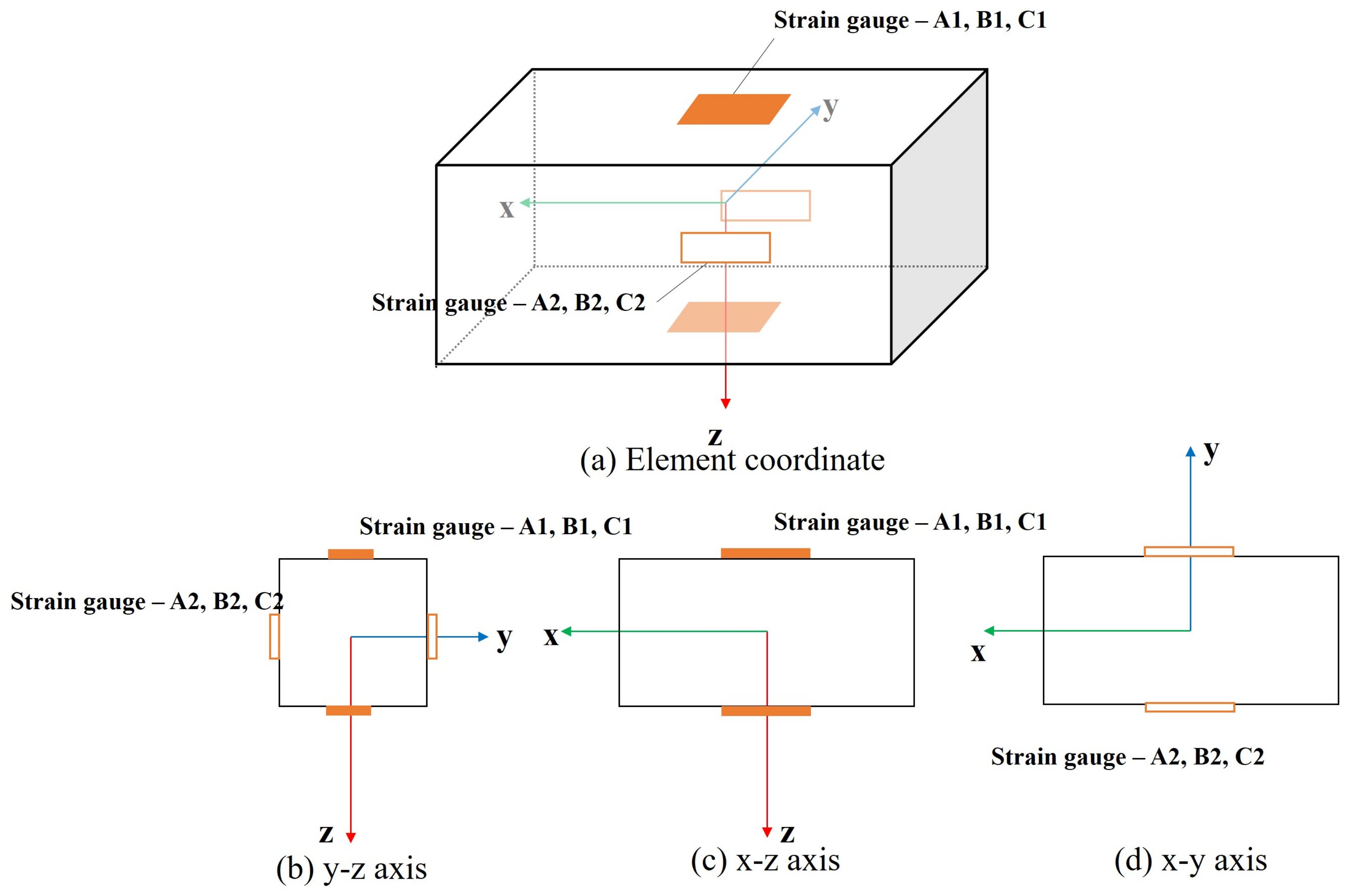
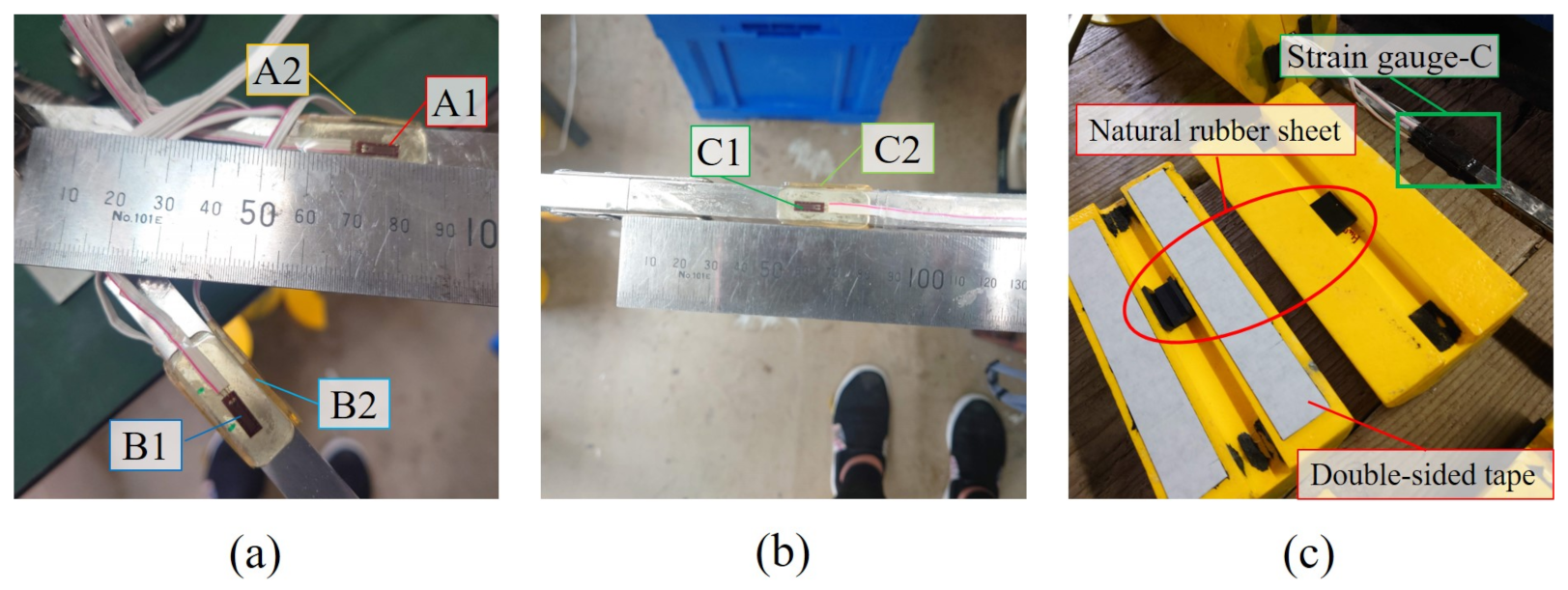
Figure 21 shows the coordinate axes of the strain gauges and Figure 22 shows the installed strain gauges. The strain gauges were installed on each face of the stainless core to measure the bending strain in the y-axis (A1, B1, C1) and z-axis (A2, B2, C2). As shown in the Figure 22, for fabrication reasons, Pontoon1 and Pontoon2 were fixed with a 45 deg bracket at the junction with the wind column and an I-shaped bracket at the center of Pontoon2, and the bending stiffness in this area was considered to have changed. Therefore, the strain gauges for measurement were placed 75 mm away from the bracket mounting position. Since the strain gauges were to be submerged in water for a long period of time in this experiment, they were coated from above with coating agent for strain gauge.
Figure 21.
Strain gauge coordinate axes.
Figure 22.
Installed strain gauge.
3.2.5. Test Conditions
Table 9 shows the experimental conditions. In this experiment, when the ducted fan was started, the thrust and float were unstable immediately after startup, so measurements were checked during the experiment and waves were generated at the timing when the thrust and float were nearly constant.
Table 9.
Test conditions.
4. Numerical Method
In this study, UTWind code and rotor thrust obtained from QBlade were combined for the numerical simulations. UTWind is a numerical simulation code developed by the University of Tokyo for coupled FOWT analysis. This code has been improved and the latest version, called “NK-UTWind”, has proven to be useful enough for the coupled analysis of FOWT with a HAWT [20,21,22]. In this study, we used a prototype of this code [23] and attempted to improve it to be compatible with VAWT. The floating structure in this study is assumed to be a framework structure. UTWind is a weakly coupled wind turbine-floating body elastic response analysis based on FEM. The fluid forces are based on the Morrison equation for the floating body and the blade elementary momentum theory for the rotor part of the wind turbine. Then, the equations of motion are substituted into the equations of motion together with the external force vector derived from the calculated fluid force, and the equations of motion are solved in the time domain to obtain the time history displacements and stresses.
In order to make UTWind compatible with VAWT, the rotor part of HAWT must be made compatible with VAWT. Figure 23 shows a flow diagram of the simulation. In this study, drag coefficients were calculated from the thrust output from QBlade to match the tower and input directly into the model.
Figure 23.
UTWind and QBlade calculation flow diagram.
4.1. Beam Model
The beam model of the actual machine used for UTWind is shown in Figure 24. The tower and floating structure are modeled as beams, and the mooring is a quasi-static catenary mooring. The beam model consists of 52 elements and 52 nodes, and Pontoon1 and Pontoon2 are divided into four sections.
Figure 24.
Beam Model in the UTWind.
4.2. Hydrodynamic Loads
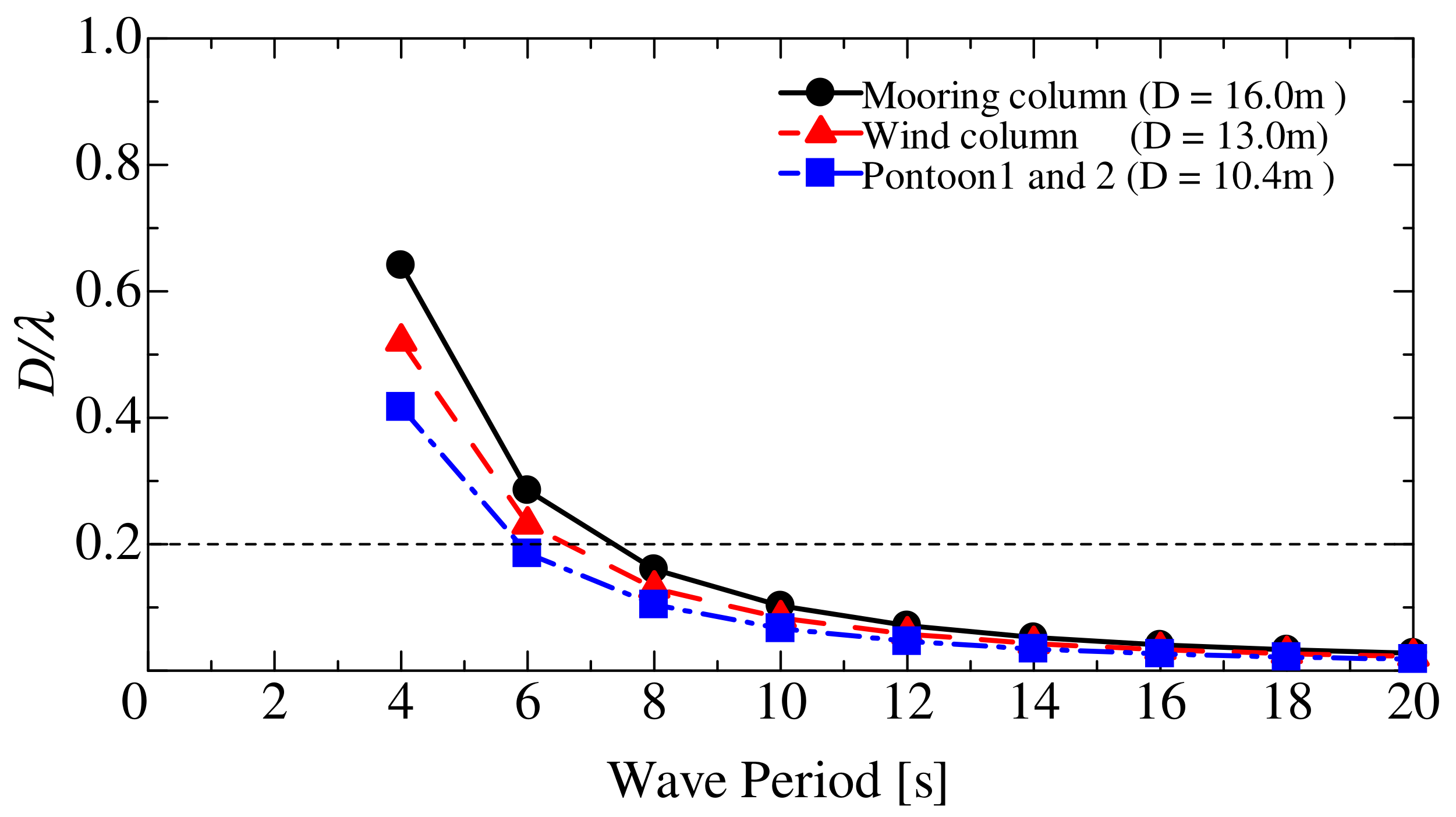
The wave force within UTWind is calculated from the Morrison equation. In general, the Morrison equation is used to calculate the wave force on a slender cylindrical member when D/ < 0.2 (D: diameter, : wavelength). The relationship between D/ and the wave period for each component member in this model is shown in Figure 25. Figure 25 shows that for wave periods longer than 7.0 s, D/ in the actual model is less than 0.2, which means that the Morrison equation is applicable to this model for wave periods longer than 7.0 s.
Figure 25.
Relationship between slenderness ratio of cylinders and wave period.
The Morrison formula used by UTWind is expressed by Equation (1).
where is the fluid density, A is the cross-sectional area, and are the water particle velocities in the x and y directions, and are the velocities of the structural elements in the x and y directions in the global coordinate system and are the additional mass coefficients in the x and y directions and are the drag coefficients in the x and y directions.
The added mass and drag coefficients for each element were standard coefficients for cylinders from the DNV-GL guidelines [19]. Table 10 shows the load mass coefficient and drag coefficient entered into UTWind. Table 11 shows the added mass calculated from UTWind.
Table 10.
Added mass and drag coefficient.
Table 11.
Added mass.
4.3. Wind Loads
In this study, the thrust of the VAWT is applied as a concentrated load at the center of the VAWT. In general, the drag coefficient can be obtained by Equation (2).
where is the thrust of the VAWT, is the projected area, and is the wind speed.
Figure 26 shows the tower elements of UTWind. The thrust output from the QBlade was 320 kN at 38.4 m from the base of the blade. Therefore, in UTWind, the drag coefficient was calculated and input to UTWind so that 320 kN of thrust would occur near that location.
Figure 26.
Tower elements of UTWind.
5. Results and Discussion
5.1. Experimental Motion Response in Waves
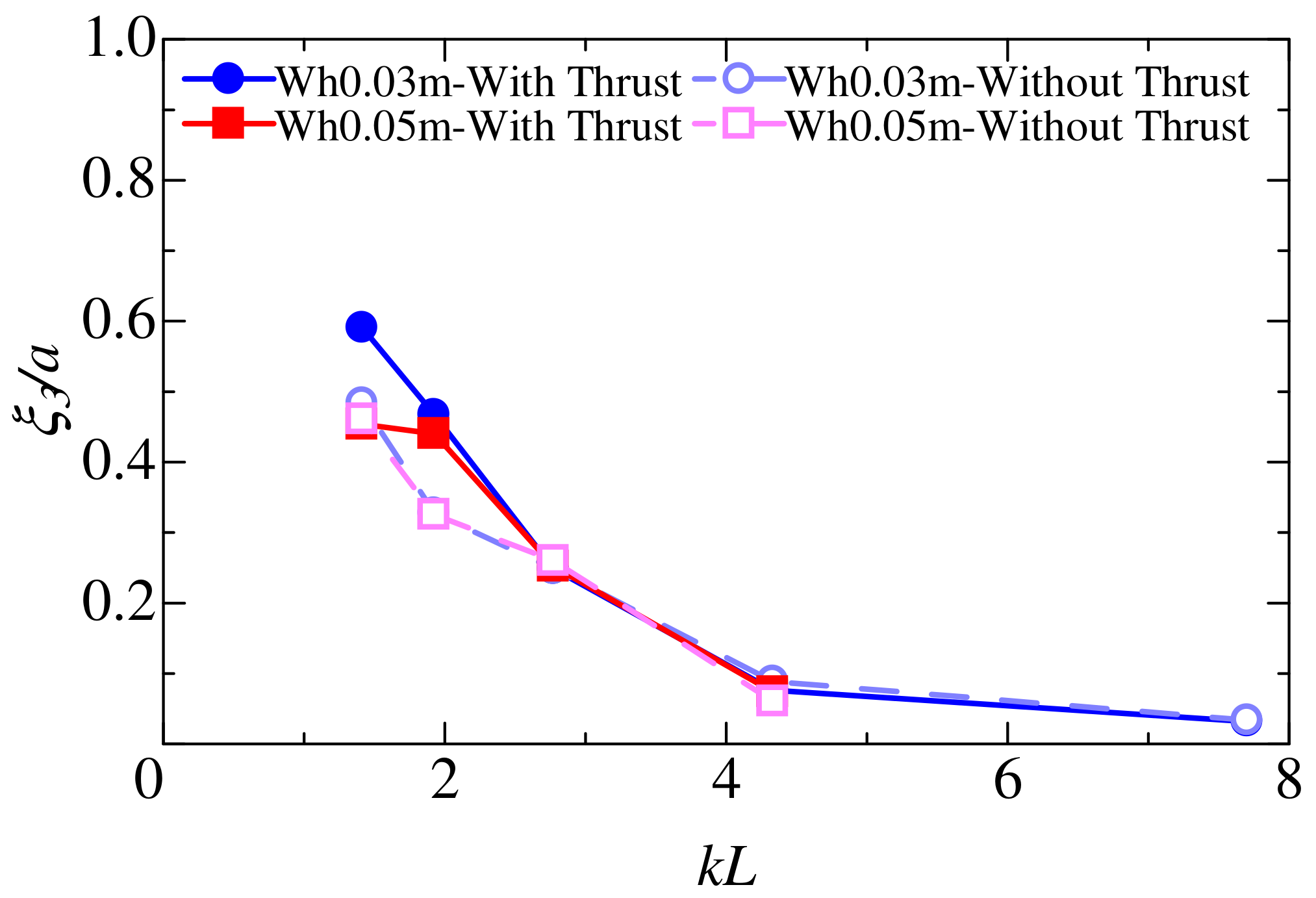
The RAO results for surge, heave, and pitch obtained from the regular wave test are presented in Figure 27, Figure 28 and Figure 29. Results with and without thrust by running a ducted fan were plotted in the same graphic to show the comparison between them. Here, surge and heave displacements are shown as dimensionless values using the incident wave amplitude a and pitch angle is non-dimensionalized using the incident wave amplitude a and wavenumber k. The wave period T is set to be the dimensionless wavenumber using the wave frequency and the width of the floating body L as shown in Equation (3).
Figure 27.
First-order surge motion RAO in wave.
Figure 28.
First-order heave motion RAO in wave.
Figure 29.
First-order pitch motion RAO in wave.
Figure 27 shows the displacement of surge, where the floating motion of surge gradually decreases toward = 2.7 (wave period 0.6 s ∼ 1.0 s) for > 2.7, reaching a minimum value around = 2.7. The effect of applying thrust on the displacement could not be confirmed. Subsequently, displacement increased as decreased in the range of < 2.7 (wave period 1.0 s ∼ 1.4 s). Furthermore, in the range of < 2.7, the motion with thrust was larger than that without thrust. This is believed to be the effect of negative damping. Negative damping is a typical behavior that occurs when a wind turbine and a floating structure are coupled. In the case of a floating offshore wind turbine, fluctuations in the relative inflow wind velocity are caused by the floating body, which in turn causes fluctuations in the thrust acting on the rotor section, which in turn affects the floating body motion [24]. In the present test results, negative damping is more pronounced when < 2.7, which is a long-period wave, and the reason why this phenomenon does not appear in the > 2.7 range is assumed to be that the floating body behavior is small and no difference in floating body motion appears. In long-period waves, the displacement was larger and the negative damping effect increased accordingly, suggesting that the displacement was larger when the thrust was activated in long-period waves.
Figure 28 shows the heave RAO and Figure 29 shows the pitch RAO. It was found that floating body motion of heave and pitch increased with increasing wave period. Similar to surge RAO results, the motion displacement with thrust was larger than the one without thrust, for < 2.7. The thrust of the ducted fan caused the pitch angle of the floating body to increase, which in turn induces a vertical load on the floating body, and in turn affects the displacement of the heave with and without thrust.
5.2. Experimental Bending Moment Response in Waves
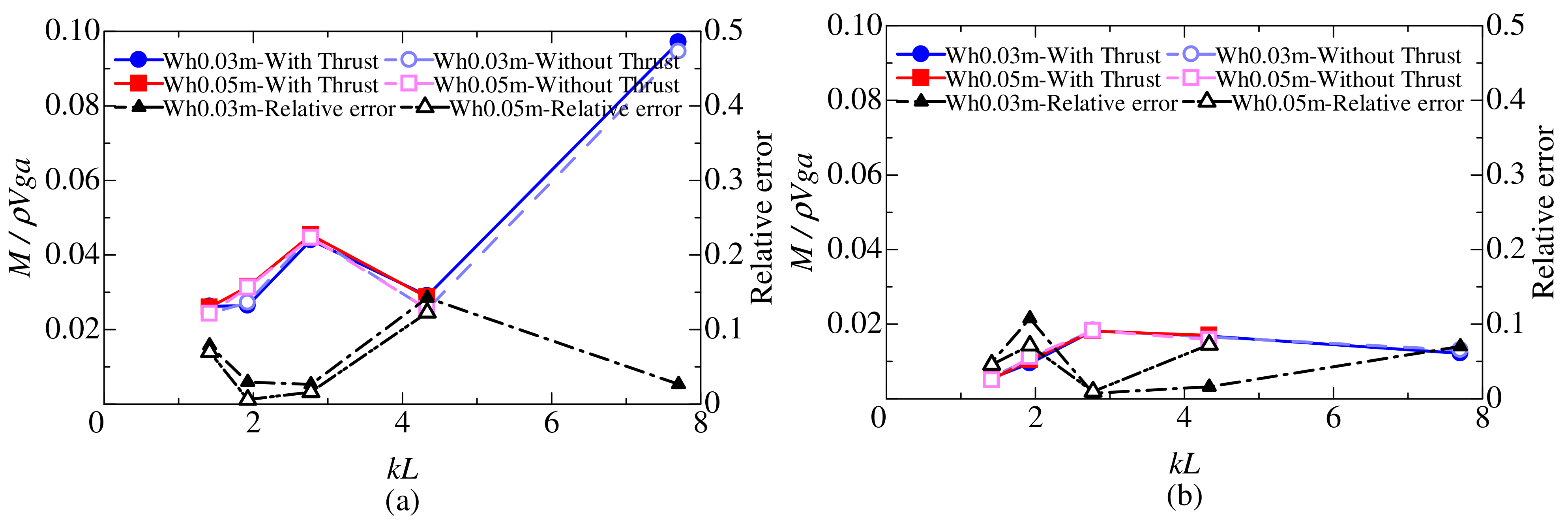
Figure 30, Figure 31 and Figure 32 show the bending moments acting on the cross-sections of Pontoon1 and Pontoon2. The bending moment M was converted to a dimensionless value using water density , drainage volume V, gravity acceleration g, and incident wave amplitude a. Relative errors with and without thrust are also shown in the same graph to confirm the effect of thrust on cross-sectional forces. The relative error is Equation (5).
where is the bending moment when thrust is generated and is the bending moment when no thrust is generated.
Figure 30.
Experimental results of bending moments measured by strain gauge-A (Connection point between wind column and Pontoon1): (a) strain gauge-A1. (b) strain gauge-A2.
Figure 31.
Experimental results of bending moments measured by strain gauge-B (Connection point between wind column and Pontoon2): (a) strain gauge-B1. (b) strain gauge-B2.
Figure 32.
Experimental results of bending moments measured by strain gauge-C (Center of Pontoon2): (a) strain gauge-C1. (b) strain gauge-C2.
In Figure 30, Figure 31 and Figure 32, the bending moments showed similar trends at all locations, with and without thrust. Most notably, the bending moment reaches a maximum around = 2.7, while the surge displacement shown in Figure 27 reaches a minimum around = 2.7.
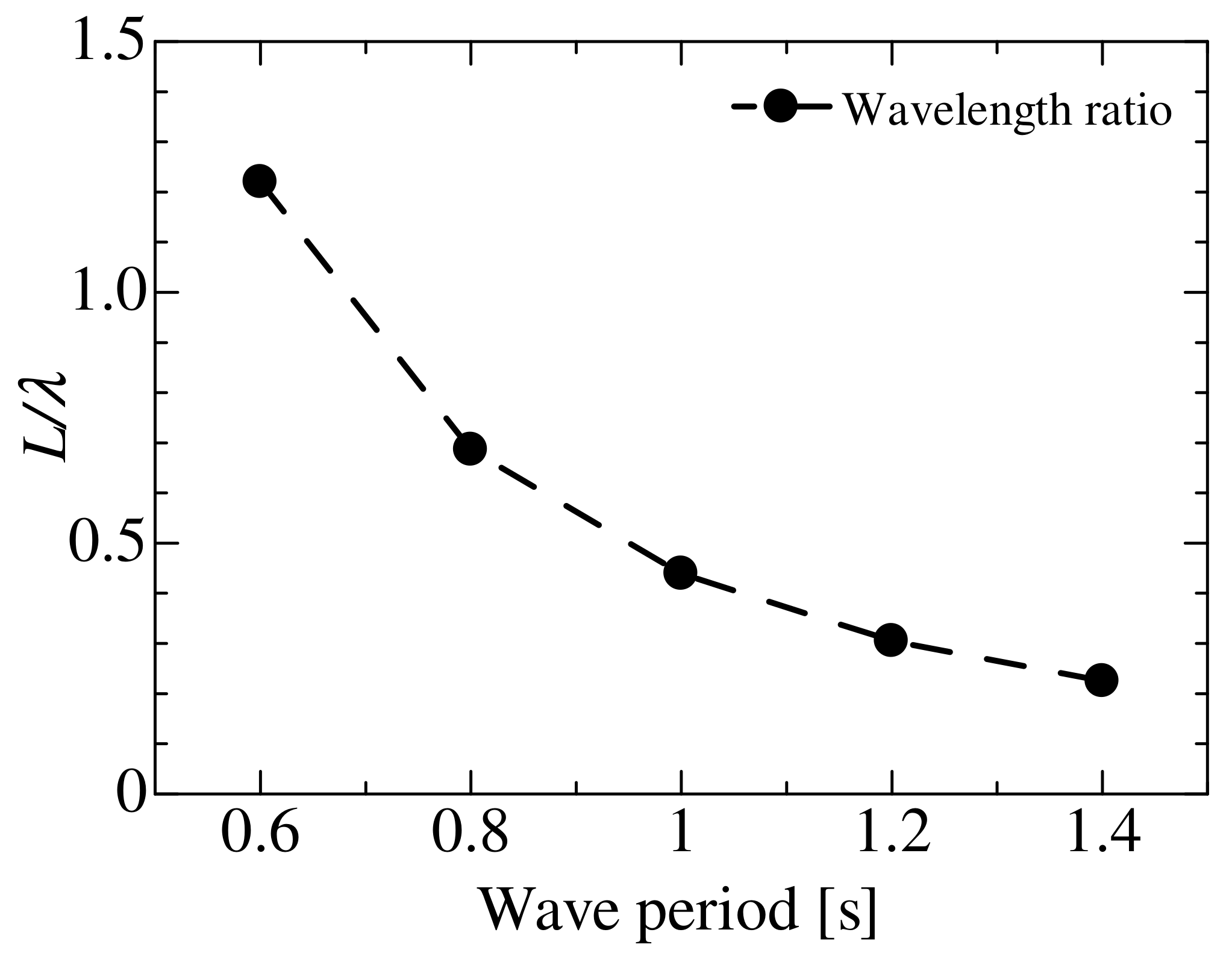
Figure 33 shows the relationship between the wavelength and the width of the floating body L. This relationship indicates that L/ = 0.5 for a wave period of 1.0 s. For a typical pontoon structure, the load acting on Pontoon1 and 2 are maximum when L/ = 1.0. However, in this experiment, the maximum bending moment was observed around L/ = 0.5. In other words, the bending moment acting on the floating structure is maximum when the wind column is at the wave crest (trough) and the mooring column is at the wave trough (mountain). In the case of this model shape, the weight balance is adjusted so that the two wind columns and the mooring column are balanced. In addition, the mooring column also has a mooring cable attached to it, so the model shape is not symmetrical. Therefore, in this model shape, the bending moment acting on the floating body is maximum when L/ = 0.5.
Figure 33.
Relationship between wavelength ratio and wave period.
Focusing on the relative error, the effect of thrust was less than 10% except around = 4.3 and 1.4 (wave periods 0.8 s and 1.4 s). Around = 4.3, thrust had a 15% effect on the vertical bending moment (Strain gauge-B1) at the junction of Pontoon2 and the wind column float (Figure 30: Strain gauge-B). This is the only point where the thrust influence is significant, since the other measurement points showed around 10%. Around = 1.4, thrust had a 30% effect on the horizontal bending moment (Strain gauge-C2) at the center point of Pontoon2 (Strain gauge-C). Thrust also had a 10–20% effect on the bending moment at other points, which was higher than for other wave cycles. From the above, it can be said that thrust affects the bending moment of the floating section by about 10%, and this effect becomes more pronounced with longer wave periods. This is thought to be due to the change in motion response due to negative damping, which in turn changed the bending moment.
5.3. Comparison of Motion Response between Experimental and Numerical Calculations in Waves
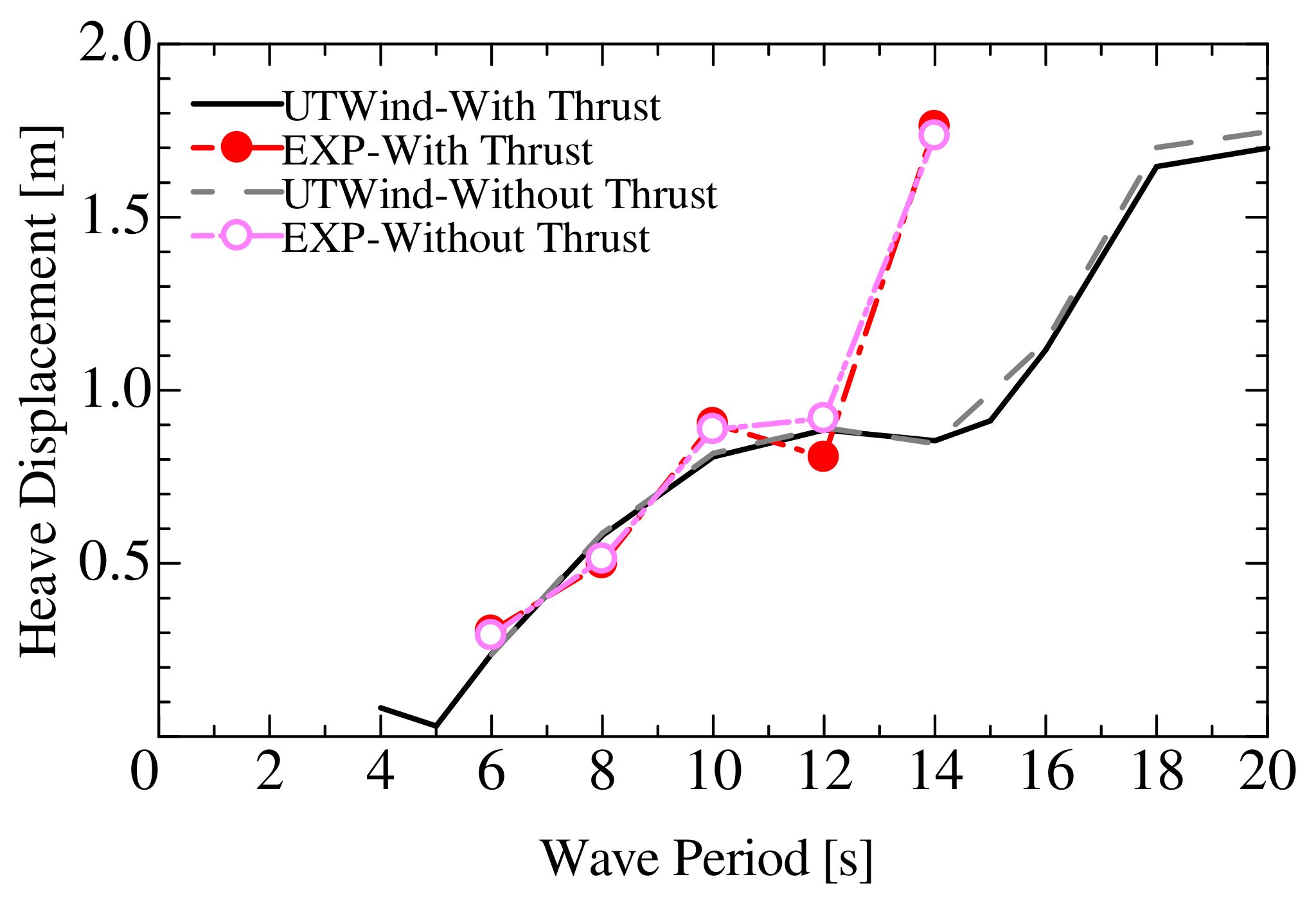
Figure 34, Figure 35 and Figure 36 show graphs comparing the experimental results with the UTWind calculations. The graphs plot the experimental results at a wave height of 0.04 m, modified to the actual scale.
Figure 34.
Comparison of surge motion between experimental and numerical calculations.
Figure 35.
Comparison of heave motion between experimental and numerical calculations.
Figure 36.
Comparison of pitch motion between experimental and numerical calculations.
Figure 34 shows the displacement of surge. For wave periods longer than 6.0 s, UTWind showed a minimum displacement of 0.23 m at a wave period of 8.0 s, regardless of the presence of thrust. On the other hand, the experimental results in regular waves showed that the minimum displacement with thrust was 0.23 m at a wave period of 10.0 s, while the minimum displacement without thrust was 0.42 m at a wave period of 8.0 s. At wave periods greater than 10.0 s, where the effect of thrust is predominant, all results for displacement at a wave period of 12.0 s matched well with the simulation results. However, at wave period 14.0 s, the experiment exceeded surge displacement predicted by the of UTWind code. Therefore, the surge displacement of UTWind is considered to be underestimated.
Figure 35 shows the experimental results for a wave height of 0.04 m and the calculated heave of UTWind. The experimental results for heave shown in Figure 28 indicate that the influence of wave force is significant in the range > 2.7, while the influence of thrust is significant in the range < 2.7. Figure 18 shows that in all cases, the displacements for wave periods of 12.0 s or less show similar trends. However, similar to the displacement of surge shown in Figure 17, the displacement of heave is significantly different between the experimental and UTWind results when the wave period is 14.0 s, when the effect of the thrust acting on the floating body becomes significant. The natural period of heave in this research model is designed at around 16.0 s. The experimental displacement is 1.73 m at a wave period of 14.0 s, and it can be inferred that the displacement is large since it is approaching the heave’s natural period. On the other hand, UTWind shows a displacement of 1.65 m at a wave period of 18.0 s, followed by a gradual increase, and since the trends of UTWind and the experimental results are similar, it can be assumed that the displacement of the experimental results also increases gradually as the wave period increases.
Figure 36 shows the experimental results and UTWind’s pitch angle at a wave height of 0.04 m. Surge and heave displacements shown in Figure 34 and Figure 35 show similar trends between the experimental results and UTWind. However, the pitch angle did not show a similar trend between UTWind and the experimental results. The experimental results were lower than the UTWind results when the wave period was 12.0 s or less, and when the wave period was 14.0 s, the UTWind result was 0.12 deg, while the experimental result was 0.78 deg, showing a large discrepancy between the two. One possible factor is the influence of the strain gauge chord. In this experiment, the chords of the strain gauge were bonded to the stainless core of Pontoon1 and Pontoon2, and were connected to the equipment outside the floating structure from the base of the left and right towers. At this time, the chords that were outside the floating structure were submerged in rings placed in the air to prevent them from being affected by floating body motion. However, as shown in Figure 36, the same trend did not appear in the UTWind and experimental results, which may have affected the results to a small extent. The natural period of pitch was designed to be 8.0 s, and UTWind showed a tendency for the pitch angle to be dominant at that wave period. However, we could not infer from the experimental results that the pitch angle tends to be dominant at that wave period.
5.4. Comparison of Bending Moments between Experimental and Numerical Calculations in Waves
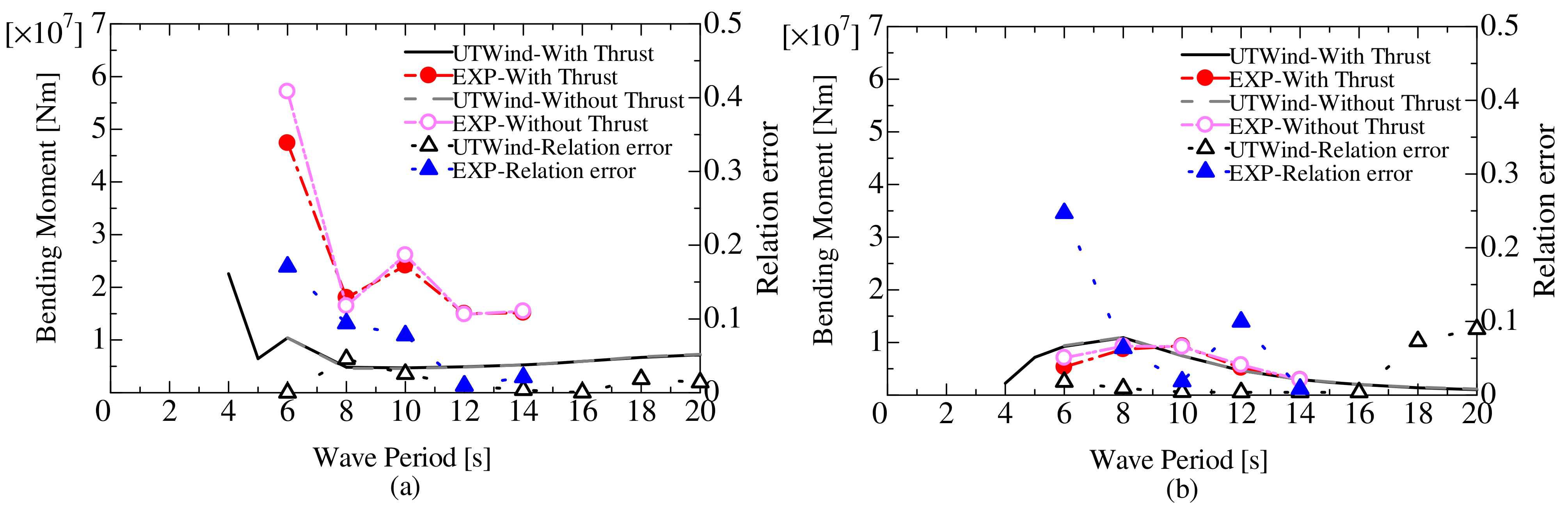
Figure 37, Figure 38 and Figure 39 show the results of bending moments acting on the members obtained from the experiment and UTWind. The experimental bending moments were converted to the actual scale and plotted on the same graph. In order to evaluate the effect of thrust, the relative error was calculated and plotted on the same graph.
Figure 37.
Comparison of experimental and numerical calculation bending moments at the connection position between the wind column and Pontoon1 (comparison of strain gauge-A and UTWind): (a) Bending moment around the y-axis. (b) Bending moment around the z-axis.
Figure 38.
Comparison of experimental and numerical calculation bending moments at the connection position between the wind column and Pontoon2 (comparison of strain gauge-B and UTWind): (a) Bending moment around the y-axis. (b) Bending moment around the z-axis.
Figure 39.
Comparison of experimental and numerical calculation bending moments at the center of Pontoon2 (comparison of strain gauge-C and UTWind): (a) Bending moment around the y-axis. (b) Bending moment around the z-axis.
Figure 37 shows the bending moment at the junction of Pontoon1 and the wind column, where Figure 37a is bending moment around the y-axis and Figure 37b is bending moment around the z-axis. Figure 37a shows that bending moments around the y-axis for wave periods below 12.0 s are higher than UTWind’s and are almost the same for wave periods of 14 s. Figure 37b shows that the bending moment of UTWind has a maximum value of 2.70 × 10⁷ Nm at a wave period of 8.0 s, while the experimental bending moment has a maximum value of 3.45 × 10⁷ at a wave period of 10.0 s. This feature is the same as the surge displacement shown in Figure 34, indicating that bending moment around the z-axis acting at the junction point of Pontoon1 and the wind turbine float is affected by the surge displacement. The relative error between the bending moment when thrust occurs and when it stops, with the bending moment in the absence of thrust as the reference, is less than 5% for both the experimental results and UTWind in the wave period range of 8.0∼14.0 s, indicating that the effect of thrust is negligible. In other words, the effect of thrust on the bending moment generated at the junction point between Pontoon1 and the floating body of the wind turbine is small.
Figure 38 shows the bending moment at the junction of Pontoon2 and the floating wind turbine. Figure 38a shows the bending moment around the y-axis relative to the member and Figure 38b shows the bending moment around the z-axis relative to the member. Figure 38a shows that the experimental values exceed the UTWind values for all wave periods. Figure 38b shows that the UTWind bending moment has a maximum value of 10.90 × 10⁷ Nm at a wave period of 8.0 s, while the experimental bending moment has a value of 9.35× 10⁷ Nm at a wave period of 10.0 s. These are approximate values regardless of the thrust conditions. In Figure 38, the experimental results for the bending moments are smaller with thrust than without thrust in both directions. Focusing on the relative error, it can be seen that thrust has an effect of more than 10% on the bending moment in the wave period range of 6.0∼12.0 s. Therefore, it can be said that the thrust of the wind turbine has a significant effect on the bending moment at the junction of Pontoon2 and the floating body of the wind turbine.
Figure 39 shows the bending moment occurring near the center of Pontoon2. The experimental bending moment at this location is much lower than UTWind in both the vertical and horizontal directions. This may be due to the fact that the bending stiffness at this point may have changed during model fabrication. The core stainless steel of Pontoon2 was made by joining two stainless steel square bars using I-shaped metal fittings and metallic glue. Strain gauges were glued at a distance of 60 mm from the joint, and the same positions were output and plotted in the graph for UTWind. As a result, the experimental bending moments were generally lower than those of UTWind, but similar trends were obtained. Therefore, it can be inferred that the bending moments in the experiment also occur as shown in UTWind. From Figure 37, Figure 38 and Figure 39, we can evaluate the effect of thrust on the bending moment from the experimental results, focusing on the relative error, and find that it has more effect on Pontoon2 than on Pontoon1. Furthermore, the effect is more pronounced for shorter wave periods.
6. Conclusions
In this study, the elastic response of a floating vertical-axis wind turbine with two vertical-axis wind turbines, called double-rotor VAWTs, was investigated. The elastic response characteristics in waves were compared using the ReaTHM test conducted in a tank and the numerical code “UTWind”. The findings of this study are as follows:
- In the case of this test model, thrust was found to affect the response to motion at longer wave periods. From the results of the regular wave test, the effect of thrust could not be confirmed in the range of a wave period less than 1.0 s (wave period of 10.0 s in the actual model), and the motion response of surge showed a minimum value around 1.0 s wave period. In the wave period range of 1.0 s or longer, the motion response in the surge, heave, and pitch directions was affected by thrust. This is due to the fact that negative damping is evident. In the future, it will be necessary to confirm whether the effect of negative damping will still appear when two actual Darrieus wind turbines are installed.
- It was found that the thrust of the wind turbine affects the bending moment generated at the hull by an increase of 5∼10%. Furthermore, for longer periods, the effect of the thrust has an about 20% increase concerning the bending moment.
- Comparing the UTWind motion response with the experimental results, the results were in good agreement for wave periods of 12.0 s or less, where the effect of thrust is relatively small. However, for wave periods of 12.0 s or longer, the trends were similar, but the numerical values diverged. Currently, the UTWind underestimates the values and modeling of thrust should be reconsidered in the future.
- Comparing the UTWind and experimental results for bending moments, the trends were generally consistent in all directions. In particular, the characteristics of the bending moment are evident around the wave period of 8.0 s, which indicates that the bending moment acting on the hull is affected by pitch motion. In this study, numerical and experimental results did not agree. If the pitch motion can be reproduced by numerical calculation, the bending moment acting on the hull can also be reproduced accurately.
Author Contributions
Conceptualization, S.I., H.S. and Y.N.; methodology, S.I., H.S. and Y.N.; software, S.I. and H.S.; validation, S.I., H.S. and Y.N.; formal analysis, S.I., H.S. and Y.N.; investigation, S.I. and Y.N.; resources, S.I. and Y.N.; data curation, S.I. and Y.N.; writing—original draft preparation, S.I.; writing—review and editing, S.I. and Y.N.; visualization, S.I.; supervision, S.I.; project administration, S.I., H.S. and Y.N.; funding acquisition, Y.N. All authors have read and agreed to the published version of the manuscript.
Funding
This research received no external funding.
Institutional Review Board Statement
Not applicable.
Informed Consent Statement
Not applicable.
Data Availability Statement
Not applicable.
Acknowledgments
We are grateful to Sharath Srinivasamurthy (Saga University) for helpful discussions and comments on the manuscript. This work was supported by JST SPRING, Grant Number JPMJSP2139.
Conflicts of Interest
The authors declare no conflict of interest.
Abbreviations
The following abbreviations are used in this manuscript:
| a | amplitude of wave (m) |
| A | cross-sectional area (m2) |
| projected area (m2) | |
| added mass coefficient in the x-direction | |
| added mass coefficient in the y-direction | |
| deag force coefficient in the x-direction | |
| drag forece coefficient in the y-direction | |
| Thrust drag coefficient (-) | |
| D | column diameter (m) |
| flexural rigidity (N·m2) | |
| thrust of the VAWT (N) | |
| g | acceleration of gravity (m/s2) |
| metacentric height (m) | |
| I | cross-sectional secondary moment |
| k | wavenumber (m) |
| L | width of the floating body (m) |
| wave length (m) | |
| M | bending moment (Nm) |
| bending moment when thrust (Nm) | |
| bending moment when no thrust (Nm) | |
| water density (kg/m3) | |
| S | scale factor of length |
| S1/2 | scale factor of time |
| S1/3 | scale factor of mass and force |
| S1/4 | scale factor of moment |
| S1/5 | scale factor of flexural rigidity EI |
| T | period of the wave (s) |
| natural period of heave (s) | |
| natural period of pitch (s) | |
| water particle velocity in the x-direction (m/s) | |
| water particle velocity in the y-direction (m/s) | |
| V | displacement (m3) |
| wind speed (m/s) | |
| velocity in the x-direction (m/s) | |
| velocity in the y-direction (m/s) | |
| wave frequency (rad/s) | |
| amplitude of the surge motion (m) | |
| amplitude of the heave motion (m) | |
| amplitude of the pitch motion (rad) | |
| x | x-direction |
| y | y-direction |
References
- Yamaguchi, A.; Ishihara, T. Current status of research activity on floating on shore wind turbine in Japan. In Proceedings of the EWEA Offshore 2013, Frankfurt am Main, Germany, 19–21 November 2013. [Google Scholar]
- Ishihara, T.; Yamaguchi, A.; Taki, S. The challenge to the world’s first floating wind farm. In Proceedings of the Grand Renewable Energy 2014 Proceedings, Tokyo, Japan, 27 July–1 August 2014. [Google Scholar]
- Fukuda, T.; Gugai, S.; Hosoya, R.; Sato, S.; Sugiura, S. Experimental study of floating off shore wind farm (FOWF) in Fukushima. In Proceedings of the Grand Renewable Energy 2014 Proceedings, Tokyo, Japan, 27 July–1 August 2014. [Google Scholar]
- Tanaka, K.; Sato, I.; Utsunomiya, T.; Kakuya, H. Validation of dynamic response of a 2-MW hybrid-spar floating wind turbine during typhoon using full-scale field data. Ocean Eng. 2020, 218, 108262. [Google Scholar] [CrossRef]
- Kosasih, K.; Suzuki, H.; Okubo, S. Demonstration Experiment and Numerical Simulation Analysis of Full-Scale Barge-Type Floating Offshore Wind Turbine. J. Mar. Sci. Eng. 2020, 8, 880. [Google Scholar] [CrossRef]
- Collu, M.; Brennan, F.P.; Patel, M.H. Conceptual design of a floating support structure for an offshore vertical-axis wind turbine: The lessons learnt. Ships Offshore Struct. 2014, 9, 3–21. [Google Scholar] [CrossRef]
- Parneix, N.; Fuchs, R.; Immas, A.; Nakamura, A.; Silvert, F. Efficiency Improvement of Vertical-Axis Wind Turbines with Counter-Rotating Lay-Out. In Proceedings of the European Wind Energy Association Wind Power Poland 2016, Warsaw, Poland, 8–9 March 2016. [Google Scholar]
- Iijima, K.; Kuroda, Y.; Nihei, Y.; Murai, M. Comparison of weathervane performance between two types of FOWT systems moored to SPM. In Proceedings of the ASME 2015 34th International Conference on Ocean, Offshore and Arctic Engineering, St. John’s, NB, Canada, 31 May–5 June 2015. OMAE2015-4113. [Google Scholar]
- Srinivasamurthy, S.; Iwamatsu, S.; Hashimoto, K.; Suzuki, H.; Chujo, T.; Haneda, K.; Nihei, Y. Study of slow-drift damping on wind tracking performance of a new-type FOWT ‘Optiflow’ with single-point mooring. Ocean Eng. 2021, 242, 1110131. [Google Scholar] [CrossRef]
- Iwamatsu, S.; Nihei, Y.; Iijima, K.; Ikoma, T.; Komori, T. Experimental Study on the Stability Performance and Turning Motion of Multi-Connection VAWT. In Proceedings of the ASME 2021 40th International Conference on Ocean, Offshore and Arctic Engineering, Virtual, Online, 21–30 June 2021. OMAE2021-62662. [Google Scholar]
- Verelst, D.R.; Madsen, H.; Kragh, K.A.; Belloni, F. Detailed Load Analysis of the baseline 5MW DeepWind Concept. DTU Wind Energy E 2014, No. 0057. [Google Scholar]
- Zheng, H.D.; Zhang, B.; Wang, S.B.; Zhou, G.Z. Effects of Blade Numbers on Wind-Induced Fatigue Lives of Straight-Bladed Vertical-Axis Wind-Turbine Tower Bases. Metals 2022, 12, 321. [Google Scholar] [CrossRef]
- Zheng, X.; Zheng, H.; Lei, Y.; Li, Y.; Li, W. An Offshore Floating Wind–Solar–Aquaculture System: Concept Design and Extreme Response in Survival Conditions. Energies 2022, 13, 604. [Google Scholar] [CrossRef]
- Cheng, Z.; Wen, T.R.; Ong, M.C.; Wang, K. Power performance and dynamic responses of a combined floating vertical-axis wind turbine and wave energy converter concept. Energy 2019, 171, 190–204. [Google Scholar] [CrossRef]
- Marten, D.; Wendler, J.; Pechlivanoglou, G.; Nayeri, C.N.; Paschereit, C.O. QBLADE: An Open Source Tool for Design and Simulation of Horizontal and Vertical Axis Wind Turbines. Int. J. Emerg. Technol. Adv. Eng. 2013, 3, 264–269. [Google Scholar]
- Giorgetti, S.; Pellegrini, G.; Zanforlin, S. CFD Investigation on the Aerodynamic Interferences between Medium-solidity Darrieus Vertical Axis Wind Turbines. Energy Procedia 2015, 81, 227–239. [Google Scholar] [CrossRef]
- Ion, P. Wind Tubine Design With Emphasis on Darrieus Concept, 1st ed.; Presses Internationales Polytechnique: Montreal, QC, Canada, 2002; pp. 48–49. [Google Scholar]
- Bachynski, E.E.; Chabaud, V.; Sauder, T. Real-time hybrid model testing of floating wind turbines: Sensitivity to limited actuatio. Energy Procedia 2015, 80, 2–12. [Google Scholar] [CrossRef]
- Hall, M.; Goupee, A.; Jonkman, J. Development of performance specifications for hybrid modeling of floating wind turbines in wave basin tests. J. Ocean Eng. Mar. Energy 2018, 4, 1–23. [Google Scholar] [CrossRef]
- Suzuki, H.; Shiohara, H.; Schnepf, A.; Houtani, H.; Carmo, L.H.S.; Chujo, T.; Nihei, Y.; Malta, E.B.; Gonçalves, R.T. Hirabayashi, S.; et al. Wave and Wind Responses of a Very-Light FOWT with Guy-Wired-Supported Tower: Numerical and Experimental Studies. J. Mar. Sci. Eng. 2020, 8, 841. [Google Scholar] [CrossRef]
- Inoue, T.; Adilah, A.; Iijima, K.; Oh, S.; Suzuki, H. Discussion on Coupling Effect in Structural Load of FOWT for Condensing Wind and Wave Bins for Spectral Fatigue Analysis. J. Mar. Sci. Eng. 2020, 8, 937. [Google Scholar] [CrossRef]
- Takata, T.; Takaoka, M.; Gonçalves, R.T.; Houtani, H.; Yoshimura, Y.; Hara, K.; Oh, S.; Dotta, R.; Malta, E.B.; Iijima, K.; et al. Dynamic Behavior of a Flexible Multi-Column FOWT in Regular Waves. J. Mar. Sci. Eng. 2021, 9, 124. [Google Scholar] [CrossRef]
- Suzuki, H.; Shibata, H.; Fujioka, H.; Hirabayashi, S.; Ishii, K.; Kikuchi, H. Development of an analysis code of rotor-floater coupled response of a floating offshore wind turbine. In Proceedings of the ASME 32nd International Conference on Ocean, Offshore and Arctic Engineering, Nantes, France, 9–14 June 2013. OMAE2013-10444. [Google Scholar]
- Karikomi, K.; Koyanagi, T.; Ohta, M.; Nakamura, A.; Iwasaki, S.; Hayashi, Y.; Honda, A. Wind Tunnel Testing on Negative-damped Responses of a 7MW Floating Offshore Wind Turbine. In Proceedings of the European Wind Energy Association Offshore 2015, Copenhagen, Denmark, 10–12 March 2015. [Google Scholar]
Publisher’s Note: MDPI stays neutral with regard to jurisdictional claims in published maps and institutional affiliations. |
© 2022 by the authors. Licensee MDPI, Basel, Switzerland. This article is an open access article distributed under the terms and conditions of the Creative Commons Attribution (CC BY) license (https://creativecommons.org/licenses/by/4.0/).