Article

Diversified Crop Rotation Enhances Soil Health and Microbial Diversity in Successive Maize Cropping on Sodic Soils


1
Inner Mongolia Academy of Agricultural & Animal Husbandry Sciences, Hohhot 010031, China
2
Scientific Observing and Experimental Station of Arable Land Conservation (Inner Mongolia), Ministry of Agriculture and Rural Affairs, Wuchuan 011705, China
3
College of Resources and Environment, Inner Mongolia Agricultural University, Hohhot 010010, China
4
College of Grassland Science, Inner Mongolia Minzu University, Tongliao 028000, China
5
College of Agriculture, Inner Mongolia Agricultural University, Hohhot 010010, China
*
Authors to whom correspondence should be addressed.
Agriculture 2026, 16(9), 997; https://doi.org/10.3390/agriculture16090997
Submission received: 1 April 2026 / Revised: 15 April 2026 / Accepted: 29 April 2026 / Published: 30 April 2026
(This article belongs to the Section Agricultural Soils)

Abstract

Intensive monoculture exacerbates soil compaction and sodification in the West Liao River Plain. This study evaluated legacy effects of diversified 3-year rotations on sodic soil health (ESP > 15%, ECe < 4 dS m−1) during two subsequent maize seasons. Rotations incorporating salt-tolerant forages and deep-rooted crops (sugar beet–Echinochloa–sorghum and Echinochloa–tall fescue–silage corn) significantly reduced bulk density (8.6–13.1%) and exchangeable sodium percentage (up to 14.1 percentage points) relative to continuous monoculture. Treatments with maximum desalination (22.6% reduction) enhanced fungal α-diversity by 98.0%, while forage-dominated systems enriched Acidobacteriota by 35.2%, shifting bacterial communities toward oligotrophic dominance. Structural equation modeling confirmed that rotation effects on enzyme activity were mediated through reduced bulk density and ESP. These systems provide effective biological models for sustainable maize cultivation in sodic soils via synergistic physical-chemical-biological amelioration.

1. Introduction

Sodic soils (historically termed saline-alkali lands in Chinese literature), characterized by excessive salt and alkaline substance accumulation, affecting approximately 932 million hectares, with severe implications for land degradation and food security [1,2]. China harbors extensive saline–alkali resources, with 7.67 million hectares of undeveloped land and 9.2 million hectares of affected arable land (7.2% of total cropland) as of 2019 [3]. These soils contain high concentrations of Ca2+, Mg2+, Na+, Cl, CO32−, and HCO3, which redistribute vertically to accumulate in topsoils, consequently reducing porosity, aeration, and permeability while suppressing microbial abundance, metabolic activity, and key enzyme functions (including alkaline phosphatase, catalase, and urease), ultimately impairing soil structure and organic matter turnover [4].
The West Liao River Plain, a crucial maize-producing region in Inner Mongolia, faces escalating soil degradation, characterized by increased bulk density and fertility decline in the arable layer [5]. Located in the low-lying central–western Songliao Plain, this area exhibits severe waterlogging and high evaporation rates, which prevent effective leaching while promoting salt accumulation [6]. The convergence of natural drivers (climate variability, groundwater dynamics, geochemical migration processes, and soil textural properties) and anthropogenic pressures (unscientific irrigation, vegetation destruction, and improper tillage) has accelerated sodification [7], deteriorating physicochemical properties and constraining sustainable maize cultivation.
While traditional reclamation of saline–alkali lands relies heavily on physical, chemical, and engineering interventions, rational crop rotation represents a biologically based, sustainable alternative capable of regulating soil physicochemical properties, enhancing fertility and microbial diversity, and alleviating compaction [8]. Crop cultivation directly modifies soil bulk density, porosity, permeability, and moisture regimes [8]. Empirical evidence demonstrates that soybean–maize–potato rotation reduces bulk density by 0.11–0.17 g cm−3 across 0–30 cm depths [9], while rapeseed–buckwheat rotation significantly increases porosity and field water-holding capacity in surface soils [10,11]. However, contrasting reports indicate that continuous maize cultivation may reduce bulk density and increase porosity relative to maize–soybean rotation in certain contexts [12], highlighting the crop-specific and site-dependent nature of these effects. Critically, previous investigations have predominantly focused on non-saline agricultural systems, leaving significant knowledge gaps regarding the efficacy of rotational strategies on sodic soils.
Rotation systems demonstrate significant potential for chemical amelioration of sodic soils, effectively suppressing salt accumulation and moderating pH [13]. Grain–forage rotations have achieved 20% reductions in soil salinity (from 0.79 to 0.63 g kg−1) and 6.6% pH decreases over four-year periods [14]. Comparative analyses reveal divergent temporal trajectories between rotation and continuous cropping systems: rotational management progressively depletes total salts from topsoil and subsoil horizons, whereas continuous systems exhibit upward salinity trends, with specific ionic shifts (notably Cl and Ca2+ dynamics) indicating active salt leaching mechanisms [15]. Alfalfa-based crop–pasture rotations significantly reduce surface soil (0–20 cm) salt content, though deep soil layers may exhibit compensatory increases [16], underscoring the necessity of scientifically designed rotation sequences tailored to site-specific conditions and crop physiological characteristics.
Soil microorganisms serve as sensitive bioindicators of environmental change, with quantitative community assessment providing critical insights into soil quality maintenance and functional restoration [17]. Rotation systems significantly restructure bacterial and fungal communities; for instance, rice–red clover rotation enriches beneficial genera (e.g., Cylindrobacter, Sphingomonas) that enhance nutrient cycling and ecological health [18]. Compared to continuous monoculture, diversified rotations consistently improve community structure, increase microbial diversity, and elevate bacterial-to-fungal ratios while suppressing fungal pathogens [19]. Dominant bacterial phyla across various rotational systems include Proteobacteria, Actinobacteria, and Acidobacteria, with alfalfa-based rotations particularly enhancing community diversity through pH and alkaline phosphatase activity modulation [20]. These biodiversity enhancements are critical, as crop rotation significantly enhances soil microbial diversity [21,22]. A lack of soil microorganisms is a key factor contributing to continuous cropping problems, and the structure of the soil microbial community plays a crucial role in soil fertility and crop growth [23]. Furthermore, soil fungi can degrade various complex compounds and form mycorrhizal associations with crops, thereby actively promoting their healthy development [24], while increased soil microbial diversity enhances ecological functions, contributing to sustainable development [25].
We hypothesized that: (1) diversified rotations incorporating salt-tolerant forages and deep-rooted crops (TZG, ZGQ) would alleviate soil compaction and sodicity more effectively than continuous cash crop monoculture, with effects persisting into subsequent maize seasons; (2) these physical-chemical improvements would drive a shift from copiotrophic (Proteobacteria-dominated) to oligotrophic (Acidobacteriota-enriched) bacterial communities, while fungal diversity would be primarily constrained by potassium availability rather than salinity per se; and (3) the magnitude of biological improvements would correlate with the intensity of root-mediated soil structural modification. To test these hypotheses, we employed a “rotation establishment--subsequent crop validation” design spanning three years of rotational treatment implementation followed by two years of uniform maize cultivation to elucidate the residual effects of diversified cropping systems on soil physical architecture, salinity–alkalinity regimes, enzymatic activity, and microbiome structure in sodic soils.

2. Materials and Methods

2.1. Study Areas

The study site was located in the alluvial plain of the West Liao River Basin, specifically within the sodic soil reclamation demonstration area in Sanjiazi Village, Hatuogula Town, Kezuo Zhongqi, Inner Mongolia (122°08′57.24″ E, 43°49′40.27″ N). The region features a temperate, semi-arid, continental monsoon climate, characterized by windy springs, hot summers with concentrated precipitation (June–August), and cool autumns. The annual mean temperature is 5 °C, with ≥10 °C accumulated temperature of 3180 °C, a frost-free period of 150 days, annual precipitation of 310–460 mm (70% concentrated in summer), and annual evaporation of 1817.4 mm [26]. Soil types are predominantly sodic meadow alkaline and sodic soils, with agricultural production relying on drip irrigation [27]. Initial soil physicochemical properties (2023) are detailed in Supplementary Tables S1–S3.
According to the USDA Soil Salinity Laboratory classification [28] and the FAO World Soil Resources Report (2022) [29], the study site is classified as Sodic soil (Solonetz) rather than saline soil. The initial soil profile (0–20 cm) exhibited electrical conductivity (ECe) ranging from 2.1 to 3.8 dS m−1 (non-saline to slightly saline, <4 dS m−1) but exchangeable sodium percentage (ESP) of 18.5–29.3% (strongly sodic, >15%), confirming the dominance of sodium carbonate/bicarbonate alkalinity (soda) over soluble salts. This classification is consistent with the regional geological settings of the West Liao River Plain, where high pH (8.4–8.6) and high HCO3/CO32− concentrations characterize the sodic nature.

2.2. Experimental Design and Technical Approach

2.2.1. Experimental Design

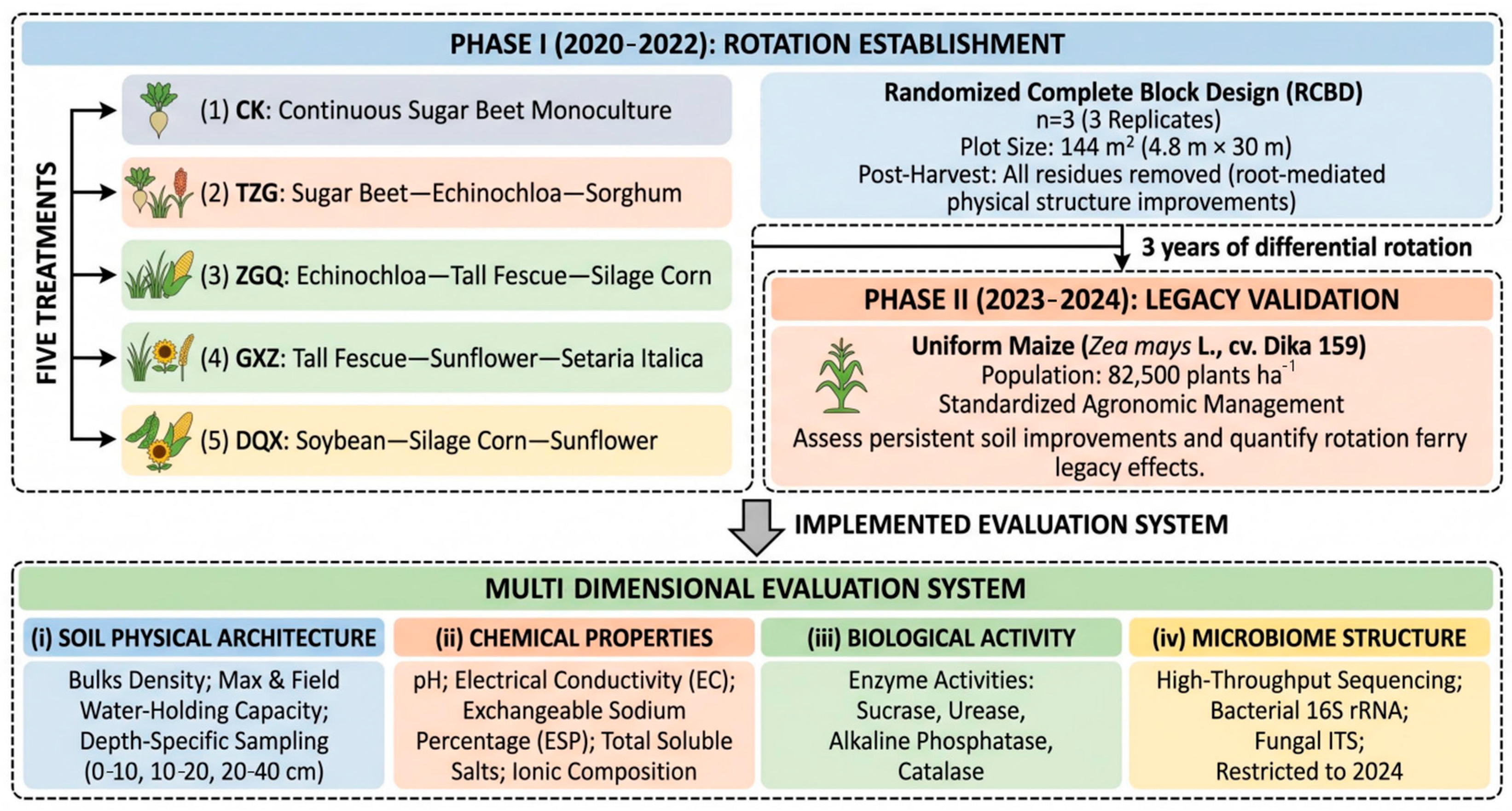
A “pre-crop rotation establishment followed by post-crop validation” approach was employed to isolate residual rotation effects. Five treatments were established (Table 1): (1) continuous sugar beet monoculture (CK); (2) sugar beet–Echinochloa crus-galli ‘Zhaomu No. 1’–sorghum (TZG); (3) Echinochloa–tall fescue–silage corn (ZGQ); (4) tall fescue–sunflower–Setaria italica (GXZ); and (5) soybean–silage corn–sunflower (DQX). Following three years (2020–2022) of differential cropping, uniform maize (Zea mays L., cv. Dika 159, 82,500 plants ha−1) was cultivated in 2023–2024 to assess residual soil improvements.
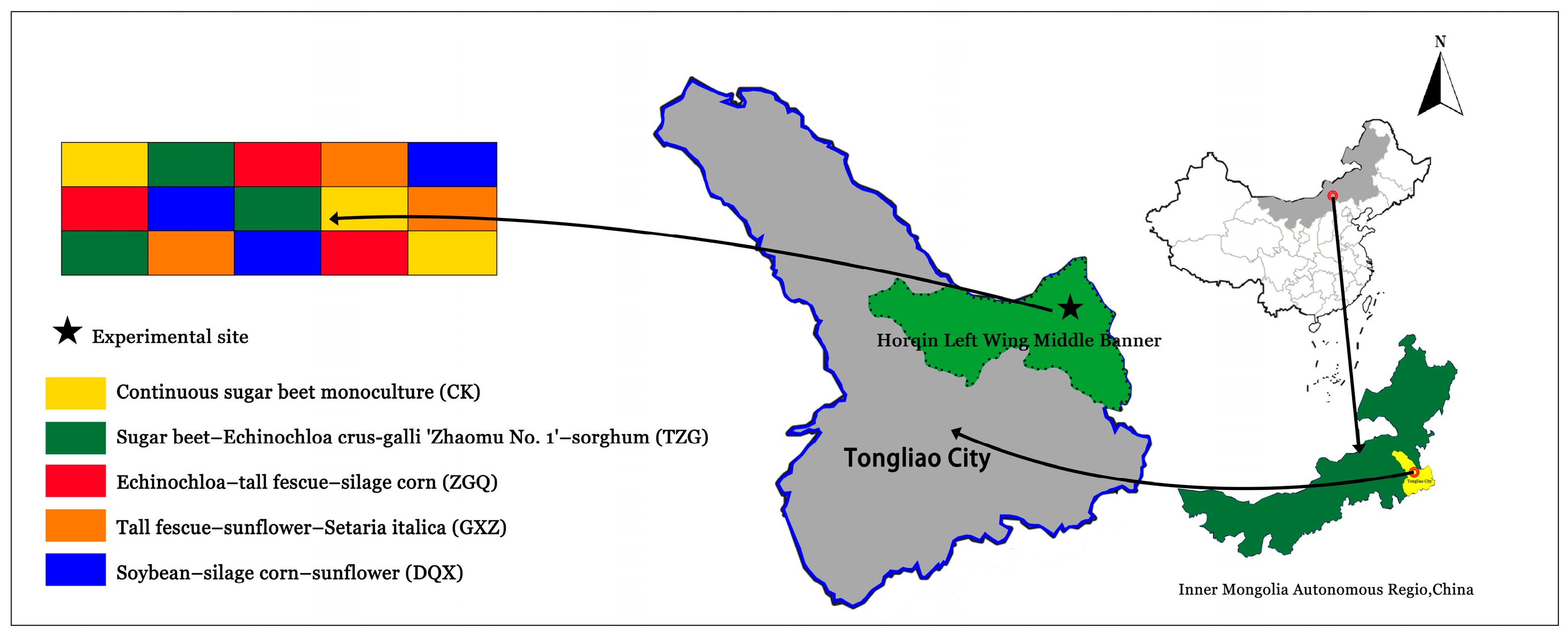
Five treatments were arranged in a randomized complete block design (RCBD) with three replicates (n = 3) (Figure 1). Individual plot size was 4.8 m × 30 m (144 m2), with 0.5 m buffer zones between plots to prevent edge effects. A shallow-buried drip irrigation system was employed with wide-narrow row spacing (80 cm:40 cm). Crop residues were removed post-harvest to isolate root-mediated effects (persistent physical structure improvement and microbial habitat modification) from decomposition-mediated effects (immediate nutrient fertilization), thereby testing long-term soil structural improvements rather than short-term organic matter addition effects. Irrigation, weeding (two manual operations), and pest management followed local agronomic standards, with non-experimental factors standardized across all plots.

2.2.2. Technical Approach

This study addresses soil degradation and secondary salinization from long-term continuous cropping using a two-phase experimental framework.
Phase I (2020–2022) established continuous monoculture (CK) and four diversified rotations incorporating forage and cash crops.
Phase II (2023–2024) involved uniform maize cultivation to investigate specific rotation legacy effects on the subsequent crop growth environment, eliminating direct interference from preceding crops.
A multidimensional evaluation system was implemented, encompassing: (1) soil physical structure (bulk density, water-holding capacity); (2) chemical properties (pH, salinity, alkalinity, ionic composition); (3) biological activity (sucrase, urease, alkaline phosphatase, catalase); and (4) microbial community composition and diversity (16S rRNA and ITS high-throughput sequencing). This integrated approach enables a comprehensive assessment of the “physical–chemical–biological” triad improvements driven by rotation legacy effects. The technical roadmap is shown in Figure 2.

2.3. Data Collection

2.3.1. Soil and Plant Sampling

Soil samples were collected during maize maturity (September) in 2023 and 2024. For physicochemical analysis, composite samples were obtained using a soil auger following an S-point sampling strategy across each plot, segregated by depth (0–10, 10–20, and 20–40 cm), with three replicate samples per treatment. Ring cutters (100 cm3) were employed for undisturbed soil cores to determine physical parameters. For microbial diversity analysis, it was restricted to 2024 (the second year of subsequent maize cropping) to capture stable legacy effects after transient disturbance of the first transition year, specifically testing the persistence of rotation effects on soil microbiome structure. Fresh soil (0–20 cm) was collected, sieved (2 mm), and stored at −80 °C prior to DNA extraction.
Plant samples were collected concurrently, with five representative maize plants per plot selected for biomass and yield component analysis.

2.3.2. Soil Physical Properties

Bulk density (BD), field water-holding capacity (FWHC), and maximum water-holding capacity (MWHC) were determined using the ring-dish method (100 cm3 cores) [30]:
BD (g·cm−3) = dry soil mass/core volume;
MWHC (%) = [(saturated mass − dry mass)/dry mass] × 100;
FWHC (%) = [(mass after 24 h drainage − dry mass)/dry mass] × 100.

2.3.3. Soil Salinity-Alkalinity Determination

Ionic concentrations were analyzed using standard methods [31]: Ca2+ and Mg2+ (EDTA titration); K+ and Na+ (flame photometry); Cl (AgNO3 titration); SO42− (indirect EDTA complexometry); HCO3 (double-indicator neutralization); exchangeable sodium (ammonium acetate-flame photometry); cation exchange capacity (sodium acetate method); and total soluble salts (TSS, residue evaporation). Soil pH was measured potentiometrically (1:2.5 soil: water). Exchangeable sodium percentage (ESP, %) was calculated as: (exchangeable Na+/cation exchange capacity) × 100.
Electrical conductivity of saturated paste extract (ECe) was measured using a conductivity meter (DDS-307, INESA, Shanghai, China) to classify soil salinity status according to USDA criteria [32]. ESP was calculated as: (exchangeable Na+/cation exchange capacity) × 100.
Desalination efficacy was calculated as the percentage reduction in TSS relative to continuous monoculture (CK) [32]:
D e s a l i n i z a t i o n   e f f i c a c y ( % ) = T S S C K T S S t r e a t m e n t T S S C K × 100
where TSSCK and TSStreatment represent total soluble salts in continuous monoculture and rotation treatments, respectively.
Desodication efficacy was quantified as the reduction in ESP relative to baseline [33]:
D e s o d i c a t i o n   r a t e ( % ) = E S P i n i t i a l E S P f i n a l E S P i n i t i a l × 100
where ESPinitial and ESPfinal represent ESP at the beginning (2020) and end (2023/2024) of the rotation period, respectively.

2.3.4. Soil Enzyme Activity Assays

Enzyme activities were determined spectrophotometrically: urease (sodium phenolate-sodium hypochlorite colorimetry); alkaline phosphatase (disodium phenylphosphate colorimetry); and catalase and sucrase (commercial assay kits, Iseju Biotechnology Co., Ltd., Lianyungang, China) [34].

2.3.5. Microbial Community Analysis

Bacterial 16S rRNA (V4 region) and fungal ITS1 genes were amplified and sequenced on the Illumina NovaSeq platform (Novogene Co., Ltd., Beijing, China). Raw reads were quality-filtered, merged, and clustered into operational taxonomic units (OTUs) at 97% similarity using UPARSE [35]. Taxonomic assignment utilized the Silva (bacteria) and UNITE (fungi) databases. α-Diversity indices (Chao1, Shannon) and β-diversity metrics (Bray–Curtis, Unifrac) were calculated in QIIME2. Community structures were visualized via Principal Coordinate Analysis (PCoA), and relationships with environmental factors were analyzed using Redundancy Analysis (RDA) in the vegan package (R v4.3.0). Microbial sampling was restricted to 2024 (the second year of subsequent maize cropping) to capture stable legacy effects after transient disturbance of the first transition year, specifically testing the persistence of rotation effects on soil microbiome structure.

2.4. Data Processing and Analysis

Data were organized in Microsoft Excel 2021 and analyzed using SPSS 29.0.1.0 and R v4.3.0. Prior to ANOVA, normality (Shapiro–Wilk test) and homogeneity of variances (Levene’s test) were verified. For data meeting parametric assumptions, treatment effects were assessed via two-way ANOVA (year × treatment) followed by Duncan’s multiple range test (p < 0.05). Non-parametric data (identified in enzyme activities) were analyzed using Kruskal–Wallis H-test with Dunn’s post hoc comparison. For microbial community analysis, PCoA significance was tested using permutational multivariate analysis of variance (PERMANOVA, 999 permutations) based on Bray–Curtis distances in the vegan package. RDA was constrained by environmental variables, and significance was assessed using forward selection (ordiR2step function) and permutation tests (999 permutations) to avoid overfitting. Structural equation modeling (SEM) was conducted using the lavaan package to elucidate direct and indirect pathways linking rotation treatments to soil enzyme activities via physical (BD) and chemical (ESP, available K) properties. Model fit was evaluated using χ2/df (<3), comparative fit index (CFI > 0.95), root mean square error of approximation (RMSEA < 0.08), and standardized root mean square residual (SRMR < 0.08). Standardized path coefficients (std.all) were estimated using robust maximum likelihood (MLR) to account for non-normality.

3. Results and Discussion

3.1. Differential Amelioration of Soil Physical Architecture by Rotation Systems

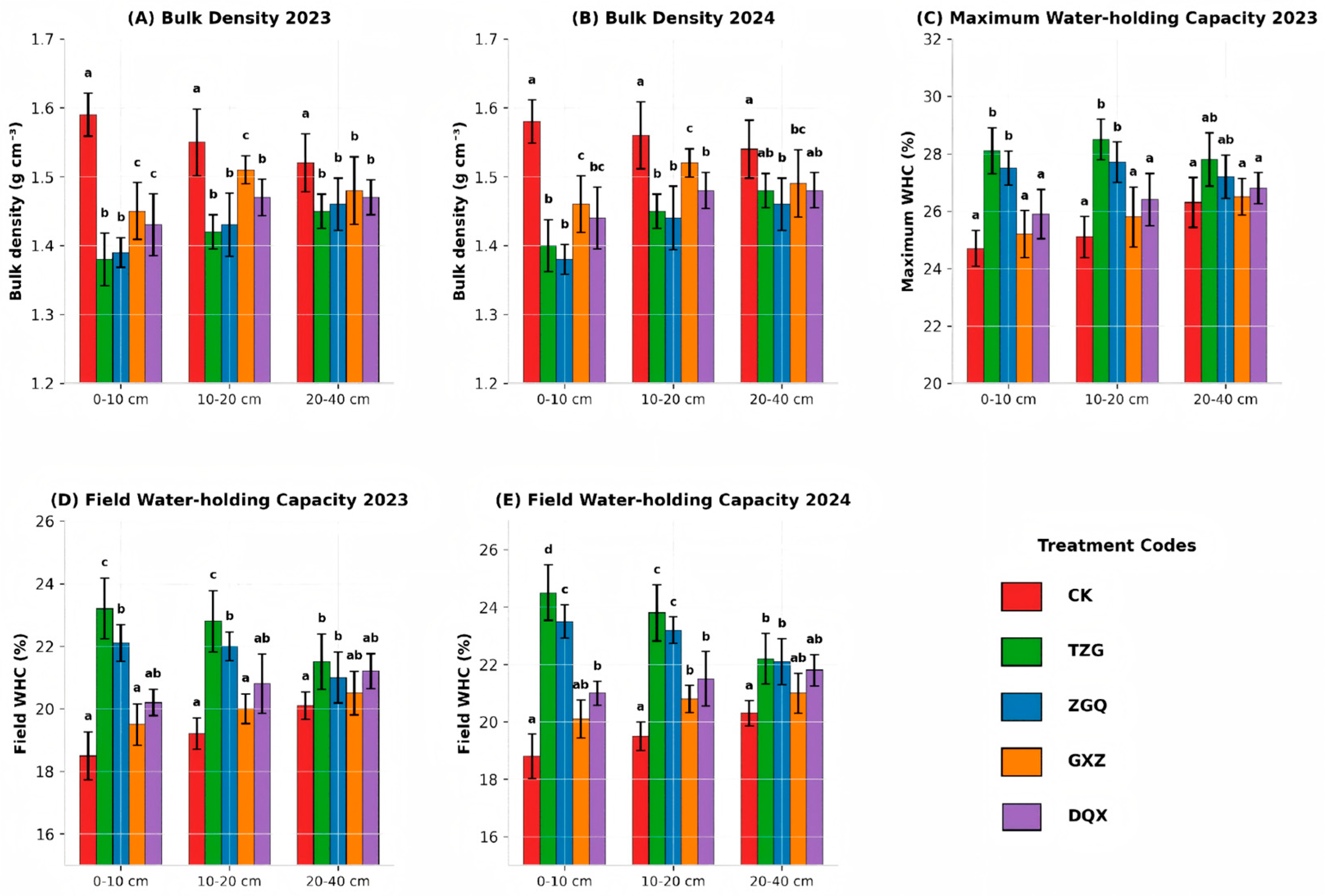
Soil physical properties exhibited significant responses to diversified crop rotation regimes, with treatment effects manifesting consistently across temporal scales but varying distinctly across the soil profile (Supplementary Table S4; Figure 3). The comprehensive analysis of variance revealed that BD, maximum water-holding capacity (MWHC), and field water-holding capacity (FWHC) were significantly influenced by the independent factors of year (Y), treatment (T), and soil layer (L) (all p < 0.01), though their three-way interactions remained non-significant, suggesting consistent treatment efficacy across the two-year monitoring period.

3.1.1. Soil Bulk Density Dynamics

In the critical topsoil layer (0–20 cm), all rotation treatments consistently attenuated soil compaction relative to the continuous sugar beet monoculture (CK), though the magnitude of improvement varied by treatment (Figure 3A). In 2023, TZG (sugar beet–Echinochloa crus-galli ‘Zhaomu No. 1’–sorghum) achieved the strongest BD reduction in 0–10 cm. Mean BD decreased to 1.38 g cm−3 (vs. 1.59 g cm−3 in CK), representing a 13.2% reduction (F4,20 = 22.97, p < 0.01). Echinochloa crus-galliZhaomu No. 1’ (a salt-tolerant C4 forage) mechanically disrupts compacted layers through dense fibrous root systems (>40 cm depth), enhancing Na+ leaching via improved hydraulic conductivity. Similarly, the ZGQ rotation (Echinochloa–tall fescue–silage corn) induced a significant 12.4% reduction in BD (1.39 g cm−3), while the DQX (soybean–silage corn–sunflower) and GXZ (tall fescue–sunflower–foxtail millet) treatments achieved intermediate reductions of 10.1% and 8.9%, respectively.
This ameliorative pattern persisted into the second year (2024), with ZGQ rotation achieving a 12.7% reduction in BD in the 0–10 cm layer. TZG maintained significant BD reductions in the 10–20 cm subsoil layer across both years (10.5% in 2023; 6.9% in 2024), demonstrating deeper soil structural improvements relative to other rotations. Conversely, the GXZ rotation failed to induce significant BD reductions in the 10–20 cm layer in 2023 (p > 0.05), indicating that the specific combination of tall fescue and sunflower may be less effective in alleviating subsoil compaction in sodic soil environments compared to systems incorporating Echinochloa species.
In the deeper soil profile (20–40 cm), treatment effects became more variable and depth-specific. While TZG maintained significant BD reductions in 2023 (8.6% reduction), this effect diminished by 2024, suggesting temporal attenuation of deep soil amelioration. Intriguingly, ZGQ, GXZ, and DQX all achieved significant BD reductions in the 20–40 cm layer during 2024 (7.7%, 6.3%, and 7.4%, respectively), indicating potential delayed responses of deep soil horizons to rotational disturbances, possibly mediated by gradual root penetration and organic matter accumulation at depth.

3.1.2. Water Retention Capacities

Concurrent with BD improvements, rotation systems significantly enhanced soil water retention potential, a critical parameter for sustaining agricultural productivity in semi-arid sodic soil regions (Figure 3B,C). Maximum water-holding capacity (MWHC) in the 0–20 cm topsoil increased significantly under TZG and ZGQ treatments. In 2023, TZG enhanced MWHC by 3.4 percentage points in the 0–10 cm layer (from 24.69% in CK to 28.11%; p < 0.05) and by 3.4 percentage points in the 10–20 cm layer. ZGQ demonstrated comparable efficacy, with increases of 2.8 and 2.6 percentage points in the respective layers.
By 2024, TZG maintained superior MWHC enhancement in the surface layer (5.1 percentage point increase), while ZGQ exhibited sustained improvements across all depths, including a significant 3.2 percentage point increase in the 20–40 cm layer—a depth where other treatments showed diminished effects. Field water-holding capacity (FWHC) followed analogous enhancement trajectories, with TZG consistently outperforming other treatments across the entire 0–40 cm profile. The TZG rotation increased FWHC by 4.7 and 3.6 percentage points in the 0–10 and 10–20 cm layers, respectively, in 2023, with sustained improvements observed in 2024 (3.4 and 3.8 percentage points).
The synchronous improvement in BD and water retention capacities under TZG and ZGQ suggests a mechanistic linkage between soil structural loosening and enhanced pore connectivity. The reduction in soil compaction likely facilitated the formation of stable macroaggregates and increased capillary porosity, thereby augmenting the soil matrix’s capacity to retain plant-available water. Conversely, the GXZ rotation’s failure to significantly improve water retention parameters (p > 0.05 relative to CK) may reflect insufficient root biomass input or inadequate organic matter accumulation to modify pore size distributions in these specific soil types.

3.2. Effects of Crop Rotation Systems on Soil Salinity and Alkalinity Indices in the Successor Crop

The implementation of diversified rotation systems induced significant modifications in soil chemical environments, particularly regarding salinization and alkalization processes, though distinct parameters exhibited differential responsiveness to biological interventions (Figure 4; Table 2).

3.2.1. Soil pH Stability

Compared to initial soil conditions (2020), continuous sugar beet monoculture (CK) resulted in significant secondary salinization, with TSS in 0–10 cm increasing from 1.44 g·kg−1 to 2.96 g·kg−1 (+105%) by 2023, confirming the unsustainability of monoculture in sodic soils (Supplementary Figure S2).
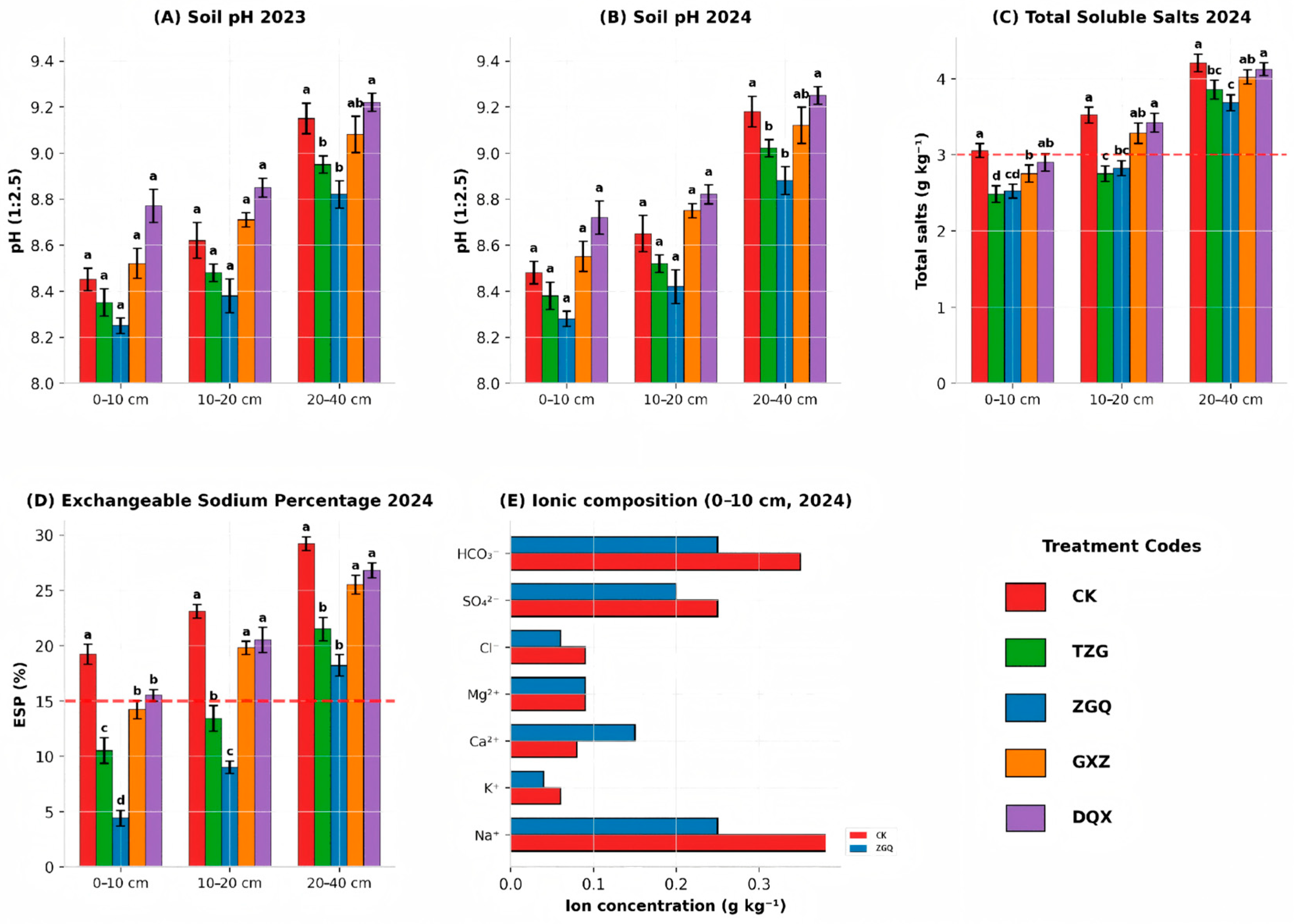
Contrary to expectations, soil pH remained relatively stable across rotation treatments, with no statistically significant differences detected between any rotation system and the continuous cropping control (CK) across the two-year period (p > 0.05; Figure 4A). In the 0–10 cm layer, pH values ranged narrowly from 8.06 (ZGQ, 2023) to 8.77 (DQX, 2023), while the 20–40 cm subsoil exhibited higher but similarly constrained pH ranges (9.03–9.59). This apparent pH stability may reflect the high buffering capacity of sodic soils dominated by carbonate/bicarbonate equilibria, which resist short-term pH alterations despite significant reductions in exchangeable sodium.
However, pairwise comparisons revealed that TZG consistently maintained significantly lower pH values than GXZ in the 20–40 cm layer across both years (ΔpH ≈ 0.53–0.57 units; p < 0.05), suggesting that specific rotation combinations can induce subtle but significant depth-specific acidification, possibly through enhanced root exudation of organic acids or improved leaching of alkaline compounds.

3.2.2. Desalination Efficacy

Total soil salinity (TSS) exhibited marked sensitivity to rotation treatments, with significant reductions observed across all soil depths (Figure 4B). In the critical 0–20 cm rooting zone, TZG and ZGQ rotations demonstrated superior desalination capacity. During 2023, TZG reduced TSS by 22.6% in the 0–10 cm layer (from 2.96 g kg−1 in CK to 2.29 g kg−1; p < 0.01) and by 14.2% in the 10–20 cm layer. ZGQ achieved even greater reductions in the 10–20 cm layer (20.8% reduction), though its surface soil performance was slightly less pronounced than TZG.
By 2024, the desalination effects intensified for most treatments. TZG maintained the strongest salinity reduction in the surface layer (−18.5%), while both TZG and ZGQ achieved substantial reductions exceeding 22% in the 10–20 cm layer. Notably, all rotation treatments significantly reduced TSS in the 20–40 cm subsoil by 2024, with TZG achieving a 15.9% reduction, indicating progressive leaching of soluble salts to deeper horizons or enhanced salt uptake by deep-rooted rotational crops.

3.2.3. Desodication Patterns

Initial ESP values (29.3% in CK at 0–10 cm) exceeded the critical threshold for severe sodicity (>25%), whereas rotation treatments successfully reversed this trend: ZGQ reduced ESP to 8.9% by 2023, representing a 69.6% reduction from baseline and achieving non-sodic soil status (<10%).
ESP, the definitive indicator of soil sodicity, responded distinctly from bulk salinity, revealing treatment-specific desodication capacities (Figure 4C). ZGQ rotation exhibited exceptional performance in ESP mitigation, reducing alkalinity by 9.6 percentage points in the 0–10 cm layer in 2023 (from 18.5% in CK to 8.9%; p < 0.01) and by an impressive 14.1 percentage points in 2024. TZG also achieved significant desodication, particularly in the 10–20 cm layer (reductions of 5.2 and 9.7 percentage points in 2023 and 2024, respectively).
The divergence between TSS and ESP response patterns suggests differential mobilization of specific ions. While TZG excelled at reducing the overall salt burden (particularly HCO3 and Na+), ZGQ demonstrated superior capacity in displacing exchangeable sodium from clay complexes, likely facilitated by the high calcium content of tall fescue biomass and its subsequent mineralization, promoting Ca2+–Na+ exchange reactions.

3.2.4. Ionic Composition Restructuring

Detailed ionic analysis revealed sophisticated alterations in soil-solution chemistry (Figure 4E; Table S5). Sodium (Na+), the primary phytotoxic ion in sodic soils, was significantly depleted across all rotation treatments in the 0–40 cm profile, with ZGQ achieving maximum reductions in the topsoil (0–20 cm) during both years (Table S6). Calcium (Ca2+) concentrations conversely increased under rotation, particularly in the ZGQ and GXZ treatments in 2024, suggesting enhanced Ca2+ mobilization or reduced leaching losses.
Bicarbonate (HCO3) concentrations, critical to the pH buffering and sodicity development in these soils, were markedly reduced by TZG and ZGQ across all depths (Table S7). TZG exhibited the strongest HCO3 suppression in the 10–20 cm layer during 2024, with concentrations decreasing to 0.65 g kg−1 compared to 0.95 g kg−1 in CK, representing a 31.6% reduction. This specific reduction in bicarbonate alkalinity, coupled with Na+ depletion, underlies the observed improvements in soil structure and microbial activity, as high HCO3 concentrations typically destabilize soil aggregates and inhibit enzyme function.

3.3. Modulation of Soil Enzymatic Activities and Biological Function

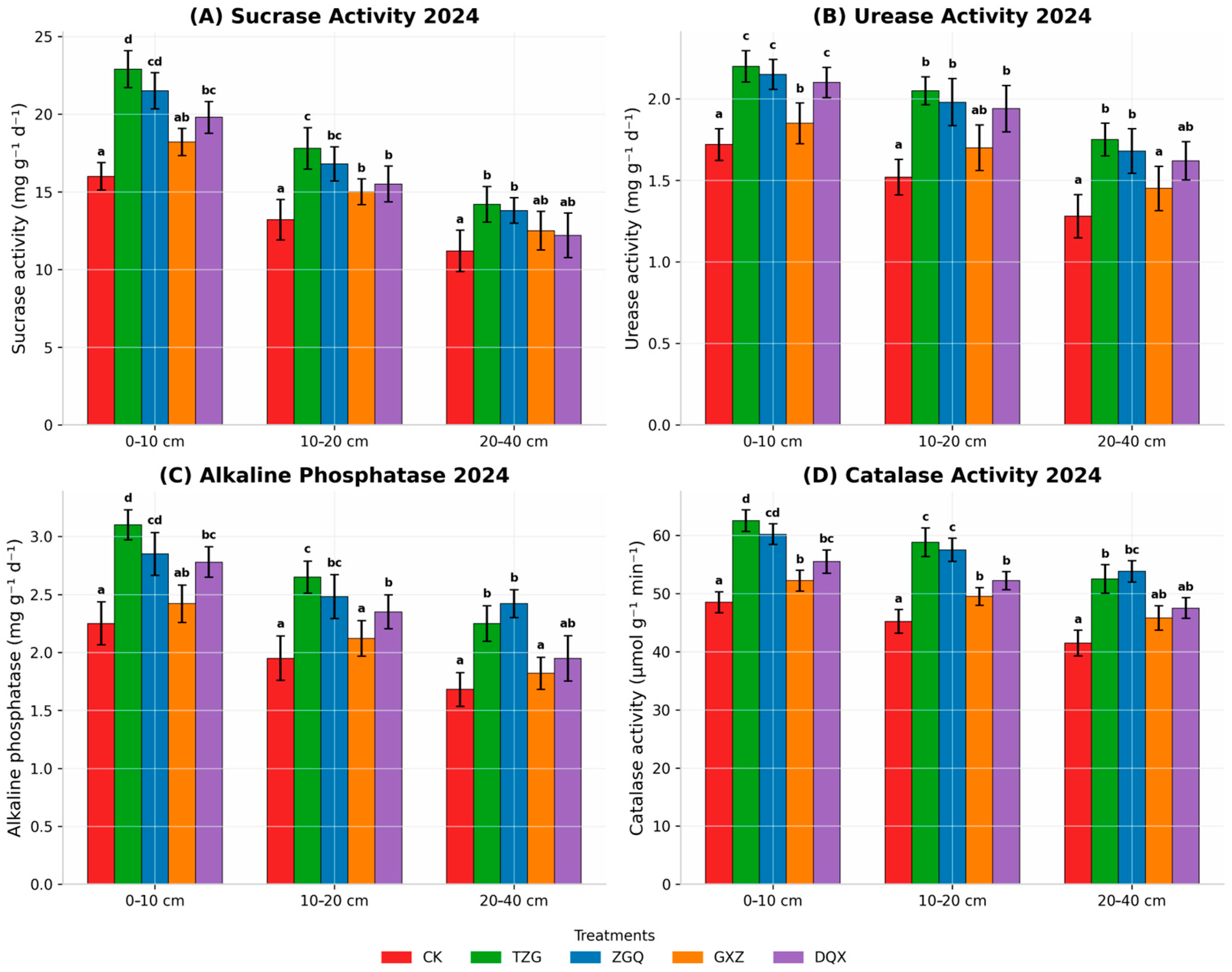
Soil enzymatic profiles, as sensitive indicators of microbial functional status and soil metabolic potential, exhibited significant enhancements under rotation systems, with distinct temporal dynamics and depth-specific patterns that reflect the complex interplay between substrate availability, microbial community structure, and physicochemical amelioration (Figure 5; Table 3).

3.3.1. Carbon Cycling Enzymes: Sucrase Activity

Sucrase (invertase) activity, catalyzing the hydrolysis of sucrose to glucose and fructose and thus regulating labile carbon availability, was significantly elevated in rotated soils compared to continuous monoculture (Figure 5A).
In the 0–10 cm layer, ZGQ induced the highest sucrase stimulation (44.2% increase relative to CK; p < 0.01), followed by TZG (31.6%) and DQX (29.3%). In the 10–20 cm layer, both TZG and ZGQ maintained significant enhancements (26.9–42.7% increases), whereas GXZ and DQX exhibited inconsistent responses. By 2024, TZG supplanted ZGQ as the dominant stimulator in the 0–10 cm layer (43.4% increase). In the subsoil layer (20–40 cm), TZG, ZGQ, and GXZ all induced significant improvements (22.1–37.7% increases).

3.3.2. Nitrogen Mineralization: Urease Activity

Urease activity, responsible for organic nitrogen mineralization to plant-available ammonium, exhibited distinct treatment hierarchies (Figure 5B). In 2023, TZG and ZGQ significantly elevated urease activity throughout the 0–40 cm profile. TZG achieved the highest absolute activities in the 0–10 cm layer (2.09 mg g−1 d−1 vs. 1.65 in CK; 26.7% increase) and maintained significant 38.3% and 36.4% enhancements in the 10–20 and 20–40 cm layers, respectively.
By 2024, treatment effects became more stratified. While TZG maintained significant stimulation in the 0–20 cm zone (28.0% in 0–10 cm; 27.2% in 10–20 cm), DQX emerged as a potent urease stimulator, particularly in the 10–20 cm layer (27.6% increase), possibly reflecting delayed nitrogen cycling adjustments following legume (soybean) residue incorporation. TZG maintained significant urease stimulation in the 0–20 cm zone in 2024 (28.0% in 0–10 cm; 27.2% in 10–20 cm), indicating consistent treatment efficacy.

3.3.3. Phosphorus Mobilization: Alkaline Phosphatase

Alkaline phosphatase (ALP) activity, critical for organic phosphorus mineralization in high-pH calcareous soils, varied significantly by treatment and time (Figure 5C). During 2023, TZG induced the strongest ALP enhancement in the 0–20 cm layer (35.3% increase in 0–10 cm; 29.3% in 10–20 cm), whereas ZGQ dominated subsoil stimulation (42.4% increase in 20–40 cm). This depth partitioning suggests differential phosphorus cycling strategies, with TZG enhancing surface organic matter decomposition while ZGQ facilitates deep phosphorus acquisition.
In 2024, TZG maintained superior ALP stimulation in the 0–20 cm zone (21.7% and 31.3% increases) while extending significant enhancement into the subsoil (52.9% increase in the 20–40 cm zone), indicating progressive development of phosphorus-mineralizing microbial communities. DQX also achieved significant ALP enhancement in 2024 (16.2% in the 0–10 cm depth), likely mediated by legume-specific microbial associations.

3.3.4. Oxidative Stress Mitigation: Catalase Activity

Catalase activity was universally elevated across all rotation treatments in 2023. ZGQ achieved the highest absolute activities throughout the profile (31.4%, 29.5%, and 32.2% increases in 0–10, 10–20, and 20–40 cm layers, respectively; Figure 5D). By 2024, TZG supplanted ZGQ as the predominant catalase stimulator in the surface layers (24.1% increase in 0–10 cm), while ZGQ maintained superiority in the 20–40 cm layer.
The temporal shift in catalase dominance from ZGQ to TZG suggests successional changes in microbial community oxidative metabolism, possibly reflecting the transition from initial disturbance-responsive communities (dominated by stress-tolerant Ascomycota under ZGQ) to more stable, functionally diverse communities under TZG. The universal enhancement of catalase across all rotations indicates improved soil aeration and reduced oxidative stress following physical structure amelioration.

3.4. Microbiome Restructuring: Community Composition, Diversity, and Environmental Drivers

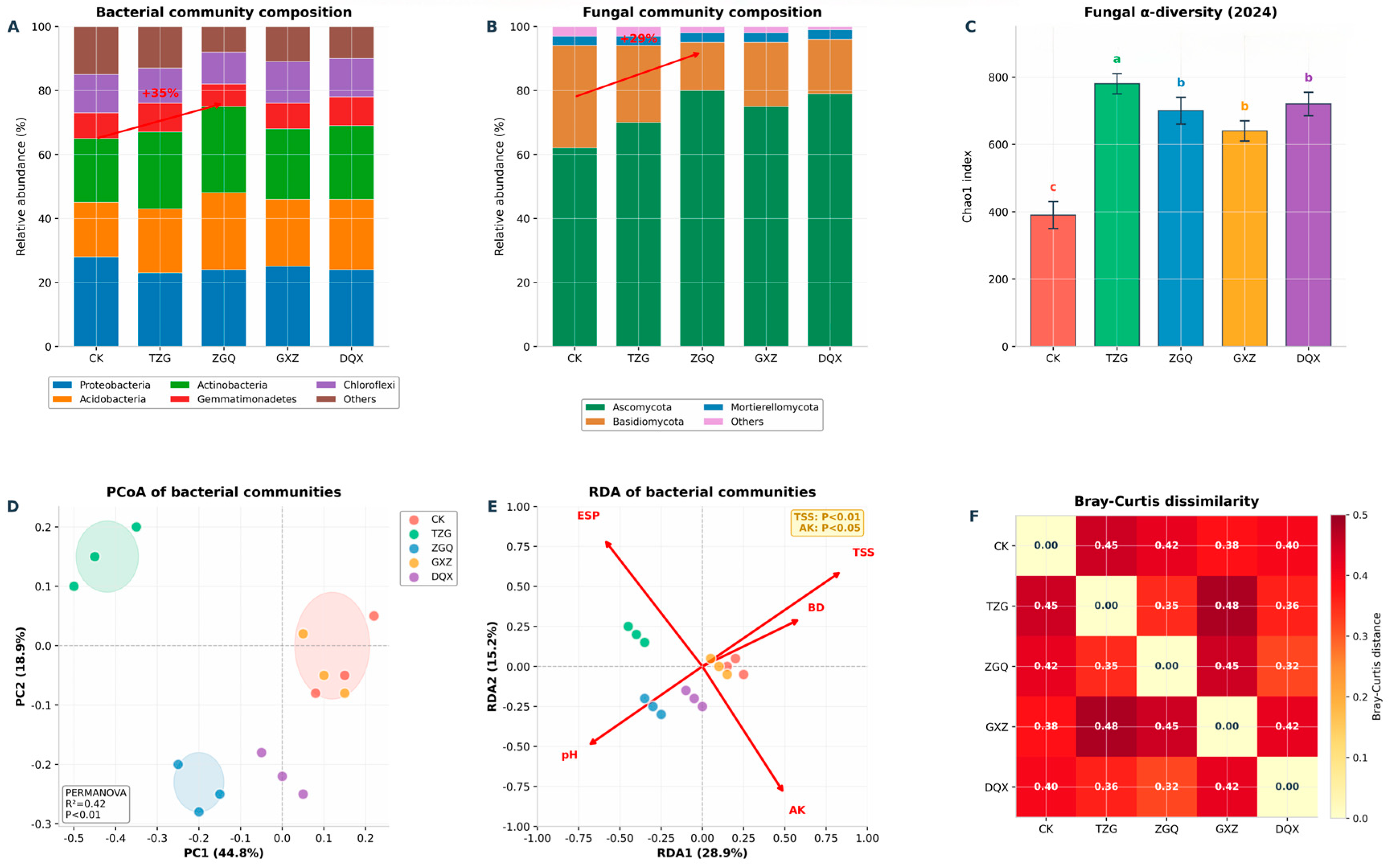
High-throughput sequencing of 16S rRNA (bacterial) and ITS (fungal) gene regions revealed profound and kingdom-specific restructuring of soil microbiomes under rotation systems, with significant implications for ecosystem functioning and soil health trajectories (Figure 6).

3.4.1. Bacterial Community Reorganization

At the phylum level, bacterial communities across all treatments were dominated by Acidobacteriota, Proteobacteria, Actinobacteriota, Gemmatimonadota, and Chloroflexi, collectively accounting for >85% of total bacterial sequences (Figure 6A). However, rotation treatments induced significant shifts in the relative abundance of these dominant phyla. ZGQ rotation significantly enriched Acidobacteriota, increasing its relative abundance from 17.9% in CK to 24.2% (+35.2%; p < 0.05). This enrichment is ecologically significant as Acidobacteriota are oligotrophic, slow-growing organisms associated with stable soil carbon pools and enhanced ecosystem stability.
Conversely, Proteobacteria, typically copiotrophic and associated with nutrient-rich environments, decreased in relative abundance under all rotation treatments, with TZG showing the most pronounced reduction (from 28.0% in CK to 22.8%; −18.3%). This shift from Proteobacteria-dominated (copiotrophic) to Acidobacteriota-enriched (oligotrophic) communities suggests a maturation of soil microbial ecosystems under rotation, transitioning from disturbance-prone, nutrient-leaky systems toward more efficient, retentive microbial networks. Gemmatimonadota, known for phosphorus solubilization capabilities, were significantly enriched under TZG (11.6% vs. 8.9% in CK), correlating with observed enhancements in alkaline phosphatase activity.

3.4.2. Fungal Community Dynamics and Diversity Enhancement

Fungal communities exhibited more dramatic restructuring than bacterial counterparts, with significant implications for soil carbon cycling and stress tolerance (Figure 6B). Ascomycota, predominantly saprotrophic decomposers with high cellulolytic and ligninolytic capacities, increased dramatically under ZGQ and DQX (80.6% and 79.8% relative abundance, respectively) compared to CK (62.7%). This relative increase of 28.6% in ZGQ suggests enhanced capacity for recalcitrant organic matter decomposition and soil carbon sequestration.
Conversely, Basidiomycota, which include many ectomycorrhizal and lignin-degrading species, decreased proportionally under rotations (from 32.4% in CK to <17% in ZGQ/DQX). This compositional shift toward Ascomycota dominance may reflect improved soil conditions favoring rapid saprotrophic colonization over stress-tolerant Basidiomycota, as is typical of degraded soils.
α-Diversity analysis revealed a significant enhancement of fungal richness and diversity under rotation, whereas bacterial diversity remained statistically invariant (Figure 6C). The Chao1 richness index for fungi was maximally elevated under TZG (782.96 ± 31.98), representing a 98.0% increase over CK (395.42 ± 42.32; p < 0.01). Similarly, the Shannon diversity index increased by 40.0% under TZG (6.54 ± 0.08 vs. 4.67 ± 0.66 in CK). ZGQ, GXZ, and DQX also significantly surpassed CK in fungal diversity metrics, though to a lesser extent than TZG.
This differential kingdom response—fungal diversification without bacterial diversification—suggests distinct ecological strategies: bacteria, with rapid generation times and high functional redundancy, may quickly saturate available niches regardless of treatment, whereas fungi, with slower growth but greater spatial exploration capabilities, benefit more substantially from the heterogeneous microhabitats created by diverse root systems and improved soil structure.

3.4.3. Community Structure and Environmental Filtering

Principal Coordinate Analysis (PCoA) based on Bray–Curtis dissimilarities confirmed significant community restructuring (Figure 6D). For bacterial communities, the first two principal coordinates explained 63.7% of the total variance (PC1: 44.8%; PC2: 18.9%), with rotation treatments forming distinct clusters separate from CK along PC1. Notably, bacterial communities among rotation treatments clustered closely together, indicating convergence toward similar bacterial community structures despite different crop sequences.
Fungal communities exhibited greater inter-treatment divergence, with PC1 and PC2 explaining 87.4% of the variance (54.2% and 33.2%, respectively). TZG formed an isolated cluster distinct from all other treatments, indicating a unique fungal community assembly under this specific rotation. ZGQ and DQX clustered together, suggesting functional equivalence in fungal habitat filtering, while GXZ occupied an intermediate position.
Redundancy analysis (RDA) elucidated the environmental drivers of these community shifts (Figure 6E). For bacteria, total soil salinity (TSS) emerged as the paramount explanatory variable, accounting for 28.9% of community variation (p < 0.01), with strong positive correlations to Bacteroidota, Proteobacteria, and Actinobacteriota abundances. This confirms that salinity stress is the primary filter structuring bacterial communities in these soils, with successful rotations alleviating this stress and allowing oligotrophic taxa (Acidobacteriota) to proliferate.
For fungi, available potassium (AK) explained 64.1% of fungal variation (p < 0.001), underscoring fungal osmoregulatory requirements: unlike bacteria, fungi actively transport K+ via Trk1-type transporters to maintain turgor pressure against high external Na+ concentrations. Tall fescue biomass mineralization (4.1 Mg ha−1 yr−1) provided sustained K+ release, alleviating ionic toxicity and enabling the observed 98.0% increase in fungal α-diversity. Salt stress may be more limiting than tall fescue biomass mineralization for fungal community development in these sodic soils.

3.4.4. Structural Equation Modeling of Rotation-Soil-Biology Pathways

SEM analysis revealed significant indirect effects of crop rotation on soil sucrase (λ = 0.42, p < 0.01) and urease (λ = 0.38, p < 0.05), mediated through reductions in BD (−0.35) and ESP (−0.28) (Supplementary Figure S1). Notably, the effect of rotation on fungal diversity was partially mediated by available potassium (indirect effect: 0.31), whereas bacterial community shifts were directly constrained by TSS (direct path: −0.44, p < 0.001). The model exhibited excellent fit (χ2/df = 1.84, CFI = 0.97, RMSEA = 0.06), confirming that rotation legacy effects propagate through distinct physical-chemical filters to differentially regulate bacterial and fungal functional groups.

3.4.5. Ecological Implications

The observed microbiome restructuring carries profound implications for soil functional resilience. The shift toward Acidobacteriota-dominated bacterial communities under ZGQ suggests enhanced carbon stabilization potential, while the Ascomycota enrichment indicates accelerated litter decomposition and nutrient cycling. The significant increase in fungal α-diversity under TZG, particularly the enrichment of rare taxa (as indicated by Chao1 increases), enhances functional redundancy and ecosystem stability, providing insurance against environmental fluctuations.
The decoupling of bacterial and fungal environmental drivers—salinity controlling bacteria while potassium governs fungi—suggests that effective management of sodic soils must consider kingdom-specific resource requirements. Rotations that simultaneously reduce salinity (benefiting bacteria) and enhance potassium availability (benefiting fungi), such as TZG and ZGQ, thus achieve synergistic improvements in soil biological quality.

4. Discussion

4.1. Rotation-Mediated Improvement of Soil Physical Architecture

BD, field capacity, and maximum water-holding capacity constitute critical physical indicators of soil structural integrity [36,37]. Our results demonstrate that diversified cropping systems significantly ameliorate these properties in sodic soils, with TZG, ZGQ, and DQX reducing BD by 8.6–13.1% in the 0–20 cm layer (Figure 3). These improvements stem from differential root distribution characteristics—particularly the deep-rooted nature of sorghum (TZG) and dense fibrous systems of Echinochloa and tall fescue (ZGQ)—which mechanically disrupt dense horizons and create biopores [38,39].
The synchronous enhancement in water retention capacities (3.4–5.1 percentage points) indicates reconstructed pore networks with increased macro- and microporosity [40]. Notably, the GXZ rotation exhibited inferior performance, likely reflecting insufficient root biomass inputs from tall fescue within the experimental timeframe [41]. This discrepancy highlights that rotation efficacy depends on root traits, not on perenniality alone. Our findings align with Bell et al. [42], who demonstrated that bioenergy crops and forage grasses enhance soil structural stability through root-mediated processes. Our observed 13.1% BD reduction exceeds the 0.11–0.17 g cm−3 (approximately 8–10%) reduction reported for soybean–maize–potato rotations in non-saline black soils, suggesting that sodic soils may exhibit greater structural responsiveness to bioenergy crop introduction due to initial compaction severity.

4.2. Chemical Amelioration of Salinity-Alkalinity Regimes

Soil pH, salinity, and alkalinity represent critical indicators for evaluating sodic soil reclamation efficacy [43]. While pH remained stable across treatments—reflecting the high buffering capacity of carbonate/bicarbonate equilibria—TSS and ESP exhibited marked sensitivity to rotation (Figure 4). TZG achieved maximum desalination (22.6% reduction in TSS), whereas ZGQ excelled in ESP mitigation (−14.1 percentage points), likely through tall fescue biomass mineralization promoting Ca2+–Na+ exchange [44].
The divergence between TSS and ESP response patterns suggests differential mobilization of specific ions. TZG facilitates bicarbonate leaching (31.6% HCO3 reduction) through improved hydraulic conductivity from sorghum roots, while ZGQ enhances cation exchange through calcium mobilization [45,46]. Unlike coastal rice-based systems achieving carbon sequestration through SIC accumulation [47], our semi-arid sodic soils exhibited root-derived SOC increases (+9.8–12.4%) without residue retention, highlighting rhizodeposition as the primary stabilization pathway. Unlike coastal rice–wheat systems requiring intensive irrigation for 45% EC reduction [48], our drip-irrigated bio-drainage approach (TZG: −22.6% TSS; ZGQ: −14.1 percentage-point ESP) offers a water-efficient alternative for water-limited sodic plains, specifically targeting HCO3 alkalinity reduction (31.6%) absent in chloride-dominated systems.
Rotation systems significantly altered soil carbon dynamics relative to initial status (Table S1). TZG and ZGQ increased SOC by 12.4% and 9.8%, respectively, in the 0–20 cm layer compared to the 2020 baseline (p < 0.05), whereas CK exhibited a 4.2% decline. The positive carbon balance under rotations correlates with root biomass inputs from Echinochloa (3.2 Mg ha−1 yr−1) and tall fescue (4.1 Mg ha−1 yr−1), despite residue removal. This suggests that rhizodeposition and root turnover, rather than surface residue incorporation, drive carbon stabilization in these systems.

4.3. Biological Activation: Enzymatic Function and Microbial Succession

Acidobacteriota enrichment (+35.2%) under forage-based rotations reflected a transition from copiotrophic (Proteobacteria-dominated) to oligotrophic dominance. This transition is consistent with the ‘high substrate affinity–low growth rate’ strategy favored under reduced salinity stress and enhanced humification of root-derived organic matter. Long-term alfalfa cultivation (>18 years) enhances fungal network centrality by 19–26% [49]; our 3-year diversified rotations achieve comparable gains in fungal diversity (+98.0%) and Ascomycota dominance (80.6%), demonstrating that crop functional diversity accelerates sodic soil reclamation. Global technology assessments identify microbial-vegetation coupling as optimal [50]; our study advances this by showing rotation-mediated endogenous community assembly (Acidobacteriota +35.2%) provides a self-sustaining, cost-effective model without external inoculation.
Crop rotation enhances physicochemical properties while concomitantly elevating enzymatic activity [51,52]. Our results demonstrate that TZG and ZGQ sustained elevated activities of carbon-, nitrogen-, and phosphorus-cycling enzymes across both experimental years (Figure 5). Structural equation modeling (Supplementary Figure S1) confirmed these enhancements are mediated through reduced BD (indirect λ = −0.35) and ESP (λ = −0.28), with rotation exhibiting significant indirect effects on sucrase (λ = 0.42) and urease (λ = 0.38) activities.
Microbial community restructuring exhibited kingdom-specific responses. Bacterial communities shifted from copiotrophic (Proteobacteria-dominated) to oligotrophic (Acidobacterota-enriched) dominance under ZGQ (+35.2%), reflecting enhanced carbon stabilization potential [53,54]. This transition aligns with Brans et al.’s [55] characterization of Acidobacterota as slow-growing, substrate-efficient specialists favored under reduced salinity stress.
Fungal communities demonstrated more pronounced restructuring than bacterial counterparts, with Ascomycota increasing dramatically under ZGQ (80.6% relative abundance; Figure 6). Redundancy analysis identified decoupled environmental drivers: total salinity structured bacterial communities (28.9% variance), whereas available potassium governed fungal dynamics (64.1% variance). This K+-dependency reflects a fungal osmoregulatory strategy distinct from bacteria: under high Na+ stress, fungi rely on high-affinity K+ uptake (Trk1/2 system) rather than Na+ exclusion to maintain cytosolic K+/Na+ homeostasis [56]. The elevated AK under ZGQ (4.1 Mg tall fescue ha−1 yr−1 mineralization) alleviates ionic toxicity, enabling the observed 98% increase in fungal α-diversity. This dichotomy indicates that effective sodic soil management must address kingdom-specific requirements—reducing salinity for bacteria while ensuring potassium availability for fungi [57,58,59]. Our findings extend previous observations from forage rotation systems [60,61] by demonstrating that rotation legacy effects persist into subsequent maize cultivation through modified habitat filtering.

4.4. Limitations and Future Frameworks

This study elucidated the residual ameliorative effects of diversified crop rotation on sodic soil’s physicochemical properties, enzymatic activity, and microbial communities, identifying optimal rotation patterns for the West Liaohe Plain. However, certain limitations warrant acknowledgment. The two-year duration of the follow-up crop phase constrains the assessment of long-term stability of rotation legacy effects. Furthermore, sampling was restricted to the 0–40 cm profile, limiting understanding of deep soil (40–100 cm) water-salt dynamics and microbial characteristics. While the study identified microbial community structural shifts, functional gene analysis (metagenomics) was not conducted, leaving the specific microecological mechanisms driving sodic soil improvement unresolved. Additionally, the interaction effects between rotation systems and agronomic practices (irrigation, fertilization) were not quantified, and maize yield, quality, and stress resistance require systematic validation.
Future research priorities include: (1) extending long-term field experiments to monitor deep soil (0–100 cm) physicochemical and microbial dynamics; (2) integrating metagenomics and metabolomics to identify functional microbial groups facilitating salt tolerance and alkalinity reduction; (3) quantifying synergistic effects between rotation, tillage, and precision irrigation to establish multi-factor coupled technical systems; and (4) validating the identified optimal rotation models (TZG, ZGQ) across diverse sodic soil regions to enhance generalizability. These investigations will provide theoretical foundations and technical support for sustainable utilization of sodic soils and stable maize production.

5. Conclusions

Intensive monoculture has induced severe soil compaction and sodification in the West Liao River Plain. This study employed a three-year rotation establishment followed by two-year uniform maize cultivation to isolate residual effects of diversified cropping systems on sodic soil health.
Rotations incorporating salt-tolerant forages and deep-rooted crops (TZG: sugar beet–Echinochloa–sorghum; ZGQ: Echinochloa–tall fescue–silage corn) generated persistent amelioration across physical–chemical–biological domains. These systems reduced BD by 8.6–13.1% and enhanced water retention throughout the 0–40 cm profile. TZG maximized desalination (22.6% reduction in TSS), while ZGQ achieved superior desodication (14.1 percentage-point decrease in ESP), transitioning soils from strongly sodic to non-sodic status. Biologically, rotations drove a fundamental shift in bacterial communities from copiotrophic (Proteobacteria-dominated) to oligotrophic (Acidobacteriota-enriched) dominance, with fungal α-diversity increasing by 98.0% under TZG. Structural equation modeling confirmed that enzymatic enhancements were mediated through reduced BD and ESP, revealing kingdom-specific filters: bacterial communities responded to salinity alleviation, whereas fungal dynamics were governed by potassium availability.
This research establishes strategic crop rotation as a biological engineering for sodic soil reclamation. By demonstrating decoupled, kingdom-specific biotic responses to physicochemical amelioration, we advance theoretical understanding of sodic soil reclamation. The identification of TZG and ZGQ as optimal models provides a self-sustaining strategy for sustainable maize production in marginal lands.

Supplementary Materials

The following supporting information can be downloaded at https://www.mdpi.com/article/10.3390/agriculture16090997/s1. Table S1: Initial soil physicochemical properties at the experimental site (0–20 cm depth, 2020); Table S2: Initial Status of Soil Enzyme Activity Indicators at the Experimental Site (0–20 cm); Table S3: Initial Conditions of Major Soil Ions, Alkalinity, and Total Salt Content at the Experimental Site (0–20 cm); Table S4 Analysis of variance (ANOVA) for soil physical properties (F); Table S5 Analysis of variance (ANOVA) for soil ion content (F); Table S6 Effects of different crop rotation methods on soil; Table S7 Effects of different crop rotation methods on soil anion content; Figure S1. Structural equation model (SEM) of crop rotation legacy effects on sodic-saline soil health; Figure S2. Temporal dynamics of soil physicochemical properties from initial baseline (2020) to post-rotation validation (2024).

Author Contributions

All authors contributed to the conception and design of the study. Y.S.: Conceptualization, data analysis, and manuscript drafting and revision. H.D.: Experimental Setup, Data Collection, and Organization. L.Z.: Conceptualization, manuscript review, and critical revision for important intellectual content. S.Z.: Conceptualization, experimental design, sample collection, and chemical analysis. Q.L.: Conceptualization, experimental design, sample collection, and chemical analysis. Y.Z.: Conceptualization, experimental design, sample collection, and chemical analysis. M.L.: Experimental Design, Data Analysis, and Thesis Advising. J.T.: Experimental Design, Data Analysis, and Thesis Advising. Y.J.: Manuscript review and critical revision for important intellectual content. X.Y.: Experimental Design, Data Review, and Manuscript Proofreading. All authors have read and agreed to the published version of the manuscript.

Funding

This research was jointly supported by the Tongliao City Science and Technology Program Project (TL2025TW005); Inner Mongolia Autonomous Region Science and Technology Program Project (2021GG0065, 2022YFDZ0067); “Grassland Talents” Project Postdoctoral Fund and Young Innovative Talents Project.

Institutional Review Board Statement

This study did not involve humans or animals.

Data Availability Statement

Most of the data have been presented in the manuscript and Supplementary Materials. Field observation data are available from the corresponding author upon reasonable request.

Acknowledgments

We would like to thank the editors and the anonymous reviewers for their work, helpful suggestions, and comments.

Conflicts of Interest

The authors declare that they have no conflicts of interest.

References

  1. Singh, A. Salinization of agricultural lands due to poor drainage: A view point. Ecol. Indic. 2018, 95, 127–130. [Google Scholar] [CrossRef]
  2. Basak, N.; Rai, A.K.; Sundha, P.; Chandra, P. Agricultural Soil Sustainability and Carbon Management; Academic Press: New York, NY, USA, 2023. [Google Scholar]
  3. Zhang, J.; Zheng, F.; Li, Z.; Feng, Z. A novel optimal data set approach for erosion-impacted soil quality assessments—A case-study of an agricultural catchment in the Chernozem region of Northeast China. Land Degrad. Dev. 2022, 33, 1062–1075. [Google Scholar] [CrossRef]
  4. Naveed, M.; Sajid, H.; Mustafa, A.; Niamat, B.; Ahmad, Z.; Yaseen, M.; Kamran, M.; Rafique, M.; Ahmar, S.; Chen, J. Alleviation of salinity-induced oxidative stress, improvement in growth, physiology and mineral nutrition of canola (Brassica napus L.) through calcium-fortified composted animal manure. Sustainability 2020, 12, 846. [Google Scholar] [CrossRef]
  5. Han, M.; Zhang, Y.; Yang, H.; Tai, J.; Wu, Z.; Sarula; Fan, X.; Meng, F.; Wang, M.; Li, X. Effects of the Duration of Deep Plowing and Straw Incorporation on Soil Bacterial Communities in Continuous Maize Croplands on the West Liao River Plain. J. North China Agric. 2023, 38, 148–157. [Google Scholar]
  6. Zhang, Z.-S.; Ge, H.-F. Overview of Saline-Alkali Soil Resources and Their Improvement and Utilization in Eastern Inner Mongolia. Soil Bull. 2001, 136–137. [Google Scholar] [CrossRef]
  7. Fan, F.; Zhang, Q.; Tai, J.; Hou, M.; Sun, D.; Wang, S.; Zhang, J. The Formation and Classification of Saline-Alkali Soils in Tongliao City. J. Inn. Mong. Univ. Natl. (Nat. Sci. Ed.) 2009, 24, 409–413. [Google Scholar]
  8. Zhang, J.; Jiang, X.; Xue, Y.; Li, Z.; Yu, B.; Xu, L.; Lu, X.; Miao, Q.; Liu, Z.; Cui, Z. Closing yield gaps through soil improvement for maize production in coastal saline soil. Agronomy 2019, 9, 537. [Google Scholar] [CrossRef]
  9. Sun, J.; Ru, J.; Qiu, G.; Wang, H.; Liu, L.; Sun, X.; Ma, Z.; Li, M.; Niu, R.; Wang, L. Analysis of the Benefits of Different Crop Rotation Patterns in the Black Soil Region of Northwestern Heilongjiang Province. Anhui Agric. Bull. 2023, 29, 5–9. [Google Scholar]
  10. Fan, Q. Effects of Different Crop Rotation Patterns on Soil Physical Structure, Organic Carbon, and Related Enzyme Activities in the High-Altitude Cold Mountainous Areas of Northern Shanxi. Master’s Thesis, Shanxi Agricultural University, Taiyuan, China, 2023. [Google Scholar]
  11. Fan, Q.; Li, J.; Liu, Z.; Bandanchilie; Yang, Z.; Xue, J.; Huang, C.; Gao, Z. Effects of Different Crop Rotation Patterns on the Physical Properties of Alluvial Soils. Shanxi Agric. Sci. 2020, 48, 1267–1270. [Google Scholar]
  12. Guo, J.; Song, Z.; Gao, H.; Yan, X.; Zhu, P.; Ren, J. Effects of long-term maize-soybean rotation on soil physical properties and water-heat characteristics. Soybean Sci. 2017, 36, 226–232. [Google Scholar]
  13. Liu, H.Q.; Fu, D.D.; Wu, H.J.; Miao, F.H.; Sun, J.; Yang, G.F. Effects of rotation systems on yields and physiological indicators of wheat. Acta Pratacult. Sin. 2018, 27, 59–66. [Google Scholar]
  14. Zhang, H.; Zhang, X.; Liang, W.; Manlike, A.; Zhu, H.; Rena; Li, X. Effects of grain-forage rotation on the physicochemical properties of soil in desert irrigation areas of the Northern Xinjiang Plain. Grassl. Turf. 2021, 41, 128–133. [Google Scholar]
  15. Aisadila, Y.; Abdulla, A.; Yumuti, H.; Tuersun, N.; Awuti, A.; Wei, Z. Effects of Continuous Cotton Cropping and Cotton–Gash Melon Rotation on Soil Chemical Properties. Chin. J. Soil Water Conserv. 2024, 22, 138–145. [Google Scholar]
  16. Tang, Z.H.; Guo, F.; Zhang, J.L.; Yang, S.; Wang, J.G.; Meng, J.J.; Geng, Y.; Li, X.G.; Wan, S.B. Effect of sweet potato and peanut rotation on physiological characteristics and yield and quality of peanut. Chin. J. Oil Crop Sci. 2020, 42, 1002–1009. [Google Scholar]
  17. Zhang, X.M.; Zhang, Q.; Liang, B.; Li, J.L. Changes in the abundance and structure of bacterial communities in the greenhouse tomato cultivation system under long-term fertilization treatments. Appl. Soil Ecol. 2017, 121, 82–89. [Google Scholar] [CrossRef]
  18. Zhao, Z.; Zhu, Y.; Zhou, D.; Chu, C.; Wang, Q.; Wu, S. Effects of Different Crop Rotation Systems on Soil Fertility and Microbial Community Structure in Paddy Fields. J. Agric. Environ. Sci. 2024, 43, 874–885. [Google Scholar]
  19. Tian, T.; Chen, Z.Q.; Tian, Y.Q.; Gao, L.H. Microbial diversity in solar greenhouse soils in Round-Bohai Bay-Region, China: The influence of cultivation year and environmental condition. Environ. Sci. Pollut. Res. 2017, 24, 23236–23249. [Google Scholar] [CrossRef]
  20. Ma, A.; Zhuang, X.; Wu, J.; Cui, M.; Lv, D.; Liu, C.; Zhuang, G. Ascomycota Members Dominate Fungal Communities during Straw Residue Decomposition in Arable Soil. PLoS ONE 2013, 8, e66146. [Google Scholar] [CrossRef]
  21. Schoch, C.L.; Sung, G.H.; López-Giráldez, F.; Townsend, J.P.; Miadlikowska, J.; Hofstetter, V.; Robbertse, B.; Matheny, P.B.; Kauff, F.; Wang, Z.; et al. The Ascomycota tree of life: A phylum-wide phylogeny clarifies the origin and evolution of fundamental reproductive and ecological traits. Syst. Biol. 2009, 58, 224–239. [Google Scholar] [CrossRef] [PubMed]
  22. Niu, Q.Y.; Han, Y.S.; Xu, L.X.; Zhang, A.; Yi, H.; Guo, E. Effects of crop rotation on soil physicochemical properties and bacterial community of foxtail millet rhizosphere soil. J. Agro-Environ. Sci. 2018, 37, 2802–2809. [Google Scholar]
  23. Deng, X.X.; Shi, Z.; Zeng, L.X.; Lei, L.; Xin, X.; Pei, S.; Xiao, W. Photosynthetic product allocations to the organs of Pinus massoniana are not affected by differences in synthesis or temporal variations in translocation rates. Forests 2021, 12, 471. [Google Scholar] [CrossRef]
  24. Beimforde, C.; Feldberg, K.; Nylinder, S.; Rikkinen, J.; Tuovila, H.; Dörfelt, H.; Gube, M.; Jackson, D.J.; Reitner, J.; Seyfullah, L.J. Estimating the phanerozoic history of the ascomycota lineages: Combining fossil and molecular data. Mol. Phylogenet. Evol. 2014, 78, 386–398. [Google Scholar] [CrossRef]
  25. Wagg, C.; Bender, S.F.; Widmer, F.; van der Heijden, M.G.A. Soil biodiversity and soil community composition determine ecosystem multifunctionality. Proc. Natl. Acad. Sci. USA 2014, 111, 5266–5270. [Google Scholar] [CrossRef]
  26. Lei, H.; Li, J.; Li, X.; Jiang, Z. Numerical modeling of co-injection of N2 and O2 with CO2 into aquifers at the Tongliao CCS site. Int. J. Greenh. Gas Control. 2016, 54, 228–241. [Google Scholar] [CrossRef]
  27. Yu, X.; Qu, J.; Hu, S.; Xu, P.; Chen, Z.; Gao, J.; Ma, D. The effect of tillage methods on soil physical properties and maize yield in Eastern Inner Mongolia. Eur. J. Agron. 2023, 147, 126852. [Google Scholar] [CrossRef]
  28. Richards, L.A. (Ed.) Diagnosis and Improvement of Saline and Alkali Soils. In USDA Handbook 60; USDA: Washington, DC, USA, 1954. [Google Scholar]
  29. IUSS Working Group WRB. World Reference Base for Soil Resources. In International Soil Classification System for Naming Soils and Creating Legends for Soil Maps, 4th ed.; International Union of Soil Sciences (IUSS): Vienna, Austria, 2022. [Google Scholar]
  30. Verheijen, F.G.; Zhuravel, A.; Silva, F.C.; Amaro, A.; Ben-Hur, M.; Keizer, J.J. The influence of biochar particle size and concentration on bulk density and maximum water holding capacity of sandy vs sandy loam soil in a column experiment. Geoderma 2019, 347, 194–202. [Google Scholar] [CrossRef]
  31. Templ, M.; Hofer, C. Compositional analysis of the relationships between the organic matter content and chemical and physical properties of soil. Appl. Geochem. 2025, 193, 106526. [Google Scholar] [CrossRef]
  32. Feng, X.; Yuan, X.; Yao, Y.; Li, W.; Tong, L.; Wang, S.; Ding, R.; Kang, S. Estimation of major soil water-soluble salt ions from Sentinel-2 imagery: Integrating spectral and texture features. Int. Soil Water Conserv. Res. 2025, 14, 100603. [Google Scholar] [CrossRef]
  33. Pati, A.K.; Tripathy, A.R.; Nandi, D.; Thakur, R.R.; Pandey, M. Irrigation water quality prognostication: An innovative ensemble architecture leveraging deep learning and machine learning for enhanced SAR and ESP estimation in the east coast of India. J. Environ. Chem. Eng. 2025, 13, 116433. [Google Scholar] [CrossRef]
  34. Attanayake, C.P.; Margenot, A.J. Optimal soil storage methods for enzyme activity assays: A meta-analysis. Soil Biol. Biochem. 2026, 215, 110107. [Google Scholar] [CrossRef]
  35. Ma, Y.; Wang, S.; Ding, J.; Liu, Y.; Wang, Y.; Zhang, Z. Dataset on soil microbial community composition based on 16S rRNA gene OTUs from estuarine wetlands in China. Data Brief 2026, 64, 112345. [Google Scholar] [CrossRef]
  36. Zhang, X.-L.; Li, G.; Zhao, Y.-Y.; Han, B.-R.; Cong, W.-F.; Zhang, F.; Li, F.-M. Accelerating soil water recovery in alfalfa-converted cropland: Critical roles of fallow season mulch, crop selection, and precipitation. Agric. Water Manag. 2025, 315, 109554. [Google Scholar] [CrossRef]
  37. Zhang, Z.; Kou, H.; Lü, J.; Qin, J.; An, Z.; Zhang, D.; Zhang, S.; Si, J.; Liu, Z.; Ning, T. Wheat–maize intercropping with alfalfa increases crop yield, quality, and economic benefits by controlling water and salt dynamics in saline–alkaline lands. Field Crops Res. 2026, 339, 110345. [Google Scholar] [CrossRef]
  38. Wang, X.-C.; Li, J.; Tahir, M.N.; Fang, X.-Y. Validation of the EPIC model and its utilization to research the sustainable recovery of soil desiccation after alfalfa (Medicago sativa L.) by grain crop rotation system in the semi-humid region of the Loess Plateau. Agric. Ecosyst. Environ. 2012, 161, 152–160. [Google Scholar] [CrossRef]
  39. Khakbazan, M.; Mohr, R.M.; Huang, J.; Xie, R.; Volkmar, K.M.; Tomasiewicz, D.J.; Moulin, A.P.; Derksen, D.A.; Irvine, B.R.; McLaren, D.L.; et al. Effects of crop rotation on energy use efficiency of irrigated potato with cereals, canola, and alfalfa over a 14-year period in Manitoba, Canada. Soil Tillage Res. 2019, 195, 104357. [Google Scholar] [CrossRef]
  40. Jiang, X.; Liu, X.; Wang, E.; Li, X.G.; Sun, R.; Shi, W. Effects of tillage pan on soil water distribution in alfalfa-corn crop rotation systems using a dye tracer and geostatistical methods. Soil Tillage Res. 2015, 150, 68–77. [Google Scholar] [CrossRef]
  41. Liu, R.; Hafeez, A.; Hussain, S.; Guo, T.; Wen, M.; Zhang, S.; Zhao, F.; Liu, Y.; Wang, J. Effects of long-term diversified crop rotations on soil carbon dynamics mediated by microbial carbon degradation genes in the Loess Plateau. Ind. Crops Prod. 2026, 240, 122487. [Google Scholar] [CrossRef]
  42. Bell, L.W.; Sparling, B.; Tenuta, M.; Entz, M.H. Soil profile carbon and nutrient stocks under long-term conventional and organic crop and alfalfa-crop rotations and re-established grassland. Agric. Ecosyst. Environ. 2012, 158, 156–163. [Google Scholar] [CrossRef]
  43. Gura, I.; Mnkeni, P.N.S.; Du Preez, C.C.; Barnard, J.H. Short-term effects of conservation agriculture strategies on the soil quality of a Haplic Plinthosol in Eastern Cape, South Africa. Soil Tillage Res. 2022, 220, 105378. [Google Scholar] [CrossRef]
  44. Zhu, D.; Sun, L.; Mao, L.; Li, J.; Yan, B.; Li, B.; Li, X. Combined effects of cropping alfalfa (Medicago sativa L.) on the soil pore structure, microbial communities, and organic carbon fractions in saline soils. Appl. Soil Ecol. 2025, 208, 105993. [Google Scholar] [CrossRef]
  45. Zhu, X.; Hong, L.; Xing, J.; Gao, R.; Zhao, W.; Wang, T. Effects of Different Green Manure Rotation Systems on Soil Improvement in Coastal Tidal Flats. J. Jiangsu Agric. 2022, 38, 1510–1516. [Google Scholar]
  46. Cui, R.; Li, T.; Wang, Y. Advances in Research on Soil Microorganisms in Sugar Beet Continuous Cropping Systems. Chin. Agric. Sci. Bull. 2022, 38, 1–6. [Google Scholar]
  47. Liu, M.; Li, X.; Li, M.; Wang, Y.; Shi, T.; Xi, M. Characteristics of carbon sequestration in coastal saline-alkali soils of the Yellow River Delta and their response to crop planting patterns. J. Environ. Manag. 2025, 395, 127806. [Google Scholar] [CrossRef]
  48. Li, J.; Wang, X.; Zhang, Z.; Liu, Q.; Liu, Y.; Feng, K.; Wang, X. Comparative Efficacy of Straw Return Strategies in Ameliorating Coastal Saline-Alkali Soils in Jiangsu Province, China. Land Degrad. Dev. 2025, 37, 3242–3255. [Google Scholar] [CrossRef]
  49. Zhu, D.; Li, B.; Ao, L.; Liu, X.; Zhang, M.; Sun, G.; Ding, J.; Li, X. Cropping alfalfa for 18 years in saline-alkali soil increases the importance of fungi in the multi-kingdom network. Pedosphere 2025, in press. [Google Scholar] [CrossRef]
  50. Guo, Y.; Dong, J.; Wang, J.; Meng, Q.; Ma, J.; Luqmon, S.; Gong, P.; Reaihan, E.; Liu, H. Regional adaptability and integrated evaluation of saline-alkali soil remediation technologies: A comprehensive review. Ecol. Indic. 2025, 180, 114305. [Google Scholar] [CrossRef]
  51. Kautz, T.; Wirth, S.; Ellmer, F. Microbial activity in a sandy arablesoil is governed by the fertilization regime. Eur. J. Soil Biol. 2004, 40, 87–94. [Google Scholar] [CrossRef]
  52. Juan, L.; Shi, M.; Sun, D.; Wu, M.; Zhang, W.; Liu, Y.; Qin, S. Effects of Legume Rotation on the Physicochemical Properties and Enzyme Activity of Soil Under Continuous Potato Cropping. J. Gansu Agric. Univ. 2025, 60, 97–104+111. [Google Scholar]
  53. Lv, N.N.; Liu, Y.; Guo, T.F.; Liang, P.; Li, R.; Liang, P.; Gao, X. The influence of Bt cotton cultivation on the structure and functions of the soil bacterial community by soil metagenomics. Ecotoxicol. Environ. Saf. 2022, 236, 113452. [Google Scholar] [CrossRef]
  54. Navarro-Noya, Y.E.; Gómez-Acata, S.; Montoya-Ciriaco, N.; Rojas-Valdez, A.; Suárez-Arriaga, M.C.; Valenzuela-Encinas, C.; Jiménez-Bueno, N.; Verhulst, N.; Govaerts, B.; Dendooven, L. Relative impacts of tillage, residue management and crop-rotation on soilbacterial communities in a semi-arid agroecosystem. Soil Biol. Biochem. 2013, 65, 86–95. [Google Scholar] [CrossRef]
  55. Brans, S.M.; Takala, S.L.; Kuske, C.R. Wide distribution and diversity of members of the bacterial kingdom acidobacterium in theenvironment. Appl. Environ. Microbiol. 1999, 65, 1731–1737. [Google Scholar] [CrossRef]
  56. Rodríguez-Navarro, A. Potassium transport in fungi and plants. Biochim. Biophys. Acta (BBA)-Rev. Biomembr. 2000, 1469, 1–30. [Google Scholar] [CrossRef]
  57. Wang, X.; Duan, Y.; Zhang, J.; Ciampitti, I.A.; Cui, J.; Qiu, S.; Xu, X.; Zhao, S.; He, P. Response of potato yield, soil chemical and microbial properties to different rotation sequences of green manure-potato cropping in North China. Soil Tillage Res. 2022, 217, 105273. [Google Scholar] [CrossRef]
  58. Zeng, Q.; Liu, D.; An, S. Decoupled diversity patterns in microbial geographic distributions on the arid area (the Loess Plateau). Catena 2021, 196, 104922. [Google Scholar] [CrossRef]
  59. Liu, H.; Xu, W.; Li, J.; Yu, Z.; Zeng, Q.; Tan, W.; Mi, W. Short-term effect of manure and straw application on bacterial and fungal community compositions and abundances in an acidic paddy soil. J. Soils Sediments 2021, 21, 3057–3071. [Google Scholar] [CrossRef]
  60. Guan, T.; Shen, Y.; Ni, H.; Xue, R.; Zhang, Y. Forage-crop rotation enhances soil microbial diversity and network stability under precipitation variability in rain-fed agroecosystems. Agric. Ecosyst. Environ. 2026, 402, 110311. [Google Scholar] [CrossRef]
  61. Jangid, K.; Williams, M.A.; Franzluebbers, A.J.; Sanderlin, J.S.; Reeves, J.H.; Jenkins, M.B.; Endale, D.M.; Coleman, D.C.; Whitman, W.B. Relative impacts of land-use, management intensity and fertilization upon soil microbial community structure in agricultural systems. Soil Biol. Biochem. 2008, 40, 2843–2853. [Google Scholar] [CrossRef]
Figure 1. Experimental site location and randomized complete block design (RCBD) layout. (Right) Map of China showing the study site location in Inner Mongolia (shaded region), with the red star indicating the experimental station in Tongliao City. (Left) Each of the five treatments was replicated three times (n = 3 biological replicates) in a randomized complete block design (RCBD). To prevent edge effects, guard rows (2 m wide) were established between blocks. The actual field layout followed complete randomization within each block, with treatment positions randomized using a random number generator (R v4.3.0) prior to establishment.
Agriculture 16 00997 g001
Figure 2. Technology roadmap of the “rotation establishment—subsequent crop validation” experimental framework. Phase I (2020–2022): Establishment of differential rotation systems with crop residue removal to isolate root-mediated physical structure improvements from decomposition-mediated nutrient effects. Five treatments were established in a randomized complete block design with three replicates: continuous sugar beet monoculture (CK) and four diversified rotations (TZG, ZGQ, GXZ, DQX). Phase II (2023–2024): Uniform cultivation of maize to assess residual soil improvements. A multi-dimensional evaluation system was implemented, encompassing: (1) soil physical structure (bulk density, water-holding capacity); (2) chemical properties (pH, salinity, alkalinity); (3) biological activity (sucrase, urease, alkaline phosphatase, catalase); and (4) microbial community composition (16S rRNA and ITS sequencing).
Agriculture 16 00997 g002
Figure 3. Soil physical properties under different crop rotation systems. (A,B) Soil bulk density, (C) maximum water-holding capacity (MWHC), and (D,E) field water-holding capacity (FWHC) across 0–40 cm soil depths during 2023 and 2024. Data are means ± standard error (SE) (n = 3 biological replicates). Different lowercase letters indicate significant differences among treatments within the same depth and year (Duncan’s multiple range test, p < 0.05). Rotations incorporating salt-tolerant forages and deep-rooted crops (TZG and ZGQ) significantly reduced bulk density (8.6–13.1%) and enhanced water retention capacities compared to continuous monoculture (CK). The ameliorative effects persisted into the second year (2024), indicating sustained physical improvements.
Agriculture 16 00997 g003
Figure 4. Soil salinity-alkalinity characteristics and ionic composition under crop rotation systems. (AD) Soil pH, TSS, and ESP across three soil depths (0–10, 10–20, and 20–40 cm) for 2023 and 2024. (E) Ionic concentrations (Na+, K+, Ca2+, Mg2+, Cl, SO42−, HCO3) in the 0–10 cm layer (2024). Different letters indicate significant differences among treatments (p < 0.05). According to USDA classification, all initial soils were classified as Sodic (Solonetz) with ESP > 15% but ECe < 4 dS m−1 (non-saline). Red dashed lines indicate critical thresholds: ESP > 15% (sodic soil threshold) and TSS = 3 g·kg−1 (salinity concern level). Rotation treatments significantly reduced ESP, with ZGQ achieving superior desodication (14.1 percentage point decrease in 2024, transitioning soils to non-sodic status < 10%).
Agriculture 16 00997 g004
Figure 5. Soil enzymatic activities under different rotation systems. Activities of (A) sucrase, (B) urease, (C) alkaline phosphatase, and (D) catalase across 0–40 cm soil depths. Hatched bars represent 2023 data; solid bars represent 2024. Data are means ± SD (n = 3). Different lowercase letters indicate significant differences among treatments (Duncan’s multiple range test, p < 0.05). Enzyme activity units: sucrase, urease, and alkaline phosphatase (mg g−1 d−1); catalase (μmol g−1 min−1).
Agriculture 16 00997 g005
Figure 6. Soil microbial community structure, diversity, and environmental associations under rotation systems. (A) Bacterial community composition at the phylum level. (B) Fungal community composition at the phylum level. (C) Fungal α-diversity (Chao1 index) with different lowercase letters above bars indicate significant differences among treatments based on Duncan’s multiple range test at p < 0.05. Boxplots show median (horizontal line), quartiles (box), and range (whiskers); dots represent individual replicates. (D) Principal Coordinate Analysis (PCoA) of bacterial communities based on Bray–Curtis distances, with confidence ellipses (shaded areas) indicating group clustering. (E) Redundancy Analysis (RDA) of bacterial communities constrained by soil environmental factors; arrows indicate direction and magnitude of environmental gradients; blue dots represent bacterial phyla. (F) Bray–Curtis dissimilarity matrix between treatments visualized as a heatmap. TSS, total soluble salts; BD, bulk density; TN, total nitrogen; ESP, exchangeable sodium percentage; AK, available potassium.
Agriculture 16 00997 g006
Table 1. Test design table.
TimeContinuous CroppingCrop Rotation
2020(CK)
Sugar beet
(TZG)
Sugar beet
(ZGQ)
Zhaomu No. 1 Barnyard Grass
(GXZ)
Gao Dancao
(DQX)
Soybeans
2021Sugar beetZhaomu No. 1 Barnyard GrassGao DancaoSunflowerSilage corn
2022Sugar beetGao DancaoSilage cornZhaomu No. 1 Barnyard GrassSunflower
2023CornCornCornCornCorn
2024CornCornCornCornCorn
Table 2. Analysis of variance (ANOVA) for sodic soil index (F).
Variance SourcepHTotal SaltESP
Year (Y)0.25294.3 **47.085 **
Treatments (T)7.17 **62.408 **43.469 **
Soil layers (L)220.539 **2939.418 **625.866 **
Y × T3.774 **3.152 *5.804 **
Y × L0.8517.295 **4.257 *
T × L2.0472.225 *2.158 *
Y × T × L0.9911.1391.956
Note: In the table, * and ** indicate a p-value less than 0.05 and 0.01, respectively.
Table 3. Analysis of variance (ANOVA) for soil enzymatic activity (F).
Variance SourceSucraseUreaseAlkaline PhosphataseCatalase
Year (Y)10.483 *1.220.002203.4 **
Treatments (T)40.284 **25.449 **27.693 **46.295 **
Soil layers (L)186.055 **387.129 **172.771 **471 **
Y × T3.421 *3.941 **4.954 **18.107 **
Y × L39.179 **12.664 **5.708 **2.874
T × L2.66 *1.4080.6321.867
Y × T × L0.5430.7091.5351.894
Note: In the table, * and ** indicate a p-value less than 0.05 and 0.01, respectively.
Disclaimer/Publisher’s Note: The statements, opinions and data contained in all publications are solely those of the individual author(s) and contributor(s) and not of MDPI and/or the editor(s). MDPI and/or the editor(s) disclaim responsibility for any injury to people or property resulting from any ideas, methods, instructions or products referred to in the content.