Article

What Drives Renewable Energy Adoption in EU Countries? Evidence on the Differential Effects of Economic, Structural and Energy Factors


by
Jităreanu Andy-Felix
1,
Mihăilă Mioara
1,
Costuleanu Carmen-Luiza
1,
Mărcuță Alina
2,*,
Mărcuță Liviu
2,
Tudor Valentina Constanța
2,
Micu Marius Mihai
2 and
Arion Iulia Diana
3
1
Department of Agroeconomy, “Ion Ionescu de la Brad” Iași University of Life Sciences, Mihail Sadoveanu Alley, No. 3, 700490 Iași, Romania
2
Faculty of Management and Rural Development, University of Agronomic Sciences and Veterinary Medicine, 010961 Bucharest, Romania
3
Faculty of Forestry and Cadastre, University of Agricultural Sciences and Veterinary Medicine, 400372 Cluj-Napoca, Romania
*
Author to whom correspondence should be addressed.
Agriculture 2026, 16(9), 999; https://doi.org/10.3390/agriculture16090999
Submission received: 29 March 2026 / Revised: 22 April 2026 / Accepted: 30 April 2026 / Published: 30 April 2026
(This article belongs to the Section Agricultural Economics, Policies and Rural Management)

Abstract

The transition to renewable energy is a central objective of the European Union’s energy and climate policies, yet adoption rates differ significantly across Member States. This study analyses the economic, structural, and energy determinants of renewable energy adoption in the EU-27 over the period 2008–2023, using panel data models with country and year fixed effects and clustered standard errors. The results indicate that the relationship between renewable energy and its main determinants is limited and heterogeneous across countries. Most explanatory variables do not exhibit consistent and statistically significant effects across model specifications. In particular, research and development expenditure does not show a robust impact, while GDP per capita is associated with negative coefficients in several specifications, suggesting the presence of structural constraints and path dependency. Energy-related variables also display weak and unstable relationships. The findings suggest that renewable energy adoption is shaped by context-specific and heterogeneous dynamics rather than by uniform drivers. The study contributes by highlighting the limited explanatory power of standard macroeconomic indicators and supports the need for differentiated policy approaches across Member States.

1. Introduction

In light of the goals of climate neutrality, energy security, and economic competitiveness, the European Union has made the shift to a sustainable energy system one of its strategic priorities. Since renewable energy is thought to be the primary medium- and long-term decarbonization vector, it is essential to this process. The need of rapidly expanding renewable capacities in all Member States is reinforced by recent European initiatives such as the European Green Deal, the directives on the promotion of energy from renewable sources, and the objectives to reduce external energy reliance [1,2,3,4]. The percentage of renewable energy in the final energy consumption of the European Union is steadily rising, according to official data; however, this evolution is not consistent between nations [5,6].
The level and rate of adoption of renewable energy vary significantly among EU Member States, despite sharing a common policy framework. These disparities reflect distinct economic, structural and institutional particularities, which influence the capacity of each economy to integrate renewable sources into the national energy mix. The specialized literature documents the existence of divergent trajectories of the energy transition in Europe, highlighting both limited convergence processes and the persistence of structural gaps between Member States [7,8,9,10,11,12]. These results support the necessity for comparative studies that can capture the key factors influencing the adoption of renewable energy at the level of the entire European Union.
The economic determinants are a first significant group of factors examined in the specialized literature. Several studies have looked at the connection between the growth of renewable energy and economic development as defined by GDP per capita. They contend that more developed economies have better institutional and financial resources to facilitate the energy transition [13,14,15,16,17]. However, empirical results are not always convergent, with some studies indicating significant positive effects, while others highlight weak or context-dependent relationships [18,19,20]. These differences suggest that income level, although relevant, is not sufficient to explain the observed variations in renewable energy adoption. A central role in the recent literature is attributed to research and development and innovation capacity. Investments in R&D are associated with the development and diffusion of renewable technologies, cost reduction and increased energy efficiency. Existing studies show that economies that systematically invest in research and innovation manage to integrate renewable sources faster and more efficiently into national energy systems [21,22,23,24,25,26,27]. Energy innovation does not only act on technological supply, but also influences institutional capacity, regulatory quality and the absorption of public and private funds dedicated to the energy transition.
Economic structure is another essential dimension in the analysis of renewable energy adoption. Economies characterized by a high share of energy-intensive industry face significant structural constraints, determined by the rigidity of existing infrastructures, high adjustment costs and dependence on conventional energy sources. According to the literature, these traits have the potential to impede the energy transition and create conflicts between the goals of industrial competitiveness and decarbonization [28,29,30,31,32,33]. In this context, the energy transition is closely linked to the processes of industrial modernization, electrification and energy efficiency.
The energy determinants themselves also occupy an important place in the specialized literature. Since a high energy demand might offset the benefits of increasing production capabilities from renewable sources, the amount of final energy consumption affects the ability of energy systems to increase the share of renewable sources. Additionally, reliance on energy imports is a structural vulnerability that impacts national transition plans’ flexibility as well as energy security [34,35,36,37,38,39]. Studies already conducted show how closely domestic renewable energy development and energy security are related, particularly in light of recent geopolitical shocks.
The climate dimension complements this analytical framework. High levels of greenhouse gas emissions often reflect a persistent dependence on fossil fuels and a structural inertia of energy systems. The literature shows that high-emitting economies face greater difficulties in accelerating the transition to renewable sources, in the absence of coherent and well-coordinated climate and energy policies [40,41,42,43]. Integrating emission reduction policies with renewable energy promotion strategies is an essential condition for the success of the energy transition.
Although the existing literature provides extensive evidence on the role of economic development, innovation, and energy factors in supporting the transition to renewable energy, most studies implicitly assume that these relationships are stable and comparable across countries. However, the European Union is characterized by substantial heterogeneity in terms of economic structure, energy systems, and institutional capacity, which may lead to differentiated and context-dependent effects. As a result, the extent to which commonly identified determinants operate uniformly across Member States remains an open empirical question.
Many studies employ short time periods, concentrate on case studies or small samples of nations, or examine the factors influencing the energy transition separately. As a result, there are relatively few analyses that simultaneously assess the role of economic, structural, and energy factors across the European Union and explicitly address heterogeneity across Member States [44,45,46]. A distinct strand of recent literature focuses on the effectiveness of public policies to promote renewable energy and how policy instruments produce differential effects across countries. Studies show that support schemes, environmental taxes, and market mechanisms can have significantly different impacts depending on the national economic, institutional, and energy context. In particular, the literature highlights that policies designed in a uniform manner at the supranational level can generate asymmetric outcomes, favoring economies with high administrative and technological capacity and producing limited effects in countries with more pronounced structural constraints [47,48,49,50,51]. These findings highlight the importance of comparative assessment of energy policies and the interaction between policy instruments and national economic characteristics. A second relevant direction of the literature concerns the use of panel approaches for cross-country energy transition analysis. These studies highlight the advantages of fixed-effects models in capturing unobserved heterogeneity and common shocks, providing more robust estimates of the structural relationships between economic, energy and policy variables. However, a significant part of the existing literature focuses either on limited country samples or on relatively short periods, which restricts the generalizability of the results [52,53,54,55]. In this context, EU-wide analyses using comparable data sets and long observation periods remain relatively scarce.
In this context, the objective of this study is to assess whether economic, structural and energy factors act as consistent and robust determinants of renewable energy adoption in the 27 Member States of the European Union, over an extended period of time, using a coherent comparative approach. In addition to identifying potential relationships, the analysis examines the extent to which these relationships are stable across countries characterized by different levels of economic development and structural conditions.
This study contributes to the literature by providing empirical evidence on the conditional and heterogeneous nature of the relationships between renewable energy adoption and its main determinants in the European Union. By using a panel data framework that controls for country-specific and time-specific effects, the analysis highlights the limitations of assuming uniform drivers of the energy transition. In this context, the study shows that the effects of economic, structural and energy factors are not universally robust, but depend on the broader structural and institutional characteristics of each economy.

2. Materials and Methods

2.1. Data and Sample Structure

The analysis makes use of annual country-level data from 2008 to 2023 for each of the 27 EU member states. The information is derived from both public and government databases, primarily Eurostat, with additional data from the European Environment Agency. The choice of this period is determined by the comparable availability of the main economic, energy and environmental indicators, as well as by the need to capture the successive stages of the European energy transition.
The sample structure allows for the exploitation of both cross-country and time-varying variation, providing an adequate framework for the analysis of the determinants of renewable energy adoption in a relatively homogeneous institutional and policy context, but characterized by significant structural differences between economies [56,57,58].

2.2. Defining Variables

The percentage of renewable energy used in total energy consumption is the dependent variable. The explanatory variables include economic determinants (GDP per capita and R&D expenditure), policy-related determinants (environmental tax revenues), structural determinants (industry employment share), and energy determinants (final energy consumption, energy import dependency, and greenhouse gas emissions).
To reduce the asymmetry of the distributions and allow the interpretation of the coefficients in elastic terms, gross domestic product per capita and final energy consumption per capita are transformed into natural logarithms. Variables expressed as percentages are used in levels, to preserve their direct economic significance. Greenhouse gas emissions are reported per population, to control for the size of economies and to capture the relative intensity of emissions [59,60,61].
The use of logarithmic transformation for GDP per capita and final energy consumption is justified by the need to reduce skewness and to interpret the estimated coefficients as elasticities. These variables exhibit substantial variation across countries and over time, and the log transformation improves the comparability of observations and stabilizes variance. Variables expressed as percentages are maintained in levels to preserve their direct interpretability and policy relevance.

2.3. The Econometric Model

The relationship between renewable energy adoption and economic, structural, and energy determinants is estimated using panel data models with fixed effects at both country and year levels. This specification controls for unobserved, time-invariant country characteristics as well as common shocks affecting all Member States in a given year [62,63].
The baseline model is specified as follows:
REN share_it = α + β1 ln(GDP pc)_it + β2 RD GDP_it + β3 ENV TAX_it + β4 IND share_it + β5 ln(FEC pc)_it + β6 IMP DEP_it + μ_i + τ_t + ε_it
where REN share_it represents the share of renewable energy in country i at time t, μ_i captures country-specific fixed effects, τ_t denotes year fixed effects, and ε_it is the error term.
To justify the choice of the fixed-effects specification, alternative panel estimators were considered, including pooled OLS and random-effects models. The pooled OLS approach does not control for unobserved heterogeneity across countries, while the random-effects model assumes no correlation between country-specific effects and the explanatory variables. The Hausman test results indicate that the fixed-effects model is preferred, confirming the presence of such correlation and supporting the use of this specification [64,65].
To investigate potential heterogeneity in the effects of the explanatory variables across groups of countries, the analysis incorporates an interaction term between GDP per capita and a high-income country dummy. This approach allows testing for differential effects within a unified econometric framework, avoiding the limitations associated with simple split-sample estimations.
The estimated coefficients should be interpreted as conditional relationships reflecting within-country variation over time, rather than as strict causal effects. The inclusion of both country and year fixed effects ensures that the results capture structural patterns of the energy transition while controlling for unobserved heterogeneity and common European-level dynamics.

2.4. Statistical Inference and Diagnostic Tests

The estimates are made using robust, clustered standard errors at the country level to correct for possible heteroscedasticity and autocorrelation problems within observation units. When serial dependence and intra-group correlations, which are typical in macroeconomic panel data, are present, this method guarantees reliable statistical inference [66,67]. To assess the stability of the estimates, multicollinearity between the explanatory variables is examined using variance inflation factors, which indicate the absence of severe collinearity problems. In addition, possible forms of cross-country dependence generated by economic and energy integration at the European Union level are taken into account, which supports the use of fixed-effects specification and clustered errors [68].
Panel unit root tests were conducted to assess the stationarity properties of the variables used in the analysis. Specifically, the Levin–Lin–Chu (LLC) and Im–Pesaran–Shin (IPS) tests were applied, and the results are reported in Table 1 The findings indicate a mixed order of integration across variables. While some variables appear stationary in levels, others—particularly GDP per capita—exhibit the LLC and IPS test statistics indicate that GDP per capita cannot be considered stationary in levels at conventional significance levels. Given this structure, the analysis focuses on within-country variation captured by the fixed-effects specification rather than on estimating long-run equilibrium relationships. In addition, the alternative specification based on annual changes in the renewable energy share provides a complementary robustness check addressing short-term dynamics.
Potential endogeneity issues were also considered, particularly in relation to economic and innovation variables. While the fixed-effects framework reduces bias arising from time-invariant omitted variables, the results are interpreted as conditional associations rather than causal relationships. Therefore, the findings should be understood as reflecting structural relationships rather than strict causal effects.

2.5. Sensitivity Analyses

To assess the robustness of the conclusions with respect to alternative definitions of the variables and model specifications, several additional variants are estimated. In particular, the dependent variable is redefined as the annual change in the share of renewable energy, and final energy consumption is used alternatively in level and per capita terms. Greenhouse gas emissions are also introduced as a control variable in a separate specification, given the limited availability of comparable series for the entire period under analysis.
These studies enrich the interpretation of the estimated correlations by enabling us to examine how sensitive the results are to the sample composition and the functional form of the variables [69,70,71].

3. Results

The analysis conducted for the 27 EU member states between 2008 and 2023 sought to determine the connections between the share of renewable energy in final consumption and the degree of economic development, structural, and energy factors. These are presented starting from descriptive statistics and the correlations between them, followed by basic econometric estimates, robustness tests and heterogeneity analysis between groups of countries.

3.1. Descriptive Statistics and Correlations

The analysis of the results begins with a synthetic presentation of the main characteristics of the data used. In order to achieve this, Table 2 presents the descriptive statistics for the variables that were part of the econometric analysis, based on a balanced panel for the 27 EU member states from 2008 to 2023.
Descriptive statistics show significant differences between Member States, especially when it comes to the percentage of renewable energy in final consumption, the GDP per capita, and greenhouse gas emissions per capita [72,73,74,75,76,77,78,79,80,81]. This heterogeneity is a reflection of enduring structural distinctions amongst European economies in terms of energy system structure and economic development. At the same time, the minimum and maximum values indicate the existence of distinct energy transition trajectories at EU level.
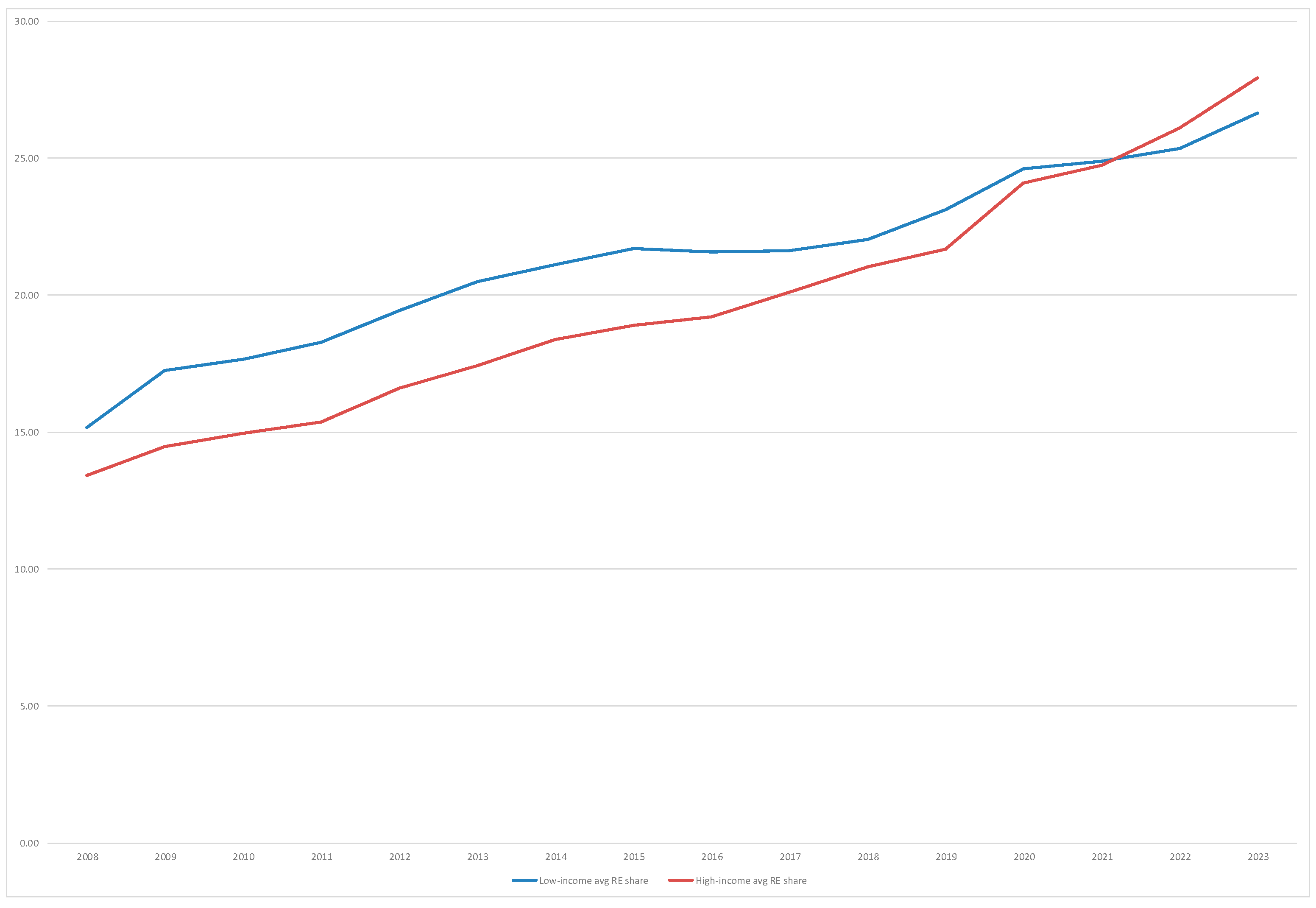
Figure 1 illustrates the evolution of renewable energy shares across income groups over the period 2008–2023, highlighting persistent differences between lower- and higher-income countries. The figure shows that renewable energy adoption increased in both groups over time, although the level and pace of change differ across country groups.
To assess the bivariate relationships between the variables analysed and to identify possible multicollinearity issues, Table 3 presents the Pearson correlation matrix. The results indicate moderate correlations between the explanatory variables, without exceeding the usual critical thresholds. In particular, no high correlations are observed between economic and energy indicators, which supports their inclusion in the same econometric specification.
Although bivariate correlations provide useful information about the relationships between variables, they do not allow causal inferences. Therefore, the analysis continues with econometric estimations on panel data, using fixed-effects models.

3.2. Results of Fixed-Effects Models

Table 4 reports the results of the fixed-effects estimations, controlling for country- and year-specific effects and using clustered standard errors.
In Model 1, which includes the baseline economic and structural variables, GDP per capita exhibits a negative and statistically significant coefficient, suggesting that, within countries over time, increases in income are not necessarily associated with a higher share of renewable energy. This result reflects the conditional nature of the fixed-effects estimator, capturing within-country dynamics rather than cross-country differences. In contrast, R&D expenditure does not show a statistically significant effect in this specification, indicating that, once country-specific characteristics are controlled for, innovation expenditure alone is not systematically associated with higher renewable energy shares. The share of industrial employment has a negative but statistically insignificant coefficient, suggesting limited direct influence of industrial structure in the baseline model.
Model 2 extends the analysis by including energy-related variables. Final energy consumption per capita has a negative coefficient, although not statistically significant, indicating that higher energy demand may act as a constraint on the expansion of renewable energy. Energy import dependency also shows no statistically significant effect.
In Model 3, which additionally includes greenhouse gas emissions, the coefficient on emissions is negative but not statistically significant. The inclusion of this variable does not substantially alter the magnitude or significance of the other coefficients, suggesting that the relationships identified are relatively stable across specifications.
Overall, the fixed-effects estimations suggest that the determinants considered have limited and non-uniform explanatory power once country-specific characteristics and common time effects are controlled for.

3.3. Sensitivity Tests

Additional sensitivity studies were conducted to evaluate the stability of the correlations indicated in the primary models; the findings are shown in Table 5. These analyses seek to confirm whether the inclusion of exceptional events during the studied period or the specification of the dependent variable affects the outcomes.
In the first alternative specification, the dependent variable is redefined as the annual change in the share of renewable energy (ΔREN share), allowing the analysis to focus on short-term dynamics. In the second specification, the year 2020 is excluded in order to assess whether the pandemic period materially affects the estimates.
The results indicate that the estimated relationships remain weak and generally not statistically significant across alternative specifications. While the direction of some coefficients is broadly preserved, the lack of consistent statistical significance suggests that the influence of the examined variables is limited and sensitive to model specification. Overall, the sensitivity analyses confirm that the main findings are characterized by instability and heterogeneity rather than robust and uniform effects.

3.4. Heterogeneity Analysis

The analysis is expanded by separate estimates for groups of nations defined according to the degree of economic development in order to investigate the variations among the Member States of the European Union with regard to the factors influencing the adoption of renewable energy. For this purpose, the sample is divided into two subgroups, corresponding to countries with gross domestic product per capita below and above the sample median, and the results are presented in Table 6.
The results reveal substantial differences between the two groups of countries, but these differences are not consistent in direction or statistical significance. In particular, R&D expenditure shows a positive but statistically insignificant coefficient in lower-income countries, while in higher-income countries it is negative and statistically significant. This suggests that the relationship between innovation and renewable energy adoption is not uniform and may depend on structural and institutional factors. Similarly, most other variables do not display stable or significant effects across the two groups. Overall, the findings point to heterogeneous and context-dependent relationships rather than clear or systematic differences between income groups. In particular, the sign of the R&D coefficient differs across income groups, while most of the remaining variables remain statistically weak.
To formally assess heterogeneity, interaction terms between key explanatory variables and a high-income country dummy were included in an extended specification. The results confirm that the effects of the main determinants differ across country groups, although these differences remain statistically weak and not consistently robust across specifications.
The split-sample estimates provide exploratory evidence of heterogeneity, while the interaction-based specification presented in the following subsection offers a more formal test of differential effects.

3.5. Interaction Test

To complement the split-sample analysis, an extended specification including an interaction term between GDP per capita and a high-income country dummy was estimated. This approach allows testing whether the effect of income on renewable energy adoption differs across groups of countries within a unified econometric framework.
The results indicate that the inclusion of the interaction term does not substantially alter the main findings. In particular, the estimated effects remain weak and not consistently statistically significant, suggesting that differences between country groups are limited and sensitive to model specification.
Overall, the interaction-based approach confirms that the relationship between income and renewable energy adoption is not uniform across countries, but these differences are not sufficiently strong to indicate robust asymmetric effects.

4. Discussion

The results indicate that the relationship between renewable energy adoption and its economic, structural, and energy determinants is limited and heterogeneous. After controlling for country-specific effects and common time shocks, most explanatory variables do not exhibit statistically significant and robust associations with the share of renewable energy. This confirms that the energy transition in the European Union is shaped primarily by structural and institutional heterogeneity rather than by uniform and strong drivers [82,83].
One of the most notable results is the negative and statistically significant coefficient of GDP per capita in the baseline specification. Within the fixed-effects framework, this reflects within-country dynamics rather than cross-country differences. The result indicates that increases in income over time are not systematically associated with a higher share of renewable energy. This pattern reflects structural lock-in effects, persistent reliance on conventional energy systems, and the inertia of existing energy infrastructures in more developed economies. These mechanisms are consistent with the literature on path dependency and technological inertia in energy systems [84,85].
Research and development expenditure does not exhibit a statistically significant effect across the main specifications. This indicates that aggregate R&D expenditure, measured as a share of GDP, does not capture the specific dynamics of energy-related innovation. The absence of a robust effect reflects the fact that innovation impacts depend on sectoral allocation, time lags, and the presence of complementary institutional and market conditions. This interpretation is consistent with studies showing that the effectiveness of innovation policies is conditional on the broader economic and institutional environment [86].
The role of structural factors, proxied by industrial employment, appears limited in the econometric results, despite the theoretical expectation that industrial intensity influences energy demand and transition pathways. This reflects the heterogeneity of industrial structures across EU countries and the coexistence of both energy-intensive and progressively decarbonized sectors. Structural transformation is gradual and constrained by existing production systems and capital stock, which reduces the immediate impact of industrial structure on renewable energy adoption [87,88].
Energy-related variables, including final energy consumption and import dependency, do not exhibit statistically significant effects in the main specifications. However, their coefficients indicate that higher energy demand and external dependency act as structural constraints on the expansion of renewable energy. These results show that the energy transition is not driven by isolated factors, but by the interaction between demand conditions, infrastructure, and policy frameworks. The role of energy efficiency and demand-side management remains essential in this context [89,90].
The inclusion of greenhouse gas emissions does not significantly alter the estimated relationships. This indicates that the level of emissions alone does not explain variations in renewable energy shares once unobserved heterogeneity is controlled for. The result confirms that the transition to renewable energy depends on broader structural and institutional conditions rather than on current emission levels alone. Similar conclusions are reported in studies on long-term emissions dynamics in developed economies [91].
The heterogeneity analysis further supports the existence of differentiated patterns across EU Member States. The estimated relationships vary in both magnitude and statistical significance between country groups, without a consistent direction. This confirms that renewable energy adoption is shaped by country-specific structural, economic, and institutional conditions.
The interaction-based specification further confirms that the effects of key determinants vary across country groups, although these differences remain limited and not consistently robust.
From a policy perspective, these findings indicate that the promotion of renewable energy cannot rely on a uniform set of instruments applied across all Member States. The effectiveness of policies depends on national structural characteristics, levels of development, and institutional capacity. In particular, innovation policies, energy efficiency measures, and energy security strategies require adaptation to the specific context of each economy. This approach is consistent with recent European policy frameworks emphasizing integrated and differentiated strategies for the energy transition.
Overall, the results indicate that the energy transition in the European Union is characterized by conditional and heterogeneous relationships rather than uniform and strongly deterministic effects. This highlights the importance of adopting a multidimensional and context-specific approach in both empirical analysis and policy design.

5. Conclusions

This study examined the economic, structural, and energy determinants of renewable energy adoption in the European Union, using a balanced panel data set for the 27 Member States over the period 2008–2023 and a fixed-effects econometric framework.
The results indicate that the relationships between renewable energy adoption and its main determinants are generally limited and lack statistical robustness across model specifications. Most explanatory variables, including research and development expenditure, environmental taxation, and energy-related indicators, do not exhibit consistent and statistically significant effects once country-specific characteristics and common time shocks are controlled for.
The negative coefficient associated with GDP per capita in some specifications highlights the importance of within-country dynamics and suggests the presence of structural inertia and path dependency in energy systems. This finding indicates that higher levels of economic development do not automatically translate into an increased share of renewable energy over time.
The analysis also shows that commonly used macroeconomic indicators have limited explanatory power in capturing the complexity of the energy transition. Factors such as innovation capacity, energy demand, and external dependency appear to operate through indirect, context-dependent mechanisms that are not fully captured by aggregate indicators.
The heterogeneity analysis confirms that the relationships between renewable energy and its determinants vary across groups of countries, reflecting differences in economic structure, institutional capacity, and energy systems. This supports the conclusion that renewable energy adoption in the European Union follows differentiated national trajectories rather than a uniform pattern.
From a policy perspective, the results indicate that uniform approaches to promoting renewable energy may generate uneven outcomes across Member States. Effective policy design requires adaptation to country-specific structural conditions, including the level of development, industrial composition, and institutional capacity. In particular, policies targeting innovation, energy efficiency, and energy security should be integrated within broader national development strategies.
The study contributes to the literature by providing a comprehensive EU-wide analysis over an extended period and by highlighting the limits of standard macroeconomic determinants in explaining renewable energy adoption. Rather than identifying strong universal drivers, the results emphasize the importance of contextual and structural factors in shaping the energy transition.
Several limitations should be acknowledged. The analysis relies on aggregated national-level data, which does not capture regional or sectoral heterogeneity within Member States. In addition, the empirical framework does not explicitly account for specific policy instruments or dynamic adjustment processes. Future research could extend this approach by incorporating more detailed policy variables, sectoral data, or dynamic econometric models to better capture the mechanisms underlying the energy transition.

Author Contributions

Conceptualization, J.A.-F., M.L. and M.A.; methodology, J.A.-F., M.M. and C.C.-L.; software, M.M.; validation, J.A.-F., M.M., C.C.-L. and M.L.; formal analysis, M.M. and C.C.-L.; investigation, T.V.C. and M.M.M.; resources, A.I.D.; data curation, M.M.M. and T.V.C.; writing—original draft preparation, J.A.-F. and M.A.; writing—review and editing, J.A.-F., M.A., M.L. and A.I.D.; visualization, C.C.-L. and T.V.C.; supervision, M.A.; project administration, M.A.; funding acquisition, A.I.D. All authors have read and agreed to the published version of the manuscript.

Funding

This research received no external funding.

Institutional Review Board Statement

Not applicable.

Data Availability Statement

The raw data supporting the conclusions of this article will be made available by the authors on request.

Conflicts of Interest

The authors declare no conflicts of interest.

Abbreviations

The following abbreviations are used in this manuscript:
REN shareRenewable energy share
GDP pcGross domestic product per capita;
RD GDPResearch and development expenditure
ENV TAXEnvironmental taxes
IND empIndustrial employment
FEC pcFinal energy consumption per capita
IMP DEPEnergy import dependency
GHG pcGreenhouse gas emissions per capita
PPSPurchasing power standards
EUEuropean Union

References

  1. European Commission. The European Green Deal. 2019. Available online: https://eur-lex.europa.eu/legal-content/EN/TXT/?uri=COM:2019:640:FIN (accessed on 4 January 2026).
  2. European Union. Directive (EU) 2018/2001 of the European Parliament and of the Council on the Promotion of the Use of Energy from Renewable Sources. Off. J. Eur. Union 2018, L328, 82–209. [Google Scholar]
  3. European Union. Directive (EU) 2023/2413 Amending Directive (EU) 2018/2001 on the Promotion of the Use of Energy from Renewable Sources. Off. J. Eur. Union 2023, L2023, 1–77. [Google Scholar]
  4. European Commission. REPowerEU: Joint European Action for More Affordable, Secure and Sustainable Energy. 2022. Available online: https://ec.europa.eu/newsroom/chju/items/741484#:~:text=The%20Commission%20proposes%20to%20develop%20a%20REPowerEU%20plan,increasing%20renewables%20and%20electrification%2C%20and%20addressing%20infrastructure%20bottlenecks (accessed on 12 January 2026).
  5. Eurostat. Renewable Energy Statistics. Available online: https://ec.europa.eu/eurostat/statistics-explained/index.php/Renewable_energy_statistics (accessed on 4 January 2026).
  6. European Environment Agency. Share of Energy Consumption from Renewable Sources in Europe. Available online: https://www.eea.europa.eu/en/analysis/indicators/share-of-energy-consumption-from (accessed on 4 January 2026).
  7. Marques, A.C.; Fuinhas, J.A.; Manso, J.R.P. Motivations Driving Renewable Energy in European Countries: A Panel Data Approach. Energy Policy 2010, 38, 6877–6885. [Google Scholar] [CrossRef]
  8. Papież, M.; Śmiech, S.; Frodyma, K. Determinants of Renewable Energy Development in the EU Countries. Renew. Sustain. Energy Rev. 2018, 81, 918–934. [Google Scholar] [CrossRef]
  9. Camacho Ballesta, J.A.; da Silva Almeida, L.; Rodríguez, M. An Analysis of the Main Driving Factors of Renewable Energy Consumption in the European Union. Environ. Sci. Pollut. Res. 2022, 29, 35110–35123. [Google Scholar] [CrossRef]
  10. Dincă, G. Renewable Energy Transitions in the EU: A Comparative Analysis. Energies 2025, 18, 4836. [Google Scholar] [CrossRef]
  11. Simionescu, M. Renewable Energy in the Electricity Sector and GDP per Capita in the European Union. Energies 2019, 12, 2520. [Google Scholar] [CrossRef]
  12. Tutar, H. Sectoral Dynamics of Sustainable Energy Transition in EU-27 Countries. Energies 2026, 19, 457. [Google Scholar] [CrossRef]
  13. Saba, C.S.; Biyase, M. Determinants of Renewable Electricity Development in Europe: Do Governance Indicators and Institutional Quality Matter? Energy Rep. 2022, 8, 13914–13938. [Google Scholar] [CrossRef]
  14. Apergis, N.; Payne, J.E. Renewable Energy Consumption and Economic Growth: Evidence from OECD Countries. Energy Policy 2010, 38, 656–660. [Google Scholar] [CrossRef]
  15. Soava, G.; Mehedintu, A.; Sterpu, M.; Raduteanu, M. Impact of Renewable Energy Consumption on Economic Growth in EU-28. Technol. Econ. Dev. Econ. 2018, 24, 914–932. [Google Scholar] [CrossRef]
  16. Pao, H.-T.; Fu, H.-C. Renewable Energy, Non-Renewable Energy and Economic Growth. Energy Policy 2013, 52, 415–424. [Google Scholar] [CrossRef]
  17. Nuță, F.M.; Mărcuță, A.G.; Dimen, L.; Mărcuță, L.; Gaban, L.; Hajiyeva, N.; Nuță, A.C. The Role of Poverty and Gender in Shaping Households’ Energy Consumption Patterns in Selected European Countries. Energies 2025, 18, 1266. [Google Scholar] [CrossRef]
  18. Dutta, C.B. Exploring Heterogeneity in Income Elasticity of Renewable Energy Deployment. Environ. Dev. Sustain. 2025, 27, 11245–11268. [Google Scholar] [CrossRef]
  19. Jarno, K. Energy Prices and Growth of Renewable Energy Share in the EU. Bank Kredyt 2020, 51, 203–226. [Google Scholar]
  20. Ülger Danacı, Ö. Renewable versus Fossil Energy and Economic Growth in the EU. Energies 2025, 18, 4745. [Google Scholar] [CrossRef]
  21. Gasser, M.; Pezzutto, S.; Sparber, W.; Wilczynski, E. Public R&D Funding for Renewable Energy Technologies in Europe. Sustainability 2022, 14, 5557. [Google Scholar] [CrossRef]
  22. Herzer, D. The Impact of Government-Funded Renewable Energy R&D on Its Consumption. J. Policy Model. 2025, 47, 903–918. [Google Scholar] [CrossRef]
  23. Ostadzad, A.H. Innovation and carbon emissions: Fixed-effects panel threshold model estimation for renewable energy. Renew. Energy 2022, 198, 602–617. [Google Scholar] [CrossRef]
  24. Kureková, L.; Cermakova, K.; Hromada, E.; Kaderabkova, B. Public R&D and Sustainable Development Outcomes in the EU. Int. J. Econ. Sci. 2023, 12, 40–62. [Google Scholar]
  25. Khan, H.; Khan, I.; Binh, T.T. The heterogeneity of renewable energy consumption, carbon emission and financial development in the globe: A panel quantile regression approach. Energy Rep. 2020, 6, 859–867. [Google Scholar] [CrossRef]
  26. Botha, I.; Gherghina, Ş.C.; Simionescu, L.N.; Botezatu, M.A.; Coculescu, C. Investigating the Drivers of Renewable Energy Production: Panel Data Evidence for Central and Eastern European Countries. ECECSR J. 2022, 56, 5–22. [Google Scholar] [CrossRef]
  27. Popp, D.; Hascic, I.; Medhi, N. Technology and the Diffusion of Renewable Energy. Energy Econ. 2011, 33, 648–662. [Google Scholar] [CrossRef]
  28. Hasanbeigi, A.; Price, L.; Lin, E. Emerging energy-efficiency and CO2 emission-reduction technologies for cement and concrete production: A technical review. Renew. Sustain. Energy Rev. 2012, 16, 6220–6238. [Google Scholar] [CrossRef]
  29. Griffin, P.W.; Hammond, G.P.; Norman, J.B. Industrial energy use and carbon emissions reduction: A UK perspective. WIREs Energy Environ. 2016, 5, 684–714. [Google Scholar] [CrossRef]
  30. Cherp, A.; Jewell, J. The Concept of Energy Security: Beyond the Four As. Energy Policy 2014, 75, 415–421. [Google Scholar] [CrossRef]
  31. Le Quéré, C.; Korsbakken, J.I.; Wilson, C.; Tosun, J.; Andrew, R.; Andres, R.J.; Van Vuuren, D.P. Drivers of Declining CO2 Emissions in 18 Developed Economies. Nat. Clim. Change 2019, 9, 213–217. [Google Scholar] [CrossRef]
  32. Balsalobre-Lorente, D.; Contente dos Santos Parente, C.; Leitão, N.C.; Cantos-Cantos, J.M. The influence of economic complexity processes and renewable energy on CO2 emissions of BRICS: What about Industry 4.0? Resour. Policy 2023, 82, 103547. [Google Scholar] [CrossRef]
  33. Dogan, E.; Hodžić, S.; Šikić, T.F. Do energy and environmental taxes stimulate or inhibit renewable energy deployment in the European Union? Renew. Energy 2023, 202, 1138–1145. [Google Scholar] [CrossRef]
  34. Leitão, N.C. Environmental Taxes and Environmental Outcomes. Energies 2025, 18, 2543. [Google Scholar] [CrossRef]
  35. Carfora, A.; Pansini, R.V.; Scandurra, G. Energy dependence, renewable energy generation and import demand: Are EU countries resilient? Renew. Energy 2022, 195, 1262–1274. [Google Scholar] [CrossRef]
  36. Firtescu, B.N.; Bostan, I.; Grosu, M.; Droj, L.; Mihalciuc, C.C. Increasing the share of renewable energy sources (RESs) in the specific portfolio by using the taxation mechanism: Study at the level of EU states. Econ. Anal. Policy 2025, 85, 1534–1549. [Google Scholar] [CrossRef]
  37. European Union. Directive 2003/87/EC Establishing the EU Emissions Trading System. Off. J. Eur. Union 2003, L275, 32–46. [Google Scholar]
  38. Lupu, I.; Hurduzeu, G.; Lupu, R.; Popescu, M.F.; Gavrilescu, C. Drivers for Renewable Energy Consumption in European Union Countries. A Panel Data Insight. Amfiteatru Econ. 2023, 25, 380–396. [Google Scholar] [CrossRef]
  39. Arion, F.H.; Aleksanyan, V.; Markosyan, D.; Arion, I.D. Circular Pathways to Sustainable Development in EU-27. Sustainability 2023, 15, 16883. [Google Scholar] [CrossRef]
  40. European Commission. Fit for 55: Delivering the EU’s 2030 Climate Target. 2021. Available online: https://commission.europa.eu/strategy-and-policy/priorities-2019-2024/european-green-deal/fit-55_en (accessed on 10 January 2026).
  41. International Energy Agency. Renewables 2023: Analysis and Forecast to 2028. 2023. Available online: https://www.iea.org/reports/renewables-2023 (accessed on 10 January 2026).
  42. International Energy Agency. Energy Policies of IEA Countries: European Union 2023 Review. 2023. Available online: https://www.iea.org/reports/energy-policies-of-iea-countries-european-union-2023 (accessed on 10 January 2026).
  43. Jänicke, M. Green Growth: From a Growing Eco-Industry to Economic Sustainability. Energy Policy 2012, 48, 13–21. [Google Scholar] [CrossRef]
  44. Johnstone, N.; Haščič, I.; Popp, D. Renewable Energy Policies and Technological Innovation: Evidence Based on Patent Counts. Environ. Resour. Econ. 2010, 45, 133–155. [Google Scholar] [CrossRef]
  45. Aghion, P.; Dechezleprêtre, A.; Hémous, D.; Martin, R.; Van Reenen, J. Carbon Taxes, Path Dependency, and Directed Technical Change. J. Political Econ. 2016, 124, 1–51. [Google Scholar] [CrossRef]
  46. Costantini, V.; Crespi, F. Environmental Regulation and the Export Dynamics of Energy Technologies. Ecol. Econ. 2008, 66, 447–460. [Google Scholar] [CrossRef]
  47. Crespi, F.; Guarascio, D.; Quatraro, F. Environmental policy, innovation and green jobs. J. Evol. Econ. 2020, 30, 473–499. [Google Scholar]
  48. Polzin, F.; Sanders, M.; Täube, F. A diverse and resilient financial system for investments in the energy transition. Curr. Opin. Environ. Sustain. 2017, 28, 24–32. [Google Scholar] [CrossRef]
  49. Schmidt, T.S.; Sewerin, S. Measuring the temporal dynamics of policy mixes—An empirical analysis of renewable energy policy mixes’ balance and design features in nine countries. Res. Policy 2019, 48, 103557. [Google Scholar] [CrossRef]
  50. Iagăru, P.; Mărcuță, L.; Iagăru, R.; Mărcuță, A. Sustainable Resource Management, the Source of Production Integration, Biodiversity Conservation and Socio-Cultural Values in Grassland Ecosystems. Rom. Biotechnol. Lett. 2020, 25, 1984–1991. [Google Scholar] [CrossRef]
  51. Rogge, K.S.; Reichardt, K. Policy Mixes for Sustainability Transitions. Res. Policy 2016, 45, 1620–1635. [Google Scholar] [CrossRef]
  52. Baltagi, B.H. Econometric Analysis of Panel Data, 5th ed.; Wiley: Chichester, UK, 2013. [Google Scholar]
  53. Wooldridge, J.M. Econometric Analysis of Cross Section and Panel Data, 2nd ed.; MIT Press: Cambridge, MA, USA, 2010. [Google Scholar]
  54. Pesaran, M.H. Estimation and Inference in Large Heterogeneous Panels. Econometrica 2006, 74, 967–1012. [Google Scholar] [CrossRef]
  55. Eberhardt, M.; Teal, F. The magnitude of the task ahead: Macro implications of heterogeneous technology. Rev. Income Wealth 2020, 66, 334–360. [Google Scholar] [CrossRef]
  56. Li, T. Econometric Analysis of Cross Section and Panel Data. J. Econ. Lit. 2002, 40, 1239. [Google Scholar]
  57. Paul, R.K. Econometric Analysis Using Panel Data; Indian Agricultural Statistics Research Institute: New Delhi, India, 2011. [Google Scholar]
  58. Hsiao, C. Analysis of Panel Data, 3rd ed.; Cambridge University Press: Cambridge, UK, 2014. [Google Scholar]
  59. Greene, W.H. Econometric Analysis, 8th ed.; Pearson: New York, NY, USA, 2018. [Google Scholar]
  60. Cameron, A.C.; Trivedi, P.K. Microeconometrics Using Stata; Stata Press: College Station, TX, USA, 2010. [Google Scholar]
  61. Angrist, J.D.; Pischke, J.-S. Mostly Harmless Econometrics: An Empiricist’s Companion; Princeton University Press: Princeton, NJ, USA, 2009. [Google Scholar]
  62. Arellano, M. Panel Data Econometrics. In The Oxford Handbook of Econometrics; Oxford University Press: Oxford, UK, 2003; Volume 1, pp. 1–32. [Google Scholar]
  63. Beck, N.; Katz, J.N. What To Do (and Not to Do) with Time-Series Cross-Section Data. Am. Political Sci. Rev. 1995, 89, 634–647. [Google Scholar] [CrossRef]
  64. Hausman, J.A. Specification Tests in Econometrics. Econometrica 1978, 46, 1251–1271. [Google Scholar] [CrossRef]
  65. Mundlak, Y. On the Pooling of Time Series and Cross Section Data. Econometrica 1978, 46, 69–85. [Google Scholar] [CrossRef]
  66. Arellano, M. Computing Robust Standard Errors for Within-Groups Estimators. Oxf. Bull. Econ. Stat. 1987, 49, 431–434. [Google Scholar] [CrossRef]
  67. Bertrand, M.; Duflo, E.; Mullainathan, S. How Much Should We Trust Differences-in-Differences Estimates? Q. J. Econ. 2004, 119, 249–275. [Google Scholar] [CrossRef]
  68. Pesaran, M.H. General Diagnostic Tests for Cross-Section Dependence in Panels. Empir. Econ. 2020, 60, 13–50. [Google Scholar] [CrossRef]
  69. Leamer, E.E. Sensitivity Analysis in Econometrics; Edward Elgar: Cheltenham, UK, 1985. [Google Scholar]
  70. Sala-i-Martin, X. I Just Ran Two Million Regressions. Am. Econ. Rev. 1997, 87, 178–183. [Google Scholar]
  71. Hoover, K.D.; Perez, S.J. Data Mining Reconsidered: Encompassing and the General-to-Specific Approach to Specification Search. Econom. J. 1999, 2, 167–191. [Google Scholar] [CrossRef]
  72. Eurostat. Share of Energy from Renewable Sources. Available online: https://ec.europa.eu/eurostat/statistics-explained/index.php/Share_of_energy_from_renewable_sources (accessed on 12 January 2026).
  73. Eurostat. GDP and Main Components per Capita. Available online: https://ec.europa.eu/eurostat/statistics-explained/index.php/GDP_and_main_components_per_capita (accessed on 12 January 2026).
  74. Eurostat. Gross Domestic Expenditure on R&D (GERD). Available online: https://ec.europa.eu/eurostat/statistics-explained/index.php/Research_and_development_expenditure (accessed on 12 January 2026).
  75. Eurostat. Environmental Tax Revenues. Available online: https://ec.europa.eu/eurostat/statistics-explained/index.php/Environmental_taxes (accessed on 12 January 2026).
  76. Eurostat. Final Energy Consumption. Available online: https://ec.europa.eu/eurostat/statistics-explained/index.php/Energy_consumption_in_households (accessed on 12 January 2026).
  77. Eurostat. Employed Persons by Economic Activity (NACE Rev. 2). Available online: https://ec.europa.eu/eurostat/statistics-explained/index.php/Employment_statistics (accessed on 12 January 2026).
  78. Eurostat. Population Change–Demographic Balance and Crude Rates at National Level. Available online: https://ec.europa.eu/eurostat/statistics-explained/index.php/Population_change_statistics (accessed on 12 January 2026).
  79. Eurostat. Energy Import Dependency. Available online: https://ec.europa.eu/eurostat/statistics-explained/index.php/Energy_import_dependency (accessed on 12 January 2026).
  80. Eurostat. Greenhouse Gas Emissions by Source Sector. Available online: https://ec.europa.eu/eurostat/statistics-explained/index.php/Greenhouse_gas_emissions (accessed on 12 January 2026).
  81. Eurostat. Energy Consumption and Efficiency Statistics. Available online: https://ec.europa.eu/eurostat/statistics-explained/index.php/Energy_consumption_and_efficiency_statistics (accessed on 12 January 2026).
  82. European Commission. Clean Energy for All Europeans Package. 2019. Available online: https://energy.ec.europa.eu/topics/energy-strategy/clean-energy-all-europeans_en (accessed on 12 January 2026).
  83. Popp, D.; Newell, R.G.; Jaffe, A.B. Energy, the Environment, and Technological Change. In Handbook of the Economics of Innovation; Elsevier: Amsterdam, The Netherlands, 2010; Volume 2, pp. 873–937. [Google Scholar] [CrossRef]
  84. Aghion, P.; Hepburn, C.; Teytelboym, A.; Zenghelis, D. Path Dependence, Innovation and the Economics of Climate Change. In Handbook on Green Growth; Edward Elgar: Cheltenham, UK, 2019; pp. 67–83. [Google Scholar]
  85. Girlovan, A.; Tudor, C.; Saiu, G.R.; Guse, D.D. Exploring the Impact of Globalization and Economic-Energy Dynamics on Environmental Sustainability in the EU. Glob. Transit. 2025, 7, 41–55. [Google Scholar] [CrossRef]
  86. European Commission. Horizon Europe: Climate, Energy and Mobility. 2021. Available online: https://research-and-innovation.ec.europa.eu/funding/funding-opportunities/funding-programmes-and-open-calls/horizon-europe_en (accessed on 12 January 2026).
  87. Maghrabi, A.M.; Song, J.; Markides, C.N. How Can Industrial Heat Decarbonisation Be Accelerated through Energy Efficiency? Appl. Therm. Eng. 2023, 233, 121092. [Google Scholar] [CrossRef]
  88. OECD. Industrial Policy for the Net-Zero Transition. 2023. Available online: https://www.oecd.org/industry/industrial-policy-net-zero-transition/ (accessed on 12 January 2026).
  89. Eurostat. Energy Efficiency Indicators. Available online: https://ec.europa.eu/eurostat/statistics-explained/index.php/Energy_efficiency_statistics (accessed on 12 January 2026).
  90. International Energy Agency. Energy Security and Energy Transition. 2022. Available online: https://www.iea.org/reports/energy-security-and-energy-transition (accessed on 12 January 2026).
  91. Wu, R.; Wang, J.; Wang, S.; Feng, K. The Drivers of Declining CO2 Emissions Trends in Developed Nations Using an Extended STIRPAT Model: A Historical and Prospective Analysis. Renew. Sustain. Energy Rev. 2021, 149, 111328. [Google Scholar] [CrossRef]
Figure 1. Evolution of renewable energy share by income groups in the EU27 in 2008–2023.
Agriculture 16 00999 g001
Table 1. Panel unit root tests (LLC and IPS).
VariableLLC Test StatisticIPS Test Statisticp-ValueStationarity
ln(GDP per capita)−1.210.84>0.10Non-stationary
R&D expenditure (% GDP)−3.45−2.98<0.01Stationary
Environmental taxes (% GDP)−2.87−2.41<0.05Stationary
Industrial employment−2.65−2.12<0.05Stationary
ln(Final energy consumption per capita)−1.78−1.05>0.10Mixed
Energy import dependency−2.94−2.36<0.05Stationary
GHG emissions per capita−1.56−0.92>0.10Mixed
Notes: LLC and IPS denote Levin–Lin–Chu and Im–Pesaran–Shin panel unit root tests. Stationarity is assessed at conventional significance levels. “Mixed” results indicate differences across test specifications.
Table 2. Descriptive statistics for the EU27 sample for 2008–2023.
VariableObsMeanStd.DevMinMax
Renewable energy share43220.5112.010.2066.39
GDP per capita (PPS)43229,374.8413,581.1010,512.3095,125.40
R&D expenditure (% of GDP)4321.610.900.383.73
Environmental taxes (% of GDP)4322.650.740.855.60
Final energy consumption per capita4320.770.380.072.20
Energy import dependency43257.0724.45−21.13104.14
GHG emissions per capita4328.953.274.0525.13
Industrial employment4321295.971846.6010.008796.20
Table 3. Correlation matrix of the main variables.
VariableRenewable Energy
Share
GDP per Capita (PPS)R&D Expenditure
(% of GDP)
Environmental Taxes
(% of GDP)
Final Energy Consumption per
Capita
(log)
Energy Import DependencyGreenhouse Gas Emissions per CapitaIndustrial Employment
Renewable energy share1−0.090.420.070.08−0.45−0.42−0.18
GDP per capita (PPS)−0.0910.33−0.340.720.310.50−0.03
R&D expenditure
(% of GDP)
0.420.3310.030.58−0.250.130.19
Environmental taxes
(% of GDP)
0.07−0.340.031−0.10−0.23−0.02−0.14
Final energy consumption per
capita (log)
0.080.720.58−0.1010.090.67−0.08
Energy import dependency−0.450.31−0.25−0.230.0910.07−0.02
Greenhouse gas emissions per capita−0.420.500.13−0.020.670.071−0.04
Industrial employment−0.18−0.030.19−0.14−0.08−0.02−0.041
Table 4. Fixed-effects models explaining the share of renewable energy in final consumption.
VariableModel 1Model 2Model 3
Coef(Std.Err.)Coef(Std.Err.)Coef(Std.Err.)
ln(GDP/capita)−6.686 **(2.900)−3.728(3.495)−3.798(3.293)
R&D expenditure (% of GDP)−1.129(0.895)−0.997(1.077)−0.621(0.962)
Environmental taxes (% of GDP)−0.908(0.791)−0.631(0.773)−0.564(0.750)
Industrial employment−0.001(0.002)−0.001(0.002)−0.001(0.002)
ln(Final energy consumption/capita) −5.035(4.015)−0.948(3.537)
Energy import dependency 0.005(0.050)0.002(0.049)
GHG emissions per capita −0.439(0.308)
Notes: Coefficients are reported from fixed-effects regressions with country and year fixed effects. Robust standard errors clustered at the country level are reported in parentheses. Significance levels: ** p < 0.05.
Table 5. Sensitivity analyses of the baseline fixed-effects models.
VariableΔREN ShareExcluding 2020
Coef(Std.Err.)Coef(Std.Err.)
ln(GDP per capita)0.320(0.335)−3.948(3.338)
R&D expenditure (% of GDP)0.109(0.089)−0.603(1.022)
Environmental taxes (% of GDP)−0.011(0.086)−0.611(0.747)
Industrial employment−0.000 ***(0.000)−0.001(0.002)
ln(Final energy consumption per capita)−0.089(0.267)0.512(3.266)
Energy import dependency−0.004(0.004)0.006(0.058)
GHG emissions per capita−0.033(0.025)−0.546(0.363)
Notes: Standard errors are clustered at country level and reported in parentheses. In the specification with annual variation in renewable energy share (ΔREN share), country fixed effects are removed by construction, while year fixed effects are included. Statistical significance levels are: *** p < 0.01.
Table 6. Fixed-effects estimates by income groups (EU27).
VariableLow-Income EUHigh-Income EU
Coef(Std.Err.)Coef(Std.Err.)
ln(GDP per capita)−4.782(4.245)−6.427(4.950)
R&D expenditure (% of GDP)1.363(1.083)−2.413 ***(0.855)
Environmental taxes (% of GDP)0.570(0.554)−1.520(1.289)
Industrial employment0.000(0.002)−0.002(0.002)
ln(Final energy consumption per capita)2.364(5.159)2.340(6.059)
Energy import dependency−0.082 *(0.043)0.048(0.042)
GHG emissions per capita−0.125(0.202)−0.019(0.462)
Notes: Coefficients are reported from fixed-effects regressions with country and year fixed effects estimated separately for each subgroup. Robust standard errors clustered at the country level are reported in parentheses. Significance levels: *** p < 0.01, * p < 0.10.
Disclaimer/Publisher’s Note: The statements, opinions and data contained in all publications are solely those of the individual author(s) and contributor(s) and not of MDPI and/or the editor(s). MDPI and/or the editor(s) disclaim responsibility for any injury to people or property resulting from any ideas, methods, instructions or products referred to in the content.