Article

Effects of the Combined Application of Nitrogen, Phosphorus, and Potassium Under Drip Irrigation on the Yield and Quality of Winter Wheat

College of Agronomy, Qingdao Agricultural University, Qingdao 266109, China
*
Author to whom correspondence should be addressed.
These authors contributed equally to this work.
Agriculture 2026, 16(9), 991; https://doi.org/10.3390/agriculture16090991 (registering DOI)
Submission received: 24 March 2026 / Revised: 23 April 2026 / Accepted: 28 April 2026 / Published: 30 April 2026
(This article belongs to the Section Crop Production)

Abstract

A two-year field experiment was conducted to clarify the regulatory effects of nitrogen (N), phosphorus (P), and potassium (K) combined with drip fertigation on the yield, yield components, and grain quality of winter wheat in lime concretion black soil (Calcaric Cambisols). The objective was to screen a sustainable fertilization model for coordinating high yield and quality in the Huang-Huai-Hai Plain. An L16(43) orthogonal design was adopted to investigate yield, protein content, wet gluten, test weight (TW), and grain hardness. Range analysis and ANOVA were used to evaluate factor effects and interactions. The results showed that N was the dominant factor affecting yield and quality (Rank 1), followed by K (Rank 2), while P showed the weakest effect. Compared to the control (N0P0K0), the optimized N–P–K combination increased grain yield by an average of 315.0% and enhanced grain crude protein by 55.3% over the two seasons. The optimal combination for maximum yield was N170P30K120 (kg/ha), which optimized the source–sink relationship by balancing spike density and 1000-grain weight. High N (220 kg/ha) combined with low P and high K achieved the best nutritional quality. The 3D response surface analysis confirmed significant synergistic interactions between N–K and N–P in promoting grain filling and protein synthesis. Rational NPK drip fertigation, particularly when synchronized with critical growth stages (jointing and grain filling), can simultaneously enhance grain yield and quality in this soil type. The optimized combination provides theoretical support and a robust fertilization strategy for green and efficient wheat production in the region.

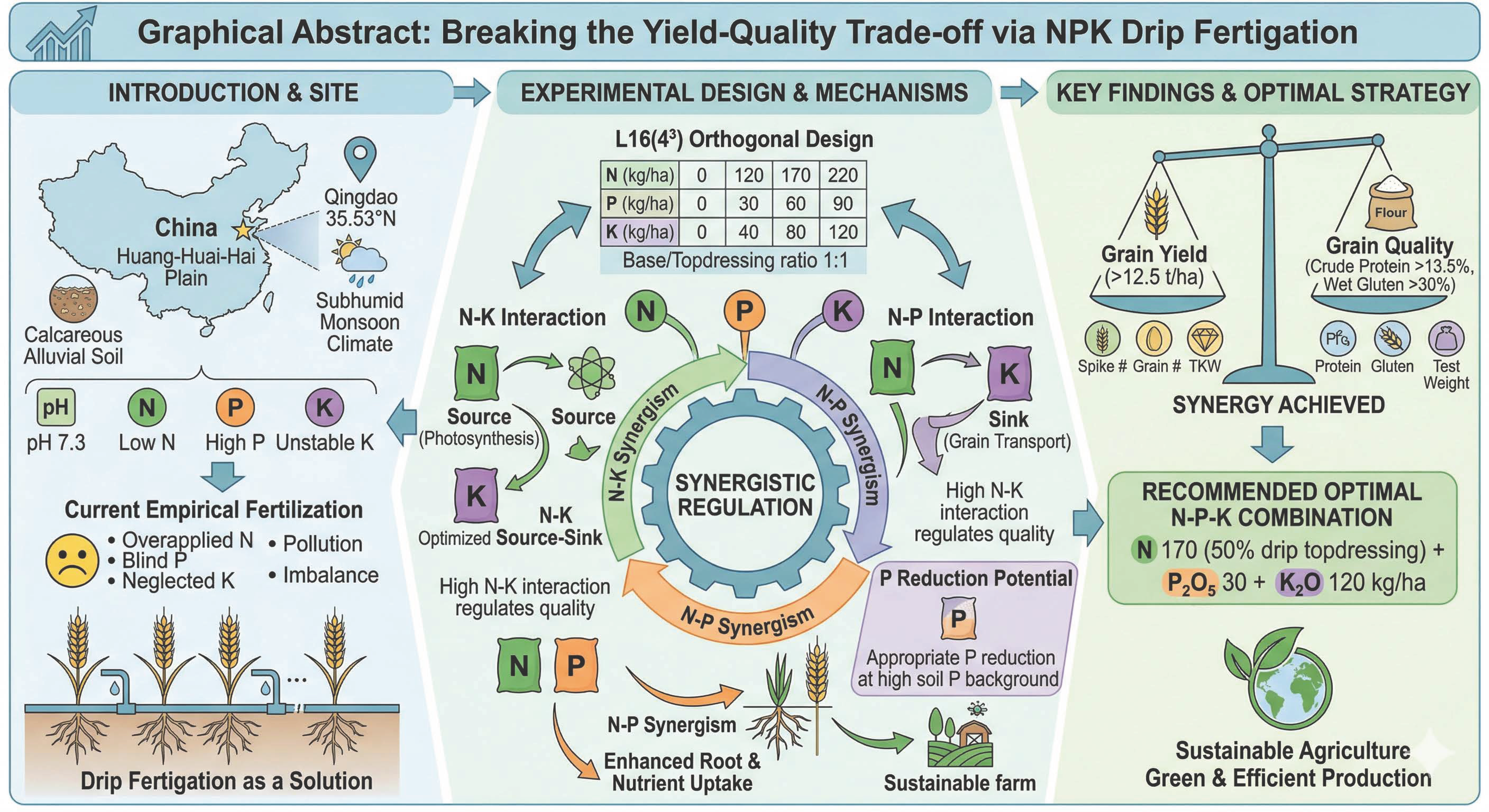
Graphical Abstract

1. Introduction

Winter wheat (Triticum aestivum L.) is a core staple crop globally, playing a pivotal role in safeguarding food security [1]. Wheat production is increasingly focused on improving both yield and grain quality to meet modern dietary demands. The protein components, gluten network structure, and physical properties (e.g., test weight) of grains directly determine the suitability of flour for end-use processing and its commercial value. However, at the crop physiological level, there is often a significant trade-off between high yield and high quality; specifically, a substantial increase in yield is frequently accompanied by a dilution of grain protein concentration [2]. How to break this bottleneck through scientific agronomic practices has become a frontier focus in the international fields of crop nutrition and cereal science. Specifically, managing the synergetic effects of multi-nutrients is crucial for achieving the “win-win” of high productivity and superior processing quality.
Precision nutrient management, particularly drip fertigation, serves as a key driver to mitigate the trade-off between yield and quality by ensuring nutrient supply is synchronized with the crop’s peak physiological demands [3]. Nitrogen, as the primary substrate for protein synthesis, directly defines the lower limit of wheat nutritional quality [4]; as a vital osmotic regulator and enzyme activator, potassium (K) plays a pivotal role in optimizing source–sink dynamics. By facilitating the efficient translocation of photoassimilates from leaves to grains, K enhances grain filling and synergistically modulates nitrogen metabolism through nutrient interactions [5]; phosphorus is widely involved in energy metabolism, ensuring the normal development of reproductive organs [6]. Nevertheless, in current intensive agricultural production, an empirical fertilization pattern of “overemphasizing nitrogen while neglecting potassium, and applying phosphorus blindly” is prevalent. This not only exacerbates the risk of non-point source pollution but also leads to nutrient imbalance in the late growth stage of wheat, easily causing problems such as excessive vegetative growth with delayed maturity or premature senescence under high temperature, which severely restricts the formation of high-grade processing quality.
The Huang-Huai-Hai Plain is the largest winter wheat-producing area in China, where lime concretion black soil (classified as Calcaric Cambisols according to the WRB system) is the dominant soil type. This soil type is characterized by its heavy clay texture, compact structure, poor aeration, and low nutrient availability, which together restrict root development and high-yield production [7]. Currently, most fertilization studies in this region are limited to the yield-increasing effects of single nutrients or conventional field phenotypes, and there is a lack of systematic analysis on the comprehensive impacts of the combined application of nitrogen (N), phosphorus (P), and potassium (K) on both yield and quality from a multi-factor interaction perspective. In particular, the potential for phosphorus reduction under high soil phosphorus background, and the regulation of “quality lag behind yield” by high nitrogen–potassium interaction, remain unclear.
Based on the above background, a field experiment was conducted in a typical lime concretion black soil area using an L16(43) randomized complete block orthogonal design to efficiently isolate the effects of multi-nutrient interactions with a minimized experimental scale [8]. This study systematically evaluated the effects of different N–P–K combined fertilization modes on winter wheat yield and key quality indicators. We hypothesize that appropriate reduction in phosphorus input under high soil phosphorus background, combined with precision drip topdressing of nitrogen at the critical jointing stage and sufficient potassium supply, can significantly optimize the source–sink relationship and enhance grain quality potential [9]. The ultimate aim of this study was to identify a sustainable fertilization model that achieves the dual goals of yield enhancement and quality improvement in Calcaric Cambisols areas.

2. Materials and Methods

2.1. Experimental Site and Soil Conditions

Field experiments were conducted from October 2023 to June 2025 at the Jiaozhou Modern Agricultural Demonstration Park of Qingdao Agricultural University (35.53° N, 119.58° E). The study area is characterized by a subhumid monsoon climate. The previous crop in the experimental field was summer maize. The soil at the site is classified as lime concretion black soil.
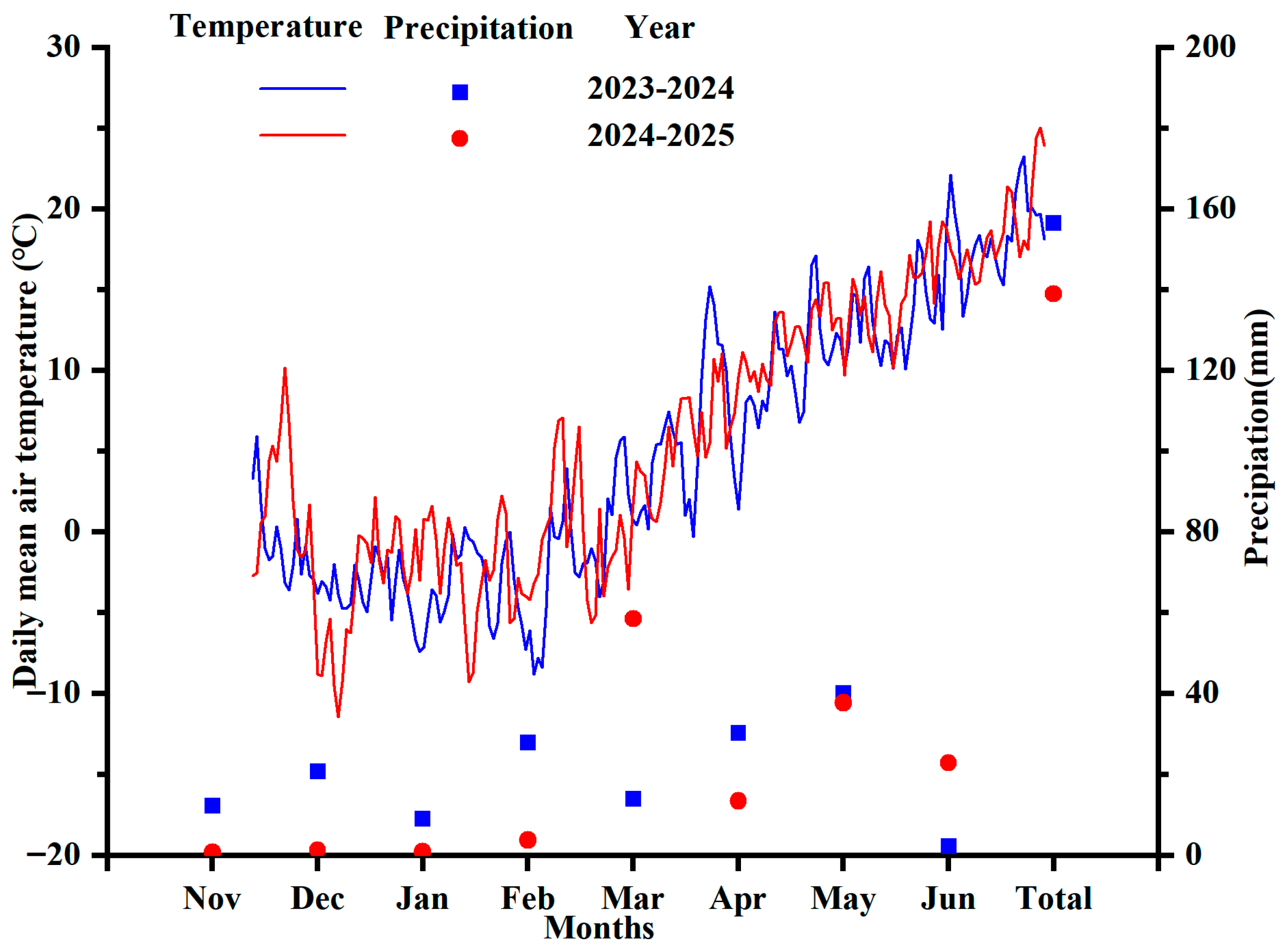
Representative soil samples from the 0–20 cm layer were collected in October 2023, prior to the sowing of the first winter wheat crop. The baseline physical and chemical properties were analyzed at the Laboratory of the College of Agronomy, Qingdao Agricultural University. The soil’s physical and chemical properties are presented in Table 1. Detailed precipitation and daily mean temperature data for the two growing seasons are presented in Figure 1.

2.2. Experimental Materials

The tested winter wheat cultivar was ‘Denghai 206’ (National Certified No. 20190038), a semi-winter variety developed by Shandong Denghai Seeds Co., Ltd. (Laizhou, China). from a cross between Jimai 22 and Zhoumai 20. The total growth period of this cultivar is approximately 242 days. It is recognized as a high-yield and high-quality variety; in high-yield demonstration fields in Shandong, its grain yield has reached 13.45 t/ha, with a standard test weight of 825 g/L and a crude protein content of 13.4%.

2.3. Experimental Design, Fertilization Schemes, and Plot Layout

A total of 48 experimental plots (16 treatments × 3 replicates) were arranged using a completely randomized design based on an L16(43) orthogonal array design. This design, also known as the Taguchi method, was selected for its high efficiency in identifying the main effects and potential interactions among multiple fertilization factors with a reduced number of experimental trials [8]. Each experimental plot occupied an area of 40 m2 (16 m × 2.5 m). To prevent the lateral movement of water and nutrients between adjacent treatments, plots were separated by 0.3 m wide buffer rows and were physically isolated by ridges. The experimental factors consisted of four levels of nitrogen (N), Phosphorus (P2O5), and potassium (K2O), as specified in Table 2 and Table 3.
A unified drip irrigation management system (equal volume and frequency) was strictly implemented. Supplemental irrigation was conducted twice during critical growth stages: at the jointing stage (Feekes scale 6.0) and the grain-filling stage (Feekes scale 11.0). The irrigation quota for each event was 60 mm, resulting in a total drip irrigation quota of 120 mm for the entire growth cycle. Drip tapes were placed on the soil surface between rows with a spacing of 60 cm (one tape for every three adjacent rows). The water volume for each plot was precisely measured and monitored via independently installed water meters.

2.4. Fertilization and Field Management

The fertilizers included urea (N = 46%), superphosphate (P2O5 = 12%), and potassium sulfate (K2O = 40%). Basal Fertilization: 100% of P and K fertilizers, plus 50% of the N fertilizer, were uniformly incorporated into the 0–20 cm soil layer during tillage prior to sowing. Topdressing: the remaining 50% of N was applied as drip fertigation at the jointing stage (Feekes 6.0), ensuring precise nutrient delivery to the crop root zone. Wheat was sown at a rate of 185 kg/ha. Sowing dates were 24 October 2023 and 1 November 2024; harvest dates were 13 June 2024 and 17 June 2025, respectively. Integrated pest, disease, and weed management followed local high-yield cultivation standards.

2.5. Measurement of Yield and Yield Components

Before maturity, the number of spikes per unit area was determined by randomly selecting three 1-m double-row samples from each plot. These data were subsequently converted to calculate the number of spikes per hectare. The number of grains per spike was counted from 20 randomly selected plants per plot. At maturity, a 3 m2 area in the center of each plot was manually harvested to determine the actual grain yield (adjusted to 13% moisture content). The 1000-grain weight was determined using three replicates per treatment.

2.6. Measurement of Grain Quality Indicators

The grain protein content was determined using the semi-micro Kjeldahl method (N × 5.7). Wet gluten content was measured using a gluten washing instrument and index tester (YUCEBAS, İzmir, Turkey) according to standard procedures. Grain test weight was recorded using a 1000 mL graduated cylinder and balance. Grain hardness was determined using a Fourier transform near-infrared spectroscopy analyzer (Antaris II, Madison, WI, USA).

2.7. Data Processing and Analysis

Initial data collation was performed in Microsoft Excel 2019. Statistical analysis was conducted using the DPS v19.05 software (Hangzhou Reifeng Technology Co., Ltd., Hangzhou, China; http://www.dpsw.cn, accessed on 2 January 2026). Figures were generated using Origin 2021 software (OriginLab Corp., Northampton, MA, USA; https://www.originlab.com, accessed on 21 February 2026). Prior to performing the analysis of variance (ANOVA), the normality of the data distribution was verified using the Shapiro–Wilk test, and the homogeneity of variance was assessed using Levene’s test. Outliers were identified using the box-plot method and managed after verifying experimental records to ensure data integrity. Post-hoc multiple comparisons were conducted using Duncan’s Multiple Range Test (p < 0.05) to identify significant differences between treatments.

3. Results

3.1. Effects of NPK Combined Application on Winter Wheat Productivity and Quality

The grain yield, yield components, and quality traits of winter wheat showed significant responses to the varying combinations of N, P, and K fertilizers over the two experimental seasons (Table 4).

3.1.1. Yield and Yield Components: Optimal vs. Control

The data analysis revealed a substantial productivity gap between the optimized fertilization treatments and the control (N1P1K1).
Grain Yield: The N3P2K4 treatment (N 170 kg/ha, P2O5 30 kg/ha, K2O 120 kg/ha) was identified as the optimal combination for maximizing productivity. In 2023–2024, the yield of N3P2K4 (12,653.3 kg/ha) was 327.5% higher than that of the N1P1K1 control (2960.0 kg/ha). A similar trend was observed in 2024–2025, with N3P2K4 achieving a yield of 12,533.6 kg/ha, representing a 302.4% increase over the control (3114.9 kg/ha, p < 0.05).
Sink Capacity (Spike and Grains): This yield surge was primarily driven by the expansion of sink capacity. Compared to N1P1K1, the spike number of the optimal N3P2K4 treatment increased by 107.0–109.5%, while the grains per spike increased by 72.3–75.0%. Notably, while N4 level treatments (e.g., N4P1K4) produced the highest spike density, N3P2K4 achieved a superior balance between spike number and grain number per spike.
Grain Filling (1000-Grain Weight): The 1000-grain weight was significantly enhanced by potassium application. The N3P2K4 treatment (K 120 kg/ha) reached 51.7 g (2023–2024) and 50.9 g (2024–2025), which was 19.9–20.6% higher than the control.

3.1.2. Grain Quality Traits: Optimal vs. Control

Nutritional and processing qualities reached their maximum levels under higher nitrogen inputs, typically at the N4 level (220 kg/ha).
Protein and Gluten: The N4P2K3 treatment demonstrated the strongest impact on protein accumulation. Compared to the N1P1K1 control, the grain crude protein in N4P2K3 increased from 8.9–9.0% to 13.6–14.2%, representing a relative gain of 52.8–57.8%. Similarly, wet gluten content increased by 59.1–60.5% over the control.
Test Weight and Hardness: The optimized treatment (N3P2K4) not only maximized yield but also maintained high physical quality, with a test weight consistently exceeding 800 g/L (a significant improvement over the low-NPK treatments). This suggests that the N170K120 interaction facilitates dense starch packing and grain vitreousness.

3.2. Orthogonal Experimental Analysis of Fertilization Effects

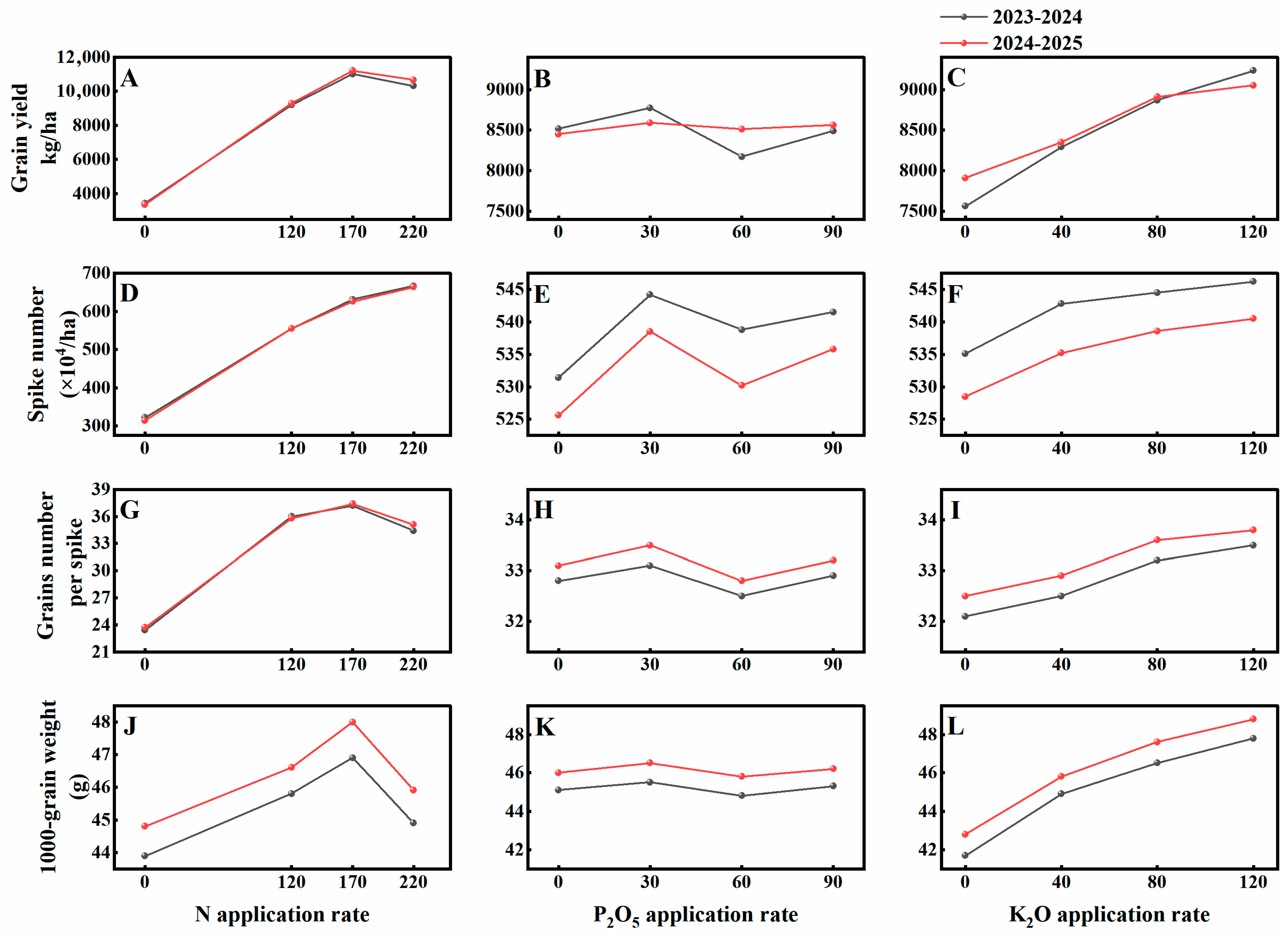
The grain yield, yield components, and quality traits of winter wheat under different NPK combinations are presented in Table 4. To further clarify the contribution of each nutrient, range analysis and factor effect evaluations were performed (Table 5 and Table 6; Figure 2 and Figure 3).

3.2.1. Effects of NPK Combinations on Grain Yield and Its Components

The range analysis for yield indicators (Table 5) revealed that nitrogen (N) was the primary factor regulating grain yield and its core components (spike number and grains per spike).
Grain Yield: The magnitude of factor influence followed the order of N > K > P consistently over both years. Peak yield was achieved under the N3P2K4 combination (N 170 kg/ha, P2O5 30 kg/ha, K2O 120 kg/ha).
Spike Number and Grains per Spike: N exerted the greatest impact (Rank 1) on both indicators. Maximum values were observed at the N3 level (170 kg/ha). While the ranking of K and P for spike number showed interannual variability, their influence on grains per spike remained stable in the order of N > K > P.
1000-Grain Weight: Unlike yield, 1000-grain weight was predominantly influenced by potassium (K), followed by N and P (rank: K > N > P). The highest 1000-grain weight was recorded at the K4 level (120 kg/ha) and N3 level (170 kg/ha), while P showed a negative effect, with the maximum achieved at the P1 level (0 kg/ha).

3.2.2. Effects of NPK Combinations on Grain Quality Traits

The influence of NPK application on nutritional and processing quality is summarized in Table 6.
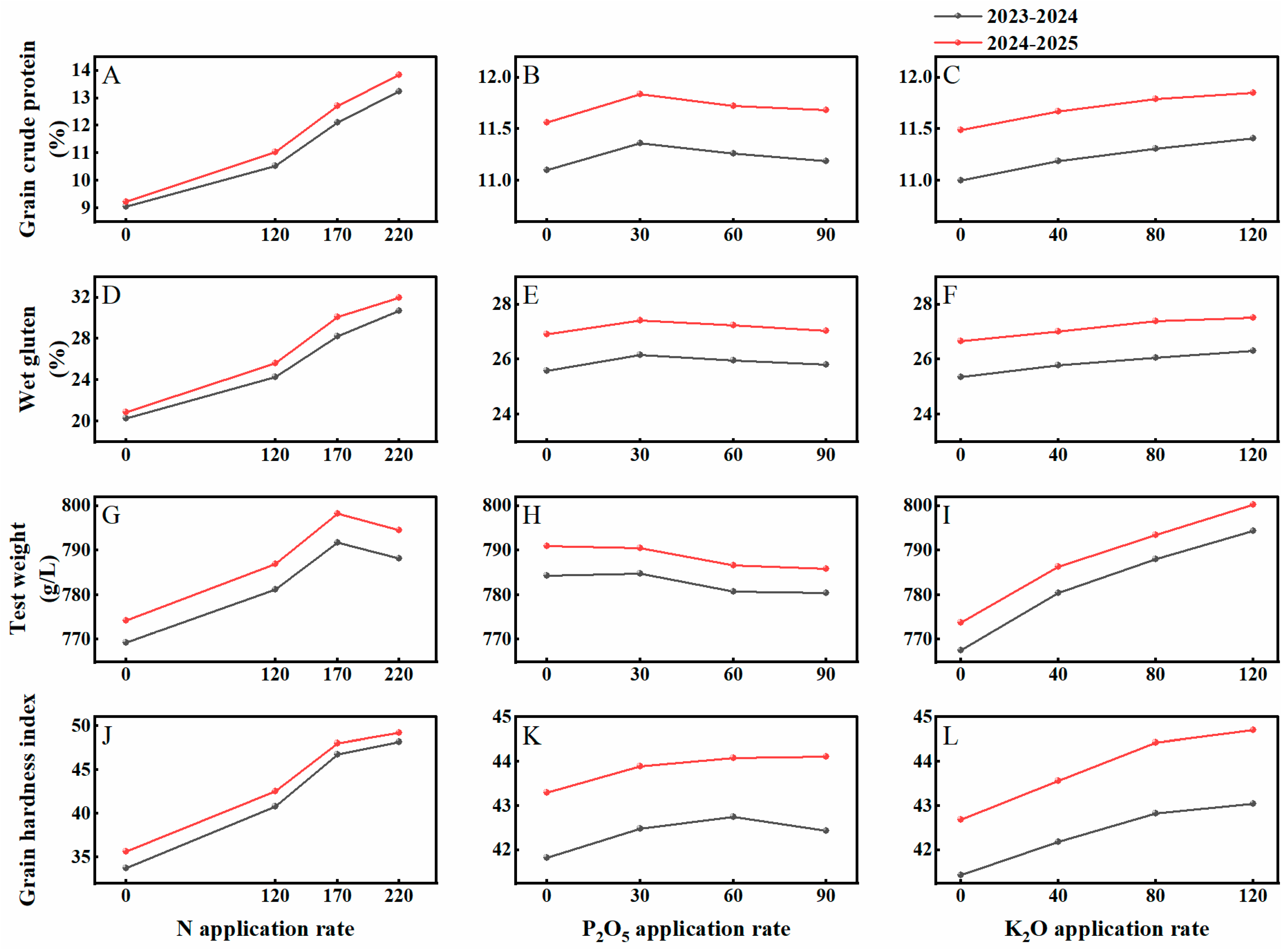
Protein and Gluten Properties: Nitrogen (N) was the most critical factor (Rank 1) affecting crude protein (CP), wet gluten content (WGC), and grain hardness. These indicators showed a linear upward trend with N application, reaching their maximum at the N4 level (220 kg/ha). Potassium (K) and phosphorus (P) followed N in influence (rank: N > K > P), with the highest quality typically achieved at K4 (120 kg/ha) and P2 (30 kg/ha).
Test Weight: Similar to 1000-grain weight, test weight was primarily regulated by K (Rank 1), followed by N and P. Optimal test weight was consistently obtained under the K4 (120 kg/ha) and N3 (170 kg/ha) treatments across both years.
Grain Hardness: The dominance of N was evident, with the magnitude of influence following N > K > P. Maximum grain hardness index was observed at N4 (220 kg/ha), K4 (120 kg/ha), and P3 (60 kg/ha).

3.3. Factor Effects and Analysis of Variance (ANOVA)

The ANOVA results (Table 7 and Table 8) provide quantitative evidence for the regulatory roles of nitrogen (N), phosphorus (P), and potassium (K) on winter wheat productivity and grain quality.

3.3.1. Dominant Role of Nitrogen in Yield Formation and Nutritional Quality

Nitrogen was identified as the primary driver (Rank 1) for yield formation and protein accumulation.
Productivity and Sink Size: In both experimental seasons, N fertilization exerted an overwhelming influence on grain yield (F = 185.83–205.72, p < 0.001) and spike number (F = 2439.71–3955.27, p < 0.0001). This confirms that in the Calcaric Cambisols of the Huang-Huai-Hai Plain, N supply is the fundamental factor for establishing a high-capacity “sink” (Table 7a,b).
Protein and Gluten Synthesis: N was also the most critical factor for grain crude protein (F = 496.48–517.84) and wet gluten content (F = 589.98–767.26), with all values reaching the significance level. These results indicate that the drip fertigation system, by optimizing N delivery, effectively enhances nitrogen metabolism and the accumulation of storage proteins, thus overcoming the “quality lag” in high-yielding wheat.

3.3.2. Potassium-Mediated Regulation of Grain Filling and Physical Traits

While N builds the framework, potassium (K) is essential for grain filling and density.
1000-Grain Weight and Test Weight: ANOVA revealed that K was the Rank 1 factor determining 1000-grain weight (F = 20.82–21.77, p < 0.0014) and test weight (Table 8c, F = 23.35–26.11, p < 0.001).
Physiological Mechanism: The significance of K highlights its critical role in optimizing the source–sink relationship. Potassium facilitates the “flow”—the translocation of assimilates from leaves (source) to grains (sink). The synergy between N (establishing sink size) and K (ensuring sink filling) explains the superior grain weight and test weight (exceeding) observed in the optimized N3P2K4 treatment.

3.3.3. Phosphorus Response and Nutritional Balance

Phosphorus Sensitivity: Phosphorus (P) showed a generally non-significant impact on grain yield (F = 0.31–0.95, p > 0.47) and quality (p > 0.22). This low sensitivity is consistent with the high background available P (32.8 mg/kg) in the experimental soil. The drip irrigation management likely maintained sufficient P mobility, minimizing the marginal benefits of additional P applications.
Interannual Consistency: Despite minor fluctuations in F-values between years, the rank of each factor remained remarkably stable. This high interannual consistency provides strong evidence for the robustness of the proposed optimized fertilization model.

3.4. Interaction Analysis via 3D Response Surfaces

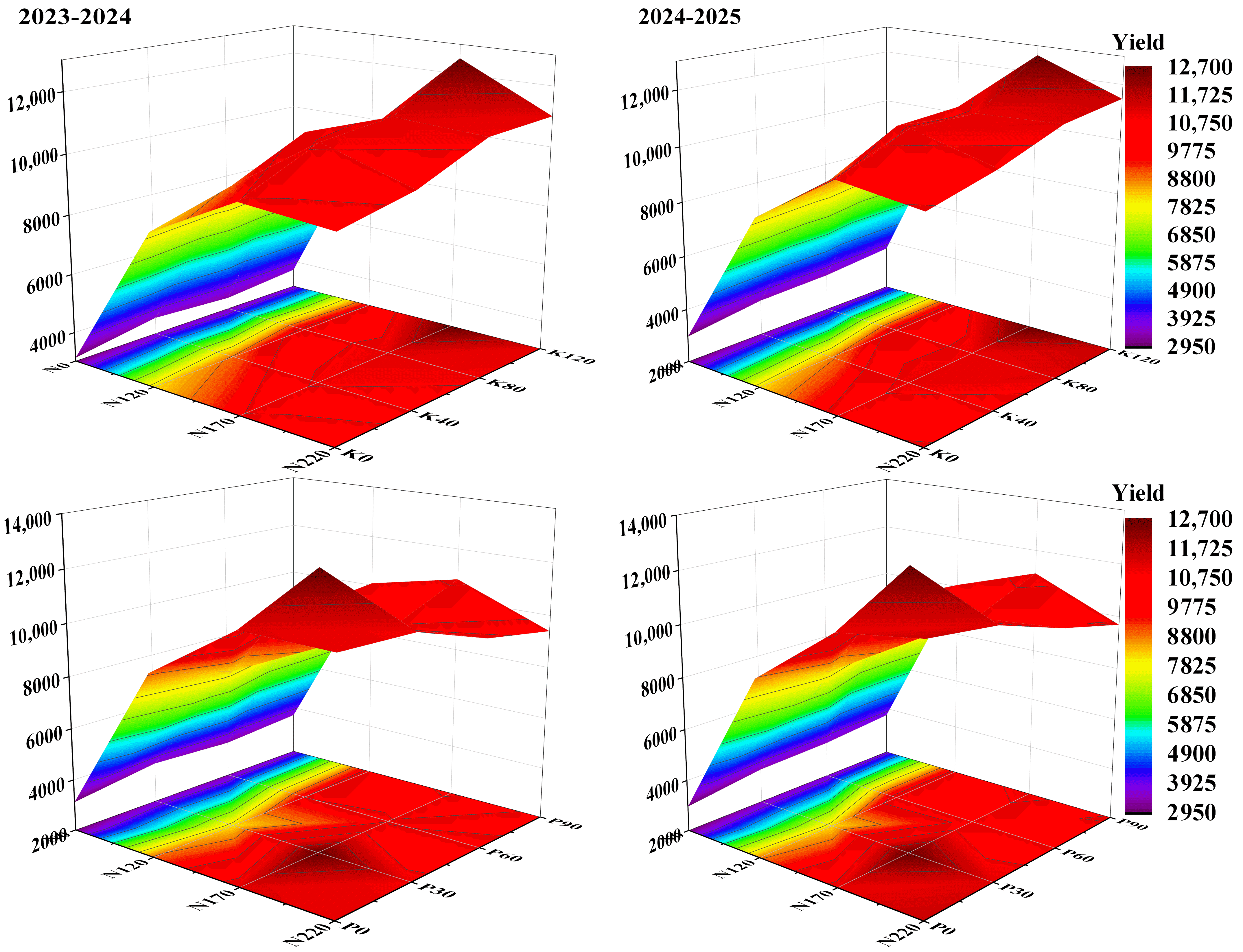
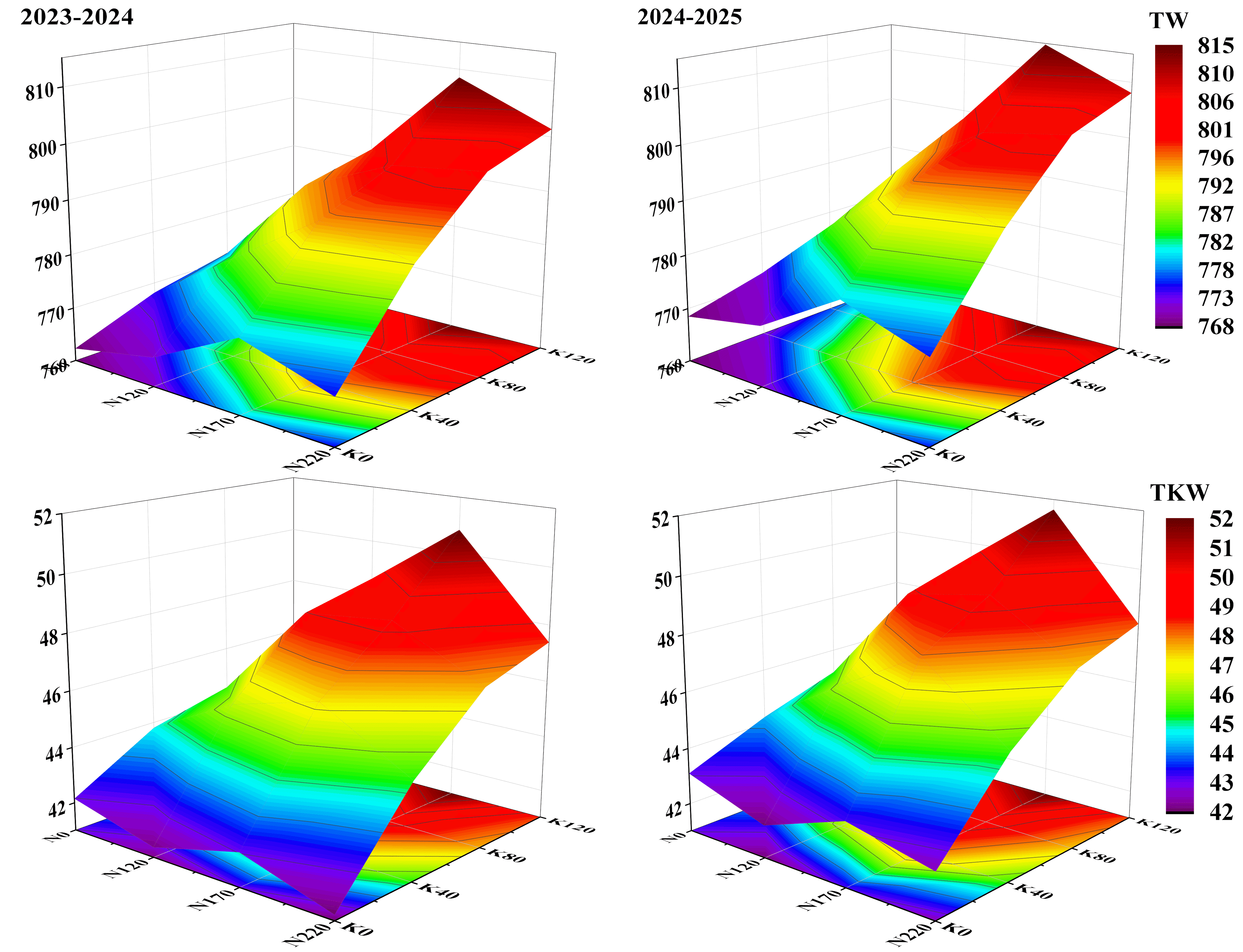
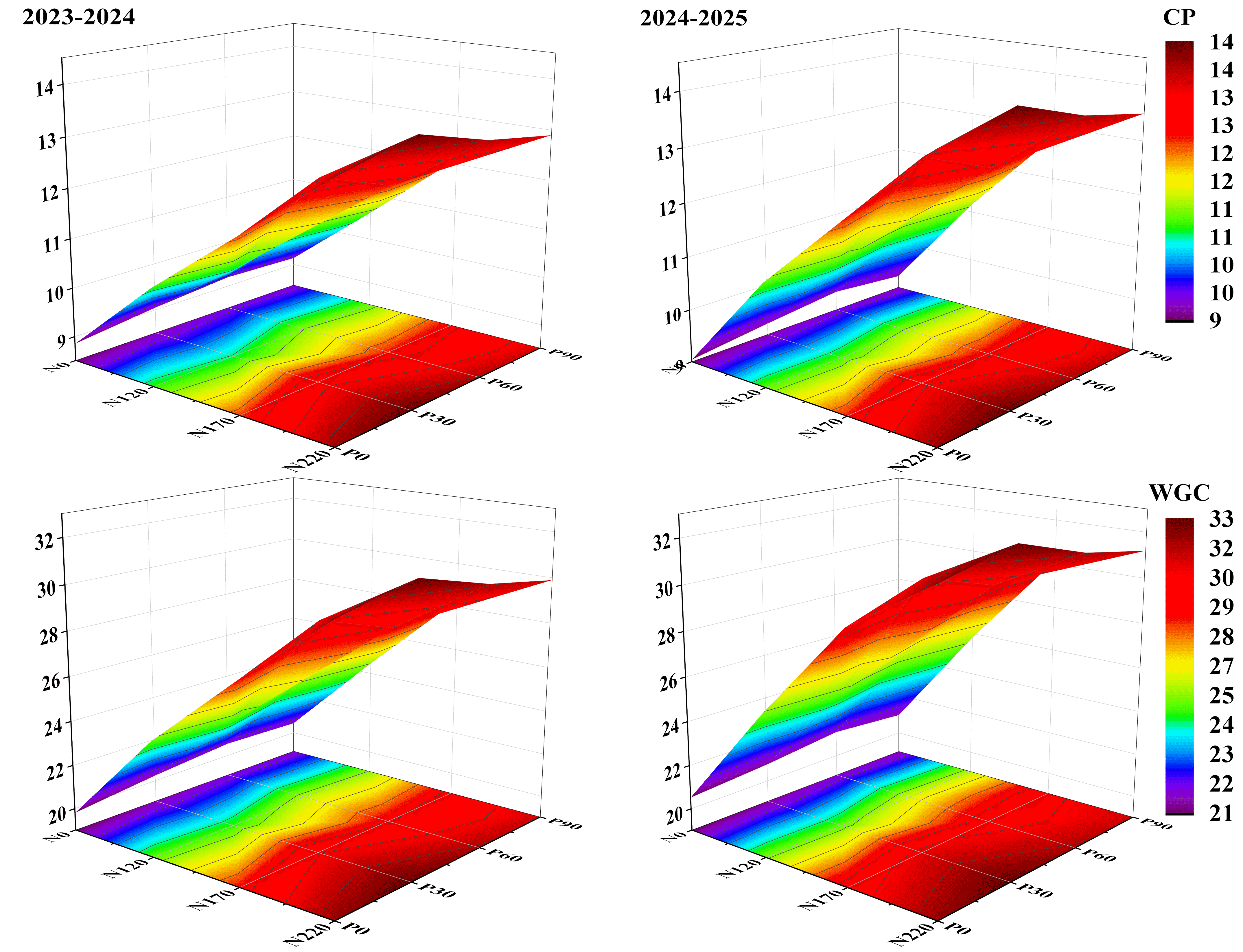
The 3D response surface plots (Figure 4, Figure 5 and Figure 6) were generated by fixing the factor with the lowest priority at its optimal level, allowing for a visual exploration of the complex interactions among nitrogen (N), phosphorus (P), and potassium (K) on wheat productivity and quality.

3.4.1. Synergy of N–K and N–P Interactions on Grain Yield

As illustrated in Figure 4, the response surfaces for grain yield exhibit a high degree of interannual consistency across the two experimental seasons. Nitrogen application served as the foundational driver, with yield increasing significantly as N levels rose. On this basis, potassium (K) fertilization further amplified productivity, demonstrating a significant synergistic effect. The peak yield was consistently achieved within the interval of medium nitrogen (N170) and high potassium (K120). In contrast, the response to phosphorus (P) exhibited a typical “diminishing returns” pattern; yield initially increased with P levels but plateaued or slightly declined beyond the P30 level. The optimal fertilization model for yield maximization was identified as the combination of N170 and P30.

3.4.2. Regulation of Physical Quality via N–K Interaction

Regarding physical grain quality (Figure 5), a significant positive interaction was observed between nitrogen and potassium on test weight (TW) and 1000-grain weight (TKW). The 3D surfaces reveal that while increasing a single factor (either N or K) had a limited impact, their combined application triggered a steep, non-linear upward trend. This indicates that the N–K synergy is not a simple additive effect but a physiological optimization of the source–sink relationship; potassium facilitates the efficient translocation of photoassimilates to grains under sufficient nitrogen supply. Consistent with yield trends, the optimal regime for maximizing TW and TKW remained N170 combined with K120 over both years.

3.4.3. Synergy of N–P Interaction on Nutritional Quality

For nutritional quality (Figure 6), the interaction between nitrogen and phosphorus significantly influenced crude protein (CP) and wet gluten content (WGC). The response surfaces highlight a joint regulation mechanism where N and P synergistically enhanced grain protein synthesis. While the independent effect of increasing phosphorus was relatively modest, its combination with high nitrogen (N220) facilitated a marked increase in both CP and WGC. To achieve superior nutritional quality, a fertilization regime centered on N220 and P30 proved most effective. These results demonstrate that maintaining a high nutritional balance through N–P interaction is essential for breaking the yield-quality trade-off in the Calcaric Cambisols of this region.

4. Discussion

4.1. Core Regulatory Role of Nitrogen and Optimization of Source–Sink Relationship

Regarding nitrogen’s influence, the yield ranges across the two-year study reached 7572.71 kg/ha and 7850.0 kg/ha, respectively, confirming N as the most dominant factor. The grain yield followed a typical parabolic response, peaking at N3 (170 kg/ha), where spike numbers and grains per spike were simultaneously maximized. This result validates the regulatory mechanism where N strengthens the “source” (photosynthetic capacity) to provide a material foundation for spike development, while optimizing the “sink” structure to promote tillering and floret setting. These findings align with the established consensus in the North China Plain by Qu et al. [1], and reinforce the “promoting early growth and controlling late growth” principle of N demand in winter wheat [10]. Furthermore, the success of the “50% base + 50% drip topdressing” method mirrors the results of Wang et al. [11] and Yan et al. [12,13], demonstrating that precision topdressing can significantly improve nitrogen use efficiency (NUE) while mitigating environmental loss. This conclusion is also supported by Yang et al. [14] regarding the effects of drip fertigation on crop yield and quality.
At the same time, the grain crude protein and wet gluten contents increased continuously with the increase in nitrogen application rate, reaching the highest values at N4 (220 kg/ha). The crude protein contents in the two years were 13.2% and 13.8%, and the wet gluten contents were 30.68% and 31.99%, respectively. This continuous increase parallels the physiological mechanism where N is directly allocated to grain protein synthesis [11], and mutually corroborates with the research conclusions of Duncan et al. [15] and Janczak-Pieniazek et al. [4]. In this study, the N3 (170 kg/ha) level achieved a synergistic balance [16], which not only ensured high yield but also maintained the crude protein and wet gluten contents at high-quality levels (crude protein ≥ 12%, wet gluten ≥ 28%), avoiding the environmental risks of excessive nitrogen application and conforming to the requirements of green and sustainable agricultural development. This balance supports the premise that reasonable N application can harmonize productivity and quality [17,18,19], an observation also corroborated by Yang et al. [20,21] regarding optimized NPK management.
Potassium (K) exerted the primary influence on physical grain quality, specifically governing 1000-grain weight and test weight. The ranges of 1000-grain weight in the two years were 6.28 g and 6.16 g, and the ranges of test weight were 26.85 g/L and 26.55 g/L, respectively. The highest 1000-grain weight and test weight were achieved at K4 (120 kg/ha), confirming that potassium is a key factor ensuring yield and commercial quality by promoting the transport of photosynthates to grains and improving grain plumpness [22]. The peak values achieved at K4 (120 kg/ha) confirm that K acts as a vital “pump” for photosynthate translocation, effectively optimizing the source–sink dynamics to ensure grain plumpness. This role echoes the results reported by Yin et al. [14] in other cereal crops. The N3K4 combination in this study reinforces the significance of the nitrogen–potassium interaction, echoing the source–sink optimization trends documented by Xu et al. [23] and Gaj et al. [24].
Potassium (K) also played a secondary but critical role in enhancing crude protein and wet gluten contents. The optimal quality indicators observed at K4 (120 kg/ha) align with the established physiological role of K in promoting protein synthesis and grain filling [17,24], while echoing the conclusions of Bouacha et al. [25] regarding N and K effects on durum wheat quality. Furthermore, the influence of K on yield ranked second in this study, with two-year yield ranges of 1671.6 kg/ha and 1805.0 kg/ha, confirming that K is a vital supplement to the nitrogen-induced yield-increasing effect [17]. Moreover, sufficient K availability effectively prevented the “quality lag” often triggered by high N application, a benefit particularly significant in heavy-textured Calcaric Cambisols where nutrient mobility is limited. This observation aligns with the long-term findings of Firmano et al. [26] and parallels the evidence from Shahid et al. [27] on K’s ability to alleviate heat stress and enhance wheat quality.
Regarding phosphorus (P), yield ranges across the two years were 601.88 kg/ha and 315.0 kg/ha, respectively, with its influence ranking third among the factors. The optimal yield was achieved at P2 (30 kg/ha), as excessive P provided no significant gain. Physiologically, P promotes root development in Calcaric Cambisols, yet excessive application risks inducing trace element deficiencies such as zinc [6], corroborating the findings of Dhaliwal et al. [6] In this study, the effectiveness of 30 kg/ha P aligns with the life cycle assessment by Chen et al. [28] in the North China Plain, illustrating that appropriate P application ensures productivity while mitigating environmental emissions. This strategy for sustainable agricultural development mirrors the conclusions of Ceclan et al. [29,30] regarding nitrogen and phosphorus fertilization effects.
The effect of P application on 1000-grain weight was weak, aligning with its primary role as a foundational guarantee for productivity rather than a core driver of grain filling. This observation parallels the existing research on nitrogen–phosphorus combined application [31,32], and echoes the results of Feng et al. [31] concerning the synergistic regulation of wheat yield and protein content.

4.2. Synergistic Regulatory Effects of Nitrogen–Potassium and Nitrogen–Phosphorus Interactions

A primary advantage of the orthogonal design is its ability to reveal the comprehensive impacts of nutrient interactions, which in this study proved more decisive for yield and quality than single-factor effects. The synergistic regulation of N–K and N–P interactions emerged as the critical mechanism for optimizing winter wheat performance in Calcaric Cambisols.
Regarding N–K synergy, N dominates source-end photosynthetic production while K facilitates sink-end transport, forming a critical regulatory nexus [33]. In this study, when the nitrogen application rate was at N3 (170 kg/ha), increasing the potassium application rate from K1 (0 kg/ha) to K4 (120 kg/ha) increased the yield by 18.2% and 19.1%, and the 1000-grain weight by 13.7% and 13.2% in the two years, respectively, confirming that sufficient K availability is the prerequisite for N to reach its full potential in Calcaric Cambisols [34]. On the contrary, when the potassium application rate was at K4 (120 kg/ha), increasing the nitrogen application rate from N1 (0 kg/ha) to N3 (170 kg/ha) increased the yield by 124.3% and 127.6%, and the number of spikes per hectare by 98.7% and 101.2% in the two years, respectively, indicating that adequate N provides the necessary sink capacity for K to regulate grain filling. This interaction aligns with the findings of Yin et al. [14], which highlight K’s role in promoting the transport of photoassimilates to grains. The optimal combination of N3 and K4 in this study reflects the maximization of N–K interaction effects: N strengthens source-end supply while K improves the “flow” and sink filling, paralleling the established view that N–K interaction is a core mechanism for productivity [23,29], and mirroring the results of Chen et al. [30] regarding quality enhancement.
At the same time, the regulatory effect of nitrogen–potassium interaction on grain quality was significant: at N3 level, the grain test weight of K4 treatment was 2.8% and 2.7% higher than that of K1, and the hardness was 11.3% and 10.8% higher; at K4 level, the crude protein content of N3 treatment was 34.6% and 35.2% higher than that of N1, and the wet gluten was 38.9% and 39.5% higher, underscoring that N–K combined application improves both nutritional and commercial quality. This synergy echoes the consensus that K can enhance N’s regulatory effect on grain protein [17], an observation further corroborated by the evidence from Bouacha et al. [25] regarding N and K effects on durum wheat and in agreement with Rawal et al. [2] concerning NPK-mediated nutrient absorption.
Phosphorus (P) provides a foundational basis for the optimization of nitrogen (N) effects by promoting root architecture development and enhancing nutrient uptake capacity, a synergy that serves as a vital support for stable winter wheat yields. In this study, at the N3 level (170 kg/ha), increasing P from P1 (0 kg/ha) to P2 (30 kg/ha) improved yield by 3.1% and 2.8%, and spike number by 2.5% and 2.3%. This indicates that appropriate P application synergistically improves the tillering and spike formation effect of N. Conversely, at P2 (30 kg/ha), the yield increase achieved by moving from N1 to N3 was 1.2 to 1.5 percentage points higher than at P1, reinforcing the premise that P amplifies N-induced yield effects by strengthening root absorption [35]. This result aligns with established findings suggesting that N–P combined application effectively enhances agronomic performance and wheat yield [31,32]. The P2N3 combination represents an optimal balance point for N–P interaction, ensuring robust root vigor while avoiding the trace element deficiencies associated with excessive P application in Calcaric Cambisols [6]. This regulatory trend reinforces the conclusions of Ceclan et al. [29,30] and parallels the evidence from Assefa et al. [36] regarding N–P fertilization in stable production systems [36].
N–P Synergy: P provides a foundational support for N uptake by promoting root development, especially vital in the compact and poorly aerated Calcaric Cambisols. Our results illustrate that appropriate P (30 kg/ha) can amplify the N-induced yield-increasing effect by strengthening root nutrient absorption, a trend previously identified by Feng et al. [31]. Furthermore, N–P interactions appeared to regulate floret retention and seed setting rate, thereby optimizing the final grain number per spike.
The regulatory effect of the nitrogen–phosphorus (N–P) interaction on the number of grains per spike proved significant, representing a critical synergy for optimizing yield components in Calcaric Cambisols. At the N3 level, the grain number per spike in the P2 treatment was 4.2% and 3.9% higher than that of the P1 treatment across the two experimental years. This confirms that P synergistically optimizes spike structure with N by reducing floret abortion and enhancing the seed setting rate, thereby effectively stabilizing the sink capacity [32]. Furthermore, N–P interactions modulate starch synthesis and the kinetics of grain filling, a regulatory mechanism that echoes the findings of Jiang et al. [37] regarding nutrient-mediated grain weight and quality improvement. In the compact and nutrient-limited Calcaric Cambisols, this coordination is essential for ensuring that the enhanced root vigor provided by P maximizes the nitrogen use efficiency (NUE) required for reproductive organ development.

4.3. Optimal Fertilization Scheme for the Synergy of High-Yield and High-Quality, and Sustainability Analysis

Synthesizing the results from this two-year field study, the optimal NPK fertigation regime for synergistic yield and quality enhancement was identified as N 170 kg/ha (50% base + 50% drip topdressing), P2O5 30 kg/ha (base), and K2O 120 kg/ha (base). The strategic scheduling of drip fertigation during the jointing (Feekes 6.0) and grain-filling stages ensured that nutrient availability was synchronized with the peak physiological demands (ETc) of the crop. Under this scheme, N3 serves as the optimal yield threshold, while K4 secures both 1000-grain weight and test weight (TW), ensuring both physical and nutritional grain quality. This synergistic interaction effect, maximizing the N–K and N–P nexus, aligns with the established consensus that nutrient interactions are the fundamental drivers of high crop productivity [23,30]. While ensuring productivity, this scheme effectively reduces the excessive application of N and P, thereby enhancing nutrient use efficiency and mitigating environmental footprints such as nitrogen leaching and greenhouse gas emissions [38]. This approach echoes the global research objective of “achieving efficiency through reduction” [28,39,40] and parallels the optimized fertilization strategies proposed by Jiang et al. [37]. Furthermore, the incorporation of micronutrients (e.g., Zn, Fe) and testing across diverse wheat cultivars in subsequent studies will be essential to refine this model and ensure its broader applicability. Such refinements would further support the findings of Jayara et al. [41] regarding the integration of mineral nutrients to bolster agricultural sustainability.
The stability of the results of this study was verified by the two-year experiment. The priority of factor influence and the optimal level of each indicator were completely consistent in the two years, confirming that this fertilization scheme has good yield stability and can cope with interannual climate fluctuations. This is consistent with the research conclusion of Addy et al. [39] that interannual weather changes will affect the response of crops to nitrogen application, but reasonable fertilization schemes can ensure stable yield. It also mutually corroborates the research conclusions of Iwanska et al. [42] and Sarker et al. [32] on the interannual variability of wheat yield, and is consistent with the research conclusion of Grzezbisz et al. [43] on the prediction of wheat yield and gluten content.

5. Conclusions

Under the experimental conditions of this study, conducted in Calcaric Cambisols, nitrogen (N) was the primary factor regulating grain yield, spike components, and core quality indicators, followed by potassium (K), while phosphorus (P) exerted the weakest influence. Notably, potassium (K) was the dominant regulatory factor for 1000-grain weight and grain test weight (TW).
The fertilization combinations of N170K120P30 (N3K4P2) and N220K120P30 (N4K4P2) were identified as the optimal models for maximizing grain yield and nutritional quality, respectively. By prioritizing nutritional balance over single-nutrient maximization, these optimized regimes ensure that winter wheat achieves superior quality standards without excessive fertilizer input. The precision of drip fertigation, particularly when synchronized with critical growth stages such as jointing and grain filling, is essential for optimizing the source–sink relationship and enhancing fertilizer use efficiency.
Significant positive interactions were observed between N–K and N–P, which synergistically regulated both yield and quality. This study confirms that balanced fertilization via drip irrigation is the key to achieving the synergy of high yield and high quality in winter wheat. To further enhance the applicability of these findings, future research should explore the integration of micronutrients and validate the stability of this fertilization model across diverse wheat cultivars.

Author Contributions

Conceptualization, Y.J. and S.L.; methodology, Y.J. and S.L.; software, Y.J. and S.L.; validation, Y.J. and S.L.; formal analysis, Y.J. and S.L.; investigation, Y.D. and H.Z.; resources, G.G., J.Q. and S.L.; data curation, Y.J. and S.L.; writing—original draft preparation, Y.J. and S.L.; writing—review and editing, Y.J. and S.L.; visualization, Y.J. and S.L.; supervision, C.Z.; project administration, C.Z.; funding acquisition, C.Z. All authors have read and agreed to the published version of the manuscript.

Funding

This experimental work was supported by Shandong Province Key Research and Development Plan Project (2022CXPT009), Shandong Province Major Science and Technology Innovation Project (2019JZZY010716), Qingdao Science and Technology Benefit for People Demonstration Special Project (24-1-8-xdny-1-nsh), Shandong Province Major Industry Public Relations Project for New and Old Kinetic Energy Conversion (2021-54), and Qingdao Modern Agricultural Industry Technology System Wheat Innovation Promotion Team Project (6622316104).

Institutional Review Board Statement

Not applicable.

Data Availability Statement

The original contributions presented in this study are included in the article. Further inquiries can be directed to the corresponding author.

Conflicts of Interest

The authors declare no conflicts of interest.

References

  1. Qu, B.; Noor, H.; Feng, Y.J.; Di, J.; Alotaibi, M.; Noor, F. Nitrogen uptake and water consumption for achieving high yield of winter wheat upon nitrogen addition at different doses. Sci. Rep. 2025, 15, 40047. [Google Scholar] [CrossRef] [PubMed]
  2. Rawal, N.; Pande, K.R.; Shrestha, R.; Vista, S.P. Nutrient concentration and its uptake in various stages of wheat (Triticum aestivum L.) as influenced by nitrogen, phosphorus, and potassium fertilization. Commun. Soil Sci. Plant Anal. 2023, 54, 1151–1166. [Google Scholar] [CrossRef]
  3. Shen, H.Z.; Gao, Y.H.; Sun, K.X.; Gu, Y.H.; Ma, X.Y. Effects of differential irrigation and nitrogen reduction replacement on winter wheat yield and water productivity and nitrogen-use efficiency. Agric. Water Manag. 2023, 282, 108289. [Google Scholar] [CrossRef]
  4. Janczak-Pieniazek, M.; Buczek, J.; Jarecki, W.; Bobrecka-Jamro, D. Effect of High Nitrogen Doses on Yield, Quality and Chemical Composition Grain of Winter Wheat Cultivars. J. Elem. 2020, 25, 1005–1017. [Google Scholar] [CrossRef]
  5. Messaoudi, A.; Labdelli, F.; Rebouh, N.Y.; Djerbaoui, M.; Kucher, D.E.; Hadjout, S.; Ouaret, W.; Zakharova, O.A.; Latati, M. Investigating the Potassium Fertilization Effect on Morphological and Agrophysiological Indicators of Durum Wheat under Mediterranean Rain-Fed Conditions. Agriculture 2023, 13, 1142. [Google Scholar] [CrossRef]
  6. Dhaliwal, S.S.; Sharma, V.; Shukla, A.K.; Behera, S.K.; Verma, V.; Kaur, L.; Verma, G. Optimization of phosphorus (P) induced zinc (Zn) deficiency in low and high P soils and monitoring their effect on productivity, Zn and P uptake by wheat (Triticum aestivum L.). J. Plant Nutr. 2023, 46, 917–928. [Google Scholar] [CrossRef]
  7. Aula, L.; Easterly, A.C.; Creech, C.F. Winter Wheat Seeding Decisions for Improved Grain Yield and Yield Components. Agronomy 2022, 12, 3061. [Google Scholar] [CrossRef]
  8. Taguchi, G. System of Experimental Design: Engineering Methods to Optimize Quality and Minimize Costs; UNIPUB/Kraus International: White Plains, NY, USA, 1987. [Google Scholar]
  9. Safar-Noori, M.; Dong, Q.; Saneoka, H. Improvement of Grain Yield, Nutritional and Antinutritional Quality, and Seed Physiological Performance of Wheat by NPK Fertilization. J. Agric. Sci. Technol. 2018, 20, 1467–1477. [Google Scholar]
  10. Beser, N.; Surek, H.; Sahin, S.; Kaya, R.; Tuna, B.; Cakir, R. An Investigation of Various Drip Irrigation Treatments in Rice (Oryza sativa L.). Fresenius Environ. Bull. 2016, 25, 3680–3686. [Google Scholar]
  11. Wang, K.K.; Liu, H.J.; Gao, Z.Z. Effects of Nitrogen Application at Different Levels by a Sprinkler Fertigation System on Crop Growth and Nitrogen-Use Efficiency of Winter Wheat in the North China Plain. Plants 2024, 13, 1714. [Google Scholar] [CrossRef]
  12. Yan, S.C.; Wu, Y.; Fan, J.L.; Zhang, F.C.; Guo, J.J.; Zheng, J.; Wu, L.F. Quantifying grain yield, protein, nutrient uptake and utilization of winter wheat under various drip fertigation regimes. Agric. Water Manag. 2022, 261, 107380. [Google Scholar] [CrossRef]
  13. Yan, S.C.; Wu, Y.; Fan, J.L.; Zhang, F.C.; Zheng, J.; Qiang, S.C.; Guo, J.J.; Xiang, Y.Z.; Zou, H.Y.; Wu, L.F. Dynamic change and accumulation of grain macronutrient (N, P and K) concentrations in winter wheat under different drip fertigation regimes. Field Crops Res. 2020, 250, 107767. [Google Scholar] [CrossRef]
  14. Yin, M.Q.; Li, Y.F.; Hu, Q.L.; Yu, X.J.; Huang, M.J.; Zhao, J.; Dong, S.Q.; Yuan, X.Y.; Wen, Y.Y. Potassium Increases Nitrogen and Potassium Utilization Efficiency and Yield in Foxtail Millet. Agronomy 2023, 13, 2200. [Google Scholar] [CrossRef]
  15. Duncan, E.G.; O’Sullivan, C.A.; Roper, M.M.; Biggs, J.S.; Peoples, M.B. Influence of co-application of nitrogen with phosphorus, potassium and sulphur on the apparent efficiency of nitrogen fertiliser use, grain yield and protein content of wheat: Review. Field Crops Res. 2018, 226, 56–65. [Google Scholar] [CrossRef]
  16. Kubar, M.S.; Feng, M.C.; Sayed, S.; Shar, A.H.; Rind, N.A.; Ullah, H.; Kalhoro, S.A.; Xie, Y.K.; Yang, C.B.; Yang, W.D.; et al. Agronomical traits associated with yield and yield components of winter wheat as affected by nitrogen managements. Saudi J. Biol. Sci. 2021, 28, 4852–4858. [Google Scholar] [CrossRef]
  17. Guo, J.H.; Jiang, P.P.; Zhang, J.; Dong, S.Y.; Tian, W.Z.; Li, J.H.; Li, F.; Lv, J.J.; Yao, Y.Q.; Hou, Y.Q.; et al. Straw Return Substituting Potassium Fertilizer Increases Crop Yield, Efficiency, and Quality in Maize-Wheat Rotation System. Agronomy 2024, 14, 1266. [Google Scholar] [CrossRef]
  18. Lian, H.D.; Zhang, Z.Y.; Zhang, X.X.; Jin, S.; Bian, G.P.; Li, H.B.; Qin, C. Optimizing water-nitrogen management for enhanced nutritional quality and mineral biofortification in dry-land winter wheat cultivars on the loess Plateau, China. BMC Plant Biol. 2025, 25, 1680. [Google Scholar] [CrossRef]
  19. Si, Z.Y.; Zain, M.; Mehmood, F.; Wang, G.S.; Gao, Y.; Duan, A.W. Effects of nitrogen application rate and irrigation regime on growth, yield, and water-nitrogen use efficiency of drip-irrigated winter wheat in the North China Plain. Agric. Water Manag. 2020, 231, 106002. [Google Scholar] [CrossRef]
  20. Yang, P.; Cheng, M.H.; Wu, L.F.; Fan, J.L.; Li, S.; Wang, H.D.; Qian, L. Review on Drip Irrigation: Impact on Crop Yield, Quality, and Water Productivity in China. Water 2023, 15, 1733. [Google Scholar] [CrossRef]
  21. Yang, Q.R.; Zhang, L.L.; Zhang, Y.J.; Li, L.T.; Wang, Y.L. Optimized Application of Nitrogen, Phosphorus, and Potassium Enhances Yield and Quality by Improving Nutrient Uptake Dynamics in Winter Wheat with Straw Return. J. Plant Growth Regul. 2025, 44, 5028–5047. [Google Scholar] [CrossRef]
  22. Ceclan, O.A.; Alin, P.; Simon, A.; Chetan, F.; Bardas, M. The influence of mineral fertilization and rotation in winter wheat (Triticum aestivum) crop. Life Sci. Sustain. Dev. 2024, 5, 72–77. [Google Scholar] [CrossRef]
  23. Xu, W.; Li, J.; Feng, J.; Shao, Z.; Huang, Y.; Hou, W.; Gao, Q. Nitrogen and potassium interactions optimized asynchronous spikelet filling and increased grain yield of japonica rice. PeerJ 2023, 11, e14710. [Google Scholar] [CrossRef] [PubMed]
  24. Gaj, R.; Górski, D.; Przybyl, J. Effect of Differentiated Phosphorus and Potassium Fertilization on Winter Wheat Yield and Quality. J. Elem. 2013, 18, 55–67. [Google Scholar] [CrossRef]
  25. Bouacha, O.D.; Nouaigui, S.; Rezgui, S. Effects of N and K fertilizers on durum wheat quality in different environments. J. Cereal Sci. 2014, 59, 9–14. [Google Scholar] [CrossRef]
  26. Firmano, R.F.; de Oliveira, A., Jr.; de Castro, C.; Alleoni, L.R.F. Potassium management over 60 crops: A long-term study on an Oxisol under no-till. Agron. J. 2021, 113, 478–489. [Google Scholar] [CrossRef]
  27. Shahid, M.; Saleem, M.F.; Saleem, A.; Sarwar, M.; Shakoor, A.; Mahmood, K.; Anjum, S.A. Qualitative traits of heat stressed bread wheat (Triticum aestivum L.) were improved by exogenous potassium signaling. J. Soil Sci. Plant Nutr. 2025, 25, 183–194. [Google Scholar] [CrossRef]
  28. Chen, X.X.; Zhang, W.; Wang, X.Z.; Liu, Y.M.; Yu, B.G.; Chen, X.P.; Zou, C.Q. Life cycle assessment of a long-term multifunctional winter wheat-summer maize rotation system on the North China Plain under sustainable P management. Sci. Total Environ. 2021, 783, 147039. [Google Scholar] [CrossRef]
  29. Ceclan, A.; Simon, A.; Russu, F.; Bardas, M.; Chetan, F.; Popa, A. The influence of N and P fertilization on winter wheat yield. Life Sci. Sustain. Dev. 2022, 3, 54–59. [Google Scholar] [CrossRef]
  30. Chen, L.Q.; Gao, J.P.; Zhang, W.Z.; Jiang, H.F.; Liu, Y.; Yan, B.C.; Wan, X. Nitrogen and Potassium Application Effects on Grain-Filling and Rice Quality in Different Japonica Rice Cultivars. Agronomy 2024, 14, 1629. [Google Scholar] [CrossRef]
  31. Feng, K.; Zhang, Y.; Feng, M.; Wang, H.; Wang, C.; Yang, W. Combined nitrogen and phosphorus application synergistically regulate grain yield and protein content in winter wheat (Triticum aestivum L.). Appl. Ecol. Environ. Res. 2022, 20, 1599–1611. [Google Scholar] [CrossRef]
  32. Sarker, U.K.; Uddin, M.R.; Kaysar, M.S.; Hossain, M.A.; Somaddar, U.; Saha, G. Exploring relationship among nitrogen fertilizer, yield and nitrogen use efficiency in modern wheat varieties under subtropical condition. Saudi J. Biol. Sci. 2023, 30, 103602. [Google Scholar] [CrossRef] [PubMed]
  33. Elekhtyar, N.M.; AL-Huqail, A.A. Effect of Foliar Application of Phosphorus, Zinc, and Silicon Nanoparticles along with Mineral NPK Fertilization on Yield and Chemical Compositions of Rice (Oryza sativa L.). Agriculture 2023, 13, 1061. [Google Scholar] [CrossRef]
  34. Ma, D.Y.; Zhang, J.; Hou, J.F.; Li, Y.G.; Huang, X.; Wang, C.Y.; Lu, H.F.; Zhu, Y.J.; Guo, T.C. Evaluation of Yield, Processing Quality, and Nutritional Quality in Different-Colored Wheat Grains under Nitrogen and Phosphorus Fertilizer Application. Crop Sci. 2018, 58, 402–415. [Google Scholar] [CrossRef]
  35. Kozera, W.; Barczak, B.; Knapowski, T.; Brudnicki, A.; Wichrowska, D. Response of Spring Barley to Npk and S Fertilisation: Yielding, the Content of Protein and the Accumulation of Mineral Nutrients. J. Elem. 2017, 22, 725–736. [Google Scholar] [CrossRef]
  36. Assefa, A.; Derebe, B.; Gebrie, N.; Shibabaw, A.; Getahun, W.; Beshir, O.; Worku, A. Grain yield and quality responses of durum wheat (Triticum turgium L. var. durum) to nitrogen and phosphorus rate in Yilmana Densa, Northwestern Ethiopia. Heliyon 2023, 9, e17262. [Google Scholar] [CrossRef] [PubMed]
  37. Jiang, X.Q.; Li, J.Z.; An, Z.C.; Liang, J.; Tian, X.H.; Chen, Y.L.; Sun, Y.P.; Li, Y. Optimal Fertilization Strategies for Winter Wheat Based on Yield Increase and Nitrogen Reduction on the North China Plain. Sustainability 2023, 15, 4199. [Google Scholar] [CrossRef]
  38. Xing, G.F.; Ma, J.W.; Liu, X.J.; Lei, B.; Wang, G.; Hou, S.Y.; Han, Y.H. Influence of Different Nitrogen, Phosphorus, and Potassium Fertilizer Ratios on the Agronomic and Quality Traits of Foxtail Millet. Agronomy 2023, 13, 2005. [Google Scholar] [CrossRef]
  39. Addy, J.W.G.; Ellis, R.H.; Macdonald, A.J.; Semenov, M.A.; Mead, A. Investigating the effects of inter-annual weather variation (1968–2016) on the functional response of cereal grain yield to applied nitrogen, using data from the Rothamsted Long-Term Experiments. Agric. For. Meteorol. 2020, 284, 107898. [Google Scholar] [CrossRef]
  40. Nguyen, L.T.T.; Kravchenko, A.N. Effects of cover crops on soil CO and NO emissions across topographically diverse agricultural landscapes in corn-soybean-wheat organic transition. Eur. J. Agron. 2021, 122, 126189. [Google Scholar] [CrossRef]
  41. Jayara, A.S.; Kumar, R.; Shukla, A.; Singh, A.P.; Pandey, P.; Shukla, P.; Rajbhar, R.P.; Meena, R.L.; Reddy, K.I. Integrating Nano-Fertilizers with Mineral-Based Nutrients for Growth, Energy Efficiency, Economics, and Environmental Sustainability in Wheat crop. Int. J. Plant Prod. 2024, 18, 465–484. [Google Scholar] [CrossRef]
  42. Iwanska, M. The Analysis of Wheat Yield Variability Based on Experimental Data from 2008–2018 to Understand the Yield Gap Elzbieta/A. Wnuk, T. Oleksiak. Agriculture 2022, 12, 32. [Google Scholar] [CrossRef]
  43. Grzebisz, W.; Szczepaniak, W.; Potarzycki, J.; Biber, M. Prediction of Grain Yield and Gluten Content in Winter Bread Wheat Based on Nutrient Content in Plant Parts during the Critical Cereal Window. Agronomy 2023, 13, 2649. [Google Scholar] [CrossRef]
Figure 1. Precipitation and daily mean temperature during the winter wheat growing period.
Agriculture 16 00991 g001
Figure 2. Main effect plots of mean values from orthogonal experimental analysis for yield indicators. (AC) Grain yield; (DF) Spike number; (GI) Grains number; (JL) 1000-grain weight. (A,D,G,J) Responses to N application rate; (B,E,H,K) Responses to P2O5 application rate; (C,F,I,L) Responses to K2O application rate.
Agriculture 16 00991 g002
Figure 3. Main effect plots of mean values from orthogonal experimental analysis for quality indicators. (AC) Grain crude protein content; (DF) Wet gluten content; (GI) Test weight; (JL) Grain hardness index.(A,D,G,J) Responses to N application rate; (B,E,H,K) Responses to P2O5 application rate; (C,F,I,L) Responses to K2O application rate.
Agriculture 16 00991 g003
Figure 4. Response surface plots of two-factor interactions for yield indicators.
Agriculture 16 00991 g004
Figure 5. Response surface plots of two-factor interactions for test weight and 1000-grain weight.
Agriculture 16 00991 g005
Figure 6. Response surface plots of two-factor interactions for grain crude protein and wet gluten content.
Agriculture 16 00991 g006
Table 1. Basic physical and chemical properties of the 0–20 cm topsoil.
Total Nitrogen (g/kg)Organic Matter (g/kg)Available Phosphorus (mg/kg)Available Potassium (mg/kg)Alkali-Hydrolyzed Nitrogen (mg/kg)Soil pH
0.89 ± 0.0412.97 ± 0.6438.20 ± 4.02112.36 ± 9.5884.19 ± 4.217.31 ± 0.10
Table 2. Experimental factors and their levels.
FactorN/
(kg/ha)
P/
(kg/ha)
K/
(kg/ha)
Level
1000
21203040
31706080
422090120
Table 3. Experimental design scheme.
TreatmentLevel SchemeImplementation Scheme
NPKN/
(kg/ha)
P/
(kg/ha)
K/
(kg/ha)
1111000
212203040
313306080
4144090120
5212120040
6221120300
723412060120
82431209080
9313170080
1032417030120
11331170600
123421709040
134142200120
144232203080
154322206040
16441220900
Table 4. Yield and Quality Indicators.
YearTreatmentSpike Number
(×104)
Grains Number1000-Grain
Weight
(g)
Grain Yield
(kg/ha)
Grain Crude Protein
(%)
Wet Gluten (%)Test Weight (g/L)Grain Hardness
Index
2023–2024N1P1K1309.3 e22 e43.1 e2960 f8.9 e19.8 e808.5 a49.1 a
N1P2K2328.5 e23.5 e44.3 d3353.3 f9.1 e20.3 e778.6 c42 cd
N1P3K3313.5 e24.2 e45.2 d3440 f9.2 e20.6 e775.2 c41.5 d
N1P4K4336 e23.8 e46.5 cd3693.3 f9.2 e20.5 e773.6 c40.1 d
N2P1K2563.6 d34.7 d46.1 cd8713.3 e10.5 d24.1 fg771.5 cd39.5 de
N2P2K1552.8 d35.2 cd42.2 e8126.7 e10.3 e23.8 d768.5 d34.5 e
N2P3K4545.1 d36.7 b49.5 b10,226.7 cd10.8 d24.9 d768.1 d34.2 e
N2P4K3559.4 d37.3 b48.7 bc10,073.3 cd10.6 d24.5 d765.4 d33.8 e
N3P1K3628.7 bc36.3 bc49.2 b11,033.3 c11.9 c27.6 cd762.3 d32.5 e
N3P2K4640.3 b38.5 a51.7 a12,653.3 a12.5 bc29.1 bc801.4 ab48.5 ab
N3P3K1617.8 c37.2 b43.3 e10,060 cd12 c27.9 cd797.2 ab48 b
N3P4K2639.5 b36.8 b47.8 bc11,100 bc12.1 c28.3 c795.3 ab47.5 bc
N4P1K4671.9 a34.7 d48.1 bc11,486.7 b13.3 ab30.8 ab792.1 ab47.2 bc
N4P2K3656.2 ab35.3 cd47.3 c11,166.7 bc13.6 a31.5 a789.2 b46.8 bc
N4P3K2667.8 a33.5 d45.4 d10,313.3 c13.2 b30.5 b788.5 b46.5 c
N4P4K1671.9 a34.2 d42.6 e9693.3 d12.9 b29.9 bc785.6 b46.2 c
2024–2025N1P1K1302.5 e22.4 e42.2 f3114.9 g9 e20.5 d768.5 d33.9 e
N1P2K2317.5 e23.8 e43.8 e3574.8 g9.2 e20.8 d772.1 d35.1 e
N1P3K3310.2 e24.5 e44.5 e3414.5 g9.4 e21.2 d776.4 cd36.5 e
N1P4K4325.8 e24 e45.2 d3659.8 g9.3 e21 d779.8 c37 e
N2P1K2553.8 d34.1 d45.4 d8873.6 e10.9 d25.3 c785.4 c41.9 d
N2P2K1546.7 d35.5 cd41.4 f8084.5 f10.9 d25.1 c771.2 d41.5 d
N2P3K4565.5 d36.5 bc48.6 b9723.8 cd11.2 d26.2 c798.5 b43.5 d
N2P4K3555.8 d37.2 b47.9 bc10,087.4 c11.2 d25.8 c792.3 b43.1 d
N3P1K3611.3 c36.8 bc48.3 b11,067.7 b12.4 c29.7 bc801.4 ab47.9 bc
N3P2K4633.8 bc38.6 a50.9 a12,533.6 a13.1 b30.9 b814.8 a48.8 bc
N3P3K1620.8 c37.5 ab42.2 f9642.2 cd12.6 c29.8 bc780.2 c47.2 c
N3P4K2638.8 b36.5 c46.2 cd10,811.1 b12.8 bc30.2 bc796.5 b48.2 bc
N4P1K4676.3 a35.2 cd47.4 bc11,013.9 b13.9 a32.1 a808.1 ab49.5 ab
N4P2K3656.7 ab35.8 cd46.6 c10,897.7 b14.2 a32.9 a803.7 ab50.2 a
N4P3K2660 a34.5 d44.4 e9902.5 cd13.8 ab31.8 ab791.4 bc49.1 ab
N4P4K1662.5 a34.8 d41.2 f9402.9 d13.5 ab31.2 ab775.1 cd48.2 bc
Different letters indicate significant differences at p < 0.05.
Table 5. Main effect table of mean values from orthogonal experimental analysis for yield.
(a) Yield (kg/ha)
YearLevellNPK
2023–202413440.978517.537561.1
29192.318772.628290.5
311,013.688170.748866.8
410,304.248490.319232.79
Delta7572.71601.881671.69
Rank132
2024–202513361.678548.337710
2928588258370
311,211.6785108928.33
410,66586409515
Delta78503151805
Rank132
(b) Spike number (×104/ha)
YearLevellNPK
2023–20241321.83543.39537.94
2555.23544.43549.86
3631.58536.05539.44
4666.95551.71548.35
Delta345.1215.6611.92
Rank123
2024–20251314535.94533.12
2555.1538.64542.5
3626.15539.01533.28
4663.85545.51550.2
Delta349.859.5717.08
Rank132
(c) Grains per spike
YearLevellNPK
2023–2024123.3831.9332.15
235.9833.1332.13
337.232.933.28
434.4333.0333.43
Delta13.821.21.3
Rank132
2024–2025123.6832.1332.55
235.7833.4332.23
337.3533.2533.53
435.0833.0833.58
Delta13.671.31.35
Rank132
(d) 1000-grain weight (g)
YearLevellNPK
2023–2024143.9145.841.73
245.8345.6644.97
346.8944.9246.83
444.945.1548.01
Delta2.980.886.28
Rank231
2024–2025144.7546.6342.78
246.6146.3445.89
347.9845.8347.59
445.8546.448.94
Delta3.230.86.16
Rank231
Table 6. Main Effect Table of Mean Values from Orthogonal Experimental Analysis for Quality.
(a) Grain crude protein (%)
YearLevellNPK
2023–202419.0611.111
210.5311.3611.19
312.111.2611.31
413.2311.1911.41
Delta4.170.260.41
Rank132
2024–202519.2211.5611.49
211.0311.8411.67
312.7111.7211.79
413.8311.6811.85
Delta4.610.280.36
Rank132
(b) Wet gluten (%)
YearLevellNPK
2023–2024120.2925.5825.35
224.3126.1625.79
328.2325.9626.05
430.6825.826.31
Delta10.390.580.96
Rank132
2024–2025120.8726.9126.66
225.5927.427.02
330.1327.2427.39
431.9927.0327.52
Delta11.120.490.86
Rank132
(c) Test weight (g/L)
YearLevellNPK
2023–20241769.28784.4767.45
2781.15784.8780.38
3791.65780.7788.13
4788.18780.35794.3
Delta22.374.4526.85
Rank231
2024–20251774.2790.85773.75
2786.85790.45786.35
3798.23786.63793.45
4794.58785.93800.3
Delta24.034.9226.55
Rank231
(d) Grain hardness index
YearLevellNPK
2023–2024133.7541.82541.425
240.77542.47542.175
346.7542.7542.825
448.242.42543.05
Delta14.450.9251.625
Rank132
2024–2025135.62543.297542.685
242.497543.943.57
348.02544.07544.4275
449.237544.112544.7025
Delta13.61250.8152.0175
Rank132
Table 7. Analysis of variance (ANOVA) for yield indicators.
(a) Grain yield (kg/ha)
SourcedfSSMSFP
2023–2024N3142,585,181.547,528,393.85185.830.0001
P3730,171.13243,390.380.950.4733
K36,385,409.072,128,469.698.320.0147
Error61,534,601.75255,766.96
Total 151,235,363.5
2024–2025N3155,962,272.851,987,424.25205.720.0001
P3236,763.3378,921.110.310.8163
K37,144,880.332,381,626.789.420.0109
Error61,516,249.49252,708.25
Total 164,860,165.9
(b) Spike number (×104)
SourcedfSSMSFP
2023–2024N3289,093.196,364.372439.710.0001
P3492.49164.164.160.0652
K3442.71147.573.740.0796
Error6236.9939.5
Total 290,265.29
2024–2025N3296,257.1498,752.383955.270.0001
P3198.0766.022.640.1435
K3810.32270.1110.820.0078
Error6149.824.97
Total 297,415.33
(c) Grains per spike
SourcedfSSMSFP
2023–2024N3483.6161.2465.280.0001
P33.681.233.540.0879
K35.931.985.70.0344
Error62.080.35
Total 495.28
2024–2025N3471.52157.17767.480.0001
P34.041.356.580.0252
K35.621.879.150.0117
Error61.230.2
Total 482.41
(d) 1000-grain weight (g)
SourcedfSSMSFP
2023–2024N319.386.464.680.0516
P32.070.690.50.6952
K390.1230.0421.770.0013
Error68.281.38
Total 119.85
2024–2025N322.037.345.410.0384
P31.370.460.340.8002
K384.8428.2820.820.0014
Error68.151.36
Total 116.39
Table 8. Analysis of variance (ANOVA) for quality indicators.
(a) Grain crude protein (%)
SourcedfSSMSFP
2023–2024N339.7313.24517.840.0001
P30.150.051.950.2237
K30.380.134.940.0463
Error60.150.03
Total 40.41
2024–2025N348.4916.16496.480.0001
P30.160.051.680.2701
K30.30.13.080.1119
Error60.20.03
Total 49.15
(b) Wet gluten (%)
SourcedfSSMSFP
2023–2024N3248.982.97589.980.0001
P30.740.251.760.2538
K32.020.674.790.0493
Error60.840.14
Total 252.51
2024–2025N3296.6298.87767.260.0001
P30.590.21.520.3028
K31.810.64.670.0519
Error60.770.13
Total 299.79
(c) Test weight (g/L)
SourcedfSSMSFP
2023–2024N31170.54390.18190.0018
P366.9922.331.090.4234
K31607.53535.8426.10.0008
Error6123.220.53
Total 2968.26
2024–2025N31354.75451.5820.490.0015
P377.8625.951.180.3938
K31543.69514.5623.350.001
Error6132.2422.04
Total 3108.54
(d) Grain hardness index
SourcedfSSMSFP
2023–2024N3520.0869173.3623959.79120.0001
P31.82190.60733.36220.0962
K36.40192.13411.81430.0063
Error61.08380.1806
Total 529.3944
2024–2025N3463.7424154.58081789.47490.0001
P31.70890.56966.59430.025
K39.98333.327838.52330.0003
Error60.51830.0864
Total 475.953
Disclaimer/Publisher’s Note: The statements, opinions and data contained in all publications are solely those of the individual author(s) and contributor(s) and not of MDPI and/or the editor(s). MDPI and/or the editor(s) disclaim responsibility for any injury to people or property resulting from any ideas, methods, instructions or products referred to in the content.