Article

Nonlinear Changes in Rhizosphere Bacterial Communities Along a Continuous Maize Cropping Chronosequence


1
Key Laboratory of Tibetan Plateau Land Surface Processes and Ecological Conservation (Ministry of Education), College of Life Sciences, Qinghai Normal University, Xining 810016, China
2
Academy of Plateau Science and Sustainability, Qinghai Normal University, Xining 810016, China
3
Qilian Mountain Southern Slope Forest Ecosystem Research Station, Haidong 810500, China
4
Eco-Environmental Research Department, Nanjing Hydraulic Research Institute, Nanjing 210000, China
*
Author to whom correspondence should be addressed.
Agriculture 2026, 16(9), 972; https://doi.org/10.3390/agriculture16090972
Submission received: 10 April 2026 / Revised: 26 April 2026 / Accepted: 28 April 2026 / Published: 29 April 2026
(This article belongs to the Section Agricultural Soils)

Abstract

Continuous maize cropping is often associated with yield decline and soil degradation, yet the temporal responses of rhizosphere bacterial communities to prolonged monocropping remain incompletely understood. Here, we used a continuous maize cropping chronosequence representing 0, 1, 2, 3, 6, 7, and 8 years of cropping to evaluate soil physicochemical properties, maize yield, rhizosphere bacterial community composition, and BugBase-predicted phenotypes using 16S rRNA gene amplicon sequencing. Available potassium declined progressively with cropping duration, whereas alkali-hydrolyzable nitrogen (AN) increased and available phosphorus (AP) changed nonlinearly. Soil pH declined in the later stages of the chronosequence. Maize yield declined progressively with prolonged cropping, with reduction of 46–55% in the 6–8 years treatments relative to earlier within-plot peaks. Bacterial alpha diversity changed nonlinearly, with Shannon diversity peaking at C3, declining at C6, and partially recovering at C7–C8. Because years 4 and 5 were not sampled, the exact shape of the transition between C3 and C6 remains unknown. Community composition also shifted with cropping duration, including a relative decline in Proteobacteria and enrichment of Actinobacteria in the longer-duration treatments. At the genus level, Arthrobacter increased in the later stages of the chronosequence. Redundancy analysis indicated broad associations between community composition and soil variables, although the phylum-level model was only marginally significant. BugBase-predicted phenotypes also varied across treatments, but these functional inferences should be interpreted cautiously because they were derived from 16S-based predictions. Overall, our findings support nonlinear changes in rhizosphere bacterial communities along the continuous maize cropping chronosequence and suggest an unresolved transition between C3 and C6, followed by partial stabilization at later stages. However, due to the missing data for years 4–5 and the inherent limitations of the chronosequence design, the existence and timing of a proposed mid-term transition remain tentative. These findings highlight the need for complete annual sampling to resolve successional trajectories.

1. Introduction

Maize (Zea mays L.) stands as one of the world’s most vital cereal crops, serving as a cornerstone for global food security, animal feed, and industrial applications [1]. To meet the sustained high demand for this commodity, continuous monocropping—the practice of cultivating maize on the same land year after year—has become increasingly prevalent in major maize-producing regions. However, the sustainability of this intensive cropping system is increasingly threatened by a phenomenon known as “continuous cropping obstacle” (CCOs) [2]. This syndrome manifests as a significant decline in crop productivity, plant health, and soil quality when maize is cultivated consecutively on the same land over multiple seasons. Typical symptoms include stunted growth, yield reduction, increased susceptibility to pests and diseases, posing a significant threat to the sustainability of agricultural systems [2]. The underlying mechanisms of CCOs are complex and multifaceted, involving a triad of interacting factors: the deterioration of soil physicochemical properties, the accumulation of autotoxic compounds from plant residues (allelopathy), and detrimental shifts in the soil microbial community structure and function [3,4].
The stability and beneficial functions of soil bacterial communities are highly sensitive to agricultural management practices [5]. Intensive monocropping can induce profound structural and functional dysbiosis within the bacterial microbiome. This often manifests as a decline in taxonomic and functional diversity, a reduction in the abundance of key beneficial taxa, and a concomitant enrichment of bacterial groups associated with pathogenicity or nutrient immobilization [6,7]. Prolonged monocropping often disrupts the delicate equilibrium of the rhizosphere bacterial community. Such an imbalance can manifest as a shift from a structure dominated by mutualistic and plant-growth-promoting taxa to one enriched with potential pathogens and a general decline in beneficial functional guilds [8,9]. Studies have shown that long-term continuous cropping can reduce the relative abundance of beneficial genera such as Bacillus and Pseudomonas, which are known for their plant growth-promoting and biocontrol properties, while simultaneously increasing the abundance of pathogenic fungi like Fusarium [10]. The response of the soil bacterial community to continuous maize cropping is not a simple, linear process. Research from long-term experimental sites reveals nuanced dynamics. Sible et al. [11] found that soil bacterial communities were surprisingly stable and largely unchanged by continuous maize rotation compared to a maize-soybean rotation. This suggests that bacterial communities may reach a new equilibrium or that the functional consequences of shifts are subtle and not always captured by gross community composition. Conversely, a study on a longer chronosequence (up to 21 years) in the Hexi Corridor of China by Zheng et al. [10] demonstrated more distinct successional patterns, identifying a critical threshold around 11 years of continuous cropping, where bacterial richness peaked before subsequently declining. Such discrepancies may arise from differences in climatic conditions, soil types, or the specific time scales examined.
Despite the growing body of research, our understanding of the temporal dynamics of the rhizosphere bacterial community over extended, multi-year continuous cropping periods remains incomplete. Many studies have focused on comparing two or three cropping durations, leaving a gap in our knowledge of the fine-scale, year-by-year successional trajectories. Specifically, it is unclear whether changes in bacterial diversity, community composition, and the abundance of key functional groups follow a linear path of decline, exhibit critical thresholds, or show signs of recovery after prolonged periods, as suggested by the “soil suppressiveness” phenomenon observed in some long-term monocultures [2,12]. Understanding these long-term, high-resolution dynamics is essential for moving beyond descriptive patterns to developing predictive models of soil microbiome evolution and for designing timely and effective mitigation strategies against continuous cropping obstacles.
In this study, we established a chronosequence of continuous maize cropping experiment with durations of 0, 1, 2, 3, 6, 7, and 8 years. We quantified soil nutrient properties and pH, examined maize yield records, characterized rhizosphere bacterial communities using 16S rRNA gene amplicon sequencing, and generated phenotype predictions using BugBase. The primary objectives were: (1) to assess how soil properties, yield, and bacterial community attributes varied along the chronosequence; (2) to test whether the observed patterns were consistent with nonlinear change rather than simple monotonic decline. Because the study did not include years 4 and 5 and relied on a chronosequence rather than repeated annual sampling of the same plots, our objective was to identify broad temporal patterns and possible transition intervals rather than to resolve the exact timing of specific threshold events.

2. Materials and Methods

2.1. Experimental Design

A long-term continuous maize cropping chronosequence was established at Gansu Huarui Agriculture Co., Ltd., Zhangye City, Gansu Province, China (100°46′59″ E, 38°43′39″ N). The site has a typical continental arid to semi-arid climate with large diurnal temperature differences, abundant sunshine, and low annual precipitation. To construct the chronosequence, new experimental plots were established sequentially between 2018 and 2025 and maintained under continuous maize monocropping after establishment. The planting configuration consisted of 16 cm within-row spacing, 25 cm between-row spacing, and 80 cm furrow spacing. Each plot had an area of 30 m2 and was managed according to local conventional practices.
By the sampling year (2025), this design yielded plots representing 1, 2, 3, 6, 7, and 8 years of continuous maize cropping, designated C1, C2, C3, C6, C7, and C8, respectively. No new plots were established in 2021 or 2022 because of the COVID-19 pandemic; therefore, treatments corresponding to 4 and 5 years of continuous cropping were unavailable. An adjacent uncultivated field was used as a reference treatment (C0). This field provided a non-cropped comparison, but it should not be interpreted as a fully equivalent newly established maize field with identical land-use history.
The present study therefore represents a chronosequence (space-for-time substitution) rather than repeated annual sampling of the same plots. This design is useful for identifying broad patterns associated with cropping duration, but it does not fully separate cropping-duration effects from potential site- and year-related variation. In addition, because years 4 and 5 were not available, the transition between C3 and C6 cannot be temporally resolved with precision. Accordingly, the chronosequence should be interpreted as providing evidence for broad temporal trends and possible transition intervals, rather than exact year-specific thresholds.

2.2. Soil Collection

Soil sampling (space-for-time substitution): In November 2025, after the harvest of the 2025 growing season, rhizosphere soil was collected from all plots (C0, C1, C2, C3, C6, C7, C8). For each plot, five maize plants were randomly selected and carefully uprooted. The soil tightly adhering to the roots (defined as rhizosphere soil) was collected by vigorous shaking and brushing. The five subsamples from the same plot were thoroughly mixed to form one composite sample. Three independent composite samples (biological replicates) were prepared for each cropping duration treatment. All fresh samples were placed on ice, transported to the laboratory, and divided into two subsamples: one stored at −80 °C for microbial analysis, and the other air-dried, sieved (2 mm mesh), and stored at room temperature for physicochemical analysis.

2.3. Determination of Soil Physicochemical Properties

For pH determination, a 10 g soil sample was mixed with 25 mL of CO2-free distilled water. The mixture was left to stand for 30 min, after which the pH was recorded using a pH meter (DZS-708L, Leici, Shanghai, China). The concentrations of alkali-hydrolyzable nitrogen (AN), available phosphorus (AP), and available potassium (AK) were measured using the same procedure as previously reported [13].

2.4. Maize Yield

Yield measurement: For each plot, maize grain yield was measured annually at harvest from the year of plot establishment through 2025. At physiological maturity (loss of kernel milk line and formation of black layer), all ears from each plot were collected. After threshing, kernel moisture content was measured using a grain moisture meter (Model 8188-A, Shandong Zeshun Electronic Technology Co., Ltd., Dezhou, China). Grain yield was normalized to a standard moisture content of 14% to calculate the final yield [14]. This design provides a complete annual yield record for each cropping duration treatment (Table 1).

2.5. Analysis of Soil Bacteria Using High-Throughput Sequencing

Genomic DNA of soil microbial communities was extracted from rhizosphere samples subjected to different continuous cropping treatments using a commercially available kit (MagaBio Soil Genomic DNA Purification Kit, Thermo Fisher Scientific, Shanghai, China), strictly following the manufacturer’s protocol [14]. Following extraction, DNA concentration and purity were assessed spectrophotometrically to ensure quality standards. Only samples with absorbance ratios (A260/280 and A260/230) within the optimal range of 1.8–2.0 were retained for downstream sequencing applications.
The V3–V4 hypervariable region of the bacterial 16S rRNA gene was targeted for amplification using the universal bacterial primer set 338F (5′-ACTCCTACGGGAGGCAGCAG-3′) and 806R (5′-GGACTACHVGGGTWTCTAAT-3′) under optimized thermal cycling parameters.
All PCR reactions were performed in triplicate using 20 μL reaction mixtures composed of 4 μL of 5× buffer, 2 μL of 2.5 mM dNTPs, 0.8 μL of each primer (5 μM), 0.4 μL of DNA polymerase, and 10 ng of template DNA. The thermal cycling program was as follows: an initial denaturation step at 95 °C for 3 min, followed by 27 cycles of denaturation at 95 °C for 30 s, annealing at 55 °C for 30 s, and extension at 72 °C for 45 s, with a final extension at 72 °C for 10 min.
Amplified products were visualized by electrophoresis on 1% (w/v) agarose gels stained with ethidium bromide to confirm amplicon size and quality. The PCR products were then purified using a QIAquick PCR Purification Kit (QIAGEN, Hilden, Germany). Validated amplicons were subsequently subjected to paired-end sequencing (2 × 250 bp) on the Illumina HiSeq platform (San Diego, CA, USA) to generate comprehensive microbial community profiles. Throughout the entire experimental process, appropriate negative controls were included to monitor and assess potential contamination.
The raw sequencing data generated from the Illumina HiSeq platform were quality-filtered using Trimmomatic (v0.36) to remove low-quality reads (average quality score < 20 over a 10 bp sliding window). Clean reads were clustered into operational taxonomic units (OTUs) at 97% similarity using UPARSE (v7.1). The sequencing depth per sample ranged from 42,315 to 58,762 high-quality reads. To account for uneven sequencing depth, all samples were rarefied to 42,000 reads per sample before downstream diversity and composition analyses. Rarefaction curves plateaued for all samples, indicating that the sequencing depth adequately captured bacterial diversity.

2.6. Data Processing and Analysis

Statistical analyses were carried out using SPSS 22.0 (IBM Corp., Armonk, NY, USA), and figures were prepared using R (version 4.0.4). Three independent composite samples were used as biological replicates for each treatment. Data normality and homogeneity of variance were assessed using the Shapiro–Wilk and Levene tests, respectively. When the assumptions for parametric analysis were met, differences among treatments were evaluated by one-way analysis of variance (ANOVA) followed by Duncan’s multiple range test; otherwise, the Kruskal–Wallis test was applied. LEfSe was performed using the LEfSe online tool (http://huttenhower.sph.harvard.edu/galaxy/, accessed on 6 April 2026). Redundancy analysis (RDA) was conducted using the Wekemo Bioincloud platform (https://www.bioincloud.tech/task-meta, accessed on 6 April 2026) to evaluate the influence of environmental factors on maize yield and soil microbial community composition, and statistical significance was assessed using 999 permutations. For the RDA, maize yield data were obtained from the 2025 harvest for each of the continuous cropping treatments (C1, C2, C3, C6, C7, C8). The 0-year control (C0) was an uncultivated reference field and therefore had no yield record; it was excluded from the RDA as a response variable but included as an environmental factor in the predictor matrix where applicable. This approach ensures that yield is treated as a conditionally independent variable measured at a single time point (2025) across all established plots, allowing a consistent assessment of its association with bacterial community structure at the end of the chronosequence. BugBase (v1.0) was used to infer phenotype categories from 16S rRNA gene sequences. Prior to phenotype prediction, OTUs were normalized according to their predicted 16S rRNA gene copy numbers. Phenotype relative abundances were then estimated for each sample across the full range of coverage thresholds (0–1, with increments of 0.01) using the precomputed BugBase reference files. For each feature in the user dataset, BugBase selected the coverage threshold that produced the highest variance across all samples, and this threshold was used for the final phenotype prediction.

3. Results

3.1. Soil Nutrients

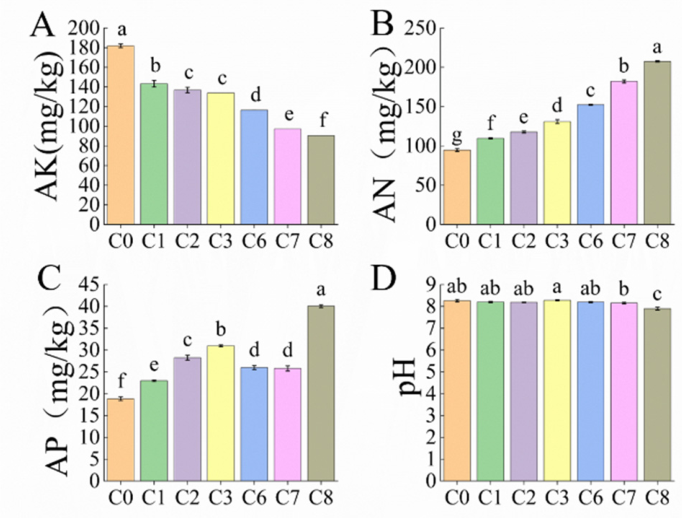
This study systematically analyzed the effects of continuous maize cropping years (C0–C8) on soil nutrient indicators, including AK, AN, AP, and pH (Figure 1). The AK content exhibited a significant and gradual decreasing trend (p < 0.01), from 181.92 ± 1.82 mg kg−1 in C0 to 90.36 ± 0.17 mg kg−1 in C8. In contrast, the AN content displayed a gradually increasing pattern opposite to that of AK (p < 0.01). The C0 treatment exhibited the lowest AN content (94.6 ± 1.92 mg kg−1), whereas the C8 group achieved the highest value (207 ± 0.91 mg kg−1). The AP content exhibited a nonlinear variation pattern. The C0 treatment recorded the lowest AP content (18.84 ± 0.40 mg kg−1), the C3 treatment reached an initial peak (30.98 ± 0.21 mg kg−1), the C6–C7 treatments showed a modest decline, and the C8 treatment increased significantly (40.07 ± 0.34 mg kg−1, p < 0.01). The pH values remained within a weakly alkaline range throughout the experiment (7.5–8.2). The pH values of the C0–C6 treatments were relatively stable (approximately 8.0), whereas the C7 treatment showed a slight decline (approximately 7.8) and the C8 treatment decreased further to 7.5. The pH value of the C8 treatment was significantly lower than that of the C0–C6 treatments (p < 0.01).

3.2. Maize Yields

The annual maize yields for each sample plot are presented in Table 1. In the longer-duration plots, yield declined over time. In C6, yield reached 6.03 ± 0.09 t ha−1 in Year 3 (2022) and decreased to 3.25 ± 0.12 t ha−1 by Year 6 (2025), representing a 46.1% reduction relative to the within-plot peak. In C7, yield declined from 5.11 ± 0.14 t ha−1 to 2.75 ± 0.10 t ha−1 by Year 7. In C8, yield peaked at 5.67 ± 0.10 t ha−1 in Year 2 (2019) and declined to 2.57 ± 0.07 t ha−1 by Year 8 (2025), corresponding to a 54.7% reduction. Overall, the longer-duration plots showed substantial yield decline with increasing years of continuous cropping.

3.3. Diversity of Soil Bacterial Communities

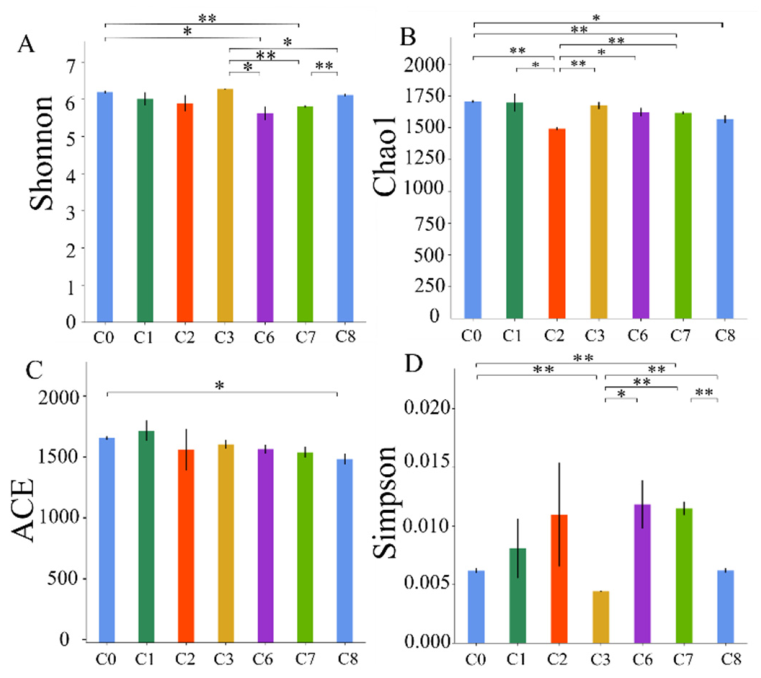
Bacterial alpha diversity varied across the chronosequence (Figure 2). Shannon diversity increased initially, peaked at C3 (6.3 ± 0.1, p < 0.05), declined at C6 (5.6 ± 0.2, p < 0.05), then increased again at C7–C8. Chao1 richness declined at C2, recovered to higher levels at C3, and then varied across the later treatments. ACE richness was stable across most treatments but decreased significantly at C8. Simpson dominance showed the inverse pattern of Shannon diversity. The lowest dominance (highest diversity) occurred at C3 (0.0044 ± 0.0001), while the highest dominance (lowest diversity) occurred at C6 (0.0118 ± 0.0002).
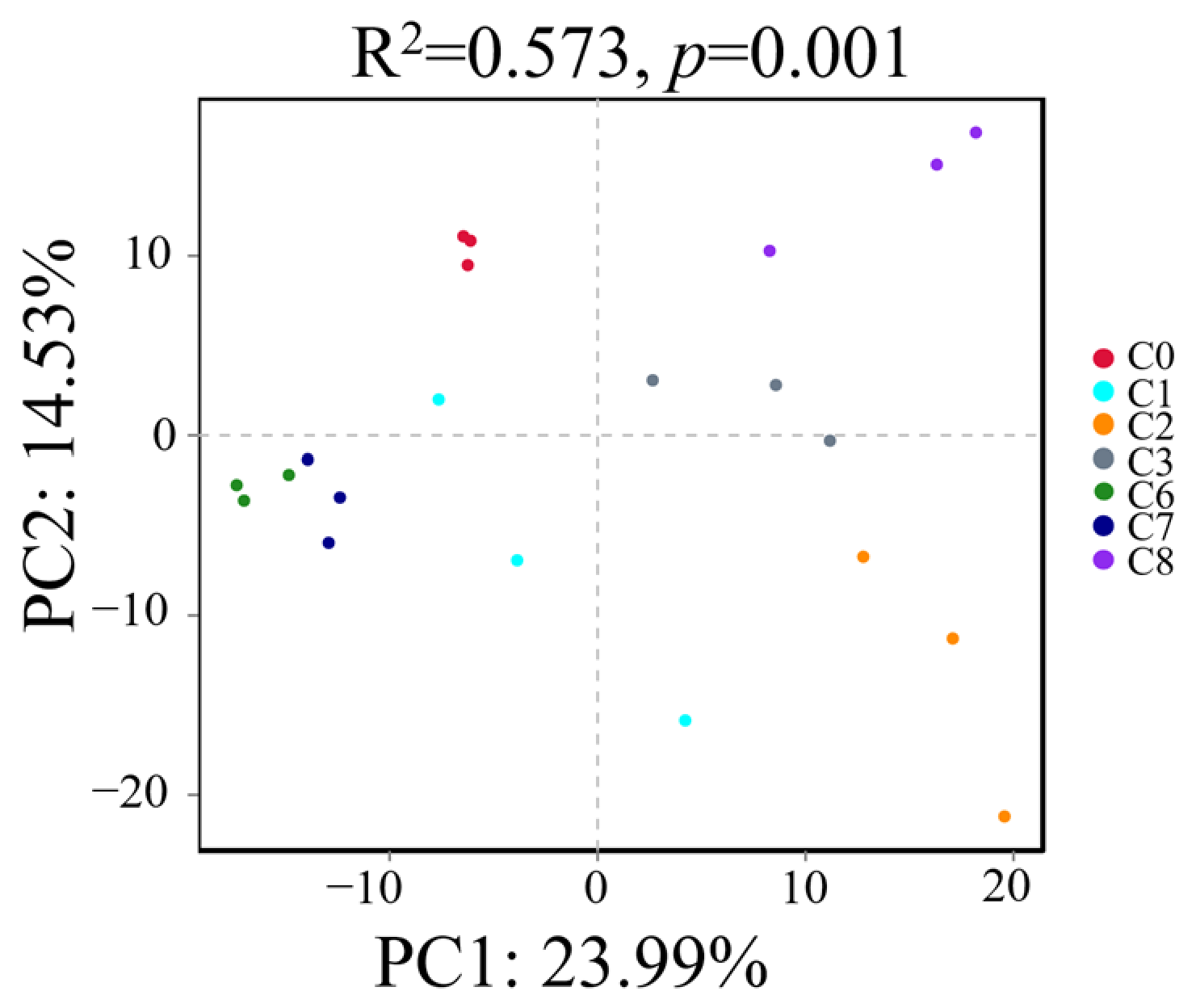
Principal coordinate analysis (PCoA) showed separation among treatments (Figure 3). PC1 explained 23.99% of the community variation and PC2 explained 14.35%, cumulatively accounting for 38.34% of the total variation. C3 samples were separated from other groups and were predominantly distributed in the positive region of the PC1 axis. C6 and C7 treatments were differentiated along PC2. These findings indicate that continuous cropping duration drives spatial heterogeneity in bacterial community composition.

3.4. Microbial Community Composition and Structure

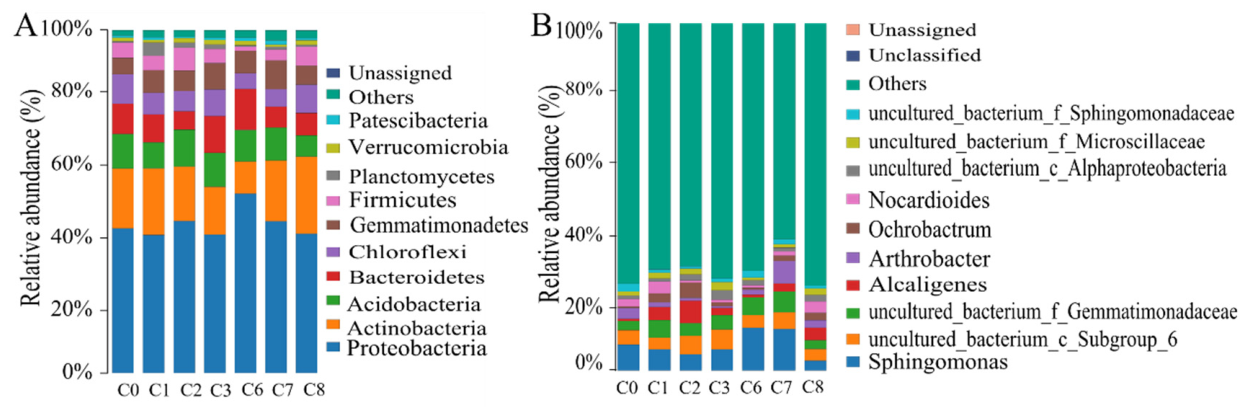
At the phylum level, Proteobacteria dominated all treatments, with relative abundances ranging from 38% to 52% (Figure 4A). The highest abundance (52%) was observed in C3, while the lowest (38%) was recorded in C7. Actinobacteria constituted the second most dominant phylum (18–28%), with its abundance significantly increasing in C7 and C8. Acidobacteria and Bacteroidetes exhibited higher relative abundances at C6. Other phyla (including Firmicutes, Planctomycetes, Verrucomicrobia, Patescibacteria, Others, and Unassigned) collectively accounted for less than 15% of the total community.
At the genus level, “Others” (unclassified genera) dominated all treatments, with relative abundances ranging from 75% to 90% (Figure 4B). The abundance of uncultured Sphingomonadaceae was relatively high in the C0 and C1, but subsequently decreased significantly with increasing cropping duration. Sphingomonas maintained relatively high abundances in the C0–C2, but reached its lowest level in C6. In contrast, Arthrobacter exhibited a significant increasing trend from C6 to C8. Genera such as Gemmatimonadaceae and uncultured bacterium Subgroup_6 displayed transient peaks in C3.

3.5. Correlation Analysis of Soil Nutrients, Maize Yields, and Bacterial Community Structure

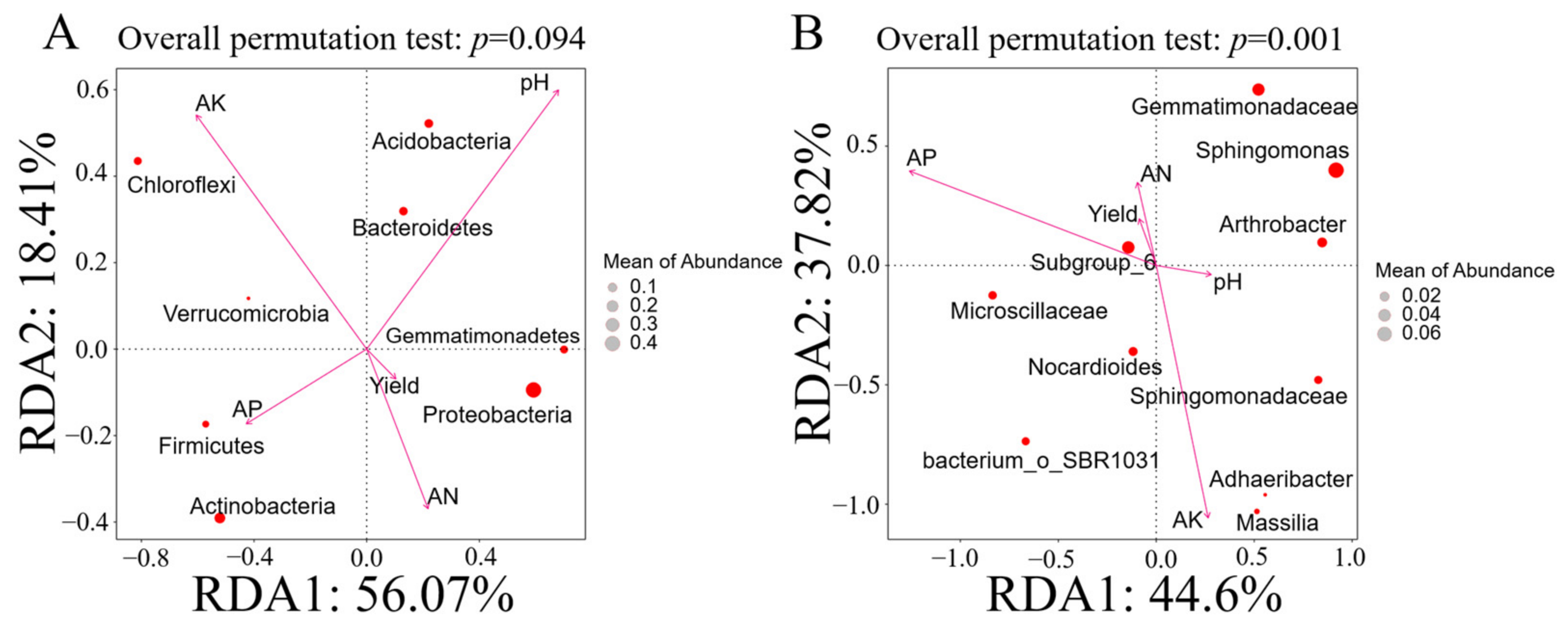
Redundancy analysis (RDA) was performed to explore the relationships between soil environmental factors and bacterial community composition (Figure 5). At the phylum level, the first two axes cumulatively explained 74.48% of the total variation, whereas the overall permutation was marginally significant (p = 0.094). pH was positively correlated with Actinobacteria and Gemmatimonadetes, and negatively correlated with Chloroflexi and Verrucomicrobia. Available phosphorus (AP) and maize yield showed positive correlations with Proteobacteria, Bacteroidetes, Firmicutes, and Acetobacterales.
At the genus level, the first two axes explained most of the constrained variation, and the overall model was significant (p = 0.001). Microscillaceae showed a positive association with soil nutrients and yield, whereas SBR1031 and Gemmata tended to show negative associations with most environmental factors. Notably, different abundance groups of the genus Arthrobacter showed divergent response directions to environmental factors: some groups were positively correlated with pH, available phosphorus, and maize yield, while others exhibited negative correlations or insensitive responses. Overall, the genus level revealed a more refined microbe-environment association pattern than the phylum level.

3.6. Differences in Predicted Phenotypic Functions

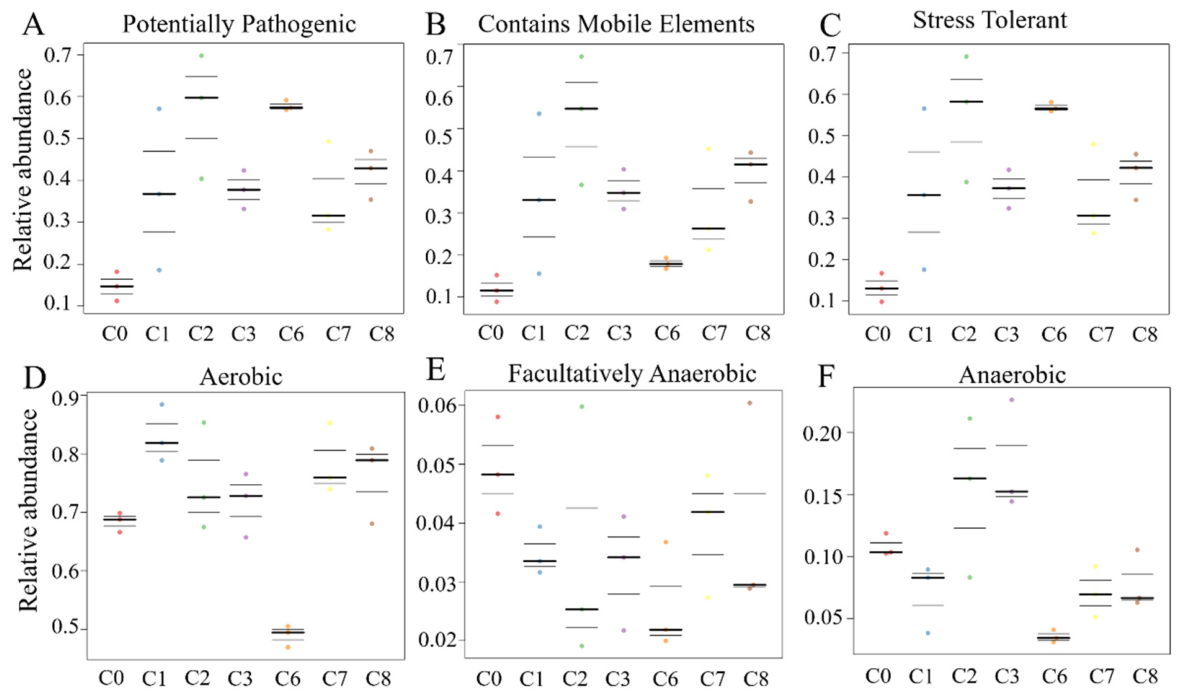
BugBase-predicted phenotypes varied across the chronosequence (Figure 6). Taxa with predicted potentially pathogenic and containing mobile elements exhibited highly similar trends, with higher relative abundances in C1, lowest abundances in C3, and stable levels in C6 and C8. Potential facultatively anaerobic groups declined from C0 to C3 and then remained relatively stable. Predicted anaerobic groups were highest at C3, lowest at C6, and increased again at C7–C8. Potential aerobic taxa showed a distinct response. Their abundance was significantly lowest in C6, highest in C1, and remained elevated in C7–C8.

4. Discussion

4.1. Changes in Soil Nutrients and Maize Yields Under Continuous Maize Cropping

Continuous maize cropping was associated with progressive depletion of AK, accumulation of AN, nonlinear variation in AP, and late-stage declines in soil pH. These patterns are broadly consistent with long-term nutrient removal by crop harvest, residue accumulation, and gradual changes in soil chemical processes under repeated monocropping. The decline in AK likely reflects crop removal and leaching losses, as maize has a high potassium demand. In contrast, the steady increase in AN may reflect the accumulation of mineralizable nitrogen associated with crop residue inputs and altered nitrogen transformation processes [15]. Therefore, the inverse trend between AK and AN should be interpreted as two independent responses to long-term continuous cropping: K depletion due to crop uptake, and N enrichment due to residue accumulation.
Based on yield data from 0 to 8 years of continuous maize cropping, Treatment C6 peaked in Year 3 (6.03 ± 0.09 t ha−1) before declining 46.1% by Year 6. Treatment C7 fluctuated downward from 5.11 ± 0.14 t ha−1 to 2.75 ± 0.10 t ha−1 in Year 7 (p < 0.05). Treatment C8 peaked in Year 2 (5.67 ± 0.10 t ha−1) and declined progressively to 2.57 ± 0.07 t ha−1 by Year 8, a 54.7% reduction. These findings align with the well-documented continuous maize yield penalty. Gentry et al. [16] reported that the yield penalty increased by 186% from year 3 to 5 and by 268% from year 3 to 7, consistent with the 54.7% decline observed in C8 by year 8. Sible et al. [11] found an average CMYP of 2570 kg ha−1 under no till, which was reduced by ~50.7% with integrated residue management, suggesting that the 46.1–54.7% reductions in C6–C8 are cumulative without active residue management. Al-Mezori et al. [17] and Laird et al. [18] also observed progressive yield declines under continuous corn, with the magnitude and timing of the penalty varying by site conditions and residue management. The substantial yield declines in this study (46.1–54.7% over 6–8 years) agree with previous reports, confirming that long-term continuous maize production without rotation or active residue management leads to progressively increasing yield losses.

4.2. Shifts in Soil Bacterial Diversity and Bacterial Community Composition

Soil bacterial alpha diversity changed nonlinearly along the continuous maize cropping chronosequence. Shannon diversity increased from C0 to C3, declined at C6, and then partially recovered at C7–C8, whereas Simpson dominance showed the opposite pattern. The partial recovery at C7–C8, with no significant difference between C8 and C0, raises the possibility of a stabilization phase analogous to soil suppressiveness [19,20]. Chao1 richness dipped at C2 and recovered at C3, whereas ACE richness remained stable across most treatments and declined significantly only at C8. This discrepancy likely reflects the greater sensitivity of ACE to rare species loss [21], suggesting that bacterial diversity did not decline monotonically with increasing cropping duration.
Continuous maize cropping was associated with directional changes in bacterial community composition. At the phylum level, Proteobacteria declined in the later treatments, whereas Actinobacteria increased in C7 and C8. At the genus level, Sphingomonas decreased with cropping duration, whereas Arthrobacter increased in the later treatments. The decline of Proteobacteria and the concurrent enrichment of Actinobacteria under long-term cropping have been widely observed in stressed or nutrient-limited soils. Actinobacteria possess traits conferring high stress tolerance, including the ability to degrade recalcitrant organic compounds, produce antibiotics, and form spores [22]. The significant increase in Arthrobacter in C6–C8 is particularly noteworthy, as this genus is known for its exceptional survival under nutrient deprivation and oxidative stress [23]. The later enrichment of Actinobacteria and Arthrobacter is consistent with previous reports that these taxa are frequently abundant in soils subjected to long-term disturbance or resource limitation. However, the present study did not directly measure stress physiology or functional activity, and these compositional patterns should therefore be interpreted cautiously. At minimum, the results indicate that continuous maize cropping was associated with a shift in dominant bacterial groups along the chronosequence.

4.3. Soil Variables and Bacterial Community Associations

The RDA results indicate that soil pH, AP and yield covaried with bacterial community composition, particularly at the genus level. Microscillaceae showed positive associations with soil nutrients and yield, while low-abundance taxa (SBR1031, Gemmata) tended to be negatively correlated with most environmental factors. Notably, different abundance groups of Arthrobacter exhibited divergent responses to pH, AP, and yield, suggesting ecological niche differentiation within this genus. A previous study observed decreasing abundances of Proteobacteria and Bacteroidetes with prolonged continuous cropping [24], which partially contrasts with our findings and may reflect differences in soil properties and cropping duration. The negative Chloroflexi–yield relationship and the positive Gemmatimonadetes–pH association observed in our study are consistent with previous findings [24,25]. The negative correlation of Verrucomicrobia with pH and yield is supported by previous work [6], which reported that long-term continuous maize cropping substantially reshapes microbial community structure. The high abundance and positive association of Microscillaceae with nutrients and yield is a novel finding, suggesting a key role in maintaining soil fertility under continuous cropping. The present data therefore support the conclusion that bacterial community variation was associated with soil chemical variation along the chronosequence. Further experimental work will be needed to confirm whether the observed soil variables are true drivers of community change.

4.4. Predicted Phenotypic Shifts and Study Limitations

The BugBase-predicted phenotype categories also showed nonlinear patterns across the chronosequence. Predicted potentially pathogenic and MGE-associated taxa peaked at C1, then declined and stabilized from C6 onward. The transient enrichment of potential pathogens at C1 aligns with the early disturbance phase often observed following the initiation of monocropping, during which host-specific pathogens accumulate in the absence of rotational hosts, as observed in soybean and peanut systems [26,27]. The subsequent decline of both groups at C3 and their stabilization from C6 onward may indicate the development of soil suppressiveness [20]. Predicted aerobic taxa were lowest at C6, while anaerobic taxa also dropped to their lowest at C6. Potential facultatively anaerobic taxa declined progressively from C0 to C3 and stabilized thereafter. Similar redox-mediated shifts in bacterial functional groups have been documented in paddy soils and wetland ecosystems [28]. Although we did not measure redox potential or O2, we hypothesize that it might reflect unstable oxygen conditions (redox fluctuation). Predicted stress-tolerant taxa exhibited a biphasic enrichment at C3 and C6, and moderate stabilization at C7–C8. This pattern indicates that intermediate cropping durations (3 and 6 years) impose the greatest environmental stress, selecting for hardy taxa such as Arthrobacter, whereas longer-term cropping may allow for partial functional recovery or community reorganization. The decline in stress-tolerant taxa at C7–C8, despite the continued presence of stressors, may reflect a shift from active stress response to community-level adaptation or the establishment of a more balanced microbial network with reduced reliance on individual stress-tolerant keystone taxa [19].
The later-stage patterns observed at C7–C8 may reflect partial microbial community reorganization or stabilization under prolonged continuous cropping. One possible explanation is that long-term monoculture favors taxa with antagonistic or regulatory potential, as reported in some suppressive soils; however, the present study did not directly measure disease suppression, pathogen inhibition, or suppressive function. Therefore, these data do not demonstrate the development of soil suppressiveness, but are only consistent with the possibility of partial microbial stabilization. Future studies combining greenhouse bioassays, metagenomics, and direct pathogen suppression assays will be needed to determine whether these later-stage communities acquire suppressive properties or other ecologically important functions.

5. Conclusions

Continuous maize cropping was associated with nonlinear changes in soil nutrient status, maize yield, and rhizosphere bacterial community structure along the studied chronosequence. Available potassium declined steadily, whereas alkali-hydrolyzable nitrogen increased and available phosphorus changed nonlinearly. Yield declined substantially within the longer-duration plots. Bacterial diversity and community composition also changed nonlinearly, with an increase up to C3, a marked shift by C6, and partial stabilization in C7–C8. However, because years 4 and 5 were not sampled, the transition between C3 and C6 cannot be resolved precisely. Likewise, because the study was based on a chronosequence and relied in part on 16S-based phenotype prediction, causal and mechanistic interpretations should remain cautious. Our findings support a nonlinear response of the rhizosphere bacterial community to prolonged continuous maize cropping.

Author Contributions

Conceptualization, M.L. and R.Z.; methodology, M.L., H.X., Z.W. and Y.L.; software, R.Z. and Z.W.; validation, formal analysis, M.L., R.Z. and Z.W.; investigation, R.Z., H.X. and Z.W.; resources, R.Z. and Y.L.; data curation, M.L., R.Z. and Z.W.; writing—original draft preparation, M.L., R.Z. and Z.W.; writing—review and editing, M.L., H.X. and Y.L.; visualization, R.Z. and Z.W.; supervision, M.L. and R.Z.; project administration, M.L. and R.Z.; funding acquisition, M.L. All authors have read and agreed to the published version of the manuscript.

Funding

This research was funded by the Science and Technology Department of Qinghai province (2023-ZJ-956Q) and the National Natural Science Foundation of China (32260284).

Institutional Review Board Statement

Not applicable.

Informed Consent Statement

Not applicable.

Data Availability Statement

The original contributions presented in this study are included in the article. Further inquiries can be directed to the corresponding author.

Conflicts of Interest

The authors declare no conflicts of interest.

Abbreviations

The following abbreviations are used in this manuscript:
ANalkali-hydrolyzable nitrogen
APavailable phosphorus
AKavailable potassium

References

  1. Shiferaw, B.; Prasanna, B.M.; Hellin, J.; Bänziger, M. Crops that feed the world 6. Past successes and future challenges to the role played by maize in global food security. Food Secur. 2011, 3, 307–327. [Google Scholar] [CrossRef]
  2. Wang, K.; Lu, Q.; Dou, Z.; Chi, Z.; Cui, D.; Ma, J.; Wang, G.; Kuang, J.; Wang, N.; Zuo, Y. A review of research progress on continuous cropping obstacles. Front. Agric. Sci. Eng. 2024, 11, 253–270. [Google Scholar] [CrossRef]
  3. Bennett, A.J.; Bending, G.D.; Chandler, D.; Hilton, S.; Mills, P. Meeting the demand for crop production: The challenge of yield decline in crops grown in short rotations. Biol. Rev. 2012, 87, 52–71. [Google Scholar] [CrossRef]
  4. Huang, L.F.; Song, L.X.; Xia, X.J.; Mao, W.H.; Shi, K.; Zhou, Y.H.; Yu, J.Q. Plant-soil feedbacks and soil sickness: From mechanisms to application in agriculture. J. Chem. Ecol. 2013, 39, 232–242. [Google Scholar] [CrossRef]
  5. Berendsen, R.L.; Pieterse, C.M.; Bakker, P.A. The rhizosphere microbiome and plant health. Trends Plant Sci. 2012, 17, 478–486. [Google Scholar] [CrossRef] [PubMed]
  6. Han, Y.L.; Yang, F.K.; He, S.P.; Guo, J.C.; Zou, Y.; Shang, Y.X.; Liu, P.; Wang, P.Y.; Wang, X.; Zhao, Z.Y.; et al. Convergent-divergent succession of soil microbial communities driven by continuous maize cropping duration via heterogeneous selection processes. Front. Microbiol. 2025, 16, 1618629. [Google Scholar] [CrossRef] [PubMed]
  7. Philippot, L.; Raaijmakers, J.M.; Lemanceau, P.; van der Putten, W.H. Going back to the roots: The microbial ecology of the rhizosphere. Nat. Rev. Microbiol. 2013, 11, 789–799. [Google Scholar] [CrossRef] [PubMed]
  8. Xiong, W.; Li, Z.; Liu, H.; Xue, C.; Zhang, R.; Wu, H.; Shen, Q. The effect of long-term continuous cropping of black pepper on soil bacterial communities as determined by 454 pyrosequencing. PLoS ONE 2015, 10, e0136946. [Google Scholar] [CrossRef]
  9. Jie, W.; Yang, D.; Yao, Y.; Guo, N. Effects of Rhizophagus intraradices on soybean yield and the composition of microbial communities in the rhizosphere soil of continuous cropping soybean. Sci. Rep. 2022, 12, 17390. [Google Scholar] [CrossRef]
  10. Zheng, R.; Wang, M.; Yu, R.; Xu, H.; Yang, W.; Miao, C.; Yang, J. Analysis of rhizosphere soil microbial community diversity in maize under different continuous cropping years. Jiangsu Agric. Sci. 2025, 53, 241–247. [Google Scholar]
  11. Sible, C.N.; Kent, A.D.; Margenot, A.J.; Below, F.E. Long-term continuous maize: Impacts on the soil microbiome and implications for residue management. Soil Sci. Soc. Am. J. 2024, 88, 1109–1126. [Google Scholar] [CrossRef]
  12. Adesemoye, A.O.; Kodati, S.; Watts, D.B.; Maharjan, B. Differential shifts in microbiome and pathogen populations associated with suppressive soil in long-term continuous corn field compared to rotation corn field. Appl. Soil Ecol. 2023, 192, 105092. [Google Scholar] [CrossRef]
  13. Bao, S. Soil Agrochemical Analysis, 3rd ed.; China Agricultural Press: Beijing, China, 2000. [Google Scholar]
  14. Liu, M.; Wang, Z.; Zhu, R.; Xie, H.; Lu, Y. Effects of fertilization and ridge furrow planting patterns on soil microbial communities, nutrient dynamics, and maize productivity. Biology 2026, 15, 551. [Google Scholar] [CrossRef] [PubMed]
  15. Jiang, Y.Z.; Liu, Q.L.; Zhang, Y.G.; Li, Z.H.; Zou, Y.; Zhu, J.W.; Shi, J.X.; Wang, P. Effect of crop rotation and continuous cropping on nitrogen mineralization characteristics in yellow cornfield. Int. J. Agric. Biol. 2018, 20, 1165–1170. [Google Scholar] [CrossRef]
  16. Gentry, L.F.; Ruffo, M.L.; Below, F.E. Identifying factors controlling the continuous corn yield penalty. Agron. J. 2013, 105, 1691–1699. [Google Scholar] [CrossRef]
  17. Al-Mezori, H.A.; Al-Saadawi, I.S.; Al-Hadithi, T.R. Allelopathic effects of corn residues on the subsequent corn crop. Allelopath. J. 1999, 6, 193–200. [Google Scholar]
  18. Laird, D.A.; Rogovska, N.; Fleming, P.; Karlen, D.; Rathke, S. Biochar mitigation of allelopathy induced yield loss in continuous maize. In Proceedings of the ASA, CSSA, and SSSA Annual Meetings, Cincinnati, OH, USA, 21–24 October 2012. [Google Scholar]
  19. Mendes, R.; Kruijt, M.; de Bruijn, I.; Dekkers, E.; van der Voort, M.; Schneider, J.H.M.; Piceno, Y.M.; DeSantis, T.Z.; Andersen, G.L.; Bakker, P.A.H.M.; et al. Deciphering the rhizosphere microbiome for disease-suppressive bacteria. Science 2011, 332, 1097–1100. [Google Scholar] [CrossRef] [PubMed]
  20. Weller, D.M.; Raaijmakers, J.M.; Gardener, B.B.M.; Thomashow, L.S. Microbial populations responsible for specific soil suppressiveness to plant pathogens. Annu. Rev. Phytopathol. 2002, 40, 309–348. [Google Scholar] [CrossRef]
  21. Chao, A.; Chiu, C.H. Species richness: Estimation and comparison. In Wiley StatsRef: Statistics Reference Online; John Wiley & Sons, Ltd.: Hoboken, NJ, USA, 2016; pp. 1–26. [Google Scholar]
  22. Barka, E.A.; Vatsa, P.; Sanchez, L.; Gaveau-Vaillant, N.; Jacquard, C.; Klenk, H.-P.; Clément, C.; Ouhdouch, Y.; van Wezel, G.P. Taxonomy, physiology, and natural products of Actinobacteria. Microbiol. Mol. Biol. Rev. 2016, 80, 1–43. [Google Scholar] [CrossRef]
  23. Mongodin, E.F.; Shapir, N.; Daugherty, S.C.; DeBoy, R.T.; Emerson, J.B.; Shvartzbeyn, A.; Radune, D.; Vamathevan, J.; Riggs, F.; Grinberg, V.; et al. Secrets of soil survival revealed by the genome sequence of Arthrobacter aurescens TC1. PLoS Genet. 2006, 2, e214. [Google Scholar] [CrossRef]
  24. Fu, W.J.; Zhao, Y.C. Non-synchronous response of rhizospheric and endophytic bacteria of maize to continuous cropping. Plant Nutr. Fertil. Sci. 2023, 29, 2108–2119. [Google Scholar]
  25. Akinola, S.A.; Ayangbenro, A.S.; Babalola, O.O. Metagenomic insight into the community structure of maize-rhizosphere bacteria as predicted by different environmental factors and their functioning within plant proximity. Microorganisms 2021, 9, 1419. [Google Scholar] [CrossRef]
  26. Li, X.G.; Ding, C.F.; Hua, K.; Zhang, T.L.; Zhang, X.X.; Wang, X.X. Soil sickness of peanuts is attributable to modifications in soil microbes induced by peanut root exudates rather than to direct allelopathy. Soil. Biol. Biochem. 2014, 78, 149–159. [Google Scholar] [CrossRef]
  27. Bai, L.; Cui, J.Q.; Jie, W.G.; Cai, B.Y. Analysis of the community compositions of rhizosphere fungi in soybean continuous cropping fields. Microbiol. China 2015, 42, 251–259. [Google Scholar] [CrossRef]
  28. Ludemann, H.; Arth, I.; Liesack, W. Spatial changes in the bacterial community structure along a vertical oxygen gradient in flooded paddy soil cores. Appl. Environ. Microbiol. 2000, 66, 754–762. [Google Scholar] [CrossRef] [PubMed]
Figure 1. Effects of continuous maize cropping on soil nutrients. (A) AK; (B) AN; (C) AP; (D) pH. Note: Different lowercase letters above the box plots indicate significant differences among treatments at p < 0.01.
Agriculture 16 00972 g001
Figure 2. Alpha-diversity of soil bacterial communities in soil of different continuous cropping years, showing the Shannon index (A), Chao1 richness estimator (B), ACE richness estimator (C), and Simpson index (D). * and ** represent statistically significant differences at p < 0.05 and 0.01, respectively.
Agriculture 16 00972 g002
Figure 3. Principal coordinate analysis (PCoA) of bacterial communities based on binary Jaccard distances.
Agriculture 16 00972 g003
Figure 4. The relative abundance of soil bacterial phyla (A) and genus (B) communities in rhizosphere soil of different continuous cropping years.
Agriculture 16 00972 g004
Figure 5. Redundancy analysis (RDA) showing associations between bacterial community composition and soil variables under different durations of continuous maize cropping. Panel (A) shows phylum-level ordination, and panel (B) shows genus-level ordination. Arrows indicate the direction and relative strength of associations with soil pH, AN, AP, AK, and maize yield.
Agriculture 16 00972 g005
Figure 6. BugBase-predicted phenotype categories of rhizosphere bacterial communities under different durations of continuous maize cropping. Panels show the relative abundances of (A) predicted potentially pathogenic, (B) mobile element-containing, (C) stress-tolerant, (D) aerobic, (E) facultatively anaerobic, and (F) anaerobic groups.
Agriculture 16 00972 g006
Table 1. Annual maize grain yield records for chronosequence plots representing different durations of continuous maize cropping.
YearMaize Yields (t ha−1)
C1C2C3C6C7C8
2018 5.30 ± 0.09 a
2019 5.11 ± 0.14 a5.67 ± 0.10 b
2020 5.39 ± 0.15 b3.51 ± 0.12 b4.54 ± 0.09 c
2021 5.47 ± 0.10 b4.50 ± 0.13 c4.10 ± 0.08 d
2022 6.03 ± 0.09 a4.72 ± 0.14 d3.83 ± 0.05 e
2023 5.37 ± 0.14 a3.49 ± 0.06 c4.00 ± 0.13 e3.50 ± 0.08 f
2024 5.24 ± 0.16 a3.83 ± 0.08 b3.43 ± 0.06 c3.32 ± 0.11 f3.05 ± 0.16 g
20255.81 ± 0.113.75 ± 0.09 b4.36 ± 0.10 c3.25 ± 0.12 d2.75 ± 0.10 g2.57 ± 0.07 e
Note: Blank cells indicate years before plot establishment. Values within each column describe the annual yield trajectory of that chronosequence plot. Different lowercase letters indicate significant differences among years within the same plot (p < 0.05) and should not be interpreted as a complete treatment comparison across all calendar years.
Disclaimer/Publisher’s Note: The statements, opinions and data contained in all publications are solely those of the individual author(s) and contributor(s) and not of MDPI and/or the editor(s). MDPI and/or the editor(s) disclaim responsibility for any injury to people or property resulting from any ideas, methods, instructions or products referred to in the content.